EP3318552B1 - Procédé de purification de méthionine - Google Patents
Procédé de purification de méthionine Download PDFInfo
- Publication number
- EP3318552B1 EP3318552B1 EP16817231.0A EP16817231A EP3318552B1 EP 3318552 B1 EP3318552 B1 EP 3318552B1 EP 16817231 A EP16817231 A EP 16817231A EP 3318552 B1 EP3318552 B1 EP 3318552B1
- Authority
- EP
- European Patent Office
- Prior art keywords
- methionine
- resin
- desorbent
- adsorption
- purifying
- Prior art date
- Legal status (The legal status is an assumption and is not a legal conclusion. Google has not performed a legal analysis and makes no representation as to the accuracy of the status listed.)
- Active
Links
Images
Classifications
-
- C—CHEMISTRY; METALLURGY
- C07—ORGANIC CHEMISTRY
- C07C—ACYCLIC OR CARBOCYCLIC COMPOUNDS
- C07C319/00—Preparation of thiols, sulfides, hydropolysulfides or polysulfides
- C07C319/26—Separation; Purification; Stabilisation; Use of additives
- C07C319/28—Separation; Purification
-
- B—PERFORMING OPERATIONS; TRANSPORTING
- B01—PHYSICAL OR CHEMICAL PROCESSES OR APPARATUS IN GENERAL
- B01D—SEPARATION
- B01D15/00—Separating processes involving the treatment of liquids with solid sorbents; Apparatus therefor
- B01D15/08—Selective adsorption, e.g. chromatography
- B01D15/10—Selective adsorption, e.g. chromatography characterised by constructional or operational features
- B01D15/12—Selective adsorption, e.g. chromatography characterised by constructional or operational features relating to the preparation of the feed
-
- B—PERFORMING OPERATIONS; TRANSPORTING
- B01—PHYSICAL OR CHEMICAL PROCESSES OR APPARATUS IN GENERAL
- B01D—SEPARATION
- B01D15/00—Separating processes involving the treatment of liquids with solid sorbents; Apparatus therefor
- B01D15/08—Selective adsorption, e.g. chromatography
- B01D15/26—Selective adsorption, e.g. chromatography characterised by the separation mechanism
- B01D15/265—Adsorption chromatography
-
- B—PERFORMING OPERATIONS; TRANSPORTING
- B01—PHYSICAL OR CHEMICAL PROCESSES OR APPARATUS IN GENERAL
- B01D—SEPARATION
- B01D15/00—Separating processes involving the treatment of liquids with solid sorbents; Apparatus therefor
- B01D15/08—Selective adsorption, e.g. chromatography
- B01D15/42—Selective adsorption, e.g. chromatography characterised by the development mode, e.g. by displacement or by elution
- B01D15/424—Elution mode
- B01D15/426—Specific type of solvent
-
- B—PERFORMING OPERATIONS; TRANSPORTING
- B01—PHYSICAL OR CHEMICAL PROCESSES OR APPARATUS IN GENERAL
- B01J—CHEMICAL OR PHYSICAL PROCESSES, e.g. CATALYSIS OR COLLOID CHEMISTRY; THEIR RELEVANT APPARATUS
- B01J20/00—Solid sorbent compositions or filter aid compositions; Sorbents for chromatography; Processes for preparing, regenerating or reactivating thereof
- B01J20/281—Sorbents specially adapted for preparative, analytical or investigative chromatography
- B01J20/282—Porous sorbents
- B01J20/285—Porous sorbents based on polymers
-
- C—CHEMISTRY; METALLURGY
- C07—ORGANIC CHEMISTRY
- C07C—ACYCLIC OR CARBOCYCLIC COMPOUNDS
- C07C323/00—Thiols, sulfides, hydropolysulfides or polysulfides substituted by halogen, oxygen or nitrogen atoms, or by sulfur atoms not being part of thio groups
- C07C323/50—Thiols, sulfides, hydropolysulfides or polysulfides substituted by halogen, oxygen or nitrogen atoms, or by sulfur atoms not being part of thio groups containing thio groups and carboxyl groups bound to the same carbon skeleton
- C07C323/51—Thiols, sulfides, hydropolysulfides or polysulfides substituted by halogen, oxygen or nitrogen atoms, or by sulfur atoms not being part of thio groups containing thio groups and carboxyl groups bound to the same carbon skeleton having the sulfur atoms of the thio groups bound to acyclic carbon atoms of the carbon skeleton
- C07C323/57—Thiols, sulfides, hydropolysulfides or polysulfides substituted by halogen, oxygen or nitrogen atoms, or by sulfur atoms not being part of thio groups containing thio groups and carboxyl groups bound to the same carbon skeleton having the sulfur atoms of the thio groups bound to acyclic carbon atoms of the carbon skeleton the carbon skeleton being further substituted by nitrogen atoms, not being part of nitro or nitroso groups
- C07C323/58—Thiols, sulfides, hydropolysulfides or polysulfides substituted by halogen, oxygen or nitrogen atoms, or by sulfur atoms not being part of thio groups containing thio groups and carboxyl groups bound to the same carbon skeleton having the sulfur atoms of the thio groups bound to acyclic carbon atoms of the carbon skeleton the carbon skeleton being further substituted by nitrogen atoms, not being part of nitro or nitroso groups with amino groups bound to the carbon skeleton
Definitions
- the present invention relates to the field of chemical industry, and more particularly, to a process for purifying methionine.
- Methionine is closely related to the metabolism of various sulfur-containing compounds in an organism. Methionine deficiency can cause a loss of appetite, retarded growth or no gain in body weight, renal enlargement and accumulation of iron in the liver, and the like, finally leading to hepatic necrosis or fibrosis.
- Another type of methionine is a hydroxyl derivative of methionine (that is, liquid methionine), which serves as a methionine nutritional supplement for promoting the growth and development of animals when widely used as a feed additive.
- Both methionine and liquid methionine are an amino acid, and differ only in the ⁇ position, at which the methionine is linked to -NH 2 and the liquid methionine is linked to -OH.
- ⁇ pl isoelectric point
- methionine exists as a cation
- methionine exists as an anion
- the solubility is the minimum.
- Methionine is soluble in water, but poorly soluble in non-polar solvents, and has a rather high melting point.
- An aqueous solution of methionine is similar in nature to an aqueous solution with a high dipole moment.
- methionine can be well separated from a salt by-product by selectively adsorbing methionine onto a non-polar macroporous adsorption resin by making full use of the differential binding to the resin of methionine and salt compounds.
- the method for producing methionine in industry is mainly Hydantion
- the method for producing liquid methionine is mainly acrolein method. Both methods have the process requirement of separating the methionine solution from a salt by-product during the production process. There is no effective desalination means in the existing production methods, resulting in the eduction of a large amount of salt substances accompanying the crystallization of the product, thereby affecting the quality and yield of the product, and increasing the production costs of methionine.
- Chinese Patent No. 2013103178492 entitled “METHOD AND APPARATUS FOR REMOVING IMPURITIES IN SECONDARY METHIONINE MOTHER LIQUOR” discloses a method and an apparatus for removing impurities in a secondary methionine mother liquor by using diatomaceous earth, activated carbon or activated clay. These adsorbents have low adsorption efficiency, and cannot be recycled effectively after adsorption, resulting in secondary pollution to the environment and thus being unsuitable for industrial applications.
- 2013101947095 entitled “PROCESS FOR PRODUCING METHIONINE” discloses a process for separating a methionine crystallization mother solution, in which the methionine crystallization mother solution is separated by a continuous chromatographic separation system filled with a sodium or potassium chromatography resin, to obtain a methionine solution and an inorganic salt solution.
- This method is only applicable to a crystallization mother liquor with a lower methionine content and not validated for the separation of a high content of a methionine solution from a salt by-product in industrialized production, and no effective solution is provided.
- SU914548B discloses the chromatographic purification of a methionine solution whereby methionine is isolated from inorganic salts present in the solution by passage on an ion-exchange resin, typically Dowex A-1 (ion-exchange resin) resin or ANKB-50 resin (polyampholyte resin).
- an ion-exchange resin typically Dowex A-1 (ion-exchange resin) resin or ANKB-50 resin (polyampholyte resin).
- the pH of the solution is between 5 and 13, methionine is adsorbed and then released by a solution of aqueous ammonia.
- WO95/14002A1 discloses the recovery of an amino-acid such as methionine by successive chromatography steps comprising contacting a solution comprising the amino-acid with a cation-exchange resin at a pH which is below the isoelectric point of said amino-acid - below5.74 for methionine), wherein said amino-acid binds to the resin and is then released by application of an appropriate eluent.
- the mother liquor comprising still methionine and other salts is treated by a chromatographic adsorbent in order to separate them.
- the resin is a macroporous ion-exchange resin, preferably of cation type.
- An objective of the present invention is to provide a process for purifying methionine.
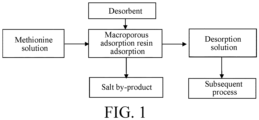
- Methionine is separated from a salt by-product by using a macroporous adsorption resin, in which the methionine is adsorbed onto the macroporous adsorption resin, and then the methionine is recovered by desorbing from the resin using a desorbent; and the salt by-product is not absorbed onto the macroporous adsorption resin during the adsorption process, but enters an effluent resulting from the adsorption.
- the process mainly comprises the following steps:
- the methionine comprises methionine and a hydroxyl derivative of methionine (that is, liquid methionine).
- the salt by-product is one of sodium carbonate, sodium sulfate, ammonium sulfate, potassium carbonate, or potassium sulfate, or a mixture of two or more thereof.
- the methionine solution to be adsorbed is adjusted to pH 1.0-10.0, preferably, pH 1.0-5.0, and more preferably, pH 2.0-3.0.
- the methionine solution is flowed through the macroporous adsorption resin layer at a flow rate of 1-10 BV/h, preferably, 1-5 BV/h, and more preferably, 1-3 BV/h.
- the desorbent is one of sodium hydroxide, hydrochloric acid, sodium chloride, aqueous ammonia, methanol, ethanol, i-propanol, or acetone.
- the concentration of the desorbent is 1-10% (w/w), preferably, 2-8% (w/w), and more preferably, 4-8% (w/w).
- the volume of the desorbent for the resin is 1-3 BV.
- the flow rate of the desorbent for the resin is 1-5 BV/h.
- the methionine comprises methionine and a hydroxyl derivative of methionine
- the salt by-product is one of sodium carbonate, sodium sulfate, ammonium sulfate, potassium carbonate, or potassium sulfate, or a mixture of two or more thereof.
- the methionine solution to be adsorbed is adjusted to pH 2.0-3.0; and then the methionine solution is flowed through the macroporous adsorption resin layer at a flow rate of 1-3 BV/h.
- the desorbent is selected from sodium hydroxide, potassium hydroxide, hydrochloric acid, sodium chloride, aqueous ammonia, methanol, ethanol, i-propanol, and acetone.
- the concentration of the desorbent is 4-8% w/w;
- the volume of the desorbent for the resin is 1-3 BV.
- the flow rate of the desorbent for the resin is 1-5 BV/h.
- BV refers to a volume of a resin bed loaded in a resin column, that is, a bed volume, referred to as BV in short.
- 1 BV refers to 1-fold bed volume
- 2 BV refers to 2-fold bed volumes.
- the present invention relates to a process for purifying methionine. Specifically, a methionine product having a purity of up to 99% is obtained by separating methionine from a salt by-product through a process comprising adsorption and desorption using a macroporous adsorption resin, where the methionine content in the salt by-product is ⁇ 0.03%.
- the yield of methionine extracted with the resin is 2 98% (w/w).
- FIG. 1 is a specific implementation of a process according to the present invention.
- the present invention is further described by way of examples, in which the methionine solution used is available from two enterprises in Chongqing and Nanjing, respectively.
- the implementation process was specifically the same as that in Example 1, in which the influence of different pH values of the methionine solutions on the adsorption capacity of the resin was mainly investigated, where the concentrations not specifically given in the experiments were all concentrations in percentages by weight.
- Methionine content 2.80% (w/w), ammonium sulfate content: 43.5% (w/w), and potassium carbonate content: 2.1% (w/w).
- Feed volume 7 BV, and feed flow rate: 1 BV/h. 5 portions of XDA-1 resin were prepared, each portion containing 100 ml resin.
- the methionine solution was adjusted to pH 1.0, 3.0, 7.0, 9.0, and 10.0 respectively with a 4% (w/w) sodium hydroxide or a 4% (w/w) sulfuric acid solution, and then subjected to an adsorption comparison test.
- Adsorption capacity of resin (Methionine content in the feed * Feed volume - Methionine content in the effluent * Effluent volume)/Resin volume
- Example pH of mother solution Adsorption capacity of resin (g/L)
- Example 3 1.0 192.1
- Example 5 3.0 194.1
- Example 6 5.0 172.5
- Example 8 9.0 102.1
- the implementation process was specifically the same as that in Example 1, in which the influence of different adsorption rates on the adsorption capacity of the resin was mainly investigated, where the concentrations not specifically given in the experiments were all concentrations in percentages by weight.
- Methionine content 3.28% (w/w), sodium sulfate content: 40.19% (w/w), pH 2.40.
- Feed volume 7 BV. 5 portions of XDA-200 resin were prepared, each portion containing 100 ml resin. The resin adsorption was carried out at various flow rates.
- the implementation process was specifically the same as that in Example 1, in which the desorption rate of various desorbents and the quality of the desorption solution were mainly investigated, where the concentrations not specifically given in the experiments were all concentrations in percentages by weight.
- Methionine content 2.95% (w/w), ammonium sulfate content: 42.04% (w/w), pH 2.20.
- Feed volume 7 BV each.
- the methionine solution was flowed respectively through 7 portions of XDA-300 resin (each 100 ml) (manufactured by Xi'An Sunresin New Materials Co., Ltd) at a flow rate of 1 BV/h.
- the resin was desorbed by using 3 BV of 4% (w/w) sodium hydroxide, 4% (w/w) potassium hydroxide, 4% (w/w) hydrochloric acid, 4% (w/w) sodium chloride, 4% (w/w) aqueous ammonia, 4% (v/v) methanol, 4% (v/v) ethanol, 4% (v/v) i-propanol, and 4% (v/v) acetone at a flow rate of 1 BV/h respectively.
- Example Desorption solution Methionine concentration in the desorption solution (%) Ammonium sulfate concentration in the desorption solution (%) Desorption rate (%)
- Example 16 4% (w/w) sodium hydroxide 6.03 0.03 87.6
- Example 17 4% (w/w) potassium hydroxide 5.98 0.02 86.9
- Example 18 4% (w/w) hydrochloric acid 5.81 0.01 84.4
- Example 19 4% (w/w) sodium chloride 5.21 0 75.7
- Example 20 4% (w/w) aqueous ammonia 6.69 0.02 97.3
- Example 21 4 % (v/v) methanol 6.79 0.02 96.7
- Example 22 4% (v/v) ethanol 6.75 0.05 98.1
- Example 23 4% (v/v) i-propanol 6.84 0.02 99.4
- Example 24 4% (v/v) acetone 6.84 0.01 99.4
- the implementation process was specifically the same as that in Examples 16-24, in which the influences of different concentrations of a desorbent on the quality of the desorption solution and the desorption rate were mainly investigated.
- Methionine content 2.64% (w/w), ammonium sulfate content: 42.04% (w/w), pH 2.20.
- Feed volume 8 BV each.
- the methionine solution was flowed respectively through 4 portions of XDA-8G resin (each 100 ml) (manufactured by Xi'An Sunresin New Materials Co., Ltd) at a flow rate of 1 BV/h. After adsorption, the resin was desorbed by using 3 BV of 1% (w/w) aqueous ammonia, 2% (w/w) aqueous ammonia, 4% (w/w) aqueous ammonia, 8% (w/w) aqueous ammonia, and 10% (w/w) aqueous ammonia at a flow rate of 1 BV/h respectively.
- Example Desorption solution Methionine concentration in the desorption solution (%) Desorption rate (%)
- Example 25 1% (w/w) aqueous ammonia 6.03 85.59
- Example 26 2% (w/w) aqueous ammonia 6.69 95.02
- Example 27 4% (w/w) aqueous ammonia 6.97 99.00
- Example 28 8% (w/w) aqueous ammonia 6.95 98.73
- Example 29 10% (w/w) aqueous ammonia 6.55 93.04
- the implementation process was specifically the same as that in Examples 16-24, in which the influences of different volumes of a desorbent on the desorption rate were mainly investigated.
- Methionine content 3.07%, ammonium sulfate content: 44.55%, pH 2.41. Feed volume: 7 BV each.
- the methionine solution was flowed respectively through 4 portions of XDA-200 resin (each 100 ml) (manufactured by Xi'An Sunresin New Materials Co., Ltd) at a flow rate of 1 BV/h. After adsorption, the resin was desorbed by using 1 BV of 4% (w/w) methanol, 2 BV of 4% (w/w) methanol, 3 BV of 4% (w/w) methanol, and 5 BV of 4% (w/w) methanol at a flow rate of 1 BV/h respectively.
- Example Volume of desorption solution Methionine concentration in the desorption solution (%) Desorption rate (%)
- Example 30 1 BV 12.47 58.03
- Example 31 2 BV 8.75 81.47
- Example 32 3 BV 6.99 97.79
- Example 33 5 BV 4.21 98.02
- the implementation process was specifically the same as that in Examples 16-24, in which the influences of different volumes of a desorbent on the desorption rate were mainly investigated.
- Methionine content 2.58% (w/w), ammonium sulfate content: 44.55% (w/w), pH 2.41.
- Feed volume 8 BV each.
- the methionine solution was flowed respectively through 4 portions of XDA-300 resin (each 100 ml) (manufactured by Xi'An Sunresin New Materials Co., Ltd) at a flow rate of 1 BV/h. After adsorption, the resin was desorbed by using 3 BV of 4% (w/w) acetone solution at a flow rate of 1 BV/h, 3 BV/h, 7 BV/h, and 10 BV/h respectively.
- Example Flow rate of the desorption solution (BV/h) Methionine concentration in the desorption solution (%) Desorption rate (%)
- Example 34 1 6.79 98.72
- Example 35 3 6.78 98.55
- Example 36 7 5.55 80.71
- Example 37 10 4.84 70.36
Landscapes
- Chemical & Material Sciences (AREA)
- Organic Chemistry (AREA)
- Analytical Chemistry (AREA)
- Chemical Kinetics & Catalysis (AREA)
- Organic Low-Molecular-Weight Compounds And Preparation Thereof (AREA)
Claims (14)
- Procédé de purification de méthionine, dans lequel
la méthionine est séparée d'un sous-produit de sel en utilisant une résine d'adsorption macroporeuse, où la méthionine est adsorbée sur la résine d'adsorption macroporeuse, et ensuite la méthionine est récupérée par désorption de la résine en utilisant un désorbant ; et le sous-produit de sel n'est pas absorbé sur la résine d'adsorption macroporeuse pendant le procédé d'adsorption, mais entre dans un effluent résultant de l'adsorption, le procédé comprenant principalement les étapes suivantes :1) d'écoulement d'une solution de méthionine, du haut vers le bas, à travers une couche de résine d'adsorption macroporeuse, et d'arrêt de l'adsorption sur la résine lorsque la teneur en méthionine dans un effluent de la colonne de résine est supérieure ou égale à 10% (p/p) de la teneur à une entrée, où l'effluent résultant de l'adsorption de résine est un sous-produit de sel ;2) de désorption de la résine : désorption, du haut vers le bas, de la résine qui a achevé l'adsorption dans l'étape 1) en utilisant un désorbant ; et3) de collecte de la solution de désorption et de détection de la quantité de méthionine. - Procédé de purification de méthionine selon la revendication 1, dans lequel la méthionine comprend de la méthionine et un dérivé hydroxyle de la méthionine.
- Procédé de purification de méthionine selon la revendication 1, dans lequel le sous-produit de sel est l'un parmi le carbonate de sodium, le sulfate de sodium, le sulfate d'ammonium, le carbonate de potassium ou le sulfate de potassium, ou un mélange de deux ou plus de ceux-ci.
- Procédé de purification de méthionine selon la revendication 1, dans lequel dans l'adsorption de résine de l'étape 1), la solution de méthionine à adsorber est ajustée à pH 1,0-10,0, et de préférence à pH 1,0-5,0.
- Procédé de purification de méthionine selon la revendication 4, dans lequel dans l'adsorption de résine de l'étape 1), la solution de méthionine à adsorber est ajustée à pH 2,0-3,0.
- Procédé de purification de méthionine selon la revendication 1, dans lequel la solution de méthionine s'écoule à travers la couche de résine d'adsorption macroporeuse à un débit allant de 1 à 10 BV/h.
- Procédé de purification de méthionine selon la revendication 6, dans lequel la solution de méthionine s'écoule à travers la couche de résine d'adsorption macroporeuse à un débit allant de 1 à 5 BV/h, et de préférence à un débit allant de 1 à 3 BV/h.
- Procédé de purification de méthionine selon la revendication 1, dans lequel le désorbant est choisi parmi l'hydroxyde de sodium, l'hydroxyde de potassium, l'acide chlorhydrique, le chlorure de sodium, l'ammoniac aqueux, le méthanol, l'éthanol, l'i-propanol et l'acétone.
- Procédé de purification de méthionine selon la revendication 1, dans lequel la concentration du désorbant est comprise entre 1 et 10% (p/p).
- Procédé de purification de méthionine selon la revendication 9, dans lequel la concentration du désorbant est comprise entre 2 et 8% (p/p).
- Procédé de purification de méthionine selon la revendication 10, dans lequel la concentration du désorbant est comprise entre 4 et 8% (p/p).
- Procédé de purification de méthionine selon la revendication 1, dans lequel le volume du désorbant pour la résine est compris entre 1 et 3 BV.
- Procédé de purification de méthionine selon la revendication 1, dans lequel le débit du désorbant pour la résine est compris entre 1 et 5 BV/h.
- Procédé de purification de méthionine selon la revendication 1, dans lequel la méthionine comprend de la méthionine et un dérivé hydroxyle de la méthionine ;le sous-produit de sel est l'un parmi le carbonate de sodium, le sulfate de sodium, le sulfate d'ammonium, le carbonate de potassium ou le sulfate de potassium, ou un mélange de deux ou plus de ceux-ci ;dans l'adsorption de résine de l'étape 1), la solution de méthionine à adsorber est ajustée à pH 2,0-3,0 ; et ensuite la solution de méthionine s'écoule à travers la couche de résine d'adsorption macroporeuse à un débit allant de 1 à 3 BV/h ;le désorbant est choisi parmi l'hydroxyde de sodium, l'hydroxyde de potassium, l'acide chlorhydrique, le chlorure de sodium, l'ammoniac aqueux, le méthanol, l'éthanol, l'i-propanol et l'acétone ;la concentration du désorbant est comprise entre 4 et 8% (p/p) ;le volume du désorbant pour la résine est compris entre 1 et 3 BV ; etle débit du désorbant pour la résine est compris entre 1 et 5 BV/h.
Applications Claiming Priority (2)
| Application Number | Priority Date | Filing Date | Title |
|---|---|---|---|
| CN201510374789.1A CN104926701B (zh) | 2015-06-30 | 2015-06-30 | 一种蛋氨酸纯化的工艺 |
| PCT/CN2016/087428 WO2017000867A1 (fr) | 2015-06-30 | 2016-06-28 | Procédé de purification de méthionine |
Publications (3)
| Publication Number | Publication Date |
|---|---|
| EP3318552A1 EP3318552A1 (fr) | 2018-05-09 |
| EP3318552A4 EP3318552A4 (fr) | 2019-02-20 |
| EP3318552B1 true EP3318552B1 (fr) | 2024-08-28 |
Family
ID=54114159
Family Applications (1)
| Application Number | Title | Priority Date | Filing Date |
|---|---|---|---|
| EP16817231.0A Active EP3318552B1 (fr) | 2015-06-30 | 2016-06-28 | Procédé de purification de méthionine |
Country Status (8)
| Country | Link |
|---|---|
| US (1) | US10287244B2 (fr) |
| EP (1) | EP3318552B1 (fr) |
| JP (1) | JP6691557B2 (fr) |
| KR (1) | KR102045531B1 (fr) |
| CN (1) | CN104926701B (fr) |
| ES (1) | ES2995498T3 (fr) |
| SG (1) | SG11201710689TA (fr) |
| WO (1) | WO2017000867A1 (fr) |
Families Citing this family (7)
| Publication number | Priority date | Publication date | Assignee | Title |
|---|---|---|---|---|
| CN104926701B (zh) * | 2015-06-30 | 2017-05-03 | 西安蓝晓科技新材料股份有限公司 | 一种蛋氨酸纯化的工艺 |
| CN108623504B (zh) * | 2017-03-16 | 2020-09-01 | 诺华赛分离技术(上海)有限公司 | 用色谱法纯化2-羟基-4-(甲基硫代)丁酸 |
| FR3064006B1 (fr) * | 2017-03-16 | 2019-03-29 | Adisseo France S.A.S. | Procede de fabrication de l'acide-2-hydroxy-4-methylthio-butyrique |
| CN110740990A (zh) * | 2017-07-19 | 2020-01-31 | 住友化学株式会社 | 纯化甲硫氨酸的制造方法及甲硫氨酸的固结防止方法 |
| US10669233B2 (en) | 2017-12-28 | 2020-06-02 | Sunresin New Materials Co. Ltd., Xi'an | Process of purifying methionine |
| CN109232338A (zh) * | 2018-11-09 | 2019-01-18 | 禄丰天宝磷化工有限公司 | 一种蛋氨酸羟基类似物的分离纯化方法 |
| CN115819381B (zh) * | 2022-12-21 | 2024-09-20 | 中国科学院青岛生物能源与过程研究所 | 一种生物催化体系中糠胺的分离纯化方法 |
Family Cites Families (17)
| Publication number | Priority date | Publication date | Assignee | Title |
|---|---|---|---|---|
| SU914548A1 (en) * | 1980-06-11 | 1982-03-23 | Inst Elementoorganicheskikh So | Process for isolating methionine |
| JPS60104052A (ja) * | 1983-11-08 | 1985-06-08 | Mitsubishi Chem Ind Ltd | フエニルアラニンと桂皮酸の分離方法 |
| JPH04193861A (ja) * | 1990-11-27 | 1992-07-13 | Sumitomo Chem Co Ltd | メチオニンの製造法 |
| DE4217203C2 (de) * | 1992-05-23 | 1995-09-21 | Degussa | Verfahren zum Abtrennen von Aminosäuren aus wäßrigen Lösungen |
| ZA949059B (en) * | 1993-11-19 | 1995-07-19 | Aeci Ltd | Recovery of an amino acid |
| FR2772026A1 (fr) * | 1997-12-05 | 1999-06-11 | Rhone Poulenc Nutrition Animal | Procede de preparation de la methionine ou de l'hydroxyanalogue |
| US6545179B2 (en) * | 2000-02-15 | 2003-04-08 | Aventis Animal Nutrition, Sa | Process for the production of methionine |
| IN192179B (fr) * | 2001-08-24 | 2004-03-06 | Ranbaxy Lab | |
| JP4587694B2 (ja) * | 2004-04-07 | 2010-11-24 | 旭化成ケミカルズ株式会社 | アミノ酸とイミノジカルボン酸を分離回収する方法 |
| CN102432674B (zh) * | 2010-09-29 | 2014-01-22 | 上海天伟生物制药有限公司 | 一种环脂肽化合物或其盐的纯化方法 |
| MX341594B (es) * | 2011-02-23 | 2016-08-26 | Evonik Degussa Gmbh | Metodo para producir 2-hidroxi-4-(metiltio)butironitrilo a partir de 3-(metiltio)propanal y cianuro de hidrogeno. |
| CN104177280A (zh) * | 2013-05-23 | 2014-12-03 | 厦门世达膜科技有限公司 | 一种蛋氨酸生产工艺 |
| CN103641758B (zh) * | 2013-11-19 | 2016-03-30 | 重庆紫光化工股份有限公司 | 廉价的高纯度的d,l-蛋氨酸的制备方法 |
| CN103772246A (zh) * | 2014-03-03 | 2014-05-07 | 重庆紫光化工股份有限公司 | 离子交换酸化蛋氨酸盐制备蛋氨酸的方法及专用设备 |
| CN104693082A (zh) * | 2015-04-03 | 2015-06-10 | 重庆紫光化工股份有限公司 | 一种制备蛋氨酸的方法 |
| CN104926701B (zh) * | 2015-06-30 | 2017-05-03 | 西安蓝晓科技新材料股份有限公司 | 一种蛋氨酸纯化的工艺 |
| CN104910055A (zh) * | 2015-06-30 | 2015-09-16 | 西安蓝晓科技新材料股份有限公司 | 一种蛋氨酸提取的方法 |
-
2015
- 2015-06-30 CN CN201510374789.1A patent/CN104926701B/zh active Active
-
2016
- 2016-06-28 WO PCT/CN2016/087428 patent/WO2017000867A1/fr not_active Ceased
- 2016-06-28 SG SG11201710689TA patent/SG11201710689TA/en unknown
- 2016-06-28 ES ES16817231T patent/ES2995498T3/es active Active
- 2016-06-28 US US15/740,792 patent/US10287244B2/en active Active
- 2016-06-28 EP EP16817231.0A patent/EP3318552B1/fr active Active
- 2016-06-28 JP JP2017567237A patent/JP6691557B2/ja active Active
- 2016-06-28 KR KR1020177037896A patent/KR102045531B1/ko active Active
Also Published As
| Publication number | Publication date |
|---|---|
| CN104926701A (zh) | 2015-09-23 |
| JP2018520146A (ja) | 2018-07-26 |
| KR20180038421A (ko) | 2018-04-16 |
| CN104926701B (zh) | 2017-05-03 |
| ES2995498T3 (en) | 2025-02-10 |
| US10287244B2 (en) | 2019-05-14 |
| EP3318552A4 (fr) | 2019-02-20 |
| EP3318552A1 (fr) | 2018-05-09 |
| US20180194723A1 (en) | 2018-07-12 |
| SG11201710689TA (en) | 2018-01-30 |
| KR102045531B1 (ko) | 2019-12-02 |
| WO2017000867A1 (fr) | 2017-01-05 |
| JP6691557B2 (ja) | 2020-04-28 |
Similar Documents
| Publication | Publication Date | Title |
|---|---|---|
| US10287244B2 (en) | Process of purifying methionine | |
| CN103951573B (zh) | 从发酵液分离有机酸及氨基酸的方法 | |
| JPS6329999B2 (fr) | ||
| KR100813368B1 (ko) | 아미노산의 정제 방법 | |
| EP1059975A4 (fr) | Purification d'acides organiques par chromatographie par echange d'anions | |
| US9120729B2 (en) | Method for purifying L-cysteine | |
| JP2008194043A (ja) | L−システインの精製方法 | |
| CN104557976A (zh) | 一种7-aca结晶母液回收的工艺 | |
| US2375164A (en) | Recovery of betaine and betaine salts from sugar beet wastes | |
| CN104520266B (zh) | 生成碱性氨基酸或碱性氨基酸盐的方法 | |
| US10669233B2 (en) | Process of purifying methionine | |
| CN116675631A (zh) | 一种d,l-蛋氨酸的循环生产方法 | |
| CN102688610B (zh) | 一种甘氨酸和无机盐的色谱分离方法 | |
| US10974168B2 (en) | Materials and methods for the selective recovery of monovalent products from aqueous solutions using continuous ion exchange | |
| US20140275518A1 (en) | L-glucose production from l-glusose/l-mannose mixtures using simulated moving bed separation | |
| CN108623504B (zh) | 用色谱法纯化2-羟基-4-(甲基硫代)丁酸 | |
| JP4143707B2 (ja) | 高純度塩化ナトリウム結晶の製造方法 | |
| CN101085749A (zh) | 一种土霉素的分离方法 | |
| US10549238B2 (en) | Methods of regenerating a resin used to decolorize a biomass feedstream and related systems | |
| CN116514927A (zh) | 一种替考拉宁的纯化方法 | |
| CN113563232A (zh) | 一种从双氰胺钠副产母液中回收双氰胺钠的方法 | |
| JP5593026B2 (ja) | カテキン類の製造方法 | |
| CN102432648A (zh) | 一种反应物脱钴及提取的方法 | |
| JPS63130580A (ja) | トリプトフアンの精製法 |
Legal Events
| Date | Code | Title | Description |
|---|---|---|---|
| STAA | Information on the status of an ep patent application or granted ep patent |
Free format text: STATUS: THE INTERNATIONAL PUBLICATION HAS BEEN MADE |
|
| PUAI | Public reference made under article 153(3) epc to a published international application that has entered the european phase |
Free format text: ORIGINAL CODE: 0009012 |
|
| STAA | Information on the status of an ep patent application or granted ep patent |
Free format text: STATUS: REQUEST FOR EXAMINATION WAS MADE |
|
| 17P | Request for examination filed |
Effective date: 20180115 |
|
| AK | Designated contracting states |
Kind code of ref document: A1 Designated state(s): AL AT BE BG CH CY CZ DE DK EE ES FI FR GB GR HR HU IE IS IT LI LT LU LV MC MK MT NL NO PL PT RO RS SE SI SK SM TR |
|
| AX | Request for extension of the european patent |
Extension state: BA ME |
|
| DAV | Request for validation of the european patent (deleted) | ||
| DAX | Request for extension of the european patent (deleted) | ||
| A4 | Supplementary search report drawn up and despatched |
Effective date: 20190123 |
|
| RIC1 | Information provided on ipc code assigned before grant |
Ipc: C07C 323/58 20060101AFI20190115BHEP Ipc: C07C 319/28 20060101ALI20190115BHEP Ipc: B01D 15/26 20060101ALI20190115BHEP Ipc: A61K 31/145 20060101ALI20190115BHEP |
|
| STAA | Information on the status of an ep patent application or granted ep patent |
Free format text: STATUS: EXAMINATION IS IN PROGRESS |
|
| 17Q | First examination report despatched |
Effective date: 20211215 |
|
| REG | Reference to a national code |
Ref country code: DE Ref legal event code: R079 Free format text: PREVIOUS MAIN CLASS: C07C0323580000 Ipc: B01D0015260000 Ref country code: DE Ref legal event code: R079 Ref document number: 602016089143 Country of ref document: DE Free format text: PREVIOUS MAIN CLASS: C07C0323580000 Ipc: B01D0015260000 |
|
| GRAP | Despatch of communication of intention to grant a patent |
Free format text: ORIGINAL CODE: EPIDOSNIGR1 |
|
| GRAP | Despatch of communication of intention to grant a patent |
Free format text: ORIGINAL CODE: EPIDOSNIGR1 |
|
| STAA | Information on the status of an ep patent application or granted ep patent |
Free format text: STATUS: GRANT OF PATENT IS INTENDED |
|
| RIC1 | Information provided on ipc code assigned before grant |
Ipc: B01J 20/285 20060101ALI20240528BHEP Ipc: C07C 319/28 20060101ALI20240528BHEP Ipc: C07C 323/58 20060101ALI20240528BHEP Ipc: B01D 15/26 20060101AFI20240528BHEP |
|
| INTG | Intention to grant announced |
Effective date: 20240614 |
|
| GRAS | Grant fee paid |
Free format text: ORIGINAL CODE: EPIDOSNIGR3 |
|
| GRAA | (expected) grant |
Free format text: ORIGINAL CODE: 0009210 |
|
| STAA | Information on the status of an ep patent application or granted ep patent |
Free format text: STATUS: THE PATENT HAS BEEN GRANTED |
|
| AK | Designated contracting states |
Kind code of ref document: B1 Designated state(s): AL AT BE BG CH CY CZ DE DK EE ES FI FR GB GR HR HU IE IS IT LI LT LU LV MC MK MT NL NO PL PT RO RS SE SI SK SM TR |
|
| REG | Reference to a national code |
Ref country code: GB Ref legal event code: FG4D |
|
| REG | Reference to a national code |
Ref country code: CH Ref legal event code: EP |
|
| REG | Reference to a national code |
Ref country code: DE Ref legal event code: R096 Ref document number: 602016089143 Country of ref document: DE |
|
| REG | Reference to a national code |
Ref country code: IE Ref legal event code: FG4D |
|
| REG | Reference to a national code |
Ref country code: NL Ref legal event code: FP |
|
| REG | Reference to a national code |
Ref country code: LT Ref legal event code: MG9D |
|
| PG25 | Lapsed in a contracting state [announced via postgrant information from national office to epo] |
Ref country code: NO Free format text: LAPSE BECAUSE OF FAILURE TO SUBMIT A TRANSLATION OF THE DESCRIPTION OR TO PAY THE FEE WITHIN THE PRESCRIBED TIME-LIMIT Effective date: 20241128 |
|
| REG | Reference to a national code |
Ref country code: AT Ref legal event code: MK05 Ref document number: 1717336 Country of ref document: AT Kind code of ref document: T Effective date: 20240828 |
|
| PG25 | Lapsed in a contracting state [announced via postgrant information from national office to epo] |
Ref country code: PL Free format text: LAPSE BECAUSE OF FAILURE TO SUBMIT A TRANSLATION OF THE DESCRIPTION OR TO PAY THE FEE WITHIN THE PRESCRIBED TIME-LIMIT Effective date: 20240828 Ref country code: PT Free format text: LAPSE BECAUSE OF FAILURE TO SUBMIT A TRANSLATION OF THE DESCRIPTION OR TO PAY THE FEE WITHIN THE PRESCRIBED TIME-LIMIT Effective date: 20241230 Ref country code: FI Free format text: LAPSE BECAUSE OF FAILURE TO SUBMIT A TRANSLATION OF THE DESCRIPTION OR TO PAY THE FEE WITHIN THE PRESCRIBED TIME-LIMIT Effective date: 20240828 Ref country code: GR Free format text: LAPSE BECAUSE OF FAILURE TO SUBMIT A TRANSLATION OF THE DESCRIPTION OR TO PAY THE FEE WITHIN THE PRESCRIBED TIME-LIMIT Effective date: 20241129 |
|
| PG25 | Lapsed in a contracting state [announced via postgrant information from national office to epo] |
Ref country code: BG Free format text: LAPSE BECAUSE OF FAILURE TO SUBMIT A TRANSLATION OF THE DESCRIPTION OR TO PAY THE FEE WITHIN THE PRESCRIBED TIME-LIMIT Effective date: 20240828 |
|
| PG25 | Lapsed in a contracting state [announced via postgrant information from national office to epo] |
Ref country code: LV Free format text: LAPSE BECAUSE OF FAILURE TO SUBMIT A TRANSLATION OF THE DESCRIPTION OR TO PAY THE FEE WITHIN THE PRESCRIBED TIME-LIMIT Effective date: 20240828 |
|
| PG25 | Lapsed in a contracting state [announced via postgrant information from national office to epo] |
Ref country code: AT Free format text: LAPSE BECAUSE OF FAILURE TO SUBMIT A TRANSLATION OF THE DESCRIPTION OR TO PAY THE FEE WITHIN THE PRESCRIBED TIME-LIMIT Effective date: 20240828 Ref country code: IS Free format text: LAPSE BECAUSE OF FAILURE TO SUBMIT A TRANSLATION OF THE DESCRIPTION OR TO PAY THE FEE WITHIN THE PRESCRIBED TIME-LIMIT Effective date: 20241228 |
|
| PG25 | Lapsed in a contracting state [announced via postgrant information from national office to epo] |
Ref country code: HR Free format text: LAPSE BECAUSE OF FAILURE TO SUBMIT A TRANSLATION OF THE DESCRIPTION OR TO PAY THE FEE WITHIN THE PRESCRIBED TIME-LIMIT Effective date: 20240828 |
|
| PG25 | Lapsed in a contracting state [announced via postgrant information from national office to epo] |
Ref country code: RS Free format text: LAPSE BECAUSE OF FAILURE TO SUBMIT A TRANSLATION OF THE DESCRIPTION OR TO PAY THE FEE WITHIN THE PRESCRIBED TIME-LIMIT Effective date: 20241128 |
|
| PG25 | Lapsed in a contracting state [announced via postgrant information from national office to epo] |
Ref country code: RS Free format text: LAPSE BECAUSE OF FAILURE TO SUBMIT A TRANSLATION OF THE DESCRIPTION OR TO PAY THE FEE WITHIN THE PRESCRIBED TIME-LIMIT Effective date: 20241128 Ref country code: PT Free format text: LAPSE BECAUSE OF FAILURE TO SUBMIT A TRANSLATION OF THE DESCRIPTION OR TO PAY THE FEE WITHIN THE PRESCRIBED TIME-LIMIT Effective date: 20241230 Ref country code: PL Free format text: LAPSE BECAUSE OF FAILURE TO SUBMIT A TRANSLATION OF THE DESCRIPTION OR TO PAY THE FEE WITHIN THE PRESCRIBED TIME-LIMIT Effective date: 20240828 Ref country code: NO Free format text: LAPSE BECAUSE OF FAILURE TO SUBMIT A TRANSLATION OF THE DESCRIPTION OR TO PAY THE FEE WITHIN THE PRESCRIBED TIME-LIMIT Effective date: 20241128 Ref country code: LV Free format text: LAPSE BECAUSE OF FAILURE TO SUBMIT A TRANSLATION OF THE DESCRIPTION OR TO PAY THE FEE WITHIN THE PRESCRIBED TIME-LIMIT Effective date: 20240828 Ref country code: IS Free format text: LAPSE BECAUSE OF FAILURE TO SUBMIT A TRANSLATION OF THE DESCRIPTION OR TO PAY THE FEE WITHIN THE PRESCRIBED TIME-LIMIT Effective date: 20241228 Ref country code: HR Free format text: LAPSE BECAUSE OF FAILURE TO SUBMIT A TRANSLATION OF THE DESCRIPTION OR TO PAY THE FEE WITHIN THE PRESCRIBED TIME-LIMIT Effective date: 20240828 Ref country code: GR Free format text: LAPSE BECAUSE OF FAILURE TO SUBMIT A TRANSLATION OF THE DESCRIPTION OR TO PAY THE FEE WITHIN THE PRESCRIBED TIME-LIMIT Effective date: 20241129 Ref country code: FI Free format text: LAPSE BECAUSE OF FAILURE TO SUBMIT A TRANSLATION OF THE DESCRIPTION OR TO PAY THE FEE WITHIN THE PRESCRIBED TIME-LIMIT Effective date: 20240828 Ref country code: BG Free format text: LAPSE BECAUSE OF FAILURE TO SUBMIT A TRANSLATION OF THE DESCRIPTION OR TO PAY THE FEE WITHIN THE PRESCRIBED TIME-LIMIT Effective date: 20240828 Ref country code: AT Free format text: LAPSE BECAUSE OF FAILURE TO SUBMIT A TRANSLATION OF THE DESCRIPTION OR TO PAY THE FEE WITHIN THE PRESCRIBED TIME-LIMIT Effective date: 20240828 |
|
| REG | Reference to a national code |
Ref country code: ES Ref legal event code: FG2A Ref document number: 2995498 Country of ref document: ES Kind code of ref document: T3 Effective date: 20250210 |
|
| PG25 | Lapsed in a contracting state [announced via postgrant information from national office to epo] |
Ref country code: DK Free format text: LAPSE BECAUSE OF FAILURE TO SUBMIT A TRANSLATION OF THE DESCRIPTION OR TO PAY THE FEE WITHIN THE PRESCRIBED TIME-LIMIT Effective date: 20240828 Ref country code: SM Free format text: LAPSE BECAUSE OF FAILURE TO SUBMIT A TRANSLATION OF THE DESCRIPTION OR TO PAY THE FEE WITHIN THE PRESCRIBED TIME-LIMIT Effective date: 20240828 Ref country code: RO Free format text: LAPSE BECAUSE OF FAILURE TO SUBMIT A TRANSLATION OF THE DESCRIPTION OR TO PAY THE FEE WITHIN THE PRESCRIBED TIME-LIMIT Effective date: 20240828 |
|
| PG25 | Lapsed in a contracting state [announced via postgrant information from national office to epo] |
Ref country code: EE Free format text: LAPSE BECAUSE OF FAILURE TO SUBMIT A TRANSLATION OF THE DESCRIPTION OR TO PAY THE FEE WITHIN THE PRESCRIBED TIME-LIMIT Effective date: 20240828 |
|
| PG25 | Lapsed in a contracting state [announced via postgrant information from national office to epo] |
Ref country code: CZ Free format text: LAPSE BECAUSE OF FAILURE TO SUBMIT A TRANSLATION OF THE DESCRIPTION OR TO PAY THE FEE WITHIN THE PRESCRIBED TIME-LIMIT Effective date: 20240828 |
|
| PG25 | Lapsed in a contracting state [announced via postgrant information from national office to epo] |
Ref country code: SK Free format text: LAPSE BECAUSE OF FAILURE TO SUBMIT A TRANSLATION OF THE DESCRIPTION OR TO PAY THE FEE WITHIN THE PRESCRIBED TIME-LIMIT Effective date: 20240828 Ref country code: IT Free format text: LAPSE BECAUSE OF FAILURE TO SUBMIT A TRANSLATION OF THE DESCRIPTION OR TO PAY THE FEE WITHIN THE PRESCRIBED TIME-LIMIT Effective date: 20240828 |
|
| REG | Reference to a national code |
Ref country code: DE Ref legal event code: R097 Ref document number: 602016089143 Country of ref document: DE |
|
| PLBE | No opposition filed within time limit |
Free format text: ORIGINAL CODE: 0009261 |
|
| STAA | Information on the status of an ep patent application or granted ep patent |
Free format text: STATUS: NO OPPOSITION FILED WITHIN TIME LIMIT |
|
| 26N | No opposition filed |
Effective date: 20250530 |
|
| PG25 | Lapsed in a contracting state [announced via postgrant information from national office to epo] |
Ref country code: SE Free format text: LAPSE BECAUSE OF FAILURE TO SUBMIT A TRANSLATION OF THE DESCRIPTION OR TO PAY THE FEE WITHIN THE PRESCRIBED TIME-LIMIT Effective date: 20240828 |
|
| PGFP | Annual fee paid to national office [announced via postgrant information from national office to epo] |
Ref country code: ES Payment date: 20250918 Year of fee payment: 10 |
|
| REG | Reference to a national code |
Ref country code: CH Ref legal event code: H13 Free format text: ST27 STATUS EVENT CODE: U-0-0-H10-H13 (AS PROVIDED BY THE NATIONAL OFFICE) Effective date: 20260127 |
|
| PG25 | Lapsed in a contracting state [announced via postgrant information from national office to epo] |
Ref country code: MC Free format text: LAPSE BECAUSE OF FAILURE TO SUBMIT A TRANSLATION OF THE DESCRIPTION OR TO PAY THE FEE WITHIN THE PRESCRIBED TIME-LIMIT Effective date: 20240828 |
|
| PG25 | Lapsed in a contracting state [announced via postgrant information from national office to epo] |
Ref country code: LU Free format text: LAPSE BECAUSE OF NON-PAYMENT OF DUE FEES Effective date: 20250628 |
|
| GBPC | Gb: european patent ceased through non-payment of renewal fee |
Effective date: 20250628 |
|
| PG25 | Lapsed in a contracting state [announced via postgrant information from national office to epo] |
Ref country code: GB Free format text: LAPSE BECAUSE OF NON-PAYMENT OF DUE FEES Effective date: 20250628 |
|
| PG25 | Lapsed in a contracting state [announced via postgrant information from national office to epo] |
Ref country code: IE Free format text: LAPSE BECAUSE OF NON-PAYMENT OF DUE FEES Effective date: 20250628 |
|
| PG25 | Lapsed in a contracting state [announced via postgrant information from national office to epo] |
Ref country code: CH Free format text: LAPSE BECAUSE OF NON-PAYMENT OF DUE FEES Effective date: 20250630 |
|
| PGFP | Annual fee paid to national office [announced via postgrant information from national office to epo] |
Ref country code: NL Payment date: 20260514 Year of fee payment: 11 |
|
| PG25 | Lapsed in a contracting state [announced via postgrant information from national office to epo] |
Ref country code: LT Free format text: LAPSE BECAUSE OF FAILURE TO SUBMIT A TRANSLATION OF THE DESCRIPTION OR TO PAY THE FEE WITHIN THE PRESCRIBED TIME-LIMIT Effective date: 20240828 |
|
| PGFP | Annual fee paid to national office [announced via postgrant information from national office to epo] |
Ref country code: DE Payment date: 20260514 Year of fee payment: 11 |
|
| PGFP | Annual fee paid to national office [announced via postgrant information from national office to epo] |
Ref country code: BE Payment date: 20260623 Year of fee payment: 11 |
|
| PGFP | Annual fee paid to national office [announced via postgrant information from national office to epo] |
Ref country code: FR Payment date: 20260513 Year of fee payment: 11 |
|
| PG25 | Lapsed in a contracting state [announced via postgrant information from national office to epo] |
Ref country code: CY Free format text: LAPSE BECAUSE OF FAILURE TO SUBMIT A TRANSLATION OF THE DESCRIPTION OR TO PAY THE FEE WITHIN THE PRESCRIBED TIME-LIMIT Effective date: 20240828 |