EP3310906B1 - Modified glucosyltransferases for producing branched alpha-glucan polymers - Google Patents
Modified glucosyltransferases for producing branched alpha-glucan polymers Download PDFInfo
- Publication number
- EP3310906B1 EP3310906B1 EP16734785.5A EP16734785A EP3310906B1 EP 3310906 B1 EP3310906 B1 EP 3310906B1 EP 16734785 A EP16734785 A EP 16734785A EP 3310906 B1 EP3310906 B1 EP 3310906B1
- Authority
- EP
- European Patent Office
- Prior art keywords
- seq
- gtf
- amino acid
- motif
- sequence
- Prior art date
- Legal status (The legal status is an assumption and is not a legal conclusion. Google has not performed a legal analysis and makes no representation as to the accuracy of the status listed.)
- Active
Links
- 108010055629 Glucosyltransferases Proteins 0.000 title claims description 452
- 102000000340 Glucosyltransferases Human genes 0.000 title claims description 452
- 229920000642 polymer Polymers 0.000 title claims description 127
- 229920000310 Alpha glucan Polymers 0.000 title claims description 95
- 125000003275 alpha amino acid group Chemical group 0.000 claims description 155
- 230000003197 catalytic effect Effects 0.000 claims description 136
- 108091033319 polynucleotide Proteins 0.000 claims description 90
- 239000002157 polynucleotide Substances 0.000 claims description 90
- 102000040430 polynucleotide Human genes 0.000 claims description 90
- 229930006000 Sucrose Natural products 0.000 claims description 57
- CZMRCDWAGMRECN-UGDNZRGBSA-N Sucrose Chemical compound O[C@H]1[C@H](O)[C@@H](CO)O[C@@]1(CO)O[C@@H]1[C@H](O)[C@@H](O)[C@H](O)[C@@H](CO)O1 CZMRCDWAGMRECN-UGDNZRGBSA-N 0.000 claims description 57
- 239000005720 sucrose Substances 0.000 claims description 56
- 238000006243 chemical reaction Methods 0.000 claims description 53
- 238000004519 manufacturing process Methods 0.000 claims description 37
- 230000001105 regulatory effect Effects 0.000 claims description 30
- 239000002773 nucleotide Substances 0.000 claims description 27
- 125000003729 nucleotide group Chemical group 0.000 claims description 27
- XLYOFNOQVPJJNP-UHFFFAOYSA-N water Substances O XLYOFNOQVPJJNP-UHFFFAOYSA-N 0.000 claims description 19
- 235000001014 amino acid Nutrition 0.000 description 117
- 108020004414 DNA Proteins 0.000 description 105
- 238000000034 method Methods 0.000 description 93
- 229920001503 Glucan Polymers 0.000 description 86
- 108090000623 proteins and genes Proteins 0.000 description 78
- 150000001413 amino acids Chemical class 0.000 description 73
- 229940024606 amino acid Drugs 0.000 description 71
- 241000588724 Escherichia coli Species 0.000 description 67
- 230000014509 gene expression Effects 0.000 description 67
- 239000000243 solution Substances 0.000 description 53
- 235000018102 proteins Nutrition 0.000 description 49
- 102000004169 proteins and genes Human genes 0.000 description 49
- 239000000047 product Substances 0.000 description 48
- 229920005640 poly alpha-1,3-glucan Polymers 0.000 description 37
- FFEARJCKVFRZRR-BYPYZUCNSA-N L-methionine Chemical compound CSCC[C@H](N)C(O)=O FFEARJCKVFRZRR-BYPYZUCNSA-N 0.000 description 35
- 229930182817 methionine Natural products 0.000 description 35
- 210000004027 cell Anatomy 0.000 description 33
- 102000004190 Enzymes Human genes 0.000 description 30
- 108090000790 Enzymes Proteins 0.000 description 30
- 229940088598 enzyme Drugs 0.000 description 30
- 241000194019 Streptococcus mutans Species 0.000 description 27
- 150000007523 nucleic acids Chemical class 0.000 description 26
- 238000011144 upstream manufacturing Methods 0.000 description 26
- 108091028043 Nucleic acid sequence Proteins 0.000 description 23
- 241000186604 Lactobacillus reuteri Species 0.000 description 22
- 108010076504 Protein Sorting Signals Proteins 0.000 description 22
- 230000000694 effects Effects 0.000 description 21
- 241000194024 Streptococcus salivarius Species 0.000 description 20
- 102000039446 nucleic acids Human genes 0.000 description 20
- 108020004707 nucleic acids Proteins 0.000 description 20
- 239000013612 plasmid Substances 0.000 description 20
- 125000000539 amino acid group Chemical group 0.000 description 18
- 230000037430 deletion Effects 0.000 description 18
- 238000012217 deletion Methods 0.000 description 18
- 238000007429 general method Methods 0.000 description 18
- 229920001184 polypeptide Polymers 0.000 description 17
- 108090000765 processed proteins & peptides Proteins 0.000 description 17
- 102000004196 processed proteins & peptides Human genes 0.000 description 17
- 108091032973 (ribonucleotides)n+m Proteins 0.000 description 16
- DCXYFEDJOCDNAF-REOHCLBHSA-N L-asparagine Chemical compound OC(=O)[C@@H](N)CC(N)=O DCXYFEDJOCDNAF-REOHCLBHSA-N 0.000 description 16
- KDXKERNSBIXSRK-UHFFFAOYSA-N Lysine Natural products NCCCCC(N)C(O)=O KDXKERNSBIXSRK-UHFFFAOYSA-N 0.000 description 16
- 108091026890 Coding region Proteins 0.000 description 15
- 235000000346 sugar Nutrition 0.000 description 15
- 241000327149 Streptococcus salivarius SK126 Species 0.000 description 14
- 238000003786 synthesis reaction Methods 0.000 description 14
- 238000005259 measurement Methods 0.000 description 13
- DCXYFEDJOCDNAF-UHFFFAOYSA-N Asparagine Natural products OC(=O)C(N)CC(N)=O DCXYFEDJOCDNAF-UHFFFAOYSA-N 0.000 description 12
- WQZGKKKJIJFFOK-GASJEMHNSA-N Glucose Natural products OC[C@H]1OC(O)[C@H](O)[C@@H](O)[C@@H]1O WQZGKKKJIJFFOK-GASJEMHNSA-N 0.000 description 12
- 239000004472 Lysine Substances 0.000 description 12
- 229960001230 asparagine Drugs 0.000 description 12
- 235000009582 asparagine Nutrition 0.000 description 12
- 238000000126 in silico method Methods 0.000 description 12
- 239000000203 mixture Substances 0.000 description 12
- KZSNJWFQEVHDMF-UHFFFAOYSA-N Valine Chemical compound CC(C)C(N)C(O)=O KZSNJWFQEVHDMF-UHFFFAOYSA-N 0.000 description 11
- RFSUNEUAIZKAJO-ARQDHWQXSA-N Fructose Chemical compound OC[C@H]1O[C@](O)(CO)[C@@H](O)[C@@H]1O RFSUNEUAIZKAJO-ARQDHWQXSA-N 0.000 description 10
- 241000194022 Streptococcus sp. Species 0.000 description 10
- 238000002360 preparation method Methods 0.000 description 10
- 238000013518 transcription Methods 0.000 description 10
- 108020004705 Codon Proteins 0.000 description 9
- 108091036078 conserved sequence Proteins 0.000 description 9
- 108090001082 glucan-binding proteins Proteins 0.000 description 9
- 239000008103 glucose Substances 0.000 description 9
- 238000012986 modification Methods 0.000 description 9
- 230000004048 modification Effects 0.000 description 9
- 230000035897 transcription Effects 0.000 description 9
- 229930091371 Fructose Natural products 0.000 description 8
- 239000005715 Fructose Substances 0.000 description 8
- KZSNJWFQEVHDMF-BYPYZUCNSA-N L-valine Chemical compound CC(C)[C@H](N)C(O)=O KZSNJWFQEVHDMF-BYPYZUCNSA-N 0.000 description 8
- 238000004458 analytical method Methods 0.000 description 8
- 230000001580 bacterial effect Effects 0.000 description 8
- 150000008163 sugars Chemical class 0.000 description 8
- 239000004474 valine Substances 0.000 description 8
- 241001288016 Streptococcus gallolyticus Species 0.000 description 7
- 241000193987 Streptococcus sobrinus Species 0.000 description 7
- 238000004422 calculation algorithm Methods 0.000 description 7
- 238000001542 size-exclusion chromatography Methods 0.000 description 7
- 239000002904 solvent Substances 0.000 description 7
- CKLJMWTZIZZHCS-REOHCLBHSA-N L-aspartic acid Chemical compound OC(=O)[C@@H](N)CC(O)=O CKLJMWTZIZZHCS-REOHCLBHSA-N 0.000 description 6
- AGPKZVBTJJNPAG-WHFBIAKZSA-N L-isoleucine Chemical compound CC[C@H](C)[C@H](N)C(O)=O AGPKZVBTJJNPAG-WHFBIAKZSA-N 0.000 description 6
- HEMHJVSKTPXQMS-UHFFFAOYSA-M Sodium hydroxide Chemical compound [OH-].[Na+] HEMHJVSKTPXQMS-UHFFFAOYSA-M 0.000 description 6
- 241000514895 Streptococcus dentirousetti Species 0.000 description 6
- WQZGKKKJIJFFOK-VFUOTHLCSA-N beta-D-glucose Chemical compound OC[C@H]1O[C@@H](O)[C@H](O)[C@@H](O)[C@@H]1O WQZGKKKJIJFFOK-VFUOTHLCSA-N 0.000 description 6
- 229940001882 lactobacillus reuteri Drugs 0.000 description 6
- DXALOGXSFLZLLN-WTZPKTTFSA-N (3s,4s,5r)-1,3,4,6-tetrahydroxy-5-[(2r,3r,4s,5s,6r)-3,4,5-trihydroxy-6-(hydroxymethyl)oxan-2-yl]oxyhexan-2-one Chemical compound OCC(=O)[C@@H](O)[C@H](O)[C@@H](CO)O[C@H]1O[C@H](CO)[C@@H](O)[C@H](O)[C@H]1O DXALOGXSFLZLLN-WTZPKTTFSA-N 0.000 description 5
- JPFGFRMPGVDDGE-UHFFFAOYSA-N Leucrose Natural products OC1C(O)C(O)C(CO)OC1OC1C(O)C(O)C(O)(CO)OC1 JPFGFRMPGVDDGE-UHFFFAOYSA-N 0.000 description 5
- 108700026244 Open Reading Frames Proteins 0.000 description 5
- 241000888288 Streptococcus salivarius K12 Species 0.000 description 5
- 241001439992 Streptococcus salivarius PS4 Species 0.000 description 5
- 108020001778 catalytic domains Proteins 0.000 description 5
- 239000000284 extract Substances 0.000 description 5
- 239000000835 fiber Substances 0.000 description 5
- 150000004676 glycans Chemical class 0.000 description 5
- 238000009396 hybridization Methods 0.000 description 5
- 238000003780 insertion Methods 0.000 description 5
- 230000037431 insertion Effects 0.000 description 5
- 238000010369 molecular cloning Methods 0.000 description 5
- 238000007899 nucleic acid hybridization Methods 0.000 description 5
- 229920001542 oligosaccharide Polymers 0.000 description 5
- 238000003752 polymerase chain reaction Methods 0.000 description 5
- 238000006116 polymerization reaction Methods 0.000 description 5
- 229920001282 polysaccharide Polymers 0.000 description 5
- 239000005017 polysaccharide Substances 0.000 description 5
- 238000000734 protein sequencing Methods 0.000 description 5
- 238000001308 synthesis method Methods 0.000 description 5
- 239000013598 vector Substances 0.000 description 5
- 241000894006 Bacteria Species 0.000 description 4
- 241000192130 Leuconostoc mesenteroides Species 0.000 description 4
- 238000005481 NMR spectroscopy Methods 0.000 description 4
- MTCFGRXMJLQNBG-UHFFFAOYSA-N Serine Natural products OCC(N)C(O)=O MTCFGRXMJLQNBG-UHFFFAOYSA-N 0.000 description 4
- 241000193992 Streptococcus downei Species 0.000 description 4
- 241000194025 Streptococcus oralis Species 0.000 description 4
- 241000194023 Streptococcus sanguinis Species 0.000 description 4
- 238000007792 addition Methods 0.000 description 4
- 229940009098 aspartate Drugs 0.000 description 4
- 150000001720 carbohydrates Chemical class 0.000 description 4
- 235000014633 carbohydrates Nutrition 0.000 description 4
- 239000013592 cell lysate Substances 0.000 description 4
- ZDXPYRJPNDTMRX-UHFFFAOYSA-N glutamine Natural products OC(=O)C(N)CCC(N)=O ZDXPYRJPNDTMRX-UHFFFAOYSA-N 0.000 description 4
- 229960000310 isoleucine Drugs 0.000 description 4
- AGPKZVBTJJNPAG-UHFFFAOYSA-N isoleucine Natural products CCC(C)C(N)C(O)=O AGPKZVBTJJNPAG-UHFFFAOYSA-N 0.000 description 4
- 108020004999 messenger RNA Proteins 0.000 description 4
- 230000035772 mutation Effects 0.000 description 4
- 238000012545 processing Methods 0.000 description 4
- 238000006467 substitution reaction Methods 0.000 description 4
- 239000000758 substrate Substances 0.000 description 4
- 238000001644 13C nuclear magnetic resonance spectroscopy Methods 0.000 description 3
- 229920002307 Dextran Polymers 0.000 description 3
- LFQSCWFLJHTTHZ-UHFFFAOYSA-N Ethanol Chemical compound CCO LFQSCWFLJHTTHZ-UHFFFAOYSA-N 0.000 description 3
- 102000005744 Glycoside Hydrolases Human genes 0.000 description 3
- 108010031186 Glycoside Hydrolases Proteins 0.000 description 3
- 241000768462 Leuconostoc citreum KM20 Species 0.000 description 3
- FXHOOIRPVKKKFG-UHFFFAOYSA-N N,N-Dimethylacetamide Chemical compound CN(C)C(C)=O FXHOOIRPVKKKFG-UHFFFAOYSA-N 0.000 description 3
- 108091034117 Oligonucleotide Proteins 0.000 description 3
- 240000004808 Saccharomyces cerevisiae Species 0.000 description 3
- 241000194043 Streptococcus criceti Species 0.000 description 3
- 241001521783 Streptococcus mutans UA159 Species 0.000 description 3
- 241000754035 Streptococcus salivarius JIM8777 Species 0.000 description 3
- 241000775106 Streptococcus sanguinis SK405 Species 0.000 description 3
- WQZGKKKJIJFFOK-DVKNGEFBSA-N alpha-D-glucose Chemical compound OC[C@H]1O[C@H](O)[C@H](O)[C@@H](O)[C@@H]1O WQZGKKKJIJFFOK-DVKNGEFBSA-N 0.000 description 3
- 238000000149 argon plasma sintering Methods 0.000 description 3
- 230000015572 biosynthetic process Effects 0.000 description 3
- 239000000872 buffer Substances 0.000 description 3
- 239000006227 byproduct Substances 0.000 description 3
- 238000005119 centrifugation Methods 0.000 description 3
- 239000003153 chemical reaction reagent Substances 0.000 description 3
- 238000001514 detection method Methods 0.000 description 3
- 238000009826 distribution Methods 0.000 description 3
- 230000002255 enzymatic effect Effects 0.000 description 3
- 235000013305 food Nutrition 0.000 description 3
- BPHPUYQFMNQIOC-NXRLNHOXSA-N isopropyl beta-D-thiogalactopyranoside Chemical compound CC(C)S[C@@H]1O[C@H](CO)[C@H](O)[C@H](O)[C@H]1O BPHPUYQFMNQIOC-NXRLNHOXSA-N 0.000 description 3
- 239000007788 liquid Substances 0.000 description 3
- 150000002772 monosaccharides Chemical group 0.000 description 3
- 150000002482 oligosaccharides Chemical class 0.000 description 3
- 239000008057 potassium phosphate buffer Substances 0.000 description 3
- 230000028327 secretion Effects 0.000 description 3
- 239000006228 supernatant Substances 0.000 description 3
- 230000009466 transformation Effects 0.000 description 3
- 238000012800 visualization Methods 0.000 description 3
- 239000003643 water by type Substances 0.000 description 3
- PKDBCJSWQUOKDO-UHFFFAOYSA-M 2,3,5-triphenyltetrazolium chloride Chemical compound [Cl-].C1=CC=CC=C1C(N=[N+]1C=2C=CC=CC=2)=NN1C1=CC=CC=C1 PKDBCJSWQUOKDO-UHFFFAOYSA-M 0.000 description 2
- 241000193830 Bacillus <bacterium> Species 0.000 description 2
- 235000014469 Bacillus subtilis Nutrition 0.000 description 2
- 108700010070 Codon Usage Proteins 0.000 description 2
- IAZDPXIOMUYVGZ-UHFFFAOYSA-N Dimethylsulphoxide Chemical compound CS(C)=O IAZDPXIOMUYVGZ-UHFFFAOYSA-N 0.000 description 2
- 241000233866 Fungi Species 0.000 description 2
- 108700007698 Genetic Terminator Regions Proteins 0.000 description 2
- 108091092195 Intron Proteins 0.000 description 2
- QNAYBMKLOCPYGJ-REOHCLBHSA-N L-alanine Chemical compound C[C@H](N)C(O)=O QNAYBMKLOCPYGJ-REOHCLBHSA-N 0.000 description 2
- 241000186660 Lactobacillus Species 0.000 description 2
- 108091026898 Leader sequence (mRNA) Proteins 0.000 description 2
- 241000192132 Leuconostoc Species 0.000 description 2
- 241001468192 Leuconostoc citreum Species 0.000 description 2
- 239000006137 Luria-Bertani broth Substances 0.000 description 2
- 108020004511 Recombinant DNA Proteins 0.000 description 2
- 241000194017 Streptococcus Species 0.000 description 2
- AYFVYJQAPQTCCC-UHFFFAOYSA-N Threonine Natural products CC(O)C(N)C(O)=O AYFVYJQAPQTCCC-UHFFFAOYSA-N 0.000 description 2
- 239000004473 Threonine Substances 0.000 description 2
- 108700009124 Transcription Initiation Site Proteins 0.000 description 2
- 235000004279 alanine Nutrition 0.000 description 2
- 125000001931 aliphatic group Chemical group 0.000 description 2
- 238000000137 annealing Methods 0.000 description 2
- 210000004436 artificial bacterial chromosome Anatomy 0.000 description 2
- 210000001106 artificial yeast chromosome Anatomy 0.000 description 2
- 238000002869 basic local alignment search tool Methods 0.000 description 2
- AFYNADDZULBEJA-UHFFFAOYSA-N bicinchoninic acid Chemical compound C1=CC=CC2=NC(C=3C=C(C4=CC=CC=C4N=3)C(=O)O)=CC(C(O)=O)=C21 AFYNADDZULBEJA-UHFFFAOYSA-N 0.000 description 2
- 238000004364 calculation method Methods 0.000 description 2
- 238000010367 cloning Methods 0.000 description 2
- 108010042194 dextransucrase Proteins 0.000 description 2
- 238000005516 engineering process Methods 0.000 description 2
- 238000002474 experimental method Methods 0.000 description 2
- 239000013613 expression plasmid Substances 0.000 description 2
- 230000004927 fusion Effects 0.000 description 2
- 230000002068 genetic effect Effects 0.000 description 2
- 238000010353 genetic engineering Methods 0.000 description 2
- 230000000977 initiatory effect Effects 0.000 description 2
- 239000003550 marker Substances 0.000 description 2
- 230000000813 microbial effect Effects 0.000 description 2
- 230000007935 neutral effect Effects 0.000 description 2
- 230000008488 polyadenylation Effects 0.000 description 2
- 125000002924 primary amino group Chemical group [H]N([H])* 0.000 description 2
- 230000008569 process Effects 0.000 description 2
- -1 promoters Proteins 0.000 description 2
- 230000009467 reduction Effects 0.000 description 2
- 239000007787 solid Substances 0.000 description 2
- 241000894007 species Species 0.000 description 2
- 230000003595 spectral effect Effects 0.000 description 2
- 238000009987 spinning Methods 0.000 description 2
- 238000003756 stirring Methods 0.000 description 2
- 239000000126 substance Substances 0.000 description 2
- 230000002194 synthesizing effect Effects 0.000 description 2
- 239000006188 syrup Substances 0.000 description 2
- 235000020357 syrup Nutrition 0.000 description 2
- 238000012546 transfer Methods 0.000 description 2
- 238000013519 translation Methods 0.000 description 2
- 238000005406 washing Methods 0.000 description 2
- CHRJZRDFSQHIFI-UHFFFAOYSA-N 1,2-bis(ethenyl)benzene;styrene Chemical compound C=CC1=CC=CC=C1.C=CC1=CC=CC=C1C=C CHRJZRDFSQHIFI-UHFFFAOYSA-N 0.000 description 1
- 238000005160 1H NMR spectroscopy Methods 0.000 description 1
- KHWCHTKSEGGWEX-RRKCRQDMSA-N 2'-deoxyadenosine 5'-monophosphate Chemical compound C1=NC=2C(N)=NC=NC=2N1[C@H]1C[C@H](O)[C@@H](COP(O)(O)=O)O1 KHWCHTKSEGGWEX-RRKCRQDMSA-N 0.000 description 1
- NCMVOABPESMRCP-SHYZEUOFSA-N 2'-deoxycytosine 5'-monophosphate Chemical compound O=C1N=C(N)C=CN1[C@@H]1O[C@H](COP(O)(O)=O)[C@@H](O)C1 NCMVOABPESMRCP-SHYZEUOFSA-N 0.000 description 1
- LTFMZDNNPPEQNG-KVQBGUIXSA-N 2'-deoxyguanosine 5'-monophosphate Chemical compound C1=2NC(N)=NC(=O)C=2N=CN1[C@H]1C[C@H](O)[C@@H](COP(O)(O)=O)O1 LTFMZDNNPPEQNG-KVQBGUIXSA-N 0.000 description 1
- FWMNVWWHGCHHJJ-SKKKGAJSSA-N 4-amino-1-[(2r)-6-amino-2-[[(2r)-2-[[(2r)-2-[[(2r)-2-amino-3-phenylpropanoyl]amino]-3-phenylpropanoyl]amino]-4-methylpentanoyl]amino]hexanoyl]piperidine-4-carboxylic acid Chemical compound C([C@H](C(=O)N[C@H](CC(C)C)C(=O)N[C@H](CCCCN)C(=O)N1CCC(N)(CC1)C(O)=O)NC(=O)[C@H](N)CC=1C=CC=CC=1)C1=CC=CC=C1 FWMNVWWHGCHHJJ-SKKKGAJSSA-N 0.000 description 1
- 241000194110 Bacillus sp. (in: Bacteria) Species 0.000 description 1
- 241000219310 Beta vulgaris subsp. vulgaris Species 0.000 description 1
- 125000001433 C-terminal amino-acid group Chemical group 0.000 description 1
- KRKNYBCHXYNGOX-UHFFFAOYSA-K Citrate Chemical compound [O-]C(=O)CC(O)(CC([O-])=O)C([O-])=O KRKNYBCHXYNGOX-UHFFFAOYSA-K 0.000 description 1
- 238000001712 DNA sequencing Methods 0.000 description 1
- IAZDPXIOMUYVGZ-WFGJKAKNSA-N Dimethyl sulfoxide Chemical compound [2H]C([2H])([2H])S(=O)C([2H])([2H])[2H] IAZDPXIOMUYVGZ-WFGJKAKNSA-N 0.000 description 1
- 241000196324 Embryophyta Species 0.000 description 1
- 241000186777 Fructobacillus fructosus Species 0.000 description 1
- 241000238631 Hexapoda Species 0.000 description 1
- 229930010555 Inosine Natural products 0.000 description 1
- UGQMRVRMYYASKQ-KQYNXXCUSA-N Inosine Chemical compound O[C@@H]1[C@H](O)[C@@H](CO)O[C@H]1N1C2=NC=NC(O)=C2N=C1 UGQMRVRMYYASKQ-KQYNXXCUSA-N 0.000 description 1
- 240000001046 Lactobacillus acidophilus Species 0.000 description 1
- 240000001929 Lactobacillus brevis Species 0.000 description 1
- 241000186679 Lactobacillus buchneri Species 0.000 description 1
- 244000199866 Lactobacillus casei Species 0.000 description 1
- 241001134659 Lactobacillus curvatus Species 0.000 description 1
- 241000186673 Lactobacillus delbrueckii Species 0.000 description 1
- 241000186840 Lactobacillus fermentum Species 0.000 description 1
- 240000002605 Lactobacillus helveticus Species 0.000 description 1
- 240000006024 Lactobacillus plantarum Species 0.000 description 1
- 241000186612 Lactobacillus sakei Species 0.000 description 1
- 241000186869 Lactobacillus salivarius Species 0.000 description 1
- 241000192003 Leuconostoc carnosum Species 0.000 description 1
- 244000172809 Leuconostoc cremoris Species 0.000 description 1
- 241000192129 Leuconostoc lactis Species 0.000 description 1
- 241001468194 Leuconostoc mesenteroides subsp. dextranicum Species 0.000 description 1
- 240000003183 Manihot esculenta Species 0.000 description 1
- 235000016735 Manihot esculenta subsp esculenta Nutrition 0.000 description 1
- 125000001429 N-terminal alpha-amino-acid group Chemical group 0.000 description 1
- 238000000636 Northern blotting Methods 0.000 description 1
- 108091005461 Nucleic proteins Proteins 0.000 description 1
- 229910019142 PO4 Inorganic materials 0.000 description 1
- 241000235061 Pichia sp. Species 0.000 description 1
- 108091028664 Ribonucleotide Proteins 0.000 description 1
- 241000235088 Saccharomyces sp. Species 0.000 description 1
- 240000000111 Saccharum officinarum Species 0.000 description 1
- 235000007201 Saccharum officinarum Nutrition 0.000 description 1
- 244000138286 Sorghum saccharatum Species 0.000 description 1
- 235000011684 Sorghum saccharatum Nutrition 0.000 description 1
- 238000002105 Southern blotting Methods 0.000 description 1
- 235000021536 Sugar beet Nutrition 0.000 description 1
- 108700019146 Transgenes Proteins 0.000 description 1
- 239000007983 Tris buffer Substances 0.000 description 1
- 241000700605 Viruses Species 0.000 description 1
- 240000008042 Zea mays Species 0.000 description 1
- 235000002017 Zea mays subsp mays Nutrition 0.000 description 1
- JLCPHMBAVCMARE-UHFFFAOYSA-N [3-[[3-[[3-[[3-[[3-[[3-[[3-[[3-[[3-[[3-[[3-[[5-(2-amino-6-oxo-1H-purin-9-yl)-3-[[3-[[3-[[3-[[3-[[3-[[5-(2-amino-6-oxo-1H-purin-9-yl)-3-[[5-(2-amino-6-oxo-1H-purin-9-yl)-3-hydroxyoxolan-2-yl]methoxy-hydroxyphosphoryl]oxyoxolan-2-yl]methoxy-hydroxyphosphoryl]oxy-5-(5-methyl-2,4-dioxopyrimidin-1-yl)oxolan-2-yl]methoxy-hydroxyphosphoryl]oxy-5-(6-aminopurin-9-yl)oxolan-2-yl]methoxy-hydroxyphosphoryl]oxy-5-(6-aminopurin-9-yl)oxolan-2-yl]methoxy-hydroxyphosphoryl]oxy-5-(6-aminopurin-9-yl)oxolan-2-yl]methoxy-hydroxyphosphoryl]oxy-5-(6-aminopurin-9-yl)oxolan-2-yl]methoxy-hydroxyphosphoryl]oxyoxolan-2-yl]methoxy-hydroxyphosphoryl]oxy-5-(5-methyl-2,4-dioxopyrimidin-1-yl)oxolan-2-yl]methoxy-hydroxyphosphoryl]oxy-5-(4-amino-2-oxopyrimidin-1-yl)oxolan-2-yl]methoxy-hydroxyphosphoryl]oxy-5-(5-methyl-2,4-dioxopyrimidin-1-yl)oxolan-2-yl]methoxy-hydroxyphosphoryl]oxy-5-(5-methyl-2,4-dioxopyrimidin-1-yl)oxolan-2-yl]methoxy-hydroxyphosphoryl]oxy-5-(6-aminopurin-9-yl)oxolan-2-yl]methoxy-hydroxyphosphoryl]oxy-5-(6-aminopurin-9-yl)oxolan-2-yl]methoxy-hydroxyphosphoryl]oxy-5-(4-amino-2-oxopyrimidin-1-yl)oxolan-2-yl]methoxy-hydroxyphosphoryl]oxy-5-(4-amino-2-oxopyrimidin-1-yl)oxolan-2-yl]methoxy-hydroxyphosphoryl]oxy-5-(4-amino-2-oxopyrimidin-1-yl)oxolan-2-yl]methoxy-hydroxyphosphoryl]oxy-5-(6-aminopurin-9-yl)oxolan-2-yl]methoxy-hydroxyphosphoryl]oxy-5-(4-amino-2-oxopyrimidin-1-yl)oxolan-2-yl]methyl [5-(6-aminopurin-9-yl)-2-(hydroxymethyl)oxolan-3-yl] hydrogen phosphate Polymers Cc1cn(C2CC(OP(O)(=O)OCC3OC(CC3OP(O)(=O)OCC3OC(CC3O)n3cnc4c3nc(N)[nH]c4=O)n3cnc4c3nc(N)[nH]c4=O)C(COP(O)(=O)OC3CC(OC3COP(O)(=O)OC3CC(OC3COP(O)(=O)OC3CC(OC3COP(O)(=O)OC3CC(OC3COP(O)(=O)OC3CC(OC3COP(O)(=O)OC3CC(OC3COP(O)(=O)OC3CC(OC3COP(O)(=O)OC3CC(OC3COP(O)(=O)OC3CC(OC3COP(O)(=O)OC3CC(OC3COP(O)(=O)OC3CC(OC3COP(O)(=O)OC3CC(OC3COP(O)(=O)OC3CC(OC3COP(O)(=O)OC3CC(OC3COP(O)(=O)OC3CC(OC3COP(O)(=O)OC3CC(OC3COP(O)(=O)OC3CC(OC3CO)n3cnc4c(N)ncnc34)n3ccc(N)nc3=O)n3cnc4c(N)ncnc34)n3ccc(N)nc3=O)n3ccc(N)nc3=O)n3ccc(N)nc3=O)n3cnc4c(N)ncnc34)n3cnc4c(N)ncnc34)n3cc(C)c(=O)[nH]c3=O)n3cc(C)c(=O)[nH]c3=O)n3ccc(N)nc3=O)n3cc(C)c(=O)[nH]c3=O)n3cnc4c3nc(N)[nH]c4=O)n3cnc4c(N)ncnc34)n3cnc4c(N)ncnc34)n3cnc4c(N)ncnc34)n3cnc4c(N)ncnc34)O2)c(=O)[nH]c1=O JLCPHMBAVCMARE-UHFFFAOYSA-N 0.000 description 1
- 238000002835 absorbance Methods 0.000 description 1
- 238000009825 accumulation Methods 0.000 description 1
- UDMBCSSLTHHNCD-KQYNXXCUSA-N adenosine 5'-monophosphate Chemical compound C1=NC=2C(N)=NC=NC=2N1[C@@H]1O[C@H](COP(O)(O)=O)[C@@H](O)[C@H]1O UDMBCSSLTHHNCD-KQYNXXCUSA-N 0.000 description 1
- 102000004139 alpha-Amylases Human genes 0.000 description 1
- 108090000637 alpha-Amylases Proteins 0.000 description 1
- 108010048202 alternansucrase Proteins 0.000 description 1
- 150000001408 amides Chemical class 0.000 description 1
- AVKUERGKIZMTKX-NJBDSQKTSA-N ampicillin Chemical compound C1([C@@H](N)C(=O)N[C@H]2[C@H]3SC([C@@H](N3C2=O)C(O)=O)(C)C)=CC=CC=C1 AVKUERGKIZMTKX-NJBDSQKTSA-N 0.000 description 1
- 229960000723 ampicillin Drugs 0.000 description 1
- 230000003321 amplification Effects 0.000 description 1
- 101150009206 aprE gene Proteins 0.000 description 1
- 239000007864 aqueous solution Substances 0.000 description 1
- 125000003118 aryl group Chemical group 0.000 description 1
- 235000015191 beet juice Nutrition 0.000 description 1
- 239000007853 buffer solution Substances 0.000 description 1
- 210000004899 c-terminal region Anatomy 0.000 description 1
- 238000001460 carbon-13 nuclear magnetic resonance spectrum Methods 0.000 description 1
- 230000015556 catabolic process Effects 0.000 description 1
- 238000006555 catalytic reaction Methods 0.000 description 1
- 230000006037 cell lysis Effects 0.000 description 1
- 239000007795 chemical reaction product Substances 0.000 description 1
- 239000013599 cloning vector Substances 0.000 description 1
- 230000000295 complement effect Effects 0.000 description 1
- 239000002299 complementary DNA Substances 0.000 description 1
- 238000004590 computer program Methods 0.000 description 1
- 239000000470 constituent Substances 0.000 description 1
- 230000001276 controlling effect Effects 0.000 description 1
- 239000000287 crude extract Substances 0.000 description 1
- 238000002425 crystallisation Methods 0.000 description 1
- 230000008025 crystallization Effects 0.000 description 1
- IERHLVCPSMICTF-XVFCMESISA-N cytidine 5'-monophosphate Chemical compound O=C1N=C(N)C=CN1[C@H]1[C@H](O)[C@H](O)[C@@H](COP(O)(O)=O)O1 IERHLVCPSMICTF-XVFCMESISA-N 0.000 description 1
- GYOZYWVXFNDGLU-XLPZGREQSA-N dTMP Chemical compound O=C1NC(=O)C(C)=CN1[C@@H]1O[C@H](COP(O)(O)=O)[C@@H](O)C1 GYOZYWVXFNDGLU-XLPZGREQSA-N 0.000 description 1
- 238000001633 decoupling pulse sequence Methods 0.000 description 1
- 230000003247 decreasing effect Effects 0.000 description 1
- 238000006731 degradation reaction Methods 0.000 description 1
- 239000005547 deoxyribonucleotide Substances 0.000 description 1
- 125000002637 deoxyribonucleotide group Chemical group 0.000 description 1
- 235000013681 dietary sucrose Nutrition 0.000 description 1
- VHJLVAABSRFDPM-QWWZWVQMSA-N dithiothreitol Chemical compound SC[C@@H](O)[C@H](O)CS VHJLVAABSRFDPM-QWWZWVQMSA-N 0.000 description 1
- 238000001035 drying Methods 0.000 description 1
- 239000012636 effector Substances 0.000 description 1
- 239000003623 enhancer Substances 0.000 description 1
- 210000003527 eukaryotic cell Anatomy 0.000 description 1
- 238000001914 filtration Methods 0.000 description 1
- 235000011389 fruit/vegetable juice Nutrition 0.000 description 1
- 230000002538 fungal effect Effects 0.000 description 1
- 238000001476 gene delivery Methods 0.000 description 1
- 239000011521 glass Substances 0.000 description 1
- RQFCJASXJCIDSX-UUOKFMHZSA-N guanosine 5'-monophosphate Chemical compound C1=2NC(N)=NC(=O)C=2N=CN1[C@@H]1O[C@H](COP(O)(O)=O)[C@@H](O)[C@H]1O RQFCJASXJCIDSX-UUOKFMHZSA-N 0.000 description 1
- 150000002402 hexoses Chemical group 0.000 description 1
- 229920006158 high molecular weight polymer Polymers 0.000 description 1
- 238000000338 in vitro Methods 0.000 description 1
- 238000010348 incorporation Methods 0.000 description 1
- 230000006698 induction Effects 0.000 description 1
- 230000001939 inductive effect Effects 0.000 description 1
- 238000002347 injection Methods 0.000 description 1
- 239000007924 injection Substances 0.000 description 1
- 229960003786 inosine Drugs 0.000 description 1
- 230000003834 intracellular effect Effects 0.000 description 1
- 238000002955 isolation Methods 0.000 description 1
- 229920002521 macromolecule Polymers 0.000 description 1
- 210000004962 mammalian cell Anatomy 0.000 description 1
- 238000004949 mass spectrometry Methods 0.000 description 1
- 239000000463 material Substances 0.000 description 1
- 239000011159 matrix material Substances 0.000 description 1
- 239000002609 medium Substances 0.000 description 1
- 125000001360 methionine group Chemical group N[C@@H](CCSC)C(=O)* 0.000 description 1
- 244000005700 microbiome Species 0.000 description 1
- 230000003278 mimic effect Effects 0.000 description 1
- 238000012544 monitoring process Methods 0.000 description 1
- 239000000178 monomer Substances 0.000 description 1
- 238000000569 multi-angle light scattering Methods 0.000 description 1
- 150000002840 non-reducing disaccharides Chemical class 0.000 description 1
- 238000003199 nucleic acid amplification method Methods 0.000 description 1
- 238000002515 oligonucleotide synthesis Methods 0.000 description 1
- NBIIXXVUZAFLBC-UHFFFAOYSA-K phosphate Chemical compound [O-]P([O-])([O-])=O NBIIXXVUZAFLBC-UHFFFAOYSA-K 0.000 description 1
- 239000010452 phosphate Substances 0.000 description 1
- 239000008363 phosphate buffer Substances 0.000 description 1
- 230000000704 physical effect Effects 0.000 description 1
- 229920000157 polyfructose Polymers 0.000 description 1
- 238000002731 protein assay Methods 0.000 description 1
- 238000000746 purification Methods 0.000 description 1
- 150000003212 purines Chemical class 0.000 description 1
- 150000003230 pyrimidines Chemical class 0.000 description 1
- 239000011541 reaction mixture Substances 0.000 description 1
- 230000014493 regulation of gene expression Effects 0.000 description 1
- 230000022532 regulation of transcription, DNA-dependent Effects 0.000 description 1
- 230000003362 replicative effect Effects 0.000 description 1
- 238000011160 research Methods 0.000 description 1
- 238000003757 reverse transcription PCR Methods 0.000 description 1
- 238000012552 review Methods 0.000 description 1
- 239000002336 ribonucleotide Substances 0.000 description 1
- 125000002652 ribonucleotide group Chemical group 0.000 description 1
- 238000000926 separation method Methods 0.000 description 1
- 238000004088 simulation Methods 0.000 description 1
- 238000002741 site-directed mutagenesis Methods 0.000 description 1
- 238000002415 sodium dodecyl sulfate polyacrylamide gel electrophoresis Methods 0.000 description 1
- 238000003860 storage Methods 0.000 description 1
- 238000012916 structural analysis Methods 0.000 description 1
- 238000012360 testing method Methods 0.000 description 1
- 239000004753 textile Substances 0.000 description 1
- 230000001131 transforming effect Effects 0.000 description 1
- 230000009261 transgenic effect Effects 0.000 description 1
- DJJCXFVJDGTHFX-XVFCMESISA-N uridine 5'-monophosphate Chemical compound O[C@@H]1[C@H](O)[C@@H](COP(O)(O)=O)O[C@H]1N1C(=O)NC(=O)C=C1 DJJCXFVJDGTHFX-XVFCMESISA-N 0.000 description 1
Images
















Classifications
-
- C—CHEMISTRY; METALLURGY
- C12—BIOCHEMISTRY; BEER; SPIRITS; WINE; VINEGAR; MICROBIOLOGY; ENZYMOLOGY; MUTATION OR GENETIC ENGINEERING
- C12N—MICROORGANISMS OR ENZYMES; COMPOSITIONS THEREOF; PROPAGATING, PRESERVING, OR MAINTAINING MICROORGANISMS; MUTATION OR GENETIC ENGINEERING; CULTURE MEDIA
- C12N9/00—Enzymes; Proenzymes; Compositions thereof; Processes for preparing, activating, inhibiting, separating or purifying enzymes
- C12N9/10—Transferases (2.)
- C12N9/1048—Glycosyltransferases (2.4)
- C12N9/1051—Hexosyltransferases (2.4.1)
-
- C—CHEMISTRY; METALLURGY
- C08—ORGANIC MACROMOLECULAR COMPOUNDS; THEIR PREPARATION OR CHEMICAL WORKING-UP; COMPOSITIONS BASED THEREON
- C08B—POLYSACCHARIDES; DERIVATIVES THEREOF
- C08B37/00—Preparation of polysaccharides not provided for in groups C08B1/00 - C08B35/00; Derivatives thereof
- C08B37/0006—Homoglycans, i.e. polysaccharides having a main chain consisting of one single sugar, e.g. colominic acid
- C08B37/0009—Homoglycans, i.e. polysaccharides having a main chain consisting of one single sugar, e.g. colominic acid alpha-D-Glucans, e.g. polydextrose, alternan, glycogen; (alpha-1,4)(alpha-1,6)-D-Glucans; (alpha-1,3)(alpha-1,4)-D-Glucans, e.g. isolichenan or nigeran; (alpha-1,4)-D-Glucans; (alpha-1,3)-D-Glucans, e.g. pseudonigeran; Derivatives thereof
-
- C—CHEMISTRY; METALLURGY
- C12—BIOCHEMISTRY; BEER; SPIRITS; WINE; VINEGAR; MICROBIOLOGY; ENZYMOLOGY; MUTATION OR GENETIC ENGINEERING
- C12N—MICROORGANISMS OR ENZYMES; COMPOSITIONS THEREOF; PROPAGATING, PRESERVING, OR MAINTAINING MICROORGANISMS; MUTATION OR GENETIC ENGINEERING; CULTURE MEDIA
- C12N15/00—Mutation or genetic engineering; DNA or RNA concerning genetic engineering, vectors, e.g. plasmids, or their isolation, preparation or purification; Use of hosts therefor
- C12N15/09—Recombinant DNA-technology
- C12N15/10—Processes for the isolation, preparation or purification of DNA or RNA
- C12N15/102—Mutagenizing nucleic acids
-
- C—CHEMISTRY; METALLURGY
- C12—BIOCHEMISTRY; BEER; SPIRITS; WINE; VINEGAR; MICROBIOLOGY; ENZYMOLOGY; MUTATION OR GENETIC ENGINEERING
- C12P—FERMENTATION OR ENZYME-USING PROCESSES TO SYNTHESISE A DESIRED CHEMICAL COMPOUND OR COMPOSITION OR TO SEPARATE OPTICAL ISOMERS FROM A RACEMIC MIXTURE
- C12P19/00—Preparation of compounds containing saccharide radicals
- C12P19/04—Polysaccharides, i.e. compounds containing more than five saccharide radicals attached to each other by glycosidic bonds
-
- C—CHEMISTRY; METALLURGY
- C12—BIOCHEMISTRY; BEER; SPIRITS; WINE; VINEGAR; MICROBIOLOGY; ENZYMOLOGY; MUTATION OR GENETIC ENGINEERING
- C12P—FERMENTATION OR ENZYME-USING PROCESSES TO SYNTHESISE A DESIRED CHEMICAL COMPOUND OR COMPOSITION OR TO SEPARATE OPTICAL ISOMERS FROM A RACEMIC MIXTURE
- C12P19/00—Preparation of compounds containing saccharide radicals
- C12P19/18—Preparation of compounds containing saccharide radicals produced by the action of a glycosyl transferase, e.g. alpha-, beta- or gamma-cyclodextrins
-
- C—CHEMISTRY; METALLURGY
- C12—BIOCHEMISTRY; BEER; SPIRITS; WINE; VINEGAR; MICROBIOLOGY; ENZYMOLOGY; MUTATION OR GENETIC ENGINEERING
- C12Q—MEASURING OR TESTING PROCESSES INVOLVING ENZYMES, NUCLEIC ACIDS OR MICROORGANISMS; COMPOSITIONS OR TEST PAPERS THEREFOR; PROCESSES OF PREPARING SUCH COMPOSITIONS; CONDITION-RESPONSIVE CONTROL IN MICROBIOLOGICAL OR ENZYMOLOGICAL PROCESSES
- C12Q1/00—Measuring or testing processes involving enzymes, nucleic acids or microorganisms; Compositions therefor; Processes of preparing such compositions
- C12Q1/48—Measuring or testing processes involving enzymes, nucleic acids or microorganisms; Compositions therefor; Processes of preparing such compositions involving transferase
-
- C—CHEMISTRY; METALLURGY
- C12—BIOCHEMISTRY; BEER; SPIRITS; WINE; VINEGAR; MICROBIOLOGY; ENZYMOLOGY; MUTATION OR GENETIC ENGINEERING
- C12Y—ENZYMES
- C12Y204/00—Glycosyltransferases (2.4)
- C12Y204/01—Hexosyltransferases (2.4.1)
- C12Y204/01027—DNA beta-glucosyltransferase (2.4.1.27)
Definitions
- the present disclosure is in the field of enzyme catalysis.
- the disclosure pertains to the production of branched alpha-glucans using modified glucosyltransferase enzymes.
- polysaccharides that are biodegradable and can be made economically from renewably sourced feedstocks.
- One such polysaccharide is poly alpha-1,3-glucan, a glucan polymer characterized by having alpha-1,3-glycosidic linkages. This polymer has been isolated by contacting an aqueous solution of sucrose with a glucosyltransferase (GTF) enzyme isolated from Streptococcus salivarius ( Simpson et al., Microbiology 141:1451-1460, 1995 ).
- GTF glucosyltransferase
- site-directed mutagenesis can alter the linkage pattern of the products of a dextransucrase enzyme ( Funane et al, FEBS Letters, 579:4739-4745, 2005 ).
- U.S. Patent 7000000 disclosed the preparation of a polysaccharide fiber using an S. salivarius gtfJ enzyme. At least 50% of the hexose units within the polymer of this fiber were linked via alpha-1,3-glycosidic linkages.
- S. salivarius gtfJ enzyme utilizes sucrose as a substrate in a polymerization reaction producing poly alpha-1,3-glucan and fructose as end-products (Simpson et al., 1995).
- the disclosed polymer formed a liquid crystalline solution when it was dissolved above a critical concentration in a solvent or in a mixture comprising a solvent. Continuous, strong, cotton-like fibers were obtained from this solution that could be spun and used in textile applications.
- the disclosure concerns a glucosyltransferase enzyme comprising a catalytic domain that comprises an amino acid sequence that is at least 90% identical to amino acid positions 54-941 of SEQ ID NO:85, 54-927 of SEQ ID NO:87, 54-935 of SEQ ID NO:89, 54-911 of SEQ ID NO:91, 54-919 of SEQ ID NO:93, 54-905 of SEQ ID NO:95, or 54-889 of SEQ ID NO:97, wherein the catalytic domain lacks at least one motif selected from the group consisting of:
- the glucosyltransferase enzyme comprises an amino acid sequence that is at least 90% identical to SEQ ID NO:85, SEQ ID NO:87, SEQ ID NO:89, SEQ ID NO:91, SEQ ID NO:93, SEQ ID NO:95, or SEQ ID NO:97, and wherein the glucosyltransferase enzyme lacks at least one of motifs (i), (ii), or (iii).
- Another embodiment concerns a polynucleotide comprising a nucleotide sequence encoding a glucosyltransferase enzyme as disclosed in the above embodiment, optionally wherein one or more regulatory sequences are operably linked to the nucleotide sequence, and preferably wherein the one or more regulatory sequences include a promoter sequence.
- Disclosed herein is a method of preparing a polynucleotide sequence encoding a glucosyltransferase enzyme that produces a branched alpha-glucan polymer. This method comprises:
- the position of the amino acid sequence that is at least 90% identical to SEQ ID NO:78 aligns with amino acid positions 231-243 of SEQ ID NO:65; the position of the amino acid sequence that is at least 90% identical to SEQ ID NO:79 aligns with amino acid positions 396-425 of SEQ ID NO:65; and/or the position of the amino acid sequence that is at least 90% identical to SEQ ID NO:80 aligns with amino acid positions 549-567 of SEQ ID NO:65.
- the motif (i) comprises SEQ ID NO:78
- motif (ii) comprises SEQ ID NO:79
- motif (iii) comprises SEQ ID NO:80.
- the parent glucosyltransferase enzyme can synthesize poly alpha-1,3-glucan having at least 95% alpha-1,3 glycosidic linkages and a weight average degree of polymerization (DP w ) of at least 100.
- modification step (b) comprises deleting at least one of motifs (i), (ii), or (iii) encoded by the polynucleotide sequence identified in step (a).
- the glucosyltransferase enzyme of step (b) comprises a catalytic domain that does not comprise at least one amino acid sequence that is at least 60% identical to SEQ ID NO:78, SEQ ID NO:79, or SEQ ID NO:80.
- the branched alpha-glucan polymer has an intrinsic viscosity and/or branching index that is reduced by at least 30% compared to the intrinsic viscosity and/or branching index of poly alpha-1,3-glucan synthesized by the parent glucosyltransferase.
- the identifying step is performed (a) in silico, (b) with a method comprising a nucleic acid hybridization step, (c) with a method comprising a protein sequencing step, and/or (d) with a method comprising a protein binding step; and/or wherein said modifying step is performed (e) in silico, followed by synthesis of the polynucleotide sequence encoding a glucosyltransferase enzyme that produces a branched alpha-glucan polymer, or (f) using a physical copy of the polynucleotide sequence encoding the parent glucosyltransferase.
- polynucleotide sequence produced according to the above disclosure, optionally wherein the polynucleotide sequence further comprises one or more regulatory sequences operably linked to the polynucleotide sequence, for example wherein the one or more regulatory sequences include a promoter sequence.
- a glucosyltransferase enzyme encoded such a polynucleotide sequence.
- Another embodiment concerns a reaction solution comprising water, sucrose, and a glucosyltransferase enzyme as disclosed herein.
- Another embodiment concerns a method for producing a branched alpha-glucan polymer.
- This method comprises (a) contacting at least water, sucrose, and a glucosyltransferase enzyme as presently disclosed, whereby branched alpha-glucan polymer is produced, and b) optionally, isolating the branched alpha-glucan polymer produced in step (a).
- branched alpha-glucan polymer produced from any glucan synthesis method or reaction disclosed herein, or that is a product of any glucosyltransferase enzyme disclosed herein.
- alpha-glucan is a polymer comprising glucose monomeric units linked together by alpha-glycosidic linkages.
- branched alpha-glucan in some aspects can have an intrinsic viscosity and/or branching index that is reduced by at least about 30% compared to poly alpha-1,3-glucan that is completely or mostly unbranched.
- a branched alpha-glucan is believed to contain at least both alpha-1,3 and alpha-1,6 glycosidic linkages (e.g., less than 95% alpha-1,3 glycosidic linkages, and more than 5% alpha-1,6- glycosidic linkages), for example.
- a branch point occurs on average at least every 5 monosaccharide units in a branched alpha-glucan herein.
- glycosidic linkage refers to the covalent bond that joins a carbohydrate (sugar) molecule to another group such as another carbohydrate.
- alpha-glycosidic linkage refers to the type of glycosidic linkage that joins alpha-D-glucose molecules to each other.
- the glycosidic linkages of an alpha-glucan herein can also be referred to as “glucosidic linkages”.
- alpha-D-glucose will be referred to as "glucose”.
- Poly alpha-1,3-glucan comprises at least 95% alpha-1,3-glycosidic linkages.
- Poly alpha-1,3-glucan that comprises 95%, 96%, 97%, 98%, or 99% alpha-1,3-glycosidic linkages is expected to be mostly unbranched, and that comprising 100% alpha-1,3-glycosidic linkages is linear/unbranched.
- Intrinsic viscosity refers to a measure of the contribution of a glucan polymer (e.g., branched alpha-glucan) to the viscosity of a liquid (e.g., solution) comprising the glucan polymer. Intrinsic viscosity can be measured, for example using the methodology disclosed in the Examples below, or as disclosed by Weaver et al. (J. Appl. Polym. Sci. 35:1631-1637 ) and Chun and Park (Macromol. Chem. Phys. 195:701-711 ), for example.
- branching index can be denoted as g'
- branching ratio can be denoted as g'
- branching index can be measured, for example using the methodology disclosed in the Examples below, or as disclosed by Zdunek et al. (Food Bioprocess Technol. 7:3525-3535 ) and Herget et al. (BMC Struct. Biol. 8:35 ).
- sucrose refers to a non-reducing disaccharide composed of an alpha-D-glucose molecule and a beta-D-fructose molecule linked by an alpha-1,2-glycosidic bond. Sucrose is known commonly as table sugar.
- GTF enzyme The activity of a GTF enzyme herein catalyzes the reaction of the substrate sucrose to make the product alpha-glucan and fructose.
- Other products (byproducts) of a GTF reaction can include glucose, various soluble gluco-oligosaccharides (DP2-DP7), and leucrose.
- Wild type forms of GTF enzymes generally contain (in the N-terminal to C-terminal direction) a signal peptide, a variable domain, a catalytic domain, and a glucan-binding domain.
- a GTF herein is classified under the glycoside hydrolase family 70 (GH70) according to the CAZy (Carbohydrate-Active EnZymes) database ( Cantarel et al., Nucleic Acids Res. 37:D233-238, 2009 ).
- CAZy Carbohydrate-Active EnZymes
- glucosyltransferase catalytic domain refers to the domain of a glucosyltransferase enzyme that provides alpha-glucan-synthesizing activity to a glucosyltransferase enzyme.
- a glucosyltransferase catalytic domain preferably does not require the presence of any other domains to have this activity.
- parent glucosyltransferase refers to a glucosyltransferase comprising a catalytic domain having (a) an amino acid sequence that is at least 90% identical to amino acid positions 54-957 of SEQ ID NO:65, positions 55-960 of SEQ ID NO:30, positions 55-960 of SEQ ID NO:4, positions 55-960 of SEQ ID NO:28, and/or positions 55-960 of SEQ ID NO:20, and (b) a motif comprising an amino acid sequence that is at least 90% identical to SEQ ID NO:78, a motif comprising an amino acid sequence that is at least 90% identical to SEQ ID NO:79, and a motif comprising an amino acid sequence that is at least 90% identical to SEQ ID NO:80.
- a parent glucosyltransferase herein typically synthesizes poly alpha-1,3-glucan.
- reaction solution generally refers to a solution comprising sucrose, water, at least one active glucosyltransferase enzyme, and optionally other components.
- a reaction solution can alternatively be referred to herein as a “glucan synthesis reaction”, “glucan reaction”, “GTF reaction”, or “reaction composition”, for example.
- Other components that can be in a glucan synthesis reaction include fructose, glucose, leucrose, and soluble gluco-oligosaccharides (e.g., DP2-DP7). It is in a reaction solution where the step of contacting water, sucrose and a glucosyltransferase enzyme is performed.
- under suitable reaction conditions refers to reaction conditions that support conversion of sucrose to poly alpha-glucan via glucosyltransferase enzyme activity.
- a reaction solution as claimed herein is not believed to be naturally occurring.
- the "percent dry solids" of a reaction solution refers to the wt% of all the sugars in the glucan synthesis reaction.
- the percent dry solids of a reaction solution can be calculated, for example, based on the amount of sucrose used to prepare the reaction.
- the "yield" of alpha-glucan by a reaction solution herein represents the weight of alpha-glucan product expressed as a percentage of the weight of sucrose substrate that is converted in the reaction. For example, if 100 g of sucrose in a reaction solution is converted to products, and 10 g of the products is alpha-glucan, the yield of the alpha-glucan would be 10%. This yield calculation can be considered as a measure of selectivity of the reaction toward alpha-glucan.
- motif herein refers to a distinctive and recurring structural unit, such as within an amino acid sequence. By “recurring” it is meant that a motif occurs in multiple related polypeptides, for example.
- motif (i) refers to an amino acid sequence comprising a sequence that is at least 90% identical to SEQ ID NO:78 (Motif 1a, Table 1).
- motif (ii) refers to an amino acid sequence comprising a sequence that is at least 90% identical to SEQ ID NO:79 (Motif 2, Table 1).
- motif (iii) refers to an amino acid sequence comprising a sequence that is at least 90% identical to SEQ ID NO:80 (Motif 3a, Table 1).
- percent by volume percent by volume
- volume percent percent of solute in a solution
- vol % percent by volume of solute in a solution
- v/v % percent by volume of solute in a solution
- Percent by weight refers to the percentage of a material on a mass basis as it is comprised in a composition, mixture, or solution.
- polynucleotide polynucleotide sequence
- nucleic acid sequence nucleotide sequence
- nucleotide sequence may be a polymer of DNA or RNA that is single- or double-stranded, that optionally contains synthetic, non-natural or altered nucleotide bases.
- a polynucleotide may be comprised of one or more segments of cDNA, genomic DNA, synthetic DNA, or mixtures thereof.
- Nucleotides can be referred to by a single letter designation as follows: “A” for adenylate or deoxyadenylate (for RNA or DNA, respectively), “C” for cytidylate or deoxycytidylate (for RNA or DNA, respectively), “G” for guanylate or deoxyguanylate (for RNA or DNA, respectively), “U” for uridylate (for RNA), “T” for deoxythymidylate (for DNA), “R” for purines (A or G), “Y” for pyrimidines (C or T), “K” for G or T, “H” for A or C or T, “I” for inosine, "W” for A or T, and “N” for any nucleotide (e.g., N can be A, C, T, or G, if referring to a DNA sequence; N can be A, C, U, or
- RNA is transcribed from the DNA polynucleotide sequence
- RNA can be a messenger RNA (encoding a protein) or a non-protein-coding RNA.
- a gene may refer to the coding region alone, or may include regulatory sequences upstream and/or downstream to the coding region (e.g., promoters, 5'-untranslated regions, 3'-transcription terminator regions).
- a coding region encoding a protein can alternatively be referred to herein as an "open reading frame" (ORF).
- a gene that is "native” or “endogenous” refers to a gene as found in nature with its own regulatory sequences; such a gene is located in its natural location in the genome of a host cell.
- a “chimeric” gene refers to any gene that is not a native gene, comprising regulatory and coding sequences that are not found together in nature (i.e., the regulatory and coding regions are heterologous with each other). Accordingly, a chimeric gene may comprise regulatory sequences and coding sequences that are derived from different sources, or regulatory sequences and coding sequences derived from the same source, but arranged in a manner different than that found in nature.
- a “foreign” or “heterologous” gene refers to a gene that is introduced into the host organism by gene transfer.
- Foreign/heterologous genes can comprise native genes inserted into a non-native organism, native genes introduced into a new location within the native host, or chimeric genes.
- Polynucleotide sequences in certain embodiments herein are heterologous.
- a “transgene” is a gene that has been introduced into the genome by a gene delivery procedure (e.g., transformation).
- a "codon-optimized” open reading frame has its frequency of codon usage designed to mimic the frequency of preferred codon usage of the host cell.
- non-native amino acid sequence or polynucleotide sequence herein comprised in a cell or organism herein does not occur in a native (natural) counterpart of such cell or organism.
- regulatory sequences refer to nucleotide sequences located upstream of a gene's transcription start site (e.g., promoter), 5' untranslated regions, introns, and 3' non-coding regions, and which may influence the transcription, processing or stability, and/or translation of an RNA transcribed from the gene. Regulatory sequences herein may include promoters, enhancers, silencers, 5' untranslated leader sequences, introns, polyadenylation recognition sequences, RNA processing sites, effector binding sites, stem-loop structures, and other elements involved in regulation of gene expression. One or more regulatory elements herein may be heterologous to a coding region herein.
- a “promoter” as used herein refers to a DNA sequence capable of controlling the transcription of RNA from a gene.
- a promoter sequence is upstream of the transcription start site of a gene. Promoters may be derived in their entirety from a native gene, or be composed of different elements derived from different promoters found in nature, or even comprise synthetic DNA segments. Promoters that cause a gene to be expressed in a cell at most times under all circumstances are commonly referred to as “constitutive promoters”. One or more promoters herein may be heterologous to a coding region herein.
- a "strong promoter” as used herein refers to a promoter that can direct a relatively large number of productive initiations per unit time, and/or is a promoter driving a higher level of gene transcription than the average transcription level of the genes in a cell.
- 3' non-coding sequence refers to DNA sequences located downstream of a coding sequence. This includes polyadenylation recognition sequences and other sequences encoding regulatory signals capable of affecting mRNA processing or gene expression.
- a first nucleic acid sequence is "hybridizable" to a second nucleic acid sequence when a single-stranded form of the first nucleic acid sequence can anneal to the second nucleic acid sequence under suitable annealing conditions (e.g., temperature, solution ionic strength).
- suitable annealing conditions e.g., temperature, solution ionic strength.
- DNA manipulation technique refers to any technique in which the sequence of a DNA polynucleotide sequence is modified. Although the DNA polynucleotide sequence being modified can be used as a substrate itself for modification, it does not have to be physically in hand for certain techniques (e.g., a sequence stored in a computer can be used as the basis for the manipulation technique).
- a DNA manipulation technique can be used to delete and/or mutate one or more DNA sequences in a longer sequence. Examples of a DNA manipulation technique include recombinant DNA techniques (restriction and ligation, molecular cloning), polymerase chain reaction (PCR), and synthetic DNA methods (e.g., oligonucleotide synthesis and ligation).
- a DNA manipulation technique can entail observing a DNA polynucleotide in silico , determining desired modifications (e.g., one or more deletions) of the DNA polynucleotide, and synthesizing a DNA polynucleotide that contains the desired modifications.
- in silico herein means in or on an information storage and/or processing device such as a computer; done or produced using computer software or simulation, i.e., virtual reality.
- a cassette can refer to a promoter operably linked to a DNA sequence encoding a protein-coding RNA.
- a cassette may optionally be operably linked to a 3' non-coding sequence.
- the structure of a cassette herein can optionally be represented by the simple notation system of "X::Y::Z”. Specifically, X describes a promoter, Y describes a coding sequence, and Z describes a terminator (optional); X is operably linked to Y, and Y is operably linked to Z.
- upstream and downstream as used herein with respect to polynucleotides refer to "5' of” and “3' of”, respectively.
- RNA e.g., mRNA or a non-protein-coding RNA
- expression of a coding region of a polynucleotide sequence can be up-regulated or down-regulated in certain embodiments.
- operably linked refers to the association of two or more nucleic acid sequences such that the function of one is affected by the other.
- a promoter is operably linked with a coding sequence when it is capable of affecting the expression of that coding sequence. That is, the coding sequence is under the transcriptional control of the promoter.
- a coding sequence can be operably linked to one (e.g., promoter) or more (e.g., promoter and terminator) regulatory sequences, for example.
- recombinant when used herein to characterize a DNA sequence such as a plasmid, vector, or construct refers to an artificial combination of two otherwise separated segments of sequence, e.g., by chemical synthesis and/or by manipulation of isolated segments of nucleic acids by genetic engineering techniques. Methods for preparing recombinant constructs/vectors herein can follow standard recombinant DNA and molecular cloning techniques as described by J. Sambrook and D. Russell (Molecular Cloning: A Laboratory Manual, 3rd Edition, Cold Spring Harbor Laboratory Press, Cold Spring Harbor, NY, 2001 ); T.J. Silhavy et al. (Experiments with Gene Fusions, Cold Spring Harbor Laboratory Press, Cold Spring Harbor, NY, 1984 ); and F.M. Ausubel et al. (Short Protocols in Molecular Biology, 5th Ed. Current Protocols, John Wiley and Sons, Inc., NY, 2002 ), for example.
- transformation refers to the transfer of a nucleic acid molecule into a host organism or host cell by any method.
- a nucleic acid molecule that has been transformed into an organism/cell may be one that replicates autonomously in the organism/cell, or that integrates into the genome of the organism/cell, or that exists transiently in the cell without replicating or integrating.
- Non-limiting examples of nucleic acid molecules suitable for transformation are disclosed herein, such as plasmids and linear DNA molecules.
- Host organisms/cells herein containing a transforming nucleic acid sequence can be referred to as “transgenic”, “recombinant”, “transformed”, “engineered”, as a “transformant”, and/or as being “modified for exogenous gene expression", for example.
- sequence identity refers to the nucleic acid bases or amino acid residues in two sequences that are the same when aligned for maximum correspondence over a specified comparison window.
- percentage of sequence identity refers to the value determined by comparing two optimally aligned sequences over a comparison window, wherein the portion of the polynucleotide or polypeptide sequence in the comparison window may comprise additions or deletions (i.e., gaps) as compared to the reference sequence (which does not comprise additions or deletions) for optimal alignment of the two sequences.
- the percentage is calculated by determining the number of positions at which the identical nucleic acid base or amino acid residue occurs in both sequences to yield the number of matched positions, dividing the number of matched positions by the total number of positions in the window of comparison and multiplying the results by 100 to yield the percentage of sequence identity. It would be understood that, when calculating sequence identity between a DNA sequence and an RNA sequence, T residues of the DNA sequence align with, and can be considered “identical” with, U residues of the RNA sequence.
- percent complementarity For purposes of determining "percent complementarity" of first and second polynucleotides, one can obtain this by determining (i) the percent identity between the first polynucleotide and the complement sequence of the second polynucleotide (or vice versa), for example, and/or (ii) the percentage of bases between the first and second polynucleotides that would create canonical Watson and Crick base pairs.
- BLAST Basic Local Alignment Search Tool
- NCBI National Center for Biotechnology Information
- polypeptide amino acid sequences and polynucleotide sequences are disclosed herein as features of certain embodiments. Variants of these sequences that are at least about 70-85%, 85-90%, or 90%-95% identical to the sequences disclosed herein can be used or referenced.
- a variant amino acid sequence or polynucleotide sequence can have at least 70%, 71%, 72%, 73%, 74%, 75%, 76%, 77%, 78%, 79%, 80%, 81%, 82%, 83%, 84%, 85%, 86%, 87%, 88%, 89%, 90%, 91%, 92%, 93%, 94%, 95%, 96%, 97%, 98% or 99% identity with a sequence disclosed herein.
- the variant amino acid sequence or polynucleotide sequence has the same function/activity of the disclosed sequence, or at least about 80%, 81%, 82%, 83%, 84%, 85%, 86%, 87%, 88%, 89%, 90%, 91%, 92%, 93%, 94%, 95%, 96%, 97%, 98%, or 99% of the function/activity of the disclosed sequence.
- Any polypeptide amino acid sequence disclosed herein not beginning with a methionine can typically further comprise at least a start-methionine at the N-terminus of the amino acid sequence.
- amino acid residues at each amino acid position of the proteins disclosed herein are examples. Given that certain amino acids share similar structural and/or charge features with each other (i.e., conserved), the amino acid at each position of a protein herein can be as provided in the disclosed sequences or substituted with a conserved amino acid residue ("conservative amino acid substitution") as follows:
- isolated refers to a polynucleotide or polypeptide molecule that has been completely or partially purified from its native source.
- the isolated polynucleotide or polypeptide molecule is part of a greater composition, buffer system or reagent mix.
- the isolated polynucleotide or polypeptide molecule can be comprised within a cell or organism in a heterologous manner.
- isolated herein can also characterize embodiments that are synthetic/man-made, and/or have properties that are not naturally occurring.
- the term "increased” as used herein can refer to a quantity or activity that is at least about 1%, 2%, 3%, 4%, 5%, 6%, 7%, 8%, 9%, 10%, 11%, 12%, 13%, 14%, 15%, 16%, 17%, 18%, 19%, 20%, 50%, 100%, or 200% more than the quantity or activity for which the increased quantity or activity is being compared.
- the terms “increased”, “elevated”, “enhanced”, “greater than”, “improved” and the like are used interchangeably herein.
- glucosyltransferases that can synthesize branched alpha-glucan.
- Some embodiments disclosed herein concern a glucosyltransferase enzyme comprising a catalytic domain that comprises an amino acid sequence that is at least 90% identical to amino acid positions 54-941 of SEQ ID NO:85, 54-927 of SEQ ID NO:87, 54-935 of SEQ ID NO:89, 54-911 of SEQ ID NO:91, 54-919 of SEQ ID NO:93, 54-905 of SEQ ID NO:95, or 54-889 of SEQ ID NO:97, wherein the catalytic domain lacks at least one motif selected from the group consisting of:
- a glucosyltransferase enzyme herein since it lacks one or more of motifs (i), (ii), and/or (iii), can optionally be characterized as a modified glucosyltransferase enzyme.
- a modified glucosyltransferase produces branched alpha-glucan polymer by virtue of lacking one or more of the above motifs.
- a glucosyltransferase that has a catalytic domain comprising an amino acid sequence of at least 90% identity to amino acid positions 54-957 of SEQ ID NO:65 and that has all three of the above motifs can produce poly alpha-1,3-glucan having at least 95% alpha-1,3-linkages (such a glucan polymer is mostly or completely linear).
- each of the above portions of SEQ ID NOs:85, 87, 89, 91, 93, 95 and 97 can be derived from amino acid positions 54-957 of SEQ ID NO:65 (refer to Examples 6-11), but in a manner lacking motifs i, ii, and/or iii. For example, consider that:
- the catalytic domain of a glucosyltransferase as presently disclosed can comprise an amino acid sequence that is at least 90% identical to amino acid positions 54-941 of SEQ ID NO:85, 54-927 of SEQ ID NO:87, 54-935 of SEQ ID NO:89, 54-911 of SEQ ID NO:91, 54-919 of SEQ ID NO:93, 54-905 of SEQ ID NO:95, or 54-889 of SEQ ID NO:97.
- the amino acid sequence of a glucosyltransferase catalytic domain can be at least 91%, 92%, 93%, 94%, 95%, 96%, 97%, 98%, 98.5%, 99%, or 99.5% identical to amino acid positions 54-941 of SEQ ID NO:85, 54-927 of SEQ ID NO:87, 54-935 of SEQ ID NO:89, 54-911 of SEQ ID NO:91, 54-919 of SEQ ID NO:93, 54-905 of SEQ ID NO:95, or 54-889 of SEQ ID NO:97.
- Amino acid positions 54-957 of SEQ ID NO:65 represent, approximately, a catalytic domain sequence of the glucosyltransferase identified in GENBANK under GI number 47527 (SEQ ID NO:60).
- SEQ ID NO:65 generally represents the catalytic domain and glucan-binding domain of SEQ ID NO:60; the signal peptide and variable domains are missing from SEQ ID NO:65.
- a catalytic domain sequence of SEQ ID NO:65 was able to catalyze the production of an alpha-glucan.
- Example 14 also shows that a catalytic domain sequence of SEQ ID NO:14 (residues 57-906 of SEQ ID NO:14 [GTF 5926]) was able to catalyze production of an alpha-glucan.
- the molecular weight of the alpha-glucan produced by each of these catalytic domain sequences generally corresponded with the molecular weight of the product produced by their enzyme counterparts containing both the catalytic domain and glucan binding domain (refer to activity of SEQ ID NOs:65 and 14 in Table 4, DP w 150).
- a catalytic domain sequence herein is an important structural component for a glucosyltransferase enzyme to be capable of producing alpha-glucan polymer.
- a glucosyltransferase enzyme herein need only have a catalytic domain sequence comprising an amino acid sequence that is at least 90% identical to amino acid positions 54-941 of SEQ ID NO:85, 54-927 of SEQ ID NO:87, 54-935 of SEQ ID NO:89, 54-911 of SEQ ID NO:91, 54-919 of SEQ ID NO:93, 54-905 of SEQ ID NO:95, or 54-889 of SEQ ID NO:97 (and lacking motif i, ii, and/or iii), the glucosyltransferase enzyme can be comprised within a larger amino acid sequence.
- the catalytic domain may be linked at its C-terminus to a glucan-binding domain, and/or linked at its N-terminus to a variable domain and/or signal peptide.
- glucosyltransferase enzymes herein comprising catalytic and glucan-binding domains can comprise SEQ ID NO:85, 87, 89, 91, 93, 95, or 97, or an amino acid sequence that is at least 90%, 91%, 92%, 93%, 94%, 95%, 96%, 97%, 98%, 98.5%, 99%, or 99.5% identical to any of these sequences (and lacking motif i, ii, and/or iii).
- glucosyltransferase enzymes can be any as disclosed herein and that include 1-300 (or any integer there between [e.g., 10, 15, 20, 25, 30, 35, 40, 45, or 50]) residues on the N-terminus and/or C-terminus. Such additional residues may be from a corresponding wild type sequence from which the glucosyltransferase enzyme is derived, or may be a heterologous sequence such as an epitope tag (at either N- or C-terminus) or a heterologous signal peptide (at N-terminus), for example.
- 1-300 or any integer there between [e.g., 10, 15, 20, 25, 30, 35, 40, 45, or 50] residues on the N-terminus and/or C-terminus.
- additional residues may be from a corresponding wild type sequence from which the glucosyltransferase enzyme is derived, or may be a heterologous sequence such as an epitope tag (at either N- or C-terminus) or a heterologous
- Examples include glucosyltransferase enzymes comprising an amino acid sequence that is at least 90%, 91%, 92%, 93%, 94%, 95%, 96%, 97%, 98%, 98.5%, 99%, or 99.5% identical to SEQ ID NO:65, 30, 4, 28, or 20, and that lack motif i, ii, and/or iii. These sequences (SEQ ID NO:65, 30, 4, 28, 20) lack an N-terminal signal peptide (as well as a variable domain) (refer to Table 1).
- Still other examples include glucosyltransferase enzymes that (i) comprise an amino acid sequence that is at least 90%, 91%, 92%, 93%, 94%, 95%, 96%, 97%, 98%, 98.5%, 99%, or 99.5% identical to SEQ ID NO:60, 61, 62, 63, or 64, and (i) lack motif i, ii, and/or iii.
- N-terminal start-methionine (amino acid position 1) has been added to certain sequences herein for intracellular expression purposes (expressed enzyme can be obtained in a cell lysate, for example) (e.g., SEQ ID NOs:85, 87, 89, 91, 93, 95, 97, 65, 30, 4, 28, 20).
- an intervening heterologous amino acid sequence such as an epitope and/or signal peptide could optionally be added between the start methionine and glucosyltransferase sequence.
- a glucosyltransferase enzyme herein may comprise an amino acid sequence that (i) is at least 90%, 91%, 92%, 93%, 94%, 95%, 96%, 97%, 98%, 98.5%, 99%, or 99.5% identical to the amino acid sequence beginning at position 2 of a disclosed amino acid sequence, and (ii) lacks motif i, ii, and/or iii.
- a glucosyltransferase enzyme herein typically lacks an N-terminal signal peptide.
- An expression system for producing a glucosyltransferase enzyme herein may employ an enzyme-encoding polynucleotide that further comprises sequence encoding an N-terminal signal peptide to direct extra-cellular secretion, if desired.
- the signal peptide in such embodiments is cleaved from the enzyme during the secretion process.
- the signal peptide may either be native or heterologous to the glucosyltransferase.
- An example of a signal peptide useful herein is one from a bacterial (e.g., a Bacillus species such as B. subtilis ) or fungal species.
- a bacterial signal peptide is an aprE signal peptide, such as one from Bacillus (e.g., B. subtilis , see Vogtentanz et al., Protein Expr. Purif. 55:40-52 ).
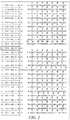
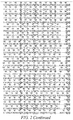
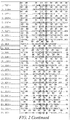
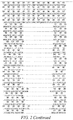
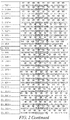
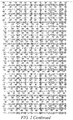
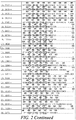
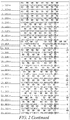
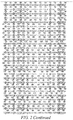
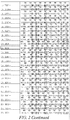
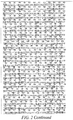
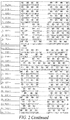
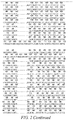
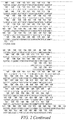
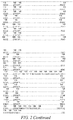
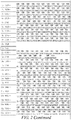
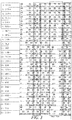
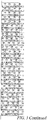
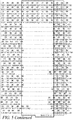
- FIG. 2 shows that a catalytic domain sequence of GTF 7527 (residues 54-957 of SEQ ID NO:65) aligns with catalytic domain sequences of several other glucosyltransferase enzymes, with several regions showing complete conservation across all the sequences (residues with dark background).
- the dark background residues in FIG. 2 visually map out the catalytic domain of each sequence, indicating their length to be about 850 to 900 amino acid residues long.
- the catalytic domain of a glucosyltransferase enzyme herein can be about 790 to 840, 850 to 900, or 790 to 900 (or any integer between 790 and 900) amino acid residues long (some of these numbers take into account embodiments in which motifs i, iii, and/or iii are removed), for example.
- a catalytic domain sequence of a glucosyltransferase enzyme in some aspects can contain one or more of SEQ ID NOs:68, 69, 70, and 71 in alignment, respectively, with SEQ ID NOs:68, 69, 70, and 71 as present in amino acids 54-957 of SEQ ID NO:65.
- Other conserved regions in FIG. 2 include SEQ ID NOs:72, 73, 74, 75, 76 and 77 (refer to Example 4).
- a catalytic domain sequence of a glucosyltransferase enzyme in some aspects can contain one or more of SEQ ID NOs:72, 73, 74, 75, 76 and 77 in alignment, respectively, with SEQ ID NOs:72, 73, 74, 75, 76 and 77 as present in amino acids 54-957 of SEQ ID NO:65.
- the catalytic domain of a glucosyltransferase enzyme herein can have activity as exhibited by a catalytic domain of a glucosyltransferase classified under the glycoside hydrolase family 70 (GH70).
- GH70 glycoside hydrolase family 70
- Such a GH70 glucosyltransferase may be found in the CAZy (Carbohydrate-Active EnZymes) database ( Cantarel et al., Nucleic Acids Res. 37:D233-238, 2009 ), for example.
- a glucosyltransferase enzyme herein lacks at least one of motifs (i), (ii), or (iii). Motif (i) corresponds with "Motif 1a” ( FIG. 3 ). Motif (ii) corresponds with "Motif 2" ( FIG. 5 ). Motif (iii) corresponds with "Motif 3a” ( FIG. 7 ).
- a glucosyltransferase can "lack" one or more of these motifs by virtue of a deletion and/or mutation (e.g., amino acid substitution), for example.
- a glucosyltransferase can be characterized as lacking one of these motifs if no amino acid sequence within a catalytic domain sequence can be identified to have 90% or more identity to SEQ ID NO:78 (motif i), SEQ ID NO:79 (motif ii), or SEQ ID NO:78 (motif iii).
- motif (i) can be at least 90%, 91%, 92%, 93%, 94%, 95%, 96%, 97%, 98%, 99%, or 100% identical to SEQ ID NO:78. In certain embodiments, motif (ii) can be at least 90%, 91%, 92%, 93%, 94%, 95%, 96%, 97%, 98%, 99%, or 100% identical to SEQ ID NO:79. In certain embodiments, motif (iii) can be at least 90%, 91%, 92%, 93%, 94%, 95%, 96%, 97%, 98%, 99%, or 100% identical to SEQ ID NO:80. Thus, it can be seen that in some aspects, motif (i) can comprise SEQ ID NO:78, motif (ii) can comprise SEQ ID NO:79, and motif (iii) can comprise SEQ ID NO:80.
- the first residue of SEQ ID NO:78 can be an aspartate (D) and the fourth residue can be an isoleucine (I).
- the first residue can be an aspartate (D) and the fourth residue can be a valine (V), or the first residue can be an asparagine (N) and the fourth residue can be an isoleucine (I), or the first residue can be an asparagine (N) and the fourth residue can be a valine (V).
- the sixth residue of SEQ ID NO:79 can be a lysine (K), the fourteenth residue can be a valine (V), and the sixteenth residue can be a glutamine (Q).
- the sixth residue can be a lysine (K), the fourteenth residue can be an alanine (A), and the sixteenth residue can be a glutamine (Q); or the sixth residue can be a lysine (K), the fourteenth residue can be an valine (V), and the sixteenth residue can be a lysine (K). Additional examples include where the sixth residue can be a threonine (T).
- the ninth residue of SEQ ID NO:80 can be an asparagine (N) and the eighteenth residue can be an asparagine (N).
- the ninth residue can be an asparagine (N) and the eighteenth residue can be a serine (S), or the ninth residue can be a lysine (K) and the eighteenth residue can be an asparagine (N), or the ninth residue can be a lysine (K) and the eighteenth residue can be a serine (S).
- a glucosyltransferase enzyme as presently disclosed may lack motif (i) only; motif (ii) only; motif (iii) only; both motifs (i) and (ii); both motifs (i) and (iii); both motifs (ii) and (iii); and all three of motifs (i), (ii) and (iii), for example.
- motif (i) (SEQ ID NO:78), motif (ii) (SEQ ID NO:79) and motif (iii) (SEQ ID NO:80) align with residues 231-243, 396-425 and 549-567, respectively, of the GTF 7527 sequence (SEQ ID NO:65) shown in FIG. 2 .
- motif (i) (SEQ ID NO:78), motif (ii) (SEQ ID NO:79) and motif (iii) (SEQ ID NO:80) align with residues 231-243, 396-425 and 549-567, respectively, of the GTF 7527 sequence (SEQ ID NO:65) shown in FIG. 2 .
- motifs (i), (ii) and/or (iii) in a glucosyltransferase catalytic domain can be determined with reference to certain conserved sequences, namely SEQ ID NOs:72, 73, 74, 75, 76 and 77, if desired.
- Motif 1a (SEQ ID NO:78) is flanked by upstream and downstream conserved sequences as shown in FIG. 3 .
- Preceding Motif 1a is the sequence SxxRxxN (SEQ ID NO:72), and following this motif is the sequence GGxxxLLxNDxDxSNPxVQAExLN (SEQ ID NO:73).
- the position of motif (i) can be located between SEQ ID NOs:72 and 73.
- SEQ ID NO:72 can be directly adjacent (upstream) to motif (i), or 1, 2, 3, 4, 5, 6, 7, 8, 9, 10, 11, 12, 13, 14, or 15 (or 1-15) amino acid residues upstream motif (i).
- SEQ ID NO:73 can be directly adjacent (downstream) to motif (i), or 1, 2, 3, 4, or 5 (or 1-5) amino acid residues downstream motif (i).
- Motif 2 (SEQ ID NO:79) is flanked by upstream and downstream conserved sequences as shown in FIG. 5 . Specifically, preceding Motif 2 is the sequence WxxxDxxY (SEQ ID NO:74), and following this motif is the sequence YxFxRAHD (SEQ ID NO:75). Thus, the position of motif (ii) can be located between SEQ ID NOs:74 and 75. SEQ ID NO:74 can be directly adjacent (upstream) to motif (ii), or 1-65 (or any integer between 1 and 65) amino acid residues upstream motif (ii). SEQ ID NO:75 can be directly adjacent (downstream) to motif (ii), or 1, 2, 3, 4, or 5 (or 1-5) amino acid residues downstream motif (ii).
- Motif 3a (SEQ ID NO:80) is flanked by upstream and downstream conserved sequences as shown in FIG. 7 . Specifically, preceding Motif 3a is the sequence YxxGGQ (SEQ ID NO:76), and following this motif is the sequence VRxG (SEQ ID NO:77). Thus, the position of motif (iii) can be located between SEQ ID NOs:76 and 77. SEQ ID NO:76 can be directly adjacent (upstream) to motif (iii), or 1, 2, 3, 4, 5, 6, 7, 8, 9, 10, or 11 (or 1-11) amino acid residues upstream motif (iii). SEQ ID NO:77 can be directly adjacent (downstream) to motif (iii), or 1, 2, 3, 4, 5, 6, 7, 8, or 9 (or 1-9) amino acid residues downstream motif (iii).
- SEQ ID NOs:72-77 can be any amino acid (indicated by an "x" in each sequence in Table 1).
- SEQ ID NOs:72 and 73 are as shown in any of the GTF sequences in FIGs. 2 and 3 at the amino acids of each GTF sequence aligning with positions 214-220 and 245-268, respectively, of SEQ ID NO:65 (GTF 7527).
- SEQ ID NOs:74 and 75 are as shown in any of the GTF sequences in FIGs. 2 and 5 at the amino acids of each GTF sequence aligning with positions 334-341 and 428-435, respectively, of SEQ ID NO:65 (GTF 7527).
- SEQ ID NOs:76 and 77 are as shown in any of the GTF sequences in FIGs. 2 and 7 at the amino acids of each GTF sequence aligning with positions 537-542 and 572-575, respectively, of SEQ ID NO:65 (GTF 7527).
- the foregoing location information (e.g., alignment coordinates and/or location between certain conserved sequences) can be used, for instance, in an effort to determine whether a glucosyltransferase lacks at least one of motifs (i), (ii), or (iii).
- a glucosyltransferase enzyme herein lacking at least one of motifs (i), (ii), or (iii) can produce a branched alpha-glucan polymer.
- alpha-glucan polymer branching can be gauged using measurements of intrinsic viscosity and/or branching index (g'), which can be measured following any means known in the art.
- g' intrinsic viscosity and/or branching index
- Alpha-glucan polymer branching herein can, in some aspects, be judged with respect to measurements made against poly alpha-1,3-glucan containing at least 95%, 96%, 97%, 98%, or 99% alpha-1,3 glycosidic linkages (such polymer is expected to be mostly unbranched), or 100% alpha-1,3 glycosidic linkages (such polymer is linear/unbranched). Measurements can be with respect to intrinsic viscosity and/or branching index, for example.
- alpha-glucan produced by a glucosyltransferase herein can have an intrinsic viscosity and/or branching index (each measurement per methodology disclosed in below Examples, for example) that is reduced by at least about 30%, 40%, 50%, 60%, 70%, 80%, or 90% compared to poly alpha-1,3-glucan that is completely or mostly unbranched.
- a branched alpha-glucan polymer herein is believed to contain at least both alpha-1,3 and alpha-1,6 glycosidic linkages, for example.
- a branched alpha-glucan polymer may possibly further comprise alpha-1,2 and/or alpha-1,4 glycosidic linkages in some aspects. There are likely no beta-glycosidic linkages present.
- branched alpha-glucan polymer can have less than 95%, 94%, 93%, 92%, 91%, 90%, 85%, 80%, 75%, 70%, 65%, 60%, 55%, 50%, 45%, 40%, 35%, or 30% alpha-1,3 glycosidic linkages.
- a branched alpha-glucan polymer can have at least 5%, 10%, 15%, 20%, 25%, 30%, 35%, 40%, 45%, 50%, 55%, 60%, 65%, or 70% alpha-1,6-glycosidic linkages in some aspects. It is contemplated that, in some aspects, a branch point occurs on average every (or at least every) 5, 10, 15, 20, 25, 30, 35, or 40 monosaccharide units in a branched alpha-glucan herein.
- the glycosidic linkage profile of a glucan polymer herein can be determined using any method known in the art.
- the linkage profile can be determined using methods that use nuclear magnetic resonance (NMR) spectroscopy (e.g., 13 C NMR or 1 H NMR). These and other methods that can be used are disclosed in Food Carbohydrates: Chemistry, Physical Properties, and Applications (S. W. Cui, Ed., Chapter 3, S. W. Cui, Structural Analysis of Polysaccharides, Taylor & Francis Group LLC, Boca Raton, FL, 2005 ).
- NMR nuclear magnetic resonance
- a branched alpha-glucan polymer in most embodiments is insoluble. Such insolubility is observed in aqueous conditions (e.g., solvent comprising at least 90% water) of generally neutral pH (e.g., between 6-8), for example.
- aqueous conditions e.g., solvent comprising at least 90% water
- generally neutral pH e.g., between 6-8
- a glucosyltransferase enzyme herein can be derived from any microbial source, such as a bacteria or fungus.
- bacterial glucosyltransferase enzymes are those derived from a Streptococcus species, Leuconostoc species or Lactobacillus species.
- Streptococcus species include S. salivarius, S. sobrinus, S. dentirousetti, S. downei, S. mutans, S. oralis, S. gallolyticus and S. sanguinis.
- Examples of Leuconostoc species include L. mesenteroides, L. amelibiosum, L. argentinum, L. carnosum, L. citreum, L.
- Lactobacillus species include L. acidophilus, L. delbrueckii, L. helveticus, L. salivarius, L. casei, L. curvatus, L. plantarum, L. sakei, L. brevis, L. buchneri, L. fermentum and L . reuteri.
- a glucosyltransferase enzyme herein can be produced by any means known in the art.
- a glucosyltransferase enzyme may be produced recombinantly in a heterologous expression system, such as a microbial heterologous expression system.
- heterologous expression systems include bacterial (e.g., E . coli such as TOP10 or MG1655; Bacillus sp.) and eukaryotic (e.g., yeasts such as Pichia sp. and Saccharomyces sp.) expression systems.
- a heterologous gene expression system may be one that is designed for protein secretion.
- a glucosyltransferase enzyme typically comprises a signal peptide (signal sequence).
- the signal peptide may be either its native signal peptide or a heterologous signal peptide.
- a glucosyltransferase enzyme described herein may be used in any purification state (e.g., pure or non-pure).
- a glucosyltransferase enzyme may be purified and/or isolated prior to its use.
- glucosyltransferase enzymes that are non-pure include those in the form of a cell lysate.
- a cell lysate or extract may be prepared from a bacteria (e.g., E. coli ) used to heterologously express the enzyme.
- the bacteria may be subjected to disruption using a French pressure cell.
- bacteria may be homogenized with a homogenizer (e.g., APV, Rannie, Gaulin).
- a glucosyltransferase enzyme is typically soluble in these types of preparations.
- a bacterial cell lysate, extract, or homogenate herein may be used at about 0.15-0.3% (v/v), for example, in a reaction solution for producing branched alpha-glucan.
- glucosyltransferase enzyme activity can be determined using any method known in the art.
- glucosyltransferase enzyme activity can be determined by measuring the production of reducing sugars (fructose and glucose) in a reaction solution containing sucrose (50 g/L), dextran T10 (1 mg/mL) and potassium phosphate buffer (pH 6.5, 50 mM), where the solution is held at 22-25 °C for 24-30 hours.
- the reducing sugars can be measured, for instance, by adding 0.01 mL of the reaction solution to a mixture containing 1 N NaOH and 0.1% triphenyltetrazolium chloride and then monitoring the increase in absorbance at OD 480nm for five minutes.
- a polynucleotide comprising a nucleotide sequence that encodes a glucosyltransferase as presently disclosed (e.g., a GTF comprising a catalytic domain with an amino acid sequence that [i] is at least 90% identical to positions 54-941 of SEQ ID NO:85, 54-927 of SEQ ID NO:87, 54-935 of SEQ ID NO:89, 54-911 of SEQ ID NO:91, 54-919 of SEQ ID NO:93, 54-905 of SEQ ID NO:95, or 54-889 of SEQ ID NO:97, and [ii] lacks at least one of motifs i, ii, or iii).
- one or more regulatory sequences are operably linked to the nucleotide sequence, and preferably a promoter sequence is included as a regulatory sequence.
- a polynucleotide comprising a nucleotide sequence encoding a glucosyltransferase herein can be a vector or construct useful for transferring a nucleotide sequence into a cell, for example.
- a suitable vector/construct can be selected from a plasmid, yeast artificial chromosome (YAC), cosmid, phagemid, bacterial artificial chromosome (BAC), virus, or linear DNA (e.g., linear PCR product).
- YAC yeast artificial chromosome
- BAC bacterial artificial chromosome
- a polynucleotide sequence in some aspects can be capable of existing transiently (i.e., not integrated into the genome) or stably (i.e., integrated into the genome) in a cell.
- a polynucleotide sequence in some aspects can comprise, or lack, one or more suitable marker sequences (e.g., selection or phenotype marker).
- a polynucleotide sequence in certain embodiments can comprise one or more regulatory sequences operably linked to the nucleotide sequence encoding a glucosyltransferase.
- a nucleotide sequence encoding a glucosyltransferase may be in operable linkage with a promoter sequence (e.g., a heterologous promoter).
- a promoter sequence can be suitable for expression in a cell (e.g., bacterial cell such as E. coli ; eukaryotic cell such as a fungus, yeast, insect, or mammalian cell) or in an in vitro protein expression system, for example. Examples of other suitable regulatory sequences are disclosed herein (e.g., transcription terminator sequences).
- a polynucleotide sequence does not comprise a regulatory sequence operably linked to a nucleotide encoding a glucosyltransferase.
- a polynucleotide could be a cloning vector (e.g., cloning plasmid), for example, used simply for sub-cloning or gene shuttling purposes.
- a promoter sequence herein can be constitutive or inducible, for example.
- a promoter in certain aspects can comprise a strong promoter, which is a promoter that can direct a relatively large number of productive initiations per unit time, and/or is a promoter driving a higher transcription level than the average transcription level of the genes in a cell comprising the strong promoter.
- strong promoters useful herein include some bacterial and phage promoters that are well known in the art, and some yeast promoters (e.g., Velculescu et al., Cell 88:243-251 ).
- Also disclosed herein is a method of preparing a polynucleotide sequence encoding a glucosyltransferase enzyme that produces a branched alpha-glucan polymer. This method comprises:
- Identification step (a) herein can, in some instances, comprise identifying an amino acid sequence of a parent glucosyltransferase enzyme.
- a polynucleotide sequence could be determined from this amino acid sequence according to the genetic code (codons), such as the genetic code used in the species from which the parent glucosyltransferase was identified.
- motifs (i), (ii), and (iii) in the catalytic domain of a parent glucosyltransferase enzyme can be detected following any means known in the art and/or any procedure described herein. For example, detection can be performed (a) in silico , (b) with a method comprising a nucleic acid hybridization step, (c) with a method comprising a protein sequencing step, and/or (d) with a method comprising a protein binding step.
- Motifs (i), (ii) and (iii) were identified by in silico detection (see Example 4 below).
- the amino acid sequences of parent glucosyltransferase enzymes (and/or nucleotide sequences encoding such glucosyltransferase enzymes) stored in a computer or database e.g., public databases such as GENBANK, EMBL, REFSEQ, GENEPEPT, SWISS-PROT, PIR, PDB
- a computer or database e.g., public databases such as GENBANK, EMBL, REFSEQ, GENEPEPT, SWISS-PROT, PIR, PDB
- Such review could comprise using any means known in the art such as through use of an alignment algorithm or software as described above (e.g., BLASTN, BLASTP, ClustalW, ClustalV, EMBOSS).
- the sequence of the glucosyltransferase catalytic domain being reviewed could be aligned with a catalytic domain sequence of SEQ ID NO:65 (GTF 7527), which comprises Motifs 1a (SEQ ID NO:78), 2 (SEQ ID NO:79) and 3a (SEQ ID NO:80), to detect the presence or absence of motifs (i), (ii), and/or (iii).
- sequence of the glucosyltransferase catalytic domain being reviewed could be aligned with a catalytic domain sequence of SEQ ID NO:30 (GTF 2678), SEQ ID NO:4 (GTF 6855), SEQ ID NO:28 (GTF 2919), and/or SEQ ID NO:20 (GTF 2765), all of which comprise Motifs 1a (SEQ ID NO:78), 2 (SEQ ID NO:79) and 3a (SEQ ID NO:80), to identify the presence or absence of motifs (i), (ii), and/or (iii).
- Another in silico means for detecting motifs (i), (ii), and (iii) in a glucosyltransferase catalytic domain sequence can comprise comparing the predicted three-dimensional structure (tertiary structure) of a glucosyltransferase catalytic domain sequence with a reference structure.
- the structures of both the catalytic domain being reviewed and the reference can be visually compared using any means known in the art such as with a computer program that provides a structure based on amino acid sequence input (e.g., software package MOE, Chemical Computing Group, Montreal, Canada).
- the comparison may detect the presence of motif (i), (ii), and/or (iii) by showing a domain(s) in the structure being reviewed that does not have a corresponding domain in the reference structure. Examples of this type of comparison are shown in FIGs. 4a, 4b , 6a, 6b , 8a and 8b .
- identifying a parent glucosyltransferase enzyme having motifs (i), (ii), and (iii) in its catalytic domain can be performed via a method comprising a nucleic acid hybridization step.
- a method can comprise using DNA hybridization (e.g., Southern blot, dot blot), RNA hybridization (e.g., northern blot), or any other method that has a nucleic acid hybridization step (e.g., DNA sequencing, PCR, RT-PCR, all of which may comprise hybridization of an oligonucleotide), for example.
- an oligonucleotide that would hybridize to a nucleotide sequence encoding Motif 1a (SEQ ID NO:78), 2 (SEQ ID NO:79), or 3a (SEQ ID NO:80) could be used to detect its presence or absence in a polynucleotide sequence encoding the glucosyltransferase catalytic domain being reviewed.
- a parent glucosyltransferase enzyme comprising motifs (i), (ii), and (iii) in its catalytic domain can be detected using a method comprising a protein sequencing step.
- a protein sequencing step can comprise one or more procedures such as N-terminal amino acid analysis, C-terminal amino acid analysis, Edman degradation, or mass spectrometry, for example.
- a parent glucosyltransferase enzyme comprising motifs (i), (ii), and (iii) in its catalytic domain can be detected using a method comprising a protein binding step.
- a protein binding step could be performed using an antibody that specifically binds to one of these motifs, for example.
- Antibodies for identifying the presence or absence of motif (i) can be specific for an amino acid sequence that is at least 90% identical to SEQ ID NO:78.
- Antibodies for identifying the presence or absence of motif (ii) can be specific for an amino acid sequence that is at least 90% identical to SEQ ID NO:79.
- Antibodies for identifying the presence or absence of motif (iii) can be specific for an amino acid sequence that is at least 90% identical to SEQ ID NO:80.
- a parent glucosyltransferase in a polynucleotide preparation method disclosed herein comprises a catalytic domain comprising motifs (i), (ii) and (iii).
- Motif (i) can be at least 90%, 91%, 92%, 93%, 94%, 95%, 96%, 97%, 98%, 99%, or 100% identical to SEQ ID NO:78.
- Motif (ii) can be at least 90%, 91%, 92%, 93%, 94%, 95%, 96%, 97%, 98%, 99%, or 100% identical to SEQ ID NO:79.
- Motif (iii) can be at least 90%, 91%, 92%, 93%, 94%, 95%, 96%, 97%, 98%, 99%, or 100% identical to SEQ ID NO:80.
- motif (i) can comprise SEQ ID NO:78
- motif (ii) can comprise SEQ ID NO:79
- motif (iii) can comprise SEQ ID NO:80.
- the first residue of SEQ ID NO:78 can be an aspartate (D) and the fourth residue can be an isoleucine (I).
- the first residue can be an aspartate (D) and the fourth residue can be a valine (V), or the first residue can be an asparagine (N) and the fourth residue can be an isoleucine (I), or the first residue can be an asparagine (N) and the fourth residue can be a valine (V).
- the sixth residue of SEQ ID NO:79 can be a lysine (K), the fourteenth residue can be a valine (V), and the sixteenth residue can be a glutamine (Q).
- the sixth residue can be a lysine (K), the fourteenth residue can be an alanine (A), and the sixteenth residue can be a glutamine (Q); or the sixth residue can be a lysine (K), the fourteenth residue can be an valine (V), and the sixteenth residue can be a lysine (K). Additional examples include where the sixth residue can be a threonine (T).
- the ninth residue of SEQ ID NO:80 can be an asparagine (N) and the eighteenth residue can be an asparagine (N).
- the ninth residue can be an asparagine (N) and the eighteenth residue can be a serine (S), or the ninth residue can be a lysine (K) and the eighteenth residue can be an asparagine (N), or the ninth residue can be a lysine (K) and the eighteenth residue can be a serine (S).
- motifs (i), (ii) and (iii) in a glucosyltransferase enzyme catalytic domain sequence can be used appropriately to detect one or more of these motifs in a parent glucosyltransferase.
- the relative positions of motifs (i) (SEQ ID NO:78), (ii) (SEQ ID NO:79) and (iii) (SEQ ID NO:80) align with residues 231-243, 396-425 and 549-567, respectively, of the GTF 7527 sequence (SEQ ID NO:65) shown in FIG. 2 .
- the relative position(s) of the amino acid sequence(s) detected in the parent glucosyltransferase catalytic domain can thus be determined with reference to the above amino acid positions in SEQ ID NO:65.
- the sequence of a putative parent glucosyltransferase catalytic domain can be aligned with SEQ ID NO:65 using any means known in the art and/or as described above.
- motif (i), (ii), and/or (iii) can be detected based on proximity to certain conserved sequences, namely SEQ ID NOs:72, 73, 74, 75, 76 and 77, as described above.
- detecting any one of motifs (i), (ii), or (iii) effectively results in identification of a parent glucosyltransferase catalytic domain having all three of these motifs.
- identifying a parent glucosyltransferase herein can optionally comprise detecting one of, two of, or all three, of motifs (i), (ii) and/or (iii) in a glucosyltransferase catalytic domain.
- a parent glucosyltransferase in a polynucleotide preparation method disclosed herein can comprise a catalytic domain comprising an amino acid sequence that is at least 90% identical to amino acid positions 54-957 of SEQ ID NO:65.
- a parent glucosyltransferase disclosed herein can comprise a catalytic domain having an amino acid sequence that is at least 90% identical to amino acid positions 55-960 of SEQ ID NO:30, positions 55-960 of SEQ ID NO:4, positions 55-960 of SEQ ID NO:28, and/or positions 55-960 of SEQ ID NO:20.
- a parent glucosyltransferase catalytic domain can be detected that comprises an amino acid sequence that is 100% identical to, or at least 91%, 92%, 93%, 94%, 95%, 96%, 97%, 98%, 98.5%, 99%, or 99.5% identical to, any of the foregoing sequences.
- Certain of the conserved regions in FIG. 2 include catalytic active site motifs SEQ ID NOs:68, 69, 70, and 71 (refer to Example 3).
- a catalytic domain sequence of a parent glucosyltransferase enzyme in some aspects can be identified based on having one or more of SEQ ID NOs:68, 69, 70, and 71 in alignment, respectively, with SEQ ID NOs:68, 69, 70, and 71 as present in amino acids 54-957 of SEQ ID NO:65.
- Other conserved regions in FIG. 2 include SEQ ID NOs:72, 73, 74, 75, 76 and 77 (refer to Example 4).
- a catalytic domain sequence of a parent glucosyltransferase enzyme disclosed herein can be identified based on having one or more of SEQ ID NOs:72, 73, 74, 75, 76 and 77 in alignment, respectively, with SEQ ID NOs:72, 73, 74, 75, 76 and 77 as present in amino acids 54-957 of SEQ ID NO:65.
- a glucosyltransferase enzyme disclosed herein need only have a catalytic domain sequence comprising an amino acid sequence that is at least 90% identical to amino acid positions 54-957 of SEQ ID NO:65 (or positions 55-960 of SEQ ID NO:30, positions 55-960 of SEQ ID NO:4, positions 55-960 of SEQ ID NO:28, or positions 55-960 of SEQ ID NO:20), a parent glucosyltransferase enzyme identified in a polynucleotide preparation method disclosed herein is typically comprised within a larger amino acid sequence.
- the catalytic domain may be linked at its C-terminus to a glucan-binding domain, and/or linked at its N-terminus to a variable domain and/or signal peptide.
- the catalytic domain of a parent glucosyltransferase enzyme disclosedherein can have activity as exhibited by a catalytic domain of a glucosyltransferase classified under the glycoside hydrolase family 70 (GH70).
- GH70 glycoside hydrolase family 70
- Such a GH70 glucosyltransferase may be found in the CAZy (Carbohydrate-Active EnZymes) database ( Cantarel et al., Nucleic Acids Res. 37:D233-238, 2009 ), for example.
- parent glucosyltransferase enzymes in a polynucleotide preparation method disclosed herein can be any as disclosed herein and that include 1-300 (or any integer there between [e.g., 10, 15, 20, 25, 30, 35, 40, 45, or 50]) residues on the N-terminus and/or C-terminus.
- additional residues may be from a corresponding wild type sequence from which the glucosyltransferase enzyme is derived, or may be a heterologous sequence such as an epitope tag (at either N- or C-terminus) or a heterologous signal peptide (at N-terminus), for example.
- Examples of such parent glucosyltransferase enzymes comprise an amino acid sequence that is 100% identical to, or at least 90%, 91%, 92%, 93%, 94%, 95%, 96%, 97%, 98%, 98.5%, 99%, or 99.5% identical to, SEQ ID NO:65, 30, 4, 28, or 20. These sequences (SEQ ID NO:65, 30, 4, 28, 20) lack an N-terminal signal peptide (as well as a variable domain) (refer to Table 1).
- parent glucosyltransferase enzymes herein include those comprising an amino acid sequence that is 100% identical to, or at least 90%, 91%, 92%, 93%, 94%, 95%, 96%, 97%, 98%, 98.5%, 99%, or 99.5% identical to, SEQ ID NO:60, 61, 62, 63, or 64.
- a parent glucosyltransferase identified in a polynucleotide preparation method disclosed herein can, for instance, synthesize insoluble poly alpha-1,3-glucan having at least 95% alpha-1,3 glycosidic linkages and DP w of at least 100.
- a parent glucosyltransferase enzyme can synthesize poly alpha-1,3-glucan in which at least about 95%, 96%, 97%, 98%, 99%, or 100% of the constituent glycosidic linkages are alpha-1,3 linkages.
- the glucosyltransferase enzyme synthesizes poly alpha-1,3-glucan in which there is less than about 5%, 4%, 3%, 2%, 1%, or 0% of glycosidic linkages that are not alpha-1,3.
- a parent glucosyltransferase enzyme can synthesize poly alpha-1,3-glucan having no branch points or less than about 5%, 4%, 3%, 2%, or 1% branch points as a percent of the glycosidic linkages in the polymer.
- branch points include alpha-1,6 branch points.
- a parent glucosyltransferase enzyme can synthesize poly alpha-1,3-glucan having a molecular weight in DP w or DP n of at least about 100.
- a parent glucosyltransferase enzyme may synthesize poly alpha-1,3-glucan having a molecular weight in DP n or DP w of at least about 400.
- a parent glucosyltransferase enzyme may synthesize poly alpha-1,3-glucan having a molecular weight in DP n or DP w of at least about 100, 150, 200, 250, 300, 350, 400, 450, 500, 550, 600, 650, 700, 750, 800, 850, 900, 950, or 1000 (or any integer between 100 and 1000).
- a method of preparing a polynucleotide sequence encoding a glucosyltransferase that produces a branched alpha-glucan polymer comprises step (b) of modifying the polynucleotide sequence (encoding a parent glucosyltransferase) identified in step (a). Such modification deletes and/or mutates (removes) at least one of motifs (i), (ii), or (iii) encoded by the polynucleotide sequence.
- Modification of sequence encoding motif (i), (ii) and/or (iii) herein allows expression of a child glucosyltransferase with a catalytic domain that does not comprise amino acid sequence(s) that is/are at least 90% identical to SEQ ID NO:78 (motif i), SEQ ID NO:79 (motif ii), and/or SEQ ID NO:80 (motif iii).
- a child glucosyltransferase comprises a catalytic domain that does not comprise amino acid sequence(s) that is/are at least 90%, 89%, 88%, 87%, 86%, 85%, 84%, 83%, 82%, 81%, 80%, 79%, 78%, 77%, 76%, 75%, 74%, 73%, 72%, 71%, 70%, 69%, 68%, 67%, 66%, 65%, 64%, 63%, 62%, 61%, 60%, 59%, 58%, 57%, 56%, 55%, 54%, 53%, 52%, 51%, 50%, 49%, 48%, 47%, 46%, 45%, 44%, 43%, 42%, 41%, or 40% identical to SEQ ID NO:78, SEQ ID NO:79, and/or SEQ ID NO:80.
- a parent glucosyltransferase can comprise a catalytic domain that is at least 90% identical to positions 54-957 of SEQ ID NO:65
- a child glucosyltransferase typically comprises a catalytic domain that has an amino acid sequence that is at least 90%, 91%, 92%, 93%, 94%, 95%, 96%, 97%, 98%, 99%, or 100% identical to positions 54-941 of SEQ ID NO:85, 54-927 of SEQ ID NO:87, 54-935 of SEQ ID NO:89, 54-911 of SEQ ID NO:91, 54-919 of SEQ ID NO:93, 54-905 of SEQ ID NO:95, or 54-889 of SEQ ID NO:97 (each of these sequences comprises one or more deleted motifs compared to positions 54-957 of SEQ ID NO:65).
- a deletion or mutation can be directed to motif (i) only, motif (ii) only, motif (iii) only, both motifs (i) and (ii), both motifs (i) and (iii), both motifs (ii) and (iii), and all three of motifs (i), (ii) and (iii), for example.
- Modification step (b) may comprise deleting at least one of motifs (i), (ii), or (iii) encoded by the polynucleotide sequence identified in step (a). Such deletion can comprise removing most of (e.g., more than 70%, 80%, or 90% of), or all off, one or more sequences encoding motif (i), (ii), or (iii).
- the encoded child glucosyltransferase can have a catalytic domain comprising an amino acid sequence that is at least 90% identical to positions 54-941 of SEQ ID NO:85, for example.
- the encoded child glucosyltransferase can have a catalytic domain comprising an amino acid sequence that is at least 90% identical to positions 54-927 of SEQ ID NO:87, for example.
- the encoded child glucosyltransferase can have a catalytic domain comprising an amino acid sequence that is at least 90% identical to positions 54-935 of SEQ ID NO:89, for example.
- the encoded child glucosyltransferase can have a catalytic domain comprising an amino acid sequence that is at least 90% identical to positions 54-911 of SEQ ID NO:91, for example.
- the encoded child glucosyltransferase can have a catalytic domain comprising an amino acid sequence that is at least 90% identical to positions 54-919 of SEQ ID NO:93, for example.
- the encoded child glucosyltransferase can have a catalytic domain comprising an amino acid sequence that is at least 90% identical to positions 54-905 of SEQ ID NO:95, for example.
- the encoded child glucosyltransferase can have a catalytic domain comprising an amino acid sequence that is at least 90% identical to positions 54-889 of SEQ ID NO:97, for example.
- a deletion or mutation of a polynucleotide in modification step (b) can be made following any DNA manipulation technique known in the art.
- Modifying step (b) can optionally be performed in silico , followed by synthesis of the polynucleotide sequence encoding a glucosyltransferase enzyme that produces a branched alpha-glucan polymer.
- a nucleotide sequence identified in step (a) can be manipulated in silico using a suitable sequence manipulation program/software (e.g., VECTOR NTI, Life Technologies, Carlsbad, CA; DNAStrider; DNASTAR, Madison, WI).
- the modified polynucleotide sequence can be artificially synthesized by any suitable technique (e.g., annealing-based connection of oligonucleotides, or any technique disclosed in Hughes et al., Methods Enzymol. 498:277-309 ). It should be appreciated that the foregoing methodology is not believed to rely on having a pre-existing polynucleotide sequence in hand.
- any suitable technique e.g., annealing-based connection of oligonucleotides, or any technique disclosed in Hughes et al., Methods Enzymol. 498:277-309 .
- modifying step (b) can optionally be performed using a physical copy of a polynucleotide sequence identified in step (a) encoding a parent glucosyltransferase.
- a polynucleotide sequence identified in step (a) encoding a parent glucosyltransferase.
- such a polynucleotide can serve as a template for amplification using primers designed in a manner such that the amplified product has one or more deletions (e.g., refer to Innis et al., above).
- Suitable types of mutations that can be applied in step (b) in some aspects herein include those resulting in an amino acid substitution.
- One or more substitutions typically are non-conservative amino acid changes.
- a glucosyltransferase encoded by the polynucleotide sequence produced in step (b) can produce branched alpha-glucan.
- Alpha-glucan polymer branching can be gauged using measurements of intrinsic viscosity and/or branching index (g'), as described above and in the below Examples.
- Alpha-glucan polymer branching herein can be judged with respect to measurements made against poly alpha-1,3-glucan containing at least 95%, 96%, 97%, 98%, or 99% alpha-1,3 glycosidic linkages (such polymer is expected to be mostly unbranched), or 100% alpha-1,3 glycosidic linkages (such polymer is linear/unbranched). Measurements can be with respect to intrinsic viscosity and/or branching index, for example.
- Alpha-glucan produced by a child glucosyltransferase disclosed herein can have an intrinsic viscosity and/or branching index (each measurement per methodology disclosed in below Examples, for example) that is reduced by at least about 30%, 40%, 50%, 60%, 70%, 80%, or 90% compared to poly alpha-1,3-glucan synthesized by a parent glucosyltransferase identified in step (a).
- a branched alpha-glucan polymer produced by a child glucosyltransferase disclosed herein is believed to contain at least both alpha-1,3 and alpha-1,6 glycosidic linkages, for example.
- a branched alpha-glucan polymer may possibly further comprise alpha-1,2 and/or alpha-1,4 glycosidic linkages in some aspects. There are likely no beta-glycosidic linkages present.
- Branched alpha-glucan polymer can have less than 94%, 93%, 92%, 91%, 90%, 85%, 80%, 75%, 70%, 65%, 60%, 55%, 50%, 45%, 40%, 35%, or 30% alpha-1,3 glycosidic linkages.
- a branched alpha-glucan polymer can have at least 30%, 35%, 40%, 45%, 50%, 55%, 60%, 65%, or 70% alpha-1,6 glycosidic linkages. It is contemplated that, in some aspects, a branch point occurs on average about every 5, 10, 15, 20, 25, 30, 35, or 40 monosaccharide units in a branched alpha-glucan herein.
- a branched alpha-glucan polymer in most embodiments is insoluble. Such insolubility is observed in aqueous conditions (e.g., solvent comprising at least 90% water) of generally neutral pH (e.g., between 6-8), for example.
- aqueous conditions e.g., solvent comprising at least 90% water
- generally neutral pH e.g., between 6-8
- a polynucleotide sequence produced following the above method of preparing a polynucleotide sequence.
- Such a polynucleotide sequence encodes a glucosyltransferase that produces a branched alpha-glucan polymer.
- one or more regulatory sequences are operably linked to the nucleotide sequence, and preferably a promoter sequence is included as a regulatory sequence. Additional possible features of a polynucleotide sequence are described above.
- glucosyltransferase (child glucosyltransferase) encoded by such a polynucleotide sequence.
- glucosyltransferase can be any as disclosed above.
- a branched alpha-glucan polymer produced by a glucosyltransferase herein (e.g., a child glucosyltransferase herein; a glucosyltransferase comprising SEQ ID NO:85, 87, 89, 91, 93, 95, or 97).
- reaction solutions comprise water, sucrose, and one or more glucosyltransferase enzymes herein that produce a branched alpha-glucan polymer.
- Other components can optionally be comprised within a reaction solution for synthesizing branched alpha-glucan, such as fructose, glucose, leucrose, and soluble oligosaccharides (e.g., DP2-DP7).
- a reaction solution herein may be one that, in addition to producing insoluble glucan product, produces byproducts such as leucrose and/or soluble oligosaccharides.
- the temperature of a reaction solution herein can be controlled, if desired.
- the temperature of the reaction can be between about 5 °C to about 50 °C.
- the temperature in certain other embodiments can be between about 20 °C to about 40 °C, or about 20 °C to about 30 °C (e.g., about 22-25 °C).
- the initial concentration of sucrose in a reaction solution herein can be about 20 g/L to about 400 g/L, for example.
- the initial concentration of sucrose can be about 75 g/L to about 175 g/L, or from about 50 g/L to about 150 g/L.
- the initial concentration of sucrose can be about 40, 50, 60, 70, 80, 90, 100, 110, 120, 130, 140, 150, or 160 g/L (or any integer value between 40 and 160 g/L), for example.
- “Initial concentration of sucrose” refers to the sucrose concentration in a GTF reaction solution just after all the reaction solution components have been added (e.g., at least water, sucrose, GTF enzyme).
- Sucrose used in a glucan synthesis reaction herein can be highly pure ( ⁇ 99.5%) or be of any other purity or grade.
- sucrose can have a purity of at least 99.0%, or can be reagent grade sucrose.
- incompletely refined sucrose can be used. Incompletely refined sucrose herein refers to sucrose that has not been processed to white refined sucrose. Thus, incompletely refined sucrose can be completely unrefined or partially refined. Examples of unrefined sucrose are "raw sucrose" ("raw sugar") and solutions thereof. Examples of partially refined sucrose have not gone through one, two, three, or more crystallization steps.
- sucrose herein may be derived from any renewable sugar source such as sugar cane, sugar beets, cassava, sweet sorghum, or corn.
- Suitable forms of sucrose useful herein are crystalline form or non-crystalline form (e.g., syrup, cane juice, beet juice), for example.
- ICUMSA ICUMSA Methods of Sugar Analysis: Official and Tentative Methods Recommended by the International Commission for Uniform Methods of Sugar Analysis (ICUMSA) (Ed. H.C.S. de Whalley, Elsevier Pub. Co., 1964 ), for example.
- ICUMSA can be measured, for example, by ICUMSA Method GS1/3-7 as described by R.J. McCowage, R.M. Urquhart and M.L. Burge (Determination of the Solution Colour of Raw Sugars, Brown Sugars and Coloured Syrups at pH 7.0 - Official, Verlag Dr Albert Bartens, 2011 revision).
- the pH of a glucan synthesis reaction in certain embodiments can be between about 4.0 to about 8.0. Alternatively, the pH can be about 4.0, 4.5, 5.0, 5.5, 6.0, 6.5, 7.0, 7.5, or 8.0.
- the pH can be adjusted or controlled by the addition or incorporation of a suitable buffer, including but not limited to: phosphate, tris, citrate, or a combination thereof.
- Buffer concentration in a glucan synthesis reaction can be from 0 mM to about 100 mM, or about 10, 20, or 50 mM, for example.
- a reaction solution herein may contain one, two, or more glucosyltransferase enzymes, for example.
- the present disclosure also concerns a method for producing branched alpha-glucan polymer, the method comprising:
- a glucan synthesis method as presently disclosed comprises contacting at least water, sucrose, and a glucosyltransferase enzyme as described herein that synthesizes branched alpha-glucan. These and optionally other reagents can be added altogether or added in any order as discussed below.
- This step can comprise providing a reaction solution comprising water, sucrose and a glucosyltransferase enzyme that synthesizes branched alpha-glucan.
- insoluble branched alpha-glucan is synthesized by a glucosyltransferase, it would be understood that the reaction solution becomes a reaction mixture given that insoluble glucan polymer falls out of solution.
- the contacting step herein can be performed in any number of ways.
- sucrose can first be dissolved in water (optionally, other components may also be added at this stage of preparation, such as buffer components), followed by addition of glucosyltransferase enzyme.
- the solution may be kept still, or agitated via stirring or orbital shaking, for example.
- a glucan synthesis reaction is cell-free.
- Completion of a reaction in certain embodiments can be determined visually (e.g., no more accumulation of insoluble glucan) and/or by measuring the amount of sucrose left in the solution (residual sucrose), where a percent sucrose consumption of over about 90% can indicate reaction completion, for example.
- a reaction of the disclosed process will take about 12, 24, 36, 48, 60, 72, 84, or 96 hours to complete, depending on certain parameters such as the amount of sucrose and glucosyltransferase enzyme used in the reaction.
- the yield of branched alpha-glucan produced in some aspects of a glucan synthesis method herein can be at least about 5%, 6%, 7%, 8%, 9%, 10%, 11%, 12%, 13%, 14%, 15%, 16%, 17%, 18%, 19%, or 20%, based on the weight of sucrose converted in the reaction.
- Branched alpha-glucan produced in the disclosed method may optionally be isolated.
- insoluble branched alpha-glucan may be separated by centrifugation or filtration. In doing so, the glucan is separated from most of the reaction solution, which may comprise water, fructose and certain byproducts (e.g., leucrose, soluble oligosaccharides DP2-DP7). This solution may also comprise residual sucrose and glucose monomer.
- Isolation can optionally further comprise washing branched glucan product one, two, or more times with water or other aqueous liquid, and/or drying the glucan product.
- branched alpha-glucan synthesis methods are examples. Any other feature disclosed herein can apply to a branched glucan synthesis method, accordingly.
- any of the branched glucan product, glucosyltransferase enzyme (e.g., the catalytic domain and its motif profile), and reaction solution condition features disclosed herein can be applied as appropriate.
- compositions and methods disclosed herein include: A glucosyltransferase enzyme comprising a catalytic domain that comprises an amino acid sequence that is at least 90% identical to amino acid positions: 54-941 of SEQ ID NO:85, 54-927 of SEQ ID NO:87, 54-935 of SEQ ID NO:89, 54-911 of SEQ ID NO:91, 54-919 of SEQ ID NO:93, 54-905 of SEQ ID NO:95, or 54-889 of SEQ ID NO:97, wherein the catalytic domain lacks at least one motif selected from the group consisting of:
- glucosyltransferase comprises an amino acid sequence that is at least 90% identical to SEQ ID NO:85, SEQ ID NO:87, SEQ ID NO:89, SEQ ID NO:91, SEQ ID NO:93, SEQ ID NO:95, or SEQ ID NO:97, and wherein the glucosyltransferase lacks at least one of motifs (i), (ii), or (iii).
- a polynucleotide comprising a nucleotide sequence encoding said glucosyltransferase, optionally wherein one or more regulatory sequences are operably linked to the nucleotide sequence, and preferably wherein the one or more regulatory sequences include a promoter sequence.
- a method of preparing a polynucleotide sequence encoding a glucosyltransferase enzyme that produces a branched alpha-glucan polymer comprising:
- motif (i) comprises SEQ ID NO:78
- motif (ii) comprises SEQ ID NO:79
- motif (iii) comprises SEQ ID NO:80.
- the parent glucosyltransferase enzyme can synthesize poly alpha-1,3-glucan having at least 95% alpha-1,3 glycosidic linkages and a weight average degree of polymerization (DP w ) of at least 100.
- modification step (b) comprises deleting at least one of motifs (i), (ii), or (iii) encoded by the polynucleotide sequence identified in step (a).
- step (b) comprises a catalytic domain that does not comprise at least one amino acid sequence that is at least 60% identical to SEQ ID NO:78, SEQ ID NO:79, or SEQ ID NO:80.
- the branched alpha-glucan polymer has an intrinsic viscosity and/or branching index that is reduced by at least 30% compared to the intrinsic viscosity and/or branching index of poly alpha-1,3-glucan synthesized by the parent glucosyltransferase.
- the identifying step is performed:
- a polynucleotide sequence encoding a glucosyltransferase enzyme that produces a branched alpha-glucan polymer wherein the polynucleotide sequence is produced according to said method, optionally wherein the polynucleotide sequence further comprises one or more regulatory sequences operably linked to the polynucleotide sequence, preferably wherein the one or more regulatory sequences include a promoter sequence.
- a reaction solution comprising water, sucrose, and a glucosyltransferase enzyme.
- a method for producing a branched alpha-glucan polymer comprising:
- branched alpha-glucan polymer wherein the polymer is produced from said method or from said reaction solution, or wherein the polymer is a product of said glucosyltransferase.
- the resulting supernatant was analyzed by the BCA (bicinchoninic acid) protein assay (Sigma-Aldrich) and SDS-PAGE to confirm expression of the GTF enzyme, and the supernatant was stored at -20 °C.
- BCA bisinchoninic acid
- GTF enzyme activity was confirmed by measuring the production of reducing sugars (fructose and glucose) in a GTF reaction solution.
- a reaction solution was prepared by adding a GTF extract (prepared as above) to a mixture containing sucrose (50 or 150 g/L), potassium phosphate buffer (pH 6.5, 50 mM), and optionally dextran (1 mg/mL, dextran T10, Cat. No. D9260, Sigma-Aldrich); the GTF extract was added to 2.5%-5% by volume. The reaction solution was then incubated at 22-25 °C for 24-30 hours, after which it was centrifuged.
- Glycosidic linkages in the glucan product synthesized by a GTF enzyme were determined by 13 C NMR (nuclear magnetic resonance). Dry glucan polymer (25-30 mg) was dissolved in 1 mL of deuterated dimethyl sulfoxide (DMSO) containing 3% by weight of LiCI with stirring at 50 °C. Using a glass pipet, 0.8 mL of the solution was transferred into a 5-mm NMR tube. A quantitative 13 C NMR spectrum was acquired using a Bruker Avance 500-MHz NMR spectrometer (Billerica, MA) equipped with a CPDUL cryoprobe at a spectral frequency of 125.76 MHz, using a spectral window of 26041.7 Hz. An inverse gated decoupling pulse sequence using waltz decoupling was used with an acquisition time of 0.629 second, an inter-pulse delay of 5 seconds, and 6000 pulses. The time domain data was transformed using an exponential multiplication of 2.0 Hz.
- the DP n of a glucan product synthesized by a GTF enzyme was determined by size-exclusion chromatography (SEC). Dry glucan polymer was dissolved at 5 mg/mL in N,N-dimethyl-acetamide (DMAc) and 5% LiCI with overnight shaking at 100 °C.
- SEC system used was an AllianceTM 2695 separation module from Waters Corporation (Milford, MA) coupled with three on-line detectors: a differential refractometer 2410 from Waters, a multiangle light scattering photometer HeleosTM 8+ from Wyatt Technologies (Santa Barbara, CA), and a differential capillary viscometer ViscoStarTM from Wyatt.
- the columns used for SEC were four styrene-divinyl benzene columns from Shodex (Japan) and two linear KD-806M, KD-802 and KD-801 columns to improve resolution at the low molecular weight region of a polymer distribution.
- the mobile phase was DMAc with 0.11% LiCI.
- the chromatographic conditions used were 50 °C in the column and detector compartments, 40 °C in the sample and injector compartment, a flow rate of 0.5 mL/min, and an injection volume of 100 ⁇ L.
- the software packages used for data reduction were EmpowerTM version 3 from Waters (calibration with broad glucan polymer standard) and Astra® version 6 from Wyatt (triple detection method with column calibration).
- Multidetector size exclusion chromatography allowed measurement of molar mass distribution (MMD) using a combination of light scattering (LS) photometer and differential refractometer (DR). Molar mass (M) of the separated fractions across the polymer distribution was measured as a ratio of two detector responses: M ⁇ LS/DR, without any column calibration.
- an in-line differential viscometer allowed measurement of intrinsic viscosity (IV) of the separated fractions: IV ⁇ DV/DR. By plotting IV as a function of M in log-log scale, a so-called Mark-Houwink plot was obtained for samples tested.
- Nucleotide sequences encoding N-terminally truncated versions of GTF enzymes were synthesized using codons optimized for protein expression in E. coli.
- the nucleic acid products (Table 2, nt SEQ ID NO) encoding the GTF enzymes (Table 2, AA SEQ ID NO) were subcloned into pJexpresss404® (DNA2.0, Menlo Park, CA) to generate GTF expression plasmids (Table 2, plasmid ID).
- the GTF expression plasmids were used to transform E. coli TOP10 cells (Invitrogen, Carlsbad, CA) to generate GTF expression strains (Table 2, strain ID).
- This Example describes using the GTF enzymes prepared in Example 1 to synthesize glucan polymer.
- Glycosidic linkages in each insoluble glucan polymer product were determined by 13 C NMR, and the DP n for each insoluble polymer product was determined by SEC, as described in General Methods. These measurements are provided in Table 3 below.
- Table 3 Polymer produced by GTF enzymes GTF ID SEQ ID NO.
- the following GTF enzymes produced glucan polymers comprising at least 50% alpha-1,3-linkages and having a DP n of at least 100: 6855 (SEQ ID NO:4), 7527 (SEQ ID NO:8), 1724 (SEQ ID NO:10), 0544 (SEQ ID NO:12), 5926 (SEQ ID NO:14), 2765 (SEQ ID NO:20), 0427 (SEQ ID NO:26), 2919 (SEQ ID NO:28), 2678 (SEQ ID NO:30), and 3929 (SEQ ID NO:34) (refer to Table 3).
- the following GTF enzymes produced glucan polymers comprising 100% alpha-1,3-linkages, indicating linear polymers: 6855 (SEQ ID NO:4), 7527 (SEQ ID NO:8), 1724 (SEQ ID NO:10), 5926 (SEQ ID NO:14), 2765 (SEQ ID NO:20), 0427 (SEQ ID NO:26), 2919 (SEQ ID NO:28), 2678 (SEQ ID NO:30), and 3929 (SEQ ID NO:34). These results clearly indicate that not all GTF enzymes are capable of producing linear alpha-1,3-glucan polymer.
- This Example describes aligning the amino acid sequences of several GTF enzymes to determine whether they share any structures.
- GTF enzymes were evaluated in Example 2 for their ability to produce glucan polymers with a focus on those enzymes that produce glucan with 100% alpha-1,3-linkages.
- the sequences of several of these enzymes were aligned with three dimensional structures that are formed by certain S. mutans and L. reuteri GTF sequences (3AIE [SEQ ID NO:66] and 3KLK [SEQ ID NO:67], respectively); the S. mutans and L. reuteri GTF sequences were aligned to superpose common tertiary structures using the software package MOE (Chemical Computing Group, Montreal, Canada).
- the sequences for each of the GTF enzymes used in the alignment contain the catalytic and glucan-binding domains of each enzyme, respectively (i.e., the N-terminal signal peptide and variable domains of each GTF are not included in the alignment).
- FIG. 2 shows the alignment.
- the sequences of the S. mutans and L. reuteri GTFs for which crystallographic structures are known were included in the alignment; S. mutans GTF is abbreviated as "3AIE” (SEQ ID NO:66) and L. reuteri GTF is abbreviated as "3KLK” (SEQ ID NO:67) in FIG. 2 .
- the alignment in FIG. 2 indicates that all the aligned GTF sequences maintain numerous invariant regions (shown with dark background). These invariant sequences are located throughout the catalytic domain of each GTF (based on a homology model as opposed to an experimentally determined structure).
- the catalytic domains in the aligned GTFs are about 900-950 amino acid residues long and begin after position 1 (artificial start methionine) in each of the sequences shown in FIG. 2 .
- the sequence following the catalytic domain in each GTF represents the glucan-binding domain.
- the aligned GTF sequences share as little as 40% sequence identity with the sequences of the known GTF structures ( S. mutans 3AIE and L. reuteri 3KLK).
- the catalytic site residues may be found in sequence motifs repeated in all the aligned sequences ( FIG. 2 ). Specifically, with reference to the sequence from GTF 7527 (SEQ ID NO:65) in FIG. 2 , Arg292 and Asp294 are found in the motif FDxxRxDAxDNV (SEQ ID NO:68) corresponding to Arg475 and Asp477 of S. mutans 3AIE GTF and Arg1023 and Asp1025 of L. reuteri 3KLK GTF; Glu332 is found in the sequence motif ExWxxxDxxY (SEQ ID NO:69) corresponding to Glu515 in S. mutans 3AIE GTF and Glu1063 in L.
- the tested GTF enzymes have catalytic domains comprising several highly conserved regions.
- GTF enzymes whose sequences were aligned in FIG. 2 were further evaluated for their ability to produce glucan polymers with a focus on those enzymes that produce glucan with 100% alpha-1,3-linkages (Table 4).
- Table 4 Polymer Produced by Various GTF Enzymes GTF ID SEQ ID NO. Glucan Polymer Features % Identity d Cat. Domain Region e % Cat.
- DP w 50 and DP w 150 represent, respectively, the DP w of glucan produced by a GTF in a reaction solution having an initial sucrose concentration of 50 g/L or 150 g/L.
- c SEQ ID NO:65 is a shorter version of the 7527 GTF of SEQ ID NO:8.
- d Percent identity of respective GTF with SEQ ID NO:65 (per EMBOSS alignment).
- e Amino acid position of region within catalytic domain sequence having conservation ( FIG. 2 ) with other listed GTF sequences (approximate location).
- f Percent identity of catalytic domain region with amino acid residues 54-957 of SEQ ID NO:65 (per EMBOSS alignment).
- sequence motifs were found in the amino acid sequences of all five GTF enzymes that produce high molecular weight glucan with 100% alpha-1,3-linkages, and appear as three different "insertions" situated around the catalytic domain of the known GTF structures. Briefly, these sequence motifs are designated as:
- motifs 1a, 2 and 3a align with residues 231-243, 396-425 and 549-567, respectively, of the 7527 GTF sequence (SEQ ID NO:65) in FIG. 2 . These motifs appear to be conserved among GTF enzymes that synthesize high molecular weight alpha-1,3-glucan.
- motif 1a is flanked by upstream and downstream sequences as shown in FIG. 3 .
- preceding motif 1a is the sequence SxxRxxN (SEQ ID NO:72)
- following motif 1a is the sequence GGxxxLLxNDxDxSNPxVQAExLN (SEQ ID NO:73). Both of these sequences were found in all the aligned GTF sequences and can serve as reference points for identifying motif 1a in other GTF sequences.
- motif 2 is flanked by upstream and downstream sequences as shown in FIG. 5 .
- preceding motif 2 by about 50 amino acids is the sequence WxxxDxxY (SEQ ID NO:74) and following motif 2 is the sequence YxFxRAHD (SEQ ID NO:75).
- the downstream sequence includes two of the active site residues, His587 and Asp588 (numbered with respect to the S . mutans GTF structure, 3AIE). Both of these sequences were found in all the aligned GTF sequences and can serve as reference points for identifying motif 2 in other GTF sequences.
- motif 3a is flanked by upstream and downstream sequences as shown in FIG. 7 .
- preceding motif 3a is sequence YxxGGQ (SEQ ID NO:76) and following motif 3a is the sequence VRxG (SEQ ID NO:77). Both of these sequences were found in all the aligned GTF sequences and can serve as reference points for identifying motif 2 in other GTF sequences.
- GTF enzymes produced low molecular weight glucan having 100% alpha-1,3-linkages (Table 4). Specifically, these enzymes were 5926 (SEQ ID NO: 14), 0427 (SEQ ID NO: 26), 0874 (SEQ ID NO: 2) and 1724 (SEQ ID NO: 10). The sequences for each of these enzymes are indicated with a "+-" in FIG. 2 . Two sequence motifs were found in the amino acid sequences of these GTF enzymes, and appear as two different "insertions" situated around the catalytic domain of the known GTF structures. Briefly, these sequence motifs are designated as:
- motifs 1b and 3b align with residues 231-243 and 549-553, respectively, of the 7527 GTF sequence (SEQ ID NO:65) in FIG. 2 .
- Identification of motifs 1b (SEQ ID NO:81) and 3b (SEQ ID NO:82) in the catalytic domains of GTF enzymes that synthesize low molecular weight glucan having 100% alpha-1,3-glycosidic linkages indicates that each of these unique motifs may be useful for identifying other GTFs with similarly activity.
- a nucleotide sequence encoding a polypeptide similar to the 7527 GTF of SEQ ID NO:65, but with a deletion of Motif 1a was synthesized using codons optimized for expression in E . coli (DNA 2.0, Menlo Park CA).
- Plasmid pMP101 was used to transform E . coli TOP10 cells to generate the strain identified as TOP10/pMP101. It is noted that a GTF catalytic domain sequence is located at amino acid positions 54-941 (approximate) of SEQ ID NO:85.
- Plasmid pMP102 was used to transform E . coli TOP10 cells to generate the strain identified as TOP10/pMP102. It is noted that a GTF catalytic domain sequence is located at amino acid positions 54-927 (approximate) of SEQ ID NO:87.
- Plasmid pMP103 was used to transform E . coli TOP10 cells to generate the strain identified as TOP10/pMP103. It is noted that a GTF catalytic domain sequence is located at amino acid positions 54-935 (approximate) of SEQ ID NO:89.
- Plasmid pMP104 was used to transform E . coli TOP10 cells to generate the strain identified as TOP10/pMP104. It is noted that a GTF catalytic domain sequence is located at amino acid positions 54-911 (approximate) of SEQ ID NO:91.
- a nucleotide sequence encoding a polypeptide similar to the 7527 GTF of SEQ ID NO:65, but with deletion of Motifs 1a and 3a was synthesized using codons optimized for expression in E . coli (DNA 2.0, Menlo Park CA).
- Plasmid pMP105 was used to transform E . coli TOP10 cells to generate the strain identified as TOP10/pMP105. It is noted that a GTF catalytic domain sequence is located at amino acid positions 54-919 (approximate) of SEQ ID NO:93.
- Plasmid pMP106 was used to transform E . coli TOP10 cells to generate the strain identified as TOP10/pMP106. It is noted that a GTF catalytic domain sequence is located at amino acid positions 54-905 (approximate) of SEQ ID NO:95.
- a nucleotide sequence encoding a polypeptide similar to the 7527 GTF of SEQ ID NO:65, but with deletion of Motifs 1a, 2 and 3a was synthesized using codons optimized for expression in E . coli (DNA 2.0, Menlo Park CA).
- Plasmid pMP107 was used to transform E . coli TOP10 cells to generate the strain identified as TOP10/pMP107. It is noted that a GTF catalytic domain sequence is located at amino acid positions 54-889 (approximate) of SEQ ID NO:97.
- This Example describes measuring the intrinsic viscosity (IV) and branching (g') of glucan polymer synthesized by each of the deletion-containing GTF enzymes prepared in Examples 6-12. These measurements were compared to those obtained with glucan polymer produced by the 7527 GTF of SEQ ID NO:65, which does not have any internal deletions of Motifs 1a, 2 and/or 3a.
- glucan polymer synthesized by 7527 GTF poly alpha-1,3-glucan, has 100% alpha-1,3 linkages and is thus linear (see Table 4, for example).
- GTF amino acid Motifs 1a, 2 and 3a play a role in production of linear poly alpha-1,3-glucan by those GTF enzymes that contain these motifs
- This Example describes testing catalytic domain sequences of certain GTFs for the ability to produce insoluble poly alpha-1,3-glucan. Specifically, catalytic domain sequences of GTFs 7527 (SEQ ID NO:65) and 5926 (SEQ ID NO:14) were tested for activity.
- a GTF catalytic domain sequence having amino acid residues 54-957 of SEQ ID NO:65 was prepared using the heterologous expression techniques described above. Briefly, a DNA sequence (codon-optimized for expression in E. coli ) encoding a methionine at the first amino acid position followed by amino acid residues 54-957 of SEQ ID NO:65 was prepared and used to express this catalytic domain sequence.
- This protein compared to the amino acid sequence identified in GENBANK under GI number 47527 (SEQ ID NO:60), is truncated by 230 amino acids at the N-terminus and 384 amino acids at the C-terminus.
- a GTF catalytic domain sequence having amino acid residues 57-906 of SEQ ID NO:14 was prepared using the heterologous expression techniques described above. Briefly, a DNA sequence (codon-optimized for expression in E. coli ) encoding a methionine at the first amino acid position followed by amino acid residues 57-906 of SEQ ID NO:14 was prepared and used to express this catalytic domain sequence.
- This protein compared to the amino acid sequence identified in GENBANK under GI number 167735926 (SEQ ID NO:83), is truncated by 199 amino acids at the N-terminus and 417 amino acids at the C-terminus.
- catalytic domain sequences of GTF 7527 (residues 54-957 of SEQ ID NO:65) and GTF 5926 (residues 57-906 of SEQ ID NO:14) were able to catalyze production of poly alpha-1,3-glucan.
- the molecular weight of the poly alpha-1,3-glucan produced by each of these catalytic domain sequences generally corresponded with the molecular weight of the product produced by their counterparts containing both the catalytic domain and glucan binding domain (refer to activity of SEQ ID NOs:65 and 14 in Table 4, DP w 150).
- the catalytic domain of a glucosyltransferase enzyme can be used to produce insoluble poly alpha-1,3-glucan in a reaction solution.
Landscapes
- Chemical & Material Sciences (AREA)
- Organic Chemistry (AREA)
- Life Sciences & Earth Sciences (AREA)
- Engineering & Computer Science (AREA)
- Health & Medical Sciences (AREA)
- Zoology (AREA)
- Wood Science & Technology (AREA)
- Genetics & Genomics (AREA)
- Bioinformatics & Cheminformatics (AREA)
- General Health & Medical Sciences (AREA)
- Biochemistry (AREA)
- General Engineering & Computer Science (AREA)
- Biotechnology (AREA)
- Microbiology (AREA)
- Molecular Biology (AREA)
- Chemical Kinetics & Catalysis (AREA)
- Biomedical Technology (AREA)
- General Chemical & Material Sciences (AREA)
- Medicinal Chemistry (AREA)
- Proteomics, Peptides & Aminoacids (AREA)
- Biophysics (AREA)
- Physics & Mathematics (AREA)
- Materials Engineering (AREA)
- Polymers & Plastics (AREA)
- Immunology (AREA)
- Analytical Chemistry (AREA)
- Plant Pathology (AREA)
- Crystallography & Structural Chemistry (AREA)
- Enzymes And Modification Thereof (AREA)
- Preparation Of Compounds By Using Micro-Organisms (AREA)
- Measuring Or Testing Involving Enzymes Or Micro-Organisms (AREA)
Applications Claiming Priority (3)
| Application Number | Priority Date | Filing Date | Title |
|---|---|---|---|
| US201562180788P | 2015-06-17 | 2015-06-17 | |
| US201562180779P | 2015-06-17 | 2015-06-17 | |
| PCT/US2016/037661 WO2016205391A1 (en) | 2015-06-17 | 2016-06-15 | Modified glucosyltransferases for producing branched alpha-glucan polymers |
Publications (2)
| Publication Number | Publication Date |
|---|---|
| EP3310906A1 EP3310906A1 (en) | 2018-04-25 |
| EP3310906B1 true EP3310906B1 (en) | 2020-05-06 |
Family
ID=56194626
Family Applications (2)
| Application Number | Title | Priority Date | Filing Date |
|---|---|---|---|
| EP16734785.5A Active EP3310906B1 (en) | 2015-06-17 | 2016-06-15 | Modified glucosyltransferases for producing branched alpha-glucan polymers |
| EP16731767.6A Pending EP3310923A1 (en) | 2015-06-17 | 2016-06-15 | Glucosyltransferase amino acid sequence motifs for producing linear poly alpha-1,3-glucan |
Family Applications After (1)
| Application Number | Title | Priority Date | Filing Date |
|---|---|---|---|
| EP16731767.6A Pending EP3310923A1 (en) | 2015-06-17 | 2016-06-15 | Glucosyltransferase amino acid sequence motifs for producing linear poly alpha-1,3-glucan |
Country Status (7)
| Country | Link |
|---|---|
| US (4) | US9988610B2 (enExample) |
| EP (2) | EP3310906B1 (enExample) |
| JP (1) | JP2018518179A (enExample) |
| CN (1) | CN107922958A (enExample) |
| AU (1) | AU2016280700B2 (enExample) |
| CA (1) | CA2989337A1 (enExample) |
| WO (2) | WO2016205391A1 (enExample) |
Families Citing this family (49)
| Publication number | Priority date | Publication date | Assignee | Title |
|---|---|---|---|---|
| US10895028B2 (en) * | 2015-12-14 | 2021-01-19 | Dupont Industrial Biosciences Usa, Llc | Nonwoven glucan webs |
| WO2018052942A1 (en) | 2016-09-14 | 2018-03-22 | E. I. Du Pont De Nemours And Company | Engineered glucosyltransferases |
| CN110291113B (zh) | 2017-02-16 | 2022-03-04 | 营养与生物科学美国4公司 | 交联的右旋糖酐和交联的右旋糖酐-聚α-1,3-葡聚糖接枝共聚物 |
| CN110651049A (zh) | 2017-05-23 | 2020-01-03 | 纳幕尔杜邦公司 | α-1,3-葡聚糖的酶促生产 |
| WO2019055373A1 (en) | 2017-09-13 | 2019-03-21 | E. I. Du Pont De Nemours And Company | Engineered glucosyltransferases |
| EP3668970A1 (en) | 2017-09-13 | 2020-06-24 | DuPont Industrial Biosciences USA, LLC | Engineered glucosyltransferases |
| EP3694891B1 (en) | 2017-10-13 | 2022-08-24 | Nutrition & Biosciences USA 4, Inc. | Flowable bulk granular polysaccharide |
| CN111566128B (zh) | 2017-11-10 | 2022-06-21 | 营养与生物科学美国4公司 | 独特形态的多糖 |
| WO2019118674A1 (en) | 2017-12-14 | 2019-06-20 | E. I. Du Pont De Nemours And Company | Alpha-1,3-glucan graft copolymers |
| AU2019230061B2 (en) | 2018-03-09 | 2025-05-15 | Nutrition & Biosciences USA 4, Inc. | Engineered glucosyltransferases |
| CN113574074B (zh) | 2018-10-25 | 2023-03-21 | 营养与生物科学美国第四公司 | α-1,3-葡聚糖接枝共聚物 |
| US20220033531A1 (en) | 2018-12-17 | 2022-02-03 | Dupont Industrial Biosciences Usa,Llc | Polysaccharide Derivatives and Compositions Comprising Same |
| US12618051B2 (en) | 2019-07-09 | 2026-05-05 | Nutrition & Biosciences USA 4, Inc. | Engineered alpha-1,3 branching enzymes |
| US12389916B2 (en) | 2019-08-16 | 2025-08-19 | Nutrition & Biosciences USA 4, Inc. | Flour- and meal-based food products comprising insoluble alpha-1,3-glucan |
| EP4055063A1 (en) | 2019-11-06 | 2022-09-14 | Nutrition & Biosciences USA 4, Inc. | Highly crystalline alpha-1,3-glucan |
| CN111019918B (zh) * | 2019-11-20 | 2023-05-09 | 广东广业清怡食品科技股份有限公司 | 一种糖基转移酶突变体及其应用 |
| CN115052905B (zh) | 2020-02-04 | 2024-06-11 | 营养与生物科学美国4公司 | 包含α-1,3糖苷键的不溶性α-葡聚糖的水性分散体 |
| EP4161972A1 (en) | 2020-06-04 | 2023-04-12 | Nutrition & Biosciences USA 4, Inc. | Dextran-alpha-glucan graft copolymers and derivatives thereof |
| CN116134055A (zh) | 2020-06-10 | 2023-05-16 | 营养与生物科学美国4公司 | 聚α-1,6-葡聚糖衍生物和包含其的组合物 |
| WO2022178075A1 (en) | 2021-02-19 | 2022-08-25 | Nutrition & Biosciences USA 4, Inc. | Oxidized polysaccharide derivatives |
| EP4334363A1 (en) | 2021-05-04 | 2024-03-13 | Nutrition & Biosciences USA 4, Inc. | Compositions comprising insoluble alpha-glucan |
| US20240239921A1 (en) | 2021-05-04 | 2024-07-18 | Nutrition & Biosciences USA 4, Inc. | Compositions comprising oxidized insoluble alpha-glucan |
| US20240307288A1 (en) | 2021-07-13 | 2024-09-19 | Nutrition & Biosciences USA 4, Inc. | Cationic glucan ester derivatives |
| AU2022354202A1 (en) | 2021-09-30 | 2024-03-14 | International N&H Denmark Aps | Method for reducing sugar in food stuff |
| EP4426362A1 (en) | 2021-11-05 | 2024-09-11 | Nutrition & Biosciences USA 4, Inc. | Glucan derivatives for microbial control |
| US20250032390A1 (en) | 2021-12-16 | 2025-01-30 | Nutrition & Biosciences USA 4, Inc. | Compositions comprising cationic alpha-glucan ethers in aqueous polar organic solvents |
| WO2023137258A1 (en) | 2022-01-12 | 2023-07-20 | Nutrition & Biosciences USA 4, Inc. | Coating compositions comprising rubber and insoluble alpha-glucan |
| CA3246295A1 (en) | 2022-03-21 | 2023-09-28 | Nutrition & Biosciences USA 4, Inc. | COMPOSITIONS CONTAINING AN INSOLUBLE ALPHA-GLUCANE |
| WO2024015769A1 (en) | 2022-07-11 | 2024-01-18 | Nutrition & Biosciences USA 4, Inc. | Amphiphilic glucan ester derivatives |
| CN120225168A (zh) | 2022-10-14 | 2025-06-27 | 营养与生物科学美国第四公司 | 包含水、阳离子α-1,6-葡聚糖醚和有机溶剂的组合物 |
| WO2024086560A1 (en) | 2022-10-17 | 2024-04-25 | International N&H Denmark Aps | Method for improving flavor in plant-based food stuff |
| US20250339361A1 (en) | 2022-11-02 | 2025-11-06 | Nutrition & Biosciences USA 4, Inc. | Compositions comprising xanthan gum and crystalline alpha-1,3-glucan |
| WO2024112740A1 (en) | 2022-11-23 | 2024-05-30 | Nutrition & Biosciences USA 4, Inc. | Hygienic treatment of surfaces with compositions comprising hydrophobically modified alpha-glucan derivative |
| US20260209394A1 (en) | 2022-12-16 | 2026-07-23 | Nutrition & Biosciences USA 4, Inc. | Esterification of alpha-glucan comprising alpha-1,6 glycosidic linkages |
| WO2024206631A1 (en) | 2023-03-29 | 2024-10-03 | International N&H Denmark Aps | Methods for modifying texture in foodstuff via preferably in situ produced alpha-glucan |
| WO2024228945A1 (en) | 2023-05-03 | 2024-11-07 | Nutrition & Biosciences USA 4, Inc. | Controlling bacterial cell adhesion with alpha-glucan comprising alpha-1,6 glycosidic linkages |
| WO2025006691A2 (en) | 2023-06-30 | 2025-01-02 | Nutrition & Biosciences USA 4, Inc. | Porous alpha-1,3-glucan compositions |
| CN122249471A (zh) | 2023-09-29 | 2026-06-19 | 美国丹尼斯科公司 | 交联的α-葡聚糖衍生物 |
| WO2025072417A1 (en) | 2023-09-29 | 2025-04-03 | Nutrition & Biosciences USA 4, Inc. | Polysaccharide derivatives |
| EP4784633A1 (en) | 2023-09-29 | 2026-08-05 | Nutrition & Biosciences USA 4, Inc. | Polysaccharide derivatives |
| CN122295376A (zh) | 2023-11-28 | 2026-06-26 | 营养与生物科学美国第四公司 | 包含α-1,6糖苷键的α-葡聚糖的酯化 |
| WO2025198996A1 (en) | 2024-03-19 | 2025-09-25 | Danisco Us Inc. | Method for improving flavor in foodstuff |
| WO2025199079A1 (en) | 2024-03-20 | 2025-09-25 | Nutrition & Biosciences USA 4, Inc. | Esterification of alpha-glucan comprising alpha-1,6 glycosidic linkages |
| WO2026015598A2 (en) | 2024-07-11 | 2026-01-15 | International N&H Denmark Aps | Method to provide improved texture and stable sucrose levels in foodstuff with glucosyltransferase |
| WO2026024663A1 (en) | 2024-07-24 | 2026-01-29 | Nutrition & Biosciences USA 4, Inc. | Compositions comprising alpha-glucan with alpha-1,3 glycosidic linkages |
| WO2026039397A1 (en) | 2024-08-13 | 2026-02-19 | Nutrition & Biosciences USA 4, Inc. | Alpha-glucan graft copolymer derivatives |
| WO2026076090A1 (en) | 2024-10-02 | 2026-04-09 | Danisco Usa Inc. | Beta-1,3-glucan compositions |
| WO2026102382A2 (en) | 2024-11-11 | 2026-05-15 | International N&H Denmark Aps | Method for reducing sugar in foodstuff through conversion of fructose with epimerase |
| WO2026112560A1 (en) | 2024-11-25 | 2026-05-28 | International N&H Denmark Aps | Use of glucosyltransferase in dough preparation |
Family Cites Families (17)
| Publication number | Priority date | Publication date | Assignee | Title |
|---|---|---|---|---|
| EP1001736A1 (en) | 1996-10-11 | 2000-05-24 | Novo Nordisk A/S | STARCH BINDING DOMAINS (SBDs) FOR ORAL CARE PRODUCTS |
| US5952205A (en) | 1998-02-06 | 1999-09-14 | Neose Technologies, Inc. | Process for processing sucrose into glucose and fructose |
| KR20010101647A (ko) | 1999-01-25 | 2001-11-14 | 메리 이. 보울러 | 폴리사카라이드 섬유 |
| US6867026B2 (en) * | 2000-05-25 | 2005-03-15 | Nederlandse Organisatie Voor Toegepast Natuurwetenschappelijk Onderzoek Tno | Glucosyltransferases |
| US7524645B2 (en) * | 2004-12-14 | 2009-04-28 | Centre National De La Recherche Scientifique (Cnrs) | Fully active alternansucrases partially deleted in its carboxy-terminal and amino-terminal domains and mutants thereof |
| EP1679374A1 (en) | 2005-01-10 | 2006-07-12 | Bayer CropScience GmbH | Transformed plant expressing a mutansucrase and synthesizing a modified starch |
| KR101540230B1 (ko) * | 2007-04-26 | 2015-07-29 | 가부시기가이샤하야시바라 | 분기 α-글루칸, 이를 생성하는 α-글루코실 전이 효소, 및 그의 제조 방법 및 용도 |
| US7871802B2 (en) * | 2007-10-31 | 2011-01-18 | E.I. Du Pont De Nemours And Company | Process for enzymatically converting glycolonitrile to glycolic acid |
| US8642757B2 (en) | 2011-09-09 | 2014-02-04 | E I Du Pont De Nemours And Company | High titer production of highly linear poly (α 1,3 glucan) |
| US9080195B2 (en) | 2011-09-09 | 2015-07-14 | E I Du Pont De Nemours And Company | High titer production of poly (α 1,3 glucan) |
| WO2013096502A1 (en) | 2011-12-19 | 2013-06-27 | E. I. Du Pont De Nemours And Company | INCREASED POLY (α 1, 3 GLUCAN) YIELD USING BORIC ACID |
| US8962282B2 (en) | 2011-12-19 | 2015-02-24 | E I Du Pont De Nemours And Company | Increased poly (alpha 1,3 glucan) yield using tetraborate |
| EP2900828B1 (en) * | 2012-09-25 | 2023-04-19 | Nutrition & Biosciences USA 4, Inc. | Glucosyltransferase enzymes for production of glucan polymers |
| EP2821482A1 (en) * | 2013-07-05 | 2015-01-07 | Roche Diagniostics GmbH | N-terminally truncated glycosyltransferases |
| WO2015123327A1 (en) | 2014-02-14 | 2015-08-20 | E. I. Du Pont De Nemours And Company | Glucosyltransferase enzymes for production of glucan polymers |
| EP3105256A1 (en) | 2014-02-14 | 2016-12-21 | E. I. du Pont de Nemours and Company | Poly-alpha-1,3-1,6-glucans for viscosity modification |
| AU2015236336B2 (en) * | 2014-03-25 | 2018-07-05 | Nutrition & Biosciences USA 4, Inc. | Production of glucan polymers from alternate sucrose sources |
-
2016
- 2016-06-15 WO PCT/US2016/037661 patent/WO2016205391A1/en not_active Ceased
- 2016-06-15 CN CN201680047380.1A patent/CN107922958A/zh active Pending
- 2016-06-15 US US15/182,778 patent/US9988610B2/en active Active
- 2016-06-15 EP EP16734785.5A patent/EP3310906B1/en active Active
- 2016-06-15 US US15/182,747 patent/US20170002335A1/en not_active Abandoned
- 2016-06-15 CA CA2989337A patent/CA2989337A1/en not_active Abandoned
- 2016-06-15 AU AU2016280700A patent/AU2016280700B2/en active Active
- 2016-06-15 EP EP16731767.6A patent/EP3310923A1/en active Pending
- 2016-06-15 WO PCT/US2016/037673 patent/WO2016205401A1/en not_active Ceased
- 2016-06-15 JP JP2017565150A patent/JP2018518179A/ja active Pending
-
2018
- 2018-04-18 US US15/955,923 patent/US10508268B2/en active Active
- 2018-11-14 US US16/190,231 patent/US10633638B2/en not_active Expired - Fee Related
Non-Patent Citations (1)
| Title |
|---|
| None * |
Also Published As
| Publication number | Publication date |
|---|---|
| CA2989337A1 (en) | 2016-12-22 |
| US20170002336A1 (en) | 2017-01-05 |
| CN107922958A (zh) | 2018-04-17 |
| WO2016205401A1 (en) | 2016-12-22 |
| US9988610B2 (en) | 2018-06-05 |
| EP3310906A1 (en) | 2018-04-25 |
| AU2016280700A1 (en) | 2018-01-04 |
| US10633638B2 (en) | 2020-04-28 |
| US10508268B2 (en) | 2019-12-17 |
| WO2016205391A1 (en) | 2016-12-22 |
| EP3310923A1 (en) | 2018-04-25 |
| US20170002335A1 (en) | 2017-01-05 |
| US20190112585A1 (en) | 2019-04-18 |
| AU2016280700B2 (en) | 2020-12-24 |
| JP2018518179A (ja) | 2018-07-12 |
| US20180305672A1 (en) | 2018-10-25 |
Similar Documents
| Publication | Publication Date | Title |
|---|---|---|
| US10508268B2 (en) | Modified glucosyltransferases for producing branched alpha-glucan polymers | |
| US10988789B2 (en) | Glucosyltransferase enzymes for production of glucan polymers | |
| EP3512955A1 (en) | Engineered glucosyltransferases |
Legal Events
| Date | Code | Title | Description |
|---|---|---|---|
| STAA | Information on the status of an ep patent application or granted ep patent |
Free format text: STATUS: THE INTERNATIONAL PUBLICATION HAS BEEN MADE |
|
| PUAI | Public reference made under article 153(3) epc to a published international application that has entered the european phase |
Free format text: ORIGINAL CODE: 0009012 |
|
| STAA | Information on the status of an ep patent application or granted ep patent |
Free format text: STATUS: REQUEST FOR EXAMINATION WAS MADE |
|
| 17P | Request for examination filed |
Effective date: 20171213 |
|
| AK | Designated contracting states |
Kind code of ref document: A1 Designated state(s): AL AT BE BG CH CY CZ DE DK EE ES FI FR GB GR HR HU IE IS IT LI LT LU LV MC MK MT NL NO PL PT RO RS SE SI SK SM TR |
|
| AX | Request for extension of the european patent |
Extension state: BA ME |
|
| DAV | Request for validation of the european patent (deleted) | ||
| DAX | Request for extension of the european patent (deleted) | ||
| RAP1 | Party data changed (applicant data changed or rights of an application transferred) |
Owner name: DUPONT INDUSTRIAL BIOSCIENCES USA, LLC |
|
| GRAP | Despatch of communication of intention to grant a patent |
Free format text: ORIGINAL CODE: EPIDOSNIGR1 |
|
| STAA | Information on the status of an ep patent application or granted ep patent |
Free format text: STATUS: GRANT OF PATENT IS INTENDED |
|
| INTG | Intention to grant announced |
Effective date: 20200117 |
|
| GRAS | Grant fee paid |
Free format text: ORIGINAL CODE: EPIDOSNIGR3 |
|
| GRAA | (expected) grant |
Free format text: ORIGINAL CODE: 0009210 |
|
| STAA | Information on the status of an ep patent application or granted ep patent |
Free format text: STATUS: THE PATENT HAS BEEN GRANTED |
|
| AK | Designated contracting states |
Kind code of ref document: B1 Designated state(s): AL AT BE BG CH CY CZ DE DK EE ES FI FR GB GR HR HU IE IS IT LI LT LU LV MC MK MT NL NO PL PT RO RS SE SI SK SM TR |
|
| REG | Reference to a national code |
Ref country code: GB Ref legal event code: FG4D |
|
| REG | Reference to a national code |
Ref country code: CH Ref legal event code: EP Ref country code: AT Ref legal event code: REF Ref document number: 1266752 Country of ref document: AT Kind code of ref document: T Effective date: 20200515 |
|
| REG | Reference to a national code |
Ref country code: IE Ref legal event code: FG4D |
|
| REG | Reference to a national code |
Ref country code: DE Ref legal event code: R096 Ref document number: 602016035791 Country of ref document: DE |
|
| PGFP | Annual fee paid to national office [announced via postgrant information from national office to epo] |
Ref country code: FR Payment date: 20200512 Year of fee payment: 5 Ref country code: DE Payment date: 20200602 Year of fee payment: 5 |
|
| PGFP | Annual fee paid to national office [announced via postgrant information from national office to epo] |
Ref country code: GB Payment date: 20200603 Year of fee payment: 5 |
|
| REG | Reference to a national code |
Ref country code: LT Ref legal event code: MG4D |
|
| REG | Reference to a national code |
Ref country code: NL Ref legal event code: MP Effective date: 20200506 |
|
| PG25 | Lapsed in a contracting state [announced via postgrant information from national office to epo] |
Ref country code: NO Free format text: LAPSE BECAUSE OF FAILURE TO SUBMIT A TRANSLATION OF THE DESCRIPTION OR TO PAY THE FEE WITHIN THE PRESCRIBED TIME-LIMIT Effective date: 20200806 Ref country code: GR Free format text: LAPSE BECAUSE OF FAILURE TO SUBMIT A TRANSLATION OF THE DESCRIPTION OR TO PAY THE FEE WITHIN THE PRESCRIBED TIME-LIMIT Effective date: 20200807 Ref country code: LT Free format text: LAPSE BECAUSE OF FAILURE TO SUBMIT A TRANSLATION OF THE DESCRIPTION OR TO PAY THE FEE WITHIN THE PRESCRIBED TIME-LIMIT Effective date: 20200506 Ref country code: PT Free format text: LAPSE BECAUSE OF FAILURE TO SUBMIT A TRANSLATION OF THE DESCRIPTION OR TO PAY THE FEE WITHIN THE PRESCRIBED TIME-LIMIT Effective date: 20200907 Ref country code: IS Free format text: LAPSE BECAUSE OF FAILURE TO SUBMIT A TRANSLATION OF THE DESCRIPTION OR TO PAY THE FEE WITHIN THE PRESCRIBED TIME-LIMIT Effective date: 20200906 Ref country code: SE Free format text: LAPSE BECAUSE OF FAILURE TO SUBMIT A TRANSLATION OF THE DESCRIPTION OR TO PAY THE FEE WITHIN THE PRESCRIBED TIME-LIMIT Effective date: 20200506 Ref country code: FI Free format text: LAPSE BECAUSE OF FAILURE TO SUBMIT A TRANSLATION OF THE DESCRIPTION OR TO PAY THE FEE WITHIN THE PRESCRIBED TIME-LIMIT Effective date: 20200506 |
|
| PG25 | Lapsed in a contracting state [announced via postgrant information from national office to epo] |
Ref country code: RS Free format text: LAPSE BECAUSE OF FAILURE TO SUBMIT A TRANSLATION OF THE DESCRIPTION OR TO PAY THE FEE WITHIN THE PRESCRIBED TIME-LIMIT Effective date: 20200506 Ref country code: HR Free format text: LAPSE BECAUSE OF FAILURE TO SUBMIT A TRANSLATION OF THE DESCRIPTION OR TO PAY THE FEE WITHIN THE PRESCRIBED TIME-LIMIT Effective date: 20200506 Ref country code: LV Free format text: LAPSE BECAUSE OF FAILURE TO SUBMIT A TRANSLATION OF THE DESCRIPTION OR TO PAY THE FEE WITHIN THE PRESCRIBED TIME-LIMIT Effective date: 20200506 Ref country code: BG Free format text: LAPSE BECAUSE OF FAILURE TO SUBMIT A TRANSLATION OF THE DESCRIPTION OR TO PAY THE FEE WITHIN THE PRESCRIBED TIME-LIMIT Effective date: 20200806 |
|
| REG | Reference to a national code |
Ref country code: AT Ref legal event code: MK05 Ref document number: 1266752 Country of ref document: AT Kind code of ref document: T Effective date: 20200506 |
|
| PG25 | Lapsed in a contracting state [announced via postgrant information from national office to epo] |
Ref country code: AL Free format text: LAPSE BECAUSE OF FAILURE TO SUBMIT A TRANSLATION OF THE DESCRIPTION OR TO PAY THE FEE WITHIN THE PRESCRIBED TIME-LIMIT Effective date: 20200506 Ref country code: NL Free format text: LAPSE BECAUSE OF FAILURE TO SUBMIT A TRANSLATION OF THE DESCRIPTION OR TO PAY THE FEE WITHIN THE PRESCRIBED TIME-LIMIT Effective date: 20200506 |
|
| PG25 | Lapsed in a contracting state [announced via postgrant information from national office to epo] |
Ref country code: CZ Free format text: LAPSE BECAUSE OF FAILURE TO SUBMIT A TRANSLATION OF THE DESCRIPTION OR TO PAY THE FEE WITHIN THE PRESCRIBED TIME-LIMIT Effective date: 20200506 Ref country code: RO Free format text: LAPSE BECAUSE OF FAILURE TO SUBMIT A TRANSLATION OF THE DESCRIPTION OR TO PAY THE FEE WITHIN THE PRESCRIBED TIME-LIMIT Effective date: 20200506 Ref country code: ES Free format text: LAPSE BECAUSE OF FAILURE TO SUBMIT A TRANSLATION OF THE DESCRIPTION OR TO PAY THE FEE WITHIN THE PRESCRIBED TIME-LIMIT Effective date: 20200506 Ref country code: SM Free format text: LAPSE BECAUSE OF FAILURE TO SUBMIT A TRANSLATION OF THE DESCRIPTION OR TO PAY THE FEE WITHIN THE PRESCRIBED TIME-LIMIT Effective date: 20200506 Ref country code: EE Free format text: LAPSE BECAUSE OF FAILURE TO SUBMIT A TRANSLATION OF THE DESCRIPTION OR TO PAY THE FEE WITHIN THE PRESCRIBED TIME-LIMIT Effective date: 20200506 Ref country code: AT Free format text: LAPSE BECAUSE OF FAILURE TO SUBMIT A TRANSLATION OF THE DESCRIPTION OR TO PAY THE FEE WITHIN THE PRESCRIBED TIME-LIMIT Effective date: 20200506 Ref country code: DK Free format text: LAPSE BECAUSE OF FAILURE TO SUBMIT A TRANSLATION OF THE DESCRIPTION OR TO PAY THE FEE WITHIN THE PRESCRIBED TIME-LIMIT Effective date: 20200506 Ref country code: IT Free format text: LAPSE BECAUSE OF FAILURE TO SUBMIT A TRANSLATION OF THE DESCRIPTION OR TO PAY THE FEE WITHIN THE PRESCRIBED TIME-LIMIT Effective date: 20200506 |
|
| REG | Reference to a national code |
Ref country code: CH Ref legal event code: PL |
|
| REG | Reference to a national code |
Ref country code: DE Ref legal event code: R081 Ref document number: 602016035791 Country of ref document: DE Owner name: NUTRITION & BIOSCIENCES USA 4, LLC, ROCHESTER, US Free format text: FORMER OWNER: DUPONT INDUSTRIAL BIOSCIENCES USA, LLC, WILMINGTON, DE, US Ref country code: DE Ref legal event code: R081 Ref document number: 602016035791 Country of ref document: DE Owner name: NUTRITION & BIOSCIENCES USA 4, INC., ROCHESTER, US Free format text: FORMER OWNER: DUPONT INDUSTRIAL BIOSCIENCES USA, LLC, WILMINGTON, DE, US |
|
| REG | Reference to a national code |
Ref country code: DE Ref legal event code: R097 Ref document number: 602016035791 Country of ref document: DE |
|
| REG | Reference to a national code |
Ref country code: GB Ref legal event code: 732E Free format text: REGISTERED BETWEEN 20210128 AND 20210203 |
|
| PG25 | Lapsed in a contracting state [announced via postgrant information from national office to epo] |
Ref country code: MC Free format text: LAPSE BECAUSE OF FAILURE TO SUBMIT A TRANSLATION OF THE DESCRIPTION OR TO PAY THE FEE WITHIN THE PRESCRIBED TIME-LIMIT Effective date: 20200506 Ref country code: SK Free format text: LAPSE BECAUSE OF FAILURE TO SUBMIT A TRANSLATION OF THE DESCRIPTION OR TO PAY THE FEE WITHIN THE PRESCRIBED TIME-LIMIT Effective date: 20200506 Ref country code: PL Free format text: LAPSE BECAUSE OF FAILURE TO SUBMIT A TRANSLATION OF THE DESCRIPTION OR TO PAY THE FEE WITHIN THE PRESCRIBED TIME-LIMIT Effective date: 20200506 |
|
| PLBE | No opposition filed within time limit |
Free format text: ORIGINAL CODE: 0009261 |
|
| STAA | Information on the status of an ep patent application or granted ep patent |
Free format text: STATUS: NO OPPOSITION FILED WITHIN TIME LIMIT |
|
| PG25 | Lapsed in a contracting state [announced via postgrant information from national office to epo] |
Ref country code: LU Free format text: LAPSE BECAUSE OF NON-PAYMENT OF DUE FEES Effective date: 20200615 |
|
| 26N | No opposition filed |
Effective date: 20210209 |
|
| REG | Reference to a national code |
Ref country code: BE Ref legal event code: MM Effective date: 20200630 |
|
| PG25 | Lapsed in a contracting state [announced via postgrant information from national office to epo] |
Ref country code: LI Free format text: LAPSE BECAUSE OF NON-PAYMENT OF DUE FEES Effective date: 20200630 Ref country code: CH Free format text: LAPSE BECAUSE OF NON-PAYMENT OF DUE FEES Effective date: 20200630 Ref country code: IE Free format text: LAPSE BECAUSE OF NON-PAYMENT OF DUE FEES Effective date: 20200615 |
|
| REG | Reference to a national code |
Ref country code: DE Ref legal event code: R082 Ref document number: 602016035791 Country of ref document: DE Representative=s name: FLEISCHER, ENGELS & PARTNER MBB, PATENTANWAELT, DE Ref country code: DE Ref legal event code: R081 Ref document number: 602016035791 Country of ref document: DE Owner name: NUTRITION & BIOSCIENCES USA 4, INC., ROCHESTER, US Free format text: FORMER OWNER: NUTRITION & BIOSCIENCES USA 4, LLC, ROCHESTER, NY, US |
|
| PG25 | Lapsed in a contracting state [announced via postgrant information from national office to epo] |
Ref country code: SI Free format text: LAPSE BECAUSE OF FAILURE TO SUBMIT A TRANSLATION OF THE DESCRIPTION OR TO PAY THE FEE WITHIN THE PRESCRIBED TIME-LIMIT Effective date: 20200506 Ref country code: BE Free format text: LAPSE BECAUSE OF NON-PAYMENT OF DUE FEES Effective date: 20200630 |
|
| REG | Reference to a national code |
Ref country code: DE Ref legal event code: R119 Ref document number: 602016035791 Country of ref document: DE |
|
| GBPC | Gb: european patent ceased through non-payment of renewal fee |
Effective date: 20210615 |
|
| PG25 | Lapsed in a contracting state [announced via postgrant information from national office to epo] |
Ref country code: GB Free format text: LAPSE BECAUSE OF NON-PAYMENT OF DUE FEES Effective date: 20210615 Ref country code: DE Free format text: LAPSE BECAUSE OF NON-PAYMENT OF DUE FEES Effective date: 20220101 |
|
| PG25 | Lapsed in a contracting state [announced via postgrant information from national office to epo] |
Ref country code: TR Free format text: LAPSE BECAUSE OF FAILURE TO SUBMIT A TRANSLATION OF THE DESCRIPTION OR TO PAY THE FEE WITHIN THE PRESCRIBED TIME-LIMIT Effective date: 20200506 Ref country code: MT Free format text: LAPSE BECAUSE OF FAILURE TO SUBMIT A TRANSLATION OF THE DESCRIPTION OR TO PAY THE FEE WITHIN THE PRESCRIBED TIME-LIMIT Effective date: 20200506 Ref country code: FR Free format text: LAPSE BECAUSE OF NON-PAYMENT OF DUE FEES Effective date: 20210630 Ref country code: CY Free format text: LAPSE BECAUSE OF FAILURE TO SUBMIT A TRANSLATION OF THE DESCRIPTION OR TO PAY THE FEE WITHIN THE PRESCRIBED TIME-LIMIT Effective date: 20200506 |
|
| PG25 | Lapsed in a contracting state [announced via postgrant information from national office to epo] |
Ref country code: MK Free format text: LAPSE BECAUSE OF FAILURE TO SUBMIT A TRANSLATION OF THE DESCRIPTION OR TO PAY THE FEE WITHIN THE PRESCRIBED TIME-LIMIT Effective date: 20200506 |