EP3300767B1 - Systems for fixating transvenously implanted medical devices - Google Patents
Systems for fixating transvenously implanted medical devices Download PDFInfo
- Publication number
- EP3300767B1 EP3300767B1 EP17193891.3A EP17193891A EP3300767B1 EP 3300767 B1 EP3300767 B1 EP 3300767B1 EP 17193891 A EP17193891 A EP 17193891A EP 3300767 B1 EP3300767 B1 EP 3300767B1
- Authority
- EP
- European Patent Office
- Prior art keywords
- control module
- lead
- timd
- electrical lead
- expanded state
- Prior art date
- Legal status (The legal status is an assumption and is not a legal conclusion. Google has not performed a legal analysis and makes no representation as to the accuracy of the status listed.)
- Active
Links
Images


Classifications
-
- A—HUMAN NECESSITIES
- A61—MEDICAL OR VETERINARY SCIENCE; HYGIENE
- A61N—ELECTROTHERAPY; MAGNETOTHERAPY; RADIATION THERAPY; ULTRASOUND THERAPY
- A61N1/00—Electrotherapy; Circuits therefor
- A61N1/18—Applying electric currents by contact electrodes
- A61N1/32—Applying electric currents by contact electrodes alternating or intermittent currents
- A61N1/36—Applying electric currents by contact electrodes alternating or intermittent currents for stimulation
- A61N1/372—Arrangements in connection with the implantation of stimulators
- A61N1/375—Constructional arrangements, e.g. casings
- A61N1/37516—Intravascular implants
-
- A—HUMAN NECESSITIES
- A61—MEDICAL OR VETERINARY SCIENCE; HYGIENE
- A61N—ELECTROTHERAPY; MAGNETOTHERAPY; RADIATION THERAPY; ULTRASOUND THERAPY
- A61N1/00—Electrotherapy; Circuits therefor
- A61N1/02—Details
- A61N1/04—Electrodes
- A61N1/05—Electrodes for implantation or insertion into the body, e.g. heart electrode
- A61N1/056—Transvascular endocardial electrode systems
-
- A—HUMAN NECESSITIES
- A61—MEDICAL OR VETERINARY SCIENCE; HYGIENE
- A61N—ELECTROTHERAPY; MAGNETOTHERAPY; RADIATION THERAPY; ULTRASOUND THERAPY
- A61N1/00—Electrotherapy; Circuits therefor
- A61N1/02—Details
- A61N1/04—Electrodes
- A61N1/05—Electrodes for implantation or insertion into the body, e.g. heart electrode
- A61N1/056—Transvascular endocardial electrode systems
- A61N1/057—Anchoring means; Means for fixing the head inside the heart
-
- A—HUMAN NECESSITIES
- A61—MEDICAL OR VETERINARY SCIENCE; HYGIENE
- A61N—ELECTROTHERAPY; MAGNETOTHERAPY; RADIATION THERAPY; ULTRASOUND THERAPY
- A61N1/00—Electrotherapy; Circuits therefor
- A61N1/02—Details
- A61N1/04—Electrodes
- A61N1/05—Electrodes for implantation or insertion into the body, e.g. heart electrode
- A61N1/056—Transvascular endocardial electrode systems
- A61N1/057—Anchoring means; Means for fixing the head inside the heart
- A61N1/0573—Anchoring means; Means for fixing the head inside the heart chacterised by means penetrating the heart tissue, e.g. helix needle or hook
-
- A—HUMAN NECESSITIES
- A61—MEDICAL OR VETERINARY SCIENCE; HYGIENE
- A61N—ELECTROTHERAPY; MAGNETOTHERAPY; RADIATION THERAPY; ULTRASOUND THERAPY
- A61N1/00—Electrotherapy; Circuits therefor
- A61N1/18—Applying electric currents by contact electrodes
- A61N1/32—Applying electric currents by contact electrodes alternating or intermittent currents
- A61N1/36—Applying electric currents by contact electrodes alternating or intermittent currents for stimulation
- A61N1/362—Heart stimulators
-
- A—HUMAN NECESSITIES
- A61—MEDICAL OR VETERINARY SCIENCE; HYGIENE
- A61N—ELECTROTHERAPY; MAGNETOTHERAPY; RADIATION THERAPY; ULTRASOUND THERAPY
- A61N1/00—Electrotherapy; Circuits therefor
- A61N1/18—Applying electric currents by contact electrodes
- A61N1/32—Applying electric currents by contact electrodes alternating or intermittent currents
- A61N1/36—Applying electric currents by contact electrodes alternating or intermittent currents for stimulation
- A61N1/362—Heart stimulators
- A61N1/37—Monitoring; Protecting
- A61N1/3702—Physiological parameters
-
- A—HUMAN NECESSITIES
- A61—MEDICAL OR VETERINARY SCIENCE; HYGIENE
- A61N—ELECTROTHERAPY; MAGNETOTHERAPY; RADIATION THERAPY; ULTRASOUND THERAPY
- A61N1/00—Electrotherapy; Circuits therefor
- A61N1/18—Applying electric currents by contact electrodes
- A61N1/32—Applying electric currents by contact electrodes alternating or intermittent currents
- A61N1/36—Applying electric currents by contact electrodes alternating or intermittent currents for stimulation
- A61N1/372—Arrangements in connection with the implantation of stimulators
- A61N1/37211—Means for communicating with stimulators
- A61N1/37217—Means for communicating with stimulators characterised by the communication link, e.g. acoustic or tactile
-
- A—HUMAN NECESSITIES
- A61—MEDICAL OR VETERINARY SCIENCE; HYGIENE
- A61N—ELECTROTHERAPY; MAGNETOTHERAPY; RADIATION THERAPY; ULTRASOUND THERAPY
- A61N1/00—Electrotherapy; Circuits therefor
- A61N1/18—Applying electric currents by contact electrodes
- A61N1/32—Applying electric currents by contact electrodes alternating or intermittent currents
- A61N1/36—Applying electric currents by contact electrodes alternating or intermittent currents for stimulation
- A61N1/372—Arrangements in connection with the implantation of stimulators
- A61N1/375—Constructional arrangements, e.g. casings
- A61N1/37512—Pacemakers
-
- A—HUMAN NECESSITIES
- A61—MEDICAL OR VETERINARY SCIENCE; HYGIENE
- A61N—ELECTROTHERAPY; MAGNETOTHERAPY; RADIATION THERAPY; ULTRASOUND THERAPY
- A61N1/00—Electrotherapy; Circuits therefor
- A61N1/18—Applying electric currents by contact electrodes
- A61N1/32—Applying electric currents by contact electrodes alternating or intermittent currents
- A61N1/36—Applying electric currents by contact electrodes alternating or intermittent currents for stimulation
- A61N1/372—Arrangements in connection with the implantation of stimulators
- A61N1/375—Constructional arrangements, e.g. casings
- A61N1/3756—Casings with electrodes thereon, e.g. leadless stimulators
-
- A—HUMAN NECESSITIES
- A61—MEDICAL OR VETERINARY SCIENCE; HYGIENE
- A61N—ELECTROTHERAPY; MAGNETOTHERAPY; RADIATION THERAPY; ULTRASOUND THERAPY
- A61N1/00—Electrotherapy; Circuits therefor
- A61N1/18—Applying electric currents by contact electrodes
- A61N1/32—Applying electric currents by contact electrodes alternating or intermittent currents
- A61N1/36—Applying electric currents by contact electrodes alternating or intermittent currents for stimulation
- A61N1/372—Arrangements in connection with the implantation of stimulators
- A61N1/37205—Microstimulators, e.g. implantable through a cannula
-
- A—HUMAN NECESSITIES
- A61—MEDICAL OR VETERINARY SCIENCE; HYGIENE
- A61N—ELECTROTHERAPY; MAGNETOTHERAPY; RADIATION THERAPY; ULTRASOUND THERAPY
- A61N1/00—Electrotherapy; Circuits therefor
- A61N1/02—Details
- A61N1/04—Electrodes
- A61N1/05—Electrodes for implantation or insertion into the body, e.g. heart electrode
- A61N1/056—Transvascular endocardial electrode systems
- A61N2001/0585—Coronary sinus electrodes
Definitions
- the present invention relates to management of physiological functions utilizing wireless implants. More specifically, the invention relates to transvenously implanting and fixating a wireless implant within vasculature of a person.
- Wireless implants can provide sensing or stimulating functionality to assist with a person's health.
- wireless implants have been discussed in association with cardiac management, including wireless electrodes used to stimulate cardiac muscle for assisted cardiac pacing.
- Wireless implant configuration, deployment, and fixation within the body provide an array of both recognized and yet-to-be realized problems.
- US 2005/154437 A1 describes a method and apparatus for implanting a medical device within a living body.
- the apparatus includes an elongate sleeve positionable with a living body, such as within a blood vessel, and a medical device insertable into the sleeve. During use, the sleeve is retained with the body, and the medical device is sealed within the sleeve.
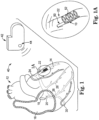
- FIGS. 1 and 1A show a transvenously implantable medical device (TIMD) 10 where FIG. 1A is an enlarged view showing the TIMD 10 in greater detail.
- the TIMD 10 is adapted to be implanted transvenously at a desired location within the vasculature of the patient.
- the TIMD 10 is implanted within vasculature of the heart 12 to provide cardiac sensing and/or stimulation functionality.
- the TIMD 10 can be used to sense various physiological characteristics of the heart 12 and/or to transmit a stimulating pulse of energy to tissue of the heart 12, such as the tissue forming the left ventricle 14.
- the TIMD 10 is adapted to be implanted into the right atrium 16, through the coronary sinus ostium 18 and into the coronary sinus 20 of the heart 12.
- catheter-based implantation is contemplated in association with the TIMD 10.
- the TIMD 10 is implantable within the left marginal vein 22 (as shown), or any other branch vein of the coronary sinus 20, including any of those known in the art of cardiac management.
- the TIMD 10 is optionally implanted within the great cardiac vein 24, the middle cardiac vein 26, the left posterior ventricular vein 28, the small cardiac vein 30, or others.
- the TIMD 10 is implanted in vasculature of the heart 12 in some embodiments, the TIMD 10 can also be implanted at other intravenous locations and/or to perform other functions.
- the TIMD 10 is optionally implanted in vasculature of the neck, such as one of the jugular veins.
- the TIMD 10 can perform various functions from the jugular veins, such as cardiac rhythm management via vagal nerve stimulation, for example.
- the TIMD 10 is optionally implanted in peripheral vasculature and is adapted for acquiring diagnostic information, blood pressure for example, and then storing the diagnostic information, transmitting the diagnostic information to another implanted medical device (IMD), and/or transmitting the diagnostic information to an external device.
- IMD implanted medical device
- the TIMD 10 is usable with a wireless electrode system 40 that includes a control system 42 having a transmitter 44 for communicating with one or more wireless electrodes, such as the TIMD 10.
- the transmitter 44 is an inductive coil used to inductively charge the TIMD 10 with power and/or trigger delivery of stimulating energy from the TIMD 10 to the heart 12.
- the transmitter 44 is a radiofrequency communication device, an acoustic communication device, or other device for communicating with the TIMD 10.
- the control system 42 directly controls stimulation via the TIMD 10 from outside of the body (externally, for example worn about the neck) or from within the body (internally, for example implanted similarly to a conventional pacemaker) using inductive communication/power transmission.
- the control system 42 can also use other types of communication to directly control stimulation or sensing functionality administered with the TIMD 10 in addition to or as an alternative to inductive transmission.
- radiofrequency, optical, or acoustic communication between the TIMD 10 and the control system 42 are also contemplated. Examples of various wireless electrode systems usable in association with the TIMD 10 are described in U.S. Patent App. Pub. 2006/0085039 , " Leadless Cardiac Stimulation Systems ,” and U.S. Patent App. Pub. 2003/0158584 , " Chronically-Implanted Device for Sensing and Therapy ,” the entire contents of each of which are incorporated herein by reference.
- control system 42 and the TIMD 10 are optionally deployed in a satellite-planet configuration, where the control system 42 acts as a planet device and the TIMD 10, or a plurality of devices similar to the TIMD 10, act as one or more satellite device(s).
- the TIMD 10 and control system 42 can have varying degrees of control over sensing/stimulating operation of the TIMD 10.
- the TIMD 10 is programmed to manage cardiac stimulation for a substantial period of time. Examples of wireless, implanted electrodes that are programmable to control stimulating or sensing functionality, as well as examples of satellite-planet device configurations are described in previously-incorporated U.S. Patent App. Pub. 2003/0158584 .
- FIG. 2 is a schematic view of the TIMD 10 in an unassembled state.
- the TIMD 10 includes a control module 50 and an electrical lead 52 providing means for fixating the control module 50 within vasculature.
- the control module 50 includes a housing 60 and various electrical components, including a signal management component 62, a power component 64, and a communication component 66.
- Various components of the control module 50, including components 62, 64, 66 can be arranged as discrete devices, combined devices having shared circuits and/or processing capabilities, or according to other arrangements.
- the housing 60 is adapted for transvenous delivery and implantation in human vasculature, including vasculature associated with the heart 12.
- the housing 60 is formed of metallic, polymeric, or other biocompatible materials.
- the housing 60 is substantially oblong and forms a terminal connector 70 adapted to be secured to the lead 52, a hermetically sealed interior compartment 72 adapted to house and protect the components 62, 64, 66, and an inner lumen 74 (shown in dotted lines) extending longitudinally through the housing 60.
- the inner lumen 74 is generally adapted to facilitate implantation of the TIMD 10, as described subsequently in greater detail.
- the housing 60 includes drug delivery features, e.g., a steroid collar, drug eluting coating, or other therapeutic agents, or others.
- the housing 60 also optionally includes stimulating and/or sensing features, e.g., one or more electrodes associated with the housing 60.
- the signal management component 62 includes circuitry for managing operation of the TIMD 10. In some embodiments, the signal management component 62 controls delivery of stimulating energy from the TIMD 10. The signal management component 62 is optionally adapted to be programmed to execute various stimulation or sensing programs. In other embodiments, the signal management component 62 is a hardwired circuit configured to deliver set stimulation or sensing programs upon initiation by a remote controller, such as the control system 42 ( FIG. 1 ).
- the power component 64 operates to provide power to the signal management component 62 and/or the communication component 66.
- the power component 64 is a battery, a coil for receiving a charge through inductance, or other type of power source for providing energy to the TIMD 10.
- power is transmitted to the control module 50 from an outside source, including those internal or external to the body, such as the control system 42 ( FIG. 1 ).
- the power component 64 is optionally integrated with the communication component 66 and data being transmitted to and received by the control module 50 is encoded into the power transmission as a modulation of the power signal from the control system 42. Examples of integrated power/communication arrangements are described in previously incorporated U.S. Patent App. Pub. 2003/0158584 .
- the communication component 66 serves to provide a communication link between the TIMD 10 and one or more other devices, such as the control system 42 ( FIG. 1 ), that are internal and/or external to the patient.
- the communication component 66 includes circuitry and/or other structures for providing communication between the chronically-implanted device and another device using radio-frequency (RF) waves, acoustics, or inductance, for example.
- RF radio-frequency
- the communication component 66 includes an acoustic transmitter for transmitting an acoustic signal to another device, such as the control system 42.
- the control system 42 is optionally an implanted cardiac stimulus device, such as a pacemaker and the communication component 66 is adapted to provide bidirectional communication between the TIMD 10 and the control system 42.
- the lead 52 defines a central longitudinal axis X and includes a lead body 80 extending from a terminal connector end 82 to a distal end 84.
- FIG. 3 shows a cross-section of a portion of the lead 52 along the line 3-3 shown in FIG. 2 .
- the lead body 80 includes an outer, insulating sheath 88, an inner, conductive core 90, an inner, insulating sheath 92, and one or more electrodes 98.
- the electrodes 98 include a plurality of ring electrodes 100 disposed circumferentially about the lead body 80 and a tip electrode 102 located at the distal end 84.
- the conductive core 90 is sandwiched between the outer and inner insulating sheaths 88, 92 and is optionally of a coiled design.
- the inner sheath 92 defines a lumen 104 that is open at the terminal connector end 82.
- the electrodes 98 are positioned along the lead body 80.
- the electrodes 98 are in electrical communication with the conductive core 90, providing an electrical pathway between the electrodes 98 and the control module 50.
- the core 90 is a coiled core, although other configurations are contemplated.
- the core 90 is a cable or ribbon conductor.
- the conductive core 90 can be made of any electrically conductive materials.
- the lead 52 includes no lumens or greater number of lumens 104, a non-coiled conductive core 90, or other features associated with electrical leads.
- a steroid collar is employed with the lead 52 to help ensure proper pacing and/or as a therapeutic agent, including anti-inflammatories, antithrombogenics, antiproliferatives, or other types of therapeutic agents. Examples of various electrical lead features contemplated for use with the lead 52 are described in U.S. Patent No. 6,584,362 , " Leads for Pacing and/or Sensing the Heart from within the Coronary Veins ,” the entire contents of which are incorporated herein by reference.
- the electrodes 98 can be substantially the same as known electrodes for pacing and/or defibrillation leads.
- the electrodes 98 are formed of an electrically conductive material such as an alloy of platinum and iridium which is highly conductive and highly resistant to corrosion.
- the conductive core 90 carries electrical current between the control module 50 and the electrodes 98.
- the lead 52 is unipolar with a single conductor. In other embodiments, the lead 52 is bipolar where one or more of the electrodes 98 are each in electrical communication with a plurality of separate conductors (not shown).
- the lead 52 is pre-biased to define a first shape in an expanded state ( FIG. 2 ) and can be transitioned, or collapsed, to define a second shape in a collapsed state ( FIG. 4 ). As shown in FIG. 2 and FIG. 4 , the lead 52 has a substantially larger maximum outer dimension in the expanded state than in the collapsed state. In different terms, the lead 52 defines a larger profile relative to the central longitudinal axis X of the lead 52 when the lead is in the expanded state in comparison to when the lead 52 is in the collapsed state.
- the lead 52 in the expanded state, naturally extends though an arcuate path to define a substantially helical, or coiled shape.
- other expanded state shapes are also contemplated, including generally arcuate shapes, undulating shapes, sinusoidal shapes, circular shapes, and others.
- the lead 52 is pre-formed, or otherwise pre-biased to the shape exhibited in the expanded state via heat-setting, materials selection, plastic deformation of the conductive core 90, or using another technique known in the art.
- the lead 52 is straighter, or more linear, in the collapsed state than in the expanded state according to some embodiments.
- Various collapsed state shapes are contemplated, including helical shapes having a smaller transverse profile than in the expanded state.
- control module 50 is assembled to the lead 52 by securing the terminal connector end 82 of the lead 52 to the terminal connector 70 of the control module 50.
- the conductive core 90 ( FIG. 3 ) of the lead 52 is placed in electrical communication with the components of the control module 50 such that the signal management component 62 ( FIG. 2 ) of the module 50 can send a stimulation signal to, or receive a sensing signal from, the electrodes 98 through the conductive core 90 of the lead 52.
- the inner lumen 104 ( FIG. 3 ) of the lead 52 is coaxially aligned to the inner lumen 74 ( FIG.
- the lead 52 has specific biases to facilitate placement and retention of the lead 52 in the coronary sinus 20 ( FIG. 1 ) or a branch vessel thereof.
- FIGS. 4-6 are illustrative of one embodiment method of transvenously implanting the TIMD 10 in a blood vessel 150 having a vessel wall 152.
- FIG. 4 shows the TIMD 10 with the lead 52 in a collapsed state.
- a straightening member 160 such as a stylet or a guidewire having sufficient stiffness to straighten and maintain the lead 52 in the collapsed state, is inserted through the inner lumen 74 of the control module 50 into the lead 52 to collapse the lead 52.
- the TIMD 10 and straightening member 160 are delivered to a desired transvenous implantation site, for example in the coronary sinus 20 ( FIG. 1 ) or a branch vein thereof.
- the TIMD 10 and the straightening member 160 are delivered through a guide catheter 162 as shown in FIG. 4 .
- the TIMD 10 is deployed from the guide catheter 162 once the TIMD 10 is delivered proximate a desired location within the blood vessel 150.
- the TIMD 10 is delivered directly to the desired implantation site using the straightening member 160 and in the absence of the guide catheter 162 in a manner substantially similar to an over-the-wire lead delivery technique.
- the straightening member 160 is then removed from the TIMD 10.
- a secondary member 164 can be deployed over the straightening member 160 to press against the TIMD 10 to assist with deployment of the TIMD 10 from the guide catheter 162 and/or removal of the straightening member 160 from the TIMD 10.
- the secondary member 164 is catheter-like in construction and formed according to catheter-based manufacturing methods.
- the lead 52 transitions from the collapsed state to the expanded state shown in FIGS. 5 and 6 to contact the vessel wall 152.
- the lead 52 provides means for anchoring or fixating the TIMD 10 in the blood vessel 150.
- the maximum outer dimension of the lead 52 for example the transverse diameter defined by the helical shape of the lead 52, is selected such that the lead 52 will mechanically engage the vessel wall 152.
- the mechanical engagement between the lead 52 and the vessel wall 152 is used to place one or more of the electrodes 98 in electrical communication with the vessel wall 152 and to anchor or otherwise fixate the TIMD 10 in position within the blood vessel 150.
- the lead 52 includes coatings, e.g., fibrosis encouraging coatings, or surface features to enhance frictional engagement with the vessel wall 152. In other embodiments, the lead 52 includes anti-fibrosis coatings or treatments to discourage fibrosis and facilitate lead extraction. As shown in FIG. 6 , upon expansion the TIMD 10 defines a central passage 168 through the expanded shape of the TIMD 10. In some embodiments, the central passage 168 facilitates blood flow past the TIMD 10.
- the TIMD 10 is used for sensing or stimulation according to various embodiments.
- the blood vessel 150 is optionally the coronary sinus 20 ( FIG. 1 ) or one of the branch vessels thereof.
- the electrodes 98 of the TIMD 10 can then be used to transmit a pulse of stimulating energy through the vessel wall 152 to surrounding tissue of the heart 12.
- the TIMD 10 is re-collapsible following transvenous implantation to remove or reposition the TIMD 10.
- the secondary member 164 can be used to grip the control module 50 following implantation of the TIMD 10.
- a vacuum is applied through the secondary member 164, which secures the control module 50 to the secondary member 164.
- the control module 50 optionally includes a proximal seal 170 that is able to be engaged by the secondary member 164.
- the proximal seal 170 facilitates coupling of the control module 50 to the secondary member 164 via application of negative pressure through the secondary member 164 by forming a better seal between the control module 50 and the secondary member 164.
- the secondary member 164 includes gripping elements (not shown), somewhat like jaws of a pliers, for gripping the control module 50 or associated structures.
- the control module 50 includes a wire loop (not shown) and the secondary member 164 includes a hook (not shown) for grasping the loop.
- Other means for securing the control module 50 relative to the secondary member 164 are also contemplated, including detents, magnets, adhesives, male and female threads, and others.
- the straightening member 160 is reinserted into the lumen 104 of the lead 52 through the inner lumen 74 of the control module 50. As the straightening member 160 is reintroduced into the lead 52, the lead 52 transitions to the collapsed state, and out of mechanical engagement with the vessel wall 152. Once the lead 52 has been partially or fully collapsed, the TIMD 10 is able to be removed or repositioned as desired.
- FIGS. 7 and 8 show another TIMD 200.
- the TIMD 200 includes a control module 210 and an electrical lead 220 providing means for fixating the control module 210 within vasculature.
- the control module 210 and the lead 220 include substantially similar components as the control module 50 and the lead 52 of the TIMD 10.
- the lead 220 extends through an arcuate path and is curved or biased, being adapted to expand from a collapsed state (not shown), for example substantially straight, to an expanded state, for example having the curvatures shown in FIGS. 7 and 8 .
- the lead 220 of the TIMD 200 defines a substantially larger maximum outer dimension in the expanded state than in the collapsed state.
- the curvature of the lead 220 is primarily in two dimensions, or within a single plane. As shown in FIG. 8 , the curvature of lead 220 also includes a non-planar component, with a second bend or curve in a second plane.
- the lead 220 is pre-formed, or otherwise pre-biased to the expanded state via heat-setting, materials selection, plastic deformation, or others.
- the lead 220 is constructed and arranged for fixation in the coronary sinus 20, and is pre-biased to facilitate placement and retention in the coronary sinus 20, or a branch vessel thereof.
- Various examples of structures and methods for providing such pre-biased, curved shapes are described in co-pending U.S. Patent App. Ser. No. 11/277,326, filed March 23, 2006 , and entitled "Left Ventricular Lead Shapes," the entire contents of which are incorporated herein by reference.
- the TIMD 200 is transvenously implanted in a similar manner to the TIMD 10, for example using the guide catheter 162 ( FIG. 4 ), the secondary member 164 ( FIG. 4 ), and/or the straightening member 160 ( FIG. 4 ) as previously described.
- the lead 220 is transitioned from the collapsed state to the expanded state to contact the vessel wall 152 ( FIG. 4 ).
- the maximum outer dimension of the lead 220 for example the outer diameter defined by the arcuate shape of the lead 52, is selected such that the lead 52 will mechanically engage the vessel wall 152 to anchor the TIMD 200 in the blood vessel 150.
- the TIMD 200 can also be removed from the blood vessel 150 in a similar manner to that described in association with the TIMD 10 according to some embodiments.
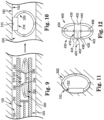
- FIGS. 9 and 10 show another TIMD 300 and are illustrative of one method of transvenously implanting the TIMD 300.
- the TIMD 300 includes a control module 310 and an electrical lead 320 providing means for fixating the control module 310 within vasculature.
- the lead 320 is adapted to transition between a collapsed state and an expanded state.
- the control module 310 and the lead 320 include substantially similar components as the control module 50 and the lead 52 of the TIMD 10.
- the control module 310 optionally includes one or more electrodes 315 for performing sensing and/or stimulating functions similar to those previously described.
- the electrode 315 is used in conjunction with one or more electrodes of the lead 320.
- the control module 310 has a proximal end 330 and distal end 332 and the lead 320 has a first end 334 and a second end 336.
- the first end 334 of the lead 320 is secured to the proximal end 330 of the control module 310 while the second end 336 of the lead 320 is secured to the distal end 332 of the control module 310.
- the lead 320 extends through an arcuate shape from the proximal end 330 to the distal end 332 of the control module 310.
- FIG. 9 shows the lead 320 in the collapsed state, where the lead 320 has been pressed into a more compact, linear shape than in the expanded state ( FIG. 10).
- FIG. 10 shows the lead 320 in the expanded state, where the lead 320 defines a greater height, or outer diameter in the expanded state than in the collapsed state.
- the lead 320 in the expanded state the lead 320 has a substantially larger maximum outer dimension than in the collapsed state.
- the lead 320 is pre-formed, or otherwise pre-biased to the shape exhibited in the expanded state via heat-setting, materials selection, plastic deformation to impart a curvature, or others.
- FIGS. 9 and 10 One method of transvenously implanting the TIMD 300 is also generally illustrated in FIGS. 9 and 10 .
- the lead 320 is maintained in the collapsed state within a catheter 350.
- the catheter 350 is guided to a desired position within the blood vessel 150.
- a pusher 352 is used to eject the TIMD 300 from the catheter 350.
- the TIMD 300 transitions to the expanded state as shown in FIG. 10 to engage the vessel wall 152 and anchor the TIMD 300 in place.
- the TIMD 300 is shown oriented "sideways" within the blood vessel 150, other orientations are also contemplated.
- the TIMD 300 is optionally transvenously implanted as shown in FIG. 11 , where the TIMD 300 is oriented substantially coaxially with the blood vessel 150.
- FIG. 12 shows another exemplary TIMD 400 .
- the TIMD 400 includes a control module 410, a first electrical lead 420, and a second electrical lead 422, the first and second leads 420, 422 providing means for fixating the control module 410 within vasculature.
- the first and second leads 420, 422 are adapted to transition between a collapsed state and an expanded state.
- the control module 410 and the leads 420, 422 generally include substantially similar components as the control module 50 and the lead 52 of the TIMD 10 ( FIG. 1 ).
- the control module 410 has a proximal end 430 and distal end 432.
- the first lead 420 has a first end 434 and a second end 436.
- the second lead 422 has a first end 438 and a second end 440.
- the first ends 434, 438 of the leads 420, 422 are secured to the proximal end 430 of the control module 410 while the second ends 436, 440 of the leads 420, 422 are secured to the distal end 432 of the control module 410.
- the first and second leads 420, 422 extend through opposing, arcuate paths relative to the control module 410 to define a pair of semi-circular shapes.
- the leads 420, 422 are transitionable between an expanded state and a more compact, collapsed state.
- FIG. 12 shows the leads 420, 422 in the expanded state.
- the leads 420, 422 are pre-biased to the expanded state such that they will expand outwardly to the shape shown generally in FIG. 12 .
- the leads 420, 422 are sufficiently flexible to be compressed to a collapsed state where the leads 420, 422 define a more linear, compact shape. In particular, the leads 420, 422 are pressed inwardly toward the control module 410 in the collapsed state.
- the leads 420, 422 define a greater height, or overall outer diameter in the expanded state than in the collapsed state.
- the leads 420, 422 are pre-biased to the expanded state shape via heat-setting, materials selection, plastic deformation, or others.
- the TIMD 400 can also include means for transitioning the TIMD 400 to the collapsed state.
- the TIMD 400 includes a filament 450 that can be tensioned to collapse the first and second leads 420, 422 toward the control module 410.
- the filament 450 includes a loop 452 at the proximal end 430 of the control module 410.
- the filament 450 extends from the loop 452 through the control module 410 and splits into a first leg 454 and a second leg 456.
- the first leg 454 is secured to the first lead 420 while the second leg 456 is secured to the second lead 422.
- the loop 452 is pulled, which in turn tensions the first and second legs 454, 456, collapsing the leads 420, 422.
- the TIMD 400 is transvenously implanted in a similar manner as that described in association with the TIMD 300.
- the catheter 350 is optionally used to maintain the TIMD 400 in the collapsed state.
- the pusher 352 is then optionally used to eject the TIMD 400 from the catheter 350.
- the TIMD 400 transitions to the expanded state as shown in FIG. 12 to engage the vessel wall 152 and anchor the TIMD 400 in place.
- the TIMD 400 is removed from the blood vessel 150 ( FIG. 10 ) by fully or partially collapsing the leads 420, 422 toward the control module 410 using the filament 450.
- a catheter or other device (not shown) having gripping jaws or a hook is used to pull the filament 450 by hooking, or grasping the loop 452 and pulling on the loop 452.
- the TIMD 400 is transitioned to the collapsed state and is repositioned as desired or removed entirely from the blood vessel 150.
- the various TIMD embodiments previously described can also include a filament forming a loop similar to the filament 450 and loop 452 to provide means for grasping and/or collapsing the TIMDs associated with those embodiments.
Landscapes
- Health & Medical Sciences (AREA)
- Life Sciences & Earth Sciences (AREA)
- Public Health (AREA)
- Radiology & Medical Imaging (AREA)
- Veterinary Medicine (AREA)
- General Health & Medical Sciences (AREA)
- Engineering & Computer Science (AREA)
- Biomedical Technology (AREA)
- Nuclear Medicine, Radiotherapy & Molecular Imaging (AREA)
- Animal Behavior & Ethology (AREA)
- Heart & Thoracic Surgery (AREA)
- Cardiology (AREA)
- Vascular Medicine (AREA)
- Biophysics (AREA)
- Physics & Mathematics (AREA)
- Acoustics & Sound (AREA)
- Physiology (AREA)
- Electrotherapy Devices (AREA)
Applications Claiming Priority (3)
| Application Number | Priority Date | Filing Date | Title |
|---|---|---|---|
| US11/750,185 US8103359B2 (en) | 2007-05-17 | 2007-05-17 | Systems and methods for fixating transvenously implanted medical devices |
| PCT/US2008/063542 WO2008144319A1 (en) | 2007-05-17 | 2008-05-13 | Systems and methods for fixating transvenously implanted medical devices |
| EP08755404.4A EP2146776B1 (en) | 2007-05-17 | 2008-05-13 | Systems for fixating transvenously implanted medical devices |
Related Parent Applications (2)
| Application Number | Title | Priority Date | Filing Date |
|---|---|---|---|
| EP08755404.4A Division-Into EP2146776B1 (en) | 2007-05-17 | 2008-05-13 | Systems for fixating transvenously implanted medical devices |
| EP08755404.4A Division EP2146776B1 (en) | 2007-05-17 | 2008-05-13 | Systems for fixating transvenously implanted medical devices |
Publications (2)
| Publication Number | Publication Date |
|---|---|
| EP3300767A1 EP3300767A1 (en) | 2018-04-04 |
| EP3300767B1 true EP3300767B1 (en) | 2025-03-05 |
Family
ID=39666116
Family Applications (2)
| Application Number | Title | Priority Date | Filing Date |
|---|---|---|---|
| EP17193891.3A Active EP3300767B1 (en) | 2007-05-17 | 2008-05-13 | Systems for fixating transvenously implanted medical devices |
| EP08755404.4A Not-in-force EP2146776B1 (en) | 2007-05-17 | 2008-05-13 | Systems for fixating transvenously implanted medical devices |
Family Applications After (1)
| Application Number | Title | Priority Date | Filing Date |
|---|---|---|---|
| EP08755404.4A Not-in-force EP2146776B1 (en) | 2007-05-17 | 2008-05-13 | Systems for fixating transvenously implanted medical devices |
Country Status (4)
| Country | Link |
|---|---|
| US (4) | US8103359B2 (enExample) |
| EP (2) | EP3300767B1 (enExample) |
| JP (1) | JP5265670B2 (enExample) |
| WO (1) | WO2008144319A1 (enExample) |
Families Citing this family (147)
| Publication number | Priority date | Publication date | Assignee | Title |
|---|---|---|---|---|
| US6702811B2 (en) | 1999-04-05 | 2004-03-09 | Medtronic, Inc. | Ablation catheter assembly with radially decreasing helix and method of use |
| US7653438B2 (en) | 2002-04-08 | 2010-01-26 | Ardian, Inc. | Methods and apparatus for renal neuromodulation |
| US8774913B2 (en) | 2002-04-08 | 2014-07-08 | Medtronic Ardian Luxembourg S.A.R.L. | Methods and apparatus for intravasculary-induced neuromodulation |
| US20140018880A1 (en) | 2002-04-08 | 2014-01-16 | Medtronic Ardian Luxembourg S.A.R.L. | Methods for monopolar renal neuromodulation |
| US7532933B2 (en) | 2004-10-20 | 2009-05-12 | Boston Scientific Scimed, Inc. | Leadless cardiac stimulation systems |
| WO2007067231A1 (en) | 2005-12-09 | 2007-06-14 | Boston Scientific Scimed, Inc. | Cardiac stimulation system |
| US7840281B2 (en) | 2006-07-21 | 2010-11-23 | Boston Scientific Scimed, Inc. | Delivery of cardiac stimulation devices |
| US8644934B2 (en) | 2006-09-13 | 2014-02-04 | Boston Scientific Scimed Inc. | Cardiac stimulation using leadless electrode assemblies |
| US8103359B2 (en) | 2007-05-17 | 2012-01-24 | Cardiac Pacemakers, Inc. | Systems and methods for fixating transvenously implanted medical devices |
| US8738147B2 (en) | 2008-02-07 | 2014-05-27 | Cardiac Pacemakers, Inc. | Wireless tissue electrostimulation |
| US9468755B2 (en) | 2009-09-30 | 2016-10-18 | Respicardia, Inc. | Medical lead with preformed bias |
| US20130006339A1 (en) * | 2009-12-11 | 2013-01-03 | March Keith L | Implantable biomedical device leads comprising liquid conductors |
| CN202654229U (zh) | 2010-10-25 | 2013-01-09 | 美敦力Af卢森堡有限责任公司 | 用于通过肾去神经支配治疗人类患者的导管装置 |
| US8489205B2 (en) * | 2011-05-03 | 2013-07-16 | Biotronik Se & Co. Kg | System for temporary fixation of an implantable medical device |
| EP2559453B1 (fr) * | 2011-08-18 | 2014-07-16 | Sorin CRM SAS | Sonde de stimulation multizone d'une cavité gauche du coeur, implantable dans le réseau coronarien |
| GB2501077B (en) * | 2012-04-10 | 2016-06-15 | Gloucestershire Hospitals Nhs Found Trust | Apparatus for artificial cardiac stimulation and method of using the same |
| EP2846724B1 (en) | 2012-05-11 | 2016-11-09 | Medtronic Ardian Luxembourg S.à.r.l. | Multi-electrode catheter assemblies for renal neuromodulation and associated systems |
| US9095321B2 (en) | 2012-11-21 | 2015-08-04 | Medtronic Ardian Luxembourg S.A.R.L. | Cryotherapeutic devices having integral multi-helical balloons and methods of making the same |
| US9179974B2 (en) | 2013-03-15 | 2015-11-10 | Medtronic Ardian Luxembourg S.A.R.L. | Helical push wire electrode |
| EP2813263A1 (de) * | 2013-06-12 | 2014-12-17 | Achim Gutersohn | Herzschrittmachersystem mit einer Haltevorrichtung |
| US20150073515A1 (en) | 2013-09-09 | 2015-03-12 | Medtronic Ardian Luxembourg S.a.r.I. | Neuromodulation Catheter Devices and Systems Having Energy Delivering Thermocouple Assemblies and Associated Methods |
| GB2519302B (en) * | 2013-10-15 | 2016-04-20 | Gloucestershire Hospitals Nhs Foundation Trust | Apparatus for artificial cardiac stimulation and method of using the same |
| WO2015106007A1 (en) | 2014-01-10 | 2015-07-16 | Cardiac Pacemakers, Inc. | Methods and systems for improved communication between medical devices |
| US9592391B2 (en) | 2014-01-10 | 2017-03-14 | Cardiac Pacemakers, Inc. | Systems and methods for detecting cardiac arrhythmias |
| US10736690B2 (en) | 2014-04-24 | 2020-08-11 | Medtronic Ardian Luxembourg S.A.R.L. | Neuromodulation catheters and associated systems and methods |
| US9999774B2 (en) * | 2014-05-06 | 2018-06-19 | Medtronic, Inc. | Optical trigger for therapy delivery |
| US9669224B2 (en) | 2014-05-06 | 2017-06-06 | Medtronic, Inc. | Triggered pacing system |
| US9492671B2 (en) | 2014-05-06 | 2016-11-15 | Medtronic, Inc. | Acoustically triggered therapy delivery |
| US10390720B2 (en) | 2014-07-17 | 2019-08-27 | Medtronic, Inc. | Leadless pacing system including sensing extension |
| US9399140B2 (en) | 2014-07-25 | 2016-07-26 | Medtronic, Inc. | Atrial contraction detection by a ventricular leadless pacing device for atrio-synchronous ventricular pacing |
| EP3185952B1 (en) | 2014-08-28 | 2018-07-25 | Cardiac Pacemakers, Inc. | Implantable cardiac rhythm system and an associated method for triggering a blanking period through a second device |
| US9492668B2 (en) | 2014-11-11 | 2016-11-15 | Medtronic, Inc. | Mode switching by a ventricular leadless pacing device |
| US9492669B2 (en) | 2014-11-11 | 2016-11-15 | Medtronic, Inc. | Mode switching by a ventricular leadless pacing device |
| US9623234B2 (en) | 2014-11-11 | 2017-04-18 | Medtronic, Inc. | Leadless pacing device implantation |
| US9724519B2 (en) | 2014-11-11 | 2017-08-08 | Medtronic, Inc. | Ventricular leadless pacing device mode switching |
| US9289612B1 (en) | 2014-12-11 | 2016-03-22 | Medtronic Inc. | Coordination of ventricular pacing in a leadless pacing system |
| ES2713231T3 (es) | 2015-02-06 | 2019-05-20 | Cardiac Pacemakers Inc | Sistemas para el suministro seguro de una terapia de estimulación eléctrica |
| US9682239B2 (en) | 2015-02-06 | 2017-06-20 | Cardiac Pacemakers, Inc. | Systems and methods for treating cardiac arrhythmias |
| US9669230B2 (en) | 2015-02-06 | 2017-06-06 | Cardiac Pacemakers, Inc. | Systems and methods for treating cardiac arrhythmias |
| WO2016130477A2 (en) | 2015-02-09 | 2016-08-18 | Cardiac Pacemakers, Inc. | Implantable medical device with radiopaque id tag |
| US11285326B2 (en) | 2015-03-04 | 2022-03-29 | Cardiac Pacemakers, Inc. | Systems and methods for treating cardiac arrhythmias |
| WO2016149262A1 (en) | 2015-03-18 | 2016-09-22 | Cardiac Pacemakers, Inc. | Communications in a medical device system with link quality assessment |
| US10050700B2 (en) | 2015-03-18 | 2018-08-14 | Cardiac Pacemakers, Inc. | Communications in a medical device system with temporal optimization |
| WO2017031221A1 (en) | 2015-08-20 | 2017-02-23 | Cardiac Pacemakers, Inc. | Systems and methods for communication between medical devices |
| CN108136187B (zh) | 2015-08-20 | 2021-06-29 | 心脏起搏器股份公司 | 用于医疗装置之间的通信的系统和方法 |
| US9968787B2 (en) | 2015-08-27 | 2018-05-15 | Cardiac Pacemakers, Inc. | Spatial configuration of a motion sensor in an implantable medical device |
| US9956414B2 (en) | 2015-08-27 | 2018-05-01 | Cardiac Pacemakers, Inc. | Temporal configuration of a motion sensor in an implantable medical device |
| US10226631B2 (en) | 2015-08-28 | 2019-03-12 | Cardiac Pacemakers, Inc. | Systems and methods for infarct detection |
| WO2017040115A1 (en) | 2015-08-28 | 2017-03-09 | Cardiac Pacemakers, Inc. | System for detecting tamponade |
| EP3341076B1 (en) | 2015-08-28 | 2022-05-11 | Cardiac Pacemakers, Inc. | Systems and methods for behaviorally responsive signal detection and therapy delivery |
| US10092760B2 (en) | 2015-09-11 | 2018-10-09 | Cardiac Pacemakers, Inc. | Arrhythmia detection and confirmation |
| WO2017062806A1 (en) | 2015-10-08 | 2017-04-13 | Cardiac Pacemakers, Inc. | Devices and methods for adjusting pacing rates in an implantable medical device |
| EP3389775B1 (en) | 2015-12-17 | 2019-09-25 | Cardiac Pacemakers, Inc. | Conducted communication in a medical device system |
| US10905886B2 (en) | 2015-12-28 | 2021-02-02 | Cardiac Pacemakers, Inc. | Implantable medical device for deployment across the atrioventricular septum |
| WO2017127548A1 (en) | 2016-01-19 | 2017-07-27 | Cardiac Pacemakers, Inc. | Devices for wirelessly recharging a rechargeable battery of an implantable medical device |
| EP3411113B1 (en) | 2016-02-04 | 2019-11-27 | Cardiac Pacemakers, Inc. | Delivery system with force sensor for leadless cardiac device |
| WO2017173275A1 (en) | 2016-03-31 | 2017-10-05 | Cardiac Pacemakers, Inc. | Implantable medical device with rechargeable battery |
| US10668294B2 (en) | 2016-05-10 | 2020-06-02 | Cardiac Pacemakers, Inc. | Leadless cardiac pacemaker configured for over the wire delivery |
| US10328272B2 (en) | 2016-05-10 | 2019-06-25 | Cardiac Pacemakers, Inc. | Retrievability for implantable medical devices |
| CN109414582B (zh) | 2016-06-27 | 2022-10-28 | 心脏起搏器股份公司 | 使用皮下感测p波进行再同步起搏管理的心脏治疗系统 |
| US11207527B2 (en) | 2016-07-06 | 2021-12-28 | Cardiac Pacemakers, Inc. | Method and system for determining an atrial contraction timing fiducial in a leadless cardiac pacemaker system |
| WO2018009392A1 (en) | 2016-07-07 | 2018-01-11 | Cardiac Pacemakers, Inc. | Leadless pacemaker using pressure measurements for pacing capture verification |
| EP3487579B1 (en) | 2016-07-20 | 2020-11-25 | Cardiac Pacemakers, Inc. | System for utilizing an atrial contraction timing fiducial in a leadless cardiac pacemaker system |
| EP3500342B1 (en) | 2016-08-19 | 2020-05-13 | Cardiac Pacemakers, Inc. | Trans-septal implantable medical device |
| US10870008B2 (en) | 2016-08-24 | 2020-12-22 | Cardiac Pacemakers, Inc. | Cardiac resynchronization using fusion promotion for timing management |
| WO2018039335A1 (en) | 2016-08-24 | 2018-03-01 | Cardiac Pacemakers, Inc. | Integrated multi-device cardiac resynchronization therapy using p-wave to pace timing |
| US10758737B2 (en) | 2016-09-21 | 2020-09-01 | Cardiac Pacemakers, Inc. | Using sensor data from an intracardially implanted medical device to influence operation of an extracardially implantable cardioverter |
| WO2018057626A1 (en) | 2016-09-21 | 2018-03-29 | Cardiac Pacemakers, Inc. | Implantable cardiac monitor |
| WO2018057318A1 (en) | 2016-09-21 | 2018-03-29 | Cardiac Pacemakers, Inc. | Leadless stimulation device with a housing that houses internal components of the leadless stimulation device and functions as the battery case and a terminal of an internal battery |
| EP3532161B1 (en) | 2016-10-27 | 2023-08-30 | Cardiac Pacemakers, Inc. | Implantable medical device with pressure sensor |
| EP3532159B1 (en) | 2016-10-27 | 2021-12-22 | Cardiac Pacemakers, Inc. | Implantable medical device delivery system with integrated sensor |
| US10463305B2 (en) | 2016-10-27 | 2019-11-05 | Cardiac Pacemakers, Inc. | Multi-device cardiac resynchronization therapy with timing enhancements |
| US10561330B2 (en) | 2016-10-27 | 2020-02-18 | Cardiac Pacemakers, Inc. | Implantable medical device having a sense channel with performance adjustment |
| US10413733B2 (en) | 2016-10-27 | 2019-09-17 | Cardiac Pacemakers, Inc. | Implantable medical device with gyroscope |
| EP3532160B1 (en) | 2016-10-27 | 2023-01-25 | Cardiac Pacemakers, Inc. | Separate device in managing the pace pulse energy of a cardiac pacemaker |
| WO2018081721A1 (en) | 2016-10-31 | 2018-05-03 | Cardiac Pacemakers, Inc | Systems for activity level pacing |
| US10617874B2 (en) | 2016-10-31 | 2020-04-14 | Cardiac Pacemakers, Inc. | Systems and methods for activity level pacing |
| US10583301B2 (en) | 2016-11-08 | 2020-03-10 | Cardiac Pacemakers, Inc. | Implantable medical device for atrial deployment |
| EP3538213B1 (en) | 2016-11-09 | 2023-04-12 | Cardiac Pacemakers, Inc. | Systems and devices for setting cardiac pacing pulse parameters for a cardiac pacing device |
| EP3541473B1 (en) | 2016-11-21 | 2020-11-11 | Cardiac Pacemakers, Inc. | Leadless cardiac pacemaker with multimode communication |
| US10881869B2 (en) | 2016-11-21 | 2021-01-05 | Cardiac Pacemakers, Inc. | Wireless re-charge of an implantable medical device |
| US11147979B2 (en) | 2016-11-21 | 2021-10-19 | Cardiac Pacemakers, Inc. | Implantable medical device with a magnetically permeable housing and an inductive coil disposed about the housing |
| US10639486B2 (en) | 2016-11-21 | 2020-05-05 | Cardiac Pacemakers, Inc. | Implantable medical device with recharge coil |
| US10894163B2 (en) | 2016-11-21 | 2021-01-19 | Cardiac Pacemakers, Inc. | LCP based predictive timing for cardiac resynchronization |
| US10675476B2 (en) | 2016-12-22 | 2020-06-09 | Cardiac Pacemakers, Inc. | Internal thoracic vein placement of a transmitter electrode for leadless stimulation of the heart |
| US11207532B2 (en) | 2017-01-04 | 2021-12-28 | Cardiac Pacemakers, Inc. | Dynamic sensing updates using postural input in a multiple device cardiac rhythm management system |
| WO2018140623A1 (en) | 2017-01-26 | 2018-08-02 | Cardiac Pacemakers, Inc. | Leadless device with overmolded components |
| WO2018140797A1 (en) | 2017-01-26 | 2018-08-02 | Cardiac Pacemakers, Inc. | Leadless implantable device with detachable fixation |
| US10835753B2 (en) | 2017-01-26 | 2020-11-17 | Cardiac Pacemakers, Inc. | Intra-body device communication with redundant message transmission |
| US10994148B2 (en) | 2017-03-20 | 2021-05-04 | Cardiac Pacemakers, Inc. | Systems and methods for treating cardiac arrhythmias |
| US10716944B2 (en) | 2017-03-20 | 2020-07-21 | Cardiac Pacemakers, Inc. | Systems and methods for treating cardiac arrhythmias |
| JP6902617B2 (ja) | 2017-03-20 | 2021-07-14 | カーディアック ペースメイカーズ, インコーポレイテッド | リードレスペーシング装置およびその位置決めシステム |
| US11160989B2 (en) | 2017-03-20 | 2021-11-02 | Cardiac Pacemakers, Inc. | Systems and methods for treating cardiac arrhythmias |
| US10905872B2 (en) | 2017-04-03 | 2021-02-02 | Cardiac Pacemakers, Inc. | Implantable medical device with a movable electrode biased toward an extended position |
| AU2018248361B2 (en) | 2017-04-03 | 2020-08-27 | Cardiac Pacemakers, Inc. | Cardiac pacemaker with pacing pulse energy adjustment based on sensed heart rate |
| US10849522B2 (en) | 2017-04-03 | 2020-12-01 | Cardiac Pacemakers, Inc. | Modular cardiac rhythm management using Q to LV activation measures |
| WO2019036568A1 (en) | 2017-08-18 | 2019-02-21 | Cardiac Pacemakers, Inc. | IMPLANTABLE MEDICAL DEVICE COMPRISING A FLOW CONCENTRATOR AND A RECEPTION COIL PROVIDED AROUND THE FLOW CONCENTRATOR |
| WO2019036600A1 (en) | 2017-08-18 | 2019-02-21 | Cardiac Pacemakers, Inc. | IMPLANTABLE MEDICAL DEVICE WITH PRESSURE SENSOR |
| EP3672532B1 (en) * | 2017-08-26 | 2022-08-03 | Transmural Systems LLC | Implantable cardiac pacing system |
| JP6938778B2 (ja) | 2017-09-20 | 2021-09-22 | カーディアック ペースメイカーズ, インコーポレイテッド | 複数の作動モードを備えた移植式医療用装置 |
| US11185703B2 (en) | 2017-11-07 | 2021-11-30 | Cardiac Pacemakers, Inc. | Leadless cardiac pacemaker for bundle of his pacing |
| CN111432874A (zh) | 2017-12-01 | 2020-07-17 | 心脏起搏器股份公司 | 从心室植入的无引线心脏起搏器检测搜索窗口内心房收缩定时基准的方法和系统 |
| CN111417433B (zh) | 2017-12-01 | 2024-04-30 | 心脏起搏器股份公司 | 从心室植入的无引线心脏起搏器检测心室充盈期间心房收缩定时基准的方法和系统 |
| EP3717063B1 (en) | 2017-12-01 | 2023-12-27 | Cardiac Pacemakers, Inc. | Systems for detecting atrial contraction timing fiducials and determining a cardiac interval from a ventricularly implanted leadless cardiac pacemaker |
| US11813463B2 (en) | 2017-12-01 | 2023-11-14 | Cardiac Pacemakers, Inc. | Leadless cardiac pacemaker with reversionary behavior |
| US10894167B2 (en) | 2017-12-22 | 2021-01-19 | Cardiac Pacemakers, Inc. | Implantable medical device for vascular deployment |
| WO2019126295A1 (en) | 2017-12-22 | 2019-06-27 | Cardiac Pacemakers, Inc. | Implantable medical device for vascular deployment |
| US11529523B2 (en) | 2018-01-04 | 2022-12-20 | Cardiac Pacemakers, Inc. | Handheld bridge device for providing a communication bridge between an implanted medical device and a smartphone |
| CN111556773A (zh) | 2018-01-04 | 2020-08-18 | 心脏起搏器股份公司 | 无逐搏通信的双腔起搏 |
| CN111886046B (zh) | 2018-03-23 | 2025-05-27 | 美敦力公司 | Av同步vfa心脏治疗 |
| JP2021518192A (ja) | 2018-03-23 | 2021-08-02 | メドトロニック,インコーポレイテッド | VfA心臓再同期治療 |
| CN111936046B (zh) | 2018-03-23 | 2024-06-28 | 美敦力公司 | 用于心动过速的vfa心脏治疗 |
| EP3549518A1 (de) | 2018-04-04 | 2019-10-09 | BIOTRONIK SE & Co. KG | Haltestruktur für ein implantat |
| AU2019222842A1 (en) | 2018-09-10 | 2020-03-26 | Northern Development AS | Percutaneous Lead |
| US11235161B2 (en) | 2018-09-26 | 2022-02-01 | Medtronic, Inc. | Capture in ventricle-from-atrium cardiac therapy |
| US11951313B2 (en) | 2018-11-17 | 2024-04-09 | Medtronic, Inc. | VFA delivery systems and methods |
| WO2020106440A1 (en) | 2018-11-19 | 2020-05-28 | The Regents Of The University Of California | Systems and methods for battery-less wirelessly powered dielectric sensors |
| AU2019384545A1 (en) * | 2018-11-20 | 2021-06-10 | Texas Heart Institute | Systems and methods for controlling wirelessly powered leadless pacemakers |
| US12296177B2 (en) | 2018-12-21 | 2025-05-13 | Medtronic, Inc. | Delivery systems and methods for left ventricular pacing |
| US12357792B2 (en) | 2019-01-04 | 2025-07-15 | Shifamed Holdings, Llc | Internal recharging systems and methods of use |
| US11679265B2 (en) | 2019-02-14 | 2023-06-20 | Medtronic, Inc. | Lead-in-lead systems and methods for cardiac therapy |
| US20200269059A1 (en) * | 2019-02-20 | 2020-08-27 | Ablation Innovations, LLC | Apparatus, systems, and methods to improve atrial fibrillation outcomes involving the left atrial appendage |
| CN113677390B (zh) | 2019-03-29 | 2024-12-17 | 心脏起搏器股份公司 | 用于治疗心律失常的系统和方法 |
| CN113660977B (zh) | 2019-03-29 | 2024-12-17 | 心脏起搏器股份公司 | 用于治疗心律失常的系统和方法 |
| US11697025B2 (en) | 2019-03-29 | 2023-07-11 | Medtronic, Inc. | Cardiac conduction system capture |
| US11213676B2 (en) | 2019-04-01 | 2022-01-04 | Medtronic, Inc. | Delivery systems for VfA cardiac therapy |
| US11712188B2 (en) | 2019-05-07 | 2023-08-01 | Medtronic, Inc. | Posterior left bundle branch engagement |
| US12052533B2 (en) | 2019-07-08 | 2024-07-30 | The Regents Of The University Of California | Systems and methods for long-distance remote sensing with sub-wavelength resolution using a wirelessly-powered sensor tag array |
| US11305127B2 (en) | 2019-08-26 | 2022-04-19 | Medtronic Inc. | VfA delivery and implant region detection |
| CN114667117A (zh) | 2019-09-09 | 2022-06-24 | 施菲姆德控股有限责任公司 | 可调整分流器和相关联的系统和方法 |
| US11571582B2 (en) | 2019-09-11 | 2023-02-07 | Cardiac Pacemakers, Inc. | Tools and systems for implanting and/or retrieving a leadless cardiac pacing device with helix fixation |
| US11510697B2 (en) | 2019-09-11 | 2022-11-29 | Cardiac Pacemakers, Inc. | Tools and systems for implanting and/or retrieving a leadless cardiac pacing device with helix fixation |
| JP7525605B2 (ja) | 2019-12-05 | 2024-07-30 | シファメド・ホールディングス・エルエルシー | 植込み式シャントシステム及び方法 |
| US11813466B2 (en) | 2020-01-27 | 2023-11-14 | Medtronic, Inc. | Atrioventricular nodal stimulation |
| WO2021174215A1 (en) | 2020-02-28 | 2021-09-02 | The Regents Of The University Of California | Integrated energy harvesting transceivers and transmitters with dual-antenna architecture for miniaturized implants and electrochemical sensors |
| US12543992B2 (en) | 2020-03-30 | 2026-02-10 | Medtronic, Inc. | Pacing efficacy determination using a representative morphology of external cardiac signals |
| US11911168B2 (en) | 2020-04-03 | 2024-02-27 | Medtronic, Inc. | Cardiac conduction system therapy benefit determination |
| EP4138649B1 (en) | 2020-04-23 | 2025-09-24 | Shifamed Holdings, LLC | Intracardiac sensors with switchable configurations and associated systems and methods |
| WO2021217059A1 (en) | 2020-04-23 | 2021-10-28 | Shifamed Holdings, Llc | Power management for interatrial shunts and associated systems and methods |
| US12605103B2 (en) | 2020-05-21 | 2026-04-21 | Medtronic, Inc. | QRS detection and bracketing |
| US11813464B2 (en) | 2020-07-31 | 2023-11-14 | Medtronic, Inc. | Cardiac conduction system evaluation |
| US12465770B2 (en) | 2020-07-31 | 2025-11-11 | Medtronic, Inc. | Coronary sinus conduction system pacing and delivery |
| EP4203847B1 (en) | 2020-08-25 | 2025-10-22 | Shifamed Holdings, LLC | Adjustable interatrial shunts and associated systems |
| EP4243915A4 (en) | 2020-11-12 | 2024-08-07 | Shifamed Holdings, LLC | Adjustable implantable devices and associated methods |
| WO2022192280A1 (en) | 2021-03-09 | 2022-09-15 | Shifamed Holdings, Llc | Shape memory actuators for adjustable shunting systems, and associated systems and methods |
| US20240206937A1 (en) * | 2021-05-22 | 2024-06-27 | Snipe Medical Ltd | Tumor ablation tools and techniques |
| EP4190398A1 (en) * | 2021-12-02 | 2023-06-07 | BIOTRONIK SE & Co. KG | Anchoring device for anchoring an implantable medical device on tissue |
Family Cites Families (35)
| Publication number | Priority date | Publication date | Assignee | Title |
|---|---|---|---|---|
| US4531933A (en) * | 1982-12-07 | 1985-07-30 | C. R. Bard, Inc. | Helical ureteral stent |
| US5000190A (en) * | 1988-06-22 | 1991-03-19 | The Cleveland Clinic Foundation | Continuous cardiac output by impedance measurements in the heart |
| US5387233A (en) | 1993-01-11 | 1995-02-07 | Incontrol, Inc. | Intravenous cardiac lead with improved fixation and method |
| US5476498A (en) | 1994-08-15 | 1995-12-19 | Incontrol, Inc. | Coronary sinus channel lead and method |
| NL9401690A (nl) * | 1994-10-13 | 1996-05-01 | Industrial Res Bv | In een lichaamsvat implanteerbare stent. |
| US5925073A (en) | 1998-02-23 | 1999-07-20 | Cardiac Pacemakers, Inc. | Intravenous cardiac lead with wave shaped fixation segment |
| US7313444B2 (en) * | 1998-11-20 | 2007-12-25 | Pacesetter, Inc. | Self-anchoring coronary sinus lead |
| US6309350B1 (en) * | 1999-05-03 | 2001-10-30 | Tricardia, L.L.C. | Pressure/temperature/monitor device for heart implantation |
| US6654638B1 (en) | 2000-04-06 | 2003-11-25 | Cardiac Pacemakers, Inc. | Ultrasonically activated electrodes |
| US6442413B1 (en) | 2000-05-15 | 2002-08-27 | James H. Silver | Implantable sensor |
| US6584362B1 (en) | 2000-08-30 | 2003-06-24 | Cardiac Pacemakers, Inc. | Leads for pacing and/or sensing the heart from within the coronary veins |
| US6445953B1 (en) | 2001-01-16 | 2002-09-03 | Kenergy, Inc. | Wireless cardiac pacing system with vascular electrode-stents |
| US7519421B2 (en) | 2001-01-16 | 2009-04-14 | Kenergy, Inc. | Vagal nerve stimulation using vascular implanted devices for treatment of atrial fibrillation |
| US20020116028A1 (en) * | 2001-02-20 | 2002-08-22 | Wilson Greatbatch | MRI-compatible pacemaker with pulse carrying photonic catheter providing VOO functionality |
| US20020116033A1 (en) * | 2001-02-20 | 2002-08-22 | Wilson Greatbatch | Controllable, wearable MRI-compatible cardiac pacemaker with pulse carrying photonic catheter and VOO functionality |
| US20030109901A1 (en) * | 2001-12-11 | 2003-06-12 | Wilson Greatbatch | Photonic pacemaker-cardiac monitor |
| US7236821B2 (en) | 2002-02-19 | 2007-06-26 | Cardiac Pacemakers, Inc. | Chronically-implanted device for sensing and therapy |
| US7653438B2 (en) * | 2002-04-08 | 2010-01-26 | Ardian, Inc. | Methods and apparatus for renal neuromodulation |
| US7203548B2 (en) | 2002-06-20 | 2007-04-10 | Advanced Bionics Corporation | Cavernous nerve stimulation via unidirectional propagation of action potentials |
| US6882887B1 (en) * | 2002-12-16 | 2005-04-19 | Pacesetter, Inc. | Implantable lead and electrode portion |
| US7082336B2 (en) * | 2003-06-04 | 2006-07-25 | Synecor, Llc | Implantable intravascular device for defibrillation and/or pacing |
| US7003350B2 (en) | 2003-11-03 | 2006-02-21 | Kenergy, Inc. | Intravenous cardiac pacing system with wireless power supply |
| JP2007514482A (ja) * | 2003-12-12 | 2007-06-07 | シネコー・エルエルシー | 前置移植外骨格を有する移植可能な医療デバイス |
| US20070106357A1 (en) | 2005-11-04 | 2007-05-10 | Stephen Denker | Intravascular Electronics Carrier Electrode for a Transvascular Tissue Stimulation System |
| US8271093B2 (en) * | 2004-09-17 | 2012-09-18 | Cardiac Pacemakers, Inc. | Systems and methods for deriving relative physiologic measurements using a backend computing system |
| CA2583404A1 (en) | 2004-10-20 | 2006-04-27 | Boston Scientific Limited | Leadless cardiac stimulation systems |
| US7532933B2 (en) | 2004-10-20 | 2009-05-12 | Boston Scientific Scimed, Inc. | Leadless cardiac stimulation systems |
| US7650186B2 (en) | 2004-10-20 | 2010-01-19 | Boston Scientific Scimed, Inc. | Leadless cardiac stimulation systems |
| US20060122522A1 (en) * | 2004-12-03 | 2006-06-08 | Abhi Chavan | Devices and methods for positioning and anchoring implantable sensor devices |
| WO2006069215A2 (en) | 2004-12-21 | 2006-06-29 | Ebr Systems, Inc. | Leadless cardiac system for pacing and arrhythmia treatment |
| US7363082B2 (en) * | 2005-03-24 | 2008-04-22 | Synecor Llc | Flexible hermetic enclosure for implantable medical devices |
| WO2007068284A1 (en) * | 2005-12-12 | 2007-06-21 | Synergio Ag | Intra cardiac device, system and methods |
| US7747334B2 (en) | 2006-03-23 | 2010-06-29 | Cardiac Pacemakers, Inc. | Left ventricular lead shapes |
| US7725197B2 (en) | 2006-06-15 | 2010-05-25 | Cardiac Pacemakers, Inc. | Medical electrical lead with friction-enhancing fixation features |
| US8103359B2 (en) * | 2007-05-17 | 2012-01-24 | Cardiac Pacemakers, Inc. | Systems and methods for fixating transvenously implanted medical devices |
-
2007
- 2007-05-17 US US11/750,185 patent/US8103359B2/en not_active Expired - Fee Related
-
2008
- 2008-05-13 WO PCT/US2008/063542 patent/WO2008144319A1/en not_active Ceased
- 2008-05-13 JP JP2010508549A patent/JP5265670B2/ja not_active Expired - Fee Related
- 2008-05-13 EP EP17193891.3A patent/EP3300767B1/en active Active
- 2008-05-13 EP EP08755404.4A patent/EP2146776B1/en not_active Not-in-force
-
2011
- 2011-12-28 US US13/338,924 patent/US8798770B2/en active Active
-
2014
- 2014-07-21 US US14/336,308 patent/US9827426B2/en active Active
-
2016
- 2016-02-04 US US15/015,721 patent/US20160158561A1/en not_active Abandoned
Also Published As
| Publication number | Publication date |
|---|---|
| EP2146776A1 (en) | 2010-01-27 |
| US9827426B2 (en) | 2017-11-28 |
| US20120101553A1 (en) | 2012-04-26 |
| JP2010527267A (ja) | 2010-08-12 |
| US20140336668A1 (en) | 2014-11-13 |
| EP2146776B1 (en) | 2017-11-01 |
| WO2008144319A1 (en) | 2008-11-27 |
| US8103359B2 (en) | 2012-01-24 |
| US20160158561A1 (en) | 2016-06-09 |
| EP3300767A1 (en) | 2018-04-04 |
| US20080288039A1 (en) | 2008-11-20 |
| JP5265670B2 (ja) | 2013-08-14 |
| US8798770B2 (en) | 2014-08-05 |
Similar Documents
| Publication | Publication Date | Title |
|---|---|---|
| US8103359B2 (en) | Systems and methods for fixating transvenously implanted medical devices | |
| US12102822B2 (en) | Delivery of cardiac stimulation devices | |
| US8676347B2 (en) | Braided lead with embedded fixation structures | |
| US6697676B2 (en) | Medical electrical lead having an expandable electrode assembly | |
| US5954761A (en) | Implantable endocardial lead assembly having a stent | |
| US8694129B2 (en) | Deployable sensor platform on the lead system of an implantable device | |
| EP2024013B1 (en) | Implantable medical lead assemblies with delivery tether | |
| US20090024196A1 (en) | Implantable electrode, insertion tool for use therewith, and insertion method | |
| US20070288076A1 (en) | Biological tissue stimulator with flexible electrode carrier | |
| US20070288077A1 (en) | Self-anchoring electrical lead with multiple electrodes | |
| JP2007505699A (ja) | 医療用電気リードの固定法 | |
| US20070179581A1 (en) | Intravascular medical device | |
| US10518083B2 (en) | Lead with braided reinforcement | |
| CN112996556A (zh) | 带引线电刺激系统 | |
| US20070239249A1 (en) | Lead having varying stiffness and method of manufacturing thereof | |
| WO2007146060A2 (en) | Self-anchoring electrical lead with multiple electrodes | |
| US9775985B2 (en) | Braided lead with embedded fixation structures | |
| EP4056224A1 (en) | Active implantable medical device for sensing an electric signal of an organ of a human or animal patient | |
| EP1971398B1 (en) | Intravascular medical device |
Legal Events
| Date | Code | Title | Description |
|---|---|---|---|
| PUAI | Public reference made under article 153(3) epc to a published international application that has entered the european phase |
Free format text: ORIGINAL CODE: 0009012 |
|
| STAA | Information on the status of an ep patent application or granted ep patent |
Free format text: STATUS: THE APPLICATION HAS BEEN PUBLISHED |
|
| AC | Divisional application: reference to earlier application |
Ref document number: 2146776 Country of ref document: EP Kind code of ref document: P |
|
| AK | Designated contracting states |
Kind code of ref document: A1 Designated state(s): AT BE BG CH CY CZ DE DK EE ES FI FR GB GR HR HU IE IS IT LI LT LU LV MC MT NL NO PL PT RO SE SI SK TR |
|
| STAA | Information on the status of an ep patent application or granted ep patent |
Free format text: STATUS: REQUEST FOR EXAMINATION WAS MADE |
|
| 17P | Request for examination filed |
Effective date: 20181004 |
|
| RBV | Designated contracting states (corrected) |
Designated state(s): AT BE BG CH CY CZ DE DK EE ES FI FR GB GR HR HU IE IS IT LI LT LU LV MC MT NL NO PL PT RO SE SI SK TR |
|
| STAA | Information on the status of an ep patent application or granted ep patent |
Free format text: STATUS: EXAMINATION IS IN PROGRESS |
|
| 17Q | First examination report despatched |
Effective date: 20210705 |
|
| GRAP | Despatch of communication of intention to grant a patent |
Free format text: ORIGINAL CODE: EPIDOSNIGR1 |
|
| STAA | Information on the status of an ep patent application or granted ep patent |
Free format text: STATUS: GRANT OF PATENT IS INTENDED |
|
| INTG | Intention to grant announced |
Effective date: 20240619 |
|
| GRAJ | Information related to disapproval of communication of intention to grant by the applicant or resumption of examination proceedings by the epo deleted |
Free format text: ORIGINAL CODE: EPIDOSDIGR1 |
|
| STAA | Information on the status of an ep patent application or granted ep patent |
Free format text: STATUS: EXAMINATION IS IN PROGRESS |
|
| GRAP | Despatch of communication of intention to grant a patent |
Free format text: ORIGINAL CODE: EPIDOSNIGR1 |
|
| STAA | Information on the status of an ep patent application or granted ep patent |
Free format text: STATUS: GRANT OF PATENT IS INTENDED |
|
| INTC | Intention to grant announced (deleted) | ||
| INTG | Intention to grant announced |
Effective date: 20241010 |
|
| GRAS | Grant fee paid |
Free format text: ORIGINAL CODE: EPIDOSNIGR3 |
|
| GRAA | (expected) grant |
Free format text: ORIGINAL CODE: 0009210 |
|
| STAA | Information on the status of an ep patent application or granted ep patent |
Free format text: STATUS: THE PATENT HAS BEEN GRANTED |
|
| AC | Divisional application: reference to earlier application |
Ref document number: 2146776 Country of ref document: EP Kind code of ref document: P |
|
| AK | Designated contracting states |
Kind code of ref document: B1 Designated state(s): AT BE BG CH CY CZ DE DK EE ES FI FR GB GR HR HU IE IS IT LI LT LU LV MC MT NL NO PL PT RO SE SI SK TR |
|
| REG | Reference to a national code |
Ref country code: GB Ref legal event code: FG4D |
|
| REG | Reference to a national code |
Ref country code: CH Ref legal event code: EP |
|
| REG | Reference to a national code |
Ref country code: IE Ref legal event code: FG4D |
|
| REG | Reference to a national code |
Ref country code: DE Ref legal event code: R096 Ref document number: 602008065175 Country of ref document: DE |
|
| PG25 | Lapsed in a contracting state [announced via postgrant information from national office to epo] |
Ref country code: FI Free format text: LAPSE BECAUSE OF FAILURE TO SUBMIT A TRANSLATION OF THE DESCRIPTION OR TO PAY THE FEE WITHIN THE PRESCRIBED TIME-LIMIT Effective date: 20250305 |
|
| PGFP | Annual fee paid to national office [announced via postgrant information from national office to epo] |
Ref country code: DE Payment date: 20250423 Year of fee payment: 18 |
|
| REG | Reference to a national code |
Ref country code: NL Ref legal event code: MP Effective date: 20250305 |
|
| PG25 | Lapsed in a contracting state [announced via postgrant information from national office to epo] |
Ref country code: ES Free format text: LAPSE BECAUSE OF FAILURE TO SUBMIT A TRANSLATION OF THE DESCRIPTION OR TO PAY THE FEE WITHIN THE PRESCRIBED TIME-LIMIT Effective date: 20250305 |
|
| REG | Reference to a national code |
Ref country code: LT Ref legal event code: MG9D |
|
| PG25 | Lapsed in a contracting state [announced via postgrant information from national office to epo] |
Ref country code: NO Free format text: LAPSE BECAUSE OF FAILURE TO SUBMIT A TRANSLATION OF THE DESCRIPTION OR TO PAY THE FEE WITHIN THE PRESCRIBED TIME-LIMIT Effective date: 20250605 |
|
| PG25 | Lapsed in a contracting state [announced via postgrant information from national office to epo] |
Ref country code: HR Free format text: LAPSE BECAUSE OF FAILURE TO SUBMIT A TRANSLATION OF THE DESCRIPTION OR TO PAY THE FEE WITHIN THE PRESCRIBED TIME-LIMIT Effective date: 20250305 |
|
| PG25 | Lapsed in a contracting state [announced via postgrant information from national office to epo] |
Ref country code: LV Free format text: LAPSE BECAUSE OF FAILURE TO SUBMIT A TRANSLATION OF THE DESCRIPTION OR TO PAY THE FEE WITHIN THE PRESCRIBED TIME-LIMIT Effective date: 20250305 |
|
| PGFP | Annual fee paid to national office [announced via postgrant information from national office to epo] |
Ref country code: FR Payment date: 20250423 Year of fee payment: 18 |
|
| PG25 | Lapsed in a contracting state [announced via postgrant information from national office to epo] |
Ref country code: GR Free format text: LAPSE BECAUSE OF FAILURE TO SUBMIT A TRANSLATION OF THE DESCRIPTION OR TO PAY THE FEE WITHIN THE PRESCRIBED TIME-LIMIT Effective date: 20250606 Ref country code: BG Free format text: LAPSE BECAUSE OF FAILURE TO SUBMIT A TRANSLATION OF THE DESCRIPTION OR TO PAY THE FEE WITHIN THE PRESCRIBED TIME-LIMIT Effective date: 20250305 |
|
| REG | Reference to a national code |
Ref country code: AT Ref legal event code: MK05 Ref document number: 1772379 Country of ref document: AT Kind code of ref document: T Effective date: 20250305 |
|
| PG25 | Lapsed in a contracting state [announced via postgrant information from national office to epo] |
Ref country code: NL Free format text: LAPSE BECAUSE OF FAILURE TO SUBMIT A TRANSLATION OF THE DESCRIPTION OR TO PAY THE FEE WITHIN THE PRESCRIBED TIME-LIMIT Effective date: 20250305 |
|
| PG25 | Lapsed in a contracting state [announced via postgrant information from national office to epo] |
Ref country code: SE Free format text: LAPSE BECAUSE OF FAILURE TO SUBMIT A TRANSLATION OF THE DESCRIPTION OR TO PAY THE FEE WITHIN THE PRESCRIBED TIME-LIMIT Effective date: 20250305 |
|
| PG25 | Lapsed in a contracting state [announced via postgrant information from national office to epo] |
Ref country code: PT Free format text: LAPSE BECAUSE OF FAILURE TO SUBMIT A TRANSLATION OF THE DESCRIPTION OR TO PAY THE FEE WITHIN THE PRESCRIBED TIME-LIMIT Effective date: 20250707 |
|
| PG25 | Lapsed in a contracting state [announced via postgrant information from national office to epo] |
Ref country code: IT Free format text: LAPSE BECAUSE OF FAILURE TO SUBMIT A TRANSLATION OF THE DESCRIPTION OR TO PAY THE FEE WITHIN THE PRESCRIBED TIME-LIMIT Effective date: 20250305 Ref country code: PL Free format text: LAPSE BECAUSE OF FAILURE TO SUBMIT A TRANSLATION OF THE DESCRIPTION OR TO PAY THE FEE WITHIN THE PRESCRIBED TIME-LIMIT Effective date: 20250305 |
|
| PG25 | Lapsed in a contracting state [announced via postgrant information from national office to epo] |
Ref country code: AT Free format text: LAPSE BECAUSE OF FAILURE TO SUBMIT A TRANSLATION OF THE DESCRIPTION OR TO PAY THE FEE WITHIN THE PRESCRIBED TIME-LIMIT Effective date: 20250305 |
|
| PG25 | Lapsed in a contracting state [announced via postgrant information from national office to epo] |
Ref country code: EE Free format text: LAPSE BECAUSE OF FAILURE TO SUBMIT A TRANSLATION OF THE DESCRIPTION OR TO PAY THE FEE WITHIN THE PRESCRIBED TIME-LIMIT Effective date: 20250305 Ref country code: CZ Free format text: LAPSE BECAUSE OF FAILURE TO SUBMIT A TRANSLATION OF THE DESCRIPTION OR TO PAY THE FEE WITHIN THE PRESCRIBED TIME-LIMIT Effective date: 20250305 |
|
| PG25 | Lapsed in a contracting state [announced via postgrant information from national office to epo] |
Ref country code: RO Free format text: LAPSE BECAUSE OF FAILURE TO SUBMIT A TRANSLATION OF THE DESCRIPTION OR TO PAY THE FEE WITHIN THE PRESCRIBED TIME-LIMIT Effective date: 20250305 |
|
| PG25 | Lapsed in a contracting state [announced via postgrant information from national office to epo] |
Ref country code: SK Free format text: LAPSE BECAUSE OF FAILURE TO SUBMIT A TRANSLATION OF THE DESCRIPTION OR TO PAY THE FEE WITHIN THE PRESCRIBED TIME-LIMIT Effective date: 20250305 |
|
| PG25 | Lapsed in a contracting state [announced via postgrant information from national office to epo] |
Ref country code: IS Free format text: LAPSE BECAUSE OF FAILURE TO SUBMIT A TRANSLATION OF THE DESCRIPTION OR TO PAY THE FEE WITHIN THE PRESCRIBED TIME-LIMIT Effective date: 20250705 |
|
| REG | Reference to a national code |
Ref country code: DE Ref legal event code: R097 Ref document number: 602008065175 Country of ref document: DE |
|
| REG | Reference to a national code |
Ref country code: CH Ref legal event code: H13 Free format text: ST27 STATUS EVENT CODE: U-0-0-H10-H13 (AS PROVIDED BY THE NATIONAL OFFICE) Effective date: 20251223 |
|
| PLBE | No opposition filed within time limit |
Free format text: ORIGINAL CODE: 0009261 |
|
| STAA | Information on the status of an ep patent application or granted ep patent |
Free format text: STATUS: NO OPPOSITION FILED WITHIN TIME LIMIT |
|
| PG25 | Lapsed in a contracting state [announced via postgrant information from national office to epo] |
Ref country code: DK Free format text: LAPSE BECAUSE OF FAILURE TO SUBMIT A TRANSLATION OF THE DESCRIPTION OR TO PAY THE FEE WITHIN THE PRESCRIBED TIME-LIMIT Effective date: 20250305 |
|
| REG | Reference to a national code |
Ref country code: CH Ref legal event code: L10 Free format text: ST27 STATUS EVENT CODE: U-0-0-L10-L00 (AS PROVIDED BY THE NATIONAL OFFICE) Effective date: 20260114 |
|
| PG25 | Lapsed in a contracting state [announced via postgrant information from national office to epo] |
Ref country code: LU Free format text: LAPSE BECAUSE OF NON-PAYMENT OF DUE FEES Effective date: 20250513 |
|
| PG25 | Lapsed in a contracting state [announced via postgrant information from national office to epo] |
Ref country code: CH Free format text: LAPSE BECAUSE OF NON-PAYMENT OF DUE FEES Effective date: 20250531 |
|
| REG | Reference to a national code |
Ref country code: BE Ref legal event code: MM Effective date: 20250531 |
|
| PG25 | Lapsed in a contracting state [announced via postgrant information from national office to epo] |
Ref country code: MC Free format text: LAPSE BECAUSE OF FAILURE TO SUBMIT A TRANSLATION OF THE DESCRIPTION OR TO PAY THE FEE WITHIN THE PRESCRIBED TIME-LIMIT Effective date: 20250305 |
|
| 26N | No opposition filed |
Effective date: 20251208 |
|
| GBPC | Gb: european patent ceased through non-payment of renewal fee |
Effective date: 20250605 |
|
| PG25 | Lapsed in a contracting state [announced via postgrant information from national office to epo] |
Ref country code: GB Free format text: LAPSE BECAUSE OF NON-PAYMENT OF DUE FEES Effective date: 20250605 |
|
| PG25 | Lapsed in a contracting state [announced via postgrant information from national office to epo] |
Ref country code: IE Free format text: LAPSE BECAUSE OF NON-PAYMENT OF DUE FEES Effective date: 20250513 |
|
| PG25 | Lapsed in a contracting state [announced via postgrant information from national office to epo] |
Ref country code: BE Free format text: LAPSE BECAUSE OF NON-PAYMENT OF DUE FEES Effective date: 20250531 |