EP3296286B1 - Esterbasierte verbindung, zusammensetzung damit, verfahren zur herstellung davon und harzzusammensetzung damit - Google Patents
Esterbasierte verbindung, zusammensetzung damit, verfahren zur herstellung davon und harzzusammensetzung damit Download PDFInfo
- Publication number
- EP3296286B1 EP3296286B1 EP16793023.9A EP16793023A EP3296286B1 EP 3296286 B1 EP3296286 B1 EP 3296286B1 EP 16793023 A EP16793023 A EP 16793023A EP 3296286 B1 EP3296286 B1 EP 3296286B1
- Authority
- EP
- European Patent Office
- Prior art keywords
- ester
- chemical formula
- weight
- compound represented
- plasticizer composition
- Prior art date
- Legal status (The legal status is an assumption and is not a legal conclusion. Google has not performed a legal analysis and makes no representation as to the accuracy of the status listed.)
- Active
Links
- 0 *OC(c(cc1)ccc1C(O*)=O)=O Chemical compound *OC(c(cc1)ccc1C(O*)=O)=O 0.000 description 1
Classifications
-
- C—CHEMISTRY; METALLURGY
- C08—ORGANIC MACROMOLECULAR COMPOUNDS; THEIR PREPARATION OR CHEMICAL WORKING-UP; COMPOSITIONS BASED THEREON
- C08K—Use of inorganic or non-macromolecular organic substances as compounding ingredients
- C08K5/00—Use of organic ingredients
- C08K5/04—Oxygen-containing compounds
- C08K5/10—Esters; Ether-esters
- C08K5/12—Esters; Ether-esters of cyclic polycarboxylic acids
-
- C—CHEMISTRY; METALLURGY
- C07—ORGANIC CHEMISTRY
- C07C—ACYCLIC OR CARBOCYCLIC COMPOUNDS
- C07C69/00—Esters of carboxylic acids; Esters of carbonic or haloformic acids
- C07C69/76—Esters of carboxylic acids having a carboxyl group bound to a carbon atom of a six-membered aromatic ring
- C07C69/80—Phthalic acid esters
- C07C69/82—Terephthalic acid esters
-
- C—CHEMISTRY; METALLURGY
- C08—ORGANIC MACROMOLECULAR COMPOUNDS; THEIR PREPARATION OR CHEMICAL WORKING-UP; COMPOSITIONS BASED THEREON
- C08L—COMPOSITIONS OF MACROMOLECULAR COMPOUNDS
- C08L27/00—Compositions of homopolymers or copolymers of compounds having one or more unsaturated aliphatic radicals, each having only one carbon-to-carbon double bond, and at least one being terminated by a halogen; Compositions of derivatives of such polymers
- C08L27/02—Compositions of homopolymers or copolymers of compounds having one or more unsaturated aliphatic radicals, each having only one carbon-to-carbon double bond, and at least one being terminated by a halogen; Compositions of derivatives of such polymers not modified by chemical after-treatment
- C08L27/04—Compositions of homopolymers or copolymers of compounds having one or more unsaturated aliphatic radicals, each having only one carbon-to-carbon double bond, and at least one being terminated by a halogen; Compositions of derivatives of such polymers not modified by chemical after-treatment containing chlorine atoms
- C08L27/06—Homopolymers or copolymers of vinyl chloride
-
- C—CHEMISTRY; METALLURGY
- C08—ORGANIC MACROMOLECULAR COMPOUNDS; THEIR PREPARATION OR CHEMICAL WORKING-UP; COMPOSITIONS BASED THEREON
- C08K—Use of inorganic or non-macromolecular organic substances as compounding ingredients
- C08K2201/00—Specific properties of additives
- C08K2201/014—Additives containing two or more different additives of the same subgroup in C08K
-
- C—CHEMISTRY; METALLURGY
- C08—ORGANIC MACROMOLECULAR COMPOUNDS; THEIR PREPARATION OR CHEMICAL WORKING-UP; COMPOSITIONS BASED THEREON
- C08K—Use of inorganic or non-macromolecular organic substances as compounding ingredients
- C08K5/00—Use of organic ingredients
- C08K5/0008—Organic ingredients according to more than one of the "one dot" groups of C08K5/01 - C08K5/59
- C08K5/0016—Plasticisers
Definitions
- the present invention relates to an ester-based compound, a composition comprising the same, a method for preparing the same, and in particular, to an ester-based plasticizer composition comprising a terephthalate-based compound, compositions thereof and methods for preparing the same.
- US 4 620 026 A discloses ester-based compositions for use as plasticizers and teaches a mixture of diesters of terephthalic acid for said use, wherein said diester compounds comprise at least one ether group in the terminal end thereof.
- alcohols react with polycarboxylic acids such as phthalic acid and adipic acid to prepare esters corresponding thereto.
- polycarboxylic acids such as phthalic acid and adipic acid
- esters corresponding thereto.
- Commercially important examples thereof include adipate of C8, C9 and C10 alcohols, for example, di(2-ethylhexyl) adipate, diisononyl adipate and diisodecyl adipate; and phthalate of C8, C9 and C10 alcohols, for example, di(2-ethylhexyl) phthalate, diisononyl phthalate and diisodecyl phthalate.
- the di(2-ethylhexyl) phthalate is used in preparing toys, films, shoes, paint, flooring materials, gloves, wallpapers, synthetic leather, sealants, tarpaulins, automotive floor coating materials, furniture, foaming mats and soundproof panels, and may also be used in producing PVC cable exteriors and insulators, and other calendering plasticizing PVC products.
- ester compounds currently used as a plasticizer di-(2-ethylhexyl) phthalate (DEHP), di-isononyl phthalate (DINP), di-2-propylheptyl phthalate (DPHP) or diisodecyl phthalate (DIDP) and the like are mainly used, however, these products are harmful to human bodies due to environmental hormones disrupting the endocrine system, and depending on the application, have a limit in improving physical properties of products in terms of processibility with resins, absorption rates, volatile loss, migration loss, thermal stability and the like.
- DEHP di-(2-ethylhexyl) phthalate
- DIDPHP di-2-propylheptyl phthalate
- DIDP diisodecyl phthalate
- ester compounds that are environmental friendly or non-phthalate-based, and capable of sufficiently improving physical properties of existing products in terms of various physical properties such as volatile loss, migration loss and thermal stability as well as processibility with resins, absorption rates, hardness, tensile strength and an elongation rate, and methods for preparing the same have been required.
- diisononyl terephthalate has poor compatibility with PVC resins and thereby has a limit in the use despite excellent cost competitiveness, and although studies to supplement this weakness have been carried out, there hasn't been much progress so far.
- physical properties of diisononyl terephthalate are improved from a new perspective, full-scale use is expected, and development of generic technology therefor has been required.
- the present invention provides a novel ester-based compound.
- the present invention provides an ester-based plasticizer composition providing excellent properties as a plasticizer in sheet formularization and compound formularization of wires, automotive interior materials, films, sheets, tubes, wallpapers, toys, flooring materials and the like, and having excellent resistance for stress.
- the present invention provides a method for preparing the ester-based plasticizer composition.
- Disclosed herein is also a resin composition comprising the ester-based plasticizer composition.
- One embodiment of the present invention provides an ester-based compound represented by the following Chemical Formula 1.
- R is a butyl group or an isobutyl group.
- Another embodiment of the present invention provides a plasticizer composition comprising an ester-based compound represented by the following Chemical Formula 1.
- R is a butyl group or an isobutyl group.
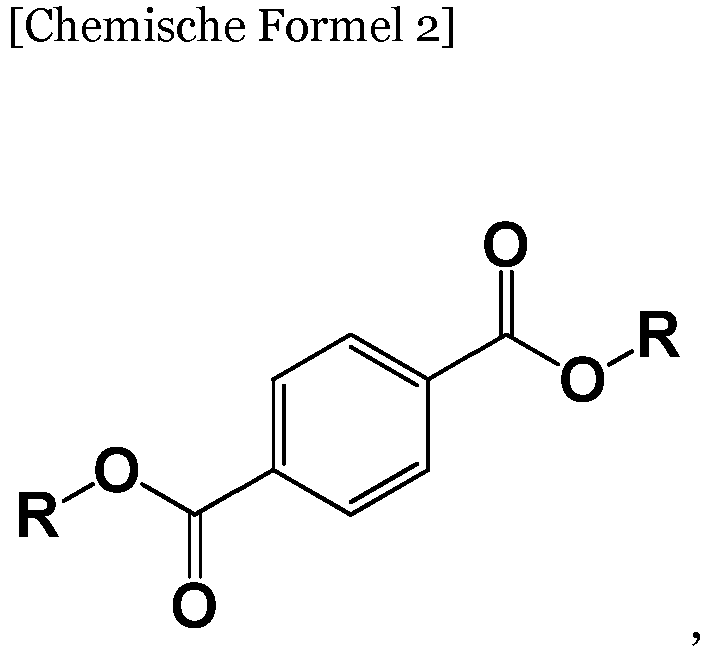
- Another embodiment of the present invention provides an ester-based plasticizer composition comprising an ester-based compound represented by the following Chemical Formula 1, an ester-based compound represented by the following Chemical Formula 2 and an ester-based compound represented by the following Chemical Formula 3.
- R is a butyl group or an isobutyl group.
- Rs are each a butyl group or an isobutyl group.
- Another embodiment of the present invention provides a method for preparing the ester-based plasticizer composition described above, the method including conducting transesterification of an ester-based compound represented by the following Chemical Formula 3 and an alcohol represented by the following Chemical Formula 4.
- Chemical Formula 4 [Chemical Formula 4] R-OH
- R is a butyl group or an isobutyl group.
- a resin composition comprising 5 parts by weight to 100 parts by weight the ester-based plasticizer composition described above based on 100 parts by weight of a resin comprising at least one selected from the group consisting of ethylene vinyl acetate, polyethylene, polypropylene, polyvinyl chloride, polystyrene, polyurethane, thermoplastic elastomers and polylactic acid.
- An ester-based plasticizer composition according to one embodiment of the present invention is a novel terephthalate-based ester compound for a plasticizer prepared by transesterification, and when used in a resin composition, the ester-based plasticizer composition may provide excellent properties such as migration resistance and volatility resistance as well as excellent tensile strength and an elongation rate, and is capable of providing resin products having excellent resistance for stress.
- the reaction product went through mixed distillation to remove butanol and 2-ethylhexyl alcohol, and a final ester-based plasticizer composition was prepared.
- Transesterification was conducted in the same manner as in Example 1 except that 2000 g of diisononyl terephthalate and 340 g of isobutanol were used to finally prepare an ester-based plasticizer composition comprising 5.0% by weight of diisobutyl terephthalate, 37.0% by weight of isobutylisononyl terephthalate and 58.0% by weight of diisononyl terephthalate.
- Transesterification was conducted in the same manner as in Example 1 except that 2000 g of diisononyl terephthalate and 160 g of n-butanol were used to finally prepare an ester-based plasticizer composition comprising 2.0% by weight of dibutyl terephthalate, 25.0% by weight of butylisononyl terephthalate and 73.0% by weight of diisononyl terephthalate.
- DINTP Diisononyl terephthalate
- Test Example 1 Sheet Formularization and Performance Evaluation
- each of the ester-based plasticizer compositions prepared in Examples 1 to 3, and Comparative Examples 1 and 2 was, as a plasticizer, mixed with 2.5 parts by weight of epoxidized oil and 3 parts by weight of a BZ stabilizer (BZ153T) as additives based on 100 parts by weight of a polyvinyl chloride resin (PVC(LS100S)) at 98°C with 700 rpm.
- BZ153T BZ stabilizer
- a compound was prepared by working on the result for 4 minutes at 160°C using a roll mill, and then working on the result for 2.5 minutes (low pressure) and 2 minutes (high pressure) at 180°C using a press.
- Shore hardness (Shore "A") at 25°C was measured in accordance with the ASTM D2240.
- Elongation rate % length after elongation / initial length ⁇ 100 .
- a specimen having a thickness of 2 mm or greater was obtained in accordance with the KSM-3156, and a load of 1 kgf/cm 2 was applied after attaching ABS (Natural Color) on both surfaces of the specimen.
- the specimen was left unattended for 24 hours in a forced convection oven (80°C), taken out, and cooled for 4 hours at room temperature. After that, the ABS attached on both surfaces of the specimen were removed, weights before and after leaving the specimen unattended in the oven were measured, and the amount of migration loss was calculated through the equation as follows.
- Amount of migration loss % initial weight of specimen at room temperature-weight of specimen after being left unattended in oven / initial weight of specimen at room temperature ⁇ 100
- the degree of color changes between the initial specimen and the specimen after carrying out the volatile loss test was measured using the volatile low measurement method.
- the measured values were determined by the changes in the E value with respect to the L, a and b values using a colorimeter.
- the specimen was left unattended for 24 hours, 72 hours and 168 hours at room temperature as being bent, and the degree of migration (the degree of oozing) was observed and expressed as a number.
- the number being closer to 0 represents excellent properties.
- Example 1 Hardness (Shore " A") Tensile Strength (kg/cm 2 ) Elongati on Rate (%) Migratio n Loss (%) Volatile Loss (%) Heat Resista nce ( ⁇ E)
- Example 1 93.5 236.8 342.8 1.33 1.19 1.18
- Example 2 94.0 239.2 342.0 1.12 1.41 1.20
- Example 3 94.7 238.5 341.9 1.37 0.85 1.20 Comparative Example 1 95.3 235.8 336.1 1.69 0.59 1.22 [Table 2] After 24 Hours After 72 Hours After 168 Hours Example 1 1.0 2.0 2.0 Example 2 1.0 2.0 2.0 2.0 Example 3 1.0 2.5 2.0 Comparative Example 1 1.5 3.0 3.0
- One embodiment of the present invention provides an ester-based compound represented by the following Chemical Formula 1.
- R is a butyl group or an isobutyl group.
- Another embodiment of the present invention provides a plasticizer composition comprising the ester-based compound represented by Chemical Formula 1.
- plasticizer composition comprising the ester-based compound represented by Chemical Formula 1
- processing stability may be secured compared to existing plasticizers such as diisononyl terephthalate due to structural characteristics having a butyl group or an isobutyl group as one substituent of benzene, which is different from existing plasticizer compositions comprising diisononyl terephthalate, and plasticizers having excellent properties such as hardness and tensile strength, having excellent stress resistance and capable of being used in applications entirely different from existing applications may be provided.
- an ester-based plasticizer composition comprising an ester-based compound represented by the following Chemical Formula 1, an ester-based compound represented by the following Chemical Formula 2 and an ester-based compound represented by the following Chemical Formula 3:
- R is a butyl group or an isobutyl group.
- Rs are each a butyl group or an isobutyl group.
- the terephthalate-based compound represented by Chemical Formula 1 is a terephthalate-based compound having ester (-COO-) groups at 1,4 positions, that is, para positions in the benzene ring, and may provide excellent physical properties such as migration resistance and volatility resistance as well as tensile strength and an elongation rate compared to phthalate-based ester compounds having ester (-COO-) groups at other positions, for example, ortho positions (1,2 positions in the benzene ring) or meta positions (1,3 positions in the benzene ring), and also may provide properties of strong resistance for stress.
- ester-based plasticizer composition when using the ester-based plasticizer composition according to one embodiment of the present invention as a plasticizer of a resin composition, an equal level of hardness, tensile strength and elongation rate compared to phthalate-based compounds normally used in existing plasticizers may be secured, and in addition to the above, volatile loss may decrease, migration resistance may be significantly superior, and resistance for stress may be excellent.
- the ester-based compound represented by Chemical Formula 1, the ester-based compound represented by Chemical Formula 2 and the ester-based compound represented by Chemical Formula 3 may be comprised in amounts of 0.5% by weight to 70% by weight, 0.5% by weight to 50% by weight and 0.5% by weight to 85% by weight, respectively, and specifically may be comprised in amounts of 10% by weight to 50% by weight, 0.5% by weight to 50% by weight and 35% by weight to 80% by weight, respectively, based on the total weight of the ester-based plasticizer composition.
- a mix ratio by weight of the sum of the non-hybrid compounds of Chemical Formulae 2 and 3 and the hybrid compound of Chemical Formula 1 may be from 95:5 to 30:70 and preferably from 90:10 to 40:60.
- the ester-based plasticizer composition is capable of further improving resin processibility by having an absorption rate for the resin and a short melting time while being environmental-friendly, and is capable of further improving physical properties such as hardness, tensile strength, an elongation rate, migration loss, sheet volatile loss, heat stability and accelerated weather resistance (QUV).
- One embodiment of the present invention may provide a method for preparing the ester-based plasticizer composition comprising conducting transesterification of an ester-based compound represented by the following Chemical Formula 3 and an alcohol represented by the following Chemical Formula 4: [Chemical Formula 4] R-OH In Chemical Formula 4, R is a butyl group or an isobutyl group.
- transesterification used in the present invention means a reaction in which an alcohol and an ester react to exchange R" of the ester with R' of the alcohol as shown in the following Reaction Formula 1 below.
- the ester-based compound represented by Chemical Formula 2 when the transesterification is progressed, the ester-based compound represented by Chemical Formula 2 may be prepared when an alkoxide of the alcohol represented by Chemical Formula 4 attacks carbon of two ester (RCOOR") groups present in the ester-based compound represented by Chemical Formula 3; the compound represented by Chemical Formula 1 may be prepared when an alkoxide of the alcohol represented by Chemical Formula 4 attacks carbon of one ester (RCOOR") group present in the ester-based compound represented by Chemical Formula 3; and the compound represented by Chemical Formula 3 may remain as an unreacted portion with no reactions.
- the transesterification has an advantage of not causing a problem of waste water compared to esterification between acid-alcohol, and may be progressed without a catalyst, and therefore, is capable of solving a problem caused by the use of an acid catalyst.
- the ester-based compound represented by Chemical Formula 1, the ester-based compound represented by Chemical Formula 2 and the ester-based compound represented by Chemical Formula 3 may be prepared by the transesterification in amounts of 0.5% by weight to 70% by weight, 0.5% by weight to 50% by weight and 0.5% by weight to 85% by weight, respectively, and specifically in amounts of 10% by weight to 50% by weight, 0.5% by weight to 50% by weight and 35% by weight to 80% by weight, respectively, based on the total weight of the ester-based plasticizer composition.
- the ester-based plasticizer composition prepared by the transesterification may comprise all of the ester-based compound represented by Chemical Formula 1, the ester-based compound represented by Chemical Formula 2 and the ester-based compound represented by Chemical Formula 3, and a composition ratio of the ester-based plasticizer composition may be controlled depending on the added amount of the alcohol represented by Chemical Formula 4.
- the added amount of the alcohol represented by Chemical Formula 4 may be 0.1 parts by weight to 89.9 parts by weight, specifically 3 parts by weight to 50 parts by weight and more specifically 5 parts by weight to 40 parts by weight based on 100 parts by weight of the compound of Chemical Formula 3.
- a mole fraction of the compound of Chemical Formula 3 participating in the transesterification may increase as the added amount of the alcohol represented by Chemical Formula 4 increases in the ester-based plasticizer composition, and accordingly, the content of the ester-based compound represented by Chemical Formula 1 and the ester-based compound represented by Chemical Formula 2 may increase in the ester-based plasticizer composition.
- a molar ratio of the ester-based compound represented by Chemical Formula 3 and the alcohol represented by Chemical Formula 4 is, for example, 1:0.005 to 5.0, 1:0.05 to 2.5, or 1:0.1 to 1.0, and being within this range is effective in preparing an ester-based plasticizer composition having high process efficiency and an excellent processibility improving effect.
- the transesterification may be conducted for 10 minutes to 10 hours, preferably for 30 minutes to 8 hours and more preferably for 1 hour to 6 hours at a reaction temperature from 120°C to 190°C, preferably 135°C to 180°C and more preferably 141°C to 179°C.
- a reaction temperature from 120°C to 190°C, preferably 135°C to 180°C and more preferably 141°C to 179°C.
- an ester-based plasticizer composition having a target composition ratio may be effectively obtained.
- the reaction time may be calculated from the time the temperature reaches the reaction temperature after raising the temperature of the reactants.
- the transesterification may be conducted under an acid catalyst or a metal catalyst, and this is effective in reducing the reaction time.
- the acid catalyst may comprise sulfuric acid, methanesulfonic acid, p-toluenesulfonic acid or the like
- the metal catalyst may comprise organic metal catalysts, metal oxide catalysts, metal salt catalysts or metals themselves.
- metal component may be any one selected from the group consisting of tin, titanium and zirconium, or a mixture of two or more types thereof.
- the method may further comprise removing unreacted alcohol and reaction byproducts, for example, the ester-based compound represented by Chemical Formula 3, by distillation after the transesterification.
- distillation may comprise two-step distillation conducting separation of the alcohol represented by Chemical Formula 4 and reaction byproducts using a boiling point difference.
- the distillation may be mixed distillation. This is effective in relatively stably securing the ester-based plasticizer composition in a target composition ratio.
- the mixed distillation means distilling butanol and reaction byproducts at the same time.
- ester-based compound represented by Chemical Formula 3 used in the transesterification of the present invention may be prepared by esterification of a compound represented by the following Chemical Formula 5 with an alcohol represented by the following Chemical Formula 6 or at least one isomer of this alcohol in the presence of a catalyst:
- the esterification may be conducted for 10 minutes to 10 hours, preferably for 30 minutes to 8 hours and more preferably for 1 hour to 6 hours at a temperature from 80°C to 270°C and preferably 150°C to 250°C.
- the compound of Chemical Formula 3 may be effectively prepared in the above-mentioned temperature and time ranges.
- the catalyst in the esterification may be an organic metal catalyst comprising a Sn-based or a Ti-based, an acid catalyst comprising a sulfonic acid-based or a sulfuric acid-based, or a mixed catalyst thereof, and types of the catalyst are not limited.
- using the alcohol represented by Chemical Formula 6 comprising isomers may lead to the preparation of a mixture in which the ester-based compound represented by Chemical Formula 3 and isomers thereof are mixed. Accordingly, in the ester-based plasticizer composition according to one embodiment of the present invention, the compounds represented by Chemical Formulae 2 and 3, and preferably the compounds represented by Chemical Formulae 1 and 3 may each further include isomers thereof.
- the ester-based compound represented by Chemical Formula 3 may be prepared in a yield of approximately 80% or higher, and by conducting transesterification the ester-based compound represented by Chemical Formula 3 prepared as above and the alcohol represented by Chemical Formula 4, an ester-based plasticizer composition having a target composition may be readily prepared.
- the ester-based compound represented by Chemical Formula 1 may be prepared using terephthalic acid, the compound represented by Chemical Formula 5, isobutanol or butanol, the alcohol represented by Chemical Formula 4, and isononyl alcohol, the alcohol represented by Chemical Formula 6, as reactants.
- the ester-based plasticizer composition may be comprised in an amount of 5 parts by weight to 100 parts by weight based on 100 parts by weight of the resin.
- the filler may use fillers known in the art, and is not particularly limited. Examples thereof may comprise at least one selected from the group consisting of silica, magnesium carbonate, calcium carbonate, hard charcoal, talc, magnesium hydroxide, titanium dioxide, magnesium oxide, calcium hydroxide, aluminum hydroxide, aluminum silicate, magnesium silicate and barium sulfate.
- the resin composition may further include one or more types of plasticizers selected from among dioctyl phthalate (DOP), dibutyl phthalate (DBP), dioctyl terephthalate (DOTP), diisononyl phthalate (DINP), diisodecyl phthalate (DIDP) and di-(2-ethylhexyl) terephthalate (DEHTP).
- DOP dioctyl phthalate
- DBP dibutyl phthalate
- DDP dioctyl terephthalate
- DINP diisononyl phthalate
- DIDP diisodecyl phthalate
- DEHTP di-(2-ethylhexyl) terephthalate
- the plasticizer may be comprised in an amount of 0 parts by weight to 150 parts by weight and preferably 5 parts by weight to 100 parts by weight based on 100 parts by weight of the resin.
- the viscosity reducing agent-free composition of the present invention means not comprising a viscosity reducing agent for controlling viscosity of the resin composition at all.
Landscapes
- Chemical & Material Sciences (AREA)
- Organic Chemistry (AREA)
- Health & Medical Sciences (AREA)
- Chemical Kinetics & Catalysis (AREA)
- Medicinal Chemistry (AREA)
- Polymers & Plastics (AREA)
- Compositions Of Macromolecular Compounds (AREA)
- Organic Low-Molecular-Weight Compounds And Preparation Thereof (AREA)
Claims (15)
- Esterbasierte Verbindung, dargestellt durch die folgende chemische Formel 1:

- Weichmacherzusammensetzung, umfassend eine esterbasierte Verbindung, dargestellt durch die folgende chemische Formel 1:

- Esterbasierte Weichmacherzusammensetzung, umfassend eine esterbasierte Verbindung, dargestellt durch die folgende chemische Formel 1, eine esterbasierte Verbindung, dargestellt durch die folgende chemische Formel 2, und eine esterbasierte Verbindung, dargestellt durch die folgende chemische Formel 3, wobei jedes R in den folgenden chemischen Formeln 1 und 2 gleich ist:


- Esterbasierte Weichmacherzusammensetzung nach Anspruch 3, wobei die esterbasierte Weichmacherzusammensetzung 0,5 Gew.-% bis 70 Gew.-% der esterbasierten Verbindung, dargestellt durch die chemische Formel 1, 0,5 Gew.-% bis 50 Gew.-% der esterbasierten Verbindung, dargestellt durch die chemische Formel 2, und 0,5 Gew.-% bis 85 Gew.-% der esterbasierten Verbindung, dargestellt durch die chemische Formel 3, bezogen auf das Gesamtgewicht der esterbasierten Weichmacherzusammensetzung, umfasst.
- Esterbasierte Weichmacherzusammensetzung nach Anspruch 3, wobei die esterbasierte Weichmacherzusammensetzung 10 Gew.-% bis 50 Gew.-% der esterbasierten Verbindung, dargestellt durch die chemische Formel 1, 0,5 Gew.-% bis 50 Gew.-% der esterbasierten Verbindung, dargestellt durch die chemische Formel 2, und 35 Gew.-% bis 80 Gew.-% der esterbasierten Verbindung, dargestellt durch die chemische Formel 3, bezogen auf das Gesamtgewicht der esterbasierten Weichmacherzusammensetzung, umfasst.
- Esterbasierte Weichmacherzusammensetzung nach Anspruch 3, wobei ein Mischungsverhältnis nach Gewicht einer Summe der esterbasierten Verbindung, dargestellt durch die chemische Formel 2, und der esterbasierten Verbindung, dargestellt durch die chemische Formel 3, und der esterbasierten Verbindung, dargestellt durch die chemische Formel 1, von 95:5 bis 30:70 ist.
- Esterbasierte Weichmacherzusammensetzung nach Anspruch 3, die ein etherfreier Weichmacher ist.
- Verfahren zum Herstellen der esterbasierten Weichmacherzusammensetzung nach Anspruch 3, das Verfahren umfassend Durchführen einer Umesterung einer esterbasierten Verbindung, dargestellt durch die folgende chemische Formel 3, und eines Alkohols, dargestellt durch die folgende chemische Formel 4:

R-OH,
wobei in der chemischen Formel 4 R eine Butylgruppe oder eine Isobutylgruppe ist. - Verfahren zum Herstellen der esterbasierten Weichmacherzusammensetzung nach Anspruch 8, wobei ein molares Verhältnis der Verbindung, dargestellt durch die chemische Formel 3, und des Alkohols, dargestellt durch die chemische Formel 4, von 1:0,005 bis 1:5 ist.
- Verfahren zum Herstellen der esterbasierten Weichmacherzusammensetzung nach Anspruch 8, wobei der Alkohol, dargestellt durch die chemische Formel 4, in einer Menge von 0,1 Gewichtsteilen bis 89,9 Gewichtsteilen, bezogen auf 100 Gewichtsteile der Verbindung, dargestellt durch die chemische Formel 3, hinzugegeben wird.
- Verfahren zum Herstellen der esterbasierten Weichmacherzusammensetzung nach Anspruch 8, wobei die Umesterung bei einer Temperatur von 120°C bis 190°C durchgeführt wird.
- Verfahren zum Herstellen der esterbasierten Weichmacherzusammensetzung nach Anspruch 8, wobei die Umesterung eine nicht-katalytische Reaktion ist.
- Verfahren zum Herstellen der esterbasierten Weichmacherzusammensetzung nach Anspruch 8, wobei das Verfahren ferner das Entfernen unreagierten Alkohols, dargestellt durch die chemische Formel 4, und Reagieren von Nebenprodukten durch Destillation nach Durchführung der Umesterung umfasst.
- Verfahren zum Herstellen der esterbasierten Weichmacherzusammensetzung nach Anspruch 8, wobei ein Teil der Verbindung, dargestellt durch die chemische Formel 3, in eine Verbindung, dargestellt durch die chemische Formel 1, und eine Verbindung, dargestellt durch die chemische Formel 2, durch Umesterung umgewandelt wird:

- Verfahren zum Herstellen der esterbasierten Weichmacherzusammensetzung nach Anspruch 8, wobei die Verbindung, dargestellt durch die chemische Formel 3, hergestellt wird durch Durchführen einer Veresterung einer Verbindung, dargestellt durch die folgende chemische Formel 5, und einen Alkohol, dargestellt durch die folgende chemische Formel 6, in Gegenwart eines Katalysators:


Applications Claiming Priority (2)
| Application Number | Priority Date | Filing Date | Title |
|---|---|---|---|
| KR1020150067549A KR101939160B1 (ko) | 2015-05-14 | 2015-05-14 | 에스테르계 화합물, 이를 포함하는 조성물, 이의 제조방법, 및 이를 포함하는 수지 조성물 |
| PCT/KR2016/005039 WO2016182377A1 (ko) | 2015-05-14 | 2016-05-12 | 에스테르계 화합물, 이를 포함하는 조성물, 이의 제조방법, 및 이를 포함하는 수지 조성물 |
Publications (3)
| Publication Number | Publication Date |
|---|---|
| EP3296286A1 EP3296286A1 (de) | 2018-03-21 |
| EP3296286A4 EP3296286A4 (de) | 2018-06-06 |
| EP3296286B1 true EP3296286B1 (de) | 2019-10-16 |
Family
ID=57248117
Family Applications (1)
| Application Number | Title | Priority Date | Filing Date |
|---|---|---|---|
| EP16793023.9A Active EP3296286B1 (de) | 2015-05-14 | 2016-05-12 | Esterbasierte verbindung, zusammensetzung damit, verfahren zur herstellung davon und harzzusammensetzung damit |
Country Status (7)
| Country | Link |
|---|---|
| US (1) | US11034818B2 (de) |
| EP (1) | EP3296286B1 (de) |
| KR (1) | KR101939160B1 (de) |
| CN (1) | CN107250099B (de) |
| ES (1) | ES2755737T3 (de) |
| TW (1) | TWI598330B (de) |
| WO (1) | WO2016182377A1 (de) |
Families Citing this family (1)
| Publication number | Priority date | Publication date | Assignee | Title |
|---|---|---|---|---|
| KR102325729B1 (ko) * | 2018-11-28 | 2021-11-15 | 주식회사 엘지화학 | 가압 구간을 포함하는 테레프탈레이트계 조성물의 제조방법 |
Family Cites Families (13)
| Publication number | Priority date | Publication date | Assignee | Title |
|---|---|---|---|---|
| US4620026A (en) * | 1984-08-10 | 1986-10-28 | The Dow Chemical Company | Monomeric plasticizers for halogen-containing resins |
| JP4333471B2 (ja) * | 2004-05-11 | 2009-09-16 | 新日本理化株式会社 | ジカルボン酸ジエステルの製造方法 |
| KR100868194B1 (ko) | 2007-05-11 | 2008-11-10 | 주식회사 엘지화학 | 고분자 수지용 테레프탈산 에스테르 조성물 및 그의 제조방법 |
| KR100812512B1 (ko) | 2007-06-25 | 2008-03-11 | 주식회사 엘지화학 | 지우개용 염화비닐계 수지 조성물 |
| DE102008006400A1 (de) * | 2008-01-28 | 2009-07-30 | Evonik Oxeno Gmbh | Gemische von Diisononylestern der Terephthalsäure, Verfahren zu deren Herstellung und deren Verwendung |
| KR101536380B1 (ko) * | 2011-09-30 | 2015-07-14 | 주식회사 엘지화학 | 에스터 가소제 조성물 |
| KR20130067513A (ko) * | 2011-12-14 | 2013-06-25 | 주식회사 엘지화학 | 에스터 가소제를 포함하는 염화비닐 수지 조성물 |
| EP2821431B1 (de) * | 2013-05-08 | 2016-09-07 | LG Chem, Ltd. | Zusammensetzung auf esterbasis, verfahren zur herstellung davon sowie harzzusammensetzung mit der esterzusammensetzung |
| KR101642561B1 (ko) * | 2013-05-08 | 2016-07-25 | 주식회사 엘지화학 | 에스테르계 가소제의 제조방법 및 이로부터 제조된 에스테르계 가소제 |
| CN104284917A (zh) | 2013-05-08 | 2015-01-14 | Lg化学株式会社 | 酯组合物的制备方法和树脂组合物 |
| KR101447376B1 (ko) | 2013-06-14 | 2014-12-18 | 주식회사 엘지화학 | 에스테르계 가소제의 제조방법 및 이로부터 제조된 에스테르계 가소제 |
| CN110734579A (zh) * | 2014-02-07 | 2020-01-31 | Lg化学株式会社 | 增塑剂、树脂组合物及它们的制备方法 |
| PL3059223T3 (pl) * | 2015-02-18 | 2023-11-27 | Evonik Operations Gmbh | Wytwarzanie mieszanin estrów |
-
2015
- 2015-05-14 KR KR1020150067549A patent/KR101939160B1/ko active Active
-
2016
- 2016-05-12 WO PCT/KR2016/005039 patent/WO2016182377A1/ko not_active Ceased
- 2016-05-12 ES ES16793023T patent/ES2755737T3/es active Active
- 2016-05-12 EP EP16793023.9A patent/EP3296286B1/de active Active
- 2016-05-12 US US15/546,185 patent/US11034818B2/en active Active
- 2016-05-12 CN CN201680010561.7A patent/CN107250099B/zh active Active
- 2016-05-13 TW TW105114933A patent/TWI598330B/zh active
Non-Patent Citations (1)
| Title |
|---|
| None * |
Also Published As
| Publication number | Publication date |
|---|---|
| US20180022890A1 (en) | 2018-01-25 |
| EP3296286A1 (de) | 2018-03-21 |
| CN107250099B (zh) | 2021-03-23 |
| TWI598330B (zh) | 2017-09-11 |
| EP3296286A4 (de) | 2018-06-06 |
| ES2755737T3 (es) | 2020-04-23 |
| US11034818B2 (en) | 2021-06-15 |
| KR101939160B1 (ko) | 2019-01-16 |
| TW201704199A (zh) | 2017-02-01 |
| WO2016182377A1 (ko) | 2016-11-17 |
| KR20160134100A (ko) | 2016-11-23 |
| CN107250099A (zh) | 2017-10-13 |
Similar Documents
| Publication | Publication Date | Title |
|---|---|---|
| EP3293226B1 (de) | Weichmacherzusammensetzung und harzzusammensetzung damit | |
| EP3272800B1 (de) | Weichmacherzusammensetzung und harzzusammensetzung sowie verfahren zur herstellung davon | |
| EP3103834B1 (de) | Esterzusammensetzung und verfahren zu deren herstellung | |
| US9505907B2 (en) | Ester composition, method of preparing the same and resin composition including the same | |
| EP3342813B1 (de) | Weichmacherzusammensetzung, harzzusammensetzung und verfahren zur herstellung davon | |
| EP3296285B1 (de) | Esterbasierte verbindung, zusammensetzung damit, verfahren zur herstellung davon und harzzusammensetzung damit | |
| EP3342794B2 (de) | Weichmacherzusammensetzung und harzzusammensetzung | |
| EP3530690B1 (de) | Weichmacherzusammensetzung mit verbindung auf cyclohexan-1,4-diesterbasis und harzzusammensetzung damit | |
| EP3281977B1 (de) | Weichmacherzusammensetzung, harzzusammensetzung und verfahren zur herstellung davon | |
| US11034818B2 (en) | Ester-based compound, composition comprising the same, method for preparing the same and resin composition comprising the same | |
| KR20220019634A (ko) | 시트레이트계 가소제 조성물 및 이를 포함하는 수지 조성물 |
Legal Events
| Date | Code | Title | Description |
|---|---|---|---|
| STAA | Information on the status of an ep patent application or granted ep patent |
Free format text: STATUS: THE INTERNATIONAL PUBLICATION HAS BEEN MADE |
|
| PUAI | Public reference made under article 153(3) epc to a published international application that has entered the european phase |
Free format text: ORIGINAL CODE: 0009012 |
|
| STAA | Information on the status of an ep patent application or granted ep patent |
Free format text: STATUS: REQUEST FOR EXAMINATION WAS MADE |
|
| 17P | Request for examination filed |
Effective date: 20170726 |
|
| AK | Designated contracting states |
Kind code of ref document: A1 Designated state(s): AL AT BE BG CH CY CZ DE DK EE ES FI FR GB GR HR HU IE IS IT LI LT LU LV MC MK MT NL NO PL PT RO RS SE SI SK SM TR |
|
| AX | Request for extension of the european patent |
Extension state: BA ME |
|
| A4 | Supplementary search report drawn up and despatched |
Effective date: 20180509 |
|
| RIC1 | Information provided on ipc code assigned before grant |
Ipc: C08L 67/03 20060101ALI20180503BHEP Ipc: C07C 69/82 20060101AFI20180503BHEP |
|
| DAV | Request for validation of the european patent (deleted) | ||
| DAX | Request for extension of the european patent (deleted) | ||
| STAA | Information on the status of an ep patent application or granted ep patent |
Free format text: STATUS: EXAMINATION IS IN PROGRESS |
|
| 17Q | First examination report despatched |
Effective date: 20190122 |
|
| GRAP | Despatch of communication of intention to grant a patent |
Free format text: ORIGINAL CODE: EPIDOSNIGR1 |
|
| STAA | Information on the status of an ep patent application or granted ep patent |
Free format text: STATUS: GRANT OF PATENT IS INTENDED |
|
| INTG | Intention to grant announced |
Effective date: 20190726 |
|
| GRAS | Grant fee paid |
Free format text: ORIGINAL CODE: EPIDOSNIGR3 |
|
| GRAA | (expected) grant |
Free format text: ORIGINAL CODE: 0009210 |
|
| STAA | Information on the status of an ep patent application or granted ep patent |
Free format text: STATUS: THE PATENT HAS BEEN GRANTED |
|
| AK | Designated contracting states |
Kind code of ref document: B1 Designated state(s): AL AT BE BG CH CY CZ DE DK EE ES FI FR GB GR HR HU IE IS IT LI LT LU LV MC MK MT NL NO PL PT RO RS SE SI SK SM TR |
|
| REG | Reference to a national code |
Ref country code: GB Ref legal event code: FG4D |
|
| REG | Reference to a national code |
Ref country code: CH Ref legal event code: EP |
|
| REG | Reference to a national code |
Ref country code: DE Ref legal event code: R096 Ref document number: 602016022640 Country of ref document: DE |
|
| REG | Reference to a national code |
Ref country code: IE Ref legal event code: FG4D |
|
| REG | Reference to a national code |
Ref country code: AT Ref legal event code: REF Ref document number: 1191124 Country of ref document: AT Kind code of ref document: T Effective date: 20191115 |
|
| REG | Reference to a national code |
Ref country code: NL Ref legal event code: MP Effective date: 20191016 |
|
| REG | Reference to a national code |
Ref country code: LT Ref legal event code: MG4D |
|
| REG | Reference to a national code |
Ref country code: AT Ref legal event code: MK05 Ref document number: 1191124 Country of ref document: AT Kind code of ref document: T Effective date: 20191016 |
|
| REG | Reference to a national code |
Ref country code: ES Ref legal event code: FG2A Ref document number: 2755737 Country of ref document: ES Kind code of ref document: T3 Effective date: 20200423 |
|
| PG25 | Lapsed in a contracting state [announced via postgrant information from national office to epo] |
Ref country code: LV Free format text: LAPSE BECAUSE OF FAILURE TO SUBMIT A TRANSLATION OF THE DESCRIPTION OR TO PAY THE FEE WITHIN THE PRESCRIBED TIME-LIMIT Effective date: 20191016 Ref country code: SE Free format text: LAPSE BECAUSE OF FAILURE TO SUBMIT A TRANSLATION OF THE DESCRIPTION OR TO PAY THE FEE WITHIN THE PRESCRIBED TIME-LIMIT Effective date: 20191016 Ref country code: AT Free format text: LAPSE BECAUSE OF FAILURE TO SUBMIT A TRANSLATION OF THE DESCRIPTION OR TO PAY THE FEE WITHIN THE PRESCRIBED TIME-LIMIT Effective date: 20191016 Ref country code: PL Free format text: LAPSE BECAUSE OF FAILURE TO SUBMIT A TRANSLATION OF THE DESCRIPTION OR TO PAY THE FEE WITHIN THE PRESCRIBED TIME-LIMIT Effective date: 20191016 Ref country code: NO Free format text: LAPSE BECAUSE OF FAILURE TO SUBMIT A TRANSLATION OF THE DESCRIPTION OR TO PAY THE FEE WITHIN THE PRESCRIBED TIME-LIMIT Effective date: 20200116 Ref country code: BG Free format text: LAPSE BECAUSE OF FAILURE TO SUBMIT A TRANSLATION OF THE DESCRIPTION OR TO PAY THE FEE WITHIN THE PRESCRIBED TIME-LIMIT Effective date: 20200116 Ref country code: FI Free format text: LAPSE BECAUSE OF FAILURE TO SUBMIT A TRANSLATION OF THE DESCRIPTION OR TO PAY THE FEE WITHIN THE PRESCRIBED TIME-LIMIT Effective date: 20191016 Ref country code: PT Free format text: LAPSE BECAUSE OF FAILURE TO SUBMIT A TRANSLATION OF THE DESCRIPTION OR TO PAY THE FEE WITHIN THE PRESCRIBED TIME-LIMIT Effective date: 20200217 Ref country code: GR Free format text: LAPSE BECAUSE OF FAILURE TO SUBMIT A TRANSLATION OF THE DESCRIPTION OR TO PAY THE FEE WITHIN THE PRESCRIBED TIME-LIMIT Effective date: 20200117 Ref country code: LT Free format text: LAPSE BECAUSE OF FAILURE TO SUBMIT A TRANSLATION OF THE DESCRIPTION OR TO PAY THE FEE WITHIN THE PRESCRIBED TIME-LIMIT Effective date: 20191016 Ref country code: NL Free format text: LAPSE BECAUSE OF FAILURE TO SUBMIT A TRANSLATION OF THE DESCRIPTION OR TO PAY THE FEE WITHIN THE PRESCRIBED TIME-LIMIT Effective date: 20191016 |
|
| PG25 | Lapsed in a contracting state [announced via postgrant information from national office to epo] |
Ref country code: HR Free format text: LAPSE BECAUSE OF FAILURE TO SUBMIT A TRANSLATION OF THE DESCRIPTION OR TO PAY THE FEE WITHIN THE PRESCRIBED TIME-LIMIT Effective date: 20191016 Ref country code: IS Free format text: LAPSE BECAUSE OF FAILURE TO SUBMIT A TRANSLATION OF THE DESCRIPTION OR TO PAY THE FEE WITHIN THE PRESCRIBED TIME-LIMIT Effective date: 20200224 Ref country code: RS Free format text: LAPSE BECAUSE OF FAILURE TO SUBMIT A TRANSLATION OF THE DESCRIPTION OR TO PAY THE FEE WITHIN THE PRESCRIBED TIME-LIMIT Effective date: 20191016 |
|
| PG25 | Lapsed in a contracting state [announced via postgrant information from national office to epo] |
Ref country code: AL Free format text: LAPSE BECAUSE OF FAILURE TO SUBMIT A TRANSLATION OF THE DESCRIPTION OR TO PAY THE FEE WITHIN THE PRESCRIBED TIME-LIMIT Effective date: 20191016 |
|
| REG | Reference to a national code |
Ref country code: DE Ref legal event code: R097 Ref document number: 602016022640 Country of ref document: DE |
|
| PG2D | Information on lapse in contracting state deleted |
Ref country code: IS |
|
| PG25 | Lapsed in a contracting state [announced via postgrant information from national office to epo] |
Ref country code: CZ Free format text: LAPSE BECAUSE OF FAILURE TO SUBMIT A TRANSLATION OF THE DESCRIPTION OR TO PAY THE FEE WITHIN THE PRESCRIBED TIME-LIMIT Effective date: 20191016 Ref country code: RO Free format text: LAPSE BECAUSE OF FAILURE TO SUBMIT A TRANSLATION OF THE DESCRIPTION OR TO PAY THE FEE WITHIN THE PRESCRIBED TIME-LIMIT Effective date: 20191016 Ref country code: EE Free format text: LAPSE BECAUSE OF FAILURE TO SUBMIT A TRANSLATION OF THE DESCRIPTION OR TO PAY THE FEE WITHIN THE PRESCRIBED TIME-LIMIT Effective date: 20191016 Ref country code: DK Free format text: LAPSE BECAUSE OF FAILURE TO SUBMIT A TRANSLATION OF THE DESCRIPTION OR TO PAY THE FEE WITHIN THE PRESCRIBED TIME-LIMIT Effective date: 20191016 Ref country code: IS Free format text: LAPSE BECAUSE OF FAILURE TO SUBMIT A TRANSLATION OF THE DESCRIPTION OR TO PAY THE FEE WITHIN THE PRESCRIBED TIME-LIMIT Effective date: 20200216 |
|
| PLBE | No opposition filed within time limit |
Free format text: ORIGINAL CODE: 0009261 |
|
| STAA | Information on the status of an ep patent application or granted ep patent |
Free format text: STATUS: NO OPPOSITION FILED WITHIN TIME LIMIT |
|
| PG25 | Lapsed in a contracting state [announced via postgrant information from national office to epo] |
Ref country code: SK Free format text: LAPSE BECAUSE OF FAILURE TO SUBMIT A TRANSLATION OF THE DESCRIPTION OR TO PAY THE FEE WITHIN THE PRESCRIBED TIME-LIMIT Effective date: 20191016 Ref country code: SM Free format text: LAPSE BECAUSE OF FAILURE TO SUBMIT A TRANSLATION OF THE DESCRIPTION OR TO PAY THE FEE WITHIN THE PRESCRIBED TIME-LIMIT Effective date: 20191016 |
|
| 26N | No opposition filed |
Effective date: 20200717 |
|
| PG25 | Lapsed in a contracting state [announced via postgrant information from national office to epo] |
Ref country code: SI Free format text: LAPSE BECAUSE OF FAILURE TO SUBMIT A TRANSLATION OF THE DESCRIPTION OR TO PAY THE FEE WITHIN THE PRESCRIBED TIME-LIMIT Effective date: 20191016 |
|
| PG25 | Lapsed in a contracting state [announced via postgrant information from national office to epo] |
Ref country code: CH Free format text: LAPSE BECAUSE OF NON-PAYMENT OF DUE FEES Effective date: 20200531 Ref country code: MC Free format text: LAPSE BECAUSE OF FAILURE TO SUBMIT A TRANSLATION OF THE DESCRIPTION OR TO PAY THE FEE WITHIN THE PRESCRIBED TIME-LIMIT Effective date: 20191016 Ref country code: LI Free format text: LAPSE BECAUSE OF NON-PAYMENT OF DUE FEES Effective date: 20200531 |
|
| REG | Reference to a national code |
Ref country code: BE Ref legal event code: MM Effective date: 20200531 |
|
| PG25 | Lapsed in a contracting state [announced via postgrant information from national office to epo] |
Ref country code: LU Free format text: LAPSE BECAUSE OF NON-PAYMENT OF DUE FEES Effective date: 20200512 |
|
| PG25 | Lapsed in a contracting state [announced via postgrant information from national office to epo] |
Ref country code: IE Free format text: LAPSE BECAUSE OF NON-PAYMENT OF DUE FEES Effective date: 20200512 |
|
| PG25 | Lapsed in a contracting state [announced via postgrant information from national office to epo] |
Ref country code: BE Free format text: LAPSE BECAUSE OF NON-PAYMENT OF DUE FEES Effective date: 20200531 |
|
| PG25 | Lapsed in a contracting state [announced via postgrant information from national office to epo] |
Ref country code: MT Free format text: LAPSE BECAUSE OF FAILURE TO SUBMIT A TRANSLATION OF THE DESCRIPTION OR TO PAY THE FEE WITHIN THE PRESCRIBED TIME-LIMIT Effective date: 20191016 Ref country code: CY Free format text: LAPSE BECAUSE OF FAILURE TO SUBMIT A TRANSLATION OF THE DESCRIPTION OR TO PAY THE FEE WITHIN THE PRESCRIBED TIME-LIMIT Effective date: 20191016 |
|
| PG25 | Lapsed in a contracting state [announced via postgrant information from national office to epo] |
Ref country code: MK Free format text: LAPSE BECAUSE OF FAILURE TO SUBMIT A TRANSLATION OF THE DESCRIPTION OR TO PAY THE FEE WITHIN THE PRESCRIBED TIME-LIMIT Effective date: 20191016 |
|
| PGFP | Annual fee paid to national office [announced via postgrant information from national office to epo] |
Ref country code: GB Payment date: 20260324 Year of fee payment: 11 |
|
| PGFP | Annual fee paid to national office [announced via postgrant information from national office to epo] |
Ref country code: ES Payment date: 20260608 Year of fee payment: 11 |
|
| PGFP | Annual fee paid to national office [announced via postgrant information from national office to epo] |
Ref country code: IT Payment date: 20260421 Year of fee payment: 11 |
|
| PGFP | Annual fee paid to national office [announced via postgrant information from national office to epo] |
Ref country code: DE Payment date: 20260420 Year of fee payment: 11 |
|
| PGFP | Annual fee paid to national office [announced via postgrant information from national office to epo] |
Ref country code: TR Payment date: 20260428 Year of fee payment: 11 |
|
| PGFP | Annual fee paid to national office [announced via postgrant information from national office to epo] |
Ref country code: FR Payment date: 20260421 Year of fee payment: 11 |