EP3296274B1 - Fining of boroalumino silicate glasses - Google Patents
Fining of boroalumino silicate glasses Download PDFInfo
- Publication number
- EP3296274B1 EP3296274B1 EP17196092.5A EP17196092A EP3296274B1 EP 3296274 B1 EP3296274 B1 EP 3296274B1 EP 17196092 A EP17196092 A EP 17196092A EP 3296274 B1 EP3296274 B1 EP 3296274B1
- Authority
- EP
- European Patent Office
- Prior art keywords
- glass
- mole percent
- glasses
- fining
- equal
- Prior art date
- Legal status (The legal status is an assumption and is not a legal conclusion. Google has not performed a legal analysis and makes no representation as to the accuracy of the status listed.)
- Active
Links
Images


Classifications
-
- C—CHEMISTRY; METALLURGY
- C03—GLASS; MINERAL OR SLAG WOOL
- C03C—CHEMICAL COMPOSITION OF GLASSES, GLAZES OR VITREOUS ENAMELS; SURFACE TREATMENT OF GLASS; SURFACE TREATMENT OF FIBRES OR FILAMENTS MADE FROM GLASS, MINERALS OR SLAGS; JOINING GLASS TO GLASS OR OTHER MATERIALS
- C03C3/00—Glass compositions
- C03C3/04—Glass compositions containing silica
- C03C3/076—Glass compositions containing silica with 40% to 90% silica, by weight
- C03C3/089—Glass compositions containing silica with 40% to 90% silica, by weight containing boron
- C03C3/091—Glass compositions containing silica with 40% to 90% silica, by weight containing boron containing aluminium
-
- C—CHEMISTRY; METALLURGY
- C03—GLASS; MINERAL OR SLAG WOOL
- C03B—MANUFACTURE, SHAPING, OR SUPPLEMENTARY PROCESSES
- C03B17/00—Forming molten glass by flowing-out, pushing-out, extruding or drawing downwardly or laterally from forming slits or by overflowing over lips
-
- C—CHEMISTRY; METALLURGY
- C03—GLASS; MINERAL OR SLAG WOOL
- C03B—MANUFACTURE, SHAPING, OR SUPPLEMENTARY PROCESSES
- C03B17/00—Forming molten glass by flowing-out, pushing-out, extruding or drawing downwardly or laterally from forming slits or by overflowing over lips
- C03B17/06—Forming glass sheets
-
- C—CHEMISTRY; METALLURGY
- C03—GLASS; MINERAL OR SLAG WOOL
- C03B—MANUFACTURE, SHAPING, OR SUPPLEMENTARY PROCESSES
- C03B5/00—Melting in furnaces; Furnaces so far as specially adapted for glass manufacture
- C03B5/06—Melting in furnaces; Furnaces so far as specially adapted for glass manufacture in pot furnaces
- C03B5/08—Glass-melting pots
-
- C—CHEMISTRY; METALLURGY
- C03—GLASS; MINERAL OR SLAG WOOL
- C03C—CHEMICAL COMPOSITION OF GLASSES, GLAZES OR VITREOUS ENAMELS; SURFACE TREATMENT OF GLASS; SURFACE TREATMENT OF FIBRES OR FILAMENTS MADE FROM GLASS, MINERALS OR SLAGS; JOINING GLASS TO GLASS OR OTHER MATERIALS
- C03C1/00—Ingredients generally applicable to manufacture of glasses, glazes, or vitreous enamels
- C03C1/004—Refining agents
Definitions
- the present invention relates to alkali-free, boroalumino silicate glasses exhibiting desirable physical and chemical properties for use as substrates in flat panel display devices, such as, active matrix liquid crystal displays (AMLCDs).
- AMLCDs active matrix liquid crystal displays
- the invention relates to the fining of such glasses (also referred to in the art as "refining").
- Displays may be broadly classified into one of two types: emissive (e.g., CRTs and plasma display panels (PDPs)) or non-emissive.
- emissive e.g., CRTs and plasma display panels (PDPs)
- non-emissive e.g., CRTs and plasma display panels (PDPs)
- This latter family to which liquid crystal displays (LCDs) belong, relies upon an external light source, with the display only serving as a light modulator.
- this external light source may be either ambient light (used in reflective displays) or a dedicated light source (such as found in direct view displays).
- Liquid crystal displays rely upon three inherent features of liquid crystal (LC) materials to modulate light. The first is the ability of LC materials to cause optical rotation of polarized light. Second is the dependence of such rotation on the mechanical orientation of the liquid crystal. And third is the ability of the liquid crystal to undergo mechanical orientation by the application of an external electric field.
- LC liquid crystal
- two substrates surround a layer of liquid crystal material.
- Normally White the application of alignment layers on the inner surfaces of the substrates creates a 90° spiral of the liquid crystal director. This means that the polarization of linearly polarized light entering one face of the liquid crystal cell will be rotated 90° by the liquid crystal material.
- Polarization films oriented 90° to each other, are placed on the outer surfaces of the substrates.
- the liquid crystal material becomes a light valve, whose ability to allow or block light transmission is controlled by the application of an electric field.
- AMLCDs active matrix liquid crystal display devices
- the two plates (substrate assemblies) that comprise a flat panel display are manufactured separately.
- the color filter plate has a series of red, blue, green, and black organic dyes deposited on it.
- Each of these primary colors must correspond precisely with a sub pixel of the companion active plate.
- glass substrates whose dimensions are independent of thermal condition (i.e., glasses with lower coefficients of thermal expansion).
- this property needs to be balanced by the generation of stresses between deposited films (e.g., silicon films) and the substrates that arise due to expansion mismatch. It is estimated that an optimal coefficient of thermal expansion (CTE) is in the range of 28-34 ⁇ 10 -7 /°C (0-300°C), more preferably, 28-33 ⁇ 10 -7 /°C (0-300°C).
- the active plate so called because it contains the active, thin film transistors, is manufactured using typical semiconductor type processes. These include sputtering, CVD, photolithography, and etching. It is highly desirable that the glass be unchanged during these processes. Thus, the glass needs to demonstrate both thermal stability and chemical durability.
- Thermal stability also known as thermal compaction or shrinkage
- thermal compaction or shrinkage is dependent upon both the inherent viscous nature of a particular glass composition (as indicated by its strain point) and the thermal history of the glass sheet as determined by the manufacturing process.
- U.S. Patents Nos. 5,374,595 (Dumbaugh et al. ) and 6,319,867 (Chacon et al. ) disclose glasses with strain points in excess of 650°C which, when subjected to the thermal history of the fusion process, have acceptable thermal stability for active plates based both on a-Si thin film transistors (TFTs) and super low temperature p-Si TFTs. Higher temperature processing (such as required by low temperature p-Si TFTs) may require the addition of an annealing step to the glass substrate to ensure thermal stability.
- TFTs thin film transistors
- p-Si TFTs super low temperature p-Si TFTs
- Chemical durability implies a resistance to attack by the various etchant solutions used in the manufacture processes.
- a resistance to attack from the dry etching conditions used to etch the silicon layer is a substrate sample is exposed to an etchant solution known as 110BHF.
- 110BHF etchant solution
- This test consists of immersing a sample of glass in a solution of 1 volume of 50 wt.% HF and 10 volumes 40 wt.% NH 4 F at 30°C for 5 minutes. The sample is graded on weight loss and appearance.
- glass substrates are also tested for their resistance to acid conditions.
- the etchant solution is 5% HCl and the glass sample is immersed in the test solution for 24 hours at 95°C.
- antimony has its own environmental and health issues. Also, compared to arsenic, antimony is a less effective fining agent.
- the gaseous inclusion level in commercially produced glass sheets needs to be less than or equal to 0.10 gaseous inclusions/cm 3 of glass and preferably less than or equal to 0.05 inclusions/cm 3 for sheets having a volume of at least 500 cm 3 .
- a measure of such consistency is to examine the gaseous defect level in a population of sequentially produced glass sheets, e.g., 50 sequential glass sheets.
- a glass intended for use as a substrate in display applications needs to achieve the above (or better) gaseous inclusion levels on average for at least 50 sequential sheets.
- a glass composition for display devices having a low density to alleviate difficulties associated with larger sheet size, preferably less than or equal to 2.45 grams/cm 3 and a liquidus viscosity greater than or equal to 10 k Pa ⁇ s (100,000 poises) to allow manufacture by, for example, the fusion process.
- the glass it would be desirable for the glass to have a thermal expansion coefficient (CTE) in the range of 28-34 ⁇ 10 -7 /°C, and preferably between about 28-33 ⁇ 10 -7 /°C, over the temperature range of 0-300° ⁇ C.
- CTE thermal expansion coefficient
- the glass would be advantageous for the glass to have a strain point greater than 650°C, and for the glass to be resistant to attack from etchant solutions. It would also be desirable for the glass to have a low gaseous inclusion level when commercially manufactured without the use of arsenic and/or antimony as fining agents.
- US 6 169 047 B1 relates to alkali-free glasses that can be formed by a float process.
- the present invention provides a method according to claim 1.
- the disclosure provides an alkali-free glass comprising in mole percent on an oxide basis: SiO 2 : 64.0-71.0 Al 2 O 3 : 9.0-12.0 B 2 O 3 : 7.0-12.0 MgO: 1.0-3.0 CaO: 6.0-11.5 SrO: 0-2.0 (preferably 0-1.0) BaO: 0-0.1 wherein:
- the glass has the further compositional characteristic that on an oxide basis, the glass comprises at most 0.05 mole percent As 2 O 3 .
- the disclosure provides an alkali-free glass comprising in mole percent on an oxide basis: SiO 2 : 64.0-71.0 Al 2 O 3 : 9.0-12.0 B 2 O 3 : 7.0-12.0 MgO: 1.0-3.0 CaO: 6.0-11.5 SrO: 0-1.0 BaO: 0-0.1 wherein: ⁇ RO / Al 2 O 3 ⁇ 1.00 preferably , ⁇ RO / Al 2 O 3 ⁇ 1.03 .
- the ⁇ [RO]/[Al 2 O 3 ] ratio is less than or equal to 1.25 (more preferably, less than or equal to 1.12).
- the glass preferably has at least one (more preferably, all) of the following compositional characteristics:
- the invention provides a method for producing alkali-free glass sheets by a downdraw process (e.g., a fusion process) comprising selecting, melting, and fining batch materials so that the glass making up the sheets comprises in mole percent on an oxide basis: SiO 2 : 64.0-71.0; Al 2 O 3 : 9.0-12.0; B 2 O 3 : 7.0-12.0; MgO: 1.0-3.0; CaO: 6.0-11.5; SrO: 0-1.0; BaO:0-0.1, and, on an oxide basis, has a ⁇ [RO]/[Al 2 O 3 ] ratio greater than or equal to 1.0 where [Al 2 O 3 ] is the mole percent of Al 2 O 3 and ⁇ [RO] is the sum of the mole percents of MgO, CaO, SrO, and BaO; and wherein:
- the glass making up the sheet is also substantially free of BaO (i.e., the concentration of BaO is less than or equal to 0.05 mole percent).
- the glass preferably has some and most preferably all of the following properties:
- the ranges specified above include the end points of the range.
- SiO 2 is specified to have a concentration of 64.0-71.0 mole percent on an oxide basis
- the 64.0 and 71.0 values are included in the permissible values for the SiO 2 concentration.
- a concentration or other parameter is described as "being between X and Y,” the X and Y values are included as part of the range.
- the present invention is concerned with a process for preparing improved glasses for use as substrates in flat panel displays, e.g., AMLCDs.
- the glasses meet the various property requirements of such substrates.
- the major components of the glass are SiO 2 , Al 2 O 3 , B 2 O 3 , and at least two alkaline earth oxides, i.e., at least MgO and CaO.
- SiO 2 serves as the basic glass former of the glasses of the disclosure. Its concentration is greater than 64 mole percent in order to provide the glass with a density and chemical durability suitable for a flat panel display glass, e.g., an AMLCD glass, and a liquidus temperature (liquidus viscosity) which allows the glass to be formed by a downdraw process (e.g., a fusion process).
- a downdraw process e.g., a fusion process
- the glasses of the disclosure preferably have a density less than or equal to 2.45 grams/cm 3 (more preferably, less than or equal to 2.43 grams/cm 3 , most preferably, less than or equal to 2.41 grams/cm 3 ), a weight loss which is less than or equal to 0.8 milligrams/cm 2 when a polished sample is exposed to a 5% HCl solution for 24 hours at 95°C, and a weight loss of less than 1.5 milligrams/cm 2 when exposed to a solution of 1 volume of 50 wt.% HF and 10 volumes 40 wt.% NH 4 F at 30°C for 5 minutes.
- the glasses preferably have a liquidus viscosity which is greater than or equal to 10 kPa ⁇ s (100,000 poises), more preferably greater than or equal to 15 kPa ⁇ s (150,000 poises), and most preferably greater than or equal to 20 kPa ⁇ s (200,000 poises).
- the SiO 2 concentration is less than or equal to 71 mole percent to allow batch materials to be melted using conventional, high volume, melting techniques, e.g., Joule melting in a refractory melter.
- concentration of SiO 2 goes above 71 mole percent, the 20 Pa ⁇ s (200 poise) temperature (melting temperature) generally rises above 1650°C, which is typically the upper limit for conventional melting processes.
- the SiO 2 concentration is between 66.0 and 70.5 mole percent, more preferably between 66.5 and 70.0 mole percent, and most preferably, between 67.0 and 69.5 mole percent.
- the glasses of the disclosure typically have melting temperatures greater than or equal to 1600°C and less than or equal to 1650°C.
- Al 2 O 3 is another glass former of the glasses of the disclosure.
- An Al 2 O 3 concentration greater than or equal to 9.0 mole percent provides the glass with a low liquidus temperature and a corresponding high liquidus viscosity.
- the use of at least 9.0 mole percent Al 2 O 3 also improves the glass' strain point and modulus.
- the Al 2 O 3 concentration is kept below 12.0 mole percent.
- the Al 2 O 3 concentration is between 9.5 and 11.5 mole percent.
- B 2 O 3 is both a glass former and a flux that aids melting and lowers the melting temperature.
- the glasses of the disclosure have B 2 O 3 concentrations that are equal to or greater than 7.0 mole percent. Large amounts of B 2 O 3 , however, lead to reductions in strain point (approximately 10°C for each mole percent increase in B 2 O 3 above 7.0 mole percent), modulus, and chemical durability.
- the glasses of the disclosure preferably have a strain point equal to or greater than 650°C (more preferably, equal to or greater than 655°C, most preferably, equal to or greater than 660°C), a Young's modulus equal to or greater than 10.0 ⁇ 10 6 psi (more preferably, equal to or greater than 10.3 ⁇ 10 6 psi; most preferably, equal to or greater than 10.6 ⁇ 10 6 psi), and a chemical durability as described above in connection with the discussion of the SiO 2 content of the glass.
- a high strain point is desirable to help prevent panel distortion due to compaction/shrinkage during thermal processing subsequent to manufacturing of the glass.
- a high Young's modulus is desirable since it reduces the amount of sag exhibited by large glass sheets during shipping and handling.
- the glasses of the disclosure have B 2 O 3 concentrations that are less than or equal to 12.0 mole percent.
- the B 2 O 3 concentration is between 8.0 and 12.0 mole percent, more preferably between 8.5 and 11.5 mole percent, and most preferably, between 9.0 and 11.0 mole percent.
- the Al 2 O 3 and B 2 O 3 concentrations are preferably selected as a pair to increase strain point, increase modulus, improve durability, reduce density, and reduce CTE, while maintaining the melting and forming properties of the glass.
- an increase in B 2 O 3 and a corresponding decrease in Al 2 O 3 can be helpful in obtaining a lower density and CTE
- an increase in Al 2 O 3 and a corresponding decrease in B 2 O 3 can be helpful in increasing strain point, modulus, and durability, provided that the increase in Al 2 O 3 does not reduce the ⁇ [RO]/[Al 2 O 3 ] ratio below 1.00.
- glasses for use in AMLCD applications preferably have CTE's (0-300°C) in the range of 28-34 ⁇ 10 -7 /°C.
- the glasses of the disclosure also include at least two alkaline earth oxides, i.e., at least MgO and CaO, and, optionally, SrO and/or BaO.
- the alkaline earth oxides provide the glass with various properties important to melting, fining, forming, and ultimate use.
- the MgO concentration in the glass and the glass' ⁇ [RO]/[Al 2 O 3 ] ratio are critical to the glass' performance and, in particular, are critical with regard to meltability and fining.
- Al 3+ ions seek to be surrounded by four oxygen ions (O 2- ).
- O 2- oxygen ions
- One means by which this occurs is traditionally called a charge-balance interaction.
- the total charge contributed by positively charged ions exactly balances the negative charge of the oxygen ions, and aluminum can remain in 4-fold coordination.
- the +2 cations that serve in this role are referred to as charge-balancing cations.
- charge-balancing cations Provided that the ⁇ [RO]/[Al 2 O 3 ] ratio is 1 or more, it then follows that nearly all aluminum in calcium aluminosilicate glasses is 4-fold coordinated by oxygen. See M Taylor, GE Brown, Structure of mineral glasses: I.
- the efficacy of charge-balance by +2 cations varies inversely with their size. The usual explanation for this is that small +2 cations polarize oxygen ions and destabilize their bonds with other cations.
- the alkaline earth ions that are not used to stabilize aluminum in 4-fold coordination will tend to share oxygen ions with adjacent silicon ions.
- the alkaline earths are termed network modifying cations, because they break up the tetrahedral network of Si-O-Si and Si-O-Al bonds.
- the only alkaline earth ions that can be available as network modifying cations are Ca 2+ and Mg 2+ .
- the modifying cations contribute to reduced viscosity at elevated temperature, thereby facilitating the basic melting process. They also reduce the solubility of gases in the glass, thereby reducing the possibility of bubble nucleation and growth at high temperature.
- mullite approximately 3Al 2 O 3 ⁇ 2SiO 2 , an aluminosilicate containing aluminum in 4-, 5- and 6-fold coordination.
- CaAl 2 Si 2 O 8 the calcium aluminosilicate anorthite
- the phase in the lower left is wollastonite, Ca 2 Si 2 O 6 , in which all Si 4+ ions are 4-fold coordinated by oxygen, all Ca 2+ ions are 6-fold coordinated by oxygen, and at least some of the oxygen ions are shared between Ca 2+ and Si 4+ ions.
- the vertical line running through the middle of the triangle denotes compositions for which the CaO/Al 2 O 3 ratio is exactly 1.0.
- the crystal in question is in equilibrium with a molten glass, and the region of equilibrium between liquid and a particular crystal is referred to as the liquidus phase field of the crystal.
- a cotectic Where two liquidus phase fields intersect, the curve indicating the intersection is called a cotectic, and where three phase fields intersect, the point at which the fields converge is referred to as a eutectic.
- Eutectics are locations where three crystalline phases simultaneously coexist with a liquid. They are, by definition, local minima in the melting temperatures of the particular crystalline assemblage, and therefore are the compositions for which the liquid is most stable relative to any one or combination of the three crystalline phases.
- Two eutectics are seen in Figure 1 . The first, between cristobalite, anorthite and mullite (right-hand side) is a single melt down to 1345°C, at which point the three crystalline phases simultaneously come into equilibrium with the liquid. The second, between wollastonite, anorthite and cristobalite, is a single melt down to 1170°C, at which point those three phases simultaneously come into equilibrium with the liquid.
- Figure 2 shows the liquidus phase diagram of the MgO-Al 2 O 3 -SiO 2 system (data used to prepare this figure are from EM Levin, CR Robbins, HF McMurdie, Phase Diagrams for Ceramists. The American Ceramic Society, Inc., Columbus, OH (1964), p. 246 , converted to mole percent).
- This system is unique among RO-Al 2 O 3 -SiO 2 systems in that the magnesium aluminosilicate (cordierite)-mullite-cristobalite eutectic composition has an ⁇ [RO]/[Al 2 O 3 ] ratio slightly greater than 1.
- the most important consequences of the compositions of early-stage melts pertain to gas solubilities and the appearance of gaseous inclusions in the glass.
- the solubility of gases is comparatively high in aluminum-rich glasses and falls steeply as the ⁇ [RO]/[Al 2 O 3 ] ratio increases beyond 1.00.
- silica is the last component to dissolve during melting, and as it does so the solubility of gas decreases considerably. In RO-rich systems, silica dissolution occurs at a comparatively low temperature, thus further inhibiting initial gas solubility.
- boric oxide B 2 O 3 . It does not participate significantly in any of the binary or ternary aluminosilicate crystals nor in SiO 2 , and as a consequence its main impact is to decrease liquidus temperature through simple dilution. The main result is that for a given point on the liquidus surface of, for example, the CaO-Al 2 O 3 -SiO 2 system, the liquidus temperatures will decrease with addition of B 2 O 3 . It is found empirically in high silica liquids that the impact of B 2 O 3 on liquidus temperatures is about twenty (20) degrees Centigrade per mol%.
- the temperature of the anorthite-cristobalite-mullite eutectic decreases from 1345°C to about 1145°C when it is diluted by 10 mol% B 2 O 3 .
- the impact of dilution on liquidus temperatures is commonly referred to as freezing point depression.
- a surprising result of composition investigations in AMLCD-type glass compositions is that the substitution of 1-3 mol% MgO for CaO in the CaO-Al 2 O 3 -SiO 2 system causes an abrupt shift in the position of the anothite-mullite-cristobalite liquidus to approximately the same position as the cordierite-mullite-cristobalite liquidus in the MgO-Al 2 O 3 -SiO 2 system.
- the addition of MgO not only forces all initial melting to the RO-rich side of the phase diagram, but also produces local minima in liquidus temperatures below those that might be expected from either the MgO- or CaO-based systems alone.
- MgO concentrations equal to or greater than 1 mole percent raised liquidus temperatures (lowered liquidus viscosities), thereby compromising high viscosity forming processes, such as, downdraw processes, e.g., fusion processes.
- downdraw processes e.g., fusion processes.
- higher levels of MgO can be used, provided that simultaneously, the ⁇ [RO]/[Al 2 O 3 ] ratio and SiO 2 concentration are carefully controlled as described above.
- MgO is particularly important with regard to melting and fining.
- the presence of MgO results in lower density and CTE, and a higher chemical durability, strain point, and modulus.
- MgO is present in an amount of greater than or equal to 1.0 mole percent in order to achieve the various benefits associated with MgO described above.
- concentrations greater than 3.0 mole percent even with control of the ⁇ [RO]/[Al 2 O 3 ] ratio and the SiO 2 concentration, the liquidus temperature rises and liquidus viscosity falls such that forming the glass using a high viscosity forming process (e.g., a fusion process) is compromised.
- the MgO concentration is between 1.2 and 2.8 mole percent, preferably between 1.4 and 2.6 mole percent, and most preferably, between 1.6 and 2.4 mole percent.
- the CaO concentration in certain embodiments of the invention is the largest.
- CaO is essential to producing low liquidus temperatures (high liquidus viscosities), high strain points and moduli, and CTE's in the most desired ranges for flat panel applications, specifically, AMLCD applications. It also contributes favorably to chemical durability, and compared to other alkaline earth oxides it is relatively inexpensive as a batch material. Accordingly, the CaO concentration is greater than or equal to 6.0 mole percent. However, at high concentrations, CaO increases density and CTE. Accordingly, the CaO concentration of the glasses of the invention is less than or equal to 11.5 mole percent. Preferably, the CaO concentration is between 6.5 and 10.5 mole percent.
- the remaining alkaline earth oxides -- SrO and BaO -- can both contribute to low liquidus temperatures (high liquidus viscosities) and thus the glasses of the invention will typically contain at least one of these oxides. However, both oxides increase CTE and density and lower modulus and strain point compared to MgO and CaO. Between SrO and BaO, BaO generally has more adverse effects on glass properties than SrO. Accordingly, the BaO concentration in the glasses of the invention is less than or equal to 0.1 mole percent (preferably, less than 0.05 mole percent), while the SrO concentration is allowed to be greater, i.e., less than or equal to 1.0 mole percent. Typically, the sum of the SrO and BaO concentrations will be greater than or equal to 0.4 mole percent, primarily to provide a sufficiently high liquidus viscosity so that the glass can be formed by a downdraw process.
- the glasses of the disclosure can include various other oxides to adjust various physical, melting, fining, and forming attributes of the glasses.
- examples of such other oxides include, but are not limited to, TiO 2 , MnO, ZnO, Nb 2 O 5 , MoO 3 , Ta 2 O 5 , WO 3 , Y 2 O 3 , La 2 O 3 , and CeO 2 .
- the amount of each of these oxides should be less than or equal to 2.0 mole percent, and their total combined concentration should be less than or equal to 5.0 mole percent.
- the glasses of the disclosure will also include various contaminants associated with batch materials and/or introduced into the glass by the melting, fining, and/or forming equipment used to produce the glass, such as, Fe 2 O 3 and ZrO 2 .
- the glasses can also contain SnO 2 either as a result of Joule melting using tin-oxide electrodes and/or through the batching of tin containing materials, e.g., SnO 2 , SnO, SnCO 3 , SnC 2 O 4 , etc.
- an "alkali-free glass” is a glass having a total alkali concentration which is less than or equal to 0.1 mole percent, where the total alkali concentration is the sum of the Na 2 O, K 2 O, and Li 2 O concentrations. Preferably, the total alkali concentration is less than or equal to 0.07 mole percent.
- the glasses of the disclosure can have one or more of the following compositional characteristics:
- As 2 O 3 is the most effective high temperature fining agent for AMLCD glasses, and in some aspects of the disclosure, As 2 O 3 is used for fining because of its superior fining properties. However, As 2 O 3 is poisonous and thus requires special handling during the glass manufacturing process. According to the invention, no As 2 O 3 is purposely used in the fining of the glass. In such cases, the finished glass will typically have at most 0.005 mole percent As 2 O 3 as a result of contaminants present in the batch materials and/or the equipment used to melt the batch materials.
- Sb 2 O 3 Although not as toxic as As 2 O 3 , Sb 2 O 3 is also poisonous and requires special handling. In addition, Sb 2 O 3 raises the density, raises the CTE, and lowers the strain point in comparison to glasses which use As 2 O 3 or SnO 2 as a fining agent. According to the invention, no Sb 2 O 3 is purposely used in the fining of the glass. In such cases, the finished glass will typically have at most 0.005 mole percent Sb 2 O 3 as a result of contaminants present in the batch materials and/or the equipment used to melt the batch materials.
- tin fining i.e., SnO 2 fining
- SnO 2 fining is less effective, but SnO 2 is a ubiquitous material which has no known hazardous properties.
- SnO 2 has been a component of AMLCD glasses through the use of tin oxide electrodes in the Joule melting of the batch materials for such glasses (e.g., the melting of Corning Incorporated Code 7059, 1737, and EAGLE 2000 glasses).
- the presence of SnO 2 in AMLCD glasses has not resulted in any known adverse effects in the use of these glasses in the manufacture of liquid crystal displays.
- SnO 2 can form crystalline defects in AMLCD glasses when used at high concentrations. Accordingly, the concentration of SnO 2 in the finished glass is preferably less than or equal to 0.15 mole percent.
- Tin fining can be used alone or in combination with other fining techniques if desired.
- tin fining can be combined with halide fining, e.g., bromine fining.
- halide fining e.g., bromine fining.
- Other possible combinations include, but are not limited to, tin fining plus sulfate, sulfide, cerium oxide, mechanical bubbling, and/or vacuum fining.
- these other fining techniques can be used by themselves (or in combinations) without the use of tin fining. In all of these cases, maintaining an ⁇ [RO]/[Al 2 O 3 ] ratio and MgO concentration in the ranges discussed above makes the fining process easier to perform and more effective.
- the glasses of the disclosure can be manufactured using various techniques known in the art. According to the invention, the glasses are made using a downdraw process and, most preferably, by a fusion downdraw process. Compared to other forming processes, such as the float process, the fusion process is preferred for several reasons. First, glass substrates made from the fusion process do not require polishing. forming processes, such as the float process, the fusion process is preferred for several reasons. First, glass substrates made from the fusion process do not require polishing. Current glass substrate polishing is capable of producing glass substrates having an average surface roughness greater than about 0.5 nm (Ra), as measured by atomic force microscopy.
- Ra nm
- Glass substrates produced according to the present invention and using the fusion process have an average surface roughness as measured by atomic force microscopy of less than 0.5 nm.
- the substrates also have an average internal stress as measured by optical retardation which is less than or equal to 150 psi.
- Table 1 lists examples of the glasses suitable to be prepared by a downdraw process according to the invention and comparative glasses in terms of mole percents which are either calculated on an oxide basis from the glass batches in the case of the crucible melts or determined from measurements on the finished glass for the compositions prepared using the continuous melter (see below).
- Table 1 also lists various physical properties for these glasses, the units for these properties being as follows: Density grams/centimeter 3 CTE x 10 -7 /°C (0-300°C) Strain Point °C Young's Modulus x 10 +6 psi Melting Temp. °C Liquidus Temp. °C Liquidus Viscosity poises / Pa ⁇ s
- the actual batch ingredients may comprise any materials, either oxides, or other compounds, which, when melted together with the other batch components, will be converted into the desired oxide in the proper proportions.
- SrCO 3 and CaCO 3 can provide the source of SrO and CaO, respectively.
- the specific batch ingredients used to prepare the glasses of Table 1 were fine sand, alumina, boric acid, magnesium oxide, limestone, strontium carbonate or strontium nitrate, and tin oxide.
- the glasses of Examples 1-6, 9-11, 29-31, 33-34, 36-42, and 46-52 were prepared by melting 3,000 gram batches of each glass composition at a temperature and time to result in a relatively homogeneous glass composition, e.g., at a temperature of about 1600°C for a period of about 16 hours in platinum crucibles.
- the batch materials were ball-milled for one hour using ceramic media in a ceramic mill.
- the batch was transferred to an 1800 cc platinum crucible and loaded into a furnace at 1600°C. After 16 hours, the crucible was removed from the furnace and the glass was poured onto a cold steel plate. When viscous enough to handle, the glass was transferred to an annealing oven at 725°C, held for one hour at this temperature, then cooled at 0.5°C/minute to room temperature.
- Examples 7-8, 12-28, 32, 35, and 43-45 the melting was done in a laboratory scale, continuous, Joule-heated melter. Batches of the raw materials massing 45.4 kg were weighed into a mechanical mixer and combined together for five minutes. An amount of water corresponding to about 0.25 kg was added to the mixture during the last 60 seconds of mixing to reduce dust generation. The mixture was loaded using a screw feeder into a ceramic-lined furnace with tin oxide electrodes and opposing burners firing over the melt surface. The power supplied by the electrodes was controlled by keeping the glass at a near-constant resistivity, corresponding to temperatures between 1590°C and 1610°C.
- the glass moved from the melter into a platinum-based conditioning system consisting of a high-temperature finer followed by a stir chamber.
- the finer and stir chamber temperatures were kept constant throughout the experiment, whereas the melt temperature of the ceramic-lined melter was allowed to vary with composition.
- the glass drained out of the stir chamber through a heated orifice and was rolled into a ribbon approximately 5 mm thick and 30 mm wide.
- the glass from the ribbon was analyzed periodically for defects, which were identified, counted, and converted to defects per pound. Compositions were obtained from the ribbon via standard chemical methods, and physical properties were obtained as described below.
- the glass properties set forth in Table 1 were determined in accordance with techniques conventional in the glass art.
- CTE linear coefficient of thermal expansion
- the strain point is expressed in terms of °C.
- the density in terms of grams/cm 3 was measured via the Archimedes method (ASTM C693).
- the melting temperature in terms of °C (defined as the temperature at which the glass melt demonstrates a viscosity of 20 Pa ⁇ s (200 poises)) was calculated employing a Fulcher equation fit to high temperature viscosity data measured via rotating cylinders viscometry (ASTM C965-81).
- the liquidus temperature of the glass in terms of °C was measured using the standard gradient boat liquidus method of ASTM C829-81. This involves placing crushed glass particles in a platinum boat, placing the boat in a furnace having a region of gradient temperatures, heating the boat in an appropriate temperature region for 24 hours, and determining by means of microscopic examination the highest temperature at which crystals appear in the interior of the glass.
- the liquidus viscosity in poises was determined from the liquidus temperature and the coefficients of the Fulcher equation. Young's modulus values in terms of Mpsi were determined using a resonant ultrasonic spectroscopy technique of the general type set forth in ASTM E1875-00e1.
- Examples 1-43 have densities, CTE's, strain points, and Young's modulus values that make the glasses suitable for use in display applications, such as AMLCD applications. Although not shown in Table 1, the glasses also have chemical durabilityities suitable for these applications. In particular, Examples 12, 13, 23 and 28 were each found to have 110BHF values of between 1.25 and 1.35 milligrams/cm 2 and HCl durability of between 0.5 and 0.8 milligrams/cm 2 .
- the glasses of Examples 1-43 can also be formed using downdraw techniques, such as the fusion technique. Thus, they have liquidus temperatures less than or equal to 1170°C and liquidus viscosities equal to or greater than 100,000, and in most cases, equal to or greater than 150,000.
- Glasses having the compositions and properties shown in Examples 23 and 28 are currently regarded as representing the most preferred embodiments of the invention, that is, as providing the best combination of properties for the purposes of the invention at this time.
- Examples 44 and 45 illustrate glasses which have liquidus viscosities less than 10 kPa ⁇ s (100,000 poises).
- Example 44 was found to produce mullite upon crystallization, which is an undesirable liquidus phase for downdraw processes. The presence of this phase can be eliminated by a small increase in the ⁇ [RO]/[Al 2 O 3 ] ratio.
- Example 45 has a MgO concentration close to the upper limit of 3.0 mole percent. As noted above, as MgO increases, the liquidus temperatures initially go down but then increase. Example 45 illustrates this later effect.
- Examples 46-48 have ⁇ [RO]/[Al 2 O 3 ] ratios of less than 1.00 and thus have either a low liquidus viscosity (Example 46) or high melting temperatures (Examples 47 and 48).
- Examples 48-52 have MgO concentrations less than 1.0 mole percent and thus have high or marginal melting temperatures (Examples 48-50) or high CTE's (Examples 51 and 52).
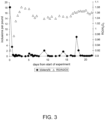
- Figure 3 illustrates the dramatic improvement in defect levels that can be achieved by switching the ⁇ [RO]/[Al 2 O 3 ] ratio of a glass from below 1.00 to above 1.00.
- This graph shows the results of an experimental study done over a 30 day period in which the ⁇ [RO]/[Al 2 O 3 ] ratio was adjusted by increasing CaO and/or MgO at the expense of Al 2 O 3 and/or SiO 2 .
- the triangular data points show the ⁇ [RO]/[Al 2 O 3 ] ratios on the various days of the experiment, and the solid circles show the number of inclusions per pound.
- the inclusion level dropped by essentially two orders of magnitude and remained at low levels even with changes in CaO and/or MgO.
- the MgO concentration was greater than 1.0 mole percent and the SiO 2 concentration was less than 71 mole percent.
- the glass of Example 23 was produced using a downdraw process, specifically, a full-scale fusion process, and was found to produce a population of 50 sequential glass sheets which had an average inclusion level of less than 0.05 gaseous inclusions/cubic centimeter, each sheet in the population having a volume of at least 500 cubic centimeters.
Landscapes
- Chemical & Material Sciences (AREA)
- Engineering & Computer Science (AREA)
- Materials Engineering (AREA)
- Organic Chemistry (AREA)
- Life Sciences & Earth Sciences (AREA)
- Chemical Kinetics & Catalysis (AREA)
- General Chemical & Material Sciences (AREA)
- Geochemistry & Mineralogy (AREA)
- Glass Compositions (AREA)
Applications Claiming Priority (3)
| Application Number | Priority Date | Filing Date | Title |
|---|---|---|---|
| US69447805P | 2005-06-28 | 2005-06-28 | |
| EP06785895A EP1899275A1 (en) | 2005-06-28 | 2006-06-28 | Fining of boroalumino silicate glasses |
| PCT/US2006/025464 WO2007002865A1 (en) | 2005-06-28 | 2006-06-28 | Fining of boroalumino silicate glasses |
Related Parent Applications (1)
| Application Number | Title | Priority Date | Filing Date |
|---|---|---|---|
| EP06785895A Division EP1899275A1 (en) | 2005-06-28 | 2006-06-28 | Fining of boroalumino silicate glasses |
Publications (3)
| Publication Number | Publication Date |
|---|---|
| EP3296274A2 EP3296274A2 (en) | 2018-03-21 |
| EP3296274A3 EP3296274A3 (en) | 2018-06-13 |
| EP3296274B1 true EP3296274B1 (en) | 2023-04-26 |
Family
ID=36942503
Family Applications (2)
| Application Number | Title | Priority Date | Filing Date |
|---|---|---|---|
| EP17196092.5A Active EP3296274B1 (en) | 2005-06-28 | 2006-06-28 | Fining of boroalumino silicate glasses |
| EP06785895A Ceased EP1899275A1 (en) | 2005-06-28 | 2006-06-28 | Fining of boroalumino silicate glasses |
Family Applications After (1)
| Application Number | Title | Priority Date | Filing Date |
|---|---|---|---|
| EP06785895A Ceased EP1899275A1 (en) | 2005-06-28 | 2006-06-28 | Fining of boroalumino silicate glasses |
Country Status (7)
| Country | Link |
|---|---|
| US (3) | US7851394B2 (https=) |
| EP (2) | EP3296274B1 (https=) |
| JP (1) | JP5142996B2 (https=) |
| KR (1) | KR101346446B1 (https=) |
| CN (3) | CN101208276B (https=) |
| TW (1) | TWI387571B (https=) |
| WO (1) | WO2007002865A1 (https=) |
Families Citing this family (84)
| Publication number | Priority date | Publication date | Assignee | Title |
|---|---|---|---|---|
| US7260960B2 (en) * | 2003-02-27 | 2007-08-28 | Carty William M | Selective glass batching methods for improving melting efficiency and reducing gross segregation of glass batch components |
| KR100994095B1 (ko) * | 2003-12-26 | 2010-11-12 | 아사히 가라스 가부시키가이샤 | 무알칼리 유리, 그 제조 방법 및 액정 디스플레이 패널 |
| WO2007002865A1 (en) * | 2005-06-28 | 2007-01-04 | Corning Incorporated | Fining of boroalumino silicate glasses |
| EP1996525B1 (en) * | 2006-02-10 | 2019-05-22 | Corning Incorporated | Glass compositions having high thermal and chemical stability and methods of making thereof |
| JP2013173670A (ja) * | 2006-05-23 | 2013-09-05 | Nippon Electric Glass Co Ltd | 無アルカリガラスおよび無アルカリガラス基板 |
| JP5703535B2 (ja) * | 2006-05-23 | 2015-04-22 | 日本電気硝子株式会社 | 無アルカリガラス基板 |
| US7534734B2 (en) * | 2006-11-13 | 2009-05-19 | Corning Incorporated | Alkali-free glasses containing iron and tin as fining agents |
| US9434642B2 (en) | 2007-05-21 | 2016-09-06 | Corning Incorporated | Mechanically flexible and durable substrates |
| JP5435394B2 (ja) * | 2007-06-08 | 2014-03-05 | 日本電気硝子株式会社 | 強化ガラス基板及びその製造方法 |
| US7709406B2 (en) * | 2007-07-31 | 2010-05-04 | Corning Incorporation | Glass compositions compatible with downdraw processing and methods of making and using thereof |
| US8196434B2 (en) * | 2007-08-08 | 2012-06-12 | Corning Incorporated | Molten glass delivery apparatus for optical quality glass |
| EP3392220A1 (en) | 2007-11-29 | 2018-10-24 | Corning Incorporated | Glasses having improved toughness and scratch resistance |
| DE102008005857A1 (de) | 2008-01-17 | 2009-07-23 | Schott Ag | Alkalifreies Glas |
| CN101980983B (zh) | 2008-02-26 | 2014-04-16 | 康宁股份有限公司 | 用于硅酸盐玻璃的澄清剂 |
| CN104313265B (zh) | 2008-03-21 | 2018-07-13 | 加利福尼亚技术学院 | 通过快速电容器放电形成金属玻璃 |
| US8613816B2 (en) | 2008-03-21 | 2013-12-24 | California Institute Of Technology | Forming of ferromagnetic metallic glass by rapid capacitor discharge |
| US8613814B2 (en) * | 2008-03-21 | 2013-12-24 | California Institute Of Technology | Forming of metallic glass by rapid capacitor discharge forging |
| RU2010154445A (ru) * | 2008-05-30 | 2012-07-10 | Фостер Вилер Энергия Ой (Fi) | Способ и система для генерации энергии путем сжигания в чистом кислороде |
| US9346699B2 (en) | 2008-10-06 | 2016-05-24 | Corning Incorporated | Method of making a glass laminate having controlled strength |
| US8975199B2 (en) | 2011-08-12 | 2015-03-10 | Corsam Technologies Llc | Fusion formable alkali-free intermediate thermal expansion coefficient glass |
| US8835335B2 (en) * | 2009-03-19 | 2014-09-16 | Nippon Electric Glass Co., Ltd. | Alkali-free glass |
| US9539628B2 (en) | 2009-03-23 | 2017-01-10 | Apple Inc. | Rapid discharge forming process for amorphous metal |
| JP5418971B2 (ja) * | 2009-08-19 | 2014-02-19 | 日本電気硝子株式会社 | ガラスフィルム |
| US20110128535A1 (en) * | 2009-11-30 | 2011-06-02 | David Eugene Baker | Nano-Structured Substrates, Articles, and Methods Thereof |
| US8835011B2 (en) * | 2010-01-07 | 2014-09-16 | Corning Incorporated | Cover assembly for electronic display devices |
| WO2011127414A2 (en) | 2010-04-08 | 2011-10-13 | California Institute Of Technology | Electromagnetic forming of metallic glasses using a capacitive discharge and magnetic field |
| TW201210967A (en) * | 2010-06-29 | 2012-03-16 | Avanstrate Inc | Production device of glass panel and production method using the same |
| US10421681B2 (en) | 2010-07-12 | 2019-09-24 | Corning Incorporated | Alumina isopipes for use with tin-containing glasses |
| TWI537231B (zh) | 2010-07-12 | 2016-06-11 | 康寧公司 | 高靜態疲勞的氧化鋁隔離管 |
| JP5874304B2 (ja) * | 2010-11-02 | 2016-03-02 | 日本電気硝子株式会社 | 無アルカリガラス |
| US20120135853A1 (en) * | 2010-11-30 | 2012-05-31 | Jaymin Amin | Glass articles/materials for use as touchscreen substrates |
| EP2655681A4 (en) * | 2010-12-23 | 2015-03-04 | California Inst Of Techn | STRETCHING OF A METAL GLASS BY QUICK CONDENSATE DISCHARGE |
| CN103443321B (zh) | 2011-02-16 | 2015-09-30 | 加利福尼亚技术学院 | 通过快速电容器放电进行的金属玻璃的注射成型 |
| WO2012125507A2 (en) | 2011-03-11 | 2012-09-20 | Saint-Gobain Ceramics & Plastics, Inc. | Refractory object, glass overflow forming block, and process for glass object manufacture |
| US20130072371A1 (en) * | 2011-03-17 | 2013-03-21 | Ppg Industries Ohio, Inc. | Method of, and apparatus for, using a glass fluxing agent to reduce foam during melting of glass batch |
| EP2694452A4 (en) | 2011-03-30 | 2015-03-11 | Saint Gobain Ceramics | FIRE-RESISTANT OBJECT, GLASS OVERFLOW FORMING BLOCK, AND METHOD FOR FORMING AND USING THE FIRE-RESISTANT OBJECT |
| EP2697177B1 (en) | 2011-04-13 | 2020-11-18 | Saint-Gobain Ceramics & Plastics, Inc. | Refractory object including beta alumina and processes of making and using the same |
| JP5935471B2 (ja) * | 2011-04-25 | 2016-06-15 | 日本電気硝子株式会社 | 液晶レンズ |
| JPWO2013005402A1 (ja) * | 2011-07-01 | 2015-02-23 | AvanStrate株式会社 | フラットパネルディスプレイ用ガラス基板およびその製造方法 |
| CN104136387A (zh) | 2012-01-11 | 2014-11-05 | 圣戈本陶瓷及塑料股份有限公司 | 耐火物体和使用所述耐火物体形成玻璃片的方法 |
| US9517967B2 (en) | 2012-05-31 | 2016-12-13 | Corning Incorporated | Ion exchangeable glass with high damage resistance |
| US9393612B2 (en) | 2012-11-15 | 2016-07-19 | Glassimetal Technology, Inc. | Automated rapid discharge forming of metallic glasses |
| WO2014127108A1 (en) | 2013-02-15 | 2014-08-21 | Corning Incorporated | High volume production of display quality glass sheets having low zirconia levels |
| WO2014145747A1 (en) | 2013-03-15 | 2014-09-18 | Glassimetal Technology, Inc. | Methods for shaping high aspect ratio articles from metallic glass alloys using rapid capacitive discharge and metallic glass feedstock for use in such methods |
| US10273568B2 (en) | 2013-09-30 | 2019-04-30 | Glassimetal Technology, Inc. | Cellulosic and synthetic polymeric feedstock barrel for use in rapid discharge forming of metallic glasses |
| CN104630661B (zh) | 2013-10-03 | 2017-04-26 | 格拉斯金属技术股份有限公司 | 用于金属玻璃的快速放电形成的涂覆有绝缘膜的进料桶 |
| US10029304B2 (en) | 2014-06-18 | 2018-07-24 | Glassimetal Technology, Inc. | Rapid discharge heating and forming of metallic glasses using separate heating and forming feedstock chambers |
| US10022779B2 (en) | 2014-07-08 | 2018-07-17 | Glassimetal Technology, Inc. | Mechanically tuned rapid discharge forming of metallic glasses |
| US10509307B2 (en) | 2014-07-30 | 2019-12-17 | Corning Incorporated | High contrast, glass-based, writeable/erasable front projection screens |
| BR112017014270A2 (pt) * | 2014-12-31 | 2018-03-27 | Corning Incorporated | ?métodos para tratar termicamente artigos de vidro? |
| BR112017014200A2 (pt) | 2014-12-31 | 2018-03-06 | Corning Incorporated | ?métodos para tratamento de artigos de vidro? |
| WO2016138111A1 (en) | 2015-02-24 | 2016-09-01 | Saint-Gobain Ceramics & Plastics, Inc. | Refractory article and method of making |
| GB201505091D0 (en) * | 2015-03-26 | 2015-05-06 | Pilkington Group Ltd | Glass |
| US10682694B2 (en) | 2016-01-14 | 2020-06-16 | Glassimetal Technology, Inc. | Feedback-assisted rapid discharge heating and forming of metallic glasses |
| TWI853308B (zh) * | 2016-02-22 | 2024-08-21 | 美商康寧公司 | 無鹼硼鋁矽酸鹽玻璃 |
| US20170362119A1 (en) * | 2016-06-17 | 2017-12-21 | Corning Incorporated | Transparent, near infrared-shielding glass ceramic |
| US10632529B2 (en) | 2016-09-06 | 2020-04-28 | Glassimetal Technology, Inc. | Durable electrodes for rapid discharge heating and forming of metallic glasses |
| CN109715576A (zh) | 2016-09-13 | 2019-05-03 | Agc株式会社 | 高频器件用玻璃基板和高频器件用电路基板 |
| CN107037073B (zh) * | 2017-05-22 | 2019-11-08 | 东旭科技集团有限公司 | 一种玻璃液相线温度的测定方法 |
| KR102634707B1 (ko) * | 2017-09-20 | 2024-02-08 | 에이지씨 가부시키가이샤 | 무알칼리 유리 기판 |
| US12552704B2 (en) | 2017-10-23 | 2026-02-17 | Corning Incorporated | Glass-ceramics and glasses |
| US10450220B2 (en) | 2017-12-13 | 2019-10-22 | Corning Incorporated | Glass-ceramics and glasses |
| US10246371B1 (en) | 2017-12-13 | 2019-04-02 | Corning Incorporated | Articles including glass and/or glass-ceramics and methods of making the same |
| NL2020896B1 (en) | 2018-05-08 | 2019-11-14 | Corning Inc | Water-containing glass-based articles with high indentation cracking threshold |
| TWI814817B (zh) * | 2018-05-01 | 2023-09-11 | 美商康寧公司 | 低鹼金屬高透射玻璃 |
| KR102886949B1 (ko) * | 2018-09-18 | 2025-11-17 | 에이지씨 가부시키가이샤 | 유리 기판, 블랙 매트릭스 기판 및 디스플레이 패널 |
| CN109485254A (zh) * | 2018-11-15 | 2019-03-19 | 东旭科技集团有限公司 | 无碱铝硅酸盐玻璃用组合物、无碱铝硅酸盐玻璃及其制备方法和应用 |
| WO2020102147A2 (en) | 2018-11-16 | 2020-05-22 | Corning Incorporated | Laminated glass articles comprising a hydrogen-containing glass core layer and methods of forming the same |
| TWI891613B (zh) | 2018-11-16 | 2025-08-01 | 美商康寧公司 | 用於透過蒸氣處理而強化之玻璃成分及方法 |
| JP2022509839A (ja) | 2018-11-30 | 2022-01-24 | コーニング インコーポレイテッド | 薄型の多層積層体 |
| US12404204B2 (en) | 2019-05-16 | 2025-09-02 | Corning Incorporated | Glasses with modified young's modulus profile |
| US12122711B2 (en) | 2019-05-16 | 2024-10-22 | Corning Incorporated | Steam strengthenable glass compositions with low phosphorous content |
| CN117361875A (zh) | 2019-05-16 | 2024-01-09 | 康宁股份有限公司 | 具有蒸汽处理雾度抗性的玻璃组合物及其方法 |
| CN111072276B (zh) * | 2019-12-25 | 2022-05-03 | 温州市康尔微晶器皿有限公司 | 含复合澄清剂的锂铝硅微晶玻璃及其制备方法 |
| GB202012825D0 (en) | 2020-05-12 | 2020-09-30 | Corning Inc | Fusion formable and steam strengthenable glass compositions with platinum compatibility |
| EP4217323A1 (en) * | 2020-09-25 | 2023-08-02 | Corning Incorporated | Transparent glass-ceramic articles having improved mechanical durability |
| WO2022075068A1 (ja) * | 2020-10-06 | 2022-04-14 | 日本電気硝子株式会社 | 貫通孔を有するガラス基板 |
| CN116802051A (zh) | 2020-11-30 | 2023-09-22 | 康宁股份有限公司 | 具有压缩顶层的玻璃聚合物层合体 |
| TW202344385A (zh) | 2022-04-28 | 2023-11-16 | 美商康寧公司 | 耐衝擊的玻璃-聚合物積層板和納入該積層板的感測器 |
| KR20250117394A (ko) | 2022-11-28 | 2025-08-04 | 코닝 인코포레이티드 | 내충격성 유리 중합체 층 및 내손상성 유리 적층체 층을 갖는 복합 물품 및 이의 제조 방법 |
| CN115947539B (zh) * | 2022-12-23 | 2024-03-12 | 中建材玻璃新材料研究院集团有限公司 | 一种用于显示基板的铝硅酸盐玻璃及其制备方法 |
| CN116282934B (zh) * | 2023-02-24 | 2023-08-15 | 泰山玻璃纤维有限公司 | 高镁高比模量玻璃纤维组合物及玻璃纤维 |
| CN116199422A (zh) * | 2023-03-29 | 2023-06-02 | 海南海控特玻科技有限公司 | 一种提高管径均匀性的中性药用玻璃管的制备方法 |
| CN117923791A (zh) * | 2023-12-18 | 2024-04-26 | 彩虹显示器件股份有限公司 | 一种低热收缩玻璃及其制备方法 |
Family Cites Families (28)
| Publication number | Priority date | Publication date | Assignee | Title |
|---|---|---|---|---|
| US3338696A (en) | 1964-05-06 | 1967-08-29 | Corning Glass Works | Sheet forming apparatus |
| BE757057A (fr) | 1969-10-06 | 1971-04-05 | Corning Glass Works | Procede et appareil de controle d'epaisseur d'une feuille de verre nouvellement etiree |
| SU642265A1 (ru) | 1976-09-15 | 1979-01-15 | Предприятие П/Я Х-5382 | Стекло |
| US4180618A (en) | 1977-07-27 | 1979-12-25 | Corning Glass Works | Thin silicon film electronic device |
| US5374595A (en) | 1993-01-22 | 1994-12-20 | Corning Incorporated | High liquidus viscosity glasses for flat panel displays |
| EP0714862B1 (en) | 1994-11-30 | 1999-03-31 | Asahi Glass Company Ltd. | Alkali-free glass and flat panel display |
| US6169047B1 (en) * | 1994-11-30 | 2001-01-02 | Asahi Glass Company Ltd. | Alkali-free glass and flat panel display |
| JP3988209B2 (ja) * | 1996-06-03 | 2007-10-10 | 旭硝子株式会社 | 無アルカリガラスおよび液晶ディスプレイパネル |
| US5824127A (en) * | 1996-07-19 | 1998-10-20 | Corning Incorporated | Arsenic-free glasses |
| US6508083B1 (en) * | 1996-08-21 | 2003-01-21 | Nippon Electric Glass Co., Ltd. | Alkali-free glass and method for producing the same |
| US5785726A (en) | 1996-10-28 | 1998-07-28 | Corning Incorporated | Method of reducing bubbles at the vessel/glass interface in a glass manufacturing system |
| US6468933B1 (en) * | 1998-09-22 | 2002-10-22 | Nippon Electric Glass Co., Ltd. | Alkali-free glass and method of producing the same |
| US6319867B1 (en) * | 1998-11-30 | 2001-11-20 | Corning Incorporated | Glasses for flat panel displays |
| JP4576680B2 (ja) * | 1999-08-03 | 2010-11-10 | 旭硝子株式会社 | 無アルカリガラス |
| US6537937B1 (en) * | 1999-08-03 | 2003-03-25 | Asahi Glass Company, Limited | Alkali-free glass |
| DE10017701C2 (de) * | 2000-04-08 | 2002-03-07 | Schott Glas | Gefloatetes Flachglas |
| JP2001348247A (ja) | 2000-05-31 | 2001-12-18 | Asahi Glass Co Ltd | 無アルカリガラス |
| JP2002308643A (ja) | 2001-02-01 | 2002-10-23 | Nippon Electric Glass Co Ltd | 無アルカリガラス及びディスプレイ用ガラス基板 |
| US6992030B2 (en) | 2002-08-29 | 2006-01-31 | Corning Incorporated | Low-density glass for flat panel display substrates |
| JP2004091244A (ja) * | 2002-08-30 | 2004-03-25 | Nippon Electric Glass Co Ltd | 無アルカリガラス基板及びその製造方法 |
| JP4305817B2 (ja) * | 2002-12-11 | 2009-07-29 | 日本電気硝子株式会社 | 無アルカリガラス基板 |
| CN1764610A (zh) | 2003-03-31 | 2006-04-26 | 旭硝子株式会社 | 无碱玻璃 |
| US20060242996A1 (en) | 2005-04-27 | 2006-11-02 | Gilbert Deangelis | System and method for controlling the environment around one or more vessels in a glass manufacturing system |
| WO2007002865A1 (en) | 2005-06-28 | 2007-01-04 | Corning Incorporated | Fining of boroalumino silicate glasses |
| EP1996525B1 (en) * | 2006-02-10 | 2019-05-22 | Corning Incorporated | Glass compositions having high thermal and chemical stability and methods of making thereof |
| US7534734B2 (en) * | 2006-11-13 | 2009-05-19 | Corning Incorporated | Alkali-free glasses containing iron and tin as fining agents |
| US7709406B2 (en) * | 2007-07-31 | 2010-05-04 | Corning Incorporation | Glass compositions compatible with downdraw processing and methods of making and using thereof |
| RU2010154445A (ru) | 2008-05-30 | 2012-07-10 | Фостер Вилер Энергия Ой (Fi) | Способ и система для генерации энергии путем сжигания в чистом кислороде |
-
2006
- 2006-06-28 WO PCT/US2006/025464 patent/WO2007002865A1/en not_active Ceased
- 2006-06-28 JP JP2008519584A patent/JP5142996B2/ja active Active
- 2006-06-28 EP EP17196092.5A patent/EP3296274B1/en active Active
- 2006-06-28 CN CN2006800228806A patent/CN101208276B/zh not_active Ceased
- 2006-06-28 CN CN201210034659.XA patent/CN102603184B/zh not_active Ceased
- 2006-06-28 EP EP06785895A patent/EP1899275A1/en not_active Ceased
- 2006-06-28 CN CN201210034654.7A patent/CN102603183B/zh not_active Ceased
- 2006-06-28 US US11/478,493 patent/US7851394B2/en active Active
- 2006-06-28 KR KR1020087002134A patent/KR101346446B1/ko active Active
- 2006-11-01 TW TW095123273A patent/TWI387571B/zh active
-
2010
- 2010-12-10 US US12/965,032 patent/US8642491B2/en active Active
- 2010-12-10 US US12/965,004 patent/US8640498B2/en active Active
Also Published As
| Publication number | Publication date |
|---|---|
| US7851394B2 (en) | 2010-12-14 |
| CN101208276A (zh) | 2008-06-25 |
| EP1899275A1 (en) | 2008-03-19 |
| EP3296274A3 (en) | 2018-06-13 |
| US8640498B2 (en) | 2014-02-04 |
| JP5142996B2 (ja) | 2013-02-13 |
| TWI387571B (zh) | 2013-03-01 |
| EP3296274A2 (en) | 2018-03-21 |
| CN101208276B (zh) | 2012-04-25 |
| US20060293162A1 (en) | 2006-12-28 |
| CN102603183A (zh) | 2012-07-25 |
| US8642491B2 (en) | 2014-02-04 |
| TW200821273A (en) | 2008-05-16 |
| US20110079049A1 (en) | 2011-04-07 |
| CN102603184B (zh) | 2015-04-15 |
| WO2007002865A1 (en) | 2007-01-04 |
| CN102603184A (zh) | 2012-07-25 |
| CN102603183B (zh) | 2015-04-15 |
| US20110082022A1 (en) | 2011-04-07 |
| KR20080023356A (ko) | 2008-03-13 |
| KR101346446B1 (ko) | 2014-01-15 |
| JP2008544942A (ja) | 2008-12-11 |
Similar Documents
| Publication | Publication Date | Title |
|---|---|---|
| EP3296274B1 (en) | Fining of boroalumino silicate glasses | |
| EP2484645B1 (en) | Alkali-free glasses containing iron and tin as fining agents | |
| EP2128101B1 (en) | Boroalumino silicate glasses | |
| KR101458249B1 (ko) | 다운드로우 공정에 양립가능한 유리조성물 및 이를 이용한 제조방법 및 용도 | |
| WO2000032528A1 (en) | Glasses for flat panel displays | |
| TWI388520B (zh) | 硼鋁酸矽酸鹽玻璃澄清 |
Legal Events
| Date | Code | Title | Description |
|---|---|---|---|
| PUAI | Public reference made under article 153(3) epc to a published international application that has entered the european phase |
Free format text: ORIGINAL CODE: 0009012 |
|
| STAA | Information on the status of an ep patent application or granted ep patent |
Free format text: STATUS: THE APPLICATION HAS BEEN PUBLISHED |
|
| AC | Divisional application: reference to earlier application |
Ref document number: 1899275 Country of ref document: EP Kind code of ref document: P |
|
| AK | Designated contracting states |
Kind code of ref document: A2 Designated state(s): DE FR |
|
| PUAL | Search report despatched |
Free format text: ORIGINAL CODE: 0009013 |
|
| AK | Designated contracting states |
Kind code of ref document: A3 Designated state(s): DE FR |
|
| RIC1 | Information provided on ipc code assigned before grant |
Ipc: C03C 3/091 20060101ALI20180508BHEP Ipc: C03C 1/00 20060101AFI20180508BHEP Ipc: C03B 17/06 20060101ALI20180508BHEP |
|
| STAA | Information on the status of an ep patent application or granted ep patent |
Free format text: STATUS: REQUEST FOR EXAMINATION WAS MADE |
|
| 17P | Request for examination filed |
Effective date: 20181128 |
|
| RBV | Designated contracting states (corrected) |
Designated state(s): DE FR |
|
| STAA | Information on the status of an ep patent application or granted ep patent |
Free format text: STATUS: EXAMINATION IS IN PROGRESS |
|
| 17Q | First examination report despatched |
Effective date: 20190212 |
|
| GRAP | Despatch of communication of intention to grant a patent |
Free format text: ORIGINAL CODE: EPIDOSNIGR1 |
|
| STAA | Information on the status of an ep patent application or granted ep patent |
Free format text: STATUS: GRANT OF PATENT IS INTENDED |
|
| GRAS | Grant fee paid |
Free format text: ORIGINAL CODE: EPIDOSNIGR3 |
|
| INTG | Intention to grant announced |
Effective date: 20230221 |
|
| GRAA | (expected) grant |
Free format text: ORIGINAL CODE: 0009210 |
|
| STAA | Information on the status of an ep patent application or granted ep patent |
Free format text: STATUS: THE PATENT HAS BEEN GRANTED |
|
| AC | Divisional application: reference to earlier application |
Ref document number: 1899275 Country of ref document: EP Kind code of ref document: P |
|
| AK | Designated contracting states |
Kind code of ref document: B1 Designated state(s): DE FR |
|
| REG | Reference to a national code |
Ref country code: DE Ref legal event code: R096 Ref document number: 602006060443 Country of ref document: DE |
|
| REG | Reference to a national code |
Ref country code: DE Ref legal event code: R097 Ref document number: 602006060443 Country of ref document: DE |
|
| PLBE | No opposition filed within time limit |
Free format text: ORIGINAL CODE: 0009261 |
|
| STAA | Information on the status of an ep patent application or granted ep patent |
Free format text: STATUS: NO OPPOSITION FILED WITHIN TIME LIMIT |
|
| 26N | No opposition filed |
Effective date: 20240129 |
|
| PGFP | Annual fee paid to national office [announced via postgrant information from national office to epo] |
Ref country code: DE Payment date: 20250509 Year of fee payment: 20 |
|
| PGFP | Annual fee paid to national office [announced via postgrant information from national office to epo] |
Ref country code: FR Payment date: 20250512 Year of fee payment: 20 |