EP3294300B1 - Long acting drug delivery device in form of an implant or iud comprising levonorgestrel and ethinylestradiol - Google Patents
Long acting drug delivery device in form of an implant or iud comprising levonorgestrel and ethinylestradiol Download PDFInfo
- Publication number
- EP3294300B1 EP3294300B1 EP16720866.9A EP16720866A EP3294300B1 EP 3294300 B1 EP3294300 B1 EP 3294300B1 EP 16720866 A EP16720866 A EP 16720866A EP 3294300 B1 EP3294300 B1 EP 3294300B1
- Authority
- EP
- European Patent Office
- Prior art keywords
- drug
- lng
- core
- segment
- segments
- Prior art date
- Legal status (The legal status is an assumption and is not a legal conclusion. Google has not performed a legal analysis and makes no representation as to the accuracy of the status listed.)
- Active
Links
Images


Classifications
-
- A—HUMAN NECESSITIES
- A61—MEDICAL OR VETERINARY SCIENCE; HYGIENE
- A61K—PREPARATIONS FOR MEDICAL, DENTAL OR TOILETRY PURPOSES
- A61K9/00—Medicinal preparations characterised by special physical form
- A61K9/0012—Galenical forms characterised by the site of application
- A61K9/0034—Urogenital system, e.g. vagina, uterus, cervix, penis, scrotum, urethra, bladder; Personal lubricants
- A61K9/0036—Devices retained in the vagina or cervix for a prolonged period, e.g. intravaginal rings, medicated tampons, medicated diaphragms
-
- A—HUMAN NECESSITIES
- A61—MEDICAL OR VETERINARY SCIENCE; HYGIENE
- A61K—PREPARATIONS FOR MEDICAL, DENTAL OR TOILETRY PURPOSES
- A61K31/00—Medicinal preparations containing organic active ingredients
- A61K31/56—Compounds containing cyclopenta[a]hydrophenanthrene ring systems; Derivatives thereof, e.g. steroids
- A61K31/565—Compounds containing cyclopenta[a]hydrophenanthrene ring systems; Derivatives thereof, e.g. steroids not substituted in position 17 beta by a carbon atom, e.g. estrane, estradiol
-
- A—HUMAN NECESSITIES
- A61—MEDICAL OR VETERINARY SCIENCE; HYGIENE
- A61K—PREPARATIONS FOR MEDICAL, DENTAL OR TOILETRY PURPOSES
- A61K31/00—Medicinal preparations containing organic active ingredients
- A61K31/56—Compounds containing cyclopenta[a]hydrophenanthrene ring systems; Derivatives thereof, e.g. steroids
- A61K31/565—Compounds containing cyclopenta[a]hydrophenanthrene ring systems; Derivatives thereof, e.g. steroids not substituted in position 17 beta by a carbon atom, e.g. estrane, estradiol
- A61K31/567—Compounds containing cyclopenta[a]hydrophenanthrene ring systems; Derivatives thereof, e.g. steroids not substituted in position 17 beta by a carbon atom, e.g. estrane, estradiol substituted in position 17 alpha, e.g. mestranol, norethandrolone
-
- A—HUMAN NECESSITIES
- A61—MEDICAL OR VETERINARY SCIENCE; HYGIENE
- A61K—PREPARATIONS FOR MEDICAL, DENTAL OR TOILETRY PURPOSES
- A61K9/00—Medicinal preparations characterised by special physical form
- A61K9/0012—Galenical forms characterised by the site of application
- A61K9/0034—Urogenital system, e.g. vagina, uterus, cervix, penis, scrotum, urethra, bladder; Personal lubricants
- A61K9/0039—Devices retained in the uterus for a prolonged period, e.g. intrauterine devices for contraception
-
- A—HUMAN NECESSITIES
- A61—MEDICAL OR VETERINARY SCIENCE; HYGIENE
- A61P—SPECIFIC THERAPEUTIC ACTIVITY OF CHEMICAL COMPOUNDS OR MEDICINAL PREPARATIONS
- A61P15/00—Drugs for genital or sexual disorders; Contraceptives
-
- A—HUMAN NECESSITIES
- A61—MEDICAL OR VETERINARY SCIENCE; HYGIENE
- A61P—SPECIFIC THERAPEUTIC ACTIVITY OF CHEMICAL COMPOUNDS OR MEDICINAL PREPARATIONS
- A61P15/00—Drugs for genital or sexual disorders; Contraceptives
- A61P15/12—Drugs for genital or sexual disorders; Contraceptives for climacteric disorders
-
- A—HUMAN NECESSITIES
- A61—MEDICAL OR VETERINARY SCIENCE; HYGIENE
- A61P—SPECIFIC THERAPEUTIC ACTIVITY OF CHEMICAL COMPOUNDS OR MEDICINAL PREPARATIONS
- A61P15/00—Drugs for genital or sexual disorders; Contraceptives
- A61P15/18—Feminine contraceptives
-
- A—HUMAN NECESSITIES
- A61—MEDICAL OR VETERINARY SCIENCE; HYGIENE
- A61P—SPECIFIC THERAPEUTIC ACTIVITY OF CHEMICAL COMPOUNDS OR MEDICINAL PREPARATIONS
- A61P43/00—Drugs for specific purposes, not provided for in groups A61P1/00-A61P41/00
-
- A—HUMAN NECESSITIES
- A61—MEDICAL OR VETERINARY SCIENCE; HYGIENE
- A61P—SPECIFIC THERAPEUTIC ACTIVITY OF CHEMICAL COMPOUNDS OR MEDICINAL PREPARATIONS
- A61P5/00—Drugs for disorders of the endocrine system
- A61P5/24—Drugs for disorders of the endocrine system of the sex hormones
-
- A—HUMAN NECESSITIES
- A61—MEDICAL OR VETERINARY SCIENCE; HYGIENE
- A61K—PREPARATIONS FOR MEDICAL, DENTAL OR TOILETRY PURPOSES
- A61K9/00—Medicinal preparations characterised by special physical form
- A61K9/0012—Galenical forms characterised by the site of application
- A61K9/0019—Injectable compositions; Intramuscular, intravenous, arterial, subcutaneous administration; Compositions to be administered through the skin in an invasive manner
- A61K9/0024—Solid, semi-solid or solidifying implants, which are implanted or injected in body tissue
Definitions
- the present invention relates to the subject matter as characterized in the patent claims, namely to a long acting drug delivery device containing two different pharmaceutically active drugs (A) and (B) with an reduced "burst" in the initial phase of the wearing period, wherein drug (A) is levonorgestrel and drug (B) is ethinylestradiol.
- the invention further relates a process for manufacturing such a long acting drug delivery device with an reduced initial "burst", a method for altering the release characteristics of a long acting drug delivery device containing two pharmaceutically active drugs (A) and (B) and the use of such a drug delivery device in contraception and gynecological therapies.
- Hormonal contraceptives are widely accepted by users owing to easy application and high contraceptive reliability. Amongst them oral contraception (pill) is the most frequently used contraceptive method in many countries.
- LARC reversible contraceptives
- New LARCs like intrauterine devices (IUD) e.g. Mirena ® ; EP 0652738 B1 and EP 0652737 B1
- subcutaneously placed polymer-based implants e.g. Norplant ® , Jadelle ®
- Intravaginal rings such as Nuvaring ®
- IVRs Intravaginal rings
- Nuvaring ® are further widely accepted long-acting contraceptive method, as the vaginal rings can be inserted into the vagina by the user herself and is thus less invasive in comparison to implants.
- intravaginal ring is a substantially ring-shaped polymeric dosage form, which provides controlled release of active ingredient(s) to the vagina over extended periods of time in which absorption of the drugs takes place via circumvention of the gastrointestinal tract.
- the application in an IVR provides a convenient formulation with low variability in drug release rate, avoiding hepatic first-pass metabolism of the drug substance and improving treatment compliance since no daily (regular) recall of drug intake is required.
- Rings provide a continuous release of the active ingredient(s) over a period from several weeks up to one year.
- Intravaginal rings have been under clinical investigation over the last 45 years.
- Such intravaginal rings are devices made of flexible and drug-permeable polymers (in the context of this invention also named as matrix or core material) such as Ethinylvinylacetate (EVA) or silicone elastomers that contains the active drugs release the active drug(s) from the polymer matrix material to the vaginal mucosa for a certain period of time at a defined rate [for details see e.g. Brache et al. Contraception 2013; 87: 264-273 ; Harwood et al. Semin Reprod Med 2001; 19: 381-390 )].
- EVA Ethinylvinylacetate
- silicone elastomers that contains the active drugs release the active drug(s) from the polymer matrix material to the vaginal mucosa for a certain period of time at a defined rate
- Intravaginal rings are also described in several patents like EP 0 050 867 , US 3,920,805A and US 4,292,965 .
- Some IVR's described in the literature comprise a polymer matrix but no membrane or wall encasing said matrix (monolithic dosage form).
- vaginal rings without a membrane are described in the literature, most vaginal rings (incl. Nuvaring ® ) but also implants (such as Norplant ®1 ) are enclosed in a membrane (also called outer layer), as the membrane ensures a more constant drug release from the polymer core segments during the wearing time.
- a membrane also called outer layer
- Nuvaring ® matrix consist of Ethinylvinylacetate (EVA), which is covered with a very thin membrane (here also the term "skin” is used in the literature) which is essentially composed also from EVA.
- EVA Ethinylvinylacetate
- skin a very thin membrane
- both active ingredients are mixed and equally distributed over the entire ring (matrix). Thus no different core segments containing the individual drugs exist in Nuvaring ® .
- Intrauterine devices also called intrauterine systems; IUS
- IUS intrauterine systems
- the active drugs are contained in different segments (reservoirs) which are either separated by an open space (e.g. by mounting the reservoirs in different places of the T-frame of the IUD) or by an separation membrane.
- an open space e.g. by mounting the reservoirs in different places of the T-frame of the IUD
- an separation membrane e.g. by mounting the reservoirs in different places of the T-frame of the IUD
- the letter A (B) is used for the drug, whereby the letter A' (B') is used for the core segment, containing drug A or B.
- the membrane material not only regulates the drug release over the wearing period but acts also as kind of depot.
- the drug diffuses from the core material into the membrane and concentrates in the membrane during storage and transportation period.
- the "accumulated drug” is emitted from the membrane, in particular during the first 1 to 3 days after insertion, which leads to a higher drug release (so called “initial burst” effect). In some cases this initial burst can last up to 7 days.
- the drug release up to 7 days after insertion is meant.
- the "initial burst” is particularly pronounced on the first day after insertion of the device and declines over a time period up to 7 days till an essentially constant (steady state) release is reached.
- the length of this initial burst phase is dependent on the polymers used for core segments and membrane, the design (e.g. membrane thickness) of the drug delivery device, and the physic chemical properties of the drug.
- the term “initial release” means an increased release before a steady state (an essentially constant) release is reached.
- a further object of the invention is a method for altering the release characteristics of a long acting drug delivery device containing two active drugs (A) and (B).
- release characteristic in the context of the present invention, refers to the release profile of the drug(s) in the initial phase after insertion of the device.
- the matrix segments can be assembled in different sequences, e.g. in a simple AB order.
- inactive segments are added to the device.
- the inactive segments (subsequently called also “inert segment” or “spacer segment”) are usually made of the same polymer matrix material but contain no drug.
- One purpose of the inactive segment is to achieve a sufficient ring size, which is needed to anchor the IVR ring reliable in the vagina of the user.
- the inert segment could be a further purpose of the inert segment, to provide a spatial separation between the drug containing segments, to create a barrier between the drug containing segments.
- the inactive segment is preferably made of the same material as the adjoining drug containing segments.
- IVR systems without a membrane a further purpose of the inactive segments could be to adjust the released dose, as the released dose is dependent on the surface area of the respective segment. Contrary to this in membrane containing systems beside the surface area (of the membrane) the release can be also influence by the physic chemical properties of the membrane.
- inactive segment extends the number of variations with respect to the order of the segments, e.g. in an IVR the order of the segments could be (1) inactive segment, (2) followed by segment A', (3) followed by segment B', (4) followed by segment A' connected to inactive segment (1).
- a further sequence could be (1) inactive / (2) drug A / (3) inactive / (4) drug B / connected to inactive segment (1).
- Many other arrangements are possible in principle, thus the a.m. sequences just serve to illustrate possible structures.
- sequence of the segments has surprisingly an influence on the drug release, particular in the initial phase after the insertion of the long acting drug delivery device.
- an inactive segment which contains no drug and is usually made of the same polymer material as the surrounding segments containing drug (A), (B) or (AB).
- This inactive segments is located between the two A' segments and connects the two A' segments to form a ring.
- the inactive segment causes a spatial separation of the two core segments containing drug (A). Without such an inactive core segment due to the ring shape an A/B/A sequence would practically result in an A/B sequence.
- intravaginal rings basically applies also to inserts which are subcutaneously implanted, respectively to intrauterine devices, if these devices contain two different drugs.
- inactive segments are not needed in the case of an intrauterine device (IUD) or implant as the inert segment would not add an additional benefit to the device.
- Manufacturing and assembly of the ring segments can be done in accordance with standard techniques described in the art, e.g. EP 652738 , US 3,920,805 , US 4,888,074 , US 4,215,691 or WO2010/058070 .
- EP 652738 US 3,920,805 , US 4,888,074 , US 4,215,691 or WO2010/058070 .
- the correct assembly of the different segments according to the teaching of this invention, has to be factored in, when using the manufacturing methods described in the literature.
- Long acting delivery devices with reduced initial burst are manufactured by a two-step process.
- first step (i) individual core segments in the required length of a polymer matrix material, containing either the active drug (A), or the active drug (B) respectively a drug mixture of drug (A) and (B), are prepared.
- step (ii) the primed segments A', B'or AB' are assembled in the order A/B/A or A/AB/A, wherein the drug (B) is better soluble in the selected polymer matrix than drug (A).
- the long acting drug delivery system is an IVR
- an inactive segment containing no drug is added to the assembly step (ii) and the "open end" of the inactive segment is combined with the "open end” of the segmentcontaining drug (A) to form a ring with the sequence A/B/A/inactive or A/AB/A/inactive.
- the design and manufacture of an exemplary IVR's is described in the examples.
- the invention furthermore refers to a method for altering the release characteristic of a long acting drug delivery system containing two pharmaceutically active drugs.
- the method comprises preparing the drug delivery device by a process comprising the steps of:
- the drug delivery device is an intravaginal ring an inactive segment containing no drug is added to this method, which connects the two segments A' to form an IVR with the sequence A/B/A/inactive or A/AB/A/inactive.
- a large variety of drugs can be used in the context of the current invention.
- pharmaceuticals for the treatment of female diseases and contraceptive active agents are eligible, whereby progestins and estrogens are preferred in contraception and aromatase inhibitors and non-steroidal anti-inflammatory drugs (NSAID) are preferred in therapy.
- NSAID non-steroidal anti-inflammatory drugs
- the invention refers also to the use of a long acting drug delivery device containing two different drugs with an improved initial release rate in contraception and therapy.
- chlormadinone acetate CMA
- NNM norgestimate
- NNMN norelgestromin
- NET norethisterone
- NETA norethisterone acetate
- etonogestrel 3-keto-desogestrel
- NOMAc nomegestrol acetate
- demegestone promegestone
- DRSP drospirenone
- MPA medroxyprogesterone acetate
- MPA cyproterone acetate
- CMA chlormadinone acetate
- TMG trimegestone
- LNG levonorgestrel
- NG norgestrel
- DSG gestodene
- DNG gestodene
- DNG dienogest
- DSG gestodene
- DNG gestodene
- DNG dienogest
- levonorgestrel LNG
- DSG gestodene
- DNG dienogest
- CEEs conjugated equine estrogens
- ethinylestradiol and estrogen or their esters such as estradiol valerate or benzoate.
- aromatase inhibitor selective aromatase inhibitors such as anastrozole (Arimidex ® ), exemestane (Aromasin ® ), fadrozole (Afema ® ), formestane (Lentaron ® ), letrozole (Femara ® ), pentrozole, vorozole (Rivizor ® ) and pharmaceutical acceptable salts of aromatase inhibitors are suitable, whereby anastrozole (AI) is preferred.
- NSAID non-selective Cox inhibitors as well as selective Cox 2 inhibitors are equally suitable in the context of this invention.
- Preferred are meloxicam, piroxicam, naproxen, celecoxib, diclofenac, tenoxicam, nimesulide, lornoxicam and indomethacin, of which indomethacin is particularly preferred.
- the concentration of the drug in the polymer matrix is 5 to 40%, wherein a range of 10-30% is preferred.
- solubility of the drug is not only depending on the physico-chemical properties of the selected drug but also on the selected matrix polymer.
- hydrophobic drugs are better soluble than hydrophilic drugs.
- the specific solubility of the selected drug in the respective polymer is of no importance. It is rather important that there is a difference in the solubility between drug (A) and (B) and that the segment with the substance with better solubility B is always located between two segments of the inferior soluble substance A. It is particular preferred, if the segment with the better soluble drug B contains in addition also drug A in a range of 5 to 30 ww % (relating to the segment containing the drug mixture A and B).
- the polysiloxane (polyethylene oxide block-polydimethylsiloxane copolymer, poly(3,3,3-trifluoropropylmethylsiloxane, or poly(dimethylsiloxane) used for measuring solubility of API should have a low viscosity, ca. 1000 cSt (mm 2 /s).
- thermoplastic polymers The solubility of API's in thermoplastic polymers is measured according to standard methods as described by A. Mahieu in Mol Pharm 2013, 10, 560-566 , R. A. Bellantone et al in J Pharm Sci 2012, 101, 4549-4558 , Y. Sun et al. in J Pharm Sci 2012, 99, 4023-4031 or P. Marsac et al. in Pharm Res 2006, 23, 2417-2426 .
- the drug delivery devices of the current invention are usually covered with a polymer based membrane.
- the membrane is brought up to the core segment according to known methods, e.g. by swelling of the membrane in cyclohexane and removal of the solvent after insertion of the core segments. Also pressurized air or vacuum can be applied to expand the membrane prior insertion of the core segments. Respective methods are described e.g. in EP 065273881 B1 .
- the membrane material could be the same of different from the core segment material, whereby it is preferred in the context of this invention, if the materials are different and the solubility of the drug in the matrix (core segment) is higher as in the membrane.
- thermoplastic polymers such as EVA (Ethinyl-Vinyl-Acetate) or elastomeric silicones, such as polysiloxanes are suitable.
- Such materials can also be used as membrane material in the context of the present invention.
- Polysiloxanes are regulating the permeation rate of drugs. They are physiologically inert, and a wide group of therapeutically active substances are capable of penetrating polysiloxane membranes. Furthermore siloxanes have also the required strength properties.
- Poly(disubstituted) siloxanes where the substituents are lower alkyl, preferably alkyl groups of 1 to 6 carbon atoms, or phenyl groups, wherein said alkyl or phenyl can be substituted or unsubstituted, are preferred as core segments and membrane material.
- a widely used and preferred polymer of this kind is poly(dimethylsiloxane) (PDMS).
- siloxane-based polymers comprising either 3,3,3 trifluoropropyl groups attached to the silicon atoms of the siloxane units (fluoro-modified polysiloxanes) or poly(alkylene oxide) groups, wherein said poly(alkylene oxide) groups are present as alkoxy-terminated grafts or blocks linked to the polysiloxane units by silicon-carbon bonds or a mixture of these forms.
- Polysiloxanes and modified polysiloxane polymers are described for example in EP 0652738 B1 , WO 00/29464 and WO 00/00550 .
- siloxane-based polymers comprising poly(alkylene oxide) groups
- PEO-b-PDMS polyethylene oxide block-polydimethylsiloxane copolymer
- Polysiloxanes without substituents are unipolar polymers and thus hydrophilic drugs are poorly soluble in such siloxane elastomers.
- solubility of hydrophilic API's can be enhanced, if polar groups, such as poly(alkylene oxide) groups are present in the siloxane.
- polar groups such as poly(alkylene oxide) groups are present in the siloxane.
- unipolar polymers are used for hydrophobic drugs, whereby polar siloxanes are preferred for hydrophilic drugs.
- a preferred embodiment of the invention refers to a polysiloxane based contraceptive ring containing Levonorgestrel (LNG) and Ethinylestradiol (EE), wherein in this drug combination EE is the drug with the higher solubility and thus the order of the segments is (1) inactive, (2) LNG, (3) EE, (4) LNG connected to the inactive material segment (1) to form a ring.
- LNG Levonorgestrel
- EE Ethinylestradiol
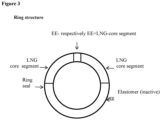
- the EE segment (3) contains Levonorgestrel in addition.
- the ratio between LNG/EE/ in segment (3), containing the drug mixture is 5/95 to 30/70 w/w %.
- Anastrozol and Levonorgestrel containing silicon elastomer based IVR wherein the Levonorgestrel containing segment (B') is located between two Anastrozole containing segments (A'), as in this combination Anastrozole is the drug with the lower solubility in a silicon elastomer. It is particular preferred if the Levonorgestrel segment, contains Anastrozole in addition, whereby the ratio of the Anastrozole to LNG in the segment containing the drug mixture is from 5/95 to 40/60 w/w%.
- the IVR can be continuously used for approximately one month up to one year, preferably for one to six months. Continuous use includes that the IVR can be taken out intermittently for 1 up to 4 hours for e.g. cleaning or during intercourse.
- the IVR can be used in such a way that it will mimic the natural cycle of the woman (e.g. for 21, 22, 23 or 24 days or up to a month ), subsequently removed to initiate the bleeding and is re-inserted after 7, 6, 5, 4 or 3 days (wearing days and non-wearing days should sum up to at least 28 days).
- a new unused IVR can be inserted after this time.
- Release rate means the average amount of active drug substance released from the device within 24 hours that is available for absorption by the surrounding tissue.
- the polymer composition of the core segments and/or the membrane, membrane thickness, and membrane surface area are the main parameters which influence the release rate.
- In-vitro release rate test is routinely used in the art to characterize hormone-containing delivery devices such as IVRs. In this test the release rate is determined by analyzing the released amount of a drug in vitro at 37°C, e.g. in an aqueous solution of cyclodextrin in a shaking water bath for the intended time of use of the device in vivo. The in vitro release rate at each sampling time point is calculated as released amount ( ⁇ g) per day (24h) [ ⁇ g/day or ⁇ g/d].
- dose and release rate are used synonymously in this patent application.
- Example 1 a refers to a ring with a segment sequence LNG/EE/LNG/inactive.
- the inactive or inert material in this example is PDMS elastomer.
- a vaginal ring with the sequence Inactive/EE/inactive/LNG has been prepared (example 1 b).
- the respective ring structures are shown in Figure 1 (LNG/EE/LNG/PDMS left; PDMS/EE/PDMS/LNG right).
- Table 1 of example 1 the dimensions of the different segments are given.
- Table 2 refers to the release rates of EE measured for the different assemblies, LNG/EE/LNG/inactive according to the invention and inactive/EE/inactive/LNG according to the State of the Art. The release rates have been measured as described above in an in-vitro test at 37°C in an aqueous solution of cyclodextrin.
- the release rates of EE in dependency from time (days) as given in Table 1 are also plotted in an arithmetic chart (see Figure 2 ).
- the highest initial burst is observed for the comparator assembly elastomer(inactive)/EE/elastomer(inactive)/LNG after 2 month storing time at 25°C.
- the release is above 55 ⁇ g on day one (violet cross curve).
- the figures also clearly indicate the accumulation of the EE in the membrane in dependency of the storing time as for an identical assembly after 0 month storing time the initial release is 35 ⁇ g only (red square curve).
- PDMS segment inactive segment
- This comparison shows that a further improvement in terms of reduction of the "initial bust” can be achieved, if the EE segment (B) contains LNG in addition.
- the ring structure is shown in Figure 3 .
- Dimensions of the segments are given in Table 3.
- the release rates have been measured as described above and are given in Table 3.
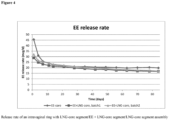
- EE release over the time is plotted in Figure 4 .
- the "initial burst" is further reduced when adding LNG to the EE containing segment.
- the EE release on the first day is reduced from ⁇ 45 ⁇ g (blue "diamond” curve) on day 1 to ⁇ 30 ⁇ g on day one (green triangle respectively red square curves).
- the matrices of the EE- and the LNG- comprising cores were made of silicone elastomer (polydimethylsiloxane), and the inert core was also made of silicone elastomer (polydimethylsiloxane).
- the EE-containing core was produced by mixing micronized EE and the silicone elastomer in a mixer. The EE content of the mixture was 10% by weight. The mixture was shaped in molds and cured to give small discs having the outer diameter of about 4.5mm.
- the LNG-containing core was produced by mixing micronized LNG and the silicone elastomer in a mixer.
- the LNG content of the mixture was 50% by weight.
- the LNG-core was extruded into a tubing with an inner diameter of about 2.0mm and an outer diameter of about 4.5mm.
- the inert silicone elastomer core was also extruded to give an elastic tubing with an inner diameter of about 1.4mm and an outer diameter of about 4.5mm.
- the drug-release-controlling membrane tubing was produced by extrusion.
- the membrane was made of silicone elastomer (polydimethylsiloxane).
- the inner diameter of the membrane tubing was about 4.3mm and the outer diameter about 5.0mm.
- the LNG core was cut into two 37mm pieces (subsequently also named as core segments).
- a PDMS core tubing was used in the ring core as an inert segment.
- the inert PDMS elastomer core was cut into 80mm length so that a total core length of 157mm was achieved.
- the membrane tubing was cut to a length of 165 mm and swollen in cyclohexane.
- the ring was put together by pushing the core segments into the swollen membrane tubing in the following order: first LNG-core segment, elastomer-core segment, second LNG-core segment, and EE-core segment.
- the tubing was shaped into a ring by overlapping and gluing. For closing the ring joint, a small amount of a PDMS glue was used. After evaporation of the solvents, the tubing contracted and compressed the parts tightly.
- the LNG core was cut into 74mm pieces (core segment).
- a PDMS core tubing was used in the ring core as an inert segment.
- the inert PDMS elastomer core was cut into two 40mm pieces resulting in a total core length of 157mm (core segment).
- the membrane tubing was cut to a length of 165 mm and swollen in cyclohexane.
- the ring was put together by pushing the core segments into the swollen membrane tubing in the following order: first elastomer-core-, LNG-core-, second elastomer-core-, and EE-core-segment.
- the tubing was shaped into a ring by overlapping and gluing.
- Ring component Material Length (mm) OD (mm) ID (mm) Membrane tubing Polydimethylsiloxane 165 5.0 4.3 LNG core (tubing) Polydimethylsiloxane 37+37* 4.5 2.0 74** EE core Polydimethylsiloxane 3 4.5 - Elastomer core (tubing) Polydimethylsiloxane 80* 4.5 1.4 40+40** * Ring structure a) Figure 1 left ** Ring structure b) Figure 1 right Table 2.
- the matrices of the EE-, the EE+LNG, and the LNG- comprising cores were made of silicone elastomer (polydimethylsiloxane), and the inert core was also made of silicone elastomer (polydimethylsiloxane).
- the EE-containing core was produced by mixing micronized EE and the silicone elastomer in a mixer. The EE content of the mixture was 20% by weight.
- the EE+LNG-containing core was produced by mixing micronized EE, micronized LNG and the silicone elastomer in a mixer.
- the EE content of the mixture was 20% by weight and the LNG content was 10% by weight.
- the EE+elastomer and the EE+LNG+elastomer mixtures were shaped in molds and cured to give small discs having the outer diameter of about 4.5mm.
- the LNG-containing core was produced by mixing micronized LNG and the silicone elastomer in a mixer.
- the LNG content of the mixture was 50% by weight.
- the LNG-core was extruded into a tubing with an inner diameter of about 2.0mm and an outer diameter of about 4.5mm.
- the inert silicone elastomer core was also extruded to give an elastic tubing with an inner diameter of about 1.4mm and an outer diameter of about 4.5 mm.
- the drug-release-controlling membrane tubing was produced by extrusion.
- the membrane was made of silicone elastomer (polydimethylsiloxane).
- the inner diameter of the membrane tubing was about 4.3mm and the outer diameter about 5.0 mm.
- the LNG core was cut into two 43-46mm pieces (core segment).
- core segment To fill out the whole ring a PDMS core tubing was used in the ring core as an inert segment.
- the inert PDMS elastomer core was cut into 65-71mm length (core segment)so that a total core length of 160mm was achieved.
- the membrane tubing was cut to a length of 160mm and swollen in cyclohexane.
- the ring was put together by pushing the core segments into the swollen membrane tubing in the following order: first LNG-core-, EE-core- or EE+LNG-core, second LNG-core, and elastomer-core-segment.
- the tubing was shaped into a ring by gluing.
- Ring component Material Length (mm) OD (mm) ID (mm) Membrane tubing Polydimethylsiloxane (PDMS) 160 5.0 4.3 LNG core (tubing) Polydimethylsiloxane (PDMS) 43-46 + 43-46 4.5 2.0 EE core or EE plus LNG Polydimethylsiloxane (PDMS) 3 4.5 - Elastomer core (tubing) Polydimethylsiloxane (PDMS) 65-71 4.5 1.4 Table 4 .
Landscapes
- Health & Medical Sciences (AREA)
- Veterinary Medicine (AREA)
- Public Health (AREA)
- General Health & Medical Sciences (AREA)
- Animal Behavior & Ethology (AREA)
- Life Sciences & Earth Sciences (AREA)
- Pharmacology & Pharmacy (AREA)
- Chemical & Material Sciences (AREA)
- Medicinal Chemistry (AREA)
- Reproductive Health (AREA)
- Epidemiology (AREA)
- Gynecology & Obstetrics (AREA)
- Bioinformatics & Cheminformatics (AREA)
- Nuclear Medicine, Radiotherapy & Molecular Imaging (AREA)
- General Chemical & Material Sciences (AREA)
- Chemical Kinetics & Catalysis (AREA)
- Organic Chemistry (AREA)
- Engineering & Computer Science (AREA)
- Urology & Nephrology (AREA)
- Endocrinology (AREA)
- Diabetes (AREA)
- Medicinal Preparation (AREA)
- Pharmaceuticals Containing Other Organic And Inorganic Compounds (AREA)
- Medicines That Contain Protein Lipid Enzymes And Other Medicines (AREA)
- Orthopedics, Nursing, And Contraception (AREA)
Applications Claiming Priority (2)
| Application Number | Priority Date | Filing Date | Title |
|---|---|---|---|
| EP15167521 | 2015-05-13 | ||
| PCT/EP2016/060298 WO2016180764A1 (en) | 2015-05-13 | 2016-05-09 | A long acting drug delivery device and its use in contraception |
Publications (2)
| Publication Number | Publication Date |
|---|---|
| EP3294300A1 EP3294300A1 (en) | 2018-03-21 |
| EP3294300B1 true EP3294300B1 (en) | 2024-12-18 |
Family
ID=53174913
Family Applications (1)
| Application Number | Title | Priority Date | Filing Date |
|---|---|---|---|
| EP16720866.9A Active EP3294300B1 (en) | 2015-05-13 | 2016-05-09 | Long acting drug delivery device in form of an implant or iud comprising levonorgestrel and ethinylestradiol |
Country Status (8)
| Country | Link |
|---|---|
| US (3) | US11096888B2 (enExample) |
| EP (1) | EP3294300B1 (enExample) |
| JP (1) | JP6898856B2 (enExample) |
| CN (1) | CN108135910B (enExample) |
| CA (1) | CA2985717A1 (enExample) |
| ES (1) | ES3009909T3 (enExample) |
| FI (1) | FI3294300T3 (enExample) |
| WO (1) | WO2016180764A1 (enExample) |
Families Citing this family (9)
| Publication number | Priority date | Publication date | Assignee | Title |
|---|---|---|---|---|
| BR112020005928A2 (pt) * | 2017-09-27 | 2020-10-06 | Bayer Oy | método para modificar a liberação de um agente terapeuticamente ativo de uma matriz elastomérica. |
| AU2019275406B2 (en) | 2018-05-24 | 2024-11-14 | Celanese Eva Performance Polymers Llc | Implantable device for sustained release of a macromolecular drug compound |
| WO2019222856A1 (en) | 2018-05-24 | 2019-11-28 | Nureva Inc. | Method, apparatus and computer-readable media to manage semi-constant (persistent) sound sources in microphone pickup/focus zones |
| WO2019226519A1 (en) | 2018-05-24 | 2019-11-28 | Celanese EVA Performance Polymers Corporation | Implantable device for sustained release of a macromolecular drug compound |
| US20200179274A1 (en) * | 2018-12-11 | 2020-06-11 | Lupin Inc. | Drug delivery system for ultra-low dose estrogen combinations and methods and uses thereof |
| US20230404911A1 (en) * | 2018-12-11 | 2023-12-21 | Lupin Inc. | Drug delivery system for ultra-low dose estrogen combinations and methods and uses thereof |
| US20240115490A1 (en) * | 2018-12-11 | 2024-04-11 | Lupin Inc. | Drug delivery system for ultra-low dose estrogen combinations and methods and uses thereof |
| CN112315898B (zh) * | 2020-11-04 | 2021-08-13 | 国家卫生健康委科学技术研究所 | 含有芳香化酶抑制剂的阴道缓控释给药系统及其制备方法 |
| WO2022231930A1 (en) | 2021-04-26 | 2022-11-03 | Celanese Eva Performance Polymers Llc | Implantable device for sustained release of a macromolecular drug compound |
Family Cites Families (21)
| Publication number | Priority date | Publication date | Assignee | Title |
|---|---|---|---|---|
| US3920805A (en) | 1971-12-09 | 1975-11-18 | Upjohn Co | Pharmaceutical devices and method |
| US4215691A (en) | 1978-10-11 | 1980-08-05 | Alza Corporation | Vaginal contraceptive system made from block copolymer |
| US4292965A (en) | 1978-12-29 | 1981-10-06 | The Population Council, Inc. | Intravaginal ring |
| DE3040978A1 (de) | 1980-10-28 | 1982-05-27 | Schering Ag, 1000 Berlin Und 4619 Bergkamen | Vaginalring |
| FR2618329B1 (fr) | 1987-07-22 | 1997-03-28 | Dow Corning Sa | Procede de fabrication d'un anneau capable d'assurer la liberation d'un agent therapeutique, et anneau fabrique par ce procede |
| PH30867A (en) | 1992-07-31 | 1997-12-09 | Leiras Oy | Method and equipment for installing a medicine capsule on a support. |
| FI90627C (fi) | 1992-07-31 | 1994-03-10 | Leiras Oy | Laitteisto lääkeainesauvan varustamiseksi vaipalla |
| US6544546B1 (en) * | 1995-07-04 | 2003-04-08 | Akzo Nobel, N.V. | Ring-shaped devices |
| IL123813A0 (en) * | 1997-04-11 | 1998-10-30 | Akzo Nobel Nv | Drug delivery system for two or more active substances |
| FI107339B (fi) | 1998-06-30 | 2001-07-13 | Leiras Oy | Lääkeaineiden läpäisynopeutta säätävä kalvo tai matriisi |
| US6056976A (en) | 1998-11-12 | 2000-05-02 | Leiras Oy | Elastomer, its preparation and use |
| US6063395A (en) * | 1998-11-12 | 2000-05-16 | Leiras Oy | Drug delivery device especially for the delivery of progestins and estrogens |
| US6476079B1 (en) * | 1999-12-23 | 2002-11-05 | Leiras Oy | Devices for the delivery of drugs having antiprogestinic properties |
| CN1289064C (zh) * | 2001-08-31 | 2006-12-13 | 先灵有限责任公司 | 药物输送体系 |
| US7833545B2 (en) * | 2003-04-29 | 2010-11-16 | The General Hospital Corporation | Methods and devices for the sustained release of multiple drugs |
| TW200927141A (en) * | 2007-11-22 | 2009-07-01 | Bayer Schering Pharma Oy | Vaginal delivery system |
| EP2062568A1 (en) | 2007-11-22 | 2009-05-27 | Bayer Schering Pharma Oy | Vaginal delivery system |
| EP2140860A1 (en) | 2008-07-03 | 2010-01-06 | Bayer Schering Pharma Oy | An improved method of contraception |
| FI121000B (fi) | 2008-11-19 | 2010-06-15 | Bayer Schering Pharma Oy | Intravaginaalinen antojärjestelmä ja menetelmä sen valmistamiseksi |
| BR112014001450A2 (pt) * | 2011-07-20 | 2017-07-18 | F Kiser Patrick | dispositivos intravaginais para distribuição de droga |
| WO2014122563A1 (en) * | 2013-02-08 | 2014-08-14 | Qpharma Ab | An intra vaginal device, and a method of reducing the rate of diffusion of active ingredients in said intra vaginal device |
-
2016
- 2016-05-09 ES ES16720866T patent/ES3009909T3/es active Active
- 2016-05-09 US US15/573,187 patent/US11096888B2/en active Active
- 2016-05-09 FI FIEP16720866.9T patent/FI3294300T3/fi active
- 2016-05-09 WO PCT/EP2016/060298 patent/WO2016180764A1/en not_active Ceased
- 2016-05-09 CN CN201680041265.3A patent/CN108135910B/zh active Active
- 2016-05-09 CA CA2985717A patent/CA2985717A1/en active Pending
- 2016-05-09 JP JP2017558678A patent/JP6898856B2/ja active Active
- 2016-05-09 EP EP16720866.9A patent/EP3294300B1/en active Active
-
2021
- 2021-06-30 US US17/364,199 patent/US12357563B2/en active Active
-
2025
- 2025-06-18 US US19/242,221 patent/US20260053736A1/en active Pending
Also Published As
| Publication number | Publication date |
|---|---|
| US20210338573A1 (en) | 2021-11-04 |
| US20180104181A1 (en) | 2018-04-19 |
| JP6898856B2 (ja) | 2021-07-07 |
| US12357563B2 (en) | 2025-07-15 |
| EP3294300A1 (en) | 2018-03-21 |
| ES3009909T3 (en) | 2025-03-31 |
| CA2985717A1 (en) | 2016-11-17 |
| FI3294300T3 (fi) | 2025-03-06 |
| CN108135910A (zh) | 2018-06-08 |
| CN108135910B (zh) | 2022-12-02 |
| WO2016180764A1 (en) | 2016-11-17 |
| US11096888B2 (en) | 2021-08-24 |
| JP2018516889A (ja) | 2018-06-28 |
| US20260053736A1 (en) | 2026-02-26 |
Similar Documents
| Publication | Publication Date | Title |
|---|---|---|
| US12357563B2 (en) | Long acting drug delivery device and its use in contraception | |
| RU2607179C2 (ru) | Интравагинальные устройства для доставки лекарственных средсв | |
| Malcolm et al. | Vaginal rings for delivery of HIV microbicides | |
| AU2011234587B2 (en) | Parenteral pharmaceutical form which releases aromatase inhibitor and gestagens, for the treatment of endometriosis | |
| TR201807996T4 (tr) | Kontrasepsiyon için bir rahim içi uygulama sistemi. | |
| CN101977651A (zh) | 线性级释放聚合物 | |
| SK5132001A3 (en) | Drug delivery device, especially for the delivery of progestins and estrogens | |
| US11793669B2 (en) | Combination therapy intravaginal rings | |
| CZ116494A3 (en) | Subcutaneous implants based on nomegesrol derivatives | |
| JP2016539088A (ja) | 子宮内送達システム | |
| IL142524A (en) | A device for administering drugs, especially for the delivery of androgens | |
| CN111770750B (zh) | 痛经有关的疼痛和/或疼痛相关症状的治疗 | |
| TW200904452A (en) | New drospirenone/17β-estradiol regimen, pharmaceutical combination, product and kit for performing this regimen | |
| AU2020282388A1 (en) | Methods, compositions and devices for treating neuroinflammatory conditions | |
| WO2018202574A1 (en) | Intravaginal drug delivery system, method for manufacturing such system and its use in gynecological therapies and contraception | |
| EP2062569A1 (en) | Vaginal delivery system | |
| Young | A modular device for vaginal administration of multiple therapeutic agents | |
| Chen | Development and evaluation of novel intravaginal rings fabricated via hot-melt extrusion-based technologies as innovative microbicides | |
| Lin et al. | Transdermal contraceptive patches: Development, clinical performance, and future prospects | |
| HK1221634A1 (zh) | 子宫内递送系统 |
Legal Events
| Date | Code | Title | Description |
|---|---|---|---|
| STAA | Information on the status of an ep patent application or granted ep patent |
Free format text: STATUS: THE INTERNATIONAL PUBLICATION HAS BEEN MADE |
|
| PUAI | Public reference made under article 153(3) epc to a published international application that has entered the european phase |
Free format text: ORIGINAL CODE: 0009012 |
|
| STAA | Information on the status of an ep patent application or granted ep patent |
Free format text: STATUS: REQUEST FOR EXAMINATION WAS MADE |
|
| 17P | Request for examination filed |
Effective date: 20171213 |
|
| AK | Designated contracting states |
Kind code of ref document: A1 Designated state(s): AL AT BE BG CH CY CZ DE DK EE ES FI FR GB GR HR HU IE IS IT LI LT LU LV MC MK MT NL NO PL PT RO RS SE SI SK SM TR |
|
| AX | Request for extension of the european patent |
Extension state: BA ME |
|
| DAV | Request for validation of the european patent (deleted) | ||
| DAX | Request for extension of the european patent (deleted) | ||
| STAA | Information on the status of an ep patent application or granted ep patent |
Free format text: STATUS: EXAMINATION IS IN PROGRESS |
|
| 17Q | First examination report despatched |
Effective date: 20190621 |
|
| REG | Reference to a national code |
Ref country code: DE Ref legal event code: R079 Free format text: PREVIOUS MAIN CLASS: A61K0031565000 Ipc: A61K0009700000 Ref document number: 602016090651 Country of ref document: DE |
|
| RIC1 | Information provided on ipc code assigned before grant |
Ipc: A61K 31/567 20060101ALI20240603BHEP Ipc: A61K 31/565 20060101ALI20240603BHEP Ipc: A61K 9/70 20060101AFI20240603BHEP |
|
| GRAP | Despatch of communication of intention to grant a patent |
Free format text: ORIGINAL CODE: EPIDOSNIGR1 |
|
| STAA | Information on the status of an ep patent application or granted ep patent |
Free format text: STATUS: GRANT OF PATENT IS INTENDED |
|
| INTG | Intention to grant announced |
Effective date: 20240712 |
|
| P01 | Opt-out of the competence of the unified patent court (upc) registered |
Free format text: CASE NUMBER: APP_51659/2024 Effective date: 20240913 |
|
| GRAS | Grant fee paid |
Free format text: ORIGINAL CODE: EPIDOSNIGR3 |
|
| GRAA | (expected) grant |
Free format text: ORIGINAL CODE: 0009210 |
|
| STAA | Information on the status of an ep patent application or granted ep patent |
Free format text: STATUS: THE PATENT HAS BEEN GRANTED |
|
| AK | Designated contracting states |
Kind code of ref document: B1 Designated state(s): AL AT BE BG CH CY CZ DE DK EE ES FI FR GB GR HR HU IE IS IT LI LT LU LV MC MK MT NL NO PL PT RO RS SE SI SK SM TR |
|
| REG | Reference to a national code |
Ref country code: GB Ref legal event code: FG4D |
|
| REG | Reference to a national code |
Ref country code: CH Ref legal event code: EP |
|
| REG | Reference to a national code |
Ref country code: DE Ref legal event code: R096 Ref document number: 602016090651 Country of ref document: DE |
|
| REG | Reference to a national code |
Ref country code: IE Ref legal event code: FG4D |
|
| REG | Reference to a national code |
Ref country code: FI Ref legal event code: FGE |
|
| REG | Reference to a national code |
Ref country code: ES Ref legal event code: FG2A Ref document number: 3009909 Country of ref document: ES Kind code of ref document: T3 Effective date: 20250331 |
|
| REG | Reference to a national code |
Ref country code: LT Ref legal event code: MG9D |
|
| PG25 | Lapsed in a contracting state [announced via postgrant information from national office to epo] |
Ref country code: HR Free format text: LAPSE BECAUSE OF FAILURE TO SUBMIT A TRANSLATION OF THE DESCRIPTION OR TO PAY THE FEE WITHIN THE PRESCRIBED TIME-LIMIT Effective date: 20241218 |
|
| PG25 | Lapsed in a contracting state [announced via postgrant information from national office to epo] |
Ref country code: BG Free format text: LAPSE BECAUSE OF FAILURE TO SUBMIT A TRANSLATION OF THE DESCRIPTION OR TO PAY THE FEE WITHIN THE PRESCRIBED TIME-LIMIT Effective date: 20241218 |
|
| PG25 | Lapsed in a contracting state [announced via postgrant information from national office to epo] |
Ref country code: NO Free format text: LAPSE BECAUSE OF FAILURE TO SUBMIT A TRANSLATION OF THE DESCRIPTION OR TO PAY THE FEE WITHIN THE PRESCRIBED TIME-LIMIT Effective date: 20250318 |
|
| REG | Reference to a national code |
Ref country code: NL Ref legal event code: MP Effective date: 20241218 |
|
| PG25 | Lapsed in a contracting state [announced via postgrant information from national office to epo] |
Ref country code: LV Free format text: LAPSE BECAUSE OF FAILURE TO SUBMIT A TRANSLATION OF THE DESCRIPTION OR TO PAY THE FEE WITHIN THE PRESCRIBED TIME-LIMIT Effective date: 20241218 Ref country code: GR Free format text: LAPSE BECAUSE OF FAILURE TO SUBMIT A TRANSLATION OF THE DESCRIPTION OR TO PAY THE FEE WITHIN THE PRESCRIBED TIME-LIMIT Effective date: 20250319 |
|
| PG25 | Lapsed in a contracting state [announced via postgrant information from national office to epo] |
Ref country code: RS Free format text: LAPSE BECAUSE OF FAILURE TO SUBMIT A TRANSLATION OF THE DESCRIPTION OR TO PAY THE FEE WITHIN THE PRESCRIBED TIME-LIMIT Effective date: 20250318 |
|
| PG25 | Lapsed in a contracting state [announced via postgrant information from national office to epo] |
Ref country code: NL Free format text: LAPSE BECAUSE OF FAILURE TO SUBMIT A TRANSLATION OF THE DESCRIPTION OR TO PAY THE FEE WITHIN THE PRESCRIBED TIME-LIMIT Effective date: 20241218 |
|
| REG | Reference to a national code |
Ref country code: AT Ref legal event code: MK05 Ref document number: 1751685 Country of ref document: AT Kind code of ref document: T Effective date: 20241218 |
|
| PG25 | Lapsed in a contracting state [announced via postgrant information from national office to epo] |
Ref country code: SM Free format text: LAPSE BECAUSE OF FAILURE TO SUBMIT A TRANSLATION OF THE DESCRIPTION OR TO PAY THE FEE WITHIN THE PRESCRIBED TIME-LIMIT Effective date: 20241218 |
|
| PGFP | Annual fee paid to national office [announced via postgrant information from national office to epo] |
Ref country code: FI Payment date: 20250513 Year of fee payment: 10 |
|
| PG25 | Lapsed in a contracting state [announced via postgrant information from national office to epo] |
Ref country code: PL Free format text: LAPSE BECAUSE OF FAILURE TO SUBMIT A TRANSLATION OF THE DESCRIPTION OR TO PAY THE FEE WITHIN THE PRESCRIBED TIME-LIMIT Effective date: 20241218 |
|
| PGFP | Annual fee paid to national office [announced via postgrant information from national office to epo] |
Ref country code: DE Payment date: 20250423 Year of fee payment: 10 |
|
| PGFP | Annual fee paid to national office [announced via postgrant information from national office to epo] |
Ref country code: ES Payment date: 20250606 Year of fee payment: 10 |
|
| PG25 | Lapsed in a contracting state [announced via postgrant information from national office to epo] |
Ref country code: IS Free format text: LAPSE BECAUSE OF FAILURE TO SUBMIT A TRANSLATION OF THE DESCRIPTION OR TO PAY THE FEE WITHIN THE PRESCRIBED TIME-LIMIT Effective date: 20250418 |
|
| PGFP | Annual fee paid to national office [announced via postgrant information from national office to epo] |
Ref country code: IT Payment date: 20250428 Year of fee payment: 10 |
|
| PG25 | Lapsed in a contracting state [announced via postgrant information from national office to epo] |
Ref country code: PT Free format text: LAPSE BECAUSE OF FAILURE TO SUBMIT A TRANSLATION OF THE DESCRIPTION OR TO PAY THE FEE WITHIN THE PRESCRIBED TIME-LIMIT Effective date: 20250421 |
|
| PG25 | Lapsed in a contracting state [announced via postgrant information from national office to epo] |
Ref country code: EE Free format text: LAPSE BECAUSE OF FAILURE TO SUBMIT A TRANSLATION OF THE DESCRIPTION OR TO PAY THE FEE WITHIN THE PRESCRIBED TIME-LIMIT Effective date: 20241218 |
|
| PGFP | Annual fee paid to national office [announced via postgrant information from national office to epo] |
Ref country code: FR Payment date: 20250422 Year of fee payment: 10 |
|
| PG25 | Lapsed in a contracting state [announced via postgrant information from national office to epo] |
Ref country code: AT Free format text: LAPSE BECAUSE OF FAILURE TO SUBMIT A TRANSLATION OF THE DESCRIPTION OR TO PAY THE FEE WITHIN THE PRESCRIBED TIME-LIMIT Effective date: 20241218 Ref country code: RO Free format text: LAPSE BECAUSE OF FAILURE TO SUBMIT A TRANSLATION OF THE DESCRIPTION OR TO PAY THE FEE WITHIN THE PRESCRIBED TIME-LIMIT Effective date: 20241218 |
|
| PG25 | Lapsed in a contracting state [announced via postgrant information from national office to epo] |
Ref country code: SK Free format text: LAPSE BECAUSE OF FAILURE TO SUBMIT A TRANSLATION OF THE DESCRIPTION OR TO PAY THE FEE WITHIN THE PRESCRIBED TIME-LIMIT Effective date: 20241218 |
|
| PG25 | Lapsed in a contracting state [announced via postgrant information from national office to epo] |
Ref country code: CZ Free format text: LAPSE BECAUSE OF FAILURE TO SUBMIT A TRANSLATION OF THE DESCRIPTION OR TO PAY THE FEE WITHIN THE PRESCRIBED TIME-LIMIT Effective date: 20241218 |
|
| PG25 | Lapsed in a contracting state [announced via postgrant information from national office to epo] |
Ref country code: SE Free format text: LAPSE BECAUSE OF FAILURE TO SUBMIT A TRANSLATION OF THE DESCRIPTION OR TO PAY THE FEE WITHIN THE PRESCRIBED TIME-LIMIT Effective date: 20241218 |
|
| REG | Reference to a national code |
Ref country code: DE Ref legal event code: R097 Ref document number: 602016090651 Country of ref document: DE |
|
| PG25 | Lapsed in a contracting state [announced via postgrant information from national office to epo] |
Ref country code: DK Free format text: LAPSE BECAUSE OF FAILURE TO SUBMIT A TRANSLATION OF THE DESCRIPTION OR TO PAY THE FEE WITHIN THE PRESCRIBED TIME-LIMIT Effective date: 20241218 |
|
| PLBE | No opposition filed within time limit |
Free format text: ORIGINAL CODE: 0009261 |
|
| STAA | Information on the status of an ep patent application or granted ep patent |
Free format text: STATUS: NO OPPOSITION FILED WITHIN TIME LIMIT |
|
| REG | Reference to a national code |
Ref country code: CH Ref legal event code: L10 Free format text: ST27 STATUS EVENT CODE: U-0-0-L10-L00 (AS PROVIDED BY THE NATIONAL OFFICE) Effective date: 20251029 |
|
| 26N | No opposition filed |
Effective date: 20250919 |
|
| REG | Reference to a national code |
Ref country code: CH Ref legal event code: H13 Free format text: ST27 STATUS EVENT CODE: U-0-0-H10-H13 (AS PROVIDED BY THE NATIONAL OFFICE) Effective date: 20251223 |
|
| PG25 | Lapsed in a contracting state [announced via postgrant information from national office to epo] |
Ref country code: LU Free format text: LAPSE BECAUSE OF NON-PAYMENT OF DUE FEES Effective date: 20250509 |
|
| PG25 | Lapsed in a contracting state [announced via postgrant information from national office to epo] |
Ref country code: CH Free format text: LAPSE BECAUSE OF NON-PAYMENT OF DUE FEES Effective date: 20250531 |
|
| REG | Reference to a national code |
Ref country code: BE Ref legal event code: MM Effective date: 20250531 |
|
| PG25 | Lapsed in a contracting state [announced via postgrant information from national office to epo] |
Ref country code: MC Free format text: LAPSE BECAUSE OF FAILURE TO SUBMIT A TRANSLATION OF THE DESCRIPTION OR TO PAY THE FEE WITHIN THE PRESCRIBED TIME-LIMIT Effective date: 20241218 |
|
| PGFP | Annual fee paid to national office [announced via postgrant information from national office to epo] |
Ref country code: GB Payment date: 20260325 Year of fee payment: 11 |
|
| PG25 | Lapsed in a contracting state [announced via postgrant information from national office to epo] |
Ref country code: IE Free format text: LAPSE BECAUSE OF NON-PAYMENT OF DUE FEES Effective date: 20250509 |
|
| PG25 | Lapsed in a contracting state [announced via postgrant information from national office to epo] |
Ref country code: BE Free format text: LAPSE BECAUSE OF NON-PAYMENT OF DUE FEES Effective date: 20250531 |