EP3277397B1 - Virusinaktivierungsvorrichtung für ein flüssigkeitschromatographiesystem und entsprechendes verfahren - Google Patents
Virusinaktivierungsvorrichtung für ein flüssigkeitschromatographiesystem und entsprechendes verfahren Download PDFInfo
- Publication number
- EP3277397B1 EP3277397B1 EP16711307.5A EP16711307A EP3277397B1 EP 3277397 B1 EP3277397 B1 EP 3277397B1 EP 16711307 A EP16711307 A EP 16711307A EP 3277397 B1 EP3277397 B1 EP 3277397B1
- Authority
- EP
- European Patent Office
- Prior art keywords
- volume
- virus inactivation
- sub
- container
- port
- Prior art date
- Legal status (The legal status is an assumption and is not a legal conclusion. Google has not performed a legal analysis and makes no representation as to the accuracy of the status listed.)
- Active
Links
Images

Classifications
-
- G—PHYSICS
- G01—MEASURING; TESTING
- G01N—INVESTIGATING OR ANALYSING MATERIALS BY DETERMINING THEIR CHEMICAL OR PHYSICAL PROPERTIES
- G01N30/00—Investigating or analysing materials by separation into components using adsorption, absorption or similar phenomena or using ion-exchange, e.g. chromatography or field flow fractionation
- G01N30/02—Column chromatography
- G01N30/60—Construction of the column
- G01N30/6034—Construction of the column joining multiple columns
-
- B—PERFORMING OPERATIONS; TRANSPORTING
- B01—PHYSICAL OR CHEMICAL PROCESSES OR APPARATUS IN GENERAL
- B01D—SEPARATION
- B01D15/00—Separating processes involving the treatment of liquids with solid sorbents; Apparatus therefor
- B01D15/08—Selective adsorption, e.g. chromatography
- B01D15/10—Selective adsorption, e.g. chromatography characterised by constructional or operational features
- B01D15/18—Selective adsorption, e.g. chromatography characterised by constructional or operational features relating to flow patterns
- B01D15/1864—Selective adsorption, e.g. chromatography characterised by constructional or operational features relating to flow patterns using two or more columns
-
- B—PERFORMING OPERATIONS; TRANSPORTING
- B01—PHYSICAL OR CHEMICAL PROCESSES OR APPARATUS IN GENERAL
- B01D—SEPARATION
- B01D15/00—Separating processes involving the treatment of liquids with solid sorbents; Apparatus therefor
- B01D15/08—Selective adsorption, e.g. chromatography
- B01D15/10—Selective adsorption, e.g. chromatography characterised by constructional or operational features
- B01D15/14—Selective adsorption, e.g. chromatography characterised by constructional or operational features relating to the introduction of the feed to the apparatus
-
- B—PERFORMING OPERATIONS; TRANSPORTING
- B01—PHYSICAL OR CHEMICAL PROCESSES OR APPARATUS IN GENERAL
- B01D—SEPARATION
- B01D15/00—Separating processes involving the treatment of liquids with solid sorbents; Apparatus therefor
- B01D15/08—Selective adsorption, e.g. chromatography
- B01D15/10—Selective adsorption, e.g. chromatography characterised by constructional or operational features
- B01D15/18—Selective adsorption, e.g. chromatography characterised by constructional or operational features relating to flow patterns
- B01D15/1807—Selective adsorption, e.g. chromatography characterised by constructional or operational features relating to flow patterns using counter-currents, e.g. fluidised beds
-
- B—PERFORMING OPERATIONS; TRANSPORTING
- B01—PHYSICAL OR CHEMICAL PROCESSES OR APPARATUS IN GENERAL
- B01D—SEPARATION
- B01D15/00—Separating processes involving the treatment of liquids with solid sorbents; Apparatus therefor
- B01D15/08—Selective adsorption, e.g. chromatography
- B01D15/26—Selective adsorption, e.g. chromatography characterised by the separation mechanism
- B01D15/38—Selective adsorption, e.g. chromatography characterised by the separation mechanism involving specific interaction not covered by one or more of groups B01D15/265 and B01D15/30 - B01D15/36, e.g. affinity, ligand exchange or chiral chromatography
- B01D15/3804—Affinity chromatography
- B01D15/3809—Affinity chromatography of the antigen-antibody type, e.g. protein A, G or L chromatography
-
- C—CHEMISTRY; METALLURGY
- C07—ORGANIC CHEMISTRY
- C07K—PEPTIDES
- C07K1/00—General methods for the preparation of peptides, i.e. processes for the organic chemical preparation of peptides or proteins of any length
- C07K1/14—Extraction; Separation; Purification
- C07K1/16—Extraction; Separation; Purification by chromatography
- C07K1/22—Affinity chromatography or related techniques based upon selective absorption processes
-
- C—CHEMISTRY; METALLURGY
- C12—BIOCHEMISTRY; BEER; SPIRITS; WINE; VINEGAR; MICROBIOLOGY; ENZYMOLOGY; MUTATION OR GENETIC ENGINEERING
- C12N—MICROORGANISMS OR ENZYMES; COMPOSITIONS THEREOF; PROPAGATING, PRESERVING, OR MAINTAINING MICROORGANISMS; MUTATION OR GENETIC ENGINEERING; CULTURE MEDIA
- C12N7/00—Viruses; Bacteriophages; Compositions thereof; Preparation or purification thereof
-
- G—PHYSICS
- G01—MEASURING; TESTING
- G01N—INVESTIGATING OR ANALYSING MATERIALS BY DETERMINING THEIR CHEMICAL OR PHYSICAL PROPERTIES
- G01N30/00—Investigating or analysing materials by separation into components using adsorption, absorption or similar phenomena or using ion-exchange, e.g. chromatography or field flow fractionation
- G01N30/02—Column chromatography
- G01N30/04—Preparation or injection of sample to be analysed
- G01N30/16—Injection
-
- G—PHYSICS
- G01—MEASURING; TESTING
- G01N—INVESTIGATING OR ANALYSING MATERIALS BY DETERMINING THEIR CHEMICAL OR PHYSICAL PROPERTIES
- G01N30/00—Investigating or analysing materials by separation into components using adsorption, absorption or similar phenomena or using ion-exchange, e.g. chromatography or field flow fractionation
- G01N30/02—Column chromatography
- G01N30/26—Conditioning of the fluid carrier; Flow patterns
- G01N30/38—Flow patterns
- G01N30/46—Flow patterns using more than one column
- G01N30/461—Flow patterns using more than one column with serial coupling of separation columns
- G01N30/465—Flow patterns using more than one column with serial coupling of separation columns with specially adapted interfaces between the columns
-
- G—PHYSICS
- G01—MEASURING; TESTING
- G01N—INVESTIGATING OR ANALYSING MATERIALS BY DETERMINING THEIR CHEMICAL OR PHYSICAL PROPERTIES
- G01N30/00—Investigating or analysing materials by separation into components using adsorption, absorption or similar phenomena or using ion-exchange, e.g. chromatography or field flow fractionation
- G01N30/02—Column chromatography
- G01N30/04—Preparation or injection of sample to be analysed
- G01N30/16—Injection
- G01N30/20—Injection using a sampling valve
- G01N2030/207—Injection using a sampling valve with metering cavity, e.g. sample loop
- G01N2030/208—Injection using a sampling valve with metering cavity, e.g. sample loop with more than one cavity
-
- G—PHYSICS
- G01—MEASURING; TESTING
- G01N—INVESTIGATING OR ANALYSING MATERIALS BY DETERMINING THEIR CHEMICAL OR PHYSICAL PROPERTIES
- G01N30/00—Investigating or analysing materials by separation into components using adsorption, absorption or similar phenomena or using ion-exchange, e.g. chromatography or field flow fractionation
- G01N30/02—Column chromatography
- G01N30/88—Integrated analysis systems specially adapted therefor, not covered by a single one of the groups G01N30/04 - G01N30/86
- G01N2030/8809—Integrated analysis systems specially adapted therefor, not covered by a single one of the groups G01N30/04 - G01N30/86 analysis specially adapted for the sample
- G01N2030/8813—Integrated analysis systems specially adapted therefor, not covered by a single one of the groups G01N30/04 - G01N30/86 analysis specially adapted for the sample biological materials
Definitions
- the present invention relates to liquid chromatography, and more specifically to a system for the separation of biomolecules in a fluid, a device enabling the processing of said biomolecules and/or fluid and a method of using a device according to the invention.
- Liquid chromatography is one of the most commonly used separation principles in the analysis and manufacture of biomolecules, such as proteins and peptides.
- biomolecules such as proteins and peptides.
- most liquid chromatography systems require some manual intervention, such as sample application, change of operating parameters etc. which may make their use time-consuming and more labour-intensive than desired.
- multi-column chromatography consists of several chromatographic columns which may be switched in position opposite to the flow direction. Columns may be equipped with pumps, and fluid streams are internally recycled to optimise the performance. Systems may be split into several sections, from which every section performs a task analog to the tasks of a batch purification.
- the processing thereof will normally include further steps upstream and downstream of the chromatography column.
- upstream processing are for example the lysis of cells originating from a culturing process and filtration to remove cell debris and the like.
- Other processing that may take place upstream or downstream may include either modification of the actual biomolecule, such as modification of the glycosylation of a protein and polymer modification, such as PEGylation; or modification of the fluid wherein the biomolecule is present.
- the simpler modification of the fluid would include pH change and/or salt additions, while a more complex and currently more time-consuming process is virus-inactivation.
- Virus-inactivation of a fluid comprising biomolecules is most commonly performed by addition of the appropriate chemicals, which requires a certain period of time for sufficient inactivation to take place. Including virus-inactivation, as well as other modifications of biomolecules and/or fluid in a continuous process presents a challenge in terms of suitable equipment as well as methodology. There is still a need in analytical as well as preparative scale chromatography for improved systems which enable automated and continuous processing of biomolecules.
- the above stated object is achieved by means of a virus inactivation device, a method, and a system.
- a first aspect of the present invention is defined in claim 1.
- a second aspect of the present invention is defined in claim 5.
- a first aspect of the present invention is a virus inactivation device.
- Said virus inactivation device may be connected to a liquid chromatography system for the separation of bio-molecules in a fluid.
- Said liquid chromatography system may include at least two unit operations and may be used according to the below.
- the first unit operation is a step of multi-column chromatography
- the second unit operation is a step of modifying said bio-molecules and/or the fluid.
- the modification comprises feeding the fluid resulting from the last chromatography column of the first unit operation into a system for modification.
- said system for modification is the virus inactivation device comprising at least two containers (104,105,106), wherein each container has a volume and a moveable sidewall (107) arranged to divide the volume into a first sub-volume and a second sub-volume, and each container comprises a first port connected to the first volume and a second port connected to the second port.
- the system described above can be used to design a continuous process for the processing of any biomolecule.
- a system is fully, or to a large extent, automated.
- the first unit operation may be a multi-column column pcc (periodic counter current chromatography) system, preferably a 4 pcc system, which includes packed bed chromatography columns.
- pcc periodic counter current chromatography
- the chromatography columns of the first unit operation may be packed with a media selected from the group consisting of affinity chromatography media, such as Protein A media or Protein L media; ion exchange media, such as cation or anion exchange media; hydrophobic interaction chromatography media; reverse phase chromatography media; and multi modal chromatography media.
- affinity chromatography media such as Protein A media or Protein L media
- ion exchange media such as cation or anion exchange media
- hydrophobic interaction chromatography media such as cation or anion exchange media
- hydrophobic interaction chromatography media such as reverse phase chromatography media
- reverse phase chromatography media such as reverse phase chromatography media
- the second unit operation may be arranged to provide for maintenance of biomolecules present in the fluid resulting from the last chromatography column for a pre-determined period of time. This will enable the modification of the biomolecule and/or fluid in any way suitable or required in a process for the separation of such biomolecule in a less manual and advantageously quicker way that possible using conventional technology.
- the second unit operation may be performed as a step included before the polishing step of an established bioprocess. Alternatively, the second unit operation is performed after the polishing step. More specifically, the second unit operation may be performed as integrated with the polishing step, using e.g. reverse phase chromatography.
- the second unit operation provides for a modification selected from the group consisting of inactivation of virus as according to the present invention, or proteases and/or endoglycanases; modification of the biomolecule by adding a group, such as a polymer, e.g. PEG; and modification of the biomolecule by removing a group.
- Virus inactivation in chromatography is well known, see e.g. Sofer G (2003) Virus inactivation in the 1990s - and into the 21st century, Biopharm International 16, 50-57 .
- the biomolecule is an antibody, such as a monoclonal antibody or a fusion or fragment thereof;
- the first unit operation comprises a first chromatography column packed with Protein A media; and
- the second unit operation provides for virus inactivation.
- the virus inactivation is advantageously performed at low pH, such as 3-4.
- the maintenance time in the container i.e. the incubation at low pH may last for 5-60 minutes, depending on the exact pH, the temperature, the expected presence of virus etc.
- the parameters for virus-inactivation are set to satisfy the regulatory requirements of a bioprocess for the manufacture of a biological drug.
- the present invention relates to continuous virus inactivation by the parallel use of two containers as described above, sometimes denoted "super-loops".
- this embodiment may by varied to include two or three parallel containers according to the invention, adapted for different scales by varying the diameters and heights thereof.
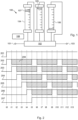
- Fig. 1 shows a virus inactivation device, generally designated 100, according to the invention.
- the virus inactivation device has an inlet port 101 configured to be connected to a chromatography system.
- the inlet port 101 is connected to a flow controller 102.
- the flow controller 102 is further connected to an outlet port 103.
- the virus inactivation device further comprises a group of containers 104,105,106.
- Each of the containers in the group of containers 104,105,106 has a volume and a moveable sidewall 107 arranged to divide the volume into a first sub-volume and a second sub-volume.
- Each container comprises a first port connected to the first volume and a second port connected to the second sub-volume.
- the first and the second port of each container are connected to the fluid controller 102.
- the fluid controller 102 is configured to select a container from the group of containers that is empty or has been in a filled state during a time equal to or longer than the virus inactivation time.
- the fluid controller 102 is further configured to direct the fluid flow from the inlet port 101 to a port of an empty sub-volume of the selected container in the group of containers.
- the flow is directed to another empty sub-volume of another container in the group, which another container is empty or has been in a filled state during a time equal to, or longer than, the virus inactivation time.
- the fluid pressure resulting from filling of the empty sub-volume acts on the moveable sidewall 107 and so causes the filled sub-volume to flow its contents to the outlet port via its respective first or second port.
- the filled sub-volume is emptied by means of the moveable sidewall 107acting as a piston.
- Fig. 2 illustrates the operation of a virus inactivation device according to the invention as a plot of flows in the device
- the flow received by the virus inactivation device is illustrated as curve 201
- the operation of the virus inactivation device is initiated and a constant inflow is received after time t0.
- the flow controller 102 directs the inlet flow to a first container illustrated in curve 202.
- the first container is filled and a sub-sequent virus inactivation is performed by means of UV light, pH adjustments etc.
- the inlet flow at t1 is then directed to a second container illustrated as curve 203.
- a third to a fifth container is filled one at a time at times t2, t3 and t4 illustrated in curves 204,205,206.
- the virus inactivation in the first container is ready and by directing the inlet flow to the empty sub-volume of the first reservoir, the filled sub-volume of the first container will be emptied to the outlet port by means of the moveable wall.
- This sequence is repeated for each container in the group and after the first virus inactivation time from t1 to t5 a constant virus inactivated flow from the outlet port will be provided, illustrated in curve 207 after t5.
- Fig. 3 illustrates one embodiment wherein the virus inactivation is performed by lowering the pH at the inlet 101 by means of a pH adjustment device 501. After a predetermined virus inactivation time the pH is raised by means of a second pH adjustment device 502. This embodiment assures that all parts of the fluid flow are subjected to a necessary pH lowering for a predetermined virus inactivation time.
- FIG.4 Another embodiment is disclosed in Fig.4 This embodiment uses dedicated UV light sources 601, 602, and 603 configured to illuminate and irradiate respectively each of the containers 104,105 and 106 for the predetermined virus inactivation time.
- N T ⁇ f / V + 1
- T the predetermined virus inactivation time including an allowance of time for washing the container and raising and lowering the pH
- V the volume of each container in the group
- f the inlet flow to be virus in-activated.
- a second aspect of the present invention relates to a method for a virus inactivation device as set out above.
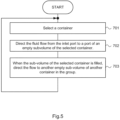
- Fig. 5 illustrates a method for virus inactivation according to the present invention as a flowchart.
- the first step 701 involves selecting a container that is empty or has been in a filled state during a time equal to or longer than the virus inactivation time.
- the second step 702 involves directing the fluid flow from the inlet port to a port of an empty sub-volume of the selected container in the group.
- a third step 703 involves determining when the sub-volume of the selected container has been filled, directing the flow to another empty sub-volume of another container in the group, which container is empty or has been in a filled state during a time equal to or longer than the virus inactivation time.
- the filling of the empty sub-volume causes the filled sub-volume to flow its content to the outlet port by means of the moveable sidewall (107).
- the container may be a super-loop as set out in US 4,389,316 A .
- Example 1 Continuous inactivation of virus in Mab processing using two containers (superloops)
- a feed comprised of fluid comprising monoclonal antibody (Mab) is received from a continuous cell culturing process and captured by affinity chromatography using Protein A media (MabSelect ® , available from GE Healthcare online) in accordance with well known techniques.
- the virus-inactivation is included into a continuous process in accordance with the present invention by providing two containers as described herein, also known as superloops, in parallel. Each superloop is equipped with a two way movable seal, allowing fluid to be applied and eluted both from the top and bottom of the loop. Fluid pH-adjusted MAb feed (pH 3,5) resulting from the chromatography column is applied to a first loop (loop 1). When loop 1 is filled with fluid to a satisfactory level, it is maintained in the container for 30 minutes, while the MAb feed resulting from the chromatography column is shifted and applied to a second loop (loop 2).
- loop 2 When loop 2 is filled to a satisfactory level, new MAb feed is applied to loop 1 using opposite flow direction (while MAb in loop 2 is allowed to stand). At the same time the virus inactivated MAb in loop 1 is eluted and can be applied to the next purification column.
- This example shows how two parallel "two way containers/superloops" can be used with a protocol of applying new MAb feed - allow to stand - apply new MAb feed in opposite direction and at the same time elute the virus inactivated MAb to obtain a continuous virus inactivation procedure within MAb processing.
Landscapes
- Chemical & Material Sciences (AREA)
- Analytical Chemistry (AREA)
- Health & Medical Sciences (AREA)
- Life Sciences & Earth Sciences (AREA)
- Chemical Kinetics & Catalysis (AREA)
- Immunology (AREA)
- Biochemistry (AREA)
- General Health & Medical Sciences (AREA)
- Organic Chemistry (AREA)
- General Physics & Mathematics (AREA)
- Pathology (AREA)
- Physics & Mathematics (AREA)
- Genetics & Genomics (AREA)
- Molecular Biology (AREA)
- Bioinformatics & Cheminformatics (AREA)
- Wood Science & Technology (AREA)
- Medicinal Chemistry (AREA)
- Zoology (AREA)
- Engineering & Computer Science (AREA)
- Biophysics (AREA)
- Biomedical Technology (AREA)
- Biotechnology (AREA)
- Microbiology (AREA)
- Proteomics, Peptides & Aminoacids (AREA)
- Virology (AREA)
- General Engineering & Computer Science (AREA)
- Micro-Organisms Or Cultivation Processes Thereof (AREA)
- Apparatus Associated With Microorganisms And Enzymes (AREA)
- Apparatus For Disinfection Or Sterilisation (AREA)
- Treatment Of Liquids With Adsorbents In General (AREA)
- Peptides Or Proteins (AREA)
- Measuring Or Testing Involving Enzymes Or Micro-Organisms (AREA)
Claims (8)
- Virusinaktivierungsvorrichtung für ein Flüssigkeitschromatographiesystem, umfassend:eine Einlassöffnung (101);eine Auslassöffnung (103);ein Virusinaktivierungsmittel (108), das so konfiguriert ist, dass es Viren während einer vorbestimmten Virusinaktivierungszeit inaktiviert;eine Gruppe von Behältern (104, 105, 106), wobei jeder Behälter in der Gruppe ein Volumen und eine bewegliche Seitenwand (107) aufweist, die so angeordnet ist, dass sie das Volumen in ein gegenüberliegendes erstes Teilvolumen und ein zweites Teilvolumen unterteilt, wobei jeder Behälter eine erste Öffnung umfasst, die mit dem ersten Teilvolumen verbunden ist, und eine zweite Öffnung, die mit dem zweiten Teilvolumen verbunden ist;eine Fluidsteuereinheit (102), die mit der Einlassöffnung (101), der Auslassöffnung (103) und der ersten Öffnung bzw. der zweiten Öffnung jedes Behälters in der Gruppe verbunden ist;wobei die Fluidsteuereinheit (103) konfiguriert ist zum:Wählen eines Behälters, der leer ist oder sich während einer Zeit, die gleich oder länger als die Virusinaktivierungszeit ist, im gefüllten Zustand befunden hat;Leiten des Fluidflusses von der Einlassöffnung zu einer ersten oder zweiten Öffnung eines leeren Teilvolumens des ausgewählten Behälters in der Gruppe;wenn das Teilvolumen des ausgewählten Behälters gefüllt ist, Leiten des Flusses zu einem anderen leeren Teilvolumen eines anderen Behälters in der Gruppe, wobei der Behälter leer ist oder sich während einer Zeit, die gleich oder länger als die Virusinaktivierungszeit ist, in einem gefüllten Zustand befunden hat, wodurch der Fluiddruck, der aus dem Füllen des leeren Teilvolumens resultiert, auf die bewegliche Seitenwand (107) einwirkt, um das gegenüberliegende gefüllte Teilvolumen zu veranlassen, seinen Inhalt zur Auslassöffnung fließen zu lassen.
- Virusinaktivierungsvorrichtung nach Anspruch 1, wobei das Virusinaktivierungsmittel (108) Folgendes umfasst:eine Vorrichtung zur Senkung des pH-Werts (501), die zwischen der Einlassöffnung (101) und der Fluidsteuereinheit (102) angeordnet ist; undeine Vorrichtung zur Erhöhung des pH-Werts (502), die zwischen der Fluidsteuereinheit (102) und der Auslassöffnung (103) angeordnet ist.
- Virusinaktivierungsvorrichtung nach Anspruch 1, wobei das Virusinaktivierungsmittel eine UV-Lichtquelle (601, 602, 603) ist.
- Virusinaktivierungsvorrichtung nach Anspruch 1, wobei die Anzahl der Behälter (N) in der Gruppe gleich oder größer als N=Txf/V+1 ist, wobei T die vorbestimmte Virusinaktivierungszeit ist und gegebenenfalls die Zeit für das Waschen der Behälter und entweder das Anheben und Absenken des pH-Wertes oder die UV-Bestrahlungszeit beinhaltet, f der Einlassfluss ist und V das Volumen eines Behälters in der Gruppe von Behältern ist.
- Verfahren für eine Virusinaktivierungsvorrichtung, wobei die Virusinaktivierungsvorrichtung Folgendes umfasst:eine Einlassöffnung (101);eine Auslassöffnung (103);ein Virusinaktivierungsmittel (108), das so konfiguriert ist, dass es Viren während einer vorbestimmten Virusinaktivierungszeit inaktiviert;eine Gruppe von Behältern (104, 105, 106), wobei jeder Behälter in der Gruppe ein Volumen und eine bewegliche Seitenwand (107) aufweist, die so angeordnet ist, dass sie das Volumen in ein gegenüberliegendes erstes Teilvolumen und ein zweites Teilvolumen unterteilt, wobei jeder Behälter eine erste Öffnung umfasst, die mit dem ersten Teilvolumen verbunden ist, und eine zweite Öffnung, die mit dem zweiten Teilvolumen verbunden ist;eine Fluidsteuereinheit (102), die mit der Einlassöffnung (101), der Auslassöffnung (103) und der ersten Öffnung bzw. der zweiten Öffnung jedes Behälters in der Gruppe verbunden ist;wobei das Verfahren Folgendes umfasst:Auswählen eines Behälters, der leer ist oder sich während einer Zeit, die gleich oder länger als die Virusinaktivierungszeit ist, in einem gefüllten Zustand befunden hat, wobei während dieser Virusinaktivierungszeit eine Virusinaktivierung mittels UV-Licht oder pH-Einstellungen durchgeführt wurde;Leiten des Fluidflusses von der Einlassöffnung zu einer Öffnung eines leeren Teilvolumens des ausgewählten Behälters in der Gruppe;wenn das Teilvolumen des ausgewählten Behälters gefüllt wurde, Leiten des Flusses zu einem anderen leeren Teilvolumen eines anderen Behälters in der Gruppe, wobei der Behälter leer ist oder sich während einer Zeit, die gleich oder länger als die Virusinaktivierungszeit ist, in einem gefüllten Zustand befunden hat, wobei während dieser Virusinaktivierungszeit eine untergeordnete Virusinaktivierung mittels UV-Licht oder pH-Einstellungen durchgeführt wird, wodurch der Fluiddruck, der aus dem Füllen des leeren Teilvolumens resultiert, auf die bewegliche Seitenwand (107) einwirkt, um das gegenüberliegende gefüllte Teilvolumen zu veranlassen, seinen Inhalt über seine jeweilige erste oder zweite Öffnung zur Auslassöffnung fließen zu lassen.
- Verfahren nach Anspruch 5, wobei die Vorrichtung einem Chromatographiesystem nachgeschaltet ist, das mindestens eine Chromatographiesäule, bevorzugt 2, 3 oder 4 Chromatographiesäulen, umfasst, wobei das Verfahren einen kontinuierlichen Flüssigkeitsfluss ermöglicht.
- Verfahren nach Anspruch 6, wobei das Chromatographiesystem ein periodisches Gegenstromchromatographiesystem (pcc) ist.
- Verfahren nach Anspruch 6 oder 7, das die Trennung eines Biomoleküls, wie eines Proteins, bevorzugt eines Antikörpers oder einer Fusion oder eines Fragments davon, unter Verwendung von Protein-A-Medien in dem Chromatographiesystem bereitstellt.
Applications Claiming Priority (3)
| Application Number | Priority Date | Filing Date | Title |
|---|---|---|---|
| GBGB1505519.7A GB201505519D0 (en) | 2015-03-31 | 2015-03-31 | A liquid chromatograhy system, a device and a method |
| GBGB1510539.8A GB201510539D0 (en) | 2015-06-16 | 2015-06-16 | A liquid chromatography system, a device, and a method |
| PCT/EP2016/056407 WO2016156153A1 (en) | 2015-03-31 | 2016-03-23 | A liquid chromatograhy system, a device, and a method |
Publications (2)
| Publication Number | Publication Date |
|---|---|
| EP3277397A1 EP3277397A1 (de) | 2018-02-07 |
| EP3277397B1 true EP3277397B1 (de) | 2024-06-19 |
Family
ID=55588301
Family Applications (1)
| Application Number | Title | Priority Date | Filing Date |
|---|---|---|---|
| EP16711307.5A Active EP3277397B1 (de) | 2015-03-31 | 2016-03-23 | Virusinaktivierungsvorrichtung für ein flüssigkeitschromatographiesystem und entsprechendes verfahren |
Country Status (5)
| Country | Link |
|---|---|
| US (1) | US11571635B2 (de) |
| EP (1) | EP3277397B1 (de) |
| JP (1) | JP6824555B2 (de) |
| CN (1) | CN107430104B (de) |
| WO (1) | WO2016156153A1 (de) |
Families Citing this family (2)
| Publication number | Priority date | Publication date | Assignee | Title |
|---|---|---|---|---|
| WO2019006710A1 (zh) * | 2017-07-05 | 2019-01-10 | 深圳迈瑞生物医疗电子股份有限公司 | 液相分析装置及用于该液相分析装置的分析方法 |
| KR102566093B1 (ko) * | 2018-10-31 | 2023-08-11 | 리플리겐 코포레이션 | 포장된 비압축성 크로마토그래피 수지들 및 그 제조 방법들 |
Citations (3)
| Publication number | Priority date | Publication date | Assignee | Title |
|---|---|---|---|---|
| EP2578286A1 (de) * | 2011-10-04 | 2013-04-10 | Merck Patent GmbH | Verfahren und Vorrichtung zur chromatographischen Aufreinigung |
| US20140251913A1 (en) * | 2010-12-03 | 2014-09-11 | Ge Healthcare Bio-Sciences Ab | System and process for biopolymer chromatography |
| WO2014137903A2 (en) * | 2013-03-08 | 2014-09-12 | Genzyme Corporation | Integrated continuous manufacturing of therapeutic protein drug substances |
Family Cites Families (12)
| Publication number | Priority date | Publication date | Assignee | Title |
|---|---|---|---|---|
| SE454326B (sv) | 1980-05-14 | 1988-04-25 | Pharmacia Ab | Sett och anordning for dosering av en provlosning till en vetskekromatografisk kolonn |
| JPS6283659A (ja) * | 1985-10-09 | 1987-04-17 | Gasukuro Kogyo Kk | 試料注入口装置 |
| CN1564703A (zh) * | 2001-10-04 | 2005-01-12 | 艾可尼西斯有限公司 | 用于分馏离心样本的装置及方法 |
| US7674631B2 (en) * | 2002-08-28 | 2010-03-09 | Pawliszyn Janusz B | Method and device for solid phase microextraction and desorption |
| US7763452B2 (en) * | 2003-06-25 | 2010-07-27 | Bn Immunotherapeutics, Inc. | Purification of HER-2 variants |
| CN102989056B (zh) * | 2007-11-19 | 2015-06-17 | 利贝尔一弗拉施姆有限公司 | 具有多剂量流体源的流体输送系统 |
| US20090143699A1 (en) * | 2007-11-29 | 2009-06-04 | John Wu | Fluid sample collecting and analyzing apparatus |
| WO2011117275A1 (de) * | 2010-03-25 | 2011-09-29 | Endress+Hauser Conducta Gesellschaft Für Mess- Und Regeltechnik Mbh+Co. Kg | System zur behandlung von flüssigkeiten |
| CN102971610B (zh) * | 2010-07-01 | 2017-03-29 | 恩德莱斯和豪瑟尔测量及调节技术分析仪表两合公司 | 测量流入容器的液体的体积流量和/或已流入容器的液体的体积的方法和装置 |
| SG11201407809QA (en) * | 2012-05-31 | 2014-12-30 | Agency Science Tech & Res | Chromatographic purification of immunoglobulin g preparations with particles having multimodal functionalities |
| JP6182210B2 (ja) * | 2012-06-29 | 2017-08-16 | イー・エム・デイー・ミリポア・コーポレイシヨン | タンパク質精製プロセス中のウイルスの不活性化方法 |
| CN103454362B (zh) * | 2013-08-22 | 2014-11-26 | 中国石油天然气股份有限公司 | 一种在线色谱减压进样方法 |
-
2016
- 2016-03-23 US US15/562,586 patent/US11571635B2/en active Active
- 2016-03-23 JP JP2017550923A patent/JP6824555B2/ja active Active
- 2016-03-23 EP EP16711307.5A patent/EP3277397B1/de active Active
- 2016-03-23 WO PCT/EP2016/056407 patent/WO2016156153A1/en not_active Ceased
- 2016-03-23 CN CN201680020881.0A patent/CN107430104B/zh active Active
Patent Citations (3)
| Publication number | Priority date | Publication date | Assignee | Title |
|---|---|---|---|---|
| US20140251913A1 (en) * | 2010-12-03 | 2014-09-11 | Ge Healthcare Bio-Sciences Ab | System and process for biopolymer chromatography |
| EP2578286A1 (de) * | 2011-10-04 | 2013-04-10 | Merck Patent GmbH | Verfahren und Vorrichtung zur chromatographischen Aufreinigung |
| WO2014137903A2 (en) * | 2013-03-08 | 2014-09-12 | Genzyme Corporation | Integrated continuous manufacturing of therapeutic protein drug substances |
Non-Patent Citations (1)
| Title |
|---|
| GE HEALTHCARE: "Data file 18-1134-31 AC; Liquid chromatography; Superloop 10 ml, 50 ml, 150 ml", INTERNET CITATION, 1 October 2007 (2007-10-01), pages 1 - 4, XP002758793, Retrieved from the Internet <URL:https://www.gelifesciences.com/gehcls_images/GELS/Related%20Content/Files/1314716762536/litdoc18113431AC_20110830173308.pdf> [retrieved on 20160614] * |
Also Published As
| Publication number | Publication date |
|---|---|
| HK1246854A1 (zh) | 2018-09-14 |
| CN107430104A (zh) | 2017-12-01 |
| JP6824555B2 (ja) | 2021-02-03 |
| EP3277397A1 (de) | 2018-02-07 |
| US11571635B2 (en) | 2023-02-07 |
| WO2016156153A1 (en) | 2016-10-06 |
| US20180111059A1 (en) | 2018-04-26 |
| JP2018519498A (ja) | 2018-07-19 |
| CN107430104B (zh) | 2020-11-03 |
Similar Documents
| Publication | Publication Date | Title |
|---|---|---|
| Chhatre et al. | Microscale methods for high‐throughput chromatography development in the pharmaceutical industry | |
| Rathore et al. | Recent developments in chromatographic purification of biopharmaceuticals | |
| US11965018B2 (en) | Chromatography system and method for capturing a biopolymer | |
| Jungbauer et al. | Ion-exchange chromatography | |
| EP2675540B1 (de) | System und verfahren für biopolymer-chromatographie | |
| Godawat et al. | Periodic counter‐current chromatography–design and operational considerations for integrated and continuous purification of proteins | |
| EP3218706B1 (de) | Verfahren zur bestimmung des einflusses von experimentellen prozessparametern bei einem flüssigkeitschromatographie-protokol | |
| AU2015259228C1 (en) | Process control systems and methods for use with filters and filtration processes | |
| Levison | Large-scale ion-exchange column chromatography of proteins: comparison of different formats | |
| JP6232067B2 (ja) | タンパク質分離用多次元の液体クロマトグラフィーの分離システム及分離方法 | |
| EP2633306B1 (de) | Chromatographiesystem mit sicherungssäulen | |
| Hall | Size exclusion chromatography (SEC) | |
| US20260042037A1 (en) | End-to-End Continuous Purification System | |
| EP3018475B1 (de) | Trennverfahren | |
| US11571635B2 (en) | Liquid chromatography system, a device, and a method | |
| Zhang et al. | Pool‐less processing to streamline downstream purification of monoclonal antibodies | |
| US20140251913A1 (en) | System and process for biopolymer chromatography | |
| US10717023B1 (en) | Method for continuous purification | |
| Zhang et al. | Development of an automated mid-scale parallel protein purification system for antibody purification and affinity chromatography | |
| Rathore et al. | An overview of scale-up in preparative chromatography | |
| Feliciano et al. | Evaluating high‐throughput scale‐down chromatography platforms for increased process understanding | |
| Dawson | A review of chromatography methods for the large scale downstream protein purification of monoclonal antibodies | |
| Chen et al. | Efficient capture of monoclonal antibody from cell culture supernatant using protein A media contained in a cuboid packed-bed device | |
| Shapiro et al. | Microfluidic chromatography for early stage evaluation of biopharmaceutical binding and separation conditions | |
| HK1246854B (en) | A liquid chromatograhy system, a device, and a method |
Legal Events
| Date | Code | Title | Description |
|---|---|---|---|
| STAA | Information on the status of an ep patent application or granted ep patent |
Free format text: STATUS: THE INTERNATIONAL PUBLICATION HAS BEEN MADE |
|
| PUAI | Public reference made under article 153(3) epc to a published international application that has entered the european phase |
Free format text: ORIGINAL CODE: 0009012 |
|
| STAA | Information on the status of an ep patent application or granted ep patent |
Free format text: STATUS: REQUEST FOR EXAMINATION WAS MADE |
|
| 17P | Request for examination filed |
Effective date: 20170929 |
|
| AK | Designated contracting states |
Kind code of ref document: A1 Designated state(s): AL AT BE BG CH CY CZ DE DK EE ES FI FR GB GR HR HU IE IS IT LI LT LU LV MC MK MT NL NO PL PT RO RS SE SI SK SM TR |
|
| AX | Request for extension of the european patent |
Extension state: BA ME |
|
| DAV | Request for validation of the european patent (deleted) | ||
| DAX | Request for extension of the european patent (deleted) | ||
| RAP1 | Party data changed (applicant data changed or rights of an application transferred) |
Owner name: CYTIVA SWEDEN AB |
|
| PUAG | Search results despatched under rule 164(2) epc together with communication from examining division |
Free format text: ORIGINAL CODE: 0009017 |
|
| STAA | Information on the status of an ep patent application or granted ep patent |
Free format text: STATUS: EXAMINATION IS IN PROGRESS |
|
| 17Q | First examination report despatched |
Effective date: 20210326 |
|
| B565 | Issuance of search results under rule 164(2) epc |
Effective date: 20210326 |
|
| RIC1 | Information provided on ipc code assigned before grant |
Ipc: B01D 15/14 20060101AFI20210323BHEP Ipc: B01D 15/18 20060101ALI20210323BHEP Ipc: G01N 30/22 20060101ALI20210323BHEP Ipc: G01N 30/60 20060101ALI20210323BHEP |
|
| P01 | Opt-out of the competence of the unified patent court (upc) registered |
Effective date: 20230526 |
|
| GRAP | Despatch of communication of intention to grant a patent |
Free format text: ORIGINAL CODE: EPIDOSNIGR1 |
|
| STAA | Information on the status of an ep patent application or granted ep patent |
Free format text: STATUS: GRANT OF PATENT IS INTENDED |
|
| RIC1 | Information provided on ipc code assigned before grant |
Ipc: G01N 30/46 20060101ALI20240206BHEP Ipc: B01D 15/18 20060101ALI20240206BHEP Ipc: B01D 15/14 20060101AFI20240206BHEP |
|
| INTG | Intention to grant announced |
Effective date: 20240221 |
|
| GRAS | Grant fee paid |
Free format text: ORIGINAL CODE: EPIDOSNIGR3 |
|
| GRAA | (expected) grant |
Free format text: ORIGINAL CODE: 0009210 |
|
| STAA | Information on the status of an ep patent application or granted ep patent |
Free format text: STATUS: THE PATENT HAS BEEN GRANTED |
|
| AK | Designated contracting states |
Kind code of ref document: B1 Designated state(s): AL AT BE BG CH CY CZ DE DK EE ES FI FR GB GR HR HU IE IS IT LI LT LU LV MC MK MT NL NO PL PT RO RS SE SI SK SM TR |
|
| REG | Reference to a national code |
Ref country code: GB Ref legal event code: FG4D |
|
| REG | Reference to a national code |
Ref country code: CH Ref legal event code: EP |
|
| REG | Reference to a national code |
Ref country code: DE Ref legal event code: R096 Ref document number: 602016088023 Country of ref document: DE |
|
| PG25 | Lapsed in a contracting state [announced via postgrant information from national office to epo] |
Ref country code: BG Free format text: LAPSE BECAUSE OF FAILURE TO SUBMIT A TRANSLATION OF THE DESCRIPTION OR TO PAY THE FEE WITHIN THE PRESCRIBED TIME-LIMIT Effective date: 20240619 |
|
| PG25 | Lapsed in a contracting state [announced via postgrant information from national office to epo] |
Ref country code: HR Free format text: LAPSE BECAUSE OF FAILURE TO SUBMIT A TRANSLATION OF THE DESCRIPTION OR TO PAY THE FEE WITHIN THE PRESCRIBED TIME-LIMIT Effective date: 20240619 Ref country code: FI Free format text: LAPSE BECAUSE OF FAILURE TO SUBMIT A TRANSLATION OF THE DESCRIPTION OR TO PAY THE FEE WITHIN THE PRESCRIBED TIME-LIMIT Effective date: 20240619 |
|
| REG | Reference to a national code |
Ref country code: LT Ref legal event code: MG9D |
|
| PG25 | Lapsed in a contracting state [announced via postgrant information from national office to epo] |
Ref country code: GR Free format text: LAPSE BECAUSE OF FAILURE TO SUBMIT A TRANSLATION OF THE DESCRIPTION OR TO PAY THE FEE WITHIN THE PRESCRIBED TIME-LIMIT Effective date: 20240920 |
|
| REG | Reference to a national code |
Ref country code: NL Ref legal event code: MP Effective date: 20240619 |
|
| PG25 | Lapsed in a contracting state [announced via postgrant information from national office to epo] |
Ref country code: LV Free format text: LAPSE BECAUSE OF FAILURE TO SUBMIT A TRANSLATION OF THE DESCRIPTION OR TO PAY THE FEE WITHIN THE PRESCRIBED TIME-LIMIT Effective date: 20240619 |
|
| PG25 | Lapsed in a contracting state [announced via postgrant information from national office to epo] |
Ref country code: NO Free format text: LAPSE BECAUSE OF FAILURE TO SUBMIT A TRANSLATION OF THE DESCRIPTION OR TO PAY THE FEE WITHIN THE PRESCRIBED TIME-LIMIT Effective date: 20240919 Ref country code: LV Free format text: LAPSE BECAUSE OF FAILURE TO SUBMIT A TRANSLATION OF THE DESCRIPTION OR TO PAY THE FEE WITHIN THE PRESCRIBED TIME-LIMIT Effective date: 20240619 Ref country code: HR Free format text: LAPSE BECAUSE OF FAILURE TO SUBMIT A TRANSLATION OF THE DESCRIPTION OR TO PAY THE FEE WITHIN THE PRESCRIBED TIME-LIMIT Effective date: 20240619 Ref country code: GR Free format text: LAPSE BECAUSE OF FAILURE TO SUBMIT A TRANSLATION OF THE DESCRIPTION OR TO PAY THE FEE WITHIN THE PRESCRIBED TIME-LIMIT Effective date: 20240920 Ref country code: FI Free format text: LAPSE BECAUSE OF FAILURE TO SUBMIT A TRANSLATION OF THE DESCRIPTION OR TO PAY THE FEE WITHIN THE PRESCRIBED TIME-LIMIT Effective date: 20240619 Ref country code: BG Free format text: LAPSE BECAUSE OF FAILURE TO SUBMIT A TRANSLATION OF THE DESCRIPTION OR TO PAY THE FEE WITHIN THE PRESCRIBED TIME-LIMIT Effective date: 20240619 Ref country code: RS Free format text: LAPSE BECAUSE OF FAILURE TO SUBMIT A TRANSLATION OF THE DESCRIPTION OR TO PAY THE FEE WITHIN THE PRESCRIBED TIME-LIMIT Effective date: 20240919 |
|
| PG25 | Lapsed in a contracting state [announced via postgrant information from national office to epo] |
Ref country code: NL Free format text: LAPSE BECAUSE OF FAILURE TO SUBMIT A TRANSLATION OF THE DESCRIPTION OR TO PAY THE FEE WITHIN THE PRESCRIBED TIME-LIMIT Effective date: 20240619 |
|
| REG | Reference to a national code |
Ref country code: AT Ref legal event code: MK05 Ref document number: 1695573 Country of ref document: AT Kind code of ref document: T Effective date: 20240619 |
|
| PG25 | Lapsed in a contracting state [announced via postgrant information from national office to epo] |
Ref country code: NL Free format text: LAPSE BECAUSE OF FAILURE TO SUBMIT A TRANSLATION OF THE DESCRIPTION OR TO PAY THE FEE WITHIN THE PRESCRIBED TIME-LIMIT Effective date: 20240619 |
|
| PG25 | Lapsed in a contracting state [announced via postgrant information from national office to epo] |
Ref country code: PT Free format text: LAPSE BECAUSE OF FAILURE TO SUBMIT A TRANSLATION OF THE DESCRIPTION OR TO PAY THE FEE WITHIN THE PRESCRIBED TIME-LIMIT Effective date: 20241021 |
|
| PG25 | Lapsed in a contracting state [announced via postgrant information from national office to epo] |
Ref country code: PT Free format text: LAPSE BECAUSE OF FAILURE TO SUBMIT A TRANSLATION OF THE DESCRIPTION OR TO PAY THE FEE WITHIN THE PRESCRIBED TIME-LIMIT Effective date: 20241021 |
|
| PG25 | Lapsed in a contracting state [announced via postgrant information from national office to epo] |
Ref country code: PL Free format text: LAPSE BECAUSE OF FAILURE TO SUBMIT A TRANSLATION OF THE DESCRIPTION OR TO PAY THE FEE WITHIN THE PRESCRIBED TIME-LIMIT Effective date: 20240619 |
|
| PG25 | Lapsed in a contracting state [announced via postgrant information from national office to epo] |
Ref country code: EE Free format text: LAPSE BECAUSE OF FAILURE TO SUBMIT A TRANSLATION OF THE DESCRIPTION OR TO PAY THE FEE WITHIN THE PRESCRIBED TIME-LIMIT Effective date: 20240619 |
|
| PG25 | Lapsed in a contracting state [announced via postgrant information from national office to epo] |
Ref country code: AT Free format text: LAPSE BECAUSE OF FAILURE TO SUBMIT A TRANSLATION OF THE DESCRIPTION OR TO PAY THE FEE WITHIN THE PRESCRIBED TIME-LIMIT Effective date: 20240619 Ref country code: IS Free format text: LAPSE BECAUSE OF FAILURE TO SUBMIT A TRANSLATION OF THE DESCRIPTION OR TO PAY THE FEE WITHIN THE PRESCRIBED TIME-LIMIT Effective date: 20241019 |
|
| PG25 | Lapsed in a contracting state [announced via postgrant information from national office to epo] |
Ref country code: CZ Free format text: LAPSE BECAUSE OF FAILURE TO SUBMIT A TRANSLATION OF THE DESCRIPTION OR TO PAY THE FEE WITHIN THE PRESCRIBED TIME-LIMIT Effective date: 20240619 |
|
| PG25 | Lapsed in a contracting state [announced via postgrant information from national office to epo] |
Ref country code: RO Free format text: LAPSE BECAUSE OF FAILURE TO SUBMIT A TRANSLATION OF THE DESCRIPTION OR TO PAY THE FEE WITHIN THE PRESCRIBED TIME-LIMIT Effective date: 20240619 Ref country code: SK Free format text: LAPSE BECAUSE OF FAILURE TO SUBMIT A TRANSLATION OF THE DESCRIPTION OR TO PAY THE FEE WITHIN THE PRESCRIBED TIME-LIMIT Effective date: 20240619 |
|
| PG25 | Lapsed in a contracting state [announced via postgrant information from national office to epo] |
Ref country code: ES Free format text: LAPSE BECAUSE OF FAILURE TO SUBMIT A TRANSLATION OF THE DESCRIPTION OR TO PAY THE FEE WITHIN THE PRESCRIBED TIME-LIMIT Effective date: 20240619 Ref country code: SM Free format text: LAPSE BECAUSE OF FAILURE TO SUBMIT A TRANSLATION OF THE DESCRIPTION OR TO PAY THE FEE WITHIN THE PRESCRIBED TIME-LIMIT Effective date: 20240619 |
|
| PG25 | Lapsed in a contracting state [announced via postgrant information from national office to epo] |
Ref country code: SM Free format text: LAPSE BECAUSE OF FAILURE TO SUBMIT A TRANSLATION OF THE DESCRIPTION OR TO PAY THE FEE WITHIN THE PRESCRIBED TIME-LIMIT Effective date: 20240619 Ref country code: SK Free format text: LAPSE BECAUSE OF FAILURE TO SUBMIT A TRANSLATION OF THE DESCRIPTION OR TO PAY THE FEE WITHIN THE PRESCRIBED TIME-LIMIT Effective date: 20240619 Ref country code: RO Free format text: LAPSE BECAUSE OF FAILURE TO SUBMIT A TRANSLATION OF THE DESCRIPTION OR TO PAY THE FEE WITHIN THE PRESCRIBED TIME-LIMIT Effective date: 20240619 Ref country code: PL Free format text: LAPSE BECAUSE OF FAILURE TO SUBMIT A TRANSLATION OF THE DESCRIPTION OR TO PAY THE FEE WITHIN THE PRESCRIBED TIME-LIMIT Effective date: 20240619 Ref country code: IS Free format text: LAPSE BECAUSE OF FAILURE TO SUBMIT A TRANSLATION OF THE DESCRIPTION OR TO PAY THE FEE WITHIN THE PRESCRIBED TIME-LIMIT Effective date: 20241019 Ref country code: ES Free format text: LAPSE BECAUSE OF FAILURE TO SUBMIT A TRANSLATION OF THE DESCRIPTION OR TO PAY THE FEE WITHIN THE PRESCRIBED TIME-LIMIT Effective date: 20240619 Ref country code: EE Free format text: LAPSE BECAUSE OF FAILURE TO SUBMIT A TRANSLATION OF THE DESCRIPTION OR TO PAY THE FEE WITHIN THE PRESCRIBED TIME-LIMIT Effective date: 20240619 Ref country code: CZ Free format text: LAPSE BECAUSE OF FAILURE TO SUBMIT A TRANSLATION OF THE DESCRIPTION OR TO PAY THE FEE WITHIN THE PRESCRIBED TIME-LIMIT Effective date: 20240619 Ref country code: AT Free format text: LAPSE BECAUSE OF FAILURE TO SUBMIT A TRANSLATION OF THE DESCRIPTION OR TO PAY THE FEE WITHIN THE PRESCRIBED TIME-LIMIT Effective date: 20240619 |
|
| PG25 | Lapsed in a contracting state [announced via postgrant information from national office to epo] |
Ref country code: IT Free format text: LAPSE BECAUSE OF FAILURE TO SUBMIT A TRANSLATION OF THE DESCRIPTION OR TO PAY THE FEE WITHIN THE PRESCRIBED TIME-LIMIT Effective date: 20240619 |
|
| REG | Reference to a national code |
Ref country code: DE Ref legal event code: R097 Ref document number: 602016088023 Country of ref document: DE |
|
| PG25 | Lapsed in a contracting state [announced via postgrant information from national office to epo] |
Ref country code: DK Free format text: LAPSE BECAUSE OF FAILURE TO SUBMIT A TRANSLATION OF THE DESCRIPTION OR TO PAY THE FEE WITHIN THE PRESCRIBED TIME-LIMIT Effective date: 20240619 |
|
| PLBE | No opposition filed within time limit |
Free format text: ORIGINAL CODE: 0009261 |
|
| STAA | Information on the status of an ep patent application or granted ep patent |
Free format text: STATUS: NO OPPOSITION FILED WITHIN TIME LIMIT |
|
| 26N | No opposition filed |
Effective date: 20250320 |
|
| PG25 | Lapsed in a contracting state [announced via postgrant information from national office to epo] |
Ref country code: SE Free format text: LAPSE BECAUSE OF FAILURE TO SUBMIT A TRANSLATION OF THE DESCRIPTION OR TO PAY THE FEE WITHIN THE PRESCRIBED TIME-LIMIT Effective date: 20240619 |
|
| PG25 | Lapsed in a contracting state [announced via postgrant information from national office to epo] |
Ref country code: MC Free format text: LAPSE BECAUSE OF FAILURE TO SUBMIT A TRANSLATION OF THE DESCRIPTION OR TO PAY THE FEE WITHIN THE PRESCRIBED TIME-LIMIT Effective date: 20240619 |
|
| PG25 | Lapsed in a contracting state [announced via postgrant information from national office to epo] |
Ref country code: LU Free format text: LAPSE BECAUSE OF NON-PAYMENT OF DUE FEES Effective date: 20250323 |
|
| REG | Reference to a national code |
Ref country code: BE Ref legal event code: MM Effective date: 20250331 |
|
| PG25 | Lapsed in a contracting state [announced via postgrant information from national office to epo] |
Ref country code: BE Free format text: LAPSE BECAUSE OF NON-PAYMENT OF DUE FEES Effective date: 20250331 |
|
| PG25 | Lapsed in a contracting state [announced via postgrant information from national office to epo] |
Ref country code: IE Free format text: LAPSE BECAUSE OF NON-PAYMENT OF DUE FEES Effective date: 20250323 |
|
| REG | Reference to a national code |
Ref country code: CH Ref legal event code: U11 Free format text: ST27 STATUS EVENT CODE: U-0-0-U10-U11 (AS PROVIDED BY THE NATIONAL OFFICE) Effective date: 20260401 |
|
| PGFP | Annual fee paid to national office [announced via postgrant information from national office to epo] |
Ref country code: GB Payment date: 20260319 Year of fee payment: 11 |
|
| PGFP | Annual fee paid to national office [announced via postgrant information from national office to epo] |
Ref country code: DE Payment date: 20260320 Year of fee payment: 11 |
|
| PGFP | Annual fee paid to national office [announced via postgrant information from national office to epo] |
Ref country code: FR Payment date: 20260323 Year of fee payment: 11 |
|
| PG25 | Lapsed in a contracting state [announced via postgrant information from national office to epo] |
Ref country code: CY Free format text: LAPSE BECAUSE OF FAILURE TO SUBMIT A TRANSLATION OF THE DESCRIPTION OR TO PAY THE FEE WITHIN THE PRESCRIBED TIME-LIMIT Effective date: 20240619 |
|
| PG25 | Lapsed in a contracting state [announced via postgrant information from national office to epo] |
Ref country code: LT Free format text: LAPSE BECAUSE OF FAILURE TO SUBMIT A TRANSLATION OF THE DESCRIPTION OR TO PAY THE FEE WITHIN THE PRESCRIBED TIME-LIMIT Effective date: 20240619 |
|
| PG25 | Lapsed in a contracting state [announced via postgrant information from national office to epo] |
Ref country code: TR Free format text: LAPSE BECAUSE OF FAILURE TO SUBMIT A TRANSLATION OF THE DESCRIPTION OR TO PAY THE FEE WITHIN THE PRESCRIBED TIME-LIMIT Effective date: 20240619 |
|
| PGFP | Annual fee paid to national office [announced via postgrant information from national office to epo] |
Ref country code: CH Payment date: 20260401 Year of fee payment: 11 |