EP3269987B1 - Verbindungsbefestigungselement - Google Patents
Verbindungsbefestigungselement Download PDFInfo
- Publication number
- EP3269987B1 EP3269987B1 EP17181391.8A EP17181391A EP3269987B1 EP 3269987 B1 EP3269987 B1 EP 3269987B1 EP 17181391 A EP17181391 A EP 17181391A EP 3269987 B1 EP3269987 B1 EP 3269987B1
- Authority
- EP
- European Patent Office
- Prior art keywords
- fastener
- connection
- shape
- holding
- attaching
- Prior art date
- Legal status (The legal status is an assumption and is not a legal conclusion. Google has not performed a legal analysis and makes no representation as to the accuracy of the status listed.)
- Active
Links
Images





Classifications
-
- F—MECHANICAL ENGINEERING; LIGHTING; HEATING; WEAPONS; BLASTING
- F16—ENGINEERING ELEMENTS AND UNITS; GENERAL MEASURES FOR PRODUCING AND MAINTAINING EFFECTIVE FUNCTIONING OF MACHINES OR INSTALLATIONS; THERMAL INSULATION IN GENERAL
- F16B—DEVICES FOR FASTENING OR SECURING CONSTRUCTIONAL ELEMENTS OR MACHINE PARTS TOGETHER, e.g. NAILS, BOLTS, CIRCLIPS, CLAMPS, CLIPS OR WEDGES; JOINTS OR JOINTING
- F16B15/00—Nails; Staples
- F16B15/08—Nails; Staples formed in integral series but easily separable
-
- B—PERFORMING OPERATIONS; TRANSPORTING
- B25—HAND TOOLS; PORTABLE POWER-DRIVEN TOOLS; MANIPULATORS
- B25C—HAND-HELD NAILING OR STAPLING TOOLS; MANUALLY OPERATED PORTABLE STAPLING TOOLS
- B25C1/00—Hand-held nailing tools; Nail feeding devices
- B25C1/001—Nail feeding devices
- B25C1/003—Nail feeding devices for belts of nails
-
- F—MECHANICAL ENGINEERING; LIGHTING; HEATING; WEAPONS; BLASTING
- F16—ENGINEERING ELEMENTS AND UNITS; GENERAL MEASURES FOR PRODUCING AND MAINTAINING EFFECTIVE FUNCTIONING OF MACHINES OR INSTALLATIONS; THERMAL INSULATION IN GENERAL
- F16B—DEVICES FOR FASTENING OR SECURING CONSTRUCTIONAL ELEMENTS OR MACHINE PARTS TOGETHER, e.g. NAILS, BOLTS, CIRCLIPS, CLAMPS, CLIPS OR WEDGES; JOINTS OR JOINTING
- F16B27/00—Bolts, screws, or nuts formed in integral series but easily separable, particularly for use in automatic machines
Definitions
- the present invention relates to a connection fastener used for a driving tool.
- connection fastener for connecting a plurality of fasteners with a connection band can set a great deal of fasteners to a driving tool en bloc and continuously inject the great deal of fasteners
- the connection fastener is used in various driving tools.
- the connection band of this connection fastener holds the fastener in two upper and lower places as described in, for instance, JP-U-A-H03-96417 , and thereby can stably hold the fastener.
- connection fastener used for this driving tool uses a connection band according to specifications of the tool, and thereby enables use for the same tool even when the connection fasteners have different lengths.
- a shape or the like of the connection band is designated by the specifications of the tool, and cannot be freely changed.
- a vertical width (a distance between a lower holding portion and an upper holding portion) of the connection band is designated by a width capable of corresponding to a feed motion of the connection fastener of the tool and a discharge motion of the connection band, and cannot be freely changed.
- connection band cannot stably hold the fastener, this causes an obstacle that the fastener driven in an oblique state is buckled or that the connection band removed and spread from the fastener is pulled into a machine so that the feed motion of the connection fastener is not smoothly performed.
- the fastener that cannot be held by the connection band regulated by the tool in the related art cannot be used, and restrictions are placed on a length of the fastener that can be used by a tool.
- An object of the present invention is to provide a connection fastener capable of stably supporting short fasteners even when a width of a connection band (a connection portion) is regulated by a tool, and thereby using the short fasteners without changing specifications of the tool.
- JP 2002 081424 A discloses a connection fastener of the prior art.
- connection fastener includes: a plurality of fasteners each of which includes a head portion provided at one end portion side and a tapered leading end portion provided at the other end portion side; a sheet-shaped connection portion that is configured to connect the plurality of fasteners in a parallel direction; and attaching portions that are separate from the connection portion attached to the fasteners such that each attaching portion covers at least one part of each leading end portion.
- the connection portion includes:
- the attaching portions are members which are separate from and are independent of the connection portion, the attaching portions are not pulled and inclined by the connection portion when removed from the connection portion. Therefore, the fasteners can be prevented from being inclined and buckled. No energy is lost to cut the connection portion.
- the attaching portion that is more easily stabilized in dimensional precision than the fastener formed of a metal is used. Thereby, dimensions of the attaching portions and dimensions of the second holding portions can be made compatible with each other, and a holding force of the fastener held via the attaching portion by the second holding portion can be enhanced.
- the attaching portion is attached to the fastener, and thereby a diameter of the toe side (the leading end portion side) of the fastener is increased. For this reason, the fastener is prevented from falling within an injection path during driving. Therefore, it is possible to stabilize a driving posture of the fastener to prevent buckling.
- the diameter of the second holding hole holding the attaching portion provided at the second holding portion is larger than that of the first holding hole holding the head portion side of the fastener provided at the first holding portion. According to this configuration, the shank of the fastener is held by the first holding hole having a relatively small diameter, and the attaching portion is held by the second holding hole having a relatively large diameter. Thus, the fastener can be tightly held even at the second portion thickened by the amount of attaching the attaching portion.
- the opening width of the opening slit (opening edge) of the second holding hole that supports and holds the attaching portion provided at the second holding portion is larger than that of the opening slit (opening edge) of the first holding hole that supports and holds the head portion side of the fastener provided at the first holding portion.
- the fastener can be loaded and held even at the lower portion thickened by the amount of attaching the attaching portion without difficulty, and assemblability is good. Even when the fastener is driven, the opening width of the opening slit (opening edge) of the second holding hole is large, and thus the fastener can be smoothly removed from the connection portion.
- the fastener includes the shank provided between the head portion and the leading end portion, and the second holding portion supports and holds the attaching portion at the position at which the second holding portion overlaps the tapered leading end portion of the fastener or at the position at which the second holding portion does not overlap the fastener.
- the length of the shank when viewed in the axial direction of the fastener, is shorter than that of the band-shaped portion. According to this configuration, even in the short fastener in which the length of the shank is shorter than that of the band-shaped portion, this short fastener is stretched by the attaching portion, and is held by the second holding portion. Thus, upper and lower portions of the shank of the fastener can be reliably held.
- the fastener includes the stepped portion at the shank.
- the stepped portion is formed such that the outer diameter of the leading end portion side is smaller than that of the head side, and faces the upper edge portion of the attaching portion.
- the attaching portion includes the flange portion protruding below the second holding portion in the outer circumferential direction. According to this configuration, since the second holding portion is prevented from falling off by the flange portion, the second holding portion is prevented from being removed from the attaching portion.
- the flange portion is provided, and thereby the diameter of the toe side of the fastener is increased.
- an effect of preventing the fastener from falling within the injection path during driving can be enhanced. Therefore, it is possible to stabilize the driving posture of the fastener to prevent the buckling.
- the attaching portion includes the fall-preventing shape for preventing the second holding portion from falling off. According to this configuration, since the second holding portion is prevented from falling off by the fall-preventing shape, the second holding portion is prevented from being removed from the attaching portion.
- the fall-preventing shape is provided for the fastener, there is a problem that penetration resistance of the fastener is increased or that the fastener is easily buckled.
- the fall-preventing shape is provided for the attaching portion, and thereby such a problem does not occur.
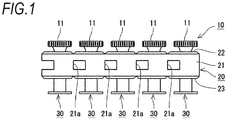
- connection fastener 10 according to the present embodiment will be described with reference to the drawings.
- connection fastener 10 is configured to connect a plurality of fasteners 11 with a connection band (a connection portion) 20, so that a great deal of fasteners 11 can be set for a driving tool en bloc and be continuously injected.
- the driving tool is provided with a magazine for containing the connection fastener 10, and a feed mechanism for feeding the connection fastener 10 stored in the magazine to a leading end portion of a tool main body thereof.
- the feed mechanism is linked to a driving motion and feeds the connection fastener 10 one by one, thereby setting the fastener 11 in the forefront of the connection fastener 10 for an injection path 40 provided at the leading end portion of the tool main body.
- the fastener 11 set for the injection path 40 in this way is driven out by a driver 41 operated by a striking mechanism of the driving tool.
- the fastener 11 driven out by the driver 41 passes through the injection path 40 and is injected from an injection port provided at the leading end portion of the tool main body.
- connection fastener 10 arranges and connects the fasteners 11 in parallel (in a parallel direction) such that a line connecting the centers of the fasteners 11 becomes a straight line. Thereby, the connection fastener 10 is formed in a straight band shape.
- the fastener 11 is a concrete pin that is driven into, for instance, concrete or a siding member, and is, as illustrated in Fig. 2A , provided with a head portion 12, an under-head tapered portion 13 that is continuous to the head portion 12, a shank 14 that is continuous to the under-head tapered portion 13, and a tapered leading end portion 15 that is continuous to the shank 14.
- the head portion 12 is a discoid region being subject to the driving of the driver 41.
- the under-head tapered portion 13 is for smoothly connecting the head portion 12 and the shank 14, and is a region whose diameter is gradually reduced in a direction from the head portion 12 to the shank 14.
- the shank 14 is a region that is formed in a columnar shape and generates pullout resistance when driven into a driven material.
- the leading end portion 15 is a region that is formed in a pointed shape and is pierced into a driven material. In the present embodiment, the leading end portion 15 is formed in a shell shape.
- the fastener 11 may have a shape with a head portion, a shank of a gently tapered shape that is continuous to the head portion (wherein an under-head tapered portion that is continuous to the head portion may be present between the head portion and the shank), and a tapered leading end portion that is continuous to the shank.
- a stepped portion 14a for reducing penetration resistance is continuously formed at the shank 14 of the fastener 11 according to the present embodiment.
- a diameter of the shank 14 is configured such that, in comparison with a diameter of a straight portion closer to the head portion 12 than the stepped portion 14a, a diameter of a straight portion closer to the leading end portion 15 than the stepped portion 14a is smaller.
- a cylindrical member 30 acting as a tubular member (an attaching portion) is attached to the shank 14 of the fastener 11.
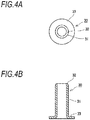
- the cylindrical member 30 is a member formed of aluminum or a synthetic resin and, as illustrated in Figs. 4A and 4B , includes a tubular portion 31 and a flange portion 33 formed to protrude from an opening edge of the tubular portion 31.
- the flange portion 33 may protrude below a lower holding portion 23 in an outer circumferential direction or be provided at a position other than the opening edge.
- the flange portion 33 may be formed on an outer circumferential surface of the tubular portion 31 to protrude in a radial direction.
- the flange portion 33 may be formed separately from and independently of the tubular portion 31.
- a shape of the flange portion 33 is not limited to a circular shape as shown in Fig. 4A , but it may be a shape in which an outer circumference is on a cylindrical locus.
- the shape of the flange portion 33 may be a polygonal shape or a rectangular shape having a cutout portion.
- a shape of the cylindrical member 30 is not also limited to a circular shape, but it may be a tubular shape in which an inner circumference is on a cylindrical locus.
- the cylindrical member 30 may be a tubular member having a polygonal shape or a rectangular shape which forms a cutout portion such that the tubular member covers at least one part of the shank 14.
- An inner diameter of the tubular portion 31 is formed in such a size as to be able to forcibly insert the shank 14 of the fastener 11 (which is closer to the leading end portion 15 than the stepped portion 14a).
- the leading end portion 15 of the fastener 11 is inserted into the tubular portion 31, and thereby the cylindrical member 30 can be attached to the fastener 11.
- the fastener 11 can be inserted up to a position where the stepped portion 14a reaches an upper edge portion 32 of the cylindrical member 30, and an inserted position of the cylindrical member 30 into the fastener 11 is configured to be determined by the stepped portion 14a, so that assemblability is good.
- connection band 20 connecting the fasteners 11 is a sheet-shaped member as shown in Figs. 3A and 3B , and is formed of a synthetic resin in the present embodiment. Although it is shown in the figure that the connection band 20 is short in length, the connection band 20 is actually formed from one long sheet in which the same shape is continuous in a vertical direction of Fig. 3A .
- This connection band 20 is provided with upper holding portions (first holding portions) 22, each of which holds the head portion 12 side of the fastener 11, lower holding portions (second holding portions) 23, each of which supports and holds the cylindrical member 30 attached to the fastener 11, and a band-shaped portion 21 that connects the upper holding portions 22 and the lower holding portions 23.
- the upper holding portions 22 and the lower holding portions 23 are provided by the same number to be correspond to each other, and one fastener 11 is configured to be held by a pair of corresponding upper and lower holding portions 22 and 23.
- the band-shaped portion 21 runs in a longitudinal direction to connect all of the upper and lower holding portions 22 and 23.
- connection band 20 the upper holding portions 22, the lower holding portions 23, and the band-shaped portion 21 are formed on the same plane, and a folding groove 20a is formed between the upper holding portions 22 and the band-shaped portion 21 and between the lower holding portions 23 and the band-shaped portion 21.
- the connection band 20 is folded along the folding groove 20a. Thereby, as illustrated in Fig. 2A , the connection band 20 formed from one long sheet is deformed in a C shape to support and hold the fasteners 11.
- the upper holding portion 22 supports and holds the top of the shank 14 of the fastener 11.
- the upper holding portion 22 is provided with an upper slit 22a whose width is narrower than a maximum diameter of the shank 14 of the fastener 11, and an upper holding hole (a first holding hole) 22b that is provided behind the upper slit 22a.
- a diameter of the upper holding hole 22b is greater than the maximum diameter of the shank 14 of the fastener 11.
- the upper slit 22a is provided as an opening edge of the upper holding hole 22b, and communicates with the upper holding hole 22b.
- the lower holding portion 23 supports and holds the tubular portion 31 of the cylindrical member 30. Additionally, the lower holding portion 23 may be configured to support and hold at least one part of a circumferential surface of the cylindrical member 30. As illustrated in Fig. 3A , the lower holding portion 23 is provided with a lower slit 23a whose width is narrower than a diameter of the tubular portion 31 of the cylindrical member 30, and a lower holding hole (a second holding hole) 23b that is provided behind the lower slit 23a. A diameter of the lower holding hole 23b is greater than the diameter of the tubular portion 31 of the cylindrical member 30. The lower slit 23a is provided as an opening edge of the lower holding hole 23b, and communicates with the lower holding hole 23b.
- the width DW1 of the lower slit 23a (an opening width of the opening slit (opening edge) of the lower holding hole 23b) is formed to be greater than the width UW1 of the upper slit 22a (an opening width of the opening slit (opening edge) of the upper holding hole 22b), and a diameter DW2 of the lower holding hole 23b is formed to be greater than a diameter UW2 of the upper holding hole 22b.
- an inner diameter of the lower holding hole 23b is increased depending on a lower portion of the fastener 11 which is thickened by the amount of attaching the cylindrical member 30, and the fastener 11 can be stably held.
- the shank 14 of the fastener 11 is loaded from the upper slit 22a to the upper holding hole 22b, and the cylindrical member 30 is loaded from the lower slit 23a to the lower holding hole 23b.
- the width DW1 of the lower slit 23a is increased depending on the lower portion of the fastener 11 which is thickened by the amount of attaching the cylindrical member 30, the fastener 11 can be loaded and held without difficulty, and the assemblability is good.
- feeding holes 21a are formed in the band-shaped portion 21 of the connection band 20 at the same intervals as those at which the fasteners 11 are held.
- the feeding holes 21a are intended for use of the feed mechanism of the driving tool. That is, the feed mechanism is operated with feed claws thereof engaged with the feeding holes 21a, and thereby the fasteners 11 are configured to be fed to the injection path 40 in turn.
- a width of the band-shaped portion 21 having these feeding holes 21a (a length H1 of the band-shaped portion 21 when viewed in an axial direction of the fastener 11) (see Fig. 2A ) is regulated by the driving tool, and cannot be easily changed.
- the feed mechanism cannot normally perform the feed operation. Therefore, the length H1 of the band-shaped portion 21 cannot be changed.
- a structure of the related art has a problem that, since the length H1 of the band-shaped portion 21 cannot be reduced, short fasteners 11 cannot be held by the connection band 20.
- a length H2 of the shank 14 of the fastener 11 is configured to be shorter than the length H1 of the band-shaped portion 21 of the connection band 20.
- the lower holding portion 23 is located at a position at which it overlaps the leading end portion 15 of the fastener 11.
- this short fastener 11 is to be held in the structure of the related art, there is a possibility of the lower holding portion 23 falling out of the leading end portion 15 of the fastener 11 as illustrated in Fig. 2B , and the fastener 11 cannot be reliably held.
- the cylindrical member 30 is attached to the fastener 11, and since the lower holding portion 23 supports and holds the cylindrical member 30, the upper and lower portions of the fastener 11 can be reliably held. Therefore, the short fastener 11 limited by specifications of the tool so far can be used, and buckling during driving can be prevented because the driving posture of the fastener 11 is stable.
- the fastener 11 when the fastener 11 is driven by the driver 41 within the injection path 40 of the driving tool, the fastener 11 moves within the injection path 40 with the cylindrical member 30 attached to a toe of the fastener 11. For this reason, a tilt of the fastener 11 is suppressed.
- the fastener 11 is inclined within the injection path 40 and is obliquely driven as illustrated in Fig. 5B , which is attributed to the buckling or the like of the fastener 11.
- the connection fastener 10 according to the present embodiment is configured to be able to prevent the buckling during driving.
- the cylindrical member 30 is provided separately from and independently of the connection band 20, there is no need to sever the cylindrical member 30 from the connection band 20 during driving of the fastener 11. For this reason, when the fastener 11 is driven by the driver 41 within the injection path 40 of the driving tool, the cylindrical member 30 is removed from the connection band 20 as illustrated in Figs. 6A to 6D , but the cylindrical member 30 is not pulled and inclined by the connection band 20. Therefore, the fastener 11 can be prevented from being inclined and buckled. Energy is not lost in order to cut the connection band 20.
- connection band 20 When, as in the prior art, the cylindrical member 30 is provided as a part of the connection band 20, the cylindrical member 30 is pulled by the connection band 20 when severed from the connection band 20 as illustrated in Figs. 7A to 7C , so that the cylindrical member 30 is inclined. For this reason, there is a possibility of the fastener 11 being inclined and buckled. A loss of energy to cut the connection band 20 is caused. In this regard, when the connection band 20 and the cylindrical member 30 are separately provided as in the present embodiment, this problem does not occur.
- the lower holding portion 23 supports and holds the cylindrical member 30 at a position at which it overlaps the leading end portion 15 of the fastener 11 when viewed from a side direction of the fastener 11 has been described.
- the lower holding portion 23 supports and holds the cylindrical member 30 at a position at which the tapered leading end portion 15 of the fasteners 11 reaches the lower holding portion 23 in the axial direction of the fasteners 11.
- the embodiment is not limited thereto.
- the lower holding portion 23 may be configured to support and hold the cylindrical member 30 at a position at which it does not overlap the fastener 11 when viewed from a side direction of the fastener 11.
- the lower holding portion 23 supports and holds the cylindrical member 30 at a position at which the tapered leading end portion 15 of the fasteners 11 does not reach the lower holding portion 23 in the axial direction of the fasteners 11. Even when the very short fastener 11 is used in this way, the fastener 11 is lengthened by the cylindrical member 30, and thereby the fastener 11 can be stably held.
- the flange portion 33 of the cylindrical member 30 may be disposed to make it possible to come into contact with a lower portion of the lower holding portion 23. Thereby, since spreading of the lower holding portion 23 can be suppressed by the flange portion 33, the lower holding portion 23 can be prevented from being removed from the cylindrical member 30.
- the concrete pin has been described as the fastener 11 by way of example, but the embodiment is not limited thereto.
- a nail may be used as the fastener 11.
- a screw may be used as the fastener 11.
- the flange portion 33 is provided for the cylindrical member 30, but the embodiment is not limited thereto. As illustrated in Fig. 10A , the flange portion 33 may not be provided for the cylindrical member 30. In addition, as illustrated in Figs. 10B and 10C , a long fastener 11 may be used.
- a fall-preventing shape for preventing the lower holding portion 23 from falling off may be provided for the cylindrical member 30.
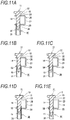
- the tubular portion 31 of the cylindrical member 30 has a tapered shape 34 whose diameter is gradually increased in a direction of a leading end portion thereof, and the tapered shape 34 is held by the lower holding portion 23.
- a fall-preventing shape for preventing the lower holding portion 23 from falling off may be formed.
- an inserted position of the lower holding portion 23 of the connection band 20 can depend on the tapered shape 34, and thus the assemblability can be improved.
- the cylindrical member 30 of the tapered shape 34 falls off from the lower holding portion 23 as it is, and thus the fastener 11 can be smoothly removed from the connection band 20.
- a stepped shape 35 having a large diameter is formed at a leading end portion side of the tubular portion 31 of the cylindrical member 30, and the lower holding portion 23 is engaged with this stepped shape 35.
- the tubular portion 31 of the cylindrical member 30 may be formed in the fall-preventing shape for preventing the lower holding portion 23 from falling off.
- the inserted position of the lower holding portion 23 of the connection band 20 can depend on the stepped shape 35, and thus the assemblability can be improved.
- a concave shape 36 is formed at the tubular portion 31 of the cylindrical member 30 in a circumferential groove shape, and the lower holding portion 23 is engaged with this concave shape 36.
- the tubular portion 31 of the cylindrical member 30 may be formed in the fall-preventing shape for preventing the lower holding portion 23 from falling off.
- the inserted position of the lower holding portion 23 of the connection band 20 can depend on the concave shape 36, and thus the assemblability can be improved.
- a bulgy shape 37 swollen in an outer circumferential direction is provided at the leading end portion side of the tubular portion 31 of the cylindrical member 30, and the lower holding portion 23 is engaged with this bulgy shape 37.
- the tubular portion 31 of the cylindrical member 30 may be formed in the fall-preventing shape for preventing the lower holding portion 23 from falling off.
- the inserted position of the lower holding portion 23 of the connection band 20 can depend on the bulgy shape 37, and thus the assemblability can be improved.
- a large diameter shape 38 is formed by making a large diameter for the leading end portion side of the tubular portion 31 of the cylindrical member 30, and the large diameter shape 38 is held by the lower holding portion 23.
- the tubular portion 31 of the cylindrical member 30 may be formed in the fall-preventing shape for preventing the lower holding portion 23 from falling off.
- the inserted position of the lower holding portion 23 of the connection band 20 can depend on the large diameter shape 38, and thus the assemblability can be improved.
- a stepped portion 39 may be provided at the tubular portion 31 of the cylindrical member 30.
- a leading end portion side of the stepped portion 39 is formed to be larger in diameter than a trailing end portion side of the stepped portion 39.
- This stepped portion 39 is disposed closer to the toe side (the leading end portion 15 side) of the fastener 11 than the lower holding portion 23, and is configured not to be contact with the lower holding portion 23. Even in this configuration, as in the form shown in Fig. 11B , the lower holding portion 23 can be inhibited from being spread by the stepped portion 39, and the tubular portion 31 of the cylindrical member 30 can be formed in the fall-preventing shape for preventing the lower holding portion 23 from falling off.
- the stepped portion 39 is formed by corners whose cross sections are formed at a right angle. In this way, the corners of the stepped portion 39 are formed at a right angle, and thereby the lower holding portion 23 is easily caught, and thus an effect of preventing the spread of the lower holding portion 23 can be enhanced.
- the corners of the stepped portion 39 are not limited to the right angle, and may have an R shape as small as possible.
- connection band 20 including the cylindrical member 30 attached to the fastener 11 is provided with the upper holding portions 22, each of which supports and holds the head portion 12 side of the fastener 11, and the lower holding portions 23, each of which supports and holds the cylindrical member 30 attached to the fastener 11. According to this configuration, since the fasteners 11 are stretched by the cylindrical members 30 and are held by the lower holding portions 23, even when the width of the connection band 20 is regulated by the tool, the fasteners 11 can be stably supported regardless of the lengths of the fasteners 11.
- the cylindrical members 30 are members which are separate from and are independent of the connection band 20 because the cylindrical members 30 are not pulled and inclined by the connection band 20 when removed from the connection band 20. Therefore, the fasteners 11 can be prevented from being inclined and buckled. No energy is lost to cut the connection band 20.
- the cylindrical member 30 that is more easily stabilized in dimensional precision than the fastener 11 formed of a metal is used. Thereby, dimensions of the cylindrical member 30 and dimensions of the lower holding portion 23 can be made compatible with each other, and a holding force of the fastener 11 held via the cylindrical member 30 by the lower holding portion 23 can be enhanced.
- the cylindrical member 30 is attached to the fastener 11, and thereby the diameter of the toe side (the leading end portion 15 side) of the fastener 11 is increased. For this reason, the fastener 11 is prevented from falling within the injection path 40 during driving. Therefore, it is possible to stabilize the driving posture of the fastener 11 to prevent the buckling.
- the diameter of the lower holding hole 23b holding the cylindrical member 30 provided at the lower holding portion 23 is larger than that of the upper holding hole 22b holding the head portion 12 side of the fastener 11 provided at the upper holding portion 22. According to this configuration, the shank 14 of the fastener 11 is held by the upper holding hole 22b having a relatively small diameter, and the cylindrical member 30 is held by the lower holding hole 23b having a relatively large diameter. Thus, the fastener 11 can be tightly held even at the lower portion thickened by the amount of attaching the cylindrical member 30.
- the lower holding portion 23 supports and holds the cylindrical member 30 at a position at which it overlaps the tapered leading end portion 15 of the fastener 11 or at a position at which it does not overlap the fastener 11. According to this configuration, even in the short fastener 11 located at the position at which the lower holding portion 23 overlaps the leading end portion 15 of the fastener 11 or at the position at which the lower holding portion 23 does not overlap the fastener 11, this short fastener 11 is stretched by the cylindrical member 30, and is held by the lower holding portion 23. Thus, the fastener 11 can be stably held.
- the length H2 of the shank 14 is shorter than the length H1 of the band-shaped portion 21. According to this configuration, even in the short fastener 11 in which the length H2 of the shank 14 is shorter than the length H1 of the band-shaped portion 21, this short fastener 11 is stretched by the cylindrical member 30, and is held by the lower holding portion 23. Thus, the fastener 11 can be stably held.
- the cylindrical member 30 includes the flange portion 33 that faces the lower portion of the lower holding portion 23 and is formed to protrude in a radial direction of the outer circumference of the cylindrical member 30. According to this configuration, since the lower holding portion 23 is prevented from falling off by the flange portion 33, the lower holding portion 23 is prevented from being removed from the cylindrical member 30.
- the flange portion 33 is provided, and thereby the diameter of the toe side of the fastener 11 is increased.
- an effect of preventing the fastener 11 from falling within the injection path 40 during driving can be enhanced. Therefore, it is possible to stabilize the driving posture of the fastener 11 to prevent the buckling.
- the fastener 11 includes the stepped portion 14a at the shank 14, and the stepped portion 14a is formed such that the outer diameter thereof close to the leading end portion 15 is smaller than that close to the head portion 12, and faces the upper edge portion 32 of the cylindrical member 30. According to this configuration, when the cylindrical member 30 is attached to the fastener 11, the position of the cylindrical member 30 depends on the stepped portion 14a, and thus a problem that the attached position of the cylindrical member 30 to the fastener 11 is made too shallow or too deep can be avoided.
- the cylindrical member 30 includes the fall-preventing shape for preventing the lower holding portion 23 from falling off. According to this configuration, since the lower holding portion 23 is prevented from falling off by the fall-preventing shape, the lower holding portion 23 is prevented from being removed from the cylindrical member 30.
Landscapes
- Engineering & Computer Science (AREA)
- General Engineering & Computer Science (AREA)
- Mechanical Engineering (AREA)
- Clamps And Clips (AREA)
- Insertion Pins And Rivets (AREA)
Claims (11)
- Verbindungsbefestigungselement (10) umfassend:eine Vielzahl von Befestigungselementen (11), von denen jedes einen Kopfabschnitt (12), der an einer Endabschnittsseite vorgesehen ist, und einen verjüngten vorderen Endabschnitt (15), der an der anderen Endabschnittsseite vorgesehen ist, aufweist;einen plattenförmigen Verbindungsabschnitt (20), der so konfiguriert ist, dass er die Vielzahl von Befestigungselementen (11) in einer parallelen Richtung verbindet; undBefestigungsabschnitte (30), die von dem an den Befestigungselementen (11) angebrachten Verbindungsabschnitt (20) getrennt sind, so dass jeder Befestigungsabschnitt (30) mindestens einen Teil jedes vorderen Endabschnitts abdeckt,wobei der Verbindungsabschnitt (20) umfasst:
erste Halteabschnitte (22), von denen jeder so konfiguriert ist, dass er eine Kopfabschnittsseite jedes Befestigungselements stützt;wobei der Verbindungsabschnitt (20) zweite Halteabschnitte (23) enthält, von denen jeder so konfiguriert ist, dass er einen rohrförmigen Abschnitt (31) jedes Befestigungsabschnitts stützt und hält. - Verbindungsbefestigungselement (10) nach Anspruch 1, wobei:der Verbindungsabschnitt (20) zweite Haltelöcher (23b) enthält, die die an den zweiten Halteabschnitten (23) vorgesehenen Befestigungsabschnitte (30) stützen, und erste Haltelöcher (22b) enthält, die die an den ersten Halteabschnitten (22) vorgesehenen Seiten der Kopfabschnitte (12) der Befestigungselemente (11) stützen; undDurchmesser der zweiten Haltelöcher (23b) größer sind als Durchmesser der ersten Haltelöcher (22b).
- Verbindungsbefestigungselement (10) nach Anspruch 1 oder 2, wobei:der Verbindungsabschnitt (20) zweite Haltelöcher (23b) enthält, die die an den zweiten Halteabschnitten (23b) vorgesehenen Befestigungsabschnitte (30) stützen, und erste Haltelöcher (22b) enthält, die die an den ersten Halteabschnitten (22) vorgesehenen Kopfabschnittsseiten der Befestigungselemente (11) stützen; undÖffnungsbreiten von Öffnungsschlitzen der zweiten Haltelöcher (23b) größer sind als Öffnungsbreiten von Öffnungsschlitzen der ersten Haltelöcher (22b).
- Verbindungsbefestigungselement (10) nach einem der Ansprüche 1 bis 3, wobei:jedes der Befestigungselemente (11) einen Schaft aufweist, der kontinuierlich zwischen dem Kopfabschnitt (12) und dem vorderen Endabschnitt vorgesehen ist; unddie zweiten Halteabschnitte (23) die Befestigungsabschnitte (30) an Positionen stützen, an denen die zweiten Halteabschnitte (23) die verjüngten vorderen Endabschnitte der Befestigungselemente (11) überlappen, oder an Positionen, an denen die zweiten Halteabschnitte (23) die Befestigungselemente (11) nicht überlappen, von einer Seitenrichtung des Befestigungselements (11) aus gesehen.
- Verbindungsbefestigungselement (10) nach einem der Ansprüche 1 bis 4, wobei:der Verbindungsabschnitt (20) durch Biegen eines langen Blechs in C-Form gebildet ist;die ersten Halteabschnitte (22), die zweiten Halteabschnitte (23) und ein bandförmiger Abschnitt, der die ersten Halteabschnitte (22) und die zweiten Halteabschnitte (23) verbindet, in der gleichen Ebene in dem langen Blech ausgebildet sind;jedes der Befestigungselemente (11) einen Schaft aufweist, der kontinuierlich zwischen dem Kopfabschnitt (12) und dem vorderen Endabschnitt vorgesehen ist; undin einer axialen Richtung des Befestigungselements (11) eine Länge des Schafts kürzer ist als eine Länge des bandförmigen Abschnitts.
- Verbindungsbefestigungselement (10) nach Anspruch 5, wobei:jedes Befestigungselement (11) einen abgestuften Abschnitt am Schaft aufweist; undder abgestufte Abschnitt (14a) so ausgebildet ist, dass ein Außendurchmesser einer Seite des vorderen Endabschnitts kleiner ist als ein Außendurchmesser der Seite des Kopfabschnitts (12) und einem oberen Kantenabschnitt des Befestigungsabschnitts (30) gegenüberliegt.
- Verbindungsbefestigungselement (10) nach einem der Ansprüche 1 bis 6, wobei
jeder der Befestigungsabschnitte (30) einen Flanschabschnitt (33) aufweist, der in einer äußeren Umfangsrichtung unterhalb des zweiten Halteabschnitts (23) vorsteht. - Verbindungsbefestigungselement (10) nach einem der Ansprüche 1 bis 7, wobei
jeder der Befestigungsabschnitte (30) eine Form zur Verhinderung des Herunterfallens des zweiten Halteabschnitts (23) aufweist. - Verbindungsbefestigungselement (10) nach Anspruch 8, wobei die Form zur Vermeidung des Herunterfallens eine sich verjüngende Form (34) ist, deren Durchmesser allmählich in Richtung einer vorderen Endabschnittsseite des Befestigungselements (11) zunimmt.
- Verbindungsbefestigungselement (10) nach Anspruch 8, wobei die Form zur Vermeidung des Herunterfallens eine abgestufte Form (35) ist, die durch Herstellen eines großen Durchmessers des Befestigungsabschnitts (30) in einer vorderen Endabschnittsseite des Befestigungselements (11) oder eine konkave Form (36) einer Umfangsrillenform gebildet wird.
- Verbindungsbefestigungselement (10) nach Anspruch 8, wobei die Form zur Vermeidung des Herunterfallens eine wulstige Form ist, bei der der Befestigungsabschnitt (30) in der Kopfseite des Befestigungselements (11) in einer äußeren Umfangsrichtung gewölbt ist, oder eine Form (38) mit großem Durchmesser, die durch Herstellen eines großen Durchmessers des Befestigungsabschnitts (30) in der Kopfseite des Befestigungselements (11) gebildet wird.
Priority Applications (1)
| Application Number | Priority Date | Filing Date | Title |
|---|---|---|---|
| PL17181391T PL3269987T3 (pl) | 2016-07-15 | 2017-07-14 | Łączący element mocujący |
Applications Claiming Priority (2)
| Application Number | Priority Date | Filing Date | Title |
|---|---|---|---|
| JP2016139922 | 2016-07-15 | ||
| JP2017096995A JP6897302B2 (ja) | 2016-07-15 | 2017-05-16 | 連結ファスナー |
Publications (2)
| Publication Number | Publication Date |
|---|---|
| EP3269987A1 EP3269987A1 (de) | 2018-01-17 |
| EP3269987B1 true EP3269987B1 (de) | 2021-09-08 |
Family
ID=59362967
Family Applications (1)
| Application Number | Title | Priority Date | Filing Date |
|---|---|---|---|
| EP17181391.8A Active EP3269987B1 (de) | 2016-07-15 | 2017-07-14 | Verbindungsbefestigungselement |
Country Status (5)
| Country | Link |
|---|---|
| US (1) | US10428853B2 (de) |
| EP (1) | EP3269987B1 (de) |
| KR (1) | KR102242482B1 (de) |
| ES (1) | ES2892752T3 (de) |
| PL (1) | PL3269987T3 (de) |
Families Citing this family (3)
| Publication number | Priority date | Publication date | Assignee | Title |
|---|---|---|---|---|
| JP7192491B2 (ja) | 2018-12-27 | 2022-12-20 | マックス株式会社 | 連結ファスナー |
| TWI689667B (zh) * | 2019-06-24 | 2020-04-01 | 光柘企業有限公司 | 螺絲釘載帶 |
| US10816025B1 (en) * | 2019-08-23 | 2020-10-27 | Guangzhe Enterprise Co., Ltd. | Screw band |
Family Cites Families (19)
| Publication number | Priority date | Publication date | Assignee | Title |
|---|---|---|---|---|
| US2203294A (en) * | 1939-03-16 | 1940-06-04 | Ralph L Engle | Nail for fastening sheeting |
| CA960189A (en) * | 1971-07-12 | 1974-12-31 | Hilti Aktiengesellschaft | Nail holder assembly |
| US4606455A (en) * | 1984-08-17 | 1986-08-19 | Duo-Fast Corporation | Collated fastener strip |
| DE3743049A1 (de) | 1987-12-18 | 1989-06-29 | Hilti Ag | Nagel mit stauchbarer huelse |
| JPH0396417A (ja) | 1989-09-08 | 1991-04-22 | Mazda Motor Corp | 車両用空調装置 |
| US5178903A (en) * | 1989-09-29 | 1993-01-12 | Illinois Tool Works Inc. | Coated metal fastener and method for making same |
| JPH0637203Y2 (ja) | 1990-01-23 | 1994-09-28 | 若井産業株式会社 | 連結釘のテープ |
| JPH07100208B2 (ja) * | 1992-10-15 | 1995-11-01 | 大内 正年 | ブラインドリベット保持体 |
| JP3429202B2 (ja) * | 1998-08-11 | 2003-07-22 | 株式会社パイオラックス | パネル状部品の固定用クリップ |
| CA2292166A1 (en) * | 1999-01-13 | 2000-07-13 | Kent B. Godsted | Chemically coated fasteners having improved penetration and withdrawal resistance |
| JP2002081424A (ja) | 2000-09-07 | 2002-03-22 | Sakai Fastening:Kk | コンクリートピンとその製造方法 |
| US6779959B1 (en) | 2003-04-21 | 2004-08-24 | Testo Industry Corp. | Belt of nails for nailers |
| US7273337B2 (en) * | 2003-06-30 | 2007-09-25 | Illinois Tool Works Inc. | Partially coated fastener assembly and method for coating |
| ITBO20070658A1 (it) | 2007-09-27 | 2009-03-28 | Samp S P A | Vite di estrusione per macchine per estrudere materia plastica. |
| TWI440774B (zh) * | 2007-11-06 | 2014-06-11 | Max Co Ltd | 連結扣件組合 |
| JP2009264585A (ja) | 2008-03-31 | 2009-11-12 | Max Co Ltd | 連結ファスナー |
| JP2010265952A (ja) * | 2009-05-13 | 2010-11-25 | Nifco Inc | 締結具 |
| US20120298716A1 (en) * | 2011-05-23 | 2012-11-29 | Ricardo Segura | Fastener collation having a collation of frangible fastener alignment caps |
| US20130270135A1 (en) * | 2012-04-13 | 2013-10-17 | Ching Yun Huang | Strip for supporting fasteners |
-
2017
- 2017-07-13 US US15/648,818 patent/US10428853B2/en active Active
- 2017-07-13 KR KR1020170088885A patent/KR102242482B1/ko active Active
- 2017-07-14 EP EP17181391.8A patent/EP3269987B1/de active Active
- 2017-07-14 PL PL17181391T patent/PL3269987T3/pl unknown
- 2017-07-14 ES ES17181391T patent/ES2892752T3/es active Active
Also Published As
| Publication number | Publication date |
|---|---|
| US10428853B2 (en) | 2019-10-01 |
| KR102242482B1 (ko) | 2021-04-20 |
| ES2892752T3 (es) | 2022-02-04 |
| KR20180008312A (ko) | 2018-01-24 |
| US20180017093A1 (en) | 2018-01-18 |
| EP3269987A1 (de) | 2018-01-17 |
| PL3269987T3 (pl) | 2022-01-31 |
| KR102242482B9 (ko) | 2022-04-14 |
Similar Documents
| Publication | Publication Date | Title |
|---|---|---|
| EP3269987B1 (de) | Verbindungsbefestigungselement | |
| EP1471265B1 (de) | Wanddübel für eine Schraube und die Anordnung, die durch solch einen Wanddübel und eine Schraube festgesetzt wird. | |
| KR100981075B1 (ko) | 날부교환식 절삭공구 및 이것에 장착되는 날부 | |
| EP2832482B1 (de) | Schneidwerkzeug mit auswechselbarem kopf | |
| EP2058533B1 (de) | Angeschlossene Befestigungsanordnung | |
| US8899888B2 (en) | Tip dresser | |
| IE56534B1 (en) | Self drilling threaded insert for drywall | |
| US11149773B2 (en) | Connection fastener | |
| NZ239681A (en) | Strip of collated wire nails:each nail has offset circular head | |
| CN101440836B (zh) | 连接的紧固件组件 | |
| US20160002979A1 (en) | Digging bit | |
| US20250052268A1 (en) | Fastener support, coupled fastener, and manufacturing method of fastener support | |
| WO2016092675A1 (ja) | 後施工アンカー、後施工アンカーの施工方法および後施工アンカーシステム | |
| JPS6326567Y2 (de) | ||
| JP7290535B2 (ja) | 固着体装置 | |
| JPS6311522B2 (de) | ||
| JP2010105156A (ja) | 直径が異なるファスナ用のキャリアストリップシステムおよび方法 | |
| JP4179171B2 (ja) | スローアウェイ式ドリル及びスローアウェイチップ | |
| JP6075437B2 (ja) | ヘッド交換式切削工具 | |
| JPH078151Y2 (ja) | テープ自動切断装置 | |
| JP2017129213A (ja) | アンカー |
Legal Events
| Date | Code | Title | Description |
|---|---|---|---|
| PUAI | Public reference made under article 153(3) epc to a published international application that has entered the european phase |
Free format text: ORIGINAL CODE: 0009012 |
|
| STAA | Information on the status of an ep patent application or granted ep patent |
Free format text: STATUS: THE APPLICATION HAS BEEN PUBLISHED |
|
| AK | Designated contracting states |
Kind code of ref document: A1 Designated state(s): AL AT BE BG CH CY CZ DE DK EE ES FI FR GB GR HR HU IE IS IT LI LT LU LV MC MK MT NL NO PL PT RO RS SE SI SK SM TR |
|
| AX | Request for extension of the european patent |
Extension state: BA ME |
|
| STAA | Information on the status of an ep patent application or granted ep patent |
Free format text: STATUS: REQUEST FOR EXAMINATION WAS MADE |
|
| 17P | Request for examination filed |
Effective date: 20180424 |
|
| RBV | Designated contracting states (corrected) |
Designated state(s): AL AT BE BG CH CY CZ DE DK EE ES FI FR GB GR HR HU IE IS IT LI LT LU LV MC MK MT NL NO PL PT RO RS SE SI SK SM TR |
|
| GRAP | Despatch of communication of intention to grant a patent |
Free format text: ORIGINAL CODE: EPIDOSNIGR1 |
|
| STAA | Information on the status of an ep patent application or granted ep patent |
Free format text: STATUS: GRANT OF PATENT IS INTENDED |
|
| INTG | Intention to grant announced |
Effective date: 20210507 |
|
| RIN1 | Information on inventor provided before grant (corrected) |
Inventor name: ARAI, TOSHIMICHI Inventor name: NAKAGAWA, YASUSHI |
|
| GRAS | Grant fee paid |
Free format text: ORIGINAL CODE: EPIDOSNIGR3 |
|
| GRAA | (expected) grant |
Free format text: ORIGINAL CODE: 0009210 |
|
| STAA | Information on the status of an ep patent application or granted ep patent |
Free format text: STATUS: THE PATENT HAS BEEN GRANTED |
|
| AK | Designated contracting states |
Kind code of ref document: B1 Designated state(s): AL AT BE BG CH CY CZ DE DK EE ES FI FR GB GR HR HU IE IS IT LI LT LU LV MC MK MT NL NO PL PT RO RS SE SI SK SM TR |
|
| REG | Reference to a national code |
Ref country code: GB Ref legal event code: FG4D |
|
| REG | Reference to a national code |
Ref country code: CH Ref legal event code: EP Ref country code: AT Ref legal event code: REF Ref document number: 1428846 Country of ref document: AT Kind code of ref document: T Effective date: 20210915 |
|
| REG | Reference to a national code |
Ref country code: DE Ref legal event code: R096 Ref document number: 602017045568 Country of ref document: DE |
|
| REG | Reference to a national code |
Ref country code: IE Ref legal event code: FG4D |
|
| REG | Reference to a national code |
Ref country code: FI Ref legal event code: FGE |
|
| REG | Reference to a national code |
Ref country code: DK Ref legal event code: T3 Effective date: 20210929 |
|
| REG | Reference to a national code |
Ref country code: SE Ref legal event code: TRGR |
|
| REG | Reference to a national code |
Ref country code: NL Ref legal event code: FP |
|
| REG | Reference to a national code |
Ref country code: LT Ref legal event code: MG9D |
|
| REG | Reference to a national code |
Ref country code: NO Ref legal event code: T2 Effective date: 20210908 |
|
| PG25 | Lapsed in a contracting state [announced via postgrant information from national office to epo] |
Ref country code: RS Free format text: LAPSE BECAUSE OF FAILURE TO SUBMIT A TRANSLATION OF THE DESCRIPTION OR TO PAY THE FEE WITHIN THE PRESCRIBED TIME-LIMIT Effective date: 20210908 Ref country code: BG Free format text: LAPSE BECAUSE OF FAILURE TO SUBMIT A TRANSLATION OF THE DESCRIPTION OR TO PAY THE FEE WITHIN THE PRESCRIBED TIME-LIMIT Effective date: 20211208 Ref country code: LT Free format text: LAPSE BECAUSE OF FAILURE TO SUBMIT A TRANSLATION OF THE DESCRIPTION OR TO PAY THE FEE WITHIN THE PRESCRIBED TIME-LIMIT Effective date: 20210908 Ref country code: HR Free format text: LAPSE BECAUSE OF FAILURE TO SUBMIT A TRANSLATION OF THE DESCRIPTION OR TO PAY THE FEE WITHIN THE PRESCRIBED TIME-LIMIT Effective date: 20210908 |
|
| REG | Reference to a national code |
Ref country code: ES Ref legal event code: FG2A Ref document number: 2892752 Country of ref document: ES Kind code of ref document: T3 Effective date: 20220204 |
|
| PG25 | Lapsed in a contracting state [announced via postgrant information from national office to epo] |
Ref country code: LV Free format text: LAPSE BECAUSE OF FAILURE TO SUBMIT A TRANSLATION OF THE DESCRIPTION OR TO PAY THE FEE WITHIN THE PRESCRIBED TIME-LIMIT Effective date: 20210908 Ref country code: GR Free format text: LAPSE BECAUSE OF FAILURE TO SUBMIT A TRANSLATION OF THE DESCRIPTION OR TO PAY THE FEE WITHIN THE PRESCRIBED TIME-LIMIT Effective date: 20211209 |
|
| PG25 | Lapsed in a contracting state [announced via postgrant information from national office to epo] |
Ref country code: IS Free format text: LAPSE BECAUSE OF FAILURE TO SUBMIT A TRANSLATION OF THE DESCRIPTION OR TO PAY THE FEE WITHIN THE PRESCRIBED TIME-LIMIT Effective date: 20220108 Ref country code: SM Free format text: LAPSE BECAUSE OF FAILURE TO SUBMIT A TRANSLATION OF THE DESCRIPTION OR TO PAY THE FEE WITHIN THE PRESCRIBED TIME-LIMIT Effective date: 20210908 Ref country code: SK Free format text: LAPSE BECAUSE OF FAILURE TO SUBMIT A TRANSLATION OF THE DESCRIPTION OR TO PAY THE FEE WITHIN THE PRESCRIBED TIME-LIMIT Effective date: 20210908 Ref country code: RO Free format text: LAPSE BECAUSE OF FAILURE TO SUBMIT A TRANSLATION OF THE DESCRIPTION OR TO PAY THE FEE WITHIN THE PRESCRIBED TIME-LIMIT Effective date: 20210908 Ref country code: PT Free format text: LAPSE BECAUSE OF FAILURE TO SUBMIT A TRANSLATION OF THE DESCRIPTION OR TO PAY THE FEE WITHIN THE PRESCRIBED TIME-LIMIT Effective date: 20220110 Ref country code: EE Free format text: LAPSE BECAUSE OF FAILURE TO SUBMIT A TRANSLATION OF THE DESCRIPTION OR TO PAY THE FEE WITHIN THE PRESCRIBED TIME-LIMIT Effective date: 20210908 Ref country code: CZ Free format text: LAPSE BECAUSE OF FAILURE TO SUBMIT A TRANSLATION OF THE DESCRIPTION OR TO PAY THE FEE WITHIN THE PRESCRIBED TIME-LIMIT Effective date: 20210908 Ref country code: AL Free format text: LAPSE BECAUSE OF FAILURE TO SUBMIT A TRANSLATION OF THE DESCRIPTION OR TO PAY THE FEE WITHIN THE PRESCRIBED TIME-LIMIT Effective date: 20210908 |
|
| REG | Reference to a national code |
Ref country code: DE Ref legal event code: R097 Ref document number: 602017045568 Country of ref document: DE |
|
| PLBE | No opposition filed within time limit |
Free format text: ORIGINAL CODE: 0009261 |
|
| STAA | Information on the status of an ep patent application or granted ep patent |
Free format text: STATUS: NO OPPOSITION FILED WITHIN TIME LIMIT |
|
| 26N | No opposition filed |
Effective date: 20220609 |
|
| PG25 | Lapsed in a contracting state [announced via postgrant information from national office to epo] |
Ref country code: SI Free format text: LAPSE BECAUSE OF FAILURE TO SUBMIT A TRANSLATION OF THE DESCRIPTION OR TO PAY THE FEE WITHIN THE PRESCRIBED TIME-LIMIT Effective date: 20210908 |
|
| PG25 | Lapsed in a contracting state [announced via postgrant information from national office to epo] |
Ref country code: MC Free format text: LAPSE BECAUSE OF FAILURE TO SUBMIT A TRANSLATION OF THE DESCRIPTION OR TO PAY THE FEE WITHIN THE PRESCRIBED TIME-LIMIT Effective date: 20210908 |
|
| REG | Reference to a national code |
Ref country code: AT Ref legal event code: UEP Ref document number: 1428846 Country of ref document: AT Kind code of ref document: T Effective date: 20210908 |
|
| PG25 | Lapsed in a contracting state [announced via postgrant information from national office to epo] |
Ref country code: LU Free format text: LAPSE BECAUSE OF NON-PAYMENT OF DUE FEES Effective date: 20220714 |
|
| PG25 | Lapsed in a contracting state [announced via postgrant information from national office to epo] |
Ref country code: IE Free format text: LAPSE BECAUSE OF NON-PAYMENT OF DUE FEES Effective date: 20220714 |
|
| PG25 | Lapsed in a contracting state [announced via postgrant information from national office to epo] |
Ref country code: HU Free format text: LAPSE BECAUSE OF FAILURE TO SUBMIT A TRANSLATION OF THE DESCRIPTION OR TO PAY THE FEE WITHIN THE PRESCRIBED TIME-LIMIT; INVALID AB INITIO Effective date: 20170714 |
|
| PG25 | Lapsed in a contracting state [announced via postgrant information from national office to epo] |
Ref country code: MK Free format text: LAPSE BECAUSE OF FAILURE TO SUBMIT A TRANSLATION OF THE DESCRIPTION OR TO PAY THE FEE WITHIN THE PRESCRIBED TIME-LIMIT Effective date: 20210908 Ref country code: CY Free format text: LAPSE BECAUSE OF FAILURE TO SUBMIT A TRANSLATION OF THE DESCRIPTION OR TO PAY THE FEE WITHIN THE PRESCRIBED TIME-LIMIT Effective date: 20210908 |
|
| PG25 | Lapsed in a contracting state [announced via postgrant information from national office to epo] |
Ref country code: MT Free format text: LAPSE BECAUSE OF FAILURE TO SUBMIT A TRANSLATION OF THE DESCRIPTION OR TO PAY THE FEE WITHIN THE PRESCRIBED TIME-LIMIT Effective date: 20210908 |
|
| PGFP | Annual fee paid to national office [announced via postgrant information from national office to epo] |
Ref country code: PL Payment date: 20250529 Year of fee payment: 9 |
|
| PGFP | Annual fee paid to national office [announced via postgrant information from national office to epo] |
Ref country code: GB Payment date: 20250529 Year of fee payment: 9 |
|
| PGFP | Annual fee paid to national office [announced via postgrant information from national office to epo] |
Ref country code: BE Payment date: 20250619 Year of fee payment: 9 Ref country code: NL Payment date: 20250613 Year of fee payment: 9 |
|
| PGFP | Annual fee paid to national office [announced via postgrant information from national office to epo] |
Ref country code: FR Payment date: 20250610 Year of fee payment: 9 |
|
| PGFP | Annual fee paid to national office [announced via postgrant information from national office to epo] |
Ref country code: SE Payment date: 20250528 Year of fee payment: 9 |
|
| PGFP | Annual fee paid to national office [announced via postgrant information from national office to epo] |
Ref country code: FI Payment date: 20250715 Year of fee payment: 9 Ref country code: ES Payment date: 20250801 Year of fee payment: 9 |
|
| PGFP | Annual fee paid to national office [announced via postgrant information from national office to epo] |
Ref country code: DE Payment date: 20250528 Year of fee payment: 9 Ref country code: DK Payment date: 20250714 Year of fee payment: 9 |
|
| PGFP | Annual fee paid to national office [announced via postgrant information from national office to epo] |
Ref country code: NO Payment date: 20250709 Year of fee payment: 9 |
|
| PGFP | Annual fee paid to national office [announced via postgrant information from national office to epo] |
Ref country code: TR Payment date: 20250704 Year of fee payment: 9 Ref country code: IT Payment date: 20250623 Year of fee payment: 9 |
|
| PGFP | Annual fee paid to national office [announced via postgrant information from national office to epo] |
Ref country code: AT Payment date: 20250625 Year of fee payment: 9 |
|
| PGFP | Annual fee paid to national office [announced via postgrant information from national office to epo] |
Ref country code: CH Payment date: 20250801 Year of fee payment: 9 |