EP3263540B1 - Feuerfeste platte - Google Patents
Feuerfeste platte Download PDFInfo
- Publication number
- EP3263540B1 EP3263540B1 EP17178179.2A EP17178179A EP3263540B1 EP 3263540 B1 EP3263540 B1 EP 3263540B1 EP 17178179 A EP17178179 A EP 17178179A EP 3263540 B1 EP3263540 B1 EP 3263540B1
- Authority
- EP
- European Patent Office
- Prior art keywords
- glass
- fireproof board
- region
- thickness
- front surface
- Prior art date
- Legal status (The legal status is an assumption and is not a legal conclusion. Google has not performed a legal analysis and makes no representation as to the accuracy of the status listed.)
- Active
Links
Images

Classifications
-
- C—CHEMISTRY; METALLURGY
- C04—CEMENTS; CONCRETE; ARTIFICIAL STONE; CERAMICS; REFRACTORIES
- C04B—LIME, MAGNESIA; SLAG; CEMENTS; COMPOSITIONS THEREOF, e.g. MORTARS, CONCRETE OR LIKE BUILDING MATERIALS; ARTIFICIAL STONE; CERAMICS; REFRACTORIES; TREATMENT OF NATURAL STONE
- C04B41/00—After-treatment of mortars, concrete, artificial stone or ceramics; Treatment of natural stone
- C04B41/80—After-treatment of mortars, concrete, artificial stone or ceramics; Treatment of natural stone of only ceramics
- C04B41/81—Coating or impregnation
- C04B41/85—Coating or impregnation with inorganic materials
- C04B41/86—Glazes; Cold glazes
-
- C—CHEMISTRY; METALLURGY
- C04—CEMENTS; CONCRETE; ARTIFICIAL STONE; CERAMICS; REFRACTORIES
- C04B—LIME, MAGNESIA; SLAG; CEMENTS; COMPOSITIONS THEREOF, e.g. MORTARS, CONCRETE OR LIKE BUILDING MATERIALS; ARTIFICIAL STONE; CERAMICS; REFRACTORIES; TREATMENT OF NATURAL STONE
- C04B41/00—After-treatment of mortars, concrete, artificial stone or ceramics; Treatment of natural stone
- C04B41/009—After-treatment of mortars, concrete, artificial stone or ceramics; Treatment of natural stone characterised by the material treated
-
- C—CHEMISTRY; METALLURGY
- C04—CEMENTS; CONCRETE; ARTIFICIAL STONE; CERAMICS; REFRACTORIES
- C04B—LIME, MAGNESIA; SLAG; CEMENTS; COMPOSITIONS THEREOF, e.g. MORTARS, CONCRETE OR LIKE BUILDING MATERIALS; ARTIFICIAL STONE; CERAMICS; REFRACTORIES; TREATMENT OF NATURAL STONE
- C04B41/00—After-treatment of mortars, concrete, artificial stone or ceramics; Treatment of natural stone
- C04B41/45—Coating or impregnating, e.g. injection in masonry, partial coating of green or fired ceramics, organic coating compositions for adhering together two concrete elements
- C04B41/50—Coating or impregnating, e.g. injection in masonry, partial coating of green or fired ceramics, organic coating compositions for adhering together two concrete elements with inorganic materials
- C04B41/5022—Coating or impregnating, e.g. injection in masonry, partial coating of green or fired ceramics, organic coating compositions for adhering together two concrete elements with inorganic materials with vitreous materials
-
- F—MECHANICAL ENGINEERING; LIGHTING; HEATING; WEAPONS; BLASTING
- F27—FURNACES; KILNS; OVENS; RETORTS
- F27D—DETAILS OR ACCESSORIES OF FURNACES, KILNS, OVENS OR RETORTS, IN SO FAR AS THEY ARE OF KINDS OCCURRING IN MORE THAN ONE KIND OF FURNACE
- F27D5/00—Supports, screens or the like for the charge within the furnace
Definitions
- the present teachings disclose a technique related to a fireproof board, particularly a technique related to a fireproof board of silicon nitride-bonded silicon carbide.
- Such a fireproof board has excellent strength and thermal resistance. However, performance thereof may be deteriorated due to influences such as oxidation from long-term use.
- Japanese Patent Publication No. H07-47507 discloses a technique forming glass coating on a surface of a fireproof board. Such a glass coating can suppress surface oxidation of the fireproof board, and can suppress performance deterioration (deterioration of durability or the like) of the fireproof board.
- JP 2015-171985 A discloses a glass film on a SiC refractory bonded with silicon nitride.
- the fireproof board As described above, performance deterioration of the fireproof board is suppressed by forming the glass coating on the surface of the fireproof board.
- the glass on the surface is softened. Due to this, when an object to be heated is placed on the fireproof board and heated in a heating furnace, the object may be adhered to the fireproof board via the glass. If the object is adhered to the fireproof board, a surface layer of the object is peeled off and adhered to the glass when the object is separated from the fireproof board. Accordingly, adhesion of the surface layer of the object to the fireproof board needs to be suppressed.
- the present teachings provide a technique of realizing a fireproof board less likely to be adhered to an object to be heated while suppressing performance deterioration of the fireproof board.
- a fireproof board disclosed herein is constituted of silicon nitride-bonded silicon carbide.
- the fireproof board has a side surface, a front surface, and a rear surface.
- the side surface is covered with glass of a first thickness.
- At least one surface of the front surface and the rear surface has a first region.
- the first region is covered with glass of a second thickness that is less than the first thickness or not covered with glass.
- the first thickness is 5 ⁇ m or more and 100 ⁇ m or less and the second thickness is 7 ⁇ m or less.
- the fireproof board has the side surface that is covered with the glass of the first thickness, the side surface of the fireproof board can be suppressed from oxidation by heating, and thus the performance deterioration of the fireproof board can be suppressed.
- the first region is provided in the front surface and/or the rear surface of the fireproof board.
- the glass on the first region has the thickness that is less than that of the glass on the side surface (or the glass is not provided on the first region). Due to this, if an object to be heated is placed on the first region, adhesion of the object to the fireproof board via the glass can be suppressed.
- the surface layer of the object can be suppressed from peeling off, which improves production yield of the object.
- the above-described fireproof board can improve the production yield of the object while suppressing the performance deterioration of the fireproof board itself. It should be noted that since the first region of the fireproof board is covered with the object to be heated, the performance deterioration of the fireproof board due to oxidation of the first region is suppressed as well.
- a phenomenon where a surface layer of an object to be heated is peeled off and is adhered to glass will be simply expressed as "an object to be heated is adhered to glass".
- a fireproof board disclosed herein is constituted of silicon nitride-bonded SiC. At least a side surface of the fireproof board is covered with glass. The side surface of the fireproof board is covered with glass of a first thickness. A first region is provided on at least one surface of a front surface and a rear surface of the fireproof board, and a thickness of glass on the first region is less than the thickness of the glass on the side surface (first thickness). The thickness of the glass on the first region is a second thickness (including a thickness of "zero").
- a front surface and the other surface will be described as "a rear surface”.
- the technique disclosed herein can also be applied to a fireproof board in which the one surface is a "rear surface” and the other surface is a "front surface”.
- the first thickness is equal to or more than 5 ⁇ m, preferably equal to or more than 10 ⁇ m, and particularly preferably equal to or more than 50 ⁇ m. Further, the first thickness is equal to or less than 100 ⁇ m. If the first thickness is less than 5 ⁇ m, an effect of suppressing oxidation of silicon nitride-bonded silicon carbide is reduced, and thus corrosion resistance is decreased. Further, if the first thickness is more than 100 ⁇ m, cracks are likely to occur on the glass due to repeated heating and cooling cycles, which results in reduced coating effect of the glass and decreased corrosion resistance. Further, when the cracks are generated in the glass, the glass is likely to be peeled off from a substrate (silicon nitride-bonded silicon carbide), which results in the decreased corrosion resistance.
- the second thickness is equal to or less than 7 ⁇ m, and preferably equal to or less than 5 ⁇ m, and particularly preferably zero. That is, the first region may not be covered with glass. If the second thickness is equal to or more than 10 ⁇ m, the object to be heated is more prone to adhering to the glass when heating is carried out by placing the object on the first region.
- the first region may be provided over an entirety of the front surface of the fireproof board or may be provided on a part of the front surface.
- the first region is preferably provided on a part of the front surface of the fireproof board.
- the first region may be provided at a center of the fireproof board, and the second region having the glass thickness that is more than the glass thickness (the second thickness) of the first region may be provided outside the first region.
- the second region preferably surrounds the first region.
- the glass thickness of the second region is a third thickness.
- the third thickness is appropriately selected within a same range as the above-mentioned preferable range of the first thickness.
- the first thickness and the third thickness may be the same.
- the second region may be provided over an entire surface outside the first region.
- the glass provided on the second region may be continuous with the glass provided on the side surface of the fireproof board. Due to this, it is possible to reliably protect corner portions of the front surface and the side surface.
- the first region may be provided only on the front surface of the fireproof board or may be provided on both of the front and rear surfaces. In this case, both the first region and the second region may be provided on each of the front and rear surfaces of the fireproof board. Also, in the case where the first region and the second region are provided on the front and rear surfaces of the fireproof board, layouts of the first region and the second region may be the same on the front surface and rear surface or may be different. If the layouts of the first region and the second region are the same on the front and rear surfaces, when the "front surface" is deteriorated, the "rear surface" can be used as the "front surface".
- the silicon nitride-bonded SiC contains SiC (silicon carbide) as a main component, and contains nitrides such as Si 3 N 4 (silicon nitride) and Si 2 ON 2 (silicon oxynitride) as a bonding material of the SiC. It should be noted that a term "silicon nitride" may hereinafter be used as a generic term of Si 3 N 4 and Si 2 ON 2 .
- the fireproof board may contain elements such as Fe (iron), Al (aluminum), B (boron) and the like besides SiC and silicon nitride.
- SiC is used as aggregate for the fireproof board.
- a content of SiC in the fireproof board is preferably 65 to 80 mass%, more preferably 70 to 80 mass%, particularly preferably 75 to 80 mass%.
- Silicon nitride is used as the bonding material for SiC (aggregate). Strength and impact resistance of the fireproof board are improved by containing silicon nitride. Silicon nitride is formed by reacting Si and N by burning a mixed material containing SiC (aggregate) and Si under N (nitrogen) atmosphere. A content of silicon nitride is preferably 20 to 50 %, more preferably 30 to 45 %, particularly preferably 30 to 40 % relative to SiC (a ratio of silicon nitride to SiC when SiC is 100) in terms of weight ratio.
- Fe is an element derived from sintering aid used in formation (sintering) of the fireproof board.
- Fe 2 O 3 iron oxide
- Fe 2 O 3 is preferably added in an amount of 0.3 to 0.7 mass% to the material before sintering.
- the glass may be formed by oxidizing silicon nitride-bonded SiC obtained by burning the above-mentioned mixed material (SiC and Si). Specifically, after the above-mentioned mixed material is burned (primary burning) under the N atmosphere to form the fireproof board containing silicon nitride-bonded silicon carbide, the fireproof board is burned under oxygen atmosphere (secondary burning) to form a glass phase of SiO 2 (silicon oxide) on the front surface of the fireproof board.
- the glass may contain SiO 2 as a main component, and may contain elements such as Al and B. In this occasion, a content of SiO 2 in the glass is preferably 70 to 90 mass%.
- the fireproof board on which the glass is formed on the surface layer thereof can be obtained by applying a material containing a desired glass composition ratio on the front surface of the silicon nitride-bonded SiC-based fireproof board.
- Al contributes to improvement of glass strength.
- a content of Al in the fireproof board is preferably in a range from 0.25 to 2,4 mass%, more preferably from 1.0 to 2.4 mass%, particularly preferably from 1.5 to 2.4 mass%.
- B contributes to reduction of melting point of the glass and suppression of occurrence of cracks in the glass when using the fireproof board (when heating the fireproof board).
- decomposition of SiO 2 can be suppressed when the fireproof board is heated under low oxygen atmosphere by containing B.
- the content of B in the fireproof board is preferably 1.5 to 8.5 mass%, more preferably 3.0 to 8.5 mass%, particularly preferably 6.0 to 8.5 mass%.
- the fireproof board disclosed herein can be manufactured by burning (primary burning) the above-described material composing silicon nitride-bonded silicon carbide (SiC, Si) under the nitrogen atmosphere, and then burning (secondary burning) the burned body under the oxygen atmosphere. Due to the secondary burning, the surface layer of the silicon nitride-bonded silicon carbide is oxidized to form the glass phase (mainly composed of SiO 2 ) on the surface layer.
- the first region having the glass thickness that is less than those of the other parts can be formed by removing a part of the glass phase corresponding to the first region (or by making the thickness of the glass phase thin) after completion of the secondary burning. It should be noted that removal of the glass phase can be carried out by sandblasting or the like.
- a mixed material obtained by mixing the material composing silicon nitride-bonded silicon carbide and a material containing the above-described elements composing the glass may be subjected to the primary burning.
- burned body thereof may be subjected to the secondary burning in a state where a part corresponding to the first region is covered.
- the first region having the glass thickness less than those of the other parts can be formed.
- the glass layer may be formed on the surface of the fireproof board by the primary burning of the material composing the silicon nitride-bonded silicon carbide, followed by applying glass material (SiO 2 , Al 2 O 3 , B 4 C etc.) on the silicon nitride-bonded silicon carbide fireproof board, and drying or further burning.
- the fireproof board having the first region can be manufactured by removing a part of the glass layer corresponding to the first region (or by making the thickness of the glass layer thin).
- the first region can be formed by applying the glass material to a part other than the first region, and then drying or sintering it.
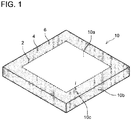
- a fireproof board 10 will be explained.
- side surfaces 10b collectively corresponding to "a side surface” of the claims, of the fireproof board 10 are covered with glass 6.
- the glass 6 surrounds the side surfaces 10b.
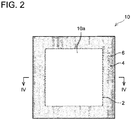
- a front surface 10a of the fireproof board 10 includes a first region 2 and a second region 4.
- the first region 2 is not covered with the glass 6, and the second region 4 is covered with the glass 6 (see FIG. 2 as well).
- Silicon nitride-bonded silicon carbide that is a main material of the fireproof board 10 is exposed on a front layer of the first region 2.
- the first region 2 is provided at a center of the front surface 10a, and the second region 4 surrounds the first region 2 outside the first region 2.
- the second region 4 is provided fully to end portions of the front surface 10a.
- the glass 6 covering the side surfaces 10b is continuous with the glass 6 covering the second region 4. It should be noted that the glass 6 is mainly constituted of SiO 2 and contains Al 2 O 3 and B 4 C.
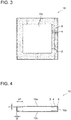
- a rear surface 10c of the fireproof board 10 also includes a first region 2 and a second region 4.
- the second region 4 is covered with the glass 6, and is continuous with the glass 6 covering the side surfaces 10b. That is, the fireproof board 10 is covered with the glass on its surface layer part except for a center part of the front surface 10a and a center part of the rear surface 10c (see FIG. 4 as well).
- the front surface 10a and the rear surface 10c have a same layout of the first region 2 and the second region 4. In other words, the front surface 10a and the rear surface 10c have a same configuration.
- the glass 6 has a same thickness on the front surface 10a and the rear surface 10c.
- a thickness of the glass 6 on the side surfaces 10b is equal to the thickness of the glass 6 on the front surface 10a and the thickness of the glass 6 on the rear surface 10c. That is, a thickness t2 (first thickness) that is the thickness of the glass 6 on the side surfaces 10b is adjusted to approximately 50 ⁇ m.
- a width W1 of the glass 6 is adjusted to 20mm on the front surface 10a and on the rear surface 10c.
- the fireproof board 10 is 400mm in length, 400mm in width, and 7mm in thickness, and a width of the second region 4 is adjusted to approximately 20mm.
- the fireproof board 10 has the glass 6 on the side surfaces 10b thereof, the first region 2 not including the glass 6 at the center of the front surface 10a, and the second region 4 including the glass 6 at the end portion of the front surface 10a.
- oxidation of a substrate (silicon nitride-bonded silicon carbide) of the fireproof board 10 is suppressed, and durability (corrosion resistance) of the fireproof board 10 is enhanced.
- first region 2 when an object to be heated is placed on the fireproof board 10 and heated, adhesion of the object to the fireproof board 10 via the glass is suppressed. A front layer of the object is suppressed from peeling off and adhering to the glass.
- both of the front surface 10a and the rear surface 10c have the first region 2 and the second region 4, respectively. That is, both of the front surface 10a and the rear surface 10c can be used as an upper surface in a direction of gravity.
- the front surface 10a of the fireproof board 10 is damaged, the object to be heated can be placed on the rear surface 10c.
- warpage or the like may be suppressed from occurring on the fireproof board 10 by alternatively using the front surface 10a and the rear surface 10c as the upper surface in the direction of gravity.
- FIG. 5 shows a variant of the fireproof board 10.
- the glass 6 is provided over an entire surface of the rear surface 10c of the fireproof board 10.
- the corrosion resistance of the fireproof board 10 is further enhanced by providing the glass 6 over the entire surface of the rear surface 10c.
- a fireproof board 20 will be explained. It should be noted that the fireproof board 20 is a variant of the fireproof board 10 and each part of a front surface 20a and a rear surface 20c provided with a second region 24 in the fireproof board 20 has a different shape from the corresponding part in the fireproof board 10. With respect to the fireproof board 20, substantially the same components as those of the fireproof board 10 may be assigned with the same reference numbers in lower digit, and explanation thereof may be omitted.
- the fireproof board 20 includes a first region 22 and a second region 24 on each of the front surface 20a and the rear surface 20c.
- projecting portions 28 are provided at end portions of the front surface 20a and rear surface 20c.
- the projecting portions 28 surround the end portions of the front surface 20a and the rear surface 20c.
- the projecting portions 28 are provided in the second regions 24.
- the second regions 24 are respectively provided outside the projecting portions 28 on the front surface 20a and on the rear surface 20c.
- the insides of the projecting portions 28 are the first regions 22.
- the second regions 24 and side surfaces 20b, collectively corresponding to "a side surface" of the claims, are covered with glass 26.
- the projecting portions 28 when heating objects to be heated by stacking a plurality of the fireproof boards 20, spacers (not shown) disposed between the fireproof boards are easily positioned. Further, when sands are provided on a surface of the fireproof board 20 (surface on which the object to be heated is placed), the sands can be securely retained on the surface of the fireproof board 20.
- the adhesion to the glass was measured by the following procedure: Glass having a thickness shown in Table 1 was provided over an entire surface of the front surface of the fireproof board, the object to be heated was placed on the surface of the fireproof board (surface of the glass) and heated at 1600°C for five hours under 1hPa of Ar atmosphere, and the surface (the surface on which the object to be heated was placed) of the fireproof board after heating was observed.
- ten pieces of the objects to be heated were simultaneously heated, occurrence rate of phenomenon where the object was adhered to the glass was calculated after heating. Samples having less than 20% of the occurrence rate of the phenomenon where the object was adhered to the glass were evaluated to be good (in table: ⁇ ), and samples having equal to or more than 20% were evaluated to be bad (in table: X).
- the corrosion resistance was measured by the following procedure.
- the fireproof board having a glass thickness in Table 1 was heated under the conditions described above without placing the object to be heated thereon, and then a number of particles on the surface of the fireproof board after heating was measured.
- Ar atmosphere contains several ppm of oxygen. Due to this, when silicon nitride-bonded silicon carbide comes into contact with atmospheric gas in a heating furnace, bonding parts of Si particles in the silicon nitride-bonded silicon carbide are decomposed, and Si particles cannot be retained on the surface of the fireproof board, resulting in particle shedding. Accordingly, the corrosion resistance of the fireproof board can be evaluated by measuring a number of SiC particles.
- An adhesive tape (carbon double-faced tape: P/N780004523: manufactured by JEOL Ltd.) was attached at a pressure of 50g/cm 2 for ten seconds to the surface of the fireproof board after heating, and a number of particles attached to the adhesive tape in an area of 2mmx2mm was measured. A sample by which less than 100 particles were attached to the tape was evaluated to be good ( ⁇ ), and a sample by which equal to or more than 100 particles were attached to the tape was evaluated to be bad ( ⁇ ).
- the thickness of the glass on the first region 2 is preferably smaller than the thickness of the glass on the side surface of the fireproof board (first thickness) or the thickness of the glass on the second region (third thickness).
- the first thickness and the third thickness are preferably larger than the second thickness. Due to this, the corrosion resistance of the fireproof board is more reliably enhanced.
Landscapes
- Chemical & Material Sciences (AREA)
- Engineering & Computer Science (AREA)
- Ceramic Engineering (AREA)
- Materials Engineering (AREA)
- Structural Engineering (AREA)
- Organic Chemistry (AREA)
- Inorganic Chemistry (AREA)
- Mechanical Engineering (AREA)
- General Engineering & Computer Science (AREA)
- Ceramic Products (AREA)
- Laminated Bodies (AREA)
- Re-Forming, After-Treatment, Cutting And Transporting Of Glass Products (AREA)
Claims (6)
- Feuerfeste Platte (10, 20) aus Siliziumnitrid-gebundenem Siliziumkarbid,
wobei die feuerfeste Platte (10, 20) eine Seitenfläche (10b, 20b), eine Vorderseitenfläche (10a, 20a) und eine Rückseitenfläche (10c, 20c) aufweist,
wobei die Seitenfläche mit Glas (6) einer ersten Dicke (t2) bedeckt ist, und
wobei die Vorderseitenfläche eine erste Region (2) aufweist, wobei die erste Region mit Glas einer zweiten Dicke, die geringer als die erste Dicke ist, bedeckt ist, oder wobei die erste Region nicht mit Glas bedeckt ist;
wobei die erste Dicke (t2) 5 µm oder mehr und 100 µm oder weniger ist, und die zweite Dicke 7 µm oder weniger ist. - Feuerfeste Platte gemäß Anspruch 1, wobei die erste Region (2) auch auf der Rückseitenfläche (10c, 20c) bereitgestellt ist.
- Feuerfeste Platte gemäß Anspruch 1 oder Anspruch 2,
wobei die mindestens eine Fläche eine zweite Region (4) aufweist, wobei die zweite Region (4) mit Glas einer dritten Dicke, die größer als die zweite Dicke ist, bedeckt ist,
wobei die erste Region (2) in einer Mitte der mindestens eine Fläche bereitgestellt ist, und
wobei die zweite Region (4) die erste Region (2) umgibt. - Feuerfeste Platte (10, 20) gemäß Anspruch 3, wobei die zweite Region (4) über eine gesamte Fläche außerhalb der ersten Region (2) bereitgestellt ist.
- Feuerfeste Platte (10, 20) gemäß Anspruch 3 oder Anspruch 4, wobei die erste und die zweite Region (2, 4) sowohl auf der Vorderseiten- als auch auf der Rückseiten-Fläche (10a, 20a, 10c, 20c) bereitgestellt sind.
- Feuerfeste Platte (10, 20) nach einem der Ansprüche 3 bis 5, wobei die dritte Dicke (t1) in einem Bereich von 10 µm bis 100 µm ist.
Priority Applications (1)
| Application Number | Priority Date | Filing Date | Title |
|---|---|---|---|
| PL17178179T PL3263540T3 (pl) | 2016-06-30 | 2017-06-27 | Płyta ognioodporna |
Applications Claiming Priority (1)
| Application Number | Priority Date | Filing Date | Title |
|---|---|---|---|
| JP2016130562A JP6473109B2 (ja) | 2016-06-30 | 2016-06-30 | 耐火板 |
Publications (2)
| Publication Number | Publication Date |
|---|---|
| EP3263540A1 EP3263540A1 (de) | 2018-01-03 |
| EP3263540B1 true EP3263540B1 (de) | 2019-09-25 |
Family
ID=59269788
Family Applications (1)
| Application Number | Title | Priority Date | Filing Date |
|---|---|---|---|
| EP17178179.2A Active EP3263540B1 (de) | 2016-06-30 | 2017-06-27 | Feuerfeste platte |
Country Status (3)
| Country | Link |
|---|---|
| EP (1) | EP3263540B1 (de) |
| JP (1) | JP6473109B2 (de) |
| PL (1) | PL3263540T3 (de) |
Families Citing this family (2)
| Publication number | Priority date | Publication date | Assignee | Title |
|---|---|---|---|---|
| JP7225376B2 (ja) * | 2019-10-02 | 2023-02-20 | 日本碍子株式会社 | 耐火物 |
| WO2024038720A1 (ja) * | 2022-08-19 | 2024-02-22 | 日本碍子株式会社 | 耐火物 |
Family Cites Families (4)
| Publication number | Priority date | Publication date | Assignee | Title |
|---|---|---|---|---|
| JPS61286284A (ja) * | 1985-06-12 | 1986-12-16 | 株式会社 スリ−ボンド | コ−クス炉用耐火レンガ |
| JPH0747507A (ja) | 1993-08-05 | 1995-02-21 | Takeshi Sadashige | 化粧単板用寄せ木ブロックの製造方法 |
| JP2002284577A (ja) * | 2001-03-26 | 2002-10-03 | Nichias Corp | 耐火物及びその製造方法 |
| JP6253554B2 (ja) * | 2014-02-19 | 2017-12-27 | 日本碍子株式会社 | 複合耐火物およびその製造方法 |
-
2016
- 2016-06-30 JP JP2016130562A patent/JP6473109B2/ja active Active
-
2017
- 2017-06-27 PL PL17178179T patent/PL3263540T3/pl unknown
- 2017-06-27 EP EP17178179.2A patent/EP3263540B1/de active Active
Non-Patent Citations (1)
| Title |
|---|
| None * |
Also Published As
| Publication number | Publication date |
|---|---|
| PL3263540T3 (pl) | 2020-04-30 |
| EP3263540A1 (de) | 2018-01-03 |
| JP2018002536A (ja) | 2018-01-11 |
| JP6473109B2 (ja) | 2019-02-20 |
Similar Documents
| Publication | Publication Date | Title |
|---|---|---|
| EP1701381B1 (de) | Keramikleiterplatte | |
| EP0695732B1 (de) | Metallisiertes Keramiksubstrat mit glatter Plattierungsschicht und Herstellungsverfahren | |
| CN1135912C (zh) | 陶瓷电路基板 | |
| EP1298108A2 (de) | Metall-keramik Verbundgegenstand | |
| WO2001078109A3 (en) | High rigidity, multi-layered, semiconductor package and method of making the same | |
| EP1345480A2 (de) | Keramische Leiterplatte und Leistungsmodul | |
| EP1187198A3 (de) | Metallkeramik-Leiterplatte und ihre Herstellungsweise | |
| EP3263540B1 (de) | Feuerfeste platte | |
| JPH0525397B2 (de) | ||
| KR20220105849A (ko) | 인쇄회로용 기판의 제조방법 | |
| US6998180B2 (en) | Package with a substrate of high thermal conductivity | |
| JPH09283656A (ja) | セラミックス回路基板 | |
| EP4310066A1 (de) | Verbundsubstrat | |
| US12441088B2 (en) | Substrate and method for producing the substrate | |
| KR20210144343A (ko) | 인쇄회로기판의 제조 방법 | |
| KR102869025B1 (ko) | 회로기판의 제조방법 | |
| JPS6135530Y2 (de) | ||
| JP3197257B2 (ja) | サーマルヘッド用グレーズ基板及びその製造方法 | |
| EP4310065A1 (de) | Verbundsubstrat | |
| KR102889133B1 (ko) | 세라믹 기판 및 이를 포함하는 파워모듈 | |
| KR20180111943A (ko) | 구리-세라믹 복합재 | |
| JP3901338B2 (ja) | BN−AlN積層体及びその用途 | |
| JP5091674B2 (ja) | 段差を有するセラミックス基板の製造方法 | |
| JP3230877B2 (ja) | 窒化アルミニウム焼結体の製造方法及び窒化アルミニウム配線基板の製造方法 | |
| KR102315581B1 (ko) | 소결이 억제된 티타늄 함유층을 포함하는 회로 기판 및 이의 제조방법 |
Legal Events
| Date | Code | Title | Description |
|---|---|---|---|
| PUAI | Public reference made under article 153(3) epc to a published international application that has entered the european phase |
Free format text: ORIGINAL CODE: 0009012 |
|
| STAA | Information on the status of an ep patent application or granted ep patent |
Free format text: STATUS: THE APPLICATION HAS BEEN PUBLISHED |
|
| AK | Designated contracting states |
Kind code of ref document: A1 Designated state(s): AL AT BE BG CH CY CZ DE DK EE ES FI FR GB GR HR HU IE IS IT LI LT LU LV MC MK MT NL NO PL PT RO RS SE SI SK SM TR |
|
| AX | Request for extension of the european patent |
Extension state: BA ME |
|
| STAA | Information on the status of an ep patent application or granted ep patent |
Free format text: STATUS: REQUEST FOR EXAMINATION WAS MADE |
|
| STAA | Information on the status of an ep patent application or granted ep patent |
Free format text: STATUS: EXAMINATION IS IN PROGRESS |
|
| 17P | Request for examination filed |
Effective date: 20180524 |
|
| RBV | Designated contracting states (corrected) |
Designated state(s): AL AT BE BG CH CY CZ DE DK EE ES FI FR GB GR HR HU IE IS IT LI LT LU LV MC MK MT NL NO PL PT RO RS SE SI SK SM TR |
|
| 17Q | First examination report despatched |
Effective date: 20180628 |
|
| GRAJ | Information related to disapproval of communication of intention to grant by the applicant or resumption of examination proceedings by the epo deleted |
Free format text: ORIGINAL CODE: EPIDOSDIGR1 |
|
| GRAP | Despatch of communication of intention to grant a patent |
Free format text: ORIGINAL CODE: EPIDOSNIGR1 |
|
| GRAP | Despatch of communication of intention to grant a patent |
Free format text: ORIGINAL CODE: EPIDOSNIGR1 |
|
| STAA | Information on the status of an ep patent application or granted ep patent |
Free format text: STATUS: GRANT OF PATENT IS INTENDED |
|
| INTG | Intention to grant announced |
Effective date: 20190417 |
|
| GRAS | Grant fee paid |
Free format text: ORIGINAL CODE: EPIDOSNIGR3 |
|
| GRAA | (expected) grant |
Free format text: ORIGINAL CODE: 0009210 |
|
| STAA | Information on the status of an ep patent application or granted ep patent |
Free format text: STATUS: THE PATENT HAS BEEN GRANTED |
|
| AK | Designated contracting states |
Kind code of ref document: B1 Designated state(s): AL AT BE BG CH CY CZ DE DK EE ES FI FR GB GR HR HU IE IS IT LI LT LU LV MC MK MT NL NO PL PT RO RS SE SI SK SM TR |
|
| REG | Reference to a national code |
Ref country code: GB Ref legal event code: FG4D |
|
| REG | Reference to a national code |
Ref country code: CH Ref legal event code: EP |
|
| REG | Reference to a national code |
Ref country code: AT Ref legal event code: REF Ref document number: 1183685 Country of ref document: AT Kind code of ref document: T Effective date: 20191015 |
|
| REG | Reference to a national code |
Ref country code: IE Ref legal event code: FG4D |
|
| REG | Reference to a national code |
Ref country code: DE Ref legal event code: R096 Ref document number: 602017007253 Country of ref document: DE |
|
| REG | Reference to a national code |
Ref country code: NL Ref legal event code: MP Effective date: 20190925 |
|
| PG25 | Lapsed in a contracting state [announced via postgrant information from national office to epo] |
Ref country code: NO Free format text: LAPSE BECAUSE OF FAILURE TO SUBMIT A TRANSLATION OF THE DESCRIPTION OR TO PAY THE FEE WITHIN THE PRESCRIBED TIME-LIMIT Effective date: 20191225 Ref country code: BG Free format text: LAPSE BECAUSE OF FAILURE TO SUBMIT A TRANSLATION OF THE DESCRIPTION OR TO PAY THE FEE WITHIN THE PRESCRIBED TIME-LIMIT Effective date: 20191225 Ref country code: LT Free format text: LAPSE BECAUSE OF FAILURE TO SUBMIT A TRANSLATION OF THE DESCRIPTION OR TO PAY THE FEE WITHIN THE PRESCRIBED TIME-LIMIT Effective date: 20190925 Ref country code: HR Free format text: LAPSE BECAUSE OF FAILURE TO SUBMIT A TRANSLATION OF THE DESCRIPTION OR TO PAY THE FEE WITHIN THE PRESCRIBED TIME-LIMIT Effective date: 20190925 Ref country code: FI Free format text: LAPSE BECAUSE OF FAILURE TO SUBMIT A TRANSLATION OF THE DESCRIPTION OR TO PAY THE FEE WITHIN THE PRESCRIBED TIME-LIMIT Effective date: 20190925 Ref country code: SE Free format text: LAPSE BECAUSE OF FAILURE TO SUBMIT A TRANSLATION OF THE DESCRIPTION OR TO PAY THE FEE WITHIN THE PRESCRIBED TIME-LIMIT Effective date: 20190925 |
|
| REG | Reference to a national code |
Ref country code: LT Ref legal event code: MG4D |
|
| PG25 | Lapsed in a contracting state [announced via postgrant information from national office to epo] |
Ref country code: GR Free format text: LAPSE BECAUSE OF FAILURE TO SUBMIT A TRANSLATION OF THE DESCRIPTION OR TO PAY THE FEE WITHIN THE PRESCRIBED TIME-LIMIT Effective date: 20191226 Ref country code: RS Free format text: LAPSE BECAUSE OF FAILURE TO SUBMIT A TRANSLATION OF THE DESCRIPTION OR TO PAY THE FEE WITHIN THE PRESCRIBED TIME-LIMIT Effective date: 20190925 Ref country code: LV Free format text: LAPSE BECAUSE OF FAILURE TO SUBMIT A TRANSLATION OF THE DESCRIPTION OR TO PAY THE FEE WITHIN THE PRESCRIBED TIME-LIMIT Effective date: 20190925 |
|
| REG | Reference to a national code |
Ref country code: AT Ref legal event code: MK05 Ref document number: 1183685 Country of ref document: AT Kind code of ref document: T Effective date: 20190925 |
|
| PG25 | Lapsed in a contracting state [announced via postgrant information from national office to epo] |
Ref country code: RO Free format text: LAPSE BECAUSE OF FAILURE TO SUBMIT A TRANSLATION OF THE DESCRIPTION OR TO PAY THE FEE WITHIN THE PRESCRIBED TIME-LIMIT Effective date: 20190925 Ref country code: IT Free format text: LAPSE BECAUSE OF FAILURE TO SUBMIT A TRANSLATION OF THE DESCRIPTION OR TO PAY THE FEE WITHIN THE PRESCRIBED TIME-LIMIT Effective date: 20190925 Ref country code: AL Free format text: LAPSE BECAUSE OF FAILURE TO SUBMIT A TRANSLATION OF THE DESCRIPTION OR TO PAY THE FEE WITHIN THE PRESCRIBED TIME-LIMIT Effective date: 20190925 Ref country code: AT Free format text: LAPSE BECAUSE OF FAILURE TO SUBMIT A TRANSLATION OF THE DESCRIPTION OR TO PAY THE FEE WITHIN THE PRESCRIBED TIME-LIMIT Effective date: 20190925 Ref country code: NL Free format text: LAPSE BECAUSE OF FAILURE TO SUBMIT A TRANSLATION OF THE DESCRIPTION OR TO PAY THE FEE WITHIN THE PRESCRIBED TIME-LIMIT Effective date: 20190925 Ref country code: EE Free format text: LAPSE BECAUSE OF FAILURE TO SUBMIT A TRANSLATION OF THE DESCRIPTION OR TO PAY THE FEE WITHIN THE PRESCRIBED TIME-LIMIT Effective date: 20190925 Ref country code: ES Free format text: LAPSE BECAUSE OF FAILURE TO SUBMIT A TRANSLATION OF THE DESCRIPTION OR TO PAY THE FEE WITHIN THE PRESCRIBED TIME-LIMIT Effective date: 20190925 Ref country code: PT Free format text: LAPSE BECAUSE OF FAILURE TO SUBMIT A TRANSLATION OF THE DESCRIPTION OR TO PAY THE FEE WITHIN THE PRESCRIBED TIME-LIMIT Effective date: 20200127 |
|
| PG25 | Lapsed in a contracting state [announced via postgrant information from national office to epo] |
Ref country code: IS Free format text: LAPSE BECAUSE OF FAILURE TO SUBMIT A TRANSLATION OF THE DESCRIPTION OR TO PAY THE FEE WITHIN THE PRESCRIBED TIME-LIMIT Effective date: 20200224 Ref country code: CZ Free format text: LAPSE BECAUSE OF FAILURE TO SUBMIT A TRANSLATION OF THE DESCRIPTION OR TO PAY THE FEE WITHIN THE PRESCRIBED TIME-LIMIT Effective date: 20190925 Ref country code: SK Free format text: LAPSE BECAUSE OF FAILURE TO SUBMIT A TRANSLATION OF THE DESCRIPTION OR TO PAY THE FEE WITHIN THE PRESCRIBED TIME-LIMIT Effective date: 20190925 Ref country code: SM Free format text: LAPSE BECAUSE OF FAILURE TO SUBMIT A TRANSLATION OF THE DESCRIPTION OR TO PAY THE FEE WITHIN THE PRESCRIBED TIME-LIMIT Effective date: 20190925 |
|
| REG | Reference to a national code |
Ref country code: DE Ref legal event code: R097 Ref document number: 602017007253 Country of ref document: DE |
|
| PG2D | Information on lapse in contracting state deleted |
Ref country code: IS |
|
| PG25 | Lapsed in a contracting state [announced via postgrant information from national office to epo] |
Ref country code: DK Free format text: LAPSE BECAUSE OF FAILURE TO SUBMIT A TRANSLATION OF THE DESCRIPTION OR TO PAY THE FEE WITHIN THE PRESCRIBED TIME-LIMIT Effective date: 20190925 Ref country code: IS Free format text: LAPSE BECAUSE OF FAILURE TO SUBMIT A TRANSLATION OF THE DESCRIPTION OR TO PAY THE FEE WITHIN THE PRESCRIBED TIME-LIMIT Effective date: 20200126 |
|
| PLBE | No opposition filed within time limit |
Free format text: ORIGINAL CODE: 0009261 |
|
| STAA | Information on the status of an ep patent application or granted ep patent |
Free format text: STATUS: NO OPPOSITION FILED WITHIN TIME LIMIT |
|
| 26N | No opposition filed |
Effective date: 20200626 |
|
| PG25 | Lapsed in a contracting state [announced via postgrant information from national office to epo] |
Ref country code: SI Free format text: LAPSE BECAUSE OF FAILURE TO SUBMIT A TRANSLATION OF THE DESCRIPTION OR TO PAY THE FEE WITHIN THE PRESCRIBED TIME-LIMIT Effective date: 20190925 |
|
| REG | Reference to a national code |
Ref country code: DE Ref legal event code: R119 Ref document number: 602017007253 Country of ref document: DE |
|
| PG25 | Lapsed in a contracting state [announced via postgrant information from national office to epo] |
Ref country code: MC Free format text: LAPSE BECAUSE OF FAILURE TO SUBMIT A TRANSLATION OF THE DESCRIPTION OR TO PAY THE FEE WITHIN THE PRESCRIBED TIME-LIMIT Effective date: 20190925 |
|
| REG | Reference to a national code |
Ref country code: CH Ref legal event code: PL |
|
| PG25 | Lapsed in a contracting state [announced via postgrant information from national office to epo] |
Ref country code: LU Free format text: LAPSE BECAUSE OF NON-PAYMENT OF DUE FEES Effective date: 20200627 |
|
| REG | Reference to a national code |
Ref country code: BE Ref legal event code: MM Effective date: 20200630 |
|
| PG25 | Lapsed in a contracting state [announced via postgrant information from national office to epo] |
Ref country code: FR Free format text: LAPSE BECAUSE OF NON-PAYMENT OF DUE FEES Effective date: 20200630 Ref country code: IE Free format text: LAPSE BECAUSE OF NON-PAYMENT OF DUE FEES Effective date: 20200627 Ref country code: CH Free format text: LAPSE BECAUSE OF NON-PAYMENT OF DUE FEES Effective date: 20200630 Ref country code: LI Free format text: LAPSE BECAUSE OF NON-PAYMENT OF DUE FEES Effective date: 20200630 |
|
| PG25 | Lapsed in a contracting state [announced via postgrant information from national office to epo] |
Ref country code: DE Free format text: LAPSE BECAUSE OF NON-PAYMENT OF DUE FEES Effective date: 20210101 Ref country code: BE Free format text: LAPSE BECAUSE OF NON-PAYMENT OF DUE FEES Effective date: 20200630 |
|
| GBPC | Gb: european patent ceased through non-payment of renewal fee |
Effective date: 20210627 |
|
| PG25 | Lapsed in a contracting state [announced via postgrant information from national office to epo] |
Ref country code: GB Free format text: LAPSE BECAUSE OF NON-PAYMENT OF DUE FEES Effective date: 20210627 |
|
| PG25 | Lapsed in a contracting state [announced via postgrant information from national office to epo] |
Ref country code: TR Free format text: LAPSE BECAUSE OF FAILURE TO SUBMIT A TRANSLATION OF THE DESCRIPTION OR TO PAY THE FEE WITHIN THE PRESCRIBED TIME-LIMIT Effective date: 20190925 Ref country code: MT Free format text: LAPSE BECAUSE OF FAILURE TO SUBMIT A TRANSLATION OF THE DESCRIPTION OR TO PAY THE FEE WITHIN THE PRESCRIBED TIME-LIMIT Effective date: 20190925 Ref country code: CY Free format text: LAPSE BECAUSE OF FAILURE TO SUBMIT A TRANSLATION OF THE DESCRIPTION OR TO PAY THE FEE WITHIN THE PRESCRIBED TIME-LIMIT Effective date: 20190925 |
|
| PG25 | Lapsed in a contracting state [announced via postgrant information from national office to epo] |
Ref country code: MK Free format text: LAPSE BECAUSE OF FAILURE TO SUBMIT A TRANSLATION OF THE DESCRIPTION OR TO PAY THE FEE WITHIN THE PRESCRIBED TIME-LIMIT Effective date: 20190925 |
|
| PGFP | Annual fee paid to national office [announced via postgrant information from national office to epo] |
Ref country code: PL Payment date: 20250429 Year of fee payment: 9 |