EP3263439B1 - Schwimmvorrichtung und auf wasser nutzbares solarzellenmodul - Google Patents
Schwimmvorrichtung und auf wasser nutzbares solarzellenmodul Download PDFInfo
- Publication number
- EP3263439B1 EP3263439B1 EP16755635.6A EP16755635A EP3263439B1 EP 3263439 B1 EP3263439 B1 EP 3263439B1 EP 16755635 A EP16755635 A EP 16755635A EP 3263439 B1 EP3263439 B1 EP 3263439B1
- Authority
- EP
- European Patent Office
- Prior art keywords
- sub
- floating body
- joining part
- solar cell
- floating
- Prior art date
- Legal status (The legal status is an assumption and is not a legal conclusion. Google has not performed a legal analysis and makes no representation as to the accuracy of the status listed.)
- Active
Links
Images









Classifications
-
- F—MECHANICAL ENGINEERING; LIGHTING; HEATING; WEAPONS; BLASTING
- F24—HEATING; RANGES; VENTILATING
- F24S—SOLAR HEAT COLLECTORS; SOLAR HEAT SYSTEMS
- F24S30/00—Arrangements for moving or orienting solar heat collector modules
- F24S30/40—Arrangements for moving or orienting solar heat collector modules for rotary movement
- F24S30/42—Arrangements for moving or orienting solar heat collector modules for rotary movement with only one rotation axis
-
- B—PERFORMING OPERATIONS; TRANSPORTING
- B63—SHIPS OR OTHER WATERBORNE VESSELS; RELATED EQUIPMENT
- B63B—SHIPS OR OTHER WATERBORNE VESSELS; EQUIPMENT FOR SHIPPING
- B63B35/00—Vessels or similar floating structures specially adapted for specific purposes and not otherwise provided for
-
- B—PERFORMING OPERATIONS; TRANSPORTING
- B63—SHIPS OR OTHER WATERBORNE VESSELS; RELATED EQUIPMENT
- B63B—SHIPS OR OTHER WATERBORNE VESSELS; EQUIPMENT FOR SHIPPING
- B63B35/00—Vessels or similar floating structures specially adapted for specific purposes and not otherwise provided for
- B63B35/34—Pontoons
- B63B35/38—Rigidly-interconnected pontoons
-
- B—PERFORMING OPERATIONS; TRANSPORTING
- B63—SHIPS OR OTHER WATERBORNE VESSELS; RELATED EQUIPMENT
- B63B—SHIPS OR OTHER WATERBORNE VESSELS; EQUIPMENT FOR SHIPPING
- B63B35/00—Vessels or similar floating structures specially adapted for specific purposes and not otherwise provided for
- B63B35/44—Floating buildings, stores, drilling platforms, or workshops, e.g. carrying water-oil separating devices
-
- F—MECHANICAL ENGINEERING; LIGHTING; HEATING; WEAPONS; BLASTING
- F24—HEATING; RANGES; VENTILATING
- F24S—SOLAR HEAT COLLECTORS; SOLAR HEAT SYSTEMS
- F24S20/00—Solar heat collectors specially adapted for particular uses or environments
- F24S20/70—Waterborne solar heat collector modules
-
- F—MECHANICAL ENGINEERING; LIGHTING; HEATING; WEAPONS; BLASTING
- F24—HEATING; RANGES; VENTILATING
- F24S—SOLAR HEAT COLLECTORS; SOLAR HEAT SYSTEMS
- F24S25/00—Arrangement of stationary mountings or supports for solar heat collector modules
- F24S25/60—Fixation means, e.g. fasteners, specially adapted for supporting solar heat collector modules
- F24S25/63—Fixation means, e.g. fasteners, specially adapted for supporting solar heat collector modules for fixing modules or their peripheral frames to supporting elements
- F24S25/634—Clamps; Clips
- F24S25/636—Clamps; Clips clamping by screw-threaded elements
-
- F—MECHANICAL ENGINEERING; LIGHTING; HEATING; WEAPONS; BLASTING
- F24—HEATING; RANGES; VENTILATING
- F24S—SOLAR HEAT COLLECTORS; SOLAR HEAT SYSTEMS
- F24S40/00—Safety or protection arrangements of solar heat collectors; Preventing malfunction of solar heat collectors
- F24S40/80—Accommodating differential expansion of solar collector elements
-
- H—ELECTRICITY
- H02—GENERATION; CONVERSION OR DISTRIBUTION OF ELECTRIC POWER
- H02S—GENERATION OF ELECTRIC POWER BY CONVERSION OF INFRARED RADIATION, VISIBLE LIGHT OR ULTRAVIOLET LIGHT, e.g. USING PHOTOVOLTAIC [PV] MODULES
- H02S10/00—PV power plants; Combinations of PV energy systems with other systems for the generation of electric power
- H02S10/40—Mobile PV generator systems
-
- H—ELECTRICITY
- H02—GENERATION; CONVERSION OR DISTRIBUTION OF ELECTRIC POWER
- H02S—GENERATION OF ELECTRIC POWER BY CONVERSION OF INFRARED RADIATION, VISIBLE LIGHT OR ULTRAVIOLET LIGHT, e.g. USING PHOTOVOLTAIC [PV] MODULES
- H02S20/00—Supporting structures for PV modules
-
- H—ELECTRICITY
- H02—GENERATION; CONVERSION OR DISTRIBUTION OF ELECTRIC POWER
- H02S—GENERATION OF ELECTRIC POWER BY CONVERSION OF INFRARED RADIATION, VISIBLE LIGHT OR ULTRAVIOLET LIGHT, e.g. USING PHOTOVOLTAIC [PV] MODULES
- H02S30/00—Structural details of PV modules other than those related to light conversion
- H02S30/10—Frame structures
-
- B—PERFORMING OPERATIONS; TRANSPORTING
- B63—SHIPS OR OTHER WATERBORNE VESSELS; RELATED EQUIPMENT
- B63B—SHIPS OR OTHER WATERBORNE VESSELS; EQUIPMENT FOR SHIPPING
- B63B35/00—Vessels or similar floating structures specially adapted for specific purposes and not otherwise provided for
- B63B35/44—Floating buildings, stores, drilling platforms, or workshops, e.g. carrying water-oil separating devices
- B63B2035/4433—Floating structures carrying electric power plants
- B63B2035/4453—Floating structures carrying electric power plants for converting solar energy into electric energy
-
- F—MECHANICAL ENGINEERING; LIGHTING; HEATING; WEAPONS; BLASTING
- F24—HEATING; RANGES; VENTILATING
- F24S—SOLAR HEAT COLLECTORS; SOLAR HEAT SYSTEMS
- F24S25/00—Arrangement of stationary mountings or supports for solar heat collector modules
- F24S2025/01—Special support components; Methods of use
- F24S2025/015—Supports with play between elements
-
- F—MECHANICAL ENGINEERING; LIGHTING; HEATING; WEAPONS; BLASTING
- F24—HEATING; RANGES; VENTILATING
- F24S—SOLAR HEAT COLLECTORS; SOLAR HEAT SYSTEMS
- F24S25/00—Arrangement of stationary mountings or supports for solar heat collector modules
- F24S25/60—Fixation means, e.g. fasteners, specially adapted for supporting solar heat collector modules
- F24S2025/6007—Fixation means, e.g. fasteners, specially adapted for supporting solar heat collector modules by using form-fitting connection means, e.g. tongue and groove
-
- F—MECHANICAL ENGINEERING; LIGHTING; HEATING; WEAPONS; BLASTING
- F24—HEATING; RANGES; VENTILATING
- F24S—SOLAR HEAT COLLECTORS; SOLAR HEAT SYSTEMS
- F24S25/00—Arrangement of stationary mountings or supports for solar heat collector modules
- F24S2025/80—Special profiles
- F24S2025/801—Special profiles having hollow parts with closed cross-section
-
- H—ELECTRICITY
- H10—SEMICONDUCTOR DEVICES; ELECTRIC SOLID-STATE DEVICES NOT OTHERWISE PROVIDED FOR
- H10F—INORGANIC SEMICONDUCTOR DEVICES SENSITIVE TO INFRARED RADIATION, LIGHT, ELECTROMAGNETIC RADIATION OF SHORTER WAVELENGTH OR CORPUSCULAR RADIATION
- H10F19/00—Integrated devices, or assemblies of multiple devices, comprising at least one photovoltaic cell covered by group H10F10/00, e.g. photovoltaic modules
- H10F19/20—Integrated devices, or assemblies of multiple devices, comprising at least one photovoltaic cell covered by group H10F10/00, e.g. photovoltaic modules comprising photovoltaic cells in arrays in or on a single semiconductor substrate, the photovoltaic cells having planar junctions
-
- Y—GENERAL TAGGING OF NEW TECHNOLOGICAL DEVELOPMENTS; GENERAL TAGGING OF CROSS-SECTIONAL TECHNOLOGIES SPANNING OVER SEVERAL SECTIONS OF THE IPC; TECHNICAL SUBJECTS COVERED BY FORMER USPC CROSS-REFERENCE ART COLLECTIONS [XRACs] AND DIGESTS
- Y02—TECHNOLOGIES OR APPLICATIONS FOR MITIGATION OR ADAPTATION AGAINST CLIMATE CHANGE
- Y02E—REDUCTION OF GREENHOUSE GAS [GHG] EMISSIONS, RELATED TO ENERGY GENERATION, TRANSMISSION OR DISTRIBUTION
- Y02E10/00—Energy generation through renewable energy sources
- Y02E10/40—Solar thermal energy, e.g. solar towers
- Y02E10/47—Mountings or tracking
-
- Y—GENERAL TAGGING OF NEW TECHNOLOGICAL DEVELOPMENTS; GENERAL TAGGING OF CROSS-SECTIONAL TECHNOLOGIES SPANNING OVER SEVERAL SECTIONS OF THE IPC; TECHNICAL SUBJECTS COVERED BY FORMER USPC CROSS-REFERENCE ART COLLECTIONS [XRACs] AND DIGESTS
- Y02—TECHNOLOGIES OR APPLICATIONS FOR MITIGATION OR ADAPTATION AGAINST CLIMATE CHANGE
- Y02E—REDUCTION OF GREENHOUSE GAS [GHG] EMISSIONS, RELATED TO ENERGY GENERATION, TRANSMISSION OR DISTRIBUTION
- Y02E10/00—Energy generation through renewable energy sources
- Y02E10/50—Photovoltaic [PV] energy
Definitions
- the present invention relates to a float device and a solar cell apparatus for use on water.
- One type of solar cell apparatuses is a solar cell apparatus for use on water that is installed on water.
- the solar cell apparatus for use on water includes float devices and solar cell modules attached to the respective float devices.
- the solar cell apparatus for use on water includes many float devices joined together on water, and is thus required to be easily installed.
- Japanese Patent Application Laid-Open Publication No. 2007-109769 discloses a float device having a fitting part for joining in an outer edge portion thereof.
- Japanese Unexamined Patent Application Publication (Translation of PCT Application) No. 2010-526727 discloses a solar cell apparatus for use on water in which pontoons for use in installation and maintenance and aligned floating bodies are joined together with their sides
- DE3630411A discloses in figure 14 a floating body having first and second joining parts on a first side surface thereof.
- the present invention provides a float device according to claim 1, and a solar cell apparatus for use on water according to claim 10. Further embodiments of the present invention are disclosed in the dependent claims.
- a float device and a solar cell apparatus for use on water will be described in detail below with reference to drawings.
- Members of the float device and the solar cell apparatus for use on water having the same names bear the same reference signs, and description thereof is not repeated.
- a solar cell apparatus for use on water 1 includes a plurality of solar cell modules 2 and floating bodies 3 to which the respective solar cell modules 2 are attached.
- the float device is not limited to a float device only including floating bodies 3 joined together.
- the float device includes a float device including sub-floating bodies connected to the floating bodies 3 to provide buoyancy and being usable as pontoons, for example.
- the float device also includes a float device including members (not illustrated) such as a column member fixed in a hole of the floating body 3, rigging provided between column members of adjacent floating bodies 3, and fittings for fixing the solar cell module 2 to the floating body 3.
- the float device is hereinafter described as the floating body 3 for convenience sake.
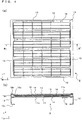
- the solar cell apparatus for use on water 1 may include a spacer 4 provided between adjacent floating bodies 3 to retain joining of the floating bodies 3. The configuration of the solar cell apparatus for use on water 1 will be described next with reference to FIGs. 1 to 4 .
- the floating body 3 includes a main body part 3a in the shape of a hollow box and four joining parts 3b, for example.
- the floating body 3 has a first surface 3a1 and a second surface 3a2 opposite the first surface 3a1.
- the floating body 3 also has a first side surface 3a3 connecting the first surface 3a1 and the second surface 3a2, and a second side surface 3a4 opposite the first side surface 3a3.
- the floating body 3 further has a third side surface 3a5 and a fourth side surface 3a6 opposite the third side surface 3a5.
- the boundary (ridge) between the first surface 3a1 and the first side surface 3a3 is hereinafter defined as a first ridge line 3a8, and the boundary (ridge) between the first surface 3a1 and the second side surface 3a4 is hereinafter defined as a second ridge line 3a9.
- a direction (hereinafter, also referred to as a first direction) parallel to the first ridge line 3a8 of the floating body 3 is defined as an X-axis direction
- a direction (hereinafter, also referred to as a second direction) perpendicular to the X-axis direction and the first side surface 3a3 is defined as a Y-axis direction
- a direction orthogonal to the X-axis direction and the Y-axis direction is defined as a Z-axis direction.
- the solar cell for use on water 1 is floated on a water surface when being used, and thus the Z-axis direction usually corresponds to a vertical direction.
- a direction of the Z-axis direction opposite the direction of gravity is referred to as a +Z-axis direction or an upward direction
- a direction of the Z-axis direction identical to the direction of gravity is referred to as a -Z-axis direction or a downward direction.
- the first surface 3a1 is a rectangular surface, for example, and includes a mounting part 3a7 on which the solar cell module 2 is mounted.
- the mounting part 3a7 is provided to protrude upwards from the first surface 3a1, for example. This enables the solar cell module 2 to be mounted at an angle to the first surface 3a1.
- the solar cell module 2 is fixed to the mounting part 3a7 by a screw and the like.
- the floating body 3 includes joining parts 3b located on the first side surface 3a3 to locate on both sides in the X-axis direction. Description will be made below by taking, as an example, a case where the floating body 3 includes a first joining part 3bA and a second joining part 3bB as a pair of joining parts 3b.
- the first joining part 3bA and the second joining part 3bB each include a first portion 3b1 located on the first side surface 3a3.
- the first joining part 3bA and the second joining part 3bB each also include a second portion 3b2 connected to the first portion 3b1 to face the first side surface.
- the second portion 3b2 is located on a head of the first portion 3b1 in a +Y-axis direction, and extends in the X-axis direction.
- the second portion 3b2 includes an end portion 3b22 farthest from the first portion 3b1.
- the end portion 3b22 of the first joining part 3bA and the end portion 3b22 of the second joining part 3bB face each other.
- the distance between the second portion 3b2 of the first joining part 3bA and the second portion 3b2 of the second joining part 3bB is defined as a first distance D1.
- the first distance D1 is a minimum distance in the X-axis direction.
- the width of the second portion 3b2 in the X-axis direction is defined as a second distance D2.
- the distance between the first portion 3b1 of the first joining part 3bA and the first portion 3b1 of the second joining part 3bB is defined as a third distance D3.
- the pair of joining parts 3b is provided so that the first distance D1 is greater than twice the second distance D2, and is smaller than the third distance D3. Joining of the floating bodies 3 is described later.
- the first portion 3b1 is in the shape of a prism having a center line parallel to the Y-axis direction, for example.
- the first portion 3b1 has a curved peripheral surface having rounded corners as viewed from the Y-axis direction.
- the first portion 3b1 having such configuration allows the solar cell apparatus for use on water 1 to move smoothly about the site of contact between the first portion 3b1 and the spacer 4 when the solar cell apparatus for use on water 1 oscillates due to waves, leading to reduction of cracks of the joining part 3b and the spacer 4.
- the second portion 3b2 of the joining part 3b is in the shape of a prism having a center line parallel to the X-axis direction.
- the second portion 3b2 has a curved peripheral surface having rounded corners as viewed from the X-axis direction.
- the second portion 3b2 having such configuration allows the solar cell apparatus for use on water 1 to move smoothly about the site of contact between the joining parts 3b of the floating bodies 3 joined together when the solar cell apparatus for use on water 1 oscillates due to waves, leading to reduction of cracks of the joining parts 3b.
- the peripheral surfaces of the first portion 3b1 and the second portion 3b2 are not limited to the surfaces having rounded corners.
- the first portion 3b1 and the second portion 3b2 may have chamfered surfaces having chamfered corners.
- the floating body 3 includes a pair of joining parts 3b on the second side surface 3a4 as on the first side surface 3a3.
- One of the pair of joining parts 3b on the second side surface 3a4 located on the same axis as the first joining part 3bA in a direction parallel to the Y-axis direction is defined as a fourth joining part 3bD
- the other one of the pair of joining parts 3b on the second side surface 3a4 located on the same axis as the second joining part 3bB in the direction parallel to the Y-axis direction is defined as a third joining part 3bC.
- the floating body 3 may have, inside the main body part 3a, a hollow portion isolated from outside air.
- the capacity of the hollow portion of the floating body 3 is set so that the waterline is located between the first surface 3a1 and the second surface 3a2 when the solar cell apparatus for use on water 1 is floated on a water surface P.
- the floating body 3 is formed of polyethylene, polypropylene, fiber reinforced plastics (FRP), or the like, for example.
- the floating body 3 is formed of such a material by blow molding.
- the floating body 3 formed of polyethylene has a thickness of approximately 5 mm to 20 mm, for example.
- the size of the floating body 3 is determined in view of the weight or the size of the solar cell module 2 mounted on the floating body 3.
- the floating body 3 may be set to have a length (a size in the Y-axis direction) of approximately 2.1 m to 2.3 m, a width (a size in the X-axis direction) of approximately 1.1 m to 1.3 m, and a height (a size in the Z-axis direction) of approximately 0.2 m to 0.6 m.
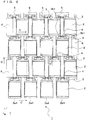
- the pair of joining parts 3b may not be provided on the surface on which the floating bodies 3 are not joined together as illustrated in FIG. 2 .
- the spacers 4 are fitted between floating bodies 3 adjacent to each other in the X-axis direction when a plurality of floating bodies 3 are joined together using pairs of joining parts 3b. With this configuration, the spacers 4 can determine relative positions of the plurality of floating bodies 3 arranged in two dimensions and retain joining of the floating bodies 3.
- Each of the spacers 4 includes a rectangular shank part 4a and a first protruding part 4b provided at one end of the shank part 4a and having a greater width in the X-axis direction than the shank part 4a.
- the spacer 4 is a hollow member.
- a distance D4 corresponding to the width of the shank part 4a in the X-axis direction has a value greater than a value obtained by subtracting twice the second distance D2 from the first distance D1, and smaller than a value obtained by subtracting twice the second distance D2 from the third distance D3. This makes the floating bodies 3 adjacent to each other in the X-axis direction less likely to be disconnected.
- a distance D5 corresponding to the width of the first protruding part 4b in the X-axis direction has a value greater than a value obtained by subtracting twice the second distance D2 from the third distance D3 so that the spacer 4 does not sink more than necessary to cause the first protruding part 4b to be fitted between the adjacent floating bodies 3.
- a lower surface 4b1 of the first protruding part 4b which is located at a shank part 4a side, may slope upwards with respect to the axial direction (Z-axis direction) of the shank part 4a as viewed from the Y-axis direction as illustrated in FIG. 3(b) .
- the shank part 4a and the lower surface 4b1 form an obtuse angle in plan view of the X-Z plane of the spacer 4.
- the lower surface 4b1 may be a curved surface. This can reduce a load put on the floating bodies 3 and the spacers 4 when waves occur in a place where the solar cell apparatus for use on water 1 is installed.
- the spacer 4 may also include a second protruding part 4c provided at the other end of the shank part 4a opposite the end at which the first protruding part 4b is provided and having a greater width in the X-axis direction than the shank part 4a.
- the second protruding part 4c is caught by a lower portion of the floating body 3 when the spacer 4 is attached to the solar cell apparatus for use on water 1. This means that the second protruding part 4c is located to overlap lower surfaces of the joining parts 3b of the adjacent floating bodies 3. This makes the spacer 4 less likely to be disconnected from between the joining parts 3b of the adjacent floating bodies 3.
- the width of the second protruding part 4c in the X-axis direction has a value greater than the fourth distance D4 of the shank part 4a, and smaller than a value obtained by subtracting twice the second distance D2 from the third distance D3. This makes the spacer 4 less likely to be disconnected from between the joining parts 3b of the adjacent floating bodies 3 and more likely to be fitted between the joining parts 3b of the adjacent floating bodies 3.
- the spacer 4 is formed of a similar material and in a similar method to the floating body 3.
- the spacer 4 formed of polyethylene has a thickness of approximately 5 mm to 20 mm, for example.
- the solar cell module 2 includes a solar cell panel 11 and a frame member 12 reinforcing an outer edge portion of the solar cell panel 11.
- the solar cell panel 11 has a first surface (light receiving surface) 11a (corresponding to one surface of a light-transmissive substrate 13) mainly receiving light and a second surface (non-light receiving surface) 11b (corresponding to one surface of a back-surface protective member 17) opposite the first surface 11a.
- the solar cell panel 11 includes in sequence, from a first surface 11a side thereof, the light-transmissive substrate 13 doubling as a substrate of the solar cell module 10, a pair of sealing materials 14 formed of thermosetting resin, and a plurality of solar cell devices 16 electrically connected to one another by inner leads 15.
- the solar cell panel 11 further includes the back-surface protective member 17 protecting a back surface of the solar cell module 2, and a terminal box 18 for extracting output obtained by the solar cell devices 16 to the outside.
- the solar cell panel 11 may receive part of light from a second surface 11b side by forming each of the sealing materials 14 located between the solar cell devices 16 and the back-surface protective member 17 and the back-surface protective member 17 using a light-transmissive material, for example.
- the solar cell devices 16 each include a flat substrate formed of monocrystalline silicon, polycrystalline silicon, or the like, for example. In a case where such a silicon substrate is used, adjacent silicon substrates are electrically connected to one another by the inner leads 15 as described above.
- the type of solar cell devices 16 is not particularly limited, and another type of solar cell devices 16 may be used.
- thin-film solar cells formed of amorphous silicon, CIGS solar cells, CdTe solar cells, the solar cell devices 16 including crystalline silicon substrates and amorphous silicon thin films formed on the crystalline silicon substrates, or the like may be used as the solar cell devices 16.
- the terminal box 18 includes a box body formed of modified polyphenylene ether resin or polyphenylene oxide resin, a terminal plate located inside the box body, and an output cable deriving power to the outside of the box body, for example.
- the frame member 12 has a function of holding the solar cell panel 11.
- the frame member 12 includes a fitting part 12a into which a peripheral portion of the solar cell panel 11 is inserted.
- the frame member 12 further includes a frame first surface 12b located at a sunlight receiving side, a frame flange part 12c located opposite the frame first surface 12b, and a frame side wall part 12d connecting the frame first surface 12b and the frame flange part 12c.
- the frame flange part 12c is a plate-like part protruding from a lower portion of the frame side wall part 12d towards the interior of the solar cell module 2.
- the frame member 12 having such configuration can be manufactured by extruding aluminum and the like, for example.
- a method of joining a plurality of floating bodies 3 of the solar cell apparatus for use on water 1 together will be described next.
- description is made by using a first floating body 3A, a second floating body 3B, and a third floating body 3C as the plurality of floating bodies 3.
- the first floating body 3A and the second floating body 3B are floated on the water surface P to be arranged in the X-axis direction, as illustrated in FIG. 5(a) .
- the first floating body 3A and the second floating body 3B are arranged so that the first joining part 3bA of the first floating body 3A and the second joining part 3bB of the second floating body 3B are in contact with each other.
- the third floating body 3C is floated on the water surface P so that the second side surface 3a4 of the third floating body 3C faces the first side surface 3a3 of the first floating body 3A and the first side surface 3a3 of the second floating body 3B.
- the third floating body 3C is moved closer to the first floating body 3A and the second floating body 3B. Then, the third floating body 3C is arranged so that the first joining part 3bA of the first floating body 3A and the second joining part 3bB of the second floating body 3B are located between the third joining part 3bC and the fourth joining part 3bD of the third floating body 3C.
- first floating body 3A and the second floating body 3B are moved away from each other in a direction parallel to the X-axis direction to cause the first joining part 3bA of the first floating body 3A and the third joining part 3bC of the third floating body 3C to engage with each other, as illustrated in FIG. 5(b) .
- the second joining part 3bB of the second floating body 3B and the fourth joining part 3bD of the third floating body 3C are also caused to engage with each other.
- the spacer 4 is fitted between the first floating body 3A and the second floating body 3B. This prevents the distance between the first floating body 3A and the second floating body 3B from being smaller than the width of the shank part 4a of the spacer 4. As a result, the first floating body 3A, the second floating body 3B, and the third floating body 3C are joined together by the joining parts 3b engaging with each other. As described above, the plurality of floating bodies 3 floated on the water surface P are moved along the water surface P to join the floating bodies 3 together in the present embodiment.
- relative positions of a plurality of floating bodies 3 is determined and engagement of the joining parts 3b is retained using the spacer 4 fitted between adjacent floating bodies 3.
- the positions of the floating bodies 3 can thereby be determined more easily compared to a method of connecting each of the floating bodies 3 to the land and the like using a mooring cable and the like. Ease of installation is thus increased.
- a case where the solar cell apparatus for use on water 1 oscillates due to waves and the like is described next.
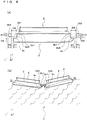
- a case where waves occur along the Y-axis direction is described first with reference FIG. 6(a) .
- the floating bodies 3 joined together along the X-axis direction can individually oscillate with up-and-down movement of the water surface P when waves occur.
- the joining parts 3b of the respective floating bodies 3 joined together can move smoothly about the site of contact between the joining parts 3b. This makes the main body parts 3a and the joining parts 3b less likely to bear an excessive load due to oscillation of the floating bodies 3. Cracks of the floating bodies 3 can thereby be reduced.
- FIG. 6(b) A case where waves occur along the X-axis direction is described next with reference FIG. 6(b) .
- the floating bodies 3 adjacent to each other in the Y-axis direction can individually oscillate with up-and-down movement of the water surface P when waves occur. This similarly makes the floating bodies 3 and the spacers 4 less likely to bear an excessive load, leading to reduction of cracks of the floating bodies 3 and the spacers 4.
- the solar cell apparatus for use on water 1 may include a member other than the solar cell modules 2, floating bodies 3, and the spacers 4.
- the solar cell apparatus for use on water 1 may include first auxiliary floating bodies 5 and second auxiliary floating bodies 6 surrounding the floating bodies 3 joined together, as illustrated in FIG. 2 .
- the first auxiliary floating bodies 5 and the second auxiliary floating bodies 6 are hollow bodies each having a shape corresponding to the shape of only a part of a floating body 3.
- Each of the first auxiliary floating bodies 5 engages with the joining parts 3b of two adjacent floating bodies 3 outside a group of floating bodies 3.
- the adjacent floating bodies 3 are thereby joined together more firmly.
- the second auxiliary floating bodies 6 can be used as places to put electrical equipment, such as a cable and a junction box, or as scaffolds for operators. As described above, the second auxiliary floating bodies 6 improve ease of installation and maintainability of the solar cell apparatus for use on water 1.
- the present embodiment differs from the above-mentioned embodiment in that the floating bodies 3 of the solar cell apparatus for use on water 1 each include a protruding part 3c located on the first side surface 3a3 to be closer to the second surface 3a2 than the pair of joining parts 3b is, as illustrated in FIGs. 7 , 8 , and 9 .
- the protruding part 3c protrudes from a portion of the first side surface 3a3 lower than the joining parts 3b.
- the protruding part 3c may also be located on the second side surface 3a4.
- a distance D6 corresponding to the width of the second portion 3b2 in the Y-axis direction is greater than a distance D7 between the second portion 3b2 and the protruding part 3c in the Y-axis direction, and is smaller than a distance D8 corresponding to the length of the first portion 3b1 in the Y-axis direction.
- a distance D9 corresponding to a gap between the protruding part 3c and the joining part 3b in the Z-axis direction is smaller than a distance D10 corresponding to the width of the joining part 3b in the Z-axis direction, and is greater than zero.
- Each of the distances D6 to D10 indicates a minimum distance.
- the second portion 3b2 includes a curved portion 3b21 connected to the head of the first portion 3b1 and an end portion 3b22 located opposite the curved portion 3b21 in plan view from a first surface 3a1 side as illustrated in FIG. 9 .
- the curved portion 3b21 and the end portion 3b22 may have rounded or chamfered portions 3d at the corners thereof as viewed from the first surface 3a1 side.
- the first floating body 3A is easily rotated towards the second floating body 3B.
- the first joining part 3bA of the first floating body 3A and the second joining part 3bB of the second floating body 3B are thus easily moved closer to each other.
- new floating bodies 3 can easily be joined in sequence to three or more floating bodies 3 fixed by the spacers 4.
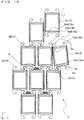
- Lines showing the protruding part 3c are omitted in FIG. 10 .
- the floating body 3 may expand outwards (in the X-axis direction) in the middle of the third side surface 3a5 and the fourth side surface 3a6 as illustrated in FIG. 9 .
- the floating body 3 having such a shape can easily be rotated to move the joining parts 3b of adjacent floating bodies 3 closer to each other as illustrated in FIG. 10 .
- the volume of the floating body 3 increases to thereby increase buoyancy, leading to an increase in stability of the solar cell module 2.
- the third side surface 3a5 and the fourth side surface 3a6 illustrated in FIG. 9 may be polygonal or arcuate in plan view from the Z-axis direction.
- the floating body 3 may have, in the first portions 3b1, dent portions 3e set further back than the third side surface 3a5 and the fourth side surface 3a6 as illustrated in FIGs. 7 and 9 .
- the spacer 4 is thereby less likely to be disconnected from between the first portions 3b1 of the adjacent floating bodies 3.
- the dent portions 3e may be grooves formed in the first portions 3b1 into which the spacer 4 is fitted, for example.
- the solar cell apparatus for use on water 1 may include the solar cell module 2 having a larger size than the first surface 3a1 of the floating body 3. Specifically, the width of the solar cell module 2 in the X-axis direction may be greater than the width of the floating body 3 in the X-axis direction in the present embodiment as illustrated in FIG. 11 .
- the solar cell module 2 is provided to overhang the third side surface 3a5 and the fourth side surface 3a6. With such configuration, an electric power generation region of the solar cell module 2 can be expanded over a gap between the third side surface 3a5 and the fourth side surface 3a6 formed when a plurality of floating bodies 3 are joined together as illustrated in FIG. 12 . The amount of electric power generated by the solar cell apparatus for use on water 1 can thus be increased.
- the first portions 3b1 may be cylindrical as illustrated in FIG. 11 .
- the second portions 3b2 may also be cylindrical. This allows the floating bodies 3 to oscillate smoothly due to waves, leading to reduction of cracks of the floating bodies 3 and the spacers 4.
- the solar cell apparatus for use on water 1 includes a plurality of sub-floating bodies 102 (a sub-first floating body 102A and a sub-second floating body 102B) joined together, and an attachment member 103 connecting the sub-floating bodies 102 together.
- the solar cell apparatus for use on water 1 further includes a plurality of floating bodies 3 joined to the sub-first floating body 102A and the sub-second floating body 102B, the solar cell modules 2 attached to the respective floating bodies 3, and the spacers 4.
- the float device includes a float device including, in addition to the sub-floating bodies 102 and the attachment member 103, members (not illustrated) such as column members fixed in dents of the sub-floating bodies 102 and rigging provided between column members of adjacent sub-floating bodies 2. Configuration of the solar cell apparatus for use on water 1 is described next with reference to FIGs. 13 to 21 .
- the sub-floating body 102 includes a sub-main body part 102a in the shape of a hollow box as well as a first engagement part 102b and a second engagement part 102c provided on opposite sides of the sub-main body part 102a, for example.
- the sub-main body part 102a has a sub-first surface 102a1 and a sub-second surface 102a2 opposite the sub-first surface 102a1.
- the sub-main body part 102a also has a sub-first side surface 102a3 connecting the sub-first surface 102a1 and the sub-second surface 102a2, and a sub-second side surface 102a4 opposite the sub-first side surface 102a3.
- the sub-main body part 102a also has a sub-third side surface 102a5 connecting the sub-first side surface 102a3 and the sub-second side surface 102a4, and a sub-fourth side surface 102a6 opposite the sub-third side surface 102a5.
- the boundary (ridge) between the sub-first surface 102a1 and the sub-first side surface 102a3 is hereinafter defined as a sub-first ridge line 102a7
- the boundary (ridge) between the sub-first surface 102a1 and the sub-second side surface 102a4 is hereinafter defined as a sub-second ridge line 102a8.
- a direction (hereinafter, also referred to as the first direction) perpendicular to the sub-first side surface 102a3 of the sub-floating body 102 is defined as the X-axis direction
- a direction (hereinafter, also referred to as the second direction) parallel to the sub-first ridge line 102a7 of the sub-floating body 102 is defined as the Y-axis direction
- a direction (hereinafter, also referred to as a third direction) orthogonal to the X-axis direction and the Y-axis direction is defined as the Z-axis direction.
- the direction of the Z-axis direction opposite the direction of gravity is referred to as the +Z-axis direction or the upward direction
- the direction of the Z-axis direction identical to the direction of gravity is referred to as the -Z-axis direction or the downward direction.
- the sub-first surface 102a1 is a surface located above the waterline when the sub-floating body 102 is floated on the water surface P, and a surface on which operators walk when the sub-floating bodies 102 are joined together to be used as pontoons.
- the sub-second surface 102a2 is a surface opposite the sub-first surface 102a1, and a surface located below the waterline when the sub-floating body 102 is floated on the water surface P.
- the sub-floating body 102 includes the first engagement part 102b provided on the sub-first side surface 102a3 and the second engagement part 102c provided on the sub-second side surface 102a4.
- the engagement parts of the sub-floating body 102 are described in detail next.
- the first engagement part 102b includes a first recessed portion 102b1 in which a part of the sub-first surface 102a1 and a part of the sub-first side surface 102a3 are recessed continuously in the middle of the sub-first ridge line 102a7.
- the first recessed portion 102b1 has a bottom surface 102b2 having a depth in the Z-axis direction located between the sub-first surface 102a1 and the sub-second surface 102a2.
- the bottom surface 102b2 expands in the same direction as the sub-first surface 102a1.
- the first recessed portion 102b1 has a first side wall 102b3, a second side wall 102b4, and a third side wall 102b5 each connecting the bottom surface 102b2 and the sub-first surface 102a1.
- the first side wall 102b3 is located in a direction parallel to the sub-first side surface 102a3, the second side wall 102b4 is located in a direction parallel to the sub-third side surface 102a5, and the third side wall 102b5 is located in a direction parallel to the sub-fourth side surface 102a6.
- the sub-first surface 102a1 has two dents 102b6 elongated in the Y-axis direction.
- one of the dents 102b6 is provided in a portion of the sub-first surface 102a1 located between the second side wall 102b4 and the sub-third side surface 102a5.
- the other one of the dents 102b6 is provided in a portion of the sub-first surface 102a1 located between the third side wall 102b5 and the fourth side surface 102a6.
- Each of the dents 102b6 includes, at the bottom thereof, a female screw portion 102b9 at a position corresponding to a through-hole 103b of the attachment member 3 described later.
- the female screw portion 102b9 includes an insert nut fitted in a circular recessed portion of the dent 102b6.
- the width and the depth of each of the dents 102b6 are set so that the attachment member 103, which is described later, does not protrude when the attachment member 103 is disposed along the dents 102b6.
- the second engagement part 102c includes a protruding portion 102c1 provided to protrude from the sub-second side surface 102a4 along the X-axis direction. More specifically, the protruding portion 102c1 is located on the sub-second side surface 102a4 of the sub-floating body 102 at a position corresponding to a portion opposite the first recessed portion 102b1. An upper surface of the second engagement part 102c corresponds to an expanded portion of the sub-first surface 102a1. A lower surface of the second engagement part 102c is a surface protruding from a portion of the sub-second side surface 102a4 located between the sub-first surface 102a1 and the sub-second surface 102a2.
- the protruding portion 102c1 of the second engagement part 102c is formed to be smaller than the first recessed portion 102b1 of the first engagement part 102b. This enables the protruding portion 102c1 to be fitted into the first recessed portion 102b1 to join the first engagement part 102b and the second engagement part 102c together.
- the second engagement part 102c further includes, in the sub-first surface 102a1 of the protruding portion 102c1, a groove portion 102c2 reaching opposite ends of the protruding portion 102c1 in the Y-axis direction.
- the groove portion 102c2 is formed along the second direction (Y-axis direction).
- the groove portion 102c2 is formed to be larger than the dents 102b6 and the attachment member 103, which is described later, as viewed from the first direction (X-axis direction).
- the sub-floating body 102 may include, inside the sub-main body part 102a, a hollow portion isolated from outside air.
- the sub-floating body 102 includes the hollow portion to have buoyancy.
- the capacity of the hollow portion of the sub-floating body 102 is set so that the waterline is located between the sub-first surface 102a1 and the sub-second surface 102a2 when the sub-floating body 102 on which a weight at least corresponding to an average weight of adult men is put is floated on the water surface P.
- ballast a weight
- the sub-floating body 102 is formed of polyethylene, polypropylene, fiber reinforced plastics (FRP), or the like, for example.
- the floating body 2 can be formed of such a material by blow molding.
- the sub-floating body 102 formed of polyethylene has a thickness of approximately 5 mm to 20 mm, for example.
- the size of the sub-floating body 102 is determined in view of stability of an operator walking on the sub-floating body 102 and an allowable area of the water surface not contributing to electric power generation. The operator can usually walk more stably on the sub-floating body 102 having a larger area of the sub-first surface 102a1.
- An upper surface 2a1 of the sub-floating body 102 thus may have a width (a size in the X-axis direction) of approximately 1.4 m to 1.6 m, a length (a size in the Y-axis direction) of approximately 0.8 m to 1.2 m, and a height (a size in the Z-axis direction) of approximately 0.3 m to 0.6 m.
- the attachment member 103 is a member used to join two adjacent sub-floating bodies 102 together along the longitudinal direction in which the sub-floating bodies 102 are arranged end to end as illustrated in FIGs. 14 and 15 .
- the attachment member 103 is a rod-like member attached by being fitted into the dents 102b6 of one of the sub-floating bodies 102 and the groove portion 102c2 of the other one of the sub-floating bodies 102.
- FIG. 14 illustrates, as an example of the attachment member 103, an elongated plate-like body having through-holes 103b into which screws 7 can be inserted in opposite end portions 103a thereof.
- the sub-first floating body 102A and the sub-second floating body 102B are positioned so that the dents 102b6 of the sub-first floating body 102A and the groove portion 102c2 of the sub-second floating body 102B are aligned along the Y-axis direction.
- the opposite end portions 103a of the attachment member 103 are located in the dents 102b6 of the sub-first floating body 102A, and then a middle portion 103c of the attachment member 103 is located in the groove portion 102c2 of the sub-second floating body 102B.
- the opposite end portions 103a of the attachment member 103 are fixed to the female screw portions 102b9 of the dents 102b6 of the sub-first floating body 102A using the screws 7.
- the attachment member 103 is fixed to the sub-first floating body 102A with a gap between the attachment member 103 and an inner wall 102c21 of the groove portion 102c2.
- This allows the sub-first floating body 102A and the sub-second floating body 102B to follow waves, walking of the operator, or the like while retaining joining thereof if the sub-first floating body 102A and the sub-second floating body 102B oscillate at different angles and the like due to the waves, walking of the operator, or the like.
- the sub-first floating body 102A and the sub-second floating body 102B can thus oscillate in conjunction with ruffles on the water surface P. As a result, cracks at a joint between the sub-first floating body 102A and the sub-second floating body 102B can be reduced.
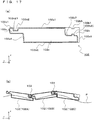
- the sub-first floating body 102A and the sub-second floating body 102B may be configured not to be disconnected from each other when the sub-second floating body 102B sinks more than the sub-first floating body 102A does due to the action of waves on the sub-floating bodies 102, for example.
- the sub-first floating body 102A may be configured not to be disconnected from the sub-second floating body 102B and move in the first direction (X-axis direction).
- X-axis direction For example, it is assumed that the sub-first floating body 102A and the sub-second floating body 102B are joined together using the attachment member 103 as illustrated in FIG. 15(c) .
- a distance between the first engagement part 102b of the sub-first floating body 102A and the second engagement part 102c of the sub-second floating body 102B in a direction parallel to the third direction (Z-axis direction) is defined as a distance S1.
- a distance between the sub-first surface 102a1 of the sub-second floating body 102B and an upper surface of the attachment member 103 in the direction parallel to the third direction (Z-axis direction) is defined as a distance S2.
- the distance S1 may be smaller than the distance S2. This makes the sub-first floating body 102A and the sub-second floating body 102B less likely to be disconnected from each other.
- the attachment member 103 can be formed of polyethylene, polypropylene, fiber reinforced plastics (FRP), or the like.
- the attachment member 103 may be formed of metal less prone to corrosion, such as an aluminum alloy or stainless steel, in view of rust prevention.
- the solar cell apparatus for use on water 1 includes the sub-floating bodies 102, the attachment members 103, the floating bodies 3, the solar cell modules 2, and the spacers 4.
- the plurality of sub-floating bodies 102 and the plurality of floating bodies 3 are arranged on water.
- the plurality of sub-floating bodies 102 are joined together using the attachment members 103 after the second engagement part 102c of one of the sub-floating bodies 102 is fitted into the first engagement part 102b of another one of the sub-floating bodies 102.
- the plurality of floating bodies 3 to which the respective solar cell modules 2 have been attached are arranged longitudinally and laterally with their joining parts 3b being connected to each other.
- the spacers 4 are fitted between the adjacent floating bodies 3 to determine the gaps between the floating bodies 3 and retain connection between the floating bodies 3. This makes the plurality of floating bodies 3 less likely to move excessively.
- the solar cell modules 2 mounted on the respective floating bodies 3 are electrically connected to one another.
- a group of the plurality of sub-floating bodies 102 arranged end to end and a group of the plurality of floating bodies 3 arranged in two dimensions can be arranged to be adjacent to each other, and fixed using rigging 19 and the like, for example. This allows an operator to use the sub-floating bodies 102 of the solar cell apparatus for use on water 1 as pontoons to maintain or install the solar cell modules 2.
- the first engagement part 102b of the sub-first floating body 102A and the second engagement part 102c of the sub-second floating body 102B vertically overlap each other.
- the first engagement part 102b of the sub-first floating body 102A supports the second engagement part 102c of the sub-second floating body 102B from below.
- Portions of the sub-first surface 102a1 at opposite sides of the first engagement part 102b of the sub-first floating body 102A are located to sandwich the second engagement part 102c of the sub-second floating body 102B as viewed from the Z-axis direction.
- the attachment member 103 fixed to the sub-first surface 102a1 of the sub-first floating body 102A is inserted into the groove portion 102c2 of the sub-second floating body 102B.
- the individual sub-floating bodies 102 can independently smoothly follow waves occurring on the water surface. This can reduce a load put on a joint between the first engagement part 2b and the second engagement part 2c of the sub-floating bodies 102, leading to reduction of cracks of the floating bodies 2.
- the present embodiment differs from the above-mentioned embodiment in that the first engagement part 102b of the sub-floating body 102 includes second recessed portions 102b7 deeper than the first recessed portion 102b1 as illustrated in FIG. 17 .
- the first engagement part 102b includes the second recessed portions 102b7 located to sandwich the bottom surface 102b2 of the first recessed portion 102b1 in the X-axis direction and being deeper than the bottom surface 102b2.
- the second engagement part 102c of any one of the sub-floating bodies 102 can rotate around the first recessed portion 102b1 of another one of the sub-floating bodies 102 along the X-Z plane within a greater range.
- the individual sub-floating bodies 102 smoothly follow the waves along the water surface P, leading to reduction of a load put on the sub-floating bodies 102.
- the present embodiment differs from the above-mentioned embodiment in configuration of the first engagement part 102b and the second engagement part 102c as illustrated in FIG. 18 .
- the first recessed portion 102b1 of the first engagement part 102b includes a first narrow portion 102b10 located closer to the sub-first side surface 102a3 and a first non-narrow portion 102b11 located closer to the sub-second side surface 102a4.
- the second engagement part 102c includes a second narrow portion 102c3 located closer to the sub-second side surface 102a4 and a second non-narrow portion 102c4 located opposite the second narrow portion 102c3.
- the narrow portion herein refers to a portion having a relatively small width
- the non-narrow portion herein refers to a portion having a relatively great width.
- the first recessed portion 102b1 of the first engagement part 102b includes portions having different widths in the Y-axis direction in the present embodiment.
- the protruding portion 102c1 of the second engagement part 102c also includes portions having different widths in the Y-axis direction.
- a width D1 of the first narrow portion 102b10 in the Y-axis direction (second direction) is greater than a width D2 of the second narrow portion 102c3 in the Y-axis direction as illustrated in FIG. 18 .
- a width D3 of the first non-narrow portion 102b11 in the Y-axis direction is greater than a width D4 of the second non-narrow portion 102c4 in the Y-axis direction.
- the protruding portion 102c1 of the sub-first floating body 102A is inserted into the first recessed portion 102b1 of the sub-second floating body 102B, for example, there is a clearance in the X-axis direction and the Y-axis direction between the sub-first floating body 102A and the sub-second floating body 102B while joining of the sub-first floating body 102A and the sub-second floating body 102B is retained in the present embodiment.
- the sub-first floating body 102A and the sub-second floating body 102B thus easily follow movement of the water surface and oscillate without disconnecting the protruding portion 102c1 from the first recessed portion 102b1 if strong waves occur in the present embodiment. As a result, occurrence of cracks in the sub-floating bodies 102 caused by strong waves can be reduced.
- the first engagement part 102b and the second engagement part 102c move more smoothly when they have rounded or chamfered corners.
- a length L1 of the first narrow portion 102b10 in the X-axis direction is smaller than a length L2 of the second narrow portion 102c3 in the X-axis direction as illustrated in FIG. 18 .
- a length L3 of the first non-narrow portion 102b11 in the X-axis direction is greater than a length L4 of the second non-narrow portion 102c4 in the X-axis direction.
- the protruding portion 102c1 of the sub-first floating body 102A is inserted into the first recessed portion 102b1 of the sub-second floating body 102B, for example, the protruding portion 102c1 can move inside the first recessed portion 102b1 in the X-axis direction while joining of the sub-first floating body 102A and the sub-second floating body 102B is retained.
- the sub-first floating body 102A and the sub-second floating body 102B can move in the X-axis direction within a region corresponding to the difference between the length L4 and the length L3.
- the sub-first floating body 102A and the sub-second floating body 102B can thus be moved in conjunction with waves within the above-mentioned region, leading to reduction of force put on the first engagement part 102b and the second engagement part 102c in the present embodiment.
- cooperation parts 102d used for connection to the floating bodies 3 may be provided on the sub-third side surface 102a5 of the sub-floating body 102 as illustrated in FIG. 19 .
- the cooperation parts 102d of the sub-floating bodies 102 having similar shapes to the joining parts 3b of the floating bodies 3 facilitate joining of the floating bodies 3 and the sub-floating bodies 102, leading to improvement in operability.
- the cooperation parts 102d used for connection to the floating bodies 3 may be provided also on the sub-fourth side surface 102a6.
- the height of the sub-first surface 102a1 can be lowered at and around the positions corresponding to the dents 102b6 as illustrated in FIG. 20 .
- the sub-floating body 102 may include a U-shaped receiving part for accommodating a cable connecting the solar cell modules 2.
- the sub-floating body 102 may further include a recessed portion for fixing electrical equipment, such as a power conditioner.
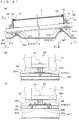
- the present embodiment differs from the above-mentioned embodiment in that the solar cell module 2 is fixed to support members 21 attached onto the mounting parts 3a7 of the floating body 3 and a rail member 20 held on the support members 21 as illustrated in FIG. 21 .
- the floating body 3 includes the support members 21 attached to the respective two mounting parts 3a7, the rail member 20 attached onto the support members 21, a cover member 22 holding the rail member 20 on the support member 21, and seizing members 23 fixing the solar cell module 2 onto the rail member 20.
- the support members 21 are members fixed to the mounting parts 3a7 of the floating body 3 to support the rail member 20.
- the support members 21 each include a support surface 21a supporting the rail member 20 from below and a grasping part 21b grasping a rib provided to the mounting part 3a7 of the floating body 3.
- One of the support members 21 is hereinafter defined as a first support member 21A, and the other one of the support members 21 is hereinafter defined as a second support member 21B.
- the rail member 20 is a square-pipe like rod member, and is an elongated member including two flange parts 20a protruding from a lower portion thereof in a direction orthogonal to the longitudinal direction thereof.
- the rail member 20 is mounted to span the first support member 21A and the second support member 21B.
- the rail member 20 is fixed at one end portion mounted on the first support member 21A using a screw 70 penetrating the rail member 20 and the first support member 21A.
- the rail member 20 is held, at the other end portion mounted on the second support member 21B, by the cover member 22 pressing the flange parts 20a onto the support surface 21a of the second support member 21B.
- the cover member 22 includes a hanging part 22a pressing the rail member 20 onto the support surface 21a of the second support member 21B and a mounting part 22b being in contact with the support surface 21a, and is fixed using a screw 70 penetrating the support surface 21a and the mounting part 22b.
- the solar cell module 2 is fixed by being pressed by the seizing members 23 attached onto the rail member 20 using the screws 70.
- the cover member 22 presses the flange parts 20a in a direction of the support surface 21a using the hanging part 22a hanging the flange parts 20a of the rail member 20.
- the distance between the hanging part 22a and the mounting part 22b of the cover member 22 being in contact with the support surface 21a in a direction perpendicular to the support surface 21a is greater than the thickness of each of the flange parts 20a.
- the gap between the hanging part 22a and the flange parts 20a is approximately 1 mm, for example.
- the rail member 20 can move in the longitudinal direction thereof at a side held by the second support member 21B.
- One end of the rail member 20 is fixed at a first support member 21A side, and the other end of the rail member 20 is supported to be movable along the longitudinal direction of the rail member 20 at a second support member 21B side.
- the solar cell module 2 can be supported while allowing deformation of the floating body 3 or the rail member 20 due to thermal expansion or thermal contraction or by external force. This can reduce dropping off of the solar cell module 2 and can reduce a load put on the solar cell module 2.
- Such configuration of the solar cell apparatus for use on water 1 is especially effective in a case where the floating body 3 is formed of a resin material having a high coefficient of thermal expansion.
Landscapes
- Engineering & Computer Science (AREA)
- Chemical & Material Sciences (AREA)
- Mechanical Engineering (AREA)
- Combustion & Propulsion (AREA)
- Life Sciences & Earth Sciences (AREA)
- Physics & Mathematics (AREA)
- Sustainable Development (AREA)
- Sustainable Energy (AREA)
- Thermal Sciences (AREA)
- General Engineering & Computer Science (AREA)
- Ocean & Marine Engineering (AREA)
- Structural Engineering (AREA)
- Civil Engineering (AREA)
- Architecture (AREA)
- Photovoltaic Devices (AREA)
Claims (12)
- Schwimmervorrichtung, die einen Schwimmkörper (3) aufweist, wobeider Schwimmkörper (3) aufweist:einen Hauptkörperteil (3a) aufweisend eine erste Fläche (3a1), eine zweite Fläche (3a2) gegenüber der ersten Fläche (3a1), eine erste Seitenfläche (3a3), die die erste Fläche (3a1) und die zweite Fläche (3a2) verbindet, und eine zweite Seitenfläche (3a4) gegenüber der ersten Seitenfläche (3a3), undeinen ersten Verbindungsteil (3bA) und einen zweiten Verbindungsteil (3bB), die auf der ersten Seitenfläche (3a3) angeordnet sind, um sich auf beiden Seiten in einer ersten Richtung parallel zu einer Gratlinie (3a8) zu befinden, die durch die erste Fläche (3a1) und die erste Seitenfläche (3a3) definiert ist,der erste Verbindungsteil (3bA) und der zweite Verbindungsteil (3bB) jeweils einen ersten Abschnitt (3b1), der auf der ersten Seitenfläche (3a3) angeordnet ist, und einen zweiten Abschnitt (3b2), der mit dem ersten Abschnitt (3b1) verbunden ist, um der ersten Seitenfläche (3a3) zugewandt zu sein, aufweisen,der zweite Abschnitt (3b2) einen Endabschnitt (3b22) aufweist, der am weitesten von dem ersten Abschnitt (3b1) entfernt ist,ein Endabschnitt (3b22) des ersten Verbindungsteils (3bA) und ein Endabschnitt (3b22) des zweiten Verbindungsteils (3bB) einander zugewandt sind, undein minimaler Abstand D1 zwischen dem Endabschnitt (3b22) des ersten Verbindungsteils (3bA) und dem Endabschnitt (3b22) des zweiten Verbindungsteils (3bB) größer ist als das Doppelte einer Breite D2 des zweiten Abschnitts (3b2) des ersten Verbindungsteils (3bA) in der ersten Richtung und kleiner ist als ein minimaler Abstand D3 zwischen dem ersten Abschnitt (3b1) des ersten Verbindungsteils (3bA) und dem ersten Abschnitt (3b1) des zweiten Verbindungsteils (3bB), undein dritter Verbindungsteil (3bC) und ein vierter Verbindungsteil (3bD) sich auf der zweiten Seitenfläche (3a4) befinden, wie der erste Verbindungsteil (3bA) und der zweite Verbindungsteil (3bB) sich auf der ersten Seitenfläche (3a3) befinden, wobei der vierte Verbindungsteil (3bD) auf der gleichen Achse in einer Richtung senkrecht zu der ersten Seitenfläche (3a3) wie der erste Verbindungsteil (3bA) angeordnet ist, und der dritte Verbindungsteil (3bC) auf der gleichen Achse in einer Richtung senkrecht zu der ersten Seitenfläche (3a3) wie der zweite Verbindungsteil (3bB) angeordnet ist.
- Schwimmervorrichtung gemäß Anspruch 1, wobei
der Endabschnitt (3b22) zumindest teilweise eine gekrümmte Fläche aufweist. - Schwimmervorrichtung gemäß Anspruch 1 oder 2, wobei
der Schwimmkörper (3) ferner aufweist:
einen vorstehenden Teil (3c), der auf der ersten Seitenfläche (3a3) angeordnet ist, um näher bei der zweiten Fläche (3a2) als der erste Verbindungsteil (3bA) und der zweite Verbindungsteil (3bB) zu sein, und
eine Länge des zweiten Abschnitts (3b2) in einer zweiten Richtung senkrecht zu der ersten Seitenfläche (3a3) und der ersten Richtung größer als ein Abstand zwischen dem zweiten Abschnitt (3b2) und dem vorstehenden Teil (3c) in der zweiten Richtung ist, und kleiner als eine Länge des ersten Abschnitts (3b1) in der zweiten Richtung ist. - Schwimmervorrichtung gemäß Anspruch 3, wobei
die vorstehenden Teile (3c) jeweils außerhalb eines Bereichs zwischen dem Endabschnitt (3b22) des ersten Verbindungsteils (3bA) und dem Endabschnitt (3b22) des zweiten Verbindungsteils (3bB) in der ersten Richtung angeordnet sind. - Schwimmervorrichtung gemäß irgendeinem der Ansprüche 1 bis 4, wobei
eine Umfangsfläche des zweiten Abschnitts (3b2) eine gekrümmte Fläche ist. - Schwimmervorrichtung gemäß irgendeinem der Ansprüche 1 bis 5, ferner aufweisend:einen ersten Unter-Schwimmkörper (102A) und einen zweiten Unter-Schwimmkörper (102B), die mit dem Schwimmkörper (3) verbunden sind, undein Befestigungselement (103), das den ersten Unter-Schwimmkörper (102A) und den zweiten Unter-Schwimmkörper (102B) entlang einer Längsrichtung miteinander verbindet, in der der erste Unter-Schwimmkörper (102A) und der zweite Unter-Schwimmkörper (102B) Ende an Ende angeordnet sind, wobeider erste Unter-Schwimmkörper (102A) und der zweite Unter-Schwimmkörper (102B) jeweils aufweisen:einen Unter-Hauptkörperteil (102a) aufweisend eine erste Unter-Fläche (102al), eine zweite Unter-Fläche (102a2) gegenüber der ersten Unter-Fläche (102a1), eine erste Unter-Seitenfläche (102a3) und eine zweite Unter-Seitenfläche (102a4) gegenüber der ersten Unter-Seitenfläche (102a3),einen ersten Eingriffsteil (102b), der einen ersten vertieften Abschnitt (102b1) aufweist, in dem ein Teil der ersten Unter-Fläche (102a1) und ein Teil der ersten Unter-Seitenfläche (102a3) kontinuierlich vertieft sind, undeinen zweiten Eingriffsteil (102c), der einen vorstehenden Abschnitt (102c1), der sich auf der zweiten Unter-Seitenfläche (102a4) an einer Position befindet, die einem Abschnitt gegenüber dem ersten vertieften Abschnitt (102b1) entspricht, und einen Nutabschnitt (102c2) aufweist, der sich in einer oberen Fläche des vorstehenden Abschnitts (102c1) befindet,der zweite Unter-Schwimmkörper (102B) mit dem ersten Unter-Schwimmkörper (102A) verbunden ist, wobei der vorstehende Abschnitt (102c1) des zweiten Unter-Schwimmkörpers (102B) über einer unteren Fläche (102b2) des ersten vertieften Abschnitts (102b1) des ersten Unter-Schwimmkörpers (102A) angeordnet ist, und das Befestigungselement (103) in dem Nutabschnitt (102c2) angeordnet ist, unddas Befestigungselement (103) an dem ersten Unter-Schwimmkörper (102A) mit einem Spalt zwischen dem Befestigungselement (103) und einer Innenwand des Nutabschnitts (102c2) befestigt ist.
- Schwimmervorrichtung gemäß Anspruch 6, wobei
der erste Eingriffsteil (102b) ferner in der Längsrichtung aufweist:einen ersten vertieften Abschnitt (102b1), der unter dem Befestigungselement (103) des ersten vertieften Abschnitts (102b1) angeordnet ist, undzweite vertiefte Abschnitte (102b7), die angeordnet sind, um die untere Fläche (102b2) des ersten vertieften Abschnitts (102b1) sandwichartig aufzunehmen, und die tiefer als der erste vertiefte Abschnitt (102b1) sind. - Schwimmervorrichtung gemäß Anspruch 6 oder 7, wobeider erste vertiefte Abschnitt (102bl) des ersten Eingriffsteils (102b) einen ersten schmalen Abschnitt (102b10), der näher bei der ersten Unter-Seitenfläche (102a3) liegt, und einen ersten nicht schmalen Abschnitt (102b11), der näher bei der zweiten Unter-Seitenfläche (102a4) liegt, aufweist,der vorstehende Abschnitt (102c1) des zweiten Eingriffsteils (102c) einen zweiten schmalen Abschnitt (102c3), der näher bei der zweiten Unter-Seitenfläche (102a4) angeordnet ist, und einen zweiten nicht schmalen Abschnitt (102c4), der gegenüber dem zweiten schmalen Abschnitt (102c3) angeordnet ist, aufweist, undeine maximale Breite D1 des ersten schmalen Abschnitts (102b10) in einer Querrichtung orthogonal zu der Längsrichtung größer ist als eine maximale Breite D2 des zweiten schmalen Abschnitts (102c3) in der Querrichtung, und eine maximale Breite D3 des ersten nicht schmalen Abschnitts (102b11) in der Querrichtung größer ist als eine maximale Breite D4 des zweiten nicht schmalen Abschnitts (102c4) in der Querrichtung.
- Schwimmervorrichtung gemäß Anspruch 8, wobei
eine maximale Länge L1 des ersten schmalen Abschnitts (102b10) in der Längsrichtung kleiner ist als eine maximale Länge L2 des zweiten schmalen Abschnitts (102c3) in der Längsrichtung, und eine maximale Länge L3 des ersten nicht schmalen Abschnitts (102b11) in der Längsrichtung größer ist als eine maximale Länge L4 des zweiten nicht schmalen Abschnitts (102c4) in der Längsrichtung. - Solarzellenvorrichtung zur Verwendung auf dem Wasser, aufweisend:eine Mehrzahl von Schwimmervorrichtungen gemäß Anspruch 1, die angeordnet und miteinander verbunden sind, undSolarzellenmodule (2), die auf den Schwimmervorrichtungen auf den ersten Flächen (3a1) montiert sind.
- Solarzellenvorrichtung zur Verwendung auf dem Wasser gemäß Anspruch 10, wobeidie Schwimmkörper (3) einen ersten Schwimmkörper (3A) und einen zweiten Schwimmkörper (3B) aufweisen, die in der ersten Richtung angeordnet sind, unddie Solarzellenvorrichtung zur Verwendung auf dem Wasser ferner einen Abstandshalter (4) aufweist, der zwischen dem ersten Verbindungsteil (3bA) des ersten Schwimmkörpers (3A) und dem zweiten Verbindungsteil (3bB) des zweiten Schwimmkörpers (3B) angeordnet ist.
- Solarzellenvorrichtung zur Verwendung auf dem Wasser gemäß Anspruch 11, wobei
der Abstandshalter (4) aufweist:einen Schaftteil (4a), der zwischen dem ersten Verbindungsteil (3bA) des ersten Schwimmkörpers (3A) und dem zweiten Verbindungsteil (3bB) des zweiten Schwimmkörpers (3B) angeordnet ist,einen ersten vorstehenden Teil (4b), der auf einem oberen Abschnitt des Schaftteils (4a) angeordnet ist, um eine obere Fläche des ersten Verbindungsteils (3bA) des ersten Schwimmkörpers (3A) und eine obere Fläche des zweiten Verbindungsteils (3bB) des zweiten Schwimmkörpers (3B) zu überlappen, undeinen zweiten vorstehenden Teil (4c), der auf einem unteren Abschnitt des Schaftteils (4a) angeordnet ist, um eine untere Fläche des ersten Verbindungsteils (3bA) des ersten Schwimmkörpers (3A) und eine untere Fläche des zweiten Verbindungsteils (3bB) des zweiten Schwimmkörpers (3B) zu überlappen, undeine untere Fläche (4b1) des ersten vorstehenden Teils (4b) relativ zu einer Axialrichtung des Schaftteils (4a) nach oben geneigt ist.
Applications Claiming Priority (3)
| Application Number | Priority Date | Filing Date | Title |
|---|---|---|---|
| JP2015037639 | 2015-02-27 | ||
| JP2015068943 | 2015-03-30 | ||
| PCT/JP2016/055667 WO2016136891A1 (ja) | 2015-02-27 | 2016-02-25 | フロート装置および水上用太陽電池装置 |
Publications (3)
| Publication Number | Publication Date |
|---|---|
| EP3263439A1 EP3263439A1 (de) | 2018-01-03 |
| EP3263439A4 EP3263439A4 (de) | 2018-10-10 |
| EP3263439B1 true EP3263439B1 (de) | 2021-03-24 |
Family
ID=56788838
Family Applications (1)
| Application Number | Title | Priority Date | Filing Date |
|---|---|---|---|
| EP16755635.6A Active EP3263439B1 (de) | 2015-02-27 | 2016-02-25 | Schwimmvorrichtung und auf wasser nutzbares solarzellenmodul |
Country Status (4)
| Country | Link |
|---|---|
| US (1) | US10266236B2 (de) |
| EP (1) | EP3263439B1 (de) |
| JP (1) | JP6538817B2 (de) |
| WO (1) | WO2016136891A1 (de) |
Families Citing this family (20)
| Publication number | Priority date | Publication date | Assignee | Title |
|---|---|---|---|---|
| JP7132477B2 (ja) * | 2017-09-29 | 2022-09-07 | キョーラク株式会社 | フロート及びフロート集合体 |
| US11050382B2 (en) | 2017-05-31 | 2021-06-29 | Kyoraku Co., Ltd. | Float aggregate |
| JP7062676B2 (ja) * | 2017-09-12 | 2022-05-06 | シャープ株式会社 | 太陽電池モジュールの水上設置用支持装置および水上太陽光発電システム |
| NL2019956B1 (en) * | 2017-11-22 | 2019-05-29 | Oceans Of Energy B V | array of pontoons for solar panel and connection modules therefor |
| JP7114716B2 (ja) | 2018-01-03 | 2022-08-08 | ハダル, インコーポレイテッド | ブイおよびブイネットワークの段階的展開 |
| FR3077556B1 (fr) * | 2018-02-06 | 2020-11-06 | William Kosak | Station automatisee flottante de lavage de bateaux a flot |
| SG10201803348WA (en) * | 2018-04-20 | 2019-11-28 | Housing And Dev Board | Floatable structure and system |
| JP2021525289A (ja) * | 2018-05-28 | 2021-09-24 | ボレアリス エージー | 光起電(pv)モジュール用装置 |
| MY201202A (en) * | 2019-01-18 | 2024-02-09 | Univ Tenaga Nasional | Modular floating solar apparatus |
| DE102019111888A1 (de) * | 2019-05-07 | 2020-11-12 | Robert Zimmermann | Schwimmträgervorrichtung |
| CN110328319B (zh) * | 2019-06-29 | 2020-12-01 | 徐州中伦光伏材料有限公司 | 一种稳定好的光伏面板边框铆压装置 |
| NO347181B1 (en) * | 2020-06-30 | 2023-06-19 | Moss Maritime As | Floating solar power plant |
| KR102313722B1 (ko) * | 2020-12-24 | 2021-10-19 | (주)테크윈 | 수상태양광 발전용 부유 구조물 |
| DE102021113729A1 (de) | 2021-05-27 | 2022-12-01 | Paxos Consulting & Engineering GmbH & Co. KG | Schwimmende Solarenergiegewinnungsvorrichtung |
| CN113612440B (zh) * | 2021-07-27 | 2023-04-07 | 阳光新能源开发股份有限公司 | 光伏浮体方阵位置监测方法、系统、计算设备及存储介质 |
| CN114313129A (zh) * | 2022-02-09 | 2022-04-12 | 阳光水面光伏科技有限公司 | 一种漂浮方阵及漂浮式光伏系统 |
| CN114872849A (zh) * | 2022-05-05 | 2022-08-09 | 阳光水面光伏科技有限公司 | 漂浮系统和漂浮式光伏电站 |
| CN115107941A (zh) * | 2022-06-29 | 2022-09-27 | 阳光水面光伏科技有限公司 | 一种漂浮方阵结构及水面光伏系统 |
| WO2024055827A1 (zh) * | 2022-09-15 | 2024-03-21 | 夏尔特拉(上海)新能源科技有限公司 | 无镂空漂浮浮岛及漂浮式光伏系统 |
| CN117238992A (zh) * | 2023-09-05 | 2023-12-15 | 上迈(镇江)新能源科技有限公司 | 一种具有浮体效果的光伏组件及其集成安装结构 |
Family Cites Families (17)
| Publication number | Priority date | Publication date | Assignee | Title |
|---|---|---|---|---|
| NL6801097A (de) * | 1967-01-30 | 1968-07-31 | ||
| US3691974A (en) * | 1970-03-03 | 1972-09-19 | Twin City Shipyard Inc | Portable barge |
| US3805721A (en) * | 1972-06-26 | 1974-04-23 | Robishaw Eng Inc | Float connection apparatus |
| US3925991A (en) * | 1974-07-24 | 1975-12-16 | John M Poche | Floating oil fence |
| US4487151A (en) * | 1982-05-14 | 1984-12-11 | Salvatore Deiana | Floating highway |
| DE3630411A1 (de) * | 1985-09-10 | 1987-09-03 | Horst Peter Dollinger | Schwimmfaehiger koerper |
| US6470820B1 (en) * | 2000-01-28 | 2002-10-29 | Cdi Corporation | Interlocking system, apparatus and method for connecting modules |
| JP5073192B2 (ja) * | 2005-10-12 | 2012-11-14 | タキロン株式会社 | フロート装置 |
| CN1986325A (zh) * | 2005-12-20 | 2007-06-27 | 冯志雄 | 多用途水上娱乐船浮体 |
| WO2007084074A1 (en) * | 2006-01-18 | 2007-07-26 | Hann-Ocean Technology Pte Ltd | A system and method for connecting marine bodies |
| SG148045A1 (en) | 2007-05-14 | 2008-12-31 | Sembcorp Marine Ltd | A connector system for a modular floating platform |
| AU2011213546A1 (en) * | 2010-02-02 | 2012-08-23 | C & L Pastoral Company Pty Ltd | Floatation device for solar panels |
| USH2277H1 (en) * | 2011-03-02 | 2013-07-02 | The United States Of America, As Represented By The Secretary Of The Navy | Modular towable platform |
| EP2682336A1 (de) * | 2012-07-05 | 2014-01-08 | Marine System Europa S.L. | Modulares, schwimmendes Docksystem |
| WO2014094004A1 (en) * | 2012-12-12 | 2014-06-19 | Tacon Jonathan Rayner | Interlocking buoyant element |
| CN103986406B (zh) * | 2013-02-07 | 2016-12-28 | 汉能新材料科技有限公司 | 一种包含水上光伏组件承载单元方阵的发电系统 |
| KR200475943Y1 (ko) * | 2014-02-28 | 2015-01-16 | (주) 그린솔루션 | 경제적인 태양광셀 모듈 고정체 |
-
2016
- 2016-02-25 JP JP2017502475A patent/JP6538817B2/ja active Active
- 2016-02-25 EP EP16755635.6A patent/EP3263439B1/de active Active
- 2016-02-25 WO PCT/JP2016/055667 patent/WO2016136891A1/ja not_active Ceased
-
2017
- 2017-08-23 US US15/684,844 patent/US10266236B2/en active Active
Non-Patent Citations (1)
| Title |
|---|
| None * |
Also Published As
| Publication number | Publication date |
|---|---|
| JPWO2016136891A1 (ja) | 2017-12-07 |
| EP3263439A1 (de) | 2018-01-03 |
| JP6538817B2 (ja) | 2019-07-03 |
| WO2016136891A1 (ja) | 2016-09-01 |
| US10266236B2 (en) | 2019-04-23 |
| US20170349245A1 (en) | 2017-12-07 |
| EP3263439A4 (de) | 2018-10-10 |
Similar Documents
| Publication | Publication Date | Title |
|---|---|---|
| EP3263439B1 (de) | Schwimmvorrichtung und auf wasser nutzbares solarzellenmodul | |
| US12132440B2 (en) | Expandable splice for a solar power system | |
| US9478688B2 (en) | Attachment member and solar cell array using same | |
| EP3167233B1 (de) | Mechanischer verbinder und rahmen für ein solarpaneel | |
| US9553543B2 (en) | Photovoltaic system | |
| US8222533B2 (en) | Low profile photovoltaic (LPPV) box | |
| US9093584B2 (en) | Solar cell array | |
| KR20100024989A (ko) | 태양열 패널을 장착시키기 위한 프레임을 구비하는 태양열 모듈 | |
| EP2958230B1 (de) | Solarzellenvorrichtung | |
| US8418416B2 (en) | Solar cell module | |
| TWM589393U (zh) | 一種漂浮式發電系統及其支撐陣列 | |
| JP2010027979A (ja) | 太陽光発電システムおよびその製造方法 | |
| KR20110035788A (ko) | 태양전지 모듈 | |
| JP2003234492A (ja) | 太陽電池モジュールの取付具及び工法 | |
| JP2014090007A (ja) | 太陽電池モジュール集合体 | |
| JP5966855B2 (ja) | 太陽電池モジュールの設置構造 | |
| JP2009293374A (ja) | 太陽電池モジュールの折版屋根への取り付け構造 | |
| JP6436414B2 (ja) | 太陽電池モジュール間固定具およびそれを利用した太陽光発電システム | |
| CN217643218U (zh) | 一种分布式储能光伏板 | |
| CN210002633U (zh) | 发电墙系统 | |
| CN117978055A (zh) | 一种光伏板导轨防水连接结构 | |
| JP2021102890A (ja) | 太陽電池アレイおよび取付具ユニット | |
| JP2006319222A (ja) | 太陽電池モジュールの固定構造及び取外し方法 | |
| JP2014080829A (ja) | 既存の太陽電池屋根の雪止め方法、及び雪止め構造 | |
| JP2015226429A (ja) | 太陽電池装置 |
Legal Events
| Date | Code | Title | Description |
|---|---|---|---|
| STAA | Information on the status of an ep patent application or granted ep patent |
Free format text: STATUS: THE INTERNATIONAL PUBLICATION HAS BEEN MADE |
|
| PUAI | Public reference made under article 153(3) epc to a published international application that has entered the european phase |
Free format text: ORIGINAL CODE: 0009012 |
|
| STAA | Information on the status of an ep patent application or granted ep patent |
Free format text: STATUS: REQUEST FOR EXAMINATION WAS MADE |
|
| 17P | Request for examination filed |
Effective date: 20170823 |
|
| AK | Designated contracting states |
Kind code of ref document: A1 Designated state(s): AL AT BE BG CH CY CZ DE DK EE ES FI FR GB GR HR HU IE IS IT LI LT LU LV MC MK MT NL NO PL PT RO RS SE SI SK SM TR |
|
| AX | Request for extension of the european patent |
Extension state: BA ME |
|
| DAV | Request for validation of the european patent (deleted) | ||
| DAX | Request for extension of the european patent (deleted) | ||
| A4 | Supplementary search report drawn up and despatched |
Effective date: 20180911 |
|
| RIC1 | Information provided on ipc code assigned before grant |
Ipc: B63B 35/00 20060101AFI20180903BHEP Ipc: H02S 10/40 20140101ALI20180903BHEP Ipc: B63B 35/38 20060101ALI20180903BHEP |
|
| STAA | Information on the status of an ep patent application or granted ep patent |
Free format text: STATUS: EXAMINATION IS IN PROGRESS |
|
| 17Q | First examination report despatched |
Effective date: 20200217 |
|
| GRAP | Despatch of communication of intention to grant a patent |
Free format text: ORIGINAL CODE: EPIDOSNIGR1 |
|
| STAA | Information on the status of an ep patent application or granted ep patent |
Free format text: STATUS: GRANT OF PATENT IS INTENDED |
|
| INTG | Intention to grant announced |
Effective date: 20201008 |
|
| GRAS | Grant fee paid |
Free format text: ORIGINAL CODE: EPIDOSNIGR3 |
|
| GRAA | (expected) grant |
Free format text: ORIGINAL CODE: 0009210 |
|
| STAA | Information on the status of an ep patent application or granted ep patent |
Free format text: STATUS: THE PATENT HAS BEEN GRANTED |
|
| AK | Designated contracting states |
Kind code of ref document: B1 Designated state(s): AL AT BE BG CH CY CZ DE DK EE ES FI FR GB GR HR HU IE IS IT LI LT LU LV MC MK MT NL NO PL PT RO RS SE SI SK SM TR |
|
| REG | Reference to a national code |
Ref country code: GB Ref legal event code: FG4D |
|
| REG | Reference to a national code |
Ref country code: CH Ref legal event code: EP |
|
| REG | Reference to a national code |
Ref country code: IE Ref legal event code: FG4D |
|
| REG | Reference to a national code |
Ref country code: AT Ref legal event code: REF Ref document number: 1374237 Country of ref document: AT Kind code of ref document: T Effective date: 20210415 Ref country code: DE Ref legal event code: R096 Ref document number: 602016054845 Country of ref document: DE |
|
| REG | Reference to a national code |
Ref country code: LT Ref legal event code: MG9D |
|
| PG25 | Lapsed in a contracting state [announced via postgrant information from national office to epo] |
Ref country code: BG Free format text: LAPSE BECAUSE OF FAILURE TO SUBMIT A TRANSLATION OF THE DESCRIPTION OR TO PAY THE FEE WITHIN THE PRESCRIBED TIME-LIMIT Effective date: 20210624 Ref country code: NO Free format text: LAPSE BECAUSE OF FAILURE TO SUBMIT A TRANSLATION OF THE DESCRIPTION OR TO PAY THE FEE WITHIN THE PRESCRIBED TIME-LIMIT Effective date: 20210624 Ref country code: FI Free format text: LAPSE BECAUSE OF FAILURE TO SUBMIT A TRANSLATION OF THE DESCRIPTION OR TO PAY THE FEE WITHIN THE PRESCRIBED TIME-LIMIT Effective date: 20210324 Ref country code: GR Free format text: LAPSE BECAUSE OF FAILURE TO SUBMIT A TRANSLATION OF THE DESCRIPTION OR TO PAY THE FEE WITHIN THE PRESCRIBED TIME-LIMIT Effective date: 20210625 Ref country code: HR Free format text: LAPSE BECAUSE OF FAILURE TO SUBMIT A TRANSLATION OF THE DESCRIPTION OR TO PAY THE FEE WITHIN THE PRESCRIBED TIME-LIMIT Effective date: 20210324 |
|
| PG25 | Lapsed in a contracting state [announced via postgrant information from national office to epo] |
Ref country code: RS Free format text: LAPSE BECAUSE OF FAILURE TO SUBMIT A TRANSLATION OF THE DESCRIPTION OR TO PAY THE FEE WITHIN THE PRESCRIBED TIME-LIMIT Effective date: 20210324 Ref country code: LV Free format text: LAPSE BECAUSE OF FAILURE TO SUBMIT A TRANSLATION OF THE DESCRIPTION OR TO PAY THE FEE WITHIN THE PRESCRIBED TIME-LIMIT Effective date: 20210324 Ref country code: SE Free format text: LAPSE BECAUSE OF FAILURE TO SUBMIT A TRANSLATION OF THE DESCRIPTION OR TO PAY THE FEE WITHIN THE PRESCRIBED TIME-LIMIT Effective date: 20210324 |
|
| REG | Reference to a national code |
Ref country code: NL Ref legal event code: MP Effective date: 20210324 |
|
| REG | Reference to a national code |
Ref country code: AT Ref legal event code: MK05 Ref document number: 1374237 Country of ref document: AT Kind code of ref document: T Effective date: 20210324 |
|
| PG25 | Lapsed in a contracting state [announced via postgrant information from national office to epo] |
Ref country code: NL Free format text: LAPSE BECAUSE OF FAILURE TO SUBMIT A TRANSLATION OF THE DESCRIPTION OR TO PAY THE FEE WITHIN THE PRESCRIBED TIME-LIMIT Effective date: 20210324 |
|
| PG25 | Lapsed in a contracting state [announced via postgrant information from national office to epo] |
Ref country code: SM Free format text: LAPSE BECAUSE OF FAILURE TO SUBMIT A TRANSLATION OF THE DESCRIPTION OR TO PAY THE FEE WITHIN THE PRESCRIBED TIME-LIMIT Effective date: 20210324 Ref country code: AT Free format text: LAPSE BECAUSE OF FAILURE TO SUBMIT A TRANSLATION OF THE DESCRIPTION OR TO PAY THE FEE WITHIN THE PRESCRIBED TIME-LIMIT Effective date: 20210324 Ref country code: CZ Free format text: LAPSE BECAUSE OF FAILURE TO SUBMIT A TRANSLATION OF THE DESCRIPTION OR TO PAY THE FEE WITHIN THE PRESCRIBED TIME-LIMIT Effective date: 20210324 Ref country code: EE Free format text: LAPSE BECAUSE OF FAILURE TO SUBMIT A TRANSLATION OF THE DESCRIPTION OR TO PAY THE FEE WITHIN THE PRESCRIBED TIME-LIMIT Effective date: 20210324 Ref country code: LT Free format text: LAPSE BECAUSE OF FAILURE TO SUBMIT A TRANSLATION OF THE DESCRIPTION OR TO PAY THE FEE WITHIN THE PRESCRIBED TIME-LIMIT Effective date: 20210324 |
|
| PG25 | Lapsed in a contracting state [announced via postgrant information from national office to epo] |
Ref country code: PT Free format text: LAPSE BECAUSE OF FAILURE TO SUBMIT A TRANSLATION OF THE DESCRIPTION OR TO PAY THE FEE WITHIN THE PRESCRIBED TIME-LIMIT Effective date: 20210726 Ref country code: PL Free format text: LAPSE BECAUSE OF FAILURE TO SUBMIT A TRANSLATION OF THE DESCRIPTION OR TO PAY THE FEE WITHIN THE PRESCRIBED TIME-LIMIT Effective date: 20210324 Ref country code: SK Free format text: LAPSE BECAUSE OF FAILURE TO SUBMIT A TRANSLATION OF THE DESCRIPTION OR TO PAY THE FEE WITHIN THE PRESCRIBED TIME-LIMIT Effective date: 20210324 Ref country code: RO Free format text: LAPSE BECAUSE OF FAILURE TO SUBMIT A TRANSLATION OF THE DESCRIPTION OR TO PAY THE FEE WITHIN THE PRESCRIBED TIME-LIMIT Effective date: 20210324 Ref country code: IS Free format text: LAPSE BECAUSE OF FAILURE TO SUBMIT A TRANSLATION OF THE DESCRIPTION OR TO PAY THE FEE WITHIN THE PRESCRIBED TIME-LIMIT Effective date: 20210724 |
|
| REG | Reference to a national code |
Ref country code: DE Ref legal event code: R097 Ref document number: 602016054845 Country of ref document: DE |
|
| PG25 | Lapsed in a contracting state [announced via postgrant information from national office to epo] |
Ref country code: AL Free format text: LAPSE BECAUSE OF FAILURE TO SUBMIT A TRANSLATION OF THE DESCRIPTION OR TO PAY THE FEE WITHIN THE PRESCRIBED TIME-LIMIT Effective date: 20210324 Ref country code: ES Free format text: LAPSE BECAUSE OF FAILURE TO SUBMIT A TRANSLATION OF THE DESCRIPTION OR TO PAY THE FEE WITHIN THE PRESCRIBED TIME-LIMIT Effective date: 20210324 Ref country code: DK Free format text: LAPSE BECAUSE OF FAILURE TO SUBMIT A TRANSLATION OF THE DESCRIPTION OR TO PAY THE FEE WITHIN THE PRESCRIBED TIME-LIMIT Effective date: 20210324 |
|
| PLBE | No opposition filed within time limit |
Free format text: ORIGINAL CODE: 0009261 |
|
| STAA | Information on the status of an ep patent application or granted ep patent |
Free format text: STATUS: NO OPPOSITION FILED WITHIN TIME LIMIT |
|
| PG25 | Lapsed in a contracting state [announced via postgrant information from national office to epo] |
Ref country code: SI Free format text: LAPSE BECAUSE OF FAILURE TO SUBMIT A TRANSLATION OF THE DESCRIPTION OR TO PAY THE FEE WITHIN THE PRESCRIBED TIME-LIMIT Effective date: 20210324 |
|
| 26N | No opposition filed |
Effective date: 20220104 |
|
| PG25 | Lapsed in a contracting state [announced via postgrant information from national office to epo] |
Ref country code: IS Free format text: LAPSE BECAUSE OF FAILURE TO SUBMIT A TRANSLATION OF THE DESCRIPTION OR TO PAY THE FEE WITHIN THE PRESCRIBED TIME-LIMIT Effective date: 20210724 |
|
| REG | Reference to a national code |
Ref country code: DE Ref legal event code: R119 Ref document number: 602016054845 Country of ref document: DE |
|
| PG25 | Lapsed in a contracting state [announced via postgrant information from national office to epo] |
Ref country code: MC Free format text: LAPSE BECAUSE OF FAILURE TO SUBMIT A TRANSLATION OF THE DESCRIPTION OR TO PAY THE FEE WITHIN THE PRESCRIBED TIME-LIMIT Effective date: 20210324 |
|
| REG | Reference to a national code |
Ref country code: CH Ref legal event code: PL |
|
| REG | Reference to a national code |
Ref country code: BE Ref legal event code: MM Effective date: 20220228 |
|
| GBPC | Gb: european patent ceased through non-payment of renewal fee |
Effective date: 20220225 |
|
| PG25 | Lapsed in a contracting state [announced via postgrant information from national office to epo] |
Ref country code: LU Free format text: LAPSE BECAUSE OF NON-PAYMENT OF DUE FEES Effective date: 20220225 |
|
| PG25 | Lapsed in a contracting state [announced via postgrant information from national office to epo] |
Ref country code: LI Free format text: LAPSE BECAUSE OF NON-PAYMENT OF DUE FEES Effective date: 20220228 Ref country code: IT Free format text: LAPSE BECAUSE OF FAILURE TO SUBMIT A TRANSLATION OF THE DESCRIPTION OR TO PAY THE FEE WITHIN THE PRESCRIBED TIME-LIMIT Effective date: 20210324 Ref country code: IE Free format text: LAPSE BECAUSE OF NON-PAYMENT OF DUE FEES Effective date: 20220225 Ref country code: GB Free format text: LAPSE BECAUSE OF NON-PAYMENT OF DUE FEES Effective date: 20220225 Ref country code: DE Free format text: LAPSE BECAUSE OF NON-PAYMENT OF DUE FEES Effective date: 20220901 Ref country code: CH Free format text: LAPSE BECAUSE OF NON-PAYMENT OF DUE FEES Effective date: 20220228 |
|
| PG25 | Lapsed in a contracting state [announced via postgrant information from national office to epo] |
Ref country code: BE Free format text: LAPSE BECAUSE OF NON-PAYMENT OF DUE FEES Effective date: 20220228 |
|
| P01 | Opt-out of the competence of the unified patent court (upc) registered |
Effective date: 20230505 |
|
| PG25 | Lapsed in a contracting state [announced via postgrant information from national office to epo] |
Ref country code: HU Free format text: LAPSE BECAUSE OF FAILURE TO SUBMIT A TRANSLATION OF THE DESCRIPTION OR TO PAY THE FEE WITHIN THE PRESCRIBED TIME-LIMIT; INVALID AB INITIO Effective date: 20160225 |
|
| PG25 | Lapsed in a contracting state [announced via postgrant information from national office to epo] |
Ref country code: MK Free format text: LAPSE BECAUSE OF FAILURE TO SUBMIT A TRANSLATION OF THE DESCRIPTION OR TO PAY THE FEE WITHIN THE PRESCRIBED TIME-LIMIT Effective date: 20210324 Ref country code: CY Free format text: LAPSE BECAUSE OF FAILURE TO SUBMIT A TRANSLATION OF THE DESCRIPTION OR TO PAY THE FEE WITHIN THE PRESCRIBED TIME-LIMIT Effective date: 20210324 |
|
| PG25 | Lapsed in a contracting state [announced via postgrant information from national office to epo] |
Ref country code: MT Free format text: LAPSE BECAUSE OF FAILURE TO SUBMIT A TRANSLATION OF THE DESCRIPTION OR TO PAY THE FEE WITHIN THE PRESCRIBED TIME-LIMIT Effective date: 20210324 |
|
| PGFP | Annual fee paid to national office [announced via postgrant information from national office to epo] |
Ref country code: FR Payment date: 20241231 Year of fee payment: 10 |
|
| PG25 | Lapsed in a contracting state [announced via postgrant information from national office to epo] |
Ref country code: TR Free format text: LAPSE BECAUSE OF FAILURE TO SUBMIT A TRANSLATION OF THE DESCRIPTION OR TO PAY THE FEE WITHIN THE PRESCRIBED TIME-LIMIT Effective date: 20210324 |