EP3259258B1 - Verfahren zur epoxidierung eines olefins mit wasserstoffperoxid - Google Patents
Verfahren zur epoxidierung eines olefins mit wasserstoffperoxid Download PDFInfo
- Publication number
- EP3259258B1 EP3259258B1 EP16703479.2A EP16703479A EP3259258B1 EP 3259258 B1 EP3259258 B1 EP 3259258B1 EP 16703479 A EP16703479 A EP 16703479A EP 3259258 B1 EP3259258 B1 EP 3259258B1
- Authority
- EP
- European Patent Office
- Prior art keywords
- hydrogen peroxide
- concentration
- loop reactor
- olefin
- phase
- Prior art date
- Legal status (The legal status is an assumption and is not a legal conclusion. Google has not performed a legal analysis and makes no representation as to the accuracy of the status listed.)
- Active
Links
Images
Classifications
-
- C—CHEMISTRY; METALLURGY
- C07—ORGANIC CHEMISTRY
- C07D—HETEROCYCLIC COMPOUNDS
- C07D301/00—Preparation of oxiranes
- C07D301/02—Synthesis of the oxirane ring
- C07D301/03—Synthesis of the oxirane ring by oxidation of unsaturated compounds, or of mixtures of unsaturated and saturated compounds
- C07D301/12—Synthesis of the oxirane ring by oxidation of unsaturated compounds, or of mixtures of unsaturated and saturated compounds with hydrogen peroxide or inorganic peroxides or peracids
-
- C—CHEMISTRY; METALLURGY
- C07—ORGANIC CHEMISTRY
- C07D—HETEROCYCLIC COMPOUNDS
- C07D303/00—Compounds containing three-membered rings having one oxygen atom as the only ring hetero atom
- C07D303/02—Compounds containing oxirane rings
- C07D303/04—Compounds containing oxirane rings containing only hydrogen and carbon atoms in addition to the ring oxygen atoms
Definitions
- the invention relates to a method for the epoxidation of an olefin with hydrogen peroxide in the presence of a water soluble epoxidation catalyst comprising a manganese complex where the reaction is carried out in a reaction mixture comprising an aqueous liquid phase and an organic liquid phase.
- WO 2010/012361 teaches to carry out the epoxidation in a biphasic system comprising an organic phase and an aqueous phase. WO 2010/012361 also suggests to add hydrogen peroxide at a rate about equal to the reaction rate of the catalytic epoxidation to ensure optimal peroxide efficiency.
- WO 2011/107188 discloses use of a loop reactor for epoxidation with this catalyst in a multiphasic reaction mixture comprising an organic phase and an aqueous phase.
- WO 2014/056603 discloses epoxidation with this catalyst in the presence of alkaline earth metal ions and suggests providing the oxidant at a concentration of from 0.05 to 4 % by weight.
- epoxidation is carried out in batch in a stirred vessel with a variable hydrogen peroxide feed aiming at a concentration of 0.1 % by weight.
- US 6,774,992 discloses measuring the concentration of hydrogen peroxide in the aqueous phase of a pulp bleaching effluent. Raman intensities are measured at different wavenumbers to additionally determine amounts of further species present in the aqueous phase.
- Subject of the invention is therefore a method for the epoxidation of an olefin, comprising continuously reacting the olefin with hydrogen peroxide in the presence of a water soluble epoxidation catalyst, comprising a manganese complex, the reaction being carried out in a reaction mixture comprising an aqueous liquid phase and an organic liquid phase using a loop reactor with mixing of the liquid phases, wherein during the reaction the concentration of hydrogen peroxide in the aqueous liquid phase is maintained at less than 1.0 % by weight and the pH of the aqueous phase is maintained in the range of from 2 to 6.
- the loop reactor comprises a measuring section, in which the liquid phases are temporarily separated into a separated aqueous phase and a separated organic phase by lowering the flow rate.
- a measuring device is arranged in the measuring section in contact with the separated aqueous phase, and the concentration of hydrogen peroxide in the separated aqueous phase is determined with this measuring device.
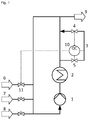
- Fig. 1 shows a preferred embodiment of the method of the invention with a measuring section in a side stream blocked off by two valves.
- an olefin is reacted with hydrogen peroxide in the presence of a water soluble epoxidation catalyst in a reaction mixture comprising an aqueous liquid phase and an organic liquid phase.
- the olefin may contain one or several carbon-carbon double bonds. In olefins containing two or more double bonds, the double bonds may be isolated or conjugated, isolated double bonds being preferred.
- the olefin may be linear, branched or cyclic and may carry substituents, in particular one or more substituents selected from aryl groups, halogens, free and esterified hydroxyl groups, alkoxy groups and carboxyl groups.
- the substituents may be in vinylic or allylic position or bonded to another position of the olefin, with substituents in allylic position being preferred.
- the olefin preferably has a solubility in water of from 0.01 g/L to 100 g/L at 20°C, more preferably of from 0.01 g/L to 10 g/L at 20°C, in order to achieve both a high rate of reaction in epoxidation and formation of an organic liquid phase without addition of solvent.
- the olefin is allyl chloride and the method of the invention provides epichlorohydrin as the reaction product.
- the olefin is propene and the method of the invention provides propene oxide as the reaction product.
- Hydrogen peroxide can be used as an aqueous solution, preferably containing from 20 to 75 % by weight hydrogen peroxide and most preferably from 40 to 70 % by weight.
- an aqueous hydrogen peroxide solution prepared by an anthraquinone process is used.
- a crude hydrogen peroxide solution as obtained in the extraction step of the anthraquinone process may be used in the method of the invention.
- the water soluble epoxidation catalyst comprises a manganese complex.
- the manganese complex preferably comprises at least one polydentate ligand which preferably coordinates through nitrogen atoms, most preferably through tertiary amino groups.
- the manganese complex may be a mononuclear complex of formula [LMnX m ]Y n , a dinuclear complex of formula [LM n ( ⁇ -X) m MnL]Y n or a polynuclear complex of formula [L p Mn p ( ⁇ -X) m ]Y n , where L is a polydentate ligand, X is a coordinating species, ⁇ -X is a bridging coordinating species, Y is a non-coordinating counter ion, m is 1, 2 or 3, n is an integer providing for the charge neutrality of the complex, and p is from 3 to 5.
- X and ⁇ -X are preferably selected from the group consisting of RO - , Cl - , Br - , I - , F - , NCS - , N 3 - , I 3 - , NH 3 , NR 3 , RCOO - , RSO 3 - , ROSO 3 - , OH - , O 2- , O 2 2- , HOO - , H 2 O, SH - , CN - , OCN - , C 2 O 4 2- and SO 4 2- , where R is alkyl, cycloalkyl, aryl or aralkyl with no more than 20 carbon atoms.
- Y is preferably selected from the group consisting of RO - , Cl - , Br - , I - , F - , RCOO - , SO 4 2- , PF 6 - , p-tolylsulfonate and trifluoromethylsulfonate, where R is alkyl, cycloalkyl, aryl or aralkyl with no more than 20 carbon atoms.
- Manganese may be in the oxidation state +2, +3, +4, or +7, the oxidation states +3 and +4 being preferred.
- Preferred polydentate ligands are acyclic polyamines containing at least 7 atoms in the backbone or cyclic polyamines containing at least 9 atoms in the ring, each having the nitrogen atoms separated by at least two carbon atoms.
- Most preferred are ligands having a 1,4,7-triazacyclononane (Tacn) ring system, which may be substituted with one or more alkyl, cycloalkyl, aryl or aralkyl groups each containing up to 20 carbon atoms.
- Preferred substituents are methyl groups.
- Suitable ligands with a Tacn ring system are N',N",N"'-trimethyl-1,4,7-triazacyclononane (TmTacn) and 2-methyl-1,4,7-trimethyl-1,4,7-triazacyclononane, with TmTacn being preferred.
- Another suitable ligand is 1,5,9-trimethyl-1,5,9-triazacyclododecane.
- dinuclear manganese complexes [(TmTacn)Mn IV ( ⁇ -O) 3 Mn IV (TmTacn)](PF 6 ) 2 and [(TmTacn)Mn IV ( ⁇ -O) 3 Mn IV (TmTacn)](CH 3 COO) 2 .
- the manganese complex may be formed in the reaction mixture by reaction of the polydentate ligand with a manganese salt, preferably manganese sulfate, manganese acetate, manganese nitrate, manganese chloride or manganese bromide with Mn 2+ or Mn 3+ .
- a manganese salt preferably manganese sulfate, manganese acetate, manganese nitrate, manganese chloride or manganese bromide with Mn 2+ or Mn 3+ .
- the manganese complex is prepared separately and added to the reaction mixture.
- the water soluble epoxidation catalyst preferably comprises oxalic acid, an oxalate or a mixture of both as a co-catalyst in addition to the manganese complex.
- the co-catalyst is preferably used in a molar excess to the manganese complex, preferably with a molar ratio of co-catalyst to manganese complex in the range of from 10 : 1 to 10 000 : 1.
- the reaction is carried out in a reaction mixture comprising an aqueous liquid phase and an organic liquid phase with mixing of the liquid phases.
- the ratio of the volume of the aqueous phase to the volume of the organic phase is maintained in the range of from 10 : 1 to 1 : 10, more preferably from 2 : 1 to 1 : 4.
- Mixing of the liquid phases can be performed by turbulent flow of the reaction mixture, by passing reaction mixture through fixed mixing elements, such as static mixers, structured packings or random packings, or by a moving mixing element, such as a stirrer or a rotating pump.
- the aqueous phase preferably comprises less than 30 % by weight, more preferably less than 5 % by weight of a solvent.
- the organic phase may contain a water insoluble solvent, but preferably contains less than 30 % by weight, more preferably less than 5 % by weight of a solvent.
- solvent refers to compounds added in addition to olefin, epoxidation catalyst, co-catalyst and impurities introduced with these components, and does not encompass products formed from the olefin.
- the epoxidation reaction is preferably carried out at a temperature of from 0 °C to 70 °C, more preferably from 5 °C to 40 °C and most preferably from 10 °C to 30 °C.
- the epoxidation is carried out at elevated pressure to maintain the olefin in the liquid phase.
- the olefin is propene
- the epoxidation reaction is preferably carried out at a pressure of from 0.8 to 2.0 MPa.
- the olefin is allyl chloride
- the epoxidation reaction is preferably carried out at a pressure of from 0.12 to 1.0 MPa.
- the reaction is carried out continuously in a loop reactor.
- the term loop reactor here refers to a reactor in which reaction mixture is circulated driven by a pump. Pumping of the reaction mixture provides mixing of the liquid phases.
- the loop reactor may comprise vessels for increasing the volume in the loop and providing the residence time necessary for achieving the desired hydrogen peroxide conversion.
- further mixing of the reaction mixture is provided in such vessels, for example by static mixers, structured packings or random packings arranged in a tube of enlarged diameter or by a stirred vessel arranged in the reactor loop.
- a heat exchanger is arranged in the loop for cooling the reaction mixture in order to remove the heat of reaction, the reaction mixture preferably being passed through the heat exchanger in every cycle of the loop.
- the heat exchanger is preferably a tube bundle heat exchanger with the reaction mixture being passed through the tubes or a plate heat exchanger.
- the diameter of the tubes or the distance between plates is preferably chosen sufficiently narrow for providing turbulent flow and mixing of the two liquid phases.
- the average residence time in the loop reactor is preferably selected to provide a hydrogen peroxide conversion of more than 85 %, more preferably of from 95 % to 99.5 %.
- the average residence time is preferably from 20 to 240 min.
- the pH of the aqueous phase is maintained in the range of from 2 to 6, preferably 2.5 to 5.
- a buffer is added to stabilize the pH in this range.
- the buffer may be an inorganic buffer, such as a phosphate buffer, or preferably an organic buffer, such as a carboxylic acid / carboxylate buffer.
- an oxalic acid / oxalate buffer is used, which acts both as buffer and as co-catalyst.
- the buffer may be prepared previous to feeding it to the loop reactor or may be preferably generated within the loop reactor by separately feeding an acid and a base to the loop reactor.
- aqueous solutions of oxalic acid and sodium hydroxide are fed separately to the loop reactor and most preferably the solution of oxalic acid is fed at an essentially constant rate and the feeding of the sodium hydroxide solution is adjusted to maintain the pH in the desired range.
- the olefin is preferably used in molar excess to hydrogen peroxide in order to achieve high conversion of hydrogen peroxide and the molar ratio of olefin fed to the loop reactor to hydrogen peroxide fed to the loop reactor is preferably from 1.2 : 1 to 12 : 1, more preferably from 2 : 1 to 8 : 1.
- the amount of catalyst fed to the loop reactor is preferably chosen to provide a molar ratio of hydrogen peroxide fed to the loop reactor to manganese fed to the loop reactor of from 100 : 1 to 10 000 000 : 1, more preferably from 1000 : 1 to 1 000 000 : 1 and most preferably 10 000 : 1 to 100 000 : 1.
- the concentration of hydrogen peroxide in the aqueous liquid phase is maintained at less than 1.0 % by weight during the reaction.
- the concentration of hydrogen peroxide is maintained at from 0.1 to 0.7 % by weight, more preferably from 0.2 to 0.5 % by weight.
- the concentration of hydrogen peroxide in the aqueous liquid phase may be adjusted by adjusting the molar ratio of olefin to hydrogen peroxide fed to the loop reactor, adjusting the feed rate for feeding hydrogen peroxide to the loop reactor or adjusting the feed rate for feeding epoxidation catalyst to the reactor, with a higher molar ratio of olefin to hydrogen peroxide, a lower feed rate for hydrogen peroxide or a higher feed rate for epoxidation catalyst leading to a lower concentration of hydrogen peroxide in the aqueous liquid phase.
- the concentration of hydrogen peroxide in the aqueous liquid phase may be measured with any method known from the prior art. However, since the concentration of hydrogen peroxide rapidly changes in samples of aqueous liquid phase withdrawn from a loop reactor, the concentration of hydrogen peroxide is preferably measured online and more preferably measured inline.
- the term online denotes a measurement carried out with a measuring device attached to the loop reactor on a sample of aqueous liquid phase withdrawn from the reaction loop and the term inline denotes a measurement carried out on aqueous liquid phase circulating in the reaction loop.
- the loop reactor comprises a measuring section, in which the liquid phases are temporarily separated into a separated aqueous phase and a separated organic phase.
- a measuring device is arranged in the measuring section in contact with the separated aqueous phase, and the concentration of hydrogen peroxide in the separated aqueous phase is determined with this measuring device.
- the measuring section may be located in the main loop of the loop reactor, but is preferably located in a side stream to the loop reactor.
- the term side stream here refers to a stream which is continuously withdrawn from the loop reactor and is at least partially returned to the loop reactor. Preferably, the entire side stream is returned to the loop reactor.
- Flow rate in the side stream may be adjusted independently of the flow rate in the main loop, for example by a pump or by a valve in the side stream.
- the liquid phases can be temporarily separated by settling or by centrifugal force and are preferably separated by lowering the flow rate which leads to settling.
- the flow rate is lowered in the measuring section by enlarging the flow cross section.
- a side stream is passed through a horizontal pipe having a section with an enlarged diameter where lowering of the flow rate leads to temporary phase separation by settling.
- the measuring section is located in a side stream and a valve is used for lowering the flow rate or temporarily stopping the flow in the measuring section.
- any device known from the prior art for measuring the concentration of hydrogen peroxide in an aqueous solution may be used as measuring device in the measuring section.
- Examples of such devices are amperometric sensors operating by electrochemical reduction or oxidation of hydrogen peroxide or online titration analyzers operating on samples withdrawn from the separated aqueous phase.
- a device is used which measures the concentration of hydrogen peroxide by spectroscopy.
- Spectroscopic measurement may be by infrared spectroscopy, near infrared spectroscopy, UV spectroscopy or Raman spectroscopy, with Raman spectroscopy being preferred.
- the concentration of hydrogen peroxide is measured by Raman spectroscopy in a measuring section located in a side stream to the loop reactor and the measuring section is blocked off by two valves during measurement of the hydrogen peroxide concentration. Blocking off the measuring section improves safety of the process and prevents that ignition of a flammable mixture in the measuring section by the laser used for Raman spectroscopy may propagate into the main reaction loop.
- an IR laser preferably operating at a wavelength of 785 nm, is used for measuring the concentration of hydrogen peroxide by Raman spectroscopy in order to minimize interferences from fluorescence.
- concentration of hydrogen peroxide is preferably determined from the intensity of the Raman peak at 786 cm -1 .
- Interference from Raman peaks of dissolved olefin and olefin oxide is preferably compensated by additionally measuring the intensity of Raman peaks characteristic for the olefin and olefin oxide, such as the peak at 1646 cm -1 characteristic for propene and the peak at 730 cm -1 characteristic for propene oxide, using linear combination or chemometric methods, such as known from US 5,242,602 and US 6,774,992 .
- Calibration for simultaneous measurement of concentrations of hydrogen peroxide, olefin and olefin oxide by Raman spectroscopy can be carried out with commercial software, for example with PLS/Plus IQTM from Thermo Scientific. Additional measurement of the concentration of the olefin in the aqueous phase by Raman spectroscopy also allows to monitor phase transfer of the olefin to the aqueous phase and to adjust the intensity of mixing in the loop reactor in order to overcome phase transfer limitation.
- the addition of hydrogen peroxide and/or addition of epoxidation catalyst to the loop reactor are controlled based on the determined concentration of hydrogen peroxide. More preferably, the addition of epoxidation catalyst is controlled to maintain an essentially constant concentration of hydrogen peroxide. Most preferably, this is done at a constant feed rate of hydrogen peroxide in order to achieve stationary continuous operation of the epoxidation reaction with little hydrogen peroxide decomposition.
- the feeding of hydrogen peroxide to the loop reactor is stopped when the measured hydrogen peroxide concentration exceeds a preset safety limit, in order to limit the hydrogen peroxide holdup of the loop reactor and thereby prevent the danger of a runaway reaction in the loop reactor.
- Fig. 1 shows a preferred embodiment of the method of the invention with a measuring section in a side stream blocked off by two valves.
- Fig. 1 shows a loop reactor comprising a circulation pump (1), a heat exchanger (2) for cooling the reaction mixture and a measuring section (3) located in a side stream to the loop reactor which can be blocked off by two valves (4, 5).
- Catalyst (6), hydrogen peroxide (7) and olefin (8) are fed to the loop reactor. Buffer and co-catalyst can also be fed to the loop reactor, but are not shown.
- An amount of reaction mixture corresponding to the feed is withdrawn as a product stream (9), comprising olefin oxide formed by the reaction, along with non-reacted olefin and hydrogen peroxide, water formed from and introduced with the hydrogen peroxide and optional additives, such as buffer and co-catalyst.
- the reaction mixture is circulated in the loop by pump (1) with a side stream passing through measuring section (3) when valves (4, 5) are open.
- a measuring device (10) comprising a Raman spectrometer is arranged in measuring section (3) at a position where it is in contact with the aqueous phase when phase separation occurs in the measuring section.
- the hydrogen peroxide concentration is measured intermittently by closing valves (4, 5), letting the reaction mixture settle in measuring section (3) during a dwell time to separate the reaction mixture enclosed between the valves into a separated aqueous phase and a separated organic phase, measuring the concentration of hydrogen peroxide in the separated aqueous phase with the Raman spectrometer after the dwell time and reopening valves (4, 5) after this measurement to return the separated phases to the main loop and re-establish the side stream.
- Closing and opening of the valves is operated by the measuring device (10), which also controls a valve (11) for adjusting dosage of the catalyst (6) based on the measured concentration of hydrogen peroxide, increasing catalyst dosage when the concentration of hydrogen peroxide is higher than the desired value and decreasing catalyst dosage when the concentration of hydrogen peroxide is lower than the desired value.
- the loop reactor comprised in series feed lines for starting materials, two circulation pumps, and a withdrawal line for reaction mixture.
- the withdrawal line for reaction mixture was connected to phase separators for separating withdrawn reaction mixture into a liquid aqueous phase, a liquid organic phase and a gas phase.
- Nitrogen was introduced into the second phase separator and gas phase was withdrawn with a pressure regulating valve to maintain a constant pressure of from 1.45 to 1.50 MPa.
- the loop of the loop reactor had a total volume of 1200 ml and was operated at a circulation rate of 100 kg/h.
- the loop reactor also comprised a measuring section in a side stream by-passing the second group of tube reactors, comprising optical windows for Raman spectroscopic measurement and two blocking valves downstream and upstream of the optical window.
- Epoxidations were carried out at 14 to 15 °C with separate feeding of an aqueous catalyst solution containing [(TmTacn)Mn IV ( ⁇ -O) 3 Mn IV (TmTacn)](CH 3 COO) 2 as catalyst, an aqueous solution of an oxalic acid/sodium oxalate buffer, an aqueous hydrogen peroxide solution and liquid propene.
- the pH of the aqueous phase of the reaction mixture was maintained in the range of 4.1 to 4.3 by adding small amounts of a sodium hydroxide solution if needed.
- Aqueous phase, organic phase and gas phase were analyzed for propene oxide by GC.
- Hydrogen peroxide decomposition was determined by measuring the flow rate of the gas phase and a paramagnetic measurement of the oxygen content of the gas phase.
- the hydrogen peroxide concentration in the aqueous phase of the reaction mixture was measured on-line by closing the blocking valves in the side stream, waiting 10 s for phase separation and Raman spectroscopic determination of the hydrogen peroxide content of the separated aqueous phase, followed by reopening the blocking valves.
- Raman spectra were taken at a wavelength of 785 nm, determining the concentration of hydrogen peroxide from the intensity of the Raman peak at 786 cm -1 with corrections for interference from propene and propene oxide based on the intensity of the Raman peaks at 1646 cm -1 and 730 cm -1 .
- Off-line measurements of hydrogen peroxide concentration were carried out by withdrawing a sample of the two phase reaction mixture, pressure release of the sample with outgassing of propene, waiting for separation of organic phase and aqueous phase and cerimetric titration of hydrogen peroxide in an aliquot of the aqueous phase, where the time span from withdrawing the sample to the endpoint of the titration was approximately 2 min.
- Examples 1 to 4 were carried out varying the hydrogen peroxide concentration in the feed.
- the combined feed rate of catalyst solution, buffer solution and hydrogen peroxide solution was 570 g/h, feeding 0.122 mmol/h of catalyst, 17.9 mmol/h of oxalic acid, 16.8 mmol/h of sodium oxalate, and the amounts of hydrogen peroxide given in table 1.
- Propene was fed at a rate of 546 g/h.
- the hydrogen peroxide concentration measured by Raman spectroscopy, the propene oxide yield (based on hydrogen peroxide charged) and the fraction of hydrogen peroxide decomposed to oxygen are given in table 1.
- Examples 5 and 6 were carried out with identical feed rates and concentrations of aqueous feed solutions, varying the feed rate of propene.
- 120 g/h of a 0.063 % by weight catalyst solution, 228 g/h of a buffer solution containing 1 % by weight oxalic acid dihydrate and 1 % by weight sodium oxalate, and 330 g/h of a 30 % by weight hydrogen peroxide solution were fed in both examples.
- the propene feed rate was 546 g/h in example 6 and 336 g/h in example 7.
- Examples 5 and 6 demonstrate that decomposition of hydrogen peroxide increases sharply with the concentration of hydrogen peroxide in the aqueous phase of the reaction mixture and that low levels of hydrogen peroxide decomposition can be achieved by maintaining a concentration of hydrogen peroxide of less than 1 % by weight.
- Examples 5 and 6 also demonstrate that an off-line measurement of a withdrawn sample provides erroneously low values for hydrogen peroxide concentration that cannot be used for controlling the hydrogen peroxide concentration in the reaction mixture, whereas an in-line measurement with temporary phase separation allows a more precise measurement of the hydrogen peroxide concentration in the aqueous phase of the reaction mixture.
Landscapes
- Chemical & Material Sciences (AREA)
- Organic Chemistry (AREA)
- Inorganic Chemistry (AREA)
- Epoxy Compounds (AREA)
- Catalysts (AREA)
- Low-Molecular Organic Synthesis Reactions Using Catalysts (AREA)
Claims (15)
- Verfahren zur Epoxidierung eines Olefins, umfassend die kontinuierliche Umsetzung des Olefins mit Wasserstoffperoxid in Gegenwart eines wasserlöslichen Epoxidierungskatalysators, der einen Mangankomplex umfasst, wobei die Umsetzung in einer Reaktionsmischung durchgeführt wird, die eine wässrige flüssige Phase und eine organische flüssige Phase umfasst, unter Verwendung eines Schlaufenreaktors mit Mischen der flüssigen Phasen, dadurch gekennzeichnet, dass während der Umsetzung die Konzentration von Wasserstoffperoxid in der wässrigen flüssigen Phase bei weniger als 1,0 Gew.-% gehalten wird und der pH-Wert der wässrigen Phase im Bereich von 2 bis 6 gehalten wird.
- Verfahren nach Anspruch 1, dadurch gekennzeichnet, dass der Schlaufenreaktor einen Messabschnitt in der Schlaufe umfasst, in dem die flüssigen Phasen durch Verringern der Strömungsgeschwindigkeit vorübergehend in eine getrennte wässrige Phase und eine getrennte organische Phase getrennt werden, sowie eine in dem Messabschnitt in Kontakt mit der getrennten wässrigen Phase angeordnete Messvorrichtung, und die Konzentration von Wasserstoffperoxid in der getrennten wässrigen Phase mit der Messvorrichtung bestimmt wird.
- Verfahren nach Anspruch 2, dadurch gekennzeichnet, dass die flüssigen Phasen durch Verringern der Strömungsgeschwindigkeit vorübergehend getrennt werden.
- Verfahren nach Anspruch 3, dadurch gekennzeichnet, dass die Strömungsgeschwindigkeit im Messabschnitt durch Vergrößerung des Strömungsquerschnitts verringert wird.
- Verfahren nach einem der Ansprüche 2 bis 4, dadurch gekennzeichnet, dass sich der Messabschnitt in einem Seitenstrom des Schlaufenreaktors befindet.
- Verfahren nach Anspruch 5, dadurch gekennzeichnet, dass ein Ventil zum Verringern der Strömungsgeschwindigkeit oder vorübergehenden Stoppen des Stroms im Messabschnitt verwendet wird.
- Verfahren nach einem der Ansprüche 2 bis 6, dadurch gekennzeichnet, dass die Konzentration von Wasserstoffperoxid durch Spektroskopie gemessen wird.
- Verfahren nach Anspruch 7, dadurch gekennzeichnet, dass die Konzentration von Wasserstoffperoxid durch Raman-Spektroskopie gemessen wird.
- Verfahren nach Anspruch 8, dadurch gekennzeichnet, dass sich der Messabschnitt in einem Seitenstrom des Schlaufenreaktors befindet und während der Messung der Wasserstoffperoxidkonzentration durch zwei Ventile abgesperrt wird.
- Verfahren nach einem der Ansprüche 2 bis 9, dadurch gekennzeichnet, dass die Zugabe von Wasserstoffperoxid und/oder die Zugabe von Epoxidierungskatalysator in den Schlaufenreaktor auf der Basis der ermittelten Konzentration von Wasserstoffperoxid gesteuert wird.
- Verfahren nach Anspruch 10, dadurch gekennzeichnet, dass die Zugabe von Epoxidierungskatalysator so gesteuert wird, dass eine im Wesentlichen konstante Konzentration von Wasserstoffperoxid aufrechterhalten wird.
- Verfahren nach einem der Ansprüche 1 bis 11, dadurch gekennzeichnet, dass es sich bei dem Olefin um Propen oder Allylchlorid handelt.
- Verfahren nach einem der Ansprüche 1 bis 12, dadurch gekennzeichnet, dass der Mangankomplex einen 1,4,7-Trimethyl-1,4,7-triazacyclononan-Liganden umfasst.
- Verfahren nach Anspruch 13, dadurch gekennzeichnet, dass die Umsetzung in Gegenwart eines Oxalat-Puffers durchgeführt wird.
- Verfahren nach Anspruch 13 oder 14, dadurch gekennzeichnet, dass der pH-Wert der wässrigen flüssigen Phase während der Umsetzung im Bereich von 2,5 bis 5 gehalten wird.
Priority Applications (1)
| Application Number | Priority Date | Filing Date | Title |
|---|---|---|---|
| PL16703479T PL3259258T3 (pl) | 2015-02-17 | 2016-02-03 | Sposób epoksydacji olefiny nadtlenkiem wodoru |
Applications Claiming Priority (2)
| Application Number | Priority Date | Filing Date | Title |
|---|---|---|---|
| EP15155390 | 2015-02-17 | ||
| PCT/EP2016/052216 WO2016131649A1 (en) | 2015-02-17 | 2016-02-03 | Method for the epoxidation of an olefin with hydrogen peroxide |
Publications (2)
| Publication Number | Publication Date |
|---|---|
| EP3259258A1 EP3259258A1 (de) | 2017-12-27 |
| EP3259258B1 true EP3259258B1 (de) | 2020-11-11 |
Family
ID=52469741
Family Applications (1)
| Application Number | Title | Priority Date | Filing Date |
|---|---|---|---|
| EP16703479.2A Active EP3259258B1 (de) | 2015-02-17 | 2016-02-03 | Verfahren zur epoxidierung eines olefins mit wasserstoffperoxid |
Country Status (9)
| Country | Link |
|---|---|
| US (1) | US10087158B2 (de) |
| EP (1) | EP3259258B1 (de) |
| JP (1) | JP6707553B2 (de) |
| KR (1) | KR102441642B1 (de) |
| CN (1) | CN107257792B (de) |
| ES (1) | ES2839323T3 (de) |
| PL (1) | PL3259258T3 (de) |
| TW (1) | TWI700277B (de) |
| WO (1) | WO2016131649A1 (de) |
Families Citing this family (12)
| Publication number | Priority date | Publication date | Assignee | Title |
|---|---|---|---|---|
| EP3059229A1 (de) | 2015-02-17 | 2016-08-24 | Evonik Degussa GmbH | Verfahren zur Epoxidierung eines Olefins mit Wasserstoffperoxid |
| EA035146B1 (ru) | 2015-11-25 | 2020-05-06 | Эвоник Оперейшнс Гмбх | Способ получения 1,2-пропандиола из пропена и пероксида водорода |
| TWI707847B (zh) | 2015-11-26 | 2020-10-21 | 德商贏創運營有限公司 | 丙烯之環氧化方法 |
| KR102648943B1 (ko) | 2015-11-26 | 2024-03-18 | 에보닉 오퍼레이션스 게엠베하 | 프로펜의 에폭시화를 위한 방법 및 반응기 |
| EA033968B1 (ru) | 2015-11-26 | 2019-12-16 | Эвоник Дегусса Гмбх | Способ эпоксидирования олефина |
| CN108473453B (zh) | 2016-01-19 | 2020-08-04 | 赢创运营有限公司 | 烯烃的环氧化方法 |
| WO2017162446A1 (en) | 2016-03-21 | 2017-09-28 | Evonik Degussa Gmbh | Process for the epoxidation of propene |
| EP3246323A1 (de) | 2016-05-17 | 2017-11-22 | Evonik Degussa GmbH | Integrierter prozess zur herststellung von propenoxid aus propan |
| EP3406603A1 (de) | 2017-05-22 | 2018-11-28 | Evonik Degussa GmbH | Verfahren zur epoxidierung von propen |
| EP3812375A1 (de) * | 2019-10-21 | 2021-04-28 | Evonik Operations GmbH | Verfahren zur epoxidierung von propen |
| EP3812374A1 (de) * | 2019-10-21 | 2021-04-28 | Evonik Operations GmbH | Verfahren zur epoxidierung von propen |
| CN113551943A (zh) * | 2020-04-23 | 2021-10-26 | 中国石油化工股份有限公司 | 萃余液中过氧化氢浓度的监测系统及方法 |
Family Cites Families (25)
| Publication number | Priority date | Publication date | Assignee | Title |
|---|---|---|---|---|
| US5274140A (en) | 1979-07-19 | 1993-12-28 | Instituto Guido Donegani, S.P.A. | Process for catalytically epoxidizing olefin with hydrogen peroxide |
| US5242602A (en) | 1992-03-04 | 1993-09-07 | W. R. Grace & Co.-Conn. | Spectrophotometric monitoring of multiple water treatment performance indicators using chemometrics |
| US5329024A (en) | 1993-03-30 | 1994-07-12 | National Starch And Chemical Investment Holding Corporation | Epoxidation of olefins via certain manganese complexes |
| JPH08233740A (ja) * | 1994-11-25 | 1996-09-13 | Kdk Corp | ラマン散乱による過酸化水素の定量方法及び装置 |
| US6023065A (en) * | 1997-03-10 | 2000-02-08 | Alberta Research Council | Method and apparatus for monitoring and controlling characteristics of process effluents |
| BE1011576A3 (fr) | 1997-11-27 | 1999-11-09 | Solvay | Produit a base d'epichlorhydrine et procede de fabrication de ce produit. |
| DE19936547A1 (de) | 1999-08-04 | 2001-02-15 | Basf Ag | Verfahren zur Umsetzung einer organischen Verbindung mit einem Hydroperoxid |
| DE19944839A1 (de) | 1999-09-18 | 2001-03-22 | Degussa | Verfahren zur Herstellung von Epoxiden aus Olefinen |
| US6743748B2 (en) | 2001-03-12 | 2004-06-01 | Nippon Shokubai Co., Ltd. | Catalyst for producing epoxy compounds and method of producing epoxy compounds using the same |
| US6500311B1 (en) | 2001-09-21 | 2002-12-31 | Arco Chemical Technology, L.P. | Propylene oxide purification |
| EP1403219A1 (de) | 2002-09-30 | 2004-03-31 | Degussa AG | Neue wässrige Wasserstoffperoxid Lösungen |
| FR2846964B1 (fr) | 2002-11-12 | 2006-07-21 | Procede de fabrication de 1,2-epoxy-3-chloropropane | |
| JP4882197B2 (ja) | 2003-09-18 | 2012-02-22 | 住友化学株式会社 | プロピレンオキサイドの精製方法 |
| EP2149569A1 (de) | 2008-08-01 | 2010-02-03 | Hexion Specialty Chemicals Research Belgium S.A. | Verfahren zur Herstellung eines 1,2-Epoxid |
| EP2149570A1 (de) | 2008-08-01 | 2010-02-03 | Hexion Specialty Chemicals Research Belgium S.A. | Verfahren zur Herstellung von Epichlorhydrin mit Wasserstoffperoxid und einem Mangankomplex |
| CN102427873B (zh) | 2009-05-18 | 2015-03-25 | 威拓股份有限公司 | 薄膜渗透蒸发膜 |
| EP2501687B1 (de) | 2009-11-19 | 2014-10-15 | Dow Global Technologies LLC | Epoxidation eines olefins |
| EP2343288A1 (de) | 2009-11-27 | 2011-07-13 | Momentive Specialty Chemicals Research Belgium S.A. | Verfahren zur Herstellung von Propylenoxid |
| EP2354131A1 (de) | 2010-02-02 | 2011-08-10 | Momentive Specialty Chemicals Research Belgium | Verfahren zur Herstellung von 1,2-Epoxid und Vorrichtung zur Durchführung besagten Verfahrens |
| EP2537836A1 (de) * | 2011-06-22 | 2012-12-26 | Momentive Specialty Chemicals Research Belgium S.A. | Vorrichtung und Verfahren zum Bewahren der Katalysatoraktivität in einem Epoxidierungsprozess |
| JP2015529628A (ja) * | 2012-01-31 | 2015-10-08 | ビーエーエスエフ ソシエタス・ヨーロピアBasf Se | エポキシドの製造方法 |
| EP2719692A1 (de) | 2012-10-09 | 2014-04-16 | Momentive Specialty Chemicals Research Belgium S.A. | Katalytischer Epoxidierungsprozess |
| TW201700464A (zh) | 2015-02-17 | 2017-01-01 | 贏創德固賽有限責任公司 | 使用過氧化氫之使烯烴環氧化方法 |
| EP3059230A1 (de) | 2015-02-17 | 2016-08-24 | Evonik Degussa GmbH | Verfahren zur Epoxidierung von Propen mit Wasserstoffperoxid |
| EP3059229A1 (de) | 2015-02-17 | 2016-08-24 | Evonik Degussa GmbH | Verfahren zur Epoxidierung eines Olefins mit Wasserstoffperoxid |
-
2016
- 2016-02-03 US US15/550,856 patent/US10087158B2/en active Active
- 2016-02-03 JP JP2017543806A patent/JP6707553B2/ja active Active
- 2016-02-03 WO PCT/EP2016/052216 patent/WO2016131649A1/en not_active Ceased
- 2016-02-03 EP EP16703479.2A patent/EP3259258B1/de active Active
- 2016-02-03 ES ES16703479T patent/ES2839323T3/es active Active
- 2016-02-03 PL PL16703479T patent/PL3259258T3/pl unknown
- 2016-02-03 CN CN201680010716.7A patent/CN107257792B/zh active Active
- 2016-02-03 KR KR1020177020595A patent/KR102441642B1/ko active Active
- 2016-02-15 TW TW105104304A patent/TWI700277B/zh active
Non-Patent Citations (1)
| Title |
|---|
| None * |
Also Published As
| Publication number | Publication date |
|---|---|
| CN107257792A (zh) | 2017-10-17 |
| CN107257792B (zh) | 2021-04-02 |
| US20180030011A1 (en) | 2018-02-01 |
| US10087158B2 (en) | 2018-10-02 |
| JP2018508505A (ja) | 2018-03-29 |
| EP3259258A1 (de) | 2017-12-27 |
| WO2016131649A1 (en) | 2016-08-25 |
| TW201704221A (zh) | 2017-02-01 |
| KR20170117034A (ko) | 2017-10-20 |
| PL3259258T3 (pl) | 2021-05-04 |
| KR102441642B1 (ko) | 2022-09-07 |
| JP6707553B2 (ja) | 2020-06-10 |
| ES2839323T3 (es) | 2021-07-05 |
| TWI700277B (zh) | 2020-08-01 |
Similar Documents
| Publication | Publication Date | Title |
|---|---|---|
| EP3259258B1 (de) | Verfahren zur epoxidierung eines olefins mit wasserstoffperoxid | |
| EP3259260B1 (de) | Verfahren zur epoxidierung eines olefins mit wasserstoffperoxid | |
| EP3059230A1 (de) | Verfahren zur Epoxidierung von Propen mit Wasserstoffperoxid | |
| US9024048B2 (en) | Apparatus and methods to preserve catalyst activity in an epoxidation process | |
| US8859790B2 (en) | Process for the manufacture of a 1,2-epoxide and a device for carrying out said process | |
| Ma et al. | Solvent-free selective oxidation of CH bonds of toluene and substituted toluene to aldehydes by vanadium-substituted polyoxometalate catalyst | |
| EP3059228A1 (de) | Verfahren zur Epoxidierung von Allylchlorid mit Wasserstoffperoxid | |
| US20120330042A1 (en) | Epoxidation process | |
| Deadman et al. | On-demand, in situ, generation of ammonium caroate (peroxymonosulfate) for the dihydroxylation of alkenes to vicinal diols | |
| Białek et al. | COORDINATION OF CU (II) WITH MORPHOLINE |
Legal Events
| Date | Code | Title | Description |
|---|---|---|---|
| STAA | Information on the status of an ep patent application or granted ep patent |
Free format text: STATUS: THE INTERNATIONAL PUBLICATION HAS BEEN MADE |
|
| PUAI | Public reference made under article 153(3) epc to a published international application that has entered the european phase |
Free format text: ORIGINAL CODE: 0009012 |
|
| STAA | Information on the status of an ep patent application or granted ep patent |
Free format text: STATUS: REQUEST FOR EXAMINATION WAS MADE |
|
| 17P | Request for examination filed |
Effective date: 20170803 |
|
| AK | Designated contracting states |
Kind code of ref document: A1 Designated state(s): AL AT BE BG CH CY CZ DE DK EE ES FI FR GB GR HR HU IE IS IT LI LT LU LV MC MK MT NL NO PL PT RO RS SE SI SK SM TR |
|
| AX | Request for extension of the european patent |
Extension state: BA ME |
|
| DAV | Request for validation of the european patent (deleted) | ||
| DAX | Request for extension of the european patent (deleted) | ||
| RAP1 | Party data changed (applicant data changed or rights of an application transferred) |
Owner name: EVONIK OPERATIONS GMBH |
|
| STAA | Information on the status of an ep patent application or granted ep patent |
Free format text: STATUS: EXAMINATION IS IN PROGRESS |
|
| 17Q | First examination report despatched |
Effective date: 20191216 |
|
| GRAP | Despatch of communication of intention to grant a patent |
Free format text: ORIGINAL CODE: EPIDOSNIGR1 |
|
| STAA | Information on the status of an ep patent application or granted ep patent |
Free format text: STATUS: GRANT OF PATENT IS INTENDED |
|
| INTG | Intention to grant announced |
Effective date: 20200619 |
|
| GRAS | Grant fee paid |
Free format text: ORIGINAL CODE: EPIDOSNIGR3 |
|
| GRAA | (expected) grant |
Free format text: ORIGINAL CODE: 0009210 |
|
| STAA | Information on the status of an ep patent application or granted ep patent |
Free format text: STATUS: THE PATENT HAS BEEN GRANTED |
|
| AK | Designated contracting states |
Kind code of ref document: B1 Designated state(s): AL AT BE BG CH CY CZ DE DK EE ES FI FR GB GR HR HU IE IS IT LI LT LU LV MC MK MT NL NO PL PT RO RS SE SI SK SM TR |
|
| REG | Reference to a national code |
Ref country code: GB Ref legal event code: FG4D |
|
| REG | Reference to a national code |
Ref country code: CH Ref legal event code: EP |
|
| REG | Reference to a national code |
Ref country code: AT Ref legal event code: REF Ref document number: 1333351 Country of ref document: AT Kind code of ref document: T Effective date: 20201115 |
|
| REG | Reference to a national code |
Ref country code: DE Ref legal event code: R096 Ref document number: 602016047586 Country of ref document: DE |
|
| REG | Reference to a national code |
Ref country code: IE Ref legal event code: FG4D |
|
| REG | Reference to a national code |
Ref country code: NL Ref legal event code: FP |
|
| REG | Reference to a national code |
Ref country code: AT Ref legal event code: MK05 Ref document number: 1333351 Country of ref document: AT Kind code of ref document: T Effective date: 20201111 |
|
| PG25 | Lapsed in a contracting state [announced via postgrant information from national office to epo] |
Ref country code: RS Free format text: LAPSE BECAUSE OF FAILURE TO SUBMIT A TRANSLATION OF THE DESCRIPTION OR TO PAY THE FEE WITHIN THE PRESCRIBED TIME-LIMIT Effective date: 20201111 Ref country code: PT Free format text: LAPSE BECAUSE OF FAILURE TO SUBMIT A TRANSLATION OF THE DESCRIPTION OR TO PAY THE FEE WITHIN THE PRESCRIBED TIME-LIMIT Effective date: 20210311 Ref country code: NO Free format text: LAPSE BECAUSE OF FAILURE TO SUBMIT A TRANSLATION OF THE DESCRIPTION OR TO PAY THE FEE WITHIN THE PRESCRIBED TIME-LIMIT Effective date: 20210211 Ref country code: GR Free format text: LAPSE BECAUSE OF FAILURE TO SUBMIT A TRANSLATION OF THE DESCRIPTION OR TO PAY THE FEE WITHIN THE PRESCRIBED TIME-LIMIT Effective date: 20210212 Ref country code: FI Free format text: LAPSE BECAUSE OF FAILURE TO SUBMIT A TRANSLATION OF THE DESCRIPTION OR TO PAY THE FEE WITHIN THE PRESCRIBED TIME-LIMIT Effective date: 20201111 |
|
| PG25 | Lapsed in a contracting state [announced via postgrant information from national office to epo] |
Ref country code: SE Free format text: LAPSE BECAUSE OF FAILURE TO SUBMIT A TRANSLATION OF THE DESCRIPTION OR TO PAY THE FEE WITHIN THE PRESCRIBED TIME-LIMIT Effective date: 20201111 Ref country code: AT Free format text: LAPSE BECAUSE OF FAILURE TO SUBMIT A TRANSLATION OF THE DESCRIPTION OR TO PAY THE FEE WITHIN THE PRESCRIBED TIME-LIMIT Effective date: 20201111 Ref country code: BG Free format text: LAPSE BECAUSE OF FAILURE TO SUBMIT A TRANSLATION OF THE DESCRIPTION OR TO PAY THE FEE WITHIN THE PRESCRIBED TIME-LIMIT Effective date: 20210211 Ref country code: LV Free format text: LAPSE BECAUSE OF FAILURE TO SUBMIT A TRANSLATION OF THE DESCRIPTION OR TO PAY THE FEE WITHIN THE PRESCRIBED TIME-LIMIT Effective date: 20201111 Ref country code: IS Free format text: LAPSE BECAUSE OF FAILURE TO SUBMIT A TRANSLATION OF THE DESCRIPTION OR TO PAY THE FEE WITHIN THE PRESCRIBED TIME-LIMIT Effective date: 20210311 |
|
| REG | Reference to a national code |
Ref country code: LT Ref legal event code: MG9D |
|
| PG25 | Lapsed in a contracting state [announced via postgrant information from national office to epo] |
Ref country code: HR Free format text: LAPSE BECAUSE OF FAILURE TO SUBMIT A TRANSLATION OF THE DESCRIPTION OR TO PAY THE FEE WITHIN THE PRESCRIBED TIME-LIMIT Effective date: 20201111 |
|
| REG | Reference to a national code |
Ref country code: ES Ref legal event code: FG2A Ref document number: 2839323 Country of ref document: ES Kind code of ref document: T3 Effective date: 20210705 |
|
| PG25 | Lapsed in a contracting state [announced via postgrant information from national office to epo] |
Ref country code: SK Free format text: LAPSE BECAUSE OF FAILURE TO SUBMIT A TRANSLATION OF THE DESCRIPTION OR TO PAY THE FEE WITHIN THE PRESCRIBED TIME-LIMIT Effective date: 20201111 Ref country code: RO Free format text: LAPSE BECAUSE OF FAILURE TO SUBMIT A TRANSLATION OF THE DESCRIPTION OR TO PAY THE FEE WITHIN THE PRESCRIBED TIME-LIMIT Effective date: 20201111 Ref country code: EE Free format text: LAPSE BECAUSE OF FAILURE TO SUBMIT A TRANSLATION OF THE DESCRIPTION OR TO PAY THE FEE WITHIN THE PRESCRIBED TIME-LIMIT Effective date: 20201111 Ref country code: SM Free format text: LAPSE BECAUSE OF FAILURE TO SUBMIT A TRANSLATION OF THE DESCRIPTION OR TO PAY THE FEE WITHIN THE PRESCRIBED TIME-LIMIT Effective date: 20201111 Ref country code: LT Free format text: LAPSE BECAUSE OF FAILURE TO SUBMIT A TRANSLATION OF THE DESCRIPTION OR TO PAY THE FEE WITHIN THE PRESCRIBED TIME-LIMIT Effective date: 20201111 |
|
| REG | Reference to a national code |
Ref country code: DE Ref legal event code: R097 Ref document number: 602016047586 Country of ref document: DE |
|
| PG25 | Lapsed in a contracting state [announced via postgrant information from national office to epo] |
Ref country code: DK Free format text: LAPSE BECAUSE OF FAILURE TO SUBMIT A TRANSLATION OF THE DESCRIPTION OR TO PAY THE FEE WITHIN THE PRESCRIBED TIME-LIMIT Effective date: 20201111 |
|
| PLBE | No opposition filed within time limit |
Free format text: ORIGINAL CODE: 0009261 |
|
| STAA | Information on the status of an ep patent application or granted ep patent |
Free format text: STATUS: NO OPPOSITION FILED WITHIN TIME LIMIT |
|
| PG25 | Lapsed in a contracting state [announced via postgrant information from national office to epo] |
Ref country code: MC Free format text: LAPSE BECAUSE OF FAILURE TO SUBMIT A TRANSLATION OF THE DESCRIPTION OR TO PAY THE FEE WITHIN THE PRESCRIBED TIME-LIMIT Effective date: 20201111 |
|
| 26N | No opposition filed |
Effective date: 20210812 |
|
| GBPC | Gb: european patent ceased through non-payment of renewal fee |
Effective date: 20210211 |
|
| PG25 | Lapsed in a contracting state [announced via postgrant information from national office to epo] |
Ref country code: AL Free format text: LAPSE BECAUSE OF FAILURE TO SUBMIT A TRANSLATION OF THE DESCRIPTION OR TO PAY THE FEE WITHIN THE PRESCRIBED TIME-LIMIT Effective date: 20201111 Ref country code: LU Free format text: LAPSE BECAUSE OF NON-PAYMENT OF DUE FEES Effective date: 20210203 |
|
| PG25 | Lapsed in a contracting state [announced via postgrant information from national office to epo] |
Ref country code: SI Free format text: LAPSE BECAUSE OF FAILURE TO SUBMIT A TRANSLATION OF THE DESCRIPTION OR TO PAY THE FEE WITHIN THE PRESCRIBED TIME-LIMIT Effective date: 20201111 |
|
| PG25 | Lapsed in a contracting state [announced via postgrant information from national office to epo] |
Ref country code: IE Free format text: LAPSE BECAUSE OF NON-PAYMENT OF DUE FEES Effective date: 20210203 Ref country code: GB Free format text: LAPSE BECAUSE OF NON-PAYMENT OF DUE FEES Effective date: 20210211 |
|
| PG25 | Lapsed in a contracting state [announced via postgrant information from national office to epo] |
Ref country code: IS Free format text: LAPSE BECAUSE OF FAILURE TO SUBMIT A TRANSLATION OF THE DESCRIPTION OR TO PAY THE FEE WITHIN THE PRESCRIBED TIME-LIMIT Effective date: 20210311 |
|
| P01 | Opt-out of the competence of the unified patent court (upc) registered |
Effective date: 20230524 |
|
| PG25 | Lapsed in a contracting state [announced via postgrant information from national office to epo] |
Ref country code: CY Free format text: LAPSE BECAUSE OF FAILURE TO SUBMIT A TRANSLATION OF THE DESCRIPTION OR TO PAY THE FEE WITHIN THE PRESCRIBED TIME-LIMIT Effective date: 20201111 |
|
| PG25 | Lapsed in a contracting state [announced via postgrant information from national office to epo] |
Ref country code: HU Free format text: LAPSE BECAUSE OF FAILURE TO SUBMIT A TRANSLATION OF THE DESCRIPTION OR TO PAY THE FEE WITHIN THE PRESCRIBED TIME-LIMIT; INVALID AB INITIO Effective date: 20160203 |
|
| PG25 | Lapsed in a contracting state [announced via postgrant information from national office to epo] |
Ref country code: MK Free format text: LAPSE BECAUSE OF FAILURE TO SUBMIT A TRANSLATION OF THE DESCRIPTION OR TO PAY THE FEE WITHIN THE PRESCRIBED TIME-LIMIT Effective date: 20201111 |
|
| PG25 | Lapsed in a contracting state [announced via postgrant information from national office to epo] |
Ref country code: TR Free format text: LAPSE BECAUSE OF FAILURE TO SUBMIT A TRANSLATION OF THE DESCRIPTION OR TO PAY THE FEE WITHIN THE PRESCRIBED TIME-LIMIT Effective date: 20201111 |
|
| PG25 | Lapsed in a contracting state [announced via postgrant information from national office to epo] |
Ref country code: MT Free format text: LAPSE BECAUSE OF FAILURE TO SUBMIT A TRANSLATION OF THE DESCRIPTION OR TO PAY THE FEE WITHIN THE PRESCRIBED TIME-LIMIT Effective date: 20201111 |
|
| PGFP | Annual fee paid to national office [announced via postgrant information from national office to epo] |
Ref country code: NL Payment date: 20250218 Year of fee payment: 10 |
|
| PGFP | Annual fee paid to national office [announced via postgrant information from national office to epo] |
Ref country code: DE Payment date: 20250218 Year of fee payment: 10 |
|
| PGFP | Annual fee paid to national office [announced via postgrant information from national office to epo] |
Ref country code: BE Payment date: 20250218 Year of fee payment: 10 Ref country code: CH Payment date: 20250301 Year of fee payment: 10 |
|
| PGFP | Annual fee paid to national office [announced via postgrant information from national office to epo] |
Ref country code: FR Payment date: 20250221 Year of fee payment: 10 Ref country code: PL Payment date: 20250124 Year of fee payment: 10 Ref country code: CZ Payment date: 20250127 Year of fee payment: 10 |
|
| PGFP | Annual fee paid to national office [announced via postgrant information from national office to epo] |
Ref country code: IT Payment date: 20250224 Year of fee payment: 10 |
|
| PGFP | Annual fee paid to national office [announced via postgrant information from national office to epo] |
Ref country code: ES Payment date: 20250331 Year of fee payment: 10 |