EP3256398B1 - Wiederverschliessbare klappenvorrichtung - Google Patents
Wiederverschliessbare klappenvorrichtung Download PDFInfo
- Publication number
- EP3256398B1 EP3256398B1 EP16731252.9A EP16731252A EP3256398B1 EP 3256398 B1 EP3256398 B1 EP 3256398B1 EP 16731252 A EP16731252 A EP 16731252A EP 3256398 B1 EP3256398 B1 EP 3256398B1
- Authority
- EP
- European Patent Office
- Prior art keywords
- flap
- layer
- lower layer
- cut
- flap device
- Prior art date
- Legal status (The legal status is an assumption and is not a legal conclusion. Google has not performed a legal analysis and makes no representation as to the accuracy of the status listed.)
- Active
Links
Images



Classifications
-
- B—PERFORMING OPERATIONS; TRANSPORTING
- B65—CONVEYING; PACKING; STORING; HANDLING THIN OR FILAMENTARY MATERIAL
- B65D—CONTAINERS FOR STORAGE OR TRANSPORT OF ARTICLES OR MATERIALS, e.g. BAGS, BARRELS, BOTTLES, BOXES, CANS, CARTONS, CRATES, DRUMS, JARS, TANKS, HOPPERS, FORWARDING CONTAINERS; ACCESSORIES, CLOSURES, OR FITTINGS THEREFOR; PACKAGING ELEMENTS; PACKAGES
- B65D75/00—Packages comprising articles or materials partially or wholly enclosed in strips, sheets, blanks, tubes or webs of flexible sheet material, e.g. in folded wrappers
- B65D75/52—Details
- B65D75/58—Opening or contents-removing devices added or incorporated during package manufacture
- B65D75/5855—Peelable seals
-
- B—PERFORMING OPERATIONS; TRANSPORTING
- B65—CONVEYING; PACKING; STORING; HANDLING THIN OR FILAMENTARY MATERIAL
- B65D—CONTAINERS FOR STORAGE OR TRANSPORT OF ARTICLES OR MATERIALS, e.g. BAGS, BARRELS, BOTTLES, BOXES, CANS, CARTONS, CRATES, DRUMS, JARS, TANKS, HOPPERS, FORWARDING CONTAINERS; ACCESSORIES, CLOSURES, OR FITTINGS THEREFOR; PACKAGING ELEMENTS; PACKAGES
- B65D75/00—Packages comprising articles or materials partially or wholly enclosed in strips, sheets, blanks, tubes or webs of flexible sheet material, e.g. in folded wrappers
- B65D75/52—Details
- B65D75/58—Opening or contents-removing devices added or incorporated during package manufacture
- B65D75/5827—Tear-lines provided in a wall portion
- B65D75/5833—Tear-lines provided in a wall portion for tearing out a portion of the wall
- B65D75/5838—Tear-lines provided in a wall portion for tearing out a portion of the wall combined with separate fixed tearing means, e.g. tabs
-
- B—PERFORMING OPERATIONS; TRANSPORTING
- B32—LAYERED PRODUCTS
- B32B—LAYERED PRODUCTS, i.e. PRODUCTS BUILT-UP OF STRATA OF FLAT OR NON-FLAT, e.g. CELLULAR OR HONEYCOMB, FORM
- B32B37/00—Methods or apparatus for laminating, e.g. by curing or by ultrasonic bonding
- B32B37/12—Methods or apparatus for laminating, e.g. by curing or by ultrasonic bonding characterised by using adhesives
-
- B—PERFORMING OPERATIONS; TRANSPORTING
- B32—LAYERED PRODUCTS
- B32B—LAYERED PRODUCTS, i.e. PRODUCTS BUILT-UP OF STRATA OF FLAT OR NON-FLAT, e.g. CELLULAR OR HONEYCOMB, FORM
- B32B37/00—Methods or apparatus for laminating, e.g. by curing or by ultrasonic bonding
- B32B37/14—Methods or apparatus for laminating, e.g. by curing or by ultrasonic bonding characterised by the properties of the layers
- B32B37/144—Methods or apparatus for laminating, e.g. by curing or by ultrasonic bonding characterised by the properties of the layers using layers with different mechanical or chemical conditions or properties, e.g. layers with different thermal shrinkage, layers under tension during bonding
-
- B—PERFORMING OPERATIONS; TRANSPORTING
- B32—LAYERED PRODUCTS
- B32B—LAYERED PRODUCTS, i.e. PRODUCTS BUILT-UP OF STRATA OF FLAT OR NON-FLAT, e.g. CELLULAR OR HONEYCOMB, FORM
- B32B38/00—Ancillary operations in connection with laminating processes
- B32B38/04—Punching, slitting or perforating
-
- B—PERFORMING OPERATIONS; TRANSPORTING
- B32—LAYERED PRODUCTS
- B32B—LAYERED PRODUCTS, i.e. PRODUCTS BUILT-UP OF STRATA OF FLAT OR NON-FLAT, e.g. CELLULAR OR HONEYCOMB, FORM
- B32B38/00—Ancillary operations in connection with laminating processes
- B32B38/10—Removing layers, or parts of layers, mechanically or chemically
-
- B—PERFORMING OPERATIONS; TRANSPORTING
- B65—CONVEYING; PACKING; STORING; HANDLING THIN OR FILAMENTARY MATERIAL
- B65D—CONTAINERS FOR STORAGE OR TRANSPORT OF ARTICLES OR MATERIALS, e.g. BAGS, BARRELS, BOTTLES, BOXES, CANS, CARTONS, CRATES, DRUMS, JARS, TANKS, HOPPERS, FORWARDING CONTAINERS; ACCESSORIES, CLOSURES, OR FITTINGS THEREFOR; PACKAGING ELEMENTS; PACKAGES
- B65D33/00—Details of, or accessories for, sacks or bags
- B65D33/14—Suspension means
-
- B—PERFORMING OPERATIONS; TRANSPORTING
- B65—CONVEYING; PACKING; STORING; HANDLING THIN OR FILAMENTARY MATERIAL
- B65D—CONTAINERS FOR STORAGE OR TRANSPORT OF ARTICLES OR MATERIALS, e.g. BAGS, BARRELS, BOTTLES, BOXES, CANS, CARTONS, CRATES, DRUMS, JARS, TANKS, HOPPERS, FORWARDING CONTAINERS; ACCESSORIES, CLOSURES, OR FITTINGS THEREFOR; PACKAGING ELEMENTS; PACKAGES
- B65D75/00—Packages comprising articles or materials partially or wholly enclosed in strips, sheets, blanks, tubes or webs of flexible sheet material, e.g. in folded wrappers
- B65D75/52—Details
- B65D75/54—Cards, coupons or other inserts or accessories
- B65D75/56—Handles or other suspension means
- B65D75/566—Hand holes or suspension apertures
-
- B—PERFORMING OPERATIONS; TRANSPORTING
- B65—CONVEYING; PACKING; STORING; HANDLING THIN OR FILAMENTARY MATERIAL
- B65D—CONTAINERS FOR STORAGE OR TRANSPORT OF ARTICLES OR MATERIALS, e.g. BAGS, BARRELS, BOTTLES, BOXES, CANS, CARTONS, CRATES, DRUMS, JARS, TANKS, HOPPERS, FORWARDING CONTAINERS; ACCESSORIES, CLOSURES, OR FITTINGS THEREFOR; PACKAGING ELEMENTS; PACKAGES
- B65D75/00—Packages comprising articles or materials partially or wholly enclosed in strips, sheets, blanks, tubes or webs of flexible sheet material, e.g. in folded wrappers
- B65D75/52—Details
- B65D75/58—Opening or contents-removing devices added or incorporated during package manufacture
-
- B—PERFORMING OPERATIONS; TRANSPORTING
- B65—CONVEYING; PACKING; STORING; HANDLING THIN OR FILAMENTARY MATERIAL
- B65D—CONTAINERS FOR STORAGE OR TRANSPORT OF ARTICLES OR MATERIALS, e.g. BAGS, BARRELS, BOTTLES, BOXES, CANS, CARTONS, CRATES, DRUMS, JARS, TANKS, HOPPERS, FORWARDING CONTAINERS; ACCESSORIES, CLOSURES, OR FITTINGS THEREFOR; PACKAGING ELEMENTS; PACKAGES
- B65D83/00—Containers or packages with special means for dispensing contents
- B65D83/08—Containers or packages with special means for dispensing contents for dispensing thin flat articles in succession
- B65D83/0805—Containers or packages with special means for dispensing contents for dispensing thin flat articles in succession through an aperture in a wall
-
- B—PERFORMING OPERATIONS; TRANSPORTING
- B65—CONVEYING; PACKING; STORING; HANDLING THIN OR FILAMENTARY MATERIAL
- B65D—CONTAINERS FOR STORAGE OR TRANSPORT OF ARTICLES OR MATERIALS, e.g. BAGS, BARRELS, BOTTLES, BOXES, CANS, CARTONS, CRATES, DRUMS, JARS, TANKS, HOPPERS, FORWARDING CONTAINERS; ACCESSORIES, CLOSURES, OR FITTINGS THEREFOR; PACKAGING ELEMENTS; PACKAGES
- B65D2575/00—Packages comprising articles or materials partially or wholly enclosed in strips, sheets, blanks, tubes or webs of flexible sheet material, e.g. in folded wrappers
- B65D2575/52—Details
- B65D2575/54—Cards, coupons, or other inserts or accessories
- B65D2575/56—Handles or other suspension means
- B65D2575/565—Handles or other suspension means means explicitly used for suspending
Definitions
- the present invention relates to reclosable or resealable flaps such as are used, for instance, on packets of moist wipes ("wet wipes"). These packets are designed to retain the moisture of the wipes by sealing the package when not in use, but to allow easy opening and closing of the flap to allow access to a hole in the package material through which one or more moist wipes can be drawn.
- the flap generally has a tacky adhesive along the outer part of its lower surface, sticking to the package wall or film surrounding the hole, but allowing the user to pull the flap away from the package film.
- One edge of the flap will generally be permanently stuck to the package to act as a hinge.
- a resealable label flap is made of two main layers, a thicker base layer 28 and a top layer 30, in the form of a rectangle.
- the base layer may itself be made of two or more layers, for instance to ease the application of the resealable adhesive.
- the rectangle is cut around three edges inside its circumference to form a flap portion, the fourth end forming a hinge.
- This hinge is constituted by slitting the lower layer but not the upper layer, so that the flap portion hinges about the upper layer where it bridges the slit.
- the region of the rectangle outside the cut forms a frame which remains stuck to the package.
- the present invention aims to provide a flap that is easier to manufacture and also more reliable.
- WO 2011/003068 Another construction, using composite layers and intending to solve the problem of the flap undesirably returning to cover the opening while one is trying to extract a wipe, is shown in WO 2011/003068 by Unicharm Corporation.
- the flap is formed by two main layers, a thinner layer on top of a thick layer, the thin layer extending beyond one side of the lower layer and being fixed to the package by a strong adhesive.
- the construction appears not to solve the problem of the flap flipping back, because a transverse slit is formed in the upper layer over most of its transverse extent, so as to weaken the restoring force.
- the present invention is defined in one aspect in claim 1 and is generally directed to a resealable flap device in the form of a sheet for applying to or incorporating in packaging, comprising:
- the lower layer at that line, or in its vicinity forms the desired hinge, being much less stiff - say two to ten times - than the composite of the two layers, in terms of Young's Modulus.
- the upper layer in the frame portion i.e. the outside region surrounding the flap portion
- the hinge will also end approximately in line with the hinge, though it may extend beyond it to a greater or lesser extent for added stability.
- a tab may be formed on the end of the flap portion remote from the hinge in the usual way, to make it easier for the user to lift the flap.
- the lower layer may be of a tough but flexible polymer such as polypropylene (PP), about 50 ⁇ m thick, the upper layer of the same or, preferably, a different material, such as polystyrene (PS) or PET, and preferably at least two or three times as thick, preferably at least 150 ⁇ m thick.
- PP polypropylene
- PS polystyrene
- PET PET
- a suitable adhesive such as acrylic-based adhesive
- the reclosure adhesive under the base layer can be any usual adhesive for this purpose.
- the flap may be generally rectangular, rounded, elliptical, oval or ogival in shape, though the hinge will generally be a straight line.
- the "north-south” direction of the flap i.e. the direction in the plane in which the flap opens and closes, will be termed the "longitudinal” direction, the perpendicular direction in the plane of the flap (when closed) being termed “transverse”.
- the "front" of the flap is that edge or end picked up by the user to open the flap.
- a resealable flap device in the form of a sheet for applying to or incorporating in packaging comprises a layer of flexible material, the layer being cut through to outline a flap portion, but leaving an edge uncut in a hinge region; wherein the layer continues rearwardly and incorporates a second flap portion having a slot by which a product may be suspended when the flap device is fixed to the product.
- the device is easy to manufacture because the upper layer can be formed by selective removal of parts of the upper layer to form the hinge region. This can be done, for instance, by cutting through the upper layer only and then removing the unwanted portion of the upper layer. In addition, printing a blocking agent to prevent adhesion between base and upper layers in certain areas may be helpful. Also, although the top surface of the laminate is not entirely smooth (because of the local absence of the top layer at the base of the hinge), this presents no practical (nor aesthetic) difficulty and it does not interfere with manufacture of the flap device itself, nor with assembly as it is applied to the pack.
- the upper and/or lower layers may be printed upon, for example for the purpose of colouring or shading the device, or to apply a logo or graphic or other printed material such as instructions or advertising material.
- Print may be applied to one or both of an upper and lower side of the lower layer, and/or to one or both of an upper and lower side of the upper layer.
- Print may be applied before adhesive is applied to a layer, in which case the presence of the print typically does not adversely affect subsequent bonding of the layer to another surface.
- print may be applied to all or a selected portion of an area of a surface of the upper or lower layers after a layer of adhesive has been applied to the surface.
- the presence of the layer of print on the adhesive essentially reduces or inhibits substantially entirely the ability of the adhesive in that area to cause the layer to stick to a surface that is subsequently brought into contact with the printed area.
- adhesive applied to the lower surface of the lower layer in order to allow the lower layer to be bonded to packaging may be printed upon in the region of the tab in order to prevent the tab from sticking to the packaging.
- the lower surface of the lower layer may be printed upon before adhesive is applied to that layer.
- the adhesive will permit the printed (and any non-printed) regions of the lower layer to be bonded to the packaging to which the device is applied.
- the upper surface of the lower layer may be printed upon.
- the upper layer may subsequently be bonded to the lower layer even in regions in which print has been applied to the lower layer.
- print may be applied to the adhesive after it has been applied to the upper surface of the lower layer or lower surface of the upper layer, to prevent adhesion in the printed areas.
- the upper and lower layers are both transparent, printed material on the lower layer or lower surface of the upper layer will be visible through the upper layer, and lower layer in the case of printing on the lower surface of the lower layer.
- Figure 1 shows a composite picture of three different versions of flap devices or "label flaps" in accordance with the invention, before their application to the packaging for which they are destined. That is, they are still mounted on a release or backing layer 2. All have the same basic features.
- the individual label flaps or flap devices 10 are arranged in rows on a release layer 1. Each has a generally rectangular shape, out of which, by a cut 15, is cut a flap portion 14, leaving a surrounding frame 12, which is in fact composed of two pieces each of a "mutton chop" shape.
- the cut extends only over three sides of the rectangle, leaving a hinge 18, forming the rear end of the flap in the longitudinal direction, i.e. the direction in which the flap is opened and closed.
- a protruding nose acting as a tab 20 when the device is in use.
- the label flap is in two main layers, though other layers, such as adhesives, may be present also.
- the lower layer is present over all the area of the label flap as shown, while the upper layer of the flap portion, in accordance with the invention, is not present behind or beyond the hinge - in the upper region of the drawing as presented, forming a single-layer rear region 25, which is to remain attached to the package.
- hinge line 18 of each flap is in the direction of feed of the roll on which the laminate materials are handled.
- a laminate material when released from the roll has a tendency to curl in the circumferential direction of the roll.
- this can lead to the flap tending to reclose rather than stay open; the design shown does not suffer from this defect.
- the flap is wider than long, further reducing any tendency to curl in the longitudinal direction.
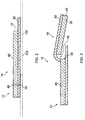
- FIG. 2 shows a section along the dogleg line 2-2 in Figure 1 .
- the upper layer 40 is generally thicker, in this embodiment 175pm thick, and made of PET.
- This material has excellent rigidity properties: that is, it retains its flat shape after repeated uses. It adheres to the 50pm-thick lower layer 30 of PP over most of its extent, including either side of the cut 15, which passes through both layers at 45 and 35 respectively. Only in the region beyond the hinge is the label flap formed by the lower layer 30 only. This means that the cut-out flap portion 14, consisting of both upper and lower layers, is free to pivot about the weaker single-layer hinge region 18. Moreover, it is found that the flap, once opened, will lie back against the packaging and after use is easy to close again.
- the foil 100 of the package to which the label flap is applied is also shown in Figure 2 , though in dashed lines only, is the foil 100 of the package to which the label flap is applied.
- the lower layer 30 has a layer of adhesive on its underside, not shown.
- the flap 14 covers the hole 102 from which moist wipes, or other contents, are to be extracted, while the hinge 18 is a short distance to the side of the hole.
- the hole will usually be made by the user on first use of the package, the outline of the hole being defined by a weak perforation which is then torn open by the attachment of the foil to the flap portion, as shown.
- Figure 3 is a cross-sectional view of a flap device 10 with the flap 14 in the open condition, leaving the frame 12 in place.
- the drawing is likewise very schematic and does not represent actual thicknesses.
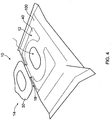
- Figure 4 is a corresponding 3D view showing the flap applied to the foil 100 of a package containing moist wipes. The contents of the package are accessed through the hole or aperture 102 formed in the foil 100 that forms a wall of the package.
- the cut is interrupted to form small ties 16. These keep the frame and flap portion together after the flap assembly is removed from the release layer and before it is applied to the package. They can, however, be easily broken by the user on first use of the flap, and they also act as a tamper-check mechanism.
- the cut 15, which passes through both layers to form the flap portion 14, is also present in the lower layer for a short distance past the point where the upper layer stops. It can be seen that on each side of the flap, or near each end of the hinge 18, a tightly curved cut 17 continues, curving round with a radius of a few mm, starting from the transversely directed line at the rear end of the cut that forms the flap. The cut goes first toward the rear edge (upper in the diagram), then outwardly towards the side edge, then slightly back towards the tab (front) edge.
- peel break It is known as a "peel break" and its function is to stop a tear in the lower layer if the user opens the flap 14 too enthusiastically: in these circumstances the tear is directed round and does not continue to the rear edge of the lower layer (which would lift the flap off entirely).
- the peel break construction also has the advantage that a short strip of the lower-layer-only area lifts up and contributes to the flexibility of the hinge.
- the user takes hold of the tab 20, which has no adhesive or where the effect of the adhesive is nullified, and pulls it up. This pulling force overcomes the tacky adhesive between the lower layer 30 and the package, though not at the area defined by perforations in the package, where instead the flap lifts the area to form the hole 102.
- the ties 16 between flap and frame are also broken.
- the opening action continues until the flap has lifted along the entire cut line shown as a thick line in Figure 1 .
- the curve towards the rear, away from the hinge line, enables the hinge region 18 of the flap to lift from the substrate and form a tube of the material of the lower layer, having a relatively large radius, i.e. several times (at least twice) the thickness of the layer. This tube is visible from the side in Figure 3 .
- the cut could be a score that tears on first use. This large radius allows the flap to lie back with only a very small restoring force, much less than the weight of the flap.
- the continuing cuts 17 could in theory just go straight back towards the rear edge, but it is better if they curve round as described above, to mitigate the risk of tearing though the entire flap device.
- the longitudinal extent of the curve might be, say, a third to a half of the longitudinal extent of the flap device behind the flap proper.
- the lower layer has an adhesive-blocking layer applied over the hinge/rear area 25; such a blocking layer may also be applied to the underside of the tab area 20 of the upper layer.
- Adhesive is then spread over the lower layer and the upper layer is stuck to the lower.
- a first cut, through the top layer only, is made along the hinge line (and the ends of the frame 12) and the resulting separated rear part of the top layer (uppermost in Figure 1 ) is removed.
- the flap/frame shape is then cut through both layers, along with the peel breaks. When ready, the flap device is removed from the backing and applied to a package.
- the variations shown in Figure 1 will be explained as follows.
- the top row shows flap portions rounded at the base (i.e. near the hinge 18), the frame continuing for a short distance to surround the flap portion, but not as far as the edge of the lower layer - in fact about the same distance as, or slightly more than, the rearward extent of the curved cut 17.
- the middle row shows a version where the base of the flap is square, with the peel breaks starting some way in along this base; the cut in the lower layer therefore extends some way in along the hinge line towards the centre.
- the frame does not continue towards the rear edge of the lower layer beyond the line of the hinge 18.
- the curved cut 15 continues in the lower layer past the square end 18 of the upper layer, so that one could say the hinge is distributed over a certain longitudinal extent of the single-layer portion 25.
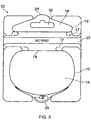
- FIG. 5 shows a variant in which the rear region 25' of the flap device extends further back in the longitudinal direction, forming a rear section 50, and a second flap-type area 14' formed by retaining a portion of the upper layer 40.
- the flap is defined by a similar cut 15' through both layers, with the tear-stop curves 17' and hinge region 18' back-to-back, as it were, with that of the package flap 14, and has an adhesive-free tab 20'. It is somewhat more squat in shape than the flap proper 14, and in addition the flap part 14' has a transverse slot 52.
- This slot known as a "Euroslot", is used for hanging the package when the closure device has been applied to a package.
- the upper layer used for the hanging portion will probably be a portion of the same layer as is used for the flap, but it could be formed separately.
- the slot could of course have a different shape, or just be a simple hole or even a hook.
- Figure 6 shows a perspective view of the label flap applied to a package, and with the flap 14 and the hanger flap 14' both deployed. This is how the package would appear in use. In a shop the flap 14 would be shut but the package would be suspended by the hanger flap 14'.
- the integral hanger flap does not have to have the same layer construction as here shown, but could have the layers inverted, or a weakness formed for the hinge line or lines in a different way, such as by partial cutting or scoring.
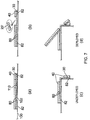
- Figure 7 shows some schematic sections illustrating the upper and lower layers 40, 30 as before, but also the adhesive layers 80.
- One adhesive layer 80 sticks together the upper and lower layers of the label flap, and the other sticks the label flap to the package 100. They can be the same or different adhesives.
- Diagrams (a) and (b) show the manufacturing step where the section 25' of upper layer 30 is removed, following the cutting step forming the outline of the flap 14 and enabled by the presence of a silicone release layer 110. This leaves the single-layer area 25 of the label flap, including the hinge regions for the flap 14 and hanger flap 14'. (The package 100 is also shown, though it would not actually be present during the manufacturing process).
- the adhesive-kill layers 82 underneath the tabs 20 and 20' are also visible.
- Diagrams (c) and (d) show the label flap in use undeployed and deployed.
- Figure 8 shows a plan view, separated into the component layers, of the embodiment of Figure 5 . This shows how the silicone release layer 110 corresponds to the shape of the cut and removed portions 25' of the upper layer.
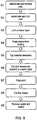
- Figure 9 shows a typical sequence of steps in the manufacturing process.
- the roll of backing layer and lower layer (with its layer of adhesive) is fed and the two layers are separated.
- the adhesive kill layer 82 is applied to the lower layer (Step S1).
- the lower layer is reunited with the backing and the laminate turned over (S2).
- the silicone release coating 110 is then printed on the base or lower layer 30, with any logos etc. (S3, S4).
- the stiff top layer 40 is laminated onto the lower layer at step S5.
- the hinge/rear area 25 is cut out and removed, and any final print applied (S6, S7).
- the flap outline is cut, including the tear stops 17 and the tab 20.
- the individual flap devices can then be applied to packages as required.
Landscapes
- Engineering & Computer Science (AREA)
- Mechanical Engineering (AREA)
- Cartons (AREA)
- Packages (AREA)
- Bag Frames (AREA)
- Packaging Of Annular Or Rod-Shaped Articles, Wearing Apparel, Cassettes, Or The Like (AREA)
Claims (13)
- Wiederverschließbare Klappenvorrichtung in Form einer Folie zur Verwendung an oder Einarbeitung in Verpackung 100), umfassend:- Eine untere Schicht (30) aus Material, das eine Klebschicht (80) auf seiner unteren Seite aufweist; und- eine obere Schicht (40) aus Material, das an die untere Schicht geklebt ist;wobei die Folie durch beide Schichten geschnitten (15) wird, um einen Klappenabschnitt (14) zu umreißen, wobei der Schnitt eine Kante in einem Scharnierbereich 18) hinter der Klappe intakt lässt, hinter dem sich ein rückwärtiger Bereich (25) der Klappenvorrichtung befindet; dadurch gekennzeichnet, dass
die untere Schicht aus flexiblem Material besteht, während die obere Schicht aus steifem Material besteht, und die obere Schicht des Klappenabschnitts im hinteren Bereich (25) über die Linie des Scharnierbereichs (18) hinaus nicht vorhanden ist. - Wiederverschließbare Klappenvorrichtung nach Anspruch 1, in welcher der Schnitt (15) außerdem einen Rahmen (12) um den Klappenabschnitt (14), zumindest an seinen zwei Seiten, formt.
- Wiederverschließbare Klappenvorrichtung nach Anspruch 2, in welcher sich der Rahmen (12) eine Distanz rückwärtig über die Scharnierlinie (18) hinaus, aber nicht so weit wie die Kante der unteren Schicht (30) erstreckt.
- Wiederverschließbare Klappenvorrichtung nach Anspruch 2 oder 3, die ferner zwei Bindeabschnitte (16) einschließen, welche den Schnitt (15) unterbrechen und den Klappenabschnitt (14) mit dem Rahmen (12) verbinden.
- Wiederverschließbare Klappenvorrichtung nach einem vorhergehenden Anspruch, in welcher der Schnitt (15) in der unteren Schicht (30) über die Scharnierlinie (18) hinaus fortführt.
- Wiederverschließbare Klappenvorrichtung nach einem vorhergehenden Anspruch, in welcher die untere Schicht (30) von vorn nach hinten über die Scharnierlinie (18) fortführt.
- Wiederverschließbare Klappenvorrichtung nach einem vorhergehenden Anspruch, in welcher der Klappenabschnitt (14) an seinem vorderen Ende, gegenüber dem Scharnierbereich (18), eine Lasche (20) aufweist, um das Erfassen und Öffnen des Klappenabschnitts zu erleichtern.
- Wiederverschließbare Klappenvorrichtung nach einem vorhergehenden Anspruch, in welcher die untere Schicht (30) aus PET hergestellt ist und 40-60 µm dick ist, und die obere Schicht (40) aus PPE hergestellt ist und 150-200 µm dick ist; und/oder, in welcher die obere Schicht zumindest zweimal so steif wie die untere Schicht ist.
- Wiederverschließbare Klappenvorrichtung nach einem vorhergehenden Anspruch, in welcher die untere Schicht (30) rückwärtig fortführt und einen zweiten Klappenabschnitt (14') inkorporiert, der durch einen weiteren Abschnitt der oberen Schicht (40) definiert ist, wobei der zweite Klappenabschnitt (14') einen Schlitz aufweist mit dem ein Produkt aufgehängt werden kann, wenn die Klappenvorrichtung am Produkt angebracht ist.
- Packung, die ein Behältnis mit einem Loch (102) zum Herausziehen oder Einfügen von Produkten einschließt, wobei das Loch von einer wiederverschließbaren Klappenvorrichtung nach einem vorhergehenden Anspruch abgedeckt wird.
- Verfahren zur Herstellung einer wiederverschließbaren Klappenvorrichtung in Form einer Folie zur Verwendung an oder Einarbeitung in Verpackung (100), die folgenden Schritte umfassend:Bereitstellen einer unteren Schicht (30) aus Material, das eine Klebschicht (80) auf seiner unteren Seite aufweist;Kleben einer oberen Schicht (40) aus Material an die untere Schicht;Schneiden durch beide Schichten, um einen Klappenabschnitt (14) zu umreißen, wobei der Schnitt eine Kante in einem Scharnierbereich 18) hinter der Klappe intakt lässt, hinter dem sich ein rückwärtiger Bereich (25) der Klappenvorrichtung befindet;gekennzeichnet durch den Schritt des Entfernens eines Abschnitts (25') der oberen Schicht (40) in einem Bereich dahinter wo der Scharnierbereich (18) zu formen ist,wobei die untere Schicht aus flexiblem Material ist und die obere Schicht aus steifem Material ist.
- Verfahren nach Anspruch 12, in welchem der Schnitt (15) in der unteren Schicht (30) rückwärtig über die Scharnierlinie (18) hinaus fortführt.
Priority Applications (2)
| Application Number | Priority Date | Filing Date | Title |
|---|---|---|---|
| PL16731252T PL3256398T3 (pl) | 2015-06-12 | 2016-06-13 | Urządzenie z klapką do wielokrotnego zamykania |
| EP19191357.3A EP3659940B1 (de) | 2015-06-12 | 2016-06-13 | Wiederverschliessbare klappenvorrichtung und verpackung mit einer solchen klappenvorrichtung |
Applications Claiming Priority (3)
| Application Number | Priority Date | Filing Date | Title |
|---|---|---|---|
| GBGB1510378.1A GB201510378D0 (en) | 2015-06-12 | 2015-06-12 | Reclosable flap |
| GBGB1522698.8A GB201522698D0 (en) | 2015-12-22 | 2015-12-22 | Reclosable flap |
| PCT/GB2016/051752 WO2016198905A1 (en) | 2015-06-12 | 2016-06-13 | Reclosable flap device |
Related Child Applications (2)
| Application Number | Title | Priority Date | Filing Date |
|---|---|---|---|
| EP19191357.3A Division EP3659940B1 (de) | 2015-06-12 | 2016-06-13 | Wiederverschliessbare klappenvorrichtung und verpackung mit einer solchen klappenvorrichtung |
| EP19191357.3A Division-Into EP3659940B1 (de) | 2015-06-12 | 2016-06-13 | Wiederverschliessbare klappenvorrichtung und verpackung mit einer solchen klappenvorrichtung |
Publications (3)
| Publication Number | Publication Date |
|---|---|
| EP3256398A1 EP3256398A1 (de) | 2017-12-20 |
| EP3256398B1 true EP3256398B1 (de) | 2019-08-14 |
| EP3256398B9 EP3256398B9 (de) | 2019-12-11 |
Family
ID=56178384
Family Applications (2)
| Application Number | Title | Priority Date | Filing Date |
|---|---|---|---|
| EP16731252.9A Active EP3256398B9 (de) | 2015-06-12 | 2016-06-13 | Wiederverschliessbare klappenvorrichtung |
| EP19191357.3A Active EP3659940B1 (de) | 2015-06-12 | 2016-06-13 | Wiederverschliessbare klappenvorrichtung und verpackung mit einer solchen klappenvorrichtung |
Family Applications After (1)
| Application Number | Title | Priority Date | Filing Date |
|---|---|---|---|
| EP19191357.3A Active EP3659940B1 (de) | 2015-06-12 | 2016-06-13 | Wiederverschliessbare klappenvorrichtung und verpackung mit einer solchen klappenvorrichtung |
Country Status (9)
| Country | Link |
|---|---|
| US (3) | US10730677B2 (de) |
| EP (2) | EP3256398B9 (de) |
| JP (1) | JP6859333B2 (de) |
| ES (2) | ES3008507T3 (de) |
| GB (2) | GB2539331B (de) |
| HU (1) | HUE070664T2 (de) |
| IL (1) | IL256254B (de) |
| PL (2) | PL3659940T3 (de) |
| WO (1) | WO2016198905A1 (de) |
Families Citing this family (2)
| Publication number | Priority date | Publication date | Assignee | Title |
|---|---|---|---|---|
| HUE070664T2 (hu) | 2015-06-12 | 2025-06-28 | Opm Advance Ltd | Visszazárható zárófedél szerkezet és csomagolás ilyen zárófedél szerkezettel |
| PL237951B1 (pl) | 2018-12-05 | 2021-06-14 | Chemes M Szperlinski Spolka Z Ograniczona Odpowiedzialnoscia | Opakowanie z otworem zamykanym klapką wielokrotnego użytku |
Family Cites Families (21)
| Publication number | Priority date | Publication date | Assignee | Title |
|---|---|---|---|---|
| US1492100A (en) * | 1921-09-29 | 1924-04-29 | Theodore H Krueger | Handle for boxes and parcels |
| US2050967A (en) * | 1935-07-05 | 1936-08-11 | John A Farmer | Combined closure and handle for bag |
| DE7603597U1 (de) * | 1976-02-09 | 1976-07-22 | Pelz & Co Kg W | Beutel zur Aufbewahrung und Entnahme eines schmiegsamen Produktes wie Watte oder dergleichen |
| DE3514943A1 (de) | 1985-04-25 | 1986-10-30 | Virgunia Verpackung Inh. Herr Fidelis Frank, 8000 München | Verpackung |
| US4679693A (en) * | 1986-05-14 | 1987-07-14 | Harold Forman | Label resealing container |
| JP3642879B2 (ja) | 1996-07-02 | 2005-04-27 | ユニ・チャーム株式会社 | 包装体の開封機構 |
| JP3659792B2 (ja) * | 1998-03-24 | 2005-06-15 | ユニ・チャーム株式会社 | 包装体の開封構造 |
| JP3195305B2 (ja) * | 1998-12-10 | 2001-08-06 | 憲司 中村 | シート状開閉蓋を有する包装体およびその製造方法 |
| US6413604B1 (en) * | 1999-03-11 | 2002-07-02 | Ampersand Label, Inc. | Multiple layer labels and methods |
| EP1364887A1 (de) * | 2002-05-23 | 2003-11-26 | Pizzo di Etichette S.r.l. | Wiederverschliessbares Selbstklebeverschlussetikett zum Hängen einer Verpackung sowie damit versehene Verpackung |
| JP5180706B2 (ja) | 2008-07-02 | 2013-04-10 | ユニ・チャーム株式会社 | 収容装置 |
| JP5262542B2 (ja) * | 2008-10-06 | 2013-08-14 | 凸版印刷株式会社 | 蓋材及びその蓋材を用いた容器 |
| US8182891B2 (en) * | 2008-12-18 | 2012-05-22 | Prime Label & Screen, Inc. | Rigid resealable label flap having a hinge |
| DE102009031568A1 (de) * | 2009-06-29 | 2010-12-30 | Fraunhofer-Gesellschaft zur Förderung der angewandten Forschung e.V. | Verfahren zur Erzeugung eines elektronischen Systems, Verfahren zur Erzeugung einer Freiformfläche mit einem solchen System, sowie elektronisches System und Freiformflächen mit einem solchen System |
| US8343469B2 (en) | 2009-07-02 | 2013-01-01 | Hercules Incorporated | Cationic synthetic polymers with improved solubility and performance in surfactant-based systems and use in personal care and household applications |
| JP5654767B2 (ja) * | 2009-07-03 | 2015-01-14 | ユニ・チャーム株式会社 | 包装体 |
| JP6001868B2 (ja) * | 2012-02-06 | 2016-10-05 | 株式会社シーネット | 包装体及び包装体の開閉蓋 |
| JP6649881B2 (ja) * | 2013-10-15 | 2020-02-19 | レリーベス エガラ,エスエル | 可撓性の使い捨て容器の開閉装置 |
| US10167111B2 (en) * | 2014-12-19 | 2019-01-01 | Velcro BVBA | Tamper-evident reusable package closure |
| HUE070664T2 (hu) | 2015-06-12 | 2025-06-28 | Opm Advance Ltd | Visszazárható zárófedél szerkezet és csomagolás ilyen zárófedél szerkezettel |
| GB2534958A (en) * | 2015-09-04 | 2016-08-10 | Adare Advantage Ltd | A resealable label flap |
-
2016
- 2016-06-13 HU HUE19191357A patent/HUE070664T2/hu unknown
- 2016-06-13 PL PL19191357.3T patent/PL3659940T3/pl unknown
- 2016-06-13 ES ES19191357T patent/ES3008507T3/es active Active
- 2016-06-13 PL PL16731252T patent/PL3256398T3/pl unknown
- 2016-06-13 JP JP2018516644A patent/JP6859333B2/ja active Active
- 2016-06-13 EP EP16731252.9A patent/EP3256398B9/de active Active
- 2016-06-13 ES ES16731252T patent/ES2755722T3/es active Active
- 2016-06-13 GB GB1610242.8A patent/GB2539331B/en active Active
- 2016-06-13 US US15/570,635 patent/US10730677B2/en active Active
- 2016-06-13 GB GB1800209.7A patent/GB2557747B/en active Active
- 2016-06-13 WO PCT/GB2016/051752 patent/WO2016198905A1/en not_active Ceased
- 2016-06-13 EP EP19191357.3A patent/EP3659940B1/de active Active
-
2017
- 2017-12-11 IL IL256254A patent/IL256254B/en unknown
-
2020
- 2020-06-23 US US16/909,611 patent/US11667448B2/en active Active
-
2023
- 2023-04-27 US US18/308,443 patent/US11999548B2/en active Active
Non-Patent Citations (1)
| Title |
|---|
| None * |
Also Published As
| Publication number | Publication date |
|---|---|
| EP3659940C0 (de) | 2025-01-15 |
| IL256254B (en) | 2021-10-31 |
| EP3659940A3 (de) | 2020-09-09 |
| PL3659940T3 (pl) | 2025-05-12 |
| GB2539331A (en) | 2016-12-14 |
| ES2755722T3 (es) | 2020-04-23 |
| JP2018516820A (ja) | 2018-06-28 |
| US11999548B2 (en) | 2024-06-04 |
| EP3659940A2 (de) | 2020-06-03 |
| US20200317417A1 (en) | 2020-10-08 |
| EP3256398B9 (de) | 2019-12-11 |
| EP3256398A1 (de) | 2017-12-20 |
| GB2539331B (en) | 2017-09-13 |
| GB201800209D0 (en) | 2018-02-21 |
| US10730677B2 (en) | 2020-08-04 |
| WO2016198905A1 (en) | 2016-12-15 |
| JP6859333B2 (ja) | 2021-04-14 |
| US20230257179A1 (en) | 2023-08-17 |
| PL3256398T3 (pl) | 2020-02-28 |
| IL256254A (en) | 2018-02-28 |
| HK1257485A1 (zh) | 2019-10-25 |
| US11667448B2 (en) | 2023-06-06 |
| GB2557747B (en) | 2022-01-26 |
| GB201610242D0 (en) | 2016-07-27 |
| ES3008507T3 (en) | 2025-03-24 |
| EP3659940B1 (de) | 2025-01-15 |
| HUE070664T2 (hu) | 2025-06-28 |
| US20180290807A1 (en) | 2018-10-11 |
| GB2557747A (en) | 2018-06-27 |
Similar Documents
| Publication | Publication Date | Title |
|---|---|---|
| US11999548B2 (en) | Reclosable flap device | |
| EP3057880B1 (de) | Öffnungs-/schliessvorrichtung für einen flexiblen einwegbehälter | |
| US10167111B2 (en) | Tamper-evident reusable package closure | |
| EP2349866A2 (de) | Verpackung | |
| RU2700944C2 (ru) | Повторно запечатываемая емкость для потребительских товаров с улучшенным контролем влажности | |
| US10137655B2 (en) | Resealable package method for producing the resealable package and apparatus for producing the resealable package | |
| WO2017060736A1 (en) | Package | |
| JP2019524568A (ja) | 改善された再封可能な接着ラベルを備えた再封止可能な容器 | |
| HK40030957A (en) | Reclosable flap device | |
| HK40033128A (en) | Reclosable flap device | |
| HK1243047B (en) | Reclosable flap device | |
| HK1243047A1 (en) | Reclosable flap device | |
| HK1236172A1 (en) | Reclosable flap device | |
| JP5837295B2 (ja) | ラップフィルム収納箱 | |
| EP2952451A1 (de) | Wiederverschließbare Schlauchbeutelverpackung für Feuchttücher | |
| WO2016049150A1 (en) | Packing list envelope with pull tab and method for forming the envelope | |
| US20170166381A1 (en) | Food Package Having Opening Feature | |
| JP2018004723A (ja) | セキュリティラベル | |
| KR20130104327A (ko) | 점착 테이프 | |
| GB2564419A (en) | Package |
Legal Events
| Date | Code | Title | Description |
|---|---|---|---|
| STAA | Information on the status of an ep patent application or granted ep patent |
Free format text: STATUS: THE INTERNATIONAL PUBLICATION HAS BEEN MADE |
|
| PUAI | Public reference made under article 153(3) epc to a published international application that has entered the european phase |
Free format text: ORIGINAL CODE: 0009012 |
|
| STAA | Information on the status of an ep patent application or granted ep patent |
Free format text: STATUS: REQUEST FOR EXAMINATION WAS MADE |
|
| 17P | Request for examination filed |
Effective date: 20170901 |
|
| AK | Designated contracting states |
Kind code of ref document: A1 Designated state(s): AL AT BE BG CH CY CZ DE DK EE ES FI FR GB GR HR HU IE IS IT LI LT LU LV MC MK MT NL NO PL PT RO RS SE SI SK SM TR |
|
| AX | Request for extension of the european patent |
Extension state: BA ME |
|
| TPAC | Observations filed by third parties |
Free format text: ORIGINAL CODE: EPIDOSNTIPA |
|
| REG | Reference to a national code |
Ref country code: HK Ref legal event code: DE Ref document number: 1243047 Country of ref document: HK |
|
| DAV | Request for validation of the european patent (deleted) | ||
| DAX | Request for extension of the european patent (deleted) | ||
| GRAP | Despatch of communication of intention to grant a patent |
Free format text: ORIGINAL CODE: EPIDOSNIGR1 |
|
| STAA | Information on the status of an ep patent application or granted ep patent |
Free format text: STATUS: GRANT OF PATENT IS INTENDED |
|
| INTG | Intention to grant announced |
Effective date: 20181123 |
|
| GRAJ | Information related to disapproval of communication of intention to grant by the applicant or resumption of examination proceedings by the epo deleted |
Free format text: ORIGINAL CODE: EPIDOSDIGR1 |
|
| STAA | Information on the status of an ep patent application or granted ep patent |
Free format text: STATUS: REQUEST FOR EXAMINATION WAS MADE |
|
| GRAP | Despatch of communication of intention to grant a patent |
Free format text: ORIGINAL CODE: EPIDOSNIGR1 |
|
| STAA | Information on the status of an ep patent application or granted ep patent |
Free format text: STATUS: GRANT OF PATENT IS INTENDED |
|
| 111L | Licence recorded |
Designated state(s): AL AT BE BG CH CY CZ DE DK EE ES FI FR GB GR HR HU IE IS IT LT LU LV MC MK MT NL NO PL PT RO RS SE SI SK SM TR Name of requester: OPM (LABELS AND PACKAGING) GROUP LIMITED, GB Effective date: 20190208 |
|
| INTC | Intention to grant announced (deleted) | ||
| GRAJ | Information related to disapproval of communication of intention to grant by the applicant or resumption of examination proceedings by the epo deleted |
Free format text: ORIGINAL CODE: EPIDOSDIGR1 |
|
| STAA | Information on the status of an ep patent application or granted ep patent |
Free format text: STATUS: REQUEST FOR EXAMINATION WAS MADE |
|
| INTG | Intention to grant announced |
Effective date: 20190405 |
|
| TPAC | Observations filed by third parties |
Free format text: ORIGINAL CODE: EPIDOSNTIPA |
|
| INTC | Intention to grant announced (deleted) | ||
| GRAP | Despatch of communication of intention to grant a patent |
Free format text: ORIGINAL CODE: EPIDOSNIGR1 |
|
| STAA | Information on the status of an ep patent application or granted ep patent |
Free format text: STATUS: GRANT OF PATENT IS INTENDED |
|
| GRAS | Grant fee paid |
Free format text: ORIGINAL CODE: EPIDOSNIGR3 |
|
| GRAA | (expected) grant |
Free format text: ORIGINAL CODE: 0009210 |
|
| STAA | Information on the status of an ep patent application or granted ep patent |
Free format text: STATUS: THE PATENT HAS BEEN GRANTED |
|
| INTG | Intention to grant announced |
Effective date: 20190701 |
|
| RIN1 | Information on inventor provided before grant (corrected) |
Inventor name: ELLISON, CHRISTOPHER JOHN Inventor name: BELL, IAN DAVID MICHAEL |
|
| 111L | Licence recorded |
Designated state(s): AL AT BE BG CH CY CZ DE DK EE ES FI FR GB GR HR HU IE IS IT LT LU LV MC MK MT NL NO PL PT RO RS SE SI SK SM TR Name of requester: OPM (LABELS AND PACKAGING) GROUP LIMITED, GB Effective date: 20190208 |
|
| AK | Designated contracting states |
Kind code of ref document: B1 Designated state(s): AL AT BE BG CH CY CZ DE DK EE ES FI FR GB GR HR HU IE IS IT LI LT LU LV MC MK MT NL NO PL PT RO RS SE SI SK SM TR |
|
| REG | Reference to a national code |
Ref country code: GB Ref legal event code: FG4D |
|
| REG | Reference to a national code |
Ref country code: CH Ref legal event code: EP Ref country code: AT Ref legal event code: REF Ref document number: 1166758 Country of ref document: AT Kind code of ref document: T Effective date: 20190815 |
|
| GRAT | Correction requested after decision to grant or after decision to maintain patent in amended form |
Free format text: ORIGINAL CODE: EPIDOSNCDEC |
|
| REG | Reference to a national code |
Ref country code: IE Ref legal event code: FG4D |
|
| REG | Reference to a national code |
Ref country code: DE Ref legal event code: R096 Ref document number: 602016018612 Country of ref document: DE |
|
| REG | Reference to a national code |
Ref country code: CH Ref legal event code: PK Free format text: BERICHTIGUNG B9 |
|
| REG | Reference to a national code |
Ref country code: SE Ref legal event code: TRGR |
|
| REG | Reference to a national code |
Ref country code: NL Ref legal event code: FP |
|
| REG | Reference to a national code |
Ref country code: LT Ref legal event code: MG4D |
|
| PG25 | Lapsed in a contracting state [announced via postgrant information from national office to epo] |
Ref country code: PT Free format text: LAPSE BECAUSE OF FAILURE TO SUBMIT A TRANSLATION OF THE DESCRIPTION OR TO PAY THE FEE WITHIN THE PRESCRIBED TIME-LIMIT Effective date: 20191216 Ref country code: LT Free format text: LAPSE BECAUSE OF FAILURE TO SUBMIT A TRANSLATION OF THE DESCRIPTION OR TO PAY THE FEE WITHIN THE PRESCRIBED TIME-LIMIT Effective date: 20190814 Ref country code: BG Free format text: LAPSE BECAUSE OF FAILURE TO SUBMIT A TRANSLATION OF THE DESCRIPTION OR TO PAY THE FEE WITHIN THE PRESCRIBED TIME-LIMIT Effective date: 20191114 Ref country code: HR Free format text: LAPSE BECAUSE OF FAILURE TO SUBMIT A TRANSLATION OF THE DESCRIPTION OR TO PAY THE FEE WITHIN THE PRESCRIBED TIME-LIMIT Effective date: 20190814 Ref country code: FI Free format text: LAPSE BECAUSE OF FAILURE TO SUBMIT A TRANSLATION OF THE DESCRIPTION OR TO PAY THE FEE WITHIN THE PRESCRIBED TIME-LIMIT Effective date: 20190814 Ref country code: NO Free format text: LAPSE BECAUSE OF FAILURE TO SUBMIT A TRANSLATION OF THE DESCRIPTION OR TO PAY THE FEE WITHIN THE PRESCRIBED TIME-LIMIT Effective date: 20191114 |
|
| REG | Reference to a national code |
Ref country code: CH Ref legal event code: PK Free format text: BERICHTIGUNG B9 |
|
| REG | Reference to a national code |
Ref country code: AT Ref legal event code: MK05 Ref document number: 1166758 Country of ref document: AT Kind code of ref document: T Effective date: 20190814 |
|
| PG25 | Lapsed in a contracting state [announced via postgrant information from national office to epo] |
Ref country code: LV Free format text: LAPSE BECAUSE OF FAILURE TO SUBMIT A TRANSLATION OF THE DESCRIPTION OR TO PAY THE FEE WITHIN THE PRESCRIBED TIME-LIMIT Effective date: 20190814 Ref country code: RS Free format text: LAPSE BECAUSE OF FAILURE TO SUBMIT A TRANSLATION OF THE DESCRIPTION OR TO PAY THE FEE WITHIN THE PRESCRIBED TIME-LIMIT Effective date: 20190814 Ref country code: IS Free format text: LAPSE BECAUSE OF FAILURE TO SUBMIT A TRANSLATION OF THE DESCRIPTION OR TO PAY THE FEE WITHIN THE PRESCRIBED TIME-LIMIT Effective date: 20191214 Ref country code: AL Free format text: LAPSE BECAUSE OF FAILURE TO SUBMIT A TRANSLATION OF THE DESCRIPTION OR TO PAY THE FEE WITHIN THE PRESCRIBED TIME-LIMIT Effective date: 20190814 |
|
| REG | Reference to a national code |
Ref country code: GR Ref legal event code: EP Ref document number: 20190403427 Country of ref document: GR Effective date: 20200213 |
|
| REG | Reference to a national code |
Ref country code: ES Ref legal event code: FG2A Ref document number: 2755722 Country of ref document: ES Kind code of ref document: T3 Effective date: 20200423 |
|
| PG25 | Lapsed in a contracting state [announced via postgrant information from national office to epo] |
Ref country code: RO Free format text: LAPSE BECAUSE OF FAILURE TO SUBMIT A TRANSLATION OF THE DESCRIPTION OR TO PAY THE FEE WITHIN THE PRESCRIBED TIME-LIMIT Effective date: 20190814 Ref country code: DK Free format text: LAPSE BECAUSE OF FAILURE TO SUBMIT A TRANSLATION OF THE DESCRIPTION OR TO PAY THE FEE WITHIN THE PRESCRIBED TIME-LIMIT Effective date: 20190814 Ref country code: AT Free format text: LAPSE BECAUSE OF FAILURE TO SUBMIT A TRANSLATION OF THE DESCRIPTION OR TO PAY THE FEE WITHIN THE PRESCRIBED TIME-LIMIT Effective date: 20190814 Ref country code: EE Free format text: LAPSE BECAUSE OF FAILURE TO SUBMIT A TRANSLATION OF THE DESCRIPTION OR TO PAY THE FEE WITHIN THE PRESCRIBED TIME-LIMIT Effective date: 20190814 |
|
| PG25 | Lapsed in a contracting state [announced via postgrant information from national office to epo] |
Ref country code: CZ Free format text: LAPSE BECAUSE OF FAILURE TO SUBMIT A TRANSLATION OF THE DESCRIPTION OR TO PAY THE FEE WITHIN THE PRESCRIBED TIME-LIMIT Effective date: 20190814 Ref country code: SK Free format text: LAPSE BECAUSE OF FAILURE TO SUBMIT A TRANSLATION OF THE DESCRIPTION OR TO PAY THE FEE WITHIN THE PRESCRIBED TIME-LIMIT Effective date: 20190814 Ref country code: IS Free format text: LAPSE BECAUSE OF FAILURE TO SUBMIT A TRANSLATION OF THE DESCRIPTION OR TO PAY THE FEE WITHIN THE PRESCRIBED TIME-LIMIT Effective date: 20200224 Ref country code: SM Free format text: LAPSE BECAUSE OF FAILURE TO SUBMIT A TRANSLATION OF THE DESCRIPTION OR TO PAY THE FEE WITHIN THE PRESCRIBED TIME-LIMIT Effective date: 20190814 |
|
| REG | Reference to a national code |
Ref country code: DE Ref legal event code: R097 Ref document number: 602016018612 Country of ref document: DE |
|
| PLBE | No opposition filed within time limit |
Free format text: ORIGINAL CODE: 0009261 |
|
| STAA | Information on the status of an ep patent application or granted ep patent |
Free format text: STATUS: NO OPPOSITION FILED WITHIN TIME LIMIT |
|
| PG2D | Information on lapse in contracting state deleted |
Ref country code: IS |
|
| 26N | No opposition filed |
Effective date: 20200603 |
|
| PG25 | Lapsed in a contracting state [announced via postgrant information from national office to epo] |
Ref country code: SI Free format text: LAPSE BECAUSE OF FAILURE TO SUBMIT A TRANSLATION OF THE DESCRIPTION OR TO PAY THE FEE WITHIN THE PRESCRIBED TIME-LIMIT Effective date: 20190814 |
|
| REG | Reference to a national code |
Ref country code: NL Ref legal event code: QB Free format text: DETAILS LICENCE OR PLEDGE: LICENCE, NEW LICENCE REGISTRATION Name of requester: OPM (LABELS & PACKAGING) GROUP LIMITED Effective date: 20200824 |
|
| REG | Reference to a national code |
Ref country code: ES Ref legal event code: GD2A Effective date: 20201007 |
|
| PG25 | Lapsed in a contracting state [announced via postgrant information from national office to epo] |
Ref country code: MC Free format text: LAPSE BECAUSE OF FAILURE TO SUBMIT A TRANSLATION OF THE DESCRIPTION OR TO PAY THE FEE WITHIN THE PRESCRIBED TIME-LIMIT Effective date: 20190814 |
|
| REG | Reference to a national code |
Ref country code: CH Ref legal event code: PL |
|
| REG | Reference to a national code |
Ref country code: GB Ref legal event code: 732E Free format text: REGISTERED BETWEEN 20210114 AND 20210120 |
|
| PG25 | Lapsed in a contracting state [announced via postgrant information from national office to epo] |
Ref country code: LU Free format text: LAPSE BECAUSE OF NON-PAYMENT OF DUE FEES Effective date: 20200613 |
|
| REG | Reference to a national code |
Ref country code: BE Ref legal event code: MM Effective date: 20200630 |
|
| PG25 | Lapsed in a contracting state [announced via postgrant information from national office to epo] |
Ref country code: LI Free format text: LAPSE BECAUSE OF NON-PAYMENT OF DUE FEES Effective date: 20200630 Ref country code: CH Free format text: LAPSE BECAUSE OF NON-PAYMENT OF DUE FEES Effective date: 20200630 |
|
| PG25 | Lapsed in a contracting state [announced via postgrant information from national office to epo] |
Ref country code: BE Free format text: LAPSE BECAUSE OF NON-PAYMENT OF DUE FEES Effective date: 20200630 |
|
| PG25 | Lapsed in a contracting state [announced via postgrant information from national office to epo] |
Ref country code: MT Free format text: LAPSE BECAUSE OF FAILURE TO SUBMIT A TRANSLATION OF THE DESCRIPTION OR TO PAY THE FEE WITHIN THE PRESCRIBED TIME-LIMIT Effective date: 20190814 Ref country code: CY Free format text: LAPSE BECAUSE OF FAILURE TO SUBMIT A TRANSLATION OF THE DESCRIPTION OR TO PAY THE FEE WITHIN THE PRESCRIBED TIME-LIMIT Effective date: 20190814 |
|
| PG25 | Lapsed in a contracting state [announced via postgrant information from national office to epo] |
Ref country code: MK Free format text: LAPSE BECAUSE OF FAILURE TO SUBMIT A TRANSLATION OF THE DESCRIPTION OR TO PAY THE FEE WITHIN THE PRESCRIBED TIME-LIMIT Effective date: 20190814 |
|
| P01 | Opt-out of the competence of the unified patent court (upc) registered |
Effective date: 20230517 |
|
| PGFP | Annual fee paid to national office [announced via postgrant information from national office to epo] |
Ref country code: PL Payment date: 20250606 Year of fee payment: 10 Ref country code: DE Payment date: 20250618 Year of fee payment: 10 |
|
| PGFP | Annual fee paid to national office [announced via postgrant information from national office to epo] |
Ref country code: GB Payment date: 20250618 Year of fee payment: 10 |
|
| PGFP | Annual fee paid to national office [announced via postgrant information from national office to epo] |
Ref country code: NL Payment date: 20250618 Year of fee payment: 10 |
|
| PGFP | Annual fee paid to national office [announced via postgrant information from national office to epo] |
Ref country code: FR Payment date: 20250625 Year of fee payment: 10 |
|
| PGFP | Annual fee paid to national office [announced via postgrant information from national office to epo] |
Ref country code: GR Payment date: 20250620 Year of fee payment: 10 |
|
| PGFP | Annual fee paid to national office [announced via postgrant information from national office to epo] |
Ref country code: TR Payment date: 20250610 Year of fee payment: 10 |
|
| PGFP | Annual fee paid to national office [announced via postgrant information from national office to epo] |
Ref country code: IE Payment date: 20250618 Year of fee payment: 10 |
|
| PGFP | Annual fee paid to national office [announced via postgrant information from national office to epo] |
Ref country code: SE Payment date: 20250618 Year of fee payment: 10 |
|
| PGFP | Annual fee paid to national office [announced via postgrant information from national office to epo] |
Ref country code: ES Payment date: 20250728 Year of fee payment: 10 |
|
| PGFP | Annual fee paid to national office [announced via postgrant information from national office to epo] |
Ref country code: IT Payment date: 20250619 Year of fee payment: 10 |