EP3244605A1 - Electronic camera - Google Patents
Electronic camera Download PDFInfo
- Publication number
- EP3244605A1 EP3244605A1 EP17001113.4A EP17001113A EP3244605A1 EP 3244605 A1 EP3244605 A1 EP 3244605A1 EP 17001113 A EP17001113 A EP 17001113A EP 3244605 A1 EP3244605 A1 EP 3244605A1
- Authority
- EP
- European Patent Office
- Prior art keywords
- section
- display
- image
- buffer
- moving image
- Prior art date
- Legal status (The legal status is an assumption and is not a legal conclusion. Google has not performed a legal analysis and makes no representation as to the accuracy of the status listed.)
- Withdrawn
Links
- 238000003384 imaging method Methods 0.000 claims 5
- 239000000872 buffer Substances 0.000 abstract description 66
- 238000000034 method Methods 0.000 description 26
- 238000010586 diagram Methods 0.000 description 2
- 230000000694 effects Effects 0.000 description 2
- 238000013500 data storage Methods 0.000 description 1
- 230000000994 depressogenic effect Effects 0.000 description 1
- 238000012986 modification Methods 0.000 description 1
- 230000004048 modification Effects 0.000 description 1
- 238000005375 photometry Methods 0.000 description 1
- 230000000153 supplemental effect Effects 0.000 description 1
- 230000001360 synchronised effect Effects 0.000 description 1
Images


Classifications
-
- H—ELECTRICITY
- H04—ELECTRIC COMMUNICATION TECHNIQUE
- H04N—PICTORIAL COMMUNICATION, e.g. TELEVISION
- H04N1/00—Scanning, transmission or reproduction of documents or the like, e.g. facsimile transmission; Details thereof
- H04N1/21—Intermediate information storage
- H04N1/2104—Intermediate information storage for one or a few pictures
- H04N1/2112—Intermediate information storage for one or a few pictures using still video cameras
-
- H—ELECTRICITY
- H04—ELECTRIC COMMUNICATION TECHNIQUE
- H04N—PICTORIAL COMMUNICATION, e.g. TELEVISION
- H04N23/00—Cameras or camera modules comprising electronic image sensors; Control thereof
- H04N23/60—Control of cameras or camera modules
- H04N23/63—Control of cameras or camera modules by using electronic viewfinders
-
- H—ELECTRICITY
- H04—ELECTRIC COMMUNICATION TECHNIQUE
- H04N—PICTORIAL COMMUNICATION, e.g. TELEVISION
- H04N23/00—Cameras or camera modules comprising electronic image sensors; Control thereof
- H04N23/60—Control of cameras or camera modules
- H04N23/667—Camera operation mode switching, e.g. between still and video, sport and normal or high- and low-resolution modes
Definitions
- the present invention relates to an electronic camera having a display device.
- V-signal a video synchronizing signal
- One type is a buffer used for temporarily storing data of a moving image generated by the image sensor or the like (hereinafter, referred to as a buffer for photographed image).
- the other type is a buffer used for temporarily storing data of a moving image to be displayed on the display device (hereinafter, referred to as a buffer for display image).
- a moving image displayed on the display device is always the image of an object that occurred three cycles of the V-signal earlier.
- An object of the present invention is to provide an electronic camera that can properly display a moving image usable as a viewfinder.
- Fig. 1 is a functional block diagram of an electronic camera according to the present invention.
- the electronic camera 1 includes a controlling section 10, a lens 11, an aperture 12, an image sensor 13, an image processing section 14, a display controlling section 15, a display device 16, a compressing/recording section 17, a TG (timing generator) 18, and an operation section 19.
- the image processing section 14 includes a moving image processing section 30, a switch SW-a, a first buffer for photographed image 31, a second buffer for photographed image 32, a switch SW-b, a switch SW-c, a first buffer for display image 33, a second buffer for display image 34, a switch SW-d, a still image processing section 35, and a still image buffer 36.
- the controlling section 10 controls the system of the electronic camera 1 as described below.
- the controlling section 10 is connected through a lens driving section (not shown) to the lens 11, and performs AF (autofocus) on the basis of the data supplied from an AF sensor (not shown) or the like.
- controlling section 10 is connected through an aperture driving section (not shown) to the aperture 12, and performs AE (auto exposure adjustment) on the basis of the data supplied from a photometry section (not shown) or the like.
- controlling section 10 is connected to each section within the image processing section 14, the display controlling section 15, the compressing/recording section 17, the TG 18, and the operation section 19, and inputs various control signals such as the V-signal output from the TG 18 to each section to control the driving timings and the like for the image processing section 14, the display controlling section 15, and the compressing/recording section 17.
- the controlling section 10 constantly monitors the states of switches constituting the operation section 19.
- the switches may include, for example, a power supply switch, a release button that can be depressed in two steps by a half-press and full-press, an AE/AF lock switch used for forcibly locking the AE and AF, and switches used for changing various modes.
- the image sensor 13 is connected to the TG 18, and is driven in accordance with various control signals output from the TG 18 to supply the image processing section 14 with image signals generated based on light incident through the lens 11 and the aperture 12.
- the moving image processing section 30 in the image processing section 14 performs various image processing for a moving image on the image signals supplied from the image sensor 13 to generate the moving image data.
- the generated moving image data is stored through the switch SW-a into the first buffer for photographed image 31 or the second buffer for photographed image 32.
- the moving image data is then stored through the switches SW-b and SW-c into the first buffer for display image 33 or the second buffer for display image 34, after which the data is supplied to the display controlling section 15 via the switch SW-d.
- the data is directly supplied to the display controlling section 15 via the switches SW-b, SW-c (position c3 thereof), and SW-d.
- the still image processing section 35 in the image processing section 14 performs various image processing for a still image on the image signals supplied from the image sensor 13 to generate the still image data.
- the generated still image data is supplied through the still image buffer 36 to the display controlling section 15 and the compressing/recording section 17.
- the display controlling section 15 converts the moving image data and still image data, both supplied as described above, to display data to be displayed on the display device 16.
- the compressing/recording section 17 compresses the still image data supplied as described above and converts it to record data to be stored into a memory card 50 (removable memory card).
- moving image capturing process in which moving image data is generated by the moving image processing section 30 by using the image signals generated by the image sensor 13, to store the generated moving image data through the switch SW-a into the first buffer for photographed image 31 or the second buffer for photographed image 32.
- a process in which the moving image data stored in the first buffer for display image 33 or the second buffer for display image 34 is supplied to the display controlling section 15 via the switch SW-d and then displayed on the display device 16 is referred to as moving image displaying process.
- a process in which the moving image data stored in the first buffer for photographed image 31 or second buffer for photographed image 32 is supplied through the switches SW-b, SW-c (position c3 thereof), and SW-d to the display controlling section 15 and then displayed on the display device 16 is also referred to as moving image displaying process.
- still image recording process a series of processes is referred to as still image recording process, in which the still image data is generated by the still image processing section 35 by using the image signals generated by the image sensor 13 and the generated still image data is supplied through the still image buffer 36 to the compressing/recording section 17 and then stored into the memory card 50.
- the still image recording process may include a process in which the still image data is supplied to the display controlling section 15 and then displayed on the display device 16.
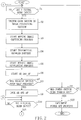
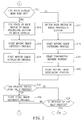
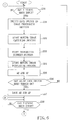
- Fig. 2 and Fig. 3 are flowcharts of the operation of the above-described electronic camera, and more particularly, showing the operation of the controlling section 10 after the power supply switch has been turned on by a user.
- Fig. 1 the operation of the electronic camera 1 will be described in order of the step numbers shown in Fig. 2 and Fig. 3 .
- the controlling section 10 decides whether a V-signal is input or not.
- the controlling section 10 repeats the operation in step S1 until a V-signal is input, and proceeds to the operation in step S2 when the V-signal is input.
- the controlling section 10 switches the state of each switch in the image processing section 14 as follows.
- the controlling section 10 closes the switch SW-a to the position a1, switch SW-b to the b2, switch SW-c to the c2, and switch SW-d to the d 1. Subsequently, when a new V-signal is input, the controlling section 10 changes the position of the switch SW-a to the position a2, switch SW-b to the b1, switch SW-c to the c1, and switch SW-d to the d2. After that, when a new V-signal is input again, the controlling section 10 changes the position of the switch SW-a to the position a1, switch SW-b to the b2, switch SW-c to the c2, and switch SW-d to the d1.
- switching the state of each switch in the image processing section 14 is to switch from/to one state (hereinafter, referred to as a first state) to/from the other state (hereinafter, referred to as a second state).
- the one state is a state in which the switch SW-a is closed to the position a1, switch SW-b to the b2, switch SW-c to the c2, and switch SW-d to the d1.
- the other state is a state in which the switch SW-a is closed to the position a2, switch SW-b to the b1, switch SW-c to the c1, and switch SW-d to the d2.
- the controlling section 10 starts the moving image capturing process.
- the controlling section 10 starts the transmittal between buffers.
- the controlling section 10 starts the moving image displaying process.
- the controlling section 10 starts performing the AE and AF.
- the controlling section 10 decides whether the release button is half-pressed or not. When the release button is half-pressed, the controlling section 10 proceeds to the operation in step S9. Otherwise, the controlling section 10 proceeds to the operation in step S8.
- the controlling section 10 decides whether the power supply switch is turned off or not. When the power supply switch is turned off, the controlling section 10 proceeds to the operation in step S22. Otherwise, the controlling section 10 returns to the operation in step S1.
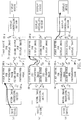
- the moving image data which has been stored in the first buffer for display image 33 in Fig. 4(b) is displayed through the display controlling section 15 on the display device 16 as shown by a thick line in Fig. 4(c) .
- newly generated moving image data is stored into the first buffer for photographed image 31, and the moving image data which has been stored in the second buffer for photographed image 32 in Fig. 4(b) is transferred to the second buffer for display image 34.
- step S7 This step follows step S7 when the release button has been half-pressed in step S7.
- the controlling section 10 locks the AE and AF.
- the controlling section 10 decides whether a V-signal is input or not.
- the controlling section 10 repeats the operation in step S10 until a V-signal is input, and proceeds to the operation in step S11 in Fig. 3 when the V-signal is input.
- the controlling section 10 decides whether the user has set a mode that makes a quick display (described in detail later) valid in advance. When the mode that makes a quick display valid has been set, the controlling section 10 proceeds to the operation in step S12; otherwise, the controlling section 10 proceeds to the operation in step S17.
- the controlling section 10 fixes the state of each switch in the image processing section 14 to the state for the quick display. That is, the controlling section 10 fixes the switch SW-a to the position a1, switch SW-b to the b1, switch SW-c to the c3, and switch SW-d to the d3.
- the controlling section 10 starts the moving image capturing process.
- the controlling section 10 starts the moving image displaying process.
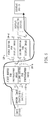
- the moving image data stored in the first buffer for photographed image 31 is directly supplied to the display controlling section 15 without passing through the first buffer for display image 33 as shown by a thick line in Fig. 5 .
- Moving image data newly stored in the first buffer for photographed image 31 in the moving image capturing process can thus be displayed on the display device more quickly than the normal display.
- this type of display is referred to as quick display.
- the controlling section 10 decides whether the release button is full-pressed or not. When the release button is full-pressed, the controlling section 10 proceeds to the operation in step S21; otherwise, the controlling section 10 proceeds to the operation in step S16.
- the controlling section 10 decides whether the release button is half-pressed or not. When the release button is half-pressed, the controlling section 10 returns to the operation in step S10; otherwise (that is, when the press of the release button is released), the controlling section 10 returns to the operation in step S1.
- steps S10 to S16 are repeated to carry out continuous quick display as long as the release button is half-pressed.
- This step follows step S11 if the quick display mode is disabled.
- the controlling section 10 changes the state of each switch in the image processing section 14 as in step S2.
- the controlling section 10 starts the moving image capturing process as in step S3.
- the controlling section 10 starts the transmittal between buffers as in step S4.
- the controlling section 10 starts the moving image displaying process as in step S5 and then proceeds to the operation in step S15. Accordingly, when the quick display mode is disabled, the operations in steps S10, S11, S17 to S20, S15, and S16 are repeated to carry out the continuous normal display as long as the release button is half-pressed.
- step S15 if the release button has been full-pressed in step S15.
- the controlling section 10 starts the still image recording process and then returns to the operation in step S1. Accordingly, the operations after step 1 are repeated when the release button is full-pressed to perform the still image recording process or when the press of the release button is released as described above.
- step S8 if the power supply switch has been turned off in step S8.
- the controlling section 10 performs a predetermined power off process and the operation of the controlling section 10 terminates.
- the user can choose the normal display (steps S3 to S5), placing importance on a synchronization.
- the user can choose the quick display (steps S12 to S14), placing importance on a response feature.
- the normal display and the quick display can thus be switched from each other appropriately depending on the features. Therefore, according to the embodiment, the user can release the shutter at the right moment.
- this switching may also be performed when the AE/AF lock switch is turned on.
- the controlling section 10 repeats the operations in steps S30 to S36 in Fig. 6 to perform the normal display until the AE/AF lock switch is turned on. When the AE/AF lock switch is turned on, then the controlling section 10 locks the AE/AF function (step S3 7 in Fig. 6 ).
- step S39 When the mode in which quick display is enabled is set in step S39, the operations in steps S38 in Fig. 6 to S45 in Fig. 7 are repeated to perform the quick display until the release button is full-pressed.
- step S39 When the mode in which quick display is not enabled is set in step S39, on the other hand, the controlling section 10 repeats the operations in step S38 in Fig. 6 and in steps S39, S46 to S49, and S43 to S45 in Fig. 7 to perform the normal display.
- the controlling section 10 When the release button is full-pressed while the quick or normal display is performed after the AE/AF lock switch has been turned on, the controlling section 10 performs the still image recording process (step S50 in Fig. 7 ); when the power supply switch is turned off, the controlling section 10 performs a power off process (step S51 in Fig. 7 ).
- a buffer section described in the claims corresponds to the first and second buffers for display image 33 and 34.
- a recording section described in the claims corresponds to the compressing/recording section 17.
- a display switching section described in the claims corresponds to a function of the controlling section 10 that switches the states of the switches SW-a, SW-b, SW-c, and SW-d.
- a first display described in the claims corresponds to the normal display.
- a second display described in the claims corresponds to the quick display.
- predetermined timing corresponds to a timing immediately after the release button is half-pressed (when the mode in which quick display is enabled).
- a shooting condition adjusting section described in Claim 2 corresponds to a function of the controlling section 10 that performs the AE and AF in step S6.
- the electronic camera of the invention can properly display a moving image that is usable as a viewfinder.
Landscapes
- Engineering & Computer Science (AREA)
- Multimedia (AREA)
- Signal Processing (AREA)
- Studio Devices (AREA)
Applications Claiming Priority (2)
| Application Number | Priority Date | Filing Date | Title |
|---|---|---|---|
| JP2002154004A JP3757905B2 (ja) | 2002-05-28 | 2002-05-28 | 電子カメラ |
| EP03730644A EP1526715A4 (en) | 2002-05-28 | 2003-05-27 | ELECTRONIC CAMERA |
Related Parent Applications (1)
| Application Number | Title | Priority Date | Filing Date |
|---|---|---|---|
| EP03730644A Division EP1526715A4 (en) | 2002-05-28 | 2003-05-27 | ELECTRONIC CAMERA |
Publications (1)
| Publication Number | Publication Date |
|---|---|
| EP3244605A1 true EP3244605A1 (en) | 2017-11-15 |
Family
ID=29561338
Family Applications (2)
| Application Number | Title | Priority Date | Filing Date |
|---|---|---|---|
| EP17001113.4A Withdrawn EP3244605A1 (en) | 2002-05-28 | 2003-05-27 | Electronic camera |
| EP03730644A Withdrawn EP1526715A4 (en) | 2002-05-28 | 2003-05-27 | ELECTRONIC CAMERA |
Family Applications After (1)
| Application Number | Title | Priority Date | Filing Date |
|---|---|---|---|
| EP03730644A Withdrawn EP1526715A4 (en) | 2002-05-28 | 2003-05-27 | ELECTRONIC CAMERA |
Country Status (5)
| Country | Link |
|---|---|
| US (1) | US7443423B2 (cg-RX-API-DMAC7.html) |
| EP (2) | EP3244605A1 (cg-RX-API-DMAC7.html) |
| JP (1) | JP3757905B2 (cg-RX-API-DMAC7.html) |
| CN (1) | CN1656794A (cg-RX-API-DMAC7.html) |
| WO (1) | WO2003101090A1 (cg-RX-API-DMAC7.html) |
Families Citing this family (5)
| Publication number | Priority date | Publication date | Assignee | Title |
|---|---|---|---|---|
| JP5058607B2 (ja) * | 2006-02-08 | 2012-10-24 | キヤノン株式会社 | 撮像装置、その制御方法、及びプログラム |
| JP5056370B2 (ja) * | 2007-11-22 | 2012-10-24 | ソニー株式会社 | 撮像装置、撮像装置の制御方法および撮像装置の制御プログラム、ならびに、データ処理装置、データ処理方法およびデータ処理プログラム |
| JP4751939B2 (ja) * | 2009-03-31 | 2011-08-17 | アイシン精機株式会社 | 車載カメラの校正装置 |
| US9154700B2 (en) * | 2009-10-16 | 2015-10-06 | Samsung Electronics Co., Ltd. | Apparatus and method for image capture using image stored in camera |
| JP5783737B2 (ja) * | 2011-02-02 | 2015-09-24 | キヤノン株式会社 | 撮像装置および動画記録装置の制御方法 |
Citations (2)
| Publication number | Priority date | Publication date | Assignee | Title |
|---|---|---|---|---|
| US6137534A (en) * | 1997-07-10 | 2000-10-24 | Flashpoint Technology, Inc. | Method and apparatus for providing live view and instant review in an image capture device |
| US20020051643A1 (en) * | 2000-10-19 | 2002-05-02 | Kazuhiko Nakashita | Image pickup apparatus |
Family Cites Families (7)
| Publication number | Priority date | Publication date | Assignee | Title |
|---|---|---|---|---|
| US6359649B1 (en) * | 1995-04-04 | 2002-03-19 | Canon Kabushiki Kaisa | Video camera integrated with still camera |
| JPH10224684A (ja) * | 1997-02-10 | 1998-08-21 | Nikon Corp | 情報処理装置 |
| US6020920A (en) * | 1997-06-10 | 2000-02-01 | Flashpoint Technology, Inc. | Method and system for speculative decompression of compressed image data in an image capture unit |
| US6563535B1 (en) * | 1998-05-19 | 2003-05-13 | Flashpoint Technology, Inc. | Image processing system for high performance digital imaging devices |
| JPH11355624A (ja) * | 1998-06-05 | 1999-12-24 | Fuji Photo Film Co Ltd | 撮影装置 |
| US7012641B2 (en) * | 2000-02-14 | 2006-03-14 | Canon Kabushiki Kaisha | Image sensing apparatus, method, memory involving differential compression of display region based on zoom operation or speed |
| JP2003209731A (ja) * | 2002-01-09 | 2003-07-25 | Sony Corp | 画像信号処理方法及び撮像装置 |
-
2002
- 2002-05-28 JP JP2002154004A patent/JP3757905B2/ja not_active Expired - Fee Related
-
2003
- 2003-05-27 EP EP17001113.4A patent/EP3244605A1/en not_active Withdrawn
- 2003-05-27 CN CNA038120984A patent/CN1656794A/zh active Pending
- 2003-05-27 WO PCT/JP2003/006602 patent/WO2003101090A1/ja not_active Ceased
- 2003-05-27 US US10/515,224 patent/US7443423B2/en not_active Expired - Fee Related
- 2003-05-27 EP EP03730644A patent/EP1526715A4/en not_active Withdrawn
Patent Citations (2)
| Publication number | Priority date | Publication date | Assignee | Title |
|---|---|---|---|---|
| US6137534A (en) * | 1997-07-10 | 2000-10-24 | Flashpoint Technology, Inc. | Method and apparatus for providing live view and instant review in an image capture device |
| US20020051643A1 (en) * | 2000-10-19 | 2002-05-02 | Kazuhiko Nakashita | Image pickup apparatus |
Also Published As
| Publication number | Publication date |
|---|---|
| US7443423B2 (en) | 2008-10-28 |
| CN1656794A (zh) | 2005-08-17 |
| EP1526715A4 (en) | 2006-08-02 |
| EP1526715A1 (en) | 2005-04-27 |
| WO2003101090A1 (en) | 2003-12-04 |
| JP2003348427A (ja) | 2003-12-05 |
| US20050151870A1 (en) | 2005-07-14 |
| JP3757905B2 (ja) | 2006-03-22 |
Similar Documents
| Publication | Publication Date | Title |
|---|---|---|
| US7710468B2 (en) | Imaging apparatus with memory for storing camera through image data | |
| EP2290948B1 (en) | Camera system | |
| CN102348066B (zh) | 摄像装置 | |
| US7839448B2 (en) | Camera apparatus having a plurality of image pickup elements | |
| JP4446787B2 (ja) | 撮像装置、および表示制御方法 | |
| KR20120020525A (ko) | 디지털 촬영 장치 및 디지털 촬영 장치의 제어 방법 | |
| EP1993280B1 (en) | Imaging apparatus and method , and computer program product | |
| JP2009017006A (ja) | 撮影装置 | |
| JP2006054698A (ja) | 手振れ補正機能を有する撮像装置 | |
| EP3244605A1 (en) | Electronic camera | |
| EP1526718A1 (en) | Electronic camera | |
| US11381755B2 (en) | Image capture apparatus and control method for generating a time-lapse moving image | |
| JP2003259201A (ja) | デジタルカメラおよび露出制御装置 | |
| JP2025164307A (ja) | 撮像システムとその制御方法及びプログラム | |
| JP4331087B2 (ja) | 撮影装置及びその制御方法 | |
| JP2001128036A (ja) | 電子カメラ装置 | |
| JP2006243372A (ja) | カメラ | |
| JP2005045511A (ja) | 立体撮影装置及びその制御方法 | |
| JP2023095508A (ja) | 撮像装置及びその制御方法及びプログラム | |
| JP2005039401A (ja) | 立体カメラ及び立体画像の撮影方法 | |
| JP2000231055A (ja) | 自動焦点調節カメラ | |
| JP3077148B2 (ja) | 電子スチルカメラ | |
| JP2001268453A (ja) | 撮像装置 | |
| JPH118795A (ja) | 電子的撮像装置 | |
| JP2001197359A (ja) | 同期制御方法及び撮像装置 |
Legal Events
| Date | Code | Title | Description |
|---|---|---|---|
| PUAI | Public reference made under article 153(3) epc to a published international application that has entered the european phase |
Free format text: ORIGINAL CODE: 0009012 |
|
| STAA | Information on the status of an ep patent application or granted ep patent |
Free format text: STATUS: REQUEST FOR EXAMINATION WAS MADE |
|
| 17P | Request for examination filed |
Effective date: 20170628 |
|
| AC | Divisional application: reference to earlier application |
Ref document number: 1526715 Country of ref document: EP Kind code of ref document: P |
|
| AK | Designated contracting states |
Kind code of ref document: A1 Designated state(s): DE FR GB |
|
| STAA | Information on the status of an ep patent application or granted ep patent |
Free format text: STATUS: EXAMINATION IS IN PROGRESS |
|
| 17Q | First examination report despatched |
Effective date: 20200701 |
|
| STAA | Information on the status of an ep patent application or granted ep patent |
Free format text: STATUS: THE APPLICATION HAS BEEN WITHDRAWN |
|
| 18W | Application withdrawn |
Effective date: 20200917 |