EP3239309A1 - Non-oriented electrical steel sheet and method for manufacturing the same - Google Patents
Non-oriented electrical steel sheet and method for manufacturing the same Download PDFInfo
- Publication number
- EP3239309A1 EP3239309A1 EP15873583.7A EP15873583A EP3239309A1 EP 3239309 A1 EP3239309 A1 EP 3239309A1 EP 15873583 A EP15873583 A EP 15873583A EP 3239309 A1 EP3239309 A1 EP 3239309A1
- Authority
- EP
- European Patent Office
- Prior art keywords
- rolled sheet
- steel sheet
- hot
- hot rolled
- sheet annealing
- Prior art date
- Legal status (The legal status is an assumption and is not a legal conclusion. Google has not performed a legal analysis and makes no representation as to the accuracy of the status listed.)
- Granted
Links
Images
Classifications
-
- C—CHEMISTRY; METALLURGY
- C21—METALLURGY OF IRON
- C21D—MODIFYING THE PHYSICAL STRUCTURE OF FERROUS METALS; GENERAL DEVICES FOR HEAT TREATMENT OF FERROUS OR NON-FERROUS METALS OR ALLOYS; MAKING METAL MALLEABLE, e.g. BY DECARBURISATION OR TEMPERING
- C21D8/00—Modifying the physical properties of ferrous metals or ferrous alloys by deformation combined with, or followed by, heat treatment
- C21D8/12—Modifying the physical properties of ferrous metals or ferrous alloys by deformation combined with, or followed by, heat treatment during manufacturing of articles with special electromagnetic properties
- C21D8/1244—Modifying the physical properties of ferrous metals or ferrous alloys by deformation combined with, or followed by, heat treatment during manufacturing of articles with special electromagnetic properties characterised by the heat treatment
-
- C—CHEMISTRY; METALLURGY
- C21—METALLURGY OF IRON
- C21D—MODIFYING THE PHYSICAL STRUCTURE OF FERROUS METALS; GENERAL DEVICES FOR HEAT TREATMENT OF FERROUS OR NON-FERROUS METALS OR ALLOYS; MAKING METAL MALLEABLE, e.g. BY DECARBURISATION OR TEMPERING
- C21D9/00—Heat treatment, e.g. annealing, hardening, quenching or tempering, adapted for particular articles; Furnaces therefor
- C21D9/46—Heat treatment, e.g. annealing, hardening, quenching or tempering, adapted for particular articles; Furnaces therefor for sheet metals
-
- C—CHEMISTRY; METALLURGY
- C21—METALLURGY OF IRON
- C21D—MODIFYING THE PHYSICAL STRUCTURE OF FERROUS METALS; GENERAL DEVICES FOR HEAT TREATMENT OF FERROUS OR NON-FERROUS METALS OR ALLOYS; MAKING METAL MALLEABLE, e.g. BY DECARBURISATION OR TEMPERING
- C21D6/00—Heat treatment of ferrous alloys
- C21D6/008—Heat treatment of ferrous alloys containing Si
-
- C—CHEMISTRY; METALLURGY
- C21—METALLURGY OF IRON
- C21D—MODIFYING THE PHYSICAL STRUCTURE OF FERROUS METALS; GENERAL DEVICES FOR HEAT TREATMENT OF FERROUS OR NON-FERROUS METALS OR ALLOYS; MAKING METAL MALLEABLE, e.g. BY DECARBURISATION OR TEMPERING
- C21D8/00—Modifying the physical properties of ferrous metals or ferrous alloys by deformation combined with, or followed by, heat treatment
- C21D8/12—Modifying the physical properties of ferrous metals or ferrous alloys by deformation combined with, or followed by, heat treatment during manufacturing of articles with special electromagnetic properties
-
- C—CHEMISTRY; METALLURGY
- C21—METALLURGY OF IRON
- C21D—MODIFYING THE PHYSICAL STRUCTURE OF FERROUS METALS; GENERAL DEVICES FOR HEAT TREATMENT OF FERROUS OR NON-FERROUS METALS OR ALLOYS; MAKING METAL MALLEABLE, e.g. BY DECARBURISATION OR TEMPERING
- C21D8/00—Modifying the physical properties of ferrous metals or ferrous alloys by deformation combined with, or followed by, heat treatment
- C21D8/12—Modifying the physical properties of ferrous metals or ferrous alloys by deformation combined with, or followed by, heat treatment during manufacturing of articles with special electromagnetic properties
- C21D8/1205—Modifying the physical properties of ferrous metals or ferrous alloys by deformation combined with, or followed by, heat treatment during manufacturing of articles with special electromagnetic properties involving particular fabrication steps or treatments of ingots or slabs
-
- C—CHEMISTRY; METALLURGY
- C21—METALLURGY OF IRON
- C21D—MODIFYING THE PHYSICAL STRUCTURE OF FERROUS METALS; GENERAL DEVICES FOR HEAT TREATMENT OF FERROUS OR NON-FERROUS METALS OR ALLOYS; MAKING METAL MALLEABLE, e.g. BY DECARBURISATION OR TEMPERING
- C21D8/00—Modifying the physical properties of ferrous metals or ferrous alloys by deformation combined with, or followed by, heat treatment
- C21D8/12—Modifying the physical properties of ferrous metals or ferrous alloys by deformation combined with, or followed by, heat treatment during manufacturing of articles with special electromagnetic properties
- C21D8/1216—Modifying the physical properties of ferrous metals or ferrous alloys by deformation combined with, or followed by, heat treatment during manufacturing of articles with special electromagnetic properties characterised by the working steps
- C21D8/1222—Hot rolling
-
- C—CHEMISTRY; METALLURGY
- C21—METALLURGY OF IRON
- C21D—MODIFYING THE PHYSICAL STRUCTURE OF FERROUS METALS; GENERAL DEVICES FOR HEAT TREATMENT OF FERROUS OR NON-FERROUS METALS OR ALLOYS; MAKING METAL MALLEABLE, e.g. BY DECARBURISATION OR TEMPERING
- C21D8/00—Modifying the physical properties of ferrous metals or ferrous alloys by deformation combined with, or followed by, heat treatment
- C21D8/12—Modifying the physical properties of ferrous metals or ferrous alloys by deformation combined with, or followed by, heat treatment during manufacturing of articles with special electromagnetic properties
- C21D8/1216—Modifying the physical properties of ferrous metals or ferrous alloys by deformation combined with, or followed by, heat treatment during manufacturing of articles with special electromagnetic properties characterised by the working steps
- C21D8/1233—Cold rolling
-
- C—CHEMISTRY; METALLURGY
- C21—METALLURGY OF IRON
- C21D—MODIFYING THE PHYSICAL STRUCTURE OF FERROUS METALS; GENERAL DEVICES FOR HEAT TREATMENT OF FERROUS OR NON-FERROUS METALS OR ALLOYS; MAKING METAL MALLEABLE, e.g. BY DECARBURISATION OR TEMPERING
- C21D8/00—Modifying the physical properties of ferrous metals or ferrous alloys by deformation combined with, or followed by, heat treatment
- C21D8/12—Modifying the physical properties of ferrous metals or ferrous alloys by deformation combined with, or followed by, heat treatment during manufacturing of articles with special electromagnetic properties
- C21D8/1244—Modifying the physical properties of ferrous metals or ferrous alloys by deformation combined with, or followed by, heat treatment during manufacturing of articles with special electromagnetic properties characterised by the heat treatment
- C21D8/1261—Modifying the physical properties of ferrous metals or ferrous alloys by deformation combined with, or followed by, heat treatment during manufacturing of articles with special electromagnetic properties characterised by the heat treatment following hot rolling
-
- C—CHEMISTRY; METALLURGY
- C22—METALLURGY; FERROUS OR NON-FERROUS ALLOYS; TREATMENT OF ALLOYS OR NON-FERROUS METALS
- C22C—ALLOYS
- C22C38/00—Ferrous alloys, e.g. steel alloys
-
- C—CHEMISTRY; METALLURGY
- C22—METALLURGY; FERROUS OR NON-FERROUS ALLOYS; TREATMENT OF ALLOYS OR NON-FERROUS METALS
- C22C—ALLOYS
- C22C38/00—Ferrous alloys, e.g. steel alloys
- C22C38/001—Ferrous alloys, e.g. steel alloys containing N
-
- C—CHEMISTRY; METALLURGY
- C22—METALLURGY; FERROUS OR NON-FERROUS ALLOYS; TREATMENT OF ALLOYS OR NON-FERROUS METALS
- C22C—ALLOYS
- C22C38/00—Ferrous alloys, e.g. steel alloys
- C22C38/002—Ferrous alloys, e.g. steel alloys containing In, Mg, or other elements not provided for in one single group C22C38/001 - C22C38/60
-
- C—CHEMISTRY; METALLURGY
- C22—METALLURGY; FERROUS OR NON-FERROUS ALLOYS; TREATMENT OF ALLOYS OR NON-FERROUS METALS
- C22C—ALLOYS
- C22C38/00—Ferrous alloys, e.g. steel alloys
- C22C38/004—Very low carbon steels, i.e. having a carbon content of less than 0,01%
-
- C—CHEMISTRY; METALLURGY
- C22—METALLURGY; FERROUS OR NON-FERROUS ALLOYS; TREATMENT OF ALLOYS OR NON-FERROUS METALS
- C22C—ALLOYS
- C22C38/00—Ferrous alloys, e.g. steel alloys
- C22C38/008—Ferrous alloys, e.g. steel alloys containing tin
-
- C—CHEMISTRY; METALLURGY
- C22—METALLURGY; FERROUS OR NON-FERROUS ALLOYS; TREATMENT OF ALLOYS OR NON-FERROUS METALS
- C22C—ALLOYS
- C22C38/00—Ferrous alloys, e.g. steel alloys
- C22C38/02—Ferrous alloys, e.g. steel alloys containing silicon
-
- C—CHEMISTRY; METALLURGY
- C22—METALLURGY; FERROUS OR NON-FERROUS ALLOYS; TREATMENT OF ALLOYS OR NON-FERROUS METALS
- C22C—ALLOYS
- C22C38/00—Ferrous alloys, e.g. steel alloys
- C22C38/04—Ferrous alloys, e.g. steel alloys containing manganese
-
- C—CHEMISTRY; METALLURGY
- C22—METALLURGY; FERROUS OR NON-FERROUS ALLOYS; TREATMENT OF ALLOYS OR NON-FERROUS METALS
- C22C—ALLOYS
- C22C38/00—Ferrous alloys, e.g. steel alloys
- C22C38/06—Ferrous alloys, e.g. steel alloys containing aluminium
-
- C—CHEMISTRY; METALLURGY
- C22—METALLURGY; FERROUS OR NON-FERROUS ALLOYS; TREATMENT OF ALLOYS OR NON-FERROUS METALS
- C22C—ALLOYS
- C22C38/00—Ferrous alloys, e.g. steel alloys
- C22C38/14—Ferrous alloys, e.g. steel alloys containing titanium or zirconium
-
- C—CHEMISTRY; METALLURGY
- C22—METALLURGY; FERROUS OR NON-FERROUS ALLOYS; TREATMENT OF ALLOYS OR NON-FERROUS METALS
- C22C—ALLOYS
- C22C38/00—Ferrous alloys, e.g. steel alloys
- C22C38/60—Ferrous alloys, e.g. steel alloys containing lead, selenium, tellurium, or antimony, or more than 0.04% by weight of sulfur
Definitions
- the present invention relates to a non-oriented electrical steel sheet and a method for manufacturing the same.
- the non-oriented electrical steel sheet is used for a material for an iron core in a rotary device such as a motor or a generator and a static device such as a small transformer and plays an important role in determining an energy efficiency of electrical equipment.
- Representative characteristics of such an electrical steel sheet include iron loss and a magnetic flux density. The lower the iron loss and the higher the magnetic flux density, the better the characteristics.
- the iron loss represents an energy which disappears due to heat generated from the material during the magnetization. Since as the iron loss is lower, the energy lost due to the heat is reduced, the iron loss is an important factor.
- the magnetic flux density is a value indicating a degree of magnetization under an unit strength of a magnetic field. As the magnetic flux density is increased, more magnetization may be induced with the same energy so that the higher the value, the more the energy may be transmitted in the electrical steel sheet with the same volume.
- the magnetic flux density is evaluated as a magnetizing force in a unit volume
- a ratio of an element in a steel sheet with the unit volume which is easily magnetized that is, a ratio of an iron atom
- Si, Al, and Mn which are elements mainly utilized for the non-oriented electrical steel sheet are non-magnetized atoms, so that as an amount of alloy thereof is increased, a saturated magnetic flux density value obtained when the steel sheet is magnetized at most under the large magnetic field is lowered and B 50 which is a value of the magnetic flux density is also lowered under the unit magnetic field strength.
- a specific resistance of the steel sheet needs to be increased. Therefore, an amount of alloy of Si, Al, and Mn which are non-magnetic alloy elements is inevitably added and thus a study for controlling a set tissue is required to overcome deterioration of the magnetic flux density.
- the present invention has been made in an effort to provide a non-oriented electrical steel sheet and a method for manufacturing the same.
- An exemplary embodiment of the present invention provides a method for manufacturing a non-oriented electrical steel sheet.
- Another embodiment of the present invention provides a non-oriented electrical steel sheet.
- a method for manufacturing a non-oriented electrical steel sheet includes performing hot rolling on a slab after heating the slab to manufacture a hot rolled sheet; performing hot rolled sheet annealing on the hot rolled sheet; performing cold rolling on a steel sheet on which the hot rolled sheet annealing is completed to manufacture a cold rolled sheet; and performing cold rolled sheet annealing on the cold rolled sheet in which a difference between a cold rolled sheet annealing temperature in the cold rolled sheet annealing and a hot rolled sheet annealing temperature in the hot rolled sheet annealing is 100°C or lower.
- a hot rolled sheet annealing temperature in the hot rolled sheet annealing may be performed at a temperature which is 150°C higher than a hot finish rolling temperature in the hot rolling to manufacture a hot rolled sheet.
- An annealing time from the hot finish rolling temperature to the hot rolled sheet annealing temperature in the hot rolled sheet annealing may be two minutes or shorter.
- the cold rolled sheet annealing time in the cold rolled sheet annealing may be five seconds or longer.
- a particle diameter of a crystal grain of a steel sheet on which the hot rolled sheet annealing is completed may be 80 ⁇ m or larger.
- the slab may include Al: 0.0005% to 0.02%, Sn: 0.005% to 0.15%, P: 0.001% to 0.15%, and S: 0.0008% to 0.015% in wt% and Fe and impurities as a balance amount.
- the slab may further include Sb: 0.005% to 0.15% and a value of ([Sn]+[Sb]+[P]+20*[S])/[Al] is 40 or higher.
- the slab may include Si: 1.5% to 4.0%, Mn: 0.02% to 3.0%, C: 0.005% or lower (does not include 0%), N: 0.005% or lower (does not include 0%), and Ti: 0.003% or lower (does not include 0%) in wt%.
- a non-oriented electrical steel sheet includes Al: 0.0005% to 0.02%, Sn: 0.005% to 0.15%, P: 0.001% to 0.15% and S: 0.0008% to 0.015% with respect to an entire composition 100 wt% and Fe and impurities as a balance amount.
- the non-oriented electrical steel sheet may further include Sb: 0.005% to 0.15% and a value of ([Sn]+[Sb]+[P]+20*[S])/[Al] may be 40 or higher.
- a volume fraction of a crystal grain having an orientation (30,0,45) as an Euler orientation may be 1.5 times higher than a volume fraction of a crystal grain having an orientation (10,0,45) as an Euler orientation.
- a non-oriented electrical steel sheet having a high magnetic flux density may be provided.
- % refers to wt%.
- a method for manufacturing a non-oriented electrical steel sheet according to an exemplary embodiment of the present invention will be described. First, a slab is prepared.
- the slab includes Al: 0.0005% to 0.02%, Sn: 0.005% to 0.15%, P: 0.001% to 0.15% and S: 0.0008% to 0.015% with respect to an entire composition 100 wt% of the slab and Fe and impurities as a balance amount.
- the slab further includes Sb: 0.005% to 0.15% and a value of ([Sn]+[Sb]+[P]+20*[S])/[Al] may be 40 or higher.
- [Al], [Sn], [Sb], [P], and [S] refer to weight percent (%) of Al, Sn, Sb, P, and S, respectively.
- the slab may further include Si: 1.5% to 4.0%, Mn: 0.02% to 3.0%, C: 0.005% or lower (does not include 0%), N: 0.005% or lower (does not include 0%), and Ti: 0.003% or lower (does not include 0%) with respect to an entire composition 100 wt% of the slab.
- Sn added When Sn added is 0.005% or more, Sn is segregated on a grain boundary at the time of annealing to suppress formation of a ⁇ 111 ⁇ set tissue. However, when Sn added exceeds 0.15%, a rolling property including a surface defect may be deteriorated during hot and cold rolling processes.
- Sb added When Sb added is 0.005% or more, Sb is segregated on a grain boundary at the time of annealing to suppress formation of a ⁇ 111 ⁇ set tissue. However, when Sb added exceeds 0.15%, a rolling property including a surface defect may be deteriorated during hot and cold rolling processes.
- a value of ([Sn]+[Sb]+[P]+20*[S])/[Al] may be 40 or higher. More specifically, the value may be 40 or higher and 240 or lower. When the value of ([Sn]+[Sb]+[P]+20*[S])/[Al] is between 40 and 240, the magnetic flux density is excellent. When the value of ([Sn]+[Sb]+[P]+20*[S])/[Al] is lower than 40, the magnetic flux density of the steel sheet may be deteriorated. This will be described below in Example.
- Si 1.5% or more of Si is added to lower an eddy current loss.
- Si 1.5% or more of Si is added to lower an eddy current loss.
- Si exceeds 4.0%, brittleness is increased so that the rolling property may be deteriorated.
- Mn 0.02% or more of Mn is added to increase a specific resistance so that the iron loss may be lowered.
- Mn exceeds 3.0%, the saturated magnetic flux density may be reduced.
- N exceeds 0.005%, nitride is formed to suppress growth of the crystal grain so that a magnetic property may be deteriorated.
- the slab may have a component system in which an austenite phase transformation is not generated when the slab is heated at a temperature A 1 or higher.
- the slab is subjected to the hot rolling after being heated to manufacture a hot rolled sheet.
- a slab heating temperature may be 1250°C or lower. When the slab heating temperature exceeds 1250°C, a sludge in the slab is dissolved and then minutely educed at the time of hot rolling.
- the hot rolling may be performed by passing a rolling pass one or more times.
- a final rolling pass may be performed at a temperature of 920°C or lower. More specifically, the temperature may be 800°C to 920°C.
- a hot rolled sheet which has been subjected to the final rolling at a temperature of 920°C or lower is subjected to hot rolled sheet annealing at a temperature which is 150°C higher than the hot finish rolling temperature within two minutes, a hot rolled annealed sheet having a crystal grain size which is uniform in all areas of the center and the surface of the steel sheet may be obtained. Therefore, a set tissue in which a fraction of an orientation (30,0,45) is 1.5 times higher than a fraction of an orientation (10,0,45) is obtained so that the magnetic flux density may be improved.
- the hot rolled sheet annealing temperature may be 150°C higher than the hot finish rolling temperature. Further, the hot rolled sheet annealing temperature may be in the range of 900°C to 1200°C.
- the hot rolled sheet annealing temperature refers to a maximum temperature of the hot rolled sheet at the time of hot rolled sheet annealing. Further, at the time of hot rolled sheet annealing, an annealing time from the hot finish rolling temperature to the hot rolled sheet annealing temperature may be two minutes or shorter.
- a particle diameter of the crystal grain in all areas of the surface and a center in the thickness direction of the steel sheet on which the hot rolled sheet annealing is completed may be 80 ⁇ m or larger.
- the particle diameter is smaller than 80 ⁇ m, the crystal grain is not sufficiently grown so that a magnetic property of the electrical steel sheet may be deteriorated.
- a particle diameter of the crystal grain in all areas of the surface and the center in the thickness direction of the steel sheet on which the hot rolled sheet annealing is completed may be 80 ⁇ m or larger and 700 ⁇ m or smaller.
- the size of the crystal grain is uniformly 80 ⁇ m or larger and 700 ⁇ m or smaller in the surface and the center in the thickness direction of the steel sheet so that the magnetic property of the electrical steel sheet may be improved.
- the hot rolled annealed sheet on which the hot rolled sheet annealing is completed is subjected to cold rolling thereafter to manufacture a cold rolled sheet.
- a reduction ratio at the time of cold rolling may be 50% to 95%.
- the cold rolled sheet annealing temperature may be 100°C lower than the hot rolled sheet annealing temperature. Further, the cold rolled sheet annealing time may be five seconds or longer.
- the non-oriented electrical steel sheet according to an exemplary embodiment of the present invention may include Al: 0.0005% to 0.02%, Sn: 0.005% to 0.15%, P: 0.001% to 0.15%, and S: 0.0008% to 0.015% with reference to an entire composition 100 wt% of the electric steel sheet.
- the non-oriented electrical steel sheet further includes Sb: 0.005% to 0.15% and a value of ([Sn]+[Sb]+[P]+20*[S])/[Al] may be 40 or higher.
- [Al], [Sn], [Sb], [P], and [S] refer to weight percent (%) of Al, Sn, Sb, P, and S, respectively.
- a volume fraction of a crystal grain having an orientation (30,0,45) as an Euler orientation is 1.5 times higher than a volume fraction of a crystal grain having an orientation (10,0,45) as an Euler orientation.
- the magnetic flux density may be improved.
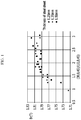
- FIG. 1 is a graph illustrating a relationship of ⁇ a volume fraction of a crystal grain having an orientation (30,0,45) ⁇ / ⁇ a volume fraction of a crystal grain having an orientation (10,0,45) ⁇ and a Br value.
- a magnetic flux density of the steel sheet is evaluated in accordance with a value (Br) of the magnetic flux density considering the density of the steel sheet as it will be described below.
- B r 7.87 / 7.87 ⁇ 0.0.065 * Si ⁇ 0.1105 * Al * B 50
- [Si] refers to an added amount (wt%) of Si and [Al] is an added amount (wt%) of Al.
- B 50 is a value of magnetic flux density induced to the steel sheet when it is exposed to 5,000 A/m.
- a reason why a density is considered rather than a normal magnetic flux density is that when it is considered that as an added amount of Si and Al in the steel is increased, an iron atom fraction in the steel is reduced and thus a saturated magnetic flux is reduced, it is possible to evaluate improvement of the magnetic flux density by the set tissue.
- the slab was subjected to hot rolling after being heated at 1150°C to manufacture a hot rolled sheet.
- Hot finish rolling at the time of hot rolling was performed at 900°C.
- hot rolled sheet annealing was performed at 1100°C and cold rolling was performed to perform cold rolled sheet annealing at 1050°C for five seconds.
- An annealing time from the hot finish rolling temperature to the hot rolled sheet annealing temperature was two minutes.
- a slab which included Si: 3.0%, Mn: 0.4%, C: 0.002%, N: 0.003%, Ti: 0.001%, Al: 0.004%, Sn: 0.03%, Sb: 0.03%, P: 0.05%, and S: 0.005% in wt% and Fe and impurities as a balance amount was manufactured.
- the slab was heated at 1150°C and then was subjected to hot rolling to manufacture a hot rolled sheet.
- Hot finish rolling at the time of hot rolling was performed at 900°C.
- hot rolled sheet annealing was performed at 1100°C and cold rolling was performed to manufacture a cold rolled sheet.
- An annealing time from a hot finish rolling temperature to a hot rolled sheet annealing temperature was two minutes.
- the cold rolled sheet was subjected to cold rolled sheet annealing at a temperature illustrated in FIG. 3 for five seconds.
Landscapes
- Chemical & Material Sciences (AREA)
- Engineering & Computer Science (AREA)
- Materials Engineering (AREA)
- Mechanical Engineering (AREA)
- Metallurgy (AREA)
- Organic Chemistry (AREA)
- Physics & Mathematics (AREA)
- Thermal Sciences (AREA)
- Crystallography & Structural Chemistry (AREA)
- Electromagnetism (AREA)
- Manufacturing & Machinery (AREA)
- Manufacturing Of Steel Electrode Plates (AREA)
- Soft Magnetic Materials (AREA)
Abstract
Description
- This application claims priority to and the benefit of Korean Patent Application No.
10-2014-0189064 - The present invention relates to a non-oriented electrical steel sheet and a method for manufacturing the same.
- The non-oriented electrical steel sheet is used for a material for an iron core in a rotary device such as a motor or a generator and a static device such as a small transformer and plays an important role in determining an energy efficiency of electrical equipment. Representative characteristics of such an electrical steel sheet include iron loss and a magnetic flux density. The lower the iron loss and the higher the magnetic flux density, the better the characteristics. The iron loss represents an energy which disappears due to heat generated from the material during the magnetization. Since as the iron loss is lower, the energy lost due to the heat is reduced, the iron loss is an important factor. Further, the magnetic flux density is a value indicating a degree of magnetization under an unit strength of a magnetic field. As the magnetic flux density is increased, more magnetization may be induced with the same energy so that the higher the value, the more the energy may be transmitted in the electrical steel sheet with the same volume.
- Among these, since the magnetic flux density is evaluated as a magnetizing force in a unit volume, a ratio of an element in a steel sheet with the unit volume which is easily magnetized, that is, a ratio of an iron atom is very important. Generally, Si, Al, and Mn which are elements mainly utilized for the non-oriented electrical steel sheet are non-magnetized atoms, so that as an amount of alloy thereof is increased, a saturated magnetic flux density value obtained when the steel sheet is magnetized at most under the large magnetic field is lowered and B50 which is a value of the magnetic flux density is also lowered under the unit magnetic field strength. However, in order to reduce an eddy current loss which is induced to the steel sheet, a specific resistance of the steel sheet needs to be increased. Therefore, an amount of alloy of Si, Al, and Mn which are non-magnetic alloy elements is inevitably added and thus a study for controlling a set tissue is required to overcome deterioration of the magnetic flux density.
- The above information disclosed in this Background section is only for enhancement of understanding of the background of the invention and therefore it may contain information that does not form the prior art that is already known in this country to a person of ordinary skill in the art.
- The present invention has been made in an effort to provide a non-oriented electrical steel sheet and a method for manufacturing the same. An exemplary embodiment of the present invention provides a method for manufacturing a non-oriented electrical steel sheet.
- Another embodiment of the present invention provides a non-oriented electrical steel sheet.
- According to an aspect of the present invention, a method for manufacturing a non-oriented electrical steel sheet includes performing hot rolling on a slab after heating the slab to manufacture a hot rolled sheet; performing hot rolled sheet annealing on the hot rolled sheet; performing cold rolling on a steel sheet on which the hot rolled sheet annealing is completed to manufacture a cold rolled sheet; and performing cold rolled sheet annealing on the cold rolled sheet in which a difference between a cold rolled sheet annealing temperature in the cold rolled sheet annealing and a hot rolled sheet annealing temperature in the hot rolled sheet annealing is 100°C or lower.
- A hot rolled sheet annealing temperature in the hot rolled sheet annealing may be performed at a temperature which is 150°C higher than a hot finish rolling temperature in the hot rolling to manufacture a hot rolled sheet.
- An annealing time from the hot finish rolling temperature to the hot rolled sheet annealing temperature in the hot rolled sheet annealing may be two minutes or shorter.
- The cold rolled sheet annealing time in the cold rolled sheet annealing may be five seconds or longer.
- A particle diameter of a crystal grain of a steel sheet on which the hot rolled sheet annealing is completed may be 80 µm or larger.
- The slab may include Al: 0.0005% to 0.02%, Sn: 0.005% to 0.15%, P: 0.001% to 0.15%, and S: 0.0008% to 0.015% in wt% and Fe and impurities as a balance amount.
- The slab may further include Sb: 0.005% to 0.15% and a value of ([Sn]+[Sb]+[P]+20*[S])/[Al] is 40 or higher.
- The slab may include Si: 1.5% to 4.0%, Mn: 0.02% to 3.0%, C: 0.005% or lower (does not include 0%), N: 0.005% or lower (does not include 0%), and Ti: 0.003% or lower (does not include 0%) in wt%.
- According to another aspect of the present invention, a non-oriented electrical steel sheet includes Al: 0.0005% to 0.02%, Sn: 0.005% to 0.15%, P: 0.001% to 0.15% and S: 0.0008% to 0.015% with respect to an
entire composition 100 wt% and Fe and impurities as a balance amount. - The non-oriented electrical steel sheet may further include Sb: 0.005% to 0.15% and a value of ([Sn]+[Sb]+[P]+20*[S])/[Al] may be 40 or higher.
- In the set tissue of the non-oriented electrical steel sheet, a volume fraction of a crystal grain having an orientation (30,0,45) as an Euler orientation may be 1.5 times higher than a volume fraction of a crystal grain having an orientation (10,0,45) as an Euler orientation.
- According to an exemplary embodiment of the present invention, a non-oriented electrical steel sheet having a high magnetic flux density may be provided.
-
-
FIG. 1 is a graph illustrating a relationship of {a volume fraction of a crystal grain having an orientation (30,0,45)}/{a volume fraction of a crystal grain having an orientation (10,0,45) } and a Br value. -
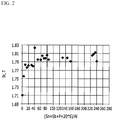
FIG. 2 is a view illustrating a relationship of a value of ([Sn]+[Sb]+[P]+20*[S])/[Al] and a Br value. -
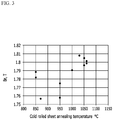
FIG. 3 is a graph illustrating a relationship of a cold rolled sheet annealing temperature and a Br value. - The advantages and characteristics of the present invention and methods for achieving the same will become clear from the embodiments set forth in detail below with reference to the attached drawings. However, the present invention is not limited to exemplary embodiment disclosed herein but will be implemented in various forms. The exemplary embodiments are provided to enable the present invention to be completely disclosed and the scope of the present invention to be easily understood by those skilled in the art. Therefore, the present invention will be defined only by the scope of the appended claims. Like reference numerals indicate like elements throughout the specification.
- Accordingly, in some exemplary embodiments, well-known technologies will not be specifically described in order to avoid ambiguous interpretation of the present invention. Unless otherwise defined, all terms (including technical and scientific terms) used in the present specification may be used as the meaning which may be commonly understood by the person with ordinary skill in the art, to which the present invention belongs. In the specification, unless explicitly described to the contrary, the word "comprise" and variations such as "comprises" or "comprising", will be understood to imply the inclusion of stated elements but not the exclusion of any other elements. Unless particularly stated otherwise in the present specification, a singular form also includes a plural form.
- Unless particularly mentioned, % refers to wt%.
- A method for manufacturing a non-oriented electrical steel sheet according to an exemplary embodiment of the present invention will be described. First, a slab is prepared.
- The slab includes Al: 0.0005% to 0.02%, Sn: 0.005% to 0.15%, P: 0.001% to 0.15% and S: 0.0008% to 0.015% with respect to an
entire composition 100 wt% of the slab and Fe and impurities as a balance amount. - The slab further includes Sb: 0.005% to 0.15% and a value of ([Sn]+[Sb]+[P]+20*[S])/[Al] may be 40 or higher. Here, [Al], [Sn], [Sb], [P], and [S] refer to weight percent (%) of Al, Sn, Sb, P, and S, respectively.
- The slab may further include Si: 1.5% to 4.0%, Mn: 0.02% to 3.0%, C: 0.005% or lower (does not include 0%), N: 0.005% or lower (does not include 0%), and Ti: 0.003% or lower (does not include 0%) with respect to an
entire composition 100 wt% of the slab. - A reason for component restriction will be described.
- When an Al added is 0.0005% or more, a specific resistance of the steel sheet is increased, which may reduce the iron loss. Further, when Al added exceeds 0.02%, the magnetic flux density may be deteriorated.
- When Sn added is 0.005% or more, Sn is segregated on a grain boundary at the time of annealing to suppress formation of a {111} set tissue. However, when Sn added exceeds 0.15%, a rolling property including a surface defect may be deteriorated during hot and cold rolling processes.
- When Sb added is 0.005% or more, Sb is segregated on a grain boundary at the time of annealing to suppress formation of a {111} set tissue. However, when Sb added exceeds 0.15%, a rolling property including a surface defect may be deteriorated during hot and cold rolling processes.
- When P added is 0.001% or more, a specific resistance is increased to reduce the iron loss and is segregated on the grain boundary to suppress formation of a {111} set tissue which is harmful to the magnetic property and form a {100} set tissue which is useful for the magnetic property. However, when P added exceeds 0.15%, a cold rolling property may be deteriorated.
- When S added is 0.0008% or more, S is segregated on a surface to lower a surface energy of a {100} plane so that a set tissue in which the {100} plane is strong may be developed. However, when S added exceeds 0.015%, workability may be deteriorated due to segregation of the grain boundary.
- Further, a value of ([Sn]+[Sb]+[P]+20*[S])/[Al] may be 40 or higher. More specifically, the value may be 40 or higher and 240 or lower. When the value of ([Sn]+[Sb]+[P]+20*[S])/[Al] is between 40 and 240, the magnetic flux density is excellent. When the value of ([Sn]+[Sb]+[P]+20*[S])/[Al] is lower than 40, the magnetic flux density of the steel sheet may be deteriorated. This will be described below in Example.
- 1.5% or more of Si is added to lower an eddy current loss. However, when Si exceeds 4.0%, brittleness is increased so that the rolling property may be deteriorated.
- 0.02% or more of Mn is added to increase a specific resistance so that the iron loss may be lowered. However, when Mn exceeds 3.0%, the saturated magnetic flux density may be reduced.
- When C exceeds 0.005%, an austenite area expands, a temperature range where a phase deformation is caused is increased, and growth of ferrite crystal grain is suppressed at the final annealing, so that the iron loss may be increased.
- When N exceeds 0.005%, nitride is formed to suppress growth of the crystal grain so that a magnetic property may be deteriorated.
- When Ti exceeds 0.003%, minute carbide and nitride are formed to suppress growth of the crystal grain and the set tissue may be deteriorated.
- Further, the slab may have a component system in which an austenite phase transformation is not generated when the slab is heated at a temperature A1 or higher.
- The slab is subjected to the hot rolling after being heated to manufacture a hot rolled sheet.
- A slab heating temperature may be 1250°C or lower. When the slab heating temperature exceeds 1250°C, a sludge in the slab is dissolved and then minutely educed at the time of hot rolling.
- When the hot rolling is performed, the hot rolling may be performed by passing a rolling pass one or more times.
- Further, a final rolling pass (hot finish rolling) may be performed at a temperature of 920°C or lower. More specifically, the temperature may be 800°C to 920°C. When the hot rolled sheet which has been subjected to the final rolling at a temperature of 920°C or lower is subjected to hot rolled sheet annealing at a temperature which is 150°C higher than the hot finish rolling temperature within two minutes, a hot rolled annealed sheet having a crystal grain size which is uniform in all areas of the center and the surface of the steel sheet may be obtained. Therefore, a set tissue in which a fraction of an orientation (30,0,45) is 1.5 times higher than a fraction of an orientation (10,0,45) is obtained so that the magnetic flux density may be improved.
- Thereafter, the hot rolled sheet is subjected to hot rolled sheet annealing. The hot rolled sheet annealing temperature may be 150°C higher than the hot finish rolling temperature. Further, the hot rolled sheet annealing temperature may be in the range of 900°C to 1200°C. Here, the hot rolled sheet annealing temperature refers to a maximum temperature of the hot rolled sheet at the time of hot rolled sheet annealing. Further, at the time of hot rolled sheet annealing, an annealing time from the hot finish rolling temperature to the hot rolled sheet annealing temperature may be two minutes or shorter.
- When the hot rolled sheet annealing is performed at a temperature which is 150°C or higher than the hot finish rolling temperature within two minutes, a hot rolled annealed sheet having a crystal grain size which is uniform in all areas of a center and surfaces of the steel sheet may be obtained. Therefore, a set tissue in which a fraction of an orientation (30,0,45) is 1.5 times higher than a fraction of an orientation (10,0,45) is obtained so that a magnetic flux density may be improved. This will be described below in Example.
- Further, a particle diameter of the crystal grain in all areas of the surface and a center in the thickness direction of the steel sheet on which the hot rolled sheet annealing is completed may be 80 µm or larger. When the particle diameter is smaller than 80 µm, the crystal grain is not sufficiently grown so that a magnetic property of the electrical steel sheet may be deteriorated.
- Further, a particle diameter of the crystal grain in all areas of the surface and the center in the thickness direction of the steel sheet on which the hot rolled sheet annealing is completed may be 80 µm or larger and 700 µm or smaller. The size of the crystal grain is uniformly 80 µm or larger and 700 µm or smaller in the surface and the center in the thickness direction of the steel sheet so that the magnetic property of the electrical steel sheet may be improved.
- The hot rolled annealed sheet on which the hot rolled sheet annealing is completed is subjected to cold rolling thereafter to manufacture a cold rolled sheet. A reduction ratio at the time of cold rolling may be 50% to 95%.
- Thereafter, the cold rolled sheet is subjected to the cold rolled sheet annealing. The cold rolled sheet annealing temperature may be 100°C lower than the hot rolled sheet annealing temperature. Further, the cold rolled sheet annealing time may be five seconds or longer.
- When a difference between the cold rolled sheet annealing temperature and the hot rolled sheet annealing temperature exceeds 100°C, even though the cold rolled sheet annealing time is maintained for five seconds or longer, a set tissue in which a fraction of an orientation (30,0,45) is 1.5 times or higher than a fraction of an orientation (10,0,45) may be obtained. This will be described below in Example.
- Hereinafter, a non-oriented electrical steel sheet according to an exemplary embodiment of the present invention will be described. The non-oriented electrical steel sheet according to an exemplary embodiment of the present invention may include Al: 0.0005% to 0.02%, Sn: 0.005% to 0.15%, P: 0.001% to 0.15%, and S: 0.0008% to 0.015% with reference to an
entire composition 100 wt% of the electric steel sheet. - The non-oriented electrical steel sheet further includes Sb: 0.005% to 0.15% and a value of ([Sn]+[Sb]+[P]+20*[S])/[Al] may be 40 or higher. Here, [Al], [Sn], [Sb], [P], and [S] refer to weight percent (%) of Al, Sn, Sb, P, and S, respectively. A reason for component restriction in the non-oriented electrical steel sheet has been described in the reason for component restriction in the slab, so that further detailed description will be omitted.
- In the set tissue of the non-oriented electrical steel sheet, a volume fraction of a crystal grain having an orientation (30,0,45) as an Euler orientation is 1.5 times higher than a volume fraction of a crystal grain having an orientation (10,0,45) as an Euler orientation. When it is satisfied that the volume fraction of the crystal grain having an orientation (30,0,45) is 1.5 times higher than the volume fraction of the crystal grain having an orientation (10,0,45), the magnetic flux density may be improved.
-
FIG. 1 is a graph illustrating a relationship of {a volume fraction of a crystal grain having an orientation (30,0,45)}/{a volume fraction of a crystal grain having an orientation (10,0,45) } and a Br value. - In order to evaluate a magnetic flux density in consideration of a density of the steel sheet, a magnetic flux density of the steel sheet is evaluated in accordance with a value (Br) of the magnetic flux density considering the density of the steel sheet as it will be described below.

- Here, [Si] refers to an added amount (wt%) of Si and [Al] is an added amount (wt%) of Al.
- B50 is a value of magnetic flux density induced to the steel sheet when it is exposed to 5,000 A/m.
- A reason why a density is considered rather than a normal magnetic flux density is that when it is considered that as an added amount of Si and Al in the steel is increased, an iron atom fraction in the steel is reduced and thus a saturated magnetic flux is reduced, it is possible to evaluate improvement of the magnetic flux density by the set tissue.
- Referring to
FIG. 1 , it is understood that when a volume fraction of a crystal gran having an orientation (30,0,45) as an Euler orientation is 1.5 times higher than a volume fraction of a crystal grain having an orientation (10,0,45) as an Euler orientation, a magnetic flux density of the steel sheet considering a density is excellent. - Hereinafter, this will be described below with reference to Examples. However, the following Examples are set forth to illustrate but are not to be construed to limit the present invention.
- A slab included Si: 3.0%, Mn: 0.4%, C: 0.002%, N: 0.003%, and Ti: 0.001% in wt% and Sn, Sb, P, S, and Al had ranges such as Al: 0.0005% to 0.02%, Sn: 0.005% to 0.15%, Sb: 0.005% to 0.15%, P: 0.001% to 0.15%, and S: 0.0008% to 0.015%. Further, contents of Sn, Sb, P, S, and Al were adjusted to manufacture a slab having a value of ([Sn]+[Sb]+[P]+20*[S])/[Al] as illustrated on an X axis of
FIG. 2 . - The slab was subjected to hot rolling after being heated at 1150°C to manufacture a hot rolled sheet. Hot finish rolling at the time of hot rolling was performed at 900°C. Thereafter, hot rolled sheet annealing was performed at 1100°C and cold rolling was performed to perform cold rolled sheet annealing at 1050°C for five seconds. An annealing time from the hot finish rolling temperature to the hot rolled sheet annealing temperature was two minutes.
- Referring to
FIG. 2 , it is understood that when a value of ([Sn]+[Sb]+[P]+20*[S])/[Al] is 40 or higher, the magnetic flux density is excellent. - A slab which included Si: 3.0%, Mn: 0.4%, C: 0.002%, N: 0.003%, Ti: 0.001%, Al: 0.004%, Sn: 0.03%, Sb: 0.03%, P: 0.05%, and S: 0.005% in wt% and Fe and impurities as a balance amount was manufactured. The slab was heated at 1150°C and then was subjected to hot rolling to manufacture a hot rolled sheet. Hot finish rolling at the time of hot rolling was performed at 900°C. Next, hot rolled sheet annealing was performed at 1100°C and cold rolling was performed to manufacture a cold rolled sheet. An annealing time from a hot finish rolling temperature to a hot rolled sheet annealing temperature was two minutes. The cold rolled sheet was subjected to cold rolled sheet annealing at a temperature illustrated in
FIG. 3 for five seconds. - Referring to
FIG. 3 , it is understood that when a difference between the cold rolled sheet annealing temperature and the hot rolled sheet annealing temperature is 100°C or lower, the magnetic flux density is excellent. - The exemplary embodiments of the present disclosure have been described with reference to the accompanying drawings, but those skilled in the art will understand that the present disclosure may be implemented in another specific form without changing the technical spirit or an essential feature thereof
- Thus, it is to be appreciated that the embodiments described above are intended to be illustrative in every sense, and not restrictive. The scope of the present invention is represented by the claims to be described below rather than the detailed description, and it is to be interpreted that the meaning and scope of the claims and all the changes or modified forms derived from the equivalents thereof come within the scope of the present invention.
- While this invention has been described in connection with what is presently considered to be practical exemplary embodiments, it is to be understood that the invention is not limited to the disclosed embodiments, but, on the contrary, is intended to cover various modifications and equivalent arrangements included within the spirit and scope of the appended claims.
Claims (14)
- A method for manufacturing a non-oriented electrical steel sheet, the method comprising:performing hot rolling on a slab after heating the slab to manufacture a hot rolled sheet;performing hot rolled sheet annealing on the hot rolled sheet;performing cold rolling on a steel sheet on which the hot rolled sheet annealing is completed to manufacture a cold rolled sheet; andperforming cold rolled sheet annealing on the cold rolled sheet,wherein a difference between a cold rolled sheet annealing temperature in the cold rolled sheet annealing and a hot rolled sheet annealing temperature in the hot rolled sheet annealing is 100°C or lower.
- The method of claim 1, wherein a hot rolled sheet annealing temperature in the hot rolled sheet annealing is performed at a temperature which is 150°C higher than a hot finish rolling temperature in the hot rolling to manufacture a hot rolled sheet.
- The method of claim 2, wherein an annealing time from the hot finish rolling temperature to the hot rolled sheet annealing temperature in the hot rolled sheet annealing is two minutes or shorter.
- The method of claim 3, wherein the cold rolled sheet annealing time in the cold rolled sheet annealing is five seconds or longer.
- The method of any one of claim 1 to claim 4, wherein the hot finish rolling temperature is 920°C or lower.
- The method of claim 5, wherein a particle diameter of a crystal grain of a steel sheet on which the hot rolled sheet annealing is completed is 80 µm or larger.
- The method of claim 6, wherein the slab includes Al: 0.0005% to 0.02%, Sn: 0.005% to 0.15%, P: 0.001% to 0.15%, and S: 0.0008% to 0.015% in wt% and Fe and impurities as a balance amount.
(Here, [Al], [Sn], [Sb], [P], and [S] refer to weight percent (%) of Al, Sn, Sb, P, and S, respectively.) - The method of claim 7, wherein the slab further includes Sb: 0.005% to 0.15% and a value of ([Sn]+[Sb]+[P]+20*[S])/[Al] is 40 or higher.
(Here, [Al], [Sn], [Sb], [P], and [S] refer to weight percent (%) of Al, Sn, Sb, P, and S, respectively.) - The method of claim 8, wherein the slab includes Si: 1.5% to 4.0%, Mn: 0.02% to 3.0%, C: 0.005% or lower (does not include 0%), N: 0.005% or lower (does not include 0%), and Ti: 0.003% or lower (does not include 0%) in wt%.
- A non-oriented electrical steel sheet, comprising:Al: 0.0005% to 0.02%, Sn: 0.005% to 0.15%, P: 0.001% to 0.15% and S: 0.0008% to 0.015% in wt% and Fe and impurities as a balance amount.(Here, [Al], [Sn], [Sb], [P], and [S] refer to weight percent (%) of Al, Sn, Sb, P, and S, respectively.)
- The non-oriented electrical steel sheet of claim 10, further comprising:Sb: 0.005% to 0.15%,wherein a value of ([Sn]+[Sb]+[P]+20*[S])/[Al] is 40 or higher.(Here, [Al], [Sn], [Sb], [P], and [S] refer to weight percent (%) of Al, Sn, Sb, P, and S, respectively.)
- The non-oriented electrical steel sheet of claim 11, wherein in the set tissue of the non-oriented electrical steel sheet, a volume fraction of a crystal grain having an orientation (30,0,45) as an Euler orientation is 1.5 times higher than a volume fraction of a crystal grain having an orientation (10,0,45) as an Euler orientation.
- The non-oriented electrical steel sheet of claim 12, further comprising:Si: 1.5% to 4.0%, Mn: 0.02% to 3.0%, C: 0.005% or lower (does not include 0%), N: 0.005% or lower (does not include 0%), and Ti: 0.003% or lower (does not include 0%) in wt%.
- The non-oriented electrical steel sheet of any one of claim 10 to claim 13, wherein a Br value of the electrical steel sheet is 1.79 (T) or higher.
(Here, Br= 7.87/ (7.87-0.0.065*[Si]-0.1105*[Al]) * B50, [Si] is an added amount (wt%) of Si and [Al] is an added amount (wt%) of Al, and B50 is a value of magnetic flux density induced to the steel sheet when it is exposed to 5,000 A/m.)
Applications Claiming Priority (2)
| Application Number | Priority Date | Filing Date | Title |
|---|---|---|---|
| KR1020140189064A KR101650406B1 (en) | 2014-12-24 | 2014-12-24 | Non-oriented electrical steel sheets and method for manufacturing the same |
| PCT/KR2015/014037 WO2016105056A1 (en) | 2014-12-24 | 2015-12-21 | Non-oriented electrical steel sheet and method for manufacturing the same |
Publications (3)
| Publication Number | Publication Date |
|---|---|
| EP3239309A1 true EP3239309A1 (en) | 2017-11-01 |
| EP3239309A4 EP3239309A4 (en) | 2017-12-20 |
| EP3239309B1 EP3239309B1 (en) | 2020-04-01 |
Family
ID=56151002
Family Applications (1)
| Application Number | Title | Priority Date | Filing Date |
|---|---|---|---|
| EP15873583.7A Active EP3239309B1 (en) | 2014-12-24 | 2015-12-21 | Non-oriented electrical steel sheet and method for manufacturing the same |
Country Status (6)
| Country | Link |
|---|---|
| US (1) | US10941457B2 (en) |
| EP (1) | EP3239309B1 (en) |
| JP (1) | JP6503464B2 (en) |
| KR (1) | KR101650406B1 (en) |
| CN (1) | CN107223165B (en) |
| WO (1) | WO2016105056A1 (en) |
Families Citing this family (6)
| Publication number | Priority date | Publication date | Assignee | Title |
|---|---|---|---|---|
| KR101728028B1 (en) * | 2015-12-23 | 2017-04-18 | 주식회사 포스코 | Non-oriented electrical steel sheet and method for manufacturing the same |
| KR102080167B1 (en) * | 2017-12-26 | 2020-02-21 | 주식회사 포스코 | Method for manufacturing non-oriented electrical steel sheet |
| KR102109241B1 (en) * | 2017-12-26 | 2020-05-11 | 주식회사 포스코 | Non-oriented electrical steel sheet having excellent shape property and method of manufacturing the same |
| KR102018181B1 (en) | 2017-12-26 | 2019-09-04 | 주식회사 포스코 | Non-oriented electrical steel sheet and method for manufacturing the same |
| WO2020078529A1 (en) * | 2018-10-15 | 2020-04-23 | Thyssenkrupp Steel Europe Ag | Method for producing an no electric strip of intermediate thickness |
| WO2026089270A1 (en) * | 2024-10-23 | 2026-04-30 | 현대제철 주식회사 | Non-oriented electrical steel sheet and method for producing same |
Family Cites Families (18)
| Publication number | Priority date | Publication date | Assignee | Title |
|---|---|---|---|---|
| JPS59157259A (en) * | 1983-01-25 | 1984-09-06 | Nippon Steel Corp | Non-directional electrical sheet having low iron loss and excellent magnetic flux density and its production |
| JP2500033B2 (en) * | 1990-12-10 | 1996-05-29 | 川崎製鉄株式会社 | Manufacturing method of non-oriented electrical steel sheet with excellent magnetic properties and good surface appearance |
| JPH086135B2 (en) * | 1991-04-25 | 1996-01-24 | 新日本製鐵株式会社 | Manufacturing method of non-oriented electrical steel sheet with excellent magnetic properties |
| JP3399726B2 (en) * | 1995-11-07 | 2003-04-21 | 新日本製鐵株式会社 | Manufacturing method of non-oriented electrical steel sheet with high magnetic flux density and low iron loss |
| JP4218077B2 (en) | 1998-02-26 | 2009-02-04 | 住友金属工業株式会社 | Non-oriented electrical steel sheet and manufacturing method thereof |
| JP4292805B2 (en) * | 2003-01-17 | 2009-07-08 | Jfeスチール株式会社 | Method for producing non-oriented electrical steel sheet with excellent magnetic properties |
| JP4276612B2 (en) * | 2004-11-08 | 2009-06-10 | 新日本製鐵株式会社 | Non-oriented electrical steel sheet and manufacturing method thereof |
| CN100999050A (en) * | 2006-01-11 | 2007-07-18 | 宝山钢铁股份有限公司 | Production method of low iron loss high magnetic sensing cold milling orientation less electrical steel plate |
| JP5375149B2 (en) | 2008-09-11 | 2013-12-25 | Jfeスチール株式会社 | Non-oriented electrical steel sheet and manufacturing method thereof |
| JP5609003B2 (en) * | 2009-04-14 | 2014-10-22 | 新日鐵住金株式会社 | Non-oriented electrical steel sheet |
| US20120267015A1 (en) * | 2009-12-28 | 2012-10-25 | Posco | Non-Oriented Electrical Steel Sheet Having Superior Magnetic Properties and a Production Method Therefor |
| KR101296114B1 (en) * | 2009-12-28 | 2013-08-19 | 주식회사 포스코 | Non-oriented electrical steel sheet with excellent magnetic property, and Method for manufacturing the same |
| KR101223113B1 (en) * | 2010-12-27 | 2013-01-17 | 주식회사 포스코 | Method for manufacturing non-oriented electrical steel sheets having excellent magnetic properties and high permeability and non-oriented electrical steel sheets thereof |
| JP5712863B2 (en) | 2011-08-23 | 2015-05-07 | 新日鐵住金株式会社 | Method for producing non-oriented electrical steel sheet |
| JP5263363B2 (en) * | 2011-10-11 | 2013-08-14 | Jfeスチール株式会社 | Method for producing non-oriented electrical steel sheet |
| JP5892327B2 (en) * | 2012-03-15 | 2016-03-23 | Jfeスチール株式会社 | Method for producing non-oriented electrical steel sheet |
| JP6127440B2 (en) * | 2012-10-16 | 2017-05-17 | Jfeスチール株式会社 | Hot rolled steel sheet for manufacturing non-oriented electrical steel sheet and method for manufacturing the same |
| KR101493059B1 (en) * | 2012-12-27 | 2015-02-11 | 주식회사 포스코 | Non-oriented electrical steel steet and method for the same |
-
2014
- 2014-12-24 KR KR1020140189064A patent/KR101650406B1/en active Active
-
2015
- 2015-12-21 US US15/539,610 patent/US10941457B2/en active Active
- 2015-12-21 EP EP15873583.7A patent/EP3239309B1/en active Active
- 2015-12-21 CN CN201580071226.3A patent/CN107223165B/en active Active
- 2015-12-21 WO PCT/KR2015/014037 patent/WO2016105056A1/en not_active Ceased
- 2015-12-21 JP JP2017534252A patent/JP6503464B2/en active Active
Also Published As
| Publication number | Publication date |
|---|---|
| JP2018507958A (en) | 2018-03-22 |
| JP6503464B2 (en) | 2019-04-17 |
| KR20160078172A (en) | 2016-07-04 |
| KR101650406B1 (en) | 2016-08-23 |
| US10941457B2 (en) | 2021-03-09 |
| WO2016105056A1 (en) | 2016-06-30 |
| EP3239309A4 (en) | 2017-12-20 |
| CN107223165A (en) | 2017-09-29 |
| EP3239309B1 (en) | 2020-04-01 |
| CN107223165B (en) | 2019-12-20 |
| US20170362676A1 (en) | 2017-12-21 |
Similar Documents
| Publication | Publication Date | Title |
|---|---|---|
| EP3239309B1 (en) | Non-oriented electrical steel sheet and method for manufacturing the same | |
| TWI658152B (en) | Non-directional electrical steel sheet and method for manufacturing non-oriented electrical steel sheet | |
| Löewe et al. | Temperature-dependent Dy diffusion processes in Nd–Fe–B permanent magnets | |
| US10541071B2 (en) | Electrical steel sheet | |
| CN105378130B (en) | High magnetic flux density non orientation electromagnetic steel plate and motor | |
| Nabi et al. | Effect of recrystallization and degree of order on the magnetic and mechanical properties of soft magnetic FeCo–2V alloy | |
| KR101591222B1 (en) | Method of producing non-oriented electrical steel sheet | |
| JP4855222B2 (en) | Non-oriented electrical steel sheet for split core | |
| CN103270179A (en) | Method of producing non-oriented electrical steel sheet | |
| JP2011084761A (en) | Non-oriented electromagnetic steel sheet for rotor and manufacturing method therefor | |
| CN104471084A (en) | Oriented electromagnetic steel plate production method | |
| KR102921431B1 (en) | Soft magnetic member and methods respectively for producing said member and intermediate therefor | |
| RU2630098C2 (en) | Sheet of nonoriented electrical steel and hot-rolled steel sheet for it | |
| JP4389691B2 (en) | Non-oriented electrical steel sheet for rotor and manufacturing method thereof | |
| JP2016211016A (en) | Hot rolled sheet for nonoriented magnetic steel sheet and production method therefor, and nonoriented magnetic steel sheet excellent in magnetic property and production method therefor | |
| JP2012036459A (en) | Non-oriented magnetic steel sheet and production method therefor | |
| JP2007314826A (en) | Unidirectional electrical steel sheet with excellent iron loss characteristics | |
| JP2535963B2 (en) | Silicon steel sheet having excellent magnetic properties and method for producing the same | |
| JP6575269B2 (en) | Non-oriented electrical steel sheet and manufacturing method thereof | |
| JP4855220B2 (en) | Non-oriented electrical steel sheet for split core | |
| JP2013104080A (en) | Non-oriented magnetic steel sheet and method for manufacturing the same | |
| JP6623533B2 (en) | Fe-based metal plate | |
| JP4515355B2 (en) | Soft magnetic steel materials with excellent magnetic properties and machinability in high magnetic fields and soft magnetic steel components with excellent magnetic properties in high magnetic fields | |
| JPH0888114A (en) | Non-oriented electrical steel sheet manufacturing method | |
| JP2017166010A (en) | Metastable austenitic stainless steel band and steel sheet |
Legal Events
| Date | Code | Title | Description |
|---|---|---|---|
| STAA | Information on the status of an ep patent application or granted ep patent |
Free format text: STATUS: THE INTERNATIONAL PUBLICATION HAS BEEN MADE |
|
| PUAI | Public reference made under article 153(3) epc to a published international application that has entered the european phase |
Free format text: ORIGINAL CODE: 0009012 |
|
| STAA | Information on the status of an ep patent application or granted ep patent |
Free format text: STATUS: REQUEST FOR EXAMINATION WAS MADE |
|
| 17P | Request for examination filed |
Effective date: 20170623 |
|
| AK | Designated contracting states |
Kind code of ref document: A1 Designated state(s): AL AT BE BG CH CY CZ DE DK EE ES FI FR GB GR HR HU IE IS IT LI LT LU LV MC MK MT NL NO PL PT RO RS SE SI SK SM TR |
|
| AX | Request for extension of the european patent |
Extension state: BA ME |
|
| A4 | Supplementary search report drawn up and despatched |
Effective date: 20171120 |
|
| RIC1 | Information provided on ipc code assigned before grant |
Ipc: C22C 38/02 20060101ALI20171114BHEP Ipc: C21D 8/12 20060101AFI20171114BHEP |
|
| DAV | Request for validation of the european patent (deleted) | ||
| DAX | Request for extension of the european patent (deleted) | ||
| STAA | Information on the status of an ep patent application or granted ep patent |
Free format text: STATUS: EXAMINATION IS IN PROGRESS |
|
| 17Q | First examination report despatched |
Effective date: 20180920 |
|
| GRAP | Despatch of communication of intention to grant a patent |
Free format text: ORIGINAL CODE: EPIDOSNIGR1 |
|
| STAA | Information on the status of an ep patent application or granted ep patent |
Free format text: STATUS: GRANT OF PATENT IS INTENDED |
|
| INTG | Intention to grant announced |
Effective date: 20191016 |
|
| GRAS | Grant fee paid |
Free format text: ORIGINAL CODE: EPIDOSNIGR3 |
|
| GRAA | (expected) grant |
Free format text: ORIGINAL CODE: 0009210 |
|
| STAA | Information on the status of an ep patent application or granted ep patent |
Free format text: STATUS: THE PATENT HAS BEEN GRANTED |
|
| AK | Designated contracting states |
Kind code of ref document: B1 Designated state(s): AL AT BE BG CH CY CZ DE DK EE ES FI FR GB GR HR HU IE IS IT LI LT LU LV MC MK MT NL NO PL PT RO RS SE SI SK SM TR |
|
| REG | Reference to a national code |
Ref country code: GB Ref legal event code: FG4D |
|
| REG | Reference to a national code |
Ref country code: AT Ref legal event code: REF Ref document number: 1251405 Country of ref document: AT Kind code of ref document: T Effective date: 20200415 Ref country code: CH Ref legal event code: EP |
|
| REG | Reference to a national code |
Ref country code: DE Ref legal event code: R096 Ref document number: 602015050057 Country of ref document: DE |
|
| REG | Reference to a national code |
Ref country code: IE Ref legal event code: FG4D |
|
| PG25 | Lapsed in a contracting state [announced via postgrant information from national office to epo] |
Ref country code: BG Free format text: LAPSE BECAUSE OF FAILURE TO SUBMIT A TRANSLATION OF THE DESCRIPTION OR TO PAY THE FEE WITHIN THE PRESCRIBED TIME-LIMIT Effective date: 20200701 |
|
| REG | Reference to a national code |
Ref country code: NL Ref legal event code: MP Effective date: 20200401 |
|
| REG | Reference to a national code |
Ref country code: LT Ref legal event code: MG4D |
|
| PG25 | Lapsed in a contracting state [announced via postgrant information from national office to epo] |
Ref country code: PT Free format text: LAPSE BECAUSE OF FAILURE TO SUBMIT A TRANSLATION OF THE DESCRIPTION OR TO PAY THE FEE WITHIN THE PRESCRIBED TIME-LIMIT Effective date: 20200817 Ref country code: CZ Free format text: LAPSE BECAUSE OF FAILURE TO SUBMIT A TRANSLATION OF THE DESCRIPTION OR TO PAY THE FEE WITHIN THE PRESCRIBED TIME-LIMIT Effective date: 20200401 Ref country code: IS Free format text: LAPSE BECAUSE OF FAILURE TO SUBMIT A TRANSLATION OF THE DESCRIPTION OR TO PAY THE FEE WITHIN THE PRESCRIBED TIME-LIMIT Effective date: 20200801 Ref country code: SE Free format text: LAPSE BECAUSE OF FAILURE TO SUBMIT A TRANSLATION OF THE DESCRIPTION OR TO PAY THE FEE WITHIN THE PRESCRIBED TIME-LIMIT Effective date: 20200401 Ref country code: FI Free format text: LAPSE BECAUSE OF FAILURE TO SUBMIT A TRANSLATION OF THE DESCRIPTION OR TO PAY THE FEE WITHIN THE PRESCRIBED TIME-LIMIT Effective date: 20200401 Ref country code: NO Free format text: LAPSE BECAUSE OF FAILURE TO SUBMIT A TRANSLATION OF THE DESCRIPTION OR TO PAY THE FEE WITHIN THE PRESCRIBED TIME-LIMIT Effective date: 20200701 Ref country code: GR Free format text: LAPSE BECAUSE OF FAILURE TO SUBMIT A TRANSLATION OF THE DESCRIPTION OR TO PAY THE FEE WITHIN THE PRESCRIBED TIME-LIMIT Effective date: 20200702 Ref country code: LT Free format text: LAPSE BECAUSE OF FAILURE TO SUBMIT A TRANSLATION OF THE DESCRIPTION OR TO PAY THE FEE WITHIN THE PRESCRIBED TIME-LIMIT Effective date: 20200401 Ref country code: NL Free format text: LAPSE BECAUSE OF FAILURE TO SUBMIT A TRANSLATION OF THE DESCRIPTION OR TO PAY THE FEE WITHIN THE PRESCRIBED TIME-LIMIT Effective date: 20200401 |
|
| PG25 | Lapsed in a contracting state [announced via postgrant information from national office to epo] |
Ref country code: HR Free format text: LAPSE BECAUSE OF FAILURE TO SUBMIT A TRANSLATION OF THE DESCRIPTION OR TO PAY THE FEE WITHIN THE PRESCRIBED TIME-LIMIT Effective date: 20200401 Ref country code: RS Free format text: LAPSE BECAUSE OF FAILURE TO SUBMIT A TRANSLATION OF THE DESCRIPTION OR TO PAY THE FEE WITHIN THE PRESCRIBED TIME-LIMIT Effective date: 20200401 Ref country code: LV Free format text: LAPSE BECAUSE OF FAILURE TO SUBMIT A TRANSLATION OF THE DESCRIPTION OR TO PAY THE FEE WITHIN THE PRESCRIBED TIME-LIMIT Effective date: 20200401 |
|
| PG25 | Lapsed in a contracting state [announced via postgrant information from national office to epo] |
Ref country code: AL Free format text: LAPSE BECAUSE OF FAILURE TO SUBMIT A TRANSLATION OF THE DESCRIPTION OR TO PAY THE FEE WITHIN THE PRESCRIBED TIME-LIMIT Effective date: 20200401 |
|
| REG | Reference to a national code |
Ref country code: DE Ref legal event code: R097 Ref document number: 602015050057 Country of ref document: DE |
|
| PG25 | Lapsed in a contracting state [announced via postgrant information from national office to epo] |
Ref country code: RO Free format text: LAPSE BECAUSE OF FAILURE TO SUBMIT A TRANSLATION OF THE DESCRIPTION OR TO PAY THE FEE WITHIN THE PRESCRIBED TIME-LIMIT Effective date: 20200401 Ref country code: ES Free format text: LAPSE BECAUSE OF FAILURE TO SUBMIT A TRANSLATION OF THE DESCRIPTION OR TO PAY THE FEE WITHIN THE PRESCRIBED TIME-LIMIT Effective date: 20200401 Ref country code: SM Free format text: LAPSE BECAUSE OF FAILURE TO SUBMIT A TRANSLATION OF THE DESCRIPTION OR TO PAY THE FEE WITHIN THE PRESCRIBED TIME-LIMIT Effective date: 20200401 Ref country code: EE Free format text: LAPSE BECAUSE OF FAILURE TO SUBMIT A TRANSLATION OF THE DESCRIPTION OR TO PAY THE FEE WITHIN THE PRESCRIBED TIME-LIMIT Effective date: 20200401 Ref country code: DK Free format text: LAPSE BECAUSE OF FAILURE TO SUBMIT A TRANSLATION OF THE DESCRIPTION OR TO PAY THE FEE WITHIN THE PRESCRIBED TIME-LIMIT Effective date: 20200401 Ref country code: IT Free format text: LAPSE BECAUSE OF FAILURE TO SUBMIT A TRANSLATION OF THE DESCRIPTION OR TO PAY THE FEE WITHIN THE PRESCRIBED TIME-LIMIT Effective date: 20200401 |
|
| PLBE | No opposition filed within time limit |
Free format text: ORIGINAL CODE: 0009261 |
|
| STAA | Information on the status of an ep patent application or granted ep patent |
Free format text: STATUS: NO OPPOSITION FILED WITHIN TIME LIMIT |
|
| PG25 | Lapsed in a contracting state [announced via postgrant information from national office to epo] |
Ref country code: PL Free format text: LAPSE BECAUSE OF FAILURE TO SUBMIT A TRANSLATION OF THE DESCRIPTION OR TO PAY THE FEE WITHIN THE PRESCRIBED TIME-LIMIT Effective date: 20200401 Ref country code: SK Free format text: LAPSE BECAUSE OF FAILURE TO SUBMIT A TRANSLATION OF THE DESCRIPTION OR TO PAY THE FEE WITHIN THE PRESCRIBED TIME-LIMIT Effective date: 20200401 |
|
| 26N | No opposition filed |
Effective date: 20210112 |
|
| PG25 | Lapsed in a contracting state [announced via postgrant information from national office to epo] |
Ref country code: SI Free format text: LAPSE BECAUSE OF FAILURE TO SUBMIT A TRANSLATION OF THE DESCRIPTION OR TO PAY THE FEE WITHIN THE PRESCRIBED TIME-LIMIT Effective date: 20200401 |
|
| REG | Reference to a national code |
Ref country code: CH Ref legal event code: PL |
|
| GBPC | Gb: european patent ceased through non-payment of renewal fee |
Effective date: 20201221 |
|
| PG25 | Lapsed in a contracting state [announced via postgrant information from national office to epo] |
Ref country code: MC Free format text: LAPSE BECAUSE OF FAILURE TO SUBMIT A TRANSLATION OF THE DESCRIPTION OR TO PAY THE FEE WITHIN THE PRESCRIBED TIME-LIMIT Effective date: 20200401 |
|
| REG | Reference to a national code |
Ref country code: BE Ref legal event code: MM Effective date: 20201231 |
|
| PG25 | Lapsed in a contracting state [announced via postgrant information from national office to epo] |
Ref country code: LU Free format text: LAPSE BECAUSE OF NON-PAYMENT OF DUE FEES Effective date: 20201221 Ref country code: IE Free format text: LAPSE BECAUSE OF NON-PAYMENT OF DUE FEES Effective date: 20201221 |
|
| PG25 | Lapsed in a contracting state [announced via postgrant information from national office to epo] |
Ref country code: LI Free format text: LAPSE BECAUSE OF NON-PAYMENT OF DUE FEES Effective date: 20201231 Ref country code: GB Free format text: LAPSE BECAUSE OF NON-PAYMENT OF DUE FEES Effective date: 20201221 Ref country code: CH Free format text: LAPSE BECAUSE OF NON-PAYMENT OF DUE FEES Effective date: 20201231 |
|
| PG25 | Lapsed in a contracting state [announced via postgrant information from national office to epo] |
Ref country code: TR Free format text: LAPSE BECAUSE OF FAILURE TO SUBMIT A TRANSLATION OF THE DESCRIPTION OR TO PAY THE FEE WITHIN THE PRESCRIBED TIME-LIMIT Effective date: 20200401 Ref country code: MT Free format text: LAPSE BECAUSE OF FAILURE TO SUBMIT A TRANSLATION OF THE DESCRIPTION OR TO PAY THE FEE WITHIN THE PRESCRIBED TIME-LIMIT Effective date: 20200401 Ref country code: CY Free format text: LAPSE BECAUSE OF FAILURE TO SUBMIT A TRANSLATION OF THE DESCRIPTION OR TO PAY THE FEE WITHIN THE PRESCRIBED TIME-LIMIT Effective date: 20200401 |
|
| PG25 | Lapsed in a contracting state [announced via postgrant information from national office to epo] |
Ref country code: MK Free format text: LAPSE BECAUSE OF FAILURE TO SUBMIT A TRANSLATION OF THE DESCRIPTION OR TO PAY THE FEE WITHIN THE PRESCRIBED TIME-LIMIT Effective date: 20200401 |
|
| PG25 | Lapsed in a contracting state [announced via postgrant information from national office to epo] |
Ref country code: BE Free format text: LAPSE BECAUSE OF NON-PAYMENT OF DUE FEES Effective date: 20201231 |
|
| REG | Reference to a national code |
Ref country code: DE Ref legal event code: R081 Ref document number: 602015050057 Country of ref document: DE Owner name: POSCO CO., LTD, POHANG-SI, KR Free format text: FORMER OWNER: POSCO, POHANG-SI, GYEONGSANGBUK-DO, KR Ref country code: DE Ref legal event code: R081 Ref document number: 602015050057 Country of ref document: DE Owner name: POSCO CO., LTD, POHANG- SI, KR Free format text: FORMER OWNER: POSCO, POHANG-SI, GYEONGSANGBUK-DO, KR Ref country code: DE Ref legal event code: R081 Ref document number: 602015050057 Country of ref document: DE Owner name: POSCO HOLDINGS INC., KR Free format text: FORMER OWNER: POSCO, POHANG-SI, GYEONGSANGBUK-DO, KR |
|
| REG | Reference to a national code |
Ref country code: AT Ref legal event code: PC Ref document number: 1251405 Country of ref document: AT Kind code of ref document: T Owner name: POSCO CO., LTD, KR Effective date: 20230228 |
|
| REG | Reference to a national code |
Ref country code: DE Ref legal event code: R081 Ref document number: 602015050057 Country of ref document: DE Owner name: POSCO CO., LTD, POHANG-SI, KR Free format text: FORMER OWNER: POSCO HOLDINGS INC., SEOUL, KR Ref country code: DE Ref legal event code: R081 Ref document number: 602015050057 Country of ref document: DE Owner name: POSCO CO., LTD, POHANG- SI, KR Free format text: FORMER OWNER: POSCO HOLDINGS INC., SEOUL, KR |
|
| PG25 | Lapsed in a contracting state [announced via postgrant information from national office to epo] |
Ref country code: IS Free format text: LAPSE BECAUSE OF NON-PAYMENT OF DUE FEES Effective date: 20200801 |
|
| PGFP | Annual fee paid to national office [announced via postgrant information from national office to epo] |
Ref country code: FR Payment date: 20250925 Year of fee payment: 11 |
|
| PGFP | Annual fee paid to national office [announced via postgrant information from national office to epo] |
Ref country code: DE Payment date: 20250922 Year of fee payment: 11 |
|
| PGFP | Annual fee paid to national office [announced via postgrant information from national office to epo] |
Ref country code: AT Payment date: 20251001 Year of fee payment: 11 |