EP3233858B1 - Erk inhibitors - Google Patents
Erk inhibitors Download PDFInfo
- Publication number
- EP3233858B1 EP3233858B1 EP15870725.7A EP15870725A EP3233858B1 EP 3233858 B1 EP3233858 B1 EP 3233858B1 EP 15870725 A EP15870725 A EP 15870725A EP 3233858 B1 EP3233858 B1 EP 3233858B1
- Authority
- EP
- European Patent Office
- Prior art keywords
- pyridin
- pyrazolo
- urea
- methylpyridin
- methyl
- Prior art date
- Legal status (The legal status is an assumption and is not a legal conclusion. Google has not performed a legal analysis and makes no representation as to the accuracy of the status listed.)
- Active
Links
- 0 CC*1N=CC(C)=C1 Chemical compound CC*1N=CC(C)=C1 0.000 description 30
- RWGFKTVRMDUZSP-UHFFFAOYSA-N CC(C)c1ccccc1 Chemical compound CC(C)c1ccccc1 RWGFKTVRMDUZSP-UHFFFAOYSA-N 0.000 description 2
- VFXFCQSSIZYQHS-YXKWHIQJSA-N C/C1=C/N=C(/C)\C=C/CCC1 Chemical compound C/C1=C/N=C(/C)\C=C/CCC1 VFXFCQSSIZYQHS-YXKWHIQJSA-N 0.000 description 1
- WDUUROPGVVLKAP-UHFFFAOYSA-N CC(C)(C)OC(N(CCC(C1)[n]2ncc3cc(Cl)ncc23)C1=N)=O Chemical compound CC(C)(C)OC(N(CCC(C1)[n]2ncc3cc(Cl)ncc23)C1=N)=O WDUUROPGVVLKAP-UHFFFAOYSA-N 0.000 description 1
- NJVWOKPUIRFIQE-CCGQDMKZSA-N CC(C)(C1)N(C)C[C@H]1NC1[O](Cc2ccccc2)C1Nc(nc1)cc2c1[n](-c1cc(C)ncc1)nc2 Chemical compound CC(C)(C1)N(C)C[C@H]1NC1[O](Cc2ccccc2)C1Nc(nc1)cc2c1[n](-c1cc(C)ncc1)nc2 NJVWOKPUIRFIQE-CCGQDMKZSA-N 0.000 description 1
- LFELAEVCCQSYRJ-UHFFFAOYSA-N CC(C)(CC1NC(Nc(nc2)cc3c2[n](-c2cc(C)ncc2)nc3)=O)Oc2c1cccc2 Chemical compound CC(C)(CC1NC(Nc(nc2)cc3c2[n](-c2cc(C)ncc2)nc3)=O)Oc2c1cccc2 LFELAEVCCQSYRJ-UHFFFAOYSA-N 0.000 description 1
- YQGYBHRJSLQDSX-UHFFFAOYSA-O CC(C)(c1ccc(CNC(Nc(cc2C=N)ncc2[NH2+]c2ccnc(C)c2)=O)cc1)O Chemical compound CC(C)(c1ccc(CNC(Nc(cc2C=N)ncc2[NH2+]c2ccnc(C)c2)=O)cc1)O YQGYBHRJSLQDSX-UHFFFAOYSA-O 0.000 description 1
- LBLLYZRYHDUXLG-CQSZACIVSA-N CC(C)C[n]1ncc2cc(NC(N[C@H](C)c3ccccc3)=O)nc(CO)c12 Chemical compound CC(C)C[n]1ncc2cc(NC(N[C@H](C)c3ccccc3)=O)nc(CO)c12 LBLLYZRYHDUXLG-CQSZACIVSA-N 0.000 description 1
- XZISOEPNTDOUEA-UHFFFAOYSA-N CC(C)c(cc1)ccc1F Chemical compound CC(C)c(cc1)ccc1F XZISOEPNTDOUEA-UHFFFAOYSA-N 0.000 description 1
- SRTOJEUVLKLAGK-UHFFFAOYSA-N CC(C)c1c[s]c(C)n1 Chemical compound CC(C)c1c[s]c(C)n1 SRTOJEUVLKLAGK-UHFFFAOYSA-N 0.000 description 1
- WFVJTQXWDNJZQN-UHFFFAOYSA-N CC(CC1)CN1c(cc1)ccc1F Chemical compound CC(CC1)CN1c(cc1)ccc1F WFVJTQXWDNJZQN-UHFFFAOYSA-N 0.000 description 1
- QDLQQFYNFWYKPM-UHFFFAOYSA-N CC(CCCC1)C1OC Chemical compound CC(CCCC1)C1OC QDLQQFYNFWYKPM-UHFFFAOYSA-N 0.000 description 1
- WPALSDNIQIXKBZ-UHFFFAOYSA-N CC(CN(C)C1)C1c1ccccc1 Chemical compound CC(CN(C)C1)C1c1ccccc1 WPALSDNIQIXKBZ-UHFFFAOYSA-N 0.000 description 1
- YSNQIAAKXNQQCB-UHFFFAOYSA-N CC(CN(C)C1)C1c1ccccc1C Chemical compound CC(CN(C)C1)C1c1ccccc1C YSNQIAAKXNQQCB-UHFFFAOYSA-N 0.000 description 1
- KBHSJJFALXACJD-KFJBMODSSA-N CC(CN(C)C1)[C@H]1C1CCCCC1 Chemical compound CC(CN(C)C1)[C@H]1C1CCCCC1 KBHSJJFALXACJD-KFJBMODSSA-N 0.000 description 1
- JMYBVVFDFBYLAM-UHFFFAOYSA-N CC(CN1CCOCC1)C1=CCCC=C1 Chemical compound CC(CN1CCOCC1)C1=CCCC=C1 JMYBVVFDFBYLAM-UHFFFAOYSA-N 0.000 description 1
- RUUXFAGAENINCV-UHFFFAOYSA-N CC(CNC1)C1OC Chemical compound CC(CNC1)C1OC RUUXFAGAENINCV-UHFFFAOYSA-N 0.000 description 1
- CTZMHGMCNFQHDP-UHFFFAOYSA-M CC([C@@H](NC(Nc(cc1cn2)ncc1[n]2[AlH2])=O)[AlH2])=O Chemical compound CC([C@@H](NC(Nc(cc1cn2)ncc1[n]2[AlH2])=O)[AlH2])=O CTZMHGMCNFQHDP-UHFFFAOYSA-M 0.000 description 1
- XIXDDIXISQGDCW-UHFFFAOYSA-M CC([C@@H](NC(Nc(cc1cn2)ncc1[n]2[AlH2])=O)[AlH2])O Chemical compound CC([C@@H](NC(Nc(cc1cn2)ncc1[n]2[AlH2])=O)[AlH2])O XIXDDIXISQGDCW-UHFFFAOYSA-M 0.000 description 1
- QJVVITCWTCLUAK-UHFFFAOYSA-N CC(c(cc1)ccc1F)OC Chemical compound CC(c(cc1)ccc1F)OC QJVVITCWTCLUAK-UHFFFAOYSA-N 0.000 description 1
- AOFFUDJSPUKQOM-UHFFFAOYSA-N CC(c1c[s]c(C)n1)NC(Nc(nc1)cc2c1[n](-c1ccnc(C)c1)nc2)=O Chemical compound CC(c1c[s]c(C)n1)NC(Nc(nc1)cc2c1[n](-c1ccnc(C)c1)nc2)=O AOFFUDJSPUKQOM-UHFFFAOYSA-N 0.000 description 1
- MZZHSNDEUAMQCJ-UHFFFAOYSA-N CC1C(CCc2ccccc2)CN(C)C1 Chemical compound CC1C(CCc2ccccc2)CN(C)C1 MZZHSNDEUAMQCJ-UHFFFAOYSA-N 0.000 description 1
- DDJSOUPUKRLHAI-UHFFFAOYSA-N CC1C(Cc2ccccc2)CCCC1 Chemical compound CC1C(Cc2ccccc2)CCCC1 DDJSOUPUKRLHAI-UHFFFAOYSA-N 0.000 description 1
- DHTTVNOAJVCZKD-UHFFFAOYSA-N CC1CN(Cc(c(OC)ccc2)c2F)CCC1 Chemical compound CC1CN(Cc(c(OC)ccc2)c2F)CCC1 DHTTVNOAJVCZKD-UHFFFAOYSA-N 0.000 description 1
- KYINPWAJIVTFBW-UHFFFAOYSA-N CC1CNCC1 Chemical compound CC1CNCC1 KYINPWAJIVTFBW-UHFFFAOYSA-N 0.000 description 1
- PIMFIFNQSWBBGO-UHFFFAOYSA-N CCCC(CN(C)C1)C1c1nc(C)c[s]1 Chemical compound CCCC(CN(C)C1)C1c1nc(C)c[s]1 PIMFIFNQSWBBGO-UHFFFAOYSA-N 0.000 description 1
- JCGTZJDRHWAZCL-UHFFFAOYSA-N CCOC1C(C)CCC1 Chemical compound CCOC1C(C)CCC1 JCGTZJDRHWAZCL-UHFFFAOYSA-N 0.000 description 1
- WAMDOVKECCWRMH-UHFFFAOYSA-N CCOC1C(C)CCCC1 Chemical compound CCOC1C(C)CCCC1 WAMDOVKECCWRMH-UHFFFAOYSA-N 0.000 description 1
- FHRTUUJINXTKLO-UHFFFAOYSA-N CCOCC(C)c1ccccc1 Chemical compound CCOCC(C)c1ccccc1 FHRTUUJINXTKLO-UHFFFAOYSA-N 0.000 description 1
- SQIUNYXQGHNTEJ-WMZOPIPTSA-N CCO[C@@H](CCC1)[C@H]1NC(Nc(nc1)cc2c1[n](-c1cc(C)ncc1)nc2)=O Chemical compound CCO[C@@H](CCC1)[C@H]1NC(Nc(nc1)cc2c1[n](-c1cc(C)ncc1)nc2)=O SQIUNYXQGHNTEJ-WMZOPIPTSA-N 0.000 description 1
- DDYWCZRBECKNIF-UHFFFAOYSA-N CCc1c[n](-c(cc2)ccc2F)nc1 Chemical compound CCc1c[n](-c(cc2)ccc2F)nc1 DDYWCZRBECKNIF-UHFFFAOYSA-N 0.000 description 1
- JIZWKCDDKNTJRS-STQMWFEESA-N CN(C[C@@H]1CCc2ccccc2)C[C@@H]1N Chemical compound CN(C[C@@H]1CCc2ccccc2)C[C@@H]1N JIZWKCDDKNTJRS-STQMWFEESA-N 0.000 description 1
- PAMIQIKDUOTOBW-UHFFFAOYSA-N CN1CCCCC1 Chemical compound CN1CCCCC1 PAMIQIKDUOTOBW-UHFFFAOYSA-N 0.000 description 1
- STVIISHELPWFGC-UHFFFAOYSA-N COc1ccc(CNC(Nc(nc2)cc3c2[n](-c2ccncc2)nc3)=O)cc1 Chemical compound COc1ccc(CNC(Nc(nc2)cc3c2[n](-c2ccncc2)nc3)=O)cc1 STVIISHELPWFGC-UHFFFAOYSA-N 0.000 description 1
- QNFNFCXLYSZMKA-CYBMUJFWSA-N C[C@H](c(cc1)ccc1F)NC(Nc(nc1)cc2c1[n](-c(cc1)ccc1F)nc2)=O Chemical compound C[C@H](c(cc1)ccc1F)NC(Nc(nc1)cc2c1[n](-c(cc1)ccc1F)nc2)=O QNFNFCXLYSZMKA-CYBMUJFWSA-N 0.000 description 1
- NEYXDTVJNDINEB-CYBMUJFWSA-N C[C@H](c(cc1Cl)ccc1F)NC(Nc(nc1)cc2c1[n](-c1cc(C)ncc1)nc2)=O Chemical compound C[C@H](c(cc1Cl)ccc1F)NC(Nc(nc1)cc2c1[n](-c1cc(C)ncc1)nc2)=O NEYXDTVJNDINEB-CYBMUJFWSA-N 0.000 description 1
- DVOGRXKEUQXASP-CQSZACIVSA-N C[C@H](c1ccccc1)NC(Nc(nc1)cc2c1[n](CCCOC)nc2)=O Chemical compound C[C@H](c1ccccc1)NC(Nc(nc1)cc2c1[n](CCCOC)nc2)=O DVOGRXKEUQXASP-CQSZACIVSA-N 0.000 description 1
- GABSXSRNXZUPKM-CQSZACIVSA-N C[C@H](c1ccccc1)NC(Nc1nc(CO)c2[n](-c(cc3)ccc3F)ncc2c1)=O Chemical compound C[C@H](c1ccccc1)NC(Nc1nc(CO)c2[n](-c(cc3)ccc3F)ncc2c1)=O GABSXSRNXZUPKM-CQSZACIVSA-N 0.000 description 1
- DZBLPMGKOZVVRU-GFCCVEGCSA-N C[C@H](c1ccccc1)NC(Nc1nc(CO)c2[n](CCO)ncc2c1)=O Chemical compound C[C@H](c1ccccc1)NC(Nc1nc(CO)c2[n](CCO)ncc2c1)=O DZBLPMGKOZVVRU-GFCCVEGCSA-N 0.000 description 1
- ZFKUTRNKVQNUNE-OAQYLSRUSA-N C[C@H](c1ccccc1)NC(Nc1nc(COCCN2CCOCC2)c2[n](-c3cc(C)ncc3)ncc2c1)=O Chemical compound C[C@H](c1ccccc1)NC(Nc1nc(COCCN2CCOCC2)c2[n](-c3cc(C)ncc3)ncc2c1)=O ZFKUTRNKVQNUNE-OAQYLSRUSA-N 0.000 description 1
- CZEYTNIILIZHKM-HSZRJFAPSA-N C[C@H](c1ccccc1)NC(Nc1nc(COCCOCc2ccccc2)c2[n](-c3cc(C)ncc3)ncc2c1)=O Chemical compound C[C@H](c1ccccc1)NC(Nc1nc(COCCOCc2ccccc2)c2[n](-c3cc(C)ncc3)ncc2c1)=O CZEYTNIILIZHKM-HSZRJFAPSA-N 0.000 description 1
- UDVINHCDYAKXDE-UHFFFAOYSA-N C[O](C(CC(C1)C2)(CC1C1)CC21N)=C Chemical compound C[O](C(CC(C1)C2)(CC1C1)CC21N)=C UDVINHCDYAKXDE-UHFFFAOYSA-N 0.000 description 1
- WRWPPGUCZBJXKX-UHFFFAOYSA-N Cc(cc1)ccc1F Chemical compound Cc(cc1)ccc1F WRWPPGUCZBJXKX-UHFFFAOYSA-N 0.000 description 1
- XGZZIQXUNIFRHE-VQCQRNETSA-N Cc1cc(-[n]2ncc3c2cnc(NC(NC(CN(C)C2)[C@H]2c2ccccc2)=O)c3)ccn1 Chemical compound Cc1cc(-[n]2ncc3c2cnc(NC(NC(CN(C)C2)[C@H]2c2ccccc2)=O)c3)ccn1 XGZZIQXUNIFRHE-VQCQRNETSA-N 0.000 description 1
- NXQPOYMTWDVZHT-RPWUZVMVSA-N Cc1cc(-[n]2ncc3c2cnc(NC(N[C@@H](CN(C2)C4CCC4)[C@H]2c2ccccc2)=O)c3)ccn1 Chemical compound Cc1cc(-[n]2ncc3c2cnc(NC(N[C@@H](CN(C2)C4CCC4)[C@H]2c2ccccc2)=O)c3)ccn1 NXQPOYMTWDVZHT-RPWUZVMVSA-N 0.000 description 1
- RRCJZUMPVBUCDH-LJQANCHMSA-N Cc1cc(-[n]2ncc3c2cnc(NC(N[C@H](CCO)c2ccccc2)=O)c3)ccn1 Chemical compound Cc1cc(-[n]2ncc3c2cnc(NC(N[C@H](CCO)c2ccccc2)=O)c3)ccn1 RRCJZUMPVBUCDH-LJQANCHMSA-N 0.000 description 1
- WTRSBZXJCFCQFU-UHFFFAOYSA-N Cc1cc(-[n]2ncc3cc(Cl)nc(CN4CCOCC4)c23)ccn1 Chemical compound Cc1cc(-[n]2ncc3cc(Cl)nc(CN4CCOCC4)c23)ccn1 WTRSBZXJCFCQFU-UHFFFAOYSA-N 0.000 description 1
- LFDMDZRQSFJZJQ-UHFFFAOYSA-N Cc1cc(-[n]2ncc3cc(NC(NC(CC4)CCN4c4ccccc4)=O)ncc23)ccn1 Chemical compound Cc1cc(-[n]2ncc3cc(NC(NC(CC4)CCN4c4ccccc4)=O)ncc23)ccn1 LFDMDZRQSFJZJQ-UHFFFAOYSA-N 0.000 description 1
- JYYNAJVZFGKDEQ-UHFFFAOYSA-N Cc1cc(C)ncc1 Chemical compound Cc1cc(C)ncc1 JYYNAJVZFGKDEQ-UHFFFAOYSA-N 0.000 description 1
- PGLRFAILADPRIX-UHFFFAOYSA-N Cc1cc(NS(C)(=O)=O)ccc1 Chemical compound Cc1cc(NS(C)(=O)=O)ccc1 PGLRFAILADPRIX-UHFFFAOYSA-N 0.000 description 1
- BHURHNJKKPNKJY-LWMIZPGFSA-N Cc1cc(Nc2c(C=N)cc(NC(N[C@H](CN(C)C3)C3c3ccccc3)=O)nc2)ccn1 Chemical compound Cc1cc(Nc2c(C=N)cc(NC(N[C@H](CN(C)C3)C3c3ccccc3)=O)nc2)ccn1 BHURHNJKKPNKJY-LWMIZPGFSA-N 0.000 description 1
- KHUUDBCEMUFYBO-UHFFFAOYSA-O Cc1cc([NH2+]c2c(C=N)cc(NC(NC(CCC3)CN3c3ccccc3)=O)nc2)ccn1 Chemical compound Cc1cc([NH2+]c2c(C=N)cc(NC(NC(CCC3)CN3c3ccccc3)=O)nc2)ccn1 KHUUDBCEMUFYBO-UHFFFAOYSA-O 0.000 description 1
- QBHQMNUEUPJFGS-UHFFFAOYSA-N Cc1cc2c[n](C)nc2cc1 Chemical compound Cc1cc2c[n](C)nc2cc1 QBHQMNUEUPJFGS-UHFFFAOYSA-N 0.000 description 1
- YRIHKBJTKVXKPA-UHFFFAOYSA-O Cc1ccc(C(CN(C)C2)C2NC(Nc(nc2)cc(C=N)c2[NH2+]c2cc(C)ncc2)=O)[s]1 Chemical compound Cc1ccc(C(CN(C)C2)C2NC(Nc(nc2)cc(C=N)c2[NH2+]c2cc(C)ncc2)=O)[s]1 YRIHKBJTKVXKPA-UHFFFAOYSA-O 0.000 description 1
- FKNQCJSGGFJEIZ-UHFFFAOYSA-N Cc1ccncc1 Chemical compound Cc1ccncc1 FKNQCJSGGFJEIZ-UHFFFAOYSA-N 0.000 description 1
- HJFZAYHYIWGLNL-UHFFFAOYSA-N Cc1cncc(C)n1 Chemical compound Cc1cncc(C)n1 HJFZAYHYIWGLNL-UHFFFAOYSA-N 0.000 description 1
- IBALAWOTEQUPGE-UHFFFAOYSA-N Cc1n[o]c(C)c1CCNC(Nc(nc1)cc2c1[n](-c1cc(C)ncc1)nc2)=O Chemical compound Cc1n[o]c(C)c1CCNC(Nc(nc1)cc2c1[n](-c1cc(C)ncc1)nc2)=O IBALAWOTEQUPGE-UHFFFAOYSA-N 0.000 description 1
- CBHISXDVIIQHHR-UHFFFAOYSA-N Cc1nccc(-[n]2ncc3c2cnc(NC(NC(C2)CNCC2c2ccccc2)=O)c3)c1 Chemical compound Cc1nccc(-[n]2ncc3c2cnc(NC(NC(C2)CNCC2c2ccccc2)=O)c3)c1 CBHISXDVIIQHHR-UHFFFAOYSA-N 0.000 description 1
- OWVLOVVTDUTZDV-UHFFFAOYSA-N Cc1nccc(-[n]2ncc3c2cnc(NC(NC(CCC2)CC2c(cc2)ccc2F)=O)c3)c1 Chemical compound Cc1nccc(-[n]2ncc3c2cnc(NC(NC(CCC2)CC2c(cc2)ccc2F)=O)c3)c1 OWVLOVVTDUTZDV-UHFFFAOYSA-N 0.000 description 1
- JHKZVUGZPXSLMU-UHFFFAOYSA-N Cc1nccc(-[n]2ncc3c2cnc(NC(NC2CN(Cc(c(F)ccc4)c4F)CC2)=O)c3)c1 Chemical compound Cc1nccc(-[n]2ncc3c2cnc(NC(NC2CN(Cc(c(F)ccc4)c4F)CC2)=O)c3)c1 JHKZVUGZPXSLMU-UHFFFAOYSA-N 0.000 description 1
- GSACRHQVICVFRC-UHFFFAOYSA-N Cc1nccc(-[n]2ncc3c2cnc(NC(NC2CN(Cc4cccnc4Cl)CC2)=O)c3)c1 Chemical compound Cc1nccc(-[n]2ncc3c2cnc(NC(NC2CN(Cc4cccnc4Cl)CC2)=O)c3)c1 GSACRHQVICVFRC-UHFFFAOYSA-N 0.000 description 1
- VXXWSSZGJWVWSB-CYBMUJFWSA-N Cc1nccc(-[n]2ncc3c2cnc(NC(NC[C@H]2CNCC2)=O)c3)c1 Chemical compound Cc1nccc(-[n]2ncc3c2cnc(NC(NC[C@H]2CNCC2)=O)c3)c1 VXXWSSZGJWVWSB-CYBMUJFWSA-N 0.000 description 1
- CPLAGFJMANGVLF-YPFKAFGZSA-N Cc1nccc(-[n]2ncc3c2cnc(NC(N[C@@H](CCCC2)[C@H]2C2C=CC=CC2)=O)c3)c1 Chemical compound Cc1nccc(-[n]2ncc3c2cnc(NC(N[C@@H](CCCC2)[C@H]2C2C=CC=CC2)=O)c3)c1 CPLAGFJMANGVLF-YPFKAFGZSA-N 0.000 description 1
- TWDOCSYZTVZEGF-RTWAWAEBSA-N Cc1nccc(-[n]2ncc3c2cnc(NC(N[C@@H](CN(C)C2)[C@H]2c2cc(F)ccc2)=O)c3)c1 Chemical compound Cc1nccc(-[n]2ncc3c2cnc(NC(N[C@@H](CN(C)C2)[C@H]2c2cc(F)ccc2)=O)c3)c1 TWDOCSYZTVZEGF-RTWAWAEBSA-N 0.000 description 1
- FCCDPKRNUKFKCM-GMAHTHKFSA-N Cc1nccc(-[n]2ncc3c2cnc(NC(N[C@@H](CN(Cc(c(F)ccc2)c2F)C2)[C@H]2OC)=O)c3)c1 Chemical compound Cc1nccc(-[n]2ncc3c2cnc(NC(N[C@@H](CN(Cc(c(F)ccc2)c2F)C2)[C@H]2OC)=O)c3)c1 FCCDPKRNUKFKCM-GMAHTHKFSA-N 0.000 description 1
- HVYDRTVFSUQYHT-URXFXBBRSA-N Cc1nccc(-[n]2ncc3c2cnc(NC(N[C@@H]2C4(COC4)N(C)C[C@H]2c2ccccc2)=O)c3)c1 Chemical compound Cc1nccc(-[n]2ncc3c2cnc(NC(N[C@@H]2C4(COC4)N(C)C[C@H]2c2ccccc2)=O)c3)c1 HVYDRTVFSUQYHT-URXFXBBRSA-N 0.000 description 1
- LQNHICYEQVMVKQ-JOCHJYFZSA-N Cc1nccc(-[n]2ncc3c2cnc(NC(N[C@H](CN2CCOCC2)c2ccccc2)=O)c3)c1 Chemical compound Cc1nccc(-[n]2ncc3c2cnc(NC(N[C@H](CN2CCOCC2)c2ccccc2)=O)c3)c1 LQNHICYEQVMVKQ-JOCHJYFZSA-N 0.000 description 1
- OFMLLOOUDZFVQQ-UHFFFAOYSA-N Cc1nccc(-[n]2ncc3cc(N)ncc23)c1 Chemical compound Cc1nccc(-[n]2ncc3cc(N)ncc23)c1 OFMLLOOUDZFVQQ-UHFFFAOYSA-N 0.000 description 1
- GXXQGSJJFAHKDN-UHFFFAOYSA-N Cc1nccc(Nc2c(C=N)cc(NC(NCc(cc3Cl)ccc3F)=O)nc2)c1 Chemical compound Cc1nccc(Nc2c(C=N)cc(NC(NCc(cc3Cl)ccc3F)=O)nc2)c1 GXXQGSJJFAHKDN-UHFFFAOYSA-N 0.000 description 1
- KSEJPDHHWWYMHR-UHFFFAOYSA-O Cc1nccc([NH2+]c2c(C=N)cc(NC(NC(CN(CC(F)(F)F)C3)C3c3ccccc3)=O)nc2)c1 Chemical compound Cc1nccc([NH2+]c2c(C=N)cc(NC(NC(CN(CC(F)(F)F)C3)C3c3ccccc3)=O)nc2)c1 KSEJPDHHWWYMHR-UHFFFAOYSA-O 0.000 description 1
- KQFZCCAEJCKCAS-UHFFFAOYSA-O Cc1nccc([NH2+]c2c(C=N)cc(NC(NCC(c(cc3)ccc3F)N3CCCCC3)=O)nc2)c1 Chemical compound Cc1nccc([NH2+]c2c(C=N)cc(NC(NCC(c(cc3)ccc3F)N3CCCCC3)=O)nc2)c1 KQFZCCAEJCKCAS-UHFFFAOYSA-O 0.000 description 1
- VNGYTYNUZHDMPP-QWRGUYRKSA-N N[C@@H](CCC1)[C@@H]1c1ccccc1 Chemical compound N[C@@H](CCC1)[C@@H]1c1ccccc1 VNGYTYNUZHDMPP-QWRGUYRKSA-N 0.000 description 1
- ATIAZLFEPJKGDP-UHFFFAOYSA-N Nc(nc1)cc(cn2)c1[n]2[AlH2] Chemical compound Nc(nc1)cc(cn2)c1[n]2[AlH2] ATIAZLFEPJKGDP-UHFFFAOYSA-N 0.000 description 1
- SADYBGJENIHNIF-GOSISDBHSA-N OC[C@H](c1ccccc1)NC(Nc(nc1)cc2c1[n](Cc1ccncc1)nc2)=O Chemical compound OC[C@H](c1ccccc1)NC(Nc(nc1)cc2c1[n](Cc1ccncc1)nc2)=O SADYBGJENIHNIF-GOSISDBHSA-N 0.000 description 1
Classifications
-
- A—HUMAN NECESSITIES
- A61—MEDICAL OR VETERINARY SCIENCE; HYGIENE
- A61K—PREPARATIONS FOR MEDICAL, DENTAL OR TOILETRY PURPOSES
- A61K31/00—Medicinal preparations containing organic active ingredients
- A61K31/33—Heterocyclic compounds
- A61K31/395—Heterocyclic compounds having nitrogen as a ring hetero atom, e.g. guanethidine or rifamycins
- A61K31/435—Heterocyclic compounds having nitrogen as a ring hetero atom, e.g. guanethidine or rifamycins having six-membered rings with one nitrogen as the only ring hetero atom
- A61K31/4353—Heterocyclic compounds having nitrogen as a ring hetero atom, e.g. guanethidine or rifamycins having six-membered rings with one nitrogen as the only ring hetero atom ortho- or peri-condensed with heterocyclic ring systems
- A61K31/437—Heterocyclic compounds having nitrogen as a ring hetero atom, e.g. guanethidine or rifamycins having six-membered rings with one nitrogen as the only ring hetero atom ortho- or peri-condensed with heterocyclic ring systems the heterocyclic ring system containing a five-membered ring having nitrogen as a ring hetero atom, e.g. indolizine, beta-carboline
-
- A—HUMAN NECESSITIES
- A61—MEDICAL OR VETERINARY SCIENCE; HYGIENE
- A61K—PREPARATIONS FOR MEDICAL, DENTAL OR TOILETRY PURPOSES
- A61K31/00—Medicinal preparations containing organic active ingredients
- A61K31/33—Heterocyclic compounds
- A61K31/395—Heterocyclic compounds having nitrogen as a ring hetero atom, e.g. guanethidine or rifamycins
- A61K31/435—Heterocyclic compounds having nitrogen as a ring hetero atom, e.g. guanethidine or rifamycins having six-membered rings with one nitrogen as the only ring hetero atom
- A61K31/44—Non condensed pyridines; Hydrogenated derivatives thereof
- A61K31/4427—Non condensed pyridines; Hydrogenated derivatives thereof containing further heterocyclic ring systems
- A61K31/444—Non condensed pyridines; Hydrogenated derivatives thereof containing further heterocyclic ring systems containing a six-membered ring with nitrogen as a ring heteroatom, e.g. amrinone
-
- A—HUMAN NECESSITIES
- A61—MEDICAL OR VETERINARY SCIENCE; HYGIENE
- A61K—PREPARATIONS FOR MEDICAL, DENTAL OR TOILETRY PURPOSES
- A61K31/00—Medicinal preparations containing organic active ingredients
- A61K31/33—Heterocyclic compounds
- A61K31/395—Heterocyclic compounds having nitrogen as a ring hetero atom, e.g. guanethidine or rifamycins
- A61K31/435—Heterocyclic compounds having nitrogen as a ring hetero atom, e.g. guanethidine or rifamycins having six-membered rings with one nitrogen as the only ring hetero atom
- A61K31/44—Non condensed pyridines; Hydrogenated derivatives thereof
- A61K31/445—Non condensed piperidines, e.g. piperocaine
- A61K31/4523—Non condensed piperidines, e.g. piperocaine containing further heterocyclic ring systems
- A61K31/4545—Non condensed piperidines, e.g. piperocaine containing further heterocyclic ring systems containing a six-membered ring with nitrogen as a ring hetero atom, e.g. pipamperone, anabasine
-
- A—HUMAN NECESSITIES
- A61—MEDICAL OR VETERINARY SCIENCE; HYGIENE
- A61P—SPECIFIC THERAPEUTIC ACTIVITY OF CHEMICAL COMPOUNDS OR MEDICINAL PREPARATIONS
- A61P35/00—Antineoplastic agents
-
- C—CHEMISTRY; METALLURGY
- C07—ORGANIC CHEMISTRY
- C07D—HETEROCYCLIC COMPOUNDS
- C07D471/00—Heterocyclic compounds containing nitrogen atoms as the only ring hetero atoms in the condensed system, at least one ring being a six-membered ring with one nitrogen atom, not provided for by groups C07D451/00 - C07D463/00
- C07D471/02—Heterocyclic compounds containing nitrogen atoms as the only ring hetero atoms in the condensed system, at least one ring being a six-membered ring with one nitrogen atom, not provided for by groups C07D451/00 - C07D463/00 in which the condensed system contains two hetero rings
- C07D471/04—Ortho-condensed systems
-
- C—CHEMISTRY; METALLURGY
- C07—ORGANIC CHEMISTRY
- C07D—HETEROCYCLIC COMPOUNDS
- C07D519/00—Heterocyclic compounds containing more than one system of two or more relevant hetero rings condensed among themselves or condensed with a common carbocyclic ring system not provided for in groups C07D453/00 or C07D455/00
Definitions
- the processes involved in tumor growth, progression, and metastasis are mediated by signaling pathways that are activated in cancer cells.
- the ERK pathway plays a central role in regulating mammalian cell growth by relaying extracellular signals from ligand-bound cell surface tyrosine kinase receptors such as erbB family, PDGF, FGF, and VEGF receptor tyrosine kinase.
- ligand-bound cell surface tyrosine kinase receptors such as erbB family, PDGF, FGF, and VEGF receptor tyrosine kinase.
- Activation of the ERK pathway is via a cascade of phosphorylation events that begins with activation of Ras.
- Activation of Ras leads to the recruitment and activation of Raf, a serine-threonine kinase.
- Raf Activated Raf then phosphorylates and activates MEK1/2, which then phosphorylates and activates ERK1/2.
- ERK1/2 phosphorylates several downstream targets involved in a multitude of cellular events including cytoskeletal changes and transcriptional activation.
- the ERK/MAPK pathway is one of the most important for cell proliferation, and it is believed that the ERK/MAPK pathway is frequently activated in many tumors.
- Ras genes, which are upstream of ERK1/2, are mutated in several cancers including colorectal, melanoma, breast and pancreatic tumors. The high Ras activity is accompanied by elevated ERK activity in many human tumors.
- BRAF a serine-threonine kinase of the Raf family
- ERK1/2 signalling pathway is an attractive pathway for anticancer therapies in a broad spectrum of human tumors.
- small-molecules i.e., compounds that inhibit ERK activity (ERK2 activity), which small-molecules may be useful for treating a broad spectrum of cancers, such as, for example, melanoma, pancreatic cancer, thryroid cancer, colorectal cancer, lung cancer, breast cancer, and ovarian cancer.
- International Patent Application publication number WO2012/036997 A1 discloses certain fused pyrazole derivatives as novel ERK inhibitors.
- United States Patent 5,760,028 (The DuPont Merck Pharmaceutical Company) relates to certain novel heterocycles useful as antagonists of the ⁇ ⁇ ⁇ 3 integrin and related cell surface adhesive protein receptors.
- United States Patent Application publication number US 2014/031360 A1 discloses certain bicyclic compounds as Pim inhibitors.
- United States Patent Application publication number US 2013/0039906 A1 discloses certain pyrazolo[3,4-c]pyridine compounds as being useful for inhibiting Pim kinase. SUMMARY OF THE INVENTION
- This invention provides compounds of the Formula I: or the pharmaceutically acceptable salts, esters, and prodrugs thereof, which are ERK2 inhibitors.
- One embodiment of the invention is compounds of formula I or a pharmaceutically acceptable salt thereof, wherein
- Another embodiment of the invention is compounds of Formula I, or a pharmaceutically acceptable salt thereof, wherein
- Another embodiment of the invention is compounds of Formula I, or a pharmaceutically acceptable salt thereof, wherein
- composition is intended to encompass a product comprising the specified ingredients in the specified amounts, as well as any product which results, directly or indirectly, from combination of the specified ingredients in the specified amounts.
- anti-cancer agent means a drug (medicament or pharmaceutically active ingredient) for treating cancer.
- antipolyplastic agent means a drug (medicament or pharmaceutically active ingredient) for treating cancer (i.e., a chemotherapeutic agent).
- at least one means one or more than one. The meaning of "at least one" with reference to the number of compounds of the invention is independent of the meaning with reference to the number of chemotherapeutic agents.
- chemotherapeutic agent means a drug (medicament or pharmaceutically active ingredient) for treating cancer (i.e., an antineoplastic agent).
- compound with reference to the antineoplastic agents, includes the agents that are antibodies.
- effective amount includes a “therapeutically effective amount”.
- therapeutically effective amount means that amount of active compound or pharmaceutical agent that elicits the biological or medicinal response in a tissue, system, animal or human that is being sought by a researcher, veterinarian, medical doctor or other clinician.
- an effective amount means, the amount of the compound (or drug), or radiation, that results in: (a) the reduction, alleviation or disappearance of one or more symptoms caused by the cancer, (b) the reduction of tumor size, (c) the elimination of the tumor, and/or (d) long-term disease stabilization (growth arrest) of the tumor.
- an effective amount, of an ERK inhibitor i.e., a compound of the invention
- an effective amount which results in the reduction in ERK (ERK2) activity and phosphorylation is that amount which results in the reduction in ERK (ERK2) activity and phosphorylation.
- the reduction in ERK activity may be determined by the analysis of pharmacodynamic markers such as phosphorylated RSK1,2 using techniques well known in the art.
- treating cancer refers to administration to a mammal afflicted with a cancerous condition and refers to an effect that alleviates the cancerous condition by killing the cancerous cells, and also refers to an effect that results in the inhibition of growth and/or metastasis of the cancer.
- the invention also provides a pharmaceutical composition comprising an effective amount of at least one compound of Formula I and a pharmaceutically acceptable carrier.
- the invention also provides a pharmaceutical composition comprising an effective amount of at least one compound of Formula I and an effective amount of at least one other pharmaceutically active ingredient (such as, for example, a chemotherapeutic agent), and a pharmaceutically acceptable carrier.
- the invention also provides compounds of Formula I for use in a method of inhibiting ERK2 in a patient in need of such treatment comprising administering to said patient an effective amount of at least one compound of Formula I.
- the invention also provides compounds of Formula I for use in a method for treating cancer in a patient in need of such treatment, said method comprising administering to said patient an effective amount of at least one compound of Formula I.
- the invention also provides compounds of Formula I for use in a method for treating cancer in a patient in need of such treatment, said method comprising administering to said patient an effective amount of at least one compound of Formula I, in combination with an effective amount of at least one chemotherapeutic agent.
- the methods of the invention include the administration of a pharmaceutical composition comprising at least one compound of the invention and a pharmaceutically acceptable carrier.
- the invention also provides any of the above methods of treating cancer wherein the cancer is colorectal.
- the invention also provides any of the above methods of treating cancer wherein the cancer is melanoma.
- the methods of treating cancers described herein can optionally include the administration of an effective amount of radiation (i.e., the methods of treating cancers described herein optionally include the administration of radiation therapy).
- the methods of treating cancer described herein include methods of treating cancer that comprise administering a therapeutically effective amount of a compound of the instant invention in combination with radiation therapy and/or in combination with a second compound selected from: an estrogen receptor modulator, an androgen receptor modulator, a retinoid receptor modulator, a cytotoxicytostatic agent, an antiproliferative agent, a prenyl-protein transferase inhibitor, an HMG-CoA reductase inhibitor, an HIV protease inhibitor, a reverse transcriptase inhibitor, an angiogenesis inhibitor, PPAR- ⁇ agonists, PPAR- ⁇ agonists, an inhibitor of inherent multidrug resistance, an anti-emetic agent, an agent useful in the treatment of anemia, an agent useful in the treatment of neutropenia, an immunologic-enhancing drug, an inhibitor of cell proliferation and survival signaling, a bisphosphonate, an aromatase inhibitor, an siRNA therapeutic, ⁇ -secretase and/or NOTCH inhibitors, agents that interfere with
- the methods can optionally include the administration of an effective amount of radiation therapy.
- an effective amount of radiation therapy for radiation therapy, ⁇ -radiation is preferred.
- another example of the invention is directed to a compound of Formula I for use in method of treating cancer in a patient in need of such treatment, said method comprising administering an effective amount of a compound of Formula I.
- Another example of the invention is directed to a comppund of Formula I for use in a method of treating cancer in a patient in need of such treatment, said method comprising administering to said patient an effective amount of a compound of Formula I, and an effective amount of at least one chemotherapeutic agent.
- the therapy cycle can be repeated according to the judgment of the skilled clinician.
- the patient can be continued on the compounds of the invention at the same dose that was administered in the treatment protocol. This maintenance dose can be continued until the patient progresses or can no longer tolerate the dose (in which case the dose can be reduced and the patient can be continued on the reduced dose).
- the actual dosages and protocols for administration employed in the methods of the invention may be varied according to the judgment of the skilled clinician.
- the actual dosage employed may be varied depending upon the requirements of the patient and the severity of the condition being treated. Determination of the proper dosage for a particular situation is within the skill of the art. A determination to vary the dosages and protocols for administration may be made after the skilled clinician takes into account such factors as the patient's age, condition and size, as well as the severity of the cancer being treated and the response of the patient to the treatment.
- the amount and frequency of administration of the compound of formula (1) and the chemotherapeutic agents will be regulated according to the judgment of the attending clinician (physician) considering such factors as age, condition and size of the patient as well as severity of the cancer being treated.
- the chemotherapeutic agent can be administered according to therapeutic protocols well known in the art. It will be apparent to those skilled in the art that the administration of the chemotherapeutic agent can be varied depending on the cancer being treated and the known effects of the chemotherapeutic agent on that disease. Also, in accordance with the knowledge of the skilled clinician, the therapeutic protocols (e.g., dosage amounts and times of administration) can be varied in view of the observed effects of the administered therapeutic agents on the patient, and in view of the observed responses of the cancer to the administered therapeutic agents.
- the initial administration can be made according to established protocols known in the art, and then, based upon the observed effects, the dosage, modes of administration and times of administration can be modified by the skilled clinician.
- chemotherapeutic agent will depend upon the diagnosis of the attending physicians and their judgement of the condition of the patient and the appropriate treatment protocol.
- the practicing physician can modify each protocol for the administration of a chemotherapeutic agent according to the individual patient's needs, as the treatment proceeds. All such modifications are within the scope of the present invention.
- the attending clinician in judging whether treatment is effective at the dosage administered, will consider the general well-being of the patient as well as more definite signs such as relief of cancer-related symptoms (e.g., pain), inhibition of tumor growth, actual shrinkage of the tumor, or inhibition of metastasis. Size of the tumor can be measured by standard methods such as radiological studies, e.g., CAT or MRI scan, and successive measurements can be used to judge whether or not growth of the tumor has been retarded or even reversed. Relief of disease-related symptoms such as pain, and improvement in overall condition can also be used to help judge effectiveness of treatment.
- cancer-related symptoms e.g., pain
- Size of the tumor can be measured by standard methods such as radiological studies, e.g., CAT or MRI scan, and successive measurements can be used to judge whether or not growth of the tumor has been retarded or even reversed.
- Relief of disease-related symptoms such as pain, and improvement in overall condition can also be used to help judge effectiveness of treatment.
- Cancers that may be treated by the compounds, compositions and methods of the invention include, but are not limited to: (1) Cardiac: sarcoma (angiosarcoma, fibrosarcoma, rhabdomyosarcoma, liposarcoma), myxoma, rhabdomyoma, fibroma, lipoma and teratoma; (2) Lung: bronchogenic carcinoma (squamous cell, undifferentiated small cell, undifferentiated large cell, adenocarcinoma), alveolar (bronchiolar) carcinoma, bronchial adenoma, sarcoma, lymphoma, chondromatous hamartoma, mesothelioma, non-small cell; (3) Gastrointestinal: esophagus (squamous cell carcinoma, adenocarcinoma, leiomyosarcoma, lymphoma
- cancer examples include thyroid cancer, anaplastic thyroid carcinoma, epidermal cancer, head and neck cancer (e.g., squamous cell cancer of the head and neck), sarcoma, tetracarcinoma, hepatoma and multiple myeloma.
- thyroid cancer anaplastic thyroid carcinoma
- epidermal cancer e.g., epidermal cancer
- head and neck cancer e.g., squamous cell cancer of the head and neck
- sarcoma e.g., squamous cell cancer of the head and neck
- tetracarcinoma tetracarcinoma
- hepatoma hepatoma
- multiple myeloma multiple myeloma
- the compound of formula (1) may be used with an effective amount of at least one antihormonal agent selected from the group consisting of: (a) aromatase inhibitors, (b) antiestrogens, and (c) LHRH analogues; and optionally an effective amount of at least one chemotherapeutic agent.
- at least one antihormonal agent selected from the group consisting of: (a) aromatase inhibitors, (b) antiestrogens, and (c) LHRH analogues; and optionally an effective amount of at least one chemotherapeutic agent.
- aromatase inhibitors include but are not limited to: Anastrozole (e.g., Arimidex), Letrozole (e.g., Femara), Exemestane (Aromasin), Fadrozole and Formestane (e.g., Lentaron).
- antiestrogens include but are not limited to: Tamoxifen (e.g., Nolvadex), Fulvestrant (e.g., Faslodex), Raloxifene (e.g., Evista), and Acolbifene.
- LHRH analogues include but are not limited to: Goserelin (e.g., Zoladex) and Leuprolide (e.g., Leuprolide Acetate, such as Lupron or Lupron Depot).
- chemotherapeutic agents include but are not limited to: Trastuzumab (e.g., Herceptin), Gefitinib (e.g., Iressa), Erlotinib (e.g., Erlotinib HCl, such as Tarceva), Bevacizumab (e.g., Avastin), Cetuximab (e.g., Erbitux), and Bortezomib (e.g., Velcade).
- Trastuzumab e.g., Herceptin
- Gefitinib e.g., Iressa
- Erlotinib e.g., Erlotinib HCl, such as Tarceva
- Bevacizumab e.g.
- the cancer treated is colo-rectal cancer (such as, for example, colon adenocarcinoma and colon adenoma).
- colo-rectal cancer such as, for example, colon adenocarcinoma and colon adenoma
- another example of the invention is directed to a method of treating colo-rectal cancer in a patient in need of such treatment, said method comprising administering an effective of a compound of Formula I, or a pharmaceutically acceptable salt thereof, to said patient.
- Another example of the invention is directed to a method of treating colo-rectal cancer in a patient in need of such treatment, said method comprising administering to said patient an effective amount of a compound of Formula I, or a pharmaceutically acceptable salt thereof, and an effective amount of at least one chemotherapeutic agent.
- the cancer treated is melanoma.
- another example of the invention is directed to a compound of Formula I for use in a method of treating melanoma in a patient in need of such treatment, said method comprising administering an effective amount of a compound of Formula I, or a pharmaceutically acceptable salt thereof, to said patient.
- Another example of the invention is directed to a compound of Formula I for use in a method of treating melanoma in a patient in need of such treatment, said method comprising administering to said patient an effective amount of a compound of Formula I, or a pharmaceutically acceptable salt thereof, and an effective amount of at least one chemotherapeutic agent.
- the compounds of the invention are also useful in preparing a medicament that may be useful in treating cancer.
- the instant compounds are also useful in combination with therapeutic, chemotherapeutic and anti-cancer agents.
- Combinations of the presently disclosed compounds with therapeutic, chemotherapeutic and anti-cancer agents are within the scope of the invention. Examples of such agents can be found in Cancer Principles and Practice of Oncology by V.T. Devita and S. Hellman (editors), 6th edition (February 15, 2001), Lippincott Williams & Wilkins Publishers . A person of ordinary skill in the art would be able to discern which combinations of agents would be useful based on the particular characteristics of the drugs and the cancer involved.
- Such agents include the following: estrogen receptor modulators, programmed cell death protein 1 (PD-1) inhibitors, programmed death-ligand 1 (PD-L1) inhibitors, androgen receptor modulators, retinoid receptor modulators, cytotoxic/cytostatic agents, antiproliferative agents, prenyl-protein transferase inhibitors, HMG-CoA reductase inhibitors and other angiogenesis inhibitors, HIV protease inhibitors, reverse transcriptase inhibitors, inhibitors of cell proliferation and survival signaling, bisphosphonates, aromatase inhibitors, siRNA therapeutics, ⁇ -secretase inhibitors, agents that interfere with receptor tyrosine kinases (RTKs) and agents that interfere with cell cycle checkpoints.
- the instant compounds are particularly useful when co-administered with radiation therapy.
- PD-1 inhibitors include pembrolizumab (lambrolizumab), nivolumab and MPDL3280A.
- Estrogen receptor modulators refers to compounds that interfere with or inhibit the binding of estrogen to the receptor, regardless of mechanism.
- Examples of estrogen receptor modulators include, but are not limited to, tamoxifen, raloxifene, idoxifene, LY353381, LY117081, toremifene, fulvestrant, 4-[7-(2,2-dimethyl-1-oxopropoxy-4-methyl-2-[4-[2-(1-piperidinyl)ethoxy]phenyl]-2H-1-benzopyran-3-yl]-phenyl-2,2-dimethylpropanoate, 4,4'-dihydroxybenzophenone-2,4-dinitrophenyl-hydrazone, and SH646.
- Androgen receptor modulators refers to compounds which interfere or inhibit the binding of androgens to the receptor, regardless of mechanism.
- Examples of androgen receptor modulators include finasteride and other 5 ⁇ -reductase inhibitors, nilutamide, flutamide, bicalutamide, liarozole, and abiraterone acetate.
- Retinoid receptor modulators refers to compounds which interfere or inhibit the binding of retinoids to the receptor, regardless of mechanism.
- retinoid receptor modulators include bexarotene, tretinoin, 13-cis-retinoic acid, 9-cis-retinoic acid, ⁇ -difluoromethylornithine, ILX23-7553, trans-N-(4'-hydroxyphenyl) retinamide, and N-4-carboxyphenyl retinamide.
- Cytotoxic/cytostatic agents refer to compounds which cause cell death or inhibit cell proliferation primarily by interfering directly with the cell's functioning or inhibit or interfere with cell myosis, including alkylating agents, tumor necrosis factors, intercalators, hypoxia activatable compounds, microtubule inhibitors/microtubule-stabilizing agents, inhibitors of mitotic kinesins, histone deacetylase inhibitors, inhibitors of kinases involved in mitotic progression, inhibitors of kinases involved in growth factor and cytokine signal transduction pathways, antimetabolites, biological response modifiers, hormonal/anti-hormonal therapeutic agents, haematopoietic growth factors, monoclonal antibody targeted therapeutic agents, topoisomerase inhibitors, proteosome inhibitors, ubiquitin ligase inhibitors, and aurora kinase inhibitors.
- cytotoxic/cytostatic agents include, but are not limited to, sertenef, cachectin, ifosfamide, tasonermin, lonidamine, carboplatin, altretamine, prednimustine, dibromodulcitol, ranimustine, fotemustine, nedaplatin, oxaliplatin, temozolomide, heptaplatin, estramustine, improsulfan tosilate, trofosfamide, nimustine, dibrospidium chloride, pumitepa, lobaplatin, satraplatin, profiromycin, cisplatin, irofulven, dexifosfamide, cis-aminedichloro(2-methyl-pyridine)platinum, benzylguanine, glufosfamide, GPX100, (trans, trans, trans)-bis-mu-(hexane-1,6-diamine,
- hypoxia activatable compound is tirapazamine.
- proteosome inhibitors include but are not limited to lactacystin and MLN-341 (Velcade).
- microtubule inhibitors/microtubule-stabilising agents include paclitaxel, vindesine sulfate, 3',4'-didehydro-4'-deoxy-8'-norvincaleukoblastine, docetaxol, rhizoxin, dolastatin, mivobulin isethionate, auristatin, cemadotin, RPR109881, BMS184476, vinflunine, cryptophycin, 2,3,4,5,6-pentafluoro-N-(3-fluoro-4-methoxyphenyl) benzene sulfonamide, anhydrovinblastine, TDX258, the epothilones (see for example U.S. Pat. Nos. 6,284,781 and 6,288,237 ) and BMS188797. In an example the epothilones are not included in the microtubule inhibitors/microtubule-stabilising agents.
- topoisomerase inhibitors are topotecan, hycaptamine, irinotecan, rubitecan, 6-ethoxypropionyl-3',4'-O-exo-benzylidene-chartreusin, 9-methoxy-N,N-dimethyl-5-nitropyrazolo[3,4,5-kl]acridine-2-(6H) propanamine, 1-amino-9-ethyl-5-fluoro-2,3-dihydro-9-hydroxy-4-methyl-1H,12H-benzo[de]pyrano[3',4':b,7]-indolizino[1,2b]quinoline-10,13(9H,15H)dione, lurtotecan, 7-[2-(N-isopropylamino)ethyl]-(20S)camptothecin, BNP1350, BNPI1100, BN80915, BN80942, etoposide phosphate, BNP
- inhibitors of mitotic kinesins are described in Publications WO03/039460 , WO03/050064 , WO03/050122 , WO03/049527 , WO03/049679 , WO03/049678 , WO04/039774 , WO03/079973 , WO03/099211 , WO03/105855 , WO03/106417 , WO04/037171 , WO04/058148 , WO04/058700 , WO04/126699 , WO05/018638 , WO05/019206 , WO05/019205 , WO05/018547 , WO05/017190 , US2005/0176776 .
- inhibitors of mitotic kinesins include, but are not limited to inhibitors of KSP, inhibitors of MKLP1, inhibitors of CENP-E
- histone deacetylase inhibitors include, but are not limited to, SAHA, TSA, oxamflatin, PXD101, MG98 and scriptaid. Further reference to other histone deacetylase inhibitors may be found in the following manuscript; Miller, T.A. et al. J. Med. Chem. 46(24):5097-5116 (2003 ).
- “Inhibitors of kinases involved in mitotic progression” include, but are not limited to, inhibitors of aurora kinase, inhibitors of Polo-like kinases (PLK; in particular inhibitors of PLK-1), inhibitors of bub-1 and inhibitors of bub-R1.
- PLK Polo-like kinases
- An example of an “aurora kinase inhibitor” is VX-680.
- Antiproliferative agents includes antisense RNA and DNA oligonucleotides such as G3139, ODN698, GEM231, and INX3001, and antimetabolites such as enocitabine, carmofur, tegafur, pentostatin, doxifluridine, trimetrexate, fludarabine, capecitabine, galocitabine, cytarabine ocfosfate, fosteabine sodium hydrate, raltitrexed, paltitrexid, emitefur, tiazofurin, decitabine, nolatrexed, pemetrexed, nelzarabine, 2'-deoxy-2'-methylidenecytidine, 2'-fluoromethylene-2'-deoxycytidine, N-[5-(2,3-dihydro-benzofuryl)sulfonyl]-N'-(3,4-dichlorophenyl)urea, N6-[
- monoclonal antibody targeted therapeutic agents include those therapeutic agents which have cytotoxic agents or radioisotopes attached to a cancer cell specific or target cell specific monoclonal antibody. Examples include Bexxar.
- HMG-CoA reductase inhibitors refers to inhibitors of 3-hydroxy-3-methylglutaryl-CoA reductase.
- HMG-CoA reductase inhibitors include but are not limited to lovastatin (MEVACOR®; see U.S. Patent Nos. 4,231,938 , 4,294,926 and 4,319,039 ), simvastatin (ZOCOR®; see U.S. Patent Nos. 4,444,784 , 4,820,850 and 4,916,239 ), pravastatin (PRAVACHOL®; see U.S. Patent Nos.
- HMG-CoA reductase inhibitor as used herein includes all pharmaceutically acceptable lactone and open-acid forms (i.e., where the lactone ring is opened to form the free acid) as well as salt and ester forms of compounds which have HMG-CoA reductase inhibitory activity, and therefor the use of such salts, esters, open-acid and lactone forms is included within the scope of the invention.
- Prenyl-protein transferase inhibitor refers to a compound which inhibits any one or any combination of the prenyl-protein transferase enzymes, including farnesyl-protein transferase (FPTase), geranylgeranyl-protein transferase type I (GGPTase-I), and geranylgeranyl-protein transferase type-II (GGPTase-II, also called Rab GGPTase).
- FPTase farnesyl-protein transferase
- GGPTase-I geranylgeranyl-protein transferase type I
- GGPTase-II geranylgeranyl-protein transferase type-II
- prenyl-protein transferase inhibitors can be found in the following publications and patents: WO 96/30343 , WO 97/18813 , WO 97/21701 , WO 97/23478 , WO 97/38665 , WO 98/28980 , WO 98/29119 , WO 95/32987 , U.S. Patent No. 5,420,245 , U.S. Patent No. 5,523,430 , U.S. Patent No. 5,532,359 , U.S. Patent No. 5,510,510 , U.S. Patent No. 5,589,485 , U.S. Patent No. 5,602,098 , European Patent Publ.
- Angiogenesis inhibitors refers to compounds that inhibit the formation of new blood vessels, regardless of mechanism.
- angiogenesis inhibitors include, but are not limited to, tyrosine kinase inhibitors, such as inhibitors of the tyrosine kinase receptors Flt-1 (VEGFR1) and Flk-1/KDR (VEGFR2), inhibitors of epidermal-derived, fibroblast-derived, or platelet derived growth factors, MMP (matrix metalloprotease) inhibitors, integrin blockers, interferon- ⁇ , interleukin-12, pentosan polysulfate, cyclooxygenase inhibitors, including nonsteroidal anti-inflammatories (NSAIDs) like aspirin and ibuprofen as well as selective cyclooxy-genase-2 inhibitors like celecoxib and rofecoxib ( PNAS, Vol.
- NSAIDs nonsteroidal anti-inflammatories
- NSAIDs nonsteroidal anti-
- steroidal anti-inflammatories such as corticosteroids, mineralocorticoids, dexamethasone, prednisone, prednisolone, methylpred, betamethasone), carboxyamidotriazole, combretastatin A-4, squalamine, 6-O-chloroacetyl-carbonyl)-fumagillol, thalidomide, angiostatin, troponin-1, angiotensin II antagonists (see Fernandez et al., J. Lab. Clin. Med.
- agents that modulate or inhibit angiogenesis and may also be used in combination with the compounds of the instant invention include agents that modulate or inhibit the coagulation and fibrinolysis systems (see review in Clin. Chem. La. Med. 38:679-692 (2000 )).
- agents that modulate or inhibit the coagulation and fibrinolysis pathways include, but are not limited to, heparin (see Thromb. Haemost. 80:10-23 (1998 )), low molecular weight heparins and carboxypeptidase U inhibitors (also known as inhibitors of active thrombin activatable fibrinolysis inhibitor [TAFIa]) (see Thrombosis Res. 101:329-354 (2001 )).
- TAFIa inhibitors have been described in U.S. Ser. Nos. 60/310,927 (filed August 8, 2001 ) and 60/349,925 (filed January 18, 2002 ).
- Agents that interfere with cell cycle checkpoints refer to compounds that inhibit protein kinases that transduce cell cycle checkpoint signals, thereby sensitizing the cancer cell to DNA damaging agents.
- agents include inhibitors of ATR, ATM, the CHK1 and CHK2 kinases and cdk and cdc kinase inhibitors and are specifically exemplified by 7-hydroxystaurosporin, flavopiridol, CYC202 (Cyclacel) and BMS-387032.
- agents that interfere with receptor tyrosine kinases refer to compounds that inhibit RTKs and therefore mechanisms involved in oncogenesis and tumor progression.
- agents include inhibitors of c-Kit, Eph, PDGF, Flt3 and c-Met.
- Further agents include inhibitors of RTKs as described by Bume-Jensen and Hunter, Nature, 411:355-365, 2001 .
- “Inhibitors of cell proliferation and survival signalling pathway” refer to compounds that inhibit signal transduction cascades downstream of cell surface receptors. Such agents include inhibitors of serine/threonine kinases (including but not limited to inhibitors of Akt such as described in WO 02/083064 , WO 02/083139 , WO 02/083140 , US 2004-0116432 , WO 02/083138 , US 2004-0102360 , WO 03/086404 , WO 03/086279 , WO 03/086394 , WO 03/084473 , WO 03/086403 , WO 2004/041162 , WO 2004/096131 , WO 2004/096129 , WO 2004/096135 , WO 2004/096130 , WO 2005/100356 , WO 2005/100344 , US 2005/029941 , US 2005/44294 , US 2005/43361 , 60/734188 , 60/652737 , 60/
- NSAID's which are potent COX-2 inhibiting agents.
- an NSAID is potent if it possesses an IC 50 for the inhibition of COX-2 of 1 ⁇ M or less as measured by cell or microsomal assays.
- the invention also encompasses combinations with NSAID's which are selective COX-2 inhibitors.
- NSAID's which are selective inhibitors of COX-2 are defined as those which possess a specificity for inhibiting COX-2 over COX-1 of at least 100 fold as measured by the ratio of IC 50 for COX-2 over IC 50 for COX-1 evaluated by cell or microsomal assays.
- Such compounds include, but are not limited to those disclosed in U.S. Patent 5,474,995 , U.S. Patent 5,861,419 , U.S. Patent 6,001,843 , U.S. Patent 6,020,343 , U.S. Patent 5,409,944 , U.S. Patent 5,436,265 , U.S.
- Patent 5,536,752 U.S. Patent 5,550,142 , U.S. Patent 5,604,260 , U.S. 5,698,584 , U.S. Patent 5,710,140 , WO 94/15932 , U.S. Patent 5,344,991 , U.S. Patent 5,134,142 , U.S. Patent 5,380,738 , U.S. Patent 5,393,790 , U.S. Patent 5,466,823 , U.S. Patent 5,633,272 and U.S. Patent 5,932,598 , all of which are hereby incorporated by reference.
- Inhibitors of COX-2 that are particularly useful in the instant method of treatment are: 3-phenyl-4-(4-(methylsulfonyl)phenyl)-2-(5 H )-furanone; and 5-chloro-3-(4-methylsulfonyl)-phenyl-2-(2-methyl-5-pyridinyl)pyridine; or a pharmaceutically acceptable salt thereof.
- angiogenesis inhibitors include, but are not limited to, endostatin, ukrain, ranpirnase, IM862, 5-methoxy-4-[2-methyl-3-(3-methyl-2-butenyl)oxiranyl]-1-oxaspiro[2,5]oct-6-yl(chloroacetyl)carbamate, acetyldinanaline, 5-amino-1-[[3,5-dichloro-4-(4-chlorobenzoyl)phenyl]methyl]-1H-1,2,3-triazole-4-carboxamide, CM101, squalamine, combretastatin, RPI4610, NX31838, sulfated mannopentaose phosphate, 7,7-(carbonyl-bis[imino-N-methyl-4,2-pyrrolocarbonylimino[N-methyl-4,2-pyrrole]-carbonylimino]-bis-(1,3-naphthal
- integrin blockers refers to compounds which selectively antagonize, inhibit or counteract binding of a physiological ligand to the ⁇ v ⁇ 3 integrin, to compounds which selectively antagonize, inhibit or counteract binding of a physiological ligand to the ⁇ v ⁇ 5 integrin, to compounds which antagonize, inhibit or counteract binding of a physiological ligand to both the ⁇ v ⁇ 3 integrin and the ⁇ v ⁇ 5 integrin, and to compounds which antagonize, inhibit or counteract the activity of the particular integrin(s) expressed on capillary endothelial cells.
- the term also refers to antagonists of the ⁇ v ⁇ 6 , ⁇ v ⁇ 8 , ⁇ 1 ⁇ 1 , ⁇ 2 ⁇ 1 , ⁇ 5 ⁇ 1 , ⁇ 6 ⁇ 1 and ⁇ 6 ⁇ 4 integrins.
- the term also refers to antagonists of any combination of ⁇ v ⁇ 3 , ⁇ v ⁇ 5 , ⁇ v ⁇ 6 , ⁇ v ⁇ 8 , ⁇ 1 ⁇ 1 , ⁇ 2 ⁇ 1 , ⁇ 5 ⁇ 1 , ⁇ 6 ⁇ 1 and ⁇ 6 ⁇ 4 integrins.
- tyrosine kinase inhibitors include N-(trifluoromethylphenyl)-5-methylisoxazol-4-carboxamide, 3-[(2,4-dimethylpyrrol-5-yl)methylidenyl)indolin-2-one, 17-(allylamino)-17-demethoxygeldanamycin, 4-(3-chloro-4-fluorophenylamino)-7-methoxy-6-[3-(4-morpholinyl)propoxyl]quinazoline, N-(3-ethynylphenyl)-6,7-bis(2-methoxyethoxy)-4-quinazolinamine, BIBX1382, 2,3,9,10,11,12-hexahydro-10-(hydroxymethyl)-10-hydroxy-9-methyl-9,12-epoxy-1H-diindolo[1,2,3-fg:3',2',1'-kl]pyrrolo[3,4-i][1,
- Combinations with compounds other than anti-cancer compounds are also encompassed in the instant methods.
- combinations of the instantly claimed compounds with PPAR- ⁇ (i.e., PPAR-gamma) agonists and PPAR- ⁇ (i.e., PPAR-delta) agonists are useful in the treatment of certain malingnancies.
- PPAR- ⁇ and PPAR- ⁇ are the nuclear peroxisome proliferator-activated receptors ⁇ and ⁇ .
- the expression of PPAR- ⁇ on endothelial cells and its involvement in angiogenesis has been reported in the literature (see J. Cardiovasc. Pharmacol. 1998; 31:909-913 ; J. Biol. Chem. 1999; 274:9116-9121 ; Invest.
- PPAR- ⁇ agonists and PPAR- ⁇ / ⁇ agonists include, but are not limited to, thiazolidinediones (such as DRF2725, CS-011, troglitazone, rosiglitazone, and pioglitazone), fenofibrate, gemfibrozil, clofibrate, GW2570, SB219994, AR-H039242, JTT-501, MCC-555, GW2331, GW409544, NN2344, KRP297, NP0110, DRF4158, NN622, GI262570, PNU182716, DRF552926, 2-[(5,7-dipropyl-3-trifluoromethyl-1,2-benzisoxazol-6-yl)oxy]-2-methylpropionic acid, and 2(R)-7-(3-(2-chloro-4-(4-fluorophenoxy) phenoxy)propoxy)-2-ethylchromane-2
- Another aspect of the instant disclosure is the use of the presently disclosed compounds in combination with gene therapy for the treatment of cancer.
- Gene therapy can be used to deliver any tumor suppressing gene. Examples of such genes include, but are not limited to, p53, which can be delivered via recombinant virus-mediated gene transfer (see U.S. Patent No.
- a uPA/uPAR antagonist (" Adenovirus-Mediated Delivery of a uPA/uPAR Antagonist Suppresses Angiogenesis-Dependent Tumor Growth and Dissemination in Mice," Gene Therapy, August 1998;5(8):1105-13 ), and interferon gamma ( J. Immunol. 2000;164:217-222 ).
- the compounds of the instant invention may also be administered in combination with an inhibitor of inherent multidrug resistance (MDR), in particular MDR associated with high levels of expression of transporter proteins.
- MDR inhibitors include inhibitors of p-glycoprotein (P-gp), such as LY335979, XR9576, OC144-093, R101922, VX853 and PSC833 (valspodar).
- a compound of the present invention may be employed in conjunction with anti-emetic agents to treat nausea or emesis, including acute, delayed, late-phase, and anticipatory emesis, which may result from the use of a compound of the present invention, alone or with radiation therapy.
- a compound of the present invention may be used in conjunction with other anti-emetic agents, especially neurokinin-1 receptor antagonists, 5HT3 receptor antagonists, such as ondansetron, granisetron, tropisetron, and zatisetron, GABAB receptor agonists, such as baclofen, a corticosteroid such as Decadron (dexamethasone), Kenalog, Aristocort, Nasalide, Preferid, Benecorten or others such as disclosed in U.S.Patent Nos.
- neurokinin-1 receptor antagonists especially 5HT3 receptor antagonists, such as ondansetron, granisetron, tropisetron, and zatisetron, GABAB receptor agonists, such as baclofen, a corticosteroid such as Decadron (dexamethasone), Kenalog, Aristocort, Nasalide, Preferid, Benecorten or others such as disclosed in U.S.Patent Nos.
- an antidopaminergic such as the phenothiazines (for example prochlorperazine, fluphenazine, thioridazine and mesoridazine), metoclopramide or dronabinol.
- phenothiazines for example prochlorperazine, fluphenazine, thioridazine and mesoridazine
- metoclopramide metoclopramide or dronabinol.
- conjunctive therapy with an anti-emesis agent selected from a neurokinin-1 receptor antagonist, a 5HT3 receptor antagonist and a corticosteroid is disclosed for the treatment or prevention of emesis that may result upon administration of the instant compounds.
- Neurokinin-1 receptor antagonists of use in conjunction with the compounds of the present invention are fully described, for example, in U.S. Patent Nos. 5,162,339 , 5,232,929 , 5,242,930 , 5,373,003 , 5,387,595 , 5,459,270 , 5,494,926 , 5,496,833 , 5,637,699 , 5,719,147 ; European Patent Publication Nos.
- the neurokinin-1 receptor antagonist for use in conjunction with the compounds of the present invention is selected from: 2-(R)-(1-(R)-(3,5-bis(trifluoromethyl)phenyl)ethoxy)-3-(S)-(4-fluorophenyl)-4-(3-(5-oxo-1H,4H-1,2,4-triazolo)methyl)morpholine, or a pharmaceutically acceptable salt thereof, which is described in U.S. Patent No. 5,719,147 .
- a compound of the instant invention may also be administered with an agent useful in the treatment of anemia.
- an anemia treatment agent is, for example, a continuous erythropoiesis receptor activator (such as epoetin alfa).
- a compound of the instant invention may also be administered with an agent useful in the treatment of neutropenia.
- a neutropenia treatment agent is, for example, a hematopoietic growth factor which regulates the production and function of neutrophils such as a human granulocyte colony stimulating factor, (G-CSF).
- G-CSF human granulocyte colony stimulating factor
- Examples of a G-CSF include filgrastim.
- a compound of the instant invention may also be administered with an immunologic-enhancing drug, such as levamisole, isoprinosine and Zadaxin.
- an immunologic-enhancing drug such as levamisole, isoprinosine and Zadaxin.
- a compound of the instant invention may also be useful for treating or preventing cancer in combination with P450 inhibitors including: xenobiotics, quinidine, tyramine, ketoconazole, testosterone, quinine, methyrapone, caffeine, phenelzine, doxorubicin, troleandomycin, cyclobenzaprine, erythromycin, cocaine, furafyline, cimetidine, dextromethorphan, ritonavir, indinavir, amprenavir, diltiazem, terfenadine, verapamil, cortisol, itraconazole, mibefradil, nefazodone and nelfinavir.
- P450 inhibitors including: xenobiotics, quinidine, tyramine, ketoconazole, testosterone, quinine, methyrapone, caffeine, phenelzine, doxorubicin, troleandomycin, cyclo
- a compound of the instant invention may also be useful for treating or preventing cancer in combination with Pgp and/or BCRP inhibitors including: cyclosporin A, PSC833, GF120918, cremophorEL, fumitremorgin C, Ko132, Ko134, Iressa, Imatnib mesylate, EKI-785, Cl1033, novobiocin, diethylstilbestrol, tamoxifen, resperpine, VX-710, tryprostatin A, flavonoids, ritonavir, saquinavir, nelfinavir, omeprazole, quinidine, verapamil, terfenadine, ketoconazole, nifidepine, FK506, amiodarone, XR9576, indinavir, amprenavir, cortisol, testosterone, LY335979, OC144-093, erythromycin, vincristine, digoxin and talinolol.
- a compound of the instant invention may also be useful for treating or preventing cancer, including bone cancer, in combination with bisphosphonates (understood to include bisphosphonates, diphosphonates, bisphosphonic acids and diphosphonic acids).
- bisphosphonates include but are not limited to: etidronate (Didronel), pamidronate (Aredia), alendronate (Fosamax), risedronate (Actonel), zoledronate (Zometa), ibandronate (Boniva), incadronate or cimadronate, clodronate, EB-1053, minodronate, neridronate, piridronate and tiludronate including any and all pharmaceutically acceptable salts, derivatives, hydrates and mixtures thereof.
- a compound of the instant invention may also be useful for treating or preventing breast cancer in combination with aromatase inhibitors.
- aromatase inhibitors include but are not limited to: anastrozole, letrozole and exemestane.
- a compound of the instant invention may also be useful for treating or preventing cancer in combination with siRNA therapeutics.
- the compounds of the instant invention may also be administered in combination with ⁇ -secretase inhibitors and/or inhibitors of NOTCH signaling.
- Such inhibitors include compounds described in WO 01/90084 , WO 02/30912 , WO 01/70677 , WO 03/013506 , WO 02/36555 , WO 03/093252 , WO 03/093264 , WO 03/093251 , WO 03/093253 , WO 2004/039800 , WO 2004/039370 , WO 2005/030731 , WO 2005/014553 , USSN 10/957,251 , WO 2004/089911 , WO 02/081435 , WO 02/081433 , WO 03/018543 , WO 2004/031137 , WO 2004/031139 , WO 2004/031138 , WO 2004/101538 , WO 2004/101539 and WO 02/47671 (including LY
- a compound of the instant invention may also be useful for treating or preventing cancer in combination with PARP inhibitors.
- a compound of the instant invention may also be useful for treating cancer in combination with the following therapeutic agents: pembrolizumab (Keytruda®), abarelix (Plenaxis depot®); aldesleukin (Prokine®); Aldesleukin (Proleukin®); Alemtuzumabb (Campath®); alitretinoin (Panretin®); allopurinol (Zyloprim®); altretamine (Hexalen®); amifostine (Ethyol®); anastrozole (Arimidex®); arsenic trioxide (Trisenox®); asparaginase (Elspar®); azacitidine (Vidaza®); bevacuzimab (Avastin®); bexarotene capsules (Targretin®); bexarotene gel (Targretin®); bleomycin (Blenoxane®); bortezomib (Velcade®); busulfan intravenous
- the angiogenesis inhibitor to be used as the second compound is selected from a tyrosine kinase inhibitor, an inhibitor of epidermal-derived growth factor, an inhibitor of fibroblast-derived growth factor, an inhibitor of platelet derived growth factor, an MMP (matrix metalloprotease) inhibitor, an integrin blocker, interferon- ⁇ , interleukin-12, pentosan polysulfate, a cyclooxygenase inhibitor, carboxyamidotriazole, combretastatin A-4, squalamine, 6-O-chloroacetyl-carbonyl)-fumagillol, thalidomide, angiostatin, troponin-1, or an antibody to VEGF.
- the estrogen receptor modulator is tamoxifen or raloxifene.
- the scope of the instant disclosure encompasses the use of the instantly claimed compounds in combination with a second compound selected from: an estrogen receptor modulator, an androgen receptor modulator, a retinoid receptor modulator, a cytotoxic/cytostatic agent, an antiproliferative agent, a prenyl-protein transferase inhibitor, an HMG-CoA reductase inhibitor, an HIV protease inhibitor, a reverse transcriptase inhibitor, an angiogenesis inhibitor, PPAR- ⁇ agonists, PPAR- ⁇ agonists, an inhibitor of inherent multidrug resistance, an anti-emetic agent, an agent useful in the treatment of anemia, an agent useful in the treatment of neutropenia, an immunologic-enhancing drug, an inhibitor of cell proliferation and survival signaling, a bisphosphonate, an aromatase inhibitor, an siRNA therapeutic, ⁇ -secretase and/or NOTCH inhibitors, agents that interfere with receptor tyrosine kinases (RTKs), an agent that interferes with a
- compound of Formula I for use in a method of treating cancer that comprises administering a therapeutically effective amount of a compound of the instant invention in combination with radiation therapy and/or in combination with a second compound selected from: an estrogen receptor modulator, an androgen receptor modulator, a retinoid receptor modulator, a cytotoxiccytostatic agent, an antiproliferative agent, a prenyl-protein transferase inhibitor, an HMG-CoA reductase inhibitor, an HIV protease inhibitor, a reverse transcriptase inhibitor, an angiogenesis inhibitor, PPAR- ⁇ agonists, PPAR- ⁇ agonists, an inhibitor of inherent multidrug resistance, an anti-emetic agent, an agent useful in the treatment of anemia, an agent useful in the treatment of neutropenia, an immunologic-enhancing drug, an inhibitor of cell proliferation and survival signaling, a bisphosphonate, an aromatase inhibitor, an siRNA therapeutic, ⁇ -secretase and/or NOTCH
- Yet another example of the invention is a compound of Formula I for use in a method of treating cancer that comprises administering a therapeutically effective amount of a compound of the instant invention in combination with paclitaxel or trastuzumab.
- the invention further encompasses a compound of Formula I for use in a method of treating or preventing cancer that comprises administering a therapeutically effective amount of a compound of the instant invention in combination with a COX-2 inhibitor.
- the instant invention also includes a pharmaceutical composition useful for treating or preventing cancer that comprises a therapeutically effective amount of a compound of the instant invention and a second compound selected from: an estrogen receptor modulator, an androgen receptor modulator, a retinoid receptor modulator, a cytotoxic/cytostatic agent, an antiproliferative agent, a prenyl-protein transferase inhibitor, an HMG-CoA reductase inhibitor, an HIV protease inhibitor, a reverse transcriptase inhibitor, an angiogenesis inhibitor, a PPAR- ⁇ agonist, a PPAR- ⁇ agonist, an inhibitor of cell proliferation and survival signaling, a bisphosphonate, an aromatase inhibitor, an siRNA therapeutic, ⁇ -secretase and/or NOTCHinhibitors, agents that interfere with receptor tyrosine kinases (RTKs), an agent that interferes with a cell cycle checkpoint, and any of the therapeutic agents listed above.
- a pharmaceutical composition useful for treating or preventing cancer that comprises
- substituents and substitution patterns on the compounds of the instant invention can be selected by one of ordinary skill in the art to provide compounds that are chemically stable and that can be readily synthesized by techniques known in the art, as well as those methods set forth below, from readily available starting materials. If a substituent is itself substituted with more than one group, it is understood that these multiple groups may be on the same carbon or on different carbons, so long as a stable structure results. Also, “optionally substituted” means optional substitution with the specified groups, radicals or moieties.
- references to the compounds of structural Formula I are meant to also include the pharmaceutically acceptable salts, and also salts that are not pharmaceutically acceptable when they are used as precursors to the free compounds or their pharmaceutically acceptable salts or in other synthetic manipulations.
- the compounds of the present invention may be administered in the form of a pharmaceutically acceptable salt.
- pharmaceutically acceptable salt refers to salts prepared from pharmaceutically acceptable non-toxic bases or acids including inorganic or organic bases and inorganic or organic acids. Salts of basic compounds encompassed within the term “pharmaceutically acceptable salt” refer to non-toxic salts of the compounds of the invention which are generally prepared by reacting the free base with a suitable organic or inorganic acid.
- Representative salts of basic compounds of the present invention include, but are not limited to, the following: acetate, ascorbate, adipate, alginate, aspirate, benzenesulfonate, benzoate, bicarbonate, bisulfate, bitartrate, borate, bromide, butyrate, camphorate, camphorsulfonate, camsylate, carbonate, chloride, clavulanate, citrate, cyclopentane propionate, diethylacetic, digluconate, dihydrochloride, dodecylsulfanate, edetate, edisylate, estolate, esylate, ethanesulfonate, formic, fumarate, gluceptate, glucoheptanoate, gluconate, glutamate, glycerophosphate, glycollylarsanilate, hemisulfate, heptanoate, hexanoate, hexyl
- suitable pharmaceutically acceptable salts thereof include, but are not limited to, salts derived from inorganic bases including aluminum, ammonium, calcium, copper, ferric, ferrous, lithium, magnesium, manganic, mangamous, potassium, sodium, zinc, and the like. Particularly preferred are the ammonium, calcium, magnesium, potassium, and sodium salts.
- Salts derived from pharmaceutically acceptable organic non-toxic bases include salts of primary, secondary, and tertiary amines, cyclic amines, dicyclohexyl amines and basic ion-exchange resins, such as arginine, betaine, caffeine, choline, N,N-dibenzylethylenediamine, diethylamine, 2-diethylaminoethanol, 2-dimethylaminoethanol, ethanolamine, ethylamine, ethylenediamine, N-ethylmorpholine, N-ethylpiperidine, glucamine, glucosamine, histidine, hydrabamine, isopropylamine, lysine, methylglucamine, morpholine, piperazine, piperidine, polyamine resins, procaine, purines, theobromine, triethylamine, trimethylamine, tripropylamine, tromethamine, and the like.
- the basic nitrogen-containing groups may be quaternized with such agents as lower alkyl halides, such as methyl, ethyl, propyl, and butyl chloride, bromides and iodides; dialkyl sulfates like dimethyl, diethyl, dibutyl; and diamyl sulfates, long chain halides such as decyl, lauryl, myristyl and stearyl chlorides, bromides and iodides, aralkyl halides like benzyl and phenethyl bromides and others.
- lower alkyl halides such as methyl, ethyl, propyl, and butyl chloride, bromides and iodides
- dialkyl sulfates like dimethyl, diethyl, dibutyl
- diamyl sulfates long chain halides
- salts can be obtained by known methods, for example, by mixing a compound of the present invention with an equivalent amount and a solution containing a desired acid, base, or the like, and then collecting the desired salt by filtering the salt or distilling off the solvent.
- the compounds of the present invention and salts thereof may form solvates with a solvent such as water, ethanol, or glycerol.
- the compounds of the present invention may form an acid addition salt and a salt with a base at the same time according to the type of substituent of the side chain.
- the present invention encompasses all stereoisomeric forms of the compounds of Formula I. Centers of asymmetry that are present in the compounds of Formula I can all independently of one another have (R) configuration or (S) configuration. When bonds to the chiral carbon are depicted as straight lines in the structural Formulas of the invention, it is understood that both the (R) and (S) configurations of the chiral carbon, and hence both enantiomers and mixtures thereof, are embraced within the Formula. Similarly, when a compound name is recited without a chiral designation for a chiral carbon, it is understood that both the (R) and (S) configurations of the chiral carbon, and hence individual enantiomers and mixtures thereof, are embraced by the name. The production of specific stereoisomers or mixtures thereof may be identified in the Examples where such stereoisomers or mixtures were obtained, but this in no way limits the inclusion of all stereoisomers and mixtures thereof from being within the scope of the invention.
- the invention includes all possible enantiomers and diastereomers and mixtures of two or more stereoisomers, for example mixtures of enantiomers and/or diastereomers, in all ratios.
- enantiomers are a subject of the invention in enantiomerically pure form, both as levorotatory and as dextrorotatory antipodes, in the form of racemates and in the form of mixtures of the two enantiomers in all ratios.
- the invention includes both the cis form and the trans form as well as mixtures of these forms in all ratios.
- the preparation of individual stereoisomers can be carried out, if desired, by separation of a mixture by customary methods, for example by chromatography or crystallization, by the use of stereochemically uniform starting materials for the synthesis or by stereoselective synthesis.
- a derivatization can be carried out before a separation of stereoisomers.
- the separation of a mixture of stereoisomers can be carried out at an intermediate step during the synthesis of a compound of Formula I or it can be done on a final racemic product.
- Absolute stereochemistry may be determined by X-ray crystallography of crystalline products or crystalline intermediates which are derivatized, if necessary, with a reagent containing a stereogenic center of known configuration.
- the atoms may exhibit their natural isotopic abundances, or one or more of the atoms may be artificially enriched in a particular isotope having the same atomic number, but an atomic mass or mass number different from the atomic mass or mass number predominantly found in nature.
- the present invention is meant to include all suitable isotopic variations of the specifically and generically described compounds.
- different isotopic forms of hydrogen (H) include protium ( 1 H) and deuterium (2H).
- Protium is the predominant hydrogen isotope found in nature.
- Enriching for deuterium may afford certain therapeutic advantages, such as increasing in vivo half-life or reducing dosage requirements, or may provide a compound useful as a standard for characterization of biological samples.
- Isotopically-enriched compounds can be prepared without undue experimentation by conventional techniques well known to those skilled in the art or by processes analogous to those described in the general process schemes and examples herein using appropriate isotopically-enriched reagents and/or intermediates.
- compounds of the present invention may exist in amorphous form and/or one or more crystalline forms, and as such all amorphous and crystalline forms and mixtures thereof of the compounds of Formula I are intended to be included within the scope of the present invention.
- some of the compounds of the instant invention may form solvates with water (i.e., a hydrate) or common organic solvents.
- solvates and hydrates, particularly the pharmaceutically acceptable solvates and hydrates, of the instant compounds are likewise encompassed within the scope of the invention, along with un-solvated and anhydrous forms.
- alkyl is intended to include both branched- and straight-chain saturated aliphatic hydrocarbon groups having the specified number of carbon atoms.
- Commonly used abbreviations for alkyl groups are used throughout the specification, e.g. methyl may be represented by conventional abbreviations including "Me” or CH 3 or a symbol that is an extended bond as the terminal group, e.g. ethyl may be represented by “Et” or CH 2 CH 3 , propyl may be represented by “Pr” or CH 2 CH 2 CH 3 , butyl may be represented by "Bu” or CH 2 CH 2 CH 2 CH 3 , etc.
- C 1-4 alkyl (or “C 1 -C 4 alkyl”) for example, means linear or branched chain alkyl groups, including all isomers, having the specified number of carbon atoms.
- the structures have equivalent meanings.
- C 1-4 alkyl includes n-, iso-, sec- and t-butyl, n- and isopropyl, ethyl and methyl. If no number is specified, 1-4 carbon atoms are intended for linear or branched alkyl groups.
- esters of carboxylic acid derivatives such as methyl, ethyl, or pivaloyloxymethyl
- acyl derivatives of alcohols such as O -acetyl, O -pivaloyl, O -benzoyl, and O -aminoacyl
- esters and acyl groups known in the art for modifying the solubility or hydrolysis characteristics for use as sustained-release or prodrug formulations.
- the invention also includes, in addition to the salt forms mentioned, inner salts or betaines (zwitterions). Salts can be obtained from the compounds of Formula I by customary methods which are known to the person skilled in the art, for example by combination with an organic or inorganic acid or base in a solvent or dispersant, or by anion exchange or cation exchange from other salts.
- the present invention also includes all salts of the compounds of Formula I which, owing to low physiological compatibility, are not directly suitable for use in pharmaceuticals but which can be used, for example, as intermediates for chemical reactions or for the preparation of physiologically acceptable salts.
- esters can optionally be made by esterification of an available carboxylic acid group or by formation of an ester on an available hydroxy group in a compound.
- labile amides can be made.
- Pharmaceutically acceptable esters or amides of the compounds of the invention may be prepared to act as prodrugs which can be hydrolyzed back to an acid (or -COO- depending on the pH of the fluid or tissue where conversion takes place) or hydroxy form particularly in vivo and as such are encompassed within the scope of the invention.
- Examples of pharmaceutically acceptable pro-drug modifications include, but are not limited to, -C 1-6 alkyl esters and -C 1-6 alkyl substituted with phenyl esters.
- alkanol is intended to include aliphatic alcohols having the specified number of carbon atoms, such as methanol, ethanol, propanol, etc., where the -OH group is attached at any aliphatic carbon, e.g., propan-1-ol, propan-2-ol, etc.
- alkyl groups may be unsubstituted, or substituted with 1 to 3 substituents on any one or more carbon atoms, with halogen, C 1 -C 20 alkyl, CF 3 , NH 2 , - NH(C 1 -C 6 alkyl), -N(C 1 -C 6 alkyl) 2 , NO 2 , oxo, CN, N 3 , -OH, -O(C 1 -C 6 alkyl), C 3 -C 10 cycloalkyl, C 2 -C 6 alkenyl, C 2 -C 6 alkynyl, (C 1 -C 6 alkyl)S(O) 0-2 -, HS(O) 0-2 -, (C 1 -C 6 alkyl)S(O) 0-2 (C 1 -C 6 alkyl)-, HS(O) 0-2 (C 1 -C 6 alkyl)-, HS(O) 0-2 (C
- halogen means fluorine, chlorine, bromine or iodine.
- heterocycle refers to a stable 4- to 7-membered mono-cyclic or stable 7- to 12-membered bicyclic or stable 12- to 14-membered tricyclic heteroatom-containing ring system unsubstituted or substituted with C 1-4 alkyl or halogen, and which consists of carbon atoms and from one to four heteroatoms independently selected from the group consisting of N, O and S, and wherein the nitrogen and sulfur heteroatoms may optionally be oxidized, and the nitrogen heteroatom may optionally be quaternized, and including any bicyclic group in which any of the above-defined heterocyclic rings is fused to a benzene ring.
- the heterocyclic ring may be attached at any heteroatom or carbon atom which results in the creation of a stable structure.
- Representative examples include azetidine, oxetane, thietane,diazetidine, dioxetane, dithietane, pyrrolidine, tetrahydrofuran, thiolane, imidazolidine, pyrazolidine, oxazolidine, isoxazolidine, thiazolidine, isothiazolidine, dioxolane, dithiolane, piperidine, oxane, thiane, piperazine, morpholine, thiomorpholine, dioxane, dithiane, trioxane, trithiane, azepane, oxepane, thiepane,and homopiperazine.
- unsaturated heterocycle refers to a monocyclic unsaturated heterocycle having a specified number of atom members (e.g., 4, 5, 6 or 7-membered), including a specified number of heteroatoms (e.g., 1, 2, 3 or 4 heteroatoms independently selected from N, O or S), or a bicyclic unsaturated ring system having a specified number of atom members (e.g., 7, 8, 9, 10, 11 or 12-membered) including a specified number of heteroatoms (e.g., 1, 2, 3, 4, 5, 6, 7, 8, 9 or 10 heteroatoms independently selected from N, S or O) or a tricyclic unsaturated ring system having a specified number of atom members (e.g., 12-, 13- or 14-membered) including a specified number of heteroatoms (e.g., 1, 2, 3, 4, 5, 6, 7, 8, 9 or 10 heteroatoms independently selected from N, S or O) e.g., 5-membered rings containing one nitrogen (
- unsaturated bicyclic heterocycle or “unsaturated tricyclic heterocycle” refers to a heterocycle having fused rings in which at least one of the rings is not fully saturated, e.g. is a 9-membered unsaturated bicyclic heterocycle having one nitrogen atom.
- carbocycle refers to a C 3 to C 8 monocyclic saturated or unsaturated ring, e.g., C 3-8 monocyclic carbocycle, or a C 9 to C 12 bicyclic saturated or unsaturated ring, e.g., C 9-12 bicyclic carbocycle.
- the carbocycle may be attached to the rest of the molecule at any carbon atom which results in a stable compound.
- Saturated carbocyclic rings include, for example, "cycloalkyl” rings, e.g., cyclopropyl, cyclobutyl, etc.
- Unsaturated carbocyclic rings include, for example, "aryl” rings.
- Unsaturated bicyclic carbocyclic ring systems includefused ring systems where all ring system members are carbon atoms and where at least one of the fused rings is not saturated.
- unsaturated bicyclic carbocycle or “unsaturated tricyclic carbocycle” refers to a carbocycle having fused rings in which at least one of the rings is not fully saturated, e.g. is a 9-membered unsaturated bicyclic carbocycle.
- aryl refers to a stable 6- to 10-membered mono-or bicyclic unsaturated carbocyclic ring system such as phenyl, or naphthyl.
- Celite® (Fluka) diatomite is diatomaceous earth, and can be referred to as "celite”.
- carbocycle groups may be unsubstituted, or substituted on any one or more carbon atoms, with halogen, C 1 -C 20 alkyl, CF 3 , NH 2 , -NH(C 1 -C 6 alkyl), -N(C 1 -C 6 alkyl) 2 , NO 2 , oxo, CN, N 3 , -OH, -O(C 1 -C 6 alkyl), C 3 -C 10 cycloalkyl, C 2 -C 6 alkenyl, C 2 -C 6 alkynyl, HS(O) 0-2 -, (C 1 -C 6 alkyl)S(O) 0-2 -, (C 1 -C 6 alkyl)S(O) 0-2 (C 1 -C 6 alkyl)-, HS(O) 0-2 (C 1 -C 6 alkyl)-, (C 1 -C 6 alkyl)S(O) 0-2
- heterocycles may be unsubstituted, or substituted on any one or more carbon atoms, with halogen, C 1 -C 20 alkyl, CF 3 , NH 2 , -NH(C 1 -C 6 alkyl),-N(C 1 -C 6 alkyl) 2 , NO 2 , oxo, CN, N 3 , -OH, -O(C 1 -C 6 alkyl), C 3 -C 10 cycloalkyl, C 2 -C 6 alkenyl, C 2 -C 6 alkynyl, (C 1 -C 6 alkyl)S(O) 0-2 -, HS(O) 0-2 -, (C 1 -C 6 alkyl)S(O) 0-2 (C 1 -C 6 alkyl)-, HS(O) 0-2 (C 1 -C 6 alkyl)S(O) 0-2 (C 1 -C 6 alkyl)-, HS
- variable R substituent variables such as variable "R" below: which are depicted as not being attached to any one particular bicyclic ring carbon atom, represent structures in which the variable can be optionally attached to any bicyclic ring carbon atom.
- variable R shown in the above structure can be attached to any one of 6 bicyclic ring carbon atoms i, ii, iii, iv, v or vi.
- bicyclic ring systems include fused ring systems, where two rings share two atoms, and spiro ring systems, where two rings share one atom.
- the disclosure also includes derivatives of the compound of Formula I, acting as prodrugs and solvates.
- Prodrugs following administration to the patient, are converted in the body by normal metabolic or chemical processes, such as through hydrolysis in the blood, to the compound of Formula 1.
- Such prodrugs include those that demonstrate enhanced bioavailability, tissue specificity, and/or cellular delivery, to improve drug absorption of the compound of Formula I.
- the effect of such prodrugs may result from modification of physicochemical properties such as lipophilicity, molecular weight, charge, and other physicochemical properties that determine the permeation properties of the drug.
- the preparation of pharmacologically acceptable salts from compounds of the Formula (I) capable of salt formation, including their stereoisomeric forms is carried out in a manner known per se.
- basic reagents such as hydroxides, carbonates, hydrogencarbonates, alkoxides and ammonia or organic bases, for example, trimethyl- or triethylamine, ethanolamine, diethanolamine or triethanolamine, trometamol or alternatively basic amino acids, for example lysine, ornithine or arginine
- the compounds of the Formula (I) form stable alkali metal, alkaline earth metal or optionally substituted ammonium salts.
- stable acid addition salts can also be prepared using strong acids.
- inorganic and organic acids such as hydrochloric, hydrobromic, sulfuric, hemisulfuric, phosphoric, methanesulfonic, benzenesulfonic, p-toluenesulfonic, 4-bromobenzenesulfonic, cyclohexylamidosulfonic, trifluoromethylsulfonic, 2-hydroxyethanesulfonic, acetic, oxalic, tartaric, succinic, glycerolphosphoric, lactic, malic, adipic, citric, fumaric, maleic, gluconic, glucuronic, palmitic or trifluoroacetic acid are suitable.
- the invention also relates to medicaments containing at least one compound of the Formula (I) and/or of a pharmaceutically acceptable salt of the compound of the Formula (I) and/or an optionally stereoisomeric form of the compound of the Formula (I) or a pharmaceutically acceptable salt of the stereoisomeric form of the compound of Fornula (I), together with a pharmaceutically suitable and pharmaceutically acceptable vehicle, additive and/or other active substances and auxiliaries.
- the medicaments according to the invention can be administered by oral, inhalative, rectal or transdermal administration or by subcutaneous, intraarticular, intraperitoneal or intravenous injection. Oral administration is preferred. Coating of stents with compounds of the Formula (I) and other surfaces which come into contact with blood in the body is possible.
- the invention also relates to a process for the production of a medicament, which comprises bringing at least one compound of the Formula (I) into a suitable administration form using a pharmaceutically suitable and pharmaceutically acceptable carrier and optionally further suitable active substances, additives or auxiliaries.
- Suitable solid or galenical preparation forms are, for example, granules, powders, coated tablets, tablets, (micro)capsules, suppositories, syrups, juices, suspensions, emulsions, drops or injectable solutions and preparations having prolonged release of active substance, in whose preparation customary excipients such as vehicles, disintegrants, binders, coating agents, swelling agents, glidants or lubricants, flavorings, sweeteners and solubilizers are used.
- auxiliaries which may be mentioned are magnesium carbonate, titanium dioxide, lactose, mannitol and other sugars, talc, lactose, gelatin, starch, cellulose and its derivatives, animal and plant oils such as cod liver oil, sunflower, peanut or sesame oil, polyethylene glycol and solvents such as, for example, sterile water and mono- or polyhydric alcohols such as glycerol.
- the dosage regimen utilizing the compounds is selected in accordance with a variety of factors including type, species, age, weight, sex and medical condition of the patient; the severity of the condition to be treated; the route of administration; the renal and hepatic function of the patient; and the particular compound or salt thereof employed.
- An ordinarily skilled physician or veterinarian can readily determine and prescribe the effective amount of the drug required to prevent, counter, or arrest the progress of the condition.
- Oral dosages of the compounds when used for the indicated effects, will range between about 0.01 mg per kg of body weight per day (mg/kg/day) to about 30 mg/kg/day, preferably 0.025-7.5 mg/kg/day, more preferably 0.1-2.5 mg/kg/day, and most preferably 0.1-0.5 mg/kg/day (unless specificed otherwise, amounts of active ingredients are on free base basis).
- an 80 kg patient would receive between about 0.8 mg/day and 2.4 g/day, preferably 2-600 mg/day, more preferably 8-200 mg/day, and most preferably 8-40 mg/kg/day.
- a suitably prepared medicament for once a day administration would thus contain between 0.8 mg and 2.4 g, preferably between 2 mg and 600 mg, more preferably between 8 mg and 200 mg, and most preferably 8 mg and 40 mg, e.g., 8 mg, 10 mg, 20 mg and 40 mg.
- the compounds may be administered in divided doses of two, three, or four times daily.
- a suitably prepared medicament would contain between 0.4 mg and 4 g, preferably between 1 mg and 300 mg, more preferably between 4 mg and 100 mg, and most preferably 4 mg and 20 mg, e.g., 4 mg, 5 mg, 10 mg and 20 mg.
- the patient would receive the active ingredient in quantities sufficient to deliver between 0.025-7.5 mg/kg/day, preferably 0.1-2.5 mg/kg/day, and more preferably 0.1-0.5 mg/kg/day.
- Such quantities may be administered in a number of suitable ways, e.g. large volumes of low concentrations of active ingredient during one extended period of time or several times a day, low volumes of high concentrations of active ingredient during a short period of time, e.g. once a day.
- a conventional intravenous formulation may be prepared which contains a concentration of active ingredient of between about 0.01-1.0 mg/ml, e.g.
- 0.1 mg/ml, 0.3 mg/ml, and 0.6 mg/ml and administered in amounts per day of between 0.01 ml/kg patient weight and 10.0 ml/kg patient weight, e.g. 0.1 ml/kg, 0.2 ml/kg, 0.5 ml/kg.
- an 80 kg patient receiving 8 ml twice a day of an intravenous formulation having a concentration of active ingredient of 0.5 mg/ml, receives 8 mg of active ingredient per day.
- Glucuronic acid, L-lactic acid, acetic acid, citric acid or any pharmaceutically acceptable acid/conjugate base with reasonable buffering capacity in the pH range acceptable for intravenous administration may be used as buffers.
- the choice of appropriate buffer and pH of a formulation, depending on solubility of the drug to be administered, is readily made by a person having ordinary skill in the art.
- the compounds of the invention may be prepared by employing reactions as shown in the following Reaction Schemes, in addition to other standard manipulations that are known in the literature or exemplified in the experimental procedures.
- the illustrative Reaction Schemes below are not limited by the compounds listed or by any particular substituents employed for illustrative purposes.
- Substituent numbering as shown in the Reaction Schemes do not necessarily correlate to that used in the claims and often, for clarity, a single substituent is shown attached to the compound where multiple substituents are optionally allowed under the definitions of Formula I hereinabove.
- TLC thin layer chromatography
- Ts is tosyl
- UV ultraviolet
- W watts
- wt. % is percentage by weight
- x g is times gravity
- ⁇ D is the specific rotation of polarized light at 589 nm
- °C is degrees Celsius
- % w/v is percentage in weight of the former agent relative to the volume of the latter agent.
- the compounds of the present invention can be readily produced from known compounds or commercially available compounds by, for example, known processes described in published documents, and produced by production processes described below.
- the present invention is not limited to the production processes described below.
- the invention also includes processes for the preparation of compounds of the invention.
- Ar is unsubstituted or substituted unsaturated carbocycle or unsubstituted or unsubstituted or substituted unsaturated heterocycle, wherein substitution includes but is not limited to C 1-4 alkyl or halogen.
- R is C 1-4 alkyl or Ar.
- 5-bromo-2-methyl-2H-indazole (515 mg, 2.44 mmol) and bis[(tetrabutylammonium iodide)copper(I) iodide] (456 mg, 0.407 mmol) were combined in a reaction vessel, followed by 5-chloro-1H-pyrazolo[3,4-c]pyridine (250 mg, 1.628 mmol), trans-N,N'-dimethylcyclohexane-1,2-diamine (0.257 ml, 1.628 mmol), and anhydrous K 3 PO 4 (691 mg, 3.26 mmol). This mixture was then evacuated and backfilled with N 2 (3 times).
- Step 1 tert -Butyl 5-chloro-1H-pyrazolo[3,4-c]pyridine-1-carboxylate
- Step 1 4-[[5-Chloro-1-(4-fluorophenyl)-1H-pyrazolo[3,4-c]pyridin-7-yl]methyl]morpholine.
- Step 2 tert-Butyl N-[[5-chloro-1-(4-fluorophenyl)-1H-pyrazolo[3,4-c]pyridin-7-yl]methyl]- N- (2-methoxyethyl)carbamate.
- Step 1 4-[[5-chloro-1-(2-methylpyridin-4-yl)-1H-pyrazolo[3,4-c]pyridin-7-yl]methyl]morpholine.
- Step 1 ([5-Chloro-1H-pyrazolo[3,4-c]pyridin-7-yl]methyl)[2-(dimethylamino)ethyl]amine.
- Step 2 tert-butyl 7-([[(tert-butoxy)carbonyl][2-(Dimethylamino)ethyl]amino]methyl)-5-chloro-1H-pyrazolo[3,4-c]pyridine-1-carboxylate.
- Step 3 tert-Butyl N-([5-chloro-1H-pyrazolo[3,4-c]pyridin-7-yl]methyl)-N-[2-(dimethylamino)ethyl]carbamate.
- Step 4 tert-Butyl N-[[5-chloro-1-(2-methylpyridin-4-yl)-1H-pyrazolo[3,4-c]pyridin-7-yl]methyl]-N-[2-(dimethylamino)ethyl]carbamate.
- Step 1 5-Chloro-7-[(2-methoxyethoxy)methyl]-1H-pyrazolo[3,4-c]pyridine.
- Step 2 4-[5-Chloro-7-[(2-methoxyethoxy)methyl]-1H-pyrazolo[3,4-c]pyridin-1-yl]-2-methylpyridine.
- Step 1 5-Chloro-7-(methoxymethyl)-1 H -pyrazolo[3,4-c]pyridine & 5-chloro-4-methoxy-7-methyl-1H-pyrazolo[3,4-c]pyridine.
- Step 2 5-Chloro-7-(methoxymethyl)-1-(2-methylpyridin-4-yl)-1H-pyrazolo[3,4-c]pyridine.
- Step 1 5-Chloro-7-methyl-1H-pyrazolo[3,4-c]pyridine.
- Step 1 6-Chloro-4-methylpyridin-3-amine.
- Step 2 6-Chloro-2-iodo-4-methylpyridin-3-amine.
- Step 3 5-Chloro-7-iodo-1H-pyrazolo[3,4-c]pyridine.
- Step 1 tert-butyl 4-((methylsulfonyl)oxy)-2-oxopiperidine-1-carboxylate
- Step 2 tert-butyl 4-(5-chloro-1H-pyrazolo[3,4-c]pyridin-1-yl)-2-oxopiperidine-1-carboxylate
- Step 1 Synthesis of (E)-(2-nitrovinyl)benzene.
- Step 2 trans-1-benzyl-3-nitro-4-phenylpyrrolidine.
- Step 4 Trans-3-nitro-4-phenyl-1-(2,2,2-trifluoroethyl)pyrrolidine.
- Step 5 Trans-4-phenyl-1-(2,2,2-trifluoroethyl)pyrrolidin-3-amine.
- Step 1 Synthesis of (E)-1-methyl-4-(2-nitrovinyl)-1H-pyrazole.
- Step 2 Synthesis of 1-methyl-trans-1-methyl-4-nitropyrrolidin-3-yl)-1H-pyrazole.
- Step 3 Trans-1-methyl-4-(1-methyl-1H-pyrazol-4-yl)pyrrolidin-3-amine.
- Step 1 Synthesis of trans- tert -butyl 3-azido-4-hydroxypyrrolidine-1-carboxylate.
- Step 2 Synthesis of trans- tert -butyl 3-azido-4-methoxypyrrolidine-1-carboxylate.
- Step 3 Synthesis of trans- tert -butyl 3-amino-4-methoxypyrrolidine-1-carboxylate.
- Step 1 Synthesis of ( S )-methyl 2-((tert-butoxycarbonyl)amino)-2-phenylacetate
- Step 2 Synthesis of ( S )-2-((tert-butoxycarbonyl)amino)-2-phenylacetic acid
- Step 3 Synthesis of ( S )- tert -butyl (2-(methoxymethyl)amino)-2-oxo-1-phenylethyl)carbamate
- Step 4 Synthesis of ( S )- tert -butyl 2-oxo-1-phenylpropylcarbamate
- Step 5 Synthesis of ( S )-1-amino-1-phenylpropan-2-one
- Step 2 Synthesis of (Rac- trans )-2-phenylcyclopentyl methanesulfonate
- Step 3 Synthesis of ((Rac- cis )-2-azidocyclopentyl)benzene
- Step-1 Synthesis of (Rac- trans )-2-azidocyclopentanol
- Step 1 Synthesis of trans-2-phenylcyclopentanol.
- Step 2 Synthesis of cis-2-phenylcyclopentanol :
- a preferred embodiment of the invention is all of the species exemplified in Examples 1-328.
- (2S)-N-ethyl-2-( ⁇ [1-(2-methylpyridin-4-yl)-1H-pyrazolo[3,4-c]pyridin-5-yl]carbamoyl ⁇ amino)-2-phenylethanamide 2.575nM Calc'd 430, found 430 142.
- Racemic trans 1-[1-(2-methylpyridin-4-yl)-1H-pyrazolo[3,4-c]pyridin-5-yl]-3-[(1S,2R) and (1R,2S)-2-phenylcyclohexyl]urea 65.68nM Calc'd 427, found 427 170.
- Step 1 5-Chloro-1-(1-methyl-1H-pyrazol-4-yl)-1H-pyrazolo[3,4-c]pyridine.
- Step 2 ( R )-1-(1-(3-Chloro-4-fluorophenyl)ethyl)urea.
- Step 3 ( R )-1-(1-(3-Chloro-4-fluorophenyl)ethyl)-3-(1-(1-methyl-1H-pyrazol-4-yl)-1H-pyrazolo[3,4-c]pyridin-5-yl)urea.
- Another synthetic method involves the palladium(0)-mediated coupling reaction of a primary urea with a 5-bromo-pyrazolo[3,4-c]pyridine, followed by N-arylation.
- This method is exemplified below for the synthesis of ( R )-1-(1-(4-fluorophenyl)ethyl)-3-(1-(2-methylpyridin-4-yl)-1H-pyrazolo[3,4-c]pyridin-5-yl)urea.
- Step 1 tert- Butyl 5-bromo-1H-pyrazolo[3,4-c]pyridine-1-carboxylate.
- Step 2 ( R )-1-(1-(4-Fluorophenyl)ethyl)urea.
- Step 3 ( R )-1-(1-(4-Fluorophenyl)ethyl)-3-(1H-pyrazolo[3,4-c]pyridin-5-yl)urea.
- Step 4 ( R )-1-(1-(4-Fluorophenyl)ethyl)-3-(1-(2-methylpyridin-4-yl)-1H-pyrazolo[3,4-c]pyridin-5-yl)urea.
- Step 1 4-Fluoro-1-(2-methylpyridin-4-yl)-1H-pyrazolo[3,4-c]pyridin-5-amine.
- Step 2 (R)-1-(4-Fluoro-1-(2-methylpyridin-4-yl)-1H-pyrazolo[3,4-c]pyridin-5-yl)-3-(1-phenylethyl)urea.
- step-1 the non-polar spot amongst the two new spots in the TLC, was the required regio-isomer (5). Both the regio-isomers obtained during N-alkylation were purified by flash column chromatography and the structure was confirmed by NMR and NOE experiments.
- Step 2 Synthesis of ( S )-1-(2-methoxy-1-phenylethyl)-3-(1-(tetrahydro-2H-pyran-4-yl)-1H-pyrazolo[3,4-c]pyridin-5-yl)urea
- Step 1 Synthesis of trans-tert-butyl 3-methoxy-4-(3-(1-(2-methylpyridin-4-yl)-1H-pyrazolo[3,4-c]pyridin-5-yl)ureido)pyrrolidine-1-carboxylate:
- Step 2 Synthesis of 1-(trans-4-methoxypyrrolidin-3-yl)-3-(1-(2-methylpyridin-4-yl)-1H-pyrazolo[3,4-c]pyridin-5-yl)urea:
- Step 3 Synthesis of 1-(trans-4-methoxy-1-(pyridin-3-ylmethyl)pyrrolidin-3-yl)-3-(1-(2-methylpyridin-4-yl)-1H-pyrazolo[3,4-c]pyridin-5-yl)urea:
- Nicotinaldehyde (0.01 g, 0.009 mmol) was added to a solution of 1-(trans-4-methoxypyrrolidin-3-yl)-3-(1-(2-methylpyridin-4-yl)-1H-pyrazolo[3,4-c]pyridin-5-yl)urea(0.03 g, 0.08 mmol) hydrochloride salt in anhydrous 1,2-dimethoxy ethane (3 mL) and the contents were stirred at ambient temperature for 30 min followed by the addition of sodium triacetoxy borohydride (0.02 g, 0.09 mmol).
- Step 1 tert-butyl 3-((3-(1-(2-methylpyridin-4-yl)-1H-pyrazolo[3,4-c]pyridin-5-yl)ureido)methyl)azetidine-1-carboxylate
- Step 2 1-(azetidin-3-ylmethyl)-3-(1-(2-methylpyridin-4-yl)-1H-pyrazolo[3,4-c]pyridin-5-yl)urea
- Step-1 Synthesis of ( S )-methyl 2-(3-(1-(2-methylpyridin-4-yl)-1H-pyrazolo[3,4-c]pyridin-5-yl)ureido)-2-phenylacetate
- Step-2 Synthesis of ( S )-1-(2-hydroxy-2-methyl-1-phenylpropyl)-3-(1-(2-methylpyridin-4-yl)-1H-pyrazolo[3,4-c]pyridin-5-yl)urea
- Step 1 Synthesis of ( S )-1-(1-(2-methylpyridin-4-yl)-1H-pyrazolo[3,4-c]pyridin-5-yl)-3-(2-oxo-1-phenylpropyl)urea
- Step 2 Synthesis of ( S )-1-(2-hydroxy-1-phenylpropyl)-3-(1-(2-methylpyridin-4-yl)-1H-pyrazolo[3,4-c]pyridin-5-yl)urea
- the aqueous layer was extracted with dichloromethane (1 x 15 mL) and the combined organic layers were washed with water (1 x 10 mL), brine (1 x 10 mL), dried (Na 2 SO 4 ) and concentrated under reduced pressure to furnish the title compound.
- Step 1 7-((( tert -Butyldimethylsilyl)oxy)methyl)-5-chloro-1-methyl-1H-pyrazolo[3,4-c]pyridine
- Step 2 (R)-1-(7-((( tert -Butyldimethylsilyl)oxy)methyl)-1-methyl-1H-pyrazolo[3,4-c]pyridin-5-yl)-3-(1-phenylethyl)urea
- the reaction mixture was heated to 90°C and stirred for 6 hrs. Additional (R)-1-(1-phenylethyl)urea (46 mg, 0.279 mmol), cesium carbonate (157.5 mg, 0.483 mmol), and Brettphos palladacycle (14.85 mg, 0.0185 mmol) was added. The reaction mixture was degassed and stirred at 90°C for 1.5 hours. The reaction mixture was filtered through Celite and rinsed with methanol. The filtrate was concentrated in vacuo while loading onto silica gel.
- Step 4 (R)-1-(7-(Hydroxymethyl)-1-methyl-1H-pyrazolo[3,4-c]pyridin-5-yl)-3-(1-phenylethyl)urea
- Step 1 7-[[(tert-Butyldimethylsilyl)oxy]methyl]-5-chloro-1-ethyl-1H-pyrazolo[3,4-c]pyridine.
- Step 2 1-[1-Ethyl-7-[[(tert-butyldimethylsilyl)oxy]methyl]-1H-pyrazolo[3,4-c]pyridin-5-yl]-3-[(1R)-1-phenylethyl]urea.
- Step 3 1-[1-Ethyl-7-(hydroxymethyl)-1H-pyrazolo[3,4-c]pyridin-5-yl]-3-[(1R)-1-phenylethyl]urea.
- the crude product was purified by Prep-HPLC with conditions: Column, XBridge Prep Shield RP18, 5 ⁇ m, 19 ⁇ 150 mm; Mobile phase, H 2 O (0.05% TFA)/CH 3 CN (30%-55% in 8 min); Detector, 254 nm and 220 nm.
- Step 1 7-((tert-Butyldimethylsilyloxy)methyl)-5-chloro-1-(2-methylpyridin-4-yl)-1H-pyrazolo[3,4-c]pyridine.
- Step 2 1-[7-((tert-butyldimethylsilyloxy)methyl)-1-(2-methylpyridin-4-yl)-1H-pyrazolo[3,4-c]pyridin-5-yl]-3-[(1R)-1-phenylethyl]urea
- Step 3 1-[7-(hydroxymethyl)-1-(2-methylpyridin-4-yl)-1H-pyrazolo[3,4-c]pyridin-5-yl]-3-[(1R)-1-phenylethyl]urea
- the crude product was purified by Prep-HPLC with conditions: Column, XBridge Prep Shield RP18, 5 ⁇ m, 19 ⁇ 150 mm; Mobile phase, H 2 O (10 mM NH 4 HCO 3 )/ CH 3 CN (25% ⁇ 32% in 6 min); Detector, 254 nm and 220 nm.
- Step 1 tert-Butyl N-[[1-(4-fluorophenyl)-5-([[(1R)-1-phenylethyl]carbamoyl]amino)-1H-pyrazolo[3,4-c]pyridin-7-yl]methyl]-N-(2-methoxyethyl)carbamate.
- tert-Butyl N-[[1-(4-fluorophenyl)-5-([[(1R)-1-phenylethyl]carbamoyl]amino)-1H-pyrazolo[3,4-c]pyridin-7-yl]methyl]-N-(2-methoxyethyl)carbamate was synthesized in one step from tert-butyl N-[[5-chloro-l-(4-fluorophenyl)-1H-pyrazolo[3,4-c]pyridin-7-yl]methyl]-N-(2-methoxyethyl)carbamate as described in example 226 procedure: MS (EI) calc'd for C 30 H 36 FN 6 O 4 [M+H] + 563, found 563.
- Step 2 1-[1-(4-Fluorophenyl)-7- ⁇ [(2-methoxyethyl)amino]methyl ⁇ -1H-pyrazolo[3,4-c]pyridin-5-yl]-3-[(1R)-1-phenylethyl]urea.
- the crude product was purified by Prep-HPLC with conditions: Column, XBridge Prep Shield RP18, 5 ⁇ m, 19 ⁇ 150 mm; Mobile phase, H 2 O (10 mM NH 4 HCO 3 )/CH 3 CN (25% ⁇ 35% in 6 min); Detector, 254 nm and 220 nm.
- Step 1 (R)-1-(7-(Azidomethyl)-1-methyl-1H-pyrazolo[3,4-c]pyridin-S-yl)-3-(1-phenylethyl)urea.
- Step 3 N- ⁇ [1-Methyl-5-( ⁇ [(1R)-1-phenylethyl]carbamoyl ⁇ amino)-1H-pyrazolo[3,4-c]pyridin-7-yl]methyl ⁇ prop-2-enamide.
- HATU (527 mg, 1.38 mmol) was added to a stirred mixture of acrylic acid (100 mg, 1.38 mmol) in DMF (10 ml),and then (R)-1-(7-(aminomethyl)-1-methyl-1H-pyrazolo[3,4-c]pyridin-5-yl)-3-(1-phenylethyl)urea (300 mg, 0.93 mmol), DIEA (0.48 ml, 2.76 mmol) were added. The reaction mixture was stirred at 25°C for 3 h. The resulting mixture was diluted with water, extracted with EtOAc, washed with brine, dried (Na 2 SO 4 ), filtered and concentrated under reduced pressure.
- the crude product was purified by Prep-HPLC with conditions: Column, XBridge Prep Shield RP18, 5 ⁇ m, 19 ⁇ 150 mm; Mobile phase, H 2 O (0.05% NH 4 HCO 3 )/CH 3 CN (44% ⁇ 57% in 8 min); Detector, 254 nm and 220 nm.
- the desired fraction afforded of N- ⁇ [1-(4-fluorophenyl)-5-( ⁇ [(1R)-1-phenylethyl]carbamoyl ⁇ amino)-1H-pyrazolo[3,4-c]pyridin-7-yl]methyl ⁇ acetamide.
- the crude product was purified by Prep-HPLC with conditions: Column, XBridge Prep Shield RP18, 5 ⁇ m, 19 ⁇ 150 mm; Mobile phase, H 2 O (0.05% TFA)/CH 3 CN (30% ⁇ 50% in 10 min); Detector, 254 nm and 220 nm.
- the desired fraction afforded methyl ⁇ [1-(4-fluorophenyl)-5-( ⁇ [(1R)-1-phenylethyl]carbamoyl ⁇ amino)-1H-pyrazolo[3,4-c]pyridin-7-yl]methyl ⁇ carbamate.
- the crude product was purified by Prep-HPLC with conditions: Column, XBridge Prep Shield RP18, 5 ⁇ m, 19 ⁇ 150 mm; Mobile phase, H 2 O (10 mM NH 4 HCO 3 )/CH 3 CN (25% ⁇ 32% in 6 min); Detector, 254 nm and 220 nm.
- the desired fraction afforded 16.7 mg of [1-(4-fluorophenyl)-5-( ⁇ [(1R)-1-phenylethyl]carbamoyl ⁇ amino)-1H-pyrazolo[3,4-c]pyridin-7-yl]methyl ethylcarbamate.
- Step 1 (S)-1-(2-azido-1-phenylethyl)-3-(1-methyl-1H-pyrazolo[3,4-c]pyridin-5-yl)urea.
- Step 2 (S)-1-(2-amino-1-phenylethyl)-3-(1-methyl-1H-pyrazolo[3,4-c]pyridin-5-yl)urea.
- Step 3 N-[(2S)-2- ⁇ [(1-methyl-1H-pyrazolo[3,4-c]pyridin-5-yl)carbamoyl]amino ⁇ -2-phenylethyl]prop-2-enamide.
- Step 1 2-(5-Chloro-1-methyl-1H-pyrazolo[3,4-c]pyridin-7-yl)acetate.
- reaction mixture was stirred at 45°C for an additional 30 min and allowed to cool down to room temperature.
- the resulting mixture was filtered and 20 mL of the filtrate was added dropwise to a stirred mixture of 5-chloro-7-iodo-1-methyl-1H-pyrazolo[3,4-c]pyridine (2.0 g, 5.79 mmol) and Pd(Ph 3 P) 4 (0.4 g, 0.346 mmol) in dry THF (30 ml) under nitrogen at room temperature.
- the reaction mixture was stirred under reflux for 1.5 h and then quenched by saturated NH 4 Cl, extracted with EtOAc, washed with brine, dried (Na 2 SO 4 ), filtered and concentrated under reduced pressure.
- Step 2 2-(5-Chloro-1-methyl-1H-pyrazolo[3,4-c]pyridin-7-yl)ethanol.
- Step 3 N- ⁇ 2-[1-Methyl-5-( ⁇ [(1R)-1-phenylethyl]carbamoyl ⁇ amino)-1H-pyrazolo[3,4-c]pyridin-7-yl]ethyl ⁇ prop-2-enamide.
- Activated ERK2 activity was determined in an IMAP-FP assay (Molecular Devices). Using this assay format, the potency (IC 50 ) of each compound was determined from a 10 point (1:3 serial dilution, 3 ⁇ M starting compound concentration) titration curve using the following outlined procedure.
- kinase buffer tween containing kinase buffer, Molecular Devices
- 0.0364 ng/mL 0.0364 ng/mL (0.833 nM) of phosphorylated active hERK2 enzyme.
- each reaction was initiated by the addition of 10 ⁇ L kinase buffer containing 2.45 ⁇ M ERK2 IMAP substrate peptides and 75 ⁇ M ATP.
- the final reaction in each well of 25 ⁇ L consists of 0.5 nM hERK2, 900 nM unlabeled peptide, 80 nM labeled-peptide, and 30 ⁇ M ATP. Phosphorylation reactions were allowed to proceed for 60 minutes and were immediately quenched by the addition of 60 ⁇ L IMAP detection beads (1:1000 dilutions) in IMAP binding buffer (Molecular Devices) with 24 mM NaCl. Plates were read on EnVision reader after 60 minutes binding equilibration using Fluorescence Polarization protocol (Perkin Elmer). The ERK2 IC 50 in nanomolar (nM) for the compounds of the invention is shown in the Example next to the strucure.
Landscapes
- Chemical & Material Sciences (AREA)
- Health & Medical Sciences (AREA)
- Organic Chemistry (AREA)
- Life Sciences & Earth Sciences (AREA)
- Medicinal Chemistry (AREA)
- Pharmacology & Pharmacy (AREA)
- Animal Behavior & Ethology (AREA)
- General Health & Medical Sciences (AREA)
- Public Health (AREA)
- Veterinary Medicine (AREA)
- Epidemiology (AREA)
- Nuclear Medicine, Radiotherapy & Molecular Imaging (AREA)
- General Chemical & Material Sciences (AREA)
- Chemical Kinetics & Catalysis (AREA)
- Pharmaceuticals Containing Other Organic And Inorganic Compounds (AREA)
- Nitrogen Condensed Heterocyclic Rings (AREA)
Description
- The processes involved in tumor growth, progression, and metastasis are mediated by signaling pathways that are activated in cancer cells. The ERK pathway plays a central role in regulating mammalian cell growth by relaying extracellular signals from ligand-bound cell surface tyrosine kinase receptors such as erbB family, PDGF, FGF, and VEGF receptor tyrosine kinase. Activation of the ERK pathway is via a cascade of phosphorylation events that begins with activation of Ras. Activation of Ras leads to the recruitment and activation of Raf, a serine-threonine kinase. Activated Raf then phosphorylates and activates MEK1/2, which then phosphorylates and activates ERK1/2. When activated, ERK1/2 phosphorylates several downstream targets involved in a multitude of cellular events including cytoskeletal changes and transcriptional activation. The ERK/MAPK pathway is one of the most important for cell proliferation, and it is believed that the ERK/MAPK pathway is frequently activated in many tumors. Ras genes, which are upstream of ERK1/2, are mutated in several cancers including colorectal, melanoma, breast and pancreatic tumors. The high Ras activity is accompanied by elevated ERK activity in many human tumors. In addition, mutations of BRAF, a serine-threonine kinase of the Raf family, are associated with increased kinase activity. Mutations in BRAF have been identified in melanomas (60%), thyroid cancers (greater than 40%) and colorectal cancers. These observations indicate that the ERK1/2 signalling pathway is an attractive pathway for anticancer therapies in a broad spectrum of human tumors. Therefore, a welcome contribution to the art would be small-molecules (i.e., compounds) that inhibit ERK activity (ERK2 activity), which small-molecules may be useful for treating a broad spectrum of cancers, such as, for example, melanoma, pancreatic cancer, thryroid cancer, colorectal cancer, lung cancer, breast cancer, and ovarian cancer. International Patent Application publication number
WO2012/036997 A1 (Schering Corporation) discloses certain fused pyrazole derivatives as novel ERK inhibitors. United States Patent5,760,028 (The DuPont Merck Pharmaceutical Company) relates to certain novel heterocycles useful as antagonists of the αυβ3 integrin and related cell surface adhesive protein receptors. United States Patent Application publication numberUS 2014/031360 A1 (Amgen Inc.) discloses certain bicyclic compounds as Pim inhibitors. United States Patent Application publication numberUS 2013/0039906 A1 (Do et al ) discloses certain pyrazolo[3,4-c]pyridine compounds as being useful for inhibiting Pim kinase. SUMMARY OF THE INVENTION - This invention provides compounds of the Formula I:

- One embodiment of the invention is compounds of formula I

- R1 is
- 1) a C4-8 monocyclic or bicyclic carbocycle, wherein the monocyclic carbocyle is saturated or unsaturated, and wherein the bicyclic carbocyle comprises 2 fused rings which are independently saturated or unsaturated, wherein the monocyclic or bicyclic carbocycle is unsubstituted or monosubstituted with halogen,
- 2) a 5-10 membered monocyclic or bicyclic heterocycle having 1-3 heteroatoms independently selected from N, S and O, wherein the monocyclic heterocycle is saturated or unsaturated, and wherein the bicyclic heterocycle comprises 2 fused rings which are independently saturated or unsaturated, wherein the monocyclic or bicyclic heterocycle is unsubstituted or substituted with C1-4alkyl, =O, or C(O)OC(C1-4alkyl)3,
- 3) -CH2R5, wherein R5 is H, C1-4alkyl, pyridine, C3-5cycloalkyl, -CH2OH, CH2OCH3, CF3, CH2CN, CH2CH2OC1-4alkyl, CH(C1-4alkyl)2, or a 4-6 membered unsubstituted monocyclic saturated heterocycle having 1 O atom,
- 4) hydrogen,
- 5) C(O)R6, wherein R6 is -NHC1-4alkyl,
- 6) -CHR7R8, wherein R7 and R8 are independently C1-4alkyl, or
- 7) C1-4alkyl;
- R2 is
- 1) CH2R9, where R9 is
- a) unsubstituted phenyl or phenyl substituted one, two or three times independently selected from
- 1) halogen, 2) -OC1-4alkyl, 3) 5-membered saturated or unsaturated heterocycle which is unsubstitued or substituted with =O having 1 or 2 heteroatoms selected from O and N,
- 4)

- 5) -SO2C1-4alkyl, 6) -C(O)NHC1-4alkyl, 7) -C(C1-4alkyl)2OH, or
- 8) -NHSO2C1-4alkyl,
- b) -CH2R13 wherein R13 is
- 1) C6H5, 2) N(C1-4alkyl)2, 3) C6H4F, 4) halogen, 5) -OC1-4alkyl, 6) CF3, 7) O-C6H4F, 8) OCH2C6H5, 9) NHCH2C6H5, 10) 6-membered saturated heterocycle which is unsubstituted or substituted with -CH2OC6H5 having 1 or 2 heteroatoms selected from O and N, 11) 5-membered saturated heterocycle which is unsubstituted having 1 heteroatom which is O, 12) 5-membered unsaturated heterocycle which is unsubstituted or mono- or di-substituted with C1-4alkyl having 1 or 2 heteroatoms independently selected from N and O, or
- 12)

- c) C3-6cycloalkyl unsubstituted or substituted with -N(C1-4alkyl)2,
- d) 10-membered bicyclic carbocycle comprising two fused rings, wherein one ring is unsaturated,
- e) -CHR19R10, wherein R19 and R10 are independently selected from
- 1) pyridine, 2) 6-membered saturated heterocycle, having 1 or 2 heteroatoms selected from O and N, which is unsubstituted or substituted with one or two F, 3) -CH2OH,
- 4) phenyl, 5) piperidine, 6) C6H4F, 7) CH3, 8) OH, or 9) C6H4CF3,
- f) a 4-10 membered monocyclic or bicyclic heterocycle having
1-3 heteroatoms independently selected from N, S and O, wherein the monocyclic heterocycle is saturated or unsaturated, and wherein the bicyclic heterocycle is saturated or unsaturated, wherein the monocyclic or bicyclic heterocycle is unsubstituted or independently mono-, di- or tri-substituted with -CHCF3CH3, C6H4F, C6H4FCl, CH2CF3, C1-4alkyl, =O, C6H5, or halogen, - g) CF2C6H5, or
- h)

- a) unsubstituted phenyl or phenyl substituted one, two or three times independently selected from
- 2) -CHR11R12, where R11 and R12 are independently selected from
- a) C1-4alkyl, b) -OC1-4alkyl, c) CF3,
- d) C6H4R12' where R12' is halogen, -OCF3, -SO2C1-4alkyl, H, or a a 5-membered unsaturated unsubstituted heteocycle or heterocycle substituted with C1-4alkyl having 2 or 3 heteroatoms selected from O, N and S,
- e) CH2CH2N(C1-4alkyl)2,
- f) CH2CH2R12" where R12" is a 6-membered saturated or unsaturated heterocycle which heterocycle is unsubstituted or mono- or di- substituted with halogen,
- g) CH2NH2, h) CH2OH, i) C6H5SO2C1-4alkyl, j) CHF2, k) CH2CH2OH,
- l) CH2OC1-4alkyl, m) -OC1-4alkyl, n) -CH2N(CH3)2,
- o) -CH2R12"' where R12"' is a
- 1) 5-membered unsaturated unsubstituted heterocycle having 2 N atoms, 2) -OC1-4alkyl, 3) N(C1-4alkyl)2, 4) -CH2OCH2CH2OC1-4alkyl,
- 5) C(O)OC1-4alkyl, 6) NH2, 7) NHC(O)CH=CH2, 8) C(C1-4alkyl)2OH,
- 9) OH, 10) a 6-membered saturated heterocycle having 2 heteroatoms independently selected from N and O,
- p) C(O)NHC1-4alkyl, q) C(O)N(C1-4alkyl)2, r) C6H3FCl,
- s) C(C1-4alkyl)2OH, t) C6H3Cl2, u) C(C1-4alkyl)2OH, v) CH(C1-4alkyl)OH, w) C(C1-4alkyl)3, x) -C(C1-4alkyl)2OH,
- y) a 5-membered unsaturated or saturated heterocycle having one or two heteroatoms independently selected from N, O and S atoms, which heterocycle is unsubstituted or substituted with C1-4alkyl,
- z) a 6-membered unsaturated heterocycle having one heteroatom which is N, which heterocycle is unsubstituted, or
- aa) C(O)OCH3,
- 3) a C4-10 monocyclic or bicyclic saturated or unsaturated carbocycle, wherein the bicyclic carbocyle comprises 2 fused rings, wherein the monocyclic or bicyclic carbocycle is unsubstituted or monosubstituted with
- a) NH2, b) NHC(O)C1-4alkyl, c) -OC1-4alkyl, d) -N(C1-4alkyl)2,
- e) -OC1-4alkyl, f) C6H5, g) NHC(O)C6H5, h) C6H4F, i) -OCH2C6H5, j) -CH2C6H5, k) - OC6H5,
- l) -OCH2CH2CH2C6H5, m) -OC6H4F, or n) -O-pyridine,
- 4) a 5-10 membered monocyclic or bicyclic saturated or unsaturated heterocycle having 1-3 heteroatoms independently selected from N and O, wherein the monocyclic or bicyclic heterocycle is unsubstituted or independently mono-, di-, tri- or tetra-substituted with
- a) C6H4Cl, b) C1-4alkyl, c) =O, d) C6H5, e) C3-6cycloalkyl, f) C6H4F,
- g) CH2C6H3(OC1-4alkyl)(F), h) C6H4(C1-4alkyl), i) CH2CH2C6H5,
- j) CH2CH2CH2C6H5, k) OC1-4alkyl, l) -OC6H5, m) CH2C6H3F2,
- n) CH2C6H4CF3, o) CH2C6H4CN, p) OC6H4F, q) -OC1-4alkyl,
- r) a 5-6-membered heterocycle saturated or unsaturated, unsubstituted or substituted with C1-4alkyl, C6H5 or C3-6cycloalkyl, having 1 or 2 heteroatoms independently selected from O, N and S,
- s) -CH2-R2', wherein R2' is a 5-6-membered unsaturated heterocycle, unsubstituted or substituted with halogen, having 1 or 2 heteroatoms independently selected from N and S, or
- t) -O-R2", wherein R2" is a 6-membered unsaturated heterocycle, unsubstituted or mono- or di-substituted with halogen, having 1 N heteroatom,
- 5) -CR13R14R15 where R13 and R14 are independently C1-4alkyl or together with the carbon atom to which they are attached form cyclopropyl, and R15 is CN or C6H5, or
- 6)

- 1) CH2R9, where R9 is
- R3 is hydrogen, -OC1-4alkyl, -OC1-4alkyl-OH, or -CH2R3', wherein R3' is
- 1) -OC1-4alkyl, 2) 6-membered saturated unsubstituted heterocycle having 1 or 2 heteroatoms independently selected from N and O, 3) -NHC1-4alkyl,
- 4) -OC1-4alkyleneR3" where R3" is a 4-6-membered saturated unsubstituted heterocycle having 1 or 2 heteroatoms selected from N and O,
- 5) -OC1-4alkylene-OH, 6) -OC1-4alkylene-OCH3, 7) hydrogen,
- 8) -OC1-4alkylene-OCH2C6H5, 9) -OH, 10) -NHC1-4alkyleneOC1-4alkyl,
- 11) NH2, 12) -NHC1-4alkyleneN(C1-4alkyl)2, 13) -NHC(O)CH=CH2,
- 14) -NHC(O)C1-4alkyl, 15) -NHC(O)OC1-4alkyl, 16) -OC(O)NHC1-4alkyl, 17) - CH2NHC(O)CH=CH2, 18) N(C1-4alkyl)2, or
- 19)

- R4 is hydrogen or halogen.
- Another embodiment of the invention is compounds of Formula I, or a pharmaceutically acceptable salt thereof, wherein
- R1 is
- 1) a C4-8 monocyclic or bicyclic carbocycle, wherein the monocyclic carbocyle is saturated or unsaturated, and wherein the bicyclic carbocyle comprises 2 fused rings which are independently saturated or unsaturated, wherein the monocyclic or bicyclic carbocycle is unsubstituted or monosubstituted with F,
- 2) a 5-10 membered monocyclic or bicyclic heterocycle having 1-3 heteroatoms independently selected from N, S and O, wherein the monocyclic heterocycle is saturated or unsaturated, and wherein the bicyclic heterocycle comprises 2 fused rings which are independently saturated or unsaturated, wherein the monocyclic or bicyclic heterocycle is unsubstiututed or substituted with CH3, =O, or C(O)OC(CH3)3,
- 3) -CH2R5, wherein R5 is H, CH3, pyridine, cyclopentyl, cyclobutyl, CH2CH3, cyclopropyl, -CH2OH, CH2OCH3, CF3, CH2CN, CH2CH2OCH3, CH(CH3)2, or a 4-6 membered unsubstituted monocyclic saturated heterocycle having 1 O atom,
- 4) hydrogen,
- 5) C(O)R6, wherein R6 is -NHCH2CH3,
- 6) -CHR7R8, wherein R7 and R8 are independently CH3, or
- 7) C1-4alkyl;
- R2 is
- 1) CH2R9, where R9 is
- a) unsubstituted phenyl or phenyl substituted one, two or three times independently selected from
- 1) F, 2) -OCH3 3) Cl, 4) 5-membered saturated or unsaturated heterocycle which is unsubstitued or substituted with =O having 1 or 2 heteroatoms selected from O and N,
- 5)

- 6) -SO2CH3, 7) -C(O)NHCH3, 8) -C(CH3)2OH, or 9) -NHSO2CH3,
- b) -CH2R13 wherein R13 is
- 1) C6H5, 2) N(CH3)2, 3) C6H4F, 4) F, 5) -OCH3, 6) CF3, 7) O-C6H4F, 8) OCH2C6H5, 9) NHCH2C6H5, 10) 6-membered saturated heterocycle which is unsubstituted or substituted with -CH2OC6H5 having 1 or 2 heteroatoms selected from O and N, 11) 5-membered saturated heterocycle which is unsubstituted having 1 heteroatom which is O, 12) 5-membered unsaturated heterocycle which is unsubstituted or mono- or di-substituted with CH3 having 1 or 2 heteroatoms independently selected from N and O, or
- 13)

- c) cyclohexyl unsubstituted or substituted with -N(CH3)2,
- d) 10-membered bicyclic carbocycle comprising two fused rings, wherein one ring is unsaturated,
- e) -CHR19R10, wherein R19 and R10 are independently selected from 1) pyridine, 2) 6-membered saturated heterocycle which is unsubstituted having 1 or 2 heteroatoms selected from O and N, which is unsubstituted or substituted with one or two F, 3) -CH2OH, 4) phenyl, 5) piperidine, 6) C6H4F, 7) CH3, 8) OH, or 9) C6H4CF3,
- f) a 4-10 membered monocyclic or bicyclic heterocycle having
1-3 heteroatoms independently selected from N, S and O, wherein the monocyclic heterocycle is saturated or unsaturated, and wherein the bicyclic heterocycle is saturated or unsaturated, wherein the monocyclic or bicyclic heterocycle is unsubstiututed or independently mono-, di- or tri-substituted with -CHCF3CH3, C6H4F, C6H3FCl, CH2CF3, CH2CH2CH3, CH(CH3)2, =O, C6H5, CH3, or F, - g) CF2C6H5, or
- h)
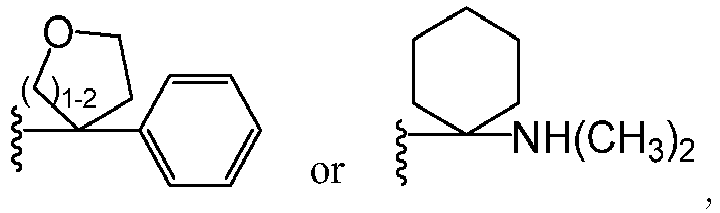
- a) unsubstituted phenyl or phenyl substituted one, two or three times independently selected from
- 2) -CHR11R12, where R11 and R12 are independently selected from
- a) -CH3, b) -OCH3, c) CF3,
- d) C6H5R12' where R12' is F, Cl, -OCF3, -SO2CH3, H, or a 5-membered unsaturated unsubstituted heteocycle or heterocycle substituted with CH3 having 2 or 3 heteroatoms selected from O, N and S,
- e) CH2CH2N(CH3)2,
- f) CH2CH2R12" where R12" is a 6-membered saturated or unsaturated heterocycle which heterocycle is unsubstituted or mono- or di- substituted with F,
- g) CH2NH2, h) CH2OH, i) C6H5SO2CH3, j) CHF2, k) CH2CH2OH,
- l) CH2OCH3, m) -OCH2CH3, n) -CH2N(CH3)2,
- o) -CH2R12"' where R12"' is a
1) 5-membered unsaturated unsubstituted heterocycle having 2 N atoms, 2) - OCH2CH3, 3) N(CH3)2, 4) -OCH(CH3)2, 5) -CH2OCH2CH2OCH3, 6) C(O)OCH3, 7) NH2, 8) NHC(O)CH=CH2, 9) C(CH2CH3)2OH, 10) OH, 11) 6-membered saturated heterocycle having 2 heteroatoms independently selected from N and O, - p) C(O)NHCH2CH3, q) C(O)NHCH3, r) C(O)N(CH2CH3)2, s) C6H3FCl,
- t) C(CH3)2OH, u) C6H3Cl2, v) C(CH3)2OH, w) CH(CH3)OH, x) C(CH3)3, y) - C(CH2CH3)2OH,
- z) a 5-membered unsaturated or saturated heterocycle having one or two heteroatoms independently selected from N, O and S atoms, which heterocycle is unsubstituted or substituted with CH3,
- aa) a 6-membered unsaturated heterocycle having one heteroatom which is N, which heterocycle is unsubstituted, or
- bb) C(O)OCH3,
- 3) a C4-10 monocyclic or bicyclic saturated or unsaturated carbocycle, wherein the bicyclic carbocyle comprises 2 fused rings, wherein the monocyclic or bicyclic carbocycle is unsubstituted or monosubstituted with
- a) NH2, b) NHC(O)CH3, c) -OCH3, d) -N(CH3)2, e) -OCH2CH3, f) C6H5, g) NHC(O)C6H5, h) C6H4F, i) -OCH2C6H5, j) -CH2C6H5, k) -OC6H5,
- l) -OCH2CH2CH2C6H5, m) -OC6H4F, or n) -O-pyridine,
- 4) a 5-10 membered monocyclic or bicyclic saturated or unsaturated heterocycle having 1-3 heteroatoms independently selected from N and O, wherein the monocyclic or bicyclic heterocycle is unsubstituted or independently mono-, di-, tri- or tetra-substituted with
- a) C6H4Cl, b) CH3, c) =O, d) C6H5, e) CH2CH3, f) CH2CH2CH3,
- g) cyclopropyl, h) cyclohexyl, i) C6H4F, j) CH2C6H3(OCH3)(F),
- k) C6H4(CH3), l) CH2CH2C6H5, m) CH2CH2CH2C6H5, n) OCH3,
- o) -OC6H5, p) cyclobutyl, q) CH(CH3)2, r) CH2C6H3F2, s) CH2C6H4CF3,
- t) CH2C6H4CN, u) OC6H4F, v) -OCH2CH3,
- w) a 5-6-membered heterocycle saturated or unsaturated, unsubstituted or substituted with CH3, C6H5 or cyclopropyl, having 1 or 2 heteroatoms independently selected from O, N and S,
- x) -CH2-R2', wherein R2' is a 5-6-membered unsaturated heterocycle, unsubstituted or substituted with Cl, having 1 or 2 heteroatoms independently selected from N and S, or
- y) -O-R2", wherein R2" is a 6-membered unsaturated heterocycle, unsubstituted or mono- or di-substituted with F, having 1 N heteroatom,
- 5) -CR13R14R15 where R13 and R14 are independently CH3 or together with the carbon atom to which they are attached form cyclopropyl, and R15 is CN or C6H5, or
- 6)

- 1) CH2R9, where R9 is
- R3 is hydrogen, -OC1-4alkyl, -OC1-4alkyl-OH, or -CH2R3', wherein R3' is
- 1) -OC1-4alkyl, 2) 6-membered saturated unsubstituted heterocycle having 1 or 2 heteroatoms independently selected from N and O, 3) -NHC1-4alkyl,
- 4) -OC1-4alkyleneR3" where R3" is a 4-6-membered saturated unsubstituted heterocycle having 1 or 2 heteroatoms selected from N and O,
- 5) -OC1-4alkylene-OH, 6) -OC1-4alkylene-OCH3, 7) hydrogen,
- 8) -OC1-4alkylene-OCH2C6H5, 9) -OH, 10) -NHC1-4alkyleneOC1-4alkyl,
- 11) NH2, 12) -NHC1-4alkyleneN(C1-4alkyl)2, 13) -NHC(O)CH=CH2,
- 14) -NHC(O)C1-4alkyl, 15) -NHC(O)OC1-4alkyl, 16) -OC(O)NHC1-4alkyl, or 17) - CH2NHC(O)CH=CH2, 18) N(CH3)2, or
- 19)

- R4 is hydrogen or halogen.
- Another embodiment of the invention is compounds of Formula I, or a pharmaceutically acceptable salt thereof, wherein
- R1 is


- R2 is


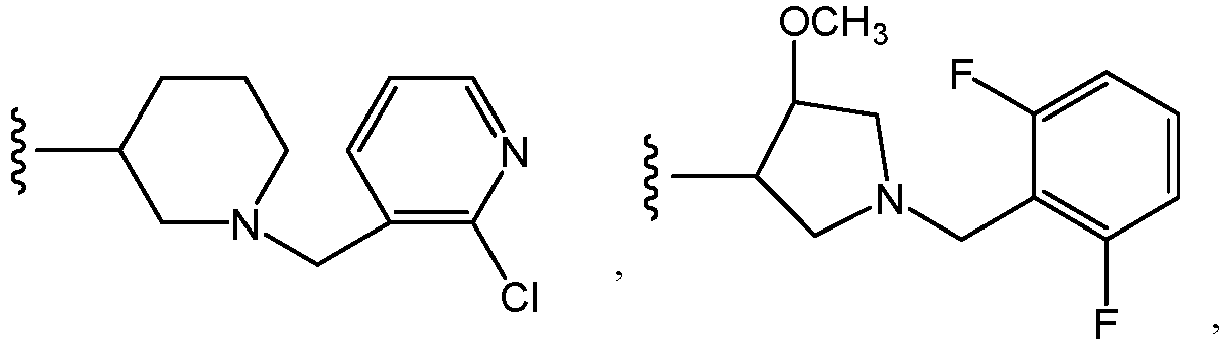


- R3 is -H, -CH2OCH3,


and - R4 is H or F.
- The term "composition" is intended to encompass a product comprising the specified ingredients in the specified amounts, as well as any product which results, directly or indirectly, from combination of the specified ingredients in the specified amounts. The term "anti-cancer agent" means a drug (medicament or pharmaceutically active ingredient) for treating cancer. The term "antineoplastic agent" means a drug (medicament or pharmaceutically active ingredient) for treating cancer (i.e., a chemotherapeutic agent). The term "at least one" means one or more than one. The meaning of "at least one" with reference to the number of compounds of the invention is independent of the meaning with reference to the number of chemotherapeutic agents. The term "chemotherapeutic agent" means a drug (medicament or pharmaceutically active ingredient) for treating cancer (i.e., an antineoplastic agent). The term "compound" with reference to the antineoplastic agents, includes the agents that are antibodies. The term "consecutively" means one following the other. The term "effective amount" includes a "therapeutically effective amount". The term "therapeutically effective amount" means that amount of active compound or pharmaceutical agent that elicits the biological or medicinal response in a tissue, system, animal or human that is being sought by a researcher, veterinarian, medical doctor or other clinician. Thus, for example, in the methods of treating cancer described herein "effective amount" (or "therapeutically effective amount") means, the amount of the compound (or drug), or radiation, that results in: (a) the reduction, alleviation or disappearance of one or more symptoms caused by the cancer, (b) the reduction of tumor size, (c) the elimination of the tumor, and/or (d) long-term disease stabilization (growth arrest) of the tumor. Also, for example, an effective amount, of an ERK inhibitor (i.e., a compound of the invention) is that amount which results in the reduction in ERK (ERK2) activity and phosphorylation. The reduction in ERK activity may be determined by the analysis of pharmacodynamic markers such as phosphorylated RSK1,2 using techniques well known in the art. The term "treating cancer" or "treatment of cancer" refers to administration to a mammal afflicted with a cancerous condition and refers to an effect that alleviates the cancerous condition by killing the cancerous cells, and also refers to an effect that results in the inhibition of growth and/or metastasis of the cancer.
- The invention also provides a pharmaceutical composition comprising an effective amount of at least one compound of Formula I and a pharmaceutically acceptable carrier. The invention also provides a pharmaceutical composition comprising an effective amount of at least one compound of Formula I and an effective amount of at least one other pharmaceutically active ingredient (such as, for example, a chemotherapeutic agent), and a pharmaceutically acceptable carrier.
- The invention also provides compounds of Formula I for use in a method of inhibiting ERK2 in a patient in need of such treatment comprising administering to said patient an effective amount of at least one compound of Formula I. The invention also provides compounds of Formula I for use in a method for treating cancer in a patient in need of such treatment, said method comprising administering to said patient an effective amount of at least one compound of Formula I. The invention also provides compounds of Formula I for use in a method for treating cancer in a patient in need of such treatment, said method comprising administering to said patient an effective amount of at least one compound of Formula I, in combination with an effective amount of at least one chemotherapeutic agent. The methods of the invention include the administration of a pharmaceutical composition comprising at least one compound of the invention and a pharmaceutically acceptable carrier. The invention also provides any of the above methods of treating cancer wherein the cancer is colorectal. The invention also provides any of the above methods of treating cancer wherein the cancer is melanoma. The methods of treating cancers described herein can optionally include the administration of an effective amount of radiation (i.e., the methods of treating cancers described herein optionally include the administration of radiation therapy).
- The methods of treating cancer described herein include methods of treating cancer that comprise administering a therapeutically effective amount of a compound of the instant invention in combination with radiation therapy and/or in combination with a second compound selected from: an estrogen receptor modulator, an androgen receptor modulator, a retinoid receptor modulator, a cytotoxicytostatic agent, an antiproliferative agent, a prenyl-protein transferase inhibitor, an HMG-CoA reductase inhibitor, an HIV protease inhibitor, a reverse transcriptase inhibitor, an angiogenesis inhibitor, PPAR-γ agonists, PPAR-δ agonists, an inhibitor of inherent multidrug resistance, an anti-emetic agent, an agent useful in the treatment of anemia, an agent useful in the treatment of neutropenia, an immunologic-enhancing drug, an inhibitor of cell proliferation and survival signaling, a bisphosphonate, an aromatase inhibitor, an siRNA therapeutic, γ-secretase and/or NOTCH inhibitors, agents that interfere with receptor tyrosine kinases (RTKs), an agent that interferes with a cell cycle checkpoint, and any of the therapeutic agents listed herein.
- In any of the methods of treating cancer described herein, unless stated otherwise, the methods can optionally include the administration of an effective amount of radiation therapy. For radiation therapy, γ-radiation is preferred.
- Thus, another example of the invention is directed to a compound of Formula I for use in method of treating cancer in a patient in need of such treatment, said method comprising administering an effective amount of a compound of Formula I. Another example of the invention is directed to a comppund of Formula I for use in a method of treating cancer in a patient in need of such treatment, said method comprising administering to said patient an effective amount of a compound of Formula I, and an effective amount of at least one chemotherapeutic agent.
- Methods for the safe and effective administration of most of these chemotherapeutic agents are known to those skilled in the art. In addition, their administration is described in the standard literature. For example, the administration of many of the chemotherapeutic agents is described in the "Physicians' Desk Reference" (PDR), e.g., 1996 edition (Medical Economics Company, Montvale, NJ 07645-1742, USA), the Physicians'Desk Reference, 56th Edition, 2002 (published by Medical Economics company, Inc. Montvale, NJ 07645-1742), the Physicians' Desk Reference, 57th Edition, 2003 (published by Thompson PDR, Montvale, NJ 07645-1742), the Physicians' Desk Reference, 60th Edition, 2006 (published by Thompson PDR, Montvale, NJ 07645-1742), and the Physicians' Desk Reference, 64th Edition, 2010 (published by PDR Network, LLC at Montvale, NJ 07645-1725); the disclosures of which are incorporated herein by reference thereto.
- If the patient is responding, or is stable, after completion of the therapy cycle, the therapy cycle can be repeated according to the judgment of the skilled clinician. Upon completion of the therapy cycles, the patient can be continued on the compounds of the invention at the same dose that was administered in the treatment protocol. This maintenance dose can be continued until the patient progresses or can no longer tolerate the dose (in which case the dose can be reduced and the patient can be continued on the reduced dose).
- Those skilled in the art will recognize that the actual dosages and protocols for administration employed in the methods of the invention may be varied according to the judgment of the skilled clinician. The actual dosage employed may be varied depending upon the requirements of the patient and the severity of the condition being treated. Determination of the proper dosage for a particular situation is within the skill of the art. A determination to vary the dosages and protocols for administration may be made after the skilled clinician takes into account such factors as the patient's age, condition and size, as well as the severity of the cancer being treated and the response of the patient to the treatment.
- The amount and frequency of administration of the compound of formula (1) and the chemotherapeutic agents will be regulated according to the judgment of the attending clinician (physician) considering such factors as age, condition and size of the patient as well as severity of the cancer being treated.
- The chemotherapeutic agent can be administered according to therapeutic protocols well known in the art. It will be apparent to those skilled in the art that the administration of the chemotherapeutic agent can be varied depending on the cancer being treated and the known effects of the chemotherapeutic agent on that disease. Also, in accordance with the knowledge of the skilled clinician, the therapeutic protocols (e.g., dosage amounts and times of administration) can be varied in view of the observed effects of the administered therapeutic agents on the patient, and in view of the observed responses of the cancer to the administered therapeutic agents.
- The initial administration can be made according to established protocols known in the art, and then, based upon the observed effects, the dosage, modes of administration and times of administration can be modified by the skilled clinician.
- The particular choice of chemotherapeutic agent will depend upon the diagnosis of the attending physicians and their judgement of the condition of the patient and the appropriate treatment protocol.
- The determination of the order of administration, and the number of repetitions of administration of the chemotherapeutic agent during a treatment protocol, is well within the knowledge of the skilled physician after evaluation of the cancer being treated and the condition of the patient.
- Thus, in accordance with experience and knowledge, the practicing physician can modify each protocol for the administration of a chemotherapeutic agent according to the individual patient's needs, as the treatment proceeds. All such modifications are within the scope of the present invention.
- The attending clinician, in judging whether treatment is effective at the dosage administered, will consider the general well-being of the patient as well as more definite signs such as relief of cancer-related symptoms (e.g., pain), inhibition of tumor growth, actual shrinkage of the tumor, or inhibition of metastasis. Size of the tumor can be measured by standard methods such as radiological studies, e.g., CAT or MRI scan, and successive measurements can be used to judge whether or not growth of the tumor has been retarded or even reversed. Relief of disease-related symptoms such as pain, and improvement in overall condition can also be used to help judge effectiveness of treatment.
- The compounds, compositions and methods provided herein may be useful for the treatment of cancer. Cancers that may be treated by the compounds, compositions and methods of the invention include, but are not limited to: (1) Cardiac: sarcoma (angiosarcoma, fibrosarcoma, rhabdomyosarcoma, liposarcoma), myxoma, rhabdomyoma, fibroma, lipoma and teratoma; (2) Lung: bronchogenic carcinoma (squamous cell, undifferentiated small cell, undifferentiated large cell, adenocarcinoma), alveolar (bronchiolar) carcinoma, bronchial adenoma, sarcoma, lymphoma, chondromatous hamartoma, mesothelioma, non-small cell; (3) Gastrointestinal: esophagus (squamous cell carcinoma, adenocarcinoma, leiomyosarcoma, lymphoma), stomach (carcinoma, lymphoma, leiomyosarcoma), pancreas (ductal adenocarcinoma, insulinoma, glucagonoma, gastrinoma, carcinoid tumors, vipoma), small bowel (adenocarcinoma, lymphoma, carcinoid tumors, Karposi's sarcoma, leiomyoma, hemangioma, lipoma, neurofibroma, fibroma), large bowel (adenocarcinoma, tubular adenoma, villous adenoma, hamartoma, leiomyoma), colon, colorectal, rectal; (4) Genitourinary tract: kidney (adenocarcinoma, Wilm's tumor [nephroblastoma], lymphoma, leukemia), bladder and urethra (squamous cell carcinoma, transitional cell carcinoma, adenocarcinoma), prostate (adenocarcinoma, sarcoma), testis (seminoma, teratoma, embryonal carcinoma, teratocarcinoma, choriocarcinoma, sarcoma, interstitial cell carcinoma, fibroma, fibroadenoma, adenomatoid tumors, lipoma); (5) Liver: hepatoma (hepatocellular carcinoma), cholangiocarcinoma, hepatoblastoma, angiosarcoma, hepatocellular adenoma, hemangioma; (6) Bone: osteogenic sarcoma (osteosarcoma), fibrosarcoma, malignant fibrous histiocytoma, chondrosarcoma, Ewing's sarcoma, malignant lymphoma (reticulum cell sarcoma), multiple myeloma, malignant giant cell tumor chordoma, osteochronfroma (osteocartilaginous exostoses), benign chondroma, chondroblastoma, chondromyxofibroma, osteoid osteoma and giant cell tumors; (7) Nervous system: skull (osteoma, hemangioma, granuloma, xanthoma, osteitis deformans), meninges (meningioma, meningiosarcoma, gliomatosis), brain (astrocytoma, medulloblastoma, glioma, ependymoma, germinoma [pinealoma], glioblastoma multiform, oligodendroglioma, schwannoma, retinoblastoma, congenital tumors), spinal cord neurofibroma, meningioma, glioma, sarcoma); (8) Gynecological: uterus (endometrial carcinoma), cervix (cervical carcinoma, pre-tumor cervical dysplasia), ovaries (ovarian carcinoma [serous cystadenocarcinoma, mucinous cystadenocarcinoma, unclassified carcinoma], granulosa-thecal cell tumors, Sertoli-Leydig cell tumors, dysgerminoma, malignant teratoma), vulva (squamous cell carcinoma, intraepithelial carcinoma, adenocarcinoma, fibrosarcoma, melanoma), vagina (clear cell carcinoma, squamous cell carcinoma, botryoid sarcoma (embryonal rhabdomyosarcoma), fallopian tubes (carcinoma), breast; (9) Hematologic: blood (myeloid leukemia [acute and chronic], acute lymphoblastic leukemia, chronic lymphocytic leukemia, chronic myelomonocytic (CMML), myeloproliferative diseases, multiple myeloma, myelodysplastic syndrome), Hodgkin's disease, non-Hodgkin's lymphoma [malignant lymphoma]; (10) Skin: malignant melanoma, basal cell carcinoma, squamous cell carcinoma, Karposi's sarcoma, moles dysplastic nevi, lipoma, angioma, dermatofibroma, keloids, psoriasis; and (11) Adrenal glands: neuroblastoma. Examples of cancer that may be treated by the compounds, compositions and methods of the invention include thyroid cancer, anaplastic thyroid carcinoma, epidermal cancer, head and neck cancer (e.g., squamous cell cancer of the head and neck), sarcoma, tetracarcinoma, hepatoma and multiple myeloma. Thus, the term "cancerous cell" as provided herein, includes a cell afflicted by any one of the above-identified conditions.
- In the treatment of breast cancer (e.g., postmenopausal and premenopausal breast cancer, e.g., hormone-dependent breast cancer) the compound of formula (1) may be used with an effective amount of at least one antihormonal agent selected from the group consisting of: (a) aromatase inhibitors, (b) antiestrogens, and (c) LHRH analogues; and optionally an effective amount of at least one chemotherapeutic agent. Examples of aromatase inhibitors include but are not limited to: Anastrozole (e.g., Arimidex), Letrozole (e.g., Femara), Exemestane (Aromasin), Fadrozole and Formestane (e.g., Lentaron). Examples of antiestrogens include but are not limited to: Tamoxifen (e.g., Nolvadex), Fulvestrant (e.g., Faslodex), Raloxifene (e.g., Evista), and Acolbifene. Examples of LHRH analogues include but are not limited to: Goserelin (e.g., Zoladex) and Leuprolide (e.g., Leuprolide Acetate, such as Lupron or Lupron Depot). Examples of chemotherapeutic agents include but are not limited to: Trastuzumab (e.g., Herceptin), Gefitinib (e.g., Iressa), Erlotinib (e.g., Erlotinib HCl, such as Tarceva), Bevacizumab (e.g., Avastin), Cetuximab (e.g., Erbitux), and Bortezomib (e.g., Velcade).
- In one example of the invention the cancer treated is colo-rectal cancer (such as, for example, colon adenocarcinoma and colon adenoma). Thus, another example of the invention is directed to a method of treating colo-rectal cancer in a patient in need of such treatment, said method comprising administering an effective of a compound of Formula I, or a pharmaceutically acceptable salt thereof, to said patient. Another example of the invention is directed to a method of treating colo-rectal cancer in a patient in need of such treatment, said method comprising administering to said patient an effective amount of a compound of Formula I, or a pharmaceutically acceptable salt thereof, and an effective amount of at least one chemotherapeutic agent.
- In one example of the invention the cancer treated is melanoma. Thus, another example of the invention is directed to a compound of Formula I for use in a method of treating melanoma in a patient in need of such treatment, said method comprising administering an effective amount of a compound of Formula I, or a pharmaceutically acceptable salt thereof, to said patient. Another example of the invention is directed to a compound of Formula I for use in a method of treating melanoma in a patient in need of such treatment, said method comprising administering to said patient an effective amount of a compound of Formula I, or a pharmaceutically acceptable salt thereof, and an effective amount of at least one chemotherapeutic agent.
- The compounds of the invention are also useful in preparing a medicament that may be useful in treating cancer.
- The instant compounds are also useful in combination with therapeutic, chemotherapeutic and anti-cancer agents. Combinations of the presently disclosed compounds with therapeutic, chemotherapeutic and anti-cancer agents are within the scope of the invention. Examples of such agents can be found in Cancer Principles and Practice of Oncology by V.T. Devita and S. Hellman (editors), 6th edition (February 15, 2001), Lippincott Williams & Wilkins Publishers. A person of ordinary skill in the art would be able to discern which combinations of agents would be useful based on the particular characteristics of the drugs and the cancer involved. Such agents include the following: estrogen receptor modulators, programmed cell death protein 1 (PD-1) inhibitors, programmed death-ligand 1 (PD-L1) inhibitors, androgen receptor modulators, retinoid receptor modulators, cytotoxic/cytostatic agents, antiproliferative agents, prenyl-protein transferase inhibitors, HMG-CoA reductase inhibitors and other angiogenesis inhibitors, HIV protease inhibitors, reverse transcriptase inhibitors, inhibitors of cell proliferation and survival signaling, bisphosphonates, aromatase inhibitors, siRNA therapeutics, γ-secretase inhibitors, agents that interfere with receptor tyrosine kinases (RTKs) and agents that interfere with cell cycle checkpoints. The instant compounds are particularly useful when co-administered with radiation therapy.
- PD-1 inhibitors include pembrolizumab (lambrolizumab), nivolumab and MPDL3280A.
- "Estrogen receptor modulators" refers to compounds that interfere with or inhibit the binding of estrogen to the receptor, regardless of mechanism. Examples of estrogen receptor modulators include, but are not limited to, tamoxifen, raloxifene, idoxifene, LY353381, LY117081, toremifene, fulvestrant, 4-[7-(2,2-dimethyl-1-oxopropoxy-4-methyl-2-[4-[2-(1-piperidinyl)ethoxy]phenyl]-2H-1-benzopyran-3-yl]-phenyl-2,2-dimethylpropanoate, 4,4'-dihydroxybenzophenone-2,4-dinitrophenyl-hydrazone, and SH646.
- "Androgen receptor modulators" refers to compounds which interfere or inhibit the binding of androgens to the receptor, regardless of mechanism. Examples of androgen receptor modulators include finasteride and other 5α-reductase inhibitors, nilutamide, flutamide, bicalutamide, liarozole, and abiraterone acetate.
- "Retinoid receptor modulators" refers to compounds which interfere or inhibit the binding of retinoids to the receptor, regardless of mechanism. Examples of such retinoid receptor modulators include bexarotene, tretinoin, 13-cis-retinoic acid, 9-cis-retinoic acid, α-difluoromethylornithine, ILX23-7553, trans-N-(4'-hydroxyphenyl) retinamide, and N-4-carboxyphenyl retinamide.
- "Cytotoxic/cytostatic agents" refer to compounds which cause cell death or inhibit cell proliferation primarily by interfering directly with the cell's functioning or inhibit or interfere with cell myosis, including alkylating agents, tumor necrosis factors, intercalators, hypoxia activatable compounds, microtubule inhibitors/microtubule-stabilizing agents, inhibitors of mitotic kinesins, histone deacetylase inhibitors, inhibitors of kinases involved in mitotic progression, inhibitors of kinases involved in growth factor and cytokine signal transduction pathways, antimetabolites, biological response modifiers, hormonal/anti-hormonal therapeutic agents, haematopoietic growth factors, monoclonal antibody targeted therapeutic agents, topoisomerase inhibitors, proteosome inhibitors, ubiquitin ligase inhibitors, and aurora kinase inhibitors.
- Examples of cytotoxic/cytostatic agents include, but are not limited to, sertenef, cachectin, ifosfamide, tasonermin, lonidamine, carboplatin, altretamine, prednimustine, dibromodulcitol, ranimustine, fotemustine, nedaplatin, oxaliplatin, temozolomide, heptaplatin, estramustine, improsulfan tosilate, trofosfamide, nimustine, dibrospidium chloride, pumitepa, lobaplatin, satraplatin, profiromycin, cisplatin, irofulven, dexifosfamide, cis-aminedichloro(2-methyl-pyridine)platinum, benzylguanine, glufosfamide, GPX100, (trans, trans, trans)-bis-mu-(hexane-1,6-diamine)-mu-[diamine-platinum(II)]bis[diamine(chloro)platinum (II)]tetrachloride, diarizidinylspermine, arsenic trioxide, 1-(11-dodecylamino-10-hydroxyundecyl)-3,7-dimethylxanthine, zorubicin, idarubicin, daunorubicin, bisantrene, mitoxantrone, pirarubicin, pinafide, valrubicin, amrubicin, antineoplaston, 3'-deamino-3'-morpholino-13-deoxo-10-hydroxycarminomycin, annamycin, galarubicin, elinafide, MEN10755, 4-demethoxy-3-deamino-3-aziridinyl-4-methylsulphonyl-daunorubicin (see
WO 00/50032 - An example of a hypoxia activatable compound is tirapazamine.
- Examples of proteosome inhibitors include but are not limited to lactacystin and MLN-341 (Velcade).
- Examples of microtubule inhibitors/microtubule-stabilising agents include paclitaxel, vindesine sulfate, 3',4'-didehydro-4'-deoxy-8'-norvincaleukoblastine, docetaxol, rhizoxin, dolastatin, mivobulin isethionate, auristatin, cemadotin, RPR109881, BMS184476, vinflunine, cryptophycin, 2,3,4,5,6-pentafluoro-N-(3-fluoro-4-methoxyphenyl) benzene sulfonamide, anhydrovinblastine, TDX258, the epothilones (see for example
U.S. Pat. Nos. 6,284,781 and6,288,237 ) and BMS188797. In an example the epothilones are not included in the microtubule inhibitors/microtubule-stabilising agents. - Some examples of topoisomerase inhibitors are topotecan, hycaptamine, irinotecan, rubitecan, 6-ethoxypropionyl-3',4'-O-exo-benzylidene-chartreusin, 9-methoxy-N,N-dimethyl-5-nitropyrazolo[3,4,5-kl]acridine-2-(6H) propanamine, 1-amino-9-ethyl-5-fluoro-2,3-dihydro-9-hydroxy-4-methyl-1H,12H-benzo[de]pyrano[3',4':b,7]-indolizino[1,2b]quinoline-10,13(9H,15H)dione, lurtotecan, 7-[2-(N-isopropylamino)ethyl]-(20S)camptothecin, BNP1350, BNPI1100, BN80915, BN80942, etoposide phosphate, teniposide, sobuzoxane, 2'-dimethylamino-2'-deoxy-etoposide, GL331, N-[2-(dimethylamino)ethyl]-9-hydroxy-5,6-dimethyl-6H-pyrido[4,3-b]carbazole-1-carboxamide, asulacrine, (5a, 5aB, 8aa,9b)-9-[2-[N-[2-(dimethylamino)ethyl]-N-methylamino]ethyl]-5-[4-hydro0xy-3,5-dimethoxyphenyl]-5,5a,6,8,8a,9-hexohydrofuro(3',4':6,7)naphtho(2,3-d)-1,3-dioxol-6-one, 2,3-(methylenedioxy)-5-methyl-7-hydroxy-8-methoxybenzo[c]-phenanthridinium, 6,9-bis[(2-aminoethyl)amino]benzo[g]isoguinoline-5,10-dione, 5-(3-aminopropylamino)-7,10-dihydroxy-2-(2-hydroxyethylaminomethyl)-6H-pyrazolo[4,5,1-de]acridin-6-one, N-[1-[2(diethylamino)ethylamino]-7-methoxy-9-oxo-9H-thioxanthen-4-ylmethyl]formamide, N-(2-(dimethylamino)ethyl)acridine-4-carboxamide, 6-[[2-(dimethylamino)ethyl]amino]-3-hydroxy-7H-indeno[2,1-c] quinolin-7-one, and dimesna.
- Examples of inhibitors of mitotic kinesins, and in particular the human mitotic kinesin KSP, are described in Publications
WO03/039460 WO03/050064 WO03/050122 WO03/049527 WO03/049679 WO03/049678 WO04/039774 WO03/079973 WO03/099211 WO03/105855 WO03/106417 WO04/037171 WO04/058148 WO04/058700 WO04/126699 WO05/018638 WO05/019206 WO05/019205 WO05/018547 WO05/017190 US2005/0176776 . In an example inhibitors of mitotic kinesins include, but are not limited to inhibitors of KSP, inhibitors of MKLP1, inhibitors of CENP-E, inhibitors of MCAK and inhibitors of Rab6-KIFL. - Examples of "histone deacetylase inhibitors" include, but are not limited to, SAHA, TSA, oxamflatin, PXD101, MG98 and scriptaid. Further reference to other histone deacetylase inhibitors may be found in the following manuscript; Miller, T.A. et al. J. Med. Chem. 46(24):5097-5116 (2003).
- "Inhibitors of kinases involved in mitotic progression" include, but are not limited to, inhibitors of aurora kinase, inhibitors of Polo-like kinases (PLK; in particular inhibitors of PLK-1), inhibitors of bub-1 and inhibitors of bub-R1. An example of an "aurora kinase inhibitor" is VX-680.
- "Antiproliferative agents" includes antisense RNA and DNA oligonucleotides such as G3139, ODN698, GEM231, and INX3001, and antimetabolites such as enocitabine, carmofur, tegafur, pentostatin, doxifluridine, trimetrexate, fludarabine, capecitabine, galocitabine, cytarabine ocfosfate, fosteabine sodium hydrate, raltitrexed, paltitrexid, emitefur, tiazofurin, decitabine, nolatrexed, pemetrexed, nelzarabine, 2'-deoxy-2'-methylidenecytidine, 2'-fluoromethylene-2'-deoxycytidine, N-[5-(2,3-dihydro-benzofuryl)sulfonyl]-N'-(3,4-dichlorophenyl)urea, N6-[4-deoxy-4-[N2-[2(E),4(E)-tetradecadienoyl]glycylamino]-L-glycero-B-L-manno-heptopyranosyl]adenine, aplidine, ecteinascidin, troxacitabine, 4-[2-amino-4-oxo-4,6,7,8-tetrahydro-3H-pyrimidino[5,4-b][1,4]thiazin-6-yl-(S)-ethyl]-2,5-thienoyl-L-glutamic acid, aminopterin, 5-flurouracil, alanosine, 11-acetyl-8-(carbamoyloxymethyl)-4-formyl-6-methoxy-14-oxa-1,11-diazatetracyclo(7.4.1.0.0)-tetradeca-2,4,6-trien-9-yl acetic acid ester, swainsonine, lometrexol, dexrazoxane, methioninase, 2'-cyano-2'-deoxy-N4-palmitoyl-1-B-D-arabino furanosyl cytosine, 3-aminopyridine-2-carboxaldehyde thiosemicarbazone and trastuzumab.
- Examples of monoclonal antibody targeted therapeutic agents include those therapeutic agents which have cytotoxic agents or radioisotopes attached to a cancer cell specific or target cell specific monoclonal antibody. Examples include Bexxar.
- "HMG-CoA reductase inhibitors" refers to inhibitors of 3-hydroxy-3-methylglutaryl-CoA reductase. Examples of HMG-CoA reductase inhibitors that may be used include but are not limited to lovastatin (MEVACOR®; see
U.S. Patent Nos. 4,231,938 ,4,294,926 and4,319,039 ), simvastatin (ZOCOR®; seeU.S. Patent Nos. 4,444,784 ,4,820,850 and4,916,239 ), pravastatin (PRAVACHOL®; seeU.S. Patent Nos. 4,346,227 ,4,537,859 ,4,410,629 ,5,030,447 and5,180,589 ), fluvastatin (LESCOL®; seeU.S. Patent Nos. 5,354,772 ,4,911,165 ,4,929,437 ,5,189,164 ,5,118,853 ,5,290,946 and5,356,896 ), atorvastatin (LIPITOR®; seeU.S. Patent Nos. 5,273,995 ,4,681,893 ,5,489,691 and5,342,952 ) and cerivastatin (also known as rivastatin and BAYCHOL®; seeUS Patent No. 5,177,080 ). The structural formulas of these and additional HMG-CoA reductase inhibitors that may be used in the instant methods are described at page 87 of M. Yalpani, "Cholesterol Lowering Drugs", Chemistry & Industry, pp. 85-89 (5 February 1996) andUS Patent Nos. 4,782,084 and4,885,314 . The term HMG-CoA reductase inhibitor as used herein includes all pharmaceutically acceptable lactone and open-acid forms (i.e., where the lactone ring is opened to form the free acid) as well as salt and ester forms of compounds which have HMG-CoA reductase inhibitory activity, and therefor the use of such salts, esters, open-acid and lactone forms is included within the scope of the invention. - "Prenyl-protein transferase inhibitor" refers to a compound which inhibits any one or any combination of the prenyl-protein transferase enzymes, including farnesyl-protein transferase (FPTase), geranylgeranyl-protein transferase type I (GGPTase-I), and geranylgeranyl-protein transferase type-II (GGPTase-II, also called Rab GGPTase).
- Examples of prenyl-protein transferase inhibitors can be found in the following publications and patents:
WO 96/30343 WO 97/18813 WO 97/21701 WO 97/23478 WO 97/38665 WO 98/28980 WO 98/29119 WO 95/32987 U.S. Patent No. 5,420,245 ,U.S. Patent No. 5,523,430 ,U.S. Patent No. 5,532,359 ,U.S. Patent No. 5,510,510 ,U.S. Patent No. 5,589,485 ,U.S. Patent No. 5,602,098 , European Patent Publ.0 618 221 , European Patent Publ.0 675 112 , European Patent Publ.0 604 181 , European Patent Publ.0 696 593 ,WO 94/19357 WO 95/08542 WO 95/11917 WO 95/12612 WO 95/12572 WO 95/10514 U.S. Patent No. 5,661,152 ,WO 95/10515 WO 95/10516 WO 95/24612 WO 95/34535 WO 95/25086 WO 96/05529 WO 96/06138 WO 96/06193 WO 96/16443 WO 96/21701 WO 96/21456 WO 96/22278 WO 96/24611 WO 96/24612 WO 96/05168 WO 96/05169 WO 96/00736 U.S. Patent No. 5,571,792 ,WO 96/17861 WO 96/33159 WO 96/34850 WO 96/34851 WO 96/30017 WO 96/30018 WO 96/30362 WO 96/30363 WO 96/31111 WO 96/31477 WO 96/31478 WO 96/31501 WO 97/00252 WO 97/03047 WO 97/03050 WO 97/04785 WO 97/02920 WO 97/17070 WO 97/23478 WO 97/26246 WO 97/30053 WO 97/44350 WO 98/02436 U.S. Patent No. 5,532,359 . For an example of the role of a prenyl-protein transferase inhibitor on angiogenesis see European J. of Cancer, Vol. 35, No. 9, pp. 1394-1401 (1999). - "Angiogenesis inhibitors" refers to compounds that inhibit the formation of new blood vessels, regardless of mechanism. Examples of angiogenesis inhibitors include, but are not limited to, tyrosine kinase inhibitors, such as inhibitors of the tyrosine kinase receptors Flt-1 (VEGFR1) and Flk-1/KDR (VEGFR2), inhibitors of epidermal-derived, fibroblast-derived, or platelet derived growth factors, MMP (matrix metalloprotease) inhibitors, integrin blockers, interferon-α, interleukin-12, pentosan polysulfate, cyclooxygenase inhibitors, including nonsteroidal anti-inflammatories (NSAIDs) like aspirin and ibuprofen as well as selective cyclooxy-genase-2 inhibitors like celecoxib and rofecoxib (PNAS, Vol. 89, p. 7384 (1992); JNCI, Vol. 69, p. 475 (1982); Arch. Opthalmol., Vol. 108, p.573 (1990); Anat. Rec., Vol. 238, p. 68 (1994); FEBS Letters, Vol. 372, p. 83 (1995); Clin, Orthop. Vol. 313, p. 76 (1995); J. Mol. Endocrinol., Vol. 16, p.107 (1996); Jpn. J. Pharmacol., Vol. 75, p. 105 (1997); Cancer Res., Vol. 57, p. 1625 (1997); Cell, Vol. 93, p. 705 (1998); Intl. J. Mol. Med., Vol. 2, p. 715 (1998); J. Biol. Chem., Vol. 274, p. 9116 (1999)), steroidal anti-inflammatories (such as corticosteroids, mineralocorticoids, dexamethasone, prednisone, prednisolone, methylpred, betamethasone), carboxyamidotriazole, combretastatin A-4, squalamine, 6-O-chloroacetyl-carbonyl)-fumagillol, thalidomide, angiostatin, troponin-1, angiotensin II antagonists (see Fernandez et al., J. Lab. Clin. Med. 105:141-145 (1985)), and antibodies to VEGF (see, Nature Biotechnology, Vol. 17, pp.963-968 (October 1999); Kim et al., Nature, 362, 841-844 (1993);
WO 00/44777 WO 00/61186 - Other therapeutic agents that modulate or inhibit angiogenesis and may also be used in combination with the compounds of the instant invention include agents that modulate or inhibit the coagulation and fibrinolysis systems (see review in Clin. Chem. La. Med. 38:679-692 (2000)). Examples of such agents that modulate or inhibit the coagulation and fibrinolysis pathways include, but are not limited to, heparin (see Thromb. Haemost. 80:10-23 (1998)), low molecular weight heparins and carboxypeptidase U inhibitors (also known as inhibitors of active thrombin activatable fibrinolysis inhibitor [TAFIa]) (see Thrombosis Res. 101:329-354 (2001)). TAFIa inhibitors have been described in
U.S. Ser. Nos. 60/310,927 (filed August 8, 2001 60/349,925 (filed January 18, 2002 - "Agents that interfere with cell cycle checkpoints" refer to compounds that inhibit protein kinases that transduce cell cycle checkpoint signals, thereby sensitizing the cancer cell to DNA damaging agents. Such agents include inhibitors of ATR, ATM, the CHK1 and CHK2 kinases and cdk and cdc kinase inhibitors and are specifically exemplified by 7-hydroxystaurosporin, flavopiridol, CYC202 (Cyclacel) and BMS-387032.
- "Agents that interfere with receptor tyrosine kinases (RTKs)" refer to compounds that inhibit RTKs and therefore mechanisms involved in oncogenesis and tumor progression. Such agents include inhibitors of c-Kit, Eph, PDGF, Flt3 and c-Met. Further agents include inhibitors of RTKs as described by Bume-Jensen and Hunter, Nature, 411:355-365, 2001.
- "Inhibitors of cell proliferation and survival signalling pathway" refer to compounds that inhibit signal transduction cascades downstream of cell surface receptors. Such agents include inhibitors of serine/threonine kinases (including but not limited to inhibitors of Akt such as described in
WO 02/083064 WO 02/083139 WO 02/083140 US 2004-0116432 ,WO 02/083138 US 2004-0102360 ,WO 03/086404 WO 03/086279 WO 03/086394 WO 03/084473 WO 03/086403 WO 2004/041162 ,WO 2004/096131 ,WO 2004/096129 ,WO 2004/096135 ,WO 2004/096130 ,WO 2005/100356 ,WO 2005/100344 ,US 2005/029941 ,US 2005/44294 ,US 2005/43361 ,60/734188 60/652737 60/670469 - As described above, the combinations with NSAID's are directed to the use of NSAID's which are potent COX-2 inhibiting agents. For purposes of the specification an NSAID is potent if it possesses an IC50 for the inhibition of COX-2 of 1µM or less as measured by cell or microsomal assays.
- The invention also encompasses combinations with NSAID's which are selective COX-2 inhibitors. For purposes of the specification NSAID's which are selective inhibitors of COX-2 are defined as those which possess a specificity for inhibiting COX-2 over COX-1 of at least 100 fold as measured by the ratio of IC50 for COX-2 over IC50 for COX-1 evaluated by cell or microsomal assays. Such compounds include, but are not limited to those disclosed in
U.S. Patent 5,474,995 ,U.S. Patent 5,861,419 ,U.S. Patent 6,001,843 ,U.S. Patent 6,020,343 ,U.S. Patent 5,409,944 ,U.S. Patent 5,436,265 ,U.S. Patent 5,536,752 ,U.S. Patent 5,550,142 ,U.S. Patent 5,604,260 ,U.S. 5,698,584 ,U.S. Patent 5,710,140 ,WO 94/15932 U.S. Patent 5,344,991 ,U.S. Patent 5,134,142 ,U.S. Patent 5,380,738 ,U.S. Patent 5,393,790 ,U.S. Patent 5,466,823 ,U.S. Patent 5,633,272 andU.S. Patent 5,932,598 , all of which are hereby incorporated by reference. - Inhibitors of COX-2 that are particularly useful in the instant method of treatment are: 3-phenyl-4-(4-(methylsulfonyl)phenyl)-2-(5H)-furanone; and 5-chloro-3-(4-methylsulfonyl)-phenyl-2-(2-methyl-5-pyridinyl)pyridine; or a pharmaceutically acceptable salt thereof.
- Compounds that have been described as specific inhibitors of COX-2 and are therefore useful in the present invention include, but are not limited to, the following: parecoxib, BEXTRA® and CELEBREX® or a pharmaceutically acceptable salt thereof.
- Other examples of angiogenesis inhibitors include, but are not limited to, endostatin, ukrain, ranpirnase, IM862, 5-methoxy-4-[2-methyl-3-(3-methyl-2-butenyl)oxiranyl]-1-oxaspiro[2,5]oct-6-yl(chloroacetyl)carbamate, acetyldinanaline, 5-amino-1-[[3,5-dichloro-4-(4-chlorobenzoyl)phenyl]methyl]-1H-1,2,3-triazole-4-carboxamide, CM101, squalamine, combretastatin, RPI4610, NX31838, sulfated mannopentaose phosphate, 7,7-(carbonyl-bis[imino-N-methyl-4,2-pyrrolocarbonylimino[N-methyl-4,2-pyrrole]-carbonylimino]-bis-(1,3-naphthalene disulfonate), and 3-[(2,4-dimethylpyrrol-5-yl)methylene]-2-indolinone (SU5416).
- As used above, "integrin blockers" refers to compounds which selectively antagonize, inhibit or counteract binding of a physiological ligand to the αvβ3 integrin, to compounds which selectively antagonize, inhibit or counteract binding of a physiological ligand to the αvβ5 integrin, to compounds which antagonize, inhibit or counteract binding of a physiological ligand to both the αvβ3 integrin and the αvβ5 integrin, and to compounds which antagonize, inhibit or counteract the activity of the particular integrin(s) expressed on capillary endothelial cells. The term also refers to antagonists of the αvβ6, αvβ8, α1β1, α2β1, α5β1, α6β1 and α6β4 integrins. The term also refers to antagonists of any combination of αvβ3, αvβ5, αvβ6, αvβ8, α1β1, α2β1, α5β1, α6β1 and α6β4 integrins.
- Some specific examples of tyrosine kinase inhibitors include N-(trifluoromethylphenyl)-5-methylisoxazol-4-carboxamide, 3-[(2,4-dimethylpyrrol-5-yl)methylidenyl)indolin-2-one, 17-(allylamino)-17-demethoxygeldanamycin, 4-(3-chloro-4-fluorophenylamino)-7-methoxy-6-[3-(4-morpholinyl)propoxyl]quinazoline, N-(3-ethynylphenyl)-6,7-bis(2-methoxyethoxy)-4-quinazolinamine, BIBX1382, 2,3,9,10,11,12-hexahydro-10-(hydroxymethyl)-10-hydroxy-9-methyl-9,12-epoxy-1H-diindolo[1,2,3-fg:3',2',1'-kl]pyrrolo[3,4-i][1,6]benzodiazocin-1-one, SH268, genistein, STI571, CEP2563, 4-(3-chlorophenylamino)-5,6-dimethyl-7H-pyrrolo[2,3-d]pyrimidinemethane sulfonate, 4-(3-bromo-4-hydroxyphenyl)amino-6,7-dimethoxyquinazoline, 4-(4'-hydroxyphenyl)amino-6,7-dimethoxyquinazoline, SU6668, STI571A, N-4-chlorophenyl-4-(4-pyridylmethyl)-1-phthalazinamine, and EMD121974.
- Combinations with compounds other than anti-cancer compounds are also encompassed in the instant methods. For example, combinations of the instantly claimed compounds with PPAR-γ (i.e., PPAR-gamma) agonists and PPAR-δ (i.e., PPAR-delta) agonists are useful in the treatment of certain malingnancies. PPAR-γ and PPAR-δ are the nuclear peroxisome proliferator-activated receptors γ and δ. The expression of PPAR-γ on endothelial cells and its involvement in angiogenesis has been reported in the literature (see J. Cardiovasc. Pharmacol. 1998; 31:909-913; J. Biol. Chem. 1999; 274:9116-9121; Invest. Ophthalmol Vis. Sci. 2000; 41:2309-2317). More recently, PPAR-γ agonists have been shown to inhibit the angiogenic response to VEGF in vitro; both troglitazone and rosiglitazone maleate inhibit the development of retinal neovascularization in mice. ( Arch. Ophthamol. 2001; 119:709-717). Examples of PPAR-γ agonists and PPAR-γ/α agonists include, but are not limited to, thiazolidinediones (such as DRF2725, CS-011, troglitazone, rosiglitazone, and pioglitazone), fenofibrate, gemfibrozil, clofibrate, GW2570, SB219994, AR-H039242, JTT-501, MCC-555, GW2331, GW409544, NN2344, KRP297, NP0110, DRF4158, NN622, GI262570, PNU182716, DRF552926, 2-[(5,7-dipropyl-3-trifluoromethyl-1,2-benzisoxazol-6-yl)oxy]-2-methylpropionic acid, and 2(R)-7-(3-(2-chloro-4-(4-fluorophenoxy) phenoxy)propoxy)-2-ethylchromane-2-carboxylic acid.
- Another aspect of the instant disclosure is the use of the presently disclosed compounds in combination with gene therapy for the treatment of cancer. For an overview of genetic strategies to treating cancer see Hall et al (Am. J. Hum. Genet. 61:785-789, 1997) and Kufe et al (Cancer Medicine, 5th Ed, pp 876-889, BC Decker, Hamilton 2000). Gene therapy can be used to deliver any tumor suppressing gene. Examples of such genes include, but are not limited to, p53, which can be delivered via recombinant virus-mediated gene transfer (see
U.S. Patent No. 6,069,134 , for example), a uPA/uPAR antagonist ("Adenovirus-Mediated Delivery of a uPA/uPAR Antagonist Suppresses Angiogenesis-Dependent Tumor Growth and Dissemination in Mice," Gene Therapy, August 1998;5(8):1105-13), and interferon gamma (J. Immunol. 2000;164:217-222). - The compounds of the instant invention may also be administered in combination with an inhibitor of inherent multidrug resistance (MDR), in particular MDR associated with high levels of expression of transporter proteins. Such MDR inhibitors include inhibitors of p-glycoprotein (P-gp), such as LY335979, XR9576, OC144-093, R101922, VX853 and PSC833 (valspodar).
- A compound of the present invention may be employed in conjunction with anti-emetic agents to treat nausea or emesis, including acute, delayed, late-phase, and anticipatory emesis, which may result from the use of a compound of the present invention, alone or with radiation therapy. For the prevention or treatment of emesis, a compound of the present invention may be used in conjunction with other anti-emetic agents, especially neurokinin-1 receptor antagonists, 5HT3 receptor antagonists, such as ondansetron, granisetron, tropisetron, and zatisetron, GABAB receptor agonists, such as baclofen, a corticosteroid such as Decadron (dexamethasone), Kenalog, Aristocort, Nasalide, Preferid, Benecorten or others such as disclosed in
U.S.Patent Nos. 2,789,118 ,2,990,401 ,3,048,581 ,3,126,375 ,3,929,768 ,3,996,359 ,3,928,326 and3,749,712 , an antidopaminergic, such as the phenothiazines (for example prochlorperazine, fluphenazine, thioridazine and mesoridazine), metoclopramide or dronabinol. In another example, conjunctive therapy with an anti-emesis agent selected from a neurokinin-1 receptor antagonist, a 5HT3 receptor antagonist and a corticosteroid is disclosed for the treatment or prevention of emesis that may result upon administration of the instant compounds. - Neurokinin-1 receptor antagonists of use in conjunction with the compounds of the present invention are fully described, for example, in
U.S. Patent Nos. 5,162,339 ,5,232,929 ,5,242,930 ,5,373,003 ,5,387,595 ,5,459,270 ,5,494,926 ,5,496,833 ,5,637,699 ,5,719,147 ; European Patent Publication Nos.EP 0 360 390 ,0 394 989 ,0 428 434 ,0 429 366 ,0 430 771 ,0 436 334 ,0 443 132 ,0 482 539 ,0 498 069 ,0 499 313 ,0 512 901 ,0 512 902 ,0 514 273 ,0 514 274 ,0 514 275 ,0 514 276 ,0 515 681 ,0 517 589 ,0 520 555 ,0 522 808 ,0 528 495 ,0 532 456 ,0 533 280 ,0 536 817 ,0 545 478 ,0 558 156 ,0 577 394 ,0 585 913 ,0 590 152 ,0 599 538 ,0 610 793 ,0 634 402 ,0 686 629 ,0 693 489 ,0 694 535 ,0 699 655 ,0 699 674 ,0 707 006 ,0 708 101 ,0 709 375 ,0 709 376 ,0 714 891 ,0 723 959 ,0 733 632 and0 776 893 ;PCT International Patent Publication Nos. WO 90/05525 90/05729 91/09844 91/18899 92/01688 92/06079 92/12151 92/15585 92/17449 92/20661 92/20676 92/21677 92/22569 93/00330 93/00331 93/01159 93/01165 93/01169 93/01170 93/06099 93/09116 93/10073 93/14084 93/14113 93/18023 93/19064 93/21155 93/21181 93/23380 93/24465 94/00440 94/01402 94/02461 94/02595 94/03429 94/03445 94/04494 94/04496 94/05625 94/07843 94/08997 94/10165 94/10167 94/10168 94/10170 94/11368 94/13639 94/13663 94/14767 94/15903 94/19320 94/19323 94/20500 94/26735 94/26740 94/29309 95/02595 95/04040 95/04042 95/06645 95/07886 95/07908 95/08549 95/11880 95/14017 95/15311 95/16679 95/17382 95/18124 95/18129 95/19344 95/20575 95/21819 95/22525 95/23798 95/26338 95/28418 95/30674 95/30687 95/33744 96/05181 96/05193 96/05203 96/06094 96/07649 96/10562 96/16939 96/18643 96/20197 96/21661 96/29304 96/29317 96/29326 96/29328 96/31214 96/32385 96/37489 97/01553 97/01554 97/03066 97/08144 97/14671 97/17362 97/18206 97/19084 97/19942 97/21702 2 266 529 2 268 931 2 269 170 2 269 590 2 271 774 2 292 144 2 293 168 2 293 169 2 302 689 - In an example, the neurokinin-1 receptor antagonist for use in conjunction with the compounds of the present invention is selected from: 2-(R)-(1-(R)-(3,5-bis(trifluoromethyl)phenyl)ethoxy)-3-(S)-(4-fluorophenyl)-4-(3-(5-oxo-1H,4H-1,2,4-triazolo)methyl)morpholine, or a pharmaceutically acceptable salt thereof, which is described in
U.S. Patent No. 5,719,147 . - A compound of the instant invention may also be administered with an agent useful in the treatment of anemia. Such an anemia treatment agent is, for example, a continuous erythropoiesis receptor activator (such as epoetin alfa).
- A compound of the instant invention may also be administered with an agent useful in the treatment of neutropenia. Such a neutropenia treatment agent is, for example, a hematopoietic growth factor which regulates the production and function of neutrophils such as a human granulocyte colony stimulating factor, (G-CSF). Examples of a G-CSF include filgrastim.
- A compound of the instant invention may also be administered with an immunologic-enhancing drug, such as levamisole, isoprinosine and Zadaxin.
- A compound of the instant invention may also be useful for treating or preventing cancer in combination with P450 inhibitors including: xenobiotics, quinidine, tyramine, ketoconazole, testosterone, quinine, methyrapone, caffeine, phenelzine, doxorubicin, troleandomycin, cyclobenzaprine, erythromycin, cocaine, furafyline, cimetidine, dextromethorphan, ritonavir, indinavir, amprenavir, diltiazem, terfenadine, verapamil, cortisol, itraconazole, mibefradil, nefazodone and nelfinavir.
- A compound of the instant invention may also be useful for treating or preventing cancer in combination with Pgp and/or BCRP inhibitors including: cyclosporin A, PSC833, GF120918, cremophorEL, fumitremorgin C, Ko132, Ko134, Iressa, Imatnib mesylate, EKI-785, Cl1033, novobiocin, diethylstilbestrol, tamoxifen, resperpine, VX-710, tryprostatin A, flavonoids, ritonavir, saquinavir, nelfinavir, omeprazole, quinidine, verapamil, terfenadine, ketoconazole, nifidepine, FK506, amiodarone, XR9576, indinavir, amprenavir, cortisol, testosterone, LY335979, OC144-093, erythromycin, vincristine, digoxin and talinolol.
- A compound of the instant invention may also be useful for treating or preventing cancer, including bone cancer, in combination with bisphosphonates (understood to include bisphosphonates, diphosphonates, bisphosphonic acids and diphosphonic acids). Examples of bisphosphonates include but are not limited to: etidronate (Didronel), pamidronate (Aredia), alendronate (Fosamax), risedronate (Actonel), zoledronate (Zometa), ibandronate (Boniva), incadronate or cimadronate, clodronate, EB-1053, minodronate, neridronate, piridronate and tiludronate including any and all pharmaceutically acceptable salts, derivatives, hydrates and mixtures thereof.
- A compound of the instant invention may also be useful for treating or preventing breast cancer in combination with aromatase inhibitors. Examples of aromatase inhibitors include but are not limited to: anastrozole, letrozole and exemestane.
- A compound of the instant invention may also be useful for treating or preventing cancer in combination with siRNA therapeutics.
- The compounds of the instant invention may also be administered in combination with γ-secretase inhibitors and/or inhibitors of NOTCH signaling. Such inhibitors include compounds described in
WO 01/90084 WO 02/30912 WO 01/70677 WO 03/013506 WO 02/36555 WO 03/093252 WO 03/093264 WO 03/093251 WO 03/093253 WO 2004/039800 ,WO 2004/039370 ,WO 2005/030731 ,WO 2005/014553 , USSN10/957,251 WO 2004/089911 ,WO 02/081435 WO 02/081433 WO 03/018543 WO 2004/031137 ,WO 2004/031139 ,WO 2004/031138 ,WO 2004/101538 ,WO 2004/101539 andWO 02/47671 - A compound of the instant invention may also be useful for treating or preventing cancer in combination with PARP inhibitors.
- A compound of the instant invention may also be useful for treating cancer in combination with the following therapeutic agents: pembrolizumab (Keytruda®), abarelix (Plenaxis depot®); aldesleukin (Prokine®); Aldesleukin (Proleukin®); Alemtuzumabb (Campath®); alitretinoin (Panretin®); allopurinol (Zyloprim®); altretamine (Hexalen®); amifostine (Ethyol®); anastrozole (Arimidex®); arsenic trioxide (Trisenox®); asparaginase (Elspar®); azacitidine (Vidaza®); bevacuzimab (Avastin®); bexarotene capsules (Targretin®); bexarotene gel (Targretin®); bleomycin (Blenoxane®); bortezomib (Velcade®); busulfan intravenous (Busulfex®); busulfan oral (Myleran®); calusterone (Methosarb®); capecitabine (Xeloda®); carboplatin (Paraplatin®); carmustine (BCNU®, BiCNU®); carmustine (Gliadel®); carmustine with Polifeprosan 20 Implant (Gliadel Wafer®); celecoxib (Celebrex®); cetuximab (Erbitux®); chlorambucil (Leukeran®); cisplatin (Platinol®); cladribine (Leustatin®, 2-CdA®); clofarabine (Clolar®); cyclophosphamide (Cytoxan®, Neosar®); cyclophosphamide (Cytoxan Injection®); cyclophosphamide (Cytoxan Tablet®); cytarabine (Cytosar-U®); cytarabine liposomal (DepoCyt®); dacarbazine (DTIC-Dome®); dactinomycin, actinomycin D (Cosmegen®); Darbepoetin alfa (Aranesp®); daunorubicin liposomal (DanuoXome®); daunorubicin, daunomycin (Daunorubicin®); daunorubicin, daunomycin (Cerubidine®); Denileukin diftitox (Ontak®); dexrazoxane (Zinecard®); docetaxel (Taxotere®); doxorubicin (Adriamycin PFS®); doxorubicin (Adriamycin®, Rubex®); doxorubicin (Adriamycin PFS Injection®); doxorubicin liposomal (Doxil®); DROMOSTANOLONE PROPIONATE (DROMOSTANOLONE®); DROMOSTANOLONE PROPIONATE (MASTERONE INJECTION®); Elliott's B Solution (Elliott's B Solution®); epirubicin (Ellence®); Epoetin alfa (epogen®); erlotinib (Tarceva®); estramustine (Emcyt®); etoposide phosphate (Etopophos®); etoposide, VP-16 (Vepesid®); exemestane (Aromasin®); Filgrastim (Neupogen®); floxuridine (intraarterial) (FUDR®); fludarabine (Fludara®); fluorouracil, 5-FU (Adrucil®); fulvestrant (Faslodex®); gefitinib (Iressa®); gemcitabine (Gemzar®); gemtuzumab ozogamicin (Mylotarg®); goserelin acetate (Zoladex Implant®); goserelin acetate (Zoladex®); histrelin acetate (Histrelin implant®); hydroxyurea (Hydrea®); Ibritumomab Tiuxetan (Zevalin®); idarubicin (Idamycin®); ifosfamide (IFEX®); imatinib mesylate (Gleevec®); interferon alfa 2a (Roferon A®); Interferon alfa-2b (Intron A®); irinotecan (Camptosar®); lenalidomide (Revlimid®); letrozole (Femara®); leucovorin (Wellcovorin®, Leucovorin®); Leuprolide Acetate (Eligard®); levamisole (Ergamisol®); lomustine, CCNU (CeeBU®); meclorethamine, nitrogen mustard (Mustargen®); megestrol acetate (Megace®); melphalan, L-PAM (Alkeran®); mercaptopurine, 6-MP (Purinethol®); mesna (Mesnex®); mesna (Mesnex tabs®); methotrexate (Methotrexate®); methoxsalen (Uvadex®); mitomycin C (Mutamycin®); mitotane (Lysodren®); mitoxantrone (Novantrone®); nandrolone phenpropionate (Durabolin-50®); nelarabine (Arranon®); Nofetumomab (Verluma®); Oprelvekin (Neumega®); oxaliplatin (Eloxatin®); paclitaxel (Paxene®); paclitaxel (Taxol®); paclitaxel protein-bound particles (Abraxane®); palifermin (Kepivance®); pamidronate (Aredia®); pegademase (Adagen (Pegademase Bovine)®); pegaspargase (Oncaspar®); Pegfilgrastim (Neulasta®); pemetrexed disodium (Alimta®); pentostatin (Nipent®); pipobroman (Vercyte®); plicamycin, mithramycin (Mithracin®); porfimer sodium (Photofrin®); procarbazine (Matulane®); quinacrine (Atabrine®); Rasburicase (Elitek®); Rituximab (Rituxan®); Ridaforolimus; sargramostim (Leukine®); Sargramostim (Prokine®); sorafenib (Nexavar®); streptozocin (Zanosar®); sunitinib maleate (Sutent®); talc (Sclerosol®); tamoxifen (Nolvadex®); temozolomide (Temodar®); teniposide, VM-26 (Vumon®); testolactone (Teslac®); thioguanine, 6-TG (Thioguanine®); thiotepa (Thioplex®); topotecan (Hycamtin®); toremifene (Fareston®); Tositumomab (Bexxar®); Tositumomab/I-131 tositumomab (Bexxar®); Trastuzumab (Herceptin®); tretinoin, ATRA (Vesanoid®); Uracil Mustard (Uracil Mustard Capsules®); valrubicin (Valstar®); vinblastine (Velban®); vincristine (Oncovin®); vinorelbine (Navelbine®); vorinostat (Zolinza®) and zoledronate (Zometa®).
- In an example, the angiogenesis inhibitor to be used as the second compound is selected from a tyrosine kinase inhibitor, an inhibitor of epidermal-derived growth factor, an inhibitor of fibroblast-derived growth factor, an inhibitor of platelet derived growth factor, an MMP (matrix metalloprotease) inhibitor, an integrin blocker, interferon-α, interleukin-12, pentosan polysulfate, a cyclooxygenase inhibitor, carboxyamidotriazole, combretastatin A-4, squalamine, 6-O-chloroacetyl-carbonyl)-fumagillol, thalidomide, angiostatin, troponin-1, or an antibody to VEGF. In an example, the estrogen receptor modulator is tamoxifen or raloxifene.
- Thus, the scope of the instant disclosure encompasses the use of the instantly claimed compounds in combination with a second compound selected from: an estrogen receptor modulator, an androgen receptor modulator, a retinoid receptor modulator, a cytotoxic/cytostatic agent, an antiproliferative agent, a prenyl-protein transferase inhibitor, an HMG-CoA reductase inhibitor, an HIV protease inhibitor, a reverse transcriptase inhibitor, an angiogenesis inhibitor, PPAR-γ agonists, PPAR-δ agonists, an inhibitor of inherent multidrug resistance, an anti-emetic agent, an agent useful in the treatment of anemia, an agent useful in the treatment of neutropenia, an immunologic-enhancing drug, an inhibitor of cell proliferation and survival signaling, a bisphosphonate, an aromatase inhibitor, an siRNA therapeutic, γ-secretase and/or NOTCH inhibitors, agents that interfere with receptor tyrosine kinases (RTKs), an agent that interferes with a cell cycle checkpoint, and any of the therapeutic agents listed above.
- Also included in the scope of the claims is compound of Formula I for use in a method of treating cancer that comprises administering a therapeutically effective amount of a compound of the instant invention in combination with radiation therapy and/or in combination with a second compound selected from: an estrogen receptor modulator, an androgen receptor modulator, a retinoid receptor modulator, a cytotoxiccytostatic agent, an antiproliferative agent, a prenyl-protein transferase inhibitor, an HMG-CoA reductase inhibitor, an HIV protease inhibitor, a reverse transcriptase inhibitor, an angiogenesis inhibitor, PPAR-γ agonists, PPAR-δ agonists, an inhibitor of inherent multidrug resistance, an anti-emetic agent, an agent useful in the treatment of anemia, an agent useful in the treatment of neutropenia, an immunologic-enhancing drug, an inhibitor of cell proliferation and survival signaling, a bisphosphonate, an aromatase inhibitor, an siRNA therapeutic, γ-secretase and/or NOTCH inhibitors, agents that interfere with receptor tyrosine kinases (RTKs), an agent that interferes with a cell cycle checkpoint, and any of the therapeutic agents listed above.
- And yet another example of the invention is a compound of Formula I for use in a method of treating cancer that comprises administering a therapeutically effective amount of a compound of the instant invention in combination with paclitaxel or trastuzumab.
- The invention further encompasses a compound of Formula I for use in a method of treating or preventing cancer that comprises administering a therapeutically effective amount of a compound of the instant invention in combination with a COX-2 inhibitor.
- The instant invention also includes a pharmaceutical composition useful for treating or preventing cancer that comprises a therapeutically effective amount of a compound of the instant invention and a second compound selected from: an estrogen receptor modulator, an androgen receptor modulator, a retinoid receptor modulator, a cytotoxic/cytostatic agent, an antiproliferative agent, a prenyl-protein transferase inhibitor, an HMG-CoA reductase inhibitor, an HIV protease inhibitor, a reverse transcriptase inhibitor, an angiogenesis inhibitor, a PPAR-γ agonist, a PPAR-δ agonist, an inhibitor of cell proliferation and survival signaling, a bisphosphonate, an aromatase inhibitor, an siRNA therapeutic, γ-secretase and/or NOTCHinhibitors, agents that interfere with receptor tyrosine kinases (RTKs), an agent that interferes with a cell cycle checkpoint, and any of the therapeutic agents listed above.
- When any variable occurs more than one time in any constituent, its definition on each occurrence is independent at every other occurrence. Also, combinations of substituents and variables are permissible only if such combinations result in stable compounds. Lines drawn into the ring systems from substituents indicate that the indicated bond may be attached to any of the substitutable ring atoms. If the ring system is bicyclic, it is intended that the bond be attached to any of the suitable atoms on either ring of the bicyclic moiety.
- It is understood that substituents and substitution patterns on the compounds of the instant invention can be selected by one of ordinary skill in the art to provide compounds that are chemically stable and that can be readily synthesized by techniques known in the art, as well as those methods set forth below, from readily available starting materials. If a substituent is itself substituted with more than one group, it is understood that these multiple groups may be on the same carbon or on different carbons, so long as a stable structure results. Also, "optionally substituted" means optional substitution with the specified groups, radicals or moieties.
- It will be understood that, as used herein, references to the compounds of structural Formula I are meant to also include the pharmaceutically acceptable salts, and also salts that are not pharmaceutically acceptable when they are used as precursors to the free compounds or their pharmaceutically acceptable salts or in other synthetic manipulations.
- The compounds of the present invention may be administered in the form of a pharmaceutically acceptable salt. The term "pharmaceutically acceptable salt" refers to salts prepared from pharmaceutically acceptable non-toxic bases or acids including inorganic or organic bases and inorganic or organic acids. Salts of basic compounds encompassed within the term "pharmaceutically acceptable salt" refer to non-toxic salts of the compounds of the invention which are generally prepared by reacting the free base with a suitable organic or inorganic acid. Representative salts of basic compounds of the present invention include, but are not limited to, the following: acetate, ascorbate, adipate, alginate, aspirate, benzenesulfonate, benzoate, bicarbonate, bisulfate, bitartrate, borate, bromide, butyrate, camphorate, camphorsulfonate, camsylate, carbonate, chloride, clavulanate, citrate, cyclopentane propionate, diethylacetic, digluconate, dihydrochloride, dodecylsulfanate, edetate, edisylate, estolate, esylate, ethanesulfonate, formic, fumarate, gluceptate, glucoheptanoate, gluconate, glutamate, glycerophosphate, glycollylarsanilate, hemisulfate, heptanoate, hexanoate, hexylresorcinate, hydrabamine, hydrobromide, hydrochloride, 2-hydroxyethanesulfonate, hydroxynaphthoate, iodide, isonicotinic, isothionate, lactate, lactobionate, laurate, malate, maleate, mandelate, mesylate, methylbromide, methylnitrate, methylsulfate, methanesulfonate, mucate, 2-naphthalenesulfonate, napsylate, nicotinate, nitrate, N-methylglucamine ammonium salt, oleate, oxalate, pamoate (embonate), palmitate, pantothenate, pectinate, persulfate, phosphate/diphosphate, pimelic, phenylpropionic, polygalacturonate, propionate, salicylate, stearate, sulfate, subacetate, succinate, tannate, tartrate, teoclate, thiocyanate, tosylate, triethiodide, trifluoroacetate, undeconate, valerate and the like. Furthermore, where the compounds of the invention carry an acidic moiety, suitable pharmaceutically acceptable salts thereof include, but are not limited to, salts derived from inorganic bases including aluminum, ammonium, calcium, copper, ferric, ferrous, lithium, magnesium, manganic, mangamous, potassium, sodium, zinc, and the like. Particularly preferred are the ammonium, calcium, magnesium, potassium, and sodium salts. Salts derived from pharmaceutically acceptable organic non-toxic bases include salts of primary, secondary, and tertiary amines, cyclic amines, dicyclohexyl amines and basic ion-exchange resins, such as arginine, betaine, caffeine, choline, N,N-dibenzylethylenediamine, diethylamine, 2-diethylaminoethanol, 2-dimethylaminoethanol, ethanolamine, ethylamine, ethylenediamine, N-ethylmorpholine, N-ethylpiperidine, glucamine, glucosamine, histidine, hydrabamine, isopropylamine, lysine, methylglucamine, morpholine, piperazine, piperidine, polyamine resins, procaine, purines, theobromine, triethylamine, trimethylamine, tripropylamine, tromethamine, and the like. Also, included are the basic nitrogen-containing groups may be quaternized with such agents as lower alkyl halides, such as methyl, ethyl, propyl, and butyl chloride, bromides and iodides; dialkyl sulfates like dimethyl, diethyl, dibutyl; and diamyl sulfates, long chain halides such as decyl, lauryl, myristyl and stearyl chlorides, bromides and iodides, aralkyl halides like benzyl and phenethyl bromides and others.
- These salts can be obtained by known methods, for example, by mixing a compound of the present invention with an equivalent amount and a solution containing a desired acid, base, or the like, and then collecting the desired salt by filtering the salt or distilling off the solvent. The compounds of the present invention and salts thereof may form solvates with a solvent such as water, ethanol, or glycerol. The compounds of the present invention may form an acid addition salt and a salt with a base at the same time according to the type of substituent of the side chain.
- The present invention encompasses all stereoisomeric forms of the compounds of Formula I. Centers of asymmetry that are present in the compounds of Formula I can all independently of one another have (R) configuration or (S) configuration. When bonds to the chiral carbon are depicted as straight lines in the structural Formulas of the invention, it is understood that both the (R) and (S) configurations of the chiral carbon, and hence both enantiomers and mixtures thereof, are embraced within the Formula. Similarly, when a compound name is recited without a chiral designation for a chiral carbon, it is understood that both the (R) and (S) configurations of the chiral carbon, and hence individual enantiomers and mixtures thereof, are embraced by the name. The production of specific stereoisomers or mixtures thereof may be identified in the Examples where such stereoisomers or mixtures were obtained, but this in no way limits the inclusion of all stereoisomers and mixtures thereof from being within the scope of the invention.
- The invention includes all possible enantiomers and diastereomers and mixtures of two or more stereoisomers, for example mixtures of enantiomers and/or diastereomers, in all ratios. Thus, enantiomers are a subject of the invention in enantiomerically pure form, both as levorotatory and as dextrorotatory antipodes, in the form of racemates and in the form of mixtures of the two enantiomers in all ratios. In the case of a cis/trans isomerism the invention includes both the cis form and the trans form as well as mixtures of these forms in all ratios. The preparation of individual stereoisomers can be carried out, if desired, by separation of a mixture by customary methods, for example by chromatography or crystallization, by the use of stereochemically uniform starting materials for the synthesis or by stereoselective synthesis. Optionally a derivatization can be carried out before a separation of stereoisomers. The separation of a mixture of stereoisomers can be carried out at an intermediate step during the synthesis of a compound of Formula I or it can be done on a final racemic product. Absolute stereochemistry may be determined by X-ray crystallography of crystalline products or crystalline intermediates which are derivatized, if necessary, with a reagent containing a stereogenic center of known configuration. Where compounds of the invention are capable of tautomerization, all individual tautomers as well as mixtures thereof are included in the scope of the invention. The present invention includes all such isomers, as well as salts, solvates (including hydrates) and solvated salts of such racemates, enantiomers, diastereomers and tautomers and mixtures thereof.
- In the compounds of the invention, the atoms may exhibit their natural isotopic abundances, or one or more of the atoms may be artificially enriched in a particular isotope having the same atomic number, but an atomic mass or mass number different from the atomic mass or mass number predominantly found in nature. The present invention is meant to include all suitable isotopic variations of the specifically and generically described compounds. For example, different isotopic forms of hydrogen (H) include protium (1H) and deuterium (2H). Protium is the predominant hydrogen isotope found in nature. Enriching for deuterium may afford certain therapeutic advantages, such as increasing in vivo half-life or reducing dosage requirements, or may provide a compound useful as a standard for characterization of biological samples. Isotopically-enriched compounds can be prepared without undue experimentation by conventional techniques well known to those skilled in the art or by processes analogous to those described in the general process schemes and examples herein using appropriate isotopically-enriched reagents and/or intermediates.
- Furthermore, compounds of the present invention may exist in amorphous form and/or one or more crystalline forms, and as such all amorphous and crystalline forms and mixtures thereof of the compounds of Formula I are intended to be included within the scope of the present invention. In addition, some of the compounds of the instant invention may form solvates with water (i.e., a hydrate) or common organic solvents. Such solvates and hydrates, particularly the pharmaceutically acceptable solvates and hydrates, of the instant compounds are likewise encompassed within the scope of the invention, along with un-solvated and anhydrous forms.
- Reference to the compounds of the invention as those of a specific formula or embodiment, e.g., Formula I or any other generic structural formula or specific compound described or claimed herein, is intended to encompass the specific compound or compounds falling within the scope of the formula or embodiment, including salts thereof, particularly pharmaceutically acceptable salts, solvates of such compounds and solvated salt forms thereof, where such forms are possible unless specified otherwise.
- Except where noted herein, "alkyl" is intended to include both branched- and straight-chain saturated aliphatic hydrocarbon groups having the specified number of carbon atoms. Commonly used abbreviations for alkyl groups are used throughout the specification, e.g. methyl may be represented by conventional abbreviations including "Me" or CH3 or a symbol that is an extended bond as the terminal group, e.g.


- Also, in the case of a carboxylic acid (-COOH) or alcohol group being present in the compounds of the present invention, pharmaceutically acceptable esters of carboxylic acid derivatives, such as methyl, ethyl, or pivaloyloxymethyl, or acyl derivatives of alcohols, such as O-acetyl, O-pivaloyl, O-benzoyl, and O-aminoacyl, can be employed. Included are those esters and acyl groups known in the art for modifying the solubility or hydrolysis characteristics for use as sustained-release or prodrug formulations.
- If the compounds of Formula I simultaneously contain acidic and basic groups in the molecule the invention also includes, in addition to the salt forms mentioned, inner salts or betaines (zwitterions). Salts can be obtained from the compounds of Formula I by customary methods which are known to the person skilled in the art, for example by combination with an organic or inorganic acid or base in a solvent or dispersant, or by anion exchange or cation exchange from other salts. The present invention also includes all salts of the compounds of Formula I which, owing to low physiological compatibility, are not directly suitable for use in pharmaceuticals but which can be used, for example, as intermediates for chemical reactions or for the preparation of physiologically acceptable salts.
- Any pharmaceutically acceptable pro-drug modification of a compound of the invention which results in conversion in vivo to a compound within the scope of the invention is also within the scope of the invention. For example, esters can optionally be made by esterification of an available carboxylic acid group or by formation of an ester on an available hydroxy group in a compound. Similarly, labile amides can be made. Pharmaceutically acceptable esters or amides of the compounds of the invention may be prepared to act as prodrugs which can be hydrolyzed back to an acid (or -COO- depending on the pH of the fluid or tissue where conversion takes place) or hydroxy form particularly in vivo and as such are encompassed within the scope of the invention. Examples of pharmaceutically acceptable pro-drug modifications include, but are not limited to, -C1-6alkyl esters and -C1-6alkyl substituted with phenyl esters.
- When any variable occurs more than one time in any constituent or in formula I, its definition on each occurrence is independent of its definition at every other occurrence. Also, combinations of substituents and/or variables are permissible only if such combinations result in stable compounds.
- Except where noted herein, "alkanol" is intended to include aliphatic alcohols having the specified number of carbon atoms, such as methanol, ethanol, propanol, etc., where the -OH group is attached at any aliphatic carbon, e.g., propan-1-ol, propan-2-ol, etc.
- Except where noted herein, alkyl groups may be unsubstituted, or substituted with 1 to 3 substituents on any one or more carbon atoms, with halogen, C1-C20 alkyl, CF3, NH2, - NH(C1-C6 alkyl), -N(C1-C6 alkyl)2, NO2, oxo, CN, N3, -OH, -O(C1-C6 alkyl), C3-C10 cycloalkyl, C2-C6 alkenyl, C2-C6 alkynyl, (C1-C6 alkyl)S(O)0-2-, HS(O)0-2-, (C1-C6 alkyl)S(O)0-2(C1-C6 alkyl)-, HS(O)0-2(C1-C6 alkyl)-, (C0-C6 alkyl)C(O)NH-, H2N-C(NH)-,-O(C1-C6 alkyl)CF3, HC(O)-, (C1-C6 alkyl)C(O)-, HOC(O)-, (C1-C6 alkyl)OC(O)-, HO(C1-C6 alkyl)-, (C1-C6 alkyl)O(C1-C6 alkyl)-, (C1-C6 alkyl)C(O)1-2(C1-C6 alkyl)-, HC(O)1-2(C1-C6 alkyl)-, (C1-C6 alkyl)C(O)1-2-, HOC(O)NH-, (C1-C6 alkyl)OC(O)NH-, aryl, aralkyl, heterocycle, heterocyclylalkyl, halo-aryl, halo-aralkyl, halo-heterocycle, halo-heterocyclylalkyl, cyano-aryl, cyano-aralkyl, cyano-heterocycle and cyano-heterocyclylalkyl, where such substitution results in formation of a stable compound.
- Except where noted, the term "halogen" means fluorine, chlorine, bromine or iodine.
- Except where noted, the term saturated "heterocycle" refers to a stable 4- to 7-membered mono-cyclic or stable 7- to 12-membered bicyclic or stable 12- to 14-membered tricyclic heteroatom-containing ring system unsubstituted or substituted with C1-4 alkyl or halogen, and which consists of carbon atoms and from one to four heteroatoms independently selected from the group consisting of N, O and S, and wherein the nitrogen and sulfur heteroatoms may optionally be oxidized, and the nitrogen heteroatom may optionally be quaternized, and including any bicyclic group in which any of the above-defined heterocyclic rings is fused to a benzene ring. Especially useful are rings containing one oxygen or sulfur, one to four nitrogen atoms, or one oxygen or sulfur combined with one or two nitrogen atoms. The heterocyclic ring may be attached at any heteroatom or carbon atom which results in the creation of a stable structure. Representative examples include azetidine, oxetane, thietane,diazetidine, dioxetane, dithietane, pyrrolidine, tetrahydrofuran, thiolane, imidazolidine, pyrazolidine, oxazolidine, isoxazolidine, thiazolidine, isothiazolidine, dioxolane, dithiolane, piperidine, oxane, thiane, piperazine, morpholine, thiomorpholine, dioxane, dithiane, trioxane, trithiane, azepane, oxepane, thiepane,and homopiperazine.
- Except where noted herein, the term unsaturated "heterocycle" refers to a monocyclic unsaturated heterocycle having a specified number of atom members (e.g., 4, 5, 6 or 7-membered), including a specified number of heteroatoms (e.g., 1, 2, 3 or 4 heteroatoms independently selected from N, O or S), or a bicyclic unsaturated ring system having a specified number of atom members (e.g., 7, 8, 9, 10, 11 or 12-membered) including a specified number of heteroatoms (e.g., 1, 2, 3, 4, 5, 6, 7, 8, 9 or 10 heteroatoms independently selected from N, S or O) or a tricyclic unsaturated ring system having a specified number of atom members (e.g., 12-, 13- or 14-membered) including a specified number of heteroatoms (e.g., 1, 2, 3, 4, 5, 6, 7, 8, 9 or 10 heteroatoms independently selected from N, S or O) e.g., 5-membered rings containing one nitrogen (pyrrole), one oxygen (furan) or one sulfur (thiophene) atom, 5-membered rings containing one nitrogen and one sulfur (thiazole) atom, 5-membered rings containing one nitrogen and one oxygen (oxazole or isoxazole) atom, 5-membered rings containing two nitrogen (imidazole or pyrazole) atoms, five-membered aromatic rings containing three nitrogen (triazole) atoms, five-membered aromatic rings containing one oxygen, one nitrogen or one sulfur atom, five-membered aromatic rings containing two heteroatoms independently selected from oxygen, nitrogen and sulfur (e.g., oxazole), 6-membered rings containing one nitrogen (pyridine), or one oxygen (pyran) atom, 6-membered rings containing two nitrogen (pyrazine, pyrimidine, or pyridazine) atoms, 6-membered rings containing three nitrogen (triazine) atoms, a tetrazolyl ring; a thiazinyl ring; or coumarinyl. Additional examples are pyridine, pyrimidine, thiophene, imidazole, isothiazole, oxadiazole, and isoxazole.
- Except where noted herein, the term "unsaturated bicyclic heterocycle" or "unsaturated tricyclic heterocycle" refers to a heterocycle having fused rings in which at least one of the rings is not fully saturated, e.g.

- Except where noted herein, the term "carbocycle" (and variations thereof such as "carbocyclic" or "carbocyclyl") as used herein, unless otherwise indicated, refers to a C3 to C8 monocyclic saturated or unsaturated ring, e.g., C3-8 monocyclic carbocycle, or a C9 to C12 bicyclic saturated or unsaturated ring, e.g., C9-12 bicyclic carbocycle. The carbocycle may be attached to the rest of the molecule at any carbon atom which results in a stable compound. Saturated carbocyclic rings include, for example, "cycloalkyl" rings, e.g., cyclopropyl, cyclobutyl, etc. Unsaturated carbocyclic rings include, for example, "aryl" rings. Unsaturated bicyclic carbocyclic ring systems includefused ring systems where all ring system members are carbon atoms and where at least one of the fused rings is not saturated.
- Except where noted herein, the term "unsaturated bicyclic carbocycle" or "unsaturated tricyclic carbocycle" refers to a carbocycle having fused rings in which at least one of the rings is not fully saturated, e.g.
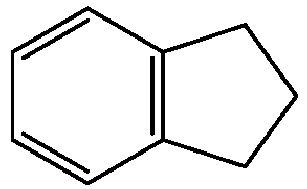
- Except where noted, the term "aryl" refers to a stable 6- to 10-membered mono-or bicyclic unsaturated carbocyclic ring system such as phenyl, or naphthyl.
- "Celite®" (Fluka) diatomite is diatomaceous earth, and can be referred to as "celite".
- Except where noted herein, carbocycle groups may be unsubstituted, or substituted on any one or more carbon atoms, with halogen, C1-C20 alkyl, CF3, NH2, -NH(C1-C6 alkyl), -N(C1-C6 alkyl)2, NO2, oxo, CN, N3, -OH, -O(C1-C6 alkyl), C3-C10 cycloalkyl, C2-C6 alkenyl, C2-C6 alkynyl, HS(O)0-2-, (C1-C6 alkyl)S(O)0-2-, (C1-C6 alkyl)S(O)0-2(C1-C6 alkyl)-, HS(O)0-2(C1-C6 alkyl)-, (C1-C6 alkyl)S(O)0-2, (C1-C6 alkyl)C(O)NH-, HC(O)NH-, H2N-C(NH)-, -O(C1-C6 alkyl)CF3, (C1-C6 alkyl)C(O)-, HC(O)-, (C1-C6 alkyl)OC(O)-, HOC(O)-, (C1-C6 alkyl)O(C1-C6 alkyl)-, HO(C1-C6 alkyl)-, (C1-C6 alkyl)C(O)1-2(C1-C6 alkyl)-, (C1-C6 alkyl)C(O)1-2-, HC(O)1-2(C1-C6 alkyl)-, (C1-C6 alkyl)OC(O)NH-, HOC(O)NH-, -P(O)(OH)2, aryl, aralkyl, heterocycle, heterocyclylalkyl, halo-aryl, halo-aralkyl, halo-heterocycle, halo-heterocyclylalkyl, cyano-aryl, cyano-aralkyl, cyano-heterocycle and cyano-heterocyclylalkyl, where such substitution results in formation of a stable compound.
- Except where noted herein, heterocycles may be unsubstituted, or substituted on any one or more carbon atoms, with halogen, C1-C20 alkyl, CF3, NH2, -NH(C1-C6 alkyl),-N(C1-C6 alkyl)2, NO2, oxo, CN, N3, -OH, -O(C1-C6 alkyl), C3-C10 cycloalkyl, C2-C6 alkenyl, C2-C6 alkynyl, (C1-C6 alkyl)S(O)0-2-, HS(O)0-2-, (C1-C6 alkyl)S(O)0-2(C1-C6 alkyl)-, HS(O)0-2(C1-C6 alkyl)-, (C1-C6 alkyl)S(O)0-2-, (C1-C6 alkyl)C(O)NH-, HC(O)NH-, H2N-C(NH)-, -O(C1-C6 alkyl)CF3, HC(O)-, (C1-C6 alkyl)C(O)-, (C1-C6 alkyl)OC(O)-, HOC(O)-, (C1-C6 alkyl)O(C1-C6 alkyl)-, HO(C1-C6 alkyl)-, (C1-C6 alkyl)O-, (C1-C6 alkyl)C(O)1-2(C1-C6 alkyl)-, HC(O)1-2(C1-C6 alkyl)-, (C1-C6 alkyl)C(O)1-2, (C1-C6 alkyl)OC(O)NH-, HOC(O)NH-, silyl groups (including trimethylsilyl, tetramethylsilyl, or supersilyl groups such as tri(trimethylsilyl)silyl or a silicon group connected to tert butyl groups), aryl, aralkyl, heterocycle, heterocyclylalkyl, halo-aryl, halo-aralkyl, halo-heterocycle, halo-heterocyclylalkyl, cyano-aryl, cyano-aralkyl, cyano-heterocycle or cyano-heterocyclylalkyl, or independently or additionally substituted with 1 substituent on any one or more nitrogen atoms, with C1-C20 alkyl, oxo, C3-C10 cycloalkyl, C2-C6 alkenyl, C2-C6 alkynyl, aryl, -C(O)C1-6 alkyl, -C(O)NHC1-C6 alkyl, - C(O)NH2, -C1-C6 alkylC(O)NH2, -C1-C6 alkylOC(O)NH2, or independently or additionally substituted with 1 substituent on any one or more sulfur atoms, with C1-C20 alkyl, oxo, C3-C10 cycloalkyl, C2-C6 alkenyl, C2-C6 alkynyl, aryl, where such substitution results in formation of a stable compound.
- Except where noted herein, structures containing substituent variables such as variable "R" below:

- Except where noted herein, bicyclic ring systems include fused ring systems, where two rings share two atoms, and spiro ring systems, where two rings share one atom.
- The disclosure also includes derivatives of the compound of Formula I, acting as prodrugs and solvates. Prodrugs, following administration to the patient, are converted in the body by normal metabolic or chemical processes, such as through hydrolysis in the blood, to the compound of Formula 1. Such prodrugs include those that demonstrate enhanced bioavailability, tissue specificity, and/or cellular delivery, to improve drug absorption of the compound of Formula I. The effect of such prodrugs may result from modification of physicochemical properties such as lipophilicity, molecular weight, charge, and other physicochemical properties that determine the permeation properties of the drug.
- The preparation of pharmacologically acceptable salts from compounds of the Formula (I) capable of salt formation, including their stereoisomeric forms is carried out in a manner known per se. With basic reagents such as hydroxides, carbonates, hydrogencarbonates, alkoxides and ammonia or organic bases, for example, trimethyl- or triethylamine, ethanolamine, diethanolamine or triethanolamine, trometamol or alternatively basic amino acids, for example lysine, ornithine or arginine, the compounds of the Formula (I) form stable alkali metal, alkaline earth metal or optionally substituted ammonium salts. If the compounds of the Formula (I) have basic groups, stable acid addition salts can also be prepared using strong acids. For the, inorganic and organic acids such as hydrochloric, hydrobromic, sulfuric, hemisulfuric, phosphoric, methanesulfonic, benzenesulfonic, p-toluenesulfonic, 4-bromobenzenesulfonic, cyclohexylamidosulfonic, trifluoromethylsulfonic, 2-hydroxyethanesulfonic, acetic, oxalic, tartaric, succinic, glycerolphosphoric, lactic, malic, adipic, citric, fumaric, maleic, gluconic, glucuronic, palmitic or trifluoroacetic acid are suitable.
- The invention also relates to medicaments containing at least one compound of the Formula (I) and/or of a pharmaceutically acceptable salt of the compound of the Formula (I) and/or an optionally stereoisomeric form of the compound of the Formula (I) or a pharmaceutically acceptable salt of the stereoisomeric form of the compound of Fornula (I), together with a pharmaceutically suitable and pharmaceutically acceptable vehicle, additive and/or other active substances and auxiliaries.
- The medicaments according to the invention can be administered by oral, inhalative, rectal or transdermal administration or by subcutaneous, intraarticular, intraperitoneal or intravenous injection. Oral administration is preferred. Coating of stents with compounds of the Formula (I) and other surfaces which come into contact with blood in the body is possible.
- The invention also relates to a process for the production of a medicament, which comprises bringing at least one compound of the Formula (I) into a suitable administration form using a pharmaceutically suitable and pharmaceutically acceptable carrier and optionally further suitable active substances, additives or auxiliaries.
- Suitable solid or galenical preparation forms are, for example, granules, powders, coated tablets, tablets, (micro)capsules, suppositories, syrups, juices, suspensions, emulsions, drops or injectable solutions and preparations having prolonged release of active substance, in whose preparation customary excipients such as vehicles, disintegrants, binders, coating agents, swelling agents, glidants or lubricants, flavorings, sweeteners and solubilizers are used. Frequently used auxiliaries which may be mentioned are magnesium carbonate, titanium dioxide, lactose, mannitol and other sugars, talc, lactose, gelatin, starch, cellulose and its derivatives, animal and plant oils such as cod liver oil, sunflower, peanut or sesame oil, polyethylene glycol and solvents such as, for example, sterile water and mono- or polyhydric alcohols such as glycerol.
- The dosage regimen utilizing the compounds is selected in accordance with a variety of factors including type, species, age, weight, sex and medical condition of the patient; the severity of the condition to be treated; the route of administration; the renal and hepatic function of the patient; and the particular compound or salt thereof employed. An ordinarily skilled physician or veterinarian can readily determine and prescribe the effective amount of the drug required to prevent, counter, or arrest the progress of the condition.
- Oral dosages of the compounds, when used for the indicated effects, will range between about 0.01 mg per kg of body weight per day (mg/kg/day) to about 30 mg/kg/day, preferably 0.025-7.5 mg/kg/day, more preferably 0.1-2.5 mg/kg/day, and most preferably 0.1-0.5 mg/kg/day (unless specificed otherwise, amounts of active ingredients are on free base basis). For example, an 80 kg patient would receive between about 0.8 mg/day and 2.4 g/day, preferably 2-600 mg/day, more preferably 8-200 mg/day, and most preferably 8-40 mg/kg/day. A suitably prepared medicament for once a day administration would thus contain between 0.8 mg and 2.4 g, preferably between 2 mg and 600 mg, more preferably between 8 mg and 200 mg, and most preferably 8 mg and 40 mg, e.g., 8 mg, 10 mg, 20 mg and 40 mg. Advantageously, the compounds may be administered in divided doses of two, three, or four times daily. For administration twice a day, a suitably prepared medicament would contain between 0.4 mg and 4 g, preferably between 1 mg and 300 mg, more preferably between 4 mg and 100 mg, and most preferably 4 mg and 20 mg, e.g., 4 mg, 5 mg, 10 mg and 20 mg.
- Intravenously, the patient would receive the active ingredient in quantities sufficient to deliver between 0.025-7.5 mg/kg/day, preferably 0.1-2.5 mg/kg/day, and more preferably 0.1-0.5 mg/kg/day. Such quantities may be administered in a number of suitable ways, e.g. large volumes of low concentrations of active ingredient during one extended period of time or several times a day, low volumes of high concentrations of active ingredient during a short period of time, e.g. once a day. Typically, a conventional intravenous formulation may be prepared which contains a concentration of active ingredient of between about 0.01-1.0 mg/ml, e.g. 0.1 mg/ml, 0.3 mg/ml, and 0.6 mg/ml, and administered in amounts per day of between 0.01 ml/kg patient weight and 10.0 ml/kg patient weight, e.g. 0.1 ml/kg, 0.2 ml/kg, 0.5 ml/kg. In one example, an 80 kg patient, receiving 8 ml twice a day of an intravenous formulation having a concentration of active ingredient of 0.5 mg/ml, receives 8 mg of active ingredient per day. Glucuronic acid, L-lactic acid, acetic acid, citric acid or any pharmaceutically acceptable acid/conjugate base with reasonable buffering capacity in the pH range acceptable for intravenous administration may be used as buffers. The choice of appropriate buffer and pH of a formulation, depending on solubility of the drug to be administered, is readily made by a person having ordinary skill in the art.
- The compounds of the invention may be prepared by employing reactions as shown in the following Reaction Schemes, in addition to other standard manipulations that are known in the literature or exemplified in the experimental procedures. The illustrative Reaction Schemes below, therefore, are not limited by the compounds listed or by any particular substituents employed for illustrative purposes. Substituent numbering as shown in the Reaction Schemes do not necessarily correlate to that used in the claims and often, for clarity, a single substituent is shown attached to the compound where multiple substituents are optionally allowed under the definitions of Formula I hereinabove.
- TLC is thin layer chromatography; Ts is tosyl; UV is ultraviolet; W is watts; wt. % is percentage by weight; x g is times gravity; αD is the specific rotation of polarized light at 589 nm; °C is degrees Celsius; % w/v is percentage in weight of the former agent relative to the volume of the latter agent.
- The compounds of the present invention can be readily produced from known compounds or commercially available compounds by, for example, known processes described in published documents, and produced by production processes described below. The present invention is not limited to the production processes described below. The invention also includes processes for the preparation of compounds of the invention.
- It should be noted that, when compounds of the present invention synthesized has a reactive group such as hydroxy group, amino group, carboxyl group, or thiol group as its substituent, such group may be adequately protected with a protective group in each reaction step and the protective group may be removed at an adequate stage. The process of such introduction and removal of the protective group may be adequately determined depending on the group to be protected and the type of the protective group, and such introduction and removal are conducted, for example, by the process described in the review section of Greene, T.W., et. al., "Protective Groups in Organic Synthesis", 2007, 4th Ed., Wiley, New York, or Kocienski, P., "Protecting Groups" 1994, Thieme.
- The present invention is not limited in scope by the specific embodiments disclosed in the examples which are intended as illustrations of a few aspects of the invention. Indeed, various modifications of the invention in addition to those shown and described herein will become apparent to those skilled in the relevant art and are intended to fall within the scope of the appended claim.
-
- Bis(t-Bu)XPhos Precatalyst
- Boc tert-butyloxycarbonyl
- BOC2O di-tert-butyl dicarbonate
- BrettPhos Precatalyst
- CDI 1,1'-carbonyldiimidazole
- celite Celite® diatomaceous earth
- DCM dichloromethane
- DIEA Diisopropylethylamine
- DIPEA diisopropylethylamine
- DMA N,N-dimethylacetamide
- DMAP 4-dimethylaminopyridine
- DMF N,N-dimethylformamide
- DMSO dimethyl sulfoxide
- EDC N-(3-dimethylaminopropyl)-N'-ethylcarbodiimide hydrochloride
- EI electron ionization
- EtOAc ethyl acetate
- HATU O-(7-azabenzotriazol-1-yl)-N,N,N',N'-tetramethyluronium hexafluorophosphate
- HPLC high performance liquid chromatography
- Hz hertz
- J coupling constant
- LC Liquid chromatography
- LCMS liquid chromatography-mass spectrometry
- MeCN acetonitrile
- MeOH methanol
- MS mass spectrometry
- NMR nuclear magnetic resonance
- Ph phenyl
- SFC supercritical fluid chromatography
- TEA triethanolamine
- TBS-Cl
- TLC analysis
- TFA trifluoroacetic acid
- THF tetrahydrofuran
- In the schemes and examples, unless otherwise indicated, Ar is unsubstituted or substituted unsaturated carbocycle or unsubstituted or unsubstituted or substituted unsaturated heterocycle, wherein substitution includes but is not limited to C1-4 alkyl or halogen. In the schemes and examples, unless otherwise indicated, R is C1-4 alkyl or Ar.
- In the following tables, intermediates are identified by number in the column headed "Int. #". Unless otherwise indicated, Exact Mass [M+H]+ is represented in the tables by the heading "[M+H]+".


- A suspension of 5-chloro-1H-pyrazolo[3,4-c]pyridine (100 mg, 0.651 mmol), 4-fluoro-1-iodobenzene (225 mg, 1.01 mmol), 2-isobutyrylcyclohexanone (50 mg, 0.297 mmol), copper(I) iodide (25 mg, 0.131 mmol) and cesium carbonate (400 mg, 1.23 mmol) in 5 mL of DMA was deoxygenated by bubbling nitrogen for 15 min. Next, the reaction mixture was warmed to 100°C and stirred overnight. The reaction mixture was then cooled and diluted with DCM, washed with 1 N aqueous NaOH and water, dried (Na2SO4) and concentrated to dryness. The solid residue was suspended in ether, stirred for 30 min, and filtered to collect the desired intermediate, 5-chloro-1-(4-fluorophenyl)-1H-pyrazolo[3,4-c]pyridine: MS (EI) calc'd for C12H8ClFN3 [M+H]+ 248, found 248; 1H NMR (600 MHz, DMSO-d6 ) δ 9.07 (s, 1 H), 8.48 (s, 1 H), 8.01 (s, 1 H), 7.86 (dd, J = 7.1, 5.0 Hz, 2 H), 7.43 (t, J = 8.8 Hz, 2 H).
- The following intermediate was made following similar protocol to intermediate 1I using appropriate reagent.
Table 1 Int. # Structure IUPAC Name [M+H]+ 2I 
5-Chloro-1-(2-methylpyridin-4-yl)-1H-pyrazolo[3,4-c]pyridine Calc'd 245, found 245 
- 5-bromo-2-methyl-2H-indazole (515 mg, 2.44 mmol) and bis[(tetrabutylammonium iodide)copper(I) iodide] (456 mg, 0.407 mmol) were combined in a reaction vessel, followed by 5-chloro-1H-pyrazolo[3,4-c]pyridine (250 mg, 1.628 mmol), trans-N,N'-dimethylcyclohexane-1,2-diamine (0.257 ml, 1.628 mmol), and anhydrous K3PO4 (691 mg, 3.26 mmol). This mixture was then evacuated and backfilled with N2 (3 times). Anhydrous degassed dioxane (20 ml) was added to this flask. This mixture was again evacuated and backfilled with N2 (3 times) and then as heated at 110°C for 22h. LCMS showed a peak consistent with product. The reaction was diluted with EtOAc and water. The blue colored aqueous layer was separated from the green colored organic layer. The aqueous layer was extracted with EtOAc. The combined organics were filtered and concentrated. The residue was purified by column chromatography on silica gel (24g), eluting with 1-100 % EtOAc/hexanes to give 5-chloro-1-(2-methyl-2H-indazol-5-yl)-1H-pyrazolo[3,4-c]pyridine LCMS: M+H = 284.


- In the reaction vessel Ruphos Indoline Precatalyst (19.77 mg, 0.027 mmol) and Sodium tert-butoxide (104 mg, 1.085 mmol) were combined, followed by tert-butyl 2-chloro-5,6-dihydropyrido[3,4-d]pyrimidine-7(8H)-carboxylate (146 mg, 0.543 mmol) and 5-chloro-1H-pyrazolo[3,4-c]pyridine (100 mg, 0.651 mmol). This mixture was then evacuated and backfilled with N2 (3 times). Then dry, degassed Tetrahydrofuran (2713 µl) and was added to this flask. This mixture was then heated at 80°C for 12 h. The mixture was cooled, brine (saturated,20 mL) was added and the mixture was extracted with ethyl acetate (2 20x mL). The combined organic fractions were washed with brine (saturated, 1 x 20mL), dried filtered and the solvent was evaporated under reduced pressure. The residue was purified by column chromatography on silica gel Isolute Flash Si; 20 g prepacked, eluting with EtOAc/isohexane to give tert-butyl 2-chloro-5,6-dihydropyrido[3,4-d]pyrimidine-7(8H)-carboxylate. Anal. Calcd. C18H19ClN6O2 [M+H] 387 found 387.


- A solution of 5-chloro-1-(4-fluorophenyl)-1H-pyrazolo[3,4-c]pyridine (150 mg, 0.606 mmol) in DMA (5 mL) was treated with NH2Boc (300 mg, 2.56 mmol), Cs2CO3 (600 mg, 1.842 mmol) and chloro[2-(dicyclohexylphosphino)-3,6-dimethoxy-2'-4'-6'-tri-i-propyl-1,1'-biphenyl][2-(2-aminoethyl)phenyl]-palladium(II) (50 mg, 0.063 mmol). The mixture was then deoxygenated by bubbling nitrogen for 15 min and stirred at 100°C overnight. Diluted with 4:1 DCM/MeOH and washed with 1 N aqueous NaOH, then dried (Na2SO4) and concentrated. Chromatography on SiO2 (0-100% EtOAc/DCM) gave the desired intermediate Boc-protected product which was dissolved in 2 M HCl in dioxane. The mixture was stirred for 30 min and concentrated to provide the bis-HCl salt, which was then dissolved in DCM and washed with sat'd NaHCO3, dried (Na2SO4) and concentrated to provide 1-(4-fluorophenyl)-1H-pyrazolo[3,4-c]pyridin-5-amine: MS (EI) calc'd for C12H10FN4 [M+H]+ 229, found 229; 1H NMR (600 MHz, CD3OD) δ 8.68 (s, 1 H), 8.05 (s, 1 H), 7.72 (dd, J= 8.3, 5.0 Hz, 2 H), 7.29 (t, J= 8.5 Hz, 2 H), 6.87 (s, 1 H).

- A mixture of 5-chloro-1-(2-methylpyridin-4-yl)-1H-pyrazolo[3,4-c]pyridine (1.20 g, 4.90 mmol), NH2Boc (1.50 g, 12.8 mmol), chloro(2-di-t-butylphosphino-2',4',6'-tri-i-propyl-1,1'-biphenyl)[2-(2-aminoethyl)phenyl] palladium(II) (300 mg, 0.437 mmol) in THF (5 mL) was deoxygenated by bubbling nitrogen and then treated with KOtBu as a 1 M solution in THF (8.00 mL, 8.00 mmol). The reaction was stirred overnight at 80°C, then diluted with DCM and washed with 1 N NaOH. The organic layer was dried (Na2SO4) and concentrated. Chromatography on SiO2 (0-50% MeOH/DCM) gave the intermediate Boc-protected product. This intermediate was dissolved in 10 mL of DCM and 10 mL of TFA, and stirred for 3 hours. The reaction was concentrated, dissolved in DCM and washed with 1 N NaOH, the organic layer dried (Na2SO4), and concentrated to provide 1-(2-methylpyridin-4-yl)-1H-pyrazolo[3,4-c]pyridin-5-amine: MS (EI) calc'd for C12H12N5 [M+H]+ 226, found 226; 1H NMR (600 MHz, DMSO-d6 ) δ 9.02 (s, 1 H), 8.47 (d, J = 5.5 Hz, 1 H), 8.26 (s, 1 H), 7.68 (d, J = 2.1 Hz, 1 H), 7.63 (dd, J = 5.6, 2.1 Hz, 1 H), 6.72 (d, J = 1.2 Hz, 1 H), 5.78 (s, 2 H), 2.53 (s, 3 H).
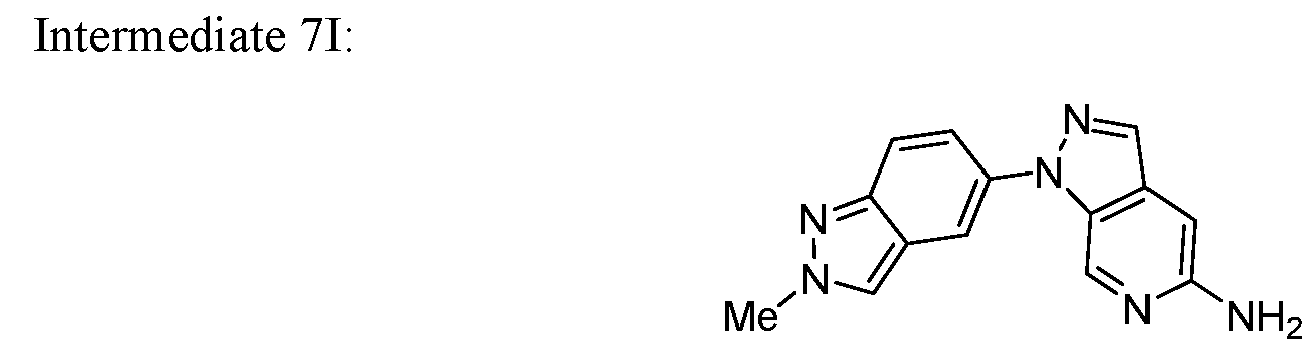
- A mixture of 5-chloro-1-(2-methyl-2H-indazol-5-yl)-1H-pyrazolo[3,4-c]pyridine (210 mg, 0.740 mmol) and SPHOS-Pd-Precatalyst (Generation 1, 56.3 mg, 0.074 mmol) were taken up in degassed THF (5 ml) and then degassed (vacuum/nitrogen) 3x. The mixture was treated with lithium bis(trimethylsilyl)amide (1.480 ml, 1.480 mmol) and heated at 60°C. The reaction was diluted with DCM (5mL), treated with 1N HCl (2mL), and stirred for 1h. The mixture was then filtered through celite. The organic layer was again filtered and concentrated. The residue was purified by column chromatography on silica gel (24g), eluting with 0-15% MeOH/DCM to give two products, of which the more polar was consistent with the desired product, 1-(2-methyl-2H-indazol-5-yl)-1H-pyrazolo[3,4-c]pyridin-5-amine. MS (ESI) calc'd for: for C14H12N6 [M+H]+ = 265 found 265.


- At 0°C, to a suspension of NaH (0.31 g, 7.84 mmol) in anhydrous DMF (10 mL) was added 5-chloro-1H-pyrazolo[3,4-c]pyridine (1.0 g, 6.53 mmol) in anhydrous DMF (5 mL) dropwise and the contents were stirred at the same temperature for 15 min. MeI (1.01 g, 7.18 mmol) in DMF (2 mL) was added dropwise to the reaction mixture at the same temperature and the contents were warmed to ambient temperature. After 30 min, the reaction was quenched with H2O (10 mL) and the organic contents were extracted with EtOAc (3 x 15 mL). The EtOAc layer was washed with brine (1 x 20 mL), dried over Na2SO4 and concentrated. The residue thus obtained was purified by flash column chromatography afforded the mixture of regio-isomers. 5-chloro-1-methyl-1H-pyrazolo[3,4-c]pyridine (81) 1H NMR (CDCl3, 400MHz) δ 8.8 (s, 1H), 7.98 (s, 1H), 7.6 (s, 1H), 3.9 (s, 3H).

- A solution of 5-chloro-1H-pyrazolo[3,4-c]pyridine (50 mg, 0.33 mmol) in DMF (1 mL) was treated with 1-bromo-3-methoxypropane (180 mg, 1.20 mmol) and Cs2CO3 (210 mg, 0.65 mmol). The mixture was warmed to 60°C for 1.5 h and cooled to afford a crude mixture of isomers. The isomers were separated by chromatography on SiO2 (5-60% EtOAc/hexanes) to yield the desired 5-chloro-1-(3-methoxypropyl)-1H-pyrazolo[3,4-c]pyridine: MS (EI) calc'd for C10H13ClN3O [M+H]+ 226, found 226; 1H NMR (600 MHz, CDCl3) δ 8.75 (s, 1 H), 7.99 (s, 1 H), 7.61 (s, 1 H), 4.56 (dt, J = 6.5 Hz, 2 H), 3.25 (s, 3 H), 3.20 (t, J = 5.6 Hz, 2 H), 2.17 (dt, J = 6.1 Hz, 2 H).

- 5-Chloro-1-methyl-1H-pyrazolo[3,4-c]pyridine (Intermediate 81, 543 mg, 3.24 mmol), benzoyl peroxide (2.3 g, 9.72 mmol), and TFA (0.300 mL, 3.89 mmol) was dissolved in methanol (30 mL) and stirred at 70°C overnight. Additional benzoyl peroxide (1.2 g, 4.86 mmol) and methanol (5 mL) were added and the reaction mixture stirred at 70°C overnight. DCM was added and the reaction was concentrated in vacuo while loading onto silica gel. Purification by flash chromatography (Biotage, 10-80% EtOAc/isohexane followed by 7-60% EtOAc/isohexanes) gave (5-chloro-1-methyl-1H-pyrazolo[3,4-c]pyridin-7-yl)methanol. MS ESI calc'd. for C8H9ClN3O [M+1]+ 198, found 198.
- The following intermediate was made following similar protocol to intermediate 10I using appropriate reagent.

-


- 5-Chloro-1H-pyrazolo[3,4-c]pyridine (2.0 g, 13.02 mmol) and triethylamine (3.63 mL, 26.0 mmol) was dissolved in DCM (40 mL) and BOC2O (4.54 ml, 19.54 mmol) was added. The reaction mixture was stirred at RT for 3 hours. DCM was added and the organic layer was washed with brine, dried over sodium sulfate, filtered, and concentrated in vacuo while loading onto silica gel. Purification by flash chromatography (Biotage, 2-30% EtOAc-Hexanes) gave tert-butyl 5-chloro-1H-pyrazolo[3,4-c]pyridine-1-carboxylate. MS ESI calc'd. for C11H13ClN3O2 [M+1]+ 254, found 254.
- Tert-Butyl 5-chloro-1H-pyrazolo[3,4-c]pyridine-1-carboxylate (1.36 g, 5.36 mmol), benzoyl peroxide (3.90 g, 16.08 mmol), and TFA (0.496 mL, 6.43 mmol) were dissolved in methanol (68 mL) and was stirred at 70°C overnight. The reaction mixture was concentrated in vacuo, TFA (5 mL) was added, and then stirred at RT for 3 hours. DCM was added and the mixture concentrated in vacuo while loading onto silica gel. Purification by flash chromatography (Biotage, 0-10% CH2Cl2/MeOH) gave (5-chloro-1H-pyrazolo[3,4-c]pyridin-7-yl)methanol. MS ESI calc'd. for C7H7ClN3O [M+1]+ 184, found 184. 1H NMR (500 MHz, DMSO-d6) δ 13.66 (s, 1H), 8.18 (s, 1H), 7.75 (s, 1H), 5.69 (s, 1H), 4.86 (s, 2H).

- (5-Chloro-1H-pyrazolo[3,4-c]pyridin-7-yl)methanol (Intermediate 121, 376.2 mg, 2.049 mmol), TBS-Cl (371 mg, 2.459 mmol), and imidazole (167 mg, 2.459 mmol) was dissolved in DMF (5 mL) and stirred at room temperature for 2 hours. Additional TBS-Cl (92.75 mg, 0.6 mmol) and imidazole (41.75 mg, 0.6 mmol) was added and the reaction mixture stirred at RT for 1.5 hours. Ethyl acetate was added and the organic layer washed with sat. ammonium chloride and brine, dried over sodium sulfate, filtered, and concentrated in vacuo while loading onto silica gel. Purification by flash chromatography (Biotage, 2-20% EtOAc/isohexane) gave 7-(((tert-butyldimethylsilyl)oxy)methyl)-5-chloro-1H-pyrazolo[3,4-c]pyridine. MS ESI calc'd. for C13H21ClN3OSi [M+1]+ 298, found 298.

- To a solution of [5-chloro-1H-pyrazolo[3,4-c]pyridin-7-yl]methanol, 12I, (1 g, 5.45 mmol) in THF (15 mL) was added TEA (552 mg, 5.46 mmol). Then methanesulfonyl chloride (623 mg, 5.44 mmol) was added dropwise with stirring at 0°C and then stirred for 1 h at the same temperature. The resulting solution was diluted with EtOAc, washed with saturated NaHCO3, brine, then dried (Na2SO4) and concentrated under reduced pressure to afford [5-chloro-1H-pyrazolo[3,4-c]pyridin-7-yl]methyl methanesulfonate. MS (EI) calc'd for C8H9ClN3O3S [M+H]+ 262, found 262.

- To a solution of [5-chloro-1H-pyrazolo[3,4-c]pyridin-7-yl]methanol, 12I, (500 mg, 2.72 mmol) in tert-butanol (10 mL) was added 4-methylbenzene-1-sulfonic acid (560 mg, 3.25 mmol) and 2-methylprop-1-ene (760 mg, 13.55 mmol). The resulting solution was sealed in a tube and stirred for 16 h at 80°C in an oil bath. The resulting mixture was concentrated under vacuum. The residue was diluted with EtOAc, washed with brine, then dried (Na2SO4) and concentrated under vacuum. The residue was purified by chromatography on SiO2, eluted with petroleum ether/EtOAc (10:1) to afford [1-tert-butyl-5-chloro-1H-pyrazolo[3,4-c]pyridin-7-yl]methanol. MS (EI) calc'd for C11H15ClN3O [M+H]+ 240, found 240.


- To a solution of [5-chloro-1-(4-fluorophenyl)-1H-pyrazolo[3,4-c]pyridin-7-yl]methanol (150 mg, 0.54 mmol) in THF (3 mL) was added TEA (164 mg, 1.62 mmol). Then methanesulfonyl chloride (92.8 mg, 0.81 mmol) was added dropwise with stirring at 0°C. The resulting solution was stirred for 2 h at 25°C and then concentrated under reduced pressure. The residue was diluted with DCM, washed with saturated NaHCO3, then dried (Na2SO4) and concentrated under reduced pressure to afford 200 mg (crude) of [5-chloro-1-(4-fluorophenyl)-1H-pyrazolo[3,4-c]pyridin-7-yl]methyl methanesulfonate as a solid, which was used in the next step without further purification. MS (EI) calc'd for C14H12ClFN3O3S [M+H]+ 356, found 356. Step 2: 5-Chloro-1-(4-fluorophenyl)-7-(methoxymethyl)-1H-pyrazolo[3,4-c]pyridine.
- To a solution of [5-chloro-1-(4-fluorophenyl)-1H-pyrazolo [3, 4-c] pyridin-7-yl] methyl methanesulfonate (200 mg, 0.56 mmol, 1.00 equiv) in THF (5 mL) under nitrogen was added sodium methoxide (91 mg, 1.68 mmol). The resulting solution was stirred for 5 h at 25°C and then quenched by the addition of water. The pH value of the solution was adjusted to 7 with 2 N aqueous HCl. The resulting solution was extracted with DCM, washed with saturated NaHCO3, then dried (Na2SO4) and concentrated under reduced pressure to afford 5-chloro-1-(4-fluorophenyl)-7-(methoxymethyl)-1H-pyrazolo[3,4-c]pyridine. MS (EI) calc'd for C14H12ClFN3O [M+H]+ 292, found 292.

- To a solution of [5-chloro-1-(4-fluorophenyl)-1H-pyrazolo[3,4-c]pyridin-7-yl] methyl methanesulfonate (200 mg, 1.69 mmol, crude) in DCM (2 mL) was added morpholine (147 mg, 1.69 mmol). The resulting solution was stirred for 2 h at 30°C and then concentrated under reduced pressure. The residue was diluted with DCM, washed with saturated NaHCO3, brine, then dried (Na2SO4) and concentrated under reduced pressure to afford 4-[[5-chloro-1-(4-fluorophenyl)-1H-pyrazolo[3,4-c]pyridin-7-yl]methyl]morpholine, which was used in the next step without further purification. MS (EI) calc'd for C17H17ClFN4O [M+H]+ 347, found 347. The following intermediate was made following similar protocol to intermediate 171 using appropriate reagent.

-

- To a solution of [5-chloro-1-(4-fluorophenyl)-1H-pyrazolo[3,4-c]pyridin-7-yl]methyl methanesulfonate (180 mg, 0.51 mmol) in MeCN (5 mL) was added 2-methoxyethan-1-amine (114 mg, 1.52 mmol). The resulting solution was stirred for 2 h at 80°C in an oil bath, then concentrated under reduced pressure. The residue was diluted with DCM, washed with brine, then dried (Na2SO4) and concentrated to dryness. The crude product was purified by chromatography on SiO2, eluted with DCM/MeOH (10:1) to afford [[5-chloro-1-(4-fluorophenyl)-1H-pyrazolo[3,4-c]pyridin-7-yl]methyl](2-methoxyethyl)amine. MS (EI) calc'd for C16H17ClFN4O [M+H]+ 335, found 335.
- A solution of [[5-chloro-1-(4-fluorophenyl)-1H-pyrazolo[3,4-c]pyridin-7-yl]methyl](2-methoxyethyl)amine (140 mg, 0.42 mmol) in DCM (5 mL) was treated with (Boc)2O (107 mg, 0.50 mmol) and TEA (127 mg, 1.26 mmol). The resulting solution was stirred for 2 h at 25°C and then concentrated under reduced pressure. The residue was diluted with DCM, washed with brine, then dried (Na2SO4) and concentrated. The crude product was purified by chromatography on SiO2, eluted with petroleum ether/EtOAc(5:1) to afford tert-butyl N-[[5-chloro-1-(4-fluorophenyl)-1H-pyrazolo[3,4-c]pyridin-7-yl]methyl]-N-(2-methoxyethyl)carbamate. MS (EI) calc'd for C21H25ClFN4O3 [M+H]+ 435, found 435.
- The following intermediates were made following similar protocol to intermediate 19I using appropriate reagent.

-

-

- To a solution of 2-(morpholin-4-yl) ethan-1-ol (221 mg, 1.69 mmol) in THF (4 mL) under nitrogen was added sodium hydride (67.4 mg, 1.69 mmol, 60%) in portions at 0°C. The mixture was stirred for 1 h at 20°C. Then [5-chloro-1-(4-fluorophenyl)-1H-pyrazolo [3, 4-c] pyridin-7-yl] methyl methanesulfonate (200 mg, 0.56 mmol) in THF (1 mL) was added and the resulting solution was stirred for 2 h at 20°C. The reaction was then quenched by the addition of water. The pH value of the mixture was adjusted to 7 with 2 N aqueous HCl. The resulting mixture was extracted with DCM, washed with brine, then dried (Na2SO4) and concentrated under reduced pressure. the residue was purified by chromatography on SiO2, eluted with DCM/MeOH (10:1) to afford 4-(2-[[5-chloro-1-(4-fluorophenyl)-1H-pyrazolo[3,4-c]pyridin-7-yl] methoxy] ethyl) morpholine. MS (EI) calc'd for C19H21ClFN4O2 [M+H]+ 391, found 391. The following intermediate was made following protocol similar to intermediate 22I using the appropriate reagent.
Table 2 Int. # Structure IUPAC Name [M+H]+ 23I 
2-((5-chloro-1-(4-fluorophenyl)-1H-pyrazolo[3,4-c]pyridin-7-yl)methoxy)ethanol Calc'd 322, found 322 

- To a mixture of sodium hydride (37 mg, 1.50 equiv) in N,N-dimethylformamide (10 mL), under nitrogen was added morpholine (539 mg, 6.19 mmol) and stirred for 0.5 h at 20°C. Then [5-chloro-1-methanesulfonyl-1H-pyrazolo[3,4-c]pyridin-7-yl]methyl methanesulfonate, 14I, (210 mg, 0.62 mmol) was added and the resulting solution was stirred for 2 h at 20°C. The reaction was then quenched by the addition of saturated NH4Cl (50 mL). The resulting mixture was extracted with EtOAc, washed with saturated NaHCO3, brine, then dried (Na2SO4) and concentrated under reduced pressure. The residue was purified by chromatography on SiO2, eluted with petroleum ether/EtOAc (10:1) to afford 4-([5-chloro-1H-pyrazolo[3,4-c]pyridin-7-yl]methyl)morpholine. MS (EI) calc'd for C11H14ClN4O [M+H]+ 253, found 253. Step 2: 4-[[5-chloro-1-(2-methylpyridin-4-yl)-1H-pyrazolo[3,4-c]pyridin-7-yl]methyl]morpholine.
- To a mixture of 4-([5-chloro-1H-pyrazolo[3,4-c]pyridin-7-yl]methyl)morpholine (100 mg, 0.40 mmol) in dioxane (20 mL) were added (2-methylpyridin-4-yl)boronic acid (81.4 mg, 0.59 mmol), TEA (140 mg, 1.39 mmol), and Cu(OAc)2 (123 mg, 0.68 mmol). The resulting mixture was stirred for 24 h at 60°C. The solids were filtered off and the filtrate was concentrated under vacuum. The residue was purified by chromatography on SiO2, eluted with DCM/MeOH (40:1) to give 4-[[5-chloro-1-(2-methylpyridin-4-yl)-1H-pyrazolo[3,4-c]pyridin-7-yl]methyl]morpholine. MS (EI) calc'd for C17H19ClN5O [M+H]+ 344, found 344.

- To a solution of [5-chloro-1H-pyrazolo[3,4-c]pyridin-7-yl]methyl methanesulfonate, 14I, (300 mg, 1.15 mmol) in DCM (3 mL) was added (2-aminoethyl)dimethylamine(303 mg, 3.44 mmol, 3.00 equiv). The resulting solution was stirred for 3 h at 30°C and then concentrated under reduced pressure. The residue was purified by chromatography on SiO2, eluted with DCM/MeOH (10:1) to afford of ([5-chloro-1H-pyrazolo[3,4-c]pyridin-7-yl]methyl)[2-(dimethylamino)ethyl]amine. MS (EI) calc'd for C11H17ClN5 [M+H]+ 254, found 254.
- To a solution of ([5-chloro-1H-pyrazolo[3,4-c]pyridin-7-yl]methyl)[2-(dimethylamino)ethyl]amine (120 mg, 0.47 mmol) in DCM (3 mL) was added TEA (239 mg, 2.36 mmol) and Boc2O (227 mg, 1.04 mmol). The resulting solution was stirred for 5 h at 30°C and then concentrated under reduced pressure. The residue was diluted with DCM, washed with Saturated NaHCO3, brine, then dried (Na2SO4) and concentrated to afford tert-butyl 7-([[(tert-butoxy)carbonyl][2-(dimethylamino)ethyl]amino]methyl)-5-chloro-1H-pyrazolo[3,4-c]pyridine-1-carboxylate. MS (EI) calc'd for C21H33ClN5O4 [M+H]+ 454, found 454.
- To a solution of tert-butyl 7-([[(tert-butoxy)carbonyl][2-(dimethylamino)ethyl]amino]methyl)-5-chloro-1H-pyrazolo[3,4-c]pyridine-1-carboxylate(220 mg, 0.48 mmol) in MeOH (5 mL) was added potassium carbonate (200.9 mg, 1.45 mmol). The resulting solution was stirred for 2 h at 20°C and then concentrated under reduced pressure. The residue was purified by chromatography on SiO2, eluted with DCM/MeOH (10:1) to afford tert-butyl N-([5-chloro-1H-pyrazolo[3,4-c]pyridin-7-yl]methyl)-N-[2-(dimethylamino)ethyl]carbamate. MS (EI) calc'd for C16H25ClN5O2 [M+H]+ 354, found 354.
- To a solution of tert-butyl N-([5-chloro-1H-pyrazolo[3,4-c]pyridin-7-yl]methyl)-N-[2-(dimethylamino)ethyl]carbamate (158 mg, 0.45 mmol) in N,N-dimethylformamide (10 mL) under nitrogen was added 4-bromo-2-methylpyridine (153 mg, 0.89 mmol), 2-acetylcyclohexan-1-one (38 mg, 0.27 mmol), CuI (26 mg, 0.14 mmol) and Cs2CO3 (292 mg, 0.90 mmol). The resulting mixture was stirred for 15 h at 120°C in an oil bath. The solids were filtered out. The filtrate was concentrated under vacuum. The residue was purified by chromatography on SiO2, eluted with DCM/MeOH (10:1) to afford tert-butyl N-[[5-chloro-1-(2-methylpyridin-4-yl)-1H-pyrazolo[3,4-c]pyridin-7-yl]methyl]-N-[2-(dimethylamino)ethyl]carbamate. MS (EI) calc'd for C22H30ClN6O2 [M+H]+ 445, found 445.
- The following intermediate was made following protocol similar to intermediate 251 using the appropriate reagent.
Table 3 Int. # Structure IUPAC Name [M+H]+ 261 
tert-butyl ((5-chloro-1-(2-methylpyridin-4-yl)-1H-pyrazolo[3,4-c]pyridin-7-yl)methyl)(2-methoxyethyl)carbamate Calc'd 432, found 432 
- To a suspension of NaH (92 mg, 3.83 mmol, 60%) in N,N-dimethylformamide (10 mL), was added 2-methoxyethan-1-ol (874 mg, 11.49 mmol) at 0°C. After stirring for 30 min at 20°C, [5-chloro-1H-pyrazolo[3,4-c]pyridin-7-yl]methyl methanesulfonate (300 mg, 1.15 mmol) was added. The resulting mixture was stirred for 1 h at 20°C, quenched by the addition of saturated aqueous NH4Cl and extracted with EtOAc. The combined organic phases was washed with brine, dried with Na2SO4 and concentrated. The residue was purified by chromatography on SiO2, eluted with petroleum ether/EtOAc (2:1) to give 5-chloro-7-[(2-methoxyethoxy)methyl]-1H-pyrazolo[3,4-c]pyridine. MS (EI) calc'd for C10H13ClN3O2 [M+H]+ 242, found 242.
- This compound was synthesized by the same method as described in intermediate 251 at step 4 except 5-chloro-7-[(2-methoxyethoxy)methyl]-1H-pyrazolo[3,4-c]pyridine was used: MS (EI) calc'd for C16H18ClN4O2 [M+H]+ 333, found 333.
The following intermediates were made following protocol similar to intermediate 27I using the appropriate reagent.Table 4 Int. # Structure IUPAC Name [M+H]+ 28I 
5-chloro-1-(2-methylpyridin-4-yl)-7-((oxetan-3-yloxy)methyl)-1H-pyrazolo[3,4-c]pyridine Calc'd 331, found 331 29I 
4-(2-((5-chloro-1-(2-methylpyridin-4-yl)-1H-pyrazolo[3,4-c]pyridin-7-yl)methoxy)ethyl)morpholine Calc'd 388, found 388 30I 
7-((2-(benzyloxy)ethoxy)methyl)-5-chloro-1-(2-methylpyridin-4-yl)-1H-pyrazolo[3,4-c]pyridine Calc'd 409, found 409 31I 
2-((5-chloro-1-(2-methylpyridin-4-yl)-1H-pyrazolo[3,4-c]pyridin-7-yl)methoxy)ethanol Calc'd 319, found 319 

- To a solution of MeONa (383 mg, 8.3 mmol) in MeOH (5 mL) was added a solution of [5-chloro-1H-pyrazolo[3,4-c]pyridin-7-yl]methyl methanesulfonate (200 mg, 0.76 mmol) in MeOH (5 mL) dropwise with stirring. The resulting mixture was stirred for 2 h at 20°C and then concentrated under vacuum. The residue was diluted with water, extracted with EtOAc, washed with brine, then dried (Na2SO4) and concentrated. The residue was purified by chromatography on SiO2, eluted with petroleum ether/EtOAc (10:1) to afford a mixture of isomers of 5-chloro-7-(methoxymethyl)-1H-pyrazolo[3,4-c]pyridine. MS (EI) calc'd for C8H9ClN3O [M+H]+ 198, found 198.
- The mixture of 5-chloro-7-(methoxymethyl)-1H-pyrazolo[3,4-c]pyridine and 5-chloro-4-methoxy-7-methyl-1H-pyrazolo[3,4-c]pyridine(80 mg, 0.40 mmol) was dissolved in N,N-dimethylformamide (4 mL). Then 4-bromo-2-methylpyridine (90 mg, 0.52 mmol), 2-acetylcyclohexan-1-one (34 mg, 0.24 mmol), CuI (24 mg, 0.13mmol) and Cs2CO3 (264 mg, 0.80 mmol) were added. The resulting solution was degassed with nitrogen and then stirred for 16 h at 110°C. The resulting mixture was concentrated under vacuum. The residue was purified by chromatography on SiO2, eluted with DCM/MeOH (40:1) to afford a mixture of 5-chloro-7-(methoxymethyl)-1-(2-methylpyridin-4-yl)-1H-pyrazolo[3,4-c]pyridine. MS (EI) calc'd for C14H14ClN4O [M+H]+ 289, found 289.

- To a solution of [5-chloro-1H-pyrazolo[3,4-c]pyridin-7-yl]methyl methanesulfonate (300 mg, 1.15 mmol) in THF (10 mL) was added LiAlH4 (87 mg, 2.29 mmol) in portions at 0°C and the resulting solution was stirred for 1 h at 20°C. The reaction was quenched by the addition of saturated aqueous NH4Cl. The resulting mixture was extracted with EtOAc, washed with brine, then dried (Na2SO4) and concentrated under vacuum to afford crude 5-chloro-7-methyl-1H-pyrazolo[3,4-c]pyridine. MS (EI) calc'd for C7H7ClO3 [M+H]+ 168, found 168.
- To a solution of 5-chloro-7-methyl-1H-pyrazolo[3,4-c]pyridine (400 mg, 2.39 mmol) in dioxane (30 mL) were added (2-methylpyridin-4-yl)boronic acid (656 mg, 4.79 mmol), TEA (847 mg, 8.37 mmol) and Cu(OAc)2 (1.1 g, 6.04 mmol). The resulting mixture was stirred for 24 h at 65°C. The solids were filtered off and the filtrate was concentrated under vacuum. The residue was purified by chromatography on SiO2, eluted with petroleum ether/EtOAc (2:1) to give 4-[5-chloro-7-methyl-1H-pyrazolo[3,4-c]pyridin-1-yl]-2-methylpyridine. MS (EI) calc'd for C13H12ClN4 [M+H]+ 259, found 259.


- To a solution of 2-chloro-4-methyl-5-nitropyridine (200 g, 1.16 mol) in THF (1000 mL) was added Raney-nickel (68.0 g, 1.16 mol) in portions. The resulting mixture was purged in 2-4 atm of hydrogen and stirred for 16 h at 25°C under an atmosphere of hydrogen (2∼4 atm.). The reaction mixture was filtered, and the filtrate was concentrated under vacuum to give 6-chloro-4-methylpyridin-3-amine, which was used directly for the next step without further purification. MS (EI) calc'd for C6H8ClN2 [M+H]+ 143, found 143.
- To a solution of 6-chloro-4-methylpyridin-3-amine (100 g, 701 mmol) in DMF (1000 mL) was added 1-iodopyrrolidine-2,5-dione (189 g, 842 mmol) in portions. The mixture was stirred for 10 h at 25°C and then concentrated under reduced pressure. The residue was diluted with water and extracted with EtOAc, washed with brine, dried (Na2SO4), filtered and concentrated. The residue was purified by chromatography on SiO2, eluted with petroleum ether/EtOAc (10:1) to give 6-chloro-2-iodo-4-methylpyridin-3-amine. MS (EI) calc'd for C6H7ClIN2 [M+H]+ 269, found 269;
- To a solution of 6-chloro-2-iodo-4-methylpyridin-3-amine (80 g, 298 mmol) in AcOH (500 mL) was added a solution of sodium nitrite (22.6 g, 328 mmol) in water (200 mL) in portions at 0°C. The resulting mixture was stirred for 10 h at 25°C and concentrated under vacuum and diluted with water. The pH value of the solution was adjusted to 7 with saturated NaHCO3 and then extracted with DCM, washed with brine, dried (Na2SO4), and filtered. The filtrate was concentrated to give 5-chloro-7-iodo-1H-pyrazolo[3,4-c]pyridine. MS (EI) calc'd for C6H4ClIN3 [M+H]+ 280, found 280.
- To a solution of 5-chloro-7-iodo-1H-pyrazolo[3,4-c]pyridine (20.0 g, 64.4 mmol) in DMF (100 mL) were added K2CO3 (17.8 g, 129 mmol) and iodomethane (9.14 g, 64.4 mmol). The resulting mixture was stirred for 2 h at 25°C and then concentrated under vacuum. The residue was diluted with DCM, washed with water, dried (Na2SO4), filtered and concentrated. The residue was purified by chromatography on SiO2, eluted with petroleum ether/EtOAc (10:1) to give the desired isomer 5-chloro-1-methyl-7-iodo-1H-pyrazolo[3,4-c]pyridine. MS (EI) calc'd for C7H6ClIN3 [M+H]+ 294, found 294. 1H NMR (300 MHz, CDCl3) δ 7.94 (s, 1 H), 7.56 (s, 1 H), 4.47 (s, 3 H).
The following intermediate was made following protocol similar to intermediate 341 using the appropriate reagent.Table 5 Int. # Structure IUPAC Name [M+H]+ 35I 
5-chloro-1-ethyl-7-iodo-1H-pyrazolo[3,4-c]pyridine Calc'd 308, found 308 
- To a solution of 5-chloro-1-ethyl-7-iodo-1H-pyrazolo[3,4-c]pyridine, intermediate 321, (1 g, 3.25 mmol) in 1,4-dioxane (20 ml) was added Pd2(dba)3·CHCl3 (0.17 g, 0.16 mmol), BINAP (0.04 g, 0.06 mmol), sodium tert-butoxide (0.88 g, 9.11 mmol) and MeOH (1.04 g, 32.5 mmol).The resulting solution was stirred for 4 h at 110°C. The solid was filtered out. The filtrate was concentrated under vacuum. The residue was purified by chromatography on SiO2, eluted with petroleum ether/EtOAc (10:1) to afford 5-chloro-1-ethyl-7-methoxy-1H-pyrazolo[3,4-c]pyridine. MS (EI) calc'd for C9H11ClN3O [M+H]+ 212, found 212.

- A solution of 5-chloro-1H-pyrazolo[3,4-c]pyridine (200 mg, 1.302 mmol) and Hunig'sBase (1.137 ml, 6.51 mmol) in THF (10 ml) was cooled to 0°C and then treated slowly with ethyl isocyanate (0.155 ml, 1.954 mmol). The reaction was slowly allowed to warm to room temperature overnight. The reaction was diluted with DCM and quenched with water. The layers were separated. The aqueous layer was extracted with DCM (2x). The combined organic fractions were washed with brine, filtered and concentrated to an off-white solid. The residue was purified by column chromatography on silica gel (24g), eluting with 1-100 % EtOAc/hexanes to give 5-chloro-N-ethyl-1H-pyrazolo[3,4-c]pyridine-1-carboxamide. LCMS (ESI) calc'd for C9H9ClN4O [M+H]+ 225, found 225.


- In a 40 mL vial with pressure relief cap, under an atmosphere of nitrogen gas, tert-butyl 4-hydroxy-2-oxopiperidine-1-carboxylate (200 mg, 0.929 mmol) and n,n-diisopropylethylamine (0.502 ml, 2.88 mmol) were dissolved in DCM (6.00 ml). After cooling to 0°C the reaction mixture was treated with methanesulfonyl chloride (0.108 ml, 1.394 mmol) and stirred at room temperature overnight. The mixture was diluted with dichloromethane (60 mL) and brine (60 mL). The biphasic solution was separated and the aqueous layer was extracted with dichloromethane (2 x 60 mL). The combined organic phase was dried over sodium sulfate, filtered and concentrated to dryness under reduced pressure to provide tert-butyl 4-((methylsulfonyl)oxy)-2-oxopiperidine-1-carboxylate.
- To a solution of 5-chloro-1H-pyrazolo[3,4-c]pyridine (130 mg, 0.847 mmol) dissolved in N,N-dimethylformamide (5.00 ml) was added cesium carbonate (579 mg, 1.778 mmol) followed by tert-butyl 4-((methylsulfonyl)oxy)-2-oxopiperidine-1-carboxylate (273 mg, 0.931 mmol). The reaction mixture stirred at room temperature overnight. LC/MS analysis indicated that the desired product was not obtained. The reaction was heated to 65°C and stirred overnight. The mixture was filtered through a 0.2 mm Millex syringe-driven filter unit, washed with methanol (2 x 6 mL) and concentrated to dryness under reduced pressure. The crude mixture was purified by reverse phase HPLC (10% to 90% Acetonitrile/Water + 0.1% TFA, over 10 minutes) to provide the desired product tert-butyl 4-(5-chloro-1H-pyrazolo[3,4-c]pyridin-1-yl)-2-oxopiperidine-1-carboxylate. LCMS (ESI) calc'd for C6H9ClN4O3 [M+H]+ = 351, found 351.


- At 0°C, to a solution of benzaldehyde (5.0 g, 47.16 mmol) and nitromethane (3.45 g, 56.6 mmol) in MeOH (50 mL) was added NaOH (1.98 g, 49.5 mmol) dissolved in minimum amount of water (5 mL).The resultant mixture was stirred at the same temperature for about an hour. A pre cooled 2N HCl (50 mL) was added dropwise to the reaction mixture and the resultant was stirred for additional 2 h. The product was extracted into ethyl acetate (3 x 25 mL). The combined extracts were washed with brine solution, dried over anhydrous Na2SO4 and concentrated to residue. The residue was purified by column chromatography using pet ether and ethyl acetate as mobile phase (9:1) afforded the title compound. 1H NMR (CDCl3, 300MHz): δ 8.03 (d, J = 14.0 Hz, 1H), 7.44-7.63 (m, 6H).
- At 0°C, to a solution of (E)-(2-nitrovinyl)benzene (0.4 g, 2.65 mmol) and N-benzyl-1-methoxy-N-((trimethylsilyl)methyl)methanamine (0.95 g, 4.02 mmol) in anhydrous CH2Cl2 (5mL) was added TFA (0.029 g, 0.25 mmol) and the resultant was stirred at the same temperature. After 30 min, the reaction mixture was warmed and stirred at ambient temperature for additional 2h. The organic volatiles were then removed under reduced pressure and the residue thus obtained was purified by flash column chromatography afforded the title compound. Anal. Calcd. C17H18N2O2 [M+H] 283 Found 283.
- A solution of trans-1-benzyl-3-nitro-4-phenylpyrrolidine (0.25 g, 0.886 mmol) in chloroethyl chloroformate (2 mL) was heated to reflux. After 7h, the reaction mixture was cooled to ambient temperature, and the volatile was removed under reduced pressure. The residue thus obtained was taken up in MeOH (5 mL) and the contents were heated to reflux. After 2 h, MeOH was removed under reduced pressure, the residue thus obtained was triturated with Et2O afforded the title compound. Anal. Calcd. C10H12N2O2 [M+H] 193; Found 193.
- At 0°C, to the solution of trans-3-nitro-4-phenylpyrrolidine (0.3 g, 1.57 mmol) in THF: DMF (1:1 mL) was added DIPEA (0.6 g, 4.71 mmol) followed by 2,2,2 trifluoroethyl trifluoromethanesulfonate (0.54 g, 2.35 mmol). The resultant mixture was stirred at RT for 2 h. The reaction mixture was quenched with H2O (3 mL) and was diluted with EtOAc (10 mL). The organic layer was separated and washed with brine solution (1 x 10 mL), dried over anhydrous Na2SO4 and the solvents were removed under reduced pressure. The residue thus obtained was purified by flash column chromatography using a mixture of pet ether and ethyl acetate as mobile phase afforded the title compound. Anal. Calcd. C12H13F3N2O2 [M+H] 275; Found 275.
- To a suspension of Zn dust (0.12 g, 1.82 mmol) in MeOH:AcOH (1:1 ratio, 4 mL) was added a solution of trans-3-nitro-4-phenyl-1-(2,2,2-trifluoroethyl)pyrrolidine (0.1 g, 0.364 mmol) in MeOH (1 mL) and the resultant mixture was heated to 80°C, After 6 h, the reaction mixture was brought back to ambient temperature and filtered through a pad of celite. The organic volatiles were then removed under reduced pressure and the residue thus obtained was basified by aqueous NH3. The organic contents were then extracted with CH2Cl2 (3 x 15mL) and was washed with brine solution, dried over anhydrous Na2SO4 and concentrated. The residue thus obtained was taken directly for next step without purification. Anal. Calcd. C12H15F3N2 [M+H] 245; Found 245.


- At 0°C, to a solution of 1-methyl 1H pyrzole-4-carbaldehyde (1.0 g, 9.1 mmol) and nitro methane (0.56 g, 9.1 mmol) in MeOH (10 mL) was added NaOH (0.364 g, 9.10 mmol) dissolved in minimum water (0.2 mL).The resultant mixture was stirred at the same temperature for about an hour. A pre cooled 2N HCl (10 mL) was added dropwise to the reaction mixture and the resultant was stirred for additional 2 h. The product that is crashed out from the solvent was filtered and washed successively with MeOH afforded the title compound. 1H NMR (300 MHz, CDCl3): δ 7.93 (d, J=13.5 Hz, 1H), 7.75 (s, 1H), 7.69 (s, 1H), 7.43 (d, J = 13.5 Hz, 1H), 3.96 (s, 3H).
- At 0°C, to a solution of (E)-1-methyl-4-(2-nitrovinyl)-1H-pyrazole (0.6 g, 3.92 mmol) and 1-methoxy-N-methyl-N-((trimethylsilyl)methyl)methanamine (0.76 g, 4.7 mmol) in anhydrous CH2Cl2 (5mL) was added TFA (0.45 g, 0.39 mmol) and the resultant was stirred at the same temperature. After 30 min, the reaction mixture was warmed and stirred at ambient temperature for additional 2h. The organic volatiles were then removed under reduced pressure and the residue thus obtained was purified by flash column chromatography afforded the title compound. Anal. Calcd. C9H14N4O2, [M+H] 211. Found 211.
- To a suspension of Zn dust (0.15 g, 2.37 mmol) in MeOH:AcOH (1:1 ratio, 4 mL) was added a solution of 1-methyl-trans-1-methyl-4-nitropyrrolidin-3-yl)-1H-pyrazole (0.1 g, 0.48 mmol) in MeOH (1 mL) and the resultant mixture was heated to 80°C, After 6 h, the reaction mass was brought back to ambient temperature and the suspension was filtered through a pad of celite. The organic volatiles were then removed under reduced pressure and the residue thus obtained was basified by aqueous NH3. The organic contents were then extracted with CH2Cl2 (3 x 15mL) and was washed with brine solution, dried over anhydrous Na2SO4 and concentrated. The residue thus obtained was taken as such for next step. The residue thus obtained was taken as such for next step.
The following intermediates were made following protocol similar to intermediate 401 using the appropriate aldehyde :Table 6 Int. # Structure IUPAC Name 41I 
(3R,4S)-1-methyl-4-(3-methylthiophen-2-yl)pyrrolidin-3-amine 42I 
(3R,4S)-1-methyl-4-phenethylpyrrolidin-3-amine 43I 
(3S,4R)-1-methyl-4-(5-methylthiophen-2-yl)pyrrolidin-3-amine 44I 
(3 S,4R)-1 -methyl-4-(4-methylthiazol-2-yl)pyrrolidin-3-amine 45I 
(3R,4S)-1-methyl-4-(3-phenylpropyl)pyrrolidin-3-amine 46I 
(3R,4S)-1-methyl-4-(5-methylisoxazol-3-yl)pyrrolidin-3-amine 47I 
(3R,4S)-1-methyl-4-(5-phenylthiophen-2-yl)pyrrolidin-3-amine 48I 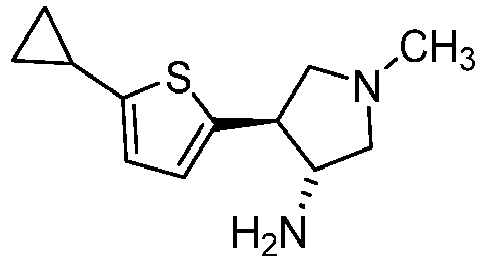
(3R,4S)-4-(5-cyclopropylthiophen-2-yl)-1-methylpyrrolidin-3-amine 


- To a solution of tert-butyl 6-oxa-3-azabicyclo[3.1.0]hexane-3-carboxylate (4.0 g, 20 mmol) in 1:1 mixture of 1,4-dioxane-H2O mixture (40 mL) was added NaN3 (5.7 g, 80 mmol) and the contents were heated at 80°C. After 4 h, the reaction mixture was cooled to ambient temperature, diluted with H2O (50 mL) and the organic contents were extracted with EtOAc (3 x 50 mL) and dried over Na2SO4. The volatiles were then removed under reduced pressure afforded the title compound. 1H NMR (CDCl3, 400MHz): δ 4.27-4.25 (m, 1H), 3.9-3.92 (m, 1H), 3.72-3.34 (s, 4H), 2.7 (bs, 1H), 1.47 (s, 9H).
- At 0°C, to a suspension of NaH (60% dispersion in mineral oil, 1.2 g, 30 mmol) in anhydrous THF (30 mL) was added a solution of trans-tert-butyl 3-azido-4-hydroxypyrrolidine-1-carboxylate (4.5 g, 20 mmol) in anhydrous THF (20 mL). A vigorous effervescence was noticed and after 10 min, a solution of MeI (3.3 g, 20 mmol) in anhydrous THF (10 mL) was added dropwise. The contents were stirred at ambient temperature for 2 h, and the reaction mixture was then quenched with ice cold H2O (10 mL) and the organic contents were extracted with EtOAc (2 x 50 mL). The organic layer was dried over anhydrous Na2SO4 and concentrated under reduced pressure. The residue thus obtained was purified by flash column chromatography using 15% EtOAc/hexanes mixture afforded the title compound. 1H NMR (CDCl3, 400MHz): δ 4.99 (bs, 1H), 4.3-4.1 (m, 1H), 3.78-3.40 (m, 4H), 3.11 (s, 3H), 1.49 (s, 9H).
- To a solution of trans-tert-butyl 3-azido-4-methoxypyrrolidine-1-carboxylate (3.0 g, 10 mmol) in anhydrous MeOH (20 mL) was added Pd-C (0.3 g, 10 mol%) and the contents were stirred at ambient temperature under the atmosphere of H2 (balloon pressure). After 16h, the reaction mixture was filtered through a pad of celite and the filtrate thus obtained was concentrated under reduced pressure afforded the title compound and the material was taken directly for the next step without further purification and characterization.
- The following intermediates were made following protocol similar to intermediate 491 using the appropriate alkylating agent in step 2:
Table 7 Int. # Structure IUPAC Name 50I 
(3S,4S)-tert-butyl 3-amino-4-ethoxypyrrolidine-1-carboxylate 51I 
(3S,4S)-tert-butyl 3-amino-4-((5-fluoropyridin-3-yl)oxy)pyrrolidine-1-carboxylate 52I 
(3S,4S)-tert-butyl 3-amino-4-phenoxypyrrolidine-1-carboxylate 53I 
(3S,4S)-tert-butyl 3-amino-4-(4-fluorophenoxy)pyrrolidine-1-carboxylate 


- To the solution of (S)-methyl 2-amino-2-phenylacetate (2.0 g, 12 mmol) in dichloromethane (15 mL) was added triethyl amine (3.3 mL, 24 mmol). The reaction mixture was cooled to 0°C and Boc-anhydride (3.15 mL, 14.4 mmol) was added slowly. The reaction mixture was allowed to warm up to room temperature at which it was stirred for 3 h. TLC analysis indicated complete disappearance of the starting material. The reaction mixture was bi-phased with water (15 mL) and ethyl acetate (25 mL). The aqueous layer was extracted with ethyl acetate (2 x 15 mL) and the combined organic layers were washed with brine (1 x 15 mL), dried (Na2SO4) and concentrated under reduced pressure to afford the crude compound which was purified by flash column chromatography to furnish the title compound. 1H NMR (400 MHz, CDCl3) δ 7.40-7.31 (m, 5H), 5.57 (bs, 1H), 5.34 (d, 1H, J = 7.4 Hz), 3.74 (s, 3H), 1.37 (s, 9H).
- To a solution of (S)-methyl 2-((tert-butoxycarbonyl)amino)-2-phenylacetate (2.0 g, 7.5 mmol) in THF (10 mL) was added lithium hydroxide (1.57 g, 37.5 mmol) in water (5 mL). The reaction mixture was allowed to stir for 6 h. TLC analysis indicated complete disappearance of the starting material. pH of the resulting solution was brought to around 7.0 by adding citric acid. THF was concentrated under reduced pressure and the mixture was bi-phased with ethyl acetate (25 mL) and water (15 mL). The aqueous layer was extracted with ethyl acetate (2 x 10 mL). The combined organic layers were washed with brine (1 x 10 mL), dried (Na2SO4) and concentrated under reduced pressure to afford the title compound which was taken to the next step without further purification.
- To the solution of (S)-2-((tert-butoxycarbonyl)amino)-2-phenylacetic acid (0.5 g, 1.93 mmol) in dichloromethane (6 mL) was added N,O-dimethylhydroxylamine (0.233 g, 2.38 mmol). To the resulting mixture was then added HOBT (0.082 g, 0.53 mmol), EDCI.HCl (0.457 g, 2.38 mmol) and DIPEA (0.87 mL, 4.96 mmol). The reaction mixture was stirred at ambient temperature for 3 h. TLC analysis indicated complete consumption of the starting material. The reaction mixture was bi-phased with dichloromethane (25 mL) and water (15 mL). The aqueous layer was extracted with dichloromethane (2 x 10 mL). The combined organic layers were washed with brine (1 x 10 mL), dried (Na2SO4) and concentrated under reduced pressure to afford the title compound. MS calc'd for C15H22N2O4 [M+H]+ 295; Found: 195.2 (M+1-Boc); 1H NMR (400 MHz, CDCl3) δ 7.41-7.24 (m, 5H), 5.80 (d, 1H, J = 7.6 Hz), 5.72 (d, 1H, J = 7.5 Hz), 3.47 (s, 3H), 3.19 (s, 3H), 1.43 (s, 9H).
- To the solution of (S)-tert-butyl (2-(methoxymethyl)amino)-2-oxo-1-phenylethyl)carbamate (1.0 g, 3.39 mmol) in THF (10 mL) at 0°C was added MeMgBr (4.27 mL, 13.5 mmol, 3M in diethylether). The reaction mixture was allowed to warm up to room temperature at which it was stirred for 2 h. TLC analysis indicated disappearance of starting material. The saturated solution of ammonium chloride (10 mL) was slowly added to the reaction mixture and extracted with dichloromethane (2 x 15 mL). The combined organic layers were washed with water (2 x 10 mL), brine (1 x 10 mL), dried (Na2SO4) and concentrated under reduced pressure to furnish the title compound which was taken up for the next step without further purification.
- To (S)-tert-butyl 2-oxo-1-phenylpropylcarbamate (0.5 g) was added solution of HCl-dioxane (5 mL) and stirred for 3 h. TLC analysis indicated disappearance of the starting material. The solvent was removed under reduced pressure to afford the crude compound which was triturated with diethyl ether to furnish the title compound. MS calc'd for C9H11NO [M+H]+ 150; Found: 150; 1H NMR (400 MHz, CD3OD) δ 7.58-7.52 (m, 3H), 7.51-7.44 (m, 2H), 5.28 (s, 1H), 2.12 (s, 3H).


- To a mixture of phenylmagnesium bromide (11.85 mL, 11.8 mmol, 1M in THF) and copper iodide (0.158 g, 0.83 mmol) was added drop wise a solution of cyclopentene oxide (1.0 g, 11.8 mmol) in THF. The reaction mixture was allowed to stir at room temperature for 1 h and quenched with 25% of ammonium chloride (15 mL). Ether (25 mL) was added and the organic layer was separated. The aqueous layer was extracted with ether (1 x 15 mL). The combined organic layers were dried (Na2SO4) and concentrated under reduced pressure to furnish the title compound. 1H NMR (400 MHz, CDCl3) δ 7.38-7.20 (m, 5H), 4.17 (d, 1H, J1 = 7.3 Hz, J2 = 14.5 Hz), 2.94-2.85 (m, 1H), 2.21-2.08 (m, 2H), 1.94-1.62 (m, 4H).
- To a solution of (Rac-trans)-2-phenylcyclopentanol (1.5 g, 9.2 mmol) in dichloromethane (10 mL) was added triethylamine (2.56 mL, 18.4 mmol) at 0°C, followed by slow addition of methanesulfonyl chloride (0.8 mL, 11.0 mmol). The reaction mixture was allowed to warm up to room temperature at which it was stirred for 2 h. TLC analysis indicated disappearance of starting material. The reaction mixture was bi-phased with water (10 mL) and dichloromethane (25 mL). The aqueous layer was extracted with dichloromethane (1 x 15 mL). The combined organic layers were washed with sodium bicarbonate (1 x 10 mL), brine (1 x 10 mL), dried (Na2SO4) and concentrated under reduced pressure to furnish the title compound. 1H NMR (300 MHz, CDCl3) δ 7.45-7.20 (m, 5H), 5.02-4.91 (m, 1H), 3.35-3.20 (m, 1H), 2.64 (s, 3H), 2.33-2.14 (m, 2H), 2.12-1.72 (m, 4H).
- To a solution of (Rac-trans)-2-phenylcyclopentyl methanesulfonate (1.0 g, 4.16 mmol) in DMF (8 mL) was added sodium azide (1.463 g, 20.79 mmol). The reaction mixture was heated at 90°C for 12 h. TLC analysis indicated complete consumption of the starting material. The reaction mixture was bi-phased with water (10 mL) and ethyl acetate (25 mL). The aqueous layer was extracted with ethyl acetate (2 x 10 mL). The combined organic layers were washed with brine (1 x 10 mL), dried (Na2SO4), and concentrated under reduced pressure to give the crude compound which was purified by flash column chromatography to furnish the title compound. 1H NMR (300 MHz, CDCl3) δ 7.40-7.20 (m, 5H), 4.19-4.09 (m, 1H), 3.24-3.11 (m, 1H), 2.20-1.90 (m, 5H), 1.89-1.70 (m, 1H).
- To the solution of ((Rac-cis)-2-azidocyclopentyl)benzene (0.700 g) in methanol (10 mL) was added 20% Pd/C (0.140 g). The reaction mixture was allowed to stir for 5 h under hydrogen atmosphere. The TLC analysis showed complete consumption of the starting material (Ninhydrin stain was used that gave a purple spot on drying). The reaction mixture was filtered through celite bed and washed with methanol (25 mL). The filtrate was acidified with dioxane-HCl (5 mL) and the solvent was removed under reduced pressure to furnish the title compound which was as such taken up for the next reaction.
- The following intermediates were made following protocol similar to intermediate 551 using the appropriate alkylating agent in step 1
Table 8 Int. # Structure IUPAC Name 56I 
(1S,2S)-2-phenylcyclohexanamine 57I 
(1S,2S)-2-(4-fluorophenyl)cyclopentanamine 

- To a solution of 6-oxabicyclo[3.1.0]hexane (1.0 g, 11.8 mmol) in dioxane (15 mL) was added a solution of NaN3 (3.09 g, 47.5 mmol) in water (10 mL) and heated at 90°C for 4 h. The reaction mixture was allowed to cool to room temperature and bi-phased with dichloromethane (20 mL) and water (10 mL). The aqueous layer was extracted with dichloromethane (1 x 15 mL). The combined organic layers were washed with brine (2 x 10 mL), dried (Na2SO4) and concentrated under reduced pressure at temperature (<40°C) to furnish the title compound.
1H NMR (400 MHz, CDCl3) δ 4.08 (dd, 1H, J1 = 5.2 Hz, J2 = 11.2 Hz), 3.75-3.66 (m, 1H), 2.15-1.95 (m, 2H), 1.87-1.53 (m, 4H). - To the solution of (Rac-trans)-2-azidocyclopentanol (0.5 g, 3.93 mmol) in THF (5 mL) was added NaH (0.47 g, 11.8 mmol) at 0°C followed by the addition of ethyl iodide (0.62 mL, 7.8 mmol). The reaction mixture was allowed to stir overnight at room temperature. Water (5 ml) was added and extracted with dichloromethane (2 x 10 mL). The combined organic layers were washed with brine (2 x 10 mL), dried (Na2SO4) and concentrated under reduced pressure at low temperature (40°C) to furnish the title compound which was used as such for the next step without purification. 1H NMR (400 MHz, CDCl3) δ 3.83-3.76 (m, 1H), 3.75-3.68 (m, 1H), 3.52 (q, 2H, J = 6.9 Hz), 2.10-1.90 (m, 2H), 1.83-1.53 (m, 4H), 1.21 (t, 3H, J = 6.9 Hz).
- To a solution of (Rac-trans)-1-azido-2-ethoxycyclopentane (0.4 g) in methanol (5 mL) was added 5% Pd/C (0.1 g) and allowed to stir for 5 h under hydrogen atmosphere. The reaction mixture was filtered through celite bed and washed with methanol and acidified with dioxane-HCl (5 mL). The solvent was removed under reduced pressure to furnish the title compound which was taken up for the next reaction without purification.
- The following intermediates were made following protocol similar to intermediate 581 using the appropriate alkylating reagent:
Table 9 Int. # Structure IUPAC Name 59I 
(1S,2S)-2-methoxycyclohexanamine 60I 
(1S,2S)-2-ethoxycyclohexanamine 61I 
(1S,2S)-2-(benzyloxy)cyclopentanamine 62I 
(1S,2S)-2-phenoxycyclopentanamine 63I 
(1S,2S)-2-(3-phenylpropoxy)cyclopentanamine 64I 
(1S,2S)-2-(4-fluorophenoxy)cyclopentana mine 

- To a solution of 6-oxabicyclo[3.1.0]hexane (2.0 g, 23.8 mmol) in anhydrous THF (20 mL) was added CuI (0.46 g, 2.34 mmol) and the contents were stirred at ambient temperature. After 15 min, PhMgBr (1.0 M solution in THF, 23.8 mL, 23.8 mmol) was added at ambient temperature dropwise and the reaction mixture was allowed to stir. After 2h, the reaction was quenched carefully with saturated aqueous NH4Cl solution (5 mL) and the organic contents were extracted with EtOAc (3 x 25 mL) and the organic layer was dried over Na2SO4. The volatiles were then removed under reduced pressure and the residue thus obtained was purified by flash column chromatography using a mixture of EtOAc/hexanes afforded the title compound. 1H NMR (CDCl3, 400MHz): δ 7.36-7.27 (m, 5H), 4.21-4.16 (m, 1H), 2.91-2.88 (m, 1H), 2.19-2.12 (m, 2H), 1.88-1.67 (m, 5H).
- At 0°C, to a solution of trans-2-phenylcyclopentanol (1.3 g, 8.02 mmol) and 4-nitro benzoic acid (1.4 g, 8.02 mmol) in anhydrous THF (20 mL) was added DIPEA (1.55 g, 12.04 mmol), PPh3 (3.2 g, 12.04 mmol) and DEAD (2.01 g, 12.04 mmol) the contents were stirred at the same temperature. After 2 h, the reaction mixture was concentrated and the residue was purified by flash column chromatography gave the nitro ester (1.2 g, 3.86 mmol) which was dissolved in anhydrous MeOH (10 mL). NaOMe (0.8 g, 15.4 mmol) was added to this mixture and the contents were stirred at ambient temperature for 10 h. The reaction was carefully quenched with H2O and the volatiles were removed under reduced pressure. The organic contents were then extracted with CH2Cl2 (2 x 20 mL) and the CH2Cl2 layer was dried over Na2SO4 and the solvent was removed under reduced pressure. The residue thus obtained was purified by flash column chromatography afforded the title compound. 1H NMR (CDCl3, 400MHz): δ 7.38-7.24 (m, 5H), 4.31-4.31 (m, 1H), 3.09-3.04 (m, 1H), 2.15-1.73 (m, 6H).
- At 0°C, to a solution of cis-2-phenylcyclopentanol (0.4 g, 2.46 mmol) in CH2Cl2 (10 mL) was added Et3N (0.75 g, 7.4 mmol) and MsCl (0.42 g, 3.7 mmol) and the contents were gradually allowed to warm to ambient temperature. After 2 h, the reaction was quenched with 10% NaHCO3 solution and the CH2Cl2 layer was separated and dried over Na2SO4. The solvent was removed under reduced pressure afforded the title compound was pure enough and was taken directly for the azide displacement. 1H NMR (CDCl3, 400MHz): δ 7.34-7.25 (m, 5H), 5.15-5.14 (m, 1H), 3.23-3.18 (m, 1H), 2.24 (s, 3H), 2.22-2.18 (m, 3H), 2.17-2.11 (m, 2H), 1.83-1.81 (m, 1H).
- To a solution of trans-2-phenylcyclopentyl methanesulfonate (0.5 g, 2.08 mmol) in DMF (10 mL) was added NaN3 (0.56 g, 8.33 mmol) and the contents were warmed to 100 °C. After 3 h, the reaction mixture was diluted with EtOAc (30 mL) and the organic layer was washed with H2O (2 x 10 mL), brine solution (1 x 25 mL), dried over Na2SO4 and the volatiles were removed under reduced pressure afforded the title compound which was directly taken to next step without further purification. Anal. Calcd. C11H13N3 [M+H] 188. Found 188.
- The product (trans-2-azidocyclopentyl)benzene (from step 4) was taken up in MeOH (10 mL) and Pd-C (0.7 g) was added and the contents were stirred in the atmosphere of H2 (balloon pressure) overnight. The reaction mixture was then filtered through a pad of celite. The solvent was then removed under reduced pressure afforded the title compound. Anal. Calcd. C11H15N [M+H]+ 162; Found 162.
- The following intermediates were made following protocol similar to intermediate 651 using the appropriate grignard reagent:
Table 10 Int. # Structure IUPAC Name 66I 
(1S,2R)-2-benzylcyclohexanamine 67I 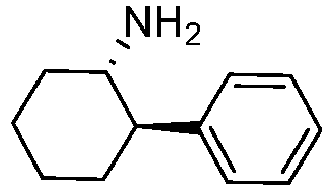
(1S,2R)-2-phenylcyclohexanamine 68I 
(1R,2S)-2-(4-fluorophenyl)cyclopentanamine 
- Methyl amine solution (2 mL, 40% solution in water) was added to (S)-methyl 2-amino-2-phenylacetate (0.1 g, 0.061 mmol) at 0°C and allowed to warm up to room temperature at which it was stirred for 3 h. LCMS analysis indicated the complete consumption of the starting material. Water was removed under reduced pressure to afford the crude compound which was directly taken to next step without purification. LC MS calc'd for C9H12N2O [M+H]+ 165; Found: 165.
- The following intermediates were made following protocol similar to intermediate 691 using the appropriate amines:
Table 11 Int. # Structure IUPAC Name 70I 
(S)-2-amino-N-ethyl-2-phenylacetamide 71I 
(S)-2-amino-N,N-diethyl-2-phenylacetamide 

- To a solution of benzofuran-3(2H)-one (1.0 g, 7.46 mmol) in pyridine (10 mL) was added NH2OH.HCl (1.0 g, 14.9 mmol) and the contents were stirred at the same temperature. After 2 h (progress of the reaction was monitored by TLC), pyridine was removed under reduced pressure and the residue thus obtained was taken up in CH2Cl2 (50 mL). The CH2Cl2 layer was washed successively with H2O (2 x 20 mL), brine (1 x 20 mL), dried over Na2SO4 and concentrated to afford the title compound. 1H NMR (CDCl3, 400MHz) δ 7.61 (d, J = 7.7 Hz, 1H), 7.40-7.34 (m, 1H), 7.03-6.96 (m, 2H), 5.19 (s, 2H). Anal. Calcd. C8H7NO2 149.2; Found 150.2 (M+H).
- To a solution of benzofuran-3(2H)-one oxime (1.0 g, 6.7 mmol) in MeOH (10 mL) was added 10% Pd on C (0.2 g) and the contents were stirred at ambient temperature in an atmosphere of H2 (balloon pressure). After 16 h, the reaction mixture was filtered through a pad of celite and the solvent MeOH was evaporated under reduced pressure to afford the title amine. 1H NMR (CDCl3, 400MHz) δ 7.34-7.20 (m, 2H), 6.95-6.82 (m, 2H), 4.70-4.59 (m, 2H), 4.22-4.18 (m, 1H).

- (E)-1-methyl-2-(2-nitrovinyl)benzene (1g, 6.13 mmol), acetone (2.250 ml, 30.6 mmol), DIEA (1.606 ml, 9.19 mmol) and 2-(methylamino)acetic acid (1.092 g, 12.26 mmol) were dissolved in Toluene (20 ml) in a 50 mL round bottom flask equipped with a Dean-Stark condenser and heated to reflux overnight. The mixture was cooled to rt, diluted with 10 mL dichloromethane, filtered through celite, and the solvents were removed in vacuo. The residue was purified on silica gel 5-50% EtOAc/Hexanes. Both products contained trace impurities and were re-purified on silica gel 2-15% EtOAc/DCM to provide 731 (3R,4R)+(3S,4R)-1,2,2-trimethyl-4-nitro-3-(o-tolyl)pyrrolidine and 74I (3R,4S)+(3S,4R)-1,2,2-trimethyl-3-nitro-4-(o-tolyl)pyrrolidine. (3R,4S)-1,2,2-trimethyl-3-nitro-4-(o-tolyl)pyrrolidine 731 1H NMR (600 MHz, cdcl3) δ 7.32 (d, J = 7.7, 1H), 7.22 - 7.16 (m, 1H), 7.11 (d, J = 4.1, 2H), 4.76 (d, J = 7.9, 1H), 4.42 (ddd, J = 5.8, 8.0, 9.3, 1H), 3.22 (t, J = 9.5, 1H), 2.86 (dd, J = 5.7, 9.6, 1H), 2.36 (s, 3H), 2.28 (s, 3H), 1.38 (s, 3H), 0.98 (s, 3H). and (3R,4R)-1,2,2-trimethyl-3-nitro-4-(o-tolyl)pyrrolidine 741 1H NMR (500 MHz, cdcl3) δ 7.24 - 7.13 (m, 4H), 5.16 (td, J = 4.2, 8.4, 1H), 4.16 (d, J = 7.8, 1H), 3.53 (dd, J = 4.0, 11.3, 1H), 3.26 (dd, J = 9.2, 11.1, 1H), 2.40 (s, 3H), 2.30 (s, 3H), 1.15 (s, 3H), 0.74 (s, 3H).
- Many compounds were prepared by the reaction of an isocyanate with a pyrazolo[3,4-c]pyridin-5-amine. This method is exemplified below for the synthesis of 1-(4-fluorobenzyl)-3-(1-(4-fluorophenyl)-1H-pyrazolo[3,4-c]pyridin-5-yl)urea, and was used for the preparation of example 2-13 utilizing suitable reagents.

- A preferred embodiment of the invention is all of the species exemplified in Examples 1-328. The ERK2 IC50 in nanomolar (nM) for the compounds of the invention, measured according to the assay "Active human ERK2 (hERK2) Activity Assay" described below, is shown in the Example next to the structure or compound name.
-
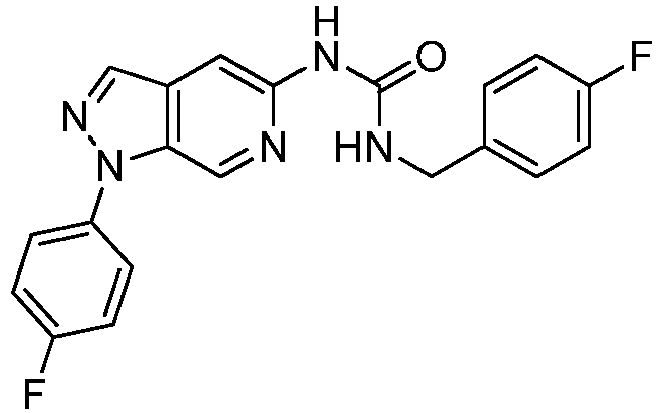
- A solution of 1-(4-fluorophenyl)-1H-pyrazolo[3,4-c]pyridin-5-amine (12 mg, 0.053 mmol) in dioxane (0.5 mL) was treated with Hunig's base (20 µL, 0.12 mmol) and 1-fluoro-4-(isocyanatomethyl)benzene (15 mg, 0.099 mmol). The reaction mixture was warmed to 80°C, stirred for 2 hours and concentrated to dryness. The residue was dissolved in 0.5 mL of DMSO and purified by reverse phase chromatography (MeCN/water with 0.1% TFA). The LC fractions were lyophilized to provide the TFA salt of 1-(4-fluorobenzyl)-3-(1-(4-fluorophenyl)-1H-pyrazolo[3,4-c]pyridin-5-yl)urea: MS (EI) calc'd for C20H16F2N5O [M+H]+ 380, found 380; 1H NNM (600 MHz, DMSO-d6 ) δ 9.17 (s, 1 H), 8.95 (s, 1 H), 8.39 (s, 1 H), 8.05 (s, 1 H), 7.84 (dd, J = 7.4, 4.7 Hz, 2 H), 7.47 (br s, 1 H), 7.39 (t, J = 8.5 Hz, 2 H), 7.33 (t, J = 6.8 Hz, 2 H), 7.13 (t, J = 7.6 Hz, 2 H), 4.32 (d, J = 5.2 Hz, 2 H).
- The following examples were made following protocol similar to example 1 using the appropriate reagent:
Table 12 EX Structure IUPAC Name / ERK2 IC 50 [M+H]+ 2 
1-benzyl-3-(1-pyridin-4-yl-1H-pyrazolo[3,4-c]pyridin-5-yl)urea 2.7nM Calc'd 345, found 345 3 
1-[(1R)-1-(4-fluorophenyl)ethyl]-3-[1-(4-fluorophenyl)-1H-pyrazolo[3,4-c]pyridin-5-yl]urea 10.6nM Calc'd 394, found 394 4 
1-(4-fluorobenzyl)-3-[1-(1-methyl-1H-pyrazol-4-yl)-1H-pyrazolo[3,4-c]pyridin-5-yl]urea 41.3nM Calc'd 366, found 366 5 
1-[(1R)-1-(4-fluorophenyl)ethyl]-3-[1-(1-methyl-1H-pyrazol-4-yl)-1H-pyrazolo[3,4-c]pyridin-5-yl]urea 12.2nM Calc'd 380, found 380 6 
1-(4-fluorobenzyl)-3-(1-pyridin-4-yl-1H-pyrazolo[3,4-c]pyridin-5-yl)urea 1.8nM Calc'd 363, found 363 7 
1-[(1R)-1-(4-fluorophenyl)ethyl]-3-(1-pyridin-4-yl-1H-pyrazolo[3,4-c]pyridin-5-yl)urea 16.2nM Calc'd 377, found 377 8 
1-(2-phenylethyl)-3-(1-pyridin-4-yl-1H-pyrazolo[3,4-c]pyridin-5-yl)urea 16.2nM Calc'd 359, found 359 9 
1-(4-methoxybenzyl)-3-(1-pyridin-4-yl-1H-pyrazolo[3,4-c]pyridin-5-yl)urea 5.3nM Calc'd 375, found 375 10 
1-(1-pyridin-4-yl-1H-pyrazolo[3,4-c]pyridin-5-yl)-3-(1,2,3,4-tetrahydronaphthalen-1-yl)urea 34.7nM Calc'd 385, found 385 11 
1-(2,4-dichlorobenzyl)-3-(1-pyridin-4-yl-1H-pyrazolo[3,4-c]pyridin-5-yl)urea 26nM Calc'd 413, found 413 12 
1-(3,4-dichlorobenzyl)-3-(1-pyridin-4-yl-1H-pyrazolo[3,4-c]pyridin-5-yl)urea 0.9nM Calc'd 413, found 413 13 
1-(3,4-dichlorobenzyl)-3-[1-(4-fluorophenyl)-1H-pyrazolo[3,4-c]pyridin-5-yl]urea 19.7nM Calc'd 430, found 430 -

-

- A solution of 1-(2-methylpyridin-4-yl)-1H-pyrazolo[3,4-c]pyridin-5-amine (25 mg, 0.11 mmol) in dioxane (1 mL) was treated with imidazole (40 mg, 0.59 mmol) and carbonyl diimidazole (100 mg, 0.62 mmol). The mixture was stirred for 3 hours. An aliquot was treated with methanol, and the presence of the corresponding methyl carbamate as observed by LC/MS was used to indicate consumption of the aminopyridine. Next, 1-(3-(trifluoromethoxy)phenyl)ethanamine (110 mg, 0.54 mmol) was added followed by TEA (0.10 mL, 0.72 mmol) and the mixture stirred for 2 hours, then concentrated to dryness. The residue was dissolved in DMSO and purified by reverse phase chromatography (MeCN/water with 0.1% TFA). The LC fractions were lyophilized to provide the TFA salt of 1-(1-(2-methylpyridin-4-yl)-1H-pyrazolo[3,4-c]pyridin-5-yl)-3-(1-(3-(trifluoromethoxy)-phenyl)ethyl)urea: MS (EI) calc'd for C22H20F3N6O2 [M+H]+ 457, found 457; 1H NMR (600 MHz, DMSO-d6 ) δ 9.40 (s, 1 H), 9.24 (s, 1 H), 8.70 (d, J = 6.5 Hz, 1 H), 8.68 (s, 1 H), 8.16 (s, 1 H), 8.14 (s, 1 H), 8.11 (d, J = 5.6 Hz, 1 H), 7.52 (d, J = 6.4 Hz, 1 H), 7.46 (t, J = 7.9 Hz, 1 H), 7.38 (d, J = 7.9 Hz, 1 H), 7.29 (s, 1 H), 7.21 (d, J = 7.6 Hz, 1 H), 4.91 (dt, J = 7.1 Hz, 1 H), 2.70 (s, 3 H), 1.40 (d, J = 7.1 Hz, 3 H).
-

- To a solution of 1-(2-methylpyridin-4-yl)-1H-pyrazolo[3,4-c]pyridin-5-amine 6I (0.04 g, 0.18 mmol) in anhydrous 1,4-dioxane (2 mL) was added CDI (0.15 g, 0.9 mmol) followed by the addition of imidazole (0.062 g, 0.9 mmol) and the contents were stirred at ambient temperature. After 16 h [the completion of the reaction was confirmed by quenching small aliquot of the reaction mixture with MeOH and mass was obtained for the corresponding carbamate (M+H) = 284], DIPEA (0.05 g, 0.36 mmol) and N,N-dimethyl ethylenediamine (0.016g, 0.18 mmol) were added and the contents were stirred. After 4 h, the reaction mixture was quenched with H2O and the organic contents were extracted with EtOAc (2 x 15 mL), dried over Na2SO4 and concentrated. The residue thus obtained was purified by flash column chromatography afforded the title compound. 1H NMR (MeOD, 400MHz) δ 9.24 (s, 1H), 8.57 (d, J = 6.0 Hz, 1H), 8.39 (m, 1H), 7.87-7.80 (m, 3H), 3.73-3.70 (m, 2H), 3.51-3.49 (m, 2H), 3.05 (s, 6H), 2.36 (s, 3H). Anal. Calcd. C17H21N7O (M+H) 340; Found 340.
- The following examples were made by using CDI coupling procedures similar to examples 14 or 15 with appropriate amines..
Table 13 Ex Structure IUPAC Name / ERK2 IC 50 [M+H]+ 16. 
1-[(3R,4S)-4-(2-chlorophenyl)-1-methylpyrrolidin-3-yl]-3-[1-(2-methylpyridin-4-yl)-1H-pyrazolo[3,4-c]pyridin-5-yl]urea 0.9521nM Calc'd 462, found 462 17. 
1-[1-(2-methylpyridin-4-yl)-1H-pyrazolo[3,4-c]pyridin-5-yl]-3-[(3R,4R)-4-phenyltetrahydrofuran-3-yl]urea 1.834nM Calc'd 415, found 415 18. 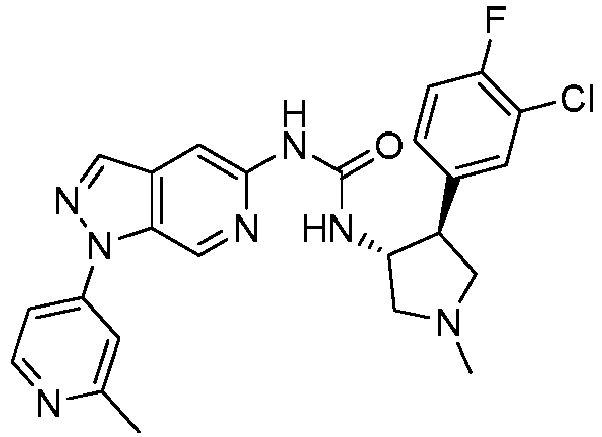
1-[(3R,4S)-4-(3-chloro-4-fluorophenyl)-1-methylpyrrolidin-3-yl]-3-[1-(2-methylpyridin-4-yl)-1H-pyrazolo[3,4-c]pyridin-5-yl]urea 2.143nM Calc'd 480, found 480 19. 
1-[(3R,4S)-4-(3-fluorophenyl)-1-methylpyrrolidin-3-yl]-3-[1-(2-methylpyridin-4-yl)-1H-pyrazolo[3,4-c]pyridin-5-yl]urea 3.067 Calc'd 446, found 446 20. 
1-[1-(2-methylpyridin-4-yl)-1H-pyrazolo[3,4-c]pyridin-5-yl]-3-[(3R)-1-methylpyrrolidin-3-yl]urea 50.47nM Calc'd 352, found 352 21. 
1-[1-(2-methylpyridin-4-yl)-1H-pyrazolo[3,4-c]pyridin-5-yl]-3-[(3S)-1-methylpyrrolidin-3-yl]urea 766.7nM Calc'd 352, found 352 22. 
1-(1-methyl-5-oxopyrrolidin-3-yl)-3-[1-(2-methylpyridin-4-yl)-1H-pyrazolo[3,4-c]pyridin-5-yl]urea 181nM Calc'd 366, found 366 23. 
1-(1-methyl-2-oxopyrrolidin-3-yl)-3-[1-(2-methylpyridin-4-yl)-1H-pyrazolo[3,4-c]pyridin-5-yl]urea 314nM Calc'd 366, found 366 24. 
1-[1-(2-methylpyridin-4-yl)-1H-pyrazolo[3,4-c]pyridin-5-yl]-3-{(3R,4S)-1-methyl-4-[(3S)-tetrahydro-2H-pyran-3-yl]pyrrolidin-3-yl}urea 139.9nM Calc'd 436, found 436 25. 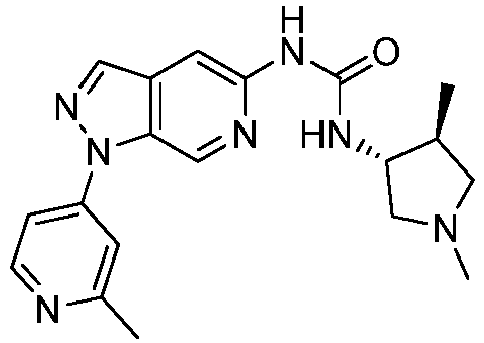
1-[(3R,4S)-1,4-dimethylpyrrolidin-3-yl]-3-[1-(2-methylpyridin-4-yl)-1H-pyrazolo[3,4-c]pyridin-5-yl]urea 66.37nM Calc'd 366, found 366 26. 
1-[(3R,5S)-1,5-dimethylpyrrolidin-3-yl]-3-[1-(2-methylpyridin-4-yl)-1H-pyrazolo[3,4-c]pyridin-5-yl]urea 274.9nM Calc'd 366.0, found 366 27. 
1-[1-(2-methylpyridin-4-yl)-1H-pyrazolo[3,4-c]pyridin-5-yl]-3-{[1-(2,2,2-trifluoro-1-methylethyl)azetidin-3-yl]methyl}urea 122.2nM Calc'd 434.0, found 434 28. 
1-[(3R)-1-ethylpyrrolidin-3-yl]-3-[1-(2-methylpyridin-4-yl)-1H-pyrazolo[3,4-c]pyridin-5-yl]urea 103.7nM Calc'd 366.0, found 366 29. 
1-[1-(2-methylpyridin-4-yl)-1H-pyrazolo[3,4-c]pyridin-5-yl]-3-[(3R)-1-propylpyrrolidin-3-yl]urea 453.3nM Calc'd 380.0, found 380 30. 
1-[(3R,4S)-4-cyclopropyl-1-methylpyrrolidin-3-yl]-3-[1-(2-methylpyridin-4-yl)-1H-pyrazolo[3,4-c]pyridin-5-yl]urea 109.5nM Calc'd 392.0, found 392 31. 
1-[(3R,4S)-4-cyclohexyl-1-methylpyrrolidin-3-yl]-3-[1-(2-methylpyridin-4-yl)-1H-pyrazolo[3,4-c]pyridin-5-yl]urea 35.14nM Calc'd 434.0, found 434 32. 
N-{3-[({[1-(2-methylpyridin-4-yl)-1H-pyrazolo[3,4-c]pyridin-5-yl]carbamoyl}amino)methyl ]phenyl}methanesulfonamid e 0.4419nM Calc'd 452.0, found 452 33. 
1-[(1S)-1-(4-fluorophenyl)-2-methoxyethyl]-3-[1-(2-methylpyridin-4-yl)-1H-pyrazolo[3,4-c]pyridin-5-yl]urea 590.4nM Calc'd 421.0, found 421 34. 
1-[(3R)-1-(4-fluorophenyl)pyrrolidin-3-yl]-3-[1-(2-methylpyridin-4-yl)-1H-pyrazolo[3,4-c]pyridin-5-yl]urea 762.4nM Calc'd 432, found 432 35. 
1-[1-(2-methyl-2H-indazol-5-yl)-1H-pyrazolo[3,4-c]pyridin-5-yl]-3-[1,3-oxazol-5-yl(phenyl)methyl]urea 1.562nM Calc'd 465, found 465 36. 
1-[(3R,4S) or (3S, 4R)-1-methyl-4-(2-methylphenyl)pyrrolidin-3-yl]-3-[1-(2-methylpyridin-4-yl)-1H-pyrazolo[3,4-c]pyridin-5-yl]urea 0.83nM Calc'd 442, found 442 37. 
1-benzyl-3-[1-(4-fluorophenyl)-1H-pyrazolo[3,4-c]pyridin-5-yl]urea 19.8nM Calc'd 362, found 362 38. 
1-(1-pyridin-4-yl-1H-pyrazolo[3,4-c]pyridin-5-yl)-3-[(1S)-2,2,2-trifluoro-1-phenylethyl]urea 19.4nM Calc'd 413, found 413 39. 
1-(pyridin-3-ylmethyl)-3-(1-pyridin-4-yl-1H-pyrazolo[3,4-c]pyridin-5-yl)urea 17.1nM Calc'd 346, found 346 40. 
1-[2-(2-fluorophenyl)ethyl]-3-(1-pyridin-4-yl-1H-pyrazolo[3,4-c]pyridin-5-yl)urea 9.2nM Calc'd 377, found 377 41. 
1-(3-chlorobenzyl)-3-(1-pyridin-4-yl-1H-pyrazolo[3,4-c]pyridin-5-yl)urea 0.4987nM Calc'd 379, found 379 42. 
1-(4-chlorobenzyl)-3-(1-pyridin-4-yl-1H-pyrazolo[3,4-c]pyridin-5-yl)urea 8.031nM Calc'd 379, found 379 43. 
1-[(1R)-1-(3-chlorophenyl)ethyl]-3-[1-(2-methylpyridin-4-yl)-1H-pyrazolo[3,4-c]pyridin-5-yl]urea 0.952nM Calc'd 407, found 407 44. 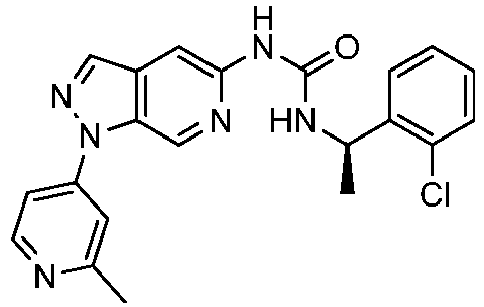
1-[(1R)-1-(2-chlorophenyl)ethyl]-3-[1-(2-methylpyridin-4-yl)-1H-pyrazolo[3,4-c]pyridin-5-yl]urea 15.64nM Calc'd 407, found 407 45. 
1-[1-(2-methylpyridin-4-yl)-1H-pyrazolo[3,4-c]pyridin-5-yl]-3-{1-[4-(1H-1,2,4-triazol-1-yl)phenyl]ethyl}urea 165.6nM Calc'd 440, found 440 46. 
1-(2,2-dimethyl-3,4-dihydro-2H-chromen-4-yl)-3-[1-(2-methylpyridin-4-yl)-1H-pyrazolo[3,4-c]pyridin-5-yl]urea 173.7nM Calc'd 429, found 429 47. 
1-[1-(2-methylpyridin-4-yl)-1H-pyrazolo[3,4-c]pyridin-5-yl]-3-{1-[4-(trifluoromethoxy)phenyl]et hyl}urea 40.34nM Calc'd 457, found 457 48. 
1-[1-(2-methylpyridin-4-yl)-1H-pyrazolo[3,4-c]pyridin-5-yl]-3-{1-[3-(trifluoromethoxy)phenyl]et hyl}urea 10.73nM Calc'd 457, found 457 49. 
1-(3-hydroxy-2-phenylpropyl)-3-[1-(2-methylpyridin-4-yl)-1H-pyrazolo[3,4-c]pyridin-5-yl]urea 7.66nM Calc'd 403, found 403 50. 
1-[1-(2-methylpyridin-4-yl)-1H-pyrazolo[3,4-c]pyridin-5-yl]-3-(2-phenyl-2-piperidin-1-ylethyl)urea 197.5nM Calc'd 456, found 456 51. 
1-[3-(dimethylamino)-1-phenylpropyl]-3-[1-(2-methylpyridin-4-yl)-1H-pyrazolo[3,4-c]pyridin-5-yl]urea 2.699nM Calc'd 430, found 430 52. 
1-[1-(2-methylpyridin-4-yl)-1H-pyrazolo[3,4-c]pyridin-5-yl]-3-[(4-phenyltetrahydro-2H-pyran-4-yl)methyl]urea 7.093nM Calc'd 443, found 443 53. 
1-[1-(2-methylpyridin-4-yl)-1H-pyrazolo[3,4-c]pyridin-5-yl]-3-(1-phenyl-3-piperidin-1-ylpropyl)urea 49.24nM Calc'd 470, found 470 54. 
1-[2-(4-fluorophenyl)-2-piperidin-1-ylethyl]-3-[1-(2-methylpyridin-4-yl)-1H-pyrazolo[3,4-c]pyridin-5-yl]urea 195nM Calc'd 474, found 474 55. 
1-[2-(4,4-difluoropiperidin-1-yl)-2-phenylethyl]-3-[1-(2-methylpyridin-4-yl)-1H-pyrazolo[3,4-c]pyridin-5-yl]urea 85.07nM Calc'd 492, found 492 56. 
1-[(3R)-1-(2-fluoro-6-methoxybenzyl)piperidin-3-yl]-3-[1-(2-methylpyridin-4-yl)-1H-pyrazolo[3,4-c]pyridin-5-yl]urea 0.5239nM Calc'd 490, found 490 57. 
1-(1-methyl-4-phenylpyrrolidin-3-yl)-3-[1-(2-methylpyridin-4-yl)-1H-pyrazolo[3,4-c]pyridin-5-yl]urea 0.8234nM Calc'd 428, found 428 58. 
1-benzyl-3-[1-(2-methylpyridin-4-yl)-1H-pyrazolo[3,4-c]pyridin-5-yl]urea 8.412nM Calc'd 359, found 359 59. 
1-[1-(2-methylpyridin-4-yl)-1H-pyrazolo[3,4-c]pyridin-5-yl]-3-[(1R)-1-phenylethyl]urea 1.008nM Calc'd 373, found 373 60. 
1-{[1-(4-fluorophenyl)-1H-pyrazol-4-yl]methyl}-3-[1-(2-methylpyridin-4-yl)-1H-pyrazolo[3,4-c]pyridin-5-yl]urea 1631nM Calc'd 443, found 443 61. 
1-(2,2-difluoro-2-phenylethyl)-3-[1-(2-methylpyridin-4-yl)-1H-pyrazolo[3,4-c]pyridin-5-yl]urea 193.1nM Calc'd 409, found 409 62. 
1-(2-amino-1-phenylethyl)-3-[1-(2-methylpyridin-4-yl)-1H-pyrazolo[3,4-c]pyridin-5-yl]urea 0.9615nM Calc'd 388, found 388 63. 
1-[1-(2-methylpyridin-4-yl)-1H-pyrazolo[3,4-c]pyridin-5-yl]-3-(4-phenylpyrrolidin-3-yl)urea 54.4nM Calc'd 414, found 414 64. 
1-[1-(2-methylpyridin-4-yl)-1H-pyrazolo[3,4-c]pyridin-5-yl]-3-(pyrazolo[1,5-a]pyridin-3-ylmethyl)urea 71.57nM Calc'd 399, found 399 65. 
1-[(1S)-2-hydroxy-1-phenylethyl]-3-[1-(2-methylpyridin-4-yl)-1H-pyrazolo[3,4-c]pyridin-5-yl]urea 1.017nM Calc'd 389, found 389 66. 
1-[1-(2-methylpyridin-4-yl)-1H-pyrazolo[3,4-c]pyridin-5-yl]-3-{1-[4-(methylsulfonyl)phenyl]eth yl}urea 7.78nM Calc'd 451, found 451 67. 
1-[1-(2-methylpyridin-4-yl)-1H-pyrazolo[3,4-c]pyridin-5-yl]-3-(5-phenylpyrrolidin-3-yl)urea 200.5nM Calc'd 414, found 414 68. 
1-{[4-methyl-2-(1-methylethyl)-1,3-thiazol-5-yl]methyl}-3-[1-(2-methylpyridin-4-yl)-1H-pyrazolo[3,4-c]pyridin-5-yl]urea 707.3nM Calc'd 422, found 422 69. 
1-[1-(2-methylpyridin-4-yl)-1H-pyrazolo[3,4-c]pyridin-5-yl]-3-[(3-phenyltetrahydrofuran-3-yl)methyl]urea 17.66nM Calc'd 429, found 429 70. 
1-[1-(2-methylpyridin-4-yl)-1H-pyrazolo[3,4-c]pyridin-5-yl]-3-[2-(5-phenyl-2,5-diazabicyclo[2.2.1]hept-2-yl)ethyl]urea 16.94nM Calc'd 469, found 469 71. 
1-[1-(2-methylpyridin-4-yl)-1H-pyrazolo[3,4-c]pyridin-5-yl]-3-{2-[2-(phenoxymethyl)morpholin-4-yl]ethyl}urea 647.7nM Calc'd 488, found 488 72. 
1-[3-(dimethylamino)-1-pyridin-2-ylpropyl]-3-[1-(2-methylpyridin-4-yl)-1H-pyrazolo[3,4-c]pyridin-5-yl]urea 10.19nM Calc'd 431, found 431 73. 
1-[1-(2-methylpyridin-4-yl)-1H-pyrazolo[3,4-c]pyridin-5-yl]-3-(2-morpholin-4-yl-2-pyridin-2-ylethyl)urea 242.9nM Calc'd 459, found 74. 
1-[1-(2-methylpyridin-4-yl)-1H-pyrazolo[3,4-c]pyridin-5-yl]-3-[(2-oxo-2,3-dihydro-1H-indol-5-yl)methyl]urea 73.07nM Calc'd 414, found 414 75. 
1-[1-(2-methylpyridin-4-yl)-1H-pyrazolo[3,4-c]pyridin-5-yl]-3-[3-(1H-pyrazol-1-yl)benzyl]urea 5.275nM Calc'd 425, found 425 76. 
1-[1-(2-methylpyridin-4-yl)-1H-pyrazolo[3,4-c]pyridin-5-yl]-3-[4-(1H-pyrazol-1-yl)benzyl]urea 1106nM Calc'd 425, found 425 77. 
1-(3-hydroxytricyclo[3.3.1.1∼3,7 ∼]dec-1-yl)-3-[1-(2-methylpyridin-4-yl)-1H-pyrazolo[3,4-c]pyridin-5-yl]urea 1876nM Calc'd 419, found 419 78. 
1-[1-(2-methylpyridin-4-yl)-1H-pyrazolo[3,4-c]pyridin-5-yl]-3-(1-phenylpiperidin-4-yl)urea 1741nM Calc'd 428, found 428 79. 
1-[1-(2-methylpyridin-4-yl)-1H-pyrazolo[3,4-c]pyridin-5-yl]-3-[(4-phenylmorpholin-2-yl)methyl]urea 26.54nM Calc'd 444, found 444 80. 
1-[1-(2-methylpyridin-4-yl)-1H-pyrazolo[3,4-c]pyridin-5-yl]-3-(2-oxo-1,2,3,4-tetrahydroquinolin-4-yl)urea 196.1nM Calc'd 414, found 414 81. 
1-[(1S)-2,2-difluoro-1-phenylethyl]-3-[1-(2-methylpyridin-4-yl)-1H-pyrazolo[3,4-c]pyridin-5-yl]urea 914.2nM Calc'd 409, found 409 82. 
1-[1-(2-methylpyridin-4-yl)-1H-pyrazolo[3,4-c]pyridin-5-yl]-3-(1-phenylpiperidin-3-yl)urea 7.607nM Calc'd 428, found 428 83. 
1-[1-(2-methylpyridin-4-yl)-1H-pyrazolo[3,4-c]pyridin-5-yl]-3-[2-(tetrahydrofuran-3-yl)ethyl]urea 64.67nM Calc'd 367, found 367 84. 
1-[1-(2-methylpyridin-4-yl)-1H-pyrazolo[3,4-c]pyridin-5-yl]-3-[(1-oxo-2,3-dihydro-1H-isoindol-5-yl)methyl]urea 17.44nM Calc'd 414, found 414 85. 
1-[2-(4-fluorophenoxy)ethyl]-3-[1-(2-methylpyridin-4-yl)-1H-pyrazolo[3,4-c]pyridin-5-yl]urea 15.93nM Calc'd 407, found 407 86. 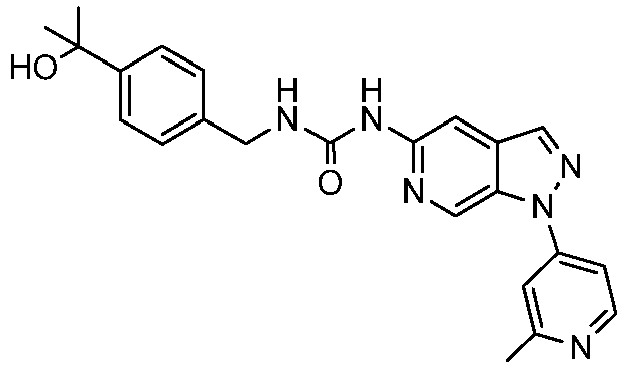
1-[4-(1-hydroxy-1-methylethyl)benzyl]-3-[1-(2-methylpyridin-4-yl)-1H-pyrazolo[3,4-c]pyridin-5-yl]urea 730.7nM Calc'd 417, found 417 87. 
1-[2-(2-fluorophenoxy)ethyl]-3-[1-(2-methylpyridin-4-yl)-1H-pyrazolo[3,4-c]pyridin-5-yl]urea 6.381nM Calc'd 407, found 407 88. 
1-[1-(2-methylpyridin-4-yl)-1H-pyrazolo[3,4-c]pyridin-5-yl]-3-(3,3,3-trifluoropropyl)urea 46.3nM Calc'd 365, found 365 89. 
1-[(1R)-3-hydroxy-1-phenylpropyl]-3-[1-(2-methylpyridin-4-yl)-1H-pyrazolo[3,4-c]pyridin-5-yl]urea 0.8211nM Calc'd 403, found 403 90. 
1-[(1S)-2-methoxy-1-phenylethyl]-3-[1-(2-methylpyridin-4-yl)-1H-pyrazolo[3,4-c]pyridin-5-yl]urea 0.6798nM Calc'd 403, found 403 91. 
1-[1-(2-methylpyridin-4-yl)-1H-pyrazolo[3,4-c]pyridin-5-yl]-3-[4-(2-oxopyrrolidin-1-yl)benzyl]urea 331.8nM Calc'd 442, found 442 92. 
N-methyl-4-[({[1-(2-methylpyridin-4-yl)-1H-pyrazolo[3,4-c]pyridin-5-yl]carbamoyl}amino)methyl ]benzamide 800.8nM Calc'd 416, found 416 93. 
1-[1-(2-methylpyridin-4-yl)-1H-pyrazolo[3,4-c]pyridin-5-yl]-3-[3-(methylsulfonyl)-benzyl]urea 1.443nM Calc'd 437, found 437 94. 
1-[1-(2-methylpyridin-4-yl)-1H-pyrazolo[3,4-c]pyridin-5-yl]-3-[3-(1,3-oxazol-2-yl)benzyl]urea 13.26nM Calc'd 426, found 426 95. 
1-[2-(benzyloxy)ethyl]-3-[1-(2-methylpyridin-4-yl)-1H-pyrazolo[3,4-c]pyridin-5-yl]urea 5.401nM Calc'd 403, found 403 96. 
1-[2-(benzylamino)ethyl]-3-[1-(2-methylpyridin-4-yl)-1H-pyrazolo[3,4-c]pyridin-5-yl]urea 19.07nM Calc'd 402, found 402 97. 
N-methyl-3-[({[1-(2-methylpyridin-4-yl)-1H-pyrazolo[3,4-c]pyridin-5-yl]carbamoyl}amino)methyl ]benzamide 3.389nM Calc'd 416, found 416 98. 
1-(3-isoxazol-3-ylbenzyl)-3-[1-(2-methylpyridin-4-yl)-1H-pyrazolo[3,4-c]pyridin-5-yl]urea 1.683nM Calc'd 426, found 426 99. 
1-[1-(2-methylpyridin-4-yl)-1H-pyrazolo[3,4-c]pyridin-5-yl]-3-[(1-methyl-1,2,3,4-tetrahydroquinolin-3-yl)methyl]urea 2.314nM Calc'd 428, found 428 100. 
1-{[1-(dimethylamino)cyclohexyl] methyl}-3-[1-(2-methylpyridin-4-yl)-1H-pyrazolo[3,4-c]pyridin-5-yl]urea 1210nM Calc'd 408, found 408 101. 
1-[(2S,3S,4R)-1,2-dimethyl-4-(2-methylphenyl)-pyrrolidin-3-yl]-3-[1-(2-methylpyridin-4-yl)-1H-pyrazolo[3,4-c]pyridin-5-yl]urea 0.4999nM Calc'd 456, found 456 102. 
1-[1-(2-methylpyridin-4-yl)-1H-pyrazolo[3,4-c]pyridin-5-yl]-3-[(3S,4R)-1,2,2-trimethyl-4-(2-methylphenyl)pyrrolidin-3-yl]urea 234.6nM Calc'd 470, found 470 103. 
1-[1-(2-methylpyridin-4-yl)-1H-pyrazolo[3,4-c]pyridin-5-yl]-3-[(3S,4S)-1,5,5-trimethyl-4-(2-methylphenyl)pyrrolidin-3-yl]urea 1.139nM Calc'd 470, found 470 104. 
1-[(2R,3S,4R)-1,2-dimethyl-4-(2-methylphenyl)pyrrolidin-3-yl]-3-[1-(2-methylpyridin-4-yl)-1H-pyrazolo[3,4-c]pyridin-5-yl]urea 35.47nM Calc'd 456, found 456 105. 
1-[(3S,4S,5S)-1,5-dimethyl-4-(2-methylphenyl)-pyrrolidin-3-yl]-3-[1-(2-methylpyridin-4-yl)-1H-pyrazolo[3,4-c]pyridin-5-yl]urea 2.147nM Calc'd 456, found 456 106. 
1-[(3S,4S,5R)-1,5-dimethyl-4-(2-methylphenyl)-pyrrolidin-3-yl]-3-[1-(2-methylpyridin-4-yl)-1H-pyrazolo[3,4-c]pyridin-5-yl]urea 1.521nM Calc'd 456, found 456 107. 
1-[(7R,8S)-5-methyl-7-phenyl-2-oxa-5-azaspiro[3.4]oct-8-yl]-3-[1-(2-methylpyridin-4-yl)-1H-pyrazolo[3,4-c]pyridin-5-yl]urea 9.035nM Calc'd 470, found 470 108. 
1-[(1-methyl-1H-imidazol-4-yl)methyl]-3-[1-(2-methylpyridin-4-yl)-1H-pyrazolo[3,4-c]pyridin-5-yl]urea 284.5nM Calc'd 363, found 363 109. 
1-[1-(2-methylpyridin-4-yl)-1H-pyrazolo[3,4-c]pyridin-5-yl]-3-(2-morpholin-4-ylethyl)urea 627.4nM Calc'd 382, found 382 110. 
1-(2-fluoroethyl)-3-[1-(2-methylpyridin-4-yl)-1H-pyrazolo[3,4-c]pyridin-5-yl]urea 106.3nM Calc'd 315, found 315 111. 
1-(2-methoxyethyl)-3-[1-(2-methylpyridin-4-yl)-1H-pyrazolo[3,4-c]pyridin-5-yl]urea 81.77nM Calc'd 327, found 327 112. 
1-[1-(2-methylpyridin-4-yl)-1H-pyrazolo[3,4-c]pyridin-5-yl]-3-[(3S,4R)-1-methyl-4-pyridin-3-ylpyrrolidin-3-yl]urea 48.7nM Calc'd 429, found 429 113. 
1-[(3R,4S)-1-methyl-4-(3-methylthiophen-2-yl)pyrrolidin-3-yl]-3-[1-(2-methylpyridin-4-yl)-1H-pyrazolo[3,4-c]pyridin-5-yl]urea 7.109nM Calc'd 448, found 448 114. 
1-[(5-methyl-3-phenyl-isoxazol-4-yl)methyl]-3-[1-(2-methylpyridin-4-yl)-1H-pyrazolo[3,4-c]pyridin-5-yl]urea 2.136nM Calc'd 440, found 440 115. 
1-[(3R,4S)-1-methyl-4-(2-phenylethyl)pyrrolidin-3-yl]-3-[1-(2-methylpyridin-4-yl)-1H-pyrazolo[3,4-c]-pyridin-5-yl]urea 0.6885nM Calc'd 456, found 456 116. 
1-[1-(2-methylpyridin-4-yl)-1H-pyrazolo[3,4-c]pyridin-5-yl]-3-[(1,3,5-trimethyl-1H-pyrazol-4-yl)methyl]urea 27.56nM Calc'd 391, found 391 117. 
1-[2-(3,5-dimethylisoxazol-4-yl)ethyl]-3-[1-(2-methylpyridin-4-yl)-1H-pyrazolo[3,4-c]pyridin-5-yl]urea 16.38nM Calc'd 392, found 392 118. 
1-[(4-methyl-1,2,5-oxadiazol-3-yl)methyl]-3-[1-(2-methylpyridin-4-yl)-1H-pyrazolo[3,4-c]pyridin-5-yl]urea 5.383nM Calc'd 365, found 365 119. 
1-[(1,3-dimethyl-1H-pyrazol-5-yl)methyl]-3-[1-(2-methylpyridin-4-yl)-1H-pyrazolo[3,4-c]pyridin-5-yl]urea 96.62nM Calc'd 377, found 377 120. 
1-(2-hydroxypropyl)-3-[1-(2-methylpyridin-4-yl)-1H-pyrazolo[3,4-c]pyridin-5-yl]urea 107.5nM Calc'd 327, found 327 121. 
1-(1-cyanocyclopropyl)-3-[1-(2-methylpyridin-4-yl)-1H-pyrazolo[3,4-c]pyridin-5-yl]urea 1806nM Calc'd 334, found 334 122. 
1-(1-methyl-1-phenylethyl)-3-[1-(2-methylpyridin-4-yl)-1H-pyrazolo[3,4-c]pyridin-5-yl]urea 56.81nM Calc'd 387, found 387 123. 
1-[1-(2-methylpyridin-4-yl)-1H-pyrazolo[3,4-c]pyridin-5-yl]-3-[1-(2-methyl-1,3-thiazol-4-yl)ethyl]urea 24.77nM Calc'd 394, found 394 124. 
1-[(3S,4R)-1-methyl-4-(5-methylthiophen-2-yl)pyrrolidin-3-yl]-3-[1-(2-methylpyridin-4-yl)-1H-pyrazolo[3,4-c]pyridin-5-yl]urea 1.01nM Calc'd 448, found 448 125. 
1-(1-benzothiophen-3-ylmethyl)-3-[1-(2-methylpyridin-4-yl)-1H-pyrazolo[3,4-c]pyridin-5-yl]urea 84.46nM Calc'd 415, found 415 126. 
1-[(3S,4R)-1-methyl-4-(4-methyl-1,3-thiazol-2-yl)pyrrolidin-3-yl]-3-[1-(2-methylpyridin-4-yl)-1H-pyrazolo[3,4-c]pyridin-5-yl]urea 15.8nM Calc'd 449, found 449 127. 
1-[1-(2-methylpyridin-4-yl)-1H-pyrazolo[3,4-c]pyridin-5-yl]-3-[(1S)-2-morpholin-4-yl-1-phenylethyl]urea 151.8nM Calc'd 458, found 458 128. 
1-[1-(2-methylpyridin-4-yl)-1H-pyrazolo[3,4-c]pyridin-5-yl]-3-[1-(2-methyl-1,3-thiazol-4-yl)ethyl]urea 2030nM Calc'd 394, found 394 129. 
1-[(1S)-2-ethoxy-1-phenylethyl]-3-[1-(2-methylpyridin-4-yl)-1H-pyrazolo[3,4-c]pyridin-5-yl]urea 1.09nM Calc'd 417, found 417 130. 
1-[(1S)-2-(dimethylamino)-1-phenylethyl]-3-[1-(2-methylpyridin-4-yl)-1H-pyrazolo[3,4-c]pyridin-5-yl]urea 122.6nM Calc'd 416, found 416 131. 
1-[1-(2-methylpyridin-4-yl)-1H-pyrazolo[3,4-c]pyridin-5-yl]-3-[1-(2-methyl-1,3-thiazol-4-yl)ethyl]urea 10.91nM Calc'd 394, found 394 132. 
1-[(3S,4S)-4-methoxypyrrolidin-3-yl]-3-[1-(2-methylpyridin-4-yl)-1H-pyrazolo[3,4-c]pyridin-5-yl]urea 168.2nM Calc'd 368, found 368 133. 
1-[1-(2-methylpyridin-4-yl)-1H-pyrazolo[3,4-c]pyridin-5-yl]-3-pyrrolidin-3-ylurea 455.5nM Calc'd 338, found 338 134. 
1-[(1S)-2-(1H-imidazol-1-yl)-1-phenylethyl]-3-[1-(2-methylpyridin-4-yl)-1H-pyrazolo[3,4-c]pyridin-5-yl]urea 474.7nM Calc'd 439, found 439 135. 
1-[(1S)-2-(1-methylethoxy)-1-phenylethyl]-3-[1-(2-methylpyridin-4-yl)-1H-pyrazolo[3,4-c]pyridin-5-yl]urea 0.7862nM Calc'd 431, found 431 136. 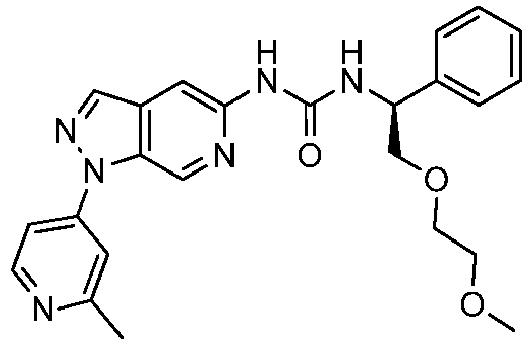
1-[(1S)-2-(2-methoxyethoxy)-1-phenylethyl]-3-[1-(2-methylpyridin-4-yl)-1H-pyrazolo[3,4-c]pyridin-5-yl]urea 4.387nM Calc'd 447, found 447 137. 
methyl (2S)-({[1-(2-methylpyridin-4-yl)-1H-pyrazolo[3,4-c]pyridin-5-yl]carbamoyl}amino)(pheny l)ethanoate 857nM Calc'd 417, found 138. 
1-[(1S,2S)-2-aminocyclohexyl]-3-[1-(2-methylpyridin-4-yl)-1H-pyrazolo[3,4-c]pyridin-5-yl]urea 395.6nM Calc'd 366, found 366 139. 
N-[(1S,2S)-2-({[1-(2-methylpyridin-4-yl)-1H-pyrazolo[3,4-c]pyridin-5-yl]carbamoyl}amino)cycloh exyl]acetamide 2164nM Calc'd 408, found 408 140. 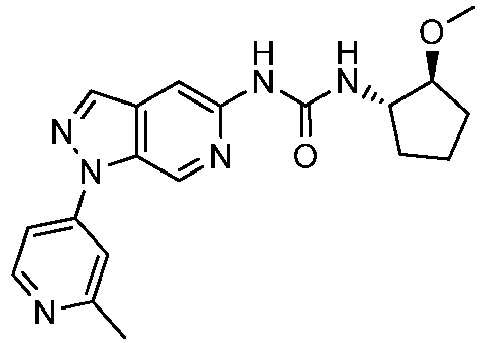
1-[(1S,2S)-2-methoxycyclopentyl]-3-[1-(2-methylpyridin-4-yl)-1H-pyrazolo[3,4-c]pyridin-5-yl]urea 72.14nM Calc'd 367, found 367 141. 
(2S)-N-ethyl-2-({[1-(2-methylpyridin-4-yl)-1H-pyrazolo[3,4-c]pyridin-5-yl]carbamoyl}amino)-2-phenylethanamide 2.575nM Calc'd 430, found 430 142. 
(2S)-N-methyl-2-({[1-(2-methylpyridin-4-yl)-1H-pyrazolo[3,4-c]pyridin-5-yl]carbamoyl}amino)-2-phenylethanamide 1.09nM Calc'd 416, found 416 143. 
1-[(1S,2S)-2-(dimethylamino)cyclohexyl] -3-[1-(2-methylpyridin-4-yl)-1H-pyrazolo[3,4-c]pyridin-5-yl]urea 127.3nM Calc'd 394, found 394 144. 
(2S)-N,N-diethyl-2-({[1-(2-methylpyridin-4-yl)-1H-pyrazolo[3,4-c]pyridin-5-yl]carbamoyl}amino)-2-phenylethanamide 89.32nM Calc'd 458, found 458 145. 
Racemic 1-[(1S,2S) and (1R,2R)-2-methoxycyclohexyl]-3-[1-(2-methylpyridin-4-yl)-1H-pyrazolo[3,4-c]pyridin-5-yl]urea 121.9nM Calc'd 381, found 381 146. 
Racemic 1-[(1S,2S) and (1R,2R) -2-ethoxycyclohexyl]-3-[1-(2-methylpyridin-4-yl)-1H-pyrazolo[3,4-c]pyridin-5-yl]urea 179.5nM Calc'd 395, found 395 147. 
Racemic 1-[(1S,2S) and (1R,2R)-2-ethoxycyclopentyl]-3-[1-(2-methylpyridin-4-yl)-1H-pyrazolo[3,4-c]pyridin-5-yl]urea 33.66nM Calc'd 381, found 381 148. 
Racemic 1-[1-(2-methylpyridin-4-yl)-1H-pyrazolo[3,4-c]pyridin-5-yl]-3-[(1S,2S) and (1R, 2R)-2-phenylcyclopentyl]urea 7.928nM Calc'd 413, found 413 149. 
1-[(3R,4S)-1-methyl-4-(3-phenylpropyl)pyrrolidin-3-yl]-3-[1-(2-methylpyridin-4-yl)-1H-pyrazolo[3,4-c]pyridin-5-yl]urea 1.178nM Calc'd 470, found 470 150. 
1-[(3R,4S)-1-methyl-4-(5-methylisoxazol-3-yl)pyrrolidin-3-yl]-3-[1-(2-methylpyridin-4-yl)-1H-pyrazolo[3,4-c]pyridin-5-yl]urea 32.57nM Calc'd 433, found 151. 
Racemic trans 1-[1-(2-methylpyridin-4-yl)-1H-pyrazolo[3,4-c]pyridin-5-yl]-3-[(1S,2R) and (1R,2S)-2-phenylcyclohexyl]urea 3.653nM Calc'd 427, found 427 152. 
Racemic Trans N-[(1S,2S) and (1R, 2R)-2-({[1-(2-methylpyridin-4-yl)-1H-pyrazolo[3,4-c]pyridin-5-yl]carbamoyl}amino)cycloh exyl]benzamide 711.2nM Calc'd 470, found 470 153. 
Racemic cis 1-[(1S,2S) and (1R,2R)-2-(4-fluorophenyl)cyclopentyl]-3-[1-(2-methylpyridin-4-yl)-1H-pyrazolo[3,4-c]pyridin-5-yl]urea 42.3nM Calc'd 431, found 431 154. 
1-[(1S,2S)-2-(benzyloxy)cyclopentyl]-3-[1-(2-methylpyridin-4-yl)-1H-pyrazolo[3,4-c]pyridin-5-yl]urea 7.515nM Calc'd 443, found 443 155. 
1-[(3R,4S)-1-methyl-4-(5-phenylthiophen-2-yl)pyrrolidin-3-yl]-3-[1-(2-methylpyridin-4-yl)-1H-pyrazolo[3,4-c]pyridin-5-yl]urea 590.9nM Calc'd 510, found 510 156. 
1-[1-(2-methylpyridin-4-yl)-1H-pyrazolo[3,4-c]pyridin-5-yl]-3-[(3R,4S)-4-phenyl-1-(2,2,2-trifluoroethyl)pyrrolidin-3-yl]urea 8.854nM Calc'd 496, found 496 157. 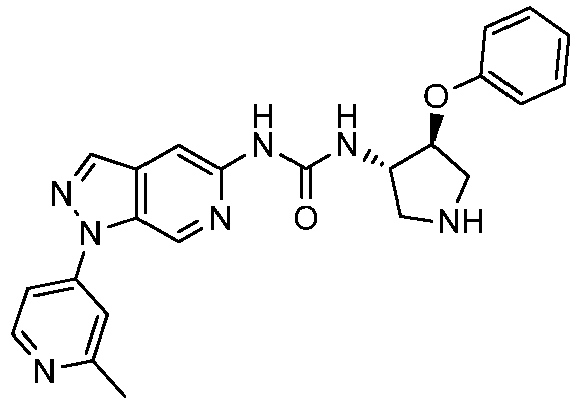
1-[1-(2-methylpyridin-4-yl)-1H-pyrazolo[3,4-c]pyridin-5-yl]-3-[(3S,4S)-4-phenoxypyrrolidin-3-yl]urea 35.29nM Calc'd 430, found 430 158. 
1-[(3S,4S)-1-methyl-4-phenoxypyrrolidin-3-yl]-3-[1-(2-methylpyridin-4-yl)-1H-pyrazolo[3,4-c]pyridin-5-yl]urea 20.5nM Calc'd 444, found 444 159. 
1-[1-(2-methylpyridin-4-yl)-1H-pyrazolo[3,4-c]pyridin-5-yl]-3-[phenyl(tetrahydrofuran-2-yl)methyl]urea 2.489nM Calc'd 429, found 429 160. 
1-[(1S,2S)-2-benzylcyclopentyl]-3-[1-(2-methylpyridin-4-yl)-1H-pyrazolo[3,4-c]pyridin-5-yl]urea 13.88nM Calc'd 427, found 427 161. 
1-[1-(2-methylpyridin-4-yl)-1H-pyrazolo[3,4-c]pyridin-5-yl]-3-[(1S,2S)-2-phenoxycyclopentyl]urea 13.45nM Calc'd 429, found 429 162. 
Racemic trans 1-[1-(2-methylpyridin-4-yl)-1H-pyrazolo[3,4-c]pyridin-5-yl]-3-[(1S,2S)and (1R,2R)-2-(3-phenylpropoxy)cyclopentyl] urea 205nM Calc'd 471, found 471 163. 
1-[(1S,2R)-2-benzylcyclohexyl]-3-[1-(2-methylpyridin-4-yl)-1H-pyrazolo[3,4-c]pyridin-5-yl]urea 39.38nM Calc'd 441, found 441 164. 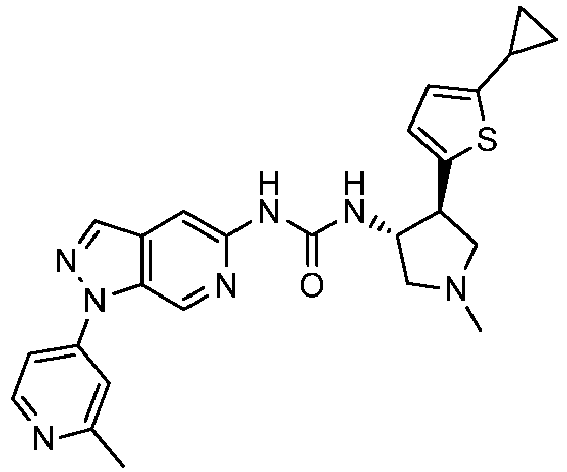
1-[(3R,4S)-4-(5-cyclopropylthiophen-2-yl)-1-methylpyrrolidin-3-yl]-3-[1-(2-methylpyridin-4-yl)-1H-pyrazolo[3,4-c]pyridin-5-yl]urea 1.13nM Calc'd 474, found 474 165. 
1-[(3R,4S)-1-methyl-4-(1-methyl-1H-pyrazol-4-yl)pyrrolidin-3-yl]-3-[1-(2-methylpyridin-4-yl)-1H-pyrazolo[3,4-c]pyridin-5-yl]urea 831.3nM Calc'd 432, found 432 166. 
Racemic trans 1-[(1S,2S) and (1R,2R)-2-(4-fluorophenoxy)cyclopentyl] -3-[1-(2-methylpyridin-4-yl)-1H-pyrazolo[3,4-c]-pyridin-5-yl]urea 66.57nM Calc'd 447, found 447 167. 
Racemic cis 1-[(1S,2S) and (1R,2R)-2-benzylcyclohexyl]-3-[1-(2-methylpyridin-4-yl)-1H-pyrazolo[3,4-c]pyridin-5-yl]urea 23.15nM Calc'd 441, found 441 168. 
Racemic trans 1-[1-(2-methylpyridin-4-yl)-1H-pyrazolo[3,4-c]pyridin-5-yl]-3-[(1S,2R) and (1R,2S)-2-phenylcyclopentyl]urea 7.339nM Calc'd 413, found 413 169. 
Racemic trans 1-[1-(2-methylpyridin-4-yl)-1H-pyrazolo[3,4-c]pyridin-5-yl]-3-[(1S,2R) and (1R,2S)-2-phenylcyclohexyl]urea 65.68nM Calc'd 427, found 427 170. 
1-[3-(4-fluorophenyl)cyclopentyl]-3-[1-(2-methylpyridin-4-yl)-1H-pyrazolo[3,4-c]pyridin-5-yl]urea 196.5nM Calc'd 431, found 431 171. 
1-[1-(2-methylpyridin-4-yl)-1H-pyrazolo[3,4-c]pyridin-5-yl]-3-(3-phenyl-cyclohexyl)urea 2.846nM Calc'd 427, found 427 172. 
1-(3,4-dihydro-2H-chromen-4-yl)-3-[1-(2-methylpyridin-4-yl)-1H-pyrazolo[3,4-c]pyridin-5-yl]urea 40.7nM Calc'd 401, found 401 173. 
1-[3-(4-fluorophenyl)cyclohexyl]-3-[1-(2-methylpyridin-4-yl)-1H-pyrazolo[3,4-c]pyridin-5-yl]urea 11.61nM Calc'd 445, found 445 174. 
Racemic cis 1-[(1S,2S) and (1R,2R)-2-(4-fluorophenyl)cyclohexyl]-3-[1-(2-methylpyridin-4-yl)-1H-pyrazolo[3,4-c]pyridin-5-yl]urea 19.14nM Calc'd 445, found 445 175. 
1-[1-(2-methylpyridin-4-yl)-1H-pyrazolo[3,4-c]pyridin-5-yl]-3-(3-phenylcyclohexyl)urea Calc'd 427, found 427 176. 
1-[3-(4-fluorophenyl)cyclohexyl]-3-[1-(2-methylpyridin-4-yl)-1H-pyrazolo[3,4-c]pyridin-5-yl]urea Calc'd 445, found 445 177. 
1-(2,3-dihydro-1-benzofuran-3-yl)-3-[1-(2-methylpyridin-4-yl)-1H-pyrazolo[3,4-c]pyridin-5-yl]urea 215.3nM Calc'd 387, found 387 178. 
1-[1-(2-methylpyridin-4-yl)-1H-pyrazolo[3,4-c]pyridin-5-yl]-3-(3-phenylcyclopentyl)urea 37.13nM Calc'd 413, found 413 179. 
1-[1-(2-methylpyridin-4-yl)-1H-pyrazolo[3,4-c]pyridin-5-yl]-3-[(1S,2S)-2-(pyridin-3-yloxy)cyclopentyl]urea 511.2nM Calc'd 430, found 430 -

- The enantiomers of 1-[(3R or 3S,4S or 4R)-1-methyl-4-(2-methylphenyl)pyrrolidin-3-yl]-3-[1-(2-methylpyridin-4-yl)-1H-pyrazolo[3,4-c]pyridin-5-yl]urea (30.2mg, 0.045 mmol) were separated by SFC (Thar80, Column: Chiral Technology AS-H 2.1 X 25cm, 5uM, UV wavelength: 220 nM, mobile phase: 25% / 75% Methanol + 0.25% dimethyl ethylamine/CO2(1), flow rate: 70 mL/Min, 7 min run time). Elution was observed at 4.93 min. The fractions were collected and the solvent evaporated in vacuo to afford 1-[(3R,4S)-1-methyl-4-(2-methylphenyl)pyrrolidin-3-yl]-3-[1-(2-methylpyridin-4-yl)-1H-pyrazolo[3,4-c]pyridin-5-yl]urea. MS ESI calc'd. for C25H28N7O [M+1]+ 442, found 442. 1H NMR (500 MHz, DMSO-d6) δ 1H NMR (500 MHz, DMSO-d6) δ 9.24 (s, 1H), 9.05 (s, 1H), 8.54 (d, J = 5.6, 1H), 8.49 (s, 1H), 8.04 (s, 1H), 7.78 (d, J = 2.0, 1H), 7.72 (dt, J = 3.5, 7.1, 1H), 7.38 (m, 2H), 7.17 (t, J = 7.4, 1H), 7.13 - 7.04 (m, 2H), 4.30 - 4.19 (m, 1H), 3.40 - 3.33 (m, 1H), 3.04 (t, J = 8.8, 1H), 2.92 (m, 1H), 2.58 (s, 3H), 2.56 - 2.51 (m, 1H), 2.36 (m, 1H), 2.30 (s, 6H).
- The following examples were purified using chiral separation technique similar to example 180.
Table 14 Ex Structure IUPAC Name / ERK2 IC 50 [M+H]+ 181 
1-((3S, 4R)1-methyl-4-phenyl-pyrrolidin-3-yl)-3-[1-(2-methyl-pyridin-4-yl)-1H-pyrazolo[3,4-c]pyridin-5-yl]urea 0.983nM Calc'd 428, found 428 182. 
1-((3R,4S)1-methyl-4-phenyl-pyrrolidin-3-yl)-3-[1-(2-methy-lpyridin-4-yl)-1H-pyrazolo[3,4-c]pyridin-5-yl]urea 59.73nM Calc'd 428, found 428 183. 
1-[(7R,8S)-5-methyl-7-phenyl-2-oxa-5-azaspiro[3.4]oct-8-yl]-3-[1-(2-methylpyridin-4-yl)-1H-pyrazolo[3,4-c]pyridin-5-yl]urea 12.16nM Calc'd 470, found 470 184. 
1-[(7S,8R)-5-methyl-7-phenyl-2-oxa-5-azaspiro[3.4]oct-8-yl]-3-[1-(2-methylpyridin-4-yl)-1H-pyrazolo[3,4-c]pyridin-5-yl]urea 873.3nM Calc'd 470, found 470 185. 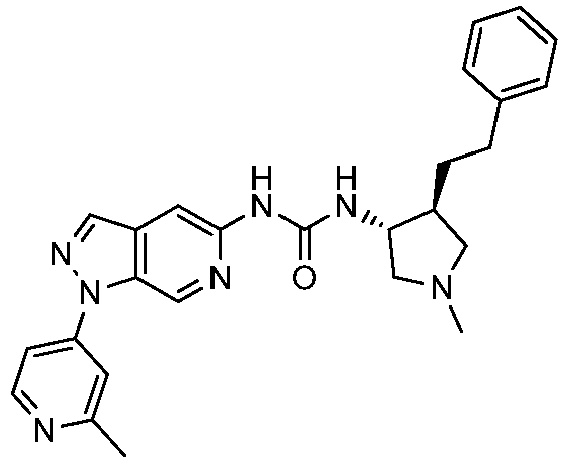
1-[(3R,4S)-1-methyl-4-(2-phenylethyl)pyrrolidin-3-yl]-3-[1-(2-methylpyridin-4-yl)-1H-pyrazolo[3,4-c]pyridin-5-yl]urea 0.1822nM Calc'd 456, found 456 186. 
1-[(1R)-2-amino-1-phenylethyl]-3-[1-(2-methylpyridin-4-yl)-1H-pyrazolo[3,4-c]pyridin-5-yl]urea 42.54nM Calc'd 388, found 388 187. 
1-[(1S)-2-amino-1-phenylethyl]-3-[1-(2-methylpyridin-4-yl)-1H-pyrazolo[3,4-c]pyridin-5-yl]urea 0.6854nM Calc'd 388, found 388 188. 
1-[(3S,4R)-1-methyl-4-(5-methylthiophen-2-yl)pyrrolidin-3-yl]-3-[1-(2-methylpyridin-4-yl)-1H-pyrazolo[3,4-c]pyridin-5-yl]urea 70.1nM Calc'd 448, found 448 189. 
1-[(3R,4S)-1-methyl-4-(5-methylthiophen-2-yl)pyrrolidin-3-yl]-3-[1-(2-methylpyridin-4-yl)-1H-pyrazolo[3,4-c]pyridin-5-yl]urea 0.254nM Calc'd 448, found 448 - The following examples were made by using procedures similar to example 14 and 15 followed by chiral purification as exemplified by example 180.
Table 15 EX Structure IUPAC Name / ERK2 IC 50 [M+H]+ 190. 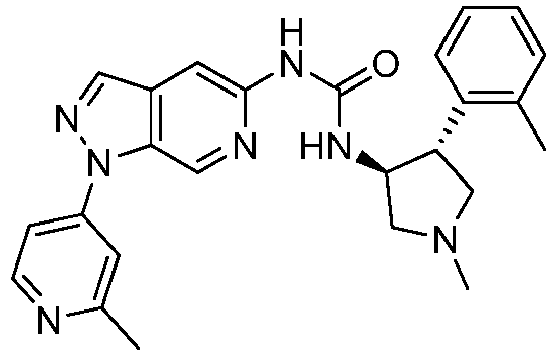
1-[(3S,4R)-1-methyl-4-(2-methylphenyl)pyrrolidin-3-yl]-3-[1-(2-methylpyridin-4-yl)-1H-pyrazolo[3,4-c]pyridin-5-yl]urea 11.7nM Calc'd 442, found 442 191. 
1-[1-(2-methylpyridin-4-yl)-1H-pyrazolo[3,4-c]pyridin-5-yl]-3-{(3R,4S)-1-methyl-4-[2-(trifluoromethyl)-phenyl]pyrrolidin-3-yl}urea 0.5091nM Calc'd 496, found 496 192. 
1-[1-(2-methylpyridin-4-yl)-1H-pyrazolo[3,4-c]pyridin-5-yl]-3-{(3S,4R)-1-methyl-4-[2-(trifluoromethyl)-phenyl]pyrrolidin-3-yl}urea 235.3nM Calc'd 496, found 496 193. 
1-[(3S,4S)-4-methoxy-1-methylpyrrolidin-3-yl]-3-[1-(2-methylpyridin-4-yl)-1H-pyrazolo[3,4-c]pyridin-5-yl]urea 2531nM Calc'd 382, found 382 194. 
1-[(3R,4R)-4-methoxy-1-methylpyrrolidin-3-yl]-3-[1-(2-methylpyridin-4-yl)-1H-pyrazolo[3,4-c]pyridin-5-yl]urea 47.66nM Calc'd 382, found 382 195. 
1-[(3R,4S)-1-cyclobutyl-4-phenylpyrrolidin-3-yl]-3-[1-(2-methylpyridin-4-yl)-1H-pyrazolo[3,4-c]pyridin-5-yl]urea 3.598nM Calc'd 468, found 468 196. 
1-[(3S,4R)-1-cyclobutyl-4-phenylpyrrolidin-3-yl]-3-[1-(2-methylpyridin-4-yl)-1H-pyrazolo[3,4-c]pyridin-5-yl]urea 354.1nM Calc'd 468, found 468 197. 
1-[(3S,4R)-1-(1-methylethyl)-4-phenylpyrrolidin-3-yl]-3-[1-(2-methylpyridin-4-yl)-1H-pyrazolo[3,4-c]-pyridin-5-yl]urea 60.76nM Calc'd 456, found 456 198. 
1-[(3R,4S)-1-(1-methylethyl)-4-phenylpyrrolidin-3-yl]-3-[1-(2-methylpyridin-4-yl)-1H-pyrazolo[3,4-c]pyridin-5-yl]urea 2.637nM Calc'd 456, found 456 199. 
1-[(3R,4S)-1-ethyl-4-phenylpyrrolidin-3-yl]-3-[1-(2-methylpyridin-4-yl)-1H-pyrazolo[3,4-c]pyridin-5-yl]urea 0.7184nM Calc'd 442, found 442 200. 
1-[(3S,4R)-1-ethyl-4-phenylpyrrolidin-3-yl]-3-[1-(2-methylpyridin-4-yl)-1H-pyrazolo[3,4-c]pyridin-5-yl]urea 20.64nM Calc'd 442, found 442 201. 
1-[(7S,8S)-5-methyl-8-phenyl-2-oxa-5-azaspiro[3.4]oct-7-yl]-3-[1-(2-methylpyridin-4-yl)-1H-pyrazolo[3,4-c]pyridin-5-yl]urea 0.6889nM Calc'd 470, found 470 202. 
1-[(7R,8R)-5-methyl-8-phenyl-2-oxa-5-azaspiro[3.4]oct-7-yl]-3-[1-(2-methylpyridin-4-yl)-1H-pyrazolo[3,4-c]pyridin-5-yl]urea 300.1nM Calc'd 470, found 470 203. 
1-[1-(2-methylpyridin-4-yl)-1H-pyrazolo[3,4-c]pyridin-5-yl]-3-[(1S)-1-pyridin-2-ylethyl]urea 1185nM Calc'd 374, found 374 204. 
1-[1-(2-methylpyridin-4-yl)-1H-pyrazolo[3,4-c]pyridin-5-yl]-3-[(1R)-1-pyridin-2-ylethyl]urea 7.843nM Calc'd 374, found 374 - Many compounds were prepared by the palladium(O)-mediated coupling reaction of a primary urea with a 5-chloro-pyrazolo[3,4-c]pyridine, which in turn was prepared by copper(I)-mediated N-arylation of 5-chloro-1H-pyrazolo[3,4-c]pyridine. The primary urea was prepared by the reaction of an amine with potassium cyanate and HCl. This method is exemplified below for the synthesis of (R)-1-(1-(3-chloro-4-fluorophenyl)ethyl)-3-(1-(1-methyl-1H-pyrazol-4-yl)-1H-pyrazolo[3,4-c]pyridin-5-yl)urea, and was used for the preparation of 208-225 utilizing suitable reagents.
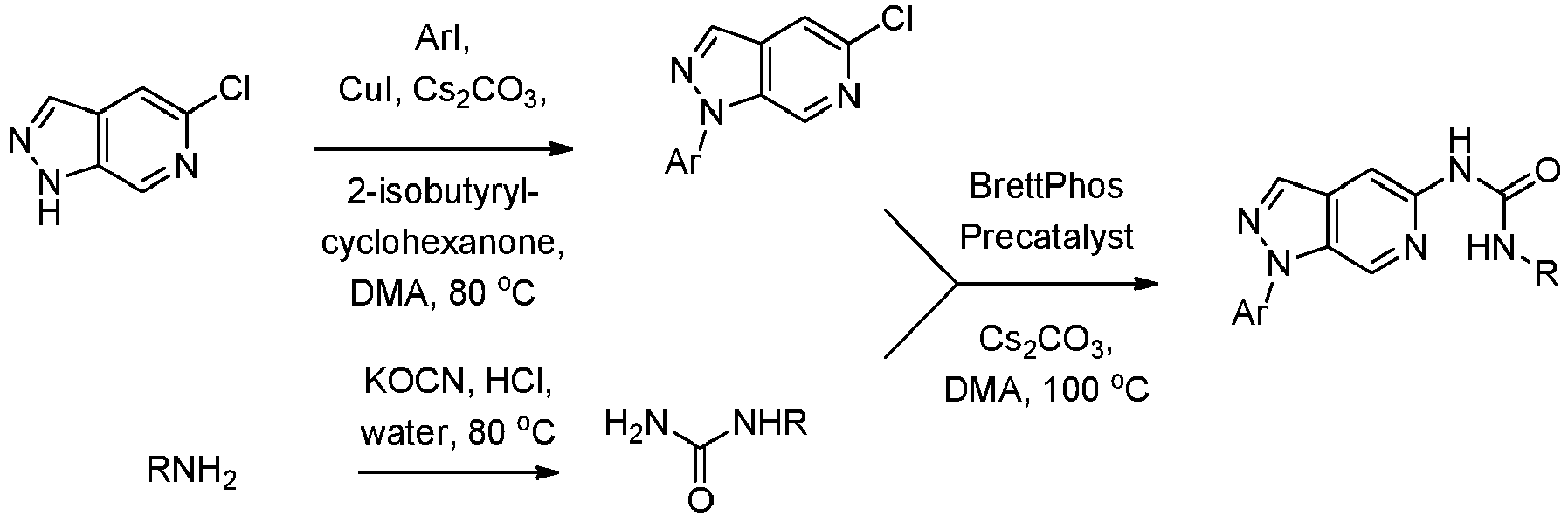
-

- A suspension of 5-chloro-1H-pyrazolo[3,4-c]pyridine (300 mg, 1.95 mmol), 4-iodo-1-methylpyrazole (600 mg, 2.88 mmol), 2-isobutyrylcyclohexanone (130 mg, 0.773 mmol), copper(I) iodide (75 mg, 0.39 mmol) and cesium carbonate (1.5 g, 4.60 mmol) in 5 mL of DMA was deoxygenated by bubbling nitrogen for 15 min. Next, the reaction mixture was warmed to 100°C and stirred overnight. The reaction mixture was then cooled and diluted with DCM, washed with 1 N aqueous NaOH and water, dried (Na2SO4) and concentrated to dryness. The solid residue was suspended in ether and filtered to collect the desired intermediate, 5-chloro-1-(1-methyl-1H-pyrazol-4-yl)-1H-pyrazolo[3,4-c]pyridine: MS (EI) calc'd for C10H9ClN5 [M+H]+ 234, found 234; 1H NMR (600 MHz, DMSO-d6 ) δ 9.02 (s, 1 H), 8.41 (s, 1 H), 8.38 (s, 1 H), 7.97 (s, 1 H), 7.96 (s, 1 H), 3.91 (s, 3 H).
- A mixture of (R)-1-(3-chloro-4-fluorophenyl)ethanamine (200 mg, 1.15 mmol) in 2 N aqueous HCl (1 mL) was treated with KOCN (500 mg, 6.16 mmol) and the mixture was then stirred at 80°C for 1 hour. Upon cooling to room temperature, a precipitate had formed. The reaction mixture was taken-up in 5:1 DCM/MeOH and washed with 1 N aqueous NaOH, dried (Na2SO4) and concentrated to provide (R)-1-(1-(3-chloro-4-fluorophenyl)ethyl)urea: 1H NMR (600 MHz, DMSO-d6 ) δ 7.42 (dd, J= 7.0, 2.0 Hz, 1 H), 7.31 (t, J= 8.8 Hz, 1 H), 7.24 (m, 1 H), 6.46 (d, J= 8.2 Hz, 1 H), 5.43 (s, 2 H), 4.64 (dt, J= 7.3 Hz, 1 H), 1.25 (d, J= 7.0 Hz, 3 H).
- A suspension of 5-chloro-1-(1-methyl-1H-pyrazol-4-yl)-1H-pyrazolo[3,4-c]pyridine (30 mg, 0.13 mmol), (R)-1-(1-(3-chloro-4-fluorophenyl)ethyl)urea (33 mg, 1.2 mmol), Cs2CO3 (100 mg, 0.31 mmol) and chloro[2-(dicyclohexylphosphino)-3,6-dimethoxy-2'-4'-6'-tri-i-propyl-1,1'-biphenyl][2-(2-aminoethyl)phenyl]palladium(II) (15 mg, 0.019 mmol) in DMA(1 mL) was deoxygenated by bubbling nitrogen for 10 min and heated with stirring to 100°C overnight. The cooled reaction mixture was filtered and purified by reverse phase chromatography (MeCN/water with 0.1% TFA). The LC fractions were lyophilized to provide the TFA salt of (R)-1-(1-(3-chloro-4-fluorophenyl)ethyl)-3-(1-(1-methyl-1H-pyrazol-4-yl)-1H-pyrazolo[3,4-c]pyridin-5-yl)urea: MS (EI) calc'd for C19H18ClFN7O [M+H]+ 414, found 414; 1H NMR (600 MHz, DMSO-d6 ) □ 8.98 (s, 1 H), 8.89 (s, 1 H), 8.36 (s, 1 H), 8.26 (s, 1 H), 7.97 (s, 1 H), 7.93 (s, 1 H), 7.51 (d, J= 7.0 Hz, 1 H), 7.47 (br s, 1 H), 7.33-7.36 (m, 2 H), 4.84 (dt, J= 7.0 Hz, 1 H), 3.89 (s, 3 H), 1.37 (d, J= 7.0 Hz, 3 H).
The following examples were made by using procedures similar to example 205 with appropriate aryl halide and amines.Table 16 Ex. Structure IUPAC Name / ERK2 IC 50 [M+H]+ 206. 
1-[(1S)-2-hydroxy-2-methyl-1-phenylpropyl]-3-[1-(1-methyl-1H-indazol-6-yl)-1H-pyrazolo[3,4-c]pyridin-5-yl]urea 0.9895nM Calc'd 456, found 456 207. 
1-[(1S)-2-hydroxy-2-methyl-1-phenylpropyl]-3-[1-(2-methyl-2H-indazol-5-yl)-1H-pyrazolo[3,4-c]pyridin-5-yl]urea 0.3301nM Calc'd 456, found 456 208. 
1-[1-(4-fluorophenyl)-1H-pyrazolo[3,4-c]pyridin-5-yl]-3-[(3R,4S)-1-methyl-4-phenylpyrrolidin-3-yl]urea 0.5791nM Calc'd 431, found 431 209. 
1-[(1R)-2-methoxy-1-pyridin-2-ylethyl]-3-[1-(2-methylpyridin-4-yl)-1H-pyrazolo[3,4-c]pyridin-5-yl]urea 24.51nM Calc'd 404, found 404 210. 
1-[(1S)-2-methoxy-1-pyridin-2-ylethyl]-3-[1-(2-methylpyridin-4-yl)-1H-pyrazolo[3,4-c]pyridin-5-yl]urea 745.3nM Calc'd 404, found 404 211. 
1-[1-(6-methylpyrazin-2-yl)-1H-pyrazolo[3,4-c]pyridin-5-yl]-3-[(1R)-1-phenylethyl]urea 549.3nM Calc'd 374, found 374 212. 
1-[1-(5-methylpyrazin-2-yl)-1H-pyrazolo[3,4-c]pyridin-5-yl]-3-[(1R)-1-phenylethyl]urea 521.2nM Calc'd 374, found 374 213. 
1-[1-(6-methylpyridazin-3-yl)-1H-pyrazolo[3,4-c]pyridin-5-yl]-3-[(1R)-1-phenylethyl]urea 208.4nM Calc'd 374, found 374 214. 
1-(3-chloro-4-fluorobenzyl)-3-[1-(2-methylpyridin-4-yl)-1H-pyrazolo[3,4-c]pyridin-5-yl]urea 4.051nM Calc'd 411, found 411 215. 
1-(3-chlorobenzyl)-3-[1-(2-methylpyridin-4-yl)-1H-pyrazolo[3,4-c]pyridin-5-yl]urea 5.035nM Calc'd 393, found 393 216. 
1-(3-chlorobenzyl)-3-[1-(1-methyl-1H-pyrazol-4-yl)-1H-pyrazolo[3,4-c]pyridin-5-yl]urea 15.72nM Calc'd 382, found 382 217. 
1-[(1R)-1-(3-chlorophenyl)ethyl]-3-[1-(1-methyl-1H-pyrazol-4-yl)-1H-pyrazolo[3,4-c]pyridin-5-yl]urea 5.45nM Calc'd 396, found 396 218. 
1-(3-chloro-4-fluorobenzyl)-3-[1-(1-methyl-1H-pyrazol-4-yl)-1H-pyrazolo[3,4-c]pyridin-5-yl]urea 20.84nM Calc'd 400, found 400 219. 
1-[(1R)-1-(3-chloro-4-fluorophenyl)ethyl]-3-[1-(2-methylpyridin-4-yl)-1H-pyrazolo[3,4-c]pyridin-5-yl]urea 2.854nM Calc'd 425, found 425 220. 
1-[(1R)-1-(3,4-dichlorophenyl)ethyl]-3-[1-(2-methylpyridin-4-yl)-1H-pyrazolo[3,4-c]pyridin-5-yl]urea 3.326nM Calc'd 441, found 441 - The following examples were made by using procedures similar to example 205 with appropriate aryl halide and amines followed by chiral separation similar to example 180.
Table 17 Ex Structure IUPAC Name / ERK2 IC 50 [M+H]+ 221. 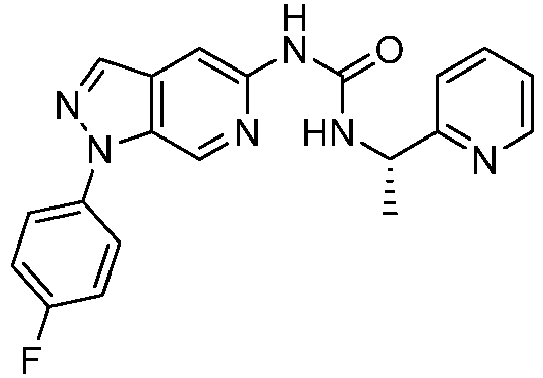
1-[1-(4-fluorophenyl)-1H-pyrazolo[3,4-c]pyridin-5-yl]-3-[(1S)-1-pyridin-2-ylethyl]urea 1790nM Calc'd 377, found 377 222. 
1-[1-(4-fluorophenyl)-1H-pyrazolo[3,4-c]pyridin-5-yl]-3-[(1R)-1-pyridin-2-ylethyl]urea 7.533nM Calc'd 377, found 377 - Another synthetic method involves the palladium(0)-mediated coupling reaction of a primary urea with a 5-bromo-pyrazolo[3,4-c]pyridine, followed by N-arylation. This method is exemplified below for the synthesis of (R)-1-(1-(4-fluorophenyl)ethyl)-3-(1-(2-methylpyridin-4-yl)-1H-pyrazolo[3,4-c]pyridin-5-yl)urea.

-

- A suspension of 5-bromo-1H-pyrazolo[3,4-c]pyridine (760 mg, 3.80 mmol) in DCM (10 mL) was treated with DMAP (50 mg, 0.41 mmol) and Boc2O (1.00 g, 4.58 mmol). After stirring for 20 min, a homogeneous solution had formed. The reaction was stirred another 12 hours, after which it was washed with 1 N aqueous HCl, water, dried (Na2SO4) and concentrated to dryness, providing tert-butyl 5-bromo-1H-pyrazolo[3,4-c]pyridine-1-carboxylate: MS (EI) calc'd for C11H13BrN3O2 [M+H]+ 298 and 300, found 298 and 300; 1H NMR (600 MHz, CDCl3) δ 9.30 (s, 1 H), 8.16 (s, 1 H), 7.83 (s, 1 H), 1.71 (s, 9 H).
- A mixture of (R)-1-(4-fluorophenyl)ethanamine (5.15 g, 37.0 mmol) in 2 N aqueous HCl (40 mL) was treated with KOCN (15.0 g, 185 mmol). The mixture was then stirred at 80 °C for 3 hours. Upon cooling to room temperature, a precipitate had formed which was collected by filtration and washed with water. The solid was partitioned between water and EtOAc, and the aqueous phase extracted once more with EtOAc. The combined organic extract was dried (Na2SO4), filtered and concentrated, providing (R)-1-(1-(4-fluorophenyl)ethyl)urea as a solid: MS (EI) calc'd for C9H12FN2O [M+H]+ 183, found 183; 1H NMR (600 MHz, DMSO-d6 ) δ 7.29 (m, 2 H), 7.11 (m, 2 H), 6.40 (d, J = 8.0 Hz, 1 H), 5.40 (s, 2 H), 4.67 (dt, J = 7.3 Hz, 1 H), 1.27 (d, J = 7.1 Hz, 3 H).
- A suspension of tert-butyl 5-bromo-1H-pyrazolo[3,4-c]pyridine-1-carboxylate (150 mg, 0.500 mmol), (R)-1-(1-(4-fluorophenyl)ethyl)urea (100 mg, 0.549 mmol), chloro[2-(dicyclohexylphosphino)-3,6-dimethoxy-2'-4'-6'-tri-i-propyl-1,1'-biphenyl][2-(2-aminoethyl)phenyl]palladium(II) (40 mg, 0.050 mmol) and Cs2O3 (300 mg, 0.921 mmol) in DMA (3 mL) was deoxygenated by bubbling nitrogen for 10 min and heated with stirring to 100°C for 8 hours. The cooled reaction mixture was filtered and purified by reverse phase chromatography (MeCN/water with 0.1% TFA). The LC fractions were lyophilized to provide the TFA salt of (R)-1-(1-(4-fluorophenyl)ethyl)-3-(1H-pyrazolo[3,4-c]pyridin-5-yl)urea: MS (EI) calc'd for C15H15FN5O [M+H]+ 300, found 300.
- A suspension of (R)-1-(1-(4-fluorophenyl)ethyl)-3-(1H-pyrazolo[3,4-c]pyridin-5-yl)urea (40 mg, 0.13 mmol), 4-iodo-2-methylpyridine (40 mg, 0.18 mmol), 2-isobutyrylcyclohexanone (20 mg, 0.12 mmol), copper(I) iodide (10 mg, 0.053 mmol) and cesium carbonate (100 mg, 0.31 mmol) in 1 mL of DMA was deoxygenated by bubbling nitrogen for 15 min. Next, the reaction mixture was warmed to 100°C and stirred overnight. The reaction mixture was then cooled and diluted with 4:1 DCM/MeOH, washed with 1 N aqueous NaOH and water, dried (Na2SO4) and concentrated to dryness. The residue was purified by reverse phase chromatography (MeCN/water with 0.1% TFA), and the LC fractions were lyophilized to provide the TFA salt of (R)-1-(1-(4-fluorophenyl)ethyl)-3-(1-(2-methylpyridin-4-yl)-1H-pyrazolo[3,4-c]pyridin-5-yl)urea: MS (EI) calc'd for C21H20FN6O [M+H]+ 391, found 391; 1H NMR (600 MHz, DMSO-d6 ) δ 9.42 (s, 1 H), 9.23 (s, 1 H), 8.73 (m, 2 H), 8.23 (s, 1 H), 8.19 (d, J = 6.2 Hz, 1 H), 8.16 (s, 1 H), 7.48 (br d, J= 6.8 Hz, 1 H), 7.36 (dd, J= 8.5, 5.9 Hz, 2 H), 7.14 (t, J= 8.0 Hz, 2 H), 4.86 (dt, J= 7.3 Hz, 1 H), 2.73 (s, 3 H), 1.38 (d, J= 7.0 Hz, 3 H).
-

- Intermediate 1-(aryl)-1H-pyrazolo[3,4-c]pyridin-5-amine was converted to the 4-fluoro analog by treatment with xenon difluoride, and the resulting aminopyrazolopyridine converted to the final urea by the reaction with CDI and imidazole. This method was used for the preparation of (R)-1-(4-Fluoro-1-(2-methylpyridin-4-yl)-1H-pyrazolo[3,4-c]pyridin-5-yl)-3-(1-phenylethyl)urea.
-

- A suspension of 1-(2-methylpyridin-4-yl)-1H-pyrazolo[3,4-c]pyridin-5-amine (75 mg, 0.33 mmol) in 1 mL of THF was treated with xenon difluoride (85 mg, 0.50 mmol) and stirred for 5 hours. The reaction mixture was diluted with DCM and washed with 1 N aqueous NaOH, water, dried (Na2SO4), and concentrated. The residue was then dissolved in DMSO and purified by reverse phase chromatography. The fractions were taken-up in DCM and washed with 1 N aqueous NaOH, water, dried (Na2SO4) and concentrated, providing 4-fluoro-1-(2-methylpyridin-4-yl)-1H-pyrazolo[3,4-c]pyridin-5-amine: MS (EI) calc'd for C12H11FN5 [M+H]+ 244, found 244; 1H NMR (600 MHz, DMSO-d6 ) δ 8.90 (s, 1 H), 8.51 (d, J = 5.6 Hz, 1 H), 8.48 (s, 1 H), 7.71 (d, J= 2.0 Hz, 1 H), 7.66 (dd, J= 5.5, 2.3 Hz, 1 H), 5.96 (s, 2 H), 2.54 (s, 3 H). Step 2: (R)-1-(4-Fluoro-1-(2-methylpyridin-4-yl)-1H-pyrazolo[3,4-c]pyridin-5-yl)-3-(1-phenylethyl)urea.
- A solution of 4-fluoro-1-(2-methylpyridin-4-yl)-1H-pyrazolo[3,4-c]pyridin-5-amine (10 mg, 0.041 mmol) in dioxane (1 mL) was treated with imidazole (15 mg, 0.22 mmol) and CDI (30 mg, 0.19 mmol), then stirred overnight. To this reaction mixture, (R)-1-phenylethanamine (10 mg, 0.083 mmol) and Hunig's base (0.050 mL, 0.29 mmol) were added and the reaction stirred for 5 hours. The mixture was concentrated, redissolved in DMSO and purified by reverse phase chromatography. Lyophilization of the LC fraction gave the TFA salt of (R)-1-(4-fluoro-1-(2-methylpyridin-4-yl)-1H-pyrazolo[3,4-c]pyridin-5-yl)-3-(1-phenylethyl)urea: MS (EI) calc'd for C21H20FN6O [M+H]+ 391, found 391; 1H NMR (600 MHz, DMSO-d6 ) δ 9.29 (s, 1 H), 8.96 (s, 1 H), 8.88 (s, 1 H), 8.71 (d, J = 6.2 Hz, 1 H), 8.12 (s, 1 H), 8.07 (d, J = 50 Hz, 1 H), 7.99 (d, J = 7.3 Hz, 1H), 7.30-7.35 (m, 4 H), 7.21 (m, 1 H), 4.90 (dt, J = 7.3 Hz, 1 H), 2.69 (s, 3 H), 1.41 (d, J = 7.0 Hz, 3 H).
-
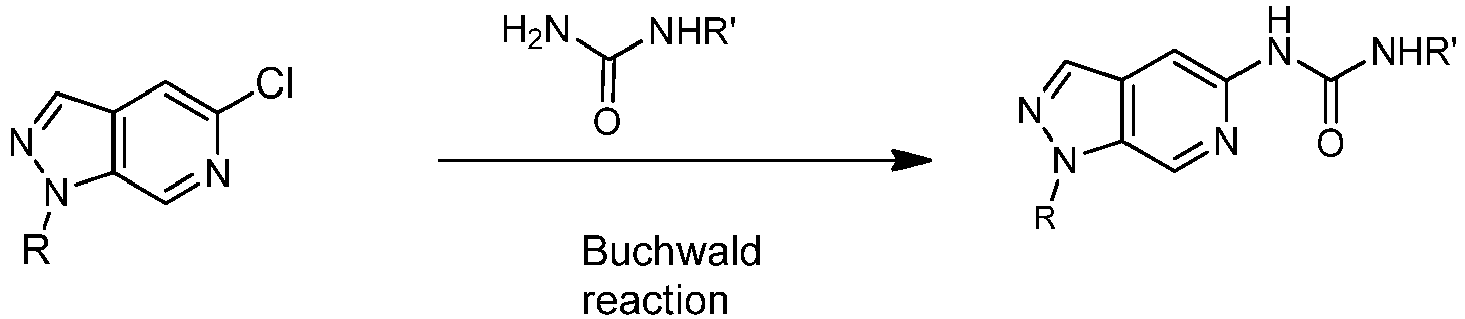
-

- To a solution of 5-chloro-1-methyl-1H-pyrazolo[3,4-c]pyridine Intermediate 81 (0.05 g, 0.3 mmol) and (R)-1-(1-phenylethyl)urea (0.054 g, 0.328 mmol) in anhydrous THF (3 mL) was added chloro(1-di-t-Butylphosphino-2',4',6'-tri-isopropyl-1,1'-biphenyl)[2-(2-aminoethyl)phenyl] palladium(II) (0.025 g, 0.036 mmol), t-BuOK (1 M solution in THF, 0.6 mL, 0.6 mmol) and the contents heated to reflux. After 16 h, the reaction mixture was brought to ambient temperature, filtered through a pad of celite, solvents was removed under reduced pressure and the residue thus obtained was purified by flash column chromatography afforded the title compound. 1H NMR (MeOD, 400MHz) δ 8.79 (s, 1H), 8.00 (s, 1H), 7.63 (s, 1H), 7.43-7.23 (m, 5H), 5.04-5.02 (m, 1H), 4.16 (s, 3H), 1.33 (d, J = 5.5 Hz, 3H). Anal. Calcd. C16H17N5O (M+H) 296.36; Found 296.4
-

- (5-Chloro-1-methyl-1H-pyrazolo[3,4-c]pyridin-7-yl)methanol (47.9 mg, 0.242 mmol), (S)-1-(2-hydroxy-2-methyl-1-phenylpropyl)urea (76 mg, 0.364 mmol), Brettphos palladacycle (19.36 mg, 0.024 mmol), cesium carbonate (205 mg, 0.630 mmol), and 2-(dicyclohexylphosphino)3,6-dimethoxy-2',4',6'-triisopropyl-1,1'-biphenyl (13.01 mg, 0.024 mmol) were dissolved in Dioxane (1.0 mL) and purged under argon for five minutes. The reaction mixture was heated to 90°C and stirred for 6 hrs. The reaction mixture was filtered through Celite rinsing with methanol and concentrated in vacuo. The reaction mixture was diluted with DMSO (2 mL), filtered, and purified by mass-triggered reverse-phase HPLC. Fractions containing pure compound were concentrated in vacuo to afford the TFA salt of (S)-1-(2-hydroxy-2-methyl-1-phenylpropyl)-3-(7-(hydroxymethyl)-1-methyl-1H-pyrazolo[3,4-c]pyridin-5-yl)urea. MS ESI calc'd. for C19H24N5O3 [M+1]+ 370, found 370. 1H NMR (500 MHz, DMSO-d6) δ 9.24 (s, 1H), 8.02 (s, 1H), 7.64 (s, 1H), 7.32 (d, J= 7.2 Hz, 2H), 7.29 - 7.22 (m, 2H), 7.19 (t, J= 7.2 Hz, 1H), 4.97 (s, 2H), 4.60-4.56 (m, 1H), 4.27 (s, 3H), 1.17 (s, 3H), 0.99 (s, 3H).
-

- 5-Chloro-1H-pyrazolo[3,4-c]pyridine (100 mg, 0.651 mmol), 1-((1S,2R)-2-hydroxy-1-phenylpropyl)urea (190 mg, 0.977 mmol), Brettphos palladacycle (41.6 mg, 0.052 mmol), and potassium tert-butoxide (1.954 mL, 1.954 mmol) were dissolved in THF (1 mL) and purged under argon for five minutes. The reaction mixture was heated to 80°C and stirred for 4 hours. The reaction mixture was filtered through Celite rinsing with methanol and concentrated in vacuo. The reaction mixture was diluted with DMSO (2 mL), filtered, and purified by mass-triggered reverse-phase HPLC. Fractions containing pure compound were concentrated in vacuo. The residue was dissolved in methanol and filtered through a PS-HCO3 cartridge, eluting with MeOH and DCM.
Diluted with a small amount of DCM and methanol. Purification by flash chromatography (Biotage, 2-20% CH2Cl2/MeOH) gave 1-((1S,2R)-2-hydroxy-1-phenylpropyl)-3-(1H-pyrazolo[3,4-c]pyridin-5-yl)urea. MS ESI calc'd. for C16H18N5O2 [M+1]+ 312, found 312. 1H NMR (500 MHz, DMSO-d6) δ 13.34 (s, 1H), 9.01 (s, 1H), 8.70 (s, 1H), 8.05 (s, 1H), 7.87 (s, 1H), 7.31 - 7.28 (m, 4H), 7.22 - 7.18 (m, 1H), 4.86 (d, J= 5.0 Hz, 1H), 4.70 (dd, J= 4.5 Hz, 8.6 Hz, 1H), 3.91 (dd, J = 4.9 Hz, 11.2 Hz, 1H), 0.94 (d, J = 6.4 Hz, 3H). - The following examples were made using Buchwald coupling procedures similar to example 225-227 with the appropriate urea.
Table 18 EX. Structure IUPAC Name / ERK2 IC 50 M+H]+ 228. 
1-[(1S)-2-hydroxy-2-methyl-1-phenylpropyl]-3-(1-methyl-1H-pyrazolo[3,4-c]pyridin-5-yl)urea 36.87nM Calc'd 340, found 340 229. 
(R)-1-(7-(hydroxymethyl)-1H-pyrazolo[3,4-c]pyridin-5-yl)-3-(1-phenylethyl)urea 40.95nM Calc'd 312 found 312 230. 
(S)-1-(2-hydroxy-2-methyl-1-phenylpropyl)-3-(1H-pyrazolo[3,4-c]pyridin-5-yl)urea (TFA salt) 69.95nM Calc'd 326 Found 326 231. 
N-ethyl-5-({[(1R)-1-phenylethyl]carbamoyl}amino)-1H-pyrazolo[3,4-c]pyridine-1-carboxamide 64.07nM Calc'd 353, found 353 232. 
1-[(1R)-1-(4-fluorophenyl)ethyl]-3-(1-methyl-1H-pyrazolo[3,4-c]pyridin-5-yl)urea 579.3nM Calc'd 314.0, found 233. 
1-[(1R)-1-(4-fluorophenyl)ethyl]-3-[1-(2-oxopiperidin-4-yl)-1H-pyrazolo[3,4-c]pyridin-5-yl]urea 1225nM Calc'd 397, found 397 234. 
tert-butyl 2-[5-({[(1S)-1-(4-fluorophenyl)-2-hydroxy-2-methylpropyl]carbamoyl}amino)-1H-pyrazolo[3,4-c]pyridin-1-yl]-5,8-dihydropyrido[3,4-d]pyrimidine-7(6H)-carboxylate 1810nM Calc'd 577, found 577 235. 
1-[1-(3-methoxypropyl)-1H-pyrazolo[3,4-c]pyridin-5-yl]-3-[(1R)-1-phenylethyl]urea 1519nM Calc'd 354, found 354 236. 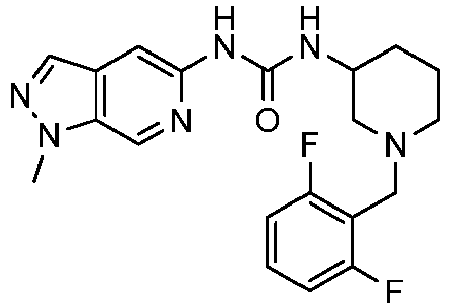
1-[1-(2,6-difluorobenzyl)piperidin-3-yl]-3-(1-methyl-1H-pyrazolo[3,4-c]pyridin-5-yl)urea 531.2nM Calc'd 401, found 401 237. 
1-[(1S)-2-methoxy-1-phenylethyl]-3-(1-methyl-1H-pyrazolo[3,4-c]pyridin-5-yl)urea 882.1nM Calc'd 326, found 326 238. 
1-[(1R)-1-phenylethyl]-3-[1-(tetrahydro-2H-pyran-4-yl)-1H-pyrazolo[3,4-c]pyridin-5-yl]urea 147.1nM Calc'd 366, found 366 239. 
1-[(1S)-2-methoxy-1-phenylethyl]-3-[1-(2-methylpiperidin-4-yl)-1H-pyrazolo[3,4-c]pyridin-5-yl]urea 2177nM Calc'd 409, found 409 240. 
1-[1-(4-fluorophenyl)-7-(hydroxymethyl)-1H-pyrazolo[3,4-c]pyridin-5-yl]-3-[(1R)-1-phenylethyl]urea 40.09nM Calc'd 406, found 406 241. 
1-[1-(4-fluorophenyl)-7-(methoxymethyl)-1H-pyrazolo[3,4-c]pyridin-5-yl]-3-[(1R)-1-phenylethyl]urea 55.94nM Calc'd 420, found 420 242. 
1-[1-(4-fluorophenyl)-7-(morpholin-4-ylmethyl)-1H-pyrazolo[3,4-c]pyridin-5-yl]-3-[(1R)-1-phenylethyl]urea 2241nM Calc'd 475, found 475 243. 
1-{7-[(dimethylamino)methyl]-1-(4-fluorophenyl)-1H-pyrazolo[3,4-c]pyridin-5-yl}-3-[(1R)-1-phenylethyl]urea 1577nM Calc'd 433, found 433 244. 
1-{1-(4-fluorophenyl)-7-[(2-morpholin-4-ylethoxy)methyl]-1H-pyrazolo[3,4-c]pyridin-5-yl}-3-[(1R)-1-phenylethyl]urea 188.2nM Calc'd 519, found 519 245. 
1-[1-(2-methylpyridin-4-yl)-7-(morpholin-4-ylmethyl)-1H-pyrazolo[3,4-c]pyridin-5-yl]-3-[(1R)-1-phenylethyl]urea 831.5nM Calc'd 472, found 472 246. 
1-{1-(4-fluorophenyl)-7-[(2-hydroxyethoxy)methyl]-1H-pyrazolo[3,4-c]pyridin-5-yl}-3-[(1R)-1-phenylethyl]urea 52.2nM Calc'd 450, found 450 247. 
1-[7-(methoxymethyl)-1-(2-methylpyridin-4-yl)-1H-pyrazolo[3,4-c]pyridin-5-yl]-3-[(1R)-1-phenylethyl]urea 11.08nM Calc'd 417, found 417 248. 
1-{7-[(2-methoxyethoxy)methyl]-1-(2-methylpyridin-4-yl)-1H-pyrazolo[3,4-c]pyridin-5-yl}-3-[(1R)-1-phenylethyl]urea 11.39nM Calc'd 461, found 461 249. 
1-{1-(2-methylpyridin-4-yl)-7-[(2-morpholin-4-ylethoxy)methyl]-1H-pyrazolo[3,4-c]pyridin-5-yl}-3-[(1R)-1-phenylethyl]urea 127.1nM Calc'd 516, found 516 250. 
1-{1-(2-methylpyridin-4-yl)-7-[(oxetan-3-yloxy)methyl]-1H-pyrazolo[3,4-c]pyridin-5-yl}-3-[(1R)-1-phenylethyl]urea 25.04nM Calc'd 459, found 459 251. 
1-[7-methyl-1-(2-methylpyridin-4-yl)-1H-pyrazolo[3,4-c]pyridin-5-yl]-3-[(1R)-1-phenylethyl]urea 2.806nM Calc'd 387, found 387 252. 
1-[7-{[2-(benzyloxy)ethoxy]methyl}-1-(2-methylpyridin-4-yl)-1H-pyrazolo[3,4-c]pyridin-5-yl]-3-[(1R)-1-phenylethyl]urea 25.27nM Calc'd 537, found 537 253. 
1-{7-[(2-hydroxyethoxy)methyl]-1-(2-methylpyridin-4-yl)-1H-pyrazolo[3,4-c]pyridin-5-yl}-3-[(1R)-1-phenylethyl]urea 23.41nM Calc'd 447, found 447 254. 
1-[7-(hydroxymethyl)-1-(2-methylpyridin-4-yl)-1H-pyrazolo[3,4-c]pyridin-5-yl]-3-[(1S)-2-hydroxy-2-methyl-1-phenylpropyl]urea 4.295nM Calc'd 447, found 447 255. 
1-[1-tert-butyl-7-(hydroxymethyl)-1H-pyrazolo[3,4-c]pyridin-5-yl]-3-[(1R)-1-phenylethyl]urea 1259nM Calc'd 368, found 368 256. 
1-(1-ethyl-7-methoxy-1H-pyrazolo[3,4-c]pyridin-5-yl)-3-[(1R)-1-phenylethyl]urea 100.2nM Calc'd 340, found 340 257. 
1-(1-ethyl-7-methoxy-1H-pyrazolo[3,4-c]pyridin-5-yl)-3-[(1S)-2-hydroxy-2-methyl-1-phenylpropyl]urea 44.94nM Calc'd 384, found 384 258. 
1-[1-ethyl-7-(2-hydroxyethoxy)-1H-pyrazolo[3,4-c]pyridin-5-yl]-3-[(1R)-1-phenylethyl]urea 35.27nM Calc'd 370, found 370 -

-

- To the solution of 5-chloro-1H-pyrazolo[3,4-c]pyridine (0.300 g, 1.95 mmol) in DMF (5 mL) at 0°C was added NaH (0.234 g, 5.86 mmol, 60% dispersion in oil). After stirring for 5 min. tetrahydro-2H-pyran-4-yl methanesulfonate (0.632 g, 3.5 mmol) was added and the reaction mixture was heated at 100°C for 5 h. TLC analysis indicated complete consumption of starting material and formation of 2 new spots. The reaction mixture was quenched by slow addition of ice-cold water (3 mL). The residue was bi-phased with water (15 mL) and ethyl acetate (25 mL). The aqueous layer was extracted with ethyl acetate (2 x 10 mL). The combined organic layers were washed with brine (1 x 15 mL), dried (anh. Na2SO4) and concentrated under reduced pressure to furnish the title compound (0.230 g.).
- In step-1, the non-polar spot amongst the two new spots in the TLC, was the required regio-isomer (5). Both the regio-isomers obtained during N-alkylation were purified by flash column chromatography and the structure was confirmed by NMR and NOE experiments. MS (EI) calc'd for C11H12N3OCl [M+H]+Expected: 238; Found: 238; 1H NMR (400 MHz, CDCl3) δ 9.06 (s, 1H), 8.15 (s, 1H), 7.79 (s, 1H), 4.90-4.78 (m, 1H), 4.24 (dd, 2H, J1 = 3.6 Hz, J2 = 11.2 Hz), 3.76-3.64 (m, 2H), 2.52-2.37 (m, 2H), 2.06 (dd, 2H, J1 = 2.4 Hz, J2 = 12.8 Hz).
- To a solution of 5-chloro-1-(tetrahydro-2H-pyran-4-yl)-1H-pyrazolo[3,4-c]pyridine (0.060 g, 0.252 mmol) and (S)-1-(2-methoxy-1-phenylethyl)urea (0.0489 g, 0.252 mmol) in THF was purged nitrogen for 10 min. and t-BuX-phos palladium catalyst (0.0207 g, 0.0302 mmol) and potassium tert-butoxide (0.54 mL, 0.547 mmol). The reaction mixture was heated at 80°C for 2 h. The starting material was completely consumed as revealed by the TLC. The reaction mixture was filtered through celite bed and washed with ethyl acetate. The filtrate was concentrated under reduced pressure and purified by preparative HPLC to furnish the title compound. MS (EI) calc'd for C21H25N5O3 [M+H]+ 396; Found: 396; 1H NMR (400 MHz, CD3OD) δ 8.91 (bs, 1H), 8.03 (s, 1H), 7.62 (bs, 1H), 7.40 (d, 2H, J = 7.60 Hz), 7.37-7.30 (m, 2H), 7.30-7.21 (m, 1H), 5.09 (t, 1H, J = 5.3 Hz), 5.00-4.90 (m, 1H), 4.12 (dd, 2H, J1 = 3.8 Hz, J2 = 11.6 Hz), 3.75-3.62 (m, 4H), 3.39 (s, 3H), 2.40-2.21 (m, 2H), 2.06-1.97 (m, 2H).
- The following examples were made by using procedures similar to example 259 with appropriate reagent.
Table 19 EX Structure IUPAC Name / ERK2 IC 50 [M+H]+ 260. 
1-[(1S)-2-methoxy-1-phenylethyl]-3 -[1 -(pyridin-4-ylmethyl)-1H-pyrazolo[3,4-c]pyridin-5-yl]urea 30.9nM Calc'd 403, found 403 261. 
1-[(1S)-2-hydroxy-1-phenylethyl]-3-[1-(pyridin-4-ylmethyl)-1H-pyrazolo[3,4-c]pyridin-5-yl]urea 2427nM Calc'd 389, found 389 -

-

- To a solution of 1-(2-methylpyridin-4-yl)-1H-pyrazolo[3,4-c]pyridin-5-amine 5 (0.15 g, 0.66 mmol) in anhydrous 1,4-dioxane (5 mL) was added CDI (0.54 g, 3.3 mmol) followed by the addition of imidazole (0.23g, 3.0 mmol) and the contents were stirred at ambient temperature. After 16 h [the completion of the reaction was confirmed by quenching small aliquot of the reaction mixture with MeOH and mass was obtained for the corresponding carbamate (M+H) = 284], DIPEA (0.25 g, 2.0 mmol) and trans-tert-butyl 3-amino-4-methoxypyrrolidine-1-carboxylate (0.3 g, 1.3 mmol) were added and the contents were stirred at ambient temperature. After 4 h, the reaction mixture was quenched with H2O and the organic contents were extracted with EtOAc (3 x 25 mL), dried over Na2SO4 and concentrated. The residue thus obtained was purified by preparative HPLC afforded the title compound. Anal. Calcd. C23H29N7O4 [M+H] 469; Found 469.
- To a solution of trans-tert-butyl 3-methoxy-4-(3-(1-(2-methylpyridin-4-yl)-1H-pyrazolo[3,4-c]pyridin-5-yl)ureido)pyrrolidine-1-carboxylate (0.12 g, 0.25 mmol) in anhydrous CH2Cl2 (5 mL) was added HCl in Dioxane (2 mL) and the contents were stirred at ambient temperature for 2 h. The volatiles were then evaporated under reduced pressure and the residue thus obtained was triturated with Et2O (3 x 5 mL) afforded the title compound as its hydrochloride salt. Anal. Calcd. C18H21N7O2 [M+H] 369; Found 369; 1H NMR (CD3OD, 400MHz): δ 9.58 (s, 1H), 8.80-8.76 (m, 2H), 8.44-8.42 (m, 2H), 8.01 (s, 1H), 4.52-4.51 (m, 1H), 4.20-4.19 (m, 1H), 3.75-3.62 (m, 2H), 3.55-3.48 (m, 5H), 2.92 (s, 3H).
- Nicotinaldehyde (0.01 g, 0.009 mmol) was added to a solution of 1-(trans-4-methoxypyrrolidin-3-yl)-3-(1-(2-methylpyridin-4-yl)-1H-pyrazolo[3,4-c]pyridin-5-yl)urea(0.03 g, 0.08 mmol) hydrochloride salt in anhydrous 1,2-dimethoxy ethane (3 mL) and the contents were stirred at ambient temperature for 30 min followed by the addition of sodium triacetoxy borohydride (0.02 g, 0.09 mmol). The reaction mixture was stirred additionally for about 1 h and the reaction was quenched with H2O (5 mL) and the organic contents were extracted with EtOAc. The EtOAc layer was dried over anhydrous Na2SO4 and concentrated under reduced pressure. The product this obtained was triturated with Et2O (3 x 5 mL) afforded the title compound. Anal. Calcd. C24H26N8O2 [M+H] 459; Found 459; 1H NMR (CD3OD, 400MHz): δ 9.19 (s, 1H), 8.57 (d, J = 5.7 Hz, 1H), 8.38 (s, 1H), 7.86 (s, 1H), 7.82 (m, 3H), 7.39-7.34 (m, 1H), 7.04-6.9 (m, 2H), 4.22 (m, 1H), 3.85 (s, 2H), 3.70 (bs, 1H), 3.5 (s, 3H), 3.16-3.12 (m, 1H), 2.97-2.93 (m, 1H), 2.68 (s, 3H), 2.68-2.60 (m, 1H), 2.53-2.50 (m, 1H).
-
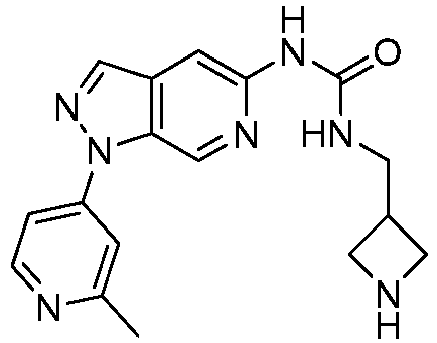
- tert-butyl 3-((3-(1-(2-methylpyridin-4-yl)-1H-pyrazolo[3,4-c]pyridin-5-yl)ureido)methyl)azetidine-1-carboxylate was prepared using the same procedure as demonstrated for example 14 using CDI coupling synthetic method II. MS ESI calc'd. For C22H28N7O3 [M+1]+438, found 438.
- tert-butyl 3-((3-(1-(2-methylpyridin-4-yl)-1H-pyrazolo[3,4-c]pyridin-5-yl)ureido)methyl)azetidine-1-carboxylate (48 mg, 0.11 mmol) was taken up in 4N HCl in 1,4-Dioxane (0.50 ml) and the reaction mixture was allowed to stir at 50°C for 2 hrs. LCMS showed that Boc group deprotection was complete. The reaction mixture was concentrated in vacuo. The residual oil was diluted with DMSO (2 ml) and was purified by reverse-phase mass-triggered preparative HPLC. The fractions containing product were concentrated down to give 1-(azetidin-3-ylmethyl)-3-(1-(2-methylpyridin-4-yl)-1H-pyrazolo[3,4-c]pyridin-5-yl)urea as the trifluoroacetic acid salt. MS ESI calc'd. For C17H20N7O [M+1]+ 338, found 338. 1H NMR (500 MHz, DMSO-d6) δ 9.44 (s, 1H), 9.40 (s, 1H) 8.6 (m, 2H), 8.62 (br s, 1H), 8.51 (br s, 1H), 8.25-8.20 (m, 2H), 7.24 (m, 1H), 3.95 (m, 2H), 3.75 (m, 2H), 3.37 (t, J = 6.24, 2H), 2.96 (m, 1H), 2.75 (s, 3H).
-

- 1-(azetidin-3-ylmethyl)-3-(1-(2-methylpyridin-4-yl)-1H-pyrazolo[3,4-c]pyridin-5-yl)urea (Example 263) was taken up in MeOH (2 ml) formaldehyde (10.16 µl, 0.136 mmol) was added followed by sodium borohydride (5.53 mg, 0.146 mmol). The reaction was allowed to stir at rt for 1 hour. The reaction mixture was then concentrated in vacuo. The residual oil was resuspended in EtOAc and water. The products were extracted into EtOAc (3x). The combined organics were washed with brine and dried over MgSO4 and concentrated in vacuo. The oil was taken up in DMSO and MeOH (3.5 ml total) and purified by reverse phase preparative HPLC. The returned fractions were dried down to give 1-((1-methylazetidin-3-yl)methyl)-3-(1-(2-methylpyridin-4-yl)-1H-pyrazolo[3,4-c]pyridin-5-yl)urea as the trifluoroacetic acid salt. MS ESI calc'd. for C18H22N7O [M+1]+352, found 352. 1H NMR (500 MHz, DMSO-d6) δ 9.44 (s, 1H), 9.40 (s, 1H) 8.6 (m, 2H), 8.62 (br s, 1H), 8.51 (br s, 1H), 8.25- 8.20 (m, 2H), 3.95 (m, 2H), 3.75 (m, 2H), 3.37 (t, J = 6.24, 2H), 2.96 (m, 1H), 2.75 (s, 3H), 2.52 (s, 3H).
- The following compounds were made by similar procedure as described in example 264.
Table 20 Ex. Structure IUPAC Name / ERK2 IC 50 [M+H]+ 265. 
1-[1-(2-methylpyridin-4-yl)-1H-pyrazolo[3,4-c]pyridin-5-yl]-3-[1-(pyridin-3-ylmethyl)-piperidin-3-yl]urea 115.4nM Calc'd 443, found 443 266. 
1-[1-(2,6-difluorobenzyl)piperidin-3-yl]-3-[1-(2-methylpyridin-4-yl)-1H-pyrazolo[3,4-c]pyridin-5-yl]urea 2.778nM Calc'd 478, found 478 267. 
1-[1-(2-methylpyridin-4-yl)-1H-pyrazolo[3,4-c]pyridin-5-yl]-3-[1-(1,3-thiazol-2-ylmethyl)piperidin-3-yl]urea 22.19nM Calc'd 449, found 449 268. 
1-{1-[(2-chloropyridin-3-yl)methyl]piperidin-3-yl}-3-[1-(2-methylpyridin-4-yl)-1H-pyrazolo[3,4-c]pyridin-5-yl]urea 18.63nM Calc'd 477, found 477 269. 
1-[(3S,4S)-1-(2,6-difluorobenzyl)-4-methoxypyrrolidin-3-yl]-3-[1-(2-methylpyridin-4-yl)-1H-pyrazolo[3,4-c]pyridin-5-yl]urea 5.389nM Calc'd 494, found 494 270. 
1-[1-(2-methylpyridin-4-yl)-1H-pyrazolo[3,4-c]pyridin-5-yl]-3-[1-(pyridin-3-ylmethyl)-pyrrolidin-3-yl]urea 45.31nM Calc'd 429, found 429 271. 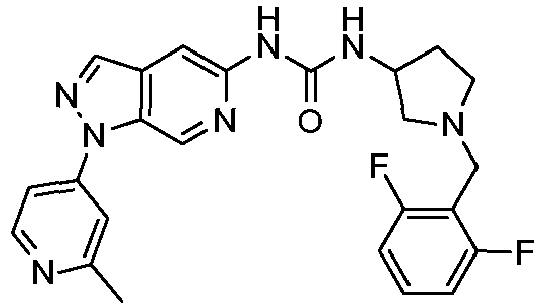
1-[1-(2,6-difluorobenzyl)pyrrolidin-3-yl]-3-[1-(2-methylpyridin-4-yl)-1H-pyrazolo[3,4-c]pyridin-5-yl]urea 0.9968nM Calc'd 464, found 464 272. 
1-[(3S,4S)-4-ethoxypyrrolidin-3-yl]-3-[1-(2-methylpyridin-4-yl)-1H-pyrazolo[3,4-c]pyridin-5-yl]urea 39.85nM Calc'd 382, found 382 273. 
1-[(3S,4S) or (3R, 4R)-1-(2,6-difluorobenzyl)-4-methoxypyrrolidin-3-yl]-3-[1-(2-methylpyridin-4-yl)-1H-pyrazolo[3,4-c]pyridin-5-yl]urea 2057nM Calc'd 494, found 494 274. 
1-[(3R,4R) or (3S, 4S)-1-(2,6-difluorobenzyl)-4-methoxypyrrolidin-3-yl]-3-[1-(2-methylpyridin-4-yl)-1H-pyrazolo[3,4-c]pyridin-5-yl]urea 3.537nM Calc'd 494, found 494 275. 
1-{(3S,4S)-4-[(5-fluoropyridin-3-yl)oxy]pyrrolidin-3-yl}-3-[1-(2-methylpyridin-4-yl)-1H-pyrazolo[3,4-c]pyridin-5-yl]urea 326.7nM Calc'd 449, found 449 276. 
1-{(3S,4S)-4-[(5-fluoropyridin-3-yl)oxy]-1-methylpyrrolidin-3-yl}-3-[1-(2-methylpyridin-4-yl)-1H-pyrazolo[3,4-c]pyridin-5-yl]urea 242.4nM Calc'd 463, found 463 277. 
1-{(3S,4S)-1-ethyl-4-[(5-fluoropyridin-3-yl)oxy]pyrrolidin-3-yl}-3-[1-(2-methylpyridin-4-yl)-1H-pyrazolo[3,4-c]pyridin-5-yl]urea 593.9nM Calc'd 477, found 477 278. 
1-[(3S,4S)-1-(2,6-difluorobenzyl)-4-ethoxypyrrolidin-3-yl]-3-[1-(2-methylpyridin-4-yl)-1H-pyrazolo[3,4-c]pyridin-5-yl]urea 45.28nM Calc'd 508, found 508 279. 
1-{(3S,4S)-4-ethoxy-1-[2-(trifluoromethyl)benzyl]pyrroli din-3-yl}-3-[1-(2-methylpyridin-4-yl)-1H-pyrazolo[3,4-c]pyridin-5-yl]urea 1751nM Calc'd 540, found 540 280. 
1-[1-(2-cyanobenzyl)pyrrolidin-3-yl]-3-[1-(2-methylpyridin-4-yl)-1H-pyrazolo[3,4-c]pyridin-5-yl]urea 4.354nM Calc'd 453, found 453 281. 
1-{1-[(2-chloropyridin-3-yl)methyl]pyrrolidin-3-yl}-3-[1-(2-methylpyridin-4-yl)-1H-pyrazolo[3,4-c]pyridin-5-yl]urea 2.84nM Calc'd 463, found 463 282. 
1-[(3S)-1-(2,6-difluorobenzyl)pyrrolidin-3-yl]-3-[1-(2-methylpyridin-4-yl)-1H-pyrazolo[3,4-c]pyridin-5-yl]urea 169.3nM Calc'd 464, found 464 283. 
1-[(3R)-1-(2,6-difluorobenzyl)pyrrolidin-3-yl]-3-[1-(2-methylpyridin-4-yl)-1H-pyrazolo[3,4-c]pyridin-5-yl]urea 0.3228nM Calc'd 464, found46 4 284. 
1-[(3S,4S)-4-(4-fluorophenoxy)pyrrolidin-3-yl]-3-[1-(2-methylpyridin-4-yl)-1H-pyrazolo[3,4-c]pyridin-5-yl]urea 24.13nM Calc'd 448, found 448 285. 
1-[(3S,4S)-4-(4-fluorophenoxy)-1-methylpyrrolidin-3-yl]-3-[1-(2-methylpyridin-4-yl)-1H-pyrazolo[3,4-c]pyridin-5-yl]urea 16.43nM Calc'd 462, found 462 286. 
1-[1-(2-methylpyridin-4-yl)-1H-pyrazolo[3,4-c]pyridin-5-yl]-3-[(3R)-pyrrolidin-3-ylmethyl]urea 23.35nM Calc'd 352, found 352 287. 
1-[(3-fluoroazetidin-3-yl)methyl]-3-[1-(2-methylpyridin-4-yl)-1H-pyrazolo[3,4-c]pyridin-5-yl]urea 43.19nM Calc'd 356, found 356 288. 
1-[1-(2-methylpyridin-4-yl)-1H-pyrazolo[3,4-c]pyridin-5-yl]-3-(5-phenylpiperidin-3-yl)urea 10.53nM Calc'd 428, found 428 289. 
1-[1-(2-methylpyridin-4-yl)-1H-pyrazolo[3,4-c]pyridin-5-yl]-3-{[(3R)-1-methylpyrrolidin-3-yl]methyl}urea 36.62nM Calc'd 366.0, found 366 290. 
1-(1-methyl-5-phenylpiperidin-3-yl)-3-[1-(2-methylpyridin-4-yl)-1H-pyrazolo[3,4-c]pyridin-5-yl]urea 17.83nM Calc'd 442.0, found 442 291. 
1-[(3S,4S)-4-methoxy-1-methylpyrrolidin-3-yl]-3-[1-(2-methylpyridin-4-yl)-1H-pyrazolo[3,4-c]pyridin-5-yl]urea 46.38nM Calc'd 382.0, found 382 -

-

- To a solution of 1-(2-methylpyridin-4-yl)-1H-pyrazolo[3,4-c]pyridin-5-amine (0.1 g, 0.44 mmol) in dioxane (4 mL) at 0°C was added imidazole (0.15 g, 2.22 mmol) and N,N-carbonyl imidazole (0.36g, 2.20mmol) and the reaction mixture was stirred for 16 h at room temperature [the completion of the reaction was confirmed by quenching small aliquot of the reaction mixture with MeOH and mass was obtained for the corresponding carbamate [M+H] = 284]. In a separate reaction flask was taken (S)-methyl 2-amino-2-phenylacetate (0.11 g, 0.67 mmol) in dioxane (2 mL) and DIPEA (0.113 g, 0.88 mmol) was added. To this reaction mixture was added solution of carbamate of 1-(2-methylpyridin-4-yl)-1H-pyrazolo[3,4-c]pyridin-5-amine and the reaction mixture was stirred for 6 h at room temperature. LCMS analysis indicated the complete consumption of the starting material. The reaction mixture was bi-phased with ethyl acetate and water. The aqueous layer was extracted with ethyl acetate (2 x 5 mL) and the combined organic layers were washed with brine (1 x 10 mL), dried (Na2SO4) and concentrated under reduced pressure to afford the crude compound which was purified by flash column chromatography to furnish the title compound. MS (EI) calc'd for C22H20N6O3 [M+H]+ 417; Found: 417; 1H NMR (400 MHz, DMSO-d6) δ 9.46 (d, 2H, J = 12.3 Hz), 8.76-8.71 (m, 2H), 8.20 (bs, 2H), 8.15 (d, 1H, J = 6.2 Hz), 7.98 (bs, 1H), 7.48-7.33 (m, 5H), 5.44 (d, 1H, J = 7.1 Hz), 3.67 (s, 3H), 2.75 (s, 3H).
- To a solution of (S)-methyl 2-(3-(1-(2-methylpyridin-4-yl)-1H-pyrazolo[3,4-c]pyridin-5-yl)ureido)-2-phenylacetate (0.03 g, 0.072 mmol) in THF (1 mL) at 0°C was added methyl magnesium bromide (0.1 mL, 0.14 mmol, 1.4 M in THF) and stirred for 3 h at room temperature. TLC analysis indicated complete consumption of the starting material. The reaction mixture was bi-phased with NH4Cl solution and ethyl acetate. The aqueous layer was extracted with ethyl acetate (2 x 5 mL) and the combined organic layers were washed with brine (1 x 10 mL), dried (Na2SO4) and concentrated under reduced pressure to afford the crude compound which was purified by prep HPLC to furnish the title compound. MS calc'd for C23H24N6O2 [M+H]+ 417; Found: 417; 1H NMR (400 MHz, CD3OD) δ 9.47 (s, 1H), 8.71 (d, 1H, J = 6.7 Hz), 8.62 (s, 1H), 8.41 (bs, 2H), 7.58 (s, 1H), 7.43 (d, 2H, J = 7.5 Hz), 7.38-7.23 (m, 3H), 4.79 (s, 1H), 2.88 (s, 3H), 1.36 (s, 3H), 1.17 (s, 3H).
- The following examples were made by using procedures similar to example 292 with appropriate reagent.
Table 21 Ex. Structure IUPAC Name / ERK2 IC 50 [M+H]+ 293. 
1-[(1S)-2-ethyl-2-hydroxy-1-phenylbutyl]-3-[1-(2-methylpyridin-4-yl)-1H-pyrazolo[3,4-c]pyridin-5-yl]urea 2.656nM Calc'd 445, found 445 294. 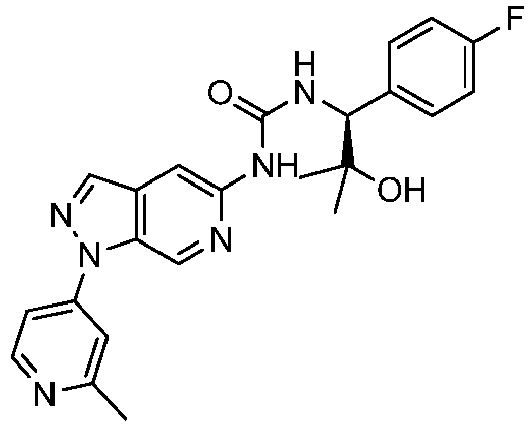
1-[(1S)-1-(4-fluorophenyl)-2-hydroxy-2-methylpropyl]-3-[1-(2-methylpyridin-4-yl)-1H-pyrazolo[3,4-c]pyridin-5-yl]urea 1.081nM Calc'd 435, found 435 295. 
1-[(1S)-1-(4-fluorophenyl)-2-hydroxy-2-methylpropyl]-3-[1-(4-fluorophenyl)-1H-pyrazolo[3,4-c]pyridin-5-yl]urea 1.287nM Calc'd 438, found 438 296. 
1-[1-(4-fluorophenyl)-1H-pyrazolo[3,4-c]pyridin-5-yl]-3-[(1S)-2-hydroxy-2-methyl-1-phenylpropyl]urea 0.8123nM Calc'd 420, found 420 -

-

- To a solution of 1-(2-methylpyridin-4-yl)-1H-pyrazolo[3,4-c]pyridin-5-amine (0.05 g, 0.22 mmol) in dioxane (4 mL) at 0°C was added imidazole (0.074 g, 1.11 mmol) and N,N'-carbonyl imidazole (0.179 g, 1.10 mmol) and stirred for 12 h at room temperature [the completion of the reaction was confirmed by quenching a small aliquot of the reaction mixture with MeOH and mass was obtained for the corresponding carbamate (M+H) = 284]. In a separate reaction flask was taken (S)-1-amino-1-phenylpropan-2-one (0.271 g, 1.36 mmol) in dioxane (2 mL) and DIPEA (0.4 mL, 2.14 mmol) was added. To the reaction mixture was added solution of 1-(2-methylpyridin-4-yl)-1H-pyrazolo[3,4-c]pyridin-5-amine carbamate and the reaction mixture was stirred for 3 h at room temperature. LCMS analysis indicated the complete consumption of the starting material. The reaction mixture was bi-phased with ethyl acetate and water. The aqueous layer was extracted with ethyl acetate (2 x 5 mL) and the combined organic layers were washed with brine (1 x 10 mL), dried (Na2SO4) and concentrated under reduced pressure to afford the crude compound which was purified by flash column chromatography to furnish the title compound. MS calc'd for C22H20N6O2 [M+H]+ 401; found: 401.
- To a solution of (S)-1-(1-(2-methylpyridin-4-yl)-1H-pyrazolo[3,4-c]pyridin-5-yl)-3-(2-oxo-1-phenylpropyl)urea (0.23 g, 0.574 mmol) in methanol (5 mL) at 0°C was added sodium borohydride (0.043 g, 1.15 mmol) portion wise. The reaction mixture was allowed to warm up to room temperature at which it was stirred for 3 h. TLC analysis indicated disappearance of the starting material. The solvent was removed under reduced pressure and the residue was bi-phased with water (10 mL) and dichloromethane (15 mL). The aqueous layer was extracted with dichloromethane (1 x 15 mL) and the combined organic layers were washed with water (1 x 10 mL), brine (1 x 10 mL), dried (Na2SO4) and concentrated under reduced pressure to furnish the title compound. MS calc'd for C22H22N6O2 [M+H]+ 403; Found: 403; 1H NMR (400 MHz, CD3OD) δ 9.44 (s, 1H), 8.69 (d, 1H, J = 7.4 Hz), 8.60 (s, 1H), 8.40-8.30 (m, 2H), 7.90-7.82 (m, 1H), 7.44-7.32 (m, 4H), 7.31-7.23 (m, 1H), 4.91-4.80 (m, 1H), 4.20-4.10 (m, 1H), 2.86 (s, 3H), 1.14 (d, 3H, J = 6.4 Hz).
-

-

- 7-(((tert-Butyldimethylsilyl)oxy)methyl)-5-chloro-1H-pyrazolo[3,4-c]pyridine (243.7 mg, 0.818 mmol) and cesium carbonate (533 mg, 1.636 mmol) were dissolved in DMF (4 mL) and stirred for 10 min. Methyl iodide (0.061 mL, 0.982 mmol) was then added and stirred at RT overnight. Ethyl acetate was added and the organic layer was washed with brine, dried over sodium sulfate, filtered, and concentrated in vacuo while loading onto silica gel. Purification by flash chromatography (Biotage, 5-40% EtOAc/isohexane) gave 7-(((tertbutyldimethylsilyl)oxy)methyl)-5-chloro-1-methyl-1H-pyrazolo[3,4-c]pyridine (116 mg, 0.372 mmol) and 7-(((tert-butyldimethylsilyl)oxy)methyl)-5-chloro-2-methyl-2H-pyrazolo[3,4-c]pyridine. MS ESI calc'd. for C14H23ClN3OSi [M+1]+ 312, found 312.
- 7-(((tert-Butyldimethylsilyl)oxy)methyl)-5-chloro-1-methyl-1H-pyrazolo[3,4-c]pyridine (116 mg, 0.372 mmol), (R)-1-(1-phenylethyl)urea (92 mg, 0.558 mmol), Brettphos palladacycle (29.7 mg, 0.037 mmol), cesium carbonate (315 mg, 0.967 mmol), and 2-(dicyclohexylphosphino)3,6-dimethoxy-2',4',6'-triisopropyl-1,1'-biphenyl (19.96 mg, 0.037 mmol) were dissolved in Dioxane (1.5 mL) and purged under argon for five minutes. The reaction mixture was heated to 90°C and stirred for 6 hrs. Additional (R)-1-(1-phenylethyl)urea (46 mg, 0.279 mmol), cesium carbonate (157.5 mg, 0.483 mmol), and Brettphos palladacycle (14.85 mg, 0.0185 mmol) was added. The reaction mixture was degassed and stirred at 90°C for 1.5 hours. The reaction mixture was filtered through Celite and rinsed with methanol. The filtrate was concentrated in vacuo while loading onto silica gel. Purification by flash chromatography (Biotage, 7-60% EtOAc/isohexane) gave (R)-1-(7-(((tertButyldimethylsilyl)oxy)methyl)-1-methyl-1H-pyrazolo[3,4-c]pyridin-5-yl)-3-(1-phenylethyl)urea. MS ESI calc'd. for C23H34N5O2Si [M+1]+ 440, found 440.
- (R)-1-(7-(((tert-Butyldimethylsilyl)oxy)methyl)-1-methyl-1H-pyrazolo[3,4-c]pyridin-5-yl)-3-(1-phenylethyl)urea (63.4 mg, 0.144 mmol) was dissolved in TFA (1.0 mL) and water (0.5 mL) and stirred at rt for 3 hours. Ethyl acetate was added and the organic layer washed with sat. sodium bicarbonate (x2), dried over sodium sulfate, filtered, and concentrated in vacuo while loading onto silica gel. Purification by flash chromatography (Biotage, 0-10% CH2Cl2/MeOH) gave (R)-1-(7-(hydroxymethyl)-1-methyl-1H-pyrazolo[3,4-c]pyridin-5-yl)-3-(1-phenylethyl)urea. MS ESI calc'd. for C17H20N5O2 [M+1]+ 326, found 326. 1H NMR (500 MHz, DMSO-d 6) δ 8.88 (s, 1H), 7.99 (s, 1H), 7.72 (s, 1H), 7.36 - 7.29 (m, 4H), 7.22 (t, J = 5.9 Hz, 1H), 5.70 - 5.59 (m, 1H), 4.93 - 4.80 (m, 2H), 4.26 (s, 3H), 1.39 (d, J = 6.9 Hz, 3H).
-

- To a solution of 7-[[(tert-butyldimethylsilyl)oxy]methyl]-5-chloro-1H-pyrazolo[3,4-c]pyridine (250 mg, 0.84 mmol) in N,N-dimethylformamide (5 mL) was added K2CO3 (174 mg, 1.25 mmol) and bromoethane (458 mg, 4.20 mmol). The resulting mixture was warmed to 80°C and stirred for 2 h. Then the reaction mixture was concentrated under vacuum. The residue was diluted with EtOAc and washed with saturated. NaHCO3, then dried (Na2SO4) and concentrated to afford 150 mg of a mixture of 7-[[(tert-butyldimethylsilyl)oxy]methyl]-5-chloro-1-ethyl-1H-pyrazolo[3,4-c]pyridine and 7-[[(tert-butyldimethylsilyl)oxy]methyl]-5-chloro-2-ethyl-2H-pyrazolo[3,4-c]pyridine, which was used in the next step without further purification: MS (EI) calc'd for C15H25ClN3OSi[M+H]+ 326, found 326.
- 1-[1-ethyl-7-[[(tert-butyldimethylsilyl)oxy]methyl]-1H-pyrazolo[3,4-c]pyridin-5-yl]-3-[(1R)-1-phenylethyl]urea was synthesized in one step from 7-[[(tertbutyldimethylsilyl)oxy]methyl]-5-chloro-1-ethyl-1H-pyrazolo[3,4-c]pyridine and (1R)-1-phenylethyl]urea as described in example 229: MS (EI) calc'd for C24H36N5O2Si [M+H]+ 454, found 454.
- 1-[1-ethyl-7-[[(tert-butyldimethylsilyl)oxy]methyl]-1H-pyrazolo[3,4-c]pyridin-5-yl]-3-[(1R)-1-phenylethyl]urea (100 mg, 0.22 mmol) was dissolved in THF and 4 N HCl (1:3 by volume) (20 mL) and stirred for 2 h at 25°C. The resulting solution was concentrated under vacuum. The residue was diluted with saturated NaHCO3, extracted with DCM, washed with brine, dried (Na2SO4) and concentrated under vacuum. The crude product was purified by Prep-HPLC with conditions: Column, XBridge Prep Shield RP18, 5 µm, 19 × 150 mm; Mobile phase, H2O (0.05% TFA)/CH3CN (30%-55% in 8 min); Detector, 254 nm and 220 nm. The desired fraction afforded 1-[1-ethyl-7-(hydroxymethyl)-1H-pyrazolo[3,4-c]pyridin-5-yl]-3-[(1R)-1-phenylethyl]ureas: MS (EI) calc'd for C18H22N5O2 [M+H]+ 340, found 340; 1H NMR (300 MHz, DMSO-d 6): δ 8.96 (br s, 1H), 8.08 (s, 1 H), 7.80 (br s, 1 H), 7.73 (s, 1 H), 7.35-7.30 (m, 4 H), 7.27-7.21 (m, 1 H), 4.90-4.82 (m, 3 H), 4.63 (q, J = 7.2 Hz, 2 H), 1.41-1.39 (m, 6 H).
-

- A solution of 7-[[(tert-butyldimethylsilyl)oxy]methyl]-5-chloro-1H-pyrazolo[3,4-c]pyridine (2 g, 6.71 mmol) in DCM (50 mL) was treated with (2-methylpyridin-4-yl)boronic acid (1.84 g, 13.44 mmol), Cu(OAc)2 (3.6 g, 20.00 mmol) and TEA (2.04 g, 20.16 mmol). The resulting mixture was stirred for 24 h at 25°C and then quenched by the addition of saturated NH4Cl. The mixture was extracted with DCM, washed with brine, then dried (Na2SO4), filtered and concentrated. The crude product was purified by chromatography on SiO2, eluted with DCM/MeOH (50:1) to afford of 7-((tert-butyldimethylsilyloxy)methyl)-5-chloro-1-(2-methylpyridin-4-yl)-1H-pyrazolo[3,4-c]pyridine. MS (EI) calc'd for C19H26ClN4OSi [M+H]+ 389, found 389.
- 1-[7-((tert-butyldimethylsilyloxy)methyl)-1-(2-methylpyridin-4-yl)-1H-pyrazolo[3,4-c]pyridin-5-yl]-3-[(1R)-1-phenylethyl]urea was synthesized using Buchwald coupling similar to example 229 from 7-((tert-butyldimethylsilyloxy)methyl)-5-chloro-1-(2-methylpyridin-4-yl)-1H-pyrazolo[3,4-c]pyridine and (1R)-1-phenylethyl]urea: MS (EI) calc'd for C28H37N6O2Si [M+H]+ 517, found 517.
- A solution of 1-[7-((tert-butyldimethylsilyloxy)methyl)-1-(2-methylpyridin-4-yl)-1H-pyrazolo[3,4-c]pyridin-5-yl]-3-[(1R)-1-phenylethyl]urea (80 mg, 0.15 mmol) in THF (3 mL) was treated with TBAF(1 M in THF) (0.3 mL). The resulting solution was stirred for 1 h at 25°C and then concentrated under reduced pressure. The crude product was purified by Prep-HPLC with conditions: Column, XBridge Prep Shield RP18, 5 µm, 19 × 150 mm; Mobile phase, H2O (10 mM NH4HCO3)/ CH3CN (25%∼32% in 6 min); Detector, 254 nm and 220 nm. The desired fraction afforded 8.2 mg (13%) of 1-[7-(hydroxymethyl)-1-(2-methylpyridin-4-yl)-1H-pyrazolo[3,4-c]pyridin-5-yl]-3-[(1R)-1-phenylethyl]urea: MS (EI) calc'd for C22H23N6O2 [M+H]+ 403, found 403; 1H NMR(300 MHz, CD3OD): δ 8.58 (d, J = 5.4 Hz, 1 H), 8.34 (s, 1 H), 7.60 (s, 2 H), 7.52 (d, J = 5.4 Hz, 1 H), 7.42 (d, J = 7.5 Hz, 2 H), 7.34 (t, J = 7.5 Hz, 2 H), 7.21 (t, J = 7.2 Hz, 1 H), 5.01 (q, J = 6.9 Hz, 1 H), 4.74 (s, 2 H), 2.66 (s, 3 H), 1.54 (d, J = 6.9 Hz, 3 H).
- The following examples were made following protocol similar to examples 300 using the appropriate reagent.
Table 22 EX Structure IUPAC Name / ERK2 IC 50 [M+H]+ 301. 
1-[7-(hydroxymethyl)-1-(3-methoxypropyl)-1H-pyrazolo[3,4-c]pyridin-5-yl]-3-[(1R)-1-phenylethyl]urea 77.97nM Calc'd 384, found 384 302. 
1-[7-(hydroxymethyl)-1-(1-methylethyl)-1H-pyrazolo[3,4-c]pyridin-5-yl]-3-[(1R)-1-phenylethyl]urea 62.16nM Calc'd 354, found 354 303. 
1-[1-(cyclopentylmethyl)-7-(hydroxymethyl)-1H-pyrazolo[3,4-c]pyridin-5-yl]-3-[(1R)-1-phenylethyl]urea 294.2nM Calc'd 394, found 394 304. 
1-[1-(cyclobutylmethyl)-7-(hydroxymethyl)-1H-pyrazolo[3,4-c]pyridin-5-yl]-3-[(1R)-1-phenylethyl]urea 230.4nM Calc'd 380, found 380 305. 
1-[7-(hydroxymethyl)-1-propyl-1H-pyrazolo[3,4-c]pyridin-5-yl]-3-[(1R)-1-phenylethyl]urea 43.67nM Calc'd 354, found 354 306. 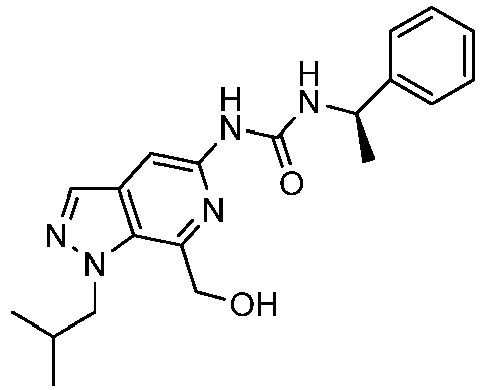
1-[7-(hydroxymethyl)-1-(2-methylpropyl)-1H-pyrazolo[3,4-c]pyridin-5-yl]-3-[(1R)-1-phenylethyl]urea 178.2nM Calc'd 368, found 368 307. 
1-[1-cyclopentyl-7-(hydroxymethyl)-1H-pyrazolo[3,4-c]pyridin-5-yl]-3-[(1R)-1-phenylethyl]urea 125.4nM Calc'd 380, found 380 308. 
1-[1-(cyclopropylmethyl)-7-(hydroxymethyl)-1H-pyrazolo[3,4-c]pyridin-5-yl]-3-[(1R)-1-phenylethyl]urea 79.5nM Calc'd 366, found 366 309. 
1-[7-(hydroxymethyl)-1-(tetrahydro-2H-pyran-4-ylmethyl)-1H-pyrazolo[3,4-c]pyridin-5-yl]-3-[(1R)-1-phenylethyl]urea 284.5nM Calc'd 410, found 410 310. 
1-[1-(2-hydroxyethyl)-7-(hydroxymethyl)-1H-pyrazolo[3,4-c]pyridin-5-yl]-3-[(1R)-1-phenylethyl]urea 159.5nM Calc'd 356, found 356 311. 
1-[7-(hydroxymethyl)-1-(tetra-hydrofuran-3-ylmethyl)-1H-pyrazolo[3,4-c]pyridin-5-yl]-3-[(1R)-1-phenylethyl]urea 157.6nM Calc'd 396, found 396 312. 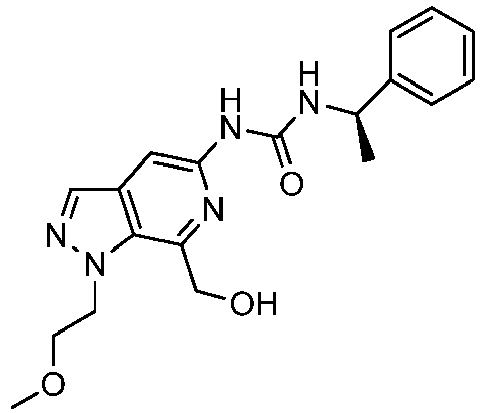
1-[7-(hydroxymethyl)-1-(2-methoxyethyl)-1H-pyrazolo[3,4-c]pyridin-5-yl]-3-[(1R)-1-phenylethyl]urea 296nM Calc'd 370, found 370 313. 
1-[1-cyclohexyl-7-(hydroxymethyl)-1H-pyrazolo[3,4-c]pyridin-5-yl]-3-[(1R)-1-phenylethyl]urea 49.15nM Calc'd 394, found 394 314. 
1-[7-(hydroxymethyl)-1-(2,2,2-trifluoroethyl)-1H-pyrazolo[3,4-c]pyridin-5-yl]-3-[(1R)-1-phenylethyl]urea 175.3nM Calc'd 394, found 394 315. 
1-[7-(hydroxymethyl)-1-(oxetan-3-ylmethyl)-1H-pyrazolo[3,4-c]pyridin-5-yl]-3-[(1R)-1-phenylethyl]urea 143.2nM Calc'd 382, found 382 316. 
1-[7-(hydroxymethyl)-1-(tetra-hydro-2H-pyran-4-yl)-1H-pyra-zolo[3,4-c]pyridin-5-yl]-3-[(1R)-1-phenylethyl]urea 235.5nM Calc'd 396, found 396 -

- (S)-tert-butyl 2-(5-(3-(1-(4-fluorophenyl)-2-hydroxy-2-methylpropyl)ureido)-1H-pyrazolo[3,4-c]pyridin-1-yl)-5,6-dihydropyrido[3,4-d]pyrimidine-7(8H)-carboxylate (5 mg, 8.67 µmol) and hydrogen chloride IN in diethyl either (0.087 ml, 0.087 mmol) and Dioxane (1 ml) were added to a reaction tube. It was stirred at rt for overnight. The solvent was removed and the product was dried under vacuum to afford 1-[(1S)-1-(4-fluorophenyl)-2-hydroxy-2-methylpropyl]-3-[1-(5,6,7,8-tetrahydropyrido[3,4-d]pyrimidin-2-yl)-1H-pyrazolo[3,4-c]pyridin-5-yl]urea. LCMS calc'd for C24H25FN8O2 [M+H]+ 477 found 477; 1H NMR (CDCl3), 8.1-8.8 (m, 3H), 7.2 (m, 4 H), 6.9 (s, 1H), 5.6 (b, 2H) 5.2 (b, 1H), 4.7 (s, 1H), 3.6 (m, 5H), 2.0 (b, 2H), 1.24 (s, 6H)
-

-

- tert-Butyl N-[[1-(4-fluorophenyl)-5-([[(1R)-1-phenylethyl]carbamoyl]amino)-1H-pyrazolo[3,4-c]pyridin-7-yl]methyl]-N-(2-methoxyethyl)carbamate was synthesized in one step from tert-butyl N-[[5-chloro-l-(4-fluorophenyl)-1H-pyrazolo[3,4-c]pyridin-7-yl]methyl]-N-(2-methoxyethyl)carbamate as described in example 226 procedure: MS (EI) calc'd for C30H36FN6O4 [M+H]+ 563, found 563.
- Tert-butyl N-[[1-(4-fluorophenyl)-5-([[(1R)-1-phenylethyl]carbamoyl]amino)-1H-pyrazolo[3,4-c]pyridin-7-yl]methyl]-N-(2-methoxyethyl)carbamate (200 mg, 0.36 mmol, 1.00 equiv) was dissolved with trifluoroacetic acid (3 mL)/DCM (5 mL) and stirred for 2 h at 25°C. Then the resulting solution was concentrated under reduced pressure. The crude product was purified by Prep-HPLC with conditions: Column, XBridge Prep Shield RP18, 5 µm, 19 × 150 mm; Mobile phase, H2O (10 mM NH4HCO3)/CH3CN (25%∼35% in 6 min); Detector, 254 nm and 220 nm. The desired fraction afforded 77 mg of 1-[1-(4-fluorophenyl)-7-{[(2-methoxyethyl)amino]methyl}-1H-pyrazolo[3,4-c]pyridin-5-yl]-3-[(1R)-1-phenylethyl]urea as an off-white solid: MS (EI) calc'd for C25H28FN6O2 [M+H]+ 463, found 463; 1H NMR(300 MHz, DMSO-d 6): δ 8.92 (s, 1 H), 8.29 (s, 1 H), 7.81 (s, 1 H), 7.72 (br s, 1 H), 7.64-7.60 (m, 2 H), 7.39-7.27 (m, 7 H), 7.22-7.17 (m, 1 H), 4.80 (q, J = 6.9 Hz, 1 H), 3.60 (s, 2 H), 3.28 (s, 2 H), 3.19 (t, J = 5.4Hz, 2 H), 3.09 (s, 3 H), 1.37 (d, J = 6.9 Hz, 3 H).
- The following examples were made by using similar procedure as described in example 318.
Table 23 EX Structure IUPAC Name / ERK2 IC 50 [M+H]+ 319. 
1-[7-(aminomethyl)-1-(4-fluorophenyl)-1H-pyrazolo[3,4-c]pyridin-5-yl]-3-[(1R)-1-phenylethyl]urea 515.5nM Calc'd 405, found 405 320. 
1-[7-({[2-(dimethylamino)ethyl]amino}meth yl)-1-(4-fluorophenyl)-1H-pyrazolo[3,4-c]pyridin-5-yl]-3-[(1R)-1-phenylethyl]urea 1240nM Calc'd 476, found 476 321. 
1-[7-{[(2-methoxyethyl)amino]methyl}-1-(2-methylpyridin-4-yl)-1H-pyrazolo[3,4-c]pyridin-5-yl]-3-[(1R)-1-phenylethyl]urea 103.2nM Calc'd 460, found 460 322. 
1-[7-({[2-(dimethylamino)ethyl]amino}meth yl)-1-(2-methylpyridin-4-yl)-1H-pyrazolo[3,4-c]pyridin-5-yl]-3-[(1R)-1-phenylethyl]urea 86.61nM Calc'd 473, found 473 -

- To a solution of 3-[7-(hydroxymethyl)-1H-pyrazolo[3,4-c]pyridin-5-yl]-1-[(1R)-1-phenylethyl]urea (30 mg, 0.10 mmol) in N,N-dimethylformamide (2 mL) was added 3-bromopropanenitrile (15.6 mg, 0.12 mmol) and potassium carbonate (40 mg, 0.29 mmol). The resulting solution was stirred for 1 h at 90°C under microwave irradiation. The resulting solution was concentrated under vacuum. The residue was diluted with EtOAc, washed with brine, then dried (Na2SO4) and concentrated under vacuum. The crude product was purified by Prep-HPLC with conditions: Column, XBridge Prep Shield RP18, 5 µm, 19 × 150 mm; Mobile phase, H2O (0.05% NH4HCO3)/CH3CN (15%∼55% in 10 min); Detector, 254 nm and 220 nm. The desired fraction afforded 6 mg of 1-[1-(2-cyanoethyl)-7-(hydroxymethyl)-1H-pyrazolo[3,4-c]pyridin-5-yl]-3-[(1R)-1-phenylethyl]urea. MS (EI) calc'd for C19H21N6O2 [M+H]+ 365, found 365. 1H NMR (400 MHz, DMSO-d 6) δ 8.97 (s, 1 H), 8.20 (s, 1 H), 7.82 (s, 1 H), 7.73 (br s, 1 H), 7.38-7.36 (t, J = 2.6 Hz, 4 H), 7.25-7.27 (q, J = 2.8 Hz, 1 H), 5.86 (s, 1 H), 4.94-4.88 (m, 5 H), 3.17 (t, J = 6.4 Hz, 2 H), 1.43 (d, J = 6.8 Hz, 3 H).
-
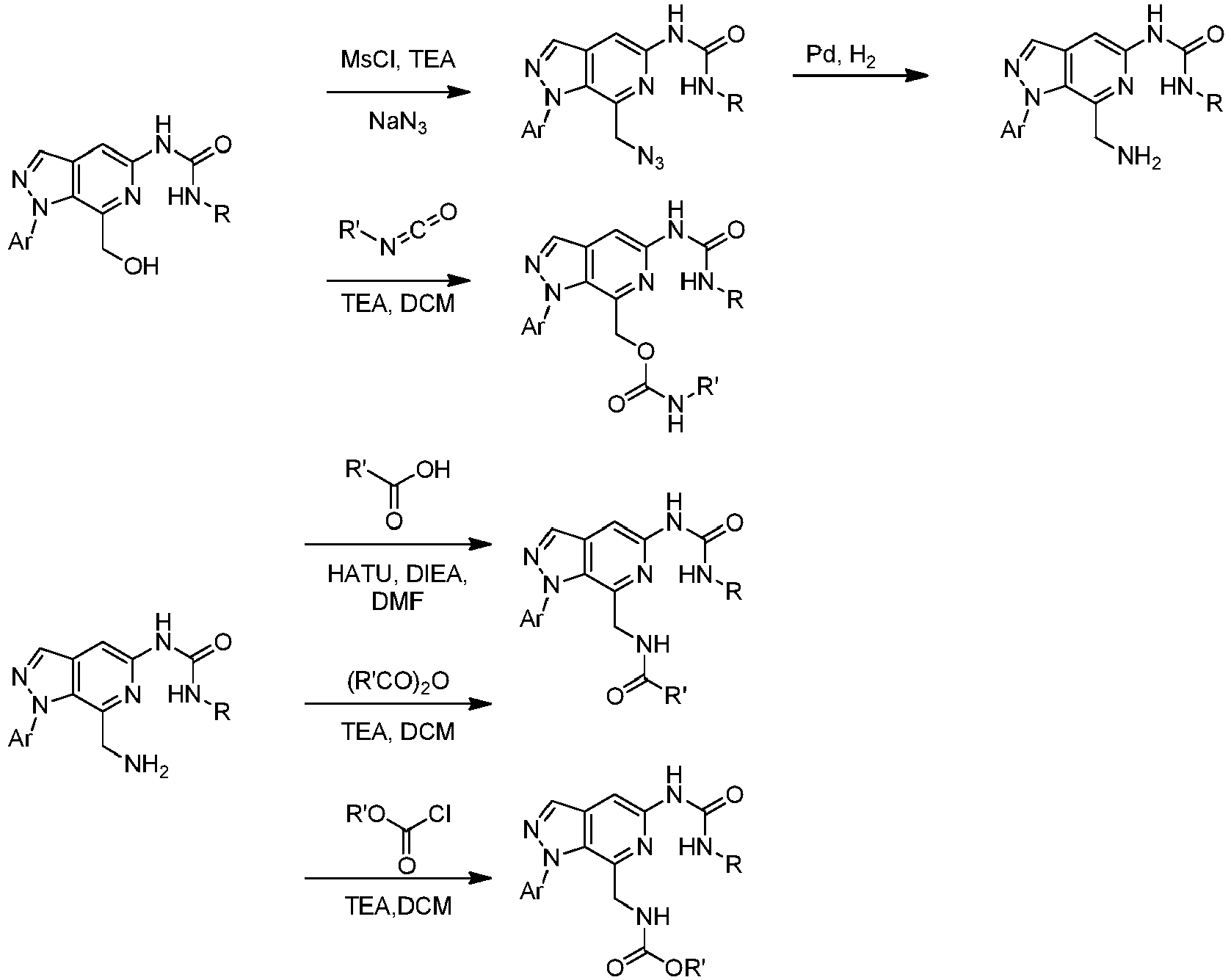
-

- To a solution of (R)-1-(7-(hydroxymethyl)-1-methyl-1H-pyrazolo[3,4-c]pyridin-5-yl)-3-(1-phenylethyl)urea (900 mg, 2.07 mmol) in THF (10 ml) was added methanesulfonyl chloride (238 mg, 2.07 mmol) at 0°C in 5 min. The resulting solution was stirred at 25°C for 2 h and then quenched by the addition of water (10 mL).The mixture was extracted with EtOAc, washed with brine, dried (Na2SO4), filtered and concentrated under reduced pressure to give (R)-(1-methyl-5-(3-(1-phenylethyl)ureido)-1H-pyrazolo[3,4-c]pyridin-7-yl)methyl methanesulfonate (688 mg) as a solid, which was dissolved in N,N-dimethylacetamide (10 ml) . Then sodium azide (135 mg, 2.07 mmol) was added and the resulting solution was stirred at 25°C for 12 h. The mixture was diluted with water, extracted with EtOAc, washed with brine, dried (Na2SO4), filtered and concentrated under reduced pressure to give(R)-1-(7-(azidomethyl)-1-methyl-1H-pyrazolo[3,4-c]pyridin-5-yl)-3-(1-phenylethyl)urea (410 mg), which was used in the next step directly without further purification. MS (EI) calc'd for C17H19N8O [M+H]+ 351, found 351. Step 2: (S)-1-(2-Amino-1-phenylethyl)-3-(1-methyl-1H-pyrazolo[3,4-c]pyridin-5-yl)urea.
- A mixture of (R)-1-(7-(azidomethyl)-1-methyl-1H-pyrazolo[3,4-c]pyridin-5-yl)-3-(1-phenylethyl)urea (500 mg, 1.17 mmol) and Pd/C (623 mg, 0.58 mmol) (10%, dry) in MeOH (10 ml) was deoxygenated by bubbling hydrogen for 5 min. Then the reaction mixture was stirred for 2 h at 25°C under an atmosphere of hydrogen (3∼4 atm). The resulting mixture was filtered. The filtrate was concentrated under vacuum. The residue was purified by chromatography on SiO2, eluted with DCM/MeOH (15/1) to give (R)-1-(7-(aminomethyl)-1-methyl-1H-pyrazolo[3,4-c]pyridin-5-yl)-3-(1-phenylethyl)urea: MS (EI) calc'd for C17H21N6O [M+H]+ 325, found 325.
- HATU (527 mg, 1.38 mmol) was added to a stirred mixture of acrylic acid (100 mg, 1.38 mmol) in DMF (10 ml),and then (R)-1-(7-(aminomethyl)-1-methyl-1H-pyrazolo[3,4-c]pyridin-5-yl)-3-(1-phenylethyl)urea (300 mg, 0.93 mmol), DIEA (0.48 ml, 2.76 mmol) were added. The reaction mixture was stirred at 25°C for 3 h. The resulting mixture was diluted with water, extracted with EtOAc, washed with brine, dried (Na2SO4), filtered and concentrated under reduced pressure. The residue was purified by Prep-TLC (petroleum ether/EtOAc = 1/5) to give N-{[1-methyl-5-({[(1R)-1-phenylethyl]carbamoyl}amino)-1H-pyrazolo[3,4-c]pyridin-7-yl]methyl}prop-2-enamide. MS (EI) calc'd for C20H23N6O2 [M+H]+ 379, found 379. 1H NMR (400 MHz, DMSO-d 6): δ 8.84 (s, 1 H), 8.66 (d, J = 4.8 Hz, 1 H), 8.03 (s, 1 H), 7.78 (s, 1 H), 7.68 (br s, 1 H), 7.34-7.31 (m, 4 H), 7.25-7.22 (m, 1 H), 6.31-6.17 (m, 2 H), 5.64-5.61(m, 1 H), 4.90-4.85 (m, 3 H), 4.22 (s, 3 H), 1.41 (d, J = 7.2 Hz, 3 H).
-

- To a solution of 3-[7-(aminomethyl)-1-(4-fluorophenyl)-1H-pyrazolo[3,4-c]pyridin-5-yl]-1-[(1R)-1-phenylethyl]urea (27 mg, 0.07 mmol) in DCM (0.5 mL) was added triethylamine (20.3 mg, 0.20 mmol) and acetic anhydride (8.2 mg, 0.08 mmol). The resulting solution was stirred for 2 h at 20°C. Then the mixture was quenched by the addition of MeOH and concentrated under reduced pressure. The crude product was purified by Prep-HPLC with conditions: Column, XBridge Prep Shield RP18, 5 µm, 19 × 150 mm; Mobile phase, H2O (0.05% NH4HCO3)/CH3CN (44%∼57% in 8 min); Detector, 254 nm and 220 nm. The desired fraction afforded of N-{[1-(4-fluorophenyl)-5-({[(1R)-1-phenylethyl]carbamoyl}amino)-1H-pyrazolo[3,4-c]pyridin-7-yl]methyl}acetamide. MS (EI) calc'd for C24H24FN6O2 [M+H]+ 447, found 447. 1H NMR (300 MHz, DMSO-d 6): δ 8.90 (s, 1 H), 8.30 (s, 1 H), 7.97 (t, J = 4.8 Hz, 1 H), 7.84 (s, 1 H), 7.63-7.59 (m, 3 H), 7.39-7.27 (m, 6 H), 7.22-7.18 (m, 1 H), 4.83 (t, J = 7.2 Hz, 1 H), 4.07 (d, J = 4.8 Hz, 2 H), 1.67 (s, 3 H), 1.37 (d, J = 6.9 Hz, 3 H).
-

- To a solution of 1-[7-(aminomethyl)-1-(4-fluorophenyl)-1H-pyrazolo[3,4-c]pyridin-5-yl]-3-[(1R)-1-phenylethyl]urea (42 mg, 0.10 mmol) in DCM (2 mL, 31.46 mmol) under nitrogen was added TEA (15 mg, 0.15 mmol) and methyl chloroformate (12 mg, 0.13 mmol). The resulting solution was stirred for 2 h at 20°C and then concentrated under vacuum. The crude product was purified by Prep-HPLC with conditions: Column, XBridge Prep Shield RP18, 5 µm, 19 × 150 mm; Mobile phase, H2O (0.05% TFA)/CH3CN (30%∼50% in 10 min); Detector, 254 nm and 220 nm. The desired fraction afforded methyl {[1-(4-fluorophenyl)-5-({[(1R)-1-phenylethyl]carbamoyl}amino)-1H-pyrazolo[3,4-c]pyridin-7-yl]methyl}carbamate. MS (EI) calc'd for C24H24FN6O3 [M+H]+ 463, found 463. 1H NMR (300 MHz, CD3OD): δ 8.17 (s, 1 H), 7.62-7.51 (m, 3 H), 7.34-7.27 (m, 6 H), 7.25-7.15 (m, 1 H), 4.98 (q, J = 6.9 Hz, 1 H), 4.18 (dd, J = 16.2, 5.1 Hz, 2 H), 3.46 (s, 3 H), 1.50 (d, J = 6.9 Hz, 3 H).
-

- To a solution of 1-[7-(hydroxymethyl)-1-(4-fluorophenyl)-1H-pyrazolo[3,4-c]pyridin-5-yl]-3-[(1R)-1-phenylethyl]urea (70 mg, 0.17 mmol) in DCM (3 mL) was added isocyanatomethane (30 mg, 0.53 mmol) and TEA (52 mg, 0.51 mmol). The resulting mixture was stirred for 3 h at 25°C and then concentrated under reduced pressure. The crude product was purified by Prep-HPLC with conditions: Column, XBridge Prep Shield RP18, 5 µm, 19 × 150 mm; Mobile phase, H2O (10 mM NH4HCO3)/CH3CN (25%∼32% in 6 min); Detector, 254 nm and 220 nm. The desired fraction afforded 16.7 mg of [1-(4-fluorophenyl)-5-({[(1R)-1-phenylethyl]carbamoyl}amino)-1H-pyrazolo[3,4-c]pyridin-7-yl]methyl ethylcarbamate. MS (EI) calc'd for C25H26FN6O3 [M+H]+ 477, found 477. 1H NMR(300 MHz, CDCl3): δ 8.17 (s, 1 H), 7.50 (t, J = 6.9 Hz, 2 H), 7.42 (d, J = 8.7 Hz, 2 H), 7.33 (t, J = 7.4 Hz, 3 H), 7.27-7.22 (m, 3 H), 5.15 (t, J = 6.9 Hz, 1 H), 5.00 (s, 2 H), 3.02-3.08 (m, 2 H), 1.59 (d, J = 6.9 Hz, 3 H), 0.94 (t, J = 6.9 Hz, 3 H).
-
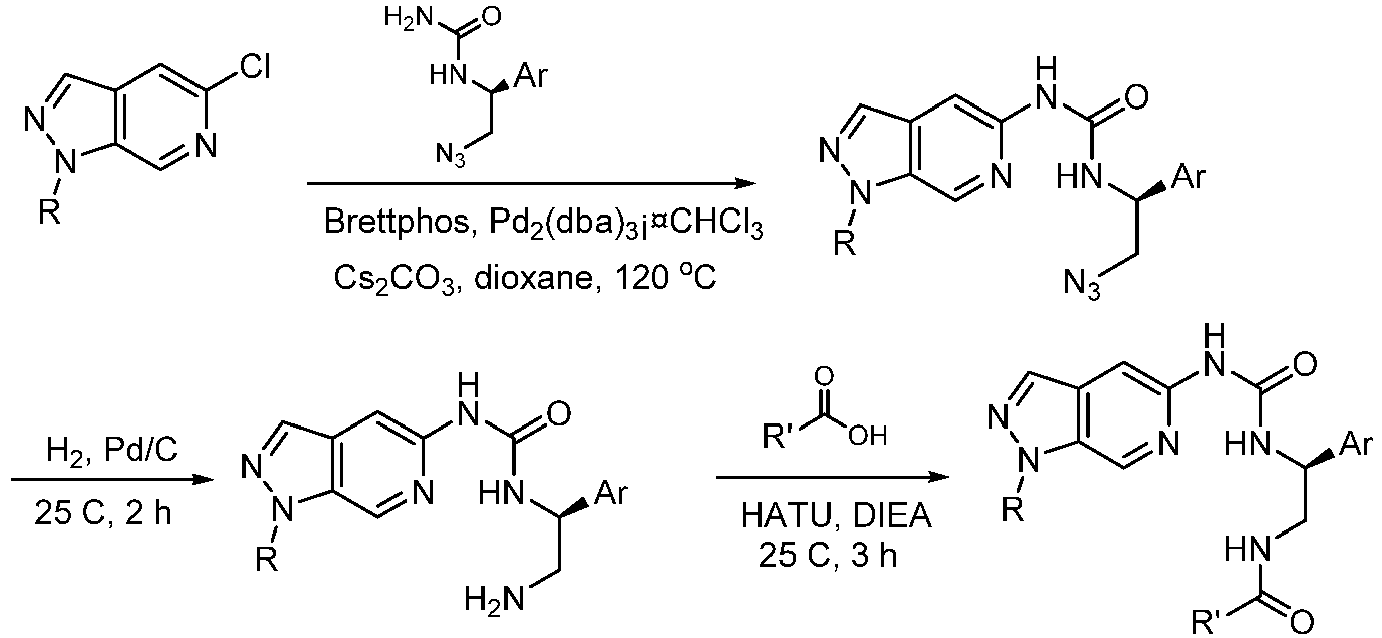
-
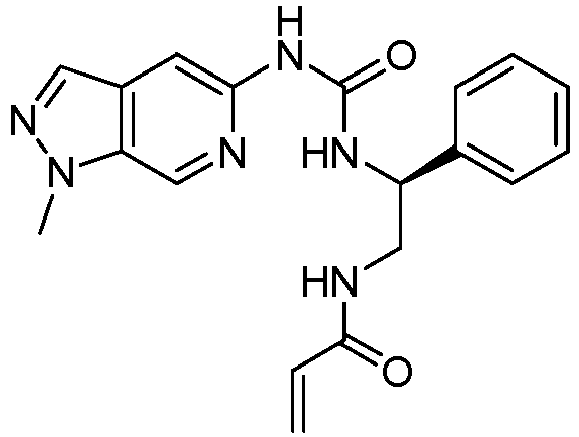
- This compound was synthesized by the same method as described in example 229 Buchwald coupling except 5-chloro-1-methyl-1H-pyrazolo[3,4-c]pyridine and (S)-1-(2-azido-1-phenylethyl)urea were used: MS (EI) calc'd for C16H17N8O [M+H]+ 337, found 337;
- A mixture of (S)-1-(2-azido-1-phenylethyl)-3-(1-methyl-1H-pyrazolo[3,4-c]pyridin-5-yl)urea (620 mg, 1.60 mmol) and Pd/C (80 mg, 0.75 mmol) in MeOH (10 ml) was deoxygenated by bubbling hydrogen for 5 min. Then the reaction mixture was stirred for 2 h at 25°C under an atmosphere of hydrogen (3∼4 atm). The resulting mixture was filtered. The filtrate was concentrated under vacuum to give (S)-1-(2-amino-1-phenylethyl)-3-(1-methyl-1H-pyrazolo[3,4-c]pyridin-5-yl)urea. MS (EI) calc'd for C16H19N60 [M+H]+ 311, found 311.
- Into a mixture of HATU (680 mg, 1.79 mmol) and acrylic acid (90 mg, 1.25 mmol) in DMF (10 ml) were added (S)-1-(2-amino-1-phenylethyl)-3-(1-methyl-1H-pyrazolo[3,4-c]pyridin-5-yl)urea (530 mg, 1.30 mmol) and DIEA (0.622 ml, 3.56 mmol). After stirring for 3 h at 25 °C, the reaction mixture was diluted with water, extracted with EtOAc, washed with brine, dried (Na2SO4), and filtered. The filtrate was concentrated under reduced pressure. The residue was purified by Prep-TLC (DCM/MeOH = 10:1). The crude product was recrystallized with EtOAc/MeOH(1:1) to give N-[(2S)-2-{[(1-methyl-1H-pyrazolo[3,4-c]pyridin-5-yl)carbamoyl]amino}-2-phenylethyl]prop-2-enamide. MS (EI) calc'd for C19H21N6O2 [M+H]+ 365, found 365. 1H NMR (400 MHz, DMSO-d 6): δ 9.00 (s, 1 H), 8.84 (s, 1 H), 8.28 (t, J = 5.6 Hz, 1 H), 8.03 (s, 1 H), 7.86 (s, 1 H), 7.70 (br s, 1 H), 7.39-7.25 (m, 5 H), 6.27-6.20 (m, 1 H), 6.08 (d, J = 16.8 Hz, 1 H), 5.57 (d, J = 10.4 Hz, 1 H), 4.95 (q, J = 6.8 Hz, 1 H), 4.10 (s, 3 H), 3.50-3.42 (m, 2 H).
-

-

- To a suspension of Zn (5.0 g, 76 mmol) powder in dry THF (20 ml) under nitrogen was added 1,2-dibromoethane (0.70 g, 3.73 mmol) at room temperature. The reaction mixture was stirred at 65°C for 1 h and then cooled down to room temperature. TMS-Cl (0.47 ml, 3.68 mmol) was added and the resulting suspension was stirred at room temperature for 15 min. Then the mixture was heated to 45°C and a solution of methyl 2-bromoacetate (5.0 g, 32.7 mmol) in dry THF (10 mL) was added at such a rate that reflux was maintained. Upon completion of the addition, the reaction mixture was stirred at 45°C for an additional 30 min and allowed to cool down to room temperature. The resulting mixture was filtered and 20 mL of the filtrate was added dropwise to a stirred mixture of 5-chloro-7-iodo-1-methyl-1H-pyrazolo[3,4-c]pyridine (2.0 g, 5.79 mmol) and Pd(Ph3P)4 (0.4 g, 0.346 mmol) in dry THF (30 ml) under nitrogen at room temperature. The reaction mixture was stirred under reflux for 1.5 h and then quenched by saturated NH4Cl, extracted with EtOAc, washed with brine, dried (Na2SO4), filtered and concentrated under reduced pressure. The residue was purified by chromatography on SiO2, eluted with petroleum ether/EtOAc (1:1) to give methyl 2-(5-chloro-1-methyl-1H-pyrazolo[3,4-c]pyridin-7-yl)acetate. MS (EI) calc'd for C10H11ClN5O2 [M+H]+ 240, found 240.
- DIBAL-H (10 ml, 10.00 mmol) was added to a stirred, cooled (0°C) mixture of methyl 2-(5-chloro-1-methyl-1H-pyrazolo[3,4-c]pyridin-7-yl)acetate (1.1 g, 3.26 mmol) in dry DCM (30 ml) under nitrogen, and then the reaction mixture was stirred at 25°C for 1.5 h. The reaction mixture was then quenched by saturated seignette salt and diluted with EtOAc. The organic layer was separated, washed with brine, dried (Na2SO4), filtered and concentrated under reduced pressure. The residue was purified by chromatography on SiO2, eluted with petroleum ether/EtOAc (1:4) to give 2-(5-chloro-1-methyl-1H-pyrazolo[3,4-c]pyridin-7-yl)ethanol. MS (EI) calc'd for C9H11ClN3O [M+H]+ 212, found 212.
- This compound was synthesized by the same method as described in example 335 step 3 except 2-(5-chloro-1-methyl-1H-pyrazolo[3,4-c]pyridin-7-yl)ethanol was used: MS (EI) calc'd for C21H25N6O2 [M+H]+ 393, found 393. 1H NMR (300 MHz, DMSO-d 6): δ 8.88 (s, 1 H), 8.32 (t, J= 5.2 Hz, 1 H), 7.98 (s, 1 H), 7.73-7.67 (m, 2 H), 7.35-7.31 (m, 4 H), 7.27-7.20 (m, 1 H), 6.26-6.06 (m, 2 H), 5.59 (dd, J = 7.2, 2.7 Hz, 1 H), 4.93-4.83 (m, 1 H), 4.26 (s, 3 H), 3.63-3.57 (m, 2 H), 3.40-3.35 (m, 2 H), 1.42 (d, J = 6.9 Hz, 3 H).
- Activated ERK2 activity was determined in an IMAP-FP assay (Molecular Devices). Using this assay format, the potency (IC50) of each compound was determined from a 10 point (1:3 serial dilution, 3 µM starting compound concentration) titration curve using the following outlined procedure. To each well of a black Corning 384-well plate (Corning Catalog #3575), 7.5 nL of compound (3333 fold dilution in final assay volume of 25 µL) was dispensed, followed by the addition of 15 µL of kinase buffer (tween containing kinase buffer, Molecular Devices) containing 0.0364 ng/mL (0.833 nM) of phosphorylated active hERK2 enzyme. Following a 15 minute compound & enzyme incubation, each reaction was initiated by the addition of 10 µL kinase buffer containing 2.45 µM ERK2 IMAP substrate peptides and 75 µM ATP. The final reaction in each well of 25 µL consists of 0.5 nM hERK2, 900 nM unlabeled peptide, 80 nM labeled-peptide, and 30 µM ATP. Phosphorylation reactions were allowed to proceed for 60 minutes and were immediately quenched by the addition of 60 µL IMAP detection beads (1:1000 dilutions) in IMAP binding buffer (Molecular Devices) with 24 mM NaCl. Plates were read on EnVision reader after 60 minutes binding equilibration using Fluorescence Polarization protocol (Perkin Elmer). The ERK2 IC50 in nanomolar (nM) for the compounds of the invention is shown in the Example next to the strucure.
- While the present invention has been described in conjunction with the specific examples set forth above, many alternatives, modifications and variations thereof will be apparent to those of ordinary skill in the art. All such alternatives, modifications and variations are intended to fall within the spirit and scope of the present invention.
Claims (8)
- A compound of formula I
 R1 is1) a C 4-8 monocyclic or bicyclic carbocycle, wherein the monocyclic carbocyle is saturated or unsaturated, and wherein the bicyclic carbocyle comprises 2 fused rings which are independently saturated or unsaturated, wherein the monocyclic or bicyclic carbocycle is unsubstituted or monosubstituted with halogen,2) a 5-10 membered monocyclic or bicyclic heterocycle having 1-3 heteroatoms independently selected from N, S and O, wherein the monocyclic heterocycle is saturated or unsaturated, and wherein the bicyclic heterocycle comprises 2 fused rings which are independently saturated or unsaturated, wherein the monocyclic or bicyclic heterocycle is unsubstituted or substituted with C1-4alkyl, =O, or C(O)OC(C1-4alkyl)3,3) -CH2R5, wherein R5 is H, C1-4alkyl, pyridine, C3-5cycloalkyl, -CH2OH, CH2OCH3, CF3, CH2CN, CH2CH2OC1-4alkyl, CH(C1-4alkyl)2, or a 4-6 membered unsubstituted monocyclic saturated heterocycle having 1 O atom,4) hydrogen,5) C(O)R6, wherein R6 is -NHC1-4alkyl,6) -CHR7R8, wherein R7 and R8 are independently C1-4alkyl, or7) C1-4alkyl;R2 is1) CH2R9, where R9 isa) unsubstituted phenyl or phenyl substituted one, two or three times independently selected from1) halogen, 2) -OC1-4alkyl, 3) 5-membered saturated or unsaturated heterocycle which is unsubstitued or substituted with =O having 1 or 2 heteroatoms selected from O and N,4)
 5) -SO2C1-4alkyl, 6) -C(O)NHC1-4alkyl, 7) -C(C1-4alkyl)2OH, or8) -NHSO2C1-4alkyl,b) -CH2R13 wherein R13 is1) C6H5, 2) N(C1-4alkyl)2, 3) C6H4F, 4) halogen, 5) -OC1-4alkyl, 6) CF3, 7) O-C6H4F, 8) OCH2C6H5, 9) NHCH2C6H5, 10) 6-membered saturated heterocycle which is unsubstituted or substituted with -CH2OC6H5 having 1 or 2 heteroatoms selected from O and N, 11) 5-membered saturated heterocycle which is unsubstituted having 1 heteroatom which is O, 12) 5-membered unsaturated heterocycle which is unsubstituted or mono- or di-substituted with C1-4alkyl having 1 or 2 heteroatoms independently selected from N and O, or12)
 c) C3-6cycloalkyl unsubstituted or substituted with -N(C1-4alkyl)2,d) 10-membered bicyclic carbocycle comprising two fused rings, wherein one ring is unsaturated,e) -CHR19R10, wherein R19 and R10 are independently selected from
1) pyridine, 2) 6-membered saturated heterocycle, having 1 or 2 heteroatoms selected from O and N, which is unsubstituted or substituted with one or two F, 3) -CH2OH, 4) phenyl, 5) piperidine, 6) C6H4F, 7) CH3, 8) OH, or 9) C6H4CF3,f) a 4-10 membered monocyclic or bicyclic heterocycle having
1-3 heteroatoms independently selected from N, S and O, wherein the monocyclic heterocycle is saturated or unsaturated, and wherein the bicyclic heterocycle is saturated or unsaturated, wherein the monocyclic or bicyclic heterocycle is unsubstituted or independently mono-, di- or tri-substituted with -CHCF3CH3, C6H4F, C6H4FCl, CH2CF3, C1-4alkyl, =O, C6H5, or halogen,g) CF2C6H5h) 2) -CHR11R12, where R11 and R12 are independently selected froma) C1-4alkyl, b) -OC1-4alkyl, c) CF3,d) C6H4R12' where R12' is halogen, -OCF3, -SO2C1-4alkyl, H, or a 5-membered unsaturated unsubstituted heteocycle or heterocycle substituted with C1-4alkyl having 2 or 3 heteroatoms selected from O, N and S,e) CH2CH2N(C1-4alkyl)2,f) CH2CH2R12" where R12" is a 6-membered saturated or unsaturated heterocycle which heterocycle is unsubstituted or mono- or di- substituted with halogen,g) CH2NH2, h) CH2OH, i) C6H5SO2C1-4alkyl, j) CHF2, k) CH2CH2OH,l) CH2OC1-4alkyl, m) -OC1-4alkyl, n) -CH2N(CH3)2,o) -CH2R12"' where R12"' is a1) 5-membered unsaturated unsubstituted heterocycle having 2 N atoms, 2) -OC1-4alkyl, 3) N(C1-4alkyl)2, 4) -CH2OCH2CH2OC1-4alkyl,5) C(O)OC1-4alkyl, 6) NH2, 7) NHC(O)CH=CH2, 8) C(C1-4alkyl)2OH,9) OH, 10) a 6-membered saturated heterocycle having 2 heteroatoms independently selected from N and O,p) C(O)NHC1-4alkyl, q) C(O)N(C1-4alkyl)2, r) C6H3FCl,s) C(C1-4alkyl)2OH, t) C6H3Cl2, u) C(C1-4alkyl)2OH, v) CH(C1-4alkyl)OH, w) C(C1-4alkyl)3, x) -C(C1-4alkyl)2OH,y) a 5-membered unsaturated or saturated heterocycle having one or two heteroatoms independently selected from N, O and S atoms, which heterocycle is unsubstituted or substituted with C1-4alkyl,z) a 6-membered unsaturated heterocycle having one heteroatom which is N, which heterocycle is unsubstituted, oraa) C(O)OCH3,3) a C 4-10 monocyclic or bicyclic saturated or unsaturated carbocycle, wherein the bicyclic carbocyle comprises 2 fused rings, wherein the monocyclic or bicyclic carbocycle is unsubstituted or monosubstituted witha) NH2, b) NHC(O)C1-4alkyl, c) -OC1-4alkyl, d) -N(C1-4alkyl)2,e) -OC1-4alkyl, f) C6H5, g) NHC(O)C6H5, h) C6H4F, i) -OCH2C6H5, j) -CH2C6H5,k) -OC6H5, 1) -OCH2CH2CH2C6H5, m) -OC6H4F, or n) -O-pyridine,4) a 5-10 membered monocyclic or bicyclic saturated or unsaturated heterocycle having 1-3 heteroatoms independently selected from N and O, wherein the monocyclic or bicyclic heterocycle is unsubstituted or independently mono-, di-, tri- or tetra-substituted witha) C6H4Cl, b) C1-4alkyl, c) =O, d) C6H5, e) C3-6cycloalkyl, f) C6H4F,g) CH2C6H3(OC1-4alkyl)(F), h) C6H4(C1-4alkyl), i) CH2CH2C6H5,j) CH2CH2CH2C6H5, k) OC1-4alkyl, 1) -OC6H5, m) CH2C6H3F2,n) CH2C6H4CF3, o) CH2C6H4CN, p) OC6H4F, q) -OC1-4alkyl,r) a 5-6-membered heterocycle saturated or unsaturated, unsubstituted or substituted with C1-4alkyl, C6H5 or C3-6cycloalkyl, having 1 or 2 heteroatoms independently selected from O, N and S,s) -CH2-R2', wherein R2' is a 5-6-membered unsaturated heterocycle, unsubstituted or substituted with halogen, having 1 or 2 heteroatoms independently selected from N and S, ort) -O-R2", wherein R2" is a 6-membered unsaturated heterocycle, unsubstituted or mono- or di-substituted with halogen, having 1 N heteroatom,5) -CR13R14R15 where R13 and R14 are independently C1-4alkyl or together with the carbon atom to which they are attached form cyclopropyl, and R15 is CN or C6H5,6)
 R3 is hydrogen, -OC1-4alkyl, -OC1-4alkyl-OH, or -CH2R3', wherein R3' is1) -OC1-4alkyl, 2) 6-membered saturated unsubstituted heterocycle having 1 or 2 heteroatoms independently selected from N and O, 3) -NHC1-4alkyl,4) -OC1-4alkyleneR3" where R3" is a 4-6-membered saturated unsubstituted heterocycle having 1 or 2 heteroatoms selected from N and O,5) -OC1-4alkylene-OH, 6) -OC1-4alkylene-OCH3, 7) hydrogen,8) -OC1-4alkylene-OCH2C6H5, 9) -OH, 10) -NHC1-4alkyleneOC1-4alkyl, 11) NH2, 12) -NHC1-4alkyleneN(C1-4alkyl)2, 13) -NHC(O)CH=CH2,14) -NHC(O)C1-4alkyl, 15) -NHC(O)OC1-4alkyl, 16) -OC(O)NHC1-4alkyl, 17)-CH2NHC(O)CH=CH2, 18) N(C1-4alkyl)2, or19)
 R4 is hydrogen or halogen.
 - A compound of Claim 1, or a pharmaceutically acceptable salt thereof, whereinR1 is1) a C 4-8 monocyclic or bicyclic carbocycle, wherein the monocyclic carbocyle is saturated or unsaturated, and wherein the bicyclic carbocyle comprises 2 fused rings which are independently saturated or unsaturated, wherein the monocyclic or bicyclic carbocycle is unsubstituted or monosubstituted with F,2) a 5-10 membered monocyclic or bicyclic heterocycle having 1-3 heteroatoms independently selected from N, S and O, wherein the monocyclic heterocycle is saturated or unsaturated, and wherein the bicyclic heterocycle comprises 2 fused rings which are independently saturated or unsaturated, wherein the monocyclic or bicyclic heterocycle is unsubstiututed or substituted with CH3, =O, or C(O)OC(CH3)3,3) -CH2R5, wherein R5 is H, CH3, pyridine, cyclopentyl, cyclobutyl, CH2CH3, cyclopropyl, -CH2OH, CH2OCH3, CF3, CH2CN, CH2CH2OCH3, CH(CH3)2, or a 4-6 membered unsubstituted monocyclic saturated heterocycle having 1 O atom,4) hydrogen,5) C(O)R6, wherein R6 is -NHCH2CH3,6) -CHR7R8, wherein R7 and R8 are independently CH3, or7) C1-4alkyl;R2 is1) CH2R9, where R9 isa) unsubstituted phenyl or phenyl substituted one, two or three times independently selected from1) F, 2) -OCH3 3) Cl, 4) 5-membered saturated or unsaturated heterocycle which is unsubstitued or substituted with =O having 1 or 2 heteroatoms selected from O and N,5)
 6) -SO2CH3, 7) -C(O)NHCH3, 8) -C(CH3)2OH, or 9) -NHSO2CH3,b) -CH2R13 wherein R13 is1) C6H5, 2) N(CH3)2, 3) C6H4F, 4) F, 5) -OCH3, 6) CF3, 7) O-C6H4F, 8) OCH2C6H5,9) NHCH2C6H5, 10) 6-membered saturated heterocycle which is unsubstituted or substituted with -CH2OC6H5 having 1 or 2 heteroatoms selected from O and N, 11) 5-membered saturated heterocycle which is unsubstituted having 1 heteroatom which is O, 12) 5-membered unsaturated heterocycle which is unsubstituted or mono- or di-substituted with CH3 having 1 or 2 heteroatoms independently selected from N and O, or13)
 c) cyclohexyl unsubstituted or substituted with -N(CH3)2,d) 10-membered bicyclic carbocycle comprising two fused rings, wherein one ring is unsaturated,e) -CHR19R10, wherein R19 and R10 are independently selected from 1) pyridine, 2) 6-membered saturated heterocycle which is unsubstituted having 1 or 2 heteroatoms selected from O and N, which is unsubstituted or substituted with one or two F, 3) -CH2OH, 4) phenyl, 5) piperidine, 6) C6H4F, 7) CH3, 8) OH, or 9) C6H4CF3,f) a 4-10 membered monocyclic or bicyclic heterocycle having
1-3 heteroatoms independently selected from N, S and O, wherein the monocyclic heterocycle is saturated or unsaturated, and wherein the bicyclic heterocycle is saturated or unsaturated, wherein the monocyclic or bicyclic heterocycle is unsubstiututed or independently mono-, di- or tri-substituted with -CHCF3CH3, C6H4F, C6H3FCl, CH2CF3, CH2CH2CH3, CH(CH3)2, =O, C6H5, CH3, or F,g) CF2C6H5 orh) 2) -CHR11R12, where R11 and R12 are independently selected froma) -CH3, b) -OCH3, c) CF3,d) C6H5R12' where R12' is F, Cl, -OCF3, -SO2CH3, H, or a a 5-membered unsaturated unsubstituted heteocycle or heterocycle substituted with CH3 having 2 or 3 heteroatoms selected from O, N and S,e) CH2CH2N(CH3)2,f) CH2CH2R12" where R12" is a 6-membered saturated or unsaturated heterocycle which heterocycle is unsubstituted or mon- or di- substituted with F,g) CH2NH2, h) CH2OH, i) C6H5SO2CH3, j) CHF2, k) CH2CH2OH,l) CH2OCH3, m) -OCH2CH3, n) -CH2N(CH3)2,o) -CH2R12"' where R12"' is a
1) 5-membered unsaturated unsubstituted heterocycle having 2 N atoms, 2)-OCH2CH3, 3) N(CH3)2, 4) -OCH(CH3)2, 5) -CH2OCH2CH2OCH3, 6) C(O)OCH3, 7) NH2, 8) NHC(O)CH=CH2, 9) C(CH2CH3)2OH, 10) OH, 11) 6-membered saturated heterocycle having 2 heteroatoms independently selected from N and O,p) C(O)NHCH2CH3, q) C(O)NHCH3, r) C(O)N(CH2CH3)2, s) C6H3FCl,t) C(CH3)2OH, u) C6H3Cl2, v) C(CH3)2OH, w) CH(CH3)OH, x) C(CH3)3, y)-C(CH2CH3)2OH,z) a 5-membered unsaturated or saturated heterocycle having one or two heteroatoms independently selected from N, O and S atoms, which heterocycle is unsubstituted or substituted with CH3,aa) a 6-membered unsaturated heterocycle having one heteroatom which is N, which heterocycle is unsubstituted, orbb) C(O)OCH3,3) a C 4-10 monocyclic or bicyclic saturated or unsaturated carbocycle, wherein the bicyclic carbocyle comprises 2 fused rings, wherein the monocyclic or bicyclic carbocycle is unsubstituted or monosubstituted witha) NH2, b) NHC(O)CH3, c) -OCH3, d) -N(CH3)2, e) -OCH2CH3, f) C6H5, g) NHC(O)C6H5, h) C6H4F, i) -OCH2C6H5, j) -CH2C6H5, k) -OC6H5,1) -OCH2CH2CH2C6H5, m) -OC6H4F, or n) -O-pyridine,4) a 5-10 membered monocyclic or bicyclic saturated or unsaturated heterocycle having 1-3 heteroatoms independently selected from N and O, wherein the monocyclic or bicyclic heterocycle is unsubstituted or independently mono-, di-, tri- or tetra-substituted witha) C6H4Cl, b) CH3, c) =O, d) C6H5, e) CH2CH3, f) CH2CH2CH3,g) cyclopropyl, h) cyclohexyl, i) C6H4F, j) CH2C6H3(OCH3)(F),k) C6H4(CH3), 1) CH2CH2C6H5, m) CH2CH2CH2C6H5, n) OCH3,o) -OC6H5, p) cyclobutyl, q) CH(CH3)2, r) CH2C6H3F2, s) CH2C6H4CF3,t) CH2C6H4CN, u) OC6H4F, v) -OCH2CH3,w) a 5-6-membered heterocycle saturated or unsaturated, unsubstituted or substituted with CH3, C6H5 or cyclopropyl, having 1 or 2 heteroatoms independently selected from O, N and S,x) -CH2-R2', wherein R2' is a 5-6-membered unsaturated heterocycle, unsubstituted or substituted with Cl, having 1 or 2 heteroatoms independently selected from N and S, ory) -O-R2", wherein R2" is a 6-membered unsaturated heterocycle, unsubstituted or mono- or di-substituted with F, having 1 N heteroatom,5) -CR13R14R15 where R13 and R14 are independently CH3 or together with the carbon atom to which they are attached form cyclopropyl, and R15 is CN or C6H5,6) R3 is hydrogen, -OC1-4alkyl, -OC1-4alkyl-OH, or -CH2R3', wherein R3' is1) -OC1-4alkyl, 2) 6-membered saturated unsubstituted heterocycle having 1 or 2 heteroatoms independently selected from N and O, 3) -NHC1-4alkyl,4) -OC1-4alkyleneR3" where R3" is a 4-6-membered saturated unsubstituted heterocycle having 1 or 2 heteroatoms selected from N and O,5) -OC1-4alkylene-OH, 6) -OC1-4alkylene-OCH3, 7) hydrogen,8) -OC1-4alkylene-OCH2C6H5, 9) -OH, 10) -NHC1-4alkyleneOC1-4alkyl, 11) NH2, 12) -NHC1-4alkyleneN(C1-4alkyl)2, 13) -NHC(O)CH=CH2,14) -NHC(O)C1-4alkyl, 15) -NHC(O)OC1-4alkyl, 16) -OC(O)NHC1-4alkyl,17) -CH2NHC(O)CH=CH2, 18) N(CH3)2, or19)
 R4 is hydrogen or halogen.
 - A compound of Claim 2, or a pharmaceutically acceptable salt thereof, whereinR1 is


 R2 is
R2 is


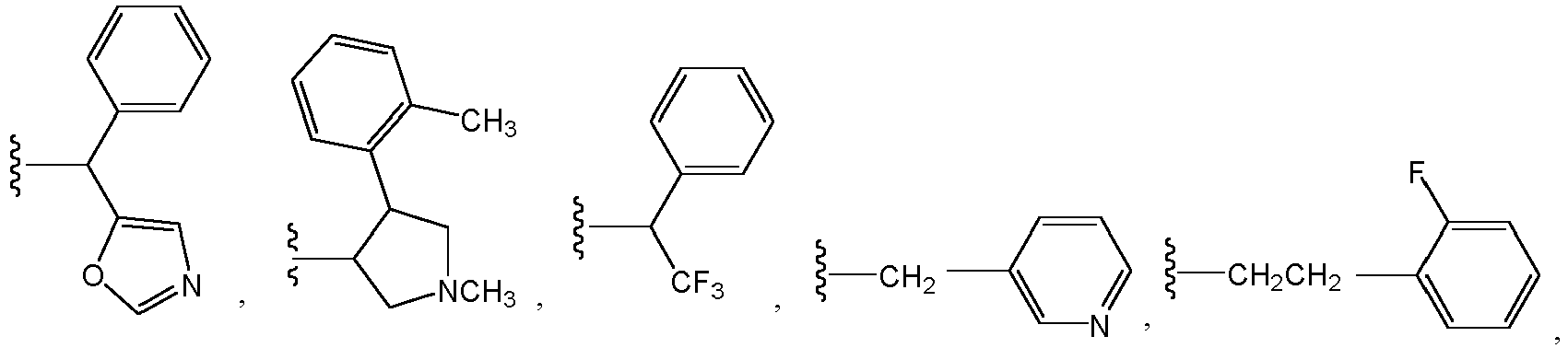


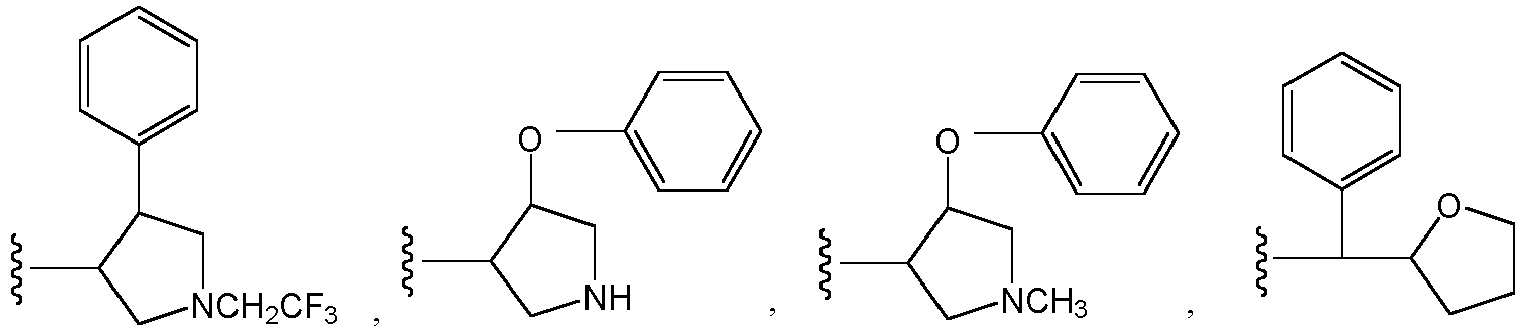


 R3 is -H, -CH2OCH3,
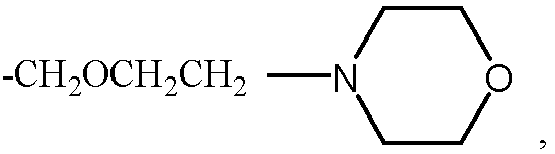
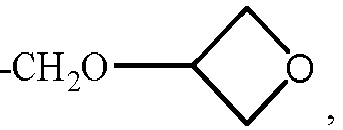

andR4 is H or F. - A compound of Claim 3, or a pharmaceutically acceptable salt thereof, selected from the group consisting of1-(4-fluorobenzyl)-3-(1-(4-fluorophenyl)-1H-pyrazolo[3,4-c]pyridin-5-yl)urea,1-benzyl-3-(1-pyridin-4-yl-1H-pyrazolo[3,4-c]pyridin-5-yl)urea,1-[(1R)-1-(4-fluorophenyl)ethyl]-3-[1-(4-fluorophenyl)-1H-pyrazolo[3,4-c]pyridin-5-yl]urea,1-(4-fluorobenzyl)-3-[1-(1-methyl-1H-pyrazol-4-yl)-1H-pyrazolo[3,4-c]pyridin-5-yl]urea,1-(4-fluorobenzyl)-3-(1-pyridin-4-yl-1H-pyrazolo[3,4-c]pyridin-5-yl)urea,1-[(1R)-1-(4-fluorophenyl)ethyl]-3-(1-pyridin-4-yl-1H-pyrazolo[3,4-c]pyridin-5-yl)urea,1-(2-phenylethyl)-3-(1-pyridin-4-yl-1H-pyrazolo [3,4-c]pyridin-5-yl)urea,1-(4-methoxybenzyl)-3-(1-pyridin-4-yl-1H-pyrazolo[3,4-c]pyridin-5-yl)urea,1-(1-pyridin-4-yl-1H-pyrazolo[3,4-c]pyridin-5-yl)-3-(1,2,3,4-tetrahydronaphthalen-1-yl)urea,1-(2,4-dichlorobenzyl)-3-(1-pyridin-4-yl-1H-pyrazolo[3,4-c]pyridin-5-yl)urea,1-(3,4-dichlorobenzyl)-3-(1-pyridin-4-yl-1H-pyrazolo[3,4-c]pyridin-5-yl)urea,1-[(3R,4S)-4-(2-chlorophenyl)-1-methylpyrrolidin-3-yl]-3-[1-(2-methylpyridin-4-yl)-1H-pyrazolo[3,4-c]pyridin-5-yl]urea,1-[1-(2-methylpyridin-4-yl)-1H-pyrazolo[3,4-c]pyridin-5-yl]-3-[(3R,4R)-4-phenyltetrahydrofuran-3-yl]urea,1-[(3R,4S)-4-(3-chloro-4-fluorophenyl)-1-methylpyrrolidin-3-yl]-3-[1-(2-methylpyridin-4-yl)-1H-pyrazolo[3,4-c]pyridin-5-yl]urea,1-[(3R,4S)-4-(3-fluorophenyl)-1-methylpyrrolidin-3-yl]-3-[1-(2-methylpyridin-4-yl)-1H-pyrazolo[3,4-c]pyridin-5-yl]urea,1-[1-(2-methylpyridin-4-yl)-1H-pyrazolo[3,4-c]pyridin-5-yl]-3-[(3R)-1-methylpyrrolidin-3-yl]urea,1-[1-(2-methylpyridin-4-yl)-1H-pyrazolo [3,4-c]pyridin-5-yl]-3-[(3S)-1-methylpyrrolidin-3-yl]urea,1-(1-methyl-5-oxopyrrolidin-3-yl)-3-[1-(2-methylpyridin-4-yl)-1H-pyrazolo[3,4-c]pyridin-5-yl]urea,1-(1-methyl-2-oxopyrrolidin-3-yl)-3-[1-(2-methylpyridin-4-yl)-1H-pyrazolo[3,4-c]pyridin-5-yl]urea,1-[1-(2-methylpyridin-4-yl)-1H-pyrazolo[3,4-c]pyridin-5-yl]-3-{(3R,4S)-1-methyl-4-[(3S)-tetrahydro-2H-pyran-3-yl]pyrrolidin-3-yl}urea,1-[(3R,4S)-4-(3-chloro-4-fluorophenyl)-1-methylpyrrolidin-3-yl]-3-[1-(2-methylpyridin-4-yl)-1H-pyrazolo[3,4-c]pyridin-5-yl]urea,1-[(3R,4S)-4-(3-fluorophenyl)-1-methylpyrrolidin-3-yl]-3-[1-(2-methylpyridin-4-yl)-1H-pyrazolo[3,4-c]pyridin-5-yl]urea,1-[1-(2-methylpyridin-4-yl)-1H-pyrazolo[3,4-c]pyridin-5-yl]-3-[(3R)-1-methylpyrrolidin-3-yl]urea,1-[1-(2-methylpyridin-4-yl)-1H-pyrazolo[3,4-c]pyridin-5-yl]-3-[(3S)-1-methylpyrrolidin-3-yl]urea,1-(1-methyl-5-oxopyrrolidin-3-yl)-3-[1-(2-methylpyridin-4-yl)-1H-pyrazolo[3,4-c]pyridin-5-yl]urea,1-(1-methyl-2-oxopyrrolidin-3-yl)-3-[1-(2-methylpyridin-4-yl)-1H-pyrazolo[3,4-c]pyridin-5-yl]urea,1-[1-(2-methylpyridin-4-yl)-1H-pyrazolo[3,4-c]pyridin-5-yl]-3-{(3R,4S)-1-methyl-4-[(3S)-tetrahydro-2H-pyran-3-yl]pyrrolidin-3-yl}urea,1-[(3R,4S)-1,4-dimethylpyrrolidin-3-yl]-3-[1-(2-methylpyridin-4-yl)-1H-pyrazolo[3,4-c]pyridin-5-yl]urea,1-[(3R,5S)-1,5-dimethylpyrrolidin-3-yl]-3-[1-(2-methylpyridin-4-yl)-1H-pyrazolo[3,4-c]pyridin-5-yl]urea,1-[1-(2-methylpyridin-4-yl)-1H-pyrazolo[3,4-c]pyridin-5-yl]-3-{[1-(2,2,2-trifluoro-1-methylethyl)azetidin-3-yl]methyl}urea,1-[(3R)-1-ethylpyrrolidin-3-yl]-3-[1-(2-methylpyridin-4-yl)-1H-pyrazolo[3,4-c]pyridin-5-yl]urea,1-[1-(2-methylpyridin-4-yl)-1H-pyrazolo [3,4-c]pyridin-5-yl]-3-[(3R)-1-propylpyrrolidin-3-yl]urea,1-[(3R,4S)-4-cyclopropyl-1-methylpyrrolidin-3-yl]-3-[1-(2-methylpyridin-4-yl)-1H-pyrazolo[3,4-c]pyridin-5-yl]urea,1-[(3R,4S)-4-cyclohexyl-1-methylpyrrolidin-3-yl]-3-[1-(2-methylpyridin-4-yl)-1H-pyrazolo[3,4-c]pyridin-5-yl]urea,N-{3-[({[1-(2-methylpyridin-4-yl)-1H-pyrazolo[3,4-c]pyridin-5-yl]carbamoyl}amino)methyl]phenyl}methanesulfonamide,1-[(1S)-1-(4-fluorophenyl)-2-methoxyethyl]-3-[1-(2-methylpyridin-4-yl)-1H-pyrazolo[3,4-c]pyridin-5-yl]urea,1-[(3R)-1-(4-fluorophenyl)pyrrolidin-3-yl]-3-[1-(2-methylpyridin-4-yl)-1H-pyrazolo[3,4-c]pyridin-5-yl]urea,1-[1-(2-methyl-2H-indazol-5-yl)-1H-pyrazolo[3,4-c]pyridin-5-yl]-3-[1,3-oxazol-5-yl(phenyl)methyl]urea,1-[(3R,4S) or (3S,4R)-1-methyl-4-(2-methylphenyl)pyrrolidin-3-yl]-3-[1-(2-methylpyridin-4-yl)-1H-pyrazolo[3,4-c]pyridin-5-yl]urea,1-benzyl-3-[1-(4-fluorophenyl)-1H-pyrazolo[3,4-c]pyridin-5-yl]urea,1-(1-pyridin-4-yl-1H-pyrazolo[3,4-c]pyridin-5-yl)-3-[(1S)-2,2,2-trifluoro-1-phenylethyl]urea,1-(pyridin-3-ylmethyl)-3-(1-pyridin-4-yl-1H-pyrazolo[3,4-c]pyridin-5-yl)urea,1-[2-(2-fluorophenyl)ethyl]-3-(1-pyridin-4-yl-1H-pyrazolo[3,4-c]pyridin-5-yl)urea,1-(3-chlorobenzyl)-3-(1-pyridin-4-yl-1H-pyrazolo[3,4-c]pyridin-5-yl)urea,1-(4-chlorobenzyl)-3-(1-pyridin-4-yl-1H-pyrazolo[3,4-c]pyridin-5-yl)urea,1-[(1R)-1-(3-chlorophenyl)ethyl]-3-[1-(2-methylpyridin-4-yl)-1H-pyrazolo[3,4-c]pyridin-5-yl]urea,1-[(1R)-1-(2-chlorophenyl)ethyl]-3-[1-(2-methylpyridin-4-yl)-1H-pyrazolo[3,4-c]pyridin-5-yl]urea,1-[1-(2-methylpyridin-4-yl)-1H-pyrazolo[3,4-c]pyridin-5-yl]-3-{1-[4-(1H-1,2,4-triazol-1-yl)phenyl]ethyl}urea,1-(2,2-dimethyl-3,4-dihydro-2H-chromen-4-yl)-3-[1-(2-methylpyridin-4-yl)-1H-pyrazolo[3,4-c]pyridin-5-yl]urea,1-[1-(2-methylpyridin-4-yl)-1H-pyrazolo[3,4-c]pyridin-5-yl]-3-{1-[4-(trifluoromethoxy)phenyl]ethyl}urea,1-[1-(2-methylpyridin-4-yl)-1H-pyrazolo[3,4-c]pyridin-5-yl]-3-{1-[3-(trifluoromethoxy)phenyl]ethyl} urea,1-(3-hydroxy-2-phenylpropyl)-3-[1-(2-methylpyridin-4-yl)-1H-pyrazolo[3,4-c]pyridin-5-yl]urea,1-[1-(2-methylpyridin-4-yl)-1H-pyrazolo[3,4-c]pyridin-5-yl]-3-(2-phenyl-2-piperidin-1-ylethyl)urea,1-[3-(dimethylamino)-1-phenylpropyl]-3-[1-(2-methylpyridin-4-yl)-1H-pyrazolo[3,4-c]pyridin-5-yl]urea,1-[1-(2-methylpyridin-4-yl)-1H-pyrazolo[3,4-c]pyridin-5-yl]-3-[(4-phenyltetrahydro-2H-pyran-4-yl)methyl]urea,1-[1-(2-methylpyridin-4-yl)-1H-pyrazolo[3,4-c]pyridin-5-yl]-3-(1-phenyl-3-piperidin-1-ylpropyl)urea,1-[2-(4-fluorophenyl)-2-piperidin-1-ylethyl]-3-[1-(2-methylpyridin-4-yl)-1H-pyrazolo[3,4-c]pyridin-5-yl]urea,1-[2-(4,4-difluoropiperidin-1-yl)-2-phenylethyl]-3-[1-(2-methylpyridin-4-yl)-1H-pyrazolo[3,4-c]pyridin-5-yl]urea,1-[(3R)-1-(2-fluoro-6-methoxybenzyl)piperidin-3-yl]-3-[1-(2-methylpyridin-4-yl)-1H-pyrazolo[3,4-c]pyridin-5-yl]urea,1-(1-methyl-4-phenylpyrrolidin-3-yl)-3-[1-(2-methylpyridin-4-yl)-1H-pyrazolo[3,4-c]pyridin-5-yl]urea,1-benzyl-3-[[3,4-c]pyridin-5-yl]urea,1-[1-(2-methylpyridin-4-yl)-1H-pyrazolo[3,4-c]pyridin-5-yl]-3-[(1R)-1-phenylethyl]urea,1-{[1-(4-fluorophenyl)-1H-pyrazol-4-yl]methyl}-3-[1-(2-methylpyridin-4-yl)-1H-pyrazolo[3,4-c]pyridin-5-yl]urea,1-(2,2-difluoro-2-phenylethyl)-3-[1-(2-methylpyridin-4-yl)-1H-pyrazolo[3,4-c]pyridin-5-yl]urea,1-(2-amino-1-phenylethyl)-3-[1-(2-methylpyridin-4-yl)-1H-pyrazolo[3,4-c]pyridin-5-yl]urea,1-[1-(2-methylpyridin-4-yl)-1H-pyrazolo[3,4-c]pyridin-5-yl]-3-(4-phenylpyrrolidin-3-yl)urea,1-[1-(2-methylpyridin-4-yl)-1H-pyrazolo[3,4-c]pyridin-5-yl]-3-(pyrazolo[1,5-a]pyridin-3-ylmethyl)urea,1-[(1S)-2-hydroxy-1-phenylethyl]-3-[1-(2-methylpyridin-4-yl)-1H-pyrazolo[3,4-c]pyridin-5-yl]urea,1-[1-(2-methylpyridin-4-yl)-1H-pyrazolo[3,4-c]pyridin-5-yl]-3-{1-[4-(methylsulfonyl)phenyl]ethyl}urea,1-[1-(2-methylpyridin-4-yl)-1H-pyrazolo[3,4-c]pyridin-5-yl]-3-(5-phenylpyrrolidin-3-yl)urea,1-{[4-methyl-2-(1-methylethyl)-1,3-thiazol-5-yl]methyl}-3-[1-(2-methylpyridin-4-yl)-1H-pyrazolo[3,4-c]pyridin-5-yl]urea,1-[1-(2-methylpyridin-4-yl)-1H-pyrazolo[3,4-c]pyridin-5-yl]-3-[(3-phenyltetrahydrofuran-3-yl)methyl]urea,1-[1-(2-methylpyridin-4-yl)-1H-pyrazolo[3,4-c]pyridin-5-yl]-3-[2-(5-phenyl-2,5-diazabicyclo[2.2.1]hept-2-yl)ethyl]urea,1-[1-(2-methylpyridin-4-yl)-1H-pyrazolo[3,4-c]pyridin-5-yl]-3-{2-[2-(phenoxymethyl)morpholin-4-yl] ethyl}urea,1-[3 -(dimethylamino)-1-pyridin-2-ylpropyl]-3-[1-(2-methylpyridin-4-yl)-1H-pyrazolo[3,4-c]pyridin-5-yl]urea,1-[1-(2-methylpyridin-4-yl)-1H-pyrazolo[3,4-c]pyridin-5-yl]-3-(2-morpholin-4-yl-2-pyridin-2-ylethyl)urea,1-[1-(2-methylpyridin-4-yl)-1H-pyrazolo[3,4-c]pyridin-5-yl]-3-[(2-oxo-2,3-dihydro-1H-indol-5-yl)methyl]urea,1-[1-(2-methylpyridin-4-yl)-1H-pyrazolo[3,4-c]pyridin-5-yl]-3-[3-(1H-pyrazol-1-yl)benzyl]urea,1-[1-(2-methylpyridin-4-yl)-1H-pyrazolo[3,4-c]pyridin-5-yl]-3-[4-(1H-pyrazol-1-yl)benzyl]urea,1-(3-hydroxytricyclo[3.3.1.1∼3,7∼]dec-1-yl)-3-[1-(2-methylpyridin-4-yl)-1H-pyrazolo[3,4-c]pyridin-5-yl]urea,1-[1-(2-methylpyridin-4-yl)-1H-pyrazolo[3,4-c]pyridin-5-yl]-3-(1-phenylpiperidin-4-yl)urea,1-[1-(2-methylpyridin-4-yl)-1H-pyrazolo[3,4-c]pyridin-5-yl]-3-[(4-phenylmorpholin-2-yl)methyl]urea,1-[1-(2-methylpyridin-4-yl)-1H-pyrazolo[3,4-c]pyridin-5-yl]-3-(2-oxo-1,2,3,4-tetrahydroquinolin-4-yl)urea,1-[(1S)-2,2-difluoro-1-phenylethyl]-3-[1-(2-methylpyridin-4-yl)-1H-pyrazolo[3,4-c]pyridin-5-yl]urea,1-[1-(2-methylpyridin-4-yl)-1H-pyrazolo[3,4-c]pyridin-5-yl]-3-(1-phenylpiperidin-3-yl)urea,1-[1-(2-methylpyridin-4-yl)-1H-pyrazolo[3,4-c]pyridin-5-yl]-3-[2-(tetrahydrofuran-3-yl)ethyl]urea,1-[1-(2-methylpyridin-4-yl)-1H-pyrazolo[3,4-c]pyridin-5-yl]-3-[(1-oxo-2,3-dihydro-1H-isoindol-5-yl)methyl]urea,1-[2-(4-fluorophenoxy)ethyl]-3-[1-(2-methylpyridin-4-yl)-1H-pyrazolo[3,4-c]pyridin-5-yl]urea,1-[4-(1-hydroxy-1-methylethyl)benzyl]-3-[1-(2-methylpyridin-4-yl)-1H-pyrazolo [3,4-c]pyridin-5-yl]urea,1-[2-(2-fluorophenoxy)ethyl]-3-[1-(2-methylpyridin-4-yl)-1H-pyrazolo[3,4-c]pyridin-5-yl]urea,1-[1-(2-methylpyridin-4-yl)-1H-pyrazolo[3,4-c]pyridin-5-yl]-3-(3,3,3-trifluoropropyl)urea,1-[(1R)-3-hydroxy-1-phenylpropyl]-3-[1-(2-methylpyridin-4-yl)-1H-pyrazolo [3,4-c]pyridin-5-yl]urea,1-[(1S)-2-methoxy-1-phenylethyl]-3-[1-(2-methylpyridin-4-yl)-1H-pyrazolo[3,4-c]pyridin-5-yl]urea,1-[1-(2-methylpyridin-4-yl)-1H-pyrazolo[3,4-c]pyridin-5-yl]-3-[4-(2-oxopyrrolidin-1-yl)benzyl]urea,N-methyl-4-[({[1-(2-methylpyridin-4-yl)-1H-pyrazolo[3,4-c]pyridin-5-yl]carbamoyl}amino)methyl]benzamide,1-[1-(2-methylpyridin-4-yl)-1H-pyrazolo[3,4-c]pyridin-5-yl]-3-[3-(methylsulfonyl)benzyl]urea,1-[1-(2-methylpyridin-4-yl)-1H-pyrazolo[3,4-c]pyridin-5-yl]-3-[3-(1,3-oxazol-2-yl)benzyl]urea,1-[2-(benzyloxy)ethyl]-3-[1-(2-methylpyridin-4-yl)-1H-pyrazolo[3,4-c]pyridin-5-yl]urea,1-[2-(benzylamino)ethyl]-3-[1-(2-methylpyridin-4-yl)-1H-pyrazolo[3,4-c]pyridin-5-yl]urea,N-methyl-3-[({[1-(2-methylpyridin-4-yl)-1H-pyrazolo[3,4-c]pyridin-5-yl]carbamoyl}amino)methyl]benzamide,1-(3-isoxazol-3-ylbenzyl)-3-[1-(2-methylpyridin-4-yl)-1H-pyrazolo[3,4-c]pyridin-5-yl]urea,1-[1-(2-methylpyridin-4-yl)-1H-pyrazolo[3,4-c]pyridin-5-yl]-3-[(1-methyl-1,2,3,4-tetrahydroquinolin-3-yl)methyl]urea,1-{[1-(dimethylamino)cyclohexyl]methyl}-3-[1-(2-methylpyridin-4-yl)-1H-pyrazolo [3,4-c]pyridin-5-yl]urea,1-[(2S,3S,4R)-1,2-dimethyl-4-(2-methylphenyl)pyrrolidin-3-yl]-3-[1-(2-methylpyridin-4-yl)-1H-pyrazolo [3,4-c]pyridin-5-yl]urea,1-[1-(2-methylpyridin-4-yl)-1H-pyrazolo[3,4-c]pyridin-5-yl]-3-[(3S,4R)-1,2,2-trimethyl-4-(2-methylphenyl)pyrrolidin-3-yl]urea,1-[1-(2-methylpyridin-4-yl)-1H-pyrazolo[3,4-c]pyridin-5-yl]-3-[(3S,4S)-1,5,5-trimethyl-4-(2-methylphenyl)pyrrolidin-3-yl]urea,1-[(2R,3S,4R)-1,2-dimethyl-4-(2-methylphenyl)pyrrolidin-3-yl]-3-[1-(2-methylpyridin-4-yl)-1H-pyrazolo[3,4-c]pyridin-5-yl]urea,1-[(3S,4S,5S)-1,5-dimethyl-4-(2-methylphenyl)pyrrolidin-3-yl]-3-[1-(2-methylpyridin-4-yl)-1H-pyrazolo[3,4-c]pyridin-5-yl]urea,1-[(3S,4S,5R)-1,5-dimethyl-4-(2-methylphenyl)pyrrolidin-3-yl]-3-[1-(2-methylpyridin-4-yl)-1H-pyrazolo[3,4-c]pyridin-5-yl]urea,1-[(7R,8S)-5-methyl-7-phenyl-2-oxa-5-azaspiro[3.4]oct-8-yl]-3-[1-(2-methylpyridin-4-yl)-1H-pyrazolo[3,4-c]pyridin-5-yl]urea,1-[(1-methyl-1H-imidazol-4-yl)methyl]-3-[1-(2-methylpyridin-4-yl)-1H-pyrazolo[3,4-c]pyridin-5-yl]urea,1-[1-(2-methylpyridin-4-yl)-1H-pyrazolo[3,4-c]pyridin-5-yl]-3-(2-morpholin-4-ylethyl)urea,1-(2-fluoroethyl)-3-[1-(2-methylpyridin-4-yl)-1H-pyrazolo[3,4-c]pyridin-5-yl]urea,1-(2-methoxyethyl)-3-[1-(2-methylpyridin-4-yl)-1H-pyrazolo[3,4-c]pyridin-5-yl]urea,1-[1-(2-methylpyridin-4-yl)-1H-pyrazolo[3,4-c]pyridin-5-yl]-3-[(3S,4R)-1-methyl-4-pyridin-3-ylpyrrolidin-3-yl]urea,1-[(3R,4S)-1-methyl-4-(3-methylthiophen-2-yl)pyrrolidin-3-yl]-3-[1-(2-methylpyridin-4-yl)-1H-pyrazolo[3,4-c]pyridin-5-yl]urea,1-[(5-methyl-3-phenylisoxazol-4-yl)methyl]-3-[1-(2-methylpyridin-4-yl)-1H-pyrazolo[3,4-c]pyridin-5-yl]urea,1-[(3R,4S)-1-methyl-4-(2-phenylethyl)pyrrolidin-3-yl]-3-[1-(2-methylpyridin-4-yl)-1H-pyrazolo [3 ,4-c]pyridin-5-yl]urea,1-[1-(2-methylpyridin-4-yl)-1H-pyrazolo[3,4-c]pyridin-5-yl]-3-[(1,3,5-trimethyl-1H-pyrazol-4-yl)methyl]urea,1-[2-(3,5-dimethylisoxazol-4-yl)ethyl]-3-[1-(2-methylpyridin-4-yl)-1H-pyrazolo[3,4-c]pyridin-5-yl]urea,1-[(4-methyl-1,2,5-oxadiazol-3-yl)methyl]-3-[1-(2-methylpyridin-4-yl)-1H-pyrazolo[3,4-c]pyridin-5-yl]urea,1-[(1,3-dimethyl-1H-pyrazol-5-yl)methyl]-3-[1-(2-methylpyridin-4-yl)-1H-pyrazolo[3,4-c]pyridin-5-yl]urea,1-(2-hydroxypropyl)-3-[1-(2-methylpyridin-4-yl)-1H-pyrazolo[3,4-c]pyridin-5-yl]urea,1-(1-cyanocyclopropyl)-3-[1-(2-methylpyridin-4-yl)-1H-pyrazolo[3,4-c]pyridin-5-yl]urea,1-(1-methyl-1-phenylethyl)-3-[1-(2-methylpyridin-4-yl)-1H-pyrazolo[3,4-c]pyridin-5-yl]urea,1-[1-(2-methylpyridin-4-yl)-1H-pyrazolo[3,4-c]pyridin-5-yl]-3-[1-(2-methyl-1,3-thiazol-4-yl)ethyl]urea,1-[(3S,4R)-1-methyl-4-(5-methylthiophen-2-yl)pyrrolidin-3-yl]-3-[1-(2-methylpyridin-4-yl)-1H-pyrazolo[3,4-c]pyridin-5-yl]urea,1-(1-benzothiophen-3-ylmethyl)-3-[[3,4-c]pyridin-5-yl]urea,1-[(3S,4R)-1-methyl-4-(4-methyl-1,3-thiazol-2-yl)pyrrolidin-3-yl]-3-[1-(2-methylpyridin-4-yl)-1H-pyrazolo[3,4-c]pyridin-5-yl]urea,1-[1-(2-methylpyridin-4-yl)-1H-pyrazolo[3,4-c]pyridin-5-yl]-3-[(1S)-2-morpholin-4-yl-1-phenylethyl]urea,1-[1-(2-methylpyridin-4-yl)-1H-pyrazolo[3,4-c]pyridin-5-yl]-3-[1-(2-methyl-1,3-thiazol-4-yl)ethyl]urea,1 -[(1S)-2-ethoxy-1-phenylethyl]-3-[1-(2-methylpyridin-4-yl)-1H-pyrazolo[3,4-c]pyridin-5-yl]urea,1-[(1S)-2-(dimethylamino)-1-phenylethyl]-3-[1-(2-methylpyridin-4-yl)-1H-pyrazolo[3,4-c]pyridin-5-yl]urea,1-[1-(2-methylpyridin-4-yl)-1H-pyrazolo[3,4-c]pyridin-5-yl]-3-[1-(2-methyl-1,3-thiazol-4-yl)ethyl]urea,1-[(3S,4S)-4-methoxypyrrolidin-3-yl]-3-[1-(2-methylpyridin-4-yl)-1H-pyrazolo[3,4-c]pyridin-5-yl]urea,1-[1-(2-methylpyridin-4-yl)-1H-pyrazolo[3,4-c]pyridin-5-yl]-3-pyrrolidin-3-ylurea,1-[(1S)-2-(1H-imidazol-1-yl)-1-phenylethyl]-3-[1-(2-methylpyridin-4-yl)-1H-pyrazolo[3,4-c]pyridin-5-yl]urea,1-[(1S)-2-(1-methylethoxy)-1 -phenylethyl]-3-[1-(2-methylpyridin-4-yl)-1H-pyrazolo [3,4-c]pyridin-5-yl]urea,1-[(1S)-2-(2-methoxyethoxy)-1-phenylethyl]-3-[1-(2-methylpyridin-4-yl)-1H-pyrazolo[3,4-c]pyridin-5-yl]urea,methyl (2S)-({[1-(2-methylpyridin-4-yl)-1H-pyrazolo[3,4-c]pyridin-5-yl]carbamoyl}amino)(phenyl)ethanoate,1-[(1S,2S)-2-aminocyclohexyl]-3-[1-(2-methylpyridin-4-yl)-1H-pyrazolo[3,4-c]pyridin-5-yl]urea,N-[(1S,2S)-2-({[1-(2-methylpyridin-4-yl)-1H-pyrazolo[3,4-c]pyridin-5-yl]carbamoyl}amino)cyclohexyl]acetamide,1-[(1S,2S)-2-methoxycyclopentyl]-3-[1-(2-methylpyridin-4-yl)-1H-pyrazolo[3,4-c]pyridin-5-yl]urea,(2S)-N-ethyl-2-({[1-(2-methylpyridin-4-yl)-1H-pyrazolo[3,4-c]pyridin-5-yl]carbamoyl}amino)-2-phenylethanamide,(2S)-N-methyl-2-({[1-(2-methylpyridin-4-yl)-1H-pyrazolo [3,4-c]pyridin-5-yl]carbamoyl}amino)-2-phenylethanamide,1-[(1S,2S)-2-(dimethylamino)cyclohexyl]-3-[1-(2-methylpyridin-4-yl)-1H-pyrazolo[3,4-c]pyridin-5-yl]urea,(2S)-N,N-diethyl-2-({[1-(2-methylpyridin-4-yl)-1H-pyrazolo[3,4-c]pyridin-5-yl]carbamoyl}amino)-2-phenylethanamide,Racemic 1-[(1S,2S) and (1R,2R)-2-methoxycyclohexyl]-3-[1-(2-methylpyridin-4-yl)-1H-pyrazolo[3,4-c]pyridin-5-yl]urea,Racemic 1-[(1S,2S) and (1R,2R)-2-ethoxycyclohexyl]-3-[1-(2-methylpyridin-4-yl)-1H-pyrazolo[3,4-c]pyridin-5-yl]urea,Racemic 1-[(1S,2S) and (1R,2R)-2-ethoxycyclopentyl]-3-[1-(2-methylpyridin-4-yl)-1H-pyrazolo[3,4-c]pyridin-5-yl]urea,Racemic 1-[1-(2-methylpyridin-4-yl)-1H-pyrazolo[3,4-c]pyridin-5-yl]-3-[(1S,2S) and (1R, 2R)-2-phenylcyclopentyl]urea,1-[(3R,4S)-1-methyl-4-(3-phenylpropyl)pyrrolidin-3-yl]-3-[1-(2-methylpyridin-4-yl)-1H-pyrazolo[3,4-c]pyridin-5-yl]urea,1-[(3R,4S)-1-methyl-4-(5-methylisoxazol-3-yl)pyrrolidin-3-yl]-3-[1-(2-methylpyridin-4-yl)-1H-pyrazolo[3,4-c]pyridin-5-yl]urea,Racemic trans 1-[1-(2-methylpyridin-4-yl)-1H-pyrazolo[3,4-c]pyridin-5-yl]-3-[(1S,2R) and (1R,2S)-2-phenylcyclohexyl]urea,Racemic Trans N-[(1S,2S) and (1R, 2R)-2-({[1-(2-methylpyridin-4-yl)-1H-pyrazolo[3,4-c]pyridin-5-yl]carbamoyl}amino)cyclohexyl]benzamide,Racemic cis 1-[(1S,2S) and (1R,2R)-2-(4-fluorophenyl)cyclopentyl]-3-[1-(2-methylpyridin-4-yl)-1H-pyrazolo [3,4-c]pyridin-5-yl]urea,1-[(1S,2S)-2-(benzyloxy)cyclopentyl]-3-[1-(2-methylpyridin-4-yl)-1H-pyrazolo[3,4-c]pyridin-5-yl]urea,1-[(3R,4S)-1-methyl-4-(5-phenylthiophen-2-yl)pyrrolidin-3-yl]-3-[1-(2-methylpyridin-4-yl)-1H-pyrazolo[3,4-c]pyridin-5-yl]urea,1-[1-(2-methylpyridin-4-yl)-1H-pyrazolo[3,4-c]pyridin-5-yl]-3-[(3R,4S)-4-phenyl-1-(2,2,2-trifluoroethyl)pyrrolidin-3-yl]urea,1-[1-(2-methylpyridin-4-yl)-1H-pyrazolo[3,4-c]pyridin-5-yl]-3-[(3S,4S)-4-phenoxypyrrolidin-3-yl]urea,1-[(3S,4S)-1-methyl-4-phenoxypyrrolidin-3-yl]-3-[1-(2-methylpyridin-4-yl)-1H-pyrazolo [3,4-c]pyridin-5-yl]urea,1-[1-(2-methylpyridin-4-yl)-1H-pyrazolo[3,4-c]pyridin-5-yl]-3-[phenyl(tetrahydrofuran-2-yl)methyl]urea,1-[(1S,2S)-2-benzylcyclopentyl]-3-[1-(2-methylpyridin-4-yl)-1H-pyrazolo[3,4-c]pyridin-5-yl]urea,1-[1-(2-methylpyridin-4-yl)-1H-pyrazolo[3,4-c]pyridin-5-yl]-3-[(1S,2S)-2-phenoxycyclopentyl]urea,Racemic trans 1-[1-(2-methylpyridin-4-yl)-1H-pyrazolo[3,4-c]pyridin-5-yl]-3-[(1S,2S)and (1R,2R)-2-(3-phenylpropoxy)cyclopentyl]urea,1-[(1S,2R)-2-benzylcyclohexyl]-3-[1-(2-methylpyridin-4-yl)-1H-pyrazolo[3,4-c]pyridin-5-yl]urea,1-[(3R,4S)-4-(5-cyclopropylthiophen-2-yl)-1-methylpyrrolidin-3-yl]-3-[1-(2-methylpyridin-4-yl)-1H-pyrazolo[3,4-c]pyridin-5-yl]urea,1 -[(3R,4S)-1-methyl-4-(1-methyl-1H-pyrazol-4-yl)pyrrolidin-3-yl]-3-[1-(2-methylpyridin-4-yl)-1H-pyrazolo[3,4-c]pyridin-5-yl]urea,Racemic trans 1-[(1S,2S) and (1R,2R)-2-(4-fluorophenoxy)cyclopentyl]-3-[1-(2-methylpyridin-4-yl)-1H-pyrazolo[3,4-c]pyridin-5-yl]urea,Racemic cis 1-[(1S,2S) and (1R,2R)-2-benzylcyclohexyl]-3-[1-(2-methylpyridin-4-yl)-1H-pyrazolo[3,4-c]pyridin-5-yl]urea,Racemic trans 1-[1-(2-methylpyridin-4-yl)-1H-pyrazolo[3,4-c]pyridin-5-yl]-3-[(1S,2R) and (1R,2S)-2-phenylcyclopentyl]urea,Racemic trans 1-[1-(2-methylpyridin-4-yl)-1H-pyrazolo[3,4-c]pyridin-5-yl]-3-[(1S,2R) and (1R,2S)-2-phenylcyclohexyl]urea,1-[3-(4-fluorophenyl)cyclopentyl]-3-[1-(2-methylpyridin-4-yl)-1H-pyrazolo[3,4-c]pyridin-5-yl]urea,1-[1-(2-methylpyridin-4-yl)-1H-pyrazolo[3,4-c]pyridin-5-yl]-3-(3-phenylcyclohexyl)urea,1-(3,4-dihydro-2H-chromen-4-yl)-3-[1-(2-methylpyridin-4-yl)-1H-pyrazolo[3,4-c]pyridin-5-yl]urea,1-[3-(4-fluorophenyl)cyclohexyl]-3-[1-(2-methylpyridin-4-yl)-1H-pyrazolo[3,4-c]pyridin-5-yl]urea,Racemic cis 1-[(1S,2S) and (1R,2R)-2-(4-fluorophenyl)cyclohexyl]-3-[1-(2-methylpyridin-4-yl)-1H-pyrazolo[3 ,4-c]pyridin-5-yl]urea,1-[1-(2-methylpyridin-4-yl)-1H-pyrazolo[3,4-c]pyridin-5-yl]-3-(3-phenylcyclohexyl)urea,1-[3-(4-fluorophenyl)cyclohexyl]-3-[1-(2-methylpyridin-4-yl)-1H-pyrazolo[3,4-c]pyridin-5-yl]urea,1-(2,3-dihydro-1-benzofuran-3-yl)-3-[1-(2-methylpyridin-4-yl)-1H-pyrazolo[3,4-c]pyridin-5-yl]urea,1-[1-(2-methylpyridin-4-yl)-1H-pyrazolo[3,4-c]pyridin-5-yl]-3-(3-phenylcyclopentyl)urea,1-((3S, 4R)1-methyl-4-phenylpyrrolidin-3-yl)-3-[1-(2-methylpyridin-4-yl)-1H-pyrazolo[3,4-c]pyridin-5-yl]urea,1-((3R,4S)1-methyl-4-phenylpyrrolidin-3-yl)-3-[1-(2-methylpyridin-4-yl)-1H-pyrazolo[3,4-c]pyridin-5-yl]urea,1-[(7R,8S)-5-methyl-7-phenyl-2-oxa-5-azaspiro[3.4]oct-8-yl]-3-[1-(2-methylpyridin-4-yl)-1H-pyrazolo[3,4-c]pyridin-5-yl]urea,1-[(7S,8R)-5-methyl-7-phenyl-2-oxa-5-azaspiro[3.4]oct-8-yl]-3-[1-(2-methylpyridin-4-yl)-1H-pyrazolo[3,4-c]pyridin-5-yl]urea,1-[(3R,4S)-1-methyl-4-(2-phenylethyl)pyrrolidin-3-yl]-3-[1-(2-methylpyridin-4-yl)-1H-pyrazolo[3,4-c]pyridin-5-yl]urea,1-[(1R)-2-amino-1-phenylethyl]-3-[1-(2-methylpyridin-4-yl)-1H-pyrazolo[3,4-c]pyridin-5-yl]urea,1-[(1S)-2-amino-1-phenylethyl]-3-[1-(2-methylpyridin-4-yl)-1H-pyrazolo[3,4-c]pyridin-5-yl]urea,1-[(3S,4R)-1-methyl-4-(5-methylthiophen-2-yl)pyrrolidin-3-yl]-3-[1-(2-methylpyridin-4-yl)-1H-pyrazolo[3,4-c]pyridin-5-yl]urea,1-[(3S,4R)-1-methyl-4-(2-methylphenyl)pyrrolidin-3-yl]-3-[1-(2-methylpyridin-4-yl)-1H-pyrazolo[3,4-c]pyridin-5-yl]urea,1-[1-(2-methylpyridin-4-yl)-1H-pyrazolo[3,4-c]pyridin-5-yl]-3-{(3R,4S)-1-methyl-4-[2-(trifluoromethyl)phenyl]pyrrolidin-3-yl}urea,1-[1-(2-methylpyridin-4-yl)-1H-pyrazolo[3,4-c]pyridin-5-yl]-3-{(3S,4R)-1-methyl-4-[2-(trifluoromethyl)phenyl]pyrrolidin-3-yl}urea,1-[(3S,4S)-4-methoxy-1-methylpyrrolidin-3-yl]-3-[1-(2-methylpyridin-4-yl)-1H-pyrazolo [3,4-c]pyridin-5-yl]urea,1-[(3R,4R)-4-methoxy-1-methylpyrrolidin-3-yl]-3-[1-(2-methylpyridin-4-yl)-1H-pyrazolo[3,4-c]pyridin-5-yl]urea,1-[(3R,4S)-1-cyclobutyl-4-phenylpyrrolidin-3-yl]-3-[1-(2-methylpyridin-4-yl)-1H-pyrazolo[3,4-c]pyridin-5-yl]urea,1-[(3S,4R)-1-cyclobutyl-4-phenylpyrrolidin-3-yl]-3-[1-(2-methylpyridin-4-yl)-1H-pyrazolo[3,4 c]pyridin-5-yl]urea,1-[(3S,4R)-1-(1-methylethyl)-4-phenylpyrrolidin-3-yl]-3-[1-(2-methylpyridin-4-yl)-1H-pyrazolo[3,4-c]pyridin-5-yl]urea,1-[(3R,4S)-1-(1-methylethyl)-4-phenylpyrrolidin-3-yl]-3-[1-(2-methylpyridin-4-yl)-1H-pyrazolo[3,4-c]pyridin-5-yl]urea,1-[(3R,4S)-1-ethyl-4-phenylpyrrolidin-3-yl]-3-[1-(2-methylpyridin-4-yl)-1H-pyrazolo[3,4-c]pyridin-5-yl]urea,1-[(3S,4R)-1-ethyl-4-phenylpyrrolidin-3-yl]-3-[1-(2-methylpyridin-4-yl)-1H-pyrazolo[3,4-c]pyridin-5-yl]urea,1-[(7S,8S)-5-methyl-8-phenyl-2-oxa-5-azaspiro[3.4]oct-7-yl]-3-[1-(2-methylpyridin-4-yl)-1H-pyrazo lo [3 ,4-c]pyridin-5-yl]urea,1-[(7R,8R)-5-methyl-8-phenyl-2-oxa-5-azaspiro[3.4]oct-7-yl]-3-[1-(2-methylpyridin-4-yl)-1H-pyrazolo[3,4-c]pyridin-5-yl]urea,1-[1-(2-methylpyridin-4-yl)-1H-pyrazolo[3,4-c]pyridin-5-yl]-3-[(1S)-1-pyridin-2-ylethyl]urea,1-[1-(2-methylpyridin-4-yl)-1H-pyrazolo[3,4-c]pyridin-5-yl]-3-[(1R)-1-pyridin-2-ylethyl]urea,R)-1-(1-(3-chloro-4-fluorophenyl)ethyl)-3-(1-(1-methyl-1H-pyrazol-4-yl)-1H-pyrazolo[3,4-c]pyridin-5-yl)urea,1-[(1S)-2-hydroxy-2-methyl-1-phenylpropyl]-3-[1-(1-methyl-1H-indazol-6-yl)-1H-pyrazolo[3,4-c]pyridin-5-yl]urea,1-[(1S)-2-hydroxy-2-methyl-1-phenylpropyl]-3-[1-(2-methyl-2H-indazol-5-yl)-1H-pyrazolo[3,4-c]pyridin-5-yl]urea,1-[1-(4-fluorophenyl)-1H-pyrazolo[3,4-c]pyridin-5-yl]-3-[(3R,4S)-1-methyl-4-phenylpyrrolidin-3-yl]urea,1-[(1R)-2-methoxy-1-pyridin-2-ylethyl]-3-[1-(2-methylpyridin-4-yl)-1H-pyrazolo [3,4-c]pyridin-5-yl]urea,1-[(1S)-2-methoxy-1-pyridin-2-ylethyl]-3-[1-(2-methylpyridin-4-yl)-1H-pyrazolo [3,4-c]pyridin-5-yl]urea,1-[1-(6-methylpyrazin-2-yl)-1H-pyrazolo[3,4-c]pyridin-5-yl]-3-[(1R)-1-phenylethyl]urea,1-[1-(5-methylpyrazin-2-yl)-1H-pyrazolo[3,4-c]pyridin-5-yl]-3-[(1R)-1-phenylethyl]urea,1-[1-(6-methylpyridazin-3-yl)-1H-pyrazolo[3,4-c]pyridin-5-yl]-3-[(1R)-1-phenylethyl]urea,1-(3-chloro-4-fluorobenzyl)-3-[1-(2-methylpyridin-4-yl)-1H-pyrazolo[3,4-c]pyridin-5-yl]urea,1-(3-chlorobenzyl)-3-[1-(2-methylpyridin-4-yl)-1H-pyrazolo[3,4-c]pyridin-5-yl]urea,1-(3-chlorobenzyl)-3-[1-(1-methyl-1H-pyrazol-4-yl)-1H-pyrazolo[3,4-c]pyridin-5-yl]urea,1-[(1R)-1-(3-chlorophenyl)ethyl]-3-[1-(1-methyl-1H-pyrazol-4-yl)-1H-pyrazolo[3,4-c]pyridin-5-yl]urea,1-(3-chloro-4-fluorobenzyl)-3-[1-(1-methyl-1H-pyrazol-4-yl)-1H-pyrazolo[3,4-c]pyridin-5-yl]urea,1-[(1R)-1-(3-chloro-4-fluorophenyl)ethyl]-3-[1-(2-methylpyridin-4-yl)-1H-pyrazolo[3,4-c]pyridin-5-yl]urea,1-[1-(4-fluorophenyl)-1H-pyrazolo[3,4-c]pyridin-5-yl]-3-[(1S)-1-pyridin-2-ylethyl]urea,1-[1-(4-fluorophenyl)-1H-pyrazolo[3,4-c]pyridin-5-yl]-3-[(1R)-1-pyridin-2-ylethyl]urea,(R)-1-(1-(4-fluorophenyl)ethyl)-3-(1-(2-methylpyridin-4-yl)-1H-pyrazolo[3,4-c]pyridin-5-yl)urea,(R)-1-(4-Fluoro-1-(2-methylpyridin-4-yl)-1H-pyrazolo[3,4-c]pyridin-5-yl)-3-(1-phenylethyl)urea,(R)-1-(1-methyl-1H-pyrazolo[3,4-c]pyridin-5-yl)-3-(1-phenylethyl)urea,1-[7-(hydroxymethyl)-1-methyl-1H-pyrazolo[3,4-c]pyridin-5-yl]-3-[(1S)-2-hydroxy-2-methyl-1-phenylpropyl]urea,1-((1S,2R)-2-Hydroxy-1-phenylpropyl)-3-(1H-pyrazolo[3,4-c]pyridin-5-yl)urea,1-[(1S)-2-hydroxy-2-methyl-1-phenylpropyl]-3-(1-methyl-1H-pyrazolo[3,4-c]pyridin-5-yl)urea, (R)-1-(7-(hydroxymethyl)-1H-pyrazolo[3,4-c]pyridin-5-yl)-3-(1-phenylethyl)urea,(S)-1-(2-hydroxy-2-methyl-1-phenylpropyl)-3-(1H-pyrazolo[3,4-c]pyridin-5-yl)urea (TFA salt), N-ethyl-5-({[(1R)-1-phenylethyl]carbamoyl}amino)-1H-pyrazolo[3,4-c]pyridine-1-carboxamide,1-[(1R)-1-(4-fluorophenyl)ethyl]-3-(1-methyl-1H-pyrazolo[3,4-c]pyridin-5-yl)urea,1-[(1R)-1-(4-fluorophenyl)ethyl]-3-[1-(2-oxopiperidin-4-yl)-1H-pyrazolo[3,4-c]pyridin-5-yl]urea,tert-butyl 2-[5-({[(1S)-1-(4-fluorophenyl)-2-hydroxy-2-methylpropyl]carbamoyl}amino)-1H-pyrazolo[3,4-c]pyridin-1-yl]-5,8-dihydropyrido[3,4-d]pyrimidine-7(6H)-carboxylate,1-[1-(3-methoxypropyl)-1H-pyrazolo[3,4-c]pyridin-5-yl]-3-[(1R)-1-phenylethyl]urea,1-[1-(2,6-difluorobenzyl)piperidin-3-yl]-3-(1-methyl-1H-pyrazolo[3,4-c]pyridin-5-yl)urea,1-[(1S)-2-methoxy-1-phenylethyl]-3-(1-methyl-1H-pyrazolo[3,4-c]pyridin-5-yl)urea,1-[(1R)-1-phenylethyl]-3-[1-(tetrahydro-2H-pyran-4-yl)-1H-pyrazolo[3,4-c]pyridin-5-yl]urea,1-[(1S)-2-methoxy-1-phenylethyl]-3-[1-(2-methylpiperidin-4-yl)-1H-pyrazolo[3,4-c]pyridin-5-yl]urea,1-[1-(4-fluorophenyl)-7-(hydroxymethyl)-1H-pyrazolo[3,4-c]pyridin-5-yl]-3-[(1R)-1-phenylethyl]urea,1-[1-(4-fluorophenyl)-7-(methoxymethyl)-1H-pyrazolo[3,4-c]pyridin-5-yl]-3-[(1R)-1-phenylethyl]urea,1-[1-(4-fluorophenyl)-7-(morpholin-4-ylmethyl)-1H-pyrazolo[3,4-c]pyridin-5-yl]-3-[(1R)-1-phenylethyl]urea,1-{7-[(dimethylamino)methyl]-1-(4-fluorophenyl)-1H-pyrazolo[3,4-c]pyridin-5-yl}-3-[(1R)-1-phenylethyl]urea,1-{1-(4-fluorophenyl)-7-[(2-morpholin-4-ylethoxy)methyl]-1H-pyrazolo[3,4-c]pyridin-5-yl}-3-[(1R)-1-phenylethyl]urea,1-[1-(2-methylpyridin-4-yl)-7-(morpholin-4-ylmethyl)-1H-pyrazolo[3,4-c]pyridin-5-yl]-3-[(1R)-1-phenylethyl]urea,1-{1-(4-fluorophenyl)-7-[(2-hydroxyethoxy)methyl]-1H-pyrazolo[3,4-c]pyridin-5-yl}-3-[(1R)-1-phenylethyl]urea,1-[7-(methoxymethyl)-1-(2-methylpyridin-4-yl)-1H-pyrazolo[3,4-c]pyridin-5-yl]-3-[(1R)-1-phenylethyl]urea,1-{7-[(2-methoxyethoxy)methyl]-1-(2-methylpyridin-4-yl)-1H-pyrazolo[3,4-c]pyridin-5-yl}-3-[(1R)-1-phenylethyl]urea,1-{1-(2-methylpyridin-4-yl)-7-[(2-morpholin-4-ylethoxy)methyl]-1H-pyrazolo[3,4-c]pyridin-5-yl}-3-[(1R)-1-phenylethyl]urea,1-{1-(2-methylpyridin-4-yl)-7-[(oxetan-3-yloxy)methyl]-1H-pyrazolo[3,4-c]pyridin-5-yl}-3-[(1R)-1-phenylethyl]urea,1-[7-methyl-1-(2-methylpyridin-4-yl)-1H-pyrazolo[3,4-c]pyridin-5-yl]-3-[(1R)-1-phenylethyl]urea,1-[7-{[2-(benzyloxy)ethoxy]methyl}-1-(2-methylpyridin-4-yl)-1H-pyrazolo[3,4-c]pyridin-5-yl]-3-[(1R)-1-phenylethyl]urea,1-{7-[(2-hydroxyethoxy)methyl]-1-(2-methylpyridin-4-yl)-1H-pyrazolo[3,4-c]pyridin-5-yl}-3-[(1R)-1-phenylethyl]urea,1-[7-(hydroxymethyl)-1-(2-methylpyridin-4-yl)-1H-pyrazolo[3,4-c]pyridin-5-yl]-3-[(1S)-2-hydroxy-2-methyl-1-phenylpropyl]urea,1-[1-tert-butyl-7-(hydroxymethyl)-1H-pyrazolo[3,4-c]pyridin-5-yl]-3-[(1R)-1-phenylethyl]urea, 1-(1-ethyl-7-methoxy-1H-pyrazolo[3,4-c]pyridin-5-yl)-3-[(1R)-1-phenylethyl]urea,1-(1-ethyl-7-methoxy-1H-pyrazolo[3,4-c]pyridin-5-yl)-3-[(1S)-2-hydroxy-2-methyl-1-phenylpropyl]urea,1-[(1S)-2-methoxy-1-phenylethyl]-3-[1-(pyridin-4-ylmethyl)-1H-pyrazolo[3,4-c]pyridin-5-yl]urea,1-[1-(2-methylpyridin-4-yl)-1H-pyrazolo[3,4-c]pyridin-5-yl]-3-[1-(pyridin-3-ylmethyl)piperidin-3-yl]urea,1-[1-(2,6-difluorobenzyl)piperidin-3-yl]-3-[1-(2-methylpyridin-4-yl)-1H-pyrazolo[3,4-c]pyridin-5-yl]urea,1-[1-(2-methylpyridin-4-yl)-1H-pyrazolo[3,4-c]pyridin-5-yl]-3-[1-(1,3-thiazol-2-ylmethyl)piperidin-3-yl]urea,1-{1-[(2-chloropyridin-3-yl)methyl]piperidin-3-yl}-3-[1-(2-methylpyridin-4-yl)-1H-pyrazolo[3,4-c]pyridin-5-yl]urea,1-[(3S,4S)-1-(2,6-difluorobenzyl)-4-methoxypyrrolidin-3-yl]-3-[1-(2-methylpyridin-4-yl)-1H-pyrazolo[3,4-c]pyridin-5-yl]urea,1-[1-(2-methylpyridin-4-yl)-1H-pyrazolo[3,4-c]pyridin-5-yl]-3-[1-(pyridin-3-ylmethyl)pyrrolidin-3-yl]urea,1-[1-(2,6-difluorobenzyl)pyrrolidin-3-yl]-3-[1-(2-methylpyridin-4-yl)-1H-pyrazolo[3,4-c]pyridin-5-yl]urea,1-[(3S,4S)-4-ethoxypyrrolidin-3-yl]-3-[1-(2-methylpyridin-4-yl)-1H-pyrazolo[3,4-c]pyridin-5-yl]urea,1-[(3S,4S) or (3R, 4R)-1-(2,6-difluorobenzyl)-4-methoxypyrrolidin-3-yl]-3-[1-(2-methylpyridin-4-yl)-1H-pyrazolo[3,4-c]pyridin-5-yl]urea,1-[(3R,4R) or (3S, 4S)-1-(2,6-difluorobenzyl)-4-methoxypyrrolidin-3-yl]-3-[1-(2-methylpyridin-4-yl)-1H-pyrazolo[3,4-c]pyridin-5-yl]urea,1-{(3S,4S)-4-[(5-fluoropyridin-3-yl)oxy]pyrrolidin-3-yl}-3-[1-(2-methylpyridin-4-yl)-1H-pyrazolo[3,4-c]pyridin-5-yl]urea,1-{(3S,4S)-4-[(5-fluoropyridin-3-yl)oxy]-1-methylpyrrolidin-3-yl}-3-[1-(2-methylpyridin-4-yl)-1H-pyrazolo[3,4-c]pyridin-5-yl]urea,1-{(3S,4S)-1-ethyl-4-[(5-fluoropyridin-3-yl)oxy]pyrrolidin-3-yl}-3-[1-(2-methylpyridin-4-yl)-1H-pyrazolo[3,4-c]pyridin-5-yl]urea,1-[(3S,4S)-1-(2,6-difluorobenzyl)-4-ethoxypyrrolidin-3-yl]-3-[1-(2-methylpyridin-4-yl)-1H-pyrazolo[3,4-c]pyridin-5-yl]urea,1-{(3S,4S)-4-ethoxy-1-[2-(trifluoromethyl)benzyl]pyrrolidin-3-yl}-3-[1-(2-methylpyridin-4-yl)-1H-pyrazolo[3,4-c]pyridin-5-yl]urea,1-[1-(2-cyanobenzyl)pyrrolidin-3-yl]-3-[1-(2-methylpyridin-4-yl)-1H-pyrazolo[3,4-c]pyridin-5-yl]urea,1-{1-[(2-chloropyridin-3-yl)methyl]pyrrolidin-3-yl}-3-[1-(2-methylpyridin-4-yl)-1H-pyrazolo[3,4-c]pyridin-5-yl]urea,1-[(3S)-1-(2,6-difluorobenzyl)pyrrolidin-3-yl]-3-[1-(2-methylpyridin-4-yl)-1H-pyrazolo[3,4-c]pyridin-5-yl]urea,1-[(3R)-1-(2,6-difluorobenzyl)pyrrolidin-3-yl]-3-[1-(2-methylpyridin-4-yl)-1H-pyrazolo[3,4-c]pyridin-5-yl]urea,1-[(3S,4S)-4-(4-fluorophenoxy)pyrrolidin-3-yl]-3-[1-(2-methylpyridin-4-yl)-1H-pyrazolo[3,4-c]pyridin-5-yl]urea,1-[(3S,4S)-4-(4-fluorophenoxy)-1-methylpyrrolidin-3-yl]-3-[1-(2-methylpyridin-4-yl)-1H-pyrazolo[3,4-c]pyridin-5-yl]urea,1-[1-(2-methylpyridin-4-yl)-1H-pyrazolo[3,4-c]pyridin-5-yl]-3-[(3R)-pyrrolidin-3-ylmethyl]urea,1-[(3-fluoroazetidin-3-yl)methyl]-3-[1-(2-methylpyridin-4-yl)-1H-pyrazolo[3,4-c]pyridin-5-yl]urea,1-[1-(2-methylpyridin-4-yl)-1H-pyrazolo[3,4-c]pyridin-5-yl]-3-(5-phenylpiperidin-3-yl)urea,1-[1-(2-methylpyridin-4-yl)-1H-pyrazolo[3,4-c]pyridin-5-yl]-3-{[(3R)-1-methylpyrrolidin-3-yl]methyl}urea,1-(1-methyl-5-phenylpiperidin-3-yl)-3-[1-(2-methylpyridin-4-yl)-1H-pyrazolo[3,4-c]pyridin-5-yl]urea,1-[(1S)-2-ethyl-2-hydroxy-1-phenylbutyl]-3-[1-(2-methylpyridin-4-yl)-1H-pyrazolo[3,4-c]pyridin-5-yl]urea,1-[(1S)-1-(4-fluorophenyl)-2-hydroxy-2-methylpropyl]-3-[1-(2-methylpyridin-4-yl)-1H-pyrazolo[3,4-c]pyridin-5-yl]urea,1-[(1S)-1-(4-fluorophenyl)-2-hydroxy-2-methylpropyl]-3-[1-(4-fluorophenyl)-1H-pyrazolo[3,4-c]pyridin-5-yl]urea,1-[7-(hydroxymethyl)-1-(3-methoxypropyl)-1H-pyrazolo[3,4-c]pyridin-5-yl]-3-[(1R)-1-phenylethyl]urea,1-[7-(hydroxymethyl)-1-(1-methylethyl)-1H-pyrazolo[3,4-c]pyridin-5-yl]-3-[(1R)-1-phenylethyl]urea,1-[1-(cyclopentylmethyl)-7-(hydroxymethyl)-1H-pyrazolo[3,4-c]pyridin-5-yl]-3-[(1R)-1-phenylethyl]urea,1-[1-(cyclobutylmethyl)-7-(hydroxymethyl)-1H-pyrazolo[3,4-c]pyridin-5-yl]-3-[(1R)-1-phenylethyl]urea,1-[7-(hydroxymethyl)-1-propyl-1H-pyrazolo[3,4-c]pyridin-5-yl]-3-[(1R)-1-phenylethyl]urea,1-[7-(hydroxymethyl)-1-(2-methylpropyl)-1H-pyrazolo[3,4-c]pyridin-5-yl]-3-[(1R)-1-phenylethyl]urea,1-[1-cyclopentyl-7-(hydroxymethyl)-1H-pyrazolo[3,4-c]pyridin-5-yl]-3-[(1R)-1-phenylethyl]urea,1-[1-(cyclopropylmethyl)-7-(hydroxymethyl)-1H-pyrazolo[3,4-c]pyridin-5-yl]-3-[(1R)-1-phenylethyl]urea,1-[7-(hydroxymethyl)-1-(tetrahydro-2H-pyran-4-ylmethyl)-1H-pyrazolo[3,4-c]pyridin-5-yl]-3-[(1R)-1-phenylethyl]urea,1-[1-(2-hydroxyethyl)-7-(hydroxymethyl)-1H-pyrazolo[3,4-c]pyridin-5-yl]-3-[(1R)-1-phenylethyl]urea,1-[7-(hydroxymethyl)-1-(tetrahydrofuran-3-ylmethyl)-1H-pyrazolo[3,4-c]pyridin-5-yl]-3-[(1R)-1-phenylethyl]urea,1-[7-(hydroxymethyl)-1-(2-methoxyethyl)-1H-pyrazolo[3,4-c]pyridin-5-yl]-3-[(1R)-1-phenylethyl]urea,1-[1-cyclohexyl-7-(hydroxymethyl)-1H-pyrazolo[3,4-c]pyridin-5-yl]-3-[(1R)-1-phenylethyl]urea,1-[7-(hydroxymethyl)-1-(2,2,2-trifluoroethyl)-1H-pyrazolo[3,4-c]pyridin-5-yl]-3-[(1R)-1-phenylethyl]urea,1-[7-(hydroxymethyl)-1-(oxetan-3-ylmethyl)-1H-pyrazolo[3,4-c]pyridin-5-yl]-3-[(1R)-1-phenylethyl]urea,1-[7-(hydroxymethyl)-1-(tetrahydro-2H-pyran-4-yl)-1H-pyrazolo[3,4-c]pyridin-5-yl]-3-[(1R)-1-phenylethyl]urea,1-[(1S)-1-(4-fluorophenyl)-2-hydroxy-2-methylpropyl]-3-[1-(5,6,7,8-tetrahydropyrido[3,4-d]pyrimidin-2-yl)-1H-pyrazolo[3,4-c]pyridin-5-yl]urea,1-[1-(4-Fluorophenyl)-7-{[(2-methoxyethyl)amino]methyl}-1H-pyrazolo[3,4-c]pyridin-5-yl]-3-[(1R)-1-phenylethyl]urea,1-[7-(aminomethyl)-1-(4-fluorophenyl)-1H-pyrazolo[3,4-c]pyridin-5-yl]-3-[(1R)-1-phenylethyl]urea,1-[7-({[2-(dimethylamino)ethyl]amino}methyl)-1-(4-fluorophenyl)-1H-pyrazolo[3,4-c]pyridin-5-yl]-3-[(1R)-1-phenylethyl]urea,1-[7-{[(2-methoxyethyl)amino]methyl}-1-(2-methylpyridin-4-yl)-1H-pyrazolo[3,4-c]pyridin-5-yl]-3-[(1R)-1-phenylethyl]urea,1-[7-({[2-(dimethylamino)ethyl]amino}methyl)-1-(2-methylpyridin-4-yl)-1H-pyrazolo[3,4-c]pyridin-5-yl]-3-[(1R)-1-phenylethyl]urea,1-[1-(2-Cyanoethyl)-7-(hydroxymethyl)-1H-pyrazolo[3,4-c]pyridin-5-yl]-3-[(1R)-1-phenylethyl]urea,N-1-Methyl-5-({[(1R)-1-phenylethyl]carbamoyl}amino)-1H-pyrazolo[3,4-c]pyridin-7-yl]methyl}prop-2-enamide,N-{[1-(4-Fluorophenyl)-5-({[(1R)-1-phenylethyl]carbamoyl}amino)-1H-pyrazolo[3,4-c]pyridin-7-yl]methyl} acetamide,Methyl{[1-(4-fluorophenyl)-5-({[(1R)-1-phenylethyl]carbamoyl}amino)-1H-pyrazolo[3,4-c]pyridin-7-yl]methyl} carbamate,[1-(4-Fluorophenyl)-5-({[(1R)-1-phenylethyl]carbamoyl}amino)-1H-pyrazolo[3,4-c]pyridin-7-yl]methyl ethylcarbamate,N-[(2S)-2-{[(1-Methyl-1H-pyrazolo[3,4-c]pyridin-5-yl)carbamoyl]amino}-2-phenylethyl]prop-2-enamide, andN-{2-[1-Methyl-S-({[(1R)-1-phenylethyl]carbamoyl}amino)-1H-pyrazolo[3,4-c]pyridin-7-yl]ethyl}prop-2-enamide.
- A composition comprising a compound of any previous claim, or a pharmaceutically acceptable salt thereof and a pharmaceutically acceptable carrier.
- A compound of any one of claims 1 to 4, or a pharmaceutically acceptable salt thereof for use in therapy.
- A compound of any one of claims 1 to 4, or a pharmaceutically acceptable salt thereof for use in treating cancer.
- A combination comprising a compound of any one of claims 1 to 4, or a pharmaceutically acceptable salt thereof and therapeutic, chemotherapeutic or anti-cancer agents.
Applications Claiming Priority (2)
| Application Number | Priority Date | Filing Date | Title |
|---|---|---|---|
| PCT/CN2014/093860 WO2016095089A1 (en) | 2014-12-15 | 2014-12-15 | Erk inhibitors |
| PCT/US2015/064860 WO2016100050A1 (en) | 2014-12-15 | 2015-12-10 | Erk inhibitors |
Publications (3)
| Publication Number | Publication Date |
|---|---|
| EP3233858A1 EP3233858A1 (en) | 2017-10-25 |
| EP3233858A4 EP3233858A4 (en) | 2018-06-13 |
| EP3233858B1 true EP3233858B1 (en) | 2019-10-30 |
Family
ID=56125556
Family Applications (1)
| Application Number | Title | Priority Date | Filing Date |
|---|---|---|---|
| EP15870725.7A Active EP3233858B1 (en) | 2014-12-15 | 2015-12-10 | Erk inhibitors |
Country Status (3)
| Country | Link |
|---|---|
| US (1) | US9884048B2 (en) |
| EP (1) | EP3233858B1 (en) |
| WO (2) | WO2016095089A1 (en) |
Families Citing this family (11)
| Publication number | Priority date | Publication date | Assignee | Title |
|---|---|---|---|---|
| SI3052096T1 (en) | 2013-10-03 | 2018-04-30 | Kura Oncology, Inc. | Inhibitors of erk and methods of use |
| AU2016266190A1 (en) * | 2015-05-27 | 2018-01-18 | Kyorin Pharmaceutical Co., Ltd. | Urea derivative or pharmacologically acceptable salt thereof |
| US10696638B2 (en) * | 2017-12-26 | 2020-06-30 | Industrial Technology Research Institute | Compounds for inhibiting AGC kinase and pharmaceutical compositions comprising the same |
| JP7478142B2 (en) | 2018-06-07 | 2024-05-02 | ディスアーム セラピューティクス, インコーポレイテッド | SARM1 inhibitors |
| CA3123215C (en) | 2018-12-19 | 2024-04-02 | Disarm Therapeutics, Inc. | Inhibitors of sarm1 in combination with neuroprotective agents |
| CN111057048B (en) * | 2019-01-30 | 2022-03-18 | 上海凌达生物医药有限公司 | Aminopyrazine/pyridine compound, preparation method and application |
| GB201901559D0 (en) | 2019-02-05 | 2019-03-27 | Syngenta Crop Protection Ag | Herbicidal compositions |
| IL305262A (en) | 2021-03-10 | 2023-10-01 | Jnana Therapeutics Inc | Small molecule inhibitors of mammalian slc6a19 function |
| WO2022268520A1 (en) * | 2021-06-21 | 2022-12-29 | Bayer Aktiengesellschaft | Use of substituted pyrrolidinones or their salts for increasing stress tolerance of plants |
| EP4587022A1 (en) * | 2022-09-14 | 2025-07-23 | Jnana Therapeutics Inc. | Treating pku with spiro-substituted and other piperidine inhibitors of slc6a19 function |
| GB202216324D0 (en) | 2022-11-02 | 2022-12-14 | Cerevance Ltd | Novel compounds |
Family Cites Families (10)
| Publication number | Priority date | Publication date | Assignee | Title |
|---|---|---|---|---|
| US5760028A (en) * | 1995-12-22 | 1998-06-02 | The Dupont Merck Pharmaceutical Company | Integrin receptor antagonists |
| NZ567140A (en) | 2005-10-07 | 2011-09-30 | Exelixis Inc | Azetidines as MEK inhibitors for the treatment of proliferative diseases |
| ES2372976T3 (en) * | 2005-12-13 | 2012-01-30 | Schering Corporation | POLYCYCLIC INDAZOL DERIVATIVES THAT ARE ERK INHIBITORS. |
| AR068046A1 (en) * | 2007-06-05 | 2009-11-04 | Schering Corp | INDAZOL POLICY DERIVATIVES AND ITS USE AS ERK INHIBITORS FOR CANCER TREATMENT |
| CN102015693B (en) * | 2008-02-21 | 2014-10-29 | 默沙东公司 | Compounds as ERK inhibitors |
| US9242981B2 (en) * | 2010-09-16 | 2016-01-26 | Merck Sharp & Dohme Corp. | Fused pyrazole derivatives as novel ERK inhibitors |
| JP2014500277A (en) * | 2010-12-09 | 2014-01-09 | アムジエン・インコーポレーテツド | Bicyclic compounds as PIM inhibitors |
| US9260425B2 (en) * | 2011-08-12 | 2016-02-16 | Genetech, Inc. | Pyrazolo[3,4-c]pyridine compounds and methods of use |
| JP6376707B2 (en) | 2013-05-13 | 2018-08-22 | グラクソスミスクライン・リミテッド・ライアビリティ・カンパニーGlaxoSmithKline LLC | Substituted crosslinked urea analogs as sirtuin modulators |
| EP3082810B1 (en) * | 2013-12-18 | 2018-09-26 | Merck Sharp & Dohme Corp. | Erk inhibitors |
-
2014
- 2014-12-15 WO PCT/CN2014/093860 patent/WO2016095089A1/en not_active Ceased
-
2015
- 2015-12-10 EP EP15870725.7A patent/EP3233858B1/en active Active
- 2015-12-10 WO PCT/US2015/064860 patent/WO2016100050A1/en not_active Ceased
- 2015-12-10 US US15/531,759 patent/US9884048B2/en active Active
Non-Patent Citations (1)
| Title |
|---|
| None * |
Also Published As
| Publication number | Publication date |
|---|---|
| WO2016095089A1 (en) | 2016-06-23 |
| WO2016100050A1 (en) | 2016-06-23 |
| US20170266167A1 (en) | 2017-09-21 |
| EP3233858A4 (en) | 2018-06-13 |
| US9884048B2 (en) | 2018-02-06 |
| EP3233858A1 (en) | 2017-10-25 |
Similar Documents
| Publication | Publication Date | Title |
|---|---|---|
| US9884048B2 (en) | ERK inhibitors | |
| EP2770987B1 (en) | Novel compounds that are erk inhibitors | |
| AU2013323508B2 (en) | Novel compounds that are ERK inhibitors | |
| US8846657B2 (en) | Substituted imidazopyridines as HDM2 inhibitors | |
| US9351965B2 (en) | Indazole derivatives useful as ERK inhibitors | |
| AU2020408148B2 (en) | PRMT5 inhibitors | |
| EP3706747B1 (en) | Prmt5 inhibitors | |
| US9745307B2 (en) | Compounds that are ERK inhibitors | |
| EP3706742B1 (en) | Prmt5 inhibitors | |
| EP4076459B1 (en) | Prmt5 inhibitors | |
| WO2020033282A1 (en) | Prmt5 inhibitors | |
| EP2621925B1 (en) | Fused tricyclic inhibitors of mammalian target of rapamycin | |
| EP4076460B1 (en) | 1,4-dihydro-2h-spiro[isoquinoline-3,4'-piperidine derivatives as prmt5 inhibitors for the treatment of cancer | |
| EP3233859B1 (en) | Bridged pyrazolopyridine derivatives as erk inhibitors useful for the treatement of cancer | |
| AU2020407471B2 (en) | PRMT5 inhibitors | |
| WO2012027240A1 (en) | Fused tricyclic inhibitors of mammalian target of rapamycin | |
| EP2608668B1 (en) | Fused tricyclic inhibitors of mammalian target of rapamycin | |
| WO2018071282A1 (en) | Kdm5 inhibitors | |
| EP3525785B1 (en) | Kdm5 inhibitors |
Legal Events
| Date | Code | Title | Description |
|---|---|---|---|
| STAA | Information on the status of an ep patent application or granted ep patent |
Free format text: STATUS: THE INTERNATIONAL PUBLICATION HAS BEEN MADE |
|
| PUAI | Public reference made under article 153(3) epc to a published international application that has entered the european phase |
Free format text: ORIGINAL CODE: 0009012 |
|
| STAA | Information on the status of an ep patent application or granted ep patent |
Free format text: STATUS: REQUEST FOR EXAMINATION WAS MADE |
|
| 17P | Request for examination filed |
Effective date: 20170717 |
|
| AK | Designated contracting states |
Kind code of ref document: A1 Designated state(s): AL AT BE BG CH CY CZ DE DK EE ES FI FR GB GR HR HU IE IS IT LI LT LU LV MC MK MT NL NO PL PT RO RS SE SI SK SM TR |
|
| AX | Request for extension of the european patent |
Extension state: BA ME |
|
| DAV | Request for validation of the european patent (deleted) | ||
| DAX | Request for extension of the european patent (deleted) | ||
| A4 | Supplementary search report drawn up and despatched |
Effective date: 20180515 |
|
| RIC1 | Information provided on ipc code assigned before grant |
Ipc: C07D 471/04 20060101AFI20180508BHEP |
|
| GRAP | Despatch of communication of intention to grant a patent |
Free format text: ORIGINAL CODE: EPIDOSNIGR1 |
|
| STAA | Information on the status of an ep patent application or granted ep patent |
Free format text: STATUS: GRANT OF PATENT IS INTENDED |
|
| INTG | Intention to grant announced |
Effective date: 20190528 |
|
| GRAS | Grant fee paid |
Free format text: ORIGINAL CODE: EPIDOSNIGR3 |
|
| GRAA | (expected) grant |
Free format text: ORIGINAL CODE: 0009210 |
|
| STAA | Information on the status of an ep patent application or granted ep patent |
Free format text: STATUS: THE PATENT HAS BEEN GRANTED |
|
| AK | Designated contracting states |
Kind code of ref document: B1 Designated state(s): AL AT BE BG CH CY CZ DE DK EE ES FI FR GB GR HR HU IE IS IT LI LT LU LV MC MK MT NL NO PL PT RO RS SE SI SK SM TR |
|
| REG | Reference to a national code |
Ref country code: GB Ref legal event code: FG4D |
|
| REG | Reference to a national code |
Ref country code: CH Ref legal event code: EP |
|
| REG | Reference to a national code |
Ref country code: AT Ref legal event code: REF Ref document number: 1196000 Country of ref document: AT Kind code of ref document: T Effective date: 20191115 |
|
| REG | Reference to a national code |
Ref country code: DE Ref legal event code: R096 Ref document number: 602015040888 Country of ref document: DE |
|
| REG | Reference to a national code |
Ref country code: IE Ref legal event code: FG4D |
|
| REG | Reference to a national code |
Ref country code: LT Ref legal event code: MG4D |
|
| PG25 | Lapsed in a contracting state [announced via postgrant information from national office to epo] |
Ref country code: NL Free format text: LAPSE BECAUSE OF FAILURE TO SUBMIT A TRANSLATION OF THE DESCRIPTION OR TO PAY THE FEE WITHIN THE PRESCRIBED TIME-LIMIT Effective date: 20191030 Ref country code: SE Free format text: LAPSE BECAUSE OF FAILURE TO SUBMIT A TRANSLATION OF THE DESCRIPTION OR TO PAY THE FEE WITHIN THE PRESCRIBED TIME-LIMIT Effective date: 20191030 Ref country code: LV Free format text: LAPSE BECAUSE OF FAILURE TO SUBMIT A TRANSLATION OF THE DESCRIPTION OR TO PAY THE FEE WITHIN THE PRESCRIBED TIME-LIMIT Effective date: 20191030 Ref country code: LT Free format text: LAPSE BECAUSE OF FAILURE TO SUBMIT A TRANSLATION OF THE DESCRIPTION OR TO PAY THE FEE WITHIN THE PRESCRIBED TIME-LIMIT Effective date: 20191030 Ref country code: PT Free format text: LAPSE BECAUSE OF FAILURE TO SUBMIT A TRANSLATION OF THE DESCRIPTION OR TO PAY THE FEE WITHIN THE PRESCRIBED TIME-LIMIT Effective date: 20200302 Ref country code: FI Free format text: LAPSE BECAUSE OF FAILURE TO SUBMIT A TRANSLATION OF THE DESCRIPTION OR TO PAY THE FEE WITHIN THE PRESCRIBED TIME-LIMIT Effective date: 20191030 Ref country code: BG Free format text: LAPSE BECAUSE OF FAILURE TO SUBMIT A TRANSLATION OF THE DESCRIPTION OR TO PAY THE FEE WITHIN THE PRESCRIBED TIME-LIMIT Effective date: 20200130 Ref country code: GR Free format text: LAPSE BECAUSE OF FAILURE TO SUBMIT A TRANSLATION OF THE DESCRIPTION OR TO PAY THE FEE WITHIN THE PRESCRIBED TIME-LIMIT Effective date: 20200131 Ref country code: PL Free format text: LAPSE BECAUSE OF FAILURE TO SUBMIT A TRANSLATION OF THE DESCRIPTION OR TO PAY THE FEE WITHIN THE PRESCRIBED TIME-LIMIT Effective date: 20191030 Ref country code: NO Free format text: LAPSE BECAUSE OF FAILURE TO SUBMIT A TRANSLATION OF THE DESCRIPTION OR TO PAY THE FEE WITHIN THE PRESCRIBED TIME-LIMIT Effective date: 20200130 |
|
| REG | Reference to a national code |
Ref country code: NL Ref legal event code: MP Effective date: 20191030 |
|
| PG25 | Lapsed in a contracting state [announced via postgrant information from national office to epo] |
Ref country code: HR Free format text: LAPSE BECAUSE OF FAILURE TO SUBMIT A TRANSLATION OF THE DESCRIPTION OR TO PAY THE FEE WITHIN THE PRESCRIBED TIME-LIMIT Effective date: 20191030 Ref country code: RS Free format text: LAPSE BECAUSE OF FAILURE TO SUBMIT A TRANSLATION OF THE DESCRIPTION OR TO PAY THE FEE WITHIN THE PRESCRIBED TIME-LIMIT Effective date: 20191030 Ref country code: IS Free format text: LAPSE BECAUSE OF FAILURE TO SUBMIT A TRANSLATION OF THE DESCRIPTION OR TO PAY THE FEE WITHIN THE PRESCRIBED TIME-LIMIT Effective date: 20200229 |
|
| PG25 | Lapsed in a contracting state [announced via postgrant information from national office to epo] |
Ref country code: AL Free format text: LAPSE BECAUSE OF FAILURE TO SUBMIT A TRANSLATION OF THE DESCRIPTION OR TO PAY THE FEE WITHIN THE PRESCRIBED TIME-LIMIT Effective date: 20191030 |
|
| PG25 | Lapsed in a contracting state [announced via postgrant information from national office to epo] |
Ref country code: CZ Free format text: LAPSE BECAUSE OF FAILURE TO SUBMIT A TRANSLATION OF THE DESCRIPTION OR TO PAY THE FEE WITHIN THE PRESCRIBED TIME-LIMIT Effective date: 20191030 Ref country code: RO Free format text: LAPSE BECAUSE OF FAILURE TO SUBMIT A TRANSLATION OF THE DESCRIPTION OR TO PAY THE FEE WITHIN THE PRESCRIBED TIME-LIMIT Effective date: 20191030 Ref country code: ES Free format text: LAPSE BECAUSE OF FAILURE TO SUBMIT A TRANSLATION OF THE DESCRIPTION OR TO PAY THE FEE WITHIN THE PRESCRIBED TIME-LIMIT Effective date: 20191030 Ref country code: EE Free format text: LAPSE BECAUSE OF FAILURE TO SUBMIT A TRANSLATION OF THE DESCRIPTION OR TO PAY THE FEE WITHIN THE PRESCRIBED TIME-LIMIT Effective date: 20191030 Ref country code: DK Free format text: LAPSE BECAUSE OF FAILURE TO SUBMIT A TRANSLATION OF THE DESCRIPTION OR TO PAY THE FEE WITHIN THE PRESCRIBED TIME-LIMIT Effective date: 20191030 |
|
| REG | Reference to a national code |
Ref country code: CH Ref legal event code: PL Ref country code: DE Ref legal event code: R097 Ref document number: 602015040888 Country of ref document: DE |
|
| REG | Reference to a national code |
Ref country code: AT Ref legal event code: MK05 Ref document number: 1196000 Country of ref document: AT Kind code of ref document: T Effective date: 20191030 |
|
| REG | Reference to a national code |
Ref country code: BE Ref legal event code: MM Effective date: 20191231 |
|
| PG25 | Lapsed in a contracting state [announced via postgrant information from national office to epo] |
Ref country code: SK Free format text: LAPSE BECAUSE OF FAILURE TO SUBMIT A TRANSLATION OF THE DESCRIPTION OR TO PAY THE FEE WITHIN THE PRESCRIBED TIME-LIMIT Effective date: 20191030 Ref country code: MC Free format text: LAPSE BECAUSE OF FAILURE TO SUBMIT A TRANSLATION OF THE DESCRIPTION OR TO PAY THE FEE WITHIN THE PRESCRIBED TIME-LIMIT Effective date: 20191030 Ref country code: SM Free format text: LAPSE BECAUSE OF FAILURE TO SUBMIT A TRANSLATION OF THE DESCRIPTION OR TO PAY THE FEE WITHIN THE PRESCRIBED TIME-LIMIT Effective date: 20191030 Ref country code: IT Free format text: LAPSE BECAUSE OF FAILURE TO SUBMIT A TRANSLATION OF THE DESCRIPTION OR TO PAY THE FEE WITHIN THE PRESCRIBED TIME-LIMIT Effective date: 20191030 |
|
| PLBE | No opposition filed within time limit |
Free format text: ORIGINAL CODE: 0009261 |
|
| STAA | Information on the status of an ep patent application or granted ep patent |
Free format text: STATUS: NO OPPOSITION FILED WITHIN TIME LIMIT |
|
| 26N | No opposition filed |
Effective date: 20200731 |
|
| PG25 | Lapsed in a contracting state [announced via postgrant information from national office to epo] |
Ref country code: LU Free format text: LAPSE BECAUSE OF NON-PAYMENT OF DUE FEES Effective date: 20191210 Ref country code: IE Free format text: LAPSE BECAUSE OF NON-PAYMENT OF DUE FEES Effective date: 20191210 |
|
| PG25 | Lapsed in a contracting state [announced via postgrant information from national office to epo] |
Ref country code: AT Free format text: LAPSE BECAUSE OF FAILURE TO SUBMIT A TRANSLATION OF THE DESCRIPTION OR TO PAY THE FEE WITHIN THE PRESCRIBED TIME-LIMIT Effective date: 20191030 Ref country code: BE Free format text: LAPSE BECAUSE OF NON-PAYMENT OF DUE FEES Effective date: 20191231 Ref country code: SI Free format text: LAPSE BECAUSE OF FAILURE TO SUBMIT A TRANSLATION OF THE DESCRIPTION OR TO PAY THE FEE WITHIN THE PRESCRIBED TIME-LIMIT Effective date: 20191030 Ref country code: CH Free format text: LAPSE BECAUSE OF NON-PAYMENT OF DUE FEES Effective date: 20191231 Ref country code: LI Free format text: LAPSE BECAUSE OF NON-PAYMENT OF DUE FEES Effective date: 20191231 |
|
| PG25 | Lapsed in a contracting state [announced via postgrant information from national office to epo] |
Ref country code: CY Free format text: LAPSE BECAUSE OF FAILURE TO SUBMIT A TRANSLATION OF THE DESCRIPTION OR TO PAY THE FEE WITHIN THE PRESCRIBED TIME-LIMIT Effective date: 20191030 |
|
| PG25 | Lapsed in a contracting state [announced via postgrant information from national office to epo] |
Ref country code: MT Free format text: LAPSE BECAUSE OF FAILURE TO SUBMIT A TRANSLATION OF THE DESCRIPTION OR TO PAY THE FEE WITHIN THE PRESCRIBED TIME-LIMIT Effective date: 20191030 Ref country code: HU Free format text: LAPSE BECAUSE OF FAILURE TO SUBMIT A TRANSLATION OF THE DESCRIPTION OR TO PAY THE FEE WITHIN THE PRESCRIBED TIME-LIMIT; INVALID AB INITIO Effective date: 20151210 |
|
| PG25 | Lapsed in a contracting state [announced via postgrant information from national office to epo] |
Ref country code: TR Free format text: LAPSE BECAUSE OF FAILURE TO SUBMIT A TRANSLATION OF THE DESCRIPTION OR TO PAY THE FEE WITHIN THE PRESCRIBED TIME-LIMIT Effective date: 20191030 |
|
| PG25 | Lapsed in a contracting state [announced via postgrant information from national office to epo] |
Ref country code: MK Free format text: LAPSE BECAUSE OF FAILURE TO SUBMIT A TRANSLATION OF THE DESCRIPTION OR TO PAY THE FEE WITHIN THE PRESCRIBED TIME-LIMIT Effective date: 20191030 |
|
| REG | Reference to a national code |
Ref country code: DE Ref legal event code: R081 Ref document number: 602015040888 Country of ref document: DE Owner name: MERCK SHARP & DOHME LLC, RAHWAY, US Free format text: FORMER OWNER: MERCK SHARP & DOHME CORP., RAHWAY, N.J., US |
|
| REG | Reference to a national code |
Ref country code: GB Ref legal event code: 732E Free format text: REGISTERED BETWEEN 20221013 AND 20221019 |
|
| PGFP | Annual fee paid to national office [announced via postgrant information from national office to epo] |
Ref country code: DE Payment date: 20251118 Year of fee payment: 11 |
|
| PGFP | Annual fee paid to national office [announced via postgrant information from national office to epo] |
Ref country code: GB Payment date: 20251113 Year of fee payment: 11 |
|
| PGFP | Annual fee paid to national office [announced via postgrant information from national office to epo] |
Ref country code: FR Payment date: 20251111 Year of fee payment: 11 |