EP0520555A1 - Azabicyclic compounds, pharmaceutical compositions containing them and their use in therapy - Google Patents
Azabicyclic compounds, pharmaceutical compositions containing them and their use in therapy Download PDFInfo
- Publication number
- EP0520555A1 EP0520555A1 EP92201770A EP92201770A EP0520555A1 EP 0520555 A1 EP0520555 A1 EP 0520555A1 EP 92201770 A EP92201770 A EP 92201770A EP 92201770 A EP92201770 A EP 92201770A EP 0520555 A1 EP0520555 A1 EP 0520555A1
- Authority
- EP
- European Patent Office
- Prior art keywords
- compound
- formula
- trifluoromethyl
- azabicyclo
- phenyl
- Prior art date
- Legal status (The legal status is an assumption and is not a legal conclusion. Google has not performed a legal analysis and makes no representation as to the accuracy of the status listed.)
- Granted
Links
Classifications
-
- C—CHEMISTRY; METALLURGY
- C07—ORGANIC CHEMISTRY
- C07D—HETEROCYCLIC COMPOUNDS
- C07D453/00—Heterocyclic compounds containing quinuclidine or iso-quinuclidine ring systems, e.g. quinine alkaloids
- C07D453/02—Heterocyclic compounds containing quinuclidine or iso-quinuclidine ring systems, e.g. quinine alkaloids containing not further condensed quinuclidine ring systems
-
- A—HUMAN NECESSITIES
- A61—MEDICAL OR VETERINARY SCIENCE; HYGIENE
- A61P—SPECIFIC THERAPEUTIC ACTIVITY OF CHEMICAL COMPOUNDS OR MEDICINAL PREPARATIONS
- A61P1/00—Drugs for disorders of the alimentary tract or the digestive system
-
- A—HUMAN NECESSITIES
- A61—MEDICAL OR VETERINARY SCIENCE; HYGIENE
- A61P—SPECIFIC THERAPEUTIC ACTIVITY OF CHEMICAL COMPOUNDS OR MEDICINAL PREPARATIONS
- A61P11/00—Drugs for disorders of the respiratory system
-
- A—HUMAN NECESSITIES
- A61—MEDICAL OR VETERINARY SCIENCE; HYGIENE
- A61P—SPECIFIC THERAPEUTIC ACTIVITY OF CHEMICAL COMPOUNDS OR MEDICINAL PREPARATIONS
- A61P25/00—Drugs for disorders of the nervous system
-
- A—HUMAN NECESSITIES
- A61—MEDICAL OR VETERINARY SCIENCE; HYGIENE
- A61P—SPECIFIC THERAPEUTIC ACTIVITY OF CHEMICAL COMPOUNDS OR MEDICINAL PREPARATIONS
- A61P25/00—Drugs for disorders of the nervous system
- A61P25/04—Centrally acting analgesics, e.g. opioids
-
- A—HUMAN NECESSITIES
- A61—MEDICAL OR VETERINARY SCIENCE; HYGIENE
- A61P—SPECIFIC THERAPEUTIC ACTIVITY OF CHEMICAL COMPOUNDS OR MEDICINAL PREPARATIONS
- A61P25/00—Drugs for disorders of the nervous system
- A61P25/18—Antipsychotics, i.e. neuroleptics; Drugs for mania or schizophrenia
-
- A—HUMAN NECESSITIES
- A61—MEDICAL OR VETERINARY SCIENCE; HYGIENE
- A61P—SPECIFIC THERAPEUTIC ACTIVITY OF CHEMICAL COMPOUNDS OR MEDICINAL PREPARATIONS
- A61P25/00—Drugs for disorders of the nervous system
- A61P25/20—Hypnotics; Sedatives
-
- A—HUMAN NECESSITIES
- A61—MEDICAL OR VETERINARY SCIENCE; HYGIENE
- A61P—SPECIFIC THERAPEUTIC ACTIVITY OF CHEMICAL COMPOUNDS OR MEDICINAL PREPARATIONS
- A61P25/00—Drugs for disorders of the nervous system
- A61P25/24—Antidepressants
-
- A—HUMAN NECESSITIES
- A61—MEDICAL OR VETERINARY SCIENCE; HYGIENE
- A61P—SPECIFIC THERAPEUTIC ACTIVITY OF CHEMICAL COMPOUNDS OR MEDICINAL PREPARATIONS
- A61P25/00—Drugs for disorders of the nervous system
- A61P25/26—Psychostimulants, e.g. nicotine, cocaine
-
- A—HUMAN NECESSITIES
- A61—MEDICAL OR VETERINARY SCIENCE; HYGIENE
- A61P—SPECIFIC THERAPEUTIC ACTIVITY OF CHEMICAL COMPOUNDS OR MEDICINAL PREPARATIONS
- A61P25/00—Drugs for disorders of the nervous system
- A61P25/28—Drugs for disorders of the nervous system for treating neurodegenerative disorders of the central nervous system, e.g. nootropic agents, cognition enhancers, drugs for treating Alzheimer's disease or other forms of dementia
-
- A—HUMAN NECESSITIES
- A61—MEDICAL OR VETERINARY SCIENCE; HYGIENE
- A61P—SPECIFIC THERAPEUTIC ACTIVITY OF CHEMICAL COMPOUNDS OR MEDICINAL PREPARATIONS
- A61P29/00—Non-central analgesic, antipyretic or antiinflammatory agents, e.g. antirheumatic agents; Non-steroidal antiinflammatory drugs [NSAID]
-
- A—HUMAN NECESSITIES
- A61—MEDICAL OR VETERINARY SCIENCE; HYGIENE
- A61P—SPECIFIC THERAPEUTIC ACTIVITY OF CHEMICAL COMPOUNDS OR MEDICINAL PREPARATIONS
- A61P37/00—Drugs for immunological or allergic disorders
- A61P37/02—Immunomodulators
- A61P37/06—Immunosuppressants, e.g. drugs for graft rejection
-
- A—HUMAN NECESSITIES
- A61—MEDICAL OR VETERINARY SCIENCE; HYGIENE
- A61P—SPECIFIC THERAPEUTIC ACTIVITY OF CHEMICAL COMPOUNDS OR MEDICINAL PREPARATIONS
- A61P37/00—Drugs for immunological or allergic disorders
- A61P37/08—Antiallergic agents
-
- A—HUMAN NECESSITIES
- A61—MEDICAL OR VETERINARY SCIENCE; HYGIENE
- A61P—SPECIFIC THERAPEUTIC ACTIVITY OF CHEMICAL COMPOUNDS OR MEDICINAL PREPARATIONS
- A61P43/00—Drugs for specific purposes, not provided for in groups A61P1/00-A61P41/00
Definitions
- This invention relates to a class of azabicyclic compounds, which are useful as tachykinin antagonists. More particularly, the compounds of the invention comprise an azabicyclic ring system substituted by an arylmethyloxy or arylmethylthio moiety and by a benzyl- or cycloalkyl-methyl moiety, their preparation, formulations thereof and their use in medicine.
- the tachykinins are a group of naturally-occurring peptides found widely distributed throughout mammalian tissues, both within the central nervous system and in the peripheral nervous and circulatory systems.
- the structures of three known mammalian tachykinins are as follows: Substance P: Arg-Pro-Lys-Pro-Gln-Gln-Phe-Phe-Gly-Leu-Met-NH2 Neurokinin A: His-Lys-Thr-Asp-Ser-Phe-Val-Gly-Leu-Met-NH2 Neurokinin B: Asp-Met-His-Asp-Phe-Phe-Val-Gly-Leu-Met-NH2
- substance P is believed inter alia to be involved in the neurotransmission of pain sensations [Otsuka e t al , "Role of Substance P as a Sensory Transmitter in Spinal Cord and Sympathetic Ganglia" in 1982 Substance P in the Nervous System, Cib
- tachykinin antagonists are believed to be useful are allergic conditions [Hamelet et al Can. J. Pharmacol. Physiol. (1988) 66 1361-7], immunoregulation [Lotz et al Science (1988) 241 1218-21 and Kimball et al , J. Immunol.
- Substance P may also play a role in demyelinating diseases such as multiple sclerosis and amyotrophic lateral sclerosis [J. Luber-Narod et al, poster to be presented at C.I.N.P. XVIIIth Congress, 28th June-2nd July 1992, in press].
- peptide derivatives are likely to be of limited utility as therapeutic agents. It is for this reason that non-peptide tachykinin antagonists are sought.
- WO-A-90/05729 describes inter alia a class of cis -3-[cyclic]methylamino-2-[( ⁇ -substituted)-arylmethyl]quinuclidine compounds which are stated to be useful as substance P antagonists for treating gastrointestinal disorders, central nervous system disorders, inflammatory diseases and pain or migraine. There is, however, no disclosure or suggestion in WO-A-90/05729 of the arylmethyloxy- or arylmethylthio-substituted azabicyclic derivatives provided by the present invention.
- the present invention provides a compound of formula (I), or a salt or prodrug thereof: wherein Q is the residue of an optionally substituted azabicyclic ring system; X represents oxa or thia; Y represents H or hydroxy; R1 represents phenyl or thienyl, either of which groups may be optionally substituted by halo, trifluoromethyl or C1 ⁇ 3 alkoxy, or C5 ⁇ 7 cycloalkyl; R2 represents benzyl which may be substituted in the benzyl ring by halo, trifluoromethyl or C1 ⁇ 3alkoxy, or C5 ⁇ 7 cycloalkyl; and R3, R4 and R5 independently represent H, C1 ⁇ 6 alkyl, C2 ⁇ 6 alkenyl, C2 ⁇ 6 alkynyl, halo, cyano, nitro, trifluoromethyl, trimethylsilyl, -OR a , SCH3, SOCH3, SO2CH3, -NR a
- the azabicyclic ring system of which Q is the residue is a non-aromatic ring system containing, as the sole heteroatom, the nitrogen atom indicated in formula (I) above.
- the ring system contains from 6 to 10 ring atoms, preferably from 7 to 9 ring atoms.
- the azabicyclic ring system may be fused, spiro or bridged, preferably bridged.
- the azabicyclic ring system may be substituted by one or more groups selected from carbonyl, C1 ⁇ 4 alkyl, C2 ⁇ 4 alkenyl, C2 ⁇ 4 alkynyl, halo, hydroxy, C1 ⁇ 4 alkoxy, carboxy or C2 ⁇ 4 alkoxycarbonyl.
- Examples of such azabicyclic ring systems include: wherein R6 and R7 independently represent H, C1 ⁇ 4 alkyl, C2 ⁇ 4 alkenyl, C2 ⁇ 4 alkynyl, halo, hydroxy, C1 ⁇ 4 alkoxy, carboxy or (C1 ⁇ 4 alkoxy)carbonyl; or R6 and R7 together represent carbonyl.
- R6 and R7 substituents may be present at any position in the azabicyclic ring system, including, where appropriate, the bridgehead carbon atom depicted in structures A to F above.
- R6 is H or methyl; and R7 is H, C1 ⁇ 4 alkyl, hydroxy or C1 ⁇ 4 alkoxy, preferably H, methyl, hydroxy or methoxy.
- R6 and R7 is/are H.
- azabicyclic ring system of which Q is the residue of a 1-azabicyclo[2.2.1]heptanyl (1-azanorbornanyl), 1-azabicyclo[2.2.2]octanyl (quinuclidinyl) or 1-azabicyclo(3.2.1]octanyl ring system of formula (B), (C) or (D) above respectively, any of which is optionally substituted by methyl or hydroxy.
- a preferred ring system is quinuclidine of formula (C) above.
- alkyl, alkenyl and alkynyl groups referred to with respect to any of the formulae herein may represent straight, branched or cyclic groups.
- suitable alkyl groups include methyl, ethyl, n- or isopropyl, n-, sec-, iso- or tert-butyl, cyclopropyl, cyclobutyl, cyclopentyl or cyclohexyl, and cycloalkyl-alkyl groups such as cyclopropylmethyl;
- suitable alkenyl groups include vinyl and allyl; and suitable alkynyl groups include propargyl.
- halo as used herein includes fluoro, chloro, bromo and iodo.
- X is oxa.
- Y is H.
- R1 represents unsubstituted phenyl or C5 ⁇ 7 cycloalkyl such as cyclohexyl.
- R1 may also suitably be phenyl substituted by methoxy.
- R2 is preferably benzyl or cyclohexyl, more preferably benzyl.
- Suitable values for the groups R3, R4 and R5 include H, straight or branched C1 ⁇ 6 alkyl, nitro, trifluoromethyl and halo, especially chloro.
- at least one of R3, R4 and R5 is other than H.
- at least one of these is methyl or trifluromethyl.
- R5 is H, and R3 and R4 are present at the meta-positions of the aromatic ring. Especially preferred is when R3 and R4 are identical.
- a particularly preferred subgroup of compounds of formula (I) are compounds wherein R3 and R4 are identical and are methyl or trifluoromethyl, more preferably trifluoromethyl.
- the compounds according to the invention have at least two asymmetric centres, and may accordingly exist both as enantiomers and as diastereoisomers.
- the relative orientation of the 2- and 3-substituents on the azabicyclic ring system in formula (I) above may give rise to cis and trans diastereoisomers. It is to be understood that all such isomers and mixtures thereof are encompassed within the scope of the present invention.
- tachykinin receptor antagonist activity preferentially resides in the 2S,3S diastereomer, whereas of the trans diastereomers, activity preferentially resides in the 2R,3S diastereomers.
- S stereochemistry at the 3-position of the azabicyle is crucial to tachykinin receptor antagonist activity.
- a particular sub-class of compounds according to the invention is represented by the compounds of formula (IIA), and salts and prodrugs thereof: wherein X represents oxa or thia, preferably oxa; R13 and R14 independently represent hydrogen, C1 ⁇ 6 alkyl, halo, cyano, nitro, trifluoromethyl, hydroxy, C1 ⁇ 6 alkoxy or amino; and R18 is phenyl optionally substituted by halo, -CF3 or C1 ⁇ 3 alkoxy, or C5 ⁇ 7 cycloalkyl; and R19 is benzyl or C5 ⁇ 7 cycloalkyl.
- R13 and R14 include hydrogen, C1 ⁇ 5 alkyl, especially methyl, halo, especially chloro and fluoro, nitro, trifluoromethyl, cyano, methyl and methoxy.
- at least one of R13 and R14 is other than hydrogen.
- a further sub-class of compounds according to the invention is represented by the compounds of formula (IIB), and salts and prodrugs thereof: wherein X, R13, R14, R18 and R19 are as defined for formula (IIA) above.
- a preferred group of compounds according to the invention are compounds of formula (IIB) wherein X is oxa and each of R13 and R14 represents a methyl or a trifluoromethyl group.
- a further preferred group of compounds according to the invention are compounds of formula (IIB) wherein R18 is substituted or unsubstituted phenyl and R19 is benzyl.
- the salts of the compounds of formula (I) will be non-toxic pharmaceutically acceptable salts.
- Other salts may, however, be useful in the preparation of the compounds according to the invention or of their non-toxic pharmaceutically acceptable salts.
- Suitable pharmaceutically acceptable salts of the compounds of this invention include acid addition salts which may, for example, be formed by mixing a solution of the compound according to the invention with a solution of a pharmaceutically acceptable non-toxic acid such as hydrochloric acid, oxalic acid, fumaric acid, maleic acid, succinic acid, acetic acid, citric acid, tartaric acid, carbonic acid or phosphoric acid.
- Salts of amine groups may also comprise quaternary ammonium salts in which the amino nitrogen atom carries a suitable organic group such as an alkyl, alkenyl, alkynyl or aralkyl moiety.
- suitable pharmaceutically acceptable salts thereof may include metal salts such as alkali metal salts, e.g. sodium or potassium salts; and alkaline earth metal salts, e.g. calcium or magnesium salts.
- the present invention includes within its scope prodrugs of the compounds of formula I above.
- prodrugs will be functional derivatives of the compounds of formula I which are readily convertible in vivo into the required compound of formula I.
- Conventional procedures for the selection and preparation of suitable prodrug derivatives are described, for example, in "Design of Prodrugs", ed. H. Bundgaard, Elsevier, 1985.
- compositions comprising one or more compounds of this invention in association with a pharmaceutically acceptable carrier.
- these compositions are in unit dosage forms such as tablets, pills, capsules, powders, granules, sterile parenteral solutions or suspensions, or suppositories, for oral, parenteral or rectal administration.
- a pharmaceutical carrier e.g. conventional tableting ingredients such as corn starch, lactose, sucrose, sorbitol, talc, stearic acid, magnesium stearate, dicalcium phosphate or gums, and other pharmaceutical diluents, e.g.
- a solid preformulation composition containing a homogeneous mixture of a compound of the present invention, or a non-toxic pharmaceutically acceptable salt thereof.
- preformulation compositions as homogeneous, it is meant that the active ingredient is dispersed evenly throughout the composition so that the composition may be readily subdivided into equally effective unit dosage forms such as tablets, pills and capsules.
- This solid preformulation composition is then subdivided into unit dosage forms of the type described above containing from 0.1 to about 500 mg of the active ingredient of the present invention.
- the tablets or pills of the novel composition can be coated or otherwise compounded to provide a dosage form affording the advantage of prolonged action.
- the tablet or pill can comprise an inner dosage and an outer dosage component, the latter being in the form of an envelope over the former.
- the two components can be separated by an enteric layer which serves to resist disintegration in the stomach and permits the inner component to pass intact into the duodenum or to be delayed in release.
- enteric layers or coatings such materials including a number of polymeric acids and mixtures of polymeric acids with such materials as shellac, cetyl alcohol and cellulose acetate.
- liquid forms in which the novel compositions of the present invention may be incorporated for administration orally or by injection include aqueous solutions, suitably flavoured syrups, aqueous or oil suspensions, and flavoured emulsions with edible oils such as cottonseed oil, sesame oil, coconut oil or peanut oil, as well as elixirs and similar pharmaceutical vehicles.
- Suitable dispersing or suspending agents for aqueous suspensions include synthetic and natural gums such as tragacanth, acacia, alginate, dextran, sodium carboxymethylcellulose, methylcellulose, polyvinylpyrrolidone or gelatin.
- the compounds of the present invention are of value in the treatment of a wide variety of clinical conditions which are characterised by the presence of an excess of tachykinin, in particular substance P, activity.
- disorders of the central nervous system such as anxiety, depression, psychosis and schizophrenia; neurodegenerative disorders such as AIDS related dementia, senile dementia of the Alzheimer type, Alzheimer's disease and Down's syndrome; demyelinating diseases such as MS and ALS and other neuropathological disorders such as diabetic or peripheral neuropathy, AIDS related neuropathy, chemotherapy-induced neuropathy, and neuralgia; respiratory diseases such as chronic obstrucutive airways disease, bronchopneumonia, bronchospasm and asthma; inflammatory diseases such as inflammatory bowel disease, psoriasis, fibrositis, osteoarthritis and rheumatoid arthritis; allergies such as eczema and rhinitis; hypersensitivity disorders such as poison ivy; ophthalmic diseases such as conjunctivitis, vern
- the present invention further provides a compound for use in the manufacture of a medicament for the treatment of physiological disorders associated with an excess of tachykinins, especially substance P.
- the present invention also provides a method for the the treatment or prevention of physiological disorders associated with an excess of tachykinins, especially substance P, which method comprises administration to a patient in need thereof of a tachykinin reducing amount of a compound or composition of this invention.
- a suitable dosage level is about 0.01 to 500 mg/kg per day, such as 0.01 to 250 mg/kg per day, preferably about 0.05 to 100 mg/kg per day, and especially about 0.05 to 5 mg/kg per day.
- the compounds may be administered on a regimen of 1 to 4 times per day.
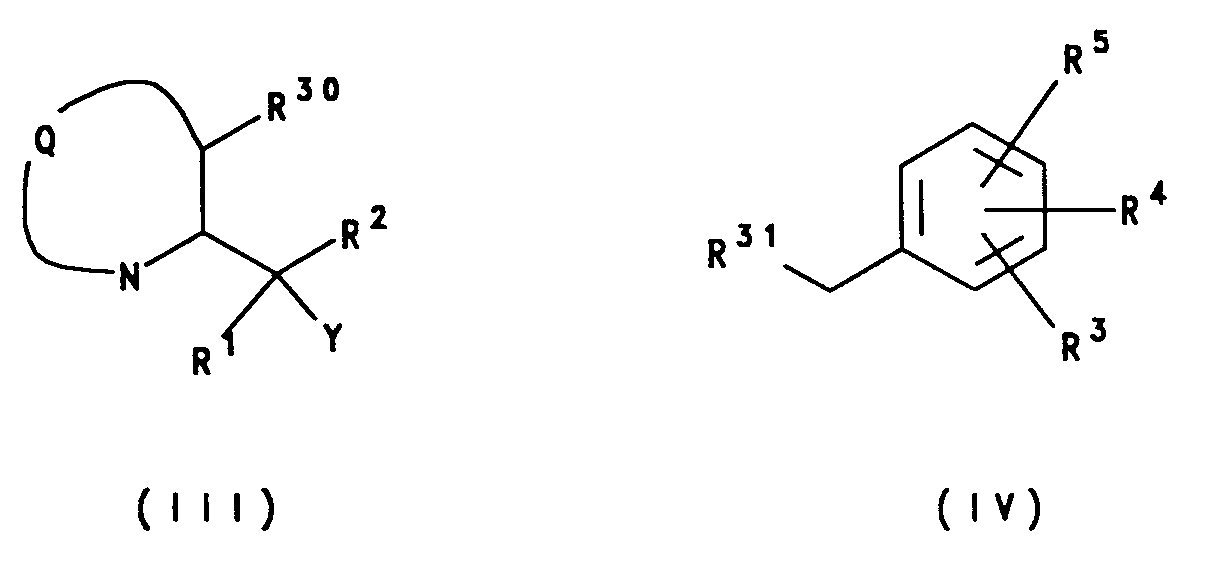
- the compounds according to the invention may be prepared by a process which comprises reacting a compound of formula (III) with a compound of formula (IV): wherein Q, Y, R1, R2, R3, R4 and R5 are as defined for formula (I) above, and one of R30 and R31 represents a leaving group and the other of R30 and R31 represents XH, where X is as defined for formula (I); in the presence of a base.
- R31 represents a leaving group and R30 represents XH.
- Suitable leaving groups include halo, e.g. chloro, bromo or iodo, or sulphonate derivatives such as tosylate or mesylate.
- reaction is conveniently carried out in a suitable organic solvent, such as an ether, e.g. 1,2-dimethoxyethane, at a temperature in the range of -5 to 25°C, preferably about 0°C.
- suitable organic solvent such as an ether, e.g. 1,2-dimethoxyethane
- Favoured bases of use in the reaction include alkali metal amides and hydrides, such as potassium bis(trimethylsilyl)amide and potassium hydride.
- potassium bis(trimethylsilyl)amide is used.
- intermediates of formula (III) above wherein R30 is SH may be prepared from the corresponding intermediates of formula (III) wherein R30 represents OH by treating the latter compound with Lawesson's reagent or phosphorus pentasulphide in a suitable solvent, e.g. pyridine, at ambient or elevated temperatures, suitably at reflux temperature.
- a suitable solvent e.g. pyridine
- the intermediates of formula (III) above wherein R30 is OH and Y is H may be prepared by reduction of the corresponding ketone of formula (V) wherein R1, R2 and Q are as defined above.
- Suitable reducing agents will be readily apparent to a person skilled in the art and include, for example, metal hydrides, such as lithium aluminium hydride and sodium borohydride, or hydrogen in the presence of a catalyst, such as noble metal catalyst, e.g. palladium on charcoal.
- the reaction is conveniently effected in a suitable solvent. Suitable solvents will depend on the nature of the reducing agent employed and will be readily apparent to those skilled in the art.
- reaction is conveniently carried out in an inert organic solvent, such as an ether, e.g. tetrahydrofuran, at low temperature, for example about -80 to about -40°C, preferably about -78°C.
- ether e.g. tetrahydrofuran
- Suitable bases will be readily identified by a person skilled in the art and include alkali metal hydrides and amides.
- a favoured base is lithium bis(trimethylsilyl)amide.
- Intermediates of formula (III) wherein R30 is OH having cis stereochemistry may preferably be prepared from the corresponding ketones via a selective reduction using a suitable reducing agent such as a lithium aluminium hydride or a substituted borohydride such as triethylborohydride.
- a suitable reducing agent such as a lithium aluminium hydride or a substituted borohydride such as triethylborohydride.
- Intermediates of formula (III) wherein R30 is OH having trans sterochemistry may be obtained selectively via a procedure involving non-selective reduction of the corresponding ketone, for example using sodium in an aromatic hydrocarbon solvent, e.g. toluene, preferably in the presence of an alcohol, e.g. iso-propyl alcohol, to give a mixture of cis and trans isomers, followed by selective oxidation of the cis isomer using a ketone in the presence of a base (Oppenauer oxidation).
- Suitable ketones include acetone, methyl ethyl ketone, cyclohexanone and, preferably, benzophenone.
- Suitable bases include alkali metal hydrides, e.g. potassium hydride.
- Ketones of formula (V) may be prepared from intermediates of formula (VIII) wherein R1 and Q are as defined above, by reaction with a compound of formula R2MgHal, where Hal represents halo such as chloro, bromo or iodo.
- novel compounds may be prepared in racemic form, or individual enantiomers may be prepared either by enantiospecific synthesis or by resolution.
- intermediate alcohols of formula (III), wherein X is oxa may be resolved into their component enantiomers by standard techniques, such as the formation of diastereomeric esters or amides, followed by chromatographic separation and removal of the chiral auxiliary.
- the diastereomeric alcohols can then be used to prepare optically pure compounds of formula (I).
- any of the above synthetic sequences it may be necessary and/or desirable to protect sensitive or reactive groups on any of the molecules concerned. This may be achieved by means of conventional protecting groups, such as those described in Protective Groups in Organic Chemistry , ed. J.F.W. McOmie, Plenum Press, 1973; and T.W. Greene and P.G.M. Wutts, Protective Groups in Organic Synthesis , John Wiley & Sons, 1991.
- the protecting groups may be removed at a convenient subsequent stage using methods known from the art.
- Example 1b To a solution of alcohol (Example 1b, 0.78g, 1:1 mixture of stereoisomers) was added 0.5M-potassium hexamethyldisilazide (5.84ml, in toluene). After 1h, 3,5-dimethylbenzyl bromide (0.58g) was added for 3h. The solution was evaporated to dryness after a further 3h, and the residue partitioned between dichloromethane and water.
- 0.5M-potassium hexamethyldisilazide 5.84ml, in toluene
- 3,5-dimethylbenzyl bromide (0.58g) was added for 3h.
- the solution was evaporated to dryness after a further 3h, and the residue partitioned between dichloromethane and water.
- Example 1c Chromatographic separation performed above (Example 1c) also yielded isomer B, which was recrystallized as an oxalate salt from ethanol/diethyl ether to give 3-[(3,5-dimethylphenyl)methyloxy]-2-(1,2-diphenylethyl)-1-azabicyclo[2.2.2]octane hydrogen oxalate salt isomer B ; m.p. 128-130°C; C30H35NO. C2H2O4.H2O requires C, 72.03; H, 7.36; N, 2.62. Found: C, 71.96; H, 7.30; N, 2.62%.
- Example 1a The product of Example 1a was crystallized from diethyl ether.
- the mother liquor (enriched in one diastereomer) was reduced according to the procedure described (Example 1b) an alkylated (Example 1c) to give 3-[(3,5-dimethylphenyl)methyloxy)-2-(1,2-diphenylethyl)-1-azabicyclo[2.2.2]octane hydrogen oxalate isomer C m.p. 55-58°C; C30H35NO.1.5 (C2H2O4).H2O requires C, 68.49; H, 6.96; N, 2.42. Found: C, 68.84; H, 7.01; N, 2.60%.
- Example 1b The title compound was prepared from 2-(1,2-diphenylethyl)-3-hydroxy-1-azabicyclo[2.2.2]octane (Example 1b) using 3,5-bis-trifluoromethylbenzyl bromide to give: Isomer A. m.p. 150-153°C; C30H29NOF6. C2H2O4.0.5H2O requires C, 60.75; H, 5.09; N, 2.21. Found: C, 60.84; H, 4.85; N, 2.17%. Isomer B m.p. 175-177°C; C30H29NOF6. C2H2O4. 0.75H2O requires C, 60.32; H, 5.14; N, 2.20.
- Amount mg Compound of formula (I) 1.0 2.0 25.0 Microcrystalline cellulose 20.0 20.0 20.0 Modified food corn starch 20.0 20.0 20.0 Lactose 58.5 57.5 34.5 Magnesium Stearate 0.5 0.5 0.5 0.5
- Compound of formula (I) 1 to 100mg Citric Acid Monohydrate 0.75mg Sodium Phosphate 4.5mg Sodium Chloride 9mg Water for injection to 1ml The sodium phosphate, citric acid monohydrate and sodium chloride are dissolved in a portion of the water. The compound of formula (I) is dissolved or suspended in the solution and made up to volume.
- the cDNA for the human NK1R was cloned into the expression vector pCDM9 which was derived from pCDM8 (INVITROGEN) by inserting the ampicillin resistance gene (nucleotide 1973 to 2964 from BLUESCRIPT SK+ (trademark, STRATAGENE, La Jolla, CA, USA)) into the Sac II site.
- Transfection of 20 ug of the plasmid DNA into 10 million COS cells was achieved by electroporation in 800 ⁇ l of transfection buffer (135 mM NaCl, 1.2 mM CaCl2, 1.2 mM MgCl2, 2.4 mM K2HPO4, 0.6 mM KH2PO4, 10 mM glucose, 10 mM N-2-hydroxyethyl-piperazine-N'-2-ethane sulphonic acid (HEPES) pH 7.4) at 260 V and 950 ⁇ F using the IBI GENEZAPPER (trademark IBI, New Haven, CT, USA).
- transfection buffer 135 mM NaCl, 1.2 mM CaCl2, 1.2 mM MgCl2, 2.4 mM K2HPO4, 0.6 mM KH2PO4, 10 mM glucose, 10 mM N-2-hydroxyethyl-piperazine-N'-2-ethane sulphonic acid (HEPES) pH 7.
- the cells were incubated in 10% fetal calf serum, 2 mM glutamine, 100U/ml penicillin-streptomycin, and 90% DMEM media (GIBCO, Grand Island, NY, USA) in 5% CO2 at 37°C for three days before the binding assay.
- the cDNA was subcloned into the vector pRcCMV (INVITROGEN).
- Transfection of 20 ug of the plasmid DNA into CHO cells was achieved by electroporation in 800 ⁇ l of transfection buffer supplemented with 0.625 mg/ml Herring sperm DNA at 300 V and 950 ⁇ F using the IBI GENEZAPPER (IBI).
- the transfected cells were incubated in CHO media [10% fetal calf serum, 100 U/ml penicillin-streptomycin, 2 mM glutamine, 1/500 hypoxanthinethymidine (ATCC), 90% IMDM media (JRH BIOSCIENCES, Lenexa, KS, USA), 0.7 mg/ml G418 (GIBCO)] in 5% CO2 at 37°C until colonies were visible. Each colony was separated and propagated. The cell clone with the highest number of human NK1R was selected for subsequent applications such as drug screening.
- CHO media 10% fetal calf serum, 100 U/ml penicillin-streptomycin, 2 mM glutamine, 1/500 hypoxanthinethymidine (ATCC), 90% IMDM media (JRH BIOSCIENCES, Lenexa, KS, USA), 0.7 mg/ml G418 (GIBCO)
- the binding assay of human NK1R expressed in either COS or CHO cells is based on the use of 125I-substance P (125I-SP, from DU PONT, Boston, MA) as a radioactively labeled ligand which competes with unlabeled substance P or any other ligand for binding to the human NK1R.
- 125I-substance P 125I-SP, from DU PONT, Boston, MA
- Monolayer cell cultures of COS or CHO were dissociated by the non-enzymatic solution (SPECIALTY MEDIA, Lavellette, NJ) and resuspended in appropriate volume of the binding buffer (50 mM Tris pH 7.5, 5 mM MnCl2, 150 mM NaCl, 0.04 mg/ml bacitracin, 0.004 mg/ml leupeptin, 0.2 mg/ml BSA, 0.01 mM phosphoramidon) such that 200 ⁇ l of the cell suspension would give rise to about 10,000 cpm of specific 125I-SP binding (approximately 50,000 to 200,000 cells).
- the binding buffer 50 mM Tris pH 7.5, 5 mM MnCl2, 150 mM NaCl, 0.04 mg/ml bacitracin, 0.004 mg/ml leupeptin, 0.2 mg/ml BSA, 0.01 mM phosphoramidon
- the binding assay 200 ul of cells were added to a tube containing 20 ul of 1.5 to 2.5 nM of 125I-SP and 20 ⁇ l of unlabeled substance P or any other test compound. The tubes were incubated at 4°C or at room temperature for 1 hour with gentle shaking. The bound radioactivity was separated from unbound radioactivity by GF/C filter (BRANDEL, Gaithersburg, MD) which was pre-wetted with 0.1% polyethylenimine. The filter was washed with 3 ml of wash buffer (50 mM Tris pH 7.5, 5 mM MnCl2, 150 mM NaCl) three times and its radioactivity was determined by gamma counter.
- wash buffer 50 mM Tris pH 7.5, 5 mM MnCl2, 150 mM NaCl
- the acitivation of phospholiphase C by NK1R may also be measured in CHO cells expressing the human NK1R by determining the accumulation of inositol monophosphate which is a degradation product of IP3.
- CHO cells are seeded in 12-well plate at 250,000 cells per well. After incubating in CHO media for 4 days, cells are loaded with 5 ⁇ Ci of 3H-myoinositol in 1 ml of media per well by overnight incubation. The extracellular radioactivity is removed by washing with phosphate buffered saline. LiCl is added to the well at final concentration of 10 mM with or without the test compound, and incubation is continued at 37°C for 15 min.
- Substance P is added to the well at final concentration of 0.3nM to activate the human NK1R. After 30 min of incubation at 37°C, the medium is removed and 0.1 N HCl is added. Each well is sonicated at 4°C and extracted with CHCl3/methanol (1:1). The aqueous phase is applied to a 1 ml Dowex AG 1X8 ion exchange column. The column is washed with 0.1 N formic acid followed by 0.025 M ammonium formate-0.1 N formic acid. The inositol monophosphate is eluted with 0.2 M ammonium formate-0.1 N formic acid and quantitated by beta counter.
Landscapes
- Health & Medical Sciences (AREA)
- Organic Chemistry (AREA)
- Chemical & Material Sciences (AREA)
- Bioinformatics & Cheminformatics (AREA)
- Engineering & Computer Science (AREA)
- Veterinary Medicine (AREA)
- Medicinal Chemistry (AREA)
- Nuclear Medicine, Radiotherapy & Molecular Imaging (AREA)
- General Chemical & Material Sciences (AREA)
- Pharmacology & Pharmacy (AREA)
- Life Sciences & Earth Sciences (AREA)
- Animal Behavior & Ethology (AREA)
- General Health & Medical Sciences (AREA)
- Public Health (AREA)
- Chemical Kinetics & Catalysis (AREA)
- Neurosurgery (AREA)
- Biomedical Technology (AREA)
- Neurology (AREA)
- Immunology (AREA)
- Psychiatry (AREA)
- Pain & Pain Management (AREA)
- Pulmonology (AREA)
- Transplantation (AREA)
- Anesthesiology (AREA)
- Hospice & Palliative Care (AREA)
- Rheumatology (AREA)
- Nitrogen Condensed Heterocyclic Rings (AREA)
- Pharmaceuticals Containing Other Organic And Inorganic Compounds (AREA)
Abstract
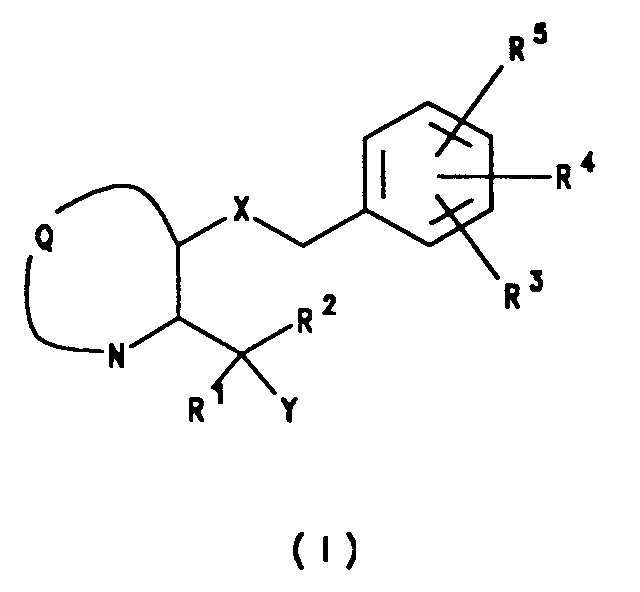
wherein
Q is the residue of an optionally substituted azabicyclic ring system;
X represents oxa or thia;
Y represents H or hydroxy;
R¹ represents phenyl or thienyl, either of which groups may be optionally substituted by halo, trifluoromethyl or C₁₋₃ alkoxy, or C₅₋₇ cycloalkyl;
R² represents benzyl which may be substituted in the benzyl ring by halo, trifluoromethyl or C₁₋₃alkoxy, or C₅₋₇ cycloalkyl; and
R³, R⁴ and R⁵ independently represent H, C₁₋₆ alkyl, C₂₋₆ alkenyl, C₂₋₆ alkynyl, halo, cyano, nitro, trifluoromethyl, trimethylsilyl, -ORa, SCH₃, SOCH₃, SO₂CH₃, -NRaRb, -NRaCORb, -NRaCO₂Rb, -CO₂Ra or -CONRaRb; and
Ra and Rb independently represent H, C₁₋₆ alkyl, phenyl or trifluoromethyl, are tachykinin receptor antagonists. They and compositions thereof are useful in therapy.
Description
- This invention relates to a class of azabicyclic compounds, which are useful as tachykinin antagonists. More particularly, the compounds of the invention comprise an azabicyclic ring system substituted by an arylmethyloxy or arylmethylthio moiety and by a benzyl- or cycloalkyl-methyl moiety, their preparation, formulations thereof and their use in medicine.
- The tachykinins are a group of naturally-occurring peptides found widely distributed throughout mammalian tissues, both within the central nervous system and in the peripheral nervous and circulatory systems. The structures of three known mammalian tachykinins are as follows:
Substance P:
Arg-Pro-Lys-Pro-Gln-Gln-Phe-Phe-Gly-Leu-Met-NH₂
Neurokinin A:
His-Lys-Thr-Asp-Ser-Phe-Val-Gly-Leu-Met-NH₂
Neurokinin B:
Asp-Met-His-Asp-Phe-Phe-Val-Gly-Leu-Met-NH₂
For example, substance P is believed inter alia to be involved in the neurotransmission of pain sensations [Otsuka et al, "Role of Substance P as a Sensory Transmitter in Spinal Cord and Sympathetic Ganglia" in 1982 Substance P in the Nervous System, Ciba Foundation Symposium 91, 13-34 (published by Pitman) and Otsuka and Yanagisawa, "Does Substance P Act as a Pain Transmitter?" TIPS (Dec. 1987) 8 506-510], specifically in the transmission of pain in migraine (B.E.B. Sandberg et al, J. Med Chem, (1982) 25 1009) and in arthritis [Levine et al in Science (1984) 226 547-549]. These peptides have also been implicated in gastrointestinal (GI) disorders and diseases of the GI tract such as inflammatory bowel disease [Mantyh et al in Neuroscience (1988) 25 (3) 817-37 and D. Regoli in "Trends in Cluster Headache" Ed. Sicuteri et al Elsevier Scientific Publishers, Amsterdam (1987) page 85)]. It is also hypothesised that there is a neurogenic mechanism for arthritis in which substance P may play a role [Kidd et al "A Neurogenic Mechanism for Symmetrical Arthritis" in The Lancet, 11 November 1989 and Grönblad et al "Neuropeptides in Synovium of Patients with Rheumatoid Arthritis and Osteoarthritis" in J. Rheumatol. (1988) 15(12) 1807-10]. Therefore, substance P is believed to be involved in the inflammatory response in diseases such as rheumatoid arthritis and osteoarthritis [O'Byrne et al in Arthritis and Rheumatism (1990) 33 1023-8]. Other disease areas where tachykinin antagonists are believed to be useful are allergic conditions [Hamelet et al Can. J. Pharmacol. Physiol. (1988) 66 1361-7], immunoregulation [Lotz et al Science (1988) 241 1218-21 and Kimball et al, J. Immunol. (1988) 141 (10) 3564-9] vasodilation, bronchospasm, reflex or neuronal control of the viscera [Mantyh et al, PNAS (1988) 85 3235-9] and, possibly by arresting or slowing β-amyloid-mediated neurodegenerative changes [Yankner et al Science (1990) 250, 279-82] in senile dementia of the Alzheimer type, Alzheimer's disease and Downs Syndrome. - Substance P may also play a role in demyelinating diseases such as multiple sclerosis and amyotrophic lateral sclerosis [J. Luber-Narod et al, poster to be presented at C.I.N.P. XVIIIth Congress, 28th June-2nd July 1992, in press].
- In view of their metabolic instability, peptide derivatives are likely to be of limited utility as therapeutic agents. It is for this reason that non-peptide tachykinin antagonists are sought.
- WO-A-90/05729 describes inter alia a class of cis-3-[cyclic]methylamino-2-[(α-substituted)-arylmethyl]quinuclidine compounds which are stated to be useful as substance P antagonists for treating gastrointestinal disorders, central nervous system disorders, inflammatory diseases and pain or migraine. There is, however, no disclosure or suggestion in WO-A-90/05729 of the arylmethyloxy- or arylmethylthio-substituted azabicyclic derivatives provided by the present invention.
- We have now found a further class of non-peptides which are potent antagonists of tachykinin.
- The present invention provides a compound of formula (I), or a salt or prodrug thereof:

wherein
Q is the residue of an optionally substituted azabicyclic ring system;
X represents oxa or thia;
Y represents H or hydroxy;
R¹ represents phenyl or thienyl, either of which groups may be optionally substituted by halo, trifluoromethyl or C₁₋₃ alkoxy, or C₅₋₇ cycloalkyl;
R² represents benzyl which may be substituted in the benzyl ring by halo, trifluoromethyl or C₁₋₃alkoxy, or C₅₋₇ cycloalkyl; and
R³, R⁴ and R⁵ independently represent H, C₁₋₆ alkyl, C₂₋₆ alkenyl, C₂₋₆ alkynyl, halo, cyano, nitro, trifluoromethyl, trimethylsilyl, -ORa, SCH₃, SOCH₃, SO₂CH₃, -NRaRb, -NRaCORb, -NRaCO₂Rb, -CO₂Ra or -CONRaRb; and
Ra and Rb independently represent H, C₁₋₆ alkyl, phenyl or trifluoromethyl. - The azabicyclic ring system of which Q is the residue is a non-aromatic ring system containing, as the sole heteroatom, the nitrogen atom indicated in formula (I) above. Suitably the ring system contains from 6 to 10 ring atoms, preferably from 7 to 9 ring atoms. The azabicyclic ring system may be fused, spiro or bridged, preferably bridged. The azabicyclic ring system may be substituted by one or more groups selected from carbonyl, C₁₋₄ alkyl, C₂₋₄ alkenyl, C₂₋₄ alkynyl, halo, hydroxy, C₁₋₄ alkoxy, carboxy or C₂₋₄ alkoxycarbonyl. Examples of such azabicyclic ring systems include:

wherein
R⁶ and R⁷ independently represent H,
C₁₋₄ alkyl, C₂₋₄ alkenyl, C₂₋₄ alkynyl, halo, hydroxy, C₁₋₄ alkoxy, carboxy or (C₁₋₄ alkoxy)carbonyl; or R⁶ and R⁷ together represent carbonyl. - It will be appreciated that, except in the case of a quaternary ammonium salt, the nitrogen atom in the azabicyclic ring system will carry a lone pair of electrons.
- It will also be appreciated that the R⁶ and R⁷ substituents may be present at any position in the azabicyclic ring system, including, where appropriate, the bridgehead carbon atom depicted in structures A to F above.
- Suitably the group R⁶ is H or methyl; and R⁷ is H, C₁₋₄ alkyl, hydroxy or C₁₋₄ alkoxy, preferably H, methyl, hydroxy or methoxy. Preferably one or both of R⁶ and R⁷ is/are H.
- Suitably the azabicyclic ring system of which Q is the residue of a 1-azabicyclo[2.2.1]heptanyl (1-azanorbornanyl), 1-azabicyclo[2.2.2]octanyl (quinuclidinyl) or 1-azabicyclo(3.2.1]octanyl ring system of formula (B), (C) or (D) above respectively, any of which is optionally substituted by methyl or hydroxy. A preferred ring system is quinuclidine of formula (C) above.
- The alkyl, alkenyl and alkynyl groups referred to with respect to any of the formulae herein may represent straight, branched or cyclic groups. Thus, for example, suitable alkyl groups include methyl, ethyl, n- or isopropyl, n-, sec-, iso- or tert-butyl, cyclopropyl, cyclobutyl, cyclopentyl or cyclohexyl, and cycloalkyl-alkyl groups such as cyclopropylmethyl; suitable alkenyl groups include vinyl and allyl; and suitable alkynyl groups include propargyl.
- The term "halo" as used herein includes fluoro, chloro, bromo and iodo.
- Preferably X is oxa.
- Preferably Y is H.
- Preferably R¹ represents unsubstituted phenyl or C₅₋₇ cycloalkyl such as cyclohexyl.
- R¹ may also suitably be phenyl substituted by methoxy.
- R² is preferably benzyl or cyclohexyl, more preferably benzyl.
- Suitable values for the groups R³, R⁴ and R⁵ include H, straight or branched C₁₋₆ alkyl, nitro, trifluoromethyl and halo, especially chloro. Preferably, at least one of R³, R⁴ and R⁵ is other than H.
Preferably, at least one of these is methyl or trifluromethyl. More preferably, R⁵ is H, and R³ and R⁴ are present at the meta-positions of the aromatic ring. Especially preferred is when R³ and R⁴ are identical. - A particularly preferred subgroup of compounds of formula (I) are compounds wherein R³ and R⁴ are identical and are methyl or trifluoromethyl, more preferably trifluoromethyl.
- The compounds according to the invention have at least two asymmetric centres, and may accordingly exist both as enantiomers and as diastereoisomers. In particular, the relative orientation of the 2- and 3-substituents on the azabicyclic ring system in formula (I) above may give rise to cis and trans diastereoisomers. It is to be understood that all such isomers and mixtures thereof are encompassed within the scope of the present invention.
- It is believed that of the cis diastereomers, tachykinin receptor antagonist activity preferentially resides in the 2S,3S diastereomer, whereas of the trans diastereomers, activity preferentially resides in the 2R,3S diastereomers. Thus, it is believed that S stereochemistry at the 3-position of the azabicyle is crucial to tachykinin receptor antagonist activity.
- A particular sub-class of compounds according to the invention is represented by the compounds of formula (IIA), and salts and prodrugs thereof:

wherein
X represents oxa or thia, preferably oxa;
R¹³ and R¹⁴ independently represent hydrogen, C₁₋₆ alkyl, halo, cyano, nitro, trifluoromethyl, hydroxy, C₁₋₆ alkoxy or amino; and
R¹⁸ is phenyl optionally substituted by halo, -CF₃ or C₁₋₃ alkoxy, or C₅₋₇ cycloalkyl; and
R¹⁹ is benzyl or C₅₋₇ cycloalkyl. - Particular values of R¹³ and R¹⁴ include hydrogen, C₁₋₅ alkyl, especially methyl, halo, especially chloro and fluoro, nitro, trifluoromethyl, cyano, methyl and methoxy. Preferably, at least one of R¹³ and R¹⁴ is other than hydrogen.
- A further sub-class of compounds according to the invention is represented by the compounds of formula (IIB), and salts and prodrugs thereof:

wherein X, R¹³, R¹⁴, R¹⁸ and R¹⁹ are as defined for formula (IIA) above. - A preferred group of compounds according to the invention are compounds of formula (IIB) wherein X is oxa and each of R¹³ and R¹⁴ represents a methyl or a trifluoromethyl group.
- A further preferred group of compounds according to the invention are compounds of formula (IIB) wherein R¹⁸ is substituted or unsubstituted phenyl and R¹⁹ is benzyl.
- For use in medicine, the salts of the compounds of formula (I) will be non-toxic pharmaceutically acceptable salts. Other salts may, however, be useful in the preparation of the compounds according to the invention or of their non-toxic pharmaceutically acceptable salts. Suitable pharmaceutically acceptable salts of the compounds of this invention include acid addition salts which may, for example, be formed by mixing a solution of the compound according to the invention with a solution of a pharmaceutically acceptable non-toxic acid such as hydrochloric acid, oxalic acid, fumaric acid, maleic acid, succinic acid, acetic acid, citric acid, tartaric acid, carbonic acid or phosphoric acid. Salts of amine groups may also comprise quaternary ammonium salts in which the amino nitrogen atom carries a suitable organic group such as an alkyl, alkenyl, alkynyl or aralkyl moiety. Furthermore, where the compounds of the invention carry an acidic moiety, suitable pharmaceutically acceptable salts thereof may include metal salts such as alkali metal salts, e.g. sodium or potassium salts; and alkaline earth metal salts, e.g. calcium or magnesium salts.
- The present invention includes within its scope prodrugs of the compounds of formula I above. In general, such prodrugs will be functional derivatives of the compounds of formula I which are readily convertible in vivo into the required compound of formula I. Conventional procedures for the selection and preparation of suitable prodrug derivatives are described, for example, in "Design of Prodrugs", ed. H. Bundgaard, Elsevier, 1985.
- The invention also provides pharmaceutical compositions comprising one or more compounds of this invention in association with a pharmaceutically acceptable carrier. Preferably these compositions are in unit dosage forms such as tablets, pills, capsules, powders, granules, sterile parenteral solutions or suspensions, or suppositories, for oral, parenteral or rectal administration. For preparing solid compositions such as tablets, the principal active ingredient is mixed with a pharmaceutical carrier, e.g. conventional tableting ingredients such as corn starch, lactose, sucrose, sorbitol, talc, stearic acid, magnesium stearate, dicalcium phosphate or gums, and other pharmaceutical diluents, e.g. water, to form a solid preformulation composition containing a homogeneous mixture of a compound of the present invention, or a non-toxic pharmaceutically acceptable salt thereof. When referring to these preformulation compositions as homogeneous, it is meant that the active ingredient is dispersed evenly throughout the composition so that the composition may be readily subdivided into equally effective unit dosage forms such as tablets, pills and capsules. This solid preformulation composition is then subdivided into unit dosage forms of the type described above containing from 0.1 to about 500 mg of the active ingredient of the present invention. The tablets or pills of the novel composition can be coated or otherwise compounded to provide a dosage form affording the advantage of prolonged action. For example, the tablet or pill can comprise an inner dosage and an outer dosage component, the latter being in the form of an envelope over the former. The two components can be separated by an enteric layer which serves to resist disintegration in the stomach and permits the inner component to pass intact into the duodenum or to be delayed in release. A variety of materials can be used for such enteric layers or coatings, such materials including a number of polymeric acids and mixtures of polymeric acids with such materials as shellac, cetyl alcohol and cellulose acetate.
- The liquid forms in which the novel compositions of the present invention may be incorporated for administration orally or by injection include aqueous solutions, suitably flavoured syrups, aqueous or oil suspensions, and flavoured emulsions with edible oils such as cottonseed oil, sesame oil, coconut oil or peanut oil, as well as elixirs and similar pharmaceutical vehicles. Suitable dispersing or suspending agents for aqueous suspensions include synthetic and natural gums such as tragacanth, acacia, alginate, dextran, sodium carboxymethylcellulose, methylcellulose, polyvinylpyrrolidone or gelatin.
- The compounds of the present invention are of value in the treatment of a wide variety of clinical conditions which are characterised by the presence of an excess of tachykinin, in particular substance P, activity. These may include disorders of the central nervous system such as anxiety, depression, psychosis and schizophrenia; neurodegenerative disorders such as AIDS related dementia, senile dementia of the Alzheimer type, Alzheimer's disease and Down's syndrome; demyelinating diseases such as MS and ALS and other neuropathological disorders such as diabetic or peripheral neuropathy, AIDS related neuropathy, chemotherapy-induced neuropathy, and neuralgia; respiratory diseases such as chronic obstrucutive airways disease, bronchopneumonia, bronchospasm and asthma; inflammatory diseases such as inflammatory bowel disease, psoriasis, fibrositis, osteoarthritis and rheumatoid arthritis; allergies such as eczema and rhinitis; hypersensitivity disorders such as poison ivy; ophthalmic diseases such as conjunctivitis, vernal conjunctivitis, and the like; cutaneous diseases such as contact dermatitis, atropic dermatitis, urticaria, and other eczematoid dermatitis; addiction disorders such as alcoholism; stress related somatic disorders; reflex sympathetic dystrophy such as shoulder/hand syndrome; dysthymic disorders; adverse immunological reactions such as rejection of transplanted tissues and disorders related to immune enhancement or suppression such as systemic lupus erythematosis; gastrointestinal (GI) disorders and diseases of the GI tract such as disorders associated with the neuronal control of viscera such as ulcerative colitis, Crohn's disease and incontinence; disorders of bladder function such as bladder detrusor hyper-reflexia; fibrosing and collagen diseases such as scleroderma and eosinophilic fascioliasis; disorders of blood flow caused by vasodilation and vasospastic diseases such as angina, migraine and Reynaud's disease; and pain or nociception, for example, that attributable to or associated with any of the foregoing conditions, especially the transmission of pain in migraine. Thus, the present invention further provides a compound for use in the manufacture of a medicament for the treatment of physiological disorders associated with an excess of tachykinins, especially substance P. The present invention also provides a method for the the treatment or prevention of physiological disorders associated with an excess of tachykinins, especially substance P, which method comprises administration to a patient in need thereof of a tachykinin reducing amount of a compound or composition of this invention.
- In the treatment of conditions involving actions of tachykinins released physiologically in response to noxious or other stimuli, a suitable dosage level is about 0.01 to 500 mg/kg per day, such as 0.01 to 250 mg/kg per day, preferably about 0.05 to 100 mg/kg per day, and especially about 0.05 to 5 mg/kg per day. The compounds may be administered on a regimen of 1 to 4 times per day.
- The compounds according to the invention may be prepared by a process which comprises reacting a compound of formula (III) with a compound of formula (IV):

wherein Q, Y, R¹, R², R³, R⁴ and R⁵ are as defined for formula (I) above, and one of R³⁰ and R³¹ represents a leaving group and the other of R³⁰ and R³¹ represents XH, where X is as defined for formula (I); in the presence of a base. - Suitably, when Y is H, R³¹ represents a leaving group and R³⁰ represents XH.
- Suitable leaving groups include halo, e.g. chloro, bromo or iodo, or sulphonate derivatives such as tosylate or mesylate.
- The reaction is conveniently carried out in a suitable organic solvent, such as an ether, e.g. 1,2-dimethoxyethane, at a temperature in the range of -5 to 25°C, preferably about 0°C. Favoured bases of use in the reaction include alkali metal amides and hydrides, such as potassium bis(trimethylsilyl)amide and potassium hydride. Suitably, potassium bis(trimethylsilyl)amide is used.
- The intermediates of formula (III) above wherein R³⁰ is SH may be prepared from the corresponding intermediates of formula (III) wherein R³⁰ represents OH by treating the latter compound with Lawesson's reagent or phosphorus pentasulphide in a suitable solvent, e.g. pyridine, at ambient or elevated temperatures, suitably at reflux temperature.
- The intermediates of formula (III) above wherein R³⁰ is OH and Y is H may be prepared by reduction of the corresponding ketone of formula (V)

wherein R¹, R² and Q are as defined above. Suitable reducing agents will be readily apparent to a person skilled in the art and include, for example, metal hydrides, such as lithium aluminium hydride and sodium borohydride, or hydrogen in the presence of a catalyst, such as noble metal catalyst, e.g. palladium on charcoal. The reaction is conveniently effected in a suitable solvent. Suitable solvents will depend on the nature of the reducing agent employed and will be readily apparent to those skilled in the art. - The intermediates of formula (III) above wherein R³⁰ is OH and Y is hydroxy may be prepared by treatment of a compound of formula (VI) with a compound of formula (VII):

wherein Q, R¹ and R² are as defined for formula (I) above, in the presence of a base. - The reaction is conveniently carried out in an inert organic solvent, such as an ether, e.g. tetrahydrofuran, at low temperature, for example about -80 to about -40°C, preferably about -78°C. Suitable bases will be readily identified by a person skilled in the art and include alkali metal hydrides and amides. A favoured base is lithium bis(trimethylsilyl)amide.
- Intermediates of formula (III) wherein R³⁰ is OH having cis stereochemistry may preferably be prepared from the corresponding ketones via a selective reduction using a suitable reducing agent such as a lithium aluminium hydride or a substituted borohydride such as triethylborohydride.
- Intermediates of formula (III) wherein R³⁰ is OH having trans sterochemistry may be obtained selectively via a procedure involving non-selective reduction of the corresponding ketone, for example using sodium in an aromatic hydrocarbon solvent, e.g. toluene, preferably in the presence of an alcohol, e.g. iso-propyl alcohol, to give a mixture of cis and trans isomers, followed by selective oxidation of the cis isomer using a ketone in the presence of a base (Oppenauer oxidation). Suitable ketones include acetone, methyl ethyl ketone, cyclohexanone and, preferably, benzophenone. Suitable bases include alkali metal hydrides, e.g. potassium hydride.
- Intermediates of formula (III) wherein R³⁰ is a leaving group may be prepared from compounds of formula (III) wherein R³⁰ is OH, for example, by reaction with a thionyl halide, a mesyl halide or a tosyl halide.
- Ketones of formula (V) may be prepared from intermediates of formula (VIII)

wherein R¹ and Q are as defined above, by reaction with a compound of formula R²MgHal, where Hal represents halo such as chloro, bromo or iodo. - Intermediates of formula (VIII) may be prepared by the procedures described in J. Org. Chem., 1974, 39, 3511; or by methods analogous thereto.
- Where they are not commercially available, the intermediates of formula (IV), (VI) and (VII) above may be prepared by conventional procedures which will be readily apparent to one skilled in the art.
- Where the above-described process for the preparation of the compounds according to the invention gives rise to mixtures of stereoisomers these isomers may, if desired, be separated, suitably by conventional techniques such as preparative chromatography.
- The novel compounds may be prepared in racemic form, or individual enantiomers may be prepared either by enantiospecific synthesis or by resolution. For example, intermediate alcohols of formula (III), wherein X is oxa, may be resolved into their component enantiomers by standard techniques, such as the formation of diastereomeric esters or amides, followed by chromatographic separation and removal of the chiral auxiliary. The diastereomeric alcohols can then be used to prepare optically pure compounds of formula (I).
- During any of the above synthetic sequences it may be necessary and/or desirable to protect sensitive or reactive groups on any of the molecules concerned. This may be achieved by means of conventional protecting groups, such as those described in Protective Groups in Organic Chemistry, ed. J.F.W. McOmie, Plenum Press, 1973; and T.W. Greene and P.G.M. Wutts, Protective Groups in Organic Synthesis, John Wiley & Sons, 1991. The protecting groups may be removed at a convenient subsequent stage using methods known from the art.
- The following Examples illustrate the preparation of compounds according to the invention.
- To a stirred solution of 2-benzylidene-3-oxo-1-azabicyclo[2.2.2]octane (10g) in diethyl ether (200ml) at -10°C under a nitrogen atmosphere was added a solution of 2M-benzylmagnesium chloride (30ml, in tetrahydrofuran, 60mmol) and diethyl ether (100ml). The solution was stirred at -10°C for 30 minutes and at ambient temperature for 16h. A saturated solution of aqueous ammonium chloride (200ml) was carefully added and the product extracted into ethyl acetate. The organic phase was dried (MgSO₄) and evaporated to dryness. The residue was chromatographed on a column containing silica gel 60 (220-440 mesh ASTM) eluting with mixtures of 30%, 50% and 70% ethyl acetate in petroleum ether (bp 60-80°C). 2-(1,2-diphenylethyl)-3-oxo-1-azabicyclo[2.2.2]octane was obtained as 1:1 mixture of stereoisomers by evaporating the appropriate fractions.
- To a solution of the product of Example 1a, (3.1g; 1:1 mixture of diastereomers) in tetrahydrofuran (50ml) at -78°C was added a solution of 1M-lithium aluminium hydride (10.16ml, in diethyl ether). After the solution had stirred at -78°C for 2h, water (3ml) was added followed by aqueous 2M-sodium hydroxide (3ml) and water (6ml). When at room temperature, diethyl ether was added and the mixture filtered through Hyflo supercel. The ethereal phase of the filtrate was washed with water (2 x 30ml), brine (30ml) and dried (MgSO₄). After removal of the solvent in vacuo the residue was chromatographed on silica gel eluting with ethyl acetate/petroleum ether (bp 60-80°C) (1:1) followed by methanol/ethyl acetate (1:50) to give the title compound as a mixture of stereoisomers.
- To a solution of alcohol (Example 1b, 0.78g, 1:1 mixture of stereoisomers) was added 0.5M-potassium hexamethyldisilazide (5.84ml, in toluene). After 1h, 3,5-dimethylbenzyl bromide (0.58g) was added for 3h. The solution was evaporated to dryness after a further 3h, and the residue partitioned between dichloromethane and water. The organic phase was dried (MgSO₄), evaporated and purified by column chromatography on silica gel eluting with petroleum ether (bp 60-80) containing increasing amounts of ethyl acetate (50% to 100%) and then methanol/ethyl acetate (15:85) to give a single diastereomer of the title compound. This was crystallised by addition of oxalic acid (72mg) in propan-2-ol and diethyl ether to give 3-[(3,5-dimethylphenyl)methyloxy]-2-(1,2-diphenylethyl)-1-azabicyclo[2.2.2]octane hydrogen oxalate salt isomer A mp 64-66°C. ¹H NMR (DMSO, 360MHz) δ 7.2-6.6 (13H, m, aryl), 4.6 (1H, d, J = 16.0Hz, OCH AHB), 4.4 (1H, d, J = 16.0Hz, OCHA H B), 3.5 (1H, m, OCHCH), 3.3 (1H, m, NCH AHB), 2.99 (1H, dd, NCHCH)), 2.8-2.60 (5H, m, NCHA H B, NCH₂, PhCH₂), 2.4 (1H, m, PhCHCH₂), 2.3 (6H, s, CH₃, CH₃), 2.25 (1H, m, bridgehead CH), 1.9 (1H, m, NCH₂CH AHB), 1.65 (1H, m, NCH₂CHA H B), 1.46-1.22 (2H, m, NCH₂CH₂); Found C, 71.09; H, 6.84; N, 2.51. C₃₀H₃₅NO. C₂H₂O₄.0.3H₂O requires C, 71.19; H, 6.86; N, 2.67. m/e (EI) 425 (M⁺), (Cl⁺) 426 (M+H), (CI⁻=) 424(M-H).
- Chromatographic separation performed above (Example 1c) also yielded isomer B, which was recrystallized as an oxalate salt from ethanol/diethyl ether to give 3-[(3,5-dimethylphenyl)methyloxy]-2-(1,2-diphenylethyl)-1-azabicyclo[2.2.2]octane hydrogen oxalate salt isomer B; m.p. 128-130°C; C₃₀H₃₅NO. C₂H₂O₄.H₂O requires C, 72.03; H, 7.36; N, 2.62. Found: C, 71.96; H, 7.30; N, 2.62%.
- The product of Example 1a was crystallized from diethyl ether. The mother liquor (enriched in one diastereomer) was reduced according to the procedure described (Example 1b) an alkylated (Example 1c) to give 3-[(3,5-dimethylphenyl)methyloxy)-2-(1,2-diphenylethyl)-1-azabicyclo[2.2.2]octane hydrogen oxalate isomer C m.p. 55-58°C; C₃₀H₃₅NO.1.5 (C₂H₂O₄).H₂O requires C, 68.49; H, 6.96; N, 2.42. Found: C, 68.84; H, 7.01; N, 2.60%.
- The following Examples were prepared similarly.
- The title compound was prepared from 2-(1,2-diphenylethyl)-3-hydroxy-1-azabicyclo[2.2.2]octane (Example 1b) using 3,5-bis-trifluoromethylbenzyl bromide to give:
Isomer A. m.p. 150-153°C; C₃₀H₂₉NOF₆. C₂H₂O₄.0.5H₂O requires C, 60.75; H, 5.09; N, 2.21. Found: C, 60.84; H, 4.85; N, 2.17%.
Isomer B m.p. 175-177°C; C₃₀H₂₉NOF₆. C₂H₂O₄. 0.75H₂O requires C, 60.32; H, 5.14; N, 2.20. Found: C, 60.15; H, 5.22; N, 2.37%.
Isomer C m.p. 146-148°C; C₃₀H₂₉NOF₆. C₂H₂O₄. 0.25H₂O requires C, 60.75; H, 5.10; N, 2.21. Found: C, 60.44; H, 5.11; N, 2.14%. - Isomer A m.p. 83°C; C₃₁H₃₁NO₂F₆. 1.3 (C₂H₂O₄) requires C, 59.29; H, 4.97; N, 2.05. Found: C, 59.16; H, 5.12; N, 2.12%.
- Isomer A m.p. 179-180°C; C₃₁H₃₁NO₂F₆. C₂H₂O₄ requires C, 60.64; H, 5.09; N, 2.14. Found: C, 60.28; H, 5.33; N, 2.16%.
Isomer B m.p. 148-151°C; C₃₁H₃₁NO₂F₆. 3.6 (C₂H₂O₄). 0.25CH₃COOCH₂CH₃ requires C, 51.74; H, 4.35; N, 1.58. Found: C, 51.34; H, 4.77; N, 1.94%. -
- a) 2-(α-cyclohexylbenzyl)-3-oxo-1-azabicyclo[2.2.2]octane
The title compound as a mixture of diastereomers was prepared in a manner analogous to that described in Example 1a using cyclohexylmagnesium chloride. - b) Using conditions analogous to those described in Example 1b and c the product of Example 5a was reduced and alkylated (with 3,5-bis(trifluoromethyl)benzyl bromide to give 3-(3,5-bis(trifluoromethyl)phenyl)methyloxy-2-(α-cyclohexylbenzyl)-1-azabicyclo[2.2.2]octane oxalate hemihydrate, mp 119-121°C. Found: C, 59.33; H, 5.67; N, 2.22. C₂₉H₃₃NOF₆.C₂H₂O₄.0.5(H₂O) requires C, 59.61; H, 2.24; N, 5.89%. m/e (CI⁺) = 526 (M+H), (CI⁻) = 524 (M-H).
-
Amount mg Compound of formula (I) 1.0 2.0 25.0 Microcrystalline cellulose 20.0 20.0 20.0 Modified food corn starch 20.0 20.0 20.0 Lactose 58.5 57.5 34.5 Magnesium Stearate 0.5 0.5 0.5 -
Amount mg Compound of formula (I) 26.0 50.0 100.0 Microcrystalline cellulose 80.0 80.0 80.0 Modified food corn starch 80.0 80.0 80.0 Lactose 213.5 189.5 139.5 Magnesium Stearate 0.5 0.5 0.5
The compound of formula (I), cellulose, lactose and a portion of the corn starch are mixed and granulated with 10% corn starch paste. The resulting granulation is sieved, dried and blended with the remainder of the corn starch and the magnesium stearate. The resulting granulation is then compressed into tablets containing 1.0mg, 2.0mg, 25.0mg, 26.0mg, 50.0mg and 100mg of the active compound per tablet. -
Amount mg Compound of formula (I) 1 to 100mg Citric Acid Monohydrate 0.75mg Sodium Phosphate 4.5mg Sodium Chloride 9mg Water for injection to 1ml
The sodium phosphate, citric acid monohydrate and sodium chloride are dissolved in a portion of the water. The compound of formula (I) is dissolved or suspended in the solution and made up to volume. -
Amount mg Compound of formula (I) 1-10g Emulsifying Wax 30g Liquid paraffin 20g White Soft Paraffin to 100g
The white soft paraffin is heated until molten. The liquid paraffin and emulsifying wax are incorporated and stirred until dissolved. The compound of formula (I) is added and stirring continued until dispersed. The mixture is then cooled until solid. - To express the cloned human neurokinin-1- receptor (NK1R) transiently in COS, the cDNA for the human NK1R was cloned into the expression vector pCDM9 which was derived from pCDM8 (INVITROGEN) by inserting the ampicillin resistance gene (nucleotide 1973 to 2964 from BLUESCRIPT SK+ (trademark, STRATAGENE, La Jolla, CA, USA)) into the Sac II site. Transfection of 20 ug of the plasmid DNA into 10 million COS cells was achieved by electroporation in 800 µl of transfection buffer (135 mM NaCl, 1.2 mM CaCl₂, 1.2 mM MgCl₂, 2.4 mM K₂HPO₄, 0.6 mM KH₂PO₄, 10 mM glucose, 10 mM N-2-hydroxyethyl-piperazine-N'-2-ethane sulphonic acid (HEPES) pH 7.4) at 260 V and 950 µF using the IBI GENEZAPPER (trademark IBI, New Haven, CT, USA). The cells were incubated in 10% fetal calf serum, 2 mM glutamine, 100U/ml penicillin-streptomycin, and 90% DMEM media (GIBCO, Grand Island, NY, USA) in 5% CO₂ at 37°C for three days before the binding assay.
- To establish a stable cell line expressing cloned human NK1R, the cDNA was subcloned into the vector pRcCMV (INVITROGEN). Transfection of 20 ug of the plasmid DNA into CHO cells was achieved by electroporation in 800 µl of transfection buffer supplemented with 0.625 mg/ml Herring sperm DNA at 300 V and 950 µF using the IBI GENEZAPPER (IBI). The transfected cells were incubated in CHO media [10% fetal calf serum, 100 U/ml penicillin-streptomycin, 2 mM glutamine, 1/500 hypoxanthinethymidine (ATCC), 90% IMDM media (JRH BIOSCIENCES, Lenexa, KS, USA), 0.7 mg/ml G418 (GIBCO)] in 5% CO₂ at 37°C until colonies were visible. Each colony was separated and propagated. The cell clone with the highest number of human NK1R was selected for subsequent applications such as drug screening.
- The binding assay of human NK1R expressed in either COS or CHO cells is based on the use of ¹²⁵I-substance P (¹²⁵I-SP, from DU PONT, Boston, MA) as a radioactively labeled ligand which competes with unlabeled substance P or any other ligand for binding to the human NK1R. Monolayer cell cultures of COS or CHO were dissociated by the non-enzymatic solution (SPECIALTY MEDIA, Lavellette, NJ) and resuspended in appropriate volume of the binding buffer (50 mM Tris pH 7.5, 5 mM MnCl₂, 150 mM NaCl, 0.04 mg/ml bacitracin, 0.004 mg/ml leupeptin, 0.2 mg/ml BSA, 0.01 mM phosphoramidon) such that 200 µl of the cell suspension would give rise to about 10,000 cpm of specific ¹²⁵I-SP binding (approximately 50,000 to 200,000 cells). In the binding assay, 200 ul of cells were added to a tube containing 20 ul of 1.5 to 2.5 nM of ¹²⁵I-SP and 20 µl of unlabeled substance P or any other test compound. The tubes were incubated at 4°C or at room temperature for 1 hour with gentle shaking. The bound radioactivity was separated from unbound radioactivity by GF/C filter (BRANDEL, Gaithersburg, MD) which was pre-wetted with 0.1% polyethylenimine. The filter was washed with 3 ml of wash buffer (50 mM Tris pH 7.5, 5 mM MnCl₂, 150 mM NaCl) three times and its radioactivity was determined by gamma counter.
- The acitivation of phospholiphase C by NK1R may also be measured in CHO cells expressing the human NK1R by determining the accumulation of inositol monophosphate which is a degradation product of IP₃. CHO cells are seeded in 12-well plate at 250,000 cells per well. After incubating in CHO media for 4 days, cells are loaded with 5µCi of ³H-myoinositol in 1 ml of media per well by overnight incubation. The extracellular radioactivity is removed by washing with phosphate buffered saline. LiCl is added to the well at final concentration of 10 mM with or without the test compound, and incubation is continued at 37°C for 15 min. Substance P is added to the well at final concentration of 0.3nM to activate the human NK1R. After 30 min of incubation at 37°C, the medium is removed and 0.1 N HCl is added. Each well is sonicated at 4°C and extracted with CHCl₃/methanol (1:1). The aqueous phase is applied to a 1 ml Dowex AG 1X8 ion exchange column. The column is washed with 0.1 N formic acid followed by 0.025 M ammonium formate-0.1 N formic acid. The inositol monophosphate is eluted with 0.2 M ammonium formate-0.1 N formic acid and quantitated by beta counter.
- The data in Table 1 were obtained for compounds of formula (I):
TABLE 1 SUBSTANCE P ANTAGONISM RESULTS Compound of Ex # IC₅₀ @ NK1R (nM) 1 : ISOMER A 2.4 1 : ISOMER B 1.8 1 : ISOMER C >100 2 : ISOMER A 4.5 2 : ISOMER B 6.3 2 : ISOMER C >100 3 : ISOMER A 3.0 4 : ISOMER A 10.0 4 : ISOMER B 1.8 5 3.0
The following examples illustrate pharmaceutical compositions according to the invention.
Claims (10)
- A compound of formula (I), or a salt or prodrug thereof:

Q is the residue of an optionally substituted azabicyclic ring system;
X represents oxa or thia;
Y represents H or hydroxy;
R¹ represents phenyl or thienyl, either of which groups may be optionally substituted by halo, trifluoromethyl or C₁₋₃ alkoxy, or C₅₋₇ cycloalkyl;
R² represents benzyl which may be substituted in the benzyl ring by halo, trifluoromethyl or C₁₋₃alkoxy, or C₅₋₇ cycloalkyl; and
R³, R⁴ and R⁵ independently represent H, C₁₋₆ alkyl, C₂₋₆ alkenyl, C₂₋₆ alkynyl, halo, cyano, nitro, trifluoromethyl, trimethylsilyl, -ORa, SCH₃, SOCH₃, So₂CH₃, -NRaRb, -NRaCORb, -NRaCO₂Rb, -CO₂Ra or -CONRaRb; and
Ra and Rb independently represent H, C₁₋₆ alkyl, phenyl or trifluoromethyl. - A compound as claimed in claim 1, where Y is H, R³, R⁴ and R⁵ independently represent H, C₁₋₆alkyl, C₂₋₆alkenyl, C₂₋₆alkynyl, halo, cyano, nitro, trifluoromethyl, -ORa, -NRaRb, -NRaCORb, -NRaCO₂Rb, -CO₂Ra or -CONRaRb, and Ra and Rb independently represent H or C₁₋₆alkyl.
- A compound as claimed in claim 1 or claim 2 wherein Q is the residue of a 1-azabicyclo[2.2.2]octanyl (quinuclidinyl) ring system and X is oxa.
- A compound as claimed in any preceding claim wherein R¹ is unsubstituted phenyl or phenyl substituted by methoxy and R² is benzyl or cyclohexyl.
- A compound as claimed in any preceding claim wherein R⁵ is H and R³ and R⁴ are present at the meta-positions of the aromatic ring and are methyl or trifluoromethyl.
- A compound as claimed in claim 1 selected from
3-[(3,5-dimethylphenyl)methyloxy]-2-(1,2-diphenylethyl)-1-azabicyclo[2.2.2]octane;
3-[(3,5-bistrifluoromethylphenyl)methyloxy]-2-(1,2-diphenylethyl)-1-azabicyclo[2.2.2]octane;
3-[(3,5-bistrifluoromethylphenyl)methyloxy]-2-[1-(1-(4-methoxyphenyl)-2-phenyl)ethyl]-1-azabicyclo[2.2.2]octane;
3-[(3,5-bistrifluoromethylphenyl)methyloxy]-2-[1-(1-(3-methoxyphenyl)-2-phenyl)ethyl]-1-azabicyclo[2.2.2]octane;
3-[(3,5-bistrifluoromethylphenyl)methyloxy]-2-(α-cyclohexylbenzyl)-1-azabicyclo[2.2.2]octane;
and salts and prodrugs thereof. - A compound as claimed in any one of the preceding claims for use in therapy.
- A process for the preparation of a compound as claimed in any one of the preceding claims which process comprises reacting a compound of formula (III) with a compound of formula (IV):
- A pharmaceutical composition comprising a compound as claimed in any of claims 1 to 6 in association with a pharmaceutically acceptable carrier or excipient.
- The use of a compound as claimed in any of claims 1 to 6 for the manufacture of a medicament for the treatment of physiological disorders associated with an excess of tachykinins.
Applications Claiming Priority (3)
| Application Number | Priority Date | Filing Date | Title |
|---|---|---|---|
| GB919113567A GB9113567D0 (en) | 1991-06-24 | 1991-06-24 | Therapeutic agents |
| GB9113567 | 1991-06-24 | ||
| JP4181932A JPH0673054A (en) | 1991-06-24 | 1992-07-09 | Azabicyclic compounds, pharmaceutical compositions containing them and their therapeutic use |
Publications (2)
| Publication Number | Publication Date |
|---|---|
| EP0520555A1 true EP0520555A1 (en) | 1992-12-30 |
| EP0520555B1 EP0520555B1 (en) | 1999-09-01 |
Family
ID=26299116
Family Applications (1)
| Application Number | Title | Priority Date | Filing Date |
|---|---|---|---|
| EP92201770A Expired - Lifetime EP0520555B1 (en) | 1991-06-24 | 1992-06-17 | Azabicyclic compounds, pharmaceutical compositions containing them and their use in therapy |
Country Status (5)
| Country | Link |
|---|---|
| US (1) | US5288730A (en) |
| EP (1) | EP0520555B1 (en) |
| JP (2) | JPH05186466A (en) |
| CA (1) | CA2071800A1 (en) |
| DE (1) | DE69229897T2 (en) |
Cited By (50)
| Publication number | Priority date | Publication date | Assignee | Title |
|---|---|---|---|---|
| WO1994014767A1 (en) * | 1992-12-21 | 1994-07-07 | Merck Sharp & Dohme Limited | Phenyl derivatives useful as tachykinin antagonists |
| WO1994016697A1 (en) | 1993-01-19 | 1994-08-04 | Rhone-Poulenc Rorer S.A. | Synergising association having an antagonist effect on nk1 and nk2 receptors |
| FR2719476A1 (en) * | 1994-05-05 | 1995-11-10 | Oreal | Use of a substance P antagonist in a cosmetic composition and composition obtained. |
| EP0717998A1 (en) | 1994-12-19 | 1996-06-26 | L'oreal | Use of substance P antagonist for the treatment of pruritis, eye or eyelid pain or disesthesies |
| EP0722722A1 (en) | 1994-12-19 | 1996-07-24 | L'oreal | Use of an antagonist of substance P for the treatment of cutaneous erythema of neurogenic origin |
| EP0722736A1 (en) | 1994-12-19 | 1996-07-24 | L'oreal | Topical composition containing an antagonist of substance P |
| EP0680749A3 (en) * | 1994-05-05 | 1996-09-11 | Oreal | Use of a substance P antagonist in a cosmetic composition and composition obtained. |
| EP0769300A2 (en) | 1995-10-20 | 1997-04-23 | Pfizer Inc. | Antiemetic composition containing an NK-1 receptor antagonists |
| EP0774250A1 (en) | 1995-11-20 | 1997-05-21 | L'oreal | Use of a TNF alpha antagonist against skin redness of neurogenic origin |
| US6203803B1 (en) | 1994-12-14 | 2001-03-20 | Societe L'oreal S.A. | Use of a substance P antagonist in a cosmetic composition, and the composition thus obtained |
| US6579885B2 (en) | 1999-11-03 | 2003-06-17 | Albany Molecular Research, Inc. | Aryl and heteroaryl substituted tetrahydroisoquinolines and use thereof |
| US7084152B2 (en) | 2000-07-11 | 2006-08-01 | Amr Technology, Inc. | 4-phenyl substituted tetrahydroisoquinolines therapeutic use thereof |
| WO2006123182A2 (en) | 2005-05-17 | 2006-11-23 | Merck Sharp & Dohme Limited | Cyclohexyl sulphones for treatment of cancer |
| US7163949B1 (en) | 1999-11-03 | 2007-01-16 | Amr Technology, Inc. | 4-phenyl substituted tetrahydroisoquinolines and use thereof |
| WO2007011820A2 (en) | 2005-07-15 | 2007-01-25 | Amr Technology, Inc. | Aryl-and heteroaryl-substituted tetrahydrobenzazepines and use thereof to block reuptake of norepinephrine, dopamine, and serotonin |
| WO2007093827A1 (en) | 2006-02-15 | 2007-08-23 | Istituto Di Ricerche Di Biologia Molecolare P. Angeletti Spa | Thiophene and thiazole substituted trifluoroethanone derivatives as histone deacetylase (hdac) inhibitors |
| WO2008090117A1 (en) | 2007-01-24 | 2008-07-31 | Glaxo Group Limited | Pharmaceutical compositions comprising 3, 5-diamin0-6- (2, 3-dichl0phenyl) -l, 2, 4-triazine or r (-) -2, 4-diamino-5- (2, 3-dichlorophenyl) -6-fluoromethyl pyrimidine and an nk1 |
| WO2009002495A1 (en) | 2007-06-27 | 2008-12-31 | Merck & Co., Inc. | 4-carboxybenzylamino derivatives as histone deacetylase inhibitors |
| US7541357B2 (en) | 2004-07-15 | 2009-06-02 | Amr Technology, Inc. | Aryl- and heteroaryl-substituted tetrahydroisoquinolines and use thereof to block reuptake of norepinephrine, dopamine, and serotonin |
| WO2010000073A1 (en) | 2008-07-03 | 2010-01-07 | Neuraxon, Inc. | Benzoxazines, benzothiazines, and related compounds having nos inhibitory activity |
| WO2010114780A1 (en) | 2009-04-01 | 2010-10-07 | Merck Sharp & Dohme Corp. | Inhibitors of akt activity |
| WO2010132487A1 (en) | 2009-05-12 | 2010-11-18 | Bristol-Myers Squibb Company | CRYSTALLINE FORMS OF (S)-7-([1,2,4]TRIAZOLO[1,5-a]PYRIDIN-6-YL)-4-(3,4-DICHLOROHPHENYL)-1,2,3,4-TETRAHYDROISOQUINOLINE AND USE THEREOF |
| WO2010132442A1 (en) | 2009-05-12 | 2010-11-18 | Albany Molecular Reserch, Inc. | 7-([1,2,4,]triazolo[1,5,-a]pyridin-6-yl)-4-(3,4-dichlorophenyl)-1,2,3,4- tetrahydroisoquinoline and use thereof |
| WO2011046771A1 (en) | 2009-10-14 | 2011-04-21 | Schering Corporation | SUBSTITUTED PIPERIDINES THAT INCREASE p53 ACTIVITY AND THE USES THEREOF |
| EP2336120A1 (en) | 2007-01-10 | 2011-06-22 | Istituto di ricerche di Biologia Molecolare P. Angeletti S.R.L. | Combinations containing amide substituted indazoles as poly(ADP-ribose)polymerase (PARP) inhibitors |
| WO2012018754A2 (en) | 2010-08-02 | 2012-02-09 | Merck Sharp & Dohme Corp. | RNA INTERFERENCE MEDIATED INHIBITION OF CATENIN (CADHERIN-ASSOCIATED PROTEIN), BETA 1 (CTNNB1) GENE EXPRESSION USING SHORT INTERFERING NUCLEIC ACID (siNA) |
| WO2012027236A1 (en) | 2010-08-23 | 2012-03-01 | Schering Corporation | NOVEL PYRAZOLO[1,5-a]PYRIMIDINE DERIVATIVES AS mTOR INHIBITORS |
| WO2012030685A2 (en) | 2010-09-01 | 2012-03-08 | Schering Corporation | Indazole derivatives useful as erk inhibitors |
| WO2012036997A1 (en) | 2010-09-16 | 2012-03-22 | Schering Corporation | Fused pyrazole derivatives as novel erk inhibitors |
| WO2012058210A1 (en) | 2010-10-29 | 2012-05-03 | Merck Sharp & Dohme Corp. | RNA INTERFERENCE MEDIATED INHIBITION OF GENE EXPRESSION USING SHORT INTERFERING NUCLEIC ACIDS (siNA) |
| WO2012087772A1 (en) | 2010-12-21 | 2012-06-28 | Schering Corporation | Indazole derivatives useful as erk inhibitors |
| WO2012145471A1 (en) | 2011-04-21 | 2012-10-26 | Merck Sharp & Dohme Corp. | Insulin-like growth factor-1 receptor inhibitors |
| US8420811B2 (en) | 2008-06-04 | 2013-04-16 | Bristol-Myers Squibb Company | Tetrahydroisoquinolines and intermediates therefor |
| WO2013063214A1 (en) | 2011-10-27 | 2013-05-02 | Merck Sharp & Dohme Corp. | Novel compounds that are erk inhibitors |
| WO2013165816A2 (en) | 2012-05-02 | 2013-11-07 | Merck Sharp & Dohme Corp. | SHORT INTERFERING NUCLEIC ACID (siNA) COMPOSITIONS |
| WO2014052563A2 (en) | 2012-09-28 | 2014-04-03 | Merck Sharp & Dohme Corp. | Novel compounds that are erk inhibitors |
| WO2014085216A1 (en) | 2012-11-28 | 2014-06-05 | Merck Sharp & Dohme Corp. | Compositions and methods for treating cancer |
| WO2014100065A1 (en) | 2012-12-20 | 2014-06-26 | Merck Sharp & Dohme Corp. | Substituted imidazopyridines as hdm2 inhibitors |
| WO2014120748A1 (en) | 2013-01-30 | 2014-08-07 | Merck Sharp & Dohme Corp. | 2,6,7,8 substituted purines as hdm2 inhibitors |
| WO2015034925A1 (en) | 2013-09-03 | 2015-03-12 | Moderna Therapeutics, Inc. | Circular polynucleotides |
| US9034899B2 (en) | 2009-05-12 | 2015-05-19 | Albany Molecular Research, Inc. | Aryl, heteroaryl, and heterocycle substituted tetrahydroisoquinolines and use thereof |
| US9156812B2 (en) | 2008-06-04 | 2015-10-13 | Bristol-Myers Squibb Company | Crystalline form of 6-[(4S)-2-methyl-4-(2-naphthyl)-1,2,3,4-tetrahydroisoquinolin-7-yl]pyridazin-3-amine |
| WO2018071283A1 (en) | 2016-10-12 | 2018-04-19 | Merck Sharp & Dohme Corp. | Kdm5 inhibitors |
| WO2019094311A1 (en) | 2017-11-08 | 2019-05-16 | Merck Sharp & Dohme Corp. | Prmt5 inhibitors |
| WO2019094312A1 (en) | 2017-11-08 | 2019-05-16 | Merck Sharp & Dohme Corp. | Prmt5 inhibitors |
| WO2020033282A1 (en) | 2018-08-07 | 2020-02-13 | Merck Sharp & Dohme Corp. | Prmt5 inhibitors |
| WO2020033284A1 (en) | 2018-08-07 | 2020-02-13 | Merck Sharp & Dohme Corp. | Prmt5 inhibitors |
| WO2020033288A1 (en) | 2018-08-07 | 2020-02-13 | Merck Sharp & Dohme Corp. | Prmt5 inhibitors |
| US11096950B2 (en) | 2006-11-01 | 2021-08-24 | Barbara Brooke Jennings | Compounds, methods, and treatments for abnormal signaling pathways for prenatal and postnatal development |
| EP4079856A1 (en) | 2010-08-17 | 2022-10-26 | Sirna Therapeutics, Inc. | Rna interference mediated inhibition of hepatitis b virus (hbv) gene expression using short interfering nucleic acid (sina) |
Families Citing this family (8)
| Publication number | Priority date | Publication date | Assignee | Title |
|---|---|---|---|---|
| US5604241A (en) * | 1992-10-21 | 1997-02-18 | Pfizer Inc. | Substituted benzylaminoquinuclidines as substance P antagonists |
| US6060473A (en) * | 1993-04-01 | 2000-05-09 | Ucb S.A. - Dtb | 7-azabicyclo[2.2.1]-heptane and -heptene derivatives as cholinergic receptor ligands |
| US5817679A (en) * | 1993-04-01 | 1998-10-06 | University Of Virginia | 7-Azabicyclo 2.2.1!-heptane and -heptene derivatives as cholinergic receptor ligands |
| AU701227B2 (en) * | 1993-09-10 | 1999-01-21 | Cytomed, Inc | Epibatidine and derivatives thereof as cholinergic receptor agonists and antagonists |
| US6117889A (en) * | 1994-04-01 | 2000-09-12 | University Of Virginia | 7-Azabicyclo-[2.2.1]-heptane and -heptene derivatives as analgesics and anti-inflammatory agents |
| MX9706944A (en) * | 1996-09-12 | 1998-08-30 | Pfizer | Quinuclidines substituted with tetrazolyl as antagonist of the substance p. |
| GB0108982D0 (en) | 2001-04-10 | 2001-05-30 | Merck Sharp & Dohme | Therapeutic agents |
| JP4471972B2 (en) * | 2003-03-03 | 2010-06-02 | シークウィスト パーフェクト ディスペンスイング フォーリン, インコーポレイテッド | Aerosol actuator |
Citations (1)
| Publication number | Priority date | Publication date | Assignee | Title |
|---|---|---|---|---|
| WO1990005729A1 (en) * | 1988-11-23 | 1990-05-31 | Pfizer Inc. | Quinuclidine therapeutic agents |
Family Cites Families (4)
| Publication number | Priority date | Publication date | Assignee | Title |
|---|---|---|---|---|
| US3833592A (en) * | 1966-05-31 | 1974-09-03 | Little Inc A | Tropanyl alpha,alpha-diphenyl-alpha-fluoroacetate esters |
| US3560510A (en) * | 1969-03-05 | 1971-02-02 | Aldrich Chem Co Inc | 2-benzhydrylquinuclidines |
| US4599344A (en) * | 1984-10-31 | 1986-07-08 | Schering A.G. | Quinuclidines and quinuclidinium salts as antiarrhythmic agents |
| US4843074A (en) * | 1988-05-17 | 1989-06-27 | Marion Laboratories, Inc. | 1-azabicyclo[2.2.2]octan-3-yl 2-aryl-3-azacyclo-2-hydroxypropionates and their quaternary salts |
-
1992
- 1992-06-16 US US07/899,205 patent/US5288730A/en not_active Expired - Lifetime
- 1992-06-17 DE DE69229897T patent/DE69229897T2/en not_active Expired - Fee Related
- 1992-06-17 EP EP92201770A patent/EP0520555B1/en not_active Expired - Lifetime
- 1992-06-22 CA CA002071800A patent/CA2071800A1/en not_active Abandoned
- 1992-06-24 JP JP4165145A patent/JPH05186466A/en active Pending
- 1992-07-09 JP JP4181932A patent/JPH0673054A/en not_active Withdrawn
Patent Citations (1)
| Publication number | Priority date | Publication date | Assignee | Title |
|---|---|---|---|---|
| WO1990005729A1 (en) * | 1988-11-23 | 1990-05-31 | Pfizer Inc. | Quinuclidine therapeutic agents |
Cited By (78)
| Publication number | Priority date | Publication date | Assignee | Title |
|---|---|---|---|---|
| US5624947A (en) * | 1992-12-21 | 1997-04-29 | Merck, Sharp & Dohme Ltd. | Phenyl derivatives useful as tachykinin antagonists |
| WO1994014767A1 (en) * | 1992-12-21 | 1994-07-07 | Merck Sharp & Dohme Limited | Phenyl derivatives useful as tachykinin antagonists |
| WO1994016697A1 (en) | 1993-01-19 | 1994-08-04 | Rhone-Poulenc Rorer S.A. | Synergising association having an antagonist effect on nk1 and nk2 receptors |
| US6333042B1 (en) | 1994-05-05 | 2001-12-25 | Societe L'oreal S.A. | Use of a substance P antagonist in a cosmetic composition, and the composition thus obtained |
| EP0680749A3 (en) * | 1994-05-05 | 1996-09-11 | Oreal | Use of a substance P antagonist in a cosmetic composition and composition obtained. |
| US6235291B1 (en) | 1994-05-05 | 2001-05-22 | Societe L'oreal S.A. | Use of a substance P antagonist in a cosmetic composition, and the composition thus obtained |
| FR2719476A1 (en) * | 1994-05-05 | 1995-11-10 | Oreal | Use of a substance P antagonist in a cosmetic composition and composition obtained. |
| US6203803B1 (en) | 1994-12-14 | 2001-03-20 | Societe L'oreal S.A. | Use of a substance P antagonist in a cosmetic composition, and the composition thus obtained |
| EP0722722B2 (en) † | 1994-12-19 | 2003-03-05 | L'oreal | Use of an antagonist of substance P for the treatment of cutaneous erythema of neurogenic origin |
| EP0722736A1 (en) | 1994-12-19 | 1996-07-24 | L'oreal | Topical composition containing an antagonist of substance P |
| EP0717998A1 (en) | 1994-12-19 | 1996-06-26 | L'oreal | Use of substance P antagonist for the treatment of pruritis, eye or eyelid pain or disesthesies |
| EP0722722A1 (en) | 1994-12-19 | 1996-07-24 | L'oreal | Use of an antagonist of substance P for the treatment of cutaneous erythema of neurogenic origin |
| EP0769300A2 (en) | 1995-10-20 | 1997-04-23 | Pfizer Inc. | Antiemetic composition containing an NK-1 receptor antagonists |
| EP0774250A1 (en) | 1995-11-20 | 1997-05-21 | L'oreal | Use of a TNF alpha antagonist against skin redness of neurogenic origin |
| US7265116B2 (en) | 1999-11-03 | 2007-09-04 | Arm Technology, Inc. | Aryl and heteroaryl substituted tetrahydroisoquinolines and use thereof |
| US7163949B1 (en) | 1999-11-03 | 2007-01-16 | Amr Technology, Inc. | 4-phenyl substituted tetrahydroisoquinolines and use thereof |
| US6579885B2 (en) | 1999-11-03 | 2003-06-17 | Albany Molecular Research, Inc. | Aryl and heteroaryl substituted tetrahydroisoquinolines and use thereof |
| US7612090B2 (en) | 1999-11-03 | 2009-11-03 | Albany Molecular Research, Inc. | Aryl and heteroaryl substituted tetrahydroisoquinolines and use thereof |
| US7084152B2 (en) | 2000-07-11 | 2006-08-01 | Amr Technology, Inc. | 4-phenyl substituted tetrahydroisoquinolines therapeutic use thereof |
| US7309789B2 (en) | 2000-07-11 | 2007-12-18 | Amr Technology, Inc. | 4-phenyl substituted tetrahydroisoquinolines and therapeutic use thereof |
| US7419985B2 (en) | 2000-07-11 | 2008-09-02 | Amr Technology, Inc. | 4-Phenyl substituted tetrahydroisoquinolines and therapeutic use thereof |
| US9085531B2 (en) | 2004-07-15 | 2015-07-21 | Albany Molecular Research, Inc. | Aryl- and heteroaryl-substituted tetrahydroisoquinolines and use thereof to block reuptake of norepinephrine, dopamine, and serotonin |
| US9499531B2 (en) | 2004-07-15 | 2016-11-22 | Albany Molecular Research, Inc. | Aryl- and heteroaryl-substituted tetrahydroisoquinolines and use thereof to block reuptake of norepinephrine, dopamine, and serotonin |
| US8236796B2 (en) | 2004-07-15 | 2012-08-07 | Albany Molecular Research, Inc. | Aryl- and heteroaryl-substituted tetrahydroisoquinolines and use thereof to block reuptake of norepinephrine, dopamine, and serotonin |
| US8741901B2 (en) | 2004-07-15 | 2014-06-03 | Albany Molecular Research, Inc. | Aryl- and heteroaryl-substituted tetrahydroisoquinolines and use thereof to block reuptake of norepinephrine, dopamine, and serotonin |
| US8227486B2 (en) | 2004-07-15 | 2012-07-24 | Albany Molecular Research, Inc. | Aryl- and heteroaryl-substituted tetrahydroisoquinolines and use thereof to block reuptake of norepinephrine, dopamine, and serotonin |
| US7541357B2 (en) | 2004-07-15 | 2009-06-02 | Amr Technology, Inc. | Aryl- and heteroaryl-substituted tetrahydroisoquinolines and use thereof to block reuptake of norepinephrine, dopamine, and serotonin |
| WO2006123182A2 (en) | 2005-05-17 | 2006-11-23 | Merck Sharp & Dohme Limited | Cyclohexyl sulphones for treatment of cancer |
| US8791101B2 (en) | 2005-07-15 | 2014-07-29 | Albany Molecular Research, Inc. | Aryl- and heteroaryl-substituted tetrahydrobenzazepines and use thereof to block reuptake of norepinephrine, dopamine, and serotonin |
| WO2007011820A2 (en) | 2005-07-15 | 2007-01-25 | Amr Technology, Inc. | Aryl-and heteroaryl-substituted tetrahydrobenzazepines and use thereof to block reuptake of norepinephrine, dopamine, and serotonin |
| US7956050B2 (en) | 2005-07-15 | 2011-06-07 | Albany Molecular Research, Inc. | Aryl- and heteroaryl-substituted tetrahydrobenzazepines and use thereof to block reuptake of norepinephrine, dopamine, and serotonin |
| US9403776B2 (en) | 2005-07-15 | 2016-08-02 | Albany Molecular Research, Inc. | Aryl- and heteroaryl-substituted tetrahydrobenzazepines and use thereof to block reuptake of norepinephrine, dopamine, and serotonin |
| WO2007093827A1 (en) | 2006-02-15 | 2007-08-23 | Istituto Di Ricerche Di Biologia Molecolare P. Angeletti Spa | Thiophene and thiazole substituted trifluoroethanone derivatives as histone deacetylase (hdac) inhibitors |
| US11096950B2 (en) | 2006-11-01 | 2021-08-24 | Barbara Brooke Jennings | Compounds, methods, and treatments for abnormal signaling pathways for prenatal and postnatal development |
| EP2336120A1 (en) | 2007-01-10 | 2011-06-22 | Istituto di ricerche di Biologia Molecolare P. Angeletti S.R.L. | Combinations containing amide substituted indazoles as poly(ADP-ribose)polymerase (PARP) inhibitors |
| EP2805945A1 (en) | 2007-01-10 | 2014-11-26 | MSD Italia S.r.l. | Amide substituted indazoles as poly(ADP-ribose)polymerase (PARP) inhibitors |
| WO2008090117A1 (en) | 2007-01-24 | 2008-07-31 | Glaxo Group Limited | Pharmaceutical compositions comprising 3, 5-diamin0-6- (2, 3-dichl0phenyl) -l, 2, 4-triazine or r (-) -2, 4-diamino-5- (2, 3-dichlorophenyl) -6-fluoromethyl pyrimidine and an nk1 |
| EP3103791A1 (en) | 2007-06-27 | 2016-12-14 | Merck Sharp & Dohme Corp. | 4-carboxybenzylamino derivatives as histone deacetylase inhibitors |
| WO2009002495A1 (en) | 2007-06-27 | 2008-12-31 | Merck & Co., Inc. | 4-carboxybenzylamino derivatives as histone deacetylase inhibitors |
| US9498476B2 (en) | 2008-06-04 | 2016-11-22 | Albany Molecular Research, Inc. | Crystalline form of 6-[(4S)-2-methyl-4-(2-naphthyl)-1,2,3,4-tetrahydroisoquinolin-7-yl]pyridazin-3-amine |
| US9156812B2 (en) | 2008-06-04 | 2015-10-13 | Bristol-Myers Squibb Company | Crystalline form of 6-[(4S)-2-methyl-4-(2-naphthyl)-1,2,3,4-tetrahydroisoquinolin-7-yl]pyridazin-3-amine |
| US8445494B2 (en) | 2008-06-04 | 2013-05-21 | Bristol-Myers Squibb Company | Crystalline form of 6-[(4S)-2-methyl-4-(2-naphthyl)-1,2,3,4-tetrahydroisoquinolin-7-yl]pyridazin-3-amine |
| US8420811B2 (en) | 2008-06-04 | 2013-04-16 | Bristol-Myers Squibb Company | Tetrahydroisoquinolines and intermediates therefor |
| WO2010000073A1 (en) | 2008-07-03 | 2010-01-07 | Neuraxon, Inc. | Benzoxazines, benzothiazines, and related compounds having nos inhibitory activity |
| WO2010114780A1 (en) | 2009-04-01 | 2010-10-07 | Merck Sharp & Dohme Corp. | Inhibitors of akt activity |
| US9034899B2 (en) | 2009-05-12 | 2015-05-19 | Albany Molecular Research, Inc. | Aryl, heteroaryl, and heterocycle substituted tetrahydroisoquinolines and use thereof |
| US8802696B2 (en) | 2009-05-12 | 2014-08-12 | Albany Molecular Research, Inc. | 7-([1,2,4]triazolo[1,5-a]pyridin-6-yl)-4-(3,4-dichlorophenyl)-1,2,3,4-tetrahydroisoqu inoli and use thereof |
| WO2010132487A1 (en) | 2009-05-12 | 2010-11-18 | Bristol-Myers Squibb Company | CRYSTALLINE FORMS OF (S)-7-([1,2,4]TRIAZOLO[1,5-a]PYRIDIN-6-YL)-4-(3,4-DICHLOROHPHENYL)-1,2,3,4-TETRAHYDROISOQUINOLINE AND USE THEREOF |
| US9604960B2 (en) | 2009-05-12 | 2017-03-28 | Albany Molecular Research, Inc. | Aryl, heteroaryl, and heterocycle substituted tetrahydroisoquinolines and use thereof |
| WO2010132442A1 (en) | 2009-05-12 | 2010-11-18 | Albany Molecular Reserch, Inc. | 7-([1,2,4,]triazolo[1,5,-a]pyridin-6-yl)-4-(3,4-dichlorophenyl)-1,2,3,4- tetrahydroisoquinoline and use thereof |
| US9173879B2 (en) | 2009-05-12 | 2015-11-03 | Bristol-Myers Squibb Company | Crystalline forms of (S)-7-([1,2,4]triazolo[1,5-a ]pyridin-6-yl)-4-(3,4-dichlorophenyl)-1,2,3,4-tetrahydroisoquinoline and use thereof |
| US8815894B2 (en) | 2009-05-12 | 2014-08-26 | Bristol-Myers Squibb Company | Crystalline forms of (S)-7-([1,2,4]triazolo[1,5-a]pyridin-6-yl)-4-(3,4-dichlorophenyl)-1,2,3,4-tetrahydroisoquinoline and use thereof |
| WO2011046771A1 (en) | 2009-10-14 | 2011-04-21 | Schering Corporation | SUBSTITUTED PIPERIDINES THAT INCREASE p53 ACTIVITY AND THE USES THEREOF |
| WO2012018754A2 (en) | 2010-08-02 | 2012-02-09 | Merck Sharp & Dohme Corp. | RNA INTERFERENCE MEDIATED INHIBITION OF CATENIN (CADHERIN-ASSOCIATED PROTEIN), BETA 1 (CTNNB1) GENE EXPRESSION USING SHORT INTERFERING NUCLEIC ACID (siNA) |
| EP3330377A1 (en) | 2010-08-02 | 2018-06-06 | Sirna Therapeutics, Inc. | Rna interference mediated inhibition of catenin (cadherin-associated protein), beta 1 (ctnnb1) gene expression using short interfering nucleic acid (sina) |
| EP4079856A1 (en) | 2010-08-17 | 2022-10-26 | Sirna Therapeutics, Inc. | Rna interference mediated inhibition of hepatitis b virus (hbv) gene expression using short interfering nucleic acid (sina) |
| WO2012027236A1 (en) | 2010-08-23 | 2012-03-01 | Schering Corporation | NOVEL PYRAZOLO[1,5-a]PYRIMIDINE DERIVATIVES AS mTOR INHIBITORS |
| WO2012030685A2 (en) | 2010-09-01 | 2012-03-08 | Schering Corporation | Indazole derivatives useful as erk inhibitors |
| WO2012036997A1 (en) | 2010-09-16 | 2012-03-22 | Schering Corporation | Fused pyrazole derivatives as novel erk inhibitors |
| WO2012058210A1 (en) | 2010-10-29 | 2012-05-03 | Merck Sharp & Dohme Corp. | RNA INTERFERENCE MEDIATED INHIBITION OF GENE EXPRESSION USING SHORT INTERFERING NUCLEIC ACIDS (siNA) |
| EP3766975A1 (en) | 2010-10-29 | 2021-01-20 | Sirna Therapeutics, Inc. | Rna interference mediated inhibition of gene expression using short interfering nucleic acid (sina) |
| EP3327125A1 (en) | 2010-10-29 | 2018-05-30 | Sirna Therapeutics, Inc. | Rna interference mediated inhibition of gene expression using short interfering nucleic acids (sina) |
| WO2012087772A1 (en) | 2010-12-21 | 2012-06-28 | Schering Corporation | Indazole derivatives useful as erk inhibitors |
| WO2012145471A1 (en) | 2011-04-21 | 2012-10-26 | Merck Sharp & Dohme Corp. | Insulin-like growth factor-1 receptor inhibitors |
| WO2013063214A1 (en) | 2011-10-27 | 2013-05-02 | Merck Sharp & Dohme Corp. | Novel compounds that are erk inhibitors |
| WO2013165816A2 (en) | 2012-05-02 | 2013-11-07 | Merck Sharp & Dohme Corp. | SHORT INTERFERING NUCLEIC ACID (siNA) COMPOSITIONS |
| EP3919620A1 (en) | 2012-05-02 | 2021-12-08 | Sirna Therapeutics, Inc. | Short interfering nucleic acid (sina) compositions |
| WO2014052563A2 (en) | 2012-09-28 | 2014-04-03 | Merck Sharp & Dohme Corp. | Novel compounds that are erk inhibitors |
| WO2014085216A1 (en) | 2012-11-28 | 2014-06-05 | Merck Sharp & Dohme Corp. | Compositions and methods for treating cancer |
| WO2014100065A1 (en) | 2012-12-20 | 2014-06-26 | Merck Sharp & Dohme Corp. | Substituted imidazopyridines as hdm2 inhibitors |
| WO2014120748A1 (en) | 2013-01-30 | 2014-08-07 | Merck Sharp & Dohme Corp. | 2,6,7,8 substituted purines as hdm2 inhibitors |
| WO2015034925A1 (en) | 2013-09-03 | 2015-03-12 | Moderna Therapeutics, Inc. | Circular polynucleotides |
| WO2018071283A1 (en) | 2016-10-12 | 2018-04-19 | Merck Sharp & Dohme Corp. | Kdm5 inhibitors |
| WO2019094312A1 (en) | 2017-11-08 | 2019-05-16 | Merck Sharp & Dohme Corp. | Prmt5 inhibitors |
| WO2019094311A1 (en) | 2017-11-08 | 2019-05-16 | Merck Sharp & Dohme Corp. | Prmt5 inhibitors |
| WO2020033288A1 (en) | 2018-08-07 | 2020-02-13 | Merck Sharp & Dohme Corp. | Prmt5 inhibitors |
| WO2020033284A1 (en) | 2018-08-07 | 2020-02-13 | Merck Sharp & Dohme Corp. | Prmt5 inhibitors |
| WO2020033282A1 (en) | 2018-08-07 | 2020-02-13 | Merck Sharp & Dohme Corp. | Prmt5 inhibitors |
Also Published As
| Publication number | Publication date |
|---|---|
| DE69229897T2 (en) | 2000-03-16 |
| US5288730A (en) | 1994-02-22 |
| EP0520555B1 (en) | 1999-09-01 |
| CA2071800A1 (en) | 1992-12-25 |
| DE69229897D1 (en) | 1999-10-07 |
| JPH05186466A (en) | 1993-07-27 |
| JPH0673054A (en) | 1994-03-15 |
Similar Documents
| Publication | Publication Date | Title |
|---|---|---|
| EP0520555B1 (en) | Azabicyclic compounds, pharmaceutical compositions containing them and their use in therapy | |
| US5256671A (en) | Azabicyclic compounds, pharmaceutical compositions containing them and their use in therapy | |
| US5242930A (en) | Azabicyclic compounds, pharmaceutical compositions containing them and their use in therapy | |
| US5610183A (en) | Phenylglycine derivatives pharmaceutical compositions containing them and their use in therapy | |
| US5328927A (en) | Hetercyclic compounds, processes for their preparation and pharmaceutical compositions containing them | |
| US5334606A (en) | Oxazolidindione substituted indole derivatives | |
| US5495047A (en) | Fused tricyclic compounds, pharmaceutical compositions containing them and their use in therapy | |
| US5563161A (en) | Alcohols and ethers with aromatic substituents as tachykinin-antagonists | |
| US5674889A (en) | Aromatic compounds, compositions containing them and their use in therapy | |
| US5459270A (en) | Azacyclic compounds, processes for their preparation and pharmaceutical compositions containing them | |
| US5668153A (en) | Piperidine derivatives and their use as therapeutic agents | |
| US5554627A (en) | Tachykinin antagonists | |
| US5633266A (en) | Azacyclic compounds compositions containing them and their use as tachykinin antagonists | |
| GB2268931A (en) | Azabicyclic tachykinin-receptor antagonists | |
| US5607936A (en) | Substituted aryl piperazines as neurokinin antagonists | |
| GB2269170A (en) | Azatricyclic tachykinin antagonists | |
| SK281813B6 (en) | Tropane-derivatives, their preparation and use | |
| CZ287272B6 (en) | Quaternary basic amide, process of its preparation and pharmaceutical composition in which the amide is comprised | |
| GB2271774A (en) | Piperazine derivatives | |
| JP2500279C (en) |
Legal Events
| Date | Code | Title | Description |
|---|---|---|---|
| PUAI | Public reference made under article 153(3) epc to a published international application that has entered the european phase |
Free format text: ORIGINAL CODE: 0009012 |
|
| AK | Designated contracting states |
Kind code of ref document: A1 Designated state(s): CH DE FR GB IT LI NL |
|
| 17P | Request for examination filed |
Effective date: 19930510 |
|
| 17Q | First examination report despatched |
Effective date: 19950906 |
|
| GRAG | Despatch of communication of intention to grant |
Free format text: ORIGINAL CODE: EPIDOS AGRA |
|
| GRAG | Despatch of communication of intention to grant |
Free format text: ORIGINAL CODE: EPIDOS AGRA |
|
| GRAH | Despatch of communication of intention to grant a patent |
Free format text: ORIGINAL CODE: EPIDOS IGRA |
|
| GRAH | Despatch of communication of intention to grant a patent |
Free format text: ORIGINAL CODE: EPIDOS IGRA |
|
| GRAA | (expected) grant |
Free format text: ORIGINAL CODE: 0009210 |
|
| AK | Designated contracting states |
Kind code of ref document: B1 Designated state(s): CH DE FR GB IT LI NL |
|
| PG25 | Lapsed in a contracting state [announced via postgrant information from national office to epo] |
Ref country code: NL Free format text: LAPSE BECAUSE OF FAILURE TO SUBMIT A TRANSLATION OF THE DESCRIPTION OR TO PAY THE FEE WITHIN THE PRESCRIBED TIME-LIMIT Effective date: 19990901 Ref country code: LI Free format text: LAPSE BECAUSE OF FAILURE TO SUBMIT A TRANSLATION OF THE DESCRIPTION OR TO PAY THE FEE WITHIN THE PRESCRIBED TIME-LIMIT Effective date: 19990901 Ref country code: CH Free format text: LAPSE BECAUSE OF FAILURE TO SUBMIT A TRANSLATION OF THE DESCRIPTION OR TO PAY THE FEE WITHIN THE PRESCRIBED TIME-LIMIT Effective date: 19990901 |
|
| REG | Reference to a national code |
Ref country code: CH Ref legal event code: EP |
|
| REF | Corresponds to: |
Ref document number: 69229897 Country of ref document: DE Date of ref document: 19991007 |
|
| ET | Fr: translation filed | ||
| ITF | It: translation for a ep patent filed | ||
| NLV1 | Nl: lapsed or annulled due to failure to fulfill the requirements of art. 29p and 29m of the patents act | ||
| REG | Reference to a national code |
Ref country code: CH Ref legal event code: PL |
|
| PLBE | No opposition filed within time limit |
Free format text: ORIGINAL CODE: 0009261 |
|
| STAA | Information on the status of an ep patent application or granted ep patent |
Free format text: STATUS: NO OPPOSITION FILED WITHIN TIME LIMIT |
|
| 26N | No opposition filed | ||
| PGFP | Annual fee paid to national office [announced via postgrant information from national office to epo] |
Ref country code: GB Payment date: 20010317 Year of fee payment: 10 |
|
| PGFP | Annual fee paid to national office [announced via postgrant information from national office to epo] |
Ref country code: FR Payment date: 20010531 Year of fee payment: 10 |
|
| PGFP | Annual fee paid to national office [announced via postgrant information from national office to epo] |
Ref country code: DE Payment date: 20010604 Year of fee payment: 10 |
|
| REG | Reference to a national code |
Ref country code: GB Ref legal event code: IF02 |
|
| PG25 | Lapsed in a contracting state [announced via postgrant information from national office to epo] |
Ref country code: GB Free format text: LAPSE BECAUSE OF NON-PAYMENT OF DUE FEES Effective date: 20020617 |
|
| PG25 | Lapsed in a contracting state [announced via postgrant information from national office to epo] |
Ref country code: DE Free format text: LAPSE BECAUSE OF NON-PAYMENT OF DUE FEES Effective date: 20030101 |
|
| GBPC | Gb: european patent ceased through non-payment of renewal fee |
Effective date: 20020617 |
|
| PG25 | Lapsed in a contracting state [announced via postgrant information from national office to epo] |
Ref country code: FR Free format text: LAPSE BECAUSE OF NON-PAYMENT OF DUE FEES Effective date: 20030228 |
|
| REG | Reference to a national code |
Ref country code: FR Ref legal event code: ST |
|
| PG25 | Lapsed in a contracting state [announced via postgrant information from national office to epo] |
Ref country code: IT Free format text: LAPSE BECAUSE OF NON-PAYMENT OF DUE FEES Effective date: 20050617 |