EP0610793A1 - Tetracyclic morpholine derivatives and their use or analgesics - Google Patents
Tetracyclic morpholine derivatives and their use or analgesics Download PDFInfo
- Publication number
- EP0610793A1 EP0610793A1 EP94101551A EP94101551A EP0610793A1 EP 0610793 A1 EP0610793 A1 EP 0610793A1 EP 94101551 A EP94101551 A EP 94101551A EP 94101551 A EP94101551 A EP 94101551A EP 0610793 A1 EP0610793 A1 EP 0610793A1
- Authority
- EP
- European Patent Office
- Prior art keywords
- hydrogen
- compound according
- compound
- added
- solution
- Prior art date
- Legal status (The legal status is an assumption and is not a legal conclusion. Google has not performed a legal analysis and makes no representation as to the accuracy of the status listed.)
- Ceased
Links
- 239000000730 antalgic agent Substances 0.000 title description 5
- 229940035676 analgesics Drugs 0.000 title description 3
- 150000002780 morpholines Chemical class 0.000 title description 2
- 229910052739 hydrogen Inorganic materials 0.000 claims abstract description 97
- 150000001875 compounds Chemical class 0.000 claims abstract description 91
- 239000001257 hydrogen Substances 0.000 claims abstract description 37
- 125000004435 hydrogen atom Chemical group [H]* 0.000 claims abstract description 21
- 150000003839 salts Chemical class 0.000 claims abstract description 11
- 125000001424 substituent group Chemical group 0.000 claims abstract description 10
- UFHFLCQGNIYNRP-UHFFFAOYSA-N Hydrogen Chemical compound [H][H] UFHFLCQGNIYNRP-UHFFFAOYSA-N 0.000 claims abstract description 9
- 239000003814 drug Substances 0.000 claims abstract description 7
- 239000002253 acid Substances 0.000 claims abstract description 6
- 125000001183 hydrocarbyl group Chemical group 0.000 claims abstract 5
- 229910052757 nitrogen Inorganic materials 0.000 claims description 69
- -1 1-phthalimidyl Chemical group 0.000 claims description 63
- 230000002829 reductive effect Effects 0.000 claims description 50
- 125000000217 alkyl group Chemical group 0.000 claims description 24
- 230000036407 pain Effects 0.000 claims description 15
- 208000002193 Pain Diseases 0.000 claims description 14
- 125000003118 aryl group Chemical group 0.000 claims description 13
- 229910052736 halogen Inorganic materials 0.000 claims description 10
- 150000005130 benzoxazines Chemical class 0.000 claims description 9
- 238000000034 method Methods 0.000 claims description 9
- 125000004433 nitrogen atom Chemical group N* 0.000 claims description 9
- 125000001997 phenyl group Chemical group [H]C1=C([H])C([H])=C(*)C([H])=C1[H] 0.000 claims description 9
- 150000002367 halogens Chemical group 0.000 claims description 8
- 125000000623 heterocyclic group Chemical group 0.000 claims description 8
- 125000000472 sulfonyl group Chemical group *S(*)(=O)=O 0.000 claims description 8
- 125000003342 alkenyl group Chemical group 0.000 claims description 7
- 229910052717 sulfur Inorganic materials 0.000 claims description 7
- 125000004169 (C1-C6) alkyl group Chemical group 0.000 claims description 6
- MYMOFIZGZYHOMD-UHFFFAOYSA-N Dioxygen Chemical compound O=O MYMOFIZGZYHOMD-UHFFFAOYSA-N 0.000 claims description 6
- NINIDFKCEFEMDL-UHFFFAOYSA-N Sulfur Chemical compound [S] NINIDFKCEFEMDL-UHFFFAOYSA-N 0.000 claims description 6
- 125000000304 alkynyl group Chemical group 0.000 claims description 6
- 125000003710 aryl alkyl group Chemical group 0.000 claims description 6
- 229940079593 drug Drugs 0.000 claims description 6
- 229910052760 oxygen Inorganic materials 0.000 claims description 6
- 239000001301 oxygen Substances 0.000 claims description 6
- 239000011593 sulfur Substances 0.000 claims description 6
- 125000003545 alkoxy group Chemical group 0.000 claims description 5
- 125000000753 cycloalkyl group Chemical group 0.000 claims description 5
- 125000002252 acyl group Chemical group 0.000 claims description 4
- 125000004430 oxygen atom Chemical group O* 0.000 claims description 4
- 125000000391 vinyl group Chemical group [H]C([*])=C([H])[H] 0.000 claims description 3
- 229920002554 vinyl polymer Chemical group 0.000 claims description 3
- 125000006274 (C1-C3)alkoxy group Chemical group 0.000 claims description 2
- 125000004191 (C1-C6) alkoxy group Chemical group 0.000 claims description 2
- 125000004391 aryl sulfonyl group Chemical group 0.000 claims description 2
- 239000003085 diluting agent Substances 0.000 claims description 2
- 239000003937 drug carrier Substances 0.000 claims description 2
- 230000003647 oxidation Effects 0.000 claims description 2
- 238000007254 oxidation reaction Methods 0.000 claims description 2
- 239000008194 pharmaceutical composition Substances 0.000 claims description 2
- 238000011321 prophylaxis Methods 0.000 claims description 2
- 238000006467 substitution reaction Methods 0.000 claims description 2
- 239000003981 vehicle Substances 0.000 claims description 2
- 125000005843 halogen group Chemical group 0.000 claims 2
- 125000006273 (C1-C3) alkyl group Chemical group 0.000 claims 1
- 125000000882 C2-C6 alkenyl group Chemical group 0.000 claims 1
- 241000124008 Mammalia Species 0.000 claims 1
- 239000004480 active ingredient Substances 0.000 claims 1
- 238000004519 manufacturing process Methods 0.000 claims 1
- 125000003944 tolyl group Chemical group 0.000 claims 1
- 238000011282 treatment Methods 0.000 claims 1
- 230000000202 analgesic effect Effects 0.000 abstract description 6
- XEKOWRVHYACXOJ-UHFFFAOYSA-N Ethyl acetate Chemical compound CCOC(C)=O XEKOWRVHYACXOJ-UHFFFAOYSA-N 0.000 description 114
- WYURNTSHIVDZCO-UHFFFAOYSA-N Tetrahydrofuran Chemical compound C1CCOC1 WYURNTSHIVDZCO-UHFFFAOYSA-N 0.000 description 78
- HEDRZPFGACZZDS-MICDWDOJSA-N Trichloro(2H)methane Chemical compound [2H]C(Cl)(Cl)Cl HEDRZPFGACZZDS-MICDWDOJSA-N 0.000 description 75
- IOLCXVTUBQKXJR-UHFFFAOYSA-M potassium bromide Chemical compound [K+].[Br-] IOLCXVTUBQKXJR-UHFFFAOYSA-M 0.000 description 70
- 239000000243 solution Substances 0.000 description 67
- 239000000203 mixture Substances 0.000 description 63
- 238000006243 chemical reaction Methods 0.000 description 46
- 238000005160 1H NMR spectroscopy Methods 0.000 description 39
- LFQSCWFLJHTTHZ-UHFFFAOYSA-N Ethanol Chemical compound CCO LFQSCWFLJHTTHZ-UHFFFAOYSA-N 0.000 description 39
- PMZURENOXWZQFD-UHFFFAOYSA-L Sodium Sulfate Chemical compound [Na+].[Na+].[O-]S([O-])(=O)=O PMZURENOXWZQFD-UHFFFAOYSA-L 0.000 description 39
- ZMXDDKWLCZADIW-UHFFFAOYSA-N N,N-Dimethylformamide Chemical compound CN(C)C=O ZMXDDKWLCZADIW-UHFFFAOYSA-N 0.000 description 38
- 239000000047 product Substances 0.000 description 37
- 239000002904 solvent Substances 0.000 description 37
- RTZKZFJDLAIYFH-UHFFFAOYSA-N Diethyl ether Chemical compound CCOCC RTZKZFJDLAIYFH-UHFFFAOYSA-N 0.000 description 36
- 238000010898 silica gel chromatography Methods 0.000 description 30
- 239000011541 reaction mixture Substances 0.000 description 29
- FAPWRFPIFSIZLT-UHFFFAOYSA-M Sodium chloride Chemical compound [Na+].[Cl-] FAPWRFPIFSIZLT-UHFFFAOYSA-M 0.000 description 28
- 229920006395 saturated elastomer Polymers 0.000 description 25
- 229910052938 sodium sulfate Inorganic materials 0.000 description 25
- 235000011152 sodium sulphate Nutrition 0.000 description 25
- 239000007864 aqueous solution Substances 0.000 description 23
- OAYLNYINCPYISS-UHFFFAOYSA-N ethyl acetate;hexane Chemical compound CCCCCC.CCOC(C)=O OAYLNYINCPYISS-UHFFFAOYSA-N 0.000 description 23
- 238000000605 extraction Methods 0.000 description 22
- 239000007832 Na2SO4 Substances 0.000 description 21
- 238000003756 stirring Methods 0.000 description 20
- 239000012044 organic layer Substances 0.000 description 19
- WEVYAHXRMPXWCK-UHFFFAOYSA-N Acetonitrile Chemical compound CC#N WEVYAHXRMPXWCK-UHFFFAOYSA-N 0.000 description 18
- HEDRZPFGACZZDS-UHFFFAOYSA-N Chloroform Chemical compound ClC(Cl)Cl HEDRZPFGACZZDS-UHFFFAOYSA-N 0.000 description 18
- YMWUJEATGCHHMB-UHFFFAOYSA-N Dichloromethane Chemical compound ClCCl YMWUJEATGCHHMB-UHFFFAOYSA-N 0.000 description 18
- CDBYLPFSWZWCQE-UHFFFAOYSA-L Sodium Carbonate Chemical compound [Na+].[Na+].[O-]C([O-])=O CDBYLPFSWZWCQE-UHFFFAOYSA-L 0.000 description 18
- VLKZOEOYAKHREP-UHFFFAOYSA-N n-Hexane Chemical compound CCCCCC VLKZOEOYAKHREP-UHFFFAOYSA-N 0.000 description 18
- XLYOFNOQVPJJNP-UHFFFAOYSA-N water Substances O XLYOFNOQVPJJNP-UHFFFAOYSA-N 0.000 description 18
- NLXLAEXVIDQMFP-UHFFFAOYSA-N Ammonia chloride Chemical compound [NH4+].[Cl-] NLXLAEXVIDQMFP-UHFFFAOYSA-N 0.000 description 16
- BWHMMNNQKKPAPP-UHFFFAOYSA-L potassium carbonate Chemical compound [K+].[K+].[O-]C([O-])=O BWHMMNNQKKPAPP-UHFFFAOYSA-L 0.000 description 16
- QTBSBXVTEAMEQO-UHFFFAOYSA-N Acetic acid Chemical compound CC(O)=O QTBSBXVTEAMEQO-UHFFFAOYSA-N 0.000 description 15
- HEMHJVSKTPXQMS-UHFFFAOYSA-M Sodium hydroxide Chemical compound [OH-].[Na+] HEMHJVSKTPXQMS-UHFFFAOYSA-M 0.000 description 15
- 239000013078 crystal Substances 0.000 description 15
- 239000012442 inert solvent Substances 0.000 description 14
- 238000001816 cooling Methods 0.000 description 13
- VEXZGXHMUGYJMC-UHFFFAOYSA-N Hydrochloric acid Chemical compound Cl VEXZGXHMUGYJMC-UHFFFAOYSA-N 0.000 description 12
- SIKJAQJRHWYJAI-UHFFFAOYSA-N Indole Chemical compound C1=CC=C2NC=CC2=C1 SIKJAQJRHWYJAI-UHFFFAOYSA-N 0.000 description 12
- QDZOEBFLNHCSSF-PFFBOGFISA-N (2S)-2-[[(2R)-2-[[(2S)-1-[(2S)-6-amino-2-[[(2S)-1-[(2R)-2-amino-5-carbamimidamidopentanoyl]pyrrolidine-2-carbonyl]amino]hexanoyl]pyrrolidine-2-carbonyl]amino]-3-(1H-indol-3-yl)propanoyl]amino]-N-[(2R)-1-[[(2S)-1-[[(2R)-1-[[(2S)-1-[[(2S)-1-amino-4-methyl-1-oxopentan-2-yl]amino]-4-methyl-1-oxopentan-2-yl]amino]-3-(1H-indol-3-yl)-1-oxopropan-2-yl]amino]-1-oxo-3-phenylpropan-2-yl]amino]-3-(1H-indol-3-yl)-1-oxopropan-2-yl]pentanediamide Chemical compound C([C@@H](C(=O)N[C@H](CC=1C2=CC=CC=C2NC=1)C(=O)N[C@@H](CC(C)C)C(=O)N[C@@H](CC(C)C)C(N)=O)NC(=O)[C@@H](CC=1C2=CC=CC=C2NC=1)NC(=O)[C@H](CCC(N)=O)NC(=O)[C@@H](CC=1C2=CC=CC=C2NC=1)NC(=O)[C@H]1N(CCC1)C(=O)[C@H](CCCCN)NC(=O)[C@H]1N(CCC1)C(=O)[C@H](N)CCCNC(N)=N)C1=CC=CC=C1 QDZOEBFLNHCSSF-PFFBOGFISA-N 0.000 description 11
- 102100024304 Protachykinin-1 Human genes 0.000 description 11
- 101800003906 Substance P Proteins 0.000 description 11
- XKRFYHLGVUSROY-UHFFFAOYSA-N Argon Chemical compound [Ar] XKRFYHLGVUSROY-UHFFFAOYSA-N 0.000 description 10
- 235000019270 ammonium chloride Nutrition 0.000 description 10
- 239000002585 base Substances 0.000 description 10
- 238000001035 drying Methods 0.000 description 10
- VGCXGMAHQTYDJK-UHFFFAOYSA-N Chloroacetyl chloride Chemical compound ClCC(Cl)=O VGCXGMAHQTYDJK-UHFFFAOYSA-N 0.000 description 9
- ZMANZCXQSJIPKH-UHFFFAOYSA-N Triethylamine Chemical compound CCN(CC)CC ZMANZCXQSJIPKH-UHFFFAOYSA-N 0.000 description 9
- 229910000029 sodium carbonate Inorganic materials 0.000 description 9
- 238000012360 testing method Methods 0.000 description 9
- YLQBMQCUIZJEEH-UHFFFAOYSA-N tetrahydrofuran Natural products C=1C=COC=1 YLQBMQCUIZJEEH-UHFFFAOYSA-N 0.000 description 9
- 241001465754 Metazoa Species 0.000 description 8
- KEAYESYHFKHZAL-UHFFFAOYSA-N Sodium Chemical compound [Na] KEAYESYHFKHZAL-UHFFFAOYSA-N 0.000 description 8
- 150000002431 hydrogen Chemical class 0.000 description 8
- 229910000027 potassium carbonate Inorganic materials 0.000 description 8
- 239000012312 sodium hydride Substances 0.000 description 8
- 229910000104 sodium hydride Inorganic materials 0.000 description 8
- 239000012141 concentrate Substances 0.000 description 7
- 239000010410 layer Substances 0.000 description 7
- 239000000725 suspension Substances 0.000 description 7
- WFDIJRYMOXRFFG-UHFFFAOYSA-N Acetic anhydride Chemical compound CC(=O)OC(C)=O WFDIJRYMOXRFFG-UHFFFAOYSA-N 0.000 description 6
- KWYUFKZDYYNOTN-UHFFFAOYSA-M Potassium hydroxide Chemical compound [OH-].[K+] KWYUFKZDYYNOTN-UHFFFAOYSA-M 0.000 description 6
- YXFVVABEGXRONW-UHFFFAOYSA-N Toluene Chemical compound CC1=CC=CC=C1 YXFVVABEGXRONW-UHFFFAOYSA-N 0.000 description 6
- 239000000706 filtrate Substances 0.000 description 6
- 150000002430 hydrocarbons Chemical group 0.000 description 6
- 230000005764 inhibitory process Effects 0.000 description 6
- 238000010992 reflux Methods 0.000 description 6
- WSLDOOZREJYCGB-UHFFFAOYSA-N 1,2-Dichloroethane Chemical compound ClCCCl WSLDOOZREJYCGB-UHFFFAOYSA-N 0.000 description 5
- RYHBNJHYFVUHQT-UHFFFAOYSA-N 1,4-Dioxane Chemical compound C1COCCO1 RYHBNJHYFVUHQT-UHFFFAOYSA-N 0.000 description 5
- 229910052786 argon Inorganic materials 0.000 description 5
- 238000004821 distillation Methods 0.000 description 5
- 150000008282 halocarbons Chemical class 0.000 description 5
- 239000005457 ice water Substances 0.000 description 5
- PZOUSPYUWWUPPK-UHFFFAOYSA-N indole Natural products CC1=CC=CC2=C1C=CN2 PZOUSPYUWWUPPK-UHFFFAOYSA-N 0.000 description 5
- RKJUIXBNRJVNHR-UHFFFAOYSA-N indolenine Natural products C1=CC=C2CC=NC2=C1 RKJUIXBNRJVNHR-UHFFFAOYSA-N 0.000 description 5
- 239000012280 lithium aluminium hydride Substances 0.000 description 5
- 230000003287 optical effect Effects 0.000 description 5
- CSNNHWWHGAXBCP-UHFFFAOYSA-L Magnesium sulfate Chemical compound [Mg+2].[O-][S+2]([O-])([O-])[O-] CSNNHWWHGAXBCP-UHFFFAOYSA-L 0.000 description 4
- PXIPVTKHYLBLMZ-UHFFFAOYSA-N Sodium azide Chemical compound [Na+].[N-]=[N+]=[N-] PXIPVTKHYLBLMZ-UHFFFAOYSA-N 0.000 description 4
- UIIMBOGNXHQVGW-UHFFFAOYSA-M Sodium bicarbonate Chemical compound [Na+].OC([O-])=O UIIMBOGNXHQVGW-UHFFFAOYSA-M 0.000 description 4
- DTQVDTLACAAQTR-UHFFFAOYSA-N Trifluoroacetic acid Chemical compound OC(=O)C(F)(F)F DTQVDTLACAAQTR-UHFFFAOYSA-N 0.000 description 4
- VSCWAEJMTAWNJL-UHFFFAOYSA-K aluminium trichloride Chemical compound Cl[Al](Cl)Cl VSCWAEJMTAWNJL-UHFFFAOYSA-K 0.000 description 4
- 239000003054 catalyst Substances 0.000 description 4
- OQNGCCWBHLEQFN-UHFFFAOYSA-N chloroform;hexane Chemical compound ClC(Cl)Cl.CCCCCC OQNGCCWBHLEQFN-UHFFFAOYSA-N 0.000 description 4
- 208000037265 diseases, disorders, signs and symptoms Diseases 0.000 description 4
- 238000001914 filtration Methods 0.000 description 4
- QJGAWCAUNRAOJV-UHFFFAOYSA-N n-[5-oxo-1-[2,4,6-tri(propan-2-yl)phenyl]sulfonyl-3,4-dihydrobenzo[cd]indol-4-yl]acetamide Chemical compound CC(C)C1=CC(C(C)C)=CC(C(C)C)=C1S(=O)(=O)N1C(C=CC=C2C(=O)C(NC(C)=O)C3)=C2C3=C1 QJGAWCAUNRAOJV-UHFFFAOYSA-N 0.000 description 4
- 238000012545 processing Methods 0.000 description 4
- 239000000126 substance Substances 0.000 description 4
- SXPPJTDZIJELRU-UHFFFAOYSA-N 4-azido-1-[2,4,6-tri(propan-2-yl)phenyl]sulfonyl-3,4-dihydrobenzo[cd]indol-5-one Chemical compound CC(C)C1=CC(C(C)C)=CC(C(C)C)=C1S(=O)(=O)N1C(C=CC=C2C(=O)C(N=[N+]=[N-])C3)=C2C3=C1 SXPPJTDZIJELRU-UHFFFAOYSA-N 0.000 description 3
- QWUBOSDJVREZRB-UHFFFAOYSA-N 4-azido-6-methoxy-1-(4-methylphenyl)sulfonyl-3,4-dihydrobenzo[cd]indol-5-one Chemical compound C1=C(C2=3)CC(N=[N+]=[N-])C(=O)C=3C(OC)=CC=C2N1S(=O)(=O)C1=CC=C(C)C=C1 QWUBOSDJVREZRB-UHFFFAOYSA-N 0.000 description 3
- UHOVQNZJYSORNB-UHFFFAOYSA-N Benzene Chemical compound C1=CC=CC=C1 UHOVQNZJYSORNB-UHFFFAOYSA-N 0.000 description 3
- OKKJLVBELUTLKV-UHFFFAOYSA-N Methanol Chemical compound OC OKKJLVBELUTLKV-UHFFFAOYSA-N 0.000 description 3
- 239000012298 atmosphere Substances 0.000 description 3
- 201000010099 disease Diseases 0.000 description 3
- 125000000524 functional group Chemical group 0.000 description 3
- INQOMBQAUSQDDS-UHFFFAOYSA-N iodomethane Chemical compound IC INQOMBQAUSQDDS-UHFFFAOYSA-N 0.000 description 3
- NXPHGHWWQRMDIA-UHFFFAOYSA-M magnesium;carbanide;bromide Chemical compound [CH3-].[Mg+2].[Br-] NXPHGHWWQRMDIA-UHFFFAOYSA-M 0.000 description 3
- 229910052987 metal hydride Inorganic materials 0.000 description 3
- 150000004681 metal hydrides Chemical class 0.000 description 3
- URXNVXOMQQCBHS-UHFFFAOYSA-N naphthalene;sodium Chemical compound [Na].C1=CC=CC2=CC=CC=C21 URXNVXOMQQCBHS-UHFFFAOYSA-N 0.000 description 3
- BXBHQOWLTNHFIQ-UHFFFAOYSA-N oxazino[5,6-c]carbazole Chemical group C1=NOC2=C3C4=CC=CC=C4N=C3C=CC2=C1 BXBHQOWLTNHFIQ-UHFFFAOYSA-N 0.000 description 3
- FVAUCKIRQBBSSJ-UHFFFAOYSA-M sodium iodide Chemical compound [Na+].[I-] FVAUCKIRQBBSSJ-UHFFFAOYSA-M 0.000 description 3
- 210000000278 spinal cord Anatomy 0.000 description 3
- PVKUMMNRYJJOQX-GIGWZHCTSA-N trans-4,6,6a,7,9,10a-hexahydro-10a-methyl-1-(2,4,6-triisopropylphenylsulfonyl)-indolo[3,4-gh][1.4]benzoxazin-8-one Chemical compound CC(C)C1=CC(C(C)C)=CC(C(C)C)=C1S(=O)(=O)C1=CC=C2C3=C1[C@@]1(C)OCC(=O)N[C@@H]1CC3=CN2 PVKUMMNRYJJOQX-GIGWZHCTSA-N 0.000 description 3
- VZCYOOQTPOCHFL-UHFFFAOYSA-N trans-butenedioic acid Natural products OC(=O)C=CC(O)=O VZCYOOQTPOCHFL-UHFFFAOYSA-N 0.000 description 3
- SCYULBFZEHDVBN-UHFFFAOYSA-N 1,1-Dichloroethane Chemical compound CC(Cl)Cl SCYULBFZEHDVBN-UHFFFAOYSA-N 0.000 description 2
- YXHGAPWZHFJYCY-UHFFFAOYSA-N 1-[2,4,6-tri(propan-2-yl)phenyl]sulfonyl-3,4-dihydrobenzo[cd]indol-5-one Chemical compound CC(C)C1=CC(C(C)C)=CC(C(C)C)=C1S(=O)(=O)N1C(C=CC=C2C(=O)CC3)=C2C3=C1 YXHGAPWZHFJYCY-UHFFFAOYSA-N 0.000 description 2
- VZSRBBMJRBPUNF-UHFFFAOYSA-N 2-(2,3-dihydro-1H-inden-2-ylamino)-N-[3-oxo-3-(2,4,6,7-tetrahydrotriazolo[4,5-c]pyridin-5-yl)propyl]pyrimidine-5-carboxamide Chemical compound C1C(CC2=CC=CC=C12)NC1=NC=C(C=N1)C(=O)NCCC(N1CC2=C(CC1)NN=N2)=O VZSRBBMJRBPUNF-UHFFFAOYSA-N 0.000 description 2
- 125000003903 2-propenyl group Chemical group [H]C([*])([H])C([H])=C([H])[H] 0.000 description 2
- 125000001494 2-propynyl group Chemical group [H]C#CC([H])([H])* 0.000 description 2
- 125000004105 2-pyridyl group Chemical group N1=C([*])C([H])=C([H])C([H])=C1[H] 0.000 description 2
- WQOLAGVAMLJXDD-UHFFFAOYSA-N 3-[1-[2,4,6-tri(propan-2-yl)phenyl]sulfonylindol-3-yl]propanoic acid Chemical compound CC(C)C1=CC(C(C)C)=CC(C(C)C)=C1S(=O)(=O)N1C2=CC=CC=C2C(CCC(O)=O)=C1 WQOLAGVAMLJXDD-UHFFFAOYSA-N 0.000 description 2
- JJKJREPZRAWTKE-UHFFFAOYSA-N 3-[5-methoxy-1-(4-methylphenyl)sulfonylindol-3-yl]propanoic acid Chemical compound C1=C(CCC(O)=O)C2=CC(OC)=CC=C2N1S(=O)(=O)C1=CC=C(C)C=C1 JJKJREPZRAWTKE-UHFFFAOYSA-N 0.000 description 2
- 125000003349 3-pyridyl group Chemical group N1=C([H])C([*])=C([H])C([H])=C1[H] 0.000 description 2
- BGSHVJHWJWPRFC-UHFFFAOYSA-N 4,6,6a,8,9,10a-hexahydro-10a-methyl-7h-indolo[3,4-gh][1.4]benzoxazine Chemical compound C1=CC(C2(C)C(NCCO2)C2)=C3C2=CNC3=C1 BGSHVJHWJWPRFC-UHFFFAOYSA-N 0.000 description 2
- ZMALWFSCRIXKSE-UHFFFAOYSA-N 4-(ethylamino)-6-methoxy-5-methyl-3,4-dihydro-1h-benzo[cd]indol-5-ol Chemical compound C1=C(OC)C(C(C(NCC)C2)(C)O)=C3C2=CNC3=C1 ZMALWFSCRIXKSE-UHFFFAOYSA-N 0.000 description 2
- LSOFKINKQVPQTL-UHFFFAOYSA-N 4-amino-5-methyl-1-[2,4,6-tri(propan-2-yl)phenyl]sulfonyl-3,4-dihydrobenzo[cd]indol-5-ol Chemical compound CC(C)C1=CC(C(C)C)=CC(C(C)C)=C1S(=O)(=O)N1C(C=CC=C2C(C)(O)C(N)C3)=C2C3=C1 LSOFKINKQVPQTL-UHFFFAOYSA-N 0.000 description 2
- RVEXOTGSSFTDIT-UHFFFAOYSA-N 4-amino-6-methoxy-1-(4-methylphenyl)sulfonyl-3,4-dihydrobenzo[cd]indol-5-one;hydrochloride Chemical compound Cl.C1=C(C2=3)CC(N)C(=O)C=3C(OC)=CC=C2N1S(=O)(=O)C1=CC=C(C)C=C1 RVEXOTGSSFTDIT-UHFFFAOYSA-N 0.000 description 2
- 125000000339 4-pyridyl group Chemical group N1=C([H])C([H])=C([*])C([H])=C1[H] 0.000 description 2
- YYROPELSRYBVMQ-UHFFFAOYSA-N 4-toluenesulfonyl chloride Chemical compound CC1=CC=C(S(Cl)(=O)=O)C=C1 YYROPELSRYBVMQ-UHFFFAOYSA-N 0.000 description 2
- CIWBSHSKHKDKBQ-JLAZNSOCSA-N Ascorbic acid Chemical compound OC[C@H](O)[C@H]1OC(=O)C(O)=C1O CIWBSHSKHKDKBQ-JLAZNSOCSA-N 0.000 description 2
- XTHFKEDIFFGKHM-UHFFFAOYSA-N Dimethoxyethane Chemical compound COCCOC XTHFKEDIFFGKHM-UHFFFAOYSA-N 0.000 description 2
- IAZDPXIOMUYVGZ-WFGJKAKNSA-N Dimethyl sulfoxide Chemical compound [2H]C([2H])([2H])S(=O)C([2H])([2H])[2H] IAZDPXIOMUYVGZ-WFGJKAKNSA-N 0.000 description 2
- VZCYOOQTPOCHFL-OWOJBTEDSA-N Fumaric acid Chemical compound OC(=O)\C=C\C(O)=O VZCYOOQTPOCHFL-OWOJBTEDSA-N 0.000 description 2
- 241000699666 Mus <mouse, genus> Species 0.000 description 2
- 241000699670 Mus sp. Species 0.000 description 2
- JGFZNNIVVJXRND-UHFFFAOYSA-N N,N-Diisopropylethylamine (DIPEA) Chemical compound CCN(C(C)C)C(C)C JGFZNNIVVJXRND-UHFFFAOYSA-N 0.000 description 2
- NIPNSKYNPDTRPC-UHFFFAOYSA-N N-[2-oxo-2-(2,4,6,7-tetrahydrotriazolo[4,5-c]pyridin-5-yl)ethyl]-2-[[3-(trifluoromethoxy)phenyl]methylamino]pyrimidine-5-carboxamide Chemical compound O=C(CNC(=O)C=1C=NC(=NC=1)NCC1=CC(=CC=C1)OC(F)(F)F)N1CC2=C(CC1)NN=N2 NIPNSKYNPDTRPC-UHFFFAOYSA-N 0.000 description 2
- AFCARXCZXQIEQB-UHFFFAOYSA-N N-[3-oxo-3-(2,4,6,7-tetrahydrotriazolo[4,5-c]pyridin-5-yl)propyl]-2-[[3-(trifluoromethoxy)phenyl]methylamino]pyrimidine-5-carboxamide Chemical compound O=C(CCNC(=O)C=1C=NC(=NC=1)NCC1=CC(=CC=C1)OC(F)(F)F)N1CC2=C(CC1)NN=N2 AFCARXCZXQIEQB-UHFFFAOYSA-N 0.000 description 2
- UFWIBTONFRDIAS-UHFFFAOYSA-N Naphthalene Chemical compound C1=CC=CC2=CC=CC=C21 UFWIBTONFRDIAS-UHFFFAOYSA-N 0.000 description 2
- KDLHZDBZIXYQEI-UHFFFAOYSA-N Palladium on carbon Substances [Pd] KDLHZDBZIXYQEI-UHFFFAOYSA-N 0.000 description 2
- JUJWROOIHBZHMG-UHFFFAOYSA-N Pyridine Chemical compound C1=CC=NC=C1 JUJWROOIHBZHMG-UHFFFAOYSA-N 0.000 description 2
- 238000005903 acid hydrolysis reaction Methods 0.000 description 2
- 230000003042 antagnostic effect Effects 0.000 description 2
- 125000003236 benzoyl group Chemical group [H]C1=C([H])C([H])=C(C([H])=C1[H])C(*)=O 0.000 description 2
- 230000000669 biting effect Effects 0.000 description 2
- 229910052799 carbon Inorganic materials 0.000 description 2
- 125000004432 carbon atom Chemical group C* 0.000 description 2
- 238000002425 crystallisation Methods 0.000 description 2
- 230000008025 crystallization Effects 0.000 description 2
- VYFYYTLLBUKUHU-UHFFFAOYSA-N dopamine Chemical compound NCCC1=CC=C(O)C(O)=C1 VYFYYTLLBUKUHU-UHFFFAOYSA-N 0.000 description 2
- UREBWPXBXRYXRJ-UHFFFAOYSA-N ethyl acetate;methanol Chemical compound OC.CCOC(C)=O UREBWPXBXRYXRJ-UHFFFAOYSA-N 0.000 description 2
- 238000010575 fractional recrystallization Methods 0.000 description 2
- 230000007062 hydrolysis Effects 0.000 description 2
- 238000006460 hydrolysis reaction Methods 0.000 description 2
- 208000027866 inflammatory disease Diseases 0.000 description 2
- 230000003340 mental effect Effects 0.000 description 2
- UKVIEHSSVKSQBA-UHFFFAOYSA-N methane;palladium Chemical compound C.[Pd] UKVIEHSSVKSQBA-UHFFFAOYSA-N 0.000 description 2
- 125000002950 monocyclic group Chemical group 0.000 description 2
- BQJCRHHNABKAKU-KBQPJGBKSA-N morphine Chemical compound O([C@H]1[C@H](C=C[C@H]23)O)C4=C5[C@@]12CCN(C)[C@@H]3CC5=CC=C4O BQJCRHHNABKAKU-KBQPJGBKSA-N 0.000 description 2
- JJYKJUXBWFATTE-UHFFFAOYSA-N mosher's acid Chemical compound COC(C(O)=O)(C(F)(F)F)C1=CC=CC=C1 JJYKJUXBWFATTE-UHFFFAOYSA-N 0.000 description 2
- AZYDXLRAMFOIKE-UHFFFAOYSA-N n-[5-ethenyl-5-hydroxy-1-[2,4,6-tri(propan-2-yl)phenyl]sulfonyl-3,4-dihydrobenzo[cd]indol-4-yl]acetamide Chemical compound CC(C)C1=CC(C(C)C)=CC(C(C)C)=C1S(=O)(=O)N1C(C=CC=C2C(O)(C=C)C(NC(C)=O)C3)=C2C3=C1 AZYDXLRAMFOIKE-UHFFFAOYSA-N 0.000 description 2
- 210000005036 nerve Anatomy 0.000 description 2
- 125000003170 phenylsulfonyl group Chemical group C1(=CC=CC=C1)S(=O)(=O)* 0.000 description 2
- NTTOTNSKUYCDAV-UHFFFAOYSA-N potassium hydride Chemical compound [KH] NTTOTNSKUYCDAV-UHFFFAOYSA-N 0.000 description 2
- 229910000105 potassium hydride Inorganic materials 0.000 description 2
- LPNYRYFBWFDTMA-UHFFFAOYSA-N potassium tert-butoxide Chemical compound [K+].CC(C)(C)[O-] LPNYRYFBWFDTMA-UHFFFAOYSA-N 0.000 description 2
- 239000000843 powder Substances 0.000 description 2
- 239000002244 precipitate Substances 0.000 description 2
- 125000000246 pyrimidin-2-yl group Chemical group [H]C1=NC(*)=NC([H])=C1[H] 0.000 description 2
- 238000001953 recrystallisation Methods 0.000 description 2
- 230000004044 response Effects 0.000 description 2
- 230000001953 sensory effect Effects 0.000 description 2
- 238000000926 separation method Methods 0.000 description 2
- 239000011734 sodium Substances 0.000 description 2
- 229910052708 sodium Inorganic materials 0.000 description 2
- 235000017557 sodium bicarbonate Nutrition 0.000 description 2
- 229910000030 sodium bicarbonate Inorganic materials 0.000 description 2
- QDRKDTQENPPHOJ-UHFFFAOYSA-N sodium ethoxide Chemical compound [Na+].CC[O-] QDRKDTQENPPHOJ-UHFFFAOYSA-N 0.000 description 2
- 210000002330 subarachnoid space Anatomy 0.000 description 2
- FYSNRJHAOHDILO-UHFFFAOYSA-N thionyl chloride Chemical compound ClS(Cl)=O FYSNRJHAOHDILO-UHFFFAOYSA-N 0.000 description 2
- 208000004371 toothache Diseases 0.000 description 2
- 125000002088 tosyl group Chemical group [H]C1=C([H])C(=C([H])C([H])=C1C([H])([H])[H])S(*)(=O)=O 0.000 description 2
- KUTSKRLZOXVRRV-DYVFJYSZSA-N trans-4,6,6a,7,9,10a-hexahydro-7-ethyl-1-methoxy-10a-methyl-indolo[3,4-gh][1.4]benzoxazin-8-one Chemical compound C1=C(OC)C([C@]2(C)[C@H](N(C(CO2)=O)CC)C2)=C3C2=CNC3=C1 KUTSKRLZOXVRRV-DYVFJYSZSA-N 0.000 description 2
- SVEXANUAVVUGNV-NEEKEDPPSA-N trans-4,6,6a,7,9,10a-hexahydro-7-methyl-10a-methyl-1-methoxy-4-(2,4,6-triisopropylphenylsulfonyl)-indolo[3,4-gh][1,4]benzoxazin-8-one Chemical compound C=1([C@@]2(C)OCC(=O)N(C)[C@@H]2CC(C2=1)=C1)C(OC)=CC=C2N1S(=O)(=O)C1=C(C(C)C)C=C(C(C)C)C=C1C(C)C SVEXANUAVVUGNV-NEEKEDPPSA-N 0.000 description 2
- OKVPMOBTMKJENF-IRPSRAIASA-N trans-4,6,6a,8,9,10a-hexahydro-10a-methyl-1-(2,4,6-triisopropylphenylsulfonyl)-7h-indolo[3,4-gh][1.4]benzoxazine Chemical compound CC(C)C1=CC(C(C)C)=CC(C(C)C)=C1S(=O)(=O)C1=CC=C2C3=C1[C@@]1(C)OCCN[C@@H]1CC3=CN2 OKVPMOBTMKJENF-IRPSRAIASA-N 0.000 description 2
- USUVTQOFZOQAIK-NEEKEDPPSA-N trans-7-chloroacetyl-4,6,6a,8,9,10a-hexahydro-10a-methyl-1-(2,4,6-triisopropylphenylsulfonyl)-7h-indolo[3,4-gh][1.4]benzoxazine Chemical compound CC(C)C1=CC(C(C)C)=CC(C(C)C)=C1S(=O)(=O)C1=CC=C2C3=C1[C@@]1(C)OCCN(C(=O)CCl)[C@@H]1CC3=CN2 USUVTQOFZOQAIK-NEEKEDPPSA-N 0.000 description 2
- 229930195735 unsaturated hydrocarbon Natural products 0.000 description 2
- SFLSHLFXELFNJZ-QMMMGPOBSA-N (-)-norepinephrine Chemical compound NC[C@H](O)C1=CC=C(O)C(O)=C1 SFLSHLFXELFNJZ-QMMMGPOBSA-N 0.000 description 1
- XSERUAWFPLRGLC-GDBMZVCRSA-N (2R,7R)-6-ethyl-2-methyl-3-oxa-6,11-diazatetracyclo[7.6.1.02,7.012,16]hexadeca-1(16),9,12,14-tetraene Chemical compound C1=CC([C@@]2(C)OCCN([C@@H]2C2)CC)=C3C2=CNC3=C1 XSERUAWFPLRGLC-GDBMZVCRSA-N 0.000 description 1
- KZEVSDGEBAJOTK-UHFFFAOYSA-N 1-(2,4,6,7-tetrahydrotriazolo[4,5-c]pyridin-5-yl)-2-[5-[2-[[3-(trifluoromethoxy)phenyl]methylamino]pyrimidin-5-yl]-1,3,4-oxadiazol-2-yl]ethanone Chemical compound N1N=NC=2CN(CCC=21)C(CC=1OC(=NN=1)C=1C=NC(=NC=1)NCC1=CC(=CC=C1)OC(F)(F)F)=O KZEVSDGEBAJOTK-UHFFFAOYSA-N 0.000 description 1
- HMUNWXXNJPVALC-UHFFFAOYSA-N 1-[4-[2-(2,3-dihydro-1H-inden-2-ylamino)pyrimidin-5-yl]piperazin-1-yl]-2-(2,4,6,7-tetrahydrotriazolo[4,5-c]pyridin-5-yl)ethanone Chemical compound C1C(CC2=CC=CC=C12)NC1=NC=C(C=N1)N1CCN(CC1)C(CN1CC2=C(CC1)NN=N2)=O HMUNWXXNJPVALC-UHFFFAOYSA-N 0.000 description 1
- IQXXEPZFOOTTBA-UHFFFAOYSA-N 1-benzylpiperazine Chemical compound C=1C=CC=CC=1CN1CCNCC1 IQXXEPZFOOTTBA-UHFFFAOYSA-N 0.000 description 1
- 125000004214 1-pyrrolidinyl group Chemical group [H]C1([H])N(*)C([H])([H])C([H])([H])C1([H])[H] 0.000 description 1
- YBYIRNPNPLQARY-UHFFFAOYSA-N 1H-indene Natural products C1=CC=C2CC=CC2=C1 YBYIRNPNPLQARY-UHFFFAOYSA-N 0.000 description 1
- BAQNNTCZFNBPLQ-UHFFFAOYSA-N 2,2,2-trifluoro-1-[5-hydroxy-5-methyl-1-[2,4,6-tri(propan-2-yl)phenyl]sulfonyl-3,4-dihydrobenzo[cd]indol-4-yl]ethanone Chemical compound CC(C)C1=CC(C(C)C)=CC(C(C)C)=C1S(=O)(=O)N1C(C=CC=C2C(C)(O)C(C(=O)C(F)(F)F)C3)=C2C3=C1 BAQNNTCZFNBPLQ-UHFFFAOYSA-N 0.000 description 1
- GINIFFXBRIWGBU-UHFFFAOYSA-N 2,2,2-trifluoro-n-[5-hydroxy-5-methyl-1-[2,4,6-tri(propan-2-yl)phenyl]sulfonyl-3,4-dihydrobenzo[cd]indol-4-yl]acetamide Chemical compound CC(C)C1=CC(C(C)C)=CC(C(C)C)=C1S(=O)(=O)N1C(C=CC=C2C(C)(O)C(NC(=O)C(F)(F)F)C3)=C2C3=C1 GINIFFXBRIWGBU-UHFFFAOYSA-N 0.000 description 1
- YQQOSZJNBOMPKH-UHFFFAOYSA-N 2,2,2-trifluoro-n-[5-hydroxy-6-methoxy-5-methyl-1-[2,4,6-tri(propan-2-yl)phenyl]sulfonyl-3,4-dihydrobenzo[cd]indol-4-yl]acetamide Chemical compound C1=C(C2=3)CC(NC(=O)C(F)(F)F)C(C)(O)C=3C(OC)=CC=C2N1S(=O)(=O)C1=C(C(C)C)C=C(C(C)C)C=C1C(C)C YQQOSZJNBOMPKH-UHFFFAOYSA-N 0.000 description 1
- OJSBSIHTQPTYMB-UHFFFAOYSA-N 2,2,2-trifluoro-n-[5-oxo-1-[2,4,6-tri(propan-2-yl)phenyl]sulfonyl-3,4-dihydrobenzo[cd]indol-4-yl]acetamide Chemical compound CC(C)C1=CC(C(C)C)=CC(C(C)C)=C1S(=O)(=O)N1C(C=CC=C2C(=O)C(NC(=O)C(F)(F)F)C3)=C2C3=C1 OJSBSIHTQPTYMB-UHFFFAOYSA-N 0.000 description 1
- UDHZRGQMAQJSGU-UHFFFAOYSA-N 2,2,2-trifluoro-n-[6-methoxy-1-(4-methylphenyl)sulfonyl-5-oxo-3,4-dihydrobenzo[cd]indol-4-yl]acetamide Chemical compound C1=C(C2=3)CC(NC(=O)C(F)(F)F)C(=O)C=3C(OC)=CC=C2N1S(=O)(=O)C1=CC=C(C)C=C1 UDHZRGQMAQJSGU-UHFFFAOYSA-N 0.000 description 1
- JAPYIBBSTJFDAK-UHFFFAOYSA-N 2,4,6-tri(propan-2-yl)benzenesulfonyl chloride Chemical compound CC(C)C1=CC(C(C)C)=C(S(Cl)(=O)=O)C(C(C)C)=C1 JAPYIBBSTJFDAK-UHFFFAOYSA-N 0.000 description 1
- LDXJRKWFNNFDSA-UHFFFAOYSA-N 2-(2,4,6,7-tetrahydrotriazolo[4,5-c]pyridin-5-yl)-1-[4-[2-[[3-(trifluoromethoxy)phenyl]methylamino]pyrimidin-5-yl]piperazin-1-yl]ethanone Chemical compound C1CN(CC2=NNN=C21)CC(=O)N3CCN(CC3)C4=CN=C(N=C4)NCC5=CC(=CC=C5)OC(F)(F)F LDXJRKWFNNFDSA-UHFFFAOYSA-N 0.000 description 1
- CILPHQCEVYJUDN-UHFFFAOYSA-N 2-(5-methyl-2-propan-2-ylcyclohexyl)oxyacetic acid Chemical compound CC(C)C1CCC(C)CC1OCC(O)=O CILPHQCEVYJUDN-UHFFFAOYSA-N 0.000 description 1
- LSFBBHAUQAYEHW-UHFFFAOYSA-N 2-[(5-methoxy-1h-indol-3-yl)methyl]butanoic acid Chemical compound C1=C(OC)C=C2C(CC(CC)C(O)=O)=CNC2=C1 LSFBBHAUQAYEHW-UHFFFAOYSA-N 0.000 description 1
- NGNBDVOYPDDBFK-UHFFFAOYSA-N 2-[2,4-di(pentan-2-yl)phenoxy]acetyl chloride Chemical compound CCCC(C)C1=CC=C(OCC(Cl)=O)C(C(C)CCC)=C1 NGNBDVOYPDDBFK-UHFFFAOYSA-N 0.000 description 1
- SXAMGRAIZSSWIH-UHFFFAOYSA-N 2-[3-[2-(2,3-dihydro-1H-inden-2-ylamino)pyrimidin-5-yl]-1,2,4-oxadiazol-5-yl]-1-(2,4,6,7-tetrahydrotriazolo[4,5-c]pyridin-5-yl)ethanone Chemical compound C1C(CC2=CC=CC=C12)NC1=NC=C(C=N1)C1=NOC(=N1)CC(=O)N1CC2=C(CC1)NN=N2 SXAMGRAIZSSWIH-UHFFFAOYSA-N 0.000 description 1
- ZRPAUEVGEGEPFQ-UHFFFAOYSA-N 2-[4-[2-(2,3-dihydro-1H-inden-2-ylamino)pyrimidin-5-yl]pyrazol-1-yl]-1-(2,4,6,7-tetrahydrotriazolo[4,5-c]pyridin-5-yl)ethanone Chemical compound C1C(CC2=CC=CC=C12)NC1=NC=C(C=N1)C=1C=NN(C=1)CC(=O)N1CC2=C(CC1)NN=N2 ZRPAUEVGEGEPFQ-UHFFFAOYSA-N 0.000 description 1
- JVKRKMWZYMKVTQ-UHFFFAOYSA-N 2-[4-[2-(2,3-dihydro-1H-inden-2-ylamino)pyrimidin-5-yl]pyrazol-1-yl]-N-(2-oxo-3H-1,3-benzoxazol-6-yl)acetamide Chemical compound C1C(CC2=CC=CC=C12)NC1=NC=C(C=N1)C=1C=NN(C=1)CC(=O)NC1=CC2=C(NC(O2)=O)C=C1 JVKRKMWZYMKVTQ-UHFFFAOYSA-N 0.000 description 1
- YJLUBHOZZTYQIP-UHFFFAOYSA-N 2-[5-[2-(2,3-dihydro-1H-inden-2-ylamino)pyrimidin-5-yl]-1,3,4-oxadiazol-2-yl]-1-(2,4,6,7-tetrahydrotriazolo[4,5-c]pyridin-5-yl)ethanone Chemical compound C1C(CC2=CC=CC=C12)NC1=NC=C(C=N1)C1=NN=C(O1)CC(=O)N1CC2=C(CC1)NN=N2 YJLUBHOZZTYQIP-UHFFFAOYSA-N 0.000 description 1
- LSTRKXWIZZZYAS-UHFFFAOYSA-N 2-bromoacetyl bromide Chemical compound BrCC(Br)=O LSTRKXWIZZZYAS-UHFFFAOYSA-N 0.000 description 1
- SYZRZLUNWVNNNV-UHFFFAOYSA-N 2-bromoacetyl chloride Chemical compound ClC(=O)CBr SYZRZLUNWVNNNV-UHFFFAOYSA-N 0.000 description 1
- 125000004974 2-butenyl group Chemical group C(C=CC)* 0.000 description 1
- 125000002941 2-furyl group Chemical group O1C([*])=C([H])C([H])=C1[H] 0.000 description 1
- 125000006040 2-hexenyl group Chemical group 0.000 description 1
- HITDQIDBXIGRBU-UHFFFAOYSA-N 2-iodoethoxybenzene Chemical compound ICCOC1=CC=CC=C1 HITDQIDBXIGRBU-UHFFFAOYSA-N 0.000 description 1
- WAULCVFGUNVPFP-UHFFFAOYSA-N 2-methyl-1-[2,4,6-tri(propan-2-yl)phenyl]sulfonylindole;propanoic acid Chemical compound CCC(O)=O.CC(C)C1=CC(C(C)C)=CC(C(C)C)=C1S(=O)(=O)N1C2=CC=CC=C2C=C1C WAULCVFGUNVPFP-UHFFFAOYSA-N 0.000 description 1
- 125000006024 2-pentenyl group Chemical group 0.000 description 1
- 125000000094 2-phenylethyl group Chemical group [H]C1=C([H])C([H])=C(C([H])=C1[H])C([H])([H])C([H])([H])* 0.000 description 1
- 125000004485 2-pyrrolidinyl group Chemical group [H]N1C([H])([H])C([H])([H])C([H])([H])C1([H])* 0.000 description 1
- JYOFAQPTDRZMEZ-UHFFFAOYSA-N 2-sulfonyl-1,4-dihydrobenzo[cd]indol-5-one Chemical compound O=S(=O)=C1NC2=CC=CC3=C2C1=CCC3=O JYOFAQPTDRZMEZ-UHFFFAOYSA-N 0.000 description 1
- 125000000175 2-thienyl group Chemical group S1C([*])=C([H])C([H])=C1[H] 0.000 description 1
- CMLFRMDBDNHMRA-UHFFFAOYSA-N 2h-1,2-benzoxazine Chemical compound C1=CC=C2C=CNOC2=C1 CMLFRMDBDNHMRA-UHFFFAOYSA-N 0.000 description 1
- CAXVDGQDGNZJKF-UHFFFAOYSA-N 3,4-dihydro-1h-benzo[cd]indol-5-one Chemical compound C1=CC(C(=O)CC2)=C3C2=CNC3=C1 CAXVDGQDGNZJKF-UHFFFAOYSA-N 0.000 description 1
- YLZOPXRUQYQQID-UHFFFAOYSA-N 3-(2,4,6,7-tetrahydrotriazolo[4,5-c]pyridin-5-yl)-1-[4-[2-[[3-(trifluoromethoxy)phenyl]methylamino]pyrimidin-5-yl]piperazin-1-yl]propan-1-one Chemical compound N1N=NC=2CN(CCC=21)CCC(=O)N1CCN(CC1)C=1C=NC(=NC=1)NCC1=CC(=CC=C1)OC(F)(F)F YLZOPXRUQYQQID-UHFFFAOYSA-N 0.000 description 1
- 125000003682 3-furyl group Chemical group O1C([H])=C([*])C([H])=C1[H] 0.000 description 1
- 125000006041 3-hexenyl group Chemical group 0.000 description 1
- 125000006201 3-phenylpropyl group Chemical group [H]C1=C([H])C([H])=C(C([H])=C1[H])C([H])([H])C([H])([H])C([H])([H])* 0.000 description 1
- 125000004575 3-pyrrolidinyl group Chemical group [H]N1C([H])([H])C([H])([H])C([H])(*)C1([H])[H] 0.000 description 1
- 125000001541 3-thienyl group Chemical group S1C([H])=C([*])C([H])=C1[H] 0.000 description 1
- FQDOYAICTDWQAU-UHFFFAOYSA-N 4,6,6a,8,9,10a-hexahydro-10a-methyl-7-(4-phthalimidobutyl)-7h-indolo[3,4-gh][1.4]benzoxazine Chemical compound C1=CC(C2(C)C(N(CCCCN3C(C4=CC=CC=C4C3=O)=O)CCO2)C2)=C3C2=CNC3=C1 FQDOYAICTDWQAU-UHFFFAOYSA-N 0.000 description 1
- BCCGXUGBXVPWHE-UHFFFAOYSA-N 4-(2,2,2-trifluoroacetyl)-1-[2,4,6-tri(propan-2-yl)phenyl]sulfonyl-3,4-dihydrobenzo[cd]indol-5-one Chemical compound CC(C)C1=CC(C(C)C)=CC(C(C)C)=C1S(=O)(=O)N1C(C=CC=C2C(=O)C(C(=O)C(F)(F)F)C3)=C2C3=C1 BCCGXUGBXVPWHE-UHFFFAOYSA-N 0.000 description 1
- XNAAMTCKYAJFAT-UHFFFAOYSA-N 4-bromo-1-(4-methylphenyl)sulfonyl-3,4-dihydrobenzo[cd]indol-5-one Chemical compound C1=CC(C)=CC=C1S(=O)(=O)N1C(C=CC=C2C(=O)C(Br)C3)=C2C3=C1 XNAAMTCKYAJFAT-UHFFFAOYSA-N 0.000 description 1
- SYUQGXZRLYFUSZ-UHFFFAOYSA-N 4-bromo-1-[2,4,6-tri(propan-2-yl)phenyl]sulfonyl-3,4-dihydrobenzo[cd]indol-5-one Chemical compound CC(C)C1=CC(C(C)C)=CC(C(C)C)=C1S(=O)(=O)N1C(C=CC=C2C(=O)C(Br)C3)=C2C3=C1 SYUQGXZRLYFUSZ-UHFFFAOYSA-N 0.000 description 1
- 125000006042 4-hexenyl group Chemical group 0.000 description 1
- QJNLUNBGDFUULX-UHFFFAOYSA-N 4-n,4-n'-dimethyl-3h-pyridine-4,4-diamine Chemical compound CNC1(NC)CC=NC=C1 QJNLUNBGDFUULX-UHFFFAOYSA-N 0.000 description 1
- VQFGUNQDLMXTKG-UHFFFAOYSA-N 5-ethenyl-4-(ethylamino)-1-[2,4,6-tri(propan-2-yl)phenyl]sulfonyl-3,4-dihydrobenzo[cd]indol-5-ol Chemical compound C=12C3=CC=CC=1C(C=C)(O)C(NCC)CC2=CN3S(=O)(=O)C1=C(C(C)C)C=C(C(C)C)C=C1C(C)C VQFGUNQDLMXTKG-UHFFFAOYSA-N 0.000 description 1
- 125000006043 5-hexenyl group Chemical group 0.000 description 1
- AHIFCSBFXVMBPY-UHFFFAOYSA-N 6-hydroxy-1-(4-methylphenyl)sulfonyl-3,4-dihydrobenzo[cd]indol-5-one Chemical compound C1=CC(C)=CC=C1S(=O)(=O)N1C(C=CC(O)=C2C(=O)CC3)=C2C3=C1 AHIFCSBFXVMBPY-UHFFFAOYSA-N 0.000 description 1
- NTZROQHABFYHNL-UHFFFAOYSA-N 6-methoxy-1-(4-methylphenyl)sulfonyl-3,4-dihydrobenzo[cd]indol-5-one Chemical compound C1=C(C2=3)CCC(=O)C=3C(OC)=CC=C2N1S(=O)(=O)C1=CC=C(C)C=C1 NTZROQHABFYHNL-UHFFFAOYSA-N 0.000 description 1
- ZCYVEMRRCGMTRW-UHFFFAOYSA-N 7553-56-2 Chemical compound [I] ZCYVEMRRCGMTRW-UHFFFAOYSA-N 0.000 description 1
- JRLTTZUODKEYDH-UHFFFAOYSA-N 8-methylquinoline Chemical group C1=CN=C2C(C)=CC=CC2=C1 JRLTTZUODKEYDH-UHFFFAOYSA-N 0.000 description 1
- QTBSBXVTEAMEQO-UHFFFAOYSA-M Acetate Chemical compound CC([O-])=O QTBSBXVTEAMEQO-UHFFFAOYSA-M 0.000 description 1
- 206010002091 Anaesthesia Diseases 0.000 description 1
- 208000019901 Anxiety disease Diseases 0.000 description 1
- 208000008035 Back Pain Diseases 0.000 description 1
- 208000020084 Bone disease Diseases 0.000 description 1
- WKBOTKDWSSQWDR-UHFFFAOYSA-N Bromine atom Chemical compound [Br] WKBOTKDWSSQWDR-UHFFFAOYSA-N 0.000 description 1
- ZAMOUSCENKQFHK-UHFFFAOYSA-N Chlorine atom Chemical compound [Cl] ZAMOUSCENKQFHK-UHFFFAOYSA-N 0.000 description 1
- KRKNYBCHXYNGOX-UHFFFAOYSA-K Citrate Chemical compound [O-]C(=O)CC(O)(CC([O-])=O)C([O-])=O KRKNYBCHXYNGOX-UHFFFAOYSA-K 0.000 description 1
- 208000020401 Depressive disease Diseases 0.000 description 1
- FEWJPZIEWOKRBE-JCYAYHJZSA-N Dextrotartaric acid Chemical compound OC(=O)[C@H](O)[C@@H](O)C(O)=O FEWJPZIEWOKRBE-JCYAYHJZSA-N 0.000 description 1
- ZAFNJMIOTHYJRJ-UHFFFAOYSA-N Diisopropyl ether Chemical compound CC(C)OC(C)C ZAFNJMIOTHYJRJ-UHFFFAOYSA-N 0.000 description 1
- PXGOKWXKJXAPGV-UHFFFAOYSA-N Fluorine Chemical compound FF PXGOKWXKJXAPGV-UHFFFAOYSA-N 0.000 description 1
- CPELXLSAUQHCOX-UHFFFAOYSA-N Hydrogen bromide Chemical compound Br CPELXLSAUQHCOX-UHFFFAOYSA-N 0.000 description 1
- 206010020772 Hypertension Diseases 0.000 description 1
- DGAQECJNVWCQMB-PUAWFVPOSA-M Ilexoside XXIX Chemical compound C[C@@H]1CC[C@@]2(CC[C@@]3(C(=CC[C@H]4[C@]3(CC[C@@H]5[C@@]4(CC[C@@H](C5(C)C)OS(=O)(=O)[O-])C)C)[C@@H]2[C@]1(C)O)C)C(=O)O[C@H]6[C@@H]([C@H]([C@@H]([C@H](O6)CO)O)O)O.[Na+] DGAQECJNVWCQMB-PUAWFVPOSA-M 0.000 description 1
- JVTAAEKCZFNVCJ-UHFFFAOYSA-M Lactate Chemical compound CC(O)C([O-])=O JVTAAEKCZFNVCJ-UHFFFAOYSA-M 0.000 description 1
- 208000008930 Low Back Pain Diseases 0.000 description 1
- AFVFQIVMOAPDHO-UHFFFAOYSA-N Methanesulfonic acid Chemical compound CS(O)(=O)=O AFVFQIVMOAPDHO-UHFFFAOYSA-N 0.000 description 1
- MKYBYDHXWVHEJW-UHFFFAOYSA-N N-[1-oxo-1-(2,4,6,7-tetrahydrotriazolo[4,5-c]pyridin-5-yl)propan-2-yl]-2-[[3-(trifluoromethoxy)phenyl]methylamino]pyrimidine-5-carboxamide Chemical compound O=C(C(C)NC(=O)C=1C=NC(=NC=1)NCC1=CC(=CC=C1)OC(F)(F)F)N1CC2=C(CC1)NN=N2 MKYBYDHXWVHEJW-UHFFFAOYSA-N 0.000 description 1
- 206010028980 Neoplasm Diseases 0.000 description 1
- 108090000189 Neuropeptides Proteins 0.000 description 1
- 206010029333 Neurosis Diseases 0.000 description 1
- 208000001132 Osteoporosis Diseases 0.000 description 1
- MUBZPKHOEPUJKR-UHFFFAOYSA-N Oxalic acid Chemical compound OC(=O)C(O)=O MUBZPKHOEPUJKR-UHFFFAOYSA-N 0.000 description 1
- 229910019142 PO4 Inorganic materials 0.000 description 1
- 208000004550 Postoperative Pain Diseases 0.000 description 1
- 241000700159 Rattus Species 0.000 description 1
- QAOWNCQODCNURD-UHFFFAOYSA-L Sulfate Chemical compound [O-]S([O-])(=O)=O QAOWNCQODCNURD-UHFFFAOYSA-L 0.000 description 1
- 102000003141 Tachykinin Human genes 0.000 description 1
- 206010053615 Thermal burn Diseases 0.000 description 1
- 210000001015 abdomen Anatomy 0.000 description 1
- XVUDRSZQKGTCPH-UHFFFAOYSA-N acetic acid;n,n-dimethylformamide Chemical compound CC(O)=O.CN(C)C=O XVUDRSZQKGTCPH-UHFFFAOYSA-N 0.000 description 1
- WGZCUXZFISUUPR-UHFFFAOYSA-N acetonitrile;oxolane Chemical compound CC#N.C1CCOC1 WGZCUXZFISUUPR-UHFFFAOYSA-N 0.000 description 1
- 125000002777 acetyl group Chemical group [H]C([H])([H])C(*)=O 0.000 description 1
- 125000003647 acryloyl group Chemical group O=C([*])C([H])=C([H])[H] 0.000 description 1
- 230000007059 acute toxicity Effects 0.000 description 1
- 231100000403 acute toxicity Toxicity 0.000 description 1
- 230000010933 acylation Effects 0.000 description 1
- 238000005917 acylation reaction Methods 0.000 description 1
- 230000001476 alcoholic effect Effects 0.000 description 1
- 125000004453 alkoxycarbonyl group Chemical group 0.000 description 1
- 125000005115 alkyl carbamoyl group Chemical group 0.000 description 1
- 125000004414 alkyl thio group Chemical group 0.000 description 1
- 230000029936 alkylation Effects 0.000 description 1
- 238000005804 alkylation reaction Methods 0.000 description 1
- HSFWRNGVRCDJHI-UHFFFAOYSA-N alpha-acetylene Natural products C#C HSFWRNGVRCDJHI-UHFFFAOYSA-N 0.000 description 1
- 150000001413 amino acids Chemical class 0.000 description 1
- 230000037005 anaesthesia Effects 0.000 description 1
- 238000010171 animal model Methods 0.000 description 1
- 125000005428 anthryl group Chemical group [H]C1=C([H])C([H])=C2C([H])=C3C(*)=C([H])C([H])=C([H])C3=C([H])C2=C1[H] 0.000 description 1
- 230000003276 anti-hypertensive effect Effects 0.000 description 1
- 206010003246 arthritis Diseases 0.000 description 1
- 125000001769 aryl amino group Chemical group 0.000 description 1
- 125000005116 aryl carbamoyl group Chemical group 0.000 description 1
- 229940072107 ascorbate Drugs 0.000 description 1
- 235000010323 ascorbic acid Nutrition 0.000 description 1
- 239000011668 ascorbic acid Substances 0.000 description 1
- 125000004429 atom Chemical group 0.000 description 1
- WPYMKLBDIGXBTP-UHFFFAOYSA-N benzoic acid Chemical compound OC(=O)C1=CC=CC=C1 WPYMKLBDIGXBTP-UHFFFAOYSA-N 0.000 description 1
- 125000001797 benzyl group Chemical group [H]C1=C([H])C([H])=C(C([H])=C1[H])C([H])([H])* 0.000 description 1
- 230000005540 biological transmission Effects 0.000 description 1
- 230000037396 body weight Effects 0.000 description 1
- PPTSBERGOGHCHC-UHFFFAOYSA-N boron lithium Chemical compound [Li].[B] PPTSBERGOGHCHC-UHFFFAOYSA-N 0.000 description 1
- GDTBXPJZTBHREO-UHFFFAOYSA-N bromine Substances BrBr GDTBXPJZTBHREO-UHFFFAOYSA-N 0.000 description 1
- 229910052794 bromium Inorganic materials 0.000 description 1
- 229920005557 bromobutyl Polymers 0.000 description 1
- 239000000872 buffer Substances 0.000 description 1
- 125000004063 butyryl group Chemical group O=C([*])C([H])([H])C([H])([H])C([H])([H])[H] 0.000 description 1
- 201000011510 cancer Diseases 0.000 description 1
- 239000002775 capsule Substances 0.000 description 1
- 125000003917 carbamoyl group Chemical group [H]N([H])C(*)=O 0.000 description 1
- 125000001589 carboacyl group Chemical group 0.000 description 1
- 125000002915 carbonyl group Chemical group [*:2]C([*:1])=O 0.000 description 1
- 125000003178 carboxy group Chemical group [H]OC(*)=O 0.000 description 1
- 208000015114 central nervous system disease Diseases 0.000 description 1
- 210000003710 cerebral cortex Anatomy 0.000 description 1
- 239000003153 chemical reaction reagent Substances 0.000 description 1
- 239000003638 chemical reducing agent Substances 0.000 description 1
- 150000001804 chlorine Chemical class 0.000 description 1
- 239000000460 chlorine Substances 0.000 description 1
- 229910052801 chlorine Inorganic materials 0.000 description 1
- FIMJSWFMQJGVAM-UHFFFAOYSA-N chloroform;hydrate Chemical compound O.ClC(Cl)Cl FIMJSWFMQJGVAM-UHFFFAOYSA-N 0.000 description 1
- 238000004587 chromatography analysis Methods 0.000 description 1
- 238000004440 column chromatography Methods 0.000 description 1
- 229940125782 compound 2 Drugs 0.000 description 1
- 238000009833 condensation Methods 0.000 description 1
- 230000005494 condensation Effects 0.000 description 1
- 238000007796 conventional method Methods 0.000 description 1
- 125000004093 cyano group Chemical group *C#N 0.000 description 1
- 125000004122 cyclic group Chemical group 0.000 description 1
- 125000001995 cyclobutyl group Chemical group [H]C1([H])C([H])([H])C([H])(*)C1([H])[H] 0.000 description 1
- 125000000113 cyclohexyl group Chemical group [H]C1([H])C([H])([H])C([H])([H])C([H])(*)C([H])([H])C1([H])[H] 0.000 description 1
- 125000001511 cyclopentyl group Chemical group [H]C1([H])C([H])([H])C([H])([H])C([H])(*)C1([H])[H] 0.000 description 1
- 125000001559 cyclopropyl group Chemical group [H]C1([H])C([H])([H])C1([H])* 0.000 description 1
- 238000011161 development Methods 0.000 description 1
- 125000004663 dialkyl amino group Chemical group 0.000 description 1
- 125000001028 difluoromethyl group Chemical group [H]C(F)(F)* 0.000 description 1
- 125000005982 diphenylmethyl group Chemical group [H]C1=C([H])C([H])=C(C([H])=C1[H])C([H])(*)C1=C([H])C([H])=C([H])C([H])=C1[H] 0.000 description 1
- 208000035475 disorder Diseases 0.000 description 1
- 229960003638 dopamine Drugs 0.000 description 1
- 231100000673 dose–response relationship Toxicity 0.000 description 1
- 239000008298 dragée Substances 0.000 description 1
- 230000000694 effects Effects 0.000 description 1
- 230000008030 elimination Effects 0.000 description 1
- 238000003379 elimination reaction Methods 0.000 description 1
- 239000003480 eluent Substances 0.000 description 1
- 238000010828 elution Methods 0.000 description 1
- ZKQFHRVKCYFVCN-UHFFFAOYSA-N ethoxyethane;hexane Chemical compound CCOCC.CCCCCC ZKQFHRVKCYFVCN-UHFFFAOYSA-N 0.000 description 1
- ZMGHKYYNDUANOZ-UHFFFAOYSA-N ethyl 3-(1h-indol-3-yl)propanoate Chemical compound C1=CC=C2C(CCC(=O)OCC)=CNC2=C1 ZMGHKYYNDUANOZ-UHFFFAOYSA-N 0.000 description 1
- WDCDAAMJNUHOIY-UHFFFAOYSA-N ethyl acetate;2-propan-2-yloxypropane Chemical compound CCOC(C)=O.CC(C)OC(C)C WDCDAAMJNUHOIY-UHFFFAOYSA-N 0.000 description 1
- MHYCRLGKOZWVEF-UHFFFAOYSA-N ethyl acetate;hydrate Chemical compound O.CCOC(C)=O MHYCRLGKOZWVEF-UHFFFAOYSA-N 0.000 description 1
- WBJINCZRORDGAQ-UHFFFAOYSA-N ethyl formate Chemical compound CCOC=O WBJINCZRORDGAQ-UHFFFAOYSA-N 0.000 description 1
- 125000001495 ethyl group Chemical group [H]C([H])([H])C([H])([H])* 0.000 description 1
- 125000002534 ethynyl group Chemical group [H]C#C* 0.000 description 1
- 238000002474 experimental method Methods 0.000 description 1
- 239000007941 film coated tablet Substances 0.000 description 1
- 229910052731 fluorine Inorganic materials 0.000 description 1
- 239000011737 fluorine Substances 0.000 description 1
- 125000002485 formyl group Chemical group [H]C(*)=O 0.000 description 1
- 239000008187 granular material Substances 0.000 description 1
- 238000010438 heat treatment Methods 0.000 description 1
- MOTRZVVGCFFABN-UHFFFAOYSA-N hexane;2-propan-2-yloxypropane Chemical compound CCCCCC.CC(C)OC(C)C MOTRZVVGCFFABN-UHFFFAOYSA-N 0.000 description 1
- XMBWDFGMSWQBCA-UHFFFAOYSA-N hydrogen iodide Chemical compound I XMBWDFGMSWQBCA-UHFFFAOYSA-N 0.000 description 1
- 238000005984 hydrogenation reaction Methods 0.000 description 1
- 125000002887 hydroxy group Chemical group [H]O* 0.000 description 1
- 125000003454 indenyl group Chemical group C1(C=CC2=CC=CC=C12)* 0.000 description 1
- 230000002401 inhibitory effect Effects 0.000 description 1
- 239000007924 injection Substances 0.000 description 1
- 238000002347 injection Methods 0.000 description 1
- 208000014674 injury Diseases 0.000 description 1
- 150000007529 inorganic bases Chemical class 0.000 description 1
- 238000003402 intramolecular cyclocondensation reaction Methods 0.000 description 1
- 238000011835 investigation Methods 0.000 description 1
- 239000011630 iodine Substances 0.000 description 1
- 229910052740 iodine Inorganic materials 0.000 description 1
- 125000000959 isobutyl group Chemical group [H]C([H])([H])C([H])(C([H])([H])[H])C([H])([H])* 0.000 description 1
- 125000001449 isopropyl group Chemical group [H]C([H])([H])C([H])(*)C([H])([H])[H] 0.000 description 1
- 125000000468 ketone group Chemical group 0.000 description 1
- 238000012417 linear regression Methods 0.000 description 1
- 239000007788 liquid Substances 0.000 description 1
- 229910052744 lithium Inorganic materials 0.000 description 1
- ZDGGJQMSELMHLK-UHFFFAOYSA-N m-Trifluoromethylhippuric acid Chemical compound OC(=O)CNC(=O)C1=CC=CC(C(F)(F)F)=C1 ZDGGJQMSELMHLK-UHFFFAOYSA-N 0.000 description 1
- RMGJCSHZTFKPNO-UHFFFAOYSA-M magnesium;ethene;bromide Chemical compound [Mg+2].[Br-].[CH-]=C RMGJCSHZTFKPNO-UHFFFAOYSA-M 0.000 description 1
- VZCYOOQTPOCHFL-UPHRSURJSA-N maleic acid Chemical compound OC(=O)\C=C/C(O)=O VZCYOOQTPOCHFL-UPHRSURJSA-N 0.000 description 1
- RHMQNXNXUZLEIY-UHFFFAOYSA-N methanol;2-propan-2-yloxypropane Chemical compound OC.CC(C)OC(C)C RHMQNXNXUZLEIY-UHFFFAOYSA-N 0.000 description 1
- CWWARWOPSKGELM-SARDKLJWSA-N methyl (2s)-2-[[(2s)-2-[[2-[[(2s)-2-[[(2s)-2-[[(2s)-5-amino-2-[[(2s)-5-amino-2-[[(2s)-1-[(2s)-6-amino-2-[[(2s)-1-[(2s)-2-amino-5-(diaminomethylideneamino)pentanoyl]pyrrolidine-2-carbonyl]amino]hexanoyl]pyrrolidine-2-carbonyl]amino]-5-oxopentanoyl]amino]-5 Chemical compound C([C@@H](C(=O)NCC(=O)N[C@@H](CC(C)C)C(=O)N[C@@H](CCSC)C(=O)OC)NC(=O)[C@H](CC=1C=CC=CC=1)NC(=O)[C@H](CCC(N)=O)NC(=O)[C@H](CCC(N)=O)NC(=O)[C@H]1N(CCC1)C(=O)[C@H](CCCCN)NC(=O)[C@H]1N(CCC1)C(=O)[C@@H](N)CCCN=C(N)N)C1=CC=CC=C1 CWWARWOPSKGELM-SARDKLJWSA-N 0.000 description 1
- 125000002496 methyl group Chemical group [H]C([H])([H])* 0.000 description 1
- 125000004170 methylsulfonyl group Chemical group [H]C([H])([H])S(*)(=O)=O 0.000 description 1
- 230000004048 modification Effects 0.000 description 1
- 238000012986 modification Methods 0.000 description 1
- 229960005181 morphine Drugs 0.000 description 1
- 125000005322 morpholin-1-yl group Chemical group 0.000 description 1
- 125000004312 morpholin-2-yl group Chemical group [H]N1C([H])([H])C([H])([H])OC([H])(*)C1([H])[H] 0.000 description 1
- 125000004572 morpholin-3-yl group Chemical group N1C(COCC1)* 0.000 description 1
- 125000004573 morpholin-4-yl group Chemical group N1(CCOCC1)* 0.000 description 1
- MAFJXAYWVBYUEH-UHFFFAOYSA-N n,n'-bis(4-methoxyphenyl)ethane-1,2-diamine Chemical compound C1=CC(OC)=CC=C1NCCNC1=CC=C(OC)C=C1 MAFJXAYWVBYUEH-UHFFFAOYSA-N 0.000 description 1
- PQSOLLURQXDZSZ-UHFFFAOYSA-N n,n-diethylethanamine;ethyl acetate;methanol Chemical compound OC.CCOC(C)=O.CCN(CC)CC PQSOLLURQXDZSZ-UHFFFAOYSA-N 0.000 description 1
- CZFNISFYDPIDNM-UHFFFAOYSA-N n,n-dimethylformamide;oxolane Chemical compound CN(C)C=O.C1CCOC1 CZFNISFYDPIDNM-UHFFFAOYSA-N 0.000 description 1
- DYLVQWRGKAZBCA-UHFFFAOYSA-N n-[5-hydroxy-5-methyl-1-[2,4,6-tri(propan-2-yl)phenyl]sulfonyl-3,4-dihydrobenzo[cd]indol-4-yl]acetamide Chemical compound CC(C)C1=CC(C(C)C)=CC(C(C)C)=C1S(=O)(=O)N1C(C=CC=C2C(C)(O)C(NC(C)=O)C3)=C2C3=C1 DYLVQWRGKAZBCA-UHFFFAOYSA-N 0.000 description 1
- BUDGVPLZNFFSNZ-UHFFFAOYSA-N n-[5-hydroxy-6-methoxy-1-(4-methylphenyl)sulfonyl-4,5-dihydro-3h-benzo[cd]indol-4-yl]acetamide Chemical compound C1=C(C2=3)CC(NC(C)=O)C(O)C=3C(OC)=CC=C2N1S(=O)(=O)C1=CC=C(C)C=C1 BUDGVPLZNFFSNZ-UHFFFAOYSA-N 0.000 description 1
- BQPZLZMHJOAUJL-UHFFFAOYSA-N n-[5-hydroxy-6-methoxy-1-(4-methylphenyl)sulfonyl-5-phenyl-3,4-dihydrobenzo[cd]indol-4-yl]acetamide Chemical compound C12=C3C(OC)=CC=C2N(S(=O)(=O)C=2C=CC(C)=CC=2)C=C1CC(NC(C)=O)C3(O)C1=CC=CC=C1 BQPZLZMHJOAUJL-UHFFFAOYSA-N 0.000 description 1
- CXKZZYAFFTXAEU-UHFFFAOYSA-N n-[5-hydroxy-6-methoxy-5-methyl-1-(4-methylphenyl)sulfonyl-3,4-dihydrobenzo[cd]indol-4-yl]acetamide Chemical compound C1=C(C2=3)CC(NC(C)=O)C(C)(O)C=3C(OC)=CC=C2N1S(=O)(=O)C1=CC=C(C)C=C1 CXKZZYAFFTXAEU-UHFFFAOYSA-N 0.000 description 1
- 125000004108 n-butyl group Chemical group [H]C([H])([H])C([H])([H])C([H])([H])C([H])([H])* 0.000 description 1
- 125000001280 n-hexyl group Chemical group C(CCCCC)* 0.000 description 1
- 125000000740 n-pentyl group Chemical group [H]C([H])([H])C([H])([H])C([H])([H])C([H])([H])C([H])([H])* 0.000 description 1
- 125000004123 n-propyl group Chemical group [H]C([H])([H])C([H])([H])C([H])([H])* 0.000 description 1
- 125000001624 naphthyl group Chemical group 0.000 description 1
- 239000004084 narcotic analgesic agent Substances 0.000 description 1
- 208000004296 neuralgia Diseases 0.000 description 1
- 208000015238 neurotic disease Diseases 0.000 description 1
- 150000002825 nitriles Chemical class 0.000 description 1
- 229960002748 norepinephrine Drugs 0.000 description 1
- SFLSHLFXELFNJZ-UHFFFAOYSA-N norepinephrine Natural products NCC(O)C1=CC=C(O)C(O)=C1 SFLSHLFXELFNJZ-UHFFFAOYSA-N 0.000 description 1
- 238000005935 nucleophilic addition reaction Methods 0.000 description 1
- 150000007530 organic bases Chemical class 0.000 description 1
- 125000002524 organometallic group Chemical group 0.000 description 1
- CTSLXHKWHWQRSH-UHFFFAOYSA-N oxalyl chloride Chemical compound ClC(=O)C(Cl)=O CTSLXHKWHWQRSH-UHFFFAOYSA-N 0.000 description 1
- 125000006340 pentafluoro ethyl group Chemical group FC(F)(F)C(F)(F)* 0.000 description 1
- ANRQGKOBLBYXFM-UHFFFAOYSA-M phenylmagnesium bromide Chemical compound Br[Mg]C1=CC=CC=C1 ANRQGKOBLBYXFM-UHFFFAOYSA-M 0.000 description 1
- NBIIXXVUZAFLBC-UHFFFAOYSA-K phosphate Chemical compound [O-]P([O-])([O-])=O NBIIXXVUZAFLBC-UHFFFAOYSA-K 0.000 description 1
- 239000010452 phosphate Substances 0.000 description 1
- 239000008363 phosphate buffer Substances 0.000 description 1
- LFGREXWGYUGZLY-UHFFFAOYSA-N phosphoryl Chemical group [P]=O LFGREXWGYUGZLY-UHFFFAOYSA-N 0.000 description 1
- 125000005544 phthalimido group Chemical group 0.000 description 1
- 239000002504 physiological saline solution Substances 0.000 description 1
- 125000005575 polycyclic aromatic hydrocarbon group Chemical group 0.000 description 1
- 235000010482 polyoxyethylene sorbitan monooleate Nutrition 0.000 description 1
- 229920000053 polysorbate 80 Polymers 0.000 description 1
- 125000002924 primary amino group Chemical group [H]N([H])* 0.000 description 1
- 108090000765 processed proteins & peptides Proteins 0.000 description 1
- 229940043274 prophylactic drug Drugs 0.000 description 1
- 230000000069 prophylactic effect Effects 0.000 description 1
- 125000001501 propionyl group Chemical group O=C([*])C([H])([H])C([H])([H])[H] 0.000 description 1
- 238000000746 purification Methods 0.000 description 1
- 239000012264 purified product Substances 0.000 description 1
- 239000008213 purified water Substances 0.000 description 1
- 125000003373 pyrazinyl group Chemical group 0.000 description 1
- UMJSCPRVCHMLSP-UHFFFAOYSA-N pyridine Natural products COC1=CC=CN=C1 UMJSCPRVCHMLSP-UHFFFAOYSA-N 0.000 description 1
- 238000006894 reductive elimination reaction Methods 0.000 description 1
- 230000011514 reflex Effects 0.000 description 1
- 201000003068 rheumatic fever Diseases 0.000 description 1
- 238000007363 ring formation reaction Methods 0.000 description 1
- 229930195734 saturated hydrocarbon Natural products 0.000 description 1
- 230000035807 sensation Effects 0.000 description 1
- BEOOHQFXGBMRKU-UHFFFAOYSA-N sodium cyanoborohydride Chemical compound [Na+].[B-]C#N BEOOHQFXGBMRKU-UHFFFAOYSA-N 0.000 description 1
- 235000009518 sodium iodide Nutrition 0.000 description 1
- 239000007901 soft capsule Substances 0.000 description 1
- 239000007858 starting material Substances 0.000 description 1
- KDYFGRWQOYBRFD-UHFFFAOYSA-L succinate(2-) Chemical compound [O-]C(=O)CCC([O-])=O KDYFGRWQOYBRFD-UHFFFAOYSA-L 0.000 description 1
- 239000007940 sugar coated tablet Substances 0.000 description 1
- 125000004434 sulfur atom Chemical group 0.000 description 1
- 239000000829 suppository Substances 0.000 description 1
- 238000013268 sustained release Methods 0.000 description 1
- 239000012730 sustained-release form Substances 0.000 description 1
- 208000024891 symptom Diseases 0.000 description 1
- 239000003826 tablet Substances 0.000 description 1
- 108060008037 tachykinin Proteins 0.000 description 1
- 229940095064 tartrate Drugs 0.000 description 1
- 229940126585 therapeutic drug Drugs 0.000 description 1
- 238000002560 therapeutic procedure Methods 0.000 description 1
- 125000003396 thiol group Chemical class [H]S* 0.000 description 1
- 230000001988 toxicity Effects 0.000 description 1
- 231100000419 toxicity Toxicity 0.000 description 1
- AZVHRLKDTYSHTK-CJNGLKHVSA-N trans-4,6,6a,8,9,10a-hexahydro-1-methoxy-7-methyl-10a-methyl- 7h-indolo[3,4-gh][1,4]benzoxazine Chemical compound CN([C@@H]1CC2=CN3)CCO[C@]1(C)C1=C2C3=CC=C1OC AZVHRLKDTYSHTK-CJNGLKHVSA-N 0.000 description 1
- BGSHVJHWJWPRFC-TZMCWYRMSA-N trans-4,6,6a,8,9,10a-hexahydro-10a-methyl-7h-indolo[3,4-gh][1.4]benzoxazine Chemical compound C1=CC([C@]2(C)[C@H](NCCO2)C2)=C3C2=CNC3=C1 BGSHVJHWJWPRFC-TZMCWYRMSA-N 0.000 description 1
- WNIGRPFSDOTRRE-KNQAVFIVSA-N trans-7-ethyl-1-methoxy-10a-phenyl-4,6,6a,10a-tetrahydro-7h-indolo[3,4-gh][1.4]benzoxazine Chemical compound C1([C@@]23OC=CN([C@@H]3CC=3C4=C2C(OC)=CC=C4NC=3)CC)=CC=CC=C1 WNIGRPFSDOTRRE-KNQAVFIVSA-N 0.000 description 1
- 230000008733 trauma Effects 0.000 description 1
- 125000000876 trifluoromethoxy group Chemical group FC(F)(F)O* 0.000 description 1
- 125000002023 trifluoromethyl group Chemical group FC(F)(F)* 0.000 description 1
- 125000002221 trityl group Chemical group [H]C1=C([H])C([H])=C([H])C([H])=C1C([*])(C1=C(C(=C(C(=C1[H])[H])[H])[H])[H])C1=C([H])C([H])=C([H])C([H])=C1[H] 0.000 description 1
- 125000003774 valeryl group Chemical group O=C([*])C([H])([H])C([H])([H])C([H])([H])C([H])([H])[H] 0.000 description 1
Classifications
-
- C—CHEMISTRY; METALLURGY
- C07—ORGANIC CHEMISTRY
- C07D—HETEROCYCLIC COMPOUNDS
- C07D498/00—Heterocyclic compounds containing in the condensed system at least one hetero ring having nitrogen and oxygen atoms as the only ring hetero atoms
- C07D498/02—Heterocyclic compounds containing in the condensed system at least one hetero ring having nitrogen and oxygen atoms as the only ring hetero atoms in which the condensed system contains two hetero rings
- C07D498/06—Peri-condensed systems
Definitions
- This invention relates to novel condensed morpholine derivatives.
- Stimuli causing pain include, among others, chemical, electrical, thermal and mechanical ones. Pain signals given to primary sensory nerve by these stimuli are transmitted to cerebral cortex through spinal cord, where the sensation is recorded as pain. In the transmission of pain, various neuropeptides are participated. Above all, substance-P (SP) is a peptide consisting of 11 amino acids belonging to tachykinins, which is counted as one of the substances of transmitting information from primary sensory nerve to the dorsal horn of the spinal cord, which participates in, other than pain, central nervous system diseases, inflammatory diseases. Therefore, drugs capable of suppressing the stimuli transmitting the action of SP can be used as excellent analgesics.
- SP substance-P
- novel indolobenzoxazine derivatives modified by introducing into their 1a-position a hydrocarbon residue such as lower alkyl, lower alkenyl, lower alkynyl or aryl presented analgesic actions in various animal models, and then conducted further investigation on the finding to complete the present invention.
- this invention relates to: a compound (I) represented by the formula wherein X is hydrogen or a substituent; R1 is an optionally substituted hydrocarbon residue; R2 and R3 are respectively hydrogen or a substituent; and ----- ⁇ shows a single bond or a double bond, or a pharmacologically acceptable acid addition salt thereof, and the use of the compound as an analgesics.
- X is hydrogen, a lower alkyl, a lower alkoxy or halogen
- R1 is a lower alkyl, a lower alkenyl, a lower alkynyl or aryl
- R2 is hydrogen or an optionally substituted lower alkyl
- R3 hydrogen or an optionally substituted lower alkyl or sulfonyl group.
- the lower alkyl includes C1 ⁇ 6 straight-chain or branched saturated hydrocarbon, one or more hydrogen atoms of which being optionally substituted with halogen, as exemplified by methyl, ethyl, n-propyl, iso-propyl, n-butyl, iso-butyl, n-pentyl, n-hexyl, trifluoromethyl, difluoromethyl, monofluoromethyl, pentafluoroethyl and 2-trifluoroethyl.
- the lower alkenyl includes C2 ⁇ 6 straight-chain or branched unsaturated hydrocarbon having a double bond in the molecule, as exemplified by vinyl, allyl, 2-propenyl, 2-butenyl, isoprenyl, 2-pentenyl, 3-pentenyl, 4-pentenyl, 2-hexenyl, 3-hexenyl, 4-hexenyl and 5-hexenyl.
- the lower alkynyl includes C2 ⁇ 6 straight-chain or branched unsaturated hydrocarbon having a triple bond in the molecule, as exemplified by propargyl, ethynyl, 2-propynyl, 3-propynyl, 1-hexynyl, 2-hexynyl, 3-hexynyl and 4-hexynyl.
- the lower alkoxy includes functional groups formed by binding the above-mentioned lower alkyl through oxygen atom, as exemplified by C1 ⁇ 6 alkoxy such as methoxy, ethoxy, n-propoxy, n-butoxy, t-butoxy, isopropoxy and trifluoromethoxy.
- the aryl includes monocyclic or condensed polycyclic aromatic hydrocarbon, as exemplified by phenyl, naphthyl, indenyl and anthryl.
- substituents of the optionally substituted lower alkyl group shown by the above-mentioned R2 and R3 mention is made of, for example, the above-mentioned halogen, aryl or cycloalkyl, heterocyclic ring, aralkyl and acyl, and the aryl and heterocyclic ring may optionally be bound to the lower alkyl through oxygen, sulfur or nitrogen atom.
- the cycloalkyl includes 3- to 7-membered ring formed with solely carbon atoms, which may optionally have a double bond in the ring, as exemplified by cyclopropyl, cyclobutyl, cyclopentyl, cyclohexyl, 2-cyclohexen-1-yl and 2-cyclopenten-1-yl.
- the heterocyclic ring includes rings which may be 4- to 7-membered monocyclic or condensed cyclic rings optionally having unsaturated bond and having at least one of oxygen atom, nitrogen atom, and sulfur atom as the ring-constituting atom, as exemplified by 2-thienyl, 3-thienyl, 2-pyridyl, 3-pyridyl, 4-pyridyl, 2-furyl, 3-furyl, 4-quinolyl, 8-quinolyl, 4-isoquinolyl, pyrazinyl, 2-pyrimidinyl, 1-pyrrolidinyl, 2-pyrrolidinyl, 3-pyrrolidinyl, 2-imidazolinyl, 3-imidazolinyl, 1-piperidyl, 3-piperidyl, 1-morpholinyl, 2-morpholinyl, 3-morpholinyl, 4-morpholinyl, 1-piperazinyl, 2-piperazinyl, 3-piperazinyl, 2-isoindolin
- the aralkyl includes functional groups formed by binding one or more aryl groups through lower alkyl, as exemplified by benzyl, phenethyl, diphenylmethyl, triphenylmethyl, 1-naphthylmethyl, 2-naphthylmethyl, 2-diphenylethyl, 3-phenylpropyl, 4-phenylbutyl and 5-phenylpentyl.
- the acyl includes functional groups formed by binding the above-mentioned lower alkyl, lower alkenyl, lower alkynyl, aryl, cycloalkyl, aralkyl or heterocyclic ring through carbonyl, phosphoryl or sulfonyl, as exemplified by formyl, acetyl, propionyl, butyryl, valeryl, acryloyl, propiolyl, benzoyl, nicotinoyl, methanesulfonyl, ethanesulfonyl, phenylsulfonyl, tolylsulfonyl and 2,4,6-triisopropylphenylsulfonyl.
- aryl, aralkyl and heterocyclic ring may optionally have, at optional positions, one or plural optional substituents which are different from one another.
- the optional substituents include the above-mentioned lower alkyl, lower alkenyl, lower alkynyl, cycloalkyl or cyano, nitro, sulfonyl, amino, lower monoalkylamino, lower dialkylamino, arylamino, hydroxyl group, lower alkoxy, halogen, carbamoyl, carboxyl, lower alkoxycarbonyl, lower alkanoyl, mercapto, lower alkylmercapto, aralkyl, aryl, lower alkyl carbamoyl, aryl carbamoyl, acyl (e.g. benzoyl, nicotinoyl), methylenedioxy, heterocyclic ring (preferably 4-pyridyl, 2-pyridyl, 3-pyridyl and 2-pyrimidinyl), or the like.
- lower alkyl lower alkenyl, lower alkynyl, cycloalkyl or cyano,
- the sulfonyl group for R3 includes a sulfonyl group optionally substituted by lower alkyl or aryl which may be substituted by lower alkyl, preferably arylsulfonyl which may be substituted by lower alkyl, more preferably phenylsulfonyl which may be substituted by one to three C1 ⁇ 6 alkyl groups, as exemplified by p-tolylsulfonyl and 2,4,6-triisopropylphenylsulfonyl.
- X stands for hydrogen or lower alkoxy
- R1 stands for a lower alkyl, a lower alkenyl or phenyl
- R2 stands for hydrogen, a lower alkyl or a group (II) shown by the formula, -(CH2) n AR4 (Formula 2): wherein n is an integer of 1 to 6, A is a bond or oxygen, sulfur or nitrogen atom, R4 is hydrogen, phenyl, 1-phthalimidyl, 4-benzylpiperazyl;
- R3 stands for hydrogen, 2,4,6-triisopropylphenylsulfonyl or p-tolylsulfonyl and ------ is a single bond.
- X is hydrogen or C1 ⁇ 3 alkoxy
- R1 is C1 -3 alkyl, vinyl or phenyl
- R2 is hydrogen, C1 ⁇ 6 alkyl or the group of the formula -(CH2) n AR4 wherein n is an integer of 1 to 6,
- A is a bond or oxygen, sulfur or nitrogen atom
- R4 is hydrogen, phenyl, 1-phthalimidyl, 4-benzylpiperazyl
- R3 is hydrogen or 2,4,6-triisopropylphenylsulfonyl and ------ is a single bond.
- Examples of pharmacologically acceptable acid addition salts include inorganic salts such as hydrochloride, hydrobromide, hydroiodide, sulfate or phosphate, and organic salts such as acetate, oxalate, succinate, ascorbate, maleate, lactate, citrate, fumalate, tartrate, methanesulfonate or benzoate.
- inorganic salts such as hydrochloride, hydrobromide, hydroiodide, sulfate or phosphate
- organic salts such as acetate, oxalate, succinate, ascorbate, maleate, lactate, citrate, fumalate, tartrate, methanesulfonate or benzoate.
- the compound (I) of this invention has the following steric configuration; wherein X, R1, R2 and R3 are of the same meaning as defined above.
- optical isomers there exist optical isomers, and the optically active compounds obtained by optical resolution of those isomers are also included in the present invention.
- the compound (I) of this invention can be produced by, for example, subjecting a compound (IV) shown by the formula wherein X, R1, R2 and R3 are of the same meaning as defined above to reduction, and, when desired, by further subjecting the reduced compound to reduction, oxidation or/and substitution reaction.
- the above-mentioned reduction is conducted in an inert solvent by reacting with a metal hydride (e.g. lithium aluminum hydride, lithium boron hydride, sodium cyano borohydride or diborane).
- a metal hydride e.g. lithium aluminum hydride, lithium boron hydride, sodium cyano borohydride or diborane.
- ether e.g. ethyl ether, tetrahydrofuran or dioxane
- halogenated hydrocarbon chloroform, dichloromethane
- hexane benzene, toluene or the like.
- the metal hydride is used in a amount of 1 to 20 equivalents, preferably 3 to 12 equivalents, and the reaction temperature ranges from -70°C to 50°C.
- the reaction is conducted in an ether solvent at temperatures ranging from 0°C to 30°C with lithium aluminum hydride.
- the alkylation on the secondary nitrogen atom is conducted processing with a base (1 to 5 equivalents, preferably 2 to 3 equivalents) in an inert solvent, for example, water, ether (e.g. tetrahydrofuran, ethyl ether or dioxane), acetonitrile, N,N-dimethylformamide and halogenated hydrocarbon, singly or a mixture of them.
- a base for example, water, ether (e.g. tetrahydrofuran, ethyl ether or dioxane), acetonitrile, N,N-dimethylformamide and halogenated hydrocarbon, singly or a mixture of them.
- the base include potassium carbonate, sodium carbonate, sodium hydride, potassium hydride, sodium ethoxide and potassium-t-butoxide, and the reaction temperature ranges from -50°C to 80°C, preferably from 0°C to 30°C.
- the acylation on the secondary nitrogen atom is conducted by allowing a reactive derivative of chlorine, acetic acid or bromoacetic acid (e.g. chloroacetyl chloride, bromoacetyl bromide or bromoacetyl chloride) to react in an inert solvent.
- a reactive derivative of chlorine, acetic acid or bromoacetic acid e.g. chloroacetyl chloride, bromoacetyl bromide or bromoacetyl chloride
- the inert solvent include water, ether, halogenated hydrocarbon, acetonitrile and N,N-dimethylformamide, and they are used singly or as a mixture.
- a base is added to the reaction system, as exemplified by inorganic bases (sodium carbonate, sodium hydrogencarbonate, sodium hydroxide, potassium carbonate, etc.) or organic bases (triethylamine, pyridine, 4,4-dimethylamino pyridine, diisopropyl ethylamine, etc.).
- the amount of the base ranges from 1 to 10 equivalents, preferably from 1 to 3 equivalents.
- the reaction temperature ranges from 0°C to 50°C, preferably from 10°Cto 30°C.
- the elimination of a base shown by R3 can be conducted by basic hydrolysis, acid hydrolysis or reductive elimination, and the last one is preferable.
- the reaction is conducted by processing with sodium naphthalene prepared form metallic sodium and naphthalene or a metal hydride (e.g. lithium aluminum hydride) in an inert solvent (e.g. ether, toluene or hexane, singly or as a mixture).
- the amount of the reducing agent ranges desirably from 5 to 20 equivalents.
- the inert solvent tetrahydrofuran is preferably employed, and the reaction temperature ranges from 0°C to 40°C, preferably around room temperature.
- the starting compound (Formula 4) can be produced from 3,4-dihydrobenzo[cd]indol-5(1H)-one (J. Chem. Soc., p.1438, 1973) or a derivative thereof by the following steps in accordance with the method described by Bowman (J. Chem. Soc., p.1121, 1972). wherein X, R1, R2 and R3 are of the same meaning as defined above.
- This step is a nucleophilic addition reaction on ketone group.
- the reaction is conducted by reacting with an organometallic reagent represented by R1-M (M stands for Li, Na, MgBr, MgCl or CeCl2) in an inert solvent.
- R1-M organometallic reagent represented by R1-M
- M stands for Li, Na, MgBr, MgCl or CeCl2
- chloroacetylation reaction which is conducted in accordance with the method of Lucien Nedelec et al. (JP-A-133292/1981). Namely, the reaction with chloroacetyl chloride (preferably 1 to 2 equivalents) is conducted in an inert solvent in the presence of an excess amount of a base.
- the inert solvent use is made of water, ether (ethyl ether, tetrahydrofuran or dioxane), halogenated hydrocarbon (chloroform, dichloromethane or dichloroethane), ethyl acetate, acetonitrile and N,N-dimethylformamide, singly or as a mixture.
- reaction is conducted at temperatures ranging from 0°C to 50°C.
- bases are exemplified by potassium carbonate, sodium carbonate, sodium hydroxide and potassium hydroxide, and, preferable inert solvents include tetrahydrofuran, chloroform and dichloromethane.
- Preferable reaction temperatures range from 0°C to 30°C.
- the reaction is conducted by processing with a base (1 to 5 equivalents, preferably 2 to 3 equivalents) in an inert solvent, for example, ether (e.g. tetrahydrofuran, ethyl ether or dioxane), acetonitrile, N,N-dimethylformamide or halogenated hydrocarbon, singly or as a mixture.
- ether e.g. tetrahydrofuran, ethyl ether or dioxane
- acetonitrile e.g. tetrahydrofuran, ethyl ether or dioxane
- acetonitrile e.g. tetrahydrofuran, ethyl ether or dioxane
- N,N-dimethylformamide or halogenated hydrocarbon singly or as a mixture.
- the base include inorganic strong bases (e.g. sodium hydride, potassium hydride, sodium hydroxide, potassium
- the inert solvent include tetrahydrofuran, acetonitrile and N,N-dimethylformamide, which can be used singly or as a mixture.
- the reaction temperatures range preferably from 0°C to 40°C.
- Optically active compounds can be produced by per se known means, more specifically stating, by using an optically active synthetic intermediate or by subjecting the mixture of the ultimate racemic compounds to optical resolution.
- optical resolution mention is made of a method which comprises allowing an optically active acid and salt to be formed, followed by separating them by fractional recrystallization; a method which comprises subjecting a racemic compound or a salt thereof to chromatography using a column for separation of optical active compounds (chiral column), for example, ENANTIO-OVM (Toso Co., Ltd.), followed by developing with a solvent such as water, various buffers (e.g. phosphate buffer), alcoholic solvents (e.g. methanol or ethanol), nitrile type solvents (e.g.
- a solvent such as water, various buffers (e.g. phosphate buffer), alcoholic solvents (e.g. methanol or ethanol), nitrile type solvents (e.g.
- acetonitrile hexane or ethyl ether, singly or as a mixture
- a conventional method e.g. acid chloride method
- MPTA ⁇ -methoxy- ⁇ -(trifluoromethyl)phenylacetic acid or menthoxyacetic acid
- the compound (Formula 1) of this invention is antagonistic against symptoms of pain or the like induced by Substance-P, and shows analgesic activity in animals.
- the toxicity of the compounds of this invention is low (acute toxicity (LD50), when Compound 2 of Examples is orally administered to rats, is not less than 100 mg/kg) with less undesirable side effects. Therefore, the compounds of this invention and their salts can be used for prophylaxis or therapy of diseases including pain due to bone diseases (arthritis, rheumatic fever, osteoporosis), pain induced by cancer of the like, lumbago, postoperative pain, neuralgia, pain induced by inflammatory diseases, pain caused by tooth extraction, tooth-ache and pain due to scalds trauma, as well as neurosis (e.g. anxiety neurosis, depression, mental disorder), somnipathy or the like. Since the compounds of this invention act on a neurotransmitting system such as dopamine or norepinephrine, they can be use also as the prophylactic and therapeutic drugs of circulatory diseases (e.g. hypertension).
- diseases including pain due to bone diseases (arthritis, rheumatic fever, osteoporos
- the compounds of this invention and their salts can be safely administered orally or non-orally as they are or as pharmaceutical compositions by being admixed with pharmaceutically acceptable carrier, vehicle or diluent, e.g. tablets (including sugar-coated tablets, film-coated tablets), powders, granules, capsules (including soft capsules), liquids, injections, suppositories, sustained-release drugs.
- pharmaceutically acceptable carrier e.g. tablets (including sugar-coated tablets, film-coated tablets), powders, granules, capsules (including soft capsules), liquids, injections, suppositories, sustained-release drugs.
- the dosage of the compounds and their salts of this invention varies with, for example, the subjects, administration routes and diseases to be treated, it ranges conveniently from 0.1 to 500 mg, preferably 1 to 100 mg, in the case of oral administration to a human adult as an analgesic agent.
- Na2SO4 means sodium sulfate
- LAH means lithium aluminum hydride
- THF means tetrahydrofuran
- NH4Cl means ammonium chloride
- DCE means 1,2-dichloroethane
- KBr means potassium bromide
- DMF means N,N-dimethylformamide
- CDCl3 means deuterochloroform.
- the reaction mixture was poured into an ice-saturated NH4Cl solution (180 ml). The upper layer was subjected to extraction with ethyl acetate (100 ml + 500 ml). The extract solution was washed with a saturated aqueous saline solution (300 ml x 2), followed by drying over Na2SO4. The residue was purified by means of a silica gel chromatography (eluent: hexane - ethyl acetate (2:1)) and then were added hydrochloric acid (100 ml) and acetic acid (400 ml), and was refluxed for 1 hour. The reaction mixture was concentrated and the resulting crystals were washed with water, dried under reduced pressure and washed with methanol-isopropyl ether (1:3) to obtain the title compound (54.1 g: m.p. 172-174°C)
- the concentrate was purified by means of a silica gel column chromatography (elution with hexane - ethyl acetate 9:1). Fractions were combined and concentrated, to which was added a small volume of hexane to cause crystallization. The crystalline product was dried under reduced pressure to afford 0.23 g of the title compound. The yield was 51%. m.p.:155-156°C.
- LAH (5 equivalents) was allowed to react with a THF solution (14.3 ml) of 4-acetylamino-3,4-dihydro-5-hydroxy- 1-(2,4,6-triisopropylphenylsulfonyl)-5-vinyl-5H-benz[cd]indole (750 mg, 1.43 mmol) and was refluxed for 3 hours to complete the reaction. Ethanol was added to the reaction mixture to inactivate the excess amount of LAH and was added aqueous soltuion of Na2SO4. The reaction mixture was subjected to extraction with ethyl acetate.
- the mixture was subjected to extraction with ethyl acetate.
- the extract solution was washed with an aqueous saline solution and, then, dried (anhydrous Na2SO4).
- the solvent was distilled off under reduced pressure, and the residue was subjected to a silica gel column chromatography, eluting with n-hexane - ethyl acetate (17:3) to afford 103 mg (54%) of the title compound as an amorphous crystalline product.
- Methyl magnesium bromide (1M THF solution 8 equivalents) was allowed to react with a solution of 3,4-dihydro-4-trifluoroacetylamino-1-(2,4,6-triisopropyl phenylsulfonyl)-5H-benz[cd]indol-5-one (1.5 g, 1.43 mmol) in THF (14.3 ml).
- the reaction mixture was processed in a conventional manner.
- the residue was subjected to a silica gel column chromatography, eluting with n-hexane - ethyl acetate (4:1) to afford 1.3 g (84%) of the title compound as an amorphous crystalline product.
- the extract solution was washed with an aqueous saline solution, followed by drying (anhydrous Na2SO4).
- the solvent was distilled off under reduced pressure.
- the residue was subjected to a silica gel column chromatography, eluting with n-hexane - ethyl acetate (1:5), to afford 106 mg (50%) of the title compound as a syrupy product.
- Lithium aluminum hydride (5 equivalents) was allowed to react with a THF solution (20 ml) of trans-4,6,6a,8,9,10a-hexahydro-10a-methyl-1-(2,4,6- triisopropyl phenylsulfonyl)-7H-indolo[3,4-gh][1.4] benzoxazin-8-one (1.2 g, 2.36 mmol).
- the residue thus obtained was subjected to a silica gel column chromatography, eluting with ethyl acetate, to afford 100 mg (15%) of the title compound.
- the extract was was further dried (anhydrous sodium sulfate), then the solvent was distilled off to leave a residue.
- the residue was subjected to a silica gel column chromatography, eluting with n-hexane - ethyl acetate (1:1-2:3) to afford 1.9 g (80%) of the title compound as amorphous crystals, m.p.155-157°C (n-hexane - ethyl acetate).
- mice of five-week old (10 animals per group) were employed. Dorsal cutaneous incisions were made under anesthesia at least one hour before the experiments. Substance-P (SP) was administered in an amount of 10 ng/5 ⁇ l/mouse at the subarachnoid space of the spinal cord. Then the test animals started to bite themselves at the abdomen alternately. The number of bitings was counted for one minute immediately after the SP administration. The values thus obtained were made indexes of pseudo pain reflexes caused by SP.
- SP Substance-P
- the solutions thus prepared were administered to test animals.
- 5% suspension of gum arabica was employed, which was administered at 30 minutes before the SP administration.
- mice of four-week old (10 animals per group) were employed. Test compounds were orally administered. Thirty minutes later, purified water containing 0.6% acetic acid was injected intraperitoneally (0.1 ml/10 g body weight). Writhing shown by the test animals during 20 minutes was observed on individual animals.
Landscapes
- Chemical & Material Sciences (AREA)
- Organic Chemistry (AREA)
- Pharmaceuticals Containing Other Organic And Inorganic Compounds (AREA)
- Indole Compounds (AREA)
Abstract
A compound represented by the formula
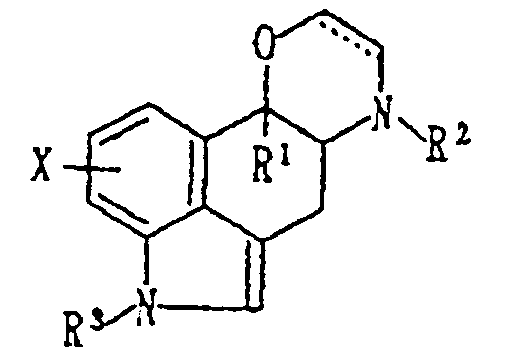
wherein X is hydrogen or a substituent; R¹ is an optionally substituted hydrocarbon residue; R² and R³ are respectively hydrogen or a substituent; and shows a single bond or a double bond, or a pharmacologically acceptable acid addition salt thereof, has an analgesic action and is useful as a medicine.
wherein X is hydrogen or a substituent; R¹ is an optionally substituted hydrocarbon residue; R² and R³ are respectively hydrogen or a substituent; and
Description
- This invention relates to novel condensed morpholine derivatives.
- Compounds having an indolobenzoxazine skeleton were disclosed in USP-4,493,836 and USP-4,318,910 by Lucien Nedelec et al., and in USP-4,238,486 by James H. Jones, in which anti-Parkinson and antihypertensive activity are indicated. In these known compounds, the carbon atom at 1a position of the indolobenzoxazine skeleton is unsubstituted.
- Pain is a complaint due to physical or mental causes, and man has endeavored, since ancient times, to synthesize drugs capable of eliminating or relieving the pain.
- Stimuli causing pain include, among others, chemical, electrical, thermal and mechanical ones. Pain signals given to primary sensory nerve by these stimuli are transmitted to cerebral cortex through spinal cord, where the sensation is recorded as pain. In the transmission of pain, various neuropeptides are participated. Above all, substance-P (SP) is a peptide consisting of 11 amino acids belonging to tachykinins, which is counted as one of the substances of transmitting information from primary sensory nerve to the dorsal horn of the spinal cord, which participates in, other than pain, central nervous system diseases, inflammatory diseases. Therefore, drugs capable of suppressing the stimuli transmitting the action of SP can be used as excellent analgesics.
- As a strong analgesic which has been known best, mention is made of a narcotic analgesic, e.g. morphine, and a number of its related compounds have been synthesized. Most of these drugs, however, cause tolerance and physical and mental dependency, and the strength of such tolerance and dependency is assumed to be in direct proportion to the analgesic activity. Circumstances being such as above, development of non-narcotic analgesic which does not act on a morphine-acceptor has been ardently desired.
- The present inventors found that novel indolobenzoxazine derivatives modified by introducing into their 1a-position a hydrocarbon residue such as lower alkyl, lower alkenyl, lower alkynyl or aryl presented analgesic actions in various animal models, and then conducted further investigation on the finding to complete the present invention.
- Thus, this invention relates to: a compound (I) represented by the formula
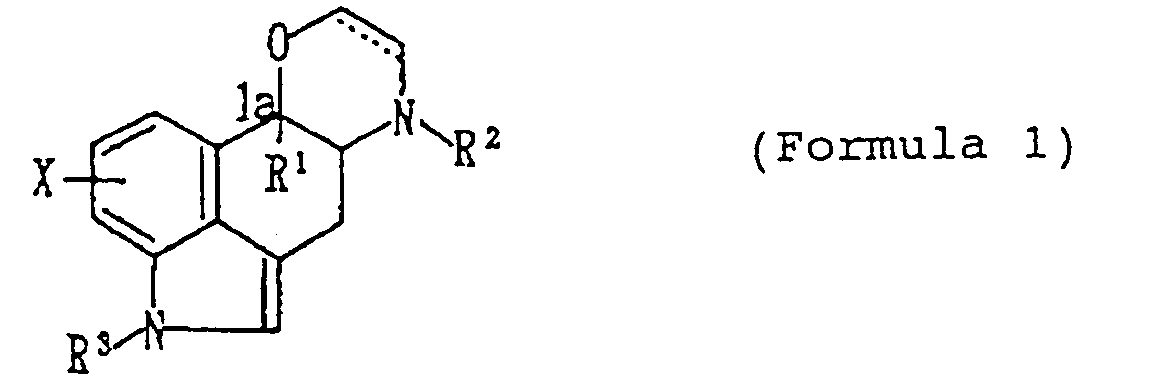
wherein X is hydrogen or a substituent; R¹ is an optionally substituted hydrocarbon residue; R² and R³ are respectively hydrogen or a substituent; and
- Referring to the compound (I) above, more particularly, hydrogen, halogen or an optionally substituted hydrocarbon residue which may be bound to the ring through oxygen atom are mentioned for X;
an optionally substituted hydrocarbon residue is mentioned for R¹;
hydrogen or an optionally substituted hydrocarbon residue are mentioned for R²;
hydrogen, an optionally substituted hydrocarbon residue or a sulfonyl group are mentioned for R³. - More preferably, X is hydrogen, a lower alkyl, a lower alkoxy or halogen;
R¹ is a lower alkyl, a lower alkenyl, a lower alkynyl or aryl;
R² is hydrogen or an optionally substituted lower alkyl;
R³ hydrogen or an optionally substituted lower alkyl or sulfonyl group. - Referring to the above-mentioned X, R¹, R² and R³, fluorine, chlorine, bromine and iodine are mentioned as halogen. The lower alkyl includes C₁₋₆ straight-chain or branched saturated hydrocarbon, one or more hydrogen atoms of which being optionally substituted with halogen, as exemplified by methyl, ethyl, n-propyl, iso-propyl, n-butyl, iso-butyl, n-pentyl, n-hexyl, trifluoromethyl, difluoromethyl, monofluoromethyl, pentafluoroethyl and 2-trifluoroethyl.
- The lower alkenyl includes C₂₋₆ straight-chain or branched unsaturated hydrocarbon having a double bond in the molecule, as exemplified by vinyl, allyl, 2-propenyl, 2-butenyl, isoprenyl, 2-pentenyl, 3-pentenyl, 4-pentenyl, 2-hexenyl, 3-hexenyl, 4-hexenyl and 5-hexenyl.
- The lower alkynyl includes C₂₋₆ straight-chain or branched unsaturated hydrocarbon having a triple bond in the molecule, as exemplified by propargyl, ethynyl, 2-propynyl, 3-propynyl, 1-hexynyl, 2-hexynyl, 3-hexynyl and 4-hexynyl.
- The lower alkoxy includes functional groups formed by binding the above-mentioned lower alkyl through oxygen atom, as exemplified by C₁₋₆ alkoxy such as methoxy, ethoxy, n-propoxy, n-butoxy, t-butoxy, isopropoxy and trifluoromethoxy.
- The aryl includes monocyclic or condensed polycyclic aromatic hydrocarbon, as exemplified by phenyl, naphthyl, indenyl and anthryl.
- As substituents of the optionally substituted lower alkyl group shown by the above-mentioned R² and R³, mention is made of, for example, the above-mentioned halogen, aryl or cycloalkyl, heterocyclic ring, aralkyl and acyl, and the aryl and heterocyclic ring may optionally be bound to the lower alkyl through oxygen, sulfur or nitrogen atom.
- The cycloalkyl includes 3- to 7-membered ring formed with solely carbon atoms, which may optionally have a double bond in the ring, as exemplified by cyclopropyl, cyclobutyl, cyclopentyl, cyclohexyl, 2-cyclohexen-1-yl and 2-cyclopenten-1-yl.
- The heterocyclic ring includes rings which may be 4- to 7-membered monocyclic or condensed cyclic rings optionally having unsaturated bond and having at least one of oxygen atom, nitrogen atom, and sulfur atom as the ring-constituting atom, as exemplified by 2-thienyl, 3-thienyl, 2-pyridyl, 3-pyridyl, 4-pyridyl, 2-furyl, 3-furyl, 4-quinolyl, 8-quinolyl, 4-isoquinolyl, pyrazinyl, 2-pyrimidinyl, 1-pyrrolidinyl, 2-pyrrolidinyl, 3-pyrrolidinyl, 2-imidazolinyl, 3-imidazolinyl, 1-piperidyl, 3-piperidyl, 1-morpholinyl, 2-morpholinyl, 3-morpholinyl, 4-morpholinyl, 1-piperazinyl, 2-piperazinyl, 3-piperazinyl, 2-isoindolinyl and 1-phthalimide.
- The aralkyl includes functional groups formed by binding one or more aryl groups through lower alkyl, as exemplified by benzyl, phenethyl, diphenylmethyl, triphenylmethyl, 1-naphthylmethyl, 2-naphthylmethyl, 2-diphenylethyl, 3-phenylpropyl, 4-phenylbutyl and 5-phenylpentyl.
- The acyl includes functional groups formed by binding the above-mentioned lower alkyl, lower alkenyl, lower alkynyl, aryl, cycloalkyl, aralkyl or heterocyclic ring through carbonyl, phosphoryl or sulfonyl, as exemplified by formyl, acetyl, propionyl, butyryl, valeryl, acryloyl, propiolyl, benzoyl, nicotinoyl, methanesulfonyl, ethanesulfonyl, phenylsulfonyl, tolylsulfonyl and 2,4,6-triisopropylphenylsulfonyl.
- The above-mentioned aryl, aralkyl and heterocyclic ring may optionally have, at optional positions, one or plural optional substituents which are different from one another.
- The optional substituents include the above-mentioned lower alkyl, lower alkenyl, lower alkynyl, cycloalkyl or cyano, nitro, sulfonyl, amino, lower monoalkylamino, lower dialkylamino, arylamino, hydroxyl group, lower alkoxy, halogen, carbamoyl, carboxyl, lower alkoxycarbonyl, lower alkanoyl, mercapto, lower alkylmercapto, aralkyl, aryl, lower alkyl carbamoyl, aryl carbamoyl, acyl (e.g. benzoyl, nicotinoyl), methylenedioxy, heterocyclic ring (preferably 4-pyridyl, 2-pyridyl, 3-pyridyl and 2-pyrimidinyl), or the like.
- The sulfonyl group for R³ includes a sulfonyl group optionally substituted by lower alkyl or aryl which may be substituted by lower alkyl, preferably arylsulfonyl which may be substituted by lower alkyl, more preferably phenylsulfonyl which may be substituted by one to three C₁₋₆ alkyl groups, as exemplified by p-tolylsulfonyl and 2,4,6-triisopropylphenylsulfonyl.
- Among the compounds (I), preferable ones are those wherein X stands for hydrogen or lower alkoxy; R¹ stands for a lower alkyl, a lower alkenyl or phenyl; R² stands for hydrogen, a lower alkyl or a group (II) shown by the formula, -(CH₂)nAR⁴ (Formula 2): wherein n is an integer of 1 to 6, A is a bond or oxygen, sulfur or nitrogen atom, R⁴ is hydrogen, phenyl, 1-phthalimidyl, 4-benzylpiperazyl; R³ stands for hydrogen, 2,4,6-triisopropylphenylsulfonyl or p-tolylsulfonyl and ------ is a single bond.
- More preferable ones are those wherein X is hydrogen or C₁₋₃ alkoxy; R¹ is C₁ -₃ alkyl, vinyl or phenyl; R² is hydrogen, C₁₋₆ alkyl or the group of the formula -(CH₂)nAR⁴ wherein n is an integer of 1 to 6, A is a bond or oxygen, sulfur or nitrogen atom, R⁴ is hydrogen, phenyl, 1-phthalimidyl, 4-benzylpiperazyl; R³ is hydrogen or 2,4,6-triisopropylphenylsulfonyl and ------ is a single bond.
- Examples of pharmacologically acceptable acid addition salts include inorganic salts such as hydrochloride, hydrobromide, hydroiodide, sulfate or phosphate, and organic salts such as acetate, oxalate, succinate, ascorbate, maleate, lactate, citrate, fumalate, tartrate, methanesulfonate or benzoate.
- It is preferable that the compound (I) of this invention has the following steric configuration;

wherein X, R¹, R² and R³ are of the same meaning as defined above. - Further, in the compounds included in the present invention, there exist optical isomers, and the optically active compounds obtained by optical resolution of those isomers are also included in the present invention.
- The compound (I) of this invention can be produced by, for example, subjecting a compound (IV) shown by the formula
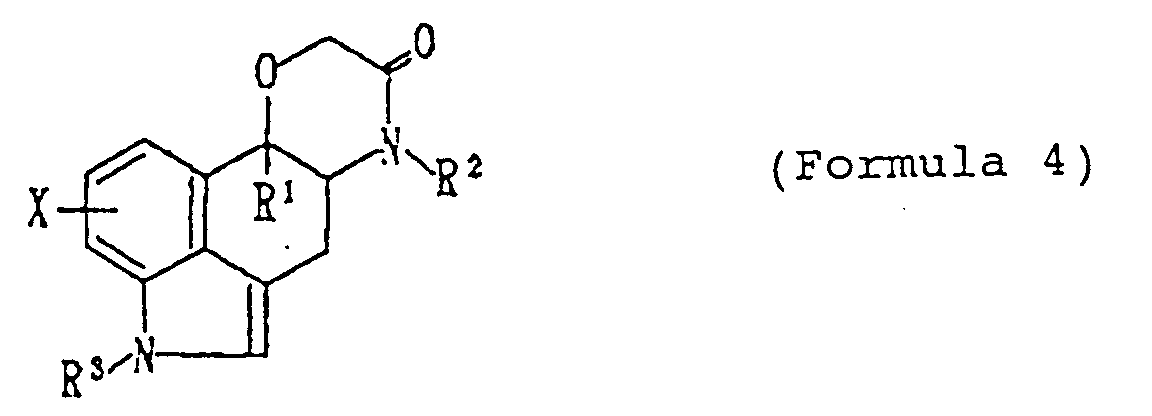
wherein X, R¹, R² and R³ are of the same meaning as defined above to reduction, and, when desired, by further subjecting the reduced compound to reduction, oxidation or/and substitution reaction. - The above-mentioned reduction is conducted in an inert solvent by reacting with a metal hydride (e.g. lithium aluminum hydride, lithium boron hydride, sodium cyano borohydride or diborane). As the inert solvent, mention is made of ether (e.g. ethyl ether, tetrahydrofuran or dioxane), halogenated hydrocarbon (chloroform, dichloromethane), hexane, benzene, toluene or the like. The metal hydride is used in a amount of 1 to 20 equivalents, preferably 3 to 12 equivalents, and the reaction temperature ranges from -70°C to 50°C. Preferably, the reaction is conducted in an ether solvent at temperatures ranging from 0°C to 30°C with lithium aluminum hydride.
- Further, introduction and modification of substituents can be conducted, for example, in the following manner.
- The alkylation on the secondary nitrogen atom is conducted processing with a base (1 to 5 equivalents, preferably 2 to 3 equivalents) in an inert solvent, for example, water, ether (e.g. tetrahydrofuran, ethyl ether or dioxane), acetonitrile, N,N-dimethylformamide and halogenated hydrocarbon, singly or a mixture of them. Examples of the base include potassium carbonate, sodium carbonate, sodium hydride, potassium hydride, sodium ethoxide and potassium-t-butoxide, and the reaction temperature ranges from -50°C to 80°C, preferably from 0°C to 30°C.
- The acylation on the secondary nitrogen atom is conducted by allowing a reactive derivative of chlorine, acetic acid or bromoacetic acid (e.g. chloroacetyl chloride, bromoacetyl bromide or bromoacetyl chloride) to react in an inert solvent. Preferable examples of the inert solvent include water, ether, halogenated hydrocarbon, acetonitrile and N,N-dimethylformamide, and they are used singly or as a mixture. Depending on cases, a base is added to the reaction system, as exemplified by inorganic bases (sodium carbonate, sodium hydrogencarbonate, sodium hydroxide, potassium carbonate, etc.) or organic bases (triethylamine, pyridine, 4,4-dimethylamino pyridine, diisopropyl ethylamine, etc.). The amount of the base ranges from 1 to 10 equivalents, preferably from 1 to 3 equivalents. The reaction temperature ranges from 0°C to 50°C, preferably from 10°Cto 30°C.
- The elimination of a base shown by R³ (e.g. sulfonyl derivatives) can be conducted by basic hydrolysis, acid hydrolysis or reductive elimination, and the last one is preferable. The reaction is conducted by processing with sodium naphthalene prepared form metallic sodium and naphthalene or a metal hydride (e.g. lithium aluminum hydride) in an inert solvent (e.g. ether, toluene or hexane, singly or as a mixture). The amount of the reducing agent ranges desirably from 5 to 20 equivalents.
- As the inert solvent, tetrahydrofuran is preferably employed, and the reaction temperature ranges from 0°C to 40°C, preferably around room temperature.
- The starting compound (Formula 4) can be produced from 3,4-dihydrobenzo[cd]indol-5(1H)-one (J. Chem. Soc., p.1438, 1973) or a derivative thereof by the following steps in accordance with the method described by Bowman (J. Chem. Soc., p.1121, 1972).

wherein X, R¹, R² and R³ are of the same meaning as defined above. - This step is a nucleophilic addition reaction on ketone group. The reaction is conducted by reacting with an organometallic reagent represented by R¹-M (M stands for Li, Na, MgBr, MgCl or CeCl₂) in an inert solvent. As the inert solvent, use is made of tetrahydrofuran, ethyl ether, dimethoxyethane or dioxane, singly or as a mixture. The amount of the organometal ranges from 1 to 20 equivalents, preferably from 4 to 10 equivalents. The reaction temperature ranges from -100°C to 70°C, preferably from -20°C to 25°C
- This is chloroacetylation reaction, which is conducted in accordance with the method of Lucien Nedelec et al. (JP-A-133292/1981). Namely, the reaction with chloroacetyl chloride (preferably 1 to 2 equivalents) is conducted in an inert solvent in the presence of an excess amount of a base. As the inert solvent, use is made of water, ether (ethyl ether, tetrahydrofuran or dioxane), halogenated hydrocarbon (chloroform, dichloromethane or dichloroethane), ethyl acetate, acetonitrile and N,N-dimethylformamide, singly or as a mixture. The reaction is conducted at temperatures ranging from 0°C to 50°C. Preferable bases are exemplified by potassium carbonate, sodium carbonate, sodium hydroxide and potassium hydroxide, and, preferable inert solvents include tetrahydrofuran, chloroform and dichloromethane.
Preferable reaction temperatures range from 0°C to 30°C. - This is intramolecular cyclization. The reaction is conducted by processing with a base (1 to 5 equivalents, preferably 2 to 3 equivalents) in an inert solvent, for example, ether (e.g. tetrahydrofuran, ethyl ether or dioxane), acetonitrile, N,N-dimethylformamide or halogenated hydrocarbon, singly or as a mixture. Preferable examples of the base include inorganic strong bases (e.g. sodium hydride, potassium hydride, sodium hydroxide, potassium hydroxide, sodium ethoxide or potassium-t-butoxide), especially preferable one being sodium hydride. Preferable examples of the inert solvent include tetrahydrofuran, acetonitrile and N,N-dimethylformamide, which can be used singly or as a mixture. The reaction temperatures range preferably from 0°C to 40°C.
- Optically active compounds can be produced by per se known means, more specifically stating, by using an optically active synthetic intermediate or by subjecting the mixture of the ultimate racemic compounds to optical resolution.
- As the optical resolution, mention is made of a method which comprises allowing an optically active acid and salt to be formed, followed by separating them by fractional recrystallization; a method which comprises subjecting a racemic compound or a salt thereof to chromatography using a column for separation of optical active compounds (chiral column), for example, ENANTIO-OVM (Toso Co., Ltd.), followed by developing with a solvent such as water, various buffers (e.g. phosphate buffer), alcoholic solvents (e.g. methanol or ethanol), nitrile type solvents (e.g. acetonitrile), hexane or ethyl ether, singly or as a mixture; and a method which comprises subjecting a mixture of racemic compounds to condensation, by a conventional method (e.g. acid chloride method), with, for example, MPTA (α-methoxy-α-(trifluoromethyl)phenylacetic acid or menthoxyacetic acid to give a mixture of diastereomers of amido-compound, which is subjected to separation and purification by means of fractional recrystallization or a silica gel chromatography, followed by subjecting thus separated and purified product to acid hydrolysis or basic hydrolysis.
- The compound (Formula 1) of this invention is antagonistic against symptoms of pain or the like induced by Substance-P, and shows analgesic activity in animals.
- The toxicity of the compounds of this invention is low (acute toxicity (LD₅₀), when Compound 2 of Examples is orally administered to rats, is not less than 100 mg/kg) with less undesirable side effects. Therefore, the compounds of this invention and their salts can be used for prophylaxis or therapy of diseases including pain due to bone diseases (arthritis, rheumatic fever, osteoporosis), pain induced by cancer of the like, lumbago, postoperative pain, neuralgia, pain induced by inflammatory diseases, pain caused by tooth extraction, tooth-ache and pain due to scalds trauma, as well as neurosis (e.g. anxiety neurosis, depression, mental disorder), somnipathy or the like. Since the compounds of this invention act on a neurotransmitting system such as dopamine or norepinephrine, they can be use also as the prophylactic and therapeutic drugs of circulatory diseases (e.g. hypertension).
- The compounds of this invention and their salts can be safely administered orally or non-orally as they are or as pharmaceutical compositions by being admixed with pharmaceutically acceptable carrier, vehicle or diluent, e.g. tablets (including sugar-coated tablets, film-coated tablets), powders, granules, capsules (including soft capsules), liquids, injections, suppositories, sustained-release drugs.
- While the dosage of the compounds and their salts of this invention varies with, for example, the subjects, administration routes and diseases to be treated, it ranges conveniently from 0.1 to 500 mg, preferably 1 to 100 mg, in the case of oral administration to a human adult as an analgesic agent.
-
- In the following, Na₂SO₄ means sodium sulfate, LAH means lithium aluminum hydride, THF means tetrahydrofuran, NH₄Cl means ammonium chloride, DCE means 1,2-dichloroethane, KBr means potassium bromide, DMF means N,N-dimethylformamide and CDCl₃ means deuterochloroform.
- In THF(640 ml)-DMF(130 ml) was dissolved ethyl 3-(5-methoxy-1H-indol-3-yl)propionic acid (99.3 g, 0.4 mol). To the solution was added in limited amounts, under ice-cooling, a suspension of 60% sodium hydride in oil (18.4 g, 0.46 mol) in THF(50 ml)-DMF(10 ml). The mixture was stirred at room temperature for one hour, which was again cooled with ice. To the mixture was gradually added p-toluenesulfonyl chloride (83.9 g, 0.44 mmol), followed by stirring for further 3 hours at room temperature. The reaction mixture was poured into an ice-saturated NH₄Cl solution (180 ml). The upper layer was subjected to extraction with ethyl acetate (100 ml + 500 ml). The extract solution was washed with a saturated aqueous saline solution (300 ml x 2), followed by drying over Na₂SO₄. The residue was purified by means of a silica gel chromatography (eluent: hexane - ethyl acetate (2:1)) and then were added hydrochloric acid (100 ml) and acetic acid (400 ml), and was refluxed for 1 hour. The reaction mixture was concentrated and the resulting crystals were washed with water, dried under reduced pressure and washed with methanol-isopropyl ether (1:3) to obtain the title compound (54.1 g: m.p. 172-174°C)
- To a DCE (600 ml) solution of 3-(5-methoxy-1-p-toluenesulfonyl-indol-3-yl)propionic acid (28.9 g, 77 mmol) was added, while stirring under ice-cooling, (COCl)₂ (8.3 ml, 95 mmol), and the mixture was stirred for about 2.5 hours at room temperature. The reaction mixture was concentrated, which was dissolved in DCE (100 ml). The solution was added to a suspension of aluminum chloride powder (33.9 g, 254 mmol) in DCE (430 ml) at 5°C taking 20 minutes. The mixture was left standing as it was at 5°C for one hour, then stirred for 2.5 hours at room temperature. To the reaction mixture were added, under ice-cooling, dimethoxyethane (300 ml) and water (300 ml). Resulting precipitates were filtered off, then the organic layer was separated. The aqueous layer was subjected to extraction with chloroform (200 ml). The extract solution was combined with the organic layer, which was washed with an aqueous saline solution. The resultant organic layer was dried (anhydrous sodium sulfate), then the solvent was distilled off under reduced pressure to leave 25 g of crude crystals. The crude crystalline product was subjected to a silica gel column chromatography, eluting with chloroform, to obtain crystals, followed by recrystallization from chloroform-n-hexane to afford the title compound (m.p.210-211°C).
¹H-NMR(CDCl₃, 200MHz) δ: 2.36(s,3H), 2.81(t,J=7Hz,2H), 3.13(t,J=7Hz,2H), 6.8-8.0(m,7H) ppm. IR(KBr): 3095, 1643 cm⁻¹.Anal: Calcd. for C₁₈H₁₅NO₄S; C 63.33%, H 4.43%, N 4.10% Found; C 63.22%, H, 4.39%, N 4.08%. - To a solution of the crude crystals (42 g) obtained in Reference Example 2 in N,N-dimethylformamide (400 ml) were added potassium carbonate (60.7 g, 440 mmol) and methyl iodide (39.7 g, 280 mmol). The mixture was stirred for about one hour at room temperature, to which were further added potassium carbonate (20.0 g, 140 mmol) and methyl iodide (15.0 g, 110 mmol). The mixture was stirred for further one hour at room temperature. To the reaction mixture was then added water (1000 ml), which was subjected to extraction with ethyl acetate (400 ml x 2). The extract solution was washed with an aqueous saline solution and dried (anhydrous Na₂SO₄). The solvent was then distilled off under reduced pressure. The residue was subjected to a silica gel column chromatography, eluting with n-hexane-ethyl acetate (1:1) to afford the title compound (48%).
¹H-NMR(CDCl₃, 200 MHz) δ: 2.36(s,3H), 2.78(t,J=7Hz,2H), 3.10(t,J=7Hz,2H), 3.96(s,3H), 6.9-8.1(m,7H), ppm.
IR(KBr): 2940, 1682 cm⁻¹. Anal: Calcd. for C₁₉H₁₇NO₄S; C 64.21%, H 4.82%, N 3.94% Found: C 63.54%, H 4.97%, N 3.93% - To a solution of 3,4-dihydro-6-methoxy-1-p-toluene sulfonylbenz[cd]indol-5(1H)-one (5.1 g, 14.3 mmol) in THF (60 ml) was gradually added, under stirring at - 45°C, a solution of Me₃PhNBr₃ (5.38 g, 14.3 mmol) in THF (20 ml), and the mixture was warmed up to 10°C. After completion of the reaction, insolubles were filtered off. The filtrate was subjected to distillation under reduced pressure to leave 7.5 g(100%) of 3,4-dihydro-4-bromo-1-(p-toluenesulfonyl) benz[cd]indol-5-one as crude crystals. Then, this crude crystalline product was dissolved in N,N-dimethylformamide-acetic acid (140 ml-2 ml). To the solution was gradually added, under stirring at -28°C, an aqueous solution (14 ml) of sodium azide (1.86 g, 28.6 mmol) to raise the temperature to about 0°C. After completion of the reaction, the reaction mixture was added to ice-water (300 ml). Resulting crystalline precipitates were collected by filtration and, then dissolved in ethyl acetate, and the solution was shaken to make two layers. The organic layer was washed with an aqueous saline solution and dried (anhydrous Na₂SO₄). The solvent was then distilled off under reduced pressure to leave 5.67 g (100%) of the title compound as crude crystals. A portion of the crystalline product was recrystallized from ethyl acetate to afford the product, m.p.147-148°C.
¹H-NMR(CDCl₃, 200 MHz) δ: 2.36(s,3H), 3.02(ddd,J=20, 12, 2 Hz, 1H), 3.33(dd,J=20, 7Hz,1H), 4.00(s,3H), 4.35(dd, J=12, 7Hz, 1H), 6.9-8.1(m,7H) ppm. IR(KBr): 2104, 1688 cm⁻¹. Anal: Calcd for C₁₉H₁₆N₄O₄S.0.3H₂O; C 56.78%, H 3.83%, N 13.82%% Found; C 57.03%, H 3.91%, N 13.42%. - To a solution of 4-azido-3,4-dihydro-6-methoxy-1-p-toluenesulfonyl benz[cd]indol-5(1H)-one (5.36 g, 13.5 mmol) in THF (130 ml) were added acetic anhydride (2.76 g, 27.0 mmol) and 10% palladium-carbon (2.2 g). The mixture was stirred for 10 hours at room temperature under hydrogen atmosphere of 3 atmospheric pressure. After completion of the reaction, the catalyst was filtered off. The filtrate was subjected to distillation under reduced pressure. The residue was washed with ethyl ether to give 5.03 g (90%) of the title compound as a crude crystalline product. A portion of the product was recrystallized from chloroform - n-hexane to afford a pure product (m.p.214-217°C).
¹H-NMR(CDCl₃, 200 MHz) δ: 2.37(s,3H), 2.73(ddd,J=18, 14, 2, 1H), 3.85(dd,J=18, 10, 1H), 3.96(s,3H), 4.73(ddd, J=14, 10, 6, 1H), 6.78(br d, 1H), 6.9-8.1(m,7H) ppm. IR(KBr): 3340, 1682, 1634 cm⁻¹. Anal: Calcd for C₂₁H₂₀N₂O₅S.1.0H₂O: C 58.59%, N 6.51% Found; C 59.02%, H 4.88%, N 6.42%. - To a suspension of 4-azido-3,4-dihydro-6-methoxy-1-p-toluenesulfonyl benz[cd]indol-5(1H)-one (2.0 g, 5.0 mmol) in ethanol (100 mmol) were added conc. hydrochloric acid (2.5 ml) and 10% palladium-carbon (400 mg). The mixture was stirred for 4 hours at room temperature under hydrogen atmosphere of 3 atmospheric pressure. After completion of the reaction, the catalyst was filtered off. The filtrate was subjected to distillation, and the residue was washed with ethyl ether to give 1.6 g (80%) of crude crystals of the title compound.
¹H-NMR(DMSO-d₆, 200 MHz) δ: 3.12(t,J=10Hz, 1H), 3.89(s,3H), 4.44(m,1H), 7.2-8.1(m,7H), 8.50(br s,2H) ppm.
IR(KBr): 1687 cm⁻¹. Anal: Calcd. for C₁₉H₁₉N₂O₄SCl.3.0H₂O; C 49.51%, H 5.47%, N 6.08% Found: C 49.57%, H 5.22%, N 5.95%. - To a suspension of 4-amino-3,4-dihydro-6-methoxy-1-p-toluenesulfonylbenz[cd]indol-5(1H)-one hydrochloride (1.45 g, 3.50 mmol) in dichloromethane (30 ml) were added, while stirring under ice-cooling, anhydrous trifluoroacetic acid (0.61 ml, 4.27 mmol) and triethylamine (1.18 ml, 16.1 mmol). The mixture was stirred for 30 minutes as it was. After completion of the reaction, the reaction mixture was subjected to distillation under reduced pressure. The residue was shaken together with ethyl acetate (40 ml)-1N HCl (30 ml) to allow two layers to be formed. The organic layer was washed with an aqueous saline solution and dried (anhydrous Na₂SO₄). The solvent was distilled off under reduced pressure. The residue was recrystallized from ethyl acetate - n-hexane to afford the title compound (1.2 g, 73%, m.p.189-190°C)
¹H-NMR(CDCl₃), 200 MHz) δ: 2.84(ddd,J=14,13,2Hz,1H), 3.98(s,3H), 4.70(m,1H), 7.0-8.2(m,7H) ppm. IR(KBr): 3355, 1732, 1690 cm⁻¹. Anal: calcd. for C₂₁H₁₇N₂O₅SF₃.0.5H₂O; C 53.05%, H 3.82%, N 5.89% Found; C 52.96%, H 3.97%, N 5.80%. - Sodium hydride (60% oil 19.03 g 0.476 mol) was washed with n-hexane, which was suspended in DMF (500 ml). To the suspension was gradually added a solution of ethyl indole-3-propionate acid (64.79 g 0.317 mol) in DMF(100 ml). The mixture was stirred for one hour at 40-50°C, to which was gradually added, under ice-cooling, 2,4,6-triisopropylphenylsulfonyl chloride (115.25 g, 0.38 mol), followed by stirring for one hour at room temperature. To the reaction mixture was added water (150 ml), which was subjected to extraction with n-hexane (500 ml). The extract solution was washed with water (100 ml) and dried over anhydrous magnesium sulfate. The solvent was distilled off under reduced pressure to to leave the title compound (152 g).
¹H-NMR(CDCl₃, 200 MHz) δ: 1.09(d,J=7Hz,12H), 1.24(d, J=7Hz,6H), 2.69(t,J=7Hz,2H), 2.90(hep,J=7Hz,1H), 3.04(t,J=7Hz,2H), 3.65(s,3H), 4.16(hep,J=7Hz,2H), 7.2-7.6(m,7H) ppm. IR(KBr): 2960, 1740cm⁻¹. -
- In acetic acid (200 ml) was dissolved methyl 1-(2,4,6-triisopropylphenylsulfonyl)-indole propionate (152 g). To the solution was added conc. hydrochloric acid (150 ml), and the mixture was refluxed under heating for two hours. The reaction mixture was concentrated under reduced pressure, which was added to a saturated aqueous solution of sodium hydrogencarbonate to render the pH to 5 - 6, followed by extraction with dichloromethane (1000 ml). The extract solution was washed with water (500 ml) and dried over anhydrous magnesium sulfate. The solvent was distilled off under reduced pressure to leave the title compound (153 g) as an oily product.
¹H-NMR(CDCl₃, 200MHz) δ: 1.09(d,J=7Hz,12H), 1.24(d,J=7Hz,6H), 2.76(t,J=7Hz,2H), 2.90(hep,J=7Hz,1H), 3.06(t,J=7Hz,2H), 4.16(hep,J=7Hz,2H), 7.2-7.6(m,7H) ppm. IR(KBr): 2955, 1712 cm⁻¹. - To a solution of 1-(2,4,6-triisopropylphenylsulfonyl)-indole-3-propionic acid (76.22 g) in chloroform (500 ml) was added dropwise thionyl chloride (28.9 ml) at room temperature taking about 10 minutes. The mixture was stirred for one hour at 60°C. After completion of the reaction, the solvent was distilled off under reduced pressure. To the residue was again added chloroform, followed by concentration under reduced pressure. The concentrate was dissolved in dichloroethane (900 ml). To the solution was gradually added, under ice-cooling, crushed aluminum chloride (58.4 g). The mixture was stirred for 30 minutes, which was added to a mixture of 1N hydrochloric acid (1000 ml) and ice (200 g), followed by extraction with chloroform (900 ml). The extract solution was washed with water (900 ml) and dried over anhydrous magnesium sulfate, which was concentrated under reduced pressure. The concentrate was purified by means of a column chromatography (eluted with ethyl acetate : n-hexane =1:4), followed by recrystallization from ethyl acetate - hexane to afford the title compound (43.86 g, m.p.124-130°C).
¹H-NMR(CDCl₃, 200MHz) δ: 1.10(d,J=7Hz,12H), 1.25(d,J=7Hz,6H), 2.87(t,J=7Hz,2H), 3.21(t,J=7Hz,2H), 4.18(hep,J=7Hz,1H), 7.2-7.4(m,4H), 7.68(d,J=9Hz,2H) ppm. - To a solution of 3,4-dihydro-1-(2,4,6-triisopropyl phenylsulfonyl)benz[cd]indol-5(1H)-one (5.1 g, 14.3 mmol.) in THF (60 ml) was gradually added under stirring at -45°C a solution of Me₃PhBr₃ (5.38 g, 14.3 mmol.) in THF (20 ml) to raise the temperature of the reaction system up to 10°C. After completion of the reaction, insolubles were filtered off, and the filtrate was subjected to distillation under reduced pressure to leave 7.5 g (100%) of 3,4-dihydro-4-bromo-1-(2,4,6-triisopropylphenylsulfonyl) benz[cd] indol-5(1H)-one as a crude crystalline product. Then, this crude crystalline product was dissolved in a mixture of N,N-dimethylformamide (140 ml) and acetic acid (2 ml). To the solution was gradually added, while stirring at -28°C, an aqueous solution (14 ml) of sodium azide (1.86 g, 28.6 mmol.) to raise the temperature of the reaction system up to near 0°C. After completion of the reaction, the reaction mixture was added to ice-water (300 ml). Crystals then precipitated were collected by filtration and dissolved in ethyl acetate. The solution was shaken to allow two layers to be formed. The organic layer was washed with an aqueous saline solution, which was then dried (anhydrous Na₂SO₄). The solvent was distilled off under reduced pressure to leave 5.67 g (100%) of the title compound as a crude crystalline product. A portion of the product was recrystallized from ethyl acetate to give a product, m.p.129-132°C.
¹H-NMR(CDCl₃, 200 MHz) δ: 1.12(d,J=7Hz,12H), 1.28(d,J=7Hz,6H), 2.94(t,J=7Hz,1H), 3.16(ddd,J=16,11,2 Hz,1H), 3.48(dd,J=16,7Hz,1H), 4.18(hep,J=7Hz,2H), 4.49(dd,J=11,7Hz,1H), 7.21(s,2H), 7.31(s,1H), 7.40(t,J=8Hz,1H), 7.76(d,J=8Hz,1Hx2) ppm. IR(KBr): 2970, 2110, 1695, 1600 cm⁻¹. Anal: Calcd for C₂₆H₃₀N₄O₃s.0.5H₂O; C 64.04%, H 6.41%, N 11.49% Found; C 64.55%, H 6.27%, N 11.20%. - A solution of 4-azido-3,4-dihydro-1-(2,4,6-triisopropylphenylsulfonyl)benz[cd]indol-5(1H)-one (5.36 g, 11.2 mmol), acetic anhydride (2.29 g, 22.4 mmol) and 10% Pd-C (1.7 g in THF (60 ml) was stirred for 4 hours at 4 hours under 4 atmospheric pressure under hydrogen atmosphere. After completion of the reaction, the catalyst was filtered off. The filtrate was concentrated under reduced pressure. To the concentrate was added isopropyl ether to give 5.03 g (91%) of the title compound.
m.p.: 159-162°C. ¹H-NMR(CDCl₃, 200 MHz) δ: 1.07, 1.10, 1.26(d,J=7Hz, 6Hx3), 2.13(s,3H), 2.85(ddd, J=15, 12, 2 Hz, 1H), 2.92*hep, J=7Hz, 1H), 3.95(dd, J=15, 7Hz, 1H), 4.16(hep, J=7 Hz, 2H), 4.85(ddd, J=12, 7, 6Hz, 1H), 6.71(d, J=6Hz, 1H), 7.19(s, 2H), 7.23(d, J=2Hz, 1H), 7.38(t, J=8Hz), 1H), 7.68, 7.76(d, J=8Hz, 1H) ppm. IR(KBr); 3420, 3380, 2960, 1690, 1875, 1600 cm⁻¹.Anal: Calcd. for C₂₈H₃₄N₂O₄ C 67.99%, H 6.93%, N 5.66% Found; C 67.72%, H 7.07%, N 5.59%. - In 100 ml of ethanol was suspended 1.00 g (2.09 mmol) of 4-azido-3,4-dihydro-1-(2,4,6-triisopropylphenylsulfonyl)benz[cd]indol-5(1H)-one, to which was added 1.0 ml of conc. HCl. The mixture was warmed to make a solution, to which was added 0.10 g of 10% Pd-C (hydrous), followed by hydrogenation for one hour at room temperature. The reaction mixture was subjected to filtration to remove the catalyst. The filtrate was washed with ethanol and concentrated under reduced pressure. To the concentrate was added ether, which was concentrated twice, followed by crystallization from ether. The crystalline product was collected by filtration, washed with ether and dried under reduced pressure to afford 0.87 g of a 4-amino derivative. The yield was 85%.
- 0.40 g (0.818 mmol) of the 4-amino derivative obtained as above was dissolved in 6 ml of methylene chloride. To the solution was added, under ice-cooling, 0.14 ml (1.2 equivalent) of anhydrous trifluoroacetic acid and 0.27 ml of triethylamine. The mixture was stirred for 15 minutes, which was then concentrated under reduced pressure. To the concentrate were added ethyl acetate and 1N HCl, and the mixture was shaken to allow two layers to be formed. The organic layer was dried over anhydrous magnesium sulfate, which was concentrated under reduced pressure. The concentrate was purified by means of a silica gel column chromatography (elution with hexane - ethyl acetate 9:1). Fractions were combined and concentrated, to which was added a small volume of hexane to cause crystallization. The crystalline product was dried under reduced pressure to afford 0.23 g of the title compound. The yield was 51%. m.p.:155-156°C. ¹H-NMR(CDCl₃, 200 MHz) δ: 1.09, 1.12, 1.26(d, J=7Hz, 6Hx3), 2.93(hep, J=7Hz, 1H), 2.96(ddd, 15, 12, 2 Hz, 1H), 4.04(dd, J=15, 7 Hz, 1H), 4.15(hep, J=7Hz, 2H), 4.83(ddd, J=12, 7, 6 Hz, 1H), 7.21(s,2H), 7.29(d,J=2Hz, 1H), 7.41(t,J=8Hz, 1H), 7.67(d,J=6Hz, 1H), 7.73, 7.8(d,J=8Hz, 1H) ppm. IR(KBr): 2950, 1730, 1685, 1600 cm⁻¹. Anal: calcd for C₂₈H₃₁F₃N₂O₄S; C 61.30%, H 5.70%, N 5.11% Found; C 61.24%, H 5.80%, N 4.95%.
- To a solution of 4-acetylamino-3,4-dihydro-1-(2,4,6-triisopropylphenylsulfonyl)-benz[cd]indol-5(1H)-one (3.0 g, 6.0 mmol) in THF (60 ml) was added a solution of 1M vinyl magnesium bromide in THF (8 equivalents relative ketone compound) at -40°C in argon streams. The mixture was warmed up to room temperature, which was stirred for 4 hours at the same temperature range. The reaction mixture was added to an ice-cooled saturated aqueous solution of NH₄Cl. The mixture was subjected to extraction with ethyl acetate. The extract was washed with an aqueous saline solution and dried (anhydrous Na₂SO₄). The solvent was distilled off under reduced pressure. The residue was subjected to a silica gel column chromatography, eluting with n-hexane - ethyl acetate (1:2) to give 0.75 g (24%) of the title compound as an amorphous crystalline product.
¹H-NMR(CDCl₃, 200 MHz) δ: 1.08(d,J=7Hz,12H), 1.24(d, J=7Hz,6H), 2.00(s,3H), 2.6-3.0(m,2H), 3.18(dd,J=16,5Hz,1H), 4.15(hept,J=7Hz,2H), 4.51(dt,J=7, 4Hz, 1H), 5.31(dd,J=17, 10Hz, 1H), 5.50(d,J=10Hz,1H), 5.73(dd,J=17, 10Hz,1H), 7.1-7.4(m,6H) ppm. IR(KBr): 3390, 2960, 1657 cm⁻¹. Anal: Calcd for C₃₀H₃₈N₂O₄S.H₂O; C 66.64%, H 7.4%, N 5.18% Found; C 66.35%, H 7.2%, N 4.7%. - LAH (5 equivalents) was allowed to react with a THF solution (14.3 ml) of 4-acetylamino-3,4-dihydro-5-hydroxy- 1-(2,4,6-triisopropylphenylsulfonyl)-5-vinyl-5H-benz[cd]indole (750 mg, 1.43 mmol) and was refluxed for 3 hours to complete the reaction. Ethanol was added to the reaction mixture to inactivate the excess amount of LAH and was added aqueous soltuion of Na₂SO₄. The reaction mixture was subjected to extraction with ethyl acetate. The extract was washed with an aqueous saline solution and, then, dried (anhydrous Na₂SO₄) and concentrated under reduced pressure. The residue thus obtained was subjected to a silica gel column chromatography, eluting with ethyl acetate to afford. 275 mg (38%) of the title compound as an oily product.
¹H-NMR(CDCl₃, 200 MHz) δ: 1.11, 1.12(d,J=7Hz, 6Hx2), 1.25(d,J=7Hz,6H), 2.4-3.1(m,5H), 3.30(dd,J=15,4Hz,1H), 4.18(hept,J=7Hz,2H), 5.0-5.3(m,2H), 5.92(dd,J=17,11Hz,1H), 7.1-7.4(m,6H) ppm. - To a solution of 3,4-dihydro-4-ethylamino-5-hydroxy-1-(2,4,6-triisopropylphenylsulfonyl)-5-vinyl-5H-benz[cd]indole (270 mg, 0.53 mmol) in ethyl acetate (5.3 ml) was added a saturated aqueous solution of sodium carbonate (5.3 ml). To the mixture was added, while vigorously stirring, chloroacetyl chloride (1.2 equivalent). After completion of the reaction, the organic layer was separated and washed with an aqueous saline solution, followed by drying (anhydrous Na₂SO₄). The solvent was distilled off under reduced pressure to leave the residue (260 mg). To a solution of the chloroacetyl compound in THF-acetonitrile (5:1, 5ml) was added, while stirring under ice-cooling, 60% sodium hydride (2 equivalents), and the mixture was stirred for 2-3 hours at room temperature. After completion of the reaction, the reaction mixture was added to a saturated aqueous solution of NH₄Cl cooled with ice, followed by extraction with ethyl acetate. The extract solution was dried (anhydrous Na₂SO₄), then the solvent was distilled off. The residue was subjected to a silica gel column chromatography, eluting with n-hexane - ethyl acetate (3:1) to afford 208 mg (86%) of the title compound as an amorphous crystalline product.
¹H-NMR(CDCl₃, 200MHz) δ: 1.07(d,J=7Hz,12H), 1.24(d,J=7Hz,6H), 2.7-3.0(m,2H), 3.35(m,2H), 3.9-4.2(m,4H), 4.40, 4.48 (d,J=17Hz, 1Hx2), 4.91(d,J=18Hz, 1H), 5.36(d,J=11Hz,1H), 6.24(dd,J=18,11Hz,1H), 7.1-7.4(m,6H) ppm. IR(KBr): 2962, 1662 cm⁻¹. Anal: Calcd. for C₃₂H₄₀N₂O₄S.0.5H₂O; C 68.91%, H 7.41%, N 5.02% Found; C 68.86%, H 7.45%, N 4.69%. - To a solution of trans-4,6,6a,7,9,10a-hexahydro-7-ethyl-4-(2,4,6-triisopropylphenylsulfonyl)-10a-vinyl-indolo[3,4-gh][1.4]benzoxazin-8-one (200 mg, 0.36 mmol) in THF (3.6 ml) was added LAH (3 equivalents) while stirring under ice-cooling, and the mixture was heated for 3 hours under reflux. After completion of the reaction, ethanol was added to the reaction mixture to inactivate the excess amount of LAH, followed by addition to an ice-cooled saturated aqueous solution of Na₂SO₄. The mixture was subjected to extraction with ethyl acetate. The extract solution was washed with an aqueous saline solution and, then, dried (anhydrous Na₂SO₄). The solvent was distilled off under reduced pressure, and the residue was subjected to a silica gel column chromatography, eluting with n-hexane - ethyl acetate (17:3) to afford 103 mg (54%) of the title compound as an amorphous crystalline product. ¹H-NMR(CDCl₃, 200MHz) δ: 1.06, 1.07 (d,J=7Hz, 6Hx2), 1.23(d,J=7Hz,6H), 2.5-3.0(m,7H), 3.21(dd,J=15, 4Hz,1H), 3.80(dd,J=11, 3Hz,1H), 4.1-4.4(m,3H), 4.76(dd,J=18, 2Hz,1H), 5.23(dd,J=11, 2Hz,1H), 6.62(dd,J=18, 11Hz,1H), 7.1-7.3(m,6H) ppm. IR(KBr): 2975 cm⁻¹. Anal: Calcd. for C₃₂H₄₂N₂O₃S.0.5H₂O; C 70.68%, H 7.97%, N 5.15% Found; C 71.07%, H 7.85%, N 5.48%.
- To a solution of trans-4,6,6a,8,9,10a-hexahydro-7-ethyl 1-4-(2,4,6-triisopropylphenylsulfonyl)-10a-vinyl-7H-indolo[3,4-gh] [1.4]benzoxazine (100 mg, 0.18 mmol) in THF (5.4 ml) was added, at room temperature, a solution of 0.5M naphthalene sodium in THF (10 equivalents) in argon streams. The mixture was stirred for 10 minutes at room temperature, which was then added to an ice-cooled saturated aqueous solution of NH₄Cl, followed by extraction with ethyl acetate. The organic layer was washed with an aqueous saline solution and dried (Na₂SO₄). The solvent was distilled off under reduced pressure, and the residue was subjected to a silica gel column chromatography, eluting with n-hexane - ethyl acetate (1:1) to afford 33 mg (68%) of the title compound as an amorphous crystalline product.
¹H-NMR(CDCl₃, 200MHz) δ: 1.05(t,J=7Hz,3H), 2.6-3.1(m,6H), 3.31(dd,J=15, 4Hz,1H), 3.83(ddd,J=11.4, 1Hz,1H), 4.32(dt,J=11, 3Hz,1H), 5.00(dd,J=17, 2Hz,1H), 5.27(dd,J=11, 2Hz,1H), 6.59(dd,J=17, 11Hz,1H), 6.88(t,J=2Hz,1H), 7.1-7.3(m,3H), 7.8-8.0(br,1H) ppm. IR(KBr): 3410, 2960 cm⁻¹. Anal: Calcd. for C₁₇H₂₀N₂O.0.9H₂O; C 71.75%, H 7.72%, N 9.84% Found; C 71.68%, H 7.25%, N 9.58%. - To a solution of 4-acetylamino-3,4-dihydro-1-(2,4,6-triisopropylphenylsulfonyl)-benz[cd]indol-5-one (3.57 g, 7.0 mmol) in THF (70 ml) was added, at 40°C in argon streams, a solution of 1M methyl magnesium bromide in THF (8 equivalents relative to ketone compound). The mixture was warmed up to room temperature, and stirred for 4 hours. The reaction mixture was added to an ice-cooled saturated aqueous solution of NH₄Cl, which was subjected to extraction with ethyl acetate. The extract was washed with an aqueous saline solution and, then, dried (anhydrous Na₂SO₄). The solvent was distilled off under reduced pressure. The residue was subjected to a silica gel column chromatography, eluting with n-hexane-ethyl acetate, (1:2) to afford 1.27 g (36%) of the title compound as an amorphous crystalline product.
¹H-NMR(CDCl₃, 200MHz) δ: 1.09(d,J=7Hz,12H), 1.25(d,J=7Hz,6H), 1.95(s,3H), 2.7-3.0(m,2H), 3.24(dd,J=16, 5Hz,1H), 4.14(hept,J=7Hz,2H), 4.54(m,1H), 5.3-5.5(br,1H), 7.1-7.4(m,6H) ppm. IR(KBr):3390, 2965, 1660 cm⁻¹. Anal: Calcd. for C₂₉H₃₈N₂O₄S.H₂O: C 65.88%, H 7.63%, N 5.30% Found; C 66.13%, H 7.28%, N 5.69%. - In substantially the same manner as in Example 1-2, 4-acetylamino-3,4-dihydro-5-hydroxy-6-methoxy-5-methyl-1-p-toluenesulfonyl-5H-benz[cd]indole (2.0 g, 4.85 mmol) was subjected to reduction. The residue thus obtained was subjected to a silica gel column chromatography, eluting with ethyl acetate - methanol, (20:1) to afford 953 mg (76%) of the title compound as an amorphous crystalline product, m.p.185-187°C (decomposed: as fumarate).
¹H-NMR(CDCl₃, 200MHz) δ: 1.22(t,J=7Hz,3H), 1.53(s,3H), 2.5-2.8(m,2H), 2.98(dq,J=11, 7Hz,1H), 3.94(s,3H), 6.8-7.2(m,3H), 7.96(br s,1H) ppm. Anal: Calcd. for C₁₉H₂₄N₂O₆.0.5C₄H₄O₄; C 64.13%, H 6.96%, N 8.80% Found; C 63.77%, H 7.17%, N 8.79% as fumarate - To a solution of 3,4-dihydro-4-ethylamino-5-hydroxy-6-methoxy-5-methyl-5H-benz[cd]indole (646 mg, 2.48 mmol) in ethyl acetate (25 ml) was added a saturated aqueous solution of sodium carbonate (24 ml). To the mixture was added, while stirring vigorously, chloroacetyl chloride (1.2 equivalent). After completion of the reaction, the organic layer was separated and washed with an aqueous saline solution, followed by drying (anhydrous Na₂SO₄). The solvent was distilled off under reduced pressure. The residue was cyclized and, then, purified by means of a silica gel column chromatography (eluting with n-hexane - ethyl acetate (2:7)) to afford 517 mg (72%) of the title compound as an amorphous crystalline product. ¹H-NMR(CDCl₃, 200MHz) δ: 1.21(t,d=7Hz,3H), 1.57(s,3H), 2.76(ddd,J=14, 13, 2 Hz, 1H), 3.38(m,2H), 3.88(s,3H), 4.0-4.3(m,2H), 4.44, 4.55 (d,J=17Hz, 1Hx2), 6.9-7.3(m,3H), 7.94(br s, 1H) ppm. IR(KBr):3348, 2988, 1645 cm⁻¹. Anal: Calcd for C₁₇H₂₀N₂O₃.1.5H₂; C 62.37%, H 7.08%, N 8.56% Found; C 62.04%, H 6.30%, N 8.45%.
- Trans-4,6,6a,7,9,10a-hexahydro-7-ethyl-1-methoxy-10a-methyl-indolo[3,4-gh][1.4]benzoxazin-8-one (500 mg, 1.67 mmol) was subjected to reduction, which was recrystallized from chloroform - n-hexane to afford the title compound (320 mg, 67%, m.p.215-217°C(dec.)).
¹H-NMR(CDCl₃, 200MHz) δ: 1.05(t,d=7Hz,3H), 1.59(s,3H), 2.4-3.0(m,6H), 3.24(dd,J=17, 4Hz, 1H), 3.87(s,3H), 4.22(dt,J=12, 3Hz,1H), 6.8-7.2(m,3H), 7.78(br s, 1H) ppm. IR(KBr): 3320, 2959, 2803 cm⁻¹. Anal: Calcd for C₁₇H₂₂N₂O₂.0.3H₂O; C 69.97%, H 7.81%, N 9.60% Found; C 69.99%, H 7.60%, N 9.48%. - Methyl magnesium bromide (1M THF solution 8 equivalents) was allowed to react with a solution of 3,4-dihydro-4-trifluoroacetylamino-1-(2,4,6-triisopropyl phenylsulfonyl)-5H-benz[cd]indol-5-one (1.5 g, 1.43 mmol) in THF (14.3 ml). The reaction mixture was processed in a conventional manner. The residue was subjected to a silica gel column chromatography, eluting with n-hexane - ethyl acetate (4:1) to afford 1.3 g (84%) of the title compound as an amorphous crystalline product.
¹H-NMR(CDCl₃, 200MHz) δ: 1.08(d,J=7Hz,12H), 1.25(d,J=7Hz,6H), 1.59(s,3H), 2.8-3.0(m,2H), 3.40(dd,J=18, 6Hz,1H), 4.15(hept,J=7Hz,2H), 4.55(m,1H), 6.0-6.2(br,1H), 7.2-7.5(m,6H) ppm. IR(KBr): 3413, 2960, 1720 cm⁻¹. Anal: Calcd for C₂₉H₃₅N₂O₄SF₃.0.5H₂; C 60.72%, H 6.33%, N 4.88% Found; C 60.59%, H 6.18%, 4.55%. - To an ethanol solution (9 ml) of 3,4-dihydro-5-hydroxy- 5-methyl-4-trifluoroacetyl-1-(2,4,6-triisopropylphenylsulfonyl)-5H-benz[cd]indole (640 mg, 0.91 mmol) was added 1N sodium hydroxide (2 equivalents). The mixture was heated for one hour under reflux. After completion of the reaction, the reaction mixture was concentrated under reduced pressure. The concentrate was shaken with chloroform-water, which was left standing to form two layers. The organic layer was separated and washed with an aqueous saline solution, followed by drying (anhydrous Na₂SO₄). The solvent was distilled off under reduced pressure. The residue was subjected to a silica gel column chromatography, eluting with ethyl acetate-methanoltriethylamine (50:5:1) to afford 290 mg (68%) of the title compound as an amorphous crystalline product.
¹H-NMR(CDCl₃, 200MHz) δ: 1.07(d,J=7Hz,12H), 1.24(d,J=7Hz,6H), 1.37(s,3H), 2.89(hep,J=7Hz,1H), 3.1-3.4(m,2H), 4.15(hep,J=7Hz,2H), 7.1-7.4(m,2H) ppm. SIMS: MH⁺=469. - To a solution of 4-amino-3,4-dihydro-5-hydroxy-5-methyl-1-(2,4,6-triisopropylphenylsulfonyl)-5H-benz[cd] indole (234 mg, 0.5 mmol) in ethyl acetate (5 ml) was added a saturated aqueous solution of sodium carbonate (5 ml). To the mixture was added, while stirring vigorously, chloroacetyl chloride (1.2 equivalent). After completion of the reaction, the organic layer was separated and washed with an aqueous saline solution, followed by drying (anhydrous Na₂SO₄). The solvent was distilled off under reduced pressure. The residue was subjected to cyclization substantially in accordance with Example 1-3. The residue thus obtained was subjected to a silica gel column chromatography, eluting with n-hexane - ethyl acetate (1:1) to afford 247 mg (99%) of the title compound as a crude crystalline product. A portion of the crystals was recrystallized (n-hexane - ethyl acetate) to give a pure product (m.p.125-127 deg.)
¹H-NMR(CDCl₃, 200MHz) δ: 1.07, 1.08 (d,J=7Hz, 6Hx2), 1.24(d,J=7Hz,6H), 1.45(s,3H), 2.6-3.1(m,3H), 4.00(dd,J=14, 6Hz,1H), 4.15(hep,J=7Hz,2H), 4.47(s,2H), 6.48(br s,1H), 7.1-7.4(m,6H) ppm. IR(KBr): 2960, 1684 cm⁻¹. SIMS:MH⁺=509. - To a solution of trans-4,6,6a,7,9,10a-hexahydro-10a-methyl-1-(2,4,6-triisopropylphenylsulfonyl)-indolo[3,4-gh][1.4]benzoxazin-8-one (220 mg, 0.43 mmol) in THF (10 ml) was added, while stirring under ice-cooling, LAH (3 equivalents). The mixture was heated for 3 hours under reflux. After completion of the reaction, ethanol was added to the reaction mixture to inactivate the excess amount of LAH. The reaction mixture was added to an ice-cooled saturated aqueous solution of Na₂SO₄, followed by extraction with ethyl acetate. The extract solution was washed with an aqueous saline solution, followed by drying (anhydrous Na₂SO₄). The solvent was distilled off under reduced pressure. The residue was subjected to a silica gel column chromatography, eluting with n-hexane - ethyl acetate (1:5), to afford 106 mg (50%) of the title compound as a syrupy product.
¹H-NMR(CDCl₃, 200 MHz) δ: 1.07(d,J=7Hz,12H), 1.23(d,J=7Hz,6H), 1.44(s,3H), 2.58(ddd,J=14, 12, 2 Hz, 1H), 2.7-3.2(m,5H), 3.79(dd,J=12, 3Hz,1H), 4.0-4.3(m,3H), 7.1-7.3(m,6H) ppm. - Lithium aluminum hydride (5 equivalents) was allowed to react with a THF solution (20 ml) of trans-4,6,6a,8,9,10a-hexahydro-10a-methyl-1-(2,4,6- triisopropyl phenylsulfonyl)-7H-indolo[3,4-gh][1.4] benzoxazin-8-one (1.2 g, 2.36 mmol). The residue thus obtained was subjected to a silica gel column chromatography, eluting with ethyl acetate, to afford 100 mg (15%) of the title compound.
¹H-NMR(CDCl₃, 200MHz) δ: 1.51(s,3H), 2.66(ddd,J=15, 12, 2 Hz, 1H), 2.8-3.3(m,4H), 3.82(dd, J=11, 3 Hz, 1H), 4.13(dt,J=12, 3Hz, 1H), 6.87(br s, 1H), 7.1-7.2(m,3H), 8.0-8.1(br,1H) ppm. IR(KBr): 3410, 2935 cm⁻¹. Anal: Calcd for C₁₄H₁₆N₂O.1.0H₂O; C 68.27%, H 7.37%, N 11.37% Found; C 68.12%, H 7.01%, N 11.10%. - To a solution of 4,6,6a,8,9,10a-hexahydro-10a-methylindolo[3,4-gh][1.4]benzoxazine (100 mg, 0.44 mmol) in DMF (5 ml) were added potassium carbonate (303 mg, 2.2 mmol), N-(4=bromobutyl)phthalimido (124 mg, 0.44 mmol) and sodium iodide (0.66 mg, 0.44 mmol). The mixture was heated at 60°C for 24 hours. After completion of the reaction, the reaction mixture was added to ice water - ethyl acetate. The organic layer was separated, washed with a saturated aqueous saline solution and dried over anhydrous sodium sulfate. The solvent was distilled off under reduced pressure. The residue was subjected to a silica gel column chromatography, eluting with n-hexane - ethyl acetate (3:2), to afford 130 mg (69%) of the title compound as an amorphous crystalline product.
¹H-NMR(CDCl₃, 200 MHz) δ: 1.52(s,3H), 1.5-1.9(m,4H), 2.3-3.0(m,6H), 3.28(dd,J=14, 4Hz,1H), 3.75(t,J=7Hz,2H), 4.18(dt,J=12, 3Hz,1H), 6.90(br s, 1H), 7.1-7.2(m,3H), 7.7-7.8(m,2H), 7.8-7.9(m,2H), 7.96(br s, 1H) ppm. IR(KBr): 3411, 2945, 1710 cm⁻¹. Anal: Calcd for C₂₆H₂₇N₃O₃.1.0H₂O; C 69.78%, N 9.39% Found; C 69.61%, H 6.18%, N 8.90%. - To a solution of 4,6,6a,8,9,10a-hexahydro-10a-methyl-7H-indolo[3,4-gh][1.4]benzoxazine (85 mg, 0.37 mmol) in DMF (5 ml) were added potassium carbonate (255 mg, 1.9 mmol) and 1-iodo-2-phenoxyethane (99 mg, 0.4 mmol). The mixture was heated at 60°C for 24 hours. After completion of the reaction, the reaction mixture was added to a mixture of ice water and ethyl acetate. The organic layer was separated, washed with a saturated aqueous saline solution and dried over anhydrous sodium sulfate. The solvent was distilled off under reduced pressure, and the residue was subjected to a silica gel column chromatography, eluting with n-hexane - ethyl acetate (2:1), to afford 59 mg (46%) of the title compound as an amorphous crystalline product.
¹H-NMR(CDCl₃, 200MHz) δ: 1.54(s,3H), 2.5-3.0(m,5H), 3.2-3.4(m,2H), 3.82(dd,J=12,3 Hz,1H), 4.1-4.3(m,3H), 6.9-7.9(m,9H), 7.95(br s,1H) ppm. IR(KBr): 3412, 2947, 1710 cm⁻¹. Anal: Calcd for C₂₂H₂₄N₂O₂.0.5H₂O; C 73.92%, H 7.05%, N 7.84% Found; C 73.44%, H 6.82%, N 7.10%. - To a solution of trans-4,6,6a,8,9,10a-hexahydro-10a-methyl-1-(2,4,6-triisopropylphenylsulfonyl)-7H-indolo[3,4-gh][1.4] benzoxazine (106 mg, 0.21 mmol) in ethyl acetate (10 ml) was added a saturated aqueous solution of sodium carbonate (2 ml). To the mixture was added, while stirring vigorously, chloroacetyl chloride (1.2 equivalent). After completion of the reaction, the organic layer was separated, washed with an aqueous saline solution and dried (anhydrous Na₂SO₄). The solvent was distilled off under reduced pressure, and the residue was subjected to a silica gel column chromatography, eluting with n-hexane - ethyl acetate (4:1) to afford 109 mg (89%) of the title compound as an amorphous crystalline product.
¹H-NMR(CDCl₃, 200MHz) δ: 1.08, 1.085(d,J=7Hz, 6Hx2), 1.24(d,J=7Hz,6H), 2.89(hep,J=7Hz,1H), 3.45(dd,J=17, 4Hz,1H), 3.68(dd,J=12, 4Hz,1H), 3.8-4.2(m,7H), 7.1-7.4(m,6H) ppm. IR(KBr): 2965, 1663 cm⁻¹. Anal: Calcd for C₃₁H₃₉N₂O₄SCl; C 65.19%, H 6.88%, N 4.90% Found; C 64.78%, H 6.84%, N 4.82%. - To a solution of trans-7-chloroacetyl-4,6,6a,8,9,10a-hexahydro-10a-methyl-1-(2,4,6-triisopropylphenylsulfonyl)- 7H-indolo[3,4-gh][1.4] benzoxazine (77 mg, 0.14 mmol) in DMF (2.5 ml) were added potassium carbonate (82 mg, 0.6 mmol) and benzyl piperazine (0.025 ml, 0.14 ml). The mixture was stirred for 8 hours at room temperature. After completion of the reaction, a mixture of ice-water and ethyl acetate was added the reaction mixture. The organic layer was separated, washed with a saturated aqueous saline solution and dried over anhydrous sodium sulfate. Under reduced pressure, the solvent was distilled off to leave 81 mg (85%) of the title compound as a crystalline product. A portion of the crystals was recrystallized from ether - n-hexane (m.p.82-84 deg.)
¹H-NMR(CDCl₃, 200MHz) δ: 1.07, 1.08 (d,J=7Hz, 6Hx2), 1.23(d,J=7Hz,6H), 1.50(s,3H), 2.3-2.7(m,8H), 3.10, 3.29 (d,J=14 Hz, 1Hx2), 3.52(s,2H), 3.61(dd, J=12, 4 Hz, 1H), 3.8-4.2(m,3H), 7.1-7.4(m,11H) ppm. IR(KBr): 2960, 1652 cm⁻¹. Anal: Calcd for C₄₂H₅₄N₄O₄.2.0H₂O; C 67.53%, H 7.83%, N 7.50% Found; C 67.47%, H 7.31%, N 7.27%. - 7-[2-(4-benzylpiperazin-1-yl)-1-oxoethyl]-4,6,6a,8, 9,10a-hexahydro-10a-methyl-4-(2,4,6-triisopropylphenylsulfonyl)-7H-indolo[3,4-gh][1.4]benzoxazine (71 mg, 0.1 mmole) was subjected to LAH reduction. The compound thus reduced was subjected to a silica gel column chromatography, eluting with ethyl acetatemethanol (20:1), to afford 29 mg (67%) of the title compound as an amorphous crystalline product.
¹H-NMR(CDCl₃, 20MHz) δ: 1.51(s,3H), 2.4-3.1(m,16H), 3.30(dd,J=14, 4Hz,1H), 3.52(s,2H), 3.81(dd,J=12, 3Hz,1H), 4.18(dt,J=12, 3Hz,1H), 6.88(br s, 1H), 7.1-7.4(m,8H), 7.97(br s, 1H) ppm. IR(KBr): 3420, 2940, 2810 cm⁻¹. Anal: Calcd for C₂₇H₃₄N₄O.2.0H₂O; C 69.50%, H 8.21%, N 12.0% Found; C 69.46%, H 7.53%, N 11.8%. - In substantially the same manner manner as Example 1-1, phenyl magnesium bromide (2M THF solution) was allowed to react with 4-acetylamino-3,4-dihydro-6-methoxy-1-p-toluenesulfonylbenz[cd] indol(1H)-5-one (2.0 g, 4.85 mmol). The residue thus obtained was subjected to a silica gel column chromatography, eluting with ethyl acetate, to afford 1.1 g (46.2%) of the title compound as an amorphous crystalline product.
¹H-NMR(CDCl₃, 200MHz) δ: 1.93(s,3H), 2.35(ddd,J=16, 13, 2 Hz, 1H), 2.38(s,3H), 2.98(dd,J=15, 5Hz,1H), 3.71(s,3H), 4.72(m,1H), 4.94(s,1H), 5.14(d,J=10Hz,1H), 6.92(d,J=9Hz,1H), 7.1-7.9(m,11H) ppm. IR(KBr): 3510, 3424, 1661 cm⁻¹. Anal: Calcd for C₂₇H₂₆N₂O₅S; C 66.10%, H 5.3%, N 5.71% Found; C 65.93%, H 5.60%, N 5.61%. - 4-Acetylamino 3,4-dihydro-5-hydroxy-6-methoxy-1-p-toluenesulfonyl-5H-benz[cd]indole (600 mg, 1.86 mmol) was likewise cyclized by processing with chloroacetyl chloride acccording to the method of Example 2-3 to give crude crystals (692 mg). A portion of the crystals was recrystallized (chloroform-n-hexane) to afford a pure product (m.p 278-280 dec.).
¹H-NMR(CDCL₃, 200MHz) δ: 0.81(t,J=7Hz,3H), 3.69(s,3H), 6.95(d,J=9Hz,1H), 7.2-7.4(m,7H), 8.00(br s, 1H) ppm. IR(KBr): 1655 cm⁻¹. - Trans-7-ethyl-4,6,6a,8,9,10a-hexahydro-1-methoxy-10a-phenyl-7H-indolo[3,4-gh][1.4]benzoxazin-8-one (664 mg, 1.83 mmol) was reduced with LAH. The residue thus obtained was subjected to a silica gel column chromatography, eluting with n-hexane - ethyl acetate (3:1), to afford 74 mg (12%) of the title compound as a crude crystalline product (m.p.194-196 dec.)
¹H-NMR(CDCl₃, 200MHz) δ: 0.97(t,J=7Hz,3H), 2.7-3.1(m,3H), 3.92(dd,J=15, 5Hz,1H), 3.61(s,3H), 3.70(dd,J=13, 5Hz, 1H), 5.42, 6.37(d,J=5Hz, 1Hx2), 6.88(d,J=9Hz,1H), 7.02(br s, 1H), 7.1-7.4(m,7H), 7.91(br s, 1H) ppm. IR(KBr): 3355, 2967 cm⁻¹, Anal: Calcd for C₂₂H₂₂N₂O₂.0.5H₂O; C 74.3%, H 6.52%, N 7.88% Found; C 73.91%, H 6.20%, N 7.73% - To a solution of 4-acetylamino-3,4-dihydro-1-(2,4,6-triisopropylphenylsulfonyl)-benz[cd]indol-5(1H)-one (6.0 g, 12.1 mmol) in THF (100 ml) was added at - 40°C, in argon streams, a THF solution (97 ml) of 1M methyl magnesium bromide. The mixture was warmed up to room temperature and stirred for 4 hours at the same temperature range, which was added to an ice-cooled saturated aqueous solution of ammonium chloride. The mixture was subjected to extraction with ethyl acetate. The extract was washed with a saturated aqueous saline solution, which was dried (anhydrous sodium sulfate). The solvent was distilled off under reduced pressure. The residue was subjected to a silica gel column chromatography, eluting with n-hexane - ethyl acetate (1:5) to afford 3.6 g (58%) of the title compound as amorphous crystals.
¹H-NMR(CDCl₃, 200 MHz) δ : 1.09(d,J=7Hz,12H), 1.25(d,J=7Hz,6H), 1.95(s,3H), 2.70-3.00(m,2H), 3.24(dd, J=16,5Hz,1H), 4.14(hept,J=7Hz,2H), 4.54(m,1H), 5.30-5.50(br,1H), 7.10-7.40(m,6H) ppm. IR(KBr): 3390, 2965, 1660cm⁻¹. Anal: Calcd for C₂₉H₃₈N₂O₄S·H₂O; C 65.88%, H 7.63%, N 5.30% Found; C 66.13%, H 7.28%, N 5.69%. - To a solution of trans-4-acetylamino-3,4-dihydro-5-hydroxy-5-methyl-1-(2,4,6-triisopropylphenylsulfonyl)-5(1H)-benz[cd]indole in THF (50 ml) was added LAH (5 equivalents). The mixture was heated for 2 hours under reflux. After completion of the reaction, ethanol was added to the reaction mixture to inactivate excess LAH, which was then added to an ice-cooled saturated aqueous solution of sodium sulfate. The mixture was subjected to extraction with ethyl acetate, and the extract was washed with a saturated aqueous saline solution, followed by drying (anhydrous sodium sulfate). The solvent was distilled off under reduced pressure. The residue was subjected to a silica gel column chromatography, eluting with ethyl acetate to afford 3.05 g (90%) of the title compound as an oily product.
¹H-NMR(CDCl₃, 200 MHz) δ : 1.07, 1.08(d,J=7Hz,6Hx2), 1.15(t,J=7Hz,3H), 1.24(d,J=7Hz,6H), 2.35-3.10(m,5H), 3.30(dd,J=15,4Hz,1H), 4.15(hept,J=7Hz,2H), 7.10-7.35(m,6H) ppm. - To a solution of trans-3,4-dihydro-4-ethylamino-5-hydroxy-5-methyl-1-(2,4,6-triisopropylphenylsulfonyl)-5(1H)-benz[cd]indole (3.0 g, 6.0 mmol) in ethyl acetate (60 ml) was added a saturated aqueous solution of sodium carbonate (60 ml). To the solution was added, while vigorously stirring, chloroacetyl chloride (1.2 equivalent). After completion of the reaction, the organic layer was taken and washed with an aqueous saline solution, followed by drying (anhydrous sodium sulfate). The solvent was distilled off under reduced pressure to leave a residue (3.4 g). To a solution of this chloroacetyl compound in THF-DMF (5:3, 80 ml) was added, while stirring under ice-cooling, 60% sodium hydride (2 equivalents). The mixture was stirred for one hour at room temperature. After completion of the reaction, the reaction mixture was added to an ice-cooled saturated aqueous solution of ammonium chloride. The mixture was subjected to extraction with ethyl acetate. The extract was further dried (anhydrous sodium sulfate), then the solvent was distilled off under reduced pressure to leave a residue (2.8 g). To a solution of thus-obtained residue in THF (50 ml) was added, at room temperature, LAH (8 equivalents), and the mixture was heated for 12 hours under reflux. After completion of the reaction, ethanol was added to the reaction mixture. The mixture was added to an ice-cooled saturated aqueous solution of sodium sulfate, followed by extraction with ethyl acetate. The extract was washed with an aqueous saline solution and dried (anhydrous sodium sulfate). The solvent was distilled off, and the residue was subjected to a silica gel column chromatography, eluting with n-hexane - ethyl acetate (1:1). The eluate was recrystallized from isopropyl ether - n-hexane to give 600 mg (39%) of the title compound, m.p.129-130°C
¹H-NMR(CDCl₃m 200 MHz) δ : 1.04(t,J=7Hz,3H), 1.53(s,3H), 2.45-3.05(m,6H), 3.28(dd,J=14,4Hz,1H), 3.84(dd,J=11,3Hz,1H), 4.21(dt,J=12,3Hz,1H), 6.88(s,1H), 7.10-7.25(m,3H), 7.85-8.05(br,1H) ppm.
IR(KBr): 3275, 2942, 1615, 1602 cm⁻¹. Anal: Calcd for C₃₁H₄₀N₂O₅; C 74.97%, H 7.86%, N 10.93% Found; C 74.90%, H 7.94%, N 10.92% - To a solution of 3,4-dihydro-5-hydroxy-6-methoxy-5-methyl-4-trifluoroacetylamino-1-(2,4,6-triisopropylphenylsulfonyl)-5H-benz[cd]indole (m.p169-171°C, Anal:
Calcd.for C₂₉H₃₃N₂O₅SF₃·0.2H₂; C 59.82%, H 5.78%m N 4.81% Found; C 59.59%, H 5.88%, N 4.92%) (3.4 g, 5.7 mmol.), which was synthesized in substantially the same manner as in Reference Example 13, in ethanol (55 ml) was added a 1 N aqueous solution of sodium hydroxide (14.3 ml). The mixture was stirred for 30 minutes at 60 °C. After completion of the reaction, the solvent was distilled off under reduced pressure. The residue was subjected to extraction with chloroform, and the extract was washed with an aqueous saline solution, followed by drying (anhydrous sodium sulfate). The solvent was distilled off under reduced pressure to leave an amine compound. Then, to a solution of this amine compound in ethyl acetate (50 ml) was added a saturated aqueous solution of sodium carbonate (50 ml). To the mixture was added, while vigorously stirring, chloroacetyl chloride (1.2 equivalent). After completion of the reaction, the organic layer was taken and washed with an aqueous saline solution, followed by drying (anhydrous sodium sulfate). The solvent was distilled off under reduced pressure to leave a residue (3.2 g). To a solution of this chloroacetyl compound (2.5 g, 4.35 mmol) in THF (40 ml) were added, while stirring under ice-cooling, 60% sodium hydride (3 equivalents) and methyl iodide (5 equivalents). The mixture was stirred for 5 days at room temperature. After completion of the reaction, the reaction mixture was added to an ice-cooled aqueous solution of ammonium chloride. The mixture was subjected to extraction with ethyl acetate. The extract was was further dried (anhydrous sodium sulfate), then the solvent was distilled off to leave a residue. The residue was subjected to a silica gel column chromatography, eluting with n-hexane - ethyl acetate (1:1-2:3) to afford 1.9 g (80%) of the title compound as amorphous crystals, m.p.155-157°C (n-hexane - ethyl acetate).
¹H-NMR(CDCl₃, 200 MHz) δ : 1.08, 1.09(d,J=7Hz,6Hx2), 1.25(d,J=7Hz), 1.51(s,3H), 3.13(s,3H), 3.15(dd,J=12,4Hz,1H), 3.86(s,3H), 3.95-4.25(m,3H), 4.48(ABq,2H), 6.85-7.30(m,3H) ppm. IR(KBr): 2960, 1655, 1600, 1429 cm⁻¹. Anal: Calcd for C₃₁H₄₀N₂O₅S; C 67.36%, H 7.29%, N 5.07% Found; C 67.44%, H 7.40%, N 5.09%. - To a solution of trans-4,6,6a,7,9,10a-hexahydro-7-methyl-10a-methyl-1-methoxy-4-(2,4,6-triisopropylphenylsulfonyl)-indolo[3,4-gh][1,4]benzoxazin-8-one (1.9 g, 3.4 mmol) in THF (30 ml) was added, while stirring under ice-cooling, LAH (3 equivalents). The mixture was heated for 3 hours under reflux. After completion of the reaction, ethanol was added to the reaction mixture, which was then added to an ice-cooled saturated aqueous solution of sodium sulfate. The mixture was subjected to extraction with ethyl acetate. The extract was washed with an aqueous saline solution, which was then dried (anhydrous sodium sulfate). The solvent was distilled off under reduced pressure. The residue was subjected to a silica gel column chromatography, eluting with ethyl acetate to leave 700 mg of a residual substance. To a solution of this residual substance in THF (10 ml) was added, at room temperature in argon streams, a solution of 0.5M naphthalene sodium in THF (10 equivalents). The mixture was stirred for 10 minutes at room temperature, which was added to an ice-cooled saturated aqueous solution of ammonium chloride, followed by extraction with ethyl acetate. The organic layer was washed with an aqueous saline solution, which was dried (anhydrous sodium sulfate). The solvent was distilled off under reduced pressure. The residue was subjected to a silica gel column chromatography, eluting with ethyl acetate to afford 250 mg (27%) of the title compound as crystals, m.p.200-202°C (isopropyl ether - ethyl acetate).
¹H-NMR(CDCl₃, 200 MHz) δ : 1.62(s,3H), 2.38(s,3H), 2.40-2.60(m,3H), 2.77(dd,J=11,2Hz,1H), 3.26(m,1H), 4.26(dt,J=12,3Hz,1H), 6.89(d,J=9Hz,1H), 7.15(d,J=9Hz,1H), 7.85-8.00(br,1H) ppm. IR(KBr): 3304, 1502, 1431 cm⁻¹. Anal: Calcd for C₁₆H₂₀N₂O₂; C 70.56%, H 7.40%, N 10.29% Found; C 70.67%, H 7.51%, N 10.45% - Male Jcl:ICR mice of five-week old (10 animals per group) were employed. Dorsal cutaneous incisions were made under anesthesia at least one hour before the experiments. Substance-P (SP) was administered in an amount of 10 ng/5 µl/mouse at the subarachnoid space of the spinal cord. Then the test animals started to bite themselves at the abdomen alternately. The number of bitings was counted for one minute immediately after the SP administration. The values thus obtained were made indexes of pseudo pain reflexes caused by SP.
- Test drugs were dissolved in a solution (Tween 80 : ethanol : physiological saline = 20:10:70) together with a given amount of SP. The solutions thus prepared were administered to test animals. In the case of oral administration, 5% suspension of gum arabica was employed, which was administered at 30 minutes before the SP administration.
- The inhibition rate (%) of each sample was calculated by the following formula.

- And, 50% inhibition dose (ID₅₀) was calculated from the primary linear regression line of dose-dependent curve.
Table 1 Antagonistic action to Substance-P (Dosage 10 µg/mouse) Compounds (Example No.) Inhibition rate (%) 1 80 2 100 8 65 - Male Slc:ICR mice of four-week old (10 animals per group) were employed. Test compounds were orally administered. Thirty minutes later, purified water containing 0.6% acetic acid was injected intraperitoneally (0.1 ml/10 g body weight). Writhing shown by the test animals during 20 minutes was observed on individual animals.
- On each test animal, the inhibition rate against the average response times in the control group was calculated. The test compound was administered as a 5% suspension of gum arabica.
Table 2 Analgesic action Compound (Example No.) Inhibition rate (%) Dose (mg/kg,p.o.) 2 99 25 8 61 12.5
Claims (20)
- A compound of the formula
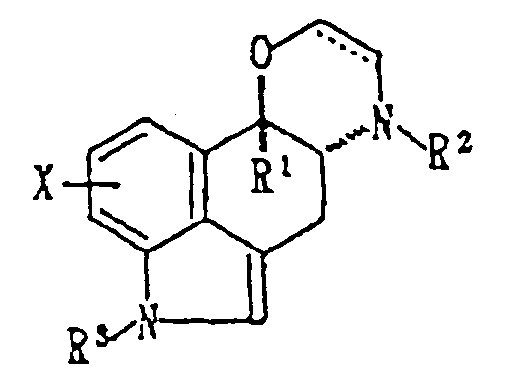
- The compound of claim 1, wherein X is hydrogen, halogen or an optionally substituted hydrocarbon residue which may be bond to the ring through oxygen atom.
- The compound according to claim 2, wherein X is hydrogen, lower alkyl, lower alkoxy or halogen.
- The compound according to claim 3, wherein X is hydrogen or C₁₋₆ alkoxy.
- The compound according to claim 1, wherein R¹ is lower alkyl, lower alkenyl, lower alkynyl or aryl.
- The compound according to claim 5, wherein R¹ is C₁₋₆ alkyl, C₂₋₆ alkenyl or phenyl.
- The compound of claim 1, wherein R² is hydrogen or an optionally substituted hydrocarbon residue.
- The compound according to claim 7, wherein R² is hydrogen or lower alkyl which may be substituted by halogen, aryl, cycloalkyl, heterocyclic ring, aralkyl or acyl, and the aryl and heterocyclic ring may be bound to the lover alkyl through oxygen, sulfur or nitrogen atom.
- The compound according to claim 8, wherein R² is hydrogen, C₁₋₆ alkyl or a group of the formula: -(CH₂)nAR⁴ (wherein n is integer of 1 to 6; A is a bond or oxygen, sulfur or nitrogen atom; R⁴ is hydrogen, phenyl, 1-phthalimidyl, 4-benzylpiperazyl).
- The compound of claim 1, wherein R³ is hydrogen, an optionally substituted hydrocarbon residue or a sulfonyl group.
- The compound according to claim 10, wherein R³ is hydrogen, lower alkyl which may be substituted by halogen or arylsulfonyl which may be substituted by lower alkyl.
- The compound according to claim 11, wherein R³ is hydrogen or sulfonyl which may be substituted by C₁₋₆ alkyl phenyl or tolyl.
- The compound according to claim 1, wherein X is hydrogen or C₁₋₃ alkoxy; R¹ is C₁₋₃ alkyl, vinyl or phenyl; R² is hydrogen, C₁₋₆ alkyl or the group of the formula: -(CH₂)nAR⁴; (wherein n is integer of 1 to 6; A is a bond or oxygen, sulfur or nitrogen atom; R⁴ is hydrogen, phenyl, 1-phthalimidyl, 4-benzylpiperazyl); R³ is hydrogen or 2,4,6-triisopropylphenylsulfonyl; and ----- is a single bond.
- The compound according to anyone of claims 1 to 13, which is trans-4,6,6a,8,9,10a-hexahydro-7-ethyl-10a-vinyl-7H-indolo[3,4-gh][1.4]benzoxazine.
- The compound according to anyone of claims 1 to 13, which is trans-4,6,6a,8,9,10a-hexahydro-7-ethyl-1-methoxy-10a-methyl-7H-indolo[3,4-gh][1.4]benzoxazine.
- The compound according to anyone of claims 1 to 13, which is trans-4,6,6a,8,9,10a-hexahydro-7-ethyl-10a-methyl-7H-indolo[3,4-gh][1.4]benzoxazine fumalate.
- A method of producing the compound according to claim 1, which comprises subjecting a compound of the formula:

- A pharmaceutical composition which contains the compound according to anyone of claims 1 to 16, together with pharmaceutically acceptable carrier, vehicle and diluent.
- The compound of anyone of claims 1 to 16, as a pharmaceutical active ingredient.
- Use of the compound according to anyone of claims 1 to 16 for manufacturing a drug intended for prophylaxis or treatment of a mammal suffering from pain.
Applications Claiming Priority (2)
| Application Number | Priority Date | Filing Date | Title |
|---|---|---|---|
| JP20340/93 | 1993-02-08 | ||
| JP2034093 | 1993-02-08 |
Publications (1)
| Publication Number | Publication Date |
|---|---|
| EP0610793A1 true EP0610793A1 (en) | 1994-08-17 |
Family
ID=12024413
Family Applications (1)
| Application Number | Title | Priority Date | Filing Date |
|---|---|---|---|
| EP94101551A Ceased EP0610793A1 (en) | 1993-02-08 | 1994-02-02 | Tetracyclic morpholine derivatives and their use or analgesics |
Country Status (3)
| Country | Link |
|---|---|
| US (1) | US5466689A (en) |
| EP (1) | EP0610793A1 (en) |
| CA (1) | CA2115020A1 (en) |
Cited By (41)
| Publication number | Priority date | Publication date | Assignee | Title |
|---|---|---|---|---|
| US6579885B2 (en) | 1999-11-03 | 2003-06-17 | Albany Molecular Research, Inc. | Aryl and heteroaryl substituted tetrahydroisoquinolines and use thereof |
| US7084152B2 (en) | 2000-07-11 | 2006-08-01 | Amr Technology, Inc. | 4-phenyl substituted tetrahydroisoquinolines therapeutic use thereof |
| WO2006123182A2 (en) | 2005-05-17 | 2006-11-23 | Merck Sharp & Dohme Limited | Cyclohexyl sulphones for treatment of cancer |
| US7163949B1 (en) | 1999-11-03 | 2007-01-16 | Amr Technology, Inc. | 4-phenyl substituted tetrahydroisoquinolines and use thereof |
| WO2007011820A2 (en) | 2005-07-15 | 2007-01-25 | Amr Technology, Inc. | Aryl-and heteroaryl-substituted tetrahydrobenzazepines and use thereof to block reuptake of norepinephrine, dopamine, and serotonin |
| WO2007093827A1 (en) | 2006-02-15 | 2007-08-23 | Istituto Di Ricerche Di Biologia Molecolare P. Angeletti Spa | Thiophene and thiazole substituted trifluoroethanone derivatives as histone deacetylase (hdac) inhibitors |
| WO2009002495A1 (en) | 2007-06-27 | 2008-12-31 | Merck & Co., Inc. | 4-carboxybenzylamino derivatives as histone deacetylase inhibitors |
| US7541357B2 (en) | 2004-07-15 | 2009-06-02 | Amr Technology, Inc. | Aryl- and heteroaryl-substituted tetrahydroisoquinolines and use thereof to block reuptake of norepinephrine, dopamine, and serotonin |
| US7723374B2 (en) | 2003-07-17 | 2010-05-25 | Plexxikon, Inc. | PPAR active compounds |
| WO2010114780A1 (en) | 2009-04-01 | 2010-10-07 | Merck Sharp & Dohme Corp. | Inhibitors of akt activity |
| WO2010132442A1 (en) | 2009-05-12 | 2010-11-18 | Albany Molecular Reserch, Inc. | 7-([1,2,4,]triazolo[1,5,-a]pyridin-6-yl)-4-(3,4-dichlorophenyl)-1,2,3,4- tetrahydroisoquinoline and use thereof |
| WO2010132487A1 (en) | 2009-05-12 | 2010-11-18 | Bristol-Myers Squibb Company | CRYSTALLINE FORMS OF (S)-7-([1,2,4]TRIAZOLO[1,5-a]PYRIDIN-6-YL)-4-(3,4-DICHLOROHPHENYL)-1,2,3,4-TETRAHYDROISOQUINOLINE AND USE THEREOF |
| WO2011046771A1 (en) | 2009-10-14 | 2011-04-21 | Schering Corporation | SUBSTITUTED PIPERIDINES THAT INCREASE p53 ACTIVITY AND THE USES THEREOF |
| EP2336120A1 (en) | 2007-01-10 | 2011-06-22 | Istituto di ricerche di Biologia Molecolare P. Angeletti S.R.L. | Combinations containing amide substituted indazoles as poly(ADP-ribose)polymerase (PARP) inhibitors |
| US8053463B2 (en) | 2007-03-08 | 2011-11-08 | Plexxikon Inc. | PPAR active compounds |
| WO2012018754A2 (en) | 2010-08-02 | 2012-02-09 | Merck Sharp & Dohme Corp. | RNA INTERFERENCE MEDIATED INHIBITION OF CATENIN (CADHERIN-ASSOCIATED PROTEIN), BETA 1 (CTNNB1) GENE EXPRESSION USING SHORT INTERFERING NUCLEIC ACID (siNA) |
| WO2012027236A1 (en) | 2010-08-23 | 2012-03-01 | Schering Corporation | NOVEL PYRAZOLO[1,5-a]PYRIMIDINE DERIVATIVES AS mTOR INHIBITORS |
| WO2012030685A2 (en) | 2010-09-01 | 2012-03-08 | Schering Corporation | Indazole derivatives useful as erk inhibitors |
| WO2012036997A1 (en) | 2010-09-16 | 2012-03-22 | Schering Corporation | Fused pyrazole derivatives as novel erk inhibitors |
| WO2012058210A1 (en) | 2010-10-29 | 2012-05-03 | Merck Sharp & Dohme Corp. | RNA INTERFERENCE MEDIATED INHIBITION OF GENE EXPRESSION USING SHORT INTERFERING NUCLEIC ACIDS (siNA) |
| WO2012087772A1 (en) | 2010-12-21 | 2012-06-28 | Schering Corporation | Indazole derivatives useful as erk inhibitors |
| WO2012145471A1 (en) | 2011-04-21 | 2012-10-26 | Merck Sharp & Dohme Corp. | Insulin-like growth factor-1 receptor inhibitors |
| US8420811B2 (en) | 2008-06-04 | 2013-04-16 | Bristol-Myers Squibb Company | Tetrahydroisoquinolines and intermediates therefor |
| WO2013063214A1 (en) | 2011-10-27 | 2013-05-02 | Merck Sharp & Dohme Corp. | Novel compounds that are erk inhibitors |
| WO2013165816A2 (en) | 2012-05-02 | 2013-11-07 | Merck Sharp & Dohme Corp. | SHORT INTERFERING NUCLEIC ACID (siNA) COMPOSITIONS |
| WO2014052563A2 (en) | 2012-09-28 | 2014-04-03 | Merck Sharp & Dohme Corp. | Novel compounds that are erk inhibitors |
| WO2014085216A1 (en) | 2012-11-28 | 2014-06-05 | Merck Sharp & Dohme Corp. | Compositions and methods for treating cancer |
| WO2014100065A1 (en) | 2012-12-20 | 2014-06-26 | Merck Sharp & Dohme Corp. | Substituted imidazopyridines as hdm2 inhibitors |
| WO2014120748A1 (en) | 2013-01-30 | 2014-08-07 | Merck Sharp & Dohme Corp. | 2,6,7,8 substituted purines as hdm2 inhibitors |
| WO2015034925A1 (en) | 2013-09-03 | 2015-03-12 | Moderna Therapeutics, Inc. | Circular polynucleotides |
| US9034899B2 (en) | 2009-05-12 | 2015-05-19 | Albany Molecular Research, Inc. | Aryl, heteroaryl, and heterocycle substituted tetrahydroisoquinolines and use thereof |
| US9156812B2 (en) | 2008-06-04 | 2015-10-13 | Bristol-Myers Squibb Company | Crystalline form of 6-[(4S)-2-methyl-4-(2-naphthyl)-1,2,3,4-tetrahydroisoquinolin-7-yl]pyridazin-3-amine |
| WO2018071283A1 (en) | 2016-10-12 | 2018-04-19 | Merck Sharp & Dohme Corp. | Kdm5 inhibitors |
| WO2019094312A1 (en) | 2017-11-08 | 2019-05-16 | Merck Sharp & Dohme Corp. | Prmt5 inhibitors |
| WO2019094311A1 (en) | 2017-11-08 | 2019-05-16 | Merck Sharp & Dohme Corp. | Prmt5 inhibitors |
| CN110229069A (en) * | 2019-07-16 | 2019-09-13 | 重庆医药高等专科学校 | The recoverying and utilizing method of trimethylphenyl tribromide ammonium in preparation method and the naproxen production of trimethylphenyl tribromide ammonium |
| WO2020033288A1 (en) | 2018-08-07 | 2020-02-13 | Merck Sharp & Dohme Corp. | Prmt5 inhibitors |
| WO2020033282A1 (en) | 2018-08-07 | 2020-02-13 | Merck Sharp & Dohme Corp. | Prmt5 inhibitors |
| WO2020033284A1 (en) | 2018-08-07 | 2020-02-13 | Merck Sharp & Dohme Corp. | Prmt5 inhibitors |
| US11096950B2 (en) | 2006-11-01 | 2021-08-24 | Barbara Brooke Jennings | Compounds, methods, and treatments for abnormal signaling pathways for prenatal and postnatal development |
| EP4079856A1 (en) | 2010-08-17 | 2022-10-26 | Sirna Therapeutics, Inc. | Rna interference mediated inhibition of hepatitis b virus (hbv) gene expression using short interfering nucleic acid (sina) |
Families Citing this family (3)
| Publication number | Priority date | Publication date | Assignee | Title |
|---|---|---|---|---|
| US7348338B2 (en) * | 2003-07-17 | 2008-03-25 | Plexxikon, Inc. | PPAR active compounds |
| EP1819673A2 (en) * | 2004-11-30 | 2007-08-22 | Plexxikon, Inc. | Indole derivatives for use as ppar active compounds |
| CA2621474A1 (en) * | 2005-09-07 | 2007-03-15 | Plexxikon, Inc. | 1,3-disubstituted indole derivatives for use as ppar modulators |
Citations (2)
| Publication number | Priority date | Publication date | Assignee | Title |
|---|---|---|---|---|
| US4238486A (en) * | 1979-11-23 | 1980-12-09 | Merck & Co., Inc. | Indolobenzoxazines |
| EP0037784A1 (en) * | 1980-04-03 | 1981-10-14 | Roussel-Uclaf | Indolobenzoxazine derivatives, their salts, process for their preparation, their use as medicaments and compositions containing them |
Family Cites Families (1)
| Publication number | Priority date | Publication date | Assignee | Title |
|---|---|---|---|---|
| FR2526797A1 (en) * | 1982-05-12 | 1983-11-18 | Roussel Uclaf | NOVEL 9-OXALYSERGIC ACID DERIVATIVES, THEIR SALTS, PREPARATION METHOD, MEDICAMENT APPLICATION AND COMPOSITIONS COMPRISING THE SAME |
-
1994
- 1994-02-02 EP EP94101551A patent/EP0610793A1/en not_active Ceased
- 1994-02-02 US US08/190,610 patent/US5466689A/en not_active Expired - Fee Related
- 1994-02-04 CA CA002115020A patent/CA2115020A1/en not_active Abandoned
Patent Citations (2)
| Publication number | Priority date | Publication date | Assignee | Title |
|---|---|---|---|---|
| US4238486A (en) * | 1979-11-23 | 1980-12-09 | Merck & Co., Inc. | Indolobenzoxazines |
| EP0037784A1 (en) * | 1980-04-03 | 1981-10-14 | Roussel-Uclaf | Indolobenzoxazine derivatives, their salts, process for their preparation, their use as medicaments and compositions containing them |
Non-Patent Citations (2)
| Title |
|---|
| CHEMICAL ABSTRACTS, vol. 105, no. 19, 10 November 1986, Columbus, Ohio, US; abstract no. 164465t, J. H. JONES ET AL: "Oxazine derivatives as dopamine antagonists" page 18; * |
| SPEC. PUBL. - R. SOC. CHEM., vol. 55, 1986, pages 96 - 108 * |
Cited By (67)
| Publication number | Priority date | Publication date | Assignee | Title |
|---|---|---|---|---|
| US7612090B2 (en) | 1999-11-03 | 2009-11-03 | Albany Molecular Research, Inc. | Aryl and heteroaryl substituted tetrahydroisoquinolines and use thereof |
| US7163949B1 (en) | 1999-11-03 | 2007-01-16 | Amr Technology, Inc. | 4-phenyl substituted tetrahydroisoquinolines and use thereof |
| US6579885B2 (en) | 1999-11-03 | 2003-06-17 | Albany Molecular Research, Inc. | Aryl and heteroaryl substituted tetrahydroisoquinolines and use thereof |
| US7265116B2 (en) | 1999-11-03 | 2007-09-04 | Arm Technology, Inc. | Aryl and heteroaryl substituted tetrahydroisoquinolines and use thereof |
| US7084152B2 (en) | 2000-07-11 | 2006-08-01 | Amr Technology, Inc. | 4-phenyl substituted tetrahydroisoquinolines therapeutic use thereof |
| US7309789B2 (en) | 2000-07-11 | 2007-12-18 | Amr Technology, Inc. | 4-phenyl substituted tetrahydroisoquinolines and therapeutic use thereof |
| US7419985B2 (en) | 2000-07-11 | 2008-09-02 | Amr Technology, Inc. | 4-Phenyl substituted tetrahydroisoquinolines and therapeutic use thereof |
| EP1648867B1 (en) * | 2003-07-17 | 2013-09-04 | Plexxikon Inc. | Ppar active compounds |
| US8367828B2 (en) | 2003-07-17 | 2013-02-05 | Plexxikon Inc. | PPAR active compounds |
| US7723374B2 (en) | 2003-07-17 | 2010-05-25 | Plexxikon, Inc. | PPAR active compounds |
| US9085531B2 (en) | 2004-07-15 | 2015-07-21 | Albany Molecular Research, Inc. | Aryl- and heteroaryl-substituted tetrahydroisoquinolines and use thereof to block reuptake of norepinephrine, dopamine, and serotonin |
| US7541357B2 (en) | 2004-07-15 | 2009-06-02 | Amr Technology, Inc. | Aryl- and heteroaryl-substituted tetrahydroisoquinolines and use thereof to block reuptake of norepinephrine, dopamine, and serotonin |
| US8236796B2 (en) | 2004-07-15 | 2012-08-07 | Albany Molecular Research, Inc. | Aryl- and heteroaryl-substituted tetrahydroisoquinolines and use thereof to block reuptake of norepinephrine, dopamine, and serotonin |
| US8227486B2 (en) | 2004-07-15 | 2012-07-24 | Albany Molecular Research, Inc. | Aryl- and heteroaryl-substituted tetrahydroisoquinolines and use thereof to block reuptake of norepinephrine, dopamine, and serotonin |
| US9499531B2 (en) | 2004-07-15 | 2016-11-22 | Albany Molecular Research, Inc. | Aryl- and heteroaryl-substituted tetrahydroisoquinolines and use thereof to block reuptake of norepinephrine, dopamine, and serotonin |
| US8741901B2 (en) | 2004-07-15 | 2014-06-03 | Albany Molecular Research, Inc. | Aryl- and heteroaryl-substituted tetrahydroisoquinolines and use thereof to block reuptake of norepinephrine, dopamine, and serotonin |
| WO2006123182A2 (en) | 2005-05-17 | 2006-11-23 | Merck Sharp & Dohme Limited | Cyclohexyl sulphones for treatment of cancer |
| US8791101B2 (en) | 2005-07-15 | 2014-07-29 | Albany Molecular Research, Inc. | Aryl- and heteroaryl-substituted tetrahydrobenzazepines and use thereof to block reuptake of norepinephrine, dopamine, and serotonin |
| WO2007011820A2 (en) | 2005-07-15 | 2007-01-25 | Amr Technology, Inc. | Aryl-and heteroaryl-substituted tetrahydrobenzazepines and use thereof to block reuptake of norepinephrine, dopamine, and serotonin |
| US7956050B2 (en) | 2005-07-15 | 2011-06-07 | Albany Molecular Research, Inc. | Aryl- and heteroaryl-substituted tetrahydrobenzazepines and use thereof to block reuptake of norepinephrine, dopamine, and serotonin |
| US9403776B2 (en) | 2005-07-15 | 2016-08-02 | Albany Molecular Research, Inc. | Aryl- and heteroaryl-substituted tetrahydrobenzazepines and use thereof to block reuptake of norepinephrine, dopamine, and serotonin |
| WO2007093827A1 (en) | 2006-02-15 | 2007-08-23 | Istituto Di Ricerche Di Biologia Molecolare P. Angeletti Spa | Thiophene and thiazole substituted trifluoroethanone derivatives as histone deacetylase (hdac) inhibitors |
| US11096950B2 (en) | 2006-11-01 | 2021-08-24 | Barbara Brooke Jennings | Compounds, methods, and treatments for abnormal signaling pathways for prenatal and postnatal development |
| EP2336120A1 (en) | 2007-01-10 | 2011-06-22 | Istituto di ricerche di Biologia Molecolare P. Angeletti S.R.L. | Combinations containing amide substituted indazoles as poly(ADP-ribose)polymerase (PARP) inhibitors |
| EP2805945A1 (en) | 2007-01-10 | 2014-11-26 | MSD Italia S.r.l. | Amide substituted indazoles as poly(ADP-ribose)polymerase (PARP) inhibitors |
| US8053463B2 (en) | 2007-03-08 | 2011-11-08 | Plexxikon Inc. | PPAR active compounds |
| EP3103791A1 (en) | 2007-06-27 | 2016-12-14 | Merck Sharp & Dohme Corp. | 4-carboxybenzylamino derivatives as histone deacetylase inhibitors |
| WO2009002495A1 (en) | 2007-06-27 | 2008-12-31 | Merck & Co., Inc. | 4-carboxybenzylamino derivatives as histone deacetylase inhibitors |
| US9156812B2 (en) | 2008-06-04 | 2015-10-13 | Bristol-Myers Squibb Company | Crystalline form of 6-[(4S)-2-methyl-4-(2-naphthyl)-1,2,3,4-tetrahydroisoquinolin-7-yl]pyridazin-3-amine |
| US8420811B2 (en) | 2008-06-04 | 2013-04-16 | Bristol-Myers Squibb Company | Tetrahydroisoquinolines and intermediates therefor |
| US8445494B2 (en) | 2008-06-04 | 2013-05-21 | Bristol-Myers Squibb Company | Crystalline form of 6-[(4S)-2-methyl-4-(2-naphthyl)-1,2,3,4-tetrahydroisoquinolin-7-yl]pyridazin-3-amine |
| US9498476B2 (en) | 2008-06-04 | 2016-11-22 | Albany Molecular Research, Inc. | Crystalline form of 6-[(4S)-2-methyl-4-(2-naphthyl)-1,2,3,4-tetrahydroisoquinolin-7-yl]pyridazin-3-amine |
| WO2010114780A1 (en) | 2009-04-01 | 2010-10-07 | Merck Sharp & Dohme Corp. | Inhibitors of akt activity |
| US8802696B2 (en) | 2009-05-12 | 2014-08-12 | Albany Molecular Research, Inc. | 7-([1,2,4]triazolo[1,5-a]pyridin-6-yl)-4-(3,4-dichlorophenyl)-1,2,3,4-tetrahydroisoqu inoli and use thereof |
| US9604960B2 (en) | 2009-05-12 | 2017-03-28 | Albany Molecular Research, Inc. | Aryl, heteroaryl, and heterocycle substituted tetrahydroisoquinolines and use thereof |
| WO2010132442A1 (en) | 2009-05-12 | 2010-11-18 | Albany Molecular Reserch, Inc. | 7-([1,2,4,]triazolo[1,5,-a]pyridin-6-yl)-4-(3,4-dichlorophenyl)-1,2,3,4- tetrahydroisoquinoline and use thereof |
| WO2010132487A1 (en) | 2009-05-12 | 2010-11-18 | Bristol-Myers Squibb Company | CRYSTALLINE FORMS OF (S)-7-([1,2,4]TRIAZOLO[1,5-a]PYRIDIN-6-YL)-4-(3,4-DICHLOROHPHENYL)-1,2,3,4-TETRAHYDROISOQUINOLINE AND USE THEREOF |
| US9173879B2 (en) | 2009-05-12 | 2015-11-03 | Bristol-Myers Squibb Company | Crystalline forms of (S)-7-([1,2,4]triazolo[1,5-a ]pyridin-6-yl)-4-(3,4-dichlorophenyl)-1,2,3,4-tetrahydroisoquinoline and use thereof |
| US9034899B2 (en) | 2009-05-12 | 2015-05-19 | Albany Molecular Research, Inc. | Aryl, heteroaryl, and heterocycle substituted tetrahydroisoquinolines and use thereof |
| US8815894B2 (en) | 2009-05-12 | 2014-08-26 | Bristol-Myers Squibb Company | Crystalline forms of (S)-7-([1,2,4]triazolo[1,5-a]pyridin-6-yl)-4-(3,4-dichlorophenyl)-1,2,3,4-tetrahydroisoquinoline and use thereof |
| WO2011046771A1 (en) | 2009-10-14 | 2011-04-21 | Schering Corporation | SUBSTITUTED PIPERIDINES THAT INCREASE p53 ACTIVITY AND THE USES THEREOF |
| EP3330377A1 (en) | 2010-08-02 | 2018-06-06 | Sirna Therapeutics, Inc. | Rna interference mediated inhibition of catenin (cadherin-associated protein), beta 1 (ctnnb1) gene expression using short interfering nucleic acid (sina) |
| WO2012018754A2 (en) | 2010-08-02 | 2012-02-09 | Merck Sharp & Dohme Corp. | RNA INTERFERENCE MEDIATED INHIBITION OF CATENIN (CADHERIN-ASSOCIATED PROTEIN), BETA 1 (CTNNB1) GENE EXPRESSION USING SHORT INTERFERING NUCLEIC ACID (siNA) |
| EP4079856A1 (en) | 2010-08-17 | 2022-10-26 | Sirna Therapeutics, Inc. | Rna interference mediated inhibition of hepatitis b virus (hbv) gene expression using short interfering nucleic acid (sina) |
| WO2012027236A1 (en) | 2010-08-23 | 2012-03-01 | Schering Corporation | NOVEL PYRAZOLO[1,5-a]PYRIMIDINE DERIVATIVES AS mTOR INHIBITORS |
| WO2012030685A2 (en) | 2010-09-01 | 2012-03-08 | Schering Corporation | Indazole derivatives useful as erk inhibitors |
| WO2012036997A1 (en) | 2010-09-16 | 2012-03-22 | Schering Corporation | Fused pyrazole derivatives as novel erk inhibitors |
| WO2012058210A1 (en) | 2010-10-29 | 2012-05-03 | Merck Sharp & Dohme Corp. | RNA INTERFERENCE MEDIATED INHIBITION OF GENE EXPRESSION USING SHORT INTERFERING NUCLEIC ACIDS (siNA) |
| EP3766975A1 (en) | 2010-10-29 | 2021-01-20 | Sirna Therapeutics, Inc. | Rna interference mediated inhibition of gene expression using short interfering nucleic acid (sina) |
| EP3327125A1 (en) | 2010-10-29 | 2018-05-30 | Sirna Therapeutics, Inc. | Rna interference mediated inhibition of gene expression using short interfering nucleic acids (sina) |
| WO2012087772A1 (en) | 2010-12-21 | 2012-06-28 | Schering Corporation | Indazole derivatives useful as erk inhibitors |
| WO2012145471A1 (en) | 2011-04-21 | 2012-10-26 | Merck Sharp & Dohme Corp. | Insulin-like growth factor-1 receptor inhibitors |
| WO2013063214A1 (en) | 2011-10-27 | 2013-05-02 | Merck Sharp & Dohme Corp. | Novel compounds that are erk inhibitors |
| WO2013165816A2 (en) | 2012-05-02 | 2013-11-07 | Merck Sharp & Dohme Corp. | SHORT INTERFERING NUCLEIC ACID (siNA) COMPOSITIONS |
| EP3919620A1 (en) | 2012-05-02 | 2021-12-08 | Sirna Therapeutics, Inc. | Short interfering nucleic acid (sina) compositions |
| WO2014052563A2 (en) | 2012-09-28 | 2014-04-03 | Merck Sharp & Dohme Corp. | Novel compounds that are erk inhibitors |
| WO2014085216A1 (en) | 2012-11-28 | 2014-06-05 | Merck Sharp & Dohme Corp. | Compositions and methods for treating cancer |
| WO2014100065A1 (en) | 2012-12-20 | 2014-06-26 | Merck Sharp & Dohme Corp. | Substituted imidazopyridines as hdm2 inhibitors |
| WO2014120748A1 (en) | 2013-01-30 | 2014-08-07 | Merck Sharp & Dohme Corp. | 2,6,7,8 substituted purines as hdm2 inhibitors |
| WO2015034925A1 (en) | 2013-09-03 | 2015-03-12 | Moderna Therapeutics, Inc. | Circular polynucleotides |
| WO2018071283A1 (en) | 2016-10-12 | 2018-04-19 | Merck Sharp & Dohme Corp. | Kdm5 inhibitors |
| WO2019094311A1 (en) | 2017-11-08 | 2019-05-16 | Merck Sharp & Dohme Corp. | Prmt5 inhibitors |
| WO2019094312A1 (en) | 2017-11-08 | 2019-05-16 | Merck Sharp & Dohme Corp. | Prmt5 inhibitors |
| WO2020033282A1 (en) | 2018-08-07 | 2020-02-13 | Merck Sharp & Dohme Corp. | Prmt5 inhibitors |
| WO2020033284A1 (en) | 2018-08-07 | 2020-02-13 | Merck Sharp & Dohme Corp. | Prmt5 inhibitors |
| WO2020033288A1 (en) | 2018-08-07 | 2020-02-13 | Merck Sharp & Dohme Corp. | Prmt5 inhibitors |
| CN110229069A (en) * | 2019-07-16 | 2019-09-13 | 重庆医药高等专科学校 | The recoverying and utilizing method of trimethylphenyl tribromide ammonium in preparation method and the naproxen production of trimethylphenyl tribromide ammonium |
Also Published As
| Publication number | Publication date |
|---|---|
| US5466689A (en) | 1995-11-14 |
| CA2115020A1 (en) | 1994-08-09 |
Similar Documents
| Publication | Publication Date | Title |
|---|---|---|
| US5466689A (en) | Morpholine derivatives and their use | |
| AU2014202864B2 (en) | Therapeutic isoxazole compounds | |
| JP2656702B2 (en) | Peptide quinuclidine | |
| RU2167152C2 (en) | N-substituted azaheterocyclic carboxylic acids or their pharmaceutically acceptable salts, method of their synthesis, pharmaceutical composition based on thereof and method of inhibition of neurogenic inflammation | |
| US5109008A (en) | Pharmaceutically useful furo[3,2-c]pyridines | |
| JPH11106341A (en) | Pharmaceutical composition containing 3-(5-tetrazolyl-benzyl) amino-piperidine derivative | |
| JPH054983A (en) | Isoquinolinone derivative, method for producing the same, and 5-HT3 receptor antagonist containing the derivative as an active ingredient | |
| WO1992005172A2 (en) | Muscarinic receptor antagonists | |
| JPH02138254A (en) | Heterocyclic derivative | |
| US5278162A (en) | 3,3'-disubstituted-1,3-dihydro-2H-pyrrolo[2,3-b]heterocyclic-2-one useful in the treatment of cognitive disorders of man | |
| WO1994007891A1 (en) | 1-substituted oxindoles and azaoxindoles as novel cognition enhancers | |
| KR101586507B1 (en) | Amide derivative and pharmaceutical composition containing the same | |
| EP0306827A1 (en) | Amide compounds, process for preparing the same, and composition for activating gastric motor function containing the same | |
| WO1992007849A1 (en) | Novel thiazole derivative | |
| EA003941B1 (en) | 2-aminopyridines containing fused ring substituents | |
| WO1999054303A1 (en) | Optically active tetrahydrobenzindole derivatives | |
| AU722147B2 (en) | N-(benzothiazol-2-yl) piperidine-1-ethanamine derivatives, their preparation and application in therapeutics | |
| JP2004277319A (en) | 1- (4-piperidinylmethyl) piperidinylamide derivative and pharmaceutical composition containing the same | |
| EP0585296A1 (en) | 2-(pyrrolidinyl-1-methyl)-piperidine derivatives and their use as kappa-recept or agonists | |
| WO1999038864A1 (en) | Oxazole derivatives as serotonin-1a receptor agonists | |
| JPH0791268B2 (en) | Muscarinic receptor antagonist | |
| HK24194A (en) | Pyrrolo[1,2-a][4,1]benzoxazepines, process for their preparation, pharmaceutical compositions containing these compounds and therapeutical use | |
| JPH1171350A (en) | Hydroxypiperidine compound and agent thereof | |
| US5932594A (en) | Muscarinic receptor antagonists | |
| US6057340A (en) | Oxazole derivatives as serotonin-1A receptor agonists |
Legal Events
| Date | Code | Title | Description |
|---|---|---|---|
| PUAI | Public reference made under article 153(3) epc to a published international application that has entered the european phase |
Free format text: ORIGINAL CODE: 0009012 |
|
| AK | Designated contracting states |
Kind code of ref document: A1 Designated state(s): AT BE CH DE DK ES FR GB GR IE IT LI LU NL PT SE |
|
| 17P | Request for examination filed |
Effective date: 19941213 |
|
| 17Q | First examination report despatched |
Effective date: 19960829 |
|
| GRAG | Despatch of communication of intention to grant |
Free format text: ORIGINAL CODE: EPIDOS AGRA |
|
| STAA | Information on the status of an ep patent application or granted ep patent |
Free format text: STATUS: THE APPLICATION HAS BEEN REFUSED |
|
| 18R | Application refused |
Effective date: 19970714 |