EP0686629A2 - Cyclohexyl tachykinine receptor antagonists - Google Patents
Cyclohexyl tachykinine receptor antagonists Download PDFInfo
- Publication number
- EP0686629A2 EP0686629A2 EP95303818A EP95303818A EP0686629A2 EP 0686629 A2 EP0686629 A2 EP 0686629A2 EP 95303818 A EP95303818 A EP 95303818A EP 95303818 A EP95303818 A EP 95303818A EP 0686629 A2 EP0686629 A2 EP 0686629A2
- Authority
- EP
- European Patent Office
- Prior art keywords
- phenyl
- compound
- preparation
- alkyl
- amino
- Prior art date
- Legal status (The legal status is an assumption and is not a legal conclusion. Google has not performed a legal analysis and makes no representation as to the accuracy of the status listed.)
- Withdrawn
Links
- 125000000113 cyclohexyl group Chemical group [H]C1([H])C([H])([H])C([H])([H])C([H])(*)C([H])([H])C1([H])[H] 0.000 title description 3
- 239000002464 receptor antagonist Substances 0.000 title 1
- 229940044551 receptor antagonist Drugs 0.000 title 1
- 150000001875 compounds Chemical class 0.000 claims abstract description 83
- 102000003141 Tachykinin Human genes 0.000 claims abstract description 14
- 108060008037 tachykinin Proteins 0.000 claims abstract description 14
- 239000008194 pharmaceutical composition Substances 0.000 claims abstract description 6
- 230000002265 prevention Effects 0.000 claims abstract description 5
- -1 3-indolyl Chemical group 0.000 claims description 107
- 150000003839 salts Chemical class 0.000 claims description 34
- 239000004480 active ingredient Substances 0.000 claims description 25
- 125000001997 phenyl group Chemical group [H]C1=C([H])C([H])=C(*)C([H])=C1[H] 0.000 claims description 19
- 125000002924 primary amino group Chemical group [H]N([H])* 0.000 claims description 13
- 239000012453 solvate Substances 0.000 claims description 13
- 125000003282 alkyl amino group Chemical group 0.000 claims description 12
- 125000005843 halogen group Chemical group 0.000 claims description 12
- 125000003386 piperidinyl group Chemical group 0.000 claims description 11
- 125000004178 (C1-C4) alkyl group Chemical group 0.000 claims description 10
- 239000001257 hydrogen Substances 0.000 claims description 10
- 229910052739 hydrogen Inorganic materials 0.000 claims description 10
- 125000004193 piperazinyl group Chemical group 0.000 claims description 10
- 125000002023 trifluoromethyl group Chemical group FC(F)(F)* 0.000 claims description 10
- 125000006552 (C3-C8) cycloalkyl group Chemical group 0.000 claims description 8
- 230000002829 reductive effect Effects 0.000 claims description 8
- 125000001624 naphthyl group Chemical group 0.000 claims description 7
- 239000000546 pharmaceutical excipient Substances 0.000 claims description 7
- 125000000229 (C1-C4)alkoxy group Chemical group 0.000 claims description 6
- 125000004169 (C1-C6) alkyl group Chemical group 0.000 claims description 6
- 125000004453 alkoxycarbonyl group Chemical group 0.000 claims description 6
- 125000000719 pyrrolidinyl group Chemical group 0.000 claims description 6
- 125000006273 (C1-C3) alkyl group Chemical group 0.000 claims description 5
- 125000004191 (C1-C6) alkoxy group Chemical group 0.000 claims description 5
- 230000003213 activating effect Effects 0.000 claims description 5
- 125000004076 pyridyl group Chemical group 0.000 claims description 5
- 125000002221 trityl group Chemical group [H]C1=C([H])C([H])=C([H])C([H])=C1C([*])(C1=C(C(=C(C(=C1[H])[H])[H])[H])[H])C1=C([H])C([H])=C([H])C([H])=C1[H] 0.000 claims description 5
- UFHFLCQGNIYNRP-UHFFFAOYSA-N Hydrogen Chemical compound [H][H] UFHFLCQGNIYNRP-UHFFFAOYSA-N 0.000 claims description 4
- 125000005236 alkanoylamino group Chemical group 0.000 claims description 4
- 239000003795 chemical substances by application Substances 0.000 claims description 4
- 125000001495 ethyl group Chemical group [H]C([H])([H])C([H])([H])* 0.000 claims description 4
- 125000002183 isoquinolinyl group Chemical group C1(=NC=CC2=CC=CC=C12)* 0.000 claims description 4
- 125000002757 morpholinyl group Chemical group 0.000 claims description 4
- 125000002943 quinolinyl group Chemical group N1=C(C=CC2=CC=CC=C12)* 0.000 claims description 4
- 125000004455 (C1-C3) alkylthio group Chemical group 0.000 claims description 3
- 125000006274 (C1-C3)alkoxy group Chemical group 0.000 claims description 3
- 125000000081 (C5-C8) cycloalkenyl group Chemical group 0.000 claims description 3
- 125000004648 C2-C8 alkenyl group Chemical group 0.000 claims description 3
- 125000000499 benzofuranyl group Chemical group O1C(=CC2=C1C=CC=C2)* 0.000 claims description 3
- 125000001797 benzyl group Chemical group [H]C1=C([H])C([H])=C(C([H])=C1[H])C([H])([H])* 0.000 claims description 3
- 125000001589 carboacyl group Chemical group 0.000 claims description 3
- 125000001309 chloro group Chemical group Cl* 0.000 claims description 3
- 239000003085 diluting agent Substances 0.000 claims description 3
- 239000003937 drug carrier Substances 0.000 claims description 3
- 125000001153 fluoro group Chemical group F* 0.000 claims description 3
- 150000002431 hydrogen Chemical group 0.000 claims description 3
- 125000004435 hydrogen atom Chemical group [H]* 0.000 claims description 3
- 238000004519 manufacturing process Methods 0.000 claims description 3
- 125000004209 (C1-C8) alkyl group Chemical group 0.000 claims description 2
- 101100244083 Arabidopsis thaliana PKL gene Proteins 0.000 claims description 2
- 125000003705 anilinocarbonyl group Chemical group O=C([*])N([H])C1=C([H])C([H])=C([H])C([H])=C1[H] 0.000 claims description 2
- 125000004196 benzothienyl group Chemical group S1C(=CC2=C1C=CC=C2)* 0.000 claims description 2
- 125000005982 diphenylmethyl group Chemical group [H]C1=C([H])C([H])=C(C([H])=C1[H])C([H])(*)C1=C([H])C([H])=C([H])C([H])=C1[H] 0.000 claims description 2
- 125000003387 indolinyl group Chemical group N1(CCC2=CC=CC=C12)* 0.000 claims description 2
- 125000001041 indolyl group Chemical group 0.000 claims description 2
- 125000001449 isopropyl group Chemical group [H]C([H])([H])C([H])(*)C([H])([H])[H] 0.000 claims description 2
- 125000000449 nitro group Chemical group [O-][N+](*)=O 0.000 claims description 2
- 125000000714 pyrimidinyl group Chemical group 0.000 claims description 2
- 125000004853 tetrahydropyridinyl group Chemical group N1(CCCC=C1)* 0.000 claims description 2
- 125000001301 ethoxy group Chemical group [H]C([H])([H])C([H])([H])O* 0.000 claims 1
- 125000000956 methoxy group Chemical group [H]C([H])([H])O* 0.000 claims 1
- 238000000034 method Methods 0.000 abstract description 26
- 150000001934 cyclohexanes Chemical class 0.000 abstract 1
- 238000002360 preparation method Methods 0.000 description 137
- 239000000543 intermediate Substances 0.000 description 46
- 239000000203 mixture Substances 0.000 description 45
- SIKJAQJRHWYJAI-UHFFFAOYSA-N Indole Chemical compound C1=CC=C2NC=CC2=C1 SIKJAQJRHWYJAI-UHFFFAOYSA-N 0.000 description 32
- XDTMQSROBMDMFD-UHFFFAOYSA-N Cyclohexane Chemical compound C1CCCCC1 XDTMQSROBMDMFD-UHFFFAOYSA-N 0.000 description 28
- 208000037265 diseases, disorders, signs and symptoms Diseases 0.000 description 22
- 239000000243 solution Substances 0.000 description 21
- 208000002193 Pain Diseases 0.000 description 19
- 208000035475 disorder Diseases 0.000 description 19
- YMWUJEATGCHHMB-UHFFFAOYSA-N Dichloromethane Chemical compound ClCCl YMWUJEATGCHHMB-UHFFFAOYSA-N 0.000 description 18
- 238000006243 chemical reaction Methods 0.000 description 18
- 238000009472 formulation Methods 0.000 description 17
- NHKJPPKXDNZFBJ-UHFFFAOYSA-N phenyllithium Chemical compound [Li]C1=CC=CC=C1 NHKJPPKXDNZFBJ-UHFFFAOYSA-N 0.000 description 17
- RTZKZFJDLAIYFH-UHFFFAOYSA-N Diethyl ether Chemical compound CCOCC RTZKZFJDLAIYFH-UHFFFAOYSA-N 0.000 description 16
- OTCKOJUMXQWKQG-UHFFFAOYSA-L magnesium bromide Chemical compound [Mg+2].[Br-].[Br-] OTCKOJUMXQWKQG-UHFFFAOYSA-L 0.000 description 16
- HQKMJHAJHXVSDF-UHFFFAOYSA-L magnesium stearate Chemical compound [Mg+2].CCCCCCCCCCCCCCCCCC([O-])=O.CCCCCCCCCCCCCCCCCC([O-])=O HQKMJHAJHXVSDF-UHFFFAOYSA-L 0.000 description 16
- XLYOFNOQVPJJNP-UHFFFAOYSA-N water Substances O XLYOFNOQVPJJNP-UHFFFAOYSA-N 0.000 description 16
- HEMHJVSKTPXQMS-UHFFFAOYSA-M Sodium hydroxide Chemical compound [OH-].[Na+] HEMHJVSKTPXQMS-UHFFFAOYSA-M 0.000 description 15
- 239000004615 ingredient Substances 0.000 description 15
- 125000004432 carbon atom Chemical group C* 0.000 description 13
- 239000003814 drug Substances 0.000 description 13
- IAZDPXIOMUYVGZ-UHFFFAOYSA-N Dimethylsulphoxide Chemical compound CS(C)=O IAZDPXIOMUYVGZ-UHFFFAOYSA-N 0.000 description 12
- XEKOWRVHYACXOJ-UHFFFAOYSA-N Ethyl acetate Chemical compound CCOC(C)=O XEKOWRVHYACXOJ-UHFFFAOYSA-N 0.000 description 12
- KFZMGEQAYNKOFK-UHFFFAOYSA-N Isopropanol Chemical compound CC(C)O KFZMGEQAYNKOFK-UHFFFAOYSA-N 0.000 description 12
- OKKJLVBELUTLKV-UHFFFAOYSA-N Methanol Chemical compound OC OKKJLVBELUTLKV-UHFFFAOYSA-N 0.000 description 12
- 239000002585 base Substances 0.000 description 11
- IQWWTJDRVBWBEL-UHFFFAOYSA-N (3,5-dimethylphenyl)methanol Chemical compound CC1=CC(C)=CC(CO)=C1 IQWWTJDRVBWBEL-UHFFFAOYSA-N 0.000 description 10
- 229920002472 Starch Polymers 0.000 description 10
- 235000019698 starch Nutrition 0.000 description 10
- 239000002462 tachykinin receptor antagonist Substances 0.000 description 10
- SJRJJKPEHAURKC-UHFFFAOYSA-N N-Methylmorpholine Chemical compound CN1CCOCC1 SJRJJKPEHAURKC-UHFFFAOYSA-N 0.000 description 9
- 238000007792 addition Methods 0.000 description 9
- 108090000765 processed proteins & peptides Proteins 0.000 description 9
- 239000000651 prodrug Substances 0.000 description 9
- 229940002612 prodrug Drugs 0.000 description 9
- 239000008107 starch Substances 0.000 description 9
- 239000003826 tablet Substances 0.000 description 9
- HBAQYPYDRFILMT-UHFFFAOYSA-N 8-[3-(1-cyclopropylpyrazol-4-yl)-1H-pyrazolo[4,3-d]pyrimidin-5-yl]-3-methyl-3,8-diazabicyclo[3.2.1]octan-2-one Chemical class C1(CC1)N1N=CC(=C1)C1=NNC2=C1N=C(N=C2)N1C2C(N(CC1CC2)C)=O HBAQYPYDRFILMT-UHFFFAOYSA-N 0.000 description 8
- 102100024304 Protachykinin-1 Human genes 0.000 description 8
- 229940079593 drug Drugs 0.000 description 8
- 235000019359 magnesium stearate Nutrition 0.000 description 8
- 125000006186 3,5-dimethyl benzyl group Chemical group [H]C1=C(C([H])=C(C([H])=C1C([H])([H])[H])C([H])([H])*)C([H])([H])[H] 0.000 description 7
- VEXZGXHMUGYJMC-UHFFFAOYSA-N Hydrochloric acid Chemical compound Cl VEXZGXHMUGYJMC-UHFFFAOYSA-N 0.000 description 7
- 239000002253 acid Substances 0.000 description 7
- CSCPPACGZOOCGX-UHFFFAOYSA-N Acetone Chemical compound CC(C)=O CSCPPACGZOOCGX-UHFFFAOYSA-N 0.000 description 6
- 108091003079 Bovine Serum Albumin Proteins 0.000 description 6
- 208000018522 Gastrointestinal disease Diseases 0.000 description 6
- PEDCQBHIVMGVHV-UHFFFAOYSA-N Glycerine Chemical compound OCC(O)CO PEDCQBHIVMGVHV-UHFFFAOYSA-N 0.000 description 6
- 101800000399 Neurokinin A Proteins 0.000 description 6
- KWYUFKZDYYNOTN-UHFFFAOYSA-M Potassium hydroxide Chemical compound [OH-].[K+] KWYUFKZDYYNOTN-UHFFFAOYSA-M 0.000 description 6
- ZMANZCXQSJIPKH-UHFFFAOYSA-N Triethylamine Chemical compound CCN(CC)CC ZMANZCXQSJIPKH-UHFFFAOYSA-N 0.000 description 6
- 125000003277 amino group Chemical group 0.000 description 6
- 239000002775 capsule Substances 0.000 description 6
- 125000003178 carboxy group Chemical group [H]OC(*)=O 0.000 description 6
- 150000003141 primary amines Chemical class 0.000 description 6
- 239000000047 product Substances 0.000 description 6
- 239000011541 reaction mixture Substances 0.000 description 6
- QDZOEBFLNHCSSF-PFFBOGFISA-N (2S)-2-[[(2R)-2-[[(2S)-1-[(2S)-6-amino-2-[[(2S)-1-[(2R)-2-amino-5-carbamimidamidopentanoyl]pyrrolidine-2-carbonyl]amino]hexanoyl]pyrrolidine-2-carbonyl]amino]-3-(1H-indol-3-yl)propanoyl]amino]-N-[(2R)-1-[[(2S)-1-[[(2R)-1-[[(2S)-1-[[(2S)-1-amino-4-methyl-1-oxopentan-2-yl]amino]-4-methyl-1-oxopentan-2-yl]amino]-3-(1H-indol-3-yl)-1-oxopropan-2-yl]amino]-1-oxo-3-phenylpropan-2-yl]amino]-3-(1H-indol-3-yl)-1-oxopropan-2-yl]pentanediamide Chemical compound C([C@@H](C(=O)N[C@H](CC=1C2=CC=CC=C2NC=1)C(=O)N[C@@H](CC(C)C)C(=O)N[C@@H](CC(C)C)C(N)=O)NC(=O)[C@@H](CC=1C2=CC=CC=C2NC=1)NC(=O)[C@H](CCC(N)=O)NC(=O)[C@@H](CC=1C2=CC=CC=C2NC=1)NC(=O)[C@H]1N(CCC1)C(=O)[C@H](CCCCN)NC(=O)[C@H]1N(CCC1)C(=O)[C@H](N)CCCNC(N)=N)C1=CC=CC=C1 QDZOEBFLNHCSSF-PFFBOGFISA-N 0.000 description 5
- CSNNHWWHGAXBCP-UHFFFAOYSA-L Magnesium sulfate Chemical compound [Mg+2].[O-][S+2]([O-])([O-])[O-] CSNNHWWHGAXBCP-UHFFFAOYSA-L 0.000 description 5
- AFVFQIVMOAPDHO-UHFFFAOYSA-N Methanesulfonic acid Chemical compound CS(O)(=O)=O AFVFQIVMOAPDHO-UHFFFAOYSA-N 0.000 description 5
- 208000019695 Migraine disease Diseases 0.000 description 5
- 102000046798 Neurokinin B Human genes 0.000 description 5
- 101800002813 Neurokinin-B Proteins 0.000 description 5
- XBDQKXXYIPTUBI-UHFFFAOYSA-M Propionate Chemical compound CCC([O-])=O XBDQKXXYIPTUBI-UHFFFAOYSA-M 0.000 description 5
- VYPSYNLAJGMNEJ-UHFFFAOYSA-N Silicium dioxide Chemical compound O=[Si]=O VYPSYNLAJGMNEJ-UHFFFAOYSA-N 0.000 description 5
- 101800003906 Substance P Proteins 0.000 description 5
- 239000007983 Tris buffer Substances 0.000 description 5
- 125000000217 alkyl group Chemical group 0.000 description 5
- 239000005557 antagonist Substances 0.000 description 5
- 239000007903 gelatin capsule Substances 0.000 description 5
- 239000012528 membrane Substances 0.000 description 5
- 239000001267 polyvinylpyrrolidone Substances 0.000 description 5
- 235000013855 polyvinylpyrrolidone Nutrition 0.000 description 5
- 229920000036 polyvinylpyrrolidone Polymers 0.000 description 5
- 229910052700 potassium Inorganic materials 0.000 description 5
- 239000011591 potassium Substances 0.000 description 5
- 102000005962 receptors Human genes 0.000 description 5
- 108020003175 receptors Proteins 0.000 description 5
- 239000002904 solvent Substances 0.000 description 5
- 125000001424 substituent group Chemical group 0.000 description 5
- LENZDBCJOHFCAS-UHFFFAOYSA-N tris Chemical compound OCC(N)(CO)CO LENZDBCJOHFCAS-UHFFFAOYSA-N 0.000 description 5
- XPNGNIFUDRPBFJ-UHFFFAOYSA-N (2-methylphenyl)methanol Chemical compound CC1=CC=CC=C1CO XPNGNIFUDRPBFJ-UHFFFAOYSA-N 0.000 description 4
- TWCMNGWGSFJDHQ-UHFFFAOYSA-N 2-[[3,5-bis(trifluoromethyl)phenyl]methoxy]-1-phenylcyclohexan-1-amine Chemical compound C=1C=CC=CC=1C1(N)CCCCC1OCC1=CC(C(F)(F)F)=CC(C(F)(F)F)=C1 TWCMNGWGSFJDHQ-UHFFFAOYSA-N 0.000 description 4
- 208000024827 Alzheimer disease Diseases 0.000 description 4
- QGZKDVFQNNGYKY-UHFFFAOYSA-N Ammonia Chemical compound N QGZKDVFQNNGYKY-UHFFFAOYSA-N 0.000 description 4
- 208000009079 Bronchial Spasm Diseases 0.000 description 4
- 208000014181 Bronchial disease Diseases 0.000 description 4
- 206010006482 Bronchospasm Diseases 0.000 description 4
- 208000022559 Inflammatory bowel disease Diseases 0.000 description 4
- 229920000168 Microcrystalline cellulose Polymers 0.000 description 4
- NHXYSAFTNPANFK-HDMCBQFHSA-N Neurokinin B Chemical compound C([C@@H](C(=O)N[C@H](C(=O)NCC(=O)N[C@@H](CC(C)C)C(=O)N[C@@H](CCSC)C(N)=O)C(C)C)NC(=O)[C@H](CC=1C=CC=CC=1)NC(=O)[C@H](CC(O)=O)NC(=O)[C@H](CC=1N=CNC=1)NC(=O)[C@H](CCSC)NC(=O)[C@@H](N)CC(O)=O)C1=CC=CC=C1 NHXYSAFTNPANFK-HDMCBQFHSA-N 0.000 description 4
- MUBZPKHOEPUJKR-UHFFFAOYSA-N Oxalic acid Chemical compound OC(=O)C(O)=O MUBZPKHOEPUJKR-UHFFFAOYSA-N 0.000 description 4
- JUJWROOIHBZHMG-UHFFFAOYSA-N Pyridine Chemical compound C1=CC=NC=C1 JUJWROOIHBZHMG-UHFFFAOYSA-N 0.000 description 4
- KXKVLQRXCPHEJC-UHFFFAOYSA-N acetic acid trimethyl ester Natural products COC(C)=O KXKVLQRXCPHEJC-UHFFFAOYSA-N 0.000 description 4
- 238000005917 acylation reaction Methods 0.000 description 4
- 150000001413 amino acids Chemical group 0.000 description 4
- 208000006673 asthma Diseases 0.000 description 4
- 235000010980 cellulose Nutrition 0.000 description 4
- 229920002678 cellulose Polymers 0.000 description 4
- 239000001913 cellulose Substances 0.000 description 4
- 150000002148 esters Chemical class 0.000 description 4
- 208000002551 irritable bowel syndrome Diseases 0.000 description 4
- 239000003446 ligand Substances 0.000 description 4
- 239000002609 medium Substances 0.000 description 4
- 235000019813 microcrystalline cellulose Nutrition 0.000 description 4
- 239000008108 microcrystalline cellulose Substances 0.000 description 4
- 229940016286 microcrystalline cellulose Drugs 0.000 description 4
- 208000004296 neuralgia Diseases 0.000 description 4
- 239000003921 oil Substances 0.000 description 4
- 150000007524 organic acids Chemical class 0.000 description 4
- 239000012074 organic phase Substances 0.000 description 4
- CTSLXHKWHWQRSH-UHFFFAOYSA-N oxalyl chloride Chemical compound ClC(=O)C(Cl)=O CTSLXHKWHWQRSH-UHFFFAOYSA-N 0.000 description 4
- 125000004194 piperazin-1-yl group Chemical group [H]N1C([H])([H])C([H])([H])N(*)C([H])([H])C1([H])[H] 0.000 description 4
- BWHMMNNQKKPAPP-UHFFFAOYSA-L potassium carbonate Chemical compound [K+].[K+].[O-]C([O-])=O BWHMMNNQKKPAPP-UHFFFAOYSA-L 0.000 description 4
- 102000004196 processed proteins & peptides Human genes 0.000 description 4
- 239000007787 solid Substances 0.000 description 4
- 210000001519 tissue Anatomy 0.000 description 4
- HEAUFJZALFKPBA-JPQUDPSNSA-N (3s)-3-[[(2s,3r)-2-[[(2s)-6-amino-2-[[(2s)-2-amino-3-(1h-imidazol-5-yl)propanoyl]amino]hexanoyl]amino]-3-hydroxybutanoyl]amino]-4-[[(2s)-1-[[(2s)-1-[[(2s)-1-[[2-[[(2s)-1-[[(2s)-1-amino-4-methylsulfanyl-1-oxobutan-2-yl]amino]-4-methyl-1-oxopentan-2-yl]amin Chemical compound C([C@@H](C(=O)N[C@H](C(=O)NCC(=O)N[C@@H](CC(C)C)C(=O)N[C@@H](CCSC)C(N)=O)C(C)C)NC(=O)[C@H](CO)NC(=O)[C@H](CC(O)=O)NC(=O)[C@@H](NC(=O)[C@H](CCCCN)NC(=O)[C@@H](N)CC=1NC=NC=1)[C@@H](C)O)C1=CC=CC=C1 HEAUFJZALFKPBA-JPQUDPSNSA-N 0.000 description 3
- 125000006700 (C1-C6) alkylthio group Chemical group 0.000 description 3
- 0 ***C(CCCC1)C1=NS* Chemical compound ***C(CCCC1)C1=NS* 0.000 description 3
- AEYVYPHDYRTLGS-UHFFFAOYSA-N 2-(4-piperidin-1-ylpiperidin-1-yl)acetic acid Chemical class C1CN(CC(=O)O)CCC1N1CCCCC1 AEYVYPHDYRTLGS-UHFFFAOYSA-N 0.000 description 3
- 125000003903 2-propenyl group Chemical group [H]C([*])([H])C([H])=C([H])[H] 0.000 description 3
- QTBSBXVTEAMEQO-UHFFFAOYSA-N Acetic acid Chemical compound CC(O)=O QTBSBXVTEAMEQO-UHFFFAOYSA-N 0.000 description 3
- WFDIJRYMOXRFFG-UHFFFAOYSA-N Acetic anhydride Chemical compound CC(=O)OC(C)=O WFDIJRYMOXRFFG-UHFFFAOYSA-N 0.000 description 3
- WEVYAHXRMPXWCK-UHFFFAOYSA-N Acetonitrile Chemical compound CC#N WEVYAHXRMPXWCK-UHFFFAOYSA-N 0.000 description 3
- 206010001052 Acute respiratory distress syndrome Diseases 0.000 description 3
- 208000019901 Anxiety disease Diseases 0.000 description 3
- WVDDGKGOMKODPV-UHFFFAOYSA-N Benzyl alcohol Chemical class OCC1=CC=CC=C1 WVDDGKGOMKODPV-UHFFFAOYSA-N 0.000 description 3
- 206010009900 Colitis ulcerative Diseases 0.000 description 3
- 208000011231 Crohn disease Diseases 0.000 description 3
- LFQSCWFLJHTTHZ-UHFFFAOYSA-N Ethanol Chemical compound CCO LFQSCWFLJHTTHZ-UHFFFAOYSA-N 0.000 description 3
- 206010020751 Hypersensitivity Diseases 0.000 description 3
- GUBGYTABKSRVRQ-QKKXKWKRSA-N Lactose Natural products OC[C@H]1O[C@@H](O[C@H]2[C@H](O)[C@@H](O)C(O)O[C@@H]2CO)[C@H](O)[C@@H](O)[C@H]1O GUBGYTABKSRVRQ-QKKXKWKRSA-N 0.000 description 3
- 241000124008 Mammalia Species 0.000 description 3
- HEAUFJZALFKPBA-YRVBCFNBSA-N Neurokinin A Chemical compound C([C@@H](C(=O)N[C@H](C(=O)NCC(=O)N[C@@H](CC(C)C)C(=O)N[C@@H](CCSC)C(N)=O)C(C)C)NC(=O)[C@H](CO)NC(=O)[C@H](CC(O)=O)NC(=O)[C@@H](NC(=O)[C@H](CCCCN)NC(=O)[C@@H](N)CC=1NC=NC=1)C(C)O)C1=CC=CC=C1 HEAUFJZALFKPBA-YRVBCFNBSA-N 0.000 description 3
- 102400000097 Neurokinin A Human genes 0.000 description 3
- 108010040722 Neurokinin-2 Receptors Proteins 0.000 description 3
- 208000013616 Respiratory Distress Syndrome Diseases 0.000 description 3
- UIIMBOGNXHQVGW-UHFFFAOYSA-M Sodium bicarbonate Chemical class [Na+].OC([O-])=O UIIMBOGNXHQVGW-UHFFFAOYSA-M 0.000 description 3
- FAPWRFPIFSIZLT-UHFFFAOYSA-M Sodium chloride Chemical class [Na+].[Cl-] FAPWRFPIFSIZLT-UHFFFAOYSA-M 0.000 description 3
- 102100037342 Substance-K receptor Human genes 0.000 description 3
- CZMRCDWAGMRECN-UGDNZRGBSA-N Sucrose Chemical compound O[C@H]1[C@H](O)[C@@H](CO)O[C@@]1(CO)O[C@@H]1[C@H](O)[C@@H](O)[C@H](O)[C@@H](CO)O1 CZMRCDWAGMRECN-UGDNZRGBSA-N 0.000 description 3
- 229930006000 Sucrose Natural products 0.000 description 3
- YXFVVABEGXRONW-UHFFFAOYSA-N Toluene Chemical compound CC1=CC=CC=C1 YXFVVABEGXRONW-UHFFFAOYSA-N 0.000 description 3
- 201000006704 Ulcerative Colitis Diseases 0.000 description 3
- 206010047700 Vomiting Diseases 0.000 description 3
- 230000010933 acylation Effects 0.000 description 3
- 208000011341 adult acute respiratory distress syndrome Diseases 0.000 description 3
- 201000000028 adult respiratory distress syndrome Diseases 0.000 description 3
- 125000001931 aliphatic group Chemical group 0.000 description 3
- 230000036506 anxiety Effects 0.000 description 3
- 238000003556 assay Methods 0.000 description 3
- 239000012131 assay buffer Substances 0.000 description 3
- WPYMKLBDIGXBTP-UHFFFAOYSA-N benzoic acid Chemical compound OC(=O)C1=CC=CC=C1 WPYMKLBDIGXBTP-UHFFFAOYSA-N 0.000 description 3
- 230000008499 blood brain barrier function Effects 0.000 description 3
- 210000001218 blood-brain barrier Anatomy 0.000 description 3
- 229940098773 bovine serum albumin Drugs 0.000 description 3
- 229910052799 carbon Inorganic materials 0.000 description 3
- 125000002915 carbonyl group Chemical group [*:2]C([*:1])=O 0.000 description 3
- 210000003169 central nervous system Anatomy 0.000 description 3
- KRKNYBCHXYNGOX-UHFFFAOYSA-N citric acid Chemical compound OC(=O)CC(O)(C(O)=O)CC(O)=O KRKNYBCHXYNGOX-UHFFFAOYSA-N 0.000 description 3
- 239000008367 deionised water Substances 0.000 description 3
- 229910021641 deionized water Inorganic materials 0.000 description 3
- 201000010099 disease Diseases 0.000 description 3
- 238000001914 filtration Methods 0.000 description 3
- 239000000796 flavoring agent Substances 0.000 description 3
- 125000000524 functional group Chemical group 0.000 description 3
- 210000001035 gastrointestinal tract Anatomy 0.000 description 3
- 150000007529 inorganic bases Chemical class 0.000 description 3
- 239000008101 lactose Substances 0.000 description 3
- 230000002503 metabolic effect Effects 0.000 description 3
- 125000002496 methyl group Chemical group [H]C([H])([H])* 0.000 description 3
- 206010027599 migraine Diseases 0.000 description 3
- 150000007522 mineralic acids Chemical class 0.000 description 3
- 230000001537 neural effect Effects 0.000 description 3
- 235000005985 organic acids Nutrition 0.000 description 3
- 150000007530 organic bases Chemical class 0.000 description 3
- 201000008482 osteoarthritis Diseases 0.000 description 3
- 230000003647 oxidation Effects 0.000 description 3
- 238000007254 oxidation reaction Methods 0.000 description 3
- 125000001820 oxy group Chemical group [*:1]O[*:2] 0.000 description 3
- 239000002245 particle Substances 0.000 description 3
- 239000008188 pellet Substances 0.000 description 3
- 239000003208 petroleum Substances 0.000 description 3
- PETAWRGSGPORRH-UHFFFAOYSA-M potassium 2-(2-cyclohexylpiperazin-1-yl)acetate Chemical compound [K+].C1CCC(CC1)C1N(CCNC1)CC(=O)[O-] PETAWRGSGPORRH-UHFFFAOYSA-M 0.000 description 3
- 239000000843 powder Substances 0.000 description 3
- 125000006239 protecting group Chemical group 0.000 description 3
- 108090000623 proteins and genes Proteins 0.000 description 3
- 238000001525 receptor binding assay Methods 0.000 description 3
- 206010039073 rheumatoid arthritis Diseases 0.000 description 3
- 201000000980 schizophrenia Diseases 0.000 description 3
- 239000011734 sodium Chemical class 0.000 description 3
- 229910052708 sodium Inorganic materials 0.000 description 3
- 238000003756 stirring Methods 0.000 description 3
- 239000005720 sucrose Substances 0.000 description 3
- 239000000829 suppository Substances 0.000 description 3
- 208000024891 symptom Diseases 0.000 description 3
- 239000000454 talc Substances 0.000 description 3
- 229910052623 talc Inorganic materials 0.000 description 3
- 235000012222 talc Nutrition 0.000 description 3
- 125000000999 tert-butyl group Chemical group [H]C([H])([H])C(*)(C([H])([H])[H])C([H])([H])[H] 0.000 description 3
- JRMUNVKIHCOMHV-UHFFFAOYSA-M tetrabutylammonium bromide Chemical compound [Br-].CCCC[N+](CCCC)(CCCC)CCCC JRMUNVKIHCOMHV-UHFFFAOYSA-M 0.000 description 3
- VZCYOOQTPOCHFL-UHFFFAOYSA-N trans-butenedioic acid Natural products OC(=O)C=CC(O)=O VZCYOOQTPOCHFL-UHFFFAOYSA-N 0.000 description 3
- MBYQPPXEXWRMQC-UHFFFAOYSA-N (2-chlorophenyl)methanol Chemical compound OCC1=CC=CC=C1Cl MBYQPPXEXWRMQC-UHFFFAOYSA-N 0.000 description 2
- WYLYBQSHRJMURN-UHFFFAOYSA-N (2-methoxyphenyl)methanol Chemical compound COC1=CC=CC=C1CO WYLYBQSHRJMURN-UHFFFAOYSA-N 0.000 description 2
- VSNNLLQKDRCKCB-UHFFFAOYSA-N (3,5-dichlorophenyl)methanol Chemical compound OCC1=CC(Cl)=CC(Cl)=C1 VSNNLLQKDRCKCB-UHFFFAOYSA-N 0.000 description 2
- AUDBREYGQOXIFT-UHFFFAOYSA-N (3,5-dimethoxyphenyl)methanol Chemical compound COC1=CC(CO)=CC(OC)=C1 AUDBREYGQOXIFT-UHFFFAOYSA-N 0.000 description 2
- 125000004890 (C1-C6) alkylamino group Chemical group 0.000 description 2
- 125000003088 (fluoren-9-ylmethoxy)carbonyl group Chemical group 0.000 description 2
- WGUXTQDCAZNJIF-UHFFFAOYSA-N 1-methyl-3,5-bis(trifluoromethyl)benzene Chemical group CC1=CC(C(F)(F)F)=CC(C(F)(F)F)=C1 WGUXTQDCAZNJIF-UHFFFAOYSA-N 0.000 description 2
- HZRJPWZAVBTQHW-UHFFFAOYSA-N 2-[(3,5-dimethylphenyl)methoxy]cyclohexan-1-ol Chemical compound CC1=CC(C)=CC(COC2C(CCCC2)O)=C1 HZRJPWZAVBTQHW-UHFFFAOYSA-N 0.000 description 2
- FUOZWCYSGNGIRI-UHFFFAOYSA-N 2-[(3,5-dimethylphenyl)methoxy]cyclohexan-1-one Chemical compound CC1=CC(C)=CC(COC2C(CCCC2)=O)=C1 FUOZWCYSGNGIRI-UHFFFAOYSA-N 0.000 description 2
- YOETUEMZNOLGDB-UHFFFAOYSA-N 2-methylpropyl carbonochloridate Chemical compound CC(C)COC(Cl)=O YOETUEMZNOLGDB-UHFFFAOYSA-N 0.000 description 2
- BMYNFMYTOJXKLE-UHFFFAOYSA-N 3-azaniumyl-2-hydroxypropanoate Chemical compound NCC(O)C(O)=O BMYNFMYTOJXKLE-UHFFFAOYSA-N 0.000 description 2
- 208000030090 Acute Disease Diseases 0.000 description 2
- 206010002383 Angina Pectoris Diseases 0.000 description 2
- 206010004446 Benign prostatic hyperplasia Diseases 0.000 description 2
- 201000004813 Bronchopneumonia Diseases 0.000 description 2
- VTYYLEPIZMXCLO-UHFFFAOYSA-L Calcium carbonate Chemical compound [Ca+2].[O-]C([O-])=O VTYYLEPIZMXCLO-UHFFFAOYSA-L 0.000 description 2
- 208000006545 Chronic Obstructive Pulmonary Disease Diseases 0.000 description 2
- 206010010741 Conjunctivitis Diseases 0.000 description 2
- 206010012289 Dementia Diseases 0.000 description 2
- 201000004624 Dermatitis Diseases 0.000 description 2
- 201000010374 Down Syndrome Diseases 0.000 description 2
- 108010051021 Eledoisin Proteins 0.000 description 2
- QUSNBJAOOMFDIB-UHFFFAOYSA-N Ethylamine Chemical compound CCN QUSNBJAOOMFDIB-UHFFFAOYSA-N 0.000 description 2
- 101000600912 Homo sapiens Substance-K receptor Proteins 0.000 description 2
- 206010021639 Incontinence Diseases 0.000 description 2
- 238000005481 NMR spectroscopy Methods 0.000 description 2
- 108010040718 Neurokinin-1 Receptors Proteins 0.000 description 2
- 102000002002 Neurokinin-1 Receptors Human genes 0.000 description 2
- NBIIXXVUZAFLBC-UHFFFAOYSA-N Phosphoric acid Chemical compound OP(O)(O)=O NBIIXXVUZAFLBC-UHFFFAOYSA-N 0.000 description 2
- 239000004372 Polyvinyl alcohol Substances 0.000 description 2
- ZLMJMSJWJFRBEC-UHFFFAOYSA-N Potassium Chemical compound [K] ZLMJMSJWJFRBEC-UHFFFAOYSA-N 0.000 description 2
- 208000004403 Prostatic Hyperplasia Diseases 0.000 description 2
- 201000004681 Psoriasis Diseases 0.000 description 2
- 208000028017 Psychotic disease Diseases 0.000 description 2
- CDBYLPFSWZWCQE-UHFFFAOYSA-L Sodium Carbonate Chemical compound [Na+].[Na+].[O-]C([O-])=O CDBYLPFSWZWCQE-UHFFFAOYSA-L 0.000 description 2
- 208000006011 Stroke Diseases 0.000 description 2
- QAOWNCQODCNURD-UHFFFAOYSA-L Sulfate Chemical compound [O-]S([O-])(=O)=O QAOWNCQODCNURD-UHFFFAOYSA-L 0.000 description 2
- QAOWNCQODCNURD-UHFFFAOYSA-N Sulfuric acid Chemical compound OS(O)(=O)=O QAOWNCQODCNURD-UHFFFAOYSA-N 0.000 description 2
- 108010072901 Tachykinin Receptors Proteins 0.000 description 2
- 102000007124 Tachykinin Receptors Human genes 0.000 description 2
- WYURNTSHIVDZCO-UHFFFAOYSA-N Tetrahydrofuran Chemical compound C1CCOC1 WYURNTSHIVDZCO-UHFFFAOYSA-N 0.000 description 2
- 206010044688 Trisomy 21 Diseases 0.000 description 2
- 206010046543 Urinary incontinence Diseases 0.000 description 2
- 208000024780 Urticaria Diseases 0.000 description 2
- TWQNSHZTQSLJEE-UHFFFAOYSA-N [2-(trifluoromethyl)phenyl]methanol Chemical compound OCC1=CC=CC=C1C(F)(F)F TWQNSHZTQSLJEE-UHFFFAOYSA-N 0.000 description 2
- BJTWPJOGDWRYDD-UHFFFAOYSA-N [3,5-bis(trifluoromethyl)phenyl]methanol Chemical compound OCC1=CC(C(F)(F)F)=CC(C(F)(F)F)=C1 BJTWPJOGDWRYDD-UHFFFAOYSA-N 0.000 description 2
- DPXJVFZANSGRMM-UHFFFAOYSA-N acetic acid;2,3,4,5,6-pentahydroxyhexanal;sodium Chemical compound [Na].CC(O)=O.OCC(O)C(O)C(O)C(O)C=O DPXJVFZANSGRMM-UHFFFAOYSA-N 0.000 description 2
- 150000007513 acids Chemical class 0.000 description 2
- 230000009471 action Effects 0.000 description 2
- 230000001154 acute effect Effects 0.000 description 2
- 230000002411 adverse Effects 0.000 description 2
- 230000007815 allergy Effects 0.000 description 2
- PNEYBMLMFCGWSK-UHFFFAOYSA-N aluminium oxide Inorganic materials [O-2].[O-2].[O-2].[Al+3].[Al+3] PNEYBMLMFCGWSK-UHFFFAOYSA-N 0.000 description 2
- 229910021529 ammonia Inorganic materials 0.000 description 2
- 206010002026 amyotrophic lateral sclerosis Diseases 0.000 description 2
- 206010003246 arthritis Diseases 0.000 description 2
- WGQKYBSKWIADBV-UHFFFAOYSA-N benzylamine Chemical class NCC1=CC=CC=C1 WGQKYBSKWIADBV-UHFFFAOYSA-N 0.000 description 2
- 125000001584 benzyloxycarbonyl group Chemical group C(=O)(OCC1=CC=CC=C1)* 0.000 description 2
- 230000005540 biological transmission Effects 0.000 description 2
- 230000015572 biosynthetic process Effects 0.000 description 2
- 230000000903 blocking effect Effects 0.000 description 2
- 230000017531 blood circulation Effects 0.000 description 2
- 239000001768 carboxy methyl cellulose Substances 0.000 description 2
- 238000002512 chemotherapy Methods 0.000 description 2
- AOGYCOYQMAVAFD-UHFFFAOYSA-N chlorocarbonic acid Chemical class OC(Cl)=O AOGYCOYQMAVAFD-UHFFFAOYSA-N 0.000 description 2
- 238000013461 design Methods 0.000 description 2
- 238000009792 diffusion process Methods 0.000 description 2
- LOKCTEFSRHRXRJ-UHFFFAOYSA-I dipotassium trisodium dihydrogen phosphate hydrogen phosphate dichloride Chemical compound P(=O)(O)(O)[O-].[K+].P(=O)(O)([O-])[O-].[Na+].[Na+].[Cl-].[K+].[Cl-].[Na+] LOKCTEFSRHRXRJ-UHFFFAOYSA-I 0.000 description 2
- 239000002552 dosage form Substances 0.000 description 2
- AYLPVIWBPZMVSH-FCKMLYJASA-N eledoisin Chemical compound C([C@@H](C(=O)N[C@@H]([C@@H](C)CC)C(=O)NCC(=O)N[C@@H](CC(C)C)C(=O)N[C@@H](CCSC)C(N)=O)NC(=O)[C@H](C)NC(=O)[C@H](CC(O)=O)NC(=O)[C@H](CCCCN)NC(=O)[C@H](CO)NC(=O)[C@H]1N(CCC1)C(=O)[C@H]1NC(=O)CC1)C1=CC=CC=C1 AYLPVIWBPZMVSH-FCKMLYJASA-N 0.000 description 2
- 229950011049 eledoisin Drugs 0.000 description 2
- 239000008387 emulsifying waxe Substances 0.000 description 2
- FCZCIXQGZOUIDN-UHFFFAOYSA-N ethyl 2-diethoxyphosphinothioyloxyacetate Chemical compound CCOC(=O)COP(=S)(OCC)OCC FCZCIXQGZOUIDN-UHFFFAOYSA-N 0.000 description 2
- 239000012894 fetal calf serum Substances 0.000 description 2
- RWTNPBWLLIMQHL-UHFFFAOYSA-N fexofenadine Chemical compound C1=CC(C(C)(C(O)=O)C)=CC=C1C(O)CCCN1CCC(C(O)(C=2C=CC=CC=2)C=2C=CC=CC=2)CC1 RWTNPBWLLIMQHL-UHFFFAOYSA-N 0.000 description 2
- 239000000706 filtrate Substances 0.000 description 2
- 235000019634 flavors Nutrition 0.000 description 2
- 125000002485 formyl group Chemical group [H]C(*)=O 0.000 description 2
- 239000008187 granular material Substances 0.000 description 2
- 150000002430 hydrocarbons Chemical group 0.000 description 2
- XMBWDFGMSWQBCA-UHFFFAOYSA-N hydrogen iodide Chemical compound I XMBWDFGMSWQBCA-UHFFFAOYSA-N 0.000 description 2
- 238000011534 incubation Methods 0.000 description 2
- 208000027866 inflammatory disease Diseases 0.000 description 2
- 238000001802 infusion Methods 0.000 description 2
- 229910052500 inorganic mineral Inorganic materials 0.000 description 2
- 238000001990 intravenous administration Methods 0.000 description 2
- 230000000622 irritating effect Effects 0.000 description 2
- 239000010410 layer Substances 0.000 description 2
- 229940057995 liquid paraffin Drugs 0.000 description 2
- 229910052943 magnesium sulfate Inorganic materials 0.000 description 2
- 235000019341 magnesium sulphate Nutrition 0.000 description 2
- VZCYOOQTPOCHFL-UPHRSURJSA-N maleic acid Chemical compound OC(=O)\C=C/C(O)=O VZCYOOQTPOCHFL-UPHRSURJSA-N 0.000 description 2
- 239000011159 matrix material Substances 0.000 description 2
- 229940098779 methanesulfonic acid Drugs 0.000 description 2
- YDCHPLOFQATIDS-UHFFFAOYSA-N methyl 2-bromoacetate Chemical compound COC(=O)CBr YDCHPLOFQATIDS-UHFFFAOYSA-N 0.000 description 2
- QPJVMBTYPHYUOC-UHFFFAOYSA-N methyl benzoate Chemical compound COC(=O)C1=CC=CC=C1 QPJVMBTYPHYUOC-UHFFFAOYSA-N 0.000 description 2
- 235000010755 mineral Nutrition 0.000 description 2
- 239000011707 mineral Substances 0.000 description 2
- 230000004899 motility Effects 0.000 description 2
- 201000006417 multiple sclerosis Diseases 0.000 description 2
- VLKZOEOYAKHREP-UHFFFAOYSA-N n-Hexane Chemical class CCCCCC VLKZOEOYAKHREP-UHFFFAOYSA-N 0.000 description 2
- 208000015122 neurodegenerative disease Diseases 0.000 description 2
- 208000021722 neuropathic pain Diseases 0.000 description 2
- 239000012299 nitrogen atmosphere Substances 0.000 description 2
- 239000012188 paraffin wax Substances 0.000 description 2
- 125000001151 peptidyl group Chemical group 0.000 description 2
- 208000033808 peripheral neuropathy Diseases 0.000 description 2
- 239000008177 pharmaceutical agent Substances 0.000 description 2
- UYWQUFXKFGHYNT-UHFFFAOYSA-N phenylmethyl ester of formic acid Natural products O=COCC1=CC=CC=C1 UYWQUFXKFGHYNT-UHFFFAOYSA-N 0.000 description 2
- 239000002953 phosphate buffered saline Substances 0.000 description 2
- 229920002451 polyvinyl alcohol Polymers 0.000 description 2
- 229910000027 potassium carbonate Inorganic materials 0.000 description 2
- 235000011181 potassium carbonates Nutrition 0.000 description 2
- 230000008569 process Effects 0.000 description 2
- 102000004169 proteins and genes Human genes 0.000 description 2
- UMJSCPRVCHMLSP-UHFFFAOYSA-N pyridine Natural products COC1=CC=CN=C1 UMJSCPRVCHMLSP-UHFFFAOYSA-N 0.000 description 2
- 230000002285 radioactive effect Effects 0.000 description 2
- 238000010992 reflux Methods 0.000 description 2
- 206010039083 rhinitis Diseases 0.000 description 2
- 230000020341 sensory perception of pain Effects 0.000 description 2
- 239000000741 silica gel Substances 0.000 description 2
- 229910002027 silica gel Inorganic materials 0.000 description 2
- SQGYOTSLMSWVJD-UHFFFAOYSA-N silver(1+) nitrate Chemical compound [Ag+].[O-]N(=O)=O SQGYOTSLMSWVJD-UHFFFAOYSA-N 0.000 description 2
- WXMKPNITSTVMEF-UHFFFAOYSA-M sodium benzoate Chemical compound [Na+].[O-]C(=O)C1=CC=CC=C1 WXMKPNITSTVMEF-UHFFFAOYSA-M 0.000 description 2
- 239000004299 sodium benzoate Substances 0.000 description 2
- 235000010234 sodium benzoate Nutrition 0.000 description 2
- 235000019812 sodium carboxymethyl cellulose Nutrition 0.000 description 2
- 229920001027 sodium carboxymethylcellulose Polymers 0.000 description 2
- 239000001509 sodium citrate Substances 0.000 description 2
- NLJMYIDDQXHKNR-UHFFFAOYSA-K sodium citrate Chemical compound O.O.[Na+].[Na+].[Na+].[O-]C(=O)CC(O)(CC([O-])=O)C([O-])=O NLJMYIDDQXHKNR-UHFFFAOYSA-K 0.000 description 2
- 239000007858 starting material Substances 0.000 description 2
- 239000000725 suspension Substances 0.000 description 2
- 238000003786 synthesis reaction Methods 0.000 description 2
- 239000006188 syrup Substances 0.000 description 2
- 235000020357 syrup Nutrition 0.000 description 2
- LMBFAGIMSUYTBN-MPZNNTNKSA-N teixobactin Chemical compound C([C@H](C(=O)N[C@@H]([C@@H](C)CC)C(=O)N[C@@H](CO)C(=O)N[C@H](CCC(N)=O)C(=O)N[C@H]([C@@H](C)CC)C(=O)N[C@@H]([C@@H](C)CC)C(=O)N[C@@H](CO)C(=O)N[C@H]1C(N[C@@H](C)C(=O)N[C@@H](C[C@@H]2NC(=N)NC2)C(=O)N[C@H](C(=O)O[C@H]1C)[C@@H](C)CC)=O)NC)C1=CC=CC=C1 LMBFAGIMSUYTBN-MPZNNTNKSA-N 0.000 description 2
- JOXIMZWYDAKGHI-UHFFFAOYSA-N toluene-4-sulfonic acid Chemical compound CC1=CC=C(S(O)(=O)=O)C=C1 JOXIMZWYDAKGHI-UHFFFAOYSA-N 0.000 description 2
- 230000024883 vasodilation Effects 0.000 description 2
- 125000000391 vinyl group Chemical group [H]C([*])=C([H])[H] 0.000 description 2
- 210000001835 viscera Anatomy 0.000 description 2
- 238000005303 weighing Methods 0.000 description 2
- 239000000230 xanthan gum Substances 0.000 description 2
- 235000010493 xanthan gum Nutrition 0.000 description 2
- 229920001285 xanthan gum Polymers 0.000 description 2
- 229940082509 xanthan gum Drugs 0.000 description 2
- ZWAJLVLEBYIOTI-OLQVQODUSA-N (1s,6r)-7-oxabicyclo[4.1.0]heptane Chemical compound C1CCC[C@@H]2O[C@@H]21 ZWAJLVLEBYIOTI-OLQVQODUSA-N 0.000 description 1
- KDDNKZCVYQDGKE-UHFFFAOYSA-N (2-chlorophenyl)methanamine Chemical compound NCC1=CC=CC=C1Cl KDDNKZCVYQDGKE-UHFFFAOYSA-N 0.000 description 1
- PXJACNDVRNAFHD-UHFFFAOYSA-N (2-methoxyphenyl)methanamine Chemical compound COC1=CC=CC=C1CN PXJACNDVRNAFHD-UHFFFAOYSA-N 0.000 description 1
- CJAAPVQEZPAQNI-UHFFFAOYSA-N (2-methylphenyl)methanamine Chemical compound CC1=CC=CC=C1CN CJAAPVQEZPAQNI-UHFFFAOYSA-N 0.000 description 1
- RDEIXVOBVLKYNT-VQBXQJRRSA-N (2r,3r,4r,5r)-2-[(1s,2s,3r,4s,6r)-4,6-diamino-3-[(2r,3r,6s)-3-amino-6-(1-aminoethyl)oxan-2-yl]oxy-2-hydroxycyclohexyl]oxy-5-methyl-4-(methylamino)oxane-3,5-diol;(2r,3r,4r,5r)-2-[(1s,2s,3r,4s,6r)-4,6-diamino-3-[(2r,3r,6s)-3-amino-6-(aminomethyl)oxan-2-yl]o Chemical compound OS(O)(=O)=O.O1C[C@@](O)(C)[C@H](NC)[C@@H](O)[C@H]1O[C@@H]1[C@@H](O)[C@H](O[C@@H]2[C@@H](CC[C@@H](CN)O2)N)[C@@H](N)C[C@H]1N.O1C[C@@](O)(C)[C@H](NC)[C@@H](O)[C@H]1O[C@@H]1[C@@H](O)[C@H](O[C@@H]2[C@@H](CC[C@H](O2)C(C)N)N)[C@@H](N)C[C@H]1N.O1[C@H](C(C)NC)CC[C@@H](N)[C@H]1O[C@H]1[C@H](O)[C@@H](O[C@@H]2[C@@H]([C@@H](NC)[C@@](C)(O)CO2)O)[C@H](N)C[C@@H]1N RDEIXVOBVLKYNT-VQBXQJRRSA-N 0.000 description 1
- MRXDGVXSWIXTQL-HYHFHBMOSA-N (2s)-2-[[(1s)-1-(2-amino-1,4,5,6-tetrahydropyrimidin-6-yl)-2-[[(2s)-4-methyl-1-oxo-1-[[(2s)-1-oxo-3-phenylpropan-2-yl]amino]pentan-2-yl]amino]-2-oxoethyl]carbamoylamino]-3-phenylpropanoic acid Chemical compound C([C@H](NC(=O)N[C@H](C(=O)N[C@@H](CC(C)C)C(=O)N[C@@H](CC=1C=CC=CC=1)C=O)C1NC(N)=NCC1)C(O)=O)C1=CC=CC=C1 MRXDGVXSWIXTQL-HYHFHBMOSA-N 0.000 description 1
- ICIJWOWQUHHETJ-UHFFFAOYSA-N (3,5-dichlorophenyl)methanamine Chemical compound NCC1=CC(Cl)=CC(Cl)=C1 ICIJWOWQUHHETJ-UHFFFAOYSA-N 0.000 description 1
- YGZJTYCCONJJGZ-UHFFFAOYSA-N (3,5-dimethoxyphenyl)methanamine Chemical compound COC1=CC(CN)=CC(OC)=C1 YGZJTYCCONJJGZ-UHFFFAOYSA-N 0.000 description 1
- DZBHNPJZCQWUCG-UHFFFAOYSA-N (3,5-dimethylphenyl)methanamine Chemical compound CC1=CC(C)=CC(CN)=C1 DZBHNPJZCQWUCG-UHFFFAOYSA-N 0.000 description 1
- ODIGIKRIUKFKHP-UHFFFAOYSA-N (n-propan-2-yloxycarbonylanilino) acetate Chemical compound CC(C)OC(=O)N(OC(C)=O)C1=CC=CC=C1 ODIGIKRIUKFKHP-UHFFFAOYSA-N 0.000 description 1
- QDVBKXJMLILLLB-UHFFFAOYSA-N 1,4'-bipiperidine Chemical compound C1CCCCN1C1CCNCC1 QDVBKXJMLILLLB-UHFFFAOYSA-N 0.000 description 1
- ASOKPJOREAFHNY-UHFFFAOYSA-N 1-Hydroxybenzotriazole Chemical compound C1=CC=C2N(O)N=NC2=C1 ASOKPJOREAFHNY-UHFFFAOYSA-N 0.000 description 1
- 125000004973 1-butenyl group Chemical group C(=CCC)* 0.000 description 1
- XPDSXKIDJNKIQY-UHFFFAOYSA-N 1-cyclohexylpiperazine Chemical compound C1CCCCC1N1CCNCC1 XPDSXKIDJNKIQY-UHFFFAOYSA-N 0.000 description 1
- 125000006039 1-hexenyl group Chemical group 0.000 description 1
- 125000006019 1-methyl-1-propenyl group Chemical group 0.000 description 1
- 125000006018 1-methyl-ethenyl group Chemical group 0.000 description 1
- UXWBAAHPVUVAHZ-UHFFFAOYSA-N 1-phenyl-2-[[2-(trifluoromethyl)phenyl]methoxy]cyclohexan-1-amine Chemical compound C=1C=CC=CC=1C1(N)CCCCC1OCC1=CC=CC=C1C(F)(F)F UXWBAAHPVUVAHZ-UHFFFAOYSA-N 0.000 description 1
- UZEFDEYDPSNFPX-UHFFFAOYSA-N 1-phenyl-2-[[2-(trifluoromethyl)phenyl]methylsulfanyl]cyclohexan-1-amine Chemical compound C=1C=CC=CC=1C1(N)CCCCC1SCC1=CC=CC=C1C(F)(F)F UZEFDEYDPSNFPX-UHFFFAOYSA-N 0.000 description 1
- NQRDKLNSOWSODK-UHFFFAOYSA-N 1-phenyl-2-n-[[2-(trifluoromethyl)phenyl]methyl]cyclohexane-1,2-diamine Chemical compound C=1C=CC=CC=1C1(N)CCCCC1NCC1=CC=CC=C1C(F)(F)F NQRDKLNSOWSODK-UHFFFAOYSA-N 0.000 description 1
- 125000006017 1-propenyl group Chemical group 0.000 description 1
- UTQNKKSJPHTPBS-UHFFFAOYSA-N 2,2,2-trichloroethanone Chemical group ClC(Cl)(Cl)[C]=O UTQNKKSJPHTPBS-UHFFFAOYSA-N 0.000 description 1
- 125000000453 2,2,2-trichloroethyl group Chemical group [H]C([H])(*)C(Cl)(Cl)Cl 0.000 description 1
- HEGFSAAWYPTAQH-UHFFFAOYSA-N 2-(4-phenylpiperazin-1-ium-1-yl)acetate Chemical class C1CN(CC(=O)O)CCN1C1=CC=CC=C1 HEGFSAAWYPTAQH-UHFFFAOYSA-N 0.000 description 1
- MUYPEYTYIQJRHY-UHFFFAOYSA-N 2-[(2-chlorophenyl)methoxy]-1-phenylcyclohexan-1-amine Chemical compound C=1C=CC=CC=1C1(N)CCCCC1OCC1=CC=CC=C1Cl MUYPEYTYIQJRHY-UHFFFAOYSA-N 0.000 description 1
- WJQQOTOBJPSGOH-UHFFFAOYSA-N 2-[(2-chlorophenyl)methylsulfanyl]-1-phenylcyclohexan-1-amine Chemical compound C=1C=CC=CC=1C1(N)CCCCC1SCC1=CC=CC=C1Cl WJQQOTOBJPSGOH-UHFFFAOYSA-N 0.000 description 1
- VQKDWEFPKMGUQX-UHFFFAOYSA-N 2-[(2-methoxyphenyl)methoxy]-1-phenylcyclohexan-1-amine Chemical compound COC1=CC=CC=C1COC1C(C=2C=CC=CC=2)(N)CCCC1 VQKDWEFPKMGUQX-UHFFFAOYSA-N 0.000 description 1
- FXORJQIMHDYPSM-UHFFFAOYSA-N 2-[(2-methoxyphenyl)methylsulfanyl]-1-phenylcyclohexan-1-amine Chemical compound COC1=CC=CC=C1CSC1C(C=2C=CC=CC=2)(N)CCCC1 FXORJQIMHDYPSM-UHFFFAOYSA-N 0.000 description 1
- JTPDZWWJVSHXSS-UHFFFAOYSA-N 2-[(2-methylphenyl)methoxy]-1-phenylcyclohexan-1-amine Chemical compound CC1=CC=CC=C1COC1C(C=2C=CC=CC=2)(N)CCCC1 JTPDZWWJVSHXSS-UHFFFAOYSA-N 0.000 description 1
- ATANLKPZXQYYBG-UHFFFAOYSA-N 2-[(2-methylphenyl)methylsulfanyl]-1-phenylcyclohexan-1-amine Chemical compound CC1=CC=CC=C1CSC1C(C=2C=CC=CC=2)(N)CCCC1 ATANLKPZXQYYBG-UHFFFAOYSA-N 0.000 description 1
- JNMDCGYNFRTXAI-UHFFFAOYSA-N 2-[(3,4-dimethylphenyl)methoxy]-1-phenylcyclohexan-1-amine Chemical compound C1=C(C)C(C)=CC=C1COC1C(C=2C=CC=CC=2)(N)CCCC1 JNMDCGYNFRTXAI-UHFFFAOYSA-N 0.000 description 1
- VNWQBZQBTAKNRW-UHFFFAOYSA-N 2-[(3,5-dichlorophenyl)methoxy]-1-phenylcyclohexan-1-amine Chemical compound C=1C=CC=CC=1C1(N)CCCCC1OCC1=CC(Cl)=CC(Cl)=C1 VNWQBZQBTAKNRW-UHFFFAOYSA-N 0.000 description 1
- GTKTVAFQNABLIF-UHFFFAOYSA-N 2-[(3,5-dichlorophenyl)methylsulfanyl]-1-phenylcyclohexan-1-amine Chemical compound C=1C=CC=CC=1C1(N)CCCCC1SCC1=CC(Cl)=CC(Cl)=C1 GTKTVAFQNABLIF-UHFFFAOYSA-N 0.000 description 1
- LEIMCJGNQOHHOU-UHFFFAOYSA-N 2-[(3,5-dimethoxyphenyl)methoxy]-1-phenylcyclohexan-1-amine Chemical compound COC1=CC(OC)=CC(COC2C(CCCC2)(N)C=2C=CC=CC=2)=C1 LEIMCJGNQOHHOU-UHFFFAOYSA-N 0.000 description 1
- FPPHOSVFOXEXLD-UHFFFAOYSA-N 2-[(3,5-dimethoxyphenyl)methylsulfanyl]-1-phenylcyclohexan-1-amine Chemical compound COC1=CC(OC)=CC(CSC2C(CCCC2)(N)C=2C=CC=CC=2)=C1 FPPHOSVFOXEXLD-UHFFFAOYSA-N 0.000 description 1
- XZIUMGJRQSDHCO-UHFFFAOYSA-N 2-[(3,5-dimethylphenyl)methoxy]-1-phenylcyclohexan-1-amine Chemical compound CC1=CC(C)=CC(COC2C(CCCC2)(N)C=2C=CC=CC=2)=C1 XZIUMGJRQSDHCO-UHFFFAOYSA-N 0.000 description 1
- LVKQELUPXAZJBL-UHFFFAOYSA-N 2-[(3,5-dimethylphenyl)methylsulfanyl]-1-phenylcyclohexan-1-amine Chemical compound CC1=CC(C)=CC(CSC2C(CCCC2)(N)C=2C=CC=CC=2)=C1 LVKQELUPXAZJBL-UHFFFAOYSA-N 0.000 description 1
- BQVQWNFQJLLNJC-UHFFFAOYSA-N 2-[[3,5-bis(trifluoromethyl)phenyl]methylsulfanyl]-1-phenylcyclohexan-1-amine Chemical compound C=1C=CC=CC=1C1(N)CCCCC1SCC1=CC(C(F)(F)F)=CC(C(F)(F)F)=C1 BQVQWNFQJLLNJC-UHFFFAOYSA-N 0.000 description 1
- 125000004974 2-butenyl group Chemical group C(C=CC)* 0.000 description 1
- 125000006282 2-chlorobenzyl group Chemical group [H]C1=C([H])C(Cl)=C(C([H])=C1[H])C([H])([H])* 0.000 description 1
- AUVALWUPUHHNQV-UHFFFAOYSA-N 2-hydroxy-3-propylbenzoic acid Chemical class CCCC1=CC=CC(C(O)=O)=C1O AUVALWUPUHHNQV-UHFFFAOYSA-N 0.000 description 1
- 125000002927 2-methoxybenzyl group Chemical group [H]C1=C([H])C([H])=C(C(OC([H])([H])[H])=C1[H])C([H])([H])* 0.000 description 1
- 125000006179 2-methyl benzyl group Chemical group [H]C1=C([H])C(=C(C([H])=C1[H])C([H])([H])*)C([H])([H])[H] 0.000 description 1
- 125000006022 2-methyl-2-propenyl group Chemical group 0.000 description 1
- CYSNDUDRSKICBW-UHFFFAOYSA-N 2-n-[(2-chlorophenyl)methyl]-1-phenylcyclohexane-1,2-diamine Chemical compound C=1C=CC=CC=1C1(N)CCCCC1NCC1=CC=CC=C1Cl CYSNDUDRSKICBW-UHFFFAOYSA-N 0.000 description 1
- ZLKQUOZHANJLBK-UHFFFAOYSA-N 2-n-[(2-methoxyphenyl)methyl]-1-phenylcyclohexane-1,2-diamine Chemical compound COC1=CC=CC=C1CNC1C(C=2C=CC=CC=2)(N)CCCC1 ZLKQUOZHANJLBK-UHFFFAOYSA-N 0.000 description 1
- NUHKKQVZTQACTO-UHFFFAOYSA-N 2-n-[(2-methylphenyl)methyl]-1-phenylcyclohexane-1,2-diamine Chemical compound CC1=CC=CC=C1CNC1C(C=2C=CC=CC=2)(N)CCCC1 NUHKKQVZTQACTO-UHFFFAOYSA-N 0.000 description 1
- IOFQNFZXHMOWKT-UHFFFAOYSA-N 2-n-[(3,5-dichlorophenyl)methyl]-1-phenylcyclohexane-1,2-diamine Chemical compound C=1C=CC=CC=1C1(N)CCCCC1NCC1=CC(Cl)=CC(Cl)=C1 IOFQNFZXHMOWKT-UHFFFAOYSA-N 0.000 description 1
- GSXHVBULANTURY-UHFFFAOYSA-N 2-n-[(3,5-dimethoxyphenyl)methyl]-1-phenylcyclohexane-1,2-diamine Chemical compound COC1=CC(OC)=CC(CNC2C(CCCC2)(N)C=2C=CC=CC=2)=C1 GSXHVBULANTURY-UHFFFAOYSA-N 0.000 description 1
- MEXWLLVLRKBBSG-UHFFFAOYSA-N 2-n-[(3,5-dimethylphenyl)methyl]-1-(1h-indol-3-yl)cyclohexane-1,2-diamine Chemical compound CC1=CC(C)=CC(CNC2C(CCCC2)(N)C=2C3=CC=CC=C3NC=2)=C1 MEXWLLVLRKBBSG-UHFFFAOYSA-N 0.000 description 1
- OKJGAABYGFGTSG-UHFFFAOYSA-N 2-n-[(3,5-dimethylphenyl)methyl]-1-phenylcyclohexane-1,2-diamine Chemical compound CC1=CC(C)=CC(CNC2C(CCCC2)(N)C=2C=CC=CC=2)=C1 OKJGAABYGFGTSG-UHFFFAOYSA-N 0.000 description 1
- FKYIIQBBGNSHGW-UHFFFAOYSA-N 2-n-[[3,5-bis(trifluoromethyl)phenyl]methyl]-1-phenylcyclohexane-1,2-diamine Chemical compound C=1C=CC=CC=1C1(N)CCCCC1NCC1=CC(C(F)(F)F)=CC(C(F)(F)F)=C1 FKYIIQBBGNSHGW-UHFFFAOYSA-N 0.000 description 1
- 125000006024 2-pentenyl group Chemical group 0.000 description 1
- 125000006494 2-trifluoromethyl benzyl group Chemical group [H]C1=C([H])C([H])=C(C(=C1[H])C([H])([H])*)C(F)(F)F 0.000 description 1
- 125000002774 3,4-dimethoxybenzyl group Chemical group [H]C1=C([H])C(=C([H])C(OC([H])([H])[H])=C1OC([H])([H])[H])C([H])([H])* 0.000 description 1
- NHXYSAFTNPANFK-UHFFFAOYSA-N 3-amino-4-[[1-[[1-[[1-[[1-[[1-[[1-[[2-[[1-[(1-amino-4-methylsulfanyl-1-oxobutan-2-yl)amino]-4-methyl-1-oxopentan-2-yl]amino]-2-oxoethyl]amino]-3-methyl-1-oxobutan-2-yl]amino]-1-oxo-3-phenylpropan-2-yl]amino]-1-oxo-3-phenylpropan-2-yl]amino]-3-carboxy-1-ox Chemical compound C=1C=CC=CC=1CC(NC(=O)C(CC(O)=O)NC(=O)C(CC=1NC=NC=1)NC(=O)C(CCSC)NC(=O)C(N)CC(O)=O)C(=O)NC(C(=O)NC(C(=O)NCC(=O)NC(CC(C)C)C(=O)NC(CCSC)C(N)=O)C(C)C)CC1=CC=CC=C1 NHXYSAFTNPANFK-UHFFFAOYSA-N 0.000 description 1
- 125000002103 4,4'-dimethoxytriphenylmethyl group Chemical group [H]C1=C([H])C([H])=C(C([H])=C1[H])C(*)(C1=C([H])C([H])=C(OC([H])([H])[H])C([H])=C1[H])C1=C([H])C([H])=C(OC([H])([H])[H])C([H])=C1[H] 0.000 description 1
- PXACTUVBBMDKRW-UHFFFAOYSA-N 4-bromobenzenesulfonic acid Chemical compound OS(=O)(=O)C1=CC=C(Br)C=C1 PXACTUVBBMDKRW-UHFFFAOYSA-N 0.000 description 1
- SJZRECIVHVDYJC-UHFFFAOYSA-N 4-hydroxybutyric acid Chemical compound OCCCC(O)=O SJZRECIVHVDYJC-UHFFFAOYSA-N 0.000 description 1
- OBKXEAXTFZPCHS-UHFFFAOYSA-N 4-phenylbutyric acid Chemical compound OC(=O)CCCC1=CC=CC=C1 OBKXEAXTFZPCHS-UHFFFAOYSA-N 0.000 description 1
- 208000030507 AIDS Diseases 0.000 description 1
- 244000215068 Acacia senegal Species 0.000 description 1
- 235000006491 Acacia senegal Nutrition 0.000 description 1
- QTBSBXVTEAMEQO-UHFFFAOYSA-M Acetate Chemical compound CC([O-])=O QTBSBXVTEAMEQO-UHFFFAOYSA-M 0.000 description 1
- NIXOWILDQLNWCW-UHFFFAOYSA-M Acrylate Chemical compound [O-]C(=O)C=C NIXOWILDQLNWCW-UHFFFAOYSA-M 0.000 description 1
- 206010049589 Afterbirth pain Diseases 0.000 description 1
- 208000007848 Alcoholism Diseases 0.000 description 1
- GUBGYTABKSRVRQ-XLOQQCSPSA-N Alpha-Lactose Chemical compound O[C@@H]1[C@@H](O)[C@@H](O)[C@@H](CO)O[C@H]1O[C@@H]1[C@@H](CO)O[C@H](O)[C@H](O)[C@H]1O GUBGYTABKSRVRQ-XLOQQCSPSA-N 0.000 description 1
- QGZKDVFQNNGYKY-UHFFFAOYSA-O Ammonium Chemical compound [NH4+] QGZKDVFQNNGYKY-UHFFFAOYSA-O 0.000 description 1
- VHUUQVKOLVNVRT-UHFFFAOYSA-N Ammonium hydroxide Chemical compound [NH4+].[OH-] VHUUQVKOLVNVRT-UHFFFAOYSA-N 0.000 description 1
- 241000416162 Astragalus gummifer Species 0.000 description 1
- 239000005711 Benzoic acid Substances 0.000 description 1
- BVKZGUZCCUSVTD-UHFFFAOYSA-M Bicarbonate Chemical class OC([O-])=O BVKZGUZCCUSVTD-UHFFFAOYSA-M 0.000 description 1
- LSNNMFCWUKXFEE-UHFFFAOYSA-M Bisulfite Chemical compound OS([O-])=O LSNNMFCWUKXFEE-UHFFFAOYSA-M 0.000 description 1
- CPELXLSAUQHCOX-UHFFFAOYSA-M Bromide Chemical compound [Br-] CPELXLSAUQHCOX-UHFFFAOYSA-M 0.000 description 1
- 206010006458 Bronchitis chronic Diseases 0.000 description 1
- 125000000882 C2-C6 alkenyl group Chemical group 0.000 description 1
- OYPRJOBELJOOCE-UHFFFAOYSA-N Calcium Chemical compound [Ca] OYPRJOBELJOOCE-UHFFFAOYSA-N 0.000 description 1
- 206010058019 Cancer Pain Diseases 0.000 description 1
- OKTJSMMVPCPJKN-UHFFFAOYSA-N Carbon Chemical compound [C] OKTJSMMVPCPJKN-UHFFFAOYSA-N 0.000 description 1
- PTHCMJGKKRQCBF-UHFFFAOYSA-N Cellulose, microcrystalline Chemical compound OC1C(O)C(OC)OC(CO)C1OC1C(O)C(O)C(OC)C(CO)O1 PTHCMJGKKRQCBF-UHFFFAOYSA-N 0.000 description 1
- 208000000094 Chronic Pain Diseases 0.000 description 1
- OLVPQBGMUGIKIW-UHFFFAOYSA-N Chymostatin Natural products C=1C=CC=CC=1CC(C=O)NC(=O)C(C(C)CC)NC(=O)C(C1NC(N)=NCC1)NC(=O)NC(C(O)=O)CC1=CC=CC=C1 OLVPQBGMUGIKIW-UHFFFAOYSA-N 0.000 description 1
- KRKNYBCHXYNGOX-UHFFFAOYSA-K Citrate Chemical compound [O-]C(=O)CC(O)(CC([O-])=O)C([O-])=O KRKNYBCHXYNGOX-UHFFFAOYSA-K 0.000 description 1
- 208000006561 Cluster Headache Diseases 0.000 description 1
- 208000027932 Collagen disease Diseases 0.000 description 1
- 208000013586 Complex regional pain syndrome type 1 Diseases 0.000 description 1
- 206010010744 Conjunctivitis allergic Diseases 0.000 description 1
- 206010011224 Cough Diseases 0.000 description 1
- 102000004127 Cytokines Human genes 0.000 description 1
- 108090000695 Cytokines Proteins 0.000 description 1
- FBPFZTCFMRRESA-FSIIMWSLSA-N D-Glucitol Natural products OC[C@H](O)[C@H](O)[C@@H](O)[C@H](O)CO FBPFZTCFMRRESA-FSIIMWSLSA-N 0.000 description 1
- FBPFZTCFMRRESA-KVTDHHQDSA-N D-Mannitol Chemical compound OC[C@@H](O)[C@@H](O)[C@H](O)[C@H](O)CO FBPFZTCFMRRESA-KVTDHHQDSA-N 0.000 description 1
- FBPFZTCFMRRESA-JGWLITMVSA-N D-glucitol Chemical compound OC[C@H](O)[C@@H](O)[C@H](O)[C@H](O)CO FBPFZTCFMRRESA-JGWLITMVSA-N 0.000 description 1
- 208000016192 Demyelinating disease Diseases 0.000 description 1
- 206010012335 Dependence Diseases 0.000 description 1
- 206010012438 Dermatitis atopic Diseases 0.000 description 1
- 206010012442 Dermatitis contact Diseases 0.000 description 1
- FEWJPZIEWOKRBE-JCYAYHJZSA-N Dextrotartaric acid Chemical compound OC(=O)[C@H](O)[C@@H](O)C(O)=O FEWJPZIEWOKRBE-JCYAYHJZSA-N 0.000 description 1
- QOSSAOTZNIDXMA-UHFFFAOYSA-N Dicylcohexylcarbodiimide Chemical compound C1CCCCC1N=C=NC1CCCCC1 QOSSAOTZNIDXMA-UHFFFAOYSA-N 0.000 description 1
- GUUVPOWQJOLRAS-UHFFFAOYSA-N Diphenyl disulfide Chemical compound C=1C=CC=CC=1SSC1=CC=CC=C1 GUUVPOWQJOLRAS-UHFFFAOYSA-N 0.000 description 1
- YFPJFKYCVYXDJK-UHFFFAOYSA-N Diphenylphosphine oxide Chemical compound C=1C=CC=CC=1[P+](=O)C1=CC=CC=C1 YFPJFKYCVYXDJK-UHFFFAOYSA-N 0.000 description 1
- 239000012591 Dulbecco’s Phosphate Buffered Saline Substances 0.000 description 1
- 108090000371 Esterases Proteins 0.000 description 1
- 206010015866 Extravasation Diseases 0.000 description 1
- 208000001640 Fibromyalgia Diseases 0.000 description 1
- BDAGIHXWWSANSR-UHFFFAOYSA-M Formate Chemical compound [O-]C=O BDAGIHXWWSANSR-UHFFFAOYSA-M 0.000 description 1
- VZCYOOQTPOCHFL-OWOJBTEDSA-N Fumaric acid Chemical compound OC(=O)\C=C\C(O)=O VZCYOOQTPOCHFL-OWOJBTEDSA-N 0.000 description 1
- 108010010803 Gelatin Proteins 0.000 description 1
- WQZGKKKJIJFFOK-GASJEMHNSA-N Glucose Natural products OC[C@H]1OC(O)[C@H](O)[C@@H](O)[C@@H]1O WQZGKKKJIJFFOK-GASJEMHNSA-N 0.000 description 1
- AEMRFAOFKBGASW-UHFFFAOYSA-M Glycolate Chemical compound OCC([O-])=O AEMRFAOFKBGASW-UHFFFAOYSA-M 0.000 description 1
- 229920000084 Gum arabic Polymers 0.000 description 1
- 241000282412 Homo Species 0.000 description 1
- OAKJQQAXSVQMHS-UHFFFAOYSA-N Hydrazine Chemical compound NN OAKJQQAXSVQMHS-UHFFFAOYSA-N 0.000 description 1
- 206010020853 Hypertonic bladder Diseases 0.000 description 1
- XQFRJNBWHJMXHO-RRKCRQDMSA-N IDUR Chemical compound C1[C@H](O)[C@@H](CO)O[C@H]1N1C(=O)NC(=O)C(I)=C1 XQFRJNBWHJMXHO-RRKCRQDMSA-N 0.000 description 1
- 238000004566 IR spectroscopy Methods 0.000 description 1
- JVTAAEKCZFNVCJ-UHFFFAOYSA-M Lactate Chemical compound CC(O)C([O-])=O JVTAAEKCZFNVCJ-UHFFFAOYSA-M 0.000 description 1
- 239000004367 Lipase Substances 0.000 description 1
- 108090001060 Lipase Proteins 0.000 description 1
- 102000004882 Lipase Human genes 0.000 description 1
- WHXSMMKQMYFTQS-UHFFFAOYSA-N Lithium Chemical compound [Li] WHXSMMKQMYFTQS-UHFFFAOYSA-N 0.000 description 1
- 208000008930 Low Back Pain Diseases 0.000 description 1
- FYYHWMGAXLPEAU-UHFFFAOYSA-N Magnesium Chemical compound [Mg] FYYHWMGAXLPEAU-UHFFFAOYSA-N 0.000 description 1
- OFOBLEOULBTSOW-UHFFFAOYSA-L Malonate Chemical compound [O-]C(=O)CC([O-])=O OFOBLEOULBTSOW-UHFFFAOYSA-L 0.000 description 1
- 229910021380 Manganese Chloride Inorganic materials 0.000 description 1
- GLFNIEUTAYBVOC-UHFFFAOYSA-L Manganese chloride Chemical compound Cl[Mn]Cl GLFNIEUTAYBVOC-UHFFFAOYSA-L 0.000 description 1
- 229930195725 Mannitol Natural products 0.000 description 1
- 206010027603 Migraine headaches Diseases 0.000 description 1
- 206010027646 Miosis Diseases 0.000 description 1
- JGFZNNIVVJXRND-UHFFFAOYSA-N N,N-Diisopropylethylamine (DIPEA) Chemical compound CCN(C(C)C)C(C)C JGFZNNIVVJXRND-UHFFFAOYSA-N 0.000 description 1
- 208000007920 Neurogenic Inflammation Diseases 0.000 description 1
- IOVCWXUNBOPUCH-UHFFFAOYSA-M Nitrite anion Chemical compound [O-]N=O IOVCWXUNBOPUCH-UHFFFAOYSA-M 0.000 description 1
- 208000001132 Osteoporosis Diseases 0.000 description 1
- 229910019142 PO4 Inorganic materials 0.000 description 1
- 208000018737 Parkinson disease Diseases 0.000 description 1
- 108091005804 Peptidases Proteins 0.000 description 1
- 102000035195 Peptidases Human genes 0.000 description 1
- 208000004983 Phantom Limb Diseases 0.000 description 1
- 206010056238 Phantom pain Diseases 0.000 description 1
- NBIIXXVUZAFLBC-UHFFFAOYSA-L Phosphate ion(2-) Chemical compound OP([O-])([O-])=O NBIIXXVUZAFLBC-UHFFFAOYSA-L 0.000 description 1
- 229920002873 Polyethylenimine Polymers 0.000 description 1
- 239000004793 Polystyrene Substances 0.000 description 1
- 208000004550 Postoperative Pain Diseases 0.000 description 1
- OFOBLEOULBTSOW-UHFFFAOYSA-N Propanedioic acid Natural products OC(=O)CC(O)=O OFOBLEOULBTSOW-UHFFFAOYSA-N 0.000 description 1
- 239000004365 Protease Substances 0.000 description 1
- 239000012980 RPMI-1640 medium Substances 0.000 description 1
- 201000001947 Reflex Sympathetic Dystrophy Diseases 0.000 description 1
- 239000006146 Roswell Park Memorial Institute medium Substances 0.000 description 1
- 206010039710 Scleroderma Diseases 0.000 description 1
- 206010039966 Senile dementia Diseases 0.000 description 1
- 206010061363 Skeletal injury Diseases 0.000 description 1
- UIIMBOGNXHQVGW-DEQYMQKBSA-M Sodium bicarbonate-14C Chemical compound [Na+].O[14C]([O-])=O UIIMBOGNXHQVGW-DEQYMQKBSA-M 0.000 description 1
- 235000021355 Stearic acid Nutrition 0.000 description 1
- KDYFGRWQOYBRFD-UHFFFAOYSA-N Succinic acid Natural products OC(=O)CCC(O)=O KDYFGRWQOYBRFD-UHFFFAOYSA-N 0.000 description 1
- LSNNMFCWUKXFEE-UHFFFAOYSA-N Sulfurous acid Chemical compound OS(O)=O LSNNMFCWUKXFEE-UHFFFAOYSA-N 0.000 description 1
- 206010042496 Sunburn Diseases 0.000 description 1
- 241000159243 Toxicodendron radicans Species 0.000 description 1
- 229920001615 Tragacanth Polymers 0.000 description 1
- 206010052779 Transplant rejections Diseases 0.000 description 1
- ZZXDRXVIRVJQBT-UHFFFAOYSA-M Xylenesulfonate Chemical compound CC1=CC=CC(S([O-])(=O)=O)=C1C ZZXDRXVIRVJQBT-UHFFFAOYSA-M 0.000 description 1
- ZSKQIFWUTUZAGF-UHFFFAOYSA-N [2-(trifluoromethyl)phenyl]methanamine Chemical compound NCC1=CC=CC=C1C(F)(F)F ZSKQIFWUTUZAGF-UHFFFAOYSA-N 0.000 description 1
- DHVHORCFFOSRBP-UHFFFAOYSA-N [3,5-bis(trifluoromethyl)phenyl]methanamine Chemical compound NCC1=CC(C(F)(F)F)=CC(C(F)(F)F)=C1 DHVHORCFFOSRBP-UHFFFAOYSA-N 0.000 description 1
- XAKBSHICSHRJCL-UHFFFAOYSA-N [CH2]C(=O)C1=CC=CC=C1 Chemical group [CH2]C(=O)C1=CC=CC=C1 XAKBSHICSHRJCL-UHFFFAOYSA-N 0.000 description 1
- 238000010521 absorption reaction Methods 0.000 description 1
- 235000010489 acacia gum Nutrition 0.000 description 1
- IPBVNPXQWQGGJP-UHFFFAOYSA-N acetic acid phenyl ester Natural products CC(=O)OC1=CC=CC=C1 IPBVNPXQWQGGJP-UHFFFAOYSA-N 0.000 description 1
- 125000002777 acetyl group Chemical group [H]C([H])([H])C(*)=O 0.000 description 1
- YTIVTFGABIZHHX-UHFFFAOYSA-L acetylenedicarboxylate(2-) Chemical compound [O-]C(=O)C#CC([O-])=O YTIVTFGABIZHHX-UHFFFAOYSA-L 0.000 description 1
- 230000002378 acidificating effect Effects 0.000 description 1
- 230000004913 activation Effects 0.000 description 1
- 239000011149 active material Substances 0.000 description 1
- 125000002252 acyl group Chemical group 0.000 description 1
- 239000000443 aerosol Substances 0.000 description 1
- 201000007930 alcohol dependence Diseases 0.000 description 1
- 150000001298 alcohols Chemical class 0.000 description 1
- 235000010443 alginic acid Nutrition 0.000 description 1
- 229920000615 alginic acid Polymers 0.000 description 1
- 239000003513 alkali Substances 0.000 description 1
- 229910001854 alkali hydroxide Inorganic materials 0.000 description 1
- 229910052783 alkali metal Inorganic materials 0.000 description 1
- 150000001340 alkali metals Chemical class 0.000 description 1
- 229910001860 alkaline earth metal hydroxide Inorganic materials 0.000 description 1
- 125000003342 alkenyl group Chemical group 0.000 description 1
- 125000003545 alkoxy group Chemical group 0.000 description 1
- 125000005115 alkyl carbamoyl group Chemical group 0.000 description 1
- 125000000304 alkynyl group Chemical group 0.000 description 1
- 208000002205 allergic conjunctivitis Diseases 0.000 description 1
- 208000026935 allergic disease Diseases 0.000 description 1
- 229910000147 aluminium phosphate Inorganic materials 0.000 description 1
- 150000001408 amides Chemical class 0.000 description 1
- 239000000908 ammonium hydroxide Substances 0.000 description 1
- 150000003863 ammonium salts Chemical class 0.000 description 1
- 210000003484 anatomy Anatomy 0.000 description 1
- 150000008064 anhydrides Chemical class 0.000 description 1
- 239000008346 aqueous phase Substances 0.000 description 1
- 125000003710 aryl alkyl group Chemical group 0.000 description 1
- 125000004429 atom Chemical group 0.000 description 1
- 201000008937 atopic dermatitis Diseases 0.000 description 1
- 208000010668 atopic eczema Diseases 0.000 description 1
- 230000002238 attenuated effect Effects 0.000 description 1
- 125000000852 azido group Chemical group *N=[N+]=[N-] 0.000 description 1
- 235000010233 benzoic acid Nutrition 0.000 description 1
- 125000003236 benzoyl group Chemical group [H]C1=C([H])C([H])=C(C([H])=C1[H])C(*)=O 0.000 description 1
- 235000019445 benzyl alcohol Nutrition 0.000 description 1
- UENWRTRMUIOCKN-UHFFFAOYSA-N benzyl thiol Chemical class SCC1=CC=CC=C1 UENWRTRMUIOCKN-UHFFFAOYSA-N 0.000 description 1
- WQZGKKKJIJFFOK-VFUOTHLCSA-N beta-D-glucose Chemical compound OC[C@H]1O[C@@H](O)[C@H](O)[C@@H](O)[C@@H]1O WQZGKKKJIJFFOK-VFUOTHLCSA-N 0.000 description 1
- 230000027455 binding Effects 0.000 description 1
- 230000000975 bioactive effect Effects 0.000 description 1
- 230000004071 biological effect Effects 0.000 description 1
- 239000003181 biological factor Substances 0.000 description 1
- 230000031018 biological processes and functions Effects 0.000 description 1
- 230000037396 body weight Effects 0.000 description 1
- 210000004556 brain Anatomy 0.000 description 1
- 239000012267 brine Substances 0.000 description 1
- 125000001246 bromo group Chemical group Br* 0.000 description 1
- 206010006451 bronchitis Diseases 0.000 description 1
- 239000006189 buccal tablet Substances 0.000 description 1
- KDYFGRWQOYBRFD-NUQCWPJISA-N butanedioic acid Chemical compound O[14C](=O)CC[14C](O)=O KDYFGRWQOYBRFD-NUQCWPJISA-N 0.000 description 1
- 125000000484 butyl group Chemical group [H]C([*])([H])C([H])([H])C([H])([H])C([H])([H])[H] 0.000 description 1
- 125000005467 butylenyl group Chemical group 0.000 description 1
- 125000004744 butyloxycarbonyl group Chemical group 0.000 description 1
- 125000004063 butyryl group Chemical group O=C([*])C([H])([H])C([H])([H])C([H])([H])[H] 0.000 description 1
- 239000011575 calcium Substances 0.000 description 1
- 229910052791 calcium Inorganic materials 0.000 description 1
- 229910000019 calcium carbonate Inorganic materials 0.000 description 1
- AXCZMVOFGPJBDE-UHFFFAOYSA-L calcium dihydroxide Chemical compound [OH-].[OH-].[Ca+2] AXCZMVOFGPJBDE-UHFFFAOYSA-L 0.000 description 1
- 239000000920 calcium hydroxide Substances 0.000 description 1
- 229910001861 calcium hydroxide Inorganic materials 0.000 description 1
- 239000001506 calcium phosphate Substances 0.000 description 1
- 229910000389 calcium phosphate Inorganic materials 0.000 description 1
- 235000011010 calcium phosphates Nutrition 0.000 description 1
- 239000000378 calcium silicate Substances 0.000 description 1
- 229910052918 calcium silicate Inorganic materials 0.000 description 1
- 229960003340 calcium silicate Drugs 0.000 description 1
- 235000012241 calcium silicate Nutrition 0.000 description 1
- OYACROKNLOSFPA-UHFFFAOYSA-N calcium;dioxido(oxo)silane Chemical compound [Ca+2].[O-][Si]([O-])=O OYACROKNLOSFPA-UHFFFAOYSA-N 0.000 description 1
- 125000003917 carbamoyl group Chemical group [H]N([H])C(*)=O 0.000 description 1
- BVKZGUZCCUSVTD-UHFFFAOYSA-N carbonic acid Chemical compound OC(O)=O BVKZGUZCCUSVTD-UHFFFAOYSA-N 0.000 description 1
- 150000004649 carbonic acid derivatives Chemical class 0.000 description 1
- GUPWNYUKYICHQX-UHFFFAOYSA-N carbonobromidic acid Chemical class OC(Br)=O GUPWNYUKYICHQX-UHFFFAOYSA-N 0.000 description 1
- PFKFTWBEEFSNDU-UHFFFAOYSA-N carbonyldiimidazole Chemical compound C1=CN=CN1C(=O)N1C=CN=C1 PFKFTWBEEFSNDU-UHFFFAOYSA-N 0.000 description 1
- 150000001732 carboxylic acid derivatives Chemical class 0.000 description 1
- 239000003054 catalyst Substances 0.000 description 1
- UOCJDOLVGGIYIQ-PBFPGSCMSA-N cefatrizine Chemical group S([C@@H]1[C@@H](C(N1C=1C(O)=O)=O)NC(=O)[C@H](N)C=2C=CC(O)=CC=2)CC=1CSC=1C=NNN=1 UOCJDOLVGGIYIQ-PBFPGSCMSA-N 0.000 description 1
- 238000005119 centrifugation Methods 0.000 description 1
- 210000004289 cerebral ventricle Anatomy 0.000 description 1
- 238000007385 chemical modification Methods 0.000 description 1
- 239000007795 chemical reaction product Substances 0.000 description 1
- 239000003153 chemical reaction reagent Substances 0.000 description 1
- KVSASDOGYIBWTA-UHFFFAOYSA-N chloro benzoate Chemical compound ClOC(=O)C1=CC=CC=C1 KVSASDOGYIBWTA-UHFFFAOYSA-N 0.000 description 1
- 125000002668 chloroacetyl group Chemical group ClCC(=O)* 0.000 description 1
- WRJWRGBVPUUDLA-UHFFFAOYSA-N chlorosulfonyl isocyanate Chemical compound ClS(=O)(=O)N=C=O WRJWRGBVPUUDLA-UHFFFAOYSA-N 0.000 description 1
- 238000004587 chromatography analysis Methods 0.000 description 1
- 208000007451 chronic bronchitis Diseases 0.000 description 1
- 230000001684 chronic effect Effects 0.000 description 1
- 108010086192 chymostatin Proteins 0.000 description 1
- 125000000490 cinnamyl group Chemical group C(C=CC1=CC=CC=C1)* 0.000 description 1
- 229940075614 colloidal silicon dioxide Drugs 0.000 description 1
- 238000004891 communication Methods 0.000 description 1
- 238000010276 construction Methods 0.000 description 1
- 208000010247 contact dermatitis Diseases 0.000 description 1
- 238000007796 conventional method Methods 0.000 description 1
- 238000001816 cooling Methods 0.000 description 1
- 239000012043 crude product Substances 0.000 description 1
- 239000013078 crystal Substances 0.000 description 1
- 125000000753 cycloalkyl group Chemical group 0.000 description 1
- 125000000582 cycloheptyl group Chemical group [H]C1([H])C([H])([H])C([H])([H])C([H])([H])C([H])(*)C([H])([H])C1([H])[H] 0.000 description 1
- 125000001511 cyclopentyl group Chemical group [H]C1([H])C([H])([H])C([H])([H])C([H])(*)C1([H])[H] 0.000 description 1
- 125000001559 cyclopropyl group Chemical group [H]C1([H])C([H])([H])C1([H])* 0.000 description 1
- 201000003146 cystitis Diseases 0.000 description 1
- GHVNFZFCNZKVNT-UHFFFAOYSA-N decanoic acid Chemical compound CCCCCCCCCC(O)=O GHVNFZFCNZKVNT-UHFFFAOYSA-N 0.000 description 1
- 230000003247 decreasing effect Effects 0.000 description 1
- 230000003111 delayed effect Effects 0.000 description 1
- 230000001419 dependent effect Effects 0.000 description 1
- 239000002274 desiccant Substances 0.000 description 1
- 238000011161 development Methods 0.000 description 1
- 239000008121 dextrose Substances 0.000 description 1
- 206010012601 diabetes mellitus Diseases 0.000 description 1
- 125000004663 dialkyl amino group Chemical group 0.000 description 1
- TXFOLHZMICYNRM-UHFFFAOYSA-N dichlorophosphoryloxybenzene Chemical compound ClP(Cl)(=O)OC1=CC=CC=C1 TXFOLHZMICYNRM-UHFFFAOYSA-N 0.000 description 1
- FAMRKDQNMBBFBR-BQYQJAHWSA-N diethyl azodicarboxylate Substances CCOC(=O)\N=N\C(=O)OCC FAMRKDQNMBBFBR-BQYQJAHWSA-N 0.000 description 1
- HPNMFZURTQLUMO-UHFFFAOYSA-N diethylamine Chemical compound CCNCC HPNMFZURTQLUMO-UHFFFAOYSA-N 0.000 description 1
- NBIIXXVUZAFLBC-UHFFFAOYSA-M dihydrogenphosphate Chemical compound OP(O)([O-])=O NBIIXXVUZAFLBC-UHFFFAOYSA-M 0.000 description 1
- ZZVUWRFHKOJYTH-UHFFFAOYSA-N diphenhydramine Chemical group C=1C=CC=CC=1C(OCCN(C)C)C1=CC=CC=C1 ZZVUWRFHKOJYTH-UHFFFAOYSA-N 0.000 description 1
- XPPKVPWEQAFLFU-UHFFFAOYSA-J diphosphate(4-) Chemical compound [O-]P([O-])(=O)OP([O-])([O-])=O XPPKVPWEQAFLFU-UHFFFAOYSA-J 0.000 description 1
- 235000011180 diphosphates Nutrition 0.000 description 1
- 238000010494 dissociation reaction Methods 0.000 description 1
- 230000005593 dissociations Effects 0.000 description 1
- 238000004821 distillation Methods 0.000 description 1
- 231100000673 dose–response relationship Toxicity 0.000 description 1
- 238000012377 drug delivery Methods 0.000 description 1
- 229940112141 dry powder inhaler Drugs 0.000 description 1
- 208000024732 dysthymic disease Diseases 0.000 description 1
- 230000000694 effects Effects 0.000 description 1
- 239000003995 emulsifying agent Substances 0.000 description 1
- 230000001804 emulsifying effect Effects 0.000 description 1
- 239000000839 emulsion Substances 0.000 description 1
- 230000002255 enzymatic effect Effects 0.000 description 1
- 230000002327 eosinophilic effect Effects 0.000 description 1
- 210000000981 epithelium Anatomy 0.000 description 1
- HHFAWKCIHAUFRX-UHFFFAOYSA-N ethoxide Chemical compound CC[O-] HHFAWKCIHAUFRX-UHFFFAOYSA-N 0.000 description 1
- 125000003754 ethoxycarbonyl group Chemical group C(=O)(OCC)* 0.000 description 1
- FAMRKDQNMBBFBR-UHFFFAOYSA-N ethyl n-ethoxycarbonyliminocarbamate Chemical compound CCOC(=O)N=NC(=O)OCC FAMRKDQNMBBFBR-UHFFFAOYSA-N 0.000 description 1
- 125000005469 ethylenyl group Chemical group 0.000 description 1
- 230000036251 extravasation Effects 0.000 description 1
- 208000006275 fascioliasis Diseases 0.000 description 1
- 239000012091 fetal bovine serum Substances 0.000 description 1
- 235000013355 food flavoring agent Nutrition 0.000 description 1
- 235000003599 food sweetener Nutrition 0.000 description 1
- 238000001640 fractional crystallisation Methods 0.000 description 1
- 230000006870 function Effects 0.000 description 1
- 238000004817 gas chromatography Methods 0.000 description 1
- 239000008273 gelatin Substances 0.000 description 1
- 229920000159 gelatin Polymers 0.000 description 1
- 229940014259 gelatin Drugs 0.000 description 1
- 235000019322 gelatine Nutrition 0.000 description 1
- 235000011852 gelatine desserts Nutrition 0.000 description 1
- 239000003365 glass fiber Substances 0.000 description 1
- 238000003306 harvesting Methods 0.000 description 1
- MNWFXJYAOYHMED-UHFFFAOYSA-N heptanoic acid Chemical compound CCCCCCC(O)=O MNWFXJYAOYHMED-UHFFFAOYSA-N 0.000 description 1
- KKLGDUSGQMHBPB-UHFFFAOYSA-N hex-2-ynedioic acid Chemical compound OC(=O)CCC#CC(O)=O KKLGDUSGQMHBPB-UHFFFAOYSA-N 0.000 description 1
- FUZZWVXGSFPDMH-UHFFFAOYSA-M hexanoate Chemical compound CCCCCC([O-])=O FUZZWVXGSFPDMH-UHFFFAOYSA-M 0.000 description 1
- 125000003104 hexanoyl group Chemical group O=C([*])C([H])([H])C([H])([H])C([H])([H])C([H])([H])C([H])([H])[H] 0.000 description 1
- 125000004051 hexyl group Chemical group [H]C([H])([H])C([H])([H])C([H])([H])C([H])([H])C([H])([H])C([H])([H])* 0.000 description 1
- 239000008240 homogeneous mixture Substances 0.000 description 1
- 238000000265 homogenisation Methods 0.000 description 1
- QAOWNCQODCNURD-UHFFFAOYSA-M hydrogensulfate Chemical compound OS([O-])(=O)=O QAOWNCQODCNURD-UHFFFAOYSA-M 0.000 description 1
- 229940071870 hydroiodic acid Drugs 0.000 description 1
- 125000004356 hydroxy functional group Chemical group O* 0.000 description 1
- 230000009610 hypersensitivity Effects 0.000 description 1
- 239000000819 hypertonic solution Substances 0.000 description 1
- 229940021223 hypertonic solution Drugs 0.000 description 1
- 230000008105 immune reaction Effects 0.000 description 1
- 208000026278 immune system disease Diseases 0.000 description 1
- 238000001727 in vivo Methods 0.000 description 1
- 230000004968 inflammatory condition Effects 0.000 description 1
- 208000014674 injury Diseases 0.000 description 1
- 238000001361 intraarterial administration Methods 0.000 description 1
- 238000007918 intramuscular administration Methods 0.000 description 1
- 125000002346 iodo group Chemical group I* 0.000 description 1
- 230000007794 irritation Effects 0.000 description 1
- 208000028867 ischemia Diseases 0.000 description 1
- 125000000959 isobutyl group Chemical group [H]C([H])([H])C([H])(C([H])([H])[H])C([H])([H])* 0.000 description 1
- 125000005468 isobutylenyl group Chemical group 0.000 description 1
- KQNPFQTWMSNSAP-UHFFFAOYSA-N isobutyric acid Chemical compound CC(C)C(O)=O KQNPFQTWMSNSAP-UHFFFAOYSA-N 0.000 description 1
- 238000002955 isolation Methods 0.000 description 1
- 125000001972 isopentyl group Chemical group [H]C([H])([H])C([H])(C([H])([H])[H])C([H])([H])C([H])([H])* 0.000 description 1
- 125000005928 isopropyloxycarbonyl group Chemical group [H]C([H])([H])C([H])(OC(*)=O)C([H])([H])[H] 0.000 description 1
- 235000019421 lipase Nutrition 0.000 description 1
- 150000002632 lipids Chemical class 0.000 description 1
- 239000007788 liquid Substances 0.000 description 1
- 239000011344 liquid material Substances 0.000 description 1
- 229910052744 lithium Inorganic materials 0.000 description 1
- 239000007937 lozenge Substances 0.000 description 1
- 239000000314 lubricant Substances 0.000 description 1
- 239000011777 magnesium Substances 0.000 description 1
- 229910052749 magnesium Inorganic materials 0.000 description 1
- 239000011976 maleic acid Substances 0.000 description 1
- IWYDHOAUDWTVEP-UHFFFAOYSA-M mandelate Chemical compound [O-]C(=O)C(O)C1=CC=CC=C1 IWYDHOAUDWTVEP-UHFFFAOYSA-M 0.000 description 1
- 239000011565 manganese chloride Substances 0.000 description 1
- 235000002867 manganese chloride Nutrition 0.000 description 1
- 229940099607 manganese chloride Drugs 0.000 description 1
- 239000000594 mannitol Substances 0.000 description 1
- 235000010355 mannitol Nutrition 0.000 description 1
- 238000004949 mass spectrometry Methods 0.000 description 1
- 239000000463 material Substances 0.000 description 1
- 229910052987 metal hydride Inorganic materials 0.000 description 1
- 150000004681 metal hydrides Chemical class 0.000 description 1
- 125000005341 metaphosphate group Chemical group 0.000 description 1
- NBTOZLQBSIZIKS-UHFFFAOYSA-N methoxide Chemical compound [O-]C NBTOZLQBSIZIKS-UHFFFAOYSA-N 0.000 description 1
- 125000001160 methoxycarbonyl group Chemical group [H]C([H])([H])OC(*)=O 0.000 description 1
- CWWARWOPSKGELM-SARDKLJWSA-N methyl (2s)-2-[[(2s)-2-[[2-[[(2s)-2-[[(2s)-2-[[(2s)-5-amino-2-[[(2s)-5-amino-2-[[(2s)-1-[(2s)-6-amino-2-[[(2s)-1-[(2s)-2-amino-5-(diaminomethylideneamino)pentanoyl]pyrrolidine-2-carbonyl]amino]hexanoyl]pyrrolidine-2-carbonyl]amino]-5-oxopentanoyl]amino]-5 Chemical compound C([C@@H](C(=O)NCC(=O)N[C@@H](CC(C)C)C(=O)N[C@@H](CCSC)C(=O)OC)NC(=O)[C@H](CC=1C=CC=CC=1)NC(=O)[C@H](CCC(N)=O)NC(=O)[C@H](CCC(N)=O)NC(=O)[C@H]1N(CCC1)C(=O)[C@H](CCCCN)NC(=O)[C@H]1N(CCC1)C(=O)[C@@H](N)CCCN=C(N)N)C1=CC=CC=C1 CWWARWOPSKGELM-SARDKLJWSA-N 0.000 description 1
- IZYBEMGNIUSSAX-UHFFFAOYSA-N methyl benzenecarboperoxoate Chemical compound COOC(=O)C1=CC=CC=C1 IZYBEMGNIUSSAX-UHFFFAOYSA-N 0.000 description 1
- 229940095102 methyl benzoate Drugs 0.000 description 1
- 229920000609 methyl cellulose Polymers 0.000 description 1
- 239000001923 methylcellulose Substances 0.000 description 1
- 235000010981 methylcellulose Nutrition 0.000 description 1
- 238000003801 milling Methods 0.000 description 1
- 239000002480 mineral oil Substances 0.000 description 1
- 235000010446 mineral oil Nutrition 0.000 description 1
- 230000003547 miosis Effects 0.000 description 1
- 238000002156 mixing Methods 0.000 description 1
- 230000004048 modification Effects 0.000 description 1
- 238000012986 modification Methods 0.000 description 1
- 210000002346 musculoskeletal system Anatomy 0.000 description 1
- PSZYNBSKGUBXEH-UHFFFAOYSA-N naphthalene-1-sulfonic acid Chemical compound C1=CC=C2C(S(=O)(=O)O)=CC=CC2=C1 PSZYNBSKGUBXEH-UHFFFAOYSA-N 0.000 description 1
- 210000005036 nerve Anatomy 0.000 description 1
- 230000002981 neuropathic effect Effects 0.000 description 1
- 201000001119 neuropathy Diseases 0.000 description 1
- 230000007823 neuropathy Effects 0.000 description 1
- QJGQUHMNIGDVPM-UHFFFAOYSA-N nitrogen group Chemical group [N] QJGQUHMNIGDVPM-UHFFFAOYSA-N 0.000 description 1
- 230000009871 nonspecific binding Effects 0.000 description 1
- 231100000252 nontoxic Toxicity 0.000 description 1
- 230000003000 nontoxic effect Effects 0.000 description 1
- 239000012038 nucleophile Substances 0.000 description 1
- 238000010534 nucleophilic substitution reaction Methods 0.000 description 1
- QIQXTHQIDYTFRH-UHFFFAOYSA-N octadecanoic acid Chemical compound CCCCCCCCCCCCCCCCCC(O)=O QIQXTHQIDYTFRH-UHFFFAOYSA-N 0.000 description 1
- OQCDKBAXFALNLD-UHFFFAOYSA-N octadecanoic acid Natural products CCCCCCCC(C)CCCCCCCCC(O)=O OQCDKBAXFALNLD-UHFFFAOYSA-N 0.000 description 1
- WWZKQHOCKIZLMA-UHFFFAOYSA-M octanoate Chemical compound CCCCCCCC([O-])=O WWZKQHOCKIZLMA-UHFFFAOYSA-M 0.000 description 1
- 239000002674 ointment Substances 0.000 description 1
- 230000003287 optical effect Effects 0.000 description 1
- 210000000056 organ Anatomy 0.000 description 1
- 150000002894 organic compounds Chemical class 0.000 description 1
- 125000000962 organic group Chemical group 0.000 description 1
- 239000012044 organic layer Substances 0.000 description 1
- 239000003960 organic solvent Substances 0.000 description 1
- 235000006408 oxalic acid Nutrition 0.000 description 1
- 125000004430 oxygen atom Chemical group O* 0.000 description 1
- 125000006503 p-nitrobenzyl group Chemical group [H]C1=C([H])C(=C([H])C([H])=C1[N+]([O-])=O)C([H])([H])* 0.000 description 1
- 230000008058 pain sensation Effects 0.000 description 1
- 230000036961 partial effect Effects 0.000 description 1
- 125000001147 pentyl group Chemical group C(CCCC)* 0.000 description 1
- 210000001428 peripheral nervous system Anatomy 0.000 description 1
- 229940124531 pharmaceutical excipient Drugs 0.000 description 1
- DYUMLJSJISTVPV-UHFFFAOYSA-N phenyl propanoate Chemical compound CCC(=O)OC1=CC=CC=C1 DYUMLJSJISTVPV-UHFFFAOYSA-N 0.000 description 1
- 229940049953 phenylacetate Drugs 0.000 description 1
- WLJVXDMOQOGPHL-UHFFFAOYSA-N phenylacetic acid Chemical compound OC(=O)CC1=CC=CC=C1 WLJVXDMOQOGPHL-UHFFFAOYSA-N 0.000 description 1
- 229950009215 phenylbutanoic acid Drugs 0.000 description 1
- NBIIXXVUZAFLBC-UHFFFAOYSA-K phosphate Chemical compound [O-]P([O-])([O-])=O NBIIXXVUZAFLBC-UHFFFAOYSA-K 0.000 description 1
- 239000010452 phosphate Substances 0.000 description 1
- XNGIFLGASWRNHJ-UHFFFAOYSA-L phthalate(2-) Chemical compound [O-]C(=O)C1=CC=CC=C1C([O-])=O XNGIFLGASWRNHJ-UHFFFAOYSA-L 0.000 description 1
- 125000005544 phthalimido group Chemical group 0.000 description 1
- 239000006187 pill Substances 0.000 description 1
- 229920000642 polymer Polymers 0.000 description 1
- 229920002223 polystyrene Polymers 0.000 description 1
- KMCWTZAENLRBSE-UHFFFAOYSA-M potassium 2-(2-cyclohexylpiperazin-1-yl)acetate hydrate Chemical compound O.[K+].[O-]C(=O)CN1CCNCC1C1CCCCC1 KMCWTZAENLRBSE-UHFFFAOYSA-M 0.000 description 1
- 239000011736 potassium bicarbonate Substances 0.000 description 1
- 235000015497 potassium bicarbonate Nutrition 0.000 description 1
- 229910000028 potassium bicarbonate Inorganic materials 0.000 description 1
- NTTOTNSKUYCDAV-UHFFFAOYSA-N potassium hydride Chemical compound [KH] NTTOTNSKUYCDAV-UHFFFAOYSA-N 0.000 description 1
- 229910000105 potassium hydride Inorganic materials 0.000 description 1
- TYJJADVDDVDEDZ-UHFFFAOYSA-M potassium hydrogencarbonate Chemical compound [K+].OC([O-])=O TYJJADVDDVDEDZ-UHFFFAOYSA-M 0.000 description 1
- 230000003389 potentiating effect Effects 0.000 description 1
- 239000003755 preservative agent Substances 0.000 description 1
- KCXFHTAICRTXLI-UHFFFAOYSA-N propane-1-sulfonic acid Chemical compound CCCS(O)(=O)=O KCXFHTAICRTXLI-UHFFFAOYSA-N 0.000 description 1
- 125000001325 propanoyl group Chemical group O=C([*])C([H])([H])C([H])([H])[H] 0.000 description 1
- 125000001436 propyl group Chemical group [H]C([*])([H])C([H])([H])C([H])([H])[H] 0.000 description 1
- 125000005470 propylenyl group Chemical group 0.000 description 1
- 125000004742 propyloxycarbonyl group Chemical group 0.000 description 1
- UORVCLMRJXCDCP-UHFFFAOYSA-M propynoate Chemical compound [O-]C(=O)C#C UORVCLMRJXCDCP-UHFFFAOYSA-M 0.000 description 1
- 238000000159 protein binding assay Methods 0.000 description 1
- 230000000541 pulsatile effect Effects 0.000 description 1
- 238000000746 purification Methods 0.000 description 1
- 239000008213 purified water Substances 0.000 description 1
- 238000011160 research Methods 0.000 description 1
- 208000023504 respiratory system disease Diseases 0.000 description 1
- 230000004044 response Effects 0.000 description 1
- 238000012552 review Methods 0.000 description 1
- YGSDEFSMJLZEOE-UHFFFAOYSA-M salicylate Chemical compound OC1=CC=CC=C1C([O-])=O YGSDEFSMJLZEOE-UHFFFAOYSA-M 0.000 description 1
- 229930195734 saturated hydrocarbon Natural products 0.000 description 1
- 238000012216 screening Methods 0.000 description 1
- 238000007423 screening assay Methods 0.000 description 1
- 229940116351 sebacate Drugs 0.000 description 1
- CXMXRPHRNRROMY-UHFFFAOYSA-L sebacate(2-) Chemical compound [O-]C(=O)CCCCCCCCC([O-])=O CXMXRPHRNRROMY-UHFFFAOYSA-L 0.000 description 1
- 239000012056 semi-solid material Substances 0.000 description 1
- 239000000377 silicon dioxide Substances 0.000 description 1
- 229910001961 silver nitrate Inorganic materials 0.000 description 1
- KKKDGYXNGYJJRX-UHFFFAOYSA-M silver nitrite Chemical compound [Ag+].[O-]N=O KKKDGYXNGYJJRX-UHFFFAOYSA-M 0.000 description 1
- 208000017520 skin disease Diseases 0.000 description 1
- 229910000029 sodium carbonate Inorganic materials 0.000 description 1
- 159000000000 sodium salts Chemical group 0.000 description 1
- HPALAKNZSZLMCH-UHFFFAOYSA-M sodium;chloride;hydrate Chemical compound O.[Na+].[Cl-] HPALAKNZSZLMCH-UHFFFAOYSA-M 0.000 description 1
- 239000011343 solid material Substances 0.000 description 1
- 230000000392 somatic effect Effects 0.000 description 1
- 239000000600 sorbitol Substances 0.000 description 1
- 235000010356 sorbitol Nutrition 0.000 description 1
- 241000894007 species Species 0.000 description 1
- 230000009870 specific binding Effects 0.000 description 1
- 210000000278 spinal cord Anatomy 0.000 description 1
- 239000008117 stearic acid Substances 0.000 description 1
- 239000012058 sterile packaged powder Substances 0.000 description 1
- 230000000638 stimulation Effects 0.000 description 1
- 230000035882 stress Effects 0.000 description 1
- 239000006190 sub-lingual tablet Substances 0.000 description 1
- 238000007920 subcutaneous administration Methods 0.000 description 1
- TYFQFVWCELRYAO-UHFFFAOYSA-L suberate(2-) Chemical compound [O-]C(=O)CCCCCCC([O-])=O TYFQFVWCELRYAO-UHFFFAOYSA-L 0.000 description 1
- 239000000126 substance Substances 0.000 description 1
- 238000006467 substitution reaction Methods 0.000 description 1
- KDYFGRWQOYBRFD-UHFFFAOYSA-L succinate(2-) Chemical compound [O-]C(=O)CCC([O-])=O KDYFGRWQOYBRFD-UHFFFAOYSA-L 0.000 description 1
- 125000000446 sulfanediyl group Chemical group *S* 0.000 description 1
- 229910052717 sulfur Inorganic materials 0.000 description 1
- 125000004434 sulfur atom Chemical group 0.000 description 1
- 239000013589 supplement Substances 0.000 description 1
- 230000001629 suppression Effects 0.000 description 1
- 239000000375 suspending agent Substances 0.000 description 1
- 230000002459 sustained effect Effects 0.000 description 1
- 239000003765 sweetening agent Substances 0.000 description 1
- 230000005062 synaptic transmission Effects 0.000 description 1
- 208000011580 syndromic disease Diseases 0.000 description 1
- 230000009885 systemic effect Effects 0.000 description 1
- 201000000596 systemic lupus erythematosus Diseases 0.000 description 1
- 239000007916 tablet composition Substances 0.000 description 1
- 229940095064 tartrate Drugs 0.000 description 1
- ILMRJRBKQSSXGY-UHFFFAOYSA-N tert-butyl(dimethyl)silicon Chemical group C[Si](C)C(C)(C)C ILMRJRBKQSSXGY-UHFFFAOYSA-N 0.000 description 1
- YLQBMQCUIZJEEH-UHFFFAOYSA-N tetrahydrofuran Natural products C=1C=COC=1 YLQBMQCUIZJEEH-UHFFFAOYSA-N 0.000 description 1
- 230000001225 therapeutic effect Effects 0.000 description 1
- 239000012049 topical pharmaceutical composition Substances 0.000 description 1
- 235000010487 tragacanth Nutrition 0.000 description 1
- 239000000196 tragacanth Substances 0.000 description 1
- 229940116362 tragacanth Drugs 0.000 description 1
- 230000037317 transdermal delivery Effects 0.000 description 1
- 230000008733 trauma Effects 0.000 description 1
- QORWJWZARLRLPR-UHFFFAOYSA-H tricalcium bis(phosphate) Chemical compound [Ca+2].[Ca+2].[Ca+2].[O-]P([O-])([O-])=O.[O-]P([O-])([O-])=O QORWJWZARLRLPR-UHFFFAOYSA-H 0.000 description 1
- 125000000026 trimethylsilyl group Chemical group [H]C([H])([H])[Si]([*])(C([H])([H])[H])C([H])([H])[H] 0.000 description 1
- 238000009827 uniform distribution Methods 0.000 description 1
- 125000003774 valeryl group Chemical group O=C([*])C([H])([H])C([H])([H])C([H])([H])C([H])([H])[H] 0.000 description 1
- 230000002455 vasospastic effect Effects 0.000 description 1
- 239000003981 vehicle Substances 0.000 description 1
- 201000005539 vernal conjunctivitis Diseases 0.000 description 1
- 229920002554 vinyl polymer Polymers 0.000 description 1
- 208000009935 visceral pain Diseases 0.000 description 1
- 238000005406 washing Methods 0.000 description 1
- 239000000080 wetting agent Substances 0.000 description 1
- 229940071104 xylenesulfonate Drugs 0.000 description 1
Classifications
-
- C—CHEMISTRY; METALLURGY
- C07—ORGANIC CHEMISTRY
- C07D—HETEROCYCLIC COMPOUNDS
- C07D295/00—Heterocyclic compounds containing polymethylene-imine rings with at least five ring members, 3-azabicyclo [3.2.2] nonane, piperazine, morpholine or thiomorpholine rings, having only hydrogen atoms directly attached to the ring carbon atoms
- C07D295/04—Heterocyclic compounds containing polymethylene-imine rings with at least five ring members, 3-azabicyclo [3.2.2] nonane, piperazine, morpholine or thiomorpholine rings, having only hydrogen atoms directly attached to the ring carbon atoms with substituted hydrocarbon radicals attached to ring nitrogen atoms
- C07D295/14—Heterocyclic compounds containing polymethylene-imine rings with at least five ring members, 3-azabicyclo [3.2.2] nonane, piperazine, morpholine or thiomorpholine rings, having only hydrogen atoms directly attached to the ring carbon atoms with substituted hydrocarbon radicals attached to ring nitrogen atoms substituted by carbon atoms having three bonds to hetero atoms with at the most one bond to halogen, e.g. ester or nitrile radicals
- C07D295/145—Heterocyclic compounds containing polymethylene-imine rings with at least five ring members, 3-azabicyclo [3.2.2] nonane, piperazine, morpholine or thiomorpholine rings, having only hydrogen atoms directly attached to the ring carbon atoms with substituted hydrocarbon radicals attached to ring nitrogen atoms substituted by carbon atoms having three bonds to hetero atoms with at the most one bond to halogen, e.g. ester or nitrile radicals with the ring nitrogen atoms and the carbon atoms with three bonds to hetero atoms attached to the same carbon chain, which is not interrupted by carbocyclic rings
- C07D295/15—Heterocyclic compounds containing polymethylene-imine rings with at least five ring members, 3-azabicyclo [3.2.2] nonane, piperazine, morpholine or thiomorpholine rings, having only hydrogen atoms directly attached to the ring carbon atoms with substituted hydrocarbon radicals attached to ring nitrogen atoms substituted by carbon atoms having three bonds to hetero atoms with at the most one bond to halogen, e.g. ester or nitrile radicals with the ring nitrogen atoms and the carbon atoms with three bonds to hetero atoms attached to the same carbon chain, which is not interrupted by carbocyclic rings to an acyclic saturated chain
-
- A—HUMAN NECESSITIES
- A61—MEDICAL OR VETERINARY SCIENCE; HYGIENE
- A61P—SPECIFIC THERAPEUTIC ACTIVITY OF CHEMICAL COMPOUNDS OR MEDICINAL PREPARATIONS
- A61P1/00—Drugs for disorders of the alimentary tract or the digestive system
-
- A—HUMAN NECESSITIES
- A61—MEDICAL OR VETERINARY SCIENCE; HYGIENE
- A61P—SPECIFIC THERAPEUTIC ACTIVITY OF CHEMICAL COMPOUNDS OR MEDICINAL PREPARATIONS
- A61P11/00—Drugs for disorders of the respiratory system
-
- A—HUMAN NECESSITIES
- A61—MEDICAL OR VETERINARY SCIENCE; HYGIENE
- A61P—SPECIFIC THERAPEUTIC ACTIVITY OF CHEMICAL COMPOUNDS OR MEDICINAL PREPARATIONS
- A61P13/00—Drugs for disorders of the urinary system
- A61P13/02—Drugs for disorders of the urinary system of urine or of the urinary tract, e.g. urine acidifiers
-
- A—HUMAN NECESSITIES
- A61—MEDICAL OR VETERINARY SCIENCE; HYGIENE
- A61P—SPECIFIC THERAPEUTIC ACTIVITY OF CHEMICAL COMPOUNDS OR MEDICINAL PREPARATIONS
- A61P15/00—Drugs for genital or sexual disorders; Contraceptives
-
- A—HUMAN NECESSITIES
- A61—MEDICAL OR VETERINARY SCIENCE; HYGIENE
- A61P—SPECIFIC THERAPEUTIC ACTIVITY OF CHEMICAL COMPOUNDS OR MEDICINAL PREPARATIONS
- A61P25/00—Drugs for disorders of the nervous system
-
- A—HUMAN NECESSITIES
- A61—MEDICAL OR VETERINARY SCIENCE; HYGIENE
- A61P—SPECIFIC THERAPEUTIC ACTIVITY OF CHEMICAL COMPOUNDS OR MEDICINAL PREPARATIONS
- A61P25/00—Drugs for disorders of the nervous system
- A61P25/18—Antipsychotics, i.e. neuroleptics; Drugs for mania or schizophrenia
-
- A—HUMAN NECESSITIES
- A61—MEDICAL OR VETERINARY SCIENCE; HYGIENE
- A61P—SPECIFIC THERAPEUTIC ACTIVITY OF CHEMICAL COMPOUNDS OR MEDICINAL PREPARATIONS
- A61P25/00—Drugs for disorders of the nervous system
- A61P25/20—Hypnotics; Sedatives
-
- A—HUMAN NECESSITIES
- A61—MEDICAL OR VETERINARY SCIENCE; HYGIENE
- A61P—SPECIFIC THERAPEUTIC ACTIVITY OF CHEMICAL COMPOUNDS OR MEDICINAL PREPARATIONS
- A61P25/00—Drugs for disorders of the nervous system
- A61P25/24—Antidepressants
-
- A—HUMAN NECESSITIES
- A61—MEDICAL OR VETERINARY SCIENCE; HYGIENE
- A61P—SPECIFIC THERAPEUTIC ACTIVITY OF CHEMICAL COMPOUNDS OR MEDICINAL PREPARATIONS
- A61P25/00—Drugs for disorders of the nervous system
- A61P25/26—Psychostimulants, e.g. nicotine, cocaine
-
- A—HUMAN NECESSITIES
- A61—MEDICAL OR VETERINARY SCIENCE; HYGIENE
- A61P—SPECIFIC THERAPEUTIC ACTIVITY OF CHEMICAL COMPOUNDS OR MEDICINAL PREPARATIONS
- A61P25/00—Drugs for disorders of the nervous system
- A61P25/28—Drugs for disorders of the nervous system for treating neurodegenerative disorders of the central nervous system, e.g. nootropic agents, cognition enhancers, drugs for treating Alzheimer's disease or other forms of dementia
-
- A—HUMAN NECESSITIES
- A61—MEDICAL OR VETERINARY SCIENCE; HYGIENE
- A61P—SPECIFIC THERAPEUTIC ACTIVITY OF CHEMICAL COMPOUNDS OR MEDICINAL PREPARATIONS
- A61P27/00—Drugs for disorders of the senses
- A61P27/16—Otologicals
-
- A—HUMAN NECESSITIES
- A61—MEDICAL OR VETERINARY SCIENCE; HYGIENE
- A61P—SPECIFIC THERAPEUTIC ACTIVITY OF CHEMICAL COMPOUNDS OR MEDICINAL PREPARATIONS
- A61P43/00—Drugs for specific purposes, not provided for in groups A61P1/00-A61P41/00
-
- A—HUMAN NECESSITIES
- A61—MEDICAL OR VETERINARY SCIENCE; HYGIENE
- A61P—SPECIFIC THERAPEUTIC ACTIVITY OF CHEMICAL COMPOUNDS OR MEDICINAL PREPARATIONS
- A61P9/00—Drugs for disorders of the cardiovascular system
-
- C—CHEMISTRY; METALLURGY
- C07—ORGANIC CHEMISTRY
- C07D—HETEROCYCLIC COMPOUNDS
- C07D209/00—Heterocyclic compounds containing five-membered rings, condensed with other rings, with one nitrogen atom as the only ring hetero atom
- C07D209/02—Heterocyclic compounds containing five-membered rings, condensed with other rings, with one nitrogen atom as the only ring hetero atom condensed with one carbocyclic ring
- C07D209/04—Indoles; Hydrogenated indoles
- C07D209/10—Indoles; Hydrogenated indoles with substituted hydrocarbon radicals attached to carbon atoms of the hetero ring
- C07D209/14—Radicals substituted by nitrogen atoms, not forming part of a nitro radical
-
- C—CHEMISTRY; METALLURGY
- C07—ORGANIC CHEMISTRY
- C07D—HETEROCYCLIC COMPOUNDS
- C07D211/00—Heterocyclic compounds containing hydrogenated pyridine rings, not condensed with other rings
- C07D211/04—Heterocyclic compounds containing hydrogenated pyridine rings, not condensed with other rings with only hydrogen or carbon atoms directly attached to the ring nitrogen atom
- C07D211/06—Heterocyclic compounds containing hydrogenated pyridine rings, not condensed with other rings with only hydrogen or carbon atoms directly attached to the ring nitrogen atom having no double bonds between ring members or between ring members and non-ring members
- C07D211/36—Heterocyclic compounds containing hydrogenated pyridine rings, not condensed with other rings with only hydrogen or carbon atoms directly attached to the ring nitrogen atom having no double bonds between ring members or between ring members and non-ring members with hetero atoms or with carbon atoms having three bonds to hetero atoms with at the most one bond to halogen, e.g. ester or nitrile radicals, directly attached to ring carbon atoms
- C07D211/56—Nitrogen atoms
- C07D211/58—Nitrogen atoms attached in position 4
-
- C—CHEMISTRY; METALLURGY
- C07—ORGANIC CHEMISTRY
- C07D—HETEROCYCLIC COMPOUNDS
- C07D401/00—Heterocyclic compounds containing two or more hetero rings, having nitrogen atoms as the only ring hetero atoms, at least one ring being a six-membered ring with only one nitrogen atom
- C07D401/02—Heterocyclic compounds containing two or more hetero rings, having nitrogen atoms as the only ring hetero atoms, at least one ring being a six-membered ring with only one nitrogen atom containing two hetero rings
- C07D401/12—Heterocyclic compounds containing two or more hetero rings, having nitrogen atoms as the only ring hetero atoms, at least one ring being a six-membered ring with only one nitrogen atom containing two hetero rings linked by a chain containing hetero atoms as chain links
-
- C—CHEMISTRY; METALLURGY
- C07—ORGANIC CHEMISTRY
- C07C—ACYCLIC OR CARBOCYCLIC COMPOUNDS
- C07C2601/00—Systems containing only non-condensed rings
- C07C2601/12—Systems containing only non-condensed rings with a six-membered ring
- C07C2601/14—The ring being saturated
Definitions
- Tachykinins are a family of peptides which share the common amidated carboxy terminal sequence, hereinafter referred to as SEQ ID NO:1.
- Substance P was the first peptide of this family to be isolated, although its purification and the determination of its primary sequence did not occur until the early 1970's.
- Substance P has the following amino acid sequence, hereinafter referred to as SEQ ID NO:2.
- neurokinin A also known as substance K, neuromedin L, and neurokinin ⁇
- neurokinin B also known as neuromedin K and neurokinin ⁇
- SEQ ID NO:3 The structure of neurokinin B is the amino acid sequence, hereinafter referred to as SEQ ID NO:4.
- Tachykinins are widely distributed in both the central and peripheral nervous systems, are released from nerves, and exert a variety of biological actions, which, in most cases, depend upon activation of specific receptors expressed on the membrane of target cells. Tachykinins are also produced by a number of non-neural tissues.
- NK-1 The mammalian tachykinins substance P, neurokinin A, and neurokinin B act through three major receptor subtypes, denoted as NK-1, NK-2, and NK-3, respectively. These receptors are present in a variety of organs.
- Substance P is believed inter alia to be involved in the neurotransmission of pain sensations, including the pain associated with migraine headaches and with arthritis. These peptides have also been implicated in gastrointestinal disorders and diseases of the gastrointestinal tract such as inflammatory bowel disease. Tachykinins have also been implicated as playing a role in numerous other maladies, as discussed infra .
- tachykinin receptor antagonists In view of the wide number of clinical maladies associated with an excess of tachykinins, the development of tachykinin receptor antagonists will serve to control these clinical conditions.
- the earliest tachykinin receptor antagonists were peptide derivatives. These antagonists proved to be of limited pharmaceutical utility because of their metabolic instability.
- this invention provides a class of potent non-peptide tachykinin receptor antagonists.
- the compounds of the present invention do not suffer from the shortcomings, in terms of metabolic instability, of known peptide-based tachykinin receptor antagonists.
- This invention encompasses methods for the treatment or prevention of a physiological disorder associated with an excess of tachykinins, which method comprises administering to a mammal in need of said treatment an effective amount of a compound of Formula I wherein: X is -NH-, -O-, or -S(O) p -, where p is 0-2; Z is -(CHR4) j -(CHR6) k -, where, j is 0 or 1; k is 0 or 1; and R4 and R6 are independently selected from the group consisting of hydrogen and C1-C3 alkyl; m and q are independently 0-3; r is 0 or 1; R3 is phenyl, phenyl-(C1-C6 alkylidenyl)-, C3-C8 cycloalkyl, C5-C8 cycloalkenyl, C1-C8 alkyl, naphthyl, C2-C8 alkenyl, or hydrogen
- this invention encompasses the novel compounds of Formula I and the salts and solvates of those compounds, as well as pharmaceutical formulations comprising at least one compound of Formula I, or a pharmaceutically acceptable salt or solvent of said compound, in combination with one or more pharmaceutically acceptable carrier, diluents or excipients.
- C1-C6 alkyl refers to straight or branched, monovalent, saturated aliphatic chains of 1 to 6 carbon atoms and includes, but is not limited to, methyl, ethyl, propyl, isopropyl, butyl, isobutyl, t-butyl, pentyl, isopentyl, and hexyl.
- C1-C6 alkyl includes within its definition the term "C1-C3 alkyl”.
- C1-C6 alkylidenyl refers to a straight or branched, divalent, saturated aliphatic chains of 1 to 6 carbon atoms and includes, but is not limited to, methylenyl, ethylenyl, propylenyl, isopropylenyl, butylenyl, isobutylenyl, t-butylenyl, pentylenyl, isopentylenyl, and hexylenyl.
- Halo represents chloro, fluoro, bromo or iodo.
- C1-C6 alkylthio represents a straight or branched alkyl chain having from one to six carbon atoms attached to a sulfur atom. Typical C1-C6 alkylthio groups include methylthio, ethylthio, propylthio, isopropylthio, butylthio and the like. The term “C1-C6 alkylthio” includes within its definition the term “C1-C3 alkylthio".
- C2-C8 alkenyl represents a straight or branched, monovalent, unsaturated aliphatic chain having from two to eight carbon atoms.
- Typical C2-C6 alkenyl groups include ethenyl (also known as vinyl), 1-methylethenyl, 1-methyl-1-propenyl, 1-butenyl, 1-hexenyl, 2-methyl-2-propenyl, 1-propenyl, 2-propenyl, 2-butenyl, 2-pentenyl, and the like.
- C5-C8 cycloalkenyl represents a hydrocarbon ring structure containing from five to eight carbon atoms and having at least one double bond within that ring, which is unsubstituted or substituted with 1, 2 or 3 substituents independently selected from halo, halo(C1-C4)alkyl, C1-C4 alkyl, C1-C4 alkoxy, carboxy, C1-C4 alkoxycarbonyl, carbamoyl, N-(C1-C4)alkylcarbamoyl, amino, C1-C4 alkylamino, di(C1-C4)alkylamino or -(CH2) a -R c where a is 1, 2, 3 or 4 and R c is hydroxy, C1-C4 alkoxy, carboxy, C1-C4 alkoxycarbonyl, amino, carbamoyl, C1-C4 alkylamino or di(C1-C4)alkylamino.
- C1-C6 alkylamino represents a straight or branched alkylamino chain having from one to six carbon atoms attached to an amino group.
- Typical C1-C4 alkyl-amino groups include methylamino, ethylamino, propylamino, isopropylamino, butylamino, sec-butylamino and the like.
- C1-C6 alkylamino encompasses within this term “C1-C4 alkylamino”.
- Di(C1-C4 alkyl)amino represents a straight or branched dialkylamino chain having two alkyl chains, each having independently from one to four carbon atoms attached to a common amino group.
- Typical di(C1-C4)alkylamino groups include dimethylamino, ethylmethylamino, methylisopropylamino, t-butylisopropylamino, di-t-butylamino and the like.
- C1-C6 alkoxy represents a straight or branched alkyl chain having from one to six carbon atoms attached to an oxygen atom. Typical C1-C6 alkoxy groups include methoxy, ethoxy, propoxy, isopropoxy, butoxy, t-butoxy, pentoxy and the like.
- the term "C1-C6 alkoxy” includes within its definition the term “C1-C3 alkoxy”.
- C2-C6 alkanoyl represents a straight or branched alkyl chain having from one to five carbon atoms attached to a carbonyl moiety.
- Typical C2-C6 alkanoyl groups include ethanoyl, propanoyl, isopropanoyl, butanoyl, t -butanoyl, pentanoyl, hexanoyl, 3-methylpentanoyl and the like.
- C1-C4 alkoxycarbonyl represents a straight or branched alkoxy chain having from one to four carbon atoms attached to a carbonyl moiety.
- Typical C1-C4 alkoxycarbonyl groups include methoxycarbonyl, ethoxycarbonyl, propoxycarbonyl, isopropoxycarbonyl, butoxycarbonyl, t -butoxycarbonyl and the like.
- C3-C8 cycloalkyl represents a saturated hydrocarbon ring structure containing from three to eight carbon atoms.
- Typical C3-C8 cycloalkyl groups include cyclopropyl, cyclopentyl, cyclohexyl, cycloheptyl, and the like.
- amino-protecting group refers to substituents of the amino group commonly employed to block or protect the amino functionality while reacting other functional groups on the compound.
- amino-protecting groups include formyl, trityl, phthalimido, trichloroacetyl, chloroacetyl, bromoacetyl, iodoacetyl, and urethane-type blocking groups such as benzyloxycarbonyl, 4-phenylbenzyloxycarbonyl, 2-methylbenzyloxycarbonyl, 4-methoxybenzyloxycarbonyl, 4-fluorobenzyloxycarbonyl, 4-chlorobenzyloxycarbonyl, 3-chlorobenzyloxycarbonyl, 2-chlorobenzyloxycarbonyl, 2,4-dichlorobenzyloxycarbonyl, 4-bromobenzyloxycarbonyl, 3-bromobenzyloxycarbonyl, 4-nitrobenzyloxycarbonyl
- amino-protecting group employed is usually not critical so long as the derivatized amino group is stable to the condition of subsequent reactions on other positions of the intermediate molecule and can be selectively removed at the appropriate point without disrupting the remainder of the molecule including any other amino-protecting groups.
- Preferred amino-protecting groups are trityl, t -butoxycarbonyl ( t -BOC), allyloxycarbonyl and benzyloxycarbonyl.
- Further examples of groups referred to by the above terms are described by E. Haslam, "Protective Groups in Organic Chemistry", (J.G.W. McOmie, ed., 1973), at Chapter 2; and T.W. Greene and P.G.M. Wuts, "Protective Groups in Organic Synthesis” (1991), at Chapter 7.
- carboxy-protecting group refers to substituents of the carboxy group commonly employed to block or protect the carboxy functionality while reacting other functional groups on the compound.
- carboxy-protecting groups include methyl, p -nitrobenzyl, p -methylbenzyl, p -methoxy-benzyl, 3,4-dimethoxybenzyl, 2,4-dimethoxybenzyl, 2,4,6-trimethoxybenzyl, 2,4,6-trimethylbenzyl, pentamethylbenzyl, 3,4-methylene-dioxybenzyl, benzhydryl, 4,4'-dimethoxy-benzhydryl, 2,2',4,4'-tetramethoxybenzhydryl, t -butyl, t -amyl, trityl, 4-methoxytrityl, 4,4'-dimethoxytrityl, 4,4',4''-trimethoxytrityl,
- Preferred carboxy-protecting groups are allyl, benzyl and t -butyl. Further examples of these groups are found in E. Haslam, supra , at Chapter 5, and T.W. Greene, et al. , supra , at Chapter 5.
- leaving group refers to a group of atoms that is displaced from a carbon atom by the attack of a nucleophile in a nucleophilic substitution reaction.
- the term “leaving group” as used in this document encompasses, but is not limited to, activating groups.
- activating groups are well-known to those skilled in the art and may be, for example, succinimidoxy, phthalimidoxy, benzotriazolyloxy, benzenesulfonyloxy, methanesulfonyloxy, toluenesulfonyloxy, azido, or -O-CO-(C4-C7 alkyl).
- haloformate refers to an ester of a haloformic acid, this compound having the formula wherein X is halo, and R d is C1-C6 alkyl.
- Preferred haloformates are bromoformates and chloroformates. Especially preferred are chloroformates. Those haloformates wherein R d is C3-C6 are preferred. Most preferred is isobutylchloroformate.
- the compounds used in the method of the present invention have multiple asymmetric centers. As a consequence of these chiral centers, the compounds of the present invention occur as racemates, mixtures of enantiomers and as individual enantiomers, as well as diastereomers and mixtures of diastereomers. All asymmetric forms, individual isomers and combinations thereof, are within the scope of the present invention.
- R and S are used herein as commonly used in organic chemistry to denote specific configuration of a chiral center.
- the term “R” (rectus) refers to that configuration of a chiral center with a clockwise relationship of group priorities (highest to second lowest) when viewed along the bond toward the lowest priority group.
- the term “S” (sinister) refers to that configuration of a chiral center with a counterclockwise relationship of group priorities (highest to second lowest) when viewed along the bond toward the lowest priority group.
- the priority of groups is based upon their atomic number (in order of decreasing atomic number). A partial list of priorities and a discussion of stereochemistry is contained in "Nomenclature of Organic Compounds: Principles and Practice", (J.H. Fletcher, et al. , eds., 1974) at pages 103-120.
- the older D-L system is also used in this document to denote absolute configuration, especially with reference to amino acids.
- a Fischer projection formula is oriented so that the number 1 carbon of the main chain is at the top.
- the prefix "D” is used to represent the absolute configuration of the isomer in which the functional (determining) group is on the right side of the carbon atom at the chiral center and "L", that of the isomer in which it is on the left.
- the skilled practitioner can proceed by one of two routes.
- the practitioner may first prepare the mixture of enantiomers and then separate the two enantiomers.
- a commonly employed method for the resolution of the racemic mixture (or mixture of enantiomers) into the individual enantiomers is to first convert the enantiomers to diastereomers by way of forming a salt with an optically active salt or base. These diastereomers can then be separated using differential solubility, fractional crystallization, chromatography, or like methods. Further details regarding resolution of enantiomeric mixtures can be found in J. Jacques, et al. , "Enantiomers, Racemates, and Resolutions", (1991).
- the practitioner of this invention may also choose an enantiospecific protocol for the preparation of the compounds of Formula I.
- a protocol employs a synthetic reaction design which maintains the chiral center present in the starting material in a desired orientation.
- These reaction schemes usually produce compounds in which greater than 95 percent of the title product is the desired enantiomer.
- this invention includes the pharmaceutically acceptable salts of the compounds defined by Formula I.
- a compound of this invention can possess a sufficiently acidic, a sufficiently basic, or both functional groups, and accordingly react with any of a number of organic and inorganic bases, and inorganic and organic acids, to form a pharmaceutically acceptable salt.
- pharmaceutically acceptable salt refers to salts of the compounds of the above formula which are substantially non-toxic to living organisms.
- Typical pharmaceutically acceptable salts include those salts prepared by reaction of the compounds of the present invention with a pharmaceutically acceptable mineral or organic acid or an organic or inorganic base. Such salts are known as acid addition and base addition salts.
- Acids commonly employed to form acid addition salts are inorganic acids such as hydrochloric acid, hydrobromic acid, hydroiodic acid, sulfuric acid, phosphoric acid, and the like, and organic acids such as p -toluenesulfonic acid, methanesulfonic acid, oxalic acid, p -bromophenylsulfonic acid, carbonic acid, succinic acid, citric acid, benzoic acid, acetic acid, and the like.
- inorganic acids such as hydrochloric acid, hydrobromic acid, hydroiodic acid, sulfuric acid, phosphoric acid, and the like
- organic acids such as p -toluenesulfonic acid, methanesulfonic acid, oxalic acid, p -bromophenylsulfonic acid, carbonic acid, succinic acid, citric acid, benzoic acid, acetic acid, and the like.
- salts examples include the sulfate, pyrosulfate, bisulfate, sulfite, bisulfite, phosphate, monohydrogenphosphate, dihydrogenphosphate, metaphosphate, pyrophosphate, bromide, iodide, acetate, propionate, decanoate, caprylate, acrylate, formate, hydrochloride, dihydrochloride, isobutyrate, caproate, heptanoate, propiolate, oxalate, malonate, succinate, suberate, sebacate, fumarate, maleate, butyne-1,4-dioate, hexyne-1,6-dioate, benzoate, chlorobenzoate, methylbenzoate, hydroxybenzoate, methoxybenzoate, phthalate, xylenesulfonate, phenylacetate, phenylpropionate, phenylbutyrate, cit
- Salts of amine groups may also comprise quarternary ammonium salts in which the amino nitrogen carries a suitable organic group such as an alkyl, alkenyl, alkynyl, or aralkyl moiety.
- Base addition salts include those derived from inorganic bases, such as ammonium or alkali or alkaline earth metal hydroxides, carbonates, bicarbonates, and the like.
- bases useful in preparing the salts of this invention thus include sodium hydroxide, potassium hydroxide, ammonium hydroxide, potassium carbonate, sodium carbonate, sodium bicarbonate, potassium bicarbonate, calcium hydroxide, calcium carbonate, and the like.
- the potassium and sodium salt forms are particularly preferred.
- any salt of this invention is usually not of a critical nature, so long as the salt as a whole is pharmacologically acceptable and as long as the counterion does not contribute undesired qualities to the salt as a whole.
- This invention further encompasses the pharmaceutically acceptable solvates of the compounds of Formulas I.
- Many of the Formula I compounds can combine with solvents such as water, methanol, ethanol and acetonitrile to form pharmaceutically acceptable solvates such as the corresponding hydrate, methanolate, ethanolate and acetonitrilate.
- a prodrug is a drug which has been chemically modified and may be biologically inactive at its site of action, but which may be degraded or modified by one or more enzymatic or other in vivo processes to the parent bioactive form.
- This prodrug should have a different pharmacokinetic profile than the parent, enabling easier absorption across the mucosal epithelium, better salt formation or solubility, or improved systemic stability (an increase in plasma half-life, for example).
- a most preferred group of compounds used in the methods of this invention are those of Formula I wherein R2 is unsubstituted phenyl or 3-indolyl, R1 is substituted piperidinyl or substituted piperazinyl, and R3 is mono- or disubstituted phenyl.
- the compounds of the present invention can be prepared by a variety of procedures well known to those of ordinary skill in the art.
- the particular order of steps required to produce the compounds of Formula I is dependent upon the particular compound being synthesized, the starting compound, and the relative lability of the substituted moieties.
- bases include organic bases containing one or more nitrogen groups, such as N-methylmorpholine, ethylamine, diethylamine, triethylamine, ethyldiisopropylamine, pyridine, and the like. Especially preferred are N-methylmorpholine and pyridine. The absence of a base is usually most preferred.
- the acylation of this primary amine can be accomplished by a number of methods known in the art.
- the primary amine can be selectively acylated by various means. This acylation can be done using any of a large number of techniques regularly employed by those skilled in organic chemistry.
- One such reaction scheme is a substitution using an anhydride such as acetic anhydride.
- Another reaction scheme often employed to acylate a primary amine employs a carboxylic acid of Formula III or a salt or solvate thereof, preferably with an activating agent, such as 1,1-carbonyl diimidazole, dicyclohexylcarbodiimide, diethyl azodicarboxylate, 1-hydroxybenzotriazole, alkyl chloroformate and triethylamine, phenyldichlorophosphate, and chlorosulfonyl isocyanate.
- an activating agent such as 1,1-carbonyl diimidazole, dicyclohexylcarbodiimide, diethyl azodicarboxylate, 1-hydroxybenzotriazole, alkyl chloroformate and triethylamine, phenyldichlorophosphate, and chlorosulfonyl isocyanate.
- esters as a means of acylating the primary amine.
- Activated esters which are attenuated to provide enhanced selectivity are very efficient acylating agents.
- a compound of Formula III, or a salt thereof is first reacted with a suitable haloformate and this is then reacted with a compound of Formula II, or a salt thereof, optionally in the presence of a base.
- a preferred process for preparing the compounds of Formula II is described in PCT Publication WO 94/07843, published April 14, 1994.
- a compound of Formula IV where R a is C1-C6 alkyl or, preferably, a phenyl group is reacted with a reagent of formula R2-(CH2) q -M where M represents an alkali metal, such as lithium.
- R2-(CH2) q -M where M represents an alkali metal, such as lithium.
- This reaction is conveniently effected in a suitable organic solvent, such as an ether, for example, tetrahydrofuran.
- the intermediates of Formula IV may be prepared from compounds of Formula V by reaction with a compound of Formula VI R a -S-S-R a VI in the presence of ammonia and a nitrite, such as, for example, silver nitrite.
- Compounds of Formula V may be prepared by the oxidation of the corresponding alcohols of Formula VII by conventional methods. Usually the oxidation is effected under Swern condition, i.e. with the use of oxalyl chloride in the presence of dimethyl sulfoxide. Other suitable oxidation procedures will readily apparent to those skilled in the art.
- a compound of Formula VII may be prepared by the reaction of a compound of Formula VIII with a compound of Formula IX HX-Z-R3 IX in the presence of a base or catalyst.
- Suitable agents for use in this reaction include metal hydrides, such as, for example, potassium hydride, or alumina.
- a toluene solution (70 ml) containing cyclohexane oxide (20 g), 3,5-dimethylbenzyl alcohol and alumina is heated at reflux for about 16 hours with azeotrophic removal of water.
- the solution is filtered and the solvent removed in vacuo to give 1-(3,5-dimethylbenzyloxy)-2-hydroxycyclohexane as as oil.
- the 1-(3,5-dimethylbenzyloxy)-2-hydroxycyclohexane is oxidized under standard Swern conditions [as described in Journal of Organic Chemistry , 43:2480 (1978)] using oxalyl chloride (4.12 ml) and dimethyl sulfoxide (6.7 ml).
- the product is purified on silica gel eluting with petroleum ether/ethyl acetate mixtures to give 1-(3,5-dimethylbenzyloxy)-2-cyclohexanone as an oil.
- the 1-(3,5-dimethylbenzyloxy)-2-cyclohexanone (10 g) is converted into the corresponding sulfenimine using the procedure described in Davis, Journal of Organic Chemistry , 38:2809 (1973) by treatment with silver nitrate (4.9 g), phenyl disulfide (6.5 g) and ammonia.
- the crude product is purified on silica gel eluting with petroleum ether/ethyl acetate mixtures to give 1-(3,5-dimethylbenzyloxy)-2-phenyl sulfenimine cyclohexane.
- the product is further purified on silica eluting with petroleum ether/ethyl acetate mixtures to give 1-(3,4-dimethylbenzyloxy)-2-amino-2-phenylcyclohexane as a crystalline solid.
- the compounds containing a 3,4-disubstituted benzyl- thio, amino, or oxy or a 2,4-disubstitutedbenzyl- thio, amino, or oxy may be prepared essentially as described above by employing the appropriately substituted benzyl mercaptan, benzylamine, or benzyl alcohol.
- Cyclohexylpiperazine (10.0 g, 0.059 mol) is added to ten volumes of methylene chloride at room temperature. To this mixture is added sodium hydroxide (36 ml of a 2N solution, 0.072 mol) and tetrabutylammonium bromide (1.3 g, 0.004 mol). After the addition of the sodium hydroxide and tetrabutylammonium bromide, methyl bromoacetate (7.0 ml, 0.073 mol) is added and the reaction mixture is stirred for four to six hours. The progress of the reaction is monitored by gas chromatography.
- the organic fraction is separated and the aqueous phase is back-extracted with methylene chloride.
- the organic phases are combined and washed twice with deionized water, once with saturated sodium bicarbonate solution, and then with brine.
- the organic phase is dried over magnesium sulfate and the solvents are removed in vacuo to yield 2-((4-cyclohexyl)piperazin-1-yl)methyl acetate as a yellowish oil.
- the title intermediate is prepared by dissolving the 2-((4-cyclohexyl)piperazin-1-yl)methyl acetate (10.0 g, 0.042 mol) in ten volumes of diethyl ether. This solution is cooled to 15°C and then potassium trimethylsilanoate (5.9 g, 0.044) is added. This mixture is then stirred for four to six hours. The reaction product is removed by filtration, washed twice with five volumes of diethyl ether, then washed twice with five volumes of hexanes, and then dried in a vacuum oven for 12-24 hours at 50°C.
- Deionized water (1.2 L) is then added to the mixture and the layers separated. The aqueous layer is back-extracted with methylene chloride (2.4 L). The organic fractions are combined and washed with deionized water (3 x 1.2 L), a saturated sodium bicarbonate solution (1.1 L) and a saturated sodium chloride solution (1.1 L). The organic fraction is then dried over anhydrous magnesium sulfate and concentrated to an oil on a rotary evaporator to yield 2-(4-(piperidin-1-yl)piperidin-1-yl)methyl acetate.
- the title compound is prepared by first cooling 2-((4-cyclohexyl)piperazin-1-yl)acetic acid potassium salt to a temperature between -8°C and -15°C in 5 volumes of anhydrous methylene chloride. To this mixture is added isobutylchloroformate at a rate such that the temperature does not exceed -8°C. The resulting reaction mixture is stirred for about 1 hour, the temperature being maintained between -8°C and -15°C.
- the reaction is quenched by the addition of 5 volumes of water.
- the organic layer is washed once with a saturated sodium bicarbonate solution.
- the organic phase is then dried over anhydrous potassium carbonate and filtered to remove the drying agent.
- To the filtrate is then added 2 equivalents of concentrated hydrochloric acid, followed by 1 volume of isopropyl alcohol.
- the methylene chloride is then exchanged with isopropyl alcohol under vacuum by distillation.
- the final volume of isopropyl alcohol is then concentrated to three volumes by vacuum.
- the reaction mixture is cooled to 20°C to 25°C and the product is allowed to crystallize for at least one hour.
- the desired product is then recovered by filtration and washed with sufficient isopropyl alcohol to give a colorless filtrate.
- the crystal cake is then dried under vacuum at 50°C.
- the title compound is prepared essentially as described in Example 1, except that 2-((4-phenyl)piperazin-1-yl)acetic acid, sodium salt is employed instead of 2-((4-cyclohexyl)piperazin-1-yl)acetic acid potassium salt.
- the title compound is prepared essentially as described in Example 1, except that the intermediate 1-(3,5-dimethylbenzylamino)-2-amino-2-(3-1H-indolyl)cyclohexane as prepared in Preparation 25 is employed instead of 1-(3,5-ditrifluoromethylbenzyloxy)-2-amino-2-phenylcyclohexane.
- the title compound is prepared essentially as described in Example 1, except that the intermediate 1-(3,5-dimethylbenzylamino)-2-amino-2-[3-(1H-indolyl)]cyclohexane as prepared in Preparation 26 is employed instead of 1-(3,5-ditrifluoromethylbenzyloxy)-2-amino-2-phenylcyclohexane.
- the title compound is prepared essentially as described in Example 3, except that 2-(4-(piperidin-1-yl)piperidin-1-yl)acetic acid, potassium salt, is employed instead of 2-((4-cyclohexyl)piperazin-1-yl)acetic acid potassium salt.
- the title compound is prepared essentially as described in Example 5, except that the intermediate 1-(2-methoxybenzylamino)-2-amino-2-(3-(1H-indolyl))cyclohexane, as prepared in Preparation 29, is employed instead of 1-(3,5-dimethylbenzylamino)-2-amino-2-(3-(1H-indolyl))cyclohexane.
- the title compound is prepared essentially as described in Example 5, except that the intermediate 1-(3,5-ditrifluoromethylbenzylamino)-2-amino-2-(3-(1H-indolyl))cyclohexane, as prepared in Preparation 26, is employed instead of 1-(3,5-dimethylbenzylamino)-2-amino-2-(3-(1H-indolyl))cyclohexane.
- the biological activity of the compounds of the present invention is evaluated employing an initial screening assay which rapidly and accurately measured the binding of the tested compound to known NK-1 and NK-2 receptor sites.
- Assays useful for evaluating tachykinin receptor antagonists are well known in the art. See. e.g. , J. Jukic, et al. , Life Sciences , 49:1463-1469 (1991); N. Kucharczyk, et al. , Journal of Medicinal Chemistry , 36:1654-1661 (1993); N. Rouissi, et al. , Biochemical and Biophysical Research Communications , 176:894-901 (1991).
- Radioreceptor binding assays are performed using a derivative of a previously published protocol. D.G. Payan, et al. , Journal of Immunology , 133:3260-3265 (1984). In this assay an aliquot of IM9 cells (1 x 10⁶ cells/tube in RPMI 1604 medium supplemented with 10% fetal calf serum) is incubated with 20 pM 125I-labeled substance P in the presence of increasing competitor concentrations for 45 minutes at 4°C.
- the IM9 cell line is a well-characterized cell line which is readily available to the public. See. e.g., Annals of the New York Academy of Science , 190: 221-234 (1972); Nature (London) , 251:443-444 (1974); Proceedings of the National Academy of Sciences (USA) , 71:84-88 (1974). These cells are routinely cultured in RPMI 1640 supplemented with 50 ⁇ g/ml gentamicin sulfate and 10% fetal calf serum.
- reaction is terminated by filtration through a glass fiber filter harvesting system using filters previously soaked for 20 minutes in 0.1% polyethylenimine. Specific binding of labeled substance P is determined in the presence of 20 nM unlabeled ligand.
- the CHO-hNK-2R cells a CHO-derived cell line transformed with the human NK-2 receptor, expressing about 400,000 such receptors per cell, are grown in 75 cm2 flasks or roller bottles in minimal essential medium (alpha modification) with 10% fetal bovine serum.
- minimal essential medium alpha modification
- the gene sequence of the human NK-2 receptor is given in N.P. Gerard, et al. , Journal of Biological Chemistry , 265:20455-20462 (1990).
- Membranes are prepared by homogenization of the cell pellets in 300 ml 50 mM Tris buffer, pH 7.4 with a Tekmar® homogenizer for 10-15 seconds, followed by centrifugation at 12,000 RPM (20,000 x g) for 30 minutes using a Beckman JA-14® rotor. The pellets are washed once using the above procedure. and the final pellets are resuspended in 100-120 ml 50 mM Tris buffer, pH 7.4, and 4 ml aliquots stored frozen at -70°C. The protein concentration of this preparation is 2 mg/ml.
- one 4-ml aliquot of the CHO-hNK-2R membrane preparation is suspended in 40 ml of assay buffer containing 50 mM Tris, pH 7.4, 3 mM manganese chloride, 0.02% bovine serum albumin (BSA) and 4 g/ml chymostatin.
- a 200 ⁇ l volume of the homogenate (40 ⁇ g protein) is used per sample.
- the radioactive ligand is [125I]iodohistidyl-neurokinin A (New England Nuclear, NEX-252), 2200 Ci/mmol.
- the ligand is prepared in assay buffer at 20 nCi per 100 ⁇ l; the final concentration in the assay is 20 pM.
- Non-specific binding is determined using 1 ⁇ M eledoisin. Ten concentrations of eledoisin from 0.1 to 1000 nM are used for a standard concentration-response curve.
- DMSO dimethylsulfoxide
- IC50 IC50 determinations.
- the order of additions for incubation is 190 or 195 ⁇ l assay buffer, 200 ⁇ l homogenate, 10 or 5 ⁇ l sample in DMSO, 100 ⁇ l radioactive ligand.
- the samples are incubated 1 hour at room temperature and then filtered on a cell harvester through filters which had been presoaked for two hours in 50 mM Tris buffer, pH 7.7, containing 0.5% BSA. The filter is washed 3 times with approximately 3 ml of cold 50 mM Tris buffer, pH 7.7. The filter circles are then punched into 12 x 75 mm polystyrene tubes and counted in a gamma counter.
- the compounds of Formula I are effective tachykinin receptor antagonists, these compounds are of value in the treatment of a wide variety of clinical conditions which are characterized by the presence of an excess of tachykinin.
- the invention provides methods for the treatment or prevention of a physiological disorder associated with an excess of tachykinins, which method comprises administering to a mammal in need of said treatment an effective amount of a compound of Formula I or a pharmaceutically acceptable salt, solvate or prodrug thereof.
- physiological disorder associated with an excess of tachykinins encompasses those disorders associated with an inappropriate stimulation of tachykinin receptors, regardless of the actual amount of tachykinin present in the locale.
- physiological disorders may include disorders of the central nervous system such as anxiety, depression, psychosis, and schizophrenia; neurodegenerative disorders such as dementia, including senile dementia of the Alzheimer's type, Alzheimer's disease, AIDS-associated dementia, and Down's syndrome; demyelinating diseases such as multiple sclerosis and amyotrophic lateral sclerosis and other neuropathological disorders such as peripheral neuropathy, such as diabetic and chemotherapy-induced neuropathy, and post-herpetic and other neuralgias; acute and chronic obstructive airway diseases such as adult respiratory distress syndrome, bronchopneumonia, bronchospasm, chronic bronchitis, drivercough, and asthma; inflammatory diseases such as inflammatory bowel disease, psoriasis, fibrositis, osteoarthritis, and rheumatoid arthritis; disorders of the musculo-skeletal system, such as osteoporosis; allergies such as eczema and rhinitis; hypersensitivity disorders such as poison ivy
- the compounds of Formula I may suitably be used in the treatment of disorders of the central nervous system such as anxiety, psychosis, and schizophrenia; neurodegenerative disorders such as Alzheimer's disease and Down's syndrome; respiratory diseases such as bronchospasm and asthma; inflammatory diseases such as inflammatory bowel disease, osteoarthritis and rheumatoid arthritis; adverse immunological disorders such as rejection of transplanted tissues; gastrointestinal disorders and diseases such as disorders associated with the neuronal control of viscera such as ulcerative colitis, Crohn's disease, emesis, and irritable bowel syndrome; incontinence; disorders of blood flow caused by vasodilation; and pain or nociception, for example, that attributable to or associated with any of the foregoing conditions or the transmission of pain in migraine.
- disorders of the central nervous system such as anxiety, psychosis, and schizophrenia
- neurodegenerative disorders such as Alzheimer's disease and Down's syndrome
- respiratory diseases such as bronchospasm and asthma
- inflammatory diseases such as inflammatory
- Many of the compounds of Formula I are selective tachykinin receptor antagonists. These compounds preferentially bind one tachykinin receptor subtype compared to other such receptors. Such compounds are especially preferred.
- NK-1 antagonists are most especially preferred in the treatment of pain, especially chronic pain, such as neuropathic pain, post-operative pain, and migraines, pain associated with arthritis, cancer-associated pain, chronic lower back pain, cluster headaches, herpes neuralgia, phantom limb pain, central pain, dental pain, neuropathic pain, opioid-resistant pain, visceral pain, surgical pain, bone injury pain, pain during labor and delivery, pain resulting from burns, including sunburn, post partum pain, angina pain, and genitourinary tract-related pain including cystitis.
- chronic pain such as neuropathic pain, post-operative pain, and migraines, pain associated with arthritis, cancer-associated pain, chronic lower back pain, cluster headaches, herpes neuralgia, phantom limb pain, central pain, dental pain, neuropathic pain, opioid-resistant pain, visceral pain, surgical pain, bone injury pain, pain during labor and delivery, pain resulting from burns, including sunburn, post partum pain, angina pain, and
- NK-1 antagonists are especially preferred in the treatment and prevention of urinary incontinence; irritative symptoms of benign prostatic hypertrophy; motility disorders of the gastrointestinal tract, such as irritable bowel syndrome; acute and chronic obstructive airway diseases, such as bronchospasm, bronchopneumonia, asthma, and adult respiratory distress syndrome; artherosclerosis; inflammatory conditions, such as inflammatory bowel disease, ulcerative colitis, Crohn's disease, rheumatoid arthritis, osteoarthritis, neurogenic inflammation, allergies, rhinitis, cough, dermatitis, urticaria, psoriasis, conjunctivitis, emesis, irritation-induced miosis; tissue transplant rejection; plasma extravasation resulting from cytokine chemotherapy and the like; spinal cord trauma; stroke; cerebral stroke (ischemia); Alzheimer's disease; Parkinson's disease; multiple sclerosis; amyotrophic lateral sclerosis; schizophrenia; anxiety; and depression.
- inflammatory conditions
- NK-2 antagonists are especially preferred in the treatment of urinary incontinence, bronchospasm, asthma, adult respiratory distress syndrome, motility disorders of the gastrointestinal tract, such as irritable bowel syndrome, and pain.
- the compounds of Formula I are usually administered in the form of pharmaceutical compositions. These compounds can be administered by a variety of routes including oral, rectal, transdermal, subcutaneous, intravenous, intramuscular, and intranasal. These compounds are effective as both injectable and oral compositions. Such compositions are prepared in a manner well known in the pharmaceutical art and comprise at least one active compound.
- the present invention also includes pharmaceutical compositions which contain, as the active ingredient, the compounds of Formula I associated with pharmaceutically acceptable carriers.
- the active ingredient is usually mixed with an excipient, diluted by an excipient or enclosed within such a carrier which can be in the form of a capsule, sachet, paper or other container.
- the excipient serves as a diluent, it can be a solid, semi-solid, or liquid material, which acts as a vehicle, carrier or medium for the active ingredient.
- compositions can be in the form of tablets, pills, powders, lozenges, sachets, cachets, elixirs, suspensions, emulsions, solutions, syrups, aerosols (as a solid or in a liquid medium), ointments containing for example up to 10% by weight of the active compound, soft and hard gelatin capsules, suppositories, sterile injectable solutions, and sterile packaged powders.
- the active compound In preparing a formulation, it may be necessary to mill the active compound to provide the appropriate particle size prior to combining with the other ingredients. If the active compound is substantially insoluble, it ordinarily is milled to a particle size of less than 200 mesh. If the active compound is substantially water soluble, the particle size is normally adjusted by milling to provide a substantially uniform distribution in the formulation, e.g. about 40 mesh.
- excipients include lactose, dextrose, sucrose, sorbitol, mannitol, starches, gum acacia, calcium phosphate, alginates, tragacanth, gelatin, calcium silicate, microcrystalline cellulose, polyvinylpyrrolidone, cellulose, water, syrup, and methyl cellulose.
- the formulations can additionally include: lubricating agents such as talc, magnesium stearate, and mineral oil; wetting agents; emulsifying and suspending agents; preserving agents such as methyl- and propylhydroxybenzoates; sweetening agents; and flavoring agents.
- the compositions of the invention can be formulated so as to provide quick, sustained or delayed release of the active ingredient after administration to the patient by employing procedures known in the art.
- compositions are preferably formulated in a unit dosage form, each dosage containing from about 0.05 to about 100 mg, more usually about 1.0 to about 30 mg, of the active ingredient.
- unit dosage form refers to physically discrete units suitable as unitary dosages for human subjects and other mammals, each unit containing a predetermined quantity of active material calculated to produce the desired therapeutic effect, in association with a suitable pharmaceutical excipient.
- the active compound is effective over a wide dosage range.
- dosages per day normally fall within the range of about 0.01 to about 30 mg/kg of body weight.
- the range of about 0.1 to about 15 mg/kg/day, in single or divided dose is especially preferred.
- the amount of the compound actually administered will be determined by a physician, in the light of the relevant circumstances, including the condition to be treated, the chosen route of administration, the actual compound administered, the age, weight, and response of the individual patient, and the severity of the patient's symptoms, and therefore the above dosage ranges are not intended to limit the scope of the invention in any way.
- dosage levels below the lower limit of the aforesaid range may be more than adequate, while in other cases still larger doses may be employed without causing any harmful side effect, provided that such larger doses are first divided into several smaller doses for administration throughout the day.
- Hard gelatin capsules containing the following ingredients are prepared: Ingredient Quantity (mg/capsule) Active Ingredient 30.0 Starch 305.0 Magnesium stearate 5.0
- the above ingredients are mixed and filled into hard gelatin capsules in 340 mg quantities.
- a tablet formula is prepared using the ingredients below: Ingredient Quantity (mg/tablet) Active Ingredient 25.0 Cellulose, microcrystalline 200.0 Colloidal silicon dioxide 10.0 Stearic acid 5.0
- the components are blended and compressed to form tablets, each weighing 240 mg.
- a dry powder inhaler formulation is prepared containing the following components: Ingredient Weight % Active Ingredient 5 Lactose 95
- the active mixture is mixed with the lactose and the mixture is added to a dry powder inhaling appliance.
- Tablets each containing 30 mg of active ingredient, are prepared as follows: Ingredient Quantity (mg/tablet) Active Ingredient 30.0 mg Starch 45.0 mg Microcrystalline cellulose 35.0 mg Polyvinylpyrrolidone (as 10% solution in water) 4.0 mg Sodium carboxymethyl starch 4.5 mg Magnesium stearate 0.5 mg Talc 1.0 mg Total 120 mg ⁇
- the active ingredient, starch and cellulose are passed through a No. 20 mesh U.S. sieve and mixed thoroughly.
- the solution of polyvinylpyrrolidone is mixed with the resultant powders, which are then passed through a 16 mesh U.S. sieve.
- the granules so produced are dried at 50-60°C and passed through a 16 mesh U.S. sieve.
- the sodium carboxymethyl starch, magnesium stearate, and talc previously passed through a No. 30 mesh U.S. sieve, are then added to the granules which, after mixing, are compressed on a tablet machine to yield tablets each weighing 120 mg.
- Capsules each containing 40 mg of medicament are made as follows: Ingredient Quantity (mg/capsule) Active Ingredient 40.0 mg Starch 109.0 mg Magnesium stearate 1.0 mg Total 150.0 mg ⁇
- the active ingredient, cellulose, starch, and magnesium stearate are blended, passed through a No. 20 mesh U.S. sieve, and filled into hard gelatin capsules in 150 mg quantities.
- Suppositories each containing 25 mg of active ingredient are made as follows: Ingredient Amount Active Ingredient 25 mg Saturated fatty acid glycerides to 2,000 mg
- the active ingredient is passed through a No. 60 mesh U.S. sieve and suspended in the saturated fatty acid glycerides previously melted using the minimum heat necessary. The mixture is then poured into a suppository mold of nominal 2.0 g capacity and allowed to cool.
- Suspensions each containing 50 mg of medicament per 5.0 ml dose are made as follows: Ingredient Amount Active Ingredient 50.0 mg Xanthan gum 4.0 mg Sodium carboxymethyl cellulose (11%) Microcrystalline cellulose (89%) 50.0 mg Sucrose 1.75 g Sodium benzoate 10.0 mg Flavor and Color q.v. Purified water to 5.0 ml
- the medicament, sucrose and xanthan gum are blended, passed through a No. 10 mesh U.S. sieve, and then mixed with a previously made solution of the microcrystalline cellulose and sodium carboxymethyl cellulose in water.
- the sodium benzoate, flavor, and color are diluted with some of the water and added with stirring. Sufficient water is then added to produce the required volume.
- Capsules each containing 15 mg of medicament, are made as follows: Ingredient Quantity (mg/capsule) Active Ingredient 15.0 mg Starch 407.0 mg Magnesium stearate 3.0 mg Total 425.0 mg ⁇
- the active ingredient, cellulose, starch, and magnesium stearate are blended, passed through a No. 20 mesh U.S. sieve, and filled into hard gelatin capsules in 425 mg quantities.
- An intravenous formulation may be prepared as follows: Ingredient Quantity Active Ingredient 250.0 mg Isotonic saline 1000 ml
- a topical formulation may be prepared as follows: Ingredient Quantity Active Ingredient 1-10 g Emulsifying Wax 30 g Liquid Paraffin 20 g White Soft Paraffin to 100 g The white soft paraffin is heated until molten. The liquid paraffin and emulsifying wax are incorporated and stirred until dissolved. The active ingredient is added and stirring is continued until dispersed. The mixture is then cooled until solid.
- Sublingual or buccal tablets each containing 10 mg of active ingredient, may be prepared as follows: Ingredient Quantity Per Tablet Active Ingredient 10.0 mg Glycerol 210.5 mg Water 143.0 mg Sodium Citrate 4.5 mg Polyvinyl Alcohol 26.5 mg Polyvinylpyrrolidone 15.5 mg Total 410.0 mg ⁇
- the glycerol, water, sodium citrate, polyvinyl alcohol, and polyvinylpyrrolidone are admixed together by continuous stirring and maintaining the temperature at about 90°C.
- the solution is cooled to about 50-55°C and the medicament is slowly admixed.
- the homogenous mixture is poured into forms made of an inert material to produce a drug-containing diffusion matrix having a thickness of about 2-4 mm. This diffusion matrix is then cut to form individual tablets having the appropriate size.
- transdermal delivery devices Such transdermal patches may be used to provide continuous or discontinuous infusion of the compounds of the present invention in controlled amounts.
- the construction and use of transdermal patches for the delivery of pharmaceutical agents is well known in the art. See. e.g. , U.S. Patent 5,023,252, issued June 11, 1991, herein incorporated by reference.
- patches may be constructed for continuous, pulsatile, or on demand delivery of pharmaceutical agents.
- Indirect techniques usually involve formulating the compositions to provide for drug latentiation by the conversion of hydrophilic drugs into lipid-soluble drugs or prodrugs.
- Latentiation is generally achieved through blocking of the hydroxy, carbonyl, sulfate, and primary amine groups present on the drug to render the drug more lipid soluble and amenable to transportation across the blood-brain barrier.
- the delivery of hydrophilic drugs may be enhanced by intra-arterial infusion of hypertonic solutions which can transiently open the blood-brain barrier.
Landscapes
- Health & Medical Sciences (AREA)
- Chemical & Material Sciences (AREA)
- Organic Chemistry (AREA)
- Engineering & Computer Science (AREA)
- Bioinformatics & Cheminformatics (AREA)
- Chemical Kinetics & Catalysis (AREA)
- Public Health (AREA)
- General Chemical & Material Sciences (AREA)
- Medicinal Chemistry (AREA)
- Nuclear Medicine, Radiotherapy & Molecular Imaging (AREA)
- Veterinary Medicine (AREA)
- Pharmacology & Pharmacy (AREA)
- Life Sciences & Earth Sciences (AREA)
- Animal Behavior & Ethology (AREA)
- General Health & Medical Sciences (AREA)
- Biomedical Technology (AREA)
- Neurology (AREA)
- Neurosurgery (AREA)
- Psychiatry (AREA)
- Pulmonology (AREA)
- Pharmaceuticals Containing Other Organic And Inorganic Compounds (AREA)
- Hospice & Palliative Care (AREA)
- Anesthesiology (AREA)
- Pain & Pain Management (AREA)
- Endocrinology (AREA)
- Reproductive Health (AREA)
- Heart & Thoracic Surgery (AREA)
- Urology & Nephrology (AREA)
- Cardiology (AREA)
- Acyclic And Carbocyclic Compounds In Medicinal Compositions (AREA)
- Organic Low-Molecular-Weight Compounds And Preparation Thereof (AREA)
- Quinoline Compounds (AREA)
- Other In-Based Heterocyclic Compounds (AREA)
- Furan Compounds (AREA)
- Plural Heterocyclic Compounds (AREA)
- Indole Compounds (AREA)
Abstract
Description
- Tachykinins are a family of peptides which share the common amidated carboxy terminal sequence,

hereinafter referred to as SEQ ID NO:1. Substance P was the first peptide of this family to be isolated, although its purification and the determination of its primary sequence did not occur until the early 1970's. Substance P has the following amino acid sequence,
hereinafter referred to as SEQ ID NO:2. - Between 1983 and 1984 several groups reported the isolation of two novel mammalian tachykinins, now termed neurokinin A (also known as substance K, neuromedin L, and neurokinin α), and neurokinin B (also known as neuromedin K and neurokinin β). See, J.E. Maggio, Peptides, 6 (Supplement 3):237-243 (1985) for a review of these discoveries. Neurokinin A has the following amino acid sequence,

hereinafter referred to as SEQ ID NO:3. The structure of neurokinin B is the amino acid sequence,
hereinafter referred to as SEQ ID NO:4. - Tachykinins are widely distributed in both the central and peripheral nervous systems, are released from nerves, and exert a variety of biological actions, which, in most cases, depend upon activation of specific receptors expressed on the membrane of target cells. Tachykinins are also produced by a number of non-neural tissues.
- The mammalian tachykinins substance P, neurokinin A, and neurokinin B act through three major receptor subtypes, denoted as NK-1, NK-2, and NK-3, respectively. These receptors are present in a variety of organs.
- Substance P is believed inter alia to be involved in the neurotransmission of pain sensations, including the pain associated with migraine headaches and with arthritis. These peptides have also been implicated in gastrointestinal disorders and diseases of the gastrointestinal tract such as inflammatory bowel disease. Tachykinins have also been implicated as playing a role in numerous other maladies, as discussed infra.
- In view of the wide number of clinical maladies associated with an excess of tachykinins, the development of tachykinin receptor antagonists will serve to control these clinical conditions. The earliest tachykinin receptor antagonists were peptide derivatives. These antagonists proved to be of limited pharmaceutical utility because of their metabolic instability.
- Recent publications have described novel classes of non-peptidyl tachykinin receptor antagonists which generally have greater oral bioavailability and metabolic stability than the earlier classes of tachykinin receptor antagonists. Examples of such newer non-peptidyl tachykinin receptor antagonists are found in United States Patent 5,328,927, issued July 12, 1994; United States Patent 5,360,820, issued November 1, 1994; United States Patent 5,344,830, issued September 6, 1994; United States Patent 5,331,089, issued July 19, 1994; European Patent Publication 591,040 A1, published April 6, 1994; Patent Cooperation Treaty publication WO 94/01402, published January 20, 1994; Patent Cooperation Treaty publication WO 94/04494, published March 3, 1994; and Patent Cooperation Treaty publication WO 93/011609, published January 21, 1993.
- In essence, this invention provides a class of potent non-peptide tachykinin receptor antagonists. By virtue of their non-peptide nature, the compounds of the present invention do not suffer from the shortcomings, in terms of metabolic instability, of known peptide-based tachykinin receptor antagonists.
- This invention encompasses methods for the treatment or prevention of a physiological disorder associated with an excess of tachykinins, which method comprises administering to a mammal in need of said treatment an effective amount of a compound of Formula I

wherein:
X is -NH-, -O-, or -S(O)p-,
where p is 0-2;
Z is -(CHR⁴)j-(CHR⁶)k-, where,
j is 0 or 1;
k is 0 or 1; and
R⁴ and R⁶ are independently selected from the group consisting of hydrogen and C₁-C₃ alkyl;
m and q are independently 0-3;
r is 0 or 1;
R³ is phenyl, phenyl-(C₁-C₆ alkylidenyl)-, C₃-C₈ cycloalkyl, C₅-C₈ cycloalkenyl, C₁-C₈ alkyl, naphthyl, C₂-C₈ alkenyl, or hydrogen;
any one of which groups except hydrogen may be substituted with one or two moieties independently selected from the group consisting of halo, C₁-C₃ alkoxy, C₁-C₃ alkylthio, nitro, trifluoromethyl, and C₁-C₃ alkyl; and
R² is phenyl, 3-indolyl, 2-indolyl, 3-benzothienyl, 3-benzofuranyl, 3-benzofuranyl, or naphthyl, said groups being optionally substituted with one to three moieties independently selected from the group consisting of C₁-C₆ alkyl, C₁-C₆ alkoxy, halo, or trifluoromethyl;
R¹ is trityl, phenyl, diphenylmethyl, phenoxy, phenylthio, hexamethyleneiminyl, piperazinyl, piperidinyl, pyrrolidinyl, morpholinyl, indolinyl, indolyl, benzothienyl, benzofuranyl, quinolinyl, isoquinolinyl, tetrahydropyridinyl, reduced quinolinyl, reduced isoquinolinyl, phenyl-(C₁-C₆ alkylidenyl)-, phenyl-(C₁-C₄ alkoxy)-, quinolinyl-(C₁-C₆ alkylidenyl)-, isoquinolinyl-(C₁-C₆ alkylidenyl)-, reduced quinolinyl-(C₁-C₆ alkylidenyl)-, reduced isoquinolinyl-(C₁-C₆ alkylidenyl)-, benzoyl-(C₁-C₆ alkylidenyl)-, C₁-C₄ alkyl, or -NH-CH₂-R⁵;
any one of which R¹ groups may be substituted with halo, C₁-C₄ alkyl, C₁-C₄ alkoxy, trifluoromethyl, amino, C₁-C₄ alkylamino, or di(C₁-C₄ alkyl)amino;
or any one of which R¹ groups may be substituted with phenyl, piperazinyl, C₃-C₈ cycloalkyl, benzyl, C₁-C₄ alkyl, piperidinyl, pyridinyl, pyrimidinyl, C₂-C₆ alkanoylamino, pyrrolidinyl, C₂-C₆ alkanoyl, or C₁-C₄ alkoxycarbonyl;
any one of which groups may be substituted with halo, C₁-C₄ alkyl, C₁-C₄ alkoxy, trifluoromethyl, amino, C₁-C₄ alkylamino, di(C₁-C₄ alkyl)amino, or C₂-C₄ alkanoylamino; and
R⁵ is pyridyl, anilino-(C₁-C₆ alkylidenyl)-, or anilinocarbonyl;
or a pharmaceutically acceptable salt or solvate thereof. - In other embodiments this invention encompasses the novel compounds of Formula I and the salts and solvates of those compounds, as well as pharmaceutical formulations comprising at least one compound of Formula I, or a pharmaceutically acceptable salt or solvent of said compound, in combination with one or more pharmaceutically acceptable carrier, diluents or excipients.
- The terms and abbreviations used in the instant examples have their normal meanings unless otherwise designated. For example "°C" refers to degrees Celsius; "N" refers to normal or normality; "mmol" refers to millimole or millimoles; "g" refers to gram or grams; "ml" means milliliter or milliliters; "M" refers to molar or molarity; "MS" refers to mass spectrometry; "IR" refers to infrared spectroscopy; and "NMR" refers to nuclear magnetic resonance spectroscopy.
- As used herein, the term "C₁-C₆ alkyl" refers to straight or branched, monovalent, saturated aliphatic chains of 1 to 6 carbon atoms and includes, but is not limited to, methyl, ethyl, propyl, isopropyl, butyl, isobutyl, t-butyl, pentyl, isopentyl, and hexyl. The term "C₁-C₆ alkyl" includes within its definition the term "C₁-C₃ alkyl".
- "C₁-C₆ alkylidenyl" refers to a straight or branched, divalent, saturated aliphatic chains of 1 to 6 carbon atoms and includes, but is not limited to, methylenyl, ethylenyl, propylenyl, isopropylenyl, butylenyl, isobutylenyl, t-butylenyl, pentylenyl, isopentylenyl, and hexylenyl.
- "Halo" represents chloro, fluoro, bromo or iodo.
- "C₁-C₆ alkylthio" represents a straight or branched alkyl chain having from one to six carbon atoms attached to a sulfur atom. Typical C₁-C₆ alkylthio groups include methylthio, ethylthio, propylthio, isopropylthio, butylthio and the like. The term "C₁-C₆ alkylthio" includes within its definition the term "C₁-C₃ alkylthio".
- The term "C₂-C₈ alkenyl" as used herein represents a straight or branched, monovalent, unsaturated aliphatic chain having from two to eight carbon atoms. Typical C₂-C₆ alkenyl groups include ethenyl (also known as vinyl), 1-methylethenyl, 1-methyl-1-propenyl, 1-butenyl, 1-hexenyl, 2-methyl-2-propenyl, 1-propenyl, 2-propenyl, 2-butenyl, 2-pentenyl, and the like.
- "C₅-C₈ cycloalkenyl" represents a hydrocarbon ring structure containing from five to eight carbon atoms and having at least one double bond within that ring, which is unsubstituted or substituted with 1, 2 or 3 substituents independently selected from halo, halo(C₁-C₄)alkyl, C₁-C₄ alkyl, C₁-C₄ alkoxy, carboxy, C₁-C₄ alkoxycarbonyl, carbamoyl, N-(C₁-C₄)alkylcarbamoyl, amino, C₁-C₄ alkylamino, di(C₁-C₄)alkylamino or -(CH₂)a-Rc where a is 1, 2, 3 or 4 and Rc is hydroxy, C₁-C₄ alkoxy, carboxy, C₁-C₄ alkoxycarbonyl, amino, carbamoyl, C₁-C₄ alkylamino or di(C₁-C₄)alkylamino.
- "C₁-C₆ alkylamino" represents a straight or branched alkylamino chain having from one to six carbon atoms attached to an amino group. Typical C₁-C₄ alkyl-amino groups include methylamino, ethylamino, propylamino, isopropylamino, butylamino, sec-butylamino and the like. "C₁-C₆ alkylamino" encompasses within this term "C₁-C₄ alkylamino".
- "Di(C₁-C₄ alkyl)amino" represents a straight or branched dialkylamino chain having two alkyl chains, each having independently from one to four carbon atoms attached to a common amino group. Typical di(C₁-C₄)alkylamino groups include dimethylamino, ethylmethylamino, methylisopropylamino, t-butylisopropylamino, di-t-butylamino and the like.
- "C₁-C₆ alkoxy" represents a straight or branched alkyl chain having from one to six carbon atoms attached to an oxygen atom. Typical C₁-C₆ alkoxy groups include methoxy, ethoxy, propoxy, isopropoxy, butoxy, t-butoxy, pentoxy and the like. The term "C₁-C₆ alkoxy" includes within its definition the term "C₁-C₃ alkoxy".
- "C₂-C₆ alkanoyl" represents a straight or branched alkyl chain having from one to five carbon atoms attached to a carbonyl moiety. Typical C₂-C₆ alkanoyl groups include ethanoyl, propanoyl, isopropanoyl, butanoyl, t-butanoyl, pentanoyl, hexanoyl, 3-methylpentanoyl and the like.
- "C₁-C₄ alkoxycarbonyl" represents a straight or branched alkoxy chain having from one to four carbon atoms attached to a carbonyl moiety. Typical C₁-C₄ alkoxycarbonyl groups include methoxycarbonyl, ethoxycarbonyl, propoxycarbonyl, isopropoxycarbonyl, butoxycarbonyl, t-butoxycarbonyl and the like.
- "C₃-C₈ cycloalkyl" represents a saturated hydrocarbon ring structure containing from three to eight carbon atoms. Typical C₃-C₈ cycloalkyl groups include cyclopropyl, cyclopentyl, cyclohexyl, cycloheptyl, and the like.
- The term "amino-protecting group" as used in the specification refers to substituents of the amino group commonly employed to block or protect the amino functionality while reacting other functional groups on the compound. Examples of such amino-protecting groups include formyl, trityl, phthalimido, trichloroacetyl, chloroacetyl, bromoacetyl, iodoacetyl, and urethane-type blocking groups such as benzyloxycarbonyl, 4-phenylbenzyloxycarbonyl, 2-methylbenzyloxycarbonyl, 4-methoxybenzyloxycarbonyl, 4-fluorobenzyloxycarbonyl, 4-chlorobenzyloxycarbonyl, 3-chlorobenzyloxycarbonyl, 2-chlorobenzyloxycarbonyl, 2,4-dichlorobenzyloxycarbonyl, 4-bromobenzyloxycarbonyl, 3-bromobenzyloxycarbonyl, 4-nitrobenzyloxycarbonyl, 4-cyanobenzyloxycarbonyl, t-butoxycarbonyl, 1,1-diphenyleth-1-yloxycarbonyl, 1,1-diphenylprop-1-yloxycarbonyl, 2-phenylprop-2-yloxycarbonyl, 2-(p-toluyl)-prop-2-yloxycarbonyl, cyclopentanyloxycarbonyl, 1-methylcyclopentanyloxycarbonyl, cyclohexanyloxycarbonyl, 1-methylcyclohexanyloxycarbonyl, 2-methylecyclohexanyloxycarbonyl, 2-(4-toluylsulfonyl)-ethoxycarbonyl, 2-(methylsulfonyl)ethoxycarbonyl, 2-(triphenylphosphino)-ethoxycarbonyl, fluorenylmethoxy-carbonyl ("FMOC"), 2-(trimethylsilyl)ethoxycarbonyl, allyloxycarbonyl, 1-(trimethylsilylmethyl)prop-l-enyloxycarbonyl, 5-benzisoxalylmethoxycarbonyl, 4-acetoxybenzyloxycarbonyl, 2,2,2-trichloroethoxycarbonyl, 2-ethynyl-2-propoxycarbonyl, cyclopropylmethoxycarbonyl, 4-(decyloxy)benzyloxycarbonyl, isobornyloxycarbonyl, 1-piperidyloxycarbonyl and the like; benzoylmethylsulfonyl group, 2-nitrophenylsulfenyl, diphenylphosphine oxide and like amino-protecting groups. The species of amino-protecting group employed is usually not critical so long as the derivatized amino group is stable to the condition of subsequent reactions on other positions of the intermediate molecule and can be selectively removed at the appropriate point without disrupting the remainder of the molecule including any other amino-protecting groups. Preferred amino-protecting groups are trityl, t-butoxycarbonyl (t-BOC), allyloxycarbonyl and benzyloxycarbonyl. Further examples of groups referred to by the above terms are described by E. Haslam, "Protective Groups in Organic Chemistry", (J.G.W. McOmie, ed., 1973), at Chapter 2; and T.W. Greene and P.G.M. Wuts, "Protective Groups in Organic Synthesis" (1991), at Chapter 7.
- The term "carboxy-protecting group" as used in the specification refers to substituents of the carboxy group commonly employed to block or protect the carboxy functionality while reacting other functional groups on the compound. Examples of such carboxy-protecting groups include methyl, p-nitrobenzyl, p-methylbenzyl, p-methoxy-benzyl, 3,4-dimethoxybenzyl, 2,4-dimethoxybenzyl, 2,4,6-trimethoxybenzyl, 2,4,6-trimethylbenzyl, pentamethylbenzyl, 3,4-methylene-dioxybenzyl, benzhydryl, 4,4'-dimethoxy-benzhydryl, 2,2',4,4'-tetramethoxybenzhydryl, t-butyl, t-amyl, trityl, 4-methoxytrityl, 4,4'-dimethoxytrityl, 4,4',4''-trimethoxytrityl, 2-phenylprop-2-yl, trimethylsilyl, t-butyldimethylsilyl, phenacyl, 2,2,2-trichloroethyl, 2-(di(n-butyl)methylsilyl)ethyl, p-toluenesulfonylethyl, 4-nitrobenzylsulfonylethyl, allyl, cinnamyl, 1-(trimethylsilylmethyl)prop-1-en-3-yl and like moieties. Preferred carboxy-protecting groups are allyl, benzyl and t-butyl. Further examples of these groups are found in E. Haslam, supra, at Chapter 5, and T.W. Greene, et al., supra, at Chapter 5.
- The term "leaving group" as used herein refers to a group of atoms that is displaced from a carbon atom by the attack of a nucleophile in a nucleophilic substitution reaction. The term "leaving group" as used in this document encompasses, but is not limited to, activating groups.
- The term "activating group" as used herein refers a leaving group which, when taken with the carbonyl (-C=O) group to which it is attached, is more likely to take part in an acylation reaction than would be the case if the group were not present, as in the free acid. Such activating groups are well-known to those skilled in the art and may be, for example, succinimidoxy, phthalimidoxy, benzotriazolyloxy, benzenesulfonyloxy, methanesulfonyloxy, toluenesulfonyloxy, azido, or -O-CO-(C₄-C₇ alkyl).
- The term "haloformate" as used herein refers to an ester of a haloformic acid, this compound having the formula

wherein X is halo, and Rd is C₁-C₆ alkyl. Preferred haloformates are bromoformates and chloroformates. Especially preferred are chloroformates. Those haloformates wherein Rd is C₃-C₆ are preferred. Most preferred is isobutylchloroformate. - The compounds used in the method of the present invention have multiple asymmetric centers. As a consequence of these chiral centers, the compounds of the present invention occur as racemates, mixtures of enantiomers and as individual enantiomers, as well as diastereomers and mixtures of diastereomers. All asymmetric forms, individual isomers and combinations thereof, are within the scope of the present invention.
- The terms "R" and "S" are used herein as commonly used in organic chemistry to denote specific configuration of a chiral center. The term "R" (rectus) refers to that configuration of a chiral center with a clockwise relationship of group priorities (highest to second lowest) when viewed along the bond toward the lowest priority group. The term "S" (sinister) refers to that configuration of a chiral center with a counterclockwise relationship of group priorities (highest to second lowest) when viewed along the bond toward the lowest priority group. The priority of groups is based upon their atomic number (in order of decreasing atomic number). A partial list of priorities and a discussion of stereochemistry is contained in "Nomenclature of Organic Compounds: Principles and Practice", (J.H. Fletcher, et al., eds., 1974) at pages 103-120.
- In addition to the (R)-(S) system, the older D-L system is also used in this document to denote absolute configuration, especially with reference to amino acids. In this system a Fischer projection formula is oriented so that the number 1 carbon of the main chain is at the top. The prefix "D" is used to represent the absolute configuration of the isomer in which the functional (determining) group is on the right side of the carbon atom at the chiral center and "L", that of the isomer in which it is on the left.
- In addition to the (R)-(S) steroisomerism, the presence of at least two substituents on the ring of the cycloalkyl molecule allows for the possibility of cis-trans isomerism. Especially preferred in this invention are those compounds of Formula I wherein the substituted amino group at position 2 of the cyclohexyl ring is in a trans relationship to the substituted thio, amino, or oxy group at position 1 as depicted below.

As noted supra, all asymmetric forms, individual isomers and combinations thereof, are within the scope of the present invention. - In order to preferentially prepare one optical isomer over its enantiomer, the skilled practitioner can proceed by one of two routes. The practitioner may first prepare the mixture of enantiomers and then separate the two enantiomers. A commonly employed method for the resolution of the racemic mixture (or mixture of enantiomers) into the individual enantiomers is to first convert the enantiomers to diastereomers by way of forming a salt with an optically active salt or base. These diastereomers can then be separated using differential solubility, fractional crystallization, chromatography, or like methods. Further details regarding resolution of enantiomeric mixtures can be found in J. Jacques, et al., "Enantiomers, Racemates, and Resolutions", (1991).
- In addition to the schemes described above, the practitioner of this invention may also choose an enantiospecific protocol for the preparation of the compounds of Formula I. Such a protocol employs a synthetic reaction design which maintains the chiral center present in the starting material in a desired orientation. These reaction schemes usually produce compounds in which greater than 95 percent of the title product is the desired enantiomer.
- As noted supra, this invention includes the pharmaceutically acceptable salts of the compounds defined by Formula I. A compound of this invention can possess a sufficiently acidic, a sufficiently basic, or both functional groups, and accordingly react with any of a number of organic and inorganic bases, and inorganic and organic acids, to form a pharmaceutically acceptable salt.
- The term "pharmaceutically acceptable salt" as used herein, refers to salts of the compounds of the above formula which are substantially non-toxic to living organisms. Typical pharmaceutically acceptable salts include those salts prepared by reaction of the compounds of the present invention with a pharmaceutically acceptable mineral or organic acid or an organic or inorganic base. Such salts are known as acid addition and base addition salts.
- Acids commonly employed to form acid addition salts are inorganic acids such as hydrochloric acid, hydrobromic acid, hydroiodic acid, sulfuric acid, phosphoric acid, and the like, and organic acids such as p-toluenesulfonic acid, methanesulfonic acid, oxalic acid, p-bromophenylsulfonic acid, carbonic acid, succinic acid, citric acid, benzoic acid, acetic acid, and the like. Examples of such pharmaceutically acceptable salts are the sulfate, pyrosulfate, bisulfate, sulfite, bisulfite, phosphate, monohydrogenphosphate, dihydrogenphosphate, metaphosphate, pyrophosphate, bromide, iodide, acetate, propionate, decanoate, caprylate, acrylate, formate, hydrochloride, dihydrochloride, isobutyrate, caproate, heptanoate, propiolate, oxalate, malonate, succinate, suberate, sebacate, fumarate, maleate, butyne-1,4-dioate, hexyne-1,6-dioate, benzoate, chlorobenzoate, methylbenzoate, hydroxybenzoate, methoxybenzoate, phthalate, xylenesulfonate, phenylacetate, phenylpropionate, phenylbutyrate, citrate, lactate, γ-hydroxybutyrate, glycolate, tartrate, methanesulfonate, propanesulfonate, naphthalene-l-sulfonate, napththalene-2-sulfonate, mandelate and the like. Preferred pharmaceutically acceptable acid addition salts are those formed with mineral acids such as hydrochloric acid and hydrobromic acid, and those formed with organic acids such as maleic acid and methanesulfonic acid.
- Salts of amine groups may also comprise quarternary ammonium salts in which the amino nitrogen carries a suitable organic group such as an alkyl, alkenyl, alkynyl, or aralkyl moiety.
- Base addition salts include those derived from inorganic bases, such as ammonium or alkali or alkaline earth metal hydroxides, carbonates, bicarbonates, and the like. Such bases useful in preparing the salts of this invention thus include sodium hydroxide, potassium hydroxide, ammonium hydroxide, potassium carbonate, sodium carbonate, sodium bicarbonate, potassium bicarbonate, calcium hydroxide, calcium carbonate, and the like. The potassium and sodium salt forms are particularly preferred.
- It should be recognized that the particular counterion forming a part of any salt of this invention is usually not of a critical nature, so long as the salt as a whole is pharmacologically acceptable and as long as the counterion does not contribute undesired qualities to the salt as a whole.
- This invention further encompasses the pharmaceutically acceptable solvates of the compounds of Formulas I. Many of the Formula I compounds can combine with solvents such as water, methanol, ethanol and acetonitrile to form pharmaceutically acceptable solvates such as the corresponding hydrate, methanolate, ethanolate and acetonitrilate.
- This invention also encompasses the pharmaceutically acceptable prodrugs of the compounds of Formula I. A prodrug is a drug which has been chemically modified and may be biologically inactive at its site of action, but which may be degraded or modified by one or more enzymatic or other in vivo processes to the parent bioactive form. This prodrug should have a different pharmacokinetic profile than the parent, enabling easier absorption across the mucosal epithelium, better salt formation or solubility, or improved systemic stability (an increase in plasma half-life, for example).
- Typically, such chemical modifications include:
- 1) ester or amide derivatives which may be cleaved by esterases or lipases;
- 2) peptides which may be recognized by specific or nonspecific proteases; or
- 3) derivatives that accumulate at a site of action through membrane selection of a prodrug form or a modified prodrug form;
or any combination of 1 to 3, supra. Conventional procedures for the selection and preparation of suitable prodrug derivatives are described, for example, in H, Bundgaard, Design of Prodrugs, (1985). - The especially preferred methods of this invention are those methods employing compounds wherein:
- a) R² is phenyl, 3-indolyl, optionally substituted with one or two substituents independently selected from the group consisting of methyl, ethyl, methoxy, ethoxy, chloro, fluoro and trifluoromethyl;
- b) Z is -CHR⁴-;
- c) R¹ is hydrogen, phenyl, substituted phenyl, piperidinyl, substituted piperidinyl, piperazinyl, substituted piperazinyl, pyrrolidinyl, substituted pyrrolidinyl, pyridyl, benzoyl, or morpholinyl;
- d) R³ is phenyl, substituted phenyl, C₃-C₈ cycloalkyl, substituted C₃-C₈ cycloalkyl, naphthyl or substituted naphthyl;
- e) X is -O-, or -NH-;
- f) r is 1; and
- g) R⁴ is hydrogen.
- A most preferred group of compounds used in the methods of this invention are those of Formula I wherein R² is unsubstituted phenyl or 3-indolyl, R¹ is substituted piperidinyl or substituted piperazinyl, and R³ is mono- or disubstituted phenyl.
- The compounds of the present invention can be prepared by a variety of procedures well known to those of ordinary skill in the art. The particular order of steps required to produce the compounds of Formula I is dependent upon the particular compound being synthesized, the starting compound, and the relative lability of the substituted moieties.
- The term "optionally in the presence of a base" indicates that the reaction may be performed with a base present, but such a base is not required for the reaction to proceed. Preferred bases include organic bases containing one or more nitrogen groups, such as N-methylmorpholine, ethylamine, diethylamine, triethylamine, ethyldiisopropylamine, pyridine, and the like. Especially preferred are N-methylmorpholine and pyridine. The absence of a base is usually most preferred.
- A preferred process for preparing the compounds of Formula I where r=1 is by the acylation of the primary amine of a compound of Formula II

or a salt or solvate thereof. - The acylation of this primary amine can be accomplished by a number of methods known in the art. In those compounds of Formula II in which X is -NH- and Z-R³ is not -H, the primary amine can be selectively acylated by various means. This acylation can be done using any of a large number of techniques regularly employed by those skilled in organic chemistry. One such reaction scheme is a substitution using an anhydride such as acetic anhydride. Another reaction scheme often employed to acylate a primary amine employs a carboxylic acid of Formula III

or a salt or solvate thereof, preferably with an activating agent, such as 1,1-carbonyl diimidazole, dicyclohexylcarbodiimide, diethyl azodicarboxylate, 1-hydroxybenzotriazole, alkyl chloroformate and triethylamine, phenyldichlorophosphate, and chlorosulfonyl isocyanate. - An amino-de-alkoxylation type of reaction uses esters as a means of acylating the primary amine. Activated esters which are attenuated to provide enhanced selectivity are very efficient acylating agents.
- In an especially preferred embodiment, a compound of Formula III, or a salt thereof, is first reacted with a suitable haloformate and this is then reacted with a compound of Formula II, or a salt thereof, optionally in the presence of a base.
- A preferred process for preparing the compounds of Formula II is described in PCT Publication WO 94/07843, published April 14, 1994. In this process a compound of Formula IV
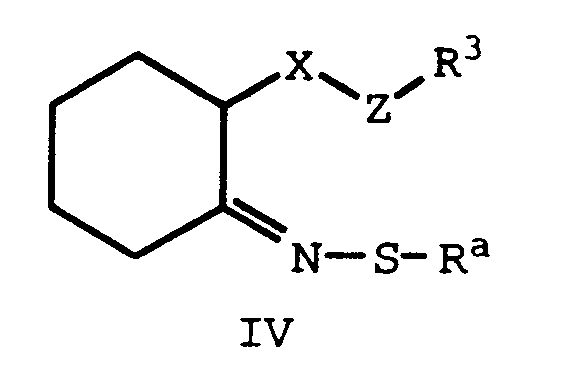
where Ra is C₁-C₆ alkyl or, preferably, a phenyl group, is reacted with a reagent of formula R²-(CH₂)q-M where M represents an alkali metal, such as lithium. This reaction is conveniently effected in a suitable organic solvent, such as an ether, for example, tetrahydrofuran. - The intermediates of Formula IV may be prepared from compounds of Formula V

by reaction with a compound of Formula VI
Ra-S-S-Ra VI
in the presence of ammonia and a nitrite, such as, for example, silver nitrite. - Compounds of Formula V may be prepared by the oxidation of the corresponding alcohols of Formula VII
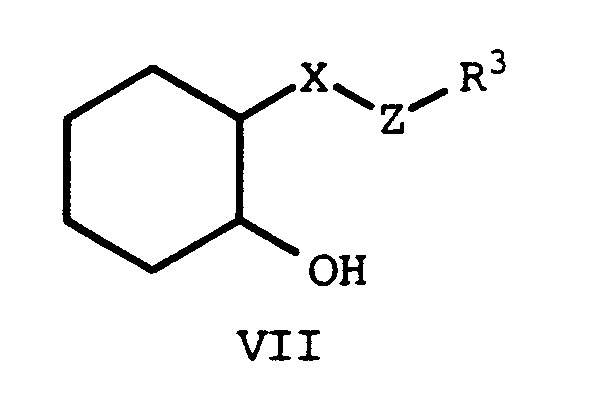
by conventional methods. Usually the oxidation is effected under Swern condition, i.e. with the use of oxalyl chloride in the presence of dimethyl sulfoxide. Other suitable oxidation procedures will readily apparent to those skilled in the art. - A compound of Formula VII may be prepared by the reaction of a compound of Formula VIII

with a compound of Formula IX
HX-Z-R³ IX
in the presence of a base or catalyst. Suitable agents for use in this reaction include metal hydrides, such as, for example, potassium hydride, or alumina. - During any of the above synthetic sequences it may be necessary or desirable to protect sensitive or reactive amino or carboxy groups on any of the molecules concerned. Such protection may be accomplished by means of the amino-protecting or carboxy-protecting groups discussed supra. These protecting groups may be removed at a convenient subsequent stage using methods known in the art.
- A toluene solution (70 ml) containing cyclohexane oxide (20 g), 3,5-dimethylbenzyl alcohol and alumina is heated at reflux for about 16 hours with azeotrophic removal of water. The solution is filtered and the solvent removed in vacuo to give 1-(3,5-dimethylbenzyloxy)-2-hydroxycyclohexane as as oil.
- The 1-(3,5-dimethylbenzyloxy)-2-hydroxycyclohexane is oxidized under standard Swern conditions [as described in Journal of Organic Chemistry, 43:2480 (1978)] using oxalyl chloride (4.12 ml) and dimethyl sulfoxide (6.7 ml). The product is purified on silica gel eluting with petroleum ether/ethyl acetate mixtures to give 1-(3,5-dimethylbenzyloxy)-2-cyclohexanone as an oil.
- The 1-(3,5-dimethylbenzyloxy)-2-cyclohexanone (10 g) is converted into the corresponding sulfenimine using the procedure described in Davis, Journal of Organic Chemistry, 38:2809 (1973) by treatment with silver nitrate (4.9 g), phenyl disulfide (6.5 g) and ammonia. The crude product is purified on silica gel eluting with petroleum ether/ethyl acetate mixtures to give 1-(3,5-dimethylbenzyloxy)-2-phenyl sulfenimine cyclohexane.
- The 1-(3,5-dimethylbenzyloxy)-2-phenyl sulfenimine cyclohexane (5.80 g) is then dissolved in ether (100 ml) at 0°C. Phenyllithium (17.1 ml) is added and after one hour the reaction mixture is heated to reflux. The reaction is quenched with 2M sodium hydroxide (100 ml) and the product is extracted into ethyl acetate (3 x 50 ml). The combined organic phase is washed with water (2 x 50 ml), saturated sodium chloride (50 ml), dried over magnesium sulfate, and evaporated in vacuo. The product is further purified on silica eluting with petroleum ether/ethyl acetate mixtures to give 1-(3,4-dimethylbenzyloxy)-2-amino-2-phenylcyclohexane as a crystalline solid.
- The title intermediate is prepared essentially as described in Preparation 1 but using 3,5-ditrifluoromethylbenzyl alcohol in place of 3,5-dimethylbenzyl alcohol.
- The title intermediate is prepared essentially as described in Preparation 1 but using 3,5-dimethoxybenzyl alcohol in place of 3,5-dimethylbenzyl alcohol.
- The title intermediate is prepared essentially as described in Preparation 1 but using 3,5-dichlorobenzyl alcohol in place of 3,5-dimethylbenzyl alcohol.
-
- The title intermediate is prepared essentially as described in Preparation 1 but using 2-methoxybenzyl alcohol in place of 3,5-dimethylbenzyl alcohol.
- The title intermediate is prepared essentially as described in Preparation 1 but using 2-chlorobenzyl alcohol in place of 3,5-dimethylbenzyl alcohol.
- The title intermediate is prepared essentially as described in Preparation 1 but using 2-methylbenzyl alcohol in place of 3,5-dimethylbenzyl alcohol.
- The title intermediate is prepared essentially as described in Preparation 1 but using 2-trifluoromethylbenzyl alcohol in place of 3,5-dimethylbenzyl alcohol.
-
- The title intermediate is prepared essentially as described in Preparation 1 but using 3,5-dimethylbenzylamine in place of 3,5-dimethylbenzyl alcohol. Journal of the American Chemical Society, 99:8208 (1977); Synthesis, 1984:629; Tetrahedron Letters, 1975:3577.
- The title intermediate is prepared essentially as described in Preparation 2 but using 3,5-ditrifluoromethylbenzylamine in place of 3,5-ditrifluoromethylbenzyl alcohol.
- The title intermediate is prepared essentially as described in Preparation 3 but using 3,5-dimethoxybenzylamine in place of 3,5-dimethoxybenzyl alcohol.
-
- The title intermediate is prepared essentially as described in Preparation 4 but using 3,5-dichlorobenzylamine in place of 3,5-dichlorobenzyl alcohol.
- The title intermediate is prepared essentially as described in Preparation 5 but using 2-methoxybenzylamine in place of 2-methoxybenzyl alcohol.
- The title intermediate is prepared essentially as described in Preparation 1 but using 2-chlorobenzylamine in place of 2-chlorobenzyl alcohol.
- The title intermediate is prepared essentially as described in Preparation 7 but using 2-methylbenzylamine in place of 2-methylbenzyl alcohol.
-
- The title intermediate is prepared essentially as described in Preparation 8 but using 2-trifluoromethylbenzylamine in place of 2-trifluoromethylbenzyl alcohol.
- The title intermediate is prepared essentially as described in Preparation 1 but 1H-indole, magnesium bromide salt is employed in place of the phenyllithium.
- The title intermediate is prepared essentially as described in Preparation 2 but 1H-indole, magnesium bromide salt is employed in place of the phenyllithium.
- The title intermediate is prepared essentially as described in Preparation 3 but 1H-indole, magnesium bromide salt is employed in place of the phenyllithium.
-
- The title intermediate is prepared essentially as described in Preparation 4 but 1H-indole, magnesium bromide salt is employed in place of the phenyllithium.
- The title intermediate is prepared essentially as described in Preparation 5 but 1H-indole, magnesium bromide salt is employed in place of the phenyllithium.
- The title intermediate is prepared essentially as described in Preparation 6 but 1H-indole, magnesium bromide salt is employed in place of the phenyllithium.
- The title intermediate is prepared essentially as described in Preparation 7 but 1H-indole, magnesium bromide salt is employed in place of the phenyllithium.
-
- The title intermediate is prepared essentially as described in Preparation 8 but 1H-indole, magnesium bromide salt is employed in place of the phenyllithium.
- The title intermediate is prepared essentially as described in Preparation 9 but 1H-indole, magnesium bromide salt is employed in place of the phenyllithium.
- The title intermediate is prepared essentially as described in Preparation 10 but 1H-indole, magnesium bromide salt is employed in place of the phenyllithium.
- The title intermediate is prepared essentially as described in Preparation 11 but 1H-indole, magnesium bromide salt is employed in place of the phenyllithium.
-
- The title intermediate is prepared essentially as described in Preparation 12 but 1H-indole, magnesium bromide salt is employed in place of the phenyllithium.
- The title intermediate is prepared essentially as described in Preparation 13 but 1H-indole, magnesium bromide salt is employed in place of the phenyllithium.
- The title intermediate is prepared essentially as described in Preparation 14 but 1H-indole, magnesium bromide salt is employed in place of the phenyllithium.
- The title intermediate is prepared essentially as described in Preparation 15 but 1H-indole, magnesium bromide salt is employed in place of the phenyllithium.
-
- The title intermediate is prepared essentially as described in Preparation 16 but 1H-indole, magnesium bromide salt is employed in place of the phenyllithium.
- The title intermediate is prepared essentially as described in Preparation 1 but using 3,5-ditrifluoromethylbenzyl mercapatan in place of 3,5-dimethylbenzyl alcohol.
- The title intermediate is prepared essentially as described in Preparation 33 but using 3,5-ditrifluoromethylbenzyl mercapatan in place of 3,5-dimethylbenzyl mercapatan.
- The title intermediate is prepared essentially as described in Preparation 33 but using 3,5-dimethoxybenzyl mercapatan in place of 3,5-dimethylbenzyl mercapatan.
- The title intermediate is prepared essentially as described in Preparation 33 but using 3,5-dichlorobenzyl mercapatan in place of 3,5-dimethylbenzyl mercapatan.
- The title intermediate is prepared essentially as described in Preparation 33 but using 2-methoxybenzyl mercapatan in place of 3,5-dimethylbenzyl mercapatan.
- The title intermediate is prepared essentially as described in Preparation 33 but using 2-chlorobenzyl mercapatan in place of 3,5-dimethylbenzyl mercapatan.
- The title intermediate is prepared essentially as described in Preparation 33 but using 2-methylbenzyl mercapatan in place of 3,5-dimethylbenzyl mercapatan.
- The title intermediate is prepared essentially as described in Preparation 33 but using 2-trifluoromethylbenzyl mercapatan in place of 3,5-dimethylbenzyl mercapatan.
- In all of the above examples the compounds containing a 3,4-disubstituted benzyl- thio, amino, or oxy or a 2,4-disubstitutedbenzyl- thio, amino, or oxy may be prepared essentially as described above by employing the appropriately substituted benzyl mercaptan, benzylamine, or benzyl alcohol.
- Cyclohexylpiperazine (10.0 g, 0.059 mol) is added to ten volumes of methylene chloride at room temperature. To this mixture is added sodium hydroxide (36 ml of a 2N solution, 0.072 mol) and tetrabutylammonium bromide (1.3 g, 0.004 mol). After the addition of the sodium hydroxide and tetrabutylammonium bromide, methyl bromoacetate (7.0 ml, 0.073 mol) is added and the reaction mixture is stirred for four to six hours. The progress of the reaction is monitored by gas chromatography.
- The organic fraction is separated and the aqueous phase is back-extracted with methylene chloride. The organic phases are combined and washed twice with deionized water, once with saturated sodium bicarbonate solution, and then with brine. The organic phase is dried over magnesium sulfate and the solvents are removed in vacuo to yield 2-((4-cyclohexyl)piperazin-1-yl)methyl acetate as a yellowish oil.
- The title intermediate is prepared by dissolving the 2-((4-cyclohexyl)piperazin-1-yl)methyl acetate (10.0 g, 0.042 mol) in ten volumes of diethyl ether. This solution is cooled to 15°C and then potassium trimethylsilanoate (5.9 g, 0.044) is added. This mixture is then stirred for four to six hours. The reaction product is removed by filtration, washed twice with five volumes of diethyl ether, then washed twice with five volumes of hexanes, and then dried in a vacuum oven for 12-24 hours at 50°C.
- 4-Piperidinopiperidine (1.20 kg, 7.13 mol) is added to methylene chloride (12.0 L) under a nitrogen atmosphere. Tetrabutylammonium bromide (0.150 kg, 0.47 mol) and sodium hydroxide (1.7 L of a 5 N solution, 8.5 mol) are then added. The reaction mixture is cooled to 10-15°C and methyl bromoacetate (1.17 kg, 7.65 mol) is added and the resulting mixture is stirred for a minimum of 16 hours.
- Deionized water (1.2 L) is then added to the mixture and the layers separated. The aqueous layer is back-extracted with methylene chloride (2.4 L). The organic fractions are combined and washed with deionized water (3 x 1.2 L), a saturated sodium bicarbonate solution (1.1 L) and a saturated sodium chloride solution (1.1 L). The organic fraction is then dried over anhydrous magnesium sulfate and concentrated to an oil on a rotary evaporator to yield 2-(4-(piperidin-1-yl)piperidin-1-yl)methyl acetate.
- A solution of 2-(4-(piperidin-1-yl)piperidin-1-yl)methyl acetate (2.395 kg, 9.96 mol) in methanol (2.4 L) is added to a solution of potassium hydroxide (0.662 kg, 10.0 mol @ 85% purity) in methanol (10.5 L) under a nitrogen atmosphere. The reaction mixture is heated to 45-50°C for a minimum of 16 hours.
- A solvent exchange from methanol to acetone (15.0 L) is performed on the solution on a rotary evaporator. This solution is slowly cooled to room temperature over 16 hours. The resulting solids are filtered, rinsed with acetone (5.0 L) and then dried to yield 2.471 kg (92%) of 2-(4-(piperidin-1-yl)piperidin-1-yl)acetic acid, potassium salt.
- The title compound is prepared by first cooling 2-((4-cyclohexyl)piperazin-1-yl)acetic acid potassium salt to a temperature between -8°C and -15°C in 5 volumes of anhydrous methylene chloride. To this mixture is added isobutylchloroformate at a rate such that the temperature does not exceed -8°C. The resulting reaction mixture is stirred for about 1 hour, the temperature being maintained between -8°C and -15°C.
- To this mixture is then added 1-(3,5-ditrifluoromethylbenzyloxy)-2-amino-2-phenylcyclohexane at such a rate that the temperature does not exceed 0°C. Next added to this mixture is N-methyl morpholine at a rate such that the temperature does not exceed 0°C. This mixture is then stirred for about 1 hour at a temperature between -15°C and -8°C.
- The reaction is quenched by the addition of 5 volumes of water. The organic layer is washed once with a saturated sodium bicarbonate solution. The organic phase is then dried over anhydrous potassium carbonate and filtered to remove the drying agent. To the filtrate is then added 2 equivalents of concentrated hydrochloric acid, followed by 1 volume of isopropyl alcohol. The methylene chloride is then exchanged with isopropyl alcohol under vacuum by distillation.
- The final volume of isopropyl alcohol is then concentrated to three volumes by vacuum. The reaction mixture is cooled to 20°C to 25°C and the product is allowed to crystallize for at least one hour. The desired product is then recovered by filtration and washed with sufficient isopropyl alcohol to give a colorless filtrate. The crystal cake is then dried under vacuum at 50°C.
- The title compound is prepared essentially as described in Example 1, except that 2-((4-phenyl)piperazin-1-yl)acetic acid, sodium salt is employed instead of 2-((4-cyclohexyl)piperazin-1-yl)acetic acid potassium salt.
- The title compound is prepared essentially as described in Example 1, except that the intermediate 1-(3,5-dimethylbenzylamino)-2-amino-2-(3-1H-indolyl)cyclohexane as prepared in Preparation 25 is employed instead of 1-(3,5-ditrifluoromethylbenzyloxy)-2-amino-2-phenylcyclohexane.
- The title compound is prepared essentially as described in Example 1, except that the intermediate 1-(3,5-dimethylbenzylamino)-2-amino-2-[3-(1H-indolyl)]cyclohexane as prepared in Preparation 26 is employed instead of 1-(3,5-ditrifluoromethylbenzyloxy)-2-amino-2-phenylcyclohexane.
- The title compound is prepared essentially as described in Example 3, except that 2-(4-(piperidin-1-yl)piperidin-1-yl)acetic acid, potassium salt, is employed instead of 2-((4-cyclohexyl)piperazin-1-yl)acetic acid potassium salt.
- The title compound is prepared essentially as described in Example 5, except that the intermediate 1-(2-methoxybenzylamino)-2-amino-2-(3-(1H-indolyl))cyclohexane, as prepared in Preparation 29, is employed instead of 1-(3,5-dimethylbenzylamino)-2-amino-2-(3-(1H-indolyl))cyclohexane.
- The title compound is prepared essentially as described in Example 5, except that the intermediate 1-(3,5-ditrifluoromethylbenzylamino)-2-amino-2-(3-(1H-indolyl))cyclohexane, as prepared in Preparation 26, is employed instead of 1-(3,5-dimethylbenzylamino)-2-amino-2-(3-(1H-indolyl))cyclohexane.
- The biological activity of the compounds of the present invention is evaluated employing an initial screening assay which rapidly and accurately measured the binding of the tested compound to known NK-1 and NK-2 receptor sites. Assays useful for evaluating tachykinin receptor antagonists are well known in the art. See. e.g., J. Jukic, et al., Life Sciences, 49:1463-1469 (1991); N. Kucharczyk, et al., Journal of Medicinal Chemistry, 36:1654-1661 (1993); N. Rouissi, et al., Biochemical and Biophysical Research Communications, 176:894-901 (1991).
- Radioreceptor binding assays are performed using a derivative of a previously published protocol. D.G. Payan, et al., Journal of Immunology, 133:3260-3265 (1984). In this assay an aliquot of IM9 cells (1 x 10⁶ cells/tube in RPMI 1604 medium supplemented with 10% fetal calf serum) is incubated with 20 pM ¹²⁵I-labeled substance P in the presence of increasing competitor concentrations for 45 minutes at 4°C.
- The IM9 cell line is a well-characterized cell line which is readily available to the public. See. e.g., Annals of the New York Academy of Science, 190: 221-234 (1972); Nature (London), 251:443-444 (1974); Proceedings of the National Academy of Sciences (USA), 71:84-88 (1974). These cells are routinely cultured in RPMI 1640 supplemented with 50 µg/ml gentamicin sulfate and 10% fetal calf serum.
- The reaction is terminated by filtration through a glass fiber filter harvesting system using filters previously soaked for 20 minutes in 0.1% polyethylenimine. Specific binding of labeled substance P is determined in the presence of 20 nM unlabeled ligand.
- Many of the compounds employed in the methods of the present invention are also effective antagonists of the NK-2 receptor.
- The CHO-hNK-2R cells, a CHO-derived cell line transformed with the human NK-2 receptor, expressing about 400,000 such receptors per cell, are grown in 75 cm² flasks or roller bottles in minimal essential medium (alpha modification) with 10% fetal bovine serum. The gene sequence of the human NK-2 receptor is given in N.P. Gerard, et al., Journal of Biological Chemistry, 265:20455-20462 (1990).
- For preparation of membranes, 30 confluent roller bottle cultures are dissociated by washing each roller bottle with 10 ml of Dulbecco's phosphate buffered saline (PBS) without calcium and magnesium, followed by addition of 10 ml of enzyme-free cell dissociation solution (PBS-based, from Specialty Media, Inc.). After an additional 15 minutes, the dissociated cells are pooled and centrifuged at 1,000 RPM for 10 minutes in a clinical centrifuge. Membranes are prepared by homogenization of the cell pellets in 300 ml 50 mM Tris buffer, pH 7.4 with a Tekmar® homogenizer for 10-15 seconds, followed by centrifugation at 12,000 RPM (20,000 x g) for 30 minutes using a Beckman JA-14® rotor. The pellets are washed once using the above procedure. and the final pellets are resuspended in 100-120 ml 50 mM Tris buffer, pH 7.4, and 4 ml aliquots stored frozen at -70°C. The protein concentration of this preparation is 2 mg/ml.
- For the receptor binding assay, one 4-ml aliquot of the CHO-hNK-2R membrane preparation is suspended in 40 ml of assay buffer containing 50 mM Tris, pH 7.4, 3 mM manganese chloride, 0.02% bovine serum albumin (BSA) and 4 g/ml chymostatin. A 200 µl volume of the homogenate (40 µg protein) is used per sample. The radioactive ligand is [¹²⁵I]iodohistidyl-neurokinin A (New England Nuclear, NEX-252), 2200 Ci/mmol. The ligand is prepared in assay buffer at 20 nCi per 100 µl; the final concentration in the assay is 20 pM. Non-specific binding is determined using 1 µM eledoisin. Ten concentrations of eledoisin from 0.1 to 1000 nM are used for a standard concentration-response curve.
- All samples and standards are added to the incubation in 10 µl dimethylsulfoxide (DMSO) for screening (single dose) or in 5 µl DMSO for IC₅₀ determinations. The order of additions for incubation is 190 or 195 µl assay buffer, 200 µl homogenate, 10 or 5 µl sample in DMSO, 100 µl radioactive ligand. The samples are incubated 1 hour at room temperature and then filtered on a cell harvester through filters which had been presoaked for two hours in 50 mM Tris buffer, pH 7.7, containing 0.5% BSA. The filter is washed 3 times with approximately 3 ml of cold 50 mM Tris buffer, pH 7.7. The filter circles are then punched into 12 x 75 mm polystyrene tubes and counted in a gamma counter.
- As the compounds of Formula I are effective tachykinin receptor antagonists, these compounds are of value in the treatment of a wide variety of clinical conditions which are characterized by the presence of an excess of tachykinin. Thus, the invention provides methods for the treatment or prevention of a physiological disorder associated with an excess of tachykinins, which method comprises administering to a mammal in need of said treatment an effective amount of a compound of Formula I or a pharmaceutically acceptable salt, solvate or prodrug thereof. The term "physiological disorder associated with an excess of tachykinins" encompasses those disorders associated with an inappropriate stimulation of tachykinin receptors, regardless of the actual amount of tachykinin present in the locale.
- These physiological disorders may include disorders of the central nervous system such as anxiety, depression, psychosis, and schizophrenia; neurodegenerative disorders such as dementia, including senile dementia of the Alzheimer's type, Alzheimer's disease, AIDS-associated dementia, and Down's syndrome; demyelinating diseases such as multiple sclerosis and amyotrophic lateral sclerosis and other neuropathological disorders such as peripheral neuropathy, such as diabetic and chemotherapy-induced neuropathy, and post-herpetic and other neuralgias; acute and chronic obstructive airway diseases such as adult respiratory distress syndrome, bronchopneumonia, bronchospasm, chronic bronchitis, drivercough, and asthma; inflammatory diseases such as inflammatory bowel disease, psoriasis, fibrositis, osteoarthritis, and rheumatoid arthritis; disorders of the musculo-skeletal system, such as osteoporosis; allergies such as eczema and rhinitis; hypersensitivity disorders such as poison ivy; ophtalmic diseases such as conjunctivitis, vernal conjunctivitis, and the like; cutaneous diseases such as contact dermatitis, atopic dermatitis, urticaria, and other eczematoid dermatites; addiction disorders such as alcoholism; stress-related somatic disorders; reflex sympathetic dystrophy such as shoulder/hand syndrome; dysthymic disorders; adverse immunological reactions such as rejection of transplanted tissues and disorders related to immune enhancement or suppression such as systemic lupus erythematosis; gastrointestinal disorders or diseases associated with the neuronal control of viscera such as ulcerative colitis, Crohn's disease, emesis, and irritable bowel syndrome; disorders of bladder function such as bladder detrusor hyper-reflexia and incontinence; artherosclerosis; fibrosing and collagen diseases such as scleroderma and eosinophilic fascioliasis; irritative symptoms of benign prostatic hypertrophy; disorders of blood flow caused by vasodilation and vasospastic diseases such as angina, migraine, and Reynaud's disease; and pain or nociception, for example, that attributable to or associated with any of the foregoing conditions, especially the transmission of pain in migraine. For example the compounds of Formula I may suitably be used in the treatment of disorders of the central nervous system such as anxiety, psychosis, and schizophrenia; neurodegenerative disorders such as Alzheimer's disease and Down's syndrome; respiratory diseases such as bronchospasm and asthma; inflammatory diseases such as inflammatory bowel disease, osteoarthritis and rheumatoid arthritis; adverse immunological disorders such as rejection of transplanted tissues; gastrointestinal disorders and diseases such as disorders associated with the neuronal control of viscera such as ulcerative colitis, Crohn's disease, emesis, and irritable bowel syndrome; incontinence; disorders of blood flow caused by vasodilation; and pain or nociception, for example, that attributable to or associated with any of the foregoing conditions or the transmission of pain in migraine.
- Many of the compounds of Formula I are selective tachykinin receptor antagonists. These compounds preferentially bind one tachykinin receptor subtype compared to other such receptors. Such compounds are especially preferred.
- For example, NK-1 antagonists are most especially preferred in the treatment of pain, especially chronic pain, such as neuropathic pain, post-operative pain, and migraines, pain associated with arthritis, cancer-associated pain, chronic lower back pain, cluster headaches, herpes neuralgia, phantom limb pain, central pain, dental pain, neuropathic pain, opioid-resistant pain, visceral pain, surgical pain, bone injury pain, pain during labor and delivery, pain resulting from burns, including sunburn, post partum pain, angina pain, and genitourinary tract-related pain including cystitis.
- In addition to pain, NK-1 antagonists are especially preferred in the treatment and prevention of urinary incontinence; irritative symptoms of benign prostatic hypertrophy; motility disorders of the gastrointestinal tract, such as irritable bowel syndrome; acute and chronic obstructive airway diseases, such as bronchospasm, bronchopneumonia, asthma, and adult respiratory distress syndrome; artherosclerosis; inflammatory conditions, such as inflammatory bowel disease, ulcerative colitis, Crohn's disease, rheumatoid arthritis, osteoarthritis, neurogenic inflammation, allergies, rhinitis, cough, dermatitis, urticaria, psoriasis, conjunctivitis, emesis, irritation-induced miosis; tissue transplant rejection; plasma extravasation resulting from cytokine chemotherapy and the like; spinal cord trauma; stroke; cerebral stroke (ischemia); Alzheimer's disease; Parkinson's disease; multiple sclerosis; amyotrophic lateral sclerosis; schizophrenia; anxiety; and depression.
- NK-2 antagonists are especially preferred in the treatment of urinary incontinence, bronchospasm, asthma, adult respiratory distress syndrome, motility disorders of the gastrointestinal tract, such as irritable bowel syndrome, and pain.
- The compounds of Formula I are usually administered in the form of pharmaceutical compositions. These compounds can be administered by a variety of routes including oral, rectal, transdermal, subcutaneous, intravenous, intramuscular, and intranasal. These compounds are effective as both injectable and oral compositions. Such compositions are prepared in a manner well known in the pharmaceutical art and comprise at least one active compound.
- The present invention also includes pharmaceutical compositions which contain, as the active ingredient, the compounds of Formula I associated with pharmaceutically acceptable carriers. In making the compositions of the present invention the active ingredient is usually mixed with an excipient, diluted by an excipient or enclosed within such a carrier which can be in the form of a capsule, sachet, paper or other container. When the excipient serves as a diluent, it can be a solid, semi-solid, or liquid material, which acts as a vehicle, carrier or medium for the active ingredient. Thus, the compositions can be in the form of tablets, pills, powders, lozenges, sachets, cachets, elixirs, suspensions, emulsions, solutions, syrups, aerosols (as a solid or in a liquid medium), ointments containing for example up to 10% by weight of the active compound, soft and hard gelatin capsules, suppositories, sterile injectable solutions, and sterile packaged powders.
- In preparing a formulation, it may be necessary to mill the active compound to provide the appropriate particle size prior to combining with the other ingredients. If the active compound is substantially insoluble, it ordinarily is milled to a particle size of less than 200 mesh. If the active compound is substantially water soluble, the particle size is normally adjusted by milling to provide a substantially uniform distribution in the formulation, e.g. about 40 mesh.
- Some examples of suitable excipients include lactose, dextrose, sucrose, sorbitol, mannitol, starches, gum acacia, calcium phosphate, alginates, tragacanth, gelatin, calcium silicate, microcrystalline cellulose, polyvinylpyrrolidone, cellulose, water, syrup, and methyl cellulose. The formulations can additionally include: lubricating agents such as talc, magnesium stearate, and mineral oil; wetting agents; emulsifying and suspending agents; preserving agents such as methyl- and propylhydroxybenzoates; sweetening agents; and flavoring agents. The compositions of the invention can be formulated so as to provide quick, sustained or delayed release of the active ingredient after administration to the patient by employing procedures known in the art.
- The compositions are preferably formulated in a unit dosage form, each dosage containing from about 0.05 to about 100 mg, more usually about 1.0 to about 30 mg, of the active ingredient. The term "unit dosage form" refers to physically discrete units suitable as unitary dosages for human subjects and other mammals, each unit containing a predetermined quantity of active material calculated to produce the desired therapeutic effect, in association with a suitable pharmaceutical excipient.
- The active compound is effective over a wide dosage range. For examples, dosages per day normally fall within the range of about 0.01 to about 30 mg/kg of body weight. In the treatment of adult humans, the range of about 0.1 to about 15 mg/kg/day, in single or divided dose, is especially preferred. However, it will be understood that the amount of the compound actually administered will be determined by a physician, in the light of the relevant circumstances, including the condition to be treated, the chosen route of administration, the actual compound administered, the age, weight, and response of the individual patient, and the severity of the patient's symptoms, and therefore the above dosage ranges are not intended to limit the scope of the invention in any way. In some instances dosage levels below the lower limit of the aforesaid range may be more than adequate, while in other cases still larger doses may be employed without causing any harmful side effect, provided that such larger doses are first divided into several smaller doses for administration throughout the day.
- Hard gelatin capsules containing the following ingredients are prepared:
Ingredient Quantity (mg/capsule) Active Ingredient 30.0 Starch 305.0 Magnesium stearate 5.0 - The above ingredients are mixed and filled into hard gelatin capsules in 340 mg quantities.
- A tablet formula is prepared using the ingredients below:
Ingredient Quantity (mg/tablet) Active Ingredient 25.0 Cellulose, microcrystalline 200.0 Colloidal silicon dioxide 10.0 Stearic acid 5.0 - The components are blended and compressed to form tablets, each weighing 240 mg.
- A dry powder inhaler formulation is prepared containing the following components:
Ingredient Weight % Active Ingredient 5 Lactose 95 - The active mixture is mixed with the lactose and the mixture is added to a dry powder inhaling appliance.
- Tablets, each containing 30 mg of active ingredient, are prepared as follows:
Ingredient Quantity (mg/tablet) Active Ingredient 30.0 mg Starch 45.0 mg Microcrystalline cellulose 35.0 mg Polyvinylpyrrolidone (as 10% solution in water) 4.0 mg Sodium carboxymethyl starch 4.5 mg Magnesium stearate 0.5 mg Talc 1.0 mg Total 
- The active ingredient, starch and cellulose are passed through a No. 20 mesh U.S. sieve and mixed thoroughly. The solution of polyvinylpyrrolidone is mixed with the resultant powders, which are then passed through a 16 mesh U.S. sieve. The granules so produced are dried at 50-60°C and passed through a 16 mesh U.S. sieve. The sodium carboxymethyl starch, magnesium stearate, and talc, previously passed through a No. 30 mesh U.S. sieve, are then added to the granules which, after mixing, are compressed on a tablet machine to yield tablets each weighing 120 mg.
- Capsules, each containing 40 mg of medicament are made as follows:
Ingredient Quantity (mg/capsule) Active Ingredient 40.0 mg Starch 109.0 mg Magnesium stearate 1.0 mg Total 
- The active ingredient, cellulose, starch, and magnesium stearate are blended, passed through a No. 20 mesh U.S. sieve, and filled into hard gelatin capsules in 150 mg quantities.
- Suppositories, each containing 25 mg of active ingredient are made as follows:
Ingredient Amount Active Ingredient 25 mg Saturated fatty acid glycerides to 2,000 mg - The active ingredient is passed through a No. 60 mesh U.S. sieve and suspended in the saturated fatty acid glycerides previously melted using the minimum heat necessary. The mixture is then poured into a suppository mold of nominal 2.0 g capacity and allowed to cool.
- Suspensions, each containing 50 mg of medicament per 5.0 ml dose are made as follows:
Ingredient Amount Active Ingredient 50.0 mg Xanthan gum 4.0 mg Sodium carboxymethyl cellulose (11%) Microcrystalline cellulose (89%) 50.0 mg Sucrose 1.75 g Sodium benzoate 10.0 mg Flavor and Color q.v. Purified water to 5.0 ml - The medicament, sucrose and xanthan gum are blended, passed through a No. 10 mesh U.S. sieve, and then mixed with a previously made solution of the microcrystalline cellulose and sodium carboxymethyl cellulose in water. The sodium benzoate, flavor, and color are diluted with some of the water and added with stirring. Sufficient water is then added to produce the required volume.
- Capsules, each containing 15 mg of medicament, are made as follows:
Ingredient Quantity (mg/capsule) Active Ingredient 15.0 mg Starch 407.0 mg Magnesium stearate 3.0 mg Total 
- The active ingredient, cellulose, starch, and magnesium stearate are blended, passed through a No. 20 mesh U.S. sieve, and filled into hard gelatin capsules in 425 mg quantities.
- An intravenous formulation may be prepared as follows:
Ingredient Quantity Active Ingredient 250.0 mg Isotonic saline 1000 ml - A topical formulation may be prepared as follows:
Ingredient Quantity Active Ingredient 1-10 g Emulsifying Wax 30 g Liquid Paraffin 20 g White Soft Paraffin to 100 g
The white soft paraffin is heated until molten. The liquid paraffin and emulsifying wax are incorporated and stirred until dissolved. The active ingredient is added and stirring is continued until dispersed. The mixture is then cooled until solid. - Sublingual or buccal tablets, each containing 10 mg of active ingredient, may be prepared as follows:
Ingredient Quantity Per Tablet Active Ingredient 10.0 mg Glycerol 210.5 mg Water 143.0 mg Sodium Citrate 4.5 mg Polyvinyl Alcohol 26.5 mg Polyvinylpyrrolidone 15.5 mg Total 
The glycerol, water, sodium citrate, polyvinyl alcohol, and polyvinylpyrrolidone are admixed together by continuous stirring and maintaining the temperature at about 90°C. When the polymers have gone into solution, the solution is cooled to about 50-55°C and the medicament is slowly admixed. The homogenous mixture is poured into forms made of an inert material to produce a drug-containing diffusion matrix having a thickness of about 2-4 mm. This diffusion matrix is then cut to form individual tablets having the appropriate size. - Another preferred formulation employed in the methods of the present invention employs transdermal delivery devices ("patches"). Such transdermal patches may be used to provide continuous or discontinuous infusion of the compounds of the present invention in controlled amounts. The construction and use of transdermal patches for the delivery of pharmaceutical agents is well known in the art. See. e.g., U.S. Patent 5,023,252, issued June 11, 1991, herein incorporated by reference. Such patches may be constructed for continuous, pulsatile, or on demand delivery of pharmaceutical agents.
- Frequently, it will be desirable or necessary to introduce the pharmaceutical composition to the brain, either directly or indirectly. Direct techniques usually involve placement of a drug delivery catheter into the host's ventricular system to bypass the blood-brain barrier. One such implantable delivery system, used for the transport of biological factors to specific anatomical regions of the body, is described in U.S. Patent 5,011,472, issued April 30, 1991, which is herein incorporated by refernce.
- Indirect techniques, which are generally preferred, usually involve formulating the compositions to provide for drug latentiation by the conversion of hydrophilic drugs into lipid-soluble drugs or prodrugs. Latentiation is generally achieved through blocking of the hydroxy, carbonyl, sulfate, and primary amine groups present on the drug to render the drug more lipid soluble and amenable to transportation across the blood-brain barrier. Alternatively, the delivery of hydrophilic drugs may be enhanced by intra-arterial infusion of hypertonic solutions which can transiently open the blood-brain barrier.
Claims (8)
- A compound of the formula

X is -NH-, -O-, or -S(O)p-,
where p is 0-2;
Z is -(CHR⁴)j-(CHR⁶)k-, where,
j is 0 or 1;
k is 0 or 1; and
R⁴ and R⁶ are independently selected from the group consisting of hydrogen and C₁-C₃ alkyl;
m and q are independently 0-3;
r is 0 or 1;
R³ is phenyl, phenyl-(C₁-C₆ alkylidenyl)-, C₃-C₈ cycloalkyl, C₅-C₈ cycloalkenyl, C₁-C₈ alkyl, naphthyl, C₂-C₈ alkenyl, or hydrogen;
any one of which groups except hydrogen may be substituted with one or two moieties independently selected from the group consisting of halo, C₁-C₃ alkoxy, C₁-C₃ alkylthio, nitro, trifluoromethyl, and C₁-C₃ alkyl; and
R² is phenyl, 3-indolyl, 2-indolyl, 3-benzothienyl, 3-benzofuranyl, 3-benzofuranyl, or naphthyl, said groups being optionally substituted with one to three moieties independently selected from the group consisting of C₁-C₆ alkyl, C₁-C₆ alkoxy, halo, or trifluoromethyl;
R¹ is trityl, phenyl, diphenylmethyl, phenoxy, phenylthio, hexamethyleneiminyl, piperazinyl, piperidinyl, pyrrolidinyl, morpholinyl, indolinyl, indolyl, benzothienyl, benzofuranyl, quinolinyl, isoquinolinyl, tetrahydropyridinyl, reduced quinolinyl, reduced isoquinolinyl, phenyl-(C₁-C₆ alkylidenyl)-, phenyl-(C₁-C₄ alkoxy)-, quinolinyl-(C₁-C₆ alkylidenyl)-, isoquinolinyl-(C₁-C₆ alkylidenyl)-, reduced quinolinyl-(C₁-C₆ alkylidenyl)-, reduced isoquinolinyl-(C₁-C₆ alkylidenyl)-, benzoyl-(C₁-C₆ alkylidenyl)-, C₁-C₄ alkyl, or -NH-CH₂-R⁵;
any one of which R¹ groups may be substituted with halo, C₁-C₄ alkyl, C₁-C₄ alkoxy, trifluoromethyl, amino, C₁-C₄ alkylamino, or di(C₁-C₄ alkyl)amino;
or any one of which R¹ groups may be substituted with phenyl, piperazinyl, C₃-C₈ cycloalkyl, benzyl, C₁-C₄ alkyl, piperidinyl, pyridinyl, pyrimidinyl, C₂-C₆ alkanoylamino, pyrrolidinyl, C₂-C₆ alkanoyl, or C₁-C₄ alkoxycarbonyl;
any one of which groups may be substituted with halo, C₁-C₄ alkyl, C₁-C₄ alkoxy, trifluoromethyl, amino, C₁-C₄ alkylamino, di(C₁-C₄ alkyl)amino, or C₂-C₄ alkanoylamino; and
R⁵ is pyridyl, anilino-(C₁-C₆ alkylidenyl)-, or anilinocarbonyl;
or a salt or solvate thereof. - A compound as claimed in Claim 1 wherein R³ is phenyl, or phenyl-(C₁-C₆ alkyl)-, optionally substituted with one or two chloro, fluoro, trifluoromethyl, methoxy, ethoxy, methyl, or ethyl groups, or a salt or solvate of said compound.
- A compound as claimed in Claim 2 wherein R² is phenyl, 2-indolyl, 3-indolyl, 2-indolinyl, 3-indolinyl, or naphthyl optionally substituted with one or two chloro, fluoro, methyl, ethyl, methoxy, or ethoxy groups, or a salt or solvate of said compound.
- A compound as claimed in Claim 3 wherein R¹ is hydrogen, phenyl, piperazinyl, piperidinyl, morpholinyl, benzofuranyl, phenyl-(C₁-C₄ alkyl)-, phenyl-(C₁-C₄ alkoxy)-, -NH-CH₂-R⁵, any one of which groups may be substituted, or a salt or solvate of said compound.
- A compound as claimed in Claim 4 wherein R¹ is hydrogen, 1-(4-phenyl)piperazinyl, 1-(4-cyclohexyl)piperazinyl, 1-(4-phenyl)piperidinyl, 1(4-cyclohexyl)piperidinyl, 1-(4-isopropyl)piperazinyl, or 1-[4-(1-piperidinyl)]piperidinyl, or a salt or solvate of said compound.
- A pharmaceutical formulation comprising as an active ingredient a compound as claimed in any one of claims 1 to 5, associated with one or more pharmaceutically acceptable carriers, diluents, or excipients therefor.
- A compound as claimed in any one of Claims 1 to 5 for use in the treatment or prevention of a physiological disorder associated with an excess of tachykinins.
- A process for preparing a compound as claimed in any one of Claims 1 to 5 in which r is 1, which comprises reacting a compound of the formula


Applications Claiming Priority (2)
| Application Number | Priority Date | Filing Date | Title |
|---|---|---|---|
| US259266 | 1981-04-30 | ||
| US25926694A | 1994-06-10 | 1994-06-10 |
Publications (2)
| Publication Number | Publication Date |
|---|---|
| EP0686629A2 true EP0686629A2 (en) | 1995-12-13 |
| EP0686629A3 EP0686629A3 (en) | 1999-02-10 |
Family
ID=22984257
Family Applications (1)
| Application Number | Title | Priority Date | Filing Date |
|---|---|---|---|
| EP95303818A Withdrawn EP0686629A3 (en) | 1994-06-10 | 1995-06-05 | Cyclohexyl tachykinine receptor antagonists |
Country Status (3)
| Country | Link |
|---|---|
| EP (1) | EP0686629A3 (en) |
| JP (1) | JPH083134A (en) |
| CA (1) | CA2150992A1 (en) |
Cited By (41)
| Publication number | Priority date | Publication date | Assignee | Title |
|---|---|---|---|---|
| EP0858444A4 (en) * | 1995-10-18 | 1999-12-01 | Merck & Co Inc | CYCLOPENTYL TACHYKININE RECEPTORANT AGONISTS |
| EP0693489B1 (en) * | 1994-07-12 | 2001-09-12 | Eli Lilly And Company | Heterocyclic tachykinin receptor antagonist |
| US6579885B2 (en) | 1999-11-03 | 2003-06-17 | Albany Molecular Research, Inc. | Aryl and heteroaryl substituted tetrahydroisoquinolines and use thereof |
| US7084152B2 (en) | 2000-07-11 | 2006-08-01 | Amr Technology, Inc. | 4-phenyl substituted tetrahydroisoquinolines therapeutic use thereof |
| WO2006123182A2 (en) | 2005-05-17 | 2006-11-23 | Merck Sharp & Dohme Limited | Cyclohexyl sulphones for treatment of cancer |
| US7163949B1 (en) | 1999-11-03 | 2007-01-16 | Amr Technology, Inc. | 4-phenyl substituted tetrahydroisoquinolines and use thereof |
| WO2007011820A2 (en) | 2005-07-15 | 2007-01-25 | Amr Technology, Inc. | Aryl-and heteroaryl-substituted tetrahydrobenzazepines and use thereof to block reuptake of norepinephrine, dopamine, and serotonin |
| WO2007093827A1 (en) | 2006-02-15 | 2007-08-23 | Istituto Di Ricerche Di Biologia Molecolare P. Angeletti Spa | Thiophene and thiazole substituted trifluoroethanone derivatives as histone deacetylase (hdac) inhibitors |
| US7291615B2 (en) | 2003-05-01 | 2007-11-06 | Bristol-Myers Squibb Company | Cyclic derivatives as modulators of chemokine receptor activity |
| WO2009002495A1 (en) | 2007-06-27 | 2008-12-31 | Merck & Co., Inc. | 4-carboxybenzylamino derivatives as histone deacetylase inhibitors |
| US7541357B2 (en) | 2004-07-15 | 2009-06-02 | Amr Technology, Inc. | Aryl- and heteroaryl-substituted tetrahydroisoquinolines and use thereof to block reuptake of norepinephrine, dopamine, and serotonin |
| WO2010114780A1 (en) | 2009-04-01 | 2010-10-07 | Merck Sharp & Dohme Corp. | Inhibitors of akt activity |
| WO2010132442A1 (en) | 2009-05-12 | 2010-11-18 | Albany Molecular Reserch, Inc. | 7-([1,2,4,]triazolo[1,5,-a]pyridin-6-yl)-4-(3,4-dichlorophenyl)-1,2,3,4- tetrahydroisoquinoline and use thereof |
| WO2010132487A1 (en) | 2009-05-12 | 2010-11-18 | Bristol-Myers Squibb Company | CRYSTALLINE FORMS OF (S)-7-([1,2,4]TRIAZOLO[1,5-a]PYRIDIN-6-YL)-4-(3,4-DICHLOROHPHENYL)-1,2,3,4-TETRAHYDROISOQUINOLINE AND USE THEREOF |
| WO2011046771A1 (en) | 2009-10-14 | 2011-04-21 | Schering Corporation | SUBSTITUTED PIPERIDINES THAT INCREASE p53 ACTIVITY AND THE USES THEREOF |
| EP2336120A1 (en) | 2007-01-10 | 2011-06-22 | Istituto di ricerche di Biologia Molecolare P. Angeletti S.R.L. | Combinations containing amide substituted indazoles as poly(ADP-ribose)polymerase (PARP) inhibitors |
| WO2012018754A2 (en) | 2010-08-02 | 2012-02-09 | Merck Sharp & Dohme Corp. | RNA INTERFERENCE MEDIATED INHIBITION OF CATENIN (CADHERIN-ASSOCIATED PROTEIN), BETA 1 (CTNNB1) GENE EXPRESSION USING SHORT INTERFERING NUCLEIC ACID (siNA) |
| WO2012027236A1 (en) | 2010-08-23 | 2012-03-01 | Schering Corporation | NOVEL PYRAZOLO[1,5-a]PYRIMIDINE DERIVATIVES AS mTOR INHIBITORS |
| WO2012030685A2 (en) | 2010-09-01 | 2012-03-08 | Schering Corporation | Indazole derivatives useful as erk inhibitors |
| WO2012036997A1 (en) | 2010-09-16 | 2012-03-22 | Schering Corporation | Fused pyrazole derivatives as novel erk inhibitors |
| WO2012058210A1 (en) | 2010-10-29 | 2012-05-03 | Merck Sharp & Dohme Corp. | RNA INTERFERENCE MEDIATED INHIBITION OF GENE EXPRESSION USING SHORT INTERFERING NUCLEIC ACIDS (siNA) |
| WO2012087772A1 (en) | 2010-12-21 | 2012-06-28 | Schering Corporation | Indazole derivatives useful as erk inhibitors |
| WO2012145471A1 (en) | 2011-04-21 | 2012-10-26 | Merck Sharp & Dohme Corp. | Insulin-like growth factor-1 receptor inhibitors |
| US8420811B2 (en) | 2008-06-04 | 2013-04-16 | Bristol-Myers Squibb Company | Tetrahydroisoquinolines and intermediates therefor |
| WO2013063214A1 (en) | 2011-10-27 | 2013-05-02 | Merck Sharp & Dohme Corp. | Novel compounds that are erk inhibitors |
| WO2013165816A2 (en) | 2012-05-02 | 2013-11-07 | Merck Sharp & Dohme Corp. | SHORT INTERFERING NUCLEIC ACID (siNA) COMPOSITIONS |
| WO2014052563A2 (en) | 2012-09-28 | 2014-04-03 | Merck Sharp & Dohme Corp. | Novel compounds that are erk inhibitors |
| WO2014085216A1 (en) | 2012-11-28 | 2014-06-05 | Merck Sharp & Dohme Corp. | Compositions and methods for treating cancer |
| WO2014100065A1 (en) | 2012-12-20 | 2014-06-26 | Merck Sharp & Dohme Corp. | Substituted imidazopyridines as hdm2 inhibitors |
| WO2014120748A1 (en) | 2013-01-30 | 2014-08-07 | Merck Sharp & Dohme Corp. | 2,6,7,8 substituted purines as hdm2 inhibitors |
| WO2015034925A1 (en) | 2013-09-03 | 2015-03-12 | Moderna Therapeutics, Inc. | Circular polynucleotides |
| US9034899B2 (en) | 2009-05-12 | 2015-05-19 | Albany Molecular Research, Inc. | Aryl, heteroaryl, and heterocycle substituted tetrahydroisoquinolines and use thereof |
| US9156812B2 (en) | 2008-06-04 | 2015-10-13 | Bristol-Myers Squibb Company | Crystalline form of 6-[(4S)-2-methyl-4-(2-naphthyl)-1,2,3,4-tetrahydroisoquinolin-7-yl]pyridazin-3-amine |
| WO2018071283A1 (en) | 2016-10-12 | 2018-04-19 | Merck Sharp & Dohme Corp. | Kdm5 inhibitors |
| WO2019094312A1 (en) | 2017-11-08 | 2019-05-16 | Merck Sharp & Dohme Corp. | Prmt5 inhibitors |
| WO2019094311A1 (en) | 2017-11-08 | 2019-05-16 | Merck Sharp & Dohme Corp. | Prmt5 inhibitors |
| WO2020033288A1 (en) | 2018-08-07 | 2020-02-13 | Merck Sharp & Dohme Corp. | Prmt5 inhibitors |
| WO2020033284A1 (en) | 2018-08-07 | 2020-02-13 | Merck Sharp & Dohme Corp. | Prmt5 inhibitors |
| WO2020033282A1 (en) | 2018-08-07 | 2020-02-13 | Merck Sharp & Dohme Corp. | Prmt5 inhibitors |
| US11096950B2 (en) | 2006-11-01 | 2021-08-24 | Barbara Brooke Jennings | Compounds, methods, and treatments for abnormal signaling pathways for prenatal and postnatal development |
| EP4079856A1 (en) | 2010-08-17 | 2022-10-26 | Sirna Therapeutics, Inc. | Rna interference mediated inhibition of hepatitis b virus (hbv) gene expression using short interfering nucleic acid (sina) |
Family Cites Families (5)
| Publication number | Priority date | Publication date | Assignee | Title |
|---|---|---|---|---|
| JPH06509087A (en) * | 1991-07-05 | 1994-10-13 | メルク シヤープ エンド ドーム リミテツド | Aromatic compounds, pharmaceutical compositions containing them and their use in therapy |
| WO1993001165A2 (en) * | 1991-07-10 | 1993-01-21 | Merck Sharp & Dohme Limited | Aromatic compounds, compositions containing them and their use in therapy |
| US5328927A (en) * | 1992-03-03 | 1994-07-12 | Merck Sharpe & Dohme, Ltd. | Hetercyclic compounds, processes for their preparation and pharmaceutical compositions containing them |
| AU4713293A (en) * | 1992-07-13 | 1994-01-31 | Merck Sharp & Dohme Limited | Heterocyclic amide derivatives as tachykinin derivatives |
| GB9220286D0 (en) * | 1992-09-25 | 1992-11-11 | Merck Sharp & Dohme | Therapeutic agents |
-
1995
- 1995-06-05 CA CA002150992A patent/CA2150992A1/en not_active Abandoned
- 1995-06-05 EP EP95303818A patent/EP0686629A3/en not_active Withdrawn
- 1995-06-08 JP JP7141863A patent/JPH083134A/en not_active Withdrawn
Cited By (66)
| Publication number | Priority date | Publication date | Assignee | Title |
|---|---|---|---|---|
| EP0693489B1 (en) * | 1994-07-12 | 2001-09-12 | Eli Lilly And Company | Heterocyclic tachykinin receptor antagonist |
| EP0858444A4 (en) * | 1995-10-18 | 1999-12-01 | Merck & Co Inc | CYCLOPENTYL TACHYKININE RECEPTORANT AGONISTS |
| US7265116B2 (en) | 1999-11-03 | 2007-09-04 | Arm Technology, Inc. | Aryl and heteroaryl substituted tetrahydroisoquinolines and use thereof |
| US6579885B2 (en) | 1999-11-03 | 2003-06-17 | Albany Molecular Research, Inc. | Aryl and heteroaryl substituted tetrahydroisoquinolines and use thereof |
| US7612090B2 (en) | 1999-11-03 | 2009-11-03 | Albany Molecular Research, Inc. | Aryl and heteroaryl substituted tetrahydroisoquinolines and use thereof |
| US7163949B1 (en) | 1999-11-03 | 2007-01-16 | Amr Technology, Inc. | 4-phenyl substituted tetrahydroisoquinolines and use thereof |
| US7309789B2 (en) | 2000-07-11 | 2007-12-18 | Amr Technology, Inc. | 4-phenyl substituted tetrahydroisoquinolines and therapeutic use thereof |
| US7419985B2 (en) | 2000-07-11 | 2008-09-02 | Amr Technology, Inc. | 4-Phenyl substituted tetrahydroisoquinolines and therapeutic use thereof |
| US7084152B2 (en) | 2000-07-11 | 2006-08-01 | Amr Technology, Inc. | 4-phenyl substituted tetrahydroisoquinolines therapeutic use thereof |
| US7696205B2 (en) | 2003-05-01 | 2010-04-13 | Bristol-Myers Squibb Company | Cyclic derivatives as modulators of chemokine receptor activity |
| US7291615B2 (en) | 2003-05-01 | 2007-11-06 | Bristol-Myers Squibb Company | Cyclic derivatives as modulators of chemokine receptor activity |
| US8741901B2 (en) | 2004-07-15 | 2014-06-03 | Albany Molecular Research, Inc. | Aryl- and heteroaryl-substituted tetrahydroisoquinolines and use thereof to block reuptake of norepinephrine, dopamine, and serotonin |
| US8236796B2 (en) | 2004-07-15 | 2012-08-07 | Albany Molecular Research, Inc. | Aryl- and heteroaryl-substituted tetrahydroisoquinolines and use thereof to block reuptake of norepinephrine, dopamine, and serotonin |
| US7541357B2 (en) | 2004-07-15 | 2009-06-02 | Amr Technology, Inc. | Aryl- and heteroaryl-substituted tetrahydroisoquinolines and use thereof to block reuptake of norepinephrine, dopamine, and serotonin |
| US8227486B2 (en) | 2004-07-15 | 2012-07-24 | Albany Molecular Research, Inc. | Aryl- and heteroaryl-substituted tetrahydroisoquinolines and use thereof to block reuptake of norepinephrine, dopamine, and serotonin |
| US9499531B2 (en) | 2004-07-15 | 2016-11-22 | Albany Molecular Research, Inc. | Aryl- and heteroaryl-substituted tetrahydroisoquinolines and use thereof to block reuptake of norepinephrine, dopamine, and serotonin |
| US9085531B2 (en) | 2004-07-15 | 2015-07-21 | Albany Molecular Research, Inc. | Aryl- and heteroaryl-substituted tetrahydroisoquinolines and use thereof to block reuptake of norepinephrine, dopamine, and serotonin |
| WO2006123182A2 (en) | 2005-05-17 | 2006-11-23 | Merck Sharp & Dohme Limited | Cyclohexyl sulphones for treatment of cancer |
| WO2007011820A2 (en) | 2005-07-15 | 2007-01-25 | Amr Technology, Inc. | Aryl-and heteroaryl-substituted tetrahydrobenzazepines and use thereof to block reuptake of norepinephrine, dopamine, and serotonin |
| US8791101B2 (en) | 2005-07-15 | 2014-07-29 | Albany Molecular Research, Inc. | Aryl- and heteroaryl-substituted tetrahydrobenzazepines and use thereof to block reuptake of norepinephrine, dopamine, and serotonin |
| US9403776B2 (en) | 2005-07-15 | 2016-08-02 | Albany Molecular Research, Inc. | Aryl- and heteroaryl-substituted tetrahydrobenzazepines and use thereof to block reuptake of norepinephrine, dopamine, and serotonin |
| US7956050B2 (en) | 2005-07-15 | 2011-06-07 | Albany Molecular Research, Inc. | Aryl- and heteroaryl-substituted tetrahydrobenzazepines and use thereof to block reuptake of norepinephrine, dopamine, and serotonin |
| WO2007093827A1 (en) | 2006-02-15 | 2007-08-23 | Istituto Di Ricerche Di Biologia Molecolare P. Angeletti Spa | Thiophene and thiazole substituted trifluoroethanone derivatives as histone deacetylase (hdac) inhibitors |
| US11096950B2 (en) | 2006-11-01 | 2021-08-24 | Barbara Brooke Jennings | Compounds, methods, and treatments for abnormal signaling pathways for prenatal and postnatal development |
| EP2336120A1 (en) | 2007-01-10 | 2011-06-22 | Istituto di ricerche di Biologia Molecolare P. Angeletti S.R.L. | Combinations containing amide substituted indazoles as poly(ADP-ribose)polymerase (PARP) inhibitors |
| EP2805945A1 (en) | 2007-01-10 | 2014-11-26 | MSD Italia S.r.l. | Amide substituted indazoles as poly(ADP-ribose)polymerase (PARP) inhibitors |
| EP3103791A1 (en) | 2007-06-27 | 2016-12-14 | Merck Sharp & Dohme Corp. | 4-carboxybenzylamino derivatives as histone deacetylase inhibitors |
| WO2009002495A1 (en) | 2007-06-27 | 2008-12-31 | Merck & Co., Inc. | 4-carboxybenzylamino derivatives as histone deacetylase inhibitors |
| US9156812B2 (en) | 2008-06-04 | 2015-10-13 | Bristol-Myers Squibb Company | Crystalline form of 6-[(4S)-2-methyl-4-(2-naphthyl)-1,2,3,4-tetrahydroisoquinolin-7-yl]pyridazin-3-amine |
| US8420811B2 (en) | 2008-06-04 | 2013-04-16 | Bristol-Myers Squibb Company | Tetrahydroisoquinolines and intermediates therefor |
| US8445494B2 (en) | 2008-06-04 | 2013-05-21 | Bristol-Myers Squibb Company | Crystalline form of 6-[(4S)-2-methyl-4-(2-naphthyl)-1,2,3,4-tetrahydroisoquinolin-7-yl]pyridazin-3-amine |
| US9498476B2 (en) | 2008-06-04 | 2016-11-22 | Albany Molecular Research, Inc. | Crystalline form of 6-[(4S)-2-methyl-4-(2-naphthyl)-1,2,3,4-tetrahydroisoquinolin-7-yl]pyridazin-3-amine |
| WO2010114780A1 (en) | 2009-04-01 | 2010-10-07 | Merck Sharp & Dohme Corp. | Inhibitors of akt activity |
| US8802696B2 (en) | 2009-05-12 | 2014-08-12 | Albany Molecular Research, Inc. | 7-([1,2,4]triazolo[1,5-a]pyridin-6-yl)-4-(3,4-dichlorophenyl)-1,2,3,4-tetrahydroisoqu inoli and use thereof |
| US9604960B2 (en) | 2009-05-12 | 2017-03-28 | Albany Molecular Research, Inc. | Aryl, heteroaryl, and heterocycle substituted tetrahydroisoquinolines and use thereof |
| WO2010132442A1 (en) | 2009-05-12 | 2010-11-18 | Albany Molecular Reserch, Inc. | 7-([1,2,4,]triazolo[1,5,-a]pyridin-6-yl)-4-(3,4-dichlorophenyl)-1,2,3,4- tetrahydroisoquinoline and use thereof |
| WO2010132487A1 (en) | 2009-05-12 | 2010-11-18 | Bristol-Myers Squibb Company | CRYSTALLINE FORMS OF (S)-7-([1,2,4]TRIAZOLO[1,5-a]PYRIDIN-6-YL)-4-(3,4-DICHLOROHPHENYL)-1,2,3,4-TETRAHYDROISOQUINOLINE AND USE THEREOF |
| US9173879B2 (en) | 2009-05-12 | 2015-11-03 | Bristol-Myers Squibb Company | Crystalline forms of (S)-7-([1,2,4]triazolo[1,5-a ]pyridin-6-yl)-4-(3,4-dichlorophenyl)-1,2,3,4-tetrahydroisoquinoline and use thereof |
| US9034899B2 (en) | 2009-05-12 | 2015-05-19 | Albany Molecular Research, Inc. | Aryl, heteroaryl, and heterocycle substituted tetrahydroisoquinolines and use thereof |
| US8815894B2 (en) | 2009-05-12 | 2014-08-26 | Bristol-Myers Squibb Company | Crystalline forms of (S)-7-([1,2,4]triazolo[1,5-a]pyridin-6-yl)-4-(3,4-dichlorophenyl)-1,2,3,4-tetrahydroisoquinoline and use thereof |
| WO2011046771A1 (en) | 2009-10-14 | 2011-04-21 | Schering Corporation | SUBSTITUTED PIPERIDINES THAT INCREASE p53 ACTIVITY AND THE USES THEREOF |
| EP3330377A1 (en) | 2010-08-02 | 2018-06-06 | Sirna Therapeutics, Inc. | Rna interference mediated inhibition of catenin (cadherin-associated protein), beta 1 (ctnnb1) gene expression using short interfering nucleic acid (sina) |
| WO2012018754A2 (en) | 2010-08-02 | 2012-02-09 | Merck Sharp & Dohme Corp. | RNA INTERFERENCE MEDIATED INHIBITION OF CATENIN (CADHERIN-ASSOCIATED PROTEIN), BETA 1 (CTNNB1) GENE EXPRESSION USING SHORT INTERFERING NUCLEIC ACID (siNA) |
| EP4079856A1 (en) | 2010-08-17 | 2022-10-26 | Sirna Therapeutics, Inc. | Rna interference mediated inhibition of hepatitis b virus (hbv) gene expression using short interfering nucleic acid (sina) |
| WO2012027236A1 (en) | 2010-08-23 | 2012-03-01 | Schering Corporation | NOVEL PYRAZOLO[1,5-a]PYRIMIDINE DERIVATIVES AS mTOR INHIBITORS |
| WO2012030685A2 (en) | 2010-09-01 | 2012-03-08 | Schering Corporation | Indazole derivatives useful as erk inhibitors |
| WO2012036997A1 (en) | 2010-09-16 | 2012-03-22 | Schering Corporation | Fused pyrazole derivatives as novel erk inhibitors |
| WO2012058210A1 (en) | 2010-10-29 | 2012-05-03 | Merck Sharp & Dohme Corp. | RNA INTERFERENCE MEDIATED INHIBITION OF GENE EXPRESSION USING SHORT INTERFERING NUCLEIC ACIDS (siNA) |
| EP3766975A1 (en) | 2010-10-29 | 2021-01-20 | Sirna Therapeutics, Inc. | Rna interference mediated inhibition of gene expression using short interfering nucleic acid (sina) |
| EP3327125A1 (en) | 2010-10-29 | 2018-05-30 | Sirna Therapeutics, Inc. | Rna interference mediated inhibition of gene expression using short interfering nucleic acids (sina) |
| WO2012087772A1 (en) | 2010-12-21 | 2012-06-28 | Schering Corporation | Indazole derivatives useful as erk inhibitors |
| WO2012145471A1 (en) | 2011-04-21 | 2012-10-26 | Merck Sharp & Dohme Corp. | Insulin-like growth factor-1 receptor inhibitors |
| WO2013063214A1 (en) | 2011-10-27 | 2013-05-02 | Merck Sharp & Dohme Corp. | Novel compounds that are erk inhibitors |
| WO2013165816A2 (en) | 2012-05-02 | 2013-11-07 | Merck Sharp & Dohme Corp. | SHORT INTERFERING NUCLEIC ACID (siNA) COMPOSITIONS |
| EP3919620A1 (en) | 2012-05-02 | 2021-12-08 | Sirna Therapeutics, Inc. | Short interfering nucleic acid (sina) compositions |
| WO2014052563A2 (en) | 2012-09-28 | 2014-04-03 | Merck Sharp & Dohme Corp. | Novel compounds that are erk inhibitors |
| WO2014085216A1 (en) | 2012-11-28 | 2014-06-05 | Merck Sharp & Dohme Corp. | Compositions and methods for treating cancer |
| WO2014100065A1 (en) | 2012-12-20 | 2014-06-26 | Merck Sharp & Dohme Corp. | Substituted imidazopyridines as hdm2 inhibitors |
| WO2014120748A1 (en) | 2013-01-30 | 2014-08-07 | Merck Sharp & Dohme Corp. | 2,6,7,8 substituted purines as hdm2 inhibitors |
| WO2015034925A1 (en) | 2013-09-03 | 2015-03-12 | Moderna Therapeutics, Inc. | Circular polynucleotides |
| WO2018071283A1 (en) | 2016-10-12 | 2018-04-19 | Merck Sharp & Dohme Corp. | Kdm5 inhibitors |
| WO2019094311A1 (en) | 2017-11-08 | 2019-05-16 | Merck Sharp & Dohme Corp. | Prmt5 inhibitors |
| WO2019094312A1 (en) | 2017-11-08 | 2019-05-16 | Merck Sharp & Dohme Corp. | Prmt5 inhibitors |
| WO2020033282A1 (en) | 2018-08-07 | 2020-02-13 | Merck Sharp & Dohme Corp. | Prmt5 inhibitors |
| WO2020033284A1 (en) | 2018-08-07 | 2020-02-13 | Merck Sharp & Dohme Corp. | Prmt5 inhibitors |
| WO2020033288A1 (en) | 2018-08-07 | 2020-02-13 | Merck Sharp & Dohme Corp. | Prmt5 inhibitors |
Also Published As
| Publication number | Publication date |
|---|---|
| EP0686629A3 (en) | 1999-02-10 |
| JPH083134A (en) | 1996-01-09 |
| CA2150992A1 (en) | 1995-12-11 |
Similar Documents
| Publication | Publication Date | Title |
|---|---|---|
| US5565568A (en) | 2-acylaminopropanamides as tachykinin receptor antagonists | |
| CA2150992A1 (en) | Cyclohexyl tachykinin receptor antagonists | |
| EP0699674A1 (en) | 1-Aryl-2-acetylamidopentanone derivatives for use as tachykinin receptor antagonists | |
| RU2140921C1 (en) | Nonpeptide antagonists of tachikinin receptors | |
| EP0714891A1 (en) | Heterocyclic tachykinin receptor antagonists | |
| AU688072B2 (en) | Heterocyclic tachykinin receptor antagonists | |
| US6358994B1 (en) | 2-acylaminopropanamines as tachykinin receptor antagonists | |
| US6175013B1 (en) | Imidazolinyl tachykinin receptor antagonists | |
| US5563133A (en) | Hexamethyleneiminyl tachykinin receptor antagonists | |
| US6339094B1 (en) | 2-acylaminopropanamines as tachykinin receptor antagonists | |
| US5607947A (en) | Pyrrolidinyl tachykinin receptor antagonists | |
| EP0747055A2 (en) | Use of tachykinin receptors antagonists for the treatment of cold and allergic rhinitis | |
| JP3657982B6 (en) | Non-peptide tachykinin receptor antagonist | |
| AU721935B2 (en) | Non-peptide tachykinin receptor antagonists | |
| MXPA00001167A (en) | 2-acylaminopropanamines as tachykinin receptor antagonists | |
| MXPA00001174A (en) | 2-acylaminopropanamines as tachykinin receptor antagonists | |
| CZ2000375A3 (en) | Compounds of 2-acylaminopropanamines as antagonists of tachykinin receptor | |
| CZ2000376A3 (en) | Compounds of 2-acylaminopropanamines functioning as antagonists of tachykinin receptor |
Legal Events
| Date | Code | Title | Description |
|---|---|---|---|
| PUAI | Public reference made under article 153(3) epc to a published international application that has entered the european phase |
Free format text: ORIGINAL CODE: 0009012 |
|
| 17P | Request for examination filed |
Effective date: 19950612 |
|
| AK | Designated contracting states |
Kind code of ref document: A2 Designated state(s): AT BE CH DE DK ES FR GB GR IE IT LI LU NL PT SE |
|
| RAX | Requested extension states of the european patent have changed |
Free format text: LT PAYMENT 950612;LV PAYMENT 950612;SI PAYMENT 950612 |
|
| PUAL | Search report despatched |
Free format text: ORIGINAL CODE: 0009013 |
|
| AK | Designated contracting states |
Kind code of ref document: A3 Designated state(s): AT BE CH DE DK ES FR GB GR IE IT LI LU NL PT SE |
|
| AX | Request for extension of the european patent |
Free format text: LT PAYMENT 950612;LV PAYMENT 950612;SI PAYMENT 950612 |
|
| 17Q | First examination report despatched |
Effective date: 20010103 |
|
| STAA | Information on the status of an ep patent application or granted ep patent |
Free format text: STATUS: THE APPLICATION IS DEEMED TO BE WITHDRAWN |
|
| 18D | Application deemed to be withdrawn |
Effective date: 20010714 |