EP3223828B1 - Verfahren zur behandlung und vorbeugung von erkrankungen im zusammenhang mit asbest - Google Patents
Verfahren zur behandlung und vorbeugung von erkrankungen im zusammenhang mit asbest Download PDFInfo
- Publication number
- EP3223828B1 EP3223828B1 EP15862201.9A EP15862201A EP3223828B1 EP 3223828 B1 EP3223828 B1 EP 3223828B1 EP 15862201 A EP15862201 A EP 15862201A EP 3223828 B1 EP3223828 B1 EP 3223828B1
- Authority
- EP
- European Patent Office
- Prior art keywords
- zeolite
- asbestos
- subject
- mesothelioma
- exposure
- Prior art date
- Legal status (The legal status is an assumption and is not a legal conclusion. Google has not performed a legal analysis and makes no representation as to the accuracy of the status listed.)
- Active
Links
Images





Classifications
-
- A—HUMAN NECESSITIES
- A61—MEDICAL OR VETERINARY SCIENCE; HYGIENE
- A61K—PREPARATIONS FOR MEDICAL, DENTAL OR TOILETRY PURPOSES
- A61K33/00—Medicinal preparations containing inorganic active ingredients
- A61K33/06—Aluminium, calcium or magnesium; Compounds thereof, e.g. clay
- A61K33/08—Oxides; Hydroxides
-
- A—HUMAN NECESSITIES
- A61—MEDICAL OR VETERINARY SCIENCE; HYGIENE
- A61K—PREPARATIONS FOR MEDICAL, DENTAL OR TOILETRY PURPOSES
- A61K33/00—Medicinal preparations containing inorganic active ingredients
- A61K33/06—Aluminium, calcium or magnesium; Compounds thereof, e.g. clay
-
- A—HUMAN NECESSITIES
- A61—MEDICAL OR VETERINARY SCIENCE; HYGIENE
- A61K—PREPARATIONS FOR MEDICAL, DENTAL OR TOILETRY PURPOSES
- A61K45/00—Medicinal preparations containing active ingredients not provided for in groups A61K31/00 - A61K41/00
- A61K45/06—Mixtures of active ingredients without chemical characterisation, e.g. antiphlogistics and cardiaca
-
- A—HUMAN NECESSITIES
- A61—MEDICAL OR VETERINARY SCIENCE; HYGIENE
- A61K—PREPARATIONS FOR MEDICAL, DENTAL OR TOILETRY PURPOSES
- A61K9/00—Medicinal preparations characterised by special physical form
- A61K9/0012—Galenical forms characterised by the site of application
- A61K9/0019—Injectable compositions; Intramuscular, intravenous, arterial, subcutaneous administration; Compositions to be administered through the skin in an invasive manner
-
- A—HUMAN NECESSITIES
- A61—MEDICAL OR VETERINARY SCIENCE; HYGIENE
- A61K—PREPARATIONS FOR MEDICAL, DENTAL OR TOILETRY PURPOSES
- A61K9/00—Medicinal preparations characterised by special physical form
- A61K9/0012—Galenical forms characterised by the site of application
- A61K9/007—Pulmonary tract; Aromatherapy
-
- A—HUMAN NECESSITIES
- A61—MEDICAL OR VETERINARY SCIENCE; HYGIENE
- A61K—PREPARATIONS FOR MEDICAL, DENTAL OR TOILETRY PURPOSES
- A61K9/00—Medicinal preparations characterised by special physical form
- A61K9/14—Particulate form, e.g. powders, Processes for size reducing of pure drugs or the resulting products, Pure drug nanoparticles
-
- A—HUMAN NECESSITIES
- A61—MEDICAL OR VETERINARY SCIENCE; HYGIENE
- A61P—SPECIFIC THERAPEUTIC ACTIVITY OF CHEMICAL COMPOUNDS OR MEDICINAL PREPARATIONS
- A61P11/00—Drugs for disorders of the respiratory system
-
- A—HUMAN NECESSITIES
- A61—MEDICAL OR VETERINARY SCIENCE; HYGIENE
- A61P—SPECIFIC THERAPEUTIC ACTIVITY OF CHEMICAL COMPOUNDS OR MEDICINAL PREPARATIONS
- A61P35/00—Antineoplastic agents
Definitions
- the present invention relates to the treatment or prevention of asbestos-related diseases, in particular mesothelioma and asbestosis.
- Asbestosis is a chronic lung disease characterised by scarring of lung tissues, which leads to long-term breathing complications. The disease is caused exclusively by exposure to asbestos and there is no cure. Asbestos exposure may also lead to pleural disease which involves inflammation and irritation of the pleura, which is the outer lining of the lung. The pleura stiffens and thickens widely, or in patches (plaques), and can fill with fluid. In some instances this thickening can restrict breathing. Exposure to asbestos fibres also greatly increases a person's risk of developing lung cancer, particularly if the person is a smoker.
- Mesothelioma is an aggressive cancer that develops from cells of the mesothelium, the protective lining that covers many of the internal organs of the body.
- the most common anatomical site for mesothelioma is the pleura (the outer lining of the lungs and internal chest wall), but it may also occur in the peritoneum (the lining of the abdominal cavity), the pericardium (the sac that surrounds the heart), or the tunica vaginalis (a sac that surrounds the testis).
- asbestos is the major cause of mesothelioma and the majority of those who develop mesothelioma have had occupational exposure to asbestos dust or fibres, or were exposed to airborne dust or fibres in other ways. Whilst it has been discontinued in many countries including Australia and the US, asbestos mining continues today in Brazil, China, Russia, India and Ukraine with no indications of discontinuence. Occupational exposure to asbestos dust and fibres remains a serious concern for asbestos miners in these countries.
- asbestos-bound or released iron generates "cytotoxic" reactive oxygen radicals that cause most of the cellular and DNA damage that leads to asbestosis and mesothelioma. Asbestos may also suppress aspects of the immune system.
- mesothelioma and asbestosis may be prevented or moderated in progression or severity.
- the present invention provides a use for treating or preventing an asbestos-related disease in a subject, the use comprising administration to the subject of an effective amount of a zeolite or a zeolite-like material.
- the use is for preventing an asbestos-related disease in a subject.
- the subject may be a subject who is deemed to be at risk of developing an asbestos-related disease.
- the subject who is deemed to be at risk of developing an asbestos-related disease may be a subject who currently has, or has previously had, or will in future have, exposure to asbestos.
- the exposure to asbestos may be, for example, occupational exposure to asbestos.
- the subject who is deemed to be at risk of developing an asbestos-related disease may be a subject who will in future have exposure to asbestos.
- the zeolite or zeolite-like material may be administered before first exposure, during exposure and, optionally, post final exposure. Administration may be daily or weekly.
- the subject who is deemed to be at risk of developing an asbestos-related disease may be a subject who currently has, or has previously had, exposure to asbestos. Administration may be daily or weekly.
- the use may be a use for treating an asbestos-related disease in a subject.
- Such uses may further comprise administration of one or more additional therapeutic agents, such as for example, chemotherapeutic agents, immunostimulatory agents or anti-inflammatory agents.
- the asbestos-related disease may be mesothelioma, pleural disease, asbestosis or lung cancer.
- the asbestos may be chrysotile or crocidolite.
- the zeolite or zeolite-like material is selected from the group of compounds listed in the appended claims. It may be administered in the form of microparticles, for example particles having a mean diameter between about 1 micron and about 5 microns, or having a mean diameter between about 3 microns and about 5 microns.
- the zeolite or zeolite-like material may have a cation exchange capacity between about 2.0 and 6.0, or between about 2.0 and 4.0.
- the zeolite or zeolite-like material may be a zeolite or zeolite-like material that is capable of binding, entrapping or scavenging Fe ions, preferably Fe 2+ ions.
- the zeolite or zeolite-like material may be a zeolite or zeolite-like material that is capable of overcoming asbestos-induced suppression of the immune system, such as suppression of the macrophage phagocytotic pathway.
- the zeolite or zeolite-like material may be a zeolite or zeolite-like material that is capable of stimulating the immune system, such as the Kupffer macrophage phagocytotic pathway.
- the zeolite is chabazite, clinoptilolite, ferrierite, boggsite, mordenite, faujasite or any combination thereof. In other embodiments the zeolite is clinoptilolite or chabazite.
- the zeolite or zeolite-like material may be administered parenterally, for example intraperitoneally. In alternative embodiments the zeolite or zeolite-like material may be administered via inhalation, for example via oral inhalation.
- the zeolite or zeolite-like material may be administered in an amount between about 0.05 mg/kg of body weight and about 1000 mg/kg of body weight, or in an amount between about 1 mg/kg of body weight and about 500 mg/kg of body weight, or in an amount between about 2 mg/kg of body weight and about 400 mg/kg of body weight, or in an amount between about 10 mg/kg of body weight and about 200 mg/kg of body weight, or in an amount between about 20 mg/kg of body weight and about 100 mg/kg of body weight.
- the zeolite or zeolite-like material may be administered on a daily, weekly or monthly basis.
- a use for treating or preventing DNA damage in a subject comprising administration to the subject of an effective amount of a zeolite or a zeolite-like material, is herein disclosed.
- the use is for example a use for preventing DNA damage.
- the DNA damage may be asbestos-induced DNA damage, for example asbestos-induced lung cell DNA damage.
- the subject may be a subject who is deemed to be at risk of sustaining such DNA damage.
- the subject who is deemed to be at risk of sustaining such DNA damage may be a subject who currently has, or has previously had, or will in future have, exposure to asbestos.
- the exposure to asbestos may be, for example, occupational exposure to asbestos.
- the zeolite or zeolite-like material may be administered in the form of microparticles, for example particles having a mean diameter between about 1 micron and about 5 microns, or having a mean diameter between about 3 microns and about 5 microns.
- the zeolite or zeolite-like material may have a cation exchange capacity between about 2.0 and 6.0, or between about 2.0 and 4.0.
- the zeolite or zeolite-like material may be a zeolite or zeolite-like material that is capable of binding, entrapping or scavenging Fe ions, preferably Fe 2+ ions.
- the zeolite or zeolite-like material may be a zeolite or zeolite-like material that is capable of overcoming asbestos-induced suppression of the immune system, such as suppression of the macrophage phagocytotic pathway.
- the zeolite or zeolite-like material may be a zeolite or zeolite-like material that is capable of stimulating the immune system, such as the Kupffer macrophage phagocytotic pathway.
- the zeolite is chabazite, clinoptilolite, ferrierite, boggsite, mordenite, faujasite or any combination thereof. In other embodiments the zeolite is clinoptilolite or chabazite.
- the zeolite or zeolite-like material may be administered parenterally, for example intraperitoneally. In alternative embodiments the zeolite or zeolite-like material may be administered via inhalation, for example via oral inhalation.
- the zeolite or zeolite-like material may be administered in an amount between about 0.05 mg/kg of body weight and about 1000 mg/kg of body weight, or in an amount between about 1 mg/kg of body weight and about 500 mg/kg of body weight, or in an amount between about 2 mg/kg of body weight and about 400 mg/kg of body weight, or in an amount between about 10 mg/kg of body weight and about 200 mg/kg of body weight, or in an amount between about 20 mg/kg of body weight and about 100 mg/kg of body weight.
- the asbestos may be chrysotile or crocidolite.
- the zeolite or zeolite-like material may be administered on a daily, weekly or monthly basis.
- the present invention provides use of a zeolite or a zeolite-like material, as defined by the appended claims, in the manufacture of a medicament for treating or preventing an asbestos-related disease.
- the present invention provides a zeolite or a zeolite-like material as defined by the appended claims for use in treating or preventing an asbestos-related disease.
- the medicament may be in a form suitable for inhalation of the zeolite or zeolite-like material.
- the medicament may be a medicament suitable for parenteral administration, for example intraperitoneal administration.
- the present invention includes a use for minimising or modulating asbestos-induced changes in expression of EGR1 or IL-8 in a subject, the use comprising administration to the subject of an effective amount of a zeolite or a zeolite-like material.
- the present invention further includes the use of a zeolite or a zeolite-like material as defined by the appended claims in the manufacture of a medicament for minimising or modulating asbestos-induced changes in expression of EGR1 or IL-8 in a subject.
- the present invention further includes a zeolite or a zeolite-like material as defined by the appended claims for use in minimising or modulating asbestos-induced changes in expression of EGR1 or IL-8 in a subject.
- the changes in expression may be an increase in expression.
- the subject may be a subject who currently has, or has previously had, or will in future have, exposure to asbestos.
- an element means one element or more than one element.
- asbestos-related disease means a disease which is caused by, related to, or in any way associated with, exposure to asbestos or asbestos fibres. The relationship or association may therefore be direct or indirect.
- exposure as it relates to asbestos exposure encompasses using, working with, or in any way coming into contact with, asbestos or asbestos fibres.
- the term "effective amount” includes a non-toxic but sufficient amount of a zeolite or zeolite-like material to provide the stated effect. Those skilled in the art will appreciate that the exact amount of zeolite or zeolite-like material required will vary based on a number of factors and thus it is not possible to specify an exact "effective amount”. However, for any given case an appropriate "effective amount” may be determined by one of ordinary skill in the art using only routine trial and experimentation.
- treating refers to any and all uses which remedy the stated disease, disorder or condition, or symptoms thereof, prevent the establishment or onset of the stated disease, disorder or condition, or otherwise prevent, hinder, arrest, retard or reverse the progression of the stated disease, disorder or condition, or other undesirable symptoms in any way whatsoever. Accordingly, the terms “treating”, “treatment”, “preventing” and “prevention” and the like are to be considered in their broadest possible context. For example, treatment does not necessarily imply that a subject is treated until total and complete recovery.
- the term "subject” includes humans, primates, livestock animals (e.g. sheep, pigs, cattle, horses, donkeys), laboratory test animals (e.g. mice, rabbits, rats, guinea pigs), companion animals (e.g. dogs, cats), captive wild animals (e.g. foxes, kangaroos, deer), avians and fish.
- livestock animals e.g. sheep, pigs, cattle, horses, donkeys
- laboratory test animals e.g. mice, rabbits, rats, guinea pigs
- companion animals e.g. dogs, cats
- captive wild animals e.g. foxes, kangaroos, deer
- avians e.g. foxes, kangaroos, deer
- administering and variations of that term including “administer” and “administration”, include contacting, applying, delivering or providing a zeolite or zeolite-like material to a subject by any appropriate means.
- the present invention is predicated on the surprising finding by the inventors that asbestos-induced cellular and DNA damage, and in particular mesothelioma, may be ameliorated by zeolites. Accordingly, the present invention broadly relates to uses for treating or preventing asbestos-related diseases and to uses for preventing DNA damage utilising zeolites or zeolite-like materials as defined by the appended claims.
- zeolite beneficial effects of zeolite are mediated by stimulation of the immune system (in particular the Kupffer macrophage phagocytotic pathway) and/or by reversing the asbestos-induced suppression of the macrophage immune system and/or by the iron binding/sequestration capability of zeolite which obviates oxidative stress and free radical formation that lead to cellular and DNA damage.
- the immune system in particular the Kupffer macrophage phagocytotic pathway
- Zeolites are a large group of natural and synthetic microporous hydrated aluminosilicates which are generally regarded as safe (GRAS) by the US Food and Drug Administration (FDA). Zeolite structures are based on a framework of AlO 4 and SiO 4 tetrahedra which are linked via common oxygen atoms so as to provide a three-dimensional network through which channels run. Each AlO 4 group posesses a negative charge which is compensated by a cation, typically a group IA or group IIA element. The cation is able to be exchanged with other cations, such as Fe 2+ . Zeolites used in the uses of the present invention may be natural zeolites or synthetic zeolites.
- Zeolite-like materials are materials that have solid structures similar to zeolites and which contain channels with sizes and shapes similar to channel sizes and shapes in zeolite structures.
- zeolite-like materials may refer to crystalline solids which have zeolite-like structures as indicated by their incorporation in " Atlas of Zeolite Framework Types" by Baerlocher, McCusker and Olsen, Sixth Revised Edition, Elsevier 2007 .
- zeolites and zeolite-like materials may also be found in the website of the Structure Commission of the International Zeolite Association (IZA-SC) at the following web address: http://www.iza-structure.org/databases/.
- IZA-SC Structure Commission of the International Zeolite Association
- Zeolites and zeolite-like materials may be distinguished from denser tectosilicates based on the framework density (FD), which is the number of tetrahedrally coordinated framework atoms (T-atoms) per 1000 ⁇ .
- FD framework density
- T-atoms tetrahedrally coordinated framework atoms
- the maximum FD for a zeolite or zeolite-like material ranges from 19 to over 21 T-atoms per 1000 ⁇ , depending on the type of smallest ring present, whereas the minimum FD for denser structures ranges from 20 to 22.
- zeolites and zeolite-like materials suitable for use in the uses of the present invention may have a maximum FD ranging from 19 to 21, 19 to 22, 19 to 23, 19 to 24, 19 to 25, 19 to 26, 19 to 27, 19 to 28, 19 to 29, or 19 to 30 T-atoms per 1000 ⁇ .
- the zeolite or zeolite-like material is a zeolite or zeolite-like material that is capable of stimulating the immune system, for example the Kupffer macrophage phagocytotic pathway.
- the zeolite or zeolite-like material is a zeolite or zeolite-like material that is capable of overcoming asbestos-induced suppression of the immune system, such as suppression of the macrophage phagocytotic pathway.
- the zeolite or zeolite-like material is a non-fibrous zeolite.
- the zeolite or zeolite-like material is a zeolite or zeolite-like material which is non-needle-like.
- the zeolite or zeolite-like material may be other than 4,5 dicyclo, disilico, dimagnesium, dialumino, oxyo, trihydrate, or a salt thereof.
- the zeolite may be a zeolite that is other than erionite.
- Zeolites that may be used in the present invention are selected from the group consisting of amicite, analcime, barrerite, bellbergite, bikitaite, boggsite, brewsterite, chabazite, clinoptilolite, cowlesite, dachiardite, direnzoite, edingtonite, epistilbite, faujasite, florkeite, ferrierite, garronite, gismondine, gmelinite, gobbinsite, gonnardite, goosecreekite, harmotome, herschelite, heulandite, laumontite, leucite, kalborsite, levyne, maricopaite, mazzite, merlinoite, mesolite, montesommaite, mordenite, mutinaite, natrolite, offretite, paranatrolite, paulingite, pentasil, perlialite
- the zeolite is clinoptilolite or chabizite. In alternative embodiments the zeolite is chabazite, clinoptilolite, ferrierite, boggsite, mordenite or faujasite.
- the above referenced zeolites may be natural or synthetic zeolites.
- the zeolite is clinoptilolite that is commercially available from St Cloud Mining Company, New Mexico, USA.
- the zeolite is a zeolite that is commercially available from Wako Pure Chemical Industries, Ltd, for example a zeolite Y sold under the trade name HS-320 or HS-341, a mordenite sold under the trade name HS-642 or HS-690, a zeolite L sold under the trade name HS-500 or a ferrierite sold under the trade name HS-720.
- the zeolite may be a synthetic zeolite which is granular or planar.
- the zeolite or zeolite-like material may be administered in the form of microparticles, for example particles having a mean diameter between about 0.05 microns and about 25 microns, or between about 0.1 microns and about 15 microns, or between 1 micron and about 10 microns, or between about 2 microns and about 8 microns, or between about 3 microns and about 5 microns, or between about 3 microns and about 10 microns, or between about 3 microns and about 20 microns, or between about 4 microns and about 5 microns, or between about 4.0 microns and about 4.5 microns.
- the particles may have a mean diameter of about 4.2 to 4.3 microns.
- the zeolite or zeolite-like material may have a cation exchange capacity between about 2.0 and 6.0, or between about 2.7 and 5.4, or between about 2.0 and 4.0.
- the zeolite or zeolite-like material is a zeolite or zeolite-like material that is capable of binding, entrapping or scavenging Fe ions, preferably Fe 2+ ions.
- the use of the first aspect may find particular application in subjects who are deemed to be at risk of developing an asbestos-related disease, such as mesothelioma or asbestosis.
- Subjects that may fall into this category include subjects that have previously had any exposure whatsoever to asbestos or asbestos fibres, and in particular prolonged previous exposure to asbestos or asbestos fibres.
- the subject may be a subject who has had exposure to asbestos or asbestos fibres for at least 1, 2, 3, 4, 5, 6, 7, 8, 9, 10, 11, 12, 13, 14, 15, 16, 17, 18, 19, 20 or more years. The exposure may have been on a daily, weekly or monthly basis, and may have been occupational exposure.
- zeolite or zeolite-like material may be administered on a daily or weekly basis for about 8 weeks, about 7 weeks, about 6 weeks, about 5 weeks, about 4 weeks, about 3 weeks, about 2 weeks or about 1 week prior to first exposure, and then daily or weekly throughout the period of exposure. Administration may also be continued post final exposure for as long as deemed necessary.
- zeolite or zeolite-like material may be administered on a daily or weekly basis commencing as soon as possible and continuing throughout the period of exposure. Administration may also be continued post final exposure for as long as deemed necessary.
- the subject who may be deemed to be at risk of developing an asbestos-related disease may be a subject that currently works, has worked, or will in future work: in an asbestos mine, as a professional asbestos removalist or on a property that contains asbestos or asbestos fibres.
- Incidents of asbestosis, pleural disease and mesothelioma have also occurred in subjects who have washed items of clothing contaminated with asbestos fibres. Accordingly, other subjects who may be deemed to be at risk of developing an asbestos-related disease include subjects who share a residence with one or more people who have, or have previously had, or will in future have, any exposure whatsoever to asbestos or asbestos fibres.
- Medical professionals such as oncologists, will be capable of determining whether a given subject is at risk of developing an asbestos-related disease by, for example, questioning the subject in relation to risk factors (such as asbestos exposure) and/or conducting relevant medical examinations and tests.
- risk factors such as asbestos exposure
- the DNA damage may be asbestos-induced DNA damage, for example asbestos-induced lung cell DNA damage.
- Subjects who are deemed to be at risk of sustaining DNA damage include those described above in connection with the first aspect, for example subjects that currently have, or have previously had, or will in future have, any exposure whatsoever to asbestos or asbestos fibres.
- zeolites and zeolite-like materials in accordance with the invention may retard, hinder, arrest or reverse progression of the disease and/or one or more symptoms thereof, and thus may be useful in prolonging the life or quality of life of subjects suffering from such diseases. It is therefore to be understood that the invention relates to prevention and also treatment of asbestos-related diseases.
- the above referred zeolites and zeolite-like materials may be used alone in the treatment of asbestos-related diseases, or alternatively in combination with radiotherapy and/or surgery and/or other therapeutic agents, for example chemotherapeutic agents, immunostimulatory agents or anti-inflammatory agents, as part of a combination therapy.
- the zeolites and zeolite-like materials may, in some embodiments, sensitise mesotheliomal cells or lung cancer cells to other chemotherapeutic agents and/or radiotherapy.
- combination therapy is intended to embrace administration of multiple therapeutic agents in a sequential manner in a regimen that will provide beneficial effects and is intended to embrace administration of these agents in either a single formulation or in separate formulations.
- Combination therapy may involve the active agents being administered together, sequentially, or spaced apart as appropriate in each case.
- Combinations of active agents including the zeolites or zeolite-like materials may be synergistic.
- the co-administration of the zeolites or zeolite-like materials with other therapeutic agent(s) may be effected by the zeolites or zeolite-like materials being in the same unit dose form as the other therapeutic agent(s), or the zeolites or zeolite-like materials and the other therapeutic agent(s) may be present in individual and discrete unit dosage forms that are administered sequentially, at the same, or at a similar time. Sequential administration may be in any order as required, and may require an ongoing physiological effect of the first or initial agent to be current when the second or later agent is administered, especially where a cumulative or synergistic effect is desired. When administered separately, it may be preferred for the zeolites or zeolite-like materials and the other therapeutic agent(s) to be administered by the same route of administration, although it is not necessary for this to be so.
- the zeolites and zeolite-like materials may be included in combination therapy with one or more chemotherapeutic agents.
- chemotherapeutic agents that are currently in use, in clinical evaluation and in pre-clinical development, which could be selected for treatment of mesothelioma and lung cancer in combination with the zeolites and zeolite-like materials.
- Suitable agents which may be used in combination therapies include those listed, for example, in the Merck Index, An Encyclopaedia of Chemicals, Drugs and Biologicals, 12th Ed., 1996 .
- the zeolites and zeolite-like materials may be administered with one or more of the following chemotherapeutic agents: adriamycin, taxol, docetaxel, fluorouracil, melphalan, cisplatin, alpha interferon, COMP (cyclophosphamide, vincristine, methotrexate and prednisone), etoposide, mBACOD (methotrexate, bleomycin, doxorubicin, cyclophosphamide, vincristine and dexamethasone), PROMACE/MOPP (prednisone, methotrexate (w/leucovin rescue), doxorubicin, cyclophosphamide, taxol, etoposide/mechlorethamine, vincristine, prednisone and procarbazine), vincristine, vinblastine, angioinhibins, TNP 470, pentosan polys
- the zeolites and zeolite-like materials may be administered with anti-inflammatory agents, such as for example, corticosteroids.
- one or more zeolites or zeolite-like materials may be administered by routes well known to those skilled in the art.
- the zeolite or zeolite-like material may be administered by the parenteral (for example intraperitoneal, intravenous, intraspinal, subcutaneous or intramuscular), oral, topical or inhlation route. Administration may be systemic, regional or local.
- the zeolite or zeolite-like material is administered intraperitoneally.
- the zeolite or zeolite-like material is administered by inhalation.
- the zeolite or zeolite-like material may be administered in the form of a medicament or pharmaceutical composition.
- suitable compositions can be prepared according to methods known to those skilled in the art and may include pharmaceutically acceptable carriers, diluents and/or excipients.
- the carriers, diluents and excipients must be "acceptable” in terms of being compatible with the other ingredients of the composition, and not deleterious to the recipient thereof.
- Examples of pharmaceutically acceptable carriers or diluents are demineralised or distilled water; saline solution; vegetable based oils such as peanut oil, safflower oil, olive oil, cottonseed oil, maize oil or coconut oil; silicone oils, including polysiloxanes, such as methyl polysiloxane, phenyl polysiloxane and methylphenyl polysiloxane; volatile silicones; mineral oils such as liquid paraffin, soft paraffin or squalane; cellulose derivatives such as methyl cellulose, ethyl cellulose, carboxymethylcellulose, sodium carboxymethylcellulose or hydroxypropylmethylcellulose; lower alkanols, for example ethanol or iso-propanol; lower aralkanols; lower polyalkylene glycols or lower alkylene glycols, for example polyethylene glycol, polypropylene glycol, ethylene glycol, propylene glycol, 1,3-butylene glycol or glycerin; fatty acid est
- compositions may be in a form suitable for administration by injection, in the form of a composition suitable for oral ingestion (such as capsules, tablets, caplets, elixirs, for example), in the form of an ointment, cream or lotion suitable for topical administration, in a form suitable for delivery as an eye drop, in an aerosol form suitable for administration by inhalation, such as by intranasal inhalation or oral inhalation, or in a form suitable for parenteral administration, that is, subcutaneous, intramuscular, intravenous or intraperitoneal injection.
- a composition suitable for oral ingestion such as capsules, tablets, caplets, elixirs, for example
- an ointment cream or lotion suitable for topical administration
- an eye drop in an aerosol form suitable for administration by inhalation, such as by intranasal inhalation or oral inhalation
- parenteral administration that is, subcutaneous, intramuscular, intravenous or intraperitoneal injection.
- non-toxic parenterally acceptable diluents or carriers can include cyclodextrins (for example Captisol®) Cremaphor, Ringer's solution, isotonic saline, phosphate buffered saline, ethanol and 1,2 propylene glycol.
- cyclodextrins for example Captisol®
- Cremaphor for example Captisol®
- Ringer's solution isotonic saline, phosphate buffered saline, ethanol and 1,2 propylene glycol.
- suitable carriers, diluents, excipients and adjuvants for oral use include cyclodextrins, cremaphor, peanut oil, liquid paraffin, sodium carboxymethylcellulose, methylcellulose, sodium alginate, gum acacia, gum tragacanth, dextrose, sucrose, sorbitol, mannitol, gelatine and lecithin.
- these oral formulations may contain suitable flavouring and colourings agents.
- the capsules When used in capsule form the capsules may be coated with compounds such as glyceryl monostearate or glyceryl distearate which delay disintegration.
- Adjuvants typically include emollients, emulsifiers, thickening agents, preservatives, bactericides and buffering agents.
- Solid forms for oral administration may contain binders acceptable in human and veterinary pharmaceutical practice, sweeteners, disintegrating agents, diluents, flavourings, coating agents, preservatives, lubricants and/or time delay agents.
- Suitable binders include gum acacia, gelatine, corn starch, gum tragacanth, sodium alginate, carboxymethylcellulose or polyethylene glycol.
- Suitable sweeteners include sucrose, lactose, glucose, aspartame or saccharine.
- Suitable disintegrating agents include corn starch, methylcellulose, polyvinylpyrrolidone, guar gum, xanthan gum, bentonite, alginic acid or agar.
- Suitable diluents include lactose, sorbitol, mannitol, dextrose, kaolin, cellulose, calcium carbonate, calcium silicate or dicalcium phosphate.
- Suitable flavouring agents include peppermint oil, oil of wintergreen, cherry, orange or raspberry flavouring.
- Suitable coating agents include polymers or copolymers of acrylic acid and/or methacrylic acid and/or their esters, waxes, fatty alcohols, zein, shellac or gluten.
- Suitable preservatives include sodium benzoate, vitamin E, alpha-tocopherol, ascorbic acid, methyl paraben, propyl paraben or sodium bisulphite.
- Suitable lubricants include magnesium stearate, stearic acid, sodium oleate, sodium chloride or talc.
- Suitable time delay agents include glyceryl monostearate or glyceryl distearate.
- Liquid forms for oral administration may contain, in addition to the above agents, a liquid carrier.
- suitable liquid carriers include water, oils such as olive oil, peanut oil, sesame oil, sunflower oil, safflower oil, coconut oil, liquid paraffin, ethylene glycol, propylene glycol, polyethylene glycol, ethanol, propanol, isopropanol, glycerol, fatty alcohols, triglycerides or mixtures thereof.
- Suspensions for oral administration may further comprise dispersing agents and/or suspending agents.
- Suitable suspending agents include sodium carboxymethylcellulose, methylcellulose, hydroxypropylmethylcellulose, polyvinylpyrrolidone, sodium alginate or acetyl alcohol.
- Suitable dispersing agents include lecithin, polyoxyethylene esters of fatty acids, such as stearic acid, polyoxyethylene sorbitol mono- or di-oleate, -stearate or -laurate, polyoxyethylene sorbitan mono- or di-oleate, -stearate or -laurate and the like.
- Emulsions for oral administration may further comprise one or more emulsifying agents.
- Suitable emulsifying agents include the dispersing agents as exemplified above or natural gums such as guar gum, gum acacia or gum tragacanth.
- parenterally administrable compositions are apparent to those skilled in the art, and are described in more detail in, for example, Remington's Pharmaceutical Science, 15th ed., Mack Publishing Company, East on, Pennsylvania.
- Topical compositions may comprise a zeolite or zeolite-like material together with one or more acceptable carriers.
- Compositions suitable for topical administration include liquid or semi-liquid preparations, such as liniments, lotions, creams, ointments or pastes, and drops suitable for administration to the eye, ear or nose.
- Creams, ointments or pastes according to the present invention are semi-solid formulations for external application. They may be made by mixing the zeolite or zeolite-like material in finely divided or powdered form, alone or in solution or suspension in an aqueous or non-aqueous fluid, with a greasy or non-greasy basis.
- the basis may comprise hydrocarbons such as hard, soft or liquid paraffin, glycerol, beeswax, a metallic soap; a mucilage; an oil of natural origin such as almond, corn, arachis, castor or olive oil; wool fat or its derivatives, or a fatty acid such as stearic or oleic acid together with an alcohol, such as propylene glycol or macrogols.
- composition may incorporate any suitable surfactant such as an anionic, cationic or non-ionic surfactant, such as sorbitan esters or polyoxyethylene derivatives thereof.
- suitable surfactant such as an anionic, cationic or non-ionic surfactant, such as sorbitan esters or polyoxyethylene derivatives thereof.
- Suspending agents such as natural gums, cellulose derivatives or inoraganic materials such as silicaceous silicas, and other ingredients such a lanolin, may also be included.
- compositions are administered in the form of suppositories suitable for rectal administration of the zeolite or zeolite-like material.
- suppositories suitable for rectal administration of the zeolite or zeolite-like material.
- These compositions are prepared by mixing the zeolite or zeolite-like material with a suitable non-irritating excipient which is solid at ordinary temperatures but liquid at the rectal temperature and will therefore melt in the rectum to release the zeolite or zeolite-like material.
- suitable non-irritating excipient which is solid at ordinary temperatures but liquid at the rectal temperature and will therefore melt in the rectum to release the zeolite or zeolite-like material.
- Such materials include cocoa butter, glycerinated gelatin, hydrogenated vegetable oils, mixtures of polyethylene glycols of various molecular weights and fatty acid esters of polyethylene glycol.
- compositions may also be administered or delivered to target cells in the form of liposomes.
- Liposomes are generally derived from phospholipids or other lipid substances and are formed by mono- or multi-lamellar hydrated liquid crystals that are dispersed in an aqueous medium.
- liposomes used in administering or delivering a composition to target cells are synthetic cholesterol (Sigma), the phospholipid 1,2-distearoyl-sn-glycero-3-phosphocholine (DSPC); Avanti Polar Lipids), the PEG lipid 3-N-[(-methoxy poly(ethylene glycol)2000)carbamoyl]-1,2-dimyrestyloxy-propylamine (PEG-cDMA), and the cationic lipid 1,2-di-o-octadecenyl-3-(N,N-dimethyl)aminopropane (DODMA) or 1,2-dilinoleyloxy-3-(N,N-dimethyl)aminopropane (DLinDMA) in the molar ratios 55:20:10:15 or 48:20:2:30, respectively, PEG-cDMA, DODMA and DLinDMA.
- DSPC phospholipid 1,2-distearoyl-sn-glycero
- any non-toxic, physiologically acceptable and metabolisable lipid capable of forming liposomes can be used.
- the compositions in liposome form may contain stablisers, preservatives, excipients and the like.
- the preferred lipids are the phospholipids and the phosphatidyl cholines (lecithins), both natural and synthetic. Methods to form liposomes are known in the art, and in relation to this, specific reference is made to: Prescott, Ed., Methods in Cell Biology, Volume XIV, Academic Press, New York, N.Y. (1976), p. 33 et seq.
- compositions may incorporate a controlled release matrix that is composed of sucrose acetate isobutyrate (SAIB) and an organic solvent or organic solvents mixture.
- SAIB sucrose acetate isobutyrate
- Polymer additives may be added to the vehicle as a release modifier to further increase the viscosity and slow down the release rate.
- SAIB is a well known food additive. It is a very hydrophobic, fully esterified sucrose derivative, at a nominal ratio of six isobutyrate to two acetate groups. As a mixed ester, SAIB does not crystallise but exists as a clear viscous liquid. Mixing SAIB with a pharmaceutically acceptable organic solvent, such as ethanol or benzyl alcohol decreases the viscosity of the mixture sufficiently to allow for injection.
- a zeolite or zeolite-like material may be added to the SAIB delivery vehicle to form SAIB solution or suspension formulations.
- the solvent differs from the matrix allowing the SAIB-drug or SAIB-drug-polymer mixtures to set up as an in situ forming depot.
- the zeolite or zeolite-like material may be provided in the form of a dry powder and delivered by a dry powder inhaler (DPI).
- the dry powder may comprise a bulking agent, for example lactose. DPIs are well known to those skilled in the art.
- the zeolite or zeolite-like material may alternatively be delivered in the form of an aerosol.
- a mixture of zeolite or zeolite-like material and a lubricating agent may be dispersed in a propellant and placed into an appropriate metered-dose inhaler for delivery intranasally or via oral inhalation.
- the uses of the invention may further comprise administration of a bronchodilator so as to increase airflow to the lungs of the subject.
- bronchodilators include salbutamol, pirbuterol, terbutaline, clenbuterol, salmeterol, bambuterol and indacaterol.
- each component may be administered at the same time, or sequentially in any order, or at different times so as to provide the desired effect.
- the components may be formulated together in a single dosage unit.
- An effective amount of zeolite or zeolite-like material for any particular subject will depend upon a variety of factors including: the type and severity of the asbestos-related disease; the extent of past, present or future asbestos exposures, the activity of the zeolite administered; the composition in which the zeolite is present; the age, body weight, general health, sex and diet of the subject; the time of administration; the route of administration; the duration of the administration; drugs used in combination or coincidental with the zeolite or zeolite-like material, together with other related factors well known in medicine.
- the zeolite or zeolite-like material is administered in an amount between about 0.05 mg/kg of body weight and about 1000 mg/kg of body weight, or in an amount between about 0.05 mg/kg of body weight and about 500 mg/kg of body weight, or in an amount between about 0.1 mg/kg of body weight and about 500 mg/kg of body weight, or in an amount between about 1 mg/kg of body weight and about 500 mg/kg of body weight, or in an amount between about 2 mg/kg of body weight and about 400 mg/kg of body weight, or in an amount between about 5 mg/kg of body weight and about 300 mg/kg of body weight, or in an amount between about 10 mg/kg of body weight and about 200 mg/kg of body weight, or in an amount between about 20 mg/kg of body weight and about 100 mg/kg of body weight.
- the zeolite used in the examples that follow was clinoptilolite obtained from St. Cloud Mining Company, New Mexico, USA and prepared according to the following method:
- CM Clinoptilolite prepared in accordance with this example.
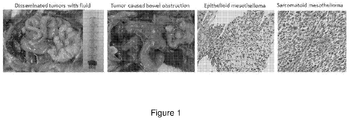
- MexTAg299 transgenic mice are suitable for testing asbestos-induced mesothelioma with 100% incidence.
- MexTAg mice exposed to asbestos develop cancer that faithfully replicates key features of the pathogenesis of human mesothelioma.
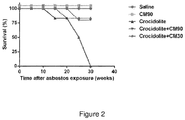
- the protective effect of compound CM against mesothelioma was tested in a MexTAg mouse model following asbestos exposure.
- mice Six MexTAg299 transgenic mice (17-19 weeks old) were subjected to intraperitoneal (i.p.) injection of two doses of 2-3 mg crocidolite (blue) asbestos one month apart (weeks 1 and 4).
- CM was injected i.p. weekly at either 30 mg/kg (6 mice; 0.6 mg/injection) or 90 mg/kg (6 mice; 1.8 mg/injection) from the beginning of the crocidolite insult (week 1) until post-mortem. Controls were normal saline (0.9%) or CM at 90 mg/kg (3 mice each).
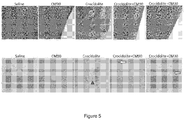
- liver showed the most obvious changes in morphology and thus liver section cutting and histological staining was performed first.
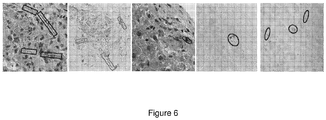
- liver mesotheliomal tumours were seen under the microscope, and less damaged liver cells were seen after CM treatment (compare the crocidolite HE slide in Figure 5 with the two crocidolite+CM slides to the right).
- Macrophage phagocytosis was more prominent in crocidolite+CM30.
- the histology results suggest that asbestos fibres may inhibit phagocytotic activities thereby exacerbating cell damage and cytotoxic effects, whereas the presence of CM might overcome this effect and enhance macrophage activity and phagocytosis.
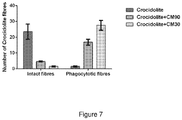
- Figure 7 shows total counts of asbestos fibres in the liver peritoneal membrane. Most asbestos fibres in asbestos-injected mice were freely dispersed in the liver peritoneum (blue bar at left in Figure 7 ), while a clear majority of fibres in crocidolite+CM-injected mice were phagocytosed in Kupffer (liver) macrophages (grey and green bars to the right in Figure 7 ).
- the spleen peritoneum samples were quantified in the same way as for the liver results above.
- Total asbestos fibre counts were made for 18 mice (6 asbestos treated; 6 crocidolite+CM90; and 6 crocidolite+CM30). For each mouse, 10 fields (40x) covering 80-100% were counted.
- Figure 9 shows total counts of asbestos fibres in the spleen peritoneal membrane. Most asbestos fibres in asbestos-injected mice were freely dispersed in the peritoneum (blue bar at left in Figure 9 ), while a clear majority of fibres in crocidolite+CM injected mice were phagocytosed (grey and green bars to the right in Figure 9 ).
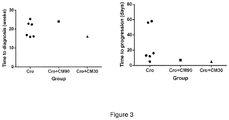
- mice Six MexTAg299 transgenic mice (17-19 weeks old) were subjected to i.p. injection of two doses of 2-3 mg crocidolite (blue) asbestos one month apart (weeks 1 and 4).
- CM was injected i.p. weekly at 30 mg/kg (6 mice; 0.6 mg/injection) from the beginning of the crocidolite insult (week 1) until post-mortem, for the first sub-group of mice, which was a repeat of Example 2.
- 'Cro+Early CM' was for CM injected once weekly, beginning at week 1 along with crocidolite, then stopped at week 10 and the surviving mice observed out to week 30 week.
- 'Late CM' was for CM injected once weekly, but not beginning until week 10 (with crocidolite as usual given i.p. at weeks 1 and 3), and continued weekly until the end of the trial at week 30 weeks.
- Hevel et al (BMC Genomics 2008, 9, 376 ) identified 43 genes with increased expression and 22 genes whose expression was down regulated after A549 cells were exposed to 6 ⁇ g/cm 2 of crocidolite asbestos for 24 hours.
- EGR1 Early Growth Response 1
- IL-8 exhibited a 16.6% increase in expression in asbestos-treated A549 cells.
- EGR1 is a transcription factor found in the nucleus. It activates expression of a number of target genes that are involved in the response to various types of cellular stress - TNF- ⁇ , TGF- ⁇ , ICAM-1, CD44 and PDGF- ⁇ and PDGF- ⁇ chains ( Khachigian and Collins, Arterioscler. Thromb. Vasc. Biol. 17: 2280-2286 ).
- IL-8 is a chemokine and inflammatory cytokine produced by various cell types. It is the major neutrophil chemotactic factor in the lung integral to the inflammatory response to foreign particulates such as asbestos fibres.
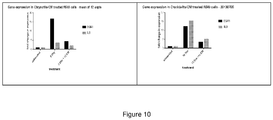
- A549 cells were seeded into either 24-well plates or T25cm 2 flasks to achieve 70% confluence at the time of exposure to asbestos fibres. Initially, cells were treated with a titration of 1-10 ⁇ g/cm 2 asbestos and changes in expression were observed with a dose-dependent response. Concentrations of 5 ⁇ g/cm 2 chrysotile and 10 ⁇ g/cm 2 crocidolite were subsequently chosen as test concentrations against which the mitigating effect of increases in asbestos-induced changes in gene expression in the presence of CM was measured. The concentration of CM used was optimised at 10 ⁇ g/ml.
- A549 cells were exposed to asbestos fibres +/- CM for 24 hours before RNA was isolated and reverse transcription performed to yield cDNA for qRT-PCR analysis. Samples were analysed for EGR1 and IL-8 expression using Applied Biosystems reagents and instruments. Gene expression was normalised to 18S ribosomal RNA in control and sample groups to generate fold-change in expression values.
- the qRT-PCR protocol used was as follows: 1) Seed cells into 24 well plate (8 x 10 4 cells in 1 ml/well) or T25 (1 x 10 6 cells in 5 ml medium) and allow to adhere overnight. 2) Remove media and add crocidolite/CM in fresh media. Expose cells to asbestos for 24 hours. 3) Remove media and wash cell monolayer with PBS. 4) Add Trizol - 100 ⁇ l/well for 24-well plate or 1 ml/T25 flask. Cells will lyse and detach. 5) Transfer Trizol to an eppendorf tube. Add 200 ⁇ l chloroform and shake vigorously for 1 minute. 6) Proceed with RNA extraction according to Trizol manufacturer's protocol.
- RNA samples Resuspend RNA in 40 ⁇ l RNAse free water. 8) Quantify RNA yield in nanodrop at A260/230 9) Perform reverse transcription according to manufacturers protocol (use High Capacity cDNA Reverse Transcription Kit from Applied Biosystems #) A total of 2ug RNA per reaction is optimal. 10) Store cDNA at -20 °C and remaining RNA at -80 °C. 11) Perform qRT-PCR using 1.5 ⁇ l cDNA/reaction. Samples are amplified using Taqman Gene Expression Master Mix (Applied Biosystems #4369016) with the following: 1.5 ⁇ l Primers 10 ⁇ l Master Mix 1.5 ⁇ l cDNA 7.5 ⁇ l water
- Figure 10 demonstrates the results (mean of 12 experiments). Both chrysotile and crocidolite increase expression of EGR1 relative to untreated A549 cells, 16.7% and 12.3% respectively. Chrysotile-induced IL-8 expression increases 3.7% while exposure to crocidolite increases IL-8 expression 15.3% relative to untreated controls.
- MexTAg transgenic mice express the SV40 large T antigen specifically in mesothelial cells by use of the cell-type-specific mesothelin promoter. When exposed to asbestos, these mice develop cancers at 100% incidence that faithfully replicate key features of the pathogenesis of human mesothelioma.
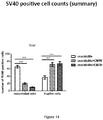
- SV-40 antigen detection is by staining to a yellow-brown colour. Slides were photographed under 40x and 100x magnifications.
- the enhanced SV-40 expression seen in the Kupffer cells from asbestos+CM treated mice might be explained by the phagocytotic effect.
- the detection of SV40 antigen in liver mesothelial cells is evidence that these cells are likely to develop into mesotheliomas.
- There is a clear absence of SV40 antigen in the asbestos+CM mice probably because Kupffer cells have removed any SV40 positive mesothelial cells by phagocytosis, resulting in the detection of SV40 only in the cytoplasm of Kupffer cells.
- the SV40 staining is more prominent in the Kupffer liver macrophages than in the mesothelial cells. Since both are visualised at the same magnification, the difference is clearly due to the much larger size of macrophage versus mesothelial cells.
Landscapes
- Health & Medical Sciences (AREA)
- Public Health (AREA)
- Chemical & Material Sciences (AREA)
- Medicinal Chemistry (AREA)
- Veterinary Medicine (AREA)
- Pharmacology & Pharmacy (AREA)
- Life Sciences & Earth Sciences (AREA)
- Animal Behavior & Ethology (AREA)
- General Health & Medical Sciences (AREA)
- Epidemiology (AREA)
- Inorganic Chemistry (AREA)
- Pulmonology (AREA)
- Engineering & Computer Science (AREA)
- Bioinformatics & Cheminformatics (AREA)
- Organic Chemistry (AREA)
- Nuclear Medicine, Radiotherapy & Molecular Imaging (AREA)
- General Chemical & Material Sciences (AREA)
- Chemical Kinetics & Catalysis (AREA)
- Dermatology (AREA)
- Pharmaceuticals Containing Other Organic And Inorganic Compounds (AREA)
Claims (8)
- Ein Zeolith für die Verwendung bei der Behandlung oder Prävention von Mesotheliom, Asbestose oder asbest-bedingtem Lungenkrebs bei einer Person, wobei der Zeolith ausgewählt ist aus der Gruppe bestehend aus: Amicit, Analcim, Barrerit, Bellbergit, Bikitait, Boggsit, Brewsterit, Chabasit, Klinoptilolith, Cowlesit, Dachiardit, Direnzoit, Edingtonit, Epistilbit, Faujasit, Flörkeit, Ferrierit, Garronit, Gismondin, Gmelinit, Gobbinsit, Gonnardit, Goosecreekit, Harmotom, Herschelit, Heulandit, Laumontit, Leucit, Kalborsit, Levyn, Maricopait, Mazzit, Merlinoit, Mesolith, Montesommait, Mordenit, Mutinait, Natrolith, Offretit, Paranatrolith, Paulingit, Pentasil, Perlialith, Phillipsit, Pollucit, Skolezit, Stellerit, Stilbit, Svetlozarit, Tetranatrolith, Thomsonit, Terranovait, Tschernichit, Tschörtnerit, Wairakit, Wenkit, Wellsit, Willhendersonit, Yugawaralith einschließlich aller Kombinationen davon, vorzugsweise Klinoptilolith und Chabizit.
- Der Zeolith für die Verwendung gemäß Anspruch 1, wobei die Verwendung eine Verwendung zur Prävention von Mesotheliom, Asbestose oder asbest-bedingtem Lungenkrebs bei einer Person ist.
- Der Zeolith für die Verwendung gemäß Anspruch 2, wobei die Person eine Person ist, die als gefährdet gilt, Mesotheliom, Asbestose oder asbestbedingten Lungenkrebs zu entwickeln.
- Der Zeolith für die Verwendung gemäß Anspruch 3, wobei die Person, der als gefährdet gilt, Mesotheliom, Asbestose oder asbestbedingten Lungenkrebs zu entwickeln, eine Person ist, die in Zukunft Asbest ausgesetzt sein wird und wobei der Zeolith vor dem ersten Aussetzen oder während des Asbest-Aussetzens verabreicht wird.
- Der Zeolith für die Verwendung gemäß Anspruch 1, wobei die Verwendung eine Verwendung zur Behandlung von Mesotheliom, Asbestose oder asbest-bedingtem Lungenkrebs bei einer Person ist.
- Der Zeolith für die Verwendung gemäß einem der Ansprüche 1 bis 5, wobei der Zeolith in Form von Mikropartikeln verabreicht wird.
- Der Zeolith für die Verwendung gemäß einem der Ansprüche 1 bis 6, wobei der Zeolith ausgewählt ist aus der Gruppe bestehend aus: Chabazit, Klinoptilolith, Ferrierit, Boggsit, Mordenit, Faujasit oder einer Kombination davon, vorzugsweise Klinoptilolith oder Chabizit.
- Der Zeolith gemäß einem der Ansprüche 1 bis 7, wobei der Zeolith parenteral oder durch Inhalation verabreicht wird.
Applications Claiming Priority (2)
| Application Number | Priority Date | Filing Date | Title |
|---|---|---|---|
| AU2014904751A AU2014904751A0 (en) | 2014-11-24 | Methods for the treatment and prevention of asbestos-related diseases | |
| PCT/AU2015/050737 WO2016081993A1 (en) | 2014-11-24 | 2015-11-24 | Methods for the treatment and prevention of asbestos-related diseases |
Publications (3)
| Publication Number | Publication Date |
|---|---|
| EP3223828A1 EP3223828A1 (de) | 2017-10-04 |
| EP3223828A4 EP3223828A4 (de) | 2018-06-27 |
| EP3223828B1 true EP3223828B1 (de) | 2020-06-17 |
Family
ID=56073220
Family Applications (1)
| Application Number | Title | Priority Date | Filing Date |
|---|---|---|---|
| EP15862201.9A Active EP3223828B1 (de) | 2014-11-24 | 2015-11-24 | Verfahren zur behandlung und vorbeugung von erkrankungen im zusammenhang mit asbest |
Country Status (4)
| Country | Link |
|---|---|
| US (1) | US10398727B2 (de) |
| EP (1) | EP3223828B1 (de) |
| AU (1) | AU2015354399B2 (de) |
| WO (1) | WO2016081993A1 (de) |
Family Cites Families (6)
| Publication number | Priority date | Publication date | Assignee | Title |
|---|---|---|---|---|
| AU7881000A (en) * | 1999-08-16 | 2001-03-13 | Henceforth Hibernia, Inc. | Therapeutic and prophylactic compositions including catalytic biomimetic solids and methods to prepare and use them |
| BG65218B1 (bg) | 2001-02-28 | 2007-08-31 | Недялка ИЗМИРОВА | Средство за намаляване на риска от ракови заболявания |
| AU2002334982A1 (en) * | 2002-10-11 | 2004-05-04 | William S. Lovell | Self-powered, wearable personal air purifier for breathing and body protection |
| DE10323758A1 (de) | 2003-05-22 | 2004-12-16 | Bauer, Wulf, Dr. | Heilmittel zur inneren Anwendung, insbesondere gegen Krebserkrankungen |
| US20050100529A1 (en) | 2003-11-06 | 2005-05-12 | Zeldis Jerome B. | Methods of using and compositions comprising immunomodulatory compounds for the treatment and management of asbestos-related diseases and disorders |
| WO2011065301A1 (ja) | 2009-11-27 | 2011-06-03 | Rapas株式会社 | ゼオライト含有飲食品 |
-
2015
- 2015-11-24 WO PCT/AU2015/050737 patent/WO2016081993A1/en not_active Ceased
- 2015-11-24 AU AU2015354399A patent/AU2015354399B2/en active Active
- 2015-11-24 EP EP15862201.9A patent/EP3223828B1/de active Active
- 2015-11-24 US US15/528,707 patent/US10398727B2/en active Active
Non-Patent Citations (1)
| Title |
|---|
| None * |
Also Published As
| Publication number | Publication date |
|---|---|
| US20170258829A1 (en) | 2017-09-14 |
| AU2015354399A1 (en) | 2017-07-13 |
| AU2015354399B2 (en) | 2020-05-14 |
| EP3223828A1 (de) | 2017-10-04 |
| US10398727B2 (en) | 2019-09-03 |
| WO2016081993A1 (en) | 2016-06-02 |
| EP3223828A4 (de) | 2018-06-27 |
Similar Documents
| Publication | Publication Date | Title |
|---|---|---|
| Mappa et al. | Salvage chemoimmunotherapy with rituximab, ifosfamide and etoposide (R‐IE regimen) in patients with primary CNS lymphoma relapsed or refractory to high‐dose methotrexate‐based chemotherapy | |
| JP5709266B2 (ja) | 放射線及び化学療法傷害に用いる局所的に活性なステロイド | |
| ES2813340T3 (es) | Método de tratamiento del cáncer | |
| EP0971735B1 (de) | Verfahren und zusammensetzungen zur behandlung entzündlicher darmerkrankungen | |
| Feld et al. | Combined modality treatment of small cell carcinoma of the lung | |
| ES2815564T3 (es) | C. novyi para el tratamiento de tumores sólidos en seres humanos | |
| Johnson et al. | Safety and efficacy of tandem 131I‐metaiodobenzylguanidine infusions in relapsed/refractory neuroblastoma | |
| Den et al. | Practical guide to the use of radium 223 dichloride | |
| Yuan et al. | Disulfiram protects against radiation-induced intestinal injury in mice | |
| Vandenberghe et al. | Role of a second transplant in the management of poor-prognosis lymphomas: a report from the European Blood and Bone Marrow Registry. | |
| Sculier et al. | Late intensification in small-cell lung cancer: a phase I study of high doses of cyclophosphamide and etoposide with autologous bone marrow transplantation. | |
| KR20190124713A (ko) | 염증성 장 질환 및 장 결장염을 치료하는데 사용하기 위한 조성물 | |
| US10398727B2 (en) | Methods for the treatment and prevention of asbestos-related diseases | |
| AU2018269462B2 (en) | A pharmaceutical combination for the treatment of a cancer | |
| Cogle et al. | Busulfan, cyclophosphamide, and etoposide as conditioning for autologous stem cell transplantation in multiple myeloma | |
| CN114081880B (zh) | 木香内酯及其衍生物在制备预防和/或治疗肠损伤的药物中的用途 | |
| Schubert et al. | Oral complications of bone-marrow transplantation | |
| JP5553306B2 (ja) | 放射線障害防護剤 | |
| GB2501591A (en) | Cyclohexenone compounds for treating bone cancer metastasis | |
| Rodriguez et al. | Therapeutic concepts in mantle cell lymphoma | |
| ES2964366T3 (es) | Antagonista de XPO1, KPT-251, para el tratamiento del síndrome mielodisplásico | |
| Maiti et al. | Therapeutic evaluation of herbal “ImmuPlus” with or without Doxorubicin in the management of canine mammary tumours | |
| JP2026069662A (ja) | 悪性中皮腫の治療薬 | |
| Boshahma et al. | Olive Oil's protective potential against cyclophosphamide-induced nephrotoxicity in Swiss albino rats | |
| JP6099043B2 (ja) | 造血又は腸管放射線障害防護剤 |
Legal Events
| Date | Code | Title | Description |
|---|---|---|---|
| STAA | Information on the status of an ep patent application or granted ep patent |
Free format text: STATUS: THE INTERNATIONAL PUBLICATION HAS BEEN MADE |
|
| PUAI | Public reference made under article 153(3) epc to a published international application that has entered the european phase |
Free format text: ORIGINAL CODE: 0009012 |
|
| STAA | Information on the status of an ep patent application or granted ep patent |
Free format text: STATUS: REQUEST FOR EXAMINATION WAS MADE |
|
| 17P | Request for examination filed |
Effective date: 20170622 |
|
| AK | Designated contracting states |
Kind code of ref document: A1 Designated state(s): AL AT BE BG CH CY CZ DE DK EE ES FI FR GB GR HR HU IE IS IT LI LT LU LV MC MK MT NL NO PL PT RO RS SE SI SK SM TR |
|
| AX | Request for extension of the european patent |
Extension state: BA ME |
|
| DAV | Request for validation of the european patent (deleted) | ||
| DAX | Request for extension of the european patent (deleted) | ||
| A4 | Supplementary search report drawn up and despatched |
Effective date: 20180528 |
|
| RIC1 | Information provided on ipc code assigned before grant |
Ipc: A61P 35/00 20060101ALI20180522BHEP Ipc: A61K 33/06 20060101AFI20180522BHEP Ipc: A61K 33/08 20060101ALI20180522BHEP Ipc: A61K 45/06 20060101ALI20180522BHEP Ipc: A61P 11/00 20060101ALI20180522BHEP |
|
| RIC1 | Information provided on ipc code assigned before grant |
Ipc: A61P 11/00 20060101ALI20180618BHEP Ipc: A61K 33/08 20060101ALI20180618BHEP Ipc: A61K 45/06 20060101ALI20180618BHEP Ipc: A61K 33/06 20060101AFI20180618BHEP Ipc: A61P 35/00 20060101ALI20180618BHEP |
|
| GRAP | Despatch of communication of intention to grant a patent |
Free format text: ORIGINAL CODE: EPIDOSNIGR1 |
|
| STAA | Information on the status of an ep patent application or granted ep patent |
Free format text: STATUS: GRANT OF PATENT IS INTENDED |
|
| INTG | Intention to grant announced |
Effective date: 20200110 |
|
| GRAS | Grant fee paid |
Free format text: ORIGINAL CODE: EPIDOSNIGR3 |
|
| GRAA | (expected) grant |
Free format text: ORIGINAL CODE: 0009210 |
|
| STAA | Information on the status of an ep patent application or granted ep patent |
Free format text: STATUS: THE PATENT HAS BEEN GRANTED |
|
| AK | Designated contracting states |
Kind code of ref document: B1 Designated state(s): AL AT BE BG CH CY CZ DE DK EE ES FI FR GB GR HR HU IE IS IT LI LT LU LV MC MK MT NL NO PL PT RO RS SE SI SK SM TR |
|
| REG | Reference to a national code |
Ref country code: GB Ref legal event code: FG4D |
|
| REG | Reference to a national code |
Ref country code: CH Ref legal event code: EP |
|
| REG | Reference to a national code |
Ref country code: IE Ref legal event code: FG4D |
|
| REG | Reference to a national code |
Ref country code: DE Ref legal event code: R096 Ref document number: 602015054538 Country of ref document: DE |
|
| REG | Reference to a national code |
Ref country code: AT Ref legal event code: REF Ref document number: 1280513 Country of ref document: AT Kind code of ref document: T Effective date: 20200715 |
|
| REG | Reference to a national code |
Ref country code: DE Ref legal event code: R081 Ref document number: 602015054538 Country of ref document: DE Owner name: BIO-LATEM TECHNOLOGIES PTY LIMITED, AU Free format text: FORMER OWNER: UNIVERSITY OF TECHNOLOGY, SYDNEY, ULTIMO, NEW SOUTH WALES, AU |
|
| RAP2 | Party data changed (patent owner data changed or rights of a patent transferred) |
Owner name: BIO-LATEM TECHNOLOGIES PTY LIMITED |
|
| PG25 | Lapsed in a contracting state [announced via postgrant information from national office to epo] |
Ref country code: LT Free format text: LAPSE BECAUSE OF FAILURE TO SUBMIT A TRANSLATION OF THE DESCRIPTION OR TO PAY THE FEE WITHIN THE PRESCRIBED TIME-LIMIT Effective date: 20200617 Ref country code: GR Free format text: LAPSE BECAUSE OF FAILURE TO SUBMIT A TRANSLATION OF THE DESCRIPTION OR TO PAY THE FEE WITHIN THE PRESCRIBED TIME-LIMIT Effective date: 20200918 Ref country code: SE Free format text: LAPSE BECAUSE OF FAILURE TO SUBMIT A TRANSLATION OF THE DESCRIPTION OR TO PAY THE FEE WITHIN THE PRESCRIBED TIME-LIMIT Effective date: 20200617 Ref country code: NO Free format text: LAPSE BECAUSE OF FAILURE TO SUBMIT A TRANSLATION OF THE DESCRIPTION OR TO PAY THE FEE WITHIN THE PRESCRIBED TIME-LIMIT Effective date: 20200917 Ref country code: FI Free format text: LAPSE BECAUSE OF FAILURE TO SUBMIT A TRANSLATION OF THE DESCRIPTION OR TO PAY THE FEE WITHIN THE PRESCRIBED TIME-LIMIT Effective date: 20200617 |
|
| REG | Reference to a national code |
Ref country code: LT Ref legal event code: MG4D |
|
| REG | Reference to a national code |
Ref country code: NL Ref legal event code: MP Effective date: 20200617 |
|
| PG25 | Lapsed in a contracting state [announced via postgrant information from national office to epo] |
Ref country code: HR Free format text: LAPSE BECAUSE OF FAILURE TO SUBMIT A TRANSLATION OF THE DESCRIPTION OR TO PAY THE FEE WITHIN THE PRESCRIBED TIME-LIMIT Effective date: 20200617 Ref country code: RS Free format text: LAPSE BECAUSE OF FAILURE TO SUBMIT A TRANSLATION OF THE DESCRIPTION OR TO PAY THE FEE WITHIN THE PRESCRIBED TIME-LIMIT Effective date: 20200617 Ref country code: BG Free format text: LAPSE BECAUSE OF FAILURE TO SUBMIT A TRANSLATION OF THE DESCRIPTION OR TO PAY THE FEE WITHIN THE PRESCRIBED TIME-LIMIT Effective date: 20200917 Ref country code: LV Free format text: LAPSE BECAUSE OF FAILURE TO SUBMIT A TRANSLATION OF THE DESCRIPTION OR TO PAY THE FEE WITHIN THE PRESCRIBED TIME-LIMIT Effective date: 20200617 |
|
| REG | Reference to a national code |
Ref country code: AT Ref legal event code: MK05 Ref document number: 1280513 Country of ref document: AT Kind code of ref document: T Effective date: 20200617 |
|
| PG25 | Lapsed in a contracting state [announced via postgrant information from national office to epo] |
Ref country code: NL Free format text: LAPSE BECAUSE OF FAILURE TO SUBMIT A TRANSLATION OF THE DESCRIPTION OR TO PAY THE FEE WITHIN THE PRESCRIBED TIME-LIMIT Effective date: 20200617 Ref country code: AL Free format text: LAPSE BECAUSE OF FAILURE TO SUBMIT A TRANSLATION OF THE DESCRIPTION OR TO PAY THE FEE WITHIN THE PRESCRIBED TIME-LIMIT Effective date: 20200617 |
|
| PG25 | Lapsed in a contracting state [announced via postgrant information from national office to epo] |
Ref country code: PT Free format text: LAPSE BECAUSE OF FAILURE TO SUBMIT A TRANSLATION OF THE DESCRIPTION OR TO PAY THE FEE WITHIN THE PRESCRIBED TIME-LIMIT Effective date: 20201019 Ref country code: IT Free format text: LAPSE BECAUSE OF FAILURE TO SUBMIT A TRANSLATION OF THE DESCRIPTION OR TO PAY THE FEE WITHIN THE PRESCRIBED TIME-LIMIT Effective date: 20200617 Ref country code: EE Free format text: LAPSE BECAUSE OF FAILURE TO SUBMIT A TRANSLATION OF THE DESCRIPTION OR TO PAY THE FEE WITHIN THE PRESCRIBED TIME-LIMIT Effective date: 20200617 Ref country code: SM Free format text: LAPSE BECAUSE OF FAILURE TO SUBMIT A TRANSLATION OF THE DESCRIPTION OR TO PAY THE FEE WITHIN THE PRESCRIBED TIME-LIMIT Effective date: 20200617 Ref country code: AT Free format text: LAPSE BECAUSE OF FAILURE TO SUBMIT A TRANSLATION OF THE DESCRIPTION OR TO PAY THE FEE WITHIN THE PRESCRIBED TIME-LIMIT Effective date: 20200617 Ref country code: RO Free format text: LAPSE BECAUSE OF FAILURE TO SUBMIT A TRANSLATION OF THE DESCRIPTION OR TO PAY THE FEE WITHIN THE PRESCRIBED TIME-LIMIT Effective date: 20200617 Ref country code: ES Free format text: LAPSE BECAUSE OF FAILURE TO SUBMIT A TRANSLATION OF THE DESCRIPTION OR TO PAY THE FEE WITHIN THE PRESCRIBED TIME-LIMIT Effective date: 20200617 Ref country code: CZ Free format text: LAPSE BECAUSE OF FAILURE TO SUBMIT A TRANSLATION OF THE DESCRIPTION OR TO PAY THE FEE WITHIN THE PRESCRIBED TIME-LIMIT Effective date: 20200617 |
|
| PG25 | Lapsed in a contracting state [announced via postgrant information from national office to epo] |
Ref country code: SK Free format text: LAPSE BECAUSE OF FAILURE TO SUBMIT A TRANSLATION OF THE DESCRIPTION OR TO PAY THE FEE WITHIN THE PRESCRIBED TIME-LIMIT Effective date: 20200617 Ref country code: PL Free format text: LAPSE BECAUSE OF FAILURE TO SUBMIT A TRANSLATION OF THE DESCRIPTION OR TO PAY THE FEE WITHIN THE PRESCRIBED TIME-LIMIT Effective date: 20200617 Ref country code: IS Free format text: LAPSE BECAUSE OF FAILURE TO SUBMIT A TRANSLATION OF THE DESCRIPTION OR TO PAY THE FEE WITHIN THE PRESCRIBED TIME-LIMIT Effective date: 20201017 |
|
| REG | Reference to a national code |
Ref country code: DE Ref legal event code: R097 Ref document number: 602015054538 Country of ref document: DE |
|
| PLBE | No opposition filed within time limit |
Free format text: ORIGINAL CODE: 0009261 |
|
| STAA | Information on the status of an ep patent application or granted ep patent |
Free format text: STATUS: NO OPPOSITION FILED WITHIN TIME LIMIT |
|
| PG25 | Lapsed in a contracting state [announced via postgrant information from national office to epo] |
Ref country code: DK Free format text: LAPSE BECAUSE OF FAILURE TO SUBMIT A TRANSLATION OF THE DESCRIPTION OR TO PAY THE FEE WITHIN THE PRESCRIBED TIME-LIMIT Effective date: 20200617 |
|
| 26N | No opposition filed |
Effective date: 20210318 |
|
| PG25 | Lapsed in a contracting state [announced via postgrant information from national office to epo] |
Ref country code: SI Free format text: LAPSE BECAUSE OF FAILURE TO SUBMIT A TRANSLATION OF THE DESCRIPTION OR TO PAY THE FEE WITHIN THE PRESCRIBED TIME-LIMIT Effective date: 20200617 |
|
| PG25 | Lapsed in a contracting state [announced via postgrant information from national office to epo] |
Ref country code: MC Free format text: LAPSE BECAUSE OF FAILURE TO SUBMIT A TRANSLATION OF THE DESCRIPTION OR TO PAY THE FEE WITHIN THE PRESCRIBED TIME-LIMIT Effective date: 20200617 |
|
| REG | Reference to a national code |
Ref country code: CH Ref legal event code: PL |
|
| PG25 | Lapsed in a contracting state [announced via postgrant information from national office to epo] |
Ref country code: LU Free format text: LAPSE BECAUSE OF NON-PAYMENT OF DUE FEES Effective date: 20201124 |
|
| REG | Reference to a national code |
Ref country code: BE Ref legal event code: MM Effective date: 20201130 |
|
| PG25 | Lapsed in a contracting state [announced via postgrant information from national office to epo] |
Ref country code: LI Free format text: LAPSE BECAUSE OF NON-PAYMENT OF DUE FEES Effective date: 20201130 Ref country code: CH Free format text: LAPSE BECAUSE OF NON-PAYMENT OF DUE FEES Effective date: 20201130 |
|
| PG25 | Lapsed in a contracting state [announced via postgrant information from national office to epo] |
Ref country code: IE Free format text: LAPSE BECAUSE OF NON-PAYMENT OF DUE FEES Effective date: 20201124 |
|
| PG25 | Lapsed in a contracting state [announced via postgrant information from national office to epo] |
Ref country code: TR Free format text: LAPSE BECAUSE OF FAILURE TO SUBMIT A TRANSLATION OF THE DESCRIPTION OR TO PAY THE FEE WITHIN THE PRESCRIBED TIME-LIMIT Effective date: 20200617 Ref country code: MT Free format text: LAPSE BECAUSE OF FAILURE TO SUBMIT A TRANSLATION OF THE DESCRIPTION OR TO PAY THE FEE WITHIN THE PRESCRIBED TIME-LIMIT Effective date: 20200617 Ref country code: CY Free format text: LAPSE BECAUSE OF FAILURE TO SUBMIT A TRANSLATION OF THE DESCRIPTION OR TO PAY THE FEE WITHIN THE PRESCRIBED TIME-LIMIT Effective date: 20200617 |
|
| PG25 | Lapsed in a contracting state [announced via postgrant information from national office to epo] |
Ref country code: MK Free format text: LAPSE BECAUSE OF FAILURE TO SUBMIT A TRANSLATION OF THE DESCRIPTION OR TO PAY THE FEE WITHIN THE PRESCRIBED TIME-LIMIT Effective date: 20200617 |
|
| PG25 | Lapsed in a contracting state [announced via postgrant information from national office to epo] |
Ref country code: BE Free format text: LAPSE BECAUSE OF NON-PAYMENT OF DUE FEES Effective date: 20201130 |
|
| P01 | Opt-out of the competence of the unified patent court (upc) registered |
Effective date: 20230608 |
|
| PGFP | Annual fee paid to national office [announced via postgrant information from national office to epo] |
Ref country code: DE Payment date: 20251118 Year of fee payment: 11 |
|
| PGFP | Annual fee paid to national office [announced via postgrant information from national office to epo] |
Ref country code: GB Payment date: 20251124 Year of fee payment: 11 |
|
| PGFP | Annual fee paid to national office [announced via postgrant information from national office to epo] |
Ref country code: FR Payment date: 20251125 Year of fee payment: 11 |