EP3211348A1 - Wärmegedämmtes gehäuse für ein klimagerät - Google Patents
Wärmegedämmtes gehäuse für ein klimagerät Download PDFInfo
- Publication number
- EP3211348A1 EP3211348A1 EP17155556.8A EP17155556A EP3211348A1 EP 3211348 A1 EP3211348 A1 EP 3211348A1 EP 17155556 A EP17155556 A EP 17155556A EP 3211348 A1 EP3211348 A1 EP 3211348A1
- Authority
- EP
- European Patent Office
- Prior art keywords
- housing
- plastic extrusion
- profile
- frame
- plastic
- Prior art date
- Legal status (The legal status is an assumption and is not a legal conclusion. Google has not performed a legal analysis and makes no representation as to the accuracy of the status listed.)
- Granted
Links
Images
Classifications
-
- F—MECHANICAL ENGINEERING; LIGHTING; HEATING; WEAPONS; BLASTING
- F24—HEATING; RANGES; VENTILATING
- F24F—AIR-CONDITIONING; AIR-HUMIDIFICATION; VENTILATION; USE OF AIR CURRENTS FOR SCREENING
- F24F13/00—Details common to, or for air-conditioning, air-humidification, ventilation or use of air currents for screening
- F24F13/20—Casings or covers
-
- F—MECHANICAL ENGINEERING; LIGHTING; HEATING; WEAPONS; BLASTING
- F24—HEATING; RANGES; VENTILATING
- F24F—AIR-CONDITIONING; AIR-HUMIDIFICATION; VENTILATION; USE OF AIR CURRENTS FOR SCREENING
- F24F13/00—Details common to, or for air-conditioning, air-humidification, ventilation or use of air currents for screening
- F24F13/02—Ducting arrangements
- F24F13/0263—Insulation for air ducts
-
- B—PERFORMING OPERATIONS; TRANSPORTING
- B29—WORKING OF PLASTICS; WORKING OF SUBSTANCES IN A PLASTIC STATE IN GENERAL
- B29C—SHAPING OR JOINING OF PLASTICS; SHAPING OF MATERIAL IN A PLASTIC STATE, NOT OTHERWISE PROVIDED FOR; AFTER-TREATMENT OF THE SHAPED PRODUCTS, e.g. REPAIRING
- B29C48/00—Extrusion moulding, i.e. expressing the moulding material through a die or nozzle which imparts the desired form; Apparatus therefor
- B29C48/03—Extrusion moulding, i.e. expressing the moulding material through a die or nozzle which imparts the desired form; Apparatus therefor characterised by the shape of the extruded material at extrusion
- B29C48/09—Articles with cross-sections having partially or fully enclosed cavities, e.g. pipes or channels
-
- B—PERFORMING OPERATIONS; TRANSPORTING
- B29—WORKING OF PLASTICS; WORKING OF SUBSTANCES IN A PLASTIC STATE IN GENERAL
- B29C—SHAPING OR JOINING OF PLASTICS; SHAPING OF MATERIAL IN A PLASTIC STATE, NOT OTHERWISE PROVIDED FOR; AFTER-TREATMENT OF THE SHAPED PRODUCTS, e.g. REPAIRING
- B29C48/00—Extrusion moulding, i.e. expressing the moulding material through a die or nozzle which imparts the desired form; Apparatus therefor
- B29C48/03—Extrusion moulding, i.e. expressing the moulding material through a die or nozzle which imparts the desired form; Apparatus therefor characterised by the shape of the extruded material at extrusion
- B29C48/12—Articles with an irregular circumference when viewed in cross-section, e.g. window profiles
Definitions
- the air conditioner can be a so-called central air conditioner with which a central climate management in buildings is possible.
- the temperature is significantly lower than in the immediate vicinity of the central air conditioner.
- a good thermal insulation of the housing is of particular importance in terms of energy consumption.
- housing of such air conditioning units are usually designed in steel or aluminum. While the housing walls usually consist of two metallic walls, between which thermal insulation material is introduced and thus a total good thermal insulation in the walls is guaranteed, the frame profiles are designed as extruded profiles of steel or aluminum, which can be provided with thermal dividers. Overall, however, the thermal insulation of the housing frame is not optimal in the prior art.
- the invention has for its object to provide a thermally insulated housing of the type described above, which has improved thermal insulation properties.
- the frame posts are made of plastic extrusion profiles and that at least one plastic extrusion profile has at least one, preferably fully enclosing an extruded, reinforcing insert.
- the invention it has been recognized that a surprisingly large improvement in the overall thermal insulation properties of the housing can be achieved by the use of plastic material in the housing frame.
- at least one plastic extrusion profile according to the invention is reinforced with at least one reinforcing insert.
- the plastic material from which the extrusion profile is made may be e.g. to trade polypropylene or PVC.
- the reinforcing insert can be band-shaped. Ribbon here means that seen in cross section, the width of the reinforcing element is significantly greater than its thickness, for example, more than twice or more than three times as large.
- the reinforcing insert may be made of metal (e.g., steel) or a fiber-matrix semi-finished product having a plastic matrix integrated with, preferably endless, reinforcing fibers.
- the fiber-matrix semifinished product can be formed as an organic sheet.
- Organic sheets are prefabricated, for example, as - in particular rolled - available strip semifinished products and consist of a reinforcing fibers containing fiber fabric or Fasergelege, which is embedded in a thermoplastic matrix.
- the fibers used are preferably glass, aramid and / or carbon fibers.
- the reinforcing fibers are all in the extrusion direction.
- the fiber-matrix semifinished product generally has the advantage that, on the one hand, it contributes to a significant increase in the mechanical load-bearing capacity of the plastic extrusion profile and, on the other hand, also has good thermal insulation properties. It is therefore within the scope of the invention in particular that at least one band-shaped fiber-matrix semifinished product arranged in the interior region of the frame post is provided. In this case, the good thermal insulation of the reinforcing material is of particular importance, since otherwise it would act as a thermal bridge.
- metal reinforcing insert is provided.
- the metal reinforcing insert is expediently in turn formed strip-shaped and is characterized in that it is generally less expensive than the fiber-matrix semifinished product and a higher flexural rigidity has. Since this reinforcing insert is aligned transversely to the heat flow direction in the case of the above-described preferred arrangement, no appreciable temperature gradient runs along the metal reinforcement, so that the good heat-conducting properties of the metal insert in this case have no relevant deterioration of the thermal insulation properties of the entire housing result.
- the metal reinforcement insert can be used without this adversely affecting the thermal insulation of the housing.
- the at least one plastic extrusion profile has a plurality of reinforcing inserts.
- the housing frame may also have a plurality of plastic extrusion profiles, each having at least one reinforcing insert (eg, several reinforcing layers).
- at least one plastic extrusion profile is reinforced both with at least one fiber-matrix semifinished product and at least one metal reinforcement insert.
- the plastic base body of at least one plastic extrusion profile (eg a plurality of plastic extrusion profiles) identify at least one additional function, such as a clip function for a clip connection and / or a resilient leg, for example, to facilitate the enclosure of a wall of a housing wall.
- ⁇ L denotes the change in length of the length element L and ⁇ T the temperature change, which causes the change in length ⁇ L.
- the thermal expansion coefficient of the reinforced plastic extrusion profile is influenced on the one hand by the plastic base material which forms the plastic matrix of the extrusion profile, and on the other hand by the material of the reinforcement insert.
- This has the overall advantage that in an embodiment of the housing walls with an inner and / or outer wall made of aluminum, the corresponding frame post has the same thermal expansion behavior as the walls. As a result, the occurrence of mechanical stresses due to different thermal expansions is avoided.
- Another advantage of the teaching of the invention is the free color design of the plastic extrusion profiles, which is easily possible by the addition of corresponding color pigments in the plastic base material.
- at least one plastic extrusion profile is furthermore designed as a hollow chamber profile in order to further improve the thermal insulation properties and at the same time to save material.
- the individual frame posts are each composed of at least two parallel juxtaposed plastic extrusion profiles together. As a result, even complex frame post geometries can be easily realized.
- the plastic extrusion profiles in this case fit into each other.
- the sealing profile may for example consist of a thermoplastic elastomer, a plasticized PVC, a polyurethane or a pure elastomer.
- the invention also relates to an air conditioner with a housing according to one of claims 1 to 13.
- Such an air conditioner usually includes a chiller, by means of which a cooled air flow can be provided.
- a device for the separation of liquid formed during cooling (condensation) is also provided.
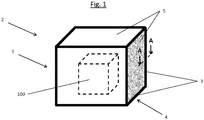
- the Fig. 1 shows a thermally insulated, cuboid housing 1 for a central air conditioner 2.
- This central air conditioner 2 includes a (indicated by dashed lines) chiller 100 for generating cooled air and other components (not shown).
- the air conditioner 2 has a plurality of frame posts 3, which are connected to a cuboid housing frame 4.
- thermally insulated housing walls 5 are provided, which are bordered by the housing frame 4.
- the housing walls 5 each have a thin inner wall 6 and outer wall 6 'made of aluminum, wherein between these two walls 6, 6' insulating material 7 is located.
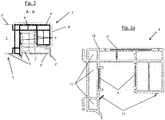
- the frame posts 3 are made of plastic extrusion profiles 8, 8 ', wherein the plastic extrusion profiles 8, 8' in each case in each case a plurality of reinforcing reinforcements 9, 9 ', which are completely enclosed by extrusion (FIG. Fig. 2a . 3a ).
- the frame post 3 also consist of (not shown in detail) unarmed plastic extrusion profiles.
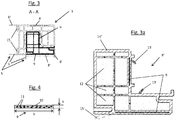
- the reinforcing inserts 9, 9 ' are band-shaped (width b> 2 ⁇ thickness s) and consist either of a steel reinforcing insert 9' or a fiber-matrix semifinished product 9 with a plastic matrix 10, in which endless reinforcing fibers 11 are integrated , This is based on the Fig. 4 clearly, which shows such a fiber-matrix semifinished product 9 in cross-section in a single representation.
- the fiber-matrix semi-finished products 9 are designed as organic sheets.
- Organic sheets are prefabricated, for example as - in particular rolled - available strip fabric semifinished products and consist of a reinforcing fibers 11 containing fiber fabric or fiber fabric, which is embedded in the thermoplastic matrix 10.
- reinforcing fibers 11 are preferably glass, aramid and / or carbon fibers used. In the exemplary embodiment, the reinforcing fibers 11 are all aligned in the band direction.
- the organic sheets 9 are arranged in the inner region of the frame post 3.
- the thermal insulation properties of the organic sheets 9 is thus of particular importance, since they would serve as unwanted thermal bridges with good heat conduction.
- the band-shaped metal reinforcing insert 9 'in Fig. 2, 2a is, however, arranged in the immediate vicinity and parallel to the outer surface B of the housing 1, so that seen in cross section along the metal reinforcing insert 9 'only a small temperature gradient is present and thus their thermal insulation properties are of minor importance. Furthermore, the two in the FIGS.
- the Figures 2 and 3 show further that the frame posts 3 are each composed of two parallel juxtaposed plastic extrusion profiles 8, 8 'together.
- These sealing profiles 13 were produced in a single extrusion process together with the respective plastic basic body 14, 14 'consisting of plastic base material (eg PP or PVC) by means of a corresponding 2K extrusion.
- the reinforcing inserts 9, 9 ' run in the extrusion as a prefabricated, band-shaped product in the extrusion tool and are encased in this case by the plastic base material. In this case, it is expedient to preheat the reinforcing inserts 9, 9 'in each case before they are processed in the extrusion process.
- the sealing profiles 13 in the exemplary embodiment each consist of a thermoplastic elastomer.
- a comparative analysis of the Fig. 3 and 3a shows that the plastic base body 14, 14 ' each have at least one spring leg 15, 15 'and are thereby partially elastically formed to facilitate the enclosure of a wall 6.
Landscapes
- Engineering & Computer Science (AREA)
- Chemical & Material Sciences (AREA)
- Combustion & Propulsion (AREA)
- Mechanical Engineering (AREA)
- General Engineering & Computer Science (AREA)
- Extrusion Moulding Of Plastics Or The Like (AREA)
- Body Structure For Vehicles (AREA)
Abstract
Description
- Die Erfindung betrifft ein wärmegedämmtes, insbesondere quaderförmiges Gehäuse für ein Klimagerät mit
- mehreren Rahmenpfosten, die miteinander zu einem Gehäuserahmen verbunden sind, und
- mehreren, vom Gehäuserahmen eingefassten wärmegedämmten Gehäusewänden.
- Bei dem Klimagerät kann es sich insbesondere um ein sogenanntes Zentralklimagerät handeln, mit dem ein zentrales Klima-Management in Gebäuden möglich ist. Üblicherweise ist in dem Klimagerät zwecks Bereitstellung von gekühlter Luft die Temperatur deutlich niedriger als in der unmittelbaren Umgebung des Zentralklimagerätes. Vor diesem Hintergrund ist eine gute Wärmedämmung des Gehäuses von besonderer Bedeutung hinsichtlich des Energieverbrauchs.
- Um die erforderliche mechanische Stabilität und Robustheit zu gewährleisten, sind die im Stand der Technik bekannten Gehäuse derartiger Klimageräte üblicherweise in Stahl bzw. Aluminium ausgeführt. Während die Gehäusewände in der Regel aus zwei metallischen Wandungen bestehen, zwischen denen Wärmedämmmaterial eingebracht ist und somit insgesamt eine gute Wärmedämmung im Bereich der Wandungen gewährleistet ist, werden die Rahmenprofile als Strangprofile aus Stahl bzw. Aluminium ausgeführt, welche mit thermischen Trennstegen versehen sein können. Insgesamt ist jedoch im Stand der Technik die Wärmedämmung des Gehäuserahmens nicht optimal.
- Vor dem beschriebenen Hintergrund liegt der Erfindung die Aufgabe zugrunde, ein wärmegedämmtes Gehäuse der eingangs beschriebenen Art bereitzustellen, welches verbesserte Wärmedämmeigenschaften aufweist.
- Erfindungsgemäß wird die Aufgabe dadurch gelöst, dass die Rahmenpfosten aus Kunststoff-Extrusionsprofilen bestehen sind und dass mindestens ein Kunststoff-Extrusionsprofil mindestens eine, vorzugsweise vollumschließend einextrudierte, Armierungseinlage aufweist. Erfindungsgemäß wurde erkannt, dass durch den Einsatz von Kunststoffmaterial im Gehäuserahmen eine überraschend große Verbesserung der gesamten Wärmedämmeigenschaften des Gehäuses erzielt werden kann. Um hierbei die erforderliche mechanische Belastbarkeit des Gehäuserahmens zu gewährleisten, ist mindestens ein Kunststoff-Extrusionsprofil erfindungsgemäß mit mindestens einer Armierungseinlage armiert. Bei dem Kunststoff-Material, aus dem das Extrusionsprofil hergestellt wird, kann es sich z.B. um Polypropylen oder PVC handeln.
- Die Armierungseinlage kann bandförmig ausgebildet sein. Bandförmig meint hierbei, dass im Querschnitt gesehen die Breite des Armierungselementes deutlich größer als dessen Dicke ist, beispielsweise mehr als doppelt oder mehr als dreimal so groß. Die Armierungseinlage kann aus Metall (z.B. Stahl) oder einem Faser-Matrix-Halbzeug mit einer Kunststoff-Matrix, in die, vorzugsweise endlose, Verstärkungsfasern integriert sind, bestehen. Insbesondere kann das Faser-Matrix-Halbzeug als Organoblech ausgebildet sein. Organobleche sind vorgefertigte, beispielsweise als - insbesondere gerollte - Bandware verfügbare Halbzeuge und bestehen aus einem die Verstärkungsfasern enthaltenden Fasergewebe oder Fasergelege, das in eine thermoplastische Kunststoff-Matrix eingebettet ist. Als Fasern kommen vorzugsweise Glas-, Aramid- und / oder Carbonfasern zum Einsatz. Zweckmäßigerweise verlaufen die Verstärkungsfasern allesamt in Extrusionsrichtung. Das Faser-Matrix-Halbzeug hat allgemein den Vorteil, dass es einerseits zu einer deutlichen Erhöhung der mechanischen Belastbarkeit des Kunststoff-Extrusionsprofils beiträgt und dabei andererseits selbst ebenfalls gute Wärmedämmeigenschaften besitzt. Im Rahmen der Erfindung liegt es daher insbesondere, dass mindestens ein im Innenbereich des Rahmenpfostens angeordnetes bandförmiges Faser-Matrix-Halbzeug vorgesehen ist. In diesem Fall ist die gute Wärmedämmung des Armierungsmaterials von besonderer Bedeutung, da es andernfalls als Wärmebrücke fungieren würde.
- Im Rahmen der Erfindung liegt es weiterhin, dass mindestens eine, vorzugsweise in unmittelbarer Nähe und parallel zur Außenoberfläche des Gehäuses angeordnete, Metall-Armierungseinlage vorgesehen ist. Die Metall-Armierungseinlage ist zweckmäßigerweise wiederum bandförmig ausgebildet und zeichnet sich dadurch aus, dass sie gegenüber dem Faser-Matrix-Halbzeug in der Regel kostengünstiger ist und eine höhere Biegesteifigkeit besitzt. Da diese Armierungseinlage im Falle der vorbeschriebenen vorzugsweisen Anordnung quer zur Wärmestromrichtung ausgerichtet ist, verläuft entlang der Metallarmierung kein nennenswerter Temperaturgradient, so dass die guten wärmeleitenden Eigenschaften der Metalleinlage in diesem Fall keine relevante Verschlechterung der Wärmedämmeigenschaften des gesamten Gehäuses zur Folge haben. In einem solchen Fall kann also die Metall-Armierungseinlage genutzt werden, ohne dass sich dies nachteilig auf die Wärmedämmung des Gehäuses auswirkt. Im Rahmen der Erfindung liegt es ferner, dass das mindestens eine Kunststoff-Extrusionsprofil mehrere Armierungseinlagen aufweist. Der Gehäuserahmen kann auch mehrere Kunststoff-Extrusionsprofile aufweisen, die jeweils mindestens eine Armierungseinlage (z.B. mehrere Armierungslagen) besitzen. Ferner liegt es im Rahmen der Erfindung, dass mindestens ein Kunststoff-Extrusionsprofil sowohl mit mindestens einem Faser-Matrix-Halbzeug als auch mindestens einer Metall-Armierungseinlage armiert ist. Auch kann der Kunststoff-Grundkörper mindestens eines Kunststoff-Extrusionsprofils (z.B. mehrerer Kunststoff-Extrusionsprofile) mindestens eine zusätzliche Funktion ausweisen, beispielsweise eine Clipsfunktion für eine Clip-Verbindung und/oder einen federnden Schenkel, z.B. um die Einfassung einer Wandung einer Gehäusewand zu erleichtern.
- Vorzugsweise weist das armierte Kunststoff-Extrusionsprofil einen Wärmeausdehnungskoeffizienten

- Vorteilhaft bei der erfindungsgemäßen Lehre ist ferner die freie Farbgestaltung der Kunststoff-Extrusionsprofile, welche durch die Zumischung entsprechender Farbpigmente in das Kunststoff-Grundmaterial problemlos möglich ist. Zweckmäßigerweise ist ferner mindestens ein Kunststoff-Extrusionsprofil als Hohlkammerprofil ausgebildet, um die Wärmedämmeigenschaften weiter zu verbessern und dabei gleichzeitig Material einzusparen. Im Rahmen der Erfindung liegt es insbesondere, dass die einzelnen Rahmenpfosten jeweils aus mindestens zwei parallel nebeneinander angeordneten Kunststoff-Extrusionsprofilen zusammen gesetzt sind. Hierdurch können auch komplexe Rahmenpfosten-Geometrien problemlos realisiert werden. Zweckmäßigerweise greifen die Kunststoff-Extrusionsprofile hierbei passgenau ineinander.
- Ein weiterer Vorteil der erfindungsgemäßen Lehre besteht darin, dass an die Kunststoff-Extrusionsprofile problemlos zusätzliche Komponenten anextrudiert werden können, beispielsweise mindestens ein elastisches Dichtungsprofil. Dies ist insbesondere von Bedeutung, wenn die einzelnen Rahmenpfosten - wie zuvor beschrieben - jeweils aus mehreren parallel nebeneinander angeordneten Kunststoff-Extrusionsprofilen zusammengesetzt sind, die zueinander abgedichtet werden müssen. Im Stand der Technik müssen hierzu in den Stahl- bzw. Aluminiumprofilen regelmäßig Nuten vorgesehen werden, in die separat herzustellende Dichtungslippen eingesetzt werden. Somit bietet die erfindungsgemäße Lehre auch fertigungstechnische Vorteile. Das Dichtungsprofil kann beispielsweise aus einem thermoplastischen Elastomer, einem weichgemachten PVC, einem Polyurethan oder einem reinen Elastomer bestehen.
- Gegenstand der Erfindung ist auch ein Klimagerät mit einem Gehäuse nach einem der Ansprüche 1 bis 13. Ein solches Klimagerät beinhaltet üblicherweise eine Kältemaschine, mittels der ein gekühlter Luftstrom bereitgestellt werden kann. Zweckmäßigerweise ist auch eine Einrichtung zur Abscheidung von bei der Abkühlung entstehender Flüssigkeit (Kondenswasser) vorgesehen.
- Im Folgenden wird die Erfindung anhand einer lediglich ein Ausführungsbeispiel darstellenden Zeichnung ausführlich erläutert. Es zeigen schematisch:
- Fig. 1:
- ein erfindungsgemäßes Gehäuse für ein Klimagerät;
- Fig. 2:
- den Teilschnitt A-A in
Fig. 1 durch einen erfindungsgemäßen Rahmenpfosten; - Fig. 2a:
- das in der
Fig. 2 schwarz dargestellte Profil in einer vergrößerten Detaildarstellung; - Fig. 3:
- eine der
Fig. 2 entsprechende Schnittdarstellung, jedoch mit anderer Schwärzung; - Fig. 3a:
- das in
Fig. 3 geschwärzt dargestellte Profil in einer vergrößerten Detailansicht und - Fig.4
- ein in den
Fig. 2,2a ,3,3a dargestelltes Faser-Matrix-Halbzeug in einer Einzeldarstellung - Die
Fig. 1 zeigt ein wärmegedämmtes, quaderförmiges Gehäuse 1 für ein Zentralklimagerät 2. Dieses Zentralklimagerät 2 umfasst eine (durch gestrichelte Linien angedeutete) Kältemaschine 100 zur Erzeugung von gekühlter Luft sowie weitere Komponenten (nicht näher dargestellt). Das Klimagerät 2 weist mehrere Rahmenpfosten 3 auf, welche miteinander zu einem quaderförmigen Gehäuserahmen 4 verbunden sind. Es sind ferner wärmegedämmte Gehäusewände 5 vorgesehen, welche vom Gehäuserahmen 4 eingefasst sind. Wie dieFiguren 2, 2a ,3 und 3a zeigen, weisen die Gehäusewände 5 weisen jeweils eine dünne Innenwandung 6 und Außenwandung 6' aus Aluminium auf, wobei sich zwischen diesen beiden Wandungen 6, 6' Isolationsmaterial 7 befindet. Die Rahmenpfosten 3 bestehen aus Kunststoff-Extrusionsprofilen 8, 8', wobei die Kunststoff-Extrusionsprofile 8, 8' zum Teil jeweils mehrere, vollumschließend einextrudierte Armierungseinlagen 9, 9' aufweisen (Fig. 2a ,3a ). Zum Teil bestehen die Rahmenpfosten 3 auch aus (nicht im Detail dargestellten) unarmierten Kunststoff-Extrusionsprofilen. Die Armierungseinlagen 9, 9' sind bandförmig ausgebildet (Breite b > 2 · Dicke s) und bestehen entweder aus einer Stahl-Armierungseinlage 9' oder einem Faser-Matrix-Halbzeug 9 mit einer Kunststoff-Matrix 10, in die endlose Verstärkungsfasern 11 integriert sind. Dies wird anhand derFig. 4 deutlich, welche ein solches Faser-Matrix-Halbzeug 9 im Querschnitt in einer Einzeldarstellung zeigt. Im Ausführungsbeispiel sind die Faser-Matrix-Halbzeuge 9 als Organobleche ausgebildet. - Organobleche sind vorgefertigte, beispielsweise als - insbesondere gerollte - Bandware verfügbare Halbzeuge und bestehen aus einem die Verstärkungsfasern 11 enthaltenden Fasergewebe oder Fasergelege, das in die thermoplastische Kunststoff-Matrix 10 eingebettet ist. Als Verstärkungsfasern 11 kommen vorzugsweise Glas-, Aramid- und / oder Carbonfasern zum Einsatz. Im Ausführungsbeispiel sind die Verstärkungsfasern 11 allesamt in Bandrichtung ausgerichtet.
- Anhand der Detaildarstellungen in den
Figuren 2, 2a sowie 3, 3a ist erkennbar, dass die Organobleche 9 im Innenbereich des Rahmenpfostens 3 angeordnet sind. Den Wärmedämmeigenschaften der Organobleche 9 kommt hierdurch eine besondere Bedeutung zu, da sie bei guter Wärmeleitung als unerwünschte Wärmebrücken dienen würden. Die bandförmige Metall-Armierungseinlage 9' inFig. 2, 2a ist hingegen in unmittelbarer Nähe und parallel zur Außenoberfläche B des Gehäuses 1 angeordnet, so dass im Querschnitt gesehen entlang der Metall-Armierungseinlage 9' nur ein geringer Temperatur-Gradient vorliegt und somit deren Wärmedämmeigenschaften von untergeordneter Bedeutung sind. Ferner weisen die beiden in denFiguren 2a und3a dargestellten Kunststoff-Extrusionsprofile 8, 8' jeweils einen Wärmeausdehnungskoeffizienten von αP ≈ 23 x 10-6 / K auf, um dem Wärmeausdehnungskoeffizienten der Innen- und Außenwandungen 6, 6' aus Aluminium zu entsprechen. Ferner ist erkennbar, dass die Kunststoff-Extrusionsprofile 8, 8' als Hohlkammerprofile mit jeweils mehreren Hohlkammern 12 ausgebildet sind. - Die
Figuren 2 und3 zeigen ferner, dass die Rahmenpfosten 3 jeweils aus zwei parallel nebeneinander angeordneten Kunststoff-Extrusionsprofilen 8, 8' zusammen gesetzt sind. Die Profile 8, 8' greifen hierbei passgenau ineinander und bilden gemeinsam den Gesamtquerschnitt des entsprechenden Rahmenpfostens 3. Um die beiden Kunststoff-Extrusionsprofile 8, 8' zueinander abzudichten, sind an beiden Profilen 8, 8' jeweils elastische Dichtungsprofile 13 anextrudiert. Diese Dichtungsprofile 13 wurden in einem einzigen Extrusionsverfahren gemeinsam mit dem jeweiligen, aus Kunststoff-Grundmaterial (z.B. PP oder PVC) bestehenden Kunststoff-Grundkörper 14, 14' durch eine entsprechende 2K-Extrusion hergestellt. Die Armierungseinlagen 9, 9' hingegen laufen bei der Extrusion als vorgefertigte, bandförmige Ware in das Extrusionswerkzeug ein und werden hierbei vom Kunststoff-Grundmaterial ummantelt. Hierbei ist es zweckmäßig, die Armierungseinlagen 9, 9' jeweils vorzuwärmen, bevor sie im Extrusionsprozess verarbeitet werden. Die Dichtungsprofile 13 bestehen im Ausführungsbeispiel jeweils aus einem thermoplastischen Elastomer. Eine vergleichende Betrachtung derFig. 3 und 3a zeigt, dass die Kunststoff-Grundkörper 14, 14' jeweils mindestens einen Federschenkel 15, 15' aufweisen und hierdurch bereichsweise elastisch ausgebildet sind, um die Einfassung einer Wandung 6 zu erleichtern.
Claims (14)
- Wärmegedämmtes, insbesondere quaderförmiges Gehäuse (1) für ein Klimagerät (2) mit- mehreren Rahmenpfosten (3), die miteinander zu einem Gehäuserahmen (4) verbunden sind, und- mehreren, vom Gehäuserahmen (4) eingefassten wärmegedämmten Gehäusewänden (5),dadurch gekennzeichnet, dass die Rahmenpfosten (3) aus Kunststoff-Extrusions-profilen (8, 8') bestehen, und dass mindestens ein Kunststoff-Extrusionsprofil (8, 8') mindestens eine, vorzugsweise vollumschließend einextrudierte, Armierungseinlage (9, 9') aufweist.
- Gehäuse (1) nach Anspruch 1, dadurch gekennzeichnet, dass die Armierungseinlage (9, 9') aus Metall oder einem Faser-Matrix-Halbzeug mit einer Kunststoff-Matrix (10), in die, vorzugsweise endlose, Verstärkungsfasern (11) integriert sind, besteht.
- Gehäuse (1) nach Anspruch 2, dadurch gekennzeichnet, dass das Faser-Matrix-Halbzeug (9) als Organoblech ausgebildet ist.
- Gehäuse (1) nach Anspruch 2 oder 3, dadurch gekennzeichnet, dass die Verstärkungsfasern (11) allesamt in Extrusionsrichtung verlaufen.
- Gehäuse (1) nach einem der Ansprüche 2 bis 4, dadurch gekennzeichnet, dass mindestens ein im Innenbereich des Rahmenpfostens (3) angeordnetes, bandförmiges Faser-Matrix-Halbzeug (9) vorgesehen ist.
- Gehäuse (1) nach einem der Ansprüche 2 bis 5, dadurch gekennzeichnet, dass mindestens eine, vorzugsweise in unmittelbarer Nähe und parallel zur Außenoberfläche (B) des Gehäuses (1) angeordnete, Metall-Armierungseinlage (9) vorgesehen ist.
- Gehäuse (1) nach einem der Ansprüche 2 bis 6, dadurch gekennzeichnet, dass das Kunststoff-Extrusionsprofil (8, 8') mehrere Armierungseinlagen (9, 9') aufweist.
- Gehäuse (1) nach einem der Ansprüche 1 bis 7, dadurch gekennzeichnet, dass das armierte Kunststoff-Extrusionsprofil (8, 8') einen Wärmeausdehnungskoeffizienten αP = 15 ÷ 35 10-6 / K, vorzugsweise αP = 20 ÷ 30 10-6 / K aufweist.
- Gehäuse (1) nach Anspruch 8, dadurch gekennzeichnet, dass die Gehäusewände (5) eine Innen- und/oder Außenwandung (6, 6') aus Aluminium aufweisen.
- Gehäuse (1) nach einem der Ansprüche 1 bis 9, dadurch gekennzeichnet, dass mindestens ein Kunststoff-Extrusionsprofil (8, 8') als Hohlkammerprofil ausgebildet ist.
- Gehäuse (1) nach einem der Ansprüche 1 bis 10, dadurch gekennzeichnet, dass die Rahmenpfosten (3) jeweils aus mindestens zwei parallel nebeneinander angeordneten Kunststoff-Extrusionsprofilen (8, 8') zusammen gesetzt sind.
- Gehäuse (1) nach einem der Ansprüche 1 bis 11, dadurch gekennzeichnet, dass an mindestens ein Kunststoff-Extrusionsprofil (8, 8') mindestens ein elastisches Dichtungsprofil (13) anextrudiert ist.
- Gehäuse (1) nach Anspruch 12, dadurch gekennzeichnet, dass das Dichtungsprofil (13) aus einem thermoplastischen Elastomer, einem weichgemachten PVC, einem Polyurethan oder einem reinen Elastomer besteht.
- Klimagerät (2) mit einem Gehäuse (1) nach einem der Ansprüche 1 bis 13.
Applications Claiming Priority (1)
| Application Number | Priority Date | Filing Date | Title |
|---|---|---|---|
| DE202016101045.4U DE202016101045U1 (de) | 2016-02-29 | 2016-02-29 | Wärmegedämmtes Gehäuse für ein Klimagerät |
Publications (2)
| Publication Number | Publication Date |
|---|---|
| EP3211348A1 true EP3211348A1 (de) | 2017-08-30 |
| EP3211348B1 EP3211348B1 (de) | 2020-08-12 |
Family
ID=58043880
Family Applications (1)
| Application Number | Title | Priority Date | Filing Date |
|---|---|---|---|
| EP17155556.8A Active EP3211348B1 (de) | 2016-02-29 | 2017-02-10 | Wärmegedämmtes gehäuse für ein klimagerät |
Country Status (2)
| Country | Link |
|---|---|
| EP (1) | EP3211348B1 (de) |
| DE (1) | DE202016101045U1 (de) |
Citations (4)
| Publication number | Priority date | Publication date | Assignee | Title |
|---|---|---|---|---|
| DE10033389A1 (de) * | 2000-07-08 | 2002-01-17 | Illerplastic Kunststoffprofile | Armierungselement mit thermischer Entkopplung zum Einschub in technische Kunststoffhohlprofile, insbesondere in Kunststoffenster |
| DE202009014319U1 (de) * | 2009-10-22 | 2011-02-24 | Rehau Ag + Co. | Gehäuserahmen einer Temperiervorrichtung und diesen umfassende Temperiervorrichtung |
| DE102009051058A1 (de) * | 2009-10-28 | 2011-05-05 | Rehau Ag + Co. | Verfahren zur Herstellung eines faserverstärkten Extrusionsprofils sowie faserverstärktes Extrusionsprofil |
| EP2803805A1 (de) * | 2013-05-17 | 2014-11-19 | REHAU AG + Co | Paneel für ein Sektionaltorblatt |
Family Cites Families (2)
| Publication number | Priority date | Publication date | Assignee | Title |
|---|---|---|---|---|
| FR2807967B1 (fr) * | 2000-04-25 | 2003-01-17 | Lapeyre | Element de menuiserie forme de matiere organique extrudable renforcee par des fibres de renforcement, procede et dispositif de fabrication |
| DE102008008343A1 (de) * | 2008-02-08 | 2009-08-13 | Aluplast Gmbh | Profil für Fenster- oder Türrahmen |
-
2016
- 2016-02-29 DE DE202016101045.4U patent/DE202016101045U1/de not_active Expired - Lifetime
-
2017
- 2017-02-10 EP EP17155556.8A patent/EP3211348B1/de active Active
Patent Citations (4)
| Publication number | Priority date | Publication date | Assignee | Title |
|---|---|---|---|---|
| DE10033389A1 (de) * | 2000-07-08 | 2002-01-17 | Illerplastic Kunststoffprofile | Armierungselement mit thermischer Entkopplung zum Einschub in technische Kunststoffhohlprofile, insbesondere in Kunststoffenster |
| DE202009014319U1 (de) * | 2009-10-22 | 2011-02-24 | Rehau Ag + Co. | Gehäuserahmen einer Temperiervorrichtung und diesen umfassende Temperiervorrichtung |
| DE102009051058A1 (de) * | 2009-10-28 | 2011-05-05 | Rehau Ag + Co. | Verfahren zur Herstellung eines faserverstärkten Extrusionsprofils sowie faserverstärktes Extrusionsprofil |
| EP2803805A1 (de) * | 2013-05-17 | 2014-11-19 | REHAU AG + Co | Paneel für ein Sektionaltorblatt |
Also Published As
| Publication number | Publication date |
|---|---|
| EP3211348B1 (de) | 2020-08-12 |
| DE202016101045U1 (de) | 2017-05-31 |
Similar Documents
| Publication | Publication Date | Title |
|---|---|---|
| DE10116049B4 (de) | Verwendung eines Kunststoffprofils und Verfahren zur Herstellung desselben | |
| DE102009051058A1 (de) | Verfahren zur Herstellung eines faserverstärkten Extrusionsprofils sowie faserverstärktes Extrusionsprofil | |
| DE202010001301U1 (de) | Wärmegedämmtes Verbundprofil | |
| DE202008013985U1 (de) | Dichtungsanordnung | |
| EP3670808A1 (de) | Rahmen-baugruppe für eine tür oder ein fenster | |
| EP0814228A2 (de) | Verstärkungsprofil für Kunststoff-Hohlprofile zur Herstellung von Fenster, Türen oder dgl. | |
| EP3119972B1 (de) | Hohlkammerprofil, insbesondere fenster- oder tür-hohlkammerprofil | |
| EP3211348B1 (de) | Wärmegedämmtes gehäuse für ein klimagerät | |
| DE102011117170A1 (de) | Isoliersteg und wärmegedämmtes Profil | |
| DE19853235A1 (de) | Wärmegedämmtes Verbundprofil, insbesondere für Fenster, Türen, Fassaden und dergleichen | |
| DE102005035279B4 (de) | Fensterprofil | |
| DE112019004113T5 (de) | Stapel | |
| DE4409315C2 (de) | Abstandshaltender Isolierprofilstab aus thermoplastischem Kunststoff an zweischaligen wärmedämmenden Bauelementen | |
| CH356265A (de) | Rahmenteil, insbesondere für Fenster und Türen | |
| DE2809119A1 (de) | Waermegedaemmtes verbundprofil | |
| DE102011010773A1 (de) | Rahmenkonstruktion für ein Fenster oder eine Tür | |
| DE20201670U1 (de) | Mehrkammeriges Profil aus Kunststoff für Blendrahmen und/oder Flügelrahmen für Fenster und Türen | |
| DE102024129688A1 (de) | Dichtungsprofil | |
| DE102019131361A1 (de) | Verstärkungselement für Fenster- oder Türhohlkammerprofile sowie Verfahren zur Verstärkung eines Fenster- oder Türhohlkammerprofils | |
| WO2012130377A1 (de) | Hohlkammerprofil | |
| EP2636837A2 (de) | Verfahren zur Herstellung eines Hohlkammerprofils | |
| AT523136B1 (de) | Schwimmbadschleuse | |
| DE102011122924B4 (de) | Isoliersteg und wärmegedämmtes Profil | |
| DE102017211654A1 (de) | Seitenplatte einer Stranggießkokille | |
| DE102024129690A1 (de) | Dichtungsprofil |
Legal Events
| Date | Code | Title | Description |
|---|---|---|---|
| PUAI | Public reference made under article 153(3) epc to a published international application that has entered the european phase |
Free format text: ORIGINAL CODE: 0009012 |
|
| STAA | Information on the status of an ep patent application or granted ep patent |
Free format text: STATUS: THE APPLICATION HAS BEEN PUBLISHED |
|
| AK | Designated contracting states |
Kind code of ref document: A1 Designated state(s): AL AT BE BG CH CY CZ DE DK EE ES FI FR GB GR HR HU IE IS IT LI LT LU LV MC MK MT NL NO PL PT RO RS SE SI SK SM TR |
|
| AX | Request for extension of the european patent |
Extension state: BA ME |
|
| STAA | Information on the status of an ep patent application or granted ep patent |
Free format text: STATUS: REQUEST FOR EXAMINATION WAS MADE |
|
| 17P | Request for examination filed |
Effective date: 20180219 |
|
| RBV | Designated contracting states (corrected) |
Designated state(s): AL AT BE BG CH CY CZ DE DK EE ES FI FR GB GR HR HU IE IS IT LI LT LU LV MC MK MT NL NO PL PT RO RS SE SI SK SM TR |
|
| RIC1 | Information provided on ipc code assigned before grant |
Ipc: F24F 13/02 20060101ALI20200217BHEP Ipc: F24F 13/20 20060101AFI20200217BHEP Ipc: F25D 23/06 20060101ALI20200217BHEP |
|
| GRAP | Despatch of communication of intention to grant a patent |
Free format text: ORIGINAL CODE: EPIDOSNIGR1 |
|
| STAA | Information on the status of an ep patent application or granted ep patent |
Free format text: STATUS: GRANT OF PATENT IS INTENDED |
|
| INTG | Intention to grant announced |
Effective date: 20200406 |
|
| GRAS | Grant fee paid |
Free format text: ORIGINAL CODE: EPIDOSNIGR3 |
|
| GRAA | (expected) grant |
Free format text: ORIGINAL CODE: 0009210 |
|
| STAA | Information on the status of an ep patent application or granted ep patent |
Free format text: STATUS: THE PATENT HAS BEEN GRANTED |
|
| AK | Designated contracting states |
Kind code of ref document: B1 Designated state(s): AL AT BE BG CH CY CZ DE DK EE ES FI FR GB GR HR HU IE IS IT LI LT LU LV MC MK MT NL NO PL PT RO RS SE SI SK SM TR |
|
| REG | Reference to a national code |
Ref country code: CH Ref legal event code: EP |
|
| REG | Reference to a national code |
Ref country code: IE Ref legal event code: FG4D Free format text: LANGUAGE OF EP DOCUMENT: GERMAN |
|
| REG | Reference to a national code |
Ref country code: DE Ref legal event code: R096 Ref document number: 502017006672 Country of ref document: DE |
|
| REG | Reference to a national code |
Ref country code: AT Ref legal event code: REF Ref document number: 1301930 Country of ref document: AT Kind code of ref document: T Effective date: 20200915 |
|
| RAP2 | Party data changed (patent owner data changed or rights of a patent transferred) |
Owner name: A.P.S. AROSIO S.P.A. Owner name: REHAU AG + CO |
|
| REG | Reference to a national code |
Ref country code: LT Ref legal event code: MG4D |
|
| REG | Reference to a national code |
Ref country code: NL Ref legal event code: MP Effective date: 20200812 |
|
| PG25 | Lapsed in a contracting state [announced via postgrant information from national office to epo] |
Ref country code: SE Free format text: LAPSE BECAUSE OF FAILURE TO SUBMIT A TRANSLATION OF THE DESCRIPTION OR TO PAY THE FEE WITHIN THE PRESCRIBED TIME-LIMIT Effective date: 20200812 Ref country code: HR Free format text: LAPSE BECAUSE OF FAILURE TO SUBMIT A TRANSLATION OF THE DESCRIPTION OR TO PAY THE FEE WITHIN THE PRESCRIBED TIME-LIMIT Effective date: 20200812 Ref country code: GR Free format text: LAPSE BECAUSE OF FAILURE TO SUBMIT A TRANSLATION OF THE DESCRIPTION OR TO PAY THE FEE WITHIN THE PRESCRIBED TIME-LIMIT Effective date: 20201113 Ref country code: NO Free format text: LAPSE BECAUSE OF FAILURE TO SUBMIT A TRANSLATION OF THE DESCRIPTION OR TO PAY THE FEE WITHIN THE PRESCRIBED TIME-LIMIT Effective date: 20201112 Ref country code: BG Free format text: LAPSE BECAUSE OF FAILURE TO SUBMIT A TRANSLATION OF THE DESCRIPTION OR TO PAY THE FEE WITHIN THE PRESCRIBED TIME-LIMIT Effective date: 20201112 Ref country code: LT Free format text: LAPSE BECAUSE OF FAILURE TO SUBMIT A TRANSLATION OF THE DESCRIPTION OR TO PAY THE FEE WITHIN THE PRESCRIBED TIME-LIMIT Effective date: 20200812 Ref country code: FI Free format text: LAPSE BECAUSE OF FAILURE TO SUBMIT A TRANSLATION OF THE DESCRIPTION OR TO PAY THE FEE WITHIN THE PRESCRIBED TIME-LIMIT Effective date: 20200812 |
|
| PG25 | Lapsed in a contracting state [announced via postgrant information from national office to epo] |
Ref country code: IS Free format text: LAPSE BECAUSE OF FAILURE TO SUBMIT A TRANSLATION OF THE DESCRIPTION OR TO PAY THE FEE WITHIN THE PRESCRIBED TIME-LIMIT Effective date: 20201212 Ref country code: NL Free format text: LAPSE BECAUSE OF FAILURE TO SUBMIT A TRANSLATION OF THE DESCRIPTION OR TO PAY THE FEE WITHIN THE PRESCRIBED TIME-LIMIT Effective date: 20200812 Ref country code: RS Free format text: LAPSE BECAUSE OF FAILURE TO SUBMIT A TRANSLATION OF THE DESCRIPTION OR TO PAY THE FEE WITHIN THE PRESCRIBED TIME-LIMIT Effective date: 20200812 Ref country code: LV Free format text: LAPSE BECAUSE OF FAILURE TO SUBMIT A TRANSLATION OF THE DESCRIPTION OR TO PAY THE FEE WITHIN THE PRESCRIBED TIME-LIMIT Effective date: 20200812 Ref country code: PL Free format text: LAPSE BECAUSE OF FAILURE TO SUBMIT A TRANSLATION OF THE DESCRIPTION OR TO PAY THE FEE WITHIN THE PRESCRIBED TIME-LIMIT Effective date: 20200812 |
|
| PG25 | Lapsed in a contracting state [announced via postgrant information from national office to epo] |
Ref country code: CZ Free format text: LAPSE BECAUSE OF FAILURE TO SUBMIT A TRANSLATION OF THE DESCRIPTION OR TO PAY THE FEE WITHIN THE PRESCRIBED TIME-LIMIT Effective date: 20200812 Ref country code: DK Free format text: LAPSE BECAUSE OF FAILURE TO SUBMIT A TRANSLATION OF THE DESCRIPTION OR TO PAY THE FEE WITHIN THE PRESCRIBED TIME-LIMIT Effective date: 20200812 Ref country code: RO Free format text: LAPSE BECAUSE OF FAILURE TO SUBMIT A TRANSLATION OF THE DESCRIPTION OR TO PAY THE FEE WITHIN THE PRESCRIBED TIME-LIMIT Effective date: 20200812 Ref country code: EE Free format text: LAPSE BECAUSE OF FAILURE TO SUBMIT A TRANSLATION OF THE DESCRIPTION OR TO PAY THE FEE WITHIN THE PRESCRIBED TIME-LIMIT Effective date: 20200812 Ref country code: SM Free format text: LAPSE BECAUSE OF FAILURE TO SUBMIT A TRANSLATION OF THE DESCRIPTION OR TO PAY THE FEE WITHIN THE PRESCRIBED TIME-LIMIT Effective date: 20200812 |
|
| REG | Reference to a national code |
Ref country code: DE Ref legal event code: R097 Ref document number: 502017006672 Country of ref document: DE |
|
| PG25 | Lapsed in a contracting state [announced via postgrant information from national office to epo] |
Ref country code: AL Free format text: LAPSE BECAUSE OF FAILURE TO SUBMIT A TRANSLATION OF THE DESCRIPTION OR TO PAY THE FEE WITHIN THE PRESCRIBED TIME-LIMIT Effective date: 20200812 Ref country code: ES Free format text: LAPSE BECAUSE OF FAILURE TO SUBMIT A TRANSLATION OF THE DESCRIPTION OR TO PAY THE FEE WITHIN THE PRESCRIBED TIME-LIMIT Effective date: 20200812 |
|
| PLBE | No opposition filed within time limit |
Free format text: ORIGINAL CODE: 0009261 |
|
| STAA | Information on the status of an ep patent application or granted ep patent |
Free format text: STATUS: NO OPPOSITION FILED WITHIN TIME LIMIT |
|
| PG25 | Lapsed in a contracting state [announced via postgrant information from national office to epo] |
Ref country code: SK Free format text: LAPSE BECAUSE OF FAILURE TO SUBMIT A TRANSLATION OF THE DESCRIPTION OR TO PAY THE FEE WITHIN THE PRESCRIBED TIME-LIMIT Effective date: 20200812 |
|
| 26N | No opposition filed |
Effective date: 20210514 |
|
| PG25 | Lapsed in a contracting state [announced via postgrant information from national office to epo] |
Ref country code: SI Free format text: LAPSE BECAUSE OF FAILURE TO SUBMIT A TRANSLATION OF THE DESCRIPTION OR TO PAY THE FEE WITHIN THE PRESCRIBED TIME-LIMIT Effective date: 20200812 |
|
| PG25 | Lapsed in a contracting state [announced via postgrant information from national office to epo] |
Ref country code: MC Free format text: LAPSE BECAUSE OF FAILURE TO SUBMIT A TRANSLATION OF THE DESCRIPTION OR TO PAY THE FEE WITHIN THE PRESCRIBED TIME-LIMIT Effective date: 20200812 |
|
| GBPC | Gb: european patent ceased through non-payment of renewal fee |
Effective date: 20210210 |
|
| PG25 | Lapsed in a contracting state [announced via postgrant information from national office to epo] |
Ref country code: LU Free format text: LAPSE BECAUSE OF NON-PAYMENT OF DUE FEES Effective date: 20210210 Ref country code: LI Free format text: LAPSE BECAUSE OF NON-PAYMENT OF DUE FEES Effective date: 20210228 Ref country code: CH Free format text: LAPSE BECAUSE OF NON-PAYMENT OF DUE FEES Effective date: 20210228 |
|
| PG25 | Lapsed in a contracting state [announced via postgrant information from national office to epo] |
Ref country code: GB Free format text: LAPSE BECAUSE OF NON-PAYMENT OF DUE FEES Effective date: 20210210 Ref country code: IE Free format text: LAPSE BECAUSE OF NON-PAYMENT OF DUE FEES Effective date: 20210210 Ref country code: FR Free format text: LAPSE BECAUSE OF NON-PAYMENT OF DUE FEES Effective date: 20210228 |
|
| REG | Reference to a national code |
Ref country code: DE Ref legal event code: R081 Ref document number: 502017006672 Country of ref document: DE Owner name: REHAU INDUSTRIES SE & CO. KG, DE Free format text: FORMER OWNERS: A.P.S. AROSIO S.P.A., GESSATE, IT; REHAU AG + CO, 95111 REHAU, DE Ref country code: DE Ref legal event code: R081 Ref document number: 502017006672 Country of ref document: DE Owner name: A.P.S. AROSIO S.P.A., IT Free format text: FORMER OWNERS: A.P.S. AROSIO S.P.A., GESSATE, IT; REHAU AG + CO, 95111 REHAU, DE |
|
| REG | Reference to a national code |
Ref country code: AT Ref legal event code: PC Ref document number: 1301930 Country of ref document: AT Kind code of ref document: T Owner name: A.P.S. AROSIO S.P.A., IT Effective date: 20220419 Ref country code: AT Ref legal event code: PC Ref document number: 1301930 Country of ref document: AT Kind code of ref document: T Owner name: REHAU INDUSTRIES SE & CO. KG, DE Effective date: 20220419 |
|
| REG | Reference to a national code |
Ref country code: BE Ref legal event code: PD Owner name: A.P.S. AROSIO S.P.A.; IT Free format text: DETAILS ASSIGNMENT: CHANGE OF OWNER(S), OTHER; FORMER OWNER NAME: REHAU AG + CO Effective date: 20220414 Ref country code: BE Ref legal event code: PD Owner name: A.P.S. AROSIO S.P.A.; IT Free format text: DETAILS ASSIGNMENT: CHANGE OF OWNER(S), OTHER; FORMER OWNER NAME: A.P.S. AROSIO S.P.A. Effective date: 20220414 |
|
| PG25 | Lapsed in a contracting state [announced via postgrant information from national office to epo] |
Ref country code: PT Free format text: LAPSE BECAUSE OF FAILURE TO SUBMIT A TRANSLATION OF THE DESCRIPTION OR TO PAY THE FEE WITHIN THE PRESCRIBED TIME-LIMIT Effective date: 20201214 |
|
| PG25 | Lapsed in a contracting state [announced via postgrant information from national office to epo] |
Ref country code: HU Free format text: LAPSE BECAUSE OF FAILURE TO SUBMIT A TRANSLATION OF THE DESCRIPTION OR TO PAY THE FEE WITHIN THE PRESCRIBED TIME-LIMIT; INVALID AB INITIO Effective date: 20170210 |
|
| PG25 | Lapsed in a contracting state [announced via postgrant information from national office to epo] |
Ref country code: CY Free format text: LAPSE BECAUSE OF FAILURE TO SUBMIT A TRANSLATION OF THE DESCRIPTION OR TO PAY THE FEE WITHIN THE PRESCRIBED TIME-LIMIT Effective date: 20200812 |
|
| PGFP | Annual fee paid to national office [announced via postgrant information from national office to epo] |
Ref country code: AT Payment date: 20240130 Year of fee payment: 8 |
|
| PG25 | Lapsed in a contracting state [announced via postgrant information from national office to epo] |
Ref country code: MK Free format text: LAPSE BECAUSE OF FAILURE TO SUBMIT A TRANSLATION OF THE DESCRIPTION OR TO PAY THE FEE WITHIN THE PRESCRIBED TIME-LIMIT Effective date: 20200812 |
|
| PGFP | Annual fee paid to national office [announced via postgrant information from national office to epo] |
Ref country code: BE Payment date: 20240130 Year of fee payment: 8 |
|
| PG25 | Lapsed in a contracting state [announced via postgrant information from national office to epo] |
Ref country code: MT Free format text: LAPSE BECAUSE OF FAILURE TO SUBMIT A TRANSLATION OF THE DESCRIPTION OR TO PAY THE FEE WITHIN THE PRESCRIBED TIME-LIMIT Effective date: 20200812 |
|
| REG | Reference to a national code |
Ref country code: AT Ref legal event code: MM01 Ref document number: 1301930 Country of ref document: AT Kind code of ref document: T Effective date: 20250210 |
|
| PG25 | Lapsed in a contracting state [announced via postgrant information from national office to epo] |
Ref country code: AT Free format text: LAPSE BECAUSE OF NON-PAYMENT OF DUE FEES Effective date: 20250210 |
|
| REG | Reference to a national code |
Ref country code: BE Ref legal event code: MM Effective date: 20250228 |
|
| PG25 | Lapsed in a contracting state [announced via postgrant information from national office to epo] |
Ref country code: TR Free format text: LAPSE BECAUSE OF FAILURE TO SUBMIT A TRANSLATION OF THE DESCRIPTION OR TO PAY THE FEE WITHIN THE PRESCRIBED TIME-LIMIT Effective date: 20200812 |
|
| PG25 | Lapsed in a contracting state [announced via postgrant information from national office to epo] |
Ref country code: BE Free format text: LAPSE BECAUSE OF NON-PAYMENT OF DUE FEES Effective date: 20250228 |
|
| PGFP | Annual fee paid to national office [announced via postgrant information from national office to epo] |
Ref country code: DE Payment date: 20260228 Year of fee payment: 10 |
|
| PGFP | Annual fee paid to national office [announced via postgrant information from national office to epo] |
Ref country code: IT Payment date: 20260225 Year of fee payment: 10 |