EP3209684B1 - Vh-vl-interdomain angle based antibody humanization - Google Patents
Vh-vl-interdomain angle based antibody humanization Download PDFInfo
- Publication number
- EP3209684B1 EP3209684B1 EP15784344.2A EP15784344A EP3209684B1 EP 3209684 B1 EP3209684 B1 EP 3209684B1 EP 15784344 A EP15784344 A EP 15784344A EP 3209684 B1 EP3209684 B1 EP 3209684B1
- Authority
- EP
- European Patent Office
- Prior art keywords
- antibody
- angle
- orientation
- cdr
- residues
- Prior art date
- Legal status (The legal status is an assumption and is not a legal conclusion. Google has not performed a legal analysis and makes no representation as to the accuracy of the status listed.)
- Active
Links
Images









Classifications
-
- C—CHEMISTRY; METALLURGY
- C07—ORGANIC CHEMISTRY
- C07K—PEPTIDES
- C07K16/00—Immunoglobulins [IG], e.g. monoclonal or polyclonal antibodies
-
- C—CHEMISTRY; METALLURGY
- C07—ORGANIC CHEMISTRY
- C07K—PEPTIDES
- C07K16/00—Immunoglobulins [IG], e.g. monoclonal or polyclonal antibodies
- C07K16/18—Immunoglobulins [IG], e.g. monoclonal or polyclonal antibodies against material from animals or humans
- C07K16/28—Immunoglobulins [IG], e.g. monoclonal or polyclonal antibodies against material from animals or humans against receptors, cell surface antigens or cell surface determinants
- C07K16/2803—Immunoglobulins [IG], e.g. monoclonal or polyclonal antibodies against material from animals or humans against receptors, cell surface antigens or cell surface determinants against the immunoglobulin superfamily
-
- C—CHEMISTRY; METALLURGY
- C07—ORGANIC CHEMISTRY
- C07K—PEPTIDES
- C07K16/00—Immunoglobulins [IG], e.g. monoclonal or polyclonal antibodies
- C07K16/18—Immunoglobulins [IG], e.g. monoclonal or polyclonal antibodies against material from animals or humans
- C07K16/28—Immunoglobulins [IG], e.g. monoclonal or polyclonal antibodies against material from animals or humans against receptors, cell surface antigens or cell surface determinants
- C07K16/2896—Immunoglobulins [IG], e.g. monoclonal or polyclonal antibodies against material from animals or humans against receptors, cell surface antigens or cell surface determinants against molecules with a "CD"-designation, not provided for elsewhere
-
- C—CHEMISTRY; METALLURGY
- C07—ORGANIC CHEMISTRY
- C07K—PEPTIDES
- C07K16/00—Immunoglobulins [IG], e.g. monoclonal or polyclonal antibodies
- C07K16/40—Immunoglobulins [IG], e.g. monoclonal or polyclonal antibodies against enzymes
-
- C—CHEMISTRY; METALLURGY
- C12—BIOCHEMISTRY; BEER; SPIRITS; WINE; VINEGAR; MICROBIOLOGY; ENZYMOLOGY; MUTATION OR GENETIC ENGINEERING
- C12Y—ENZYMES
- C12Y304/00—Hydrolases acting on peptide bonds, i.e. peptidases (3.4)
- C12Y304/21—Serine endopeptidases (3.4.21)
- C12Y304/21106—Hepsin (3.4.21.106)
-
- C—CHEMISTRY; METALLURGY
- C07—ORGANIC CHEMISTRY
- C07K—PEPTIDES
- C07K2317/00—Immunoglobulins specific features
- C07K2317/20—Immunoglobulins specific features characterized by taxonomic origin
- C07K2317/24—Immunoglobulins specific features characterized by taxonomic origin containing regions, domains or residues from different species, e.g. chimeric, humanized or veneered
-
- C—CHEMISTRY; METALLURGY
- C07—ORGANIC CHEMISTRY
- C07K—PEPTIDES
- C07K2317/00—Immunoglobulins specific features
- C07K2317/50—Immunoglobulins specific features characterized by immunoglobulin fragments
- C07K2317/56—Immunoglobulins specific features characterized by immunoglobulin fragments variable (Fv) region, i.e. VH and/or VL
-
- C—CHEMISTRY; METALLURGY
- C07—ORGANIC CHEMISTRY
- C07K—PEPTIDES
- C07K2317/00—Immunoglobulins specific features
- C07K2317/90—Immunoglobulins specific features characterized by (pharmaco)kinetic aspects or by stability of the immunoglobulin
- C07K2317/92—Affinity (KD), association rate (Ka), dissociation rate (Kd) or EC50 value
Definitions
- the current invention is in the field of antibody humanization.
- a method for antibody humanization comprising the grafting of donor residues onto an acceptor framework wherein the selection of the acceptor framework is done depending on the VH-VL-interdomain angle of the humanized antibody and the donor antibody.
- the antigen binding site of antibodies is formed at the interface of the heavy and light chain variable domains, VH and VL, making the VH-VL domain orientation a factor that affects antibody specificity and affinity. Preserving the VH-VL domain orientation in the process of antibody engineering and humanization would be advantageous in order to retain the donor antibody properties. Predicting the correct VH-VL orientation has been recognized as a factor in antibody homology modeling.
- WO 2011/021009 variant immunoglobulins with improved manufacturability related to the finding that modifying the amino acid sequence of immunoglobulin molecules in certain key positions leads to improvements in manufacturability, and in particular to reductions in aggregation propensity and/or increases in production levels.
- variable region framework can be selected by taking into account the homology of a human acceptor framework with the donor sequence, but more importantly, selecting those variable region frameworks in which specific residues, being obligatory donor residues, are taken into account, i.e. given weighting.
- specific residues being obligatory donor residues
- weighting the more of these weighted (important) donor residues which are already present in a homologous human framework, the more appropriate the human framework is regardless of whether the overall homology is somewhat less than another framework with fewer weighted residues matching.
- WO 2001/027160 EP 1 224 224 a method of monoclonal antibody production and specifically to the simultaneous in vitro affinity optimization of multiple distinct domains of a variable region of a monoclonal antibody is reported.
- the grafting is accomplished by generating a diverse library of CDR grafted variable region fragments and then screening the library for binding activity similar or better than the binding activity of the donor.
- a diverse library is generated by selecting acceptor framework positions that differ at the corresponding position compared to the donor framework and making a library population containing of all possible amino acid residue changes at each of those positions together with all possible amino acid residue changes at each position within the CDRs of the variable region.
- the method as reported herein uses a fast sequence-based predictor that predicts VH-VL-interdomain orientation.
- the VH-VL-orientation is described in terms of the six absolute ABangle parameters to precisely separate the different degrees of freedom of VH-VL-orientation. It has been found that with the method as reported herein an improvement in the selection of humanized antibodies regarding the deviation of VH-VL-orientation of variant (humanized) antibodies with regard to the parent (non-human) antibody can be achieved. This shows an improvement regarding the similarity of the VH-VL-interdomain angle between parent (non-human) and variant (humanized) antibody.
- the method as reported herein (comprising a grafting procedure) is delivering better binding properties of the variant (humanized) antibodies compared to humanized antibodies obtained with different methods.
- Other engineering methods such as framework shuffling can be combined with the method as reported herein resulting in improved binding of the variant antibodies obtained when exchanging a human framework by another one in order to change the bio-physical properties of the antibody.
- One aspect of the invention is a method for selecting one or more variant antibody Fv fragments derived from a parent antibody Fv fragment comprising the following steps:
- the set of VH-VL-interface residues comprises residues H35, H37, H39, H45, H47, H50, H58, H60, H61, H91, H95, H96, H98, H100x-2, H100x-1, H100x, H101, H102, H103, H105, L32, L34, L36, L38, L43, L44, L46, L49, L50, L55, L87, L89, L91, L95x-1, L95x, L96 (numbering according to Chothia index).
- the set of VH-VL-interface residues comprises residues H33, H35, H43, H44, H46, H50, H55, H56, H58, H61, H62, H89, H99, L34, L36, L38, L41, L42, L43, L44, L45, L46, L49, L50, L53, L55, L56, L85, L87, L89, L91, L93, L94/L95x-1, L95x, L96, L97, L100 (numbering according to Chothia index).
- the set of VH-VL-interface residues comprises residues H33, H35, H37, H39, H43, H44, H45, H46, H47, H50, H55, H56, H58, H60, H61, H62, H89, H91, H95, H96, H98, H99, H100x-2, H100x-1, H100x, H101, H102, H103, H105, L32, L34, L36, L38, L41, L42, L43, L44, L45, L46, L49, L50, L53, L55, L56, L85, L87, L89, L91, L93, L94/L95x-1, L95x, L96, L97, L100 (numbering according to Chothia index).
- the set of VH-VL-interface residues comprises residues H35, H37, H39, H45, H47, H50, H58, H60, H61, H91, H95, H96, H98, H100x-2, H100x-1, H100x, H101, H102, H103, H105, L32, L34, L36, L38, L43, L44, L46, L49, L50, L55, L87, L89, L91, L95x-1, L95x, L96, L98 (numbering according to Chothia index).
- the set of VH-VL-interface residues comprises residues H33, H35, H37, H39, H43, H44, H45, H46, H47, H50, H58, H60, H61, H62, H89, H91, H95, H96, H98, H99, H100x-2, H100x-1, H100x, H101, H102, H103, H105, L32, L34, L36, L38, L41, L42, L43, L44, L45, L46, L49, L50, L53, L55, L56, L85, L87, L89, L91, L93, L94, L95x-1, L95x, L96, L97, L98, L100 (numbering according to Chothia index).
- the set of VH-VL-interface residues comprises residues 210, 296, 610, 612, 733 (numbering according to Wolfguy index).
- the set of VH-VL-interface residues comprises residues 199, 202, 204, 210, 212, 251, 292, 294, 295, 329, 351, 352, 354, 395, 396, 397, 398, 399, 401, 403, 597, 599, 602, 604, 609, 610, 612, 615, 651, 698, 733, 751, 753, 796, 797, 798 (numbering according to Wolfguy index).
- the set of VH-VL-interface residues comprises residues 197, 199, 208, 209, 211, 251, 289, 290, 292, 295, 296, 327, 355, 599, 602, 604, 607, 608, 609, 610, 611, 612, 615, 651, 696, 698, 699, 731, 733, 751, 753, 755, 796, 797, 798, 799, 803 (numbering according to Wolfguy index).
- the set of VH-VL-interface residues comprises residues 197, 199, 202, 204, 208, 209, 210, 211, 212, 251, 292, 294, 295, 296, 327, 329, 351, 352, 354, 355, 395, 396, 397, 398, 399, 401, 403, 597, 599, 602, 604, 607, 608, 609, 610, 611, 612, 615, 651, 696, 698, 699, 731, 733, 751, 753, 755, 796, 796, 797, 798, 799, 801, 803 (numbering according to Wolfguy index).
- the set of VH-VL-interface residues comprises residues 199, 202, 204, 210, 212, 251, 292, 294, 295, 329, 351, 352, 354, 395, 396, 397, 398, 399, 401, 403, 597, 599, 602, 604, 609, 610, 612, 615, 651, 698, 733, 751, 753, 796, 797, 798, 801 (numbering according to Wolfguy index).
- the set of VH-VL-interface residues comprises residues 197, 199, 202, 204, 208, 209, 210, 211, 212, 251, 292, 294, 295, 296, 327, 329, 351, 352, 354, 355, 395, 396, 397, 398, 399, 401, 403, 597, 599, 602, 604, 607, 608, 609, 610, 611, 612, 615, 651, 696, 698, 699, 731, 733, 751, 753, 755, 796, 797, 798, 799, 801, 803 (numbering according to Wolfguy index).
- the selecting/selection is based on the top 80 % variant antibody Fv fragments regarding VH-VL-orientation.
- the selecting/selection is of the top 20 % variant antibody Fv fragments regarding VH-VL-orientation.
- the selecting is a deselecting of the worst 20 % variant antibody Fv fragments regarding VH-VL-orientation.
- the VH-VL-orientation is determined by calculating the ABangle VH-VL-orientation parameters using a random forest method.
- the VH-VL-orientation is determined by calculating the ABangle VH-VL-orientation parameters using one random forest method for each ABangle.
- the VH-VL-orientation is determined by calculating the habitual torsion angle, the four bend angles (two per variable domain), and the length of the pivot axis of VH and VL (HL, HC1, LC1, HC2, LC2, dc) using a random forest model.
- the random forest model is trained only with complex antibody structure data.
- the smallest difference is the smallest difference between real and predicted angle parameter value relating to the highest Q 2 value.
- the smallest difference is the smallest difference between the parent antibody angle parameter and the humanized variant antibody angle parameter value relating to the highest Q 2 value.
- the highest structural similarity is the lowest average root-mean-square deviation (RMSD).
- RMSD is the RMSD determined for all Calpha atoms (or carbonyl atoms) of the amino acid residues of the non-human or parent antibody to the corresponding Calpha atoms of the variant antibody.
- dist ABangle was improved with regard to the reference of structures by using the VH-VL predictor.
- the reduction of dist ABangle by VH-VL reorientation translated generally into better RMSD values, especially with regard to the framework regions.
- notable improvements of dist ABangle and improvements of the carbonyl RMSD for the whole Fv was found.
- a model assembled from template structures aligned on either consensus VH or VL framework, followed by VH-VL reorientation on a consensus Fv framework is used for determining the VH-VL-orientation.
- a model aligned on the ⁇ -sheet core of the complete Fv (VH and VL simultaneously) is used for determining the VH-VL-orientation.
- a model in which the antibody Fv fragment is reoriented on a consensus Fv framework is used for determining the VH-VL-orientation.
- a model using template structures aligned onto a common consensus Fv framework and VH-VL orientation not being adjusted in any form is used for determining the VH-VL-orientation.
- a model assembled from template structures aligned on either consensus VH or VL framework, followed by VH-VL reorientation on a VH-VL orientation template structure chosen based on similarity is used to determine the VH-VL-orientation.
- a humanized antibody that comprises amino acid residues from a donor non-human antibody at amino acid positions L26-L32, L44, L46, L50-L52, L87, L91-L96, H26-H32, H45, H53-H55, H62 and H96-H101 (numbering according to Chothia index) and at the remaining positions in the light and heavy chain variable domain residues from an acceptor human or humanized antibody or an acceptor human germline amino acid sequence.
- a humanized antibody that comprises amino acid residues from a donor non-human antibody at amino acid positions H26-H32, H35, H37, H39, H45, H47, H50, H53-H55, H58, H60, H61, H91, H95, H96-H101, H102, H103, H105, L26-L32, L34, L36, L38, L43, L44, L46, L49, L50-L52, L55, L87, L89, L91-L96 (numbering according to Chothia index) and at the remaining positions in the light and heavy chain variable domain residues from an acceptor human or humanized antibody or an acceptor human germline amino acid sequence.
- a humanized antibody that comprises amino acid residues from a donor non-human antibody at amino acid positions H26-H32, H33, H35, H43, H44, H46, H50, H53-H55, H56, H58, H61, H62, H89, H96-H101, L26-L32, L34, L36, L38, L41, L42, L43, L44, L45, L46, L49, L50-L52, L53, L55, L56, L85, L87, L89, L91-L96, L97, L100 (numbering according to Chothia index) and at the remaining positions in the light and heavy chain variable domain residues from an acceptor human or humanized antibody or an acceptor human germline amino acid sequence.
- a humanized antibody that comprises amino acid residues from a donor non-human antibody at amino acid positions H26-H32, H33, H35, H37, H39, H43, H44, H45, H46, H47, H50, H53-H55, H56, H58, H60, H61, H62, H89, H91, H95, H96-H101, H102, H103 H105, L26-L32, L34, L36, L38, L41, L42, L43, L44, L45, L46, L49, L50-L52, L53, L55, L56, L85, L87, L89, L91-L96, L97, L100 (numbering according to Chothia index) and at the remaining positions in the light and heavy chain variable domain residues from an acceptor human or humanized antibody or an acceptor human germline amino acid sequence.
- a humanized antibody that comprises amino acid residues from a donor non-human antibody at amino acid positions H26-H32, H35, H37, H39, H45, H47, H50, H53-H55, H58, H60, H61, H91, H95, H96-H101, H102, H103, H105, L26-L32, L34, L36, L38, L43, L44, L46, L49, L50-L52, L55, L87, L89, L91-L96, L98 (numbering according to Chothia index) and at the remaining positions in the light and heavy chain variable domain residues from an acceptor human or humanized antibody or an acceptor human germline amino acid sequence.
- a humanized antibody that comprises amino acid residues from a donor non-human antibody at amino acid positions H26-H32, H33, H35, H37, H39, H43, H44, H45, H46, H47, H50, H53-H55, H58, H60, H61, H62, H89, H91, H95, H96-H101, H102, H103, H105, L26-L32, L34, L36, L38, L41, L42, L43, L44, L45, L46, L49, L50-L52, L53, L55, L56, L85, L87, L89, L91-L96, L97, L98, L100 (numbering according to Chothia index) and at the remaining positions in the light and heavy chain variable domain residues from an acceptor human or humanized antibody or an acceptor human germline amino acid sequence.
- the Wolfguy numbering defines CDR regions as the set union of the Kabat and Chothia definition. Furthermore, the numbering scheme annotates CDR loop tips based on CDR length (and partly based on sequence) so that the index of a CDR position indicates if a CDR residue is part of the ascending or the descending loop.
- Table 1 A comparison with established numbering schemes is shown in Table 1.
- Wolfguy is designed such that structurally equivalent residues (i.e. residues that are very similar in terms of conserved spatial localization in the Fv structure) are numbered with equivalent indices as far as possible. This is illustrated in Figure 1 .
- RMSD root-mean-square deviation
- the ABangle concept is a method which fully characterizes VH-VL orientation in a consistent and absolute sense using five angles (HL, HC1, LC1, HC2 and LC2) and a distance (dc).
- the pair of variable domains of an antibody, VH and VL, is denoted collectively as an antibody Fv fragment.
- antibody structures were extracted from a data bank (e.g. the protein data bank, PDB). Chothia antibody numbering (Chothia and Lesk, 1987) was applied to each of the antibody chains. Chains that were successfully numbered were paired to form Fv regions. This was done by applying the constraint that the H37 position C ⁇ coordinate of the heavy chain (alpha carbon atom of the amino acid residue at heavy chain variable domain position 37) must be within 20 ⁇ of the L87 position C ⁇ coordinate of the light chain. A non-redundant set of antibodies was created using CDHIT ( Li, W. and Godzik, A. Bioinformatics, 22 (2006) 1658-1659 ), applying a sequence identity cut-off over the framework of the Fv region of 99 %.
- CDHIT Li, W. and Godzik, A. Bioinformatics, 22 (2006) 1658-1659
- VH and VL coresets The most structurally conserved residue positions in the heavy and light domains were used to define domain location. These positions are denoted as the VH and VL coresets. These positions are predominantly located on the ⁇ -strands of the framework and form the core of each domain.
- the coreset positions are given in the following Table 3: light chain heavy chain L44 H35 L19 H12 L69 H38 L14 H36 L75 H83 L82 H19 L15 H94 L21 H37 L47 H11 L20 H47 L48 H39 L49 H93 L22 H46 L81 H45 L79 H68 L80 H69 L23 H71 L36 H70 L35 H17 L37 H72 L74 H92 L88 H84 L38 H91 L18 H90 L87 H20 L17 H21 L86 H85 L85 H25 L46 H24 L70 H86 L45 H89 L16 H88 L71 H87 L72 H22 L73 H23
- the coreset positions were used to register frames of reference onto the antibody Fv region domains.
- the VH domains in the non-redundant dataset were clustered using CDHIT, applying a sequence identity cut-off of 80 % over framework positions in the domain.
- One structure was randomly chosen from each of the 30 largest clusters.
- This set of domains was aligned over the VH coreset positions using Mammoth-mult ( Lupyan, D., et al., Bioinf. 21 (2005) 3255-3263 ). From this alignment the C ⁇ coordinates corresponding to the eight structurally conserved positions H36, H37, H38, H39, H89, H90, H91 and H92 in the ⁇ -sheet interface were extracted. Through the resulting 240 coordinates a plane was fitted. For the VL domain positions L35, L36, L37, L38, L85, L86, L87 and L88 were used to fit the plane.
- the procedure described above allows mapping the two reference frame planes onto any Fv structure. Therefore the measuring of the VH-VL orientation can be made equivalent to measuring the orientation between the two planes.
- To do this fully and in an absolute sense requires at least six parameters: a distance, a torsion angle and four bend angles. These parameters must be measured about a consistently defined vector that connects the planes.
- This vector is denoted C in the following.
- C the reference frame planes were registered onto each of the structures in the non-redundant set as described above and a mesh placed on each plane. Each structure therefore had equivalent mesh points and thus equivalent VH-VL mesh point pairs.
- the Euclidean distance was measured for each pair of mesh points in each structure.
- the pair of points with the minimum variance in their separation distance was identified.
- the vector which joins these points is defined as C.
- the coordinate system is fully defined using vectors, which lie in each plane and are centered on the points corresponding to C.
- H1 is the vector running parallel to the first principal component of the VH plane, while H2 runs parallel to the second principal component.
- L1 and L2 are similarly defined on the VL domain.
- the HL angle is a torsion angle between the two domains.
- the HC1 and LC1 bend angles are equivalent to tilting-like variations of one domain with respect to the other.
- the HC2 and LC2 bend angles describe twisting-like variations of one domain to the other.
- VH-VL orientation is used in accordance with its common meaning in the art as it would be understood by a person skilled in the art (see, e.g., Dunbar et al., Prot. Eng. Des. Sel. 26 (2013) 611-620 ; and Bujotzek, A., et al., Proteins, Struct. Funct. Bioinf., 83 (2015) 681-695 ). It denotes how the VH and VL domains orientate with respect to one another.
- VH-VL orientation is defined by
- the positions are determined according to the Chothia index.
- the vector C was chosen to have the most conserved length over the non-redundant set of structures.
- the distance, dc is this length. It has a mean value of 16.2 ⁇ and a standard deviation of only 0.3 ⁇ .
- Table 4 lists the top 10 positions and residues identified by the random forest algorithm as being important in determining each of the angular measures of VH-VL orientation.
- Table 4: X represents the variable L36Va/L38Eb/L42Ha/L43La/L44Fa,b/L45T/ L46Gb/L49G/L95H Angle top 10 important input variables HL L87Fb L42Ga/L43Ta L44Va,b H61D L89L H43Q H43N/H44K H62Kb/H89V L55H L53R HC1 Xa,b L56P L41Da,b L89A L97V L94N L34H L34N L96W L100A HC2 H62Sb H62Kb/H89V H43K H50W H46K/H62Db H35S H61Q H43Q H33W H58T LC1 L91W L89A Xa,b L97V L94N L50G H43Q
- acceptor human framework for the purposes herein is a framework comprising the amino acid sequence of a light chain variable domain (VL) framework or a heavy chain variable domain (VH) framework derived from a human immunoglobulin framework or a human consensus framework, as defined below.
- An acceptor human framework "derived from” a human immunoglobulin framework or a human consensus framework may comprise the same amino acid sequence thereof, or it may contain amino acid sequence changes. In some embodiments, the number of amino acid changes are 10 or less, 9 or less, 8 or less, 7 or less, 6 or less, 5 or less, 4 or less, 3 or less, or 2 or less.
- the VL acceptor human framework is identical in sequence to the VL human immunoglobulin framework sequence or human consensus framework sequence.
- Bind refers to the strength of the sum total of non-covalent interactions between a single binding site of a molecule (e.g., an antibody) and its binding partner (e.g., an antigen). Unless indicated otherwise, as used herein, "binding affinity” refers to intrinsic binding affinity which reflects a 1:1 interaction between members of a binding pair (e.g., antibody and antigen).
- the affinity of a molecule X for its partner Y can generally be represented by the dissociation constant (Kd). Affinity can be measured by common methods known in the art, including those described herein.
- antibody herein is used in the broadest sense and encompasses various antibody structures, including but not limited to monoclonal antibodies, polyclonal antibodies, multispecific antibodies (e.g., bispecific antibodies), and antibody fragments so long as they exhibit the desired antigen-binding activity.
- antibody fragment refers to a molecule other than an intact antibody that comprises a portion of an intact antibody that binds the antigen to which the intact antibody binds.
- antibody fragments include but are not limited to Fv, Fab, Fab', Fab'-SH, F(ab') 2 ; diabodies; linear antibodies; single-chain antibody molecules (e.g. scFv); and multispecific antibodies formed from antibody fragments.
- chimeric antibody refers to an antibody in which a portion of the heavy and/or light chain is derived from a particular source or species, while the remainder of the heavy and/or light chain is derived from a different source or species.
- the "class" of an antibody refers to the type of constant domain or constant region possessed by its heavy chain.
- the heavy chain constant domains that correspond to the different classes of immunoglobulins are called ⁇ , ⁇ , ⁇ , ⁇ , and ⁇ , respectively.
- Fc region herein is used to define a C-terminal region of an immunoglobulin heavy chain that contains at least a portion of the constant region.
- the term includes native sequence Fc regions and variant Fc regions.
- a human IgG heavy chain Fc region extends from Cys226, or from Pro230, to the carboxyl-terminus of the heavy chain.
- the C-terminal lysine (Lys447) of the Fc region may or may not be present.
- numbering of amino acid residues in the Fc region or constant region is according to the EU numbering system, also called the EU index, as described in Kabat, E.A. et al., Sequences of Proteins of Immunological Interest, 5th ed., Public Health Service, National Institutes of Health, Bethesda, MD (1991), NIH Publication 91-3242 .
- FR Framework or "FR” refers to variable domain residues other than hypervariable region (HVR) residues.
- the FR of a variable domain generally consists of four FR domains: FR1, FR2, FR3, and FR4. Accordingly, the HVR and FR sequences generally appear in the following sequence in VH (or VL): FR1-H1(L1)-FR2-H2(L2)-FR3-H3(L3)-FR4.
- full length antibody “intact antibody,” and “whole antibody” are used herein interchangeably to refer to an antibody having a structure substantially similar to a native antibody structure or having heavy chains that contain an Fc region as defined herein.
- a "human antibody” is one which possesses an amino acid sequence which corresponds to that of an antibody produced by a human or a human cell or derived from a non-human source that utilizes human antibody repertoires or other human antibody-encoding sequences. This definition of a human antibody specifically excludes a humanized antibody comprising non-human antigen-binding residues.
- a "human consensus framework” is a framework which represents the most commonly occurring amino acid residues in a selection of human immunoglobulin VL or VH framework sequences.
- the selection of human immunoglobulin VL or VH sequences is from a subgroup of variable domain sequences.
- the subgroup of sequences is a subgroup as in Kabat, E.A. et al., Sequences of Proteins of Immunological Interest, 5th ed., Bethesda MD (1991), NIH Publication 91-3242, Vols. 1-3 .
- the subgroup is subgroup kappa I as in Kabat et al., supra.
- the subgroup is subgroup III as in Kabat et al., supra.
- a “humanized” antibody refers to a chimeric antibody comprising amino acid residues from non-human HVRs and amino acid residues from human FRs.
- a humanized antibody will comprise substantially all of at least one, and typically two, variable domains, in which all or substantially all of the HVRs (e.g., CDRs) correspond to those of a non-human antibody, and all or substantially all of the FRs correspond to those of a human antibody.
- a humanized antibody optionally may comprise at least a portion of an antibody constant region derived from a human antibody.
- a "humanized form" of an antibody, e.g., a non-human antibody refers to an antibody that has undergone humanization.
- hypervariable region refers to each of the regions of an antibody variable domain which are hypervariable in sequence ("complementarity determining regions” or “CDRs") and/or form structurally defined loops ("hypervariable loops"), and/or contain the antigen-contacting residues ("antigen contacts").
- CDRs complementarity determining regions
- hypervariable loops form structurally defined loops
- antigen contacts Generally, antibodies comprise six HVRs; three in the VH (H1, H2, H3), and three in the VL (L1, L2, L3).
- HVRs herein include
- HVR residues and other residues in the variable domain are numbered herein according to Kabat et al., supra.
- an “isolated” antibody is one which has been separated from a component of its natural environment.
- an antibody is purified to greater than 95% or 99% purity as determined by, for example, electrophoretic (e.g., SDS-PAGE, isoelectric focusing (IEF), capillary electrophoresis) or chromatographic (e.g., ion exchange or reverse phase HPLC).
- electrophoretic e.g., SDS-PAGE, isoelectric focusing (IEF), capillary electrophoresis
- chromatographic e.g., ion exchange or reverse phase HPLC
- monoclonal antibody refers to an antibody obtained from a population of substantially homogeneous antibodies, i.e., the individual antibodies comprising the population are identical and/or bind the same epitope, except for possible variant antibodies, e.g., containing naturally occurring mutations or arising during production of a monoclonal antibody preparation, such variants generally being present in minor amounts.
- polyclonal antibody preparations typically include different antibodies directed against different determinants (epitopes)
- each monoclonal antibody of a monoclonal antibody preparation is directed against a single determinant on an antigen.
- the modifier "monoclonal” indicates the character of the antibody as being obtained from a substantially homogeneous population of antibodies, and is not to be construed as requiring production of the antibody by any particular method.
- the monoclonal antibodies to be used in accordance with the present invention may be made by a variety of techniques, including but not limited to the hybridoma method, recombinant DNA methods, phage-display methods, and methods utilizing transgenic animals containing all or part of the human immunoglobulin loci, such methods and other exemplary methods for making monoclonal antibodies being described herein.
- variable region refers to the domain of an antibody heavy or light chain that is involved in binding the antibody to antigen.
- the variable domains of the heavy chain and light chain (VH and VL, respectively) of a native antibody generally have similar structures, with each domain comprising four conserved framework regions (FRs) and three hypervariable regions (HVRs).
- FRs conserved framework regions
- HVRs hypervariable regions
- antibodies that bind a particular antigen may be isolated using a VH or VL domain from an antibody that binds the antigen to screen a library of complementary VL or VH domains, respectively. See, e.g., Portolano, S. et al., J. Immunol. 150 (1993) 880-887 ; Clackson, T. et al., Nature 352 (1991) 624-628 ).
- VH-VL-orientation is described in terms of the six absolute ABangle parameters to precisely separate the different degrees of freedom of VH-VL-orientation.
- the impact of VH-VL-orientation was evaluated on different antibody structures. It has been found that with the method as reported herein an improvement regarding the deviation of VH-VL-orientation of variant (humanized) antibodies with regard to the parent (non-human) antibody can be achieved. This is shown by the average root-mean-square deviation (RMSD) of the carbonyl atoms of the amino acid backbone.
- RMSD root-mean-square deviation
- the six antigen-binding loops of the two antibody variable fragments (Fvs) are hypervariable in sequence (hypervariable regions, HVRs). Five of them are prone to adapt canonical conformations that can be predicted from sequence based on existing template structures. This does not hold for the third loop on the variable region of the heavy chain, HVR-H3.
- the HVR-H3 is the most variable loop with regard to sequence and length, and typically the main antigen interaction specificity determining site.
- the antigen binding site of an antibody forms at the interface of the two Fvs (heavy chain variable domain (VH) and light chain variable domain (VL). Each variable domain comprises three HVRs. The relative orientation of VH and VL domain adds to the topology of the antigen binding site.
- Teplyakov et al. (2) used a single angular measure to describe VH-VL orientation.
- the difference in VH-VL tilt angle with respect to a reference structure is calculated as the ⁇ angle in spherical angular system ( ⁇ , ⁇ , ⁇ ) of the coordinate transformation achieved by sequential superposition of the VL and VH domains using a set of structurally conserved ⁇ -sheet core positions.
- Narayanan et al. (6) used an RMSD (root mean square deviation) based metric to train and evaluate an energy-based predictor of VH-VL orientation.
- VH-VL packing angle an absolute metric for comparing VH-VL orientation.
- the VH-VL packing angle is the torsion angle spanned by a vector fitted through the principal axes of a highly conserved set of C ⁇ positions in each of the two domains.
- the VH-VL packing angle allows to describe each individual Fv structure in terms of its VH-VL orientation in structural space.
- the authors identified a set of influential positions and provided a sequence-based predictor of VH-VL packing learned with a neural network.
- Table 5 Q 2 and RMSE values for the prediction of the six ABangle parameters averaged over 50 runs. The number of trees per random forest model was tuned manually so as to maximize Q 2 . The values in brackets specify the standard deviation.
- the random forest model was trained once on the complete dataset of apo and complex structures (Table 5, central column) and once on the complex structures only (Table 5, right column). Although the training set was reduced by almost 550 structures, the Q 2 and RMSE values improved when only complex structures were used. For HL, LC2 and dc, the Q 2 value is about 0.68, while HC1, LC1 and LC2 have Q 2 values of 0.75 and above (when considering complex structures).
- CD-HIT can be used to cluster the orientation fingerprints at 100 % identity, and, for each cluster, at least one representative can be added to the training set, until 2/3 of the available structures are assigned to the training set. The remaining 1 ⁇ 3 can be used for testing. Due to the fact that the test set then would consist of orientation fingerprints that are also included in the training set, the resulting Q 2 values, e.g. ranging from 0.71 to 0.88 for the current datd set depending on the respective ABangle parameter, would overstate the actual capabilities of the predictor when confronted with an unknown orientation fingerprint. In that case, Q 2 values to range 0.54 to 0.73, approximately, could be found for the current dataset.
- Figure 2 shows exemplary regression plots for predicted versus actual ABangle parameters on the complex structures only dataset.
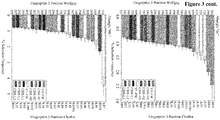
- each ABangle parameter is influenced by a largely different set of interface positions on both VH and VL.
- a framework position was the most important descriptor. Nonetheless, in each case at least two HVR-H3 residues were among the most important descriptors.
- Positions that have been ranked among the top ten important input variables in the original ABangle publication (7) were tracked in the ranking presented herein, too. But, whereas Dunbar et al.
- HC1 and LC1 find HC1 to be exclusively determined by residues on the heavy chain, and LC1 exclusively determined by residues on the light chain, the top ten descriptors as determined with a method as reported herein for HC1 and LC1 involve fingerprint positions on both chains.
- fingerprint positions are ranked irrespective of amino acid specificity.
- the top 25 ranked fingerprint positions also contain a number of members of the sets of VH-VL-orientation determining positions identified by Chailyan et al. (5) (L41, L42, L43, L44) and by Abhinandan and Martin (4) (L41, L44, L46, L87, H33, H45, H60, H62, H91, H105). It has been found that L87 is the top descriptor for HL, L46 for HC1, H45 for LC1, H62 for HC2, and L44 for LC2.
- the mean carbonyl RMSD values per fragment calculated for the VH-VL-orientation-optimized Variant 2 models showed an improvement of approximately 0.05 ⁇ in comparison to the models using a generic VH-VL-orientation (see Table 7).
- VH-VL-orientation prediction based on sequence features can be extended by moving from a single VH-VL packing angle to a finer description of VH-VL orientation in terms of the six ABangle parameters defined by Dunbar et al. (7).
- a random forest model was trained on an up-to-date set of known Fv structures.
- the Q 2 values for the six predictors range from 0.67 to 0.80 when trained on a set consisting only of complex structures.
- VH-VL-orientation prediction and adjustment Two model building variants without VH-VL-orientation prediction and adjustment (Variants 1 and 3) were compared with a model building variant that predicts the most likely VH-VL-orientation in terms of the six ABangle parameters, automatically looks up the most similarly oriented Fv structure in an antibody template database, and reorients the raw model onto this VH-VL orientation template prior to further processing (Variant 2).
- the VH-VL orientation is herein predicted from a (meaningful) subset of Fv sequence positions (a "sequence fingerprint") rather than from complete Fv sequences.
- sequence fingerprint a subset of Fv sequence positions
- a set of interface residues has been identified wherein a residue is defined to be part of the VH-VL interface if its side chain atoms are neighboring atoms of the opposite chain with a distance of less or equal than 4 ⁇ in at least 90 % of all superimposed Fv structures in the database, e.g. in RAB3D.
- Table 29 VH-VL interface residues where a residue is part of the interface if its side chain atoms are neighboring atoms of the opposite chain with a distance of less or equal than 4 ⁇ in at least 90 % of all superpositioned Fv structures in RAB3D.
- Wolfguy Index Chothia (14) Index Wolfguy Region Dunbar et al. (7) Abhinandan, Martin (4) Chailyan et al.
- VH-VL-orientation is described in terms of the six "ABangle" orientation parameters, consisting of one torsion angle, four bend angles (two per variable domain), as well as the length of the pivot axis of VH and VL.
- VH-VL orientation the relative orientation between the VH- and VL-domains
- the invention is in the following exemplified with specific antibodies which are intended to serve as an example and should not be construed to limit the scope of the invention thereto.
- the method as reported herein is a generally applicable method.
- the sequence fingerprint consists of 54 amino acids, 29 in the VH region, and 25 in the VL region. See following Table 13. Table 13: Sequence fingerprint.
- Wolfguy Index Chothia (14) Index Wolfguy Region 199 H35 + CDR-H1 202 H37 + VH-FW2 204 H39 + VH-FW2 210 H45 + VH-FW2 212 H47 + VH-FW2 251 H50
- a rabbit antibody recognizing a peptide segment from the pTau protein (including the S422 phosphorylation) and its humanized variants are evaluated according to the methods as reported herein.
- an anti-Hepsin antibody and its humanized variants are evaluated according to the methods as reported herein.
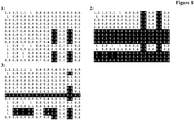
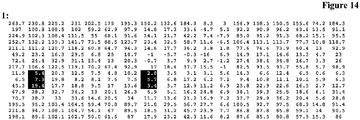
- HVRs are marked with a gray background.
- the HVR definition used corresponds to the set union of the Kabat and Chothia CDR definition.
- Sequence positions that are part of the sequence fingerprint used for predicting VH-VL-orientation are marked with a black background.
- Fingerprint positions that are unpopulated in a given antibody are marked with an 'X'.
- CD81K04 VH humanization variants (the original murine sequence is shown on top):
- CD81K04 VL humanization variants (the original murine sequence is shown on top):
- CD81K13 VH humanization variants (the original murine sequence is shown on top):
- CD81K13 VL humanization variants (the original murine sequence is shown on top):
- the sequence variants have been designed using the general grafting principle. Grafting, in general, was developed to produce humanized antibodies. In addition grafting can also be used to obtain antibodies compatible to other species, or simply in order to exchange the framework of one antibody in order to get other biophysical properties for this antibody or antibody fragment.
- the antibodies are expressed in a "matrix" by combining all heavy chain plasmids with all light chain plasmids.
- the first row and the first column are then half-humanized antibodies, whereas the first cell is the original murine or rabbit antibody in its chimeric form, and the rest of the matrix are the fully humanized antibodies.
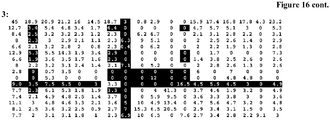
- the binding data are biochemical (cellular binding) ELISA data as summarized in Table 14 and Table 15 below, respectively.
- CD81K04 The chimeric form of CD81K04 is close to the value of 1.15, and the humanized variants are slightly less effective binders. For some of the variants, the affinity drops more drastically.
- the matrices can be correlated using the RV coefficient or other coefficients such as the correlation coefficient from the PROTEST method. These methods essentially evaluate the correlation between two data sets, where we have not one but several measurements for each sample and are therefore, to some degree, extensions of the standard univariate correlation coefficient.
- the RV coefficient is used in the following. In Table 23 the RV coefficient and its p-values for the three different data sets from the perspective of the HCs and the LCs is shown. Table 23: RV coefficients and corresponding p-values for all four data sets. The RV coefficient is calculated from the perspective of HCs as samples and hence the LCs as multivariate measurements and vice versa.
- RV HC p-value HC RV LC p-value LC CD81K04 0.2713155 0.05665427 0.3385992 0.03257287 CD81K13 0.4597497 0.03238687 0.1094843 0.627880
- Table 24 shows the correlation coefficient and the according p-value for the different data sets.
- Table 24 Pearson correlation coefficient for all three data sets and corresponding p-value. The correlation is calculated on vectorized versions of the angle-distance and binding matrices. The p-value indicates the probability to reach the calculated correlation under the null hypothesis of having no correlation.
- the first one is the ratio of median binding length between the kept and rejected subsets. For this ratio also a p-value was calculated using a permutation test. Furthermore the distribution of binding lengths or for one data set ICso values in the two subsets using stacked histograms was inspected visually.
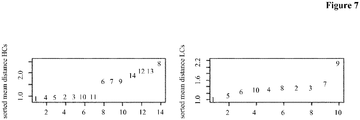
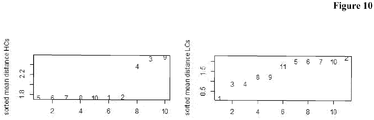
- Figure 7 depicts the average angle distance for the HCs (rows of the matrix, left) and the LCs (columns of the matrix, right). Antibodies comprising the HCs 6, 7, 8, 9, 12, 13 and 14, and LCs 7 and 9 were deselected.
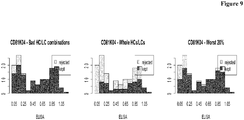
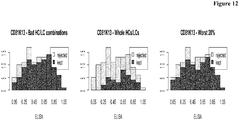
- Table 25 shows the results of the comparison of the subsets of antibodies as to their binding length. The median binding length in both sets was calculated and the ratio of both was formed. In the table the results for all three methods together with the p-value, which indicates the probability of getting a ratio at least this low, are shown. Table 25: For the three different antibody rejection methods, the ratio of the median ELISA measurement between the rejected and kept antibodies was calculated. Additionally a p-value was calculated via a permutation method, which shows that probability of reaching a value as low or lower as the found median ratio. CD81K04 median ratio (deselected/selected) p-value reject worst 20% 0.2279 0.0373 reject bad HC/LC combinations 0.20661 0.0162 reject whole HCs and LCs 0.3152 ⁇ 0.001
- Antibodies comprising the HCs 3, 4 and 9, and LCs 2, 5, 6, 7, 10 and 11 were deselected.
- Figure 12 shows that predominantly antibodies with lower binding length are rejected.
- Antibodies comprising the HCs 9, 10 and 11, and LCs 2 and 8 were deselected.
- the SPR data is used in the selection/deselection step. Two different measurements regarding the binding behavior of the different antibodies are available.
- the confidence matrix is incorporated as an additional step, e.g. first the deselected subset is chosen and then the high confidence subset is chosen.
- the distance information between all antibodies to compute clusters and identify clusters of antibodies that are most far away from the cluster incorporating the reference is used.
- the antibody structure database RAB3D contains mostly publicly available Fv structures.
- the Fv structures are processed and annotated with the in-house "Wolfguy" numbering scheme (see next section). All annotated Fv structures are superimposed on a consensus Fv framework, on a consensus VH framework, and on a consensus VL framework.
- the consensus structures are calculated using a subset of high-resolution structures from the PDB.
- the annotated and reoriented Fv structures serve as template repository for homology modeling.
- the Wolfguy numbering defines CDR regions as the set union of the Kabat and Chothia definition. Furthermore, the numbering scheme annotates CDR loop tips based on CDR length (and partly based on sequence) so that the index of a CDR position indicates if a CDR residue is part of the ascending or the descending loop.
- Table 1 Numbering of CDR-L3 and CDR-H3 using Chothia/Kabat (Ch-Kb), Honegger and Wolfguy numbering schemes. The latter has increasing numbers from the N-terminal basis to the CDR peak and decreasing ones starting from the C-terminal CDR end. Kabat schemes fix the two last CDR residues and introduce letters to accommodate for the CDR length.
- Wolfguy is designed such that structurally equivalent residues (i.e. residues that are very similar in terms of conserved spatial localization in the Fv structure) are numbered with equivalent indices as far as possible. This is illustrated in Figure 1 .
- the VH-VL orientation is herein predicted from a (meaningful) subset of Fv sequence positions (a "sequence fingerprint") rather than from complete Fv sequences.
- sequence fingerprint a subset of Fv sequence positions
- a set of interface residues has been identified wherein a residue is defined to be part of the VH-VL interface if its side chain atoms are neighboring atoms of the opposite chain with a distance of less or equal than 4 ⁇ in at least 90 % of all superimposed Fv structures in the database, e.g. in RAB3D.
- Table 29 VH-VL interface residues where a residue is part of the interface if its side chain atoms are neighboring atoms of the opposite chain with a distance of less or equal than 4 ⁇ in at least 90 % of all superpositioned Fv structures in RAB3D.
- Wolfguy Index Chothia (14) Index Wolfguy Region Dunbar et al. (7) Abhinandan, Martin (4) Chailyan et al.
- the “random forest” method turned out to be the statistically significant best predictor for each of the ABangle orientation parameters, followed by “neural net” and “decision tree”.
- the method "boosted tree” performed the least good on our dataset (data not shown).
- Tree Options Minimum Samples Per Node 10 Maximum Tree Depth 20 Split Method Gini Weighting Method By Class Forest Options Number of Trees Depending on ABangle parameter, see Table 2 Ensemble Method Bagging Voting Method Mean Score Equalize Class Sizes False Minimum Samples Per Class 5 Number of Descriptors All Advanced Tree Options Maximum Knots Per Property 20 Minimum Alpha 0.0 Maximum Pruned Trees 20 Disregard Uncorrelated Questions False Minimum Correlation Squared 0.00001 Maximum Lookahead Depth 0 Number of Lookahead Alternatives 3 Maximum Generic Depth 0 Generic Node Weighting 1.5 Learn Options Numeric Distance Function Euclidean Numeric Scaling Mean-Center and Scale, Scale by Number of Dimensions Fingerprint Distance Function Tanimoto Model Domain Fingerprint FCFP 2 Number Records Before Caching 100000 Node Pool Size 50000
- Table 32 shows the Q 2 and root-mean-square error (RMSE) values for the prediction of the six ABangle parameters averaged over 50 runs with randomly chosen training and test set.
- Table 32 Q 2 and RMSE values for the prediction of the six ABangle parameters averaged over 50 runs.
- the number of trees per random forest model was tuned manually so as to maximize Q 2 .
- the values in brackets specify the standard deviation.
- the random forest model has been trained once on the complete dataset of apo and complex structures (Table 32, central column) and once on the complex structures only (Table 32 above, right column). Despite the fact that the training set is reduced by almost 550 structures, the Q 2 and RMSE values improve when only complex structures are considered. For HL, LC2 and dc, Q 2 values are about 0.68, while HC1, LC1 and LC2 have Q 2 values of 0.75 and above (when considering complex structures).
- Figure 2 shows exemplary regression plots for predicted versus actual ABangle parameters on the complex structures only dataset.
- Table 33 Mean R 2 values for the prediction of the six ABangle parameters HL, HC1, LC1, HC2, LC2 and dc over three repetitions using the three sequence fingerprints and their variants with only the outmost CDR residues at the edge of the framework (a) and without any CDR residues (b).
- Fingerprint HL HC1 LC1 HC2 LC2 dc Mean Interface 1 0.616 0.755 0.687 0.750 0.602 0.569 0.663 1a 0.577 0.693 0.640 0.680 0.496 0.537 0.604 1b 0.290 0.564 0.410 0.450 0.359 0.354 0.405 ABangle 2 0.601 0.752 0.679 0.761 0.612 0.567 0.662 2a 0.566 0.705 0.669 0.703 0.549 0.520 0.619 2b 0.481 0.633 0.602 0.653 0.486 0.465 0.553 Interface + ABangle 3 0.598 0.758 0.684 0.751 0.616 0.554 0.660 3a 0.566 0.708 0.615 0.714 0.543 0.538 0.614 3b 0.478 0.632 0.638 0.630 0.485 0.502 0.561
- Fingerprint 1 based on the set of interface residues
- Fingerprint 2 based on the ABangle top input variable positions
- Fingerprint 3 has been chosen for further evaluation and a random forest model for learning.
- the random forest model was implemented and trained using Accelrys Pipeline Pilot 8.5 (19) with the component "Learn RP (random partitioning) Forest Model” in "Regression” mode.
- 50 runs were performed each while varying the number of decision trees in the random forest from 10 to 100 in order to determine the optimal number of trees with regard to the Q 2 value of the test set.
- the input dataset was randomly split into 70 % test and 30 % training set.
- the modeling software for modeling the Fv region of Antibodies uses the annotated and reoriented structures, e.g. from the RAB3D database, as template repository.
- a given pair of heavy and light chain input sequence was annotated with Wolfguy and reduced to VH and VL, respectively. Both VH and VL were then divided into seven functional segments, i.e. Framework 1, CDR 1, Framework 2, CDR 2, Framework 3, CDR 3, and Framework 4 (see Table 10).
- Framework 1, CDR 1, Framework 2, CDR 2, Framework 3, CDR 3, and Framework 4 see Table 10.
- no common framework template was picked per Fv or per chain, but every fragment was looked up/aligned/determined independently based on sequence homology.
- a single MoFvAb model might be assembled from fourteen different template structures, and possibly even more, as it is feasible to reconstruct the ascending and descending section of CDR loops from different template structures, too. Fragment template hits were ranked in the following order by
- the processed model was parameterized for the CHARMm force field and minimized using the Generalized Born with a simple Switching (GBSW) implicit water model, first by the Steepest Descent and then by the Conjugate Gradient method.
- GBSW Generalized Born with a simple Switching
- MoFvAb is available as a web service based on a protocol implemented in Accelrys Pipeline Pilot 8.5 (19) using the Accelrys Discovery Studio 3.5 (20) interface.
- the MoFvAb was used to build the 11 antibody Fv structures from AMAII.
- the AMAII structures were diverse with regard to species (rabbit, mouse, human) and consist mainly of protein-binding antibodies, with anti-DNA Fab A52 (PDB ID 4M61) being the exception. All AMAII reference structures were crystallized in the unbound form.
- access to more template structures than the original AMAII "contestants" was possible, including a number of rabbit antibody structures. Therefore, the modeling results in terms of RMSD presented herein cannot be directly compared to the results presented by the original blind modeling studies.
- the weighted distance function was used for finding orientation templates in the database that best match a predicted set of ABangle parameters.
- dist ABangle and dlst ABangle mingle angular (HL, HC1, LC1, HC2, LC2) with linear (dc) distance measures, they cannot be interpreted as factual distance in angular space but serve only as an abstract distance measure.
- the RV coefficient was introduced by Escoufier to measure the similarity between square symmetric matrices (26).
- the definition can be easily extended to rectangular matrices (27).
- a variant of the subsequent method is to just reject antibodies which have "bad" HC/LC combinations. This method might perform well if the correlation of angle-distance to antibody is not so strong for individual antibodies but is better preserved over whole HCs and LCs.
- the algorithm is:
- the carbonyl RMSD and the definition of ⁇ -sheet core and CDR loops according to Teplyakov et al. (2) were used
- the model was superimposed onto the crystal structure using the C ⁇ atoms of the ⁇ -sheet core with the superposition method provided in Accelrys Discovery Studio 3.5 (20).
- the carbonyl RMSD was then calculated as the deviation of the backbone carbonyl group atoms of the given segment with regard to the crystal structure.
- the carbonyl RMSD is more sensitive with regard to deviations in backbone conformation.
- HuH7-Rluc-H3 positive cell line expressing CD81
- HuH7-Rluc-L1 negative control cell line
- F-12 DMEM medium with 10 % FCS at 37 °C and 5 % CO 2 .
- the cells were trypsinized at approximately 90 % confluence and resuspended at 4 x 10 5 cells/mL.
- 2 x10 4 cells/well HuH7-Rluc-H3 and HuH7-Rluc-L1 (negative control cell line) were plated in 50 ⁇ L DMEM medium and allowed to adhere to the 96 well poly-D-Lysine plate (Greiner, Cat-Nr.
- the antibody samples to be tested were prepared in a separate polypropylene round bottom plate with a twofold desired concentration with a final volume of 120 ⁇ l. All of the assay samples were diluted in cell culture medium. 50 ⁇ L of each antibody sample (duplicate wells) were added to cells to give final volume of 100 ⁇ L/well and incubated for 2 hours at 4 °C. Following the primary incubation the samples were removed by aspiration and the cells were fixed with 0.05 % glutaraldehyde in PBS solution (Roche Diagnostics GmbH, Mannheim, Germany, Cat-Nr. 1666789) for 10 minutes at room temperature.
- the secondary incubation step for detection of bound anti-CD81 antibodies was performed for 2 h at room temperature on a reciprocal shaker.
- detection was performed using peroxidase conjugate sheep anti-human-IgG-gamma chain specific antibody (The Binding Site, Cat.-Nr. AP004) and a goat anti-mouse IgG, (H+L)-HRP conjugate (BIORAD, Cat-Nr. 170-6516) was used for the JS81 mouse positive control antibody (BD Biosciences, Cat. Nr. 555675) both diluted 1:1000 in PBS 10 % blocking buffer.
- the kinetic screening was performed according to Schraeml et al. ( Schraeml, M. and M. Biehl, Methods Mol. Biol. 901 (2012) 171-181 ) on a BIAcore 4000 instrument, mounted with a BIAcore CM5 sensor.
- the BIAcore 4000 instrument was under the control of the software version V1.1.
- a BIAcore CM5 series S chip was mounted into the instrument and was hydrodynamically addressed and preconditioned according to the manufacturer's instructions.
- the instrument buffer was HBS-EP buffer (10 mM HEPES (pH 7.4), 150 mM NaCl, 1 mM EDTA, 0.05 % (w/v) P20).
- An antibody capture system was prepared on the sensor surface.
- a polyclonal goat anti-human antibody with human IgG-Fc specificity (Jackson Lab.) was immobilized at 30 ⁇ g/ml in 10 mM sodium acetate buffer (pH 5) to spots 1, 2, 4 and 5 in the instrument's flow cells 1, 2, 3 and 4 at 10,000 RU using NHS/EDC chemistry. In each flow cell the antibodies were captured on spot 1 and spot 5. Spot 2 and spot 4 were used as reference spots. The sensor was deactivated with a 1 M ethanolamine solution. Humanized antibody derivatives were applied at concentrations between 44 nM and 70 nM in instrument buffer supplemented with 1mg/ml CMD (carboxymethyldextrane).
- CMD carboxymethyldextrane
- the antibodies were injected at a flow rate of 30 ⁇ l/min for 2 min.
- the capture level (CL) of the surface-presented antibodies was measured in rel. response units (RU).
- the analytes in solution, phosphorylated human tau protein, non-phosphorylated human tau protein and the phosphorylated human tau mutant protein T422S, were injected at 300 nM for 3 min. at a flow rate of 30 ⁇ l/min.
- the dissociation was monitored for 5 min.
- the capture system was regenerated by a 1 min. injection of 10 mM glycine buffer pH 1.7 at 30 ⁇ L/min. over all flow cells.
- binding late BL
- SL stability late
- kinetic rates were determined at 25 °C and 37 °C using the same experimental setup, but using multiple concentration series of each analyte in solution at 0 nM (buffer), 1.2 nM, 3.7 nM, 11.1 nM, 33.3 nM, 100 nM and 300 nM. From the concentration-dependent binding behavior the kinetic data was calculated using the BIAcore evaluation software according to the manufacturer's instructions and a Langmuir 1.1 model with RMAX global.
Landscapes
- Chemical & Material Sciences (AREA)
- Health & Medical Sciences (AREA)
- Organic Chemistry (AREA)
- Immunology (AREA)
- Life Sciences & Earth Sciences (AREA)
- Biochemistry (AREA)
- General Health & Medical Sciences (AREA)
- Genetics & Genomics (AREA)
- Proteomics, Peptides & Aminoacids (AREA)
- Molecular Biology (AREA)
- Medicinal Chemistry (AREA)
- Biophysics (AREA)
- Engineering & Computer Science (AREA)
- Bioinformatics & Cheminformatics (AREA)
- General Engineering & Computer Science (AREA)
- Wood Science & Technology (AREA)
- Zoology (AREA)
- Peptides Or Proteins (AREA)
- Preparation Of Compounds By Using Micro-Organisms (AREA)
- Medicines Containing Antibodies Or Antigens For Use As Internal Diagnostic Agents (AREA)
Applications Claiming Priority (2)
| Application Number | Priority Date | Filing Date | Title |
|---|---|---|---|
| EP14190307 | 2014-10-24 | ||
| PCT/EP2015/074294 WO2016062734A1 (en) | 2014-10-24 | 2015-10-21 | Vh-vl-interdomain angle based antibody humanization |
Publications (2)
| Publication Number | Publication Date |
|---|---|
| EP3209684A1 EP3209684A1 (en) | 2017-08-30 |
| EP3209684B1 true EP3209684B1 (en) | 2020-12-23 |
Family
ID=51799006
Family Applications (1)
| Application Number | Title | Priority Date | Filing Date |
|---|---|---|---|
| EP15784344.2A Active EP3209684B1 (en) | 2014-10-24 | 2015-10-21 | Vh-vl-interdomain angle based antibody humanization |
Country Status (12)
| Country | Link |
|---|---|
| US (2) | US20170204182A1 (es) |
| EP (1) | EP3209684B1 (es) |
| JP (1) | JP6829194B2 (es) |
| KR (1) | KR20170070070A (es) |
| CN (1) | CN107074933B (es) |
| BR (1) | BR112017005451A2 (es) |
| CA (1) | CA2960445A1 (es) |
| DK (1) | DK3209684T3 (es) |
| ES (1) | ES2857553T3 (es) |
| MX (1) | MX2017004001A (es) |
| RU (1) | RU2017115212A (es) |
| WO (1) | WO2016062734A1 (es) |
Families Citing this family (18)
| Publication number | Priority date | Publication date | Assignee | Title |
|---|---|---|---|---|
| TW201829463A (zh) | 2016-11-18 | 2018-08-16 | 瑞士商赫孚孟拉羅股份公司 | 抗hla-g抗體及其用途 |
| AU2018247796A1 (en) | 2017-04-04 | 2019-08-29 | F. Hoffmann-La Roche Ag | Novel bispecific antigen binding molecules capable of specific binding to CD40 and to FAP |
| CN117050176A (zh) | 2017-07-31 | 2023-11-14 | 豪夫迈·罗氏有限公司 | 基于三维结构的人源化方法 |
| TWI829667B (zh) | 2018-02-09 | 2024-01-21 | 瑞士商赫孚孟拉羅股份公司 | 結合gprc5d之抗體 |
| AR114789A1 (es) | 2018-04-18 | 2020-10-14 | Hoffmann La Roche | Anticuerpos anti-hla-g y uso de los mismos |
| AR115052A1 (es) | 2018-04-18 | 2020-11-25 | Hoffmann La Roche | Anticuerpos multiespecíficos y utilización de los mismos |
| EP3861025A1 (en) | 2018-10-01 | 2021-08-11 | F. Hoffmann-La Roche AG | Bispecific antigen binding molecules with trivalent binding to cd40 |
| NZ773887A (en) | 2018-10-01 | 2024-11-29 | Hoffmann La Roche | Bispecific antigen binding molecules comprising anti-fap clone 212 |
| JP7354306B2 (ja) | 2019-06-27 | 2023-10-02 | エフ・ホフマン-ラ・ロシュ・アクチェンゲゼルシャフト | 新規icos抗体及びそれらを含む腫瘍標的化抗原結合分子 |
| AR119382A1 (es) | 2019-07-12 | 2021-12-15 | Hoffmann La Roche | Anticuerpos de pre-direccionamiento y métodos de uso |
| SG11202112491WA (en) | 2019-07-31 | 2021-12-30 | Hoffmann La Roche | Antibodies binding to gprc5d |
| JP2022543551A (ja) | 2019-07-31 | 2022-10-13 | エフ・ホフマン-ラ・ロシュ・アクチェンゲゼルシャフト | Gprc5dに結合する抗体 |
| AR121706A1 (es) | 2020-04-01 | 2022-06-29 | Hoffmann La Roche | Moléculas de unión a antígeno biespecíficas dirigidas a ox40 y fap |
| JP7326584B2 (ja) | 2020-12-17 | 2023-08-15 | エフ・ホフマン-ラ・ロシュ・アクチェンゲゼルシャフト | 抗hla-g抗体及びその使用 |
| AR126009A1 (es) | 2021-06-02 | 2023-08-30 | Hoffmann La Roche | Moléculas agonistas de unión al antígeno cd28 que se dirigen a epcam |
| WO2023078420A1 (en) * | 2021-11-04 | 2023-05-11 | Vibrant Pharma Limited | Methods for antibody optimization |
| EP4720120A1 (en) | 2023-06-01 | 2026-04-08 | F. Hoffmann-La Roche AG | Bispecific antibodies targeting bcma and cd28 |
| EP4720121A1 (en) | 2023-06-01 | 2026-04-08 | F. Hoffmann-La Roche AG | Immunostimulatory antigen binding molecules that specifically bind to bcma |
Family Cites Families (9)
| Publication number | Priority date | Publication date | Assignee | Title |
|---|---|---|---|---|
| US5530101A (en) * | 1988-12-28 | 1996-06-25 | Protein Design Labs, Inc. | Humanized immunoglobulins |
| US6849425B1 (en) * | 1999-10-14 | 2005-02-01 | Ixsys, Inc. | Methods of optimizing antibody variable region binding affinity |
| MXPA05000511A (es) * | 2001-07-12 | 2005-09-30 | Jefferson Foote | Anticuepros super humanizados. |
| SI2000481T1 (sl) * | 2003-02-01 | 2016-08-31 | Tanox, Inc. | Anti-humana protitelesa IgE z visoko afiniteto |
| GB0613209D0 (en) * | 2006-07-03 | 2006-08-09 | Ucb Sa | Methods |
| EP2250198B1 (en) * | 2008-01-23 | 2016-03-09 | Department of Biotechnology | A humanized high affinity recombinant antibody against hepatitis b surface antigen |
| GB0914691D0 (en) * | 2009-08-21 | 2009-09-30 | Lonza Biologics Plc | Immunoglobulin variants |
| AU2010290844B2 (en) * | 2009-09-06 | 2015-04-09 | Protab Ltd. | Humanized antibodies specific for HSP65-derived peptide-6 methods and uses thereof |
| US20130108641A1 (en) * | 2011-09-14 | 2013-05-02 | Sanofi | Anti-gitr antibodies |
-
2015
- 2015-10-21 ES ES15784344T patent/ES2857553T3/es active Active
- 2015-10-21 RU RU2017115212A patent/RU2017115212A/ru not_active Application Discontinuation
- 2015-10-21 EP EP15784344.2A patent/EP3209684B1/en active Active
- 2015-10-21 JP JP2017522101A patent/JP6829194B2/ja active Active
- 2015-10-21 KR KR1020177010887A patent/KR20170070070A/ko not_active Withdrawn
- 2015-10-21 DK DK15784344.2T patent/DK3209684T3/da active
- 2015-10-21 BR BR112017005451A patent/BR112017005451A2/pt not_active Application Discontinuation
- 2015-10-21 MX MX2017004001A patent/MX2017004001A/es unknown
- 2015-10-21 CN CN201580056696.2A patent/CN107074933B/zh active Active
- 2015-10-21 WO PCT/EP2015/074294 patent/WO2016062734A1/en not_active Ceased
- 2015-10-21 CA CA2960445A patent/CA2960445A1/en not_active Abandoned
-
2017
- 2017-03-31 US US15/475,440 patent/US20170204182A1/en not_active Abandoned
-
2020
- 2020-03-16 US US16/820,094 patent/US20200377590A1/en active Pending
Non-Patent Citations (1)
| Title |
|---|
| None * |
Also Published As
| Publication number | Publication date |
|---|---|
| WO2016062734A1 (en) | 2016-04-28 |
| US20200377590A1 (en) | 2020-12-03 |
| CA2960445A1 (en) | 2016-04-28 |
| MX2017004001A (es) | 2017-06-30 |
| JP6829194B2 (ja) | 2021-02-10 |
| BR112017005451A2 (pt) | 2018-01-02 |
| ES2857553T3 (es) | 2021-09-29 |
| JP2017531443A (ja) | 2017-10-26 |
| US20170204182A1 (en) | 2017-07-20 |
| KR20170070070A (ko) | 2017-06-21 |
| RU2017115212A3 (es) | 2019-04-24 |
| RU2017115212A (ru) | 2018-11-26 |
| CN107074933A (zh) | 2017-08-18 |
| DK3209684T3 (da) | 2021-02-22 |
| CN107074933B (zh) | 2021-03-19 |
| EP3209684A1 (en) | 2017-08-30 |
Similar Documents
| Publication | Publication Date | Title |
|---|---|---|
| EP3209684B1 (en) | Vh-vl-interdomain angle based antibody humanization | |
| EP2050765B1 (en) | Methods for use in human-adapting monoclonal antibodies | |
| US8343489B2 (en) | Methods for humanizing antibodies and humanized antibodies made thereby | |
| JP7217772B2 (ja) | 三次元構造に基づくヒト化方法 | |
| Bujotzek et al. | VH-VL orientation prediction for antibody humanization candidate selection: A case study | |
| JP5323710B2 (ja) | ヒトに適合するモノクローナル抗体に使用するための方法 | |
| US9249232B2 (en) | Framework selection | |
| US20220059184A1 (en) | Methods for identifying epitopes and paratopes | |
| HK1242352B (zh) | 基於vh-vl域间角的抗体人源化 | |
| HK1242352A1 (en) | Vh-vl-interdomain angle based antibody humanization | |
| US20250122311A1 (en) | Method for humanizing antibodies | |
| US20250006293A1 (en) | Methods for antibody optimization | |
| HK40023878A (en) | Three-dimensional structure-based humanization method | |
| HK40098558A (zh) | 基於三维结构的人源化方法 | |
| HK40023878B (zh) | 基於三维结构的人源化方法 | |
| Almagro et al. | Humanization of antibodies |
Legal Events
| Date | Code | Title | Description |
|---|---|---|---|
| STAA | Information on the status of an ep patent application or granted ep patent |
Free format text: STATUS: THE INTERNATIONAL PUBLICATION HAS BEEN MADE |
|
| PUAI | Public reference made under article 153(3) epc to a published international application that has entered the european phase |
Free format text: ORIGINAL CODE: 0009012 |
|
| STAA | Information on the status of an ep patent application or granted ep patent |
Free format text: STATUS: REQUEST FOR EXAMINATION WAS MADE |
|
| 17P | Request for examination filed |
Effective date: 20170524 |
|
| AK | Designated contracting states |
Kind code of ref document: A1 Designated state(s): AL AT BE BG CH CY CZ DE DK EE ES FI FR GB GR HR HU IE IS IT LI LT LU LV MC MK MT NL NO PL PT RO RS SE SI SK SM TR |
|
| AX | Request for extension of the european patent |
Extension state: BA ME |
|
| DAV | Request for validation of the european patent (deleted) | ||
| DAX | Request for extension of the european patent (deleted) | ||
| STAA | Information on the status of an ep patent application or granted ep patent |
Free format text: STATUS: EXAMINATION IS IN PROGRESS |
|
| 17Q | First examination report despatched |
Effective date: 20180911 |
|
| GRAP | Despatch of communication of intention to grant a patent |
Free format text: ORIGINAL CODE: EPIDOSNIGR1 |
|
| STAA | Information on the status of an ep patent application or granted ep patent |
Free format text: STATUS: GRANT OF PATENT IS INTENDED |
|
| RIC1 | Information provided on ipc code assigned before grant |
Ipc: C07K 16/00 20060101AFI20200224BHEP |
|
| INTG | Intention to grant announced |
Effective date: 20200316 |
|
| GRAJ | Information related to disapproval of communication of intention to grant by the applicant or resumption of examination proceedings by the epo deleted |
Free format text: ORIGINAL CODE: EPIDOSDIGR1 |
|
| STAA | Information on the status of an ep patent application or granted ep patent |
Free format text: STATUS: EXAMINATION IS IN PROGRESS |
|
| GRAP | Despatch of communication of intention to grant a patent |
Free format text: ORIGINAL CODE: EPIDOSNIGR1 |
|
| STAA | Information on the status of an ep patent application or granted ep patent |
Free format text: STATUS: GRANT OF PATENT IS INTENDED |
|
| INTC | Intention to grant announced (deleted) | ||
| RIN1 | Information on inventor provided before grant (corrected) |
Inventor name: LIPSMEIER, FLORIAN Inventor name: BUJOTZEK, ALEXANDER Inventor name: GEORGES, GUY |
|
| INTG | Intention to grant announced |
Effective date: 20200715 |
|
| GRAS | Grant fee paid |
Free format text: ORIGINAL CODE: EPIDOSNIGR3 |
|
| GRAA | (expected) grant |
Free format text: ORIGINAL CODE: 0009210 |
|
| STAA | Information on the status of an ep patent application or granted ep patent |
Free format text: STATUS: THE PATENT HAS BEEN GRANTED |
|
| AK | Designated contracting states |
Kind code of ref document: B1 Designated state(s): AL AT BE BG CH CY CZ DE DK EE ES FI FR GB GR HR HU IE IS IT LI LT LU LV MC MK MT NL NO PL PT RO RS SE SI SK SM TR |
|
| REG | Reference to a national code |
Ref country code: GB Ref legal event code: FG4D |
|
| REG | Reference to a national code |
Ref country code: DE Ref legal event code: R096 Ref document number: 602015063873 Country of ref document: DE |
|
| REG | Reference to a national code |
Ref country code: AT Ref legal event code: REF Ref document number: 1347639 Country of ref document: AT Kind code of ref document: T Effective date: 20210115 |
|
| REG | Reference to a national code |
Ref country code: IE Ref legal event code: FG4D |
|
| REG | Reference to a national code |
Ref country code: DK Ref legal event code: T3 Effective date: 20210218 |
|
| REG | Reference to a national code |
Ref country code: NO Ref legal event code: T2 Effective date: 20201223 |
|
| REG | Reference to a national code |
Ref country code: SE Ref legal event code: TRGR |
|
| PG25 | Lapsed in a contracting state [announced via postgrant information from national office to epo] |
Ref country code: FI Free format text: LAPSE BECAUSE OF FAILURE TO SUBMIT A TRANSLATION OF THE DESCRIPTION OR TO PAY THE FEE WITHIN THE PRESCRIBED TIME-LIMIT Effective date: 20201223 Ref country code: RS Free format text: LAPSE BECAUSE OF FAILURE TO SUBMIT A TRANSLATION OF THE DESCRIPTION OR TO PAY THE FEE WITHIN THE PRESCRIBED TIME-LIMIT Effective date: 20201223 Ref country code: GR Free format text: LAPSE BECAUSE OF FAILURE TO SUBMIT A TRANSLATION OF THE DESCRIPTION OR TO PAY THE FEE WITHIN THE PRESCRIBED TIME-LIMIT Effective date: 20210324 |
|
| REG | Reference to a national code |
Ref country code: NL Ref legal event code: MP Effective date: 20201223 |
|
| PG25 | Lapsed in a contracting state [announced via postgrant information from national office to epo] |
Ref country code: BG Free format text: LAPSE BECAUSE OF FAILURE TO SUBMIT A TRANSLATION OF THE DESCRIPTION OR TO PAY THE FEE WITHIN THE PRESCRIBED TIME-LIMIT Effective date: 20210323 Ref country code: LV Free format text: LAPSE BECAUSE OF FAILURE TO SUBMIT A TRANSLATION OF THE DESCRIPTION OR TO PAY THE FEE WITHIN THE PRESCRIBED TIME-LIMIT Effective date: 20201223 |
|
| PG25 | Lapsed in a contracting state [announced via postgrant information from national office to epo] |
Ref country code: NL Free format text: LAPSE BECAUSE OF FAILURE TO SUBMIT A TRANSLATION OF THE DESCRIPTION OR TO PAY THE FEE WITHIN THE PRESCRIBED TIME-LIMIT Effective date: 20201223 Ref country code: HR Free format text: LAPSE BECAUSE OF FAILURE TO SUBMIT A TRANSLATION OF THE DESCRIPTION OR TO PAY THE FEE WITHIN THE PRESCRIBED TIME-LIMIT Effective date: 20201223 |
|
| REG | Reference to a national code |
Ref country code: LT Ref legal event code: MG9D |
|
| PG25 | Lapsed in a contracting state [announced via postgrant information from national office to epo] |
Ref country code: LT Free format text: LAPSE BECAUSE OF FAILURE TO SUBMIT A TRANSLATION OF THE DESCRIPTION OR TO PAY THE FEE WITHIN THE PRESCRIBED TIME-LIMIT Effective date: 20201223 Ref country code: PT Free format text: LAPSE BECAUSE OF FAILURE TO SUBMIT A TRANSLATION OF THE DESCRIPTION OR TO PAY THE FEE WITHIN THE PRESCRIBED TIME-LIMIT Effective date: 20210423 Ref country code: SK Free format text: LAPSE BECAUSE OF FAILURE TO SUBMIT A TRANSLATION OF THE DESCRIPTION OR TO PAY THE FEE WITHIN THE PRESCRIBED TIME-LIMIT Effective date: 20201223 Ref country code: RO Free format text: LAPSE BECAUSE OF FAILURE TO SUBMIT A TRANSLATION OF THE DESCRIPTION OR TO PAY THE FEE WITHIN THE PRESCRIBED TIME-LIMIT Effective date: 20201223 Ref country code: SM Free format text: LAPSE BECAUSE OF FAILURE TO SUBMIT A TRANSLATION OF THE DESCRIPTION OR TO PAY THE FEE WITHIN THE PRESCRIBED TIME-LIMIT Effective date: 20201223 Ref country code: CZ Free format text: LAPSE BECAUSE OF FAILURE TO SUBMIT A TRANSLATION OF THE DESCRIPTION OR TO PAY THE FEE WITHIN THE PRESCRIBED TIME-LIMIT Effective date: 20201223 Ref country code: EE Free format text: LAPSE BECAUSE OF FAILURE TO SUBMIT A TRANSLATION OF THE DESCRIPTION OR TO PAY THE FEE WITHIN THE PRESCRIBED TIME-LIMIT Effective date: 20201223 |
|
| PG25 | Lapsed in a contracting state [announced via postgrant information from national office to epo] |
Ref country code: PL Free format text: LAPSE BECAUSE OF FAILURE TO SUBMIT A TRANSLATION OF THE DESCRIPTION OR TO PAY THE FEE WITHIN THE PRESCRIBED TIME-LIMIT Effective date: 20201223 |
|
| REG | Reference to a national code |
Ref country code: DE Ref legal event code: R097 Ref document number: 602015063873 Country of ref document: DE |
|
| REG | Reference to a national code |
Ref country code: ES Ref legal event code: FG2A Ref document number: 2857553 Country of ref document: ES Kind code of ref document: T3 Effective date: 20210929 |
|
| PG25 | Lapsed in a contracting state [announced via postgrant information from national office to epo] |
Ref country code: IS Free format text: LAPSE BECAUSE OF FAILURE TO SUBMIT A TRANSLATION OF THE DESCRIPTION OR TO PAY THE FEE WITHIN THE PRESCRIBED TIME-LIMIT Effective date: 20210423 |
|
| PG25 | Lapsed in a contracting state [announced via postgrant information from national office to epo] |
Ref country code: AL Free format text: LAPSE BECAUSE OF FAILURE TO SUBMIT A TRANSLATION OF THE DESCRIPTION OR TO PAY THE FEE WITHIN THE PRESCRIBED TIME-LIMIT Effective date: 20201223 |
|
| PLBE | No opposition filed within time limit |
Free format text: ORIGINAL CODE: 0009261 |
|
| STAA | Information on the status of an ep patent application or granted ep patent |
Free format text: STATUS: NO OPPOSITION FILED WITHIN TIME LIMIT |
|
| 26N | No opposition filed |
Effective date: 20210924 |
|
| PG25 | Lapsed in a contracting state [announced via postgrant information from national office to epo] |
Ref country code: SI Free format text: LAPSE BECAUSE OF FAILURE TO SUBMIT A TRANSLATION OF THE DESCRIPTION OR TO PAY THE FEE WITHIN THE PRESCRIBED TIME-LIMIT Effective date: 20201223 |
|
| REG | Reference to a national code |
Ref country code: BE Ref legal event code: MM Effective date: 20211031 |
|
| PG25 | Lapsed in a contracting state [announced via postgrant information from national office to epo] |
Ref country code: MC Free format text: LAPSE BECAUSE OF FAILURE TO SUBMIT A TRANSLATION OF THE DESCRIPTION OR TO PAY THE FEE WITHIN THE PRESCRIBED TIME-LIMIT Effective date: 20201223 |
|
| PG25 | Lapsed in a contracting state [announced via postgrant information from national office to epo] |
Ref country code: LU Free format text: LAPSE BECAUSE OF NON-PAYMENT OF DUE FEES Effective date: 20211021 Ref country code: BE Free format text: LAPSE BECAUSE OF NON-PAYMENT OF DUE FEES Effective date: 20211031 |
|
| PG25 | Lapsed in a contracting state [announced via postgrant information from national office to epo] |
Ref country code: IE Free format text: LAPSE BECAUSE OF NON-PAYMENT OF DUE FEES Effective date: 20211021 |
|
| PGFP | Annual fee paid to national office [announced via postgrant information from national office to epo] |
Ref country code: NO Payment date: 20220926 Year of fee payment: 8 Ref country code: DK Payment date: 20220927 Year of fee payment: 8 |
|
| REG | Reference to a national code |
Ref country code: AT Ref legal event code: UEP Ref document number: 1347639 Country of ref document: AT Kind code of ref document: T Effective date: 20201223 |
|
| PGFP | Annual fee paid to national office [announced via postgrant information from national office to epo] |
Ref country code: SE Payment date: 20221011 Year of fee payment: 8 Ref country code: IT Payment date: 20221019 Year of fee payment: 8 Ref country code: ES Payment date: 20221101 Year of fee payment: 8 Ref country code: AT Payment date: 20220926 Year of fee payment: 8 |
|
| PG25 | Lapsed in a contracting state [announced via postgrant information from national office to epo] |
Ref country code: HU Free format text: LAPSE BECAUSE OF FAILURE TO SUBMIT A TRANSLATION OF THE DESCRIPTION OR TO PAY THE FEE WITHIN THE PRESCRIBED TIME-LIMIT; INVALID AB INITIO Effective date: 20151021 |
|
| PG25 | Lapsed in a contracting state [announced via postgrant information from national office to epo] |
Ref country code: CY Free format text: LAPSE BECAUSE OF FAILURE TO SUBMIT A TRANSLATION OF THE DESCRIPTION OR TO PAY THE FEE WITHIN THE PRESCRIBED TIME-LIMIT Effective date: 20201223 |
|
| REG | Reference to a national code |
Ref country code: DE Ref legal event code: R082 Ref document number: 602015063873 Country of ref document: DE Representative=s name: KRAUS & LEDERER PARTGMBB, DE |
|
| PG25 | Lapsed in a contracting state [announced via postgrant information from national office to epo] |
Ref country code: MK Free format text: LAPSE BECAUSE OF FAILURE TO SUBMIT A TRANSLATION OF THE DESCRIPTION OR TO PAY THE FEE WITHIN THE PRESCRIBED TIME-LIMIT Effective date: 20201223 |
|
| REG | Reference to a national code |
Ref country code: SE Ref legal event code: EUG |
|
| REG | Reference to a national code |
Ref country code: DK Ref legal event code: EBP Effective date: 20231031 |
|
| REG | Reference to a national code |
Ref country code: AT Ref legal event code: MM01 Ref document number: 1347639 Country of ref document: AT Kind code of ref document: T Effective date: 20231021 |
|
| PG25 | Lapsed in a contracting state [announced via postgrant information from national office to epo] |
Ref country code: AT Free format text: LAPSE BECAUSE OF NON-PAYMENT OF DUE FEES Effective date: 20231021 |
|
| PG25 | Lapsed in a contracting state [announced via postgrant information from national office to epo] |
Ref country code: NO Free format text: LAPSE BECAUSE OF NON-PAYMENT OF DUE FEES Effective date: 20231031 Ref country code: AT Free format text: LAPSE BECAUSE OF NON-PAYMENT OF DUE FEES Effective date: 20231021 |
|
| PG25 | Lapsed in a contracting state [announced via postgrant information from national office to epo] |
Ref country code: SE Free format text: LAPSE BECAUSE OF NON-PAYMENT OF DUE FEES Effective date: 20231022 |
|
| PG25 | Lapsed in a contracting state [announced via postgrant information from national office to epo] |
Ref country code: MT Free format text: LAPSE BECAUSE OF FAILURE TO SUBMIT A TRANSLATION OF THE DESCRIPTION OR TO PAY THE FEE WITHIN THE PRESCRIBED TIME-LIMIT Effective date: 20201223 |
|
| PG25 | Lapsed in a contracting state [announced via postgrant information from national office to epo] |
Ref country code: DK Free format text: LAPSE BECAUSE OF NON-PAYMENT OF DUE FEES Effective date: 20231031 |
|
| PG25 | Lapsed in a contracting state [announced via postgrant information from national office to epo] |
Ref country code: DK Free format text: LAPSE BECAUSE OF NON-PAYMENT OF DUE FEES Effective date: 20231031 |
|
| PG25 | Lapsed in a contracting state [announced via postgrant information from national office to epo] |
Ref country code: IT Free format text: LAPSE BECAUSE OF NON-PAYMENT OF DUE FEES Effective date: 20231021 |
|
| REG | Reference to a national code |
Ref country code: ES Ref legal event code: FD2A Effective date: 20241209 |
|
| PG25 | Lapsed in a contracting state [announced via postgrant information from national office to epo] |
Ref country code: IT Free format text: LAPSE BECAUSE OF NON-PAYMENT OF DUE FEES Effective date: 20231021 |
|
| PG25 | Lapsed in a contracting state [announced via postgrant information from national office to epo] |
Ref country code: ES Free format text: LAPSE BECAUSE OF NON-PAYMENT OF DUE FEES Effective date: 20231022 |
|
| PG25 | Lapsed in a contracting state [announced via postgrant information from national office to epo] |
Ref country code: ES Free format text: LAPSE BECAUSE OF NON-PAYMENT OF DUE FEES Effective date: 20231022 |
|
| PGFP | Annual fee paid to national office [announced via postgrant information from national office to epo] |
Ref country code: GB Payment date: 20250923 Year of fee payment: 11 |
|
| PGFP | Annual fee paid to national office [announced via postgrant information from national office to epo] |
Ref country code: FR Payment date: 20250925 Year of fee payment: 11 |
|
| REG | Reference to a national code |
Ref country code: CH Ref legal event code: U11 Free format text: ST27 STATUS EVENT CODE: U-0-0-U10-U11 (AS PROVIDED BY THE NATIONAL OFFICE) Effective date: 20251101 |
|
| PG25 | Lapsed in a contracting state [announced via postgrant information from national office to epo] |
Ref country code: TR Free format text: LAPSE BECAUSE OF FAILURE TO SUBMIT A TRANSLATION OF THE DESCRIPTION OR TO PAY THE FEE WITHIN THE PRESCRIBED TIME-LIMIT Effective date: 20201223 |
|
| PGFP | Annual fee paid to national office [announced via postgrant information from national office to epo] |
Ref country code: DE Payment date: 20250923 Year of fee payment: 11 |
|
| PGFP | Annual fee paid to national office [announced via postgrant information from national office to epo] |
Ref country code: CH Payment date: 20251101 Year of fee payment: 11 |