EP3204792B1 - Procédé de fourniture de cartes des obstacles pour véhicules - Google Patents
Procédé de fourniture de cartes des obstacles pour véhicules Download PDFInfo
- Publication number
- EP3204792B1 EP3204792B1 EP16711551.8A EP16711551A EP3204792B1 EP 3204792 B1 EP3204792 B1 EP 3204792B1 EP 16711551 A EP16711551 A EP 16711551A EP 3204792 B1 EP3204792 B1 EP 3204792B1
- Authority
- EP
- European Patent Office
- Prior art keywords
- threshold value
- map
- environment
- obstacle
- vehicle
- Prior art date
- Legal status (The legal status is an assumption and is not a legal conclusion. Google has not performed a legal analysis and makes no representation as to the accuracy of the status listed.)
- Active
Links
Images

Classifications
-
- B—PERFORMING OPERATIONS; TRANSPORTING
- B60—VEHICLES IN GENERAL
- B60W—CONJOINT CONTROL OF VEHICLE SUB-UNITS OF DIFFERENT TYPE OR DIFFERENT FUNCTION; CONTROL SYSTEMS SPECIALLY ADAPTED FOR HYBRID VEHICLES; ROAD VEHICLE DRIVE CONTROL SYSTEMS FOR PURPOSES NOT RELATED TO THE CONTROL OF A PARTICULAR SUB-UNIT
- B60W40/00—Estimation or calculation of non-directly measurable driving parameters for road vehicle drive control systems not related to the control of a particular sub unit, e.g. by using mathematical models
- B60W40/02—Estimation or calculation of non-directly measurable driving parameters for road vehicle drive control systems not related to the control of a particular sub unit, e.g. by using mathematical models related to ambient conditions
- B60W40/04—Traffic conditions
-
- G—PHYSICS
- G08—SIGNALLING
- G08G—TRAFFIC CONTROL SYSTEMS
- G08G1/00—Traffic control systems for road vehicles
- G08G1/16—Anti-collision systems
-
- B—PERFORMING OPERATIONS; TRANSPORTING
- B60—VEHICLES IN GENERAL
- B60W—CONJOINT CONTROL OF VEHICLE SUB-UNITS OF DIFFERENT TYPE OR DIFFERENT FUNCTION; CONTROL SYSTEMS SPECIALLY ADAPTED FOR HYBRID VEHICLES; ROAD VEHICLE DRIVE CONTROL SYSTEMS FOR PURPOSES NOT RELATED TO THE CONTROL OF A PARTICULAR SUB-UNIT
- B60W40/00—Estimation or calculation of non-directly measurable driving parameters for road vehicle drive control systems not related to the control of a particular sub unit, e.g. by using mathematical models
- B60W40/02—Estimation or calculation of non-directly measurable driving parameters for road vehicle drive control systems not related to the control of a particular sub unit, e.g. by using mathematical models related to ambient conditions
-
- G—PHYSICS
- G01—MEASURING; TESTING
- G01S—RADIO DIRECTION-FINDING; RADIO NAVIGATION; DETERMINING DISTANCE OR VELOCITY BY USE OF RADIO WAVES; LOCATING OR PRESENCE-DETECTING BY USE OF THE REFLECTION OR RERADIATION OF RADIO WAVES; ANALOGOUS ARRANGEMENTS USING OTHER WAVES
- G01S15/00—Systems using the reflection or reradiation of acoustic waves, e.g. sonar systems
- G01S15/88—Sonar systems specially adapted for specific applications
- G01S15/93—Sonar systems specially adapted for specific applications for anti-collision purposes
- G01S15/931—Sonar systems specially adapted for specific applications for anti-collision purposes of land vehicles
-
- G—PHYSICS
- G06—COMPUTING OR CALCULATING; COUNTING
- G06V—IMAGE OR VIDEO RECOGNITION OR UNDERSTANDING
- G06V20/00—Scenes; Scene-specific elements
- G06V20/50—Context or environment of the image
- G06V20/56—Context or environment of the image exterior to a vehicle by using sensors mounted on the vehicle
- G06V20/58—Recognition of moving objects or obstacles, e.g. vehicles or pedestrians; Recognition of traffic objects, e.g. traffic signs, traffic lights or roads
-
- B—PERFORMING OPERATIONS; TRANSPORTING
- B60—VEHICLES IN GENERAL
- B60W—CONJOINT CONTROL OF VEHICLE SUB-UNITS OF DIFFERENT TYPE OR DIFFERENT FUNCTION; CONTROL SYSTEMS SPECIALLY ADAPTED FOR HYBRID VEHICLES; ROAD VEHICLE DRIVE CONTROL SYSTEMS FOR PURPOSES NOT RELATED TO THE CONTROL OF A PARTICULAR SUB-UNIT
- B60W2420/00—Indexing codes relating to the type of sensors based on the principle of their operation
- B60W2420/40—Photo, light or radio wave sensitive means, e.g. infrared sensors
- B60W2420/408—Radar; Laser, e.g. lidar
-
- B—PERFORMING OPERATIONS; TRANSPORTING
- B60—VEHICLES IN GENERAL
- B60W—CONJOINT CONTROL OF VEHICLE SUB-UNITS OF DIFFERENT TYPE OR DIFFERENT FUNCTION; CONTROL SYSTEMS SPECIALLY ADAPTED FOR HYBRID VEHICLES; ROAD VEHICLE DRIVE CONTROL SYSTEMS FOR PURPOSES NOT RELATED TO THE CONTROL OF A PARTICULAR SUB-UNIT
- B60W2420/00—Indexing codes relating to the type of sensors based on the principle of their operation
- B60W2420/54—Audio sensitive means, e.g. ultrasound
-
- B—PERFORMING OPERATIONS; TRANSPORTING
- B60—VEHICLES IN GENERAL
- B60W—CONJOINT CONTROL OF VEHICLE SUB-UNITS OF DIFFERENT TYPE OR DIFFERENT FUNCTION; CONTROL SYSTEMS SPECIALLY ADAPTED FOR HYBRID VEHICLES; ROAD VEHICLE DRIVE CONTROL SYSTEMS FOR PURPOSES NOT RELATED TO THE CONTROL OF A PARTICULAR SUB-UNIT
- B60W2520/00—Input parameters relating to overall vehicle dynamics
- B60W2520/06—Direction of travel
-
- B—PERFORMING OPERATIONS; TRANSPORTING
- B60—VEHICLES IN GENERAL
- B60W—CONJOINT CONTROL OF VEHICLE SUB-UNITS OF DIFFERENT TYPE OR DIFFERENT FUNCTION; CONTROL SYSTEMS SPECIALLY ADAPTED FOR HYBRID VEHICLES; ROAD VEHICLE DRIVE CONTROL SYSTEMS FOR PURPOSES NOT RELATED TO THE CONTROL OF A PARTICULAR SUB-UNIT
- B60W2554/00—Input parameters relating to objects
Definitions
- the invention relates to a method for providing an obstacle map and a correspondingly configured electronic control device.
- the detection of the surroundings of the vehicle is essential. In particular, it is usually necessary to determine which sections of the surroundings are not blocked by obstacles and are therefore unrestrictedly passable.
- the surroundings are recorded with various sensor systems such as camera networks, radar, lidar and ultrasonic sensors.
- an environment map often also referred to as an occupancy grid, is typically used as a model.
- An environment map includes environment data that result from the processing of sensor measurements of the environment and represent them.
- the environment data is usually arranged according to sections of the environment. Each section is assigned the environmental data resulting from measurements in this section.
- the environment data can include different types of information per cell, for example the probability of occupancy of the respective cell (i.e. the probability that the cell is occupied by an obstacle), the height of the obstacle, etc.
- Some driver assistance functions do not need the abstract occupancy probability as information for modeling the environment, but rather the information as to whether a section of the environment is occupied by an obstacle or not.
- An obstacle in a section means that the section of the surroundings cannot be driven on by the vehicle or only under certain conditions.
- an obstacle map is typically generated which comprises cells which are each assigned to sections of the surroundings of the vehicle and to which the information is assigned as to whether the corresponding section of the surroundings is occupied by an obstacle.
- relevant Section of the environment is occupied with an obstacle.
- the cells of the obstacle map typically correspond to the cells of the environment map and the assigned sections are the same.
- the information as to whether a section is occupied by an obstacle is determined by comparing the occupancy probability of the map of the surroundings assigned to the section with a threshold value.
- the obstacle height determined for the section can also be taken into account.
- the correct detection of the occupancy probability due to an obstacle in a section depends on the distance to the vehicle and the angle to the vehicle's longitudinal axis. For example, obstacles in front of the vehicle are more often not correctly recognized than obstacles to the side of the vehicle. Even with an accumulation of the occupancy probabilities determined one after the other in time, obstacles in the environment map are represented by different occupancy probabilities.
- the problem arises that obstacles that are insufficiently represented by occupancy probabilities due to the detection properties of the SFM are not recorded in the obstacle map.
- document DE 10 2011 081740 A1 relates to a driving environment recognition device capable of precisely recognizing a driving environment of a vehicle.
- An occupancy grid map storing an occupancy probability of each obstacle for own vehicle travel for each cell of the occupancy grid map is generated, and the occupancy probability for each cell is updated.
- the invention is based on the object of solving the problem explained above.
- One aspect of the invention relates to a method for providing an obstacle map for driving functions and driver assistance systems of a vehicle, the obstacle map comprising cells which are each assigned to sections of the surroundings of the vehicle and to which the information is assigned as to whether the corresponding section of the surroundings with an obstacle is occupied;
- the method comprises: providing a map of the surroundings, the map of the surroundings comprising cells which are each assigned to sections of the surroundings of the vehicle and to which an obstacle probability is assigned which represents the probability that the corresponding section of the surroundings is occupied by an obstacle and which results from the processing of sensor measurements of the surroundings of the vehicle; Providing a threshold value specification; wherein the threshold value specification for cells of the environment map specifies different threshold values; the threshold value rule being determined as a function of the trajectory, in particular a part of the previous trajectory, of the vehicle; Determination of the obstacle map based on the environment map and depending on the threshold value rule.
- the threshold value rule can include an explicit specification of threshold values for each cell of the environment map (also called threshold value map) or be represented in a closed form (formula) from which the threshold values for individual cells of the environment map can be determined.
- the threshold map is also called the exploration grid.
- Sensor measured values from several sensor systems can be included in the provision of the environment map, for example measurements from camera systems and ultrasound systems.
- the threshold value rule can take into account the detection properties (in particular direction and distance dependency) of the sensor system of the vehicle with which the occupancy probabilities of the environmental sections are determined.
- a constant threshold value as in the prior art, but rather a threshold value which varies in a segment-related (or cell-related) manner.
- the variation of the threshold value can be selected in such a way that the different detection properties of obstacles of the vehicle's sensor system are taken into account.
- a high threshold value is selected for those sections for which the detection properties of the sensor Represent obstacles with a high probability of being occupied.
- a lower threshold value is chosen for those sections in which obstacles are represented by lower occupancy probabilities.
- the threshold values for the sections predetermined by the threshold value pattern can depend on the driving function that is carried out based on the obstacle map.
- the vehicle's trajectory determines for which sections the sensor properties have an effect, i.e. in which sections of the environment obstacles are represented with a high probability of occupancy and in which sections obstacles are represented with a low probability of occupancy.
- the threshold value rule for sections of the surroundings in the direction of travel in front of the vehicle will set a lower threshold value than for sections which the previous travel trajectory passed laterally.
- a threshold value pattern is repeatedly taken into account to determine the threshold value rule; wherein the threshold value pattern indicates different threshold value increments for different cells from a group of cells.
- the number of the group of cells can be smaller than the number of cells on the map of the surroundings.
- the threshold value pattern can be a threshold value pattern card which specifies threshold value increments for individual cells.
- the threshold values which the pattern specifies advantageously follow a Gaussian function or a linear function.
- the threshold value pattern reproduces the obstacle detection properties of the sensor system in the case of a single measurement (whereby a single measurement is understood here as a data basis which updates the environment map and can combine several raw measurements).
- the threshold value pattern can also take into account the properties of various sensor systems, for example SFM camera systems and ultrasound. Complex threshold value patterns can arise from this.
- the threshold value pattern is typically applied repeatedly or taken into account unchanged.
- the starting point can be a predefined start threshold value specification.
- the threshold value pattern is repeatedly added to this, depending on the trajectory of the vehicle.
- the threshold value of individual cells of the environment map can be limited to a maximum value, for example 0.9.
- the incremental further development of the threshold value rule has the advantage that the previous threshold value rule can be used for each successive determination of the obstacle map. Only the threshold value pattern corresponding to the current vehicle position is added to the last determined threshold value rule. The new vehicle position can also be reflected by shifting the map or its content.
- the accumulation (or the provision of the updated threshold value pattern) can take place in the same time segments or, if the familiarization is dependent on the covering of a route, after predetermined distances Driving trajectory can be carried out.
- One or more considerations or accumulations (additions) of the threshold value pattern can be undertaken between the determination of two obstacle maps in order to determine the threshold value rule then to be applied. This can depend on the number of incorporation of new sensor measurements (i.e. their newly recognized occupancy probabilities of the sections of the environment). Likewise, the threshold value pattern, in particular the level of the threshold value increments, can depend on the number of updates to the map of the surroundings by means of new sensor measurements of the surroundings.
- the threshold value pattern can be taken into account when determining the threshold value rule depending on the position and / or orientation of the vehicle in the map of the surroundings. This means that when the threshold value pattern is applied to the start threshold value map, the threshold value increments to be added in the individual cells of the threshold value map (based on the specifications of the threshold value pattern) are determined on the basis of the vehicle position.
- the threshold value pattern has a reference point, for example the symmetry point of the pattern (and possibly a reference direction), which is oriented to the vehicle position (and possibly the vehicle orientation).
- cells of the environment map are each assigned the same section of the environment as cells of the obstacle map; wherein the information for a cell of the obstacle map is obtained by comparing the occupancy probability of the corresponding cell of the environment map with a threshold value specified for the corresponding cell of the environment map in accordance with the threshold value rule.
- the obstacle map and the environment map thus correspond to the cell structure.
- control device for vehicles, the control device being set up to carry out one of the methods described above.
- the control device can be a microcontroller, a CPU, an ASIC or a RISC.
- Another aspect of the invention relates to a vehicle, in particular a passenger car, comprising the control device.
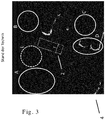
- Fig. 2 shows the measurement diagram of an environment map 1 according to an embodiment.
- the map of the surroundings comprises 256x256 cells, the assigned occupancy probability is shown on the basis of gray levels.
- White means that the corresponding section of the area was recorded as unoccupied, i.e. the occupancy probability was determined to be 0%.
- Gray means that no statement can be made about the occupancy, i.e. there is an occupancy probability of 50%.
- Black means that there is an occupancy, i.e. the cell has an occupancy probability of 100%.
- the majority of the cells are assigned an unknown occupancy probability.
- the measurements were carried out from vehicle 2 with the aid of cameras in the vehicle and an SFM method.
- the occupancy probabilities and height information determined for the sections of the surroundings are shown in the measurement diagram of Fig. 2 only the occupancy information is shown.
- vehicle 2 the rear axle is symbolized by the crossbar.
- the previous trajectory of the vehicle 2 moving forward can be seen from the white lane 3.
- the measurement diagram of the Fig. 2 the result of the occupancy detection of the area after driving through lane 3 is shown.
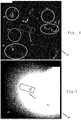
- FIG. 4 shows a measurement diagram of an obstacle map 4 according to an exemplary embodiment, which according to a threshold value application of the prior art based on the environment map according to the measurement diagram of FIG Fig. 2 was determined.
- This obstacle map 4 shows height information which is assigned to individual cells recognized as being occupied by an obstacle. Black symbolizes cells for which no obstacle was recognized. Grayscale and white symbolize an obstacle and the height of the obstacle.
- the occupancy probability of a cell compared with the same threshold value, for example 0.6. As can be seen, this comparison effectively suppresses the noise in area E and the systematic errors in area C.
- the obstacles in areas A and B are also not correctly recognized or represented.
- Fig. 4 shows a measurement diagram of an obstacle map 5 according to an embodiment of the invention. It was made by using the threshold map 6 according to the diagram of FIG Fig. 5 generated.
- the threshold map 6 has as many cells as the environment map 1. Each cell of the environment map is assigned a threshold value by the threshold map 6.
- the highest threshold value (area 7), for example 0.95, is represented by white, the lowest (area 9), for example 0.3, by black. Shades of gray (area 8) symbolize values in between.
- the distribution of the threshold values depends on the previous trajectory of the vehicle.
- the sensor properties in SFM processes namely the difficult detection of obstacles at a greater distance and in front of the vehicle, are taken into account.
- the probabilities of occupancy of the cells of the environment map 1 are compared with threshold values.
- the threshold values for the individual cells of the environment map 1 are not uniform or constant, but, as explained, different depending on the location (for example row and column) of the cell.
- the obstacles are represented in the areas A and B, while the noise and the misrecognition in the areas E and C are suppressed.
- the obstacles in area D are also correctly identified.
- the obstacle map 5 thus reproduces the obstacles in the surrounding area better than in accordance with the prior art method result shown in obstacle map 4.
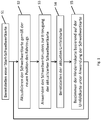
- the threshold map 6 and the obstacle map are generated using an iterative method that in Fig. 1 is explained.
- a start threshold map is provided. This can provide the same threshold value, for example 0.3, for all cells.
- This threshold map is adapted in step S2 according to the changed position (and orientation) of the vehicle. Typically, this will include a shift and rotation of the threshold map, provided that the threshold map is always to be arranged symmetrically and in a constant orientation to the vehicle.
- a threshold value pattern is applied to the threshold values of the individual cells of the threshold value map.
- the threshold value pattern can also be viewed as a threshold value map, the individual cells of which are assigned threshold value increments. These threshold value increments and threshold values of corresponding cells are added in order to arrive at the updated threshold value map.
- the threshold value increments are typically lower than the threshold values of the start threshold value map, for example 0.03; 0.05 or 0.07. If the addition would exceed a maximum threshold value, for example 0.95, the threshold value of the cell under consideration is set to the maximum threshold value.
- the distribution of the height of the threshold value increments in the cells of the threshold value pattern can follow a cone function or a Gaussian curve.
- the threshold values of the threshold value map reflect the previous trajectory of the vehicle.
- the current map of the surroundings is provided in step S4. As previously described, the current map of the surroundings was based on repeated entries of sensor readings (occupancy probabilities). The occupancy probabilities that are determined in a sensor measurement are added to occupancy probabilities previously recognized for the same section.
- the creation of the threshold map is iterative like the creation of the environment map. In the method it can be provided that the sensor measured values are incorporated into the environment map several times before a new obstacle map is created based on them. The threshold value increments of the threshold value pattern are adapted accordingly (i.e. higher).
- the obstacle map is determined in the last step S5. For this purpose, height information is only entered in the obstacle map for those cells that were recognized as occupied. Those cells are recognized as occupied whose occupancy probability is above the threshold value which is specified for the corresponding cell by the threshold value map.
- Steps S2 to S5 are repeated based on the newly created threshold map.
Landscapes
- Engineering & Computer Science (AREA)
- Physics & Mathematics (AREA)
- General Physics & Mathematics (AREA)
- Radar, Positioning & Navigation (AREA)
- Remote Sensing (AREA)
- Automation & Control Theory (AREA)
- Mathematical Physics (AREA)
- Transportation (AREA)
- Mechanical Engineering (AREA)
- Multimedia (AREA)
- Theoretical Computer Science (AREA)
- Acoustics & Sound (AREA)
- Computer Networks & Wireless Communication (AREA)
- Traffic Control Systems (AREA)
- Navigation (AREA)
Claims (9)
- Procédé de fourniture d'une carte d'obstacles destinée à des fonctions de conduite et à des systèmes d'assistance à la conduite d'un véhicule, la carte d'obstacles comprenant des cellules qui sont chacune associées à des portions de l'environnement du véhicule et à chacune desquelles est attribuée l'information selon laquelle la portion correspondante de l'environnement est occupée par un obstacle ; le procédé comprenant les étapes suivantes :fournir une carte d'environnement, la carte d'environnement comprenant des cellules qui sont chacune associées à des portion de l'environnement du véhicule et à chacune desquelles est attribuée une probabilité d'obstacle qui représente la probabilité que la portion correspondante de l'environnement soit occupée par un obstacle et qui résulte du traitement des mesures de l'environnement du véhicule par des capteurs ;fournir une règle de valeur de seuil ;la règle de valeur de seuil indiquant pour les cellules de la carte d'environnement différentes valeurs de seuil ;la règle de valeur de seuil étant déterminée en fonction de la trajectoire du véhicule ;spécifier la carte d'obstacles en fonction de la carte d'environnement et en fonction de la règle de valeur de seuil.
- Procédé selon la revendication 1, un modèle de valeur de seuil étant pris en compte de manière répétée pour déterminer la règle de valeur de seuil ; le modèle de valeur de seuil indiquant différents incréments de valeur de seuil pour différentes cellules d'un groupe de cellules.
- Procédé selon la revendication 2, la règle de valeur de seuil comprenant une carte de valeur de seuil qui indique un incrément de valeur de seuil pour chacune des cellules de la carte d'environnement.
- Procédé selon l'une quelconque des revendications 2 et 3, dans lequel lors de la prise en compte du motif de valeur de seuil, les incréments de valeur de seuil du motif de valeur de seuil sont ajoutés aux valeurs de seuil d'une règle de valeur de seuil préalablement déterminée, notamment une carte de valeur de seuil.
- Procédé selon l'une des revendications 2 à 4, le modèle de valeur de seuil étant pris en compte en fonction de la position et/ou de l'orientation du véhicule dans la carte d'environnement lors de la spécification de la règle de valeur de seuil.
- Procédé selon l'une des revendications précédentes, la règle de valeur de seuil étant également dépendante du temps et/ou dépendante de l'intégration de mesures de capteur de l'environnement dans la carte d'environnement.
- Procédé selon l'une des revendications précédentes, des cellules de la carte d'environnement étant chacune associées à la même portion de l'environnement que les cellules de la carte d'obstacles ; l'information pour une cellule de la carte d'obstacles étant obtenue par comparaison de la probabilité d'occupation de la cellule correspondante de la carte d'environnement avec une valeur de seuil indiquée pour la cellule correspondante de la carte d'environnement conformément à la règle de valeur de seuil.
- Unité de commande électronique destinée à des véhicules, l'unité de commande étant adaptée pour mettre en œuvre un procédé selon l'une des revendications précédentes.
- Véhicule comprenant une unité de commande selon la revendication 8.
Applications Claiming Priority (2)
| Application Number | Priority Date | Filing Date | Title |
|---|---|---|---|
| DE102015205244.3A DE102015205244B3 (de) | 2015-03-24 | 2015-03-24 | Verfahren zum Bereitstellen von Hinderniskarten für Fahrzeuge |
| PCT/EP2016/055212 WO2016150728A1 (fr) | 2015-03-24 | 2016-03-11 | Procédé de fourniture de cartes des obstacles pour véhicules |
Publications (2)
| Publication Number | Publication Date |
|---|---|
| EP3204792A1 EP3204792A1 (fr) | 2017-08-16 |
| EP3204792B1 true EP3204792B1 (fr) | 2020-12-30 |
Family
ID=54549099
Family Applications (1)
| Application Number | Title | Priority Date | Filing Date |
|---|---|---|---|
| EP16711551.8A Active EP3204792B1 (fr) | 2015-03-24 | 2016-03-11 | Procédé de fourniture de cartes des obstacles pour véhicules |
Country Status (5)
| Country | Link |
|---|---|
| US (1) | US10460603B2 (fr) |
| EP (1) | EP3204792B1 (fr) |
| CN (1) | CN107000753B (fr) |
| DE (1) | DE102015205244B3 (fr) |
| WO (1) | WO2016150728A1 (fr) |
Families Citing this family (14)
| Publication number | Priority date | Publication date | Assignee | Title |
|---|---|---|---|---|
| US10635913B2 (en) * | 2016-10-17 | 2020-04-28 | Mediatek Inc. | Path planning method and related navigation device |
| DE102016123391A1 (de) * | 2016-12-02 | 2018-06-07 | Continental Engineering Services Gmbh | Verfahren zur Unterstützung eines Einparkvorganges sowie Parkassistenzvorrichtung |
| US10195992B2 (en) | 2017-04-03 | 2019-02-05 | Ford Global Technologies, Llc | Obstacle detection systems and methods |
| EP3514648B1 (fr) * | 2018-01-22 | 2023-09-06 | Continental Autonomous Mobility Germany GmbH | Procédé et appareil pour la détection d'une limite dans un environment d'un objet |
| KR102704006B1 (ko) * | 2019-02-14 | 2024-09-05 | 한화에어로스페이스 주식회사 | 장애물 지도 생성 방법 및 그 장치 |
| CN109849936A (zh) * | 2019-03-07 | 2019-06-07 | 无锡众创未来科技应用有限公司 | 一种车辆周边局部障碍物地图的生成方法 |
| CN110045376B (zh) * | 2019-04-28 | 2021-06-01 | 森思泰克河北科技有限公司 | 可行驶区域获取方法、计算机可读存储介质及终端设备 |
| CN111942374A (zh) * | 2020-08-14 | 2020-11-17 | 中国第一汽车股份有限公司 | 一种障碍物地图生成方法、装置、车辆及存储介质 |
| DE102020215255A1 (de) | 2020-12-03 | 2022-06-09 | Continental Automotive Gmbh | Verfahren zur Höhenklassifikation von Objekten mittels Ultraschallsensorik |
| US11462021B2 (en) * | 2021-01-13 | 2022-10-04 | GM Global Technology Operations LLC | Obstacle detection and notification for motorcycles |
| CN112644480B (zh) * | 2021-01-18 | 2022-12-13 | 广州小鹏自动驾驶科技有限公司 | 一种障碍物检测方法、检测系统、计算机设备和存储介质 |
| GB202108228D0 (en) * | 2021-06-09 | 2021-07-21 | Agco Int Gmbh | Residue spread mapping |
| US12325450B2 (en) * | 2021-08-23 | 2025-06-10 | Ford Global Technologies, Llc | Systems and methods for generating multilevel occupancy and occlusion grids for controlling navigation of vehicles |
| CN114253273B (zh) * | 2021-12-23 | 2024-04-12 | 南京世泽科技有限公司 | 一种基于多线激光雷达的避障方法 |
Family Cites Families (17)
| Publication number | Priority date | Publication date | Assignee | Title |
|---|---|---|---|---|
| DE10230483A1 (de) * | 2002-07-06 | 2004-01-15 | Robert Bosch Gmbh | Verfahren zur Ansteuerung eines zweistufigen Gurtstraffers |
| DE10244148A1 (de) | 2002-09-23 | 2004-04-08 | Daimlerchrysler Ag | Verfahren und Vorrichtung zur videobasierten Beobachtung und Vermessung der seitlichen Umgebung eines Fahrzeugs |
| JP4412337B2 (ja) * | 2007-03-08 | 2010-02-10 | トヨタ自動車株式会社 | 周囲環境推定装置及び周囲環境推定システム |
| JP4623057B2 (ja) * | 2007-06-05 | 2011-02-02 | トヨタ自動車株式会社 | 自車両の移動領域取得装置 |
| US8244458B1 (en) * | 2008-06-23 | 2012-08-14 | The United States Of America As Represented By The Secretary Of The Navy | Host-centric method for automobile collision avoidance decisions |
| EP2583062B1 (fr) * | 2010-06-15 | 2017-08-09 | TomTom Global Content B.V. | Détection de position, tableau horaire et estimation des temps de trajet pour la traversée d'obstacles sur une carte numérique |
| JP5206752B2 (ja) | 2010-08-30 | 2013-06-12 | 株式会社デンソー | 走行環境認識装置 |
| US8571722B2 (en) * | 2010-10-22 | 2013-10-29 | Toyota Motor Engineering & Manufacturing North America, Inc. | Method for safely parking vehicle near obstacles |
| DE102011113016A1 (de) * | 2011-09-09 | 2012-03-29 | Daimler Ag | Verfahren zur Umgebungsrepräsentation eines Fahrzeugs |
| DE102011116613A1 (de) * | 2011-10-20 | 2013-04-25 | Atlas Elektronik Gmbh | Unbemanntes Unterwasserfahrzeug und Verfahren zum Lokalisieren und Untersuchen eines am Gewässergrund eines Gewässers angeordenten Objekts sowie System mit dem unbemannten Unterwasserfahrzeug |
| EP2771873B1 (fr) * | 2011-10-28 | 2018-04-11 | Conti Temic microelectronic GmbH | Modèle d'environnement à base de grille pour un véhicule |
| JP6015227B2 (ja) * | 2012-08-10 | 2016-10-26 | アイシン・エィ・ダブリュ株式会社 | 交差点案内システム、方法およびプログラム |
| DE102013207905A1 (de) * | 2013-04-30 | 2014-10-30 | Bayerische Motoren Werke Aktiengesellschaft | Verfahren zum effizienten Bereitstellen von Belegungsinformationen über Abschnitte des Umfeldes eines Fahrzeugs |
| JP2015155878A (ja) * | 2014-02-21 | 2015-08-27 | 株式会社デンソー | 車両用障害物検出装置 |
| US9766336B2 (en) * | 2015-03-16 | 2017-09-19 | Here Global B.V. | Vehicle obstruction detection |
| US9505413B2 (en) * | 2015-03-20 | 2016-11-29 | Harman International Industries, Incorporated | Systems and methods for prioritized driver alerts |
| US9868443B2 (en) * | 2015-04-27 | 2018-01-16 | GM Global Technology Operations LLC | Reactive path planning for autonomous driving |
-
2015
- 2015-03-24 DE DE102015205244.3A patent/DE102015205244B3/de active Active
-
2016
- 2016-03-11 WO PCT/EP2016/055212 patent/WO2016150728A1/fr not_active Ceased
- 2016-03-11 CN CN201680004234.0A patent/CN107000753B/zh active Active
- 2016-03-11 EP EP16711551.8A patent/EP3204792B1/fr active Active
-
2017
- 2017-09-22 US US15/713,115 patent/US10460603B2/en active Active
Non-Patent Citations (1)
| Title |
|---|
| None * |
Also Published As
| Publication number | Publication date |
|---|---|
| DE102015205244B3 (de) | 2015-12-10 |
| CN107000753A (zh) | 2017-08-01 |
| US20180012494A1 (en) | 2018-01-11 |
| CN107000753B (zh) | 2019-08-20 |
| US10460603B2 (en) | 2019-10-29 |
| EP3204792A1 (fr) | 2017-08-16 |
| WO2016150728A1 (fr) | 2016-09-29 |
Similar Documents
| Publication | Publication Date | Title |
|---|---|---|
| DE102015205244B3 (de) | Verfahren zum Bereitstellen von Hinderniskarten für Fahrzeuge | |
| DE102016107938B4 (de) | Vorausschauendes fahrzeuggeschwindigkeitsregelungssystem und verfahren zur vorausschauenden geschwindigkeitsregelung | |
| DE102008001409A1 (de) | Verfahren zur Bestimmung von freien Bereichen in der, insbesondere für die Fahrzeugführung relevanten Umgebung eines Kraftfahrzeugs | |
| DE102019112413A1 (de) | Verfahren und vorrichtung zur multi-sensor-datenfusion für automatisierte und autonome fahrzeuge | |
| DE102016212326A1 (de) | Verfahren zur Verarbeitung von Sensordaten für eine Position und/oder Orientierung eines Fahrzeugs | |
| DE102019133708A1 (de) | Verfahren und vorrichtung zum erfassen von statischen und dynamischen informationen auf spurniveau | |
| WO2019072674A1 (fr) | Procédé et dispositif de génération d'un modèle de capteur inverse et procédé de détection d'obstacles | |
| WO2015139864A1 (fr) | Procédé et dispositif de fonctionnement d'un véhicule | |
| WO2014032664A1 (fr) | Procédé de détermination du tracé de la voie d'un véhicule | |
| DE102014204309A1 (de) | Vorrichtung und Verfahren zum Betreiben eines Fahrzeugs | |
| DE102021127078B4 (de) | Verfahren zum Plausibilisieren einer auf Basis von Schwarmdaten erzeugten Trajektorie für ein zumindest teilweise assistiert betriebenes Kraftfahrzeug, Computerprogrammprodukt sowie Assistenzsystem | |
| DE102017217986B4 (de) | Verfahren und vorrichtung zum vorhersagen potenzieller kollisionen, fahrerassistenzsystem und fahrzeug | |
| AT518940B1 (de) | Verfahren und Vorrichtung zum Messen eines Abstands zwischen einem ersten Fahrzeug und einem zweiten, dem ersten Fahrzeug unmittelbar vorausfahrenden, Fahrzeug | |
| DE102007034196A1 (de) | Verfahren und Vorrichtung für die Spurerfassung mit einem Fahrerassistenzsystem | |
| DE102018204451A1 (de) | Verfahren und Vorrichtung zur Autokalibrierung eines Fahrzeugkamerasystems | |
| DE102013203908A1 (de) | Schätzung der zukünftigen Geschwindigkeit eines Fahrzeugs | |
| DE102018124979A1 (de) | Fahrerassistenzsystem zur Bestimmung einer Entfernung zwischen zwei Fahrzeugen mit einer Kamera | |
| DE102019215263A1 (de) | Verfahren und Vorrichtung zum Führen eines Kraftfahrzeuges in einer Fahrspur | |
| DE102008026876A1 (de) | Stereokamerasystem und Verfahren zum Ermitteln mindestens eines Kalibrierfehlers eines Stereokamerasystems | |
| DE102019132150A1 (de) | Verfahren zum automatischen Kalibrieren eines Umfeldsensors, insbesondere eines Lidar-Sensors, eines Fahrzeugs auf Grundlage von Belegungskarten sowie Recheneinrichtung | |
| DE102011076795A1 (de) | Verfahren zum Bestimmen einer Nickbewegung einer in einem Fahrzeug verbauten Kamera und Verfahren zur Steuerung einer Lichtaussendung zumindest eines Frontscheinwerfers eines Fahrzeugs | |
| DE102019102922A1 (de) | Verfahren und Vorrichtung zur Multi-Sensor-Datenfusion für automatisierte und autonome Fahrzeuge | |
| DE102017201796A1 (de) | Steuervorrichtung zum Ermitteln einer Eigenbewegung eines Kraftfahrzeugs sowie Kraftfahrzeug und Verfahren zum Bereitstellen der Steuervorrichtung | |
| DE102009024131A1 (de) | Verfahren zur Ermittelung einer Fahrspur und Fahrerassistenzsystem für ein Fahrzeug mit Mitteln zur Ermittelung einer Fahrspur | |
| WO2013164182A2 (fr) | Procédé et dispositif pour déterminer un environnement |
Legal Events
| Date | Code | Title | Description |
|---|---|---|---|
| STAA | Information on the status of an ep patent application or granted ep patent |
Free format text: STATUS: THE INTERNATIONAL PUBLICATION HAS BEEN MADE |
|
| PUAI | Public reference made under article 153(3) epc to a published international application that has entered the european phase |
Free format text: ORIGINAL CODE: 0009012 |
|
| STAA | Information on the status of an ep patent application or granted ep patent |
Free format text: STATUS: REQUEST FOR EXAMINATION WAS MADE |
|
| 17P | Request for examination filed |
Effective date: 20170509 |
|
| AK | Designated contracting states |
Kind code of ref document: A1 Designated state(s): AL AT BE BG CH CY CZ DE DK EE ES FI FR GB GR HR HU IE IS IT LI LT LU LV MC MK MT NL NO PL PT RO RS SE SI SK SM TR |
|
| AX | Request for extension of the european patent |
Extension state: BA ME |
|
| DAV | Request for validation of the european patent (deleted) | ||
| DAX | Request for extension of the european patent (deleted) | ||
| GRAP | Despatch of communication of intention to grant a patent |
Free format text: ORIGINAL CODE: EPIDOSNIGR1 |
|
| STAA | Information on the status of an ep patent application or granted ep patent |
Free format text: STATUS: GRANT OF PATENT IS INTENDED |
|
| RIC1 | Information provided on ipc code assigned before grant |
Ipc: G06K 9/00 20060101ALI20200814BHEP Ipc: G01S 15/931 20200101ALI20200814BHEP Ipc: G08G 1/16 20060101ALI20200814BHEP Ipc: B60W 30/08 20120101ALI20200814BHEP Ipc: G01S 15/93 20200101AFI20200814BHEP Ipc: B60W 40/04 20060101ALI20200814BHEP Ipc: G06K 9/62 20060101ALI20200814BHEP |
|
| INTG | Intention to grant announced |
Effective date: 20200916 |
|
| RIN1 | Information on inventor provided before grant (corrected) |
Inventor name: WALESSA, MARC Inventor name: KORMANN, OLIVER |
|
| GRAS | Grant fee paid |
Free format text: ORIGINAL CODE: EPIDOSNIGR3 |
|
| GRAA | (expected) grant |
Free format text: ORIGINAL CODE: 0009210 |
|
| STAA | Information on the status of an ep patent application or granted ep patent |
Free format text: STATUS: THE PATENT HAS BEEN GRANTED |
|
| AK | Designated contracting states |
Kind code of ref document: B1 Designated state(s): AL AT BE BG CH CY CZ DE DK EE ES FI FR GB GR HR HU IE IS IT LI LT LU LV MC MK MT NL NO PL PT RO RS SE SI SK SM TR |
|
| REG | Reference to a national code |
Ref country code: GB Ref legal event code: FG4D Free format text: NOT ENGLISH |
|
| REG | Reference to a national code |
Ref country code: AT Ref legal event code: REF Ref document number: 1350466 Country of ref document: AT Kind code of ref document: T Effective date: 20210115 |
|
| REG | Reference to a national code |
Ref country code: DE Ref legal event code: R096 Ref document number: 502016012074 Country of ref document: DE |
|
| REG | Reference to a national code |
Ref country code: IE Ref legal event code: FG4D Free format text: LANGUAGE OF EP DOCUMENT: GERMAN |
|
| PG25 | Lapsed in a contracting state [announced via postgrant information from national office to epo] |
Ref country code: NO Free format text: LAPSE BECAUSE OF FAILURE TO SUBMIT A TRANSLATION OF THE DESCRIPTION OR TO PAY THE FEE WITHIN THE PRESCRIBED TIME-LIMIT Effective date: 20210330 Ref country code: RS Free format text: LAPSE BECAUSE OF FAILURE TO SUBMIT A TRANSLATION OF THE DESCRIPTION OR TO PAY THE FEE WITHIN THE PRESCRIBED TIME-LIMIT Effective date: 20201230 Ref country code: GR Free format text: LAPSE BECAUSE OF FAILURE TO SUBMIT A TRANSLATION OF THE DESCRIPTION OR TO PAY THE FEE WITHIN THE PRESCRIBED TIME-LIMIT Effective date: 20210331 Ref country code: FI Free format text: LAPSE BECAUSE OF FAILURE TO SUBMIT A TRANSLATION OF THE DESCRIPTION OR TO PAY THE FEE WITHIN THE PRESCRIBED TIME-LIMIT Effective date: 20201230 |
|
| PG25 | Lapsed in a contracting state [announced via postgrant information from national office to epo] |
Ref country code: SE Free format text: LAPSE BECAUSE OF FAILURE TO SUBMIT A TRANSLATION OF THE DESCRIPTION OR TO PAY THE FEE WITHIN THE PRESCRIBED TIME-LIMIT Effective date: 20201230 Ref country code: BG Free format text: LAPSE BECAUSE OF FAILURE TO SUBMIT A TRANSLATION OF THE DESCRIPTION OR TO PAY THE FEE WITHIN THE PRESCRIBED TIME-LIMIT Effective date: 20210330 Ref country code: LV Free format text: LAPSE BECAUSE OF FAILURE TO SUBMIT A TRANSLATION OF THE DESCRIPTION OR TO PAY THE FEE WITHIN THE PRESCRIBED TIME-LIMIT Effective date: 20201230 |
|
| REG | Reference to a national code |
Ref country code: NL Ref legal event code: MP Effective date: 20201230 |
|
| PG25 | Lapsed in a contracting state [announced via postgrant information from national office to epo] |
Ref country code: HR Free format text: LAPSE BECAUSE OF FAILURE TO SUBMIT A TRANSLATION OF THE DESCRIPTION OR TO PAY THE FEE WITHIN THE PRESCRIBED TIME-LIMIT Effective date: 20201230 |
|
| REG | Reference to a national code |
Ref country code: LT Ref legal event code: MG9D |
|
| PG25 | Lapsed in a contracting state [announced via postgrant information from national office to epo] |
Ref country code: EE Free format text: LAPSE BECAUSE OF FAILURE TO SUBMIT A TRANSLATION OF THE DESCRIPTION OR TO PAY THE FEE WITHIN THE PRESCRIBED TIME-LIMIT Effective date: 20201230 Ref country code: CZ Free format text: LAPSE BECAUSE OF FAILURE TO SUBMIT A TRANSLATION OF THE DESCRIPTION OR TO PAY THE FEE WITHIN THE PRESCRIBED TIME-LIMIT Effective date: 20201230 Ref country code: LT Free format text: LAPSE BECAUSE OF FAILURE TO SUBMIT A TRANSLATION OF THE DESCRIPTION OR TO PAY THE FEE WITHIN THE PRESCRIBED TIME-LIMIT Effective date: 20201230 Ref country code: PT Free format text: LAPSE BECAUSE OF FAILURE TO SUBMIT A TRANSLATION OF THE DESCRIPTION OR TO PAY THE FEE WITHIN THE PRESCRIBED TIME-LIMIT Effective date: 20210430 Ref country code: SK Free format text: LAPSE BECAUSE OF FAILURE TO SUBMIT A TRANSLATION OF THE DESCRIPTION OR TO PAY THE FEE WITHIN THE PRESCRIBED TIME-LIMIT Effective date: 20201230 Ref country code: RO Free format text: LAPSE BECAUSE OF FAILURE TO SUBMIT A TRANSLATION OF THE DESCRIPTION OR TO PAY THE FEE WITHIN THE PRESCRIBED TIME-LIMIT Effective date: 20201230 |
|
| PG25 | Lapsed in a contracting state [announced via postgrant information from national office to epo] |
Ref country code: PL Free format text: LAPSE BECAUSE OF FAILURE TO SUBMIT A TRANSLATION OF THE DESCRIPTION OR TO PAY THE FEE WITHIN THE PRESCRIBED TIME-LIMIT Effective date: 20201230 |
|
| PG25 | Lapsed in a contracting state [announced via postgrant information from national office to epo] |
Ref country code: IS Free format text: LAPSE BECAUSE OF FAILURE TO SUBMIT A TRANSLATION OF THE DESCRIPTION OR TO PAY THE FEE WITHIN THE PRESCRIBED TIME-LIMIT Effective date: 20210430 |
|
| REG | Reference to a national code |
Ref country code: DE Ref legal event code: R097 Ref document number: 502016012074 Country of ref document: DE |
|
| PG25 | Lapsed in a contracting state [announced via postgrant information from national office to epo] |
Ref country code: AL Free format text: LAPSE BECAUSE OF FAILURE TO SUBMIT A TRANSLATION OF THE DESCRIPTION OR TO PAY THE FEE WITHIN THE PRESCRIBED TIME-LIMIT Effective date: 20201230 Ref country code: MC Free format text: LAPSE BECAUSE OF FAILURE TO SUBMIT A TRANSLATION OF THE DESCRIPTION OR TO PAY THE FEE WITHIN THE PRESCRIBED TIME-LIMIT Effective date: 20201230 |
|
| REG | Reference to a national code |
Ref country code: CH Ref legal event code: PL |
|
| PLBE | No opposition filed within time limit |
Free format text: ORIGINAL CODE: 0009261 |
|
| STAA | Information on the status of an ep patent application or granted ep patent |
Free format text: STATUS: NO OPPOSITION FILED WITHIN TIME LIMIT |
|
| PG25 | Lapsed in a contracting state [announced via postgrant information from national office to epo] |
Ref country code: DK Free format text: LAPSE BECAUSE OF FAILURE TO SUBMIT A TRANSLATION OF THE DESCRIPTION OR TO PAY THE FEE WITHIN THE PRESCRIBED TIME-LIMIT Effective date: 20201230 |
|
| 26N | No opposition filed |
Effective date: 20211001 |
|
| REG | Reference to a national code |
Ref country code: BE Ref legal event code: MM Effective date: 20210331 |
|
| PG25 | Lapsed in a contracting state [announced via postgrant information from national office to epo] |
Ref country code: ES Free format text: LAPSE BECAUSE OF FAILURE TO SUBMIT A TRANSLATION OF THE DESCRIPTION OR TO PAY THE FEE WITHIN THE PRESCRIBED TIME-LIMIT Effective date: 20201230 Ref country code: IE Free format text: LAPSE BECAUSE OF NON-PAYMENT OF DUE FEES Effective date: 20210311 Ref country code: CH Free format text: LAPSE BECAUSE OF NON-PAYMENT OF DUE FEES Effective date: 20210331 Ref country code: LI Free format text: LAPSE BECAUSE OF NON-PAYMENT OF DUE FEES Effective date: 20210331 Ref country code: LU Free format text: LAPSE BECAUSE OF NON-PAYMENT OF DUE FEES Effective date: 20210311 |
|
| PG25 | Lapsed in a contracting state [announced via postgrant information from national office to epo] |
Ref country code: SI Free format text: LAPSE BECAUSE OF FAILURE TO SUBMIT A TRANSLATION OF THE DESCRIPTION OR TO PAY THE FEE WITHIN THE PRESCRIBED TIME-LIMIT Effective date: 20201230 |
|
| REG | Reference to a national code |
Ref country code: AT Ref legal event code: MM01 Ref document number: 1350466 Country of ref document: AT Kind code of ref document: T Effective date: 20210311 |
|
| PG25 | Lapsed in a contracting state [announced via postgrant information from national office to epo] |
Ref country code: IS Free format text: LAPSE BECAUSE OF FAILURE TO SUBMIT A TRANSLATION OF THE DESCRIPTION OR TO PAY THE FEE WITHIN THE PRESCRIBED TIME-LIMIT Effective date: 20210430 |
|
| PG25 | Lapsed in a contracting state [announced via postgrant information from national office to epo] |
Ref country code: BE Free format text: LAPSE BECAUSE OF NON-PAYMENT OF DUE FEES Effective date: 20210331 |
|
| PG25 | Lapsed in a contracting state [announced via postgrant information from national office to epo] |
Ref country code: AT Free format text: LAPSE BECAUSE OF NON-PAYMENT OF DUE FEES Effective date: 20210311 |
|
| PG25 | Lapsed in a contracting state [announced via postgrant information from national office to epo] |
Ref country code: HU Free format text: LAPSE BECAUSE OF FAILURE TO SUBMIT A TRANSLATION OF THE DESCRIPTION OR TO PAY THE FEE WITHIN THE PRESCRIBED TIME-LIMIT; INVALID AB INITIO Effective date: 20160311 |
|
| P01 | Opt-out of the competence of the unified patent court (upc) registered |
Effective date: 20230502 |
|
| PG25 | Lapsed in a contracting state [announced via postgrant information from national office to epo] |
Ref country code: NL Free format text: LAPSE BECAUSE OF NON-PAYMENT OF DUE FEES Effective date: 20201230 Ref country code: CY Free format text: LAPSE BECAUSE OF FAILURE TO SUBMIT A TRANSLATION OF THE DESCRIPTION OR TO PAY THE FEE WITHIN THE PRESCRIBED TIME-LIMIT Effective date: 20201230 |
|
| PG25 | Lapsed in a contracting state [announced via postgrant information from national office to epo] |
Ref country code: SM Free format text: LAPSE BECAUSE OF FAILURE TO SUBMIT A TRANSLATION OF THE DESCRIPTION OR TO PAY THE FEE WITHIN THE PRESCRIBED TIME-LIMIT Effective date: 20201230 |
|
| PG25 | Lapsed in a contracting state [announced via postgrant information from national office to epo] |
Ref country code: MK Free format text: LAPSE BECAUSE OF FAILURE TO SUBMIT A TRANSLATION OF THE DESCRIPTION OR TO PAY THE FEE WITHIN THE PRESCRIBED TIME-LIMIT Effective date: 20201230 |
|
| PG25 | Lapsed in a contracting state [announced via postgrant information from national office to epo] |
Ref country code: MT Free format text: LAPSE BECAUSE OF FAILURE TO SUBMIT A TRANSLATION OF THE DESCRIPTION OR TO PAY THE FEE WITHIN THE PRESCRIBED TIME-LIMIT Effective date: 20201230 |
|
| PG25 | Lapsed in a contracting state [announced via postgrant information from national office to epo] |
Ref country code: TR Free format text: LAPSE BECAUSE OF FAILURE TO SUBMIT A TRANSLATION OF THE DESCRIPTION OR TO PAY THE FEE WITHIN THE PRESCRIBED TIME-LIMIT Effective date: 20201230 |
|
| PGFP | Annual fee paid to national office [announced via postgrant information from national office to epo] |
Ref country code: GB Payment date: 20260324 Year of fee payment: 11 |
|
| PGFP | Annual fee paid to national office [announced via postgrant information from national office to epo] |
Ref country code: DE Payment date: 20260304 Year of fee payment: 11 |
|
| PGFP | Annual fee paid to national office [announced via postgrant information from national office to epo] |
Ref country code: FR Payment date: 20260325 Year of fee payment: 11 |
|
| PGFP | Annual fee paid to national office [announced via postgrant information from national office to epo] |
Ref country code: IT Payment date: 20260331 Year of fee payment: 11 |