EP3200720B1 - Form zur herstellung eines vorgeformten prothesenbasisrohlings - Google Patents
Form zur herstellung eines vorgeformten prothesenbasisrohlings Download PDFInfo
- Publication number
- EP3200720B1 EP3200720B1 EP15778225.1A EP15778225A EP3200720B1 EP 3200720 B1 EP3200720 B1 EP 3200720B1 EP 15778225 A EP15778225 A EP 15778225A EP 3200720 B1 EP3200720 B1 EP 3200720B1
- Authority
- EP
- European Patent Office
- Prior art keywords
- prosthesis base
- dental arch
- prosthesis
- parts
- base blank
- Prior art date
- Legal status (The legal status is an assumption and is not a legal conclusion. Google has not performed a legal analysis and makes no representation as to the accuracy of the status listed.)
- Active
Links
Images


Classifications
-
- A—HUMAN NECESSITIES
- A61—MEDICAL OR VETERINARY SCIENCE; HYGIENE
- A61C—DENTISTRY; APPARATUS OR METHODS FOR ORAL OR DENTAL HYGIENE
- A61C13/00—Dental prostheses; Making same
- A61C13/01—Palates or other bases or supports for the artificial teeth; Making same
- A61C13/04—Palates or other bases or supports for the artificial teeth; Making same made by casting
-
- A—HUMAN NECESSITIES
- A61—MEDICAL OR VETERINARY SCIENCE; HYGIENE
- A61C—DENTISTRY; APPARATUS OR METHODS FOR ORAL OR DENTAL HYGIENE
- A61C13/00—Dental prostheses; Making same
- A61C13/0003—Making bridge-work, inlays, implants or the like
- A61C13/0022—Blanks or green, unfinished dental restoration parts
-
- A—HUMAN NECESSITIES
- A61—MEDICAL OR VETERINARY SCIENCE; HYGIENE
- A61C—DENTISTRY; APPARATUS OR METHODS FOR ORAL OR DENTAL HYGIENE
- A61C13/00—Dental prostheses; Making same
-
- A—HUMAN NECESSITIES
- A61—MEDICAL OR VETERINARY SCIENCE; HYGIENE
- A61C—DENTISTRY; APPARATUS OR METHODS FOR ORAL OR DENTAL HYGIENE
- A61C13/00—Dental prostheses; Making same
- A61C13/0003—Making bridge-work, inlays, implants or the like
- A61C13/0004—Computer-assisted sizing or machining of dental prostheses
-
- A—HUMAN NECESSITIES
- A61—MEDICAL OR VETERINARY SCIENCE; HYGIENE
- A61C—DENTISTRY; APPARATUS OR METHODS FOR ORAL OR DENTAL HYGIENE
- A61C13/00—Dental prostheses; Making same
- A61C13/01—Palates or other bases or supports for the artificial teeth; Making same
-
- G—PHYSICS
- G16—INFORMATION AND COMMUNICATION TECHNOLOGY [ICT] SPECIALLY ADAPTED FOR SPECIFIC APPLICATION FIELDS
- G16H—HEALTHCARE INFORMATICS, i.e. INFORMATION AND COMMUNICATION TECHNOLOGY [ICT] SPECIALLY ADAPTED FOR THE HANDLING OR PROCESSING OF MEDICAL OR HEALTHCARE DATA
- G16H20/00—ICT specially adapted for therapies or health-improving plans, e.g. for handling prescriptions, for steering therapy or for monitoring patient compliance
- G16H20/40—ICT specially adapted for therapies or health-improving plans, e.g. for handling prescriptions, for steering therapy or for monitoring patient compliance relating to mechanical, radiation or invasive therapies, e.g. surgery, laser therapy, dialysis or acupuncture
Definitions
- the invention relates to a mold for producing a preformed prosthesis base blank, the preformed prosthesis base blank being provided for the production of a prosthesis base for a dental prosthesis using a subtractive CAM method.
- the invention also relates to a method for producing a prosthesis base blank with such a shape and a prosthesis base blank produced with such a method or with such a shape.
- the invention thus ultimately relates to the production of partial plastic prostheses (partial prostheses) and total plastic prostheses (total prostheses) for the dental field or of prosthesis bases for this, which are machine-aided manufacturing (CAM - Computer-Aided Manufacturing) to be produced.
- the dental prostheses and the prosthesis bases are preferably constructed with computer-aided design using CAD methods (CAD - Computer-Aided Design, German: computer-aided design).
- CAD Computer-Aided Design, German: computer-aided design.
- First a prosthesis base is produced, which later rests on the toothless or partially toothless gums of the patient's jaw arch.
- the denture teeth are then individually manufactured and inserted into the denture base and attached there.
- the denture base with the erected denture teeth then forms the finished dental prosthesis.
- the common way is the analog creation of dental prostheses.
- an analogous method is currently used in which an impression of the patient's toothless jaw is first taken. A mold is made from this impression, which is filled with a gum-colored plastic. After the plastic has hardened, it is reworked in order to obtain the desired shape. Then the separately manufactured denture teeth are inserted, which are also currently mostly manufactured analogously.
- denture teeth are set up manually and individually on a wax base.
- this wax prosthesis is embedded in a cuvette with plaster of paris. After the plaster has hardened, the wax base is then washed out with hot water and a cavity is created for the denture resin. The denture teeth remain in the plaster of paris. A corresponding prosthesis material is injected or stuffed into the cavity and, after the plastic has hardened, the prosthesis or the finished prosthetic tooth is obtained.
- the prefabricated teeth When the prefabricated teeth are set up, they are adapted and ground to the respective oral situation of the patient by the dental technician and, if necessary, also by the dentist.
- Such a procedure is from the WO 91/07141 A1 known in which a prosthesis base is milled from a plastic block on the basis of an impression.
- the FR 2 582 932 A1 suggests that a prosthesis base be created with the help of a wax impression and a 3D copy milling machine, this process is more complex than modern CAD-CAM processes.
- From the WO 2013 068 124 A2 a milling block with preformed prosthetic teeth is known.
- the disadvantage here is that the denture teeth are made of the same material as the base and, if damaged, the entire dentition has to be replaced and the finished denture can only be adapted to the needs of the patient with great effort (for example with regard to the tooth color or the occlusion and tooth position) can be customized.
- Another disadvantage is that the base and the prosthetic tooth (or the prosthetic tooth crown) have different requirements but are made of the same material. So the tooth should primarily chew and remain undamaged.
- the base on the other hand, should distribute the forces that occur over the mucous membrane. This can cause problems when using only one material.
- the WO 2014/134 640 A1 discloses a method for producing a dental prosthesis, in which a cavity is filled with a plastic to produce the prosthesis base. From the GB 426 744 A a prosthesis base blank is known which is formed with a press. Due to pressure, the material flows into the free parts of a shape of the prosthesis base.
- a round blank for producing a dental prosthesis is known.
- Such blanks are in principle solid polymethyl methacrylate disks (PMMA disks).
- PMMA disks solid polymethyl methacrylate disks
- This blank (the so-called round blank) is clamped in a CAM milling machine and automatically milled on the basis of a CAD model.
- Current methods mill a prosthesis base only 2 mm to 3 mm thick from such a full block (the round blank).
- Disadvantages are, on the one hand, a very high waste of material which, depending on the anatomical situation of the respective patient, can easily amount to over 90%. On the other hand, this leads to a time-consuming processing time by the CAM device, since a great deal of material has to be removed.
- the wear and tear on the respective milling tools is relatively high.
- Another disadvantage here is that it takes a relatively long time until the prosthesis base is produced.
- the milling head wears out due to the machining of the blank and has to be be renewed at regular intervals.
- the milled material (the milling chips) must be disposed of or recycled.
- the object of the invention is therefore to overcome the disadvantages of the prior art.
- a possibility is to be found, or a prosthesis base blank and a method are to be provided with which the simplest, most complete and inexpensive processing of the prosthesis base blank or the simplest, most complete and inexpensive production of the prosthesis base is possible.
- the milling head or the tool for performing the subtractive CAM method should be stressed as little as possible.
- the prosthesis base should be able to be manufactured as quickly as possible.
- the prosthesis base to be produced should be adaptable to the anatomical conditions for different patients.
- a mold for the production of a preformed prosthesis base blank the preformed prosthesis base blank being provided for the production of a prosthesis base for a dental prosthesis using a subtractive CAM method
- the mold having an inner surface which is a negative of the prosthesis base blank to be produced is, wherein the inner surface represents a negative of a dental arch or a dental arch section, the dental arch or the dental arch section having a thickening in the occlusal direction, and the shape consists of at least two parts which are releasably attached to one another or which are releasably attachable to one another
- the inner surface of the mold besides the dental arch or the dental arch section additionally defines webs and a holder for the prosthesis base blank, the webs connecting the holder to the dental arch or the dental arch portion.
- a dental arch is not understood here to mean the arch of the prosthetic teeth, but rather the part of the prosthesis formed on the saddle of the jaw, which simulates the gum in which the prosthetic teeth are to be attached.
- the thickening in the occlusal direction is necessary in order to be able to shape the papillae between the bearing surfaces for the prosthetic teeth in the prosthetic base blank. Since the prosthetic teeth have to be inserted individually at different locations depending on the patient, the prosthetic base blank formed with the mold according to the invention offers sufficient space or material to be able to shape the papillae (the prosthetic areas for the gums between the teeth) at any point. According to the invention, the thickening rests in the occlusion direction on the dental arch or on the dental arch section.
- a negative of a dental arch or dental arch section is contained in the mold means that the mold forms a receptacle so that the material for the dental arch to be produced of the prosthesis base blank or the dental arch section of the prosthesis base blank to be produced for the partial prosthesis base is already thickened Use of the form, or is contained in the prosthesis base blank produced with the form.
- the dimensions of the dental arch or of the dental arch section are larger than a group of typical dental arches to be manufactured from prosthesis bases, including the usual tolerances.
- the dental arch includes the dental arch of the denture base but not the denture teeth to be inserted. After the prosthetic teeth have been inserted, the set of teeth that was produced with the prosthetic base blank produced from such a mold can be higher than the thickening of the dental arch of the unprocessed prosthetic base blank.
- the inner surface of the mold can be adapted by exchanging parts, the mutually exchangeable parts having a different partial area of the inner surface of the mold for producing different prosthesis base blanks.
- the shape is suitable as a set of parts for the production of different prosthesis base blanks, which are thereby already adapted to certain types of shape for prosthesis bases.
- the mold has a plurality of interchangeable parts and / or inserts which can be inserted within the mold and which change the inner surface when the parts and / or inserts are used to assemble the mold.
- the prosthesis base blank can be clamped in CAM-controlled milling machines or other devices for the subtractive production of prosthesis bases.
- the inner surface of the mold is preferably shaped in such a way that in the case of the prosthesis base blank produced with the mold, the holder is connected to the dental arch or the dental arch section exclusively via the webs.
- the holder which is defined by the inner surface of the mold, forms a ring around the dental arch or dental arch section to be produced, preferably the Dental arch or the dental arch section is connected to the ring via at least three webs.
- the use of at least three webs has the advantage that sufficient stability of the dental arch or the dental arch section is generated in the ring so that the dental arch or the dental arch section cannot rotate against the ring under the mechanical load when machining the prosthesis base blank. Theoretically, the same effect can be achieved with two or even just one sufficiently wide web. At least three more compact webs are preferred according to the invention, however, since the webs can then be separated more easily and post-processing when removing the web attachments from the severed prosthesis base is also easier.
- the webs should be kept as small as possible in diameter in order to keep reworking as low as possible.
- the at least two parts of the mold lie against one another in a snug fit in at least one joint plane, with all of the webs to be produced by the mold being arranged in the at least one joint plane of the mold.
- the basic prosthesis blank prevents the basic prosthesis blank from being permanently connected to the mold through the inner surface, in particular at the points that are intended to form the webs.
- the mold is composed of three parts, then these are placed next to each other in two joint planes. If the form is put together from four parts, then these are put together in two or three joint levels. Correspondingly more joint levels are possible for further parts.
- the joint planes do not have to be arranged geometrically in a flat plane. Instead, the joint plane can also be a corrugated, twisted, kinked, arched and / or curved plane.
- the inner surface of the mold defines a recess or a protrusion which can be used as a reference marking to determine the orientation of the prosthesis base blank, the inner surface of the mold preferably defining a recess or a protrusion on the holder , specifically defined on the ring.
- Shapes preferred according to the invention can be characterized in that the shape consists of metal, silicone or duplicating gel, preferably consists of metal, particularly preferably consists of steel, aluminum or brass.
- the inner surface of the mold is coated.
- the coating can be firmly bonded to the inner surface of the mold or reapplied each time a prosthesis base blank is manufactured.
- the surface can have a very low surface roughness, which can be produced, for example, by electropolishing.
- the at least two parts are joined to one another along a transverse plane or are to be joined to one another.
- the transverse plane is a plane in which the mandibular arch of the prosthesis base to be produced lies.
- the inner surface of the parts of the mold does not form a geometric body that prevents the mold from being released from the cured basic prosthesis blank when the basic prosthesis blank is removed from the mold, with preferably no undercuts or undercuts the inner surface of the parts of the mold are provided.
- the objects on which the present invention is based are also achieved by a method for producing a prosthesis base blank with a mold according to the invention, in which a hot polymer or a cold polymer is filled into the at least two-part composite mold, then the hot polymer or the cold polymer cures and then the parts the mold can be released from the cured prosthesis base blank.
- the prosthesis base blank is deburred at least in some areas after the parts of the mold have been detached.
- the curing is preferably carried out under increased pressure to avoid bubbles in the material.
- a hot polymerizate is filled into the at least two-part composite mold made of metal using a stuffing-press technique or an injection technique.
- a cold polymerizate is filled into the at least two-part, composite mold made of metal, silicone or duplicating gel using a casting technique or an injection technique.
- Either a full prosthesis for a jaw part can be milled or shaped from the prosthesis base blank produced according to the invention, or several partial prostheses can be milled or shaped from a prosthesis base blank.
- the shape, the parts of the mold and / or inserts of the mold for producing the prosthesis base blank be selected from a variety of shapes, parts and / or inserts, the selection being made arithmetically on the basis of the CAD Model of the prosthesis base to be generated and the known dimensions of all shapes, parts of the shapes and inserts of the shapes, with all possible shapes and / or combinations of the parts of the shapes and / or combinations of the inserts of the shapes being suggested as a selection preferably via an output device of a computer and / or can be selected via an input device.
- the shape is selected or the combination of parts and / or inserts of a form are selected from the set of forms, parts and / or inserts whose inner surface has the external dimensions of the prosthesis base to be produced, which by the CAD model is calculated, can completely record, preferably the proposed sequence, in particular the displayed or illustrated sequence, the selected shapes, parts and / or inserts is determined by the volume difference between the inner surface of the assembled forms, parts and / or inserts and the CAD model of the prosthesis base to be produced.
- the shape or the combination of parts and / or inserts of a shape is automatically proposed or used which has the smallest volume difference to the CAD model of the prosthesis base to be produced.
- the objects on which the invention is based are also achieved by a prosthesis base blank produced using a method according to the invention or produced using a mold according to the invention.
- the prosthesis base blank has webs which are connected to a ring as a holder and which hold the dental arch or the dental arch section in the interior of the ring.
- the position of the prosthesis base to be produced in the prosthesis base blank is accurate to 10 mm, preferably to 5 mm, and the orientation of the prosthesis base to be produced in the prosthesis base blank is accurate to 10 °, preferably to 5 °.
- the orientation relates to possible tilt angles of the prosthesis base to be produced relative to the preformed prosthesis base blank.
- the prosthesis base blank has exactly one plane of symmetry or two planes of symmetry oriented perpendicular to one another, with precisely one plane of symmetry being preferred. It can preferably be provided that the one plane of symmetry or one of the planes of symmetry corresponds to the sagittal plane of the prosthesis base to be produced.
- the prosthesis base blank has a curved recess on the side for resting on the gums as a preform of a receptacle of a toothless jaw saddle or part of a toothless jaw saddle, the recess extending along the dental arch or dental arch section.
- the prosthesis base blank is made of polymethyl methacrylate (PMMA), polyether ketone (PEK), polyether ether ketone (PEEK), polyamide (PA), polycarbonate (PC) or polyurethane (PU) or a combination thereof or with these materials or a combination is generated from this. These materials are for the Machining of the prosthesis base blank with the CAM process is particularly suitable. In addition, aesthetically fitting prosthesis bases can be made from it.
- PMMA polymethyl methacrylate
- PEK polyether ketone
- PEEK polyether ether ketone
- PA polyamide
- PC polycarbonate
- PU polyurethane
- the invention is based on the surprising finding that the shape makes it possible to produce a compact prosthesis base blank in a simple manner, the external dimensions and geometry of which is already adapted to the external dimensions and the geometry of the prosthesis base to be produced from the prosthesis base blank, so that from the prosthesis base blanks produced with the mold or the method can be produced quickly and by removing only small amounts of the material, the desired prosthesis bases.
- the preformed prosthesis base blanks With the preformed prosthesis base blanks, it is possible to enable a faster and more efficient process for the production of prosthesis bases in which the tools of the CAM device are spared and the material loss can be minimized by the subtractive CAM process. Due to the suitable shape, the prosthesis base blanks remain flexible enough to be easily adapted to the different oral situations of different patients and to the other requirements for the prosthesis base to be produced.
- the method and the prosthesis base blanks produced with the mold are intended for processing with CAD / CAM methods and are particularly suitable for this.
- the approach on which this invention is based is preferably based on various shapes or parts and inserts for molds for producing various preformed prosthesis base blanks, which eliminate the above-mentioned disadvantages in that they are not solid bodies or solid disks but rather preformed blanks.
- the invention is characterized in that - similar to impression spoons - it divides the human jaw into categories or sizes on the basis of anatomical features and accordingly provides largely pre-formed prosthesis base blanks.
- the prosthesis base blank to be produced can already be adapted to a certain extent to the oral situation or to the type of patient, thus further reducing the amount of material to be removed.
- the software used in a CAD-CAM system can select a suitable shape or suitable parts of the shape for the respective patient situation and takes over the so-called nesting in the preformed prosthesis base blanks (the best possible positioning of the virtual shape of the prosthesis base to be created in the prosthesis base blank ).
- the prosthesis base blanks can preferably be made of different materials such as plastics or wax.
- the advantages of the mold according to the invention and the method according to the invention, or the prosthesis base blanks produced with such methods and molds, are, among other things, the shorter milling times, the lower use of prosthesis base material and the protection of the milling tools, i.e. less wear on the milling tools in comparison for the use of common milling blanks.
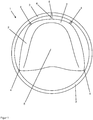
- FIG. 1 shows a schematic plan view of a prosthesis base blank 1 according to the invention, which was produced using a method according to the invention or a mold according to the invention.
- the prosthesis base blank 1 consists of a plastic, preferably a polymer.
- the inner area of the basic prosthesis blank 1 has a parabolic thickening which forms a preformed dental arch 2 with a thickening.
- the basic prosthesis blank 1 is symmetrical with respect to a middle plane. This middle plane corresponds to the sagittal plane of the patient in whom the dental prosthesis produced with the basic prosthesis blank 1 is used.
- the prosthesis base blank 1 has a ring 3 which surrounds the inner area of the prosthesis base blank 1.
- the ring 3 is connected to the inner area of the basic prosthesis blank 1 via five webs 4.
- the ring 3 and the webs 4 serve exclusively to hold the prosthesis base blank 1 in a standardized mount of a CAM device, such as a CAM four-axis milling machine.
- the webs 4 are separated and the resulting stumps of the webs 4 are ground on the prosthesis base.
- the prosthesis base is therefore made only from the inner area of the prosthesis base blank 1 with the preformed dental arch 2 and with a palate plate 8 or a sublingual plate 8.
- the apex of the preformed dental arch 2 of a prosthesis base produced from the prosthesis base blank 1 will later be arranged on the patient's labial side, i.e. on the lip side, when a total dental prosthesis is made from the prosthesis base blank 1 or a partial prosthesis is made that includes at least the central incisors.
- the prosthesis base blank 1 shown is suitable both for the production of a partial prosthesis base or several partial prosthesis bases or a full prosthesis base for an upper jaw as well as for a lower jaw. However, it is also possible to produce more strongly preformed prosthesis base blanks 1 in which a distinction is made between the upper jaw and the lower jaw. In addition or as an alternative, a variety of different shapes for the production of different prosthesis base blanks 1 can be kept or provided as a set, which differ in the curvature of the dental arches 2 and their width and from which the appropriate shape for the production of a prosthesis base blank 1 can be selected.
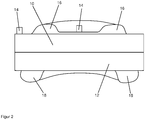
- Figure 2 shows a schematic side view of a mold according to the invention for producing a prosthesis base blank comprising two parts 10, 12.
- the two parts 10, 12 are placed against one another or fastened to one another in such a way that an inner surface is formed inside the mold, which is a negative of the prosthesis base blank 1 after Figure 1 or another prosthesis base blank.
- the inner surface of the mold forms the outer circumference of the ring 3.
- At least two filler necks 14 with openings for filling or pressing in or injecting material into the mold are provided in the mold.
- the entire material for producing the prosthesis base blank does not have to be entered into the mold only through the filler neck 14.
- the mold can also or additionally be filled with the material before the two parts 10, 12 are put together.
- At least one vent may also be included in the molds to allow air trapped in the mold to escape as the material is injected.
- the inner surface forming the dental arch 2 and the elevation or thickening thereon can be seen from the outside as a receptacle 16 for the elevation or thickening in the occlusal direction on the dental arch on the upper part 10 of the mold.
- 12 receptacles 18 for the inner surface are on the underside of the lower mold.
- the shape of the support on the gums can be seen. However, the shape could also have a cylindrical structure from the outside.
- the two parts 10, 12 of the mold are in a joint plane (in Figure 2 the middle horizontal line). In the plane of the joint plane, the two parts 10, 12 rest flush against one another with contact surfaces. In the plane of the joint plane, all webs 4 of the prosthesis base blank 1 to be shaped are also arranged. It is thereby achieved that the parts 10, 12 of the mold can be separated from the prosthesis base blank 1 when the prosthesis base blank 1 has hardened, and not the parts 10, 12 engage in the webs 4 and thereby detach the parts 10, 12 from the Prevent hardened prosthesis base blank 1. Pins and holes (not shown) or tongue and groove (not shown) can be provided in the contact surfaces in order to force a clear orientation of the two parts 10, 12 to one another when fastening the parts 10, 12 to one another.
- Figure 3 shows a schematic plan view of the shaping surface of the upper part 10 of the mold according to the invention Figure 2 .
- the part 10 of the mold has a rim 20 which encloses the entire part 10 of the mold.
- the edge 20 forms a surface which rests on a suitable counterpart, that is to say on a suitable edge of the part 12 and closes the mold to the outside.
- a negative mold for the ring 21 that is to say the area of the inner surface of the mold that is used to shape the ring 3 Figure 1 is provided.
- the negative molds for the webs 22, which are arranged between five support surfaces 23, are located adjacent to this.
- the negative molds for the webs 22 are accordingly the area of the inner surface of the mold that is used to shape the webs 4 Figure 1 is provided.
- the five contact surfaces 23 rest on corresponding and precisely fitting contact surfaces of the other part 12 of the mold.
- the bearing surfaces 23 and the surface of the ring 21 all lie in the joint plane of the mold.
- the support surfaces 23 can theoretically also have a different height than the surface of the ring 21.
- the joint plane would then be correspondingly curved or at least not flat and could then also be called a joint surface in a more geometrically correct manner.
- the negative molds for the dental arch 24 are the area of the inner surface of the mold which is used for forming the dental arch 2 Figure 1 is provided.
- the negative mold for the marking 26 is accordingly the area of the inner surface of the mold that is used for forming the marking 6 Figure 1 is provided.
- openings 27 for filling in material for producing the prosthesis base blank 1 Figure 1 or another prosthesis base blank is provided. These openings 27 open into the filler neck 14 Figure 2 .
- an insert 28 can be inserted and preferably fastened, with which an inner surface deviating from the part 10 of the mold can be produced.
- the insert 28 has a thickened area 29 in certain areas.
- the insert 28 is in Figure 3 indicated by dashed lines to indicate that it is a separate and removable additional piece of the mold.
- the insert 28 is used, it is fixed in the negative mold for the dental arch 24 and the inner surface of the mold is thereby changed in this area.
- the prosthesis base blank produced with the shape modified in this way will be less thick in this area, that is to say it will have less material and possibly also be shorter due to the thickening 29. This allows the basic prosthesis blank to be adapted to the patient's oral situation.
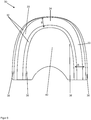
- FIG 4 shows a schematic side view of a prosthesis base blank 30 according to the invention, which has a shape according to the invention, such as a shape according to the Figures 2 and 3 , or a method according to the invention was produced.
- the prosthesis base blank 30 shows, analogously Figure 1 , a dental arch 32 to which a width B can be assigned.
- the dental arch 32 extends at the edge in a parabolic shape along the prosthesis base blank 30.
- the dental arch 32 has a thickening 33 in the occlusal direction, which provides sufficient space for the formation of papillae in the prosthesis base. In the area of an apex 34 of the basic prosthesis blank 1, the height H of the dental arch 32 is increased somewhat more.
- a recess 36 is provided on the underside of the prosthesis base blank 30 (in Figure 4 below), which serves as a preform of a support surface of the patient's toothless gums in the denture base to be produced. Laterally next to the dental arch 32, widenings 38 or protrusions 38 are provided, from which a connection surface to the patient's saddle can be formed.
- a center piece 40 extends up to the center, so that a large-area palatal cover can also be formed from this prosthesis base blank 30.
- FIG. 5 shows a schematic plan view of a further prosthesis base blank 30 according to the invention.
- the prosthesis base blank 30 has rounded corners in order to prevent the risk of parts of the prosthesis base blank 30 breaking off during processing. Such roundings can be provided in all prosthesis base blanks 1, 30 according to the invention.
- the basic prosthesis blank 30 has an edge-side parabolic thickening 33 of a dental arch 32, which is shown analogously to the explanations Figure 4 up (in Figure 5 in the direction of the viewer) and there forms the thickening 33 in the occlusal direction.
- the height of the dental arch 32 or the thickening 33 can be greater than in the other areas of the dental arch 32 Figure 5 the width B in the region of the vertex 34 is also slightly increased.
- protrusions 38 are provided which serve the same purpose as the protrusions 38 Figure 4 .
- a center piece 40 is provided from which a palate plate or a sublingual support of the prosthesis base to be produced can be produced.
- the labial protrusion 38 is greatly reduced or no longer exists.
- the cross section of the dental arch 32 perpendicular to the parabolic curve or perpendicular to the dental arch 32 also changes along the dental arch 32.
- the slope of the labial flank of the dental arch 32 is reduced in the area of the apex 34.
- the prosthesis base blanks 30 after Figures 4 and 5 are all constructed symmetrically with respect to the sagittal plane in which the vertex 34 lies. Any anatomically necessary asymmetries can be produced when the prosthesis base blank 30 is milled out during the production of the prosthesis base or can be produced by additional parts of the mold or inserts of the mold.
- a prosthesis base blank 1, 30 is produced with a mold, the parts 10, 12 and optionally the inlays 28 of the mold being selected from a large number of parts and optionally inlays with different surfaces.
- the matching inner surface 24 of the mold is determined with the aid of a computer.
- the possible inner surfaces 24 of the various shapes are electronically stored in a database for this purpose.
- the oral situation of the patient to be treated is scanned and digitized with the help of a 3D scanner.
- a virtual model of the prosthesis base to be generated is generated with the aid of a CAD method.
- a list of the possible prosthesis base blanks 1, 30 is offered on a screen of a computer. The order can be based on the volume difference between the prosthesis base to be produced and the inner surface 24 of the mold, with smaller volume differences being favored. Alternatively, only the shape with the smallest volume difference can be displayed.
- the small difference in volume has the advantage that with prosthesis base blanks 1, 30 produced with these molds, less material has to be removed than with prosthesis base blanks 1, 30 with a greater volume difference to the prosthesis base to be produced.
- a form with the matching parts 10, 12 and optionally with matching inserts 28 is selected by the user or by the computer and all parts 10, 12 and optionally inserts 28 are put together.
- the assembled mold is filled or stuffed with a hardenable plastic and the plastic is hardened in the mold.
- the parts 10, 12 and optionally the insert 28 are detached from the prosthesis base blank 1, 30 produced and cured in this way. If necessary, burrs are removed.
- the detached prosthesis base blank 1, 30 is clamped into a CAM device, such as a CAM four-axis milling machine. Attention must be paid to the correct orientation of the prosthesis base blank 1, 30 in the CAM device.
- markings 6 or formations can be provided on the prosthesis base blank 1, 30 which enable or preferably enforce a specific position and orientation of the prosthesis base blanks 1, 30 in the CAM device.
- Recesses or surfaces for receiving prosthetic teeth can also be produced in this prosthesis base. Then denture teeth are glued into the denture base and the dental prosthesis is completed.
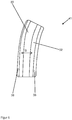
- FIG 6 shows a schematic plan view of a prosthesis base blank 41 according to the invention for a partial prosthesis.
- the prosthesis base blank 41 simulates a cheek-side part of the prosthesis base blank 30
- a dental arch section 32 is provided in the form of a parabolic section as a thickening 33 of the material of the prosthesis base blank 41. Since the width B of the prosthesis base blank 41 is almost as wide as the entire cross section of the prosthesis base blank 41, the dental arch 32 is also arranged at the edge in this embodiment.
- there are short protrusions 38 provided, which serve the same purpose as the protrusions 38 of the embodiments according to Figures 4 and 5 .
- a recess can be provided on the underside of the prosthesis base blank 41 (in plan view according to FIG Figure 6 not visible), which extends below the thickening 33 of the dental arch 32 in the same direction and position.
- the recess serves as a pre-shaping of the later bearing surface on the gums of a partial prosthesis base produced from the prosthesis base blank 41 or the partial dental prosthesis produced therefrom.
- the manufacturing process for the prosthesis base blank 41 according to Figure 6 runs analogously to the Figures 1 to 5 described method, with only a partial dental prosthesis being produced.
- the prosthesis base blanks 30, 41 according to the Figures 4 to 6 according to the invention preferably have webs (not shown) and a ring (not shown), as shown in FIG Figure 1 is shown.
- the ring surrounds the in the Figures 4 to 6 shown pieces of the prosthesis base blank 30, 41 and is arranged in the transverse plane.
- the ring can be used as a holder for a CAM milling machine.
- there is preferably a marking on the ring (in the Figures 4 to 6 not shown) is provided, with which the orientation and position of the prosthesis base blank 30, 41 can be determined in the CAM milling machine.
- the ring and the bars are in the Figures 4 to 6 only not shown for the sake of clarity, but particularly preferred for carrying out the present invention.
Landscapes
- Health & Medical Sciences (AREA)
- Oral & Maxillofacial Surgery (AREA)
- Dentistry (AREA)
- Epidemiology (AREA)
- Life Sciences & Earth Sciences (AREA)
- Animal Behavior & Ethology (AREA)
- General Health & Medical Sciences (AREA)
- Public Health (AREA)
- Veterinary Medicine (AREA)
- Dental Prosthetics (AREA)
- Dental Tools And Instruments Or Auxiliary Dental Instruments (AREA)
Applications Claiming Priority (2)
| Application Number | Priority Date | Filing Date | Title |
|---|---|---|---|
| DE102014114278.0A DE102014114278B4 (de) | 2014-10-01 | 2014-10-01 | Form zur Herstellung eines vorgeformten Prothesenbasisrohlings |
| PCT/EP2015/071980 WO2016050600A1 (de) | 2014-10-01 | 2015-09-24 | Form zur herstellung eines vorgeformten prothesenbasisrohlings |
Publications (2)
| Publication Number | Publication Date |
|---|---|
| EP3200720A1 EP3200720A1 (de) | 2017-08-09 |
| EP3200720B1 true EP3200720B1 (de) | 2020-12-09 |
Family
ID=54291255
Family Applications (1)
| Application Number | Title | Priority Date | Filing Date |
|---|---|---|---|
| EP15778225.1A Active EP3200720B1 (de) | 2014-10-01 | 2015-09-24 | Form zur herstellung eines vorgeformten prothesenbasisrohlings |
Country Status (6)
| Country | Link |
|---|---|
| US (1) | US20170304033A1 (enExample) |
| EP (1) | EP3200720B1 (enExample) |
| JP (1) | JP2017534354A (enExample) |
| CN (1) | CN107072756B (enExample) |
| DE (1) | DE102014114278B4 (enExample) |
| WO (1) | WO2016050600A1 (enExample) |
Families Citing this family (6)
| Publication number | Priority date | Publication date | Assignee | Title |
|---|---|---|---|---|
| DE102014117222A1 (de) * | 2014-11-25 | 2016-05-25 | Heraeus Kulzer Gmbh | Herstellung einer Dentalprothese durch Aufdrucken der Prothesenbasis auf die Prothesenzähne |
| DE102016119598B4 (de) | 2016-10-14 | 2019-09-12 | Heraeus Kulzer Gmbh | In Wachs eingebetteter vorgeformter Prothesenbasisrohling |
| JP7224752B2 (ja) * | 2017-04-28 | 2023-02-20 | ローランドディー.ジー.株式会社 | 被加工物成型用型および切削対象物作製方法 |
| USD855811S1 (en) * | 2017-07-27 | 2019-08-06 | Ronald G. Lowery | Set of dentures |
| KR102098489B1 (ko) * | 2018-08-28 | 2020-04-07 | (주) 디케이 문교 | 틀니 제작을 위한 왁스 틀니 제작방법 |
| USD1001289S1 (en) * | 2021-09-10 | 2023-10-10 | Sahereh Mohammadi | Centric relation self registering full denture oral appliance for direct mounting on laboratory articulator |
Citations (1)
| Publication number | Priority date | Publication date | Assignee | Title |
|---|---|---|---|---|
| WO2014191286A1 (de) * | 2013-05-27 | 2014-12-04 | Vita Zahnfabrik H. Rauter Gmbh & Co. Kg | Prothesenvorkörper zur herstellung eines dentalen prothesenkörpers |
Family Cites Families (24)
| Publication number | Priority date | Publication date | Assignee | Title |
|---|---|---|---|---|
| GB426744A (en) * | 1932-12-27 | 1935-04-09 | Carbide & Carbon Chem Corp | Improvements in or relating to dentures and denture blanks and to processes of making the same |
| US2806253A (en) * | 1953-10-19 | 1957-09-17 | Harold M Vernon | Method and apparatus for the production of prostheses such as dentures |
| US4024637A (en) * | 1975-07-11 | 1977-05-24 | Polythetics, Inc. | Dentures and process for making the same |
| FR2582932B1 (fr) | 1985-06-07 | 1992-02-21 | Deoux Georges | Dispositif pour la fabrication de protheses dentaires adjointes completes obtenues a partir de preformes bases et de preformes arcades |
| DE3707400C1 (de) * | 1987-03-07 | 1988-03-10 | Kulzer & Co Gmbh | Form zum Einbetten von histologischen Praeparaten |
| DE59008157D1 (de) | 1989-11-20 | 1995-02-09 | Wolfgang Becker | Verfahren zur herstellung einer zahnprothese. |
| US5302104A (en) * | 1992-06-18 | 1994-04-12 | High Dental Service Co., Ltd. | Resin denture base molding apparatus |
| US5324186A (en) * | 1993-02-18 | 1994-06-28 | Douglas R. Held | Apparatus for molding a dental prosthesis |
| CN2173042Y (zh) * | 1993-09-10 | 1994-08-03 | 中国人民解放军第四军医大学口腔医学院 | 可变式预成全口牙列 |
| AU692520B2 (en) * | 1994-05-16 | 1998-06-11 | Dentsply Detrey G.M.B.H. | Method of making a dental prosthesis and curable system |
| JPH1043208A (ja) * | 1996-08-05 | 1998-02-17 | Matsushita Satoyuki | 合成樹脂床義歯の製造装置および製造方法 |
| US20020047222A1 (en) * | 2000-10-16 | 2002-04-25 | Philp Graham K. | Mold for forming a dental prosthetics |
| DE202006006286U1 (de) | 2006-04-19 | 2007-08-30 | Merz Dental Gmbh | Maschinenbearbeitbarer Rohling für Zahnersatz |
| DE102006026776A1 (de) | 2006-06-07 | 2007-12-13 | Heraeus Kulzer Gmbh | Verfahren zur Herstellung einer Zahnprothese |
| DE102006061143A1 (de) * | 2006-12-22 | 2008-07-24 | Aepsilon Rechteverwaltungs Gmbh | Verfahren, computerlesbares Medium und Computer betreffend die Herstellung von Zahnersatzteilen |
| DE102009056752C5 (de) | 2009-12-04 | 2024-04-04 | Kulzer Gmbh | Herstellung individueller dentaler Prothesen via CAD/CAM und Rapid Manufacturing/Rapid Prototyping aus Daten der digitalen Abdrucknahme |
| DE102011101678A1 (de) * | 2011-05-16 | 2012-11-22 | Amann Girrbach Ag | Prothesenzahnträger |
| DE102011118320A1 (de) | 2011-11-11 | 2013-05-16 | Merz Dental Gmbh | Fräsblock, Fräsblocksystem und entsprechendes Herstellungsverfahren hierfür |
| WO2013124452A1 (en) | 2012-02-22 | 2013-08-29 | 3Shape A/S | Virtually reducing and milling artificial teeth |
| CN203001151U (zh) * | 2012-08-03 | 2013-06-19 | 徐军 | 线性平面*型人造后牙 |
| US9492252B2 (en) * | 2013-02-15 | 2016-11-15 | Cmp Industries Llc | Molding artificial teeth in denture base disc |
| CN102805670B (zh) * | 2012-08-28 | 2015-06-17 | 山东大学 | 一种全牙列全口义齿成品树脂牙及其制备方法 |
| DE102013003913A1 (de) * | 2013-03-07 | 2014-09-11 | Amann Girrbach Ag | Verfahren zur Herstellung einer Prothesenbasis |
| US9901428B2 (en) * | 2013-03-15 | 2018-02-27 | Good Fit Technologies, Inc. | Dental devices and systems and methods for making the same |
-
2014
- 2014-10-01 DE DE102014114278.0A patent/DE102014114278B4/de active Active
-
2015
- 2015-09-24 EP EP15778225.1A patent/EP3200720B1/de active Active
- 2015-09-24 US US15/516,061 patent/US20170304033A1/en not_active Abandoned
- 2015-09-24 WO PCT/EP2015/071980 patent/WO2016050600A1/de not_active Ceased
- 2015-09-24 JP JP2017517660A patent/JP2017534354A/ja active Pending
- 2015-09-24 CN CN201580053482.XA patent/CN107072756B/zh active Active
Patent Citations (1)
| Publication number | Priority date | Publication date | Assignee | Title |
|---|---|---|---|---|
| WO2014191286A1 (de) * | 2013-05-27 | 2014-12-04 | Vita Zahnfabrik H. Rauter Gmbh & Co. Kg | Prothesenvorkörper zur herstellung eines dentalen prothesenkörpers |
Also Published As
| Publication number | Publication date |
|---|---|
| US20170304033A1 (en) | 2017-10-26 |
| CN107072756A (zh) | 2017-08-18 |
| DE102014114278B4 (de) | 2022-08-25 |
| EP3200720A1 (de) | 2017-08-09 |
| WO2016050600A1 (de) | 2016-04-07 |
| JP2017534354A (ja) | 2017-11-24 |
| CN107072756B (zh) | 2022-03-22 |
| DE102014114278A1 (de) | 2016-04-07 |
Similar Documents
| Publication | Publication Date | Title |
|---|---|---|
| EP3200720B1 (de) | Form zur herstellung eines vorgeformten prothesenbasisrohlings | |
| EP3128945B1 (de) | Vorgeformter prothesenbasisrohling | |
| DE102012007706B4 (de) | Verfahren zum Herstellen eines künstlichen Gebisses | |
| EP2934365B1 (de) | Verfahren zur herstellung eines kieferorthopädischen setups | |
| EP3148475B1 (de) | Verfahren zur herstellung eines dentalen prothesenbasishalbzeugs | |
| EP3612131B1 (de) | Verfahren zur herstellung einer dentalprothese mit parallelen wurzeln der prothesenzähne | |
| EP3930625A1 (de) | Verfahren zum herstellen eines formkörpers und formkörper | |
| EP3256068B1 (de) | Erstellen einer wachs- oder kunststoffbasis zur fertigung einer dentalprothese | |
| EP1543797B1 (de) | Verfahren zum Herstellen einer dentalkeramischen Struktur | |
| DE102017113814B4 (de) | Verfahren zur Herstellung einer Dentalprothese mit definiertem Klebespalt | |
| EP3525718B1 (de) | In wachs eingebetteter vorgeformter prothesenbasisrohling | |
| WO2020057872A1 (de) | Vorprodukt zur herstellung von prothesenzähnen und verfahren zu dessen herstellung und verarbeitung | |
| EP0796063B1 (de) | Verfahren zur patientenspezifischen herstellung von und versorgung mit zahnprothetischen werkstücken | |
| DE102022134561B4 (de) | Verfahren zur Herstellung einer Dentalprothese durch Auffüllen eines Zwischenraums | |
| EP2965710A1 (de) | Individualisierte Negativformen | |
| WO2008040400A1 (de) | Verfahren zur herstellung eines prothetischen bauteils der zahnmedizin | |
| EP3705078B1 (de) | Verfahren zur herstellung eines individuellen abformlöffels | |
| DE102021112178B4 (de) | Verfahren und Vorrichtung zur Herstellung einer Dentalprothese | |
| DE102023115371B4 (de) | Materialverbrauchsoptimierte Herstellung von Prothesenzähnen | |
| DE102023004830A1 (de) | Verfahren zur Herstellung einer partiellen Zahnprothese, sowie eine partielle Zahnprothese, die nach diesem Verfahren hergestellt ist. | |
| EP3125819A1 (de) | Verfahren zur herstellung einer künstlichen zahnkrone sowie spezielle verwendung einer zahnkrone |
Legal Events
| Date | Code | Title | Description |
|---|---|---|---|
| STAA | Information on the status of an ep patent application or granted ep patent |
Free format text: STATUS: THE INTERNATIONAL PUBLICATION HAS BEEN MADE |
|
| PUAI | Public reference made under article 153(3) epc to a published international application that has entered the european phase |
Free format text: ORIGINAL CODE: 0009012 |
|
| STAA | Information on the status of an ep patent application or granted ep patent |
Free format text: STATUS: REQUEST FOR EXAMINATION WAS MADE |
|
| 17P | Request for examination filed |
Effective date: 20170330 |
|
| AK | Designated contracting states |
Kind code of ref document: A1 Designated state(s): AL AT BE BG CH CY CZ DE DK EE ES FI FR GB GR HR HU IE IS IT LI LT LU LV MC MK MT NL NO PL PT RO RS SE SI SK SM TR |
|
| AX | Request for extension of the european patent |
Extension state: BA ME |
|
| RAP1 | Party data changed (applicant data changed or rights of an application transferred) |
Owner name: KULZER GMBH |
|
| DAV | Request for validation of the european patent (deleted) | ||
| DAX | Request for extension of the european patent (deleted) | ||
| STAA | Information on the status of an ep patent application or granted ep patent |
Free format text: STATUS: EXAMINATION IS IN PROGRESS |
|
| 17Q | First examination report despatched |
Effective date: 20190415 |
|
| GRAP | Despatch of communication of intention to grant a patent |
Free format text: ORIGINAL CODE: EPIDOSNIGR1 |
|
| STAA | Information on the status of an ep patent application or granted ep patent |
Free format text: STATUS: GRANT OF PATENT IS INTENDED |
|
| INTG | Intention to grant announced |
Effective date: 20200908 |
|
| GRAS | Grant fee paid |
Free format text: ORIGINAL CODE: EPIDOSNIGR3 |
|
| GRAA | (expected) grant |
Free format text: ORIGINAL CODE: 0009210 |
|
| STAA | Information on the status of an ep patent application or granted ep patent |
Free format text: STATUS: THE PATENT HAS BEEN GRANTED |
|
| AK | Designated contracting states |
Kind code of ref document: B1 Designated state(s): AL AT BE BG CH CY CZ DE DK EE ES FI FR GB GR HR HU IE IS IT LI LT LU LV MC MK MT NL NO PL PT RO RS SE SI SK SM TR |
|
| REG | Reference to a national code |
Ref country code: GB Ref legal event code: FG4D Free format text: NOT ENGLISH |
|
| REG | Reference to a national code |
Ref country code: AT Ref legal event code: REF Ref document number: 1342593 Country of ref document: AT Kind code of ref document: T Effective date: 20201215 Ref country code: CH Ref legal event code: EP |
|
| REG | Reference to a national code |
Ref country code: DE Ref legal event code: R096 Ref document number: 502015013994 Country of ref document: DE |
|
| REG | Reference to a national code |
Ref country code: IE Ref legal event code: FG4D Free format text: LANGUAGE OF EP DOCUMENT: GERMAN |
|
| PG25 | Lapsed in a contracting state [announced via postgrant information from national office to epo] |
Ref country code: GR Free format text: LAPSE BECAUSE OF FAILURE TO SUBMIT A TRANSLATION OF THE DESCRIPTION OR TO PAY THE FEE WITHIN THE PRESCRIBED TIME-LIMIT Effective date: 20210310 Ref country code: FI Free format text: LAPSE BECAUSE OF FAILURE TO SUBMIT A TRANSLATION OF THE DESCRIPTION OR TO PAY THE FEE WITHIN THE PRESCRIBED TIME-LIMIT Effective date: 20201209 Ref country code: RS Free format text: LAPSE BECAUSE OF FAILURE TO SUBMIT A TRANSLATION OF THE DESCRIPTION OR TO PAY THE FEE WITHIN THE PRESCRIBED TIME-LIMIT Effective date: 20201209 Ref country code: NO Free format text: LAPSE BECAUSE OF FAILURE TO SUBMIT A TRANSLATION OF THE DESCRIPTION OR TO PAY THE FEE WITHIN THE PRESCRIBED TIME-LIMIT Effective date: 20210309 |
|
| PG25 | Lapsed in a contracting state [announced via postgrant information from national office to epo] |
Ref country code: LV Free format text: LAPSE BECAUSE OF FAILURE TO SUBMIT A TRANSLATION OF THE DESCRIPTION OR TO PAY THE FEE WITHIN THE PRESCRIBED TIME-LIMIT Effective date: 20201209 Ref country code: SE Free format text: LAPSE BECAUSE OF FAILURE TO SUBMIT A TRANSLATION OF THE DESCRIPTION OR TO PAY THE FEE WITHIN THE PRESCRIBED TIME-LIMIT Effective date: 20201209 Ref country code: BG Free format text: LAPSE BECAUSE OF FAILURE TO SUBMIT A TRANSLATION OF THE DESCRIPTION OR TO PAY THE FEE WITHIN THE PRESCRIBED TIME-LIMIT Effective date: 20210309 |
|
| REG | Reference to a national code |
Ref country code: NL Ref legal event code: MP Effective date: 20201209 |
|
| PG25 | Lapsed in a contracting state [announced via postgrant information from national office to epo] |
Ref country code: HR Free format text: LAPSE BECAUSE OF FAILURE TO SUBMIT A TRANSLATION OF THE DESCRIPTION OR TO PAY THE FEE WITHIN THE PRESCRIBED TIME-LIMIT Effective date: 20201209 Ref country code: NL Free format text: LAPSE BECAUSE OF FAILURE TO SUBMIT A TRANSLATION OF THE DESCRIPTION OR TO PAY THE FEE WITHIN THE PRESCRIBED TIME-LIMIT Effective date: 20201209 |
|
| REG | Reference to a national code |
Ref country code: LT Ref legal event code: MG9D |
|
| PG25 | Lapsed in a contracting state [announced via postgrant information from national office to epo] |
Ref country code: SK Free format text: LAPSE BECAUSE OF FAILURE TO SUBMIT A TRANSLATION OF THE DESCRIPTION OR TO PAY THE FEE WITHIN THE PRESCRIBED TIME-LIMIT Effective date: 20201209 Ref country code: RO Free format text: LAPSE BECAUSE OF FAILURE TO SUBMIT A TRANSLATION OF THE DESCRIPTION OR TO PAY THE FEE WITHIN THE PRESCRIBED TIME-LIMIT Effective date: 20201209 Ref country code: PT Free format text: LAPSE BECAUSE OF FAILURE TO SUBMIT A TRANSLATION OF THE DESCRIPTION OR TO PAY THE FEE WITHIN THE PRESCRIBED TIME-LIMIT Effective date: 20210409 Ref country code: LT Free format text: LAPSE BECAUSE OF FAILURE TO SUBMIT A TRANSLATION OF THE DESCRIPTION OR TO PAY THE FEE WITHIN THE PRESCRIBED TIME-LIMIT Effective date: 20201209 Ref country code: SM Free format text: LAPSE BECAUSE OF FAILURE TO SUBMIT A TRANSLATION OF THE DESCRIPTION OR TO PAY THE FEE WITHIN THE PRESCRIBED TIME-LIMIT Effective date: 20201209 Ref country code: EE Free format text: LAPSE BECAUSE OF FAILURE TO SUBMIT A TRANSLATION OF THE DESCRIPTION OR TO PAY THE FEE WITHIN THE PRESCRIBED TIME-LIMIT Effective date: 20201209 Ref country code: CZ Free format text: LAPSE BECAUSE OF FAILURE TO SUBMIT A TRANSLATION OF THE DESCRIPTION OR TO PAY THE FEE WITHIN THE PRESCRIBED TIME-LIMIT Effective date: 20201209 |
|
| PG25 | Lapsed in a contracting state [announced via postgrant information from national office to epo] |
Ref country code: PL Free format text: LAPSE BECAUSE OF FAILURE TO SUBMIT A TRANSLATION OF THE DESCRIPTION OR TO PAY THE FEE WITHIN THE PRESCRIBED TIME-LIMIT Effective date: 20201209 |
|
| REG | Reference to a national code |
Ref country code: DE Ref legal event code: R097 Ref document number: 502015013994 Country of ref document: DE |
|
| PG25 | Lapsed in a contracting state [announced via postgrant information from national office to epo] |
Ref country code: IS Free format text: LAPSE BECAUSE OF FAILURE TO SUBMIT A TRANSLATION OF THE DESCRIPTION OR TO PAY THE FEE WITHIN THE PRESCRIBED TIME-LIMIT Effective date: 20210409 |
|
| PLBE | No opposition filed within time limit |
Free format text: ORIGINAL CODE: 0009261 |
|
| STAA | Information on the status of an ep patent application or granted ep patent |
Free format text: STATUS: NO OPPOSITION FILED WITHIN TIME LIMIT |
|
| PG25 | Lapsed in a contracting state [announced via postgrant information from national office to epo] |
Ref country code: AL Free format text: LAPSE BECAUSE OF FAILURE TO SUBMIT A TRANSLATION OF THE DESCRIPTION OR TO PAY THE FEE WITHIN THE PRESCRIBED TIME-LIMIT Effective date: 20201209 |
|
| 26N | No opposition filed |
Effective date: 20210910 |
|
| PG25 | Lapsed in a contracting state [announced via postgrant information from national office to epo] |
Ref country code: DK Free format text: LAPSE BECAUSE OF FAILURE TO SUBMIT A TRANSLATION OF THE DESCRIPTION OR TO PAY THE FEE WITHIN THE PRESCRIBED TIME-LIMIT Effective date: 20201209 Ref country code: SI Free format text: LAPSE BECAUSE OF FAILURE TO SUBMIT A TRANSLATION OF THE DESCRIPTION OR TO PAY THE FEE WITHIN THE PRESCRIBED TIME-LIMIT Effective date: 20201209 |
|
| PG25 | Lapsed in a contracting state [announced via postgrant information from national office to epo] |
Ref country code: ES Free format text: LAPSE BECAUSE OF FAILURE TO SUBMIT A TRANSLATION OF THE DESCRIPTION OR TO PAY THE FEE WITHIN THE PRESCRIBED TIME-LIMIT Effective date: 20201209 |
|
| REG | Reference to a national code |
Ref country code: CH Ref legal event code: PL |
|
| REG | Reference to a national code |
Ref country code: BE Ref legal event code: MM Effective date: 20210930 |
|
| PG25 | Lapsed in a contracting state [announced via postgrant information from national office to epo] |
Ref country code: IS Free format text: LAPSE BECAUSE OF FAILURE TO SUBMIT A TRANSLATION OF THE DESCRIPTION OR TO PAY THE FEE WITHIN THE PRESCRIBED TIME-LIMIT Effective date: 20210409 Ref country code: MC Free format text: LAPSE BECAUSE OF FAILURE TO SUBMIT A TRANSLATION OF THE DESCRIPTION OR TO PAY THE FEE WITHIN THE PRESCRIBED TIME-LIMIT Effective date: 20201209 |
|
| PG25 | Lapsed in a contracting state [announced via postgrant information from national office to epo] |
Ref country code: LU Free format text: LAPSE BECAUSE OF NON-PAYMENT OF DUE FEES Effective date: 20210924 Ref country code: IE Free format text: LAPSE BECAUSE OF NON-PAYMENT OF DUE FEES Effective date: 20210924 Ref country code: BE Free format text: LAPSE BECAUSE OF NON-PAYMENT OF DUE FEES Effective date: 20210930 |
|
| PG25 | Lapsed in a contracting state [announced via postgrant information from national office to epo] |
Ref country code: LI Free format text: LAPSE BECAUSE OF NON-PAYMENT OF DUE FEES Effective date: 20210930 Ref country code: CH Free format text: LAPSE BECAUSE OF NON-PAYMENT OF DUE FEES Effective date: 20210930 |
|
| REG | Reference to a national code |
Ref country code: AT Ref legal event code: MM01 Ref document number: 1342593 Country of ref document: AT Kind code of ref document: T Effective date: 20210924 |
|
| PG25 | Lapsed in a contracting state [announced via postgrant information from national office to epo] |
Ref country code: AT Free format text: LAPSE BECAUSE OF NON-PAYMENT OF DUE FEES Effective date: 20210924 |
|
| PG25 | Lapsed in a contracting state [announced via postgrant information from national office to epo] |
Ref country code: HU Free format text: LAPSE BECAUSE OF FAILURE TO SUBMIT A TRANSLATION OF THE DESCRIPTION OR TO PAY THE FEE WITHIN THE PRESCRIBED TIME-LIMIT; INVALID AB INITIO Effective date: 20150924 |
|
| PG25 | Lapsed in a contracting state [announced via postgrant information from national office to epo] |
Ref country code: CY Free format text: LAPSE BECAUSE OF FAILURE TO SUBMIT A TRANSLATION OF THE DESCRIPTION OR TO PAY THE FEE WITHIN THE PRESCRIBED TIME-LIMIT Effective date: 20201209 |
|
| PG25 | Lapsed in a contracting state [announced via postgrant information from national office to epo] |
Ref country code: MK Free format text: LAPSE BECAUSE OF FAILURE TO SUBMIT A TRANSLATION OF THE DESCRIPTION OR TO PAY THE FEE WITHIN THE PRESCRIBED TIME-LIMIT Effective date: 20201209 |
|
| PG25 | Lapsed in a contracting state [announced via postgrant information from national office to epo] |
Ref country code: TR Free format text: LAPSE BECAUSE OF FAILURE TO SUBMIT A TRANSLATION OF THE DESCRIPTION OR TO PAY THE FEE WITHIN THE PRESCRIBED TIME-LIMIT Effective date: 20201209 |
|
| PG25 | Lapsed in a contracting state [announced via postgrant information from national office to epo] |
Ref country code: MT Free format text: LAPSE BECAUSE OF FAILURE TO SUBMIT A TRANSLATION OF THE DESCRIPTION OR TO PAY THE FEE WITHIN THE PRESCRIBED TIME-LIMIT Effective date: 20201209 |
|
| PGFP | Annual fee paid to national office [announced via postgrant information from national office to epo] |
Ref country code: DE Payment date: 20250916 Year of fee payment: 11 |
|
| PGFP | Annual fee paid to national office [announced via postgrant information from national office to epo] |
Ref country code: IT Payment date: 20250904 Year of fee payment: 11 |
|
| PGFP | Annual fee paid to national office [announced via postgrant information from national office to epo] |
Ref country code: GB Payment date: 20250820 Year of fee payment: 11 |
|
| PGFP | Annual fee paid to national office [announced via postgrant information from national office to epo] |
Ref country code: FR Payment date: 20250825 Year of fee payment: 11 |