EP3193929B1 - Treatment regimens using anti-nkg2a antibodies - Google Patents
Treatment regimens using anti-nkg2a antibodies Download PDFInfo
- Publication number
- EP3193929B1 EP3193929B1 EP15763016.1A EP15763016A EP3193929B1 EP 3193929 B1 EP3193929 B1 EP 3193929B1 EP 15763016 A EP15763016 A EP 15763016A EP 3193929 B1 EP3193929 B1 EP 3193929B1
- Authority
- EP
- European Patent Office
- Prior art keywords
- antibody
- nkg2a
- cells
- hla
- administered
- Prior art date
- Legal status (The legal status is an assumption and is not a legal conclusion. Google has not performed a legal analysis and makes no representation as to the accuracy of the status listed.)
- Active
Links
Images




Classifications
-
- C—CHEMISTRY; METALLURGY
- C07—ORGANIC CHEMISTRY
- C07K—PEPTIDES
- C07K16/00—Immunoglobulins [IG], e.g. monoclonal or polyclonal antibodies
- C07K16/18—Immunoglobulins [IG], e.g. monoclonal or polyclonal antibodies against material from animals or humans
- C07K16/28—Immunoglobulins [IG], e.g. monoclonal or polyclonal antibodies against material from animals or humans against receptors, cell surface antigens or cell surface determinants
- C07K16/2803—Immunoglobulins [IG], e.g. monoclonal or polyclonal antibodies against material from animals or humans against receptors, cell surface antigens or cell surface determinants against the immunoglobulin superfamily
-
- A—HUMAN NECESSITIES
- A61—MEDICAL OR VETERINARY SCIENCE; HYGIENE
- A61K—PREPARATIONS FOR MEDICAL, DENTAL OR TOILETRY PURPOSES
- A61K39/00—Medicinal preparations containing antigens or antibodies
- A61K39/395—Antibodies; Immunoglobulins; Immune serum, e.g. antilymphocytic serum
- A61K39/39533—Antibodies; Immunoglobulins; Immune serum, e.g. antilymphocytic serum against materials from animals
- A61K39/39558—Antibodies; Immunoglobulins; Immune serum, e.g. antilymphocytic serum against materials from animals against tumor tissues, cells, antigens
-
- A—HUMAN NECESSITIES
- A61—MEDICAL OR VETERINARY SCIENCE; HYGIENE
- A61P—SPECIFIC THERAPEUTIC ACTIVITY OF CHEMICAL COMPOUNDS OR MEDICINAL PREPARATIONS
- A61P29/00—Non-central analgesic, antipyretic or antiinflammatory agents, e.g. antirheumatic agents; Non-steroidal antiinflammatory drugs [NSAID]
-
- A—HUMAN NECESSITIES
- A61—MEDICAL OR VETERINARY SCIENCE; HYGIENE
- A61P—SPECIFIC THERAPEUTIC ACTIVITY OF CHEMICAL COMPOUNDS OR MEDICINAL PREPARATIONS
- A61P35/00—Antineoplastic agents
-
- A—HUMAN NECESSITIES
- A61—MEDICAL OR VETERINARY SCIENCE; HYGIENE
- A61P—SPECIFIC THERAPEUTIC ACTIVITY OF CHEMICAL COMPOUNDS OR MEDICINAL PREPARATIONS
- A61P35/00—Antineoplastic agents
- A61P35/02—Antineoplastic agents specific for leukemia
-
- C—CHEMISTRY; METALLURGY
- C07—ORGANIC CHEMISTRY
- C07K—PEPTIDES
- C07K16/00—Immunoglobulins [IG], e.g. monoclonal or polyclonal antibodies
- C07K16/18—Immunoglobulins [IG], e.g. monoclonal or polyclonal antibodies against material from animals or humans
- C07K16/28—Immunoglobulins [IG], e.g. monoclonal or polyclonal antibodies against material from animals or humans against receptors, cell surface antigens or cell surface determinants
- C07K16/2863—Immunoglobulins [IG], e.g. monoclonal or polyclonal antibodies against material from animals or humans against receptors, cell surface antigens or cell surface determinants against receptors for growth factors, growth regulators
-
- C—CHEMISTRY; METALLURGY
- C07—ORGANIC CHEMISTRY
- C07K—PEPTIDES
- C07K16/00—Immunoglobulins [IG], e.g. monoclonal or polyclonal antibodies
- C07K16/18—Immunoglobulins [IG], e.g. monoclonal or polyclonal antibodies against material from animals or humans
- C07K16/28—Immunoglobulins [IG], e.g. monoclonal or polyclonal antibodies against material from animals or humans against receptors, cell surface antigens or cell surface determinants
- C07K16/30—Immunoglobulins [IG], e.g. monoclonal or polyclonal antibodies against material from animals or humans against receptors, cell surface antigens or cell surface determinants from tumour cells
-
- A—HUMAN NECESSITIES
- A61—MEDICAL OR VETERINARY SCIENCE; HYGIENE
- A61K—PREPARATIONS FOR MEDICAL, DENTAL OR TOILETRY PURPOSES
- A61K39/00—Medicinal preparations containing antigens or antibodies
- A61K2039/505—Medicinal preparations containing antigens or antibodies comprising antibodies
-
- A—HUMAN NECESSITIES
- A61—MEDICAL OR VETERINARY SCIENCE; HYGIENE
- A61K—PREPARATIONS FOR MEDICAL, DENTAL OR TOILETRY PURPOSES
- A61K39/00—Medicinal preparations containing antigens or antibodies
- A61K2039/54—Medicinal preparations containing antigens or antibodies characterised by the route of administration
-
- A—HUMAN NECESSITIES
- A61—MEDICAL OR VETERINARY SCIENCE; HYGIENE
- A61K—PREPARATIONS FOR MEDICAL, DENTAL OR TOILETRY PURPOSES
- A61K39/00—Medicinal preparations containing antigens or antibodies
- A61K2039/545—Medicinal preparations containing antigens or antibodies characterised by the dose, timing or administration schedule
-
- A—HUMAN NECESSITIES
- A61—MEDICAL OR VETERINARY SCIENCE; HYGIENE
- A61K—PREPARATIONS FOR MEDICAL, DENTAL OR TOILETRY PURPOSES
- A61K2300/00—Mixtures or combinations of active ingredients, wherein at least one active ingredient is fully defined in groups A61K31/00 - A61K41/00
-
- C—CHEMISTRY; METALLURGY
- C07—ORGANIC CHEMISTRY
- C07K—PEPTIDES
- C07K2317/00—Immunoglobulins specific features
- C07K2317/20—Immunoglobulins specific features characterized by taxonomic origin
- C07K2317/21—Immunoglobulins specific features characterized by taxonomic origin from primates, e.g. man
-
- C—CHEMISTRY; METALLURGY
- C07—ORGANIC CHEMISTRY
- C07K—PEPTIDES
- C07K2317/00—Immunoglobulins specific features
- C07K2317/20—Immunoglobulins specific features characterized by taxonomic origin
- C07K2317/24—Immunoglobulins specific features characterized by taxonomic origin containing regions, domains or residues from different species, e.g. chimeric, humanized or veneered
-
- C—CHEMISTRY; METALLURGY
- C07—ORGANIC CHEMISTRY
- C07K—PEPTIDES
- C07K2317/00—Immunoglobulins specific features
- C07K2317/50—Immunoglobulins specific features characterized by immunoglobulin fragments
- C07K2317/52—Constant or Fc region; Isotype
-
- C—CHEMISTRY; METALLURGY
- C07—ORGANIC CHEMISTRY
- C07K—PEPTIDES
- C07K2317/00—Immunoglobulins specific features
- C07K2317/70—Immunoglobulins specific features characterized by effect upon binding to a cell or to an antigen
- C07K2317/71—Decreased effector function due to an Fc-modification
-
- C—CHEMISTRY; METALLURGY
- C07—ORGANIC CHEMISTRY
- C07K—PEPTIDES
- C07K2317/00—Immunoglobulins specific features
- C07K2317/70—Immunoglobulins specific features characterized by effect upon binding to a cell or to an antigen
- C07K2317/73—Inducing cell death, e.g. apoptosis, necrosis or inhibition of cell proliferation
- C07K2317/732—Antibody-dependent cellular cytotoxicity [ADCC]
-
- C—CHEMISTRY; METALLURGY
- C07—ORGANIC CHEMISTRY
- C07K—PEPTIDES
- C07K2317/00—Immunoglobulins specific features
- C07K2317/70—Immunoglobulins specific features characterized by effect upon binding to a cell or to an antigen
- C07K2317/76—Antagonist effect on antigen, e.g. neutralization or inhibition of binding
-
- C—CHEMISTRY; METALLURGY
- C07—ORGANIC CHEMISTRY
- C07K—PEPTIDES
- C07K2317/00—Immunoglobulins specific features
- C07K2317/90—Immunoglobulins specific features characterized by (pharmaco)kinetic aspects or by stability of the immunoglobulin
- C07K2317/92—Affinity (KD), association rate (Ka), dissociation rate (Kd) or EC50 value
Definitions
- This invention relates to the use of anti-NKG2A-antibodies for therapy, notably for the treatment of cancers.
- NCR Natural Cytotoxicity Receptors
- NKp30, NKp44, and NKp46 see, e.g., Lanier (2001) Nat Immunol 2:23-27 , Pende et al. (1999) J Exp Med. 190:1505-1516 , Cantoni et al. (1999) J Exp Med.
- CD95/KKG2A is an inhibitory receptor found on subsets of natural killer cells (NKS cells), Natural Killer T cells (NKT cells) and T cells ( ⁇ / ⁇ and ⁇ / ⁇ ).
- CD94/NKG2A restricts cytokine release and cytotoxic responses of aforementioned lymphocytes towards cells expressing the CD94/NKG2A-ligand HLA-E (see, e.g., WO99/28748 ).
- HLA-E has also been found to be secreted in soluble form by certain tumor cells ( Derre et al., J Immunol 2006;177:3100-7 ) and activated endothelial cells ( Coupel et al., Blood 2007;109:2806-14 ).
- Antibodies that inhibit CD94/NKG2A signaling may increase the cytokine release and cytolytic activity of lymphocytes towards HLA-E positive target cells, such as responses of CD94/NKG2A-positive NK cells responses towards virally infected cells. Therefore, therapeutic antibodies that inhibit CD94/NKG2A but that do not provoke the killing of CD94/NKG2A-expressing cells (i.e. non-depleting antibodies), may induce control of tumor-growth in cancer patients.
- anti-NKG2A antibodies have also been suggested for use in treating autoimmune or inflammatory diseases (see, e.g., US20030095965 , WO2006070286 ).
- Antibody Z270 binds and neutralizes the inhibitory receptor NKG2A without neutralizing the activating receptors NKG2C and NKG2E.
- Antibody Z199, 20D5 and 3S9 all bind the activating NKG2 family members NKG2C and NKG2E in addition to NKG2A.
- Antibody Z270 blocks the binding of HLA-E to NKG2A, while antibody Z199 neutralises NKG2A without interfering with the binding of NKG2A to HLA-E Innate Pharma in " Research and Development” Update disclosed on 10.04.2014 different dosage regimens with IPH2201.
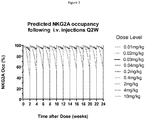
- the present inventors have discovered that doses and concentrations of anti- NKG2A antibody that fully occupy NKG2A receptors on lymphocytes do not yield maximal neutralization of NKG2A receptors in the presence of HLA-E expressing target cells in vivo.
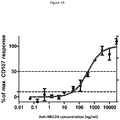
- the concentration of anti-NKG2A antibody required for full neutralization ofNKG2A receptors on NK cells in the presence of HLA-E expressing target cells is 100-fold higher than the concentration observed to fully occupy NKG2A receptors in binding assays using NKG2A+ lymphocytes.
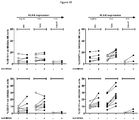
- the anti-tumor effect of anti- NKG2A is increased as a function of higher expression of HLA-E on tumor cells.
- NKG2A+ NK and CD8+ T lymphocytes are present not only in circulation but within the tumor environment, and NKG2A+ CD8 T cells may furthermore be found at significantly increased frequencies within the tumor-infiltrating subset, compared to CD8+ T cells in tumor draining lymph nodes and spleen.
- the treatment regimens of the disclosure therefore additionally provide advantageous methods for treating solid tumors by using anti-NKG2A antibodies to modulate lymphocytes within the tumor environment.
- a method for treating or preventing a disease comprising administering to an individual having disease (e.g. a cancer, a solid tumor) an antibody that neutralizes the inhibitory activity of a human NKG2A polypeptide, wherein the anti-NKG2A antibody is administered in an amount effective to achieve a blood (serum) concentration of anti- NKG2A antibody that corresponds to at least the EC 50 , optionally the EC 100 , for NKG2A+ NK cell response.
- the amount is effective to achieve a concentration in extravascular tissue (e.g.
- NKG2A+ NK cell response is assessed using an assay of cytotoxic activity of NKG2A-expressing NK cells toward HLA-E expressing target cells.
- a method for treating or preventing a disease comprising administering to an individual having disease (e.g. a cancer, a solid tumor) an antibody that neutralizes the inhibitory activity of a human NKG2A polypeptide, wherein the anti-NKG2A antibody is administered in an amount effective to achieve (and/or to maintain for a specified period of time or between two successive administrations) a blood (serum) concentration of anti- NKG2A antibody of at least 10 ⁇ g/ml (or, optionally at least 20, 30, 40, 50, 80 or 100 ⁇ g/mL).
- a method for treating or preventing a disease comprising administering to an individual an antibody that binds NKG2A and that neutralizes the inhibitory activity of a human NKG2A polypeptide for at least one administration cycle, the administration cycle comprising at least a first and second (and optionally a 3 rd , 4 th , 5 th , 6 th , 7 th and/or 8 th or further) administration of the anti-NKG2A antibody, wherein the anti-NKG2A antibody is administered in an amount effective to achieve blood concentration of anti-NKG2A antibody, and/or to maintain blood concentration of anti-NKG2A antibody be- tween two successive (e.g.
- said first and second, and optionally the further) administrations which concentration is at least 10-fold (e.g., 10-20 fold, 10-50 fold, 10-100 fold, 20-50 fold, 20-100 fold, 30-100 fold, 50-100 fold), optionally at least 50-, 60-, 80- or 100-fold, the mini-mum concentration required to substantially fully (e.g. 90%, 95%) occupy (saturate) NKG2A receptors on the surface of NKG2A+ cells (e.g., as assessed by titrating anti-NKG2A anti- body on NKG2A-expressing cells in PBMC).
- the anti-NKG2A antibody competes with HLA-E for binding to human NKG2A.
- a method for treating or preventing a disease comprising administering to an individual having disease (e.g. a cancer, a solid tumor) an antibody that neutralizes the inhibitory activity of a human NKG2A polypeptide for at least one administration cycle, the administration cycle comprising at least a first and second (and optionally a 3 rd , 4 th , 5 th , 6 th , 7 th and/or 8 th or further) administration of the anti-NKG2A antibody, wherein the anti-NKG2A antibody is administered in an amount effective to achieve, or to maintain between two successive administrations, a blood (serum) concentration of anti-NKG2A antibody of at least 10 ⁇ g/ml (or, optionally at least 20, 30, 40 or 50 ⁇ g/mL).
- a blood (serum) concentration of anti-NKG2A antibody of at least 10 ⁇ g/ml (or, optionally at least 20, 30, 40 or 50 ⁇ g/mL).
- a specified continuous blood concentration is maintained, wherein the blood concentration does not drop substantially below the specified blood concentration for the duration of the specified time period (e.g. between two administrations of antibody, number of weeks), i.e. although the blood concentration can vary during the specified time period, the specified blood concentration maintained represents a minimum or "trough" concentration.
- a therapeutically active amount of an anti-NKG2A antibody is an amount of such antibody capable of providing (at least) the EC 50 concentration, optionally substantially the EC 100 concentration, in blood and/or in a tissue for NKG2A+ NK cell response for a period of at least about 1 week, about 2 weeks, or about one month, following administration of the antibody.
- the anti-NKG2A antibody is administered in an amount effective to achieve blood (serum) concentration of anti-NKG2A antibody of at least 10 ⁇ g/ml (or, optionally at least 20, 30, 40 or 50 ⁇ g/mL) for a period of at least about 1 week, at least about 2 weeks, and that permits a significant "de-saturation" between two successive administrations (successive administrations may for example be separated by one month, two months or more).
- a therapeutically active amount of an anti-NKG2A antibody is an amount of such antibody capable of providing (at least) the EC 50 concentration, optionally substantially the EC 100 concentration, in a tissue for NKG2A+ NK cell response for a period of at least 1 week, or at least about 2 weeks, following administration of the antibody, and that permits thereafter a significant "de-saturation" between two successive administrations; optionally where the antibody is administered at a dosing frequency of one about every month, or about once every two months.
- Blood concentration of anti-NKG2A antibody during the de-saturation period is below the specified concentration to be achieved during the initial period (e.g. 1 week, 2 weeks, etc.); for example blood and/or tissue concentration of anti-NKG2A antibody during the de-saturation period can be specified to be below the EC 100 , optionally below the EC 50 for NKG2A+ NK cell response.
- the anti-NKG2A antibody is administered in an amount effective to achieve a peak concentration, or to maintain a blood concentration, of about or at least about 40, 50, 60, 70 or 80 ⁇ g/ml, optionally at least about 100 ⁇ g/ml, upon administration (e.g. within 1 or 2 days of administration).
- NKG2A antibody is administered in an amount effective to maintain the specified blood concentration for at least one week, optionally at least two weeks, following administration of the anti-NKG2A antibody.
- the anti-NKG2A antibody is administered in an amount effective to achieve, or to maintain, a continuous (minimum) blood concentration of anti-NKG2A antibody of about or at least about 50, 60, 70 or 80 ⁇ g/ml, optionally at least about 100 ⁇ g/ml, between the first and second (and optionally further) administrations.
- successive administrations e.g. said first and second administrations
- the anti-NKG2A antibody can optionally be administered in an amount effective and according to a frequency that achieves, or that maintains a blood concentration as specified for the entire duration of the administration cycle.
- a method for treating or preventing a solid tumor in an individual comprising administering to an individual having a solid tumor an antibody that neutralizes the inhibitory activity of a human NKG2A polypeptide for at least one administration cycle, the administration cycle comprising least two administrations of the anti-NKG2A antibody, wherein the anti-NKG2A antibody is administered in an amount effective to achieve, or to maintain, a (minimum) concentration in an extravascular tissue (e.g. in the tumor environment) of at least 4 ⁇ g/mL, optionally at least 10 ⁇ g/mL between two successive administrations.
- a (minimum) concentration in an extravascular tissue e.g. in the tumor environment
- the anti-NKG2A antibody is administered in an amount effective to achieve, or to maintain, a (minimum) concentration in an extravascular tissue (e.g. in the tumor environment) of at least 4 ⁇ g/mL, optionally at least 10 ⁇ g/mL, for the entire duration of the administration cycle.
- the anti-NKG2A antibody is administered in an amount effective to maintain a continuous blood concentration of anti-NKG2A antibody of at least 40 ⁇ g/mL, optionally at least 100 ⁇ g/mL, between two successive administrations, or for the duration of the administration cycle.
- the anti-NKG2A antibody is administered in an amount effective to achieve blood concentration of anti-NKG2A antibody of at least 40 ⁇ g/mL, optionally at least 100 ⁇ g/mL, upon administration (e.g. for at least one week, at least two weeks upon administration), followed by a period that permits a significant "de-saturation" of NKG2A-expressing cells in circulation between two successive administrations (wherein blood concentration of anti-NKG2A antibody is below said least 40 ⁇ g/mL or at least 100 ⁇ g/mL during the de-saturation period).
- a method for treating or preventing a hematological tumor in an individual comprising administering to an individual having a hematological tumor an antibody that neutralizes the inhibitory activity of a human NKG2A polypeptide for at least one administration cycle, the administration cycle comprising at least two administrations of the anti-NKG2A antibody, wherein the anti-NKG2A antibody is administered in an amount effective to achieve or maintain a continuous (minimum) blood concentration of anti-NKG2A antibody of at least 10 ⁇ g/mL between two successive administrations.
- the anti-NKG2A antibody is administered in an amount effective to achieve or maintain a continuous (minimum) blood concentration of anti-NKG2A antibody of at least 10 ⁇ g/mL, for the entire duration of the administration cycle.
- the antibody is administered to achieve a peak blood concentration of at least about 40 ⁇ g/mL, optionally about or at least about 100 ⁇ g/mL upon administration (e.g. the day of administration, within 24 or 48 hours of administration).
- a blood concentration of 40 ⁇ g/ml is capable of providing the EC 50 concentration for NKG2A+ NK cell response in an extravascular tissue.
- a blood concentration of 100 ⁇ g/ml is capable of providing the EC 100 concentration in a tissue (outside of the vasculature, e.g. in the tumor environment) for NKG2A+ NK cell response.
- a method of treatment comprises administering a treatment cycle with (a) an induction (or loading) period wherein a first dosage of anti-NKG2A antibody is administered to achieve or maintain a continuous(minimum) blood concentration of at least about 40 ⁇ g/mL, optionally at least about 100 ⁇ g/mL, between the first administration and a subsequent administration of anti-NKG2A antibody, (b) a maintenance period, wherein a second, lower, dosage of anti-NKG2A antibody is administered is an amount sufficient to achieve or maintain a continuous (minimum) blood concentration of the anti-NKG2A antibody of at least about 40 ⁇ g/mL, optionally at least about 100 ⁇ g/mL, until the next administrations of anti-NKG2A antibody (e.g., for the entire treatment cycle).
- an induction (or loading) period wherein a first dosage of anti-NKG2A antibody is administered to achieve or maintain a continuous(minimum) blood concentration of at least about 40 ⁇ g/mL, optional
- the maintenance period follows the induction period.
- the maintenance period comprises at least two administrations of the anti-NKG2A antibody.
- the maintenance period comprises at least two administrations at a dose and frequency that provides a continuous blood concentration of the anti-NKG2A antibody of at least about 40 ⁇ g/mL, optionally at least about 100 ⁇ g/mL, between two administrations.
- blood concentration can be specified to be blood serum concentration.
- the anti-NKG2A antibody substantially fully neutralizes the inhibitory activity of human CD94/NKG2A in the human patient (in vivo), on NKG2A-positive lymphocytes in circulation or in extravascular tissue, for about one week or for about two weeks.
- a method of treating an individual having a cancer comprising administering to the individual an antibody that binds and neutralizes the inhibitory activity of NKG2A for at least one administration cycle in which the anti-NKG2A antibody is administered two times per month intravenously at a dose of between 4-10 mg/kg, optionally 4-6 mg/kg, optionally 4-8 mg/kg, optionally about 4 mg/kg, optionally about 6 mg/kg, optionally about 8 mg/kg, or optionally about 10 mg/kg body weight.
- a method of treating an individual having a cancer comprising administering to the individual an antibody that binds and neutralizes the inhibitory activity of NKG2A for at least one administration cycle, wherein the method comprises:
- a therapeutic regimen described herein is administered to an individual having a cancer prior to the individual receiving surgery to remove cancer cells, i.e. the anti-NKG2A antibody regimen is used as a preoperative treatment.
- a therapeutic regimen or course of therapy designed to achieve a concentration of anti-NKG2A antibody that corresponds to at least the EC 50 , optionally the EC 100 , for NKG2A+ NK cell response in the extravascular tumor environment is administered to an individual having a cancer prior to surgery to remove cancer cells, i.e. as a preoperative treatment.
- the anti-NKG2A antibody is administered to an individual having cancer cells that express HLA-E at their surface.
- HLA-E status of a cancer can be assessed prior to treatment with an anti-NKG2A antibody.
- the treatment or prevention of a cancer in an individual comprises:
- the treatment or prevention of a cancer in an individual comprises:
- determining the HLA-E polypeptide status or determining the level of expression in step (a) comprises determining the level of expression of a HLA-E nucleic acid or polypeptide of malignant cells in a biological sample and comparing the level to a reference level (e.g. a value, weak cell surface staining, etc.).
- the reference level may, for example, correspond to a healthy individual, to an individual deriving no/low clinical benefit from treatment with an anti-NKG2A antibody, or to an individual deriving substantial clinical benefit from treatment with an anti-NKG2A antibody.
- a determination that a biological sample expresses HLA-E nucleic acid or polypeptide at a level that is in- creased (e.g.
- a high value, strong surface staining indicates that the individual has a cancer that can be treated with an anti-NKG2A antibody, e.g. according to the treatment methods de- scribed herein.
- the anti-NKG2A antibody is administered as single agent therapy. In one aspect, the anti-NKG2A antibody is administered in combination treatment with one or more other anti-cancer agents.
- the method further comprises administering to an individual a therapeutically active amount of a second anti-cancer agent.
- the cancer is a solid tumor.
- the second anti-cancer agent is an antibody that is capable of mediating ADCC (e.g. binds, via its Fc domain to human Fc ⁇ receptors, such as CD16.
- the antibody that mediates ADCC is administered in an effective amount that elicits antibody-dependent cellular cytotoxicity toward human tumor cells in the human patient (in vivo) that express a polypeptide to which the second anti-cancer agent is directed.
- the second anti-cancer agent is an anti-EGFR antibody.
- a patient treated with an anti-NKG2A antibody according to a treatment regimen of the disclosure, in combination with an anti-EGFR antibody has an insufficient response to prior treatment with anti-EGFR antibody (e.g. is a non-responder or has progressing disease), or has an unfavorable prognosis for response to treatment with an anti-EGFR antibody (in the absence of treatment with anti-NKG2A).
- the combination is administered (or is for administration) according to a particular clinical dosage regimen, notably at a particular dose amount and according to a specific dosing schedule (e.g. a dose amount and/or according to a specific dosing schedule provided herein).
- a specific dosing schedule e.g. a dose amount and/or according to a specific dosing schedule provided herein.
- the antibody that neutralizes the inhibitory activity of a NKG2A polypeptide is an antibody that increases the ability of an NKG2A-expressing NK and/or T cells to cause the death of the HLA-E-expressing cell.
- the anti-NKG2A agent reduces the inhibitory activity of NKG2A by blocking binding of its ligand, HLA-E, i.e., the anti-NKG2A agent interferes with the binding of NKG2A by HLA-E.
- the antibody having the heavy chain of any one of SEQ ID NOS: 2 to 6 and the light chain of SEQ ID NO: 7 respectively, is an example of such an antibody.
- the anti-NKG2A antibody is antibody which binds with a significantly higher affinity to NKG2A than to one or more activating NKG2 receptors.
- the antibody binds with a significantly higher affinity to NKG2A than to NKG2C.
- the antibody binds with a significantly higher affinity to NKG2A than to NKG2E.
- the antibody binds with a significantly higher affinity to NKG2A than to NKG2H.
- the anti-NKG2A antibody binds the same epitope on NKG2A and/or competes for binding to CD94/NKG2A with the antibody having a heavy chain of any one of SEQ ID NOS: 2-6 and a light chain of SEQ ID NO: 7.
- the antibody can be, e.g., a human or humanized anti-NKG2A antibody.
- the anti-NKG2A antibody is a humanized antibody having the heavy chain CDRs of any one of the heavy chain sequences of SEQ ID NOS: 2-6 and the light chain CDRs of the light chain sequence of SEQ ID NO: 7.
- compositions and kits are provided, as well as methods for using them.
- a or “an” may mean one or more.
- the words “a” or “an” when used in conjunction with the word “comprising”, the words “a” or “an” may mean one or more than one.
- another may mean at least a second or more.
- NKG2A (OMIM 161555) is a member of the NKG2 group of transcripts ( Houchins, et al. (1991) J. Exp. Med.173:1017-1020 ). NKG2A is encoded by 7 exons spanning 25 kb, showing some differential splicing. Together with CD94, NKG2A forms the heterodimeric inhibitory receptor CD94/NKG2A, found on the surface of subsets of NK cells, ⁇ / ⁇ T cells, ⁇ / ⁇ T cells, and NKT cells. Similar to inhibitory KIR receptors, it possesses an ITIM in its cytoplasmic domain.
- NKG2A refers to any variant, derivative, or isoform of the NKG2A gene or encoded protein. Also encompassed are any nucleic acid or protein sequences sharing one or more biological properties or functions with wild type, full length NKG2A, and sharing at least 70%, 80%, 90%, 95%, 96%, 97%, 98%, 99%, or higher nucleotide or amino acid identity.
- Human NKG2A comprises 233 amino acids in 3 domains, with a cytoplasmic domain comprising residues 1-70, a transmembrane region comprising residues 71-93, and an extracellular region comprising residues 94-233, of the following sequence:
- NKG2C OMIM 602891
- NKG2E OMIM 602892
- the CD94/NKG2C and CD94/NKG2E receptors are activating receptors found on the surface of subsets of lymphocytes such as NK cells and T-cells.
- HLA-E (OMIM 143010) is a non classical MHC molecule that is expressed on the cell surface and regulated by the binding of peptides, e.g., such as fragments derived from the signal sequence of other MHC class I molecules. Soluble versions of HLA-E have also been identified. In addition to its T-cell receptor binding properties, HLA-E binds subsets of natural killer (NK) cells, natural killer T-cells (NKT) and T cells ( ⁇ / ⁇ and ⁇ / ⁇ ), by binding specifically to CD94/NKG2A, CD94/NKG2B, and CD94/NKG2C (see, e.g., Braud et al. (1998) Nature 391:795-799 ).
- NK natural killer
- NKT natural killer T-cells
- T cells ⁇ / ⁇ and ⁇ / ⁇
- HLA-E refers to any variant, derivative, or isoform of the HLA-E gene or encoded protein. Also encompassed are any nucleic acid or protein sequences sharing one or more biological properties or functions with wild type, full length HLA-E, and sharing at least 70%, 80%, 90%, 95%, 96%, 97%, 98%, 99%, or higher nucleotide or amino acid identity.
- CD94/NKG2A positive lymphocyte refers to cells of the lymphoid lineage (e.g. NK-, NKT- and T-cells) expressing CD94/NKG2A on the cell-surface, which can be detected by e.g. flow-cytometry using antibodies that specifically recognize a combined epitope on CD94 and NKG2A or and epitope on NKG2A alone.
- CD94/NKG2A positive lymphocyte also includes immortal cell lines of lymphoid origin (e.g. NKL, NK-92).
- NKG2A reduceds the inhibitory activity of NKG2A
- NKG2A neutralizes NKG2A
- neutralizes the inhibitory activity of NKG2A refers to a process in which CD94/NKG2A is inhibited in its capacity to negatively affect intracellular processes leading to lymphocyte responses such as cytokine release and cytotoxic responses. This can be measured for example in a NK- or T-cell based cytotoxicity assay, in which the capacity of a therapeutic compound to stimulate killing of HLA-E positive cells by CD94/NKG2A positive lymphocytes is measured.
- an antibody preparation causes at least a 10% augmentation in the cytotoxicity of a CD94/NKG2A-restricted lymphocyte, preferably at least a 40% or 50% augmentation in lymphocyte cytotoxicity, or more preferably at least a 70% augmentation in NK cytotoxicity", and referring to the cytotoxicity assays described. If an anti-NKG2A antibody reduces or blocks CD94/NKG2A interactions with HLA-E, it may in- crease the cytotoxicity of CD94/NKG2A-restricted lymphocytes.
- NK cells that express CD94/NKG2A
- target cells that express HLA-E.
- NK cells do not efficiently kill tar- gets that express HLA-E because CD94/NKG2A recognizes HLA-E, leading to initiation and propagation of inhibitory signaling that prevents lymphocyte-mediated cytolysis.
- Such an in vitro cytotoxicity assay can be carried out by standard methods that are well known in the art, as described for example in Coligan et al., eds., Current Protocols in Immunology, Greene Publishing Assoc. and Wiley Interscience, N.Y., (1992, 1993 ).
- Chromium release and/or other parameters to assess the ability of the antibody to stimulate lymphocytes to kill target cells are also disclosed in Sivori et al., J. Exp. Med. 1997;186:1129-1136 ; Vitale et al., J. Exp. Med. 1998; 187:2065-2072 ; Pessino et al. J. Exp. Med. 1998;188:953-960 ; Neri et al. Clin. Diag. Lab. Immun. 2001;8:1131-1135 ; Pende et al. J. Exp. Med. 1999;190:1505-1516 .
- the target cells are labeled with 51 Cr prior to addition of NK cells, and then the killing is estimated as proportional to the release of 51 Cr from the cells to the medium, as a result of killing.
- the addition of an antibody that prevents CD94/NKG2A from binding to HLA-E results in prevention of the initiation and propagation of inhibitory signaling via CD94/NKG2A. Therefore, addition of such agents results in increases in lymphocyte-mediated killing of the target cells. This step thereby identifies agents that prevent CD94/NKG2A-induced negative signaling by, e.g., blocking ligand binding.
- CD94/NKG2A-expressing NK effector-cells can kill HLA-E-negative LCL 721.221 target cells, but less well HLA-E-expressing LCL 721.221-Cw3 control cells.
- YTS effector-cells that lack CD94/NKG2A kill both cell-lines efficiently.
- NK effector cells kill less efficiently HLA-E + LCL 721.221-Cw3 cells due to HLA-E- induced inhibitory signaling via CD94/NKG2A.
- NK cells When NK cells are pre-incubated with blocking anti-CD94/NKG2A antibodies according to the present disclosure in such a 51 Cr-release cytotoxicity assay, HLA-E-expressing LCL 721.221-Cw3 cells are more efficiently killed, in an antibody-concentration-dependent fashion.
- the inhibitory activity (i.e. cytotoxicity enhancing potential) of an anti-NKG2A antibody can also be assessed in any of a number of other ways, e.g., by its effect on intracellular free calcium as described, e.g., in Sivori et al., J. Exp. Med. 1997;186:1129-1136 .
- Activation of NK cell cytotoxicity can be assessed for example by measuring an increase in cytokine production (e.g.
- IFN- ⁇ production or cytotoxicity markers (e.g. CD107 or CD137 mobilization).
- cytotoxicity markers e.g. CD107 or CD137 mobilization.
- IFN-y production from PBMC is assessed by cell surface and intracytoplasmic staining and analysis by flow cytometry after 4 days in culture. Briefly, Brefeldin A (Sigma Aldrich) is added at a final concentration of 5 ⁇ g/ml for the last 4 hours of culture. The cells are then incubated with anti-CD3 and anti-CD56 mAb prior to permeabilization (IntraPrepTM; Beckman Coulter) and staining with PE-anti-IFN-y or PE-IgG1(Pharmingen).
- GM-CSF and IFN-y production from polyclonal activated NK cells are meas- ured in supernatants using ELISA (GM-CSF: DuoSet Elisa, R&D Systems, Minneapolis, MN, IFN-y: OptEIA set, Pharmingen).
- anti-NKG2A binding agent e.g. antibody
- biopsy as used herein is defined as removal of a tissue for the purpose of examination, such as to establish diagnosis.
- types of biopsies include by ap- plication of suction, such as through a needle attached to a syringe; by instrumental removal of a fragment of tissue; by removal with appropriate instruments through an endoscope; by surgical excision, such as of the whole lesion.
- antibody refers to polyclonal and monoclonal antibodies. Depending on the type of constant domain in the heavy chains, antibodies are assigned to one of five major classes: IgA, IgD, IgE, IgG, and IgM. Several of these are further divided into subclasses or isotypes, such as IgG1, IgG2, IgG3, IgG4.
- An exemplary immunoglobulin (antibody) structural unit comprises a tetramer. Each tetramer is composed of two identical pairs of polypeptide chains, each pair having one "light” (about 25 kDa) and one "heavy" chain (about 50-70 kDa).
- each chain defines a variable region of about 100 to 110 or more amino acids that is primarily responsible for antigen recognition.
- the terms variable light chain (V L ) and variable heavy chain (V H ) refer to these light and heavy chains respectively.
- the heavy-chain constant domains that correspond to the different classes of immunoglobulins are termed "alpha,” “delta,” “epsilon,” “gamma” and “mu,” respectively.
- the subunit structures and three-dimensional configurations of different classes of immunoglobulins are well known.
- IgG are the exemplary classes of antibodies employed herein because they are the most common antibodies in the physiological situation and be- cause they are most easily made in a laboratory setting.
- the antibody is a monoclonal antibody.
- Particular examples of antibodies are humanized, chimeric, human, or otherwise-human-suitable antibodies.
- Antibodies also includes any fragment or derivative of any of the herein described antibodies.
- binding partner e.g. NKG2A
- competitive binding assays and other methods for determining specific binding are well known in the art. For example binding can be detected via radiolabels, physical methods such as mass spectrometry, or direct or indirect fluorescent labels detected using, e.g., cytofluorometric analysis (e.g. FACScan). Binding above the amount seen with a control, non-specific agent indicates that the agent binds to the target.
- An agent that specifically binds NKG2A may bind NKG2A alone or NKG2A as a dimer with CD94.
- an antibody When an antibody is said to "compete with” a particular monoclonal antibody, it means that the antibody competes with the monoclonal antibody in a binding assay using either recombinant molecules (e.g., NKG2A) or surface expressed molecules (e.g., NKG2A).
- recombinant molecules e.g., NKG2A
- surface expressed molecules e.g., NKG2A.
- a test antibody reduces the binding of an antibody having a heavy chain of any one of SEQ ID NOS: 2-6 and a light chain of SEQ ID NO: 7 to a NKG2A polypeptide or NKG2A-expressing cell in a binding assay, the antibody is said to "compete” respectively with such antibody.
- affinity means the strength of the binding of an antibody to an epitope.
- the affinity of an antibody is given by the dissociation constant Kd, defined as [Ab] x [Ag] / [Ab-Ag], where [Ab-Ag] is the molar concentration of the antibody-antigen complex, [Ab] is the molar concentration of the unbound antibody and [Ag] is the molar concentration of the unbound antigen.
- Kd dissociation constant
- a "determinant" designates a site of interaction or binding on a polypeptide.
- epitope refers to an antigenic determinant, and is the area or region on an antigen to which an antibody binds.
- a protein epitope may comprise amino acid residues directly involved in the binding as well as amino acid residues which are effectively blocked by the specific antigen binding antibody or peptide, i.e., amino acid residues within the "foot- print" of the antibody. It is the simplest form or smallest structural area on a complex antigen molecule that can combine with e.g., an antibody or a receptor.
- Epitopes can be linear or conformational/structural.
- linear epitope is defined as an epitope composed of amino acid residues that are contiguous on the linear sequence of amino acids (primary structure).
- conformational or structural epitope is defined as an epitope composed of amino acid residues that are not all contiguous and thus represent separated parts of the linear sequence of amino acids that are brought into proximity to one another by folding of the molecule (secondary, tertiary and/or quaternary structures).
- a conformational epitope is dependent on the 3-dimensional structure.
- 'conformational' is therefore often used interchangeably with 'structural'.
- agent is used herein to denote a chemical compound, a mixture of chemical compounds, a biological macromolecule, or an extract made from biological materials.
- therapeutic agent refers to an agent that has biological activity.
- a “humanized” or “human” antibody refers to an antibody in which the constant and variable framework region of one or more human immunoglobulins is fused with the binding region, e.g. the CDR, of an animal immunoglobulin.
- Such antibodies are designed to maintain the binding specificity of the non-human antibody from which the binding regions are derived, but to avoid an immune reaction against the non-human antibody.
- Such antibodies can be obtained from transgenic mice or other animals that have been "engineered” to produce specific human antibodies in response to antigenic challenge (see, e.g., Green et al. (1994) Nature Genet 7:13 ; Lonberg et al. (1994) Nature 368:856 ; Taylor et al.
- a fully human antibody also can be constructed by genetic or chromosomal transfection methods, as well as phage display technology, all of which are known in the art (see, e.g., McCafferty et al. (1990) Nature 348:552-553 ).
- Human antibodies may also be generat- ed by in vitro activated B cells (see, e.g., U.S. Pat. Nos. 5,567,610 and 5,229,275 ).
- a “chimeric antibody” is an antibody molecule in which (a) the constant region, or a portion thereof, is altered, replaced or exchanged so that the antigen binding site (variable region) is linked to a constant region of a different or altered class, effector function and/or species, or an entirely different molecule which confers new properties to the chimeric anti- body, e.g., an enzyme, toxin, hormone, growth factor, drug, etc.; or (b) the variable region, or a portion thereof, is altered, replaced or exchanged with a variable region having a different or altered antigen specificity.
- Fc domain refers to a C-terminal fragment of an antibody heavy chain, e.g., from about amino acid (aa) 230 to about aa 450 of human ⁇ (gamma) heavy chain or its counterpart sequence in other types of antibody heavy chains (e.g., ⁇ , ⁇ , ⁇ and ⁇ for human antibodies), or a naturally occurring allotype thereof.
- aa amino acid
- gamma human ⁇
- ⁇ ⁇
- ⁇ and ⁇ for human antibodies e.g., ⁇ , ⁇ and ⁇ for human antibodies
- the commonly accepted Kabat amino acid numbering for immunoglobulins is used throughout this disclosure (see Kabat et al. (1991) Sequences of Protein of Immunological Interest, 5th ed., United States Public Health Service, National Institute of Health, Bethesda, MD ).
- isolated refers to material that is substantially or essentially free from components which normally accompany it as found in its native state. Purity and homogeneity are typically determined using analytical chemistry techniques such as polyacrylamide gel electrophoresis or high performance liquid chromatography. A protein that is the predominant species present in a preparation is substantially purified.
- polypeptide peptide
- protein protein
- amino acid polymers in which one or more amino acid residue is an artificial chemical mimetic of a corresponding naturally occurring amino acid, as well as to naturally occurring amino acid polymers and non-naturally occurring amino acid polymer.
- recombinant when used with reference, e.g., to a cell, or nucleic acid, protein, or vector, indicates that the cell, nucleic acid, protein or vector, has been modified by the introduction of a heterologous nucleic acid or protein or the alteration of a native nucleic acid or protein, or that the cell is derived from a cell so modified.
- recombinant cells express genes that are not found within the native (non recombinant) form of the cell or express native genes that are otherwise abnormally expressed, under expressed or not expressed at all.
- antibody that "binds" a polypeptide or epitope designates an antibody that binds said determinant with specificity and/or affinity.
- identity refers to the degree of sequence relatedness between polypeptides, as determined by the number of matches between strings of two or more amino acid residues. "Identity” measures the percent of identical matches between the smaller of two or more sequences with gap alignments (if any) addressed by a particular mathematical model or computer program (i.e., "algorithms”). Identity of related polypeptides can be readily calculated by known methods. Such methods include those described in Computational Molecular Biology, Lesk, A. M., ed., Oxford University Press, New York, 1988 ; Biocomputing: Informatics and Genome Projects, Smith, D.
- Methods for determining identity are designed to give the largest match between the sequences tested. Methods of determining identity are described in publicly available computer programs. Computer program methods for determining identity between two sequences include the GCG program package, including GAP ( Devereux et al., Nucl. Acid. Res. 12, 387 (1984); Genetics Computer Group, University of Wisconsin, Madison, W is.), BLASTP, BLASTN, and FASTA ( Altschul et al., J. Mol. Biol. 215, 403-410 (1990 )). The BLASTX pro- gram is publicly available from the National Center for Biotechnology Information (NCBI) and other sources (BLAST Manual, Altschul et al. NCB/NLM/NIH Bethesda, Md. 20894; Altschul et al., supra). The well-known Smith Waterman algorithm may also be used to determine identity.
- NCBI National Center for Biotechnology Information
- the anti-NKG2A agent binds an extra-cellular portion of human CD94/NKG2A receptor and reduces the inhibitory activity of human CD94/NKG2A receptor expressed on the surface of a CD94/NKG2A positive lymphocyte.
- the agent competes with HLA-E in binding to CD94/NKG2A, i.e. the agent interferes with and reduces the interaction between CD94/NKG2A and its ligand HLA-E.
- the antibody may bind a combined epitope on CD94 and NKG2A or an epitope on NKG2A alone. In one aspect, the antibody binds an epitope on NKG2A which at least partly overlaps with the HLA-E binding site.
- the anti-NKG2A agent is an antibody selected from a fully human antibody, a humanized antibody, and a chimeric antibody.
- the agent comprises a constant domain derived from a human IgG1, IgG2, IgG3 or IgG4 antibody.
- the agent is a fragment of an antibody selected from IgA, an IgD, an IgG, an IgE and an IgM antibody.
- the agent is an antibody fragment selected from a Fab fragment, a Fab' fragment, a Fab'-SH fragment, a F(ab)2 fragment, a F(ab')2 fragment, an Fv fragment, a Heavy chain Ig (a llama or camel Ig), a V HH fragment, a single domain FV, and a single-chain antibody fragment.
- the agent is a synthetic or semisynthetic antibody-derived molecule selected from a scFV, a dsFV, a minibody, a diabody, a triabody, a kappa body, an IgNAR; and a multispecific antibody.
- the anti-NKG2A antibodies do not demonstrate substantial specific binding to Fc ⁇ receptors, e.g. CD16.
- Such antibodies may comprise constant regions of various heavy chains that are known not to bind Fc receptors.
- One such example is a human IgG4 constant region.
- the IgG4 antibody comprises a modification to prevent the formation of half antibodies (fab arm exchange) in vivo, e.g., the antibody comprises an IgG4 heavy chain comprising a serine to proline mutation in residue 241, corresponding to position 228 according to the EU-index ( Kabat et al., "Sequences of proteins of immunological interest", 5th ed., NIH, Bethesda, ML, 1991 ).
- modified IgG4 antibodies will remain intact in vivo and maintain a bivalent (high affinity) binding to NKG2A, as opposed to native IgG4 that will undergo fab arm exchange in vivo such that they bind to NKG2A in monovalent manner which can alter binding affinity.
- antibody fragments that do not comprise one or more constant regions such as Fab or F(ab')2 fragments, can be used to avoid Fc receptor binding.
- Fc receptor binding can be assessed according to methods known in the art, including for example testing binding of an antibody to Fc receptor protein in a BIACORE assay.
- any human antibody type e.g.
- IgG1, IgG2, IgG3 or IgG4 can be used in which the Fc portion is modified to minimize or eliminate binding to Fc receptors (see, e.g., WO03101485 ).
- Assays such as, e.g., cell based assays, to assess Fc receptor binding are well known in the art, and are de- scribed in, e.g., WO03101485 .
- An anti-NKG2A antibody can advantageously bind to an extracellular portion of NKG2A with a KD that is at least 100 fold lower than the KD for binding to NKG2C.
- the antibody binds to an extracellular portion of NKG2A with a KD that is at least 150, 200, 300, 400, or 10,000 fold lower than the KD for binding to NKG2C.
- the antibody binds to an extracellular portion of NKG2A with a KD that is at least 100 fold lower than the KD for binding to NKG2C, NKG2E and/or NKG2H molecules.
- the antibody binds to an extracellular portion of NKG2A with a KD that is at least 150, 200, 300, 400, or 10,000 fold lower than the KD for binding to NKG2C, NKG2C and/or NKG2H molecules.
- a KD that is at least 150, 200, 300, 400, or 10,000 fold lower than the KD for binding to NKG2C, NKG2C and/or NKG2H molecules.
- This can be measured, for instance, in BiaCore experiments, in which the capacity of agents to bind the extracellular portion of immobilized CD94/NKG2A (e.g. purified from CD94/NKG2 expressing cells, or produced in a bio-system) is measured and compared to the binding of agents to similarly produced CD94/NKG2C and/or other CD94/NKG2 variants in the same assay.
- CD94/NKG2A can be measured and compared to binding of cells expressing CD94/NKG2C and/or other CD94/NKG2 variants.
- Anti-NKG2A antibodies may optionally bind NKG2B, which is an NKG2A splice variant forming an inhibitory receptor together with CD94.
- affinity can be measured using the methods disclosed in U.S. Patent No 8,206,709 , for ex- ample by assessing binding to covalently immobilized NKG2A-CD94-Fc fusion protein by Biacore as shown in Example 8 of U.S. Patent No 8,206,709 .
- the antibody can for example have an EC 50 for binding (high affinity) to NKG2A- expressing cells of between 0.5-10 ng/ml, optionally 1-5 ng/ml, optionally 1-10 ng/ml, option- ally 1-20 ng/ml, e.g. about 4 ng/ml.
- the NKG2A-expressing cells can be, for example, NKG2A-expressing cells in human PBMC.
- the NKG2A-expressing cells are cells made to express CD94/NKG2A, for example Ba/F3 cells stably overexpressing CD94/NKG2A as shown in Example 13 of U.S. Patent No. 8,206,709 .
- the antibody has binding affinity (K) optionally wherein binding affinity is bivalent, for a human NKG2A polypeptide of less than 10 -9 M, optionally less than 10 -10 M, or optionally less than 10 -11 M, optionally between than 10 -10 and 10 -12 M, optionally between than 10 -10 M and 10 -11 M.
- K binding affinity
- Affinity can be assessed, for example, for binding to a single-chain NKG2A-CD94-mFc construct as described in U.S. Patent No. 7,932,055 ).
- the anti-NKG2A antibody can be a human or humanized antibody, for example comprising a VH human acceptor framework from a human acceptor sequence selected from, e.g., VH1_18, VH5_a, VH5_51, VH1_f, and VH1_46, and a JH6 J-segment, or other human germline VH framework sequences known in the art.
- the VL region human acceptor sequence may be, e.g., VKI_O2/JK4.
- the antibody is a humanized antibody based on antibody Z270.
- Different humanized Z270VH chains are shown in SEQ ID NOS: 2-6 (variable region domain amino acids underlined).
- Humanized Z270VH light chain is shown in SEQ ID NO: 7.
- HumZ270 antibody is also disclosed in U.S. Patent No 8,206,709 .
- HumZ270VH6 (SEQ ID NO: 2) is based on VH5_51; HumZ270VH1 (SEQ ID NO: 3) is based on VH1_18; humZ270VH5 (SEQ ID NO: 4) is based on VH5_a; humZ270VH7 (SEQ ID NO: 5) is based on VH1_f; and humZ270VH8 (SEQ ID NO: 6) is based on VH1_46; all with a JH6 J-segment.
- each of these antibodies retains high affinity binding to NKG2A, with low likelihood of a host immune response against the anti- body as the 6 C-terminal amino acid residues of the Kabat CDR-H2 of each of the humanized constructs are identical to the human acceptor framework.
- the following sequence identities between humZ270VH1 and humZ270VH5, -6, 7, and -8 were obtained: 78,2% (VH1 vs. VH5), 79,0% (VH1 vs. VH6), 88,7% (VH1 vs. VH7), and 96,0% (VH1 vs. VH8).
- the agent comprises (i) a heavy chain variable region of any of SEQ ID NOS: 2-6, or an amino acid sequence at least 50%, 60%, 70%, 80%, 90%, 95%, 98% or 99% identical thereto, and (ii) a light chain variable region of SEQ ID NO: 7, or an amino acid sequence at least 50%, 60%, 70%, 80%, 90%, 95%, 98% or 99% identical thereto.
- the agent comprises (i) a heavy chain comprising the amino acid sequence of any of SEQ ID NOS: 2-6, or an amino acid sequence at least 50%, 60%, 70%, 80%, 90%, 95%, 98% or 99% identical thereto, and (ii) a light chain comprising the amino acid sequence of SEQ ID NO: 7, or an amino acid sequence at least 50%, 60%, 70%, 80%, 90%, 95%, 98% or 99% identical thereto.
- the antibody having the heavy chain comprising the sequence of any of SEQ ID NOS: 2-6 and a light chain comprising the sequence of SEQ ID NO: 7 neutralizes the inhibitory activity of NKG2A, but does not substantially bind the activating receptors NKG2C, NKGE or NKG2H.
- the agent comprises HCDR1, HCDR2 and/orHCDR3 sequences derived from the heavy chain having the amino acid sequence of any of SEQ ID NO: 2-6.
- the agent comprises LCDR1, LCDR2 and/or LCDR3 sequences derived from the light chain having the amino acid sequence of SEQ ID NO: 7.
- the anti-NKG2A antibody is an antibody comprising a CDR-H1 corresponding to residues 31-35 of any of SEQ ID NOS: 2-6 (the amino acid sequence SYWMN (SEQ ID NO: 8)), a CDR-H2 corresponding to residues 50-60 (the amino acid sequence RIDPYDSETHY (SEQ ID NO: 9)) (optionally 50-66 when including the 6 terminal amino acids of human origin, i.e.
- a CDR may comprise one, two, three, four, or more amino acid substitutions.
- the anti-NKG2A antibody is an antibody comprising a CDR-L1 corresponding to residues 24-34 of SEQ ID NO: 7 (the amino acid sequence RASENIYSYLA (SEQ ID NO: 13)), a CDR-L2 corresponding to residues 50-56 of SEQ ID NO: 7 (the amino acid sequence NAKTLAE (SEQ ID NO: 14)), and an CDR-L3 corresponding to residues 89-97 of SEQ ID NO: 7 (the amino acid sequence QHHYGTPRT (SEQ ID NO: 15)).
- _a CDR may comprise one, two, three, four, or more amino acid substitutions.
- the anti-NKG2A antibody is an antibody comprising a CDR-H1 corresponding to residues 31-35 of any of SEQ ID NOS: 2-6, a CDR-H2 corresponding to residues 50-60 (optionally 50-66) of any of SEQ ID NOS: 2-6, and a CDR-H3 corresponding to residues 99-114 (95-102 according to Kabat) of any of SEQ ID NOS: 2-6, a CDR-L1 corresponding to residues 24-34 of SEQ ID NO: 7, a CDR-L2 corresponding to residues 50-56 of SEQ ID NO: 7, and an CDR-L3 corresponding to residues 89-97 of SEQ ID NO: 7.
- the agent is a fully human antibody which has been raised against the CD94/NKG2A epitope to which any of the aforementioned antibodies bind.
- any fragment of NKG2A preferably but not exclusively human NKG2A, or any combination of NKG2A fragments, can be used as immuno- gens to raise antibodies, and the antibodies can recognize epitopes at any location within the NKG2A polypeptide, so long as they can do so on NKG2A expressing NK cells as described herein.
- the epitope is the epitope specifically recognized by antibody having the heavy chain of any of SEQ ID NOS: 2-6 and the light chain of SEQ ID NO: 7.
- the agent competes with humZ270 antibody disclosed in U.S. Patent No 8,206,709 in binding to the extra-cellular portion of human CD94/NKG2A receptor.
- Competitive binding can be measured, for instance, in BiaCore experiments, in which the capacity of agents is measured, for binding the extracellular portion of immobilized CD94/NKG2A receptor (e.g. purified from CD94/NKG2 expressing cells, or produced in a bio-system) saturated with humZ270.
- the binding of agents to cells is measured that either naturally express, or over- express (e.g. after transient or stable transfection), CD94/NKG2A receptor, and which have been pre-incubated with saturating doses of Z270.
- competitive binding can be measured using the methods disclosed in U.S. Patent No 8,206,709 , for example by assessing binding to Ba/F3-CD94-NKG2A cells by flow cytometry as shown in Example 15 of U.S. Patent No 8,206,709 .
- an anti-NKG2A antibody can be incorporated in a pharmaceutical formulation comprising in a concentration from 1 mg/ml to 500 mg/ml, wherein said formulation has a pH from 2.0 to 10.0.
- the formulation may further comprise a buffer system, preservative(s), and tonicity agent, chelating agent, stabilizers and surfactants.
- the pharmaceutical formulation is an aqueous formulation, i.e., formulation comprising water. Such formulation is typically a solution or a suspension.
- the pharmaceutical formulation is an aqueous solution.
- aqueous formulation is defined as a formulation comprising at least 50 %w/w water.
- aqueous solution is defined as a solution comprising at least 50 %w/w water
- aqueous suspension is defined as a suspension comprising at least 50 %w/w water.
- the pharmaceutical formulation is a freeze-dried formulation, whereto the physician or the patient adds solvents and/or diluents prior to use.
- the pharmaceutical formulation is a dried formulation (e.g. freeze-dried or spray-dried) ready for use without any prior dissolution.
- the pharmaceutical formulation comprises an aqueous solution of such an antibody, and a buffer, wherein the antibody is present in a concentration from 1 mg/ml or above, and wherein said formulation has a pH from about 2.0 to about 10.0.
- the pH of the formulation is in the range selected from the list consisting of from about 2.0 to about 10.0, about 3.0 to about 9.0, about 4.0 to about 8.5, about 5.0 to about 8.0, and about 5.5 to about 7.5.
- the buffer is selected from the group consisting of sodium acetate, sodium carbonate, citrate, glycylglycine, histidine, glycine, lysine, arginine, sodium dihydrogen phosphate, disodium hydrogen phosphate, sodium phosphate, and tris(hydroxymethyl)-aminomethan, bicine, tricine, malic acid, succinate, maleic acid, fumaric acid, tartaric acid, aspartic acid or mixtures thereof.
- Each one of these specific buffers constitutes an alternative aspect of the disclosure.
- the formulation further comprises a pharmaceutically acceptable preservative.
- the formulation further comprises an isotonic agent.
- the formulation also comprises a chelating agent.
- the formulation further comprises a stabilizer.
- the formulation further comprises a surfactant.
- Such additional ingredients may include wetting agents, emulsifiers, antioxidants, bulking agents, tonicity modifiers, chelating agents, metal ions, ole- aginous vehicles, proteins (e.g., human serum albumin, gelatine or proteins) and a zwitterion (e.g., an amino acid such as betaine, taurine, arginine, glycine, lysine and histidine).
- additional ingredients should not adversely affect the overall stability of the pharmaceutical formulation of the present disclosure.
- compositions containing an antibody may be administered to a patient in need of such treatment at several sites, for example, at topical sites, for example, skin and mucosal sites, at sites which bypass absorption, for example, administration in an artery, in a vein, in the heart, and at sites which involve absorption, for example, administration in the skin, under the skin, in a muscle or in the abdomen.
- topical sites for example, skin and mucosal sites
- sites which bypass absorption for example, administration in an artery, in a vein, in the heart
- sites which involve absorption for example, administration in the skin, under the skin, in a muscle or in the abdomen.
- Administration of pharmaceutical compositions may be through several routes of administration, for example, subcutaneous, intramuscular, intraperitoneal, intravenous, lingual, sublingual, buccal, in the mouth, oral, in the stomach and intestine, nasal, pulmonary, for example, through the bronchioles and al- veoli or a combination thereof, epidermal, dermal, transdermal, vaginal, rectal, ocular, for examples through the conjunctiva, uretal, and parenteral to patients in need of such a treatment.
- routes of administration for example, subcutaneous, intramuscular, intraperitoneal, intravenous, lingual, sublingual, buccal, in the mouth, oral, in the stomach and intestine, nasal, pulmonary, for example, through the bronchioles and al- veoli or a combination thereof, epidermal, dermal, transdermal, vaginal, rectal, ocular, for examples through the conjunctiva, uretal, and parenteral to patients in need of such a
- carcinoma including that of the bladder, breast, colon, kidney, liver, lung, ovary, prostate, pancreas, stomach, cervix, thyroid and skin, including squamous cell carcinoma
- hematopoietic tumors of lymphoid lineage including leukemia, acute lymphocytic leukemia, chronic lymphocytic leukemia, acute lymphoblastic leukemia, B-cell lymphoma, T-cell lymphoma, Hodgkins lymphoma, non-Hodgkins lymphoma, hairy cell lymphoma and Burketts lymphoma, and multiple myeloma
- hematopoietic tumors of myeloid lineage including acute and chronic myelogenous leukemias, promyelocytic leukemia, and myelodysplastic syndrome
- tumors of mesenchymal origin including fibros
- T-cell and B-cell tumors include for example T-cell and B-cell tumors, including T-cell disorders such as T-prolymphocytic leukemia (T-PLL), including of the small cell and cerebriform cell type; large granular lymphocyte leukemia (LGL) preferably of the T-cell type; Sezary syndrome (SS); adult T-cell leukemia lymphoma (ATLL); T-NHL hepatosplenic lymphoma; peripheral/post-thymic T cell lymphoma (pleomorphic and immunoblastic subtypes); angioimmunoblastic T-cell lymphoma; angiocentric (nasal) T-cell lymphoma; anaplastic (Ki 1+) large cell lymphoma; intestinal T-cell lymphoma; T-lymphoblastic; lymphoma/leukemia (T-Lbly/TALL), multiple myeloma.
- T-PLL T-prolymphocytic leukemia
- the cancer is a head and neck squamous cell carcinoma (HNSCC).
- HNSCC head and neck squamous cell carcinoma
- the HNSCC is an oropharangeal tumor, a larynx tumor, a tumor of the oral cavity, or a tumor of the hypopharynx.
- the HNSCC is an oral cavity SCC (OCSCC).
- OCSCC comprises squamous cell carcinoma of the lip, anterior 2/3 of the tongue, floor of the mouth, buccal mucosa, gingiva, hard palate and retromolar trigone.
- the HNSCC is a metastatic cancer.
- a compound that neutralizes the inhibitory activity of a human NKG2A polypeptide can advantageously be administered according to a treatment regimen described herein, to an individual having a cancer who has not received surgery to remove cancer cells, or who has not in the current period received such surgery.
- the compound can also be administered to a patient who has received, or who is undergoing, surgery to remove cancer cells.
- the anti-NKG2A compound is administered to an individual who has not received surgical intervention to remove cancer cells (e.g. to remove HNSCC cells)
- the NKG2A-binding compound can for example be administered approximately 1 to 8 weeks prior to surgery.
- at least one (e.g. one, two, three or more) complete ad- ministration cycle(s) of treatment with anti-NKG2A compound is administered prior to surgery.
- the administration cycle is between 2 weeks and 8 weeks.
- the cancer treated with the methods disclosed herein is an HLA-E-expressing cancer.
- a patient having a cancer can be treated with the anti-NKG2A agents with or without a prior detection step to assess expression of HLA-E on the surface of tumor cells.
- the treatment methods can comprises a step of detecting a HLA-E nucleic acid or polypeptide in a biological sample of a tumor (e.g. on a tumor cell) from an individual.
- biological samples include any suitable biological fluid (for example serum, lymph, blood), cell sample, or tissue sample.
- a tissue sample may be a sample of tumor tissue or tumor-adjacent tissue.
- HLA-E polypeptide is detected on the sur- face of a malignant cell.
- a determination that a biological sample expresses HLA-E (e.g.
- the method comprises determining the level of expression of a HLA-E nucleic acid or polypeptide in a biological sample and comparing the level to a reference level (e.g. a value, weak cell surface staining, etc.) corresponding to a healthy individual.
- a reference level e.g. a value, weak cell surface staining, etc.
- a determination that a biological sample e.g., a sample comprising tumor cells, tumor tissue and/or tumor adjacent tissue
- a biological sample e.g., a sample comprising tumor cells, tumor tissue and/or tumor adjacent tissue
- HLA-E nucleic acid or polypeptide indicates that the individual has a cancer that can be treated with an agent that inhibits NKG2A.
- Prominently expressed when referring to a HLA-E polypeptide, means that the HLA-E polypeptide is expressed in a substantial number of tumor cells taken from a given individual.
- a receptor said to be “prominently expressed” will be present on at least 30%, 40%, 50°%, 60%, 70%, 80%, or more of the tumor cells taken from a patient.
- Determining whether an individual has cancer cells that express an HLA-E polypeptide can for example comprise obtaining a biological sample (e.g. by performing a biopsy) from the individual that comprises cancer cells, bringing said cells into contact with an anti- body that binds an HLA-E polypeptide, and detecting whether the cells express HLA-E on their surface.
- determining whether an individual has cancer cells that express HLAE comprises conducting an immunohistochemistry assay.
- determining whether an individual has cancer cells that express HLA-E comprises conducting a flow cytometry assay.
- a mammalian host e.g., a human patient
- a detectable level of cancer cells comprising administering an anti-NKG2A antibody in a dosage and frequency according to the disclosure sufficient to detectably reduce the progression of the cancer in the host.
- a method for treating or preventing a disease comprising administering to an individual having disease an antibody that neutralizes the inhibitory activity of a human NKG2A polypeptide in an amount that achieves a concentration in circulation that is at least 10, 20, 30 or 50 times higher than the concentration required for substantially full (e.g., 90%, 95%) receptor saturation (e.g., as assessed by titrating anti-NKG2A antibody on NKG2A-expressing cells, for example in PBMC).
- the anti- body can for example have an EC 50 for binding to NKG2A-expressing cells in human PBMC of between 0.5-10 ng/ml, optionally 1-10 ng/ml, optionally 1-20 ng/ml, e.g. about 4 ng/ml.
- a disease e.g. a solid tumor, an inflammatory or autoimmune disease
- the method comprising administering to an individual having disease an antibody that neutralizes the inhibitory activity of a human NKG2A polypeptide in an amount that achieves a concentration in an extravascular tissue of interest (e.g. the tumor or tumor environment) that is at least 10, 20, 30 or 50 times higher than the concentration required for substantially full (e.g., 90%, 95%) receptor saturation (e.g., as assessed by titrating anti-NKG2A antibody on NKG2A-expressing cells, for example in PBMC).
- an extravascular tissue of interest e.g. the tumor or tumor environment
- concentration required for substantially full e.g. 90%, 95%) receptor saturation
- the EC 50 for NKG2A+ NK cell response of the blocking anti-NKG2A antibody HumZ270 is about 4 ⁇ g/ml, thus an amount of this anti-NKG2A antibody is administered so at to achieve and/or maintain a blood concentration of at least 4 ⁇ g/ml.
- an amount of anti-NKG2A antibody is administered to an individual so at to achieve and/or maintain a blood concentration in the individual of at least 10 ⁇ g/ml (the EC 100 for NKG2A+ NK cell response.
- the blood concentration to be achieved and/or maintained can be between 10-12 ⁇ g/ml, 10-15 ⁇ g/ml, 10-20 ⁇ g/ml, 10-30 ⁇ g/ml, 10-40 ⁇ g/ml, 10-50 ⁇ g/ml, 10-70 ⁇ g/ml, 10-100 ⁇ g/ml, 10-150 ⁇ g/ml or 10-200 ⁇ g/ml.
- an amount of anti-NKG2A antibody is administered to an individual so at to achieve and/or maintain a tissue concentration in the individual of at least about 4 ⁇ g/ml (the EC 50 for NKG2A+ NK cell response) or optionally at least about 10 ⁇ g/ml (the EC 100 for NKG2A+ NK cell response).
- tissue concentration in the individual of at least about 4 ⁇ g/ml (the EC 50 for NKG2A+ NK cell response) or optionally at least about 10 ⁇ g/ml (the EC 100 for NKG2A+ NK cell response).
- an amount of anti-NKG2A antibody is administered so at to achieve and/or maintain a tissue concentration of at least 10 ⁇ g/ml; for example, administering an amount of anti-NKG2A antibody to achieve a blood concentration of at least 100 ⁇ g/ml is expected to achieve an extravascular tissue (e.g. tumor tissue) concentration of at least 10 ⁇ g/ml.
- tissue concentration e.g. 10 ⁇ g/ml
- the blood concentration to be achieved and/or maintained in order to achieve/maintain 10 ⁇ g/ml in a tissue can be between 100-110 ⁇ g/ml, 100-120 ⁇ g/ml, 100-130 ⁇ g/ml, 100-140 ⁇ g/ml, 100-150 ⁇ g/ml, 100-200 ⁇ g/ml, 100-250 ⁇ g/ml or 100-300 ⁇ g/ml.
- an amount of anti-NKG2A antibody is administered so as to obtain a concentration in blood (serum) that corresponds to at least the EC 50 for NKG2A+ NK cell response, optionally at about or at least about, the EC 100 .
- NKG2A+ NK cell response can be assessed using a suitable assay of cytotoxic activity of NKG2A-expressing NK cells toward HLA-E expressing target cells. Examples include assays based on markers of NK cell activation, for example CD107 or CD137 expression as shown in the Examples herein.
- EC 50 with respect to NKG2A+ NK cell response, refers to the efficient concentration of anti- NKG2A antibody which produces 50% of its maximum response or effect with respect to such NKG2A+ NK cell response.
- EC 100 with respect to NKG2A+ NK cell response, refers to the efficient concentration of anti-NKG2A antibody which produces its substantially maximum response or effect with respect to such NKG2A+ NK cell response.
- the concentration achieved is designed to lead to a concentration in tissues (outside of the vasculature, e.g. in the tumor or tumor environment) that corresponds to at least the EC 50 for NKG2A+ NK cell response, optionally at about, or at least about, the EC 100 .
- Suitable treatment protocols for treating a human include, for example, administering to the patient an effective amount of an anti-NKG2A antibody, wherein the method comprises at least one administration cycle in which at least one dose of the anti-NKG2A anti- body is administered at a dose of 2-10 mg/kg, optionally 4-10 mg/kg, optionally 6-10 mg/kg, optionally 8-10 mg/kg, optionally 2-4 mg/kg, optionally 4-6 mg/kg, optionally 4-8 mg/kg, optionally 6-8 mg/kg body weight.
- at least 2, 3, 4, 5, 6, 7 or 8 doses of the anti- NKG2A antibody are administered.
- the administration cycle is between 2 weeks and 8 weeks.
- the administration cycle is 8 weeks.
- the administration cycle is 8 weeks and comprises administering one dose of the anti-NKG2A antibody every two weeks (i.e. a total of four doses).
- the anti-NKG2A antibody is administered once about every two weeks.
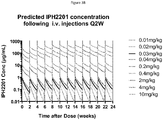
- Suitable treatment protocols for treating a human include, for example, administering to the patient an effective amount of an anti-NKG2A antibody, wherein the antibody is administered 2 times per month and the amount effective to maintain a continuous blood concentration of anti-NKG2A antibody of at least 10 ⁇ g/ml between at least two successive administrations of the anti-NKG2A antibody is between 2-10 mg/kg, optionally 2-6 mg/kg, optionally 2-8 mg/kg, optionally 2-4 mg/kg, optionally 2-3 mg/kg, or optionally about 2, 3 or 4 mg/kg body weight.
- These doses can optionally be selected so as to provide for a continued blood concentration of anti-NKG2A antibody of at least 10 ⁇ g/ml throughout the treatment cycle. Achieving blood concentration of anti-NKG2A antibody of 10 ⁇ g/ml corresponds to the EC 100 for an antibody such as humanized Z270.
- Further suitable treatment protocols for treating a human include, for example, administering to the patient an effective amount of an anti-NKG2A antibody, wherein the antibody is administered two times per month and the amount effective to maintain a continuous blood concentration of anti-NKG2A antibody of at least 40 ⁇ g/ml between at least two successive administrations of the anti-NKG2A antibody is between 2-10 mg/kg, optionally 2-8 mg/kg, optionally 2-6 mg/kg, optionally 2-4 mg/kg, optionally 2-3 mg/kg, or optionally about 2, 3 or 4 mg/kg body weight.
- These doses can optionally be administered so as to provide for continued blood concentration of anti-NKG2A antibody of at least 40 ⁇ g/ml throughout the treatment cycle.
- Achieving blood concentration of anti-NKG2A antibody of 40 ⁇ g/ml is expected to provide a tissue (e.g., extravascular tissue, tumor environment of a solid tumor) concentration of about 4 ⁇ g/ml, in turn corresponding to the EC 50 for NKG2A+ NK cell response for an antibody such as humanized Z270.
- tissue e.g., extravascular tissue, tumor environment of a solid tumor
- suitable treatment protocols for treating a human include, for example, administering to the patient an effective amount of an anti-NKG2A antibody, where- in the antibody is administered 2 times per month and the amount effective to maintain a continuous blood concentration of anti-NKG2A antibody of at least 100 ⁇ g/ml between at least two successive administrations of the anti-NKG2A antibody is between 4-10 mg/kg, optionally 4-6 mg/kg, optionally 4-8 mg/kg, optionally about 4 mg/kg, optionally about 6 mg/kg, optionally about 8 mg/kg, or optionally about 10 mg/kg body weight.
- These doses can optionally be administered so as to provide for continued blood concentration of anti-NKG2A antibody of at least 100 ⁇ g/ml throughout the treatment cycle.
- Achieving blood concentration of anti-NKG2A antibody of 100 ⁇ g/ml is expected to provide a tissue (e.g., extravascular, tumor environment) concentration of about 10 ⁇ g/ml, in turn corresponding to the EC 100 for an antibody such as humanized Z270.
- a loading period may comprise administering to the patient an effective amount of an anti-NKG2A antibody, wherein the antibody is administered one or more times in an amount effective to maintain a continuous blood concentration of anti- NKG2A antibody of at least 100 ⁇ g/ml until the first administration of anti-NKG2A antibody in the maintenance regimen.
- a loading dose 10 mg/kg of anti-NKG2A antibody can be administered, wherein the first administration of anti- NKG2A antibody within the maintenance regimen occurs about two weeks (or less) after the loading dose.
- the maintenance regimen can then employ a lower dose and/or lower frequency of administration in order to maintain a continuous blood concentration of anti- NKG2A antibody of at least 100 ⁇ g/ml between successive administrations within the maintenance regimen.
- a maintenance regimen can comprise administering an- ti-NKG2A antibody every two weeks at a dose of between 2-10 mg/kg, optionally 4-10 mg/kg, optionally 2-4 mg/kg, optionally 4-6 mg/kg, optionally 4-8 mg/kg, optionally about 4 mg/kg, optionally about 6 mg/kg, optionally about 8 mg/kg body weight.
- anti-NKG2A antibody is dosed in an amount so as to obtain a concentration in blood (serum) and/or tissue (e.g. tumor tissue) that corresponds to at least the EC 50 for NKG2A+ NK cell response, optionally at about or at least about, the EC 100 , for a period of at least about 1 week, at least about 2 weeks, without a significant "de-saturation" of NKG2A on cells in circulation between at least two successive administrations of the anti- NKG2A antibody.
- antibody is dosed in an amount so as to obtain a concentration in blood (serum) and/or tissue (e.g.
- the tumor tissue that corresponds to at least the EC 50 for NKG2A+ NK cell response, optionally at about or at least about, the EC 100 , for a period of at least about 1 week, at least about 2 weeks, and that permits a significant "de- saturation" of NKG2A on cells in circulation between two (or between each) successive ad- ministrations of the anti-NKG2A antibody.
- the anti-NKG2A antibody may be administered in an amount and at a frequency may result in at least 50% de-saturation of NKG2A on cells in circulation during the treatment period, for example between two successive administrations of the anti-NKG2A antibody.
- the amount that that permits a significant "de-saturation" of NKG2A on cells in circulation is an amount that provides a blood concentration of less than the EC 50 for NKG2A+ NK cell response, optionally less than the EC 20 for NKG2A+ NK cell response.
- Advantageous suitable treatment protocols for treating a human include, for example, administering to the patient an effective amount of an anti-NKG2A antibody, wherein the antibody is administered in an amount effective to achieve a blood concentration of anti- NKG2A antibody of at least 10 ⁇ g/ml, 40 ⁇ g/ml or 100 ⁇ g/ml for a period of at least about 1 week, or at least about 2 weeks, and that permits (e.g. is followed by) a significant "de- saturation" of NKG2A on cells in circulation between two (or between each) successive ad- ministrations of the anti-NKG2A antibody.
- the antibody is administered no more than once per month (or no more than once about every two months) and the amount effective to achieve a blood concentration of anti-NKG2A antibody of at least 10 ⁇ g/ml, 40 ⁇ g/ml or 100 ⁇ g/ml for a period of at least about 1 week, or at least about 2 weeks is between 2-10 mg/kg, optionally 2-8 mg/kg, optionally 2-6 mg/kg, optionally 2-4 mg/kg, optionally 2-3 mg/kg, or optionally about 2, 3 or 4 mg/kg body weight.
- Saturation (and de-saturation) of NKG2A on cells in circulation can be assessed by obtaining a peripheral blood sample and using standard methods for assessing receptor occupancy.
- a method of reducing the risk of cancer progression, reducing the risk of further cancer progression in a cell population that has undergone initiation, and/or providing a therapeutic regimen for reducing cancer progression in a human patient which comprises administering to the patient one or more first treatments (e.g. induction therapy, such as a chemotherapeutic agent) in an amount and regimen sufficient to achieve a response (partial or complete response), and then administering to the patient an amount of an anti-NKG2A antibody in a dosage and frequency according to the disclosure.
- first treatments e.g. induction therapy, such as a chemotherapeutic agent
- a method of promoting remission of a cancer in an individual comprising administering a composition comprising an anti-NKG2A antibody, to the individual, in a dosage and frequency according to the disclosure, so as to promote cancer remission in the individual.
- a method of preventing recurrence of a cancer in an individual comprising administering to the individual a composition comprising an anti-NKG2A antibody, in a dosage and frequency according to the disclosure, so as to promote cancer remission in the individual.
- a method for reducing the risk of developing a cancer, reducing the time to onset of a cancerous condition, and/or reducing the severity of a cancer diagnosed in the early stages comprising administering to an individual a prophylactically effective amount of an anti-NKG2A antibody in a dosage and frequency according to the disclosure, so as to achieve the desired physiological effect(s).
- a method for improving the quality of life of a cancer patient comprising administering to the patient a composition in an amount effective to improve the quality of life thereof.
- methods described herein can be applied to significantly reduce the number of cancer cells in a vertebrate host, such that, for example, the total number of cancer cells is reduced.
- a method for killing e.g. either directly or indirectly causing death of) cancer cells in a vertebrate, such as a human cancer patient.
- the anti-NKG2A antibody can be administered as monotherapy or in adjunctive or combined administration (co-administration) with a second therapeutic agent, e.g. an anti- EGFR antibody.
- a second therapeutic agent e.g. an anti- EGFR antibody.
- the adjunctive or combined administration includes simultaneous administration of the compounds in the same or different dosage form, or separate administration of the compounds (e.g., sequential administration).
- the anti-NKG2A and second therapeutic agent can be simultaneously administered in a single formulation.
- the anti-NKG2A and second therapeutic agent can be formulated for separate administration and are administered concurrently or sequentially.
- the second therapeutic agent will normally be administered in amounts and treatment regimens typically used for that agent in a monotherapy for the particular disease or condition being treated.
- Humanized Z270 is described in U.S. Patent No. 8,206,709 (Novo Nordisk). As described in U.S. Patent No. 8,206,709 , HumZ270 VKI_O2/JK4 light chain and various heavy chain acceptor frameworks were produced as human IgG4 antibodies. Heavy chain frameworks included "VH1" based on VH1_18/JH6; "VH5" based on VH5_a; “VH6” based on VH5_51; “VH7” based on VH1_f; and “VH8” based on VH1_46, all with a JH6 J-segment.
- the antigen-binding properties were analyzed on a Biacore T100 (Biacore AB, Uppsala, Sweden).
- the antigen was in the form of a single-chain NKG2A-CD94-mFc construct was covalently immobilized on the sensor CM5 chip (Biacore AB, Uppsala, Sweden) via amine groups using 1- ethyl-3-(3-dimethylaminopropyl) carbodiimide hydrochloride (EDC) and N- hydroxysuccinimide (NHS).
- EDC 1- ethyl-3-(3-dimethylaminopropyl) carbodiimide hydrochloride
- NHS N- hydroxysuccinimide
- Z270 antibody variants were diluted to a concentration series (0.157, 0.313, 0.625, 1.25, 2.5 nM) in the running buffer HBS-EP (10 mM HEPES pH 7.4, 150 mM NaCl, 3 mM EDTA, 0.005% (v/v) Tween-20). All the samples were then injected over the immobilized antigen for 2 min at the flow rate of 40 ul/min. Subsequently, the running buffer was injected for 3 min at 40 ul/min for antibody dissociation analysis. After each run, the regeneration buffer (10 mM NaOH, 500 mM NaCI) was injected (30 seconds, 10 ul/min) to completely strip the remaining antibodies off the antigen. Data were evaluated with Biacore T100 evaluation software.
- Example 2 - humZ270 is a competitive CD94/NKG2A antagonist
- humZ270 As described in U.S. Patent No. 8, 206, 709 , to test whether humZ270 prevents ligand (i.e. HLA-E) binding to CD94/NKG2A, humZ270 was tested for the ability to prevent the binding of HLA-E tetramers to CD94/NKG2A over-expressing Ba/F3 cells (Ba/F3-CD94/NKG2A).
- humZ270VL1/VH1 having the respective heavy and light chains of SEQ ID NOS: 3 and 7 was used in this Example, and unless indicated to the contrary, this antibody was also used as humZ270 for all other Examples below.
- Ba/F3-CD94/NKG2A were incubated with 1) various concentrations of humZ270 or 2) first incubated with a saturating concentration of HLA-E tetramers (4.7 ⁇ g/ml) and then incubated with various concentrations of humZ270. All incubations were performed in tissue-culture medium containing 2% FCS, on ice. Subsequently, cells were incubated with APC-conjugated secondary antibodies specific for mouse Ab's, and analyzed by flowcytometry using a BD Biosciences FACSarray.humZ270 efficiently binds Ba/F3-CD94/NKG2A cells in a concentration dependent fashion (diamonds).
- humZ270 when cells were pre-incubated with HLA-E tetramers, humZ270 was prevented from binding to Ba/F3-CD94/NKG2A cells. Thus HumZ270 and HLA-E bind overlapping epitopes on CD94/NKG2A. Therefore, the CD94/NKG2A-inhibitory effect of humZ270 in NK-cytotoxicity assays is likely a consequence of preventing the ability of HLA-E inducing negative signals to cytotoxic lymphocytes via CD94/NKG2A. As such, humZ270 can be considered a competitive CD94/NKG2A antagonist.
- Example 3 Distribution of NK and T cell subsets in C57/bl6 mice bearing rma-rae1 tumor based on NKG2A expression
- NKG2A NKG2A-specific kinase kinase kinase kinase kinase kinase kinase kinase kinase kinase kinase kinase kinase kinase kinase kinase kinase kinase kinase kinase kinas.
- NK and T cell subsets NK and T cell subsets in mice. Lymphocytes were taken from spleen, from tumor draining lymph nodes, as well as from within solid tumors.
- NKG2A-expressing NK and CD8+ T lymphocytes are found in significant percentages within the tumor environment with NKG2A+CD8+ T cells being present in high percentages in the tumor environment but not in the spleen or tumor draining lymph nodes.
- NKG2A+CD8+ T cells are present in high percentages in the tumor environment but not in the spleen or tumor draining lymph nodes.
- NK cell subset cells in both the draining lymph nodes and spleen were about half NKG2A-positive and half NKG2A-negative.
- T cell subset most cells were NKG2A-negative (only 1.1% in lymph nodes and 4.7% in spleen are NKG2A + ).
- CD8 T cell subset In the CD8 T cell subset, most cells were again NKG2A-negative (only 1.6% in lymph nodes and 3.9% in spleen are NKG2A + ). However, while almost no CD8 T cells outside the tumor had NKG2A expression, tumor infiltrating CD8 T cell subset had a mean of 26.3% NKG2A+ positive cells. Among the CD8 - T cell subset, there was little difference in NKG2A expression observed between TILs and spleen or lymph node cells, as only 5.1% of CD8 - T cells in the tumor expressed NKG2A.
- Example 4 In vitro receptor saturation: binding of humanized anti-NKG2A antibody IPH2201 to NKG2A+ NK cells in whole blood
- Receptor occupancy of anti-NKG2A was assessed in vitro in human blood, providing a prediction of the pharmacokinetics of anti-NKG2A in human patients.
- This study was aimed to estimate ex vivo the cellular affinity in whole blood of HumZ270 as well as the absolute number of available NKG2A receptors per ⁇ l of whole blood and also per cell in humans. The affinity and total number of receptors may impact both pharmacokinetics (PK) and pharmacodynamics (PD) of the mAb in humans.
- PK pharmacokinetics
- PD pharmacodynamics
- humZ270 was done in whole blood from 8 volunteers (mAb incubated for 30 minutes at room temperature (RT). Fifteen mAb concentrations were tested to cover the full range of binding between 0 and 100% of maximal binding, going from 90 ⁇ g/ml to 0.000019 ⁇ g/ml (1/3 serial dilution, 15 points and 0). Samples were processed to remove red blood cells and fix the cells and acquired on a cytometer. Calibrating beads were used to transform MFI results into MESF (Molecule of Equivalent Soluble Fluorochrome). Gating was done on CD45+ lymphocytes expressing NKG2A.
- humZ270 Three tubes were dedicated to absolute counting of lymphocyte subsets using flow- count beads added into the blood.
- a titration was done using humZ270, in which bound humZ270 was be detected using a PE-coupled anti-hlgG4 secondary antibody.
- a titration was also performed with PE-coupled humZ270 and compared to titration done with bound humZ270 in order to examine the effect of the coupling to PE on the pharmacological properties of humZ270 and for evaluating the total number of receptors for a saturating concentration of humZ270.
- NKG2A+ cell subsets i.e. NK cells and T cells. These subsets of lymphocytes do not all express NKG2A and therefore a NKG2A- subset for each population of interest were studied and compared to the NKG2A+ subset.
- the cell populations are defined as follows:
- MFI Mean Fluorescence Intensity
- results showed that human anti-NKG2A mAb (humZ270) binds to two subsets of peripheral blood lymphocytes: NK and CD8+ T cells.
- HumZ270 also referred to as IPH2201
- IPH2201 concentrations listed on the x-axis
- MESF signal for receptor binding is shown on the y-axis.
- the antibody had a binding affinity (EC50) of about 4 ng/mL for NKG2A+ cells (K D ⁇ 4ng/mL). This K D is consistent with K D values observed in other assays, notably affinity for binding to PBMC and affinity for recombinant NKG2A in Biacore as- says.
- the K D for full receptor occupancy was about 100 ng/ml.
- HumZ270 a human IgG4 antibody was produced with a heavy chain having a serine to proline mutation in residue 241 of the heavy chain (S241P mutation), corresponding to position 228 according to the EU-index, in order to maintain high affinity bivalent binding in vivo.
- the safety profile of humZ270 (IPH2201) was explored in a double-blind, placebo- controlled dose-escalation phase I trial in 92 patients with stable and controlled rheumatoid arthritis.
- Z270 or placebo was administered as single-dose i.v. up to 10 mg/kg, or single-dose s.c. or multiple-dose s.c. (four administrations given with 2-week intervals) up to 4 mg/kg.
- the dosages tested as single dose by i.v. were: 0.0002, 0.001 mg/kg, 0.005 mg/kg, 0.025 mg/kg, 0.1 mg/kg, 0.4 mg/kg, 1.1 mg/kg, 3.5 mg/kg and 10 mg/kg. All patients were followed for a minimum of 12 weeks. The safety profile was very favorable. The MTD was not reached. There were no SUSAR, no drug-related serious adverse events, no infusion related reaction and no immune related adverse event. Nasopharyngitis and headache were the two most frequently reported adverse events.
- Receptor saturation was assessed using a conventional sandwich ELISA format with a mouse Fc human NKG2A fusion protein used to capture the humZ270 antibody. After incubation with serum samples containing humZ270 antibody, bound antibody (the analyte in this study) is detected using a biotinylated mouse anti human IgG4. HRP labelled avidin is added to tag the solid phase bound biotinylated anti-human IgG4 and a colorimetric HRP substrate (TMB) is used for end point detection.
- TMB colorimetric HRP substrate
- the optimal dose and dosing frequency for the Anti-NKG2A (IPH2201) dose levels to be used in the clinical trials that would provide substantially full receptor saturation was predicted using a PK/PD model developed using pharmacokinetic software package (WinNonLin 6.3.0.395, Pharsight Corporation), model based on clinical data from IPH2201 phase I in RA patients.
- the dosing frequency in clinical therapy using IPH2201 depends on the steady state plasma concentration needed for saturation as well as the clearance and volume of distribution of IPH2201.
- a population PD modelling was performed based on preliminary NKG2A occupancy data available from the ongoing phase I clinical trial.
- a sigmoid Emax model was used to fit the plasma concentration-effect relationship.
- the model was characterized by an EC50, defined as the serum drug concentration to reach 50% of Emax, i.e. 50% of NKG2A occupancy here.
- substantially complete (at least 90%) receptor saturation of NKG2A+ cells can be achieved by administering 0.03 mg/kg every two weeks.
- a dose of 0.1 mg/kg can be administered every four weeks to maintain substantially complete saturation of NKG2A. If saturation in the extravascular tissue (e.g. a solid tumor) is desired, an approximately 10-fold higher dose is believed to be needed, translating to a dose of about 0.4 mg/kg every two weeks, 1 mg/kg every four weeks.
- NK cells effector cells
- assessment of CD107 mobilization and occupancy was performed in parallel.
- the target cells were autologous SEB blasts. This killing is considered to be mediated by NK cells, and it can be specifically increased by an anti-NKG2A antibody as it is expected to counteract the inhibitory signal from HLA-E.
- a concentration-range response with antibody humZ270 was performed in a 4-hour cytotoxicity assay. It was chosen to use purified NK cells and a CD107 mobilization assay based on the experimental results generated.
- the FACS-based CD107 assay enables the specifically study of the cytotoxic response of NK cells expressing NKG2A and to compare it to NK cells not expressing NKG2A.
- An alternative protocol such as chromium release assays would not have allowed discriminating the effect depending on NKG2A expression which is an issue in donors with a low percentage of NKG2A+ cells.
- Purified NK cells were prepared from frozen PBMC: Human NK purification with Stem Sep system, and cultured O/N in complete medium supplemented with 10 IU/ml recombinant IL-2.
- PBMC were prepared from collected blood. Blood was qualified for transfusion, donors were thus anonymous and supposedly healthy.
- PBMC were prepared, aliquoted and stored in nitrogen tanks prior to the study.
- Results are summarized in Figure 3A .
- the concentrations of anti-NKG2A required for efficacy are 100-fold higher than concentrations providing full receptor saturation.
- the EC50 concentration (the amount that provides a 50% of maximum) in the CD107 mobilization assay was determined to be about 400 ng/ml, and the EC100 was about 10,000 ng/ml (10 ⁇ g/ml).
- the EC50 concentration for receptor saturation is about 4 ng/ml and the EC100 is about 100 ng/ml, a concentration also corroborated by data from the Phase I clinical trial (see Example 5).
- Example 6 the EC observed for biological effect in autologous SEB blasts in Example 6 was compared to that of cells having different levels of expression of HLA-E.
- Human K562 cells transfected with HLA-E were selected as high HLA-E expressing cells.
- the FACS-based CD107 assay was performed using purified NK cells as described in Example 6.
- the optimal dose and dosing frequency for the anti-NKG2A (IPH2201) dose levels to be used in the clinical trials was predicted using a PK/PD model developed using pharmacokinetic software package (WinNonLin 6.3.0.395, Pharsight Corporation), model based on clinical data from IPH2201 phase I in RA patients.
- the dosing frequency in clinical therapy using IPH2201 depends on the steady state plasma concentration needed as well as the clearance and volume of distribution of IPH2201.
- Figure 3B shows different blood concentrations reached with different dosages administered by i.v. every two weeks. Dose levels were 0.01, 0.02, 0.03, 0.04, 0.2, 0.4 mg/kg, 2 mg/kg, 4mg/kg and 10 mg/kg body weight.
- the lines in Figure 3B correspond, from bottom to top, to increasing doses of IPH2201, where the lowest dose corresponds to the lowest line at the bottom of the chart to the highest dose at the top of the chart.
- the dose of 0.01 mg/kg provided an initial (peak) blood concentration of about 0.2 ⁇ g/ml.
- the dose of 0.04 mg/kg provided an initial (peak) blood concentration of about 1 ⁇ g/ml, i.e.
- the dose of 0.4 mg/kg provided an initial (peak) blood concentration of about 10 ⁇ g/ml, i.e. at about the EC 100 for efficacy in circulation, and a continued blood concentration above 3 ⁇ g/ml up to the two week time point.
- the dose of 4 mg/kg provided an initial (peak) blood concentration of about 100 ⁇ g/ml, i.e. at about the EC 100 for efficacy in tissues, and a continued blood concentration above 30 ⁇ g/ml up to the two week time point.
- the fourth dose provides continued blood concentration of approximately 100 ⁇ g/ml.
- the dose of 10 mg/kg provided a continued blood concentration approximately 100 ⁇ g/ml.
- Figure 3C shows different blood concentrations reached with different dosages ad- ministered by i.v. every two weeks, when a loading dose and maintenance dose are used.
- a loading dose of 10 mg/kg body weight followed by a maintenance dose of 4 mg/kg body weight (the upper line in Figure 3C ) provides provided an initial and continued blood concentration approximately 100 ⁇ g/ml.
- a constant dose of 4 mg/kg is shown as the lower line in Figure 3C , which provides for a continued (or minimal) blood concentration of at least 30 ⁇ g/ml between the initial and subsequent injection at two weeks, a continued (or minimal or remaining) blood concentration of at least 50 ⁇ g/ml at two weeks after the second injection, a continued (or minimal or remaining) blood concentration of at least 60-70 ⁇ g/ml at two weeks after the third injection.
- Immunotherapeutic approaches for HNSCC are particularly complicated by the pro- found immune suppression that is induced by HNSCC, which potentially decreases the effectiveness of immune stimulatory efforts (see, e.g., Duray et al. (2010) Clin. Dev. Immunol. 2010: 1-15 ).
- the goal of this experiment was to explore whether an anti-NKG2A antibody that targets NKG2A is able to eliminate HNSCC cells.
- CD107 mobilization at 4 hours is a marker of the release of lytic granules by NK cells ( Alter et al., (2004) J Immunol Methods 294(1-2): 15-22 ). Increase in CD137 expression at 24 hours is correlated with the activation of several lymphocytes including NK cells ( Kohrt et al. (2011) Blood 117(8):2423-2432 ). Analysis of CD107 and CD137 expression was performed on NK cells expressing or not expressing NKG2A (NKG2A+ NK cells or NKG2A- NK cells respectively). Since the antibody is targeting NKG2A, its effect is expected to be seen only on NKG2A+ NK cells, and thus NKG2A- NK cells can be regarded as an internal control in the experiments.
- the effector cells used were freshly isolated PBMC from healthy volunteers and tar- get cells were HNSCC cell lines or clones of K562 cell line transfected with HLA-E. Cells were numerated and passed every two days in complete medium. Viability was measured and had to be over 90%. They were kept in culture up to 12 passages. The day before of the experiment, cells were counted and adjusted to 100,000 cells/wells. Viability was measured and had to be over 90%.
- the K562 cell lines were K562 clone E6 (HLA-E positive, CD32low) and K562 clone F7 (HLA-E negative/low, CD32low).
- Human head and neck cancer cell lines were screened by flow cytometry for HLA-E expression (see Table C, below). Three cell lines were selected for functional tests: FaDu (ATCC #HTB-43), H-N (DSMZ #ACC 417) and CAL-27 (DSMZ #ACC 446).
- Table C Cell line HLA-E expression Cell type Source Mean HLA-E / IC MFI ratio # exp.
- the effector cells used were freshly isolated PBMC from healthy volunteers.
- Anti-NKG2A antibody humZ270 VH1 whose heavy chain amino acid sequence is shown in SEQ ID NO: 3 and whose light chain amino acid sequence is shown in SEQ ID NO: 7 was used at a final concentration of 10 ⁇ g/mL.
- Figures 4A and 4B show CD107 (Top) and CD137 (Bottom) FACS read-outs on NKG2A- NK (left) or NKG2A+ NK cells (right) in presence of controls or indicated target cell lines and in presence or not of anti-NKG2A at a concentration of 10 ⁇ g/mL.
- the cell lines are ordered from left to right according to level of HLA-E surface expression. Each dot represents PBMC from a healthy volunteer.
- Figure 4B shows HNSCC cell lines and demonstrates anti-NKG2A can restore lysis of HNSCC with endogenous HLA-E expression or of K562 transfected with HLA-E. This effect is only seen on NKG2A positive NK cells and is dependent on the level of expression of HLA-E. Indeed, anti-NKG2A effect is seen on cell lines with medium to high HLA-E level of expression.
- Anti-NKG2A can induce the NK-mediated lysis of HLA-E expressing cell lines by blocking the interaction of the inhibitory receptor NKG2A with HLA-E. This effect is observed on K562 cell line transfected with HLA-E, but more importantly on HNSCC cell lines with endogeneous HLA-E expression such as FaDu and CAL-27 cell lines. The extent of anti- NKG2A effect depends on the level of HLA-E expression at the cell surface of the target cells.
- EGFR Epidermal growth factor receptor
- HNSCC epidermal growth factor receptor
- the anti-EGFR monoclonal antibody cetuximab is thought to act through blocking oncogenic signaling of the EGF receptor pathway and by inducing Fc ⁇ receptor -mediated antibody dependent cellular cytotoxicity (ADCC).
- ADCC Fc ⁇ receptor -mediated antibody dependent cellular cytotoxicity
- HNSCC human epidermal growth factor receptor
- ADCC Fc ⁇ receptor -mediated antibody dependent cellular cytotoxicity
- blocking oncogenic signaling of the EGF receptor pathway results in posttranscriptional regulation in tumor cells of major histocompatibility complex (MHC) class I-related antigens of the MICA/B and ULBP protein families which are recognized by the activating receptor NKG2D on NK cells and subsets of T cells.
- MHC major histocompatibility complex
- This experiment was designed to explore the effect of an EGFR inhibiting antibody on the ability of anti-NKG2A antibodies to activate NK cells in HNSCC.
- Effect of a dose-response of cetuximab on NK cells activation was determined by analysis of CD107 and CD137 expression, using as effector cells PBMC freshly isolated from healthy volunteers, and as target cells HNSCC cell lines (FaDu, and H-N), at an E:T ratio of 2.5/1.
- the read out was CD107 at 4 hours vs. CD137 at 24 hours, using 3 donors (CD107 read out in 4h) and four donors (CD137 read out in 24h).
- Cetuximab was tested at a dose response, 1/10 serial dilution starting at 10 ⁇ g/mL.
- NK cells were subdivided in NKG2A+ and NKG2A- subsets.
- Suboptimal doses of cetuximab were chosen for further testing to explore the effect of an EGFR inhibiting antibody on the ability of anti-NKG2A antibodies to activate NK cells in HNSCC.
- the 0.001 ⁇ g/mL (1 ng/mL) dose is the starting point of the cetuximab effect observed both with CD107 and CD137 readouts.
- the 0.01 ⁇ g/mL (10 ng/mL) dose is approximatively at the EC50 of the cetuximab effect.
- the read out was CD107 at 4 hours vs. CD137 at 24 hours, using 7 donors (FaDu and H-N)) and two donors (CAL-27).
- Anti-NKG2A antibody whose heavy chain amino acid sequence is shown in SEQ ID NO: 3 and whose light chain amino acid sequence is shown in SEQ ID NO: 7 was used at a final concentration of 10 ⁇ g/mL corresponding to full functional activity, and EGFR inhibitor cetuximab was used at two suboptimal doses of 0.001 ⁇ g/mL or 0.01 ⁇ g/mL.
- the read out was CD107 at 4 hours vs. CD137 at 24 hours, using 2 donors.
- Anti-NKG2A antibody whose heavy chain amino acid sequence is shown in SEQ ID NO: 3 and whose light chain amino acid sequence is shown in SEQ ID NO: 7 was used at two suboptimal doses of 0.1 and 1 ⁇ g/mL, and at a saturating dose of 10 ⁇ g/mL.
- Cetuximab was used at two suboptimal doses of 0.001 ⁇ g/mL and 0.01 ⁇ g/mL ( ⁇ EC50) and at a saturating dose of 0.1 ⁇ g/mL in these experimental settings.
- FIG. 6A shows CD107 read out on controls with no target and with K562-HLA-E transfectants. Each healthy volunteer is represented by a different symbol: squares or circles. Crossed open symbols correspond to condition where anti-NKG2A was replaced by 10 ⁇ g/mL hIgG4 isotypic control co-incubated with 0.1 ⁇ g/mL cetuximab. It can be seen that the effect of anti-NKG2A antibody is dose-dependent, depends on HLA-E expression level, and is still observed at a saturating dose of cetuximab of 0.1 ⁇ g/mL in the clone E6 that expresses HLA-E at high levels. In clone F7 (low HLA-E expression levels), the effect of anti-NKG2A was limited and high doses (e.g. full activity doses) of anti-NKG2A did not further augment the effect.
- clone F7 low HLA-E expression levels
- Figure 6B shows CD107 read out on HNSCC cell lines. Each healthy volunteer is represented by a different symbol: squares or circles. Crossed open symbols correspond to condition where anti-NKG2A was replaced by 10 ⁇ g/mL hIgG4 isotypic control co-incubated with 0.1 ⁇ g/mL cetuximab. It can be seen that the effect of anti-NKG2A antibody is dose-dependent, depends on HLA-E expression level, and is still observed at a saturating dose of cetuximab of 0.1 ⁇ g/mL in the FaDu or CAL-27 that expresses at higher levels/stain strongly for HLA-E.
- anti-NKG2A antibody The effect of anti-NKG2A antibody is dose-dependent, depends on HLA-E expression level, and is still observed at a saturating dose of cetuximab of 0.1 ⁇ g/mL.
- Example 12 A human clinical trial for treatment of cancer with repeated injections of humanized Z270 as single agent
- the primary objective of the trial is to evaluate the antitumor activity of preoperative IPH2201 (humanized Z270 comprising an S241P mutation) in patients with operable squamous cell carcinoma of the oral cavity.
- the secondary objectives are to assess the safety of IPH2201, the pharmacokinetics, the immunogenicity and the pharmacodynamics including intra-tumoral biomarkers
- the trial is a single-center, open label single-arm phase lb-II study including a run-in part.
- Previously untreated patients with measurable, clinical intermediate or high risk, stage III or IVa squamous cell carcinoma of the oral cavity will be treated with single agent IPH2201 i.v. every 2 weeks (q2w) for 4 administrations, by intravenous (i.v.) route over 1 hour.
- the first 6 patients will receive IPH2201 at a dose of 4 mg/kg q2w x 4.
- a minimum interval of one week will be observed between the first administrations of IPH2201 to the 3 first patients treated at 4 mg/kg.
- the subsequent patients will be treated at a dose of 10 mg/kg q2w x 4, the escalation of the dose being allowed by the safety committee after a minimal follow-up of 4 weeks following the first administration in the last patient treated at 4 mg/kg.
- Standard loco-regional treatment with surgery followed by adjuvant therapy (radiotherapy (RT) or radiochemotherapy (RCT)) according to histopathologic risk factors will be initiated after the last administration of IPH2201. In case of tumor progression loco-regional treatment will be initiated immediately.
- Antitumor activity will be assessed clinically and radiologically before the third ad- ministration of IPH2201, and 2 weeks after the last administration of IPH2201, before surgery. Tumor measurements will be obtained on target lesions according to RECIST 1.1 criteria. The same imaging techniques will be used for efficacy assessment at baseline and during the preoperative period, for the assessment of the primary end point and /or after surgery, for the monitoring of potential relapses. An assessment by appropriate imaging techniques, at the investigator's dicretion (computed tomography (CT) scans and/or Magnetic Resonance Imaging (MRI)) will be performed in all the patients, as well as photographs of the accessible tumor lesions.
- CT computed tomography
- MRI Magnetic Resonance Imaging
- a fresh tumor sample will be obtained by biopsy at baseline and the resected specimen will be collected at surgery.
- Pharmacology (PK/PD) and biomarker studies will be con- ducted before and after surgery.
- the patients will be followed up to one year after the first cycle of administration. After the end of study visit, relapse and survival will be documented post study according to local practices during 2 additional years.
Landscapes
- Health & Medical Sciences (AREA)
- Chemical & Material Sciences (AREA)
- Immunology (AREA)
- Organic Chemistry (AREA)
- Life Sciences & Earth Sciences (AREA)
- Medicinal Chemistry (AREA)
- General Health & Medical Sciences (AREA)
- Biochemistry (AREA)
- Molecular Biology (AREA)
- Genetics & Genomics (AREA)
- Biophysics (AREA)
- Proteomics, Peptides & Aminoacids (AREA)
- Animal Behavior & Ethology (AREA)
- Public Health (AREA)
- Veterinary Medicine (AREA)
- Pharmacology & Pharmacy (AREA)
- General Chemical & Material Sciences (AREA)
- Chemical Kinetics & Catalysis (AREA)
- Nuclear Medicine, Radiotherapy & Molecular Imaging (AREA)
- Engineering & Computer Science (AREA)
- Oncology (AREA)
- Epidemiology (AREA)
- Biomedical Technology (AREA)
- Bioinformatics & Cheminformatics (AREA)
- Microbiology (AREA)
- Mycology (AREA)
- Cell Biology (AREA)
- Rheumatology (AREA)
- Pain & Pain Management (AREA)
- Hematology (AREA)
- Medicines Containing Antibodies Or Antigens For Use As Internal Diagnostic Agents (AREA)
- Peptides Or Proteins (AREA)
- Preparation Of Compounds By Using Micro-Organisms (AREA)
Priority Applications (1)
| Application Number | Priority Date | Filing Date | Title |
|---|---|---|---|
| PL15763016T PL3193929T3 (pl) | 2014-09-16 | 2015-09-15 | Schematy leczenia z zastosowaniem przeciwciał anty-nkg2a |
Applications Claiming Priority (6)
| Application Number | Priority Date | Filing Date | Title |
|---|---|---|---|
| US201462050948P | 2014-09-16 | 2014-09-16 | |
| US201462067642P | 2014-10-23 | 2014-10-23 | |
| US201462083929P | 2014-11-25 | 2014-11-25 | |
| US201462093124P | 2014-12-17 | 2014-12-17 | |
| US201462093141P | 2014-12-17 | 2014-12-17 | |
| PCT/EP2015/071073 WO2016041947A1 (en) | 2014-09-16 | 2015-09-15 | Treatment regimens using anti-nkg2a antibodies |
Publications (2)
| Publication Number | Publication Date |
|---|---|
| EP3193929A1 EP3193929A1 (en) | 2017-07-26 |
| EP3193929B1 true EP3193929B1 (en) | 2019-06-12 |
Family
ID=54105801
Family Applications (1)
| Application Number | Title | Priority Date | Filing Date |
|---|---|---|---|
| EP15763016.1A Active EP3193929B1 (en) | 2014-09-16 | 2015-09-15 | Treatment regimens using anti-nkg2a antibodies |
Country Status (14)
| Country | Link |
|---|---|
| US (4) | US10676523B2 (enExample) |
| EP (1) | EP3193929B1 (enExample) |
| JP (4) | JP2017538660A (enExample) |
| KR (2) | KR20240141862A (enExample) |
| CN (1) | CN107074950A (enExample) |
| AU (3) | AU2015316993B2 (enExample) |
| CA (1) | CA2959463A1 (enExample) |
| DK (1) | DK3193929T3 (enExample) |
| ES (1) | ES2742456T3 (enExample) |
| HU (1) | HUE044704T2 (enExample) |
| IL (1) | IL250672B (enExample) |
| PL (1) | PL3193929T3 (enExample) |
| SG (2) | SG10202007781TA (enExample) |
| WO (1) | WO2016041947A1 (enExample) |
Cited By (8)
| Publication number | Priority date | Publication date | Assignee | Title |
|---|---|---|---|---|
| US11274150B2 (en) | 2018-11-16 | 2022-03-15 | Bristol-Myers Squibb Company | Anti-human natural killer cell inhibitory receptor group 2A protein (NKG2A) antibodies |
| US11607453B2 (en) | 2017-05-12 | 2023-03-21 | Harpoon Therapeutics, Inc. | Mesothelin binding proteins |
| US11623958B2 (en) | 2016-05-20 | 2023-04-11 | Harpoon Therapeutics, Inc. | Single chain variable fragment CD3 binding proteins |
| US11807692B2 (en) | 2018-09-25 | 2023-11-07 | Harpoon Therapeutics, Inc. | DLL3 binding proteins and methods of use |
| US11976125B2 (en) | 2017-10-13 | 2024-05-07 | Harpoon Therapeutics, Inc. | B cell maturation antigen binding proteins |
| US12084518B2 (en) | 2015-05-21 | 2024-09-10 | Harpoon Therapeutics, Inc. | Trispecific binding proteins and methods of use |
| US12195544B2 (en) | 2018-09-21 | 2025-01-14 | Harpoon Therapeutics, Inc. | EGFR binding proteins and methods of use |
| US12371504B2 (en) | 2017-10-13 | 2025-07-29 | Harpoon Therapeutics, Inc. | Trispecific proteins and methods of use |
Families Citing this family (48)
| Publication number | Priority date | Publication date | Assignee | Title |
|---|---|---|---|---|
| EP3409289B1 (en) | 2010-02-26 | 2020-09-30 | Novo Nordisk A/S | Stable antibody containing compositions |
| KR102047248B1 (ko) | 2011-06-17 | 2019-11-21 | 노보 노르디스크 에이/에스 | 침식성 세포의 선택적 제거 |
| SG10202007781TA (en) | 2014-09-16 | 2020-09-29 | Innate Pharma | Treatment Regimens Using Anti-NKG2A Antibodies |
| AU2015316991B2 (en) | 2014-09-16 | 2021-04-01 | Innate Pharma | Neutralization of inhibitory pathways in lymphocytes |
| US10329348B2 (en) | 2014-10-23 | 2019-06-25 | Innate Pharma | Treatment of cancers using anti-NKG2A agents |
| US10736963B2 (en) | 2015-07-24 | 2020-08-11 | Innate Pharma | Methods for detecting tissue infiltrating NK cells |
| SI3405495T1 (sl) | 2016-01-21 | 2021-08-31 | Innate Pharma | Nevtralizacija inhibitornih poti v limfocitih |
| EP3529277A1 (en) | 2016-10-21 | 2019-08-28 | Innate Pharma | Treatment with anti-kir3dl2 agents |
| US11447545B2 (en) | 2017-07-10 | 2022-09-20 | Innate Pharma | Combination therapy using antibody to human Siglec-9 and antibody to human NKG2A for treating cancer |
| WO2019175182A1 (en) * | 2018-03-13 | 2019-09-19 | Innate Pharma | Treatment of head and neck cancer |
| EP3768715A1 (en) | 2018-03-23 | 2021-01-27 | Bristol-Myers Squibb Company | Antibodies against mica and/or micb and uses thereof |
| EA202092696A1 (ru) | 2018-05-15 | 2021-04-05 | Медиммун Лимитед | Лечение рака |
| US12534526B2 (en) | 2018-11-07 | 2026-01-27 | Shanghai Hyamab Biotech Co., Ltd. | NKG2A antibody, preparation method therefor and application thereof |
| WO2020205440A1 (en) * | 2019-03-29 | 2020-10-08 | Dren Bio, Inc. | Methods of reducing large granular lymphocyte and natural killer cell levels |
| KR20220016155A (ko) | 2019-05-30 | 2022-02-08 | 브리스톨-마이어스 스큅 컴퍼니 | 면역-종양학 (i-o) 요법에 적합한 대상체를 확인하는 방법 |
| US20220363760A1 (en) | 2019-05-30 | 2022-11-17 | Bristol-Myers Squibb Company | Multi-tumor gene signature for suitability to immuno-oncology therapy |
| WO2020243570A1 (en) | 2019-05-30 | 2020-12-03 | Bristol-Myers Squibb Company | Cell localization signature and combination therapy |
| WO2021024020A1 (en) | 2019-08-06 | 2021-02-11 | Astellas Pharma Inc. | Combination therapy involving antibodies against claudin 18.2 and immune checkpoint inhibitors for treatment of cancer |
| CN114599372A (zh) | 2019-11-04 | 2022-06-07 | 阿斯利康(瑞典)有限公司 | 用于治疗癌症的组合疗法 |
| CN113583127A (zh) * | 2020-04-30 | 2021-11-02 | 迈威(上海)生物科技股份有限公司 | 一种靶向nkg2a和pd-l1的双特异性抗体及应用 |
| CN116096754A (zh) * | 2020-05-04 | 2023-05-09 | 免疫里森公司 | 前体三特异性抗体构建体及其使用方法 |
| US20230348854A1 (en) * | 2020-05-08 | 2023-11-02 | Seattle Children's Hospital D/B/A Seattle Children's Research Institute | Chimeric antigen receptors (cars) targeting natural killer cells |
| KR20230035576A (ko) | 2020-07-07 | 2023-03-14 | 비온테크 에스이 | Hpv 양성 암 치료용 rna |
| AU2021334361A1 (en) | 2020-08-31 | 2023-05-11 | Bristol-Myers Squibb Company | Cell localization signature and immunotherapy |
| KR20230104611A (ko) | 2020-09-30 | 2023-07-10 | 드렌 바이오, 인크. | 항-cd94 항체 및 이의 사용 방법 |
| WO2022120179A1 (en) | 2020-12-03 | 2022-06-09 | Bristol-Myers Squibb Company | Multi-tumor gene signatures and uses thereof |
| AR124414A1 (es) | 2020-12-18 | 2023-03-22 | Century Therapeutics Inc | Sistema de receptor de antígeno quimérico con especificidad de receptor adaptable |
| WO2022135666A1 (en) | 2020-12-21 | 2022-06-30 | BioNTech SE | Treatment schedule for cytokine proteins |
| TW202245808A (zh) | 2020-12-21 | 2022-12-01 | 德商拜恩迪克公司 | 用於治療癌症之治療性rna |
| WO2022135667A1 (en) | 2020-12-21 | 2022-06-30 | BioNTech SE | Therapeutic rna for treating cancer |
| JP2024501029A (ja) | 2020-12-28 | 2024-01-10 | ブリストル-マイヤーズ スクイブ カンパニー | Pd1/pd-l1抗体の皮下投与 |
| US20220233693A1 (en) | 2020-12-28 | 2022-07-28 | Bristol-Myers Squibb Company | Antibody Compositions and Methods of Use Thereof |
| EP4314068A1 (en) | 2021-04-02 | 2024-02-07 | The Regents Of The University Of California | Antibodies against cleaved cdcp1 and uses thereof |
| WO2022253805A1 (en) * | 2021-06-01 | 2022-12-08 | Symphogen A/S | Anti-nkg2a antibodies and compositions |
| CA3225254A1 (en) | 2021-07-13 | 2023-01-19 | BioNTech SE | Multispecific binding agents against cd40 and cd137 in combination therapy for cancer |
| TW202333802A (zh) | 2021-10-11 | 2023-09-01 | 德商拜恩迪克公司 | 用於肺癌之治療性rna(二) |
| WO2023178329A1 (en) | 2022-03-18 | 2023-09-21 | Bristol-Myers Squibb Company | Methods of isolating polypeptides |
| KR20250022071A (ko) | 2022-06-02 | 2025-02-14 | 브리스톨-마이어스 스큅 컴퍼니 | 항체 조성물 및 이의 이용 방법 |
| JP2026501506A (ja) | 2022-12-14 | 2026-01-16 | アステラス・ファーマ・ヨーロッパ・ベスローデン・フェンノートシャップ | Cldn18.2及びcd3に結合する二重特異性結合剤並びに免疫チェックポイント阻害剤を含む併用療法 |
| EP4649173A1 (en) | 2023-01-13 | 2025-11-19 | Akrivia Biomedics Limited | Method of profiling diseases |
| WO2024196952A1 (en) | 2023-03-20 | 2024-09-26 | Bristol-Myers Squibb Company | Tumor subtype assessment for cancer therapy |
| WO2025038763A1 (en) | 2023-08-15 | 2025-02-20 | Bristol-Myers Squibb Company | Ceramic hydroxyapatite chromatography flow through method |
| TW202541837A (zh) | 2023-12-08 | 2025-11-01 | 日商安斯泰來製藥公司 | 含有結合至cldn18.2和cd3之雙特異性結合劑和穩定或增加cldn18.2表現之藥劑之組合療法 |
| WO2025120866A1 (en) | 2023-12-08 | 2025-06-12 | Astellas Pharma Inc. | Combination therapy involving bispecific binding agents binding to cldn18.2 and cd3 and agents stabilizing or increasing expression of cldn18.2 |
| WO2026033885A1 (en) | 2024-08-08 | 2026-02-12 | Astellas Pharma Inc. | Combination therapy involving bispecific binding agents binding to cldn18.2 and cd3 and agents stabilizing or increasing expression of cldn18.2 |
| WO2025120867A1 (en) | 2023-12-08 | 2025-06-12 | Astellas Pharma Inc. | Combination therapy involving bispecific binding agents binding to cldn18.2 and cd3 and anti-vegfr2 antibodies |
| WO2025145207A1 (en) | 2023-12-29 | 2025-07-03 | Bristol-Myers Squibb Company | Combination therapy of kras inhibitor and treg-depleting agent |
| NL2037811B1 (en) | 2024-05-29 | 2025-12-12 | Univ Oslo | Treatment for Cancer |
Family Cites Families (16)
| Publication number | Priority date | Publication date | Assignee | Title |
|---|---|---|---|---|
| GB9725764D0 (en) | 1997-12-04 | 1998-02-04 | Isis Innovation | HLA-E binding |
| US20030095965A1 (en) | 2001-05-02 | 2003-05-22 | Katrien Van Beneden | Antibodies to Ly49E and CD94/NKG2 receptors |
| CN101107269B (zh) * | 2004-12-28 | 2012-10-31 | 依奈特制药公司 | 抗nkg2a的单克隆抗体 |
| PT1831258E (pt) | 2004-12-28 | 2016-01-07 | Univ Genova | Anticorpos monoclonais contra nkg2a |
| MX2008015830A (es) | 2006-06-30 | 2009-01-09 | Novo Nordisk As | Anticuerpos anti-nkg2a y usos de los mismos. |
| KR20100110864A (ko) | 2008-01-24 | 2010-10-13 | 노보 노르디스크 에이/에스 | 인간화된 항-인간 nkg2a 모노클로날 항체 |
| WO2010129033A2 (en) | 2009-04-29 | 2010-11-11 | Calmune Corporation | Modified antibodies for passive immunotherapy |
| EP3409289B1 (en) | 2010-02-26 | 2020-09-30 | Novo Nordisk A/S | Stable antibody containing compositions |
| KR102047248B1 (ko) | 2011-06-17 | 2019-11-21 | 노보 노르디스크 에이/에스 | 침식성 세포의 선택적 제거 |
| RU2017105425A (ru) | 2014-08-28 | 2018-09-28 | Академиш Зикенхёйс Лейден Х.О.Д.Н. Люмк | Комбинации антитела против cd94/nkg2a и/или cd94/nkg2b и вакцины |
| AU2015316991B2 (en) | 2014-09-16 | 2021-04-01 | Innate Pharma | Neutralization of inhibitory pathways in lymphocytes |
| SG10202007781TA (en) | 2014-09-16 | 2020-09-29 | Innate Pharma | Treatment Regimens Using Anti-NKG2A Antibodies |
| US10329348B2 (en) | 2014-10-23 | 2019-06-25 | Innate Pharma | Treatment of cancers using anti-NKG2A agents |
| SI3405495T1 (sl) | 2016-01-21 | 2021-08-31 | Innate Pharma | Nevtralizacija inhibitornih poti v limfocitih |
| WO2019175182A1 (en) | 2018-03-13 | 2019-09-19 | Innate Pharma | Treatment of head and neck cancer |
| EA202092696A1 (ru) | 2018-05-15 | 2021-04-05 | Медиммун Лимитед | Лечение рака |
-
2015
- 2015-09-15 SG SG10202007781TA patent/SG10202007781TA/en unknown
- 2015-09-15 US US15/511,792 patent/US10676523B2/en active Active
- 2015-09-15 DK DK15763016.1T patent/DK3193929T3/da active
- 2015-09-15 CN CN201580050103.1A patent/CN107074950A/zh active Pending
- 2015-09-15 KR KR1020247031251A patent/KR20240141862A/ko active Pending
- 2015-09-15 CA CA2959463A patent/CA2959463A1/en active Pending
- 2015-09-15 AU AU2015316993A patent/AU2015316993B2/en active Active
- 2015-09-15 ES ES15763016T patent/ES2742456T3/es active Active
- 2015-09-15 JP JP2017514485A patent/JP2017538660A/ja active Pending
- 2015-09-15 SG SG11201701387SA patent/SG11201701387SA/en unknown
- 2015-09-15 WO PCT/EP2015/071073 patent/WO2016041947A1/en not_active Ceased
- 2015-09-15 PL PL15763016T patent/PL3193929T3/pl unknown
- 2015-09-15 EP EP15763016.1A patent/EP3193929B1/en active Active
- 2015-09-15 KR KR1020177008837A patent/KR20170068458A/ko not_active Ceased
- 2015-09-15 HU HUE15763016 patent/HUE044704T2/hu unknown
-
2017
- 2017-02-19 IL IL250672A patent/IL250672B/en active IP Right Grant
-
2020
- 2020-06-08 US US16/894,937 patent/US20200299383A1/en not_active Abandoned
- 2020-10-01 JP JP2020166883A patent/JP2021008487A/ja active Pending
-
2021
- 2021-04-08 US US17/225,160 patent/US12037392B2/en active Active
- 2021-06-07 AU AU2021203744A patent/AU2021203744B2/en active Active
-
2023
- 2023-02-02 JP JP2023014793A patent/JP7580506B2/ja active Active
-
2024
- 2024-07-15 US US18/772,517 patent/US20240368281A1/en active Pending
- 2024-10-29 JP JP2024189529A patent/JP2025016606A/ja active Pending
-
2025
- 2025-07-17 AU AU2025205563A patent/AU2025205563A1/en active Pending
Non-Patent Citations (1)
| Title |
|---|
| None * |
Cited By (10)
| Publication number | Priority date | Publication date | Assignee | Title |
|---|---|---|---|---|
| US12084518B2 (en) | 2015-05-21 | 2024-09-10 | Harpoon Therapeutics, Inc. | Trispecific binding proteins and methods of use |
| US11623958B2 (en) | 2016-05-20 | 2023-04-11 | Harpoon Therapeutics, Inc. | Single chain variable fragment CD3 binding proteins |
| US11607453B2 (en) | 2017-05-12 | 2023-03-21 | Harpoon Therapeutics, Inc. | Mesothelin binding proteins |
| US11976125B2 (en) | 2017-10-13 | 2024-05-07 | Harpoon Therapeutics, Inc. | B cell maturation antigen binding proteins |
| US12371504B2 (en) | 2017-10-13 | 2025-07-29 | Harpoon Therapeutics, Inc. | Trispecific proteins and methods of use |
| US12195544B2 (en) | 2018-09-21 | 2025-01-14 | Harpoon Therapeutics, Inc. | EGFR binding proteins and methods of use |
| US11807692B2 (en) | 2018-09-25 | 2023-11-07 | Harpoon Therapeutics, Inc. | DLL3 binding proteins and methods of use |
| US11274150B2 (en) | 2018-11-16 | 2022-03-15 | Bristol-Myers Squibb Company | Anti-human natural killer cell inhibitory receptor group 2A protein (NKG2A) antibodies |
| US11981734B2 (en) | 2018-11-16 | 2024-05-14 | Bristol-Myers Squibb Company | Nucleic acid molecules encoding antibodies which bind natural killer cell inhibitory receptor group 2A protein (NKG2A) |
| US12077584B2 (en) | 2018-11-16 | 2024-09-03 | Bristol-Myers Squibb Company | Methods of treating HLA-E-expressing cancers by administering antibodies which bind human natural killer cell inhibitory receptor group 2A (NKG2A) |
Also Published As
| Publication number | Publication date |
|---|---|
| EP3193929A1 (en) | 2017-07-26 |
| IL250672B (en) | 2020-10-29 |
| JP2025016606A (ja) | 2025-02-04 |
| US20240368281A1 (en) | 2024-11-07 |
| ES2742456T3 (es) | 2020-02-14 |
| JP2021008487A (ja) | 2021-01-28 |
| US20200299383A1 (en) | 2020-09-24 |
| KR20240141862A (ko) | 2024-09-27 |
| HUE044704T2 (hu) | 2019-11-28 |
| AU2015316993A1 (en) | 2017-03-16 |
| DK3193929T3 (da) | 2019-08-19 |
| US12037392B2 (en) | 2024-07-16 |
| SG10202007781TA (en) | 2020-09-29 |
| AU2021203744B2 (en) | 2025-04-24 |
| AU2025205563A1 (en) | 2025-08-07 |
| AU2021203744A1 (en) | 2021-07-01 |
| PL3193929T3 (pl) | 2019-12-31 |
| CA2959463A1 (en) | 2016-03-24 |
| CN107074950A (zh) | 2017-08-18 |
| JP7580506B2 (ja) | 2024-11-11 |
| US20170298131A1 (en) | 2017-10-19 |
| WO2016041947A1 (en) | 2016-03-24 |
| IL250672A0 (en) | 2017-04-30 |
| US10676523B2 (en) | 2020-06-09 |
| JP2017538660A (ja) | 2017-12-28 |
| US20210238285A1 (en) | 2021-08-05 |
| KR20170068458A (ko) | 2017-06-19 |
| JP2023055871A (ja) | 2023-04-18 |
| SG11201701387SA (en) | 2017-03-30 |
| AU2015316993B2 (en) | 2021-03-18 |
Similar Documents
| Publication | Publication Date | Title |
|---|---|---|
| US20240368281A1 (en) | Treatment regimens using anti-nkg2a antibodies | |
| US20230235060A1 (en) | Neutralization of inhibitory pathways in lymphocytes | |
| JP7531667B2 (ja) | リンパ球における阻害経路の中和 | |
| HK40110316A (en) | Neutralization of inhibitory pathways in lymphocytes | |
| CA2959841C (en) | Treatment of cancers using anti-nkg2a agents | |
| HK40058058A (en) | Neutralization of inhibitory pathways in lymphocytes | |
| CA2959841A1 (en) | Treatment of cancers using anti-nkg2a agents | |
| NZ729207B2 (en) | Neutralization of inhibitory pathways in lymphocytes |
Legal Events
| Date | Code | Title | Description |
|---|---|---|---|
| STAA | Information on the status of an ep patent application or granted ep patent |
Free format text: STATUS: THE INTERNATIONAL PUBLICATION HAS BEEN MADE |
|
| PUAI | Public reference made under article 153(3) epc to a published international application that has entered the european phase |
Free format text: ORIGINAL CODE: 0009012 |
|
| STAA | Information on the status of an ep patent application or granted ep patent |
Free format text: STATUS: REQUEST FOR EXAMINATION WAS MADE |
|
| 17P | Request for examination filed |
Effective date: 20170406 |
|
| AK | Designated contracting states |
Kind code of ref document: A1 Designated state(s): AL AT BE BG CH CY CZ DE DK EE ES FI FR GB GR HR HU IE IS IT LI LT LU LV MC MK MT NL NO PL PT RO RS SE SI SK SM TR |
|
| AX | Request for extension of the european patent |
Extension state: BA ME |
|
| DAV | Request for validation of the european patent (deleted) | ||
| STAA | Information on the status of an ep patent application or granted ep patent |
Free format text: STATUS: EXAMINATION IS IN PROGRESS |
|
| 17Q | First examination report despatched |
Effective date: 20180125 |
|
| GRAP | Despatch of communication of intention to grant a patent |
Free format text: ORIGINAL CODE: EPIDOSNIGR1 |
|
| STAA | Information on the status of an ep patent application or granted ep patent |
Free format text: STATUS: GRANT OF PATENT IS INTENDED |
|
| RIC1 | Information provided on ipc code assigned before grant |
Ipc: C07K 16/28 20060101ALI20181130BHEP Ipc: A61K 39/00 20060101ALI20181130BHEP Ipc: A61P 35/00 20060101ALI20181130BHEP Ipc: C07K 16/30 20060101ALI20181130BHEP Ipc: A61P 29/00 20060101ALI20181130BHEP Ipc: A61K 39/395 20060101AFI20181130BHEP |
|
| INTG | Intention to grant announced |
Effective date: 20190107 |
|
| GRAS | Grant fee paid |
Free format text: ORIGINAL CODE: EPIDOSNIGR3 |
|
| GRAA | (expected) grant |
Free format text: ORIGINAL CODE: 0009210 |
|
| STAA | Information on the status of an ep patent application or granted ep patent |
Free format text: STATUS: THE PATENT HAS BEEN GRANTED |
|
| AK | Designated contracting states |
Kind code of ref document: B1 Designated state(s): AL AT BE BG CH CY CZ DE DK EE ES FI FR GB GR HR HU IE IS IT LI LT LU LV MC MK MT NL NO PL PT RO RS SE SI SK SM TR |
|
| AX | Request for extension of the european patent |
Extension state: BA ME |
|
| REG | Reference to a national code |
Ref country code: GB Ref legal event code: FG4D |
|
| REG | Reference to a national code |
Ref country code: CH Ref legal event code: EP |
|
| REG | Reference to a national code |
Ref country code: AT Ref legal event code: REF Ref document number: 1141728 Country of ref document: AT Kind code of ref document: T Effective date: 20190615 |
|
| REG | Reference to a national code |
Ref country code: DE Ref legal event code: R096 Ref document number: 602015031869 Country of ref document: DE |
|
| REG | Reference to a national code |
Ref country code: IE Ref legal event code: FG4D |
|
| REG | Reference to a national code |
Ref country code: DK Ref legal event code: T3 Effective date: 20190816 |
|
| REG | Reference to a national code |
Ref country code: NL Ref legal event code: FP |
|
| REG | Reference to a national code |
Ref country code: SE Ref legal event code: TRGR |
|
| REG | Reference to a national code |
Ref country code: NO Ref legal event code: T2 Effective date: 20190612 |
|
| REG | Reference to a national code |
Ref country code: LT Ref legal event code: MG4D |
|
| PG25 | Lapsed in a contracting state [announced via postgrant information from national office to epo] |
Ref country code: HR Free format text: LAPSE BECAUSE OF FAILURE TO SUBMIT A TRANSLATION OF THE DESCRIPTION OR TO PAY THE FEE WITHIN THE PRESCRIBED TIME-LIMIT Effective date: 20190612 Ref country code: LT Free format text: LAPSE BECAUSE OF FAILURE TO SUBMIT A TRANSLATION OF THE DESCRIPTION OR TO PAY THE FEE WITHIN THE PRESCRIBED TIME-LIMIT Effective date: 20190612 Ref country code: AL Free format text: LAPSE BECAUSE OF FAILURE TO SUBMIT A TRANSLATION OF THE DESCRIPTION OR TO PAY THE FEE WITHIN THE PRESCRIBED TIME-LIMIT Effective date: 20190612 |
|
| REG | Reference to a national code |
Ref country code: HU Ref legal event code: AG4A Ref document number: E044704 Country of ref document: HU |
|
| PG25 | Lapsed in a contracting state [announced via postgrant information from national office to epo] |
Ref country code: BG Free format text: LAPSE BECAUSE OF FAILURE TO SUBMIT A TRANSLATION OF THE DESCRIPTION OR TO PAY THE FEE WITHIN THE PRESCRIBED TIME-LIMIT Effective date: 20190912 Ref country code: RS Free format text: LAPSE BECAUSE OF FAILURE TO SUBMIT A TRANSLATION OF THE DESCRIPTION OR TO PAY THE FEE WITHIN THE PRESCRIBED TIME-LIMIT Effective date: 20190612 Ref country code: LV Free format text: LAPSE BECAUSE OF FAILURE TO SUBMIT A TRANSLATION OF THE DESCRIPTION OR TO PAY THE FEE WITHIN THE PRESCRIBED TIME-LIMIT Effective date: 20190612 |
|
| REG | Reference to a national code |
Ref country code: GR Ref legal event code: EP Ref document number: 20190402491 Country of ref document: GR Effective date: 20191128 |
|
| PG25 | Lapsed in a contracting state [announced via postgrant information from national office to epo] |
Ref country code: EE Free format text: LAPSE BECAUSE OF FAILURE TO SUBMIT A TRANSLATION OF THE DESCRIPTION OR TO PAY THE FEE WITHIN THE PRESCRIBED TIME-LIMIT Effective date: 20190612 Ref country code: SK Free format text: LAPSE BECAUSE OF FAILURE TO SUBMIT A TRANSLATION OF THE DESCRIPTION OR TO PAY THE FEE WITHIN THE PRESCRIBED TIME-LIMIT Effective date: 20190612 Ref country code: RO Free format text: LAPSE BECAUSE OF FAILURE TO SUBMIT A TRANSLATION OF THE DESCRIPTION OR TO PAY THE FEE WITHIN THE PRESCRIBED TIME-LIMIT Effective date: 20190612 Ref country code: PT Free format text: LAPSE BECAUSE OF FAILURE TO SUBMIT A TRANSLATION OF THE DESCRIPTION OR TO PAY THE FEE WITHIN THE PRESCRIBED TIME-LIMIT Effective date: 20191014 |
|
| REG | Reference to a national code |
Ref country code: ES Ref legal event code: FG2A Ref document number: 2742456 Country of ref document: ES Kind code of ref document: T3 Effective date: 20200214 |
|
| PG25 | Lapsed in a contracting state [announced via postgrant information from national office to epo] |
Ref country code: SM Free format text: LAPSE BECAUSE OF FAILURE TO SUBMIT A TRANSLATION OF THE DESCRIPTION OR TO PAY THE FEE WITHIN THE PRESCRIBED TIME-LIMIT Effective date: 20190612 Ref country code: IS Free format text: LAPSE BECAUSE OF FAILURE TO SUBMIT A TRANSLATION OF THE DESCRIPTION OR TO PAY THE FEE WITHIN THE PRESCRIBED TIME-LIMIT Effective date: 20191012 |
|
| REG | Reference to a national code |
Ref country code: DE Ref legal event code: R097 Ref document number: 602015031869 Country of ref document: DE |
|
| PLBE | No opposition filed within time limit |
Free format text: ORIGINAL CODE: 0009261 |
|
| STAA | Information on the status of an ep patent application or granted ep patent |
Free format text: STATUS: NO OPPOSITION FILED WITHIN TIME LIMIT |
|
| 26N | No opposition filed |
Effective date: 20200313 |
|
| PG25 | Lapsed in a contracting state [announced via postgrant information from national office to epo] |
Ref country code: IS Free format text: LAPSE BECAUSE OF FAILURE TO SUBMIT A TRANSLATION OF THE DESCRIPTION OR TO PAY THE FEE WITHIN THE PRESCRIBED TIME-LIMIT Effective date: 20200224 Ref country code: SI Free format text: LAPSE BECAUSE OF FAILURE TO SUBMIT A TRANSLATION OF THE DESCRIPTION OR TO PAY THE FEE WITHIN THE PRESCRIBED TIME-LIMIT Effective date: 20190612 Ref country code: MC Free format text: LAPSE BECAUSE OF FAILURE TO SUBMIT A TRANSLATION OF THE DESCRIPTION OR TO PAY THE FEE WITHIN THE PRESCRIBED TIME-LIMIT Effective date: 20190612 |
|
| REG | Reference to a national code |
Ref country code: AT Ref legal event code: UEP Ref document number: 1141728 Country of ref document: AT Kind code of ref document: T Effective date: 20190612 |
|
| PG2D | Information on lapse in contracting state deleted |
Ref country code: IS |
|
| PG25 | Lapsed in a contracting state [announced via postgrant information from national office to epo] |
Ref country code: LU Free format text: LAPSE BECAUSE OF NON-PAYMENT OF DUE FEES Effective date: 20190915 |
|
| PG25 | Lapsed in a contracting state [announced via postgrant information from national office to epo] |
Ref country code: CY Free format text: LAPSE BECAUSE OF FAILURE TO SUBMIT A TRANSLATION OF THE DESCRIPTION OR TO PAY THE FEE WITHIN THE PRESCRIBED TIME-LIMIT Effective date: 20190612 |
|
| PG25 | Lapsed in a contracting state [announced via postgrant information from national office to epo] |
Ref country code: MT Free format text: LAPSE BECAUSE OF FAILURE TO SUBMIT A TRANSLATION OF THE DESCRIPTION OR TO PAY THE FEE WITHIN THE PRESCRIBED TIME-LIMIT Effective date: 20190612 |
|
| PG25 | Lapsed in a contracting state [announced via postgrant information from national office to epo] |
Ref country code: MK Free format text: LAPSE BECAUSE OF FAILURE TO SUBMIT A TRANSLATION OF THE DESCRIPTION OR TO PAY THE FEE WITHIN THE PRESCRIBED TIME-LIMIT Effective date: 20190612 |
|
| P01 | Opt-out of the competence of the unified patent court (upc) registered |
Effective date: 20230414 |
|
| PGFP | Annual fee paid to national office [announced via postgrant information from national office to epo] |
Ref country code: NL Payment date: 20250820 Year of fee payment: 11 |
|
| REG | Reference to a national code |
Ref country code: CH Ref legal event code: U11 Free format text: ST27 STATUS EVENT CODE: U-0-0-U10-U11 (AS PROVIDED BY THE NATIONAL OFFICE) Effective date: 20251001 |
|
| PGFP | Annual fee paid to national office [announced via postgrant information from national office to epo] |
Ref country code: FI Payment date: 20250820 Year of fee payment: 11 |
|
| PGFP | Annual fee paid to national office [announced via postgrant information from national office to epo] |
Ref country code: DK Payment date: 20250820 Year of fee payment: 11 Ref country code: DE Payment date: 20250820 Year of fee payment: 11 |
|
| PGFP | Annual fee paid to national office [announced via postgrant information from national office to epo] |
Ref country code: NO Payment date: 20250825 Year of fee payment: 11 Ref country code: GR Payment date: 20250822 Year of fee payment: 11 |
|
| PGFP | Annual fee paid to national office [announced via postgrant information from national office to epo] |
Ref country code: TR Payment date: 20250827 Year of fee payment: 11 Ref country code: IT Payment date: 20250820 Year of fee payment: 11 Ref country code: PL Payment date: 20250825 Year of fee payment: 11 |
|
| PGFP | Annual fee paid to national office [announced via postgrant information from national office to epo] |
Ref country code: HU Payment date: 20250917 Year of fee payment: 11 Ref country code: BE Payment date: 20250820 Year of fee payment: 11 Ref country code: GB Payment date: 20250822 Year of fee payment: 11 |
|
| PGFP | Annual fee paid to national office [announced via postgrant information from national office to epo] |
Ref country code: FR Payment date: 20250820 Year of fee payment: 11 Ref country code: AT Payment date: 20250822 Year of fee payment: 11 |
|
| PGFP | Annual fee paid to national office [announced via postgrant information from national office to epo] |
Ref country code: SE Payment date: 20250820 Year of fee payment: 11 |
|
| PGFP | Annual fee paid to national office [announced via postgrant information from national office to epo] |
Ref country code: IE Payment date: 20250822 Year of fee payment: 11 Ref country code: CZ Payment date: 20250828 Year of fee payment: 11 |
|
| PGFP | Annual fee paid to national office [announced via postgrant information from national office to epo] |
Ref country code: CH Payment date: 20251001 Year of fee payment: 11 |
|
| PGFP | Annual fee paid to national office [announced via postgrant information from national office to epo] |
Ref country code: ES Payment date: 20251001 Year of fee payment: 11 |