EP3185867B1 - Crystallization process of aripiprazole derivatives in extended release formulations for treatment of schizophrenia - Google Patents
Crystallization process of aripiprazole derivatives in extended release formulations for treatment of schizophrenia Download PDFInfo
- Publication number
- EP3185867B1 EP3185867B1 EP15836431.5A EP15836431A EP3185867B1 EP 3185867 B1 EP3185867 B1 EP 3185867B1 EP 15836431 A EP15836431 A EP 15836431A EP 3185867 B1 EP3185867 B1 EP 3185867B1
- Authority
- EP
- European Patent Office
- Prior art keywords
- temperature
- mixture
- aripiprazole
- surface area
- crystallization
- Prior art date
- Legal status (The legal status is an assumption and is not a legal conclusion. Google has not performed a legal analysis and makes no representation as to the accuracy of the status listed.)
- Active
Links
- XAZKFISIRYLAEE-UHFFFAOYSA-N CC1CC(C)CC1 Chemical compound CC1CC(C)CC1 XAZKFISIRYLAEE-UHFFFAOYSA-N 0.000 description 1
- 0 CCC1C(*C2)*C2C1 Chemical compound CCC1C(*C2)*C2C1 0.000 description 1
Images






Classifications
-
- A—HUMAN NECESSITIES
- A61—MEDICAL OR VETERINARY SCIENCE; HYGIENE
- A61K—PREPARATIONS FOR MEDICAL, DENTAL OR TOILETRY PURPOSES
- A61K31/00—Medicinal preparations containing organic active ingredients
- A61K31/33—Heterocyclic compounds
- A61K31/395—Heterocyclic compounds having nitrogen as a ring hetero atom, e.g. guanethidine or rifamycins
- A61K31/495—Heterocyclic compounds having nitrogen as a ring hetero atom, e.g. guanethidine or rifamycins having six-membered rings with two or more nitrogen atoms as the only ring heteroatoms, e.g. piperazine or tetrazines
- A61K31/496—Non-condensed piperazines containing further heterocyclic rings, e.g. rifampin, thiothixene or sparfloxacin
-
- A—HUMAN NECESSITIES
- A61—MEDICAL OR VETERINARY SCIENCE; HYGIENE
- A61K—PREPARATIONS FOR MEDICAL, DENTAL OR TOILETRY PURPOSES
- A61K31/00—Medicinal preparations containing organic active ingredients
-
- A—HUMAN NECESSITIES
- A61—MEDICAL OR VETERINARY SCIENCE; HYGIENE
- A61P—SPECIFIC THERAPEUTIC ACTIVITY OF CHEMICAL COMPOUNDS OR MEDICINAL PREPARATIONS
- A61P25/00—Drugs for disorders of the nervous system
- A61P25/18—Antipsychotics, i.e. neuroleptics; Drugs for mania or schizophrenia
-
- C—CHEMISTRY; METALLURGY
- C07—ORGANIC CHEMISTRY
- C07D—HETEROCYCLIC COMPOUNDS
- C07D215/00—Heterocyclic compounds containing quinoline or hydrogenated quinoline ring systems
- C07D215/02—Heterocyclic compounds containing quinoline or hydrogenated quinoline ring systems having no bond between the ring nitrogen atom and a non-ring member or having only hydrogen atoms or carbon atoms directly attached to the ring nitrogen atom
- C07D215/16—Heterocyclic compounds containing quinoline or hydrogenated quinoline ring systems having no bond between the ring nitrogen atom and a non-ring member or having only hydrogen atoms or carbon atoms directly attached to the ring nitrogen atom with hetero atoms or with carbon atoms having three bonds to hetero atoms with at the most one bond to halogen, e.g. ester or nitrile radicals, directly attached to ring carbon atoms
- C07D215/20—Oxygen atoms
- C07D215/22—Oxygen atoms attached in position 2 or 4
-
- C—CHEMISTRY; METALLURGY
- C07—ORGANIC CHEMISTRY
- C07D—HETEROCYCLIC COMPOUNDS
- C07D401/00—Heterocyclic compounds containing two or more hetero rings, having nitrogen atoms as the only ring hetero atoms, at least one ring being a six-membered ring with only one nitrogen atom
- C07D401/02—Heterocyclic compounds containing two or more hetero rings, having nitrogen atoms as the only ring hetero atoms, at least one ring being a six-membered ring with only one nitrogen atom containing two hetero rings
- C07D401/12—Heterocyclic compounds containing two or more hetero rings, having nitrogen atoms as the only ring hetero atoms, at least one ring being a six-membered ring with only one nitrogen atom containing two hetero rings linked by a chain containing hetero atoms as chain links
Definitions
- the present invention is directed to the preparation of crystalline forms of aripiprazole derivatives including aripiprazole lauroxil and aripiprazole cavoxil. More particularly, the present invention is directed to controlling the recrystallization of aripiprazole lauroxil and aripiprazole cavoxil to produce particles useful in extended release injectable formulations for the treatment of schizophrenia and other psychiatric conditions.
- Aripiprazole is an atypical antipsychotic drug used in the treatment of schizophrenia and other psychiatric conditions, such as bipolar disorder and major depressive disorder.
- Aripiprazole which is a dopamine D 2 and serotonin 5-HT 1A receptor agonist, and an antagonist of the serotonin 5-HT 2A receptor, has been formulated as a tablet and as a solution, both for oral administration.
- concerns with patient compliance with oral antipsychotics have been reported, and other methods of delivering antipsychotics, such as intramuscular or subcutaneous injection, have been developed.
- ABILIFY® which is a drug containing aripiprazole as the active agent, is available from Otsuka as an oral tablet (aripiprazole dosage of 2 mg, 5 mg, 10 mg, 15 mg, 20 mg, or 30 mg), an orally disintegrating tablet (dosage of 10 mg or 15 mg), an oral solution (dosage of 1 mg/mL), and as an injection for intramuscular use (9.75 mg/1.3 mL in a single-dose vial).
- ABILIFY® is indicated for schizophrenia, bipolar I disorder, adjunctive treatment of major depressive disorder, irritability associated with autistic disorder, and agitation associated with schizophrenia or bipolar mania.
- Abilify Maintena® is an extended release injectable suspension of aripiprazole available from Otsuka, and which is indicated for schizophrenia.
- step (b) comprises combining the drug solution with a second solvent to form a mixture.
- the second solvent of step (b) is n-heptane.
- the mixture of step (b) may be a homogeneous mixture.
- homogeneity of the mixture of step (b) is achieved or maintained by heating or preheating the first solvent of step (a) and/or the drug solution of step (a) and/or the second solvent of step (b).
- the temperature of the mixture of step (b) is in the range of about 55 °C to about 65 °C.
- step (b) is absent.
- step (b) comprises cooling the drug solution of step (a)
- step (d) comprises homogenizing the drug solution to form crystallized particles of the compound of Formula (A) having a surface area of about 0.50 m 2 /g to about 3.3 m 2 /g when the temperature of the mixture is within the range of about 0-5 °C above the target temperature,
- step (c) comprises cooling the mixture to the point of supersaturation.
- the temperature at which the mixture becomes supersaturated may be in the range of about 50 °C to about 55 °C.
- step (c) comprises cooling to mixture to so that its temperature approaches a target temperature. In a particular embodiment, the target temperature is about 34 °C.
- the target temperature of step (d) is in the range of about 31 °C to about 35 °C. In a particular embodiment, the target temperature of step (d) is about 34 °C. In another embodiment of step (d), homogenizing begins when the temperature of the mixture is about 0 °C to about 4 °C above the target temperature (e.g., at about 31 °C to about 38 °C).
- the foregoing methods may further comprise the following steps:
- Steps (c), (d) and (e) may be performed once, or two or more times, prior to proceeding to step (f).
- any one or more of steps (a), (b), (c), (d), (e), and (f) may be performed under agitation
- the foregoing methods may further comprise the following steps: filtering the crystallized particles; rinsing the crystallized particles; and drying the crystallized particles.
- the crystallized particles produced in accordance with the processes described herein may have a surface area of about 0.80 to about 1.1 m 2 /g. In one embodiment, the crystallized particles have a surface area of about 1.00 m 2 /g. In another embodiment, the Dv[50] of the crystallized particles is about 10 to about 30 microns. In still another embodiment, the Dv[50] of the crystallized particles is about 10 to about 20 microns. In yet another embodiment, the crystallized particles are suitable for use in a depot injection.
- crystallized particles of the compound of Formula (I) and the compound of Formula (II) produced by the foregoing process may have a surface area of about 0.80 to about 1.1 m 2 /g, and more preferably, about 1.00 m 2 /g.
- the Dv[50] of the crystallized particles may be about 10 to about 30 microns, preferably about 10 to about 20 microns.
- homogenizing of the processes described herein can be replaced with sonicating or the use of an ultrasound device.
- Crystallization is a process of forming crystals through precipitation of solids from a solution, which occurs by variation of the solubility conditions of the solute in the solvent.
- the process is governed by both thermodynamic and kinetic factors, which can make it highly variable and difficult to control. These factors include component concentrations, impurity levels, mixing regime, vessel design, and cooling profile. All can have a major impact on the size, number, and shape of crystals produced.
- Crystallization consists of two major kinetic driven events: nucleation and crystal growth.
- Nucleation is the step where the solute molecules dispersed in the solvent start to gather into clusters (nuclei) that become stable under the current operating conditions.
- the crystal growth is the subsequent growth of the nuclei that succeed in producing stable crystals. Nucleation and growth continue to occur simultaneously while solution supersaturation exists.
- Nucleation is the initiation of crystallization and is the sum effect of two categories, primary and secondary.
- Primary nucleation is the initial formation of nuclei where there are no other crystals present. This typically occurs through the influence/presence of other solids (i.e., walls of the crystallizer vessel and particles of any foreign substance).
- Secondary nucleation is the formation of nuclei attributable to the influence of already-existing crystals in the solution. Typically, this is a function of fluid shear and collisions of crystals and results in the formation of new nuclei.
- Several factors used to influence nucleation rate are use of seed crystals, equipment surface imperfections, and high shear homogenization.
- nucleation rate which in turn influences the crystal particle size and surface area.
- a fast nucleation rate leads to smaller crystals, while a slow nucleation results in larger crystals. This is best understood through the concept of population balance.
- a fast nucleation rate creates a large number of small nuclei in a specified period, while a slow nucleation rate creates a lesser number in the same period. After the nuclei are generated, they then being to grow. Given a finite amount of mass available for growth, and assuming equivalent growth rates, the larger number population of nuclei will achieve a final particle size that is smaller (conversely larger surface area) than the lesser number population.
- Aripiprazole lauroxil an N -lauroyloxymethyl prodrug form of aripiprazole, has been developed for formulation into extended-release injectable formulations, such as for intramuscular injection.
- Aripiprazole lauroxil is a non-hygroscopic white crystalline solid with a melting point of 81.3 to 83.0 °C, and it exists as a stable form, which has not been observed in any polymorphic modifications to date.
- the compound is insoluble in water ( ⁇ 4 ng/mL at room temperature) and shows highest room temperature solubility in the following organic solvents: THF ( ⁇ 400 mg/mL), dichloromethane ( ⁇ 500 mg/mL), and toluene ( ⁇ 300 mg/mL).
- aripiprazole lauroxil The IUPAC name for aripiprazole lauroxil is (7-(4-(4-(2,3-dichlorophenyl)piperazin-1-yl)butoxy)-2-oxo-3,4-dihydro-2 H -quinolin-1-yl)methyl dodecanoate, corresponding to the molecular formula C 36 H 51 Cl 2 N 3 O 4 and a molecular weight of 660.7.
- Aripiprazole lauroxil may also be referred to as N -lauroyloxymethyl aripiprazole.
- the chemical structure of aripiprazole lauroxil is as follows: and is also referred to herein as Formula (I).
- Pre-processed aripiprazole lauroxil suitable for the recrystallization process described herein may be obtained, for example, by following the synthesis described in U.S.
- Patent No. 8,431,576 Salts and solvates of aripiprazole lauroxil, which are disclosed and described in U.S. Patent No. 8,431,576 , are also suitable for the recrystallization process described herein.
- Aripiprazole lauroxil undergoes hydrolysis to lauric acid, formaldehyde, and aripiprazole, which is an important antipsychotic used in the treatment of schizophrenia and other psychiatric conditions, such as bipolar disorder and major depressive disorder. Conversion of aripiprazole lauroxil to aripiprazole in vivo is governed by slow dissolution of the aripiprazole lauroxil drug crystals and subsequent enzyme-mediated cleavage to the N-hydroxymethyl aripiprazole intermediate, which spontaneously converts to aripiprazole.
- the slow dissolution of the aripiprazole lauroxil drug crystals in vivo results in systemic exposure of aripiprazole over several weeks.
- the rate of aripiprazole lauroxil release is a function of the amount of exposed surface area, represented by particle size distribution (PSD) and shape/morphology of the drug crystals.
- PSD particle size distribution
- An extended release IM injection offers the potential for an improved safety profile and treatment compliance; therefore, it has the potential to provide more effective management of schizophrenia.
- aripiprazole lauroxil i.e., the compound of Formula (I), in crystal form.
- the process comprises the steps of: (a) obtaining a drug solution by combining the compound of Formula (I) or a salt or solvate thereof with a first solvent; (b) combining the drug solution with a second solvent to form a mixture with reduced solubility relative to the solubility of the drug solution; (c) cooling the mixture so that it becomes supersaturated; (d) cooling the mixture so that its temperature approaches a target temperature; and (e) when the temperature of the mixture is within the range of about 5 °C above the target temperature, homogenizing the mixture to form crystallized particles of the compound of Formula (I) having a surface area of about 0.50 to about 3.3 m 2 /g.
- any one or more of steps (a) through (d) of the foregoing process may be performed under agitation.
- the foregoing process may further comprise the steps of (f) filtering the crystallized particles, (g) rinsing the crystallized particles, and (h) drying the crystallized particles.
- the first solvent may be ethyl acetate, propyl acetate, isopropyl acetate, butyl acetate, isobutyl acetate, tert-butyl acetate, acetone, and the like, with isopropyl acetate being preferred; and the second solvent may be pentane, cyclopentane, hexane, cyclohexane, methyl cyclohexane, heptanes, octane, nonane, decane, undecane, dodecane, ethanol, methanol, and the like, with n-heptane being preferred.
- the temperature of the mixture is in the range of about 55 °C to about 65 °C.
- the temperature at which the mixture becomes supersaturated may be in the range of about 50 °C to about 55 °C.
- the target temperature reached in step (d) may be in the range of about 31 °C to about 35 °C, such as about 34 °C.
- the homogenizing begins when the temperature of the mixture is about 0 °C to about 4 °C above the target temperature.
- the homogenizing in step (e) initializes and promotes crystallization, and allows for control of particle size and surface area.
- a suitable homogenization speed is from about 4800 to about 9600 rpm.
- the drying in step (h) can be conducted under nitrogen purge and vacuum.
- crystallized particles of the compound of Formula (I) produced by the foregoing process may have a surface area of about 0.80 to about 1.1 m 2 /g, and more preferably, about 1.00 m 2 /g.
- the Dv[50] of the crystallized particles may be about 10 to about 30 microns, preferably about 10 to about 20 microns.
- a process for providing a depot injection comprising the compound of Formula (I) in crystal form comprising the steps of: (a) obtaining a drug solution by combining the compound of Formula (I) or a salt or solvate thereof with heated isopropyl acetate; (b) combining the drug solution with n-heptane to form a mixture with reduced solubility relative to the solubility of the drug solution; (c) cooling the mixture so that it becomes supersaturated; (d) cooling the mixture so that its temperature approaches a target temperature of about 34 °C; and (e) when the temperature of the mixture is within the range of about 5 °C above the target temperature, homogenizing the mixture to form crystallized particles of the compound of Formula (I) having a surface area of about 0.50 to about 3.3 m 2 /g.
- any one or more of steps (a) through (d) of the foregoing process may be performed under agitation.
- the foregoing process may further comprise the steps of (f) filtering the crystallized particles, (g) rinsing the crystallized particles, and (h) drying the crystallized particles.
- the temperature of the mixture is in the range of about 55 °C to about 65 °C.
- the temperature at which the mixture becomes supersaturated may be in the range of about 50 °C to about 55 °C.
- the target temperature reached in step (d) may be in the range of about 31 °C to about 35 °C, such as about 34 °C.
- the homogenizing begins when the temperature of the mixture is about 0 °C to about 4 °C above the target temperature.
- the homogenizing in step (e) initializes and promotes crystallization, and allows for control of particle size and surface area.
- a suitable homogenization speed is from about 4800 to about 9600 rpm.
- the drying in step (h) can be conducted under nitrogen purge and vacuum.
- crystallized particles of the compound of Formula (I) produced by the foregoing process may have a surface area of about 0.80 to about 1.1 m 2 /g, and more preferably, about 1.00 m 2 /g.
- the Dv[50] of the crystallized particles may be about 10 to about 30 microns, preferably about 10 to about 20 microns.
- Still further disclosed herein is a process for providing a depot injection comprising the compound of Formula (I) in crystal form the process comprising the steps of: (a) obtaining a drug solution by combining the compound of Formula (I) or a salt or solvate thereof with a first solvent; (b) combining the drug solution with a second solvent to form a mixture with reduced solubility relative to the solubility of the drug solution; (c) cooling the mixture so that it becomes supersaturated; (d) cooling the mixture so that its temperature approaches a target temperature; (e) when the temperature of the mixture is within the range of about 5 °C above the target temperature, homogenizing the mixture to form crystallized particles of the compound of Formula (I); (f) stopping homogenization, and re-dissolving the crystallized particles of the compound of Formula (I) by heating the mixture; (g) cooling the mixture so that its temperature approaches the target temperature; and (h) when the temperature of the mixture is within the range of about 5 °C above the target temperature, homogenizing
- Steps (d), (e), and (f) of the foregoing process can be performed a second time (or three times, four times, etc.) prior to proceeding to step (g).
- the process steps can be carried out in the order (a), (b), (c), (d), (e), (f), (d), (e), (f), (g), and (h); that is, steps (d) through (f) are performed twice in succession.
- the first solvent may be ethyl acetate, propyl acetate, isopropyl acetate, butyl acetate, isobutyl acetate, tert-butyl acetate, acetone, and the like, with isopropyl acetate being preferred; and the second solvent may be pentane, cyclopentane, hexane, cyclohexane, methyl cyclohexane, heptanes, octane, nonane, decane, undecane, dodecane, ethanol, methanol, and the like, with n-heptane being preferred.
- any one or more of steps (a), (b), (c), (d), (e), (f), and (g) of the foregoing process may be performed under agitation.
- the foregoing process may further comprise the steps of (i) filtering the crystallized particles, (j) rinsing the crystallized particles, and (k) drying the crystallized particles.
- the temperature of the mixture is in the range of about 55 °C to about 65 °C.
- the temperature at which the mixture becomes supersaturated may be in the range of about 50 °C to about 55 °C.
- the target temperature reached in steps (d) and (g) may be in the range of about 31 °C to about 35 °C, such as about 34 °C.
- the homogenizing begins when the temperature of the mixture is about 0 °C to about 4 °C above the target temperature.
- the homogenizing in steps (e) and (h) initializes and promotes crystallization, and allows for control of particle size and surface area.
- a suitable homogenization speed is from about 4800 to about 9600 rpm.
- the drying in step (k) can be conducted under nitrogen purge and vacuum.
- crystallized particles of the compound of Formula (I) produced by the foregoing process may have a surface area of about 0.80 to about 1.1 m 2 /g, and more preferably, about 1.00 m 2 /g.
- the Dv[50] of the crystallized particles may be about 10 to about 30 microns, preferably about 10 to about 20 microns.
- Each of the foregoing processes may use, instead of the compound of Formula (I), a salt or solvate thereof such as the salts or solvates of pre-processed aripiprazole lauroxil disclosed and described in U.S. Patent No. 8,431,576 .
- the depot injection provided by any of the foregoing processes can provide for extended release of aripiprazole in vivo. Such extended release can occur, for example, over from a period of about one month to a period of about three months. Preferably, such extended release can occur, for example, over from a period of about one month to a period of about two months.
- the depot injection provided by any of the foregoing processes can be administered, for example, as a once-monthly injection, a once-every-two-months injection, or a once-every-three months injection.
- Aripiprazole cavoxil an N -hexanoyloxymethyl prodrug form of aripiprazole, has been developed for formulation into extended-release injectable formulations, such as for intramuscular injection.
- the IUPAC name for aripiprazole cavoxil is (7-(4-(4-(2,3-dichlorophenyl)piperazin-1-yl)butoxy)-2-oxo-3,4-dihydroquinolin-1(2H)-yl)methyl hexanoate, corresponding to the molecular formula C 30 H 39 C 12 N 3 O 4 and a molecular weight of 576.56.
- Aripiprazole cavoxil suitable for the processes described herein may be obtained, for example, by the synthesis methods described in U.S. Patent No. 8,431,576 . Salts and solvates of aripiprazole cavoxil, which are disclosed and described in U.S. Patent No. 8,431,576 , are also suitable for the processes described herein.
- Drug dissolution vessel To produce a 4.0 kg batch of recrystallized aripiprazole lauroxil, a single closed, jacketed, agitated 20 liter vessel was used to dissolve and transfer the drug through a sterilizing filter to the sterilized recrystallization vessel in a single step. A smaller pilot process (producing 1.75 kg of recrystallized aripiprazole lauroxil) used two small stock pots and hot plates to dissolve the drug, and multiple transfer steps to a 4 liter pressure vessel to sterile filter the solution into the recrystallization vessel. At both 4.0 kg and 1.75 kg scales, warm isopropyl acetate was used to dissolve the pre-processed drug crystals of aripiprazole lauroxil.
- a “jacket” refers to heat transfer fluid and to the encased space around the vessel containing the heat transfer fluid that acts as a heat exchanger to cool or heat the inside of the vessel
- a "glycol jacket” is a jacket where the heat transfer fluid is glycol or a mixture of water and glycol.
- the glycol jacket temperature affects primary cooling, which transitions the system into a meta-stable zone where crystallization of aripiprazole lauroxil can be initiated with homogenization.
- Drug solution filter The drug solution filter used for both scales was Milliport Aervent OptiSeal Cartridge, PTFE Hydrophobic, LAGR04TP6 (112-00783).
- Filter heat tape The filter heat tape used for both scales was Fiberglass Cloth Heating Tape with Glas-Col PowrTrol Controller (10 amps/120 volts).
- Recrystallization vessel The recrystallization vessel used for both scales was a DCI 24-Liter Cone Shaped (16" upper ID / 23° angle) Stainless Steel Jacketed Vessel (DCI Serial #: JS2884) with a 3.75" Radial Lower Impeller, 3.75" Axial Upper Impeller on an angled (non-vertical) agitator.
- the homogenizer used for both scales was a Kinematica Polytron PT-D 50-6 F/G (installed in the recrystallization vessel) with 50 mm Stator Diameter and 45 mm Rotor Diameter.
- Sonicator An exemplary sonicator suitable for use with the process of the present invention is Transsonic T310 from Lab-Line Instruments Inc.
- the dryer used in the 4.0 kg scale process was a closed, agitated, 15" self-discharging vacuum filter dryer (Powder Systems Limited; PSL).
- the 1.75 kg scale process used two 8" static vacuum filter dryers that required manual aseptic stirring of the recrystallized drug crystals prior to drying and discharge.
- the mode of drying was the same at both scales, namely, the recrystallized drug crystals were dried under vacuum at room temperature with a dry gas purge to facilitate removal of processing solvents to acceptably low levels.
- the filtrate vessel used in both scales was a DCI 10-gallon Stainless Steel Jacketed Vessel (DCI Serial #: JS2060).
- the recrystallization process of the present invention can produce crystallized particles of aripiprazole lauroxil having a surface area of about 0.50 to about 3.3 m 2 /g, preferably about 0.80 to about 1.1 m 2 /g, more preferably about 1.00 m 2 /g.
- the Dv[50] of the crystallized particles may be about 10 to about 30 microns, preferably about 10 to about 20 microns.
- Recrystallized aripiprazole lauroxil can be produced through the following procedure:
- the first solvent may be ethyl acetate, propyl acetate, isopropyl acetate, butyl acetate, isobutyl acetate, tert-butyl acetate, acetone, or another suitable solvent as would be well understood by one skilled in the art in light of the present disclosure, or mixtures of the foregoing solvents.
- Isopropyl acetate is a preferred first solvent.
- the second solvent may be pentane, cyclopentane, hexane, cyclohexane, methyl cyclohexane, heptanes, octane, nonane, decane, undecane, dodecane, ethanol, methanol, or another suitable solvent as would be well understood by one skilled in the art in light of the present disclosure, or mixtures of the foregoing solvents.
- N-heptane is a preferred second solvent.
- a preferred selection and ratio of first solvent and second solvent is isopropyl acetate and heptanes, in a ratio of 1:2 (v/v).
- the drug solution of aripiprazole lauroxil in a first solvent such as isopropyl acetate
- the second solvent such as heptane
- the drug solution and the second solvent are preferably combined at a temperature of from about 55 °C to about 65 °C, and then the mixture is cooled at a specified rate, such as 1.5 °C per minute, so that the mixture becomes supersaturated.
- the temperature at which the mixture becomes supersaturated may be in the range of about 50 °C to about 55 °C.
- the mixture is cooled so that its temperature approaches a target temperature, wherein the target temperature is 31 °C to 38 °C.
- This target temperature may be in the range of about 31 °C to about 35 °C, such as about 34 °C.
- a suitable speed for homogenization is from about 4800 to about 9600 rpm.
- Drug dissolution combining the drug solution and the second solvent, cooling the mixture of the drug solution and the second solvent, cooling the mixture once it has become supersaturated, homogenizing the mixture, and re-dissolving the crystallized particles of aripiprazole lauroxil by heating the mixture can each be performed under agitation.
- the agitation may be carried out with an agitator such as an overhead stirrer. The agitator helps to maintain a uniform crystal suspension and control over the temperature.
- Suitable salts and solvates of pre-processed aripiprazole lauroxil that can be obtained, synthesized, and used with the present invention include those disclosed in U.S. Patent No. 8,431,576 .
- the recrystallized aripiprazole lauroxil prepared according to the methods disclosed herein can be suspended in injection vehicles to produce injectable compositions suitable, for example, for IM administration.
- injection vehicles include a phosphate-buffered saline injection vehicle comprising sorbitan monolaurate in an amount of approximately 0.37% by weight relative to the weight of the injectable composition; polysorbate 20 in an amount of approximately 0.15% by weight relative to the weight of the injectable composition; and an aqueous carrier.
- the recrystallized aripiprazole lauroxil prepared according to the methods disclosed herein can also be incorporated into other vehicles and formulations, such as those disclosed in U.S. Patent Application Publication No. 2012/0238552 .
- an exemplary depot injection composition comprising recrystallized aripiprazole lauroxil prepared according to the methods disclosed herein: Formulation Amount Per Dose (% w/w) Recrystallized Aripiprazole Lauroxil Drug Substance 26.6 Sorbitan Monolaurate 0.37 Polysorbate 20 0.15 Sodium Chloride 0.59 CMC NA Sodium Phosphate Dibasic Anhydrous 0.06 Sodium Dihydrogen Phosphate Monobasic Dihydrate 0.05 Water for Injection QS to 100
- Particle size of the aripiprazole lauroxil produced from the recrystallization process of the present invention was shown to relate to release rate in animal studies and thus required controlling to within an acceptable range.
- PSD particle size distribution
- the particle size distribution (PSD) of recrystallized aripiprazole lauroxil produced according to the process disclosed herein can be measured, for example, using a light scattering particle size analyzer such as those available from HORIBA or Beckman-Coulter, or by other suitable instruments and methods as would be well understood by one skilled in the art in light of the present disclosure.
- Dv[50] refers to the 50th percentile of the particle size distribution, which is interchangeable with median diameter or the average particle diameter by volume.
- Dv[10] refers to the 10th percentile of the particle size distribution
- Dv[90] refers to the 90th percentile of the particle size distribution
- Dv[X] refers to the Xth percentile of the particle size distribution.
- An acceptable Dv[50] range of particles of aripiprazole lauroxil produced from the recrystallization process of the present invention is 10-30 microns, with a Dv[50] of 10-20 microns being preferred.
- Drug release was found to be proportional to the surface area of aripiprazole lauroxil produced from the recrystallization process of the present invention.
- the surface area of recrystallized aripiprazole lauroxil particles can be measured, for example, using an accelerated surface area and porosimetry analyzer, or by other suitable instruments and methods as would be well understood by one skilled in the art in light of the present disclosure.
- An acceptable surface area range for particles of aripiprazole lauroxil produced from the recrystallization process of the present invention is from about 0.50 to about 3.3 m 2 /g.
- a surface area range of 0.80 to about 1.1 m 2 /g is preferred, and a surface area of about 1.0 m 2 /g is more preferred.
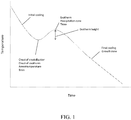
- FIG. 1 depicts a typical cooling profile for the recrystallization process of the present invention. Cooling of a mixture containing aripiprazole lauroxil, first solvent, and second solvent causes the temperature of the mixture to decrease, and the mixture becomes supersaturated. Aripiprazole lauroxil precipitates, causing an increase in temperature of the system. This is followed by further cooling of the system.
- the term "exotherm” refers to the increase in temperature of the system due to precipitation of the drug.
- the "precipitation zone,” in which the exotherm occurs, begins when the temperature starts to increase and covers the entire period during which aripiprazole lauroxil is precipitating or crystallizing.
- the "arrest temperature” or target temperature is the temperature at which no further decrease in temperature of the system is observed and the start (or onset) of crystallization occurs. Homogenization is preferably initiated when the temperature of the supersaturated mixture of aripiprazole lauroxil is a few degrees above the arrest or target temperature. Homogenization promotes crystallization and allows for control of particle size and surface area.
- Tmin indicates the initial temperature increase due to exothermic heating from the major crystallization event. Tmin, which defines both the "onset of crystallization” and the "onset of exotherm,” is directly correlated with particle size and surface area of the recrystallized particles of aripiprazole lauroxil.
- Tmax or the exotherm maximum temperature, denotes the completion of significant exothermic heating from the major crystallization event. Following the major crystallization event, the slurry is further cooled in the “final cooling” stage (growth zone). “Tmin 2 " is the temperature equal to Tmin that occurs upon cooling of the system following the exotherm associated with crystallization.
- homogenizer initiation induces crystallization at a target temperature.
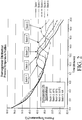
- the results of five crystallization tests at the 1.75 kg scale are reflected in FIG. 2 . All of the crystallization tests had the same cooling rate, but each used a different homogenizer initiation temperatures and resulted in different exotherm onset temperatures and, as a result, different crystal sizes.
- the homogenizer was turned on at the respective temperature specified in the plot, and crystallization was induced soon after the initiation of homogenization.
- the Batch 5 test shows the point when spontaneous crystallization occurred, when no homogenization was used at the given cooling rate.
- the objective of this study was to screen the impact of homogenization initiation temperature ("Homogenizer ON”) on the surface area and particle size of recrystallized aripiprazole lauroxil, as well as the crystallization induction time and exotherm onset temperature.
- the study evaluated homogenizer initiation temperature at three values (35, 36, and 37 °C) while the following parameters were held constant: Homogenizer speed - 75% (120 Hz / 7200 rpm); Vessel agitation speed - 375 rpm; Vessel jacket glycol temperature set-point - 30 °C (this parameter dictates the solution primary cooling rate).
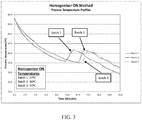
- Table 1 summarizes several tests at the 4 kg scale used to evaluate the effect of homogenizer initiation temperature (Homogenizer ON) on in-process crystal particle size.
- Exotherm onset temperature is meant the temperature at which dissolved aripiprazole lauroxil begins to recrystallize.
- Table 1 Effect of Homogenizer ON Temperature (4 kg Scale) Test Homogenizer ON Temperature (°C) Exotherm Onset Temperature (°C) PSD (Micron) Dv[10] Dv[S0] Dv[90] B1 37 35.8 6 21 37 B2 36 35.4 5 17 31 B3 35 34.7 4 14 29
- FIG. 3 shows the temperature profiles for the tests at the 4 kg scale. The plots showed that crystallization (observed by the exotherm) occurred shortly after homogenizer initiation, as was previously demonstrated at the 1.75 kg scale ( FIG. 2 ).
- the objective of this study was to characterize the impact of homogenizer initiation temperature and homogenizer speed on surface area and particle size as well as the crystallization induction time and exotherm onset temperature.
- the study evaluated the two factors of homogenizer initiation temperature and homogenizer speed, both factors being studied at three levels.
- the study used a full factorial experimental design with a center-point resulting in ten (10) crystallizations.
- the jacket glycol temperature set-point was adjusted as a function of the homogenizer initiation temperature.
- the intent was to maintain a heat transfer temperature gradient (at crystallization) between 5-7 °C. This value is defined as the difference between the jacket glycol temperature set-point and homogenizer initiation temperature.
- Table 2 summarizes tests from the multi-factor screening study used to evaluate the combinatory effect of homogenizer initiation temperature (Homogenizer ON) and homogenizer speed on in-process crystal surface area and particle size.
- the jacket glycol temperature set-point was varied to maintain the gradient in a range of 5-7 °C in order to minimize the under-cooling temperature delta.
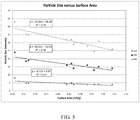
- FIG. 4 and FIG. 5 present plots of surface area versus exotherm onset temperature and particle size versus surface area. The plots demonstrate that the strong relationship observed between these attributes at the 1.75 kg scale continued to be present at the 4 kg scale.
- Table 2 Effect of Crystallization Parameters (Multi-factor Screening) Test Pattern Glycol Jacket Temp. (°C) Homg. Setting (%) Homg. ON Temp. (°C) Exotherm Onset Temp. (°C) Under-cooling Temp. Delta (°C) Heat Transfer Temp.
- the objective of this study was to characterize the impact of homogenizer initiation temperature and homogenizer speed on surface area and particle size as well as the crystallization induction time and exotherm onset temperature.
- This study was equivalent to the study Impact of crystallization variables on particle size and surface area (multi-factor screening) above, but executed in a different process train.
- This study evaluated the two factors of homogenizer initiation temperature and homogenizer speed, each at three levels.
- the study used a full factorial experimental design resulting in nine (9) crystallizations.
- the jacket glycol temperature set-point was adjusted as a function of the homogenizer initiation temperature.
- the intent was to maintain a heat transfer temperature gradient (at crystallization) of 6 °C. This value is defined as the difference between the jacket glycol temperature set-point and homogenizer initiation temperature.
- Table 3 summarizes tests from the multi-factor DOE (design of experiments) study used to evaluate the combinatory effect of homogenizer initiation temperature (Homogenizer ON) and homogenizer speed on in-process crystal surface area and particle size.
- the jacket glycol temperature set-point was varied to maintain the gradient at a specified 6 °C in order to minimize the under-cooling temperature delta.
- the study showed that the impact of Homogenizer ON temperature and the impact of homogenizer speed parameters were both statistically significant.
- Table 3 Effect of Crystallization Parameters (Multi-factor DOE) Test Pattern Glycol Jacket Temp. (°C) Homg. Setting (%) Homg. ON Temp. (°C) Exotherm Onset Temp. (°C) Under-cooling Temp.
- the objective of this study was to characterize the impact of homogenizer initiation temperature, homogenizer speed, and heat transfer temperature gradient (at crystallization) on surface area and particle size as well as the crystallization induction time and exotherm onset temperature.
- This study augmented the foregoing multi-factor DOE study by incorporating the additional parameter of heat transfer temperature gradient.
- the study evaluated the three factors of homogenizer initiation temperature, homogenizer speed, and heat transfer temperature gradient (at crystallization), each at three levels.
- the study used a central composite experimental design with center-point replicates resulting in seventeen (17) crystallizations.
- the jacket glycol temperature set-point was adjusted as a function of the homogenizer initiation temperature in order to set the heat transfer temperature gradient (at crystallization). This value is defined as the difference between the jacket glycol temperature set-point and homogenizer initiation temperature.
- Table 4 summarizes tests from the augmented multi-factor DOE study used to evaluate the combinatory effect of homogenizer initiation temperature (Homogenizer ON), homogenizer speed, and heat transfer temperature gradient on in-process crystal surface area, particle size, and exotherm onset temperature.
- This DOE augmented the immediately previous experimental design by including heat transfer temperature gradient as a factor.
- jacket glycol temperature set-point was varied to maintain the gradient at specified values of 4, 6, and 8 °C.
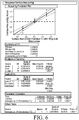
- FIGS. 6 , 7 , 8 , 9 , and 10 show several models built from the results. Table 5 summarizes the findings from these models. All models were statistically significant based on ANOVA (p-values ⁇ 0.05) and demonstrate no Lack of Fit.
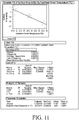
- FIG. 11 shows the relationship between surface area and exotherm onset temperature.
- Linear regression analysis demonstrated statistical significance per ANOVA (p-values ⁇ 0.05).
- the excellent relationship of surface area to exotherm onset temperature was advantageous because it provided an in-process measurement of crystallization progression or performance.
- the run could be discontinued, the material re-heated, and the crystallization repeated.
- Table 4 Effect of Crystallization Parameters (Multi-factor Augmented DOE) Test ID Pattern Homg. Setting (%) Homg. ON Temp. (°C) Glycol Jacket Temp. (°C) Heat Transfer Temp. Gradient (°C) Under-cooling Temp.
- FIG. 6 Surface area Model (Multi-factor Augmented DOE) 0.849 ⁇ 0.0001
- FIG. 7 Exotherm Onset Temperature Model (Multi-factor Augmented DOE) 0.990 ⁇ 0.0001
- FIG. 8 Particle Size (Dv[10]) Model (Multi-factor Augmented DOE) 0.599 0.0003
- FIG. 9 Particle Size (Dv[50]) Model (Multi-factor Augmented DOE) 0.574 0.0004 Yes
- FIG. 10 Particle Size (Dv[90]) Model (Multi-factor Augmented DOE) 0.340 0.0140 No
- the objective of this study was to characterize the impact of solution cooling rate (as a function of jacket glycol temperature), homogenization speed, and crystallization type (spontaneous versus induced) on the crystallization induction time and exotherm onset temperature.
- the study used a designed experiment (central composite design) consisting of 10 runs that incorporated two factors at three levels: Vessel Jacket Temperature (3 °C, 16.5 °C, 30 °C); and Homogenizer Speed (0%, 37.5%, 75%).
- Table 6 summarizes tests from the multi-factor DOE (central composite design) consisting of 10 runs that incorporated the two factors at three levels: Vessel Jacket Temperature (3 °C, 16.5 °C, 30 °C); and Homogenizer Speed (0%, 37.5%, 75%). Each run that used a 0% homogenizer speed (no homogenization) was cooled until it spontaneously crystallized. In the runs that used homogenizer speeds of 37.5% and 75%, the homogenizer was turned on when the process temperature cooled to 53.6 °C. (This temperature represents the solubility limit of the process solution below which the solution enters a meta-stable state.) The solution then continued to cool with homogenization until it crystallized.
- FIG. 12 shows several cooling profiles for runs that used no homogenization.
- FIG. 13 displays plots of the transformed temperature data for the corresponding cooling profiles from FIG. 12 .
- Table 6 Process Operational Zone Results Test ID Homg. Setting (%) Homg. ON Temp. (°C) Glycol Jacket Temp. (°C) Exponential Primary Cooling Parameter (1/min) Exotherm Onset Temp.
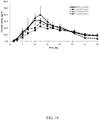
- FIG. 14 shows a plot of exotherm onset temperature (Tmin) versus the calculated Exponential Primary Cooling Parameter (i.e., cooling rate). The following terms describe key features of the plot:
- Aripiprazole lauroxil was recrystallized using the following procedure. 246.4 g of isopropyl acetate was heated in a 1 liter Erlenmeyer flask to 70-75 °C. 383.0 g of heptane was heated in a 1 liter Erlenmeyer flask to 45-50 °C. The hot isopropyl acetate was added to a 2 liter Erlenmeyer flask containing 200 g of aripiprazole lauroxil. The mixture was heated with swirling until all the white solids dissolved and a clear solution was obtained at 65-70 °C. Hot heptane was added to the clear solution in three portions with gentle heating and swirling to avoid crash-out.
- the flask containing the clear solution was placed in a 12 inch sieve pan or equivalent.
- a homogenizer probe was placed into the solution and turned on to # 3 (13.5 l/min set on the machine). Ice was added up to the capacity of the pan. The homogenizer was stopped once the solution crystallized. The flask was kept in ice until the temperature was 15-20 °C. The flask was removed from the ice bath.
- a filtration set-up was assembled using a 2 liter filtering flask, Buchner funnel with a rubber connector, and filter paper.
- the filter paper was wetted with heptane ( ⁇ 5 ml).
- the recrystallized white solid was filtered and washed with heptane ( ⁇ 60 ml).
- the filtered material was spread into a dish.
- the material was dried inside a vacuum oven at room temperature for 18-24 hrs with a nitrogen purge.
- the dried material was transferred into a 250 ⁇ m sieve.
- 5 PTFE sieve rings were added to the sieve, a cover with o-ring was placed on the sieve, and sieving took place using an Analysette 3 PRO at an amplitude set point of 2.7.
- Table 7 lists the particle size distribution summary statistics for each batch as well as the combined (weight averaged) final batch.
- FIG. 15 shows the particle size distributions for each batch as well as the combined (weight averaged) final batch.
- the solution was then poured into a 1 liter jacketed glass vessel with a first recirculator recirculating water and an overhead high shear mixing probe.
- the probe was turned on immediately on setting #3 (13.5 1/min set on the machine).
- the recirculating water was switched to a second recirculator in order to arrest the cooling.
- the recirculating water was switched back to the first recirculator.
- the probe was then stopped 90 seconds after the start of the temperature rise, after which it was replaced with an overhead mixer. The slurry was left to cool down to 18 °C.
- Aripiprazole lauroxil is dissolved in a 65 °C isopropyl acetate/heptane mixture.
- Crystallization vessel 2 liter Erlenmeyer flask in an ice bath. 1 liter jacketed glass vessel with two recirculating jacket fluid temperatures. Mixing Manual swirling and homogenizer. Overhead mixer and homogenizer. Crystallization Homogenizer is switched on and solution is cooled with ice bath until it reaches 15-20 °C. Homogenizer is switched on and solution cooled with recirculator 1. Homogenizer is switched off once the solution crystallizes. As soon as the internal temperature reached 2 °C above the target arrest temperature, the recirculating water is switched to recirculator 2 in order to arrest the cooling.
- the modified 200 gram process was used successfully in four aripiprazole lauroxil recrystallization batch campaigns (each consisting of five recrystallization batches).
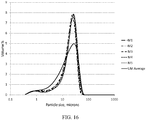
- a particle size distribution similar to that from the (unmodified) 200 gram process was reproducibly obtained as seen in FIG. 16 .
- Summary statistics are listed in Table 9.
- a comparison between the particle size distribution statistics of recrystallized aripiprazole lauroxil from the modified process versus that from the unmodified process revealed a tighter spread in Dv[10], Dv[50], and Dv[90], clearly showing an improvement in process robustness and reproducibility.
- Table 9 Particle size distribution summary statistics of four batch campaigns Batch Dv[10], ⁇ m Dv[50], ⁇ m Dv[90], ⁇ m M1 5 21 36 M2 4 20 34 M3 6 21 35 M4 6 23 39 M5 6 23 39 2 A 6 21 36 2 B 6 23 39 2 C 7 26 42 2 D 7 23 38 2 E 5 21 36 3 A 7 24 40 3 B 6 23 39 3 C 6 22 38 3 D 6 23 39 3 E 6 23 41 4 A 6 22 37 4 B 6 24 39 4 C 4 20 34 4 D 4 21 37 4 E 4 22 37 Range 4 - 7 20 - 26 34 - 42 Mean 6 22 38 Rel. SD 17% 7% 6%
- Aripiprazole lauroxil was recrystallized using the following procedure. 2156.0 g of isopropyl acetate was added to a recrystallization vessel containing 1750.0 g of aripiprazole lauroxil. The mixture was heated under agitation to 55-65 °C. When the drug was visibly dissolved in solution, 3351.0 g of heptane heated to 55-65 °C was added to the recrystallization vessel. The resulting mixture was heated to 60-65 °C, at which point cold glycol was introduced into the jacket of the recrystallization vessel in order to cool the mixture.
- the recrystallized aripiprazole lauroxil was filtered under vacuum in a dead end filter dryer and rinsed with 2187.0 g of heptanes at ambient temperature. The solids were dried under vacuum (80 torr) for 40 hours in the same vessel and collected.
- Aripiprazole lauroxil was recrystallized using the following procedure. 4940.0 g of isopropyl acetate was added to a recrystallization vessel containing 4000.0 g of aripiprazole lauroxil and mixture under agitation. When the drug was visibly dissolved in solution ( ⁇ 55 °C), 7670.0 g of heptane heated to 55-65 °C was added to the recrystallization vessel. The resulting mixture was heated to ⁇ 60 °C and then held for 5 minutes.
- the recrystallized aripiprazole lauroxil was filtered under vacuum in a dead end filter dryer and rinsed with 9 kg of heptanes at ambient temperature. The solids were dried under vacuum (20 torr) for 20 hours in the same vessel and collected.
- Aripiprazole lauroxil (10 g) was dissolved in hot isobutyl acetate (14 mL). N-heptane (28 mL) was added to the hot solution and the mixture was heated further to dissolve all solids. The hot solution was placed in a sonication bath and sonicated for 2 minutes. Ice was added to the sonication bath to cool down the mixture. White crystals were formed. The crystals were filtered using a Buchner funnel and washed with cold n-heptane (10 mL). The white solid was then dried under vacuum at room temperature overnight and resulted in 9.6 g of recrystallized aripiprazole lauroxil (96% yield).
- IM intramuscular rat dosing study
- the dosing amount in the study was 29 mg of recrystallized aripiprazole lauroxil prodrug, which is equivalent to 20 mg aripiprazole base.
- the following two formulations were prepared and dosed intramuscularly to male rats:
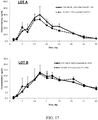
- FIG. 17 shows pharmacokinetic profiles of aripiprazole resulting from intramuscular administration of a single dose of recrystallized aripiprazole lauroxil (20 mg aripiprazole equivalents) suspended in either the NaCMC or SML vehicle, to male rats to assess the effect of injection vehicle on the in vivo profile.
- recrystallized aripiprazole lauroxil drug substance were tested.
- Pharmacokinetic analysis showed that suspensions prepared from the same drug substance lot resulted in essentially overlapping in vivo pK profiles of aripiprazole, independent of injection vehicle.
- the pK parameters summarized in Table 10, indicated that the injection vehicle did not significantly impact C max , T max , or AUC 0-Tlast .
- Table 10 pK parameters from a single IM administration of recrystallized aripiprazole lauroxil in male rats drug substance lot, vehicle C max (ng/mL) a T max (day) b AUC 0-Tlast c (day ⁇ ng/mL) Lot A, suspended in NaCMC vehicle 34.2 ⁇ 6.21 13.8 ⁇ 3.66 735 ⁇ 82.7 Lot A, suspended in SML vehicle 43.1 ⁇ 8.60 16.0 ⁇ 1.55 836 ⁇ 73.0 Lot B, suspended in NaCMC vehicle 22.7 ⁇ 1.17 17.2 ⁇ 5.74 638 ⁇ 53.7 Lot B, suspended in SML vehicle 23.4 ⁇ 6.47 17.2 ⁇ 3.66 643 ⁇ 146 a C max : The maximum precipitated plasma concentration observed.
- b T max Time at which C max occurred.
- c AUC 0-tlast Area under the precipitated plasma concentration-time curve from Time 0 to the last measured precipitated plasma concentration.
- PSD particle size distribution
- surface area measurements for the four lots are presented in Table 11, and the PSD profiles are illustrated in FIG. 18 .
- Table 12 Aripiprazole pK parameters following a single IM administration of recrystallized aripiprazole lauroxil suspended in SML injection vehicle in male rats Drug Lot Group Surface area (m 2 /g) C max a (ng/mL) T max b (day) AUC 0-tlast c (day ⁇ ng/mL) AUC inf d (day ⁇ ng/mL) Lot X3 C 1.32 Mean 43.1 16.0 836 894 SD 8.60 1.55 73.0 91 Lot X1 A 1.10 Mean 35.0 15.5 817 1050 SD 6.76 3.73 66.7 157 Lot X4 D Not measured Mean 28.9 16.0 713 952 SD 6.23 1.55 153.0 282 Lot X2 B 0.73 Mean 23.4 17.2 643 918 SD 6.47 3.66 146.0 184 a C max : The maximum precipitated plasma concentration observed.
- AUC 0-tlast Area under the precipitated plasma concentration-time curve from Time 0 to the last measured precipitated plasma concentration.
- AUC inf Area under the precipitated plasma concentration-time curve from Time 0 to infinity.
- a two-pass recrystallization process was developed to further improve reproducibility and particle size control.
- crystallization of aripiprazole lauroxil occurs after cooling the mixture of the drug, the first solvent (such as isopropyl acetate), and the second solvent (such as n-heptane) to a supersaturated condition.
- Control of the solution temperature to target a specific onset temperature (exotherm "Tminimum” or “Tmin”) for crystallization is important to control the final particle size distribution and surface area of the aripiprazole lauroxil crystals.
- Nucleation and crystallization can be induced by initiating high-shear mixing as the supersaturated mixture approaches a target temperature.
- the recrystallization process of the present invention reproducibly produces crystals of aripiprazole lauroxil with desirable particle size distribution and surface area parameters.
- Crystals of aripiprazole lauroxil were first formed by cooling and precipitating at supersaturated conditions with or without homogenization. The solution was then re-warmed and the crystals were re-dissolved. When the solution was re-cooled, crystals were precipitated in a reliable manner, with the aid of high-shear mixing as the target temperature was approached, much as in the one-pass crystallization process described earlier.
Landscapes
- Health & Medical Sciences (AREA)
- Chemical & Material Sciences (AREA)
- Organic Chemistry (AREA)
- Animal Behavior & Ethology (AREA)
- Pharmacology & Pharmacy (AREA)
- Veterinary Medicine (AREA)
- Public Health (AREA)
- General Health & Medical Sciences (AREA)
- Life Sciences & Earth Sciences (AREA)
- Medicinal Chemistry (AREA)
- Epidemiology (AREA)
- Bioinformatics & Cheminformatics (AREA)
- Engineering & Computer Science (AREA)
- Biomedical Technology (AREA)
- Nuclear Medicine, Radiotherapy & Molecular Imaging (AREA)
- General Chemical & Material Sciences (AREA)
- Chemical Kinetics & Catalysis (AREA)
- Psychiatry (AREA)
- Neurosurgery (AREA)
- Neurology (AREA)
- Pharmaceuticals Containing Other Organic And Inorganic Compounds (AREA)
- Quinoline Compounds (AREA)
Priority Applications (6)
| Application Number | Priority Date | Filing Date | Title |
|---|---|---|---|
| RS20210433A RS61709B1 (sr) | 2014-08-25 | 2015-08-24 | Postupak kristalizacije derivata aripiprazola u formulacijama sa produženim oslobađanjem za lečenje šizofrenije |
| SM20210212T SMT202100212T1 (it) | 2014-08-25 | 2015-08-24 | Processo di cristallizzazione di derivati di aripiprazolo in formulazioni a rilascio prolungato per il trattamento di schizofrenia |
| SI201531576T SI3185867T1 (sl) | 2014-08-25 | 2015-08-24 | Postopek kristalizacije aripiprazolnih derivatov v formulacijah s podaljšanim sproščanjem za zdravljenje shizofrenije |
| PL15836431T PL3185867T3 (pl) | 2014-08-25 | 2015-08-24 | Sposób krystalizacji pochodnych arypiprazolu w formulacjach o przedłużonym uwalnianiu do leczenia schizofrenii |
| HRP20210551TT HRP20210551T1 (hr) | 2014-08-25 | 2015-08-24 | Postupak kristalizacije derivata aripiprazola u formulacijama sa produženim oslobađanjem za liječenje shizofrenije |
| EP21150116.8A EP3865476B1 (en) | 2014-08-25 | 2015-08-24 | Crystallization process of aripiprazole derivatives in extended release formulations for treatment of schizophrenia |
Applications Claiming Priority (2)
| Application Number | Priority Date | Filing Date | Title |
|---|---|---|---|
| US201462041341P | 2014-08-25 | 2014-08-25 | |
| PCT/US2015/046525 WO2016032950A1 (en) | 2014-08-25 | 2015-08-24 | Crystallization process of aripiprazole derivatives in extended release formulations for treatment of schizophrenia |
Related Child Applications (1)
| Application Number | Title | Priority Date | Filing Date |
|---|---|---|---|
| EP21150116.8A Division EP3865476B1 (en) | 2014-08-25 | 2015-08-24 | Crystallization process of aripiprazole derivatives in extended release formulations for treatment of schizophrenia |
Publications (3)
| Publication Number | Publication Date |
|---|---|
| EP3185867A1 EP3185867A1 (en) | 2017-07-05 |
| EP3185867A4 EP3185867A4 (en) | 2018-01-24 |
| EP3185867B1 true EP3185867B1 (en) | 2021-01-13 |
Family
ID=55347322
Family Applications (2)
| Application Number | Title | Priority Date | Filing Date |
|---|---|---|---|
| EP15836431.5A Active EP3185867B1 (en) | 2014-08-25 | 2015-08-24 | Crystallization process of aripiprazole derivatives in extended release formulations for treatment of schizophrenia |
| EP21150116.8A Active EP3865476B1 (en) | 2014-08-25 | 2015-08-24 | Crystallization process of aripiprazole derivatives in extended release formulations for treatment of schizophrenia |
Family Applications After (1)
| Application Number | Title | Priority Date | Filing Date |
|---|---|---|---|
| EP21150116.8A Active EP3865476B1 (en) | 2014-08-25 | 2015-08-24 | Crystallization process of aripiprazole derivatives in extended release formulations for treatment of schizophrenia |
Country Status (20)
| Country | Link |
|---|---|
| US (5) | US10064859B2 (enExample) |
| EP (2) | EP3185867B1 (enExample) |
| JP (2) | JP6591546B2 (enExample) |
| CN (2) | CN111454207B (enExample) |
| AU (2) | AU2015306910B2 (enExample) |
| CA (1) | CA2959329C (enExample) |
| CY (1) | CY1124058T1 (enExample) |
| DK (1) | DK3185867T3 (enExample) |
| ES (2) | ES2994850T3 (enExample) |
| HR (1) | HRP20210551T1 (enExample) |
| HU (1) | HUE054641T2 (enExample) |
| IL (1) | IL250661B (enExample) |
| LT (1) | LT3185867T (enExample) |
| MA (2) | MA55917A (enExample) |
| PL (1) | PL3185867T3 (enExample) |
| PT (1) | PT3185867T (enExample) |
| RS (1) | RS61709B1 (enExample) |
| SI (1) | SI3185867T1 (enExample) |
| SM (1) | SMT202100212T1 (enExample) |
| WO (1) | WO2016032950A1 (enExample) |
Families Citing this family (12)
| Publication number | Priority date | Publication date | Assignee | Title |
|---|---|---|---|---|
| ES2972387T3 (es) | 2011-03-18 | 2024-06-12 | Alkermes Pharma Ireland Ltd | Composiciones farmacéuticas que comprenden ésteres de sorbitán |
| JP6654042B2 (ja) | 2012-09-19 | 2020-02-26 | アルカームス ファーマ アイルランド リミテッド | 貯蔵安定性が改善された医薬組成物 |
| AU2015231278B2 (en) | 2014-03-20 | 2020-01-23 | Alkermes Pharma Ireland Limited | Aripiprazole formulations having increased injection speeds |
| US10016415B2 (en) | 2014-08-18 | 2018-07-10 | Alkermes Pharma Ireland Limited | Aripiprazole prodrug compositions |
| SMT202100481T1 (it) | 2014-08-18 | 2021-09-14 | Alkermes Pharma Ireland Ltd | Composizioni per profarmaci di aripiprazolo |
| SMT202100212T1 (it) * | 2014-08-25 | 2021-07-12 | Alkermes Pharma Ireland Ltd | Processo di cristallizzazione di derivati di aripiprazolo in formulazioni a rilascio prolungato per il trattamento di schizofrenia |
| WO2016181406A1 (en) * | 2015-05-08 | 2016-11-17 | Davuluri Ramamohan Rao | Improved process for the preparation of aripiprazole with reduced particle size |
| WO2018104953A1 (en) * | 2016-12-07 | 2018-06-14 | Msn Laboratories Private Limited, R&D Center | Improved process for the preparation of 7-{4-[4-(2,3-dichlorophenyl)-piperazin-1-yl]butoxy}-2oxo-3,4-dihydro-2h-quinolin-1-yl)methyl dodecanoate |
| ES2903278T3 (es) | 2017-07-28 | 2022-03-31 | Interquim Sa | Procedimiento para la preparación de aripiprazol lauroxil |
| CN110218209B (zh) * | 2018-03-02 | 2022-09-30 | 上海现代药物制剂工程研究中心有限公司 | 一种依匹哌唑月桂酸酯的晶型a、其制备方法及应用 |
| AU2019230014B2 (en) | 2018-03-05 | 2024-11-28 | Alkermes Pharma Ireland Limited | Aripiprazole dosing strategy |
| CN113105389B (zh) * | 2021-04-16 | 2022-04-08 | 江苏海洋大学 | 一种阿立哌唑药物共晶及其制备方法 |
Family Cites Families (14)
| Publication number | Priority date | Publication date | Assignee | Title |
|---|---|---|---|---|
| US5510118A (en) * | 1995-02-14 | 1996-04-23 | Nanosystems Llc | Process for preparing therapeutic compositions containing nanoparticles |
| AR033485A1 (es) * | 2001-09-25 | 2003-12-26 | Otsuka Pharma Co Ltd | Sustancia medicinal de aripiprazol de baja higroscopicidad y proceso para la preparacion de la misma |
| US20050032811A1 (en) | 2003-08-06 | 2005-02-10 | Josiah Brown | Methods for administering aripiprazole |
| TWI371274B (en) * | 2003-10-23 | 2012-09-01 | Bristol Myers Squibb Co | Process for making sterile aripiprazole of desired mean particle size |
| BRPI0415531B8 (pt) * | 2003-10-23 | 2021-05-25 | Otsuka Pharma Co Ltd | formulação de aripiprazol injetável estéril de liberação controlada e método para a sua preparação |
| CA2655335C (en) | 2007-12-19 | 2016-09-06 | Janssen Pharmaceutica N.V. | Prolonged-release injectable suspensions of paliperidone palmitate, and dosage forms and delivery systems incorporating same |
| US20110003823A1 (en) | 2008-08-01 | 2011-01-06 | Alpha Synergy Development, Inc. | Compositions and methods for treatment of diseases and conditions associated with vasodilation and/or vascular leakage |
| PT2445502T (pt) | 2009-06-25 | 2017-09-22 | Alkermes Pharma Ireland Ltd | Compostos heterocíclicos para o tratamento de distúrbios neurológicos e psicológicos |
| WO2012077134A1 (en) * | 2010-12-07 | 2012-06-14 | Ind-Swift Laboratories Limted | Process for preparing aripiprazole polymorphs |
| AU2012204174B2 (en) * | 2011-01-07 | 2016-07-21 | Neodyne Biosciences, Inc. | Wound or skin treatment devices and methods |
| ES2972387T3 (es) | 2011-03-18 | 2024-06-12 | Alkermes Pharma Ireland Ltd | Composiciones farmacéuticas que comprenden ésteres de sorbitán |
| CA2867121C (en) * | 2012-03-19 | 2021-05-25 | Alkermes Pharma Ireland Limited | Pharmaceutical compositions comprising fatty acid esters |
| JP6654042B2 (ja) * | 2012-09-19 | 2020-02-26 | アルカームス ファーマ アイルランド リミテッド | 貯蔵安定性が改善された医薬組成物 |
| SMT202100212T1 (it) * | 2014-08-25 | 2021-07-12 | Alkermes Pharma Ireland Ltd | Processo di cristallizzazione di derivati di aripiprazolo in formulazioni a rilascio prolungato per il trattamento di schizofrenia |
-
2015
- 2015-08-24 SM SM20210212T patent/SMT202100212T1/it unknown
- 2015-08-24 WO PCT/US2015/046525 patent/WO2016032950A1/en not_active Ceased
- 2015-08-24 RS RS20210433A patent/RS61709B1/sr unknown
- 2015-08-24 LT LTEP15836431.5T patent/LT3185867T/lt unknown
- 2015-08-24 PL PL15836431T patent/PL3185867T3/pl unknown
- 2015-08-24 HR HRP20210551TT patent/HRP20210551T1/hr unknown
- 2015-08-24 ES ES21150116T patent/ES2994850T3/es active Active
- 2015-08-24 EP EP15836431.5A patent/EP3185867B1/en active Active
- 2015-08-24 SI SI201531576T patent/SI3185867T1/sl unknown
- 2015-08-24 MA MA055917A patent/MA55917A/fr unknown
- 2015-08-24 CN CN202010375290.3A patent/CN111454207B/zh active Active
- 2015-08-24 AU AU2015306910A patent/AU2015306910B2/en active Active
- 2015-08-24 US US14/833,638 patent/US10064859B2/en active Active
- 2015-08-24 JP JP2017530956A patent/JP6591546B2/ja active Active
- 2015-08-24 ES ES15836431T patent/ES2862098T3/es active Active
- 2015-08-24 CN CN201580057857.XA patent/CN107106556B/zh active Active
- 2015-08-24 MA MA40480A patent/MA40480B1/fr unknown
- 2015-08-24 PT PT158364315T patent/PT3185867T/pt unknown
- 2015-08-24 DK DK15836431.5T patent/DK3185867T3/da active
- 2015-08-24 HU HUE15836431A patent/HUE054641T2/hu unknown
- 2015-08-24 CA CA2959329A patent/CA2959329C/en active Active
- 2015-08-24 EP EP21150116.8A patent/EP3865476B1/en active Active
-
2017
- 2017-02-19 IL IL250661A patent/IL250661B/en active IP Right Grant
-
2018
- 2018-07-24 US US16/043,721 patent/US10478434B2/en active Active
-
2019
- 2019-09-18 JP JP2019169473A patent/JP2019210296A/ja active Pending
- 2019-10-08 US US16/595,608 patent/US10973816B2/en active Active
-
2020
- 2020-11-04 AU AU2020264303A patent/AU2020264303B2/en active Active
-
2021
- 2021-03-24 US US17/211,352 patent/US11883394B2/en active Active
- 2021-04-13 CY CY20211100318T patent/CY1124058T1/el unknown
-
2023
- 2023-12-18 US US18/543,767 patent/US20240245676A1/en active Pending
Non-Patent Citations (1)
| Title |
|---|
| None * |
Also Published As
Similar Documents
| Publication | Publication Date | Title |
|---|---|---|
| US20240245676A1 (en) | Crystallization process of aripiprazole derivatives in extended release formulations for treatment of schizophrenia | |
| JP4376518B2 (ja) | サブミクロン粒子の懸濁物を調製する方法 | |
| EP1682116B1 (en) | Method for preparing submicron particles of paclitaxel or docetaxel | |
| CN1761454A (zh) | 小颗粒的制备方法 | |
| ZA200304742B (en) | Method for preparing submicron particle suspensions. | |
| US20050170002A1 (en) | Method for preparing submicron particle suspensions | |
| KR20060106826A (ko) | 용매가 본질적으로 없는 소립자의 제조 방법 | |
| HK40057525A (en) | Crystallization process of aripiprazole derivatives in extended release formulations for treatment of schizophrenia | |
| HK40057525B (en) | Crystallization process of aripiprazole derivatives in extended release formulations for treatment of schizophrenia | |
| US7417044B2 (en) | Tadalafil having a large particle size and a process for preparation thereof | |
| HK1246636B (en) | Crystallization process of aripiprazole derivatives in extended release formulations for treatment of schizophrenia | |
| HK1246636A1 (en) | Crystallization process of aripiprazole derivatives in extended release formulations for treatment of schizophrenia | |
| NZ729479B2 (en) | Crystallization process of aripiprazole derivatives in extended release formulations for treatment of schizophrenia | |
| TWI917510B (zh) | 非晶形的固體分散物以及其製備方法及用途 | |
| JP6851379B2 (ja) | カナグリフロジン半水和物結晶を得るための結晶化手順 | |
| KR101677539B1 (ko) | 파라세타몰 결정의 제조방법 | |
| HK1096309A (en) | Method for preparing submicron particles of paclitaxel |
Legal Events
| Date | Code | Title | Description |
|---|---|---|---|
| STAA | Information on the status of an ep patent application or granted ep patent |
Free format text: STATUS: THE INTERNATIONAL PUBLICATION HAS BEEN MADE |
|
| PUAI | Public reference made under article 153(3) epc to a published international application that has entered the european phase |
Free format text: ORIGINAL CODE: 0009012 |
|
| STAA | Information on the status of an ep patent application or granted ep patent |
Free format text: STATUS: REQUEST FOR EXAMINATION WAS MADE |
|
| 17P | Request for examination filed |
Effective date: 20170321 |
|
| AK | Designated contracting states |
Kind code of ref document: A1 Designated state(s): AL AT BE BG CH CY CZ DE DK EE ES FI FR GB GR HR HU IE IS IT LI LT LU LV MC MK MT NL NO PL PT RO RS SE SI SK SM TR |
|
| AX | Request for extension of the european patent |
Extension state: BA ME |
|
| RIN1 | Information on inventor provided before grant (corrected) |
Inventor name: ZEIDAN, TAREK A. Inventor name: CHIARELLA, RENATO A. Inventor name: PERRY, JASON M. Inventor name: MORALES, WILFREDO JR. Inventor name: WRIGHT, STEVEN G. |
|
| REG | Reference to a national code |
Ref country code: DE Ref legal event code: R079 Ref document number: 602015064815 Country of ref document: DE Free format text: PREVIOUS MAIN CLASS: A61K0031496000 Ipc: C07D0401120000 |
|
| A4 | Supplementary search report drawn up and despatched |
Effective date: 20180102 |
|
| RIC1 | Information provided on ipc code assigned before grant |
Ipc: A61K 31/496 20060101ALI20171219BHEP Ipc: C07D 401/12 20060101AFI20171219BHEP |
|
| TPAC | Observations filed by third parties |
Free format text: ORIGINAL CODE: EPIDOSNTIPA |
|
| REG | Reference to a national code |
Ref country code: HK Ref legal event code: DE Ref document number: 1246636 Country of ref document: HK |
|
| STAA | Information on the status of an ep patent application or granted ep patent |
Free format text: STATUS: EXAMINATION IS IN PROGRESS |
|
| 17Q | First examination report despatched |
Effective date: 20190524 |
|
| GRAP | Despatch of communication of intention to grant a patent |
Free format text: ORIGINAL CODE: EPIDOSNIGR1 |
|
| STAA | Information on the status of an ep patent application or granted ep patent |
Free format text: STATUS: GRANT OF PATENT IS INTENDED |
|
| INTG | Intention to grant announced |
Effective date: 20200804 |
|
| GRAS | Grant fee paid |
Free format text: ORIGINAL CODE: EPIDOSNIGR3 |
|
| GRAA | (expected) grant |
Free format text: ORIGINAL CODE: 0009210 |
|
| STAA | Information on the status of an ep patent application or granted ep patent |
Free format text: STATUS: THE PATENT HAS BEEN GRANTED |
|
| AK | Designated contracting states |
Kind code of ref document: B1 Designated state(s): AL AT BE BG CH CY CZ DE DK EE ES FI FR GB GR HR HU IE IS IT LI LT LU LV MC MK MT NL NO PL PT RO RS SE SI SK SM TR |
|
| AX | Request for extension of the european patent |
Extension state: BA ME |
|
| REG | Reference to a national code |
Ref country code: GB Ref legal event code: FG4D |
|
| REG | Reference to a national code |
Ref country code: CH Ref legal event code: EP |
|
| REG | Reference to a national code |
Ref country code: IE Ref legal event code: FG4D |
|
| REG | Reference to a national code |
Ref country code: DE Ref legal event code: R096 Ref document number: 602015064815 Country of ref document: DE |
|
| REG | Reference to a national code |
Ref country code: AT Ref legal event code: REF Ref document number: 1354467 Country of ref document: AT Kind code of ref document: T Effective date: 20210215 |
|
| REG | Reference to a national code |
Ref country code: DK Ref legal event code: T3 Effective date: 20210310 |
|
| REG | Reference to a national code |
Ref country code: RO Ref legal event code: EPE |
|
| REG | Reference to a national code |
Ref country code: SE Ref legal event code: TRGR |
|
| REG | Reference to a national code |
Ref country code: NL Ref legal event code: FP |
|
| REG | Reference to a national code |
Ref country code: HR Ref legal event code: TUEP Ref document number: P20210551T Country of ref document: HR |
|
| REG | Reference to a national code |
Ref country code: PT Ref legal event code: SC4A Ref document number: 3185867 Country of ref document: PT Date of ref document: 20210412 Kind code of ref document: T Free format text: AVAILABILITY OF NATIONAL TRANSLATION Effective date: 20210406 |
|
| REG | Reference to a national code |
Ref country code: FI Ref legal event code: FGE |
|
| REG | Reference to a national code |
Ref country code: SK Ref legal event code: T3 Ref document number: E 36892 Country of ref document: SK |
|
| RAP2 | Party data changed (patent owner data changed or rights of a patent transferred) |
Owner name: ALKERMES PHARMA IRELAND LIMITED |
|
| REG | Reference to a national code |
Ref country code: GR Ref legal event code: EP Ref document number: 20210400969 Country of ref document: GR Effective date: 20210519 |
|
| REG | Reference to a national code |
Ref country code: EE Ref legal event code: FG4A Ref document number: E020712 Country of ref document: EE Effective date: 20210407 |
|
| REG | Reference to a national code |
Ref country code: NO Ref legal event code: T2 Effective date: 20210113 |
|
| REG | Reference to a national code |
Ref country code: BE Ref legal event code: PD Owner name: ALKERMES PHARMA IRELAND LIMITED; IE Free format text: DETAILS ASSIGNMENT: CHANGE OF OWNER(S), ASSIGNMENT; FORMER OWNER NAME: MORALES WILFREDO JR. Effective date: 20210521 |
|
| REG | Reference to a national code |
Ref country code: NL Ref legal event code: PD Owner name: ALKERMES PHARMA IRELAND LIMITED; IE Free format text: DETAILS ASSIGNMENT: CHANGE OF OWNER(S), ASSIGNMENT; FORMER OWNER NAME: MORALES WILFREDO JR. Effective date: 20210618 |
|
| REG | Reference to a national code |
Ref country code: AT Ref legal event code: PC Ref document number: 1354467 Country of ref document: AT Kind code of ref document: T Owner name: ALKERMES PHARMA IRELAND LIMITED, IE Effective date: 20210519 |
|
| REG | Reference to a national code |
Ref country code: HR Ref legal event code: T1PR Ref document number: P20210551 Country of ref document: HR |
|
| REG | Reference to a national code |
Ref country code: MA Ref legal event code: VAGR Ref document number: 40480 Country of ref document: MA Kind code of ref document: B1 |
|
| REG | Reference to a national code |
Ref country code: HU Ref legal event code: AG4A Ref document number: E054641 Country of ref document: HU |
|
| REG | Reference to a national code |
Ref country code: ES Ref legal event code: FG2A Ref document number: 2862098 Country of ref document: ES Kind code of ref document: T3 Effective date: 20211007 |
|
| REG | Reference to a national code |
Ref country code: DE Ref legal event code: R097 Ref document number: 602015064815 Country of ref document: DE |
|
| REG | Reference to a national code |
Ref country code: HR Ref legal event code: ODRP Ref document number: P20210551 Country of ref document: HR Payment date: 20211005 Year of fee payment: 7 |
|
| PLBE | No opposition filed within time limit |
Free format text: ORIGINAL CODE: 0009261 |
|
| STAA | Information on the status of an ep patent application or granted ep patent |
Free format text: STATUS: NO OPPOSITION FILED WITHIN TIME LIMIT |
|
| 26N | No opposition filed |
Effective date: 20211014 |
|
| REG | Reference to a national code |
Ref country code: HR Ref legal event code: ODRP Ref document number: P20210551 Country of ref document: HR Payment date: 20220802 Year of fee payment: 8 |
|
| REG | Reference to a national code |
Ref country code: AT Ref legal event code: UEP Ref document number: 1354467 Country of ref document: AT Kind code of ref document: T Effective date: 20210113 |
|
| P01 | Opt-out of the competence of the unified patent court (upc) registered |
Effective date: 20230518 |
|
| REG | Reference to a national code |
Ref country code: HR Ref legal event code: ODRP Ref document number: P20210551 Country of ref document: HR Payment date: 20230802 Year of fee payment: 9 |
|
| REG | Reference to a national code |
Ref country code: HR Ref legal event code: ODRP Ref document number: P20210551 Country of ref document: HR Payment date: 20240801 Year of fee payment: 10 |
|
| PGFP | Annual fee paid to national office [announced via postgrant information from national office to epo] |
Ref country code: LU Payment date: 20250827 Year of fee payment: 11 Ref country code: NL Payment date: 20250826 Year of fee payment: 11 |
|
| PGFP | Annual fee paid to national office [announced via postgrant information from national office to epo] |
Ref country code: HU Payment date: 20250807 Year of fee payment: 11 |
|
| REG | Reference to a national code |
Ref country code: HR Ref legal event code: ODRP Ref document number: P20210551 Country of ref document: HR Payment date: 20250820 Year of fee payment: 11 |
|
| PGFP | Annual fee paid to national office [announced via postgrant information from national office to epo] |
Ref country code: SM Payment date: 20250825 Year of fee payment: 11 |
|
| PGFP | Annual fee paid to national office [announced via postgrant information from national office to epo] |
Ref country code: ES Payment date: 20250901 Year of fee payment: 11 Ref country code: PT Payment date: 20250805 Year of fee payment: 11 Ref country code: FI Payment date: 20250825 Year of fee payment: 11 |
|
| PGFP | Annual fee paid to national office [announced via postgrant information from national office to epo] |
Ref country code: LT Payment date: 20250731 Year of fee payment: 11 Ref country code: DK Payment date: 20250825 Year of fee payment: 11 Ref country code: DE Payment date: 20250827 Year of fee payment: 11 |
|
| PGFP | Annual fee paid to national office [announced via postgrant information from national office to epo] |
Ref country code: NO Payment date: 20250827 Year of fee payment: 11 Ref country code: MC Payment date: 20250804 Year of fee payment: 11 Ref country code: GR Payment date: 20250826 Year of fee payment: 11 |
|
| PGFP | Annual fee paid to national office [announced via postgrant information from national office to epo] |
Ref country code: PL Payment date: 20250801 Year of fee payment: 11 Ref country code: IT Payment date: 20250820 Year of fee payment: 11 Ref country code: TR Payment date: 20250814 Year of fee payment: 11 |
|
| PGFP | Annual fee paid to national office [announced via postgrant information from national office to epo] |
Ref country code: BG Payment date: 20250820 Year of fee payment: 11 Ref country code: BE Payment date: 20250827 Year of fee payment: 11 Ref country code: GB Payment date: 20250827 Year of fee payment: 11 |
|
| PGFP | Annual fee paid to national office [announced via postgrant information from national office to epo] |
Ref country code: HR Payment date: 20250820 Year of fee payment: 11 |
|
| PGFP | Annual fee paid to national office [announced via postgrant information from national office to epo] |
Ref country code: AL Payment date: 20250811 Year of fee payment: 11 Ref country code: FR Payment date: 20250825 Year of fee payment: 11 Ref country code: AT Payment date: 20250827 Year of fee payment: 11 |
|
| PGFP | Annual fee paid to national office [announced via postgrant information from national office to epo] |
Ref country code: MT Payment date: 20250805 Year of fee payment: 11 Ref country code: CH Payment date: 20250901 Year of fee payment: 11 Ref country code: SE Payment date: 20250827 Year of fee payment: 11 |
|
| PGFP | Annual fee paid to national office [announced via postgrant information from national office to epo] |
Ref country code: CZ Payment date: 20250807 Year of fee payment: 11 Ref country code: EE Payment date: 20250808 Year of fee payment: 11 Ref country code: IE Payment date: 20250827 Year of fee payment: 11 Ref country code: RS Payment date: 20250801 Year of fee payment: 11 |
|
| PGFP | Annual fee paid to national office [announced via postgrant information from national office to epo] |
Ref country code: RO Payment date: 20250806 Year of fee payment: 11 |
|
| VSFP | Annual fee paid to validation state [announced via postgrant information from national office to epo] |
Ref country code: MA Payment date: 20230803 Year of fee payment: 9 |
|
| PGFP | Annual fee paid to national office [announced via postgrant information from national office to epo] |
Ref country code: SK Payment date: 20250731 Year of fee payment: 11 |
|
| PGFP | Annual fee paid to national office [announced via postgrant information from national office to epo] |
Ref country code: IS Payment date: 20250813 Year of fee payment: 11 |
|
| PGFP | Annual fee paid to national office [announced via postgrant information from national office to epo] |
Ref country code: LV Payment date: 20250731 Year of fee payment: 11 |
|
| VSFP | Annual fee paid to validation state [announced via postgrant information from national office to epo] |
Ref country code: MA Payment date: 20220808 Year of fee payment: 8 Ref country code: MA Payment date: 20211001 Year of fee payment: 7 |
|
| PGFP | Annual fee paid to national office [announced via postgrant information from national office to epo] |
Ref country code: SI Payment date: 20250730 Year of fee payment: 11 |
|
| PGFP | Annual fee paid to national office [announced via postgrant information from national office to epo] |
Ref country code: MK Payment date: 20250731 Year of fee payment: 11 |
|
| VSFP | Annual fee paid to validation state [announced via postgrant information from national office to epo] |
Ref country code: MA Payment date: 20240815 Year of fee payment: 10 Ref country code: MA Payment date: 20250908 Year of fee payment: 11 |
|
| PGFP | Annual fee paid to national office [announced via postgrant information from national office to epo] |
Ref country code: CY Payment date: 20250804 Year of fee payment: 11 |