EP3182617B1 - Récepteur de données optiques muni d'un détecteur de phase relative - Google Patents
Récepteur de données optiques muni d'un détecteur de phase relative Download PDFInfo
- Publication number
- EP3182617B1 EP3182617B1 EP16202539.9A EP16202539A EP3182617B1 EP 3182617 B1 EP3182617 B1 EP 3182617B1 EP 16202539 A EP16202539 A EP 16202539A EP 3182617 B1 EP3182617 B1 EP 3182617B1
- Authority
- EP
- European Patent Office
- Prior art keywords
- coupled
- signal
- optical receiver
- input
- timing signal
- Prior art date
- Legal status (The legal status is an assumption and is not a legal conclusion. Google has not performed a legal analysis and makes no representation as to the accuracy of the status listed.)
- Active
Links
- 230000003287 optical effect Effects 0.000 title claims description 75
- 230000000630 rising effect Effects 0.000 claims description 37
- 230000008859 change Effects 0.000 claims description 13
- 230000007704 transition Effects 0.000 claims description 9
- 230000001902 propagating effect Effects 0.000 claims description 8
- 230000010363 phase shift Effects 0.000 claims description 3
- 230000004913 activation Effects 0.000 claims description 2
- 239000003990 capacitor Substances 0.000 description 4
- 230000003247 decreasing effect Effects 0.000 description 4
- 230000008901 benefit Effects 0.000 description 3
- 238000001514 detection method Methods 0.000 description 2
- 238000010586 diagram Methods 0.000 description 2
- 238000005516 engineering process Methods 0.000 description 2
- 230000000644 propagated effect Effects 0.000 description 2
- 230000004044 response Effects 0.000 description 2
- 230000035945 sensitivity Effects 0.000 description 2
- RYGMFSIKBFXOCR-UHFFFAOYSA-N Copper Chemical compound [Cu] RYGMFSIKBFXOCR-UHFFFAOYSA-N 0.000 description 1
- 230000004075 alteration Effects 0.000 description 1
- 230000005540 biological transmission Effects 0.000 description 1
- 229910052802 copper Inorganic materials 0.000 description 1
- 239000010949 copper Substances 0.000 description 1
- 238000007599 discharging Methods 0.000 description 1
- 230000000694 effects Effects 0.000 description 1
- 230000006872 improvement Effects 0.000 description 1
- 238000002347 injection Methods 0.000 description 1
- 239000007924 injection Substances 0.000 description 1
- 238000004519 manufacturing process Methods 0.000 description 1
- 230000004048 modification Effects 0.000 description 1
- 238000012986 modification Methods 0.000 description 1
- 239000000243 solution Substances 0.000 description 1
- 230000001360 synchronised effect Effects 0.000 description 1
- 230000002123 temporal effect Effects 0.000 description 1
- 230000001131 transforming effect Effects 0.000 description 1
- 230000001960 triggered effect Effects 0.000 description 1
Images


Classifications
-
- H—ELECTRICITY
- H04—ELECTRIC COMMUNICATION TECHNIQUE
- H04B—TRANSMISSION
- H04B10/00—Transmission systems employing electromagnetic waves other than radio-waves, e.g. infrared, visible or ultraviolet light, or employing corpuscular radiation, e.g. quantum communication
- H04B10/60—Receivers
- H04B10/66—Non-coherent receivers, e.g. using direct detection
- H04B10/69—Electrical arrangements in the receiver
- H04B10/691—Arrangements for optimizing the photodetector in the receiver
- H04B10/6911—Photodiode bias control, e.g. for compensating temperature variations
-
- H—ELECTRICITY
- H04—ELECTRIC COMMUNICATION TECHNIQUE
- H04B—TRANSMISSION
- H04B10/00—Transmission systems employing electromagnetic waves other than radio-waves, e.g. infrared, visible or ultraviolet light, or employing corpuscular radiation, e.g. quantum communication
- H04B10/60—Receivers
- H04B10/66—Non-coherent receivers, e.g. using direct detection
- H04B10/69—Electrical arrangements in the receiver
-
- H—ELECTRICITY
- H03—ELECTRONIC CIRCUITRY
- H03L—AUTOMATIC CONTROL, STARTING, SYNCHRONISATION OR STABILISATION OF GENERATORS OF ELECTRONIC OSCILLATIONS OR PULSES
- H03L7/00—Automatic control of frequency or phase; Synchronisation
-
- H—ELECTRICITY
- H04—ELECTRIC COMMUNICATION TECHNIQUE
- H04B—TRANSMISSION
- H04B10/00—Transmission systems employing electromagnetic waves other than radio-waves, e.g. infrared, visible or ultraviolet light, or employing corpuscular radiation, e.g. quantum communication
- H04B10/07—Arrangements for monitoring or testing transmission systems; Arrangements for fault measurement of transmission systems
-
- H—ELECTRICITY
- H04—ELECTRIC COMMUNICATION TECHNIQUE
- H04B—TRANSMISSION
- H04B10/00—Transmission systems employing electromagnetic waves other than radio-waves, e.g. infrared, visible or ultraviolet light, or employing corpuscular radiation, e.g. quantum communication
- H04B10/60—Receivers
- H04B10/66—Non-coherent receivers, e.g. using direct detection
-
- H—ELECTRICITY
- H04—ELECTRIC COMMUNICATION TECHNIQUE
- H04L—TRANSMISSION OF DIGITAL INFORMATION, e.g. TELEGRAPHIC COMMUNICATION
- H04L7/00—Arrangements for synchronising receiver with transmitter
- H04L7/0079—Receiver details
Definitions
- the present description relates to the field of optical data receivers, and in particular an optical data receiver capable of receiving a low amplitude optical signal.
- Optical links provide high data transmission rates with low power, and thus provide a viable solution for replacing ordinary copper interconnects between integrated circuits.
- Optical reception is based on the capture, using a photosensitive device such as a photodiode, of a light signal which is generally digitally coded, and which can have a power level as low as 10 ⁇ W.
- the photosensitive device for example generates a small current which is converted by the optical receiver into a digital voltage signal.
- US2014 / 0064744 describes a receiver using a synchronization signal.
- a difficulty in receiving optical data is to be able to accurately detect the low optical signal power. Indeed, the current generated by the data pulse of the optical signal can be as low as 10 ⁇ A.
- An object of embodiments of the present disclosure is to at least partially solve one or more problems of the prior art.
- an optical receiver adapted to convert a received optical signal into a phase change of a timing signal to generate a first modified timing signal and to generate a data signal by comparing the first modified timing signal. to a reference signal.
- the received optical signal is a modulated signal based on the data to be transmitted to the optical receiver.
- the optical receiver comprises: an input adapted to receive the synchronization signal comprising rising and falling edges; a first branch coupled to the input and comprising at least one logic gate adapted to propagate the synchronization signal and to generate the first modified synchronization signal; a second branch coupled to the input and comprising at least one logic gate adapted to propagate the synchronization signal and to generate a second modified synchronization signal forming the reference signal; a photodiode adapted to convert the received optical signal into a current signal, the photodiode being coupled to at least one of the first and second branches to induce, on the basis of the current signal, a phase difference between the rising and falling edges; descendants of the first and second modified synchronization signals; and a relative phase detector adapted to generate the data signal by detecting the relative phases of rising or falling edges of the first and second modified synchronization signals.
- the photodiode is coupled so that the current signal causes a change in the slope of a first rising or falling edge of the synchronization signal propagating in at least one of the first and second branches, at least one of the first and second branches comprising a comparator adapted to convert the change of slope into a phase shift of the first rising or falling edge.
- the rising or falling edge is a voltage transition between first and second voltage levels
- the comparator is a transistor device adapted to generate a voltage transition on its output when the voltage on its input crosses a voltage. threshold level, and the comparator is adapted such that the threshold level is at least 10% higher or lower than a midpoint between the first and second voltage levels.
- the first branch comprises a first logic gate connected to the input and the photodiode is coupled to an output of the first logic gate.
- the second branch comprises a second logic gate connected to the input, and the photodiode is coupled between the output of the first logic gate and an output of the second logic gate.
- the first branch comprises a second logic gate having an input node coupled to the input and having a first power supply voltage input node coupled to a first power supply voltage rail. intermediate of a first current source, and the photodiode is coupled to the first supply voltage input node.
- the second branch comprises a second logic gate having an input node coupled to the input and having a first voltage input node.
- power supply coupled to the first supply voltage rail via a second current source, the photodiode being coupled between the first supply voltage input nodes of the second logic gates of the first and second branches.
- the photodiode is coupled between the first and second branches.
- the relative phase detector is adapted to detect the relative phases of rising edges of the first and second modified synchronization signals
- the optical receiver further comprising: a third branch coupled to the input and comprising at least one logic gate adapted to propagate the synchronization signal and generate a modified third synchronization signal; a fourth branch coupled to the input and comprising at least one logic gate adapted to propagate the synchronization signal and to generate a modified fourth synchronization signal; and another relative phase detector adapted to generate another data signal by detecting the relative phases of falling edges of the modified third and fourth synchronization signals.
- the photodiode is coupled such that the current signal causes a change in the slope of a first rising edge of the synchronization signal propagating in at least one of the first and second branches, and a first falling edge of the synchronization signal propagating in at least one of the third and fourth branches
- the first and second branches each comprising a first comparator adapted to generate a voltage transition on its output when the voltage on its input crosses a threshold level, the first comparators being adapted so that the threshold level is at least 10% greater than a midpoint between the first and second voltage levels
- the third and fourth branches each comprise a second comparator adapted to generate a voltage transition on its output when the voltage on its input crosses a threshold level, the second comparators being adapted so that the threshold level is at least 10% lower than a midpoint between the first and second voltage levels.
- the first and second comparators are formed by inverters.
- the relative phase detector comprises an advance-delay detector comprising: a bistable storage device consisting of a pair of inverters cross-coupled between first and second output nodes of the forward-delay detector; at least one first switch coupled between the first and second output nodes and controlled based on the first and second modified synchronization signals; a second controlled switch based on the first modified synchronization signal and coupled between the first node and a first supply voltage rail; and a third controlled switch based on the second modified synchronization signal and coupled between the second node and the first supply voltage rail.
- the at least one first switch comprises a pair of first switches coupled in series between the first and second output nodes, a first switch of the pair being controlled on the basis of the first modified synchronization signal, and a second switch of the pair being controlled on the basis of the second modified synchronization signal.
- said at least one first switch further comprises another switch coupled between the switches of the pair of first switches and controlled by an activation signal to selectively activate the relative phase detector.
- the term “connected” is used to denote a direct electrical connection between elements
- the term “coupled” is used to designate an electrical connection between elements that may be direct, or that may be by via one or more other components such as resistors, capacitors or transistors.
- the term “substantially” is used to denote a range of ⁇ 10% around the value in question.
- the figure 1 schematically illustrates an optical link 100.
- a modulator 102 modulates a laser generated laser beam 104 based on a signal provided by a driver 106.
- the modulator 102 is also controlled by a signal from a temperature control circuit 108.
- the control device 106 receives a DATA data signal to be transmitted.
- the modulator 102 produces an optical signal, which is transmitted through a waveguide 110 to the receiving side of the optical link.
- the optical signal is received by an optical receiver 111 consisting of a photodiode 112 and a data detection circuit 114.
- the photodiode 112 converts the optical signal into an electric current.
- the data detection circuit 114 detects the data signal based on the current generated by the photodiode 112.
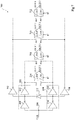
- the figure 2 illustrates the optical receiver 111 in more detail according to an exemplary embodiment.
- the optical receiver 111 comprises for example a branch 202 and a branch 204, each branch being coupled to an input line 206 for receiving a clock signal CLK.
- Each of the branches 202, 204 comprises for example a plurality of logic gates coupled in series.
- Logic gates are inverters, although in alternative embodiments, other types of logic gates can be used.
- the branch 202 comprises, for example, a series connection of inverters 208, 210 and 212 coupled between the input line 206 and an input of a relative phase detector 214.
- the branch 204 comprises, for example, a series connection of inverters 216, 218 and 220 coupled between the input line 206 and another input of the relative phase detector 214.
- each coupled branch 202, 204 comprises only a logic gate, or a different number of logic gates.
- the clock signal CLK comprises, for example, voltage transitions between high and low voltage levels. Each of these rising and falling edges has a certain slope which depends on various physical characteristics of the elements of the circuit, such as the input capacitors of the inverters constituting each branch, the voltage levels, and so on.
- the photodiode 112 is for example coupled to one or both of the branches 202 or 204, so that, on the basis of the optical signal, the slope of the rising and / or falling edges propagating in a branch is modified relative to to the other branch.
- the relative phase detector 214 detects for example the relative phases of rising or falling edges of the modified synchronization signal IN1 on the output of the branch 202 and the modified synchronization signal IN2 on the output of the branch 204, and generates the signal of corresponding data output accordingly.
- relative phase is meant the temporal order in which the fronts occur.
- the relative phase detector 214 is a forward-delay relative phase detector that generates output signals OUT1, OUT2, as will be described in more detail hereinafter.
- the photodiode 112 has its cathode coupled to a node 222 on the output of the inverter 208, and its anode coupled to a supply voltage VDD.
- a current will be generated by the photodiode 112 thus discharging the input capacitance of the inverter 210. If this optical pulse arrives during a rising clock edge of the signal CLK clock at the inverter 210, it will tend to decrease the gradient of the slope of the rising clock edge, while if this optical pulse arrives during a clock edge falling clock signal CLK at level of the inverter 210, it will tend to increase the gradient of the slope of the falling clock edge.
- the clock signal CLK is for example synchronized with the optical data signal so that pulses of the optical signal occur. during rising and / or falling edges of the clock signal.
- the photodiode 112 passes a constant current, which will be called here a dark current, and a current source 223 is for example coupled between the node 222 and the voltage power supply to cancel this dark current and / or to ensure a calibration.
- another photodiode 224 is coupled in the branch 204, for example between a node 226 on the output of the inverter 216 and the supply voltage.
- the received optical signal is for example provided to the two photodiodes 112 and 224, and they induce opposite effects in the branches 202, 204, thereby accentuating the phase difference between the branches.
- the photodiode 224 can pass a dark current that can be canceled by a current source 227 coupled between the node 226 and the ground.
- the photodiode 224 could be a dummy photodiode, which does not receive the optical signal.
- the photodiode 224 is for example coupled in the same way, for example between the node 226 and the mass, so that the branches 202, 204 are identical except as regards the presence of the optical signal at the photodiode 112.
- the photodiode 112 could be coupled to a different point in the branch 202 and / or 204.
- the point of the branch 202 and / or 204 on which the photodiode is connected is for example isolated from the input line 206 by at least one logic gate, so that it does not influence the signal propagating in the two branches 202, 204 in the same way.
- the figure 3 illustrates the optical receiver 111 according to an alternative embodiment similar to the embodiment of the figure 2 , and similar elements bear the same references and will not be described again in detail.
- the photodiode 112 has for example its cathode coupled to the node 222 at the output of the inverter 208 of the branch 202, and its anode coupled to the node 226 at the output of the inverter 216 of the branch 204.
- an optical pulse arriving on the photodiode 112 will charge the input capacitance of the inverter 218 and discharge the input capacitance of the inverter 210.
- the current sources 223 and 227 of the figure 2 could also be planned in the circuit of the figure 3 coupled to nodes 222 and 226, respectively.
- the photodiode 114 could be coupled between feed lines of the inverters 210, 218, as shown by dashed lines in FIG. figure 3 .
- a transistor 302 is coupled by its main conduction nodes between the positive supply rail VDD and the positive supply input node of the inverter 210.
- a transistor 304 is for example coupled by its main conduction nodes between the positive supply rail VDD and the positive supply input node of the inverter 218.
- the transistors 302, 304 are for example controlled by a bias voltage BIAS BI so that they behave as current sources, the current generated by each of these current sources being a function of the dimensions of the respective transistor 302, 304 and the level of the bias voltage V BIAS .
- the photodiode 112 is for example coupled between the positive supply input nodes of the inverters 210 and 218, so that an optical pulse arriving on the photodiode 112 will reduce the supply voltage on the inverter 210 and increase the voltage. supply voltage on the inverter 218, thus altering the gradient of a rising or falling edge propagated by the branches 202 and 204.
- the figure 4 is a timing diagram illustrating an example of the following signals in the optical receiver 111 of the Figures 2 and 3 : the clock signal CLK, a current (CURRENT INJECTION) injected by the photodiode 112, the voltage signals V1 on the output of the inverter 208 and V2 on the output of the inverter 216, the modified synchronization signal IN1 on the output of the branch 202, the modified synchronization signal IN2 on the output of the branch 204, and the output signal OUT1, OUT2 of the relative phase detector 214.
- the clock signal CLK the clock signal CLK
- V1 on the output of the inverter 208 and V2 on the output of the inverter 216 the modified synchronization signal IN1 on the output of the branch 202
- the modified synchronization signal IN2 on the output of the branch 204 the output signal OUT1, OUT2 of the relative phase detector 214
- the clock signal CLK is for example a square wave signal having rising and falling slopes.
- the current injected by the photodiode is for example close to 0 ⁇ A, or at a constant level given by the current sources 223, 227, and thus the signals V1 and V2 are substantially equal to the inverted form of the clock signal CLK.
- the slope of the corresponding rising edge of the signals V1 and V2 is altered.
- the gradient of the slope of the rising edge of the signal V1 is reduced, while the gradient of the slope of the rising edge of the signal V2 is increased, but this will depend on the particular configuration of the photodiode 112.
- the inverters 210 , 212 and 218, 220 change their output state when the input signal intersects a threshold level substantially equal to the midpoint between the high and low supply voltages, for example VDD / 2, this will cause a difference in time t D represented in figure 4 between the times when this threshold is crossed for the signals V1 and V2.
- the signals IN1 and IN2 thus have falling edges having a phase difference equal to t D. Indeed, the falling edge of the signal IN1 arrives, for example, at a time t D after the corresponding edge of the signal IN2.
- the relative phase detector 214 generates, for example, output voltages OUT1 and OUT2, each of which is at a VM metastable level until a falling edge of the signal IN1 or IN2 arrives.
- the metastable level is for example at the midpoint between the high and low supply voltages, which is for example located substantially VDD / 2.
- the signal OUT2 In response to a falling edge of the signal IN2 arriving before a rising edge of the signal IN1, the signal OUT2 for example goes high, and the signal OUT1 goes to the low state.
- the metastable states are for example reset during a high pulse of the signals IN1, IN2.
- the signal OUT1 In response to a falling edge of the signal IN1 arriving before a falling edge of the signal IN2, the signal OUT1 for example goes high, and the signal OUT2 goes to the low state.
- the relative phase detector 214, and / or one or both of the two branches 202, 204, or both, are for example biased so as to favor a given state of the output signals OUT1, OUT2 for such cases.
- the sizes of the transistors and the supply voltage level of one or more of the logic gates of the branch 204 are selected such that, without an optical signal, the edges of the signal IN2 will occur after the edges of the signal IN1. This is represented in the example of the figure 4 , where "0" data bits are generated by the output signal OUT1 which goes high when no optical signal is present.
- the phase difference induced by the change in the slope rising fronts is going to be t D as in the example of the figure 4 .
- This time difference can be amplified if the logic gates 210 and 218 are adapted to have different threshold levels of VDD / 2.
- the Figure 5A illustrates an example in which the threshold level is increased to substantially 0.9 * VDD, and thus the phase difference is now increased to t D '.
- the threshold level is for example decreased in order to amplify the phase difference between the branches.
- the threshold level is increased or decreased to be at least 10%, for example 30% or more, above or below the midpoint between the high and low supply voltages.
- This offset in the threshold level is for example obtained by adapting the sizes of the transistors of the logic devices 210 and 218, as will now be described with reference to FIG. Figure 5B .
- the Figure 5B schematically illustrates the inverters 210, 218 according to an exemplary embodiment.
- Each inverter 210, 218 is for example implemented by a PMOS transistor 502 and an NMOS transistor 504 coupled in series by their main conduction nodes between the supply voltage VDD and the ground.
- the gates of the transistors 502, 504 are coupled to the node 222 in the case of the inverter 210, and to the node 226 in the case of the inverter 218.
- the drains of the transistors 502, 504 provide the output node of the inverters 210, 218.
- the dimensions of the PMOS transistor 502 and the NMOS transistor 504 are for example chosen so that the inverter is unbalanced.
- the width W p of the PMOS transistor is substantially twice the width W n of the NMOS transistor. If the width W p is increased or if the width W n is decreased, the trigger voltage at which the inverter switches will rise. This means that a rising edge on the 222, 226 input node of the inverter must reach a relatively high level in order to turn on the transistor 504 and bring the output node to a low voltage. Alternatively, if the width W p is decreased or the width W n is increased, the trigger voltage at which the inverter switches will go down.
- the logic devices 210 and 218 could be implemented by comparators receiving appropriate reference voltages to change the voltage level at which they are triggered.
- FIG 6 illustrates the relative phase detector 214 in more detail according to an exemplary embodiment in which it is realized by an advance-delay detector.
- Advance-delay detector 214 comprises, for example, a bistable storage circuit consisting of two inverters 602 and 604 cross-coupled between the output nodes OUT1 and OUT2 of the forward-delay detector (502).
- the output node OUT1 is coupled to ground via a switch 606, and the output node OUT2 is coupled to ground via a switch 608.
- the output nodes OUT1 and OUT2 are coupled together by the serial connection of two switches 610 and 612.
- another switch 613 is also coupled between the switches 610 and 612, and is controlled by a phase signal ⁇ 1, which allows the advance-delay detector 214 to be activated or deactivated, as will be described in more detail below.
- the switches 606, 608, 610 and 612 are turned on by a high level of the applied control signal, and set to a non-conductive state by a low level of the applied control signal.
- the switches are based on NMOS transistors. However, in alternative embodiments it could be the opposite.
- the switch 610 is controlled on the basis of the modified synchronization signal IN1.
- inverters 614 and 615 are coupled in series between the line providing the modified timing signal IN1 and the control node of the switch 610.
- the switch 612 is controlled based on the modified timing signal IN2.
- inverters 616 and 617 are coupled in series between the line providing the modified timing signal IN2 and the control node of the switch 612.
- the switch 606 is for example controlled by the output of the inverter 614
- the switch 608 is for example controlled by the output of the inverter 616.
- the example of the figure 6 is based on a detector for detecting a phase difference between falling edges of the signals IN1, IN2, but it could be adapted to detect a phase difference between rising edges by suppressing the inverters 614 and 616.
- an unbalance circuit is provided to unbalance the bistable circuit of the forward-delay detector.
- the unbalance circuit leads, for example, to the output of the delay-delay detector 502 to favor one of the states.
- the unbalance circuit includes a capacitor 618 coupled to the output node OUT2.
- the capacity of the capacitor 618 is for example relatively low, for example substantially equal to 1 fF.
- the signal ⁇ 1 is for example activated to activate the forward-delay detector 214, and initially, the two modified synchronization signals IN1, IN2 are in the high state, and thus the outputs OUT1 and OUT2 are coupled together by the switches 610, 612.
- the voltages on these nodes are thus at the intermediate level VM represented in the timing diagram of the figure 4 .
- the switch 610 is open, and the switch 606 is closed, so that the voltage OUT1 is brought to the ground level. This causes the OUT2 voltage to go to the supply voltage level.
- the arrival of a falling edge of the modified synchronization signal IN2 can no longer change the state of the bistable circuit.
- the modified synchronization signals IN1, IN2 go high, the output voltages OUT1 and OUT2 are reset by switches 610, 612 at the intermediate VM level.
- the series connection of the switches 610 and 612 respectively controlled on the basis of the modified synchronization signals IN1 and IN2 allows the stable state of the flip-flop formed by the inverters 602, 604 to be released by that of signals that will arrive first.
- the detector 214 is insensitive to the disparities caused by variations in the manufacturing process.
- the figure 7 schematically illustrates an optical receiver 700 according to another embodiment in which it is adapted to operate at a double data rate by receiving signals on both the rising edges and on the falling edges of the clock signal.
- the optical receiver 700 comprises for example only the inverters 208 and 210 in the branch 202, and the inverters 216 and 218 in the branch 204.
- the photodiode 112 is coupled between the nodes 222 and 226 as in the realization of the figure 3 although in alternative embodiments it may be coupled in a different manner.
- the outputs of the inverters 210 and 218 provide, for example, the synchronization signals IN1, IN2 modified at the forward-delay detector 214.
- another forward-delay detector 701 and provided coupled to the outputs of the inverters 210, 218.
- the two detectors 214 and 701 are for example implemented by the circuit of the figure 6 , although they are for example adapted to detect the phase of rising edges of the signals IN1, IN2, and thus the inverters 614 and 616 are for example omitted.
- the switch 613 of the forward-delay detector 214 is for example controlled by a phase signal ⁇ 1
- the switch 613 of the forward-delay detector 701 is controlled by a phase signal ⁇ 2, the phase signals ⁇ 1 and ⁇ 2 being high during alternating periods so that the detectors 214 and 701 operate in a time-interlaced manner on alternate rising edges of the signals IN1, IN2.
- Another branch is for example formed by a logic gate 702 having its input coupled to the output of the inverter 208 of the branch 202, and yet another branch is for example formed by a logic gate 704 having its input coupled to the output of the inverter 216 of the branch 204.
- the logic gates 702 and 704 are for example inverters.
- the output of the gate 702 provides a modified synchronization signal IN1 ', and is coupled to an input of another relative phase detector 710, which is for example implemented by the forward-delay detector of the figure 6 .
- the output of the gate 704 provides a modified synchronization signal IN2 ', and is coupled to the other input of the relative phase detector 710.
- the detector 710 for example detects the phase difference between the falling edges of the signals IN1' and IN2 .
- yet another relative phase detector 712 is provided coupled to the outputs of the inverters 702 and 704.
- the relative phase detector 710 is for example controlled by the phase signal ⁇ 1, while the relative phase detector 712 For example, it is controlled by the phase signal ⁇ 2 so that these relative phase detectors operate in a time interleaved manner similar to the relative phase detectors 214 and 701.
- the inverters 210 and 218 are for example adapted to have a threshold level greater than the medium voltage between their high and low supply voltages, so that the phase difference induced by the photodiode 112 on the rising edges is amplified.
- the inverters 702 and 704 are for example adapted to have a threshold level lower than the medium voltage between their high and low supply voltages, so that the phase difference induced by the photodiode 112 on falling edges is amplified.
- an advantage of the embodiments described herein is that the optical receiver has a high sensitivity and a relatively low power consumption.
- the advance-delay detector as described herein in connection with the figure 6 has the advantage of having a particularly high operating speed, which allows for example to detect the sign of the phase difference for phase differences of 2 ps or less between the modified synchronization signals IN1, IN2.
Landscapes
- Engineering & Computer Science (AREA)
- Computer Networks & Wireless Communication (AREA)
- Signal Processing (AREA)
- Physics & Mathematics (AREA)
- Electromagnetism (AREA)
- Optical Communication System (AREA)
- Dc Digital Transmission (AREA)
Applications Claiming Priority (1)
| Application Number | Priority Date | Filing Date | Title |
|---|---|---|---|
| FR1562863A FR3045992A1 (https=) | 2015-12-18 | 2015-12-18 |
Publications (2)
| Publication Number | Publication Date |
|---|---|
| EP3182617A1 EP3182617A1 (fr) | 2017-06-21 |
| EP3182617B1 true EP3182617B1 (fr) | 2018-01-24 |
Family
ID=55862907
Family Applications (1)
| Application Number | Title | Priority Date | Filing Date |
|---|---|---|---|
| EP16202539.9A Active EP3182617B1 (fr) | 2015-12-18 | 2016-12-06 | Récepteur de données optiques muni d'un détecteur de phase relative |
Country Status (3)
| Country | Link |
|---|---|
| US (1) | US10103817B2 (https=) |
| EP (1) | EP3182617B1 (https=) |
| FR (1) | FR3045992A1 (https=) |
Families Citing this family (1)
| Publication number | Priority date | Publication date | Assignee | Title |
|---|---|---|---|---|
| CN117915215A (zh) * | 2019-09-10 | 2024-04-19 | 华为技术有限公司 | 图像传感器像素电路及控制方法、图像传感器、终端设备 |
Family Cites Families (6)
| Publication number | Priority date | Publication date | Assignee | Title |
|---|---|---|---|---|
| JPH07336342A (ja) * | 1994-06-13 | 1995-12-22 | Fujitsu Ltd | クロック再生回路 |
| WO2002065688A1 (fr) * | 2001-02-16 | 2002-08-22 | Fujitsu Limited | Circuit d'extraction de synchronisation d'un recepteur optique utilisant une horloge de frequences dont le debit de transmission de donnees est divise par deux, et circuit adaptatif a commutation de service d'un emetteur-recepteur optique |
| JP6092727B2 (ja) * | 2012-08-30 | 2017-03-08 | 株式会社メガチップス | 受信装置 |
| JP5776657B2 (ja) * | 2012-09-18 | 2015-09-09 | 株式会社デンソー | 受信回路 |
| CN104144018A (zh) * | 2013-05-10 | 2014-11-12 | 中兴通讯股份有限公司 | 光接收装置及方法、光收发一体模块 |
| TWI542156B (zh) * | 2014-05-09 | 2016-07-11 | 瑞昱半導體股份有限公司 | 時脈資料回復電路與方法以及等化訊號分析電路與方法 |
-
2015
- 2015-12-18 FR FR1562863A patent/FR3045992A1/fr active Pending
-
2016
- 2016-12-06 EP EP16202539.9A patent/EP3182617B1/fr active Active
- 2016-12-16 US US15/381,405 patent/US10103817B2/en active Active
Non-Patent Citations (1)
| Title |
|---|
| None * |
Also Published As
| Publication number | Publication date |
|---|---|
| US10103817B2 (en) | 2018-10-16 |
| FR3045992A1 (https=) | 2017-06-23 |
| US20170180056A1 (en) | 2017-06-22 |
| EP3182617A1 (fr) | 2017-06-21 |
Similar Documents
| Publication | Publication Date | Title |
|---|---|---|
| EP1863179B1 (fr) | Circuit décaleur de niveau | |
| EP1085659A1 (fr) | Convertisseur numérique-analogique en courant | |
| EP0585150A1 (fr) | Circuit de lecture pour mémoire, avec précharge et équilibrage avant lecture | |
| EP0181664A1 (fr) | Comparateur synchronisé | |
| FR2977749A1 (fr) | Cellule elementaire d'un circuit integre peu sensible aux perturbations exterieures | |
| FR2466906A1 (fr) | Circuit detecteur de transitions d'un niveau de signal a un autre | |
| EP3509219A1 (fr) | Comparateur compense | |
| FR2946201A1 (fr) | Annulation d'offset pour amplificateur audio | |
| EP0194195B1 (fr) | Bascule bistable statique en technologie CMOS | |
| EP3182617B1 (fr) | Récepteur de données optiques muni d'un détecteur de phase relative | |
| EP3667915A1 (fr) | Circuit retardateur | |
| FR3029041A1 (fr) | Recepteur optique muni d'un bloc de controle de seuil | |
| FR3023412A1 (https=) | ||
| FR2768872A1 (fr) | Porte logique ou-exclusif a quatre entrees complementaires deux a deux et a deux sorties complementaires, et multiplieur de frequence l'incorporant | |
| US11054306B2 (en) | Self-clocked low noise photoreceiver (SCLNP) | |
| FR3033220A1 (https=) | ||
| CA2057824C (fr) | Dispositif de retard reglable | |
| FR2499788A1 (fr) | Circuit generateur d'impulsions utilisant une source de courant et ensemble de memorisation utilisant un tel circuit | |
| EP0537083B1 (fr) | Dispositif pour détecter le contenu de cellules au sein d'une mémoire, notamment une mémoire EPROM, procédé mis en oeuvre dans ce dispositif, et mémoire munie de ce dispositif | |
| FR2961978A1 (fr) | Circuit bistable en logique cml | |
| FR2823362A1 (fr) | Dispositif de lecture de cellules memoire | |
| FR3034593A1 (https=) | ||
| FR3075407A1 (fr) | Circuit de commande pour la polarisation de transistors | |
| EP2777045B1 (fr) | Circuit de polarisation arriere d'inverseurs pour reduction de la consommation d'une mémoire sram | |
| FR2996968A1 (fr) | Circuit de protection de rapport cyclique |
Legal Events
| Date | Code | Title | Description |
|---|---|---|---|
| PUAI | Public reference made under article 153(3) epc to a published international application that has entered the european phase |
Free format text: ORIGINAL CODE: 0009012 |
|
| 17P | Request for examination filed |
Effective date: 20161206 |
|
| AK | Designated contracting states |
Kind code of ref document: A1 Designated state(s): AL AT BE BG CH CY CZ DE DK EE ES FI FR GB GR HR HU IE IS IT LI LT LU LV MC MK MT NL NO PL PT RO RS SE SI SK SM TR |
|
| AX | Request for extension of the european patent |
Extension state: BA ME |
|
| GRAP | Despatch of communication of intention to grant a patent |
Free format text: ORIGINAL CODE: EPIDOSNIGR1 |
|
| INTG | Intention to grant announced |
Effective date: 20170807 |
|
| GRAS | Grant fee paid |
Free format text: ORIGINAL CODE: EPIDOSNIGR3 |
|
| GRAA | (expected) grant |
Free format text: ORIGINAL CODE: 0009210 |
|
| AK | Designated contracting states |
Kind code of ref document: B1 Designated state(s): AL AT BE BG CH CY CZ DE DK EE ES FI FR GB GR HR HU IE IS IT LI LT LU LV MC MK MT NL NO PL PT RO RS SE SI SK SM TR |
|
| REG | Reference to a national code |
Ref country code: GB Ref legal event code: FG4D Free format text: NOT ENGLISH |
|
| REG | Reference to a national code |
Ref country code: CH Ref legal event code: EP |
|
| REG | Reference to a national code |
Ref country code: AT Ref legal event code: REF Ref document number: 966328 Country of ref document: AT Kind code of ref document: T Effective date: 20180215 |
|
| REG | Reference to a national code |
Ref country code: IE Ref legal event code: FG4D Free format text: LANGUAGE OF EP DOCUMENT: FRENCH |
|
| REG | Reference to a national code |
Ref country code: DE Ref legal event code: R096 Ref document number: 602016001458 Country of ref document: DE |
|
| REG | Reference to a national code |
Ref country code: NL Ref legal event code: MP Effective date: 20180124 |
|
| REG | Reference to a national code |
Ref country code: LT Ref legal event code: MG4D |
|
| REG | Reference to a national code |
Ref country code: AT Ref legal event code: MK05 Ref document number: 966328 Country of ref document: AT Kind code of ref document: T Effective date: 20180124 |
|
| PG25 | Lapsed in a contracting state [announced via postgrant information from national office to epo] |
Ref country code: NL Free format text: LAPSE BECAUSE OF FAILURE TO SUBMIT A TRANSLATION OF THE DESCRIPTION OR TO PAY THE FEE WITHIN THE PRESCRIBED TIME-LIMIT Effective date: 20180124 |
|
| PG25 | Lapsed in a contracting state [announced via postgrant information from national office to epo] |
Ref country code: ES Free format text: LAPSE BECAUSE OF FAILURE TO SUBMIT A TRANSLATION OF THE DESCRIPTION OR TO PAY THE FEE WITHIN THE PRESCRIBED TIME-LIMIT Effective date: 20180124 Ref country code: HR Free format text: LAPSE BECAUSE OF FAILURE TO SUBMIT A TRANSLATION OF THE DESCRIPTION OR TO PAY THE FEE WITHIN THE PRESCRIBED TIME-LIMIT Effective date: 20180124 Ref country code: NO Free format text: LAPSE BECAUSE OF FAILURE TO SUBMIT A TRANSLATION OF THE DESCRIPTION OR TO PAY THE FEE WITHIN THE PRESCRIBED TIME-LIMIT Effective date: 20180424 Ref country code: FI Free format text: LAPSE BECAUSE OF FAILURE TO SUBMIT A TRANSLATION OF THE DESCRIPTION OR TO PAY THE FEE WITHIN THE PRESCRIBED TIME-LIMIT Effective date: 20180124 Ref country code: LT Free format text: LAPSE BECAUSE OF FAILURE TO SUBMIT A TRANSLATION OF THE DESCRIPTION OR TO PAY THE FEE WITHIN THE PRESCRIBED TIME-LIMIT Effective date: 20180124 Ref country code: CY Free format text: LAPSE BECAUSE OF FAILURE TO SUBMIT A TRANSLATION OF THE DESCRIPTION OR TO PAY THE FEE WITHIN THE PRESCRIBED TIME-LIMIT Effective date: 20180124 |
|
| PG25 | Lapsed in a contracting state [announced via postgrant information from national office to epo] |
Ref country code: AT Free format text: LAPSE BECAUSE OF FAILURE TO SUBMIT A TRANSLATION OF THE DESCRIPTION OR TO PAY THE FEE WITHIN THE PRESCRIBED TIME-LIMIT Effective date: 20180124 Ref country code: RS Free format text: LAPSE BECAUSE OF FAILURE TO SUBMIT A TRANSLATION OF THE DESCRIPTION OR TO PAY THE FEE WITHIN THE PRESCRIBED TIME-LIMIT Effective date: 20180124 Ref country code: LV Free format text: LAPSE BECAUSE OF FAILURE TO SUBMIT A TRANSLATION OF THE DESCRIPTION OR TO PAY THE FEE WITHIN THE PRESCRIBED TIME-LIMIT Effective date: 20180124 Ref country code: IS Free format text: LAPSE BECAUSE OF FAILURE TO SUBMIT A TRANSLATION OF THE DESCRIPTION OR TO PAY THE FEE WITHIN THE PRESCRIBED TIME-LIMIT Effective date: 20180524 Ref country code: SE Free format text: LAPSE BECAUSE OF FAILURE TO SUBMIT A TRANSLATION OF THE DESCRIPTION OR TO PAY THE FEE WITHIN THE PRESCRIBED TIME-LIMIT Effective date: 20180124 Ref country code: GR Free format text: LAPSE BECAUSE OF FAILURE TO SUBMIT A TRANSLATION OF THE DESCRIPTION OR TO PAY THE FEE WITHIN THE PRESCRIBED TIME-LIMIT Effective date: 20180425 Ref country code: BG Free format text: LAPSE BECAUSE OF FAILURE TO SUBMIT A TRANSLATION OF THE DESCRIPTION OR TO PAY THE FEE WITHIN THE PRESCRIBED TIME-LIMIT Effective date: 20180424 Ref country code: PL Free format text: LAPSE BECAUSE OF FAILURE TO SUBMIT A TRANSLATION OF THE DESCRIPTION OR TO PAY THE FEE WITHIN THE PRESCRIBED TIME-LIMIT Effective date: 20180124 |
|
| PG25 | Lapsed in a contracting state [announced via postgrant information from national office to epo] |
Ref country code: MT Free format text: LAPSE BECAUSE OF FAILURE TO SUBMIT A TRANSLATION OF THE DESCRIPTION OR TO PAY THE FEE WITHIN THE PRESCRIBED TIME-LIMIT Effective date: 20180124 |
|
| REG | Reference to a national code |
Ref country code: DE Ref legal event code: R097 Ref document number: 602016001458 Country of ref document: DE |
|
| PG25 | Lapsed in a contracting state [announced via postgrant information from national office to epo] |
Ref country code: AL Free format text: LAPSE BECAUSE OF FAILURE TO SUBMIT A TRANSLATION OF THE DESCRIPTION OR TO PAY THE FEE WITHIN THE PRESCRIBED TIME-LIMIT Effective date: 20180124 Ref country code: IT Free format text: LAPSE BECAUSE OF FAILURE TO SUBMIT A TRANSLATION OF THE DESCRIPTION OR TO PAY THE FEE WITHIN THE PRESCRIBED TIME-LIMIT Effective date: 20180124 Ref country code: EE Free format text: LAPSE BECAUSE OF FAILURE TO SUBMIT A TRANSLATION OF THE DESCRIPTION OR TO PAY THE FEE WITHIN THE PRESCRIBED TIME-LIMIT Effective date: 20180124 |
|
| PG25 | Lapsed in a contracting state [announced via postgrant information from national office to epo] |
Ref country code: SM Free format text: LAPSE BECAUSE OF FAILURE TO SUBMIT A TRANSLATION OF THE DESCRIPTION OR TO PAY THE FEE WITHIN THE PRESCRIBED TIME-LIMIT Effective date: 20180124 Ref country code: CZ Free format text: LAPSE BECAUSE OF FAILURE TO SUBMIT A TRANSLATION OF THE DESCRIPTION OR TO PAY THE FEE WITHIN THE PRESCRIBED TIME-LIMIT Effective date: 20180124 Ref country code: DK Free format text: LAPSE BECAUSE OF FAILURE TO SUBMIT A TRANSLATION OF THE DESCRIPTION OR TO PAY THE FEE WITHIN THE PRESCRIBED TIME-LIMIT Effective date: 20180124 Ref country code: SK Free format text: LAPSE BECAUSE OF FAILURE TO SUBMIT A TRANSLATION OF THE DESCRIPTION OR TO PAY THE FEE WITHIN THE PRESCRIBED TIME-LIMIT Effective date: 20180124 |
|
| PLBE | No opposition filed within time limit |
Free format text: ORIGINAL CODE: 0009261 |
|
| STAA | Information on the status of an ep patent application or granted ep patent |
Free format text: STATUS: NO OPPOSITION FILED WITHIN TIME LIMIT |
|
| 26N | No opposition filed |
Effective date: 20181025 |
|
| PG25 | Lapsed in a contracting state [announced via postgrant information from national office to epo] |
Ref country code: MC Free format text: LAPSE BECAUSE OF FAILURE TO SUBMIT A TRANSLATION OF THE DESCRIPTION OR TO PAY THE FEE WITHIN THE PRESCRIBED TIME-LIMIT Effective date: 20180124 Ref country code: LU Free format text: LAPSE BECAUSE OF NON-PAYMENT OF DUE FEES Effective date: 20181206 |
|
| REG | Reference to a national code |
Ref country code: IE Ref legal event code: MM4A |
|
| REG | Reference to a national code |
Ref country code: BE Ref legal event code: MM Effective date: 20181231 |
|
| PG25 | Lapsed in a contracting state [announced via postgrant information from national office to epo] |
Ref country code: IE Free format text: LAPSE BECAUSE OF NON-PAYMENT OF DUE FEES Effective date: 20181206 |
|
| PG25 | Lapsed in a contracting state [announced via postgrant information from national office to epo] |
Ref country code: BE Free format text: LAPSE BECAUSE OF NON-PAYMENT OF DUE FEES Effective date: 20181231 |
|
| PG25 | Lapsed in a contracting state [announced via postgrant information from national office to epo] |
Ref country code: TR Free format text: LAPSE BECAUSE OF FAILURE TO SUBMIT A TRANSLATION OF THE DESCRIPTION OR TO PAY THE FEE WITHIN THE PRESCRIBED TIME-LIMIT Effective date: 20180124 |
|
| PG25 | Lapsed in a contracting state [announced via postgrant information from national office to epo] |
Ref country code: PT Free format text: LAPSE BECAUSE OF FAILURE TO SUBMIT A TRANSLATION OF THE DESCRIPTION OR TO PAY THE FEE WITHIN THE PRESCRIBED TIME-LIMIT Effective date: 20180124 |
|
| PG25 | Lapsed in a contracting state [announced via postgrant information from national office to epo] |
Ref country code: HU Free format text: LAPSE BECAUSE OF FAILURE TO SUBMIT A TRANSLATION OF THE DESCRIPTION OR TO PAY THE FEE WITHIN THE PRESCRIBED TIME-LIMIT; INVALID AB INITIO Effective date: 20161206 Ref country code: MK Free format text: LAPSE BECAUSE OF NON-PAYMENT OF DUE FEES Effective date: 20180124 Ref country code: RO Free format text: LAPSE BECAUSE OF FAILURE TO SUBMIT A TRANSLATION OF THE DESCRIPTION OR TO PAY THE FEE WITHIN THE PRESCRIBED TIME-LIMIT Effective date: 20180124 |
|
| REG | Reference to a national code |
Ref country code: CH Ref legal event code: PL |
|
| PG25 | Lapsed in a contracting state [announced via postgrant information from national office to epo] |
Ref country code: LI Free format text: LAPSE BECAUSE OF NON-PAYMENT OF DUE FEES Effective date: 20191231 Ref country code: CH Free format text: LAPSE BECAUSE OF NON-PAYMENT OF DUE FEES Effective date: 20191231 Ref country code: SI Free format text: LAPSE BECAUSE OF NON-PAYMENT OF DUE FEES Effective date: 20181206 |
|
| GBPC | Gb: european patent ceased through non-payment of renewal fee |
Effective date: 20201206 |
|
| PG25 | Lapsed in a contracting state [announced via postgrant information from national office to epo] |
Ref country code: GB Free format text: LAPSE BECAUSE OF NON-PAYMENT OF DUE FEES Effective date: 20201206 |
|
| PGFP | Annual fee paid to national office [announced via postgrant information from national office to epo] |
Ref country code: FR Payment date: 20241227 Year of fee payment: 9 |
|
| PGFP | Annual fee paid to national office [announced via postgrant information from national office to epo] |
Ref country code: DE Payment date: 20241219 Year of fee payment: 9 |