EP3166830B1 - Dispositif et procédé servant à déterminer des profils de charge de véhicules automobiles - Google Patents
Dispositif et procédé servant à déterminer des profils de charge de véhicules automobiles Download PDFInfo
- Publication number
- EP3166830B1 EP3166830B1 EP15723891.6A EP15723891A EP3166830B1 EP 3166830 B1 EP3166830 B1 EP 3166830B1 EP 15723891 A EP15723891 A EP 15723891A EP 3166830 B1 EP3166830 B1 EP 3166830B1
- Authority
- EP
- European Patent Office
- Prior art keywords
- driving state
- motor vehicle
- parameter
- parameters
- stress
- Prior art date
- Legal status (The legal status is an assumption and is not a legal conclusion. Google has not performed a legal analysis and makes no representation as to the accuracy of the status listed.)
- Active
Links
Images


Classifications
-
- G—PHYSICS
- G07—CHECKING-DEVICES
- G07C—TIME OR ATTENDANCE REGISTERS; REGISTERING OR INDICATING THE WORKING OF MACHINES; GENERATING RANDOM NUMBERS; VOTING OR LOTTERY APPARATUS; ARRANGEMENTS, SYSTEMS OR APPARATUS FOR CHECKING NOT PROVIDED FOR ELSEWHERE
- G07C5/00—Registering or indicating the working of vehicles
- G07C5/08—Registering or indicating performance data other than driving, working, idle, or waiting time, with or without registering driving, working, idle or waiting time
- G07C5/0841—Registering performance data
- G07C5/085—Registering performance data using electronic data carriers
-
- B—PERFORMING OPERATIONS; TRANSPORTING
- B60—VEHICLES IN GENERAL
- B60W—CONJOINT CONTROL OF VEHICLE SUB-UNITS OF DIFFERENT TYPE OR DIFFERENT FUNCTION; CONTROL SYSTEMS SPECIALLY ADAPTED FOR HYBRID VEHICLES; ROAD VEHICLE DRIVE CONTROL SYSTEMS FOR PURPOSES NOT RELATED TO THE CONTROL OF A PARTICULAR SUB-UNIT
- B60W40/00—Estimation or calculation of non-directly measurable driving parameters for road vehicle drive control systems not related to the control of a particular sub unit, e.g. by using mathematical models
- B60W40/12—Estimation or calculation of non-directly measurable driving parameters for road vehicle drive control systems not related to the control of a particular sub unit, e.g. by using mathematical models related to parameters of the vehicle itself, e.g. tyre models
-
- B—PERFORMING OPERATIONS; TRANSPORTING
- B60—VEHICLES IN GENERAL
- B60R—VEHICLES, VEHICLE FITTINGS, OR VEHICLE PARTS, NOT OTHERWISE PROVIDED FOR
- B60R16/00—Electric or fluid circuits specially adapted for vehicles and not otherwise provided for; Arrangement of elements of electric or fluid circuits specially adapted for vehicles and not otherwise provided for
- B60R16/02—Electric or fluid circuits specially adapted for vehicles and not otherwise provided for; Arrangement of elements of electric or fluid circuits specially adapted for vehicles and not otherwise provided for electric constitutive elements
- B60R16/023—Electric or fluid circuits specially adapted for vehicles and not otherwise provided for; Arrangement of elements of electric or fluid circuits specially adapted for vehicles and not otherwise provided for electric constitutive elements for transmission of signals between vehicle parts or subsystems
- B60R16/0231—Circuits relating to the driving or the functioning of the vehicle
- B60R16/0232—Circuits relating to the driving or the functioning of the vehicle for measuring vehicle parameters and indicating critical, abnormal or dangerous conditions
-
- G—PHYSICS
- G07—CHECKING-DEVICES
- G07C—TIME OR ATTENDANCE REGISTERS; REGISTERING OR INDICATING THE WORKING OF MACHINES; GENERATING RANDOM NUMBERS; VOTING OR LOTTERY APPARATUS; ARRANGEMENTS, SYSTEMS OR APPARATUS FOR CHECKING NOT PROVIDED FOR ELSEWHERE
- G07C5/00—Registering or indicating the working of vehicles
- G07C5/008—Registering or indicating the working of vehicles communicating information to a remotely located station
-
- G—PHYSICS
- G07—CHECKING-DEVICES
- G07C—TIME OR ATTENDANCE REGISTERS; REGISTERING OR INDICATING THE WORKING OF MACHINES; GENERATING RANDOM NUMBERS; VOTING OR LOTTERY APPARATUS; ARRANGEMENTS, SYSTEMS OR APPARATUS FOR CHECKING NOT PROVIDED FOR ELSEWHERE
- G07C5/00—Registering or indicating the working of vehicles
- G07C5/08—Registering or indicating performance data other than driving, working, idle, or waiting time, with or without registering driving, working, idle or waiting time
- G07C5/0808—Diagnosing performance data
-
- B—PERFORMING OPERATIONS; TRANSPORTING
- B60—VEHICLES IN GENERAL
- B60W—CONJOINT CONTROL OF VEHICLE SUB-UNITS OF DIFFERENT TYPE OR DIFFERENT FUNCTION; CONTROL SYSTEMS SPECIALLY ADAPTED FOR HYBRID VEHICLES; ROAD VEHICLE DRIVE CONTROL SYSTEMS FOR PURPOSES NOT RELATED TO THE CONTROL OF A PARTICULAR SUB-UNIT
- B60W50/00—Details of control systems for road vehicle drive control not related to the control of a particular sub-unit, e.g. process diagnostic or vehicle driver interfaces
- B60W2050/0062—Adapting control system settings
- B60W2050/0075—Automatic parameter input, automatic initialising or calibrating means
-
- B—PERFORMING OPERATIONS; TRANSPORTING
- B60—VEHICLES IN GENERAL
- B60W—CONJOINT CONTROL OF VEHICLE SUB-UNITS OF DIFFERENT TYPE OR DIFFERENT FUNCTION; CONTROL SYSTEMS SPECIALLY ADAPTED FOR HYBRID VEHICLES; ROAD VEHICLE DRIVE CONTROL SYSTEMS FOR PURPOSES NOT RELATED TO THE CONTROL OF A PARTICULAR SUB-UNIT
- B60W2510/00—Input parameters relating to a particular sub-units
- B60W2510/06—Combustion engines, Gas turbines
- B60W2510/0638—Engine speed
-
- B—PERFORMING OPERATIONS; TRANSPORTING
- B60—VEHICLES IN GENERAL
- B60W—CONJOINT CONTROL OF VEHICLE SUB-UNITS OF DIFFERENT TYPE OR DIFFERENT FUNCTION; CONTROL SYSTEMS SPECIALLY ADAPTED FOR HYBRID VEHICLES; ROAD VEHICLE DRIVE CONTROL SYSTEMS FOR PURPOSES NOT RELATED TO THE CONTROL OF A PARTICULAR SUB-UNIT
- B60W2520/00—Input parameters relating to overall vehicle dynamics
- B60W2520/10—Longitudinal speed
-
- B—PERFORMING OPERATIONS; TRANSPORTING
- B60—VEHICLES IN GENERAL
- B60W—CONJOINT CONTROL OF VEHICLE SUB-UNITS OF DIFFERENT TYPE OR DIFFERENT FUNCTION; CONTROL SYSTEMS SPECIALLY ADAPTED FOR HYBRID VEHICLES; ROAD VEHICLE DRIVE CONTROL SYSTEMS FOR PURPOSES NOT RELATED TO THE CONTROL OF A PARTICULAR SUB-UNIT
- B60W2520/00—Input parameters relating to overall vehicle dynamics
- B60W2520/10—Longitudinal speed
- B60W2520/105—Longitudinal acceleration
-
- B—PERFORMING OPERATIONS; TRANSPORTING
- B60—VEHICLES IN GENERAL
- B60W—CONJOINT CONTROL OF VEHICLE SUB-UNITS OF DIFFERENT TYPE OR DIFFERENT FUNCTION; CONTROL SYSTEMS SPECIALLY ADAPTED FOR HYBRID VEHICLES; ROAD VEHICLE DRIVE CONTROL SYSTEMS FOR PURPOSES NOT RELATED TO THE CONTROL OF A PARTICULAR SUB-UNIT
- B60W2520/00—Input parameters relating to overall vehicle dynamics
- B60W2520/12—Lateral speed
- B60W2520/125—Lateral acceleration
-
- B—PERFORMING OPERATIONS; TRANSPORTING
- B60—VEHICLES IN GENERAL
- B60W—CONJOINT CONTROL OF VEHICLE SUB-UNITS OF DIFFERENT TYPE OR DIFFERENT FUNCTION; CONTROL SYSTEMS SPECIALLY ADAPTED FOR HYBRID VEHICLES; ROAD VEHICLE DRIVE CONTROL SYSTEMS FOR PURPOSES NOT RELATED TO THE CONTROL OF A PARTICULAR SUB-UNIT
- B60W2556/00—Input parameters relating to data
- B60W2556/10—Historical data
-
- B—PERFORMING OPERATIONS; TRANSPORTING
- B60—VEHICLES IN GENERAL
- B60W—CONJOINT CONTROL OF VEHICLE SUB-UNITS OF DIFFERENT TYPE OR DIFFERENT FUNCTION; CONTROL SYSTEMS SPECIALLY ADAPTED FOR HYBRID VEHICLES; ROAD VEHICLE DRIVE CONTROL SYSTEMS FOR PURPOSES NOT RELATED TO THE CONTROL OF A PARTICULAR SUB-UNIT
- B60W2556/00—Input parameters relating to data
- B60W2556/45—External transmission of data to or from the vehicle
Definitions
- the invention relates to a device and a method for determining load profiles of motor vehicles; in particular of motor vehicles in a vehicle fleet.
- FIG. 1 shows a method for detecting an operating age of a component of a hybrid vehicle with detecting a change in the condition of the component and changing a condition counter value when the condition change is present, the condition count value indicating the operating age of the component.
- the document DE102008049754 A1 on which the two-part version of the claim is based, describes a method and a device for wear diagnosis of a motor vehicle.
- the object of the invention is therefore an alternative device and an alternative method for determining load profiles of motor vehicles; to provide in particular of motor vehicles of a vehicle fleet, the load profiles can be created without creating an exact movement profile of the respective motor vehicle.
- the invention makes it possible to determine driving profiles, from which the use, load and wear of a motor vehicle can be determined, on the basis of driving condition parameters, which are determined while the motor vehicle is driving, the driving condition parameters not including the exact location of the motor vehicle, so that no movement profiles of the motor vehicle and its driver can be created.
- driving condition parameters which are determined while the motor vehicle is driving
- driving condition parameters not including the exact location of the motor vehicle
- a comparison device is additionally provided, which is designed to compare the numerical total load parameters of a number of motor vehicles, in particular the motor vehicles of a vehicle fleet, with one another.
- the comparison device includes a sorting device that is designed to sort the motor vehicles based on their overall load parameters. In this way, a ranking list of the motor vehicles can be drawn up, which makes it possible to identify motor vehicles that are subject to particularly high loads and are subject to particularly high wear.
- the driving state evaluation device comprises a storage device in which first and second entries are stored, each second entry being linked to at least one first entry; and a comparison and assignment device which is designed to select a first entry by comparing the specific driving condition parameter with the first entries and to assign a second entry linked to the first entry to the driving condition parameter as a load parameter.
- the first entries can designate the limits of intervals, in particular, so that driving condition parameters that lie in an interval designated by the first entries are assigned a corresponding second entry as a load parameter.
- Such a comparison and assignment device can be used to assign the corresponding load parameters to the driving state parameters in a particularly effective manner.
- the driving status parameters can in particular include the operating time and the speed of the engine.
- the driving state parameters can also include the scattering of these variables during the journey, in particular in the form of their statistical standard deviation.
- the operating time, the speed, the longitudinal and the lateral acceleration are representative values for the use and load of the motor vehicle. Evaluating the scattering of these parameters, for example in the form of the statistical standard deviation, also makes it possible to determine whether the motor vehicle is being used fairly evenly or rather unevenly with parameters that fluctuate greatly. The latter results in higher wear, which is identified and taken into account by evaluating the scatter can be. The quality of the load profiles is therefore improved if the scatter or fluctuation of the driving condition parameters is taken into account.
- the driving status evaluation device can be designed in particular to determine how often a driving status parameter exceeds a predefined limit value assigned to the driving status parameter, and to assign a numerical load parameter to the number of times the limit value is exceeded while the motor vehicle is driving.
- the driving state evaluation device is designed to determine a load parameter from a combination of at least two driving state parameters.
- the extent of the load on the motor vehicle often only results from a combination of several driving condition parameters.
- the wear caused by braking and acceleration processes can be dependent on the speed at which these braking or acceleration processes are carried out.
- Determining load parameters for example using a matrix or table from a combination of at least two driving condition parameters, as according to the present invention in the form of the speed and the longitudinal or lateral acceleration of the motor vehicle, therefore increases the quality and informative value of the load profile.
- the device additionally has at least one transmission device, which is designed to transmit a driving condition parameter, in particular wirelessly, from the driving condition determination device to the driving condition evaluation device.
- the driving condition parameters in the motor vehicle are continuously recorded and either transmitted directly with the aid of the transmission device to an external, in particular central, driving condition evaluation device in order to be evaluated there.
- a memory device can also be provided in the motor vehicle in order to initially store the detected driving condition parameters in the motor vehicle and at predetermined times, for example when the journey is completed/the vehicle is parked Motors collected to transmit to the driving condition evaluation device. In this way, the effort involved in data transmission can be reduced. If the motor vehicles, e.g. as part of a vehicle fleet, repeatedly drive to defined points, e.g. predetermined garages, service points and/or gas stations, the data transmission at these defined points can be inexpensive with a short-range data connection that, in particular, does not use a mobile network , be performed.
- the load parameters within the motor vehicle can be determined from the driving condition parameters, so that instead of the driving condition parameters, the load parameters are transmitted using the transmission device from the driving condition evaluation device, which in this case is arranged in the motor vehicle, to the adding device. This improves data protection even further, since no driving condition parameters are transmitted in this way, only the more abstract load parameters.
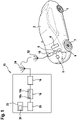
- FIG. 1 shows a schematic view of a motor vehicle 2 with an engine 4 and a device according to the invention for determining its load profile.
- a driving condition determination device 8 is provided, which is connected to a plurality of sensors 5, 6 to driving condition parameters of the motor vehicle 2, such as its operating time, speed, acceleration in the longitudinal and / or Lateral direction, etc., to determine, wherein a combination of at least two driving condition parameters, namely the speed of the motor vehicle (2) and the longitudinal and / or lateral acceleration of the motor vehicle (2) comprises the invention.
- the driving state determination device 8 is also connected to a transmission device 10 which is designed to wirelessly transmit the driving state parameters determined by the driving state determination device 8 to a server 15 arranged outside of the motor vehicle 2 with the aid of an antenna 12 .
- the transmission can take place, for example, via WLAN, Bluetooth or a mobile phone connection.
- the server 15 has a receiving device 16 with an antenna 14 for receiving the signals transmitted by the transmission device 10 .
- the driving condition parameters of motor vehicle 2 received by receiving device 16 are forwarded by receiving device 16 to a driving condition evaluation device 18 which is designed to assign a numerical load parameter to each of the driving condition parameters transmitted by driving condition determination device 8 via the data connection.
- the driving condition evaluation device 18 includes a memory device 18a in which at least first and second entries are stored, with each second entry being linked to at least one first entry.
- the driving condition evaluation device 18 also includes a comparison and assignment device 18b, which is designed to select a first entry by comparing a driving condition parameter transmitted by the receiving device 16 with the first entries, which corresponds to the transmitted driving condition parameter within a predetermined tolerance, or the one Interval denotes in which the transmitted driving condition parameter is located, and to assign a second entry linked to the first entry to this driving condition parameter as a load parameter.
- the load parameter assigned in this way is fed to an addition device 20, which is designed to add the numerical load parameters of a motor vehicle, which have been determined on the basis of the driving state parameters transmitted while the motor vehicle 2 is being driven, in order to add up a numerical overall load parameter for the journey of the motor vehicle 2 to determine.
- the server also includes a comparison device 22 that makes it possible to compare the total numerical load parameters of several motor vehicles 2 in a vehicle fleet in order to identify motor vehicles 2 that are heavily and less heavily loaded.
- the comparison device 22 can in particular also be configured with a sorting device 24 be, which makes it possible to sort the motor vehicles 2 based on the overall load parameters assigned to them. In this way, a ranking list of motor vehicles 2 can be created in which the motor vehicles 2 are sorted according to their load, so that both heavily and slightly loaded motor vehicles 2 can be identified quickly and easily based on their position at the beginning or end of the ranking list.
- a first example according to the invention of a driving condition parameter is the current speed of motor vehicle 2.
- High wear and tear of motor vehicle 2 is not necessarily associated with high speed of motor vehicle 2. Rather, it has been shown that city traffic in particular, with its medium speed range, results in high stress and wear and tear on motor vehicle 2; a similarly high load only occurs again at very high speeds of more than 160 km/h.
- the load parameters that result from the respective speed of the motor vehicle 2 are therefore assigned to the motor vehicle condition parameter “speed”, for example using Table 1 below.
- Table 1 speed load parameters 0-60km/h 10 60-130km/h 5 130-160km/h 2 >160km/h 10
- the evaluation of the speed can be optimized by using the maximum speeds applicable in the respective country on different roads (city traffic, country roads, federal roads, motorways, "freeways", “highways”) in order to determine which type of road the motor vehicle is on 2 is on the way.
- city driving usually leads to greater wear and tear on the motor vehicle 2 than driving on the freeway, even if the latter are usually carried out at higher speeds.
- the country in which the motor vehicle 2 is currently traveling can be determined by manual input, by evaluating the mobile operator currently in use and/or of the receivable radio stations.
- a GPS signal can also be used, with only the country in which the motor vehicle 2 is currently located being determined from the GPS information for data protection reasons, without fully evaluating the GPS information in order to determine the exact location of the motor vehicle 2 determine.
- Another driving state parameter according to the invention which has an influence on the wear of the motor vehicle 2, is the acceleration in the longitudinal and transverse direction.
- One possibility for numerically detecting the scattering of the acceleration is to determine the standard deviation of the accelerations occurring during a journey of the motor vehicle 2 around their mean value, and to assign a numerical load parameter to this standard deviation.
- a defensive driving style that is gentle on the motor vehicle 2 therefore results in a narrow distribution of the acceleration around its mean value and thus in a small standard deviation.
- the speed of the motor 4 can also be recorded and evaluated in order to determine the load on the motor vehicle 2, in particular on the motor 4, the clutch (not shown) and the tires 7.
- gear change processes can be identified based on strong fluctuations in the engine speed, from which conclusions can be drawn about the load and wear on the clutch.
- maintenance intervals for the clutch and any necessary replacement of the clutch linings can be determined depending on the use of the motor vehicle 2 ("predictive maintenance"), so that maintenance intervals that are too long can be avoided if the motor vehicle 2 is used heavily and/or if there is a Aggressive driving style can be avoided as well as unnecessarily short maintenance intervals with low and/or careful use of the motor vehicle 2.
- limit values for the speed and/or the acceleration can be defined, with a load counter being incremented each time a driving condition parameter determined while the motor vehicle 2 is driving exceeds such a limit value.
- the sum of the exceeding of limit values determined during a journey is assigned to a load parameter after the end of the journey.
- the load parameters accumulated over the course of the trip can be added to determine an overall load parameter.
- a ranking list of the motor vehicles 2 can be created on the basis of the total load parameter, which represents the sum of the individual load parameters.
- a separate ranking list can be created for each individual driving state or load parameter in order to generate ranking lists specific to driving state parameters.
- an overall ranking list can be created on the basis of the positions of the motor vehicles 2 in the ranking lists specific to the driving state parameters.
- the ranking lists can be evaluated using a 20/60/20 scheme, with the 20% of motor vehicles 2 in a vehicle fleet that have the 20% greatest overall load parameters being assigned to a first, highly loaded class, and the last 20% of the motor vehicles 2 of a vehicle fleet, which have the 20% lowest overall load parameters, are assigned to a second, low load class.
- the evaluation of the driving conditions of the motor vehicle 2 is further improved by using combinations of different driving condition parameters for the evaluation.
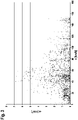
- FIG. 2 shows an example of the distribution of the longitudinal acceleration (on the vertical axis) over the speed (on the horizontal axis) for two different motor vehicles 2, which are represented by crosses or squares.
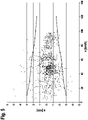
- FIG. 3 shows one of the 2 Corresponding plot, ie acceleration on the vertical axis as a function of velocity on the horizontal axis, for negative accelerations denoting braking.
- the dash-dot line describes a moderate braking pattern in which the driver slows down slowly and then either stops or continues at a slower speed.
- This braking pattern corresponds to a forward-looking driving style of a safe and relaxed driver, which results in less wear and tear on motor vehicle 2 .
- the dotted line shows the braking profile of a driver who drives with foresight and anticipates the traffic situation well. He brakes only lightly, but then quickly releases the brake (steep drop of the curve after its peak at around 4.5 s). This driving style results in slightly higher wear than the moderate driving style described above.
- the dashed line shows the braking profile of a driver braking hard, e.g. B. because the distance to the vehicle in front has become too small, after the hard triggering of the braking process, the motor vehicle 2 is slowed down more gently.
- This nervous driving style results in increased wear on the motor vehicle 2 and is therefore associated with a relatively large load parameter.
- the different braking profiles can be distinguished on the basis of their respective gradients. Braking begins with a positive gradient of negative acceleration (increasing braking effect) until the climax is reached. Then the braking effect decreases until the (negative) acceleration reaches zero. After both gradients (for the areas before and after the peak of the curve) have been calculated, the associated braking profile can be determined. In particular, gradients of more than 4 m/s 2 indicate sudden and/or intensive braking, which leads to high stress and wear and tear on motor vehicle 2, and are therefore assigned to large stress parameters.
- the load profiles of the motor vehicle 2 can be used to estimate the wear of the tires 7 and the brakes, in particular the brake pads, of the motor vehicle 2 and maintenance intervals, in particular for changing the tires 7 and/or the brake pads to determine.
- the lateral acceleration of the motor vehicle 2 can also be evaluated as a function of the speed. This improves the result of the evaluation, since in built-up areas, at relatively low speeds, due to the tight radii, e.g. B. when turning, high lateral accelerations occur even with a defensive driving style, whereas the same lateral accelerations in higher speed ranges indicate a restless driving style.
- Table 3 shows an example of the lateral acceleration that occurs when driving through curves that have the specified radius R at the specified speed.
- Table 3 speed [km/h] curve radius [m] Lateral acceleration [m/s 2 ] 50 80 2.4 60 120 2.3 70 180 2.1 80 250 1.9 90 340 1.8 100 450 1.7 120 720 1.5
- the dashed lines denote the maximum lateral accelerations anticipated in the design of the roads for the given speed. Acceleration values outside (above or below) the dashed lines therefore indicate driving states in which the motor vehicle 2 is outside the area provided for in the construction of the respective road, ie driving through the curve too quickly. Such driving states are generally associated with a high load and a resulting high level of wear and tear on the motor vehicle 2 and are therefore assigned a high load parameter.
- the driving time of the motor vehicle 2 can also be used to determine the load and wear of the motor vehicle 2 .
- the proportion of the current driving time to the total driving time over the last 30 days can be evaluated in order to determine whether the motor vehicle 2 has been used evenly or unevenly in the last 30 days, with uneven use of the motor vehicle 2 leading to increased wear and tear Consequence and is therefore assigned to an increased wear parameter.
Landscapes
- Engineering & Computer Science (AREA)
- Physics & Mathematics (AREA)
- General Physics & Mathematics (AREA)
- Automation & Control Theory (AREA)
- Mechanical Engineering (AREA)
- Mathematical Physics (AREA)
- Transportation (AREA)
- Electric Propulsion And Braking For Vehicles (AREA)
Claims (8)
- Dispositif de détermination de profils de charge de véhicules automobiles (2), notamment d'un parc de véhicules, ledit dispositif de détermination comprenant au moins un dispositif d'évaluation d'état de conduite (18) ;au moins un dispositif de détermination d'état de conduite (8) disposé dans un véhicule automobile (2), l'au moins un dispositif de détermination d'état de conduite (8) étant conçu pour déterminer de manière répétée au moins un paramètre d'état de conduite du véhicule automobile (2) et pour transmettre celui-ci à au moins un dispositif d'évaluation d'état de conduite (18) ;l'au moins un dispositif d'évaluation d'état de conduite (18) étant conçu pour associer un paramètre de charge numérique à chaque paramètre d'état de conduite déterminé par l'au moins un dispositif de détermination d'état de conduite (8) ; etun dispositif d'addition (20) qui est conçu pour additionner les paramètres de charge numériques afin de former un paramètre de charge totale numérique, caractérisé en ce que l'au moins un dispositif d'évaluation d'état de conduite (18) est également conçu pour déterminer un paramètre de charge à partir d'une combinaison d'au moins deux paramètres d'état de conduite, la combinaison d'au moins deux paramètres d'état de conduite comprenant la vitesse du véhicule automobile (2) et l'accélération longitudinale et/ou transversale du véhicule automobile (2).
- Dispositif selon la revendication 1, le dispositif comprenant en outre un dispositif de comparaison (22) qui est conçu pour comparer entre eux les paramètres de charge totale numériques de plusieurs véhicules automobiles (2), le dispositif de comparaison (22) comprenant un dispositif de tri (24) qui est conçu pour trier les véhicules automobiles (2) sur la base de leurs paramètres de charge totale.
- Dispositif selon la revendication 1 ou 2, le dispositif d'évaluation d'état de conduite (18) comprenant :un dispositif de mémorisation (18a) dans lequel des première et deuxième entrées sont mémorisées, chaque deuxième entrée étant associée à au moins une première entrée ; etun dispositif de comparaison et d'association (18b) qui est conçu pour sélectionner une première entrée en comparant le paramètre d'état de conduite déterminé aux premières entrées et pour associer une deuxième entrée, combinée à la première entrée, au paramètre d'état de conduite en tant que paramètre de charge.
- Dispositif selon l'une des revendications 1 à 3, le paramètre d'état de conduite comprenant également l'une au moins des grandeurs suivantes : durée de fonctionnement du véhicule automobile (2), vitesse de rotation du moteur (4) et/ou écart-type d'au moins une de ces grandeurs lors d'un trajet du véhicule automobile (2).
- Dispositif selon l'une des revendications 1 à 4, le dispositif d'évaluation d'état de conduite (18) étant conçu pour déterminer la fréquence à laquelle le paramètre d'état de conduite dépasse une valeur limite spécifiée associée au paramètre d'état de conduite, et pour associer un paramètre de charge numérique au nombre de fois que la valeur limite est dépassée pendant la conduite du véhicule automobile (2).
- Dispositif selon l'une des revendications précédentes, le dispositif comportant en plus au moins un dispositif de transmission (10) qui est conçu pour transmettre des paramètres d'état de conduite, en particulier sans fil, du dispositif de détermination d'état de conduite (8) au dispositif d'évaluation d'état de conduite (18) et/ou pour transmettre des paramètres de charge, en particulier sans fil, du dispositif d'évaluation d'état de conduite (18) au dispositif d'addition (20).
- Procédé de détermination de profils de charge de véhicules automobiles (2) dans un parc de véhicules, à l'aide d'au moins un dispositif d'évaluation d'état de conduite (18), d'au moins un dispositif de détermination d'état de conduite (8) disposé dans le véhicule automobile et d'un dispositif d'addition (20), ledit procédé comprenant les étapes suivantes :déterminer de manière répétée au moins un paramètre d'état de conduite du véhicule automobile (2) au moyen de l'au moins un dispositif de détermination d'état de conduite ;associer un paramètre de charge numérique à chaque paramètre d'état de conduite déterminé par l'au moins un dispositif de détermination d'état de conduite (8) ; etadditionner les paramètres de charge numériques d'un véhicule automobile (2) à l'aide du dispositif d'addition (20) afin de former un paramètre de charge totale numérique, caractérisé en ce qu'un paramètre de charge numérique est déterminé à partir d'une combinaison d'au moins deux paramètres d'état de conduite à l'aide de l'au moins un dispositif d'évaluation d'état de conduite (18), la combinaison d'au moins deux paramètres d'état de conduite comprenant la vitesse du véhicule automobile (2) et l'accélération longitudinale et/ou transversale du véhicule automobile (2).
- Procédé selon la revendication 7, qui comprend en outre les étapes de comparaison des paramètres de charge totale numériques de plusieurs véhicules automobiles (2) du parc automobile entre eux et de tri des véhicules automobiles (2) sur la base de leurs paramètres de charge totale.
Applications Claiming Priority (2)
| Application Number | Priority Date | Filing Date | Title |
|---|---|---|---|
| DE102014213522.2A DE102014213522A1 (de) | 2014-07-11 | 2014-07-11 | Vorrichtung und Verfahren zum Bestimmen von Belastungsprofilen von Kraftfahrzeugen |
| PCT/EP2015/060497 WO2016005086A1 (fr) | 2014-07-11 | 2015-05-12 | Dispositif et procédé servant à déterminer des profils de charge de véhicules automobiles |
Publications (2)
| Publication Number | Publication Date |
|---|---|
| EP3166830A1 EP3166830A1 (fr) | 2017-05-17 |
| EP3166830B1 true EP3166830B1 (fr) | 2022-12-21 |
Family
ID=53199966
Family Applications (1)
| Application Number | Title | Priority Date | Filing Date |
|---|---|---|---|
| EP15723891.6A Active EP3166830B1 (fr) | 2014-07-11 | 2015-05-12 | Dispositif et procédé servant à déterminer des profils de charge de véhicules automobiles |
Country Status (5)
| Country | Link |
|---|---|
| US (1) | US10692310B2 (fr) |
| EP (1) | EP3166830B1 (fr) |
| CN (1) | CN106488864B (fr) |
| DE (1) | DE102014213522A1 (fr) |
| WO (1) | WO2016005086A1 (fr) |
Families Citing this family (8)
| Publication number | Priority date | Publication date | Assignee | Title |
|---|---|---|---|---|
| US9847701B2 (en) * | 2015-12-01 | 2017-12-19 | GM Global Technology Operations LLC | Determination of rotor fatigue in an electric machine assembly |
| EP3179418A1 (fr) * | 2015-12-08 | 2017-06-14 | Tata Consultancy Services Limited | Procédés et systèmes de planification d'entretien automatique d'un véhicule |
| DE102016113795A1 (de) * | 2016-07-27 | 2018-02-01 | Dr. Ing. H.C. F. Porsche Aktiengesellschaft | Verfahren zur Bereitstellung zumindest eines spezifischen Fahrzeugzustandes eines Fahrzeugs |
| CN106960481A (zh) * | 2017-02-15 | 2017-07-18 | 赵立 | 一种基于警用智能手机监控异常驾驶行为的方法 |
| DE102017207014A1 (de) | 2017-04-26 | 2018-10-31 | Audi Ag | Verfahren zur Datenerhebung |
| DE102019217006A1 (de) * | 2019-11-05 | 2021-05-06 | Volkswagen Aktiengesellschaft | Verfahren, Vorrichtung und Computerprogrammprodukt zur belastungsminimalen Trajektorienplanung für Fahrzeuge |
| DE102023000076A1 (de) | 2023-01-12 | 2024-07-18 | Mercedes-Benz Group AG | Verfahren zur Bestimmung eines Abnutzungsindikators für ein Fahrzeug und Fahrzeug |
| DE102023211895A1 (de) * | 2023-11-29 | 2025-06-05 | Robert Bosch Gesellschaft mit beschränkter Haftung | Vorrichtung und Verfahren zur Bestimmung eines mehrdimensionalen Fahrerparameters für eine Erprobung einer Fahrzeugkomponente oder eines Fahrzeugs |
Family Cites Families (10)
| Publication number | Priority date | Publication date | Assignee | Title |
|---|---|---|---|---|
| WO2006131926A2 (fr) * | 2005-06-09 | 2006-12-14 | Drive Diagnostics Ltd. | Systeme et procede de presentation d'un profil de conduite |
| US20070100518A1 (en) * | 2005-10-31 | 2007-05-03 | Cooper Johnny G | Method and System For Fluid Condition Monitoring |
| AT504028B1 (de) * | 2007-11-02 | 2009-03-15 | Avl List Gmbh | Verfahren zur schädigungsvorhersage von bauteilen eines kraftfahrzeuges |
| DE102008001803A1 (de) | 2008-05-15 | 2009-11-19 | Robert Bosch Gmbh | Verfahren zum Erfassen eines Betriebsalters einer Komponente eines Hybridfahrzeugs |
| DE102008049754A1 (de) | 2008-09-30 | 2010-04-08 | Continental Automotive Gmbh | Verfahren und Vorrichtung zur Verschleißdiagnose eines Kraftfahrzeugs |
| GB2473957B (en) | 2009-09-24 | 2011-12-07 | David Gilleland | Positioning system |
| US9142142B2 (en) | 2010-12-10 | 2015-09-22 | Kaarya, Llc | In-car driver tracking device |
| DE102010054531A1 (de) | 2010-12-15 | 2012-06-21 | Volkswagen Ag | Verfahren zur Bestimmung eines Zustands eines Verbrennungsmotors eines Fahrzeugs mit weiterem Motor sowie entsprechende Vorrichtung und Fahrzeug |
| GB2488956B (en) * | 2010-12-15 | 2013-08-21 | Andrew William Wright | Method and system for logging vehicle behaviour |
| US9164957B2 (en) * | 2011-01-24 | 2015-10-20 | Lexisnexis Risk Solutions Inc. | Systems and methods for telematics monitoring and communications |
-
2014
- 2014-07-11 DE DE102014213522.2A patent/DE102014213522A1/de not_active Withdrawn
-
2015
- 2015-05-12 CN CN201580037687.9A patent/CN106488864B/zh active Active
- 2015-05-12 EP EP15723891.6A patent/EP3166830B1/fr active Active
- 2015-05-12 WO PCT/EP2015/060497 patent/WO2016005086A1/fr not_active Ceased
- 2015-05-12 US US15/323,477 patent/US10692310B2/en active Active
Also Published As
| Publication number | Publication date |
|---|---|
| US10692310B2 (en) | 2020-06-23 |
| CN106488864B (zh) | 2019-11-01 |
| CN106488864A (zh) | 2017-03-08 |
| DE102014213522A1 (de) | 2016-01-14 |
| US20170124779A1 (en) | 2017-05-04 |
| WO2016005086A1 (fr) | 2016-01-14 |
| EP3166830A1 (fr) | 2017-05-17 |
Similar Documents
| Publication | Publication Date | Title |
|---|---|---|
| EP3166830B1 (fr) | Dispositif et procédé servant à déterminer des profils de charge de véhicules automobiles | |
| DE102017207620B4 (de) | Verfahren und Vorrichtung zur Bestimmung von Radlasten an Rädern eines Fahrzeuges | |
| DE112012000680T5 (de) | Verkehrsstauerfassungsgerät und Fahrzeugsteuergerät | |
| EP2625082A1 (fr) | Procédé et système d'information pour communiquer à un conducteur de véhicule des informations sur les conditions d'un dépassement prévu | |
| DE102018127333A1 (de) | Verfahren und systeme zur adaptiven überwachung des bremsbelagverschleisses | |
| DE102018104673A1 (de) | Verfahren zum Zuordnen von Reifendrucküberwachungseinheiten zu Radpositionen des Fahrzeugs sowie Reifendrucküberwachungssystem | |
| DE102017119317A1 (de) | Klassifizierung von Umgebungs-Fahrzeugen für eine Abstandsregeltempomat-Vorrichtung in einem Kraftfahrzeug | |
| DE102004039286A1 (de) | Vorrichtung und Verfahren zu Bewertung des Betriebsrisikos von Kraftfahrzeugen | |
| DE102008052132A1 (de) | Verfahren und Vorrichtung zum Verbessern des Fahrverhaltens eines Kraftfahrzeugs | |
| DE102015008725A1 (de) | Verfahren zum Ermitteln eines Zustands eines Fahrzeugs | |
| DE102015008968A1 (de) | Verfahren zur Auswertung von Fahrzeugdaten | |
| DE10063588A1 (de) | Verfahren zum Übermitteln von Daten zur Verkehrslagebeurteilung und ein Endgerät in einem mobilen Detektor | |
| EP3321111B1 (fr) | Procédé de détermination d'un état de batterie | |
| EP2388618A1 (fr) | Procédé de détection de perturbations du fonctionnement de mesure d'un agencement de mesure à ultrasons d'un véhicule automobile et véhicule automobile | |
| DE102015010576A1 (de) | System und Methode zur Feststellung von Straßenoberflächenunregelmäßigkeiten | |
| EP1933292B1 (fr) | Procédé et système destinés à l'influence du flux de trafic à l'intérieur d'une section de trajectoires | |
| EP4170622B1 (fr) | Procédé de mémorisation et d'évaluation des informations d'état collectées au sein d'un réseau v2x | |
| WO2009046796A1 (fr) | Procédé et dispositif de détermination des données relatives aux performances d'un ou de plusieurs véhicules | |
| DE102020107239A1 (de) | Variabler kollisions-meldeschwellwert | |
| DE102015120203A1 (de) | Verfahren und System zur Bestimmung einer Beanspruchung eines Fahrzeugs | |
| DE102023103269A1 (de) | Verfahren zum Bereitstellen von Kartendaten mit Funktionsnutzbarkeits-Informationen, Verfahren zur Routenplanung, computerlesbares Speichermedium, Fahrzeug und System | |
| EP2951045B1 (fr) | Methode pour la mise en oeuvre d'un systeme d'assistance au parcage et vehicule | |
| EP2905750B1 (fr) | Dispositif pour un véhicule automobile destiné à la détermination de l'utilisation d'une installation de réglage de la vitesse ainsi que véhicule automobile correspondant et procédé | |
| DE10243536B4 (de) | Verfahren und Vorrichtung zur Auslegung von Fahrzeugen und/oder Fahrzeugbauteilen | |
| DE102017109647A1 (de) | Verfahren zum Erkennen von Schäden eines Radlagers |
Legal Events
| Date | Code | Title | Description |
|---|---|---|---|
| STAA | Information on the status of an ep patent application or granted ep patent |
Free format text: STATUS: THE INTERNATIONAL PUBLICATION HAS BEEN MADE |
|
| PUAI | Public reference made under article 153(3) epc to a published international application that has entered the european phase |
Free format text: ORIGINAL CODE: 0009012 |
|
| STAA | Information on the status of an ep patent application or granted ep patent |
Free format text: STATUS: REQUEST FOR EXAMINATION WAS MADE |
|
| 17P | Request for examination filed |
Effective date: 20170213 |
|
| AK | Designated contracting states |
Kind code of ref document: A1 Designated state(s): AL AT BE BG CH CY CZ DE DK EE ES FI FR GB GR HR HU IE IS IT LI LT LU LV MC MK MT NL NO PL PT RO RS SE SI SK SM TR |
|
| AX | Request for extension of the european patent |
Extension state: BA ME |
|
| DAV | Request for validation of the european patent (deleted) | ||
| DAX | Request for extension of the european patent (deleted) | ||
| RAP1 | Party data changed (applicant data changed or rights of an application transferred) |
Owner name: ROBERT BOSCH GMBH |
|
| STAA | Information on the status of an ep patent application or granted ep patent |
Free format text: STATUS: EXAMINATION IS IN PROGRESS |
|
| 17Q | First examination report despatched |
Effective date: 20210414 |
|
| GRAP | Despatch of communication of intention to grant a patent |
Free format text: ORIGINAL CODE: EPIDOSNIGR1 |
|
| STAA | Information on the status of an ep patent application or granted ep patent |
Free format text: STATUS: GRANT OF PATENT IS INTENDED |
|
| INTG | Intention to grant announced |
Effective date: 20220929 |
|
| GRAS | Grant fee paid |
Free format text: ORIGINAL CODE: EPIDOSNIGR3 |
|
| GRAA | (expected) grant |
Free format text: ORIGINAL CODE: 0009210 |
|
| STAA | Information on the status of an ep patent application or granted ep patent |
Free format text: STATUS: THE PATENT HAS BEEN GRANTED |
|
| AK | Designated contracting states |
Kind code of ref document: B1 Designated state(s): AL AT BE BG CH CY CZ DE DK EE ES FI FR GB GR HR HU IE IS IT LI LT LU LV MC MK MT NL NO PL PT RO RS SE SI SK SM TR |
|
| REG | Reference to a national code |
Ref country code: GB Ref legal event code: FG4D Free format text: NOT ENGLISH |
|
| REG | Reference to a national code |
Ref country code: DE Ref legal event code: R096 Ref document number: 502015016203 Country of ref document: DE |
|
| REG | Reference to a national code |
Ref country code: CH Ref legal event code: EP |
|
| REG | Reference to a national code |
Ref country code: AT Ref legal event code: REF Ref document number: 1538896 Country of ref document: AT Kind code of ref document: T Effective date: 20230115 |
|
| REG | Reference to a national code |
Ref country code: IE Ref legal event code: FG4D Free format text: LANGUAGE OF EP DOCUMENT: GERMAN |
|
| REG | Reference to a national code |
Ref country code: LT Ref legal event code: MG9D |
|
| REG | Reference to a national code |
Ref country code: NL Ref legal event code: MP Effective date: 20221221 |
|
| PG25 | Lapsed in a contracting state [announced via postgrant information from national office to epo] |
Ref country code: SE Free format text: LAPSE BECAUSE OF FAILURE TO SUBMIT A TRANSLATION OF THE DESCRIPTION OR TO PAY THE FEE WITHIN THE PRESCRIBED TIME-LIMIT Effective date: 20221221 Ref country code: NO Free format text: LAPSE BECAUSE OF FAILURE TO SUBMIT A TRANSLATION OF THE DESCRIPTION OR TO PAY THE FEE WITHIN THE PRESCRIBED TIME-LIMIT Effective date: 20230321 Ref country code: LT Free format text: LAPSE BECAUSE OF FAILURE TO SUBMIT A TRANSLATION OF THE DESCRIPTION OR TO PAY THE FEE WITHIN THE PRESCRIBED TIME-LIMIT Effective date: 20221221 Ref country code: FI Free format text: LAPSE BECAUSE OF FAILURE TO SUBMIT A TRANSLATION OF THE DESCRIPTION OR TO PAY THE FEE WITHIN THE PRESCRIBED TIME-LIMIT Effective date: 20221221 |
|
| PG25 | Lapsed in a contracting state [announced via postgrant information from national office to epo] |
Ref country code: RS Free format text: LAPSE BECAUSE OF FAILURE TO SUBMIT A TRANSLATION OF THE DESCRIPTION OR TO PAY THE FEE WITHIN THE PRESCRIBED TIME-LIMIT Effective date: 20221221 Ref country code: LV Free format text: LAPSE BECAUSE OF FAILURE TO SUBMIT A TRANSLATION OF THE DESCRIPTION OR TO PAY THE FEE WITHIN THE PRESCRIBED TIME-LIMIT Effective date: 20221221 Ref country code: HR Free format text: LAPSE BECAUSE OF FAILURE TO SUBMIT A TRANSLATION OF THE DESCRIPTION OR TO PAY THE FEE WITHIN THE PRESCRIBED TIME-LIMIT Effective date: 20221221 Ref country code: GR Free format text: LAPSE BECAUSE OF FAILURE TO SUBMIT A TRANSLATION OF THE DESCRIPTION OR TO PAY THE FEE WITHIN THE PRESCRIBED TIME-LIMIT Effective date: 20230322 |
|
| PG25 | Lapsed in a contracting state [announced via postgrant information from national office to epo] |
Ref country code: NL Free format text: LAPSE BECAUSE OF FAILURE TO SUBMIT A TRANSLATION OF THE DESCRIPTION OR TO PAY THE FEE WITHIN THE PRESCRIBED TIME-LIMIT Effective date: 20221221 |
|
| PG25 | Lapsed in a contracting state [announced via postgrant information from national office to epo] |
Ref country code: SM Free format text: LAPSE BECAUSE OF FAILURE TO SUBMIT A TRANSLATION OF THE DESCRIPTION OR TO PAY THE FEE WITHIN THE PRESCRIBED TIME-LIMIT Effective date: 20221221 Ref country code: RO Free format text: LAPSE BECAUSE OF FAILURE TO SUBMIT A TRANSLATION OF THE DESCRIPTION OR TO PAY THE FEE WITHIN THE PRESCRIBED TIME-LIMIT Effective date: 20221221 Ref country code: PT Free format text: LAPSE BECAUSE OF FAILURE TO SUBMIT A TRANSLATION OF THE DESCRIPTION OR TO PAY THE FEE WITHIN THE PRESCRIBED TIME-LIMIT Effective date: 20230421 Ref country code: ES Free format text: LAPSE BECAUSE OF FAILURE TO SUBMIT A TRANSLATION OF THE DESCRIPTION OR TO PAY THE FEE WITHIN THE PRESCRIBED TIME-LIMIT Effective date: 20221221 Ref country code: EE Free format text: LAPSE BECAUSE OF FAILURE TO SUBMIT A TRANSLATION OF THE DESCRIPTION OR TO PAY THE FEE WITHIN THE PRESCRIBED TIME-LIMIT Effective date: 20221221 Ref country code: CZ Free format text: LAPSE BECAUSE OF FAILURE TO SUBMIT A TRANSLATION OF THE DESCRIPTION OR TO PAY THE FEE WITHIN THE PRESCRIBED TIME-LIMIT Effective date: 20221221 |
|
| PG25 | Lapsed in a contracting state [announced via postgrant information from national office to epo] |
Ref country code: SK Free format text: LAPSE BECAUSE OF FAILURE TO SUBMIT A TRANSLATION OF THE DESCRIPTION OR TO PAY THE FEE WITHIN THE PRESCRIBED TIME-LIMIT Effective date: 20221221 Ref country code: PL Free format text: LAPSE BECAUSE OF FAILURE TO SUBMIT A TRANSLATION OF THE DESCRIPTION OR TO PAY THE FEE WITHIN THE PRESCRIBED TIME-LIMIT Effective date: 20221221 Ref country code: IS Free format text: LAPSE BECAUSE OF FAILURE TO SUBMIT A TRANSLATION OF THE DESCRIPTION OR TO PAY THE FEE WITHIN THE PRESCRIBED TIME-LIMIT Effective date: 20230421 Ref country code: AL Free format text: LAPSE BECAUSE OF FAILURE TO SUBMIT A TRANSLATION OF THE DESCRIPTION OR TO PAY THE FEE WITHIN THE PRESCRIBED TIME-LIMIT Effective date: 20221221 |
|
| REG | Reference to a national code |
Ref country code: DE Ref legal event code: R097 Ref document number: 502015016203 Country of ref document: DE |
|
| PLBE | No opposition filed within time limit |
Free format text: ORIGINAL CODE: 0009261 |
|
| STAA | Information on the status of an ep patent application or granted ep patent |
Free format text: STATUS: NO OPPOSITION FILED WITHIN TIME LIMIT |
|
| PG25 | Lapsed in a contracting state [announced via postgrant information from national office to epo] |
Ref country code: DK Free format text: LAPSE BECAUSE OF FAILURE TO SUBMIT A TRANSLATION OF THE DESCRIPTION OR TO PAY THE FEE WITHIN THE PRESCRIBED TIME-LIMIT Effective date: 20221221 |
|
| 26N | No opposition filed |
Effective date: 20230922 |
|
| REG | Reference to a national code |
Ref country code: CH Ref legal event code: PL |
|
| PG25 | Lapsed in a contracting state [announced via postgrant information from national office to epo] |
Ref country code: MC Free format text: LAPSE BECAUSE OF FAILURE TO SUBMIT A TRANSLATION OF THE DESCRIPTION OR TO PAY THE FEE WITHIN THE PRESCRIBED TIME-LIMIT Effective date: 20221221 |
|
| GBPC | Gb: european patent ceased through non-payment of renewal fee |
Effective date: 20230512 |
|
| REG | Reference to a national code |
Ref country code: BE Ref legal event code: MM Effective date: 20230531 |
|
| PG25 | Lapsed in a contracting state [announced via postgrant information from national office to epo] |
Ref country code: SI Free format text: LAPSE BECAUSE OF FAILURE TO SUBMIT A TRANSLATION OF THE DESCRIPTION OR TO PAY THE FEE WITHIN THE PRESCRIBED TIME-LIMIT Effective date: 20221221 Ref country code: MC Free format text: LAPSE BECAUSE OF FAILURE TO SUBMIT A TRANSLATION OF THE DESCRIPTION OR TO PAY THE FEE WITHIN THE PRESCRIBED TIME-LIMIT Effective date: 20221221 Ref country code: LU Free format text: LAPSE BECAUSE OF NON-PAYMENT OF DUE FEES Effective date: 20230512 Ref country code: LI Free format text: LAPSE BECAUSE OF NON-PAYMENT OF DUE FEES Effective date: 20230531 Ref country code: CH Free format text: LAPSE BECAUSE OF NON-PAYMENT OF DUE FEES Effective date: 20230531 |
|
| REG | Reference to a national code |
Ref country code: IE Ref legal event code: MM4A |
|
| PG25 | Lapsed in a contracting state [announced via postgrant information from national office to epo] |
Ref country code: IE Free format text: LAPSE BECAUSE OF NON-PAYMENT OF DUE FEES Effective date: 20230512 |
|
| PG25 | Lapsed in a contracting state [announced via postgrant information from national office to epo] |
Ref country code: IE Free format text: LAPSE BECAUSE OF NON-PAYMENT OF DUE FEES Effective date: 20230512 Ref country code: GB Free format text: LAPSE BECAUSE OF NON-PAYMENT OF DUE FEES Effective date: 20230512 |
|
| PG25 | Lapsed in a contracting state [announced via postgrant information from national office to epo] |
Ref country code: IT Free format text: LAPSE BECAUSE OF FAILURE TO SUBMIT A TRANSLATION OF THE DESCRIPTION OR TO PAY THE FEE WITHIN THE PRESCRIBED TIME-LIMIT Effective date: 20221221 Ref country code: FR Free format text: LAPSE BECAUSE OF NON-PAYMENT OF DUE FEES Effective date: 20230531 Ref country code: BE Free format text: LAPSE BECAUSE OF NON-PAYMENT OF DUE FEES Effective date: 20230531 |
|
| REG | Reference to a national code |
Ref country code: AT Ref legal event code: MM01 Ref document number: 1538896 Country of ref document: AT Kind code of ref document: T Effective date: 20230512 |
|
| PG25 | Lapsed in a contracting state [announced via postgrant information from national office to epo] |
Ref country code: AT Free format text: LAPSE BECAUSE OF NON-PAYMENT OF DUE FEES Effective date: 20230512 |
|
| PG25 | Lapsed in a contracting state [announced via postgrant information from national office to epo] |
Ref country code: AT Free format text: LAPSE BECAUSE OF NON-PAYMENT OF DUE FEES Effective date: 20230512 |
|
| PG25 | Lapsed in a contracting state [announced via postgrant information from national office to epo] |
Ref country code: BG Free format text: LAPSE BECAUSE OF FAILURE TO SUBMIT A TRANSLATION OF THE DESCRIPTION OR TO PAY THE FEE WITHIN THE PRESCRIBED TIME-LIMIT Effective date: 20221221 |
|
| PG25 | Lapsed in a contracting state [announced via postgrant information from national office to epo] |
Ref country code: BG Free format text: LAPSE BECAUSE OF FAILURE TO SUBMIT A TRANSLATION OF THE DESCRIPTION OR TO PAY THE FEE WITHIN THE PRESCRIBED TIME-LIMIT Effective date: 20221221 |
|
| PG25 | Lapsed in a contracting state [announced via postgrant information from national office to epo] |
Ref country code: CY Free format text: LAPSE BECAUSE OF FAILURE TO SUBMIT A TRANSLATION OF THE DESCRIPTION OR TO PAY THE FEE WITHIN THE PRESCRIBED TIME-LIMIT; INVALID AB INITIO Effective date: 20150512 |
|
| PG25 | Lapsed in a contracting state [announced via postgrant information from national office to epo] |
Ref country code: HU Free format text: LAPSE BECAUSE OF FAILURE TO SUBMIT A TRANSLATION OF THE DESCRIPTION OR TO PAY THE FEE WITHIN THE PRESCRIBED TIME-LIMIT; INVALID AB INITIO Effective date: 20150512 |
|
| PGFP | Annual fee paid to national office [announced via postgrant information from national office to epo] |
Ref country code: DE Payment date: 20250716 Year of fee payment: 11 |
|
| PG25 | Lapsed in a contracting state [announced via postgrant information from national office to epo] |
Ref country code: TR Free format text: LAPSE BECAUSE OF FAILURE TO SUBMIT A TRANSLATION OF THE DESCRIPTION OR TO PAY THE FEE WITHIN THE PRESCRIBED TIME-LIMIT Effective date: 20221221 |