EP3166690B2 - Verbesserte entfärbung von gefärbten keratinischen fasern - Google Patents
Verbesserte entfärbung von gefärbten keratinischen fasern Download PDFInfo
- Publication number
- EP3166690B2 EP3166690B2 EP15730107.8A EP15730107A EP3166690B2 EP 3166690 B2 EP3166690 B2 EP 3166690B2 EP 15730107 A EP15730107 A EP 15730107A EP 3166690 B2 EP3166690 B2 EP 3166690B2
- Authority
- EP
- European Patent Office
- Prior art keywords
- agent
- acid
- group
- decolorizing
- total amount
- Prior art date
- Legal status (The legal status is an assumption and is not a legal conclusion. Google has not performed a legal analysis and makes no representation as to the accuracy of the status listed.)
- Not-in-force
Links
- 239000000835 fiber Substances 0.000 title claims description 60
- 238000004042 decolorization Methods 0.000 title description 19
- 239000003795 chemical substances by application Substances 0.000 claims description 216
- 239000003638 chemical reducing agent Substances 0.000 claims description 57
- 239000002888 zwitterionic surfactant Substances 0.000 claims description 54
- 108010076876 Keratins Proteins 0.000 claims description 44
- 102000011782 Keratins Human genes 0.000 claims description 44
- 239000000975 dye Substances 0.000 claims description 39
- KRKNYBCHXYNGOX-UHFFFAOYSA-N citric acid Chemical compound OC(=O)CC(O)(C(O)=O)CC(O)=O KRKNYBCHXYNGOX-UHFFFAOYSA-N 0.000 claims description 36
- QTBSBXVTEAMEQO-UHFFFAOYSA-N Acetic acid Chemical compound CC(O)=O QTBSBXVTEAMEQO-UHFFFAOYSA-N 0.000 claims description 34
- 238000000034 method Methods 0.000 claims description 32
- GEHJYWRUCIMESM-UHFFFAOYSA-L sodium sulfite Chemical compound [Na+].[Na+].[O-]S([O-])=O GEHJYWRUCIMESM-UHFFFAOYSA-L 0.000 claims description 31
- 210000004209 hair Anatomy 0.000 claims description 30
- MUBZPKHOEPUJKR-UHFFFAOYSA-N Oxalic acid Chemical compound OC(=O)C(O)=O MUBZPKHOEPUJKR-UHFFFAOYSA-N 0.000 claims description 28
- KWYUFKZDYYNOTN-UHFFFAOYSA-M Potassium hydroxide Chemical compound [OH-].[K+] KWYUFKZDYYNOTN-UHFFFAOYSA-M 0.000 claims description 28
- HEMHJVSKTPXQMS-UHFFFAOYSA-M Sodium hydroxide Chemical compound [OH-].[Na+] HEMHJVSKTPXQMS-UHFFFAOYSA-M 0.000 claims description 25
- JVTAAEKCZFNVCJ-UHFFFAOYSA-N lactic acid Chemical compound CC(O)C(O)=O JVTAAEKCZFNVCJ-UHFFFAOYSA-N 0.000 claims description 24
- AFVFQIVMOAPDHO-UHFFFAOYSA-N Methanesulfonic acid Chemical compound CS(O)(=O)=O AFVFQIVMOAPDHO-UHFFFAOYSA-N 0.000 claims description 22
- VEXZGXHMUGYJMC-UHFFFAOYSA-N Hydrochloric acid Chemical compound Cl VEXZGXHMUGYJMC-UHFFFAOYSA-N 0.000 claims description 21
- NBIIXXVUZAFLBC-UHFFFAOYSA-N Phosphoric acid Chemical compound OP(O)(O)=O NBIIXXVUZAFLBC-UHFFFAOYSA-N 0.000 claims description 21
- QAOWNCQODCNURD-UHFFFAOYSA-N Sulfuric acid Chemical compound OS(O)(=O)=O QAOWNCQODCNURD-UHFFFAOYSA-N 0.000 claims description 21
- 239000000203 mixture Substances 0.000 claims description 21
- CWERGRDVMFNCDR-UHFFFAOYSA-N thioglycolic acid Chemical compound OC(=O)CS CWERGRDVMFNCDR-UHFFFAOYSA-N 0.000 claims description 20
- PENRVBJTRIYHOA-UHFFFAOYSA-L zinc dithionite Chemical compound [Zn+2].[O-]S(=O)S([O-])=O PENRVBJTRIYHOA-UHFFFAOYSA-L 0.000 claims description 20
- DBVJJBKOTRCVKF-UHFFFAOYSA-N Etidronic acid Chemical compound OP(=O)(O)C(O)(C)P(O)(O)=O DBVJJBKOTRCVKF-UHFFFAOYSA-N 0.000 claims description 19
- DWAQJAXMDSEUJJ-UHFFFAOYSA-M Sodium bisulfite Chemical compound [Na+].OS([O-])=O DWAQJAXMDSEUJJ-UHFFFAOYSA-M 0.000 claims description 19
- PQUCIEFHOVEZAU-UHFFFAOYSA-N Diammonium sulfite Chemical compound [NH4+].[NH4+].[O-]S([O-])=O PQUCIEFHOVEZAU-UHFFFAOYSA-N 0.000 claims description 18
- OFOBLEOULBTSOW-UHFFFAOYSA-N Malonic acid Chemical compound OC(=O)CC(O)=O OFOBLEOULBTSOW-UHFFFAOYSA-N 0.000 claims description 18
- WPYMKLBDIGXBTP-UHFFFAOYSA-N benzoic acid Chemical compound OC(=O)C1=CC=CC=C1 WPYMKLBDIGXBTP-UHFFFAOYSA-N 0.000 claims description 18
- FGRVOLIFQGXPCT-UHFFFAOYSA-L dipotassium;dioxido-oxo-sulfanylidene-$l^{6}-sulfane Chemical compound [K+].[K+].[O-]S([O-])(=O)=S FGRVOLIFQGXPCT-UHFFFAOYSA-L 0.000 claims description 18
- 239000000982 direct dye Substances 0.000 claims description 18
- 238000007254 oxidation reaction Methods 0.000 claims description 18
- BHZRJJOHZFYXTO-UHFFFAOYSA-L potassium sulfite Chemical compound [K+].[K+].[O-]S([O-])=O BHZRJJOHZFYXTO-UHFFFAOYSA-L 0.000 claims description 18
- 238000002156 mixing Methods 0.000 claims description 17
- 230000003647 oxidation Effects 0.000 claims description 17
- PMNLUUOXGOOLSP-UHFFFAOYSA-N 2-mercaptopropanoic acid Chemical compound CC(S)C(O)=O PMNLUUOXGOOLSP-UHFFFAOYSA-N 0.000 claims description 16
- AKHNMLFCWUSKQB-UHFFFAOYSA-L sodium thiosulfate Chemical compound [Na+].[Na+].[O-]S([O-])(=O)=S AKHNMLFCWUSKQB-UHFFFAOYSA-L 0.000 claims description 16
- CIWBSHSKHKDKBQ-JLAZNSOCSA-N Ascorbic acid Chemical compound OC[C@H](O)[C@H]1OC(=O)C(O)=C1O CIWBSHSKHKDKBQ-JLAZNSOCSA-N 0.000 claims description 15
- 235000019345 sodium thiosulphate Nutrition 0.000 claims description 15
- JVBXVOWTABLYPX-UHFFFAOYSA-L sodium dithionite Chemical compound [Na+].[Na+].[O-]S(=O)S([O-])=O JVBXVOWTABLYPX-UHFFFAOYSA-L 0.000 claims description 14
- 239000004094 surface-active agent Substances 0.000 claims description 14
- HEZHYQDYRPUXNJ-UHFFFAOYSA-L potassium dithionite Chemical compound [K+].[K+].[O-]S(=O)S([O-])=O HEZHYQDYRPUXNJ-UHFFFAOYSA-L 0.000 claims description 13
- 125000001453 quaternary ammonium group Chemical group 0.000 claims description 13
- XYXNTHIYBIDHGM-UHFFFAOYSA-N ammonium thiosulfate Chemical compound [NH4+].[NH4+].[O-]S([O-])(=O)=S XYXNTHIYBIDHGM-UHFFFAOYSA-N 0.000 claims description 12
- 235000015165 citric acid Nutrition 0.000 claims description 12
- SBGKURINHGJRFN-UHFFFAOYSA-N hydroxymethanesulfinic acid Chemical compound OCS(O)=O SBGKURINHGJRFN-UHFFFAOYSA-N 0.000 claims description 12
- 239000004310 lactic acid Substances 0.000 claims description 12
- 235000014655 lactic acid Nutrition 0.000 claims description 12
- DJEHXEMURTVAOE-UHFFFAOYSA-M potassium bisulfite Chemical compound [K+].OS([O-])=O DJEHXEMURTVAOE-UHFFFAOYSA-M 0.000 claims description 12
- 239000002243 precursor Substances 0.000 claims description 12
- 235000010267 sodium hydrogen sulphite Nutrition 0.000 claims description 12
- 235000010265 sodium sulphite Nutrition 0.000 claims description 12
- BJEPYKJPYRNKOW-REOHCLBHSA-N (S)-malic acid Chemical compound OC(=O)[C@@H](O)CC(O)=O BJEPYKJPYRNKOW-REOHCLBHSA-N 0.000 claims description 11
- QGZKDVFQNNGYKY-UHFFFAOYSA-N Ammonia Chemical compound N QGZKDVFQNNGYKY-UHFFFAOYSA-N 0.000 claims description 11
- FEWJPZIEWOKRBE-JCYAYHJZSA-N Dextrotartaric acid Chemical compound OC(=O)[C@H](O)[C@@H](O)C(O)=O FEWJPZIEWOKRBE-JCYAYHJZSA-N 0.000 claims description 11
- FEWJPZIEWOKRBE-UHFFFAOYSA-N Tartaric acid Natural products [H+].[H+].[O-]C(=O)C(O)C(O)C([O-])=O FEWJPZIEWOKRBE-UHFFFAOYSA-N 0.000 claims description 11
- BJEPYKJPYRNKOW-UHFFFAOYSA-N alpha-hydroxysuccinic acid Natural products OC(=O)C(O)CC(O)=O BJEPYKJPYRNKOW-UHFFFAOYSA-N 0.000 claims description 11
- ISLGHAYMGURDSU-UHFFFAOYSA-N aminomethanesulfinic acid Chemical compound NCS(O)=O ISLGHAYMGURDSU-UHFFFAOYSA-N 0.000 claims description 11
- 239000003581 cosmetic carrier Substances 0.000 claims description 11
- 238000004043 dyeing Methods 0.000 claims description 11
- 239000001630 malic acid Substances 0.000 claims description 11
- 235000011090 malic acid Nutrition 0.000 claims description 11
- 229940098779 methanesulfonic acid Drugs 0.000 claims description 11
- 238000004806 packaging method and process Methods 0.000 claims description 11
- 235000010259 potassium hydrogen sulphite Nutrition 0.000 claims description 11
- 235000019252 potassium sulphite Nutrition 0.000 claims description 11
- 229940079827 sodium hydrogen sulfite Drugs 0.000 claims description 11
- 239000011975 tartaric acid Substances 0.000 claims description 11
- 235000002906 tartaric acid Nutrition 0.000 claims description 11
- 150000003077 polyols Chemical class 0.000 claims description 10
- 239000002537 cosmetic Substances 0.000 claims description 9
- 150000007524 organic acids Chemical class 0.000 claims description 9
- 229920005862 polyol Polymers 0.000 claims description 9
- 239000005711 Benzoic acid Substances 0.000 claims description 8
- 235000011054 acetic acid Nutrition 0.000 claims description 8
- 229910000147 aluminium phosphate Inorganic materials 0.000 claims description 8
- 235000010233 benzoic acid Nutrition 0.000 claims description 8
- 235000006408 oxalic acid Nutrition 0.000 claims description 8
- 150000007522 mineralic acids Chemical class 0.000 claims description 7
- XUJNEKJLAYXESH-REOHCLBHSA-N L-Cysteine Chemical compound SC[C@H](N)C(O)=O XUJNEKJLAYXESH-REOHCLBHSA-N 0.000 claims description 6
- 230000003113 alkalizing effect Effects 0.000 claims description 6
- 239000003086 colorant Substances 0.000 claims description 6
- 238000009472 formulation Methods 0.000 claims description 6
- 230000005855 radiation Effects 0.000 claims description 6
- 238000002834 transmittance Methods 0.000 claims description 6
- 125000004169 (C1-C6) alkyl group Chemical group 0.000 claims description 5
- HZAXFHJVJLSVMW-UHFFFAOYSA-N 2-Aminoethan-1-ol Chemical compound NCCO HZAXFHJVJLSVMW-UHFFFAOYSA-N 0.000 claims description 5
- 229910021529 ammonia Inorganic materials 0.000 claims description 5
- 239000003945 anionic surfactant Substances 0.000 claims description 5
- ODKSFYDXXFIFQN-UHFFFAOYSA-N arginine Natural products OC(=O)C(N)CCCNC(N)=N ODKSFYDXXFIFQN-UHFFFAOYSA-N 0.000 claims description 5
- 229960005070 ascorbic acid Drugs 0.000 claims description 5
- XUJNEKJLAYXESH-UHFFFAOYSA-N cysteine Natural products SCC(N)C(O)=O XUJNEKJLAYXESH-UHFFFAOYSA-N 0.000 claims description 5
- 230000009969 flowable effect Effects 0.000 claims description 5
- 239000004475 Arginine Substances 0.000 claims description 4
- 125000000882 C2-C6 alkenyl group Chemical group 0.000 claims description 4
- 235000010323 ascorbic acid Nutrition 0.000 claims description 4
- 239000011668 ascorbic acid Substances 0.000 claims description 4
- 239000000973 cosmetic coloring agent Substances 0.000 claims description 4
- 235000018417 cysteine Nutrition 0.000 claims description 2
- 239000002280 amphoteric surfactant Substances 0.000 claims 1
- -1 Kaliumdithionit Chemical compound 0.000 description 41
- 230000002829 reductive effect Effects 0.000 description 23
- 239000002253 acid Substances 0.000 description 22
- 230000008569 process Effects 0.000 description 22
- 125000004432 carbon atom Chemical group C* 0.000 description 20
- 238000004040 coloring Methods 0.000 description 14
- 239000000499 gel Substances 0.000 description 14
- 150000001875 compounds Chemical class 0.000 description 13
- 125000000217 alkyl group Chemical group 0.000 description 12
- 125000002496 methyl group Chemical group [H]C([H])([H])* 0.000 description 11
- IXOCGRPBILEGOX-UHFFFAOYSA-N 3-[3-(dodecanoylamino)propyl-dimethylazaniumyl]-2-hydroxypropane-1-sulfonate Chemical compound CCCCCCCCCCCC(=O)NCCC[N+](C)(C)CC(O)CS([O-])(=O)=O IXOCGRPBILEGOX-UHFFFAOYSA-N 0.000 description 10
- 239000007864 aqueous solution Substances 0.000 description 9
- 235000014113 dietary fatty acids Nutrition 0.000 description 9
- 238000002845 discoloration Methods 0.000 description 9
- 230000000694 effects Effects 0.000 description 9
- 239000000194 fatty acid Substances 0.000 description 9
- 229930195729 fatty acid Natural products 0.000 description 9
- 150000003839 salts Chemical class 0.000 description 9
- DNIAPMSPPWPWGF-UHFFFAOYSA-N Propylene glycol Chemical compound CC(O)CO DNIAPMSPPWPWGF-UHFFFAOYSA-N 0.000 description 8
- 150000007513 acids Chemical class 0.000 description 8
- 150000004665 fatty acids Chemical class 0.000 description 8
- 150000003254 radicals Chemical class 0.000 description 8
- GHMLBKRAJCXXBS-UHFFFAOYSA-N resorcinol Chemical compound OC1=CC=CC(O)=C1 GHMLBKRAJCXXBS-UHFFFAOYSA-N 0.000 description 8
- CWLKGDAVCFYWJK-UHFFFAOYSA-N 3-aminophenol Chemical class NC1=CC=CC(O)=C1 CWLKGDAVCFYWJK-UHFFFAOYSA-N 0.000 description 6
- QGZKDVFQNNGYKY-UHFFFAOYSA-O Ammonium Chemical compound [NH4+] QGZKDVFQNNGYKY-UHFFFAOYSA-O 0.000 description 6
- LYCAIKOWRPUZTN-UHFFFAOYSA-N Ethylene glycol Chemical compound OCCO LYCAIKOWRPUZTN-UHFFFAOYSA-N 0.000 description 6
- 150000003863 ammonium salts Chemical class 0.000 description 6
- 229920001577 copolymer Polymers 0.000 description 6
- 125000006538 C11 alkyl group Chemical group [H]C([H])([H])C([H])([H])C([H])([H])C([H])([H])C([H])([H])C([H])([H])C([H])([H])C([H])([H])C([H])([H])C([H])([H])C([H])([H])* 0.000 description 5
- PEDCQBHIVMGVHV-UHFFFAOYSA-N Glycerine Chemical compound OCC(O)CO PEDCQBHIVMGVHV-UHFFFAOYSA-N 0.000 description 5
- 239000004133 Sodium thiosulphate Substances 0.000 description 5
- 125000002252 acyl group Chemical group 0.000 description 5
- 125000000129 anionic group Chemical group 0.000 description 5
- QVGXLLKOCUKJST-UHFFFAOYSA-N atomic oxygen Chemical compound [O] QVGXLLKOCUKJST-UHFFFAOYSA-N 0.000 description 5
- 239000002736 nonionic surfactant Substances 0.000 description 5
- 239000001301 oxygen Substances 0.000 description 5
- 229910052760 oxygen Inorganic materials 0.000 description 5
- 229920001296 polysiloxane Polymers 0.000 description 5
- 239000002453 shampoo Substances 0.000 description 5
- 239000000126 substance Substances 0.000 description 5
- 239000001117 sulphuric acid Substances 0.000 description 5
- 239000002562 thickening agent Substances 0.000 description 5
- 229920001285 xanthan gum Polymers 0.000 description 5
- 235000010493 xanthan gum Nutrition 0.000 description 5
- 239000000230 xanthan gum Substances 0.000 description 5
- 229940082509 xanthan gum Drugs 0.000 description 5
- PUPZLCDOIYMWBV-UHFFFAOYSA-N (+/-)-1,3-Butanediol Chemical compound CC(O)CCO PUPZLCDOIYMWBV-UHFFFAOYSA-N 0.000 description 4
- UNVGBIALRHLALK-UHFFFAOYSA-N 1,5-Hexanediol Chemical compound CC(O)CCCCO UNVGBIALRHLALK-UHFFFAOYSA-N 0.000 description 4
- KJCVRFUGPWSIIH-UHFFFAOYSA-N 1-naphthol Chemical compound C1=CC=C2C(O)=CC=CC2=C1 KJCVRFUGPWSIIH-UHFFFAOYSA-N 0.000 description 4
- MHAJPDPJQMAIIY-UHFFFAOYSA-N Hydrogen peroxide Chemical compound OO MHAJPDPJQMAIIY-UHFFFAOYSA-N 0.000 description 4
- PPBRXRYQALVLMV-UHFFFAOYSA-N Styrene Chemical compound C=CC1=CC=CC=C1 PPBRXRYQALVLMV-UHFFFAOYSA-N 0.000 description 4
- 239000004480 active ingredient Substances 0.000 description 4
- 239000003093 cationic surfactant Substances 0.000 description 4
- 239000006071 cream Substances 0.000 description 4
- HAHLURFXZPKIQK-UHFFFAOYSA-N diazanium;sulfinato sulfite Chemical compound [NH4+].[NH4+].[O-]S(=O)OS([O-])=O HAHLURFXZPKIQK-UHFFFAOYSA-N 0.000 description 4
- 150000002148 esters Chemical class 0.000 description 4
- 239000011521 glass Substances 0.000 description 4
- 230000002209 hydrophobic effect Effects 0.000 description 4
- 239000004615 ingredient Substances 0.000 description 4
- 239000007788 liquid Substances 0.000 description 4
- OIPPWFOQEKKFEE-UHFFFAOYSA-N orcinol Chemical compound CC1=CC(O)=CC(O)=C1 OIPPWFOQEKKFEE-UHFFFAOYSA-N 0.000 description 4
- 239000007800 oxidant agent Substances 0.000 description 4
- 230000001590 oxidative effect Effects 0.000 description 4
- 238000002360 preparation method Methods 0.000 description 4
- 229960004063 propylene glycol Drugs 0.000 description 4
- 238000010405 reoxidation reaction Methods 0.000 description 4
- 239000011734 sodium Substances 0.000 description 4
- 159000000000 sodium salts Chemical class 0.000 description 4
- XLYOFNOQVPJJNP-UHFFFAOYSA-N water Substances O XLYOFNOQVPJJNP-UHFFFAOYSA-N 0.000 description 4
- 150000003751 zinc Chemical class 0.000 description 4
- BMTSZVZQNMNPCT-UHFFFAOYSA-N 2-aminopyridin-3-ol Chemical compound NC1=NC=CC=C1O BMTSZVZQNMNPCT-UHFFFAOYSA-N 0.000 description 3
- 229940018563 3-aminophenol Drugs 0.000 description 3
- JQVAPEJNIZULEK-UHFFFAOYSA-N 4-chlorobenzene-1,3-diol Chemical compound OC1=CC=C(Cl)C(O)=C1 JQVAPEJNIZULEK-UHFFFAOYSA-N 0.000 description 3
- IAYPIBMASNFSPL-UHFFFAOYSA-N Ethylene oxide Chemical compound C1CO1 IAYPIBMASNFSPL-UHFFFAOYSA-N 0.000 description 3
- 244000208060 Lawsonia inermis Species 0.000 description 3
- WHNWPMSKXPGLAX-UHFFFAOYSA-N N-Vinyl-2-pyrrolidone Chemical compound C=CN1CCCC1=O WHNWPMSKXPGLAX-UHFFFAOYSA-N 0.000 description 3
- BLZLODDEPXSDCY-UHFFFAOYSA-N OC(=O)CC(O)=O.OC(=O)C1=CC=CC=C1 Chemical compound OC(=O)CC(O)=O.OC(=O)C1=CC=CC=C1 BLZLODDEPXSDCY-UHFFFAOYSA-N 0.000 description 3
- VHFSMDHANDABQK-UHFFFAOYSA-N azane;2-sulfanylpropanoic acid Chemical compound [NH4+].CC(S)C([O-])=O VHFSMDHANDABQK-UHFFFAOYSA-N 0.000 description 3
- 238000004061 bleaching Methods 0.000 description 3
- 229910052799 carbon Inorganic materials 0.000 description 3
- 150000001805 chlorine compounds Chemical class 0.000 description 3
- 150000002191 fatty alcohols Chemical class 0.000 description 3
- 239000003349 gelling agent Substances 0.000 description 3
- 238000005259 measurement Methods 0.000 description 3
- 229920001223 polyethylene glycol Polymers 0.000 description 3
- 229920000642 polymer Polymers 0.000 description 3
- 239000002994 raw material Substances 0.000 description 3
- 239000000243 solution Substances 0.000 description 3
- 238000003756 stirring Methods 0.000 description 3
- DNIAPMSPPWPWGF-VKHMYHEASA-N (+)-propylene glycol Chemical compound C[C@H](O)CO DNIAPMSPPWPWGF-VKHMYHEASA-N 0.000 description 2
- GHOKWGTUZJEAQD-ZETCQYMHSA-N (D)-(+)-Pantothenic acid Chemical compound OCC(C)(C)[C@@H](O)C(=O)NCCC(O)=O GHOKWGTUZJEAQD-ZETCQYMHSA-N 0.000 description 2
- 229940015975 1,2-hexanediol Drugs 0.000 description 2
- YPFDHNVEDLHUCE-UHFFFAOYSA-N 1,3-propanediol Substances OCCCO YPFDHNVEDLHUCE-UHFFFAOYSA-N 0.000 description 2
- ZTMADXFOCUXMJE-UHFFFAOYSA-N 2-methylbenzene-1,3-diol Chemical compound CC1=C(O)C=CC=C1O ZTMADXFOCUXMJE-UHFFFAOYSA-N 0.000 description 2
- XYRDGCCCBJITBH-UHFFFAOYSA-N 3-amino-2-chloro-6-methylphenol Chemical compound CC1=CC=C(N)C(Cl)=C1O XYRDGCCCBJITBH-UHFFFAOYSA-N 0.000 description 2
- MWKPYVXITDAZLL-UHFFFAOYSA-N 4-[3-(2,4-diaminophenoxy)propoxy]benzene-1,3-diamine Chemical compound NC1=CC(N)=CC=C1OCCCOC1=CC=C(N)C=C1N MWKPYVXITDAZLL-UHFFFAOYSA-N 0.000 description 2
- PLIKAWJENQZMHA-UHFFFAOYSA-N 4-aminophenol Chemical compound NC1=CC=C(O)C=C1 PLIKAWJENQZMHA-UHFFFAOYSA-N 0.000 description 2
- OZCJSIBGTRKJGX-UHFFFAOYSA-N 4-methylcyclohexa-1,5-diene-1,4-diamine Chemical compound CC1(N)CC=C(N)C=C1 OZCJSIBGTRKJGX-UHFFFAOYSA-N 0.000 description 2
- DBFYESDCPWWCHN-UHFFFAOYSA-N 5-amino-2-methylphenol Chemical compound CC1=CC=C(N)C=C1O DBFYESDCPWWCHN-UHFFFAOYSA-N 0.000 description 2
- GHVHDYYKJYXFGU-UHFFFAOYSA-N Beta-Orcinol Chemical compound CC1=CC(O)=C(C)C(O)=C1 GHVHDYYKJYXFGU-UHFFFAOYSA-N 0.000 description 2
- LCGLNKUTAGEVQW-UHFFFAOYSA-N Dimethyl ether Chemical compound COC LCGLNKUTAGEVQW-UHFFFAOYSA-N 0.000 description 2
- 229930091371 Fructose Natural products 0.000 description 2
- RFSUNEUAIZKAJO-ARQDHWQXSA-N Fructose Chemical compound OC[C@H]1O[C@](O)(CO)[C@@H](O)[C@@H]1O RFSUNEUAIZKAJO-ARQDHWQXSA-N 0.000 description 2
- WQZGKKKJIJFFOK-GASJEMHNSA-N Glucose Natural products OC[C@H]1OC(O)[C@H](O)[C@@H](O)[C@@H]1O WQZGKKKJIJFFOK-GASJEMHNSA-N 0.000 description 2
- 239000004201 L-cysteine Substances 0.000 description 2
- 235000013878 L-cysteine Nutrition 0.000 description 2
- ALQSHHUCVQOPAS-UHFFFAOYSA-N Pentane-1,5-diol Chemical compound OCCCCCO ALQSHHUCVQOPAS-UHFFFAOYSA-N 0.000 description 2
- 239000002202 Polyethylene glycol Substances 0.000 description 2
- 229910006069 SO3H Inorganic materials 0.000 description 2
- 229920002125 Sokalan® Polymers 0.000 description 2
- VBIIFPGSPJYLRR-UHFFFAOYSA-M Stearyltrimethylammonium chloride Chemical compound [Cl-].CCCCCCCCCCCCCCCCCC[N+](C)(C)C VBIIFPGSPJYLRR-UHFFFAOYSA-M 0.000 description 2
- ULUAUXLGCMPNKK-UHFFFAOYSA-N Sulfobutanedioic acid Chemical compound OC(=O)CC(C(O)=O)S(O)(=O)=O ULUAUXLGCMPNKK-UHFFFAOYSA-N 0.000 description 2
- 230000002378 acidificating effect Effects 0.000 description 2
- 230000009471 action Effects 0.000 description 2
- 239000013543 active substance Substances 0.000 description 2
- 235000010443 alginic acid Nutrition 0.000 description 2
- 229920000615 alginic acid Polymers 0.000 description 2
- 125000003342 alkenyl group Chemical group 0.000 description 2
- POJWUDADGALRAB-UHFFFAOYSA-N allantoin Chemical compound NC(=O)NC1NC(=O)NC1=O POJWUDADGALRAB-UHFFFAOYSA-N 0.000 description 2
- ZZTCCAPMZLDHFM-UHFFFAOYSA-N ammonium thioglycolate Chemical compound [NH4+].[O-]C(=O)CS ZZTCCAPMZLDHFM-UHFFFAOYSA-N 0.000 description 2
- 229940075861 ammonium thioglycolate Drugs 0.000 description 2
- 239000008365 aqueous carrier Substances 0.000 description 2
- 239000000987 azo dye Substances 0.000 description 2
- 230000008901 benefit Effects 0.000 description 2
- WQZGKKKJIJFFOK-VFUOTHLCSA-N beta-D-glucose Chemical compound OC[C@H]1O[C@@H](O)[C@H](O)[C@@H](O)[C@@H]1O WQZGKKKJIJFFOK-VFUOTHLCSA-N 0.000 description 2
- 230000001588 bifunctional effect Effects 0.000 description 2
- 230000005540 biological transmission Effects 0.000 description 2
- BMRWNKZVCUKKSR-UHFFFAOYSA-N butane-1,2-diol Chemical compound CCC(O)CO BMRWNKZVCUKKSR-UHFFFAOYSA-N 0.000 description 2
- WERYXYBDKMZEQL-UHFFFAOYSA-N butane-1,4-diol Chemical compound OCCCCO WERYXYBDKMZEQL-UHFFFAOYSA-N 0.000 description 2
- 239000004359 castor oil Substances 0.000 description 2
- 235000019438 castor oil Nutrition 0.000 description 2
- 229920002678 cellulose Polymers 0.000 description 2
- 235000010980 cellulose Nutrition 0.000 description 2
- 229940073669 ceteareth 20 Drugs 0.000 description 2
- 229940081733 cetearyl alcohol Drugs 0.000 description 2
- 238000006243 chemical reaction Methods 0.000 description 2
- 235000019646 color tone Nutrition 0.000 description 2
- 230000003750 conditioning effect Effects 0.000 description 2
- 235000013870 dimethyl polysiloxane Nutrition 0.000 description 2
- WJJMNDUMQPNECX-UHFFFAOYSA-N dipicolinic acid Chemical compound OC(=O)C1=CC=CC(C(O)=O)=N1 WJJMNDUMQPNECX-UHFFFAOYSA-N 0.000 description 2
- 239000000839 emulsion Substances 0.000 description 2
- RTZKZFJDLAIYFH-UHFFFAOYSA-N ether Substances CCOCC RTZKZFJDLAIYFH-UHFFFAOYSA-N 0.000 description 2
- 239000006260 foam Substances 0.000 description 2
- 229960002737 fructose Drugs 0.000 description 2
- 239000008103 glucose Substances 0.000 description 2
- 235000011187 glycerol Nutrition 0.000 description 2
- ZEMPKEQAKRGZGQ-XOQCFJPHSA-N glycerol triricinoleate Natural products CCCCCC[C@@H](O)CC=CCCCCCCCC(=O)OC[C@@H](COC(=O)CCCCCCCC=CC[C@@H](O)CCCCCC)OC(=O)CCCCCCCC=CC[C@H](O)CCCCCC ZEMPKEQAKRGZGQ-XOQCFJPHSA-N 0.000 description 2
- 230000037308 hair color Effects 0.000 description 2
- FHKSXSQHXQEMOK-UHFFFAOYSA-N hexane-1,2-diol Chemical compound CCCCC(O)CO FHKSXSQHXQEMOK-UHFFFAOYSA-N 0.000 description 2
- AVIYEYCFMVPYST-UHFFFAOYSA-N hexane-1,3-diol Chemical compound CCCC(O)CCO AVIYEYCFMVPYST-UHFFFAOYSA-N 0.000 description 2
- QVTWBMUAJHVAIJ-UHFFFAOYSA-N hexane-1,4-diol Chemical compound CCC(O)CCCO QVTWBMUAJHVAIJ-UHFFFAOYSA-N 0.000 description 2
- XXMIOPMDWAUFGU-UHFFFAOYSA-N hexane-1,6-diol Chemical compound OCCCCCCO XXMIOPMDWAUFGU-UHFFFAOYSA-N 0.000 description 2
- 150000002430 hydrocarbons Chemical group 0.000 description 2
- 125000002887 hydroxy group Chemical group [H]O* 0.000 description 2
- CSFWPUWCSPOLJW-UHFFFAOYSA-N lawsone Chemical compound C1=CC=C2C(=O)C(O)=CC(=O)C2=C1 CSFWPUWCSPOLJW-UHFFFAOYSA-N 0.000 description 2
- 230000005923 long-lasting effect Effects 0.000 description 2
- ZUVBIBLYOCVYJU-UHFFFAOYSA-N naphthalene-1,7-diol Chemical compound C1=CC=C(O)C2=CC(O)=CC=C21 ZUVBIBLYOCVYJU-UHFFFAOYSA-N 0.000 description 2
- LQNUZADURLCDLV-UHFFFAOYSA-N nitrobenzene Chemical compound [O-][N+](=O)C1=CC=CC=C1 LQNUZADURLCDLV-UHFFFAOYSA-N 0.000 description 2
- GLDOVTGHNKAZLK-UHFFFAOYSA-N octadecan-1-ol Chemical compound CCCCCCCCCCCCCCCCCCO GLDOVTGHNKAZLK-UHFFFAOYSA-N 0.000 description 2
- 239000001814 pectin Substances 0.000 description 2
- 235000010987 pectin Nutrition 0.000 description 2
- 229920001277 pectin Polymers 0.000 description 2
- WCVRQHFDJLLWFE-UHFFFAOYSA-N pentane-1,2-diol Chemical compound CCCC(O)CO WCVRQHFDJLLWFE-UHFFFAOYSA-N 0.000 description 2
- RUOPINZRYMFPBF-UHFFFAOYSA-N pentane-1,3-diol Chemical compound CCC(O)CCO RUOPINZRYMFPBF-UHFFFAOYSA-N 0.000 description 2
- GLOBUAZSRIOKLN-UHFFFAOYSA-N pentane-1,4-diol Chemical compound CC(O)CCCO GLOBUAZSRIOKLN-UHFFFAOYSA-N 0.000 description 2
- 239000000049 pigment Substances 0.000 description 2
- 229920000435 poly(dimethylsiloxane) Polymers 0.000 description 2
- 229920000151 polyglycol Polymers 0.000 description 2
- 239000010695 polyglycol Substances 0.000 description 2
- 235000013824 polyphenols Nutrition 0.000 description 2
- 229920001451 polypropylene glycol Polymers 0.000 description 2
- 229920000166 polytrimethylene carbonate Polymers 0.000 description 2
- QVOMDXSQDOBBMW-UHFFFAOYSA-L potassium metabisulphite Chemical compound [K+].[K+].[O-]S(=O)OS([O-])=O QVOMDXSQDOBBMW-UHFFFAOYSA-L 0.000 description 2
- 230000002265 prevention Effects 0.000 description 2
- 239000000047 product Substances 0.000 description 2
- 235000013772 propylene glycol Nutrition 0.000 description 2
- 239000003531 protein hydrolysate Substances 0.000 description 2
- 150000003856 quaternary ammonium compounds Chemical class 0.000 description 2
- XWGJFPHUCFXLBL-UHFFFAOYSA-M rongalite Chemical compound [Na+].OCS([O-])=O XWGJFPHUCFXLBL-UHFFFAOYSA-M 0.000 description 2
- 239000007787 solid Substances 0.000 description 2
- 239000000758 substrate Substances 0.000 description 2
- 125000000542 sulfonic acid group Chemical group 0.000 description 2
- 229930003231 vitamin Natural products 0.000 description 2
- 239000011782 vitamin Substances 0.000 description 2
- 235000013343 vitamin Nutrition 0.000 description 2
- 229940088594 vitamin Drugs 0.000 description 2
- 238000005406 washing Methods 0.000 description 2
- WTVHAMTYZJGJLJ-UHFFFAOYSA-N (+)-(4S,8R)-8-epi-beta-bisabolol Natural products CC(C)=CCCC(C)C1(O)CCC(C)=CC1 WTVHAMTYZJGJLJ-UHFFFAOYSA-N 0.000 description 1
- PFTAWBLQPZVEMU-DZGCQCFKSA-N (+)-catechin Chemical compound C1([C@H]2OC3=CC(O)=CC(O)=C3C[C@@H]2O)=CC=C(O)C(O)=C1 PFTAWBLQPZVEMU-DZGCQCFKSA-N 0.000 description 1
- RGZSQWQPBWRIAQ-CABCVRRESA-N (-)-alpha-Bisabolol Chemical compound CC(C)=CCC[C@](C)(O)[C@H]1CCC(C)=CC1 RGZSQWQPBWRIAQ-CABCVRRESA-N 0.000 description 1
- NKNCGBHPGCHYCQ-UHFFFAOYSA-N (2,5-diaminophenyl)methanol Chemical compound NC1=CC=C(N)C(CO)=C1 NKNCGBHPGCHYCQ-UHFFFAOYSA-N 0.000 description 1
- SCZGZDLUGUYLRV-UHFFFAOYSA-N (2-methylphenyl)hydrazine Chemical compound CC1=CC=CC=C1NN SCZGZDLUGUYLRV-UHFFFAOYSA-N 0.000 description 1
- MEJYDZQQVZJMPP-ULAWRXDQSA-N (3s,3ar,6r,6ar)-3,6-dimethoxy-2,3,3a,5,6,6a-hexahydrofuro[3,2-b]furan Chemical compound CO[C@H]1CO[C@@H]2[C@H](OC)CO[C@@H]21 MEJYDZQQVZJMPP-ULAWRXDQSA-N 0.000 description 1
- DNIAPMSPPWPWGF-GSVOUGTGSA-N (R)-(-)-Propylene glycol Chemical compound C[C@@H](O)CO DNIAPMSPPWPWGF-GSVOUGTGSA-N 0.000 description 1
- 150000005207 1,3-dihydroxybenzenes Chemical class 0.000 description 1
- WZCQRUWWHSTZEM-UHFFFAOYSA-N 1,3-phenylenediamine Chemical compound NC1=CC=CC(N)=C1 WZCQRUWWHSTZEM-UHFFFAOYSA-N 0.000 description 1
- FBMQNRKSAWNXBT-UHFFFAOYSA-N 1,4-diaminoanthracene-9,10-dione Chemical compound O=C1C2=CC=CC=C2C(=O)C2=C1C(N)=CC=C2N FBMQNRKSAWNXBT-UHFFFAOYSA-N 0.000 description 1
- FRASJONUBLZVQX-UHFFFAOYSA-N 1,4-dioxonaphthalene Natural products C1=CC=C2C(=O)C=CC(=O)C2=C1 FRASJONUBLZVQX-UHFFFAOYSA-N 0.000 description 1
- CBCKQZAAMUWICA-UHFFFAOYSA-N 1,4-phenylenediamine Chemical compound NC1=CC=C(N)C=C1 CBCKQZAAMUWICA-UHFFFAOYSA-N 0.000 description 1
- BOKGTLAJQHTOKE-UHFFFAOYSA-N 1,5-dihydroxynaphthalene Chemical compound C1=CC=C2C(O)=CC=CC2=C1O BOKGTLAJQHTOKE-UHFFFAOYSA-N 0.000 description 1
- PQUXFUBNSYCQAL-UHFFFAOYSA-N 1-(2,3-difluorophenyl)ethanone Chemical compound CC(=O)C1=CC=CC(F)=C1F PQUXFUBNSYCQAL-UHFFFAOYSA-N 0.000 description 1
- NLXFWUZKOOWWFD-UHFFFAOYSA-N 1-(2-hydroxyethylamino)-4-(methylamino)anthracene-9,10-dione Chemical compound O=C1C2=CC=CC=C2C(=O)C2=C1C(NCCO)=CC=C2NC NLXFWUZKOOWWFD-UHFFFAOYSA-N 0.000 description 1
- OWEGWHBOCFMBLP-UHFFFAOYSA-N 1-(4-chlorophenoxy)-1-(1H-imidazol-1-yl)-3,3-dimethylbutan-2-one Chemical compound C1=CN=CN1C(C(=O)C(C)(C)C)OC1=CC=C(Cl)C=C1 OWEGWHBOCFMBLP-UHFFFAOYSA-N 0.000 description 1
- ICVRBKCRXNVOJC-UHFFFAOYSA-N 1-amino-4-(methylamino)anthracene-9,10-dione Chemical compound O=C1C2=CC=CC=C2C(=O)C2=C1C(N)=CC=C2NC ICVRBKCRXNVOJC-UHFFFAOYSA-N 0.000 description 1
- JOLQKTGDSGKSKJ-UHFFFAOYSA-N 1-ethoxypropan-2-ol Chemical compound CCOCC(C)O JOLQKTGDSGKSKJ-UHFFFAOYSA-N 0.000 description 1
- IIZPXYDJLKNOIY-JXPKJXOSSA-N 1-palmitoyl-2-arachidonoyl-sn-glycero-3-phosphocholine Chemical compound CCCCCCCCCCCCCCCC(=O)OC[C@H](COP([O-])(=O)OCC[N+](C)(C)C)OC(=O)CCC\C=C/C\C=C/C\C=C/C\C=C/CCCCC IIZPXYDJLKNOIY-JXPKJXOSSA-N 0.000 description 1
- OVSKIKFHRZPJSS-UHFFFAOYSA-N 2,4-D Chemical compound OC(=O)COC1=CC=C(Cl)C=C1Cl OVSKIKFHRZPJSS-UHFFFAOYSA-N 0.000 description 1
- SYEYEGBZVSWYPK-UHFFFAOYSA-N 2,5,6-triamino-4-hydroxypyrimidine Chemical compound NC1=NC(N)=C(N)C(O)=N1 SYEYEGBZVSWYPK-UHFFFAOYSA-N 0.000 description 1
- ZEXQZDBPFALETL-UHFFFAOYSA-N 2-(2,4-diamino-6-chloro-3-nitrophenyl)ethanol Chemical compound NC1=CC(Cl)=C(CCO)C(N)=C1[N+]([O-])=O ZEXQZDBPFALETL-UHFFFAOYSA-N 0.000 description 1
- KWSVXCAQFTWTEF-UHFFFAOYSA-N 2-(2,5-diaminophenyl)ethanol Chemical compound NC1=CC=C(N)C(CCO)=C1 KWSVXCAQFTWTEF-UHFFFAOYSA-N 0.000 description 1
- STNOBKHYSBEHCH-UHFFFAOYSA-N 2-(2-amino-4-nitrophenyl)ethylurea Chemical compound NC(=O)NCCC1=CC=C([N+]([O-])=O)C=C1N STNOBKHYSBEHCH-UHFFFAOYSA-N 0.000 description 1
- OUNZARDETXBPIX-UHFFFAOYSA-N 2-(2-dodecoxyethoxy)acetic acid Chemical compound CCCCCCCCCCCCOCCOCC(O)=O OUNZARDETXBPIX-UHFFFAOYSA-N 0.000 description 1
- JILWUYWXYQTKLL-UHFFFAOYSA-N 2-(3-amino-4-methyl-2-nitrophenyl)ethanol Chemical compound CC1=CC=C(CCO)C([N+]([O-])=O)=C1N JILWUYWXYQTKLL-UHFFFAOYSA-N 0.000 description 1
- KDBUTNSQYYLYOY-UHFFFAOYSA-N 2-(4,5-diaminopyrazol-1-yl)ethanol Chemical compound NC=1C=NN(CCO)C=1N KDBUTNSQYYLYOY-UHFFFAOYSA-N 0.000 description 1
- LGZSBRSLVPLNTM-UHFFFAOYSA-N 2-(4-amino-2-methyl-5-nitroanilino)ethanol Chemical compound CC1=CC(N)=C([N+]([O-])=O)C=C1NCCO LGZSBRSLVPLNTM-UHFFFAOYSA-N 0.000 description 1
- YESOPQNVGIQNEV-UHFFFAOYSA-N 2-(4-amino-2-nitroanilino)benzoic acid Chemical compound [O-][N+](=O)C1=CC(N)=CC=C1NC1=CC=CC=C1C(O)=O YESOPQNVGIQNEV-UHFFFAOYSA-N 0.000 description 1
- LGGKGPQFSCBUOR-UHFFFAOYSA-N 2-(4-chloro-2-nitroanilino)ethanol Chemical compound OCCNC1=CC=C(Cl)C=C1[N+]([O-])=O LGGKGPQFSCBUOR-UHFFFAOYSA-N 0.000 description 1
- VLZVIIYRNMWPSN-UHFFFAOYSA-N 2-Amino-4-nitrophenol Chemical compound NC1=CC([N+]([O-])=O)=CC=C1O VLZVIIYRNMWPSN-UHFFFAOYSA-N 0.000 description 1
- YBRJTUFWBLSLHY-UHFFFAOYSA-N 2-[2-(2-octadecanoyloxyethoxy)ethoxy]ethyl octadecanoate Chemical compound CCCCCCCCCCCCCCCCCC(=O)OCCOCCOCCOC(=O)CCCCCCCCCCCCCCCCC YBRJTUFWBLSLHY-UHFFFAOYSA-N 0.000 description 1
- FHHDPRNJLKDPEV-UHFFFAOYSA-N 2-[2-amino-4-(2-hydroxyethyl)-3-nitrophenyl]ethanol Chemical compound NC1=C(CCO)C=CC(CCO)=C1[N+]([O-])=O FHHDPRNJLKDPEV-UHFFFAOYSA-N 0.000 description 1
- NZKTVPCPQIEVQT-UHFFFAOYSA-N 2-[4-[(4-aminophenyl)diazenyl]-n-(2-hydroxyethyl)anilino]ethanol Chemical compound C1=CC(N)=CC=C1N=NC1=CC=C(N(CCO)CCO)C=C1 NZKTVPCPQIEVQT-UHFFFAOYSA-N 0.000 description 1
- MPGFDYDCTBHZQG-UHFFFAOYSA-N 2-amino-4-(2-hydroxyethyl)-3-nitrophenol Chemical compound NC1=C(O)C=CC(CCO)=C1[N+]([O-])=O MPGFDYDCTBHZQG-UHFFFAOYSA-N 0.000 description 1
- CDFNUSAXZDSXKF-UHFFFAOYSA-N 2-chloro-6-(ethylamino)-4-nitrophenol Chemical compound CCNC1=CC([N+]([O-])=O)=CC(Cl)=C1O CDFNUSAXZDSXKF-UHFFFAOYSA-N 0.000 description 1
- SWZVJOLLQTWFCW-UHFFFAOYSA-N 2-chlorobenzene-1,3-diol Chemical compound OC1=CC=CC(O)=C1Cl SWZVJOLLQTWFCW-UHFFFAOYSA-N 0.000 description 1
- OSCJHTSDLYVCQC-UHFFFAOYSA-N 2-ethylhexyl 4-[[4-[4-(tert-butylcarbamoyl)anilino]-6-[4-(2-ethylhexoxycarbonyl)anilino]-1,3,5-triazin-2-yl]amino]benzoate Chemical compound C1=CC(C(=O)OCC(CC)CCCC)=CC=C1NC1=NC(NC=2C=CC(=CC=2)C(=O)NC(C)(C)C)=NC(NC=2C=CC(=CC=2)C(=O)OCC(CC)CCCC)=N1 OSCJHTSDLYVCQC-UHFFFAOYSA-N 0.000 description 1
- WPWZFAUHXAPBFF-UHFFFAOYSA-N 2-hydroxy-2-thiophen-2-ylacetic acid Chemical class OC(=O)C(O)C1=CC=CS1 WPWZFAUHXAPBFF-UHFFFAOYSA-N 0.000 description 1
- MXCDRFGKHNFKIP-UHFFFAOYSA-N 2-hydroxy-5-[(4-sulfophenyl)diazenyl]benzoic acid Chemical compound C1=C(O)C(C(=O)O)=CC(N=NC=2C=CC(=CC=2)S(O)(=O)=O)=C1 MXCDRFGKHNFKIP-UHFFFAOYSA-N 0.000 description 1
- HVHNMNGARPCGGD-UHFFFAOYSA-N 2-nitro-p-phenylenediamine Chemical compound NC1=CC=C(N)C([N+]([O-])=O)=C1 HVHNMNGARPCGGD-UHFFFAOYSA-N 0.000 description 1
- XDHQHBSDKYPJRG-UHFFFAOYSA-N 3-[2-nitro-4-(trifluoromethyl)anilino]propane-1,2-diol Chemical compound OCC(O)CNC1=CC=C(C(F)(F)F)C=C1[N+]([O-])=O XDHQHBSDKYPJRG-UHFFFAOYSA-N 0.000 description 1
- CNIGBCBFYDWQHS-QXMHVHEDSA-N 3-[dimethyl-[3-[[(z)-octadec-9-enoyl]amino]propyl]azaniumyl]-2-hydroxypropane-1-sulfonate Chemical compound CCCCCCCC\C=C/CCCCCCCC(=O)NCCC[N+](C)(C)CC(O)CS([O-])(=O)=O CNIGBCBFYDWQHS-QXMHVHEDSA-N 0.000 description 1
- SYRZWFBWUASJJI-UHFFFAOYSA-N 3-amino-2,4-dichlorophenol Chemical compound NC1=C(Cl)C=CC(O)=C1Cl SYRZWFBWUASJJI-UHFFFAOYSA-N 0.000 description 1
- SIYKOUNMJAUPEV-UHFFFAOYSA-N 3-amino-2-(2-hydroxyethyl)-4,6-dinitrophenol Chemical compound NC1=C(CCO)C(O)=C([N+]([O-])=O)C=C1[N+]([O-])=O SIYKOUNMJAUPEV-UHFFFAOYSA-N 0.000 description 1
- ASHGTJPOSUFTGB-UHFFFAOYSA-N 3-methoxyphenol Chemical compound COC1=CC=CC(O)=C1 ASHGTJPOSUFTGB-UHFFFAOYSA-N 0.000 description 1
- ZQBHGSSAKLGUBH-UHFFFAOYSA-N 4,5,6-triamino-1h-pyrimidin-2-one Chemical compound NC1=NC(=O)NC(N)=C1N ZQBHGSSAKLGUBH-UHFFFAOYSA-N 0.000 description 1
- HSDSBIUUVWRHTM-UHFFFAOYSA-N 4-(2-nitroanilino)phenol Chemical compound C1=CC(O)=CC=C1NC1=CC=CC=C1[N+]([O-])=O HSDSBIUUVWRHTM-UHFFFAOYSA-N 0.000 description 1
- VTXBLQLZQLHDIL-UHFFFAOYSA-N 4-(3-hydroxypropylamino)-3-nitrophenol Chemical compound OCCCNC1=CC=C(O)C=C1[N+]([O-])=O VTXBLQLZQLHDIL-UHFFFAOYSA-N 0.000 description 1
- UNBOSJFEZZJZLR-UHFFFAOYSA-N 4-(4-nitrophenylazo)aniline Chemical compound C1=CC(N)=CC=C1N=NC1=CC=C([N+]([O-])=O)C=C1 UNBOSJFEZZJZLR-UHFFFAOYSA-N 0.000 description 1
- XPLTXYDVYDWSSO-UHFFFAOYSA-N 4-(ethylamino)-3-nitrobenzoic acid Chemical compound CCNC1=CC=C(C(O)=O)C=C1[N+]([O-])=O XPLTXYDVYDWSSO-UHFFFAOYSA-N 0.000 description 1
- HLIGKHFHQXRAOX-UHFFFAOYSA-N 4-amino-2-[(5-amino-2-hydroxyphenyl)methyl]phenol Chemical compound NC1=CC=C(O)C(CC=2C(=CC=C(N)C=2)O)=C1 HLIGKHFHQXRAOX-UHFFFAOYSA-N 0.000 description 1
- IQXUIDYRTHQTET-UHFFFAOYSA-N 4-amino-3-nitrophenol Chemical compound NC1=CC=C(O)C=C1[N+]([O-])=O IQXUIDYRTHQTET-UHFFFAOYSA-N 0.000 description 1
- QGNGOGOOPUYKMC-UHFFFAOYSA-N 4-hydroxy-6-methylaniline Chemical compound CC1=CC(O)=CC=C1N QGNGOGOOPUYKMC-UHFFFAOYSA-N 0.000 description 1
- CZCUIGLMMGPMLC-UHFFFAOYSA-N 5,8-dihydroxy-2-(4-methylpentyl)naphthalene-1,4-dione Chemical compound C1=CC(O)=C2C(=O)C(CCCC(C)C)=CC(=O)C2=C1O CZCUIGLMMGPMLC-UHFFFAOYSA-N 0.000 description 1
- LPYXWGMUVRGUOY-REOHCLBHSA-N 5-[(1S)-1,2-dihydroxyethyl]furan-2,3,4-triol Chemical compound OC[C@H](O)C=1OC(O)=C(O)C=1O LPYXWGMUVRGUOY-REOHCLBHSA-N 0.000 description 1
- WDQMXRWYXILWPT-UHFFFAOYSA-N 5-amino-4-chloro-2-methylphenol Chemical compound CC1=CC(Cl)=C(N)C=C1O WDQMXRWYXILWPT-UHFFFAOYSA-N 0.000 description 1
- KIEGFAYDOKCBOK-UHFFFAOYSA-N 6-hydroxy-4,5-dimethyl-1h-pyridin-2-one Chemical compound CC1=CC(=O)NC(O)=C1C KIEGFAYDOKCBOK-UHFFFAOYSA-N 0.000 description 1
- ATCBPVDYYNJHSG-UHFFFAOYSA-N 6-methoxy-2-n-methylpyridine-2,3-diamine Chemical compound CNC1=NC(OC)=CC=C1N ATCBPVDYYNJHSG-UHFFFAOYSA-N 0.000 description 1
- ZVDCYZVYRXZJQF-UHFFFAOYSA-N 6-nitro-1,2,3,4-tetrahydroquinoxaline Chemical compound N1CCNC2=CC([N+](=O)[O-])=CC=C21 ZVDCYZVYRXZJQF-UHFFFAOYSA-N 0.000 description 1
- TWLMSPNQBKSXOP-UHFFFAOYSA-N 6358-09-4 Chemical compound NC1=CC([N+]([O-])=O)=CC(Cl)=C1O TWLMSPNQBKSXOP-UHFFFAOYSA-N 0.000 description 1
- 244000235603 Acacia catechu Species 0.000 description 1
- 244000215068 Acacia senegal Species 0.000 description 1
- CQPFMGBJSMSXLP-ZAGWXBKKSA-M Acid orange 7 Chemical compound OC1=C(C2=CC=CC=C2C=C1)/N=N/C1=CC=C(C=C1)S(=O)(=O)[O-].[Na+] CQPFMGBJSMSXLP-ZAGWXBKKSA-M 0.000 description 1
- 229920001817 Agar Polymers 0.000 description 1
- 241000118825 Alkanna tinctoria Species 0.000 description 1
- POJWUDADGALRAB-PVQJCKRUSA-N Allantoin Natural products NC(=O)N[C@@H]1NC(=O)NC1=O POJWUDADGALRAB-PVQJCKRUSA-N 0.000 description 1
- GUBGYTABKSRVRQ-XLOQQCSPSA-N Alpha-Lactose Chemical compound O[C@@H]1[C@@H](O)[C@@H](O)[C@@H](CO)O[C@H]1O[C@@H]1[C@@H](CO)O[C@H](O)[C@H](O)[C@H]1O GUBGYTABKSRVRQ-XLOQQCSPSA-N 0.000 description 1
- AOMZHDJXSYHPKS-DROYEMJCSA-L Amido Black 10B Chemical compound [Na+].[Na+].[O-]S(=O)(=O)C1=CC2=CC(S([O-])(=O)=O)=C(\N=N\C=3C=CC=CC=3)C(O)=C2C(N)=C1\N=N\C1=CC=C(N(=O)=O)C=C1 AOMZHDJXSYHPKS-DROYEMJCSA-L 0.000 description 1
- 229920000945 Amylopectin Polymers 0.000 description 1
- 229920000856 Amylose Polymers 0.000 description 1
- 235000006226 Areca catechu Nutrition 0.000 description 1
- 241000416162 Astragalus gummifer Species 0.000 description 1
- 229920002134 Carboxymethyl cellulose Polymers 0.000 description 1
- 235000007866 Chamaemelum nobile Nutrition 0.000 description 1
- GHOKWGTUZJEAQD-UHFFFAOYSA-N Chick antidermatitis factor Natural products OCC(C)(C)C(O)C(=O)NCCC(O)=O GHOKWGTUZJEAQD-UHFFFAOYSA-N 0.000 description 1
- 244000303965 Cyamopsis psoralioides Species 0.000 description 1
- 229920000858 Cyclodextrin Polymers 0.000 description 1
- XUJNEKJLAYXESH-UWTATZPHSA-N D-Cysteine Chemical compound SC[C@@H](N)C(O)=O XUJNEKJLAYXESH-UWTATZPHSA-N 0.000 description 1
- ZZZCUOFIHGPKAK-UHFFFAOYSA-N D-erythro-ascorbic acid Natural products OCC1OC(=O)C(O)=C1O ZZZCUOFIHGPKAK-UHFFFAOYSA-N 0.000 description 1
- SNPLKNRPJHDVJA-ZETCQYMHSA-N D-panthenol Chemical compound OCC(C)(C)[C@@H](O)C(=O)NCCCO SNPLKNRPJHDVJA-ZETCQYMHSA-N 0.000 description 1
- 208000001840 Dandruff Diseases 0.000 description 1
- 229920002307 Dextran Polymers 0.000 description 1
- 239000004375 Dextrin Substances 0.000 description 1
- 229920001353 Dextrin Polymers 0.000 description 1
- 229930195710 D‐cysteine Natural products 0.000 description 1
- 241000196324 Embryophyta Species 0.000 description 1
- 239000005715 Fructose Substances 0.000 description 1
- 108010010803 Gelatin Proteins 0.000 description 1
- 241000206672 Gelidium Species 0.000 description 1
- 229920000084 Gum arabic Polymers 0.000 description 1
- 229920000569 Gum karaya Polymers 0.000 description 1
- MIWUTEVJIISHCP-UHFFFAOYSA-N HC Blue No. 2 Chemical compound OCCNC1=CC=C(N(CCO)CCO)C=C1[N+]([O-])=O MIWUTEVJIISHCP-UHFFFAOYSA-N 0.000 description 1
- GZGZVOLBULPDFD-UHFFFAOYSA-N HC Red No. 3 Chemical compound NC1=CC=C(NCCO)C([N+]([O-])=O)=C1 GZGZVOLBULPDFD-UHFFFAOYSA-N 0.000 description 1
- PNENOUKIPPERMY-UHFFFAOYSA-N HC Yellow No. 4 Chemical compound OCCNC1=CC=C([N+]([O-])=O)C=C1OCCO PNENOUKIPPERMY-UHFFFAOYSA-N 0.000 description 1
- 240000007829 Haematoxylum campechianum Species 0.000 description 1
- 239000004354 Hydroxyethyl cellulose Substances 0.000 description 1
- 229920000663 Hydroxyethyl cellulose Polymers 0.000 description 1
- DGAQECJNVWCQMB-PUAWFVPOSA-M Ilexoside XXIX Chemical compound C[C@@H]1CC[C@@]2(CC[C@@]3(C(=CC[C@H]4[C@]3(CC[C@@H]5[C@@]4(CC[C@@H](C5(C)C)OS(=O)(=O)[O-])C)C)[C@@H]2[C@]1(C)O)C)C(=O)O[C@H]6[C@@H]([C@H]([C@@H]([C@H](O6)CO)O)O)O.[Na+] DGAQECJNVWCQMB-PUAWFVPOSA-M 0.000 description 1
- 239000002211 L-ascorbic acid Substances 0.000 description 1
- 235000000069 L-ascorbic acid Nutrition 0.000 description 1
- GUBGYTABKSRVRQ-QKKXKWKRSA-N Lactose Natural products OC[C@H]1O[C@@H](O[C@H]2[C@H](O)[C@@H](O)C(O)O[C@@H]2CO)[C@H](O)[C@@H](O)[C@H]1O GUBGYTABKSRVRQ-QKKXKWKRSA-N 0.000 description 1
- 240000006240 Linum usitatissimum Species 0.000 description 1
- 235000004431 Linum usitatissimum Nutrition 0.000 description 1
- 229920000161 Locust bean gum Polymers 0.000 description 1
- 244000042664 Matricaria chamomilla Species 0.000 description 1
- 235000007232 Matricaria chamomilla Nutrition 0.000 description 1
- 241001465754 Metazoa Species 0.000 description 1
- 239000004165 Methyl ester of fatty acids Substances 0.000 description 1
- 229930182559 Natural dye Natural products 0.000 description 1
- 241000123069 Ocyurus chrysurus Species 0.000 description 1
- 102000015636 Oligopeptides Human genes 0.000 description 1
- 108010038807 Oligopeptides Proteins 0.000 description 1
- 229910019142 PO4 Inorganic materials 0.000 description 1
- 239000004285 Potassium sulphite Substances 0.000 description 1
- GOOHAUXETOMSMM-UHFFFAOYSA-N Propylene oxide Chemical compound CC1CO1 GOOHAUXETOMSMM-UHFFFAOYSA-N 0.000 description 1
- 108010009736 Protein Hydrolysates Proteins 0.000 description 1
- 241000219100 Rhamnaceae Species 0.000 description 1
- 240000000513 Santalum album Species 0.000 description 1
- 235000008632 Santalum album Nutrition 0.000 description 1
- 229920002472 Starch Polymers 0.000 description 1
- 241000934878 Sterculia Species 0.000 description 1
- QAOWNCQODCNURD-UHFFFAOYSA-L Sulfate Chemical compound [O-]S([O-])(=O)=O QAOWNCQODCNURD-UHFFFAOYSA-L 0.000 description 1
- LSNNMFCWUKXFEE-UHFFFAOYSA-N Sulfurous acid Chemical compound OS(O)=O LSNNMFCWUKXFEE-UHFFFAOYSA-N 0.000 description 1
- 244000269722 Thea sinensis Species 0.000 description 1
- 235000006468 Thea sinensis Nutrition 0.000 description 1
- 229920001615 Tragacanth Polymers 0.000 description 1
- GSEJCLTVZPLZKY-UHFFFAOYSA-N Triethanolamine Chemical compound OCCN(CCO)CCO GSEJCLTVZPLZKY-UHFFFAOYSA-N 0.000 description 1
- 229930003268 Vitamin C Natural products 0.000 description 1
- HCHKCACWOHOZIP-UHFFFAOYSA-N Zinc Chemical compound [Zn] HCHKCACWOHOZIP-UHFFFAOYSA-N 0.000 description 1
- 239000002250 absorbent Substances 0.000 description 1
- 230000002745 absorbent Effects 0.000 description 1
- 235000010489 acacia gum Nutrition 0.000 description 1
- 239000000205 acacia gum Substances 0.000 description 1
- 229940019789 acid black 52 Drugs 0.000 description 1
- 229940099540 acid violet 43 Drugs 0.000 description 1
- 229920006322 acrylamide copolymer Polymers 0.000 description 1
- 239000000654 additive Substances 0.000 description 1
- 239000000443 aerosol Substances 0.000 description 1
- 235000010419 agar Nutrition 0.000 description 1
- 125000001931 aliphatic group Chemical group 0.000 description 1
- 125000003545 alkoxy group Chemical group 0.000 description 1
- 150000008051 alkyl sulfates Chemical class 0.000 description 1
- 229960000458 allantoin Drugs 0.000 description 1
- RGZSQWQPBWRIAQ-LSDHHAIUSA-N alpha-Bisabolol Natural products CC(C)=CCC[C@@](C)(O)[C@@H]1CCC(C)=CC1 RGZSQWQPBWRIAQ-LSDHHAIUSA-N 0.000 description 1
- WQZGKKKJIJFFOK-PHYPRBDBSA-N alpha-D-galactose Chemical compound OC[C@H]1O[C@H](O)[C@H](O)[C@@H](O)[C@H]1O WQZGKKKJIJFFOK-PHYPRBDBSA-N 0.000 description 1
- 230000009435 amidation Effects 0.000 description 1
- 238000007112 amidation reaction Methods 0.000 description 1
- 150000001412 amines Chemical class 0.000 description 1
- 235000001014 amino acid Nutrition 0.000 description 1
- 150000001413 amino acids Chemical class 0.000 description 1
- BFNBIHQBYMNNAN-UHFFFAOYSA-N ammonium sulfate Chemical compound N.N.OS(O)(=O)=O BFNBIHQBYMNNAN-UHFFFAOYSA-N 0.000 description 1
- 229910052921 ammonium sulfate Inorganic materials 0.000 description 1
- 235000011130 ammonium sulphate Nutrition 0.000 description 1
- 229940051880 analgesics and antipyretics pyrazolones Drugs 0.000 description 1
- 229920006318 anionic polymer Polymers 0.000 description 1
- 239000000420 anogeissus latifolia wall. gum Substances 0.000 description 1
- 229930014669 anthocyanidin Natural products 0.000 description 1
- 235000008758 anthocyanidins Nutrition 0.000 description 1
- 239000001000 anthraquinone dye Substances 0.000 description 1
- 150000004056 anthraquinones Chemical class 0.000 description 1
- 125000004429 atom Chemical group 0.000 description 1
- 235000013871 bee wax Nutrition 0.000 description 1
- 239000012166 beeswax Substances 0.000 description 1
- JBIROUFYLSSYDX-UHFFFAOYSA-M benzododecinium chloride Chemical compound [Cl-].CCCCCCCCCCCC[N+](C)(C)CC1=CC=CC=C1 JBIROUFYLSSYDX-UHFFFAOYSA-M 0.000 description 1
- 229940036350 bisabolol Drugs 0.000 description 1
- HHGZABIIYIWLGA-UHFFFAOYSA-N bisabolol Natural products CC1CCC(C(C)(O)CCC=C(C)C)CC1 HHGZABIIYIWLGA-UHFFFAOYSA-N 0.000 description 1
- 235000020279 black tea Nutrition 0.000 description 1
- 239000007844 bleaching agent Substances 0.000 description 1
- 229920001400 block copolymer Polymers 0.000 description 1
- 150000001649 bromium compounds Chemical class 0.000 description 1
- HOWJQLVNDUGZBI-UHFFFAOYSA-N butane;propane Chemical compound CCC.CCCC HOWJQLVNDUGZBI-UHFFFAOYSA-N 0.000 description 1
- 235000013877 carbamide Nutrition 0.000 description 1
- BVKZGUZCCUSVTD-UHFFFAOYSA-N carbonic acid Chemical class OC(O)=O BVKZGUZCCUSVTD-UHFFFAOYSA-N 0.000 description 1
- 150000004649 carbonic acid derivatives Chemical class 0.000 description 1
- 125000003178 carboxy group Chemical group [H]OC(*)=O 0.000 description 1
- 235000010948 carboxy methyl cellulose Nutrition 0.000 description 1
- 239000001768 carboxy methyl cellulose Substances 0.000 description 1
- 125000004181 carboxyalkyl group Chemical group 0.000 description 1
- 239000008112 carboxymethyl-cellulose Substances 0.000 description 1
- 235000010418 carrageenan Nutrition 0.000 description 1
- 239000000679 carrageenan Substances 0.000 description 1
- 229920001525 carrageenan Polymers 0.000 description 1
- 229940113118 carrageenan Drugs 0.000 description 1
- 239000000969 carrier Substances 0.000 description 1
- 239000005018 casein Substances 0.000 description 1
- BECPQYXYKAMYBN-UHFFFAOYSA-N casein, tech. Chemical compound NCCCCC(C(O)=O)N=C(O)C(CC(O)=O)N=C(O)C(CCC(O)=N)N=C(O)C(CC(C)C)N=C(O)C(CCC(O)=O)N=C(O)C(CC(O)=O)N=C(O)C(CCC(O)=O)N=C(O)C(C(C)O)N=C(O)C(CCC(O)=N)N=C(O)C(CCC(O)=N)N=C(O)C(CCC(O)=N)N=C(O)C(CCC(O)=O)N=C(O)C(CCC(O)=O)N=C(O)C(COP(O)(O)=O)N=C(O)C(CCC(O)=N)N=C(O)C(N)CC1=CC=CC=C1 BECPQYXYKAMYBN-UHFFFAOYSA-N 0.000 description 1
- 235000021240 caseins Nutrition 0.000 description 1
- 150000001765 catechin Chemical class 0.000 description 1
- 235000005487 catechin Nutrition 0.000 description 1
- ADRVNXBAWSRFAJ-UHFFFAOYSA-N catechin Natural products OC1Cc2cc(O)cc(O)c2OC1c3ccc(O)c(O)c3 ADRVNXBAWSRFAJ-UHFFFAOYSA-N 0.000 description 1
- 125000002091 cationic group Chemical group 0.000 description 1
- 229920006317 cationic polymer Polymers 0.000 description 1
- 239000001913 cellulose Substances 0.000 description 1
- 229920003086 cellulose ether Polymers 0.000 description 1
- 229940106189 ceramide Drugs 0.000 description 1
- 150000001783 ceramides Chemical class 0.000 description 1
- WOWHHFRSBJGXCM-UHFFFAOYSA-M cetyltrimethylammonium chloride Chemical compound [Cl-].CCCCCCCCCCCCCCCC[N+](C)(C)C WOWHHFRSBJGXCM-UHFFFAOYSA-M 0.000 description 1
- 229960003344 climbazole Drugs 0.000 description 1
- 239000007859 condensation product Substances 0.000 description 1
- 230000008878 coupling Effects 0.000 description 1
- 238000010168 coupling process Methods 0.000 description 1
- 238000005859 coupling reaction Methods 0.000 description 1
- 125000004122 cyclic group Chemical group 0.000 description 1
- 229940097362 cyclodextrins Drugs 0.000 description 1
- 235000019425 dextrin Nutrition 0.000 description 1
- SLADUMIFXREMOR-UHFFFAOYSA-N diazanium;dioxido(sulfanylidene)-$l^{4}-sulfane Chemical compound [NH4+].[NH4+].[O-]S([O-])=S SLADUMIFXREMOR-UHFFFAOYSA-N 0.000 description 1
- 150000005690 diesters Chemical class 0.000 description 1
- 125000004177 diethyl group Chemical group [H]C([H])([H])C([H])([H])* 0.000 description 1
- MTHSVFCYNBDYFN-UHFFFAOYSA-N diethylene glycol Chemical group OCCOCCO MTHSVFCYNBDYFN-UHFFFAOYSA-N 0.000 description 1
- 229940008099 dimethicone Drugs 0.000 description 1
- 239000004205 dimethyl polysiloxane Substances 0.000 description 1
- GQOKIYDTHHZSCJ-UHFFFAOYSA-M dimethyl-bis(prop-2-enyl)azanium;chloride Chemical compound [Cl-].C=CC[N+](C)(C)CC=C GQOKIYDTHHZSCJ-UHFFFAOYSA-M 0.000 description 1
- REZZEXDLIUJMMS-UHFFFAOYSA-M dimethyldioctadecylammonium chloride Chemical compound [Cl-].CCCCCCCCCCCCCCCCCC[N+](C)(C)CCCCCCCCCCCCCCCCCC REZZEXDLIUJMMS-UHFFFAOYSA-M 0.000 description 1
- LQJVOKWHGUAUHK-UHFFFAOYSA-L disodium 5-amino-4-hydroxy-3-phenyldiazenylnaphthalene-2,7-disulfonate Chemical compound [Na+].[Na+].OC1=C2C(N)=CC(S([O-])(=O)=O)=CC2=CC(S([O-])(=O)=O)=C1N=NC1=CC=CC=C1 LQJVOKWHGUAUHK-UHFFFAOYSA-L 0.000 description 1
- 235000019820 disodium diphosphate Nutrition 0.000 description 1
- GYQBBRRVRKFJRG-UHFFFAOYSA-L disodium pyrophosphate Chemical compound [Na+].[Na+].OP([O-])(=O)OP(O)([O-])=O GYQBBRRVRKFJRG-UHFFFAOYSA-L 0.000 description 1
- 229940038485 disodium pyrophosphate Drugs 0.000 description 1
- 239000004664 distearyldimethylammonium chloride (DHTDMAC) Substances 0.000 description 1
- GRWZHXKQBITJKP-UHFFFAOYSA-L dithionite(2-) Chemical class [O-]S(=O)S([O-])=O GRWZHXKQBITJKP-UHFFFAOYSA-L 0.000 description 1
- PGQAXGHQYGXVDC-UHFFFAOYSA-N dodecyl(dimethyl)azanium;chloride Chemical compound Cl.CCCCCCCCCCCCN(C)C PGQAXGHQYGXVDC-UHFFFAOYSA-N 0.000 description 1
- QELUYTUMUWHWMC-UHFFFAOYSA-N edaravone Chemical compound O=C1CC(C)=NN1C1=CC=CC=C1 QELUYTUMUWHWMC-UHFFFAOYSA-N 0.000 description 1
- ILEDWLMCKZNDJK-UHFFFAOYSA-N esculetin Chemical class C1=CC(=O)OC2=C1C=C(O)C(O)=C2 ILEDWLMCKZNDJK-UHFFFAOYSA-N 0.000 description 1
- CAPAZTWTGPAFQE-UHFFFAOYSA-N ethane-1,2-diol Chemical compound OCCO.OCCO CAPAZTWTGPAFQE-UHFFFAOYSA-N 0.000 description 1
- 125000001033 ether group Chemical group 0.000 description 1
- 239000003925 fat Substances 0.000 description 1
- 235000019387 fatty acid methyl ester Nutrition 0.000 description 1
- 210000003746 feather Anatomy 0.000 description 1
- 229930003949 flavanone Natural products 0.000 description 1
- 150000002208 flavanones Chemical class 0.000 description 1
- 235000011981 flavanones Nutrition 0.000 description 1
- 229930003944 flavone Natural products 0.000 description 1
- 150000002213 flavones Chemical class 0.000 description 1
- 235000011949 flavones Nutrition 0.000 description 1
- HVQAJTFOCKOKIN-UHFFFAOYSA-N flavonol Natural products O1C2=CC=CC=C2C(=O)C(O)=C1C1=CC=CC=C1 HVQAJTFOCKOKIN-UHFFFAOYSA-N 0.000 description 1
- 150000002216 flavonol derivatives Chemical class 0.000 description 1
- 235000011957 flavonols Nutrition 0.000 description 1
- NWKFECICNXDNOQ-UHFFFAOYSA-N flavylium Chemical compound C1=CC=CC=C1C1=CC=C(C=CC=C2)C2=[O+]1 NWKFECICNXDNOQ-UHFFFAOYSA-N 0.000 description 1
- 235000004426 flaxseed Nutrition 0.000 description 1
- 238000005187 foaming Methods 0.000 description 1
- QJQZEJFUIOWFMS-UHFFFAOYSA-N formaldehyde;sulfanediol Chemical compound O=C.OSO QJQZEJFUIOWFMS-UHFFFAOYSA-N 0.000 description 1
- 229930182830 galactose Natural products 0.000 description 1
- 229960003082 galactose Drugs 0.000 description 1
- 239000008273 gelatin Substances 0.000 description 1
- 229920000159 gelatin Polymers 0.000 description 1
- 235000019322 gelatine Nutrition 0.000 description 1
- 235000011852 gelatine desserts Nutrition 0.000 description 1
- 229960001031 glucose Drugs 0.000 description 1
- 235000012701 green S Nutrition 0.000 description 1
- WDPIZEKLJKBSOZ-UHFFFAOYSA-M green s Chemical compound [Na+].C1=CC(N(C)C)=CC=C1C(C=1C2=CC=C(C=C2C=C(C=1O)S([O-])(=O)=O)S([O-])(=O)=O)=C1C=CC(=[N+](C)C)C=C1 WDPIZEKLJKBSOZ-UHFFFAOYSA-M 0.000 description 1
- 150000002357 guanidines Chemical class 0.000 description 1
- 235000019314 gum ghatti Nutrition 0.000 description 1
- 239000000118 hair dye Substances 0.000 description 1
- 125000004435 hydrogen atom Chemical group [H]* 0.000 description 1
- 229920013821 hydroxy alkyl cellulose Polymers 0.000 description 1
- 150000005165 hydroxybenzoic acids Chemical class 0.000 description 1
- 229930005346 hydroxycinnamic acid Natural products 0.000 description 1
- DEDGUGJNLNLJSR-UHFFFAOYSA-N hydroxycinnamic acid group Chemical class OC(C(=O)O)=CC1=CC=CC=C1 DEDGUGJNLNLJSR-UHFFFAOYSA-N 0.000 description 1
- 235000010359 hydroxycinnamic acids Nutrition 0.000 description 1
- 235000019447 hydroxyethyl cellulose Nutrition 0.000 description 1
- 150000004693 imidazolium salts Chemical class 0.000 description 1
- 230000005764 inhibitory process Effects 0.000 description 1
- 230000003993 interaction Effects 0.000 description 1
- 239000002563 ionic surfactant Substances 0.000 description 1
- 150000002500 ions Chemical class 0.000 description 1
- 235000010494 karaya gum Nutrition 0.000 description 1
- 239000000231 karaya gum Substances 0.000 description 1
- 229940039371 karaya gum Drugs 0.000 description 1
- 239000008101 lactose Substances 0.000 description 1
- 229960001375 lactose Drugs 0.000 description 1
- 230000002045 lasting effect Effects 0.000 description 1
- 239000004816 latex Substances 0.000 description 1
- 229920000126 latex Polymers 0.000 description 1
- PYIDGJJWBIBVIA-UYTYNIKBSA-N lauryl glucoside Chemical compound CCCCCCCCCCCCO[C@@H]1O[C@H](CO)[C@@H](O)[C@H](O)[C@H]1O PYIDGJJWBIBVIA-UYTYNIKBSA-N 0.000 description 1
- 229940048848 lauryl glucoside Drugs 0.000 description 1
- 235000010445 lecithin Nutrition 0.000 description 1
- 239000000787 lecithin Substances 0.000 description 1
- 229940067606 lecithin Drugs 0.000 description 1
- SXQCTESRRZBPHJ-UHFFFAOYSA-M lissamine rhodamine Chemical compound [Na+].C=12C=CC(=[N+](CC)CC)C=C2OC2=CC(N(CC)CC)=CC=C2C=1C1=CC=C(S([O-])(=O)=O)C=C1S([O-])(=O)=O SXQCTESRRZBPHJ-UHFFFAOYSA-M 0.000 description 1
- 235000010420 locust bean gum Nutrition 0.000 description 1
- 239000000711 locust bean gum Substances 0.000 description 1
- 229940018564 m-phenylenediamine Drugs 0.000 description 1
- 150000004988 m-phenylenediamines Chemical class 0.000 description 1
- VZCYOOQTPOCHFL-UPHRSURJSA-N maleic acid Chemical compound OC(=O)\C=C/C(O)=O VZCYOOQTPOCHFL-UPHRSURJSA-N 0.000 description 1
- 239000011976 maleic acid Substances 0.000 description 1
- NYGZLYXAPMMJTE-UHFFFAOYSA-M metanil yellow Chemical compound [Na+].[O-]S(=O)(=O)C1=CC=CC(N=NC=2C=CC(NC=3C=CC=CC=3)=CC=2)=C1 NYGZLYXAPMMJTE-UHFFFAOYSA-M 0.000 description 1
- WCYAALZQFZMMOM-UHFFFAOYSA-N methanol;sulfuric acid Chemical compound OC.OS(O)(=O)=O WCYAALZQFZMMOM-UHFFFAOYSA-N 0.000 description 1
- 229920000609 methyl cellulose Polymers 0.000 description 1
- 235000010981 methylcellulose Nutrition 0.000 description 1
- 239000001923 methylcellulose Substances 0.000 description 1
- 239000012170 montan wax Substances 0.000 description 1
- FYTRVVJHEWUARG-UHFFFAOYSA-N n-(2-aminophenyl)nitramide Chemical class NC1=CC=CC=C1N[N+]([O-])=O FYTRVVJHEWUARG-UHFFFAOYSA-N 0.000 description 1
- DZQXQAXLDXJEAG-UHFFFAOYSA-N n-(2-hydroxyphenyl)nitramide Chemical class OC1=CC=CC=C1N[N+]([O-])=O DZQXQAXLDXJEAG-UHFFFAOYSA-N 0.000 description 1
- 229940049292 n-(3-(dimethylamino)propyl)octadecanamide Drugs 0.000 description 1
- WWVIUVHFPSALDO-UHFFFAOYSA-N n-[3-(dimethylamino)propyl]octadecanamide Chemical compound CCCCCCCCCCCCCCCCCC(=O)NCCCN(C)C WWVIUVHFPSALDO-UHFFFAOYSA-N 0.000 description 1
- DFQICHCWIIJABH-UHFFFAOYSA-N naphthalene-2,7-diol Chemical compound C1=CC(O)=CC2=CC(O)=CC=C21 DFQICHCWIIJABH-UHFFFAOYSA-N 0.000 description 1
- CTIQLGJVGNGFEW-UHFFFAOYSA-L naphthol yellow S Chemical compound [Na+].[Na+].C1=C(S([O-])(=O)=O)C=C2C([O-])=C([N+]([O-])=O)C=C([N+]([O-])=O)C2=C1 CTIQLGJVGNGFEW-UHFFFAOYSA-L 0.000 description 1
- 150000004780 naphthols Chemical class 0.000 description 1
- 239000000978 natural dye Substances 0.000 description 1
- 230000007935 neutral effect Effects 0.000 description 1
- CXQXSVUQTKDNFP-UHFFFAOYSA-N octamethyltrisiloxane Chemical class C[Si](C)(C)O[Si](C)(C)O[Si](C)(C)C CXQXSVUQTKDNFP-UHFFFAOYSA-N 0.000 description 1
- 239000003921 oil Substances 0.000 description 1
- 235000019198 oils Nutrition 0.000 description 1
- 229920001542 oligosaccharide Polymers 0.000 description 1
- 150000002482 oligosaccharides Chemical class 0.000 description 1
- 239000003605 opacifier Chemical group 0.000 description 1
- 125000004430 oxygen atom Chemical group O* 0.000 description 1
- 230000020477 pH reduction Effects 0.000 description 1
- 229940101267 panthenol Drugs 0.000 description 1
- SERHXTVXHNVDKA-UHFFFAOYSA-N pantolactone Chemical compound CC1(C)COC(=O)C1O SERHXTVXHNVDKA-UHFFFAOYSA-N 0.000 description 1
- 229940115458 pantolactone Drugs 0.000 description 1
- SIEVQTNTRMBCHO-UHFFFAOYSA-N pantolactone Natural products CC1(C)OC(=O)CC1O SIEVQTNTRMBCHO-UHFFFAOYSA-N 0.000 description 1
- 229940055726 pantothenic acid Drugs 0.000 description 1
- 235000019161 pantothenic acid Nutrition 0.000 description 1
- 239000011713 pantothenic acid Substances 0.000 description 1
- 235000020957 pantothenol Nutrition 0.000 description 1
- 239000011619 pantothenol Substances 0.000 description 1
- 239000012188 paraffin wax Substances 0.000 description 1
- 230000035515 penetration Effects 0.000 description 1
- 239000002304 perfume Substances 0.000 description 1
- 230000035699 permeability Effects 0.000 description 1
- ISWSIDIOOBJBQZ-UHFFFAOYSA-N phenol group Chemical group C1(=CC=CC=C1)O ISWSIDIOOBJBQZ-UHFFFAOYSA-N 0.000 description 1
- 235000021317 phosphate Nutrition 0.000 description 1
- 150000003904 phospholipids Chemical class 0.000 description 1
- 150000003013 phosphoric acid derivatives Chemical group 0.000 description 1
- OXNIZHLAWKMVMX-UHFFFAOYSA-N picric acid Chemical compound OC1=C([N+]([O-])=O)C=C([N+]([O-])=O)C=C1[N+]([O-])=O OXNIZHLAWKMVMX-UHFFFAOYSA-N 0.000 description 1
- BTSZTGGZJQFALU-UHFFFAOYSA-N piroctone olamine Chemical compound NCCO.CC(C)(C)CC(C)CC1=CC(C)=CC(=O)N1O BTSZTGGZJQFALU-UHFFFAOYSA-N 0.000 description 1
- 229940081510 piroctone olamine Drugs 0.000 description 1
- 239000000419 plant extract Substances 0.000 description 1
- 229920001521 polyalkylene glycol ether Polymers 0.000 description 1
- 150000008442 polyphenolic compounds Chemical class 0.000 description 1
- 239000004293 potassium hydrogen sulphite Substances 0.000 description 1
- HYTYHTSMCRDHIM-UHFFFAOYSA-M potassium;2-sulfanylacetate Chemical compound [K+].[O-]C(=O)CS HYTYHTSMCRDHIM-UHFFFAOYSA-M 0.000 description 1
- 239000003380 propellant Substances 0.000 description 1
- JEXVQSWXXUJEMA-UHFFFAOYSA-N pyrazol-3-one Chemical class O=C1C=CN=N1 JEXVQSWXXUJEMA-UHFFFAOYSA-N 0.000 description 1
- PZRKPUQWIFJRKZ-UHFFFAOYSA-N pyrimidine-2,4,5,6-tetramine Chemical compound NC1=NC(N)=C(N)C(N)=N1 PZRKPUQWIFJRKZ-UHFFFAOYSA-N 0.000 description 1
- 229940079053 quaternium-27 Drugs 0.000 description 1
- 230000009467 reduction Effects 0.000 description 1
- 238000009895 reductive bleaching Methods 0.000 description 1
- 235000002020 sage Nutrition 0.000 description 1
- 229920005573 silicon-containing polymer Polymers 0.000 description 1
- 239000000344 soap Substances 0.000 description 1
- 229910052708 sodium Inorganic materials 0.000 description 1
- 229940047670 sodium acrylate Drugs 0.000 description 1
- WXMKPNITSTVMEF-UHFFFAOYSA-M sodium benzoate Chemical compound [Na+].[O-]C(=O)C1=CC=CC=C1 WXMKPNITSTVMEF-UHFFFAOYSA-M 0.000 description 1
- 239000004299 sodium benzoate Substances 0.000 description 1
- 235000010234 sodium benzoate Nutrition 0.000 description 1
- 239000004289 sodium hydrogen sulphite Substances 0.000 description 1
- MDSQKJDNWUMBQQ-UHFFFAOYSA-M sodium myreth sulfate Chemical compound [Na+].CCCCCCCCCCCCCCOCCOCCOCCOS([O-])(=O)=O MDSQKJDNWUMBQQ-UHFFFAOYSA-M 0.000 description 1
- GNBVPFITFYNRCN-UHFFFAOYSA-M sodium thioglycolate Chemical compound [Na+].[O-]C(=O)CS GNBVPFITFYNRCN-UHFFFAOYSA-M 0.000 description 1
- 229940046307 sodium thioglycolate Drugs 0.000 description 1
- GTKIEPUIFBBXJQ-UHFFFAOYSA-M sodium;2-[(4-hydroxy-9,10-dioxoanthracen-1-yl)amino]-5-methylbenzenesulfonate Chemical compound [Na+].[O-]S(=O)(=O)C1=CC(C)=CC=C1NC1=CC=C(O)C2=C1C(=O)C1=CC=CC=C1C2=O GTKIEPUIFBBXJQ-UHFFFAOYSA-M 0.000 description 1
- FTUYQIPAPWPHNC-UHFFFAOYSA-M sodium;4-[[4-[benzyl(ethyl)amino]phenyl]-[4-[benzyl(ethyl)azaniumylidene]cyclohexa-2,5-dien-1-ylidene]methyl]benzene-1,3-disulfonate Chemical compound [Na+].C=1C=C(C(=C2C=CC(C=C2)=[N+](CC)CC=2C=CC=CC=2)C=2C(=CC(=CC=2)S([O-])(=O)=O)S([O-])(=O)=O)C=CC=1N(CC)CC1=CC=CC=C1 FTUYQIPAPWPHNC-UHFFFAOYSA-M 0.000 description 1
- NJOYSONZACYNBD-UHFFFAOYSA-M sodium;aminomethanesulfinate Chemical compound [Na+].NCS([O-])=O NJOYSONZACYNBD-UHFFFAOYSA-M 0.000 description 1
- 239000011877 solvent mixture Substances 0.000 description 1
- 238000010186 staining Methods 0.000 description 1
- 239000008107 starch Substances 0.000 description 1
- 235000019698 starch Nutrition 0.000 description 1
- 150000003871 sulfonates Chemical class 0.000 description 1
- 230000000475 sunscreen effect Effects 0.000 description 1
- 239000000516 sunscreening agent Substances 0.000 description 1
- 230000008961 swelling Effects 0.000 description 1
- 235000018553 tannin Nutrition 0.000 description 1
- 229920001864 tannin Polymers 0.000 description 1
- 239000001648 tannin Substances 0.000 description 1
- UJMBCXLDXJUMFB-GLCFPVLVSA-K tartrazine Chemical compound [Na+].[Na+].[Na+].[O-]C(=O)C1=NN(C=2C=CC(=CC=2)S([O-])(=O)=O)C(=O)C1\N=N\C1=CC=C(S([O-])(=O)=O)C=C1 UJMBCXLDXJUMFB-GLCFPVLVSA-K 0.000 description 1
- 235000012756 tartrazine Nutrition 0.000 description 1
- 239000004149 tartrazine Substances 0.000 description 1
- 230000008719 thickening Effects 0.000 description 1
- 235000010487 tragacanth Nutrition 0.000 description 1
- 239000000196 tragacanth Substances 0.000 description 1
- 229940116362 tragacanth Drugs 0.000 description 1
- VZCYOOQTPOCHFL-UHFFFAOYSA-N trans-butenedioic acid Natural products OC(=O)C=CC(O)=O VZCYOOQTPOCHFL-UHFFFAOYSA-N 0.000 description 1
- FAGMGMRSURYROS-UHFFFAOYSA-M trihexadecyl(methyl)azanium;chloride Chemical compound [Cl-].CCCCCCCCCCCCCCCC[N+](C)(CCCCCCCCCCCCCCCC)CCCCCCCCCCCCCCCC FAGMGMRSURYROS-UHFFFAOYSA-M 0.000 description 1
- AAAQKTZKLRYKHR-UHFFFAOYSA-N triphenylmethane Chemical compound C1=CC=CC=C1C(C=1C=CC=CC=1)C1=CC=CC=C1 AAAQKTZKLRYKHR-UHFFFAOYSA-N 0.000 description 1
- UJMBCXLDXJUMFB-UHFFFAOYSA-K trisodium;5-oxo-1-(4-sulfonatophenyl)-4-[(4-sulfonatophenyl)diazenyl]-4h-pyrazole-3-carboxylate Chemical compound [Na+].[Na+].[Na+].[O-]C(=O)C1=NN(C=2C=CC(=CC=2)S([O-])(=O)=O)C(=O)C1N=NC1=CC=C(S([O-])(=O)=O)C=C1 UJMBCXLDXJUMFB-UHFFFAOYSA-K 0.000 description 1
- 150000003672 ureas Chemical class 0.000 description 1
- 235000015112 vegetable and seed oil Nutrition 0.000 description 1
- 239000008158 vegetable oil Substances 0.000 description 1
- 230000000007 visual effect Effects 0.000 description 1
- 235000019154 vitamin C Nutrition 0.000 description 1
- 239000011718 vitamin C Substances 0.000 description 1
- 150000003722 vitamin derivatives Chemical class 0.000 description 1
- 239000001993 wax Substances 0.000 description 1
- 230000003313 weakening effect Effects 0.000 description 1
- 210000002268 wool Anatomy 0.000 description 1
- 239000011701 zinc Substances 0.000 description 1
- 229910052725 zinc Inorganic materials 0.000 description 1
- UHVMMEOXYDMDKI-JKYCWFKZSA-L zinc;1-(5-cyanopyridin-2-yl)-3-[(1s,2s)-2-(6-fluoro-2-hydroxy-3-propanoylphenyl)cyclopropyl]urea;diacetate Chemical compound [Zn+2].CC([O-])=O.CC([O-])=O.CCC(=O)C1=CC=C(F)C([C@H]2[C@H](C2)NC(=O)NC=2N=CC(=CC=2)C#N)=C1O UHVMMEOXYDMDKI-JKYCWFKZSA-L 0.000 description 1
- PICXIOQBANWBIZ-UHFFFAOYSA-N zinc;1-oxidopyridine-2-thione Chemical compound [Zn+2].[O-]N1C=CC=CC1=S.[O-]N1C=CC=CC1=S PICXIOQBANWBIZ-UHFFFAOYSA-N 0.000 description 1
- HPNCVECJEUYJQK-UHFFFAOYSA-L zinc;aminomethanesulfinate Chemical compound [Zn+2].NCS([O-])=O.NCS([O-])=O HPNCVECJEUYJQK-UHFFFAOYSA-L 0.000 description 1
- CAAIULQYGCAMCD-UHFFFAOYSA-L zinc;hydroxymethanesulfinate Chemical compound [Zn+2].OCS([O-])=O.OCS([O-])=O CAAIULQYGCAMCD-UHFFFAOYSA-L 0.000 description 1
- 239000004711 α-olefin Substances 0.000 description 1
Classifications
-
- A—HUMAN NECESSITIES
- A61—MEDICAL OR VETERINARY SCIENCE; HYGIENE
- A61K—PREPARATIONS FOR MEDICAL, DENTAL OR TOILETRY PURPOSES
- A61K8/00—Cosmetics or similar toiletry preparations
- A61K8/18—Cosmetics or similar toiletry preparations characterised by the composition
- A61K8/30—Cosmetics or similar toiletry preparations characterised by the composition containing organic compounds
- A61K8/46—Cosmetics or similar toiletry preparations characterised by the composition containing organic compounds containing sulfur
- A61K8/466—Cosmetics or similar toiletry preparations characterised by the composition containing organic compounds containing sulfur containing sulfonic acid derivatives; Salts
-
- A—HUMAN NECESSITIES
- A61—MEDICAL OR VETERINARY SCIENCE; HYGIENE
- A61K—PREPARATIONS FOR MEDICAL, DENTAL OR TOILETRY PURPOSES
- A61K8/00—Cosmetics or similar toiletry preparations
- A61K8/18—Cosmetics or similar toiletry preparations characterised by the composition
- A61K8/19—Cosmetics or similar toiletry preparations characterised by the composition containing inorganic ingredients
- A61K8/22—Peroxides; Oxygen; Ozone
-
- A—HUMAN NECESSITIES
- A61—MEDICAL OR VETERINARY SCIENCE; HYGIENE
- A61K—PREPARATIONS FOR MEDICAL, DENTAL OR TOILETRY PURPOSES
- A61K8/00—Cosmetics or similar toiletry preparations
- A61K8/02—Cosmetics or similar toiletry preparations characterised by special physical form
- A61K8/0216—Solid or semisolid forms
-
- A—HUMAN NECESSITIES
- A61—MEDICAL OR VETERINARY SCIENCE; HYGIENE
- A61K—PREPARATIONS FOR MEDICAL, DENTAL OR TOILETRY PURPOSES
- A61K8/00—Cosmetics or similar toiletry preparations
- A61K8/18—Cosmetics or similar toiletry preparations characterised by the composition
- A61K8/19—Cosmetics or similar toiletry preparations characterised by the composition containing inorganic ingredients
- A61K8/23—Sulfur; Selenium; Tellurium; Compounds thereof
-
- A—HUMAN NECESSITIES
- A61—MEDICAL OR VETERINARY SCIENCE; HYGIENE
- A61K—PREPARATIONS FOR MEDICAL, DENTAL OR TOILETRY PURPOSES
- A61K8/00—Cosmetics or similar toiletry preparations
- A61K8/18—Cosmetics or similar toiletry preparations characterised by the composition
- A61K8/30—Cosmetics or similar toiletry preparations characterised by the composition containing organic compounds
- A61K8/46—Cosmetics or similar toiletry preparations characterised by the composition containing organic compounds containing sulfur
-
- A—HUMAN NECESSITIES
- A61—MEDICAL OR VETERINARY SCIENCE; HYGIENE
- A61Q—SPECIFIC USE OF COSMETICS OR SIMILAR TOILETRY PREPARATIONS
- A61Q5/00—Preparations for care of the hair
- A61Q5/08—Preparations for bleaching the hair
-
- A—HUMAN NECESSITIES
- A61—MEDICAL OR VETERINARY SCIENCE; HYGIENE
- A61Q—SPECIFIC USE OF COSMETICS OR SIMILAR TOILETRY PREPARATIONS
- A61Q5/00—Preparations for care of the hair
- A61Q5/10—Preparations for permanently dyeing the hair
-
- A—HUMAN NECESSITIES
- A61—MEDICAL OR VETERINARY SCIENCE; HYGIENE
- A61K—PREPARATIONS FOR MEDICAL, DENTAL OR TOILETRY PURPOSES
- A61K2800/00—Properties of cosmetic compositions or active ingredients thereof or formulation aids used therein and process related aspects
- A61K2800/20—Chemical, physico-chemical or functional or structural properties of the composition as a whole
- A61K2800/26—Optical properties
- A61K2800/262—Transparent; Translucent
-
- A—HUMAN NECESSITIES
- A61—MEDICAL OR VETERINARY SCIENCE; HYGIENE
- A61K—PREPARATIONS FOR MEDICAL, DENTAL OR TOILETRY PURPOSES
- A61K2800/00—Properties of cosmetic compositions or active ingredients thereof or formulation aids used therein and process related aspects
- A61K2800/40—Chemical, physico-chemical or functional or structural properties of particular ingredients
- A61K2800/59—Mixtures
- A61K2800/596—Mixtures of surface active compounds
-
- A—HUMAN NECESSITIES
- A61—MEDICAL OR VETERINARY SCIENCE; HYGIENE
- A61K—PREPARATIONS FOR MEDICAL, DENTAL OR TOILETRY PURPOSES
- A61K2800/00—Properties of cosmetic compositions or active ingredients thereof or formulation aids used therein and process related aspects
- A61K2800/80—Process related aspects concerning the preparation of the cosmetic composition or the storage or application thereof
- A61K2800/88—Two- or multipart kits
-
- A—HUMAN NECESSITIES
- A61—MEDICAL OR VETERINARY SCIENCE; HYGIENE
- A61K—PREPARATIONS FOR MEDICAL, DENTAL OR TOILETRY PURPOSES
- A61K2800/00—Properties of cosmetic compositions or active ingredients thereof or formulation aids used therein and process related aspects
- A61K2800/80—Process related aspects concerning the preparation of the cosmetic composition or the storage or application thereof
- A61K2800/88—Two- or multipart kits
- A61K2800/882—Mixing prior to application
Definitions
- the invention relates to compositions for reductive color removal of colored keratinic fibers, in particular human hair, containing in a cosmetic carrier at least one reducing agent and at least one zwitterionic surfactant, each of which has a quaternary ammonium group and a -SO 3 - group as structural units.
- the invention also relates to a multi-component packaging unit (kit-of-parts) containing the compositions described above and a method for decolorizing keratin fibers.
- Preparations for tinting and coloring hair are an important type of cosmetic agent. They can be used to give the natural hair color a slight or greater nuance according to the wishes of the person concerned, to achieve a completely different hair color or to cover up undesired color tones such as gray tones.
- Customary hair dyes are formulated either on the basis of oxidation dyes or on the basis of substantive dyes, depending on the desired color or durability of the color. Often, combinations of oxidation dyes and substantive dyes are used to achieve special nuances.
- Colorants based on oxidation dyes lead to brilliant and lasting color tones. However, they require the use of strong oxidizing agents such as hydrogen peroxide solutions. Such colorants contain oxidation dye precursors, so-called developer components and coupler components. The developer components form the actual dyes under the influence of oxidizing agents or atmospheric oxygen with one another or by coupling with one or more coupler components.
- Colorants based on substantive dyes are often used for temporary colorations.
- the substantive dyes are dye molecules that are absorbed directly onto the hair and do not require an oxidative process to develop the color.
- Important representatives of this class of dyes are, for example, triphenylmethane dyes, azo dyes, anthraquinone dyes or nitrobenzene dyes, each of which can carry cationic or anionic groups.
- a method for reversing colorations which is well known from the prior art, is the oxidative aftertreatment of the colored hair, for example with the help of a conventional bleaching agent. In this process, however, the fibers can be damaged by the use of strong oxidizing agents.
- EP 1 300 136 A2 Method for hair treatment in which the hair is colored in a first step and reductively decolorized again in a second step.
- the reductive decolorization takes place by using a formulation containing a dithionite salt and a surfactant.
- the reductive discoloration of keratin fibers is carried out by means of a mixture of a reducing agent and an absorbent.
- the decolorizing takes place by reducing the dyes on the keratin fibers or hair. As a result of the reduction, the dyes are usually converted into their reduced leuco forms. During this process, the double bonds present in the dyes are reduced, the chromophoric system of the dyes is interrupted in this way and the dye is converted into a colorless form.
- a general problem with the reductive decolorizing agents known from the prior art is that the dyed keratin fibers can be decolorized initially by using the reducing agent, but the color removal is not permanent.
- the coloring is produced by oxidation dye precursors of the developer and coupler types on the hair
- dyeings with in some cases very good fastness properties are obtained.
- these dyes are converted into uncolored compounds reductively - which, however, still remain on the hair due to their similarly good fastness properties.
- the object of the present invention was therefore to provide a decolorizing agent for decolorizing colored keratin fibers which decolorizes colored keratin fibers as completely as possible.
- the discoloration should last for a long time, and the discolored keratin fibers should not suffer any discoloration, shifting of shades or darkening under the action of atmospheric oxygen.
- the decolorizing agent should, in particular, show good decolorizing performance on the keratin fibers which have previously been colored with oxidative colorants based on oxidation dye precursors of the developer and coupler type.
- decolorizing agents which contain one or more inorganic reducing agents and at least one special zwitterionic surfactant in an aqueous cosmetic carrier.
- the special zwitterionic surfactants are characterized in that they each have at least one quaternary ammonium group and one -SO3- group as structural units.
- the application of the decolorizing agents according to the invention brings about - depending on the choice of the dyes previously used for dyeing - an almost complete or even complete decolorization of previously dyed keratin fibers.
- the decolorizing agent according to the invention exhibits an excellent effect, especially on keratin fibers previously dyed with oxidation dyes. It turned out to be particularly surprising that this decolorizing effect continues even after the reducing agent has been rinsed out and that the decolorized keratin fibers, which are exposed to atmospheric oxygen for hours or days, do not suffer any reoxidation or darkening.
- Keratin fibers, keratin-containing fibers or keratin fibers are to be understood as meaning furs, wool, feathers and, in particular, human hair.
- the agents according to the invention are primarily suitable for decolorizing keratin fibers or human hair, there is in principle nothing to prevent them from being used in other areas as well.
- colored keratin fibers is understood to mean keratin fibers which have been colored with conventional cosmetic coloring agents known to the person skilled in the art.
- the "colored keratin fibers” are to be understood as meaning fibers which have been dyed with the oxidative dyes known from the prior art and / or with substantive dyes.
- the agents contain the ingredients essential to the invention in each case in an aqueous cosmetic carrier, for example in a suitable aqueous or aqueous-alcoholic carrier.
- aqueous cosmetic carrier for example in a suitable aqueous or aqueous-alcoholic carrier.
- aqueous cosmetic carrier for example in a suitable aqueous or aqueous-alcoholic carrier.
- such carriers can be, for example, creams, emulsions, gels or surfactant-containing foaming solutions, such as shampoos, foam aerosols, foam formulations or other preparations which are suitable for use on the hair.
- Agents for reductive color removal from keratinic fibers are particularly preferably creams, emulsions or flowable gels.
- the decolorizing agents contain one or more reducing agents from the group consisting of sodium dithionite, zinc dithionite, potassium dithionite, sodium sulphite, sodium hydrogen sulphite, potassium sulphite, potassium hydrogen sulphite, ammonium sulphite, sodium thiosulphate, ammonium thiosulphate, ammonium thiosulphite, ammonomic sulfite, potassium disulphite, ammonium disulphite, ammonium disulphite, ammonium disulphite, ammonium disulphite, sodium thiosulphate, ammonium disethiosulphine, potassium disulphite, sodium thiosulphate, ammonium disethiosulphinic acid, potassium thiosulphate, ammonium disethiosulphinic acid, sodium thiosulphate, ammonium disethiosulphinic acid, sodium thiosulphate, ammonium disethi
- Sodium dithionite is an inorganic reducing agent with the empirical formula Na 2 S 2 O 4 and the CAS no. 7775-14-6 .
- Zinc dithionite is an inorganic reducing agent with the empirical formula ZnS 2 O 4 and the CAS no. 7779-86-4 .
- Potassium dithionite is an inorganic reducing agent with the empirical formula K 2 S 2 O 4 and the CAS no. 14293-73-3 .
- Sodium sulfite is an inorganic reducing agent with the empirical formula Na 2 SO 3 and the CAS no. 7757-83-7 .
- Sodium hydrogen sulfite is an inorganic reducing agent with the empirical formula NaHSO 3 and the CAS no. 7631-90-5 .
- Sodium hydrogen sulfite is preferably used in the form of an aqueous solution.
- Potassium sulfite is an inorganic reducing agent with the empirical formula K 2 SO 3 and the CAS no. 10117-38-1 .
- Potassium hydrogen sulfite is an inorganic reducing agent with the empirical formula KHSO 3 and the CAS no. 7773-03-7 .
- Ammonium sulfite is an inorganic reducing agent with the empirical formula (NH 4 ) 2 SO 3 and the CAS no. 10196-04-0 .
- Sodium thiosulfate is an inorganic reducing agent with the empirical formula Na 2 S 2 O 3 and the CAS no. 7772-98-7 .
- Potassium thiosulfate is an inorganic reducing agent with the empirical formula K 2 S 2 O 3 and the CAS no. 10294-66-3 .
- Ammonium thiosulfate is an inorganic reducing agent with the empirical formula (NH 4 ) 2 S 2 O 3 and the CAS no. 7783-18-8 .
- Hydroxymethanesulfinic acid is an organic reducing agent with the formula HO-CH 2 -S (O) OH and the CAS no. 79-25-4 .
- hydroxymethanesulfinic acid is also referred to as formaldehyde sulfoxylic acid.
- sodium formaldehyde sulfoxylate sodium hydroxymethanesulfinate, the sodium salt of hydroxymethanesulfinic acid
- zinc formula aldehyde sulfoxylate zinc hydroxymethanesulfinate, the zinc salt of hydroxymethanesulfinic acid
- Aminomethanesulfinic acid is an organic reducing agent with the formula H 2 N-CH 2 -S (O) OH and the CAS no. 118201-33-5 .
- the use of sodium aminomethanesulfinate (the sodium salt of aminomethanesulfinic acid) and / or zinc aminomethanesulfinate (the zinc salt of aminomethanesulfinic acid) is therefore also according to the invention.
- cysteine (2-amino-3-sulfanylpropionic acid) is understood to mean D-cysteine, L-cysteine and / or a mixture of D- and L-cysteine.
- Thiolactic acid (2-sulfanylpropionic acid) is understood to mean D-thio-lactic acid, L-thio-lactic acid and / or a mixture of D- and L-thiolactic acid. Both the use of thiolactic acid itself and the use of thiolactic acid in the form of a physiologically acceptable salt thereof are in accordance with the invention.
- a preferred salt of thiolactic acid is ammonium thiolactate.
- Ammonium thiolactate is the ammonium salt of thiolactic acid (ie the ammonium salt of 2-sulfanylpropionic acid) (Formula XX).
- ammonium thiolactate includes both the ammonium salts of D-thiolactic acid and the ammonium salts of L-thiolactic acid and mixtures thereof.
- Thioglycolic acid (sulfanylacetic acid, 2-mercapto-acetic acid) is understood to mean an organic reducing agent of the formula HS-CH 2 -COOH, the compound has the CAS no. 68-11-1 .
- thioglycolic acid too, both the use of thioglycolic acid itself and the use of a physiologically compatible salt of thioglycolic acid are according to the invention.
- Sodium thioglycolate, potassium thioglycolate and / or ammonium thioglycolate, for example, can be used as physiologically compatible salts of thiolglycolic acid.
- Ammonium thioglylate is a preferred physiologically acceptable salt of thioglycolic acid.
- Ammonium thioglycolate is the ammonium salt of thiglycolic acid (ie the ammonium salt of sulfanylacetic acid) (Formula XXX).
- ascorbic acid is in particular (R) -5 - [(S) -1,2-dihydroxyethyl] -3,4-dihydroxy-5 H- furan-2-one (further alternative names: vitamin C, L-ascorbic acid) with the CAS no. 50-81-7 Understood.
- the reducing agents sodium dithionite, zinc dithionite, potassium dithionite, sodium sulfite, sodium hydrogen sulfite, potassium sulfite, potassium hydrogen sulfite, ammonium sulfite, sodium thiosulfate, potassium thiosulfate and / or ammonium thiosulfate have proven to be particularly suitable for reductive decolourisation of oxidatively colored hair. If these aforementioned preferred reducing agents (a) are used in combination with the zwitterionic surfactants (b) according to the invention, it was possible to observe particularly effective discoloration and particularly effective prevention of reoxidation in the discolored strands of hair. In this way it was possible to prevent the discolored keratin fibers from darkening over a particularly long period of time.
- the reducing agent or agents from group (a) are preferably used in certain quantity ranges. A discoloring effect can be observed even with small amounts used. In order to obtain a sufficient and strong decolorizing effect, however, it is preferred if the decolorizing agent or reducing agent (a) in a total amount of 0.5 to 20.5 wt .-%, preferably from 3.5 to 15.5 wt .-%, more preferably from 6.0 to 13.5% by weight and particularly preferably from 7.5 to 11.5% by weight, based on the total weight of the agent.
- the decolorizing agents contain one or more zwitterionic surfactants which each have at least one quaternary ammonium group and at least one -SO 3 - group as structural units.
- Surfactants are amphiphilic (bifunctional) compounds with at least one hydrophobic radical and at least one hydrophilic part of the molecule.
- the hydrophobic part of the molecule is mostly a hydrocarbon chain with 10 to 30 carbon atoms.
- the hydrophilic part of the molecule comprises a zwitterionic structural unit, ie a structural unit which comprises both a cationically charged and an anionically charged part of the molecule.
- Zwitterionic surfactants (b) according to the invention are characterized in that they have a cationically charged part of the molecule in the form of a quaternary ammonium group and their anionic part of the molecule is in the form of a -SO 3 - group .
- An ammonium group is quaternary if a grouping of the type (R 1 R 2 R 3 R 4 N) + is present, ie if all four H atoms of the NH 4 ion, from which the quaternary ammonium group is derived, are replaced by organic radicals R ( or R1 to R4) is replaced.
- the -SO3 - group of the zwitterionic surfactant can be bonded directly to a carbon atom.
- the anionic part of the zwitterionic compound is a deprotonated sulfonic acid group of the formula R 5 R 6 R 7 C-SO3 - ; the radicals R5, R6, R7 represent the remaining part of the zwitterionic surfactant according to the invention.
- the anionic part of the zwitterionic surfactant is a deprotonated sulfuric acid ester of the formula R 5 R 6 R 7 CO-SO 3 - , wherein the radicals R5, R6, R7 again represent the remaining part of the zwitterionic surfactant according to the invention.
- the group --SO3 - is bonded directly to a carbon atom, ie in the form of a deprotonated sulfonic acid group.
- the use of the zwitterionic surfactants (b) according to the invention prevents the discolored strands from darkening and in this way ensures a long-lasting bleaching effect.
- the use of the surfactants in certain quantity ranges is of particular advantage here. It is particularly preferred when the zwitterionic surfactant (s) (b) in the decolorizing agent according to the invention in a total amount of from 0.1 to 15.0% by weight, preferably from 0.5 to 12.0% by weight, more preferably from 1.0 to 9.0% by weight and particularly preferably from 2.0 to 6.0% by weight - based on the total weight of the agent - can be used.
- zwitterionic surfactants of the formula (I) in which the radical R1 is a linear C 11 alkyl group, a linear C 13 alkyl group, a linear C 15 alkyl group, a linear C 17 alkyl group or a linear C 19 -alkyl group, a linear, monounsaturated C 11 -alkenyl group, a linear, monounsaturated C 13 -alkenyl group, a linear, monounsaturated C 17 -alkenyl group or a linear, monounsaturated C 19 -alkenyl group.
- n stands for the number 3.
- the zwitterionic surfactants of this particularly preferred type are also known under the name "Amidopropylhydroxysultaine”: Laurylamidopropylhydroxysultaine is a zwitterionic surfactant of the formula (I), where R1 is C11-alkyl, R2 is methyl, R3 is methyl, n is 3, m is 1, o is 1 and p is 1.
- Cocamidopropylhydroxysultaine is a mixture of compounds of the formula (I) in which R1 is C11-alkyl to C17-alkyl, R2 is methyl, R3 is methyl, n is 3, m is 1, o is 1 and p is 1.
- Oleamidopropylhydroxysultaine is a zwitterionic surfactant of the formula (I), where R1 stands for a monounsaturated C17 alkenyl group (the double bond is between atoms 8 and 9 of the R1 radical), R2 for methyl, R3 for methyl, n for 3, m stands for 1, o for 1 and p for 1.
- Cocamidopropyl hydroxysultaine is explicitly used with very particular preference, as is commercially available from Rhodia, for example, under the trade name Mirataine CBS.
- a mixture of zwitterionic surfactants (b) of the formula (I) in which R1 is C11-alkyl to C17-alkyl, R2 is methyl, R3 is methyl, n is 3, m is 1, is very particularly preferably used according to the invention. o for 1 and p for 1.
- the zwitterionic surfactant or surfactants (b) are used together with the reducing agent (a) in an aqueous cosmetic carrier and thus form the decolorizing agent according to the invention.
- This decolorizing agent can be adjusted to different pH values by adding acids and bases.
- the group - SO3 - of the surfactants (b) can also be partially protonated in the aqueous cosmetic carrier when the pH value changes in an equilibrium reaction.
- These forms of the zwitterinionic surfactants protonated by the equilibrium reaction are also encompassed by this invention. All stated amounts relate to the total amount of zwitterionic surfactants which are added to the aqueous carrier in their zwitterionic form.
- the reducing agent (s) (a) and the zwitterionic surfactant (s) (b) together bring about an effective, long-lasting discoloration of colored keratin fibers.
- the darkening can be prevented particularly effectively if the reducing agents (a) are used in at least the same total amount, but preferably in excess, compared to the zwitterionic surfactants (b).
- the total amount of the reducing agents (a) is selected to be a factor of 2.6 and particularly preferably a factor of 3.2 higher than the total amount of the zwitterionic surfactants (b).
- the decolorizing agents are therefore characterized in that the weight ratio of the total amount of all reducing agents contained in the agent from group (a) to the total amount of all zwitterionic surfactants from group (b) contained in the agent, ie the weight ratio (a) / (b) , is at a value of at least 2.6 and particularly preferably at least 3.2.
- 100 g of decolorizing agent contain 8.0 g of sodium dithionite (total amount of all reducing agents (a)).
- the weight ratio (a) / (b) is 1.0.
- the weight ratio (a) / (b) is about 1.8.
- the weight ratio (a) / (b) is about 2.6.
- the weight ratio (a) / (b) is approx. 3.2.
- the amount of zwitterionic surfactants (b) used should not be too small so that the darkening of the discolored strands can be sufficiently inhibited. It is therefore also according to the invention that the total amount of the reducing agents (a) contained in the agent exceeds the total amount of zwitterionic surfactants (b) by a factor of 7.0, preferably by a factor of 6.2, more preferably by a factor of 5.6 and particularly preferably at most by a factor of 4.8.
- the decolorizing agents are therefore characterized in that the weight ratio of the total amount of all reducing agents contained in the agent from group (a) to the total amount of all zwitterionic surfactants from group (b) contained in the agent, ie the weight ratio (a) / (b) , at a value of at most 7.0, preferably of at most 6.2, more preferably of at most 5.6 and particularly preferably of at most 4.8.
- decolorizing agent 100 g of decolorizing agent contain 8.0 g of sodium ditionite (total amount of all reducing agents (a)).
- the weight ratio (a) / (b) When using 1.14 g of cocamidopropylhydroxysultaine, the weight ratio (a) / (b) is approximately 7.0. When using 1.29 g of cocamidopropyl hydroxysultaine, the weight ratio (a) / (b) is about 6.2. When using 1.42 g of cocamidopropyl hydroxysultaine, the weight ratio (a) / (b) is approximately 5.6. When using 1.66 g of cocamidopropyl hydroxysultaine, the weight ratio (a) / (b) is approx. 4.8.
- the weight ratio of the total amount of all reducing agents from group (a) contained in the agent to the total amount of all zwitterionic surfactants from group (b) contained in the agent ie the weight ratio (a) / (b) , has a value of 3.2 to 4.8.
- the use of polyols further supports the decolorization effect. For this reason, it is preferred if the decolorizing agents according to the invention additionally contain one or more polyols.
- a polyol is understood to mean a compound with at least two aliphatic (i.e. non-phenolic) OH groups.
- polyols examples include ethylene glycol, 1,2-propylene glycol, 1,3-propanediol, 1,2-butanediol, 1,3-butanediol, 1,2-pentanediol, 1,3-pentanediol, 1,4-pentanediol , 1,5-pentanediol, 1,2-hexanediol, 1,3-hexanediol, 1,4-hexanediol, 1,5-hexanediol and 1,6-hexanediol.
- polyethylene glycol and polypropylene glycol are also suitable.
- a decolorizing agent according to the invention is therefore characterized in that it additionally contains one or more polyols from the group consisting of ethylene glycol (1,2-ethanediol), 1,2-propanediol, 1,3-propanediol, 1,2-butanediol, 1,3-butanediol, 1,4-butanediol, 1,2-pentanediol, 1,3-pentanediol, 1,4-pentanediol, 1,5-pentanediol, 1,2-hexanediol, 1,3-hexanediol, 1, 4-hexanediol, 1,5-hexanediol, 1,6-hexanediol, polyethylene glycol and / or polypropylene glycol contains.
- polyols from the group consisting of ethylene glycol (1,2-ethanediol), 1,2-propanedio
- the polyols are preferably used in the agents according to the invention in a total amount of from 0.5 to 15.0% by weight, preferably from 2.5 to 13.5% by weight, more preferably from 3.5 to 11.5% by weight. -% and particularly preferably from 4.5 to 9.5% by weight - based on the total weight of the agent - used.
- a decolorizing agent according to the invention is therefore characterized in that it additionally contains one or more polyols in a total amount of 0.5 to 15.0% by weight, preferably 2.5 to 13.5% by weight, more preferably from 3.5 to 11.5% by weight and particularly preferably from 4.5 to 9.5% by weight, based on the total weight of the agent.
- the decolorizing agents according to the invention can also contain further surfactants, such as, for example, nonionic, ampholytic and / or cationic surfactants. It is preferred, however, if the decolorizing agents do not contain any anionic surfactants.
- a decolorizing agent according to the invention is therefore characterized in that the total amount of all anionic surfactants contained in the agent has a value of at most 0.5% by weight, preferably of at most 0.3% by weight, more preferably of at most 0.1% by weight and particularly preferably from a maximum of 0.05% by weight, based on the total weight of the agent.
- Anionic surfactants in the context of this invention are understood to mean surfactants with an exclusively anionic charge.
- Nonionic surfactants are amphiphilic (bifunctional) compounds with at least one hydrophobic radical and at least one hydrophilic part of the molecule.
- the hydrophobic part of the molecule is mostly a hydrocarbon chain with 10 to 30 carbon atoms.
- the nonionic surfactants have, for example, a polyol group, a polyalkylene glycol ether group or a combination of polyol and polyglycol ether groups as the hydrophilic group.
- Such compounds are, for example, adducts of 2 to 30 moles of ethylene oxide and / or 0 to 5 moles of propylene oxide with linear fatty alcohols with 8 to 22 carbon atoms, with fatty acids with 12 to 22 carbon atoms and with alkylphenols with 8 to 15 carbon atoms in deralkyl group, C12-C22 fatty acid mono- and diesters of addition products of 1 to 30 mol of ethylene oxide with glycerol, C8-C22-alkyl mono- and oligoglycosides and their ethoxylated analogs, and addition products of 5 to 60 mol of ethylene oxide with castor oil and hydrogenated castor oil.
- Preferred nonionic surfactants are alkyl polyglycosides.
- the nonionic surfactants that can additionally be used can be used in the decolorizing agents according to the invention in a total amount of from 0.1 to 15.0% by weight, preferably from 2.5 to 13.5% by weight, more preferably from 3.5 to 11.5% % By weight and particularly preferably from 4.5 to 9.5% by weight - based on the total weight of the agent - can be used.
- the cationic surfactants used are in particular those of the quaternary ammonium compound, esterquat and amidoamine type.
- Preferred quaternary ammonium compounds are ammonium halides, in particular chlorides and bromides, such as alkyltrimethylammonium chlorides, dialkyldimethylammonium chlorides and trialkylmethylammonium chlorides, e.g. B.
- cetyltrimethylammonium chloride stearyltrimethylammonium chloride, distearyldimethylammonium chloride, lauryldimethylammonium chloride, lauryldimethylbenzylammonium chloride and tricetylmethylammonium chloride, as well as the imidazolium compounds known under the INCI names Quaternium-27 and Quaternium-83.
- the long alkyl chains of the above-mentioned surfactants preferably have 10 to 18 carbon atoms.
- Esterquats are known substances that contain both at least one ester function and at least one quaternary ammonium group as a structural element.
- Preferred ester quats are quaternized ester salts of fatty acids with triethanolamine, quaternized ester salts of fatty acids with diethanolalkylamines and quaternized ester salts of fatty acids with 1,2-dihydroxypropyldialkylamines.
- the alkylamidoamines are usually produced by amidation of natural or synthetic fatty acids and fatty acid cuts with dialkylaminoamines.
- a compound from this group of substances that is particularly suitable according to the invention is stearamidopropyldimethylamine, which is commercially available under the name Tegoamid® S 18.
- quaternized protein hydrolyzates represent.
- the additionally usable cationic surfactants can be used in the decolorizing agents according to the invention in a total amount of 0.1 to 15.0% by weight, preferably from 2.5 to 13.5% by weight, more preferably from 3.5 to 11.5 % By weight and particularly preferably from 4.5 to 9.5% by weight - based on the total weight of the agent - can be used.
- the agents according to the invention are decolorizing agents which are used to decolorize previously colored keratin fibers, in particular human hair.
- the dyed keratin fibers are usually fibers which have previously been dyed with conventional oxidation dyes and / or substantive dyes known to the person skilled in the art.
- the decolorizing agents are suitable for removing colorations that have been produced on the keratin fibers with oxidation dyes based on developer and coupler components.
- the colorations produced with them can be removed easily, effectively and with almost no subsequent darkening by using the decolorizing agent: p-phenylenediamine, p-tolylenediamine, N-bis- ( ⁇ -hydroxyethyl) -p-phenylenediamine , 4-N, N-bis ( ⁇ -hydroxyethyl) amino-2-methylaniline, 2- ( ⁇ -hydroxyethyl) -p-phenylenediamine, 2- ( ⁇ , ⁇ -dihydroxyethyl) -p-phenylenediamine, 2-hydroxymethyl -p-phenylenediamine, bis- (2-hydroxy-5-aminophenyl) -methane, p-aminophenol, 4-amino-3-methylphenol, 2,4,5,6-tetraaminopyrimidine, 4-hydroxy-2,5,6 triaminopyrimidine, 2-hydroxy-4,5,6-triaminopyrimidine and / or 4,5-dia
- the colorations produced with them can also be removed with very good decolorization results: m-phenylenediamine derivatives, naphthols, resorcinol and resorcinol derivatives, pyrazolones and m-aminophenol derivatives are used.
- coupler substances are 1-naphthol, 1,5-, 2,7- and 1,7-dihydroxynaphthalene, 5-amino-2-methylphenol, m-aminophenol, resorcinol, resorcinol monomethyl ether, m-phenylenediamine, 1-phenyl-3 -methyl-pyrazolone-5, 2,4-dichloro-3-aminophenol, 1,3-bis (2 ', 4'-diaminophenoxy) propane, 2-chloro-resorcinol, 4-chloro-resorcinol, 2-chloro -6-methyl-3-aminophenol, 2-amino-3-hydroxypyridine, 2-methylresorcinol, 5-methylresorcinol and 2-methyl-4-chloro-5-aminophenol.
- 1-naphthol 1,5-dihydroxynaphthalene, 2,7-dihydroxynaphthalene, 1,7-dihydroxynaphthalene, 3-aminophenol, 5-amino-2-methylphenol, 2-amino-3-hydroxypyridine, resorcinol, 4-chlororesorcinol, 2- Chloro-6-methyl-3-aminophenol, 2-methylresorcinol, 5-methylresorcinol, 2,5-dimethylresorcinol and 2,6-dihydroxy-3,4-dimethylpyridine.
- the substrate to be decolored can also have been colored with substantive dyes.
- Nitrophenylenediamines, nitroaminophenols, azo dyes, anthraquinones or indophenols are particularly suitable as substantive dyes.
- Preferred direct dyes are those under the international names or trade names HC Yellow 2, HC Yellow 4, HC Yellow 5, HC Yellow 6, HC Yellow 12, Acid Yellow 1, Acid Yellow 10, Acid Yellow 23, Acid Yellow 36, HC Orange 1, Disperse Orange 3, Acid Orange 7, HC Red 1, HC Red 3, HC Red 10, HC Red 11, HC Red 13, Acid Red 33, Acid Red 52, HC Red BN, Pigment Red 57: 1, HC Blue 2, HC Blue 12, Disperse Blue 3, Acid Blue 7, Acid Green 50, HC Violet 1, Disperse Violet 1, Disperse Violet 4, Acid Violet 43, Disperse Black 9, Acid Black 1, and Acid Black 52 as well as 1 , 4-diamino-2-nitrobenzene, 2-amino-4-nitrophenol, 1,4-bis- ( ⁇ -hydroxyethyl)
- the substrates to be decolorized can also contain naturally occurring, natural dyes, such as those in henna red, henna neutral, henna black, chamomile blossom, sandalwood, black tea, buckthorn bark, sage, logwood, madder root, catechu, sedre and alkanna root are to be colored.
- natural dyes such as those in henna red, henna neutral, henna black, chamomile blossom, sandalwood, black tea, buckthorn bark, sage, logwood, madder root, catechu, sedre and alkanna root are to be colored.
- the decolorizing agents according to the invention are intended to remove this coloration and therefore preferably themselves do not contain any dyes, i.e. no oxidation dye precursors of the developer type and of the coupler type and also no substantive dyes.
- a decolorizing agent according to the invention is therefore characterized in that the total amount of all substantive dyes and oxidation dye precursors contained in the agent has a value of at most 0.2% by weight, preferably at most 0.1% by weight, more preferably at maximum 0.05 % By weight and particularly preferably from a maximum of 0.01% by weight, based on the total weight of the agent.
- the decolorizing agents described above are agents which contain components (a) and (b) which are essential to the invention in an aqueous cosmetic carrier.
- the pH of the decolorizing agent can be adjusted to values between 2 and 12.
- the agent has an alkaline pH.
- the agent is therefore preferably set to a pH value from 7 to 12, more preferably from 7.5 to 11.5, even more preferably from 8.0 to 11.0 and very particularly preferably from 8.5 to 10.5.
- the pH values were measured with a type N 61 glass electrode from Schott at a temperature of 22 ° C.
- a decolorizing agent according to the invention is therefore characterized in that it has a pH value from 7.0 to 12.0, preferably from 7.5 to 11.5, more preferably from 8.0 to 11.0 and completely particularly preferably from 8.5 to 10.5 (measured with a glass electrode of the type N61 from Schott at a temperature of 22 ° C.).
- the decolorizing agents according to the invention are brought to an alkaline pH value by using one or more alkalizing agents from the group consisting of sodium hydroxide, potassium hydroxide, ammonia, monoethanolamine and / or arginine.
- alkalizing agents from the group consisting of sodium hydroxide, potassium hydroxide, ammonia, monoethanolamine and / or arginine.
- Sodium hydroxide and / or potassium hydroxide are very particularly preferably selected from this group.
- a decolorizing agent according to the invention is therefore characterized in that it additionally contains one or more alkalizing agents selected from the group sodium hydroxide, potassium hydroxide, ammonia, monoethanolamine and / or arginine, particularly preferably selected from the group sodium hydroxide and / or potassium hydroxide.
- the decolorizing process can take different lengths of time for different people. Even if the decolorizing process should generally be completed within the usual application times of up to 60 minutes, it is much more convenient for the user of the decolorizing agent to observe the decolorizing process directly and the decolorizing agent immediately after completion of the decolorizing - possibly after 20 or 30 minutes - to be able to rinse off.
- the decolorizing agent is packaged in the form of a transparent gel.
- Gels are understood to mean systems that consist of a solid, colloidally distributed substance, which is a thickening agent or a gelling agent, and a liquid (water or water-solvent mixtures).
- a thickening agent or a gelling agent forms a spatial network in the liquid.
- the gels are flowable, which means that they preferably have a viscosity of 1,000 mPas to 15,000 mPas, particularly preferably 3,000 mPas to 8,000 mPas (for measurements with a Brookfield rotational viscometer, spindle size 4, at 25 ° C and 20 rpm).
- the transmission describes the permeability of the gel for the measurement light (preferably daylight) and is expressed as the degree of transmission T.
- the measurement is made with daylight (daylight lamp) with a layer thickness of 1 cm (ie the gel to be measured is filled into a cuvette so that the gel is present in a layer thickness of 1 cm and is then measured with a commercially available photometer).
- the gel With a transmittance of at least 70%, preferably of at least 75%, more preferably of at least 80% and particularly preferably at least 85%, the gel is so transparent that the consumer can start the hair bleaching process directly through the transparent gel applied to the hair can watch. In this way, he can visually perceive the end of the decoloring process directly, without having to rinse off the decolorizing agent from a sample strand of the treated hair.
- the decolorizing agents can be packaged in the form of flowable gels, the viscosity of which is optimized with regard to the application process and which enable a direct visual assessment of the decolorizing process particularly well. For this reason, the use of xanthan gum as a thickening agent is particularly preferred.
- a decolorizing agent according to the invention is therefore characterized in that it additionally contains xanthan gum as a thickening agent.
- the decolorizing agent is preferably adjusted to an alkaline pH value for the purpose of storage, since it has better stability at alkaline pH values.
- the decolorization effect of the combination of reducing agent (a) and zwitterionic surfactant (b) is, however, a function of the pH value, which is optimal in an acidic environment. For this reason, it is advantageous to bring the agent according to the invention to an acidic pH value, which is preferably in the range from 4 to 6, shortly before use. Shortly before use, the pH value of the previously alkaline agent should therefore be lowered.
- the acidification of the previously alkaline decolorizing agent shortly before use can be achieved by mixing two different agents, the previously described alkaline first agent being mixed with a further agent which contains one or more acids.
- Acids that can be used are, for example, one or more acids from the group consisting of citric acid, tartaric acid, malic acid, lactic acid, acetic acid, sulfuric acid, hydrochloric acid, phosphoric acid, methanesulfonic acid, benzoic acid, malonic acid, oxalic acid and / or 1-hydroxyethane-1,1-diphosphonic acid.
- the ready-to-use decolorizing agent is produced by mixing agent (A) from container (I) and agent (B) from container (II).
- the agent (A) of the first subject matter of the invention is the agent — preferably made alkaline and stable in storage — which contains the reducing agent (s) (a) and the zwitterionic surfactant (s) (b).
- the agent (A) By mixing the agent (A) with the agent (B) containing one or more acids, the pH of the ready-to-use agent is lowered and brought to the optimal value for the application.
- the acids citric acid, tartaric acid, malic acid, lactic acid, methanesulfonic acid, malonic acid, oxalic acid and / or 1-hydroxyethane-1,1-diphosphonic acid have proven particularly suitable for adjusting the pH.
- the means (B) in container (II), which contain at least one acid, can be packaged in solid or liquid form.
- the agent (B) in container (II) is preferably a liquid agent with an aqueous carrier.
- the agent (B) in container (II) preferably has a pH of from 1 to 6, preferably from 1.3 to 4.5, more preferably from 1.6 to 4.0 and particularly preferably from 2.0 to 3 , 6, whereby these pH values can be measured, for example, with a glass electrode of the type N61 from Schott at a temperature of 22 ° C.
- the ready-to-use decolorizing agent is preferably produced by mixing agents (A) and (B).
- the agents (A) and (B) can be mixed in different mixing ratios, such as, for example, (A) / (B) from 20: 1 to 1:20.
- the acids contained in the agent (B) are used in a more concentrated form, however, it can also be advantageous to use the agent (A) in an excess.
- a multicomponent packaging unit is therefore characterized in that the quantities of agent (A) in container (I) and of agent (B) in container (II) are selected so that when the application mixture is produced - ie when mixing of means (A) and (B) - the mixing ratio (A) / (B) is at a value of at least 1, preferably of at least 1.3, more preferably of at least 1.5 and particularly preferably of at least 2.0.
- the agent (A) can be transferred completely from the container (I) into the container (II) - which already contains the agent (B).
- the size of the container (II) is chosen so that the container (II) can hold the total amount of the means (A) and (B) and also a mixing of the two means (A) and (B), for example by shaking or stirring, allows.
- the mixture can also be produced by completely transferring the agent (B) from the container (II) into the container (I) - which already contains the agent (A).
- the size of the container (I) should be chosen so that the container (I) can hold the total amount of means (A) and (B) and also a mixing of the two means (A) and (B), e.g. by shaking or stirring.
- Another possibility for preparing the application mixture is the complete transfer of both agents (A) and (B) from the containers (I) and (II) into a third container, which then allows the two agents to be mixed - for example by shaking or stirring .
- the agent (B) is completely transferred from container (II) into container (I).
- the means (A) and (B) are then shaken or stirred together.
- the agents (A), (B) and optionally (C) can also contain additional active ingredients, auxiliaries and additives in order to improve the decolorizing performance and to set further desired properties of the agents.
- one or more of the agents can additionally be nonionic polymers such as vinylpyrrolidinone / vinyl acrylate copolymers, polyvinylpyrrolidinone, vinylpyrrolidinone / vinyl acetate copolymers, polyethylene glycols and polysiloxanes; additional silicones such as volatile or non-volatile, straight-chain, branched or cyclic, crosslinked or non-crosslinked polyalkylsiloxanes (such as dimethicones or cyclomethicones), polyarylsiloxanes and / or polyalkylarylsiloxanes, in particular polysiloxanes with organofunctional groups, such as substituted or unsubstituted amines, Alkoxy and / or hydroxyl groups (dimethicone copolyols),
- the agents and multi-component packaging units (kit-of-parts) according to the invention described above can be used in processes for coloring and reductive decolorization.
- Steps (I), (II) and (III) of the method represent the dyeing process of the keratin fibers and are therefore carried out one after the other in a direct time sequence.
- step (IV) can take place hours, days or, for example, up to two weeks after the end of step (III).
- the method is intended to remove the undesirable color bergenis of the dyeing process of steps (I) to (III), so it goes without saying that the decolorization can only be carried out if the dyed fibers also show the undesired color result. If the keratin fibers have been dyed with substantive dyes, for example, and this dye has been completely washed out after 2 weeks, a subsequent decolorizing process is neither necessary nor according to the invention.
- step (IV) of the method according to the invention a ready-to-use decolorizing agent is produced by mixing an agent of the first subject matter of the invention by mixing it with a further agent which contains at least one of the aforementioned acids.
- Steps (IV), (V), (VI) and (VII) of the method represent the decolorizing process of the keratin fibers and are consequently carried out one after the other in a direct time sequence.
- Step (VIII) of the process i.e. the application of an aftertreatment agent, is optional. There is again no time limit for the sequence of steps (VII) and the optional step (VIII).
- step (VIII) takes place a maximum of two days after the end of step (VII).
- the aftertreatment step (VIII) can also be repeated more than once, for example if the aftertreatment agent is a shampoo.
- step (VIII) an aftertreatment in step (VIII) with an aftertreatment agent which contains one or more zwitterionic surfactants which each have at least one quaternary ammonium group and one -SO - group as structural units particular advantage is.
- the aftertreatment agent applied in step (VIII) contains a zwitterionic surfactant (b) according to the invention just like the decolorizing agent, the inhibition of reoxidation, i.e. the prevention of darkening, lasts so long that it lasts even over several washes. This is particularly the case when the aftertreatment agent applied in step (VIII) is a shampoo that is used regularly after the decolorization.
- Coloring Cream (F1) raw material Weight% Cetearyl alcohol 8.5 C12-C18 fatty alcohols 3.0 Ceteareth-20 0.5 Ceteareth-12 0.5 Plantacare 1200 UP (Laurylglucoside, 50 - 53% aqueous solution) 2.0 Sodium Laureth-6 Carboxylate (21% aqueous solution) 10.0 Sodium myreth sulfate (68-73% aqueous solution) 2.8 Sodium acrylate, trimethylammoniopropylacrylamide chloride copolymer (19 - 21% aqueous solution) 3.8 Potassium hydroxide 0.83 p-tolylenediamine, sulfate 2.25 m-aminophenol 0.075 2-amino-3-hydroxypyridine 0.12 Resorcinol 0.62 4-chlororesorcinol 0.26 3-amino-2-methylamino-6-methoxypyridine 0.04 1,3-bis (2,4-diaminophenoxy
- the color cream (F1) and the oxidizing agent (Ox) were mixed in a ratio of 1: 1 and applied to strands of hair (Kerling Euronaturhaar, white).
- the weight ratio application mixture: hair was 4: 1, the exposure time was 30 minutes at a temperature of 32 degrees Celsius.
- the tresses were then rinsed with water, dried and left to rest at room temperature for at least 24 hours. The tresses were dyed a dark brown shade.
- decolorizing agents were produced (all data in% by weight of active substance): raw material V1 (comparison) E1 (invention) Sodium Dithionite 8.8 8.8 Cocamidopropyl sultaine --- 2.5 Sodium hydroxide 0.5 0.5 Xanthan gum 1.5 1.5 Propylene glycol 6.0 6.0
- the pH of the two formulations V1 and E1 was between 8 and 10.
- each of the decolorizing agents V1 and E1 was adjusted to a pH of 4 to 5 by adding an aqueous citric acid solution.
- This ready-to-use decolorizer was applied to the hair colored under point 1.1 and left to act for 45 minutes at a temperature of 30 ° C. The tresses were then rinsed with water for 2 minutes and dried.
- the color of the tresses was assessed visually as a function of time.
- the color intensity was assessed using the following scale: 0 - strand no longer has a discernible color (white-blonde, like the original color of the Kerling Euronatura hair used) 1 - strand dyed with weak color intensity 2 - strand dyed with medium color intensity 3 - strand dyed with strong color intensity 4 - Coloring of the tress as immediately after coloring, no bleaching effect V1 (comparison) E1 (invention) Coloring of the tress during washing off of the decolorizer 0 0 Coloring of the strand immediately after washing it out 2 1 Coloring of the tress after 10 minutes 3 1 Coloring of the tress after 60 minutes 3 1 Coloring of the tress after 1 day 3 2
Landscapes
- Health & Medical Sciences (AREA)
- Life Sciences & Earth Sciences (AREA)
- Animal Behavior & Ethology (AREA)
- General Health & Medical Sciences (AREA)
- Public Health (AREA)
- Veterinary Medicine (AREA)
- Birds (AREA)
- Epidemiology (AREA)
- Chemical & Material Sciences (AREA)
- Inorganic Chemistry (AREA)
- Emergency Medicine (AREA)
- Cosmetics (AREA)
Description
- Die Erfindung betrifft Zusammensetzungen zum reduktiven Farbabzug von gefärbten keratinischen Fasern, insbesondere menschlichen Haaren, enthaltend in einem kosmetischen Träger mindestens ein Reduktionsmittel und mindestens ein zwitterionisches Tensid, das als Struktureinheiten jeweils eine quartäre Ammoniumgruppe und eine Gruppierung -SO3 - besitzt. Weiterhin sind auch eine Mehrkomponentenverpackungseinheit (Kit-of-parts) enthaltend die zuvor beschriebenen Zusammensetzungen und ein Verfahren zum Entfärben von Keratinfasern Gegenstand der Erfindung.
- Zubereitungen zum Tönen und Färben von Haaren sind ein wichtiger Typ von kosmetischen Mitteln. Sie können dazu dienen, die natürliche Haarfarbe gemäß den Wünschen der entsprechenden Person leicht oder stärker zu nuancieren, eine gänzlich andere Haarfarbe zu erzielen oder unerwünschte Farbtöne, wie beispielsweise Grautöne, zu überdecken. Übliche Haarfärbemittel werden, je nach gewünschter Farbe bzw. Dauerhaftigkeit der Färbung, entweder auf Basis von Oxidationsfarbstoffen oder auf Basis von direktziehenden Farbstoffen formuliert. Häufig werden auch Kombinationen von Oxidationsfarbstoffen und direktziehenden Farbstoffen zur Erzielung spezieller Nuancen eingesetzt.
- Färbemittel auf Basis von Oxidationsfarbstoffen führen zu brillanten und dauerhaften Farbtönen. Sie bedingen allerdings den Einsatz starker Oxidationsmittel, wie beispielsweise WasserstoffperoxidLösungen. Solche Färbemittel enthalten Oxidationsfarbstoffvorprodukte, sogenannte Entwicklerkomponenten und Kupplerkomponenten. Die Entwicklerkomponenten bilden unter dem Einfluss von Oxidationsmitteln oder von Luftsauerstoff untereinander oder unter Kupplung mit einer oder mehrerer Kupplerkomponenten die eigentlichen Farbstoffe aus.
- Färbemittel auf der Basis direktziehender Farbstoffe werden häufig für temporäre Färbungen eingesetzt. Bei den direktziehenden Farbstoffen handelt es sich um Farbstoffmoleküle, die direkt auf das Haar aufziehen und keinen oxidativen Prozess zur Ausbildung der Farbe benötigen. Wichtige Vertreter dieser Farbstoffklasse sind beispielsweise Triphenylmethanfarbstoffe, Azofarbstoffe, Anthrachinonfarbstoffe oder Nitrobenzolfarbstoffe, welche jeweils kationische oder anionische Gruppen tragen können.
- Bei all diesen Färbeprozessen kann es vorkommen, dass die Färbung aus verschiedenen Gründen ganz oder teilweise wieder rückgängig gemacht werden soll. Eine teilweise Entfernung der Färbung bietet sich beispielsweise an, wenn das Färbeergebnis auf den Fasern dunkler ausfällt als gewünscht.
- Andererseits kann auch eine vollständige Entfernung der Färbung in manchen Fällen gewünscht sein. So ist es beispielsweise denkbar, dass die Haare für einen konkreten Anlass in einer bestimmten Nuance gefärbt oder getönt werden sollen und nach einigen Tagen die ursprüngliche Farbe wieder zurückgewonnen werden soll.
- Mittel und Verfahren zum Farbabzug sind bereits literaturbekannt. Ein aus dem Stand der Technik hinlänglich bekanntes Verfahren, Färbungen wieder rückgängig zu machen, ist die oxidative Nachbehandlung der gefärbten Haare, beispielsweise mithilfe eines üblichen Blondiermittels. Bei diesem Prozess können die Fasern aber durch den Einsatz starker Oxidationsmittel geschädigt werden.
- Ferner wurden auch reduktive Prozesse zum Farbabzug bereits beschrieben. So offenbart beispielsweise die europäische Patentanmeldung
EP 1 300 136 A2 Verfahren zur Haarbehandlung, bei welchem die Haare in einem ersten Schritt gefärbt und in einem zweiten Schritt wieder reduktiv entfärbt werden. Hierbei erfolgt die reduktive Entfärbung durch Anwendung von einer Formulierung enthaltend ein Dithionitsalz und ein Tensid. In derWO 2008/055756 A2 wird die reduktive Entfärbung von Keratinfasern mittels eines Gemisches aus einem Reduktionsmittel und einem Absorptionsmittel vorgenommen. - Bei Einsatz von reduktiven Entfärbemitteln findet die Entfärbung durch Reduktion der auf den Keratinfasern bzw. Haaren befindlichen Farbstoffe statt. Durch die Reduktion werden die Farbstoffe in der Regel in ihre reduzierten Leukoformen überführt. Bei diesem Vorgang werden die in den Farbstoffen vorhandenen Doppelbindungen reduziert, das chromophore System der Farbstoffe auf diese Weise unterbrochen und der Farbstoff in eine farblose Form umgewandelt.
- Ein generelles Problem bei den aus dem Stand der Technik bekannten reduktiven Entfärbemitteln besteht darin, dass die gefärbten Keratinfasern durch Einsatz des Reduktionsmittels zwar zunächst entfärbt werden können, der Farbabzug jedoch nicht von Dauer ist. Insbesondere bei oxidativ gefärbten Haaren, bei denen die Färbung durch Oxidationsfarbstoffvorprodukte vom Entwickler- und vom Kupplertyp auf dem Haar erzeugt wird, werden Färbungen mit teilweise sehr guten Echtheitseigenschaften erhalten. Bei Anwendung des reduktiven Entfärbemittels werden diese Farbstoffe nun reduktiv in ungefärbte Verbindungen überführt - die aufgrund ähnlich guter Echtheitseigenschaften jedoch nach wie vor auf dem Haar verbleiben.
- Nach Abspülen des Reduktionsmittels und unter Einwirkung von Luftsauerstoff können diese reduzierten Formen nun nach und nach wieder zurückoxidiert werden. Bedingt durch diese Rückoxidation findet eine mehr oder weniger stark ausgeprägte Rückfärbung statt. Diese Rückfärbung entspricht in der Regel nicht dem Farbton, in dem die Keratinfasern zuvor gefärbt worden waren, sondern kann beliebig unattraktiv ausfallen und wird vom Anwender des Entfärbemittels daher umso weniger erwünscht.
- Aufgabe der vorliegenden Erfindung war daher die Bereitstellung eines Entfärbemittels zur Entfärbung von gefärbten keratinischen Fasern, welches gefärbte Keratinfasern möglichst vollständig entfärbt. Die Entfärbung sollte lang anhaltend sein, und die entfärbten Keratinfasern sollten unter der Einwirkung von Luftsauerstoff keine Rückfärbung, keine Nuancenverschiebung und keine Nachdunklung erleiden. Das Entfärbemittel sollte insbesondere auf den Keratinfasern eine gute Entfärbeleistung zeigen, die zuvor mit oxidativen Färbemitteln auf Basis von Oxidationsfarbstoffvorprodukten vom Entwickler- und vom Kupplertyp gefärbt wurden.
- Überraschenderweise hat sich nun herausgestellt, dass diese Aufgabe durch den Einsatz von Entfärbemitteln gelöst werden kann, die in einem wässrigen kosmetischen Träger ein oder mehrere anorganische Reduktionsmittel und mindestens ein spezielles zwitterionisches Tensid enthalten. Die speziellen zwitterionischen Tenside sind dadurch gekennzeichnet, dass die als Sturktureinheiten jeweils mindestens eine quartäre Ammoniumgruppe und eine Gruppierung -SO3- besitzen.
- Ein erster Gegenstand der vorliegenden Erfindung ist ein Mittel zur reduktiven Entfärbung von gefärbten keratinischen Fasern, insbesondere menschlichen Haaren, enthaltend in einem wässrigen kosmetischen Träger
- (a) ein oder mehrere Reduktionsmittel aus der Gruppe Natriumdithionit, Zinkdithionit, Kaliumdithionit, Natriumsulfit, Natriumhydrogensulfit, Kaliumsulfit, Kaliumhydrogensulfit, Ammoniumsulfit, Natriumthiosulfat, Kaliumthiosulfat, Ammoniumthiosulfat, Hydroxymethansulfinsäure, Aminomethansulfinsäure, Cystein, Thiomilchsäure, Thioglycolsäure und/oder Ascorbinsäure, und
- (b) ein oder mehrere zwitterionische Tenside, die als Struktureinheiten jeweils mindestens eine quartäre Ammoniumgruppe und mindestens eine Gruppierung -SO3 - besitzen,
- (c) ein oder mehrere Alkalisierungsmittel ausgewählt aus der Gruppe Natriumhydroxid. Kaliumhydroxid, Ammoniak. Monoethanolamin und/oder Arginin, dadurch gekennzeichnet, dass
- die Gesamtmenge aller im Mittel enthaltenen direktziehenden Farbstoffe und Oxidationsfarbstoffvorprodukte bei einem Wert von maximal 0.2 Gew.-% - bezogen auf das Gesamtgewicht des Mittels - liegt, und
- das Gewichtsverhältnis aus der Gesamtmenge aller im Mittel enthaltenen Reduktionsmittel aus der Gruppe (a) zu der Gesamtmenge aller im Mittel enthaltenen zwitterionischen Tenside aus der Gruppe (b), d.h. das Gewichtsverhältnis (a)/(b), bei einem Wert von mindestens 2,6 und von höchstens 7,0 liegt.
- Die Anwendung der erfindungsgemäßen Entfärbemittel bewirkt - je nach Wahl der zuvor zur Färbung eingesetzten Farbstoffe - eine nahezu vollständige oder sogar vollständige Entfärbung von zuvor gefärbten Keratinfasern. Vor allem auf zuvor mit Oxidationsfarbstoffen gefärbten Keratinfasern zeigt das erfindungsgemäße Entfärbemittel eine hervorragende Wirkung. Als insbesondere überraschend hat sich herausgestellt, dass diese Entfärbewirkung auch nach dem Auspülen des Reduktionsmittels noch anhält und dass auch die entfärbten Keratinfasern, die für Stunden bzw. Tage der Einwirkung von Luftsauerstoff ausgesetzt werden, keine Rückoxidation und keine Nachdunklung erleiden.
- Unter keratinischen Fasern, keratinhaltigen Fasern oder Keratinfasern sind Pelze, Wolle, Federn und insbesondere menschliche Haare zu verstehen. Obwohl die erfindungsgemäßen Mittel in erster Linie zum Entfärben von Keratinfasern bzw. menschlichen Haaren geeignet sind, steht prinzipiell einer Verwendung auch auf anderen Gebieten nichts entgegen.
- Unter dem Begriff "gefärbte keratinische Fasern" werden Keratinfasern verstanden, die mit herkömmlichen, dem Fachmann bekannten kosmetischen Färbemitteln gefärbt wurden. Insbesondere snd unter den "gefärbten keratinsichen Fasern" Fasern zu verstehen, die mit den aus dem Stand der Technik bekannten oxidativen Färbemitteln und/oder mit direktziehenden Farbstoffen gefärbt wurden. Es wird in diesem Zusammenhang ausdrücklich auf die bekannten Monographien, z. B. Kh. Schrader, Grundlagen und Rezepturen der Kosmetika, 2. Auflage, Hüthig Buch Verlag, Heidelberg, 1989, verwiesen, die das entsprechende Wissen des Fachmannes wiedergeben.
- Die Mittel enthalten die erfindungswesentlichen Inhaltsstoffe jeweils in einem wässrigen kosmetischen Träger, beispielsweise in einem geeigneten wässrigen oder wässrig-alkoholischen Träger. Zum Zwecke der reduktiven Entfärbung können solche Träger beispielsweise Cremes, Emulsionen, Gele oder auch tensidhaltige schäumende Lösungen, wie beispielsweise Shampoos, Schaumaerosole, Schaumformulierungen oder andere Zubereitungen, die für die Anwendung auf dem Haar geeignet sind, sein. Besonders bevorzugt handelt es sich bei Mitteln zum reduktiven Farbabzug von keratinischen Fasern um Cremes, Emulsionen oder fließfähige Gele.
- Als ersten erfindungswesentlichen Inhaltsstoff (a) enthalten die Entfärbemittel ein oder mehrere Reduktionsmittel aus der Gruppe Natriumdithionit, Zinkdithionit, Kaliumdithionit, Natriumsulfit, Natriumhydrogensulfit, Kaliumsulfit, Kaliumhydrogensulfit, Ammoniumsulfit, Natriumthiosulfat, Kaliumthiosulfat, Ammoniumthiosulfat, Natriumdisulfit, Kaliumdisulfit, Ammoniumdisulfit, Hydroxymethansulfinsäure, Aminomethansulfinsäure, Cystein, Thiomilchsäure, Thioglycolsäure (Alternativname: Sulfanylessigsäure) und/oder Ascorbinsäure.
- Bei Natriumdithionit handelt es sich um ein anorganischen Reduktionsmittel mit der Summenformel Na2S2O4 und der CAS-Nr. 7775-14-6.
- Bei Zinkdithionit handelt es sich um ein anorganisches Reduktionsmittel mit der Summenformel ZnS2O4 und der CAS-Nr. 7779-86-4.
- Bei Kaliumdithionit handelt es sich um ein anorganisches Reduktionsmittel mit der Summenformel K2S2O4 und der CAS-Nr. 14293-73-3.
- Bei Natriumsulfit handelt es sich um ein anorganisches Reduktionsmittel mit der Summenformel Na2SO3 und der CAS-Nr. 7757-83-7.
- Bei Natriumhydrogensulfit handelt es sich um ein anorganisches Reduktionsmittel mit der Summenformel NaHSO3 und der CAS-Nr. 7631-90-5. Natriumhydrogensulfit wird bevorzugt in Form einer wässrigen Lösung eingesetzt.
- Bei Kaliumsulfit handelt es sich um ein ein anorganisches Reduktionsmittel mit der Summenformel K2SO3 und der CAS-Nr. 10117-38-1.
- Bei Kaliumhydrogensulfit handelt es sich um ein anorganisches Reduktionsmittel mit der Summenformel KHSO3 und der CAS-Nr. 7773-03-7.
- Bei Ammoniumsulfit handelt es sich um ein anorganisches Reduktionsmittel mit der Summenformel (NH4)2SO3 und der CAS-Nr. 10196-04-0.
- Bei Natriumthiosulfat handelt es sich um ein anorganisches Reduktionsmittel mit der Summenformel Na2S2O3 und der CAS-Nr. 7772-98-7.
- Bei Kaliumthiosulfat handelt es sich um ein anorganisches Reduktionsmittel mit der Summenformel K2S2O3 und der CAS-Nr. 10294-66-3.
- Bei Ammoniumthiosulfat handelt es sich um ein anorganisches Reduktionsmittel mit der Summenformel (NH4)2S2O3 und der CAS-Nr. 7783-18-8.
- Bei Hydroxymethansulfinsäure handelt es sich um ein organisches Reduktionsmittel mit der Formel HO-CH2-S(O)OH und der CAS-Nr. 79-25-4. Alternativ wird Hydroxymethansulfinsäure auch als Formaldehydsulfoxylsäure bezeichnet. Erfindungsgemäß ist sowohl der Einsatz der Hydroxymethansulfinsäure selbst als auch der Einsatz der physiologisch verträglichen Salze von Hydroxymethansulfinsäure, beispielsweise des Natriumsalzes und/oder des Zinksalzes. Der Einsatz von Natriumformaldehydsulfoxylat (Natrium Hydroxymethansulfinat, dem Natriumsalz der Hydroxymethansulfinsäure) und/oder Zinkformeladehydsulfoxylat (Zink Hydroxymethansulfinat, dem Zinksalz der Hydroxymethansulfinsäure) ist demnach ebenfalls erfindungsgemäß.
- Bei Aminomethansulfinsäure handelt es sich um ein organisches Reduktionsmittel mit der Formel H2N-CH2-S(O)OH und der CAS-Nr. 118201-33-5. Erfindungsgemäß ist sowohl der Einsatz der Aminomethansulfinsäure selbst als auch der Einsatz der physiologisch verträglichen Salze von Aminomethansulfinsäure, beispielsweise des Natriumsalzes und/oder des Zinksalzes. Der Einsatz von Natrium Aminomethansulfinat (dem Natriumsalz der Aminomethansulfinsäure) und/oder Zink Aminomethansulfinat (dem Zinksalz der Aminomethansulfinsäure) ist deshalb ebenfalls erfindungsgemäß.
- Unter Cystein (2-Amino-3-sulfanylpropionsäure) wird erfindungsgemäß D-Cystein, L-Cystein und/oder ein Gemisch aus D- und L-Cystein verstanden.
- Unter Thiomilchsäure (2-Sulfanylpropionsäure) wird D-Thio-Milchsäure, L-Thio-Milchsäure und/oder ein Gemisch aus D- und L-Thiomilchsäure verstanden. Erfindungsgemäß ist sowohl der Einsatz der Thiomilchsäure selbst als auch der Einsatz von Thiomilchsäure in Form eines physiologisch verträglichen Salzes hiervon. Ein bevorzugtes Salz der Thiomilchsäure ist Ammoniumthiolactat. Bei Ammoniumthiolactat handelt es sich um das Ammoniumsalz der Thiomilchsäure (d.h. das Ammoniumsalz der 2-Sulfanylpropionsäure) (Formel XX).
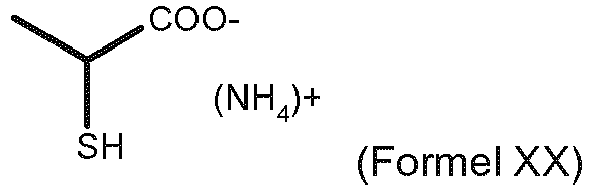
- Von der Definition Ammoniumthiolactat mit umfasst sind sowohl die Ammoniumsalze der D-Thiomilchsäure als auch die Ammoniumsalze der L-Thiomilchsäure sowie deren Gemische.
- Unter Thioglycolsäure (Sulfanylessigsäure, 2-Mercapto-essigäure) wird ein organisches Reduktionsmittel der Formel HS-CH2-COOH verstanden, die Verbindung besitzt die CAS-Nr. 68-11-1. Auch bei Thioglycolsäure ist sowohl der Einsatz von Thioglycolsäure selbst auch der Einsatz eines physiologisch verträglichen Salzes der Thioglycolsäure erfindungsgemäß. Als physiologisch verträgliche Salze der Thiolgycolsäure können beispielsweis Natriumthioglycolat, Kaliumthioglycolat und/oder Ammoniumthioglycolat eingsetzt werden. Ammoniumthioglylat ist ein bevorzugtes physiologisch vertägliches Salze der Thioglycolsäure.
- Bei Ammoniumthioglycolat handelt es sich um das Ammoniumsalz der Thiglycolsäure (d.h. das Ammoniumsalz der Sulfanylessigsäure) (Formel XXX).
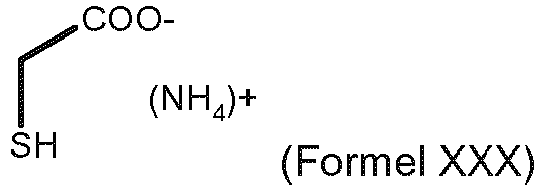
- Unter Ascorbinsäure wird erfindungsgemäß insbesondere (R)-5-[(S)-1,2-Dihydroxyethyl]-3,4-dihydroxy- 5H-furan-2-on (weitere Alterniativnamen: Vitamin C, L-Ascorbinsäure) mit der CAS-Nr. 50-81-7 verstanden.
- Als besonders gut geignet zur reduktiven Entfärbung von oxidativ gefärbten Haaren haben sich die Reduktionsmittel Natriumdithionit, Zinkdithionit, Kaliumdithionit, Natriumsulfit, Natriumhydrogensulfit, Kaliumsulfit, Kaliumhydrogensulit, Ammoniumsulfit, Natriumthiosulfat, Kaliumthiosulfat und/oder Ammoniumthiosulfat herausgestellt. Werden diese vorgenannten bevorzugten Reduktionsmittel (a) in Kombination mit den erfindungsgemäßen zwitterionischen Tensiden (b) eingesetzt, so konnte eine besonders effektive Entfärbung und eine besonders wirksame Verhinderung der Rückoxidation bei den entfärbten Haarsträhnen beobachtet werden. Auf diese Weise konnte ein Nachdunkeln der entfärbten Keratinfasern über einen besonders langen Zeitraum verhindert werden.
- Weiterhin werden das bzw. die Reduktionsmittel aus der Gruppe (a) bevorzugt in bestimmten Mengenbereichen eingesetzt. Ein entfärbender Effekt ist bereits bei kleinen Einsatzmengen zu beobachten. Um eine ausreichende und starke Entfärbewirkung zu erhalten, ist es jedoch bevozugt, wenn das Entfärbemittel das oder die Reduktionsmittel (a) in einer Gesamtmenge von 0,5 bis 20,5 Gew.-%, bevorzugt von 3,5 bis 15,5 Gew.-%, weiter bevorzugt von 6,0 bis 13,5 Gew.-% und besonders bevorzugt von 7,5 bis 11,5 Gew.-% - bezogen auf das Gesamtgewicht des Mittels - enthält.
- Bevorzugt ist daher ein Mittel zur reduktiven Entfärbung von gefärbten keratinischen Fasern, insbesondere menschlichen Haaren, enthaltend in einem wässrigen kosmetischen Träger
- (a) ein oder mehrere Reduktionsmittel aus der Gruppe Natriumdithionit, Zinkdithionit, Kaliumdithionit, Natriumsulfit, Natriumhydrogensulfit, Kaliumsulfit, Kaliumhydrogensulfit, Ammoniumsulfit, Natriumthiosulfat, Kaliumthiosulfat, Ammoniumthiosulfat, Hydroxymethansulfinsäure, Aminomethansulfinsäure, Cystein, Thiomilchsäure, Thioglycolsäure und/oder Ascorbinsäure in einer Gesamtmenge von 0,5 bis 20,5 Gew.-%, bevorzugt von 3,5 bis 15,5 Gew.-%, weiter bevorzugt von 6,0 bis 13,5 Gew.-% und besonders bevorzugt von 7,5 bis 11,5 Gew.-% - bezogen auf das Gesamtgewicht des Mittels - und
- (b) ein oder mehrere zwitterionische Tenside, die als Struktureinheiten jeweils mindestens eine quartäre Ammoniumgruppe und eine Gruppierung -SO3 - besitzen.
- Ein ganz besonders bevorzugtes Mittel zur reduktiven Entfärbung von gefärbten keratinischen Fasern ist weiterhin dadurch gekennzeichnet, dass es
- (a) ein oder mehrere Reduktionsmittel aus der Gruppe Natriumdithionit, Zinkdithionit, Kaliumdithionit, Natriumsulfit, Natriumhydrogensulfit, Kaliumsulfit, Kaliumhydrogensulfit, Ammoniumsulfit,Natriumthiosulfat, Kaliumthiosulfat und/oder Ammoniumthiosulfat in einer Gesamtmenge von 0,5 bis 20,5 Gew.-%, bevorzugt von 3,5 bis 15,5 Gew.-%, weiter bevorzugt von 6,0 bis 13,5 Gew.-% und besonders bevorzugt von 7,5 bis 11,5 Gew.-% - bezogen auf das Gesamtgewicht des Mittels - enthält.
- Weiterhin hat es sich als besonders vorteilhaft herausgestellt, wenn die erfindungsgemäßen Mittel bestimmte Kombinationen aus Reduktionsmitteln aus der Gruppe (a) enthalten, da bei bestimmten Kombinationen ein ganz besonders starker entfärbender Effekt auftritt. Besonders vorteilhaft ist in diesem Zusammenhang der Einsatz von zwei verschiedenen Reduktionsmitteln aus der Gruppe (a), wobei das Entfärbemittel
- (a1) ein erstes Reduktionsmittel enthält, das aus der Gruppe Natriumdithionit, Zinkdithionit, Kaliumdithionit, Natriumthiosulfat, Kaliumthiosulfat und/oder Ammoniumthiosulfat ausgewählt wird, und zusätzlich
- (a2) ein zweites Reduktionsmittel enthält, das aus der Gruppe Natriumsulfit, Natriumhydrogensulfit, Kaliumsulfit, Kaliumhydrogensulfit und/oder Ammoniumsulfit ausgewählt wird.
- Mit anderen Worten besonders bevorzugt sind im Rahmen dieser Ausführungsform die Mittel zur reduktiven Entfärbung von gefärbten keratinischen Fasern, insbesondere menschlichen Haaren, die in einem wässrigen kosmetischen Träger enthalten
- (a1) ein erstes Reduktionsmittel, das aus der Gruppe Natriumdithionit, Zinkdithionit, Kaliumdithionit, Natriumthiosulfat, Kaliumthiosulfat und/oder Ammoniumthiosulfat ausgewählt wird, und zusätzlich
- (a2) ein zweites Reduktionsmittel, das aus der Gruppe Natriumsulfit, Natriumhydrogensulfit, Kaliumsulfit, Kaliumhydrogensulfit und/oder Ammoniumsulfit ausgewählt wird, und
- (b) ein oder mehrere zwitterionische Tenside, die als Struktureinheiten jeweils mindestens eine quartäre Ammoniumgruppe und eine Gruppierung -SO3 - besitzen.
- Als zweiten erfindungswesentlichen Bestandteil (b) enthalten die Entfärbemittel ein oder mehrere zwitterionische Tenside, die als Struktureinheiten jeweils mindestens eine quartäre Ammoniumgruppe und mindestens eine Gruppierung -SO3 - besitzen.
- Unter Tensiden werden amphiphile (bifunktionelle) Verbindungen mit mindestens einem hydrophoben Rest und mindestens einem hydrophilen Molekülteil verstanden. Bei dem hydrophoben Molekülteil handelt es sich zumeist um eine Kohlenwasserstoffkette mit 10 bis 30 Kohlenstoff-Atomen.
- Im Fall der zwitterionischen Tenside umfasst der hydrophile Molekülteil eine zwitterionische Struktureinheit, d.h. eine Struktureinheit, die sowohl einen kationisch geladenen als auch einen anionisch geladenen Molekülteil umfasst. Erfindungsgemäße zwitterionische Tenside (b) sind dadurch gekennzeichnet, dass sie einen kationisch geladenen Molekülteil in Form einer quartären Ammoniumgruppe besitzen und ihr anionischer Molekülteil in Form einer Gruppierung -SO3 - vorliegt.
- Eine Ammoniumgruppe ist quartär, wenn eine Gruppierung des Typs (R1R2R3R4N)+ vorliegt, d.h. wenn alle vier H-Atome des NH4-Ions, von dem die quartäre Ammoniumgruppe abgeleitet ist, durch organische Reste R (bzw. R1 bis R4) ersetzt wird.
- Die Gruppierung -SO3- des zwitterionischen Tensids kann direkt an ein Kohlenstoffatom gebunden vorliegen. In diesem Fall handelt es sich bei dem anionischen Teil der zwitterionischen Verbindung um eine deprotonierte Sulfonsäuregruppierung der Formel R5R6R7C-SO3-; die Reste R5, R6, R7 stellen hierbei den restlichen Teil des erfindungsgemäßen zwitterionischen Tensids dar.
- Es ist jedoch ebenfalls auch erfindungsgemäß, wenn die Gruppierung -SO3 - über ein Sauerstoffatom an ein Kohlenstoffatom gebunden vorliegt, in diesem Fall stellt der anionische Teil des zwitterionischen Tensids einen deprotonierten Schwefelsäureester der Formel R5R6R7C-O-SO3 - dar, wobei die Reste R5, R6, R7 wieder den restlichen Teil des erfindungsgemäßen zwitterionischen Tensids darstellen.
- Erfindungsgemäß bevorzugt ist es, wenn die Gruppierung -SO3- direkt an ein Kohlenstoffatom gebunden, d.h. in Form einer deprotonierten Sulfonsäuregruppierung, vorliegt.
- Über einen besonders langen Zeitraum ließ sich eine Nachdunklung der entfärbten Keratinfasern verhindern, wenn als erfindungsgmäßes zwitterionisches Tensid (b) mindestens eine Verbindung der Formel (I) eingesetzt wurde,

- R1
- für eine lineare oder verzweigte C9-C29-Alkylgruppe, eine lineare oder verzweigte C9-C29-Alkenylgruppe oder eine lineare oder verzweigte Hydroxy-C9-C29-Alkylgruppe steht,
R2, R3 unabhängig voneinander für eine C1-C6-Alkylgruppe, eine C2-C6-Alkenylgruppe oder eine HydroxyC2-C6-alkylgruppe stehen, - n
- für eine ganze Zahl von 1 bis 6 steht,
- m
- für eine ganze Zahl von 0 bis 6 steht,
- o
- für eine ganze Zahl von 0 bis 6 steht,
- p
- für eine ganze Zahl von 0 bis 6 steht,
- In einer weiteren Ausführungsform ganz besonders bevorzugt ist daher ein Mittel zur reduktiven Entfärbung von gefärbten keratinischen Fasern, enthaltend
- (a) ein oder mehrere Reduktionsmittel aus der Gruppe Natriumdithionit, Zinkdithionit, Kaliumdithionit, Natriumsulfit, Natriumhydrogensulfit, Kaliumsulfit, Kaliumhydrogensulfit, Ammoniumsulfit, Natriumthiosulfat, Kaliumthiosulfat und/oder Ammoniumthiosulfat und
- (b) ein oder mehrere zwitterionisches Tenside der Formel (I),

- R1
- für eine lineare oder verzweigte C9-C29-Alkylgruppe, eine lineare oder verzweigte C9-C29-Alkenylgruppe oder eine lineare oder verzweigte Hydroxy-C9-C29-Alkylgruppe steht,
- R2, R3
- unabhängig voneinander für eine C1-C6-Alkylgruppe, eine C2-C6-Alkenylgruppe oder eine Hydroxy-C2-C6-alkylgruppe stehen,
- n
- für eine ganze Zahl von 1 bis 6 steht,
- m
- für eine ganze Zahl von 0 bis 6 steht,
- o
- für eine ganze Zahl von 0 bis 6 steht,
- p
- für eine ganze Zahl von 0 bis 6 steht,
- Der Einsatz der erfindungsgemäßen zwitterionischen Tenside (b) verhindert die Nachdunklung der entfärbten Strähnen und sorgt auf diese Weise für einen lang anhaltenden Entfärbeeffekt. Von besonderem Vorteil ist hierbei der Einsatz der Tenside in bestimmten Mengenbereichen. Besonders bevorzugt ist es, wann das oder die zwitterionischenTenside (b) im erfindungsgemäßen Entfärbemittel in einer Gesamtmenge von von 0,1 bis 15,0 Gew.-%, bevorzugt von 0,5 bis 12,0 Gew.-%, weiter bevorzugt von 1,0 bis 9,0 Gew.-% und besonders bevorzugt von 2,0 bis 6,0 Gew.-% - bezogen auf das Gesamtgewicht des Mittels - eingesetzt werden.
- In einer weiteren ganz besonders bevorzugten Ausführungsform ist ein erfindungsgmäßes Entfärbemittel daher dadurch gekennzeichnet, dass es als zwitterionisches Tensid (b) ein oder mehrere Tenside der Formel (I) in einer Gesamtmenge von 0,1 bis 15,0 Gew.-%, bevorzugt von 0,5 bis 12,0 Gew.-%, weiter bevorzugt von 1,0 bis 9,0 Gew.-% und besonders bevorzugt von 2,0 bis 6,0 Gew.-% - bezogen auf das Gesamtgewicht des Mittels - enthält,

- R1
- für eine lineare oder verzweigte C9-C29-Alkylgruppe, eine lineare oder verzweigte C9-C29-Alkenylgruppe oder eine lineare oder verzweigte Hydroxy-C9-C29-Alkylgruppe steht,
R2, R3 unabhängig voneinander für eine C1-C6-Alkylgruppe, eine C2-C6-Alkenylgruppe oder eine HydroxyC2-C6-alkylgruppe stehen, - n
- für eine ganze Zahl von 1 bis 6 steht,
- m
- für eine ganze Zahl von 0 bis 6 steht,
- o
- für eine ganze Zahl von 0 bis 6 steht,
- p
- für eine ganze Zahl von 0 bis 6 steht,
- Insbesondere bevorzugt ist der Einsatz von zwitterionischen Tensiden der Formel (I), bei welchen der Rest R1 für eine lineare C11-Alkylgruppe, eine lineare C13-Alkylgruppe, eine lineare C15-Alkylgruppe, eine lineare C17-Alkylgruppe oder eine lineare C19-Alkylgruppe, eine lineare, einfach ungesättigte C11-Alkenylgruppe, eine lineare, einfach ungesättigte C13-Alkenylgruppe, eine lineare, einfach ungesättigte C17-Alkenylgruppe oder eine lineare, einfach ungesättigte C19-Alkenylgruppe steht.
- Weiterhin ist es ganz besonders bevorzugt, wenn n für die Zahl 3 steht.
- Die Reste R2 und R3 stehen bevorzugt unabhängig voneinander für eine C1-C6-Alkylgruppe, besonders bevorzugt stehen R2 und R3 für eine Methylgruppe.
- m steht ganz besonders bevorzugt für die Zahlen 1 oder 2.
- o steht ganz besonders bevorzugt für die Zahl 1.
- p steht ganz besonders bevorzugt für die Zahlen 1 oder 2.
- In einer weiteren ganz besonders bevorzugten Ausführungsform ist ein erfindungsgemäßes Entfärbemittel deshalb dadurch gekennzeichnet, dass es als zwitterionisches Tensid (b) ein oder mehrere Tenside der Formel (I) in einer Gesamtmenge von 0,1 bis 15,0 Gew.-%, bevorzugt von 0,5 bis 12,0 Gew.-%, weiter bevorzugt von 1,0 bis 9,0 Gew.-% und besonders bevorzugt von 2,0 bis 6,0 Gew.-% - bezogen auf das Gesamtgewicht des Mittels - enthält,

- R1
- für eine lineare C11-Alkylgruppe, eine lineare C13-Alkylgruppe, eine lineare C15-Alkylgruppe, eine lineare C17-Alkylgruppe, eine lineare C19-Alkylgruppe, eine lineare, einfach ungesättigte C11-Alkenylgruppe, eine lineare, einfach ungesättigte C13-Alkenylgruppe, eine lineare, einfach ungesättigte C17-Alkenylgruppe oder eine lineare, einfach ungesättigte C19-Alkenylgruppe steht,
- R2, R3
- beide für eine Methylgruppe stehen,
- n
- für eine ganze Zahl von 1 bis 3 steht,
- m
- für die Zahl 1 oder 2 steht
- o
- für die Zahl 1 steht und
- p
- für die Zahl 1 oder 2 steht.
- Die zwitterionischen Tenside dieses ganz besonders bevorzugten Typs sind auch unter dem Namen "Amidopropylhydroxysultaine" bekannt:
Laurylamidpropylhydroxysultain ist ein zwitterionischesTensid der Formel (I), wobei R1 für C11-Alkyl, R2 für Methyl, R3 für Methyl, n für 3, m für 1, o für 1 und p für 1 steht. - Cocamidopropylhydroxysultain stellt ein Gemisch von Verbindungen der Formel (I) dar, bei denen R1 steht für C11-Alkyl bis C17-Alkyl, R2 für Methyl, R3 für Methyl, n für 3, m für 1, o für 1 und p für 1.
- Oleamidopropylhydroxysultain ist ein zwitterionisches Tensid der Formel (I), wobei R1 für eine einfach ungesättigte C17-Alkenylgruppe steht (die Doppelbindung liegt zwischen den Atomen 8 und 9 des R1-Restes), R2 für Methyl, R3 für Methyl, n für 3, m für 1, o für 1 und p für 1 steht.
- Explizit ganz besonders bevorzugt wird Cocamidopropyl Hydroxysultain eingesetzt, wie es beispielsweise unter dem Handelsnamen Mirataine CBS von der Firma Rhodia käuflich erhältlich ist. Ganz besonders bevorzugt wird erfindungsgemäß demnach ein Gemisch von zwitterionische Tensiden (b) der Formel (I) eingesetzt, bei denen R1 steht für C11-Alkyl bis C17-Alkyl, R2 für Methyl, R3 für Methyl, n für 3, m für 1, o für 1 und p für 1.
- Das oder die zwitterionischen Tenside (b) werden zusammen mit dem Reduktionsmittel (a) in einem wässrigen kosmetischen Träger eingesetzt und bilden so das erfindungsgemäße Entfärbemittel. Dieses Entfärbemittel kann durch Zusatz von Säuren und Basen auf verschiedene pH-Werte eingestellt werden. Die Gruppierung -SO3- der Tenside (b) kann in dem wässrigen kosmetischen Träger bei Veränderung des pH-Wertes in einer Gleichgewichtsreaktion auch teilweise protoniert werden. Auch diese durch die Gleichgewichtsreaktion protonierten Formen der zwitterinionischen Tenside sind von dieser Erfindung mit umfasst. Alle angegebenen Mengenangaben beziehen sich auf die Gesamtmenge der zwitterionischen Tenside, die in ihrer zwitterionischen Form dem wässrigen Träger hinzugefügt werden.
- Das bzw. die Reduktionsmittel (a) und das bzw. die zwitterionischen Tenside (b) bewirken zusammen eine effektive, lang anhaltende Entfärbung von gefärbten Keratinfasern. Hierbei bewirkt der Zusatz der speziellen zwitterionischen Tenside mit -SO3- Gruppierung, dass nach Abschluss des Entfärbevorgangs unter dem Einfluss von Luftsauerstoff keine Rückoxidation stattfindet. Auf diese Weise kann ein Nachdunkeln und damit eine spätere Abschwächung des Entfärbeergebnisses verhindert werden. Da der gesamte Entfärbeprozess somit eine Wechselwirkung der Reduktionsmittel (a) und der zwitterionischen Tenside (b) erfordert, werden die Wirkstoffe beider Kategorien (a) und (b) in bestimmten Verhältnisssen zueinander eingesetzt.
- Es hat sich herausgestellt, dass die Nachdunklung besonders effektiv verhindert werden kann, wenn die Reduktionsmittel (a) im Vergleich zu den zwitterionischen Tensiden (b) mindestens in gleicher Gesamtmenge, bevorzugt jedoch in einem Überschuß eingesetzt werden. Die Gesamtmenge der Reduktionsmittel (a) wird um den Faktor 2,6 und besonders bevorzugt um den Faktor 3,2 höher als die Gesamtmenge der zwitterionischen Tenside (b) gewählt.
- Die Entfärbemittel sind daher dadurch gekennzeichnet, dass das Gewichtsverhältnis aus der Gesamtmenge aller im Mittel enthaltenen Reduktionsmittel aus der Gruppe (a) zu der Gesamtmenge aller im Mittel enthaltenen zwitterionischen Tenside aus der Gruppe (b), d.h. das Gewichtsverhältnis (a)/(b), bei einem Wert von mindestens 2,6 und besonders bevorzugt von mindestens 3,2 liegt.
- 100 g Entfärbemittel enthalten 8,0 g Natriumdithionit (Gesamtmenge aller Reduktionsmittel (a)). Bei Einsatz von 8,0 g Cocamidopropylhydroxysultain (Aktivsubstanz) liegt das Gewichttsverhältnis (a)/(b) bei einem Wert von 1,0. Bei Einsatz von 4,4 g Cocamidopropylhydroxysultain liegt das Gewichtsverhältnis (a)/(b) bei einem Wert von ca. 1,8. Bei Einsatz von 3,1 g Cocamidopropylhydroxysultain liegt das Gewichtsverhältnis (a)/(b) bei einem Wert ca. 2,6. Bei Einsatz von 2,5 g Cocamidopropylhydroxysultain liegt das Gewichtsverähltnis (a)/(b) bei einem Wert ca. 3.2.
- Auch wenn sich der Einsatz eines Gewichtsüberschusses an Reduktionsmittel (a) als vorteilhaft herausgestellt hat, so sollte die Einsatzmenge an zwitterionischen Tensiden (b) auch nicht zu klein gewählt werden, damit die Nachdunklung der entfärbten Strähnen in ausreichendem Maß inhibiert werden kann. Weiterhin erfindungsgemäß ist es daher, dass die Gesamtmenge der im Mittel enthaltenen Reduktionsmittel (a) die Gesamtmenge der zwitterionischen Tenside (b) höchstens um den Faktor 7,0, bevorzugt höchstens um den Faktor 6,2 weiter bevorzugt höchstens um den Faktor 5,6 und besonders bevorzugt höchstens um den Faktor 4,8 übersteigt.
- Die Entfärbemittel sind daher dadurch gekennzeichnet, dass das Gewichtsverhältnis aus der Gesamtmenge aller im Mittel enthaltenen Reduktionsmittel aus der Gruppe (a) zu der Gesamtmenge aller im Mittel enthaltenen zwitterionischen Tenside aus der Gruppe (b), d.h. das Gewichtsverhältnis (a)/(b), bei einem Wert von höchstens 7,0, bevorzugt von höchstens 6,2, weiter bevorzugt von höchstens 5,6 und besonders bevorzugt von höchstens 4,8 liegt.
- 100 g Entfärbemittel enthalten 8,0 g Natriumditionit (Gesamtmenge aller Reduktionsmittel (a)).
- Bei Einsatz von 1,14 g Cocamidopropylhydroxysultain liegt das Gewichttsverhältnis (a)/(b) bei einem Wert von ca. 7,0. Bei Einsatz von 1,29 g Cocamidopropylhydroxysultain liegt das Gewichtsverhältnis (a)/(b) bei einem Wert von ca. 6,2. Bei Einsatz von 1,42 g Cocamidopropylhydroxysultain liegt das Gewichtsverhältnis (a)/(b) bei einem Wert ca. 5,6. Bei Einsatz von 1,66 g Cocamidopropylhydroxysultain liegt das Gewichtsverähltnis (a)/(b) bei einem Wert ca. 4,8.
- Zusammenfassend ist es am allermeisten bevorzugt, wenn das Gewichtsverhältnis aus der Gesamtmenge aller im Mittel enthaltenen Reduktionsmittel aus der Gruppe (a) zu der Gesamtmenge aller im Mittel enthaltenen zwitterionischen Tenside aus der Gruppe (b), d.h. das Gewichtsverhältnis (a)/(b), bei einem Wert von 3,2 bis 4,8 liegt.
- Es hat sich herausgestellt, dass der Einsatz von Polyolen die Entfärbewirkung weiter unterstützt. Aus diesem Grund ist es bevorugt, wenn die erfindungsgemäßen Entärbemittel zusätzlich ein odere mehrere Polyole enthalten.
- Unter einem Polyol wird eine Verbindung mit mindestens zwei aliphatischen (d.h. nicht phenolischen) OH-Gruppen verstanden.
- Beispiele für geeignete erfindungsgemäße Polyole sind insbesondere Ethylengylcol, 1,2-Propylenglycol, 1,3-Propandiol, 1,2-Butandiol, 1,3-Butandiol, 1,2-Pentandiol, 1,3-Pentandiol, 1,4-Pentandiol, 1,5-Pentandiol, 1,2-Hexandiol, 1,3-hexandiol, 1,4-Hexandiol, 1,5-Hexandiol und 1,6-Hexandiol. Geeignet sind aber auch Polyethylenglycol und Polypropylenglycol.
- In einer weiteren bevorzugten Ausführungsform ist ein erfindungsgemäßes Entfärbemittel daher dadurch gekennzeichnet, dass es zusätzlich ein oder mehrere Polyole aus der Gruppe Ethylengylcol (1,2-Ethandiol), 1,2-Propandiol, 1,3-Propandiol, 1,2-Butandiol, 1,3-Butandiol, 1,4-Butandiol, 1,2-Pentantiol, 1,3-Pentantiol, 1,4-Pentantiol, 1,5-Pentantiol, 1,2-Hexandiol, 1,3-Hexandiol, 1,4-Hexantiol, 1,5-Hexandiol, 1,6-Hexandiol, Polyethylenglycol und/oder Polypropylenglycol enthält.
- Die Polyole werden in den erfindungsgemäßen Mitteln bevorzugt in einer Gesamtmenge von 0,5 bis 15,0 Gew.-%, bevorzugt von 2,5 bis 13,5 Gew.-%, weiter bevorzugt von 3,5 bis 11,5 Gew.-% und besonders bevorzugt von 4,5 bis 9,5 Gew.-% - bezogen auf das Gesamtgewicht des Mittels - eingesetzt.
- In einer weiteren bevorzugten Ausführungsform ist ein erfindungsgemäßes Entfärbemittel daher dadurch gekennzeichnet, dass es zusätzlich ein oder mehrere Polyole in einer Gesamtmenge von 0,5 bis 15,0 Gew.-%, bevorzugt von 2,5 bis 13,5 Gew.-%, weiter bevorzugt von 3,5 bis 11,5 Gew.-% und besonders bevorzugt von 4,5 bis 9,5 Gew.-% - bezogen auf das Gesamtgewicht des Mittels - enthält.
- Die erfindungsgemäßen Entfärbemittel können neben den erfindungswesentlichen zwitterionischen Tensiden (b) auch noch weitere Tenside enthalten, wie beispielsweise nichtionische, ampholytische und/oder kationische Tenside. Bevorzugt ist es jedoch, wenn die Entfärbemittel keine anionischen Tenside enthalten.
- In einer weiteren bevorzugten Ausführungsform ist ein erfindungsgemäßes Entfärbemittel daher dadurch gekennzeichnet, dass die Gesamtmenge aller im Mittel enthaltenen anionischen Tenside bei einem Wert von maximal 0,5 Gew.-%, bevorzugt von maximal 0,3 Gew.-%, weiter bevorzugt von maximal 0,1 Gew.-% und besonders bevorzugt von maximal 0,05 Gew.-% - bezogen auf das Gesamtgewicht des Mittels - liegt.
- Unter anionischen Tensiden im Sinne dieser Erfindung werden Tenside mit ausschließlich anionischer Ladung verstanden.
- Demnach ist es bevorzugt, wenn die Gesamtmenge aller im Mittel enthaltenen anionischen Tenside aus der Gruppe der
- linearen Fettsäuren mit 10 bis 22 C-Atomen (Seifen),
- Ethercarbonsäuren der Formel R-O-(CH2-CH2O)x-CH2-COOH, in der R eine lineare Alkylgruppe mit 10 bis 22 C-Atomen und x = 0 oder 1 bis 16 ist,
- Acylsarcosiden mit 10 bis 18 C-Atomen in der Acylgruppe,
- Acyltauriden mit 10 bis 18 C-Atomen in der Acylgruppe,
- Acylisethionaten mit 10 bis 18 C-Atomen in der Acylgruppe,
- Sulfobernsteinsäuremono- und -dialkylestern mit 8 bis 18 C-Atomen in der Alkylgruppe und Sulfobernsteinsäuremono-alkylpolyoxyethylestern mit 8 bis 18 C-Atomen in der Alkylgruppe und 1 bis 6 Oxyethylgruppen,
- linearen Alkansulfonaten mit 12 bis 18 C-Atomen,
- linearen Alpha-Olefinsulfonaten mit 12 bis 18 C-Atomen,
- Alpha-Sulfofettsäuremethylestern von Fettsäuren mit 12 bis 18 C-Atomen, und der
- Alkylsulfaten und Alkylpolyglykolethersulfaten der Formel R-O(CH2-CH2O)x-SO3H, in der R eine bevorzugt lineare Alkylgruppe mit 10 bis 18 C-Atomen und x = 0 oder 1 bis 12 ist,
- Unter nichtionischen Tensiden werden amphiphile (bifunktionelle) Verbindungen mit mindestens einem hydrophoben Rest und mindestens einem hydrophilen Molekülteil verstanden. Bei dem hydrophoben Molekülteil handelt es sich zumeist um eine Kohlenwasserstoffkette mit 10 bis 30 Kohlenstoff-Atomen. Als hydrophile Gruppe tragen die nichtionischen Tenside beispielsweise eine Polyolgruppe, eine Polyalkylenglykolethergruppe oder eine Kombination aus Polyol- und Polyglykolethergruppe. Solche Verbindungen sind beispielsweise Anlagerungsprodukte von 2 bis 30 Mol Ethylenoxid und/oder 0 bis 5 Mol Propylenoxid an lineare Fettalkohole mit 8 bis 22 C-Atomen, an Fettsäuren mit 12 bis 22 C-Atomen und an Alkylphenole mit 8 bis 15 C-Atomen in derAlkylgruppe, C12-C22-Fettsäuremono- und -diester von Anlagerungsprodukten von 1 bis 30 Mol Ethylenoxid an Glycerin, C8-C22-Alkylmono- und -oligoglycoside und deren ethoxylierte Analoga sowie Anlagerungsprodukte von 5 bis 60 Mol Ethylenoxid an Rizinusöl und gehärtetes Rizinusöl. Bevorzugte nichtionische Tenside sind Alkylpolyglykoside.
- Die zusätzlich einsetzbaren nichtionischen Tenside können in den erfindungsgemäßen Entfärbemitteln in einer Gesamtmenge von 0,1 bis 15,0 Gew.-%, bevorzugt von 2,5 bis 13,5 Gew.-%, weiter bevorzugt von 3,5 bis 11,5 Gew.-% und besonders bevorzugt von 4,5 bis 9,5 Gew.-% - bezogen auf das Gesamtgewicht des Mittels - eingesetzt werden.
- Erfindungsgemäß werden als kationische Tenside insbesondere solche vom Typ der quartären Ammoniumverbindungen, der Esterquats und der Amidoamine eingesetzt. Bevorzugte quaternäre Ammoniumverbindungen sind Ammoniumhalogenide, insbesondere Chloride und Bromide, wie Alkyltrimethylammoniumchloride, Dialkyldimethylammoniumchloride und Trialkylmethylammoniumchloride, z. B. Cetyltrimethylammoniumchlorid, Stearyltrimethylammoniumchlorid, Distearyldimethylammoniumchlorid, Lauryldimethylammoniumchlorid, Lauryldimethylbenzylammoniumchlorid und Tricetylmethylammoniumchlorid, sowie die unter den INCI-Bezeichnungen Quaternium-27 und Quaternium-83 bekannten Imidazolium-Verbindungen. Die langen Alkylketten der oben genannten Tenside weisen bevorzugt 10 bis 18 Kohlenstoffatome auf. Bei Esterquats handelt es sich um bekannte Stoffe, die sowohl mindestens eine Esterfunktion als auch mindestens eine quartäre Ammoniumgruppe als Strukturelement enthalten. Bevorzugte Esterquats sind quaternierte Estersalze von Fettsäuren mit Triethanolamin, quaternierte Estersalze von Fettsäuren mit Diethanolalkylaminen und quaternierten Estersalze von Fettsäuren mit 1,2-Dihydroxypropyldialkylaminen. Die Alkylamidoamine werden üblicherweise durch Amidierung natürlicher oder synthetischer Fettsäuren und Fettsäureschnitte mit Dialkylaminoaminen hergestellt. Eine erfindungsgemäß besonders geeignete Verbindung aus dieser Substanzgruppe stellt das unter der Bezeichnung Tegoamid® S 18 im Handel erhältliche Stearamidopropyldimethylamin dar.
- Weitere erfindungsgemäß verwendbare kationische Tenside stellen die quaternisierten Proteinhydrolysate dar.
- Die zusätzlich einsetzbaren kationischen Tenside können in den erifndungsgemäßen Entfärbemitteln in einer Gesamtmenge von 0,1 bis 15,0 Gew.-%, bevorzugt von 2,5 bis 13,5 Gew.-%, weiter bevorzugt von 3,5 bis 11,5 Gew.-% und besonders bevorzugt von 4,5 bis 9,5 Gew.-% - bezogen auf das Gesamtgewicht des Mittels - eingesetzt werden.
- Bei den erfindungsgemäßen Mitteln handelt es sich um Entfärbemittel, die zur Entfärbung von zuvor gefärbten keratinischen Fasern, insbesondere menschlichen Haaren eingesetzt werden. Bei den gefärbten Keratinfasern handelt es sich üblicherweise um Fasern, die zuvor mit herkömmlichen, dem Fachmann bekannten Oxidationsfarbstoffen und/oder direktziehenden Farbstoffen gefärbt wurden. Die Entfärbemittel sind geeignet zur Entfernung von Färbungen, die mit Oxidationsfarbstoffen auf Basis von Entwickler- und Kupplerkomonenten auf den Keratinfasern erzeugt wurden. Wenn als Entwickler die folgenden Verbindungen einsetzt wurden, lassen sich die hiermit erzeugten Färbungen durch Einsatz des Entfärbemittel gut, effektiv und nahezu ohne spätere Nachdunklung entfernen: p-Phenylendiamin, p-ToluylendiaminN,N-Bis-(β-hydroxyethyl)-p-phenylendiamin, 4-N,N-Bis-(β-hydroxyethyl)-amino-2-methylanilin, 2-(β-Hydroxyethyl)-p-phenylendiamin, 2-(α,β-Dihydroxyethyl)-p-phenylendiamin, 2-Hydroxymethyl-p-phenylendiamin, Bis-(2-hydroxy-5-aminophenyl)-methan, p-Aminophenol, 4-Amino-3-methylphenol, 2,4,5,6-Tetraaminopyrimidin, 4-Hydroxy-2,5,6-triaminopyrimidin, 2-Hydroxy-4,5,6-triaminopyrimidin und/oder 4,5-Diamino-1-(β-hydroxyethyl)-pyrazol.
- Wenn als Kuppler die folgenden Verbindungen einsetzt wurden, lassen sich die hiermit erzeugten Färbungen ebenfalls mit sehr gutem Entfärbeergebnis entfernen: m-Phenylendiaminderivate, Naphthole, Resorcin und Resorcinderivate, Pyrazolone und m-Aminophenolderivate verwendet. Als Kupplersubstanzen eignen sich insbesondere 1-Naphthol, 1,5-, 2,7- und 1,7-Dihydroxynaphthalin, 5-Amino-2-methylphenol, m-Aminophenol, Resorcin, Resorcinmonomethylether, m-Phenylendiamin, 1-Phenyl-3-methyl-pyrazolon-5, 2,4-Dichlor-3-aminophenol, 1,3-Bis-(2',4'-diaminophenoxy)-propan, 2-Chlor-resorcin, 4-Chlor-resorcin, 2-Chlor-6-methyl-3-aminophenol, 2-Amino-3-hydroxypyridin, 2-Methylresorcin, 5-Methylresorcin und 2-Methyl-4-chlor-5-aminophenol.
- 1-Naphthol, 1,5-Dihydroxynaphthalin, 2,7-Dihydroxynaphthalin, 1,7-Dihydroxynaphthalin, 3-Aminophenol, 5-Amino-2-methylphenol, 2-Amino-3-hydroxypyridin, Resorcin, 4-Chlorresorcin, 2-Chlor-6-methyl-3-aminophenol, 2-Methylresorcin, 5-Methylresorcin, 2,5-Dimethylresorcin und 2,6-Dihydroxy-3,4-dimethylpyridin.
- Das zu entfärbende Substrat kann ebenso mit direktziehenden Farbstoffen eingefärbt worden sein. Als direktziehende Farbstoffe kommen dabei insbesondere Nitrophenylendiamine, Nitroaminophenole, Azofarbstoffe, Anthrachinone oder Indophenole in Frage. Bevorzugte direktziehende Farbstoffe sind die unter den internationalen Bezeichnungen bzw. Handelsnamen HC Yellow 2, HC Yellow 4, HC Yellow 5, HC Yellow 6, HC Yellow 12, Acid Yellow 1, Acid Yellow 10, Acid Yellow 23, Acid Yellow 36, HC Orange 1, Disperse Orange 3, Acid Orange 7, HC Red 1, HC Red 3, HC Red 10, HC Red 11, HC Red 13, Acid Red 33, Acid Red 52, HC Red BN, Pigment Red 57:1, HC Blue 2, HC Blue 12, Disperse Blue 3, Acid Blue 7, Acid Green 50, HC Violet 1, Disperse Violet 1, Disperse Violet 4, Acid Violet 43, Disperse Black 9, Acid Black 1, und Acid Black 52 bekannten Verbindungen sowie 1,4-Diamino-2-nitrobenzol, 2-Amino-4-nitrophenol, 1,4-Bis-(β-hydroxyethyl)-amino-2-nitrobenzol, 3-Nitro-4-(β-hydroxyethyl)-aminophenol, 2-(2'-Hydroxyethyl)amino-4,6-dinitrophenol, 1-(2'-Hydroxyethyl)amino-4-methyl-2-nitrobenzol, 1-Amino-4-(2'-hydroxyethyl)-amino-5-chlor-2-nitrobenzol, 4-Amino-3-nitrophenol, 1-(2'-Ureidoethyl)amino-4-nitrobenzol, 4-Amino-2-nitrodiphenylamin-2'-carbonsäure, 6-Nitro-1,2,3,4-tetrahydrochinoxalin, 2-Hydroxy-1,4-naphthochinon, Pikraminsäure und deren Salze, 2-Amino-6-chloro-4-nitrophenol, 4-Ethylamino-3-nitrobenzoesäure und 2-Chloro-6-ethylamino-1-hydroxy-4-nitrobenzol.
- Weiterhin können die zu entfärbenden Substrate auch mit in der Natur vorkommenden, natürlichen Farbstoffen, wie sie beispielsweise in Henna rot, Henna neutral, Henna schwarz, Kamillenblüte, Sandelholz, schwarzen Tee, Faulbaumrinde, Salbei, Blauholz, Krappwurzel, Catechu, Sedre und Alkannawurzel enthalten sind, gefärbt sein.
- Die erfindungsgmäßen Entfärbemittel sind zur Entfernung dieser Färbungen gedacht und enhalten selbst daher bevorzugt keine Farbstoffe, d.h. keine Oxidationsfarbstoffvorprodukte vom Entwicklertyp und vom Kupplertyp und auch keine direktziehenden Farbstoffe.
- Ein erfindungsgemäßes Entfärbemittel ist daher dadurch gekennzeichnet, dass die Gesamtmenge aller im Mittel enthaltenen direktziehenden Farbstoffe und Oxidationsfarbstoffvorprodukte bei einem Wert von maximal 0,2 Gew.-%, bevorzugt von maximal 0,1 Gew.-%, weiter bevorzugt von maximal 0,05 Gew.-% und besonders bevorzugt von maximal 0,01 Gew.-% - bezogen auf das Gesamtgewicht des Mittels - liegt.
- Bei dem zuvor beschriebenen Entfärbemitteln handelt es sich um Mittel, welche die erfindungswesentlichen Komponenten (a) und (b) in einem wässrigen kosmetischen Träger enthalten. Der pH-Wert der Entfärbemittel kann prinzipiell auf Werte zwischen 2 bis 12 eingestellt werden. Aus Stabilitätsgründen und zum Zwecke der Lagerung ist es jedoch von Vorteil, wenn das Mittel einen alkalischen pH-Wert besitzt. Bevorzugt wird das Mittel daher auf einen pH-Wert von 7 bis 12, weiter bevorzugt von 7,5 bis 11,5 noch weiter bevorzugt von 8,0 bis 11,0 und ganz besonders bevorzugt von 8,5 bis 10,5 eingestellt.
- Die pH-Werte wurden mit einer Glaselektrode des Typs N 61 der Firma Schott bei einer Temperatur von 22 °C gemessen.
- In einer weiteren bevorzugten Ausführungsform ist ein erfindungsgemäßes Entfärbemittel daher dadurch gekennzeichnet, dass es einen pH-Wert von 7,0 bis 12,0, bevorzugt von 7,5 bis 11,5, weiter bevorzugt von 8,0 bis 11,0 und ganz besonders bevorzugt von 8,5 bis 10,5 (gemessen mit einer Glaselektrode des Typs N61 der Firma Schott bei einer Temperatur von 22 °C) besitzt.
- Die erfindungsgemäßen Entfärbemittel werden durch Einsatz eines oder mehrere Alkalisierungsmittel aus der Gruppe Natriumhydroxid, Kaliumhydroxid, Ammoniak, Monoethanolamin und/oder Arginin auf einen alkalischen pH-Wert gebracht. Ganz besonders bevorzugt werden aus dieser Gruppe Natriumhydroxid und/oder Kaliumhydroxid ausgewählt.
- Ein erfindungsgemäßes Entfärbemittel ist daher dadurch gekennzeichnet, dass es zusätzlich ein oder mehrere Alkalisierungsmittel ausgewählt aus der Gruppe Natriumhydroxid, Kaliumhydroxid, Ammoniak, Monoethanolamin und/oder Arginin, besonders bevorzugt ausgewählt aus der Gruppe Natriumhydroxid und/oder Kaliumhydroxid, enthält.
- Abhängig von den zuvor für die Färbung verwendeten Farbstoffen und abhängig vom Zustand, dem Schädigungsgrad und der Dicke der Haare kann der Entfärbeprozess bei unterschiedlichen Personen unterschiedlich lange dauern. Auch wenn der Entfärbeprozess generell innerhalb der üblichen Anwendungszeiten von bis zu 60 Minuten abgeschlossen sein sollte, ist es für den Anwender des Entfärbemittels doch um ein vielfaches komfortabler, den Entfärbevorgang direkt zu beobachten und das Entfärbemittel direkt nach Abschluss der Entfärbung - gegebenenfalls bereits nach 20 oder 30 Minuten - abspülen zu können.
- Die direkte Beobachtung des Entfärbeprozesses wird für den Anwender oder Friseur möglich, wenn das Entfärbemittel in Form eines transparenten Gels konfektioniert wird.
- In einer weiteren bevorzugten Ausführungsform ist ein erfindungsgemäßes Entfärbemittel daher dadurch gekennzeichnet, dass es sich um eine klare, fließfähige Gelformulierung mit einem Transmissionsgrad T von mindestens 70 %, bevorzugt von mindestens 75 %, weiter bevorzugt von mindestens 80 % und besonders bevorzugt mindestens 85 % handelt, wobei sich der Transmissionsgrad T über die folgende Formel berechnet

- φex gleich der Strahlungsintensität des aus dem Mittel austretenden, durchgelassenen Lichtstrahls und
- φin gleich der Strahlungsintensität des in das Mittel einfallenden Lichtstrahls.
- Unter Gelen werden Systeme verstanden, die aus einem festen, kolloidisch verteilten Stoff, bei dem es sich um ein Verdickungsmittel bzw. einem Geliermittel handelt, und einer Flüssigkeit (Wasser oder Wasser-Lösungsmittel-Gemische) verstanden. Hierbei bildet das Verdickungs- bzw. Geliermittel in der Flüssigkeit ein räumliches Netwerk.
- Die Gele im Sinne der vorliegenden Erfindung sind fließfähig, was bedeutet, dass sie bevorzugt eine Viskosität von 1.000 mPas bis 15.000 mPas, besonders bevorzugt von 3.000 mPas bis 8.000 mPas (bei Messungen mit einem Rotationsviskosimeter von Brookfield, Spindelgröße 4, bei 25°C und 20 Upm) besitzen.
- Die Transmission beschreibt die Durchlässigkeit des Gels für das Messlicht (bevorzugt Tageslicht), und wird als Transmissionsgrad T ausgedrückt. Der Transmissionsgrad stellt einen Verhältniswert T = Φex/Φin dar, wobei die Strahlungsintensität des aus dem Mittel austretenden, durchgelassenen Lichtstrahls (Φex) zur Strahlungsintensität des in das Mittel einfallenden Lichtstrahls (Φin) ins Verhältnis gesetzt wird. Die Messung erfolgt mit Tageslicht (Tageslichtlampe) bei einer Schichtdicke von 1 cm (d.h. das zu vermessende Gel wird in eine Küvette eingefüllt, so dass das Gel in einer Schichtdicke von 1 cm vorliegt und wird dann mit einem handelsüblichen Photometer vermessen). Bei einem Transmissionsgrad von mindestens 70%, bevorzugt von mindestens 75 %, weiter bevorzugt von mindestens 80 % und besonders bevorzugt mindestens 85 % ist das Gel so transparent, dass der Konsument den Entfärbeprozess des Haares direkt durch das transparente, auf das Haar aufgetragene Gel hindurch beobachten kann. Auf diese Weise kann er die Beendigung des Entfärbeprozesses direkt optisch wahrnehmen, ohne des Entfärbemittel von einer Probesträhne des behandelten Haares abspülen zu müssen.
- Als Geliermittel bzw. Verdickungsmittel zur Herstellung des transparenten Gels können beispielsweise Agar-Agar, Carrageen, Alginate, Xanthan-Gum, Karaya-Gummi, Ghatti-Gummi, Tragant, Skleroglucangums oder Gummi arabicum, Alginate, Pektine, Polyosen, Guar-Gums, Johannisbrotbaumkernmehl, Leinsamengummen, Dextrane, Pektine, Staerke-Fraktionen und Derivate wie Amylose, Amylopektin und Dextrine, Gelatine und Casein sowie Cellulosederivate, wie beispielsweise Methylcellulose, Carboxyalkylcellulosen wie Carboxymethylcellulose und Hydroxyalkylcellulosen wie Hydroxyethylcellulose eingsetzt werden.
- Bei Einsatz von Xanthan können die Entfärbungsmittel in Form von fließfähigen Gelen konfektioniert werden, deren Viskosität im Hinblick auf den Anwendungsprozess optimiert ist und die besonders gut eine direkte visuelle Beurteilung des Entfärbevorgangs ermöglichen. Aus diesem Grund ist der Einsatz von Xanthanals Verdickungsmittel besonders bevorzugt.
- In einer weiteren bevorzugten Ausführungsform ist ein erfindungsgemäßes Entfärbemittel daher dadurch gekennzeichnet, dass es zusätzlich als Verdickungsmittel Xanthan enthält.
- Wie zuvor beschrieben wird das Entfärbemittel zum Zwecke der Lagerung bevorzugt auf einen alkalischen pH-Wert eingestellt, da es bei alkalischen pH-Werten eine bessere Stabiltität besitzt. Die Entfärbewirkung der Kombination aus Reduktionsmittel (a) und zwitterionischem Tensid (b) ist jedoch eine Funktion des pH-Wertes, die ihr Optimium im sauren Milieu durchläuft. Aus diesem Grund ist es von Vorteil, das erfindungsgemäße Mittel kurz vor der Anwendung auf einen sauren pH-Wert zu bringen, der bevorzugt im Bereich von 4 bis 6 liegt. Kurz vor der Anwendung sollte der pH-Wert des zuvor alkalisch eingestellten Mittels daher abgesenkt werden.
- Die Ansäuerung des zuvor alkalisch eingestellten Entfärbemittels kurz vor der Anwendung kann durch Vermischen von zwei verschiedenen Mitteln realisiert werden, wobei das zuvor beschriebene alkalisch eingestellte erste Mittel mit einem weiteren Mittel vermischt wird, welches eine oder mehrere Säuren enthält.
- Als Säuren können beispielsweise eine oder mehrere Säuren aus der Gruppe Zitronensäure, Weinsäure, Äpfelsäure, Milchsäure, Essigsäure, Schwefelsäure, Salzsäure, Phosphorsäure, Methansulfonsäure, Benzoesäure Malonsäure, Oxalsäure und/oder 1-Hydroxyethan-1,1-diphosphonsäure verwendet werden.
- Ein zweiter Gegenstand der vorliegenden Erfindung ist eine Mehrkomponentenverpackungseinheit (Kit-of-parts) zur reduktiven Entfärbung von gefärbten keratinischen Fasern, welche getrennt voneinander konfektioniert
- (I) in einem Container (I) ein Mittel (A) und
- (II) in einem Container (II) ein Mittel (B) umfasst, wobei
- das Mittel (A) in Container (I) ein Mittel des ersten Erfindungsgegenstands ist
- das Mittel (B) in Container (II) ein kosmetisches Mittel ist, das mindestens eine organische und/oder anorganische Säure aus der Gruppe Zitronensäure, Weinsäure, Äpfelsäure, Milchsäure, Essigsäure, Schwefelsäure, Salzsäure, Phosphorsäure, Methansulfonsäure, Benzoesäure Malonsäure, Oxalsäure und/oder 1-Hydroxyethan-1,1-diphosphonsäure enthält.
- Mit anderen Worten wird das anwendungsbereite Entfärbemittel durch Vermischen des Mittels (A) aus Container (I) und des Mittels (B) aus Container (II) hergestellt.
- Bei dem Mittel (A) des ersten Erfindungsgegentstand handelt es sich um das - bevorzugt alkalisch eingestellte und lagerstabile - Mittel, welches das bzw. die Reduktionsmittel (a) sowie das bzw. die zwitterionischen Tenside (b) enthält. Durch Vermischen des Mittels (A) mit dem ein oder mehrere Säuren enthaltenden Mittel (B) wird der pH-Wert des anwendungsbereiten Mittels abgesenkt und auf den für die Anwendung optimalen Wert gebracht.
- Als besonders geeignet zur Einstellung des pH-Wertes haben sich die Säuren Zitronensäure, Weinsäure, Äpfelsäure, Milchsäure, Methansulfonsäure, Malonsäure, Oxalsäure und/oder 1-Hydroxyethan-1,1-diphosphonsäure erwiesen.
- Die Mittel (B) in Container (II), welche mindestens eine Säure enthalten, können in fester oder flüssiger Form konfektioniert werden. Bevorzugt handelt es sich bei dem Mittel (B) in Container (II) um ein flüssiges Mittel mit einem wässrigen Träger.
- Das Mittel (B) in Container (II) besitzt bevorzugt einen pH-Wert von 1 bis 6, bevorzugt von 1,3 bis 4,5, weiter bevorzugt von 1,6 bis 4,0 und besonders bevorzugt von 2,0 bis 3,6, wobei diese pH-Werte beispielsweise mit einer Glaselektrode des Typs N61 der Firma Schott bei einer Tempteratur von 22 °C gemessen werden können.
- Besonders bevorzugt ist demnach eine Mehrkomponentenverpackungseinheit (Kit-of-parts), wobei
- das Mittel (B) in Container (II) ein Mittel ist, das in einem wässrigen kosmetischen Träger mindestens eine organische Säure aus der Gruppe Zitronensäure, Weinsäure, Äpfelsäure, Milchsäure, Methansulfonsäure, Malonsäure, Oxalsäure und/oder 1-Hydroxyethan-1,1-diphosphonsäure enthält und einen pH-Wert von 1 bis 6, bevorzugt von 1,3 bis 4,5, weiter bevorzugt von 1,6 bis 4,0 und besonders bevorzugt von 2,0 bis 3,6 (gemessen mit einer Glaselektrode des Typs N61 der Firma Schott bei einer Tempteratur von 22 °C) besitzt.
Gegebenenfalls kann die Mehrkomponentenverpackungseinheit (Kit-of-parts) auch noch einen weiteren, dritten getrennt konfektionierten Container (III) umfassen, wobei der Container (III) ein Mittel (C) enthält, bei dem es sich um ein Shampoo oder ein Kontitioniermittel handeln kann. Ebenfalls bevorzgut ist daher auch eine Mehrkomponentenverpackungseinheit (Kit-of-parts) zur reduktiven Entfärbung von gefärbten keratinischen Fasern, welche getrennt voneinander konfektioniert- (I) in einem Container (I) ein Mittel (A)
- (II) in einem Container (II) ein Mittel (B),
- (III) in einem Container (III) ein Mittel (C) umfasst, wobei
- das Mittel (A) in Container (I) ein Mittel des ersten Erfindungsgegenstands ist
- das Mittel (B) in Container (II) ein kosmetisches Mittel ist, das mindestens eine organische und/oder anorganische Säure aus der Gruppe Zitronensäure, Weinsäure, Äpfelsäure, Milchsäure, Essigsäure, Schwefelsäure, Salzsäure, Phosphorsäure, Methansulfonsäure, Benzoesäure Malonsäure, Oxalsäure und/oder 1-Hydroxyethan-1,1-diphosphonsäure enthält,
- das Mittel (C) in Container (III) ein kosmetisches Mittel ist, das ein oder mehrere zwitterionische Tenside enthält. Ebenfalls bevorzugt ist weiterhin auch eine Mehrkomponentenverpackungseinheit (Kit-of-parts) zur reduktiven Entfärbung von gefärbten keratinischen Fasern, welche getrennt voneinander konfektioniert
- (I) in einem Container (I) ein Mittel (A)
- (II) in einem Container (II) ein Mittel (B),
- (III) in einem Container (III) ein Mittel (C) umfasst, wobei
- das Mittel (A) in Container (I) ein Mittel des ersten Erfindungsgegenstands ist
- das Mittel (B) in Container (II) ein kosmetisches Mittel ist, das mindestens eine organische und/oder anorganische Säure aus der Gruppe Zitronensäure, Weinsäure, Äpfelsäure, Milchsäure, Essigsäure, Schwefelsäure, Salzsäure, Phosphorsäure, Methansulfonsäure, Benzoesäure Malonsäure, Oxalsäure und/oder 1-Hydroxyethan-1,1-diphosphonsäure enthält,
- das Mittel (C) in Container (III) ein kosmetisches Mittel ist, das ein oder mehrere zwitterionische Tenside enthält, die als Struktureinheiten jeweils mindestens eine quartäre Ammoniumgruppe und eine Gruppierung -SO3 - besitzen.
- Wie bereits zuvor beschrieben wird das anwendungsbereite Entfärbemittel bevorzugt durch Vermischen der Mittel (A) und (B) hergestellt. Prinzipiell können die Mittel (A) und (B) hierbei in verschiedenen Mischungsverhältnissen, wie beispielsweise (A)/(B) von 20:1 bis 1:20, vermischt werden.
- Um eine komfortable Vermischung zu gewährleisten, kann von Vorteil sein, die beiden Mittel (A) und (B) in ungefähr gleichen Mengen einzusetzen.
- Insbesondere, wenn die im Mittel (B) enthaltenen Säuren in konzentrierterer Form eingesetzt werden, kann es jedoch auch von Vorteil sein, das Mittel (A) in einem Überschuss einzusetzen.
- In einer weiteren bevorzugten Ausführungsform ist eine erfindungsgemäße MehrkomponentenVerpackungseinheit daher dadurch gekennzeichnet, dass die Mengen des Mittels (A) in Container (I) und des Mittels (B) in Container (II) so gewählt werden, dass bei Herstellung der Anwendungsmischung - d.h. bei Vermischung der Mittel (A) und (B) - das Mischungsverhältnis (A)/(B) bei einem Wert von mindestens 1, bevorzugt von mindestens 1,3, weiter bevorzugt von mindestens 1,5 und besonders bevorzugt von mindestens 2,0 liegt.
- Zur Herstellung der Mischung kann beispielsweise das Mittel (A) aus Container (I) vollständig in Container (II) - der bereits das Mittel (B) enthält - überführt werden. In diesem Fall wird die Größe des Containers (II) so gewählt, dass der Container (II) die Gesamtmenge der Mittel (A) und (B) aufnehmen kann und auch ein Vermischen der beiden Mittel (A) und (B), z.B. durch Verschütteln oder Verrühren, zulässt.
- Analog kann die Herstellung der Mischung auch durch vollständige Übeführung des Mittels (B) aus Container (II) in Container (I) - der bereits das Mittel (A) enthält - erfolgen. In diesem Fall sollte die Größe des Containers (I) so gewählt werden, dass der Container (I) die Gesamtmenge der Mittel (A) und (B) aufnehmen kann und auch ein Vermischen der beiden Mittel (A) und (B), z.B. durch Verschütteln, oder Verrühren, zulässt.
- Eine weitere Möglichkeit zur Herstellung der Anwendungsmischung ist die vollständige Überführung beider Mittel (A) und (B) aus den Containern (I) und (II) in ein drittes Behältnis, welches dann das Vermischen beider Mittel - z.B. durch Verschütteln, oder Verrühren - erlaubt.
- Beispiel: Eine erfindungsgemäße Mehrkompenenten-Verpackungseinheit enthält
- 100 g des Mittels (A) in Container (I)
- 50 g des Mittels (B) in Conatiner (II)
- Zur Herstellung der Anwendungsmischung wird das Mittel (B) aus Container (II) vollständig in Container (I) überführt. Die Mittel (A) und (B) werden dann miteinander verschüttelt oder verrührt. Das Mischungsverhältnis der Mittel (A)/(B) liegt bei einem Wert von (100 g / 50 g) = 2,0.
- Die Mittel (A), (B) sowie gegegenenfalls (C) können weiterhin zusätzliche Wirk-, Hilfs- und Zusatzstoffe enthalten, um die Entfärbeleistung zu verbessern und weitere gewünschte Eigenschaften der Mittel einzustellen. Beispielsweise kann eines oder mehrere der Mittel zusätzlich nichtionische Polymere wie beispielsweise Vinylpyrrolidinon/Vinylacrylat-Copolymere, Polyvinylpyrrolidinon, Vinylpyrrolidinon/Vinylacetat-Copolymere, Polyethylenglykole und Polysiloxane; zusätzliche Silikone wie flüchtige oder nicht flüchtige, geradkettige, verzweigte oder cyclische, vernetzte oder nicht vernetzte Polyalkylsiloxane (wie Dimethicone oder Cyclomethicone), Polyarylsiloxane und/oder Polyalkylarylsiloxane, insbesondere Polysiloxane mit organofunktionelle Gruppen, wie substituierten oder unsubstituierten Aminen (Amodimethicone), Carboxyl-, Alkoxy- und/oder Hydroxylgruppen (Dimethiconcopolyole), lineare Polysiloxan(A)-Polyoxyalkylen(B)-Blockcopolymere, gepfropften Silikonpolymere; kationische Polymere wie quaternisierte Celluloseether, Polysiloxane mit quaternären Gruppen, Dimethyldiallylammoniumchlorid-Polymere, Acrylamid-Dimethyldiallylammoniumchlorid-Copolymere, mit Diethylsulfat quaternierte Dimethylamino-ethylmethacrylat-Vinylpyrrolidinon-Copolymere, Vinylpyrrolidinon-Imidazolinium-methochlorid-Copolymere und quaternierter Polyvinylalkohol; zwitterionische und amphotere Polymere; anionische Polymere wie beispielsweise Polyacrylsäuren oder vernetzte Polyacrylsäuren; Strukturanten wie Glucose, Maleinsäure und Milchsäure, haarkonditionierende Verbindungen wie Phospholipide, beispielsweise Lecitin und Kephaline; Parfümöle, Dimethylisosorbid und Cyclodextrine; faserstrukturverbessernde Wirkstoffe, insbesondere Mono-, Di- und Oligosaccharide wie beispielsweise Glucose, Galactose, Fructose, Fruchtzucker und Lactose; Farbstoffe zum Anfärben des Mittels; Antischuppenwirkstoffe wie Piroctone Olamine, Zink Omadine und Climbazol; Aminosäuren und Oligopeptide; Proteinhydrolysate auf tierischer und/oder pflanzlicher Basis, sowie in Form ihrer Fettsäure-Kondensationsprodukte oder gegebenenfalls anionisch oder kationisch modifizierten Derivate; pflanzliche Öle; Lichtschutzmittel und UV-Blocker; Wirkstoffe wie Panthenol, Pantothensäure, Pantolacton, Allantoin, Pyrrolidinoncarbonsäuren und deren Salze sowie Bisabolol; Polyphenole, insbesondere Hydroxyzimtsäuren, 6,7-Dihydroxycumarine, Hydroxybenzoesäuren, Catechine, Tannine, Leukoanthocyanidine, Anthocyanidine, Flavanone, Flavone und Flavonole; Ceramide oder Pseudoceramide; Vitamine, Provitamine und Vitaminvorstufen; Pflanzenextrakte; Fette und Wachse wie Fettalkohole, Bienenwachs, Montanwachs und Paraffine; Quell- und Penetrationsstoffe wie Glycerin, Propylenglykolmonoethylether, Carbonate, Hydrogencarbonate, Guanidine, Harnstoffe sowie primäre, sekundäre und tertiäre Phosphate; Trübungsmittel wie Latex, Styrol/PVP- und Styrol/Acrylamid-Copolymere; Perlglanzmittel wie Ethylenglykolmono- und -distearat sowie PEG-3-distearat; Pigmente sowie Treibmittel wie Propan-Butan-Gemische, N2O, Dimethylether, CO2 und Luft. Es wird in diesem Zusammenhang ausdrücklich auf die bekannten Monographien, z. B. Kh. Schrader, Grundlagen und Rezepturen der Kosmetika, 2. Auflage, Hüthig Buch Verlag, Heidelberg, 1989, verwiesen, die das entsprechende Wissen des Fachmannes wiedergeben.
- Die erfindunsgemäßen, zuvor beschriebenen Mittel und Mehrkomponenten-Verpackungseinheiten (Kit-of-Parts) lassen sich in Verfahren zur Färbung und reduktiven Entfärbung einsetzen.
- Ein dritter Gegenstand der vorliegenden Erfindung ist daher ein Verfahren zur Färbung und reduktiven Entfärbung von keratinischen Fasern, umfassend die folgenden Schritte in der angegebenen Reihenfolge
- (I) Applizierung eines kosmetischen Färbemittels, das mindestens einen direktziehenden Farbstoff und/oder mindestens ein Oxlidationsfarbstoffvorprodukt enthält, auf die keratinischen Fasern,
- (II) Einwirkenlassen des Färbemittels für einen Zeitraum von 5 bis 60 Minuten,
- (III) Ausspülen des Färbemittels,
- (IV) Herstellung eines anwendungsbereiten Entfärbemittels durch Vermischen eines Mittels des ersten Erfindungsgegenstands mit einem Mittel, dass mindestens eine organische und/oder anorganische Säure aus der Gruppe Zitronensäure, Weinsäure, Äpfelsäure, Milchsäure, Essigsäure, Schwefelsäure, Salzsäure, Phosphorsäure, Methansulfonsäure, Benzoesäure und/oder 1-Hydroxyethan-1,1-diphosphonsäure enthält,
- (V) Applizierung des (in Schritt (IV) erhaltenen) anwendungsbereiten Entfärbemittels auf die keratinischen Fasern
- (VI) Einwirkenlassen des Entfärbemittels für einen Zeitraum von 5 bis 60 Minuten, bevorzugt von 10 bis 55 Minuten, weiter bevorzugt von 15 bis 55 Minuten und besonders bevorzugt von 20 bis 50 Minuten,
- (VII) Ausspülen des Entfärbemittels,
- (VIII) gegebenenfalls Applizierung eines Nachbehandlungsmittels auf die keratinischen Fasern, wobei das Nachbehandlungsmittel mindestens ein Tensid enthält.
- Die Schritte (I), (II) und (III) des Verfahrens stellen den Färbevorgang der Keratinfasern dar und werden demzufolge in direktzer zeitlicher Abfolge hintereinander ausgeführt. Für die Abfolge der Schritte (III) und (IV) besteht prinzipiell keine zeitliche Limitierung. So kann Schritt (IV) Stunden, Tage oder auch beispielsweise bis zu zwei Wochen nach Beendigung des Schrittes (III) erfolgen.
- Das Verfahren soll jedoch das unerwünschte Farbergenis der Färbevorgangs der Schritte (I) bis (III) entfernen, daher versteht es sich von selbst, dass die Entfärbung nur dann vorgenommen werden kann, wenn die gefärbten Fasern auch noch das unerwünschtes Farbergebnis zeigen. Wurden die Keratinfasern beispielsweise mit direktziehenden Farbstoffen gefärbt und hat sich diese Färbung nach 2 Wochen schon komplett ausgewaschen, so ist ein im Anschluss daran stattfindender Entfärbevorgang weder notwendig noch erfindungsgemäß.
- In Schritt (IV) des erfindungsgemäßen Verfahrens wird ein anwendungsbereites Entfärbemittel durch Vermischen eines Mittels des ersten Erfindungsgegenstand durch Vermischen mit einem weiteren Mittel, welches mindestens eine der vorgenannten Säuren enthält, herstellt. Die Schritte (IV), (V), (VI) und (VII) des Verfahrens stellen den Entfärbevorgang der Keratinsfasern dar und werden demzufolge wieder in direktzer zeitlicher Abfolge hintereinander ausgeführt.
- Schritt (VIII) des Verfahrens, d.h. die Applizierung eines Nachbehandlungsmittels, ist optional. Für die Abfolge der Schritte (VII) und des optionalen Schrittes (VIII) besteht wieder keine zeitliche Limitierung.
- Es ist jedoch von Vorteil, wenn die Nachbehandlung des Schrittes (VIII) maximal zwei Tage nach Abschluss des Schrittes (VII) erfolgt. Der Nachbehandlungsschritt (VIII) kann auch öfters als einmal wiederholt werden, beispielsweise wenn es sich bei dem Nachbehandlungsmittel um ein Shampoo handelt.
- Im Zuge der zu dieser Erfindung führenden Arbeiten hat sich herausgestellt, dass eine Nachbehandlung in Schritt (VIII) mit einem Nachbehandlungsmittel, welches ein oder mehrere zwitterionische Tenside enthält, die als Struktureinheiten jeweils mindestens eine quartäre Ammoniumgruppe und eine Gruppierung -SO - besitzen, von ganz besonderem Vorteil ist.
- Wenn das in Schritt (VIII) applizierte Nachbehandlungsmittel genau wie das Entfärbemittel ein erfindungsgemäßes zwitterionisches Tensid (b) enthält, ist die Inhibierung der Rückoxidation, d.h. die Verhinderung der Nachdunklung so lang anhaltend, dass diese sogar über mehrere Haarwäschen Bestand hat. Dies ist insbesondere der Fall, wenn es sich bei dem in Schritt (VIII) applizierten Nachbehandlungmittel um ein Shampoo handelt, das regelmäßig nach der Entfärbung angewendet wird.
- Ganz besonders bevorzugt ist daher auch ein Verfahren zur Färbung und reduktiven Entfärbung von keratinischen Fasern, umfassend die folgenden Schritte in der angegebenen Reihenfolge
- (I) Applizierung eines kosmetischen Färbemittels, das mindestens einen direktziehenden Farbstoff und/oder mindestens ein Oxlidationsfarbstoffvorprodukt enthält, auf die keratinischen Fasern,
- (II) Einwirkenlassen des Färbemittels für einen Zeitraum von 5 bis 60 Minuten,
- (III) Ausspülen des Färbemittels,
- (IV) Herstellung eines anwendungsbereiten Entfärbemittels durch Vermischen eines Mittels des ersten Erfindungsgegenstands mit einem Mittel, dass mindestens eine organische und/oder anorganische Säure aus der Gruppe Zitronensäure, Weinsäure, Äpfelsäure, Milchsäure, Essigsäure, Schwefelsäure, Salzsäure, Phosphorsäure, Methansulfonsäure, Benzoesäure und/oder 1-Hydroxyethan-1,1-diphosphonsäure enthält,
- (V) Applizierung des anwendungsbereiten Entfärbemittels aus Schritt (IV) auf die keratinischen Fasern
- (VI) Einwirkenlassen des Entfärbemittels für einen Zeitraum von 5 bis 60 Minuten, bevorzugt von 10 bis 55 Minuten, weiter bevorzugt von 15 bis 55 Minuten und besonders bevorzugt von 20 bis 50 Minuten,
- (VII) Ausspülen des Entfärbemittels,
- (VIII) Applizierung eines Nachbehandlungsmittels auf die keratinischen Fasern, wobei das Nachbehandlungsmittel ein oder mehrere zwitterionische Tenside enthält, die als Struktureinheiten jeweils mindestens eine quartäre Ammoniumgruppe und eine Gruppierung -SO3 - besitzen.
- Es wurden die folgenden Formulierungen hergestellt (alle Angaben in Gew.-%):
Färbecreme (F1) Rohstoff Gew.% Cetearylalkohol 8,5 C12-C18 Fettalkohole 3,0 Ceteareth-20 0,5 Ceteareth-12 0,5 Plantacare 1200 UP (Laurylglucoside, 50 - 53 %ige wässrige Lösung) 2,0 Natrium Laureth-6 Carboxylat (21 %ige wässrige Lösung) 10,0 Natriummyreth Sulfat (68 - 73 %ige wässrige Lösung) 2,8 Sodium acrylate, trimethylammoniopropylacrylamide chloride copolymer (19 - 21 %ige wässrige Lösung) 3,8 Kaliumhydroxid 0,83 p-Toluylendiamin, Sulfat 2,25 m-Aminophenol 0,075 2-Amino-3-hyd roxypyridin 0,12 Resorcin 0,62 4-Chlorresorcin 0,26 3-Amino-2-methylamino-6-methoxypyridin 0,04 1,3-Bis(2,4-diaminophenoxy)propan, Tetrahydrochlorid 0,05 Ammoniumsulfat 0,1 Natriumsulfit 0,4 Ascorbinsäure 0,1 1-Hydroxyethan-1,1-diphosphonsäure (60 %ige wässrige Lösung) 0,2 Ammoniak (25 %ige wässrige Lösung) 7,2 Wasser Ad 100 Oxidationsmittel (Ox) Rohstoff Gew.% Natriumbenzoat 0,04 Dipicolinsäure 0,1 Dinatriumpyrophosphat 0,1 Kaliumhydroxid 0,09 1,2-Propylenglycol 1,0 1-Hydroxyethan-1,1-diphosphonsäure (60 %ige wässrige Lösung) 0,25 Paraffinum Liquidum 0,30 Steartrimoniumchlorid 0,39 Cetearylalkohol 3,4 Ceteareth-20 1,0 Wasserstoffperoxid (50 %ige wässrige Lösung) 12,0 - Die Farbcreme (F1) und das Oxidationsmittel (Ox) wurden im Mengenverhältnis 1:1 gemischt und auf Haarsträhnen (Kerling Euronaturhaar weiß) appliziert. Das Gewichtsverhältnis Anwendungsmischung : Haar betrug 4:1, die Einwirkzeit betrug 30 Minuten bei einer Temperatur von 32 Grad Celsius. Anschließend wurden die Strähnen mit Wasser gespült, getrocknet und mindestens 24 Stunden bei Raumtemperatur ruhen gelassen. Die Strähnen wurden in einem dunkelbraunen Farbton gefärbt.
- Es wurden die folgenden Entfärbemittel hergestellt (alle Angaben in Gew.-% Aktivsubstanz):
Rohstoff V1 (Vergleich) E1 (Erfindung) Natriumdithionit 8,8 8,8 Cocamidopropylsultain --- 2,5 Natriumhydroxid 0,5 0,5 Xanthan 1,5 1,5 Propylengylcol 6,0 6,0 - Der pH-Wert der beiden Formulierungen V1 und E1 lag bei einem Wert zwischen 8 und 10.
- Für die Anwendung wurde jedes der Entfärbemittel V1 und E1 durch Zusatz einer wässrigen Zitronensäure-Lösung auf einen pH-Wert von 4 bis 5 eingestellt.
- Dieses anwendungsbereite Entfärbemittel wurde auf die unter Punkt 1.1 colorierten Haare aufgetragen und für 45 Minuten bei einer Temperatur von 30 °C einwirken gelassen. Danach wurden die Strähnen für 2 Minuten mit Wasser ausgepült und getocknet.
- Die Färbung der Strähnen wurde in Abhängigkeit von der Zeit visuell beurteilt. Die Bewertung der Farbintensität erfolgte anhand der folgenden Skala:
0 - Strähne besitzt keine wahrnehmbare Färbung mehr (weiß-blond, wie die urpsüngliche Färbung des eingesetzten Kerling Euronaturhaar weiß)
1 - Strähne mit schwacher Farbintensität gefärbt
2 - Strähne mit mittlerer Farbintensität gefärbt
3 - Strähne mit starker Farbintensität gefärbt
4 - Färbung der Strähne wie direkt nach der Färbung, kein Entfärbe-EffektV1 (Vergleich) E1 (Erfindung) Färbung der Strähne während des Auswaschens des Entfärbemittels 0 0 Färbung der Strähne direkt nach dem Auswaschen 2 1 Färbung der Strähne nach 10 Minuten 3 1 Färbung der Strähne nach 60 Minuten 3 1 Färbung der Strähne nach 1 Tag 3 2 
Claims (14)
- Mittel zur reduktiven Entfärbung von gefärbten keratinischen Fasern, insbesondere menschlichen Haaren, enthaltend in einem wässrigen kosmetischen Träger(a) ein oder mehrere Reduktionsmittel aus der Gruppe Natriumdithionit, Zinkdithionit, Kaliumdithionit, Natriumsulfit, Natriumhydrogensulfit, Kaliumsulfit, Kaliumhydrogensulfit, Ammoniumsulfit, Natriumthiosulfat, Kaliumthiosulfat, Ammoniumthiosulfat, Hydroxymethansulfinsäure, Aminomethansulfinsäure, Cystein, Thiomilchsäure, Thioglycolsäure und/oder Ascorbinsäure, und(b) ein oder mehrere zwitterionische Tenside, die als Struktureinheiten jeweils mindestens eine quartäre Ammoniumgruppe und mindestens eine Gruppierung -SO3 - besitzen, und(c) ein oder mehrere Alkalisierungsmittel ausgewählt aus der Gruppe Natriumhydroxid, Kaliumhydroxid, Ammoniak, Monoethanolamin und/oder Arginin,dadurch gekennzeichnet, dass- die Gesamtmenge aller im Mittel enthaltenen direktziehenden Farbstoffe und Oxidationsfarbstoffvorprodukte bei einem Wert von maximal 0,2 Gew.-% - bezogen auf das Gesamtgewicht des Mittels - liegt, und- das Gewichtsverhältnis aus der Gesamtmenge aller im Mittel enthaltenen Reduktionsmittel aus der Gruppe (a) zu der Gesamtmenge aller im Mittel enthaltenen zwitterionischen Tenside aus der Gruppe (b), d.h. das Gewichtsverhältnis (a)/(b), bei einem Wert von mindestens 2,6 und von höchstens 7,0 liegt.
- Mittel nach Anspruch 1, dadurch gekennzeichnet, dass es(a) ein oder mehrere Reduktionsmittel aus der Gruppe Natriumdithionit, Zinkdithionit, Kaliumdithionit, Natriumsulfit, Natriumhydrogensulfit, Kaliumsulfit, Kaliumhydrogensulfit, Ammoniumsulfit, Natriumthiosulfat, Kaliumthiosulfat und/oder Ammoniumthiosulfat in einer Gesamtmenge von 0,5 bis 20,5 Gew.-%, bevorzugt von 3,5 bis 15,5 Gew.-%, weiter bevorzugt von 6,0 bis 13,5 Gew.-% und besonders bevorzugt von 7,5 bis 11,5 Gew.-% - bezogen auf das Gesamtgewicht des Mittels - enthält.
- Mittel nach einem der Ansprüche 1 bis 2, dadurch gekennzeichnet, dass es als zwitterionisches Tensid (b) ein oder mehrere Tenside der Formel (I) in einer Gesamtmenge von 0,1 bis 15,0 Gew.-%, bevorzugt von 0,5 bis 12,0 Gew.-%, weiter bevorzugt von 1,0 bis 9,0 Gew.-% und besonders bevorzugt von 2,0 bis 6,0 Gew.-% - bezogen auf das Gesamtgewicht des Mittels - enthält,
 R1 für eine lineare oder verzweigte C9-C29-Alkylgruppe, eine lineare oder verzweigte C9-C29-Alkenylgruppe oder eine lineare oder verzweigte Hydroxy-C9-C29-Alkylgruppe steht,R2, R3 unabhängig voneinander für eine C1-C6-Alkylgruppe, eine C2-C6-Alkenylgruppe oder eine Hydroxy-C2-C6-alkylgruppe stehen,n für eine ganze Zahl von 1 bis 6 steht,m für eine ganze Zahl von 0 bis 6 steht,o für eine ganze Zahl von 0 bis 6 steht,p für eine ganze Zahl von 0 bis 6 steht,mit der Maßgabe, dass die Summe aus m, o und p mindestens 1 beträgt.
 - Mittel nach einem der Ansprüche 1 bis 3, dadurch gekennzeichnet, dass das Gewichtsverhältnis aus der Gesamtmenge aller im Mittel enthaltenen Reduktionsmittel aus der Gruppe (a) zu der Gesamtmenge aller im Mittel enthaltenen zwitterionischen Tenside aus der Gruppe (b), d.h. das Gewichtsverhältnis (a)/(b), bei einem Wert von mindestens 3,2 liegt.
- Mittel nach einem der Ansprüche 1 bis 4, dadurch gekennzeichnet, dass das Gewichtsverhältnis aus der Gesamtmenge aller im Mittel enthaltenen Reduktionsmittel aus der Gruppe (a) zu der Gesamtmenge aller im Mittel enthaltenen zwitterionischen Tenside aus der Gruppe (b), d.h. das Gewichtsverhältnis (a)/(b), bei einem Wert von höchstens 6,2, bevorzugt von höchstens 5,6 und besonders bevorzugt von höchstens 4,8 liegt.
- Mittel nach einem der Ansprüche 1 bis 5, dadurch gekennzeichnet, dass es zusätzlich ein oder mehrere Polyole in einer Gesamtmenge von 0,5 bis 15,0 Gew.-%, bevorzugt von 2,5 bis 13,5 Gew.-%, weiter bevorzugt von 3,5 bis 11,5 Gew.-% und besonders bevorzugt von 4,5 bis 9,5 Gew.-% - bezogen auf das Gesamtgewicht des Mittels - enthält.
- Mittel nach einem der Ansprüche 1 bis 6, dadurch gekennzeichnet, dass die Gesamtmenge aller im Mittel enthaltenen anionischen Tenside bei einem Wert von maximal 0,5 Gew.-%, bevorzugt von maximal 0,3 Gew.-%, weiter bevorzugt von maximal 0,1 Gew.-% und besonders bevorzugt von maximal 0,05 Gew.-% - bezogen auf das Gesamtgewicht des Mittels - liegt.
- Mittel nach einem der Ansprüche 1 bis 7, dadurch gekennzeichnet, dass die Gesamtmenge aller im Mittel enthaltenen direktziehenden Farbstoffe und Oxidationsfarbstoffvorprodukte bei einem Wert von maximal 0,1 Gew.-%, bevorzugt von maximal 0,05 Gew.-% und besonders bevorzugt von maximal 0,01 Gew.-% - bezogen auf das Gesamtgewicht des Mittels - liegt.
- Mittel nach einem der Ansprüche 1 bis 8, dadurch gekennzeichnet, dass es einen pH-Wert von 7,0 bis 12,0, bevorzugt von 7,5 bis 11,5, weiter bevorzugt von 8,0 bis 11,0 und ganz besonders bevorzugt von 8,5 bis 10,5 besitzt.
- Mittel nach einem der Ansprüche 1 bis 9, dadurch gekennzeichnet, dass es zusätzlich ein oder mehrere Alkalisierungsmittel ausgewählt aus der Gruppe Natriumhydroxid und/oder Kaliumhydroxid, enthält.
- Mittel nach einem der Ansprüche 1 bis 10, dadurch gekennzeichnet, dass es sich um eine klare, fließfähige Gelformulierung mit einem Transmissionsgrad T von mindestens 70 %, bevorzugt von mindestens 75 %, weiter bevorzugt von mindestens 80 % und besonders bevorzugt mindestens 85 % handelt, wobei sich der Transmissionsgrad T über die folgende Formel berechnet
 φex gleich der Strahlungsintensität des aus dem Mittel austretenden, durchgelassenen Lichtstrahls undφin gleich der Strahlungsintensität des in das Mittel einfallenden Lichtstrahls.
 - Mehrkomponentenverpackungseinheit (Kit-of-parts) zur reduktiven Entfärbung von gefärbten keratinischen Fasern, welche getrennt voneinander konfektioniert(I) in einem Container (I) ein Mittel (A) und(II) in einem Container (II) ein Mittel (B) umfasst, wobei- das Mittel (A) in Container (I) ein Mittel nach einem der Ansprüche 1 bis 11 ist und- das Mittel (B) in Container (II) ein kosmetisches Mittel ist, das mindestens eine organische und/oder anorganische Säure aus der Gruppe Zitronensäure, Weinsäure, Äpfelsäure, Milchsäure, Essigsäure, Schwefelsäure, Salzsäure, Phosphorsäure, Methansulfonsäure, Benzoesäure Malonsäure, Oxalsäure und/oder 1-Hydroxyethan-1,1-diphosphonsäure enthält.
- Mehrkomponentenverpackungseinheit (Kit-of-parts) nach Anspruch 12, wobei- das Mittel (B) in Container (II) ein Mittel ist, das in einem wässrigen kosmetischen Träger mindestens eine organische Säure aus der Gruppe Zitronensäure, Weinsäure, Äpfelsäure, Milchsäure, Methansulfonsäure, Malonsäure, Oxalsäure und/oder 1-Hydroxyethan-1,1-diphosphonsäure enthält und einen pH-Wert von 1 bis 6, bevorzugt von 1,3 bis 4,5, weiter bevorzugt von 1,6 bis 4,0 und besonders bevorzugt von 2,0 bis 3,6 besitzt.
- Verfahren zur Färbung und reduktiven Entfärbung von keratinischen Fasern, umfassend die folgenden Schritte in der angegebenen Reihenfolge(I) Applizierung eines kosmetischen Färbemittels, das mindestens einen direktziehenden Farbstoff und/oder mindestens ein Oxlidationsfarbstoffvorprodukt enthält, auf die keratinischen Fasern(II) Einwirkenlassen des Färbemittels für einen Zeitraum von 5 bis 60 Minuten(III) Ausspülen des Färbemittels(IV) Herstellung eines anwendungsbereiten Entfärbemittels durch Vermischen eines Mittels nach einem der Ansprüche 1 bis 11 mit einem Mittel, dass mindestens eine organische und/oder anorganische Säure aus der Gruppe Zitronensäure, Weinsäure, Äpfelsäure, Milchsäure, Essigsäure, Schwefelsäure, Salzsäure, Phosphorsäure, Methansulfonsäure, Benzoesäure und/oder 1-Hydroxyethan-1,1-diphosphonsäure enthält,(V) Applizierung des anwendungsbereiten Entfärbemittels auf die keratinischen Fasern(VI) Einwirkenlassen des Entfärbemittels für einen Zeitraum von 5 bis 60 Minuten, bevorzugt von 10 bis 55 Minuten, weiter bevorzugt von 15 bis 55 Minuten und besonders bevorzugt von 20 bis 50 Minuten,(VII) Ausspülen des Entfärbemittels,(VIII) gegebenenfalls Applizierung eines Nachbehandlungsmittels auf die keratinischen Fasern, wobei das Nachbehandlungsmittel mindestens ein amphoteres und/oder zwitterionisches Tensid enthält.
Applications Claiming Priority (2)
| Application Number | Priority Date | Filing Date | Title |
|---|---|---|---|
| DE102014213318.1A DE102014213318A1 (de) | 2014-07-09 | 2014-07-09 | Verbesserte Entfärbung von gefärbten keratinischen Fasern |
| PCT/EP2015/063168 WO2016005144A1 (de) | 2014-07-09 | 2015-06-12 | Verbesserte entfärbung von gefärbten keratinischen fasern |
Publications (3)
| Publication Number | Publication Date |
|---|---|
| EP3166690A1 EP3166690A1 (de) | 2017-05-17 |
| EP3166690B1 EP3166690B1 (de) | 2018-08-29 |
| EP3166690B2 true EP3166690B2 (de) | 2021-09-08 |
Family
ID=53434321
Family Applications (1)
| Application Number | Title | Priority Date | Filing Date |
|---|---|---|---|
| EP15730107.8A Not-in-force EP3166690B2 (de) | 2014-07-09 | 2015-06-12 | Verbesserte entfärbung von gefärbten keratinischen fasern |
Country Status (7)
| Country | Link |
|---|---|
| US (1) | US20170112740A1 (de) |
| EP (1) | EP3166690B2 (de) |
| JP (1) | JP6791837B2 (de) |
| CN (1) | CN106470668A (de) |
| DE (1) | DE102014213318A1 (de) |
| RU (1) | RU2693477C2 (de) |
| WO (1) | WO2016005144A1 (de) |
Families Citing this family (13)
| Publication number | Priority date | Publication date | Assignee | Title |
|---|---|---|---|---|
| KR20210082277A (ko) | 2015-05-01 | 2021-07-02 | 로레알 | 화학적 처리 중 활성제의 용도 |
| CN108495687B (zh) | 2015-11-24 | 2021-11-09 | 欧莱雅 | 用于处理毛发的组合物 |
| BR112018010381B1 (pt) | 2015-11-24 | 2021-08-17 | L'oreal | Composição para tratamento de cabelo, sistema para tratamento de cabelo, métodos para tratamento de cabelo e para alteração da cor do cabelo, e, kit de multicompartimentos para alteração da cor ou do formato do cabelo |
| US10828244B2 (en) | 2015-11-24 | 2020-11-10 | L'oreal | Compositions for treating the hair |
| US11135150B2 (en) | 2016-11-21 | 2021-10-05 | L'oreal | Compositions and methods for improving the quality of chemically treated hair |
| US11433011B2 (en) | 2017-05-24 | 2022-09-06 | L'oreal | Methods for treating chemically relaxed hair |
| EP3453380B1 (de) * | 2017-09-07 | 2025-12-03 | Kao Germany GmbH | Bleich- und entfärbungsverfahren für keratinfasern |
| US11596588B2 (en) | 2017-12-29 | 2023-03-07 | L'oreal | Compositions for altering the color of hair |
| US11090249B2 (en) | 2018-10-31 | 2021-08-17 | L'oreal | Hair treatment compositions, methods, and kits for treating hair |
| US11419809B2 (en) | 2019-06-27 | 2022-08-23 | L'oreal | Hair treatment compositions and methods for treating hair |
| RU2734960C1 (ru) * | 2019-10-09 | 2020-10-26 | Общество с ограниченной ответственностью "ЮНИКОСМЕТИК" | Средство для деколорирования окрашенных кератиновых волокон |
| DE102019218227A1 (de) * | 2019-11-26 | 2021-05-27 | Henkel Ag & Co. Kgaa | Verfahren zur Entfärbung von keratinischem Material, das durch Anwendung eines Pigments gefärbt wurde |
| WO2025160794A1 (zh) * | 2024-01-31 | 2025-08-07 | 扬州富威尔复合材料有限公司 | 一种提高废旧涤纶纺织品蒸汽脱色率的方法 |
Family Cites Families (21)
| Publication number | Priority date | Publication date | Assignee | Title |
|---|---|---|---|---|
| FR1329537A (fr) | 1939-11-10 | 1963-06-14 | Le Ministre De L Air | Servo-valve |
| US4529588A (en) * | 1984-02-27 | 1985-07-16 | Richardson-Vicks Inc. | Hair conditioning shampoo |
| US5264001A (en) * | 1989-01-19 | 1993-11-23 | The United States Of America As Represented By The Secretary Of Agriculture | Sequential oxidative/reductive bleaching and dyeing in a multi-component single liquor system |
| DE19945877A1 (de) * | 1999-09-24 | 2001-04-05 | Goldwell Gmbh | Mittel und Verfahren zum Entfärben von gefärbten Haaren |
| US6660254B1 (en) * | 2000-05-05 | 2003-12-09 | Unilever Home & Personal Care Usa, Division Of Conopco, Inc. | Leave-in foaming composition for conditioning, lightening and highlighting hair |
| FR2813016B1 (fr) | 2000-08-21 | 2002-10-11 | Oreal | Composition de decoloration des fibres keratiniques teintes |
| FR2820035B1 (fr) * | 2001-01-26 | 2003-05-02 | Oreal | Composition reductrice pour le traitement des matieres keratiniques comprenant un poly (vinyllactame) cationique |
| EP1300136A3 (de) | 2001-10-04 | 2003-05-14 | Henkel Kommanditgesellschaft auf Aktien | Farbveränderndes Verfahren zur Haarbehandlung auf Basis von Dithionitsalzen |
| FR2831815B1 (fr) * | 2001-11-08 | 2004-08-06 | Oreal | Composition reductrice pour le traitement des fibres keratiniques comprenant une silicone aminee particuliere |
| JP3857199B2 (ja) * | 2002-08-23 | 2006-12-13 | ホーユー株式会社 | 毛髪脱染剤組成物 |
| US8153108B2 (en) * | 2003-04-25 | 2012-04-10 | Kao Corporation | Hair cosmetic product |
| JP2004330216A (ja) * | 2003-05-01 | 2004-11-25 | Nippon Steel Corp | 湾曲型多点矯正連続鋳造設備 |
| DE102004028599A1 (de) * | 2004-06-12 | 2005-12-29 | Henkel Kgaa | Milde Bleichmittel mit erhöhter Aufhellleistung |
| JP4527593B2 (ja) * | 2005-04-22 | 2010-08-18 | ホーユー株式会社 | 毛髪処理剤 |
| JP2008056635A (ja) * | 2006-09-01 | 2008-03-13 | Hoyu Co Ltd | 染毛・脱染キット及び毛髪の染色・脱染方法 |
| DE102006053402A1 (de) | 2006-11-10 | 2008-05-15 | Henkel Kgaa | Reduktiver Farbabzug |
| DE102007039954A1 (de) * | 2007-08-23 | 2009-02-26 | Henkel Ag & Co. Kgaa | Reduktive Entfärbung keratinhaltiger Fasern |
| US8152858B2 (en) * | 2007-10-24 | 2012-04-10 | Kao Corporation | Head hair dyeing method |
| US20100251488A1 (en) * | 2007-10-24 | 2010-10-07 | Kao Corporation | Head hair dyeing method |
| JP6077732B2 (ja) * | 2009-08-21 | 2017-02-08 | 花王株式会社 | 染毛方法 |
| FR2953713B1 (fr) * | 2009-12-10 | 2012-04-20 | Oreal | Composition cosmetique capillaire, detergente et lissante, et procede de traitement cosmetique mettant en oeuvre ladite composition |
-
2014
- 2014-07-09 DE DE102014213318.1A patent/DE102014213318A1/de not_active Withdrawn
-
2015
- 2015-06-12 RU RU2017104113A patent/RU2693477C2/ru active
- 2015-06-12 WO PCT/EP2015/063168 patent/WO2016005144A1/de not_active Ceased
- 2015-06-12 CN CN201580036928.8A patent/CN106470668A/zh active Pending
- 2015-06-12 JP JP2017500840A patent/JP6791837B2/ja not_active Expired - Fee Related
- 2015-06-12 EP EP15730107.8A patent/EP3166690B2/de not_active Not-in-force
-
2017
- 2017-01-05 US US15/399,683 patent/US20170112740A1/en not_active Abandoned
Also Published As
| Publication number | Publication date |
|---|---|
| US20170112740A1 (en) | 2017-04-27 |
| DE102014213318A1 (de) | 2016-01-14 |
| JP2017524688A (ja) | 2017-08-31 |
| JP6791837B2 (ja) | 2020-11-25 |
| RU2693477C2 (ru) | 2019-07-03 |
| CN106470668A (zh) | 2017-03-01 |
| EP3166690B1 (de) | 2018-08-29 |
| EP3166690A1 (de) | 2017-05-17 |
| WO2016005144A1 (de) | 2016-01-14 |
Similar Documents
| Publication | Publication Date | Title |
|---|---|---|
| EP3166690B1 (de) | Verbesserte entfärbung von gefärbten keratinischen fasern | |
| EP3166584B1 (de) | Verbesserte entfärbung von gefärbten keratinischen fasern | |
| EP3191189B1 (de) | Verpackungseinheit (kit-of-parts) mit speziellen aminierten siliconpolymeren | |
| EP3229769B1 (de) | Verbesserte entfärbung von gefärbten keratinischen fasern | |
| EP3307235B1 (de) | Emulsionen zur verbesserten reduktiven entfärbung keratinischer fasern | |
| EP3166577A1 (de) | Verbesserte entfärbung von gefärbten keratinischen fasern | |
| DE102015222214A1 (de) | Verbesserte Entfärbung von gefärbten keratinischen Fasern | |
| EP3215227B1 (de) | Oxidationsfärbemittel, enthaltend eine kombination aus vernetzten, aminierten siloxanpolymeren und nichtionischen tensiden | |
| EP3191076B1 (de) | Färbemittel mit speziellen nichtionischen linearen siliconpolymeren | |
| EP2809401B1 (de) | Reduktiver farbabzug | |
| EP2143419A2 (de) | Oxidationsfärbemittel mit Gelbasis aus hochethoxylierten Fettalkoholen und polysaccharidischem Verdicker für pH-reduzierte Expressfärbung | |
| DE102016209980A1 (de) | "Nachbehandlungsmittel für die reduktive Entfärbung von gefärbten keratinischen Fasern" | |
| DE102016225047A1 (de) | "Verfahren zur Entfärbung von gefärbten keratinischen Fasern" | |
| EP3191077B1 (de) | Färbemittel mit protein-siloxan-polymeren | |
| WO2019057470A1 (de) | Verbesserte entfärbung von gefärbten keratinischen fasern | |
| EP3280386A1 (de) | Oxidationsfärbemittel, enthaltend eine kombination aus silikon-blockcopolymeren und phospholipiden | |
| WO2015185340A1 (de) | Oxidationsfärbemittel mit kationischen keratinhydrolysaten | |
| DE102014210741A1 (de) | Aufhellmittel mit kationischen Keratinhydrolysaten |
Legal Events
| Date | Code | Title | Description |
|---|---|---|---|
| STAA | Information on the status of an ep patent application or granted ep patent |
Free format text: STATUS: THE INTERNATIONAL PUBLICATION HAS BEEN MADE |
|
| PUAI | Public reference made under article 153(3) epc to a published international application that has entered the european phase |
Free format text: ORIGINAL CODE: 0009012 |
|
| STAA | Information on the status of an ep patent application or granted ep patent |
Free format text: STATUS: REQUEST FOR EXAMINATION WAS MADE |
|
| 17P | Request for examination filed |
Effective date: 20161222 |
|
| AK | Designated contracting states |
Kind code of ref document: A1 Designated state(s): AL AT BE BG CH CY CZ DE DK EE ES FI FR GB GR HR HU IE IS IT LI LT LU LV MC MK MT NL NO PL PT RO RS SE SI SK SM TR |
|
| AX | Request for extension of the european patent |
Extension state: BA ME |
|
| DAV | Request for validation of the european patent (deleted) | ||
| DAX | Request for extension of the european patent (deleted) | ||
| GRAP | Despatch of communication of intention to grant a patent |
Free format text: ORIGINAL CODE: EPIDOSNIGR1 |
|
| STAA | Information on the status of an ep patent application or granted ep patent |
Free format text: STATUS: GRANT OF PATENT IS INTENDED |
|
| INTG | Intention to grant announced |
Effective date: 20180328 |
|
| GRAS | Grant fee paid |
Free format text: ORIGINAL CODE: EPIDOSNIGR3 |
|
| GRAA | (expected) grant |
Free format text: ORIGINAL CODE: 0009210 |
|
| STAA | Information on the status of an ep patent application or granted ep patent |
Free format text: STATUS: THE PATENT HAS BEEN GRANTED |
|
| AK | Designated contracting states |
Kind code of ref document: B1 Designated state(s): AL AT BE BG CH CY CZ DE DK EE ES FI FR GB GR HR HU IE IS IT LI LT LU LV MC MK MT NL NO PL PT RO RS SE SI SK SM TR |
|
| REG | Reference to a national code |
Ref country code: GB Ref legal event code: FG4D Free format text: NOT ENGLISH |
|
| REG | Reference to a national code |
Ref country code: CH Ref legal event code: EP |
|
| REG | Reference to a national code |
Ref country code: AT Ref legal event code: REF Ref document number: 1034432 Country of ref document: AT Kind code of ref document: T Effective date: 20180915 |
|
| REG | Reference to a national code |
Ref country code: IE Ref legal event code: FG4D Free format text: LANGUAGE OF EP DOCUMENT: GERMAN |
|
| REG | Reference to a national code |
Ref country code: DE Ref legal event code: R096 Ref document number: 502015005693 Country of ref document: DE |
|
| REG | Reference to a national code |
Ref country code: NL Ref legal event code: MP Effective date: 20180829 |
|
| REG | Reference to a national code |
Ref country code: LT Ref legal event code: MG4D |
|
| PG25 | Lapsed in a contracting state [announced via postgrant information from national office to epo] |
Ref country code: NL Free format text: LAPSE BECAUSE OF FAILURE TO SUBMIT A TRANSLATION OF THE DESCRIPTION OR TO PAY THE FEE WITHIN THE PRESCRIBED TIME-LIMIT Effective date: 20180829 Ref country code: SE Free format text: LAPSE BECAUSE OF FAILURE TO SUBMIT A TRANSLATION OF THE DESCRIPTION OR TO PAY THE FEE WITHIN THE PRESCRIBED TIME-LIMIT Effective date: 20180829 Ref country code: IS Free format text: LAPSE BECAUSE OF FAILURE TO SUBMIT A TRANSLATION OF THE DESCRIPTION OR TO PAY THE FEE WITHIN THE PRESCRIBED TIME-LIMIT Effective date: 20181229 Ref country code: BG Free format text: LAPSE BECAUSE OF FAILURE TO SUBMIT A TRANSLATION OF THE DESCRIPTION OR TO PAY THE FEE WITHIN THE PRESCRIBED TIME-LIMIT Effective date: 20181129 Ref country code: NO Free format text: LAPSE BECAUSE OF FAILURE TO SUBMIT A TRANSLATION OF THE DESCRIPTION OR TO PAY THE FEE WITHIN THE PRESCRIBED TIME-LIMIT Effective date: 20181129 Ref country code: LT Free format text: LAPSE BECAUSE OF FAILURE TO SUBMIT A TRANSLATION OF THE DESCRIPTION OR TO PAY THE FEE WITHIN THE PRESCRIBED TIME-LIMIT Effective date: 20180829 Ref country code: RS Free format text: LAPSE BECAUSE OF FAILURE TO SUBMIT A TRANSLATION OF THE DESCRIPTION OR TO PAY THE FEE WITHIN THE PRESCRIBED TIME-LIMIT Effective date: 20180829 Ref country code: FI Free format text: LAPSE BECAUSE OF FAILURE TO SUBMIT A TRANSLATION OF THE DESCRIPTION OR TO PAY THE FEE WITHIN THE PRESCRIBED TIME-LIMIT Effective date: 20180829 Ref country code: GR Free format text: LAPSE BECAUSE OF FAILURE TO SUBMIT A TRANSLATION OF THE DESCRIPTION OR TO PAY THE FEE WITHIN THE PRESCRIBED TIME-LIMIT Effective date: 20181130 |
|
| PG25 | Lapsed in a contracting state [announced via postgrant information from national office to epo] |
Ref country code: HR Free format text: LAPSE BECAUSE OF FAILURE TO SUBMIT A TRANSLATION OF THE DESCRIPTION OR TO PAY THE FEE WITHIN THE PRESCRIBED TIME-LIMIT Effective date: 20180829 Ref country code: LV Free format text: LAPSE BECAUSE OF FAILURE TO SUBMIT A TRANSLATION OF THE DESCRIPTION OR TO PAY THE FEE WITHIN THE PRESCRIBED TIME-LIMIT Effective date: 20180829 Ref country code: AL Free format text: LAPSE BECAUSE OF FAILURE TO SUBMIT A TRANSLATION OF THE DESCRIPTION OR TO PAY THE FEE WITHIN THE PRESCRIBED TIME-LIMIT Effective date: 20180829 |
|
| PG25 | Lapsed in a contracting state [announced via postgrant information from national office to epo] |
Ref country code: IT Free format text: LAPSE BECAUSE OF FAILURE TO SUBMIT A TRANSLATION OF THE DESCRIPTION OR TO PAY THE FEE WITHIN THE PRESCRIBED TIME-LIMIT Effective date: 20180829 Ref country code: EE Free format text: LAPSE BECAUSE OF FAILURE TO SUBMIT A TRANSLATION OF THE DESCRIPTION OR TO PAY THE FEE WITHIN THE PRESCRIBED TIME-LIMIT Effective date: 20180829 Ref country code: CZ Free format text: LAPSE BECAUSE OF FAILURE TO SUBMIT A TRANSLATION OF THE DESCRIPTION OR TO PAY THE FEE WITHIN THE PRESCRIBED TIME-LIMIT Effective date: 20180829 Ref country code: RO Free format text: LAPSE BECAUSE OF FAILURE TO SUBMIT A TRANSLATION OF THE DESCRIPTION OR TO PAY THE FEE WITHIN THE PRESCRIBED TIME-LIMIT Effective date: 20180829 Ref country code: ES Free format text: LAPSE BECAUSE OF FAILURE TO SUBMIT A TRANSLATION OF THE DESCRIPTION OR TO PAY THE FEE WITHIN THE PRESCRIBED TIME-LIMIT Effective date: 20180829 Ref country code: PL Free format text: LAPSE BECAUSE OF FAILURE TO SUBMIT A TRANSLATION OF THE DESCRIPTION OR TO PAY THE FEE WITHIN THE PRESCRIBED TIME-LIMIT Effective date: 20180829 |
|
| REG | Reference to a national code |
Ref country code: DE Ref legal event code: R026 Ref document number: 502015005693 Country of ref document: DE |
|
| PG25 | Lapsed in a contracting state [announced via postgrant information from national office to epo] |
Ref country code: SK Free format text: LAPSE BECAUSE OF FAILURE TO SUBMIT A TRANSLATION OF THE DESCRIPTION OR TO PAY THE FEE WITHIN THE PRESCRIBED TIME-LIMIT Effective date: 20180829 Ref country code: SM Free format text: LAPSE BECAUSE OF FAILURE TO SUBMIT A TRANSLATION OF THE DESCRIPTION OR TO PAY THE FEE WITHIN THE PRESCRIBED TIME-LIMIT Effective date: 20180829 Ref country code: DK Free format text: LAPSE BECAUSE OF FAILURE TO SUBMIT A TRANSLATION OF THE DESCRIPTION OR TO PAY THE FEE WITHIN THE PRESCRIBED TIME-LIMIT Effective date: 20180829 |
|
| PLBI | Opposition filed |
Free format text: ORIGINAL CODE: 0009260 |
|
| PLAX | Notice of opposition and request to file observation + time limit sent |
Free format text: ORIGINAL CODE: EPIDOSNOBS2 |
|
| 26 | Opposition filed |
Opponent name: L'OREAL Effective date: 20190529 |
|
| PG25 | Lapsed in a contracting state [announced via postgrant information from national office to epo] |
Ref country code: SI Free format text: LAPSE BECAUSE OF FAILURE TO SUBMIT A TRANSLATION OF THE DESCRIPTION OR TO PAY THE FEE WITHIN THE PRESCRIBED TIME-LIMIT Effective date: 20180829 |
|
| PLBB | Reply of patent proprietor to notice(s) of opposition received |
Free format text: ORIGINAL CODE: EPIDOSNOBS3 |
|
| PLAB | Opposition data, opponent's data or that of the opponent's representative modified |
Free format text: ORIGINAL CODE: 0009299OPPO |
|
| R26 | Opposition filed (corrected) |
Opponent name: L'OREAL Effective date: 20190529 |
|
| PG25 | Lapsed in a contracting state [announced via postgrant information from national office to epo] |
Ref country code: MC Free format text: LAPSE BECAUSE OF FAILURE TO SUBMIT A TRANSLATION OF THE DESCRIPTION OR TO PAY THE FEE WITHIN THE PRESCRIBED TIME-LIMIT Effective date: 20180829 |
|
| REG | Reference to a national code |
Ref country code: CH Ref legal event code: PL |
|
| REG | Reference to a national code |
Ref country code: BE Ref legal event code: MM Effective date: 20190630 |
|
| PG25 | Lapsed in a contracting state [announced via postgrant information from national office to epo] |
Ref country code: TR Free format text: LAPSE BECAUSE OF FAILURE TO SUBMIT A TRANSLATION OF THE DESCRIPTION OR TO PAY THE FEE WITHIN THE PRESCRIBED TIME-LIMIT Effective date: 20180829 |
|
| PG25 | Lapsed in a contracting state [announced via postgrant information from national office to epo] |
Ref country code: IE Free format text: LAPSE BECAUSE OF NON-PAYMENT OF DUE FEES Effective date: 20190612 |
|
| PG25 | Lapsed in a contracting state [announced via postgrant information from national office to epo] |
Ref country code: LU Free format text: LAPSE BECAUSE OF NON-PAYMENT OF DUE FEES Effective date: 20190612 Ref country code: BE Free format text: LAPSE BECAUSE OF NON-PAYMENT OF DUE FEES Effective date: 20190630 Ref country code: LI Free format text: LAPSE BECAUSE OF NON-PAYMENT OF DUE FEES Effective date: 20190630 Ref country code: CH Free format text: LAPSE BECAUSE OF NON-PAYMENT OF DUE FEES Effective date: 20190630 |
|
| PG25 | Lapsed in a contracting state [announced via postgrant information from national office to epo] |
Ref country code: PT Free format text: LAPSE BECAUSE OF FAILURE TO SUBMIT A TRANSLATION OF THE DESCRIPTION OR TO PAY THE FEE WITHIN THE PRESCRIBED TIME-LIMIT Effective date: 20181229 |
|
| APBM | Appeal reference recorded |
Free format text: ORIGINAL CODE: EPIDOSNREFNO |
|
| APBP | Date of receipt of notice of appeal recorded |
Free format text: ORIGINAL CODE: EPIDOSNNOA2O |
|
| APAH | Appeal reference modified |
Free format text: ORIGINAL CODE: EPIDOSCREFNO |
|
| APBU | Appeal procedure closed |
Free format text: ORIGINAL CODE: EPIDOSNNOA9O |
|
| PG25 | Lapsed in a contracting state [announced via postgrant information from national office to epo] |
Ref country code: CY Free format text: LAPSE BECAUSE OF FAILURE TO SUBMIT A TRANSLATION OF THE DESCRIPTION OR TO PAY THE FEE WITHIN THE PRESCRIBED TIME-LIMIT Effective date: 20180829 |
|
| PG25 | Lapsed in a contracting state [announced via postgrant information from national office to epo] |
Ref country code: MT Free format text: LAPSE BECAUSE OF FAILURE TO SUBMIT A TRANSLATION OF THE DESCRIPTION OR TO PAY THE FEE WITHIN THE PRESCRIBED TIME-LIMIT Effective date: 20180829 Ref country code: HU Free format text: LAPSE BECAUSE OF FAILURE TO SUBMIT A TRANSLATION OF THE DESCRIPTION OR TO PAY THE FEE WITHIN THE PRESCRIBED TIME-LIMIT; INVALID AB INITIO Effective date: 20150612 |
|
| PGFP | Annual fee paid to national office [announced via postgrant information from national office to epo] |
Ref country code: DE Payment date: 20210618 Year of fee payment: 7 Ref country code: FR Payment date: 20210622 Year of fee payment: 7 |
|
| PUAH | Patent maintained in amended form |
Free format text: ORIGINAL CODE: 0009272 |
|
| STAA | Information on the status of an ep patent application or granted ep patent |
Free format text: STATUS: PATENT MAINTAINED AS AMENDED |
|
| REG | Reference to a national code |
Ref country code: AT Ref legal event code: MM01 Ref document number: 1034432 Country of ref document: AT Kind code of ref document: T Effective date: 20200612 |
|
| PGFP | Annual fee paid to national office [announced via postgrant information from national office to epo] |
Ref country code: GB Payment date: 20210625 Year of fee payment: 7 |
|
| 27A | Patent maintained in amended form |
Effective date: 20210908 |
|
| AK | Designated contracting states |
Kind code of ref document: B2 Designated state(s): AL AT BE BG CH CY CZ DE DK EE ES FI FR GB GR HR HU IE IS IT LI LT LU LV MC MK MT NL NO PL PT RO RS SE SI SK SM TR |
|
| REG | Reference to a national code |
Ref country code: DE Ref legal event code: R102 Ref document number: 502015005693 Country of ref document: DE |
|
| REG | Reference to a national code |
Ref country code: DE Ref legal event code: R084 Ref document number: 502015005693 Country of ref document: DE |
|
| PG25 | Lapsed in a contracting state [announced via postgrant information from national office to epo] |
Ref country code: AT Free format text: LAPSE BECAUSE OF NON-PAYMENT OF DUE FEES Effective date: 20200612 |
|
| PG25 | Lapsed in a contracting state [announced via postgrant information from national office to epo] |
Ref country code: MK Free format text: LAPSE BECAUSE OF FAILURE TO SUBMIT A TRANSLATION OF THE DESCRIPTION OR TO PAY THE FEE WITHIN THE PRESCRIBED TIME-LIMIT Effective date: 20180829 |
|
| REG | Reference to a national code |
Ref country code: DE Ref legal event code: R119 Ref document number: 502015005693 Country of ref document: DE |
|
| GBPC | Gb: european patent ceased through non-payment of renewal fee |
Effective date: 20220612 |
|
| PG25 | Lapsed in a contracting state [announced via postgrant information from national office to epo] |
Ref country code: FR Free format text: LAPSE BECAUSE OF NON-PAYMENT OF DUE FEES Effective date: 20220630 |
|
| PG25 | Lapsed in a contracting state [announced via postgrant information from national office to epo] |
Ref country code: GB Free format text: LAPSE BECAUSE OF NON-PAYMENT OF DUE FEES Effective date: 20220612 Ref country code: DE Free format text: LAPSE BECAUSE OF NON-PAYMENT OF DUE FEES Effective date: 20230103 |