EP3149110B1 - Flüssigkristallines medium - Google Patents
Flüssigkristallines medium Download PDFInfo
- Publication number
- EP3149110B1 EP3149110B1 EP15723433.7A EP15723433A EP3149110B1 EP 3149110 B1 EP3149110 B1 EP 3149110B1 EP 15723433 A EP15723433 A EP 15723433A EP 3149110 B1 EP3149110 B1 EP 3149110B1
- Authority
- EP
- European Patent Office
- Prior art keywords
- compounds
- liquid
- denotes
- alkyl
- atoms
- Prior art date
- Legal status (The legal status is an assumption and is not a legal conclusion. Google has not performed a legal analysis and makes no representation as to the accuracy of the status listed.)
- Active
Links
- 0 *Oc(ccc(C(CC1)CCC1C(CC1)CCC1*=C)c1F)c1Cl Chemical compound *Oc(ccc(C(CC1)CCC1C(CC1)CCC1*=C)c1F)c1Cl 0.000 description 38
- ZXDIQRGIYADNBI-UHFFFAOYSA-N CC(C)(CC(CC1(C)C)OC(CCC(OC(CC2(C)C)CC(C)(C)N2O)=O)=O)N1O Chemical compound CC(C)(CC(CC1(C)C)OC(CCC(OC(CC2(C)C)CC(C)(C)N2O)=O)=O)N1O ZXDIQRGIYADNBI-UHFFFAOYSA-N 0.000 description 2
- SXPLGYBFGPYAHS-UHFFFAOYSA-N CC(C)(CC(CC1(C)C)OC(CCCCCCCCC(OC(CC2(C)C)CC(C)(C)N2O)=O)=O)N1O Chemical compound CC(C)(CC(CC1(C)C)OC(CCCCCCCCC(OC(CC2(C)C)CC(C)(C)N2O)=O)=O)N1O SXPLGYBFGPYAHS-UHFFFAOYSA-N 0.000 description 2
- KMGDYKOGDOVDCW-UHFFFAOYSA-N CC1CC=C(C)CC1 Chemical compound CC1CC=C(C)CC1 KMGDYKOGDOVDCW-UHFFFAOYSA-N 0.000 description 2
- YEJCHVFCLNKZPU-UHFFFAOYSA-N CC1COC(C)CC1 Chemical compound CC1COC(C)CC1 YEJCHVFCLNKZPU-UHFFFAOYSA-N 0.000 description 2
- KORMYSCDCHFFMN-UHFFFAOYSA-N CCCC(CC1)CCC1C1CCC(CC)CC1 Chemical compound CCCC(CC1)CCC1C1CCC(CC)CC1 KORMYSCDCHFFMN-UHFFFAOYSA-N 0.000 description 2
- PAPYPEADCWGBHS-UHFFFAOYSA-N C=CC(Oc(cc1)cc(F)c1-c(ccc(OC(C=C)=O)c1F)c1F)=O Chemical compound C=CC(Oc(cc1)cc(F)c1-c(ccc(OC(C=C)=O)c1F)c1F)=O PAPYPEADCWGBHS-UHFFFAOYSA-N 0.000 description 1
- CEQFPXKIFRTXNQ-UHFFFAOYSA-N C=CC(Oc(cc1)ccc1-c(cc1)cc(F)c1OC(C=C)=O)=O Chemical compound C=CC(Oc(cc1)ccc1-c(cc1)cc(F)c1OC(C=C)=O)=O CEQFPXKIFRTXNQ-UHFFFAOYSA-N 0.000 description 1
- LQWXPLYHAIHCSU-UHFFFAOYSA-N C=CC(Oc1ccc(-c(cc2F)cc(F)c2OC(C=C)=O)c(F)c1F)=O Chemical compound C=CC(Oc1ccc(-c(cc2F)cc(F)c2OC(C=C)=O)c(F)c1F)=O LQWXPLYHAIHCSU-UHFFFAOYSA-N 0.000 description 1
- WJPLIWSLHOIGAY-UHFFFAOYSA-N CC(C(OCC(Oc(cc1)ccc1-c(cc1)cc(C)c1-c(cc1)ccc1OC(C(C)=C)=O)=O)=O)=C Chemical compound CC(C(OCC(Oc(cc1)ccc1-c(cc1)cc(C)c1-c(cc1)ccc1OC(C(C)=C)=O)=O)=O)=C WJPLIWSLHOIGAY-UHFFFAOYSA-N 0.000 description 1
- CWZKMUDSWLASKI-UHFFFAOYSA-N CC(C(OCCCCc(cc1C=C2c(cc3)ccc3OC(C(C)=C)=O)cc(CCCCOC(C(C)=C)=O)c1OC2=O)=C)=C Chemical compound CC(C(OCCCCc(cc1C=C2c(cc3)ccc3OC(C(C)=C)=O)cc(CCCCOC(C(C)=C)=O)c1OC2=O)=C)=C CWZKMUDSWLASKI-UHFFFAOYSA-N 0.000 description 1
- SMWVFBJTHKAMEK-UHFFFAOYSA-N CC(C(Oc(cc1)ccc1C(Oc(cc1)c2cc1OC(C(C)=C)=O)=CC2=O)=O)=C Chemical compound CC(C(Oc(cc1)ccc1C(Oc(cc1)c2cc1OC(C(C)=C)=O)=CC2=O)=O)=C SMWVFBJTHKAMEK-UHFFFAOYSA-N 0.000 description 1
- GWOVOZIGKBOENB-UHFFFAOYSA-N CC(C(Oc(ccc(-c(ccc(OC(C(C)=C)=O)c1F)c1F)c1F)c1F)=O)=C Chemical compound CC(C(Oc(ccc(-c(ccc(OC(C(C)=C)=O)c1F)c1F)c1F)c1F)=O)=C GWOVOZIGKBOENB-UHFFFAOYSA-N 0.000 description 1
- VNQNXQYZMPJLQX-UHFFFAOYSA-N CC(C)(C)c(cc(CN(C(N(Cc(cc1C(C)(C)C)cc(C(C)(C)C)c1O)C(N1Cc(cc2C(C)(C)C)cc(C(C)(C)C)c2O)=O)=O)C1=O)cc1C(C)(C)C)c1O Chemical compound CC(C)(C)c(cc(CN(C(N(Cc(cc1C(C)(C)C)cc(C(C)(C)C)c1O)C(N1Cc(cc2C(C)(C)C)cc(C(C)(C)C)c2O)=O)=O)C1=O)cc1C(C)(C)C)c1O VNQNXQYZMPJLQX-UHFFFAOYSA-N 0.000 description 1
- VFBJXXJYHWLXRM-UHFFFAOYSA-N CC(C)(C)c1cc(CCC(OCCSCCOC(CCc(cc2C(C)(C)C)cc(C(C)(C)C)c2O)=O)=O)cc(C(C)(C)C)c1O Chemical compound CC(C)(C)c1cc(CCC(OCCSCCOC(CCc(cc2C(C)(C)C)cc(C(C)(C)C)c2O)=O)=O)cc(C(C)(C)C)c1O VFBJXXJYHWLXRM-UHFFFAOYSA-N 0.000 description 1
- QHNQNBLJZFTYJF-UHFFFAOYSA-N CC(CC1)CC=C1I Chemical compound CC(CC1)CC=C1I QHNQNBLJZFTYJF-UHFFFAOYSA-N 0.000 description 1
- JBWQDWYETIARNE-UHFFFAOYSA-N CC(CC1)CCC1C1CCC(COc(c(F)c2F)cc3c2OC(C)CC3)CC1 Chemical compound CC(CC1)CCC1C1CCC(COc(c(F)c2F)cc3c2OC(C)CC3)CC1 JBWQDWYETIARNE-UHFFFAOYSA-N 0.000 description 1
- HAQUGNKCDIIZHE-UHFFFAOYSA-N CC(CS1)CSC1[IH]C(CO1)CSC1I Chemical compound CC(CS1)CSC1[IH]C(CO1)CSC1I HAQUGNKCDIIZHE-UHFFFAOYSA-N 0.000 description 1
- NPFTUAWJJHRRMX-UHFFFAOYSA-N CC(OC1)OCC1I Chemical compound CC(OC1)OCC1I NPFTUAWJJHRRMX-UHFFFAOYSA-N 0.000 description 1
- UAEPNZWRGJTJPN-UHFFFAOYSA-N CC1CCCCC1 Chemical compound CC1CCCCC1 UAEPNZWRGJTJPN-UHFFFAOYSA-N 0.000 description 1
- RPMUDXVQHUECRE-UHFFFAOYSA-N CC1COC(C)OC1 Chemical compound CC1COC(C)OC1 RPMUDXVQHUECRE-UHFFFAOYSA-N 0.000 description 1
- FCFFROVETURYHE-UHFFFAOYSA-N CC1CSC(C)CC1 Chemical compound CC1CSC(C)CC1 FCFFROVETURYHE-UHFFFAOYSA-N 0.000 description 1
- PEDJXJZUJMTWBB-UHFFFAOYSA-N CCCC(CC1)CCC1C1COc2ccc(cccc3)c3c2-c(c2ccccc2cc2)c2OC1 Chemical compound CCCC(CC1)CCC1C1COc2ccc(cccc3)c3c2-c(c2ccccc2cc2)c2OC1 PEDJXJZUJMTWBB-UHFFFAOYSA-N 0.000 description 1
- CNBVVIOVQXJKPW-UHFFFAOYSA-N CCCCCCC(C(C(CC(C1)C(CC2)CCC2C2CCC(CCC)CC2)F)C1F)=O Chemical compound CCCCCCC(C(C(CC(C1)C(CC2)CCC2C2CCC(CCC)CC2)F)C1F)=O CNBVVIOVQXJKPW-UHFFFAOYSA-N 0.000 description 1
- KIBVWJSSPWYCAU-UHFFFAOYSA-N CCCCCCCCCCCCCOCC(COc(cc1)cc(O)c1-c1nc(-c2c(C)cc(C)cc2)nc(-c2ccc(C)cc2C)n1)OCCCCCCCCCCCCOCC(COc(cc1)cc(O)c1-c1nc(-c2c(C)cc(C)cc2)nc(-c2ccc(C)cc2C)n1)O Chemical compound CCCCCCCCCCCCCOCC(COc(cc1)cc(O)c1-c1nc(-c2c(C)cc(C)cc2)nc(-c2ccc(C)cc2C)n1)OCCCCCCCCCCCCOCC(COc(cc1)cc(O)c1-c1nc(-c2c(C)cc(C)cc2)nc(-c2ccc(C)cc2C)n1)O KIBVWJSSPWYCAU-UHFFFAOYSA-N 0.000 description 1
- RCGMSPQINMINIZ-UHFFFAOYSA-N COc(cc1)ccc1C1=Cc2ccc(CCCOC(C=C)=O)cc2OC1=O Chemical compound COc(cc1)ccc1C1=Cc2ccc(CCCOC(C=C)=O)cc2OC1=O RCGMSPQINMINIZ-UHFFFAOYSA-N 0.000 description 1
- JLVZMXAHDBZHRV-UHFFFAOYSA-N C[IH]C(CC1)COC1[IH]C(CC1)OCC1[IH]C(CC1)CC=C1I Chemical compound C[IH]C(CC1)COC1[IH]C(CC1)OCC1[IH]C(CC1)CC=C1I JLVZMXAHDBZHRV-UHFFFAOYSA-N 0.000 description 1
- ISSYGWIDLYOJEN-UHFFFAOYSA-N Cc(cc(cc1)OC(c(cc2)ccc2OCCCOC(C=C)=O)=O)c1OC(c(cc1)ccc1OCCCOC(C=C)=O)=O Chemical compound Cc(cc(cc1)OC(c(cc2)ccc2OCCCOC(C=C)=O)=O)c1OC(c(cc1)ccc1OCCCOC(C=C)=O)=O ISSYGWIDLYOJEN-UHFFFAOYSA-N 0.000 description 1
- DBLHOBLHKVAQSR-UHFFFAOYSA-N Cc(cc1)ccc1-c1ccc(-c2ccc(C)cc2)c(F)c1 Chemical compound Cc(cc1)ccc1-c1ccc(-c2ccc(C)cc2)c(F)c1 DBLHOBLHKVAQSR-UHFFFAOYSA-N 0.000 description 1
- HXEBRPJFHIFBFQ-UHFFFAOYSA-N Cc(cc1)ccc1-c1ccc(-c2ccc(C)cc2)c(F)c1F Chemical compound Cc(cc1)ccc1-c1ccc(-c2ccc(C)cc2)c(F)c1F HXEBRPJFHIFBFQ-UHFFFAOYSA-N 0.000 description 1
- UDHAWRUAECEBHC-UHFFFAOYSA-N Cc(cc1)ccc1I Chemical compound Cc(cc1)ccc1I UDHAWRUAECEBHC-UHFFFAOYSA-N 0.000 description 1
- XEDHYDJMTRBTEI-UHFFFAOYSA-N Cc1ccc(-c(c(C)c2)ccc2O)c(N)c1N Chemical compound Cc1ccc(-c(c(C)c2)ccc2O)c(N)c1N XEDHYDJMTRBTEI-UHFFFAOYSA-N 0.000 description 1
Classifications
-
- C—CHEMISTRY; METALLURGY
- C09—DYES; PAINTS; POLISHES; NATURAL RESINS; ADHESIVES; COMPOSITIONS NOT OTHERWISE PROVIDED FOR; APPLICATIONS OF MATERIALS NOT OTHERWISE PROVIDED FOR
- C09K—MATERIALS FOR MISCELLANEOUS APPLICATIONS, NOT PROVIDED FOR ELSEWHERE
- C09K19/00—Liquid crystal materials
- C09K19/04—Liquid crystal materials characterised by the chemical structure of the liquid crystal components, e.g. by a specific unit
- C09K19/06—Non-steroidal liquid crystal compounds
- C09K19/34—Non-steroidal liquid crystal compounds containing at least one heterocyclic ring
- C09K19/3441—Non-steroidal liquid crystal compounds containing at least one heterocyclic ring having nitrogen as hetero atom
- C09K19/3477—Non-steroidal liquid crystal compounds containing at least one heterocyclic ring having nitrogen as hetero atom the heterocyclic ring being a five-membered aromatic ring containing at least one nitrogen atom
- C09K19/348—Non-steroidal liquid crystal compounds containing at least one heterocyclic ring having nitrogen as hetero atom the heterocyclic ring being a five-membered aromatic ring containing at least one nitrogen atom containing at least two nitrogen atoms
-
- C—CHEMISTRY; METALLURGY
- C09—DYES; PAINTS; POLISHES; NATURAL RESINS; ADHESIVES; COMPOSITIONS NOT OTHERWISE PROVIDED FOR; APPLICATIONS OF MATERIALS NOT OTHERWISE PROVIDED FOR
- C09K—MATERIALS FOR MISCELLANEOUS APPLICATIONS, NOT PROVIDED FOR ELSEWHERE
- C09K19/00—Liquid crystal materials
- C09K19/04—Liquid crystal materials characterised by the chemical structure of the liquid crystal components, e.g. by a specific unit
- C09K19/42—Mixtures of liquid crystal compounds covered by two or more of the preceding groups C09K19/06 - C09K19/40
-
- C—CHEMISTRY; METALLURGY
- C09—DYES; PAINTS; POLISHES; NATURAL RESINS; ADHESIVES; COMPOSITIONS NOT OTHERWISE PROVIDED FOR; APPLICATIONS OF MATERIALS NOT OTHERWISE PROVIDED FOR
- C09K—MATERIALS FOR MISCELLANEOUS APPLICATIONS, NOT PROVIDED FOR ELSEWHERE
- C09K19/00—Liquid crystal materials
- C09K19/04—Liquid crystal materials characterised by the chemical structure of the liquid crystal components, e.g. by a specific unit
- C09K19/06—Non-steroidal liquid crystal compounds
- C09K19/34—Non-steroidal liquid crystal compounds containing at least one heterocyclic ring
-
- C—CHEMISTRY; METALLURGY
- C09—DYES; PAINTS; POLISHES; NATURAL RESINS; ADHESIVES; COMPOSITIONS NOT OTHERWISE PROVIDED FOR; APPLICATIONS OF MATERIALS NOT OTHERWISE PROVIDED FOR
- C09K—MATERIALS FOR MISCELLANEOUS APPLICATIONS, NOT PROVIDED FOR ELSEWHERE
- C09K19/00—Liquid crystal materials
- C09K19/52—Liquid crystal materials characterised by components which are not liquid crystals, e.g. additives with special physical aspect: solvents, solid particles
- C09K19/54—Additives having no specific mesophase characterised by their chemical composition
-
- G—PHYSICS
- G02—OPTICS
- G02F—OPTICAL DEVICES OR ARRANGEMENTS FOR THE CONTROL OF LIGHT BY MODIFICATION OF THE OPTICAL PROPERTIES OF THE MEDIA OF THE ELEMENTS INVOLVED THEREIN; NON-LINEAR OPTICS; FREQUENCY-CHANGING OF LIGHT; OPTICAL LOGIC ELEMENTS; OPTICAL ANALOGUE/DIGITAL CONVERTERS
- G02F1/00—Devices or arrangements for the control of the intensity, colour, phase, polarisation or direction of light arriving from an independent light source, e.g. switching, gating or modulating; Non-linear optics
- G02F1/01—Devices or arrangements for the control of the intensity, colour, phase, polarisation or direction of light arriving from an independent light source, e.g. switching, gating or modulating; Non-linear optics for the control of the intensity, phase, polarisation or colour
- G02F1/13—Devices or arrangements for the control of the intensity, colour, phase, polarisation or direction of light arriving from an independent light source, e.g. switching, gating or modulating; Non-linear optics for the control of the intensity, phase, polarisation or colour based on liquid crystals, e.g. single liquid crystal display cells
-
- C—CHEMISTRY; METALLURGY
- C09—DYES; PAINTS; POLISHES; NATURAL RESINS; ADHESIVES; COMPOSITIONS NOT OTHERWISE PROVIDED FOR; APPLICATIONS OF MATERIALS NOT OTHERWISE PROVIDED FOR
- C09K—MATERIALS FOR MISCELLANEOUS APPLICATIONS, NOT PROVIDED FOR ELSEWHERE
- C09K19/00—Liquid crystal materials
- C09K19/04—Liquid crystal materials characterised by the chemical structure of the liquid crystal components, e.g. by a specific unit
- C09K19/0403—Liquid crystal materials characterised by the chemical structure of the liquid crystal components, e.g. by a specific unit the structure containing one or more specific, optionally substituted ring or ring systems
- C09K2019/0411—Liquid crystal materials characterised by the chemical structure of the liquid crystal components, e.g. by a specific unit the structure containing one or more specific, optionally substituted ring or ring systems containing a chlorofluoro-benzene, e.g. 2-chloro-3-fluoro-phenylene-1,4-diyl
-
- C—CHEMISTRY; METALLURGY
- C09—DYES; PAINTS; POLISHES; NATURAL RESINS; ADHESIVES; COMPOSITIONS NOT OTHERWISE PROVIDED FOR; APPLICATIONS OF MATERIALS NOT OTHERWISE PROVIDED FOR
- C09K—MATERIALS FOR MISCELLANEOUS APPLICATIONS, NOT PROVIDED FOR ELSEWHERE
- C09K19/00—Liquid crystal materials
- C09K19/04—Liquid crystal materials characterised by the chemical structure of the liquid crystal components, e.g. by a specific unit
- C09K19/06—Non-steroidal liquid crystal compounds
- C09K19/08—Non-steroidal liquid crystal compounds containing at least two non-condensed rings
- C09K19/10—Non-steroidal liquid crystal compounds containing at least two non-condensed rings containing at least two benzene rings
- C09K19/12—Non-steroidal liquid crystal compounds containing at least two non-condensed rings containing at least two benzene rings at least two benzene rings directly linked, e.g. biphenyls
- C09K2019/121—Compounds containing phenylene-1,4-diyl (-Ph-)
- C09K2019/123—Ph-Ph-Ph
-
- C—CHEMISTRY; METALLURGY
- C09—DYES; PAINTS; POLISHES; NATURAL RESINS; ADHESIVES; COMPOSITIONS NOT OTHERWISE PROVIDED FOR; APPLICATIONS OF MATERIALS NOT OTHERWISE PROVIDED FOR
- C09K—MATERIALS FOR MISCELLANEOUS APPLICATIONS, NOT PROVIDED FOR ELSEWHERE
- C09K19/00—Liquid crystal materials
- C09K19/04—Liquid crystal materials characterised by the chemical structure of the liquid crystal components, e.g. by a specific unit
- C09K19/06—Non-steroidal liquid crystal compounds
- C09K19/08—Non-steroidal liquid crystal compounds containing at least two non-condensed rings
- C09K19/30—Non-steroidal liquid crystal compounds containing at least two non-condensed rings containing saturated or unsaturated non-aromatic rings, e.g. cyclohexane rings
- C09K19/3001—Cyclohexane rings
- C09K19/3003—Compounds containing at least two rings in which the different rings are directly linked (covalent bond)
- C09K2019/3004—Cy-Cy
-
- C—CHEMISTRY; METALLURGY
- C09—DYES; PAINTS; POLISHES; NATURAL RESINS; ADHESIVES; COMPOSITIONS NOT OTHERWISE PROVIDED FOR; APPLICATIONS OF MATERIALS NOT OTHERWISE PROVIDED FOR
- C09K—MATERIALS FOR MISCELLANEOUS APPLICATIONS, NOT PROVIDED FOR ELSEWHERE
- C09K19/00—Liquid crystal materials
- C09K19/04—Liquid crystal materials characterised by the chemical structure of the liquid crystal components, e.g. by a specific unit
- C09K19/06—Non-steroidal liquid crystal compounds
- C09K19/08—Non-steroidal liquid crystal compounds containing at least two non-condensed rings
- C09K19/30—Non-steroidal liquid crystal compounds containing at least two non-condensed rings containing saturated or unsaturated non-aromatic rings, e.g. cyclohexane rings
- C09K19/3001—Cyclohexane rings
- C09K19/3003—Compounds containing at least two rings in which the different rings are directly linked (covalent bond)
- C09K2019/3009—Cy-Ph
-
- C—CHEMISTRY; METALLURGY
- C09—DYES; PAINTS; POLISHES; NATURAL RESINS; ADHESIVES; COMPOSITIONS NOT OTHERWISE PROVIDED FOR; APPLICATIONS OF MATERIALS NOT OTHERWISE PROVIDED FOR
- C09K—MATERIALS FOR MISCELLANEOUS APPLICATIONS, NOT PROVIDED FOR ELSEWHERE
- C09K19/00—Liquid crystal materials
- C09K19/04—Liquid crystal materials characterised by the chemical structure of the liquid crystal components, e.g. by a specific unit
- C09K19/06—Non-steroidal liquid crystal compounds
- C09K19/08—Non-steroidal liquid crystal compounds containing at least two non-condensed rings
- C09K19/30—Non-steroidal liquid crystal compounds containing at least two non-condensed rings containing saturated or unsaturated non-aromatic rings, e.g. cyclohexane rings
- C09K19/3001—Cyclohexane rings
- C09K19/3003—Compounds containing at least two rings in which the different rings are directly linked (covalent bond)
- C09K2019/301—Cy-Cy-Ph
-
- C—CHEMISTRY; METALLURGY
- C09—DYES; PAINTS; POLISHES; NATURAL RESINS; ADHESIVES; COMPOSITIONS NOT OTHERWISE PROVIDED FOR; APPLICATIONS OF MATERIALS NOT OTHERWISE PROVIDED FOR
- C09K—MATERIALS FOR MISCELLANEOUS APPLICATIONS, NOT PROVIDED FOR ELSEWHERE
- C09K19/00—Liquid crystal materials
- C09K19/04—Liquid crystal materials characterised by the chemical structure of the liquid crystal components, e.g. by a specific unit
- C09K19/06—Non-steroidal liquid crystal compounds
- C09K19/08—Non-steroidal liquid crystal compounds containing at least two non-condensed rings
- C09K19/30—Non-steroidal liquid crystal compounds containing at least two non-condensed rings containing saturated or unsaturated non-aromatic rings, e.g. cyclohexane rings
- C09K19/3001—Cyclohexane rings
- C09K19/3003—Compounds containing at least two rings in which the different rings are directly linked (covalent bond)
- C09K2019/3016—Cy-Ph-Ph
-
- C—CHEMISTRY; METALLURGY
- C09—DYES; PAINTS; POLISHES; NATURAL RESINS; ADHESIVES; COMPOSITIONS NOT OTHERWISE PROVIDED FOR; APPLICATIONS OF MATERIALS NOT OTHERWISE PROVIDED FOR
- C09K—MATERIALS FOR MISCELLANEOUS APPLICATIONS, NOT PROVIDED FOR ELSEWHERE
- C09K19/00—Liquid crystal materials
- C09K19/04—Liquid crystal materials characterised by the chemical structure of the liquid crystal components, e.g. by a specific unit
- C09K19/06—Non-steroidal liquid crystal compounds
- C09K19/08—Non-steroidal liquid crystal compounds containing at least two non-condensed rings
- C09K19/30—Non-steroidal liquid crystal compounds containing at least two non-condensed rings containing saturated or unsaturated non-aromatic rings, e.g. cyclohexane rings
- C09K19/3001—Cyclohexane rings
- C09K19/3003—Compounds containing at least two rings in which the different rings are directly linked (covalent bond)
- C09K2019/3027—Compounds comprising 1,4-cyclohexylene and 2,3-difluoro-1,4-phenylene
-
- C—CHEMISTRY; METALLURGY
- C09—DYES; PAINTS; POLISHES; NATURAL RESINS; ADHESIVES; COMPOSITIONS NOT OTHERWISE PROVIDED FOR; APPLICATIONS OF MATERIALS NOT OTHERWISE PROVIDED FOR
- C09K—MATERIALS FOR MISCELLANEOUS APPLICATIONS, NOT PROVIDED FOR ELSEWHERE
- C09K19/00—Liquid crystal materials
- C09K19/04—Liquid crystal materials characterised by the chemical structure of the liquid crystal components, e.g. by a specific unit
- C09K19/06—Non-steroidal liquid crystal compounds
- C09K19/08—Non-steroidal liquid crystal compounds containing at least two non-condensed rings
- C09K19/30—Non-steroidal liquid crystal compounds containing at least two non-condensed rings containing saturated or unsaturated non-aromatic rings, e.g. cyclohexane rings
- C09K19/3001—Cyclohexane rings
- C09K19/3028—Cyclohexane rings in which at least two rings are linked by a carbon chain containing carbon to carbon single bonds
- C09K2019/3036—Cy-C2H4-Ph
-
- C—CHEMISTRY; METALLURGY
- C09—DYES; PAINTS; POLISHES; NATURAL RESINS; ADHESIVES; COMPOSITIONS NOT OTHERWISE PROVIDED FOR; APPLICATIONS OF MATERIALS NOT OTHERWISE PROVIDED FOR
- C09K—MATERIALS FOR MISCELLANEOUS APPLICATIONS, NOT PROVIDED FOR ELSEWHERE
- C09K19/00—Liquid crystal materials
- C09K19/04—Liquid crystal materials characterised by the chemical structure of the liquid crystal components, e.g. by a specific unit
- C09K19/06—Non-steroidal liquid crystal compounds
- C09K19/08—Non-steroidal liquid crystal compounds containing at least two non-condensed rings
- C09K19/30—Non-steroidal liquid crystal compounds containing at least two non-condensed rings containing saturated or unsaturated non-aromatic rings, e.g. cyclohexane rings
- C09K19/3001—Cyclohexane rings
- C09K19/3066—Cyclohexane rings in which the rings are linked by a chain containing carbon and oxygen atoms, e.g. esters or ethers
- C09K19/3068—Cyclohexane rings in which the rings are linked by a chain containing carbon and oxygen atoms, e.g. esters or ethers chain containing -COO- or -OCO- groups
- C09K2019/3075—Cy-COO-Ph
-
- C—CHEMISTRY; METALLURGY
- C09—DYES; PAINTS; POLISHES; NATURAL RESINS; ADHESIVES; COMPOSITIONS NOT OTHERWISE PROVIDED FOR; APPLICATIONS OF MATERIALS NOT OTHERWISE PROVIDED FOR
- C09K—MATERIALS FOR MISCELLANEOUS APPLICATIONS, NOT PROVIDED FOR ELSEWHERE
- C09K19/00—Liquid crystal materials
- C09K19/04—Liquid crystal materials characterised by the chemical structure of the liquid crystal components, e.g. by a specific unit
- C09K19/06—Non-steroidal liquid crystal compounds
- C09K19/08—Non-steroidal liquid crystal compounds containing at least two non-condensed rings
- C09K19/30—Non-steroidal liquid crystal compounds containing at least two non-condensed rings containing saturated or unsaturated non-aromatic rings, e.g. cyclohexane rings
- C09K19/3001—Cyclohexane rings
- C09K19/3066—Cyclohexane rings in which the rings are linked by a chain containing carbon and oxygen atoms, e.g. esters or ethers
- C09K19/3068—Cyclohexane rings in which the rings are linked by a chain containing carbon and oxygen atoms, e.g. esters or ethers chain containing -COO- or -OCO- groups
- C09K2019/3077—Cy-Cy-COO-Ph
-
- C—CHEMISTRY; METALLURGY
- C09—DYES; PAINTS; POLISHES; NATURAL RESINS; ADHESIVES; COMPOSITIONS NOT OTHERWISE PROVIDED FOR; APPLICATIONS OF MATERIALS NOT OTHERWISE PROVIDED FOR
- C09K—MATERIALS FOR MISCELLANEOUS APPLICATIONS, NOT PROVIDED FOR ELSEWHERE
- C09K19/00—Liquid crystal materials
- C09K19/04—Liquid crystal materials characterised by the chemical structure of the liquid crystal components, e.g. by a specific unit
- C09K19/06—Non-steroidal liquid crystal compounds
- C09K19/34—Non-steroidal liquid crystal compounds containing at least one heterocyclic ring
- C09K19/3402—Non-steroidal liquid crystal compounds containing at least one heterocyclic ring having oxygen as hetero atom
- C09K2019/3422—Non-steroidal liquid crystal compounds containing at least one heterocyclic ring having oxygen as hetero atom the heterocyclic ring being a six-membered ring
Definitions
- Such media are to be used in particular for electro-optical displays with an active-matrix addressing based on the ECB effect as well as for in-plane switching or Fringe Field Switching (FFS) displays.
- FFS Fringe Field Switching
- VAN V ertically A capitad N Ematic
- MVA M Ultimatum D omain V ertical A lignment
- FK phases are needed, which must meet a variety of requirements. Particularly important here are the chemical resistance to moisture, air and physical influences such as heat, radiation in the infrared, visible and ultraviolet range and electrical alternating and alternating fields.
- LC phases require a liquid-crystalline mesophase in a suitable temperature range and a low viscosity.
- Matrix liquid crystal displays are known.
- active elements ie transistors
- Type 1 typically uses dynamic scattering or guest-host effect as the electro-optic effect.
- the use of monocrystalline silicon as a substrate material limits the display size, since the modular composition of various partial displays on the joints leads to problems.
- the TN effect is usually used as the electro-optical effect.
- TFTs made of compound semiconductors, such as e.g. CdSe or TFTs based on polycrystalline or amorphous silicon.
- CdSe compound semiconductors
- TFTs based on polycrystalline or amorphous silicon The latter technology is being worked on worldwide with great intensity.
- the TFT matrix is applied on the inside of one glass plate of the display, while the other glass plate on the inside carries the transparent counter electrode. Compared to the size of the pixel electrode, the TFT is very small and practically does not disturb the image.
- This technology can also be extended to fully color-capable image representations, wherein a mosaic of red, green and blue filters is arranged such that each one filter element is opposite to a switchable image element.
- Such MFK displays are particularly suitable for TV applications (eg pocket TV) or for high-information displays in automotive or aircraft.
- difficulties arise in the case of MFK displays due to the insufficiently high specific resistance of the liquid-crystal mixtures [ TOGASHI, S., SEKIGUCHI, K., TANABE, H., YAMAMOTO, E., SORIMACHI, K., TAJIMA, E., WATANABE, H., SHIMIZU, H., Proc. Eurodisplay 84, Sept. 1984: A 210-288 Matrix LCD Controlled by Double Stage Diode Rings, p.
- the drawback of the commonly used MFK TN displays is their relatively low contrast, the relatively high viewing angle dependence, and the difficulty in creating grayscale in these displays.
- VA displays Significantly better viewing angle dependencies are found on VA displays and are therefore mainly used for TVs and monitors.
- frame rates frame rate / repetition rates
- the characteristics, such as the low-temperature stability, must not be impaired.
- the invention is based on the object liquid crystal mixtures, such as known from DE 10 2012 004871 A1 . WO 2006/002747 A1 . DE 10 2004 012970 A1 . DE10 2011 013007 . EP 2 722 380 A2 and WO 200/017180 A1 in particular for monitor and TV applications which are based on the ECB or on the IPS or FFS effect to provide, which have the disadvantages mentioned above, or only to a lesser extent.
- it must be ensured for monitors and TVs that they operate at extremely high and extremely low temperatures and at the same time have very low switching times and at the same time have an improved reliability behavior, in particular no or significantly reduced image sticking after long runtimes.
- decomposition may occur within the liquid crystal mixture. Under UV exposure, a large decrease in Voltage Holding Ratio (VHR) is often observed.
- VHR Voltage Holding Ratio
- Object of the present invention is therefore to provide liquid crystal mixtures that cause no or no significant problems at elevated temperatures and under UV exposure.
- the invention thus relates to a liquid-crystalline medium according to claim 1, which contains the compound of formula I-1 and / or the compound of formula I-2.
- the mixtures according to the invention are both stable at elevated temperatures and under UV exposure, preferably show very broad nematic phase ranges with clearing points ⁇ 70 ° C, preferably ⁇ 75 ° C, in particular ⁇ 80 ° C, very favorable values for the capacitive threshold, relative high values for the holding ratio and at the same time very good low-temperature stabilities at -20 ° C and -30 ° C as well as very low Rotational viscosities and low switching times.
- the mixtures according to the invention are further distinguished by the fact that, in addition to the improvement of the rotational viscosity ⁇ 1 , relatively high values of the elastic constants K 33 can be observed to improve the switching times.
- either the compound of the formula I-1 or the compound of the formula I-2 is added to the liquid-crystalline mixture.
- the compound I-1 or I-2 is used in amounts of 50-10,000 ppm, in particular 100-6,000 ppm and very particularly preferably 300-4,000 ppm, based on the liquid-crystalline mixture. If the liquid-crystal mixture contains the compounds I-1 and I-2, the two compounds may be added in equal amounts or in different amounts. However, the total concentration should not exceed 6000 - 10000 ppm based on the mixture.
- the compounds of formulas I-1 and I-2 are commercially available, e.g. B. from the company Sigma-Aldrich.
- Z 2 may have the same or different meanings.
- Z 2 and Z 2 ' may have the same or different meanings.
- Z 2 and Z 2 ' in the formulas IIA and IIB preferably each independently a single bond, further a -C 2 H 4 - or a -CH 2 O bridge.
- Z 2 -C 2 H 4 - or -CH 2 O-
- (O) C v H 2v + 1 preferably denotes OC v H 2v + 1 , furthermore C v H 2v + 1 .
- (O) C v H 2v + 1 is preferably C v H 2v + 1 .
- L 3 and L 4 are preferably in each case F.
- alkyl and alkyl * each independently represent a straight-chain alkyl radical having 1-6 C atoms.
- Particularly preferred mixtures according to the invention contain one or more compounds of the formulas IIA-2, IIA-8, IIA-14, IIA-26, II-28, IIA-33, IIA-39, IIA-45, IIA-46, IIA-47 , IIA-50, IIB-2, IIB-11, IIB-16 and IIC-1.
- the proportion of compounds of the formulas IIA and / or IIB in the total mixture is preferably at least 20% by weight.
- Preferred media contain one or more compounds of formulas O-1, O-3, O-4, O-6, O-7, O-10, O-11, O-12, O-14, O-15, O -16 and / or 0-17.
- mixtures according to the invention containing the compounds of the formula O-10, O-12, O-16 and / or O-17, in particular in amounts of 5-30%.
- the medium according to the invention particularly preferably contains the trinuclear compounds of the formula O-10a and / or of the formula O-10b in combination with one or more dinuclear compounds of the formulas O-17a to O-17d.
- the total amount of the compounds of formula O-10a and / or O-10b in combination with one or more compounds selected from the binuclear compounds of the formulas O-17a to O-17d 5-40%, most preferably 15-35%.
- Very particularly preferred mixtures contain the compounds O-10a and O-17a:
- the compounds O-10a and O-17a are preferably present in the mixture in a concentration of 15-35%, particularly preferably 15-25% and particularly preferably 18-22%, based on the total mixture.
- Very particularly preferred mixtures contain the compounds O-10b and O-17a:
- the compounds O-10b and O-17a are preferably present in the mixture in a concentration of 15-35%, particularly preferably 15-25% and particularly preferably 18-22%, based on the total mixture.
- Very particularly preferred mixtures contain the following three compounds:
- the compounds O-10a, O-10b and O-17a are preferably present in the mixture in a concentration of 15-35%, particularly preferably 15-25% and particularly preferably 18-22%, based on the total mixture.
- Preferred mixtures contain at least one compound selected from the group of compounds wherein R 1 and R 2 have the meanings given above.
- R 1 preferably denotes alkyl or alkenyl having 1-6 or 2-6 C atoms and R 2 alkenyl having 2-6 C atoms.
- the mixtures according to the invention preferably contain the compounds of the formulas BC, CR, PH-1, PH-2 and / or BF in amounts of from 3 to 20% by weight, in particular in amounts of from 3 to 15% by weight.
- the compounds of the formulas L-1 to L-11 are preferably used in concentrations of 5 to 50% by weight, in particular 5 to 40% by weight and very particularly preferably 10 to 40% by weight.
- Another object of the invention is an electro-optical display with an active matrix addressing based on the ECB, VA, PS-VA, PA-VA, IPS, PS-IPS, FFS, UB-FFS or PS -FFS effect, characterized in that it contains as a dielectric liquid-crystalline medium according to one or more of claims 1 to 15.
- the liquid-crystalline medium according to the invention preferably has a nematic phase of ⁇ -20 ° C to ⁇ 70 ° C, more preferably from ⁇ -30 ° C to ⁇ 80 ° C, most preferably from ⁇ -40 ° C to ⁇ 90 ° C ,
- the term "having a nematic phase" on the one hand means that no smectic phase and no crystallization is observed at low temperatures at the corresponding temperature and, on the other hand, that no clarification occurs during heating from the nematic phase.
- the investigation at low temperatures is carried out in a flow viscometer at the appropriate temperature and by storage in test cells corresponding to the electro-optical application Layer thickness checked for at least 100 hours.
- the storage stability at a temperature of -20 ° C in a corresponding test cell is 1,000 hours or more, the medium is said to be stable at this temperature.
- the corresponding times are 500 h or 250 h.
- the clearing point is measured in capillaries by conventional methods.
- the liquid-crystal mixture preferably has a nematic phase range of at least 60 K and a flow viscosity v 20 of at most 30 mm 2 ⁇ s -1 at 20 ° C.
- the values of the birefringence ⁇ n in the liquid-crystal mixture are generally between 0.07 and 0.16, preferably between 0.08 and 0.13.
- the liquid-crystal mixture according to the invention has a ⁇ of -0.5 to -8.0, in particular of -2.5 to -6.0, where ⁇ denotes the dielectric anisotropy.
- the rotational viscosity ⁇ 1 at 20 ° C is preferably ⁇ 150 mPa ⁇ s, especially ⁇ 120 mPa ⁇ s.
- the liquid-crystal media according to the invention have relatively small values for the threshold voltage (Vo). Preferably, they are in the range of 1.7V to 3.0V, more preferably ⁇ 2.5V, and most preferably ⁇ 2.3V.
- threshold voltage for the present invention refers to the capacitive threshold (V 0 ), also called Freedericksz threshold, unless explicitly stated otherwise.
- liquid-crystal media according to the invention have high values for the voltage holding ratio in liquid-crystal cells.
- liquid crystal media with a low drive voltage or threshold voltage show a lower voltage holding ratio than those with a larger drive voltage or threshold voltage and vice versa.
- dielectrically positive compounds mean those compounds with a ⁇ > 1.5, "dielectrically neutral compounds” those with -1.5 ⁇ ⁇ ⁇ 1.5 and “dielectrically negative” compounds those with ⁇ ⁇ - 1.5.
- the dielectric anisotropy of the compounds is determined by 10% of the compounds are dissolved in a liquid crystalline host and the capacity of the resulting mixture in at least one test cell with 20 micron layer thickness is determined with homeotropic and homogeneous surface orientation at 1 kHz.
- the measurement voltage is typically 0.5 V to 1.0 V, but it is always lower than the capacitive threshold of the liquid crystal mixture under investigation.
- the mixtures according to the invention are suitable for all VA-TFT applications, such as, for example, VAN, MVA, (S) -PVA, ASV, PSA (polymer-sustained VA) and PS-VA (polymer-stabilized VA). Furthermore, they are for IPS (I n p lane s witching) and FFS (F rings f ield s witching), preferably UB-FFS, with a negative ⁇ suitable.
- the nematic liquid-crystal mixtures in the displays according to the invention generally contain two components A and B, which in turn consist of one or more individual compounds.
- the component A has a markedly negative dielectric anisotropy and gives the nematic phase a dielectric anisotropy of ⁇ -0.5. It preferably contains, in addition to one or more compounds of the formulas IIA, IIB and / or IIC, furthermore one or more compounds of the formula 0-17.
- the proportion of component A is preferably between 45 and 100%, in particular between 60 and 100%.
- one (or more) individual compound (s) is preferably selected which have a value of ⁇ ⁇ -0.8. This value must be the more negative the smaller the proportion A of the total mixture is.
- the component B has a pronounced nematogeneity and a flow viscosity of not more than 30 mm 2 .s -1 , preferably not more than 25 mm 2 .s -1 , at 20 ° C.
- Particularly preferred individual compounds of component B are extremely low-viscosity nematic liquid crystals having a flow viscosity of not more than 18, preferably not more than 12 mm 2 ⁇ s 1 , at 20 ° C.
- Component B is monotropic or enantiotropic nematic, has no smectic phases and can prevent the occurrence of smectic phases in liquid crystal mixtures up to very low temperatures. If, for example, a smectic liquid-crystal mixture is mixed with in each case different materials with high nematogeneity, the degree of suppression of smectic phases achieved can be used to compare the nematogeneity of these materials.
- the mixture may also contain a component C, which are compounds having a dielectric anisotropy of ⁇ ⁇ 1.5.
- component C which are compounds having a dielectric anisotropy of ⁇ ⁇ 1.5.
- positive compounds are generally contained in a mixture with negative dielectric anisotropy in amounts of ⁇ 20% by weight, based on the total mixture.
- the compounds of the formulas P-1 to P-4 are preferably used in concentrations of 2 to 15%, in particular 2 to 10%, in the mixtures according to the invention.
- the compound of the formula which is preferably used in amounts of 2-15% in the mixtures according to the invention.
- these liquid crystal phases may also contain more than 18 components, preferably 18 to 25 components.
- the phases preferably contain 4 to 15, in particular 5 to 12, and particularly preferably ⁇ 10, compounds of the formulas IIA, IIB and / or IIC and optionally one or more compounds the formula O-17.
- the other constituents are preferably selected from the nematic or nematogenic substances, in particular the known substances, from the classes of the azoxybenzenes, benzylideneanilines, biphenyls, terphenyls, phenyl or cyclohexyl benzoates, cyclohexane-carboxylic acid phenyl or cyclohexyl esters, phenylcyclohexanes, cyclohexylbiphenyls, cyclohexylcyclohexanes, cyclohexylnaphthalenes , 1,4-bis-cyclohexylbiphenyls or cyclohexylpyrimidines, phenyl- or cyclohexyldioxanes, optionally halogenated stilbenes, benzylphenyl ethers, tolans and substituted cinnamic acid esters.
- R 20 and R 21 are different from each other, one of these radicals is usually an alkyl or alkoxy group.
- Other variants of the proposed substituents are in use. Many such substances or mixtures thereof are commercially available. All these substances can be prepared by literature methods.
- VA, PALC, PS-VA, IPS, PS-IPS, FFS or PS-FFS mixture according to the invention can also contain compounds in which, for example, H, N, O, Cl, F are replaced by the corresponding isotopes.
- the mixtures according to the invention may furthermore contain polymerizable compounds, so-called reactive mesogens (RMs), for example in US 6,861,107 disclosed, in concentrations of preferably 0.01 to 5 wt.%, Particularly preferably 0.2 to 2% based on the mixture added.
- these mixtures may also contain an initiator such as described in US 6,781,665.
- the initiator for example Irganox-1076 from BASF, is preferably added to the mixture containing polymerizable compounds in amounts of 0-1%.
- Such mixtures can be used for so-called polymer stabilized VA modes (PS-VA) or PSA (polymer sustained VA), in which a polymerization of the reactive mesogens in the liquid-crystalline mixture is to take place.
- PS-VA polymer stabilized VA modes
- PSA polymer sustained VA
- the polymerization is preferably carried out under the following conditions:
- the polymerizable reactive mesogen (s) (RM) is (are) polymerized in a cell using a UV-A lamp of defined intensity for a defined period of time and applied voltage (typically 10V to 30V Alternating voltage, frequencies in the range of 60 Hz to 1 kHz).
- the UV-A light source used is typically a metal halide lamp or a high-pressure mercury lamp with an intensity of 50 mW / cm 2.
- liquid crystalline compounds having an alkenyl or Alkenlyoxychannelkette such as. B. the compound of the formula do not polymerize.
- the mixtures according to the invention may further contain conventional additives or additives, e.g. Stabilizers, antioxidants, UV absorbers, nanoparticles, microparticles, etc.
- additives or additives e.g. Stabilizers, antioxidants, UV absorbers, nanoparticles, microparticles, etc.
- the structure of the liquid crystal displays according to the invention corresponds to the usual geometry, as for example in EP-OS 0 240 379 , is described.
- 1,4-cyclohexylene rings and 1,4-phenylene rings are represented as follows:
- the cyclohexylene rings are trans-1,4-cyclohexylene rings.
- the mixtures according to the invention preferably contain, in addition to the compounds of the formula I-1 and / or I-2, one or more compounds of the following compounds from Table A.
- Table A ⁇ / u> ⁇ /b>
- the following abbreviations are used: (n, m, m ', z: each independently 1, 2, 3, 4, 5 or 6; (O) C m H 2m + 1 means OC m H 2m + 1 or C m H 2m + 1 )
- the preparation of the liquid crystal mixtures which can be used according to the invention is carried out in a conventional manner.
- the desired amount of the components used in lesser amount is dissolved in the constituent of the main component, expediently at elevated temperature.
- solutions of the components in an organic solvent e.g. in acetone, chloroform or methanol, and to remove the solvent again after thorough mixing, for example by distillation.
- liquid crystal phases according to the invention can be modified such that they can be used in any type of z.
- B. ECB, VAN, IPS, GH or ASM-VA LCD display can be used.
- the dielectrics may also other, known in the art and described in the literature additives such.
- UV absorbers antioxidants, nanoparticles, radical scavengers included.
- 0-15% pleochroic dyes, stabilizers or chiral dopants may be added.
- Suitable stabilizers for the mixtures according to the invention are in particular those listed in Table B.
- pleochroic dyes may be added, further conductive salts, preferably ethyldimethyldodecylammonium 4-hexoxybenzoate, tetrabutylammonium tetraphenylboranate or complex salts of crown ethers (cf., for example Haller et al., Mol. Cryst. Liq. Cryst. Volume 24, pages 249-258 (1973 )) to improve conductivity or substances for changing the dielectric anisotropy, the viscosity and / or the orientation of the nematic phases.
- Such substances are z. Tie DE-OS 22 09 127 . 22 40 864 . 23 21 632 . 23 38 281 . 24 50 088 . 26 37 430 and 28 53 728 described.
- Table B lists possible dopants which can be added to the mixtures according to the invention. If the mixtures contain a dopant, it is used in amounts of 0.01-4% by weight, preferably 0.1-1.0% by weight. ⁇ b> ⁇ u> Table B ⁇ / u> ⁇ /b> In Table B possible dopants are given, which are usually added to the mixtures of the invention. Preferably, the mixtures contain 0-10 wt.%, In particular 0.01-5 wt.% And particularly preferably 0.01-3 wt.% Of dopants. Stabilizers which can be added, for example, to the mixtures according to the invention in amounts of 0-10% by weight are mentioned below.
- an initiator or a mixture of two or more initiators must be added for the polymerization. The initiator or the initiator mixture is preferably added in amounts of 0.001-2% by weight, based on the mixture. A suitable initiator is z.
- BASF Irgacure
- BASF Irganox
- the mixtures according to the invention comprise one or more polymerizable compounds, preferably selected from the polymerizable compounds of the formulas RM-1 to RM-98.
- Such media are particularly suitable for PS-FFS and PS-IPS applications.
- the compounds RM-1, RM-2, RM-3, RM-4, RM-5, RM-11, RM-17, RM-35, RM-41, RM- 44, RM-62 and RM-81 are particularly preferred.
- temperatures such as the melting point T (C, N), the transition from the smectic (S) to the nematic (N) phase T (S, N) and the clearing point T (N, I), in degrees Celsius (° C).
- Mp means melting point
- bp clearing point.
- K crystalline state
- N nematic phase
- S smectic phase
- I isotropic phase. The information between these symbols represents the transition temperatures.
- the sales mixture ZLI-4792 (from Merck KGaA) is used. used.
- the sales mixture ZLI-2857 is used for the determination of the dielectric anisotropy ⁇ . From the change in the dielectric constant of the host mixture after addition of the test compound and extrapolation to 100% of the compound used, the physical data of the compound to be tested are obtained. Depending on the solubility, the compound to be tested is usually dissolved at 10% in the host mixture.
- low temperature stability also referred to as “LTS” (low temperature stability), i. the stability of the LC mixture against spontaneous crystallization of individual components at low temperatures
- vials are stored with 1 ml FK / RM mixture at Temperaturren between 0 ° C and -30 ° C and it is checked regularly whether the mixtures were crystallized.
- the VHR value is measured as follows: The FK-host mixture is optionally filled with the compound of the formula I-1 and / or I-2 and the resulting mixture in TN-VHR test cells (90 ° rubbed, orientation layer TN Polyimide (eg SE 2414 Nissan Chemicals, or AL-16301, JSR, layer thickness d ⁇ 6 ⁇ m)
- the HR value is measured either at room temperature (RT) or after 5 min at 100 ° C before and after 0.5 h or 2 h UV exposure (suntest) at 1 V, 60 Hz, 64 ⁇ s pulse determined (measuring device: Autronic-Melcher's VHRM-105).
- HTP helical twisting power
- CY-3-O2 12.00% Clearing point [° C]: 86.5 CY-3-O4 2.00% ⁇ n [589 nm, 20 ° C]: .1092 CY-5-O2 12.00% ⁇ [1 kHz, 20 ° C]: -4.2 CCY-3-O1 6.00% ⁇ ⁇ [1 kHz, 20 ° C]: 3.7 CCY-3-O2 8.00% K 3 [pN, 20 ° C]: 16.6 CCY-4-O2 8.00% K 3 / K 1 [20 ° C]: 1.14 CPY-2-O2 9.00% ⁇ 1 [mPa.s, 20 ° C]: 155 CPY-3-O2 9.00% LTS bulk (-30 ° C): > 1000 h PYP 2-3 5.00% CC-3-V1 5.00% CC-3-V 19.00% BCH-32 5.00%
- CY-3-O2 12.00% Clearing point [° C]: 86.5 CY-3-O4 2.00% ⁇ n [589 nm, 20 ° C]: .1092 CY-5-O2 12.00% ⁇ [1 kHz, 20 ° C]: -4.2 CCY-3-O1 6.00% ⁇ ⁇ [1 kHz, 20 ° C]: 3.7 CCY-3-O2 8.00% K 3 [pN, 20 ° C]: 16.6 CCY-4-O2 8.00% K 3 / K 1 [20 ° C]: 1.14 CPY-2-O2 9.00% ⁇ 1 [mPa.s, 20 ° C]: 155 CPY-3-O2 9.00% LTS bulk (-30 ° C): > 1000 h PYP 2-3 5.00% CC-3-V1 5.00% CC-3-V 19.00% BCH-32 5.00%
Landscapes
- Chemical & Material Sciences (AREA)
- Crystallography & Structural Chemistry (AREA)
- Engineering & Computer Science (AREA)
- Materials Engineering (AREA)
- Organic Chemistry (AREA)
- Physics & Mathematics (AREA)
- Nonlinear Science (AREA)
- General Physics & Mathematics (AREA)
- Optics & Photonics (AREA)
- Liquid Crystal Substances (AREA)
Description
- Die Erfindung betrifft ein flüssigkristallines Medium nach Anspruch 1, welches die Verbindung der Formel I-1 und/oder die Verbindung der Formel I-2

und
zusätzlich eine oder mehrere Verbindungen ausgewählt aus der Gruppe der Verbindungen der Formeln IIA, IIB und IIC,


- R2A, R2B und R2C
- jeweils unabhängig voneinander H, einen unsubstituierten, einen einfach durch CN oder CF3 oder mindestens einfach durch Halogen substituierten Alkyl- oder Alkenylrest mit bis zu 15 C-Atomen, wobei in diesen Resten auch eine oder mehrere CH2-Gruppen durch -O-, -S-,

- L1-4
- jeweils unabhängig voneinander F, Cl, CF3 oder CHF2,
- Z2 und Z2'
- jeweils unabhängig voneinander Einfachbindung, -C≡C-, -CH2CH2-, -CH=CH-, -CF2O-, -OCF2-, -CH2O-, -OCH2-, -COO-, -OCO-, -C2F4-, -CF=CF-, -CH=CHCH2O-,
- p
- 0, 1 oder 2,
- q
- 0 oder 1, und
- v
- 1 bis 6
- Derartige Medien sind insbesondere für elektrooptische Anzeigen mit einer Aktivmatrix-Adressierung basierend auf dem ECB-Effekt sowie für IPS-Anzeigen (In plane switching) oder FFS-Anzeigen (Fringe Field Switching) zu verwenden.
- Das Prinzip der elektrisch kontrollierten Doppelbrechung, der ECB-Effekt (electrically controlled birefringence) oder auch DAP-Effekt (Deformation aufgerichteter Phasen) wurde erstmals 1971 beschrieben (M.F. Schieckel und K. Fahrenschon, "Deformation of nematic liquid crystals with vertical orientation in electrical fields", Appl. Phys. Lett. 19 (1971), 3912). Es folgten Arbeiten von J.F. Kahn (Appl. Phys. Lett. 20 (1972), 1193) und G. Labrunie und J. Robert (J. Appl. Phys. 44 (1973), 4869).
- Die Arbeiten von J. Robert und F. Clerc (SID 80 Digest Techn. Papers (1980), 30), J. Duchene (Displays 7 (1986), 3) und H. Schad (SID 82 Digest Techn. Papers (1982), 244) haben gezeigt, dass flüssigkristalline Phasen hohe Werte für das Verhältnis der elastischen Konstanten K3/K1, hohe Werte für die optische Anisotropie Δn und Werte für die dielektrische Anisotropie von Δε ≤ -0,5 aufweisen müssen, um für hochinformative Anzeigeelemente basierend auf dem ECB-Effekt eingesetzt werden zu können. Auf dem ECB-Effekt basierende elektrooptische Anzeigeelemente weisen eine homeotrope Randorientierung auf (VA-Technologie = Vertical Aligned). Auch bei Anzeigen, die den sogenannten IPS- oder FFS-Effekt verwenden, können dielektrisch negative Flüssigkristallmedien zum Einsatz kommen.
- Anzeigen, die den ECB-Effekt verwenden, haben sich als sogenannte VAN- (Vertically Aligned Nematic) Anzeigen beispielsweise in den Bauformen MVA (Multi-Domain Vertical Alignment, z.B.: Yoshide, H. et al., Vortrag 3.1: "MVA LCD for Notebook or Mobile PCs ...", SID 2004 International Symposium, Digest of Technical Papers, XXXV, Buch I, S. 6 bis 9 und Liu, C.T. et al., Vortrag 15.1: "A 46-inch TFT-LCD HDTV Technnology ...", SID 2004 International Symposium, Digest of Technical Papers, XXXV, Buch II, S. 750 bis 753), PVA (Patterned Vertical Alignment, z.B.: Kim, Sang Soo, Vortrag 15.4: "Super PVA Sets New State-of-the-Art for LCD-TV", SID 2004 International Symposium, Digest of Technical Papers, XXXV, Buch II, S. 760 bis 763), ASV- (Advanced Super View, z.B.: Shigeta, Mitzuhiro und Fukuoka, Hirofumi, Vortrag 15.2: "Development of High Quality LCDTV", SID 2004 International Symposium, Digest of Technical Papers, XXXV, Buch II, S. 754 bis 757) Anzeigen, neben IPS (In Plane Switching) (z.B.: Yeo, S.D., Vortrag 15.3: "A LC Display for the TV Application", SID 2004 International Symposium, Digest of Technical Papers, XXXV, Buch II, S. 758 & 759) den lange bekannten TN- (Twisted Nematic) Anzeigen, als eine der drei zur Zeit wichtigsten neueren Typen von Flüssigkristallanzeigen, insbesondere für Fernsehanwendungen, etabliert. In allgemeiner Form werden die Technologien z.B. in Souk, Jun, SIDSeminar 2004, Seminar M-6: "Recent Advances in LCD Technology", Seminar Lecture Notes, M-6/1 bis M-6/26 und Miller, lan, SIDSeminar 2004, Seminar M-7: "LCD-Television", Seminar Lecture Notes, M-7/1 bis M-7/32, verglichen. Obwohl die Schaltzeiten moderner ECB-Anzeigen durch Ansteuerungsmethoden mit Übersteuerung (overdrive) bereits deutlich verbessert wurden, z.B.: Kim, Hyeon Kyeong et al., Vortrag 9.1: "A 57-in. Wide UXGA TFT-LCD for HDTV Application", SID 2004 International Symposium, Digest of Technical Papers, XXXV, Buch I, S. 106 bis 109, ist die Erzielung von videotauglichen Schaltzeiten, insbesondere beim Schalten von Graustufen, immer noch ein noch nicht zufriedenstellend gelöstes Problem.
- Für die technische Anwendung dieses Effektes in elektrooptischen Anzeigeelementen werden FK-Phasen benötigt, die einer Vielzahl von Anforderungen genügen müssen. Besonders wichtig sind hier die chemische Beständigkeit gegenüber Feuchtigkeit, Luft und physikalischen Einflüssen wie Wärme, Strahlung im infraroten, sichtbaren und ultravioletten Bereich und elektrische Gleich- und Wechselfelder.
- Ferner wird von technisch verwendbaren FK-Phasen eine flüssigkristalline Mesophase in einem geeigneten Temperaturbereich und eine niedrige Viskosität gefordert.
- In keiner der bisher bekannten Reihen von Verbindungen mit flüssigkristalliner Mesophase gibt es eine Einzelverbindung, die allen diesen Erfordernissen entspricht. Es werden daher in der Regel Mischungen von zwei bis 25, vorzugsweise drei bis 18, Verbindungen hergestellt, um als FK-Phasen verwendbare Substanzen zu erhalten. Optimale Phasen konnten jedoch auf diese Weise nicht leicht hergestellt werden, da bisher keine Flüssigkristallmaterialien mit deutlich negativer dielektrischer Anisotropie und ausreichender Langzeitstabilität zur Verfügung standen.
- Matrix-Flüssigkristallanzeigen (MFK-Anzeigen) sind bekannt. Als nichtlineare Elemente zur individuellen Schaltung der einzelnen Bildpunkte können beispielsweise aktive Elemente (d.h. Transistoren) verwendet werden.
- Man spricht dann von einer "aktiven Matrix", wobei man zwei Typen unterscheiden kann:
- 1. MOS (Metal Oxide Semiconductor)-Transistoren auf Silizium-Wafer als Substrat.
- 2. Dünnfilm-Transistoren (TFT) auf einer Glasplatte als Substrat.
- Bei Typ 1 wird als elektrooptischer Effekt üblicherweise die dynamische Streuung oder der Guest-Host-Effekt verwendet. Die Verwendung von einkristallinem Silizium als Substratmaterial beschränkt die Displaygröße, da auch die modulartige Zusammensetzung verschiedener Teildisplays an den Stößen zu Problemen führt.
- Bei dem aussichtsreicheren Typ 2, welcher bevorzugt ist, wird als elektrooptischer Effekt üblicherweise der TN-Effekt verwendet.
- Man unterscheidet zwei Technologien: TFT's aus Verbindungshalbleitern wie z.B. CdSe oder TFT's auf der Basis von polykristallinem oder amorphem Silizium. An letzterer Technologie wird weltweit mit großer Intensität gearbeitet.
- Die TFT-Matrix ist auf der Innenseite der einen Glasplatte der Anzeige aufgebracht, während die andere Glasplatte auf der Innenseite die transparente Gegenelektrode trägt. Im Vergleich zu der Größe der Bildpunkt-Elektrode ist der TFT sehr klein und stört das Bild praktisch nicht. Diese Technologie kann auch für voll farbtaugliche Bilddarstellungen erweitert werden, wobei ein Mosaik von roten, grünen und blauen Filtern derart angeordnet ist, dass je ein Filterelement einem schaltbaren Bildelement gegenüber liegt.
- Der Begriff MFK-Anzeigen umfasst hier jedes Matrix-Display mit integrierten nichtlinearen Elementen, d.h. neben der aktiven Matrix auch Anzeigen mit passiven Elementen wie Varistoren oder Dioden (MIM = Metall-Isolator-Metall).
- Derartige MFK-Anzeigen eignen sich insbesondere für TV-Anwendungen (z.B. Taschenfernseher) oder für hochinformative Displays in Automobil- oder Flugzeugbau. Neben Problemen hinsichtlich der Winkelabhängigkeit des Kontrastes und der Schaltzeiten resultieren bei MFK-Anzeigen Schwierigkeiten bedingt durch einen nicht ausreichend hohen spezifischen Widerstand der Flüssigkristallmischungen [TOGASHI, S., SEKIGUCHI, K., TANABE, H., YAMAMOTO, E., SORIMACHI, K., TAJIMA, E., WATANABE, H., SHIMIZU, H., Proc. Eurodisplay 84, Sept. 1984: A 210-288 Matrix LCD Controlled by Double Stage Diode Rings, p. 141 ff, Paris; STROMER, M., Proc. Eurodisplay 84, Sept. 1984: Design of Thin Film Transistors for Matrix Adressing of Television Liquid Crystal Displays, p. 145 ff, Paris]. Mit abnehmendem Widerstand verschlechtert sich der Kontrast einer MFK-Anzeige. Da der spezifische Widerstand der Flüssigkristallmischung durch Wechselwirkung mit den inneren Oberflächen der Anzeige im allgemeinen über die Lebenszeit einer MFK-Anzeige abnimmt, ist ein hoher (Anfangs)-Widerstand sehr wichtig für Anzeigen die akzeptable Widerstandswerte über eine lange Betriebsdauer aufweisen müssen.
- Es besteht somit immer noch ein großer Bedarf nach MFK-Anzeigen mit sehr hohem spezifischen Widerstand bei gleichzeitig großem Arbeitstemperaturbereich, kurzen Schaltzeiten und niedriger Schwellenspannung, mit deren Hilfe verschiedene Graustufen erzeugt werden können.
- Der Nachteil der häufig verwendeten MFK-TN-Anzeigen beruht in ihrem vergleichsweise niedrigen Kontrast, der relativ hohen Blickwinkelabhängigkeit und der Schwierigkeit in diesen Anzeigen Graustufen zu erzeugen.
- Wesentlich bessere Blickwinkelabhängigkeiten weisen VA-Displays auf und werden daher hauptsächlich für Fernseher und Monitore verwendet. Hier besteht jedoch weiterhin der Bedarf die Schaltzeiten zu verbessern, insbesondere im Hinblick auf die Verwendung für Fernseher mit "Frame Rates" (Bildwechselfrequenz/Wiederholraten) von mehr als 60 Hz. Dabei dürfen allerdings die Eigenschaften, wie beispielsweise die Tieftemperaturstabilität nicht verschlechtert werden.
- Der Erfindung liegt die Aufgabe zugrunde Flüssigkristallmischungen, wie z.B. bekannt aus
DE 10 2012 004871 A1 ,WO 2006/002747 A1 ,DE 10 2004 012970 A1 ,DE10 2011 013007 ,EP 2 722 380 A2 undWO 200/017180 A1 - Aufgabe der vorliegenden Erfindung ist es daher Flüssigkristallmischungen bereit zu stellen, die bei erhöhten Temperaturen sowie unter UV-Belastung keine oder keine nennenswerten Probleme bereiten.
- Überraschenderweise ist es möglich die Reliability und damit die Voltage Holding Ratio nach UV-Belastung (Suntest) zu verbessern ohne den Voltage Holding Ratio Wert vor Belastung zu beeinträchtigen, wenn man Verbindungen der Formel I-1 und/oder I-2 in Flüssigkristallmischungen verwendet, insbesondere in LC-Mischungen mit negativer dielektrischer Anisotropie, vorzugsweise für VA-, IPS- und FFS-Anwendungen, ganz besonders bevorzugt für UB (ultra bright)-FFS-Displays.
- Gegenstand der Erfindung ist somit ein flüssigkristallines Medium gemäß Anspruch 1, welches die Verbindung der Formel I-1 und/oder die Verbindung der Formel I-2 enthält.
- Die erfindungsgemäßen Mischungen sind sowohl stabil bei erhöhten Temperaturen als auch unter UV-Belastung, zeigen vorzugsweise sehr breite nematische Phasenbereiche mit Klärpunkten ≥ 70 °C, vorzugsweise ≥ 75 °C, insbesondere ≥ 80 °C, sehr günstige Werte für die kapazitive Schwelle, relativ hohe Werte für die Holding Ratio und gleichzeitig sehr gute Tieftemperaturstabilitäten bei -20 °C und -30 °C sowie sehr geringe Rotationsviskositäten und niedrige Schaltzeiten. Die erfindungsgemäßen Mischungen zeichnen sich weiterhin dadurch aus, dass zusätzlich zur Verbesserung der Rotationsviskosität γ1, relativ hohe Werte der elastischen Konstanten K33 zur Verbesserung der Schaltzeiten zu beobachten sind.
- Einige bevorzugte Ausführungsformen der erfindungsgemäßen Mischungen werden im Folgenden genannt.
- Vorzugsweise wird der flüssigkristallinen Mischung entweder die Verbindung der Formel I-1 oder die Verbindung der Formel I-2 zugesetzt. Die Verbindung I-1 oder I-2 wird in Mengen von 50 - 10000 ppm, insbesondere 100 - 6000 ppm und ganz besonders bevorzugt 300 - 4000 ppm, bezogen auf die flüssigkristalline Mischung eingesetzt. Sofern die Flüssigkristallmischung die Verbindungen I-1 und I-2 enthält, können die beiden Verbindungen in gleichen oder in unterschiedlichen Mengen zugesetzt werden. Die Gesamtkonzentration sollte allerdings 6000 - 10000 ppm bezogen auf die Mischung, nicht übersteigen.
- Die Verbindungen der Formeln I-1 und I-2 sind kommerziell erhältlich, z. B. von der Fa. Sigma-Aldrich.
- Im Folgenden werden bevorzugte Ausführungsformen für das erfindungsgemäße flüssigkristalline Medium angeführt:
- a) Flüssigkristallines Medium, welches eine oder mehrere Verbindungen ausgewählt aus der Gruppe der Verbindungen der Formeln IIA, IIB und IIC enthält,


- R2A, R2B und R2C
- jeweils unabhängig voneinander H, einen unsubstituierten, einen einfach durch CN oder CF3 oder mindestens einfach durch Halogen substituierten Alkyl- oder Alkenylrest mit bis zu 15 C-Atomen, wobei in diesen Resten auch eine oder mehrere CH2-Gruppen durch -O-, -S-,

- L1-4
- jeweils unabhängig voneinander F, Cl, CF3 oder CHF2, vorzugsweise F,
- Z2 und Z2'
- jeweils unabhängig voneinander Einfachbindung, -CH2CH2-, -CH=CH-, -CF2O-, -OCF2-, -CH2O-, -OCH2-, -COO-, -OCO-, -C2F4-, -CF=CF-, -CH=CHCH2O-, vorzugsweise eine Einfachbindung, -OCH2- oder -CH2CH2-,
- p
- 0, 1 oder 2,
- q
- 0 oder 1, und
- v
- 1 bis 6
- In den Verbindungen der Formeln IIA und IIB können Z2 gleiche oder unterschiedliche Bedeutungen haben. In den Verbindungen der Formel IIB können Z2 und Z2' gleiche oder verschiedene Bedeutungen aufweisen.
- In den Verbindungen der Formeln IIA, IIB und IIC bedeuten R2A, R2B und R2C jeweils vorzugsweise Alkyl oder Alkenyl mit 1 bzw. 2-6 C-Atomen, insbesondere CH3, C2H5, n-C3H7, n-C4H9, n-C5H11., CH2=CH,
- In den Verbindungen der Formeln IIA und IIB bedeuten L1, L2, L3 und L4 vorzugsweise L1 = L2 = F und L3 = L4 = F, ferner L1 = F und L2 = Cl, L1 = Cl und L2 = F, L3 = F und L4 = Cl, L3 = Cl und L4 = F. Z2 und Z2' bedeuten in den Formeln IIA und IIB vorzugsweise jeweils unabhängig voneinander eine Einfachbindung, ferner eine -C2H4- oder eine -CH2O-Brücke.
- Sofern in der Formel IIB Z2 = -C2H4- oder -CH2O- bedeutet, ist Z2' vorzugsweise eine Einfachbindung bzw. falls Z2' = -C2H4- oder -CH2O- bedeutet, ist Z2 vorzugsweise eine Einfachbindung. In den Verbindungen der Formeln IIA und IIB bedeutet (O)CvH2v+1 vorzugsweise OCvH2v+1, ferner CvH2v+1. In den Verbindungen der Formel IIC bedeutet (O)CvH2v+1 vorzugsweise CvH2v+1. In den Verbindungen der Formel IIC bedeuten L3 und L4 vorzugsweise jeweils F.
- Bevorzugte Verbindungen der Formeln IIA, IIB und IIC werden nachfolgend genannt:

















- Besonders bevorzugte erfindungsgemäße Mischungen enthalten eine oder mehrere Verbindungen der Formeln IIA-2, IIA-8, IIA-14, IIA-26, II-28, IIA-33, IIA-39, IIA-45, IIA-46, IIA-47, IIA-50, IIB-2, IIB-11, IIB-16 und IIC-1.
- Vorzugsweise beträgt der Anteil an Verbindungen der Formeln IIA und/oder IIB im Gesamtgemisch mindestens 20 Gew.%.
- Besonders bevorzugte erfindungsgemäße Medien enthalten mindestens eine Verbindung der Formel IIC-1,

- b) Flüssigkristallines Medium, welches zusätzlich eine oder mehrere Verbindungen der Formel III

worin- R31 und R32
- jeweils unabhängig voneinander einen geradkettigen Alkyl-, Alkoxy, Alkenly-, Alkoxyalkyl- oder Alkoxyrest mit bis zu 12 C-Atomen, und


- Z3
- Einfachbindung, -CH2CH2-, -CH=CH-, -CF2O-, -OCF2-, -CH2O-, -OCH2-, -COO-, -OCO-, -C2F4-, -C4H8-, -CF=CF-
Bevorzugte Verbindungen der Formel III werden nachfolgend genannt,


- Alkyl und Alkyl*
- jeweils unabhängig voneinander einen geradkettigen Alkylrest mit 1-6 C-Atomen
Vorzugsweise enthält das erfindungsgemäße Medium mindestens eine Verbindung der Formel IIIa und/oder Formel IIIb.
Der Anteil an Verbindungen der Formel III im Gesamtgemisch beträgt vorzugsweise mindestens 5 Gew.%. - c) Flüssigkristallines Medium enthaltend zusätzlich eine Verbindung der Formel


Weiterhin bevorzugt sind erfindungsgemäße Mischungen enthaltend die Verbindung der Formel (Acronym: CC-3-V1)
Bevorzugte Mischungen enthalten 5-60 %, vorzugsweise 10-55 %, insbesondere 20-50 Gew.% der Verbindung der Formel (Acronym: CC-3-V)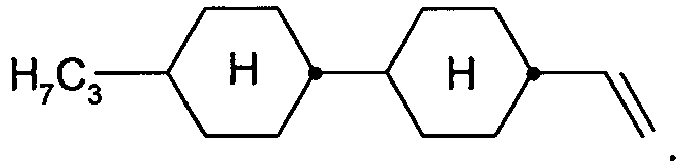
Weiterhin bevorzugt sind Mischungen, die eine Verbindung der Formel (Acronym: CC-3-V)

- d) Flüssigkristallines Medium, welches zusätzlich eine oder mehrere Vierkernverbindungen der Formeln,




- R7-10
- jeweils unabhängig voneinander eine der in Anspruch 3 für R2A angegebenen Bedeutung haben, und
- w und x
- jeweils unabhängig voneinander 1 bis 6,
enthält.
Insbesondere bevorzugt sind Mischungen enthaltend mindestens eine Verbindung der Formel V-9. - e) Flüssigkristallines Medium, welches zusätzlich eine oder mehrere Verbindungen der Formeln Y-1 bis Y-6,


worin R14-R19 jeweils unabhängig voneinander einen Alkyl- oder Alkoxyrest mit 1-6 C-Atomen bedeuten; z und m bedeuten jeweils unabhängig voneinander 1-6; x bedeutet 0, 1, 2 oder 3.
Insbesondere bevorzugt enthält das erfindungsgemäße Medium eine oder mehrere Verbindungen der Formel Y-1 bis Y-6, vorzugsweise in Mengen von ≥ 5 Gew.%. - f) Flüssigkristallines Medium enthaltend zusätzlich ein oder mehrere fluorierte Terphenyle der Formeln T-1 bis T-21,





R geradkettiger Alkyl- oder Alkoxyrest mit 1-7 C-Atomen bedeutet, und m = 0, 1, 2, 3, 4, 5 oder 6 und n 0, 1, 2, 3 oder 4 bedeuten,
enthält.
Vorzugsweise bedeutet R Methyl, Ethyl, Propyl, Butyl, Pentyl, Hexyl Methoxy, Ethoxy, Propoxy, Butoxy, Pentoxy.
Das erfindungsgemäße Medium enthält ein oder mehrere Terphenyle der Formeln T-1 bis T-21 vorzugsweise in Mengen von 2-30 Gew.%, insbesondere von 5-20 Gew.%.
Besonders bevorzugt sind Verbindungen der Formeln T-1, T-2, T-4, T-20 und T-21. In diesen Verbindungen bedeutet R vorzugsweise Alkyl, ferner Alkoxy jeweils mit 1-5 C-Atomen. In den Verbindungen der Formel T-20 bedeutet R vorzugsweise Alkyl oder Alkenyl, insbesondere Alkyl. In der Verbindung der Formel T-21 bedeutet R vorzugsweise Alkyl.
Vorzugsweise werden die Terphenyle in den erfindungsgemäßen Mischungen eingesetzt, wenn der Δn-Wert der Mischung ≥ 0,1 sein soll. Bevorzugte Mischungen enthalten 2-20 Gew.% einer oder mehrerer Terphenyl-Verbindungen ausgewählt aus der Gruppe der Verbindungen T-1 bis T-21. - g) Flüssigkristallines Medium enthaltend zusätzlich ein oder mehrere Biphenyle der Formeln B-1 bis B-3,



- Alkyl und Alkyl*
- jeweils unabhängig voneinander einen geradkettigen Alkylrest mit 1-6 C-Atomen, und
- Alkenyl und Alkenyl*
- jeweils unabhängig voneinander einen geradkettigen Alkenylrest mit 2-6 C-Atomen
Der Anteil der Biphenyle der Formeln B-1 bis B-3 in der Gesamtmischung beträgt vorzugsweise mindestens 3 Gew.%, insbesondere ≥ 5 Gew.%.
Von den Verbindungen der Formeln B-1 bis B-3 sind die Verbindungen der Formel B-2 insbesondere bevorzugt.
Besonders bevorzugte Biphenyle sind



- h) Flüssigkristallines Medium enthaltend mindestens eine Verbindung der Formeln Z-1 bis Z-7,





- i) Flüssigkristallines Medium enthaltend mindestens eine Verbindung der Formeln O-1 bis 0-18,






- Bevorzugte Medien enthalten eine oder mehrere Verbindungen der Formeln O-1, O-3, O-4, 0-6, O-7, 0-10, 0-11, 0-12, 0-14, 0-15, O-16 und/oder 0-17.
- Erfindungsgemäße Mischungen enthalten ganz besonders bevorzugt die Verbindungen der Formel O-10, 0-12, 0-16 und/oder O-17, inbesondere in Mengen von 5-30 %.
- Bevorzugte Verbindungen der Formeln O-10 und 0-17 werden nachfolgend genannt:




- Besonders bevorzugt enthält das erfindungsgemäße Medium die Dreikern-Verbindungen der Formel O-10a und/oder der Formel O-10b in Kombination mit einer oder mehreren Zweikern-Verbindungen der Formeln O-17a bis O-17d. Vorzugsweise beträgt der Gesamtanteil der Verbindungen der Formel O-10a und/oder O-10b in Kombination mit einer oder mehreren Verbindungen ausgewählt aus den Zweikern-verbindungen der Formeln O-17a bis O-17d 5-40 %, ganz besonders bevorzugt 15-35 %.
- Ganz besonders bevorzugte Mischungen enthalten die Verbindungen O-10a und O-17a:


- Vorzugsweise sind die Verbindungen O-10a und O-17a in der Mischung in einer Konzentration von 15-35 %, besonders bevorzugt von 15-25 % und insbesondere bevorzugt von 18-22 % bezogen auf die Gesamtmischung, enthalten.
- Ganz besonders bevorzugte Mischungen enthalten die Verbindungen O-10b und O-17a:


- Vorzugsweise sind die Verbindungen O-10b und O-17a in der Mischung in einer Konzentration von 15-35 %, besonders bevorzugt von 15-25 % und insbesondere bevorzugt von 18-22 % bezogen auf die Gesamtmischung, enthalten.
- Ganz besonders bevorzugte Mischungen enthalten folgende drei Verbindungen:



- Vorzugsweise sind die Verbindungen O-10a, O-10b und O-17a in der Mischung in einer Konzentration von 15-35 %, besonders bevorzugt von 15-25 % und insbesondere bevorzugt von 18-22 % bezogen auf die Gesamtmischung, enthalten.
- Bevorzugte Mischungen enthalten mindestens eine Verbindung ausgewählt aus der Gruppe der Verbindungen


- Bevorzugte Mischungen enthalten mindestens eine Verbindung ausgewählt aus der Gruppe der Verbindungen der Formeln O-6a, O-6b O-7a, O-7b, O-17e, O-17f, O-17g und O-17h:





- j) Bevorzugte erfindungsgemäße flüssigkristalline Medien enthalten eine oder mehrere Substanzen, die eine Tetrahydronaphthyl- oder Naphthyl-Einheit aufweisen, wie z.B. die Verbindungen der Formeln N-1 bis N-5,


- worin R1N und R2N jeweils unabhängig voneinander die für R2A angegebenen Bedeutungen haben, vorzugsweise geradkettiges Alkyl, geradkettiges Alkoxy oder geradkettiges Alkenyl bedeuten, und
- Z1 und Z2 jeweils unabhängig voneinander -C2H4-, -CH=CH-, -(CH2)4-, -(CH2)3O-, -O(CH2)3-, -CH=CHCH2CH2-, -CH2CH2CH=CH-, -CH2O-, -OCH2-, -COO-, -OCO-, -C2F4-, -CF=CF-, -CF=CH-, -CH=CF-, -CF2O-, -OCF2-, -CH2- oder eine Einfachbindung
- k) Bevorzugte Mischungen enthalten eine oder mehrere Verbindungen ausgewählt aus der Gruppe der Difluordibenzochroman-Verbindungen der Formel BC, Chromane der Formeln CR, fluorierte Phenanthrene der Formeln PH-1 und PH-2, fluorierte Dibenzofurane der Formeln BF-1 und BF-2,


RB1, RB2, RCR1, RCR2, R1, R2 jeweils unabhängig voneinander die Bedeutung von R2A aufweisen. c bedeutet 0, 1 oder 2. d bedeutet 1 oder 2. R1 und R2 bedeuten vorzugsweise unabhängig voneinander Alkyl oder Alkoxy mit 1 bis 6 C-Atomen. - Die erfindungsgemäßen Mischungen enthalten die Verbindungen der Formeln BC, CR, PH-1, PH-2 und/oder BF vorzugsweise in Mengen von 3 bis 20 Gew.%, insbesondere in Mengen von 3 bis 15 Gew.%.
- Besonders bevorzugte Verbindungen der Formeln BC, CR und BF sind die Verbindungen BC-1 bis BC-7, CR-1 bis CR-5, BF-1a bis BF-1c,




- Alkyl und Alkyl*
- jeweils unabhängig voneinander einen geradkettigen Alkylrest mit 1-6 C-Atomen, und
- Alkenyl und Alkenyl*
- jeweils unabhängig voneinander einen geradkettigen Alkenylrest mit 2-6 C-Atomen,
- Ganz besonders bevorzugt sind Mischungen enthaltend eine, zwei oder drei Verbindungen der Formel BC-2, BF-1 und/oder BF-2.
- I) Bevorzugte Mischungen enthalten eine oder mehrere Indan-Verbindungen der Formeln In,

- R11, R12, R13
- jeweils unabhängig voneinander einen geradkettigen Alkyl-, Alkoxy-, Alkoxyalkyl- oder Alkenylrest mit 1-6 C-Atomen,
- R12 und R13
- zusätzlich Halogen, vorzugsweise F,

- i
- 0, 1 oder 2
Bevorzugte Verbindungen der Formel In sind die nachfolgend genannten Verbindungen der Formeln In-1 bis In-16,






Besonders bevorzugt sind die Verbindungen der Formeln In-1, In-2, In-3 und In-4.
Die Verbindungen der Formeln In und der Unterformeln In-1 bis In-16 werden vorzugsweise in Konzentrationen ≥ 5 Gew.%, insbesondere 5 - 30 Gew.% und ganz besonders bevorzugt 5 - 25 Gew.% in den erfindungsgemäßen Mischungen eingesetzt. - m) Bevorzugte Mischungen enthalten zusätzlich eine oder mehrere Verbindungen der Formeln L-1 bis L-11,







R, R1 und R2 jeweils unabhängig voneinander die für R2A in Anspruch 5 angegebenen Bedeutungen haben und Alkyl ein Alkylrest mit 1-6 C-Atomen bedeutet. s bedeutet 1 oder 2. - Besonders bevorzugt sind die Verbindungen der Formeln L-1 und L-4, insbesondere L-4.
- Die Verbindungen der Formeln L-1 bis L-11 werden vorzugsweise in Konzentrationen von 5 - 50 Gew.%, insbesondere 5 - 40 Gew.% und ganz besonders bevorzugt 10 - 40 Gew.% eingesetzt.
- Besonders bevorzugte Mischungskonzepte werden nachfolgend genannt: (Die verwendeten Acronyme sind in Tabelle A erklärt. n und m bedeuten hier jeweils unabhängig voneinander 1-15, vorzugsweise 1-6.)
- Die erfindungsgemäßen Mischungen enthalten vorzugsweise
- CPY-n-Om, insbesondere CPY-2-O2, CPY-3-O2 und/oder CPY-5-02, vorzugsweise in Konzentrationen > 5 %, insbesondere 10-30 %, bezogen auf die Gesamtmischung,
und/oder - CY-n-Om, vorzugsweise CY-3-O2, CY-3-O4, CY-5-O2 und/oder CY-5-04, vorzugsweise in Konzentrationen > 5 %, insbesondere 15-50 %, bezogen auf die Gesamtmischung,
und/oder - CCY-n-Om, vorzugsweise CCY-4-O2, CCY-3-O2, CCY-3-O3, CCY-3-01 und/oder CCY-5-O2, vorzugsweise in Konzentrationen > 5 %, insbesondere 10-30 %, bezogen auf die Gesamtmischung,
und/oder - CLY-n-Om, vorzugsweise CLY-2-O4, CLY-3-O2 und/oder CLY-3-O3, vorzugsweise in Konzentrationen > 5 %, insbesondere 10-30 %, bezogen auf die Gesamtmischung,
und/oder - CK-n-F, vorzugsweise CK-3-F, CK-4-F und/oder CK-5-F, vorzugsweise > 5 %, insbesondere 5-25 %, bezogen auf die Gesamtmischung.
- Weiterhin bevorzugt sind erfindungsgemäße Mischungen, die folgende Mischungskonzepte enthalten:
(n und m bedeuten jeweils unabhängig voneinander 1-6.) - CPY-n-Om und CY-n-Om, vorzugsweise in Konzentrationen von 10-80 % bezogen auf die Gesamtmischung,
und/oder - CPY-n-Om und CK-n-F, vorzugsweise in Konzentrationen von 10-70 % bezogen auf die Gesamtmischung,
und/oder - CPY-n-Om und PY-n-Om, vorzugsweise CPY-2-02 und/oder CPY-3-02 und PY-3-O2, vorzugsweise in Konzentrationen von 10 - 45 % bezogen auf die Gesamtmischung,
und/oder - CPY-n-Om und CLY-n-Om, vorzugsweise in Konzentrationen von 10-80 % bezogen auf die Gesamtmischung.
und/oder - CCVC-n-V, vorzugsweise CCVC-3-V, vorzugsweise in Konzentrationen von 2 - 10 % bezogen auf die Gesamtmischung,
und/oder - CCC-n-V, vorzugsweise CCC-2-V und/oder CCC-3-V, vorzugsweise in Konzentrationen von 2 - 10 % bezogen auf die Gesamtmischung,
und/oder - CC-V-V oder CC-V-V1, vorzugsweise in Konzentrationen von 5 - 50 % bezogen auf die Gesamtmischung.
- Ein weiterer Gegenstand der Erfindung ist eine elektrooptische Anzeige mit einer Aktivmatrix-Adressierung basierend auf dem ECB-, VA-, PS-VA-, PA-VA-, IPS-, PS-IPS-, FFS-, UB-FFS- oder PS-FFS-Effekt, dadurch gekennzeichnet, dass sie als Dielektrikum ein flüssigkristallines Medium nach einem oder mehreren der Ansprüche 1 bis 15 enthält.
- Das erfindungsgemäße flüssigkristalline Medium weist bevorzugt eine nematische Phase von ≤ -20 °C bis ≥ 70 °C, besonders bevorzugt von ≤ -30 °C bis ≥ 80 °C, ganz besonders bevorzugt von ≤ -40 °C bis ≥ 90 °C auf.
- Hierbei bedeutet der Begriff "eine nematische Phase aufweisen" einerseits, dass bei tiefen Temperaturen bei der entsprechenden Temperatur keine smektische Phase und keine Kristallisation beobachtet wird und andererseits, dass beim Aufheizen aus der nematischen Phase noch keine Klärung auftritt. Die Untersuchung bei tiefen Temperaturen wird in einem Fließviskosimeter bei der entsprechenden Temperatur durchgeführt sowie durch Lagerung in Testzellen einer der elektrooptischen Anwendung entsprechenden Schichtdicke für mindestens 100 Stunden überprüft. Wenn die Lagerstabilität bei einer Temperatur von -20 °C in einer entsprechenden Testzelle 1.000 h oder mehr beträgt, wird das Medium als bei dieser Temperatur stabil bezeichnet. Bei Temperaturen von -30 °C bzw. -40 °C betragen die entsprechenden Zeiten 500 h bzw. 250 h. Bei hohen Temperaturen wird der Klärpunkt nach üblichen Methoden in Kapillaren gemessen.
- Vorzugsweise weist die Flüssigkristallmischung einen nematischen Phasenbereich von mindestens 60 K und eine Fließviskosität v20 von maximal 30 mm2 · s-1 bei 20 °C auf.
- Die Werte der Doppelbrechung Δn in der Flüssigkristallmischung liegen in der Regel zwischen 0,07 und 0,16, vorzugsweise zwischen 0,08 und 0,13.
- Die erfindungsgemäße Flüssigkristallmischung weist ein Δε von -0,5 bis -8,0, insbesondere von -2,5 bis -6,0 auf, wobei Δε die dielektrische Anisotropie bedeutet. Die Rotationsviskosität γ1 bei 20 °C ist vorzugsweise ≤ 150 mPa·s, insbesondere ≤ 120 mPa·s.
- Die erfindungsgemäßen Flüssigkristallmedien weisen relativ kleine Werte für die Schwellenspannung (Vo) auf. Vorzugsweise sind sie im Bereich von 1,7 V bis 3,0 V, besonders bevorzugt ≤ 2,5 V und ganz besonders bevorzugt ≤ 2,3 V.
- Der Begriff "Schwellenspannung" bezieht sich für die vorliegende Erfindung auf die kapazitive Schwelle (V0), auch Freedericksz-Schwelle genannt, sofern nicht explizit anders angegeben.
- Außerdem weisen die erfindungsgemäßen Flüssigkristallmedien hohe Werte für die Voltage Holding Ratio in Flüssigkristallzellen auf.
- In der Regel zeigen dabei Flüssigkristallmedien mit einer geringen Ansteuerspannung bzw. Schwellenspannung eine geringere Voltage Holding Ratio als solche mit einer größeren Ansteuerspannung bzw. Schwellenspannung und umgekehrt.
- Für die vorliegende Erfindung bedeuten die Begriffe "dielektrisch positive Verbindungen" solche Verbindungen mit einem Δε > 1,5, "dielektrisch neutrale Verbindungen" solche mit -1,5 ≤ Δε ≤ 1,5 und "dielektrisch negative" Verbindungen solche mit Δε < -1,5. Hierbei wird die dielektrische Anisotropie der Verbindungen bestimmt, indem 10 % der Verbindungen in einem flüssigkristallinen Host gelöst werden und von der resultierenden Mischung die Kapazität in mindestens jeweils einer Testzelle mit 20 µm Schichtdicke mit homeotroper und mit homogener Oberflächenorientierung bei 1 kHz bestimmt wird. Die Messspannung beträgt typischerweise 0,5 V bis 1,0 V, sie ist jedoch stets niedriger als die kapazitive Schwelle der jeweiligen untersuchten Flüssigkristallmischung.
- Alle angegebenen Werte für Temperaturen für die vorliegende Erfindung sind in °C.
- Die erfindungsgemäßen Mischungen sind für alle VA-TFT-Anwendungen geeignet, wie z.B. VAN, MVA, (S)-PVA, ASV, PSA (polymer sustained VA) und PS-VA (polymer stabilized VA). Weiterhin sind sie für IPS (In plane switching) und FFS (Fringe field switching), vorzugsweise UB-FFS, mit negativem Δε geeignet.
- Die nematischen Flüssigkristallmischungen in den erfindungsgemäßen Anzeigen enthalten in der Regel zwei Komponenten A und B, die ihrerseits aus einer oder mehreren Einzelverbindungen bestehen.
- Die Komponente A weist eine deutlich negative dielektrische Anisotropie auf und verleiht der nematischen Phase eine dielektrische Anisotropie von ≤ -0,5. Sie enthält bevorzugt neben eine oder mehrere Verbindungen der Formeln IIA, IIB und/oder IIC, ferner eine oder mehrere Verbindungen der Formel 0-17.
- Der Anteil der Komponente A liegt vorzugsweise zwischen 45 und 100 %, insbesondere zwischen 60 und 100 %.
- Für Komponente A wird vorzugsweise eine (oder mehrere) Einzelverbindung(en) gewählt, die einen Wert von Δε ≤ -0,8 haben. Dieser Wert muss umso negativer sein, je kleiner der Anteil A an der Gesamtmischung ist.
- Die Komponente B weist eine ausgeprägte Nematogenität und eine Fließviskosität von nicht mehr als 30 mm2·s-1, vorzugsweise nicht mehr als 25 mm2·s-1, bei 20 °C auf.
- Dem Fachmann sind aus der Literatur eine Vielzahl geeigneter Materialien bekannt. Besonders bevorzugt sind Verbindungen der Formel 0-17.
- Besonders bevorzugte Einzelverbindungen der Komponente B sind extrem niedrig viskose nematische Flüssigkristalle mit einer Fließviskosität von nicht mehr als 18, vorzugsweise nicht mehr als 12 mm2·s1, bei 20 °C.
- Komponente B ist monotrop oder enantiotrop nematisch, weist keine smektischen Phasen auf und kann in Flüssigkristallmischungen das Auftreten von smektischen Phasen bis zu sehr tiefen Temperaturen verhindern. Versetzt man beispielsweise eine smektische Flüssigkristallmischung mit jeweils verschiedenen Materialien mit hoher Nematogenität, so kann durch den erzielten Grad der Unterdrückung smektischer Phasen die Nematogenität dieser Materialien verglichen werden.
- Optional kann die Mischung auch eine Komponente C enthalten, wobei es sich um Verbindungen mit einer dielektrischen Anisotropie von Δε ≥ 1,5 handelt. Diese sogenannten positiven Verbindungen sind in der Regel in einer Mischung mit negativer dielektrischer Anisotropie in Mengen von ≤ 20 Gew.% bezogen auf die Gesamtmischung enthalten.
- Sofern die erfindungsgemäße Mischung eine oder mehrere Verbindungen mit einer dielektrischen Anisotropie von Δε ≥ 1,5 enthält, handelt es sich vorzugsweise um eine oder mehrere Verbindungen ausgewählt aus der Gruppe der Verbindungen der Formeln P-1 bis P-4,


- R
- geradkettiges Alkyl, Alkoxy oder Alkenyl mit jeweils 1 bzw. 2 bis 6 C-Atomen, und
- X
- F, Cl, CF3, OCF3, OCHFCF3 oder CCF2CHFCF3, vorzugsweise F oder OCF3
- Vorzugsweise werden die Verbindungen der Formeln P-1 bis P-4 in Konzentrationen von 2 - 15 %, inbesondere 2 - 10 % in den erfindungsgemäßen Mischungen eingesetzt.
- Besonders bevorzugt ist die Verbindung der Formel,

- Daneben können diese Flüssigkristallphasen auch mehr als 18 Komponenten, vorzugsweise 18 bis 25 Komponenten, enthalten.
- Vorzugsweise enthalten die Phasen neben der Verbindung der Formel I-1 und/oder I-2, 4 bis 15, insbesondere 5 bis 12, und besonders bevorzugt < 10, Verbindungen der Formeln IIA, IIB und/oder IIC und optional eine oder mehrere Verbindungen der Formel O-17.
- Neben Verbindungen der Formeln I-1 und/oder I-2 und den Verbindungen der Formeln IIA, IIB und/oder IIC und optional 0-17 können auch noch andere Bestandteile zugegen sein, z. B. in einer Menge von bis zu 45 % der Gesamtmischung, vorzugsweise jedoch bis zu 35 %, insbesondere bis zu 10 %.
- Die anderen Bestandteile werden vorzugsweise ausgewählt aus den nematischen oder nematogenen Substanzen, insbesondere den bekannten Substanzen, aus den Klassen der Azoxybenzole, Benzylidenaniline, Biphenyle, Terphenyle, Phenyl- oder Cyclohexylbenzoate, Cyclohexan-carbonsäurephenyl- oder -cyclohexylester, Phenylcyclohexane, Cyclohexylbiphenyle, Cyclohexylcyclohexane, Cyclohexylnaphthaline, 1,4-Bis-cyclohexylbiphenyle oder Cylohexylpyrimidine, Phenyl- oder Cyclohexyldioxane, gegebenenfalls halogenierten Stilbenen, Benzylphenylether, Tolane und substituierten Zimtsäureestern.
- Die wichtigsten als Bestandteile derartiger Flüssigkristallphasen in Frage kommenden Verbindungen lassen sich durch die Formel IV charakterisieren,
R20-L-G-E-R21 IV
worin L und E je ein carbo- oder heterocyclisches Ringsystem aus der aus 1,4-disubstituierten Benzol- und Cyclohexanringen, 4,4'-disubstituierten Biphenyl-, Phenylcyclohexan- und Cyclohexylcyclohexansystemen, 2,5-disubstituierten Pyrimidin- und 1,3-Dioxanringen, 2,6-disubstituierten Naphthalin, Di- und Tetrahydronaphthalin, Chinazolin und Tetrahydrochinazolin gebildeten Gruppe,G -CH=CH- -N(O)=N- -CH=CQ- -CH=N(O)- -C≡C- -CH2-CH2- -CO-O- -CH2-O- -CO-S- -CH2-S- -CH=N- -COO-Phe-COO- -CF2O- -CF=CF- -OCF2- -OCH2- -(CH2)4- -(CH2)3O- - Bei den meisten dieser Verbindungen sind R20 und R21 voneinander verschieden, wobei einer dieser Reste meist eine Alkyl- oder Alkoxygruppe ist. Auch andere Varianten der vorgesehenen Substituenten sind gebräuchlich. Viele solcher Substanzen oder auch Gemische davon sind im Handel erhältlich. Alle diese Substanzen sind nach literaturbekannten Methoden herstellbar.
- Es versteht sich für den Fachmann von selbst, dass die erfindungsgemäße VA-, PALC-, PS-VA, IPS-, PS-IPS, FFS- oder PS-FFS- Mischung auch Verbindungen enthalten kann, worin beispielsweise H, N, O, Cl, F durch die entsprechenden Isotope ersetzt sind.
- Den erfindungsgemäßen Mischungen können weiterhin polymerisierbare Verbindungen, sogenannte reaktive Mesogene (RMs), beispielsweise wie in
U.S. 6,861,107 offenbart, in Konzentrationen von bevorzugt 0,01 - 5 Gew.%, besonders bevorzugt 0,2 - 2 % bezogen auf die Mischung, zugesetzt werden. Optional können diese Mischungen auch einen Initiator enthalten, wie beispielsweise in der U.S 6,781,665 beschrieben. Der Initiator, z.B. Irganox-1076 der Fa. BASF, wird vorzugsweise der Mischung enthaltend polymerisierbare Verbindungen in Mengen von 0-1 % zugesetzt. Derartige Mischungen können für sogenannte Polymer Stabilized VA-Modes (PS-VA) oder PSA (Polymer sustained VA), bei denen eine Polymerisierung der reaktiven Mesogene in der flüssigkristallinen Mischung erfolgen soll, verwendet werden. Voraussetzung hierfür ist, dass die Flüssigkristallmischung selbst keine polymerisierbaren Komponenten enthält, die unter den Bedingungen, wo die RMs polymerisieren, ebenfalls polymerisieren. - Die Polymerisation wird vorzugsweise unter folgenden Bedingungen durchgeführt:
Das bzw. die polymerisierbare(n) reaktive(n) Mesogen(e) (RM) wird (werden) in einer Zelle polymerisiert unter Verwendung einer UV-A Lampe definierter Intensität für einen definierten Zeitraum und angelegter Spannung (typischerweise 10 V bis 30 V Wechselspannung, Frequenzen im Bereich von 60 Hz bis 1 kHz). Als UV-A Lichtquelle wird typischerweise eine Halogenmetalldampflampe oder eine Hochdruckquecksilberlampe mit einer Intensität von 50 mW/cm2 eingesetzt. - Dies sind Bedingungen, wo beispielsweise flüssigkristalline Verbindungen mit einer Alkenyl- oder Alkenlyoxyseitenkette, wie z. B. die Verbindung der Formel

- Die erfindungsgemäßen Mischungen können weiterhin übliche Zusätze oder Additive enthalten, wie z.B. Stabilisatoren, Antioxidantien, UV-Absorber, Nanopartikel, Mikropartikel, etc.
- Der Aufbau der erfindungsgemäßen Flüssigkristallanzeigen entspricht der üblichen Geometrie, wie sie z.B. in
EP-OS 0 240 379 - Die folgenden Beispiele sollen die Erfindung erläutern, ohne sie zu begrenzen. Vor- und nachstehend bedeuten Prozentangaben Gewichtsprozent; alle Temperaturen sind in Grad Celsius angegeben.
- In der gesamten Patentanmeldung werden 1,4-Cyclohexylenringe und 1,4-Phenylenringe wie folgt dargestellt:


- Bei den Cyclohexylenringen handelt es sich um trans-1,4-Cyclohexylenringe.
- In der gesamten Patentanmeldung sowie in den Ausführungsbeispielen sind die Strukturen der Flüssigkristallverbindungen durch Acronyme angegeben. Sofern nicht anders angegeben, erfolgt die Transformation in chemische Formeln gemäß der Tabellen 1-3. Alle Reste CnH2n+1, CmH2m+1, und Cm'H2m'+1 bzw. CnH2n und CmH2m sind geradkettige Alkylreste bzw. Alkylenreste jeweils mit n, m, m' bzw. z C-Atomen.n, m, m', z bedeuten jeweils unabhängig voneinander 1, 2, 3, 4, 5, 6, 7, 8, 9, 10, 11, 12, vorzugsweise 1, 2, 3, 4, 5 oder 6. In Tabelle 1 sind die Ringelemente der jeweiligen Verbindung codiert, in Tabelle 2 sind die Brückenglieder aufgelistet und in Tabelle 3 sind die Bedeutungen der Symbole für die linken bzw. rechten Seitenketten der Verbindungen angegeben.


Tabelle 2: Brückenglieder E -CH2CH2- V -CH=CH- T -C=C- W -CF2CF2- Z -COO- ZI -OCO- O -CH2O- OI -OCH2- Q -CF2O- QI -OCF2- Tabelle 3: Seitenketten Seitenkette links Seitenkette rechts n- CnH2n+1- -n -CnH2n+1 nO- CnH2n+1-O- -On -O-CnH2n+1 V- CH2=CH- -V -CH=CH2 nV- CnH2n+1-CH=CH- -nV -CnH2n-CH=CH2 Vn- CH2=CH- CnH2n- -Vn -CH=CH-CnH2n+1 nVm- CnH2n+1-CH=CH-CmH2m- -nVm -CnH2n-CH=CH-CmH2m+1 N- N≡C- -N -C≡N F- F- -F -F Cl- Cl- -Cl -Cl M- CFH2- -M -CFH2 D- CF2H- -D -CF2H T- CF3- -T -CF3 MO- CFH2O- -OM -OCFH2 DO- CF2HO- -OD -OCF2H TO- CF3O- -OT -OCF3 T- CF3- -T -CF3 A- H-C≡C- -A -C≡C-H - Vorzugsweise enthalten die erfindungsgemäßen Mischungen neben den Verbindungen der Formel I-1 und/oder I-2 eine oder mehrere Verbindungen der nachfolgend genannten Verbindungen aus der Tabelle A.
Tabelle A Folgende Abkürzungen werden verwendet: (n, m, m', z: jeweils unabhängig voneinander 1, 2, 3, 4, 5 oder 6; (O)CmH2m+1 bedeutet OCmH2m+1 oder CmH2m+1) 


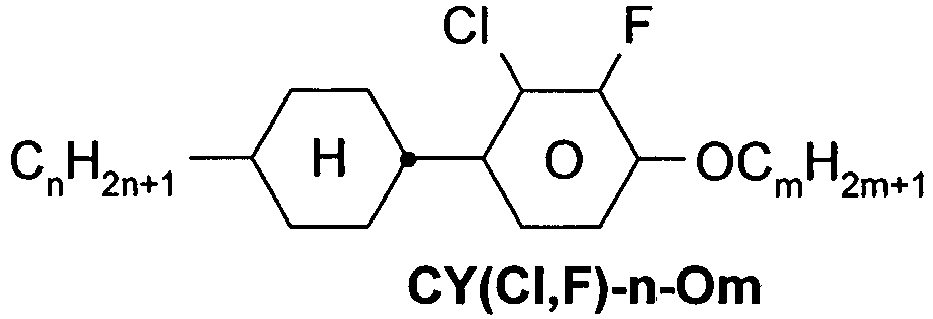


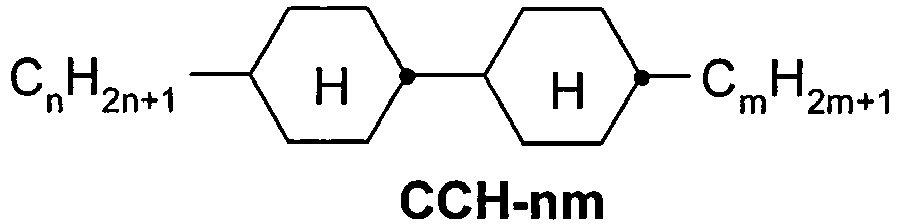
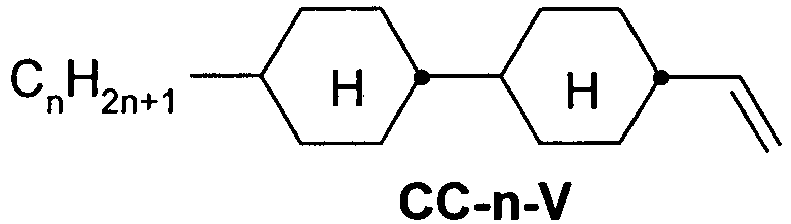





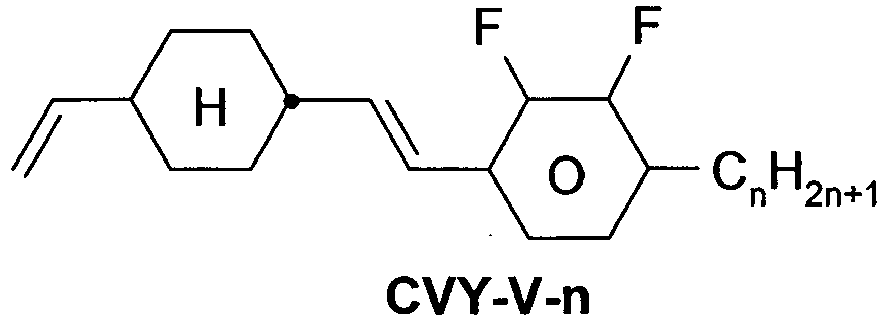


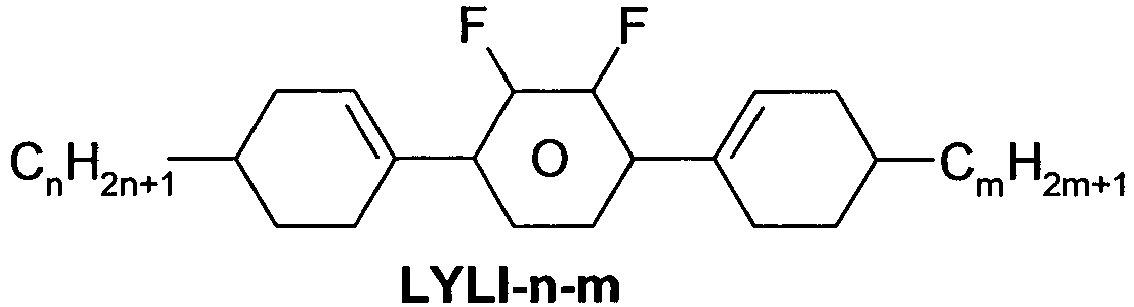


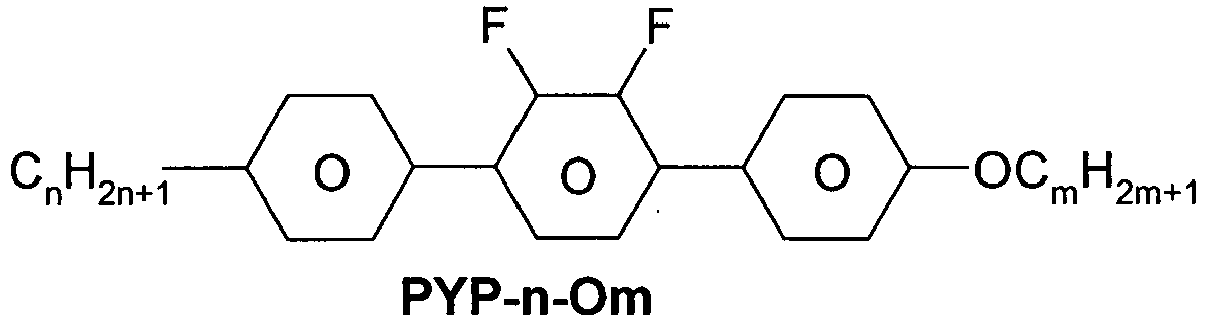


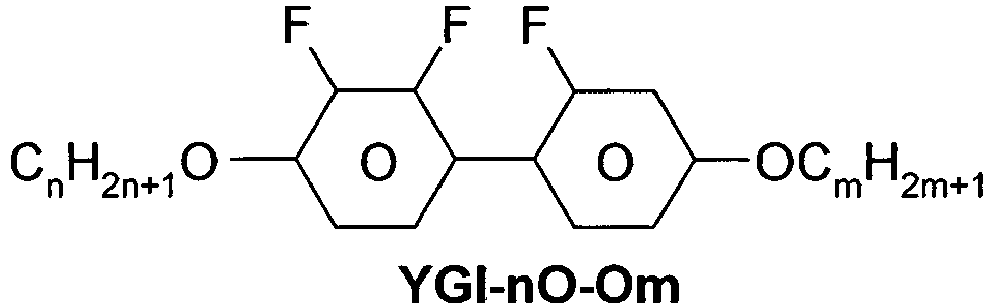


- Die Herstellung der erfindungsgemäß verwendbaren Flüssigkristallmischungen erfolgt in an sich üblicher Weise. In der Regel wird die gewünschte Menge der in geringerer Menge verwendeten Komponenten in der den Hauptbestandteil ausmachenden Komponenten gelöst, zweckmäßig bei erhöhter Temperatur. Es ist auch möglich, Lösungen der Komponenten in einem organischen Lösungsmittel, z.B. in Aceton, Chloroform oder Methanol, zu mischen und das Lösungsmittel nach Durchmischung wieder zu entfernen, beispielsweise durch Destillation.
- Mittels geeigneter Zusatzstoffe können die erfindungsgemäßen Flüssigkristallphasen derart modifiziert werden, dass sie in jeder bisher bekannt gewordenen Art von z. B. ECB-, VAN-, IPS-, GH- oder ASM-VA LCD-Anzeige einsetzbar sind.
- Die Dielektrika können auch weitere, dem Fachmann bekannte und in der Literatur beschriebene Additive, wie z. B. UV-Absorber, Antioxidantien, Nanoteilchen, Radikalfänger, enthalten. Beispielsweise können 0-15 % pleochroitische Farbstoffe, Stabilisatoren oder chirale Dotierstoffe zugesetzt werden. Geeignete Stabilisatoren für die erfindungsgemäßen Mischungen sind insbesondere solche die in Tabelle B gelistet sind.
- Beispielsweise können 0-15 % pleochroitische Farbstoffe zugesetzt werden, ferner Leitsalze, vorzugsweise Ethyldimethyldodecylammonium-4-hexoxybenzoat, Tetrabutylammoniumtetraphenylboranat oder Komplexsalze von Kronenethern (vgl. z.B. Haller et al., Mol. Cryst. Liq. Cryst. Band 24, Seiten 249- 258 (1973)) zur Verbesserung der Leitfähigkeit oder Substanzen zur Veränderung der dielektrischen Anisotropie, der Viskosität und/oder der Orientierung der nematischen Phasen. Derartige Substanzen sind z. B. in den
DE-OS 22 09 127 22 40 864 ,23 21 632 ,23 38 281 ,24 50 088 ,26 37 430 und28 53 728 beschrieben. - In der Tabelle B werden mögliche Dotierstoffe angegeben, die den erfindungsgemäßen Mischungen zugesetzt werden können. Sofern die Mischungen einen Dotierstoff enthalten, wird er in Mengen von 0,01-4 Gew.%, vorzugsweise 0,1-1,0 Gew.%, eingesetzt.
Tabelle B In der Tabelle B werden mögliche Dotierstoffe angegeben, die in der Regel den erfindungsgemäßen Mischungen zugesetzt werden. Vorzugsweise enthalten die Mischungen 0-10 Gew.%, insbesondere 0,01-5 Gew.% und besonders bevorzugt 0,01-3 Gew.% an Dotierstoffen. 


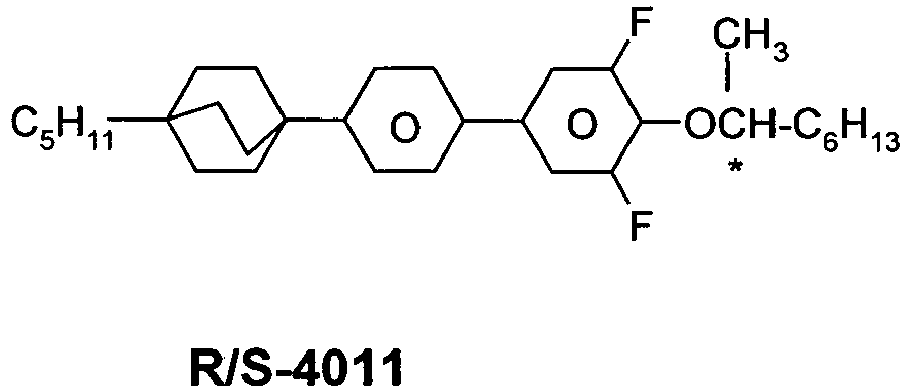


Tabelle C Stabilisatoren, die beispielsweise den erfindungsgemäßen Mischungen in Mengen von 0-10 Gew.% zugesetzt werden können, werden nachfolgend genannt. 


n = 1, 2, 3, 4, 5, 6 oder 7 
n = 1, 2, 3, 4, 5, 6 oder 7 

n = 1, 2, 3, 4, 5, 6 oder 7 


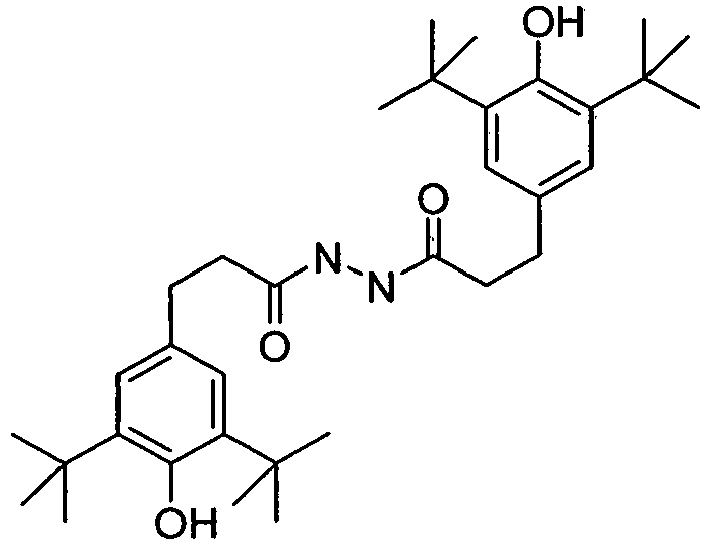
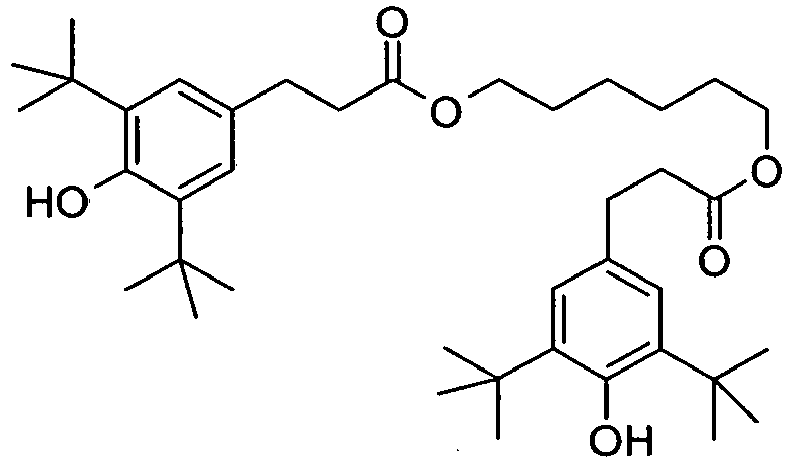
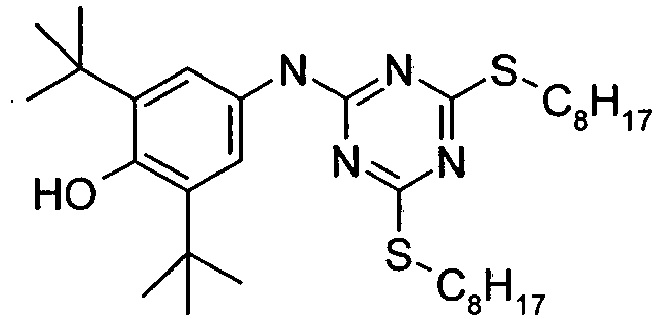


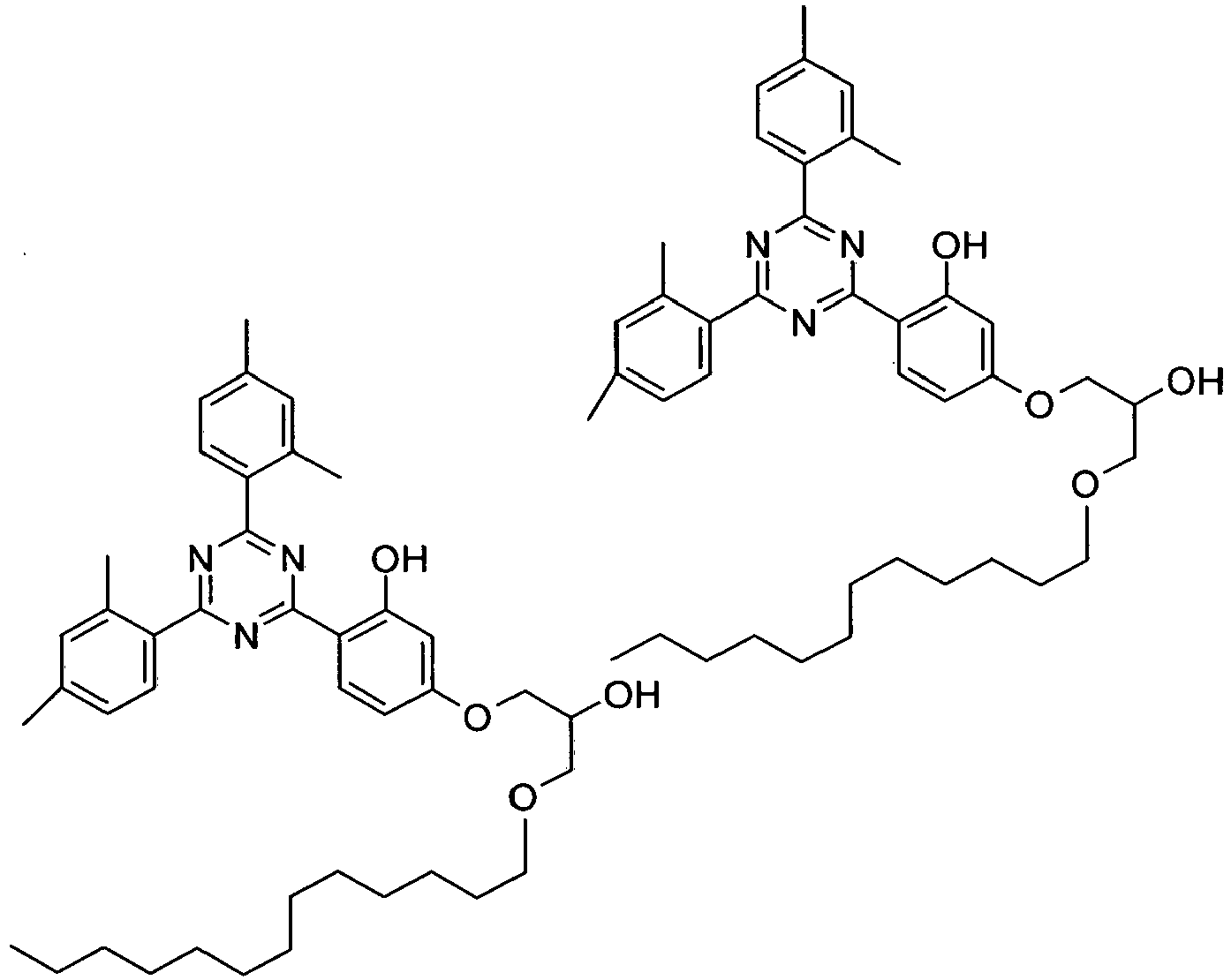


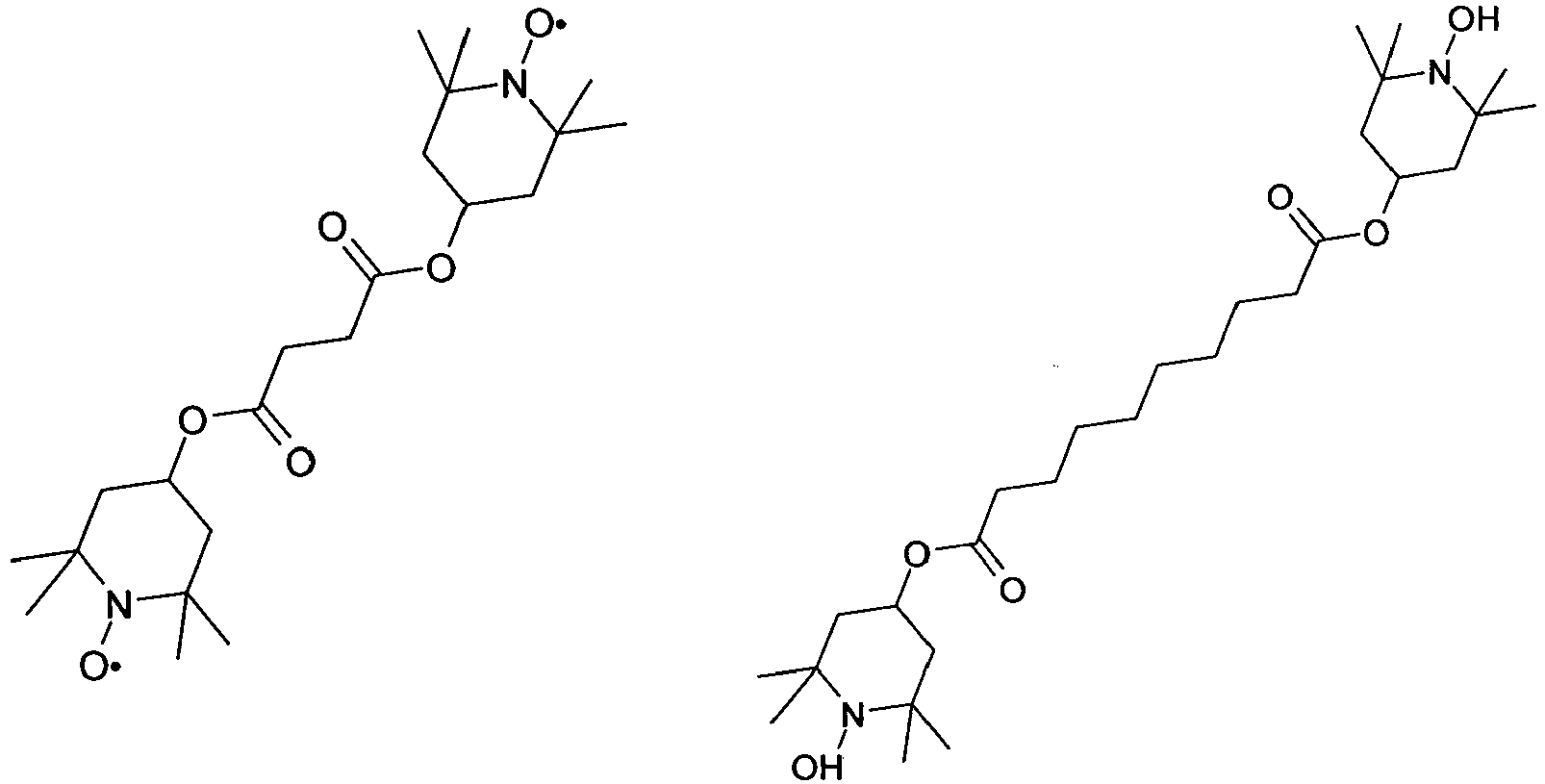
Tabelle D In der Tabelle D sind Beispielverbindungen zusammengestellt, die in den FK-Medien gemäß der vorliegenden Erfindung vorzugsweise als reaktive mesogene Verbindungen verwendet werden können. Sofern die erfindungsgemäßen Mischungen ein oder mehrere reaktive Verbindungen enthalten, werden sie vorzugsweise in Mengen von 0,01-5 Gew.% eingesetzt. Gegebenenfalls muss für die Polymerisation noch ein Initiator oder ein Gemisch aus zwei oder mehr Initiatoren zugesetzt werden. Der Initiator oder das Initiatorgemisch wird vorzugsweise in Mengen von 0,001-2 Gew.% bezogen auf die Mischung zugesetzt. Ein geeigneter Initiator ist z. B. Irgacure (Fa. BASF) oder Irganox (Fa. BASF). 
RM-1 
RM-2 
RM-3 
RM-4 
RM-5 
RM-6 
RM-7 
RM-8 
RM-9 
RM-10 
RM-11 
RM-12 
RM-13 
RM-14 
RM-15 
RM-16 
RM-17 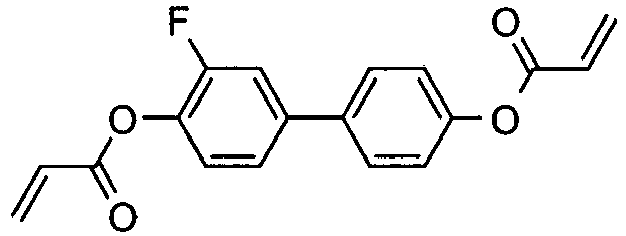
RM-18 
RM-19 
RM-20 
RM-21 
RM-22 
RM-23 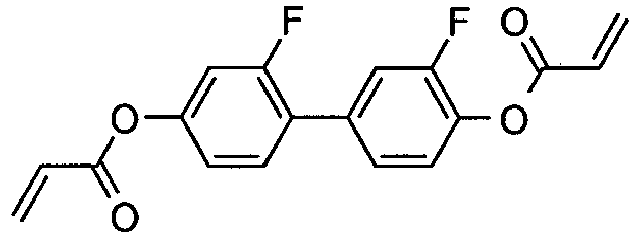
RM-24 
RM-25 
RM-26 
RM-27 
RM-28 
RM-29 
RM-30 
RM-31 
RM-32 
RM-33 
RM-34 
RM-35 
RM-36 
RM-37 
RM-38 
RM-39 
RM-40 
RM-41 
RM-42 
RM-43 
RM-44 
RM-45 
RM-46 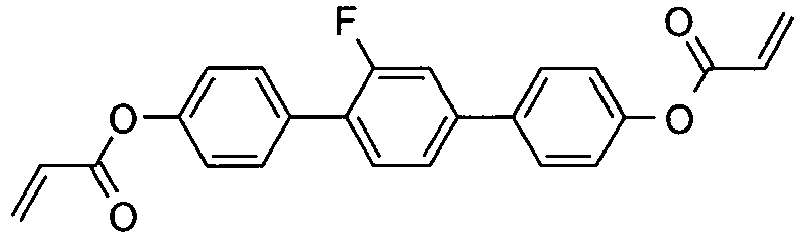
RM-47 
RM-48 
RM-49 
RM-50 
RM-51 
RM-52 
RM-53 
RM-54 
RM-55 
RM-56 
RM-57 
RM-58 
RM-59 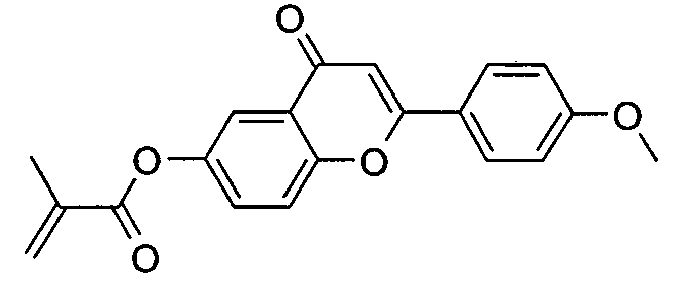
RM-60 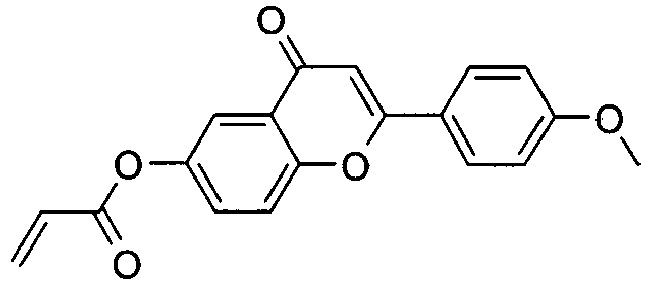
RM-61 
RM-62 
RM-63 
RM-64 
RM-65 
RM-66 
RM-67 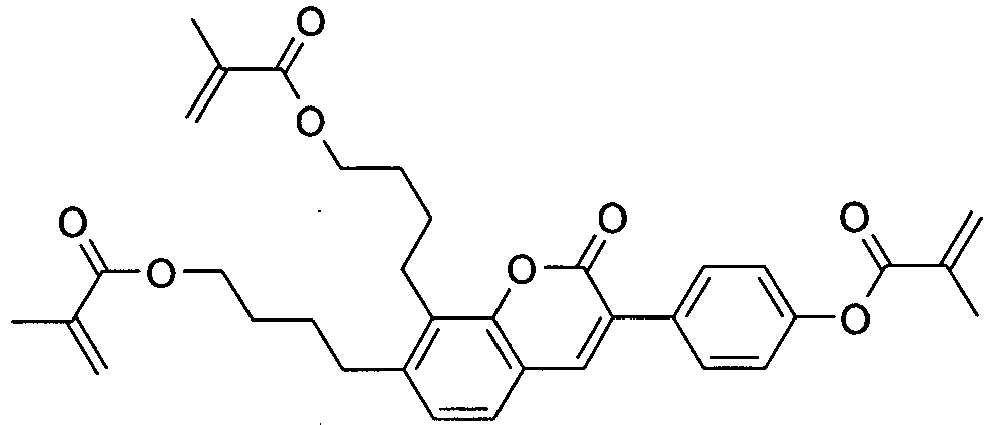
RM-68 
RM-69 
RM-70 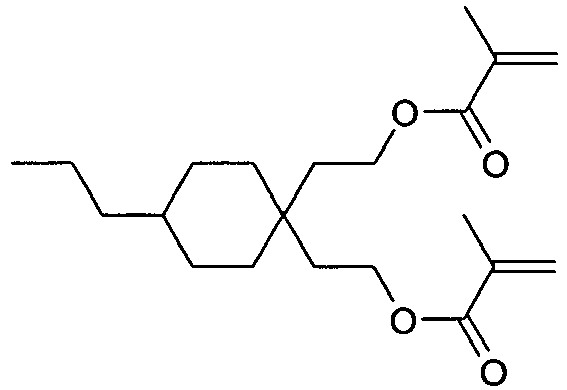
RM-71 
RM-72 
RM-73 
RM-74 
RM-75 
RM-76 
RM-77 
RM-78 
RM-79 
RM-80 
RM-81 
RM-82 
RM-83 
RM-84 
RM-85 
RM-86 
RM-87 
RM-88 
RM-89 
RM-90 
RM-91 
RM-92 
RM-93 
RM-94 
RM-95 
RM-96 
RM-97 
RM-98 - In einer bevorzugten Ausführungsform enthalten die erfindungsgemäßen Mischungen eine oder mehrere polymerisierbare Verbindungen, vorzugsweise ausgewählt aus den polymerisierbaren Verbindungen der Formeln RM-1 bis RM-98. Derartige Medien sind insbesondere für PS-FFS- und PS-IPS-Anwendungen geeignet. Von den in der Tabelle D genannten reaktiven Mesogenen sind die Verbindungen RM-1, RM-2, RM-3, RM-4, RM-5, RM-11, RM-17, RM-35, RM-41, RM-44, RM-62 und RM-81 insbesondere bevorzugt.
- Die folgenden Beispiele sollen die Erfindung erläutern, ohne sie zu begrenzen.
- Soweit nicht explizit anders vermerkt, sind in der vorliegenden Anmeldung alle Konzentrationen und %-Werte (mit Ausnahme der Werte für HR, Kontrast und Transmission) in Gewichtsprozent angegeben und beziehen sich auf die jeweilige Gesamtmischung, enthaltend alle festen oder flüssigkristallinen Komponenten, ohne Lösungsmittel.
- In der vorliegenden Anmeldung sind alle angegebenen Werte für Temperaturen, wie z. B. der Schmelzpunkt T(C,N), der Übergang von der smektischen (S) zur nematischen (N) Phase T(S,N) und der Klärpunkt T(N,I), in Grad Celsius (°C) angegeben. Fp. bedeutet Schmelzpunkt, Kp. = Klärpunkt. Ferner bedeuten K = kristalliner Zustand, N = nematische Phase, S = smektische Phase und I = isotrope Phase. Die Angaben zwischen diesen Symbolen stellen die Übergangstemperaturen dar.
- Als Hostmischung zur Bestimmung der optischen Anisotropie Δn der Verbindungen wird die Verkaufsmischung ZLI-4792 (Fa. Merck KGaA) verwendet. Für die Bestimmung der dielektrischen Anisotropie Δε wird die Verkaufsmischung ZLI-2857 verwendet. Aus der Änderung der Dielektrizitätskonstanten der Hostmischung nach Zugabe der zu untersuchenden Verbindung und Extrapolation auf 100 % der eingesetzten Verbindung werden die physikalischen Daten der zu untersuchenden Verbindung erhalten. Die zu untersuchende Verbindung wird in Abhängigkeit der Löslichkeit in der Regel zu 10 % in der Hostmischung gelöst.
- Sofern nichts anderes angegeben ist, bedeuten Angaben von Teilen oder Prozent Gewichtsteile bzw. Gewichtsprozent.
-
- ne
- außerordentlicher Brechungsindex bei 20°C und 589 nm,
- no
- ordentlicher Brechungsindex bei 20°C und 589 nm,
- Δn
- optische Anisotropie bei 20°C und 589 nm,
- ε⊥
- dielektrische Suszeptibilität senkrecht zum Direktor bei 20°C und 1 kHz,
- ε∥
- dielektrische Suszeptibilität parallel zum Direktor bei 20°C und 1 kHz,
- Δε
- dielektrische Anisotropie bei 20°C und 1 kHz,
- Kp., T(N,I)
- Klärpunkt [°C],
- γ1
- Rotationsviskosität gemessen bei 20 °C [mPa·s], bestimmt nach dem Rotationsverfahren in einem magnetischen Feld,
- K1
- elastische Konstante, "Splay"-Deformation bei 20°C, [pN],
- K3
- elastische Konstante, "Bend"-Deformation bei 20°C, [pN],
- K3
- elastische Konstante, "bend"-Deformation bei 20°C [pN],
- LTS
- Tieftemperaturstabilität [Low temperature stability (nematische Phase)], bestimmt in Fläschchen mit 1 ml Mischung, Mehrfachbestimmung,
- HR20
- "voltage holding ratio" bei 20°C [%] und
- HR100
- "voltage holding ratio" bei 100°C [%].
- Alle Konzentrationen in dieser Anmeldung, soweit nicht explizit anders angegeben, beziehen sich auf die entsprechende Mischung oder Mischungskomponente.
- Zur Untersuchung der Tieftemperaturstabilität, auch als "LTS" (low temperature stability) bezeichnet, d.h. der Stabilität der FK-Mischung gegen spontane Auskristallisation einzelner Komponenten bei tiefen Temperaturen, werden Fläschchen mit 1 ml FK/RM-Mischung bei Temperaturren zwischen 0 °C und -30 °C eingelagert und es wird regelmäßig überprüft, ob die Mischungen auskristallisiert waren.
- Der VHR-Wert wird wie folgt gemessen: Zur FK-Host-Mischung werden ggf. die Verbindung der Formel I-1 und/oder I-2 und die dadurch entstandene Mischung in TN-VHR-Testzellen gefüllt (90° gerieben, Orientierungsschicht TN-Polyimid (z.B. SE 2414 Nissan Chemicals, oder AL-16301, JSR, Schichtdicke d ≈ 6 µm). Der HR-Wert wird entweder bei Raumtemperatur (RT) oder nach 5 min bei 100 °C vor und nach 0,5 h oder 2 h UV-Belastung (suntest) bei 1 V, 60 Hz, 64 µs pulse bestimmt (Messgerät: Autronic-Melchers VHRM-105).
- Die sogenannte "HTP" ("helical twisting power") bezeichnet das helikale Verdrillungsvermögen einer optisch aktiven bzw. chiralen Substanz in einerm FK-Medium (in µm). Falls nicht anders angegeben, wird die HTP in der kommerziell erhältlichen nematischen FK-Hostmischung MLC-6260 (Merck KGaA) bei einer Temperatur von 20 °C gemessen.
- Alle physikalischen Eigenschaften werden und wurden nach "Merck Liquid Crystals, Physical Properties of Liquid Crystals", Status November 1997, Merck KGaA, Deutschland bestimmt und gelten für eine Temperatur von 20°C, sofern nicht explizit anders angegeben.
-
CY-3-O2 12,00 % Klärpunkt [°C]: 86,5 CY-3-O4 2,00 % Δn [589 nm, 20 °C]: 0,1092 CY-5-O2 12,00 % Δε [1 kHz, 20 °C]: -4,2 CCY-3-O1 6,00 % ε∥ [1 kHz, 20 °C]: 3,7 CCY-3-O2 8,00 % K3 [pN, 20 °C]: 16,6 CCY-4-O2 8,00 % K3/K1 [20 °C]: 1,14 CPY-2-O2 9,00 % γ1 [mPa·s, 20 °C]: 155 CPY-3-O2 9,00 % LTS Bulk (-30 °C): > 1000 h PYP-2-3 5,00 % CC-3-V1 5,00 % CC-3-V 19,00 % BCH-32 5,00 % -

VHR M1 M1 + I-1 100 ppm M1 + I-1 300 ppm M1 + I-1 600 ppm VHR (60 Hz, initial, RT): 99,7 % 99,6 % 99,6 % 99,6 % VHR (60 Hz; 0,5 h Suntest, RT): 99,1 % 98,8 % 99,3 % 99,4 % VHR (10 Hz, initial, RT): 99,1 % 98,9 % 99,0 % 99,1 % VHR (10 Hz; 0,5 h Suntest, RT): 95,7 % 94,6 % 97,0 % 97,6 % -
CY-3-O2 12,00 % Klärpunkt [°C]: 86,5 CY-3-O4 2,00 % Δn [589 nm, 20°C]: 0,1092 CY-5-O2 12,00 % Δε [1 kHz, 20 °C]: -4,2 CCY-3-O1 6,00 % ε∥ [1 kHz, 20 °C]: 3,7 CCY-3-O2 8,00 % K3 [pN, 20 °C]: 16,6 CCY-4-O2 8,00 % K3/K1 [20 °C]: 1,14 CPY-2-O2 9,00 % γ1 [mPa·s, 20 °C]: 155 CPY-3-O2 9,00 % LTS Bulk (-30 °C): > 1000 h PYP-2-3 5,00 % CC-3-V1 5,00 % CC-3-V 19,00 % BCH-32 5,00 % -

VHR M2 M2 + I-2 300 ppm M2 + I-2 600 ppm M2 + I-2 1000 ppm VHR (60 Hz, initial, RT): 99,6 % 99,6 % 99,6 % 99,6 % VHR (60 Hz; 0,5 h Suntest, RT): 97,9 % 98,8 % 98,9 % 99,0 % VHR 10 Hz, initial, RT): 98,8 % 99,0 % 98,9 % 99,0 % VHR (10 Hz; 0,5 h Suntest, RT): 89,0 % 93,9 % 94,3 % 95,1 % VHR M2 M2 + I-2 2000 ppm M2 + I-2 4000 ppm VHR (60 Hz, initial, RT): 99,6 % 99,6 % 99,6 % VHR (60 Hz; 0,5 h Suntest, RT): 97,9 % 99,0 % 99,0 % VHR 10 Hz, initial, RT): 98,8 % 98,9 % 98,9 % VHR (10 Hz; 0,5 h Suntest, RT): 89,0 % 95,2 % 94,9 % - Analoge Ergebnisse für die Voltage Holding Ratio werden mit den Mischungen gemäß der Beispiele M3 bis M10 erzielt.
-
CY-3-O2 22,00 % Klärpunkt [°C]: 79,5 CY-5-O2 2,00 % Δn [589 nm, 20 °C]: 0,0942 CCOY-3-O2 8,00 % Δε [1kHz,20 °C]: -3,0 CPY-2-O2 7,00 % ε∥ [1kHz,20 °C]: 3,4 CPY-3-O2 10,00 % K3 [pN, 20 °C]: 15,5 CCH-34 6,00 % K3/K1 [20 °C]: 1,08 CCH-23 22,00 % γ1 [mPa·s, 20 °C]: 112 CCP-3-3 7,50 % V0 [20 °C,V]: 2,41 CCP-3-1 7,00 % VHR (initial): 98,6 % BCH-32 6,00 % VHR (15 minUVA): 94,5 % PCH-301 2,50 % VHR (2 minUVA+ 2h suntest): 91,6% -
CY-3-O2 12,00 % Klärpunkt [°C]: 79,5 COY-3-O2 12,00 % Δn [589 nm, 20 °C]: 0,0955 CCY-3-O2 4,00 % Δε [1 kHz, 20 °C]: -3,0 CPY-2-O2 9,00 % ε∥ [1 kHz, 20 °C]: 3,4 CPY-3-O2 10,00 % K3 [pN, 20 °C]: 15,3 CCH-34 6,00 % K3/K1 [20 °C]: 1,03 CCH-23 22,00 % γ1 [mPa·s, 20 °C]: 108 CCP-3-3 8,00 % V0 [20 °C, V]: 2,39 CCP-3-1 8,00 % VHR (initial): 98,4 % BCH-32 6,00 % VHR (15 min UVA): 93,5% PCH-301 3,00 % VHR (2 minUVA+ 2h suntest): 89,0% -
COY-3-O2 21,00 % Klärpunkt [°C]: 79,5 CCY-3-O2 3,00 % Δn [589 nm, 20 °C]: 0,0959 CPY-2-O2 10,00 % Δε [1kHz,20 °C]: -3,0 CPY-3-O2 10,00 % ε∥ [1kHz,20 °C]: 3,5 CCH-34 6,00 % K3 [pN, 20 °C]: 14,9 CCH-23 22,00 % K3/K1 [20 °C]: 1,03 CCP-3-3 8,00 % γ1 [mPa·s, 20 °C]: 108 CCP-3-1 8,00 % VHR (initial): 98,4 % BCH-32 6,00 % VHR (15 min UVA): 91,0 % PCH-301 6,00 % VHR (2 minUVA+ 2h suntest): 86,4% -
COY-3-O2 16,00 % Klärpunkt [°C]: 81,0 CCY-3-O2 9,00 % Δn [589 nm, 20 °C]: 0,0931 CPY-2-O2 5,00 % Δε [1 kHz,20 °C]: -2,9 CPY-3-O2 10,00 % K1[pN, 20 °C]: 15,0 CCH-34 7,00 % K3[pN, 20 °C]: 15,6 CCH-23 21,00 % γ1 [mPa·s, 20 °C]: 108 CCP-3-3 6,00 % V0 [20 °C,V]: 2,42 CCP-3-1 10,00 % BCH-32 6,00 % Y-4O-O4 7,00 % CBC-33 3,00 % -
COY-3-O2 15,00 % Klärpunkt [°C]: 74,5 CCOY-3-O2 5,00 % Δn [589 nm, 20 °C]: 0,1069 CCY-3-O2 6,00 % Δε [1 kHz, 20 °C]: -3,0 CPY-2-O2 8,00 % K1[pN, 20 °C]: 14,0 CPY-3-O2 10,00 % K3[pN, 20 °C]: 14,7 CCH-23 24,00 % γ1 [mPa·s, 20 °C]: 104 CCH-34 5,00 % V0 [20 °C, V]: 2,34 PYP-2-3 10,00 % PYP-2-4 5,00 % CC-3-V1 10,00 % PCH-301 2,00 % -
CC-3-V 32,00 % Klärpunkt [°C]: 75 PP-1-3 2,30 % Δn [589 nm, 20 °C]: 0,1021 CC-3-V1 6,70 % Δε [1 kHz, 20 °C]: -3,7 PY-3-O2 8,10 % K1[pN, 20 °C]: 12,9 PY-V2-O2 7,35 % K3[pN, 20 °C]: 15,5 CEY-3-O2 2,75 % γ1 [mPa·s, 20 °C]: 96 CCP-V-1 4,60 % V0 [20 °C, V]: 2,15 CCY-V-O1 5,60 % CCY-V-O2 9,40 % CPY-V-O2 4,80 % CAIY-3-O2 6,85 % CCY-V-O4 7,60 % CPY-V-O4 1,95 % -
CC-3-V 36,50 % Klärpunkt [°C]: 75 CC-3-V1 2,00 % Δn [589 nm, 20 °C]: 0,1015 CCY-3-O1 8,00 % Δε [1 kHz, 20 °C]: -3,7 CCY-3-O2 6,00 % K1[pN, 20 °C]: 13,8 CCY-4-O2 2,50 % K3[pN, 20 °C]: 15,0 CLY-3-O2 8,00 % γ1 [mPa·s, 20 °C]: 97 CLY-3-O3 2,00 % V0 [20 °C, V]: 2,14 CPY-2-O2 10,00 % CPY-3-O2 3,00 % CY-3-O2 5,50 % PY-3-O2 13,00 % PY-1-O4 3,50 % -
CC-3-V 31,50 % Klärpunkt [°C]: 75,5 PP-1-3 4,50 % Δn [589 nm, 20 °C]: 0,1086 CC-3-V1 3,30 % Δε [1 kHz, 20 °C]: -3,7 PY-3-O2 6,00 % K1[pN, 20 °C]: 12,9 PP-1-5 1,50 % K3[pN, 20 °C]: 15,2 PY-V2-O2 7,00 % γ1 [mPa·s, 20 °C]: 101 CEY-3-O2 3,70 % V0 [20 °C, V]: 2,14 CCY-V-O1 5,50 % CCY-V-O2 10,00 % CPY-V-O2 5,70 % CAIY-3-O2 7,00 % CCY-V-O4 7,40 CPY-V-O4 4,70 GPP-5-2 2,20
enthält.
Claims (15)
- Flüssigkristallines Medium auf der Basis eines Gemisches von polaren Verbindungen, dadurch gekennzeichnet, dass es eine Verbindung der Formel I-1 und/oder I-2

und
zusätzlich eine oder mehrere Verbindungen ausgewählt aus der Gruppe der Verbindungen der Formeln IIA, IIB und IIC,

 R2A, R2B und R2C jeweils unabhängig voneinander H, einen unsubstituierten, einen einfach durch CN oder CF3 oder mindestens einfach durch Halogen substituierten Alkyl- oder Alkenylrest mit bis zu 15 C-Atomen, wobei in diesen Resten auch eine oder mehrere CH2-Gruppen durch -O-, -S-,
 L1-4 jeweils unabhängig voneinander F, Cl, CF3 oder CHF2,Z2 und Z2' jeweils unabhängig voneinander Einfachbindung, -CH2CH2-, -CH=CH-, -CF2O-, -OCF2-, -CH2O-, -OCH2-,-COO-, -OCO-, -C2F4-, -CF=CF-, -CH=CHCH2O-,p 0, 1 oder 2,q 0 oder 1, undv 1 bis 6bedeuten,
enthält, und das Medium zusätzlich eine oder mehrere Verbindungen ausgewählt aus der Gruppe der Verbindungen der Formeln L-1 bis L-11, der Terphenyle der Formeln T-1 bis T-21 und der Verbindungen der Formeln BF-1 und BF-2,





 R, R1 und R2 jeweils unabhängig voneinander die für R2A angegebenen Bedeutungen haben und Alkyl ein Alkylrest mit 1-6 C-Atomen, unds 1 oder 2bedeuten,






 R geradkettiger Alkyl- oder Alkoxyrest mit 1-7 C-Atomen undm 1-6bedeuten,
 R1 und R2 jeweils unabhängig voneinander die Bedeutung von R2A aufweisen,c 0, 1 oder 2d 1 oder 2,bedeuten,
enthält. - Flüssigkristallines Medium nach Anspruch 1, dadurch gekennzeichnet, dass es eine oder mehrere Verbindungen der Formeln
















Alkyl und Alkyl* jeweils unabhängig voneinander einen geradkettigen Alkylrest mit 1-6 C-Atomen und Alkenyl einen Alkenylrest mit 2-6 C-Atomen bedeuten,
enthält. - Flüssigkristallines Medium nach Anspruch 1 oder 2, dadurch gekennzeichnet, dass das Medium zusätzlich eine oder mehrere Verbindungen der Formel III,
 R31 und R32 jeweils unabhängig voneinander einen geradkettigen Alkyl-, Alkenyl-, Alkoxy-, Alkoxyalkyl- oder Alkoxyrest mit
 Z3 Einfachbindung, -CH2CH2-, -CH=CH-, -CF2O-, -OCF2-, -CH2O-, -OCH2-, -COO-, -OCO-, -C2F4-, -C4H8-, -CF=CF-bedeuten,
enthält. - Flüssigkristallines Medium nach einem oder mehreren der Ansprüche 1 bis 3, dadurch gekennzeichnet, dass das Medium zusätzlich eine oder mehrere Verbindungen der Formeln O-1 bis O-18,











R1 und R2 jeweils unabhängig voneinander die für R2A in Anspruch 1 angegebenen Bedeutungen haben,
enthält. - Flüssigkristallines Medium nach einem oder mehreren der Ansprüche 1 bis 4, dadurch gekennzeichnet, dass das Medium zusätzlich eine oder mehrere Verbindungen ausgewählt aus der Gruppe der Verbindungen der Formeln O-6, O-7 und O-17,


R1 Alkyl oder Alkenyl mit 1-6 bzw. 2-6 C-Atomen und R2 Alkenyl mit 2-6 C-Atomen bedeuten,
enthält. - Flüssigkristallines Medium nach einem oder mehreren der Ansprüche 1 bis 5, dadurch gekennzeichnet, dass das Medium zusätzlich eine oder mehrere Indan-Verbindungen der Formel In,
 R11, R12, R13 ein geradkettiger Alkyl-, Alkoxy-, Alkoxyalkyl- oder Alkenylrest mit 1-5 C-Atomen,R12 und R13 zusätzlich auch Halogen,
 i 0, 1 oder 2bedeuten,
enthält. - Flüssigkristallines Medium nach einem oder mehreren der Ansprüche 1 bis 6, dadurch gekennzeichnet, dass das Medium zusätzlich mindestens eine polymerisierbare Verbindung enthält.
- Flüssigkristallines Medium nach einem oder mehreren der Ansprüche 1 bis 7, dadurch gekennzeichnet, dass das Medium zusätzlich ein oder mehrere Additive enthält.
- Flüssigkristallines Medium nach einem oder mehreren der Ansprüche 1 bis 8, dadurch gekennzeichnet, dass das Additiv ausgewählt ist aus der Gruppe Radikalfänger, Antioxidans und/oder Stabilisator.
- Flüssigkristallines Medium nach einem oder mehreren der Ansprüche 1 bis 9, dadurch gekennzeichnet, dass das Medium ein oder mehrere Stabilisatoren ausgewählt aus der Gruppe
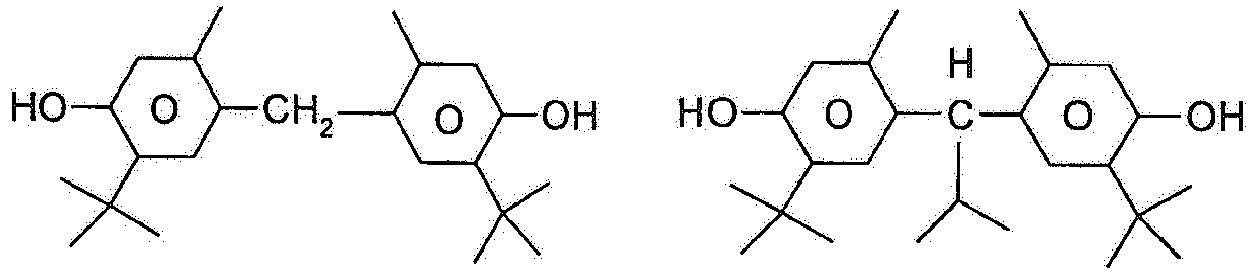
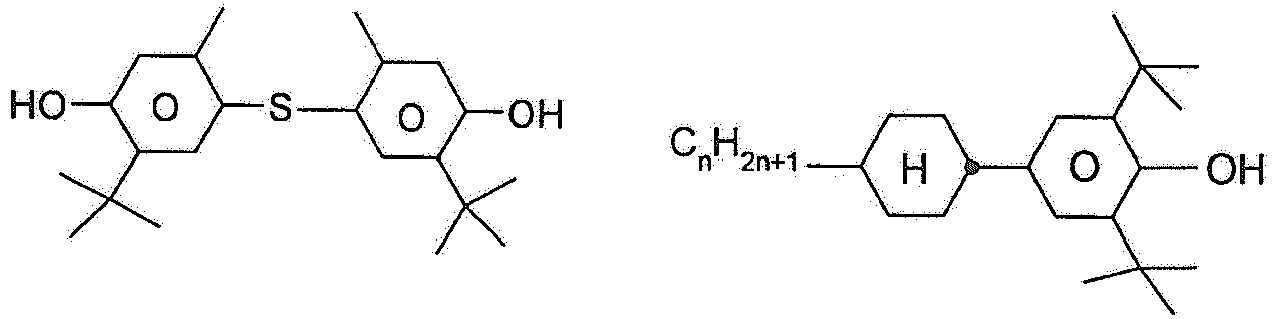


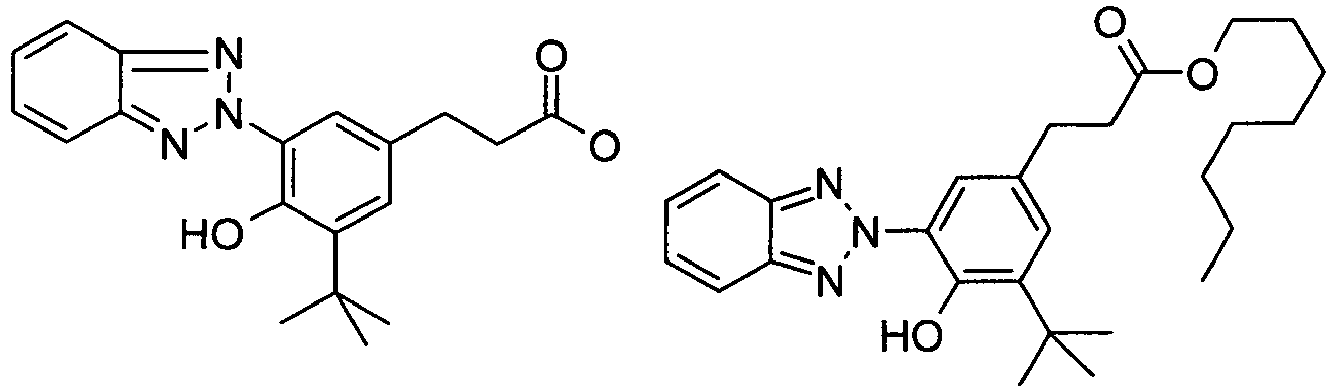


- Flüssigkristallines Medium nach einem oder mehreren der Ansprüche 1 bis 10, dadurch gekennzeichnet, dass das Medium ein oder mehrere Stabilisatoren in Mengen von 0-10 Gew.% enthält.
- Verfahren zur Herstellung eines flüssigkristallinen Mediums nach einem oder mehreren der Ansprüche 1 bis 11, dadurch gekennzeichnet, dass man die Verbindung der Formel I-1 und/oder die Verbindung der Formel I-2 mit mindestens einer Verbindung ausgewählt aus der Gruppe der Verbindungen der Formeln IIA, IIB und IIC und zusätzlich einer oder mehrerer Verbindungen ausgewählt aus der Gruppe der Verbindungen der Formeln L-1 bis L-11, T-1 bis T-21, BF-1 und BF-2 und mit mindestens einer weiteren flüssigkristallinen Verbindung mischt und gegebenenfalls ein oder mehrere Additive und gegebenfalls mindestens eine polymerisierbare Verbindung zusetzt.
- Verwendung des flüssigkristallinen Mediums nach einem oder mehreren der Ansprüche 1 bis 11 in elektrooptischen Anzeigen.
- Elektrooptische Anzeige mit einer Aktivmatrix-Addressierung, dadurch gekennzeichnet, dass sie als Dielektrikum ein flüssigkristallines Medium nach einem oder mehreren der Ansprüche 1 bis 11 enthält.
- Elektrooptische Anzeige nach Anspruch 14, dadurch gekennzeichnet, dass es sich um eine VA-, PSA-, PA-VA-, PS-VA-, PALC-, IPS-, PS-IPS-, FFS-, UB-FFS-, PS-FFS-Anzeige handelt.
Applications Claiming Priority (2)
| Application Number | Priority Date | Filing Date | Title |
|---|---|---|---|
| DE102014007663 | 2014-05-27 | ||
| PCT/EP2015/001011 WO2015180830A1 (de) | 2014-05-27 | 2015-05-18 | Flüssigkristallines medium |
Publications (2)
| Publication Number | Publication Date |
|---|---|
| EP3149110A1 EP3149110A1 (de) | 2017-04-05 |
| EP3149110B1 true EP3149110B1 (de) | 2019-12-11 |
Family
ID=53189773
Family Applications (1)
| Application Number | Title | Priority Date | Filing Date |
|---|---|---|---|
| EP15723433.7A Active EP3149110B1 (de) | 2014-05-27 | 2015-05-18 | Flüssigkristallines medium |
Country Status (7)
| Country | Link |
|---|---|
| EP (1) | EP3149110B1 (de) |
| JP (1) | JP2017517606A (de) |
| KR (1) | KR20170012407A (de) |
| CN (1) | CN106414666A (de) |
| DE (1) | DE102015006246A1 (de) |
| TW (1) | TWI668300B (de) |
| WO (1) | WO2015180830A1 (de) |
Families Citing this family (4)
| Publication number | Priority date | Publication date | Assignee | Title |
|---|---|---|---|---|
| JPWO2017195585A1 (ja) * | 2016-05-10 | 2018-05-24 | Dic株式会社 | 液晶表示素子 |
| JP2019077792A (ja) * | 2017-10-25 | 2019-05-23 | Jnc株式会社 | 液晶組成物および液晶表示素子 |
| WO2019110636A1 (en) * | 2017-12-08 | 2019-06-13 | Merck Patent Gmbh | Liquid-crystalline medium |
| JP2020176255A (ja) * | 2019-04-18 | 2020-10-29 | Jnc株式会社 | 液晶組成物および液晶表示素子 |
Family Cites Families (21)
| Publication number | Priority date | Publication date | Assignee | Title |
|---|---|---|---|---|
| BE795849A (fr) | 1972-02-26 | 1973-08-23 | Merck Patent Gmbh | Phases nematiques modifiees |
| US3814700A (en) | 1972-08-03 | 1974-06-04 | Ibm | Method for controllably varying the electrical properties of nematic liquids and dopants therefor |
| DE2450088A1 (de) | 1974-10-22 | 1976-04-29 | Merck Patent Gmbh | Biphenylester |
| DE2637430A1 (de) | 1976-08-20 | 1978-02-23 | Merck Patent Gmbh | Fluessigkristallines dielektrikum |
| DE2853728A1 (de) | 1978-12-13 | 1980-07-17 | Merck Patent Gmbh | Fluessigkristalline carbonsaeureester, verfahren zu ihrer herstellung, diese enthaltende dielektrika und elektrooptisches anzeigeelement |
| FR2595157B1 (fr) | 1986-02-28 | 1988-04-29 | Commissariat Energie Atomique | Cellule a double couche de cristal liquide, utilisant l'effet de birefringence controlee electriquement et procede de fabrication d'un milieu uniaxe d'anisotropie optique negative utilisable dans cette cellule |
| JPH03255423A (ja) * | 1990-01-12 | 1991-11-14 | Takiron Co Ltd | 調光材 |
| JPH08176549A (ja) * | 1994-12-22 | 1996-07-09 | Matsushita Electric Ind Co Ltd | 耐紫外線液晶材料及び液晶表示装置 |
| CN1204445C (zh) | 2002-02-04 | 2005-06-01 | 富士通显示技术株式会社 | 液晶显示装置及其制造方法 |
| EP1378557B1 (de) | 2002-07-06 | 2007-02-21 | MERCK PATENT GmbH | Flüssigkristallines Medium |
| DE102004012970A1 (de) * | 2003-04-11 | 2004-10-28 | Merck Patent Gmbh | Flüssigkristallines Medium |
| JP2005298733A (ja) * | 2004-04-14 | 2005-10-27 | Chisso Corp | 液晶組成物および液晶表示素子 |
| US9550942B2 (en) * | 2004-07-02 | 2017-01-24 | Merck Patent Gmbh | Liquid crystal medium and electrooptical display containing same |
| JP4857543B2 (ja) * | 2004-10-29 | 2012-01-18 | Dic株式会社 | ネマチック液晶組成物及びこれを用いた液晶表示素子 |
| KR101496268B1 (ko) * | 2005-08-09 | 2015-02-26 | 메르크 파텐트 게엠베하 | 액정 매질 |
| JP5141947B2 (ja) * | 2007-06-29 | 2013-02-13 | Dic株式会社 | ネマチック液晶組成物及びこれを用いた液晶表示素子 |
| CN101608120B (zh) * | 2008-07-08 | 2013-05-15 | 北京八亿时空液晶科技股份有限公司 | 一种向列型液晶组合物 |
| DE102011013007A1 (de) * | 2010-04-01 | 2011-10-06 | Merck Patent Gmbh | Flüssigkristallines Medium und Elektrooptische Anzeige |
| EP3260518B1 (de) * | 2011-03-29 | 2019-12-25 | Merck Patent GmbH | Flüssigkristallines medium |
| DE102013017173A1 (de) * | 2012-10-18 | 2014-04-24 | Merck Patent Gmbh | Flüssigkristallines Medium, Methode zu seiner Stabilisierung und Flüssigkristallanzeige |
| EP2848676B1 (de) * | 2013-09-12 | 2017-07-26 | Merck Patent GmbH | Flüssigkristallmedium |
-
2015
- 2015-05-18 CN CN201580027446.6A patent/CN106414666A/zh active Pending
- 2015-05-18 KR KR1020167036260A patent/KR20170012407A/ko not_active Withdrawn
- 2015-05-18 EP EP15723433.7A patent/EP3149110B1/de active Active
- 2015-05-18 WO PCT/EP2015/001011 patent/WO2015180830A1/de not_active Ceased
- 2015-05-18 JP JP2016569743A patent/JP2017517606A/ja active Pending
- 2015-05-18 DE DE102015006246.8A patent/DE102015006246A1/de not_active Withdrawn
- 2015-05-26 TW TW104116881A patent/TWI668300B/zh active
Non-Patent Citations (1)
| Title |
|---|
| None * |
Also Published As
| Publication number | Publication date |
|---|---|
| TWI668300B (zh) | 2019-08-11 |
| EP3149110A1 (de) | 2017-04-05 |
| TW201606058A (zh) | 2016-02-16 |
| CN106414666A (zh) | 2017-02-15 |
| KR20170012407A (ko) | 2017-02-02 |
| WO2015180830A1 (de) | 2015-12-03 |
| DE102015006246A1 (de) | 2015-12-03 |
| JP2017517606A (ja) | 2017-06-29 |
Similar Documents
| Publication | Publication Date | Title |
|---|---|---|
| EP2937401B1 (de) | Flüssigkristallines medium | |
| EP2677019B1 (de) | Flüssigkristallines medium | |
| EP3224331B1 (de) | Flüssigkristallines medium | |
| EP2534223B1 (de) | Flüssigkristallines medium | |
| EP2957618B1 (de) | Flüssigkristallines medium | |
| EP1958999B1 (de) | Flüssigkristallines Medium | |
| EP2176376B1 (de) | Flüssigkristallines medium | |
| EP2886627B1 (de) | Flüssigkristallines Medium | |
| EP1913114B1 (de) | Flüssigkristallines medium | |
| EP2031040B1 (de) | Flüssigkristallines Medium | |
| EP2542647B1 (de) | Flüssigkristallines medium | |
| DE102019003615A1 (de) | Flüssigkristallines medium | |
| DE102017002925A1 (de) | Flüssigkristallines Medium | |
| DE102015006246A1 (de) | Flüssigkristallines Medium | |
| DE112018006224T5 (de) | Flüssigkristallines Medium |
Legal Events
| Date | Code | Title | Description |
|---|---|---|---|
| STAA | Information on the status of an ep patent application or granted ep patent |
Free format text: STATUS: THE INTERNATIONAL PUBLICATION HAS BEEN MADE |
|
| PUAI | Public reference made under article 153(3) epc to a published international application that has entered the european phase |
Free format text: ORIGINAL CODE: 0009012 |
|
| STAA | Information on the status of an ep patent application or granted ep patent |
Free format text: STATUS: REQUEST FOR EXAMINATION WAS MADE |
|
| 17P | Request for examination filed |
Effective date: 20161004 |
|
| AK | Designated contracting states |
Kind code of ref document: A1 Designated state(s): AL AT BE BG CH CY CZ DE DK EE ES FI FR GB GR HR HU IE IS IT LI LT LU LV MC MK MT NL NO PL PT RO RS SE SI SK SM TR |
|
| AX | Request for extension of the european patent |
Extension state: BA ME |
|
| DAV | Request for validation of the european patent (deleted) | ||
| DAX | Request for extension of the european patent (deleted) | ||
| STAA | Information on the status of an ep patent application or granted ep patent |
Free format text: STATUS: EXAMINATION IS IN PROGRESS |
|
| 17Q | First examination report despatched |
Effective date: 20180914 |
|
| GRAP | Despatch of communication of intention to grant a patent |
Free format text: ORIGINAL CODE: EPIDOSNIGR1 |
|
| STAA | Information on the status of an ep patent application or granted ep patent |
Free format text: STATUS: GRANT OF PATENT IS INTENDED |
|
| INTG | Intention to grant announced |
Effective date: 20190618 |
|
| GRAS | Grant fee paid |
Free format text: ORIGINAL CODE: EPIDOSNIGR3 |
|
| GRAJ | Information related to disapproval of communication of intention to grant by the applicant or resumption of examination proceedings by the epo deleted |
Free format text: ORIGINAL CODE: EPIDOSDIGR1 |
|
| GRAL | Information related to payment of fee for publishing/printing deleted |
Free format text: ORIGINAL CODE: EPIDOSDIGR3 |
|
| STAA | Information on the status of an ep patent application or granted ep patent |
Free format text: STATUS: EXAMINATION IS IN PROGRESS |
|
| GRAR | Information related to intention to grant a patent recorded |
Free format text: ORIGINAL CODE: EPIDOSNIGR71 |
|
| STAA | Information on the status of an ep patent application or granted ep patent |
Free format text: STATUS: GRANT OF PATENT IS INTENDED |
|
| GRAA | (expected) grant |
Free format text: ORIGINAL CODE: 0009210 |
|
| STAA | Information on the status of an ep patent application or granted ep patent |
Free format text: STATUS: THE PATENT HAS BEEN GRANTED |
|
| INTC | Intention to grant announced (deleted) | ||
| INTG | Intention to grant announced |
Effective date: 20191031 |
|
| AK | Designated contracting states |
Kind code of ref document: B1 Designated state(s): AL AT BE BG CH CY CZ DE DK EE ES FI FR GB GR HR HU IE IS IT LI LT LU LV MC MK MT NL NO PL PT RO RS SE SI SK SM TR |
|
| REG | Reference to a national code |
Ref country code: GB Ref legal event code: FG4D Free format text: NOT ENGLISH |
|
| REG | Reference to a national code |
Ref country code: CH Ref legal event code: EP |
|
| REG | Reference to a national code |
Ref country code: AT Ref legal event code: REF Ref document number: 1212176 Country of ref document: AT Kind code of ref document: T Effective date: 20191215 |
|
| REG | Reference to a national code |
Ref country code: DE Ref legal event code: R096 Ref document number: 502015011201 Country of ref document: DE |
|
| REG | Reference to a national code |
Ref country code: IE Ref legal event code: FG4D Free format text: LANGUAGE OF EP DOCUMENT: GERMAN |
|
| REG | Reference to a national code |
Ref country code: NL Ref legal event code: MP Effective date: 20191211 |
|
| REG | Reference to a national code |
Ref country code: LT Ref legal event code: MG4D |
|
| PG25 | Lapsed in a contracting state [announced via postgrant information from national office to epo] |
Ref country code: LT Free format text: LAPSE BECAUSE OF FAILURE TO SUBMIT A TRANSLATION OF THE DESCRIPTION OR TO PAY THE FEE WITHIN THE PRESCRIBED TIME-LIMIT Effective date: 20191211 Ref country code: NO Free format text: LAPSE BECAUSE OF FAILURE TO SUBMIT A TRANSLATION OF THE DESCRIPTION OR TO PAY THE FEE WITHIN THE PRESCRIBED TIME-LIMIT Effective date: 20200311 Ref country code: GR Free format text: LAPSE BECAUSE OF FAILURE TO SUBMIT A TRANSLATION OF THE DESCRIPTION OR TO PAY THE FEE WITHIN THE PRESCRIBED TIME-LIMIT Effective date: 20200312 Ref country code: FI Free format text: LAPSE BECAUSE OF FAILURE TO SUBMIT A TRANSLATION OF THE DESCRIPTION OR TO PAY THE FEE WITHIN THE PRESCRIBED TIME-LIMIT Effective date: 20191211 Ref country code: BG Free format text: LAPSE BECAUSE OF FAILURE TO SUBMIT A TRANSLATION OF THE DESCRIPTION OR TO PAY THE FEE WITHIN THE PRESCRIBED TIME-LIMIT Effective date: 20200311 Ref country code: SE Free format text: LAPSE BECAUSE OF FAILURE TO SUBMIT A TRANSLATION OF THE DESCRIPTION OR TO PAY THE FEE WITHIN THE PRESCRIBED TIME-LIMIT Effective date: 20191211 Ref country code: LV Free format text: LAPSE BECAUSE OF FAILURE TO SUBMIT A TRANSLATION OF THE DESCRIPTION OR TO PAY THE FEE WITHIN THE PRESCRIBED TIME-LIMIT Effective date: 20191211 |
|
| PG25 | Lapsed in a contracting state [announced via postgrant information from national office to epo] |
Ref country code: HR Free format text: LAPSE BECAUSE OF FAILURE TO SUBMIT A TRANSLATION OF THE DESCRIPTION OR TO PAY THE FEE WITHIN THE PRESCRIBED TIME-LIMIT Effective date: 20191211 Ref country code: RS Free format text: LAPSE BECAUSE OF FAILURE TO SUBMIT A TRANSLATION OF THE DESCRIPTION OR TO PAY THE FEE WITHIN THE PRESCRIBED TIME-LIMIT Effective date: 20191211 |
|
| PG25 | Lapsed in a contracting state [announced via postgrant information from national office to epo] |
Ref country code: AL Free format text: LAPSE BECAUSE OF FAILURE TO SUBMIT A TRANSLATION OF THE DESCRIPTION OR TO PAY THE FEE WITHIN THE PRESCRIBED TIME-LIMIT Effective date: 20191211 |
|
| PG25 | Lapsed in a contracting state [announced via postgrant information from national office to epo] |
Ref country code: ES Free format text: LAPSE BECAUSE OF FAILURE TO SUBMIT A TRANSLATION OF THE DESCRIPTION OR TO PAY THE FEE WITHIN THE PRESCRIBED TIME-LIMIT Effective date: 20191211 Ref country code: CZ Free format text: LAPSE BECAUSE OF FAILURE TO SUBMIT A TRANSLATION OF THE DESCRIPTION OR TO PAY THE FEE WITHIN THE PRESCRIBED TIME-LIMIT Effective date: 20191211 Ref country code: RO Free format text: LAPSE BECAUSE OF FAILURE TO SUBMIT A TRANSLATION OF THE DESCRIPTION OR TO PAY THE FEE WITHIN THE PRESCRIBED TIME-LIMIT Effective date: 20191211 Ref country code: NL Free format text: LAPSE BECAUSE OF FAILURE TO SUBMIT A TRANSLATION OF THE DESCRIPTION OR TO PAY THE FEE WITHIN THE PRESCRIBED TIME-LIMIT Effective date: 20191211 Ref country code: EE Free format text: LAPSE BECAUSE OF FAILURE TO SUBMIT A TRANSLATION OF THE DESCRIPTION OR TO PAY THE FEE WITHIN THE PRESCRIBED TIME-LIMIT Effective date: 20191211 Ref country code: PT Free format text: LAPSE BECAUSE OF FAILURE TO SUBMIT A TRANSLATION OF THE DESCRIPTION OR TO PAY THE FEE WITHIN THE PRESCRIBED TIME-LIMIT Effective date: 20200506 |
|
| PG25 | Lapsed in a contracting state [announced via postgrant information from national office to epo] |
Ref country code: SM Free format text: LAPSE BECAUSE OF FAILURE TO SUBMIT A TRANSLATION OF THE DESCRIPTION OR TO PAY THE FEE WITHIN THE PRESCRIBED TIME-LIMIT Effective date: 20191211 Ref country code: SK Free format text: LAPSE BECAUSE OF FAILURE TO SUBMIT A TRANSLATION OF THE DESCRIPTION OR TO PAY THE FEE WITHIN THE PRESCRIBED TIME-LIMIT Effective date: 20191211 Ref country code: IS Free format text: LAPSE BECAUSE OF FAILURE TO SUBMIT A TRANSLATION OF THE DESCRIPTION OR TO PAY THE FEE WITHIN THE PRESCRIBED TIME-LIMIT Effective date: 20200411 |
|
| REG | Reference to a national code |
Ref country code: DE Ref legal event code: R097 Ref document number: 502015011201 Country of ref document: DE |
|
| PLBE | No opposition filed within time limit |
Free format text: ORIGINAL CODE: 0009261 |
|
| STAA | Information on the status of an ep patent application or granted ep patent |
Free format text: STATUS: NO OPPOSITION FILED WITHIN TIME LIMIT |
|
| PG25 | Lapsed in a contracting state [announced via postgrant information from national office to epo] |
Ref country code: DK Free format text: LAPSE BECAUSE OF FAILURE TO SUBMIT A TRANSLATION OF THE DESCRIPTION OR TO PAY THE FEE WITHIN THE PRESCRIBED TIME-LIMIT Effective date: 20191211 |
|
| 26N | No opposition filed |
Effective date: 20200914 |
|
| PG25 | Lapsed in a contracting state [announced via postgrant information from national office to epo] |
Ref country code: SI Free format text: LAPSE BECAUSE OF FAILURE TO SUBMIT A TRANSLATION OF THE DESCRIPTION OR TO PAY THE FEE WITHIN THE PRESCRIBED TIME-LIMIT Effective date: 20191211 |
|
| PG25 | Lapsed in a contracting state [announced via postgrant information from national office to epo] |
Ref country code: IT Free format text: LAPSE BECAUSE OF FAILURE TO SUBMIT A TRANSLATION OF THE DESCRIPTION OR TO PAY THE FEE WITHIN THE PRESCRIBED TIME-LIMIT Effective date: 20191211 Ref country code: MC Free format text: LAPSE BECAUSE OF FAILURE TO SUBMIT A TRANSLATION OF THE DESCRIPTION OR TO PAY THE FEE WITHIN THE PRESCRIBED TIME-LIMIT Effective date: 20191211 Ref country code: LI Free format text: LAPSE BECAUSE OF NON-PAYMENT OF DUE FEES Effective date: 20200531 Ref country code: CH Free format text: LAPSE BECAUSE OF NON-PAYMENT OF DUE FEES Effective date: 20200531 |
|
| PG25 | Lapsed in a contracting state [announced via postgrant information from national office to epo] |
Ref country code: PL Free format text: LAPSE BECAUSE OF FAILURE TO SUBMIT A TRANSLATION OF THE DESCRIPTION OR TO PAY THE FEE WITHIN THE PRESCRIBED TIME-LIMIT Effective date: 20191211 |
|
| REG | Reference to a national code |
Ref country code: BE Ref legal event code: MM Effective date: 20200531 |
|
| GBPC | Gb: european patent ceased through non-payment of renewal fee |
Effective date: 20200518 |
|
| PG25 | Lapsed in a contracting state [announced via postgrant information from national office to epo] |
Ref country code: LU Free format text: LAPSE BECAUSE OF NON-PAYMENT OF DUE FEES Effective date: 20200518 |
|
| PG25 | Lapsed in a contracting state [announced via postgrant information from national office to epo] |
Ref country code: GB Free format text: LAPSE BECAUSE OF NON-PAYMENT OF DUE FEES Effective date: 20200518 Ref country code: IE Free format text: LAPSE BECAUSE OF NON-PAYMENT OF DUE FEES Effective date: 20200518 Ref country code: FR Free format text: LAPSE BECAUSE OF NON-PAYMENT OF DUE FEES Effective date: 20200531 |
|
| PG25 | Lapsed in a contracting state [announced via postgrant information from national office to epo] |
Ref country code: BE Free format text: LAPSE BECAUSE OF NON-PAYMENT OF DUE FEES Effective date: 20200531 |
|
| REG | Reference to a national code |
Ref country code: AT Ref legal event code: MM01 Ref document number: 1212176 Country of ref document: AT Kind code of ref document: T Effective date: 20200518 |
|
| PG25 | Lapsed in a contracting state [announced via postgrant information from national office to epo] |
Ref country code: AT Free format text: LAPSE BECAUSE OF NON-PAYMENT OF DUE FEES Effective date: 20200518 |
|
| PG25 | Lapsed in a contracting state [announced via postgrant information from national office to epo] |
Ref country code: TR Free format text: LAPSE BECAUSE OF FAILURE TO SUBMIT A TRANSLATION OF THE DESCRIPTION OR TO PAY THE FEE WITHIN THE PRESCRIBED TIME-LIMIT Effective date: 20191211 Ref country code: MT Free format text: LAPSE BECAUSE OF FAILURE TO SUBMIT A TRANSLATION OF THE DESCRIPTION OR TO PAY THE FEE WITHIN THE PRESCRIBED TIME-LIMIT Effective date: 20191211 Ref country code: CY Free format text: LAPSE BECAUSE OF FAILURE TO SUBMIT A TRANSLATION OF THE DESCRIPTION OR TO PAY THE FEE WITHIN THE PRESCRIBED TIME-LIMIT Effective date: 20191211 |
|
| PG25 | Lapsed in a contracting state [announced via postgrant information from national office to epo] |
Ref country code: MK Free format text: LAPSE BECAUSE OF FAILURE TO SUBMIT A TRANSLATION OF THE DESCRIPTION OR TO PAY THE FEE WITHIN THE PRESCRIBED TIME-LIMIT Effective date: 20191211 |
|
| P01 | Opt-out of the competence of the unified patent court (upc) registered |
Effective date: 20230518 |
|
| PGFP | Annual fee paid to national office [announced via postgrant information from national office to epo] |
Ref country code: DE Payment date: 20250423 Year of fee payment: 11 |