EP3149075B1 - Verfahren zur herstellung von graphen-/graphit-polymerverbundschaumstoff aus durch kinetische graphen/graphit-fallen stabilisierten emulsionen - Google Patents
Verfahren zur herstellung von graphen-/graphit-polymerverbundschaumstoff aus durch kinetische graphen/graphit-fallen stabilisierten emulsionen Download PDFInfo
- Publication number
- EP3149075B1 EP3149075B1 EP15798851.0A EP15798851A EP3149075B1 EP 3149075 B1 EP3149075 B1 EP 3149075B1 EP 15798851 A EP15798851 A EP 15798851A EP 3149075 B1 EP3149075 B1 EP 3149075B1
- Authority
- EP
- European Patent Office
- Prior art keywords
- graphene
- graphite
- emulsion
- water
- solvent
- Prior art date
- Legal status (The legal status is an assumption and is not a legal conclusion. Google has not performed a legal analysis and makes no representation as to the accuracy of the status listed.)
- Active
Links
Images



Classifications
-
- H—ELECTRICITY
- H01—ELECTRIC ELEMENTS
- H01B—CABLES; CONDUCTORS; INSULATORS; SELECTION OF MATERIALS FOR THEIR CONDUCTIVE, INSULATING OR DIELECTRIC PROPERTIES
- H01B1/00—Conductors or conductive bodies characterised by the conductive materials; Selection of materials as conductors
- H01B1/06—Conductors or conductive bodies characterised by the conductive materials; Selection of materials as conductors mainly consisting of other non-metallic substances
- H01B1/12—Conductors or conductive bodies characterised by the conductive materials; Selection of materials as conductors mainly consisting of other non-metallic substances organic substances
- H01B1/124—Intrinsically conductive polymers
-
- B—PERFORMING OPERATIONS; TRANSPORTING
- B01—PHYSICAL OR CHEMICAL PROCESSES OR APPARATUS IN GENERAL
- B01J—CHEMICAL OR PHYSICAL PROCESSES, e.g. CATALYSIS OR COLLOID CHEMISTRY; THEIR RELEVANT APPARATUS
- B01J20/00—Solid sorbent compositions or filter aid compositions; Sorbents for chromatography; Processes for preparing, regenerating or reactivating thereof
- B01J20/02—Solid sorbent compositions or filter aid compositions; Sorbents for chromatography; Processes for preparing, regenerating or reactivating thereof comprising inorganic material
- B01J20/20—Solid sorbent compositions or filter aid compositions; Sorbents for chromatography; Processes for preparing, regenerating or reactivating thereof comprising inorganic material comprising free carbon; comprising carbon obtained by carbonising processes
- B01J20/205—Carbon nanostructures, e.g. nanotubes, nanohorns, nanocones, nanoballs
-
- B—PERFORMING OPERATIONS; TRANSPORTING
- B01—PHYSICAL OR CHEMICAL PROCESSES OR APPARATUS IN GENERAL
- B01J—CHEMICAL OR PHYSICAL PROCESSES, e.g. CATALYSIS OR COLLOID CHEMISTRY; THEIR RELEVANT APPARATUS
- B01J20/00—Solid sorbent compositions or filter aid compositions; Sorbents for chromatography; Processes for preparing, regenerating or reactivating thereof
- B01J20/22—Solid sorbent compositions or filter aid compositions; Sorbents for chromatography; Processes for preparing, regenerating or reactivating thereof comprising organic material
- B01J20/26—Synthetic macromolecular compounds
- B01J20/261—Synthetic macromolecular compounds obtained by reactions only involving carbon to carbon unsaturated bonds
-
- B—PERFORMING OPERATIONS; TRANSPORTING
- B01—PHYSICAL OR CHEMICAL PROCESSES OR APPARATUS IN GENERAL
- B01J—CHEMICAL OR PHYSICAL PROCESSES, e.g. CATALYSIS OR COLLOID CHEMISTRY; THEIR RELEVANT APPARATUS
- B01J20/00—Solid sorbent compositions or filter aid compositions; Sorbents for chromatography; Processes for preparing, regenerating or reactivating thereof
- B01J20/22—Solid sorbent compositions or filter aid compositions; Sorbents for chromatography; Processes for preparing, regenerating or reactivating thereof comprising organic material
- B01J20/26—Synthetic macromolecular compounds
- B01J20/262—Synthetic macromolecular compounds obtained otherwise than by reactions only involving carbon to carbon unsaturated bonds, e.g. obtained by polycondensation
-
- B—PERFORMING OPERATIONS; TRANSPORTING
- B01—PHYSICAL OR CHEMICAL PROCESSES OR APPARATUS IN GENERAL
- B01J—CHEMICAL OR PHYSICAL PROCESSES, e.g. CATALYSIS OR COLLOID CHEMISTRY; THEIR RELEVANT APPARATUS
- B01J20/00—Solid sorbent compositions or filter aid compositions; Sorbents for chromatography; Processes for preparing, regenerating or reactivating thereof
- B01J20/22—Solid sorbent compositions or filter aid compositions; Sorbents for chromatography; Processes for preparing, regenerating or reactivating thereof comprising organic material
- B01J20/26—Synthetic macromolecular compounds
- B01J20/265—Synthetic macromolecular compounds modified or post-treated polymers
- B01J20/267—Cross-linked polymers
-
- B—PERFORMING OPERATIONS; TRANSPORTING
- B01—PHYSICAL OR CHEMICAL PROCESSES OR APPARATUS IN GENERAL
- B01J—CHEMICAL OR PHYSICAL PROCESSES, e.g. CATALYSIS OR COLLOID CHEMISTRY; THEIR RELEVANT APPARATUS
- B01J20/00—Solid sorbent compositions or filter aid compositions; Sorbents for chromatography; Processes for preparing, regenerating or reactivating thereof
- B01J20/28—Solid sorbent compositions or filter aid compositions; Sorbents for chromatography; Processes for preparing, regenerating or reactivating thereof characterised by their form or physical properties
- B01J20/28002—Solid sorbent compositions or filter aid compositions; Sorbents for chromatography; Processes for preparing, regenerating or reactivating thereof characterised by their form or physical properties characterised by their physical properties
- B01J20/28011—Other properties, e.g. density, crush strength
-
- B—PERFORMING OPERATIONS; TRANSPORTING
- B01—PHYSICAL OR CHEMICAL PROCESSES OR APPARATUS IN GENERAL
- B01J—CHEMICAL OR PHYSICAL PROCESSES, e.g. CATALYSIS OR COLLOID CHEMISTRY; THEIR RELEVANT APPARATUS
- B01J20/00—Solid sorbent compositions or filter aid compositions; Sorbents for chromatography; Processes for preparing, regenerating or reactivating thereof
- B01J20/28—Solid sorbent compositions or filter aid compositions; Sorbents for chromatography; Processes for preparing, regenerating or reactivating thereof characterised by their form or physical properties
- B01J20/28014—Solid sorbent compositions or filter aid compositions; Sorbents for chromatography; Processes for preparing, regenerating or reactivating thereof characterised by their form or physical properties characterised by their form
- B01J20/28026—Particles within, immobilised, dispersed, entrapped in or on a matrix, e.g. a resin
-
- B—PERFORMING OPERATIONS; TRANSPORTING
- B01—PHYSICAL OR CHEMICAL PROCESSES OR APPARATUS IN GENERAL
- B01J—CHEMICAL OR PHYSICAL PROCESSES, e.g. CATALYSIS OR COLLOID CHEMISTRY; THEIR RELEVANT APPARATUS
- B01J20/00—Solid sorbent compositions or filter aid compositions; Sorbents for chromatography; Processes for preparing, regenerating or reactivating thereof
- B01J20/28—Solid sorbent compositions or filter aid compositions; Sorbents for chromatography; Processes for preparing, regenerating or reactivating thereof characterised by their form or physical properties
- B01J20/28014—Solid sorbent compositions or filter aid compositions; Sorbents for chromatography; Processes for preparing, regenerating or reactivating thereof characterised by their form or physical properties characterised by their form
- B01J20/28042—Shaped bodies; Monolithic structures
- B01J20/28045—Honeycomb or cellular structures; Solid foams or sponges
-
- B—PERFORMING OPERATIONS; TRANSPORTING
- B01—PHYSICAL OR CHEMICAL PROCESSES OR APPARATUS IN GENERAL
- B01J—CHEMICAL OR PHYSICAL PROCESSES, e.g. CATALYSIS OR COLLOID CHEMISTRY; THEIR RELEVANT APPARATUS
- B01J20/00—Solid sorbent compositions or filter aid compositions; Sorbents for chromatography; Processes for preparing, regenerating or reactivating thereof
- B01J20/28—Solid sorbent compositions or filter aid compositions; Sorbents for chromatography; Processes for preparing, regenerating or reactivating thereof characterised by their form or physical properties
- B01J20/28054—Solid sorbent compositions or filter aid compositions; Sorbents for chromatography; Processes for preparing, regenerating or reactivating thereof characterised by their form or physical properties characterised by their surface properties or porosity
- B01J20/28095—Shape or type of pores, voids, channels, ducts
-
- B—PERFORMING OPERATIONS; TRANSPORTING
- B01—PHYSICAL OR CHEMICAL PROCESSES OR APPARATUS IN GENERAL
- B01J—CHEMICAL OR PHYSICAL PROCESSES, e.g. CATALYSIS OR COLLOID CHEMISTRY; THEIR RELEVANT APPARATUS
- B01J20/00—Solid sorbent compositions or filter aid compositions; Sorbents for chromatography; Processes for preparing, regenerating or reactivating thereof
- B01J20/30—Processes for preparing, regenerating, or reactivating
- B01J20/3085—Chemical treatments not covered by groups B01J20/3007 - B01J20/3078
-
- B—PERFORMING OPERATIONS; TRANSPORTING
- B01—PHYSICAL OR CHEMICAL PROCESSES OR APPARATUS IN GENERAL
- B01J—CHEMICAL OR PHYSICAL PROCESSES, e.g. CATALYSIS OR COLLOID CHEMISTRY; THEIR RELEVANT APPARATUS
- B01J20/00—Solid sorbent compositions or filter aid compositions; Sorbents for chromatography; Processes for preparing, regenerating or reactivating thereof
- B01J20/30—Processes for preparing, regenerating, or reactivating
- B01J20/32—Impregnating or coating ; Solid sorbent compositions obtained from processes involving impregnating or coating
- B01J20/3202—Impregnating or coating ; Solid sorbent compositions obtained from processes involving impregnating or coating characterised by the carrier, support or substrate used for impregnation or coating
- B01J20/3206—Organic carriers, supports or substrates
- B01J20/3208—Polymeric carriers, supports or substrates
- B01J20/321—Polymeric carriers, supports or substrates consisting of a polymer obtained by reactions involving only carbon to carbon unsaturated bonds
-
- B—PERFORMING OPERATIONS; TRANSPORTING
- B01—PHYSICAL OR CHEMICAL PROCESSES OR APPARATUS IN GENERAL
- B01J—CHEMICAL OR PHYSICAL PROCESSES, e.g. CATALYSIS OR COLLOID CHEMISTRY; THEIR RELEVANT APPARATUS
- B01J20/00—Solid sorbent compositions or filter aid compositions; Sorbents for chromatography; Processes for preparing, regenerating or reactivating thereof
- B01J20/30—Processes for preparing, regenerating, or reactivating
- B01J20/32—Impregnating or coating ; Solid sorbent compositions obtained from processes involving impregnating or coating
- B01J20/3202—Impregnating or coating ; Solid sorbent compositions obtained from processes involving impregnating or coating characterised by the carrier, support or substrate used for impregnation or coating
- B01J20/3206—Organic carriers, supports or substrates
- B01J20/3208—Polymeric carriers, supports or substrates
- B01J20/3212—Polymeric carriers, supports or substrates consisting of a polymer obtained by reactions otherwise than involving only carbon to carbon unsaturated bonds
-
- B—PERFORMING OPERATIONS; TRANSPORTING
- B01—PHYSICAL OR CHEMICAL PROCESSES OR APPARATUS IN GENERAL
- B01J—CHEMICAL OR PHYSICAL PROCESSES, e.g. CATALYSIS OR COLLOID CHEMISTRY; THEIR RELEVANT APPARATUS
- B01J20/00—Solid sorbent compositions or filter aid compositions; Sorbents for chromatography; Processes for preparing, regenerating or reactivating thereof
- B01J20/30—Processes for preparing, regenerating, or reactivating
- B01J20/32—Impregnating or coating ; Solid sorbent compositions obtained from processes involving impregnating or coating
- B01J20/3231—Impregnating or coating ; Solid sorbent compositions obtained from processes involving impregnating or coating characterised by the coating or impregnating layer
- B01J20/3234—Inorganic material layers
- B01J20/324—Inorganic material layers containing free carbon, e.g. activated carbon
-
- B—PERFORMING OPERATIONS; TRANSPORTING
- B01—PHYSICAL OR CHEMICAL PROCESSES OR APPARATUS IN GENERAL
- B01J—CHEMICAL OR PHYSICAL PROCESSES, e.g. CATALYSIS OR COLLOID CHEMISTRY; THEIR RELEVANT APPARATUS
- B01J20/00—Solid sorbent compositions or filter aid compositions; Sorbents for chromatography; Processes for preparing, regenerating or reactivating thereof
- B01J20/30—Processes for preparing, regenerating, or reactivating
- B01J20/32—Impregnating or coating ; Solid sorbent compositions obtained from processes involving impregnating or coating
- B01J20/3231—Impregnating or coating ; Solid sorbent compositions obtained from processes involving impregnating or coating characterised by the coating or impregnating layer
- B01J20/3242—Layers with a functional group, e.g. an affinity material, a ligand, a reactant or a complexing group
- B01J20/3268—Macromolecular compounds
- B01J20/3272—Polymers obtained by reactions otherwise than involving only carbon to carbon unsaturated bonds
-
- B—PERFORMING OPERATIONS; TRANSPORTING
- B01—PHYSICAL OR CHEMICAL PROCESSES OR APPARATUS IN GENERAL
- B01J—CHEMICAL OR PHYSICAL PROCESSES, e.g. CATALYSIS OR COLLOID CHEMISTRY; THEIR RELEVANT APPARATUS
- B01J20/00—Solid sorbent compositions or filter aid compositions; Sorbents for chromatography; Processes for preparing, regenerating or reactivating thereof
- B01J20/30—Processes for preparing, regenerating, or reactivating
- B01J20/32—Impregnating or coating ; Solid sorbent compositions obtained from processes involving impregnating or coating
- B01J20/3291—Characterised by the shape of the carrier, the coating or the obtained coated product
-
- B—PERFORMING OPERATIONS; TRANSPORTING
- B82—NANOTECHNOLOGY
- B82Y—SPECIFIC USES OR APPLICATIONS OF NANOSTRUCTURES; MEASUREMENT OR ANALYSIS OF NANOSTRUCTURES; MANUFACTURE OR TREATMENT OF NANOSTRUCTURES
- B82Y30/00—Nanotechnology for materials or surface science, e.g. nanocomposites
-
- C—CHEMISTRY; METALLURGY
- C08—ORGANIC MACROMOLECULAR COMPOUNDS; THEIR PREPARATION OR CHEMICAL WORKING-UP; COMPOSITIONS BASED THEREON
- C08J—WORKING-UP; GENERAL PROCESSES OF COMPOUNDING; AFTER-TREATMENT NOT COVERED BY SUBCLASSES C08B, C08C, C08F, C08G or C08H
- C08J9/00—Working-up of macromolecular substances to porous or cellular articles or materials; After-treatment thereof
- C08J9/04—Working-up of macromolecular substances to porous or cellular articles or materials; After-treatment thereof using blowing gases generated by a previously added blowing agent
- C08J9/12—Working-up of macromolecular substances to porous or cellular articles or materials; After-treatment thereof using blowing gases generated by a previously added blowing agent by a physical blowing agent
- C08J9/125—Water, e.g. hydrated salts
-
- C—CHEMISTRY; METALLURGY
- C08—ORGANIC MACROMOLECULAR COMPOUNDS; THEIR PREPARATION OR CHEMICAL WORKING-UP; COMPOSITIONS BASED THEREON
- C08J—WORKING-UP; GENERAL PROCESSES OF COMPOUNDING; AFTER-TREATMENT NOT COVERED BY SUBCLASSES C08B, C08C, C08F, C08G or C08H
- C08J9/00—Working-up of macromolecular substances to porous or cellular articles or materials; After-treatment thereof
- C08J9/36—After-treatment
- C08J9/365—Coating
-
- C—CHEMISTRY; METALLURGY
- C09—DYES; PAINTS; POLISHES; NATURAL RESINS; ADHESIVES; COMPOSITIONS NOT OTHERWISE PROVIDED FOR; APPLICATIONS OF MATERIALS NOT OTHERWISE PROVIDED FOR
- C09D—COATING COMPOSITIONS, e.g. PAINTS, VARNISHES OR LACQUERS; FILLING PASTES; CHEMICAL PAINT OR INK REMOVERS; INKS; CORRECTING FLUIDS; WOODSTAINS; PASTES OR SOLIDS FOR COLOURING OR PRINTING; USE OF MATERIALS THEREFOR
- C09D165/00—Coating compositions based on macromolecular compounds obtained by reactions forming a carbon-to-carbon link in the main chain; Coating compositions based on derivatives of such polymers
-
- C—CHEMISTRY; METALLURGY
- C09—DYES; PAINTS; POLISHES; NATURAL RESINS; ADHESIVES; COMPOSITIONS NOT OTHERWISE PROVIDED FOR; APPLICATIONS OF MATERIALS NOT OTHERWISE PROVIDED FOR
- C09D—COATING COMPOSITIONS, e.g. PAINTS, VARNISHES OR LACQUERS; FILLING PASTES; CHEMICAL PAINT OR INK REMOVERS; INKS; CORRECTING FLUIDS; WOODSTAINS; PASTES OR SOLIDS FOR COLOURING OR PRINTING; USE OF MATERIALS THEREFOR
- C09D5/00—Coating compositions, e.g. paints, varnishes or lacquers, characterised by their physical nature or the effects produced; Filling pastes
- C09D5/24—Electrically-conducting paints
-
- C—CHEMISTRY; METALLURGY
- C09—DYES; PAINTS; POLISHES; NATURAL RESINS; ADHESIVES; COMPOSITIONS NOT OTHERWISE PROVIDED FOR; APPLICATIONS OF MATERIALS NOT OTHERWISE PROVIDED FOR
- C09K—MATERIALS FOR MISCELLANEOUS APPLICATIONS, NOT PROVIDED FOR ELSEWHERE
- C09K3/00—Materials not provided for elsewhere
- C09K3/32—Materials not provided for elsewhere for absorbing liquids to remove pollution, e.g. oil, gasoline, fat
-
- C—CHEMISTRY; METALLURGY
- C09—DYES; PAINTS; POLISHES; NATURAL RESINS; ADHESIVES; COMPOSITIONS NOT OTHERWISE PROVIDED FOR; APPLICATIONS OF MATERIALS NOT OTHERWISE PROVIDED FOR
- C09K—MATERIALS FOR MISCELLANEOUS APPLICATIONS, NOT PROVIDED FOR ELSEWHERE
- C09K5/00—Heat-transfer, heat-exchange or heat-storage materials, e.g. refrigerants; Materials for the production of heat or cold by chemical reactions other than by combustion
- C09K5/08—Materials not undergoing a change of physical state when used
- C09K5/14—Solid materials, e.g. powdery or granular
-
- H—ELECTRICITY
- H01—ELECTRIC ELEMENTS
- H01B—CABLES; CONDUCTORS; INSULATORS; SELECTION OF MATERIALS FOR THEIR CONDUCTIVE, INSULATING OR DIELECTRIC PROPERTIES
- H01B1/00—Conductors or conductive bodies characterised by the conductive materials; Selection of materials as conductors
- H01B1/04—Conductors or conductive bodies characterised by the conductive materials; Selection of materials as conductors mainly consisting of carbon-silicon compounds, carbon or silicon
-
- C—CHEMISTRY; METALLURGY
- C08—ORGANIC MACROMOLECULAR COMPOUNDS; THEIR PREPARATION OR CHEMICAL WORKING-UP; COMPOSITIONS BASED THEREON
- C08J—WORKING-UP; GENERAL PROCESSES OF COMPOUNDING; AFTER-TREATMENT NOT COVERED BY SUBCLASSES C08B, C08C, C08F, C08G or C08H
- C08J2203/00—Foams characterized by the expanding agent
- C08J2203/10—Water or water-releasing compounds
-
- C—CHEMISTRY; METALLURGY
- C08—ORGANIC MACROMOLECULAR COMPOUNDS; THEIR PREPARATION OR CHEMICAL WORKING-UP; COMPOSITIONS BASED THEREON
- C08J—WORKING-UP; GENERAL PROCESSES OF COMPOUNDING; AFTER-TREATMENT NOT COVERED BY SUBCLASSES C08B, C08C, C08F, C08G or C08H
- C08J2205/00—Foams characterised by their properties
- C08J2205/04—Foams characterised by their properties characterised by the foam pores
- C08J2205/05—Open cells, i.e. more than 50% of the pores are open
-
- C—CHEMISTRY; METALLURGY
- C08—ORGANIC MACROMOLECULAR COMPOUNDS; THEIR PREPARATION OR CHEMICAL WORKING-UP; COMPOSITIONS BASED THEREON
- C08J—WORKING-UP; GENERAL PROCESSES OF COMPOUNDING; AFTER-TREATMENT NOT COVERED BY SUBCLASSES C08B, C08C, C08F, C08G or C08H
- C08J2325/00—Characterised by the use of homopolymers or copolymers of compounds having one or more unsaturated aliphatic radicals, each having only one carbon-to-carbon double bond, and at least one being terminated by an aromatic carbocyclic ring; Derivatives of such polymers
- C08J2325/02—Homopolymers or copolymers of hydrocarbons
- C08J2325/04—Homopolymers or copolymers of styrene
- C08J2325/06—Polystyrene
Definitions
- the present disclosure relates to methods of fabrication of pristine graphene/graphite/polymer composite foams.
- graphene has recently gained interest as a filler for composite materials (e.g., because of its intrinsic mechanical, thermal, and electrical properties).
- graphene's lack of solubility in substantially all solvents has led to the common practice of either using graphene oxide or reduced graphene oxide in the place of pristine graphene sheets.
- both graphene oxide and reduced graphene oxide have significantly reduced mechanical, thermal, and electrical properties when compared to the pristine graphene material.
- graphene has been sought after for its use as a filler in composite materials (e.g., because of its outstanding electrical, thermal, and mechanical properties). Unlike metals with comparable properties, graphene has a relatively low density of about 2.2 g/cm 3 and large theoretical surface area to mass ratio of around 2600 m 2 /g. Problems in dispersion have plagued the field and have unfortunately led to the use of both graphene oxide (GO) and reduced graphene oxide (RGO) in the place of pristine graphene sheets. Both of these substitutes, however, have greatly reduced properties when compared to the pristine material.
- GO graphene oxide
- RGO reduced graphene oxide
- Some processing problems include: harsh in-situ chemical reduction steps, as well difficult solvent removal in the solution mixing method; dispersion problems associated with the high viscosities of melted polymers, as well as the breaking and buckling of sheets from shear stress in the melt blending method; and dispersion and manipulation issues that arise from increases in viscosity in the in-situ polymerization method.
- US 7008565 discloses a method of preparing an electroconductive foam, in which an electroconductive polymer such as polyaniline is dispersed in a liquid medium that includes an aromatic solvent such as xylene and an organic dopant/dispersant such as an aromatic sulfonic acid.
- US 8642503 discloses a superhydrophobic and superoleophilic composite comprising a porous material and a surface layer.
- the porous material includes a framework and a plurality of interconnecting pores formed inside the framework and interconnecting with each other.
- the framework has a plurality of skeletons connected with each other.
- the surface layer is coated on the surfaces of the skeletons and includes an adhesion medium and a plurality of graphene sheets stuck to the surfaces of the skeletons by the adhesion medium.
- the graphene sheets form a rough surface conforming to the skeletons.
- EP 0565237 discloses an electroconductive polyurethane foam obtained by adding and dispersing, in a composition constituting a polyurethane foam, a substance with an electron conduction mechanism, and a substance with an ionic conduction mechanism, and mechanically agitating the resultant mixture in the presence of inert gas.
- US 2002/0150740 discloses a conductive polymeric foam wherein the cavities are coated with graphitic powder.
- the present disclosure provides advantageous graphene/graphite stabilized composites (e.g., graphene/graphite stabilized emulsion-templated foam composites), and improved methods for fabricating such graphene/graphite stabilized composites. More particularly, the present disclosure provides improved methods for fabricating pristine, graphene/graphite/polymer composite foams derived from emulsions stabilized by graphene/graphite kinetic trapping.
- the present disclosure provides that, instead of viewing the insolubility of pristine graphene/graphite as an obstacle to be overcome, it is utilized as a means to create/fabricate water/oil emulsions, with graphene/graphite stabilizing the spheres formed.
- These emulsions are then the frameworks used to make composites (e.g., foam composites) that have shown bulk conductivities up to about 2 S/m, as well as compressive moduli up to about 100 MPa and breaking strengths of over 8.3 MPa (1200 psi) all with densities as low as about 0.25 g/cm 3 .
- the lack of solubility of pristine graphene/graphite was viewed as an obstacle to be overcome.
- the present invention provides that by using an interface trapping method, the lack of solubility of pristine graphene/graphite is advantageously utilized to both exfoliate and trap graphene/graphite, as well as form stable emulsions used as the framework for polymer/graphene/graphite composites (e.g., hollow polymer/graphene/graphite composites).
- Research has shown film climbing using an interface trapping method in a heptane and water mixture. See, e.g., U.S. Patent App. Serial Nos.
- the present disclosure provides for the formation of spheres of water surrounded by oil stabilized by pristine graphene/graphite sheets through altering both the ratios of water/oil and the concentration of graphite in the system. Furthermore, by changing the oil phase from heptane to a monomer, an emulsion is made in which the oil phase may then be polymerized. In certain embodiments, styrene (and divinyl benzene as a crosslinker) is utilized as the oil phase and a thermally initiated free-radical polymerization was performed, although other monomers and polymerization methods may be used as well (as discussed further below).
- a composite is formed with polystyrene as the matrix and spherical cavities/areas lined with pristine graphene/graphite sheets and filled with water. After a gentle evaporation process, the water is removed.
- the final product is a polymer/graphene/graphite composite foam with exceptional mechanical strength, conductivity, and low density.
- Sphere size may also be controlled through altering the concentration of graphene/graphite, as well as the ratio of water/oil.
- both the strength and the conductivity may be increased, the latter by up to two orders of magnitude.
- the present invention provides for a method for fabricating a composite including: a) providing a phase separated system of two non-mixing solvents, the phase separated system including: (i) a first solvent and a second solvent, and (ii) an interface between the first and second solvents; b) introducing an unaltered pristine graphene or unaltered pristine graphite layered material to the interface of the phase separated system; c) forming an emulsion of the first and second solvents, at least a portion of the layered material stabilizing the emulsion; and d) adding a monomer and polymerizing the first solvent phase of the emulsion to form a matrix material having cavities lined with portions of the unaltered pristine graphene or unaltered pristine graphite layered material.
- the first solvent is an oil and the second solvent is water;
- the emulsion is a water/oil emulsion;
- the oil phase of the emulsion is the continuous phase of the emulsion; and after step c), the water/oil emulsion includes spheres of water surrounded by oil, the spheres of water coated and stabilized by layers or sheets of the layered material.
- the oil is styrene and the layered material is unaltered pristine graphite; the emulsion is formed via mixing and sonication; and after step d), the matrix material includes polystyrene.
- the first solvent phase of the emulsion includes monomers selected from the group consisting of styrene, isoprene, butyl acrylate, divinylbenzene, methyl acrylate, tetra(ethylene glycol) diacrylate, and butyl methacrylate.
- step d) includes a thermally initiated free-radical polymerizing step/process.
- step d) includes a thermally initiated free-radical polymerizing step/process.
- step d) the second solvent is removed from the matrix material; wherein the second solvent is removed from the matrix material via an evaporation step/process; and after the second solvent is removed from the matrix material, the matrix material has an open pore foam structure.
- the portions of the layered material lining the cavities include individual sheets or layers of graphene or graphite.
- the first solvent is an oil and the second solvent is water; and the emulsion is a water/oil emulsion.
- the first solvent phase of the emulsion is the continuous phase of the emulsion; and the matrix material is a polymeric matrix material.
- the second solvent phase of the emulsion is also polymerized to form the matrix material; and prior to polymerization, the second solvent phase of the emulsion includes monomers.
- the matrix material is electrically conductive.
- the second solvent includes poly(3,4-ethylenedioxythiophene) poly(styrenesulfonate); and wherein after step d) the poly(3,4-ethylenedioxythiophene) poly(styrenesulfonate) forms a conductive coating on at least a portion of the cavities of the matrix material.
- the matrix material is contacted with a solution containing poly(3,4-ethylenedioxythiophene) poly(styrenesulfonate); and after contacting the matrix material with the solution containing poly(3,4-ethylenedioxythiophene) poly(styrenesulfonate), the matrix material is dried and the poly(3,4-ethylenedioxythiophene) poly(styrenesulfonate) forms a conductive coating on at least a portion of the cavities of the matrix material.
- the first solvent is oil and the second solvent is water;
- the layered material is unaltered pristine graphene or graphite;
- the oil phase of the emulsion includes monomers,
- the water/oil emulsion includes spheres of water surrounded by oil, the spheres of water are coated and stabilized by layers or sheets of the graphene or graphite;
- the polymeric matrix material has spherical cavities lined with layers or sheets of the graphene or graphite, the oil phase of the emulsion is the continuous phase of the emulsion; after step d), the water is removed from the polymeric matrix material, so that the polymeric matrix material has an open pore foam structure, and is electrically conductive.
- the present disclosure also provides for a composite including a polymeric matrix material having an open pore foam structure, the open pore foam structure having cavities lined with substantially pristine graphene or graphite layers or sheets; wherein the polymeric matrix material is electrically conductive.
- the present disclosure also provides for a composite wherein the polymeric matrix material includes polystyrene; wherein the cavities of the polymeric matrix material include substantially spherical cavities; and wherein the graphene or graphite lining the cavities include individual sheets or layers of graphene or graphite.
- the present disclosure also provides for a composite wherein the polymeric matrix material has a bulk conductivity of about 2 S/m, a compressive modulus of about 100 MPa, a breaking strength of at least about 8.3 MPa (1200 psi) and a density of about 0.25 g/cm 3 .
- the exemplary embodiments disclosed herein are illustrative of advantageous graphene/graphite stabilized composites (e.g., graphene/graphite stabilized emulsion-templated foam composites), and systems of the present disclosure and methods/techniques thereof. It should be understood, however, that the disclosed embodiments are merely exemplary of the present disclosure, which may be embodied in various forms.
- the present disclosure provides improved graphene/graphite stabilized composites (e.g., graphene/graphite stabilized emulsion-templated foam composites), and improved methods for fabricating such graphene/graphite stabilized composites. More particularly, the present disclosure provides advantageous methods for fabricating pristine, graphene/graphite/polymer composite foams derived from emulsions stabilized by graphene/graphite kinetic trapping.
- the present disclosure provides for a conductive polymer/graphene/graphite composite (e.g., nano-composite) that can be made with a variety of morphologies (e.g., sphere size, sphere size dispersity, graphene/graphite sheet size, graphene/graphite loading, overall shape, etc.) to give it unique properties depending on the intended application.
- the composite may be made hollow to give it a low density, and made with a variety of polymers to make it rigid and/or flexible.
- the material/composite is fabricated by forming an emulsion using a layered material (e.g., graphene/graphite) as a stabilizer.
- This stabilization is a result of kinetic trapping of graphene sheets or several layers of graphene flakes at a solvent/solvent interface. Polymerizing one of the phases yields a graphene/graphite/polymer composite with an open pore foam structure, electrical conductivity, and/or high strength.
- the present disclosure provides for a conductive plastic/graphene/graphite composite that is applicable to a wide variety of uses. Some potential uses include: heat transfer, electronics, supercapacitors (or ultra capacitors), catalyst supports, oil absorption, flexible batteries, UV degradation resistance, and filters.
- the composites of the present disclosure also can be used in applications that require high compressive strength or flexibility.
- the systems/methods of the present disclosure reduce cost and fabrication time, and the fabricated composites are substantially lighter than current materials.
- the systems/methods of the present disclosure also allow for the formation of conductive foam composites that are electrically conductive and extremely robust.
- FIG. 1 displays a FESEM image of an exemplary composite foam material according to the present disclosure.
- the example polymer is polystyrene, although the present disclosure is not limited thereto. Rather, it is noted that other polymers may be utilized (e.g., dienes, styrene, acrylates, methacrylates, addition polymers, step-growth polymers, etc.).
- the composites are extremely strong, with compressive strengths greater than 6.9 MPa (1000 psi). They are very inexpensive, especially compared to CVD grown graphene materials.
- films of graphene using the interface trapping method have been fabricated, where graphene sheets are trapped as they are unstacked from graphite.
- the systems/methods of the present disclosure advantageously produce emulsions of graphene/graphite with liquids (e.g., two non-mixing solvents, such as oil and water) on both the inside and the outside of the graphene/graphite.
- liquids e.g., two non-mixing solvents, such as oil and water
- at least one of the liquids includes monomers that are later polymerized, and a user is then left with a highly ordered structure composed of connected spheres.
- the present disclosure provides several possible fabrication approaches, including:
- the advantageous systems/methods of the present disclosure can also increase the conductivity of the composites with the addition of conductive polymers, such as, for example, poly(3,4-ethylenedioxythiophene) poly(styrenesulfonate) (PEDOT:PSS).
- conductive polymers such as, for example, poly(3,4-ethylenedioxythiophene) poly(styrenesulfonate) (PEDOT:PSS).
- the present disclosure provides for at least two methods to add the conductive polymer to the composite material.
- One method adds the PEDOT:PSS to the water used as the inner phase of the spheres before the polymerization. After the polymerization is complete, the PEDOT:PSS is left behind and forms a conductive coating on the inside of the spheres.
- Another method provides that a solution of PEDOT:PSS can be infused into a finished hollow nanocomposite by submerging the composite in the solution and putting it under vacuum. This replaces the air in the hollow cavities with the solution. The sample is then removed and dried slowly. As the water evaporates, the conductive polymer is left behind and again forms a conductive coating on the inside of the hollow spheres.
- the conductive polymer serves as a bridge between the graphene/graphite sheets, leading to higher conductivity of the fabricated composite.
- a unique aspect of the exemplary foam composites is their hollow structure. This structure imparts both the low density, as well as the conductivity.
- synthesis of the composite begins with a layered material (e.g., graphite, such as graphene sheets or layers of graphite) being placed at the interface of a phase separated system (e.g., at an interface of two non-mixing solvents, such as a styrene/water system).
- a layered material e.g., graphite, such as graphene sheets or layers of graphite
- the amount of graphite added is substantially greater compared to the amount of graphite used to create such films.
- the emulsion In order to continue the interfacial energy minimization, spheres are formed, thereby creating more surface area for the graphene/graphite sheets to adsorb on to.
- the resulting emulsion is used as a template for the creation of the composites (e.g., foam composites).
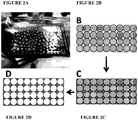
- the emulsion consists of spheres of water, coated with graphene, and surrounded by styrene. This composition is important, because it creates a network of continuous connected styrene that is the backbone of the polymerized composite. Similar spheres may be seen in FIG. 2A .
- FIG. 2A it is noted that the concentration of graphene/graphite was lowered to form spheres of a size adequate for demonstration, and that the spheres found in the composite emulsions are usually much smaller.
- the polymerization is thermally initiated, as photo-initiation can be difficult because of the absorption of light by the graphene sheets.
- the polymerization is complete ( FIG. 2C ).
- the water is then removed through gentle heating around 80°C ( FIG. 2D ), and the result is a hollow foam graphene/graphite/polystyrene composite.
- the composites produced by this method have extremely low densities, normally about 0.25 g/cm 3 .
- FIG. 2A-2D show the formation of emulsion-templated foam composites: FIG. 2A - vial of spheres of water surrounded by oil and stabilized by graphene/graphite sheets - the concentration of graphene/graphite was lowered to form spheres of a size adequate for demonstration; FIG. 2B - through sonication and mixing, the sheets are exfoliated and trapped at the interface and form spheres; FIG. 2C - the styrene is then thermally initiated and the polymerization proceeds; FIG. 2D - the water is gently evaporated out of the cavities, leaving a low density hollow composite.
- the sphere/sphere contact areas also provide pathways for the water to escape during the evaporation process. It is noted that films generated from the interface trapping method were seen to have about 80% coverage, with small spaces in between, as seen by transmission electron microscopy (TEM). These spaces provide ample space for the water vapor to diffuse out. Interestingly, if the pre-dried sample is put immediately into high vacuum, the water bursts out of the spheres violently, creating a popcorn-like effect.
- TEM transmission electron microscopy
- Sphere/cavity size control has been shown through varying the concentration of graphite, as well as altering the ratio of styrene to water in the initial emulsion.
- a progression in sphere size from a 90/10 water/styrene ratio to a 50/50 water/styrene ratio all while keeping the graphene/graphite concentration constant was shown.
- One optimal ratio (for the concentration used) for minimum excess of either phase is a 75/25 water/styrene ratio.
- Even adding enough water to get to an 80/20 water/styrene ratio results in a large amount of excess water seen at the bottom.
- the areas where the spheres are in contact with one another provide the access points for the water to evaporate out of the system. These areas are also the means by which other solutions may be infused into the system.
- the air is forced out of the cavities in the material.
- the solution then enters the cavities to fill in the void.
- a sample was infused with an aqueous suspension of Poly(3,4-ethylenedioxythiophene) Polystyrene sulfonate (PEDOT:PSS).
- the sample is again placed under gentle heating. This process slowly evaporates the water, while leaving the PEDOT:PSS behind.
- the PEDOT:PSS left behind provides a coating that connects the graphene/graphite sheets, therefore dramatically increasing conductivity.
- the PEDOT:PSS solution may instead be used in place of or along with the water phase in the initial preparation of the emulsions. Again, as the water evaporates out in the end, the PEDOT:PSS is left behind, thereby resulting in a dramatic increase in conductivity.
- the PEDOT:PSS film was seen "draping" over the polystyrene beads and graphene/graphite. Through this method, conductivities may be improved by up to two orders of magnitude. As the polymer leaves behind a coating, there is also added mechanical strength compared to the unmodified system. In compressive testing, up to a 20% increase in breaking strength compared to the unmodified samples has been observed.
- requirements of the oil phase come from the theory behind the interface trapping method.
- the surface energy of the graphene should be between those of the oil and water phases.
- the surface energy of the oil phase should ultimately be below 54.8 mN/m.
- EXAMPLE 2 - Exfoliation of Pristine Surfactant-Free Graphite via Emulsion Formation Enabling the Formation of Strong, Electrically Conducting Foams:
- a method for the large scale, inexpensive exfoliation of pristine graphite by the formation of graphene/graphite-stabilized emulsions is disclosed. Unlike previous approaches to graphite exfoliation, no oxidation or reduction chemistry is employed, and no surfactants, high boiling solvents, or other stabilizers are required, thus preserving the intrinsic properties of the graphite.
- An exemplary technique disclosed herein is environmentally friendly and takes advantage of the insolubility of graphite to create stable emulsions, with graphene/graphite sheets playing the role of surfactant by stabilizing the oil/water interface.
- An application enabled by this method is the formation of open cell foams containing a continuous graphene network.
- the exemplary foams have remarkable mechanical properties with compressive moduli of up to around 100 MPa and breaking strengths of over 8.3 MPa (1200 psi) at densities below 0.35 g/cm 3 . Furthermore, the percolating graphene/graphite network makes these foams electrically conductive at low loadings with bulk conductivities approaching 7 S/m.
- the excitement surrounding the potential of graphene as a nano-filler in composite materials is driven by its unique set of properties.
- challenges associated with graphite's solubility and dispersion have plagued the field and led to the widespread use of graphene oxide (GO) and reduced graphene oxide (rGO) as substitutes for the pristine material at the cost of inferior filler properties that are passed on to the final composites.
- the present disclosure advantageously provides an alternative and environmentally friendly approach to graphite exfoliation that avoids the use of chemical treatments or the addition of stabilizers such as surfactants or high boiling solvents that can be difficult to remove.
- the methods of the present disclosure takes advantage of graphite's inherent insolubility and the large interfacial energies between aqueous and organic solvents to kinetically "trap" graphene/graphite sheets at an oil/water interface and thus form a graphene stabilized emulsion.
- graphene/graphite sheets can be viewed as two-dimensional surfactants with internal bending rigidity.
- emulsions can be dried as a source of graphite nano-platelets, or used to template graphene/graphite composite foams by using various monomers as the continuous oil phase.
- the water filled spherical cavities are lined with pristine graphene/graphite sheets and a gentle evaporation process removes the water, leaving a final open foam composite material with exceptional mechanical strength, electrical conductivity, and low density with cells sizes easily controllable by varying the mixture composition.
- Applications of these low cost materials include strong and lightweight building materials, filters, ultra capacitor electrodes, and conductive catalyst supports.
- the methods of the present disclosure demonstrate an exemplary technique for making composite graphene/graphite foams by utilizing styrene as the oil phase in the graphene/graphite stabilized water/oil emulsion.
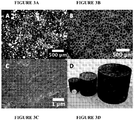
- the exfoliation of the natural flake graphite is accelerated by gentle sonication in the water/styrene mixture and an example of the graphene-stabilized emulsion under optical microscopy before polymerization is shown in FIG. 3A . It is noted that some of the spheres have coalesced because of the transfer process needed for imaging on a glass slide.
- FIG. 3B Morphological studies of the graphene foam composites after polymerization were carried out using a JEOL 6330 field emission scanning electron microscope (FESEM), and a typical image is shown in FIG. 3B .
- the imaged surface is much like the surface of a golf ball, with concave divots covering the entire surface.
- the spherical cavities formed by the water phase of the emulsion are visible, and a higher magnification image clearly shows a layer of graphene/graphite sheets lining the interior of the cavities ( FIG. 3C ).
- the average sphere size is about 75 um.
- FIG. 3D shows composites of increasing overall size all with the same basic foam structure.
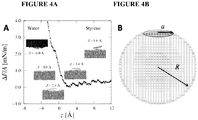
- the strength of attraction between a graphene/graphite flake and water/styrene interface was evaluated by calculating the potential of the mean force (see FIG. 4A ).
- the minimum of the potential is located in the styrene phase, indicating that although insoluble in both phases, the preference of the graphene/graphite is for styrene rather than water.
- the increase of the potential in the styrene phase is not as steep as that observed in the water phase, proving that the styrene is a better solvent for graphene flakes than is water. Oscillations seen in the potential of mean force indicate displacement of the aligned styrene molecules as the graphene flake is moved further away from the interface.
- the magnitude of the potential in the plateau regime is on the order of
- the total free energy of an emulsion occupying volume V and consisting of droplets with size R covered by graphene sheets with size a consists of an elastic and surface energy contribution and is written as follows: ⁇ F total V ⁇ E 384 ⁇ ⁇ a 4 R 4 ⁇ 3 ⁇ g ⁇ R where ⁇ g depends on the emulsion composition, ⁇ and ⁇ depend on the component densities, and E is the Young's modulus of the graphene sheet (around 1TPa).
- Equation 1 shows that the surface energy term favors the formation of smaller droplets to increase the area of the water/graphene/styrene interface while the elastic energy term tends to decrease the interface curvature to minimize sheet bending.
- the equilibrium size of the droplets is obtained by optimizing the system free energy ⁇ F total with respect to droplet size R: R ⁇ ⁇ E ⁇ a 4 288 ⁇ g 1 / 3
- Equation 2 shows that we can control the size of the droplets by changing the emulsion composition (changing parameter ⁇ g) or by varying the graphene sheet size a.
- the equilibrium size of the droplets is due to spontaneous curvature of the surfactant bilayer that arises from competition between head-head and tail-tail interactions.
- the graphene/graphite sheets can be viewed as surfactant bilayers in which spontaneous curvature arises from competition between sheet bending rigidity due to the chemical bonding of carbon atoms into a two dimensional lattice and graphene/graphite interactions with water and oil.
- the area where the two spheres touch has no polymer, only graphene/graphite.
- This structural feature is important to the conductivity of the composites as it provides the contact between the graphene sheets of different spheres.
- the exemplary system of the present disclosure builds a well-ordered percolating network of graphene prior to polymerization.
- the sphere/sphere contact areas also provide pathways for water to escape during the evaporation process.
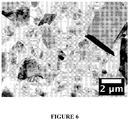
- Experimental modeling of the emulsion formation mechanism indicates that the oil/water interface is roughly 80% covered by graphene sheets three to five layers thick.
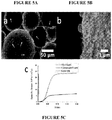
- a transmission electron microscopy (TEM) image of the graphene layers at the emulsion interface are shown in FIG. 6 .
- the size of spheres is controlled by altering the ratio of styrene to water in the emulsion, as well as by varying the amount of graphite.
- Table 1 shows the progression of sphere size from a 9/1 to a 1/1 water/styrene ratio with a constant graphene concentration. The dependence of graphene/graphite concentration is shown in FIGS. 7A and 7B .
- the relative amount of each solvent in the initial mixture also determines the volume fraction of the emulsion phase.
- the final volume of the sample is composed entirely of the emulsion. If the volume fraction of the water is lowered, the system has an excess styrene phase, and when the volume fraction of water is raised, the emulsion loses its stability and the graphene spheres coalesce, leaving an excess of water.
- the relationship between solvent volume ratio and emulsion volume fraction is plotted in FIG. 8 .
- the areas where the spheres are in contact with one another provide both electrical contact between the sphere as well as passage ways for the removal of water. They also provide an opportunity by which other solutions may be infused into the system. Submerging a composite sample in a solution and placing the system under gentle vacuum, the solution replaces the air in the foam. Infusing the graphene/graphite composite foam with an aqueous suspension of poly(3,4-ethylenedioxythiophene):poly(styrene sulfonate) (PEDOT:PSS), followed by the evaporation of water, leaves a layer of PEDOT:PS lining the interior surfaces of the foam.
- PEDOT:PSS poly(3,4-ethylenedioxythiophene):poly(styrene sulfonate)
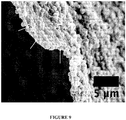
- an aqueous PEDOT:PSS solution is used in place of the water phase in the initial preparation of the emulsions. After the water evaporates from the foam, the PEDOT:PSS left behind "draped" over the PS beads and graphene sheets as shown in FIG. 9 .
- a dramatic increase in conductivity and compressive strength is observed, with conductivities improved by up to two orders of magnitude, from 0.08 S/m to 7 S/m for a 0.7 initial water volume fraction sample, and the compressive strength increased by up to 20%.
- the graphene/graphite foam composite described uses water with styrene as the oil phase, many other monomers have been used. These include isoprene, butyl acrylate, divinylbenzene, and butyl methacrylate. Flexible foam composites are observed with polyisoprene and ultra low densities are realized with butyl acrylate. Limitations on the choice of oil phase comes from the theory behind the interface trapping method. The oil phase should have a surface energy less than the surface energy of graphene and be nearly insoluble in the water phase.
- the present disclosure has provided a technique to produce low density, conductive, high compressive strength polymer/graphene/graphite foam composites using an interface trapping method to form emulsions that serve as the composite template.
- the graphene/graphite sheets that line the foam cavities form a conductive network in the system at very low graphite loadings.
- the present disclosure demonstrates that the electrical conductivity and strength of the composite foams may be increased dramatically through the infusion of conductive polymers such as PEDOT:PSS.
- the foams are inexpensive and the processing method is environmentally friendly with no volatile organic solvents, oxidations, reductions, or high temperatures required. Applications such as strong and lightweight building materials, ultra capacitor electrodes, conductive catalyst supports, and filtration are expected to be enabled by these materials and are being investigated.
- EXAMPLE 3 - Creation of Composite Materials Containing Exfoliated and Dispersed Graphene/Graphite for use as a "Master Batch":
- a method of producing a source of pre-exfoliated and dispersed graphene/graphite for use as a "Master Batch" is disclosed.
- Current procedures to create polymer composites with graphite based filler materials are limited to using chemically modified graphite or graphene to aid in dispersion and exfoliation.
- the chemical modification involved leads to severely degraded mechanical, electrical, and thermal properties.
- the methods used are also often time consuming, expensive, and harmful to the environment.
- a method of producing flexible graphene/graphite/polymer composites is disclosed. By simply altering the monomer used in the creation of the emulsions, one may vary the properties to match the application desired.
- One such embodiment substitutes a mixture of butyl acrylate and a crosslinking agent (such as divinylbenzene or tetra(ethylene glycol) diacrylate) for styrene. This substitution enables the creation of a flexible variant of the composite utilizing the same theory as previous composites.
- the continuous network of graphene/graphite throughout the composite enables them to be used in flexible electronics, such as capacitors and batteries. Additionally, the cost of such devices would be substantially lower than traditional metal-based devices.
- the composites In addition to the electronic properties of the material, the composites have the potential to be used for oil cleanup. Upon placing the composite into a mixture of oil and water (simulating an oil slick), the composite readily absorbs the oil, while leaving most (if not all) of the water behind. Furthermore, the composite swells dramatically to accommodate large amounts of oil. After the oil has been absorbed, it may then be removed, and the oil squeezed out for the composite to be re-used. Additionally, the composite also removes some of the contaminants from the oil soaked up.
- a method of creating boron nitride/polymer composites is disclosed. As previously mentioned, the theory does not simply encompass graphene and or graphite as the two dimensional surfactant.
- One example of another filler to be used in a similar fashion is hexagonal boron nitride. While similar in shape to graphene/graphite, boron nitride has very different properties, which are highly desirable for many modern applications. Perhaps most useful is that boron nitride is both a thermal conductor and electrical insulator.
- boron nitride/polymer composites utilizes the same principles as the graphene/graphite based examples, although a slight varying of the ratios and initiator is generally required. Specifically, benzoyl peroxide is used (just for one example) instead of AIBN as AIBN is thought to react with boron nitride.
- composites with similar properties to those of the graphene/graphite/polymer composites are created.
- the composites have slightly higher densities, due to more polymer being incorporated. However, this is accompanied by significantly higher compressive strengths.
- Possible uses for the boron nitride/polymer composites include catalyst support, filters, and industrial materials. Additionally, one promising application is as a heat-sink in electronics. As the composites would be thermally, but not electronically, conductive, they would be able to be placed directly against electronic components to remove heat without worrying about electrical shorts.
- Flexible composites may also be created in a manner similar to that of the graphene/graphite/polymer composites. These composites also have the potential to be used in oil cleanup. After soaking the oil up, the oil in the composites may be lit and burned without compromising the structure of the composite material. It may then be reused.
- a flask is charged with 880 mg of graphite (Asbury Carbons Grade 2299), along with 150 mL water (Deionized), 50 mL styrene (Acros Organics, 99.5%), 12 mL divinylbenzene (Aldrich, 80%), and a stir bar. The contents are then mixed on a stir plate for 30 seconds, followed by 30 seconds of bath sonication (Branson 80W B2510DTH). 150 mg of azobisisobutyronitrile (Aldrich, 98%) is then added to the same flask. The system is then mixed on a stir plate for a minimum of 15 minutes while being purged with Ar gas (Fisher).
- the contents of the flask are poured into a Waring Commercial Blender (Model 33BL79) and covered with Ar gas.
- the blender is then turned on full power for about 1 minute.
- the newly formed emulsion is then placed into a 250 mL jar and sealed under Ar gas.
- the jar is then placed in an oven (Thermo Electron Corporation, Model 6500) at about 70°C for 24 hours.
- the composite samples are removed from the jars and heated at around 80°C for about 2 days to remove substantially all water from the cavities. Excess bulk polystyrene may simply be cut off of the top if necessary.
- the reaction may be heated in an oil bath for the same amount of time.
- the oven is more convenient, there are sometimes "bubbles" that form in the composites that are believed to be from the inability to escape through a liquid top layer.
- the system starts polymerizing from the bottom, therefore leaving a layer of liquid at the top for the gas to escape.
- the samples were first cut with a razor blade. The slices were then mounted on aluminum stubs and coated with Au/Pd in a sputter coater (Polaron Unit E5100). It is noted that the samples were put under vacuum both during sputter coating, as well as in the microscope itself. Some of the holes in the sample may be due to this process.
- the samples were characterized with a JEOL 6330 field emission scanning electron microscope with a 10 kV accelerating voltage.
Landscapes
- Chemical & Material Sciences (AREA)
- Organic Chemistry (AREA)
- Chemical Kinetics & Catalysis (AREA)
- Analytical Chemistry (AREA)
- Engineering & Computer Science (AREA)
- Materials Engineering (AREA)
- Physics & Mathematics (AREA)
- Health & Medical Sciences (AREA)
- Inorganic Chemistry (AREA)
- Nanotechnology (AREA)
- Life Sciences & Earth Sciences (AREA)
- Polymers & Plastics (AREA)
- Wood Science & Technology (AREA)
- Medicinal Chemistry (AREA)
- Crystallography & Structural Chemistry (AREA)
- Spectroscopy & Molecular Physics (AREA)
- Combustion & Propulsion (AREA)
- Thermal Sciences (AREA)
- Dispersion Chemistry (AREA)
- Environmental & Geological Engineering (AREA)
- Oil, Petroleum & Natural Gas (AREA)
- Public Health (AREA)
- Composite Materials (AREA)
- Condensed Matter Physics & Semiconductors (AREA)
- General Physics & Mathematics (AREA)
- Carbon And Carbon Compounds (AREA)
- Manufacture Of Porous Articles, And Recovery And Treatment Of Waste Products (AREA)
- Compositions Of Macromolecular Compounds (AREA)
- Conductive Materials (AREA)
Claims (15)
- Ein Verfahren zur Herstellung eines Verbundwerkstoffs, umfassend:a) Bereitstellen eines phasengetrennten Systems aus zwei sich nichtvermischenden Lösungsmitteln, wobei das phasengetrennte System umfasst: (i) ein erstes Lösungsmittel und ein zweites Lösungsmittel und (ii) eine Grenzfläche zwischen den ersten und zweiten Lösungsmitteln;b) Zuführen eines Schichtmaterials aus unverändertem, ursprünglichem Graphen oder unverändertem, ursprünglichem Graphit zu der Grenzfläche des phasengetrennten Systems;c) Bilden einer Emulsion aus den ersten und zweiten Lösungsmitteln, wobei mindestens ein Teil des Schichtmaterials aus unverändertem, ursprünglichem Graphen oder unverändertem, ursprünglichem Graphit die Emulsion stabilisiert; undd) Hinzufügen eines Monomers und Polymerisieren der ersten Lösungsmittelphase der Emulsion, um ein Matrixmaterial mit Hohlräumen zu bilden, die mit Teilen des Schichtmaterials aus unverändertem, ursprünglichem Graphen oder unverändertem, ursprünglichem Graphit ausgekleidet sind.
- Das Verfahren nach Anspruch 1, wobei das erste Lösungsmittel ein Öl ist und das zweite Lösungsmittel Wasser ist;
wobei die Emulsion eine Wasser/Öl-Emulsion ist;
wobei die Ölphase der Emulsion die kontinuierliche Phase der Emulsion ist; und
wobei, nach Schritt c), die Wasser/Öl-Emulsion von Öl umgebene Sphären aus Wasser enthält,
wobei die Sphären aus Wasser durch Schichten oder Blätter des Schichtmaterials beschichtet und stabilisiert sind. - Das Verfahren nach Anspruch 2, wobei das Öl Styrol ist und das Schichtmaterial unveränderter, ursprünglicher Graphit ist;
wobei die Emulsion durch Mischen und Beschallen gebildet wird; und
wobei, nach Schritt d), das Matrixmaterial Polystyrol aufweist. - Das Verfahren nach Anspruch 1, wobei die erste Lösungsmittelphase der Emulsion Monomere enthält, die ausgewählt sind aus der Gruppe bestehend aus Styrol, Isopren, Butylacrylat, Divinylbenzen, Methylacrylat, Tetra(ethylenglycol)diacrylat und Butylmethacrylat.
- Das Verfahren nach Anspruch 1, wobei die Hohlräume des Matrixmaterials sphärische Hohlräume einschließen.
- Das Verfahren nach Anspruch 1, wobei Schritt d) einen/ein thermisch initiierten/initiiertes radikalischen/radikalisches Polymerisierungsschritt/-verfahren einschließt.
- Das Verfahren nach Anspruch 1, wobei das zweite Lösungsmittel nach Schritt d) aus dem Matrixmaterial entfernt wird;
wobei das zweite Lösungsmittel durch einen/ein Verdampfungsschritt/-verfahren aus dem Matrixmaterial entfernt wird; und
wobei nach dem Entfernen des zweiten Lösungsmittels aus dem Matrixmaterial das Matrixmaterial eine offenporige Schaumstruktur aufweist. - Das Verfahren nach Anspruch 1, wobei die Teile des Schichtmaterials, die die Hohlräume auskleiden, einzelne Blätter oder Schichten aus Graphen oder Graphit enthalten.
- Das Verfahren nach Anspruch 1, wobei das erste Lösungsmittel ein Öl ist und das zweite Lösungsmittel Wasser ist; und
wobei die Emulsion eine Wasser/Öl-Emulsion ist. - Das Verfahren nach Anspruch 1, wobei die erste Lösungsmittelphase der Emulsion die kontinuierliche Phase der Emulsion ist; und
wobei das Matrixmaterial ein polymeres Matrixmaterial ist. - Das Verfahren nach Anspruch 1, wobei die zweite Lösungsmittelphase der Emulsion auch polymerisiert wird, um das Matrixmaterial zu bilden; und
wobei, vor der Polymerisation, die zweite Lösungsmittelphase der Emulsion Monomere aufweist. - Das Verfahren nach Anspruch 1, wobei, nach Schritt d), das Matrixmaterial elektrisch leitfähig ist.
- Das Verfahren nach Anspruch 1, wobei, vor Schritt d), das zweite Lösungsmittel Poly(3,4-ethylendioxythiophen)poly(styrolsulfonat) enthält; und
wobei, nach Schritt d), das Poly(3,4-ethylendioxythiophen)poly(styrolsulfonat) eine leitfähige Beschichtung auf mindestens einem Teil der Hohlräume des Matrixmaterials bildet. - Das Verfahren nach Anspruch 7, wobei nach Entfernen des zweiten Lösungsmittels aus dem Matrixmaterial, das Matrixmaterial mit einer Lösung in Kontakt gebracht wird, die Poly(3,4-ethylendioxythiophen)poly(styrolsulfonat) enthält; und
wobei nach dem in Kontakt bringen des Matrixmaterials mit der Lösung, die Poly(3,4-ethylendioxythiophen)poly(styrolsulfonat) enthält, das Matrixmaterial getrocknet wird und das Poly(3,4-ethylendioxythiophen)poly(styrolsulfonat) eine leitfähige Beschichtung auf mindestens einem Teil der Hohlräume des Matrixmaterials bildet. - Das Verfahren nach Anspruch 1,
wobei das erste Lösungsmittel Öl ist und das zweite Lösungsmittel Wasser ist;
wobei das Schichtmaterial unverändertes, ursprüngliches Graphen oder unveränderter, ursprünglicher Graphit ist;
wobei die Ölphase der Emulsion Monomere enthält, die Wasser/Öl-Emulsion von Öl umgebene Sphären aus Wasser aufweist, wobei die Sphären aus Wasser durch Schichten oder Folien des Graphens oder Graphits beschichtet und stabilisiert sind; wobei das polymere Matrixmaterial sphärische Hohlräume aufweist, die mit Schichten oder Blättern des Graphens oder Graphits ausgekleidet sind, wobei die Ölphase der Emulsion die kontinuierliche Phase der Emulsion ist;
wobei, nach Schritt d), das Wasser aus dem polymeren Matrixmaterial entfernt wird, sodass das polymere Matrixmaterial eine offenporige Schaumstruktur aufweist und elektrisch leitfähig ist.
Applications Claiming Priority (3)
| Application Number | Priority Date | Filing Date | Title |
|---|---|---|---|
| US201462005318P | 2014-05-30 | 2014-05-30 | |
| US201462061337P | 2014-10-08 | 2014-10-08 | |
| PCT/US2015/033011 WO2015184155A1 (en) | 2014-05-30 | 2015-05-28 | Graphene/graphite polymer composite foam derived from emulsions stabilized by graphene/graphite kinetic trapping |
Publications (3)
| Publication Number | Publication Date |
|---|---|
| EP3149075A1 EP3149075A1 (de) | 2017-04-05 |
| EP3149075A4 EP3149075A4 (de) | 2018-01-03 |
| EP3149075B1 true EP3149075B1 (de) | 2020-12-02 |
Family
ID=54699813
Family Applications (1)
| Application Number | Title | Priority Date | Filing Date |
|---|---|---|---|
| EP15798851.0A Active EP3149075B1 (de) | 2014-05-30 | 2015-05-28 | Verfahren zur herstellung von graphen-/graphit-polymerverbundschaumstoff aus durch kinetische graphen/graphit-fallen stabilisierten emulsionen |
Country Status (5)
| Country | Link |
|---|---|
| US (3) | US9646735B2 (de) |
| EP (1) | EP3149075B1 (de) |
| CN (1) | CN106459470B (de) |
| ES (1) | ES2851673T3 (de) |
| WO (1) | WO2015184155A1 (de) |
Cited By (2)
| Publication number | Priority date | Publication date | Assignee | Title |
|---|---|---|---|---|
| DE102022209933A1 (de) | 2022-09-21 | 2024-03-21 | Robert Bosch Gesellschaft mit beschränkter Haftung | Stoffgemisch, Verwendung eines Stoffgemisches, Verfahren für die Herstellung eines Funktionskörpers für einen elektrochemischen Energiewandler sowie elektrochemischer Energiewandler |
| US12141508B2 (en) | 2020-03-16 | 2024-11-12 | Washington University | Systems and methods for forming micropillar array |
Families Citing this family (39)
| Publication number | Priority date | Publication date | Assignee | Title |
|---|---|---|---|---|
| ES2851673T3 (es) | 2014-05-30 | 2021-09-08 | Univ Connecticut | Proceso para preparar espuma de material compuesto de polímero de grafeno/grafito derivada de emulsiones estabilizadas mediante el atrapamiento cinético de grafeno/grafito |
| US9741499B2 (en) | 2015-08-24 | 2017-08-22 | Nanotek Instruments, Inc. | Production process for a supercapacitor having a high volumetric energy density |
| US9920178B2 (en) * | 2015-12-11 | 2018-03-20 | Northrop Grumman Systems Corporation | Compressible, thermally-conductive, removable nanocomposite gasket |
| US9966199B2 (en) * | 2016-01-11 | 2018-05-08 | Nanotek Instruments, Inc. | Supercapacitor having highly conductive graphene foam electrode |
| US9950628B2 (en) | 2016-03-09 | 2018-04-24 | Ford Global Technologies, Llc | Power-module assembly with dummy module |
| WO2018005431A1 (en) * | 2016-06-27 | 2018-01-04 | The Regents Of The University Of California | Method for direct optical visualization of graphene and its nanoscale defects on transparent substrates |
| WO2018157208A1 (en) * | 2017-03-01 | 2018-09-07 | The University Of Adelaide | Acoustic graphene-containing compositions/materials and methods of formation |
| CN107236075B (zh) * | 2017-05-31 | 2019-04-02 | 浙江理工大学 | 具有多级孔结构的压敏聚合物复合泡沫及其制备方法 |
| JP7239277B2 (ja) * | 2017-06-13 | 2023-03-14 | 株式会社イノアック技術研究所 | 導電性発泡体 |
| US10157714B1 (en) | 2017-08-07 | 2018-12-18 | Nanotek Instruments, Inc. | Supercapacitor electrode having highly oriented and closely packed expanded graphite flakes and production process |
| US20200407571A1 (en) * | 2017-11-01 | 2020-12-31 | University Of Connecticut | Two-Dimensional Sheet Stabilized Emulsion Based Inks |
| GB201800249D0 (en) | 2018-01-08 | 2018-02-21 | Univ Of Sussex | Pickering emulsions |
| WO2020014164A1 (en) * | 2018-07-09 | 2020-01-16 | Nanotek Instruments, Inc. | Graphene foam laminate-based sealing materials |
| US12009283B2 (en) | 2018-08-24 | 2024-06-11 | Washington University | Methods and systems for evaporation of liquid from droplet confined on hollow pillar |
| EP3636592A1 (de) | 2018-10-12 | 2020-04-15 | Advanced Material Development Limited | Flüssigkeitsabschälende nanomaterialien |
| EP3906216B1 (de) | 2019-01-02 | 2026-01-14 | Solidification Products International, Inc. | Adsorptions-/absorptionsfiltermedium und verfahren zu dessen herstellung |
| US11566852B2 (en) | 2019-04-26 | 2023-01-31 | Global Graphene Group, Inc. | Graphene-enhanced vapor-based heat transfer device |
| US11453593B2 (en) | 2019-04-29 | 2022-09-27 | Global Graphene Group, Inc. | Oriented graphene sheet-enhanced vapor-based heat transfer device and process for producing same |
| US12138565B2 (en) | 2019-06-26 | 2024-11-12 | Solidification Products International, Inc. | Filter media insert structures and methods of installation |
| WO2020264351A1 (en) | 2019-06-26 | 2020-12-30 | Solidification Products International, Inc. | Filter media insert structures and methods of installation |
| GB201911629D0 (en) | 2019-08-14 | 2019-09-25 | Univ Of Sussex | Materials and methods |
| CN110467706A (zh) * | 2019-09-03 | 2019-11-19 | 武汉工程大学 | 一种六方氮化硼改性丙烯酸酯核壳乳液的制备方法 |
| CN110791250B (zh) * | 2019-10-29 | 2021-07-16 | 沈阳航空航天大学 | 石墨烯-脂肪族聚氨酯复合材料胶黏剂及其应用 |
| CN115210307A (zh) * | 2020-03-31 | 2022-10-18 | 日东电工株式会社 | 复合材料 |
| JP7345516B2 (ja) * | 2020-03-31 | 2023-09-15 | 日東電工株式会社 | 複合材料 |
| US12580183B2 (en) | 2020-05-04 | 2026-03-17 | Northwestern University | Conformal pickering emulsion graphene coatings for electrode materials and forming methods applications of same |
| SE544448C2 (en) * | 2020-06-26 | 2022-05-31 | Grafren Ab | Method for inserting 2D flakes of a two-dimensional material into pores of a porous substrate and a porous composite material |
| US20230364544A1 (en) * | 2020-09-23 | 2023-11-16 | Wayne Neville SEEGERS | A panel for an air circulation system |
| CA3191192A1 (en) | 2020-09-30 | 2022-04-07 | Solidification Products International, Inc. | Sump pump system and methods for removing synthetic ester-based fluids from an emulsion |
| US12140139B2 (en) | 2020-09-30 | 2024-11-12 | Solidification Products International, Inc. | Gravity flow filtration of hydrocarbons from an oil-in-water emulsion |
| CN116867838A (zh) * | 2020-12-09 | 2023-10-10 | 普世物料公司 | 石墨烯复合材料及其生产方法 |
| US12509401B2 (en) | 2020-12-17 | 2025-12-30 | University Of Connecticut | Ceramic foams with imbedded self-assembled electrically conductive pristine graphene networks |
| US12404177B2 (en) | 2021-02-18 | 2025-09-02 | University Of Connecticut | Exfoliation of graphite to graphene by interface stabilization |
| US12406996B2 (en) | 2021-04-27 | 2025-09-02 | Northwestern University | Composite material with conformal graphene coating, fabricating methods and applications of same |
| CN113897184B (zh) * | 2021-10-28 | 2022-08-09 | 广东墨睿科技有限公司 | 一种石墨烯基高导热相变材料及其制备方法和生产装置 |
| CN114783655B (zh) * | 2022-05-10 | 2024-04-02 | 中国人民解放军国防科技大学 | 一种复合薄膜在轴对称壳体谐振子中的应用方法 |
| WO2025015417A1 (en) * | 2023-07-14 | 2025-01-23 | UNIVERSITé LAVAL | Method for producing graphene sheets and hollow carbon nanostructures as well as crystalline twisted bilayer / few-layer graphene thereby produced |
| CN119753908B (zh) * | 2024-12-12 | 2026-02-13 | 五邑大学 | 一种柔性导电纱线及其制备方法和应用 |
| CN119566326B (zh) * | 2025-02-06 | 2025-07-01 | 四川大学 | 用于3d立体结构打印的液态金属泡沫复合油墨及其制备方法和应用 |
Family Cites Families (28)
| Publication number | Priority date | Publication date | Assignee | Title |
|---|---|---|---|---|
| US4524175A (en) * | 1984-04-16 | 1985-06-18 | The Dow Chemical Company | Water-in-oil emulsions of hydrophobe association polymers |
| US5232772A (en) * | 1989-12-07 | 1993-08-03 | The United States Of America As Represented By The United States Department Of Energy | Low density carbonized composite foams |
| DE69318469T2 (de) * | 1992-03-09 | 1998-11-05 | Bridgestone Corp | Leitfähiger Polyurethanschaumstoff |
| US6136128A (en) | 1998-06-23 | 2000-10-24 | Amerasia International Technology, Inc. | Method of making an adhesive preform lid for electronic devices |
| DE19852678A1 (de) * | 1998-11-16 | 2000-05-18 | Basf Ag | Graphitpartikel enthaltende expandierbare Styrolpolymerisate |
| FR2812569A1 (fr) * | 2000-08-01 | 2002-02-08 | Conseil Et De Prospective Scie | Structures poreuses complexes revetues de plomb, et procede d'activation conductrice correspondant |
| US7008565B2 (en) * | 2002-11-08 | 2006-03-07 | More Energy Ltd. | Flexible electroconductive foam, and method of preparation thereof |
| US9359481B2 (en) | 2003-11-26 | 2016-06-07 | Owens Corning Intellectual Capital, Llc | Thermoplastic foams and method of forming them using nano-graphite |
| US7566410B2 (en) * | 2006-01-11 | 2009-07-28 | Nanotek Instruments, Inc. | Highly conductive nano-scaled graphene plate nanocomposites |
| US8110026B2 (en) | 2006-10-06 | 2012-02-07 | The Trustees Of Princeton University | Functional graphene-polymer nanocomposites for gas barrier applications |
| CN101711264A (zh) * | 2007-05-15 | 2010-05-19 | 陶氏环球技术公司 | 具有良好表面性质、高绝热性质以及低密度的链烯基-芳族泡沫体 |
| ATE552306T1 (de) | 2007-05-25 | 2012-04-15 | Kuraray Co | Thermoplastische polymerzusammensetzung |
| US20110091512A1 (en) * | 2007-09-05 | 2011-04-21 | Sunstorm Research Corporation | Highly porous, large polymeric particles and methods of preparation and use |
| JP5302332B2 (ja) * | 2007-12-20 | 2013-10-02 | シーマ ナノ テック イスラエル リミティド | ナノ粒子で形成された透明電極を有する光起電力デバイス |
| US8507568B2 (en) | 2008-05-28 | 2013-08-13 | The Ohio State University | Suspension polymerization and foaming of water containing activated carbon-nano/microparticulate polymer composites |
| US8303922B2 (en) * | 2009-08-24 | 2012-11-06 | The United States Of America As Represeted By The Administrator Of The National Aeronautics And Space Administration | Method for exfoliation of hexagonal boron nitride |
| KR101898499B1 (ko) | 2010-08-20 | 2018-09-13 | 로디아 오퍼레이션스 | 중합체 조성물, 중합체 막, 중합체 겔, 중합체 발포제, 및 이러한 막, 겔, 및 발포제를 포함하는 전자장치 |
| DE102011083011A1 (de) * | 2011-09-20 | 2013-03-21 | Evonik Goldschmidt Gmbh | Verbundwerkstoffe umfassend eine Polymermatrix und darin eingebetteteGranulate |
| DE102012005659B4 (de) * | 2012-03-22 | 2015-10-01 | Otto-Von-Guericke-Universität Magdeburg | Füllkörper für den Einsatz in Wärmeübertragern und Wärmeübertrager mit Füllkörpern |
| AU2013305486B2 (en) * | 2012-08-23 | 2017-02-23 | The University Of Melbourne | Graphene-based materials |
| TWI447217B (zh) * | 2012-08-24 | 2014-08-01 | Nat Univ Tsing Hua | 兼具超疏水及超親油功能的複合物 |
| US20140120339A1 (en) * | 2012-10-31 | 2014-05-01 | Cabot Corporation | Porous carbon monoliths templated by pickering emulsions |
| US9685261B2 (en) * | 2013-04-16 | 2017-06-20 | University Of Connecticut | Formation of a transparent conductive film by interfacial graphene assembly |
| CN103232027B (zh) * | 2013-04-22 | 2015-05-20 | 南京航空航天大学 | 一种三维氮化硼泡沫及其制备方法 |
| US9611146B2 (en) * | 2013-07-01 | 2017-04-04 | Lawrence Livermore National Security, Llc | Crystalline boron nitride aerogels |
| CN103408786A (zh) * | 2013-07-26 | 2013-11-27 | 复旦大学 | 一种石墨烯-聚合物多孔复合材料的制备方法 |
| WO2015167950A1 (en) * | 2014-04-30 | 2015-11-05 | Rogers Corporation | Thermally conductive composites and methods of manufacture thereof, and articles containing the composites |
| ES2851673T3 (es) | 2014-05-30 | 2021-09-08 | Univ Connecticut | Proceso para preparar espuma de material compuesto de polímero de grafeno/grafito derivada de emulsiones estabilizadas mediante el atrapamiento cinético de grafeno/grafito |
-
2015
- 2015-05-28 ES ES15798851T patent/ES2851673T3/es active Active
- 2015-05-28 CN CN201580034677.XA patent/CN106459470B/zh active Active
- 2015-05-28 EP EP15798851.0A patent/EP3149075B1/de active Active
- 2015-05-28 WO PCT/US2015/033011 patent/WO2015184155A1/en not_active Ceased
- 2015-05-28 US US14/724,499 patent/US9646735B2/en active Active
-
2017
- 2017-03-02 US US15/447,524 patent/US10832828B2/en active Active
-
2020
- 2020-10-08 US US17/066,174 patent/US11355259B2/en active Active
Non-Patent Citations (1)
| Title |
|---|
| None * |
Cited By (2)
| Publication number | Priority date | Publication date | Assignee | Title |
|---|---|---|---|---|
| US12141508B2 (en) | 2020-03-16 | 2024-11-12 | Washington University | Systems and methods for forming micropillar array |
| DE102022209933A1 (de) | 2022-09-21 | 2024-03-21 | Robert Bosch Gesellschaft mit beschränkter Haftung | Stoffgemisch, Verwendung eines Stoffgemisches, Verfahren für die Herstellung eines Funktionskörpers für einen elektrochemischen Energiewandler sowie elektrochemischer Energiewandler |
Also Published As
| Publication number | Publication date |
|---|---|
| CN106459470A (zh) | 2017-02-22 |
| US9646735B2 (en) | 2017-05-09 |
| WO2015184155A1 (en) | 2015-12-03 |
| US20150348669A1 (en) | 2015-12-03 |
| EP3149075A1 (de) | 2017-04-05 |
| US10832828B2 (en) | 2020-11-10 |
| CN106459470B (zh) | 2020-04-07 |
| ES2851673T3 (es) | 2021-09-08 |
| EP3149075A4 (de) | 2018-01-03 |
| US20170178762A1 (en) | 2017-06-22 |
| US11355259B2 (en) | 2022-06-07 |
| US20210027907A1 (en) | 2021-01-28 |
Similar Documents
| Publication | Publication Date | Title |
|---|---|---|
| US11355259B2 (en) | Boron nitride polymer composite foam derived from emulsions stabilized by boron nitride kinetic trapping | |
| Chen et al. | In situ self-assembly of mild chemical reduction graphene for three-dimensional architectures | |
| Galpayage Dona et al. | Recent advances in fabrication and characterization of graphene-polymer nanocomposites | |
| Liu et al. | RAFT controlled synthesis of graphene/polymer hydrogel with enhanced mechanical property for pH-controlled drug release | |
| Quan et al. | Facile preparation and thermal degradation studies of graphite nanoplatelets (GNPs) filled thermoplastic polyurethane (TPU) nanocomposites | |
| Huang et al. | Boron nitride@ graphene oxide hybrids for epoxy composites with enhanced thermal conductivity | |
| Gudarzi et al. | Self assembly of graphene oxide at the liquid–liquid interface: A new route to the fabrication of graphene based composites | |
| Thickett et al. | Hollow hybrid polymer–graphene oxide nanoparticles via Pickering miniemulsion polymerization | |
| US9845245B2 (en) | Foams of graphene, method of making and materials made thereof | |
| Wong et al. | Macroporous polymer nanocomposites synthesised from high internal phase emulsion templates stabilised by reduced graphene oxide | |
| He et al. | Constructing facile proton-conduction pathway within sulfonated poly (ether ether ketone) membrane by incorporating poly (phosphonic acid)/silica nanotubes | |
| Tao et al. | 3D Graphene–sponge skeleton reinforced polysulfide rubber nanocomposites with improved electrical and thermal conductivity | |
| Yang et al. | Highly electrically conductive rGO/PVA composites with a network dispersive nanostructure | |
| Mahmoudian et al. | A facile approach to prepare regenerated cellulose/graphene nanoplatelets nanocomposite using room-temperature ionic liquid | |
| CN105504740B (zh) | 官能化的多孔聚合物纳米复合材料 | |
| Mudassir et al. | Fundamentals and design‐led synthesis of emulsion‐templated porous materials for environmental applications | |
| Li et al. | Multifunctional and highly compressive cross-linker-free sponge based on reduced graphene oxide and boron nitride nanosheets | |
| Texter | Graphene oxide and graphene flakes as stabilizers and dispersing aids | |
| Shen et al. | Fabrication of microcellular polymer/graphene nanocomposite foams | |
| CA3087834A1 (en) | Pickering emulsions | |
| Liu et al. | Hierarchical xanthan gum/graphene oxide nanocomposite film induced by ferric ions coordination | |
| Yang et al. | Enhanced conductive polymer nanocomposite by foam structure and polyelectrolyte encapsulated on carbon nanotubes | |
| Brown et al. | PolyHIPE foams from pristine graphene: Strong, porous, and electrically conductive materials templated by a 2D surfactant | |
| Hazarika et al. | Graphene nanosheets generated from sulfonated polystyrene/graphene nanocomposite | |
| Ogilvie et al. | Nanosheet-stabilized emulsions: near-minimum loading and surface energy design of conductive networks |
Legal Events
| Date | Code | Title | Description |
|---|---|---|---|
| STAA | Information on the status of an ep patent application or granted ep patent |
Free format text: STATUS: THE INTERNATIONAL PUBLICATION HAS BEEN MADE |
|
| PUAI | Public reference made under article 153(3) epc to a published international application that has entered the european phase |
Free format text: ORIGINAL CODE: 0009012 |
|
| STAA | Information on the status of an ep patent application or granted ep patent |
Free format text: STATUS: REQUEST FOR EXAMINATION WAS MADE |
|
| 17P | Request for examination filed |
Effective date: 20161220 |
|
| AK | Designated contracting states |
Kind code of ref document: A1 Designated state(s): AL AT BE BG CH CY CZ DE DK EE ES FI FR GB GR HR HU IE IS IT LI LT LU LV MC MK MT NL NO PL PT RO RS SE SI SK SM TR |
|
| AX | Request for extension of the european patent |
Extension state: BA ME |
|
| RIN1 | Information on inventor provided before grant (corrected) |
Inventor name: DOBRYNIN, ANDREY, V. Inventor name: WOLTORNIST, STEVEN Inventor name: ADAMSON, DOUGLAS, H. |
|
| DAV | Request for validation of the european patent (deleted) | ||
| DAX | Request for extension of the european patent (deleted) | ||
| A4 | Supplementary search report drawn up and despatched |
Effective date: 20171205 |
|
| RIC1 | Information provided on ipc code assigned before grant |
Ipc: B01J 20/26 20060101ALI20171129BHEP Ipc: B01J 20/30 20060101ALI20171129BHEP Ipc: B01J 20/32 20060101ALI20171129BHEP Ipc: B01J 20/28 20060101ALI20171129BHEP Ipc: C08J 9/28 20060101AFI20171129BHEP |
|
| STAA | Information on the status of an ep patent application or granted ep patent |
Free format text: STATUS: EXAMINATION IS IN PROGRESS |
|
| 17Q | First examination report despatched |
Effective date: 20190520 |
|
| RAP1 | Party data changed (applicant data changed or rights of an application transferred) |
Owner name: UNIVERSITY OF CONNECTICUT |
|
| GRAP | Despatch of communication of intention to grant a patent |
Free format text: ORIGINAL CODE: EPIDOSNIGR1 |
|
| STAA | Information on the status of an ep patent application or granted ep patent |
Free format text: STATUS: GRANT OF PATENT IS INTENDED |
|
| INTG | Intention to grant announced |
Effective date: 20200630 |
|
| GRAS | Grant fee paid |
Free format text: ORIGINAL CODE: EPIDOSNIGR3 |
|
| GRAA | (expected) grant |
Free format text: ORIGINAL CODE: 0009210 |
|
| STAA | Information on the status of an ep patent application or granted ep patent |
Free format text: STATUS: THE PATENT HAS BEEN GRANTED |
|
| AK | Designated contracting states |
Kind code of ref document: B1 Designated state(s): AL AT BE BG CH CY CZ DE DK EE ES FI FR GB GR HR HU IE IS IT LI LT LU LV MC MK MT NL NO PL PT RO RS SE SI SK SM TR |
|
| REG | Reference to a national code |
Ref country code: GB Ref legal event code: FG4D |
|
| REG | Reference to a national code |
Ref country code: AT Ref legal event code: REF Ref document number: 1340898 Country of ref document: AT Kind code of ref document: T Effective date: 20201215 Ref country code: CH Ref legal event code: EP |
|
| REG | Reference to a national code |
Ref country code: IE Ref legal event code: FG4D |
|
| REG | Reference to a national code |
Ref country code: DE Ref legal event code: R096 Ref document number: 602015062977 Country of ref document: DE |
|
| PG25 | Lapsed in a contracting state [announced via postgrant information from national office to epo] |
Ref country code: GR Free format text: LAPSE BECAUSE OF FAILURE TO SUBMIT A TRANSLATION OF THE DESCRIPTION OR TO PAY THE FEE WITHIN THE PRESCRIBED TIME-LIMIT Effective date: 20210303 Ref country code: NO Free format text: LAPSE BECAUSE OF FAILURE TO SUBMIT A TRANSLATION OF THE DESCRIPTION OR TO PAY THE FEE WITHIN THE PRESCRIBED TIME-LIMIT Effective date: 20210302 Ref country code: RS Free format text: LAPSE BECAUSE OF FAILURE TO SUBMIT A TRANSLATION OF THE DESCRIPTION OR TO PAY THE FEE WITHIN THE PRESCRIBED TIME-LIMIT Effective date: 20201202 Ref country code: FI Free format text: LAPSE BECAUSE OF FAILURE TO SUBMIT A TRANSLATION OF THE DESCRIPTION OR TO PAY THE FEE WITHIN THE PRESCRIBED TIME-LIMIT Effective date: 20201202 |
|
| REG | Reference to a national code |
Ref country code: NL Ref legal event code: MP Effective date: 20201202 |
|
| REG | Reference to a national code |
Ref country code: AT Ref legal event code: MK05 Ref document number: 1340898 Country of ref document: AT Kind code of ref document: T Effective date: 20201202 |
|
| PG25 | Lapsed in a contracting state [announced via postgrant information from national office to epo] |
Ref country code: PL Free format text: LAPSE BECAUSE OF FAILURE TO SUBMIT A TRANSLATION OF THE DESCRIPTION OR TO PAY THE FEE WITHIN THE PRESCRIBED TIME-LIMIT Effective date: 20201202 Ref country code: LV Free format text: LAPSE BECAUSE OF FAILURE TO SUBMIT A TRANSLATION OF THE DESCRIPTION OR TO PAY THE FEE WITHIN THE PRESCRIBED TIME-LIMIT Effective date: 20201202 Ref country code: SE Free format text: LAPSE BECAUSE OF FAILURE TO SUBMIT A TRANSLATION OF THE DESCRIPTION OR TO PAY THE FEE WITHIN THE PRESCRIBED TIME-LIMIT Effective date: 20201202 Ref country code: BG Free format text: LAPSE BECAUSE OF FAILURE TO SUBMIT A TRANSLATION OF THE DESCRIPTION OR TO PAY THE FEE WITHIN THE PRESCRIBED TIME-LIMIT Effective date: 20210302 |
|
| PG25 | Lapsed in a contracting state [announced via postgrant information from national office to epo] |
Ref country code: HR Free format text: LAPSE BECAUSE OF FAILURE TO SUBMIT A TRANSLATION OF THE DESCRIPTION OR TO PAY THE FEE WITHIN THE PRESCRIBED TIME-LIMIT Effective date: 20201202 Ref country code: NL Free format text: LAPSE BECAUSE OF FAILURE TO SUBMIT A TRANSLATION OF THE DESCRIPTION OR TO PAY THE FEE WITHIN THE PRESCRIBED TIME-LIMIT Effective date: 20201202 |
|
| REG | Reference to a national code |
Ref country code: LT Ref legal event code: MG9D |
|
| PG25 | Lapsed in a contracting state [announced via postgrant information from national office to epo] |
Ref country code: CZ Free format text: LAPSE BECAUSE OF FAILURE TO SUBMIT A TRANSLATION OF THE DESCRIPTION OR TO PAY THE FEE WITHIN THE PRESCRIBED TIME-LIMIT Effective date: 20201202 Ref country code: EE Free format text: LAPSE BECAUSE OF FAILURE TO SUBMIT A TRANSLATION OF THE DESCRIPTION OR TO PAY THE FEE WITHIN THE PRESCRIBED TIME-LIMIT Effective date: 20201202 Ref country code: SM Free format text: LAPSE BECAUSE OF FAILURE TO SUBMIT A TRANSLATION OF THE DESCRIPTION OR TO PAY THE FEE WITHIN THE PRESCRIBED TIME-LIMIT Effective date: 20201202 Ref country code: LT Free format text: LAPSE BECAUSE OF FAILURE TO SUBMIT A TRANSLATION OF THE DESCRIPTION OR TO PAY THE FEE WITHIN THE PRESCRIBED TIME-LIMIT Effective date: 20201202 Ref country code: PT Free format text: LAPSE BECAUSE OF FAILURE TO SUBMIT A TRANSLATION OF THE DESCRIPTION OR TO PAY THE FEE WITHIN THE PRESCRIBED TIME-LIMIT Effective date: 20210405 Ref country code: SK Free format text: LAPSE BECAUSE OF FAILURE TO SUBMIT A TRANSLATION OF THE DESCRIPTION OR TO PAY THE FEE WITHIN THE PRESCRIBED TIME-LIMIT Effective date: 20201202 Ref country code: RO Free format text: LAPSE BECAUSE OF FAILURE TO SUBMIT A TRANSLATION OF THE DESCRIPTION OR TO PAY THE FEE WITHIN THE PRESCRIBED TIME-LIMIT Effective date: 20201202 |
|
| PG25 | Lapsed in a contracting state [announced via postgrant information from national office to epo] |
Ref country code: AT Free format text: LAPSE BECAUSE OF FAILURE TO SUBMIT A TRANSLATION OF THE DESCRIPTION OR TO PAY THE FEE WITHIN THE PRESCRIBED TIME-LIMIT Effective date: 20201202 |
|
| REG | Reference to a national code |
Ref country code: DE Ref legal event code: R097 Ref document number: 602015062977 Country of ref document: DE |
|
| PG25 | Lapsed in a contracting state [announced via postgrant information from national office to epo] |
Ref country code: IS Free format text: LAPSE BECAUSE OF FAILURE TO SUBMIT A TRANSLATION OF THE DESCRIPTION OR TO PAY THE FEE WITHIN THE PRESCRIBED TIME-LIMIT Effective date: 20210402 |
|
| PLBE | No opposition filed within time limit |
Free format text: ORIGINAL CODE: 0009261 |
|
| STAA | Information on the status of an ep patent application or granted ep patent |
Free format text: STATUS: NO OPPOSITION FILED WITHIN TIME LIMIT |
|
| PG25 | Lapsed in a contracting state [announced via postgrant information from national office to epo] |
Ref country code: IT Free format text: LAPSE BECAUSE OF FAILURE TO SUBMIT A TRANSLATION OF THE DESCRIPTION OR TO PAY THE FEE WITHIN THE PRESCRIBED TIME-LIMIT Effective date: 20201202 Ref country code: AL Free format text: LAPSE BECAUSE OF FAILURE TO SUBMIT A TRANSLATION OF THE DESCRIPTION OR TO PAY THE FEE WITHIN THE PRESCRIBED TIME-LIMIT Effective date: 20201202 |
|
| 26N | No opposition filed |
Effective date: 20210903 |
|
| PG25 | Lapsed in a contracting state [announced via postgrant information from national office to epo] |
Ref country code: SI Free format text: LAPSE BECAUSE OF FAILURE TO SUBMIT A TRANSLATION OF THE DESCRIPTION OR TO PAY THE FEE WITHIN THE PRESCRIBED TIME-LIMIT Effective date: 20201202 Ref country code: DK Free format text: LAPSE BECAUSE OF FAILURE TO SUBMIT A TRANSLATION OF THE DESCRIPTION OR TO PAY THE FEE WITHIN THE PRESCRIBED TIME-LIMIT Effective date: 20201202 |
|
| REG | Reference to a national code |
Ref country code: CH Ref legal event code: PL |
|
| PG25 | Lapsed in a contracting state [announced via postgrant information from national office to epo] |
Ref country code: CH Free format text: LAPSE BECAUSE OF NON-PAYMENT OF DUE FEES Effective date: 20210531 Ref country code: LU Free format text: LAPSE BECAUSE OF NON-PAYMENT OF DUE FEES Effective date: 20210528 Ref country code: MC Free format text: LAPSE BECAUSE OF FAILURE TO SUBMIT A TRANSLATION OF THE DESCRIPTION OR TO PAY THE FEE WITHIN THE PRESCRIBED TIME-LIMIT Effective date: 20201202 Ref country code: LI Free format text: LAPSE BECAUSE OF NON-PAYMENT OF DUE FEES Effective date: 20210531 |
|
| REG | Reference to a national code |
Ref country code: BE Ref legal event code: MM Effective date: 20210531 |
|
| PG25 | Lapsed in a contracting state [announced via postgrant information from national office to epo] |
Ref country code: IE Free format text: LAPSE BECAUSE OF NON-PAYMENT OF DUE FEES Effective date: 20210528 |
|
| PG25 | Lapsed in a contracting state [announced via postgrant information from national office to epo] |
Ref country code: IS Free format text: LAPSE BECAUSE OF FAILURE TO SUBMIT A TRANSLATION OF THE DESCRIPTION OR TO PAY THE FEE WITHIN THE PRESCRIBED TIME-LIMIT Effective date: 20210402 |
|
| PG25 | Lapsed in a contracting state [announced via postgrant information from national office to epo] |
Ref country code: BE Free format text: LAPSE BECAUSE OF NON-PAYMENT OF DUE FEES Effective date: 20210531 |
|
| PG25 | Lapsed in a contracting state [announced via postgrant information from national office to epo] |
Ref country code: HU Free format text: LAPSE BECAUSE OF FAILURE TO SUBMIT A TRANSLATION OF THE DESCRIPTION OR TO PAY THE FEE WITHIN THE PRESCRIBED TIME-LIMIT; INVALID AB INITIO Effective date: 20150528 |
|
| PG25 | Lapsed in a contracting state [announced via postgrant information from national office to epo] |
Ref country code: CY Free format text: LAPSE BECAUSE OF FAILURE TO SUBMIT A TRANSLATION OF THE DESCRIPTION OR TO PAY THE FEE WITHIN THE PRESCRIBED TIME-LIMIT Effective date: 20201202 |
|
| PG25 | Lapsed in a contracting state [announced via postgrant information from national office to epo] |
Ref country code: MK Free format text: LAPSE BECAUSE OF FAILURE TO SUBMIT A TRANSLATION OF THE DESCRIPTION OR TO PAY THE FEE WITHIN THE PRESCRIBED TIME-LIMIT Effective date: 20201202 |
|
| PG25 | Lapsed in a contracting state [announced via postgrant information from national office to epo] |
Ref country code: TR Free format text: LAPSE BECAUSE OF FAILURE TO SUBMIT A TRANSLATION OF THE DESCRIPTION OR TO PAY THE FEE WITHIN THE PRESCRIBED TIME-LIMIT Effective date: 20201202 |
|
| PG25 | Lapsed in a contracting state [announced via postgrant information from national office to epo] |
Ref country code: MT Free format text: LAPSE BECAUSE OF FAILURE TO SUBMIT A TRANSLATION OF THE DESCRIPTION OR TO PAY THE FEE WITHIN THE PRESCRIBED TIME-LIMIT Effective date: 20201202 |
|
| PGFP | Annual fee paid to national office [announced via postgrant information from national office to epo] |
Ref country code: ES Payment date: 20260601 Year of fee payment: 12 |
|
| PGFP | Annual fee paid to national office [announced via postgrant information from national office to epo] |
Ref country code: GB Payment date: 20260527 Year of fee payment: 12 |
|
| PGFP | Annual fee paid to national office [announced via postgrant information from national office to epo] |
Ref country code: DE Payment date: 20260528 Year of fee payment: 12 |
|
| PGFP | Annual fee paid to national office [announced via postgrant information from national office to epo] |
Ref country code: FR Payment date: 20260525 Year of fee payment: 12 |