EP3138822B1 - Fining agents for silicate glasses - Google Patents
Fining agents for silicate glasses Download PDFInfo
- Publication number
- EP3138822B1 EP3138822B1 EP16195343.5A EP16195343A EP3138822B1 EP 3138822 B1 EP3138822 B1 EP 3138822B1 EP 16195343 A EP16195343 A EP 16195343A EP 3138822 B1 EP3138822 B1 EP 3138822B1
- Authority
- EP
- European Patent Office
- Prior art keywords
- mol
- glass
- silicate glass
- melt
- fining agent
- Prior art date
- Legal status (The legal status is an assumption and is not a legal conclusion. Google has not performed a legal analysis and makes no representation as to the accuracy of the status listed.)
- Active
Links
Images


Classifications
-
- C—CHEMISTRY; METALLURGY
- C03—GLASS; MINERAL OR SLAG WOOL
- C03C—CHEMICAL COMPOSITION OF GLASSES, GLAZES OR VITREOUS ENAMELS; SURFACE TREATMENT OF GLASS; SURFACE TREATMENT OF FIBRES OR FILAMENTS MADE FROM GLASS, MINERALS OR SLAGS; JOINING GLASS TO GLASS OR OTHER MATERIALS
- C03C3/00—Glass compositions
- C03C3/04—Glass compositions containing silica
- C03C3/076—Glass compositions containing silica with 40% to 90% silica, by weight
- C03C3/083—Glass compositions containing silica with 40% to 90% silica, by weight containing aluminium oxide or an iron compound
-
- C—CHEMISTRY; METALLURGY
- C03—GLASS; MINERAL OR SLAG WOOL
- C03C—CHEMICAL COMPOSITION OF GLASSES, GLAZES OR VITREOUS ENAMELS; SURFACE TREATMENT OF GLASS; SURFACE TREATMENT OF FIBRES OR FILAMENTS MADE FROM GLASS, MINERALS OR SLAGS; JOINING GLASS TO GLASS OR OTHER MATERIALS
- C03C1/00—Ingredients generally applicable to manufacture of glasses, glazes, or vitreous enamels
- C03C1/004—Refining agents
-
- C—CHEMISTRY; METALLURGY
- C03—GLASS; MINERAL OR SLAG WOOL
- C03B—MANUFACTURE, SHAPING, OR SUPPLEMENTARY PROCESSES
- C03B17/00—Forming molten glass by flowing-out, pushing-out, extruding or drawing downwardly or laterally from forming slits or by overflowing over lips
- C03B17/06—Forming glass sheets
- C03B17/064—Forming glass sheets by the overflow downdraw fusion process; Isopipes therefor
-
- C—CHEMISTRY; METALLURGY
- C03—GLASS; MINERAL OR SLAG WOOL
- C03B—MANUFACTURE, SHAPING, OR SUPPLEMENTARY PROCESSES
- C03B5/00—Melting in furnaces; Furnaces so far as specially adapted for glass manufacture
- C03B5/16—Special features of the melting process; Auxiliary means specially adapted for glass-melting furnaces
- C03B5/225—Refining
-
- C—CHEMISTRY; METALLURGY
- C03—GLASS; MINERAL OR SLAG WOOL
- C03C—CHEMICAL COMPOSITION OF GLASSES, GLAZES OR VITREOUS ENAMELS; SURFACE TREATMENT OF GLASS; SURFACE TREATMENT OF FIBRES OR FILAMENTS MADE FROM GLASS, MINERALS OR SLAGS; JOINING GLASS TO GLASS OR OTHER MATERIALS
- C03C14/00—Glass compositions containing a non-glass component, e.g. compositions containing fibres, filaments, whiskers, platelets, or the like, dispersed in a glass matrix
- C03C14/008—Glass compositions containing a non-glass component, e.g. compositions containing fibres, filaments, whiskers, platelets, or the like, dispersed in a glass matrix the non-glass component being in molecular form
-
- C—CHEMISTRY; METALLURGY
- C03—GLASS; MINERAL OR SLAG WOOL
- C03C—CHEMICAL COMPOSITION OF GLASSES, GLAZES OR VITREOUS ENAMELS; SURFACE TREATMENT OF GLASS; SURFACE TREATMENT OF FIBRES OR FILAMENTS MADE FROM GLASS, MINERALS OR SLAGS; JOINING GLASS TO GLASS OR OTHER MATERIALS
- C03C21/00—Treatment of glass, not in the form of fibres or filaments, by diffusing ions or metals in the surface
- C03C21/001—Treatment of glass, not in the form of fibres or filaments, by diffusing ions or metals in the surface in liquid phase, e.g. molten salts, solutions
- C03C21/002—Treatment of glass, not in the form of fibres or filaments, by diffusing ions or metals in the surface in liquid phase, e.g. molten salts, solutions to perform ion-exchange between alkali ions
-
- C—CHEMISTRY; METALLURGY
- C03—GLASS; MINERAL OR SLAG WOOL
- C03C—CHEMICAL COMPOSITION OF GLASSES, GLAZES OR VITREOUS ENAMELS; SURFACE TREATMENT OF GLASS; SURFACE TREATMENT OF FIBRES OR FILAMENTS MADE FROM GLASS, MINERALS OR SLAGS; JOINING GLASS TO GLASS OR OTHER MATERIALS
- C03C3/00—Glass compositions
- C03C3/04—Glass compositions containing silica
- C03C3/076—Glass compositions containing silica with 40% to 90% silica, by weight
- C03C3/083—Glass compositions containing silica with 40% to 90% silica, by weight containing aluminium oxide or an iron compound
- C03C3/085—Glass compositions containing silica with 40% to 90% silica, by weight containing aluminium oxide or an iron compound containing an oxide of a divalent metal
-
- C—CHEMISTRY; METALLURGY
- C03—GLASS; MINERAL OR SLAG WOOL
- C03C—CHEMICAL COMPOSITION OF GLASSES, GLAZES OR VITREOUS ENAMELS; SURFACE TREATMENT OF GLASS; SURFACE TREATMENT OF FIBRES OR FILAMENTS MADE FROM GLASS, MINERALS OR SLAGS; JOINING GLASS TO GLASS OR OTHER MATERIALS
- C03C3/00—Glass compositions
- C03C3/04—Glass compositions containing silica
- C03C3/076—Glass compositions containing silica with 40% to 90% silica, by weight
- C03C3/083—Glass compositions containing silica with 40% to 90% silica, by weight containing aluminium oxide or an iron compound
- C03C3/085—Glass compositions containing silica with 40% to 90% silica, by weight containing aluminium oxide or an iron compound containing an oxide of a divalent metal
- C03C3/087—Glass compositions containing silica with 40% to 90% silica, by weight containing aluminium oxide or an iron compound containing an oxide of a divalent metal containing calcium oxide, e.g. common sheet or container glass
-
- C—CHEMISTRY; METALLURGY
- C03—GLASS; MINERAL OR SLAG WOOL
- C03C—CHEMICAL COMPOSITION OF GLASSES, GLAZES OR VITREOUS ENAMELS; SURFACE TREATMENT OF GLASS; SURFACE TREATMENT OF FIBRES OR FILAMENTS MADE FROM GLASS, MINERALS OR SLAGS; JOINING GLASS TO GLASS OR OTHER MATERIALS
- C03C3/00—Glass compositions
- C03C3/04—Glass compositions containing silica
- C03C3/076—Glass compositions containing silica with 40% to 90% silica, by weight
- C03C3/089—Glass compositions containing silica with 40% to 90% silica, by weight containing boron
- C03C3/091—Glass compositions containing silica with 40% to 90% silica, by weight containing boron containing aluminium
-
- C—CHEMISTRY; METALLURGY
- C03—GLASS; MINERAL OR SLAG WOOL
- C03C—CHEMICAL COMPOSITION OF GLASSES, GLAZES OR VITREOUS ENAMELS; SURFACE TREATMENT OF GLASS; SURFACE TREATMENT OF FIBRES OR FILAMENTS MADE FROM GLASS, MINERALS OR SLAGS; JOINING GLASS TO GLASS OR OTHER MATERIALS
- C03C3/00—Glass compositions
- C03C3/04—Glass compositions containing silica
- C03C3/076—Glass compositions containing silica with 40% to 90% silica, by weight
- C03C3/095—Glass compositions containing silica with 40% to 90% silica, by weight containing rare earths
-
- Y—GENERAL TAGGING OF NEW TECHNOLOGICAL DEVELOPMENTS; GENERAL TAGGING OF CROSS-SECTIONAL TECHNOLOGIES SPANNING OVER SEVERAL SECTIONS OF THE IPC; TECHNICAL SUBJECTS COVERED BY FORMER USPC CROSS-REFERENCE ART COLLECTIONS [XRACs] AND DIGESTS
- Y02—TECHNOLOGIES OR APPLICATIONS FOR MITIGATION OR ADAPTATION AGAINST CLIMATE CHANGE
- Y02A—TECHNOLOGIES FOR ADAPTATION TO CLIMATE CHANGE
- Y02A40/00—Adaptation technologies in agriculture, forestry, livestock or agroalimentary production
- Y02A40/10—Adaptation technologies in agriculture, forestry, livestock or agroalimentary production in agriculture
- Y02A40/28—Adaptation technologies in agriculture, forestry, livestock or agroalimentary production in agriculture specially adapted for farming
-
- Y—GENERAL TAGGING OF NEW TECHNOLOGICAL DEVELOPMENTS; GENERAL TAGGING OF CROSS-SECTIONAL TECHNOLOGIES SPANNING OVER SEVERAL SECTIONS OF THE IPC; TECHNICAL SUBJECTS COVERED BY FORMER USPC CROSS-REFERENCE ART COLLECTIONS [XRACs] AND DIGESTS
- Y10—TECHNICAL SUBJECTS COVERED BY FORMER USPC
- Y10T—TECHNICAL SUBJECTS COVERED BY FORMER US CLASSIFICATION
- Y10T428/00—Stock material or miscellaneous articles
- Y10T428/31—Surface property or characteristic of web, sheet or block
- Y10T428/315—Surface modified glass [e.g., tempered, strengthened, etc.]
Definitions
- the invention relates to silicate glasses. More particularly, the invention relates to fining agents for silicate glasses. Even more particularly, the invention relates to non-toxic fining agents for such glasses.
- seeds During glass formation from the melt, contaminants in the melt tend to form gas bubbles, also referred to in the art as “seeds.” Such seeds affect the performance and quality of the glass, and efforts are made to remove or “fine” them from the glass.
- Seed formation is problematic for silicate glasses.
- aluminosilicate glasses and other silicate glasses that melt at high temperature are much more difficult to fine than other glasses.
- the high viscosities of such glasses slows the rate of bubble removal by via Stokes fining; i.e., allowing the bubbles to rise to the surface of the melt due to buoyancy.
- Fining agents such as As 2 O 3 , Sb 2 O 3 , and halogens have been used to remove bubbles from aluminosilicate glasses. These chemical fining packages work by releasing gas to existing bubbles, causing them to increase in size and rise more quickly to the top of the melt. Unfortunately, these components are toxic, hazardous to handle, expensive, and undesirable for environmentally green products and processes. Sulfate fining agents have also been used in soft glasses. However, they contribute to sulfur emissions and actually exacerbate seed formation in aluminosilicate glasses.
- the present invention relates to a silicate glass.
- the silicate glass has a seed concentration of less than about 1 seed/cm 3 , wherein a batch comprising raw materials that form the silicate glass includes at least one fining agent.
- the glass comprises 60-70 mol% SiO 2 ; 6-14 mol% Al 2 O 3 ; 0-15 mol% B 2 O 3 ; 0-20 mol% Na 2 O; 0-10 mol% K 2 O; 0-8 mol% MgO; 0-10 mol% CaO; 0-5 mol% ZrO 2 ; 0-1 mol% SnO 2 ; 0-1 mol% CeO 2 ; less than 50 ppm As 2 O 3 ; less than 50 ppm Sb 2 O 3 ; wherein 12 mol% ⁇ Li 2 O + Na 2 O + K 2 O ⁇ 20 mol%; wherein 0 mol% ⁇ MgO + CaO ⁇ 10 mol%; wherein the batch comprising raw materials is substantially
- the invention further relates to a method of making a silicate glass having a seed concentration of less than about 1 seed/cm 3 .
- the method comprises the steps of: providing a batch, the batch comprising raw materials for the silicate glass and at least one fining agent, wherein the at least one fining agent comprises at least one at least one of a metal hydrate, a metal hydroxide and combinations thereof; melting the batch to form the melt, wherein the melt comprises 60-70 mol% SiO 2 ; 6-14 mol% Al 2 O 3 ; 0-15 mol% B 2 O 3 ; 0-20 mol% Na 2 O; 0-10 mol% K 2 O; 0-8 mol% MgO; 0-10 mol% CaO; 0-5 mol% ZrO 2 ; 0-1 mol% SnO 2 ; 0-1 mol% CeO 2 ; less than 50 ppm As 2 O 3 ; less than 50 ppm Sb 2 O 3 ; wherein 12 mol% ⁇ Li
- Glasses having relatively high viscosities may require melting to obtain a glass having low levels of inclusions.
- Gaseous inclusions, blisters, or bubbles, which are also referred to herein as "seeds,” tend to have an adverse affect of the optical quality and properties of the glass.
- the presence of seeds affects the refractive index, density, and transmission of light through the glass.
- Such fining agents fill early-stage bubbles with gas, thus increasing the velocity at which the bubbles rise through the melt.
- Typical fining agents include, but are not limited to: oxides of arsenic, antimony, tin and cerium; metal halides (fluorides, chlorides and bromides); metal sulfates; and the like.
- Arsenic oxides are particularly effective fining agents because they release oxygen very late in the melt stage.
- arsenic and antimony are generally regarded as hazardous materials. Therefore, it may be advantageous in particular applications to completely avoid using arsenic or antimony, and instead using a nontoxic component to produce a fining effect.
- the present invention reduces the number of seeds within silicate glasses by providing fining agents that comprise at least one of a metal hydrate , a metal hydroxide and combination thereof.
- the fining agent is also substantially free of arsenic and antimony.
- Hydrates are solid inorganic compounds that contain water molecules, which are either bound to a metal or silicon center or crystallized with a metal complex. Such hydrates are said to contain "water of crystallization” or “water of hydration.” With the exception of boric acid, such hydrates may include hydrates of oxides or salts formed by any of the constituents (e.g., alumina, alkali and alkali earth metals, zirconium) of the silicate glass.
- Metal hydroxides are compounds that comprise a metal and the diatomic hydroxyl OH - anion.
- Non-limiting examples of inorganic or metal hydrates and hydroxides include, but are not limited to: phyllosilicates, such as clays and micas; zeolites; other hydrated silicates; and the like.
- Clays that may be used as a water source in the fining agent include: aluminum silicate hydroxides, such as kaolinite and pyrophillite; talc (magnesium silicate hydroxide); montmorillonite-smectite (e.g., Bentonite); and combinations thereof, such as clinochlore ((Mg 5 Al)(AlSi 3 )O 10 (OH) 8 ).
- Zeolites are hydrated aluminosilicates having symmetrically stacked alumina and silica tetrahedra that form an open, stable, three-dimensional honeycomb structure having a negative charge.
- Zeolites that may be used as a water source in the fining agent include, but are not limited to: mineral zeolites, such as analcime, chabazite, heulandite, natrolite, phillipsite, stilbite, and mordenite.
- Natrolite Na 2 Al 2 Si 3 O 10 ⁇ 2H 2 O
- Synthetic zeolites such as zeolite A, ZSM-5, and the like may also be used in the fining agent.
- the fining agent includes at least one metal hydroxide.
- Such hydroxides may include the hydroxides formed by any of the constituents (e.g., alumina ((Al(OH) 3 ), alkali (e.g., NaOH, KOH, LiOH) and alkali earth (Mg(OH) 2 , Ca(OH) 2 , Sr(OH) 2 , Ba(OH) 2 ) metals, zirconium (Zr(OH) 4 ) of the silicate glass.
- the fining agent may comprise the mineral hydroromarchite (Sn 3 O 2 (OH) 2 ), and hydroxides of zinc (Zn(OH) 2 ) and gallium (Ga(OH) 3 ).
- the fining agent further includes at least one multivalent metal oxide that acts as a source of oxygen to the melt and, optionally, an oxidizer. These multivalent metal oxides are reduced in the glass melt, releasing oxygen, which may also form bubbles.
- Such oxides include, but are not limited to, tin(IV) oxide (SnO 2 ), ceria or cerium oxide (CeO 2 ), and the like.
- the fining agent in one embodiment, comprises up to 0.5 mol% SnO 2 , up to 0.5 mol% CeO 2 , and, optionally, 0-4 mol% of oxidizer.
- Oxidizers such as, but not limited to, aluminum nitrate, alkali metal nitrates, alkali earth metal nitrates, zirconium nitrate, ammonium nitrate, and the like re-oxidize the multivalent metal oxides in the melt, thus enhancing the effectiveness of the fining agent. Rather than be consumed by tramp contaminants and organic compounds, the oxygen produced by the reduction of multivalent metal oxides such as tin(IV) oxide and ceria are absorbed by the oxidizer and reused in the fining process.
- the fining agents described herein are "batched in” with the rest of the raw materials that are used to formulate the silicate glass.
- Each mole of aluminum hydroxide decomposes in the melt to first form boehmite, which then decomposes to form alumina (aluminum oxide), ultimately releasing 1.5 moles of water according to the reactions Al(OH) 3 ⁇ AlO ⁇ (OH) + H 2 O , and AlO ⁇ (OH) ⁇ 1/2 Al 2 O 3 + 1/2 H 2 O .
- each mole of Al 2 O 3 that is batched provides 3 moles of water vapor to the melt.
- each mole of Al 2 O 3 batched as Al(OH) 3 (molecular weight 156 grams) releases 67 liters of gas.
- the actual volume of gas released by each mole of alumina batched as Al(OH) 3 will be much greater than 67 liters.
- each mole of alumina batched as Al(OH) 3 releases a volume of about 312 liters of gaseous water.
- a mole of sodium hydroxide decomposes to form sodium oxide and water vapor according to the reaction NaOH ⁇ 1/2 Na 2 O + 1/2 H 2 O
- the amount Na 2 O batched as sodium hydroxide provides one mole of water vapor to the melt.
- one mole of a gas has a volume of 22.3 liters.
- gaseous water is released at the temperature of the melt, and the actual volume of gas released by each mole of sodium oxide batched as NaOH will be much greater than 22.3 liters.
- At least 1 mole of water per kilogram of glass is used to effectively "fine" the glass - i.e., reduce the number of seeds or bubbles in the glass.
- 5-50 moles H 2 O/kg of glass are used to fine the glass.
- the amount of water needed to fine the glass depends in part on the density of glass and other factors such as viscosity, temperature of the melt, and composition of the glass. Depending on the parameters for a particular glass, it may be possible in some instances to use less than 1 mole H 2 O/kg glass to effectively fine the glass.
- the fining agents described herein are capable of providing at least 0.25 moles, and, in one embodiment, 0.5 moles of gas (water vapor, oxygen, or the like), per mole of fining agent to the melt.
- the fining agents are capable of producing a seed concentration within the silicate glass of less than about 1seed/cm 3 or, alternatively, about 5 seeds per pound (454 grams) of silicate glass.
- the fining agents described herein are capable of producing a silicate glass that is substantially free of seeds.
- the fining agents described herein may also act as "fugitive" fluxes that reduce the viscosity of the melt, causing the bubbles to rise to the top of the melt more rapidly.
- a silicate glass having a seed concentration of less than about 1 seed/cm 3 or, alternatively, about 5 seeds per pound (454 grams) of silicate glass, is also provided.
- the silicate glass is substantially free of seeds.
- At least one of the fining agents described hereinabove is added to a batch comprising raw materials for the silicate glass. Such raw materials for making the silicate glasses described herein are known in the art. After adding the at least one fining agent to the batch, the batch is melted.
- the fining agent comprises at least one of a metal hydrate, a metal hydroxide and combinations thereof.
- the silicate glass may be one of a borosilicate glass, an aluminosilicate glass, and combinations thereof, such as, for example an aluminoborosilicate glass.
- the silicate glass comprises: 60-70 mol% SiO 2 ; 6-14 mol% Al 2 O 3 ; 0-15 mol% B 2 O 3 ; 0-20 mol% Na 2 O; 0-10 mol% K 2 O; 0-8 mol% MgO; 0-10 mol% CaO; 0-5 mol% ZrO 2 ; 0-1 mol% SnO 2 ; 0-1 mol% CeO 2 ; less than 50 ppm As 2 O 3 ; and less than 50 ppm Sb 2 O 3 ; wherein 12 mol% ⁇ Li 2 O + Na 2 O + K 2 O ⁇ 20 mol% and 0 mol% ⁇ MgO + CaO ⁇ 10 mol%, whereby the batch or raw materials are substantially free of lithium.
- the silicate glass comprises: 63.5-66.5 mol% SiO 2 ; 8-12 mol% Al 2 O 3 ; 0-3 mol% B 2 O 3 ; 8-18 mol% Na 2 O; 0-5 mol% K 2 O; 1-7 mol% MgO; 0-2.5 mol% CaO; 0-3 mol% ZrO 2 ; 0.05-0.25 mol% SnO 2 ; 0.05-0.5 mol% CeO 2 ; less than 50 ppm As 2 O 3 ; and less than 50 ppm Sb 2 O 3 ; wherein 14 mol% ⁇ Li 2 O + Na 2 O + K 2 O ⁇ 18 mol% and 2 mol% ⁇ MgO + CaO ⁇ 7 mol%.
- SiO 2 The largest single constituent of the silicate glass is SiO 2 , which forms the matrix of the glass and is present in the inventive glasses in a concentration ranging from about 60 mol% up to and including about 70 mol%.
- SiO 2 serves as a viscosity enhancer that aids formability and imparts chemical durability to the glass. At concentrations that are higher than the range given above, SiO 2 prohibitively raises the melting temperature. Glass durability suffers at concentrations below the 60-70 mol% SiO 2 range. In addition, lower SiO 2 concentrations can cause the liquidus temperature to increase substantially in glasses having high alkali or alkali earth oxide concentrations.
- the greater alkali metal oxide content of the silicate glass facilitates melting, softens the glass, enables ion exchange, decreases melt resistivity, and breaks up the glass network, which increases thermal expansion and decreases durability. Mixtures of alkali metal oxides help depress the liquidus temperature and may enhance ion exchange as well. Na 2 O is very desirable for ion exchange with K + ions for chemical strengthening and makes stable glasses with respect to devitrification. Small amounts of K 2 O relative to Na 2 O actually help increase the rate exchange of K + ions for Na + ions and decrease the liquidus temperature, but also increase the thermal expansivity of the glass.
- Alumina (Al 2 O 3 ) and, to a lesser extent, zirconia (ZrO 2 ) have the opposite effect of the alkali metal oxides.
- Al 2 O 3 scavenges non-bridging oxygens (NBOs) to form AlO 4 tetrahedra while making the glass thermally harder.
- NBOs non-bridging oxygens
- Alumina and zirconia also provide lower expansion and greater durability but, at high concentrations, make the glass more difficult to melt.
- Alkaline earth oxides help create a steeper viscosity curve for the glasses. Replacing alkali metal oxides with alkaline earth metal oxides generally raises the anneal and strain points of the glass while lowering the melting temperatures needed to make high quality glass. MgO and CaO are less expensive than SrO and BaO and do not increase the density as much as the heavier oxides. BaO is also considered to be a hazardous or toxic material, and its presence is therefore undesirable. Accordingly, in one embodiment, the glass is substantially free of barium. Large amounts of MgO tend to increase the liquidus temperature, as the oxide is prone to form forsterite (Mg 2 SiO 4 ) at low MgO concentrations in sodium aluminosilicate glasses.
- forsterite Mg 2 SiO 4
- B 2 O 3 may be used as a flux to soften glasses, making them easier to melt.
- B 2 O 3 also helps scavenge non-bridging oxygen atoms (NBOs), converting the NBOs to bridging oxygen atoms through the formation of BO 4 tetrahedra, which increases the toughness of the glass by minimizing the number of weak NBOs.
- B 2 O 3 also lowers the hardness of the glass which, when coupled with the higher toughness, decreases the brittleness, thereby resulting in a mechanically durable glass.
- the silicate glass in another embodiment, is substantially free of at least one of arsenic, antimony, and barium.
- the silicate glass has a liquidus viscosity of at least 10 kPa•s (100 kilopoise (kpoise)). In another embodiment, the liquidus viscosity is at least 16 kPa•s (160 kpoise), and, in a third embodiment, the liquidus viscosity is at least 22 kPa•s (220 kpoise).
- the term "liquidus viscosity” refers to the viscosity of a molten glass at the liquidus temperature, wherein the liquidus temperature refers to the temperature at which the very last crystals melt away as temperature is increased from room temperature.
- silicate glasses to be down-drawable; i.e., the glass is capable of being formed into sheets using down-draw methods such as, but not limited to, fusion draw and slot draw methods that are known to those skilled in the art.
- down-draw processes are used in the large-scale manufacture of ion-exchangeable flat glass.
- the fusion draw process uses a drawing tank that has a channel for accepting molten glass raw material.
- the channel has weirs that are open at the top along the length of the channel on both sides of the channel.
- the molten glass overflows the weirs. Due to gravity, the molten glass flows down the outside surfaces of the drawing tank. These outside surfaces extend down and inwardly so that they join at an edge below the drawing tank. The two flowing glass surfaces join at this edge to fuse and form a single flowing sheet.
- the fusion draw method offers the advantage that, since the two glass films flowing over the channel fuse together, neither outside surface of the resulting glass sheet comes in contact with any part of the apparatus. Thus, the surface properties of the glass sheet are not affected by such contact.
- the slot draw method is distinct from the fusion draw method.
- the molten raw material glass is provided to a drawing tank.
- the bottom of the drawing tank has an open slot with a nozzle that extends the length of the slot.
- the molten glass flows through the slot/nozzle and is drawn downward as a continuous sheet therethrough and into an annealing region.
- the slot draw process provides a thinner sheet, as only a single sheet is drawn through the slot, rather than two sheets being fused together, as in the fusion down-draw process.
- Down-draw processes produce surfaces that are relatively pristine. Because the strength of the glass surface is controlled by the amount and size of surface flaws, a pristine surface that has had minimal contact has a higher initial strength. When this high strength glass is then chemically strengthened, the resultant strength is higher than that of a surface that has been a lapped and polished. Chemical strengthening or tempering by ion exchange also increases the resistance of the glass to flaw formation due to handling. Down-drawn glass may be drawn to a thickness of less than about 2 mm. In addition, down drawn glass has a very flat, smooth surface that can be used in its final application without costly grinding and polishing.
- the silicate glass described herein is substantially free of lithium.
- substantially free of lithium means that lithium is not intentionally added to the glass or glass raw materials during any of the processing steps leading to the formation of the alkali aluminosilicate glass. It is understood that a silicate glass or a silicate glass article that is substantially free of lithium may inadvertently contain small amounts of lithium due to contamination. The absence of lithium reduces poisoning of ion exchange baths, and thus reduces the need to replenish the salt supply needed to chemically strengthen the glass.
- the glass is compatible with continuous unit (CU) melting technologies such as the down-draw processes described above and the materials used therein, the latter including both fused zirconia and alumina refractories and zirconia and alumina isopipes.
- CU continuous unit
- the silicate glass comprises at least one alkali metal oxide and is ion exchangeable.
- ion-exchangeable is understood to mean that the glass is capable of being strengthened by ion exchange processes that are known to those skilled in the art. Such ion exchange processes include, but are not limited to, treating the heated alkali aluminosilicate glass with a heated solution containing ions having a larger ionic radius than ions that are present in the glass surface, thus replacing the smaller ions with the larger ions. Potassium ions, for example, could replace sodium ions in the glass.
- the down-drawn glass is chemically strengthened by placing it a molten salt bath comprising KNO 3 for a predetermined time period to achieve ion exchange.
- the temperature of the molten salt bath is about 430°C and the predetermined time period is about eight hours.
- Surface compressive stress refers to a stress caused by the substitution during chemical strengthening of an alkali metal ion contained in a glass surface layer by another alkali metal ion having a larger ionic radius.
- potassium ions are substituted for sodium ions in the surface layer of the glass described herein.
- the glass has a surface compressive stress of at least about 200 MPa. In one embodiment, the surface compressive stress is at least about 600 MPa.
- the alkali aluminosilicate glass has a compressive stress layer that has a depth of at least about 30 ⁇ m and, in another embodiment, the depth of the compressive stress layer is at least about 40 ⁇ m.
- the silicate glass is resistant to both chipping and scratching, making it well suited for use in cover plates, touch screens, watch crystals, solar concentrators, windows, screens, containers, and other applications that require strong and tough glass with good scratch resistance.
- a method of reducing the concentration of seeds in a silicate glass is also provided.
- a batch comprising raw materials for the silicate glass and at least one fining agent, as described herein, is first provided.
- raw materials include, but are not limited to, sand, alumina, nepheline syenite (a mineral comprising Na 2 O ⁇ Al 2 O 3 ⁇ 2SiO 2 ), boric acid, soda ash, potassium carbonate, magnesia, limestone, and the like.
- the batch containing the at least one fining agent is then melted to form a silicate glass melt.
- the fining agent comprises at least one of a metal hydrate, a metal hydroxide, and combinations thereof.
- the fining agent may further include at least one multivalent metal oxide that acts as a source of oxygen to the melt and, optionally, at least one oxidizer, all of which have been previously described herein.
- a method of making the silicate glass described herein is also provided.
- a batch comprising raw materials for the silicate glass and at least one fining agent, as described herein, is first provided.
- raw materials include, but are not limited to, sand, alumina, nepheline syenite (a mineral comprising Na 2 O ⁇ Al 2 O 3 ⁇ 2SiO 2 ), boric acid, soda ash, potassium carbonate, magnesia, limestone, and the like.
- the batch containing the at least one fining agent is then heated to a temperature at which a melt begins to form.
- the fining agent comprises at least one of a metal hydrate, a metal hydroxide and combinations thereof.
- the fining agent may further include at least one multivalent metal oxide that acts as a source of oxygen to the melt and, optionally, at least one oxidizer, all of which have been previously described herein.
- the melt is heated to reduce the seed concentration in the melt below a predetermined concentration.
- the silicate glass having a seed concentration of less than about 1 seed/cm 3 , is then solidified.
- Example 1 serves to illustrate the effectiveness of the fining agents of the present invention.
- Nine samples of aluminosilicate crucible melts were prepared. The batch materials used for each sample are listed in Table 1a. Different combinations of the fining agents of the present invention were added to samples 11-18. Sample 19 did not contain any of the fining agents described hereinabove, and thus served as a control sample.
- the fining agent aluminum hydroxide (Al(OH) 3 ) was substituted for alumina (Al 2 O 3 ) in the batch.
- Sodium hydroxide (NaOH) was substituted for soda ash in samples 15 and 16.
- Ceria and tin(IV) oxide were added to samples 11-18, and the oxidizer sodium nitrate (NaNO 3 ) was added to samples 17 and 18.
- the batched samples were melted at 1525°C for one hour and then heated at 1600° for one hour to facilitate the removal of bubbles from the melt.
- the compositions of the resulting glasses are listed in Tables 1b and 1c, respectively.
- Tables 1b and 1c also include the averages concentration of seeds or bubbles in the glass samples, expressed as seeds/cm 3 .
- the inorganic compound fining agents comprising the hydrates and hydroxides that are added as sources of water, form oxides that account for a portion of the glass composition. This is shown in tables 1c, 2c, and 3c.
- FIG. 1 Polished cross-sections of glasses obtained from the melts in Example 1 are shown in FIG. 1 .
- Sample 19 which contained none of the fining agents, has an average seed concentration of 930 seeds/cm 3 .
- the use of the oxidizer (NaNO 3 ) with SnO 2 and CeO 2 alone (sample 17) also further reduces the concentration of bubbles or seeds to 0.061 seeds/cm 3 .
- Al(OH) 3 reduces the seed concentration to values ranging from 0.610 seeds/cm 3 (sample 14, in which 359 g of nephelene syenite were added to the batch) to 0.183 seeds/cm 3 (sample 18, in which 247 g (Al(OH) 3 were added to the batch).
- the addition of NaOH reduces seed concentration to values ranging from 0.580 seeds/cm 3 (sample 15, 87 g NaOH added to the batch) to 0.677 seeds/cm 3 (sample 16, 173 g NaOH added to the batch).
- Use of the oxidizer NaNOs with SnO 2 , CeO 2 , and a hydrate reduces the number of bubble/seeds in the glass to a concentration of 0.183 seeds/cm 3 .
- Example 2 illustrates the amount of fining agent (or agents) needed to effectively reduced the concentration of bubbles/seeds in silicate glasses.
- Nine samples of aluminosilicate crucible melts were prepared. The batch materials used for each sample are listed in Table 2a. Ceria and tin(IV) oxide were added to samples 21-29, and are the only fining agents present in sample 29.
- the fining agent aluminum hydroxide (Al(OH) 3 ) was substituted for alumina (Al 2 O 3 ) in the batch in samples 21 and 22, and sodium hydroxide (NaOH) was substituted for soda ash in samples 23 and 24.
- Samples 21 and 23 each contain an amount of hydroxide fining agent (Al(OH) 3 in sample 21 and NaOH in sample 23) to generate three moles of H 2 O
- samples 22 and 24 each contain an amount of hydroxide fining agent ((Al(OH) 3 ) in sample 21 and NaOH in sample 23) to generate six moles of H 2 O.
- Sodium nitrate was added as an oxidizer to samples 27 and 28.
- Tall oil burns at melt temperatures, consuming O 2 to yield CO, CO 2 , and water as combustion products.
- the batched samples were melted at 1525°C for one hour and then heated at 1600° for one hour to facilitate the removal of bubbles from the melt.
- the compositions of the resulting glasses, expressed in weight percent and mole percent, are listed in Tables 2b and 2c, respectively.
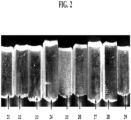
- polished cross-sections of glasses obtained from the melts in Example 2 are shown in FIG. 2 .
- Both aluminum hydroxide and sodium hydroxide fining agents effectively fine the glass.
- NaOH appears to be more effective than Al(OH) 3 in reducing the bubble/seed count in the glass.
- tall oil does not act as a fining agent. Instead, as seen in samples 25 and 25 in FIG. 2 , the addition of tall oil to the melt leads to an increase bubble/seed formation in the glass.
- Example 3 compares the effectiveness of the hydroxide fining agents to hydrogen permeation.
- the batch materials used for each sample are listed in Table 3a.
- Samples 31 and 32 were identical samples, each containing aluminum hydroxide, tin(IV) oxide, and ceria. Samples 31 and 32 were placed in platinum crucibles. Sample 32 was melted with glass on both sides of the crucible to effectively shut off hydrogen permeation into the sample. Sample 32 was further contained by a second refractory crucible backer.
- Samples 33 and 34 were identical samples, containing tin(IV) oxide, ceria, and 52.78 g of sodium nitrate oxidizer. Sample 33 was melted with glass on both sides of the crucible to effectively shut off hydrogen permeation into the sample. Samples 35, 36, and 37 contained SnO 2 , CeO 2 , and 26.39, 105.55 g, and 52.78 g, respectively, of NaNO 3 . Sample 38 contained SnO 2 and NaNO 3 , but no ceria, whereas sample 9 contained ceria and NaNO 3 , but no tin(IV) oxide.
- the batched samples were melted at 1525°C for one hour and then heated at 1600° for one hour to facilitate the removal of bubbles from the melt.
- the compositions of the resulting glasses, expressed in weight percent and mole percent, are listed in Tables 3b and 3c, respectively.
- Polished cross-sections of glasses obtained from the melts in Example 3 are shown in FIG. 3 .
- Comparison of samples 31 and 32 shows no apparent difference in the number of bubbles/seeds, indicating the hydrogen permeation is not the mechanism for fining/bubble reduction in the melt.
- Samples 33 and 34 do not contain hydride fining agents.
- the glass where H 2 permeation was shut off shows that H 2 permeation is not the effective mechanism of the fining package of the present invention.
- Samples 35-37 demonstrate that varying the amount of oxidizer has little effect on the number of bubbles/seeds in the melt. These samples all exhibit low concentrations of bubbles/seeds, compared to glasses that do not contain the fining agents described herein (see, for example, sample 39 in FIG. 1 ). Similarly, melts containing oxidizer and either tin(IV) oxide alone (sample 38) or ceria alone (sample 39) yield low concentrations of bubbles/seeds, showing that the presence of just one of these fining agents and an oxidizer is still effective in removing bubbles/seeds. Table 1a. Compositions of batch materials, expressed in grams, for crucible melts described in Example 1.
- B 2 O 3 0.68 0.68 0.68 0.68 0.68 0.68 0.68 0.68 0.68 0.68 0.68 0.68 0.68 0.68 0.68 Na 2 O 13.33 13.33 13.33 13.33 13.33 13.33 13.33 13.33 13.33 13.33 13.39 K 2 O 3.57 3.57 3.57 3.57 3.57 3.57 3.57 3.57 3.57 3.57 3.59 MgO 3.66 3.66 3.66 3.66 3.66 3.66 3.66 3.66 3.66 3.68 3.68 CaO 0.50 0.50 0.50 0.50 0.50 0.50 0.50 0.50 0.50 0.50 0.50 0.50 0.50 0.50 0.50 0.50 0.50 0.50 0.50 0.50 0.50 SnO 2 0.23 0.
Landscapes
- Chemical & Material Sciences (AREA)
- Engineering & Computer Science (AREA)
- Materials Engineering (AREA)
- Organic Chemistry (AREA)
- Chemical Kinetics & Catalysis (AREA)
- Geochemistry & Mineralogy (AREA)
- General Chemical & Material Sciences (AREA)
- Life Sciences & Earth Sciences (AREA)
- Ceramic Engineering (AREA)
- Dispersion Chemistry (AREA)
- Glass Compositions (AREA)
- Pretreatment Of Seeds And Plants (AREA)
- Silicates, Zeolites, And Molecular Sieves (AREA)
- Surface Treatment Of Glass (AREA)
Description
- The invention relates to silicate glasses. More particularly, the invention relates to fining agents for silicate glasses. Even more particularly, the invention relates to non-toxic fining agents for such glasses.
- During glass formation from the melt, contaminants in the melt tend to form gas bubbles, also referred to in the art as "seeds." Such seeds affect the performance and quality of the glass, and efforts are made to remove or "fine" them from the glass.
- Seed formation is problematic for silicate glasses. In particular, aluminosilicate glasses and other silicate glasses that melt at high temperature are much more difficult to fine than other glasses. The high viscosities of such glasses slows the rate of bubble removal by via Stokes fining; i.e., allowing the bubbles to rise to the surface of the melt due to buoyancy.
- Fining agents such as As2O3, Sb2O3, and halogens have been used to remove bubbles from aluminosilicate glasses. These chemical fining packages work by releasing gas to existing bubbles, causing them to increase in size and rise more quickly to the top of the melt. Unfortunately, these components are toxic, hazardous to handle, expensive, and undesirable for environmentally green products and processes. Sulfate fining agents have also been used in soft glasses. However, they contribute to sulfur emissions and actually exacerbate seed formation in aluminosilicate glasses.
Various glass compositions and methods for fining glass are described inEP 0 253 188 A1 ,WO 2009/105189 A1 ,US 4,028,131 ,US 2004/186000 A1 ,US 2006/270545 A1 ,US 5,384,296 A1 ,US 5,908,703 ,US 6,297,182 ,JP 2001-294441 A US 5,895,768 . - The present invention relates to a silicate glass. The silicate glass has a seed concentration of less than about 1 seed/cm3, wherein a batch comprising raw materials that form the silicate glass includes at least one fining agent. The glass comprises 60-70 mol% SiO2; 6-14 mol% Al2O3; 0-15 mol% B2O3; 0-20 mol% Na2O; 0-10 mol% K2O; 0-8 mol% MgO; 0-10 mol% CaO; 0-5 mol% ZrO2; 0-1 mol% SnO2; 0-1 mol% CeO2; less than 50 ppm As2O3; less than 50 ppm Sb2O3; wherein 12 mol% ≤ Li2O + Na2O + K2O ≤ 20 mol%; wherein 0 mol% ≤ MgO + CaO ≤ 10 mol%; wherein the batch comprising raw materials is substantially free of lithium. The fining agent comprises at least one of a metal hydrate, a metal hydroxide and combinations thereof.
- The invention further relates to a method of making a silicate glass having a seed concentration of less than about 1 seed/cm3. The method comprises the steps of: providing a batch, the batch comprising raw materials for the silicate glass and at least one fining agent, wherein the at least one fining agent comprises at least one at least one of a metal hydrate, a metal hydroxide and combinations thereof; melting the batch to form the melt, wherein the melt comprises 60-70 mol% SiO2; 6-14 mol% Al2O3; 0-15 mol% B2O3; 0-20 mol% Na2O; 0-10 mol% K2O; 0-8 mol% MgO; 0-10 mol% CaO; 0-5 mol% ZrO2; 0-1 mol% SnO2; 0-1 mol% CeO2; less than 50 ppm As2O3; less than 50 ppm Sb2O3; wherein 12 mol% ≤ Li2O + Na2O + K2O ≤ 20 mol%; wherein 0 mol% ≤ MgO + CaO ≤ 10 mol%; wherein the batch or raw materials is substantially free of lithium; heating the melt to reduce the concentration of the plurality of seeds in the melt below a predetermined concentration; and solidifying the melt to form the silicate glass, wherein the glass has a seed concentration of less than about 1 seed/cm3.
- These and other aspects, advantages, and salient features of the present invention will become apparent from the following detailed description, the accompanying drawings, and the appended claims.
-
-
FIGURE 1 is a photograph of polished cross sections of glasses obtained from melts containing fining agents; -
FIGURE 2 is a photograph of polished cross sections of glasses obtained from melts showing the effect of different fining agents on the concentration of seeds within the melt; and -
FIGURE 3 is a photograph of polished cross sections of glasses obtained from melts comparing the effectiveness of hydroxide fining agents in reducing seed formation. - In the following description, like reference characters designate like or corresponding parts throughout the several views shown in the figures. It is also understood that, unless otherwise specified, terms such as "top," "bottom," "outward," "inward," and the like are words of convenience and are not to be construed as limiting terms. In addition, whenever a group is described as comprising at least one of a group of elements and combinations thereof, it is understood that the group may comprise, consist of, or consist essentially of any number of those elements recited, either individually or in combination with each other. Similarly, whenever a group is described as consisting of at least one of a group of elements or combinations thereof, it is understood that the group may consist of any number of those elements recited, either individually or in combination with each other. Unless otherwise specified, a range of values, when recited, includes both the upper and lower limits of the recited range.
- Referring to the drawings in general and to
FIG. 1 in particular, it will be understood that the illustrations are for the purpose of describing a particular embodiment of the invention and are not intended to limit the invention thereto. - Glasses having relatively high viscosities (i.e., 20 Pa•s (200 Poise) viscosities of between about 1500°C and 1675°C) may require melting to obtain a glass having low levels of inclusions. Gaseous inclusions, blisters, or bubbles, which are also referred to herein as "seeds," tend to have an adverse affect of the optical quality and properties of the glass. For example, the presence of seeds affects the refractive index, density, and transmission of light through the glass. To aid in eliminating or reducing the concentration of these gaseous inclusions, it is, in some instances, useful to add chemical fining agents. Such fining agents fill early-stage bubbles with gas, thus increasing the velocity at which the bubbles rise through the melt. Typical fining agents include, but are not limited to: oxides of arsenic, antimony, tin and cerium; metal halides (fluorides, chlorides and bromides); metal sulfates; and the like. Arsenic oxides are particularly effective fining agents because they release oxygen very late in the melt stage. However, arsenic and antimony are generally regarded as hazardous materials. Therefore, it may be advantageous in particular applications to completely avoid using arsenic or antimony, and instead using a nontoxic component to produce a fining effect.
- The present invention reduces the number of seeds within silicate glasses by providing fining agents that comprise at least one of a metal hydrate , a metal hydroxide and combination thereof. The fining agent is also substantially free of arsenic and antimony.
- Hydrates are solid inorganic compounds that contain water molecules, which are either bound to a metal or silicon center or crystallized with a metal complex. Such hydrates are said to contain "water of crystallization" or "water of hydration." With the exception of boric acid, such hydrates may include hydrates of oxides or salts formed by any of the constituents (e.g., alumina, alkali and alkali earth metals, zirconium) of the silicate glass. Metal hydroxides are compounds that comprise a metal and the diatomic hydroxyl OH- anion.
- Non-limiting examples of inorganic or metal hydrates and hydroxides include, but are not limited to: phyllosilicates, such as clays and micas; zeolites; other hydrated silicates; and the like. Clays that may be used as a water source in the fining agent include: aluminum silicate hydroxides, such as kaolinite and pyrophillite; talc (magnesium silicate hydroxide); montmorillonite-smectite (e.g., Bentonite); and combinations thereof, such as clinochlore ((Mg5Al)(AlSi3)O10(OH)8). Zeolites are hydrated aluminosilicates having symmetrically stacked alumina and silica tetrahedra that form an open, stable, three-dimensional honeycomb structure having a negative charge. Zeolites that may be used as a water source in the fining agent include, but are not limited to: mineral zeolites, such as analcime, chabazite, heulandite, natrolite, phillipsite, stilbite, and mordenite. Natrolite (Na2Al2Si3O10·2H2O) has a formula that is typical of such mineral zeolites. Synthetic zeolites such as zeolite A, ZSM-5, and the like may also be used in the fining agent.
- In one embodiment, the fining agent includes at least one metal hydroxide. Such hydroxides may include the hydroxides formed by any of the constituents (e.g., alumina ((Al(OH)3), alkali (e.g., NaOH, KOH, LiOH) and alkali earth (Mg(OH)2, Ca(OH)2, Sr(OH)2, Ba(OH)2) metals, zirconium (Zr(OH)4) of the silicate glass. Additionally, the fining agent may comprise the mineral hydroromarchite (Sn3O2(OH)2), and hydroxides of zinc (Zn(OH)2) and gallium (Ga(OH)3).
- In another embodiment, the fining agent further includes at least one multivalent metal oxide that acts as a source of oxygen to the melt and, optionally, an oxidizer. These multivalent metal oxides are reduced in the glass melt, releasing oxygen, which may also form bubbles. Non-limiting examples of such oxides include, but are not limited to, tin(IV) oxide (SnO2), ceria or cerium oxide (CeO2), and the like. The fining agent, in one embodiment, comprises up to 0.5 mol% SnO2, up to 0.5 mol% CeO2, and, optionally, 0-4 mol% of oxidizer.
- Oxidizers such as, but not limited to, aluminum nitrate, alkali metal nitrates, alkali earth metal nitrates, zirconium nitrate, ammonium nitrate, and the like re-oxidize the multivalent metal oxides in the melt, thus enhancing the effectiveness of the fining agent. Rather than be consumed by tramp contaminants and organic compounds, the oxygen produced by the reduction of multivalent metal oxides such as tin(IV) oxide and ceria are absorbed by the oxidizer and reused in the fining process.
- The fining agents described herein are "batched in" with the rest of the raw materials that are used to formulate the silicate glass. The inorganic compounds that are added as sources of water, such as the hydrates and hydroxides, upon release of water, form oxides that account for a portion of the glass composition.
- Each mole of aluminum hydroxide, for example, decomposes in the melt to first form boehmite, which then decomposes to form alumina (aluminum oxide), ultimately releasing 1.5 moles of water according to the reactions
Al(OH)3 → AlO·(OH) + H2O ,
and
AlO·(OH) → 1/2 Al2O3 + 1/2 H2O .
Expressed in terms of the amount of alumina that is initially introduced into the glass (batched) as aluminum hydroxide, each mole of Al2O3 that is batched provides 3 moles of water vapor to the melt. Given that 1 mole of any gas occupies 22.4 liters at standard temperature and pressure (1 kPa (1bar) pressure, 273 K), or STP, each mole of Al2O3 batched as Al(OH)3 (molecular weight 156 grams) releases 67 liters of gas. As the gas is released at the temperature of the melt, the actual volume of gas released by each mole of alumina batched as Al(OH)3 will be much greater than 67 liters. At 1000°C (1273 K), for example, each mole of alumina batched as Al(OH)3 releases a volume of about 312 liters of gaseous water. - Similarly, a mole of sodium hydroxide decomposes to form sodium oxide and water vapor according to the reaction
NaOH → 1/2 Na2O + 1/2 H2O
The amount Na2O batched as sodium hydroxide provides one mole of water vapor to the melt. At STP, one mole of a gas has a volume of 22.3 liters. As previously described above, gaseous water is released at the temperature of the melt, and the actual volume of gas released by each mole of sodium oxide batched as NaOH will be much greater than 22.3 liters. - In one embodiment, at least 1 mole of water per kilogram of glass is used to effectively "fine" the glass - i.e., reduce the number of seeds or bubbles in the glass. In another embodiment, 5-50 moles H2O/kg of glass are used to fine the glass. The amount of water needed to fine the glass depends in part on the density of glass and other factors such as viscosity, temperature of the melt, and composition of the glass. Depending on the parameters for a particular glass, it may be possible in some instances to use less than 1 mole H2O/kg glass to effectively fine the glass.
- The fining agents described herein are capable of providing at least 0.25 moles, and, in one embodiment, 0.5 moles of gas (water vapor, oxygen, or the like), per mole of fining agent to the melt. The fining agents are capable of producing a seed concentration within the silicate glass of less than about 1seed/cm3 or, alternatively, about 5 seeds per pound (454 grams) of silicate glass. In one embodiment, the fining agents described herein are capable of producing a silicate glass that is substantially free of seeds.
- The fining agents described herein may also act as "fugitive" fluxes that reduce the viscosity of the melt, causing the bubbles to rise to the top of the melt more rapidly.
- A silicate glass having a seed concentration of less than about 1 seed/cm3 or, alternatively, about 5 seeds per pound (454 grams) of silicate glass, is also provided. In one embodiment, the silicate glass is substantially free of seeds. At least one of the fining agents described hereinabove is added to a batch comprising raw materials for the silicate glass. Such raw materials for making the silicate glasses described herein are known in the art. After adding the at least one fining agent to the batch, the batch is melted. The fining agent comprises at least one of a metal hydrate, a metal hydroxide and combinations thereof. The silicate glass may be one of a borosilicate glass, an aluminosilicate glass, and combinations thereof, such as, for example an aluminoborosilicate glass.
- The silicate glass comprises: 60-70 mol% SiO2; 6-14 mol% Al2O3; 0-15 mol% B2O3; 0-20 mol% Na2O; 0-10 mol% K2O; 0-8 mol% MgO; 0-10 mol% CaO; 0-5 mol% ZrO2; 0-1 mol% SnO2; 0-1 mol% CeO2; less than 50 ppm As2O3; and less than 50 ppm Sb2O3; wherein 12 mol% ≤ Li2O + Na2O + K2O ≤ 20 mol% and 0 mol% ≤ MgO + CaO ≤ 10 mol%, whereby the batch or raw materials are substantially free of lithium. In another embodiment, the silicate glass comprises: 63.5-66.5 mol% SiO2; 8-12 mol% Al2O3; 0-3 mol% B2O3; 8-18 mol% Na2O; 0-5 mol% K2O; 1-7 mol% MgO; 0-2.5 mol% CaO; 0-3 mol% ZrO2; 0.05-0.25 mol% SnO2; 0.05-0.5 mol% CeO2; less than 50 ppm As2O3; and less than 50 ppm Sb2O3; wherein 14 mol% ≤ Li2O + Na2O + K2O ≤ 18 mol% and 2 mol% ≤ MgO + CaO ≤ 7 mol%.
- The largest single constituent of the silicate glass is SiO2, which forms the matrix of the glass and is present in the inventive glasses in a concentration ranging from about 60 mol% up to and including about 70 mol%. SiO2 serves as a viscosity enhancer that aids formability and imparts chemical durability to the glass. At concentrations that are higher than the range given above, SiO2 prohibitively raises the melting temperature. Glass durability suffers at concentrations below the 60-70 mol% SiO2 range. In addition, lower SiO2 concentrations can cause the liquidus temperature to increase substantially in glasses having high alkali or alkali earth oxide concentrations.
- The greater alkali metal oxide content of the silicate glass facilitates melting, softens the glass, enables ion exchange, decreases melt resistivity, and breaks up the glass network, which increases thermal expansion and decreases durability. Mixtures of alkali metal oxides help depress the liquidus temperature and may enhance ion exchange as well. Na2O is very desirable for ion exchange with K+ ions for chemical strengthening and makes stable glasses with respect to devitrification. Small amounts of K2O relative to Na2O actually help increase the rate exchange of K+ ions for Na+ ions and decrease the liquidus temperature, but also increase the thermal expansivity of the glass.
- Alumina (Al2O3) and, to a lesser extent, zirconia (ZrO2) have the opposite effect of the alkali metal oxides. In addition, Al2O3 scavenges non-bridging oxygens (NBOs) to form AlO4 tetrahedra while making the glass thermally harder. Alumina and zirconia also provide lower expansion and greater durability but, at high concentrations, make the glass more difficult to melt. In most ion exchangeable glasses, R2O > Al2O3 (where R2O represents at least one alkali metal oxide, such as Li2O, Na2O, K2O) since glasses in which R2O = Al2O3 are very difficult to melt unless B2O3 is present.
- Alkaline earth oxides help create a steeper viscosity curve for the glasses. Replacing alkali metal oxides with alkaline earth metal oxides generally raises the anneal and strain points of the glass while lowering the melting temperatures needed to make high quality glass. MgO and CaO are less expensive than SrO and BaO and do not increase the density as much as the heavier oxides. BaO is also considered to be a hazardous or toxic material, and its presence is therefore undesirable. Accordingly, in one embodiment, the glass is substantially free of barium. Large amounts of MgO tend to increase the liquidus temperature, as the oxide is prone to form forsterite (Mg2SiO4) at low MgO concentrations in sodium aluminosilicate glasses.
- B2O3 may be used as a flux to soften glasses, making them easier to melt. B2O3 also helps scavenge non-bridging oxygen atoms (NBOs), converting the NBOs to bridging oxygen atoms through the formation of BO4 tetrahedra, which increases the toughness of the glass by minimizing the number of weak NBOs. B2O3 also lowers the hardness of the glass which, when coupled with the higher toughness, decreases the brittleness, thereby resulting in a mechanically durable glass.
- Arsenic and antimony are widely regarded as hazardous or toxic materials, and their presence is therefore undesirable. Accordingly, the silicate glass, in another embodiment, is substantially free of at least one of arsenic, antimony, and barium.
- In one embodiment, the silicate glass has a liquidus viscosity of at least 10 kPa•s (100 kilopoise (kpoise)). In another embodiment, the liquidus viscosity is at least 16 kPa•s (160 kpoise), and, in a third embodiment, the liquidus viscosity is at least 22 kPa•s (220 kpoise). As used herein, the term "liquidus viscosity" refers to the viscosity of a molten glass at the liquidus temperature, wherein the liquidus temperature refers to the temperature at which the very last crystals melt away as temperature is increased from room temperature. These properties permit these silicate glasses to be down-drawable; i.e., the glass is capable of being formed into sheets using down-draw methods such as, but not limited to, fusion draw and slot draw methods that are known to those skilled in the art. Such down-draw processes are used in the large-scale manufacture of ion-exchangeable flat glass.
- The fusion draw process uses a drawing tank that has a channel for accepting molten glass raw material. The channel has weirs that are open at the top along the length of the channel on both sides of the channel. When the channel fills with molten material, the molten glass overflows the weirs. Due to gravity, the molten glass flows down the outside surfaces of the drawing tank. These outside surfaces extend down and inwardly so that they join at an edge below the drawing tank. The two flowing glass surfaces join at this edge to fuse and form a single flowing sheet. The fusion draw method offers the advantage that, since the two glass films flowing over the channel fuse together, neither outside surface of the resulting glass sheet comes in contact with any part of the apparatus. Thus, the surface properties of the glass sheet are not affected by such contact.
- The slot draw method is distinct from the fusion draw method. Here the molten raw material glass is provided to a drawing tank. The bottom of the drawing tank has an open slot with a nozzle that extends the length of the slot. The molten glass flows through the slot/nozzle and is drawn downward as a continuous sheet therethrough and into an annealing region. Compared to the fusion draw process, the slot draw process provides a thinner sheet, as only a single sheet is drawn through the slot, rather than two sheets being fused together, as in the fusion down-draw process.
- Down-draw processes produce surfaces that are relatively pristine. Because the strength of the glass surface is controlled by the amount and size of surface flaws, a pristine surface that has had minimal contact has a higher initial strength. When this high strength glass is then chemically strengthened, the resultant strength is higher than that of a surface that has been a lapped and polished. Chemical strengthening or tempering by ion exchange also increases the resistance of the glass to flaw formation due to handling. Down-drawn glass may be drawn to a thickness of less than about 2 mm. In addition, down drawn glass has a very flat, smooth surface that can be used in its final application without costly grinding and polishing.
- The silicate glass described herein is substantially free of lithium. As used herein, "substantially free of lithium" means that lithium is not intentionally added to the glass or glass raw materials during any of the processing steps leading to the formation of the alkali aluminosilicate glass. It is understood that a silicate glass or a silicate glass article that is substantially free of lithium may inadvertently contain small amounts of lithium due to contamination. The absence of lithium reduces poisoning of ion exchange baths, and thus reduces the need to replenish the salt supply needed to chemically strengthen the glass. In addition, due to the absence of lithium, the glass is compatible with continuous unit (CU) melting technologies such as the down-draw processes described above and the materials used therein, the latter including both fused zirconia and alumina refractories and zirconia and alumina isopipes.
- In one embodiment, the silicate glass comprises at least one alkali metal oxide and is ion exchangeable. As used herein, the term "ion-exchangeable" is understood to mean that the glass is capable of being strengthened by ion exchange processes that are known to those skilled in the art. Such ion exchange processes include, but are not limited to, treating the heated alkali aluminosilicate glass with a heated solution containing ions having a larger ionic radius than ions that are present in the glass surface, thus replacing the smaller ions with the larger ions. Potassium ions, for example, could replace sodium ions in the glass. Alternatively, other alkali metal ions having larger atomic radii, such as rubidium or cesium, could replace smaller alkali metal ions in the glass. Alternatively, the smaller alkali metal ions could be replaced by Ag+ ions. Similarly, other alkali metal salts such as, but not limited to, sulfates, halides, and the like may be used in the ion exchange process. In one embodiment, the down-drawn glass is chemically strengthened by placing it a molten salt bath comprising KNO3 for a predetermined time period to achieve ion exchange. In one embodiment, the temperature of the molten salt bath is about 430°C and the predetermined time period is about eight hours.
- Surface compressive stress refers to a stress caused by the substitution during chemical strengthening of an alkali metal ion contained in a glass surface layer by another alkali metal ion having a larger ionic radius. In one embodiment, potassium ions are substituted for sodium ions in the surface layer of the glass described herein. The glass has a surface compressive stress of at least about 200 MPa. In one embodiment, the surface compressive stress is at least about 600 MPa. The alkali aluminosilicate glass has a compressive stress layer that has a depth of at least about 30 µm and, in another embodiment, the depth of the compressive stress layer is at least about 40 µm.
- The replacement of smaller ions by larger ions at a temperature below that at which the glass network can relax produces a distribution of ions across the surface of the glass that results in a stress profile. The larger volume of the incoming ion produces compressive stress (CS) on the surface and tension in the center (central tension, or CT) of the glass. The compressive stress is related to the central tension by the following relationship:

- The silicate glass is resistant to both chipping and scratching, making it well suited for use in cover plates, touch screens, watch crystals, solar concentrators, windows, screens, containers, and other applications that require strong and tough glass with good scratch resistance.
- A method of reducing the concentration of seeds in a silicate glass is also provided. A batch comprising raw materials for the silicate glass and at least one fining agent, as described herein, is first provided. Such raw materials include, but are not limited to, sand, alumina, nepheline syenite (a mineral comprising Na2O·Al2O3·2SiO2), boric acid, soda ash, potassium carbonate, magnesia, limestone, and the like. The batch containing the at least one fining agent is then melted to form a silicate glass melt. The fining agent comprises at least one of a metal hydrate, a metal hydroxide, and combinations thereof. In another embodiment, the fining agent may further include at least one multivalent metal oxide that acts as a source of oxygen to the melt and, optionally, at least one oxidizer, all of which have been previously described herein.
- A method of making the silicate glass described herein is also provided. A batch comprising raw materials for the silicate glass and at least one fining agent, as described herein, is first provided. Such raw materials include, but are not limited to, sand, alumina, nepheline syenite (a mineral comprising Na2O·Al2O3·2SiO2), boric acid, soda ash, potassium carbonate, magnesia, limestone, and the like. The batch containing the at least one fining agent is then heated to a temperature at which a melt begins to form. The fining agent comprises at least one of a metal hydrate, a metal hydroxide and combinations thereof. In an embodiment, the fining agent may further include at least one multivalent metal oxide that acts as a source of oxygen to the melt and, optionally, at least one oxidizer, all of which have been previously described herein.
- The melt is heated to reduce the seed concentration in the melt below a predetermined concentration. The silicate glass, having a seed concentration of less than about 1 seed/cm3, is then solidified.
- The following examples illustrate the features and advantages of the invention and in no way are intended to limit the invention thereto.
- Example 1 serves to illustrate the effectiveness of the fining agents of the present invention. Nine samples of aluminosilicate crucible melts were prepared. The batch materials used for each sample are listed in Table 1a. Different combinations of the fining agents of the present invention were added to samples 11-18.
Sample 19 did not contain any of the fining agents described hereinabove, and thus served as a control sample. Insamples samples samples - The batched samples were melted at 1525°C for one hour and then heated at 1600° for one hour to facilitate the removal of bubbles from the melt. The compositions of the resulting glasses, expressed in weight percent and mole percent, are listed in Tables 1b and 1c, respectively. Tables 1b and 1c also include the averages concentration of seeds or bubbles in the glass samples, expressed as seeds/cm3.
- As previously described herein, upon the release of water, the inorganic compound fining agents comprising the hydrates and hydroxides that are added as sources of water, form oxides that account for a portion of the glass composition. This is shown in tables 1c, 2c, and 3c.
- Polished cross-sections of glasses obtained from the melts in Example 1 are shown in
FIG. 1 .Sample 19, which contained none of the fining agents, has an average seed concentration of 930 seeds/cm3. The addition of 0.1 mol% SnO2 and 0.1 mol% CeO2 alone (sample 11) drastically reduces the concentration of seeds or bubbles in the glass to 79.1 seeds/cm3. The use of the oxidizer (NaNO3) with SnO2 and CeO2 alone (sample 17) also further reduces the concentration of bubbles or seeds to 0.061 seeds/cm3. - The addition of either Al(OH)3 (
samples samples 15 and 16) adds water in the form of hydroxides. Either of these fining agents reduces the seed concentration to levels below those observed when a combination of tin(IV) oxide and ceria alone (sample 11) is used, whereas addition of even higher levels of these hydroxides virtually eliminate seeds or bubbles under the melting conditions used. The addition of Al(OH)3 reduces the seed concentration to values ranging from 0.610 seeds/cm3 (sample 14, in which 359 g of nephelene syenite were added to the batch) to 0.183 seeds/cm3 (sample 18, in which 247 g (Al(OH)3 were added to the batch). The addition of NaOH reduces seed concentration to values ranging from 0.580 seeds/cm3 (sample 15, 87 g NaOH added to the batch) to 0.677 seeds/cm3 (sample 16, 173 g NaOH added to the batch). Use of the oxidizer NaNOs with SnO2, CeO2, and a hydrate (sample 18) reduces the number of bubble/seeds in the glass to a concentration of 0.183 seeds/cm3. - Example 2 illustrates the amount of fining agent (or agents) needed to effectively reduced the concentration of bubbles/seeds in silicate glasses. Nine samples of aluminosilicate crucible melts were prepared. The batch materials used for each sample are listed in Table 2a. Ceria and tin(IV) oxide were added to samples 21-29, and are the only fining agents present in
sample 29. The fining agent aluminum hydroxide (Al(OH)3) was substituted for alumina (Al2O3) in the batch insamples samples Samples sample 21 and NaOH in sample 23) to generate three moles of H2O, whereassamples sample 21 and NaOH in sample 23) to generate six moles of H2O. Sodium nitrate was added as an oxidizer tosamples - Varying amounts of tall oil, an organic fatty acid, were added to
samples - The batched samples were melted at 1525°C for one hour and then heated at 1600° for one hour to facilitate the removal of bubbles from the melt. The compositions of the resulting glasses, expressed in weight percent and mole percent, are listed in Tables 2b and 2c, respectively.
- Polished cross-sections of glasses obtained from the melts in Example 2 are shown in
FIG. 2 . Both aluminum hydroxide and sodium hydroxide fining agents effectively fine the glass. For a given amount of water generated by the fining agents (i.e., comparingsample 21 vs.sample 23 andsample 22 vs. sample 24), NaOH appears to be more effective than Al(OH)3 in reducing the bubble/seed count in the glass. - Based on these experiments, tall oil does not act as a fining agent. Instead, as seen in
samples FIG. 2 , the addition of tall oil to the melt leads to an increase bubble/seed formation in the glass. - Example 3 compares the effectiveness of the hydroxide fining agents to hydrogen permeation. The batch materials used for each sample are listed in Table 3a.
-
Samples Samples Sample 32 was melted with glass on both sides of the crucible to effectively shut off hydrogen permeation into the sample.Sample 32 was further contained by a second refractory crucible backer. -
Samples Sample 33 was melted with glass on both sides of the crucible to effectively shut off hydrogen permeation into the sample.Samples Sample 38 contained SnO2 and NaNO3, but no ceria, whereas sample 9 contained ceria and NaNO3, but no tin(IV) oxide. - The batched samples were melted at 1525°C for one hour and then heated at 1600° for one hour to facilitate the removal of bubbles from the melt. The compositions of the resulting glasses, expressed in weight percent and mole percent, are listed in Tables 3b and 3c, respectively.
- Polished cross-sections of glasses obtained from the melts in Example 3 are shown in
FIG. 3 . Comparison ofsamples -
Samples - Samples 35-37 demonstrate that varying the amount of oxidizer has little effect on the number of bubbles/seeds in the melt. These samples all exhibit low concentrations of bubbles/seeds, compared to glasses that do not contain the fining agents described herein (see, for example,
sample 39 inFIG. 1 ). Similarly, melts containing oxidizer and either tin(IV) oxide alone (sample 38) or ceria alone (sample 39) yield low concentrations of bubbles/seeds, showing that the presence of just one of these fining agents and an oxidizer is still effective in removing bubbles/seeds.Table 1a. Compositions of batch materials, expressed in grams, for crucible melts described in Example 1. Batch Material 11 12 13 14 15 16 17 18 19 Sand 616.56 616.57 616.59 396.99 616.57 616.58 616.56 616.59 619.67 Alumina 161.71 82.33 0 0 161.71 161.71 161.71 0 162.51 Aluminum hydroxide 0.00 121.40 247.30 120.15 0.00 0.00 0.00 247.30 0.00 Nepheline Syenite 0.00 0.00 0.00 359.48 0.00 0.00 0.00 0.00 0.00 Boric Acid 12.06 12.06 12.06 12.06 12.06 12.06 12.06 12.06 12.06 Soda Ash 227.86 227.84 227.81 165.45 112.69 0 194.96 194.90 228.89 Sodium Hydroxide 0.00 0.00 0.00 0.00 87.27 172.67 0.00 0.00 0.00 Sodium Nitrate 0.00 0.00 0.00 0.00 0.00 0.00 52.78 52.78 0.00 Potassium Carbonate 52.69 52.69 52.69 27.29 52.69 52.69 52.66 52.66 52.98 Magnesia 37.86 37.86 37.86 37.92 37.87 37.87 37.86 37.86 38.07 Limestone 8.23 8.23 8.23 6.30 8.50 8.77 8.31 8.31 8.23 Tin (IV) Oxide 2.31 2.31 2.31 2.31 2.31 2.31 2.31 2.31 0.00 Cerium (IV) Oxide 2.72 2.72 2.72 2.72 2.72 2.72 2.72 2.72 0.00 Table 1b. Compositions of glasses prepared from crucible melts described in Example 1, expressed in weight percent. Composition (wt%) 11 12 13 14 15 16 17 18 19 SiO2 61.37 61.37 61.38 61.38 61.37 61.37 61.37 61.37 61.69 Al2O3 16.23 16.24 16.24 16.24 16.23 16.23 16.23 16.23 16.32 B2O3 0.68 0.68 0.68 0.68 0.68 0.68 0.68 0.68 0.68 Na2O 13.33 13.33 13.33 13.33 13.33 13.33 13.33 13.33 13.39 K2O 3.57 3.57 3.57 3.57 3.57 3.57 3.57 3.57 3.59 MgO 3.66 3.66 3.66 3.66 3.66 3.66 3.66 3.66 3.68 CaO 0.50 0.50 0.50 0.50 0.50 0.50 0.50 0.50 0.50 SnO2 0.23 0.23 0.23 0.23 0.23 0.23 0.23 0.23 0.00 CeO2 0.27 0.27 0.27 0.27 0.27 0.27 0.27 0.27 0.00 Fe2O3 0.02 0.02 0.01 0.01 0.02 0.02 0.02 0.01 0.02 Average seeds/cm3 79.11 0.482 0.384 0.610 0.580 0.677 0.061 0.183 929.7 Table 1c. Compositions of glasses prepared from crucible melts described in Example 1, expressed in mole percent. Composition (mol% ) 11 12 13 14 15 16 17 18 19 SiO2 65.89 65.89 65.89 65.89 65.89 65.89 65.89 65.89 65.89 Al2O3 (Alumina) 10.27 5.27 0 0 10.27 10.27 10.27 0 10.27 Al2O3 (Al(OH)3) 0 5 10.27 5 0 0 0 10.27 0 Al2O3(Nepheline) 0 0 0 5.27 0 0 0 0 0 B2O3 0.63 0.63 0.63 0.63 0.63 0.63 0.63 0.63 0.63 Na2O (Soda Ash) 13.91 13.91 13.91 13.91 6.91 0 11.91 11.91 13.91 Na2O (NaOH) 0 0 0 0 7 13.91 0 0 0 Na2O (NaNO3) 0 0 0 0 0 0 2 2 0 K2O 2.45 2.45 2.45 2.45 2.45 2.45 2.45 2.45 2.45 MgO 5.86 5.86 5.86 5.86 5.86 5.86 5.86 5.86 5.86 CaO 0.57 0.57 0.57 0.57 0.57 0.57 0.57 0.57 0.57 SnO2 0.10 0.10 0.10 0.10 0.10 0.10 0.10 0.10 0 CeO2 0.10 0.10 0.10 0.10 0.10 0.10 0.10 0.10 0 Average seeds/cm3 79.11 0.482 0.384 0.610 0.580 0.677 0.061 0.183 929.7 Table 2a. Compositions of batch materials, expressed in grams, for crucible melts described in Example 2. Batch Material 21 22 23 24 25 26 27 28 29 Sand 616.56 616.56 616.56 616.56 616.56 616.56 616.56 189.49 616.56 Alumina 145.77 129.94 161.71 161.71 161.71 161.71 161.71 0 161.71 Aluminum hydroxide 24.22 48.59 0.00 0.00 0.00 0.00 0.00 0.00 0.00 Nepheline Syenite 0.00 0.00 0.00 0.00 0.00 0.00 0.00 699.16 0.00 Boric Acid 12.06 12.06 12.06 12.06 12.06 12.06 12.06 12.06 12.06 Soda Ash 227.86 227.85 178.50 129.15 227.86 227.86 194.96 73.63 227.86 Sodium Hydroxide 0.00 0.00 37.40 74.81 0.00 0.00 0.00 0.00 0.00 Sodium Nitrate 0.00 0.00 0.00 0.00 0.00 0.00 52.78 52.78 0.00 Potassium Carbonate 52.69 52.69 52.69 52.69 52.69 52.69 52.66 3.27 52.69 Magnesia 37.86 37.86 37.86 37.87 37.86 37.86 37.86 37.97 37.86 Limestone 8.23 8.23 8.35 8.46 8.23 8.23 8.31 4.56 8.23 Tin (IV) Oxide 2.31 2.31 2.31 2.31 2.31 2.31 2.31 2.31 2.31 Cerium (IV) Oxide 2.72 2.72 2.72 2.72 2.72 2.72 2.72 2.72 2.72 Fatty Acid, Tall Oil 1.00 5.00 Table 2b. Compositions of glasses prepared from crucible melts described in Example 2, expressed in weight percent. Composition (wt%) 21 22 23 24 25 26 27 28 29 SiO2 61.38 61.37 61.37 61.37 61.37 61.37 61.37 61.38 61.37 Al2O3 16.23 16.23 16.23 16.23 16.23 16.23 16.23 16.24 16.23 B2O3 0.68 0.68 0.68 0.68 0.68 0.68 0.68 0.68 0.68 Na2O 13.33 13.33 13.33 13.33 13.33 13.33 13.33 13.33 13.33 K2O 3.58 3.57 3.57 3.57 3.57 3.57 3.57 3.57 3.57 MgO 3.66 3.66 3.66 3.66 3.66 3.66 3.66 3.66 3.66 CaO 0.50 0.50 0.50 0.50 0.50 0.50 0.50 0.50 0.50 SnO2 0.23 0.23 0.23 0.23 0.23 0.23 0.23 0.23 0.23 CeO2 0.27 0.27 0.27 0.27 0.27 0.27 0.27 0.27 0.27 Fe2O3 0.02 0.02 0.02 0.02 0.02 0.02 0.02 0.00 0.02 Table 2c. Compositions of glasses prepared from crucible melts described in Example 2, expressed in mole percent. Composition (mol % ) 21 22 23 24 25 26 27 28 29 SiO2 65.89 65.89 65.89 65.89 65.89 65.89 65.89 65.89 65.89 Al2O3 (Alumina) 9.27 8.27 10.27 10.27 10.27 10.27 10.27 0 10.27 Al2O3 (Al(OH)3) 1 2 0 0 0 0 0 0 0 Al2O3 (Nepheline) 0 0 0 0 0 0 0 10.27 0 B2O3 0.63 0.63 0.63 0.63 0.63 0.63 0.63 0.63 0.63 Na2O (Soda Ash) 13.91 13.91 10.91 7.91 13.91 13.91 11.91 11.91 13.91 Na2O (NaOH) 0 0 3 6 0 0 0 0 0 Na2O (NaNO3) 0 0 0 0 0 0 2 2 0 K2O 2.45 2.45 2.45 2.45 2.45 2.45 2.45 2.45 2.45 MgO 5.86 5.86 5.86 5.86 5.86 5.86 5.86 5.86 5.86 CaO 0.57 0.57 0.57 0.57 0.57 0.57 0.57 0.57 0.57 SnO2 0.10 0.10 0.10 0.10 0.10 0.10 0.10 0.10 0.10 CeO2 0.10 0.10 0.10 0.10 0.10 0.10 0.10 0.10 0.10 Table 3a. Compositions of batch materials, expressed in grams, for crucible melts described in Example 3. Batch Material 31 32 33 34 35 36 37 38 39 Sand 616.59 616.59 616.56 616.56 616.56 616.56 188.45 616.76 616.36 Alumina 0 0 161.71 161.71 161.71 161.71 0 161.71 161.61 Aluminum hydroxide 247.30 247.30 0.00 0.00 0.00 0.00 0.00 0.00 0.00 Nepheline Syenite 0.00 0.00 0.00 0.00 0.00 0.00 699.16 0.00 0.00 Boric Acid 12.06 12.06 12.06 12.06 12.06 12.06 12.06 12.06 12.06 Soda Ash 227.81 227.81 194.96 194.96 211.41 162.05 73.33 194.97 194.78 Sodium Nitrate 0.00 0.00 52.78 52.78 26.39 105.55 52.78 52.78 52.78 Potassium Carbonate 52.69 52.69 52.66 52.66 52.67 52.64 3.15 52.66 52.66 Magnesia 37.86 37.86 37.86 37.86 37.86 37.86 37.97 37.86 37.86 Limestone 8.23 8.23 8.31 8.31 8.27 8.38 4.55 8.31 8.31 Tin (IV) Oxide 2.31 2.31 2.31 2.31 2.31 2.31 2.31 4.71 0.00 Cerium Oxide 2.72 2.72 2.72 2.72 2.72 2.72 2.72 0.00 5.35 Table 3b. Compositions of glasses prepared from crucible melts described in Example 3, expressed in weight percent. Composition (wt%) 31 32 33 34 35 36 37 38 39 SiO2 61.38 61.38 61.37 61.37 61.37 61.37 61.38 61.40 61.36 Al2O3 16.24 16.24 16.23 16.23 16.23 16.23 16.24 16.24 16.23 B2O3 0.68 0.68 0.68 0.68 0.68 0.68 0.68 0.68 0.68 Na2O 13.33 13.33 13.33 13.33 13.33 13.33 13.33 13.33 13.32 K2O 3.57 3.57 3.57 3.57 3.57 3.57 3.57 3.57 3.57 MgO 3.66 3.66 3.66 3.66 3.66 3.66 3.66 3.66 3.66 CaO 0.50 0.50 0.50 0.50 0.50 0.50 0.50 0.50 0.50 SnO2 0.23 0.23 0.23 0.23 0.23 0.23 0.23 0.47 0.00 CeO2 0.27 0.27 0.27 0.27 0.27 0.27 0.27 0.00 0.53 Fe2O3 0.01 0.01 0.02 0.02 0.02 0.02 0.00 0.02 0.02 Table 3c. Compositions of glasses prepared from crucible melts described in Example 3, expressed in mole percent. Composition (mol%) 31 32 33 34 35 36 37 38 39 SiO2 65.89 65.89 65.89 65.89 65.89 65.89 65.89 65.89 65.89 Al2O3 (Alumina) 0 0 10.27 10.27 10.27 10.27 0 10.27 10.27 Al2O3 (Al(OH)3) 10.27 10.27 0 0 0 0 0 0 0 Al2O3 (Nepheline) 0 0 0 0 0 0 10.27 0 0 B2O3 0.63 0.63 0.63 0.63 0.63 0.63 0.63 0.63 0.63 Na2O (Soda Ash) 13.91 13.91 11.91 11.91 12.91 9.91 11.91 11.91 11.91 Na2O (NaNO3) 0 0 2 2 1 4 2 2 2 K2O 2.45 2.45 2.45 2.45 2.45 2.45 2.45 2.45 2.45 MgO 5.86 5.86 5.86 5.86 5.86 5.86 5.86 5.86 5.86 CaO 0.57 0.57 0.57 0.57 0.57 0.57 0.57 0.57 0.57 SnO2 0.10 0.10 0.10 0.10 0.10 0.10 0.10 0.2 0 CeO2 0.10 0.10 0.10 0.10 0.10 0.10 0.10 0 0.2
Claims (12)
- A silicate glass, the silicate glass having a seed concentration of less than about 1 seed/cm3, wherein the silicate glass is formed from a batch comprising raw materials that includes at least one fining agent, wherein the glass comprises:60-70 mol% SiO2;6-14 mol% Al2O3;0-15 mol% B2O3;0-20 mol% Na2O;0-10 mol% K2O;0-8 mol% MgO;0-10 mol% CaO;0-5 mol% ZrO2;0-1 mol% SnO2;0-1 mol% CeO2;less than 50 ppm As2O3;less than 50 ppm Sb2O3;wherein 12 mol% ≤ Li2O + Na2O + K2O ≤ 20 mol%;wherein 0 mol% ≤ MgO + CaO ≤ 10 mol%;wherein the batch comprising raw materials is substantially free of lithium; andwherein the fining agent comprises at least one of a metal hydrate, a metal hydroxide, and combinations thereof.
- The silicate glass according to Claim 1, wherein either:the metal hydrate is one of a clay, a zeolite, a mica, and combinations thereof; orthe metal hydroxide is one of aluminum hydroxide, an alkali metal hydroxide, an alkali earth metal hydroxide, zirconium hydroxide, and combinations thereof.
- The silicate glass according to Claim 1, wherein the fining agent further comprises at least one multivalent metal oxide that acts as a source of oxygen to the melt and, optionally, at least one oxidizer; and
optionally further wherein the at least one oxidizer is one of aluminum nitrate, an alkali metal nitrate, an alkali earth nitrate, zirconium nitrate, ammonium nitrate, and combinations thereof. - The silicate glass according to Claim 1, wherein the silicate glass is down-drawable and ion exchangeable, optionally wherein the silicate glass, when ion exchanged, has a surface compressive stress of at least about 200 MPa and a surface compressive layer having a depth of at least about 30 µm.
- The silicate glass according to Claim 1, wherein the silicate glass forms a cover plate for a mobile electronic device.
- A method of making a silicate glass having a seed concentration of less than about 1 seed/cm3, the method comprising the steps of:
providing a batch, the batch comprising raw materials for the silicate glass and at least one fining agent; melting the batch to form a silicate glass melt, where the melt comprises:60-70 mol% SiO2;6-14 mol% Al2O3;0-15 mol% B2O3;0-20 mol% Na2O;0-10 mol% K2O;0-8 mol% MgO;0-10 mol% CaO;0-5 mol% ZrO2;0-1 mol% SnO2;0-1 mol% CeO2;less than 50 ppm As2O3;less than 50 ppm Sb2O3;wherein 12 mol% ≤ Li2O + Na2O + K2O ≤ 20 mol%;wherein 0 mol% ≤ MgO + CaO ≤ 10 mol%;wherein the batch comprising raw materials is substantially free of lithium; andwherein the at least one fining agent comprises at least one of: a metal hydrate, a metal hydroxide; and combinations thereof;heating the melt to reduce the seed concentration in the melt below a predetermined concentration; andsolidifying the melt to form the silicate glass, wherein the glass has a seed concentration of less than about 1 seed/cm3. - The method according to Claim 6, wherein the at least one fining agent further comprises at least one multivalent metal oxide that acts as a source of oxygen to the melt and, optionally, at least one oxidizer.
- The method according to Claim 6, wherein the fining agent comprises aluminum hydroxide, sodium hydroxide, or combinations thereof.
- The method according to Claim 6, further comprising ion exchanging the silicate glass to achieve a surface compressive stress of at least 200 MPa and a surface compressive layer having a depth of at least 30 µm.
- The method according to Claim 6, wherein the solidifying further comprises forming a glass sheet of the silicate glass via a down-draw method.
- The method according to Claim 6, wherein the fining agent further comprises a multivalent metal oxide that acts as a source of oxygen to the melt, an oxidizer, and at least one inorganic compound that acts as a source of water at a temperature where the melt is formed.
- The method according to Claim 6, wherein the fining agent comprises SnO2, CeO2, or combinations thereof.
Applications Claiming Priority (4)
| Application Number | Priority Date | Filing Date | Title |
|---|---|---|---|
| US6713008A | 2008-02-26 | 2008-02-26 | |
| US6713008P | 2008-02-26 | 2008-02-26 | |
| EP09716064.2A EP2262741B2 (en) | 2008-02-26 | 2009-02-18 | Fining agents for silicate glasses |
| PCT/US2009/001063 WO2009108285A2 (en) | 2008-02-26 | 2009-02-18 | Fining agents for silicate glasses |
Related Parent Applications (2)
| Application Number | Title | Priority Date | Filing Date |
|---|---|---|---|
| EP09716064.2A Division-Into EP2262741B2 (en) | 2008-02-26 | 2009-02-18 | Fining agents for silicate glasses |
| EP09716064.2A Division EP2262741B2 (en) | 2008-02-26 | 2009-02-18 | Fining agents for silicate glasses |
Publications (3)
| Publication Number | Publication Date |
|---|---|
| EP3138822A2 EP3138822A2 (en) | 2017-03-08 |
| EP3138822A3 EP3138822A3 (en) | 2017-06-28 |
| EP3138822B1 true EP3138822B1 (en) | 2023-07-26 |
Family
ID=40998909
Family Applications (3)
| Application Number | Title | Priority Date | Filing Date |
|---|---|---|---|
| EP16195343.5A Active EP3138822B1 (en) | 2008-02-26 | 2009-02-18 | Fining agents for silicate glasses |
| EP09716064.2A Active EP2262741B2 (en) | 2008-02-26 | 2009-02-18 | Fining agents for silicate glasses |
| EP12178879.8A Ceased EP2535320A3 (en) | 2008-02-26 | 2009-02-18 | Fining agents for silicate glasses |
Family Applications After (2)
| Application Number | Title | Priority Date | Filing Date |
|---|---|---|---|
| EP09716064.2A Active EP2262741B2 (en) | 2008-02-26 | 2009-02-18 | Fining agents for silicate glasses |
| EP12178879.8A Ceased EP2535320A3 (en) | 2008-02-26 | 2009-02-18 | Fining agents for silicate glasses |
Country Status (7)
| Country | Link |
|---|---|
| US (7) | US8158543B2 (en) |
| EP (3) | EP3138822B1 (en) |
| JP (4) | JP5583606B2 (en) |
| KR (1) | KR101606600B1 (en) |
| CN (2) | CN103113022B (en) |
| DE (6) | DE202009018732U1 (en) |
| WO (1) | WO2009108285A2 (en) |
Families Citing this family (152)
| Publication number | Priority date | Publication date | Assignee | Title |
|---|---|---|---|---|
| JP5467490B2 (en) | 2007-08-03 | 2014-04-09 | 日本電気硝子株式会社 | Method for producing tempered glass substrate and tempered glass substrate |
| EP3392220A1 (en) | 2007-11-29 | 2018-10-24 | Corning Incorporated | Glasses having improved toughness and scratch resistance |
| EP3138822B1 (en) | 2008-02-26 | 2023-07-26 | Corning Incorporated | Fining agents for silicate glasses |
| US8075999B2 (en) | 2008-08-08 | 2011-12-13 | Corning Incorporated | Strengthened glass articles and methods of making |
| CN101508524B (en) * | 2009-03-31 | 2010-06-30 | 成都光明光电股份有限公司 | Glass suitable for chemical tempering and chemically tempered glass thereof |
| US8771532B2 (en) | 2009-03-31 | 2014-07-08 | Corning Incorporated | Glass having anti-glare surface and method of making |
| US20100279068A1 (en) * | 2009-05-04 | 2010-11-04 | Glen Bennett Cook | Embossed glass articles for anti-fingerprinting applications and methods of making |
| US20100285272A1 (en) * | 2009-05-06 | 2010-11-11 | Shari Elizabeth Koval | Multi-length scale textured glass substrates for anti-fingerprinting |
| US8647995B2 (en) | 2009-07-24 | 2014-02-11 | Corsam Technologies Llc | Fusion formable silica and sodium containing glasses |
| US8802581B2 (en) | 2009-08-21 | 2014-08-12 | Corning Incorporated | Zircon compatible glasses for down draw |
| WO2011025908A1 (en) | 2009-08-28 | 2011-03-03 | Corning Incorporated | Methods for laser cutting articles from chemically strengthened glass substrates |
| US9019211B2 (en) | 2009-10-30 | 2015-04-28 | Corning Incorporated | Methods and apparatus for providing touch sensitive displays |
| US8436833B2 (en) * | 2009-11-25 | 2013-05-07 | Corning Incorporated | Methods and apparatus for sensing touch events on a display |
| US8110279B2 (en) * | 2009-11-30 | 2012-02-07 | Corning Incorporated | Method for improving the edge strength of tempered glass sheet articles |
| TWI478879B (en) * | 2009-11-30 | 2015-04-01 | Corning Inc | Method and apparatus for making a shaped glass article |
| US20110129648A1 (en) * | 2009-11-30 | 2011-06-02 | Yabei Gu | Glass sheet article with double-tapered asymmetric edge |
| WO2011106196A1 (en) | 2010-02-24 | 2011-09-01 | Corning Incorporated | Oleophobic glass substrates |
| US8385703B2 (en) * | 2010-03-02 | 2013-02-26 | Corning Incorporated | High numerical aperture multimode optical fiber |
| JP2011201711A (en) * | 2010-03-24 | 2011-10-13 | Hoya Corp | Display cover glass and display |
| US8713968B2 (en) | 2010-05-03 | 2014-05-06 | Corning Incorporated | Method and apparatus for making a 3D glass article |
| CN102249542B (en) * | 2010-05-18 | 2015-08-19 | 肖特玻璃科技(苏州)有限公司 | For the alkali aluminosilicate glass of 3D accurate die pressing and thermal flexure |
| CN102892722B (en) * | 2010-05-19 | 2015-01-21 | 旭硝子株式会社 | Glass for chemical strengthening and glass plate for display device |
| US10322960B2 (en) * | 2010-06-17 | 2019-06-18 | Johns Manville | Controlling foam in apparatus downstream of a melter by adjustment of alkali oxide content in the melter |
| TWI537231B (en) | 2010-07-12 | 2016-06-11 | 康寧公司 | High static fatigue alumina isopipes |
| US10421681B2 (en) | 2010-07-12 | 2019-09-24 | Corning Incorporated | Alumina isopipes for use with tin-containing glasses |
| FR2963617B1 (en) * | 2010-08-03 | 2015-06-05 | Eurokera | GLASSES OF LITHIUM ALUMINOSILICATE (PRECURSORS OF VITROCERAMIC); BETA-QUARTZ AND / OR BETA-SPODUMENE VITROCERAMICS; ARTICLES THEREOF VITROCERAMIC; METHODS OF OBTAINING |
| EP2457881B1 (en) | 2010-11-30 | 2019-05-08 | Corning Incorporated | Method and apparatus for bending a sheet of material into a shaped article |
| JP5896338B2 (en) * | 2011-01-18 | 2016-03-30 | 日本電気硝子株式会社 | Method for producing tempered glass and method for producing tempered glass plate |
| FI2673237T4 (en) | 2011-02-11 | 2025-12-12 | Zs Pharma Inc | Use of a zirconium silicate for the treatment of hyperkalemia |
| WO2012118612A1 (en) | 2011-02-28 | 2012-09-07 | Corning Incorporated | Method of forming a 3d glass article from a 2d glass sheet |
| US8889575B2 (en) | 2011-05-31 | 2014-11-18 | Corning Incorporated | Ion exchangeable alkali aluminosilicate glass articles |
| US9783452B2 (en) * | 2011-07-01 | 2017-10-10 | Corning Incorporated | Ion-exchanged glass of high surface compression and shallow depth of layer with high resistance to radial crack formation from vickers indentation |
| US8756680B2 (en) * | 2011-08-02 | 2014-06-17 | Corning Incorporated | Biometric-enabled smart card |
| AU2011101310A4 (en) * | 2011-08-26 | 2011-11-10 | Sterlite Technologies Limited | Glass composition for strengthened cover glass |
| EP3305737B1 (en) * | 2011-10-25 | 2020-02-12 | Corning Incorporated | Glass compositions with improved chemical and mechanical durability |
| US9850162B2 (en) | 2012-02-29 | 2017-12-26 | Corning Incorporated | Glass packaging ensuring container integrity |
| EP2780291B1 (en) | 2011-11-16 | 2018-04-11 | Corning Incorporated | Ion exchangeable glass with high crack initiation threshold |
| CN104160366A (en) | 2011-11-28 | 2014-11-19 | 康宁股份有限公司 | Robust optical touch screen system and method using flat transparent sheet |
| WO2013081894A1 (en) | 2011-11-28 | 2013-06-06 | Corning Incorporated | Optical touch-screen systems and methods using a planar transparent sheet |
| US20130136909A1 (en) | 2011-11-30 | 2013-05-30 | John Christopher Mauro | Colored alkali aluminosilicate glass articles |
| US8901544B2 (en) | 2011-12-06 | 2014-12-02 | Corning Incorporated | Organic thin film transistor with ion exchanged glass substrate |
| DE102012202695B4 (en) * | 2012-02-22 | 2015-10-22 | Schott Ag | Process for the preparation of glasses and glass ceramics, LAS glass and LAS glass ceramics and their use |
| DE102012202696B4 (en) * | 2012-02-22 | 2015-10-15 | Schott Ag | Process for the preparation of glasses and glass ceramics, glass and glass ceramic and their use |
| US9359251B2 (en) | 2012-02-29 | 2016-06-07 | Corning Incorporated | Ion exchanged glasses via non-error function compressive stress profiles |
| US11179295B2 (en) | 2012-02-29 | 2021-11-23 | Corning Incorporated | Glass packaging ensuring container integrity |
| US9591484B2 (en) | 2012-04-20 | 2017-03-07 | T-Mobile Usa, Inc. | Secure environment for subscriber device |
| US20130288010A1 (en) | 2012-04-27 | 2013-10-31 | Ravindra Kumar Akarapu | Strengthened glass article having shaped edge and method of making |
| US9880653B2 (en) | 2012-04-30 | 2018-01-30 | Corning Incorporated | Pressure-sensing touch system utilizing total-internal reflection |
| CO6790239A1 (en) * | 2012-05-09 | 2013-11-14 | Agp America Sa | Curved armored glass with glass, ceramic or mechanically curved ceramic in the outer layer |
| CN102643021A (en) * | 2012-05-09 | 2012-08-22 | 蚌埠玻璃工业设计研究院 | Composite performance reinforcing agent for producing alumina silicate glass |
| US9952719B2 (en) | 2012-05-24 | 2018-04-24 | Corning Incorporated | Waveguide-based touch system employing interference effects |
| US10898933B2 (en) | 2012-05-31 | 2021-01-26 | Corning Incorporated | Oleophobic glass articles |
| US9512029B2 (en) | 2012-05-31 | 2016-12-06 | Corning Incorporated | Cover glass article |
| DE202013012920U1 (en) | 2012-05-31 | 2022-01-24 | Corning Incorporated | Zircon-compatible, ion-exchangeable glass with high damage resistance |
| US10273048B2 (en) | 2012-06-07 | 2019-04-30 | Corning Incorporated | Delamination resistant glass containers with heat-tolerant coatings |
| TWI600626B (en) * | 2012-06-07 | 2017-10-01 | 康寧公司 | Delamination resistant glass containers |
| WO2013184205A1 (en) | 2012-06-08 | 2013-12-12 | Corning Incorporated | Strengthened glass articles and methods of making |
| US9943637B2 (en) | 2012-06-11 | 2018-04-17 | ZS Pharma, Inc. | Microporous zirconium silicate and its method of production |
| WO2014003188A1 (en) * | 2012-06-25 | 2014-01-03 | 日本電気硝子株式会社 | Toughened glass substrate and manufacturing process therefor |
| US9034442B2 (en) | 2012-11-30 | 2015-05-19 | Corning Incorporated | Strengthened borosilicate glass containers with improved damage tolerance |
| KR20150036555A (en) | 2012-07-11 | 2015-04-07 | 제트에스 파마, 인코포레이티드 | Microporous zirconium silicate for the treatment of hyperkalemia in hypercalcemic patients and improved calcium-containing compositions for the treatment of hyperkalemia |
| JP2014037343A (en) * | 2012-07-18 | 2014-02-27 | Nippon Electric Glass Co Ltd | Glass for medicine container and glass tube using the same |
| TWI571448B (en) * | 2012-09-04 | 2017-02-21 | Avanstrate Inc | A method for manufacturing a glass substrate, and a manufacturing apparatus for a glass substrate |
| US20140087193A1 (en) * | 2012-09-26 | 2014-03-27 | Jeffrey Scott Cites | Methods for producing ion exchanged glass and resulting apparatus |
| US9387651B2 (en) | 2012-09-26 | 2016-07-12 | Corning Incorporated | Methods for producing ion exchanged glass and resulting apparatus |
| US9557846B2 (en) | 2012-10-04 | 2017-01-31 | Corning Incorporated | Pressure-sensing touch system utilizing optical and capacitive systems |
| US20140210770A1 (en) | 2012-10-04 | 2014-07-31 | Corning Incorporated | Pressure sensing touch systems and methods |
| KR102184602B1 (en) | 2012-10-22 | 2020-11-30 | 제트에스 파마, 인코포레이티드 | Microporous zirconium silicate for treating hyperkalemia |
| US10695365B2 (en) | 2012-10-22 | 2020-06-30 | ZS Pharma, Inc. | Microporous zirconium silicate for the treatment of hyperkalemia |
| US9586860B2 (en) | 2012-11-20 | 2017-03-07 | Corning Incorporated | Method of making three dimensional glass ceramic article |
| US10501364B2 (en) * | 2012-11-21 | 2019-12-10 | Corning Incorporated | Ion exchangeable glasses having high hardness and high modulus |
| US20140152914A1 (en) * | 2012-11-30 | 2014-06-05 | Corning Incorporated | Low-Fe Glass for IR Touch Screen Applications |
| US10117806B2 (en) | 2012-11-30 | 2018-11-06 | Corning Incorporated | Strengthened glass containers resistant to delamination and damage |
| US9266768B2 (en) | 2013-01-21 | 2016-02-23 | Corning Incorporated | High purity nickel molds for optical quality glass forming |
| KR102169675B1 (en) | 2013-02-15 | 2020-10-26 | 코닝 인코포레이티드 | High volume production of display quality glass sheets having low zirconia levels |
| CN105793203B (en) | 2013-02-20 | 2022-03-01 | 康宁股份有限公司 | Method and apparatus for forming shaped glass articles |
| US20140309099A1 (en) | 2013-04-15 | 2014-10-16 | Ppg Industries Ohio, Inc. | Low iron, high redox ratio, and high iron, high redox ratio, soda-lime-silica glasses and methods of making same |
| US11261122B2 (en) * | 2013-04-15 | 2022-03-01 | Vitro Flat Glass Llc | Low iron, high redox ratio, and high iron, high redox ratio, soda-lime-silica glasses and methods of making same |
| KR102225583B1 (en) | 2013-04-29 | 2021-03-10 | 코닝 인코포레이티드 | Photovoltaic module package |
| TWI631049B (en) | 2013-05-07 | 2018-08-01 | Corning Incorporated | Method of manufacturing 3D glass cover and computer implementation method for estimating shape of 3D glass cover |
| EP2994432B1 (en) | 2013-05-07 | 2020-07-22 | Corning Incorporated | Process and apparatus for forming shaped glass articles |
| US20140345325A1 (en) | 2013-05-24 | 2014-11-27 | Corning Incorporated | Double ion exchange process |
| CN103332857A (en) * | 2013-06-09 | 2013-10-02 | 彩虹显示器件股份有限公司 | Alkali-free aluminum borosilicate glass clarifier and preparation method thereof |
| US11079309B2 (en) | 2013-07-26 | 2021-08-03 | Corning Incorporated | Strengthened glass articles having improved survivability |
| US10209419B2 (en) | 2013-09-17 | 2019-02-19 | Corning Incorporated | Broadband polarizer made using ion exchangeable fusion drawn glass sheets |
| TWI633073B (en) | 2013-10-14 | 2018-08-21 | 康寧公司 | Ion exchange method and chemically strengthened glass substrate from Peter |
| US10118858B2 (en) | 2014-02-24 | 2018-11-06 | Corning Incorporated | Strengthened glass with deep depth of compression |
| US9670088B2 (en) | 2014-05-20 | 2017-06-06 | Corning Incorporated | Scratch resistant glass and method of making |
| CN106461191A (en) * | 2014-06-04 | 2017-02-22 | 旭硝子株式会社 | Glass plate for light-guide plate |
| TWI852054B (en) * | 2014-06-19 | 2024-08-11 | 美商康寧公司 | Glasses having non-frangible stress profiles |
| WO2015195419A2 (en) | 2014-06-19 | 2015-12-23 | Corning Incorporated | Strengthened glass with deep depth of compression |
| CN116282965A (en) | 2014-07-25 | 2023-06-23 | 康宁股份有限公司 | Strengthened glass with deep compression depth |
| US10472277B2 (en) | 2014-07-28 | 2019-11-12 | Dell Products L.P. | Composite plastic display cover |
| JP2017530383A (en) | 2014-07-30 | 2017-10-12 | コーニング インコーポレイテッド | High contrast glass-based writable / erasable front projection screen |
| US10737467B2 (en) | 2014-08-25 | 2020-08-11 | Dell Products L.P. | Multilayer glass composite display cover |
| MX2017002898A (en) | 2014-09-05 | 2017-10-11 | Corning Inc | Glass articles and methods for improving the reliability of glass articles. |
| TWI749406B (en) | 2014-10-08 | 2021-12-11 | 美商康寧公司 | Glasses and glass ceramics including a metal oxide concentration gradient |
| US10150698B2 (en) | 2014-10-31 | 2018-12-11 | Corning Incorporated | Strengthened glass with ultra deep depth of compression |
| JP6839077B2 (en) | 2014-11-04 | 2021-03-03 | コーニング インコーポレイテッド | Deep non-fragile stress profile and how to create it |
| US10065884B2 (en) | 2014-11-26 | 2018-09-04 | Corning Incorporated | Methods for producing strengthened and durable glass containers |
| US9761817B2 (en) | 2015-03-13 | 2017-09-12 | Corning Incorporated | Photo-patternable gate dielectrics for OFET |
| TWI687375B (en) | 2015-03-20 | 2020-03-11 | 美商康寧公司 | Molds for shaping glass-based materials and methods for making the same |
| CN104761144A (en) * | 2015-03-26 | 2015-07-08 | 蚌埠翔宇玻璃制造有限公司 | Nontoxic glass clarifying agent and preparation method thereof |
| CN104761143A (en) * | 2015-03-26 | 2015-07-08 | 蚌埠翔宇玻璃制造有限公司 | Clarifying agent for aluminum silicate glass and preparation method of clarifying agent |
| CN104829119A (en) * | 2015-03-26 | 2015-08-12 | 蚌埠翔宇玻璃制造有限公司 | A high-alkali aluminosilicate glass clarifying agent and a preparing method thereof |
| CN104843993A (en) * | 2015-03-26 | 2015-08-19 | 蚌埠翔宇玻璃制造有限公司 | Glass clarifying agent for float glass production and preparation method therefor |
| CN104761142A (en) * | 2015-03-26 | 2015-07-08 | 蚌埠翔宇玻璃制造有限公司 | Arsenic-flue-dust-containing glass clarifying agent and preparation method thereof |
| CN104761145A (en) * | 2015-03-26 | 2015-07-08 | 蚌埠翔宇玻璃制造有限公司 | Clarifying agent for high-borate glass and preparation method thereof |
| CN104843994A (en) * | 2015-03-26 | 2015-08-19 | 蚌埠翔宇玻璃制造有限公司 | Glass clarifying agent capable of eliminating seeds and preparation method therefor |
| CN104761140A (en) * | 2015-03-26 | 2015-07-08 | 蚌埠翔宇玻璃制造有限公司 | Glass clarifying agent for high-grade glass and preparation method thereof |
| CN104843995A (en) * | 2015-03-26 | 2015-08-19 | 蚌埠翔宇玻璃制造有限公司 | Non-toxic clarifying agent for TFT-LCD (Thin Film Transistor-Liquid Crystal Display) substrate glass and preparation method therefor |
| CN104761141A (en) * | 2015-03-26 | 2015-07-08 | 蚌埠翔宇玻璃制造有限公司 | Clarifying agent for high-hardness glass and preparation method thereof |
| WO2016176096A1 (en) | 2015-04-30 | 2016-11-03 | Corning Incorporated | Electrically conductive articles with discrete metallic silver layers and methods for making same |
| US11613103B2 (en) | 2015-07-21 | 2023-03-28 | Corning Incorporated | Glass articles exhibiting improved fracture performance |
| US10579106B2 (en) | 2015-07-21 | 2020-03-03 | Corning Incorporated | Glass articles exhibiting improved fracture performance |
| US10351459B2 (en) | 2015-08-14 | 2019-07-16 | Corning Incorporated | Molds and methods to control mold surface quality |
| US9592253B1 (en) | 2015-10-14 | 2017-03-14 | ZS Pharma, Inc. | Extended use zirconium silicate compositions and methods of use thereof |
| WO2017087204A1 (en) | 2015-11-18 | 2017-05-26 | Corning Incorporated | Powder, process of making the powder, and articles made therefrom |
| WO2017091482A1 (en) | 2015-11-23 | 2017-06-01 | Corning Incorporated | Removal of inorganic coatings from glass substrates |
| EP3386930B1 (en) | 2015-12-11 | 2021-06-16 | Corning Incorporated | Fusion-formable glass-based articles including a metal oxide concentration gradient |
| CN109071316B (en) | 2016-04-08 | 2020-03-27 | 康宁股份有限公司 | Glass-based articles comprising a concentration gradient of metal oxide |
| EP3397597B1 (en) | 2016-04-08 | 2023-11-08 | Corning Incorporated | Glass-based articles including a stress profile comprising two regions, and methods of making |
| CN107226611A (en) * | 2017-06-02 | 2017-10-03 | 合肥市惠科精密模具有限公司 | A kind of TFT LCD substrates glass environmental protection fining agent |
| CN107117808A (en) * | 2017-06-19 | 2017-09-01 | 合肥市惠科精密模具有限公司 | A kind of AMOLED base plate glass production compound clarifier |
| NL2020896B1 (en) | 2018-05-08 | 2019-11-14 | Corning Inc | Water-containing glass-based articles with high indentation cracking threshold |
| US10807896B2 (en) * | 2018-03-15 | 2020-10-20 | Owens-Brockway Glass Container Inc. | Process and apparatus for glass manufacture |
| US11485663B2 (en) | 2018-08-22 | 2022-11-01 | Corning Incorporated | Methods for manufacturing glass articles |
| US12037282B2 (en) | 2018-11-01 | 2024-07-16 | Corning Incorporated | Strengthened glass articles with reduced delayed breakage and methods of making the same |
| US10894734B1 (en) * | 2018-11-14 | 2021-01-19 | Molten Aura Labs, LLC | Systems and methods of manufacturing colored borosilicate glass |
| TWI891613B (en) | 2018-11-16 | 2025-08-01 | 美商康寧公司 | Glass compositions and methods for strengthening via steam treatment |
| CA3117986A1 (en) | 2018-11-26 | 2020-06-04 | Owens Corning Intellectual Capital, Llc | High performance fiberglass composition with improved specific modulus |
| ES2980180T3 (en) | 2018-11-26 | 2024-09-30 | Owens Corning Intellectual Capital Llc | High performance fiberglass composition with improved modulus of elasticity |
| US10434506B1 (en) | 2018-12-18 | 2019-10-08 | Emerging Fuels Technology, Inc. | Method for activation or regeneration of a catalyst |
| JP2020100538A (en) * | 2018-12-25 | 2020-07-02 | 日本電気硝子株式会社 | Mixed raw material for glass production and glass production method using the same |
| CN110183103B (en) * | 2019-05-06 | 2023-05-02 | 中建材玻璃新材料研究院集团有限公司 | Clarifying agent for alkali-free boroaluminosilicate glass and use method thereof |
| WO2020231961A1 (en) | 2019-05-16 | 2020-11-19 | Corning Incorporated | Glass compositions and methods with steam treatment haze resistance |
| US12122711B2 (en) | 2019-05-16 | 2024-10-22 | Corning Incorporated | Steam strengthenable glass compositions with low phosphorous content |
| WO2020231959A1 (en) | 2019-05-16 | 2020-11-19 | Corning Incorporated | Glasses with modified young's modulus profile |
| DE102019126332A1 (en) | 2019-09-30 | 2021-04-01 | Schott Ag | Glass articles, processes for their manufacture and uses |
| US11370686B2 (en) * | 2019-10-01 | 2022-06-28 | Owens-Brockway Glass Container Inc. | Fining submerged combustion glass |
| US11912608B2 (en) | 2019-10-01 | 2024-02-27 | Owens-Brockway Glass Container Inc. | Glass manufacturing |
| CN112897888A (en) | 2019-12-04 | 2021-06-04 | 康宁股份有限公司 | Method of making a glass substrate having a textured surface |
| MY209646A (en) | 2020-02-03 | 2025-07-29 | Vitro Flat Glass Llc | Soda lime silica glass with high visible light transmittance |
| GB202012825D0 (en) | 2020-05-12 | 2020-09-30 | Corning Inc | Fusion formable and steam strengthenable glass compositions with platinum compatibility |
| KR102916905B1 (en) | 2020-08-24 | 2026-01-26 | 코닝 인코포레이티드 | Minimizing the formation of crystalline rhodium-platinum defects in glasses manufactured in precious metal systems. |
| CN114276001B (en) * | 2021-09-18 | 2024-03-26 | 长兴旗滨玻璃有限公司 | Float glass preparation method with low bubble content and float glass |
| WO2023055620A1 (en) * | 2021-10-01 | 2023-04-06 | Corning Incorporated | Fining packages for glass compositions |
| US12151971B2 (en) * | 2021-11-30 | 2024-11-26 | Corning Incorporated | Lithium phosphoalumino silicate glasses with fast effective inter-diffusivity |
| CN114804618B (en) * | 2022-04-23 | 2023-11-28 | 绵竹市红森玻璃制品有限责任公司 | Glass composite clarifying agent and preparation method and application thereof |
| CN119562934A (en) * | 2022-07-28 | 2025-03-04 | 康宁股份有限公司 | Refining kit for glass compositions |
| EP4682121A1 (en) * | 2024-07-19 | 2026-01-21 | S.A. Lhoist Recherche Et Developpement | Calcium and magnesium composition with low dust and improved carbon-footprint for use in a glass manufacturing |
| WO2026072479A1 (en) | 2024-09-26 | 2026-04-02 | Corning Incorporated | Strengthened glass articles with deep outer compression from ion exchange on cylindrically thermally induced bending stress profile |
Citations (22)
| Publication number | Priority date | Publication date | Assignee | Title |
|---|---|---|---|---|
| US3778335A (en) | 1971-09-02 | 1973-12-11 | Corning Glass Works | Sodium aluminosilicate glass article strengthened by a surface compressive stress layer |
| US5846280A (en) | 1996-04-26 | 1998-12-08 | Schott Glaswerke | Process for production of chemically prestressed glass |
| DE19739912C1 (en) | 1997-09-11 | 1998-12-10 | Schott Glas | New alkali-free aluminoborosilicate glass |
| US5895768A (en) * | 1996-04-26 | 1999-04-20 | Schott Glaswerke | Chemically prestressable aluminosilicate glass and products made therefrom |
| US5908703A (en) | 1996-04-30 | 1999-06-01 | Schott Glaswerke | Alkali-free aluminoborosilicate glass and its use |
| EP1078889A1 (en) | 1999-08-21 | 2001-02-28 | Schott Glas | Process for refining glass melts |
| US6297182B1 (en) * | 1998-08-11 | 2001-10-02 | Asahi Glass Company Ltd. | Glass for a substrate |
| JP2001294441A (en) * | 2000-04-11 | 2001-10-23 | Asahi Glass Co Ltd | Glass for substrates |
| US20020193232A1 (en) | 2001-03-28 | 2002-12-19 | Asahi Glass Company, Limited | Process for producing a glass for cathode ray tubes |
| US20040186000A1 (en) | 2003-02-18 | 2004-09-23 | Toru Kawamoto | Glass composition |
| EP1473284A1 (en) | 2002-02-05 | 2004-11-03 | Nippon Electric Glass Co., Ltd | Glass composition |
| US20050065014A1 (en) | 2003-09-02 | 2005-03-24 | Toshiharu Narita | Alkali-free glass substrate |
| EP1593658A1 (en) | 2004-05-07 | 2005-11-09 | Schott AG | Chemically and thermally pre-stressable lithium aluminosilicate float glass of high temperature resistance |
| US7090937B2 (en) | 2001-05-31 | 2006-08-15 | Hoya Corporation | Glass substrate for information recording medium and magnetic information recording medium to which the glass substrate is applied |
| JP2007111079A (en) | 2005-10-18 | 2007-05-10 | Hiroshima Pref Gov | Odor adsorption unit, air cleaning method, and air cleaner |
| JP2007142324A (en) | 2005-11-22 | 2007-06-07 | Kyocera Corp | Thin film transistor and image display device |
| US20080063459A1 (en) | 2006-09-12 | 2008-03-13 | Seiko Epson Corporation | Printer and emission intensity adjusting method |
| US20080143999A1 (en) | 2006-12-15 | 2008-06-19 | Wen-Yu Liu | Range finder and range finding method |
| EP2000440A2 (en) | 2006-03-27 | 2008-12-10 | Asahi Glass Company, Limited | Glass-making process |
| EP2036867A1 (en) | 2006-06-08 | 2009-03-18 | Hoya Corporation | Glass for use as substrate for information recording medium, substrate for information recording medium, information recording medium, and their production methods |
| US20090108285A1 (en) | 2006-06-14 | 2009-04-30 | Josuke Nakata | Rod-Shaped Semiconductor Device |
| EP3138822A2 (en) | 2008-02-26 | 2017-03-08 | Corning Incorporated | Fining agents for silicate glasses |
Family Cites Families (169)
| Publication number | Priority date | Publication date | Assignee | Title |
|---|---|---|---|---|
| DE88633C (en) | 1900-01-01 | |||
| GB254377A (en) | 1925-03-30 | 1926-06-30 | Bramson Mogens Louis | Improvements in or relating to variable pitch propellers |
| NL122215C (en) | 1961-06-12 | |||
| US3485702A (en) | 1965-11-23 | 1969-12-23 | Corning Glass Works | Mechanical strengthening of glass by ion exchange |
| NL6603154A (en) | 1966-03-10 | 1967-09-11 | ||
| US3752729A (en) | 1966-05-16 | 1973-08-14 | Corning Glass Works | Strengthened glass article |
| US3451796A (en) | 1966-05-16 | 1969-06-24 | Corning Glass Works | Method of treating strengthened glass surface to increase acid durability |
| US3479217A (en) | 1967-05-31 | 1969-11-18 | Owens Illinois Inc | Copper-coated glass article |
| US3524737A (en) | 1967-06-01 | 1970-08-18 | Corning Glass Works | Method for thermochemical strengthening of glass articles |
| FR1559817A (en) * | 1968-01-23 | 1969-03-14 | ||
| US3617231A (en) * | 1968-06-10 | 1971-11-02 | Brockway Glass Co Inc | Method of controlling the softening point and working temperature of soda-lime glass by regulating the water content of the glass melt |
| US3954656A (en) | 1969-02-24 | 1976-05-04 | American Optical Corporation | Laser glasses with high damage threshold and method of making such glasses |
| FR2051663B1 (en) | 1969-07-10 | 1974-05-03 | Asahi Glass Co Ltd | |
| BE753189A (en) | 1969-07-10 | 1970-12-16 | Asahi Glass Co Ltd | PROCESS FOR REINFORCING A GLASS ARTICLE BY ION EXCHANGE AND PRODUCT THUS OBTAINED |
| US3784638A (en) | 1969-12-24 | 1974-01-08 | Polaroid Corp | Preparation of tertiary organo-phosphine oxides |
| US3652303A (en) | 1970-01-26 | 1972-03-28 | Ppg Industries Inc | Heat absorbing blue soda-lime-silica glass |
| US3885976A (en) | 1970-07-15 | 1975-05-27 | American Optical Corp | Solarization resistant glass containing ytterbium oxide |
| DD88633A (en) | 1971-03-23 | |||
| US3914514A (en) | 1973-08-16 | 1975-10-21 | Trw Inc | Termination for resistor and method of making the same |
| JPS5411812B2 (en) | 1973-09-08 | 1979-05-17 | ||
| US4015045A (en) * | 1974-01-09 | 1977-03-29 | Ppg Industries, Inc. | Chemical strengthening of glass |
| US4110097A (en) * | 1974-08-14 | 1978-08-29 | Saint-Gobain Industries | Method for the manufacture of glass |
| US4033777A (en) | 1974-10-03 | 1977-07-05 | Owens-Illinois, Inc. | Sodium specific glass compositions and electrodes |
| US3988234A (en) | 1974-10-03 | 1976-10-26 | Owens-Illinois, Inc. | Sodium specific glass electrodes |
| US4119760A (en) * | 1975-08-15 | 1978-10-10 | Ppg Industries, Inc. | Chemical strengthening of glass |
| JPS5284212A (en) | 1976-01-05 | 1977-07-13 | Nippon Electric Glass Co | Infrared ray absorbing glass for leading switch of selffholding type |
| US4058437A (en) | 1976-05-24 | 1977-11-15 | Owens-Illinois, Inc. | Process for selectively measuring sodium ions in solution |
| JPS53108111A (en) | 1976-11-25 | 1978-09-20 | Takeshi Hoshikawa | Iron aventurine glass and production thereof |
| US4138235A (en) * | 1977-05-31 | 1979-02-06 | Ppg Industries, Inc. | Method of making flat glass with lower sulfur-containing emissions |
| US4270945A (en) * | 1979-12-03 | 1981-06-02 | Ppg Industries, Inc. | Method of melting flat glass using nitrates to suppress sulfurous emissions |
| US4298389A (en) * | 1980-02-20 | 1981-11-03 | Corning Glass Works | High transmission glasses for solar applications |
| US4298390A (en) | 1980-08-13 | 1981-11-03 | Corning Glass Works | Fluorophosphate opal glasses |
| SU937373A1 (en) | 1980-10-22 | 1982-06-23 | Научно-Исследовательский Институт Камня И Силикатов Мпсм Армсср | Opacified glass |
| DE3212612C2 (en) * | 1982-04-05 | 1985-12-19 | Schott Glaswerke, 6500 Mainz | Chemically hardenable watch glass with high Knoop hardness in the system SiO ↓ 2 ↓ -Al ↓ 2 ↓ O ↓ 3 ↓ -MgO-Na ↓ 2 ↓ O-K ↓ 2 ↓ O (-B ↓ 2 ↓ O ↓ 3 ↓ La ↓ 2 ↓ O ↓ 3 ↓) |
| JPS59156506A (en) | 1983-10-03 | 1984-09-05 | Kobe Steel Ltd | Cooling method of work roll in hot rolling |
| FR2596028B1 (en) | 1986-03-24 | 1988-12-30 | Dromigny Pierre | DEVICE FOR TRANSPORTING A DETERMINED FORMAT FILM |
| JPS62270439A (en) | 1986-05-17 | 1987-11-24 | Ishizuka Glass Ltd | Chemically strengthened glass |
| SU1351897A1 (en) | 1986-05-27 | 1987-11-15 | Государственный научно-исследовательский институт стекла | Glass |
| NZ220810A (en) * | 1986-07-07 | 1989-08-29 | Ppg Industries Inc | Refining glass; collapsing foam above melt by adding substances |
| JPS63230536A (en) * | 1987-03-18 | 1988-09-27 | Nippon Sheet Glass Co Ltd | Thallium-containing optical glass |
| SU1671625A1 (en) | 1987-03-19 | 1991-08-23 | Государственный научно-исследовательский институт стекла | Yellow glass |
| JPS63252938A (en) | 1987-04-10 | 1988-10-20 | Asahi Glass Co Ltd | High expansive glass composition |
| GB8710298D0 (en) * | 1987-04-30 | 1987-06-03 | Glaverbel | Glass-melting furnace |
| JPH01122936A (en) | 1987-11-05 | 1989-05-16 | Natl Inst For Res In Inorg Mater | Glass for coating metallic surface |
| SU1606477A1 (en) | 1988-07-08 | 1990-11-15 | Государственный научно-исследовательский институт стекла | Glass |
| US4919700A (en) * | 1989-01-03 | 1990-04-24 | Ppg Industries, Inc. | Vacuum refining of glassy materials with selected water content |
| JPH03237036A (en) * | 1989-08-24 | 1991-10-22 | Nippon Electric Glass Co Ltd | Thin plate type borosilicate glass for alumina package |
| JPH0753235Y2 (en) | 1990-02-23 | 1995-12-06 | 株式会社東海理化電機製作所 | Switch device |
| GB9004485D0 (en) | 1990-02-28 | 1990-04-25 | Johnson Matthey Plc | Glass composition |
| BR9302204A (en) * | 1992-06-05 | 1993-12-14 | Praxair Technology Inc | GLASS PRODUCTION PROCESS |
| DE4314817A1 (en) | 1993-04-30 | 1994-11-03 | Ivoclar Ag | Opalescent glass |
| JP3431279B2 (en) | 1993-06-08 | 2003-07-28 | 旭テクノグラス株式会社 | Low expansion glass used for anodic bonding |
| US5384296A (en) * | 1993-08-16 | 1995-01-24 | Mobil Oil Corporation | Thermally stable noble metal-container zeolite catalyst |
| CZ279603B6 (en) | 1993-11-03 | 1995-05-17 | Vysoká Škola Chemicko-Technologická | Crystal lead-free glass with refractive index greater than 1.52 |
| DE4428839C2 (en) | 1994-08-01 | 1997-01-23 | Ivoclar Ag | Alkali-zinc-silicate glass-ceramics and glasses and process for producing the glass-ceramics |
| US5780371A (en) * | 1994-10-13 | 1998-07-14 | Saint-Gobain Vitrage S.A. | Reinforced glass substrate |
| IT1268814B1 (en) | 1994-12-13 | 1997-03-06 | Calp Spa | GLAZING MIXTURE FOR QUALITY GLASS |
| GB2299991B (en) | 1995-04-20 | 1998-09-09 | Ag Technology Corp | Glass substrate for magnetic disk |
| US5665137A (en) * | 1995-08-15 | 1997-09-09 | Owens-Corning Fiberglas Technology, Inc. | Method for controlling secondary foam during glass melting |
| JP3804115B2 (en) | 1996-01-24 | 2006-08-02 | 旭硝子株式会社 | Glass substrate |
| JP3804159B2 (en) | 1996-03-15 | 2006-08-02 | 旭硝子株式会社 | Glass substrate and glass substrate for PDP |
| JPH09255354A (en) | 1996-03-18 | 1997-09-30 | Asahi Glass Co Ltd | Glass composition for substrates |
| US6253578B1 (en) * | 1996-04-12 | 2001-07-03 | Praxair Technology, Inc. | Glass melting process and apparatus with reduced emissions and refractory corrosion |
| US5922097A (en) * | 1996-06-12 | 1999-07-13 | Praxair Technology, Inc. | Water enhanced fining process a method to reduce toxic emissions from glass melting furnaces |
| EP0812809A3 (en) * | 1996-06-12 | 1998-11-25 | Praxair Technology, Inc. | Method to reduce toxic emissions from glass melting furnaces by water enhanced fining process |
| JP3211683B2 (en) | 1996-07-18 | 2001-09-25 | 株式会社日立製作所 | Glass substrate for information recording disk |
| US5824127A (en) * | 1996-07-19 | 1998-10-20 | Corning Incorporated | Arsenic-free glasses |
| US5785726A (en) | 1996-10-28 | 1998-07-28 | Corning Incorporated | Method of reducing bubbles at the vessel/glass interface in a glass manufacturing system |
| US5785725A (en) | 1997-04-14 | 1998-07-28 | Johns Manville International, Inc. | Polymeric fiber and glass fiber composite filter media |
| JP2001523208A (en) * | 1997-05-07 | 2001-11-20 | コーニング ソシエテ アノニム | Mold for organic lens composed of inorganic glass and novel inorganic glass |
| DE19721738C1 (en) * | 1997-05-24 | 1998-11-05 | Schott Glas | Aluminosilicate glass for flat displays and uses |
| JP3741526B2 (en) | 1997-09-30 | 2006-02-01 | セントラル硝子株式会社 | Substrate glass for display devices |
| JPH11180728A (en) | 1997-12-22 | 1999-07-06 | Central Glass Co Ltd | Substrate glass composition for display device |
| US6313052B1 (en) * | 1998-02-27 | 2001-11-06 | Asahi Glass Company Ltd. | Glass for a substrate |
| GB2335423A (en) * | 1998-03-20 | 1999-09-22 | Pilkington Plc | Chemically toughenable glass |
| JP4086211B2 (en) | 1998-04-17 | 2008-05-14 | Hoya株式会社 | Glass composition and method for producing the same |
| JPH11302032A (en) | 1998-04-17 | 1999-11-02 | Nippon Sheet Glass Co Ltd | Glass composition and substrate for information recording medium using same |
| JPH11310433A (en) | 1998-04-27 | 1999-11-09 | Central Glass Co Ltd | Substrate glass for display device |
| JPH11335133A (en) | 1998-05-27 | 1999-12-07 | Central Glass Co Ltd | Substrate glass for display device |
| JP2000001331A (en) | 1998-06-11 | 2000-01-07 | Nh Techno Glass Kk | Glass for liquid crystal display substrates |
| JP4045662B2 (en) | 1998-08-24 | 2008-02-13 | 日本板硝子株式会社 | Heat resistant glass composition and plasma display panel using the same |
| JP4497591B2 (en) | 1998-09-11 | 2010-07-07 | Hoya株式会社 | Glass composition, substrate for information recording medium and information recording medium using the same |
| JP4544666B2 (en) | 1998-09-11 | 2010-09-15 | Hoya株式会社 | Glass composition, substrate for information recording medium and information recording medium using the same |
| US6333286B1 (en) | 1998-09-11 | 2001-12-25 | Nippon Sheet Glass Co., Ltd. | Glass composition and substrate for information recording media comprising the same |
| DE19906240A1 (en) | 1999-02-15 | 2000-08-17 | Schott Glas | Glass composition used, e.g., as container glass for chemically aggressive liquids contains a high amount of zirconium oxide |
| DE60006176T2 (en) | 1999-03-25 | 2004-04-22 | Central Glass Co., Ltd., Ube | Glass composition, glass object reinforced by ion exchange and process for its manufacture |
| DE19924520C1 (en) | 1999-05-28 | 2000-06-21 | Schott Glas | Lead-free optical borosilicate glass, especially for high performance optics, contains aluminum, calcium and tantalum oxides and has a high negative anomalous partial dispersion |
| DE19934072C2 (en) | 1999-07-23 | 2001-06-13 | Schott Glas | Alkali-free aluminoborosilicate glass, its uses and processes for its manufacture |
| DE19939773C2 (en) * | 1999-08-21 | 2003-06-18 | Schott Glas | Device and method for refining glasses or glass ceramics |
| JP2001076336A (en) | 1999-09-08 | 2001-03-23 | Hoya Corp | Glass substrate for information recording medium and information recording medium using the same |
| JP2001226138A (en) | 1999-12-06 | 2001-08-21 | Nippon Electric Glass Co Ltd | Glass substrate for flat panel display device |
| SG99350A1 (en) | 2000-02-17 | 2003-10-27 | Hoya Corp | Glass for cathode-ray tube, strengthened glass, method for the production thereof and use thereof |
| JP2001348248A (en) * | 2000-06-02 | 2001-12-18 | Hoya Corp | Glass for cathode ray tube, method for manufacturing the same and glass panel for cathode ray tube |
| DE10017701C2 (en) | 2000-04-08 | 2002-03-07 | Schott Glas | Floated flat glass |
| GB2361382A (en) | 2000-04-12 | 2001-10-17 | Mitel Corp | Tree hierarchy and description for generated logs |
| DE10019355A1 (en) | 2000-04-18 | 2001-10-31 | Schott Glas | Vitreous body with increased strength |
| US6713008B1 (en) | 2000-06-23 | 2004-03-30 | Darrin Blake Teeter | Method for making composite structures |
| JP2002025760A (en) | 2000-07-04 | 2002-01-25 | Nippon Electric Glass Co Ltd | Back-face base board for inorganic el display |
| DE10034985C1 (en) * | 2000-07-19 | 2001-09-06 | Schott Glas | Process for the production of aluminosilicate glasses, aluminosilicate glasses and their uses |
| JP2002053340A (en) | 2000-08-09 | 2002-02-19 | Nippon Electric Glass Co Ltd | Glass substrate of inorganic el display |
| DE10042771B4 (en) * | 2000-08-31 | 2004-02-12 | Schott Glas | Process for controlling and setting the redox state of redox refining agents in a glass melt |
| JP2002174810A (en) * | 2000-12-08 | 2002-06-21 | Hoya Corp | Glass substrate for display, manufacturing method for the same and display using the same |
| DE10064808B4 (en) * | 2000-12-22 | 2005-09-01 | Schott Ag | Zinc oxide-containing borosilicate glass and its uses |
| DE10223705A1 (en) | 2001-05-31 | 2003-01-30 | Asahi Glass Co Ltd | Glass color CRT undergoes localized, specified stress modifications induced by ion-exchange process. |
| JP4481641B2 (en) * | 2001-10-02 | 2010-06-16 | ショット アクチエンゲゼルシャフト | Apparatus and method for low contamination melting of materials |
| US6753279B2 (en) | 2001-10-30 | 2004-06-22 | Corning Incorporated | Glass composition for display panels |
| US7155934B2 (en) * | 2001-11-19 | 2007-01-02 | Schott Ag | Method for the production of borosilicate glass with a surface suitable for modification glass obtained according to said method and the use thereof |
| JP2003203604A (en) | 2002-01-08 | 2003-07-18 | Matsushita Electric Ind Co Ltd | Flat discharge lamp |
| CN1450010A (en) | 2002-04-09 | 2003-10-22 | 碧悠国际光电股份有限公司 | Optical glass |
| US7309671B2 (en) | 2002-05-24 | 2007-12-18 | Nippon Sheet Glass Co., Ltd. | Glass composition, glass article, glass substrate for magnetic recording media, and method for producing the same |
| US20040050106A1 (en) * | 2002-08-29 | 2004-03-18 | Murnane Rand A. | Producing glass using outgassed frit |
| JP4530618B2 (en) * | 2002-09-27 | 2010-08-25 | コニカミノルタオプト株式会社 | Glass composition and glass substrate |
| JP2004123495A (en) | 2002-10-07 | 2004-04-22 | Nippon Sheet Glass Co Ltd | Ultraviolet and infrared absorption colored glass plate |
| JP4266109B2 (en) | 2002-10-07 | 2009-05-20 | 日本板硝子株式会社 | Glass frit for sealing |
| JP2004131314A (en) * | 2002-10-09 | 2004-04-30 | Asahi Glass Co Ltd | Chemically tempered glass substrate with transparent conductive film and method for producing the same |
| DE10309495B4 (en) | 2003-02-25 | 2006-02-16 | Schott Ag | Aluminosilicate glass and its use |
| US7260960B2 (en) * | 2003-02-27 | 2007-08-28 | Carty William M | Selective glass batching methods for improving melting efficiency and reducing gross segregation of glass batch components |
| US6962887B2 (en) * | 2003-05-14 | 2005-11-08 | Ppg Industries Ohio, Inc. | Transparent glass having blue edge color |
| DE102004027120B4 (en) | 2003-06-06 | 2013-01-31 | Schott Ag | Use of a UV-absorbing neutral glass, in particular for fluorescent lamps |
| DE10333399B3 (en) * | 2003-07-16 | 2005-04-07 | Schott Ag | Use of a glass for optical transmission components of large thickness |
| CN1833306B (en) | 2003-08-08 | 2010-04-28 | 日本电气硝子株式会社 | Jacket container for external electrode fluorescent lamp |
| JP4378769B2 (en) * | 2003-09-18 | 2009-12-09 | 日本電気硝子株式会社 | Glass substrate |
| JP5105571B2 (en) | 2003-10-10 | 2012-12-26 | 日本電気硝子株式会社 | Method for producing alkali-free glass |
| US7727917B2 (en) * | 2003-10-24 | 2010-06-01 | Schott Ag | Lithia-alumina-silica containing glass compositions and glasses suitable for chemical tempering and articles made using the chemically tempered glass |
| CN1226213C (en) | 2003-12-16 | 2005-11-09 | 中国科学院长春应用化学研究所 | Preparation method of rare earth green long afterglow glass |
| DE102004008464A1 (en) | 2004-02-19 | 2005-09-15 | Fischerwerke Artur Fischer Gmbh & Co. Kg | Multi-component epoxy resin kit for fixing applications, e.g. fixing anchor bars in concrete, contains a hardener component based on a Mannich base formulation with specified properties |
| JP4737709B2 (en) | 2004-03-22 | 2011-08-03 | 日本電気硝子株式会社 | Method for producing glass for display substrate |
| DE102004033653B4 (en) * | 2004-07-12 | 2013-09-19 | Schott Ag | Use of a glass for EEFL fluorescent lamps |
| JP4716245B2 (en) * | 2004-11-11 | 2011-07-06 | 日本電気硝子株式会社 | Glass substrate and manufacturing method thereof |
| US7409838B2 (en) * | 2005-01-12 | 2008-08-12 | Praxair Technology, Inc. | Reducing corrosion and particulate emission in glassmelting furnaces |
| US7475568B2 (en) * | 2005-04-27 | 2009-01-13 | Corning Incorporated | Method of fining glass |
| JP4977965B2 (en) * | 2005-05-02 | 2012-07-18 | 旭硝子株式会社 | Alkali-free glass and method for producing the same |
| US7562538B2 (en) * | 2005-05-27 | 2009-07-21 | Guardian Industries Corp. | Method of making clear glass composition |
| US7742667B2 (en) | 2005-06-08 | 2010-06-22 | Commscope, Inc. Of North Carolina | Fiber optic cables and methods for forming the same |
| CN101208276B (en) * | 2005-06-28 | 2012-04-25 | 康宁股份有限公司 | Clarification of borosilicate glass |
| US7584632B2 (en) * | 2005-07-28 | 2009-09-08 | Corning Incorporated | Method of increasing the effectiveness of a fining agent in a glass melt |
| US7854144B2 (en) | 2005-07-28 | 2010-12-21 | Corning Incorporated | Method of reducing gaseous inclusions in a glass making process |
| US8304078B2 (en) | 2005-09-12 | 2012-11-06 | Saxon Glass Technologies, Inc. | Chemically strengthened lithium aluminosilicate glass having high strength effective to resist fracture upon flexing |
| JPWO2007058146A1 (en) * | 2005-11-15 | 2009-04-30 | AvanStrate株式会社 | Glass manufacturing method |
| TWI327559B (en) * | 2005-12-08 | 2010-07-21 | Corning Inc | Method of eliminating blisters in a glass making process |
| JP2006191125A (en) | 2006-01-27 | 2006-07-20 | Ftl:Kk | Manufacturing method of SOI wafer |
| WO2007086441A1 (en) * | 2006-01-30 | 2007-08-02 | Matsushita Electric Industrial Co., Ltd. | Process for producing glass composition for lamp, glass composition for lamp, and lamp |
| JP4762741B2 (en) | 2006-02-02 | 2011-08-31 | 株式会社クラベ | Method for manufacturing structure with PTFE resin molded body bonded |
| US7833919B2 (en) | 2006-02-10 | 2010-11-16 | Corning Incorporated | Glass compositions having high thermal and chemical stability and methods of making thereof |
| US7635521B2 (en) | 2006-02-10 | 2009-12-22 | Corning Incorporated | Glass compositions for protecting glass and methods of making and using thereof |
| US20070199350A1 (en) * | 2006-02-24 | 2007-08-30 | Butts Dennis I | Methods for producing glass compositions |
| JP4841278B2 (en) | 2006-03-23 | 2011-12-21 | 富士フイルム株式会社 | Endoscope suction device |
| JP2007252565A (en) | 2006-03-23 | 2007-10-04 | Olympia:Kk | Game machine, program and recording medium |
| CN101454252A (en) * | 2006-05-25 | 2009-06-10 | 日本电气硝子株式会社 | Tempered glass and method for producing same |
| JP2009538817A (en) * | 2006-06-01 | 2009-11-12 | エージーシー フラット グラス ユーロップ エスエー | Lime glass batch composition |
| JP2008000655A (en) * | 2006-06-21 | 2008-01-10 | Jfe Engineering Kk | Methods for preventing elution of heavy metals in dust collection ash |
| JP2008010303A (en) * | 2006-06-29 | 2008-01-17 | Swcc Showa Cable Systems Co Ltd | Resin composition for covering electric wires and cables, and electric wires and cables using the same |
| CN101522584B (en) | 2006-10-10 | 2012-12-05 | 日本电气硝子株式会社 | Tempered glass substrate |
| US7534734B2 (en) * | 2006-11-13 | 2009-05-19 | Corning Incorporated | Alkali-free glasses containing iron and tin as fining agents |
| JP5396859B2 (en) | 2006-11-22 | 2014-01-22 | 旭硝子株式会社 | Glass for information recording medium substrate |
| JP5483821B2 (en) | 2007-02-27 | 2014-05-07 | AvanStrate株式会社 | Glass substrate for display device and display device |
| US7666511B2 (en) * | 2007-05-18 | 2010-02-23 | Corning Incorporated | Down-drawable, chemically strengthened glass for cover plate |
| US7709406B2 (en) | 2007-07-31 | 2010-05-04 | Corning Incorporation | Glass compositions compatible with downdraw processing and methods of making and using thereof |
| JP5467490B2 (en) | 2007-08-03 | 2014-04-09 | 日本電気硝子株式会社 | Method for producing tempered glass substrate and tempered glass substrate |
| JP5339173B2 (en) * | 2007-09-27 | 2013-11-13 | 日本電気硝子株式会社 | Tempered glass substrate, glass and method for producing tempered glass substrate |
| JP5743125B2 (en) * | 2007-09-27 | 2015-07-01 | 日本電気硝子株式会社 | Tempered glass and tempered glass substrate |
| EP3392220A1 (en) * | 2007-11-29 | 2018-10-24 | Corning Incorporated | Glasses having improved toughness and scratch resistance |
| US7908886B2 (en) | 2008-02-22 | 2011-03-22 | Corning Incorporated | Oxyhalide glass fining |
| US8232218B2 (en) * | 2008-02-29 | 2012-07-31 | Corning Incorporated | Ion exchanged, fast cooled glasses |
| US8075999B2 (en) * | 2008-08-08 | 2011-12-13 | Corning Incorporated | Strengthened glass articles and methods of making |
| WO2010021746A1 (en) * | 2008-08-21 | 2010-02-25 | Corning Incorporated | Durable glass housings/enclosures for electronic devices |
| US20100199721A1 (en) * | 2008-11-12 | 2010-08-12 | Keisha Chantelle Ann Antoine | Apparatus and method for reducing gaseous inclusions in a glass |
| JP2011076336A (en) | 2009-09-30 | 2011-04-14 | Kddi Corp | Digital signage system and method for identifying display device viewed by user |
| US20180141857A1 (en) | 2015-05-15 | 2018-05-24 | Nippon Electric Glass Co., Ltd. | Strengthened glass plate producing method, glass plate for strengthening, and strengthened glass plate |
-
2009
- 2009-02-18 EP EP16195343.5A patent/EP3138822B1/en active Active
- 2009-02-18 DE DE202009018732U patent/DE202009018732U1/en not_active Expired - Lifetime
- 2009-02-18 KR KR1020107021327A patent/KR101606600B1/en active Active
- 2009-02-18 CN CN201310027639.4A patent/CN103113022B/en not_active Expired - Fee Related
- 2009-02-18 EP EP09716064.2A patent/EP2262741B2/en active Active
- 2009-02-18 CN CN200980111940.5A patent/CN101980983B/en active Active
- 2009-02-18 DE DE202009018699U patent/DE202009018699U1/en not_active Expired - Lifetime
- 2009-02-18 WO PCT/US2009/001063 patent/WO2009108285A2/en not_active Ceased
- 2009-02-18 DE DE202009018701U patent/DE202009018701U1/en not_active Expired - Lifetime
- 2009-02-18 JP JP2010548676A patent/JP5583606B2/en active Active
- 2009-02-18 DE DE202009018722U patent/DE202009018722U1/en not_active Expired - Lifetime
- 2009-02-18 DE DE202009018723U patent/DE202009018723U1/en not_active Expired - Lifetime
- 2009-02-18 DE DE202009018700U patent/DE202009018700U1/en not_active Expired - Lifetime
- 2009-02-18 EP EP12178879.8A patent/EP2535320A3/en not_active Ceased
- 2009-02-25 US US12/392,577 patent/US8158543B2/en not_active Expired - Fee Related
-
2012
- 2012-01-09 US US13/346,235 patent/US20120159991A1/en not_active Abandoned
- 2012-06-13 US US13/495,355 patent/US8431502B2/en active Active
- 2012-07-23 JP JP2012162482A patent/JP2012197226A/en active Pending
-
2013
- 2013-06-19 US US13/921,703 patent/US8623776B2/en active Active
-
2014
- 2014-01-02 US US14/146,377 patent/US9073779B2/en active Active
-
2015
- 2015-06-04 US US14/730,354 patent/US10626042B2/en not_active Expired - Fee Related
- 2015-12-04 JP JP2015237329A patent/JP2016029021A/en active Pending
-
2017
- 2017-10-11 US US15/730,275 patent/US10040715B2/en active Active
-
2019
- 2019-04-05 JP JP2019072629A patent/JP6924220B2/en active Active
Patent Citations (22)
| Publication number | Priority date | Publication date | Assignee | Title |
|---|---|---|---|---|
| US3778335A (en) | 1971-09-02 | 1973-12-11 | Corning Glass Works | Sodium aluminosilicate glass article strengthened by a surface compressive stress layer |
| US5846280A (en) | 1996-04-26 | 1998-12-08 | Schott Glaswerke | Process for production of chemically prestressed glass |
| US5895768A (en) * | 1996-04-26 | 1999-04-20 | Schott Glaswerke | Chemically prestressable aluminosilicate glass and products made therefrom |
| US5908703A (en) | 1996-04-30 | 1999-06-01 | Schott Glaswerke | Alkali-free aluminoborosilicate glass and its use |
| DE19739912C1 (en) | 1997-09-11 | 1998-12-10 | Schott Glas | New alkali-free aluminoborosilicate glass |
| US6297182B1 (en) * | 1998-08-11 | 2001-10-02 | Asahi Glass Company Ltd. | Glass for a substrate |
| EP1078889A1 (en) | 1999-08-21 | 2001-02-28 | Schott Glas | Process for refining glass melts |
| JP2001294441A (en) * | 2000-04-11 | 2001-10-23 | Asahi Glass Co Ltd | Glass for substrates |
| US20020193232A1 (en) | 2001-03-28 | 2002-12-19 | Asahi Glass Company, Limited | Process for producing a glass for cathode ray tubes |
| US7090937B2 (en) | 2001-05-31 | 2006-08-15 | Hoya Corporation | Glass substrate for information recording medium and magnetic information recording medium to which the glass substrate is applied |
| EP1473284A1 (en) | 2002-02-05 | 2004-11-03 | Nippon Electric Glass Co., Ltd | Glass composition |
| US20040186000A1 (en) | 2003-02-18 | 2004-09-23 | Toru Kawamoto | Glass composition |
| US20050065014A1 (en) | 2003-09-02 | 2005-03-24 | Toshiharu Narita | Alkali-free glass substrate |
| EP1593658A1 (en) | 2004-05-07 | 2005-11-09 | Schott AG | Chemically and thermally pre-stressable lithium aluminosilicate float glass of high temperature resistance |
| JP2007111079A (en) | 2005-10-18 | 2007-05-10 | Hiroshima Pref Gov | Odor adsorption unit, air cleaning method, and air cleaner |
| JP2007142324A (en) | 2005-11-22 | 2007-06-07 | Kyocera Corp | Thin film transistor and image display device |
| EP2000440A2 (en) | 2006-03-27 | 2008-12-10 | Asahi Glass Company, Limited | Glass-making process |
| EP2036867A1 (en) | 2006-06-08 | 2009-03-18 | Hoya Corporation | Glass for use as substrate for information recording medium, substrate for information recording medium, information recording medium, and their production methods |
| US20090108285A1 (en) | 2006-06-14 | 2009-04-30 | Josuke Nakata | Rod-Shaped Semiconductor Device |
| US20080063459A1 (en) | 2006-09-12 | 2008-03-13 | Seiko Epson Corporation | Printer and emission intensity adjusting method |
| US20080143999A1 (en) | 2006-12-15 | 2008-06-19 | Wen-Yu Liu | Range finder and range finding method |
| EP3138822A2 (en) | 2008-02-26 | 2017-03-08 | Corning Incorporated | Fining agents for silicate glasses |
Non-Patent Citations (6)
Also Published As
Similar Documents
| Publication | Publication Date | Title |
|---|---|---|
| EP2262741B2 (en) | Fining agents for silicate glasses | |
| US20220274864A1 (en) | Glasses having improved toughness and scratch resistance |
Legal Events
| Date | Code | Title | Description |
|---|---|---|---|
| PUAI | Public reference made under article 153(3) epc to a published international application that has entered the european phase |
Free format text: ORIGINAL CODE: 0009012 |
|
| STAA | Information on the status of an ep patent application or granted ep patent |
Free format text: STATUS: THE APPLICATION HAS BEEN PUBLISHED |
|
| AC | Divisional application: reference to earlier application |
Ref document number: 2262741 Country of ref document: EP Kind code of ref document: P |
|
| AK | Designated contracting states |
Kind code of ref document: A2 Designated state(s): AT BE BG CH CY CZ DE DK EE ES FI FR GB GR HR HU IE IS IT LI LT LU LV MC MK MT NL NO PL PT RO SE SI SK TR |
|
| PUAL | Search report despatched |
Free format text: ORIGINAL CODE: 0009013 |
|
| AK | Designated contracting states |
Kind code of ref document: A3 Designated state(s): AT BE BG CH CY CZ DE DK EE ES FI FR GB GR HR HU IE IS IT LI LT LU LV MC MK MT NL NO PL PT RO SE SI SK TR |
|
| RIC1 | Information provided on ipc code assigned before grant |
Ipc: C03C 1/00 20060101AFI20170522BHEP |
|
| STAA | Information on the status of an ep patent application or granted ep patent |
Free format text: STATUS: REQUEST FOR EXAMINATION WAS MADE |
|
| 17P | Request for examination filed |
Effective date: 20171228 |
|
| RBV | Designated contracting states (corrected) |
Designated state(s): AT BE BG CH CY CZ DE DK EE ES FI FR GB GR HR HU IE IS IT LI LT LU LV MC MK MT NL NO PL PT RO SE SI SK TR |
|
| STAA | Information on the status of an ep patent application or granted ep patent |
Free format text: STATUS: EXAMINATION IS IN PROGRESS |
|
| 17Q | First examination report despatched |
Effective date: 20181116 |
|
| RIC1 | Information provided on ipc code assigned before grant |
Ipc: C03C 3/095 20060101ALI20221227BHEP Ipc: C03C 3/091 20060101ALI20221227BHEP Ipc: C03C 1/00 20060101AFI20221227BHEP |
|
| GRAP | Despatch of communication of intention to grant a patent |
Free format text: ORIGINAL CODE: EPIDOSNIGR1 |
|
| STAA | Information on the status of an ep patent application or granted ep patent |
Free format text: STATUS: GRANT OF PATENT IS INTENDED |
|
| INTG | Intention to grant announced |
Effective date: 20230214 |
|
| GRAS | Grant fee paid |
Free format text: ORIGINAL CODE: EPIDOSNIGR3 |
|
| GRAA | (expected) grant |
Free format text: ORIGINAL CODE: 0009210 |
|
| STAA | Information on the status of an ep patent application or granted ep patent |
Free format text: STATUS: THE PATENT HAS BEEN GRANTED |
|
| AC | Divisional application: reference to earlier application |
Ref document number: 2262741 Country of ref document: EP Kind code of ref document: P |
|
| AK | Designated contracting states |
Kind code of ref document: B1 Designated state(s): AT BE BG CH CY CZ DE DK EE ES FI FR GB GR HR HU IE IS IT LI LT LU LV MC MK MT NL NO PL PT RO SE SI SK TR |
|
| REG | Reference to a national code |
Ref country code: GB Ref legal event code: FG4D |
|
| REG | Reference to a national code |
Ref country code: CH Ref legal event code: EP |
|
| REG | Reference to a national code |
Ref country code: IE Ref legal event code: FG4D |
|
| REG | Reference to a national code |
Ref country code: DE Ref legal event code: R096 Ref document number: 602009064936 Country of ref document: DE |
|
| REG | Reference to a national code |
Ref country code: LT Ref legal event code: MG9D |
|
| REG | Reference to a national code |
Ref country code: NL Ref legal event code: MP Effective date: 20230726 |
|
| REG | Reference to a national code |
Ref country code: AT Ref legal event code: MK05 Ref document number: 1591782 Country of ref document: AT Kind code of ref document: T Effective date: 20230726 |
|
| PG25 | Lapsed in a contracting state [announced via postgrant information from national office to epo] |
Ref country code: NL Free format text: LAPSE BECAUSE OF FAILURE TO SUBMIT A TRANSLATION OF THE DESCRIPTION OR TO PAY THE FEE WITHIN THE PRESCRIBED TIME-LIMIT Effective date: 20230726 |
|
| PG25 | Lapsed in a contracting state [announced via postgrant information from national office to epo] |
Ref country code: GR Free format text: LAPSE BECAUSE OF FAILURE TO SUBMIT A TRANSLATION OF THE DESCRIPTION OR TO PAY THE FEE WITHIN THE PRESCRIBED TIME-LIMIT Effective date: 20231027 |
|
| PG25 | Lapsed in a contracting state [announced via postgrant information from national office to epo] |
Ref country code: IS Free format text: LAPSE BECAUSE OF FAILURE TO SUBMIT A TRANSLATION OF THE DESCRIPTION OR TO PAY THE FEE WITHIN THE PRESCRIBED TIME-LIMIT Effective date: 20231126 |
|
| PG25 | Lapsed in a contracting state [announced via postgrant information from national office to epo] |
Ref country code: SE Free format text: LAPSE BECAUSE OF FAILURE TO SUBMIT A TRANSLATION OF THE DESCRIPTION OR TO PAY THE FEE WITHIN THE PRESCRIBED TIME-LIMIT Effective date: 20230726 Ref country code: PT Free format text: LAPSE BECAUSE OF FAILURE TO SUBMIT A TRANSLATION OF THE DESCRIPTION OR TO PAY THE FEE WITHIN THE PRESCRIBED TIME-LIMIT Effective date: 20231127 Ref country code: NO Free format text: LAPSE BECAUSE OF FAILURE TO SUBMIT A TRANSLATION OF THE DESCRIPTION OR TO PAY THE FEE WITHIN THE PRESCRIBED TIME-LIMIT Effective date: 20231026 Ref country code: LV Free format text: LAPSE BECAUSE OF FAILURE TO SUBMIT A TRANSLATION OF THE DESCRIPTION OR TO PAY THE FEE WITHIN THE PRESCRIBED TIME-LIMIT Effective date: 20230726 Ref country code: LT Free format text: LAPSE BECAUSE OF FAILURE TO SUBMIT A TRANSLATION OF THE DESCRIPTION OR TO PAY THE FEE WITHIN THE PRESCRIBED TIME-LIMIT Effective date: 20230726 Ref country code: IS Free format text: LAPSE BECAUSE OF FAILURE TO SUBMIT A TRANSLATION OF THE DESCRIPTION OR TO PAY THE FEE WITHIN THE PRESCRIBED TIME-LIMIT Effective date: 20231126 Ref country code: HR Free format text: LAPSE BECAUSE OF FAILURE TO SUBMIT A TRANSLATION OF THE DESCRIPTION OR TO PAY THE FEE WITHIN THE PRESCRIBED TIME-LIMIT Effective date: 20230726 Ref country code: GR Free format text: LAPSE BECAUSE OF FAILURE TO SUBMIT A TRANSLATION OF THE DESCRIPTION OR TO PAY THE FEE WITHIN THE PRESCRIBED TIME-LIMIT Effective date: 20231027 Ref country code: FI Free format text: LAPSE BECAUSE OF FAILURE TO SUBMIT A TRANSLATION OF THE DESCRIPTION OR TO PAY THE FEE WITHIN THE PRESCRIBED TIME-LIMIT Effective date: 20230726 Ref country code: AT Free format text: LAPSE BECAUSE OF FAILURE TO SUBMIT A TRANSLATION OF THE DESCRIPTION OR TO PAY THE FEE WITHIN THE PRESCRIBED TIME-LIMIT Effective date: 20230726 |
|
| PG25 | Lapsed in a contracting state [announced via postgrant information from national office to epo] |
Ref country code: PL Free format text: LAPSE BECAUSE OF FAILURE TO SUBMIT A TRANSLATION OF THE DESCRIPTION OR TO PAY THE FEE WITHIN THE PRESCRIBED TIME-LIMIT Effective date: 20230726 |
|
| PG25 | Lapsed in a contracting state [announced via postgrant information from national office to epo] |
Ref country code: ES Free format text: LAPSE BECAUSE OF FAILURE TO SUBMIT A TRANSLATION OF THE DESCRIPTION OR TO PAY THE FEE WITHIN THE PRESCRIBED TIME-LIMIT Effective date: 20230726 |
|
| REG | Reference to a national code |
Ref country code: DE Ref legal event code: R026 Ref document number: 602009064936 Country of ref document: DE |
|
| PLBI | Opposition filed |
Free format text: ORIGINAL CODE: 0009260 |
|
| PG25 | Lapsed in a contracting state [announced via postgrant information from national office to epo] |
Ref country code: RO Free format text: LAPSE BECAUSE OF FAILURE TO SUBMIT A TRANSLATION OF THE DESCRIPTION OR TO PAY THE FEE WITHIN THE PRESCRIBED TIME-LIMIT Effective date: 20230726 Ref country code: ES Free format text: LAPSE BECAUSE OF FAILURE TO SUBMIT A TRANSLATION OF THE DESCRIPTION OR TO PAY THE FEE WITHIN THE PRESCRIBED TIME-LIMIT Effective date: 20230726 Ref country code: EE Free format text: LAPSE BECAUSE OF FAILURE TO SUBMIT A TRANSLATION OF THE DESCRIPTION OR TO PAY THE FEE WITHIN THE PRESCRIBED TIME-LIMIT Effective date: 20230726 Ref country code: DK Free format text: LAPSE BECAUSE OF FAILURE TO SUBMIT A TRANSLATION OF THE DESCRIPTION OR TO PAY THE FEE WITHIN THE PRESCRIBED TIME-LIMIT Effective date: 20230726 Ref country code: CZ Free format text: LAPSE BECAUSE OF FAILURE TO SUBMIT A TRANSLATION OF THE DESCRIPTION OR TO PAY THE FEE WITHIN THE PRESCRIBED TIME-LIMIT Effective date: 20230726 Ref country code: SK Free format text: LAPSE BECAUSE OF FAILURE TO SUBMIT A TRANSLATION OF THE DESCRIPTION OR TO PAY THE FEE WITHIN THE PRESCRIBED TIME-LIMIT Effective date: 20230726 |
|
| PLAB | Opposition data, opponent's data or that of the opponent's representative modified |
Free format text: ORIGINAL CODE: 0009299OPPO |
|
| PLAX | Notice of opposition and request to file observation + time limit sent |
Free format text: ORIGINAL CODE: EPIDOSNOBS2 |
|
| 26 | Opposition filed |
Opponent name: SCHOTT AG Effective date: 20240426 |
|
| PG25 | Lapsed in a contracting state [announced via postgrant information from national office to epo] |
Ref country code: IT Free format text: LAPSE BECAUSE OF FAILURE TO SUBMIT A TRANSLATION OF THE DESCRIPTION OR TO PAY THE FEE WITHIN THE PRESCRIBED TIME-LIMIT Effective date: 20230726 |
|
| R26 | Opposition filed (corrected) |
Opponent name: SCHOTT AG Effective date: 20240426 |
|
| PG25 | Lapsed in a contracting state [announced via postgrant information from national office to epo] |
Ref country code: SI Free format text: LAPSE BECAUSE OF FAILURE TO SUBMIT A TRANSLATION OF THE DESCRIPTION OR TO PAY THE FEE WITHIN THE PRESCRIBED TIME-LIMIT Effective date: 20230726 |
|
| PLBB | Reply of patent proprietor to notice(s) of opposition received |
Free format text: ORIGINAL CODE: EPIDOSNOBS3 |
|
| PG25 | Lapsed in a contracting state [announced via postgrant information from national office to epo] |
Ref country code: MC Free format text: LAPSE BECAUSE OF FAILURE TO SUBMIT A TRANSLATION OF THE DESCRIPTION OR TO PAY THE FEE WITHIN THE PRESCRIBED TIME-LIMIT Effective date: 20230726 |
|
| REG | Reference to a national code |
Ref country code: CH Ref legal event code: PL |
|
| PG25 | Lapsed in a contracting state [announced via postgrant information from national office to epo] |
Ref country code: LU Free format text: LAPSE BECAUSE OF NON-PAYMENT OF DUE FEES Effective date: 20240218 |
|
| PG25 | Lapsed in a contracting state [announced via postgrant information from national office to epo] |
Ref country code: CH Free format text: LAPSE BECAUSE OF NON-PAYMENT OF DUE FEES Effective date: 20240229 |
|
| PG25 | Lapsed in a contracting state [announced via postgrant information from national office to epo] |
Ref country code: LU Free format text: LAPSE BECAUSE OF NON-PAYMENT OF DUE FEES Effective date: 20240218 Ref country code: CH Free format text: LAPSE BECAUSE OF NON-PAYMENT OF DUE FEES Effective date: 20240229 |
|
| PG25 | Lapsed in a contracting state [announced via postgrant information from national office to epo] |
Ref country code: BG Free format text: LAPSE BECAUSE OF FAILURE TO SUBMIT A TRANSLATION OF THE DESCRIPTION OR TO PAY THE FEE WITHIN THE PRESCRIBED TIME-LIMIT Effective date: 20230726 |
|
| PG25 | Lapsed in a contracting state [announced via postgrant information from national office to epo] |
Ref country code: BG Free format text: LAPSE BECAUSE OF FAILURE TO SUBMIT A TRANSLATION OF THE DESCRIPTION OR TO PAY THE FEE WITHIN THE PRESCRIBED TIME-LIMIT Effective date: 20230726 |
|
| REG | Reference to a national code |
Ref country code: BE Ref legal event code: MM Effective date: 20240229 |
|
| PG25 | Lapsed in a contracting state [announced via postgrant information from national office to epo] |
Ref country code: BE Free format text: LAPSE BECAUSE OF NON-PAYMENT OF DUE FEES Effective date: 20240229 |
|
| PG25 | Lapsed in a contracting state [announced via postgrant information from national office to epo] |
Ref country code: IE Free format text: LAPSE BECAUSE OF NON-PAYMENT OF DUE FEES Effective date: 20240218 |
|
| PG25 | Lapsed in a contracting state [announced via postgrant information from national office to epo] |
Ref country code: IE Free format text: LAPSE BECAUSE OF NON-PAYMENT OF DUE FEES Effective date: 20240218 Ref country code: BE Free format text: LAPSE BECAUSE OF NON-PAYMENT OF DUE FEES Effective date: 20240229 |
|
| PG25 | Lapsed in a contracting state [announced via postgrant information from national office to epo] |
Ref country code: CY Free format text: LAPSE BECAUSE OF FAILURE TO SUBMIT A TRANSLATION OF THE DESCRIPTION OR TO PAY THE FEE WITHIN THE PRESCRIBED TIME-LIMIT; INVALID AB INITIO Effective date: 20090218 |
|
| PG25 | Lapsed in a contracting state [announced via postgrant information from national office to epo] |
Ref country code: HU Free format text: LAPSE BECAUSE OF FAILURE TO SUBMIT A TRANSLATION OF THE DESCRIPTION OR TO PAY THE FEE WITHIN THE PRESCRIBED TIME-LIMIT; INVALID AB INITIO Effective date: 20090218 |
|
| PG25 | Lapsed in a contracting state [announced via postgrant information from national office to epo] |
Ref country code: TR Free format text: LAPSE BECAUSE OF FAILURE TO SUBMIT A TRANSLATION OF THE DESCRIPTION OR TO PAY THE FEE WITHIN THE PRESCRIBED TIME-LIMIT Effective date: 20230726 |
|
| APAH | Appeal reference modified |
Free format text: ORIGINAL CODE: EPIDOSCREFNO |
|
| APBP | Date of receipt of notice of appeal recorded |
Free format text: ORIGINAL CODE: EPIDOSNNOA2O |
|
| APBQ | Date of receipt of statement of grounds of appeal recorded |
Free format text: ORIGINAL CODE: EPIDOSNNOA3O |
|
| PGFP | Annual fee paid to national office [announced via postgrant information from national office to epo] |
Ref country code: GB Payment date: 20260113 Year of fee payment: 18 |
|
| PGFP | Annual fee paid to national office [announced via postgrant information from national office to epo] |
Ref country code: DE Payment date: 20260115 Year of fee payment: 18 |
|
| PGFP | Annual fee paid to national office [announced via postgrant information from national office to epo] |
Ref country code: FR Payment date: 20260109 Year of fee payment: 18 |