EP3131152A1 - Flammwidrige, phosphorsäureester enthaltende batterieelektrolyte - Google Patents
Flammwidrige, phosphorsäureester enthaltende batterieelektrolyte Download PDFInfo
- Publication number
- EP3131152A1 EP3131152A1 EP15180355.8A EP15180355A EP3131152A1 EP 3131152 A1 EP3131152 A1 EP 3131152A1 EP 15180355 A EP15180355 A EP 15180355A EP 3131152 A1 EP3131152 A1 EP 3131152A1
- Authority
- EP
- European Patent Office
- Prior art keywords
- ppm
- flame
- lithium
- carbonate
- less
- Prior art date
- Legal status (The legal status is an assumption and is not a legal conclusion. Google has not performed a legal analysis and makes no representation as to the accuracy of the status listed.)
- Withdrawn
Links
- 239000003792 electrolyte Substances 0.000 title claims abstract description 83
- RNFJDJUURJAICM-UHFFFAOYSA-N 2,2,4,4,6,6-hexaphenoxy-1,3,5-triaza-2$l^{5},4$l^{5},6$l^{5}-triphosphacyclohexa-1,3,5-triene Chemical compound N=1P(OC=2C=CC=CC=2)(OC=2C=CC=CC=2)=NP(OC=2C=CC=CC=2)(OC=2C=CC=CC=2)=NP=1(OC=1C=CC=CC=1)OC1=CC=CC=C1 RNFJDJUURJAICM-UHFFFAOYSA-N 0.000 title claims abstract description 31
- 239000003063 flame retardant Substances 0.000 title claims abstract description 31
- 150000003014 phosphoric acid esters Chemical class 0.000 title claims abstract description 26
- 229910001416 lithium ion Inorganic materials 0.000 claims abstract description 7
- -1 lithium hexafluorophosphate Chemical compound 0.000 claims description 24
- VEXZGXHMUGYJMC-UHFFFAOYSA-M Chloride anion Chemical compound [Cl-] VEXZGXHMUGYJMC-UHFFFAOYSA-M 0.000 claims description 21
- 239000000203 mixture Substances 0.000 claims description 19
- XLYOFNOQVPJJNP-UHFFFAOYSA-N water Substances O XLYOFNOQVPJJNP-UHFFFAOYSA-N 0.000 claims description 19
- WNXJIVFYUVYPPR-UHFFFAOYSA-N 1,3-dioxolane Chemical compound C1COCO1 WNXJIVFYUVYPPR-UHFFFAOYSA-N 0.000 claims description 15
- 150000003839 salts Chemical class 0.000 claims description 15
- WEVYAHXRMPXWCK-UHFFFAOYSA-N Acetonitrile Chemical compound CC#N WEVYAHXRMPXWCK-UHFFFAOYSA-N 0.000 claims description 14
- XEKOWRVHYACXOJ-UHFFFAOYSA-N Ethyl acetate Chemical compound CCOC(C)=O XEKOWRVHYACXOJ-UHFFFAOYSA-N 0.000 claims description 14
- KMTRUDSVKNLOMY-UHFFFAOYSA-N Ethylene carbonate Chemical compound O=C1OCCO1 KMTRUDSVKNLOMY-UHFFFAOYSA-N 0.000 claims description 12
- WYURNTSHIVDZCO-UHFFFAOYSA-N Tetrahydrofuran Chemical compound C1CCOC1 WYURNTSHIVDZCO-UHFFFAOYSA-N 0.000 claims description 12
- IEJIGPNLZYLLBP-UHFFFAOYSA-N dimethyl carbonate Chemical compound COC(=O)OC IEJIGPNLZYLLBP-UHFFFAOYSA-N 0.000 claims description 12
- XZZNDPSIHUTMOC-UHFFFAOYSA-N triphenyl phosphate Chemical compound C=1C=CC=CC=1OP(OC=1C=CC=CC=1)(=O)OC1=CC=CC=C1 XZZNDPSIHUTMOC-UHFFFAOYSA-N 0.000 claims description 12
- 239000002904 solvent Substances 0.000 claims description 11
- SBLRHMKNNHXPHG-UHFFFAOYSA-N 4-fluoro-1,3-dioxolan-2-one Chemical compound FC1COC(=O)O1 SBLRHMKNNHXPHG-UHFFFAOYSA-N 0.000 claims description 10
- XTHFKEDIFFGKHM-UHFFFAOYSA-N Dimethoxyethane Chemical compound COCCOC XTHFKEDIFFGKHM-UHFFFAOYSA-N 0.000 claims description 10
- BZLVMXJERCGZMT-UHFFFAOYSA-N Methyl tert-butyl ether Chemical compound COC(C)(C)C BZLVMXJERCGZMT-UHFFFAOYSA-N 0.000 claims description 10
- 239000000654 additive Substances 0.000 claims description 10
- 229910013870 LiPF 6 Inorganic materials 0.000 claims description 9
- YEJRWHAVMIAJKC-UHFFFAOYSA-N 4-Butyrolactone Chemical compound O=C1CCCO1 YEJRWHAVMIAJKC-UHFFFAOYSA-N 0.000 claims description 7
- OIFBSDVPJOWBCH-UHFFFAOYSA-N Diethyl carbonate Chemical compound CCOC(=O)OCC OIFBSDVPJOWBCH-UHFFFAOYSA-N 0.000 claims description 7
- DAZHWGHCARQALS-UHFFFAOYSA-N (2-methylphenyl) (4-methylphenyl) phenyl phosphate Chemical compound C1=CC(C)=CC=C1OP(=O)(OC=1C(=CC=CC=1)C)OC1=CC=CC=C1 DAZHWGHCARQALS-UHFFFAOYSA-N 0.000 claims description 6
- LZDKZFUFMNSQCJ-UHFFFAOYSA-N 1,2-diethoxyethane Chemical compound CCOCCOCC LZDKZFUFMNSQCJ-UHFFFAOYSA-N 0.000 claims description 6
- VAYTZRYEBVHVLE-UHFFFAOYSA-N 1,3-dioxol-2-one Chemical compound O=C1OC=CO1 VAYTZRYEBVHVLE-UHFFFAOYSA-N 0.000 claims description 6
- JWUJQDFVADABEY-UHFFFAOYSA-N 2-methyltetrahydrofuran Chemical compound CC1CCCO1 JWUJQDFVADABEY-UHFFFAOYSA-N 0.000 claims description 6
- PPDFQRAASCRJAH-UHFFFAOYSA-N 2-methylthiolane 1,1-dioxide Chemical compound CC1CCCS1(=O)=O PPDFQRAASCRJAH-UHFFFAOYSA-N 0.000 claims description 6
- SBUOHGKIOVRDKY-UHFFFAOYSA-N 4-methyl-1,3-dioxolane Chemical compound CC1COCO1 SBUOHGKIOVRDKY-UHFFFAOYSA-N 0.000 claims description 6
- OZJPLYNZGCXSJM-UHFFFAOYSA-N 5-valerolactone Chemical compound O=C1CCCCO1 OZJPLYNZGCXSJM-UHFFFAOYSA-N 0.000 claims description 6
- RUOJZAUFBMNUDX-UHFFFAOYSA-N propylene carbonate Chemical compound CC1COC(=O)O1 RUOJZAUFBMNUDX-UHFFFAOYSA-N 0.000 claims description 6
- HXJUTPCZVOIRIF-UHFFFAOYSA-N sulfolane Chemical compound O=S1(=O)CCCC1 HXJUTPCZVOIRIF-UHFFFAOYSA-N 0.000 claims description 6
- YLQBMQCUIZJEEH-UHFFFAOYSA-N tetrahydrofuran Natural products C=1C=COC=1 YLQBMQCUIZJEEH-UHFFFAOYSA-N 0.000 claims description 6
- XMNDMAQKWSQVOV-UHFFFAOYSA-N (2-methylphenyl) diphenyl phosphate Chemical compound CC1=CC=CC=C1OP(=O)(OC=1C=CC=CC=1)OC1=CC=CC=C1 XMNDMAQKWSQVOV-UHFFFAOYSA-N 0.000 claims description 5
- WHXSMMKQMYFTQS-UHFFFAOYSA-N Lithium Chemical compound [Li] WHXSMMKQMYFTQS-UHFFFAOYSA-N 0.000 claims description 5
- YSMRWXYRXBRSND-UHFFFAOYSA-N TOTP Chemical compound CC1=CC=CC=C1OP(=O)(OC=1C(=CC=CC=1)C)OC1=CC=CC=C1C YSMRWXYRXBRSND-UHFFFAOYSA-N 0.000 claims description 5
- 229910052744 lithium Inorganic materials 0.000 claims description 5
- PPBRXRYQALVLMV-UHFFFAOYSA-N Styrene Chemical compound C=CC1=CC=CC=C1 PPBRXRYQALVLMV-UHFFFAOYSA-N 0.000 claims description 4
- 150000002148 esters Chemical class 0.000 claims description 4
- JBTWLSYIZRCDFO-UHFFFAOYSA-N ethyl methyl carbonate Chemical compound CCOC(=O)OC JBTWLSYIZRCDFO-UHFFFAOYSA-N 0.000 claims description 4
- 125000001997 phenyl group Chemical group [H]C1=C([H])C([H])=C(*)C([H])=C1[H] 0.000 claims description 4
- 238000002360 preparation method Methods 0.000 claims description 4
- VDIFKDMFGPIVCQ-UHFFFAOYSA-N (2-tert-butylphenyl) diphenyl phosphate Chemical compound CC(C)(C)C1=CC=CC=C1OP(=O)(OC=1C=CC=CC=1)OC1=CC=CC=C1 VDIFKDMFGPIVCQ-UHFFFAOYSA-N 0.000 claims description 3
- SVYTVCKAXJJNMO-UHFFFAOYSA-N 1,3-dioxolane 4-methyl-1,3-dioxolane Chemical compound C1COCO1.CC1COCO1 SVYTVCKAXJJNMO-UHFFFAOYSA-N 0.000 claims description 3
- 238000003860 storage Methods 0.000 claims description 3
- WDXYVJKNSMILOQ-UHFFFAOYSA-N 1,3,2-dioxathiolane 2-oxide Chemical compound O=S1OCCO1 WDXYVJKNSMILOQ-UHFFFAOYSA-N 0.000 claims description 2
- KGIGUEBEKRSTEW-UHFFFAOYSA-N 2-vinylpyridine Chemical compound C=CC1=CC=CC=N1 KGIGUEBEKRSTEW-UHFFFAOYSA-N 0.000 claims description 2
- QSGGLAGTJDEIAN-UHFFFAOYSA-N 3-fluorooxolan-2-one Chemical compound FC1CCOC1=O QSGGLAGTJDEIAN-UHFFFAOYSA-N 0.000 claims description 2
- GKZFQPGIDVGTLZ-UHFFFAOYSA-N 4-(trifluoromethyl)-1,3-dioxolan-2-one Chemical compound FC(F)(F)C1COC(=O)O1 GKZFQPGIDVGTLZ-UHFFFAOYSA-N 0.000 claims description 2
- OHOQZTFDZUDREM-UHFFFAOYSA-N B(F)(F)F.FC(C(F)(F)F)F.[Li] Chemical compound B(F)(F)F.FC(C(F)(F)F)F.[Li] OHOQZTFDZUDREM-UHFFFAOYSA-N 0.000 claims description 2
- GXKAPTLUEUKNFJ-UHFFFAOYSA-N B([O-])(Cl)F.B([O-])(Cl)F.B([O-])(Cl)F.[Li+].[Li+].[Li+] Chemical compound B([O-])(Cl)F.B([O-])(Cl)F.B([O-])(Cl)F.[Li+].[Li+].[Li+] GXKAPTLUEUKNFJ-UHFFFAOYSA-N 0.000 claims description 2
- BTBUEUYNUDRHOZ-UHFFFAOYSA-N Borate Chemical compound [O-]B([O-])[O-] BTBUEUYNUDRHOZ-UHFFFAOYSA-N 0.000 claims description 2
- 229910015015 LiAsF 6 Inorganic materials 0.000 claims description 2
- 229910013063 LiBF 4 Inorganic materials 0.000 claims description 2
- 229910012258 LiPO Inorganic materials 0.000 claims description 2
- 229910012513 LiSbF 6 Inorganic materials 0.000 claims description 2
- UQRSMZHDWDMLDH-UHFFFAOYSA-N bis(2-tert-butylphenyl) phenyl phosphate Chemical compound CC(C)(C)C1=CC=CC=C1OP(=O)(OC=1C(=CC=CC=1)C(C)(C)C)OC1=CC=CC=C1 UQRSMZHDWDMLDH-UHFFFAOYSA-N 0.000 claims description 2
- JJXNVYMIYBNZQX-UHFFFAOYSA-N diphenyl (2-propan-2-ylphenyl) phosphate Chemical compound CC(C)C1=CC=CC=C1OP(=O)(OC=1C=CC=CC=1)OC1=CC=CC=C1 JJXNVYMIYBNZQX-UHFFFAOYSA-N 0.000 claims description 2
- 238000004146 energy storage Methods 0.000 claims description 2
- 229910003473 lithium bis(trifluoromethanesulfonyl)imide Inorganic materials 0.000 claims description 2
- MHCFAGZWMAWTNR-UHFFFAOYSA-M lithium perchlorate Chemical compound [Li+].[O-]Cl(=O)(=O)=O MHCFAGZWMAWTNR-UHFFFAOYSA-M 0.000 claims description 2
- 229910001496 lithium tetrafluoroborate Inorganic materials 0.000 claims description 2
- ACFSQHQYDZIPRL-UHFFFAOYSA-N lithium;bis(1,1,2,2,2-pentafluoroethylsulfonyl)azanide Chemical compound [Li+].FC(F)(F)C(F)(F)S(=O)(=O)[N-]S(=O)(=O)C(F)(F)C(F)(F)F ACFSQHQYDZIPRL-UHFFFAOYSA-N 0.000 claims description 2
- QSZMZKBZAYQGRS-UHFFFAOYSA-N lithium;bis(trifluoromethylsulfonyl)azanide Chemical compound [Li+].FC(F)(F)S(=O)(=O)[N-]S(=O)(=O)C(F)(F)F QSZMZKBZAYQGRS-UHFFFAOYSA-N 0.000 claims description 2
- QVXQYMZVJNYDNG-UHFFFAOYSA-N lithium;bis(trifluoromethylsulfonyl)methylsulfonyl-trifluoromethane Chemical compound [Li+].FC(F)(F)S(=O)(=O)[C-](S(=O)(=O)C(F)(F)F)S(=O)(=O)C(F)(F)F QVXQYMZVJNYDNG-UHFFFAOYSA-N 0.000 claims description 2
- IGILRSKEFZLPKG-UHFFFAOYSA-M lithium;difluorophosphinate Chemical compound [Li+].[O-]P(F)(F)=O IGILRSKEFZLPKG-UHFFFAOYSA-M 0.000 claims description 2
- MCVFFRWZNYZUIJ-UHFFFAOYSA-M lithium;trifluoromethanesulfonate Chemical compound [Li+].[O-]S(=O)(=O)C(F)(F)F MCVFFRWZNYZUIJ-UHFFFAOYSA-M 0.000 claims description 2
- 230000003137 locomotive effect Effects 0.000 claims description 2
- 238000000034 method Methods 0.000 claims description 2
- 230000003287 optical effect Effects 0.000 claims description 2
- RMNODSGCFHVNDC-UHFFFAOYSA-N phenyl bis(2-propan-2-ylphenyl) phosphate Chemical compound CC(C)C1=CC=CC=C1OP(=O)(OC=1C(=CC=CC=1)C(C)C)OC1=CC=CC=C1 RMNODSGCFHVNDC-UHFFFAOYSA-N 0.000 claims description 2
- 238000013138 pruning Methods 0.000 claims description 2
- LIPMRGQQBZJCTM-UHFFFAOYSA-N tris(2-propan-2-ylphenyl) phosphate Chemical compound CC(C)C1=CC=CC=C1OP(=O)(OC=1C(=CC=CC=1)C(C)C)OC1=CC=CC=C1C(C)C LIPMRGQQBZJCTM-UHFFFAOYSA-N 0.000 claims description 2
- SPUXJWDKFVXXBI-UHFFFAOYSA-N tris(2-tert-butylphenyl) phosphate Chemical compound CC(C)(C)C1=CC=CC=C1OP(=O)(OC=1C(=CC=CC=1)C(C)(C)C)OC1=CC=CC=C1C(C)(C)C SPUXJWDKFVXXBI-UHFFFAOYSA-N 0.000 claims description 2
- VMAJRFCXVOIAAS-UHFFFAOYSA-N 4-phenyl-1,3-dioxol-2-one Chemical compound O1C(=O)OC=C1C1=CC=CC=C1 VMAJRFCXVOIAAS-UHFFFAOYSA-N 0.000 claims 1
- 239000000470 constituent Substances 0.000 claims 1
- 238000004519 manufacturing process Methods 0.000 claims 1
- HBBGRARXTFLTSG-UHFFFAOYSA-N Lithium ion Chemical compound [Li+] HBBGRARXTFLTSG-UHFFFAOYSA-N 0.000 abstract description 5
- 238000007363 ring formation reaction Methods 0.000 description 9
- 238000012360 testing method Methods 0.000 description 9
- 210000004027 cell Anatomy 0.000 description 7
- OKTJSMMVPCPJKN-UHFFFAOYSA-N Carbon Chemical compound [C] OKTJSMMVPCPJKN-UHFFFAOYSA-N 0.000 description 6
- 229910001290 LiPF6 Inorganic materials 0.000 description 6
- 239000010439 graphite Substances 0.000 description 6
- 229910002804 graphite Inorganic materials 0.000 description 6
- 229910019142 PO4 Inorganic materials 0.000 description 5
- 235000021317 phosphate Nutrition 0.000 description 5
- 238000003109 Karl Fischer titration Methods 0.000 description 4
- 239000000463 material Substances 0.000 description 4
- 238000005259 measurement Methods 0.000 description 4
- 230000000996 additive effect Effects 0.000 description 3
- 239000000243 solution Substances 0.000 description 3
- NLXLAEXVIDQMFP-UHFFFAOYSA-N Ammonia chloride Chemical compound [NH4+].[Cl-] NLXLAEXVIDQMFP-UHFFFAOYSA-N 0.000 description 2
- 230000015572 biosynthetic process Effects 0.000 description 2
- 230000001413 cellular effect Effects 0.000 description 2
- 239000008151 electrolyte solution Substances 0.000 description 2
- 229940021013 electrolyte solution Drugs 0.000 description 2
- 238000004255 ion exchange chromatography Methods 0.000 description 2
- VUQCHHHVRHCENT-UHFFFAOYSA-N oxan-2-one;oxolan-2-one Chemical compound O=C1CCCO1.O=C1CCCCO1 VUQCHHHVRHCENT-UHFFFAOYSA-N 0.000 description 2
- 239000010452 phosphate Substances 0.000 description 2
- 150000003013 phosphoric acid derivatives Chemical class 0.000 description 2
- BASFCYQUMIYNBI-UHFFFAOYSA-N platinum Chemical compound [Pt] BASFCYQUMIYNBI-UHFFFAOYSA-N 0.000 description 2
- BVKZGUZCCUSVTD-UHFFFAOYSA-L Carbonate Chemical compound [O-]C([O-])=O BVKZGUZCCUSVTD-UHFFFAOYSA-L 0.000 description 1
- 241001295925 Gegenes Species 0.000 description 1
- UUGLJVMIFJNVFH-UHFFFAOYSA-N Hexyl benzoate Chemical compound CCCCCCOC(=O)C1=CC=CC=C1 UUGLJVMIFJNVFH-UHFFFAOYSA-N 0.000 description 1
- 239000012300 argon atmosphere Substances 0.000 description 1
- QVGXLLKOCUKJST-UHFFFAOYSA-N atomic oxygen Chemical compound [O] QVGXLLKOCUKJST-UHFFFAOYSA-N 0.000 description 1
- 239000011230 binding agent Substances 0.000 description 1
- 235000010290 biphenyl Nutrition 0.000 description 1
- 239000004305 biphenyl Substances 0.000 description 1
- MYWGVEGHKGKUMM-UHFFFAOYSA-N carbonic acid;ethene Chemical compound C=C.C=C.OC(O)=O MYWGVEGHKGKUMM-UHFFFAOYSA-N 0.000 description 1
- 239000010406 cathode material Substances 0.000 description 1
- 230000007423 decrease Effects 0.000 description 1
- 210000001787 dendrite Anatomy 0.000 description 1
- 230000001419 dependent effect Effects 0.000 description 1
- 238000002848 electrochemical method Methods 0.000 description 1
- 238000002474 experimental method Methods 0.000 description 1
- 239000007789 gas Substances 0.000 description 1
- 239000003365 glass fiber Substances 0.000 description 1
- 238000002847 impedance measurement Methods 0.000 description 1
- 238000001453 impedance spectrum Methods 0.000 description 1
- 230000016507 interphase Effects 0.000 description 1
- 239000010410 layer Substances 0.000 description 1
- 229910000625 lithium cobalt oxide Inorganic materials 0.000 description 1
- GELKBWJHTRAYNV-UHFFFAOYSA-K lithium iron phosphate Chemical compound [Li+].[Fe+2].[O-]P([O-])([O-])=O GELKBWJHTRAYNV-UHFFFAOYSA-K 0.000 description 1
- BFZPBUKRYWOWDV-UHFFFAOYSA-N lithium;oxido(oxo)cobalt Chemical compound [Li+].[O-][Co]=O BFZPBUKRYWOWDV-UHFFFAOYSA-N 0.000 description 1
- 230000014759 maintenance of location Effects 0.000 description 1
- 238000005457 optimization Methods 0.000 description 1
- 239000001301 oxygen Substances 0.000 description 1
- 229910052760 oxygen Inorganic materials 0.000 description 1
- ZUOUZKKEUPVFJK-UHFFFAOYSA-N phenylbenzene Natural products C1=CC=CC=C1C1=CC=CC=C1 ZUOUZKKEUPVFJK-UHFFFAOYSA-N 0.000 description 1
- 229910052698 phosphorus Inorganic materials 0.000 description 1
- 239000011574 phosphorus Substances 0.000 description 1
- 150000003018 phosphorus compounds Chemical class 0.000 description 1
- 229910052697 platinum Inorganic materials 0.000 description 1
- 239000011241 protective layer Substances 0.000 description 1
- 238000012552 review Methods 0.000 description 1
- 230000002000 scavenging effect Effects 0.000 description 1
- 239000007784 solid electrolyte Substances 0.000 description 1
- 210000002023 somite Anatomy 0.000 description 1
- 239000000126 substance Substances 0.000 description 1
Images


Classifications
-
- H—ELECTRICITY
- H01—ELECTRIC ELEMENTS
- H01M—PROCESSES OR MEANS, e.g. BATTERIES, FOR THE DIRECT CONVERSION OF CHEMICAL ENERGY INTO ELECTRICAL ENERGY
- H01M10/00—Secondary cells; Manufacture thereof
- H01M10/42—Methods or arrangements for servicing or maintenance of secondary cells or secondary half-cells
- H01M10/4235—Safety or regulating additives or arrangements in electrodes, separators or electrolyte
-
- H—ELECTRICITY
- H01—ELECTRIC ELEMENTS
- H01M—PROCESSES OR MEANS, e.g. BATTERIES, FOR THE DIRECT CONVERSION OF CHEMICAL ENERGY INTO ELECTRICAL ENERGY
- H01M10/00—Secondary cells; Manufacture thereof
- H01M10/05—Accumulators with non-aqueous electrolyte
- H01M10/056—Accumulators with non-aqueous electrolyte characterised by the materials used as electrolytes, e.g. mixed inorganic/organic electrolytes
- H01M10/0564—Accumulators with non-aqueous electrolyte characterised by the materials used as electrolytes, e.g. mixed inorganic/organic electrolytes the electrolyte being constituted of organic materials only
- H01M10/0566—Liquid materials
- H01M10/0567—Liquid materials characterised by the additives
-
- H—ELECTRICITY
- H01—ELECTRIC ELEMENTS
- H01M—PROCESSES OR MEANS, e.g. BATTERIES, FOR THE DIRECT CONVERSION OF CHEMICAL ENERGY INTO ELECTRICAL ENERGY
- H01M10/00—Secondary cells; Manufacture thereof
- H01M10/05—Accumulators with non-aqueous electrolyte
- H01M10/056—Accumulators with non-aqueous electrolyte characterised by the materials used as electrolytes, e.g. mixed inorganic/organic electrolytes
- H01M10/0564—Accumulators with non-aqueous electrolyte characterised by the materials used as electrolytes, e.g. mixed inorganic/organic electrolytes the electrolyte being constituted of organic materials only
- H01M10/0566—Liquid materials
- H01M10/0569—Liquid materials characterised by the solvents
-
- H—ELECTRICITY
- H01—ELECTRIC ELEMENTS
- H01M—PROCESSES OR MEANS, e.g. BATTERIES, FOR THE DIRECT CONVERSION OF CHEMICAL ENERGY INTO ELECTRICAL ENERGY
- H01M10/00—Secondary cells; Manufacture thereof
- H01M10/05—Accumulators with non-aqueous electrolyte
- H01M10/052—Li-accumulators
- H01M10/0525—Rocking-chair batteries, i.e. batteries with lithium insertion or intercalation in both electrodes; Lithium-ion batteries
-
- H—ELECTRICITY
- H01—ELECTRIC ELEMENTS
- H01M—PROCESSES OR MEANS, e.g. BATTERIES, FOR THE DIRECT CONVERSION OF CHEMICAL ENERGY INTO ELECTRICAL ENERGY
- H01M10/00—Secondary cells; Manufacture thereof
- H01M10/05—Accumulators with non-aqueous electrolyte
- H01M10/056—Accumulators with non-aqueous electrolyte characterised by the materials used as electrolytes, e.g. mixed inorganic/organic electrolytes
- H01M10/0564—Accumulators with non-aqueous electrolyte characterised by the materials used as electrolytes, e.g. mixed inorganic/organic electrolytes the electrolyte being constituted of organic materials only
- H01M10/0566—Liquid materials
- H01M10/0568—Liquid materials characterised by the solutes
-
- H—ELECTRICITY
- H01—ELECTRIC ELEMENTS
- H01M—PROCESSES OR MEANS, e.g. BATTERIES, FOR THE DIRECT CONVERSION OF CHEMICAL ENERGY INTO ELECTRICAL ENERGY
- H01M2220/00—Batteries for particular applications
- H01M2220/10—Batteries in stationary systems, e.g. emergency power source in plant
-
- H—ELECTRICITY
- H01—ELECTRIC ELEMENTS
- H01M—PROCESSES OR MEANS, e.g. BATTERIES, FOR THE DIRECT CONVERSION OF CHEMICAL ENERGY INTO ELECTRICAL ENERGY
- H01M2220/00—Batteries for particular applications
- H01M2220/20—Batteries in motive systems, e.g. vehicle, ship, plane
-
- H—ELECTRICITY
- H01—ELECTRIC ELEMENTS
- H01M—PROCESSES OR MEANS, e.g. BATTERIES, FOR THE DIRECT CONVERSION OF CHEMICAL ENERGY INTO ELECTRICAL ENERGY
- H01M2220/00—Batteries for particular applications
- H01M2220/30—Batteries in portable systems, e.g. mobile phone, laptop
-
- Y—GENERAL TAGGING OF NEW TECHNOLOGICAL DEVELOPMENTS; GENERAL TAGGING OF CROSS-SECTIONAL TECHNOLOGIES SPANNING OVER SEVERAL SECTIONS OF THE IPC; TECHNICAL SUBJECTS COVERED BY FORMER USPC CROSS-REFERENCE ART COLLECTIONS [XRACs] AND DIGESTS
- Y02—TECHNOLOGIES OR APPLICATIONS FOR MITIGATION OR ADAPTATION AGAINST CLIMATE CHANGE
- Y02E—REDUCTION OF GREENHOUSE GAS [GHG] EMISSIONS, RELATED TO ENERGY GENERATION, TRANSMISSION OR DISTRIBUTION
- Y02E60/00—Enabling technologies; Technologies with a potential or indirect contribution to GHG emissions mitigation
- Y02E60/10—Energy storage using batteries
Definitions
- the invention relates to battery electrolytes with very low flammability, which are particularly suitable for use in lithium-ion batteries, batteries containing selbige battery electrolytes, and the use of certain phosphoric acid esters for the preparation of battery electrolytes and batteries of the invention.
- lithium-ion batteries Due to their high energy density, low self-discharge and long service life, lithium-ion batteries have gained outstanding importance for the storage of electrical energy for various applications. These include batteries for consumer electronics, telecommunications, photography, but also for electromobility.
- Electrolytes for lithium-ion batteries typically consist of mixtures of combustible solvents such as diethylene carbonate (DEC), dimethyl carbonate (DMC) or ethylene carbonate, in which conductive salts such as lithium hexafluorophosphate (LiPF 6 ) are dissolved along with various additives.
- combustible solvents such as diethylene carbonate (DEC), dimethyl carbonate (DMC) or ethylene carbonate
- conductive salts such as lithium hexafluorophosphate (LiPF 6 ) are dissolved along with various additives.
- SEI solid electrolyte interphase
- the object of the present invention was therefore to provide flame-retardant electrolytes which have a good Zyklmieswin.
- water contents refer to those determined by Karl Fischer titration, which is known to the person skilled in the art and, for example, in US Pat P. Bruttel, R. Schlink, "Water Determination by Karl Fischer Titration", Metrohm Monograph 8.026.5001, 2003-06 , or G. Wieland, "Water Determination by Karl Fischer Titration", GIT Verlag Darmstadt, 1985 , has been described in detail.
- chloride levels refer to those determined by ion chromatography, which are known to those skilled in the art and which are incorporated herein by reference Example in TU Bergakademie Freiberg, Faculty of Chemistry and Physics, Institute of Analytical Chemistry from March 2002 as well as the literature cited therein as well as in Lydia Terborg, Sascha Nowak, Stefano Passerini, Martin Winter, Uwe Karst, Paul R. Hadad, Pavel N. Nesterenko, Analytica Chimica Acta 714 (2012) 121-126 was described in more detail.
- ppm levels are by weight ppm.
- the required water and, if appropriate, chloride contents can be obtained, in particular, by using phosphoric acid esters with correspondingly low water and optionally chloride contents, for which reason the invention furthermore relates both to the use of phosphoric acid esters having a content of 50 ppm or less, preferably 20 ppm or less of water and preferably additionally 20 ppm or less, preferably 15 ppm or less of chloride is included as a component of or for the preparation of flame retardant electrolytes, as well as a method for increasing the flame retardancy of electrolytes, characterized in that in the preparation of the Elektolyte 30 to 70 wt .-%, preferably 40 to 60 wt .-%, particularly preferably 40 to 55 wt .-% of at least one phosphoric acid ester are used, wherein the phosphoric acid ester (s) in total 50 ppm or less, preferably 20 ppm or less of water, and preferably 20 ppm or less, preferably 15 ppm or
- Particularly preferred phosphoric acid esters are selected from the group consisting of triphenyl phosphate, diphenyl cresyl phosphate, diphenyl (isopropylphenyl) phosphate, Diphenyl (tert-butylphenyl) phosphate, dicresylphenyl phosphate, di- (isopropylphenyl) phenyl phosphate, di (tert-butylphenyl) phenyl phosphate, tricresyl phosphate, tri (isopropylphenyl) phosphate, tri (tert-butylphenyl) - phosphate or any mixture of the aforementioned phosphoric acid esters.
- Very particularly preferred phosphoric acid esters are selected from the group consisting of triphenyl phosphate, diphenyl cresyl phosphate, dicresylphenyl phosphate, tricresyl phosphate or any desired mixture of the abovementioned phosphoric acid esters.
- Conductive salts include all conductive salts known to those skilled in the art for use in batteries.
- lithium hexafluorophosphate LiPF 6
- lithium tetrafluoroborate LiBF 4
- lithium hexafluoroarsenate LiAsF 6
- lithium hexafluoroantimonate LiSbF 6
- lithium bis (trifluoromethanesulfonyl) imide LiN (CF 3 CF 2 SO 2 ) 2
- lithium perchlorate LiClO 4
- Liithium bis (oxalato) borate LiB (C 2 O 4 ) 2
- lithium fluorooxalatoborat LiF 2 (C 2 O 4 )
- lithium trifluoromethan-sulfonate LiCF 3 SO 3
- triethylmethylammonium tetrafluoroborate Litetraethylammonium tetrafluoroborate
- the amounts according to the invention of 3 to 18 wt .-%, preferably 5 to 15 wt .-%, particularly preferably 10 to 13 wt .-% of at least one conductive salt depending on the type of conductive salt and the desired use temperature, the used Solvent and the phosphoric ester may be limited upwards.
- the content of conducting salt is between 0.1 and 3% by weight, preferably between 0.2 and 1.5% by weight, below the solubility of the conductive salt in the flame-retardant electrolyte at 20 ° C.
- the electrolytes according to the invention further contain from 0.001 to 5 wt .-%, more preferably 0.1 to 3 and most preferably 1 to 2.5 wt .-% based on the total weight of the flame-retardant electrolyte of additives Reduction of creeping capacity loss.
- Such additives are selected, for example, from the group consisting of fluoroethylene carbonate (FEC, (4-fluoro-1,3-dioxolan-2-ones), vinylene carbonate (VC), ethylene sulfite, styrene, vinylpyridine, trifluoropropylene carbonate, fluoro-gamma-butyrolactone and phenyvinylene carbonate , each individually or in any mixture, wherein Fluoroethylene carbonate and vinylene carbonate are each individually or in mixture, and fluoroethylene carbonate is particularly preferred.
- FEC fluoroethylene carbonate
- VC vinylene carbonate
- VC vinylene carbonate
- VC ethylene sulfite
- styrene vinylpyridine
- trifluoropropylene carbonate fluoro-gamma-butyrolactone
- fluoroethylene carbonate and vinylene carbonate are each individually or in mixture, and fluoroethylene carbonate is particularly preferred.
- the electrolytes according to the invention are particularly suitable for use in accumulators, which is why the invention also includes accumulators containing the electrolytes according to the invention.
- the accumulators according to the invention are particularly suitable for use in electrically operated devices and vehicles, which is why the invention includes electrically operated devices and vehicles containing the electrolytes according to the invention or accumulators according to the invention.
- Electrically operated devices include, for example, electronic devices such as computers, notebooks, laptops, telecommunication devices such as cellular phones, and radios, home appliances such as stirrers, scales, vacuum cleaners, electric toothbrushes and frothers, optical devices such as cameras, exposure meters, laser rangefinders, tools such as drills, screwdrivers, grinders and saws. Furthermore, garden equipment (lawnmowers, pruning shears) and energy storage for all types of emergency power supply and storage of solar, water and wind power.
- electronic devices such as computers, notebooks, laptops, telecommunication devices such as cellular phones, and radios
- home appliances such as stirrers, scales, vacuum cleaners, electric toothbrushes and frothers
- optical devices such as cameras, exposure meters, laser rangefinders, tools such as drills, screwdrivers, grinders and saws.
- garden equipment (lawnmowers, pruning shears) and energy storage for all types of emergency power supply and storage of solar, water and wind power.
- Electrically powered vehicles include, for example, rail vehicles such as locomotives, railcars and maneuvering robots, aircraft such as aircraft, drones and helicopters, cars and trucks, bicycles and tricycles, tracked vehicles and watercraft. This includes their respective hybrid variants.
- a flame-retardant electrolyte of the following composition was prepared: (all quantities in% by weight based on the total electrolyte) 95 g of a mixture of 50% by weight of ethylene carbonate and 50% by weight of a commercial aryl phosphate mixture were mixed with 5 g of fluoroethylene carbonate. Subsequently, a 1 molar LiPF 6 solution was prepared with this solution. "
- the water content of the electrolyte was determined by Karl Fischer titration and was 9.0 ppm, the chloride content was determined by ion chromatography and was 3.0 ppm.
- the conductivity of the electrolyte was 2.05 mS cm-1 at 20 ° C.
- the self-extinguishing test was carried out in an apparatus in which a cell separator (Whatman® Glassfibre filter GF / D, pre-dried at 300 ° C.) with a diameter of 25 mm and 500 ⁇ L of the flame-retardant electrolyte according to the examples 1 to 8 was soaked.
- the cell separator was then placed in a closed box by a gripping arm for two seconds in a gas flame with a length of about 5 cm and then to sensors that determine the burning time.
- the experiment was carried out a total of 8 times for each flame-retardant electrolyte.
- a 1287 A potentiostat from Solatron Analytical Solartron 1260A Impedance / Gain Phase Analyzer (FRA) was used.
- the electrodes used for the measurements were platinum-plated platinum electrodes from Amel srl.
- a Binder MK53 climatic chamber was used for temperature-dependent measurement. The impedance spectrum was between 2 kHz and 200 kHz.
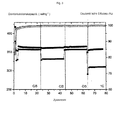
- the electrolyte solutions according to Examples 1 and 2 were measured in Swagelok TM T-piece cells. Timcal T44 graphite was used as working electrode and Li as counter electrode and reference electrode. The separator between the electrodes was Freudenberg fleece. The test schedule consisted of three cycles of C / 5 and then connecting 100 cycles of C / 5 combined with a constant voltage step after discharge, at 0.025 V vs. Li / Li + . The measurements were performed on a Maccor Series 4000.
- Fig. 2 shows the comparison of the capacities of T44 graphite electrodes in Swagelok half cells, cycled with an electrolyte according to Example 1 (squares).
- the round points correspond to the results with an electrolyte according to example 2. They achieve an even higher efficiency and a better capacity retention.
- C stands for the current or charge rate and reflects the power required to fully charge the battery within one hour. A rate of C / 5 would therefore correspond to a complete charging time of 12 min.
- Table 2 shows the Coulomb efficiencies (Eff) of the tested electrolytes of the 1st, 20th, 40th and 72nd cycles for the respective electrolytes.
- Table 2 Electrolyte from example ... Eff # 1 Eff # 20 Eff # 40 Eff # 72 3 83.3 99.7 99.9 99.9 4 82.0 99.5 99.8 99.9 5 71.1 98.9 99.3 99.2 6 96.9 99.5 97.7 98.1 7 76.5 98.9 99.6 99.8 8th 79.7 98.9 99.9 97.4
Landscapes
- Chemical & Material Sciences (AREA)
- Engineering & Computer Science (AREA)
- Manufacturing & Machinery (AREA)
- Chemical Kinetics & Catalysis (AREA)
- Electrochemistry (AREA)
- General Chemical & Material Sciences (AREA)
- Physics & Mathematics (AREA)
- Condensed Matter Physics & Semiconductors (AREA)
- General Physics & Mathematics (AREA)
- Inorganic Chemistry (AREA)
- Secondary Cells (AREA)
Abstract
Die Erfindung betrifft Batterieelektrolyte mit sehr geringer Entflammbarkeit, die insbesondere zum Einsatz in Lithium-Ionen-Batterien geeignet sind, Batterien enthaltend selbige Batterieelektrolyte, sowie die Verwendung bestimmter Phosphorsäureester in einer Menge von 30 bis 70 Gew.-% bezogen auf das Gesamtgewicht des flammwidrigen Elektrolten zur Herstellung der erfindungsgemäßen Batterieelektrolyte und Batterien.
Description
- Die Erfindung betrifft Batterieelektrolyte mit sehr geringer Entflammbarkeit, die insbesondere zum Einsatz in Lithium-Ionen-Batterien geeignet sind, Batterien enthaltend selbige Batterieelektrolyte, sowie die Verwendung bestimmter Phosphorsäureester zur Herstellung der erfindungsgemäßen Batterieelektrolyte und Batterien.
- Lithium-Ionen Batterien haben aufgrund ihrer hohen Energiedichte, geringen Selbstentladung und hoher Lebensdauer eine herausragende Bedeutung für die Speicherung von elektrischer Energie für verschiedene Anwendungen erlangt. Dazu gehören Batterien für Geräte der Unterhaltungselektronik, Telekommunikation, Fotografie, aber auch für die Elektromobilität.
- Der hohen Leistungsfähigkeit der Batterie stehen kritische Befunde hinsichtlich der Batteriesicherheit gegenüber, wie sie beispielsweise in den Übersichtsartikeln Dan Doughty, E. Peter Roth, "A General Discussion on Li-Ion Battery Safety", The Electrochemical Society Interface Summer, Vol 21, No.2 (2012), S. 37 - 44 und E. Peter Roth, Christopher J. Orendorff, "How Electrolytes Influence Battery Safety", The Electrochemical Society Interface Summer, Vol 21, No.2 (2012), S. 45- 49 beschrieben werden.
- Elektrolyte für Lithium-Ionenbatterien bestehen typischerweise aus Gemischen von brennbaren Lösungsmitteln wie Diethylencarbonat (DEC), Dimethylcarbonat (DMC) oder Ethylencarbonat, in denen Leitsalze wie zum Beispiel Lithium-hexafluorophosphat (LiPF6) nebst diversen Additiven gelöst sind.
- Nach heutigem Stand der Technik werden gegen die verschiedenen Einflüsse, die einen Brand von Lithium-Ionen-Batterien auslösen können, verschiedene Sicherheitsvorkehrungen getroffen. Dies sind im Einzelnen:
- Batteriemanagement-Systeme zum Verhindern des Überladens der Batterie beispielsweise durch Anlegen falscher Spannung, thermische Überlastung und Lithium-Dendritenbildung.
- Einsatz von sogenannten Redox-Shuttle Additiven gegen Überladung
- Wahl von geeigneten Kathodenmaterialien wie zum Beispiel Lithiumeisenphosphat statt Lithiumkobaltoxid, wodurch Sauerstoffabspaltung vermieden wird
- Einhausung der Batterie mit mechanisch stabilen Materialien
- Separatoren-Optimierung durch Einsatz dickerer und reißfesterer Materialien, die robuster sind und somit Kurzschlüsse unwahrscheinlicher machen
- Keine dieser Maßnahmen kann jedoch verhindern, dass es bei massiver mechanischer Beschädigung der Batterie unter dem Einfluß äußerer Zündquellen zu einer Entzündung kommt. Es ist daher vorteilhaft, schon auf Zellebene einen Brand zu verhindern, was z.B. durch den Einsatz eines nicht oder nur schwer entflammbaren Elektrolyten erreicht werden kann.
- Dabei ist es wichtig, dass die elektrochemischen Eigenschaften des Elektrolyten möglichst wenig beeinflusst werden, um die Leistungsfähigkeit der Batterie in Hinblick zum Beispiel auf die erreichbare Ladezyklenzahl dabei nicht zu verschlechtern.
- Um Elektrolyte flammwidrig auszurüsten, sind als Additive verschiedene Stoffe aus der Klasse der Phosphorverbindungen beschrieben worden. So wurden Phosphorsäureester wie Triphenylphosphat und Dikresylphenylphosphat bereits für diesen Zweck vorgeschlagen (siehe X. Xia, P. Ping, J. R. Dahn, Journal of the Electrochemical Society, 159 (9), A1460-A1466 (2012), E. Shim, T. Nam, J. Kim, H. Kim, S. Moon, Journal of Power Sources 172 (2007), 919 -924, R. Dunn, J. Kafle, F. Krause, C. Hwang, B. Ratnakumar, M. Smart, B. Lucht, Journal of the Electrochemical Society, 159 (12) A2100 - 2108 (2012) und D. Doughty, E. Roth, C. Crafts, G. Nagasubramanian, G. Henriksen, K. Amine, Journal of Power Sources, 146 (2005) 116 - 120).
- Allerdings weisen die aus dem Stand der Technik bekannten Phosphorsäureesterhaltigen Elektrolytlösungen erhebliche Nachteile auf, die einer kommerziellen Nutzung bislang im Wege stehen.
- So werden entweder nicht ausreichend flammwidrige Elektrolyte erhalten oder aber die Zyklisierungsfähigkeit der damit hergestellten elektrochemischen Zellen nimmt bereits nach wenigen Zyklen signifikant ab oder kann nur mit sehr hohen Konzentrationen an teuren sogenannten SEI-Schutzschichtbildnern kompensiert werden (SEI: solid electrolyte interphase).
- Die Aufgabe der vorliegenden Erfindung bestand folglich darin, flammwidrige Elektrolyte bereitzustellen, die eine gute Zyklisierungsfähigkeit aufweisen.
- Es wurden nun flammwidrige Elektrolyte gefunden, enthaltend
- I) 30 bis 70 Gew.-%, vorzugsweise 40 bis 60 Gew.-%, besonders bevorzugt 40 bis 55 Gew.-% zumindest eines Phosphorsäureesters
- II) 3 bis 18 Gew.-%, vorzugsweise 5 bis 15 Gew.-%, besonders bevorzugt 10 bis 13 Gew.-% zumindest eines Leitsalzes
- III) zumindest ein Lösungsmittel ausgewählt aus der Gruppe bestehend aus Acetonitril, γ-Butyrolacton, Valerolacton, 1,3-Dioxolan, 4-Methyl-1,3-dioxolan, 1,4-Dioxolan, Ethylencarbonat, Propylencarbonat, Dimethylcarbonat, Diethylcarbonat, Ethylmethylcarbonat, Tetrahydrofuran, 2-Methyl-tetrahydrofuran, 1,2-Dimethoxyethan, 1,2-Diethoxyethan, Sulfolan, Methylsulfolan, Methyl-tert.-butylether und Ethylacetat,
- Sofern nicht anders angegeben, beziehen sich Wassergehalte auf solche, die per Karl-Fischer-Titration bestimmt worden sind, die dem Fachmann bekannt ist und zum Beispiel in P. Bruttel, R. Schlink, "Wasserbestimmung durch Karl-Fischer-Titration", Metrohm Monographie 8.026.5001, 2003-06, oder G. Wieland, "Wasserbestimmung durch Karl Fischer-Titration", GIT Verlag Darmstadt, 1985, näher beschrieben wurde.
- Sofern nicht anders angegeben beziehen sich Chlorid-Gehalte auf solche, die durch Ionenchromatographie bestimmt worden sind, die dem Fachmann bekannt ist und zum Beispiel in TU Bergakademie Freiberg, Fakultät der Chemie und Physik, Institut für Analytische Chemie aus März 2002 sowie die darin zitierte Literatur sowie in Lydia Terborg, Sascha Nowak, Stefano Passerini, Martin Winter, Uwe Karst, Paul R. Hadad, Pavel N. Nesterenko, Analytica Chimica Acta 714 (2012) 121-126 näher beschrieben wurde.
- Sofern nicht anders angegeben, beziehen sich ppm-Gehalte auf Gewichts-ppm.
- Bevorzugte flammwidrige Elektrolyte sind solche, die
- I) 40 bis 60 Gew.-%, besonders bevorzugt 40 bis 55 Gew.-% zumindest eines Phosphorsäureesters
- II) 5 bis 15 Gew.-%, besonders bevorzugt 10 bis 13 Gew.-% zumindest eines Leitsalzes
- III) zumindest ein Lösungsmittel ausgewählt aus der Gruppe bestehend aus Acetonitril, γ-Butyrolacton Valerolacton, 1,3-Dioxolan, 4-Methyl-1,3-dioxolan, 1,4-Dioxolan, Ethylencarbonat, Propylencarbonat, Dimethylcarbonat, Diethylcarbonat, Ethylmethylcarbonat, Tetrahydrofuran, 2-Methyl-tetrahydrofuran, 1,2-Dimethoxyethan, 1,2-Diethoxyethan, Sulfolan, Methylsulfolan, Methyl-tert.-butylether und Ethylacetat enthalten, wobei der Gehalt an Lösungsmittels ausgewählt aus der Gruppe bestehend aus 1,3-Dioxolan, 4-Methyl-1,3-dioxolan 1,4-Dioxolan, Ethylencarbonat, Propylencarbonat mindestens 12 Gew.-%, vorzugsweise mindestens 15 Gew.-%, besonders bevorzugt 20 bis 50 Gew.-% und ganz besonders bevorzugt 30 bis 50 Gew.-% beträgt,
wobei die Summe der Komponenten I) bis III) so gewählt ist, dass sie 90 bis 100 Gew.-%, vorzugsweise 93 bis 100 Gew.-% und besonders bevorzugt 95 bis 100 Gew.-% bezogen auf das Gesamtgewicht des flammwidrigen Elektrolytes beträgt und
wobei der flammwidrige Elektrolyt bevorzugt 50 ppm oder weniger, vorzugsweise 20 ppm oder weniger AN Wasser und vorzugsweise weiterhin 20 ppm Chlorid oder weniger, vorzugsweise 15 ppm Chlorid oder weniger enthält. - Die erforderlichen Wasser- und gegebenenfalls Chlorid-Gehalte können insbesondere durch Einsatz von Phosphorsäureestern mit entsprechend niedrigen Wasser- und gegebenenfalls Chlorid-Gehalten erhalten werden, weshalb von der Erfindung weiterhin sowohl die Verwendung von Phosphorsäureestern mit einem Gehalt von 50 ppm oder weniger, vorzugsweise 20 ppm oder weniger an Wasser und vorzugsweise zusätzlich 20 ppm oder weniger, vorzugsweise 15 ppm oder weniger an Chlorid als Bestandteil von oder zur Herstellung von flammwidrigen Elektrolyten umfasst ist, als auch ein Verfahren zur Erhöhung der Flammwidrigkeit von Elektrolyten, dadurch gekennzeichnet, dass bei der Zubereitung der Elektolyte 30 bis 70 Gew.-%, vorzugsweise 40 bis 60 Gew.-%, besonders bevorzugt 40 bis 55 Gew.-% zumindest eines Phosphorsäureesters eingesetzt werden, wobei der oder die Phosphorsäureester in Summe 50 ppm oder weniger, vorzugsweise 20 ppm oder weniger an Wasser und vorzugsweise zusätzlich 20 ppm oder weniger, vorzugsweise 15 ppm oder weniger an Chlorid, jeweils bezogen auf die Summe des oder der Phosphorsäureester enthalten.
- Überraschend hierbei ist, dass chlorid- und wasserarme Phosphorsäureester in den erfindungsgemäßen Mengen dem Elektrolyten zugesetzt werden können, so dass diese im Kleinbrennertest selbstverlöschend sind und trotzdem keinen oder keinen nennenswerten Verlust an Zyklisierungsfähigkeit aufweisen.
- Bevorzugte Phosphorsäureester sind solche der Formel (I)
O=P(OR1)(OR2)(OR3) (I)
worin die Reste R1, R2 und R3 jeweils unabhängig voneinander für einen linearen oder verzweigten C1-C8-Alkylrest, Phenyl oder ein, zwei oder dreifach mit linearen oder verzweigten C1-C4-Alkylresten substituiertes Phenyl bedeuten. - Besonders bevorzugte Phosphorsäureester sind ausgewählt aus der Gruppe bestehend aus Triphenylphosphat, Diphenylkresylphosphat, Diphenyl-(isopropylphenyl)phosphat, Diphenyl-(tert.-butylphenyl)phosphat, Dikresylphenylphosphat, Di-(isopropylphenyl)-phenylphosphat, Di-(tert.-butylphenyl)-phenylphosphat, Trikresylphosphat, Tri-(isopropylphenyl)-phosphat, Tri-(tert.-butylphenyl)-phosphat oder einer beliebigen Mischung der vorgenannten Phosphorsäureester.
- Ganz besonders bevorzugte Phosphorsäureester sind ausgewählt aus der Gruppe bestehend aus Triphenylphosphat, Diphenylkresylphosphat, Dikresylphenylphosphat, Trikresylphosphat oder einer beliebigen Mischung der vorgenannten Phosphorsäureester.
- Leitsalze umfassen alle dem Fachmann für den Einsatz in Batterien bekannte Leitsalze. Beispielsweise sind dies Lithium-hexafluorophosphat (LiPF6), Lithium-tetrafluoroborat (LiBF4), Lithium-hexafluoroarsenat (LiAsF6), Lithium-hexafluoroantimonat (LiSbF6), Lithium-bis-(trifluoromethansulfonyl)imid ( LiN(CF3CF2SO2)2), Lithium-perchlorat (LiClO4), Liithium-bis(oxalato)borat (LiB(C2O4)2), Lithium-fluorooxalatoborat (LiF2(C2O4)), Lithium trifluoromethan-sulfonat (LiCF3SO3), Triethyl-methyl-ammonium-tetrafluoroborat , Tetraethyl-ammonium-tetrafluoroborat, Lithium-bis-(perfluorethylsulfonyl)imid (LiN(CF3CF2SO2)2), Lithium-tris(trifluoromethansulfonyl)methid (Li[C(CF3SO2)3]), Lithium trifluorchlorborat (Li[BF3Cl]), LiFNSFI (Li(N(SO2F)(SO2-n-C4F9)), Lithium-bisfluorsulfonylimid (LiN(SO2F)2), Lithium-pentafluorethantrifluoroborat (Li(F5C2BF3)) und Lithium-difluorphosphat (LiPO2F2), einzeln oder in beliebiger Mischung, wobei Lithium-hexafluorophosphat (LiPF6) bevorzugt ist.
- Dem Fachmann ist klar, dass die erfindungsgemäßen Mengen von 3 bis 18 Gew.-%, vorzugsweise 5 bis 15 Gew.-%, besonders bevorzugt 10 bis 13 Gew.-% zumindest eines Leitsalzes je nach Typ des Leitsalzes und gewünschter Einsatztemperatur, dem eingesetzten Lösungsmittel und des Phosphorsäureesters nach oben begrenzt sein kann.
- Zum Erreichen einer möglichst hohen Leitfähigkeit ist es in einer Ausführungsform bevorzugt, den Gehalt an Leitsalz so zu wählen, dass er zwischen 0,1 und 3 Gew.-%, vorzugsweise zwischen 0,2 und 1,5 Gew.-% unterhalb der Löslichkeit des Leitsalzes im flammwidrigen Elektrolyten bei 20°C liegt.
- In einer bevorzugten Ausführungsform der Erfindung enthalten die erfindungsgemäßen Elektrolyte weiterhin von 0,001 bis 5 Gew.-%, besonders bevorzugt 0,1 bis 3 und ganz besonders bevorzugt 1 bis 2,5 Gew.-% bezogen auf das Gesamtgewicht des flammwidrigen Elektrolyten an Additiven zur Verringerung des schleichenden Kapazitätsverlusts.
- Solche Additive sind beispielsweise ausgewählt aus der Gruppe bestehend aus Fluorethylencarbonat (FEC, (4-Fluor-1,3-dioxolan-2-one), Vinylencarbonat (VC), Ethylensulfit, Styrol, Vinylpyridin, Trifluorpropylencarbonat, Fluor-gamma-butyrolacton und Phenlyvinylencarbonat, jeweils einzeln oder in beliebiger Mischung, wobei Fluorethylencarbonat und Vinylencarbonat jeweils einzeln oder in Mischung bevorzugt und Fluorethylencarbonat besonders bevorzugt ist.
- Die erfindungsgemäßen Elektrolyte eignen sich insbesondere zum Einsatz in Akkumulatoren, weshalb von der Erfindung auch Akkumulatoren enthaltend die erfindungsgemäßen Elektrolyte umfasst sind.
- Die erfindungsgemäßen Akkumulatoren eignen sich insbesondere zum Einsatz in elektrisch betriebene Geräte und Fahrzeuge, weshalb von der Erfindung auch elektrisch betriebene Geräte und Fahrzeuge enthaltend die erfindungsgemäßen Elektrolyte bzw. erfindungsgemäßen Akkumulatoren umfasst sind.
- Elektrisch betriebene Geräte umfassen beispielsweise elektronische Geräte wie Computer, Notebooks, Laptops, Telekommunikationsgeräte wie Mobiltelefone, und Funkgeräte, Haushaltsgeräte wie Rührer, Waagen, Staubsauger, elektrische Zahnbürsten und Aufschäumer, optische Geräte wie Kameras, Belichtungsmesser, Laserentfernungsmesser, Werkzeuge wie Bohrmaschinen, Schrauber, Schleifer und Sägen. Weiterhin Gartengeräte (Rasenmäher, Gartenscheren) sowie Energiespeicher für alle Arten der Notstromversorgung und zur Speicherung von aus Solar- und, wasser- und Windkraft.
- Elektrisch betriebene Fahrzeuge umfassen beispielsweise schienengebundene Fahrzeuge wie Lokomotiven, Triebwagen und Rangierroboter, Luftfahrzeuge wie Flugzeuge, Drohnen und Helikopter, Personen- und Lastwagen, Zwei- und -Dreiräder, Kettenfahrzeuge sowie Wasserfahrzeuge. Dazu gehören auch deren jeweilige Hybridvarianten.
- Die nachstehenden Beispiele erläutern die Erfindung, ohne sie jedoch darauf zu beschränken.
- Beispiel 1: Es wurde ein flammwidriger Elektrolyt folgender Zusammensetzung hergestellt : Eine 1 molare LiPF6 -Lösung in einer 1:1 Mischung nach Gewicht aus Ethylencarbonat und "Disflamoll® DPK" der Firma Lanxess Deutschland GmbH, welches im Wesentlichen eine Mischung aus Triphenylphosphat, Diphenylkresylphosphaten, Dikresylphenylphosphaten und Trikresylphosphaten ist.
- Der Elektrolyt enthielt folglich:
- I) 44,63 Gew.-% an den vorgenannten Phosphorsäureestern
- II) 10,74 Gew.-% Lithiumhexafluorophosphat als Leitsalz
- III) 44,63 Gew.-% Ethylencarbonat als Lösungsmittel
- Es wurde ein flammwidriger Elektrolyt folgender Zusammensetzung hergestellt :
(alle Mengenangaben in Gewichts-% bezogen auf den gesamten Elektrolyten)
95 g einer Mischung aus 50 Gew.-% Ethylencarbonat und 50 Gew.% einer kommerziellen Arylphosphatmischung wurden mit 5 g Fluorethylencarbonat gemischt. Anschließend wurde mit dieser Lösung eine 1 molare LiPF6 -Lösung hergestellt." - Als Arylphosphatmischung wurde das Produkt "Disflamoll® DPK" der Firma Lanxess Deutschland GmbH eingesetzt.
- Der Elektrolyt enthielt folglich:
- I) 42,43 Gew.-% an den vorgenannten Phosphorsäureestern
- II) 10,67 Gew.-% Lithiumhexafluorophosphat als Leitsalz
- III) 42,43 Gew.-% Ethylencarbonat als Lösungsmittel und
- IV) 4,47 Gew.-% an Fluorethylencarbonat als Additiv zur Verringerung des schleichenden Kapazitätsverlusts
- Der Wassergehalt des Elektrolyten wurde durch Karl-Fischer-Titration ermittelt und betrug 9,0 ppm, der Chlorid-Gehalt wurde durch Ionenchromatographie bestimmt und betrug 3,0 ppm. Die Leitfähigkeit des Elektrolyten betrug bei 20 °C 2,05 mS cm-1.
- Analog zu Beispiel 2 wurden weitere flammwidrige Elektrolyten hergestellt, deren Zusammensetzungen aus Tabelle 1 hervorgehen:
Beispiel Phosphorester [Gew.-%] Leitsalz (LiPF6) [Gew.-%] Lösungsmittel (EC, EC/DMC) [Gew.-%] Additiv (FEC) [Gew.-%] 3 (1M LiPF6 EC:DPK*:DMC:FEC [42.5:42.5:10:5]) 38 11 47 4 4 (1M LiPF6 EC:DPK*:DMC:FEC [40:40:15:5]) 36 11 49 4 5 (1M LiPF6 EC:51092**:FEC [47.5:47.5:5]) 42 11 43 4 6 (1M LiPF6 EC:51070***:FEC [47.5:47.5:5]) 42 11 42 4 7 (1M LiPF6 EC:TP****:FEC [47.5:47.5:5]) 42 11 42 4 8 (1M LiPF6 EC:TKP-P*****:FEC [47.5:47.5:5]) 42 11 42 4 *: Disflamoll® DPK: Mischung aus Triphenylphosphat, Diphenylkresylphosphat, Dikresylphenylphosphat und Trikresylphosphat
**: Disflamoll ® TP LXS 51092: (tert.-Butylphenyldiphenylphosphat
***: Disflamoll ® TP LXS 51070: (Isopropylphenyldiphenylphosphat)
****: Disflamoll ® TP (Triphenylphosphat)
*****: Disflamoll® TKP-P: Mischung aus Triphenylphosphat, Diphenylkresylphosphat, Dikresylphenylphosphat und Trikresylphosphat - Der Selbstlöschtest (self extinguishing test, SET) wurde in einer Apparatur durchgeführt, bei der ein Zellseparator (Glasfaserfilter Whatman® Glassfiber Filter GF/D, vorab getrocknet bei 300°C) mit einem Durchmesser von 25mm mit 500 µL des flammwidrigen Elektrolyten gemäß den Beispielen 1 bis 8 getränkt wurde. Der Zellseparator wurde dann in einer geschlossenen Box von einem Greifarm für zwei Sekunden in eine Gasflamme mit einer Länge von ca 5 cm und anschließend zu Sensoren geführt, die die Brenndauer ermitteln. Das Experiment wurde für jeden flammwidrigen Elektrolyten insgesamt 8 mal durchgeführt.
- Der gleiche Test wurde mit einem kommerziellen Standardelektrolyt (1M LiPF6 in Ethylencarbonat / Diethylcarbonat 1:1, gewichtsanteilig, Firma UBE) durchgeführt: Beispiel 9
- Die Ergebnisse der Kleinbrennerteste sind in Tabelle 2 dargestellt:
Elektrolyt aus Beispiel Leitfähigkeit bei 25 °C [mS cm-1] Wassergehalt/ Chloridgehalt [ppm] Flammpunkt [°C] Entzündbarkeit 1 2,00 9,0 /3,0 >150 keine 2 2,05 9,0 / 3,0 >150 keine 3 2.80 42.6 / 5,0 60 keine 4 2.91 22.1/ 6,0 52 keine 5 1.54 16.8/ 3,0 >150 keine 6 1.66 19.4/ 4,0 >150 keine 7 1.96 16.8/ 9,0 >150 keine 8 1.59 24.2/ 5,0 >150 keine 9 (zum Vergleich) 7,0 11 / 1 30°C 35 bis 40 s - Bei Elektrolyten mit einer Brenndauer von unter 1 Sekunde wurde in der Spalte "Entzündbarkeit" der Wert "keine" eingetragen.
- Für die Elektrolyten wurden Leitfähigkeitsmessungen sowie galvanostatische /potentiostatische Zyklisierungen durchgeführt. Dabei wurden die Elektrolyte gemäß den Beispielen 1 und 2 verwendet.
- Für die Impedanzmessungen zur Bestimmung der Leitfähigkeit wurde ein 1287 A Potentiostat der Firma Solatron Analytical Solartron 1260A Impedance/Gain-Phase Analyzer (FRA) verwendet. Die verwendeten Elektroden für die Messungen waren platinierte Platinelektroden der Firma Amel srl. Zur temperaturabhänigen Messung wurde eine Binder MK53 Klimakammer verwendet. Das Impedanzspektrum war zwischen 2 kHz und 200 kHz angesiedelt.
- Die Elektrolytlösungen gemäß der Beispiele 1 und 2 wurden in Swagelok™ T-Stück-Zellen vermessen. Dabei wurde Timcal T44 Graphit als Arbeitselektrode und Li als Gegenelektrode und Referenzelektrode verwendet. Als Separator zwischen den Elektroden diente Freudenberg Vlies. Der Testplan bestand aus drei Zyklen mit C/5 und anschließen 100 Zyklen mit C/5 kombiniert mit einem Konstantspannungsschritt nach dem Entladen, bei 0,025 V vs. Li/Li+. Die Messungen wurden an einem Maccor Series 4000 durchgeführt.
- Die Vergleiche der Potentialverläufe der Elektrolyte gemäß der Beispiele 1 und 2 sind in
Fig. 1 wiedergegeben. - Dabei zeigen:

2. Zyklus Elektrolyt gemäß Beispiel 1 
10. Zyklus Elektrolyt gemäß Beispiel 1 
2. Zyklus Elektrolyt gemäß Beispiel 2 -------- 10. Zyklus Elektrolyt gemäß Beispiel 2 - Aus
Fig. 1 wird deutlich, dass eine konstante und effiziente Zyklisierung insbesondere in Kombination mit dem Additiv (FEC) und Raten von < 1C erzielt wird. -
Fig. 2 zeigt den Vergleich der Kapazitäten von T44 Graphit Elektroden in Swagelok-Halbzellen, zyklisiert mit einem Elektrolyten gemäß Beispiel 1 (Quadrate). Die runden Punkte entsprechen den Ergebnissen mit einem Elektrolyten gemäß Beispiel 2. Sie erreichen eine noch höhere Effizienz und eine bessere Kapazitätsretention. - Im Detail zeigen:
■ Deinterkalationskapazität Elektrolyt gemäß Beispiel 1 
Effizienz Elektrolyt gemäß Beispiel 1 ● Deinterkalationskapazität Elektrolyt gemäß Beispiel 2 ⊕ Effizienz Elektrolyt gemäß Beispiel 2 - Für diese Zyklisierungsuntersuchungen wurden 3-Elektroden Swagelok Zellen unter Argonatmosphäre angefertigt. Die Graphit-Anodentest wurden mit dem Graphit T44 in einer Schichtdicke von 130 µm als Anode gegen überdimensionierte LFP Kathoden (Li-Quelle) durchgeführt (WE: Graphit, CE:LFP, RE:Li) im Potentialbereich: zwischen 1.5 - 0.025 V durchgeführt.
- Der Testplan für diese Zyklisierung lautete:
- 3 Formierungszyklen C/5
- 20 Zyklen C/5 mit 1h Constant Voltage Step
- 20 Zyklen C/2 mit 1 h Constant Voltage Step
- 20 Zyklen C/5 mit 1 h Constant Voltage Step
- 20 Zyklen 1 C mit 1 h Constant Voltage Step
- Dabei steht C für die current bzw. charge rate und spiegelt den Strombedarf wider, der nötig ist, um den Akkumulator innerhalb von einer Stunde komplett zu laden. Ein Rate von C/5 entspräche demnach einer vollständigen Ladedauer von 12 min.
- Tabelle 2 zeigt die Coulomb'schen Effizienzwerte (Eff) der untersuchten Elektrolyte des 1., 20., 40. und 72. Zyklus für die jeweiligen Elektrolyte auf.
Tabelle 2: Elektrolyt aus Beispiel... Eff #1 Eff #20 Eff #40 Eff #72 3 83,3 99,7 99,9 99,9 4 82,0 99,5 99,8 99,9 5 71,1 98,9 99,3 99,2 6 96,9 99,5 97,7 98,1 7 76,5 98,9 99,6 99,8 8 79,7 98,9 99,9 97,4 - Es zeigen sich sehr gute Effizienzwerte, insbesondere bei Verwendung von Disflamoll ® DPK.
- Das Zyklisierverhalten der Elektrolyte gemäß den Beispielen 3 (Quadrate) und 4 (Kreise) mit DPK in einer Zelle bestehend aus Graphit und LFP sind im
Fig. 3 abgebildet. - Im Detail zeigen
■ Deinterkalationskapazität Elektrolyt gemäß Beispiel 3 □ Effizienz Elektrolyt gemäß Beispiel 3 ● Deinterkalationskapazität Elektrolyt gemäß Beispiel 4 ○ Effizienz Elektrolyt gemäß Beispiel 4 - Es ist erkennbar, dass sowohl die Anfangskapazität als auch die Zyklenstabilität mit höherem Anteil DMC im Elektrolyten besser ist als mit weniger DMC im Elektrolyten.
wobei der flammwidrige Elektrolyt weiterhin 50 ppm oder weniger, vorzugsweise 20 ppm oder weniger an Wasser enthält und vorzugsweise zusätzlich 20 ppm Chlorid oder weniger, vorzugsweise 15 ppm Chlorid oder weniger.
Claims (15)
- Flammwidriger Elektrolyt, enthaltendI) 30 bis 70 Gew.-%, vorzugsweise 40 bis 60 Gew.-%, besonders bevorzugt 40 bis 55 Gew.-% zumindest eines Phosphorsäureesters undII) 3 bis 18 Gew.-%, vorzugsweise 5 bis 15 Gew.-%, besonders bevorzugt 10 bis 13 Gew.-% zumindest eines Leitsalzes undIII) zumindest ein Lösungsmittel ausgewählt aus der Gruppe bestehend aus Acetonitril, γ-Butyrolacton, Valerolacton, 1,3-Dioxolan, 4-Methyl-1,3-dioxolan, 1,4-Dioxolan, Ethylencarbonat, Propylencarbonat, Dimethylcarbonat, Diethylcarbonat, Ethylmethylcarbonat, Tetrahydrofuran, 2-Methyl-tetrahydrofuran, 1,2-Dimethoxyethan, 1,2-Diethoxyethan, Sulfolan, Methylsulfolan, Methyl-tert.-butyl-ether und Ethylacetat enthält,
wobei die Summe der Komponenten I) bis III) so gewählt ist, dass sie 90 bis 100 Gew.-%, vorzugsweise 93 bis 100 Gew.-% und besonders bevorzugt 95 bis 100 Gew.-% bezogen auf das Gesamtgewicht des flammwidrigen Elektrolytes beträgt und
wobei der flammwidrige Elektrolyt weiterhin 50 ppm oder weniger, vorzugsweise 20 ppm oder weniger an Wasser enthält. - Flammwidriger Elektrolyt nach Anspruch 1, dadurch gekennzeichnet, dass er 20 ppm Chlorid oder weniger, vorzugsweise 15 ppm Chlorid oder weniger enthält.
- Flammwidriger Elektrolyt nach Anspruch 1 oder 2, dadurch gekennzeichnet, dass erI) 40 bis 60 Gew.-%, besonders bevorzugt 40 bis 55 Gew.-% zumindest eines PhosphorsäureestersII) 5 bis 15 Gew.-%, besonders bevorzugt 10 bis 13 Gew.-% zumindest eines LeitsalzesIII) zumindest ein Lösungsmittel ausgewählt aus der Gruppe bestehend aus Acetonitril, γ-Butyrolacton, Valerolacton, 1,3-Dioxolan, 4-Methyl-1,3-dioxolan, 1,4-Dioxolan, Ethylencarbonat, Propylencarbonat, Dimethylcarbonat, Diethylcarbonat, Ethylmethylcarbonat, Tetrahydrofuran, 2-Methyl-tetrahydrofuran, 1,2-Dimethoxyethan, 1,2-Diethoxyethan, Sulfolan, Methylsulfolan, Methyl-tert.-butyl-ether und Ethylacetat enthält wobei der Gehalt an Lösungsmittels ausgewählt aus der Gruppe bestehend aus 1,3- Dioxolan, 4-Methyl-1,3-dioxolan 1,4-Dioxolan, Ethylencarbonat, Propylencarbonat mindestens 12 Gew.-%, vorzugsweise mindestens 15 Gew.-%, besonders bevorzugt 15 bis 50 Gew.-% und ganz besonders bevorzugt 20 bis 50 Gew.-% beträgt,
wobei die Summe der Komponenten I) bis III) so gewählt ist, dass sie 90 bis 100 Gew.-%, vorzugsweise 93 bis 100 Gew.-% und besonders bevorzugt 95 bis 100 Gew.-% bezogen auf das Gesamtgewicht des flammwidrigen Elektrolytes beträgt und
50 ppm oder weniger, vorzugsweise 20 ppm oder weniger an Wasser enthält: - Flammwidriger Elektrolyt nach Anspruch 3, dadurch gekennzeichnet, dass er 20 ppm Chlorid oder weniger, vorzugsweise 15 ppm Chlorid oder weniger enthält.
- Flammwidriger Elektrolyt nach einem der Ansprüche 1 bis 4, dadurch gekennzeichnet, dass Phosphorsäureester solche der Formel (I) sind:
O=P(OR1)(OR2)(OR3) (I)
worin die Reste R1, R2 und R3 jeweils unabhängig voneinander für einen linearen oder verzweigten C1-C8-Alkylrest, Phenyl oder ein, zwei oder dreifach mit linearen oder verzweigten C1-C4-Alkylresten substituiertes Phenyl bedeuten. - Flammwidriger Elektrolyt nach einem der Ansprüche 1 bis 5, dadurch gekennzeichnet, dass Phosphorsäureester ausgewählt sind aus der Gruppe bestehend aus Triphenylphosphat, Diphenylkresylphosphat, Diphenyl-(isopropylphenyl)phosphat, Diphenyl-(tert.-butylphenyl)phosphat, Dikresylphenylphosphat, Di-(isopropylphenyl)-phenylphosphat, Di-(tert.-butylphenyl)-phenylphosphat, Trikresylphosphat, Tri-(isopropylphenyl)-phosphat, Tri-(tert.-butylphenyl)-phosphat oder einer beliebigen Mischung der vorgenannten Phosphorsäureester.
- Flammwidriger Elektrolyt nach einem der Ansprüche 1 bis 6, dadurch gekennzeichnet, dass die Leitsalze ausgewählt sind aus der Gruppe bestehend aus Lithium-hexafluorophosphat (LiPF6), Lithium-tetrafluoroborat (LiBF4), Lithium-hexafluoroarsenat (LiAsF6), Lithium-hexafluoroantimonat (LiSbF6), Lithium-bis-(trifluoromethansulfonyl)imid ( LiN(CF3CF2SO2)2), Lithium-perchlorat (LiClO4), Liithium-bis(oxalato)borat (LiB(C2O4)2), Lithium-fluorooxalatoborat (LiF2(C2O4)), Lithium trifluoromethan-sulfonat (LiCF3SO3), Triethyl-methyl-ammonium-tetrafluoroborat , Tetraethyl-ammonium-tetrafluoroborat, Lithium-bis-(perfluorethylsulfonyl)imid (LiN(CF3CF2SO2)2), Lithium-tris(trifluoromethansulfonyl)methid (Li[C(CF3SO2)3]), Lithium trifluorchlorborat (Li[BF3Cl]), LiFNSFI (Li(N(SO2F)(SO2-n-C4F9)), Lithium-bisfluorsulfonylimid (LiN(SO2F)2), Lithium-pentafluorethantrifluoroborat (Li(F5C2BF3)) und Lithium-difluorphosphat (LiPO2F2), einzeln oder in beliebiger Mischung, wobei Lithium-hexafluorophosphat (LiPF6) bevorzugt ist.
- Flammwidriger Elektrolyt nach einem der Ansprüche 1 bis 7, dadurch gekennzeichnet, dass er weiterhin von 0,001 bis 5 Gew.-%, besonders bevorzugt 0,1 bis 3 Gew.-% und ganz besonders bevorzugt 1 bis 2,5 Gew.-% bezogen auf das Gesamtgewicht des flammwidrigen Elektrolyten an Additiven zur Verringerung des schleichenden Kapazitätsverlusts enthält.
- Flammwidriger Elektrolyt nach Anspruch 8, dadurch gekennzeichnet, dass die Additive ausgewählt sind aus der Gruppe bestehend aus Fluorethylencarbonat (FEC, (4-Fluor-1,3-dioxolan-2-on), Vinylencarbonat (VC), Ethylensulfit, Styrol, Vinylpyridin, Trifluorpropylencarbonat, Fluor-gamma-butyrolacton und Phenlyvinylencarbonat, jeweils einzeln oder in beliebiger Mischung, wobei Fluorethylencarbonat und Vinylencarbonat jeweils einzeln oder in Mischung bevorzugt und Fluorethylencarbonat besonders bevorzugt ist.
- Verwendung von Phosphorsäureestern mit einem Gehalt von 50 ppm oder weniger, vorzugsweise 20 ppm oder weniger an Wasser und vorzugsweise zusätzlich 20 ppm oder weniger, vorzugsweise 15 ppm oder weniger an Chlorid als Bestandteil von oder zur Herstellung von flammwidrigen Elektrolyten.
- Verfahren zur Erhöhung der Flammwidrigkeit von Elektrolyten, dadurch gekennzeichnet, dass bei der Zubereitung der Elektolyte 30 bis 70 Gew.-%, vorzugsweise 40 bis 60 Gew.-%, besonders bevorzugt 40 bis 55 Gew.-% zumindest eines Phosphorsäureesters eingesetzt werden, wobei der oder die Phosphorsäureester in Summe 50 ppm oder weniger, vorzugsweise 20 ppm oder weniger an Wasser und vorzugsweise zusätzlich 20 ppm oder weniger, vorzugsweise 15 ppm oder weniger an Chlorid, jeweils bezogen auf die Summe des oder der Phosphorsäureester enthalten.
- Verwendung von flammwidrigen Elektrolyten nach einem der Ansprüche 1 bis 9 in Akkumulatoren.
- Akkumulator, insbesondere Li-Ionen-Akkumulator enthaltend einen flammwidrigen Elektrolyten nach einem der Ansprüche 1 bis 9.
- Elektrisch betriebene Geräte und Fahrzeuge enthaltend einen flammwidrigen Elektrolyten nach einem der Ansprüche 1 bis 9 oder einen Akkumulator nach Anspruch 13.
- Elektrisch betriebene Geräte und Fahrzeuge nach Anspruch 14, dadurch gekennzeichnet dass es sich um Computer, Notebooks, Laptops, Telekommunikationsgeräte wie Mobiltelefone, und Funkgeräte, Haushaltsgeräte wie Rührer, Waagen, Staubsauger, elektrische Zahnbürsten und Aufschäumer, optische Geräte wie Kameras, Belichtungsmesser, Laserentfernungsmesser, Werkzeuge wie Bohrmaschinen, Schrauber, Schleifer und Sägen. Weiterhin Gartengeräte (Rasenmäher, Gartenscheren) sowie Energiespeicher für alle Arten der Notstromversorgung und zur Speicherung von aus Solar- und, wasser- und Windkraft einerseits bzw. schienengebundene Fahrzeuge wie Lokomotiven, Triebwagen und Rangierroboter, Luftfahrzeuge wie Flugzeuge, Drohnen und Helikopter, Personen- und Lastwagen, Zwei- und -Dreiräder, Kettenfahrzeuge sowie Wasserfahrzeuge einschließlich ihrer jeweiligen Hybridvarianten andererseits handelt.
Priority Applications (1)
| Application Number | Priority Date | Filing Date | Title |
|---|---|---|---|
| EP15180355.8A EP3131152A1 (de) | 2015-08-10 | 2015-08-10 | Flammwidrige, phosphorsäureester enthaltende batterieelektrolyte |
Applications Claiming Priority (1)
| Application Number | Priority Date | Filing Date | Title |
|---|---|---|---|
| EP15180355.8A EP3131152A1 (de) | 2015-08-10 | 2015-08-10 | Flammwidrige, phosphorsäureester enthaltende batterieelektrolyte |
Publications (1)
| Publication Number | Publication Date |
|---|---|
| EP3131152A1 true EP3131152A1 (de) | 2017-02-15 |
Family
ID=53794107
Family Applications (1)
| Application Number | Title | Priority Date | Filing Date |
|---|---|---|---|
| EP15180355.8A Withdrawn EP3131152A1 (de) | 2015-08-10 | 2015-08-10 | Flammwidrige, phosphorsäureester enthaltende batterieelektrolyte |
Country Status (1)
| Country | Link |
|---|---|
| EP (1) | EP3131152A1 (de) |
Cited By (4)
| Publication number | Priority date | Publication date | Assignee | Title |
|---|---|---|---|---|
| WO2019018432A1 (en) | 2017-07-17 | 2019-01-24 | NOHMs Technologies, Inc. | ELECTROLYTES CONTAINING PHOSPHORUS |
| CN112366361A (zh) * | 2020-09-25 | 2021-02-12 | 河南新太行电源股份有限公司 | 一种准固态锂离子电池的制备方法及电池 |
| CN115692833A (zh) * | 2022-10-20 | 2023-02-03 | 天津大学 | 一种聚醚类准固态电解质及其制备方法和应用 |
| EP4199169A4 (de) * | 2021-06-03 | 2024-04-17 | LG Energy Solution, Ltd. | Elektrolyt für lithium-schwefel-batterie und lithium-schwefel-batterie damit |
Citations (5)
| Publication number | Priority date | Publication date | Assignee | Title |
|---|---|---|---|---|
| US5691084A (en) * | 1994-03-19 | 1997-11-25 | Hitachi Maxell, Ltd | Organic electrolytic solution secondary cell |
| JPH10255839A (ja) * | 1997-03-12 | 1998-09-25 | Matsushita Electric Ind Co Ltd | 非水電解質二次電池 |
| JPH1140193A (ja) * | 1997-07-16 | 1999-02-12 | Sony Corp | 非水電解液電池 |
| JP2001307768A (ja) * | 2000-04-19 | 2001-11-02 | Toyota Central Res & Dev Lab Inc | 非水電解液二次電池 |
| US20120301795A1 (en) * | 2010-02-10 | 2012-11-29 | Nec Energy Devices, Ltd. | Nonaqueous electrolyte solution, and lithium ion secondary battery having the same |
-
2015
- 2015-08-10 EP EP15180355.8A patent/EP3131152A1/de not_active Withdrawn
Patent Citations (5)
| Publication number | Priority date | Publication date | Assignee | Title |
|---|---|---|---|---|
| US5691084A (en) * | 1994-03-19 | 1997-11-25 | Hitachi Maxell, Ltd | Organic electrolytic solution secondary cell |
| JPH10255839A (ja) * | 1997-03-12 | 1998-09-25 | Matsushita Electric Ind Co Ltd | 非水電解質二次電池 |
| JPH1140193A (ja) * | 1997-07-16 | 1999-02-12 | Sony Corp | 非水電解液電池 |
| JP2001307768A (ja) * | 2000-04-19 | 2001-11-02 | Toyota Central Res & Dev Lab Inc | 非水電解液二次電池 |
| US20120301795A1 (en) * | 2010-02-10 | 2012-11-29 | Nec Energy Devices, Ltd. | Nonaqueous electrolyte solution, and lithium ion secondary battery having the same |
Non-Patent Citations (10)
| Title |
|---|
| D. DOUGHTY; E. ROTH; C. CRAFTS; G. NAGASUBRAMANIAN; G. HENRIKSEN; K. AMINE, JOURNAL OF POWER SOURCES, vol. 146, 2005, pages 116 - 120 |
| DAN DOUGHTY; E. PETER ROTH: "A General Discussion on Li-lon Battery Safety", vol. 21, 2012, THE ELECTROCHEMICAL SOCIETY INTERFACE SUMMER, pages: 37 - 44 |
| E. PETER ROTH; CHRISTOPHER J. ORENDORFF: "How Electrolytes Influence Battery Safety", vol. 21, 2012, THE ELECTROCHEMICAL SOCIETY INTERFACE SUMMER, pages: 45 - 49 |
| E. SHIM; T. NAM; J. KIM; H. KIM; S. MOON, JOURNAL OF POWER SOURCES, vol. 172, 2007, pages 919 - 924 |
| G. WIELAND: "Wasserbestimmung durch Karl Fischer-Titration", 1985, GIT VERLAG DARMSTADT |
| LYDIA TERBORG; SASCHA NOWAK; STEFANO PASSERINI; MARTIN WINTER; UWE KARST; PAUL R. HADAD; PAVEL N. NESTERENKO, ANALYTICA CHIMICA ACTA, vol. 714, 2012, pages 121 - 126 |
| P. BRUTTEL; R. SCHLINK: "Wasserbestimmung durch Karl-Fischer-Titration", METROHM MONOGRAPHIE 8.026.5001, June 2003 (2003-06-01) |
| R. DUNN; J. KAFLE; F. KRAUSE; C. HWANG; B. RATNAKUMAR; M. SMART; B. LUCHT, JOURNAL OF THE ELECTROCHEMICAL SOCIETY, vol. 159, no. 12, 2012 |
| TU BERGAKADEMIE FREIBERG, FAKULTÄT DER CHEMIE UND PHYSIK, INSTITUT FÜR ANALYTISCHE CHEMIE, March 2002 (2002-03-01) |
| X. XIA; P. PING; J. R. DAHN, JOURNAL OF THE ELECTROCHEMICAL SOCIETY, vol. 159, no. 9, 2012, pages A1460 - A1466 |
Cited By (8)
| Publication number | Priority date | Publication date | Assignee | Title |
|---|---|---|---|---|
| WO2019018432A1 (en) | 2017-07-17 | 2019-01-24 | NOHMs Technologies, Inc. | ELECTROLYTES CONTAINING PHOSPHORUS |
| CN110915037A (zh) * | 2017-07-17 | 2020-03-24 | 诺姆斯科技公司 | 含磷电解质 |
| JP2020527823A (ja) * | 2017-07-17 | 2020-09-10 | ノームズ テクノロジーズ インコーポレイテッド | リン含有電解質 |
| EP3656010A4 (de) * | 2017-07-17 | 2021-08-11 | Nohms Technologies, Inc. | Phosphor enthaltende elektrolyten |
| CN110915037B (zh) * | 2017-07-17 | 2023-11-07 | 诺姆斯科技公司 | 含磷电解质 |
| CN112366361A (zh) * | 2020-09-25 | 2021-02-12 | 河南新太行电源股份有限公司 | 一种准固态锂离子电池的制备方法及电池 |
| EP4199169A4 (de) * | 2021-06-03 | 2024-04-17 | LG Energy Solution, Ltd. | Elektrolyt für lithium-schwefel-batterie und lithium-schwefel-batterie damit |
| CN115692833A (zh) * | 2022-10-20 | 2023-02-03 | 天津大学 | 一种聚醚类准固态电解质及其制备方法和应用 |
Similar Documents
| Publication | Publication Date | Title |
|---|---|---|
| EP3794663B1 (de) | Wiederaufladbare batteriezelle | |
| EP3818579B1 (de) | Elektrolyt mit einem phosphit als additiv oder co-lösemittel, lithium-sekundärbatterie mit diesem elektrolyten und verfahren zur herstellung des phosphits | |
| Wu et al. | An electrochemically compatible and flame-retardant electrolyte additive for safe lithium ion batteries | |
| EP3005449B1 (de) | Neue elektrolytzusammensetzung für hochenergieanoden | |
| EP4492500A1 (de) | Nicht-wässrige elektrolytzusammensetzungen | |
| EP4374445A1 (de) | Flüssige elektrolytzusammensetzung sowie eine elektrochemische zelle mit der elektrolytzusammensetzung | |
| WO2014060077A2 (de) | Additive für galvanische zellen | |
| EP2740178B1 (de) | Elektrolyt für lithium-basierte energiespeicher | |
| EP3155686B1 (de) | Elektrolyt, zelle und batterie umfassend den elektrolyt und dessen verwendung | |
| EP3131152A1 (de) | Flammwidrige, phosphorsäureester enthaltende batterieelektrolyte | |
| EP2937918B1 (de) | Gehinderte glyme für elektrolytzusammensetzungen | |
| DE102012105377B4 (de) | 1,2,4-thiadiazinan-3,5-dion-1,1-dioxid-derivate, deren herstellung und verwendung | |
| EP4175003A1 (de) | Elektrolytadditiv, batterieelektrolyt damit und sekundärbatterie damit | |
| DE10109032A1 (de) | Fluoralkylphosphat-Salze und Verfahren zur Herstellung dieser Substanzen | |
| DE102017113141A1 (de) | Elektrolyt für Lithium-Ionen-Batterien | |
| WO2012084066A1 (de) | Elektrolyte umfassend propylencarbonat für batterien und akkumulatoren | |
| EP4428980A1 (de) | Elektrolyt und sekundärbatterie damit | |
| DE102017107257A1 (de) | Elektrolyt-Zusatz für Lithium-Ionen-Batterien | |
| EP4175001A1 (de) | Nichtwässrige elektrolytlösung und batterie mit nichtwässriger elektrolytlösung | |
| WO2013050283A1 (de) | Lithium-ionen-zellen mit verbesserten eigenschaften | |
| DE102006055770A1 (de) | Elektrolyt zur Verwendung in elektrochemischen Zellen | |
| DE102019101343A1 (de) | Elektrolyt-Zusatz für Lithium-Ionen-Batterien | |
| DE102018006379A1 (de) | Flüssigelektrolyte umfassend organische Carbonate für Anwendungen in Lithium-Ionen-, Lithium-Metall- und Lithium-Schwefel-Batterien | |
| DE102017103334A1 (de) | Elektrolyt-Zusatz für Lithium-Ionen-Batterien | |
| CN120303799A (zh) | 液体电解质 |
Legal Events
| Date | Code | Title | Description |
|---|---|---|---|
| PUAI | Public reference made under article 153(3) epc to a published international application that has entered the european phase |
Free format text: ORIGINAL CODE: 0009012 |
|
| AK | Designated contracting states |
Kind code of ref document: A1 Designated state(s): AL AT BE BG CH CY CZ DE DK EE ES FI FR GB GR HR HU IE IS IT LI LT LU LV MC MK MT NL NO PL PT RO RS SE SI SK SM TR |
|
| AX | Request for extension of the european patent |
Extension state: BA ME |
|
| STAA | Information on the status of an ep patent application or granted ep patent |
Free format text: STATUS: THE APPLICATION IS DEEMED TO BE WITHDRAWN |
|
| 18D | Application deemed to be withdrawn |
Effective date: 20170817 |