EP3109290A1 - Water-repellant/oil-repellant film and production method therefor - Google Patents
Water-repellant/oil-repellant film and production method therefor Download PDFInfo
- Publication number
- EP3109290A1 EP3109290A1 EP15751325.0A EP15751325A EP3109290A1 EP 3109290 A1 EP3109290 A1 EP 3109290A1 EP 15751325 A EP15751325 A EP 15751325A EP 3109290 A1 EP3109290 A1 EP 3109290A1
- Authority
- EP
- European Patent Office
- Prior art keywords
- water
- group
- coating film
- math
- expressed
- Prior art date
- Legal status (The legal status is an assumption and is not a legal conclusion. Google has not performed a legal analysis and makes no representation as to the accuracy of the status listed.)
- Ceased
Links
Images



Classifications
-
- C—CHEMISTRY; METALLURGY
- C09—DYES; PAINTS; POLISHES; NATURAL RESINS; ADHESIVES; COMPOSITIONS NOT OTHERWISE PROVIDED FOR; APPLICATIONS OF MATERIALS NOT OTHERWISE PROVIDED FOR
- C09D—COATING COMPOSITIONS, e.g. PAINTS, VARNISHES OR LACQUERS; FILLING PASTES; CHEMICAL PAINT OR INK REMOVERS; INKS; CORRECTING FLUIDS; WOODSTAINS; PASTES OR SOLIDS FOR COLOURING OR PRINTING; USE OF MATERIALS THEREFOR
- C09D5/00—Coating compositions, e.g. paints, varnishes or lacquers, characterised by their physical nature or the effects produced; Filling pastes
- C09D5/16—Antifouling paints; Underwater paints
- C09D5/1681—Antifouling coatings characterised by surface structure, e.g. for roughness effect giving superhydrophobic coatings or Lotus effect
-
- C—CHEMISTRY; METALLURGY
- C09—DYES; PAINTS; POLISHES; NATURAL RESINS; ADHESIVES; COMPOSITIONS NOT OTHERWISE PROVIDED FOR; APPLICATIONS OF MATERIALS NOT OTHERWISE PROVIDED FOR
- C09D—COATING COMPOSITIONS, e.g. PAINTS, VARNISHES OR LACQUERS; FILLING PASTES; CHEMICAL PAINT OR INK REMOVERS; INKS; CORRECTING FLUIDS; WOODSTAINS; PASTES OR SOLIDS FOR COLOURING OR PRINTING; USE OF MATERIALS THEREFOR
- C09D183/00—Coating compositions based on macromolecular compounds obtained by reactions forming in the main chain of the macromolecule a linkage containing silicon, with or without sulfur, nitrogen, oxygen, or carbon only; Coating compositions based on derivatives of such polymers
- C09D183/04—Polysiloxanes
-
- B—PERFORMING OPERATIONS; TRANSPORTING
- B32—LAYERED PRODUCTS
- B32B—LAYERED PRODUCTS, i.e. PRODUCTS BUILT-UP OF STRATA OF FLAT OR NON-FLAT, e.g. CELLULAR OR HONEYCOMB, FORM
- B32B27/00—Layered products comprising a layer of synthetic resin
- B32B27/28—Layered products comprising a layer of synthetic resin comprising synthetic resins not wholly covered by any one of the sub-groups B32B27/30 - B32B27/42
- B32B27/283—Layered products comprising a layer of synthetic resin comprising synthetic resins not wholly covered by any one of the sub-groups B32B27/30 - B32B27/42 comprising polysiloxanes
-
- C—CHEMISTRY; METALLURGY
- C08—ORGANIC MACROMOLECULAR COMPOUNDS; THEIR PREPARATION OR CHEMICAL WORKING-UP; COMPOSITIONS BASED THEREON
- C08G—MACROMOLECULAR COMPOUNDS OBTAINED OTHERWISE THAN BY REACTIONS ONLY INVOLVING UNSATURATED CARBON-TO-CARBON BONDS
- C08G77/00—Macromolecular compounds obtained by reactions forming a linkage containing silicon with or without sulfur, nitrogen, oxygen or carbon in the main chain of the macromolecule
- C08G77/70—Siloxanes defined by use of the MDTQ nomenclature
Definitions
- An aspect of the present invention relates to manufacturing methods of water/oil repellant coating film and manufacturing methods of precursor solution thereof.
- the contact angle hysteresis is indicated by a difference ( ⁇ A - ⁇ R ) between an advance contact angle ( ⁇ A ) and a sweepback contact angle ( ⁇ R ), and the droplet slips on the surface of the solid object with a slight tilt as the value of the contact angle hysteresis becomes smaller. That is, the surface of the solid object whose contact angle hysteresis is small has an excellent capability for removing the droplets.
- the droplet is pinned at the surface of the solid object whose contact angle hysteresis is great even if the surface is super-water-repellent whose static contact angle exceeding 150°.
- non-patent documents 2 and 3 it is disclosed that a mixed solution of decyltriethoxysilane and tetramethoxysilane is coated on respective substrate, and a transparent film can be obtained when the solution is dried under normal temperature.
- Patent Document 1 Japanese Laid-open Patent Publication No. 2010-222703
- An object of an aspect of the present invention is to provide a water/oil repellant coating film having excellent heat tolerance and water/oil repellency.
- An aspect of the present invention is, a water/oil repellant coating film, the water/oil repellant coating film being formed on a surface of a solid object, wherein the water/oil repellant coating film is terminated with a group expressed by chemical formula (A) and a three-dimensional crosslinking structure of siloxane bond is formed.
- Another aspect of the present invention is, a method for producing a water/oil repellant coating film, the method comprising:
- Another aspect of the present invention is, a method for producing a water/oil repellant coating film, the method comprising:
- Another aspect of the present invention is, A method for producing a precursor solution by dissolving organic silane compound in organic solvent, wherein the organic silane compound is any one of compounds expressed by general formula (B) [math. 14] (CH 3 ) 4-n SiR n ⁇ (B) (wherein n is any one of 1, 2, and 3, and R is any one of alkoxy group, chloro group, and acetoxy group whose carbon number is equal to or less than 6), expressed by general formula (C) [math.
- R 1 -O-(SiH(CH 3 )-O) m -R 2 ⁇ (D) (wherein m indicates a polymerization degree, and R1and R2 are any of any of group and hydrogen atom respectively and independently expressed by general formula [math. 18] ( CH 3 ) 3-n R n Si - (wherein n is any one of 1 and 2, and R is any one of alkoxy group, chloro group, and acetoxy group whose carbon number is equal to or less than 6.)), and expressed by general formula (E) [math. 19] (wherein m indicates a polymerization degree).
- a water/oil repellant coating film having excellent heat tolerance and water/oil repellency can be provided.
- a water/oil repellant coating film is formed on a surface of a solid object.
- the water/oil repellant coating film is terminated with a group expressed by chemical formula (A), and a three-dimensional crosslinking structure of siloxane bond is formed.
- the group expressed by chemical formula (A) exists on the surface of the water/oil repellant coating film.
- the root mean square surface roughness Rq of the water/oil repellant coating film is normally equal to or less than 50 nm, preferably equal to or less than 1 nm, and further preferably equal to or less than 0.5 nm. If the root mean square surface roughness Rq of the water/oil repellant coating film exceeds 50 nm, water repellency or transparency is reduced.
- the group expressed by chemical formula (A) has an excellent heat tolerance greater than or equal to 450°C in the atmosphere. Therefore, the water/oil repellant coating film can maintain the capability up to 450°C.
- the water/oil repellant coating film preferably, enough space is provided between methyl groups existing on the surface thereof. In this case, rotation of the methyl groups existing on the surface is not disturbed.
- a mole ratio of alkoxy groups and hydroxyl groups with respect to the methyl groups existing on the surface of the water/oil repellant coating film is normally equal to or less than 0.1, preferably equal to or less than 0.05, and more preferably, alkoxy groups and hydroxyl groups do not exist on the surface. If the mole ratio of alkoxy groups and hydroxyl groups with respect to the methyl groups existing on the surface of the water/oil repellant coating film exceeds 0.1, the water/oil repellency of the water/oil repellant coating film may be reduced.
- the mole ratio of alkoxy groups and hydroxyl groups with respect to the methyl groups existing on the surface of the water/oil repellant coating film can be calculated by using formula of Cassie.
- the mobility does not become "Liquid-like" because the phenyl groups are likely to densely aggregate due to n-n interaction.
- droplet slip-down properties may be reduced where a position at which alkoxy groups and hydroxyl groups greater than or equal to a predetermined amount exist is starting point.
- the alkoxy groups may be separated as alcohol and silanol groups may be generated.
- hydrolysis and condensation polymerization in precursor solution are sufficiently performed.
- the water/oil repellant coating film does not contain any organic group other than the methyl groups included in the group expressed by chemical formula (A).
- the organic group may be thermally decomposed to make the surface rough, or to cause pollution of the surface due to the thermally decomposed products when the film is exposed to high temperature.
- a ratio of transparency of a solid object whose surface is not coated by the water/oil repellant coating film with respect to a transparency of the solid object whose surface is coated by the water/oil repellant coating film is normally greater than or equal to 0.95.
- the water/oil repellant coating film is preferably chemically bound with the surface of the solid object. In this case, adhesiveness of the water/oil repellant coating film can be improved.
- the slid object are metal, metal oxide, composition metal, semiconductor, polymer, ceramics, and glass.
- Non-limiting examples of shape of the surface of the solid object are a planar surface, a curved surface, a concave-convex surface, and a porous surface, where two or more shapes may be used.
- the water/oil repellant coating film has an excellent flexibility. Therefore, clacks and peeling can be suppressed even when polymer film coating, metal foil coating, etc., are provided.
- the water/oil repellant coating film can be formed by coating the precursor solution on the surface of the solid object or by causing gas or liquid organic silane compound to adhere to the surface of the solid object, where the precursor solution is produced by dissolving organic silane compound in organic solvent.
- the organic silane compound is a compound expressed by general formula (B), general formula (C), general formula (D), or general formula (E).
- organic silane compound may be hydrolysed or condensedly polymerized in producing the precursor solution.
- the solid object on which the precursor solution is coated normally causes solvent to be volatilized under the atmosphere pressure and causes the organic silane compound to be cross-linked.
- Temperature for volatilizing the solvent is normally 0 - 100°C, and preferably 15 - 30°C.
- Time for volatilizing the solvent is normally 0 - 60 seconds, and preferably 0 - 15 seconds.
- the solid object is normally heated under the atmosphere pressure to cause the organic silane compound to be cross-linked, where the organic silane compound is adhered to the surface of the solid object.
- Temperature for heating the solid object is normally 50 - 500°C, and preferably 100 - 350°C.
- the precursor solution is coated on the surface of the solid object or gas or liquid organic silane compound is caused to be adhered to the surface of the solid object after performing a preprocessing on the surface of the solid object by using oxygen plasma, ozone, ultraviolet rays, vacuum ultraviolet rays, etc., so as to further improve the adhesiveness.
- the organic solvent preferably has a steam pressure greater than that of water.
- Any organic solvent may be chosen as long as the solvent is water-miscible and capable of solving the organic silane compound and polycondensate thereof.
- Methanol, ethanol, isopropanol, tetrahydrofuran, and acetone can be exemplified.
- Non-protic solvent is preferably used because protic solvent may remain on the surface of the water/oil repellant coating film as alkoxy groups.
- the precursor solution preferably includes catalyst capable of fostering hydrolysis of the organic silane compound. Speed of condensation polymerization can be controlled by using the catalyst. Therefore, the precursor solution, whose pot life is greater than or equal to 30 days under a normal temperature, can be prepared. Such a precursor solution can be used after leaving more than 30 days under the normal temperature since condensation polymerization speed of silanol group is decreased in the precursor solution.
- Non-limiting examples of the catalyst are hydrogen chloride, acetic acid, and phosphoric acid.
- Non-limiting examples of coating method are a spin coating method, a dip coating method, a roller coating method, a bar coating method, an inkjet coating method, a gravure coating method, a spray method, a dispenser method, a nozzle coating method, a slit coating method, a diquat method, a blade coating method, a knife coating method, a wire bar coating method, and a screen printing method.
- a thickness of the water/oil repellant coating film can be controlled by adjusting concentration of the organic silane compound in the precursor solution.
- the water/oil repellant coating film may be formed by coating a mixture solution of the precursor solution and a solution prepared by hydrolysing and condensedly polymerizing metalalkoxide in an organic solution containing dissolved metalalkoxide on the surface of the solid object.
- the water/oil repellant coating film may be formed by coating a mixture solution of the precursor solution and a solution prepared by dissolving perhydropolysilazane in an organic solution on the surface of the solid object.
- metalalkoxide is expressed by a general formula described below. [math. 20]
- n is integer number of 0 - 4
- M is Al, Hf, Si, Ti, Sn, or Zr
- R is alkyl group whose carbon number is 1 -15.
- Perhydropolysilazane is expressed by a general formula described below. [math. 21] -(SiH 2 -NH) m -
- the thickness of the water/oil repellant coating film is normally 10 nm - 10 ⁇ m, and preferably 200 nm - 1 ⁇ m.
- the water/oil repellant coating film causes contact angle hysteresis with respect to a liquid, whose surface tension is 18 - 73 dyn/cm, to be equal to or less than 10° and enables a droplet greater than or equal to 5 ⁇ L to slip with a falling angle equal to or less than 10°.
- the contact angle hysteresis can be calculated by a formula described below, wherein advance contact angle is ⁇ A (°) and a sweepback contact angle is ⁇ R (°). ⁇ A ⁇ ⁇ R
- Non-limiting examples of the liquid are n-pentan, n-hexan, ethanol, methanol, silicone oil, acetone, benzene, n-hexadecane, ethylene glycol, iodomethane, and water.
- the water/oil repellant coating film has an excellent adhesiveness to the surface of the solid object because silanol group generated by hydrolyzing organic silane compound has a high reactivity.
- the polycondensate of the organic silane compound does not include coupling scheme other than siloxane bond (Si-O bond), C-Si bond, and C-H bond. Therefore, capability of the water/oil repellant coating film for removing droplets is not reduced even if the water/oil repellant coating film is heated at 450°C for one hour or more under the atmosphere pressure. Also, the capability of the water/oil repellant coating film for removing droplets is not reduced even if the water/oil repellant coating film is heated at 350°C for twenty four hours or more under the atmosphere pressure.
- the water/oil repellant coating film has excellent heat tolerance and adhesiveness. Therefore, the capability of the water/oil repellant coating film for removing droplets is not reduced even if the water/oil repellant coating film is dipped in a liquid, whose surface tension is 18 - 73 dyn/cm and whose temperature is equal to or less than boiling temperature, for 24 hours or more.
- the surface tension of droplet significantly changes according to temperature change. Therefore, static contact angle of the water/oil repellant coating film with respect to a liquid is reversibly changed when the liquid, whose surface tension is 18 - 73 dyn/cm, is repeatedly heated and cooled under the temperature equal to or less than boiling temperature.
- the surface tension and viscosity of the liquid decreases when the liquid, whose surface tension is 18 - 73 dyn/cm, is repeatedly heated and cooled under the temperature equal to or less than boiling temperature. Therefore, the droplet slip-down properties on the water/oil repellant coating film increases (falling angle is decreased).
- the water/oil repellant coating film has an excellent plasticity. Therefore, the droplet slip-down properties are not degraded even if repeated bending is performed 50 times or more.
- the water/oil repellant coating film can provide lubricity in an engine of vehicle, which is exposed to high temperature for a long period of time, and the like.
- the water/oil repellant coating film can prevent corrosion of an exhaust pipe/metal material.
- the water/oil repellant coating film can improve visibility of transparent window in an oil pump.
- the water/oil repellant coating film can prevent creeping-up of flux, adhesion of oil spot to a distillation column, smear of a frying pan.
- the water/oil repellant coating film can applied to an actuator using movement of droplet, and the like.
- part means mass part
- the precursor solution is produced by mixing 33 parts of methyl triethoxysilane, 5 parts of 0.01M-hydrochloric acid and 62 parts of ethanol, then stirring under room temperature for 24 hours.
- a test piece is obtained by coating, in a spin coating method, the precursor solution on a stainless steel sheet (SUS304) and a polyimide film, then heating in an oven at 100°C for 24 hours to form the water/oil repellant coating film whose thickness is 800 nm and whose root mean square surface roughness Rq is equal to or less than 0.3 nm.
- FIG. 1 is a diagram illustrating an appearance of the test piece. Additionally, (a), (b), and (c) depicted in FIG. 1 are respectively show a glass sheet, a stainless sheet, and a polyimide film.
- the water/oil repellant coating film of the first embodiment has excellent transparency and adhesiveness.
- the precursor solution is produced by mixing 20 parts of tetramethoxysilane, 4.5 parts of decyltriethoxysilane, 65 parts of ethanol and 10 parts of 0.01M-hydrochloric acid, then stirring under room temperature for 24 hours.
- a test piece is obtained by coating, in a spin coating method, the precursor solution on a glass sheet and a stainless steel sheet (SUS304), then being placed under room temperature for 24 hours to form the water/oil repellant coating film whose thickness is 700 nm and whose root mean square surface roughness Rq is 1.1 nm.
- the precursor solution is produced by mixing 7.8 parts of tetramethoxysilane (heptadecafluoro-1,1,2,2,-tetrahydrodecyl), 3.9 parts of trimethoxysilane FAS17 (produced by "GELEST"), 84 parts of isopropanol, and 4 parts of 0.01M-hydrochloric acid, then stirring under room temperature for 24 hours.
- a test piece is obtained by coating, in a spin coating method, the precursor solution on a glass sheet, then being placed under room temperature for 24 hours to form the water/oil repellant coating film whose thickness is 500 nm and whose root mean square surface roughness Rq is 0.82 nm.
- the stainless sheet (SUS304) of the first embodiment is used as a test piece.
- the polyimide film of the first embodiment is used as a test piece.
- the root mean square surface roughness Rq is calculated based on an image obtained through AFM.
- test piece (glass sheet) of the first embodiment is heated in an oven at a predetermined temperature for 1 hour, then, a dynamic contact angle (advance contact angle ( ⁇ A ) and sweepback contact angle ( ⁇ R )) with respect to water and n-hexadecane is measured and the contact angle hysteresis is calculated.
- test piece (glass sheet) of the first embodiment before and after heated are shown in table 1.
- table 1 OVEN TEMPERATURE [°C] WATER n-HEXADECANE ⁇ A [° ] ⁇ R [° ] CONTACT ANGLE HYSTERESIS [° ] ⁇ A [° ] ⁇ R [° ] CONTACT ANGLE HYSTERESIS [° ] - 91 84 7 36 30 6 150 92 85 7 34 30 4 200 98 87 11 34 30 4 250 95 83 12 33 28 5 300 104 93 11 35 31 4 350 98 88 10 35 31 5 400 103 92 10 36 30 6 450 101 92 9 38 34 4 500 50 30 20 7 - -
- the dynamic contact angle (advance contact angle ( ⁇ A ) and sweepback contact angle ( ⁇ R )) with respect to water and n-hexadecane is measured by using contact angle measuring device (produced by "KYOWA KAIMEN"). Then, the contact angle hysteresis is calculated according to the following formula. ⁇ A ⁇ ⁇ R
- test pieces of the first embodiment, the comparative examples 1 and 2 are heated in an oven at a predetermined temperature for 24 hour, then, the contact angle hysteresis with respect to water and n-hexadecane is measured.
- the water/oil repellant coating film of the first embodiment has an excellent heat tolerance, and the capability of the water/oil repellant coating film for removing droplets can be maintained even if the water/oil repellant coating film is exposed to high temperature for long hours.
- the reason for this property is considered that groups expressed by chemical formula described below exist at the surface. [math. 22]
- water/oil repellant coating film for removing droplets cannot be maintained if the water/oil repellant coating film is exposed to high temperature for long hours. Also, water/oil repellency becomes smaller because silanol groups exist at the surface.
- water/oil repellant coating film for removing droplets cannot be maintained if the water/oil repellant coating film is exposed to high temperature for long hours. Also, water/oil repellency becomes smaller because silanol groups exist at the surface.
- test piece of the first embodiment is dipped in an oil bath at 250°C for 5 minutes, then being rotated at 5 rpm for 30 hours under the room temperature or 250°C temperature.
- m-bis (m-phenoxyphenoxy) benzene (m-5P4E) is used as oil in the oil bath.
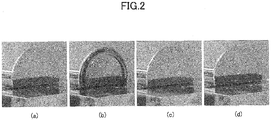
- FIG. 2 is a diagram illustrating results of the heat tolerance test 3 conducted on the test piece of the first embodiment. Additionally, (a), (b), (c), and (d) of FIG. 2 are respectively illustrate a state just after dipped in the oil bath, a state just after rotated under room temperature, a state just after rotated under 250°C, and a state just after rotated under 250°C for 30 hours.
- the water/oil repellant coating film of the first embodiment can maintain cleanliness of the surface since droplet slip-down properties are improved by heating a liquid having high viscosity at room temperature so as to have fluidity.
- the dynamic contact angle with respect to water at 25°C and 230°C is measured, where droplet of silicone oil is dropped on the test piece (stainless sheet) of the first embodiment under the temperature of 25°C, then being heated up to 230°C and cooled down to 25°C, and cyclic heating and cooling operation is repeatedly performed.
- FIG. 3 is a graph illustrating the result of the heat tolerance test 4.
- the droplet slip-down properties and droplet drivability of the water/oil repellant coating film of the first embodiment can be controlled in accordance with temperature change.
- Solder containing resin is placed on the surface of the test piece (stainless sheet) of the first embodiment and the test piece of the comparative example 3 that are tilted at 5°, then the test pieces are heated up to 200°C.
- FIG. 4 is a diagram illustrating results of the heat tolerance test 5 conducted on the test piece (stainless sheet) of the first embodiment and the test piece of the comparative example 3.
- the resin dissolved with the solder slips down on the surface of the water/oil repellant coating film of the first embodiment.
- Such properties are useful for preventing choke in a pipe exposed to high temperature, where the choke is caused by residual droplets or solidified droplets.
- Droplets of m-bis (m-phenoxyphenoxy) benzene (m-5P4E), m-(m-phenoxyphenoxy) diphenyl (m-4P2E), silicone oil PMM-0025 (produced by “GELEST”), and silicone oil PMM-0021 (produced by “GELEST”) are dropped on the test piece (stainless sheet) of the first embodiment, and temperature at the surface of the test piece is measured, then, the test piece is tilted to measure the falling angle.
- FIG. 5 is a graph illustrating the result of the heat tolerance test 6 conducted on the test piece (stainless sheet) of the first embodiment.
- the falling angle of the water/oil repellant coating film of the first embodiment decreases as temperature increases, that is, the capability of the water/oil repellant coating film for removing droplets is improved.
- the reason for this capability is considered that the surface tension and the viscosity of the droplet decrease as the temperature increases.
- One side of the test piece of the first embodiment is set at 230°C while the other side thereof is set at 50°C, and the silicone oil is placed on the one side whose temperature is higher than the other side.
- FIG. 6 is a diagram illustrating the result of the heat tolerance test 7 conducted on the test piece (stainless sheet) of the first embodiment.
- the droplet moves on the surface of the water/oil repellant coating film of the first embodiment from the higher temperature side to the lower temperature side.
- a moving distance (35 mm) of the silicone oil PMM-0021 (produced by "GELEST") is 3.5 times greater a moving distance (10 mm) of m-bis (m-phenoxyphenoxy) benzene (m-5P4E). It is conceivable that the difference between the moving distances is caused because a temperature dependency of the surface tension is specific to the substance, where the rate of change of the surface tension is smaller in the silicone oil. There have been some reports about voluntary move of the droplet due to temperature gradient.
- the temperatures of the surface at higher temperature side are normally equal to or less than 100°C, and moving distances of the droplets are less than 10mm in the reported cases.
- the voluntary move of the droplets is caused even if the temperature of the surface is greater than or equal to 200°C because of the excellent heat tolerance of the water/oil repellant coating film.
- a significant temperature gradient can be applied to the surface of the water/oil repellant coating film of the first embodiment because the water/oil repellant coating film of the first embodiment has heat tolerance of 450°C at maximum. Therefore, the moving distance of the droplet can be significantly increased in comparison to conventional technologies.
- test piece of the first embodiment polyimide film
- test piece of the comparative example 4 50-times repeated bending is performed on the test piece of the first embodiment (polyimide film) and the test piece of the comparative example 4, then, the test pieces are dipped in an oil bath at 250°C for 5 minutes.
- m-bis (m-phenoxyphenoxy) benzene (m-5P4E) is used as oil in the oil bath.
- FIG. 7 is a diagram illustrating the result of the heat tolerance test 8 conducted on the test piece (polyimide film) of the first embodiment and the test piece of the comparative example 4.
- the water/oil repellant coating film of the first embodiment has an excellent plasticity to improve the droplet slip-down properties, and the cleanliness of the surface can be maintained.
- the water/oil repellant coating film of the first embodiment has excellent heat tolerance and plasticity to provide the capability for removing the droplets on the surface of the solid object, and further, the droplet slip-down properties and droplet drivability can be controlled in accordance with temperature change or temperature gradient. Therefore, the water/oil repellant coating film of the first embodiment is expected to be applied to a micro channel utilizing thermal droplet transfer, and the like.
- the precursor solution is produced by mixing 33 parts of methyl triethoxysilane, 5 parts of 0.01M-hydrochloric acid and 62 parts of ethanol, then stirring under room temperature for a predetermined period of time.
- a test piece is obtained by coating, in a spin coating method, the precursor solution on a glass sheet, then heating in an oven at 100°C for 24 hours to form the water/oil repellant coating film whose thickness is 800 nm, and whose root mean square surface roughness Rq is equal to or less than 0.3 nm.
- the precursor solution is produced by mixing 3 parts of perhydropolysilazane, 27 parts of dibutyl ether, and N,N,N',N'-tetramethyl hexanediamine (catalytic amount), then adding polyhydroxymethyl siloxane (PHMS) thereto.
- PHMS polyhydroxymethyl siloxane
- a test piece is obtained by coating, in a spin coating method, the precursor solution on a glass sheet, then heating in an oven at 100°C for 24 hours to form the water/oil repellant coating film whose thickness is 1000 nm and whose root mean square surface roughness Rq is equal to or less than 1 nm.
- test piece is heated in the oven at 300°C for 24 hours.
- the precursor solution is produced by mixing a predetermined amount of dimethyl diethoxy silane (DMDES), a predetermined amount of tetraethoxysilane (TEOS), 5 parts of 0.01M-hydrochloric acid, and 62 parts of ethanol, then stirring under room temperature for 24 hours.
- DMDES dimethyl diethoxy silane
- TEOS tetraethoxysilane
- 0.01M-hydrochloric acid 0.01M-hydrochloric acid
- a test piece is obtained by coating, in a spin coating method, the precursor solution on a glass sheet, then heating in an oven at 100°C for 24 hours to form the water/oil repellant coating film whose thickness is 1000 nm and whose root mean square surface roughness Rq is equal to or less than 1 nm.
- test piece is heated in the oven at 300°C for 24 hours.
- the test piece is obtained by exposing a silicon wafer heated at 80°C to vapor of tetracyclotetramethylsiloxane for 24 hours.
- test piece is heated in the oven at 300°C for 24 hours.
- the test piece is obtained by exposing a silicon wafer heated at 80°C to vapor of methyl triethoxysilane for 24 hours.
- test piece is heated in the oven at 300°C for 24 hours.
- the precursor solution is produced by mixing a predetermined amount of trimethyletoxysilane (TMES), a predetermined amount of tetraethoxysilane (TEOS), 5 parts of 0.01M-hydrochloric acid, and 62 parts of ethanol, then stirring under room temperature for 24 hours.
- TMES trimethyletoxysilane
- TEOS tetraethoxysilane
- 0.01M-hydrochloric acid 0.01M-hydrochloric acid
- a test piece is obtained by coating, in a spin coating method, the precursor solution on a glass sheet, then heating in an oven at 100°C for 24 hours.
- test piece is heated in the oven at 250°C for 24 hours.
- the precursor solution is produced by mixing a 21 parts of tetraethoxysilane, 5 parts of phenyltriethoxysilane, 64 parts of ethanol, and 4 parts of 0.01M-hydrochloric acid, then stirring under room temperature for 24 hours.
- a test piece is obtained by coating, in a spin coating method, the precursor solution on a glass sheet, then being placed under room temperature for 24 hours to form the water/oil repellant coating film whose thickness is 1000 nm and whose root mean square surface roughness Rq is 0.90 nm.
- test piece is heated in the oven at 350°C for 24 hours.
Landscapes
- Chemical & Material Sciences (AREA)
- Organic Chemistry (AREA)
- Engineering & Computer Science (AREA)
- Life Sciences & Earth Sciences (AREA)
- Materials Engineering (AREA)
- Wood Science & Technology (AREA)
- Chemical Kinetics & Catalysis (AREA)
- Crystallography & Structural Chemistry (AREA)
- Paints Or Removers (AREA)
- Health & Medical Sciences (AREA)
- Medicinal Chemistry (AREA)
- Polymers & Plastics (AREA)
- Materials Applied To Surfaces To Minimize Adherence Of Mist Or Water (AREA)
- Application Of Or Painting With Fluid Materials (AREA)
Abstract
Description
- An aspect of the present invention relates to manufacturing methods of water/oil repellant coating film and manufacturing methods of precursor solution thereof.
- Upon a droplet adhering to a surface of a solid object, corrosion, deterioration, and pollution may expand from the adhered point. For example, an exhaust pipe of an engine is continuously exposed to high temperature air. Meanwhile it is known that rusting is occurred from a point at which a water droplet is adhered if the water droplet is adhered or condensation is occurred when temperature of the exhaust pipe is low. Further, if oil adhered to a solid subject is continued to be exposed to high temperature air, the oil is carbonized and adheres with a high strength. Therefore, visibility may be decreased and choke may occur. Therefore, in various fields of engineering, material and surface treatment is tried to be developed, which makes it possible to prevent deterioration of capability for removing droplets over a long period of time even in a high-temperature environment.
- Recently, importance is placed on dynamic motion of the droplet (dynamic wettability) on the surface of the solid object as an index of capability of removing droplets, which can be evaluated by using contact angle hysteresis (
e.g. Patent Document 1 and Non-Patent Document 1). The contact angle hysteresis is indicated by a difference (θA-θR) between an advance contact angle (θA) and a sweepback contact angle (θR), and the droplet slips on the surface of the solid object with a slight tilt as the value of the contact angle hysteresis becomes smaller. That is, the surface of the solid object whose contact angle hysteresis is small has an excellent capability for removing the droplets. On the other hand, the droplet is pinned at the surface of the solid object whose contact angle hysteresis is great even if the surface is super-water-repellent whose static contact angle exceeding 150°. - In
non-patent documents - [Patent Document 1]: Japanese Laid-open Patent Publication No.
2010-222703 -
- [Non-Patent Document 1]: L. Gao and T. J. McCarthy, Langmuir, 22, 6234 (2006)
- [Non-Patent Document 2]:"transparent film having excellent oil repellency" <online> March 13, 2012, Advanced Industrial Science and Technology, <URL: http://www.aist.go.jp/aist_j/press_release/pr2012/pr2 0120313/pr20120313.html>
- [Non-Patent Document 3]: C. Urata, D. F. Cheng, B. Masheder and A. Hozumi, RSC Adv., 2, 9805 (2012)
- However, further improvement of water/oil repellency of coating film is expected.
- An object of an aspect of the present invention is to provide a water/oil repellant coating film having excellent heat tolerance and water/oil repellency.
- An aspect of the present invention is, a water/oil repellant coating film, the water/oil repellant coating film being formed on a surface of a solid object, wherein
the water/oil repellant coating film is terminated with a group expressed by chemical formula (A) and a three-dimensional crosslinking structure of siloxane bond is formed.
[math. 1]
- Another aspect of the present invention is,
a method for producing a water/oil repellant coating film, the method comprising: - producing a precursor solution by dissolving organic silane compound in organic solvent;
- coating the precursor solution on a surface of a solid object, wherein
- the organic silane compound is any one of compounds expressed by general formula (B)
- Another aspect of the present invention is,
a method for producing a water/oil repellant coating film, the method comprising: - causing gas or liquid organic silane compound to adhere to a surface of a solid object; wherein
- the organic silane compound is any one of compounds expressed by general formula (B)
- Another aspect of the present invention is,
A method for producing a precursor solution by dissolving organic silane compound in organic solvent, wherein
the organic silane compound is any one of compounds expressed by general formula (B)
[math. 14]
(CH3)4-n SiRn ▪▪▪ (B)
(wherein n is any one of 1, 2, and 3, and R is any one of alkoxy group, chloro group, and acetoxy group whose carbon number is equal to or less than 6),
expressed by general formula (C)
[math. 15]
R1-O-(Si(CH3)2-O-)mR2 ▪▪▪ (C)
(wherein m indicates a polymerization degree, and R1and R2 are any of group and hydrogen atom respectively and independently expressed by general formula
[math. 16]
(CH3 ) 3-nRnSi -
(wherein n is any one of 1 and 2, and R is any one of alkoxy group, chloro group, and acetoxy group whose carbon number is equal to or less than 6.)),
expressed by general formula (D)
[math. 17]
R1-O-(SiH(CH3)-O)m-R2 ▪▪▪ (D)
(wherein m indicates a polymerization degree, and R1and R2 are any of any of group and hydrogen atom respectively and independently expressed by general formula
[math. 18]
(CH3 ) 3-n RnSi -
(wherein n is any one of 1 and 2, and R is any one of alkoxy group, chloro group, and acetoxy group whose carbon number is equal to or less than 6.)), and
expressed by general formula (E)
[math. 19]
- According to an aspect of the present invention, a water/oil repellant coating film having excellent heat tolerance and water/oil repellency can be provided.
-
- [
FIG. 1 ]
FIG. 1 is a photographic image illustrating appearance of a first embodiment. - [
FIG. 2 ]
FIG. 2 is a photographic image illustrating a result ofheat tolerance test 3 conducted on a test piece (stainless sheet) of the first embodiment. - [
FIG. 3 ]
FIG. 3 is a photographic image illustrating a result ofheat tolerance test 4 conducted on the test piece (stainless sheet) of the first embodiment. - [
FIG. 4 ]
FIG. 4 is a photographic image illustrating a result ofheat tolerance test 5 conducted on the test piece (stainless sheet) of the first embodiment and a test piece of comparative example 3. - [
FIG. 5 ]
FIG. 5 is a photographic image illustrating a result ofheat tolerance test 6 conducted on the test piece (stainless sheet) of the first embodiment. - [
FIG. 6 ]
FIG. 6 is a photographic image illustrating a result ofheat tolerance test 7 conducted on the test piece (stainless sheet) of the first embodiment. - [
FIG. 7 ]
FIG. 7 is a photographic image illustrating a result ofheat tolerance test 8 conducted on the test piece (polyimide film) of the first embodiment and a test piece of comparative example 4. - In the following, embodiments of the present invention will be described with reference to accompanying drawings.
- A water/oil repellant coating film is formed on a surface of a solid object. The water/oil repellant coating film is terminated with a group expressed by chemical formula (A), and a three-dimensional crosslinking structure of siloxane bond is formed. Thus, the group expressed by chemical formula (A) exists on the surface of the water/oil repellant coating film.
- The root mean square surface roughness Rq of the water/oil repellant coating film is normally equal to or less than 50 nm, preferably equal to or less than 1 nm, and further preferably equal to or less than 0.5 nm. If the root mean square surface roughness Rq of the water/oil repellant coating film exceeds 50 nm, water repellency or transparency is reduced.
- The group expressed by chemical formula (A) has an excellent heat tolerance greater than or equal to 450°C in the atmosphere. Therefore, the water/oil repellant coating film can maintain the capability up to 450°C.
- In the water/oil repellant coating film, preferably, enough space is provided between methyl groups existing on the surface thereof. In this case, rotation of the methyl groups existing on the surface is not disturbed.
- A mole ratio of alkoxy groups and hydroxyl groups with respect to the methyl groups existing on the surface of the water/oil repellant coating film is normally equal to or less than 0.1, preferably equal to or less than 0.05, and more preferably, alkoxy groups and hydroxyl groups do not exist on the surface. If the mole ratio of alkoxy groups and hydroxyl groups with respect to the methyl groups existing on the surface of the water/oil repellant coating film exceeds 0.1, the water/oil repellency of the water/oil repellant coating film may be reduced.
- Additionally, the mole ratio of alkoxy groups and hydroxyl groups with respect to the methyl groups existing on the surface of the water/oil repellant coating film can be calculated by using formula of Cassie.
- In order to achieve excellent water/oil repellency of the water/oil repellant coating film, mobility of the methyl groups existing on the surface of the water/oil repellant coating film needs to be "Liquid-like". Hence, the space for enabling rotation of the methyl groups is required.
- For example, in a case where phenyl groups exist on the surface instead of the methyl groups, the mobility does not become "Liquid-like" because the phenyl groups are likely to densely aggregate due to n-n interaction.
- Also, in a case where alkoxy groups and hydroxyl groups greater than or equal to a predetermined amount exist on the surface of the film, droplet slip-down properties may be reduced where a position at which alkoxy groups and hydroxyl groups greater than or equal to a predetermined amount exist is starting point.
- Further, in a case where alkoxy groups exist on the surface of the film and heated to temperature greater than or equal to 150°C, the alkoxy groups may be separated as alcohol and silanol groups may be generated.
- In order to suppress exposure of hydroxyl groups or alkoxy groups on the surface, preferably, hydrolysis and condensation polymerization in precursor solution (described below) are sufficiently performed.
- Preferably, the water/oil repellant coating film does not contain any organic group other than the methyl groups included in the group expressed by chemical formula (A). In the film containing organic group other than the methyl groups included in the group expressed by chemical formula (A), the organic group may be thermally decomposed to make the surface rough, or to cause pollution of the surface due to the thermally decomposed products when the film is exposed to high temperature.
- A ratio of transparency of a solid object whose surface is not coated by the water/oil repellant coating film with respect to a transparency of the solid object whose surface is coated by the water/oil repellant coating film is normally greater than or equal to 0.95.
- The water/oil repellant coating film is preferably chemically bound with the surface of the solid object. In this case, adhesiveness of the water/oil repellant coating film can be improved. Non-limiting examples of the slid object are metal, metal oxide, composition metal, semiconductor, polymer, ceramics, and glass.
- Non-limiting examples of shape of the surface of the solid object are a planar surface, a curved surface, a concave-convex surface, and a porous surface, where two or more shapes may be used.
- The water/oil repellant coating film has an excellent flexibility. Therefore, clacks and peeling can be suppressed even when polymer film coating, metal foil coating, etc., are provided.
- The water/oil repellant coating film can be formed by coating the precursor solution on the surface of the solid object or by causing gas or liquid organic silane compound to adhere to the surface of the solid object, where the precursor solution is produced by dissolving organic silane compound in organic solvent. Here, the organic silane compound is a compound expressed by general formula (B), general formula (C), general formula (D), or general formula (E).
- Additionally, the organic silane compound may be hydrolysed or condensedly polymerized in producing the precursor solution.
- The solid object on which the precursor solution is coated normally causes solvent to be volatilized under the atmosphere pressure and causes the organic silane compound to be cross-linked.
- Temperature for volatilizing the solvent is normally 0 - 100°C, and preferably 15 - 30°C.
- Time for volatilizing the solvent is normally 0 - 60 seconds, and preferably 0 - 15 seconds.
- Also, the solid object is normally heated under the atmosphere pressure to cause the organic silane compound to be cross-linked, where the organic silane compound is adhered to the surface of the solid object.
- Temperature for heating the solid object is normally 50 - 500°C, and preferably 100 - 350°C.
- In a case where the solid object is polymer, preferably, the precursor solution is coated on the surface of the solid object or gas or liquid organic silane compound is caused to be adhered to the surface of the solid object after performing a preprocessing on the surface of the solid object by using oxygen plasma, ozone, ultraviolet rays, vacuum ultraviolet rays, etc., so as to further improve the adhesiveness.
- The organic solvent preferably has a steam pressure greater than that of water.
- Any organic solvent may be chosen as long as the solvent is water-miscible and capable of solving the organic silane compound and polycondensate thereof. Methanol, ethanol, isopropanol, tetrahydrofuran, and acetone can be exemplified. Non-protic solvent is preferably used because protic solvent may remain on the surface of the water/oil repellant coating film as alkoxy groups.
- The precursor solution preferably includes catalyst capable of fostering hydrolysis of the organic silane compound. Speed of condensation polymerization can be controlled by using the catalyst. Therefore, the precursor solution, whose pot life is greater than or equal to 30 days under a normal temperature, can be prepared. Such a precursor solution can be used after leaving more than 30 days under the normal temperature since condensation polymerization speed of silanol group is decreased in the precursor solution.
- Non-limiting examples of the catalyst are hydrogen chloride, acetic acid, and phosphoric acid.
- Non-limiting examples of coating method are a spin coating method, a dip coating method, a roller coating method, a bar coating method, an inkjet coating method, a gravure coating method, a spray method, a dispenser method, a nozzle coating method, a slit coating method, a diquat method, a blade coating method, a knife coating method, a wire bar coating method, and a screen printing method.
- A thickness of the water/oil repellant coating film can be controlled by adjusting concentration of the organic silane compound in the precursor solution.
- Additionally, the water/oil repellant coating film may be formed by coating a mixture solution of the precursor solution and a solution prepared by hydrolysing and condensedly polymerizing metalalkoxide in an organic solution containing dissolved metalalkoxide on the surface of the solid object. Or the water/oil repellant coating film may be formed by coating a mixture solution of the precursor solution and a solution prepared by dissolving perhydropolysilazane in an organic solution on the surface of the solid object.
- A non-limiting example of metalalkoxide is expressed by a general formula described below.
[math. 20] - (Wherein n is integer number of 0 - 4, M is Al, Hf, Si, Ti, Sn, or Zr, and R is alkyl group whose carbon number is 1 -15.)
- Perhydropolysilazane is expressed by a general formula described below.
[math. 21]
-(SiH2-NH)m-
- (Wherein m is polymerizing degree.)
- The thickness of the water/oil repellant coating film is normally 10 nm - 10 µm, and preferably 200 nm - 1µm.
- The water/oil repellant coating film causes contact angle hysteresis with respect to a liquid, whose surface tension is 18 - 73 dyn/cm, to be equal to or less than 10° and enables a droplet greater than or equal to 5 µL to slip with a falling angle equal to or less than 10°.
- Additionally, the contact angle hysteresis can be calculated by a formula described below, wherein advance contact angle is θA (°) and a sweepback contact angle is θR (°).

- Non-limiting examples of the liquid, whose surface tension is 18 - 73 dyn/cm, are n-pentan, n-hexan, ethanol, methanol, silicone oil, acetone, benzene, n-hexadecane, ethylene glycol, iodomethane, and water.
- Also, the water/oil repellant coating film has an excellent adhesiveness to the surface of the solid object because silanol group generated by hydrolyzing organic silane compound has a high reactivity.
- Normally, the polycondensate of the organic silane compound does not include coupling scheme other than siloxane bond (Si-O bond), C-Si bond, and C-H bond. Therefore, capability of the water/oil repellant coating film for removing droplets is not reduced even if the water/oil repellant coating film is heated at 450°C for one hour or more under the atmosphere pressure. Also, the capability of the water/oil repellant coating film for removing droplets is not reduced even if the water/oil repellant coating film is heated at 350°C for twenty four hours or more under the atmosphere pressure.
- The water/oil repellant coating film has excellent heat tolerance and adhesiveness. Therefore, the capability of the water/oil repellant coating film for removing droplets is not reduced even if the water/oil repellant coating film is dipped in a liquid, whose surface tension is 18 - 73 dyn/cm and whose temperature is equal to or less than boiling temperature, for 24 hours or more.
- The surface tension of droplet significantly changes according to temperature change. Therefore, static contact angle of the water/oil repellant coating film with respect to a liquid is reversibly changed when the liquid, whose surface tension is 18 - 73 dyn/cm, is repeatedly heated and cooled under the temperature equal to or less than boiling temperature.
- The surface tension and viscosity of the liquid decreases when the liquid, whose surface tension is 18 - 73 dyn/cm, is repeatedly heated and cooled under the temperature equal to or less than boiling temperature. Therefore, the droplet slip-down properties on the water/oil repellant coating film increases (falling angle is decreased).
- The water/oil repellant coating film has an excellent plasticity. Therefore, the droplet slip-down properties are not degraded even if repeated bending is performed 50 times or more.
- In a case where the water/oil repellant coating film is horizontally placed and temperature gradient within a range between freezing temperature and boiling temperature of the liquid, whose surface tension is 18 - 73dyn/cm, is applied, Marangoni convection occurs due to gradient of surface tension at the interface of the liquid, and the droplet moves voluntarily.
- Therefore, for example, the water/oil repellant coating film can provide lubricity in an engine of vehicle, which is exposed to high temperature for a long period of time, and the like. Also, the water/oil repellant coating film can prevent corrosion of an exhaust pipe/metal material. Further, the water/oil repellant coating film can improve visibility of transparent window in an oil pump. Also, the water/oil repellant coating film can prevent creeping-up of flux, adhesion of oil spot to a distillation column, smear of a frying pan. Further, the water/oil repellant coating film can applied to an actuator using movement of droplet, and the like.
- In the following, specific embodiments of the present invention will be described. However, the embodiments are not limiting examples. Additionally, "part" means mass part.
- The precursor solution is produced by mixing 33 parts of methyl triethoxysilane, 5 parts of 0.01M-hydrochloric acid and 62 parts of ethanol, then stirring under room temperature for 24 hours.
- A test piece is obtained by coating, in a spin coating method, the precursor solution on a stainless steel sheet (SUS304) and a polyimide film, then heating in an oven at 100°C for 24 hours to form the water/oil repellant coating film whose thickness is 800 nm and whose root mean square surface roughness Rq is equal to or less than 0.3 nm.
-
FIG. 1 is a diagram illustrating an appearance of the test piece. Additionally, (a), (b), and (c) depicted inFIG. 1 are respectively show a glass sheet, a stainless sheet, and a polyimide film. - According to
FIG. 1 , the water/oil repellant coating film of the first embodiment has excellent transparency and adhesiveness. - The precursor solution is produced by mixing 20 parts of tetramethoxysilane, 4.5 parts of decyltriethoxysilane, 65 parts of ethanol and 10 parts of 0.01M-hydrochloric acid, then stirring under room temperature for 24 hours.
- A test piece is obtained by coating, in a spin coating method, the precursor solution on a glass sheet and a stainless steel sheet (SUS304), then being placed under room temperature for 24 hours to form the water/oil repellant coating film whose thickness is 700 nm and whose root mean square surface roughness Rq is 1.1 nm.
- The precursor solution is produced by mixing 7.8 parts of tetramethoxysilane (heptadecafluoro-1,1,2,2,-tetrahydrodecyl), 3.9 parts of trimethoxysilane FAS17 (produced by "GELEST"), 84 parts of isopropanol, and 4 parts of 0.01M-hydrochloric acid, then stirring under room temperature for 24 hours.
- A test piece is obtained by coating, in a spin coating method, the precursor solution on a glass sheet, then being placed under room temperature for 24 hours to form the water/oil repellant coating film whose thickness is 500 nm and whose root mean square surface roughness Rq is 0.82 nm.
- The stainless sheet (SUS304) of the first embodiment is used as a test piece.
- The polyimide film of the first embodiment is used as a test piece.
- The root mean square surface roughness Rq is calculated based on an image obtained through AFM.
- Then, following heat tolerance tests are conducted by using test pieces of the first embodiment, and comparative examples 1 - 3.
- The test piece (glass sheet) of the first embodiment is heated in an oven at a predetermined temperature for 1 hour, then, a dynamic contact angle (advance contact angle (θA) and sweepback contact angle (θR)) with respect to water and n-hexadecane is measured and the contact angle hysteresis is calculated.
- The contact angles of the test piece (glass sheet) of the first embodiment before and after heated are shown in table 1.
[table 1] OVEN TEMPERATURE [°C] WATER n-HEXADECANE θ A [° ] θ R [° ] CONTACT ANGLE HYSTERESIS [° ] θ A [° ] θ R [° ] CONTACT ANGLE HYSTERESIS [° ] - 91 84 7 36 30 6 150 92 85 7 34 30 4 200 98 87 11 34 30 4 250 95 83 12 33 28 5 300 104 93 11 35 31 4 350 98 88 10 35 31 5 400 103 92 10 36 30 6 450 101 92 9 38 34 4 500 50 30 20 7 - - - Additionally, "-" shown as "oven temperature" means a state before heated, and "-" shown as "θA", "θR", and "contact angle hysteresis" means that the contact angle cannot be measured due to reduction of repellency of the water/oil repellant coating film.
- The dynamic contact angle (advance contact angle (θA) and sweepback contact angle (θR)) with respect to water and n-hexadecane is measured by using contact angle measuring device (produced by "KYOWA KAIMEN"). Then, the contact angle hysteresis is calculated according to the following formula.

- The test pieces of the first embodiment, the comparative examples 1 and 2 (glass sheet) are heated in an oven at a predetermined temperature for 24 hour, then, the contact angle hysteresis with respect to water and n-hexadecane is measured.
- The contact angles of the test pieces of the first embodiment, the comparative examples 1 and 2 (glass sheet) before and after heated are shown in table 2 - table 4.
[table 2] OVEN TEMPERATURE [°C] WATER n-HEXADECANE θ A [° ] θ R [° ] CONTACT ANGLE HYSTERESIS [° ] θ A [° ] θ R [° ] CONTACT ANGLE HYSTERESIS [° ] - 91 84 7 36 30 6 150 97 88 9 36 30 6 200 101 89 12 34 30 4 250 102 90 12 39 34 5 300 103 91 11 38 33 4 350 105 92 13 39 33 6 400 81 68 13 29 - - 450 55 16 39 - - - 500 54 27 27 - - - [table 3] OVEN TEMPERATURE [°C] WATER n-HEXADECANE θ A [° ] θ R [° ] CONTACT ANGLE HYSTERESIS [° ] θ A [° ] θ R [° ] CONTACT ANGLE HYSTERESIS [° ] - 107 96 11 28 27 2 150 82 74 8 13 - - 200 - - - - - - 250 - - - - - - 300 - - - - - - 350 - - - - - - 400 - - - - - - 450 - - - - - - 500 - - - - - - [table 4] OVEN TEMPERATURE [°C] WATER n-HEXADECANE θ A [° ] θ R [° ] CONTACT ANGLE HYSTERESIS [° ] θ A [° ] θ R [° ] CONTACT ANGLE HYSTERESIS [° ] - 106 98 9 59 54 5 150 108 98 9 59 54 5 200 103 91 12 55 49 6 250 96 75 21 52 45 7 300 81 59 22 47 40 7 350 26 - - 5 - - 400 - - - - - - 450 - - - - - - 500 - - - - - - - Additionally, "-" shown as "oven temperature" means a state before heated, and "-" shown as "θA", "θR", and "contact angle hysteresis" means that the contact angle cannot be measured due to reduction of repellency of the water/oil repellant coating film.
- According to table 1 - table 4, the water/oil repellant coating film of the first embodiment has an excellent heat tolerance, and the capability of the water/oil repellant coating film for removing droplets can be maintained even if the water/oil repellant coating film is exposed to high temperature for long hours. The reason for this property is considered that groups expressed by chemical formula described below exist at the surface.
[math. 22]
- On the other hand, in a case of the water/oil repellant coating film of the comparative example 1, groups expressed by chemical formula described below exist at the surface.
[math. 23]
- Therefore, the capability of the water/oil repellant coating film for removing droplets cannot be maintained if the water/oil repellant coating film is exposed to high temperature for long hours. Also, water/oil repellency becomes smaller because silanol groups exist at the surface.
- Further, in a case of the water/oil repellant coating film of the comparative example 2, groups expressed by chemical formula described below exist at the surface.
[math. 24]
- Therefore, the capability of the water/oil repellant coating film for removing droplets cannot be maintained if the water/oil repellant coating film is exposed to high temperature for long hours. Also, water/oil repellency becomes smaller because silanol groups exist at the surface.
- The test piece of the first embodiment is dipped in an oil bath at 250°C for 5 minutes, then being rotated at 5 rpm for 30 hours under the room temperature or 250°C temperature. m-bis (m-phenoxyphenoxy) benzene (m-5P4E) is used as oil in the oil bath.
-
FIG. 2 is a diagram illustrating results of theheat tolerance test 3 conducted on the test piece of the first embodiment. Additionally, (a), (b), (c), and (d) ofFIG. 2 are respectively illustrate a state just after dipped in the oil bath, a state just after rotated under room temperature, a state just after rotated under 250°C, and a state just after rotated under 250°C for 30 hours. - According to
FIG. 2 , the water/oil repellant coating film of the first embodiment can maintain cleanliness of the surface since droplet slip-down properties are improved by heating a liquid having high viscosity at room temperature so as to have fluidity. - The dynamic contact angle with respect to water at 25°C and 230°C is measured, where droplet of silicone oil is dropped on the test piece (stainless sheet) of the first embodiment under the temperature of 25°C, then being heated up to 230°C and cooled down to 25°C, and cyclic heating and cooling operation is repeatedly performed.
-
FIG. 3 is a graph illustrating the result of theheat tolerance test 4. - According to
FIG. 3 , the droplet slip-down properties and droplet drivability of the water/oil repellant coating film of the first embodiment can be controlled in accordance with temperature change. - Solder containing resin is placed on the surface of the test piece (stainless sheet) of the first embodiment and the test piece of the comparative example 3 that are tilted at 5°, then the test pieces are heated up to 200°C.
-
FIG. 4 is a diagram illustrating results of theheat tolerance test 5 conducted on the test piece (stainless sheet) of the first embodiment and the test piece of the comparative example 3. - According to
FIG. 4 , the resin dissolved with the solder slips down on the surface of the water/oil repellant coating film of the first embodiment. Such properties are useful for preventing choke in a pipe exposed to high temperature, where the choke is caused by residual droplets or solidified droplets. - In contrast, the resin dissolved with the solder remains on the surface of the test piece of the comparative example 3.
- Droplets of m-bis (m-phenoxyphenoxy) benzene (m-5P4E), m-(m-phenoxyphenoxy) diphenyl (m-4P2E), silicone oil PMM-0025 (produced by "GELEST"), and silicone oil PMM-0021 (produced by "GELEST") are dropped on the test piece (stainless sheet) of the first embodiment, and temperature at the surface of the test piece is measured, then, the test piece is tilted to measure the falling angle.
-
FIG. 5 is a graph illustrating the result of theheat tolerance test 6 conducted on the test piece (stainless sheet) of the first embodiment. - According to
FIG. 5 , in the falling angle of the water/oil repellant coating film of the first embodiment, the falling angle decreases as temperature increases, that is, the capability of the water/oil repellant coating film for removing droplets is improved. The reason for this capability is considered that the surface tension and the viscosity of the droplet decrease as the temperature increases. - One side of the test piece of the first embodiment is set at 230°C while the other side thereof is set at 50°C, and the silicone oil is placed on the one side whose temperature is higher than the other side.
-
FIG. 6 is a diagram illustrating the result of theheat tolerance test 7 conducted on the test piece (stainless sheet) of the first embodiment. - According to
FIG. 6 , the droplet moves on the surface of the water/oil repellant coating film of the first embodiment from the higher temperature side to the lower temperature side. In particular, a moving distance (35 mm) of the silicone oil PMM-0021 (produced by "GELEST") is 3.5 times greater a moving distance (10 mm) of m-bis (m-phenoxyphenoxy) benzene (m-5P4E). It is conceivable that the difference between the moving distances is caused because a temperature dependency of the surface tension is specific to the substance, where the rate of change of the surface tension is smaller in the silicone oil. There have been some reports about voluntary move of the droplet due to temperature gradient. However, the temperatures of the surface at higher temperature side are normally equal to or less than 100°C, and moving distances of the droplets are less than 10mm in the reported cases. In contrast, in a case of the water/oil repellant coating film of the first embodiment, the voluntary move of the droplets is caused even if the temperature of the surface is greater than or equal to 200°C because of the excellent heat tolerance of the water/oil repellant coating film. Further, a significant temperature gradient can be applied to the surface of the water/oil repellant coating film of the first embodiment because the water/oil repellant coating film of the first embodiment has heat tolerance of 450°C at maximum. Therefore, the moving distance of the droplet can be significantly increased in comparison to conventional technologies. - 50-times repeated bending is performed on the test piece of the first embodiment (polyimide film) and the test piece of the comparative example 4, then, the test pieces are dipped in an oil bath at 250°C for 5 minutes. m-bis (m-phenoxyphenoxy) benzene (m-5P4E) is used as oil in the oil bath.
-
FIG. 7 is a diagram illustrating the result of theheat tolerance test 8 conducted on the test piece (polyimide film) of the first embodiment and the test piece of the comparative example 4. - According to
FIG. 7 , the water/oil repellant coating film of the first embodiment has an excellent plasticity to improve the droplet slip-down properties, and the cleanliness of the surface can be maintained. - In contrast, the oil for the oil bath adheres to the surface of the test piece of the comparative example 4 (see area surrounded by dotted line).
- As described above, the water/oil repellant coating film of the first embodiment has excellent heat tolerance and plasticity to provide the capability for removing the droplets on the surface of the solid object, and further, the droplet slip-down properties and droplet drivability can be controlled in accordance with temperature change or temperature gradient. Therefore, the water/oil repellant coating film of the first embodiment is expected to be applied to a micro channel utilizing thermal droplet transfer, and the like.
- The precursor solution is produced by mixing 33 parts of methyl triethoxysilane, 5 parts of 0.01M-hydrochloric acid and 62 parts of ethanol, then stirring under room temperature for a predetermined period of time.
- A test piece is obtained by coating, in a spin coating method, the precursor solution on a glass sheet, then heating in an oven at 100°C for 24 hours to form the water/oil repellant coating film whose thickness is 800 nm, and whose root mean square surface roughness Rq is equal to or less than 0.3 nm.
- Contact angles of the test piece are shown in table 5.
[table 5] STIRRING TIME [h] WATER n-HEXADECANE θ A [° ] θ R [° ] CONTACT ANGLE HYSTERESIS [° ] θ A [° ] θ R [° ] CONTACT ANGLE HYSTERESIS [° ] 24 91 86 5 35 33 2 96 99 85 14 34 27 6 120 99 85 15 35 29 5 192 103 92 11 34 28 6 288 90 87 2 34 26 8 - The precursor solution is produced by mixing 3 parts of perhydropolysilazane, 27 parts of dibutyl ether, and N,N,N',N'-tetramethyl hexanediamine (catalytic amount), then adding polyhydroxymethyl siloxane (PHMS) thereto.
- A test piece is obtained by coating, in a spin coating method, the precursor solution on a glass sheet, then heating in an oven at 100°C for 24 hours to form the water/oil repellant coating film whose thickness is 1000 nm and whose root mean square surface roughness Rq is equal to or less than 1 nm.
- Contact angles of the test piece are shown in table 6.
[table 6] ADDITION AMOUNT OF PHMS [PART] WATER n-HEXADECANE θ A [° ] θ R [° ] CONTACT ANGLE HYSTERESIS [° ] θ A [° ] θ R [° ] CONTACT ANGLE HYSTERESIS [° ] 0.75 102 93 9 26 21 4 1.5 101 94 7 25 20 5 3 102 98 4 28 25 3 6 100 95 5 32 28 4 - Then, the test piece is heated in the oven at 300°C for 24 hours.
- Contact angles of the test piece that has been heated are shown in table 7.
[table 7] ADDITION AMOUNT OF PHMS [PART] WATER n-HEXADECANE θ A [° ] θ R [° ] CONTACT ANGLE HYSTERESIS [° ] θ A [° ] θ R [° ] CONTACT ANGLE HYSTERESIS [° ] 0.75 94 87 7 27 21 7 1.5 96 82 14 22 22 0 3 98 85 13 30 27 3 6 95 84 12 29 28 1 - The precursor solution is produced by mixing a predetermined amount of dimethyl diethoxy silane (DMDES), a predetermined amount of tetraethoxysilane (TEOS), 5 parts of 0.01M-hydrochloric acid, and 62 parts of ethanol, then stirring under room temperature for 24 hours.
- A test piece is obtained by coating, in a spin coating method, the precursor solution on a glass sheet, then heating in an oven at 100°C for 24 hours to form the water/oil repellant coating film whose thickness is 1000 nm and whose root mean square surface roughness Rq is equal to or less than 1 nm.
- Contact angles of the test piece are shown in table 8.
[table 8] ADDITION AMOUNT OF DMDES [PART] ADDITION AMOUNT OF TEOS [PART] WATER n-HEXADECANE θ A [° ] θ R [° ] CONTACT ANGLE HYSTERESIS [° ] θ A [° ] θ R [° ] CONTACT ANGLE HYSTERESIS [° ] 29 4 101 91 9 39 34 6 25 8 101 93 8 40 34 6 20 13 101 93 8 41 33 7 12 21 99 88 11 35 31 5 7 26 96 85 11 38 31 7 - Then, the test piece is heated in the oven at 300°C for 24 hours.
- Contact angles of the test piece that has been heated are shown in table 9.
[table 9] ADDITION AMOUNT OF DMDES [PART] ADDITION AMOUNT OF TEOS [PART] WATER n-HEXADECANE θ A [° ] θ R [° ] CONTACT ANGLE HYSTERESIS [° ] θ A [° ] θ R [° ] CONTACT ANGLE HYSTERESIS [° ] 29 4 106 97 10 36 32 4 25 8 108 98 10 36 31 5 20 13 108 97 11 36 32 4 12 21 106 94 12 34 27 7 7 26 99 86 13 33 26 7 - The test piece is obtained by exposing a silicon wafer heated at 80°C to vapor of tetracyclotetramethylsiloxane for 24 hours.
- Then, the test piece is heated in the oven at 300°C for 24 hours.
- Contact angles of the test piece before and after heated are shown in table 10.
[table 10] OVEN TEMPERATURE [°C] WATER n-HEXADECANE θ A [°] θ R [°] CONTACT ANGLE HYSTERESIS [°] θ A [°] θ R [°] CONTACT ANGLE HYSTERESIS [°] - 101 99 2 37 35 3 300 92 86 7 30 24 7 - Additionally, "-" shown as "oven temperature" means a state before heated.
- The test piece is obtained by exposing a silicon wafer heated at 80°C to vapor of methyl triethoxysilane for 24 hours.
- Then, the test piece is heated in the oven at 300°C for 24 hours.
- Contact angles of the test piece before and after heated are shown in table 11.
[table 11] OVEN TEMPERATURE [°C] WATER n-HEXADECANE θ A [°] θ R [°] CONTACT ANGLE HYSTERESIS [°] θ A [°] θ R [°] CONTACT ANGLE HYSTERESIS [°] - 104 96 8 53 46 8 300 75 65 10 37 28 9 - Additionally, "-" shown as "oven temperature" means a state before heated.
- The precursor solution is produced by mixing a predetermined amount of trimethyletoxysilane (TMES), a predetermined amount of tetraethoxysilane (TEOS), 5 parts of 0.01M-hydrochloric acid, and 62 parts of ethanol, then stirring under room temperature for 24 hours.
- A test piece is obtained by coating, in a spin coating method, the precursor solution on a glass sheet, then heating in an oven at 100°C for 24 hours.
- Contact angles of the test piece are shown in table 12.
[table 12] ADDITION AMOUNT OF TMES [PART] ADDITION AMOUNT OF TEOS [PART] WATER n-HEXADECANE θ A [°] θ R [°] CONTACT ANGLE HYSTERESIS [°] θ A [°] θ R [°] CONTACT ANGLE HYSTERESIS [°] 19 14 97 93 4 97 93 4 12 21 95 92 3 39 33 6 7 26 100 92 9 40 36 4 - Then, the test piece is heated in the oven at 250°C for 24 hours.
- Contact angles of the test piece that has been heated are shown in table 13.
[table 13] ADDITION AMOUNT OF TMES [PART] ADDITION AMOUNT OF TEOS [PART] WATER n-HEXADECANE θ A [°] θ R [°] CONTACT ANGLE HYSTERESIS [°] θ A [°] θ R [°] CONTACT ANGLE HYSTERESIS [°] 19 14 65 51 14 31 27 4 12 21 87 72 16 30 24 6 7 26 96 91 5 37 31 6 - The precursor solution is produced by mixing a 21 parts of tetraethoxysilane, 5 parts of phenyltriethoxysilane, 64 parts of ethanol, and 4 parts of 0.01M-hydrochloric acid, then stirring under room temperature for 24 hours.
- A test piece is obtained by coating, in a spin coating method, the precursor solution on a glass sheet, then being placed under room temperature for 24 hours to form the water/oil repellant coating film whose thickness is 1000 nm and whose root mean square surface roughness Rq is 0.90 nm.
- Then, the test piece is heated in the oven at 350°C for 24 hours.
- Contact angles of the test piece before and after heated are shown in table 14.
[table 14] OVEN TEMPERATURE [°C] θ A [°] θ R [°] CONTACT ANGLE HYSTERESIS [°] - 77 66 11 350 60 20 40 - Additionally, "-" shown as "oven temperature" means a state before heated.
- The present application is based on Japanese Priority Application No.
2014-032316 filed on February 21, 2014
(CH3) 4-n SiRn ▪▪▪ (B)
(wherein n is any one of 1, 2, and 3, and R is any one of alkoxy group, chloro group, and acetoxy group whose carbon number is equal to or less than 6.),
expressed by general formula (C)
[math. 3]
R1- O -(Si (CH3)2 O )m R2 ▪▪▪ (C)
(wherein m indicates a polymerization degree, and R1and R2 are any of group and hydrogen atom respectively and independently expressed by general formula
[math. 4]
(CH3 ) 3- n RnSi -
(wherein n is any one of 1 and 2, and R is any one of alkoxy group, chloro group, and acetoxy group whose carbon number is equal to or less than 6.)),
expressed by general formula (D)
[math. 5]
R1-O-(SiH(CH3)-O)-R2 ▪▪▪ (D)
(wherein m indicates a polymerization degree, and R1and R2 are any of group and hydrogen atom respectively and independently expressed by general formula
[math. 6]
(CH3)3-n RnSi -
(wherein n is any one of 1 and 2, and R is any one of alkoxy group, chloro group, and acetoxy group whose carbon number is equal to or less than 6.)), and
expressed by general formula (E)
[math. 7]

(CH3)4-n SiRn ▪▪▪ (B)
(wherein n is any one of 1, 2, and 3, and R is any one of alkoxy group, chloro group, and acetoxy group whose carbon number is equal to or less than 6.),
expressed by general formula (C)
[math. 9]
R1-O-(Si(CH3)2 -O)m-R2 ▪▪▪ (C)
(wherein m indicates a polymerization degree, and R1and R2 are any of group or hydrogen atom respectively and independently expressed by general formula
[math. 10]
(CH3)3-n RnSi -
(wherein n is any one of 1 and 2, and R is any one of alkoxy group, chloro group, and acetoxy group whose carbon number is equal to or less than 6.)),
expressed by general formula (D)
[math. 11]
R1-O-(SiH(CH3)-O)m-R2 ▪▪▪ (D)
(wherein m indicates a polymerization degree, and R1and R2 are any of group and hydrogen atom respectively and independently expressed by general formula
[math. 12]
(CH3)3-n RnSi-
(wherein n is any one of 1 and 2, and R is any one of alkoxy group, chloro group, and acetoxy group whose carbon number is equal to or less than 6)), and expressed by general formula (E)
[math. 13]

Claims (8)
- A water/oil repellant coating film, the water/oil repellant coating film being formed on a surface of a solid object, wherein
the water/oil repellant coating film is terminated with a group expressed by chemical formula (A) and a three-dimensional crosslinking structure of siloxane bond is formed.
[math. 1]
- The water/oil repellant coating film according to claim 1, wherein
a root mean square surface roughness Rq of the water/oil repellant coating film is equal to or less than 50 nm. - The water/oil repellant coating film according to claim 1, wherein
any of alkoxy group and hydroxyl group does not exist on the surface of the water/oil repellant coating film. - The water/oil repellant coating film according to claim 1, wherein
the water/oil repellant coating film does not contain any organic group other than the methyl group included in the group expressed by chemical formula (A). - The water/oil repellant coating film according to claim 1, wherein
the water/oil repellant coating film is chemically bound with the surface of the solid object. - A method for producing a water/oil repellant coating film, the method comprising:producing a precursor solution by dissolving organic silane compound in organic solvent;coating the precursor solution on a surface of a solid object, whereinthe organic silane compound is any one of compounds expressed by general formula (B)
[math. 2]
(CH3)4-n SiRn ▪▪▪ (B)
(wherein n is any one of 1, 2, and 3, and R is any one of alkoxy group, chloro group, and acetoxy group whose carbon number is equal to or less than 6.),
expressed by general formula (C)
[math. 3]
R1-O-(Si(CH3)2-O)m-R2 ▪▪▪ (C)
(wherein m indicates a polymerization degree, and R1and R2 are any of group and hydrogen atom respectively and independently expressed by general formula
[math. 4]
(CH3)3-n RnSi -
(wherein n is any one of 1 and 2, and R is any one of alkoxy group, chloro group, and acetoxy group whose carbon number is equal to or less than 6.)),
expressed by general formula (D)
[math. 5]
R1-O-(SiH(CH3 )-O)m-R2 ▪▪▪ (D)
(wherein m indicates a polymerization degree, and R1and R2 are any of group and hydrogen atom respectively and independently expressed by general formula
[math. 6]
(CH3)3-nRnSi -
(wherein n is any one of 1 and 2, and R is any one of alkoxy group, chloro group, and acetoxy group whose carbon number is equal to or less than 6.)), and
expressed by general formula (E)
[math. 7]
- A method for producing a water/oil repellant coating film, the method comprising:causing gas or liquid organic silane compound to adhere to a surface of a solid object; whereinthe organic silane compound is any one of compounds expressed by general formula (B)
[math. 8]
(CH3)4-n SiRn ▪▪▪ (B)
(wherein n is any one of 1, 2, and 3, and R is any one of alkoxy group, chloro group, and acetoxy group whose carbon number is equal to or less than 6.),
expressed by general formula (C)
[math. 9]
R1-O-(Si(CH3)2-O)m-R2 ▪▪▪ (C)
(wherein m indicates a polymerization degree, and R1and R2 are any of group or hydrogen atom respectively and independently expressed by general formula
[math. 10]
(CH3)3-n RnSi -
(wherein n is any one of 1 and 2, and R is any one of alkoxy group, chloro group, and acetoxy group whose carbon number is equal to or less than 6.)),
expressed by general formula (D)
[math. 11]
R1-O-(SiH(CH3)-O)m-R2 ▪▪▪ (D)
(wherein m indicates a polymerization degree, and R1and R2 are any of group and hydrogen atom respectively and independently expressed by general formula
[math. 12]
(CH3)3-n RnSi -
(wherein n is any one of 1 and 2, and R is any one of alkoxy group, chloro group, and acetoxy group whose carbon number is equal to or less than 6.)), and
expressed by general formula (E)
[math. 13]
- A method for producing a precursor solution by dissolving organic silane compound in organic solvent, wherein
the organic silane compound is any one of compounds expressed by general formula (B)
[math. 14]
(CH3)4-nSiRn ▪▪▪ (B)
(wherein n is any one of 1, 2, and 3, and R is any one of alkoxy group, chloro group, and acetoxy group whose carbon number is equal to or less than 6.),
expressed by general formula (C)
[math. 15]
R1-O-(Si(CH3)2-O)m-R2 ▪▪▪ (C)
(wherein m indicates a polymerization degree, and R1and R2 are any of group and hydrogen atom respectively and independently expressed by general formula
[math. 16]
(CH3)3-n RnSi -
(wherein n is any one of 1 and 2, and R is any one of alkoxy group, chloro group, and acetoxy group whose carbon number is equal to or less than 6.)),
expressed by general formula (D) [math. 17]
R1-O-(SiH (CH3)-O)m-R2 ▪▪▪ (D)
(wherein m indicates a polymerization degree, and R1and R2 are any of any of group and hydrogen atom respectively and independently expressed by general formula
[math. 18]
(CH3)3-n RnSi -
(wherein n is any one of 1 and 2, and R is any one of alkoxy group, chloro group, and acetoxy group whose carbon number is equal to or less than 6.)), and
expressed by general formula (E)
[math. 19]
Applications Claiming Priority (2)
| Application Number | Priority Date | Filing Date | Title |
|---|---|---|---|
| JP2014032316A JP6346456B2 (en) | 2013-02-22 | 2014-02-21 | Water / oil repellent coating and method for producing the same |
| PCT/JP2015/054626 WO2015125866A1 (en) | 2014-02-21 | 2015-02-19 | Water-repellant/oil-repellant film and production method therefor |
Publications (2)
| Publication Number | Publication Date |
|---|---|
| EP3109290A1 true EP3109290A1 (en) | 2016-12-28 |
| EP3109290A4 EP3109290A4 (en) | 2017-01-11 |
Family
ID=53879266
Family Applications (1)
| Application Number | Title | Priority Date | Filing Date |
|---|---|---|---|
| EP15751325.0A Ceased EP3109290A4 (en) | 2014-02-21 | 2015-02-19 | Water-repellant/oil-repellant film and production method therefor |
Country Status (6)
| Country | Link |
|---|---|
| US (1) | US10138380B2 (en) |
| EP (1) | EP3109290A4 (en) |
| JP (1) | JP6346456B2 (en) |
| KR (1) | KR101874425B1 (en) |
| CN (1) | CN106029818B (en) |
| WO (1) | WO2015125866A1 (en) |
Cited By (1)
| Publication number | Priority date | Publication date | Assignee | Title |
|---|---|---|---|---|
| FR3159608A1 (en) * | 2024-02-28 | 2025-08-29 | Seb S.A. | Silica-free sol-gel finish with TMMS or TMES |
Families Citing this family (13)
| Publication number | Priority date | Publication date | Assignee | Title |
|---|---|---|---|---|
| CN107109119B (en) | 2014-10-31 | 2019-08-23 | 住友化学株式会社 | Water- and oil-repellent coating composition |
| JP6704854B2 (en) * | 2014-10-31 | 2020-06-03 | 住友化学株式会社 | Transparent film |
| KR102553617B1 (en) | 2014-10-31 | 2023-07-07 | 스미또모 가가꾸 가부시키가이샤 | Transparent coating film |
| US10400137B2 (en) | 2014-11-12 | 2019-09-03 | Sumitomo Chemical Company, Limited | Water-repellant and oil-repellant coating composition and transparent film |
| CN107075306B (en) | 2014-11-12 | 2020-03-17 | 住友化学株式会社 | Transparent coating film |
| JP6710049B2 (en) * | 2016-01-12 | 2020-06-17 | 住友化学株式会社 | Fluorine-containing film and water/oil repellent coating composition |
| TWI712682B (en) * | 2016-04-28 | 2020-12-11 | 日商住友化學股份有限公司 | Envelope |
| KR102338212B1 (en) * | 2016-04-28 | 2021-12-10 | 스미또모 가가꾸 가부시키가이샤 | composition |
| US11981828B2 (en) | 2018-06-04 | 2024-05-14 | Toagosei Co. Ltd. | Water repellent and oil repellent film composition and use thereof |
| CN110857334A (en) * | 2018-08-23 | 2020-03-03 | 香港城市大学深圳研究院 | Solvent-resistant polydimethylsiloxane polymer with oil repellency and method for producing the same |
| US12116545B2 (en) | 2020-07-30 | 2024-10-15 | Kao Corporation | Lubricating agent |
| CN111961332A (en) * | 2020-08-30 | 2020-11-20 | 宁波耀众模塑科技有限公司 | Formula of polyurethane foaming product with good oil-repellent effect |
| CN118621615A (en) * | 2024-06-21 | 2024-09-10 | 衢州市浙工大生态工业创新研究院 | Preparation method of food oil-proof paper-based material containing composite coating |
Family Cites Families (35)
| Publication number | Priority date | Publication date | Assignee | Title |
|---|---|---|---|---|
| US2397895A (en) * | 1945-02-14 | 1946-04-02 | Corning Glass Works | Organo-siloxanes and methods of preparing them |
| US3450672A (en) * | 1967-01-12 | 1969-06-17 | Gen Electric | Organosilsesquioxanes and a method for making them |
| US3634321A (en) * | 1969-07-28 | 1972-01-11 | Owens Illinois Inc | Methods of making solid organopolysiloxanes |
| US4322476A (en) * | 1979-12-12 | 1982-03-30 | General Electric Company | Impact resistant laminate |
| US4895286A (en) * | 1988-09-29 | 1990-01-23 | Derosa James V | Camera support |
| FR2674862B1 (en) | 1991-04-05 | 1994-09-09 | Corning France | COMPOSITION AND METHOD FOR TREATING ARTICLES TO PROVIDE SUSTAINABLE ADHESIVE AND WATER REPELLENT PROPERTIES. |
| JPH0632991A (en) | 1992-07-10 | 1994-02-08 | Kanebo Ltd | Modified powder, and cosmetic containing the same |
| JP3599358B2 (en) | 1993-08-06 | 2004-12-08 | ジーイー東芝シリコーン株式会社 | Composition for coating |
| JP3193818B2 (en) * | 1993-12-08 | 2001-07-30 | シャープ株式会社 | Waterproof ceramic heater |
| JPH09157636A (en) * | 1995-12-11 | 1997-06-17 | Hiroaki Hayashi | Surface treating agent and its production |
| EP1225056B1 (en) * | 1997-03-21 | 2004-11-24 | Canon Kabushiki Kaisha | Process for producing a printed substrate |
| JPH1192714A (en) * | 1997-09-25 | 1999-04-06 | Toshiba Silicone Co Ltd | Coating composition |
| JP3013337B2 (en) * | 1998-02-02 | 2000-02-28 | 松下電器産業株式会社 | Pattern formation method |
| JP3300940B2 (en) * | 1998-06-30 | 2002-07-08 | 昭和電工株式会社 | Method of forming underlayer for photocatalytic film |
| JP2000080354A (en) * | 1998-09-03 | 2000-03-21 | Ge Toshiba Silicones Co Ltd | Rust and stain resistant protective coating composition |
| JP2000182513A (en) * | 1998-12-16 | 2000-06-30 | Canon Inc | Electron-emitting device, electron source, image forming apparatus, and manufacturing method thereof |
| JP2000195415A (en) * | 1998-12-25 | 2000-07-14 | Canon Inc | Electron-emitting device, electron source, image forming apparatus, and manufacturing method thereof |
| US6743516B2 (en) * | 2000-09-29 | 2004-06-01 | Guardian Industries Corporation | Highly durable hydrophobic coatings and methods |
| TWI282349B (en) | 2003-01-24 | 2007-06-11 | Shinetsu Chemical Co | Silicone composition and paper treatment agent including the same |
| JP4530255B2 (en) * | 2003-10-16 | 2010-08-25 | 信越化学工業株式会社 | Water-dispersed water / oil repellent and water / oil repellent paper and sheet using the same |
| MY151065A (en) * | 2003-02-25 | 2014-03-31 | Kaneka Corp | Curing composition and method for preparing same, light-shielding paste, light-shielding resin and method for producing same, package for light-emitting diode, and semiconductor device |
| AU2003901735A0 (en) * | 2003-04-11 | 2003-05-01 | Unisearch Limited | Durable superhydrophobic coating |
| WO2004113456A2 (en) * | 2003-06-23 | 2004-12-29 | University Of Zurich | Superhydrophobic coating |
| US7351477B2 (en) * | 2004-04-07 | 2008-04-01 | Shin-Etsu Chemical Co., Ltd. | Antifouling coating compositions and coated articles |
| US20080090004A1 (en) * | 2004-10-05 | 2008-04-17 | Hua Zhang | Hydrophobic and Lyophobic Coating |
| US20070141305A1 (en) * | 2005-12-21 | 2007-06-21 | Toshihiro Kasai | Superhydrophobic coating |
| JP5553304B2 (en) | 2009-02-27 | 2014-07-16 | 独立行政法人産業技術総合研究所 | Solid surface modification method and surface modified substrate |
| JP5607915B2 (en) | 2009-03-25 | 2014-10-15 | パナソニック株式会社 | Water / oil repellent resin composition and coated product |
| JP5368951B2 (en) | 2009-11-25 | 2013-12-18 | パナソニック株式会社 | Water / oil repellent resin composition and coated product |
| JP2012017394A (en) * | 2010-07-07 | 2012-01-26 | Central Glass Co Ltd | Anti-fog article |
| JP2012214588A (en) | 2011-03-31 | 2012-11-08 | Panasonic Corp | Water- and oil-repellent resin composition and coated product |
| WO2012137976A1 (en) * | 2011-04-08 | 2012-10-11 | 東レ・ダウコーニング株式会社 | Composition for coating film formation purposes |
| JPWO2012137977A1 (en) * | 2011-04-08 | 2014-07-28 | 東レ・ダウコーニング株式会社 | Film forming composition |
| JP5481653B2 (en) * | 2013-02-07 | 2014-04-23 | 国立大学法人弘前大学 | Nanocomposite, nanodispersion, method for producing the same, and various agents comprising the dispersion |
| JP2013173939A (en) * | 2013-04-11 | 2013-09-05 | Kazufumi Ogawa | Article and product having water-repellent and oil-repellent antifouling film with minute irregularity formed on surface thereof, and methods of manufacturing the same |
-
2014
- 2014-02-21 JP JP2014032316A patent/JP6346456B2/en active Active
-
2015
- 2015-02-19 KR KR1020167025075A patent/KR101874425B1/en active Active
- 2015-02-19 WO PCT/JP2015/054626 patent/WO2015125866A1/en not_active Ceased
- 2015-02-19 CN CN201580009221.8A patent/CN106029818B/en active Active
- 2015-02-19 EP EP15751325.0A patent/EP3109290A4/en not_active Ceased
- 2015-02-19 US US15/119,437 patent/US10138380B2/en active Active
Cited By (2)
| Publication number | Priority date | Publication date | Assignee | Title |
|---|---|---|---|---|
| FR3159608A1 (en) * | 2024-02-28 | 2025-08-29 | Seb S.A. | Silica-free sol-gel finish with TMMS or TMES |
| WO2025180822A1 (en) * | 2024-02-28 | 2025-09-04 | Seb S.A. | Silica-free sol-gel finish with tmms or tmes |
Also Published As
| Publication number | Publication date |
|---|---|
| CN106029818B (en) | 2018-05-22 |
| US10138380B2 (en) | 2018-11-27 |
| JP6346456B2 (en) | 2018-06-20 |
| WO2015125866A1 (en) | 2015-08-27 |
| JP2014185334A (en) | 2014-10-02 |
| US20170015842A1 (en) | 2017-01-19 |
| EP3109290A4 (en) | 2017-01-11 |
| KR20160122211A (en) | 2016-10-21 |
| CN106029818A (en) | 2016-10-12 |
| KR101874425B1 (en) | 2018-07-04 |
Similar Documents
| Publication | Publication Date | Title |
|---|---|---|
| US10138380B2 (en) | Water/oil repellant coating film and manufacturing method thereof | |
| TWI683858B (en) | Transparent film | |
| EP2118175A2 (en) | Curable liquid composition, method of coating, inorganic substrate, and semiconductor device | |
| EP2695922A1 (en) | Composition for coating film formation purposes | |
| US20140024758A1 (en) | Coating composition containing siloxane resin | |
| EP3729497B1 (en) | Crack-resistant silicon-based planarizing compositions, methods and films | |
| JP5730012B2 (en) | Solvent-free coating solution for film formation, coating solution and method for producing film | |
| JP2007111645A5 (en) | ||
| WO2009104424A1 (en) | Solution for formation of organic thin film, and method for production thereof | |
| TW202003752A (en) | Release film for pressure-sensitive silicone adhesive and production method therefor | |
| US20150141571A1 (en) | Water-repellent and oil-repellent coating, and formation method thereof | |
| CN106065278B (en) | Polysiloxane compositions and coatings for optoelectronic applications | |
| TWI728045B (en) | Aged polymeric silsesquioxanes | |
| JPH03221577A (en) | Coating solution for insulating film formation | |
| WO2015056772A1 (en) | Glass substrate having protective film | |
| Menaa et al. | Preparation and properties of polyphenylsiloxane-based hybrid glass films obtained from a non-aqueous coating sol via a single-step dip-coating | |
| US20250257239A1 (en) | Polysiloxane compositions for optoelectronic device applications involving moisture sensitive layers | |
| JP7177889B2 (en) | Liquid composition for film formation | |
| WO2025134484A1 (en) | Polysiloxane composition and use thereof | |
| JP2015083689A (en) | Solvent-free coating solution for film formation, coating solution and method for producing film | |
| JP2015147376A (en) | Glass composite | |
| TW202340374A (en) | Thermosetting resin composition | |
| KR101763464B1 (en) | Polyorganosiloxane and coating agent composition comprising the same and coating layer comprising the coating agent | |
| JP2016145280A (en) | Polysiloxane film and manufacturing method therefor |
Legal Events
| Date | Code | Title | Description |
|---|---|---|---|
| PUAI | Public reference made under article 153(3) epc to a published international application that has entered the european phase |
Free format text: ORIGINAL CODE: 0009012 |
|
| STAA | Information on the status of an ep patent application or granted ep patent |
Free format text: STATUS: REQUEST FOR EXAMINATION WAS MADE |
|
| 17P | Request for examination filed |
Effective date: 20160817 |
|
| AK | Designated contracting states |
Kind code of ref document: A1 Designated state(s): AL AT BE BG CH CY CZ DE DK EE ES FI FR GB GR HR HU IE IS IT LI LT LU LV MC MK MT NL NO PL PT RO RS SE SI SK SM TR |
|
| AX | Request for extension of the european patent |
Extension state: BA ME |
|
| RIC1 | Information provided on ipc code assigned before grant |
Ipc: C09D 183/04 20060101ALI20161201BHEP Ipc: C09K 3/18 20060101AFI20161201BHEP Ipc: C09D 183/05 20060101ALI20161201BHEP Ipc: C09D 183/08 20060101ALI20161201BHEP Ipc: C09D 5/16 20060101ALI20161201BHEP Ipc: C09D 183/06 20060101ALI20161201BHEP |
|
| A4 | Supplementary search report drawn up and despatched |
Effective date: 20161209 |
|
| DAX | Request for extension of the european patent (deleted) | ||
| STAA | Information on the status of an ep patent application or granted ep patent |
Free format text: STATUS: EXAMINATION IS IN PROGRESS |
|
| 17Q | First examination report despatched |
Effective date: 20180423 |
|
| REG | Reference to a national code |
Ref country code: DE Ref legal event code: R003 |
|
| STAA | Information on the status of an ep patent application or granted ep patent |
Free format text: STATUS: THE APPLICATION HAS BEEN REFUSED |
|
| 18R | Application refused |
Effective date: 20211009 |