EP3088409B1 - Verfahren zur kontinuierlichen herstellung für abbauprodukte aus wasserunlöslichen makromolekularen verbindungen - Google Patents
Verfahren zur kontinuierlichen herstellung für abbauprodukte aus wasserunlöslichen makromolekularen verbindungen Download PDFInfo
- Publication number
- EP3088409B1 EP3088409B1 EP14873187.0A EP14873187A EP3088409B1 EP 3088409 B1 EP3088409 B1 EP 3088409B1 EP 14873187 A EP14873187 A EP 14873187A EP 3088409 B1 EP3088409 B1 EP 3088409B1
- Authority
- EP
- European Patent Office
- Prior art keywords
- water
- protein
- cation exchange
- exchange resin
- adsorbed
- Prior art date
- Legal status (The legal status is an assumption and is not a legal conclusion. Google has not performed a legal analysis and makes no representation as to the accuracy of the status listed.)
- Not-in-force
Links
- 238000000034 method Methods 0.000 title claims description 79
- 238000010924 continuous production Methods 0.000 title 1
- 238000000354 decomposition reaction Methods 0.000 title 1
- 229920002521 macromolecule Polymers 0.000 title 1
- 235000018102 proteins Nutrition 0.000 claims description 99
- 102000004169 proteins and genes Human genes 0.000 claims description 99
- 108090000623 proteins and genes Proteins 0.000 claims description 99
- 239000006228 supernatant Substances 0.000 claims description 72
- NWUYHJFMYQTDRP-UHFFFAOYSA-N 1,2-bis(ethenyl)benzene;1-ethenyl-2-ethylbenzene;styrene Chemical compound C=CC1=CC=CC=C1.CCC1=CC=CC=C1C=C.C=CC1=CC=CC=C1C=C NWUYHJFMYQTDRP-UHFFFAOYSA-N 0.000 claims description 49
- 239000003729 cation exchange resin Substances 0.000 claims description 49
- 102000008186 Collagen Human genes 0.000 claims description 48
- 108010035532 Collagen Proteins 0.000 claims description 48
- 229920001436 collagen Polymers 0.000 claims description 48
- 239000007857 degradation product Substances 0.000 claims description 38
- 108010076876 Keratins Proteins 0.000 claims description 27
- 102000011782 Keratins Human genes 0.000 claims description 27
- 108010013296 Sericins Proteins 0.000 claims description 26
- 239000000203 mixture Substances 0.000 claims description 26
- 238000010438 heat treatment Methods 0.000 claims description 25
- 239000012736 aqueous medium Substances 0.000 claims description 21
- 238000004519 manufacturing process Methods 0.000 claims description 8
- 238000005406 washing Methods 0.000 claims description 8
- 238000002156 mixing Methods 0.000 claims description 6
- 102000007469 Actins Human genes 0.000 claims description 2
- 108010085238 Actins Proteins 0.000 claims description 2
- 102000009027 Albumins Human genes 0.000 claims description 2
- 108010088751 Albumins Proteins 0.000 claims description 2
- 102000011632 Caseins Human genes 0.000 claims description 2
- 108010076119 Caseins Proteins 0.000 claims description 2
- 102000002322 Egg Proteins Human genes 0.000 claims description 2
- 108010000912 Egg Proteins Proteins 0.000 claims description 2
- 102000016942 Elastin Human genes 0.000 claims description 2
- 108010014258 Elastin Proteins 0.000 claims description 2
- 108010022355 Fibroins Proteins 0.000 claims description 2
- 102000006395 Globulins Human genes 0.000 claims description 2
- 108010044091 Globulins Proteins 0.000 claims description 2
- 102000003505 Myosin Human genes 0.000 claims description 2
- 108060008487 Myosin Proteins 0.000 claims description 2
- 235000003434 Sesamum indicum Nutrition 0.000 claims description 2
- 244000000231 Sesamum indicum Species 0.000 claims description 2
- 108010073771 Soybean Proteins Proteins 0.000 claims description 2
- 235000021307 Triticum Nutrition 0.000 claims description 2
- 241000209140 Triticum Species 0.000 claims description 2
- 102000007544 Whey Proteins Human genes 0.000 claims description 2
- 108010046377 Whey Proteins Proteins 0.000 claims description 2
- 239000005018 casein Substances 0.000 claims description 2
- BECPQYXYKAMYBN-UHFFFAOYSA-N casein, tech. Chemical compound NCCCCC(C(O)=O)N=C(O)C(CC(O)=O)N=C(O)C(CCC(O)=N)N=C(O)C(CC(C)C)N=C(O)C(CCC(O)=O)N=C(O)C(CC(O)=O)N=C(O)C(CCC(O)=O)N=C(O)C(C(C)O)N=C(O)C(CCC(O)=N)N=C(O)C(CCC(O)=N)N=C(O)C(CCC(O)=N)N=C(O)C(CCC(O)=O)N=C(O)C(CCC(O)=O)N=C(O)C(COP(O)(O)=O)N=C(O)C(CCC(O)=N)N=C(O)C(N)CC1=CC=CC=C1 BECPQYXYKAMYBN-UHFFFAOYSA-N 0.000 claims description 2
- 235000021240 caseins Nutrition 0.000 claims description 2
- 229920002549 elastin Polymers 0.000 claims description 2
- 238000002791 soaking Methods 0.000 claims description 2
- 235000019710 soybean protein Nutrition 0.000 claims description 2
- 235000021119 whey protein Nutrition 0.000 claims description 2
- 108090000765 processed proteins & peptides Proteins 0.000 description 108
- 239000003054 catalyst Substances 0.000 description 73
- 239000011973 solid acid Substances 0.000 description 72
- 239000000243 solution Substances 0.000 description 45
- XLYOFNOQVPJJNP-UHFFFAOYSA-N water Substances O XLYOFNOQVPJJNP-UHFFFAOYSA-N 0.000 description 32
- 150000002482 oligosaccharides Chemical class 0.000 description 28
- 238000006243 chemical reaction Methods 0.000 description 26
- 229920001542 oligosaccharide Polymers 0.000 description 26
- 238000009826 distribution Methods 0.000 description 25
- 239000000843 powder Substances 0.000 description 22
- 238000005063 solubilization Methods 0.000 description 22
- 230000007928 solubilization Effects 0.000 description 22
- 229920001817 Agar Polymers 0.000 description 20
- 239000008272 agar Substances 0.000 description 20
- 238000011084 recovery Methods 0.000 description 19
- 230000035484 reaction time Effects 0.000 description 18
- 241000657665 Rhopilema esculentum Species 0.000 description 17
- 239000007788 liquid Substances 0.000 description 17
- FAPWRFPIFSIZLT-UHFFFAOYSA-M Sodium chloride Chemical compound [Na+].[Cl-] FAPWRFPIFSIZLT-UHFFFAOYSA-M 0.000 description 16
- 239000013585 weight reducing agent Substances 0.000 description 16
- 229920001218 Pullulan Polymers 0.000 description 15
- 239000004373 Pullulan Substances 0.000 description 15
- 238000005259 measurement Methods 0.000 description 15
- 235000019423 pullulan Nutrition 0.000 description 15
- 241000242583 Scyphozoa Species 0.000 description 13
- 239000000047 product Substances 0.000 description 9
- 238000011002 quantification Methods 0.000 description 9
- 238000010586 diagram Methods 0.000 description 8
- 239000011347 resin Substances 0.000 description 8
- 229920005989 resin Polymers 0.000 description 8
- 239000011780 sodium chloride Substances 0.000 description 8
- 229920003176 water-insoluble polymer Polymers 0.000 description 8
- 150000001768 cations Chemical class 0.000 description 7
- 230000007704 transition Effects 0.000 description 7
- ZMANZCXQSJIPKH-UHFFFAOYSA-N Triethylamine Chemical compound CCN(CC)CC ZMANZCXQSJIPKH-UHFFFAOYSA-N 0.000 description 6
- 238000011088 calibration curve Methods 0.000 description 6
- HNPSIPDUKPIQMN-UHFFFAOYSA-N dioxosilane;oxo(oxoalumanyloxy)alumane Chemical compound O=[Si]=O.O=[Al]O[Al]=O HNPSIPDUKPIQMN-UHFFFAOYSA-N 0.000 description 5
- 239000000284 extract Substances 0.000 description 5
- 238000001641 gel filtration chromatography Methods 0.000 description 5
- 239000011148 porous material Substances 0.000 description 5
- 239000002994 raw material Substances 0.000 description 5
- 102000004190 Enzymes Human genes 0.000 description 4
- 108090000790 Enzymes Proteins 0.000 description 4
- WQZGKKKJIJFFOK-GASJEMHNSA-N Glucose Natural products OC[C@H]1OC(O)[C@H](O)[C@@H](O)[C@@H]1O WQZGKKKJIJFFOK-GASJEMHNSA-N 0.000 description 4
- 239000005909 Kieselgur Substances 0.000 description 4
- MUPFEKGTMRGPLJ-RMMQSMQOSA-N Raffinose Natural products O(C[C@H]1[C@@H](O)[C@H](O)[C@@H](O)[C@@H](O[C@@]2(CO)[C@H](O)[C@@H](O)[C@@H](CO)O2)O1)[C@@H]1[C@H](O)[C@@H](O)[C@@H](O)[C@@H](CO)O1 MUPFEKGTMRGPLJ-RMMQSMQOSA-N 0.000 description 4
- VYPSYNLAJGMNEJ-UHFFFAOYSA-N Silicium dioxide Chemical compound O=[Si]=O VYPSYNLAJGMNEJ-UHFFFAOYSA-N 0.000 description 4
- MUPFEKGTMRGPLJ-UHFFFAOYSA-N UNPD196149 Natural products OC1C(O)C(CO)OC1(CO)OC1C(O)C(O)C(O)C(COC2C(C(O)C(O)C(CO)O2)O)O1 MUPFEKGTMRGPLJ-UHFFFAOYSA-N 0.000 description 4
- 229910021536 Zeolite Inorganic materials 0.000 description 4
- 238000002835 absorbance Methods 0.000 description 4
- 239000002253 acid Substances 0.000 description 4
- 238000004458 analytical method Methods 0.000 description 4
- 239000003153 chemical reaction reagent Substances 0.000 description 4
- 230000000694 effects Effects 0.000 description 4
- 239000008103 glucose Substances 0.000 description 4
- 150000004676 glycans Chemical class 0.000 description 4
- 229920001282 polysaccharide Polymers 0.000 description 4
- 239000005017 polysaccharide Substances 0.000 description 4
- 238000002360 preparation method Methods 0.000 description 4
- MUPFEKGTMRGPLJ-ZQSKZDJDSA-N raffinose Chemical compound O[C@H]1[C@H](O)[C@@H](CO)O[C@@]1(CO)O[C@@H]1[C@H](O)[C@@H](O)[C@H](O)[C@@H](CO[C@@H]2[C@@H]([C@@H](O)[C@@H](O)[C@@H](CO)O2)O)O1 MUPFEKGTMRGPLJ-ZQSKZDJDSA-N 0.000 description 4
- 239000007787 solid Substances 0.000 description 4
- 239000000126 substance Substances 0.000 description 4
- 125000000542 sulfonic acid group Chemical group 0.000 description 4
- 150000004043 trisaccharides Chemical class 0.000 description 4
- 239000010457 zeolite Substances 0.000 description 4
- WEVYAHXRMPXWCK-UHFFFAOYSA-N Acetonitrile Chemical compound CC#N WEVYAHXRMPXWCK-UHFFFAOYSA-N 0.000 description 3
- 229930006000 Sucrose Natural products 0.000 description 3
- CZMRCDWAGMRECN-UGDNZRGBSA-N Sucrose Chemical compound O[C@H]1[C@H](O)[C@@H](CO)O[C@@]1(CO)O[C@@H]1[C@H](O)[C@@H](O)[C@H](O)[C@@H](CO)O1 CZMRCDWAGMRECN-UGDNZRGBSA-N 0.000 description 3
- 239000003513 alkali Substances 0.000 description 3
- 150000002016 disaccharides Chemical class 0.000 description 3
- 238000005342 ion exchange Methods 0.000 description 3
- 150000002500 ions Chemical class 0.000 description 3
- 239000000463 material Substances 0.000 description 3
- 150000002772 monosaccharides Chemical class 0.000 description 3
- 102000004196 processed proteins & peptides Human genes 0.000 description 3
- 150000003839 salts Chemical class 0.000 description 3
- 238000004062 sedimentation Methods 0.000 description 3
- 239000005720 sucrose Substances 0.000 description 3
- -1 sulfopropyl group Chemical group 0.000 description 3
- 238000009736 wetting Methods 0.000 description 3
- 238000000035 BCA protein assay Methods 0.000 description 2
- 241000196324 Embryophyta Species 0.000 description 2
- VEXZGXHMUGYJMC-UHFFFAOYSA-N Hydrochloric acid Chemical compound Cl VEXZGXHMUGYJMC-UHFFFAOYSA-N 0.000 description 2
- 108091005804 Peptidases Proteins 0.000 description 2
- WCUXLLCKKVVCTQ-UHFFFAOYSA-M Potassium chloride Chemical compound [Cl-].[K+] WCUXLLCKKVVCTQ-UHFFFAOYSA-M 0.000 description 2
- 239000004365 Protease Substances 0.000 description 2
- 102100037486 Reverse transcriptase/ribonuclease H Human genes 0.000 description 2
- DTQVDTLACAAQTR-UHFFFAOYSA-N Trifluoroacetic acid Chemical compound OC(=O)C(F)(F)F DTQVDTLACAAQTR-UHFFFAOYSA-N 0.000 description 2
- 238000013019 agitation Methods 0.000 description 2
- 150000001413 amino acids Chemical class 0.000 description 2
- 239000007864 aqueous solution Substances 0.000 description 2
- 235000013361 beverage Nutrition 0.000 description 2
- 210000000988 bone and bone Anatomy 0.000 description 2
- 125000003178 carboxy group Chemical group [H]OC(*)=O 0.000 description 2
- 230000015556 catabolic process Effects 0.000 description 2
- 238000005119 centrifugation Methods 0.000 description 2
- 239000002537 cosmetic Substances 0.000 description 2
- 238000006731 degradation reaction Methods 0.000 description 2
- 238000001035 drying Methods 0.000 description 2
- 238000001914 filtration Methods 0.000 description 2
- 239000012467 final product Substances 0.000 description 2
- 235000013305 food Nutrition 0.000 description 2
- 239000012528 membrane Substances 0.000 description 2
- 239000000825 pharmaceutical preparation Substances 0.000 description 2
- 229940127557 pharmaceutical product Drugs 0.000 description 2
- 238000002203 pretreatment Methods 0.000 description 2
- 230000017854 proteolysis Effects 0.000 description 2
- 125000001174 sulfone group Chemical group 0.000 description 2
- 239000008399 tap water Substances 0.000 description 2
- 235000020679 tap water Nutrition 0.000 description 2
- QTBSBXVTEAMEQO-UHFFFAOYSA-M Acetate Chemical compound CC([O-])=O QTBSBXVTEAMEQO-UHFFFAOYSA-M 0.000 description 1
- 241000251468 Actinopterygii Species 0.000 description 1
- 241000242567 Aurelia aurita Species 0.000 description 1
- 238000009020 BCA Protein Assay Kit Methods 0.000 description 1
- 208000020084 Bone disease Diseases 0.000 description 1
- BTBUEUYNUDRHOZ-UHFFFAOYSA-N Borate Chemical compound [O-]B([O-])[O-] BTBUEUYNUDRHOZ-UHFFFAOYSA-N 0.000 description 1
- 241000283690 Bos taurus Species 0.000 description 1
- UXVMQQNJUSDDNG-UHFFFAOYSA-L Calcium chloride Chemical compound [Cl-].[Cl-].[Ca+2] UXVMQQNJUSDDNG-UHFFFAOYSA-L 0.000 description 1
- BVKZGUZCCUSVTD-UHFFFAOYSA-L Carbonate Chemical compound [O-]C([O-])=O BVKZGUZCCUSVTD-UHFFFAOYSA-L 0.000 description 1
- 241000726816 Cassiopea Species 0.000 description 1
- 241000680980 Cephea cephea Species 0.000 description 1
- KRKNYBCHXYNGOX-UHFFFAOYSA-K Citrate Chemical compound [O-]C(=O)CC(O)(CC([O-])=O)C([O-])=O KRKNYBCHXYNGOX-UHFFFAOYSA-K 0.000 description 1
- 241000287828 Gallus gallus Species 0.000 description 1
- 208000012659 Joint disease Diseases 0.000 description 1
- 241000327113 Mastigias papua Species 0.000 description 1
- 241001465754 Metazoa Species 0.000 description 1
- 229920000557 Nafion® Polymers 0.000 description 1
- CBENFWSGALASAD-UHFFFAOYSA-N Ozone Chemical compound [O-][O+]=O CBENFWSGALASAD-UHFFFAOYSA-N 0.000 description 1
- 229910019142 PO4 Inorganic materials 0.000 description 1
- ISWSIDIOOBJBQZ-UHFFFAOYSA-N Phenol Chemical compound OC1=CC=CC=C1 ISWSIDIOOBJBQZ-UHFFFAOYSA-N 0.000 description 1
- 241001521441 Rhizostomeae Species 0.000 description 1
- 229910006069 SO3H Inorganic materials 0.000 description 1
- 241000427035 Stomolophus Species 0.000 description 1
- 241000282887 Suidae Species 0.000 description 1
- 241000681075 Thysanostoma thysanura Species 0.000 description 1
- 239000007983 Tris buffer Substances 0.000 description 1
- 239000003377 acid catalyst Substances 0.000 description 1
- 230000002378 acidificating effect Effects 0.000 description 1
- 238000007605 air drying Methods 0.000 description 1
- 239000002585 base Substances 0.000 description 1
- 239000011324 bead Substances 0.000 description 1
- 238000000861 blow drying Methods 0.000 description 1
- 239000000872 buffer Substances 0.000 description 1
- 239000001110 calcium chloride Substances 0.000 description 1
- 229910001628 calcium chloride Inorganic materials 0.000 description 1
- 125000002057 carboxymethyl group Chemical group [H]OC(=O)C([H])([H])[*] 0.000 description 1
- 230000003197 catalytic effect Effects 0.000 description 1
- 238000005341 cation exchange Methods 0.000 description 1
- 229940023913 cation exchange resins Drugs 0.000 description 1
- 239000007795 chemical reaction product Substances 0.000 description 1
- 239000007979 citrate buffer Substances 0.000 description 1
- 238000007796 conventional method Methods 0.000 description 1
- 230000018044 dehydration Effects 0.000 description 1
- 238000006297 dehydration reaction Methods 0.000 description 1
- 238000004925 denaturation Methods 0.000 description 1
- 230000036425 denaturation Effects 0.000 description 1
- 238000011033 desalting Methods 0.000 description 1
- 238000010828 elution Methods 0.000 description 1
- 238000000605 extraction Methods 0.000 description 1
- 239000000945 filler Substances 0.000 description 1
- UQSQSQZYBQSBJZ-UHFFFAOYSA-N fluorosulfonic acid Chemical compound OS(F)(=O)=O UQSQSQZYBQSBJZ-UHFFFAOYSA-N 0.000 description 1
- 238000004108 freeze drying Methods 0.000 description 1
- 238000007710 freezing Methods 0.000 description 1
- 230000008014 freezing Effects 0.000 description 1
- 230000002414 glycolytic effect Effects 0.000 description 1
- 238000004128 high performance liquid chromatography Methods 0.000 description 1
- 238000007602 hot air drying Methods 0.000 description 1
- 230000007062 hydrolysis Effects 0.000 description 1
- 238000006460 hydrolysis reaction Methods 0.000 description 1
- 230000002779 inactivation Effects 0.000 description 1
- 239000003456 ion exchange resin Substances 0.000 description 1
- 229920003303 ion-exchange polymer Polymers 0.000 description 1
- 230000011164 ossification Effects 0.000 description 1
- 230000001151 other effect Effects 0.000 description 1
- 239000002245 particle Substances 0.000 description 1
- OQUKIQWCVTZJAF-UHFFFAOYSA-N phenol;sulfuric acid Chemical compound OS(O)(=O)=O.OC1=CC=CC=C1 OQUKIQWCVTZJAF-UHFFFAOYSA-N 0.000 description 1
- NBIIXXVUZAFLBC-UHFFFAOYSA-K phosphate Chemical compound [O-]P([O-])([O-])=O NBIIXXVUZAFLBC-UHFFFAOYSA-K 0.000 description 1
- 239000010452 phosphate Substances 0.000 description 1
- 229920000642 polymer Polymers 0.000 description 1
- 229920001343 polytetrafluoroethylene Polymers 0.000 description 1
- 239000004810 polytetrafluoroethylene Substances 0.000 description 1
- 239000001103 potassium chloride Substances 0.000 description 1
- 235000011164 potassium chloride Nutrition 0.000 description 1
- 238000010248 power generation Methods 0.000 description 1
- 230000007065 protein hydrolysis Effects 0.000 description 1
- 239000008213 purified water Substances 0.000 description 1
- 238000000926 separation method Methods 0.000 description 1
- 238000010008 shearing Methods 0.000 description 1
- 239000012064 sodium phosphate buffer Substances 0.000 description 1
- 230000003381 solubilizing effect Effects 0.000 description 1
- 239000012086 standard solution Substances 0.000 description 1
- 239000007858 starting material Substances 0.000 description 1
- 238000003860 storage Methods 0.000 description 1
- 239000000758 substrate Substances 0.000 description 1
- QAOWNCQODCNURD-UHFFFAOYSA-N sulfuric acid Substances OS(O)(=O)=O QAOWNCQODCNURD-UHFFFAOYSA-N 0.000 description 1
- 208000024891 symptom Diseases 0.000 description 1
- 210000002435 tendon Anatomy 0.000 description 1
- 238000010257 thawing Methods 0.000 description 1
- 229920002554 vinyl polymer Polymers 0.000 description 1
- 239000002349 well water Substances 0.000 description 1
- 235000020681 well water Nutrition 0.000 description 1
Images






Classifications
-
- C—CHEMISTRY; METALLURGY
- C07—ORGANIC CHEMISTRY
- C07K—PEPTIDES
- C07K1/00—General methods for the preparation of peptides, i.e. processes for the organic chemical preparation of peptides or proteins of any length
- C07K1/14—Extraction; Separation; Purification
- C07K1/16—Extraction; Separation; Purification by chromatography
- C07K1/22—Affinity chromatography or related techniques based upon selective absorption processes
-
- C—CHEMISTRY; METALLURGY
- C07—ORGANIC CHEMISTRY
- C07K—PEPTIDES
- C07K1/00—General methods for the preparation of peptides, i.e. processes for the organic chemical preparation of peptides or proteins of any length
- C07K1/12—General methods for the preparation of peptides, i.e. processes for the organic chemical preparation of peptides or proteins of any length by hydrolysis, i.e. solvolysis in general
- C07K1/122—Hydrolysis with acids different from HF
-
- B—PERFORMING OPERATIONS; TRANSPORTING
- B01—PHYSICAL OR CHEMICAL PROCESSES OR APPARATUS IN GENERAL
- B01D—SEPARATION
- B01D15/00—Separating processes involving the treatment of liquids with solid sorbents; Apparatus therefor
- B01D15/08—Selective adsorption, e.g. chromatography
- B01D15/26—Selective adsorption, e.g. chromatography characterised by the separation mechanism
- B01D15/34—Size-selective separation, e.g. size-exclusion chromatography; Gel filtration; Permeation
-
- C—CHEMISTRY; METALLURGY
- C07—ORGANIC CHEMISTRY
- C07H—SUGARS; DERIVATIVES THEREOF; NUCLEOSIDES; NUCLEOTIDES; NUCLEIC ACIDS
- C07H1/00—Processes for the preparation of sugar derivatives
- C07H1/06—Separation; Purification
-
- C—CHEMISTRY; METALLURGY
- C07—ORGANIC CHEMISTRY
- C07K—PEPTIDES
- C07K14/00—Peptides having more than 20 amino acids; Gastrins; Somatostatins; Melanotropins; Derivatives thereof
- C07K14/435—Peptides having more than 20 amino acids; Gastrins; Somatostatins; Melanotropins; Derivatives thereof from animals; from humans
-
- C—CHEMISTRY; METALLURGY
- C07—ORGANIC CHEMISTRY
- C07K—PEPTIDES
- C07K14/00—Peptides having more than 20 amino acids; Gastrins; Somatostatins; Melanotropins; Derivatives thereof
- C07K14/435—Peptides having more than 20 amino acids; Gastrins; Somatostatins; Melanotropins; Derivatives thereof from animals; from humans
- C07K14/43504—Peptides having more than 20 amino acids; Gastrins; Somatostatins; Melanotropins; Derivatives thereof from animals; from humans from invertebrates
- C07K14/43563—Peptides having more than 20 amino acids; Gastrins; Somatostatins; Melanotropins; Derivatives thereof from animals; from humans from invertebrates from insects
- C07K14/43586—Peptides having more than 20 amino acids; Gastrins; Somatostatins; Melanotropins; Derivatives thereof from animals; from humans from invertebrates from insects from silkworms
-
- C—CHEMISTRY; METALLURGY
- C07—ORGANIC CHEMISTRY
- C07K—PEPTIDES
- C07K14/00—Peptides having more than 20 amino acids; Gastrins; Somatostatins; Melanotropins; Derivatives thereof
- C07K14/435—Peptides having more than 20 amino acids; Gastrins; Somatostatins; Melanotropins; Derivatives thereof from animals; from humans
- C07K14/46—Peptides having more than 20 amino acids; Gastrins; Somatostatins; Melanotropins; Derivatives thereof from animals; from humans from vertebrates
- C07K14/47—Peptides having more than 20 amino acids; Gastrins; Somatostatins; Melanotropins; Derivatives thereof from animals; from humans from vertebrates from mammals
- C07K14/4701—Peptides having more than 20 amino acids; Gastrins; Somatostatins; Melanotropins; Derivatives thereof from animals; from humans from vertebrates from mammals not used
- C07K14/4741—Keratin; Cytokeratin
-
- C—CHEMISTRY; METALLURGY
- C07—ORGANIC CHEMISTRY
- C07K—PEPTIDES
- C07K14/00—Peptides having more than 20 amino acids; Gastrins; Somatostatins; Melanotropins; Derivatives thereof
- C07K14/435—Peptides having more than 20 amino acids; Gastrins; Somatostatins; Melanotropins; Derivatives thereof from animals; from humans
- C07K14/78—Connective tissue peptides, e.g. collagen, elastin, laminin, fibronectin, vitronectin or cold insoluble globulin [CIG]
-
- C—CHEMISTRY; METALLURGY
- C07—ORGANIC CHEMISTRY
- C07K—PEPTIDES
- C07K2/00—Peptides of undefined number of amino acids; Derivatives thereof
-
- C—CHEMISTRY; METALLURGY
- C08—ORGANIC MACROMOLECULAR COMPOUNDS; THEIR PREPARATION OR CHEMICAL WORKING-UP; COMPOSITIONS BASED THEREON
- C08B—POLYSACCHARIDES; DERIVATIVES THEREOF
- C08B37/00—Preparation of polysaccharides not provided for in groups C08B1/00 - C08B35/00; Derivatives thereof
- C08B37/0006—Homoglycans, i.e. polysaccharides having a main chain consisting of one single sugar, e.g. colominic acid
- C08B37/0036—Galactans; Derivatives thereof
- C08B37/0039—Agar; Agarose, i.e. D-galactose, 3,6-anhydro-D-galactose, methylated, sulfated, e.g. from the red algae Gelidium and Gracilaria; Agaropectin; Derivatives thereof, e.g. Sepharose, i.e. crosslinked agarose
Definitions
- the present invention relates to a method of solubilizing and reducing the molecular weight of a water-insoluble polymeric compound (a protein or polysaccharide), so as to continuously produce a degradation product of a water-insoluble polymeric compound (a protein or polysaccharide).
- water-insoluble proteins are solubilized and the molecular weight thereof is reduced via heating treatment, acid or alkali treatment, treatment with a protease, or other means.
- heating treatment acid or alkali treatment
- some proteins that have been subjected to heating treatment may become thermally denatured, disadvantageously.
- acid or alkali treatment is employed, amino acid may become destroyed, and disposal after the treatment is also cost-consuming and laborious.
- protease treatment requires adequate determination and regulation of temperature and pH level, so as to provide optimal conditions for an enzyme to be used. When an enzyme remains in the treated product, inactivation and removal of such enzyme become necessary.
- Patent Document 3 A method of protein hydrolysis involving the use of a solid acid catalyst is known (Patent Document 3), and such method has been employed for the production of jellyfish collagen peptide (Patent Document 4).
- Patent Document 4 A method of protein hydrolysis involving the use of a solid acid catalyst is known (Patent Document 3), and such method has been employed for the production of jellyfish collagen peptide (Patent Document 4).
- soluble proteins are targeted, and water-insoluble proteins are not subjected to solubilization or molecular weight reduction.
- the present inventors have conducted concentrated studies in order to attain the above object. As a result, surprisingly, they discovered that a degradation product of a water-insoluble protein could be primarily obtained in a fraction that has not adsorbed to a solid acid catalyst (hereafter referred to as a "non-adsorbed fraction") as a result of treatment of the water-insoluble protein with a solid acid catalyst. After a procedure of recovering the non-adsorbed fraction has been repeated, an adsorbed fraction eluted from the solid acid catalyst should also be combined therewith. Thus, the present inventors succeeded in continuously producing a water-insoluble protein degradation product at high yield, thereby completing the present invention.
- the present invention includes the following.
- the present invention provides a method for producing a degradation product of a water-insoluble protein.
- a degradation product of a water-insoluble protein can be continuously produced with high efficiency in a cost-effective manner from a material that was impossible to effectively use in the past.
- the method of the present invention does not cause unnecessary denaturation of a polymeric compound, hydrolysis of such protein can be performed with certainty, and the production step does not require complicated operations or special regulations.
- the present invention provides a method for producing a degradation product of a water-insoluble protein, which comprises the steps described below.
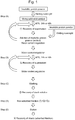
- Fig. 1 schematically shows the process of production.
- a degradation product of a water-insoluble protein may be a product resulting from solubilization and degradation of a water-insoluble protein and the average molecular weight and the molecular weight distribution thereof are not limited.
- Step (A) comprises bringing a water-insoluble protein into contact with a solid acid catalyst, heating the resulting mixture, and recovering a supernatant.
- water-insoluble used in the present invention refers to a condition under which a protein of interest does not dissolve in water.
- Water-insoluble proteins encompass substances that may be derived from animals or plants, and types thereof are not particularly limited. Examples of water-insoluble proteins include collagen, sericin, fibroin, keratin, casein, albumin, globulin, elastin, myosin, actin, whey protein, soybean protein, wheat protein, sesame protein, and egg protein. Jellyfish collagen is particularly preferable.
- jellyfish species is not limited, examples of jellyfish include Rhopilema esculenta, Stomolophus, Mastigias papua, Thysanostoma thysanura, Netrostoma setouchianum, Cephea cephea, Rhopilema asamushi, and Cassiopea ornate belonging to Rhizostomeae, Scyphozoa.
- Raw materials of water-insoluble proteins are preferably roughly ground, and more preferably powdered, with the use of a shearing machine, a mincing machine, a cutter, or the like as a pre-treatment, so as to promote solubilization and molecular weight reduction caused upon contact with a solid acid catalyst. Powderization can be carried out with the use of an apparatus that is generally used by a person skilled in the art, such as a hammer mill, bead mill, roller mill, pin mill, or blender.
- a water-insoluble protein that has been subjected to a pre-treatment as described above may be wetted with an aqueous medium before it is brought into contact with a solid acid catalyst.
- a water-insoluble protein is preferably subjected to wetting for approximately 1 to 36 hours, although such period varies depending on water-insoluble polymeric compound type.
- a solid acid catalyst used in the present invention is preferably at least one member selected from the group consisting of a cation exchanger, zeolite, and diatomaceous earth, with a cation exchanger being more preferable.
- Such solid acid catalyst can be used alone or in combinations of two or more.
- a cation exchanger is preferably a resin comprising at least either a sulfone group or a carboxyl group, and a sulfone group and a carboxyl group may be a sulfopropyl group and a carboxymethyl group, respectively.
- a counter ion of a cation exchanger is not a proton, it is preferable that the cation exchanger be used after its counter ion has been substituted with a proton.
- a sulfonic acid cation exchanger is an ion exchanger capable of exchanging cations including a sulfonic acid group (-SO 3 H).
- preferable forms include a cation exchange resin comprising a sulfonic acid group and a cation exchange membrane comprising a sulfonic acid group.
- preferable cation exchange resins include a resin comprising a hydrophilic vinyl polymer as a substrate, such as TOYOPEARL SP-650C and TOYOPEARL SP-550C (manufactured by Tosoh Corporation), and a polytetrafluoroethylene copolymer comprising perfluorosulfonic acid, such as Nafion®.
- Any zeolite that is generally used as a zeolite catalyst can be used without particular limitation.
- An example thereof is Zeolum® (manufactured by Tosoh Corporation).
- diatomaceous earth that can function as an acid catalyst can be used without particular limitation.
- An example thereof is diatomaceous earth (granular) manufactured by Wako Pure Chemical Industries, Ltd.
- a solid acid catalyst used in the present invention may be in either a particulate or powdered form. It is preferable that the average particle diameter be approximately 2 ⁇ m to 2 mm and the ion exchange capacity be approximately 0.01 to 1 eq/l.
- the solid acid catalyst is preferably a porous material.
- TOYOPEARL SP-650C and TOYOPEARL SP-550C are made of a porous material comprising a gel filtration chromatography filler into which a sulfonic acid group as an ion exchange group.
- the adequate pore size of a porous material varies depending on the molecular weight of the target water-insoluble polymeric compound. For example, it is 0.01 to 0.75 ⁇ m, and preferably 0.05 to 0.6 ⁇ m.
- the amount of the aqueous medium is, in combination with the aqueous medium used for wetting the water-insoluble protein, 1 to 50 times and preferably 5 to 15 times greater than the amount of the solid acid catalyst by mass.
- a degradation product of a water-insoluble protein is mainly recovered from a fraction that has not adsorbed to the solid acid catalyst (i.e., a supernatant).
- the aqueous medium used for wetting the water-insoluble protein and for bringing the water-insoluble protein into contact with the solid acid catalyst is not particularly limited, provided that such aqueous medium does not inhibit the reaction between the water-insoluble protein and the solid acid catalyst.
- examples thereof include water, such as ion exchange water, purified water, RO water, tap water, and well water; buffers, such as phosphate, carbonate, acetate, borate, citrate, and Tris buffers; and aqueous solutions of inorganic salts, such as sodium chloride, potassium chloride, and calcium chloride.
- the salt concentration is preferably as low as approximately 1 mM to 0.1 M.
- the amount of the water-insoluble protein can be adequately determined in accordance with the catalytic ability of the solid acid catalyst. For example, such amount is 0.01 to 0.5 times and preferably 0.05 to 0.2 times greater than the amount of the solid acid catalyst by mass.
- the heating temperature is 40°C to 160°C, preferably 60°C to 120°C, and more preferably 80°C to 100°C.
- the heating time is 0.1 to 168 hours, preferably 10 to 72 hours, and more preferably 24 to 48 hours, although it varies depending on the heating temperature.
- a water-insoluble protein for example, it is important to stop the molecular weight reduction until degradation of the protein to a peptide.
- a water-insoluble protein may be hydrolyzed to an amino acid. Accordingly, the treatment period is preferably shortened as the treatment temperature is increased.
- the water-insoluble protein is preferably brought into contact with the solid acid catalyst by the batch method.
- the solid acid catalyst is thoroughly mixed with the water-insoluble protein in the container, and the mixture is then heated. Heating is preferably carried out after the container has been hermetically sealed. Heating conditions are as described above.
- the batch method may involve the use of one or more containers.
- a supernatant is recovered after the heating treatment.
- a supernatant can be recovered via sedimentation, floatation, filtration, membrane separation, centrifugation, or another technique, and sedimentation is preferable because of the simplicity of the process.
- Fig. 2 shows an embodiment of the method for supernatant recovery.
- a solid acid catalyst is heavier than an aqueous medium. If it is allowed to stand, accordingly, sedimentation generally takes place within approximately 15 minutes.
- a drainage valve may be provided in a position slightly little above the tank bottom (slightly above the position of the sedimented solid acid catalyst), and the liquid may be discharged therefrom, so as to recover a supernatant.
- a filter having a pore diameter that allows a supernatant comprising a degradation product of a water-insoluble polymeric compound to pass therethrough but does not allow a solid acid catalyst to pass therethrough may be provided at the bottom of the tank, and the liquid may be discharged therefrom. Thus, a supernatant can be recovered.
- a series of procedure in this step i.e., contact of a water-insoluble protein with a solid acid catalyst, heating treatment, and recovery of a supernatant is repeated a plurality of times.
- the number of repetitions can be adequately changed in accordance with the water-insoluble protein type and the target yield of this step. For example, such procedure may be repeated 4 or 5 times.
- the number of repetitions may be determined so as to adjust the yield of the degradation product of the water-insoluble protein to 50% or higher, preferably 65% or higher, more preferably 70% or higher, and most preferably 80% or higher in the non-adsorbed fraction obtained by mixing the supernatant recovered in this step, the supernatant recovered in the next Step (B), and the wash solution recovered in the next Step (C) together.
- the entire amount of the water-insoluble polymeric compound to be treated is preferably divided into fractions of equal amounts from the viewpoint of the efficiency of solubilization and molecular weight reduction of the water-insoluble protein with the aid of the solid acid catalyst.
- Step (B) comprises adding an aqueous medium to the solid acid catalyst, agitating and heating the resulting mixture, and recovering a supernatant.
- a water-insoluble protein remaining unsolubilized in Step (A) and adhering to the solid acid catalyst surface can be solubilized, the molecular weight thereof can be reduced, and the resulting water-insoluble protein can be recovered.
- heating treatment may be carried out in accordance with the heating conditions (temperature and duration) that are employed when the solid acid catalyst is brought into contact with the water-insoluble protein.
- the recovery procedure is preferably repeated a plurality of times.
- the number of repetitions can be adequately changed in accordance with the water-insoluble protein type, the yield of the degradation product of the water-insoluble protein in Step (A), and the final target yield. For example, such procedure can be repeated 3 to 6 times.
- the number of repetitions may be determined so as to adjust the yield of the degradation product of the water-insoluble protein to 50% or higher, preferably 65% or higher, more preferably 70% or higher, and most preferably 80% or higher of the total amount of the non-adsorbed fraction obtained by mixing the supernatant recovered in Step (A), the supernatant recovered in Step (B), and the wash solution recovered in the next Step (C) together.
- a supernatant may be recovered in the same manner as in Step (A).
- Step (C) comprises washing a solid acid catalyst with an aqueous medium and recovering a wash solution.
- heating treatment is not carried out, and a solid acid catalyst may be washed once with an aqueous medium.
- Step (D) comprises mixing the supernatant recovered in Step (A), the supernatant recovered in Step (B), and the wash solution recovered in Step (C) and obtaining a fraction that has not adsorbed to the solid acid catalyst.
- Step (D) comprises mixing the supernatant recovered in Step (A), the supernatant recovered in Step (B), and the wash solution recovered in Step (C) and obtaining a fraction that has not adsorbed to the solid acid catalyst.
- Step (E) comprises eluting the adsorbed fraction from the solid acid catalyst and recovering an eluate, so as to obtain a fraction that has adsorbed to the solid acid catalyst.
- Elution can be carried out with the use of, for example, an aqueous solution containing a salt such as sodium chloride at high concentration (0.1 M or more), an acid such as hydrochloric acid or trifluoroacetic acid, and a base such as triethylamine.
- the degradation product of a water-insoluble protein can be obtained with high yield by implementing the process from Step (A) to Step (D).
- the degradation product of a water-insoluble protein adsorbed to the solid acid catalyst can be obtained from among the degradation product of a water-insoluble protein that has achieved solubilization and molecular weight reduction as a result of the reaction with the solid acid catalyst, and the yield can be further increased.
- the non-adsorbed fraction obtained in Step (D) and the adsorbed fraction obtained in Step (E) may be independently dried and prepared into the form of the final product. Alternatively, these fractions may be mixed, dried, and then prepared in the form of the final product. Drying techniques are not particularly limited, and examples of such techniques include air drying, lyophilization, blow drying, hot-air drying, vacuum dehydration, and drying via microwave application.
- the insoluble collagen powder prepared in (1) (1 g) was wetted with 90 ml of RO water overnight, it was then mixed with 10 ml of cation exchange resin (TOYOPEARL SP-550C), and the mixture was thoroughly agitated. The resultant was subjected to reaction at 80°C for 24 hours for solubilization, the resultant was cooled, and the supernatant containing the collagen peptide was then recovered.
- TOYOPEARL SP-550C cation exchange resin
- insoluble collagen powder obtained from the Rhopilema esculenta umbrella prepared in (1) was wetted overnight in the same manner as described above, the wet powder was added to the above cation exchange resin after the supernatant was recovered, the amount of the solution was adjusted to 100 ml with the addition of RO water, and the solution was thoroughly agitated. The resultant was subjected to reaction at 80°C for 24 hours, and the supernatant was recovered again. This procedure was repeated 3 more times (and the first to the fifth recovery procedures were completed). The insoluble collagen powder obtained from the Rhopilema esculenta umbrella was subjected to each procedure in an equivalent amount (5 g in total).
- RO water was added to the remaining cation exchange resin, so as to adjust the amount of the solution to 100 ml, and the resultant was thoroughly agitated. After the reaction had been conducted at 80°C for 24 hours, the supernatant was recovered. This procedure was repeated 6 more times (and the sixth to the eleventh recovery procedures were completed). The remaining cation exchange resin was washed with 30 ml of RO water. The recovered supernatant was mixed with the wash solution, and a solution of the collagen peptide with a molecular weight (Mp) of 12 kDa or less, which had not adsorbed to the cation exchange resin, was obtained.
- Mp molecular weight
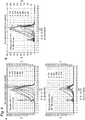
- Fig. 3a shows the transition of the amount of the collagen peptide (i.e., the non-adsorbed peptide) in the recovered supernatant (reaction time: 24 hours).
- the insoluble collagen powder prepared in (1) (1 g) was wetted with 90 ml of RO water overnight, it was then mixed with 10 ml of cation exchange resin (TOYOPEARL SP-550C), and the mixture was thoroughly agitated. The resultant was subjected to reaction at 80°C for 48 hours for solubilization, the reaction product was cooled, and the supernatant containing the collagen peptide was then recovered.
- TOYOPEARL SP-550C cation exchange resin
- the insoluble collagen powder obtained from the Rhopilema esculenta umbrella prepared in (1) was wetted overnight in the same manner as described above, the wet powder was added to the above cation exchange resin after the supernatant was recovered, and the amount of the solution was adjusted to 100 ml with the addition of RO water, followed by thorough agitation. The resultant was subjected to reaction at 80°C for 48 hours, and a supernatant was recovered again. This procedure was repeated 3 more times (and the first to the fifth recovery procedures were completed). The insoluble collagen powder obtained from the Rhopilema esculenta umbrella was subjected to each procedure in an equivalent amount (5 g in total).
- RO water was added to the remaining cation exchange resin, so as to adjust the amount of the solution to 100 ml, and the resultant was thoroughly agitated. After the reaction had been conducted at 80°C for 48 hours, the supernatant was recovered. This procedure was repeated 2 more times (and the sixth to the eighth recovery procedures were completed). The remaining cation exchange resin was washed with 80 ml of RO water. The recovered supernatant was mixed with the wash solution, and a solution of the collagen peptide with a molecular weight (Mp) of 12 kDa or less, which had not adsorbed to the cation exchange resin, was obtained.
- Mp molecular weight
- Fig. 3b shows the transition of the amount of the collagen peptide (i.e., the non-adsorbed peptide) in the recovered supernatant (reaction time: 48 hours).
- the insoluble collagen powder obtained from the Rhopilema esculenta umbrella (1 g) was wetted with 100 ml of RO water overnight, it was then mixed with 100 g of cation exchange resin (TOYOPEARL SP-550C), and the mixture was thoroughly agitated.
- the resultant was subjected to reaction at 80°C for 24 hours for solubilization, the resultant was cooled, and it was then washed with 500 ml of RO water.
- the washed resin was subjected to extraction 3 times with 100 ml of a 5% triethylamine/10% acetonitrile solution. After the obtained extracts had been mixed with each other, the mixture was solidified to dryness with the use of a rotary evaporator.
- the dried extract was dissolved in RO water and then lyophilized. Samples containing the resulting dry products at 3.00, 1.50, 0.75, 0.375, and 0.188 mg/ml were prepared and used to prepare the standard calibration curve for collagen peptide quant
- the amount of the collagen peptide obtained in (2) was measured using the BCA protein assay kit (manufactured by PIERCE).
- the BCA protein assay reagent A was mixed with the BCA protein assay reagent B at a ratio of 50 : 1, and the resultant was designated as the BCA reagent.
- the sample (100 ⁇ l) was mixed with 2 ml of the BCA reagent, the mixture was incubated at 37° for 15 minutes, and the absorbance was measured at 562 nm. The absorbance was measured using a digital colorimeter (mini photo 10, Sanshin Kogyo).
- the amount of the peptide was determined on the basis of the collagen peptide standard calibration curved prepared in (3-1).
- Table 1 and Table 2 show the results of measurements after the reaction had been conducted for 24 hours.
- the amount of the collagen peptide (the non-adsorbed peptide) was 3.65 g and the yield was 73%.
- the amount of the collagen peptide (the adsorbed peptide) was 0.86 g and the yield was 17%.
- Table 3 and Table 4 show the results of measurements after the reaction had been conducted for 48 hours.
- the amount of the collagen peptide was 3.58 g and the yield was 72%.
- the amount of the collagen peptide was 0.77 g and the yield was 15%.
- the molecular weight distribution of the collagen peptide obtained in (2) was measured via gel filtration chromatography. The measurement conditions are described below.
- Fig. 4 shows molecular weight distribution of a collagen peptide (a non-adsorbed peptide) in a supernatant (the molecular weights of pullulan standards: M1: 112 kDa; M2: 47.3 kDa; M3: 22.8 kDa; M4: 11.8 kDa; M5: 5.9 kDa).
- M1 112 kDa
- M2 47.3 kDa
- M3 22.8 kDa
- M4 11.8 kDa
- M5 5.9 kDa
- Fig. 5 shows molecular weight distribution of a collagen peptide (an adsorbed peptide) in an eluate (the molecular weights of pullulan standards: M1: 112 kDa; M2: 47.3 kDa; M3: 22.8 kDa; M4: 11.8 kDa; M5: 5.9 kDa).
- the molecular weight of the adsorbed peptide was less than that of the non-adsorbed peptide, and the maximal peak was 5.9 kDa or less. Regardless of the reaction time, substantially the same molecular weight distribution was observed in the case of the reaction conducted for 24 hours as that observed in the case of the reaction conducted for 48 hours.
- Sericin powder (1 g, Kogensha Co. Ltd.) was wetted with 90 ml of RO water overnight, it was then mixed with 10 ml of cation exchange resin (TOYOPEARL SP-550C), and the mixture was thoroughly agitated. The resultant was subjected to reaction at 80°C for 24 hours for solubilization, the resultant was cooled, and the supernatant containing the sericin peptide was then recovered. Subsequently, sericin powder was wetted overnight in the same manner as described above, the wet powder was added to the above cation exchange resin after the supernatant was recovered, the amount of the solution was adjusted to 100 ml with the addition of RO water, and the solution was thoroughly agitated.
- cation exchange resin TOYOPEARL SP-550C
- Fig. 6 shows the transition of the amount of the sericin peptide (i.e., the non-adsorbed peptide) in the recovered supernatant.
- the amount of the sericin peptide obtained in (1) was measured in the same manner as in Example 1 (3-2), except for the use of the standard calibration curve for sericin peptide quantification.
- Table 5 and Table 6 show the results of measurements.
- the amount of the sericin peptide (the non-adsorbed peptide) was 3.36 g and the yield was 67%.
- the amount of the sericin peptide (the adsorbed peptide) was 0.21 g and the yield was 4%.
- the molecular weight distribution of the sericin peptide obtained in (1) was measured via gel filtration chromatography in accordance with the same measurement conditions employed in Example 1.
- Fig. 7 shows molecular weight distribution of a sericin peptide (a non-adsorbed peptide) in a supernatant (the molecular weights of pullulan standards: M1: 112 kDa; M2: 47.3 kDa; M3: 22.8 kDa; M4: 11.8 kDa; M5: 5.9 kDa). While a sharp peak was detected at 5.9 kDa or less in terms of pullulan molecular weight standards in the first and the second recovery procedures, a broad peak shifted toward the high-molecular-weight side was detected thereafter,
- Fig. 8 shows molecular weight distribution of a sericin peptide (an adsorbed peptide) in an eluate (the molecular weights of pullulan standards: M1: 112 kDa; M2: 47.3 kDa; M3: 22.8 kDa; M4: 11.8 kDa; M5: 5.9 kDa).
- the maximal peak of the adsorbed peptide did not significantly differ from the peak of the non-adsorbed peptide observed at the first, second, and seventh to twelfth recovery procedures.
- Keratin powder (1 g, Nacalai Tesque, Inc.) was wetted with 90 ml of RO water overnight, it was then mixed with 10 ml of cation exchange resin (TOYOPEARL SP-550C), and the mixture was thoroughly agitated. The resultant was subjected to reaction at 100°C for 48 hours for solubilization, the resultant was cooled, and the supernatant containing the keratin peptide was then recovered. Subsequently, keratin powder was wetted overnight in the same manner as described above, the wet powder was added to the above cation exchange resin after the supernatant was recovered, the amount of the solution was adjusted to 100 ml with the addition of RO water, and the solution was thoroughly agitated.
- TOYOPEARL SP-550C cation exchange resin
- the resultant was subjected to reaction at 100°C for 48 hours, and the supernatant was recovered again. This procedure was repeated 3 more times (and the first to the fifth recovery procedures were completed). Keratin powder was subjected to each procedure in an equivalent amount (5 g in total). RO water was added to the remaining cation exchange resin, so as to adjust the amount of the solution to 100 ml, and the resultant was thoroughly agitated. After the reaction had been conducted at 100°C for 48 hours, the supernatant was recovered. This procedure was repeated 2 more times (and the sixth to the eighth recovery procedures were completed). The remaining cation exchange resin was washed with 80 ml of RO water.
- the recovered supernatant was mixed with the wash solution, and a solution of the keratin peptide with a molecular weight (Mp) of 5.9 kDa or less, which had not adsorbed to the cation exchange resin, was obtained.
- Mp molecular weight
- the amount of the keratin peptide in the eluate among the keratin peptide obtained in (1) was measured in the same manner as in Example 1 (3-2), except for the use of the standard calibration curve for keratin peptide quantification.
- the supernatant including the wash solution
- the supernatant was lyophilized, and dry weight of the keratin peptide was determined.
- the amount of the keratin peptide (the non-adsorbed peptide) was 2.65 g and the yield was 53%.
- the amount of the keratin peptide (the adsorbed peptide) was 0.20 g and the yield was 4%.
- the molecular weight distribution of the keratin peptide obtained in (1) was measured via gel filtration chromatography in accordance with the same measurement conditions employed in Example 1.
- Fig. 9 shows molecular weight distribution of a keratin peptide (a non-adsorbed peptide) in a supernatant (the molecular weights of pullulan standards: M1: 112 kDa; M2: 47.3 kDa; M3: 22.8 kDa; M4: 11.8 kDa; M5: 5.9 kDa).
- M1 112 kDa
- M2 47.3 kDa
- M3 22.8 kDa
- M4 11.8 kDa
- M5 5.9 kDa
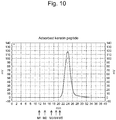
- Fig. 10 shows molecular weight distribution of a keratin peptide (an adsorbed peptide) in an eluate.
- the maximal peak of the adsorbed peptide did not significantly differ from that of the non-adsorbed peptide.
- Agar powder (1 g, Kanto Chemical Co., Inc.) was suspended in 90 ml of RO water, it was mixed with 10 ml of cation exchange resin (TOYOPEARL SP-550C), and the mixture was thoroughly agitated. The resultant was subjected to reaction at 100°C for 24 hours for solubilization, the resultant was cooled, and the supernatant containing the agar oligosaccharide was then recovered. Subsequently, agar powder was wetted overnight in the same manner as described above, the wet powder was added to the above cation exchange resin after the supernatant was recovered, the amount of the solution was adjusted to 100 ml with the addition of RO water, and the solution was thoroughly agitated.
- cation exchange resin TOYOPEARL SP-550C
- the resultant was subjected to reaction at 100°C for 24 hours, and the supernatant was recovered again. This procedure was repeated 3 more times (and the first to the fifth recovery procedures were completed).
- the agar powder was subjected to each procedure in an equivalent amount (5 g in total).
- RO water was added to the remaining cation exchange resin, so as to adjust the amount of the solution to 100 ml, and the resultant was thoroughly agitated. After the reaction had been conducted at 100°C for 24 hours, the supernatant was recovered. This procedure was repeated 2 more times (and the sixth to the eighth recovery procedures were completed). The remaining cation exchange resin was washed with 80 ml of RO water. The recovered supernatant was mixed with the wash solution, and a solution of the agar oligosaccharide, which had not adsorbed to the cation exchange resin, was obtained.
- Fig. 11 shows the transition of the amount of the agar oligosaccharide (i.e., the non-adsorbed oligosaccharide) in the recovered supernatant.
- the supernatant was lyophilized, and dry weight of the agar oligosaccharide was determined.
- the amount of the agar oligosaccharide in the eluate was determined by the phenol-sulfuric acid method described below. At the outset, 1.0 ml of a 5% phenol solution was added to and mixed with 1.0 ml of the sample. Subsequently, 5.0 ml of concentrated sulfuric acid was directly added dropwise thereto rapidly.
- the resulting mixture was allowed to stand at room temperature for 10 minutes and then cooled in a water bath for 10 minutes.
- the absorbance was measured at 470 nm.
- the absorbance was measured using a digital colorimeter (mini photo 10, Sanshin Kogyo). Samples containing the glucose at 50, 100, and 150 mg/ml were prepared and used to prepare the standard calibration curve.
- Table 7 shows the results of measurements.
- the amount of the agar oligosaccharide (the non-adsorbed oligosaccharide) was 4.15 g and the yield was 83%.
- the molecular weight distribution of the agar oligosaccharide obtained in (1) was measured via gel filtration chromatography. Measurement was carried out under the same conditions as employed in Example 1, except for the use of the TSKgel G-OLIGO-PW column (7.8 ⁇ 300 mm, Tosoh Corporation). As control samples, the standard sample for molecular weight measurement (Shodex STANDARD P-82, Showa Denko K.K., molecular weight: 5.9 kDa), a monosaccharide (glucose), a disaccharide (sucrose), and a trisaccharide (raffinose) were used.
- Fig. 12 shows molecular weight distribution of the agar oligosaccharide (the non-adsorbed oligosaccharide) in the supernatant (control substance M1 : 5.9 kDa (M1: Shodex STANDARD P-82, Showa Denko K.K.); M2: trisaccharide (raffinose); M3: disaccharide (sucrose); M4: monosaccharide (glucose)).
- M1 Shodex STANDARD P-82, Showa Denko K.K.
- the present invention is applicable in the fields for the production of functional peptides or functional oligosaccharides that are starting materials of pharmaceutical products, food and beverage products, and cosmetic products.
Landscapes
- Chemical & Material Sciences (AREA)
- Health & Medical Sciences (AREA)
- Organic Chemistry (AREA)
- Life Sciences & Earth Sciences (AREA)
- Molecular Biology (AREA)
- General Health & Medical Sciences (AREA)
- Biochemistry (AREA)
- Medicinal Chemistry (AREA)
- Genetics & Genomics (AREA)
- Proteomics, Peptides & Aminoacids (AREA)
- Biophysics (AREA)
- Zoology (AREA)
- Toxicology (AREA)
- Gastroenterology & Hepatology (AREA)
- Analytical Chemistry (AREA)
- Chemical Kinetics & Catalysis (AREA)
- Engineering & Computer Science (AREA)
- Materials Engineering (AREA)
- Polymers & Plastics (AREA)
- Insects & Arthropods (AREA)
- Tropical Medicine & Parasitology (AREA)
- Biotechnology (AREA)
- Peptides Or Proteins (AREA)
- Polysaccharides And Polysaccharide Derivatives (AREA)
Claims (7)
- Verfahren zum Herstellen eines Abbauprodukts eines wasserunlöslichen Proteins, umfassend die folgenden Schritte:(A) Inkontaktbringen eines wasserunlöslichen Proteins mit einem Kationenaustauschharz, Erwärmen der resultierenden Mischung und Gewinnen eines Überstands;(B) nach Schritt (A), Hinzufügen eines wässrigen Mediums zu dem Kationenaustauschharz, Umrühren und Erwärmen der resultierenden Mischung und Gewinnen eines Überstands;(C) nach Schritt (B), Waschen des Kationenaustauschharzes mit einem wässrigen Medium und Gewinnen einer Waschlösung;(D) Mischen des Überstands, der in Schritt (A) gewonnen wurde, des Überstands, der in Schritt (B) gewonnen wurde, und der Waschlösung, die in Schritt (C) gewonnen wurde, und Erhalten einer Fraktion, die nicht an das Kationenaustauschharz adsorbiert hat; und(E) nach Schritt (D), Eluieren der adsorbierten Fraktion von dem Kationenaustauschharz und Gewinnen eines Eluats, um eine Fraktion zu erhalten, die an das Kationenaustauschharz adsorbiert hat.
- Verfahren nach Anspruch 1, wobei das wasserunlösliche Protein Kollagen, Sericin, Fibroin, Keratin, Kasein, Albumin, Globulin, Elastin, Myosin, Aktin, Molkeprotein, Sojabohnenprotein, Weizenprotein, Sesamprotein oder Eiprotein ist.
- Verfahren nach Anspruch 1 oder 2, das ferner einen Schritt eines Tränkens des wasserunlöslichen Proteins in einem wässrigen Medium vor dem Schritt eines Inkontaktbringens des wasserunlöslichen Proteins mit dem Kationenaustauschharz umfasst.
- Verfahren nach einem der Ansprüche 1 bis 3, wobei die Menge des wasserunlöslichen Proteins das 0,01- bis 0,5-Fache der Masse bezogen auf die Menge des Kationenaustauschharzes ist.
- Verfahren nach einem der Ansprüche 1 bis 4, wobei, in Schritt (A), die Menge eines wässrigen Mediums, das verwendet wird, wenn das wasserunlösliche Protein in Kontakt mit dem Kationenaustauschharz gebracht wird, auf das 1- bis 50-Fache der Masse bezogen auf die Menge des Kationenaustauschharzes angepasst wird.
- Verfahren nach einem der Ansprüche 1 bis 5, wobei die Wärmebehandlung in Schritt (A) und Schritt (B) bei 40 °C bis 160 °C für 0,1 bis 168 Stunden ausgeführt wird.
- Verfahren nach einem der Ansprüche 1 bis 6, wobei Schritt (A) und Schritt (B) jeweils eine Vielzahl von Malen wiederholt werden, bis der Ertrag des Abbauprodukts des wasserunlöslichen Proteins in der nicht adsorbierten Fraktion 50 % oder mehr erreicht.
Applications Claiming Priority (2)
| Application Number | Priority Date | Filing Date | Title |
|---|---|---|---|
| JP2013267662 | 2013-12-25 | ||
| PCT/JP2014/083342 WO2015098634A1 (ja) | 2013-12-25 | 2014-12-17 | 水不溶性高分子化合物の分解物の連続的製造方法 |
Publications (3)
| Publication Number | Publication Date |
|---|---|
| EP3088409A1 EP3088409A1 (de) | 2016-11-02 |
| EP3088409A4 EP3088409A4 (de) | 2017-11-08 |
| EP3088409B1 true EP3088409B1 (de) | 2019-02-06 |
Family
ID=53478498
Family Applications (1)
| Application Number | Title | Priority Date | Filing Date |
|---|---|---|---|
| EP14873187.0A Not-in-force EP3088409B1 (de) | 2013-12-25 | 2014-12-17 | Verfahren zur kontinuierlichen herstellung für abbauprodukte aus wasserunlöslichen makromolekularen verbindungen |
Country Status (7)
| Country | Link |
|---|---|
| US (1) | US10239915B2 (de) |
| EP (1) | EP3088409B1 (de) |
| JP (1) | JP6431851B2 (de) |
| KR (1) | KR102312148B1 (de) |
| CN (1) | CN106061991B (de) |
| AU (1) | AU2014371389B2 (de) |
| WO (1) | WO2015098634A1 (de) |
Family Cites Families (20)
| Publication number | Priority date | Publication date | Assignee | Title |
|---|---|---|---|---|
| US4534906A (en) | 1982-11-01 | 1985-08-13 | Genentech, Inc. | Removal of impurities from human leukocyte interferon preparations |
| JP2974434B2 (ja) * | 1990-03-15 | 1999-11-10 | 雪印乳業株式会社 | 分泌性コンポネント含有組成物 |
| US5767078A (en) * | 1995-06-07 | 1998-06-16 | Johnson; Dana L. | Agonist peptide dimers |
| JP4324265B2 (ja) * | 1999-01-14 | 2009-09-02 | 東ソー株式会社 | ホモアリルアルコール類の製造方法 |
| JP4970754B2 (ja) | 2005-08-17 | 2012-07-11 | 公立大学法人福井県立大学 | クラゲ類からのコラーゲン回収方法 |
| JP4423432B2 (ja) * | 2006-03-01 | 2010-03-03 | 国立大学法人北海道大学 | セルロースの加水分解および/または加水分解物の還元用触媒およびセルロースから糖アルコールの製造方法 |
| US20080226826A1 (en) | 2006-06-26 | 2008-09-18 | Tokyo Electon Limited | Substrate Processing Method and Substrate Processing Apparatus |
| JP5263738B2 (ja) * | 2006-06-26 | 2013-08-14 | 国立大学法人東京工業大学 | 多糖類の加水分解による他の多糖類および/または単糖類の製造方法 |
| JP4796914B2 (ja) | 2006-07-28 | 2011-10-19 | 公立大学法人福井県立大学 | クラゲ類からのコラーゲン回収方法 |
| US8062428B2 (en) * | 2007-11-06 | 2011-11-22 | University Of Central Florida Research Foundation, Inc. | Solid acid catalyzed hydrolysis of cellulosic materials |
| JP5273766B2 (ja) | 2007-11-13 | 2013-08-28 | 独立行政法人理化学研究所 | タンパク質加水分解方法および装置、ならびに、タンパク質分析方法および装置 |
| WO2010058590A1 (ja) * | 2008-11-19 | 2010-05-27 | 独立行政法人理化学研究所 | タンパク質の加水分解方法、加水分解装置、及び加水分解産物の分析装置 |
| JP5692678B2 (ja) * | 2009-06-10 | 2015-04-01 | 独立行政法人産業技術総合研究所 | タンパク質リフォールディング条件設定キット |
| CN101692617A (zh) * | 2009-08-26 | 2010-04-07 | 南京邮电大学 | 多径信号载波相位误差估计装置 |
| CN101691617A (zh) | 2009-09-11 | 2010-04-07 | 南京工业大学 | 一种植物秸秆降解制备可溶性糖的方法 |
| JP2011213634A (ja) * | 2010-03-31 | 2011-10-27 | Equos Research Co Ltd | セルロースの分解方法及びセルロース分解用カーボン系固体酸触媒 |
| JP2012031107A (ja) * | 2010-07-30 | 2012-02-16 | Koyo Chemical Kk | ヘテロ二糖、キトビオース、及びジ‐n‐アセチルキトビオースの製造方法、並びにそれらの用途 |
| JP5709157B2 (ja) * | 2010-08-16 | 2015-04-30 | 国立大学法人 香川大学 | 糖鎖の製造方法 |
| JP2013006142A (ja) * | 2011-06-23 | 2013-01-10 | Toshiba Corp | 植物系材料の加水分解用触媒及び糖類の製造方法 |
| JP2013095708A (ja) | 2011-11-01 | 2013-05-20 | Nicca Chemical Co Ltd | クラゲコラーゲンペプチド混合物 |
-
2014
- 2014-12-17 EP EP14873187.0A patent/EP3088409B1/de not_active Not-in-force
- 2014-12-17 US US15/107,983 patent/US10239915B2/en active Active
- 2014-12-17 WO PCT/JP2014/083342 patent/WO2015098634A1/ja not_active Ceased
- 2014-12-17 JP JP2015554772A patent/JP6431851B2/ja not_active Expired - Fee Related
- 2014-12-17 CN CN201480071005.1A patent/CN106061991B/zh not_active Expired - Fee Related
- 2014-12-17 AU AU2014371389A patent/AU2014371389B2/en not_active Ceased
- 2014-12-17 KR KR1020167019784A patent/KR102312148B1/ko not_active Expired - Fee Related
Non-Patent Citations (1)
| Title |
|---|
| None * |
Also Published As
| Publication number | Publication date |
|---|---|
| KR102312148B1 (ko) | 2021-10-12 |
| AU2014371389B2 (en) | 2019-12-05 |
| US20160326213A1 (en) | 2016-11-10 |
| KR20160102256A (ko) | 2016-08-29 |
| EP3088409A4 (de) | 2017-11-08 |
| US10239915B2 (en) | 2019-03-26 |
| WO2015098634A1 (ja) | 2015-07-02 |
| CN106061991B (zh) | 2019-12-13 |
| AU2014371389A1 (en) | 2016-07-21 |
| JP6431851B2 (ja) | 2018-11-28 |
| EP3088409A1 (de) | 2016-11-02 |
| CN106061991A (zh) | 2016-10-26 |
| JPWO2015098634A1 (ja) | 2017-03-23 |
Similar Documents
| Publication | Publication Date | Title |
|---|---|---|
| US9974321B2 (en) | Fish protein oligopeptide with low allergenicity and slight fishiness and industrial preparation method and application thereof | |
| US20170267746A1 (en) | Techniques of preparing collagen active peptides | |
| CN104513843B (zh) | 一种多糖和蛋白肽的联合制备方法 | |
| CN113151387B (zh) | 一种具有抗氧化和增强免疫功能的鳕鱼皮胶原蛋白肽及其制备方法 | |
| CA2669090A1 (en) | Protein gel formation | |
| CN104152519B (zh) | 一种酶溶性高纯超螺旋结构ⅰ型胶原蛋白的制备方法 | |
| CN105707879B (zh) | 一种大豆肽生物钙的制备方法 | |
| CN108048434A (zh) | 一种蚯蚓中蚯蚓蛋白和蚓激酶的提取方法 | |
| CN109943612A (zh) | 一种酶解鲢鱼鱼鳞生产高活性鱼糜及制品抗冻剂的方法 | |
| CN118909042B (zh) | 一种蛋壳膜抗氧化肽及其制备方法和应用 | |
| EP3088409B1 (de) | Verfahren zur kontinuierlichen herstellung für abbauprodukte aus wasserunlöslichen makromolekularen verbindungen | |
| CN103352065A (zh) | 一种怀山药抗氧化多肽及其制备方法 | |
| CN110452286B (zh) | 一种具有乳化活性与抗氧化活性的鸢乌贼蛋白肽及其制备方法与应用 | |
| JP4741471B2 (ja) | 改良された抽出方法 | |
| CN116178482B (zh) | 一种基于响应面法优化天山马鹿皱胃糖蛋白超声辅助提取的方法及应用 | |
| KR20090127785A (ko) | 다시마 주요성분을 적절히 분리 추출, 농축, 전부 활용,오염을 유발하지 않는 다시마 완전 처리공정 | |
| CN110699410B (zh) | 一种南极磷虾小分子肽的制备方法 | |
| KR101083357B1 (ko) | 근육 단백질의 분리 방법 | |
| CN121320474A (zh) | 一种基于弹性蛋白保护的干花胶锁链素低温提取工艺 | |
| CN121992058A (zh) | 一种肠道免疫增强型海参肽的定向制备方法 | |
| CN120775944A (zh) | 一种锌螯合三文鱼鱼骨磷酸肽和其制备方法及补锌鱼糜 | |
| RU2662368C2 (ru) | Способ извлечения водорастворимых компонентов из морских бурых водорослей, обогащенных фукоиданом и йодом | |
| CN103638515B (zh) | 一种鮟鱇鱼皮胶原蛋白肽抗革兰氏阳性菌组合物 | |
| CN104830934A (zh) | 一种猪骨抗氧化肽的制备方法 | |
| CN119119192A (zh) | 一种干腌火腿皮源抗氧化肽及其制备方法与应用 |
Legal Events
| Date | Code | Title | Description |
|---|---|---|---|
| PUAI | Public reference made under article 153(3) epc to a published international application that has entered the european phase |
Free format text: ORIGINAL CODE: 0009012 |
|
| 17P | Request for examination filed |
Effective date: 20160722 |
|
| AK | Designated contracting states |
Kind code of ref document: A1 Designated state(s): AL AT BE BG CH CY CZ DE DK EE ES FI FR GB GR HR HU IE IS IT LI LT LU LV MC MK MT NL NO PL PT RO RS SE SI SK SM TR |
|
| AX | Request for extension of the european patent |
Extension state: BA ME |
|
| DAX | Request for extension of the european patent (deleted) | ||
| A4 | Supplementary search report drawn up and despatched |
Effective date: 20171009 |
|
| RIC1 | Information provided on ipc code assigned before grant |
Ipc: C13K 13/00 20060101ALI20171003BHEP Ipc: C07K 14/435 20060101ALI20171003BHEP Ipc: C07K 1/12 20060101AFI20171003BHEP Ipc: C07K 14/78 20060101ALI20171003BHEP |
|
| GRAP | Despatch of communication of intention to grant a patent |
Free format text: ORIGINAL CODE: EPIDOSNIGR1 |
|
| STAA | Information on the status of an ep patent application or granted ep patent |
Free format text: STATUS: GRANT OF PATENT IS INTENDED |
|
| INTG | Intention to grant announced |
Effective date: 20180710 |
|
| GRAS | Grant fee paid |
Free format text: ORIGINAL CODE: EPIDOSNIGR3 |
|
| RAP1 | Party data changed (applicant data changed or rights of an application transferred) |
Owner name: MARUWA OIL & FAT CO., LTD. Owner name: JELLYFISH RESEARCH LABORATORIES, INC. |
|
| RIN1 | Information on inventor provided before grant (corrected) |
Inventor name: SHINOHARA, SATOSHI Inventor name: KIHIRA, KOJI Inventor name: BABA, TAKAYUKI |
|
| RIN1 | Information on inventor provided before grant (corrected) |
Inventor name: SHINOHARA, SATOSHI Inventor name: BABA, TAKAYUKI Inventor name: KIHIRA, KOJI |
|
| GRAA | (expected) grant |
Free format text: ORIGINAL CODE: 0009210 |
|
| STAA | Information on the status of an ep patent application or granted ep patent |
Free format text: STATUS: THE PATENT HAS BEEN GRANTED |
|
| AK | Designated contracting states |
Kind code of ref document: B1 Designated state(s): AL AT BE BG CH CY CZ DE DK EE ES FI FR GB GR HR HU IE IS IT LI LT LU LV MC MK MT NL NO PL PT RO RS SE SI SK SM TR |
|
| REG | Reference to a national code |
Ref country code: GB Ref legal event code: FG4D |
|
| REG | Reference to a national code |
Ref country code: CH Ref legal event code: EP Ref country code: AT Ref legal event code: REF Ref document number: 1094846 Country of ref document: AT Kind code of ref document: T Effective date: 20190215 |
|
| REG | Reference to a national code |
Ref country code: DE Ref legal event code: R096 Ref document number: 602014040883 Country of ref document: DE |
|
| REG | Reference to a national code |
Ref country code: IE Ref legal event code: FG4D |
|
| REG | Reference to a national code |
Ref country code: NL Ref legal event code: MP Effective date: 20190206 |
|
| REG | Reference to a national code |
Ref country code: LT Ref legal event code: MG4D |
|
| PG25 | Lapsed in a contracting state [announced via postgrant information from national office to epo] |
Ref country code: FI Free format text: LAPSE BECAUSE OF FAILURE TO SUBMIT A TRANSLATION OF THE DESCRIPTION OR TO PAY THE FEE WITHIN THE PRESCRIBED TIME-LIMIT Effective date: 20190206 Ref country code: LT Free format text: LAPSE BECAUSE OF FAILURE TO SUBMIT A TRANSLATION OF THE DESCRIPTION OR TO PAY THE FEE WITHIN THE PRESCRIBED TIME-LIMIT Effective date: 20190206 Ref country code: NL Free format text: LAPSE BECAUSE OF FAILURE TO SUBMIT A TRANSLATION OF THE DESCRIPTION OR TO PAY THE FEE WITHIN THE PRESCRIBED TIME-LIMIT Effective date: 20190206 Ref country code: PT Free format text: LAPSE BECAUSE OF FAILURE TO SUBMIT A TRANSLATION OF THE DESCRIPTION OR TO PAY THE FEE WITHIN THE PRESCRIBED TIME-LIMIT Effective date: 20190606 Ref country code: SE Free format text: LAPSE BECAUSE OF FAILURE TO SUBMIT A TRANSLATION OF THE DESCRIPTION OR TO PAY THE FEE WITHIN THE PRESCRIBED TIME-LIMIT Effective date: 20190206 Ref country code: NO Free format text: LAPSE BECAUSE OF FAILURE TO SUBMIT A TRANSLATION OF THE DESCRIPTION OR TO PAY THE FEE WITHIN THE PRESCRIBED TIME-LIMIT Effective date: 20190506 |
|
| REG | Reference to a national code |
Ref country code: AT Ref legal event code: MK05 Ref document number: 1094846 Country of ref document: AT Kind code of ref document: T Effective date: 20190206 |
|
| PG25 | Lapsed in a contracting state [announced via postgrant information from national office to epo] |
Ref country code: IS Free format text: LAPSE BECAUSE OF FAILURE TO SUBMIT A TRANSLATION OF THE DESCRIPTION OR TO PAY THE FEE WITHIN THE PRESCRIBED TIME-LIMIT Effective date: 20190606 Ref country code: LV Free format text: LAPSE BECAUSE OF FAILURE TO SUBMIT A TRANSLATION OF THE DESCRIPTION OR TO PAY THE FEE WITHIN THE PRESCRIBED TIME-LIMIT Effective date: 20190206 Ref country code: HR Free format text: LAPSE BECAUSE OF FAILURE TO SUBMIT A TRANSLATION OF THE DESCRIPTION OR TO PAY THE FEE WITHIN THE PRESCRIBED TIME-LIMIT Effective date: 20190206 Ref country code: GR Free format text: LAPSE BECAUSE OF FAILURE TO SUBMIT A TRANSLATION OF THE DESCRIPTION OR TO PAY THE FEE WITHIN THE PRESCRIBED TIME-LIMIT Effective date: 20190507 Ref country code: BG Free format text: LAPSE BECAUSE OF FAILURE TO SUBMIT A TRANSLATION OF THE DESCRIPTION OR TO PAY THE FEE WITHIN THE PRESCRIBED TIME-LIMIT Effective date: 20190506 Ref country code: RS Free format text: LAPSE BECAUSE OF FAILURE TO SUBMIT A TRANSLATION OF THE DESCRIPTION OR TO PAY THE FEE WITHIN THE PRESCRIBED TIME-LIMIT Effective date: 20190206 |
|
| PG25 | Lapsed in a contracting state [announced via postgrant information from national office to epo] |
Ref country code: RO Free format text: LAPSE BECAUSE OF FAILURE TO SUBMIT A TRANSLATION OF THE DESCRIPTION OR TO PAY THE FEE WITHIN THE PRESCRIBED TIME-LIMIT Effective date: 20190206 Ref country code: CZ Free format text: LAPSE BECAUSE OF FAILURE TO SUBMIT A TRANSLATION OF THE DESCRIPTION OR TO PAY THE FEE WITHIN THE PRESCRIBED TIME-LIMIT Effective date: 20190206 Ref country code: ES Free format text: LAPSE BECAUSE OF FAILURE TO SUBMIT A TRANSLATION OF THE DESCRIPTION OR TO PAY THE FEE WITHIN THE PRESCRIBED TIME-LIMIT Effective date: 20190206 Ref country code: SK Free format text: LAPSE BECAUSE OF FAILURE TO SUBMIT A TRANSLATION OF THE DESCRIPTION OR TO PAY THE FEE WITHIN THE PRESCRIBED TIME-LIMIT Effective date: 20190206 Ref country code: IT Free format text: LAPSE BECAUSE OF FAILURE TO SUBMIT A TRANSLATION OF THE DESCRIPTION OR TO PAY THE FEE WITHIN THE PRESCRIBED TIME-LIMIT Effective date: 20190206 Ref country code: EE Free format text: LAPSE BECAUSE OF FAILURE TO SUBMIT A TRANSLATION OF THE DESCRIPTION OR TO PAY THE FEE WITHIN THE PRESCRIBED TIME-LIMIT Effective date: 20190206 Ref country code: DK Free format text: LAPSE BECAUSE OF FAILURE TO SUBMIT A TRANSLATION OF THE DESCRIPTION OR TO PAY THE FEE WITHIN THE PRESCRIBED TIME-LIMIT Effective date: 20190206 Ref country code: AL Free format text: LAPSE BECAUSE OF FAILURE TO SUBMIT A TRANSLATION OF THE DESCRIPTION OR TO PAY THE FEE WITHIN THE PRESCRIBED TIME-LIMIT Effective date: 20190206 |
|
| REG | Reference to a national code |
Ref country code: DE Ref legal event code: R097 Ref document number: 602014040883 Country of ref document: DE |
|
| PG25 | Lapsed in a contracting state [announced via postgrant information from national office to epo] |
Ref country code: SM Free format text: LAPSE BECAUSE OF FAILURE TO SUBMIT A TRANSLATION OF THE DESCRIPTION OR TO PAY THE FEE WITHIN THE PRESCRIBED TIME-LIMIT Effective date: 20190206 Ref country code: PL Free format text: LAPSE BECAUSE OF FAILURE TO SUBMIT A TRANSLATION OF THE DESCRIPTION OR TO PAY THE FEE WITHIN THE PRESCRIBED TIME-LIMIT Effective date: 20190206 |
|
| PLBE | No opposition filed within time limit |
Free format text: ORIGINAL CODE: 0009261 |
|
| STAA | Information on the status of an ep patent application or granted ep patent |
Free format text: STATUS: NO OPPOSITION FILED WITHIN TIME LIMIT |
|
| PG25 | Lapsed in a contracting state [announced via postgrant information from national office to epo] |
Ref country code: AT Free format text: LAPSE BECAUSE OF FAILURE TO SUBMIT A TRANSLATION OF THE DESCRIPTION OR TO PAY THE FEE WITHIN THE PRESCRIBED TIME-LIMIT Effective date: 20190206 |
|
| 26N | No opposition filed |
Effective date: 20191107 |
|
| PG25 | Lapsed in a contracting state [announced via postgrant information from national office to epo] |
Ref country code: SI Free format text: LAPSE BECAUSE OF FAILURE TO SUBMIT A TRANSLATION OF THE DESCRIPTION OR TO PAY THE FEE WITHIN THE PRESCRIBED TIME-LIMIT Effective date: 20190206 |
|
| PG25 | Lapsed in a contracting state [announced via postgrant information from national office to epo] |
Ref country code: TR Free format text: LAPSE BECAUSE OF FAILURE TO SUBMIT A TRANSLATION OF THE DESCRIPTION OR TO PAY THE FEE WITHIN THE PRESCRIBED TIME-LIMIT Effective date: 20190206 |
|
| REG | Reference to a national code |
Ref country code: CH Ref legal event code: PL |
|
| REG | Reference to a national code |
Ref country code: BE Ref legal event code: MM Effective date: 20191231 |
|
| PG25 | Lapsed in a contracting state [announced via postgrant information from national office to epo] |
Ref country code: MC Free format text: LAPSE BECAUSE OF FAILURE TO SUBMIT A TRANSLATION OF THE DESCRIPTION OR TO PAY THE FEE WITHIN THE PRESCRIBED TIME-LIMIT Effective date: 20190206 |
|
| PG25 | Lapsed in a contracting state [announced via postgrant information from national office to epo] |
Ref country code: IE Free format text: LAPSE BECAUSE OF NON-PAYMENT OF DUE FEES Effective date: 20191217 Ref country code: LU Free format text: LAPSE BECAUSE OF NON-PAYMENT OF DUE FEES Effective date: 20191217 |
|
| PG25 | Lapsed in a contracting state [announced via postgrant information from national office to epo] |
Ref country code: CH Free format text: LAPSE BECAUSE OF NON-PAYMENT OF DUE FEES Effective date: 20191231 Ref country code: BE Free format text: LAPSE BECAUSE OF NON-PAYMENT OF DUE FEES Effective date: 20191231 Ref country code: LI Free format text: LAPSE BECAUSE OF NON-PAYMENT OF DUE FEES Effective date: 20191231 |
|
| PG25 | Lapsed in a contracting state [announced via postgrant information from national office to epo] |
Ref country code: CY Free format text: LAPSE BECAUSE OF FAILURE TO SUBMIT A TRANSLATION OF THE DESCRIPTION OR TO PAY THE FEE WITHIN THE PRESCRIBED TIME-LIMIT Effective date: 20190206 |
|
| PG25 | Lapsed in a contracting state [announced via postgrant information from national office to epo] |
Ref country code: HU Free format text: LAPSE BECAUSE OF FAILURE TO SUBMIT A TRANSLATION OF THE DESCRIPTION OR TO PAY THE FEE WITHIN THE PRESCRIBED TIME-LIMIT; INVALID AB INITIO Effective date: 20141217 Ref country code: MT Free format text: LAPSE BECAUSE OF FAILURE TO SUBMIT A TRANSLATION OF THE DESCRIPTION OR TO PAY THE FEE WITHIN THE PRESCRIBED TIME-LIMIT Effective date: 20190206 |
|
| PG25 | Lapsed in a contracting state [announced via postgrant information from national office to epo] |
Ref country code: MK Free format text: LAPSE BECAUSE OF FAILURE TO SUBMIT A TRANSLATION OF THE DESCRIPTION OR TO PAY THE FEE WITHIN THE PRESCRIBED TIME-LIMIT Effective date: 20190206 |
|
| PGFP | Annual fee paid to national office [announced via postgrant information from national office to epo] |
Ref country code: GB Payment date: 20221223 Year of fee payment: 9 Ref country code: FR Payment date: 20221222 Year of fee payment: 9 Ref country code: DE Payment date: 20220620 Year of fee payment: 9 |
|
| REG | Reference to a national code |
Ref country code: DE Ref legal event code: R119 Ref document number: 602014040883 Country of ref document: DE |
|
| GBPC | Gb: european patent ceased through non-payment of renewal fee |
Effective date: 20231217 |
|
| PG25 | Lapsed in a contracting state [announced via postgrant information from national office to epo] |
Ref country code: DE Free format text: LAPSE BECAUSE OF NON-PAYMENT OF DUE FEES Effective date: 20240702 |
|
| PG25 | Lapsed in a contracting state [announced via postgrant information from national office to epo] |
Ref country code: GB Free format text: LAPSE BECAUSE OF NON-PAYMENT OF DUE FEES Effective date: 20231217 |
|
| PG25 | Lapsed in a contracting state [announced via postgrant information from national office to epo] |
Ref country code: FR Free format text: LAPSE BECAUSE OF NON-PAYMENT OF DUE FEES Effective date: 20231231 |
|
| PG25 | Lapsed in a contracting state [announced via postgrant information from national office to epo] |
Ref country code: GB Free format text: LAPSE BECAUSE OF NON-PAYMENT OF DUE FEES Effective date: 20231217 Ref country code: FR Free format text: LAPSE BECAUSE OF NON-PAYMENT OF DUE FEES Effective date: 20231231 Ref country code: DE Free format text: LAPSE BECAUSE OF NON-PAYMENT OF DUE FEES Effective date: 20240702 |