EP3088366A1 - Cdi-wasserbehandlungsvorrichtung - Google Patents
Cdi-wasserbehandlungsvorrichtung Download PDFInfo
- Publication number
- EP3088366A1 EP3088366A1 EP14875126.6A EP14875126A EP3088366A1 EP 3088366 A1 EP3088366 A1 EP 3088366A1 EP 14875126 A EP14875126 A EP 14875126A EP 3088366 A1 EP3088366 A1 EP 3088366A1
- Authority
- EP
- European Patent Office
- Prior art keywords
- sterilization
- unit
- valve
- electrode part
- water
- Prior art date
- Legal status (The legal status is an assumption and is not a legal conclusion. Google has not performed a legal analysis and makes no representation as to the accuracy of the status listed.)
- Granted
Links
Images




Classifications
-
- C—CHEMISTRY; METALLURGY
- C02—TREATMENT OF WATER, WASTE WATER, SEWAGE, OR SLUDGE
- C02F—TREATMENT OF WATER, WASTE WATER, SEWAGE, OR SLUDGE
- C02F1/00—Treatment of water, waste water, or sewage
- C02F1/46—Treatment of water, waste water, or sewage by electrochemical methods
- C02F1/469—Treatment of water, waste water, or sewage by electrochemical methods by electrochemical separation, e.g. by electro-osmosis, electrodialysis, electrophoresis
- C02F1/4691—Capacitive deionisation
-
- C—CHEMISTRY; METALLURGY
- C02—TREATMENT OF WATER, WASTE WATER, SEWAGE, OR SLUDGE
- C02F—TREATMENT OF WATER, WASTE WATER, SEWAGE, OR SLUDGE
- C02F1/00—Treatment of water, waste water, or sewage
- C02F1/46—Treatment of water, waste water, or sewage by electrochemical methods
- C02F1/461—Treatment of water, waste water, or sewage by electrochemical methods by electrolysis
- C02F1/467—Treatment of water, waste water, or sewage by electrochemical methods by electrolysis by electrochemical disinfection; by electrooxydation or by electroreduction
-
- C—CHEMISTRY; METALLURGY
- C02—TREATMENT OF WATER, WASTE WATER, SEWAGE, OR SLUDGE
- C02F—TREATMENT OF WATER, WASTE WATER, SEWAGE, OR SLUDGE
- C02F1/00—Treatment of water, waste water, or sewage
- C02F1/46—Treatment of water, waste water, or sewage by electrochemical methods
- C02F1/461—Treatment of water, waste water, or sewage by electrochemical methods by electrolysis
- C02F1/467—Treatment of water, waste water, or sewage by electrochemical methods by electrolysis by electrochemical disinfection; by electrooxydation or by electroreduction
- C02F1/4672—Treatment of water, waste water, or sewage by electrochemical methods by electrolysis by electrochemical disinfection; by electrooxydation or by electroreduction by electrooxydation
- C02F1/4674—Treatment of water, waste water, or sewage by electrochemical methods by electrolysis by electrochemical disinfection; by electrooxydation or by electroreduction by electrooxydation with halogen or compound of halogens, e.g. chlorine, bromine
-
- C—CHEMISTRY; METALLURGY
- C02—TREATMENT OF WATER, WASTE WATER, SEWAGE, OR SLUDGE
- C02F—TREATMENT OF WATER, WASTE WATER, SEWAGE, OR SLUDGE
- C02F1/00—Treatment of water, waste water, or sewage
- C02F1/46—Treatment of water, waste water, or sewage by electrochemical methods
- C02F1/469—Treatment of water, waste water, or sewage by electrochemical methods by electrochemical separation, e.g. by electro-osmosis, electrodialysis, electrophoresis
-
- C—CHEMISTRY; METALLURGY
- C02—TREATMENT OF WATER, WASTE WATER, SEWAGE, OR SLUDGE
- C02F—TREATMENT OF WATER, WASTE WATER, SEWAGE, OR SLUDGE
- C02F1/00—Treatment of water, waste water, or sewage
- C02F1/46—Treatment of water, waste water, or sewage by electrochemical methods
- C02F1/461—Treatment of water, waste water, or sewage by electrochemical methods by electrolysis
- C02F1/46104—Devices therefor; Their operating or servicing
- C02F1/46109—Electrodes
- C02F2001/46133—Electrodes characterised by the material
- C02F2001/46138—Electrodes comprising a substrate and a coating
- C02F2001/46142—Catalytic coating
-
- C—CHEMISTRY; METALLURGY
- C02—TREATMENT OF WATER, WASTE WATER, SEWAGE, OR SLUDGE
- C02F—TREATMENT OF WATER, WASTE WATER, SEWAGE, OR SLUDGE
- C02F2201/00—Apparatus for treatment of water, waste water or sewage
- C02F2201/48—Devices for applying magnetic or electric fields
-
- C—CHEMISTRY; METALLURGY
- C02—TREATMENT OF WATER, WASTE WATER, SEWAGE, OR SLUDGE
- C02F—TREATMENT OF WATER, WASTE WATER, SEWAGE, OR SLUDGE
- C02F2209/00—Controlling or monitoring parameters in water treatment
- C02F2209/005—Processes using a programmable logic controller [PLC]
-
- C—CHEMISTRY; METALLURGY
- C02—TREATMENT OF WATER, WASTE WATER, SEWAGE, OR SLUDGE
- C02F—TREATMENT OF WATER, WASTE WATER, SEWAGE, OR SLUDGE
- C02F2209/00—Controlling or monitoring parameters in water treatment
- C02F2209/10—Solids, e.g. total solids [TS], total suspended solids [TSS] or volatile solids [VS]
-
- C—CHEMISTRY; METALLURGY
- C02—TREATMENT OF WATER, WASTE WATER, SEWAGE, OR SLUDGE
- C02F—TREATMENT OF WATER, WASTE WATER, SEWAGE, OR SLUDGE
- C02F2209/00—Controlling or monitoring parameters in water treatment
- C02F2209/40—Liquid flow rate
-
- C—CHEMISTRY; METALLURGY
- C02—TREATMENT OF WATER, WASTE WATER, SEWAGE, OR SLUDGE
- C02F—TREATMENT OF WATER, WASTE WATER, SEWAGE, OR SLUDGE
- C02F2303/00—Specific treatment goals
- C02F2303/04—Disinfection
-
- C—CHEMISTRY; METALLURGY
- C02—TREATMENT OF WATER, WASTE WATER, SEWAGE, OR SLUDGE
- C02F—TREATMENT OF WATER, WASTE WATER, SEWAGE, OR SLUDGE
- C02F2305/00—Use of specific compounds during water treatment
- C02F2305/02—Specific form of oxidant
Definitions
- the present invention relates to a CDI-type water treatment device, more specifically to a CDI-type water treatment device capable of performing sterilization without the need to additionally supply a chemical substance as a sterilization substance, thereby preventing in advance a problem caused by bacteria.
- EDI electro deionization
- CEDI continuous electro deionization
- CDI capacitive deionization
- the CDI method refers to a method of removing an ion (a contaminant) using a principle of adsorbing and desorbing ion at a surface of an electrode by an electrical force.
- an anion moves to anode and a cation moves to cathode, as illustrated in Fig. 9 .
- adsorption occurs.
- the ion included in the raw water may be removed.
- the electrode cannot adsorb the ion any longer.
- a voltage with an opposite polarity of purified water may be applied. In this case, regeneration water is generated and discharged.
- the inventors of the present invention found the fact that as the CDI-type water treatment device is used, bacteria are formed in a filter (more exactly, in an electrode part which will be described later) and thus a lifespan of the filter is reduced. More specifically, as the CDI-type water treatment device is used, bacteria flow in the filter through raw water or bacteria increase in the filter, thereby forming a lot of bacteria in the filter. When bacteria are formed, a biofilm, etc. is formed, and thereby a pressure drop of the filter increases. This may reduce extract flow of purified water and also deteriorate purification performance by contaminating an electrode surface of the filter. Thus, in order to continuously use the CDI-type water treatment, it is necessary to sterilize the filter. However, an additional introduction of the chemical substance for this may cause problems in lifespan of electrodes, taste and odor, stability, etc.
- the present invention is to solve the above-mentioned problems.
- the task of the present invention is to provide a CDI-type water treatment device capable of performing sterilization without the need to additionally supply a chemical substance as a sterilization substance, thereby preventing in advance problems caused by bacteria. Additionally, the task of the present invention is to provide a CDI-type water treatment device where a rejection of a contaminant is not reduced even if the sterilization is performed.
- the CDI-type water treatment device includes a filter unit for purifying raw water in a CDI type through an electrode part formed by alternately stacking electrodes and separators; and a sterilization unit provided on the front of the filter unit to supply the electrode part with a sterilization substance, which has been generated from the raw water in order to sterilize the electrode part.
- the sterilization unit in this case, preferably operates when the electrode part has both stopped purifying raw water and stopped regeneration the electrodes.
- the CDI-type water treatment device reduces chlorine ion (Cl-) in raw water to chlorine (Cl 2 ) to generate the sterilization substance.
- the CDI-type water treatment device may perform the sterilization without the need to additionally supply the chemical substance as the sterilization substrate, thereby preventing in advance the problems caused by bacteria.
- the CDI-type water treatment device according to the present invention provides the sterilization substance to the electrode part when both the water-purifying mode and regeneration mode are not performed, the CDI-type water treatment device may not only inhibit the increase of pressure drop, but mostly maintain the TDS rejection constantly.
- Fig. 1 is a perspective view illustrating a filter unit according to an embodiment of the present invention
- Fig. 2 is an exploded perspective view illustrating the filter unit of Fig. 1
- Fig. 3 is an exploded perspective view illustrating an electrode part and a terminal part of the filter unit of Fig. 1
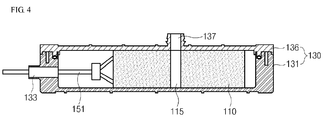
- Fig. 4 is a cross-sectional view taken along line A-A of the filter unit of Fig. 1 .
- the water treatment device according to an embodiment of the present invention relates to a CDI-type water treatment device, which includes a filter unit 100 and a sterilization unit 200.
- the filter unit 100 includes an electrode part 110, a filter case part 130 and a terminal part 150.
- the electrode part 110 plays a role of purifying raw water using a CDI method. More specifically, as illustrated in Fig. 3 , the electrode part 110 is formed as electrodes 111 and 113 and a separator 112 are alternately stacked. In this case, the electrodes include an anode 111 and a cathode 113. In other words, the electrode part 110 is formed as the anode 111 and the cathode 113 are oppositely stacked through the separator 112.
- the separator 112 forms a gap between the anode 111 and cathode 113.
- the electrodes 111 and 113 may be formed by coating an activated carbon on both sides of a graphite foil.
- the graphite foil may include a body portion coated with the activated carbon ( see the slashed portion in Fig. 3 ), and protrusion portions 111a and 113a which are protruded from the main portion but are not coated with the activated carbon.
- the protrusion portions 111a and 113a form electrode taps of the electrodes 111 and 113.
- the electrode part 110 may be operated by supplying power (or voltage or current) to the electrodes 111 and 113 through the electrode tabs 111a and 113a.
- anode tap 111a and a cathode tap 113a are separated from each other.
- the anode tap 111 is protruded in the same direction at the same position with the anode tap 111
- the cathode tap 113a is protruded in the same direction at the same position with the cathode tap 113a. Then, it is convenient to supply power to the anode tap 111a and cathode tap 113a, respectively.
- the filter case part 130 accommodates the electrode part 110. More specifically, an opening 132 is formed at the top of the filter case part 130, and the filter case part includes a lower case 131 in which the electrode part 110 is accommodated and an upper case 136 sealing the opening 132 of the lower case 131.
- the electrode part 110 is inserted into the inside of the lower case 131 through the opening 132 of the lower case 131, and then the opening 132 of the lower case 131 is sealed with the upper case 136.
- the lower case 131 has an inlet 133 on its side into which raw water enters
- the upper case 136 has an outlet 137 on its top from which purified water exits.
- the outlet 137 is formed to correspond to an outlet hole 115 of the electrode part 110.
- raw water is purified by the following process: First, raw water is supplied to the inside of the filter case part 130 through the inlet 133. Next, by the pressure resulting from this supplying, the raw water enters into the inside of the electrode part 110 through the side surface of the electrode part 110. The raw water then flows between the anode 111 and cathode 113 inside the electrode part 110 to be purified according to the CDI method. Then, the raw water (that is, purified water) is discharged to the outside of the electrode part 110 through an outlet hole 115. Then, the raw water is discharged to the outside of the filter case part 130 through the outlet 137.
- the terminal part 150 is electrically connected to the electrode taps 111a and 113a to supply power from external power (not illustrated) to the electrodes 111 and 113. More specifically, as illustrated in Figs. 2 and 3 , the terminal part 150 includes a conductive electrode terminal 151 contacting with the electrodes taps 111a and 113a at one end. (When supplying power to the other end of the electrode terminal with the electrodes taps contacting with one end of the electrode end, power may be supplied to the electrode taps through the electrode terminal.)
- the electrode terminal 151 is made of stainless steel. This also applies to a terminal band 152 which will be described later. This is because stainless steel is inexpensive and has good electrical conductivity. However, stainless steel has a limitation that the stainless steel becomes oxidized according to the current flow and thus rust may occur. In order to solve this limitation, it may be considered to form the electrode terminal 151 with titanium (Ti). However, since titanium may be oxidized according to the current flow, electrical conductivity may be weakened.
- the electrode terminal 151 it is most preferable to form the electrode terminal 151 with platinum (Pt). This also applies to the terminal band 152 which will be described later. This is because platinum does not have problems that platinum is oxidized and thus rust occurs, or electrical conductivity is weakened. Meanwhile, considering that platinum is expensive, it may be considered to form the electrode terminal 151 by coating platinum on the surface.
- the terminal part 150 may include a conductive terminal band 152 enclosing the electrode tap 111a or 113a along with the electrode terminal 151.
- the terminal band 152 encloses the electrode taps 111a and 113a along with the electrode terminal 151 so that the electrode taps 111a and 113a could be compressed inwardly.
- the terminal band 152 encloses the electrode taps 111a and 113a at least one round along with the electrode terminal 151 from the outside of the electrode taps 111a and 113a.
- a sterilization unit 200 plays a role of generating a sterilization substance from raw water to supply the sterilization substance to the electrode part 110 in order to sterilize the electrode part 110.
- the sterilization unit 200 may reduce chlorine ion (Cl - ) in raw water to chlorine (Cl 2 ).
- the sterilization unit 200 may include a sterilization terminal part (not illustrated) coated with ruthenium oxide (RuOx), and a sterilization case part 210 accommodating the sterilization terminal part.
- RuOx ruthenium oxide
- HOCl hypochlorous acid
- the water treatment device according to the present embodiment may sterilize the electrode part 110 without the need to further supply a chemical substance as the sterilization substance. Additionally, the water treatment device according to the present embodiment prevents in advance problems which occur due to bacteria through the sterilization so that the device may be semi-permanently used.
- the sterilization terminal part may be prepared as below. First, ruthenium is coated on a metal terminal such as the electrode terminal 151. Next, the metal terminal is heated at a high temperature. By means of the heating, ruthenium may be oxidized to ruthenium oxide. Accordingly, ruthenium oxide mostly exists on the surface of the metal terminal.
- a platinum group metal such as platinum or iridium may be used instead of ruthenium. However, it is most effective to use ruthenium.
- the sterilization unit 200 may be prepared at the front of the filter unit 100.
- the sterilization unit 200 may be independently operated regardless of the filter unit 100. Accordingly, when operating the sterilization unit 200, raw water including the sterilization substance may be supplied to the electrode part 110, and when stopping the sterilization unit 200, raw water which does not include the sterilization substance may be supplied to the electrode part 110. As such, when operating the sterilization unit 200 selectively, a lifespan of the sterilization terminal part may be extended. Additionally, when operating the sterilization unit 200 independently, the problems caused by bacteria such as the increase of pressure drop may be solved and also the TDS (Total Dissolved Solids) rejection may be maintained.
- TDS Total Dissolved Solids
- the water treatment device may be in a water-purifying mode, a regeneration mode and a sterilization mode.
- the water-purifying mode is a mode which purifies raw water in the electrode part 110
- the regeneration mode is a mode which regenerates electrodes 111 and 113 in the electrode part 110
- the sterilization mode is a mode which sterilizes bacteria in the electrode part 110 through the sterilization unit 200.
- the water treatment device may include a control unit (not illustrated) which controls power supplied to the sterilization terminal part in order to operate the sterilization mode.
- the control unit it is preferable for the control unit to perform a control of supplying power to the sterilization terminal part when in the sterilization mode among the water-purifying mode, regeneration mode and sterilization mode.
- Inventors of the present invention found the fact that when supplying the sterilization substance such as HOCl to the filter unit 100 during the operation of filter unit 100 such as in water-purifying mode or regeneration mode, iron oxide (FeOx), etc. may occur, thereby reducing the TDS rejection of the filter unit 100. Since iron oxide has a small particle size, iron oxide may be jammed in a gap and thus may not be properly discharged from the electrode. When iron oxide is not discharged, it is difficult for the electrodes to be regenerated properly. Thus, it is preferable that the sterilization mode is performed when both the water-purifying mode and regeneration mode are not performed.
- the sterilization mode is performed after a predetermined time (about 4 hours) passed with the water-purifying mode and regeneration mode not performed.
- the predetermined time may be properly selected according to the time that bacteria increase in the electrode part 110.
- the control unit determines the strength of power to be supplied to the sterilization terminal part in the sterilization mode according to the TDS of raw water.
- the TDS of raw water When the TDS of raw water is high, this means that the concentration of chlorine ion in raw water could be high.
- the TDS of raw water when the TDS of raw water is high, it is preferable to reduce the strength of power to be supplied to the sterilization terminal part in the sterilization mode. Even if the strength of power is low, since the concentration of chlorine ion in raw water is high, the sterilization substance may be fully generated.
- the TDS of raw water may be estimated by installing an additional TDS sensor at the front of the filter case part 130.
- the strength of current flowing in the electrodes 111 and 113 may vary depending on the TDS of raw water. That is, when the TDS of raw water is high, the current flowing in the electrodes 111 and 113 is high. When the TDS of raw water is low, the current flowing in the electrodes 111 and 113 is low. Thus, even if an additional TDS sensor is not installed, the TDS of raw water may be estimated based on the strength of current flowing in the electrodes 111 and 113. Thus, even if there is no additional TDS sensor, the strength of power to be supplied to the sterilization terminal part in the sterilization mode may be determined according to the strength of current flowing in the electrodes 111 and 113 in the water-purifying mode.
- Fig. 5 is a schematic view schematically illustrating the water treatment device according to an embodiment of the present invention.
- the water treatment device according to an embodiment of the present invention not only includes a filter unit 100, a sterilization unit 200, a control unit, but includes a supply unit 310 which supplies raw water to the filter unit 100, a purge unit 320 which purges purified water to the user, a discharge unit 330 which discharges regeneration water to the outside, and a valve unit.
- the supply unit 310 may be implemented in various ways.
- the supply unit 310 may be a conduit to receive raw water from the outside.
- the purge unit 320 may be implemented in various ways.
- the purge unit 320 may be a cock for selectively supplying purified water to the user.
- the discharge unit 330 may be implemented in various ways.
- the discharge unit 330 may be a conduit to discharge regeneration water to the outside.
- valve unit may include a supply valve 341 installed on a flow path passing from the supply unit 310 to an inlet 133; a purge valve 342 installed on a flow path passing from an outlet 137 to the purge unit 320; a discharge valve 343 installed on a flow path passing from the outlet 137 to the discharge unit 330; a washing valve 344 installed on a flow path passing from the front of the supply valve 341 to the outlet 137; and a drain valve 345 installed on a flow path passing from the rear of the supply valve 341 to the outside.
- Valves of the valve unit may be implemented as a solenoid valve for electronic control.
- the front of the supply valve 341 means a left side of the supply valve 341 based on Fig. 5
- the bottom of the supply valve 341 means a right side of the supply valve 341 based on Fig. 5 .
- the filter unit 100 may include two electrode parts 110a and 110b.
- the electrode parts 110a and 110b need to regenerate electrodes. However, when there is one electrode part, purified water cannot be generated during the regeneration of electrode. Thus, in order to generate purified water regardless of the regeneration of electrode, it is preferable that the filter unit 100 includes two electrode parts 110a and 110b. In other words, when any one of the electrode part is in the regeneration mode, it is preferable that the other electrode part is in the water-purifying mode. Accordingly, as illustrated in Fig. 5 , the purge valves 342a and 342b, discharge valves 343a and 343b, and washing valves 344a and 344b may be prepared in pairs (the filter case parts are prepared to correspond to the electrode parts, respectively).
- raw water is selectively supplied to the inlet 133a and 133b or outlet 137a and 137b by passing the sterilization case part 210, since it is more advantageous in sterilizing the electrode parts 110a and 110b to supply raw water including the sterilization substance to the side of the electrode parts 110a and 110b or to an outlet hole 115 of the electrode parts 110a and 110b, as needed ( Fig. 4 ).
- a second electrode part 110b When a second electrode part 110b is in the water-purifying mode, only the supply valve 341 and purge valve 342b are open. In other words, this is the same as the case where the first electrode part is in the water-purifying mode.
- the raw water may be supplied to the user through the purge unit 320 after being purified through the second electrode part 110b.
- the control unit it is necessary for the control unit to supply power to the electrode terminal of the first electrode part 110a or the electrode terminal of the second electrode part 110b.
- the regeneration mode will be explained.
- the first electrode part 110a is in the regeneration mode, only the supply valve 341 and discharge valve 343a are open. The rest will be closed.
- the raw water may be discharged to the outside through the discharge unit 330 by passing the first electrode part 110a.
- the second electrode part 110b is in the regeneration mode, only the supply valve 341 and discharge valve 343b are open. That is, this is the same as the case where the first electrode part is in the regeneration mode.
- the raw water may be discharged to the outside through the discharge unit 330 by passing the second electrode part 110b.
- the control unit it is necessary for the control unit to supply power to the electrode terminal of the first electrode part 110a or the electrode terminal of the second electrode part 110b.
- the water-purifying mode and regeneration mode may be performed in a complex way.
- the first electrode part 110a is in the water-purifying mode and the second electrode part 110b is in the regeneration mode, only the supply valve 341, purge valve 342a and discharge valve 343b are open.
- the back washing in the sterilization mode will be explained.
- the raw water may enter into the first electrode part 110a through the outlet 137a of the first filter case part 130a and be discharged to the outside through the inlet 133a of the first filter case part 130a.
- the raw water may be immediately discharged to the outside, and may be discharged to the outside through the discharge unit 330 as illustrated in Fig. 5 (the direction that the raw water flows in the back washing is opposite to the direction that the raw water flows in the water-purifying mode or in the regeneration mode. Thus, "back” is added to "washing").
- the washing valve 344b and drain valve 345 are open. That is, this is the same as the case where the first electrode part 110a is back-washed.
- the raw water may enter into the second electrode part 110b through the outlet 137b of the second filter case part 130b and then be drained to the outside through the inlet 133b of the second filter case part 130b.
- the control unit may supply power to the sterilization terminal part during the back washing for the sterilization of the first electrode part 110a or the second electrode part 110b.
- the normal washing and back washing may be interchangeably used as follows: First, only the washing valve 344a and discharge valve 343b are open. The rest will be closed. In case of such opening and closing, the raw water may be discharged to the outside by going through the outlet 137a of the first filter case part 130a ⁇ the first electrode part 110a ⁇ the inlet 133a of the first filter case part 130a ⁇ the inlet 133b of the second filter case part 130b ⁇ the second electrode part 110b ⁇ the outlet 137b of the second filter case part 130b. In this case, the control unit may supply power to the sterilization terminal part for sterilization.
- the washing valve 344b and discharge valve 343a are open.
- the raw water may be discharged to the outside by going through the outlet 137b of the second filter case part 130b ⁇ the second electrode part 110b ⁇ the inlet 133b of the second filter case part 130b ⁇ the inlet 133a of the first filter case part 130a ⁇ the first electrode part 110a ⁇ the outlet 137a of the first filter case part 130a.
- the control unit may supply power to the sterilization terminal part for sterilization.
- the reverse sterilization (second sterilization) in the sterilization mode will be explained.
- the raw water may enter into the first electrode part 110a through the outlet 137a of the first filter case part 130a, and then be discharged to the outside through the inlet 133a of the first filter case part 130a.
- the raw water may be immediately discharged to the outside, and may be discharged to the outside through the discharge unit 330 as illustrated in Fig. 5 (the direction that the raw water flows in the reverse sterilization is opposite to the direction that the raw water flows in the water-purifying mode or in the regeneration mode.
- “reverse” is added to "sterilization”).
- the washing valve 344b and drain valve 345 are open. That is, this is the same as the case where the first electrode part 110a is reversely sterilized.
- the raw water may enter into the second electrode part 110b through the outlet 137b of the second filter case part 130b, and then be drained to the outside through the inlet 133b of the second filter case part 130b.
- the control unit it is necessary for the control unit to supply power to the sterilization terminal part during the reverse sterilization for the sterilization of the first electrode part 110a or second electrode part 110b.
- the second electrode part 110b When normally sterilizing the second electrode part 110b, only the supply valve 341 and discharge valve 343b are open. That is, this is the same as the case where the first electrode part 110a is normally sterilized.
- the raw water may enter into the second electrode part 110b through the inlet 133b of the second filter case part 130b and then be discharged to the outside through the outlet 137b of the second filter case part 130b.
- the control unit it is necessary for the control unit to supply power to the sterilization terminal part during the normal sterilization for the sterilization of the first electrode part 110a or the second electrode part 110b.
- the normal sterilization is suitable for the sterilization at the inlet 137 in the electrode part 110
- the reverse sterilization is suitable for the sterilization at the outlet 137 of the electrode part 110.
- the back washing, reverse sterilization and normal sterilization during the sterilization mode are performed in a complex way.
- the normal sterilization is performed after the reverse sterilization.
- the case where purified water is generated as the water-purifying mode is performed after the reverse sterilization is highly likely to have the residue sterilization substance included in purified water and supplied to the user (the sterilization substance at entry may pass the CDI-type electrode part and then be removed).
- the normal sterilization is performed last. Additionally, considering the object of the back washing (to remove particulate materials which will be mentioned later), it is preferable that the back washing is performed before the reverse sterilization or normal sterilization.
- discharge flow (corresponding to a first flow where the raw water is supplied to the inlet during the normal sterilization) discharged to the outside through the discharge unit 330 during the normal sterilization or the discharge flow (corresponding to a second flow where the raw water is supplied to the outlet during the reverse sterilization) discharged to the outside through the discharge unit 330 during the reverse sterilization is smaller than the discharge flow (corresponding to a third flow where the raw water is supplied to the outlet during the back washing) discharged to the outside through the discharge unit 330 during the back washing.
- a particulate material stays more in the inlet 133 than in the outlet 137.
- the discharge flow in the normal sterilization or reverse sterilization is relatively low.
- the discharge flow of the normal sterilization may be the same as the discharge amount of the reverse sterilization.
- the discharge flow may be controlled through a diameter of a pipe. As an example, when a pipe diameter after the discharge valve 343 or drain valve 345 is smaller than a pipe diameter after the purge valve 342, the discharge flow may be small.
- the water treatment device may further include a valve for controlling flow 346 at the bottom of the discharge valve 343.
- the valve for controlling flow 346 may control the amount of regeneration water discharged to the outside to control the rate between purified water and regeneration water.
- the water treatment device according to the present embodiment may further include another filter in addition to the filter unit 100.
- the water treatment device according to the present embodiment may further include a precarbon filter 401 for mainly removing chlorine substance, or a post-carbon filter 402 for mainly removing smell, as illustrated in Fig. 5 .
- Fig. 6 is a graph illustrating a TDS rejection and a pressure drop according to the use period of the water treatment device in case of not sterilizing the electrode mode.
- bacteria may increase in the electrode part 110, which may lead to the increase in the pressure drop (a pressure difference between the outlet and inlet). Accordingly, a lifespan of the filter may be reduced.
- Fig. 7 is a graph illustrating a TDS rejection and a pressure drop according to the use period of the water treatment device when the sterilization substance is continuously supplied to the electrode part regardless of being in the water-purifying mode or regeneration mode.
- the increase in pressure drop may be inhibited.
- the TDS rejection i.e., contaminant rejection
- this is caused by the occurrence of inorganic ion such as iron oxide.
- the TDS rejection is reduced, since the increase in the pressure drop may be inhibited, the supply of the sterilization substance is meaningful.
- Fig. 8 is a graph illustrating a TDS rejection and a pressure drop according to the use period of the water treatment device when supplying the sterilization substance to the electrode part whenever a predetermined time passes with the water-purifying mode and regeneration mode not performed.
Landscapes
- Chemical & Material Sciences (AREA)
- Life Sciences & Earth Sciences (AREA)
- Chemical Kinetics & Catalysis (AREA)
- Engineering & Computer Science (AREA)
- General Chemical & Material Sciences (AREA)
- Hydrology & Water Resources (AREA)
- Electrochemistry (AREA)
- Environmental & Geological Engineering (AREA)
- Water Supply & Treatment (AREA)
- Organic Chemistry (AREA)
- Health & Medical Sciences (AREA)
- Analytical Chemistry (AREA)
- Molecular Biology (AREA)
- Water Treatment By Electricity Or Magnetism (AREA)
- Apparatus For Disinfection Or Sterilisation (AREA)
Applications Claiming Priority (2)
| Application Number | Priority Date | Filing Date | Title |
|---|---|---|---|
| KR1020130161066A KR101897567B1 (ko) | 2013-12-23 | 2013-12-23 | Cdi 방식의 수처리 장치 |
| PCT/KR2014/012059 WO2015099320A1 (ko) | 2013-12-23 | 2014-12-09 | Cdi 방식의 수처리 장치 |
Publications (3)
| Publication Number | Publication Date |
|---|---|
| EP3088366A1 true EP3088366A1 (de) | 2016-11-02 |
| EP3088366A4 EP3088366A4 (de) | 2016-11-23 |
| EP3088366B1 EP3088366B1 (de) | 2021-11-10 |
Family
ID=53479122
Family Applications (1)
| Application Number | Title | Priority Date | Filing Date |
|---|---|---|---|
| EP14875126.6A Active EP3088366B1 (de) | 2013-12-23 | 2014-12-09 | Verfahren zur wasserbehandlung mit einer vorrichtung zur kapazitiven entionisierung |
Country Status (6)
| Country | Link |
|---|---|
| US (1) | US11084740B2 (de) |
| EP (1) | EP3088366B1 (de) |
| JP (1) | JP6543630B2 (de) |
| KR (1) | KR101897567B1 (de) |
| CN (1) | CN105849050B (de) |
| WO (1) | WO2015099320A1 (de) |
Families Citing this family (9)
| Publication number | Priority date | Publication date | Assignee | Title |
|---|---|---|---|---|
| WO2016166168A1 (en) * | 2015-04-14 | 2016-10-20 | Koninklijke Philips N.V. | Electrosorption purification system with recirculation |
| GB201603889D0 (en) * | 2016-03-07 | 2016-04-20 | Fujifilm Mfg Europe Bv | Capacitive deionisation |
| CN106830227A (zh) * | 2017-03-01 | 2017-06-13 | 河海大学 | 一种循环处理的膜电容去离子装置及处理方法 |
| CN111526758B (zh) * | 2017-12-28 | 2023-05-05 | 庆东纳碧安株式会社 | 热水垫和灭菌模块 |
| KR102557399B1 (ko) * | 2019-03-07 | 2023-07-20 | 주식회사 경동나비엔 | 연수 시스템 |
| US11572287B2 (en) | 2019-03-07 | 2023-02-07 | Kyungdong Navien Co., Ltd. | Water-softening system |
| CN113880201A (zh) * | 2020-07-03 | 2022-01-04 | 拓狄克科技(江苏)有限公司 | 一种净水装置 |
| PL4029835T3 (pl) * | 2021-01-13 | 2024-02-05 | Robert Bosch Gmbh | Urządzenie do dejonizacji wody |
| KR102514234B1 (ko) * | 2022-02-14 | 2023-03-27 | 케이에스티 주식회사 | 전극 이온 교환 극대화 장치 |
Family Cites Families (26)
| Publication number | Priority date | Publication date | Assignee | Title |
|---|---|---|---|---|
| CN1188744A (zh) * | 1996-11-05 | 1998-07-29 | 三电有限公司 | 有产生氯气的功能又有抑菌功能的水净化系统 |
| ID18692A (id) | 1996-11-05 | 1998-04-30 | Sanden Corp | Instalasi pembersih air dengan fungsi penghasil klorin bersama dengan fungsi ilmu gangguan bakteri |
| JPH1190129A (ja) | 1997-09-24 | 1999-04-06 | Matsushita Electric Works Ltd | 浴槽水循環浄化装置 |
| JP4090640B2 (ja) | 1999-09-03 | 2008-05-28 | オルガノ株式会社 | 通液型コンデンサの通液方法及び装置 |
| US6580598B2 (en) | 2001-02-15 | 2003-06-17 | Luxon Energy Devices Corporation | Deionizers with energy recovery |
| EP1291324A3 (de) | 2001-09-07 | 2003-10-29 | Luxon Energy Devices Corporation | Entionisierungsvorrichtung mit Energierückgewinnung |
| JP2003285066A (ja) | 2002-03-27 | 2003-10-07 | Luxon Energy Devices Corp | エネルギー回収をともなう純水装置 |
| JP2005087898A (ja) | 2003-09-18 | 2005-04-07 | Air Water Inc | 静電脱イオン装置および静電脱イオン方法 |
| US20050103717A1 (en) | 2003-11-13 | 2005-05-19 | United States Filter Corporation | Water treatment system and method |
| KR100894558B1 (ko) * | 2007-07-31 | 2009-04-24 | 권오정 | 냉,온 이온수기 |
| JP2009190016A (ja) | 2008-02-13 | 2009-08-27 | Linxross Inc | 水浄化処理用電解キャパシター内のバイオフィルム除去及び防止方法 |
| KR100973669B1 (ko) * | 2009-11-27 | 2010-08-04 | 제이에이건설주식회사 | 축전 탈이온화 방식을 이용한 간이 상수도의 정수 처리 시스템 |
| EP2571594B1 (de) * | 2010-05-19 | 2020-02-19 | Woongjin Coway Co., Ltd. | Wasseraufbereitungsvorrichtung sowie sterilisierungs- und reinigungsverfahren dafür |
| KR101220891B1 (ko) | 2010-06-30 | 2013-01-11 | 문상봉 | 3차원 다공성 복극 전극 및 이를 구비한 전기살균 필터와 이를 이용한 수처리 방법 |
| ES2764576T3 (es) * | 2010-08-06 | 2020-06-03 | De Nora Holdings Us Inc | Generador electrolítico in situ |
| JP4734664B1 (ja) * | 2010-09-17 | 2011-07-27 | 田中貴金属工業株式会社 | 電解用電極、オゾン電解生成用陽極、過硫酸電解生成用陽極及びクロム電解酸化用陽極 |
| WO2012091500A2 (en) * | 2010-12-30 | 2012-07-05 | Woongjin Coway Co., Ltd | Water treatment apparatus and water treatment method using the same |
| KR101675749B1 (ko) * | 2010-12-30 | 2016-11-16 | 코웨이 주식회사 | 수처리 장치 및 이를 이용한 수처리 방법 |
| WO2012165694A1 (en) * | 2011-06-02 | 2012-12-06 | Woongjin Coway Co., Ltd. | Sterilizing apparatus and method for water treatment apparatus |
| KR101876214B1 (ko) * | 2011-06-07 | 2018-07-10 | 코웨이 주식회사 | 살균 또는 세정이 가능한 수처리 장치 및 그 살균세정 방법 |
| CN105642121B (zh) | 2011-07-01 | 2019-01-04 | 懿华水处理技术私人有限公司 | 电脱盐系统和方法 |
| US9174859B2 (en) * | 2011-11-24 | 2015-11-03 | Eco Watertech, Inc. | Method for treating waste waters |
| KR102010978B1 (ko) * | 2011-12-29 | 2019-08-14 | 웅진코웨이 주식회사 | 축전식 탈이온 수처리 장치 및 축전식 탈이온 수처리 장치의 제어방법 |
| KR20130096521A (ko) * | 2012-02-22 | 2013-08-30 | 코웨이 주식회사 | 무선통신을 이용한 수처리 기기의 세척방법, 및 이에 사용되는 수처리 기기 및 세척키트 |
| KR101406986B1 (ko) * | 2012-03-23 | 2014-06-13 | (주) 시온텍 | 전해살균수 생산장치 및 생산방법 |
| CN102786174B (zh) | 2012-03-29 | 2013-12-18 | 波鹰(厦门)科技有限公司 | 海水淡化装置及其方法 |
-
2013
- 2013-12-23 KR KR1020130161066A patent/KR101897567B1/ko active Active
-
2014
- 2014-12-09 EP EP14875126.6A patent/EP3088366B1/de active Active
- 2014-12-09 WO PCT/KR2014/012059 patent/WO2015099320A1/ko not_active Ceased
- 2014-12-09 CN CN201480070459.7A patent/CN105849050B/zh active Active
- 2014-12-09 US US15/103,199 patent/US11084740B2/en active Active
- 2014-12-09 JP JP2016542684A patent/JP6543630B2/ja active Active
Also Published As
| Publication number | Publication date |
|---|---|
| EP3088366A4 (de) | 2016-11-23 |
| KR101897567B1 (ko) | 2018-09-13 |
| JP6543630B2 (ja) | 2019-07-10 |
| JP2017500201A (ja) | 2017-01-05 |
| WO2015099320A1 (ko) | 2015-07-02 |
| CN105849050B (zh) | 2019-06-14 |
| EP3088366B1 (de) | 2021-11-10 |
| US11084740B2 (en) | 2021-08-10 |
| US20160355418A1 (en) | 2016-12-08 |
| KR20150074245A (ko) | 2015-07-02 |
| CN105849050A (zh) | 2016-08-10 |
Similar Documents
| Publication | Publication Date | Title |
|---|---|---|
| EP3088366B1 (de) | Verfahren zur wasserbehandlung mit einer vorrichtung zur kapazitiven entionisierung | |
| EP3081537A1 (de) | Vorrichtung zur behandlung von wasser mittels cdi-verfahren | |
| KR102211119B1 (ko) | Cdi 방식의 수처리 장치 | |
| CN103269982A (zh) | 水处理设备和使用该水处理设备的水处理方法 | |
| EP3778497B1 (de) | Wasserbehandlungsvorrichtung und wasserbehandlungsverfahren | |
| EP3081536A1 (de) | Vorrichtung zur behandlung von wasser mittels cdi-verfahren | |
| KR100621937B1 (ko) | 전해 살균기능을 가지는 수처리장치와 이를 통한 살균방법 | |
| JP2006043610A (ja) | 電解式水素水生成装置 | |
| KR102220165B1 (ko) | 전기 탈이온 방식의 수처리 장치 | |
| KR102210190B1 (ko) | Cdi 방식의 수처리 장치 및 이의 제어 방법 | |
| KR100988465B1 (ko) | 전기살균 기능을 구비한 정수기 | |
| KR101586302B1 (ko) | 이온수기 | |
| KR102054288B1 (ko) | 전기 탈이온 방식 살균 정수기 및 전기 탈이온 방식 정수기의 살균 방법 | |
| US20230080847A1 (en) | Water treatment device | |
| US10040706B2 (en) | CDI type water treatment apparatus | |
| EP3527537A1 (de) | Wasserenthärtungsvorrichtung |
Legal Events
| Date | Code | Title | Description |
|---|---|---|---|
| PUAI | Public reference made under article 153(3) epc to a published international application that has entered the european phase |
Free format text: ORIGINAL CODE: 0009012 |
|
| 17P | Request for examination filed |
Effective date: 20160615 |
|
| AK | Designated contracting states |
Kind code of ref document: A1 Designated state(s): AL AT BE BG CH CY CZ DE DK EE ES FI FR GB GR HR HU IE IS IT LI LT LU LV MC MK MT NL NO PL PT RO RS SE SI SK SM TR |
|
| AX | Request for extension of the european patent |
Extension state: BA ME |
|
| A4 | Supplementary search report drawn up and despatched |
Effective date: 20161025 |
|
| RIC1 | Information provided on ipc code assigned before grant |
Ipc: C02F 1/467 20060101ALI20161019BHEP Ipc: C02F 1/469 20060101AFI20161019BHEP |
|
| DAX | Request for extension of the european patent (deleted) | ||
| STAA | Information on the status of an ep patent application or granted ep patent |
Free format text: STATUS: EXAMINATION IS IN PROGRESS |
|
| 17Q | First examination report despatched |
Effective date: 20170816 |
|
| GRAP | Despatch of communication of intention to grant a patent |
Free format text: ORIGINAL CODE: EPIDOSNIGR1 |
|
| STAA | Information on the status of an ep patent application or granted ep patent |
Free format text: STATUS: GRANT OF PATENT IS INTENDED |
|
| INTG | Intention to grant announced |
Effective date: 20210602 |
|
| GRAS | Grant fee paid |
Free format text: ORIGINAL CODE: EPIDOSNIGR3 |
|
| GRAA | (expected) grant |
Free format text: ORIGINAL CODE: 0009210 |
|
| STAA | Information on the status of an ep patent application or granted ep patent |
Free format text: STATUS: THE PATENT HAS BEEN GRANTED |
|
| AK | Designated contracting states |
Kind code of ref document: B1 Designated state(s): AL AT BE BG CH CY CZ DE DK EE ES FI FR GB GR HR HU IE IS IT LI LT LU LV MC MK MT NL NO PL PT RO RS SE SI SK SM TR |
|
| REG | Reference to a national code |
Ref country code: GB Ref legal event code: FG4D |
|
| REG | Reference to a national code |
Ref country code: AT Ref legal event code: REF Ref document number: 1445949 Country of ref document: AT Kind code of ref document: T Effective date: 20211115 Ref country code: CH Ref legal event code: EP |
|
| REG | Reference to a national code |
Ref country code: DE Ref legal event code: R096 Ref document number: 602014081230 Country of ref document: DE |
|
| REG | Reference to a national code |
Ref country code: IE Ref legal event code: FG4D |
|
| REG | Reference to a national code |
Ref country code: LT Ref legal event code: MG9D |
|
| REG | Reference to a national code |
Ref country code: NL Ref legal event code: MP Effective date: 20211110 |
|
| REG | Reference to a national code |
Ref country code: AT Ref legal event code: MK05 Ref document number: 1445949 Country of ref document: AT Kind code of ref document: T Effective date: 20211110 |
|
| PG25 | Lapsed in a contracting state [announced via postgrant information from national office to epo] |
Ref country code: RS Free format text: LAPSE BECAUSE OF FAILURE TO SUBMIT A TRANSLATION OF THE DESCRIPTION OR TO PAY THE FEE WITHIN THE PRESCRIBED TIME-LIMIT Effective date: 20211110 Ref country code: LT Free format text: LAPSE BECAUSE OF FAILURE TO SUBMIT A TRANSLATION OF THE DESCRIPTION OR TO PAY THE FEE WITHIN THE PRESCRIBED TIME-LIMIT Effective date: 20211110 Ref country code: FI Free format text: LAPSE BECAUSE OF FAILURE TO SUBMIT A TRANSLATION OF THE DESCRIPTION OR TO PAY THE FEE WITHIN THE PRESCRIBED TIME-LIMIT Effective date: 20211110 Ref country code: BG Free format text: LAPSE BECAUSE OF FAILURE TO SUBMIT A TRANSLATION OF THE DESCRIPTION OR TO PAY THE FEE WITHIN THE PRESCRIBED TIME-LIMIT Effective date: 20220210 Ref country code: AT Free format text: LAPSE BECAUSE OF FAILURE TO SUBMIT A TRANSLATION OF THE DESCRIPTION OR TO PAY THE FEE WITHIN THE PRESCRIBED TIME-LIMIT Effective date: 20211110 |
|
| PG25 | Lapsed in a contracting state [announced via postgrant information from national office to epo] |
Ref country code: IS Free format text: LAPSE BECAUSE OF FAILURE TO SUBMIT A TRANSLATION OF THE DESCRIPTION OR TO PAY THE FEE WITHIN THE PRESCRIBED TIME-LIMIT Effective date: 20220310 Ref country code: SE Free format text: LAPSE BECAUSE OF FAILURE TO SUBMIT A TRANSLATION OF THE DESCRIPTION OR TO PAY THE FEE WITHIN THE PRESCRIBED TIME-LIMIT Effective date: 20211110 Ref country code: PT Free format text: LAPSE BECAUSE OF FAILURE TO SUBMIT A TRANSLATION OF THE DESCRIPTION OR TO PAY THE FEE WITHIN THE PRESCRIBED TIME-LIMIT Effective date: 20220310 Ref country code: PL Free format text: LAPSE BECAUSE OF FAILURE TO SUBMIT A TRANSLATION OF THE DESCRIPTION OR TO PAY THE FEE WITHIN THE PRESCRIBED TIME-LIMIT Effective date: 20211110 Ref country code: NO Free format text: LAPSE BECAUSE OF FAILURE TO SUBMIT A TRANSLATION OF THE DESCRIPTION OR TO PAY THE FEE WITHIN THE PRESCRIBED TIME-LIMIT Effective date: 20220210 Ref country code: NL Free format text: LAPSE BECAUSE OF FAILURE TO SUBMIT A TRANSLATION OF THE DESCRIPTION OR TO PAY THE FEE WITHIN THE PRESCRIBED TIME-LIMIT Effective date: 20211110 Ref country code: LV Free format text: LAPSE BECAUSE OF FAILURE TO SUBMIT A TRANSLATION OF THE DESCRIPTION OR TO PAY THE FEE WITHIN THE PRESCRIBED TIME-LIMIT Effective date: 20211110 Ref country code: HR Free format text: LAPSE BECAUSE OF FAILURE TO SUBMIT A TRANSLATION OF THE DESCRIPTION OR TO PAY THE FEE WITHIN THE PRESCRIBED TIME-LIMIT Effective date: 20211110 Ref country code: GR Free format text: LAPSE BECAUSE OF FAILURE TO SUBMIT A TRANSLATION OF THE DESCRIPTION OR TO PAY THE FEE WITHIN THE PRESCRIBED TIME-LIMIT Effective date: 20220211 Ref country code: ES Free format text: LAPSE BECAUSE OF FAILURE TO SUBMIT A TRANSLATION OF THE DESCRIPTION OR TO PAY THE FEE WITHIN THE PRESCRIBED TIME-LIMIT Effective date: 20211110 |
|
| PG25 | Lapsed in a contracting state [announced via postgrant information from national office to epo] |
Ref country code: SM Free format text: LAPSE BECAUSE OF FAILURE TO SUBMIT A TRANSLATION OF THE DESCRIPTION OR TO PAY THE FEE WITHIN THE PRESCRIBED TIME-LIMIT Effective date: 20211110 Ref country code: SK Free format text: LAPSE BECAUSE OF FAILURE TO SUBMIT A TRANSLATION OF THE DESCRIPTION OR TO PAY THE FEE WITHIN THE PRESCRIBED TIME-LIMIT Effective date: 20211110 Ref country code: RO Free format text: LAPSE BECAUSE OF FAILURE TO SUBMIT A TRANSLATION OF THE DESCRIPTION OR TO PAY THE FEE WITHIN THE PRESCRIBED TIME-LIMIT Effective date: 20211110 Ref country code: EE Free format text: LAPSE BECAUSE OF FAILURE TO SUBMIT A TRANSLATION OF THE DESCRIPTION OR TO PAY THE FEE WITHIN THE PRESCRIBED TIME-LIMIT Effective date: 20211110 Ref country code: DK Free format text: LAPSE BECAUSE OF FAILURE TO SUBMIT A TRANSLATION OF THE DESCRIPTION OR TO PAY THE FEE WITHIN THE PRESCRIBED TIME-LIMIT Effective date: 20211110 Ref country code: CZ Free format text: LAPSE BECAUSE OF FAILURE TO SUBMIT A TRANSLATION OF THE DESCRIPTION OR TO PAY THE FEE WITHIN THE PRESCRIBED TIME-LIMIT Effective date: 20211110 |
|
| REG | Reference to a national code |
Ref country code: CH Ref legal event code: PL |
|
| REG | Reference to a national code |
Ref country code: DE Ref legal event code: R097 Ref document number: 602014081230 Country of ref document: DE |
|
| PG25 | Lapsed in a contracting state [announced via postgrant information from national office to epo] |
Ref country code: MC Free format text: LAPSE BECAUSE OF FAILURE TO SUBMIT A TRANSLATION OF THE DESCRIPTION OR TO PAY THE FEE WITHIN THE PRESCRIBED TIME-LIMIT Effective date: 20211110 |
|
| PLBE | No opposition filed within time limit |
Free format text: ORIGINAL CODE: 0009261 |
|
| STAA | Information on the status of an ep patent application or granted ep patent |
Free format text: STATUS: NO OPPOSITION FILED WITHIN TIME LIMIT |
|
| REG | Reference to a national code |
Ref country code: BE Ref legal event code: MM Effective date: 20211231 |
|
| 26N | No opposition filed |
Effective date: 20220811 |
|
| GBPC | Gb: european patent ceased through non-payment of renewal fee |
Effective date: 20220210 |
|
| PG25 | Lapsed in a contracting state [announced via postgrant information from national office to epo] |
Ref country code: LU Free format text: LAPSE BECAUSE OF NON-PAYMENT OF DUE FEES Effective date: 20211209 Ref country code: IE Free format text: LAPSE BECAUSE OF NON-PAYMENT OF DUE FEES Effective date: 20211209 Ref country code: AL Free format text: LAPSE BECAUSE OF FAILURE TO SUBMIT A TRANSLATION OF THE DESCRIPTION OR TO PAY THE FEE WITHIN THE PRESCRIBED TIME-LIMIT Effective date: 20211110 |
|
| PG25 | Lapsed in a contracting state [announced via postgrant information from national office to epo] |
Ref country code: SI Free format text: LAPSE BECAUSE OF FAILURE TO SUBMIT A TRANSLATION OF THE DESCRIPTION OR TO PAY THE FEE WITHIN THE PRESCRIBED TIME-LIMIT Effective date: 20211110 Ref country code: FR Free format text: LAPSE BECAUSE OF NON-PAYMENT OF DUE FEES Effective date: 20220110 Ref country code: BE Free format text: LAPSE BECAUSE OF NON-PAYMENT OF DUE FEES Effective date: 20211231 |
|
| PG25 | Lapsed in a contracting state [announced via postgrant information from national office to epo] |
Ref country code: LI Free format text: LAPSE BECAUSE OF NON-PAYMENT OF DUE FEES Effective date: 20211231 Ref country code: CH Free format text: LAPSE BECAUSE OF NON-PAYMENT OF DUE FEES Effective date: 20211231 |
|
| PG25 | Lapsed in a contracting state [announced via postgrant information from national office to epo] |
Ref country code: GB Free format text: LAPSE BECAUSE OF NON-PAYMENT OF DUE FEES Effective date: 20220210 |
|
| PG25 | Lapsed in a contracting state [announced via postgrant information from national office to epo] |
Ref country code: IT Free format text: LAPSE BECAUSE OF FAILURE TO SUBMIT A TRANSLATION OF THE DESCRIPTION OR TO PAY THE FEE WITHIN THE PRESCRIBED TIME-LIMIT Effective date: 20211110 Ref country code: HU Free format text: LAPSE BECAUSE OF FAILURE TO SUBMIT A TRANSLATION OF THE DESCRIPTION OR TO PAY THE FEE WITHIN THE PRESCRIBED TIME-LIMIT; INVALID AB INITIO Effective date: 20141209 |
|
| PG25 | Lapsed in a contracting state [announced via postgrant information from national office to epo] |
Ref country code: CY Free format text: LAPSE BECAUSE OF FAILURE TO SUBMIT A TRANSLATION OF THE DESCRIPTION OR TO PAY THE FEE WITHIN THE PRESCRIBED TIME-LIMIT Effective date: 20211110 |
|
| PG25 | Lapsed in a contracting state [announced via postgrant information from national office to epo] |
Ref country code: MK Free format text: LAPSE BECAUSE OF FAILURE TO SUBMIT A TRANSLATION OF THE DESCRIPTION OR TO PAY THE FEE WITHIN THE PRESCRIBED TIME-LIMIT Effective date: 20211110 |
|
| PG25 | Lapsed in a contracting state [announced via postgrant information from national office to epo] |
Ref country code: MT Free format text: LAPSE BECAUSE OF FAILURE TO SUBMIT A TRANSLATION OF THE DESCRIPTION OR TO PAY THE FEE WITHIN THE PRESCRIBED TIME-LIMIT Effective date: 20211110 |
|
| PG25 | Lapsed in a contracting state [announced via postgrant information from national office to epo] |
Ref country code: TR Free format text: LAPSE BECAUSE OF FAILURE TO SUBMIT A TRANSLATION OF THE DESCRIPTION OR TO PAY THE FEE WITHIN THE PRESCRIBED TIME-LIMIT Effective date: 20211110 |
|
| PGFP | Annual fee paid to national office [announced via postgrant information from national office to epo] |
Ref country code: DE Payment date: 20250922 Year of fee payment: 12 |