EP3078680A1 - Metallocenkatalysator auf basis eines übergangsmetalls der gruppe 4 oder 5 des periodensystems, immobilisiert auf einem mit löslicher hybrid-kieselsäure modifizierten träger sowie verfahren zur herstellung und verwendung davon - Google Patents
Metallocenkatalysator auf basis eines übergangsmetalls der gruppe 4 oder 5 des periodensystems, immobilisiert auf einem mit löslicher hybrid-kieselsäure modifizierten träger sowie verfahren zur herstellung und verwendung davon Download PDFInfo
- Publication number
- EP3078680A1 EP3078680A1 EP14867336.1A EP14867336A EP3078680A1 EP 3078680 A1 EP3078680 A1 EP 3078680A1 EP 14867336 A EP14867336 A EP 14867336A EP 3078680 A1 EP3078680 A1 EP 3078680A1
- Authority
- EP
- European Patent Office
- Prior art keywords
- catalyst
- groups
- transition metal
- ind
- evaporation
- Prior art date
- Legal status (The legal status is an assumption and is not a legal conclusion. Google has not performed a legal analysis and makes no representation as to the accuracy of the status listed.)
- Granted
Links
Images
Classifications
-
- C—CHEMISTRY; METALLURGY
- C08—ORGANIC MACROMOLECULAR COMPOUNDS; THEIR PREPARATION OR CHEMICAL WORKING-UP; COMPOSITIONS BASED THEREON
- C08F—MACROMOLECULAR COMPOUNDS OBTAINED BY REACTIONS ONLY INVOLVING CARBON-TO-CARBON UNSATURATED BONDS
- C08F210/00—Copolymers of unsaturated aliphatic hydrocarbons having only one carbon-to-carbon double bond
- C08F210/16—Copolymers of ethene with alpha-alkenes, e.g. EP rubbers
-
- C—CHEMISTRY; METALLURGY
- C08—ORGANIC MACROMOLECULAR COMPOUNDS; THEIR PREPARATION OR CHEMICAL WORKING-UP; COMPOSITIONS BASED THEREON
- C08F—MACROMOLECULAR COMPOUNDS OBTAINED BY REACTIONS ONLY INVOLVING CARBON-TO-CARBON UNSATURATED BONDS
- C08F4/00—Polymerisation catalysts
- C08F4/02—Carriers therefor
-
- C—CHEMISTRY; METALLURGY
- C08—ORGANIC MACROMOLECULAR COMPOUNDS; THEIR PREPARATION OR CHEMICAL WORKING-UP; COMPOSITIONS BASED THEREON
- C08F—MACROMOLECULAR COMPOUNDS OBTAINED BY REACTIONS ONLY INVOLVING CARBON-TO-CARBON UNSATURATED BONDS
- C08F210/00—Copolymers of unsaturated aliphatic hydrocarbons having only one carbon-to-carbon double bond
- C08F210/02—Ethene
-
- C—CHEMISTRY; METALLURGY
- C08—ORGANIC MACROMOLECULAR COMPOUNDS; THEIR PREPARATION OR CHEMICAL WORKING-UP; COMPOSITIONS BASED THEREON
- C08F—MACROMOLECULAR COMPOUNDS OBTAINED BY REACTIONS ONLY INVOLVING CARBON-TO-CARBON UNSATURATED BONDS
- C08F4/00—Polymerisation catalysts
- C08F4/42—Metals; Metal hydrides; Metallo-organic compounds; Use thereof as catalyst precursors
- C08F4/44—Metals; Metal hydrides; Metallo-organic compounds; Use thereof as catalyst precursors selected from light metals, zinc, cadmium, mercury, copper, silver, gold, boron, gallium, indium, thallium, rare earths or actinides
- C08F4/60—Metals; Metal hydrides; Metallo-organic compounds; Use thereof as catalyst precursors selected from light metals, zinc, cadmium, mercury, copper, silver, gold, boron, gallium, indium, thallium, rare earths or actinides together with refractory metals, iron group metals, platinum group metals, manganese, rhenium technetium or compounds thereof
- C08F4/62—Refractory metals or compounds thereof
- C08F4/64—Titanium, zirconium, hafnium or compounds thereof
- C08F4/659—Component covered by group C08F4/64 containing a transition metal-carbon bond
- C08F4/65912—Component covered by group C08F4/64 containing a transition metal-carbon bond in combination with an organoaluminium compound
-
- C—CHEMISTRY; METALLURGY
- C08—ORGANIC MACROMOLECULAR COMPOUNDS; THEIR PREPARATION OR CHEMICAL WORKING-UP; COMPOSITIONS BASED THEREON
- C08F—MACROMOLECULAR COMPOUNDS OBTAINED BY REACTIONS ONLY INVOLVING CARBON-TO-CARBON UNSATURATED BONDS
- C08F4/00—Polymerisation catalysts
- C08F4/42—Metals; Metal hydrides; Metallo-organic compounds; Use thereof as catalyst precursors
- C08F4/44—Metals; Metal hydrides; Metallo-organic compounds; Use thereof as catalyst precursors selected from light metals, zinc, cadmium, mercury, copper, silver, gold, boron, gallium, indium, thallium, rare earths or actinides
- C08F4/60—Metals; Metal hydrides; Metallo-organic compounds; Use thereof as catalyst precursors selected from light metals, zinc, cadmium, mercury, copper, silver, gold, boron, gallium, indium, thallium, rare earths or actinides together with refractory metals, iron group metals, platinum group metals, manganese, rhenium technetium or compounds thereof
- C08F4/62—Refractory metals or compounds thereof
- C08F4/64—Titanium, zirconium, hafnium or compounds thereof
- C08F4/659—Component covered by group C08F4/64 containing a transition metal-carbon bond
- C08F4/65916—Component covered by group C08F4/64 containing a transition metal-carbon bond supported on a carrier, e.g. silica, MgCl2, polymer
-
- C—CHEMISTRY; METALLURGY
- C08—ORGANIC MACROMOLECULAR COMPOUNDS; THEIR PREPARATION OR CHEMICAL WORKING-UP; COMPOSITIONS BASED THEREON
- C08F—MACROMOLECULAR COMPOUNDS OBTAINED BY REACTIONS ONLY INVOLVING CARBON-TO-CARBON UNSATURATED BONDS
- C08F4/00—Polymerisation catalysts
- C08F4/42—Metals; Metal hydrides; Metallo-organic compounds; Use thereof as catalyst precursors
- C08F4/44—Metals; Metal hydrides; Metallo-organic compounds; Use thereof as catalyst precursors selected from light metals, zinc, cadmium, mercury, copper, silver, gold, boron, gallium, indium, thallium, rare earths or actinides
- C08F4/60—Metals; Metal hydrides; Metallo-organic compounds; Use thereof as catalyst precursors selected from light metals, zinc, cadmium, mercury, copper, silver, gold, boron, gallium, indium, thallium, rare earths or actinides together with refractory metals, iron group metals, platinum group metals, manganese, rhenium technetium or compounds thereof
- C08F4/62—Refractory metals or compounds thereof
- C08F4/64—Titanium, zirconium, hafnium or compounds thereof
- C08F4/659—Component covered by group C08F4/64 containing a transition metal-carbon bond
- C08F4/6592—Component covered by group C08F4/64 containing a transition metal-carbon bond containing at least one cyclopentadienyl ring, condensed or not, e.g. an indenyl or a fluorenyl ring
Definitions
- the present invention pertains to a catalyst prepared by the immobilization of metallocene complex on a support modified with hybrid soluble silica, prepared by a non-hydrolytic sol-gel process. A process for preparing said catalyst is also described.
- the mPEBDL (Linear Low Density Polyethylene obtained with metallocenes) polymers can be typically produced in gas phase reactors, among others, and their properties enable them to be used in special films, industrial sacks and flexible packaging for foods.
- Two specific examples of application for mPEBDL are plastic stretch packaging for frozen food and plastic shrink wrap for wrapping primary packages such as bottles or cans, widely used in Brazil.
- the supported metallocene catalysts for use in a gas phase process result in copolymers of ethylene and ⁇ -olefins with inferior properties to those noted for copolymers obtained by using homogenous complexes, such as, for example, those of the constrained geometry catalyst (CGC) type, in processes in solution. Therefore, it is considered a technological challenge, in light of the state of the art, to develop a supported metallocene catalyst, for a gas phase process, that produces mPEBDL with uniform distribution of comonomer in the polymer chains.
- CGC constrained geometry catalyst
- Patent US7452947B2 teaches the preparation of supported metallocene catalysts by a non-hydrolytic sol-gel process.
- a hybrid silica is synthesized by condensing an organosilane containing anionic ligands, a halogenated silane and an alkoxysilane.
- the hybrid silica generated is subsequently subjected to a metallation reaction and the resulting catalyst is active, in the presence of a cocatalyst, in the polymerization of olefins.
- the proposed route does not enable the formation of a hybrid soluble silica in hydrocarbons and, consequently, the morphological control of the supported catalyst.
- the polymers obtained do not display a uniform distribution of the incorporated comonomer.
- the present invention provides a metallocene catalyst based on a transition metal of groups 4 or 5 of the periodic table immobilized on a support modified with hybrid soluble silica, comprising
- the present invention also pertains to the use of the supported metallocene catalyst used in process of copolymerization of ethylene with alpha-olefins, resulting in polymers with uniform distribution of incorporated comonomer and with high molar mass value in the ultra-high molar mass fraction (Mz).
- the supported metallocene catalyst of the present invention has advantages over the state of the art such as high catalytic activity, morphology, besides the fact of producing copolymers of ethylene with alpha-olefins having molecular behavior that will bring benefits in mechanical properties, such as resistance to tearing, piercing and impact, as well as improved optical and weldability properties.
- the present invention pertains to a metallocene catalyst based on a transition metal of groups 4 or 5 of the periodic table supported on a support modified with hybrid soluble silica, prepared by a non-hydrolytic sol-gel process.
- the supported metallocene catalyst on a support modified with hybrid soluble silica of the present invention comprises:
- Representative but non-limitative examples of compounds having formula 1 include: Cp 2 TiCl 2 , Cp 2 ZrCl 2 , Cp 2 HfCl 2 , Cp 2 VCl 2 , Cp 2 Ti(Me) 2 , Cp 2 Zr(Me) 2 , Cp 2 Hf(Me) 2 , Cp 2 Ti(OMe) 2 , Cp 2 Zr(OMe) 2 , Cp 2 Hf(OMe) 2 , Cp 2 Ti(OEt) 2 , Cp 2 Zr(OEt) 2 , Cp 2 Hf(OEt) 2 , Ind 2 TiCl 2 , Ind 2 ZrCl 2 , Ind 2 HfCl 2 , Ind 2 VCl 2 , Ind 2 Ti(Me) 2 , Ind 2 Zr(Me) 2 , Ind 2 Hf(Me) 2 , Ind 2 Ti(Me) 2 , Ind 2 Zr(OMe) 2 , In
- the content of transition metal of the metallocene complex defined in (I) in the catalyst of the present invention is in the range of 0.1 to 6%.
- the organometallic reagent containing aluminum is an aluminoxane compound of the metylaluminoxane (MAO) type, etylaluminoxane (EAO) or a compound of formula 2 Cl x Al(C) y Formula 2 wherein:
- organometallic reagents containing aluminum of formula 2 present in the catalyst of the present invention are: trimethylaluminum, triethylaluminum, tri-isobutylaluminum, tri-n-hexylaluminum and diethylaluminum chloride.
- the catalyst of the present invention exhibits contents of Al, from the organometallic reagent, in the range of 1 to 20%.
- the present invention pertains to a process for obtaining supported metallocene catalysts based on a transition metal of groups 4 or 5, comprising:
- step (a) of the process for obtaining supported metallocene catalysts based on a transition metal of groups 4 or 5 of the present invention a hybrid soluble silica is prepared.
- a hybrid soluble silica of the present invention is obtained by a non-hydrolytic sol-gel route, where a metal halide acts as catalyst of the sol-gel reaction. This catalyst accelerates the condensation reactions of the reagents present in said reaction.
- a hybrid soluble silica is prepared according to the following steps:
- step (i) of the process for preparing the hybrid soluble silica a suspension of a metal halide in an organic solvent is prepared.
- concentration of metal halide in this suspension should be in the range of 0.5 mg to 10 mg per mL of organic solvent.
- metal halides that can be used in step (i) of the process for preparing the hybrid soluble silica are selected from the group that comprises iron chloride III, aluminum chloride, titanium chloride IV and zirconium chloride IV. Iron chloride III is preferably used.
- Non-limitative examples of solvents that can be used for the suspension of the metal halide are selected from the group that comprises toluene, cyclo-hexane, n-hexane, n-heptane, n-octane and/or mixtures thereof.
- step (ii) of the process for preparing the hybrid soluble silica silicon tetrachloride is added to the suspension prepared in (i).
- the molar ratio of silicon tetrachloride/metal halide is in the range between 10 and 100, preferably between 20 and 60.
- step (iii) of the process for preparing the hybrid soluble silica a mixture is made containing an alkoxysilane, an organo-alkoxysilane and an organic solvent.
- alkoxysilane + organo-alkoxysilane in this mixture should be in the range of 0.1 mmol to 10 mmol per mL of organic solvent.
- Non-limitative examples of the alkoxysilanes used in the present invention are selected from the group that comprises tetramethoxysilane, tetraethoxysilane, tetrapropoxysilane, tetrabutoxysilane. Tetraethoxysilane should preferably be used.
- the organo-alkoxysilane has a carbon chain from 1 to 40 carbon atoms.
- An organo-alkoxysilane having 8 to 22 carbon atoms is preferably used.
- the alkoxide grouping of said reagent should have from 1 to 4 carbon atoms. Alkoxide grouping having 1 carbon atom is preferably used.
- Non-limitative examples of the organo-alkoxysilanes used in the present invention are selected from the group that comprises methyltriethoxysilane, propyltrimethoxysilane, octyltrimethoxysilane, hexadecyltrimethoxysilane and octadecyltrimethoxysilane.
- Non-limitative examples of solvents used in step (iii) of the process for preparing the hybrid soluble silica are selected from the group that comprises toluene, cyclo-hexane, n-hexane, n-heptane, n-octane and/or mixtures thereof.
- the molar ratio of organo-alkoxysilane/alkoxysilane in the mixture prepared in step (iii) may range from 0.05 to 20, preferably between 0.1 and 5.
- step (iv) of the process for preparing the hybrid soluble silica the mixture prepared in (iii) is added to the suspension obtained in (ii);
- the molar ratio total silane/silicon tetrachloride used in preparing the hybrid soluble silica may range from 1 to 10.
- the temperature during the addition in step (iv) may range between the limits of 10 to 40°C.
- step (v) of the process for preparing the hybrid soluble silica the chemical reaction occurs between the reagents present in the mixture prepared in (iv).
- the temperature of the reaction of step (v) may range between 50 and 200°C, preferably between 80 and 150°C.
- reaction time of step (v) may range from 0.5 to 50 h, preferably from 5 to 25 h.
- step (b) of the process for obtaining supported metallocene catalysts based on a transition metal of groups 4 or 5 of the present invention the hybrid soluble silica is reacted with an inorganic support.
- the inorganic support may be used in its form in natura or calcined up to a temperature limit of 800°C.
- the content of hybrid soluble silica added to the inorganic support may range from 0.5% to 20% by mass of carbon per mass of inorganic support.
- Non-limitative examples of solvents that can be used in step (b) of the process for preparing of the catalyst of the present invention are selected from the group that comprises toluene, cyclo-hexane, n-hexane, n-heptane and/or mixtures thereof.
- the temperature of the reaction of step (b) may range between 10 and 200°C, preferably between 20 and 50°C.
- the stirring velocity is kept between 50 and 500 rpm.
- the temperature in step (b) may range from 10 to 80°C, preferably between 20 and 40°C.
- the reaction of step (b) is kept for a time between 0.1 and 24 h.
- step (c) of the process for obtaining the metallocene catalysts of the present invention the solvent is removed from the reaction product obtained in step (b) preferably by techniques of nitrogen gas flow evaporation, settling/siphoning, evaporation by reduced pressure or evaporation by heating, used in isolation or in combination.
- step (d) the product obtained in step (c) is reacted with one aluminum-containing organometallic reagent.
- the content of organometallic reagent containing aluminum added to the product of step (c) may range from 0.1% to 20% by mass of aluminum per mass of product of step (c).
- organometallic reagents used in step (d) are preferably selected from among metylaluminoxane, etylaluminoxane, trimethylaluminum, triethylaluminum, tri-isobutylaluminum, tri-n-hexilaluminum and diethylaluminum chloride.
- Non-limitative examples of solvents that can be used in step (d) are preferably selected from among toluene, cyclo-hexane, n-hexane, n-heptane, n-octane and/or mixtures thereof.
- the temperature of the reaction of step (d) may range between 0 and 40°C, preferably between 10 and 30°C.
- step (d) of the process is kept between 0 and 500 rpm.
- step (d) The reaction of step (d) is kept for a time between 0.1 and 8 h, specifically between 0.5 and 2 h.
- step (e) of the process for obtaining metallocene catalysts the solvent is removed from the reaction product obtained in step (d) preferably by techniques of nitrogen gas flow evaporation, settling/siphoning, evaporation by reduced pressure or evaporation by heating, used in isolation or in combination.
- step (f) of the process for obtaining metallocene catalysts the product obtained in step (e) is reacted with a metallocene complex.
- the metallocene used in step (f) of the process comprises a derivative compound of the following formula: [L] 2 - MQ 2 formula 1 wherein,
- Representative but non-limitative examples of compounds having formula 1 include: Cp 2 TiCl 2 , Cp 2 ZrCl 2 , Cp 2 HfCl 2 , Cp 2 VCl 2 , Cp 2 Ti(Me) 2 , Cp 2 Zr(Me) 2 , Cp 2 Hf(Me) 2 , Cp 2 Ti(OMe) 2 , Cp 2 Zr(OMe) 2 , Cp 2 Hf(OMe) 2 , Cp 2 Ti(OEt) 2 , Cp 2 Zr(OEt) 2 , Cp 2 Hf(OEt) 2 , Ind 2 TiCl 2 , Ind 2 ZrCl 2 , Ind 2 HfCl 2 , Ind 2 VCl 2 , Ind 2 Ti(Me) 2 , Ind 2 Zr(Me) 2 , Ind 2 Hf(Me) 2 , Ind 2 Ti(Me) 2 , Ind 2 Zr(OMe) 2 , In
- the content of metallocene added in step (f) of the process may range from 0.1 to 6% by mass of transition metal per mass of supported catalyst.
- Non-limitative examples of solvents that can be used in step (f) of the process are selected from among toluene, cyclo-hexane, n-hexane, n-heptane, n-octane and/or mixtures thereof.
- the metallocene complex can be reacted with an organometallic compound containing aluminum and subsequently added to the product obtained in step (e).
- organometallic compounds that can be used are selected from among metylaluminoxane, etylaluminoxane, trimethylaluminum, triethylaluminum, tri-isobutylaluminum, tri-n-hexilaluminum and diethylaluminum chloride.
- the Al/M molar ratio that can be used is in the range of 2 to 100.
- the temperature of the reaction of step (f) of the process may range between 10 and 80°C, preferably between 20 and 40°C.
- step (f) of the process is kept between 0 and 500 rpm.
- step (f) of the process is kept for a time in the range of 0.1 to 8 h, specifically between 0.5 and 2 h.
- step (g) of the process for obtaining metallocene catalysts the solvent is removed from the reaction product obtained in step (f) preferably by techniques of nitrogen gas flow evaporation, settling/siphoning, evaporation by reduced pressure or evaporation by heating, used in isolation or in combination.
- the supported metallocene catalysts of the present invention are suitable for being used in a process of copolymerization of the ethylene with alpha-olefins in suspension or gas phase processes.
- the alpha-olefins are selected from among: propene, 1-butene, 1-octene and 1-decene.
- the supported metallocene catalysts of the present invention exhibit catalytic activity of 0.4 to 12 kg pol /g cat.
- a cocatalyst alkylaluminum can be used, and the preferred forms are selected from among metylaluminoxane, trimethylaluminum, triethylaluminum, tri-isobutylaluminum.
- the Al/M molar ratio in the process of copolymerization of ethylene with alpha-olefins is from 100 to 2000.
- copolymers of ethylene with ⁇ -olefins obtained with the supported metallocene catalysts of the present invention, exhibit uniform distribution of incorporated comonomer and high molar mass value in the ultra-high molar mass fraction, combined characteristics that lead to the formation of a mechanically more resistant material, with improved optical and weldability properties.
- iron chloride Sigma-Aldrich, 99% purity
- silicon tetrachloride Merck, 99% purity
- tetraethoxysilane Merck, 98% purity
- octadecyltrimethoxysilane Sigma-Aldrich, 90% purity
- trimethylaluminum Al in hexane
- triethylaluminum Akzo Nobel, 9.0% in Al in hexane
- tri-isobutylaluminum Al in hexane
- metylaluminoxane Sigma-Aldrich, 13% in Al in toluene
- (n-BuCp) 2 ZrCl 2 Booulder, 98% purity
- silica Sylopol 948 Grace
- the hexane (Merck, 95% purity), the octane (Sigma-Aldrich, 98%) and the 1-hexene, used in the preparation of the supported metallocene catalyst and in the copolymerization of the ethylene with alpha-olefins, are dried according to conventional techniques.
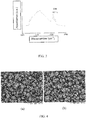
- Figure 4 exhibits the SEM images for the support modified and for the support in nature. According to Figure 4 , the support modified exhibited the same morphology as the start commercial support.
- a catalytic solution was prepared separately by reacting 50 mg of n-BuCp 2 ZrCl 2 (0.25 mmol) with 9.0 mL of solution of TMA 9.0% (5.0 mmol) in 50 mL of hexane. This solution was added to the suspension containing the support impregnated with MAO under stirring of 200 rpm and temperature of 25°C. After mechanical stirring for 1 h, the solvent was removed by evaporation with nitrogen flow.
- the content of Zr in the supported catalyst metallocene of Example 3 is 0.15% (p/p).
- a catalytic solution was prepared separately by reacting 50 mg of n-BuCp 2 ZrCl 2 (0.25 mmol) with 9.0 mL of solution of TMA 9.0% (5.0 mmol) in 50 mL of hexane. This solution was added to the suspension containing the support impregnated with MAO under stirring of 200 rpm and a temperature of 25°C. After mechanical stirring for 1 h, the solvent was removed by evaporation with nitrogen flow.
- the content of Zr in the supported catalyst metallocene of the comparative example is 0.16% (p/p).
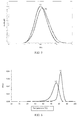
- Table 1 shows the displacement of the curve profile to high molar masses, but a narrow distribution of the molar mass being maintained.
- the increase of the molar mass is more significant in the ultra-high molar mass fraction (Mz).
- Figure 5 shows this displacement of the curve (b) to the right more evidently.
- This molecular behavior will likely bring benefits in mechanical properties, with resistance to tear, piercing and impact. Maintaining the narrow distribution of molar mass may keep the level of oligomers or amorphs low in the soluble fraction, contributing to a low blockage level.
- Figure 6 shows the Crystaf profile for the example of this patent and the comparative polymer.
- the curve also showed an important displacement to lower crystallization temperatures. This means that the material has a differentiated comonomer distribution, taking it to a better level of product.
- the short ramifications (comonomer) were much better distributed along the chains, leading to a lower temperature of crystallinity, that is, a greater number of faults in the ethane sequence. Therefore, the formation of the crystalline structure is hindered, leading to the formation of smaller and finer crystals, and, therefore, having lower crystallization temperature.
- the Crystaf revealed the trend of a material to crystallize with the reduction of the temperature in solution.
- the polymer produced with the catalyst of the present invention has more homogenous distribution than the polymer obtained with the comparative system.
Landscapes
- Chemical & Material Sciences (AREA)
- Health & Medical Sciences (AREA)
- Chemical Kinetics & Catalysis (AREA)
- Medicinal Chemistry (AREA)
- Polymers & Plastics (AREA)
- Organic Chemistry (AREA)
- Engineering & Computer Science (AREA)
- Materials Engineering (AREA)
- Transition And Organic Metals Composition Catalysts For Addition Polymerization (AREA)
Applications Claiming Priority (2)
| Application Number | Priority Date | Filing Date | Title |
|---|---|---|---|
| US201361912355P | 2013-12-05 | 2013-12-05 | |
| PCT/BR2014/050029 WO2015081409A1 (pt) | 2013-12-05 | 2014-12-04 | Catalisador metaloceno a base de metal de transição dos grupos 4 ou 5 da tabela periódica imobilizado sobre um suporte modificado com sílica híbrida solúvel, processo de obtenção do mesmo e seu uso |
Publications (4)
| Publication Number | Publication Date |
|---|---|
| EP3078680A1 true EP3078680A1 (de) | 2016-10-12 |
| EP3078680A4 EP3078680A4 (de) | 2017-08-02 |
| EP3078680B1 EP3078680B1 (de) | 2024-12-04 |
| EP3078680B8 EP3078680B8 (de) | 2025-01-15 |
Family
ID=53272667
Family Applications (1)
| Application Number | Title | Priority Date | Filing Date |
|---|---|---|---|
| EP14867336.1A Active EP3078680B8 (de) | 2013-12-05 | 2014-12-04 | Metallocenkatalysator auf basis eines übergangsmetalls der gruppe 4 oder 5 des periodensystems, immobilisiert auf einem mit löslicher hybrid-kieselsäure modifizierten träger sowie verfahren zur herstellung und verwendung davon |
Country Status (5)
| Country | Link |
|---|---|
| US (1) | US9822199B2 (de) |
| EP (1) | EP3078680B8 (de) |
| BR (1) | BR112016012724B1 (de) |
| ES (1) | ES2998660T3 (de) |
| WO (1) | WO2015081409A1 (de) |
Family Cites Families (17)
| Publication number | Priority date | Publication date | Assignee | Title |
|---|---|---|---|---|
| US236365A (en) | 1881-01-04 | John sherman | ||
| US4808561A (en) | 1985-06-21 | 1989-02-28 | Exxon Chemical Patents Inc. | Supported polymerization catalyst |
| US5057475A (en) | 1989-09-13 | 1991-10-15 | Exxon Chemical Patents Inc. | Mono-Cp heteroatom containing group IVB transition metal complexes with MAO: supported catalyst for olefin polymerization |
| JP2882241B2 (ja) | 1993-06-07 | 1999-04-12 | 東ソー株式会社 | オレフィン重合用触媒およびオレフィンの重合方法 |
| US5466649A (en) | 1993-10-15 | 1995-11-14 | Exxon Chemical Patents Inc. | Polymerization catalyst systems, their production and use |
| ES2160182T3 (es) | 1994-12-15 | 2001-11-01 | Exxonmobil Chem Patents Inc | Sistemas catalizadores de polimerizacion, su produccion y uso. |
| US6211109B1 (en) | 1995-07-18 | 2001-04-03 | Fina Technology, Inc. | Process for treating silica with alumoxane |
| US6291695B1 (en) | 1996-02-20 | 2001-09-18 | Northwestern University | Organo-Lewis acids of enhanced utility, uses thereof, and products based thereon |
| US5968864A (en) | 1996-12-20 | 1999-10-19 | Fina Technology, Inc. | Catalyst efficiency for supported metallocene catalyst |
| US6777366B2 (en) | 2001-02-13 | 2004-08-17 | Fina Technology, Inc. | Method for the preparation of metallocene catalysts |
| EP1412420B1 (de) | 2001-07-19 | 2011-03-30 | Univation Technologies LLC | Polyethylenfilme mit verbesserten physikalischen eigenschaften |
| EP1546214A1 (de) | 2002-08-20 | 2005-06-29 | BP Chemicals Limited | Siliciumdioxidgeträgerter polymerisationskatalysator |
| US6908876B2 (en) | 2003-04-16 | 2005-06-21 | Saudi Basic Industries Corporation | Supported metallocene catalyst system for olefin polymerization, method for making and using the same |
| US7307036B2 (en) * | 2004-07-22 | 2007-12-11 | Formosa Plastics Corporation U.S.A. | Highly active alpha-olefin polymerization catalyst |
| MX2010004418A (es) | 2007-10-25 | 2010-08-09 | Lummus Novolen Technology Gmbh | Compuestos de metaloceno, catalizadores que comprenden los mismos, proceso para producir un polimero de olefina mediante el uso de los catalizadores y homo- y copolimeros de olefina. |
| ES2392698T3 (es) * | 2008-11-10 | 2012-12-13 | Borealis Ag | Proceso para la preparación de un sistema catalizador metalocénico sólido, sin soporte, y su uso en la polimerización de olefinas |
| MX363101B (es) * | 2012-11-26 | 2019-03-08 | Braskem Sa | Catalizador de metaloceno soportado por medios de soporte hibridos, procesos para producir el mismo, procesos de polimerizacion para producir un homopolimero o copolimero de etileno con distribucion de masa molar amplia o bimodal, uso del catalizador de metaloceno soportado y polimero de etileno con distribucion de masa molar amplia o bimodal. |
-
2014
- 2014-12-04 WO PCT/BR2014/050029 patent/WO2015081409A1/pt not_active Ceased
- 2014-12-04 BR BR112016012724-2A patent/BR112016012724B1/pt active IP Right Grant
- 2014-12-04 US US15/101,710 patent/US9822199B2/en active Active
- 2014-12-04 EP EP14867336.1A patent/EP3078680B8/de active Active
- 2014-12-04 ES ES14867336T patent/ES2998660T3/es active Active
Also Published As
| Publication number | Publication date |
|---|---|
| US20170107316A1 (en) | 2017-04-20 |
| WO2015081409A1 (pt) | 2015-06-11 |
| US9822199B2 (en) | 2017-11-21 |
| BR112016012724B1 (pt) | 2022-05-31 |
| ES2998660T3 (en) | 2025-02-21 |
| EP3078680B1 (de) | 2024-12-04 |
| EP3078680A4 (de) | 2017-08-02 |
| EP3078680B8 (de) | 2025-01-15 |
| BR112016012724A2 (de) | 2017-08-08 |
Similar Documents
| Publication | Publication Date | Title |
|---|---|---|
| CN114127130B (zh) | 催化剂体系的改进制备 | |
| AU764962B2 (en) | Catalyst systems and their use in a polymerization process | |
| KR101412118B1 (ko) | 혼성 담지 메탈로센 촉매의 제조방법 및 이를 이용하여 제조된 혼성 담지 메탈로센 촉매 | |
| US5622906A (en) | Compositions useful for olefin polymerization and processes therefor and therewith | |
| MXPA06000495A (es) | Polimerizacion de olefina con catalizadores de un solo sitio que contienen una porcion de piridina. | |
| EP1517930B1 (de) | Aktivatoren für polymerisationskatalysatoren, verfahren zu deren herstellung und verwendung in polymerisationsverfahren | |
| KR101795748B1 (ko) | 폴리올레핀의 제조 방법 | |
| MXPA02006571A (es) | Catalizador mixto de ziegler/metaloceno para la produccion de poliolefinas bimodales. | |
| KR101725351B1 (ko) | 혼성 담지 메탈로센 촉매의 제조방법 및 이를 이용하여 제조된 혼성 담지 메탈로센 촉매 | |
| JP2004515576A (ja) | 触媒担持法及び担持触媒による重合 | |
| KR20160112424A (ko) | 혼성 담지 메탈로센 촉매의 제조방법 및 이를 이용하여 제조된 혼성 담지 메탈로센 촉매 | |
| AU2001294810B2 (en) | A method for preparing a catalyst system and its use in a polymerization process | |
| US6593438B2 (en) | Catalyst composition and method of polymerization | |
| MXPA02006565A (es) | Catalizadores hibridos autoestables para la produccion de poliolefinas. | |
| AU2002231225A1 (en) | Catalyst composition and method of polymerization | |
| AU2001294810A1 (en) | A method for preparing a catalyst system and its use in a polymerization process | |
| EP3078680B1 (de) | Metallocenkatalysator auf basis eines übergangsmetalls der gruppe 4 oder 5 des periodensystems, immobilisiert auf einem mit löslicher hybrid-kieselsäure modifizierten träger sowie verfahren zur herstellung und verwendung davon | |
| US5925587A (en) | Supported polymerization catalyst component and system, Polymerization process using same for the production of ultra-fine particle size resins with improved crystallization rates | |
| KR100412230B1 (ko) | 좁은분자량분포를갖는폴리에틸렌의제조를위한촉매 | |
| AU2002352741B2 (en) | Bidentate ligand based catalyst for the polymerization of olefins | |
| KR20050055769A (ko) | 가스상 올레핀 중합을 위한 담지 촉매 | |
| JPH11222505A (ja) | 共重合体の製造方法 | |
| WO2007061601A1 (en) | Olefin polymerization process | |
| US20080153998A1 (en) | Modified catalysts for improved polymer properties | |
| HU205956B (en) | Process for producing new, metallocene and alumoxane containing catalyst on carrier for polymerizing olefines |
Legal Events
| Date | Code | Title | Description |
|---|---|---|---|
| PUAI | Public reference made under article 153(3) epc to a published international application that has entered the european phase |
Free format text: ORIGINAL CODE: 0009012 |
|
| 17P | Request for examination filed |
Effective date: 20160705 |
|
| AK | Designated contracting states |
Kind code of ref document: A1 Designated state(s): AL AT BE BG CH CY CZ DE DK EE ES FI FR GB GR HR HU IE IS IT LI LT LU LV MC MK MT NL NO PL PT RO RS SE SI SK SM TR |
|
| AX | Request for extension of the european patent |
Extension state: BA ME |
|
| DAX | Request for extension of the european patent (deleted) | ||
| A4 | Supplementary search report drawn up and despatched |
Effective date: 20170703 |
|
| RIC1 | Information provided on ipc code assigned before grant |
Ipc: C08F 4/6592 20060101ALI20170627BHEP Ipc: C08F 4/659 20060101ALI20170627BHEP Ipc: C08F 210/16 20060101ALI20170627BHEP Ipc: C08F 10/00 20060101ALI20170627BHEP Ipc: C08F 4/64 20060101AFI20170627BHEP |
|
| STAA | Information on the status of an ep patent application or granted ep patent |
Free format text: STATUS: EXAMINATION IS IN PROGRESS |
|
| 17Q | First examination report despatched |
Effective date: 20210727 |
|
| GRAP | Despatch of communication of intention to grant a patent |
Free format text: ORIGINAL CODE: EPIDOSNIGR1 |
|
| STAA | Information on the status of an ep patent application or granted ep patent |
Free format text: STATUS: GRANT OF PATENT IS INTENDED |
|
| INTG | Intention to grant announced |
Effective date: 20240626 |
|
| GRAS | Grant fee paid |
Free format text: ORIGINAL CODE: EPIDOSNIGR3 |
|
| GRAA | (expected) grant |
Free format text: ORIGINAL CODE: 0009210 |
|
| STAA | Information on the status of an ep patent application or granted ep patent |
Free format text: STATUS: THE PATENT HAS BEEN GRANTED |
|
| AK | Designated contracting states |
Kind code of ref document: B1 Designated state(s): AL AT BE BG CH CY CZ DE DK EE ES FI FR GB GR HR HU IE IS IT LI LT LU LV MC MK MT NL NO PL PT RO RS SE SI SK SM TR |
|
| REG | Reference to a national code |
Ref country code: GB Ref legal event code: FG4D |
|
| REG | Reference to a national code |
Ref country code: CH Ref legal event code: EP |
|
| REG | Reference to a national code |
Ref country code: DE Ref legal event code: R096 Ref document number: 602014091289 Country of ref document: DE |
|
| REG | Reference to a national code |
Ref country code: CH Ref legal event code: PK Free format text: BERICHTIGUNG B8 |
|
| REG | Reference to a national code |
Ref country code: IE Ref legal event code: FG4D |
|
| REG | Reference to a national code |
Ref country code: NL Ref legal event code: FP |
|
| PGFP | Annual fee paid to national office [announced via postgrant information from national office to epo] |
Ref country code: NL Payment date: 20241230 Year of fee payment: 11 |
|
| PGFP | Annual fee paid to national office [announced via postgrant information from national office to epo] |
Ref country code: GB Payment date: 20241212 Year of fee payment: 11 |
|
| REG | Reference to a national code |
Ref country code: SE Ref legal event code: TRGR |
|
| P01 | Opt-out of the competence of the unified patent court (upc) registered |
Free format text: CASE NUMBER: APP_66682/2024 Effective date: 20241217 |
|
| REG | Reference to a national code |
Ref country code: ES Ref legal event code: FG2A Ref document number: 2998660 Country of ref document: ES Kind code of ref document: T3 Effective date: 20250221 |
|
| REG | Reference to a national code |
Ref country code: LT Ref legal event code: MG9D |
|
| PG25 | Lapsed in a contracting state [announced via postgrant information from national office to epo] |
Ref country code: HR Free format text: LAPSE BECAUSE OF FAILURE TO SUBMIT A TRANSLATION OF THE DESCRIPTION OR TO PAY THE FEE WITHIN THE PRESCRIBED TIME-LIMIT Effective date: 20241204 |
|
| PG25 | Lapsed in a contracting state [announced via postgrant information from national office to epo] |
Ref country code: FI Free format text: LAPSE BECAUSE OF FAILURE TO SUBMIT A TRANSLATION OF THE DESCRIPTION OR TO PAY THE FEE WITHIN THE PRESCRIBED TIME-LIMIT Effective date: 20241204 |
|
| PG25 | Lapsed in a contracting state [announced via postgrant information from national office to epo] |
Ref country code: BG Free format text: LAPSE BECAUSE OF FAILURE TO SUBMIT A TRANSLATION OF THE DESCRIPTION OR TO PAY THE FEE WITHIN THE PRESCRIBED TIME-LIMIT Effective date: 20241204 |
|
| PGFP | Annual fee paid to national office [announced via postgrant information from national office to epo] |
Ref country code: ES Payment date: 20250120 Year of fee payment: 11 |
|
| PGFP | Annual fee paid to national office [announced via postgrant information from national office to epo] |
Ref country code: SE Payment date: 20241230 Year of fee payment: 11 |
|
| PGFP | Annual fee paid to national office [announced via postgrant information from national office to epo] |
Ref country code: NO Payment date: 20241227 Year of fee payment: 11 |
|
| PG25 | Lapsed in a contracting state [announced via postgrant information from national office to epo] |
Ref country code: LV Free format text: LAPSE BECAUSE OF FAILURE TO SUBMIT A TRANSLATION OF THE DESCRIPTION OR TO PAY THE FEE WITHIN THE PRESCRIBED TIME-LIMIT Effective date: 20241204 Ref country code: GR Free format text: LAPSE BECAUSE OF FAILURE TO SUBMIT A TRANSLATION OF THE DESCRIPTION OR TO PAY THE FEE WITHIN THE PRESCRIBED TIME-LIMIT Effective date: 20250305 |
|
| PG25 | Lapsed in a contracting state [announced via postgrant information from national office to epo] |
Ref country code: RS Free format text: LAPSE BECAUSE OF FAILURE TO SUBMIT A TRANSLATION OF THE DESCRIPTION OR TO PAY THE FEE WITHIN THE PRESCRIBED TIME-LIMIT Effective date: 20250304 |
|
| REG | Reference to a national code |
Ref country code: AT Ref legal event code: MK05 Ref document number: 1748096 Country of ref document: AT Kind code of ref document: T Effective date: 20241204 |
|
| PG25 | Lapsed in a contracting state [announced via postgrant information from national office to epo] |
Ref country code: SM Free format text: LAPSE BECAUSE OF FAILURE TO SUBMIT A TRANSLATION OF THE DESCRIPTION OR TO PAY THE FEE WITHIN THE PRESCRIBED TIME-LIMIT Effective date: 20241204 |
|
| PG25 | Lapsed in a contracting state [announced via postgrant information from national office to epo] |
Ref country code: PL Free format text: LAPSE BECAUSE OF FAILURE TO SUBMIT A TRANSLATION OF THE DESCRIPTION OR TO PAY THE FEE WITHIN THE PRESCRIBED TIME-LIMIT Effective date: 20241204 |
|
| PG25 | Lapsed in a contracting state [announced via postgrant information from national office to epo] |
Ref country code: IS Free format text: LAPSE BECAUSE OF FAILURE TO SUBMIT A TRANSLATION OF THE DESCRIPTION OR TO PAY THE FEE WITHIN THE PRESCRIBED TIME-LIMIT Effective date: 20250404 |
|
| PG25 | Lapsed in a contracting state [announced via postgrant information from national office to epo] |
Ref country code: PT Free format text: LAPSE BECAUSE OF FAILURE TO SUBMIT A TRANSLATION OF THE DESCRIPTION OR TO PAY THE FEE WITHIN THE PRESCRIBED TIME-LIMIT Effective date: 20250404 |
|
| PG25 | Lapsed in a contracting state [announced via postgrant information from national office to epo] |
Ref country code: AT Free format text: LAPSE BECAUSE OF FAILURE TO SUBMIT A TRANSLATION OF THE DESCRIPTION OR TO PAY THE FEE WITHIN THE PRESCRIBED TIME-LIMIT Effective date: 20241204 Ref country code: RO Free format text: LAPSE BECAUSE OF FAILURE TO SUBMIT A TRANSLATION OF THE DESCRIPTION OR TO PAY THE FEE WITHIN THE PRESCRIBED TIME-LIMIT Effective date: 20241204 |
|
| PG25 | Lapsed in a contracting state [announced via postgrant information from national office to epo] |
Ref country code: SK Free format text: LAPSE BECAUSE OF FAILURE TO SUBMIT A TRANSLATION OF THE DESCRIPTION OR TO PAY THE FEE WITHIN THE PRESCRIBED TIME-LIMIT Effective date: 20241204 |
|
| PG25 | Lapsed in a contracting state [announced via postgrant information from national office to epo] |
Ref country code: CZ Free format text: LAPSE BECAUSE OF FAILURE TO SUBMIT A TRANSLATION OF THE DESCRIPTION OR TO PAY THE FEE WITHIN THE PRESCRIBED TIME-LIMIT Effective date: 20241204 |
|
| REG | Reference to a national code |
Ref country code: CH Ref legal event code: PL |
|
| PG25 | Lapsed in a contracting state [announced via postgrant information from national office to epo] |
Ref country code: LU Free format text: LAPSE BECAUSE OF NON-PAYMENT OF DUE FEES Effective date: 20241204 |
|
| REG | Reference to a national code |
Ref country code: DE Ref legal event code: R097 Ref document number: 602014091289 Country of ref document: DE |
|
| PG25 | Lapsed in a contracting state [announced via postgrant information from national office to epo] |
Ref country code: MC Free format text: LAPSE BECAUSE OF FAILURE TO SUBMIT A TRANSLATION OF THE DESCRIPTION OR TO PAY THE FEE WITHIN THE PRESCRIBED TIME-LIMIT Effective date: 20241204 |
|
| REG | Reference to a national code |
Ref country code: BE Ref legal event code: MM Effective date: 20241231 |
|
| PG25 | Lapsed in a contracting state [announced via postgrant information from national office to epo] |
Ref country code: DK Free format text: LAPSE BECAUSE OF FAILURE TO SUBMIT A TRANSLATION OF THE DESCRIPTION OR TO PAY THE FEE WITHIN THE PRESCRIBED TIME-LIMIT Effective date: 20241204 |
|
| PLBE | No opposition filed within time limit |
Free format text: ORIGINAL CODE: 0009261 |
|
| STAA | Information on the status of an ep patent application or granted ep patent |
Free format text: STATUS: NO OPPOSITION FILED WITHIN TIME LIMIT |
|
| PG25 | Lapsed in a contracting state [announced via postgrant information from national office to epo] |
Ref country code: BE Free format text: LAPSE BECAUSE OF NON-PAYMENT OF DUE FEES Effective date: 20241231 |
|
| PG25 | Lapsed in a contracting state [announced via postgrant information from national office to epo] |
Ref country code: CH Free format text: LAPSE BECAUSE OF NON-PAYMENT OF DUE FEES Effective date: 20241231 |
|
| PG25 | Lapsed in a contracting state [announced via postgrant information from national office to epo] |
Ref country code: IE Free format text: LAPSE BECAUSE OF NON-PAYMENT OF DUE FEES Effective date: 20241204 |
|
| 26N | No opposition filed |
Effective date: 20250905 |
|
| PGFP | Annual fee paid to national office [announced via postgrant information from national office to epo] |
Ref country code: DE Payment date: 20251104 Year of fee payment: 12 |
|
| PGFP | Annual fee paid to national office [announced via postgrant information from national office to epo] |
Ref country code: IT Payment date: 20251121 Year of fee payment: 12 |
|
| PGFP | Annual fee paid to national office [announced via postgrant information from national office to epo] |
Ref country code: FR Payment date: 20251110 Year of fee payment: 12 |