EP3074761B1 - Kalibriervorrichtung und verfahren für computertomografie - Google Patents
Kalibriervorrichtung und verfahren für computertomografie Download PDFInfo
- Publication number
- EP3074761B1 EP3074761B1 EP14802471.4A EP14802471A EP3074761B1 EP 3074761 B1 EP3074761 B1 EP 3074761B1 EP 14802471 A EP14802471 A EP 14802471A EP 3074761 B1 EP3074761 B1 EP 3074761B1
- Authority
- EP
- European Patent Office
- Prior art keywords
- markers
- calibration object
- image
- detector
- rotation
- Prior art date
- Legal status (The legal status is an assumption and is not a legal conclusion. Google has not performed a legal analysis and makes no representation as to the accuracy of the status listed.)
- Active
Links
Images








Classifications
-
- A—HUMAN NECESSITIES
- A61—MEDICAL OR VETERINARY SCIENCE; HYGIENE
- A61B—DIAGNOSIS; SURGERY; IDENTIFICATION
- A61B6/00—Apparatus or devices for radiation diagnosis; Apparatus or devices for radiation diagnosis combined with radiation therapy equipment
- A61B6/58—Testing, adjusting or calibrating thereof
- A61B6/582—Calibration
- A61B6/583—Calibration using calibration phantoms
- A61B6/584—Calibration using calibration phantoms determining position of components of the apparatus or device using images of the phantom
-
- A—HUMAN NECESSITIES
- A61—MEDICAL OR VETERINARY SCIENCE; HYGIENE
- A61B—DIAGNOSIS; SURGERY; IDENTIFICATION
- A61B6/00—Apparatus or devices for radiation diagnosis; Apparatus or devices for radiation diagnosis combined with radiation therapy equipment
- A61B6/58—Testing, adjusting or calibrating thereof
- A61B6/582—Calibration
- A61B6/583—Calibration using calibration phantoms
-
- A—HUMAN NECESSITIES
- A61—MEDICAL OR VETERINARY SCIENCE; HYGIENE
- A61B—DIAGNOSIS; SURGERY; IDENTIFICATION
- A61B6/00—Apparatus or devices for radiation diagnosis; Apparatus or devices for radiation diagnosis combined with radiation therapy equipment
- A61B6/02—Arrangements for diagnosis sequentially in different planes; Stereoscopic radiation diagnosis
- A61B6/03—Computed tomography [CT]
- A61B6/032—Transmission computed tomography [CT]
-
- G—PHYSICS
- G01—MEASURING; TESTING
- G01N—INVESTIGATING OR ANALYSING MATERIALS BY DETERMINING THEIR CHEMICAL OR PHYSICAL PROPERTIES
- G01N23/00—Investigating or analysing materials by the use of wave or particle radiation, e.g. X-rays or neutrons, not covered by groups G01N3/00 – G01N17/00, G01N21/00 or G01N22/00
- G01N23/02—Investigating or analysing materials by the use of wave or particle radiation, e.g. X-rays or neutrons, not covered by groups G01N3/00 – G01N17/00, G01N21/00 or G01N22/00 by transmitting the radiation through the material
- G01N23/04—Investigating or analysing materials by the use of wave or particle radiation, e.g. X-rays or neutrons, not covered by groups G01N3/00 – G01N17/00, G01N21/00 or G01N22/00 by transmitting the radiation through the material and forming images of the material
- G01N23/046—Investigating or analysing materials by the use of wave or particle radiation, e.g. X-rays or neutrons, not covered by groups G01N3/00 – G01N17/00, G01N21/00 or G01N22/00 by transmitting the radiation through the material and forming images of the material using tomography, e.g. computed tomography [CT]
Definitions
- the invention relates to a calibration method for an X-ray computed tomography (CT) system using a dedicated (but not necessarily calibrated) calibration object (phantom).
- CT computed tomography
- X-ray imaging is a known technique for analysing a sample, for example, for measurement or inspection.
- X-rays emitted by the source are attenuated by the sample and detected by the detector.
- the degree of attenuation of X-rays passing through the sample, and therefore the intensity of the X-rays detected by the detector depends on characteristics of the sample. For example, parts of the sample that are strongly X-ray attenuating typically appear as darker areas on the detector image.
- CT computed tomography
- a plurality of two-dimensional projected images of a sample are acquired, for example, by rotating the sample relative to the source and detector.
- the sample is placed on a mount, such as a turntable, and the mount is rotated about a rotation axis, in successive angle increments.
- the resulting two-dimensional images are processed to reconstruct a three-dimensional representation of the sample.
- Reference [12] relates to a method of determining magnification in a system such as a CT system, using a known distance between different positions of a workpiece. The results of are limited accuracy.
- Reference [17] relates to a method of determining a rotation axis in a tomosynthesis device by adding a plurality of projection images, and using the fact that the added projection image is symmetrical with respect to the rotation axis.
- US 2013/0230150 A1 relates to a method for operating a measurement arrangement for a computer tomograph.
- the measurement arrangement has a radiation source of invasive radiation and a flat image detector with scintillation layer and a photocell array of photocells for detection of radiation from the radiation source.
- a calibration object is arranged between the radiation source and the flat image detector, and at least one radiation image of the calibration object is recorded with the flat image detector. From known dimensions of the calibration object and from the at least one radiation image, a distortion error, which occurred as a result of a distortion of the flat image detector, is determined as a function of the location in the photocell array. In particular, a radiation image of an object to be measured, recorded with the flat image detector, is corrected on the basis of the determined distortion error.
- the object of the invention is to address the problems of the prior art.
- geometrical parameters of the system are derived from the images of markers, without use of accurate measurements of the locations of markers in the calibration object itself.
- an additional measurement to introduce a length standard (corresponding to the nominal distance above) may be required.
- it is the fitting of ellipses to the 2-dimensional imaged trajectories of at least two markers that enables the geometrical parameters of the system to be determined, as described below.
- the plurality of radiographic images are different images corresponding to different projection directions of the X-rays. In other words, the images are taken at different relative degrees of rotation.
- Embodiments of the invention derive an initial estimate of geometrical parameters of the system, which are further refined. This increases the accuracy.
- a dedicated phantom is constructed by arranging spherical markers of a strongly X-ray attenuating material (e.g. tungsten carbide precision ball bearings) in low-density foam of a weakly X-ray attenuating material. Radiographic images of the phantom are taken in a number of positions and orientations. The 2D image coordinates are determined for each marker in each radiograph. A system of non-linear equations is set up to express these 2D image coordinates in terms of the 3D relative positions of the markers as well as the geometry parameters of the CT system. A least-squares solution is found using a non-linear iterative solver. Where accurate information about the 3D relative positions of the markers or about the geometry parameters of the CT system or about the positions and/or orientations of the phantom is available it may be used to improve the robustness of the solution.
- a strongly X-ray attenuating material e.g. tungsten carbide precision ball bearings
- the phantom fabrication precision need only be sufficient to ensure markers do not overlap in the radiographic images.
- the phantom need not be measured (e.g. with a contact or optical CMM) and need not be dimensionally stable over prolonged periods. This allows the phantom to be low cost and also allows it to be better optimised for its radiographic properties.
- the supporting structure must be much more open to allow access to the CMM probe. Additionally the supporting structure must not deflect under the force of the CMM probe. Furthermore the measurements must remain valid over prolonged periods (i.e. between re-measurements using the contact CMM).
- adhesives for example, for fixing the markers, are not required. It is important that the markers do not move during the calibration process. They can be fixed in place as a result of being forced into the foam. Adhesive has a similar attenuation to solid plastics (that is, higher than low density foam), and so avoiding adhesive can result in higher contrast images.
- the calibration object can be made by embedding markers, such as ball bearings, in a solid plastic. Compared with a foam supporting structure, there would be a slightly lower contrast, but the images would still be quite clear because the supporting material would be very uniform.
- the method of refining the 2D image coordinates of the markers is more accurate than the prior art.
- the image coordinates can be located to sub-pixel level, up to of the order of 1/200 th of a pixel.
- the efficacy of this aspect of the method depends on the markers being imaged very clearly.
- the invention also provides a computer program, or computer-readable storage medium storing a computer program, for executing the method.
- FIG. 16 A diagram illustrating the general principles of radiographic X-ray imaging is shown in Fig. 16 .
- a source S emits X-rays in a beam B having a centreline C towards a detector D.
- a target object T is arranged between the source S and detector D, on an axis of rotation R.
- certain geometrical parameters of the CT system need to be known, such as the location of the source S, the location of the detector D, and the axis of rotation R. Identifying these parameters accurately is performed by calibration.
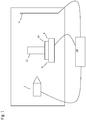
- Fig. 1 shows an embodiment of a CT imaging system.
- the system has a source 2, which emits X-rays in a conical beam (not shown), and a detector 4 for detecting X-rays emitted from the source 2.
- a sample mount 6 is provided between the source 2 and the detector 4.
- the sample mount 6 includes a platform 8, and a turntable 10 on the platform 8.
- a sample 12 is mounted on the platform 8.
- the platform 8 can be translated along the beam centreline (x axis), and in perpendicular axes in a plane perpendicular to the beam centreline (y and z axes), using a manipulator (not shown).
- the turntable 10 rotates about a rotation axis (not shown I Fig. 1 , but discussed in more detail below).
- a controller in the form of a control computer 14 controls the source, detector and sample mount.
- the controller 14 also obtains image data from the detector 4 and reconstructs the volume map.
- the controller 14 also performs calibration, to determine the geometrical parameters of the CT system, as described in more detail below. Alternatively, the image data can be transferred from the CT system for subsequent processing elsewhere.
- a dedicated calibration object known as a phantom or artefact, is used as the target sample.
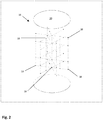
- the phantom is constructed by arranging a plurality of markers 18 in a supporting material 20.
- the markers 18 are strongly X-ray attenuating (radiodense, or relatively opaque to X-rays) in order to provide high contrast radiographic images in which the markers can be easily identified.
- the markers are highly spherical so that the 2D image coordinates of the centre of each marker can be determined with very high accuracy.
- the markers 18 are formed of tungsten carbide precision ball bearings.
- the markers 18 are retained in the supporting material 20 without the use of adhesives.
- the markers 18 are arranged with respect to each other so as to minimise overlap in the intended radiographic images. Preferably, the markers 18 are arranged so as to never overlap in the intended radiographic images.
- Suitable arrangements can be designed, for example, by modelling, or by inspection.
- at least one marker is close to the central axis of the phantom and at least one other marker is spaced further away from the central axis, as in Fig. 2 .
- the markers include markers radially spaced, preferably at least one marker close to the central axis and at least one marker close to the outer circumference of the phantom.
- the supporting material 20 is weakly attenuating (radiolucent, or relatively translucent to X-ray) so that the outline of each marker is imaged as clearly as possible.
- the supporting material 20 is preferably a low-density foam composed primarily of materials with low atomic number.
- the supporting material 20 is rigid, uniform and has a low thermal expansion coefficient. Carbon or silicon carbide foams are therefore considered ideal. Plastic foams such as extruded polystyrene foam are less favourable but may produce acceptable results. Other suitable materials include solid plastics and ceramics.
- the phantom 16 is placed in the X-ray CT system of Fig. 1 and radiographic images are taken in a number of positions and orientations.
- the acquisition includes one complete rotation (in small angular increments) with the rotation axis imaged in the region of the centre of the detector. This central scan is important since this is the position where CT acquisition will normally take place.
- the acquisition also includes one complete rotation with the rotation axis imaged significantly toward the left- or right-hand side of the detector (but where the entire phantom 16 still remains in view).
- This offset scan is important since data from the central scan alone does not fully decouple all of the required geometry parameters of the CT system.
- the misalignment of the rotation axis relative to the detector is zero or close to zero in the central scan, and is significantly greater than zero, and preferably as large as possible, in the offset scan.
- misalignment angles "skew” in the plane of the detector, with respect to rotation axis "z” and perpendicular axis "x"
- slant around rotation axis z
- tilt around axis x
- slant around rotation axis z
- tilt around axis x
- a CT acquisition is usually done with slant, skew and tilt close to zero in order to make the reconstruction of an object as insensitive as possible to errors in slant, skew and tilt.
- calibration preferably involves a central scan in similar conditions.
- slant is equal to 0
- very poor accuracy in tilt where slant almost equal to 0.
- invariants between the two scans are required.
- this is, for example, the positions of the markers in the phantom, and the relationship between the X-ray source and the detector (specifically the position of the principal point and the source to detector distance).
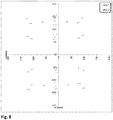
- Fig. 4 shows an example of a radiographic image of the phantom 16 of Fig. 2 from an offset scan.
- the acquisition also includes images taken at different magnifications (with the phantom 16 moved towards and/or away from the source) and in different vertical positions. This is important to provide information about the directions of the manipulator axes relative to the detector pixel row and column directions.
- the entire phantom 16 is in view in each captured image, but this is not essential, provided there are at least 2 markers 18 which remain in view during a rotation.
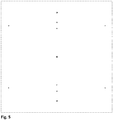
- Fig. 5 shows an example of a radiographic image of the phantom 16 from a scan at higher magnification.
- the complete acquisition might take some considerable time (perhaps 4 hours or more) and there is therefore some possibility that changes might occur in the geometry parameters of the system or the 3D relative positions of the markers 18 (e.g. as a result of thermal changes). For this reason it might be beneficial to repeat the acquisition of a subset of the radiographic images within a reduced time window (at the beginning, at the end or in the middle of the acquisition).
- This fast scan allows long-term trends in the slow scan to be identified and compensated for in the subsequent analysis. This can be achieved by comparing the trajectories of the markers in the fast and slow scans.
- the radiographic images are then analysed to determine the 2D image coordinates of the markers.
- the method involves deriving a first approximation of the geometrical parameters of the CT system, followed by performing various refinements, to progressively improve accuracy.
- the method involves defining the unknowns (unknown parameters), determining redundant degrees of freedom, measuring the phantom 16 in an offset position, extracting marker centre coordinates, calculating an initial geometry estimate, performing an iterative non-linear least squares estimate, and analysis of residual errors. This is described in more detail below.
- the 2D image coordinates of the markers are refined (step 602). This is done by extracting radial intensity profiles at a number of different angles. Bi-linear interpolation is used although other interpolation schemes might also be suitable. For each radial intensity profile the point of maximum gradient is determined and the coordinates of this point are converted back to Cartesian coordinates. A circle is then fitted to these points using a least-squares method. The points of maximum gradient as well as the diameter and centre of the fitted circle are all stored for later use.
- the markers are given numeric identifiers based on (approximate) prior information about the 3D relative positions of the markers 18 (step 603). This can be done, for example, simply by inspection, and does not require measurement. To avoid ambiguity the arrangement of the markers within the phantom is preferably asymmetric.
- the 2D image coordinates from the offset scan are then analysed to determine an initial estimate of the geometry parameters of the CT system and of the position and orientation of the rotation axis, as discussed in more detail below. In general terms, this is done by recognising that during the rotation of the calibration object each marker traces an elliptical path on the detector (in other words, the path of the image of each marker in the plurality of images is elliptical). Ellipses are fitted to the 2D image coordinates of two or more of the markers (step 604). From the equations of these ellipses it is possible to obtain (step 605) the equation of the line on the detector 4 that is the image of the central slice (i.e.
- the image of the plane that is perpendicular to the rotation axis and contains the X-ray source point It is also possible to obtain the coordinates of the principal point (i.e. the image of the line that is perpendicular to the detector and contains the X-ray source point) as well as the perpendicular distance from the X-ray source point to the detector, and therefore the location of the source S. Finally it is possible to obtain the equation of the line on the detector that is the image of the rotation axis.
- Fig. 8 shows examples of two radiographic images (projections) in the central scan, in co-ordinate system (u, v), in the plane of the detector.
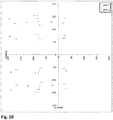
- Fig. 10 shows examples of two radiographic images (projections) in the offset scan.
- Fig. 11 shows the complete trajectories of two specific markers 18 in the offset scan.
- markers are selected for use in the initial estimate.
- two markers 18 are selected, in particular, marker (sphere) number 5 and marker (sphere) number 31.
- the trajectories of the selected markers in the plurality of captured images is identified (different images corresponding to different projection directions of the X-rays, that is different relative positions of rotation of the calibration object).
- trajectory 20 corresponds to marker number 5
- trajectory 22 corresponds to marker number 31.
- the centres of the ellipses can easily be determined from their equations.
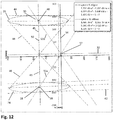
- Fig. 12 shows the line through the ellipse centre 28, 30 and corresponding image of the circle centre 38, 40, for each of the markers 5 and 31. These lines, and all similar lines for other markers, intersect the image of the central slice at a single point 52. It can be shown that the principal point 58 is located on a line which passes through this point 52 and which is perpendicular to the image of the central slice.
- the principal point 58 is at the same time located on a line 56 which passes through the vanishing point 36 and which is perpendicular to the image of the rotation axis 50.
- This line 56 is identified in Fig. 13 .
- the intersection of this line 56 with the previously identified line 54 gives the complete location of the principal point 58.
- the perpendicular distance from the x-ray source 2 to the detector 4 (i.e. the focal length) is equal to the square root of the product of two distances along this line 56.
- the first distance is from the principal point 58 to the image of the rotation axis 50 and the second is from the principal point 58 to the vanishing point 36.
- the combination of the principal point and the focal length forms a complete description of the geometry parameters of the CT system.
- the orientation of the rotation axis can be determined by calculating the vector product of two vectors in the plane of the central slice (as mentioned above, the central slice is the image of the plane that is perpendicular to the rotation axis and contains the X-ray source point, and the perpendicular to the plane is found by a vector product of vectors in the plane).
- One vector can be (in the plane of the detector) along the direction of the image of the central slice.
- the other vector can be from the x-ray source point to any point (in the plane of the detector) on the image of the central slice.
- the position of the rotation axis can then be determined by selecting any point on the image of the rotation axis.
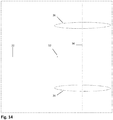
- FIG. 14 Another example of the elliptical paths 24, 26 of two markers along with the principal point 52, the image of the central slice 32 and the image of the rotation axis 50 are shown in Fig. 14 .
- this captures a complete description of the geometry parameters of the CT system and the position and orientation of the rotation axis with the exception that it is not possible to determine the perpendicular distance from the X-ray source to the rotation axis (i.e. magnification) without accurate prior information about the 3D relative positions of the markers (and specifically about the overall size of the phantom). If this distance is temporarily assigned a nominal value then an alternative value can later be substituted and the appropriate changes to the position of the rotation axis and the 3D relative positions of the markers can be trivially computed.
- the inaccuracy in the 2D image coordinates of the markers stems mostly from interpolation errors but it should also be noted that the outline of a sphere is only a circle in the case that the image of the sphere is centred on the principal point. In all other cases the image of the sphere undergoes a perspective distortion and its outline becomes elliptical. Under many circumstances this effect is negligible but it can be significant when the image of the sphere is large (e.g. at higher magnifications) and is far from the principal point. Since the coordinates of the principal point and the perpendicular distance from the X-ray source point to the detector are now known (to a first approximation) it becomes possible to compensate for the perspective distortion (step 606). The points of maximum gradient (stored earlier) are transformed onto an appropriate virtual detector where they form a circle (rather than an ellipse). A new circle is fitted on this virtual detector and the diameter and centre are again stored.
- the 2D image coordinates of the markers are further refined (step 607) using a slower but more accurate algorithm.
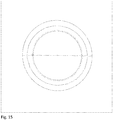
- This algorithm considers a narrow circular band on the virtual detector several pixels wide and containing the outline of the sphere (see Fig. 15 ). The algorithm seeks to maximize the area integral (over the entire circular band) of the product of the intensity at a point and the intensity at that point mirrored through the centre. A maximum will occur when the mirror point is the centre of the circle. This is analogous to the maximum cross correlation method commonly used in image registration. Appropriate sampling points are constructed on the virtual detector and then transformed onto the real detector where (for example) quadratic b-spline interpolation is then used to obtain the intensity. Maximization can be via (for example) the Nelder-Mead simplex method or using gradient-based methods. Other methods can be used.
- a least-squares solution using 2D image coordinates from all of the markers is sought.
- An iterative non-linear solver is used to minimize the differences between the measured 2D image coordinates and those predicted by a model (step 608).
- the complete model incorporates the 3D relative positions of the markers, the geometry parameters of the CT system and the positions and orientations of the phantom (for each radiographic image). A succession of fits is performed with gradually increasing numbers of free parameters.
- An initial estimate of the position and orientation of the rotation axis for the central scan is obtained. This can be based on (approximate) prior information about the difference in position of the central and offset scans and/or observed differences in the 2D image coordinates of one or more markers. An iterative non-linear solver is then used to refine this estimate (without attempting to solve for any other part of the model).
- An iterative non-linear solver is then used to solve (simultaneously for both offset and central scans) for the complete model subject to the constraint that the phantom undergoes two separate pure rotations (with known angular steps).
- An optional further step is to relax the constraint of pure rotation. Individual positions and orientations of the phantom are allowed for each radiographic image. An iterative non-linear solver is again used to find the least-squares solution which then contains a measure of the run-out and wobble of the rotation axis.
- step 609 attempts to detect (and quantify) a simple form of image distortion in the radiographic imaging device.
- the 2D image coordinates are corrected for some trial value of a and all of the initial estimates and subsequent non-linear least-squares solutions are recalculated.
- the final sum of square differences between the measured 2D image coordinates and those predicted by the model is a measure of the correctness of the trial value of a and a minimum can be sought.
- steps 604 to 608 are performed repeatedly with different magnitudes of distortion compensation, with the best result selected.
- Other models for image distortion can be used, such as non-radial or third-order equation models.
- the method described so far is unable to determine the perpendicular distance from the X-ray source to the rotation axis.
- it is unable to determine the overall size of the phantom.
- This is a serious limitation where the CT system is a metrology CT system and accurate absolute distance measurements are required.
- This requires the introduction of a length standard (step 610).
- the method described is readily adapted to incorporate either of two possible types of length standard described below.
- the second type of length standard is an accurately known distance between positions of the phantom.
- the acquisition can include a complete rotation of the phantom (with the rotation axis imaged in the centre of the detector) where the perpendicular distance from the X-ray source to the rotation axis is reduced by a known distance.
- An additional fit is required to determine the position and orientation of the rotation axis for this higher magnification scan.
- the acquisition can even include several such scans where all of the incremental distances between scanning positions are known.
- the above distances for the length standard can be determined using known techniques.
- the calibration can be carried out within the CT system itself, or the data can be downloaded and transferred to another system for processing.
- the calibration data is then used in association with the CT system in subsequent processing, that is, when in use for imaging other objects.
Landscapes
- Health & Medical Sciences (AREA)
- Life Sciences & Earth Sciences (AREA)
- Engineering & Computer Science (AREA)
- Medical Informatics (AREA)
- Nuclear Medicine, Radiotherapy & Molecular Imaging (AREA)
- General Health & Medical Sciences (AREA)
- Physics & Mathematics (AREA)
- Radiology & Medical Imaging (AREA)
- Pathology (AREA)
- Heart & Thoracic Surgery (AREA)
- Public Health (AREA)
- High Energy & Nuclear Physics (AREA)
- Biophysics (AREA)
- Biomedical Technology (AREA)
- Veterinary Medicine (AREA)
- Molecular Biology (AREA)
- Surgery (AREA)
- Animal Behavior & Ethology (AREA)
- Optics & Photonics (AREA)
- Pulmonology (AREA)
- Theoretical Computer Science (AREA)
- Chemical & Material Sciences (AREA)
- Analytical Chemistry (AREA)
- Biochemistry (AREA)
- General Physics & Mathematics (AREA)
- Immunology (AREA)
- Apparatus For Radiation Diagnosis (AREA)
- Analysing Materials By The Use Of Radiation (AREA)
Claims (12)
- Verfahren zur Kalibrierung eines Radiographiesystems, das eine Quelle (S) und einen Detektor (D) umfasst, wobei das Verfahren Folgendes umfasst: Bereitstellen eines Kalibrierobjekts (16), das einen oder mehrere Marker (18) umfasst, Rotieren des Kalibrierobjekts (16) relativ zu der Quelle (S) und/oder zu dem Detektor (D) um eine Rotationsachse, Aufnehmen einer Vielzahl von radiographischen Bildern des Kalibrierobjekts,
wobei das Verfahren Folgendes umfasst: Identifizieren des Orts des einen oder der mehreren Marker (18) in den radiographischen Bildern und
Ableiten von Bahnen für den einen oder die mehreren Marker unter Verwendung der Vielzahl von radiographischen Bildern,
gekennzeichnet durch
Zuordnen eines Nennwerts, der den Abstand zwischen der Quelle und der Rotationsachse darstellt, und Bestimmen von vollständigen geometrischen Parametern des Systems außer des Nennwerts des Abstands unter Verwendung der radiographischen Bilder und des Nennwerts des Abstands,
wobei die vollständigen geometrischen Parameter sieben Parameter sind, die aus Folgenden bestehen: zwei Parametern, die den Hauptpunkt (58) angeben, einem Parameter, der die Brennweite angibt, zwei Parametern, die die Ausrichtung der Rotationsachse angeben, und zwei Parametern, die die Position der Rotationsachse angeben. - Verfahren nach Anspruch 1, wobei das Verfahren das Ableiten einer elliptischen Bahn für jeden des einen oder der mehreren Marker (18) unter Verwendung der Vielzahl von radiographischen Bildern umfasst, bevorzugt durch Einpassen einer Ellipse auf die abgebildete Bewegungsbahn von jedem des einen oder der mehreren Marker (18).
- Verfahren nach einem von Anspruch 1 oder Anspruch 2, das das Überschneiden der Ellipsen umfasst, um geometrische Parameter des Systems zu bestimmen.
- Verfahren nach einem vorstehenden Anspruch, das das Ableiten einer ersten Geometrieschätzung des Systems unter Verwendung des einen oder der mehreren Marker (18) in den radiographischen Bildern umfasst.
- Verfahren nach einem vorstehenden Anspruch, das Folgendes umfasst: Verwenden eines Kreiserkennungsverfahrens, um eine Vielzahl von Kreisformen in jedem Bild zu identifizieren, und Auswählen von N oder weniger der Kreisformen, wobei N die Anzahl von Markern (18) in dem Kalibrierungsobjekt (16) ist.
- Verfahren nach einem vorstehenden Anspruch, das das Ableiten von einem oder mehreren von dem Bild der Rotationsachse, dem Bild der mittleren Schicht und des Hauptpunkts und/oder einem oder mehreren von dem Abstand von der Quelle zu Detektor, Objektversatz, Rotationsachse umfasst.
- Verfahren nach einem vorstehenden Anspruch, das das Bestimmen eines Werts umfasst, der den Abstand zwischen der Quelle und der Rotationsachse darstellt, optional wobei der Abstandswert unter Verwendung von Messungen des Kalibrierobjekts oder Messungen von relativen Positionen des Kalibrierobjekts bestimmt wird.
- Verfahren nach einem vorstehenden Anspruch, das Folgendes umfasst: Bereitstellen des Kalibrierobjekts (16) in einer mittleren Position, wo sich die Rotationsachse des Kalibrierobjekts ungefähr mit der Strahlmittellinie überschneidet, wobei eine Vielzahl der radiographischen Bilder mit dem Kalibrierobjekt in der mittleren Position erhalten wird, und/oder Bereitstellen des Kalibrierobjekts in einer versetzten Position, wo die Rotationsachse des Kalibrierobjekts von der Strahlmittellinie versetzt ist, wobei eine Vielzahl der radiographischen Bilder mit dem Kalibrierobjekt in der versetzten Position erhalten wird.
- Verfahren nach einem vorstehenden Anspruch, das weiter das anschließende Ableiten eines Werts für den Nennwert des Abstands beispielsweise unter Verwendung von Messungen des Kalibrierobjekts umfasst.
- Verfahren nach einem vorstehenden Anspruch, das das Verwenden eines unkalibrierten Kalibrierobjekts umfasst.
- Verfahren zur Messung eines Objekts in einem Radiographiesystem, das unter Verwendung des Verfahrens nach einem vorstehenden Anspruch kalibriert ist.
- Vorrichtung für die Kalibrierung eines Radiographiesystems, das eine Quelle (S) und einen Detektor (D) umfasst, und Mittel, die zur Ausführung der Schritte des Verfahrens nach einem vorstehenden Anspruch geeignet sind.
Applications Claiming Priority (2)
| Application Number | Priority Date | Filing Date | Title |
|---|---|---|---|
| GB1321003.4A GB2520711B (en) | 2013-11-28 | 2013-11-28 | Calibration apparatus and method for computed tomography |
| PCT/EP2014/075568 WO2015078874A1 (en) | 2013-11-28 | 2014-11-25 | Calibration apparatus and method for computed tomography |
Publications (2)
| Publication Number | Publication Date |
|---|---|
| EP3074761A1 EP3074761A1 (de) | 2016-10-05 |
| EP3074761B1 true EP3074761B1 (de) | 2018-11-21 |
Family
ID=49979463
Family Applications (1)
| Application Number | Title | Priority Date | Filing Date |
|---|---|---|---|
| EP14802471.4A Active EP3074761B1 (de) | 2013-11-28 | 2014-11-25 | Kalibriervorrichtung und verfahren für computertomografie |
Country Status (6)
| Country | Link |
|---|---|
| US (1) | US10478147B2 (de) |
| EP (1) | EP3074761B1 (de) |
| JP (1) | JP6735667B2 (de) |
| CN (1) | CN105849537B (de) |
| GB (1) | GB2520711B (de) |
| WO (1) | WO2015078874A1 (de) |
Families Citing this family (29)
| Publication number | Priority date | Publication date | Assignee | Title |
|---|---|---|---|---|
| GB201508065D0 (en) * | 2015-05-12 | 2015-06-24 | Rolls Royce Plc | A method of scanning Aerofoil blades |
| FR3040867A1 (fr) * | 2015-09-11 | 2017-03-17 | Thales Sa | Mire et procede de calibration d'un systeme d'imagerie par rayons x |
| CN105769233A (zh) * | 2016-02-29 | 2016-07-20 | 江苏美伦影像系统有限公司 | 一种几何校正方法 |
| WO2018133090A1 (zh) * | 2017-01-23 | 2018-07-26 | 深圳先进技术研究院 | X光机的参数校准方法、装置及系统 |
| WO2018170366A1 (en) * | 2017-03-16 | 2018-09-20 | The Johns Hopkins University | Geometric calibration for cone beam ct using line fiducials |
| EP4019893B1 (de) * | 2017-04-21 | 2025-07-02 | Shimadzu Corporation | Utensil zur auswertung von längenmessfehlern in einer röntgen-ct-vorrichtung zur dreidimensionalen formmessung |
| CN107233105B (zh) * | 2017-05-24 | 2020-12-11 | 深圳先进技术研究院 | 一种用于ct图像重建的修正方法及修正系统 |
| EP3421086B1 (de) * | 2017-06-28 | 2020-01-15 | OptiNav Sp. z o.o. | Bestimmung von geometrischen informationen über eine medizinische behandlungsanordnung mit drehbarer behandlungsstrahlungsquelleneinheit |
| JP6708857B2 (ja) * | 2017-10-17 | 2020-06-10 | 日本装置開発株式会社 | X線検査装置 |
| CN108030501B (zh) * | 2017-11-14 | 2019-12-13 | 深圳先进技术研究院 | 一种静态锥束ct成像系统几何校准装置及方法 |
| US10631818B2 (en) * | 2017-12-13 | 2020-04-28 | Carestream Health, Inc. | Mobile radiography calibration for tomosynthesis using epipolar geometry |
| CN112313502B (zh) * | 2018-03-07 | 2024-11-19 | 贝克休斯数据解决方案有限公司 | 计算机断层摄影应用的摆动补偿 |
| EP3817659B1 (de) * | 2018-07-02 | 2024-06-05 | Boston Scientific Scimed Inc. | Magnetischer spurfolgesender |
| CN109549660B (zh) * | 2018-12-07 | 2022-03-04 | 北京锐视康科技发展有限公司 | 可携带式扫描仪 |
| CN109549661B (zh) * | 2018-12-29 | 2022-11-15 | 北京纳米维景科技有限公司 | 一种探测器几何校正体模及校正方法 |
| CN109682843B (zh) * | 2019-02-13 | 2021-07-06 | 重庆交通大学 | 一种对ct系统的参数标定方法 |
| CN110006931A (zh) * | 2019-04-23 | 2019-07-12 | 西安增材制造国家研究院有限公司 | 一种工业在线ct及其应用 |
| JP7257924B2 (ja) * | 2019-09-09 | 2023-04-14 | 株式会社ミツトヨ | X線計測装置の校正方法 |
| JP7257925B2 (ja) * | 2019-09-10 | 2023-04-14 | 株式会社ミツトヨ | X線計測装置の校正方法 |
| EP3839420B1 (de) * | 2019-12-20 | 2023-07-05 | Hexagon Technology Center GmbH | Dynamische modellierung von cmms zur numerischen korrektur von messergebnissen |
| KR102419873B1 (ko) * | 2020-06-30 | 2022-07-13 | 오스템임플란트 주식회사 | 엑스선 촬영 장치 및 이를 이용한 팬텀 비드 탐색 방법 |
| JP7366467B2 (ja) * | 2020-07-17 | 2023-10-23 | 国立研究開発法人産業技術総合研究所 | X線ct装置の評価用器具 |
| DE102020128288A1 (de) * | 2020-10-28 | 2022-04-28 | Volume Graphics Gmbh | Computerimplementiertes Verfahren zur Ermittlung mindestens eines für eine Auswertung von Messdaten benötigten geometrischen Parameters |
| US12174129B2 (en) * | 2021-04-28 | 2024-12-24 | The Boeing Company | X-ray tomography systems and methods for imaging an aircraft part |
| JP7642233B2 (ja) * | 2021-06-21 | 2025-03-10 | 日本装置開発株式会社 | Ct画像生成方法 |
| KR102593247B1 (ko) | 2021-06-21 | 2023-10-24 | 주식회사 쓰리디산업영상 | 컴퓨터 단층 촬영의 기하 보정 방법 및 기하 보정 장치 |
| CN113876346B (zh) * | 2021-11-16 | 2024-06-07 | 佗道医疗科技有限公司 | 一种倾斜图像的迭代校正方法 |
| CN116359257A (zh) * | 2021-12-27 | 2023-06-30 | 同方威视技术股份有限公司 | 标定组件、标定模体及标定方法 |
| CN114460110B (zh) * | 2022-03-08 | 2023-06-06 | 中国电子科技集团公司第三十八研究所 | 一种伺服系统误差补偿方法 |
Family Cites Families (17)
| Publication number | Priority date | Publication date | Assignee | Title |
|---|---|---|---|---|
| FR2700909B1 (fr) | 1993-01-27 | 1995-03-17 | Gen Electric Cgr | Dispositif et procédé automatique de calibration géométrique d'un système d'imagerie par rayons X. |
| JP3548306B2 (ja) * | 1995-12-22 | 2004-07-28 | 株式会社日立メディコ | X線断層撮影装置 |
| JP4573593B2 (ja) * | 2003-07-25 | 2010-11-04 | 株式会社モリタ製作所 | X線画像補正方法及び装置 |
| EP1654516B1 (de) * | 2003-08-08 | 2012-11-28 | University Health Network | Verfahren und system zum kalibrieren einer quelle und detektorinstrument |
| US7016456B2 (en) | 2003-10-31 | 2006-03-21 | General Electric Company | Method and apparatus for calibrating volumetric computed tomography systems |
| JP4537090B2 (ja) | 2004-02-19 | 2010-09-01 | 東芝Itコントロールシステム株式会社 | トモシンセシス装置 |
| JP4421917B2 (ja) * | 2004-02-27 | 2010-02-24 | 株式会社日立メディコ | コーンビームx線ct装置 |
| DE102005032686A1 (de) * | 2005-07-06 | 2007-01-11 | Carl Zeiss Industrielle Messtechnik Gmbh | Verfahren und Anordnung zum Untersuchen eines Messobjekts mittels invasiver Strahlung |
| DE102005033187A1 (de) * | 2005-07-13 | 2007-01-25 | Carl Zeiss Industrielle Messtechnik Gmbh | Verfahren und eine Anordnung zum Kalibrieren einer Messanordnung |
| US7950849B2 (en) * | 2005-11-29 | 2011-05-31 | General Electric Company | Method and device for geometry analysis and calibration of volumetric imaging systems |
| US8033725B2 (en) * | 2006-06-02 | 2011-10-11 | Koninklijke Philips Electronics N.V. | X-ray image apparatus and device for and method of calibrating an X-ray image apparatus |
| DE102008044437A1 (de) | 2008-06-30 | 2009-12-31 | Werth Messtechnik Gmbh | Verfahren zum Messen von Geometrien von Werkstücken |
| JP5522345B2 (ja) * | 2009-02-10 | 2014-06-18 | 東芝Itコントロールシステム株式会社 | Ct装置およびct装置の較正方法 |
| DE102010050949A1 (de) * | 2010-11-10 | 2012-05-10 | Carl Zeiss Industrielle Messtechnik Gmbh | Messanordnung für einen Computertomographen |
| CN202104929U (zh) * | 2011-05-11 | 2012-01-11 | 上海生物医学工程研究中心 | 一种用于体ct几何校正的装置 |
| CN102423264B (zh) * | 2011-09-01 | 2014-05-21 | 中国科学院深圳先进技术研究院 | 基于图像的生物组织弹性的测量方法及装置 |
| KR20150079560A (ko) * | 2012-08-20 | 2015-07-08 | 오란게덴탈 게엠베하 운트 코카게 | 콘빔 컴퓨터 단층 촬영 장치의 기하 특성화 및 교정 |
-
2013
- 2013-11-28 GB GB1321003.4A patent/GB2520711B/en active Active
-
2014
- 2014-11-25 EP EP14802471.4A patent/EP3074761B1/de active Active
- 2014-11-25 JP JP2016533060A patent/JP6735667B2/ja active Active
- 2014-11-25 US US15/100,192 patent/US10478147B2/en active Active
- 2014-11-25 CN CN201480065411.7A patent/CN105849537B/zh active Active
- 2014-11-25 WO PCT/EP2014/075568 patent/WO2015078874A1/en not_active Ceased
Non-Patent Citations (1)
| Title |
|---|
| None * |
Also Published As
| Publication number | Publication date |
|---|---|
| CN105849537B (zh) | 2021-01-12 |
| GB2520711B (en) | 2018-06-20 |
| GB2520711A (en) | 2015-06-03 |
| US10478147B2 (en) | 2019-11-19 |
| JP2016538552A (ja) | 2016-12-08 |
| US20170020481A1 (en) | 2017-01-26 |
| WO2015078874A1 (en) | 2015-06-04 |
| CN105849537A (zh) | 2016-08-10 |
| GB201321003D0 (en) | 2014-01-15 |
| JP6735667B2 (ja) | 2020-08-05 |
| EP3074761A1 (de) | 2016-10-05 |
Similar Documents
| Publication | Publication Date | Title |
|---|---|---|
| EP3074761B1 (de) | Kalibriervorrichtung und verfahren für computertomografie | |
| Hiller et al. | Measurement accuracy in X-ray computed tomography metrology: Toward a systematic analysis of interference effects in tomographic imaging | |
| CA2892799C (en) | Method for detecting geometrical imaging properties of a flat panel detector, correspondingly configured x-ray testing system and calibrating body | |
| US6690841B2 (en) | Method and apparatus for image registration | |
| US20150260859A1 (en) | Method and device for correcting computed tomographiy measurements, comprising a coordinate measuring machine | |
| JP5615260B2 (ja) | 機械的ワークを断層撮影法によって測定するための方法 | |
| KR20150079560A (ko) | 콘빔 컴퓨터 단층 촬영 장치의 기하 특성화 및 교정 | |
| KR20180107324A (ko) | 3차원 비접촉 스캐닝 시스템의 현장 교정 | |
| US20170160077A1 (en) | Method of inspecting an object with a vision probe | |
| WO2018170366A1 (en) | Geometric calibration for cone beam ct using line fiducials | |
| WO2018014138A1 (en) | Inspection method for a manufactured article and system for performing same | |
| Ferrucci et al. | Measurement of the X-ray computed tomography instrument geometry by minimization of reprojection errors—Implementation on simulated data | |
| CN110133014A (zh) | 一种芯片内部缺陷检测方法及系统 | |
| JP2021193400A (ja) | アーチファクトを測定するための方法 | |
| JP7038399B2 (ja) | Ct装置用校正器 | |
| JP2021050937A (ja) | 計測用x線ct装置の校正方法、測定方法、及び、計測用x線ct装置 | |
| CN111736235A (zh) | Ct设备的几何参数标定件及标定方法 | |
| WO2007043974A1 (en) | Computed tomography system and method | |
| US12400377B2 (en) | Computer-implemented method for determining at least one geometric parameter required for evaluating measurement data | |
| US11604152B2 (en) | Fast industrial computed tomography for large objects | |
| CN120457454A (zh) | 用于校准系统的装置和计算机实现的方法 | |
| JP2010169636A (ja) | 形状測定装置 | |
| KR20160101903A (ko) | 테스트 대상과 x-레이 검사 시스템 사이의 위험 구역을 결정하기 위한 방법 | |
| KR101464180B1 (ko) | 엑스레이 검사기의 구별 시편을 이용한 x선 3차원 복원 방법 | |
| JP7757181B2 (ja) | X線計測装置の校正方法 |
Legal Events
| Date | Code | Title | Description |
|---|---|---|---|
| PUAI | Public reference made under article 153(3) epc to a published international application that has entered the european phase |
Free format text: ORIGINAL CODE: 0009012 |
|
| 17P | Request for examination filed |
Effective date: 20160627 |
|
| AK | Designated contracting states |
Kind code of ref document: A1 Designated state(s): AL AT BE BG CH CY CZ DE DK EE ES FI FR GB GR HR HU IE IS IT LI LT LU LV MC MK MT NL NO PL PT RO RS SE SI SK SM TR |
|
| AX | Request for extension of the european patent |
Extension state: BA ME |
|
| DAX | Request for extension of the european patent (deleted) | ||
| STAA | Information on the status of an ep patent application or granted ep patent |
Free format text: STATUS: REQUEST FOR EXAMINATION WAS MADE |
|
| STAA | Information on the status of an ep patent application or granted ep patent |
Free format text: STATUS: EXAMINATION IS IN PROGRESS |
|
| 17Q | First examination report despatched |
Effective date: 20170629 |
|
| REG | Reference to a national code |
Ref country code: DE Ref legal event code: R079 Ref document number: 602014036591 Country of ref document: DE Free format text: PREVIOUS MAIN CLASS: G01N0023040000 Ipc: G01N0023046000 |
|
| RIC1 | Information provided on ipc code assigned before grant |
Ipc: G01N 23/046 20180101AFI20180219BHEP Ipc: A61B 6/00 20060101ALI20180219BHEP Ipc: A61B 6/03 20060101ALI20180219BHEP |
|
| GRAP | Despatch of communication of intention to grant a patent |
Free format text: ORIGINAL CODE: EPIDOSNIGR1 |
|
| STAA | Information on the status of an ep patent application or granted ep patent |
Free format text: STATUS: GRANT OF PATENT IS INTENDED |
|
| INTG | Intention to grant announced |
Effective date: 20180417 |
|
| GRAS | Grant fee paid |
Free format text: ORIGINAL CODE: EPIDOSNIGR3 |
|
| GRAA | (expected) grant |
Free format text: ORIGINAL CODE: 0009210 |
|
| STAA | Information on the status of an ep patent application or granted ep patent |
Free format text: STATUS: THE PATENT HAS BEEN GRANTED |
|
| AK | Designated contracting states |
Kind code of ref document: B1 Designated state(s): AL AT BE BG CH CY CZ DE DK EE ES FI FR GB GR HR HU IE IS IT LI LT LU LV MC MK MT NL NO PL PT RO RS SE SI SK SM TR |
|
| REG | Reference to a national code |
Ref country code: CH Ref legal event code: EP |
|
| REG | Reference to a national code |
Ref country code: IE Ref legal event code: FG4D |
|
| REG | Reference to a national code |
Ref country code: DE Ref legal event code: R096 Ref document number: 602014036591 Country of ref document: DE |
|
| REG | Reference to a national code |
Ref country code: AT Ref legal event code: REF Ref document number: 1068112 Country of ref document: AT Kind code of ref document: T Effective date: 20181215 |
|
| REG | Reference to a national code |
Ref country code: NL Ref legal event code: MP Effective date: 20181121 |
|
| REG | Reference to a national code |
Ref country code: AT Ref legal event code: MK05 Ref document number: 1068112 Country of ref document: AT Kind code of ref document: T Effective date: 20181121 |
|
| PG25 | Lapsed in a contracting state [announced via postgrant information from national office to epo] |
Ref country code: FI Free format text: LAPSE BECAUSE OF FAILURE TO SUBMIT A TRANSLATION OF THE DESCRIPTION OR TO PAY THE FEE WITHIN THE PRESCRIBED TIME-LIMIT Effective date: 20181121 Ref country code: IS Free format text: LAPSE BECAUSE OF FAILURE TO SUBMIT A TRANSLATION OF THE DESCRIPTION OR TO PAY THE FEE WITHIN THE PRESCRIBED TIME-LIMIT Effective date: 20190321 Ref country code: NO Free format text: LAPSE BECAUSE OF FAILURE TO SUBMIT A TRANSLATION OF THE DESCRIPTION OR TO PAY THE FEE WITHIN THE PRESCRIBED TIME-LIMIT Effective date: 20190221 Ref country code: HR Free format text: LAPSE BECAUSE OF FAILURE TO SUBMIT A TRANSLATION OF THE DESCRIPTION OR TO PAY THE FEE WITHIN THE PRESCRIBED TIME-LIMIT Effective date: 20181121 Ref country code: LT Free format text: LAPSE BECAUSE OF FAILURE TO SUBMIT A TRANSLATION OF THE DESCRIPTION OR TO PAY THE FEE WITHIN THE PRESCRIBED TIME-LIMIT Effective date: 20181121 Ref country code: BG Free format text: LAPSE BECAUSE OF FAILURE TO SUBMIT A TRANSLATION OF THE DESCRIPTION OR TO PAY THE FEE WITHIN THE PRESCRIBED TIME-LIMIT Effective date: 20190221 Ref country code: ES Free format text: LAPSE BECAUSE OF FAILURE TO SUBMIT A TRANSLATION OF THE DESCRIPTION OR TO PAY THE FEE WITHIN THE PRESCRIBED TIME-LIMIT Effective date: 20181121 Ref country code: LV Free format text: LAPSE BECAUSE OF FAILURE TO SUBMIT A TRANSLATION OF THE DESCRIPTION OR TO PAY THE FEE WITHIN THE PRESCRIBED TIME-LIMIT Effective date: 20181121 Ref country code: AT Free format text: LAPSE BECAUSE OF FAILURE TO SUBMIT A TRANSLATION OF THE DESCRIPTION OR TO PAY THE FEE WITHIN THE PRESCRIBED TIME-LIMIT Effective date: 20181121 |
|
| PG25 | Lapsed in a contracting state [announced via postgrant information from national office to epo] |
Ref country code: PT Free format text: LAPSE BECAUSE OF FAILURE TO SUBMIT A TRANSLATION OF THE DESCRIPTION OR TO PAY THE FEE WITHIN THE PRESCRIBED TIME-LIMIT Effective date: 20190321 Ref country code: AL Free format text: LAPSE BECAUSE OF FAILURE TO SUBMIT A TRANSLATION OF THE DESCRIPTION OR TO PAY THE FEE WITHIN THE PRESCRIBED TIME-LIMIT Effective date: 20181121 Ref country code: RS Free format text: LAPSE BECAUSE OF FAILURE TO SUBMIT A TRANSLATION OF THE DESCRIPTION OR TO PAY THE FEE WITHIN THE PRESCRIBED TIME-LIMIT Effective date: 20181121 Ref country code: NL Free format text: LAPSE BECAUSE OF FAILURE TO SUBMIT A TRANSLATION OF THE DESCRIPTION OR TO PAY THE FEE WITHIN THE PRESCRIBED TIME-LIMIT Effective date: 20181121 Ref country code: SE Free format text: LAPSE BECAUSE OF FAILURE TO SUBMIT A TRANSLATION OF THE DESCRIPTION OR TO PAY THE FEE WITHIN THE PRESCRIBED TIME-LIMIT Effective date: 20181121 Ref country code: GR Free format text: LAPSE BECAUSE OF FAILURE TO SUBMIT A TRANSLATION OF THE DESCRIPTION OR TO PAY THE FEE WITHIN THE PRESCRIBED TIME-LIMIT Effective date: 20190222 |
|
| REG | Reference to a national code |
Ref country code: CH Ref legal event code: PL |
|
| PG25 | Lapsed in a contracting state [announced via postgrant information from national office to epo] |
Ref country code: LU Free format text: LAPSE BECAUSE OF NON-PAYMENT OF DUE FEES Effective date: 20181125 Ref country code: IT Free format text: LAPSE BECAUSE OF FAILURE TO SUBMIT A TRANSLATION OF THE DESCRIPTION OR TO PAY THE FEE WITHIN THE PRESCRIBED TIME-LIMIT Effective date: 20181121 Ref country code: DK Free format text: LAPSE BECAUSE OF FAILURE TO SUBMIT A TRANSLATION OF THE DESCRIPTION OR TO PAY THE FEE WITHIN THE PRESCRIBED TIME-LIMIT Effective date: 20181121 Ref country code: PL Free format text: LAPSE BECAUSE OF FAILURE TO SUBMIT A TRANSLATION OF THE DESCRIPTION OR TO PAY THE FEE WITHIN THE PRESCRIBED TIME-LIMIT Effective date: 20181121 Ref country code: CZ Free format text: LAPSE BECAUSE OF FAILURE TO SUBMIT A TRANSLATION OF THE DESCRIPTION OR TO PAY THE FEE WITHIN THE PRESCRIBED TIME-LIMIT Effective date: 20181121 |
|
| REG | Reference to a national code |
Ref country code: BE Ref legal event code: MM Effective date: 20181130 |
|
| REG | Reference to a national code |
Ref country code: IE Ref legal event code: MM4A |
|
| REG | Reference to a national code |
Ref country code: DE Ref legal event code: R097 Ref document number: 602014036591 Country of ref document: DE |
|
| PG25 | Lapsed in a contracting state [announced via postgrant information from national office to epo] |
Ref country code: CH Free format text: LAPSE BECAUSE OF NON-PAYMENT OF DUE FEES Effective date: 20181130 Ref country code: MC Free format text: LAPSE BECAUSE OF FAILURE TO SUBMIT A TRANSLATION OF THE DESCRIPTION OR TO PAY THE FEE WITHIN THE PRESCRIBED TIME-LIMIT Effective date: 20181121 Ref country code: LI Free format text: LAPSE BECAUSE OF NON-PAYMENT OF DUE FEES Effective date: 20181130 Ref country code: SK Free format text: LAPSE BECAUSE OF FAILURE TO SUBMIT A TRANSLATION OF THE DESCRIPTION OR TO PAY THE FEE WITHIN THE PRESCRIBED TIME-LIMIT Effective date: 20181121 Ref country code: RO Free format text: LAPSE BECAUSE OF FAILURE TO SUBMIT A TRANSLATION OF THE DESCRIPTION OR TO PAY THE FEE WITHIN THE PRESCRIBED TIME-LIMIT Effective date: 20181121 Ref country code: SM Free format text: LAPSE BECAUSE OF FAILURE TO SUBMIT A TRANSLATION OF THE DESCRIPTION OR TO PAY THE FEE WITHIN THE PRESCRIBED TIME-LIMIT Effective date: 20181121 Ref country code: EE Free format text: LAPSE BECAUSE OF FAILURE TO SUBMIT A TRANSLATION OF THE DESCRIPTION OR TO PAY THE FEE WITHIN THE PRESCRIBED TIME-LIMIT Effective date: 20181121 |
|
| PLBE | No opposition filed within time limit |
Free format text: ORIGINAL CODE: 0009261 |
|
| STAA | Information on the status of an ep patent application or granted ep patent |
Free format text: STATUS: NO OPPOSITION FILED WITHIN TIME LIMIT |
|
| 26N | No opposition filed |
Effective date: 20190822 |
|
| PG25 | Lapsed in a contracting state [announced via postgrant information from national office to epo] |
Ref country code: IE Free format text: LAPSE BECAUSE OF NON-PAYMENT OF DUE FEES Effective date: 20181125 Ref country code: SI Free format text: LAPSE BECAUSE OF FAILURE TO SUBMIT A TRANSLATION OF THE DESCRIPTION OR TO PAY THE FEE WITHIN THE PRESCRIBED TIME-LIMIT Effective date: 20181121 |
|
| PG25 | Lapsed in a contracting state [announced via postgrant information from national office to epo] |
Ref country code: BE Free format text: LAPSE BECAUSE OF NON-PAYMENT OF DUE FEES Effective date: 20181130 |
|
| PG25 | Lapsed in a contracting state [announced via postgrant information from national office to epo] |
Ref country code: MT Free format text: LAPSE BECAUSE OF NON-PAYMENT OF DUE FEES Effective date: 20181125 |
|
| PG25 | Lapsed in a contracting state [announced via postgrant information from national office to epo] |
Ref country code: TR Free format text: LAPSE BECAUSE OF FAILURE TO SUBMIT A TRANSLATION OF THE DESCRIPTION OR TO PAY THE FEE WITHIN THE PRESCRIBED TIME-LIMIT Effective date: 20181121 |
|
| PG25 | Lapsed in a contracting state [announced via postgrant information from national office to epo] |
Ref country code: CY Free format text: LAPSE BECAUSE OF FAILURE TO SUBMIT A TRANSLATION OF THE DESCRIPTION OR TO PAY THE FEE WITHIN THE PRESCRIBED TIME-LIMIT Effective date: 20181121 Ref country code: MK Free format text: LAPSE BECAUSE OF NON-PAYMENT OF DUE FEES Effective date: 20181121 Ref country code: HU Free format text: LAPSE BECAUSE OF FAILURE TO SUBMIT A TRANSLATION OF THE DESCRIPTION OR TO PAY THE FEE WITHIN THE PRESCRIBED TIME-LIMIT; INVALID AB INITIO Effective date: 20141125 |
|
| P01 | Opt-out of the competence of the unified patent court (upc) registered |
Effective date: 20230526 |
|
| PGFP | Annual fee paid to national office [announced via postgrant information from national office to epo] |
Ref country code: DE Payment date: 20251126 Year of fee payment: 12 |
|
| PGFP | Annual fee paid to national office [announced via postgrant information from national office to epo] |
Ref country code: GB Payment date: 20251125 Year of fee payment: 12 |
|
| PGFP | Annual fee paid to national office [announced via postgrant information from national office to epo] |
Ref country code: FR Payment date: 20251124 Year of fee payment: 12 |