EP3067964B1 - Acid resistant glass mats that include binders with hydrophilic agents - Google Patents
Acid resistant glass mats that include binders with hydrophilic agents Download PDFInfo
- Publication number
- EP3067964B1 EP3067964B1 EP16159136.7A EP16159136A EP3067964B1 EP 3067964 B1 EP3067964 B1 EP 3067964B1 EP 16159136 A EP16159136 A EP 16159136A EP 3067964 B1 EP3067964 B1 EP 3067964B1
- Authority
- EP
- European Patent Office
- Prior art keywords
- glass
- mat
- hydrophilic
- fiber mat
- fibers
- Prior art date
- Legal status (The legal status is an assumption and is not a legal conclusion. Google has not performed a legal analysis and makes no representation as to the accuracy of the status listed.)
- Active
Links
Images


Classifications
-
- H—ELECTRICITY
- H01—ELECTRIC ELEMENTS
- H01M—PROCESSES OR MEANS, e.g. BATTERIES, FOR THE DIRECT CONVERSION OF CHEMICAL ENERGY INTO ELECTRICAL ENERGY
- H01M50/00—Constructional details or processes of manufacture of the non-active parts of electrochemical cells other than fuel cells, e.g. hybrid cells
- H01M50/40—Separators; Membranes; Diaphragms; Spacing elements inside cells
- H01M50/403—Manufacturing processes of separators, membranes or diaphragms
-
- B—PERFORMING OPERATIONS; TRANSPORTING
- B29—WORKING OF PLASTICS; WORKING OF SUBSTANCES IN A PLASTIC STATE IN GENERAL
- B29C—SHAPING OR JOINING OF PLASTICS; SHAPING OF MATERIAL IN A PLASTIC STATE, NOT OTHERWISE PROVIDED FOR; AFTER-TREATMENT OF THE SHAPED PRODUCTS, e.g. REPAIRING
- B29C70/00—Shaping composites, i.e. plastics material comprising reinforcements, fillers or preformed parts, e.g. inserts
- B29C70/04—Shaping composites, i.e. plastics material comprising reinforcements, fillers or preformed parts, e.g. inserts comprising reinforcements only, e.g. self-reinforcing plastics
- B29C70/06—Fibrous reinforcements only
- B29C70/10—Fibrous reinforcements only characterised by the structure of fibrous reinforcements, e.g. hollow fibres
- B29C70/12—Fibrous reinforcements only characterised by the structure of fibrous reinforcements, e.g. hollow fibres using fibres of short length, e.g. in the form of a mat
-
- B—PERFORMING OPERATIONS; TRANSPORTING
- B29—WORKING OF PLASTICS; WORKING OF SUBSTANCES IN A PLASTIC STATE IN GENERAL
- B29C—SHAPING OR JOINING OF PLASTICS; SHAPING OF MATERIAL IN A PLASTIC STATE, NOT OTHERWISE PROVIDED FOR; AFTER-TREATMENT OF THE SHAPED PRODUCTS, e.g. REPAIRING
- B29C70/00—Shaping composites, i.e. plastics material comprising reinforcements, fillers or preformed parts, e.g. inserts
- B29C70/04—Shaping composites, i.e. plastics material comprising reinforcements, fillers or preformed parts, e.g. inserts comprising reinforcements only, e.g. self-reinforcing plastics
- B29C70/28—Shaping operations therefor
- B29C70/30—Shaping by lay-up, i.e. applying fibres, tape or broadsheet on a mould, former or core; Shaping by spray-up, i.e. spraying of fibres on a mould, former or core
- B29C70/36—Shaping by lay-up, i.e. applying fibres, tape or broadsheet on a mould, former or core; Shaping by spray-up, i.e. spraying of fibres on a mould, former or core and impregnating by casting, e.g. vacuum casting
-
- B—PERFORMING OPERATIONS; TRANSPORTING
- B29—WORKING OF PLASTICS; WORKING OF SUBSTANCES IN A PLASTIC STATE IN GENERAL
- B29C—SHAPING OR JOINING OF PLASTICS; SHAPING OF MATERIAL IN A PLASTIC STATE, NOT OTHERWISE PROVIDED FOR; AFTER-TREATMENT OF THE SHAPED PRODUCTS, e.g. REPAIRING
- B29C70/00—Shaping composites, i.e. plastics material comprising reinforcements, fillers or preformed parts, e.g. inserts
- B29C70/88—Shaping composites, i.e. plastics material comprising reinforcements, fillers or preformed parts, e.g. inserts characterised primarily by possessing specific properties, e.g. electrically conductive or locally reinforced
-
- D—TEXTILES; PAPER
- D04—BRAIDING; LACE-MAKING; KNITTING; TRIMMINGS; NON-WOVEN FABRICS
- D04H—MAKING TEXTILE FABRICS, e.g. FROM FIBRES OR FILAMENTARY MATERIAL; FABRICS MADE BY SUCH PROCESSES OR APPARATUS, e.g. FELTS, NON-WOVEN FABRICS; COTTON-WOOL; WADDING ; NON-WOVEN FABRICS FROM STAPLE FIBRES, FILAMENTS OR YARNS, BONDED WITH AT LEAST ONE WEB-LIKE MATERIAL DURING THEIR CONSOLIDATION
- D04H1/00—Non-woven fabrics formed wholly or mainly of staple fibres or like relatively short fibres
- D04H1/40—Non-woven fabrics formed wholly or mainly of staple fibres or like relatively short fibres from fleeces or layers composed of fibres without existing or potential cohesive properties
- D04H1/42—Non-woven fabrics formed wholly or mainly of staple fibres or like relatively short fibres from fleeces or layers composed of fibres without existing or potential cohesive properties characterised by the use of certain kinds of fibres insofar as this use has no preponderant influence on the consolidation of the fleece
- D04H1/4209—Inorganic fibres
- D04H1/4218—Glass fibres
-
- H—ELECTRICITY
- H01—ELECTRIC ELEMENTS
- H01M—PROCESSES OR MEANS, e.g. BATTERIES, FOR THE DIRECT CONVERSION OF CHEMICAL ENERGY INTO ELECTRICAL ENERGY
- H01M10/00—Secondary cells; Manufacture thereof
- H01M10/06—Lead-acid accumulators
- H01M10/12—Construction or manufacture
-
- H—ELECTRICITY
- H01—ELECTRIC ELEMENTS
- H01M—PROCESSES OR MEANS, e.g. BATTERIES, FOR THE DIRECT CONVERSION OF CHEMICAL ENERGY INTO ELECTRICAL ENERGY
- H01M50/00—Constructional details or processes of manufacture of the non-active parts of electrochemical cells other than fuel cells, e.g. hybrid cells
- H01M50/40—Separators; Membranes; Diaphragms; Spacing elements inside cells
- H01M50/409—Separators, membranes or diaphragms characterised by the material
- H01M50/431—Inorganic material
- H01M50/434—Ceramics
- H01M50/437—Glass
-
- H—ELECTRICITY
- H01—ELECTRIC ELEMENTS
- H01M—PROCESSES OR MEANS, e.g. BATTERIES, FOR THE DIRECT CONVERSION OF CHEMICAL ENERGY INTO ELECTRICAL ENERGY
- H01M50/00—Constructional details or processes of manufacture of the non-active parts of electrochemical cells other than fuel cells, e.g. hybrid cells
- H01M50/40—Separators; Membranes; Diaphragms; Spacing elements inside cells
- H01M50/409—Separators, membranes or diaphragms characterised by the material
- H01M50/44—Fibrous material
-
- H—ELECTRICITY
- H01—ELECTRIC ELEMENTS
- H01M—PROCESSES OR MEANS, e.g. BATTERIES, FOR THE DIRECT CONVERSION OF CHEMICAL ENERGY INTO ELECTRICAL ENERGY
- H01M50/00—Constructional details or processes of manufacture of the non-active parts of electrochemical cells other than fuel cells, e.g. hybrid cells
- H01M50/40—Separators; Membranes; Diaphragms; Spacing elements inside cells
- H01M50/489—Separators, membranes, diaphragms or spacing elements inside the cells, characterised by their physical properties, e.g. swelling degree, hydrophilicity or shut down properties
-
- H—ELECTRICITY
- H01—ELECTRIC ELEMENTS
- H01M—PROCESSES OR MEANS, e.g. BATTERIES, FOR THE DIRECT CONVERSION OF CHEMICAL ENERGY INTO ELECTRICAL ENERGY
- H01M50/00—Constructional details or processes of manufacture of the non-active parts of electrochemical cells other than fuel cells, e.g. hybrid cells
- H01M50/40—Separators; Membranes; Diaphragms; Spacing elements inside cells
- H01M50/489—Separators, membranes, diaphragms or spacing elements inside the cells, characterised by their physical properties, e.g. swelling degree, hydrophilicity or shut down properties
- H01M50/491—Porosity
-
- H—ELECTRICITY
- H01—ELECTRIC ELEMENTS
- H01M—PROCESSES OR MEANS, e.g. BATTERIES, FOR THE DIRECT CONVERSION OF CHEMICAL ENERGY INTO ELECTRICAL ENERGY
- H01M50/00—Constructional details or processes of manufacture of the non-active parts of electrochemical cells other than fuel cells, e.g. hybrid cells
- H01M50/40—Separators; Membranes; Diaphragms; Spacing elements inside cells
- H01M50/489—Separators, membranes, diaphragms or spacing elements inside the cells, characterised by their physical properties, e.g. swelling degree, hydrophilicity or shut down properties
- H01M50/494—Tensile strength
-
- B—PERFORMING OPERATIONS; TRANSPORTING
- B29—WORKING OF PLASTICS; WORKING OF SUBSTANCES IN A PLASTIC STATE IN GENERAL
- B29K—INDEXING SCHEME ASSOCIATED WITH SUBCLASSES B29B, B29C OR B29D, RELATING TO MOULDING MATERIALS OR TO MATERIALS FOR MOULDS, REINFORCEMENTS, FILLERS OR PREFORMED PARTS, e.g. INSERTS
- B29K2033/00—Use of polymers of unsaturated acids or derivatives thereof as moulding material
- B29K2033/04—Polymers of esters
- B29K2033/08—Polymers of acrylic acid esters, e.g. PMA, i.e. polymethylacrylate
-
- B—PERFORMING OPERATIONS; TRANSPORTING
- B29—WORKING OF PLASTICS; WORKING OF SUBSTANCES IN A PLASTIC STATE IN GENERAL
- B29K—INDEXING SCHEME ASSOCIATED WITH SUBCLASSES B29B, B29C OR B29D, RELATING TO MOULDING MATERIALS OR TO MATERIALS FOR MOULDS, REINFORCEMENTS, FILLERS OR PREFORMED PARTS, e.g. INSERTS
- B29K2105/00—Condition, form or state of moulded material or of the material to be shaped
- B29K2105/06—Condition, form or state of moulded material or of the material to be shaped containing reinforcements, fillers or inserts
- B29K2105/12—Condition, form or state of moulded material or of the material to be shaped containing reinforcements, fillers or inserts of short lengths, e.g. chopped filaments, staple fibres or bristles
-
- B—PERFORMING OPERATIONS; TRANSPORTING
- B29—WORKING OF PLASTICS; WORKING OF SUBSTANCES IN A PLASTIC STATE IN GENERAL
- B29K—INDEXING SCHEME ASSOCIATED WITH SUBCLASSES B29B, B29C OR B29D, RELATING TO MOULDING MATERIALS OR TO MATERIALS FOR MOULDS, REINFORCEMENTS, FILLERS OR PREFORMED PARTS, e.g. INSERTS
- B29K2309/00—Use of inorganic materials not provided for in groups B29K2303/00 - B29K2307/00, as reinforcement
- B29K2309/08—Glass
-
- B—PERFORMING OPERATIONS; TRANSPORTING
- B29—WORKING OF PLASTICS; WORKING OF SUBSTANCES IN A PLASTIC STATE IN GENERAL
- B29K—INDEXING SCHEME ASSOCIATED WITH SUBCLASSES B29B, B29C OR B29D, RELATING TO MOULDING MATERIALS OR TO MATERIALS FOR MOULDS, REINFORCEMENTS, FILLERS OR PREFORMED PARTS, e.g. INSERTS
- B29K2995/00—Properties of moulding materials, reinforcements, fillers, preformed parts or moulds
- B29K2995/0037—Other properties
- B29K2995/0058—Inert to chemical degradation
-
- B—PERFORMING OPERATIONS; TRANSPORTING
- B29—WORKING OF PLASTICS; WORKING OF SUBSTANCES IN A PLASTIC STATE IN GENERAL
- B29K—INDEXING SCHEME ASSOCIATED WITH SUBCLASSES B29B, B29C OR B29D, RELATING TO MOULDING MATERIALS OR TO MATERIALS FOR MOULDS, REINFORCEMENTS, FILLERS OR PREFORMED PARTS, e.g. INSERTS
- B29K2995/00—Properties of moulding materials, reinforcements, fillers, preformed parts or moulds
- B29K2995/0037—Other properties
- B29K2995/0092—Other properties hydrophilic
-
- B—PERFORMING OPERATIONS; TRANSPORTING
- B29—WORKING OF PLASTICS; WORKING OF SUBSTANCES IN A PLASTIC STATE IN GENERAL
- B29L—INDEXING SCHEME ASSOCIATED WITH SUBCLASS B29C, RELATING TO PARTICULAR ARTICLES
- B29L2031/00—Other particular articles
- B29L2031/34—Electrical apparatus, e.g. sparking plugs or parts thereof
- B29L2031/3468—Batteries, accumulators or fuel cells
-
- D—TEXTILES; PAPER
- D10—INDEXING SCHEME ASSOCIATED WITH SUBLASSES OF SECTION D, RELATING TO TEXTILES
- D10B—INDEXING SCHEME ASSOCIATED WITH SUBLASSES OF SECTION D, RELATING TO TEXTILES
- D10B2401/00—Physical properties
- D10B2401/02—Moisture-responsive characteristics
- D10B2401/022—Moisture-responsive characteristics hydrophylic
-
- D—TEXTILES; PAPER
- D10—INDEXING SCHEME ASSOCIATED WITH SUBLASSES OF SECTION D, RELATING TO TEXTILES
- D10B—INDEXING SCHEME ASSOCIATED WITH SUBLASSES OF SECTION D, RELATING TO TEXTILES
- D10B2505/00—Industrial
- D10B2505/02—Reinforcing materials; Prepregs
-
- D—TEXTILES; PAPER
- D10—INDEXING SCHEME ASSOCIATED WITH SUBLASSES OF SECTION D, RELATING TO TEXTILES
- D10B—INDEXING SCHEME ASSOCIATED WITH SUBLASSES OF SECTION D, RELATING TO TEXTILES
- D10B2505/00—Industrial
- D10B2505/04—Filters
-
- H—ELECTRICITY
- H01—ELECTRIC ELEMENTS
- H01M—PROCESSES OR MEANS, e.g. BATTERIES, FOR THE DIRECT CONVERSION OF CHEMICAL ENERGY INTO ELECTRICAL ENERGY
- H01M2220/00—Batteries for particular applications
- H01M2220/20—Batteries in motive systems, e.g. vehicle, ship, plane
-
- Y—GENERAL TAGGING OF NEW TECHNOLOGICAL DEVELOPMENTS; GENERAL TAGGING OF CROSS-SECTIONAL TECHNOLOGIES SPANNING OVER SEVERAL SECTIONS OF THE IPC; TECHNICAL SUBJECTS COVERED BY FORMER USPC CROSS-REFERENCE ART COLLECTIONS [XRACs] AND DIGESTS
- Y02—TECHNOLOGIES OR APPLICATIONS FOR MITIGATION OR ADAPTATION AGAINST CLIMATE CHANGE
- Y02E—REDUCTION OF GREENHOUSE GAS [GHG] EMISSIONS, RELATED TO ENERGY GENERATION, TRANSMISSION OR DISTRIBUTION
- Y02E60/00—Enabling technologies; Technologies with a potential or indirect contribution to GHG emissions mitigation
- Y02E60/10—Energy storage using batteries
Definitions
- Lead-acid batteries are an inexpensive, reliable, and rechargable storage medium for electric power. Their ability to provide a short burst of high current has made them the battery of choice to crank an automobile's starter motor for more than a century. Despite a long history of development and commericalization, and many well-studied shortcomings, the lead-acid battery is still being improved.
- Glass fibers have become a popular choice for the separator and reinforcing mats found in lead-acid batteries see for example DE-C-947 182 ; EP-A-0 381 077 and US 2,978,529 .
- the glass fibers are relatively inert to the concentrated sulfuric acid used in the batteries, electrically insulating, and when properly arranged in a glass-fiber mat are sufficiently porous to allow the efficient migration of sulfate ions between the positive and negative electrodes.
- the glass fibers do not naturally stick together, and require a binder to hold them together in the mat. That binder needs to be resistant to the acidic environment just like the fibers themselves.
- the binder compositions for glass fibers are typically organic compounds that form a polymer matrix around the fibers when cured.
- organic compounds that form acid-resistant polymers, but a hydrophobic character often complements their acid resistance.
- Acid resistant polymers generally do not have a strong bonding affinity for the polar-protic constituents of a concentrated sulfuric acid solution, which keeps the polymers from dissolving in the acid.
- the hydrophobic character of the polymers also reduce the wettability and wickability of the mat in the battery acid, which can have several adverse consequences on battery performance. For example a battery separator with reduced wettability and wickability hinders the migration of sulfate ions between electrodes, which reduces the charging and discharging efficiency of the battery. This disadvantage is acutely felt in lead-acid batteries used in gas-electric hybrid vehicles that shut off a gasoline-powered internal combustion engine much more frequently than a conventional, gasoline-only vehicle.
- Glass-fiber mats are described with improved wettability characteristics that make the mats more suitable as separators and reinforcement mats in lead-acid batteries. Said glass fiber mats are defined in claim 1 and the dependent claims 2 to 9. The improved wettability is achieved by introducing a hydrophilic agent to mat either by adding it to the binder composition that holds together the mats glass fibers, applying it to the cured binder-fiber composite, or both.
- the improved wettability of the mat allows it to more rapidly absorb water from the surrounding battery components.
- the mat When the mat is used as a reinforcement mat (sometime referred to as paper) surrounding a battery electrode, it can soak up water more rapidly from the wet paste that is used to make the electrode. This results in a faster and more uniform drying of the electrode paste resulting in a tougher and more electrically conductive electrode.
- the mat when used as a separator, it soaks up the sulfate ion-containing electrolyte (e.g., aqueous sulfuric acid) more rapidly and with more water-holding capacity. This improves the conductance of the sulfate ions between the anode and cathode electrodes, which allows electric current to flow more freely (i.e., with lower electrical resistance) when the battery is charged and discharged.
- sulfate ion-containing electrolyte e.g., aqueous sulfuric acid
- the hydrophilic agent may also improve the wickability of the glass-fiber mat as well as its wettability.
- Wickability refers to the ability of a material to disperse water, and in fiber mats is typically sensitive to the capillary action of water moving though channels formed between adjacent fibers.
- the wettability of the mat influences its wickability by making the water more attracted to the surface of the binder-coated fibers as it wicks its way through the mat.
- glass-fiber mats for lead-acid batteries include mats made from a plurality of glass fibers held together by a binder.
- the binder is made from a binder composition that includes (i) an acid resistant polymer, and (ii) a hydrophilic agent as defined in claim 1.
- the hydrophilic agent increases the wettability of the glass-fiber mat such that the glass-fiber mat forms a contact angle with water or aqueous sulfuric acid solution of 70° or less.
- the batteries may include a positive electrode, a negative electrode, and the glass-fiber mat disposed adjacent to at least one of the positive electrode and the negative electrode.
- the mat may be a nonwoven glass-fiber mat that is made from a plurality of glass fibers and a binder holding together the fibers.
- the binder is made from a binder composition that includes (i) an acid resistant polymer, and (i) a hydrophilic agent as defined in claim 1. The hydrophilic agent increases wettability of the glass-fiber mat such that the glass-fiber mat forms a contact angle with water or aqueous sulfuric acid solution of 70° or less.
- the methods may include providing a plurality of glass fibers, and applying a binder composition as defined in claim 10 to the glass fibers.
- the binder composition include an acid resistant polymer.
- the binder composition is cured to form the glass-fiber mat.
- the method also includes placing a hydrophilic agent as defined in claim 10 in the glass-fiber mat.
- the hydrophilic agent may be added to the binder composition, applied to the glass-fiber mat, or both.
- the hydrophilic agent increases wettability of the glass-fiber mat such that the glass-fiber mat forms a contact angle with water or aqueous sulfuric acid solution of 70° or less.
- the glass-fiber mats include a hydrophilic agent that improves the wettability of the mat in the aqueous acidic environment of the lead-acid battery.
- the agent is chosen from a hydrophilic gel and a hydrophilic carboxyl-containing compound as defined in claim 1.
- the glass-fiber mats may be used for a variety of components in both flooded lead-acid batteries, and valve regulated lead-acid (VRLA) batteries including absorbent glass mat (AGM) lead-acid batteries.
- VRLA valve regulated lead-acid
- AGM absorbent glass mat
- the glass-fiber mats may be used as pasting paper in the electrode assemblies, as well as separator support mats for the battery separator.
- the glass-fiber mats may be used a pasting papers for electrode assemblies, and as the separator or separator support.
- the lead-acid batter cell 200 may represent a cell used in either flooded lead-acid batteries or Absorptive Glass Mat (AGM) batteries.
- Each cell 200 may provide an electromotive force (emf) of about 2.1 volts and a lead-acid battery may include three such cells 200 connected in series to provide an emf of about 6.3 volts or may include six such cells 200 connected in series to provide an emf of about 12.6 volts, and the like.
- Cell 200 may include a positive plate electrode assembly 202 and a negative electrode assembly 212 separated by battery separator 220 so as to electrically insulate the electrode assemblies 202 and 212.
- Positive electrode assembly 202 may include a grid or conductor 206 of lead alloy material.
- a positive active material 204 such as lead dioxide, may typically be coated or pasted on grid 206.
- Grid 206 may also be electrically coupled with a positive terminal 208. Grid 206 may provide structural support for the positive active material 204 along with electrical conductivity to terminal 208.
- the negative electrode assembly 212 may include a grid or conductor 216 of lead alloy material that is coated or pasted with a negative active material 214, such as lead.
- Grid 216 may be electrically coupled with a negative terminal 218.
- grid 216 structurally may support the negative active material 214 along with providing electrical conductance to terminal 218.
- the electrode assembiles 202 and 212 may be immersed in an electrolyte (not shown) that may include a sulfuric acid and water solution.
- the electrolyte may be absorbed and maintained within battery separator 220.
- Battery separator 220 may be positioned between the positive and negative electrode assemblies 202 and 212 to physically separate the two assemblies while enabling ionic transport, thus completing a circuit and allowing an electronic current to flow between positive terminal 208 and negative terminal 218.
- the separator 220 may be made from the present glass-fiber mats.
- the thickness of mat is adequate to prevent positive and negative electrode assemblies 202 and 212 from making electrical contact that would short out the cell 200.
- Exemplary mat thickness ranges between 0.1 mm to 1.0 mm when compressed under a pressure of 10kPa.
- the area weight of the glass mat in the separator 220 generally ranges from 100 and 400 g/m 2 (e.g., 150 and 300 g/m 2 ).
- the glass mat used in separator 220 should be sufficiently electrically insulating to prevent significant electron conductance between the positive and negative electrode assemblies 202 and 212. Electrical resistivity on the order of about 1M ⁇ per square or more is usually sufficient. While the separator 220 is electrically insulating, it should also be conductive to the ions in the electrolyte (e.g., SO 4 2- ions) that form the complementary ionic current to the electric current traveling between the positive and negative electrode assemblies 202 and 212.
- the glass mat used in separator 220 is porous to permit this ionic migration, and can have a porosity of 50% to 90%. In exemplary separators 220, the average pore diameter of the ion channels formed in the separator 220 can range from 5 ⁇ m to 5 mm.
- the nonwoven glass-fibers used in the separator 220 may include one or more of T-glass, 253-glass, and C-glass, among other types of glass fibers.
- the glass fibers used in the separator 220 may be grouped into two or more categories of fiber diameters. For example, the glass fibers may be divided into (i) coarse glass fibers having first category of nominal cross-sectional diameters of greater than 5 ⁇ m, and (ii) glass microfibers having a second category of nominal cross-sectional diameters of 0.1 to 5 ⁇ m.
- Exemplary weight ratios of the coarse glass fibers and glass microfibers have the coarse glass fibers making up 50 wt.% to 90 wt.% of a total weight of the plurality of glass fibers, and the glass microfibers making up 10 wt.% to 50 wt.% of a total weight of the plurality of glass fibers.
- Exemplary coarse glass fibers may have lengths ranging from 0.76cm to 3.81cm (0.3 inches to 1.5 inches).
- the coarse glass fibers may have an average length of 3.18cm (1.25 inches), while in other examples shorter coarse glass fibers having lengths of 1.27cm to 1.91cm (0.5 inches to 0.75 inches) are used in the glass mat.
- the glass microfibers may have the same or different lengths than the coarse glass fibers.
- the coarse glass fibers may be sized with a sizing composition to reduce the friction between fibers and/or increase bonding affinity between the fibers and the binder composition.
- the weight ratio of coarse glass fibers to glass microfibers, as well as the physical dimensions of the fibers play a role in determining the overall tensile strength of the glass-fiber mat used in the separator 220.
- the total tensile strength of the separator 220 may range from 2.98kg/cm (50 lbs/3-inch) or more (e.g., 3.57kg/cm (60 lbs/3-inch) or more).
- the coarse glass fibers and glass microfibers may be homogeneously dispersed throughout the glass-fiber mat used in the separator 220.
- the homogeneous dispersion of the different size fibers is an alternative to a layered construction where the glass-fiber mat in made from two or more layers (e.g., a dual-layer construction) each having uniform-size fibers that only differ in size between the layers.
- Making the glass-fiber mat as a homogeneous layer of different-size fibers requires adjusting the manufacturing parameters used to make the mat compared with the parameters used to make a mat of uniform-size fibers.
- glass-fiber mats made with homogenously dispersed coarse glass fibers and glass microfibers may be used in any of the described battery components that use glass-fiber mats, and are not limited to the separator 220.
- the glass-fiber mats may be blended with non-glass fibers, such as fibers made from organic polymers and fibers made from graphite, among others.
- exemplary organic polymer fibers may include polyolefin fibers and polyester fibers, among others. Specific examples include polyethylene terephthalate (PET) fibers, polybutylene terephthalate (PBT) fibers, polyethylene (PE) fibers, polypropylene (PP) fibers, and poly(p-phenylene sulfide) (PPS) fibers, among others. Fibers made from these materials have comparable electrical conductivity to glass fibers.
- the non-glass fibers are added in addition to the plurality of glass fibers, most typically up to 90 wt.% based on the total weight of the plurality of glass fibers are added in addition.
- separator 220 electrically isolates the positive and negative electrode assemblies 202 and 212. In some instances however, it may be appropriate to lower the electrical resistivity by blending one or more types of electrically conductive fibers in the separator 220.
- Graphite fibers normally have a higher electrical conductivity (lower electrical resistance) than more electrically insulating glass and organic polymer fibers. Thus, adding graphite fibers to the glass-fiber mat makes separator 220 more electrically conductive. In addition to (or in lieu of) the graphite fiber, other fibers with increased electrical conductivity may be added to the glass-fiber mat.
- These conductive fibers may include conductive organic polymers (e.g., polyanilines), graphene, carbon nanofibers, carbon nanotubes, and carbon nanostructures (CNS), among others. Fibers made from graphene and/or CNS are relatively unreactive with sulfuric acid, and thus may increase the useful life of separator 220 in the acidic environment of the lead-acid battery cell 200.
- conductive organic polymers e.g., polyanilines
- CNS carbon nanostructures
- the binder that holds together the glass fibers is an acid resistant binder, preferably an acid resistant polymer.
- exemplary acid resistant binders may include a substituted or unsubstituted acrylic acid or a substituted or unsubstituted acrylic ester.
- the substituted or unsubstituted acrylic ester may include one or more of methyl methacrylate and ethyl acrylate, among other alkyl alkylacrylates and alkyl acrylates (e.g., a combination of methyl methacrylate and ethyl acrylate).
- the binder composition may further include acrylamide compounds such as methyl acrylamide.
- the substituted or unsubstituted acrylic ester further include at least two substituted or unsubstituted acrylic esters, where the esters form an acrylic ester copolymer.
- Some of these binder compositions are commercially sold under the tradename Rhoplex® by Dow Chemical Company (e.g., Rhoplex® HA-16), and Hycar® by Lubrizol Corporation (e.g., Hycar® 26-0688).
- the glass-fiber mats may include 5 wt.% to 30 wt.% of acid resistant binder, preferably acid resistant polymer, and 70 wt.% to 95 wt.% of glass fibers, so that the sum of acid resistant binder and fibers, in particular glass fiber, totals to 100 wt.%.
- the hydrophilic agent is typically included in the resistant binder compostion and forms up to 50 wt.%, preferably up to 20 wt%, of the binder composition.
- the hydrophilic agent increases the wettability of the mat and is typically included the resistant binder compostion in a minimum amout of at least 0.5 wt.%, preferably at least 1 wt.%. All weight percent of the binder composition are referring to solid content of the binder composition.
- the separator 220 also includes at least one hydrophilic agent that may be (i) mixed into the binder composition before curing, (ii) applied to the uncured or cured glass-fiber mat, or both.
- the hydrophilic agent may be added at 1-5 wt.% of the total binder composition that is applied to the glass fibers and cured to form the glass mat.
- the binder composition may first be applied to the glass fibers and cured to form the glass mat, and then the hydrophilic agent is applied to the surface of the mat.
- Hydrophilic agents include (i) a hydrophilic gel and/or (ii) a hydrophilic carboxyl-containing compound as defined in claim 1.
- the hydrophilic gel is made from a hydrophilic polymer that is a polymerization product of N,N'-Methylenebis-acrylamide (which may act as a crosslinking agent) and acrylamide (which is a monomer).
- the formulation for the hydrophilic polymer may also include a polymerization catalyst such as ammonium persulfate ((NH 4 ) 2 S 2 O 8 ).
- the hydrophilic agent include a hydrophilic carboxyl-containing compound, said compounds include a hydrophilic glycol ester, comprising polyethylene glycol ester. Having a molecular weight of less than 1000 Daltons.
- exemplary polyethylene glycol esters are available commercially under the tradename TegMeR® 812 by the HallStar Company.
- the glass-fiber mats may include 5 wt.% to 30 wt.% of acid resistant binder, preferably acid resistant polymer, and 70 wt.% to 95 wt.% of glass fibers, so that the sum of acid resistant binder and fibers, in particular glass fiber, totals to 100 wt.%.
- the hydrophilic agent is typically included in the resistant binder compostion and forms up to 50 wt.%, preferably up to 20 wt%, of the binder composition.
- the hydrophilic agent increases the wettability of the mat and is typically included the resistant binder compostion in a minimum amout of at least 0.5 wt.%, preferably at least 1 wt.%. All weight percent of the binder composition are referring to solid content of the binder composition.
- hydrophilic agents used in the present glass-fiber mats may include ionic and nonionic surfactants.
- exemplary ionic surfactants may include nitrogen-containing cationic surfactants, such as quaternary ammonium compounds (e.g., salts that include halogen anions coupled with a quaternary ammonium cation).
- quaternary ammonium compounds e.g., salts that include halogen anions coupled with a quaternary ammonium cation.
- quaternary ammonium compound that may act as a hydrophilic agent is stearyl dimethyl benzyl ammonium chloride, which is a component of a commercial surfactant formulation tradenamed Carsoquat® SDQ-25 sold by Lonza, Inc.
- Exemplary non-ionic surfactants include alcohol ethoxylates.
- alcohol ethoxylates are tridecyl alcohol ethoxylates, which are sold commercially under the tradename Surfonic® T
- Fig. 2 also shows optional separator support mats 250 positioned on opposite sides of the separator 220.
- Exemplary separator support mats 250 may include a fine-fiber polymeric mat.
- the polymeric mat may include micro-sized voids that allow ionic transport (i.e., transport of ionic charge carriers) across separator 220.
- the polymeric mat may have a thickness of 50 micrometers or less, including 25 micrometers or less, may have a porosity of about 50% or 40% or less, and may have an average pore size of 5 micrometers or less, including 1 ⁇ m or less.
- the polymeric mat may be made from one or more types of organic polymers such as PET, PBT, PP, PE, PPS, among other organic polymers.
- the polymeric mat may be made using manufacturing methods such as meltblown, meltspun, solution spun, spunbond, and spunlace, among others.
- Exemplary separator support mats 250 may also include glass-fiber mats.
- the glass-fiber separator support mats 250 may be made from a single category of glass fibers, or made from two or more categories of glass fibers (e.g., coarse glass fibers and glass microfibers). Additional examples of separator support mats 250 include blends of glass fibers and polymer fibers, such as the organic polymer fibers described above for the polymeric mat.
- Separator support mats 250 made from glass-fibers and/or polymer fibers with low electrical conductivity may include a conductive material and/or layer to enable electron flow on a surface and/or through separator support mat 250 to positive terminal 208 and/or negative terminal 218.
- the fiber mat or mats of separator support mat 250 may include a conductive material and/or layer, such as within the binder of the mats, as a film, mat, or layer of conductive fibers, and/or in accordance with any example described herein.
- electrons may flow along reinforcement mat 230, grid/conductor 216, reinforcement mat 240, grid/conductor 206, separator 220, and/or separator support mat 250 depending on which conductive path provides the least electrical resistance.
- electrons proximate to grid/conductor 216 may flow along grid/conductor 216 and/or reinforcement mat 230 to terminal 218 while electrons proximate to separator 220 flow along an electrical path of separator 220 to terminal 218.
- electrons proximate to grid/conductor 206 may flow along grid/conductor 206 and/or reinforcement mat 240 to terminal 208 while electrons proximate to separator 220 flow along an electrical path of separator 220 to terminal 208.
- the available or possible electron paths may be greatly increased.
- the separator includes conductive materials
- the conductive material in the separator may be positioned on or near a surface of the separator such that at least one nonconductive layer extends through a center of the separator.
- the separator support mat 250 may also optionally include a hydrophilic agent and/or some other type of wetting component.
- separator support mat 250 may include 10-40 wt.% of cotton fibers, such as cotton microfibers having diameters of between about 0.5 and 3.0 ⁇ m.
- the reinforcement mat may include a hydrophilic agent in the binder and/or on the mat like those described above for the separator 220.
- the wetting component may increase the wettability/wickability of the separator support mat 250 such that the separator support mat 250 has or exhibits an average water wick height and/or water/acid solution wick height of at least 1.0 cm after exposure to the respective solution for 10 minutes in accordance with a test conducted according to method ISO8787.
- FIG. 2 further shows additional reinforcement mats that may optionally be incorporated into cell 200.
- reinforcement mat 230 is positioned near a surface of negative electrode assembly 212
- reinforcement mat 240 is positioned near the surface of positive electrode assembly 202.
- the reinforcement mat 230 may be a nonwoven fiber mat disposed partially or fully over the surface of negative electrode assembly 212 so as to partially or fully cover the surface.
- the reinforcement mat 230 may be disposed on both surfaces of the negative electrode assembly 212, or may fully envelope or surround the electrode.
- reinforcement mat 230 is shown on the outer surface of the electrode assembly 212, in some examples, reinforcement mat 230 may be positioned on the inner surface of the electrode assembly 212 (i.e., adjacent to separator 220).
- Reinforcement mat 230 may reinforce the negative electrode assembly 212 by providing additional support for the negative active material 214.
- the additional support provided by reinforcement mat 230 may help reduce the negative effects of shedding of the negative active material particles as the active material layer softens from repeated charge and discharge cycles. This may reduce the degradation commonly experienced by repeated usage of lead-acid batteries.
- Reinforcement mat 230 may often be impregnated or saturated with the negative active material 214 so that the reinforcement mat 230 is partially or fully disposed within the active material 214 layer. Impregnation or saturation of the active material within the reinforcement mat means that the active material penetrates at least partially into the mat.
- reinforcement mat 230 may be fully impregnated with the negative active material 214 so that reinforcement mat 230 is fully buried within the negative active material 214 (i.e., fully buried within the lead paste). Fully burying the reinforcement mat 230 within the negative active material 214 means that the mat is entirely disposed within the negative active material 214.
- reinforcement mat 230 may be disposed within the negative active material 214 up to about a depth "X" of about 0.51mm (20 mils (i.e., 0.020 inches)) from an outer surface of the electrode 212.
- the glass mat 230 may rest atop the negative active material 214 so that the mat is impregnated with very little active material.
- the reinforcement mat 230 may be impregnated with the negative active material 214 so that the outer surface of the mat forms or is substantially adjacent the outer surface of the electrode assembly 212.
- the active material may fully penetrate through the reinforcement mat 230 so that the outer surface of the electrode assembly 212 is a blend or mesh of active material and reinforcement mat fibers.
- reinforcement mat 240 is shown positioned near a surface of positive electrode assembly 202 may be arranged and/or coupled with the positive assembly 202 similar to the arrangement and coupling of reinforcement mat 230 with respect to negative electrode assembly 212.
- reinforcement mat 240 may be disposed partially or fully over the surface of positive electrode assembly 202 so as to partially or fully cover the surface, may be positioned on an inner surface of the electrode assembly 202 (i.e., adjacent separator 220) instead of the shown outer surface configuration, and/or may be impregnated or saturated with the positive active material 204 so that the reinforcement mat 240 is partially or fully disposed within the active material 204 layer.
- reinforcement mat 240 may provide additional support to help reduce the negative effects of shedding of the positive active material particles due to repeated charge and discharge cycles.
- Reinforcement mats 230 and 240 may be a nonwoven glass-fiber mats whose thickness is a function of mat weight, binder content (Loss on Ignition [LOI]), and fiber diameter, among other parameters, similar to the other glass fiber mats described.
- the type of binder used and the length of the fibers may be weaker factors in determining the glass mat thickness. Higher binder content, however, may generally reduce the glass mat thickness, although excessive binder use may pose various processing challenges during mat production and thereafter.
- a lower mat weight may also reduce the mat thickness.
- the mat weight may also be limited because the mat provides tensile strength during winding and downstream processes.
- reinforcement mats 230 and 240 may include a plurality of glass fibers and an acid resistant binder that couples the plurality of glass fibers together to form the reinforcement mat.
- Reinforcement mats 230 and 240 may have an area weight of between about 10 and 100 g/m 2 , including between about 20 and 60 g/m 2 .
- Reinforcement mats 230 and 240 may include a mixture of glass fibers that may include a combination of glass microfibers having a nominal cross-sectional diameter ranging between 0.1 to 5 ⁇ m and coarse glass fibers having a diameter greater than 5 ⁇ m. In some examples the glass fibers may make up between about 70-95% of the weight of the reinforcement mats 230 and 240.
- the reinforcement mats 230 and 240 may also include 5-30 wt.% conductive fibers.
- conductive fibers having diameters about 6 ⁇ m and above and having lengths between about 8 and 10 mm can be included in the mats.
- the reinforcement mats 230 and 240 also include an acid resistant binder that bonds the plurality of glass fibers together.
- the reinforcement mats 230 and 240 may further include a wetting component that is applied to reinforcement mats and/or the acid-resistant binder composition to increase the wettability/wickability of the reinforcement mats 230 and 240.
- the wettability/wickability of the reinforcement mats 230 and 240 may be increased such that the reinforcement mats have or exhibit an average water wick height and/or water/acid solution wick height of at least 1.0 cm after exposure to the respective solution for 10 minutes in accordance with a test conducted according to method ISO8787.
- the reinforcement mats 230 and 240, as well as separator 220, may have a total tensile strength of, for example, 178.58g/cm (1 lbf/in) or more, 892.90g/cm (5 lbf/in) or more, 1.786kg/cm(10 lbf/in) or more, 2.677kg/cm(15 lbf/in) or more, 3.571kg/cm (20 lbf/in) or more, or 4.465kg/cm (25 lbf/in) or more, among other ranges of total tensile strengths.
- Additional exemplary total tensile strength ranges may be 178.35g/cm to 8.929kg/cm (1 Ibf/in to 50 lbf/in).
- the tensile strengths of the present glass-fiber mats may be several times larger than those of conventional nonwoven fiber mats.
- conventional pasting papers for AGM batteries typically have a base weight of 326.6g/sq(0.72 Ib/sq) and a tensile strength of 3.5N/cm (2.0 lbf/in) (i.e., 10.5N/cm (6.0 lbf/3 inch)).
- a 2.54cm (1 inch) wide sample of the present glass-fiber mats used in the reinforcement mats and separators may have an exemplary total tensile strength normalized by weight greater of 0.39sq/cm (1.0 sq/in) or more, 0.78sq/cm (2.0 sq/in) or more, 2.76sq/cm (7.0 sq/in) or more, 5.51sq/cm (14.0 sq/in) or more, 8.27sq/cm (21.0 sq/in) or more, or 11.02sq/cm (28.0 sq/in) or more, among other ranges of total tensile strengths.
- a 7.62cm (3 inch) wide sample of the present glass-fiber mats may have an exemplary total tensile strength normalized by weight of 6.56sq/cm (50 sq/3 in) or more, 7.87sq/cm (60 sq/3 in) or more, 10.5sq/cm(80 sq/3 in) or more, 13.12sq/cm(100 sq/3 in) or more, among other ranges of total tensile strengths.
- the normalized total tensile strength ranges may be 6.56sq/cm (50 sq/3 in) to 19.69sq/cm (150 sq/3 in).
- FIGS. 3A-3C illustrated are various electrode-pasting paper configurations.
- the terms “pasting paper” and “reinforcement mat” are used interchangeably in the art, and the pasting papers 302 and 304 described below may also be referred to as reinforcement mats.
- the reinforcement mats 230 and 240 described in FIG. 2 may also be referred to as pasting paper.
- FIG. 3A illustrates a configuration where an electrode 300 has a single glass-mat pasting paper 302 disposed on or near an outer surface.
- the pasting paper 302 may include a conductive material and/or layer so as to enable electron flow on a surface and/or through the pasting paper 302 to a battery terminal.
- the pasting paper 302 may also include a wetting component (e.g., a hydrophilic agent) as described above to provide the pasting paper 302 with enhanced wettability characteristics.
- the pasting paper 302 may partially or fully cover the outer surface of electrode 300.
- FIG. 3B The configuration of FIG. 3B is similar to that of FIG. 3A except that an additional pasting paper 304 may be disposed on or near an opposite surface of electrode 300 so that electrode 300 may be sandwiched between the two pasting papers, 302 and 304.
- Either or both pasting papers, 302 and 304 may include a conductive material and/or layer to enable electron flow to a battery terminal as well as a wetting component. As such, electrode 300 may be sandwiched between two conductive pasting papers 302 and 304.
- FIG. 3C illustrates a configuration where a pasting paper 306 may envelop or surround electrode 300. Although FIG. 3C illustrates the pasting paper 306 fully enveloping the electrode 300, in many examples a top side or portion of the pasting paper 306, or a portion thereof, is open.
- the pasting paper 306 may include a conductive material and/or layer as described above to enable electron flow as well as a wetting component.
- FIG. 4 shows as simplified schematic of a manufacturing system 400 for making an electrode assembly with the present glass fiber mats as pasting paper.
- the system 400 includes a conveyor belt to transport a lead alloy grid 410 toward an active material 430 applicator (e.g., lead or lead oxide paste applicator).
- the applicator 430 applies or pastes the active material 430 to the grid 410.
- a first pasting paper roll 420 may be positioned below the grid 410 so that a first layer of pasting paper is applied to a bottom surface of the grid 410.
- the pasting paper may include a plurality of glass fibers, a binder, and at least one hydrophilic agent as described herein.
- a second pasting paper roll 440 may be positioned above grid 410 so that a second pasting paper is applied to a top surface of the grid 410.
- the second pasting paper may include a plurality of glass fibers, a binder, and at least one hydrophilic agent as described herein (similar to or different from first pasting paper formed by the first pasting paper roll 420).
- the resulting electrode assembly 450 may subsequently be cut to length via a plate cutter (not shown).
- the active material 430 may be applied to the grid 410 and/or top and bottom of the pasting papers formed from rolls 440 and 420, so that the active material impregnates or saturates the pasting papers to a desired degree.
- the electrode assembly 450 may then be dried via a dryer (not shown) or other component of system 400.
- the pasting papers formed from rolls 440 and 420 may aid in the drying of the electrode assembly 450 by wicking the water and/or water/acid solution from the assembly 450 so as to allow the water and/or water/acid solution to evaporate.
- the mixing, adding, and drying operations performed by manufacturing system 400 may be continuous processes instead of batch or semi-batch processes.
- the manufacturing system 400 may be run continuously, for a faster throughput and more cost effective operation.
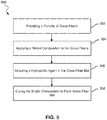
- the method 500 may include providing a plurality of glass fibers 502.
- the plurality of fibers may include a single kind of glass fiber, or alternatively may include two or more types of glass fibers.
- the plurality of glass fibers may include a first kind of coarse glass fibers that have nominal cross-sectional diameters greater than 5 ⁇ m, and a second kind of glass microfibers that have nominal cross-sectional diameters ranging from 0.1 ⁇ m to 5 ⁇ m.
- the two kinds of fibers may be blended in various weight ratios.
- the glass microfibers may constitute 10 wt.% to 50 wt.% of the total weight of the plurality of glass fibers.
- the coarse glass fibers may constitute 50 wt.% to 90 wt.% of the total weight of the plurality of glass fibers.
- the glass fibers may be sized.
- the fibers may be contacted with a whitewater solution that includes a sizing composition that is applied to the exposed surfaces of the fibers.
- the sizing compositions may be applied to less than all the types of fibers included in the plurality of fibers. For example, in a blend of coarse glass fibers and glass microfibers, the sizing composition may only be applied to the coarse glass fibers.
- the plurality of glass fibers may also include a powdered filler.
- the powdered filler may increase wickability, which may be useful in mat formulations that use a low weight percentage (wt.%) of glass microfibers relative to the coarse glass fibers.
- the powdered filler may between about 0.1% and about 20% by weight of the nonwoven fiber mat.
- the coarse glass fibers and the microfibers together may help hold the powdered filler in the mixture or slurry or finished nonwoven fiber mat.
- the method 500 also includes applying a binder composition to the glass fibers 504.
- the binder composition may be a substituted or unsubstituted acrylic acid or a substituted or unsubstituted acrylic ester.
- the substituted or unsubstituted acrylic ester may include one or more of methyl methacrylate and ethyl acrylate, among other alkyl alkylacrylates and alkyl acrylates (e.g., a combination of methyl methacrylate and ethyl acrylate).
- the binder composition may further include acrylamide compounds such as methyl acrylamide.
- Examples of the substituted or unsubstituted acrylic ester further include at least two substituted or unsubstituted acrylic esters, where the esters form an acrylic ester copolymer.
- Some of these binder compositions are commercially sold under the tradename Rhoplex® by Dow Chemical Company (e.g., Rhoplex® HA-16), and Hycar® by Lubrizol Corporation (e.g., Hycar® 26-0688).
- Exemplary glass-fiber mats may include 5 wt.% to 30 wt.% of binder and 70 wt.% to 95 wt.% of glass fibers.
- the method 500 may also include including a hydrophilic agent in the glass fiber mat 506.
- the hydrophilic agent may be added to the binder composition, applied to the glass-fiber mat, or both.
- the hydrophilic agent may be mixed with the other components of the binder composition (e.g., the substituted or unsubstituted acrylic acid or the substituted or unsubstituted acrylic ester) to form the final formulation of the binder composition.
- the hydrophilic agent may be applied onto the combination of the fibers and binder composition before and/or after the binder-fiber amalgam has been cured. Exemplary methods of applying the hydrophilic agent include dip coating, spray coating, and curtain coating, among other application techniques.
- the method 500 may further include curing the binder composition to form the glass-fiber mat 508.
- Curing may involve exposing the binder-fiber amalgam to an elevated temperature environment, such as a curing oven, dryer, or other type of heating unit. As the oven raises the temperature of the binder-fiber amalgam to a curing temperature, the binder composition polymerizes into a binder matrix that holds together the plurality of fibers into the glass-fiber mat.
- a hydrophilic agent may be applied to the glass-fiber mat during and/or following the curing of the binder. Alternatively (or in addition) the hydrophilic agent may already be present in the curing binder composition and remain active in the cured glass-fiber mat.
- the glass-fiber mats produced by method 500 find use as lead-acid battery separators and reinforcement mats.
- the hydrophilic agent gives the mats improved hydrophilic properties, such as increasing the wettability and/or wickability of the mat.
- the glass-fiber mats produced by method 500 may have improved wettability as measured by the contact angle between the mat and water or an aqueous sulfuric acid solution.
- the contact angle may be 70° or less, 50° or less, or even smaller threshold angles.
- the glass-fiber mats may also show increased wickability, as measured by the Klemm method (ISO8787, except that sulfuric acid with a specific gravity of 1.28 is used instead of water), so that the present mats may have an average sulfuric acid wick height of between 1 cm and 5 cm, preferably 2 cm to 4 cm, more preferred 3 cm to 4 cm, after exposure to sulfuric acid (with a specific gravity of 1.28 at 25°C) for 10 minutes, as measured by the Klemm method.
- the aforementioned specific gravity of 1.28 at 25°C corresponds to about 38 wt.% at 25°C)
- the contact angle is determined in accordance with ASTM D7334 - 08(2013).
- the concentration of the aqueous sulfuric acid solution is 33 % by weight sulfuric acid (at 25°C).
- the contact angle was measured by Kruss DSA100.
- wick height determined in accordance with ISO 8787:1986 ("Paper and board - Determination of capillary rise - Klemm method" (1986-08-28). In ISO 8787:1986, only water is used and in the instant measurement a sulfuric acid (specific gravity 1.280+/-0.002 at 25°C) is used instead of water. After 10 minutes of exposure the wick height is determined.
- Air permeability was measured by the Frazier test, which is described by ASTM Standard Method D737. This test was usually carried out at a differential pressure of about 0.5 inches of water (125Pa) by the TEXTESTTM FX 3300. ASTM D737-04(2012), Standard Test Method for Air Permeability of Textile Fabrics , ASTM International, West Conshohocken, PA, 2012, www.astm.org
- Thickness was measured using the BCI method. Mat thickness: it is measured by a micrometer under a specific pressure. Its test procedure is described in BCIS-03A ( Chapter 10) Rev. Sept09 of BCI Battery Technical Manual published by Battery Council International . A pressure of 10KPa is used. Different pressures (e.g., 2KPa, 20KPa) might be used as well.
- Tensile strength of a 1 inch wide sample or a 3 inch wide sample was measured using an ASTM D5035 - 11 (Reapproved 2015) "Standard Test Method for Breaking Force and Elongation of Textile Fabrics (Strip Method) ". Tensile strength was measured in the machine direction (MD) and the cross-machine direction (CMD).)". The measurement was done by Instron machine, e.g. Model “33R4444" for the 1 inch samples.
- the electromotive force (emf) such as the potential/voltage of the battery in the instant application, is measured by a voltage meter.
- the molecular weight Dalton refers to Mw.
- LOI Loss on ignition
- the effects of surfactants on the wickability of non-woven glass fiber mats were measured.
- the non-woven glass mats were made with a wet-laid machine that brings together the binder composition with the glass fibers.
- the non-woven glass mat samples used a combination of coarse glass fibers, made from K249T glass (commercially available from Johns Manville, Denver, CO, U.S.A) and having a nominal fiber diameter of 13 ⁇ m and length of 1.91cm (0.75 inches), and glass microfibers, made from 206-253 glass (commercially available from Johns Manville, Denver, CO, U.S.A) and having a nominal fiber diameter of about 0.765 ⁇ m.
- the weight ratio of the coarse glass fibers to glass microfibers was 70:30 for all the samples measured.
- the glass fibers were contacted with a variety of binder compositions listed in Table 1 below. All the binder compositions included Rhoplex® HA-16, and/or a surfactant such as Carsoquat® SDQ-25 or TegMeR® 812. Table 1: Air Permeability and Wickability of Glass Fiber Mats With Various Binder Compositions LOI (%) Base wt.
- a process may correspond to a method, a function, a procedure, a subroutine, a subprogram, etc. When a process corresponds to a function, its termination corresponds to a return of the function to the calling function or the main function.
Landscapes
- Chemical & Material Sciences (AREA)
- Chemical Kinetics & Catalysis (AREA)
- Electrochemistry (AREA)
- General Chemical & Material Sciences (AREA)
- Engineering & Computer Science (AREA)
- Manufacturing & Machinery (AREA)
- Mechanical Engineering (AREA)
- Composite Materials (AREA)
- Inorganic Chemistry (AREA)
- Textile Engineering (AREA)
- Ceramic Engineering (AREA)
- Cell Separators (AREA)
- Secondary Cells (AREA)
- Treatments For Attaching Organic Compounds To Fibrous Goods (AREA)
Priority Applications (2)
| Application Number | Priority Date | Filing Date | Title |
|---|---|---|---|
| SI201630273T SI3067964T1 (sl) | 2015-03-09 | 2016-03-08 | Steklene podloge, odporne na kislino, ki vsebujejo veziva s hidrofilnimi sredstvi |
| PL16159136T PL3067964T3 (pl) | 2015-03-09 | 2016-03-08 | Kwasoodporna mata z włókien szklanych zawierająca spoiwa ze środkami hydrofilowymi |
Applications Claiming Priority (1)
| Application Number | Priority Date | Filing Date | Title |
|---|---|---|---|
| US14/641,940 US9780347B2 (en) | 2015-03-09 | 2015-03-09 | Acid resistant glass mats that include binders with hydrophilic agents |
Publications (2)
| Publication Number | Publication Date |
|---|---|
| EP3067964A1 EP3067964A1 (en) | 2016-09-14 |
| EP3067964B1 true EP3067964B1 (en) | 2019-05-08 |
Family
ID=55910081
Family Applications (1)
| Application Number | Title | Priority Date | Filing Date |
|---|---|---|---|
| EP16159136.7A Active EP3067964B1 (en) | 2015-03-09 | 2016-03-08 | Acid resistant glass mats that include binders with hydrophilic agents |
Country Status (7)
| Country | Link |
|---|---|
| US (2) | US9780347B2 (pl) |
| EP (1) | EP3067964B1 (pl) |
| CA (1) | CA2923195C (pl) |
| ES (1) | ES2734744T3 (pl) |
| PL (1) | PL3067964T3 (pl) |
| SI (1) | SI3067964T1 (pl) |
| TR (1) | TR201907654T4 (pl) |
Families Citing this family (13)
| Publication number | Priority date | Publication date | Assignee | Title |
|---|---|---|---|---|
| US20180145298A1 (en) * | 2016-11-23 | 2018-05-24 | Hollingsworth & Vose Company | Battery separators and related methods |
| JP6953821B2 (ja) * | 2017-06-15 | 2021-10-27 | 昭和電工マテリアルズ株式会社 | 液式鉛蓄電池 |
| US10483597B2 (en) * | 2017-11-14 | 2019-11-19 | Johns Manville | Fiber-containing mats with additives for improved performance of lead acid batteries |
| CN109638226A (zh) * | 2018-11-28 | 2019-04-16 | 孟婷婷 | 一种铅酸蓄电池正极极板加工方法及其应用 |
| KR102741248B1 (ko) * | 2019-06-20 | 2024-12-10 | 유니프랙스 아이 엘엘씨 | 경량 부직 섬유 매트 |
| CN112421180A (zh) * | 2020-10-30 | 2021-02-26 | 浙江昊杨新能源科技有限公司 | 一种高抗穿刺agm隔板 |
| US20220219424A1 (en) * | 2021-01-11 | 2022-07-14 | Johns Manville | Polymeric wet-laid nonwoven mat for flooring applications |
| CN112895509B (zh) * | 2021-01-18 | 2022-01-18 | 大连理工大学 | 一种用于强流电子束发射阴极制备的成型模具及其使用方法 |
| CN113459354A (zh) * | 2021-07-06 | 2021-10-01 | 哈尔滨理工大学 | 一种紫外光固化管道修复内衬软管及其缠绕式生产工艺 |
| CN115224435B (zh) * | 2022-04-28 | 2024-07-23 | 中材锂膜(宁乡)有限公司 | 一种石墨烯水凝胶/聚烯烃基锂离子电池复合隔膜 |
| WO2025076807A1 (en) | 2023-10-13 | 2025-04-17 | Dow Global Technologies Llc | Impregnated fabric for use in battery cells |
| EP4559565A1 (en) * | 2023-11-24 | 2025-05-28 | Roche Diagnostics GmbH | Method of coating a glass fiber fleece, coated glass fiber filter and uses thereof |
| CN119812666A (zh) * | 2025-02-10 | 2025-04-11 | 华宇新能源科技有限公司 | 一种蓄电池高比表隔板的制备方法 |
Citations (7)
| Publication number | Priority date | Publication date | Assignee | Title |
|---|---|---|---|---|
| JPH07335192A (ja) * | 1994-06-02 | 1995-12-22 | Nippon Muki Co Ltd | リチウム電池用セパレータ |
| US5962161A (en) * | 1997-01-14 | 1999-10-05 | Daramic, Inc. | Recombinant battery separator |
| US6509118B1 (en) * | 1997-07-04 | 2003-01-21 | Detchko Pavlov | Valve-regulated lead-acid cells and batteries and separators used in such cells and batteries |
| US20070083004A1 (en) * | 2005-10-07 | 2007-04-12 | Shooshtari Kiarash A | Curable fiberglass binder comprising a polyacetal or polyketal |
| EP0954885B1 (en) * | 1997-01-14 | 2010-04-14 | Daramic, Inc. | Recombinant battery separator |
| EP2390947A1 (en) * | 2010-05-27 | 2011-11-30 | Johns Manville | Lead-oxide battery plate with nonwoven glas mat |
| EP2693529A1 (en) * | 2012-07-31 | 2014-02-05 | Johns Manville | Fiber mat for battery plate reinforcement |
Family Cites Families (39)
| Publication number | Priority date | Publication date | Assignee | Title |
|---|---|---|---|---|
| GB580390A (en) | 1943-12-20 | 1946-09-05 | Albert Peter Thurston | Improvements in or relating to storage batteries |
| DE947182C (de) | 1951-07-01 | 1956-08-09 | Owens Corning Fiberglass Corp | Separator fuer Akkumulatoren und Verfahren und Vorrichtung zu seiner Herstellung |
| US2978529A (en) | 1955-10-17 | 1961-04-04 | Owens Corning Fiberglass Corp | Battery separator and method for manufacturing same |
| DE2415076C3 (de) * | 1973-03-30 | 1980-09-25 | Sekisui Kagaku Kogyo K.K., Osaka (Japan) | Verfahren zur Herstellung einer Kunststoffbahn mit einer Porenschichtstruktur als Separator für galvanische Elemente und dessen Verwendung |
| US4024213A (en) * | 1973-03-30 | 1977-05-17 | Sekisui Kagaku Kogyo Kabushiki Kaisha | Method for preparing a porous structure by stretching a resin sheet useful as an electrode separator |
| JPS5049633A (pl) * | 1973-09-05 | 1975-05-02 | ||
| JPS5445755A (en) * | 1977-09-19 | 1979-04-11 | Yuasa Battery Co Ltd | Separator for storage battery |
| JPS54140941A (en) * | 1978-04-26 | 1979-11-01 | Mitsui Petrochemical Ind | Method of producing battery separator |
| US4268337A (en) * | 1978-08-24 | 1981-05-19 | Asahi Kasei Kogyo Kabushiki Kaisha | Sheet molding material produced by associating a layer comprising a photopolymerizable material with layers comprising thermosetting resins |
| US4440838A (en) | 1982-06-07 | 1984-04-03 | Kimberly-Clark Corporation | Lead acid battery, separator therefor |
| JPH0780970B2 (ja) * | 1986-08-29 | 1995-08-30 | 三菱化学株式会社 | 吸水性複合材料の製造法 |
| JP2706729B2 (ja) | 1989-01-28 | 1998-01-28 | 日本エヌエスシー株式会社 | 鉛蓄電池ガラスマツト用バインダーの製法 |
| US5376477A (en) | 1992-11-10 | 1994-12-27 | Teledyne Industries, Inc. | Storage battery and plate separator systems for a storage battery |
| JP3344613B2 (ja) * | 1994-12-16 | 2002-11-11 | 王子製紙株式会社 | 粘着シート |
| DE69635897T2 (de) * | 1995-11-02 | 2006-10-19 | Nippon Shokubai Co. Ltd. | Wasserabsorbierendes harz, absorbierendes material und verfahren zur herstellung derselben |
| JP3374665B2 (ja) | 1996-07-23 | 2003-02-10 | 松下電器産業株式会社 | 密閉型鉛蓄電池 |
| US6821672B2 (en) * | 1997-09-02 | 2004-11-23 | Kvg Technologies, Inc. | Mat of glass and other fibers and method for producing it |
| US6514639B2 (en) | 1998-03-20 | 2003-02-04 | Ensci Inc | Negative plate element for a lead acid battery containing efficiency improving additives |
| US6406813B2 (en) | 1999-04-02 | 2002-06-18 | Gnb Technologies, Inc. | Lead-acid separators and cells and batteries using such separators |
| US6955865B2 (en) | 1999-10-29 | 2005-10-18 | Hollingsworth & Vose Company | Graft polymerization, separators, and batteries including the separators |
| US6680144B2 (en) | 1999-10-29 | 2004-01-20 | Kvg Technologies, Inc. | Battery separator |
| JP2002008948A (ja) * | 2000-06-19 | 2002-01-11 | Matsushita Electric Ind Co Ltd | 電気二重層コンデンサ |
| JP2002105208A (ja) * | 2000-09-28 | 2002-04-10 | Showa Highpolymer Co Ltd | 熱硬化性樹脂組成物およびその成形体の製造方法 |
| US6703161B2 (en) | 2001-09-20 | 2004-03-09 | Daramic, Inc. | Multilayer separator for lead-acid batteries |
| US20030208831A1 (en) * | 2002-05-07 | 2003-11-13 | Lazar Robert P. | Cooling garment made of water-resistant fabric |
| US20100210745A1 (en) * | 2002-09-09 | 2010-08-19 | Reactive Surfaces, Ltd. | Molecular Healing of Polymeric Materials, Coatings, Plastics, Elastomers, Composites, Laminates, Adhesives, and Sealants by Active Enzymes |
| DE102005016195A1 (de) * | 2005-04-08 | 2006-10-12 | Clariant Produkte (Deutschland) Gmbh | Stabilisiertes Flammschutzmittel |
| US20090011210A1 (en) * | 2007-02-15 | 2009-01-08 | Xiao Gao | Lightweight glass fiber reinforced thermoplastic material |
| CN101981075A (zh) * | 2008-01-30 | 2011-02-23 | 陶氏环球技术公司 | 丁烯/α-烯烃嵌段互聚物 |
| WO2009097560A1 (en) * | 2008-01-30 | 2009-08-06 | Dow Global Technologies Inc. | ETHYLENE/α-OLEFIN BLOCK INTERPOLYMERS |
| US20110143184A1 (en) | 2008-02-14 | 2011-06-16 | Firefly International Energy Group, Inc. | Battery with electrolyte diffusing separator |
| EP2270074B1 (en) * | 2008-04-11 | 2021-05-26 | Nippon Shokubai Co., Ltd. | Surface treatment method for water-absorbing resin and production method for water-absorbing resin |
| DE102009001498A1 (de) * | 2009-03-11 | 2010-09-16 | Wacker Chemie Ag | Verwendung von Vinylester-Copolymeren als Low-Profile-Additive (LPA) |
| BRPI1006184A2 (pt) | 2009-03-27 | 2015-09-22 | 3M Innovative Properties Co | "composição termoplástica, artigos, lençol cirúrgico, avental cirúrgico, material para contato com ferimento e método para a fabricação de uma composição" |
| US9994482B2 (en) | 2009-08-11 | 2018-06-12 | Johns Manville | Curable fiberglass binder |
| US9506194B2 (en) * | 2012-09-04 | 2016-11-29 | Ocv Intellectual Capital, Llc | Dispersion of carbon enhanced reinforcement fibers in aqueous or non-aqueous media |
| JP2016532017A (ja) | 2013-08-09 | 2016-10-13 | アムテック リサーチ インターナショナル エルエルシー | 即時的に濡れるポリマー繊維シート |
| US20150086838A1 (en) | 2013-09-26 | 2015-03-26 | Johns Manville | Battery separator having improved wettability and methods of use therefor |
| US10062887B2 (en) | 2013-10-08 | 2018-08-28 | Johns Manville | Battery electrode plate reinforcement mat having improved wettability characteristics and methods of use therefor |
-
2015
- 2015-03-09 US US14/641,940 patent/US9780347B2/en active Active
-
2016
- 2016-03-08 PL PL16159136T patent/PL3067964T3/pl unknown
- 2016-03-08 SI SI201630273T patent/SI3067964T1/sl unknown
- 2016-03-08 EP EP16159136.7A patent/EP3067964B1/en active Active
- 2016-03-08 ES ES16159136T patent/ES2734744T3/es active Active
- 2016-03-08 TR TR2019/07654T patent/TR201907654T4/tr unknown
- 2016-03-09 CA CA2923195A patent/CA2923195C/en active Active
-
2017
- 2017-06-14 US US15/623,270 patent/US10396327B2/en active Active
Patent Citations (7)
| Publication number | Priority date | Publication date | Assignee | Title |
|---|---|---|---|---|
| JPH07335192A (ja) * | 1994-06-02 | 1995-12-22 | Nippon Muki Co Ltd | リチウム電池用セパレータ |
| US5962161A (en) * | 1997-01-14 | 1999-10-05 | Daramic, Inc. | Recombinant battery separator |
| EP0954885B1 (en) * | 1997-01-14 | 2010-04-14 | Daramic, Inc. | Recombinant battery separator |
| US6509118B1 (en) * | 1997-07-04 | 2003-01-21 | Detchko Pavlov | Valve-regulated lead-acid cells and batteries and separators used in such cells and batteries |
| US20070083004A1 (en) * | 2005-10-07 | 2007-04-12 | Shooshtari Kiarash A | Curable fiberglass binder comprising a polyacetal or polyketal |
| EP2390947A1 (en) * | 2010-05-27 | 2011-11-30 | Johns Manville | Lead-oxide battery plate with nonwoven glas mat |
| EP2693529A1 (en) * | 2012-07-31 | 2014-02-05 | Johns Manville | Fiber mat for battery plate reinforcement |
Also Published As
| Publication number | Publication date |
|---|---|
| US10396327B2 (en) | 2019-08-27 |
| TR201907654T4 (tr) | 2019-06-21 |
| CA2923195C (en) | 2024-02-27 |
| ES2734744T3 (es) | 2019-12-11 |
| US20170288188A1 (en) | 2017-10-05 |
| US9780347B2 (en) | 2017-10-03 |
| PL3067964T3 (pl) | 2019-10-31 |
| SI3067964T1 (sl) | 2019-08-30 |
| CA2923195A1 (en) | 2016-09-09 |
| EP3067964A1 (en) | 2016-09-14 |
| US20160268566A1 (en) | 2016-09-15 |
Similar Documents
| Publication | Publication Date | Title |
|---|---|---|
| EP3067964B1 (en) | Acid resistant glass mats that include binders with hydrophilic agents | |
| US9685646B2 (en) | Pasting paper made of glass fiber nonwoven comprising carbon graphite | |
| US10971709B2 (en) | Battery electrode plate reinforcement mat having improved wettability characteristics and methods of use therefor | |
| CA2865474C (en) | New pasting paper made of glass fiber nonwoven comprising carbon graphite | |
| EP3067963B1 (en) | Small pore size nonwoven mat with hydrophilic/acid resistant filler used in lead acid batteries and applications therefor | |
| CA2923112C (en) | Wicking nonwoven mat from wet-laid process | |
| US11018333B2 (en) | Conductive mat for battery electrode plate reinforcement and methods of use therefor | |
| US10084170B2 (en) | Pasting paper made of glass fiber nonwoven comprising carbon graphite | |
| WO2020150416A1 (en) | Improved z wrap separators, cells, systems, batteries, and related equipment and methods |
Legal Events
| Date | Code | Title | Description |
|---|---|---|---|
| PUAI | Public reference made under article 153(3) epc to a published international application that has entered the european phase |
Free format text: ORIGINAL CODE: 0009012 |
|
| AK | Designated contracting states |
Kind code of ref document: A1 Designated state(s): AL AT BE BG CH CY CZ DE DK EE ES FI FR GB GR HR HU IE IS IT LI LT LU LV MC MK MT NL NO PL PT RO RS SE SI SK SM TR |
|
| AX | Request for extension of the european patent |
Extension state: BA ME |
|
| STAA | Information on the status of an ep patent application or granted ep patent |
Free format text: STATUS: REQUEST FOR EXAMINATION WAS MADE |
|
| 17P | Request for examination filed |
Effective date: 20170302 |
|
| RBV | Designated contracting states (corrected) |
Designated state(s): AL AT BE BG CH CY CZ DE DK EE ES FI FR GB GR HR HU IE IS IT LI LT LU LV MC MK MT NL NO PL PT RO RS SE SI SK SM TR |
|
| STAA | Information on the status of an ep patent application or granted ep patent |
Free format text: STATUS: EXAMINATION IS IN PROGRESS |
|
| 17Q | First examination report despatched |
Effective date: 20170602 |
|
| GRAP | Despatch of communication of intention to grant a patent |
Free format text: ORIGINAL CODE: EPIDOSNIGR1 |
|
| STAA | Information on the status of an ep patent application or granted ep patent |
Free format text: STATUS: GRANT OF PATENT IS INTENDED |
|
| RIC1 | Information provided on ipc code assigned before grant |
Ipc: H01M 2/16 20060101AFI20181024BHEP Ipc: H01M 2/14 20060101ALN20181024BHEP |
|
| INTG | Intention to grant announced |
Effective date: 20181128 |
|
| GRAS | Grant fee paid |
Free format text: ORIGINAL CODE: EPIDOSNIGR3 |
|
| GRAA | (expected) grant |
Free format text: ORIGINAL CODE: 0009210 |
|
| STAA | Information on the status of an ep patent application or granted ep patent |
Free format text: STATUS: THE PATENT HAS BEEN GRANTED |
|
| AK | Designated contracting states |
Kind code of ref document: B1 Designated state(s): AL AT BE BG CH CY CZ DE DK EE ES FI FR GB GR HR HU IE IS IT LI LT LU LV MC MK MT NL NO PL PT RO RS SE SI SK SM TR |
|
| REG | Reference to a national code |
Ref country code: GB Ref legal event code: FG4D |
|
| REG | Reference to a national code |
Ref country code: CH Ref legal event code: EP Ref country code: AT Ref legal event code: REF Ref document number: 1131632 Country of ref document: AT Kind code of ref document: T Effective date: 20190515 |
|
| REG | Reference to a national code |
Ref country code: DE Ref legal event code: R096 Ref document number: 602016013433 Country of ref document: DE Ref country code: IE Ref legal event code: FG4D |
|
| REG | Reference to a national code |
Ref country code: NL Ref legal event code: MP Effective date: 20190508 |
|
| REG | Reference to a national code |
Ref country code: LT Ref legal event code: MG4D |
|
| PG25 | Lapsed in a contracting state [announced via postgrant information from national office to epo] |
Ref country code: NO Free format text: LAPSE BECAUSE OF FAILURE TO SUBMIT A TRANSLATION OF THE DESCRIPTION OR TO PAY THE FEE WITHIN THE PRESCRIBED TIME-LIMIT Effective date: 20190808 Ref country code: PT Free format text: LAPSE BECAUSE OF FAILURE TO SUBMIT A TRANSLATION OF THE DESCRIPTION OR TO PAY THE FEE WITHIN THE PRESCRIBED TIME-LIMIT Effective date: 20190908 Ref country code: AL Free format text: LAPSE BECAUSE OF FAILURE TO SUBMIT A TRANSLATION OF THE DESCRIPTION OR TO PAY THE FEE WITHIN THE PRESCRIBED TIME-LIMIT Effective date: 20190508 Ref country code: FI Free format text: LAPSE BECAUSE OF FAILURE TO SUBMIT A TRANSLATION OF THE DESCRIPTION OR TO PAY THE FEE WITHIN THE PRESCRIBED TIME-LIMIT Effective date: 20190508 Ref country code: SE Free format text: LAPSE BECAUSE OF FAILURE TO SUBMIT A TRANSLATION OF THE DESCRIPTION OR TO PAY THE FEE WITHIN THE PRESCRIBED TIME-LIMIT Effective date: 20190508 Ref country code: NL Free format text: LAPSE BECAUSE OF FAILURE TO SUBMIT A TRANSLATION OF THE DESCRIPTION OR TO PAY THE FEE WITHIN THE PRESCRIBED TIME-LIMIT Effective date: 20190508 Ref country code: HR Free format text: LAPSE BECAUSE OF FAILURE TO SUBMIT A TRANSLATION OF THE DESCRIPTION OR TO PAY THE FEE WITHIN THE PRESCRIBED TIME-LIMIT Effective date: 20190508 Ref country code: LT Free format text: LAPSE BECAUSE OF FAILURE TO SUBMIT A TRANSLATION OF THE DESCRIPTION OR TO PAY THE FEE WITHIN THE PRESCRIBED TIME-LIMIT Effective date: 20190508 |
|
| PG25 | Lapsed in a contracting state [announced via postgrant information from national office to epo] |
Ref country code: GR Free format text: LAPSE BECAUSE OF FAILURE TO SUBMIT A TRANSLATION OF THE DESCRIPTION OR TO PAY THE FEE WITHIN THE PRESCRIBED TIME-LIMIT Effective date: 20190809 Ref country code: BG Free format text: LAPSE BECAUSE OF FAILURE TO SUBMIT A TRANSLATION OF THE DESCRIPTION OR TO PAY THE FEE WITHIN THE PRESCRIBED TIME-LIMIT Effective date: 20190808 Ref country code: RS Free format text: LAPSE BECAUSE OF FAILURE TO SUBMIT A TRANSLATION OF THE DESCRIPTION OR TO PAY THE FEE WITHIN THE PRESCRIBED TIME-LIMIT Effective date: 20190508 Ref country code: LV Free format text: LAPSE BECAUSE OF FAILURE TO SUBMIT A TRANSLATION OF THE DESCRIPTION OR TO PAY THE FEE WITHIN THE PRESCRIBED TIME-LIMIT Effective date: 20190508 |
|
| REG | Reference to a national code |
Ref country code: ES Ref legal event code: FG2A Ref document number: 2734744 Country of ref document: ES Kind code of ref document: T3 Effective date: 20191211 |
|
| REG | Reference to a national code |
Ref country code: AT Ref legal event code: MK05 Ref document number: 1131632 Country of ref document: AT Kind code of ref document: T Effective date: 20190508 |
|
| PG25 | Lapsed in a contracting state [announced via postgrant information from national office to epo] |
Ref country code: RO Free format text: LAPSE BECAUSE OF FAILURE TO SUBMIT A TRANSLATION OF THE DESCRIPTION OR TO PAY THE FEE WITHIN THE PRESCRIBED TIME-LIMIT Effective date: 20190508 Ref country code: CZ Free format text: LAPSE BECAUSE OF FAILURE TO SUBMIT A TRANSLATION OF THE DESCRIPTION OR TO PAY THE FEE WITHIN THE PRESCRIBED TIME-LIMIT Effective date: 20190508 Ref country code: AT Free format text: LAPSE BECAUSE OF FAILURE TO SUBMIT A TRANSLATION OF THE DESCRIPTION OR TO PAY THE FEE WITHIN THE PRESCRIBED TIME-LIMIT Effective date: 20190508 Ref country code: EE Free format text: LAPSE BECAUSE OF FAILURE TO SUBMIT A TRANSLATION OF THE DESCRIPTION OR TO PAY THE FEE WITHIN THE PRESCRIBED TIME-LIMIT Effective date: 20190508 Ref country code: DK Free format text: LAPSE BECAUSE OF FAILURE TO SUBMIT A TRANSLATION OF THE DESCRIPTION OR TO PAY THE FEE WITHIN THE PRESCRIBED TIME-LIMIT Effective date: 20190508 Ref country code: SK Free format text: LAPSE BECAUSE OF FAILURE TO SUBMIT A TRANSLATION OF THE DESCRIPTION OR TO PAY THE FEE WITHIN THE PRESCRIBED TIME-LIMIT Effective date: 20190508 |
|
| REG | Reference to a national code |
Ref country code: DE Ref legal event code: R097 Ref document number: 602016013433 Country of ref document: DE |
|
| PG25 | Lapsed in a contracting state [announced via postgrant information from national office to epo] |
Ref country code: SM Free format text: LAPSE BECAUSE OF FAILURE TO SUBMIT A TRANSLATION OF THE DESCRIPTION OR TO PAY THE FEE WITHIN THE PRESCRIBED TIME-LIMIT Effective date: 20190508 |
|
| PLBE | No opposition filed within time limit |
Free format text: ORIGINAL CODE: 0009261 |
|
| STAA | Information on the status of an ep patent application or granted ep patent |
Free format text: STATUS: NO OPPOSITION FILED WITHIN TIME LIMIT |
|
| REG | Reference to a national code |
Ref country code: DE Ref legal event code: R082 Ref document number: 602016013433 Country of ref document: DE |
|
| 26N | No opposition filed |
Effective date: 20200211 |
|
| PG25 | Lapsed in a contracting state [announced via postgrant information from national office to epo] |
Ref country code: MC Free format text: LAPSE BECAUSE OF FAILURE TO SUBMIT A TRANSLATION OF THE DESCRIPTION OR TO PAY THE FEE WITHIN THE PRESCRIBED TIME-LIMIT Effective date: 20190508 |
|
| REG | Reference to a national code |
Ref country code: CH Ref legal event code: PL |
|
| REG | Reference to a national code |
Ref country code: DE Ref legal event code: R079 Ref document number: 602016013433 Country of ref document: DE Free format text: PREVIOUS MAIN CLASS: H01M0002160000 Ipc: H01M0050409000 |
|
| REG | Reference to a national code |
Ref country code: BE Ref legal event code: MM Effective date: 20200331 |
|
| PG25 | Lapsed in a contracting state [announced via postgrant information from national office to epo] |
Ref country code: LU Free format text: LAPSE BECAUSE OF NON-PAYMENT OF DUE FEES Effective date: 20200308 |
|
| PG25 | Lapsed in a contracting state [announced via postgrant information from national office to epo] |
Ref country code: IE Free format text: LAPSE BECAUSE OF NON-PAYMENT OF DUE FEES Effective date: 20200308 Ref country code: CH Free format text: LAPSE BECAUSE OF NON-PAYMENT OF DUE FEES Effective date: 20200331 Ref country code: LI Free format text: LAPSE BECAUSE OF NON-PAYMENT OF DUE FEES Effective date: 20200331 |
|
| PG25 | Lapsed in a contracting state [announced via postgrant information from national office to epo] |
Ref country code: BE Free format text: LAPSE BECAUSE OF NON-PAYMENT OF DUE FEES Effective date: 20200331 |
|
| PG25 | Lapsed in a contracting state [announced via postgrant information from national office to epo] |
Ref country code: MT Free format text: LAPSE BECAUSE OF FAILURE TO SUBMIT A TRANSLATION OF THE DESCRIPTION OR TO PAY THE FEE WITHIN THE PRESCRIBED TIME-LIMIT Effective date: 20190508 Ref country code: CY Free format text: LAPSE BECAUSE OF FAILURE TO SUBMIT A TRANSLATION OF THE DESCRIPTION OR TO PAY THE FEE WITHIN THE PRESCRIBED TIME-LIMIT Effective date: 20190508 |
|
| PG25 | Lapsed in a contracting state [announced via postgrant information from national office to epo] |
Ref country code: MK Free format text: LAPSE BECAUSE OF FAILURE TO SUBMIT A TRANSLATION OF THE DESCRIPTION OR TO PAY THE FEE WITHIN THE PRESCRIBED TIME-LIMIT Effective date: 20190508 Ref country code: IS Free format text: LAPSE BECAUSE OF FAILURE TO SUBMIT A TRANSLATION OF THE DESCRIPTION OR TO PAY THE FEE WITHIN THE PRESCRIBED TIME-LIMIT Effective date: 20190908 |
|
| PGFP | Annual fee paid to national office [announced via postgrant information from national office to epo] |
Ref country code: DE Payment date: 20250327 Year of fee payment: 10 |
|
| PGFP | Annual fee paid to national office [announced via postgrant information from national office to epo] |
Ref country code: SI Payment date: 20250217 Year of fee payment: 10 |
|
| PGFP | Annual fee paid to national office [announced via postgrant information from national office to epo] |
Ref country code: FR Payment date: 20250325 Year of fee payment: 10 Ref country code: PL Payment date: 20250220 Year of fee payment: 10 |
|
| PGFP | Annual fee paid to national office [announced via postgrant information from national office to epo] |
Ref country code: GB Payment date: 20250327 Year of fee payment: 10 Ref country code: IT Payment date: 20250319 Year of fee payment: 10 |
|
| PGFP | Annual fee paid to national office [announced via postgrant information from national office to epo] |
Ref country code: TR Payment date: 20250224 Year of fee payment: 10 |
|
| PGFP | Annual fee paid to national office [announced via postgrant information from national office to epo] |
Ref country code: ES Payment date: 20250401 Year of fee payment: 10 |