EP3040406B1 - Method for stabilizing scent component, fragrance composition, and deodorizing composition - Google Patents
Method for stabilizing scent component, fragrance composition, and deodorizing composition Download PDFInfo
- Publication number
- EP3040406B1 EP3040406B1 EP14833086.3A EP14833086A EP3040406B1 EP 3040406 B1 EP3040406 B1 EP 3040406B1 EP 14833086 A EP14833086 A EP 14833086A EP 3040406 B1 EP3040406 B1 EP 3040406B1
- Authority
- EP
- European Patent Office
- Prior art keywords
- perfume
- glucopyranosylglycerol
- deterioration
- odor
- fragrance
- Prior art date
- Legal status (The legal status is an assumption and is not a legal conclusion. Google has not performed a legal analysis and makes no representation as to the accuracy of the status listed.)
- Active
Links
Classifications
-
- C—CHEMISTRY; METALLURGY
- C11—ANIMAL OR VEGETABLE OILS, FATS, FATTY SUBSTANCES OR WAXES; FATTY ACIDS THEREFROM; DETERGENTS; CANDLES
- C11B—PRODUCING, e.g. BY PRESSING RAW MATERIALS OR BY EXTRACTION FROM WASTE MATERIALS, REFINING OR PRESERVING FATS, FATTY SUBSTANCES, e.g. LANOLIN, FATTY OILS OR WAXES; ESSENTIAL OILS; PERFUMES
- C11B5/00—Preserving by using additives, e.g. anti-oxidants
- C11B5/0021—Preserving by using additives, e.g. anti-oxidants containing oxygen
-
- A—HUMAN NECESSITIES
- A23—FOODS OR FOODSTUFFS; TREATMENT THEREOF, NOT COVERED BY OTHER CLASSES
- A23L—FOODS, FOODSTUFFS OR NON-ALCOHOLIC BEVERAGES, NOT OTHERWISE PROVIDED FOR; PREPARATION OR TREATMENT THEREOF
- A23L2/00—Non-alcoholic beverages; Dry compositions or concentrates therefor; Preparation or treatment thereof
- A23L2/52—Adding ingredients
- A23L2/60—Sweeteners
-
- A—HUMAN NECESSITIES
- A23—FOODS OR FOODSTUFFS; TREATMENT THEREOF, NOT COVERED BY OTHER CLASSES
- A23L—FOODS, FOODSTUFFS OR NON-ALCOHOLIC BEVERAGES, NOT OTHERWISE PROVIDED FOR; PREPARATION OR TREATMENT THEREOF
- A23L27/00—Spices; Flavouring agents or condiments; Artificial sweetening agents; Table salts; Dietetic salt substitutes; Preparation or treatment thereof
- A23L27/20—Synthetic spices, flavouring agents or condiments
- A23L27/204—Aromatic compounds
-
- A—HUMAN NECESSITIES
- A61—MEDICAL OR VETERINARY SCIENCE; HYGIENE
- A61K—PREPARATIONS FOR MEDICAL, DENTAL OR TOILETRY PURPOSES
- A61K8/00—Cosmetics or similar toiletry preparations
- A61K8/18—Cosmetics or similar toiletry preparations characterised by the composition
- A61K8/30—Cosmetics or similar toiletry preparations characterised by the composition containing organic compounds
- A61K8/60—Sugars; Derivatives thereof
- A61K8/602—Glycosides, e.g. rutin
-
- A—HUMAN NECESSITIES
- A61—MEDICAL OR VETERINARY SCIENCE; HYGIENE
- A61Q—SPECIFIC USE OF COSMETICS OR SIMILAR TOILETRY PREPARATIONS
- A61Q13/00—Formulations or additives for perfume preparations
-
- C—CHEMISTRY; METALLURGY
- C11—ANIMAL OR VEGETABLE OILS, FATS, FATTY SUBSTANCES OR WAXES; FATTY ACIDS THEREFROM; DETERGENTS; CANDLES
- C11B—PRODUCING, e.g. BY PRESSING RAW MATERIALS OR BY EXTRACTION FROM WASTE MATERIALS, REFINING OR PRESERVING FATS, FATTY SUBSTANCES, e.g. LANOLIN, FATTY OILS OR WAXES; ESSENTIAL OILS; PERFUMES
- C11B5/00—Preserving by using additives, e.g. anti-oxidants
- C11B5/0007—Organic substances
-
- C—CHEMISTRY; METALLURGY
- C11—ANIMAL OR VEGETABLE OILS, FATS, FATTY SUBSTANCES OR WAXES; FATTY ACIDS THEREFROM; DETERGENTS; CANDLES
- C11B—PRODUCING, e.g. BY PRESSING RAW MATERIALS OR BY EXTRACTION FROM WASTE MATERIALS, REFINING OR PRESERVING FATS, FATTY SUBSTANCES, e.g. LANOLIN, FATTY OILS OR WAXES; ESSENTIAL OILS; PERFUMES
- C11B5/00—Preserving by using additives, e.g. anti-oxidants
- C11B5/0021—Preserving by using additives, e.g. anti-oxidants containing oxygen
- C11B5/0028—Carboxylic acids; Their derivates
Definitions
- the present invention relates to a method for preventing deterioration of smell components (fragrance components such as perfumes, and odor-causing components such as unsaturated fatty acids), and a perfume composition and a deodorant composition each of which utilizes this method. Further, the present invention also relates to uses of D-glucopyranosylglycerol.
- perfumes have been used by adding them to food and drink and other products to which fragrances are intended to be imparted, in order to enhance qualities of those products.
- perfumes are subjected to actions of heat, light, air, enzyme, etc. not only in storage thereof but also in production process, storage process, distribution process and other processes subsequent to the addition of the perfumes, their fragrance and flavor components are deteriorated through an action of oxidation, reduction, hydrolysis, polymerization, volatilation or the like, thereby lowering the qualities of the products.
- powder perfumes obtained by pulverization have an extremely large surface area, and therefore, deterioration takes place especially in the pulverization process or the storage.
- emulsion perfumes obtained by emulsification there occurs a problem that deterioration tends to take place in the emulsificationprocess or the storage due to the existence of water.
- Most of causative substances of body odors are lower aldehydes or lower fatty acids, and secreted sebum is decomposed and oxidized by microorganisms, heat, light or the like to form these components.
- nonenal having an unpleasant oily odor a so-called aging odor
- this compound is a lower aldehyde formed by deterioration of palmitoleic acid that is a kind of unsaturated fatty acid contained in sebum.
- a means capable of suppressing formation of such lower aldehydes or lower fatty acids is being required.
- ⁇ -D-glucopyranosylglycerol is contained in refined sake in an amount of about 0.5% by mass and is a substance that is known to impart refreshing sweetness.
- the ⁇ -D-glucopyranosylglycerol has functions, such as non-cariogenic property, indigestible property and moisture retaining property, and usefulness of it as a functional material has been paid attention. Noting these functions, utilization of the ⁇ -D-glucopyranosylglycerol as a man component of seasonings or moisturizers and addition of it to a variety of food and drink and cosmetics have been proposed (patent literature 7).
- the present invention addresses, in one aspect, the problem of providing a method capable of preventing deterioration (oxidation, decomposition or the like) of various smell components, e.g., fragrance components such as perfumes or odor-causing components such as unsaturated fatty acids.
- the present invention addresses, in another aspect, the problem of providing a perfume composition in which deterioration of a perfume has been prevented (a stabilized perfume composition) and a deodorant composition capable of preventing deterioration of an unsaturated fatty acid.
- D-glucopyranosylglycerol has an action to prevent deterioration of a fragrance component such as a perfume or an odor-causing component such as an unsaturated fatty acid and can be utilized as an active ingredient of a stabilized perfume composition or a deodorant composition, and they have completed the present invention.
- the present invention includes the following matters.
- D-glucopyranosylglycerol as an active ingredient for preventing deterioration of a fragrance component (perfume or the like) and an odor-causing component (unsaturated fatty acid or the like), a method for preventing deterioration of these components can be carried out.
- a method for preventing deterioration of these components can be carried out.
- D-glucopyranosylglycerol having a structure in which saccharide has undergone addition to glycerol forms a molecular aggregate such as a micell or a cluster together with various fragrance components and odor-causing components, and it suppresses diffusion (motion) of those components or can cover a part that is susceptible to a change of a chemical structure, whereby deterioration of a perfume is suppressed to allow the fragrance to last, or oxidation or decomposition of an unsaturated bond part of a chemically unstable unsaturated fatty acid can be suppressed to prevent formation of an odor component.
- saccharides such as sucrose, anhydrofructose, sorbitol, D-glucose, erythritol, dextrin and glucose fructose liquid sugar, and glycerol are not found to have such excellent deterioration preventive actions on both of a perfume and an unsaturated fatty acid as is possessed by the D-glucopyranosylglycerol, and it is presumed that such mechanism as above does not act on those compounds.
- the term “smell components” refers to smell-related components (compounds) in general and includes a "fragrance component” that stimulates the sense of smell to allow a pleasant fragrance to be perceptible and an "odor component” (including an "odor-causing component” that forms an odor component through deterioration such as decomposition) that allows an unpleasant odor to be perceptible.
- Typical examples of the fragrance components include various compounds generally used as “perfumes", and typical examples of the odor components include "unsaturated fatty acids” that causes body odors, etc.
- the "method for preventing deterioration of a smell component” includes a method for retaining a pleasant fragrance by preventing deterioration of a fragrance component and a method for suppressing occurrence of an unpleasant odor by preventing deterioration of an odor component.
- the expression "preventing deterioration” of a fragrance component (perfume) can be put in another expression “stabilization” of the fragrance component.
- Such a method for preventing deterioration of a smell component can be carried out by allowing D-glucopyranosylglycerol to coexist with a smell component, that is, by bringing D-glucopyranosylglycerol and a fragrance component such as a perfume or an odor-causing component such as an unsaturated fatty acid into contact with each other in such a manner that their mutual interaction, which is presumed as previously described, takes place.
- first embodiment a method relating to prevention of deterioration (stabilization) of a fragrance component, a product pertaining to performance of the method, or the like
- second embodiment a method relating to prevention of deterioration of an odor-causing component, a product pertaining to performance of the method, or the like
- the working effect on prevention of deterioration of a fragrance component or an odor-causing component can be evaluated by a publicly known technique such as an organoleptic test.
- deterioration of a fragrance component or an odor-causing component does not always have to be prevented completely, and if it is shown from the results of an organoleptic test or the like that the degree of deterioration of a fragrance component or an odor-causing component is lower than usual (the case where the present invention is not carried out) or that deterioration of a fragrance component or an odor-causing component is prevented over a long period of time, this means that the working effect on prevention of deterioration of a fragrance component or an odor-causing component has been exerted, and it can be said that their embodiments correspond to the "method for preventing deterioration of a fragrance component" and the "stabilized perfume composition", or the "method for preventing deterioration of an odor-causing component” and the "deodorant composition”.
- D-glucopyranosylglycerol is used as an essential substance for carrying out the method for preventing deterioration (for stabilization) of a fragrance component of the first embodiment and the method for preventing deterioration of an odor component of the second embodiment.
- the present invention provides uses of D-glucopyranosylglycerol as an active ingredient (deterioration inhibitor) for preventing deterioration of each of the fragrance component and the odor component.
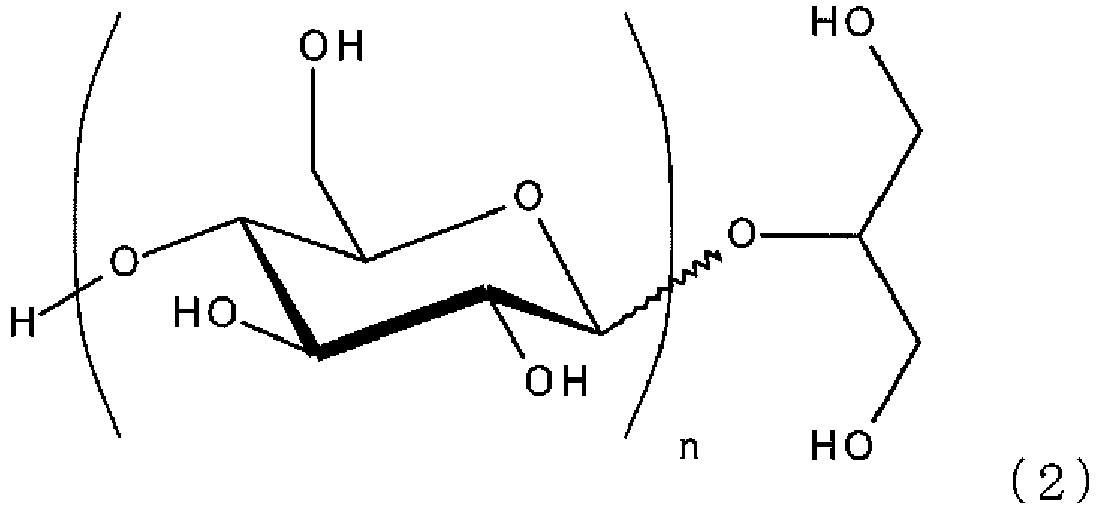
- D-Glucopyranosylglycerol is a general term for a compound represented by the formula (1), namely, 1-O-( ⁇ - or ⁇ -)D-(mono or poly)glucopyranosylglycerol (sometimes also referred to as "1-O-( ⁇ - or ⁇ -)D-dihydroxypropyl (mono or poly) glucopyranoside") and a compound represented by the formula (2), namely, 2-O-( ⁇ - or ⁇ -)D-(mono or poly)glucopyranosylglycerol (sometimes also referred to as "2-O-( ⁇ - or ⁇ -)D-dihydroxypropyl (mono or poly)glucopyranoside").
- the 2-position carbon atom with a symbol * is an asymmetric carbon atom, and optical isomers, namely, (2R) form and (2S) form, are present.
- the compound represented by the formula (1) may be any of these optical isomers, and may be a mixture (racemate) composed of these optical isomers.
- n represents a degree of saccharide condensation and is an integer of 1 or more.
- n is usually an integer of 1 to 6, mostly an integer of 1 to 4.
- only a compound in which n is 1 may be used, or a mixture of compounds in each of which n is 1 or more may be used.
- a compound in which the wavy line part is an ⁇ -linkage may be used, or only a compound in which the wavy line part is a ⁇ -linkage may be used, or a mixture of a compound in which the wavy line is an ⁇ -linkage and a compound in which the wavy line part is a ⁇ -linkage may be used.
- the form and the purity (content ratio) of the D-glucopyranosylglycerol for use in the present invention are not restricted.
- Examples of the forms of the D-glucopyranosylglycerol include an aqueous solution and a syrup-like high-viscosity solution obtained by concentrating an aqueous solution.
- the purity of the D-glucopyranosylglycerol is preferably not less than 10% by weight, and for example, the purity of the D-glucopyranosylglycerol in the high-viscosity solution can be set to about 40% by weight or more.
- D-glucopyranosylglycerol As a component other than the D-glucopyranosylglycerol, there can be mentioned, for example, an unreacted material or a reaction by-product (impurity), which is sometimes introduced when D-glucopyranosylglycerol is prepared by an organic synthesis method.
- an unreacted material or a reaction by-product (impurity) which is sometimes introduced when D-glucopyranosylglycerol is prepared by an organic synthesis method.
- impurities include glycerol that is added as one raw material for synthesizing D-glucopyranosylglycerol and reaction by-products derived from glycerol, e.g., alcohols, such as ethanol, isopropyl alcohol, ethylene glycol, diethylene glycol, triethylene glycol, propylene glycol, dipropylene glycol, 1,3-butylene glycol, 1,2-pentanediol, diglycerol and polyglycerol.
- alcohols such as ethanol, isopropyl alcohol, ethylene glycol, diethylene glycol, triethylene glycol, propylene glycol, dipropylene glycol, 1,3-butylene glycol, 1,2-pentanediol, diglycerol and polyglycerol.
- the amount of glycerol compounded in food and drink, seasonings, cosmetics, etc. is sometimes restricted.
- the amount of glycerol in a saccharide composition composition containing D-glucopyranosylglycerol and the aforesaid unre acted material and reaction by-product
- the amount of glycerol in a saccharide composition is preferably not more than 20% by mass, more preferably not more than 10% by mass, based on the total solids content in the saccharide composition.
- the amount of the glycerol compounded is not particularly a problem, the amount of glycerol may be not less than 20% by mass based on the total solids content in the saccharide composition.
- a glucose source that is added as the other raw material for synthesizing D-glucopyranosylglycerol and reaction by-products derived from the glucose source such as saccharide formed by decomposition of di- or higher saccharide when the glucose source is the di- or higher saccharide, and saccharide produced as a by-product through the reaction of such saccharides, can be mentioned.
- D-Glucopyranosylglycerol can be prepared in advance by a publicly known technique, or can be purchased as a commercial product.
- This production process comprises a step of allowing a glucose source to react with glycerol using an acid catalyst to synthesize D-glucopyranosylglycerol (glycosylationstep) and a step of adding a neutralizing agent for the acid catalyst into the reaction system of the glycosilation step to terminate the reaction (reaction termination step), and if necessary, may further comprise a refining step (distillation step, decoloring step or the like) for removing residual glycerol, a residual glucose source, a by-product, etc., an aqueous solution preparation step of lowering the viscosity to enhance handling properties, and other steps.
- a refining step distillation step, decoloring step or the like
- a commercial product "COSARTE-2G" manufactured by Toyo Sugar Refining Co., Ltd. is a composition containing D-glucopyranosylglycerol (mixture of 1-O- ⁇ -D-glucopyranosylglycerol, 1-O- ⁇ -D-glucopyranosylglycerol, 2-O- ⁇ -D-glucopyranosylglycerol and 2-O- ⁇ -D-glucopyranosylglycerol), water and glycerol, and the content of D-dihydroxypropyl glucopyranoside, excluding water and glycerol, is about 70 to 78% and is 73.5% on an average.
- D-glucopyranosylglycerol mixture of 1-O- ⁇ -D-glucopyranosylglycerol, 1-O- ⁇ -D-glucopyranosylglycerol, 2-O- ⁇ -D-glucopyranosylglycerol and 2-
- the method for preventing deterioration of a smell component according to the present invention is carried out or when the perfume composition or the deodorant composition according to the present invention is produced, it is preferable to use, as the D-glucopyranosylglycerol, the above commercial product containing the above four kinds of compounds.
- the object of the deterioration prevention is a fragrance component, typically a perfume, as the smell component.
- D-glucopyranosylglycerol can be used in the same mode as that for a publicly known stabilizer for perfumes. That is to say, D-glucopyranosylglycerol can be used for stabilizing a fragrance component (perfume) by allowing D-glucopyranosylglycerol to coexist with a fragrance component that is intended to be prevented from deterioration, generally by adding it to a perfume, a product containing a perfume, or the like.
- the method for preventing deterioration of a perfume according to the first embodiment may be carried out by adding D-glucopyranosylglycerol to a perfume in the production of such a perfume composition as described later, or may be carried out by adding D-glucopyranosylglycerol to a perfume and other components in the production of a product (composition) using a perfume. Further, if a perfume and D-glucopyranosylglycerol are in a coexisting state after production of a perfume composition or a product containing a perfume, it can be said that the above method has been carried out.
- the content of D-glucopyranosylglycerol in the product is not restricted provided that it is in a range where the working effect on prevention of deterioration of the perfume is exerted.
- the deterioration prevention effect can be exhibited by adding D-glucopyranosylglycerol generally in an amount of 100 times or more, preferably 1,000 times or more, the amount by mass of the perfume added and used in the product.
- the upper limit of the amount of D-glucopyranosylglycerol added is not specif ically restricted, but the upper limit is properly determined taking influence on the properties of the product into consideration.
- the type and the shape of the perfume that is a typical fragrance component are not restricted.
- the perfumes may be natural perfumes, such as essential oil, extract, oleoresin, recovered flavor and isolated perfume, or may be synthetic perfumes, such as alcohols, esters, aldehydes, acetals and lactones.
- the perfume may be any one of them or may comprise two or more kinds of them (compound perfume material).
- perfumes are classified by the general system in the technical field of perfumes, there can be mentioned the following as specific examples of the perfumes: citrus-basedperfumes (lemon, lime, grapefruit, etc.), fruity perfumes (orange, apple, melon, grape, pineapple, banana, peach, strawberry, raspberry, mango, passion fruit, mandarin, apricot, black currant, etc.), floral perfumes (rose, jasmine, lavender, lily bell, magnolia, violet, neroli, lilac, freesia, muguet, gardenia, etc.), confectionery-based perfumes (vanilla, etc.), ozone-based perfumes (hyacinth, magnolia, iris, etc.), marine-based perfumes (water mint, water lily, water fruit, fresh pepper, ginger, etc.), powderyperfumes (violet, cyclamen, Tonkabean, heliotrope, etc.), soapy perfumes (musk, etc.), spicy perfume
- the perfume composition that is described herein contains at least one perfume and D-glucopyranosylglycerol as an active ingredient for preventing deterioration of the perfume.
- the D-glucopyranosylglycerol is not hindered from further exertion of other functions in the perfume composition or a product containing the perfume composition.
- the perfume composition according to the present invention may be a composition essntially consisting of D-glucopyranosylglycerol and at least one perfume only, or maybe a composition containing D-glucopyranosylglycerol, at least one perfume and other arbitrary components, as long as the perfume composition exerts a working effect on stabilization of the perfume.
- the content of the D-glucopyranosylglycerol in the perfume composition is not restricted provided that it is in a range where the working effect on prevention of deterioration of the perfume is exerted. Such a content can be properly determined by a person skilled in the art according to the perfume used, without requiring excess trials and error, while examining a relationship between the content of the D-glucopyranosylglycerol and the perfume deterioration prevention effect.
- the deterioration prevention effect can be exhibited by adding D-glucopyranosylglycerol generally in an amount of 0.1 time or more, preferably 1 time or more, the amount by mass of the perfume used.
- the upper limit of the amount of D-glucopyranosylglycerol added is not specifically restricted, but the upper limit is properly determined taking handling properties, cost, etc. of the perfume composition into consideration.
- the above description of the content of D-glucopyranosylglycerol in the perfume composition refers to not a content based on the mass of the commercial product itself but a content based on the mass of D-glucopyranosylglycerol (calculable from the mass of the commercial product and the purity of D-glucopyranosylglycerol) contained in the commercial product.
- the perfume composition described herein may contain the following substances (compounds) according to the dosage form, when needed: emulsifying agents, such as glycerol fatty acid ester, sorbitan fatty acid ester, sucrose fatty acid ester, lecithin, and enzyme-treated lecithin; thickening polysaccharides (viscosity modifiers), such as guar gum, xanthan gum, tamarind seed gum, pectin, agar, carrageenan, arabinoxylan, arabinogalactan, water-soluble hemicellulose, and gum arabic; organic acids, such as lactic acid, citric acid, malic acid, acetic acid, carbonic acid and phosphoric acid, and salts thereof, such as sodium salt, potassium salt, calcium salt and magnesium salt; oils and fats, ethanol, water, propylene glycol, starch and chemically modified starches, dextrin, casein; antioxidants (oxidation inhibitors, reducing agents), such as vitamin C, glutachione
- the perfume composition can be produced by adding D-glucopyranosylglycerol to at least one perfume in accordance with a conventional method.
- the perfume may be prepared in advance by a publicly known technique, or may be purchased as a commercial product.
- the method to add D-glucopyranosylglycerol to the perfume is not restricted.
- the perfume when the perfume is liquid, a method of dissolving D-glucopyranosylglycerol in the solution can be mentioned.
- the perfume when the perfume is a powder, a method comprising dissolving the powder perfume once, then adding D-glucopyranosylglycerol to the solution and drying, a method of allowing the powder perfume to adsorb liquid D-glucopyranosylglycerol, a method comprising further drying the adsorption product, etc. can be mentioned.
- a method of adding D-glucopyranosylglycerol to the emulsion can be mentioned. Further, a method of directly adding or kneading the perfume into a highly concentrated solution of D-glucopyranosylglycerol can be also mentioned.
- the apparatus and the technique to carry out such a production process for the perfume composition as above are not restricted.
- a stirrer, a kneader or the like can be used;
- a powdery perfume composition is produced, a drying method, such as spray drying method, hot air drying method, vacuum freeze drying method, vacuum drying method or drum drying method, and an apparatus for the method can be used; and
- a homomixer, a homogenizer, a colloid mill or the like can be used.
- the perfume composition described herein produced may be stored inside a closed vessel or the like until a product containing the perfume composition is produced, or it can be immediately used for producing a product containing the perfume composition.
- the perfume composition is stored inside a closed vessel or the like, it is preferable to store it in such an environment that the perfume composition is influenced by light, heat, air or the like, which causes deterioration of the perfume, as little as possible.
- the perfume composition described herein can be used in the production of various products (compositions) by compounding it as a part of the components of each product (composition).
- the product in which the perfume composition is to be compounded is not restricted, and a variety of products required to be scented, such as cosmetics, quasi-drugs, other daily life products (oil, cream, lipstick, lotion, shampoo, conditioner, soap, hand soap, mouthwash, aromatic, aroma candle, etc.), and food and drink (beverage, frozen sweet, dessert, confectionery, retort pouched food, instant food, seasoning, etc.), can be mentioned.
- Such products containing the perfume composition can be produced by the same process as a conventional process, except that its step is changed in such a manner that the perfume composition described herein is compounded instead of a part or all of a perfume or a perfume composition compounded in a conventional product.
- the object of the deterioration prevention is an odor-causing component, typically an unsaturated fatty acid, as the smell component.
- D-glucopyranosylglycerol can be used in the same mode as that for a publicly known deodorant or odor-eliminating component.
- D-glucopyranosylglycerol can be used in order to prevent deterioration of an odor component and thereby inhibit occurrence of an unpleasant odor by applying D-glucopyranosylglycerol to an odor component (causative component) that is intended to be prevented from deterioration, generally by adding D-glucopyranosylglycerol as a deodorant component to a deodorant product or the like and applying the product to a body part that emits a body odor.
- the unsaturated fatty acid that is a typical odor-causing component is not specifically restricted provided that it is decomposed and oxidized by microorganism, heat, light or the like to form a lower aldehyde (nonenal or the like) or a lower fatty acid, which becomes a body odor.
- unsaturated fatty acids include oleic acid, linoleic acid, linolenic acid, palmitoleic acid and vaccenic acid.
- the deodorant composition that is provided as one aspect of the second embodiment of the present invention contains D-glucopyranosylglycerol as an active ingredient for preventing deterioration of an unsaturated fatty acid, and may further contain other arbitrary components.
- the D-glucopyranosylglycerol is not hindered from further exertion of other functions in the deodorant composition.
- the content of the D-glucopyranosylglycerol in the deodorant composition is not restricted provided that it is in a range where the working effect on suppression of a body odor is exerted when the deodorant composition is applied to the body surface. Such a content can be properly determined by a person skilled in the art according to the dosage form of the deodorant composition through an appropriate evaluation test, without requiring excess trials and errors.
- the content of the D-glucopyranosylglycerol is generally 0.01 to 50% by weight, preferably 0.5 to 10% by weight, based on the total weight of the deodorant composition.
- the deodorant composition can be generally prepared as a product (composition) whose main purpose is to prevent a body odor or the like, or as a product (composition) applied to a body surface of a human or other animal whose main purpose is a matter other than the prevention of a body odor or the like but to which a function to prevent a body odor or the like is intended to be further added.
- Such products may be cosmetics, quasi-drugs or other daily life products, and examples thereof include deodorant products and care products for hair, etc. (aerosol, cream, lotion, spray, stick, shampoo, conditioner, treatment, hair tonic, body soap, etc.).
- Such a deodorant composition (product) according to the second embodiment as above can be produced by the same process as a conventional process, except that its step is changed in such a manner that the D-glucopyranosylglycerol is compounded instead of a part or all of a deodorant component compounded in a conventional product.
- the deodorant composition may contain the following substances (compounds) according to the dosage form, when needed: odor-eliminating powders (chitosan fine particles, amphoteric porous fine particles, zeolite, antibacterial zeolite, porous silica, zinc oxide, magnesium oxide, etc.); bactericides (3,4,4-trichlorocarbanilide, triclosan, benzalkonium chloride, benzethonium chloride, alkyltrimethylammonium chloride, resorcin, phenol, sorbic acid, salicylic acid, hexachlorophen, isopropyl methylphenol, silver ion, copper ion, zinc ion, etc.); polyphenols (phloroglucinol; fluoroglucinol derivatives such as aspidin and aspidinol; tannin; tannin derivatives such as pyrogallol tannin and catechol tannin; plant extracts containing polyphenols, such as mimosa, green tea, mint,
- Example 4 To 500 g of a 50% (W/W%) ethanol aqueous solution, 150 g of D-glucopyranosylglycerol (COSARTE-2G, manufactured by Toyo Sugar Refining Co., Ltd.) was added, and they were mixed. Thereafter, 80 g of a vanilla flavor was added to the resulting mixture, and they were stirred for 5 minutes by a stirrer to obtain a vanilla perfume formulation (Example 4). Further, by using glycerol instead of D-glucopyranosylglycerol, a vanilla perfume formulation was obtained similarly to the above (Comparative Example 4).
- COSARTE-2G D-glucopyranosylglycerol
- vanilla perfume formulations were placed in a glass bottle, then each bottle was stoppered tightly, and each of the formulations was storedat 40°C for 3 months . Thereafter, 0.03 g of each of the vanilla perfume formulations was dissolved in 100 g of water, and organoleptic tests were carried out by 7 panelists. The results are set forth in Table 4. With regard to fragrance, flavor and deterioration odor, 10-grade evaluation was carried out. The most intensive emission was taken as 10, and no emission was taken as 0. The numerical value was a mean value. Table 4 Fragrance Flavor Deterioration odor Ex. 4 9 9 1 Comp. Ex. 4 5 5 4
- Example 5 To 500 g of a 50% (W/W%) ethanol aqueous solution, 120 g of D-glucopyranosylglycerol (COSARTE-2G, manufactured by Toyo Sugar Refining Co., Ltd.) was added, and they were mixed. Thereafter, 70 g of an ozone-based flavor was added to the resulting mixture, and they were stirred for 5 minutes by a stirrer to obtain an ozone perfume formulation (Example 5). Further, by using sorbitol instead of D-glucopyranosylglycerol, an ozone perfume formulation was obtained similarly to the above (Comparative Example 5).
- COSARTE-2G D-glucopyranosylglycerol
- each of the ozone perfume formulations was placed in a glass bottle, then each bottle was stoppered tightly, and each of the formulations was storedat 40 ° C for 3 months. Thereafter, 0.03 g of each of the ozone perfume formulations was dissolved in 100 g of water, and organoleptic tests were carried out by 7 panelists. The results are set forth in Table 5. With regard to fragrance and deterioration odor, 10-grade evaluation was carried out. The most intensive emission was taken as 10, and no emission was taken as 0. The numerical value was a mean value. Table 5 Fragrance Deterioration odor Ex. 5 9 1 Comp. Ex. 5 7 3
- Example 8 To 500 g of a 50% (W/W%) ethanol aqueous solution, 150 g of D-glucopyranosylglycerol (COSARTE-2G, manufactured by Toyo Sugar Refining Co., Ltd.) was added, and they were mixed. Thereafter, 70 g of a musk flavor was added to the resulting mixture, and they were stirred for 5 minutes by a stirrer to obtain a musk perfume formulation (Example 8). Further, by using erythritol instead of D-glucopyranosylglycerol, a musk perfume formulation was obtained similarly to the above (Comparative Example 8).
- COSARTE-2G D-glucopyranosylglycerol
- each of the musk perfume formulations was placed in a glass bottle, then each bottle was stoppered tightly, and each of the formulations was stored at 40°C for 3 months. Thereafter, 0.03 g of each of the musk perfume formulations was dissolved in 100 g of water, and organoleptic tests were carried out by 7 panelists . The results are set forth in Table 8. With regard to fragrance and deterioration odor, 10-grade evaluation was carried out. The most intensive emission was taken as 10, and no emission was taken as 0. The numerical value was a mean value. Table 8 Fragrance Deterioration odor Ex. 8 9 1 Comp. Ex. 8 4 3
- Example 10 To 500 g of a 50% (W/W%) ethanol aqueous solution, 140 g of D-glucopyranosylglycerol (COSARTE-2G, manufactured by Toyo Sugar Refining Co., Ltd.) was added, and they were mixed. Thereafter, 60 g of a geranium flavor was added to the resulting mixture, and they were stirred for 10 minutes by a stirrer to obtain a geranium perfume formulation (Example 10). Further, by using anhydrofructose (Anhydrose, manufactured by Nihon Starch Co., Ltd.) instead of D-glucopyranosylglycerol, a geranium perfume formulation was obtained similarly to the above (Comparative Example 10).
- COSARTE-2G D-glucopyranosylglycerol
- each of the geranium perfume formulations was placed in a glass bottle, then each bottle was stoppered tightly, and each of the formulations was stored at 40°C for 3 months. Thereafter, 0.03 g of each of the geranium perfume formulations was dissolved in 100 g of water, and organoleptic tests were carried out by 7 panelists. The results are set forth in Table 10. With regard to fragrance and deterioration odor, 10-grade evaluation was carried out. The most intensive emission was taken as 10, and no emission was taken as 0. The numerical value was a mean value. Table 10 Fragrance Deterioration odor Ex. 10 9 1 Comp. Ex. 10 6 3
- each of the oakmoss perfume formulations was placed in a glass bottle, then each bottle was stoppered tightly, and each of the formulations was storedat 40 ° C for 3 months . Thereafter, 0.03 g of each of the oakmoss perfume formulations was dissolved in 100 g of water, and organoleptic tests were carried out by 7 panelists. The results are set forth in Table 11. With regard to fragrance and deterioration odor, 10-grade evaluation was carried out. The most intensive emission was taken as 10, and no emission was taken as 0. The numerical value was a mean value. Table 11 Fragrance Deterioration odor Ex. 11 9 1 Comp. Ex. 11 7.5 2
- Example 12 To 500 g of a 50% (W/W%) ethanol aqueous solution, 100 g of D-glucopyranosylglycerol (COSARTE-2G, manufactured by Toyo Sugar Refining Co., Ltd.) was added, and they were mixed. Thereafter, 40 g of lavender oil was added to the resulting mixture, and they were stirred for 5 minutes by a stirrer to obtain a lavender perfume formulation (Example 12). Further, by using glucose fructose liquid sugar instead of D-glucopyranosylglycerol, a lavender perfume formulation was obtained similarly to the above (Comparative Example 12).
- COSARTE-2G D-glucopyranosylglycerol
- each of the lavender perfume formulations was placed in a glass bottle, then each bottle was stoppered tightly, and each of the formulations was stored at 40 °C for 3 months. Thereafter, 0.03 g of each of the lavender perfume formulations was dissolved in 100 g of water, and organoleptic tests were carried out by 7 panelists. The results are set forth in Table 12. With regard to fragrance and deterioration odor, 10-grade evaluation was carried out. The most intensive emission was taken as 10, and no emission was taken as 0. The numerical value was a mean value. Table 12 Fragrance Deterioration odor Ex. 12 9 1 Comp. Ex. 12 6 3
- Example 13 To 500 g of a 50% (W/W%) ethanol aqueous solution, 100 g of D-glucopyranosylglycerol (COSARTE-2G, manufactured by Toyo Sugar Refining Co., Ltd.) was added, and they were mixed. Thereafter, 40 g of a cypress flavor was added to the resulting mixture, and they were stirred for 5 minutes by a stirrer to obtain a cypress perfume formulation (Example 13). Further, by using glycerol instead of D-glucopyranosylglycerol, a cypress perfume formulation was obtained similarly to the above (Comparative Example 13).
- each of the cypress perfume formulations was placed in a glass bottle, then each bottle was stoppered tightly, and each of the formulations was storedat 40 ° C for 3 months . Thereafter, 0.03 g of each of the cypress perfume formulations was dissolved in 100 g of water, and organoleptic tests were carried out by 7 panelists. The results are set forth in Table 13. With regard to fragrance and deterioration odor, 10-grade evaluation was carried out. The most intensive emission was taken as 10, and no emission was taken as 0. The numerical value was a mean value. Table 13 Fragrance Deterioration odor Ex. 13 9 1 Comp. Ex. 13 5.5 2
- each of the aldehyde perfume formulations was placed in a glass bottle, then each bottle was stoppered tightly, and each of the formulations was stored at 40 °C for 3 months. Thereafter, 0.03 g of each of the aldehyde perfume formulations was dissolved in 100 g of water, and organoleptic tests were carried out by 7 panelists. The results are set forth in Table 14. With regard to fragrance and deterioration odor, 10-grade evaluation was carried out. The most intensive emission was taken as 10, and no emission was taken as 0. The numerical value was a mean value. Table 14 Fragrance Deterioration odor Ex. 14 9 0 Comp. Ex. 14 5 2
- a lemon perfume shampoo was obtained similarly to the above (Comparative Example 15) .
- Each of the lemon perfume shampoos was placed in a glass bottle, then each bottle was stoppered tightly, and each of the shampoos was stored at 40°C for 5 months. Thereafter, in a 200 ml Erlenmeyer flask, 5 g of each of the lemon perfume shampoos and 50 g of water were placed, then each flask was stoppered tightly, and the contents in each flask were shaken and mixed for 30 seconds. Thereafter, organoleptic tests were carried out by 6 panelists. The results are set forth in Table 15.
- a rose perfume shampoo was obtained similarly to the above (Comparative Example 16).
- Each of the rose perfume shampoos was placed in a glass bottle, then each bottle was stoppered tightly, and each of the shampoos was stored at 40°C for 5 months. Thereafter, in a 200 ml Erlenmeyer flask, 5 g of each of the rose perfume shampoos and 50 g of water were placed, then each flask was stoppered tightly, and the contents in each flask were shaken and mixed for 30 seconds. Thereafter, organoleptic tests were carried out by 8 panelists.
- body care oil containing D-glucopyranosylglycerol was prepared in a conventional way, and cyclomethicone was added to make up a total amount of 100 g (Example 17). Further, by using glycerol instead of D-glucopyranosylglycerol, similar body car oil was obtained (Comparative Example 17). Each of the body care oils was placed in a glass bottle, then each bottle was stoppered tightly, and each of the oils was stored at 40°C for 5 months. Thereafter, the glass bottles were opened, and organoleptic tests were carried out by 8 panelists. The results are set forth in Table 17. With regard to fragrance and deterioration odor, 10-grade evaluation was carried out.
- face care cream containing D-glucopyranosylglycerol was prepared in a conventional way, and water was added to make up a total amount of 100 g (Example 18). Further, by using glycerol instead of D-glucopyranosylglycerol, similar face care cream was obtained (Comparative Example 18). Each of the face care creams was placed in a glass bottle, then each bottle was stoppered tightly, and each of the creams was stored at 40°C for 5 months. Thereafter, the glass bottles were opened, and organoleptic tests were carried out by 8 panelists. The results are set forth in Table 18. With regard to fragrance and deterioration odor, 10-grade evaluation was carried out.
- a lotion containing D-glucopyranosylglycerol was prepared in a conventional way, and water was added to make up a total amount of 100 g (Example 19). Further, by using propylene glycol (PG) instead of D-glucopyranosylglycerol, a similar lotion was obtained (Comparative Example 19).
- PG propylene glycol
- Each of the lotions was placed in a glass bottle, then each bottle was stoppered tightly, and each of the lotions was stored at 40 °C for 5 months. Thereafter, the glass bottles were opened, and organoleptic tests were carried out by 8 panelists. The results are set forth in Table 19. With regard to fragrance and deterioration odor, 10-grade evaluation was carried out.
- an oral wetting agent (gel type) containing D-glucopyranosylglycerol was prepared in a conventional way, and water was added to make up a total amount of 100 g (Example 20). Further, by using sorbitol instead of D-glucopyranosylglycerol, a similar oral wetting agent (gel type) was obtained (Comparative Example 20). Each of the oral wetting agents was placed in a glass bottle, then each bottle was stoppered tightly, and each of the agents was stored at 40°C for 5 months. Thereafter, the glass bottles were opened, and organoleptic tests were carried out by 8 panelists. The results are set forth in Table 20.
- a beverage containing D-glucopyranosylglycerol was prepared in a conventional way, and water was added to make up a total amount of 200 g (Example 21). Further, by using trehalose instead of D-glucopyranosylglycerol, a similar beverage was obtained (Comparative Example 21). Each of the beverages was placed in a glass bottle, then each bottle was stoppered tightly, and each of the beverages was stored at 40°C for 3 months. Thereafter, organoleptic tests were carried out by 8 panelists. The results are set forth in Table 21. With regard to fragrance, flavor and deterioration odor, 10-grade evaluation was carried out. The most intensive emission was taken as 10, and no emission was taken as 0.
- the numerical value was a mean value.
Landscapes
- Life Sciences & Earth Sciences (AREA)
- Health & Medical Sciences (AREA)
- Chemical & Material Sciences (AREA)
- Engineering & Computer Science (AREA)
- Wood Science & Technology (AREA)
- General Health & Medical Sciences (AREA)
- Polymers & Plastics (AREA)
- Veterinary Medicine (AREA)
- Chemical Kinetics & Catalysis (AREA)
- Oil, Petroleum & Natural Gas (AREA)
- Nutrition Science (AREA)
- Organic Chemistry (AREA)
- Animal Behavior & Ethology (AREA)
- Food Science & Technology (AREA)
- Public Health (AREA)
- Emergency Medicine (AREA)
- Birds (AREA)
- Epidemiology (AREA)
- Fats And Perfumes (AREA)
- Cosmetics (AREA)
- Disinfection, Sterilisation Or Deodorisation Of Air (AREA)
- Seasonings (AREA)
Description
- The present invention relates to a method for preventing deterioration of smell components (fragrance components such as perfumes, and odor-causing components such as unsaturated fatty acids), and a perfume composition and a deodorant composition each of which utilizes this method. Further, the present invention also relates to uses of D-glucopyranosylglycerol.
- In the past, perfumes have been used by adding them to food and drink and other products to which fragrances are intended to be imparted, in order to enhance qualities of those products. However, when the perfumes are subjected to actions of heat, light, air, enzyme, etc. not only in storage thereof but also in production process, storage process, distribution process and other processes subsequent to the addition of the perfumes, their fragrance and flavor components are deteriorated through an action of oxidation, reduction, hydrolysis, polymerization, volatilation or the like, thereby lowering the qualities of the products.
- In particular, powder perfumes obtained by pulverization have an extremely large surface area, and therefore, deterioration takes place especially in the pulverization process or the storage. In emulsion perfumes obtained by emulsification, there occurs a problem that deterioration tends to take place in the emulsificationprocess or the storage due to the existence of water.
- Then, a great number of proposals have been made to stabilize perfumes. For example, a method of utilizing a sequestering agent, flavonols, a sunflower extract and an apple extract (patent literature 1), a method of utilizing flavonols and neohesperidin dihydrochalcone (patent literature 2), a method of utilizing palatinose and raffinose (patent literature 3), a method of utilizing trehalose and water-soluble hemicellulose (patent literature 4), a method of utilizing cyclodextrin (patent literature 5), a method of utilizing 1, 5-anhydrofructose (patent literature 6), etc. can be mentioned.
- By the methods described in the patent literatures 1 to 6, however, deterioration of perfumes cannot be sufficiently prevented in some cases.
- On the other hand, there are deodorant products in the cosmetics group that has been now domestically paid attention. In particular, the elderly men who are nervous about aging odors and young women are eager for more effective products.
- Most of causative substances of body odors are lower aldehydes or lower fatty acids, and secreted sebum is decomposed and oxidized by microorganisms, heat, light or the like to form these components. As a typical example, nonenal having an unpleasant oily odor, a so-called aging odor, can be mentioned, and this compound is a lower aldehyde formed by deterioration of palmitoleic acid that is a kind of unsaturated fatty acid contained in sebum. A means capable of suppressing formation of such lower aldehydes or lower fatty acids is being required.
- By the way, α-D-glucopyranosylglycerol is contained in refined sake in an amount of about 0.5% by mass and is a substance that is known to impart refreshing sweetness. In recent years, it has been reported that the α-D-glucopyranosylglycerol has functions, such as non-cariogenic property, indigestible property and moisture retaining property, and usefulness of it as a functional material has been paid attention. Noting these functions, utilization of the α-D-glucopyranosylglycerol as a man component of seasonings or moisturizers and addition of it to a variety of food and drink and cosmetics have been proposed (patent literature 7).
- Further, it has been also proposed that by the use of a saccharide composition containing α-D-glucopyranosylglycerol (α-D-dihydroxypropyl glucopyranoside) and its steric isomer, β-D-glucopyranosylglycerol (β-D-dihydroxypropyl glucopyranoside), in a specific ratio, moisture retaining property can be enhanced as compared with the case of using α-D-glucopyranosylglycerol alone (patent literature 8).
- In the patent literatures 7 and 8, however, it is not described that α- and/or β-D-glucopyranosylglycerol can be utilized for preventing deterioration of fragrance components (perfumes, etc.) or odor-causing components (unsaturated fatty acids, etc.).
-
- Patent literature 1:
JP H08(1996)-023940 A - Patent literature 2:
JP 2000-236860 A - Patent literature 3:
JP 2001-186858 A - Patent literature 4:
JP 2000-217538 A - Patent literature 5:
JP H11(1999)-222455 A - Patent literature 6:
JP 2003-268397 A - Patent literature 7:
JP H11(1999)-222496 A - Patent literature 8:
JP 2011-236152 A - The present invention addresses, in one aspect, the problem of providing a method capable of preventing deterioration (oxidation, decomposition or the like) of various smell components, e.g., fragrance components such as perfumes or odor-causing components such as unsaturated fatty acids. The present invention addresses, in another aspect, the problem of providing a perfume composition in which deterioration of a perfume has been prevented (a stabilized perfume composition) and a deodorant composition capable of preventing deterioration of an unsaturated fatty acid.
- The present inventors have found that D-glucopyranosylglycerol has an action to prevent deterioration of a fragrance component such as a perfume or an odor-causing component such as an unsaturated fatty acid and can be utilized as an active ingredient of a stabilized perfume composition or a deodorant composition, and they have completed the present invention.
- That is to say, the present invention includes the following matters.
- [1] A method for preventing deterioration of a smell component, comprising allowing D-glucopyranosylglycerol to coexist with a smell component.
- [2] The method for preventing deterioration as stated in [1], wherein the smell component is a perfume.
- [3] The method for preventing deterioration as stated in [2], wherein the perfume is at least one perfume selected from the group consisting of citrus-based, fruity, floral, confectionery-based, ozone-based, marine-based, powdery, soapy, spicy, green-based, chypre-based, fougere-based, woody and aldehyde-based perfumes.
- [4] The method for preventing deterioration as stated in [1], wherein the smell component is an unsaturated fatty acid.
- [5] The method for preventing deterioration as stated in [1], wherein the D-glucopyranosylglycerol is a mixture of 1-O-α-D-glucopyranosylglycerol,
1-O-β-D-glucopyranosylglycerol,
2-O-α-D-glucopyranosylglycerol and
2-O-β-D-glucopyranosylglycerol. - In the present invention, by utilizing D-glucopyranosylglycerol as an active ingredient for preventing deterioration of a fragrance component (perfume or the like) and an odor-causing component (unsaturated fatty acid or the like), a method for preventing deterioration of these components can be carried out. In addition, there can be produced high-quality products wherein problems regarding odors have been solved, solution of said problems having been so far demanded, such as a stabilized perfume composition capable of maintaining a fragrance and a flavor of a perfume for a long period of time and also capable of suppressing a deterioration odor and a deodorant composition capable of suppressing body odors such as an aging odor.
- It is presumed that such mechanism as described below acts on the prevention of deterioration of a fragrance component and an odor-causing component by the D-glucopyranosylglycerol. That is to say, it is presumed that D-glucopyranosylglycerol having a structure in which saccharide has undergone addition to glycerol forms a molecular aggregate such as a micell or a cluster together with various fragrance components and odor-causing components, and it suppresses diffusion (motion) of those components or can cover a part that is susceptible to a change of a chemical structure, whereby deterioration of a perfume is suppressed to allow the fragrance to last, or oxidation or decomposition of an unsaturated bond part of a chemically unstable unsaturated fatty acid can be suppressed to prevent formation of an odor component. Contrary to this, as can be seen from comparison between the later-described examples and comparative examples, saccharides such as sucrose, anhydrofructose, sorbitol, D-glucose, erythritol, dextrin and glucose fructose liquid sugar, and glycerol are not found to have such excellent deterioration preventive actions on both of a perfume and an unsaturated fatty acid as is possessed by the D-glucopyranosylglycerol, and it is presumed that such mechanism as above does not act on those compounds.
- In the present invention, the term "smell components" refers to smell-related components (compounds) in general and includes a "fragrance component" that stimulates the sense of smell to allow a pleasant fragrance to be perceptible and an "odor component" (including an "odor-causing component" that forms an odor component through deterioration such as decomposition) that allows an unpleasant odor to be perceptible. Typical examples of the fragrance components include various compounds generally used as "perfumes", and typical examples of the odor components include "unsaturated fatty acids" that causes body odors, etc.
- The "method for preventing deterioration of a smell component" includes a method for retaining a pleasant fragrance by preventing deterioration of a fragrance component and a method for suppressing occurrence of an unpleasant odor by preventing deterioration of an odor component. The expression "preventing deterioration" of a fragrance component (perfume) can be put in another expression "stabilization" of the fragrance component. Such a method for preventing deterioration of a smell component can be carried out by allowing D-glucopyranosylglycerol to coexist with a smell component, that is, by bringing D-glucopyranosylglycerol and a fragrance component such as a perfume or an odor-causing component such as an unsaturated fatty acid into contact with each other in such a manner that their mutual interaction, which is presumed as previously described, takes place.
- In the present description, a method relating to prevention of deterioration (stabilization) of a fragrance component, a product pertaining to performance of the method, or the like is referred to as a "first embodiment", and a method relating to prevention of deterioration of an odor-causing component, a product pertaining to performance of the method, or the like is referred to as a "second embodiment".
- The working effect on prevention of deterioration of a fragrance component or an odor-causing component can be evaluated by a publicly known technique such as an organoleptic test. In the present invention, deterioration of a fragrance component or an odor-causing component does not always have to be prevented completely, and if it is shown from the results of an organoleptic test or the like that the degree of deterioration of a fragrance component or an odor-causing component is lower than usual (the case where the present invention is not carried out) or that deterioration of a fragrance component or an odor-causing component is prevented over a long period of time, this means that the working effect on prevention of deterioration of a fragrance component or an odor-causing component has been exerted, and it can be said that their embodiments correspond to the "method for preventing deterioration of a fragrance component" and the "stabilized perfume composition", or the "method for preventing deterioration of an odor-causing component" and the "deodorant composition".
- In the present invention, D-glucopyranosylglycerol is used as an essential substance for carrying out the method for preventing deterioration (for stabilization) of a fragrance component of the first embodiment and the method for preventing deterioration of an odor component of the second embodiment. In other words, the present invention provides uses of D-glucopyranosylglycerol as an active ingredient (deterioration inhibitor) for preventing deterioration of each of the fragrance component and the odor component.
- D-Glucopyranosylglycerol is a general term for a compound represented by the formula (1), namely, 1-O-(α- or β-)D-(mono or poly)glucopyranosylglycerol (sometimes also referred to as "1-O-(α- or β-)D-dihydroxypropyl (mono or poly) glucopyranoside") and a compound represented by the formula (2), namely, 2-O-(α- or β-)D-(mono or poly)glucopyranosylglycerol (sometimes also referred to as "2-O-(α- or β-)D-dihydroxypropyl (mono or poly)glucopyranoside"). There is a structurally isomeric relationship between these compounds. In the present invention, only the compound represented by the formula (1) may be used, or only the compound represented by the formula (2) may be used, or a mixture of the compound represented by the formula (1) and the compound represented by the formula (2) may be used.

- In the formula (1), the 2-position carbon atom with a symbol * is an asymmetric carbon atom, and optical isomers, namely, (2R) form and (2S) form, are present. The compound represented by the formula (1) may be any of these optical isomers, and may be a mixture (racemate) composed of these optical isomers.
- In the formulas (1) and (2), n represents a degree of saccharide condensation and is an integer of 1 or more. With regard to a compound in a saccharide composition obtained by such a production process as described later, n is usually an integer of 1 to 6, mostly an integer of 1 to 4. In the present invention, only a compound in which n is 1 may be used, or a mixture of compounds in each of which n is 1 or more may be used.
- In the formulas (1) and (2), the wavy line indicates that the 1-position carbon atom of a glucose residue in parentheses and an oxygen atom derived from a hydroxyl group of glycerol, and further, in case of n=2 or more, an oxygen atom derived from the 4-position hydroxyl group of a glucose residue and the 1-position carbon atom of a glucose reside, are linked by a single bond, and that the linkage may be an α-linkage or may be a β-linkage. In the present invention, only a compound in which the wavy line part is an α-linkage may be used, or only a compound in which the wavy line part is a β-linkage may be used, or a mixture of a compound in which the wavy line is an α-linkage and a compound in which the wavy line part is a β-linkage may be used.
- Specific examples of the compounds represented by the formula (1) include a compound represented by the following formula (1A), said compound corresponding to a compound of the formula (1) in which n=1 and the wavy line represents an α-linkage, namely, 1-O-α-D-monoglucopyranosylglycerol, and a compound represented by the following formula (1B), said compound corresponding to a compound of the formula (1) in which n=1 and the wavy line represents a β-linkage, namely, 1-O-β-D-monoglucopyranosylglycerol. A specific example of the compound represented by the formula (2) is a compound represented by the following formula (2A), said compound corresponding to a compound of the formula (2) in which n=1 and the wavy line represents an α-linkage, namely, 2-O-α-D-monoglucopyranosylglycerol.


- The form and the purity (content ratio) of the D-glucopyranosylglycerol for use in the present invention are not restricted. Examples of the forms of the D-glucopyranosylglycerol include an aqueous solution and a syrup-like high-viscosity solution obtained by concentrating an aqueous solution. The purity of the D-glucopyranosylglycerol is preferably not less than 10% by weight, and for example, the purity of the D-glucopyranosylglycerol in the high-viscosity solution can be set to about 40% by weight or more.
- As a component other than the D-glucopyranosylglycerol, there can be mentioned, for example, an unreacted material or a reaction by-product (impurity), which is sometimes introduced when D-glucopyranosylglycerol is prepared by an organic synthesis method.
- Examples of such impurities include glycerol that is added as one raw material for synthesizing D-glucopyranosylglycerol and reaction by-products derived from glycerol, e.g., alcohols, such as ethanol, isopropyl alcohol, ethylene glycol, diethylene glycol, triethylene glycol, propylene glycol, dipropylene glycol, 1,3-butylene glycol, 1,2-pentanediol, diglycerol and polyglycerol.
- The amount of glycerol compounded in food and drink, seasonings, cosmetics, etc. is sometimes restricted. On that account, when the perfume composition according to the first embodiment of the present invention or the deodorant composition according to the second embodiment of the present invention is used for producing those products, the amount of glycerol in a saccharide composition (composition containing D-glucopyranosylglycerol and the aforesaid unre acted material and reaction by-product) obtained by the organic synthesis method is preferably not more than 20% by mass, more preferably not more than 10% by mass, based on the total solids content in the saccharide composition. On the other hand, when the amount of the glycerol compounded is not particularly a problem, the amount of glycerol may be not less than 20% by mass based on the total solids content in the saccharide composition.
- Further, as the aforesaid impurities, a glucose source that is added as the other raw material for synthesizing D-glucopyranosylglycerol and reaction by-products derived from the glucose source, such as saccharide formed by decomposition of di- or higher saccharide when the glucose source is the di- or higher saccharide, and saccharide produced as a by-product through the reaction of such saccharides, can be mentioned.
- D-Glucopyranosylglycerol can be prepared in advance by a publicly known technique, or can be purchased as a commercial product.
- For example, if such an enzyme process as described in
JP H11(1999)-0222496 A JP 2011-236152 A - For example, a commercial product "COSARTE-2G" manufactured by Toyo Sugar Refining Co., Ltd. is a composition containing D-glucopyranosylglycerol (mixture of
1-O-α-D-glucopyranosylglycerol,
1-O-β-D-glucopyranosylglycerol,
2-O-α-D-glucopyranosylglycerol and
2-O-β-D-glucopyranosylglycerol), water and glycerol, and the content of D-dihydroxypropyl glucopyranoside, excluding water and glycerol, is about 70 to 78% and is 73.5% on an average. When the method for preventing deterioration of a smell component according to the present invention is carried out or when the perfume composition or the deodorant composition according to the present invention is produced, it is preferable to use, as the D-glucopyranosylglycerol, the above commercial product containing the above four kinds of compounds. - In the first embodiment of the method for preventing deterioration of a smell component according to the present invention, the object of the deterioration prevention is a fragrance component, typically a perfume, as the smell component. In this embodiment, D-glucopyranosylglycerol can be used in the same mode as that for a publicly known stabilizer for perfumes. That is to say, D-glucopyranosylglycerol can be used for stabilizing a fragrance component (perfume) by allowing D-glucopyranosylglycerol to coexist with a fragrance component that is intended to be prevented from deterioration, generally by adding it to a perfume, a product containing a perfume, or the like.
- Specifically, the method for preventing deterioration of a perfume according to the first embodiment may be carried out by adding D-glucopyranosylglycerol to a perfume in the production of such a perfume composition as described later, or may be carried out by adding D-glucopyranosylglycerol to a perfume and other components in the production of a product (composition) using a perfume. Further, if a perfume and D-glucopyranosylglycerol are in a coexisting state after production of a perfume composition or a product containing a perfume, it can be said that the above method has been carried out.
- Also in the case where a previously prepared perfume composition containing a perfume and D-glucopyranosylglycerol is not added but a perfume and D-glucopyranosylglycerol are separately added in the production of a product (composition), the content of D-glucopyranosylglycerol in the product is not restricted provided that it is in a range where the working effect on prevention of deterioration of the perfume is exerted. The deterioration prevention effect can be exhibited by adding D-glucopyranosylglycerol generally in an amount of 100 times or more, preferably 1,000 times or more, the amount by mass of the perfume added and used in the product. In this case, the upper limit of the amount of D-glucopyranosylglycerol added is not specif ically restricted, but the upper limit is properly determined taking influence on the properties of the product into consideration.
- The type and the shape of the perfume that is a typical fragrance component are not restricted. The perfumes may be natural perfumes, such as essential oil, extract, oleoresin, recovered flavor and isolated perfume, or may be synthetic perfumes, such as alcohols, esters, aldehydes, acetals and lactones. The perfume may be any one of them or may comprise two or more kinds of them (compound perfume material).
- When perfumes are classified by the general system in the technical field of perfumes, there can be mentioned the following as specific examples of the perfumes: citrus-basedperfumes (lemon, lime, grapefruit, etc.), fruity perfumes (orange, apple, melon, grape, pineapple, banana, peach, strawberry, raspberry, mango, passion fruit, mandarin, apricot, black currant, etc.), floral perfumes (rose, jasmine, lavender, lily bell, magnolia, violet, neroli, lilac, freesia, muguet, gardenia, etc.), confectionery-based perfumes (vanilla, etc.), ozone-based perfumes (hyacinth, magnolia, iris, etc.), marine-based perfumes (water mint, water lily, water fruit, fresh pepper, ginger, etc.), powderyperfumes (violet, cyclamen, Tonkabean, heliotrope, etc.), soapy perfumes (musk, etc.), spicy perfumes (bergamot, pepper, cinnamon, nutmeg, clove, etc.), green-based perfumes (geranium, sage, eucalyptus, mint, chamomile, lavender, rosemary, etc.), chypre-based perfumes (oakmoss, bergamot, vetiver, fern, etc.), fougere-basedperfumes (lavender, etc.), woody perfumes (cypress, sandalwood, cedar wood, patchouli, vetiver, ivy leaf, etc.) and aldehyde-based perfumes (aldehyde C9, aldehyde C10, aldehyde C11, aldehyde C12, etc.). Examples of the shapes of the perfumes include powder, emulsion, paste and solution.
- The perfume composition that is described herein contains at least one perfume and D-glucopyranosylglycerol as an active ingredient for preventing deterioration of the perfume. However, the D-glucopyranosylglycerol is not hindered from further exertion of other functions in the perfume composition or a product containing the perfume composition. The perfume composition according to the present invention may be a composition essntially consisting of D-glucopyranosylglycerol and at least one perfume only, or maybe a composition containing D-glucopyranosylglycerol, at least one perfume and other arbitrary components, as long as the perfume composition exerts a working effect on stabilization of the perfume.
- The content of the D-glucopyranosylglycerol in the perfume composition is not restricted provided that it is in a range where the working effect on prevention of deterioration of the perfume is exerted. Such a content can be properly determined by a person skilled in the art according to the perfume used, without requiring excess trials and error, while examining a relationship between the content of the D-glucopyranosylglycerol and the perfume deterioration prevention effect.
- The deterioration prevention effect can be exhibited by adding D-glucopyranosylglycerol generally in an amount of 0.1 time or more, preferably 1 time or more, the amount by mass of the perfume used. In this case, the upper limit of the amount of D-glucopyranosylglycerol added is not specifically restricted, but the upper limit is properly determined taking handling properties, cost, etc. of the perfume composition into consideration.
- When a commercial product also containing other components is used in order to incorporate D-glucopyranosylglycerol, the above description of the content of D-glucopyranosylglycerol in the perfume composition refers to not a content based on the mass of the commercial product itself but a content based on the mass of D-glucopyranosylglycerol (calculable from the mass of the commercial product and the purity of D-glucopyranosylglycerol) contained in the commercial product.
- The perfume composition described herein may contain the following substances (compounds) according to the dosage form, when needed: emulsifying agents, such as glycerol fatty acid ester, sorbitan fatty acid ester, sucrose fatty acid ester, lecithin, and enzyme-treated lecithin; thickening polysaccharides (viscosity modifiers), such as guar gum, xanthan gum, tamarind seed gum, pectin, agar, carrageenan, arabinoxylan, arabinogalactan, water-soluble hemicellulose, and gum arabic; organic acids, such as lactic acid, citric acid, malic acid, acetic acid, carbonic acid and phosphoric acid, and salts thereof, such as sodium salt, potassium salt, calcium salt and magnesium salt; oils and fats, ethanol, water, propylene glycol, starch and chemically modified starches, dextrin, casein; antioxidants (oxidation inhibitors, reducing agents), such as vitamin C, glutachione, glutachione-containing yeast extract, cysteine, cystine, vitamin E, vitamin C fatty acid ester, tea catechin and polyphenol; and publicly known various components used for cosmetics, quasi-drugs, foods, etc.
- Although the production process for the perfume composition is not restricted, the perfume composition can be produced by adding D-glucopyranosylglycerol to at least one perfume in accordance with a conventional method. The perfume may be prepared in advance by a publicly known technique, or may be purchased as a commercial product.
- The method to add D-glucopyranosylglycerol to the perfume is not restricted. For example, when the perfume is liquid, a method of dissolving D-glucopyranosylglycerol in the solution can be mentioned. When the perfume is a powder, a method comprising dissolving the powder perfume once, then adding D-glucopyranosylglycerol to the solution and drying, a method of allowing the powder perfume to adsorb liquid D-glucopyranosylglycerol, a method comprising further drying the adsorption product, etc. can be mentioned. When the perfume is in a state of emulsion, a method of adding D-glucopyranosylglycerol to the emulsion can be mentioned. Further, a method of directly adding or kneading the perfume into a highly concentrated solution of D-glucopyranosylglycerol can be also mentioned.
- The apparatus and the technique to carry out such a production process for the perfume composition as above are not restricted. For example, when a liquid or paste-like perfume composition is produced, a stirrer, a kneader or the like can be used; when a powdery perfume composition is produced, a drying method, such as spray drying method, hot air drying method, vacuum freeze drying method, vacuum drying method or drum drying method, and an apparatus for the method can be used; and when an emulsion-like perfume composition is produced, a homomixer, a homogenizer, a colloid mill or the like can be used.
- The perfume composition described herein produced may be stored inside a closed vessel or the like until a product containing the perfume composition is produced, or it can be immediately used for producing a product containing the perfume composition. When the perfume composition is stored inside a closed vessel or the like, it is preferable to store it in such an environment that the perfume composition is influenced by light, heat, air or the like, which causes deterioration of the perfume, as little as possible.
- The perfume composition described herein can be used in the production of various products (compositions) by compounding it as a part of the components of each product (composition). The product in which the perfume composition is to be compounded is not restricted, and a variety of products required to be scented, such as cosmetics, quasi-drugs, other daily life products (oil, cream, lipstick, lotion, shampoo, conditioner, soap, hand soap, mouthwash, aromatic, aroma candle, etc.), and food and drink (beverage, frozen sweet, dessert, confectionery, retort pouched food, instant food, seasoning, etc.), can be mentioned.
- Such products containing the perfume composition can be produced by the same process as a conventional process, except that its step is changed in such a manner that the perfume composition described herein is compounded instead of a part or all of a perfume or a perfume composition compounded in a conventional product.
- In the second embodiment of the method for preventing deterioration of a smell component according to the present invention, the object of the deterioration prevention is an odor-causing component, typically an unsaturated fatty acid, as the smell component. In this embodiment, D-glucopyranosylglycerol can be used in the same mode as that for a publicly known deodorant or odor-eliminating component. That is to say, D-glucopyranosylglycerol can be used in order to prevent deterioration of an odor component and thereby inhibit occurrence of an unpleasant odor by applying D-glucopyranosylglycerol to an odor component (causative component) that is intended to be prevented from deterioration, generally by adding D-glucopyranosylglycerol as a deodorant component to a deodorant product or the like and applying the product to a body part that emits a body odor.
- The unsaturated fatty acid that is a typical odor-causing component is not specifically restricted provided that it is decomposed and oxidized by microorganism, heat, light or the like to form a lower aldehyde (nonenal or the like) or a lower fatty acid, which becomes a body odor. Examples of such unsaturated fatty acids include oleic acid, linoleic acid, linolenic acid, palmitoleic acid and vaccenic acid.
- The deodorant composition that is provided as one aspect of the second embodiment of the present invention contains D-glucopyranosylglycerol as an active ingredient for preventing deterioration of an unsaturated fatty acid, and may further contain other arbitrary components. However, the D-glucopyranosylglycerol is not hindered from further exertion of other functions in the deodorant composition.
- The content of the D-glucopyranosylglycerol in the deodorant composition is not restricted provided that it is in a range where the working effect on suppression of a body odor is exerted when the deodorant composition is applied to the body surface. Such a content can be properly determined by a person skilled in the art according to the dosage form of the deodorant composition through an appropriate evaluation test, without requiring excess trials and errors. For example, when the deodorant composition is a deodorant agent, the content of the D-glucopyranosylglycerol is generally 0.01 to 50% by weight, preferably 0.5 to 10% by weight, based on the total weight of the deodorant composition.
- The deodorant composition can be generally prepared as a product (composition) whose main purpose is to prevent a body odor or the like, or as a product (composition) applied to a body surface of a human or other animal whose main purpose is a matter other than the prevention of a body odor or the like but to which a function to prevent a body odor or the like is intended to be further added. Such products may be cosmetics, quasi-drugs or other daily life products, and examples thereof include deodorant products and care products for hair, etc. (aerosol, cream, lotion, spray, stick, shampoo, conditioner, treatment, hair tonic, body soap, etc.).
- Such a deodorant composition (product) according to the second embodiment as above can be produced by the same process as a conventional process, except that its step is changed in such a manner that the D-glucopyranosylglycerol is compounded instead of a part or all of a deodorant component compounded in a conventional product.
- The deodorant composition may contain the following substances (compounds) according to the dosage form, when needed: odor-eliminating powders (chitosan fine particles, amphoteric porous fine particles, zeolite, antibacterial zeolite, porous silica, zinc oxide, magnesium oxide, etc.); bactericides (3,4,4-trichlorocarbanilide, triclosan, benzalkonium chloride, benzethonium chloride, alkyltrimethylammonium chloride, resorcin, phenol, sorbic acid, salicylic acid, hexachlorophen, isopropyl methylphenol, silver ion, copper ion, zinc ion, etc.); polyphenols (phloroglucinol; fluoroglucinol derivatives such as aspidin and aspidinol; tannin; tannin derivatives such as pyrogallol tannin and catechol tannin; plant extracts containing polyphenols, such as mimosa, green tea, mint, senna and horse chestnut); antiperspirants (aluminum chlorohydrate, aluminum zirconium chlorohydrate, aluminum chloride, aluminum sulfate, basic aluminum bromide, aluminumphenolsulfonic acid, basic aluminum iodide, etc.); others, such as publicly known various components used in cosmetics, quasi-drugs, foods, etc.
- To 1,000 g of water, 300 g of gum arabic, 80 g of D-glucopyranosylglycerol (COSARTE-2G, manufactured by Toyo Sugar RefiningCo., Ltd.) and 130 g of dextrin (DE10) were added to dissolve them, and the resulting solution was subjected to heat sterilization at 85 to 90°C for 15 minutes. After the solution was cooled to 40°C, 70 g of lemon oil was added, and they were emulsified by an ultrasonic homogenizer and spray-dried by a spray dryer to obtain a powder lemon perfume (Example 1). Further, by using sucrose instead of D-glucopyranosylglycerol, a powder lemon perfume was obtained similarly to the above (Comparative Example 1). Each of the powder lemon perfumes was placed in a plastic bag, then each bag was sealed, and each of the perfumes was stored at 40°C for 3 months. Thereafter, 0.02 g of each of the powder lemon perfumes was dissolved in 100 g of water, and organoleptic tests were carried out by 7 panelists. The results are set forth in Table 1. With regard to fragrance, flavor and deterioration odor, 10-grade evaluation was carried out. The most intensive emission was taken as 10, and no emission was taken as 0. The numerical value was a mean value.
Table 1 Fragrance Flavor Deterioration odor Ex. 1 9 9 0 Comp. Ex. 1 3 3 8 - In 300 g of water, 30 g of sucrose fatty acid ester (HLB16) and 300 g of D-glucopyranosylglycerol (COSARTE-2G, manufactured by Toyo Sugar Refining Co. , Ltd.) were dissolved, and the resulting solution was subjected to heat sterilization at 65 to 75°C for 30 minutes. After the solution was cooled to 40°C, 50 g of orange oil was added, and they were emulsified by an ultrasonic homogenizer and cooled down to 25°C to obtain an orange emulsion perfume (Example 2). Further, by using glycerol instead of D-glucopyranosylglycerol, an orange emulsion perfume was obtained similarly to the above (Comparative Example 2). Each of the orange emulsion perfumes was placed in a glass bottle, then each bottle was stoppered tightly, and each of the perfumes was stored at 40°C for 3 months. Thereafter, 0.03 g of each of the orange emulsion perfumes was dissolved in 100 g of water, and organoleptic tests were carried out by 7 panelists. The results are set forth in Table 2. With regard to fragrance, flavor and deterioration odor, 10-grade evaluation was carried out. The most intensive emission was taken as 10, and no emission was taken as 0. The numerical value was a mean value.
Table 2 Fragrance Flavor Deterioration odor Ex. 2 9 9 1 Comp. Ex. 2 3 3.5 8 - To 500 g of a 50% (W/W%) ethanol aqueous solution, 160 g of maltosylcyclodextrin and 130 g of D-glucopyranosylglycerol (COSARTE-2G, manufactured by Toyo Sugar Refining Co., Ltd.) were added, and theywere dissolved by heating at 60 to 65°C. Thereafter, 40 g of rose oil was introduced into the resulting solution, and they were emulsified by an ultrasonic homogenizer and cooled down to 25°C to obtain a rose emulsion perfume (Example 3). Further, by using anhydrofructose (Anhydrose, manufactured by Nihon Starch Co., Ltd.) instead of D-glucopyranosylglycerol, a rose emulsion perfume was obtained similarly to the above (Comparative Example 3). Each of the rose emulsion perfumes was placed in a glass bottle, then each bottle was stoppered tightly, and each of the perfumes was stored at 40°C for 3 months. Thereafter, 0.03 g of each of the rose emulsion perfumes was dissolved in 100 g of water, and organoleptic tests were carried out by 7 panelists. The results are set forth in Table 3. With regard to fragrance, flavor and deterioration odor, 10-graze evaluation was carried out. The most intensive emission was taken as 10, and no emission was taken as 0. The numerical value was a mean value.
Table 3 Fragrance Flavor Deterioration odor Ex. 3 9 9 1 Comp. Ex. 3 7.5 7 3 - To 500 g of a 50% (W/W%) ethanol aqueous solution, 150 g of D-glucopyranosylglycerol (COSARTE-2G, manufactured by Toyo Sugar Refining Co., Ltd.) was added, and they were mixed. Thereafter, 80 g of a vanilla flavor was added to the resulting mixture, and they were stirred for 5 minutes by a stirrer to obtain a vanilla perfume formulation (Example 4). Further, by using glycerol instead of D-glucopyranosylglycerol, a vanilla perfume formulation was obtained similarly to the above (Comparative Example 4). Each of the vanilla perfume formulations was placed in a glass bottle, then each bottle was stoppered tightly, and each of the formulations was storedat 40°C for 3 months . Thereafter, 0.03 g of each of the vanilla perfume formulations was dissolved in 100 g of water, and organoleptic tests were carried out by 7 panelists. The results are set forth in Table 4. With regard to fragrance, flavor and deterioration odor, 10-grade evaluation was carried out. The most intensive emission was taken as 10, and no emission was taken as 0. The numerical value was a mean value.
Table 4 Fragrance Flavor Deterioration odor Ex. 4 9 9 1 Comp. Ex. 4 5 5 4 - To 500 g of a 50% (W/W%) ethanol aqueous solution, 120 g of D-glucopyranosylglycerol (COSARTE-2G, manufactured by Toyo Sugar Refining Co., Ltd.) was added, and they were mixed. Thereafter, 70 g of an ozone-based flavor was added to the resulting mixture, and they were stirred for 5 minutes by a stirrer to obtain an ozone perfume formulation (Example 5). Further, by using sorbitol instead of D-glucopyranosylglycerol, an ozone perfume formulation was obtained similarly to the above (Comparative Example 5). Each of the ozone perfume formulations was placed in a glass bottle, then each bottle was stoppered tightly, and each of the formulations was storedat 40 ° C for 3 months. Thereafter, 0.03 g of each of the ozone perfume formulations was dissolved in 100 g of water, and organoleptic tests were carried out by 7 panelists. The results are set forth in Table 5. With regard to fragrance and deterioration odor, 10-grade evaluation was carried out. The most intensive emission was taken as 10, and no emission was taken as 0. The numerical value was a mean value.
Table 5 Fragrance Deterioration odor Ex. 5 9 1 Comp. Ex. 5 7 3 - To 500 g of a 50% (W/W%) ethanol aqueous solution, 160 g of maltosylcyclodextrin and 130 g of D-glucopyranosylglycerol (COSARTE-2G, manufactured by Toyo Sugar Refining Co. , Ltd.) were added, and they were dissolved by heating at 60 to 65°C. Thereafter, 40 g of water mint oil was added to the resulting solution, and they were emulsified by an ultrasonic homogenizer and cooled down to 25 ° C to obtain a water mint emulsionperfume (Example 6) . Further, by using D-gulcose instead of D-glucopyranosylglycerol, a water mint emulsion perfume was obtained similarly to the above (Comparative Example 6). Each of the water mint emulsion perfumes was placed in a glass bottle, then each bottle was stoppered tightly, and each of the perfumes was stored at 40 °C for 3 months. Thereafter, 0.03 g of each of the water mint emulsion perfumes was dissolved in 100 g of water, and organoleptic tests were carried out by 7 panelists. The results are set forth in Table 6. With regard to fragrance, flavor and deterioration odor, 10-grade evaluation was carried out. The most intensive emission was taken as 10, and no emission was taken as 0. The numerical value was a mean value.
Table 6 Fragrance Flavor Deterioration odor Ex. 6 9 9 0 Comp. Ex. 6 5 4 2 - To 1,000 g of water, 300 g of gum arabic, 80 g of D-glucopyranosylglycerol (COSARTE-2G, manufactured by Toyo Sugar Refining Co., Ltd.), 130 g of dextrin (DE10) and 80 g of a violet powder were added to dissolve them, and the resulting solution was subjected to heat sterilization at 70 to 75 °C for 30 minutes. After the solution was cooled to 40°C, it was emulsified by an ultrasonic homogenizer and spray-dried by a spray dryer to obtain a powder violet perfume (Example 7). Further, by using glycerol instead of D-glucopyranosylglycerol, a powder violet perfume was obtained similarly to the above (Comparative Example 7). Each of the powder violet perfumes was placed in a plastic bag, then each bag was sealed, and each of the perfumes was stored at 40°C for 3 months. Thereafter, 0.02 g of each of the powder violet perfumes was dissolved in 100 g of water, and organoleptic tests were carried out by 7 panelists. The results are set forth in Table 7 . With regard to fragrance, flavor and deterioration odor, 10-grade evaluation was carried out. The most intensive emission was taken as 10, and no emission was taken as 0. The numerical value was a mean value.
Table 7 Fragrance Flavor Deterioration odor Ex. 7 9 9 0 Comp. Ex. 7 4 4 3 - To 500 g of a 50% (W/W%) ethanol aqueous solution, 150 g of D-glucopyranosylglycerol (COSARTE-2G, manufactured by Toyo Sugar Refining Co., Ltd.) was added, and they were mixed. Thereafter, 70 g of a musk flavor was added to the resulting mixture, and they were stirred for 5 minutes by a stirrer to obtain a musk perfume formulation (Example 8). Further, by using erythritol instead of D-glucopyranosylglycerol, a musk perfume formulation was obtained similarly to the above (Comparative Example 8). Each of the musk perfume formulations was placed in a glass bottle, then each bottle was stoppered tightly, and each of the formulations was stored at 40°C for 3 months. Thereafter, 0.03 g of each of the musk perfume formulations was dissolved in 100 g of water, and organoleptic tests were carried out by 7 panelists . The results are set forth in Table 8. With regard to fragrance and deterioration odor, 10-grade evaluation was carried out. The most intensive emission was taken as 10, and no emission was taken as 0. The numerical value was a mean value.
Table 8 Fragrance Deterioration odor Ex. 8 9 1 Comp. Ex. 8 4 3 - To 1,000 g of water, 300 g of gum arabic, 100 g of D-glucopyranosylglycerol (COSARTE-2G, manufactured by Toyo Sugar Refining Co., Ltd.) and 150 g of dextrin (DE10) were added to dissolve them, and the resulting solution was subjected to heat sterilization at 70 to 75°C for 30 minutes. After the solution was cooled to 40 °C, 20 g of bergamot oil was added, and they were emulsified by an ultrasonic homogenizer and spray-dried by a spray dryer to obtain a powder bergamot perfume (Example 9). Further, by using glycerol instead of D-glucopyranosylglycerol, a powder bergamot perfume was obtained similarly to the above (Comparative Example 9). Each of the powder bergamot perfumes was placed in a plastic bag, then each bag was sealed, and each of the perfumes was stored at 40°C for 3 months. Thereafter, 0.02 g of each of the powder bergamot perfumes was dissolved in 100 g of water, and organoleptic tests were carried out by 7 panelists. The results are set forth in Table 9. With regard to fragrance, flavor and deterioration odor, 10-graze evaluation was carried out. The most intensive emission was taken as 10, and no emission was taken as 0. The numerical value was a mean value.
Table 9 Fragrance Flavor Deterioration odor Ex. 9 9 9 0 Comp. Ex. 9 5.5 4 4 - To 500 g of a 50% (W/W%) ethanol aqueous solution, 140 g of D-glucopyranosylglycerol (COSARTE-2G, manufactured by Toyo Sugar Refining Co., Ltd.) was added, and they were mixed. Thereafter, 60 g of a geranium flavor was added to the resulting mixture, and they were stirred for 10 minutes by a stirrer to obtain a geranium perfume formulation (Example 10). Further, by using anhydrofructose (Anhydrose, manufactured by Nihon Starch Co., Ltd.) instead of D-glucopyranosylglycerol, a geranium perfume formulation was obtained similarly to the above (Comparative Example 10). Each of the geranium perfume formulations was placed in a glass bottle, then each bottle was stoppered tightly, and each of the formulations was stored at 40°C for 3 months. Thereafter, 0.03 g of each of the geranium perfume formulations was dissolved in 100 g of water, and organoleptic tests were carried out by 7 panelists. The results are set forth in Table 10. With regard to fragrance and deterioration odor, 10-grade evaluation was carried out. The most intensive emission was taken as 10, and no emission was taken as 0. The numerical value was a mean value.
Table 10 Fragrance Deterioration odor Ex. 10 9 1 Comp. Ex. 10 6 3 - To 500 g of a 50% (W/W%) ethanol aqueous solution, 120 g of D-glucopyranosylglycerol (COSARTE-2G, manufactured by Toyo Sugar Refining Co., Ltd.) was added, and they were mixed. Thereafter, 60 g of an oakmoss flavor was added to the resulting mixture, and they were stirred for 5 minutes by a stirrer to obtain an oakmoss perfume formulation (Example 11). Further, by using dextrin instead of D-glucopyranosylglycerol, an oakmoss perfume formulation was obtained similarly to the above (Comparative Example 11). Each of the oakmoss perfume formulations was placed in a glass bottle, then each bottle was stoppered tightly, and each of the formulations was storedat 40 ° C for 3 months . Thereafter, 0.03 g of each of the oakmoss perfume formulations was dissolved in 100 g of water, and organoleptic tests were carried out by 7 panelists. The results are set forth in Table 11. With regard to fragrance and deterioration odor, 10-grade evaluation was carried out. The most intensive emission was taken as 10, and no emission was taken as 0. The numerical value was a mean value.
Table 11 Fragrance Deterioration odor Ex. 11 9 1 Comp. Ex. 11 7.5 2 - To 500 g of a 50% (W/W%) ethanol aqueous solution, 100 g of D-glucopyranosylglycerol (COSARTE-2G, manufactured by Toyo Sugar Refining Co., Ltd.) was added, and they were mixed. Thereafter, 40 g of lavender oil was added to the resulting mixture, and they were stirred for 5 minutes by a stirrer to obtain a lavender perfume formulation (Example 12). Further, by using glucose fructose liquid sugar instead of D-glucopyranosylglycerol, a lavender perfume formulation was obtained similarly to the above (Comparative Example 12). Each of the lavender perfume formulations was placed in a glass bottle, then each bottle was stoppered tightly, and each of the formulations was stored at 40 °C for 3 months. Thereafter, 0.03 g of each of the lavender perfume formulations was dissolved in 100 g of water, and organoleptic tests were carried out by 7 panelists. The results are set forth in Table 12. With regard to fragrance and deterioration odor, 10-grade evaluation was carried out. The most intensive emission was taken as 10, and no emission was taken as 0. The numerical value was a mean value.
Table 12 Fragrance Deterioration odor Ex. 12 9 1 Comp. Ex. 12 6 3 - To 500 g of a 50% (W/W%) ethanol aqueous solution, 100 g of D-glucopyranosylglycerol (COSARTE-2G, manufactured by Toyo Sugar Refining Co., Ltd.) was added, and they were mixed. Thereafter, 40 g of a cypress flavor was added to the resulting mixture, and they were stirred for 5 minutes by a stirrer to obtain a cypress perfume formulation (Example 13). Further, by using glycerol instead of D-glucopyranosylglycerol, a cypress perfume formulation was obtained similarly to the above (Comparative Example 13). Each of the cypress perfume formulations was placed in a glass bottle, then each bottle was stoppered tightly, and each of the formulations was storedat 40 ° C for 3 months . Thereafter, 0.03 g of each of the cypress perfume formulations was dissolved in 100 g of water, and organoleptic tests were carried out by 7 panelists. The results are set forth in Table 13. With regard to fragrance and deterioration odor, 10-grade evaluation was carried out. The most intensive emission was taken as 10, and no emission was taken as 0. The numerical value was a mean value.
Table 13 Fragrance Deterioration odor Ex. 13 9 1 Comp. Ex. 13 5.5 2 - To 500 g of a 50% (W/W%) ethanol aqueous solution, 100 g of D-glucopyranosylglycerol (COSARTE-2G, manufactured by Toyo Sugar Refining Co., Ltd.) was added, and they were mixed. Thereafter, 20 g of artificial aldehyde was introduced into the resulting mixture, and they were stirred for 5 minutes by a stirrer to obtain an aldehyde perfume formulation (Example 14). Further, by using glycerol instead of D-glucopyranosylglycerol, an aldehyde perfume formulation was obtained similarly to the above (Comparative Example 14). Each of the aldehyde perfume formulations was placed in a glass bottle, then each bottle was stoppered tightly, and each of the formulations was stored at 40 °C for 3 months. Thereafter, 0.03 g of each of the aldehyde perfume formulations was dissolved in 100 g of water, and organoleptic tests were carried out by 7 panelists. The results are set forth in Table 14. With regard to fragrance and deterioration odor, 10-grade evaluation was carried out. The most intensive emission was taken as 10, and no emission was taken as 0. The numerical value was a mean value.
Table 14 Fragrance Deterioration odor Ex. 14 9 0 Comp. Ex. 14 5 2 - In a container equipped with a stirring device, about 50 ml of water, 16 g of sodium lauryl sulfate and 3.0 g of cocoyl betaine were placed, and they were stirred and dissolved. Next, 0.2 g of hydroxypropyl cellulose, 3 g of D-glucopyranosylglycerol (COSARTE-2G, manufactured by Toyo Sugar Refining Co., Ltd.), 0.003 g of a lemon perfume and an antiseptic were added, and they were stirred and mixed. After the resulting mixture was adjusted to pH 6.5 by the use of citric acid, water was added to make up a total amount of 100 g, whereby a lemon perfume shampoo was obtained (Example 15). Further, by using glycerol instead of D-glucopyranosylglycerol, a lemon perfume shampoo was obtained similarly to the above (Comparative Example 15) . Each of the lemon perfume shampoos was placed in a glass bottle, then each bottle was stoppered tightly, and each of the shampoos was stored at 40°C for 5 months. Thereafter, in a 200 ml Erlenmeyer flask, 5 g of each of the lemon perfume shampoos and 50 g of water were placed, then each flask was stoppered tightly, and the contents in each flask were shaken and mixed for 30 seconds. Thereafter, organoleptic tests were carried out by 6 panelists. The results are set forth in Table 15. With regard to fragrance and deterioration odor, 10-grade evaluation was carried out. The most intensive emission was taken as 10, and no emission was taken as 0. The numerical value was a mean value.
Table 15 Fragrance Deterioration odor Ex. 15 9 1 Comp. Ex. 15 6 4 - In a container equipped with a stirring device, about 50 ml of water, 10.0 g of an amino-modified polysiloxane emulsion, 5.0 g of 2-alkyl-N-carboxymethyl-N-hydroxyimidazolium betaine, 10 g of triethanolamine lauryl sulfate, 5 g of D-glucopyranosylglycerol (COSARTE-2G, manufactured by Toyo Sugar Refining Co., Ltd.), 0.005 g of a rose perfume and an antiseptic were placed, then they were stirred and mixed, and water was added to make up a total amount of 100 g, whereby a rose perfume shampoo was obtained (Example 16). Further, by using anhydrofructose (Anhydrose, manufactured by Nihon Starch Co., Ltd.) instead of D-glucopyranosylglycerol, a rose perfume shampoo was obtained similarly to the above (Comparative Example 16). Each of the rose perfume shampoos was placed in a glass bottle, then each bottle was stoppered tightly, and each of the shampoos was stored at 40°C for 5 months. Thereafter, in a 200 ml Erlenmeyer flask, 5 g of each of the rose perfume shampoos and 50 g of water were placed, then each flask was stoppered tightly, and the contents in each flask were shaken and mixed for 30 seconds. Thereafter, organoleptic tests were carried out by 8 panelists. The results are set forth in Table 16. With regard to fragrance and deterioration odor, 10-grade evaluation was carried out. The most intensive emission was taken as 10, and no emission was taken as 0. The numerical value was a mean value.
Table 16 Fragrance Deterioration odor Ex. 16 9 0 Comp. Ex. 16 7 2 - By the following formulation, body care oil containing D-glucopyranosylglycerol was prepared in a conventional way, and cyclomethicone was added to make up a total amount of 100 g (Example 17). Further, by using glycerol instead of D-glucopyranosylglycerol, similar body car oil was obtained (Comparative Example 17). Each of the body care oils was placed in a glass bottle, then each bottle was stoppered tightly, and each of the oils was stored at 40°C for 5 months. Thereafter, the glass bottles were opened, and organoleptic tests were carried out by 8 panelists. The results are set forth in Table 17. With regard to fragrance and deterioration odor, 10-grade evaluation was carried out. The most intensive emission was taken as 10, and no emission was taken as 0. The numerical value was a mean value.
Caprylic/capric triglyceride 7 g Propylene glycol dicaprylate/dicaprate 22 g Cetostearyl octanoate, isopropyl myristate 5 g Isostearyl pivalate 3 g Groundnut oil 1 g Water mint oil 0.003 g D-Glucopyranosylglycerol or glycerol 5 g VE, antiseptic proper amount Table 17 Fragrance Deterioration odor Ex. 17 9 0 Comp. Ex. 17 7 2 - By the following formulation, face care cream containing D-glucopyranosylglycerol was prepared in a conventional way, and water was added to make up a total amount of 100 g (Example 18). Further, by using glycerol instead of D-glucopyranosylglycerol, similar face care cream was obtained (Comparative Example 18). Each of the face care creams was placed in a glass bottle, then each bottle was stoppered tightly, and each of the creams was stored at 40°C for 5 months. Thereafter, the glass bottles were opened, and organoleptic tests were carried out by 8 panelists. The results are set forth in Table 18. With regard to fragrance and deterioration odor, 10-grade evaluation was carried out. The most intensive emission was taken as 10, and no emission was taken as 0. The numerical value was a mean value.
Vaseline 4 g Hydrogenated polyisobutene 7 g Cetyl alcohol 3 g Sorbitan tristearate 1 g PEG40 stearate 3 g Myristyl myristate 3 g Glyceryl stearate 3 g Shea butter 2 g Cyclomethicone 5 g Stearic acid 0.2 g NaOH 0.5 g Citric acid soda 0.1 g Lavender perfume 0.004 g D-Glucopyranosylglycerol or glycerol 5 g VE, antiseptic proper amount Table 18 Fragrance Deterioration odor Ex. 18 9 0 Comp. Ex. 18 6.5 3 - By the following formulation, a lotion containing D-glucopyranosylglycerol was prepared in a conventional way, and water was added to make up a total amount of 100 g (Example 19). Further, by using propylene glycol (PG) instead of D-glucopyranosylglycerol, a similar lotion was obtained (Comparative Example 19). Each of the lotions was placed in a glass bottle, then each bottle was stoppered tightly, and each of the lotions was stored at 40 °C for 5 months. Thereafter, the glass bottles were opened, and organoleptic tests were carried out by 8 panelists. The results are set forth in Table 19. With regard to fragrance and deterioration odor, 10-grade evaluation was carried out. The most intensive emission was taken as 10, and no emission was taken as 0. The numerical value was a mean value.
Hydrogenated egg yolk lecithin 0.5 g Liquid paraffin 0.5 g Polyoxyethylene(20) sorbitan monooleate 0.5 g Ethyl alcohol 10 g Glycerol 4 g Jasmine flavor 0.004 g D-Glucopyranosylglycerol or PG 5 g Methylparaben 0.1 g Table 19 Fragrance Deterioration odor Ex. 19 9 0 Comp. Ex. 19 7 4 - By the following formulation, an oral wetting agent (gel type) containing D-glucopyranosylglycerol was prepared in a conventional way, and water was added to make up a total amount of 100 g (Example 20). Further, by using sorbitol instead of D-glucopyranosylglycerol, a similar oral wetting agent (gel type) was obtained (Comparative Example 20). Each of the oral wetting agents was placed in a glass bottle, then each bottle was stoppered tightly, and each of the agents was stored at 40°C for 5 months. Thereafter, the glass bottles were opened, and organoleptic tests were carried out by 8 panelists. The results are set forth in Table 20. With regard to fragrance and deterioration odor, 10-grade evaluation was carried out. The most intensive emission was taken as 10, and no emission was taken as 0. The numerical value was a mean value.
Carboxymethyl cellulose sodium 4 g Glycerol 15 g Propylene glycol 5 g Sodium benzoate 0.3 g Cetylpyridium chloride 0.01 g Citric acid 0.23 g Sodium citrate 1.1 g Spearmint perfume 0.003 g D-Glucopyranosylglycerol or sorbitol 5 g Table 20 Fragrance Deterioration odor Ex. 20 9 0 Comp. Ex. 20 6 2 - By the following formulation, a beverage containing D-glucopyranosylglycerol was prepared in a conventional way, and water was added to make up a total amount of 200 g (Example 21). Further, by using trehalose instead of D-glucopyranosylglycerol, a similar beverage was obtained (Comparative Example 21). Each of the beverages was placed in a glass bottle, then each bottle was stoppered tightly, and each of the beverages was stored at 40°C for 3 months. Thereafter, organoleptic tests were carried out by 8 panelists. The results are set forth in Table 21. With regard to fragrance, flavor and deterioration odor, 10-grade evaluation was carried out. The most intensive emission was taken as 10, and no emission was taken as 0. The numerical value was a mean value.
Sugar 10 g Enzyme-treated stevia 0.1 g Enzyme-treated hesperidin 0.6 g Orange concentrated juice 2 g Orange flavor 0.01 g D-Glucopyranosylglycerol or trehalose 5 g Acidulant 1 g Calcium lactate 0.7 g Vitamin C 0.03 g Vitamin D3 150 IU Vitamin K 100 µg Table 21 Fragrance Flavor Deterioration odor Ex. 21 9 9 0 Comp. Ex. 21 7 6 2 - The following substances 1 to 8 containing unsaturated fatty acids (oleic acid, linoleic acid, linolenic acid) were weighed into a vial tube according to the composition shown in Tables 22 to 24, and they were mixed. The resulting mixture was heated in boiling water for 1 hour and cooled to room temperature to obtain a test sample. In Table 22, Example 22 and Comparative Examples 23 and 24 were compared with Comparative Example 22; in Table 23, Example 23 and Comparative Examples 26 and 27 were compared with Comparative Example 25; and in Table 24, Example 24 and Comparative Examples 29 and 30 were compared with Comparative Example 28. Evaluation was carried out by 8 panelists based on the following criteria.
-
- Substance 1: hydroxyethyl cellulose (HEC SE-900, Daicel FineChem Ltd.) 0.5 g
- Substance 2: 0.6M phosphoric acid buffer solution (phosphoric acid (Nacalai Tesque, Inc.), dipotassium hydrogenphosphate (Kanto Chemical Co., Ltd.)) 0.25 ml
- Substance 3: oleic acid (Wako Pure Chemical Industries, Ltd.) 0.1 g
- Substance 4: linoleic acid (Kanto Chemical Co., Ltd.) 0.1 g
- Substance 5 : linonenic acid (Wako Pure Chemical Industries, Ltd.) 0.1 g
- Substance 6: 5% glyceryl glucoside aqueous solution (COSARTE-2G, Toyo Sugar Refining Co., Ltd.) 1.0 ml
- Substance 7: 5% glycerol aqueous solution (concentrated glycerol for cosmetics, Kao Corporation) 1.0 ml
- Substance 8: 5% glucose aqueous solution (D-(+)-glucose, Kanto Chemical Co., Ltd.) 1.0 ml
-
- -2: The test sample hardly smells.
- -1: The test sample does not smell much.
- 0: The smell is nearly equal.
- 1: The test sample smells a little.
- 2: The test sample considerably smells.
- As a result of the above organoleptic evaluation, it can be seen that the deterioration odors of the unsaturated fatty acids of oleic acid, linoleic acid and linolenic acid were reduced by glyceryl glucoside.
- Similarly to Examples 22 to 24, the following substances 1, 2 and 5 to 9 containing linolenic acid were weighed into a vial tube according to the composition shown in Table 25, and they were mixed. The resulting mixture was heated in boiling water for 1 hour, then cooled to room temperature and thereafter heated at 80°C for 5 minutes in a hot water bath to obtain a test sample. The test sample was subjected to gas chromatography analysis under the following conditions, and using peak area values of four kinds of fatty acid deterioration odor components (1) to (4), an occurrence ratio of the odor component was calculated from the following formula. As a control, Comparative Example 31 was used, and as the test samples, Example 25 and Comparative Examples 32 to 34 in Table 25 were used.

-
- Substance 1: hydroxyethyl cellulose (HEC SE-900, Daicel FineChem Ltd.) 0.5 g
- Substance 2: 0.6M phosphoric acid buffer solution (phosphoric acid (Nacalai Tesque, Inc.), dipotassium hydrogenphosphate (Kanto Chemical Co., Ltd.)) 0.25 ml
- Substance 5 : linolenic acid (Wako Pure Chemical Industries, Ltd.) 0.1 g
- Substance 6: 5% glyceryl glucoside aqueous solution (COSARTE-2G, Toyo Sugar Refining Co., Ltd.) 1.0 ml
- Substance 7: 5% glycerol aqueous solution (concentrated glycerol for cosmetics, Kao Corporation) 1.0 ml
- Substance 8: 5% glucose aqueous solution (D-(+)-glucose, Kanto Chemical Co., Ltd.) 1.0 ml
- Substance 9: 5% trehalose aqueous solution (trehalose, Hayashibara Biochemical Laboratories, Inc.) 1.0 ml
-
- Type of equipment: Gas chromatograph Shimadzu GC-2010
- Preparation: solid phase microextraction method, 10 minutes
- Elimination: 5 minutes
- Injection mode: splitless
- Temperature of constant-temperature bath: 40°C (1 minute) → 100°C, 5°C/1 minute
- Carrier gas: He 72.0 cm/SEC
- Detector: MS
- As a result of the above gas chromatography analysis, it can be seen that four kinds of the deterioration odors generated by heating linolenic acid were reduced by the addition of glyceryl glucoside. From the above, it has been understood that glyceryl glucoside is excellent in the effect on suppression of deterioration odors of fatty acids, and is a useful substance applicable also to cosmetics, etc.
| Composition (amount added) | Ex. | Comp. Ex. | ||
| 22 | 22 | 23 | 24 | |
| Hydroxyethyl cellulose (g) | 0.5 | 0.5 | 0.5 | 0.5 |
| 0.6M Phosphoric acid buffer solution (ml) | 0.25 | 0.25 | 0.25 | 0.25 |
| Oleic acid (g) | 0.1 | 0.1 | 0.1 | 0.1 |
| Purified water | - | 1.0 | - | - |
| 5% Glyceryl glucoside aqueous solution (ml) | 1.0 | - | - | - |
| 5% Glucose aqueous solution (ml) | - | - | 0.1 | - |
| 5% Glycerol aqueous solution (ml) | - | - | - | 0.1 |
| Panelist evaluation (point(s)) | -5 | 0 | 4 | 7 |
| Composition (amount added) | Ex. | Comp. Ex. | ||
| 23 | 25 | 26 | 27 | |
| Hydroxyethyl cellulose (g) | 0.5 | 0.5 | 0.5 | 0.5 |
| 0.6M Phosphoric acid buffer solution (ml) | 0.25 | 0.25 | 0.25 | 0.25 |
| Linoleic acid (g) | 0.1 | 0.1 | 0.1 | 0.1 |
| Purified water | - | 1.0 | - | - |
| 5% Glyceryl glucoside aqueous solution (ml) | 1.0 | - | - | - |
| 5% Glucose aqueous solution (ml) | - | - | 0.1 | - |
| 5% Glycerol aqueous solution (ml) | - | - | - | 0.1 |
| Panelist evaluation (point(s)) | -2 | 0 | 4 | 8 |
| Composition (amount added) | Ex. | Comp. Ex. | ||
| 24 | 28 | 29 | 30 | |
| Hydroxyethyl cellulose (g) | 0.5 | 0.5 | 0.5 | 0.5 |
| 0.6M Phosphoric acid buffer solution (ml) | 0.25 | 0.25 | 0.25 | 0.25 |
| Linolenic acid (g) | 0.1 | 0.1 | 0.1 | 0.1 |
| Purified water | - | 1.0 | - | - |
| 5% Glyceryl glucoside aqueous solution (ml) | 1.0 | - | - | - |
| 5% Glucose aqueous solution (ml) | - | - | 0.1 | - |
| 5% Glycerol aqueous solution (ml) | - | - | - | 0.1 |
| Panelist evaluation (point(s)) | -5 | 0 | 2 | 4 |
| Composition (amount added) | Ex. | Comp. Ex. | |||
| 25 | 31 | 32 | 33 | 34 | |
| Hydroxyethyl cellulose (g) | 0.5 | 0.5 | 0.5 | 0.5 | 0.5 |
| 0.6M Phosphoric acid buffer solution (ml) | 0.25 | 0.25 | 0.25 | 0.25 | 0.25 |
| Linolenic acid (g) | 0.1 | 0.1 | 0.1 | 0.1 | 0.1 |
| Purified water | - | 1.0 | - | - | - |
| 5% Glyceryl glucoside aqueous solution (ml) | 1.0 | - | - | - | - |
| 5% Glucose aqueous solution (ml) | - | - | 1.0 | - | - |
| 5% Glycerol aqueous solution (ml) | - | - | - | 1.0 | - |
| 5% Trehalose aqueous solution (ml) | - | - | - | - | 1.0 |
| Fatty acid deterioration odor component (i) occurrence ratio (%) | 60 | 100 | 108 | 108 | 124 |
| Fatty acid deterioration odor component (ii) occurrence ratio (%) | 67 | 100 | 119 | 101 | 133 |
| Fatty acid deterioration odor component (iii) occurrence ratio (%) | 71 | 100 | 106 | 154 | 95 |
| Fatty acid deterioration odor component (iv) occurrence ratio (%) | 64 | 100 | 122 | 122 | 83 |
Claims (5)
- A method for preventing deterioration of a smell component, comprising allowing D-glucopyranosylglycerol to coexist with a smell component.
- The method for preventing deterioration as claimed in claim 1, wherein the smell component is a perfume.
- The method for preventing deterioration as claimed in claim 2, wherein the perfume is at least one perfume selected from the group consisting of citrus-based, fruity, floral, confectionery-based, ozone-based, marine-based, powdery, soapy, spicy, green-based, chypre-based, fougere-based, woody and aldehyde-based perfumes.
- The method for preventing deterioration as claimed in claim 1, wherein the smell component is an unsaturated fatty acid.
- The method for preventing deterioration as claimed in claim 1, wherein the D-glucopyranosylglycerol is a mixture of 1-O-α-D-glucopyranosylglycerol, 1-O-β-D-glucopyranosylglycerol, 2-O-α-D-glucopyranosylglycerol and 2-O-β-D-glucopyranosylglycerol.
Applications Claiming Priority (3)
| Application Number | Priority Date | Filing Date | Title |
|---|---|---|---|
| JP2013159080 | 2013-07-31 | ||
| JP2013203832A JP5443646B1 (en) | 2013-07-31 | 2013-09-30 | Method for stabilizing odor component, perfume composition and deodorant composition |
| PCT/JP2014/069041 WO2015016077A1 (en) | 2013-07-31 | 2014-07-17 | Method for stabilizing scent component, fragrance composition, and deodorizing composition |
Publications (3)
| Publication Number | Publication Date |
|---|---|
| EP3040406A1 EP3040406A1 (en) | 2016-07-06 |
| EP3040406A4 EP3040406A4 (en) | 2017-02-22 |
| EP3040406B1 true EP3040406B1 (en) | 2018-04-25 |
Family
ID=50614384
Family Applications (1)
| Application Number | Title | Priority Date | Filing Date |
|---|---|---|---|
| EP14833086.3A Active EP3040406B1 (en) | 2013-07-31 | 2014-07-17 | Method for stabilizing scent component, fragrance composition, and deodorizing composition |
Country Status (5)
| Country | Link |
|---|---|
| EP (1) | EP3040406B1 (en) |
| JP (1) | JP5443646B1 (en) |
| CN (1) | CN105431509B (en) |
| ES (1) | ES2670534T3 (en) |
| WO (1) | WO2015016077A1 (en) |
Families Citing this family (4)
| Publication number | Priority date | Publication date | Assignee | Title |
|---|---|---|---|---|
| JP6134943B2 (en) * | 2013-05-23 | 2017-05-31 | 株式会社サイエンスリン | Topical skin preparation |
| WO2017148504A1 (en) * | 2016-02-29 | 2017-09-08 | Symrise Ag | Method for the production of scent capsules with improved surfactant stablity |
| WO2021113885A1 (en) * | 2019-12-04 | 2021-06-10 | Sunstar Joint Stock Company | Herb hair dye preparations |
| CN114159956A (en) * | 2021-12-15 | 2022-03-11 | 淄博睿泽环保工程有限公司 | Deodorant formulation |
Family Cites Families (15)
| Publication number | Priority date | Publication date | Assignee | Title |
|---|---|---|---|---|
| JP3420340B2 (en) | 1994-07-14 | 2003-06-23 | 三栄源エフ・エフ・アイ株式会社 | Flavor deterioration inhibitor for beverage and method for preventing flavor deterioration of beverage |
| JP3569432B2 (en) | 1998-02-02 | 2004-09-22 | 辰馬本家酒造株式会社 | Method for producing α-D-glucopyranosylglycerols and use thereof |
| JP4087938B2 (en) | 1998-02-04 | 2008-05-21 | 高砂香料工業株式会社 | Antibacterial agent comprising branched cyclodextrin inclusion compound of hinokitiols and composition containing the same |
| JP2000045183A (en) * | 1998-07-27 | 2000-02-15 | Esupo Kk | Deodorant agent for fiber treatment and deodorant fiber |
| JP3958885B2 (en) | 1999-01-27 | 2007-08-15 | 長谷川香料株式会社 | Powder material with excellent storage stability |
| JP2000236860A (en) | 1999-02-23 | 2000-09-05 | Shiono Koryo Kk | Flavor deterioration-preventing agent for drink and food, method for preventing deterioration of flavor of drink and food and the drink and food |
| JP3510552B2 (en) | 1999-12-29 | 2004-03-29 | 高砂香料工業株式会社 | Method for producing powdered flavor and food containing powdered flavor |
| TWI283168B (en) * | 2000-09-14 | 2007-07-01 | Ajinomoto Kk | Composition for enhancing or improving the flavor of foods or drinks and method thereof |
| JP4105457B2 (en) | 2002-03-20 | 2008-06-25 | アサマ化成株式会社 | Stabilized perfume composition and perfume stabilization method |
| JPWO2004020552A1 (en) * | 2002-08-30 | 2005-12-15 | 株式会社林原生物化学研究所 | Radical reaction inhibitor, radical reaction suppression method and use thereof |
| JP4039567B2 (en) * | 2003-05-08 | 2008-01-30 | 株式会社ノエビア | Aqueous cosmetics |
| JP3732501B2 (en) * | 2004-03-30 | 2006-01-05 | 辰馬本家酒造株式会社 | α-D-Glucopyranosylglycerols, method for producing the same, and use thereof |
| JP4828922B2 (en) * | 2005-11-22 | 2011-11-30 | 兵庫県 | Antiallergic agent |
| CN101404974B (en) * | 2006-03-22 | 2013-12-25 | 高砂香料工业株式会社 | Deodorant composition |
| JP6187892B2 (en) | 2010-05-10 | 2017-08-30 | 群栄化学工業株式会社 | Moisturizer and method for producing the same |
-
2013
- 2013-09-30 JP JP2013203832A patent/JP5443646B1/en active Active
-
2014
- 2014-07-17 CN CN201480043051.0A patent/CN105431509B/en active Active
- 2014-07-17 EP EP14833086.3A patent/EP3040406B1/en active Active
- 2014-07-17 ES ES14833086.3T patent/ES2670534T3/en active Active
- 2014-07-17 WO PCT/JP2014/069041 patent/WO2015016077A1/en not_active Ceased
Non-Patent Citations (1)
| Title |
|---|
| None * |
Also Published As
| Publication number | Publication date |
|---|---|
| CN105431509A (en) | 2016-03-23 |
| WO2015016077A1 (en) | 2015-02-05 |
| CN105431509B (en) | 2019-01-18 |
| JP5443646B1 (en) | 2014-03-19 |
| EP3040406A4 (en) | 2017-02-22 |
| EP3040406A1 (en) | 2016-07-06 |
| ES2670534T3 (en) | 2018-05-30 |
| JP2015044968A (en) | 2015-03-12 |
Similar Documents
| Publication | Publication Date | Title |
|---|---|---|
| CN1642523B (en) | Stabilization of terpenoids in cosmetic compositions | |
| DE69534385T2 (en) | PERFECT RELEASE PERFUME AND METHOD FOR DETECTING MICROORGANISMS THROUGH THIS PERFUME | |
| JP4177002B2 (en) | Fragrance composition | |
| WO2019156707A1 (en) | Fragrance compositions and uses thereof | |
| US7749551B2 (en) | Mint composition | |
| WO2019156708A1 (en) | Fragrance compositions and uses thereof | |
| EP3040406A1 (en) | Method for stabilizing scent component, fragrance composition, and deodorizing composition | |
| EP3313533B1 (en) | Deodorant composition comprising a mixture of alpha, beta and gamma cyclodextrin | |
| CN102686547B (en) | 3,5-dihydroxy-2-menthenyl stilbene,plant extract containing same,method for collecting same,and application for same | |
| WO2006080992A1 (en) | Fragrance delivery system | |
| JP6039256B2 (en) | Solubilization accelerator | |
| EP1946743A2 (en) | Humectant Composition | |
| JP2001302483A (en) | Deodorant | |
| EP4637702A1 (en) | Fragrance compositions and uses thereof | |
| JP5829438B2 (en) | Fragrance composition | |
| JP2021080197A (en) | Antiallergic agent | |
| US6806250B2 (en) | Use of fatty alcohol in a perfume composition | |
| JP6445759B2 (en) | Cosmetic composition | |
| JP5650882B2 (en) | Radical formation inhibitor | |
| JP2017193504A (en) | Deodorant cosmetic | |
| WO2023044460A1 (en) | Fragrance and flavor compositions comprising hydroxymelonal formate ester | |
| US10907116B2 (en) | Olfactive compositions comprising cyclohexyl-alkyl carbinols | |
| JP5441207B2 (en) | New antioxidants, active oxygen scavengers, cosmetics |
Legal Events
| Date | Code | Title | Description |
|---|---|---|---|
| PUAI | Public reference made under article 153(3) epc to a published international application that has entered the european phase |
Free format text: ORIGINAL CODE: 0009012 |
|
| 17P | Request for examination filed |
Effective date: 20160202 |
|
| AK | Designated contracting states |
Kind code of ref document: A1 Designated state(s): AL AT BE BG CH CY CZ DE DK EE ES FI FR GB GR HR HU IE IS IT LI LT LU LV MC MK MT NL NO PL PT RO RS SE SI SK SM TR |
|
| AX | Request for extension of the european patent |
Extension state: BA ME |
|
| DAX | Request for extension of the european patent (deleted) | ||
| A4 | Supplementary search report drawn up and despatched |
Effective date: 20170119 |
|
| RIC1 | Information provided on ipc code assigned before grant |
Ipc: C11C 3/06 20060101ALI20170113BHEP Ipc: A61K 8/60 20060101ALI20170113BHEP Ipc: A23L 27/00 20160101ALI20170113BHEP Ipc: C11B 5/00 20060101AFI20170113BHEP Ipc: A61Q 13/00 20060101ALI20170113BHEP Ipc: C11B 9/00 20060101ALI20170113BHEP Ipc: A23L 27/20 20160101ALI20170113BHEP Ipc: A23L 2/60 20060101ALI20170113BHEP |
|
| GRAP | Despatch of communication of intention to grant a patent |
Free format text: ORIGINAL CODE: EPIDOSNIGR1 |
|
| STAA | Information on the status of an ep patent application or granted ep patent |
Free format text: STATUS: GRANT OF PATENT IS INTENDED |
|
| INTG | Intention to grant announced |
Effective date: 20171123 |
|
| GRAA | (expected) grant |
Free format text: ORIGINAL CODE: 0009210 |
|
| GRAS | Grant fee paid |
Free format text: ORIGINAL CODE: EPIDOSNIGR3 |
|
| STAA | Information on the status of an ep patent application or granted ep patent |
Free format text: STATUS: THE PATENT HAS BEEN GRANTED |
|
| AK | Designated contracting states |
Kind code of ref document: B1 Designated state(s): AL AT BE BG CH CY CZ DE DK EE ES FI FR GB GR HR HU IE IS IT LI LT LU LV MC MK MT NL NO PL PT RO RS SE SI SK SM TR |
|
| REG | Reference to a national code |
Ref country code: GB Ref legal event code: FG4D |
|
| REG | Reference to a national code |
Ref country code: CH Ref legal event code: EP |
|
| REG | Reference to a national code |
Ref country code: AT Ref legal event code: REF Ref document number: 992912 Country of ref document: AT Kind code of ref document: T Effective date: 20180515 |
|
| REG | Reference to a national code |
Ref country code: IE Ref legal event code: FG4D |
|
| REG | Reference to a national code |
Ref country code: DE Ref legal event code: R096 Ref document number: 602014024652 Country of ref document: DE |
|
| REG | Reference to a national code |
Ref country code: ES Ref legal event code: FG2A Ref document number: 2670534 Country of ref document: ES Kind code of ref document: T3 Effective date: 20180530 |
|
| REG | Reference to a national code |
Ref country code: FR Ref legal event code: PLFP Year of fee payment: 5 |
|
| REG | Reference to a national code |
Ref country code: NL Ref legal event code: MP Effective date: 20180425 |
|
| REG | Reference to a national code |
Ref country code: LT Ref legal event code: MG4D |
|
| PG25 | Lapsed in a contracting state [announced via postgrant information from national office to epo] |
Ref country code: NL Free format text: LAPSE BECAUSE OF FAILURE TO SUBMIT A TRANSLATION OF THE DESCRIPTION OR TO PAY THE FEE WITHIN THE PRESCRIBED TIME-LIMIT Effective date: 20180425 |
|
| PG25 | Lapsed in a contracting state [announced via postgrant information from national office to epo] |
Ref country code: SE Free format text: LAPSE BECAUSE OF FAILURE TO SUBMIT A TRANSLATION OF THE DESCRIPTION OR TO PAY THE FEE WITHIN THE PRESCRIBED TIME-LIMIT Effective date: 20180425 Ref country code: PL Free format text: LAPSE BECAUSE OF FAILURE TO SUBMIT A TRANSLATION OF THE DESCRIPTION OR TO PAY THE FEE WITHIN THE PRESCRIBED TIME-LIMIT Effective date: 20180425 Ref country code: LT Free format text: LAPSE BECAUSE OF FAILURE TO SUBMIT A TRANSLATION OF THE DESCRIPTION OR TO PAY THE FEE WITHIN THE PRESCRIBED TIME-LIMIT Effective date: 20180425 Ref country code: BG Free format text: LAPSE BECAUSE OF FAILURE TO SUBMIT A TRANSLATION OF THE DESCRIPTION OR TO PAY THE FEE WITHIN THE PRESCRIBED TIME-LIMIT Effective date: 20180725 Ref country code: NO Free format text: LAPSE BECAUSE OF FAILURE TO SUBMIT A TRANSLATION OF THE DESCRIPTION OR TO PAY THE FEE WITHIN THE PRESCRIBED TIME-LIMIT Effective date: 20180725 Ref country code: FI Free format text: LAPSE BECAUSE OF FAILURE TO SUBMIT A TRANSLATION OF THE DESCRIPTION OR TO PAY THE FEE WITHIN THE PRESCRIBED TIME-LIMIT Effective date: 20180425 |
|
| PG25 | Lapsed in a contracting state [announced via postgrant information from national office to epo] |
Ref country code: GR Free format text: LAPSE BECAUSE OF FAILURE TO SUBMIT A TRANSLATION OF THE DESCRIPTION OR TO PAY THE FEE WITHIN THE PRESCRIBED TIME-LIMIT Effective date: 20180726 Ref country code: RS Free format text: LAPSE BECAUSE OF FAILURE TO SUBMIT A TRANSLATION OF THE DESCRIPTION OR TO PAY THE FEE WITHIN THE PRESCRIBED TIME-LIMIT Effective date: 20180425 Ref country code: LV Free format text: LAPSE BECAUSE OF FAILURE TO SUBMIT A TRANSLATION OF THE DESCRIPTION OR TO PAY THE FEE WITHIN THE PRESCRIBED TIME-LIMIT Effective date: 20180425 Ref country code: HR Free format text: LAPSE BECAUSE OF FAILURE TO SUBMIT A TRANSLATION OF THE DESCRIPTION OR TO PAY THE FEE WITHIN THE PRESCRIBED TIME-LIMIT Effective date: 20180425 |
|
| REG | Reference to a national code |
Ref country code: AT Ref legal event code: MK05 Ref document number: 992912 Country of ref document: AT Kind code of ref document: T Effective date: 20180425 |
|
| PG25 | Lapsed in a contracting state [announced via postgrant information from national office to epo] |
Ref country code: PT Free format text: LAPSE BECAUSE OF FAILURE TO SUBMIT A TRANSLATION OF THE DESCRIPTION OR TO PAY THE FEE WITHIN THE PRESCRIBED TIME-LIMIT Effective date: 20180827 |
|
| REG | Reference to a national code |
Ref country code: DE Ref legal event code: R097 Ref document number: 602014024652 Country of ref document: DE |
|
| PG25 | Lapsed in a contracting state [announced via postgrant information from national office to epo] |
Ref country code: SK Free format text: LAPSE BECAUSE OF FAILURE TO SUBMIT A TRANSLATION OF THE DESCRIPTION OR TO PAY THE FEE WITHIN THE PRESCRIBED TIME-LIMIT Effective date: 20180425 Ref country code: EE Free format text: LAPSE BECAUSE OF FAILURE TO SUBMIT A TRANSLATION OF THE DESCRIPTION OR TO PAY THE FEE WITHIN THE PRESCRIBED TIME-LIMIT Effective date: 20180425 Ref country code: DK Free format text: LAPSE BECAUSE OF FAILURE TO SUBMIT A TRANSLATION OF THE DESCRIPTION OR TO PAY THE FEE WITHIN THE PRESCRIBED TIME-LIMIT Effective date: 20180425 Ref country code: RO Free format text: LAPSE BECAUSE OF FAILURE TO SUBMIT A TRANSLATION OF THE DESCRIPTION OR TO PAY THE FEE WITHIN THE PRESCRIBED TIME-LIMIT Effective date: 20180425 Ref country code: AT Free format text: LAPSE BECAUSE OF FAILURE TO SUBMIT A TRANSLATION OF THE DESCRIPTION OR TO PAY THE FEE WITHIN THE PRESCRIBED TIME-LIMIT Effective date: 20180425 Ref country code: CZ Free format text: LAPSE BECAUSE OF FAILURE TO SUBMIT A TRANSLATION OF THE DESCRIPTION OR TO PAY THE FEE WITHIN THE PRESCRIBED TIME-LIMIT Effective date: 20180425 |
|
| PG25 | Lapsed in a contracting state [announced via postgrant information from national office to epo] |
Ref country code: SM Free format text: LAPSE BECAUSE OF FAILURE TO SUBMIT A TRANSLATION OF THE DESCRIPTION OR TO PAY THE FEE WITHIN THE PRESCRIBED TIME-LIMIT Effective date: 20180425 |
|
| REG | Reference to a national code |
Ref country code: CH Ref legal event code: PL |
|
| PLBE | No opposition filed within time limit |
Free format text: ORIGINAL CODE: 0009261 |
|
| STAA | Information on the status of an ep patent application or granted ep patent |
Free format text: STATUS: NO OPPOSITION FILED WITHIN TIME LIMIT |
|
| PG25 | Lapsed in a contracting state [announced via postgrant information from national office to epo] |
Ref country code: MC Free format text: LAPSE BECAUSE OF FAILURE TO SUBMIT A TRANSLATION OF THE DESCRIPTION OR TO PAY THE FEE WITHIN THE PRESCRIBED TIME-LIMIT Effective date: 20180425 Ref country code: LU Free format text: LAPSE BECAUSE OF NON-PAYMENT OF DUE FEES Effective date: 20180717 |
|
| REG | Reference to a national code |
Ref country code: BE Ref legal event code: MM Effective date: 20180731 |
|
| 26N | No opposition filed |
Effective date: 20190128 |
|
| REG | Reference to a national code |
Ref country code: IE Ref legal event code: MM4A |
|
| PG25 | Lapsed in a contracting state [announced via postgrant information from national office to epo] |
Ref country code: IE Free format text: LAPSE BECAUSE OF NON-PAYMENT OF DUE FEES Effective date: 20180717 Ref country code: LI Free format text: LAPSE BECAUSE OF NON-PAYMENT OF DUE FEES Effective date: 20180731 Ref country code: CH Free format text: LAPSE BECAUSE OF NON-PAYMENT OF DUE FEES Effective date: 20180731 |
|
| PG25 | Lapsed in a contracting state [announced via postgrant information from national office to epo] |
Ref country code: BE Free format text: LAPSE BECAUSE OF NON-PAYMENT OF DUE FEES Effective date: 20180731 Ref country code: SI Free format text: LAPSE BECAUSE OF FAILURE TO SUBMIT A TRANSLATION OF THE DESCRIPTION OR TO PAY THE FEE WITHIN THE PRESCRIBED TIME-LIMIT Effective date: 20180425 |
|
| PG25 | Lapsed in a contracting state [announced via postgrant information from national office to epo] |
Ref country code: AL Free format text: LAPSE BECAUSE OF FAILURE TO SUBMIT A TRANSLATION OF THE DESCRIPTION OR TO PAY THE FEE WITHIN THE PRESCRIBED TIME-LIMIT Effective date: 20180425 |
|
| PG25 | Lapsed in a contracting state [announced via postgrant information from national office to epo] |
Ref country code: MT Free format text: LAPSE BECAUSE OF NON-PAYMENT OF DUE FEES Effective date: 20180717 |
|
| PG25 | Lapsed in a contracting state [announced via postgrant information from national office to epo] |
Ref country code: TR Free format text: LAPSE BECAUSE OF FAILURE TO SUBMIT A TRANSLATION OF THE DESCRIPTION OR TO PAY THE FEE WITHIN THE PRESCRIBED TIME-LIMIT Effective date: 20180425 |
|
| PG25 | Lapsed in a contracting state [announced via postgrant information from national office to epo] |
Ref country code: HU Free format text: LAPSE BECAUSE OF FAILURE TO SUBMIT A TRANSLATION OF THE DESCRIPTION OR TO PAY THE FEE WITHIN THE PRESCRIBED TIME-LIMIT; INVALID AB INITIO Effective date: 20140717 Ref country code: CY Free format text: LAPSE BECAUSE OF FAILURE TO SUBMIT A TRANSLATION OF THE DESCRIPTION OR TO PAY THE FEE WITHIN THE PRESCRIBED TIME-LIMIT Effective date: 20180425 Ref country code: MK Free format text: LAPSE BECAUSE OF NON-PAYMENT OF DUE FEES Effective date: 20180425 |
|
| PG25 | Lapsed in a contracting state [announced via postgrant information from national office to epo] |
Ref country code: IS Free format text: LAPSE BECAUSE OF FAILURE TO SUBMIT A TRANSLATION OF THE DESCRIPTION OR TO PAY THE FEE WITHIN THE PRESCRIBED TIME-LIMIT Effective date: 20180825 |
|
| PGFP | Annual fee paid to national office [announced via postgrant information from national office to epo] |
Ref country code: ES Payment date: 20250812 Year of fee payment: 12 |
|
| PGFP | Annual fee paid to national office [announced via postgrant information from national office to epo] |
Ref country code: DE Payment date: 20250721 Year of fee payment: 12 |
|
| PGFP | Annual fee paid to national office [announced via postgrant information from national office to epo] |
Ref country code: IT Payment date: 20250728 Year of fee payment: 12 |
|
| PGFP | Annual fee paid to national office [announced via postgrant information from national office to epo] |
Ref country code: GB Payment date: 20250718 Year of fee payment: 12 |
|
| PGFP | Annual fee paid to national office [announced via postgrant information from national office to epo] |
Ref country code: FR Payment date: 20250717 Year of fee payment: 12 |