EP3010213B1 - Automatisiertes absetzen einer notfallnachricht bei einem notruf - Google Patents
Automatisiertes absetzen einer notfallnachricht bei einem notruf Download PDFInfo
- Publication number
- EP3010213B1 EP3010213B1 EP15190322.6A EP15190322A EP3010213B1 EP 3010213 B1 EP3010213 B1 EP 3010213B1 EP 15190322 A EP15190322 A EP 15190322A EP 3010213 B1 EP3010213 B1 EP 3010213B1
- Authority
- EP
- European Patent Office
- Prior art keywords
- emergency
- telecommunications terminal
- message
- emergency message
- terminal
- Prior art date
- Legal status (The legal status is an assumption and is not a legal conclusion. Google has not performed a legal analysis and makes no representation as to the accuracy of the status listed.)
- Active
Links
Images


Classifications
-
- G—PHYSICS
- G08—SIGNALLING
- G08B—SIGNALLING SYSTEMS, e.g. PERSONAL CALLING SYSTEMS; ORDER TELEGRAPHS; ALARM SYSTEMS
- G08B25/00—Alarm systems in which the location of the alarm condition is signalled to a central station, e.g. fire or police telegraphic systems
- G08B25/01—Alarm systems in which the location of the alarm condition is signalled to a central station, e.g. fire or police telegraphic systems characterised by the transmission medium
- G08B25/016—Personal emergency signalling and security systems
-
- G—PHYSICS
- G08—SIGNALLING
- G08B—SIGNALLING SYSTEMS, e.g. PERSONAL CALLING SYSTEMS; ORDER TELEGRAPHS; ALARM SYSTEMS
- G08B25/00—Alarm systems in which the location of the alarm condition is signalled to a central station, e.g. fire or police telegraphic systems
- G08B25/01—Alarm systems in which the location of the alarm condition is signalled to a central station, e.g. fire or police telegraphic systems characterised by the transmission medium
- G08B25/08—Alarm systems in which the location of the alarm condition is signalled to a central station, e.g. fire or police telegraphic systems characterised by the transmission medium using communication transmission lines
-
- H—ELECTRICITY
- H04—ELECTRIC COMMUNICATION TECHNIQUE
- H04M—TELEPHONIC COMMUNICATION
- H04M1/00—Substation equipment, e.g. for use by subscribers
- H04M1/72—Mobile telephones; Cordless telephones, i.e. devices for establishing wireless links to base stations without route selection
- H04M1/724—User interfaces specially adapted for cordless or mobile telephones
- H04M1/72403—User interfaces specially adapted for cordless or mobile telephones with means for local support of applications that increase the functionality
- H04M1/72418—User interfaces specially adapted for cordless or mobile telephones with means for local support of applications that increase the functionality for supporting emergency services
-
- H—ELECTRICITY
- H04—ELECTRIC COMMUNICATION TECHNIQUE
- H04M—TELEPHONIC COMMUNICATION
- H04M1/00—Substation equipment, e.g. for use by subscribers
- H04M1/72—Mobile telephones; Cordless telephones, i.e. devices for establishing wireless links to base stations without route selection
- H04M1/724—User interfaces specially adapted for cordless or mobile telephones
- H04M1/72448—User interfaces specially adapted for cordless or mobile telephones with means for adapting the functionality of the device according to specific conditions
- H04M1/72457—User interfaces specially adapted for cordless or mobile telephones with means for adapting the functionality of the device according to specific conditions according to geographic location
-
- G—PHYSICS
- G06—COMPUTING OR CALCULATING; COUNTING
- G06F—ELECTRIC DIGITAL DATA PROCESSING
- G06F9/00—Arrangements for program control, e.g. control units
- G06F9/06—Arrangements for program control, e.g. control units using stored programs, i.e. using an internal store of processing equipment to receive or retain programs
- G06F9/44—Arrangements for executing specific programs
- G06F9/451—Execution arrangements for user interfaces
- G06F9/454—Multi-language systems; Localisation; Internationalisation
-
- H—ELECTRICITY
- H04—ELECTRIC COMMUNICATION TECHNIQUE
- H04M—TELEPHONIC COMMUNICATION
- H04M1/00—Substation equipment, e.g. for use by subscribers
- H04M1/72—Mobile telephones; Cordless telephones, i.e. devices for establishing wireless links to base stations without route selection
- H04M1/724—User interfaces specially adapted for cordless or mobile telephones
- H04M1/72403—User interfaces specially adapted for cordless or mobile telephones with means for local support of applications that increase the functionality
- H04M1/72409—User interfaces specially adapted for cordless or mobile telephones with means for local support of applications that increase the functionality by interfacing with external accessories
- H04M1/72412—User interfaces specially adapted for cordless or mobile telephones with means for local support of applications that increase the functionality by interfacing with external accessories using two-way short-range wireless interfaces
-
- H—ELECTRICITY
- H04—ELECTRIC COMMUNICATION TECHNIQUE
- H04M—TELEPHONIC COMMUNICATION
- H04M1/00—Substation equipment, e.g. for use by subscribers
- H04M1/72—Mobile telephones; Cordless telephones, i.e. devices for establishing wireless links to base stations without route selection
- H04M1/724—User interfaces specially adapted for cordless or mobile telephones
- H04M1/72403—User interfaces specially adapted for cordless or mobile telephones with means for local support of applications that increase the functionality
- H04M1/72418—User interfaces specially adapted for cordless or mobile telephones with means for local support of applications that increase the functionality for supporting emergency services
- H04M1/72421—User interfaces specially adapted for cordless or mobile telephones with means for local support of applications that increase the functionality for supporting emergency services with automatic activation of emergency service functions, e.g. upon sensing an alarm
-
- H—ELECTRICITY
- H04—ELECTRIC COMMUNICATION TECHNIQUE
- H04M—TELEPHONIC COMMUNICATION
- H04M1/00—Substation equipment, e.g. for use by subscribers
- H04M1/72—Mobile telephones; Cordless telephones, i.e. devices for establishing wireless links to base stations without route selection
- H04M1/724—User interfaces specially adapted for cordless or mobile telephones
- H04M1/72403—User interfaces specially adapted for cordless or mobile telephones with means for local support of applications that increase the functionality
- H04M1/72418—User interfaces specially adapted for cordless or mobile telephones with means for local support of applications that increase the functionality for supporting emergency services
- H04M1/72424—User interfaces specially adapted for cordless or mobile telephones with means for local support of applications that increase the functionality for supporting emergency services with manual activation of emergency-service functions
-
- H—ELECTRICITY
- H04—ELECTRIC COMMUNICATION TECHNIQUE
- H04M—TELEPHONIC COMMUNICATION
- H04M1/00—Substation equipment, e.g. for use by subscribers
- H04M1/72—Mobile telephones; Cordless telephones, i.e. devices for establishing wireless links to base stations without route selection
- H04M1/724—User interfaces specially adapted for cordless or mobile telephones
- H04M1/72403—User interfaces specially adapted for cordless or mobile telephones with means for local support of applications that increase the functionality
- H04M1/7243—User interfaces specially adapted for cordless or mobile telephones with means for local support of applications that increase the functionality with interactive means for internal management of messages
- H04M1/72433—User interfaces specially adapted for cordless or mobile telephones with means for local support of applications that increase the functionality with interactive means for internal management of messages for voice messaging, e.g. dictaphones
-
- H—ELECTRICITY
- H04—ELECTRIC COMMUNICATION TECHNIQUE
- H04M—TELEPHONIC COMMUNICATION
- H04M1/00—Substation equipment, e.g. for use by subscribers
- H04M1/72—Mobile telephones; Cordless telephones, i.e. devices for establishing wireless links to base stations without route selection
- H04M1/724—User interfaces specially adapted for cordless or mobile telephones
- H04M1/72403—User interfaces specially adapted for cordless or mobile telephones with means for local support of applications that increase the functionality
- H04M1/7243—User interfaces specially adapted for cordless or mobile telephones with means for local support of applications that increase the functionality with interactive means for internal management of messages
- H04M1/72436—User interfaces specially adapted for cordless or mobile telephones with means for local support of applications that increase the functionality with interactive means for internal management of messages for text messaging, e.g. short messaging services [SMS] or e-mails
-
- H—ELECTRICITY
- H04—ELECTRIC COMMUNICATION TECHNIQUE
- H04M—TELEPHONIC COMMUNICATION
- H04M1/00—Substation equipment, e.g. for use by subscribers
- H04M1/72—Mobile telephones; Cordless telephones, i.e. devices for establishing wireless links to base stations without route selection
- H04M1/724—User interfaces specially adapted for cordless or mobile telephones
- H04M1/72403—User interfaces specially adapted for cordless or mobile telephones with means for local support of applications that increase the functionality
- H04M1/7243—User interfaces specially adapted for cordless or mobile telephones with means for local support of applications that increase the functionality with interactive means for internal management of messages
- H04M1/72439—User interfaces specially adapted for cordless or mobile telephones with means for local support of applications that increase the functionality with interactive means for internal management of messages for image or video messaging
-
- H—ELECTRICITY
- H04—ELECTRIC COMMUNICATION TECHNIQUE
- H04M—TELEPHONIC COMMUNICATION
- H04M1/00—Substation equipment, e.g. for use by subscribers
- H04M1/72—Mobile telephones; Cordless telephones, i.e. devices for establishing wireless links to base stations without route selection
- H04M1/724—User interfaces specially adapted for cordless or mobile telephones
- H04M1/72475—User interfaces specially adapted for cordless or mobile telephones specially adapted for disabled users
- H04M1/72478—User interfaces specially adapted for cordless or mobile telephones specially adapted for disabled users for hearing-impaired users
-
- H—ELECTRICITY
- H04—ELECTRIC COMMUNICATION TECHNIQUE
- H04M—TELEPHONIC COMMUNICATION
- H04M1/00—Substation equipment, e.g. for use by subscribers
- H04M1/72—Mobile telephones; Cordless telephones, i.e. devices for establishing wireless links to base stations without route selection
- H04M1/724—User interfaces specially adapted for cordless or mobile telephones
- H04M1/72475—User interfaces specially adapted for cordless or mobile telephones specially adapted for disabled users
- H04M1/72481—User interfaces specially adapted for cordless or mobile telephones specially adapted for disabled users for visually impaired users
-
- H—ELECTRICITY
- H04—ELECTRIC COMMUNICATION TECHNIQUE
- H04M—TELEPHONIC COMMUNICATION
- H04M2250/00—Details of telephonic subscriber devices
- H04M2250/58—Details of telephonic subscriber devices including a multilanguage function
Definitions
- the invention relates to a solution which allows a person who is in an emergency situation or witnesses such an emergency situation to automatically generate a message containing important information about the emergency situation by means of a mobile telecommunication terminal (TEG) or a terminal device coupled to such a TEG and to send.
- TEG mobile telecommunication terminal
- the same happens in particular barrier-free, so that the discontinuation of an emergency message in an emergency call basically any person equipped with the solution according to the invention is possible regardless of the type of possibly existing in him health, biological or other physical impairment.
- the invention relates to a corresponding method and a system suitable for carrying out the method.
- an example is intended for an injured person who is trapped and who, due to the fact that he / she can not manually use a TEG to trigger an emergency call, is comparable to a blind person.
- the existence of the emergency situation may even be clearly or objectively (sensorily) recognizable by means of the TEG or a terminal device coupled to it, then also the option of an automated starting of generating the message for the emergency call already mentioned at the beginning to think.
- a speech impairment can also occur temporarily or situationally.
- (voice) telephone emergency calls of persons with a sudden cardiovascular and / or cardiac insufficiency or seriously injured persons, who as a result of the occurred situation can sometimes hardly or not at all articulate language, so-called " Röchelan antivirus ".
- people who are physically unaffected may in certain circumstances be linguistically impaired, for example if they are abroad, namely in a country whose national language they do not speak. Deafblind people have so far no technical possibility to transmit an effective emergency call directly to sovereign and locally responsible control centers of the police and / or fire or rescue services. Blind and partially sighted people can not yet provide information on the location of the emergency.
- an emergency call system has become known, which indeed provides some remedy for the problems described above, but is still not free of disadvantages.
- this essentially consists of a mobile terminal usable by a person in an emergency situation for triggering an emergency call, an emergency server with memory means and a control center likewise represented by corresponding hardware devices.
- the latter control center is not a governmental or government-established operational control center.
- a person using the system creates a personal profile on the emergency server in advance of a possible emergency situation.
- the subject of this profile are in addition to basic information about the person, such as name and the like, information on existing health impairments, which are deposited in the storage means of the emergency call server.
- the person concerned signals the emergency by means of the mobile terminal carried by her to the emergency server, which records the personal profile associated with the sender of the emergency call, in particular with regard to the person's health impairments, such as a voice message. and / or hearing impairment, retrieves from the storage means and, together with the emergency call to the, of course, not state, that is not forwarded by the public sector or not governmentally determined control center forwarded. It may possibly also be considered problematic if the control center mentioned in the publication is privately operated.
- the last-mentioned control center then contacts the affected person sending the emergency call in order to first clarify whether an emergency situation actually exists.
- this can again be quite difficult in individual cases, especially in the case of people with mental disabilities, such as deaf or hard of hearing people, blind / partially sighted people, deafblind people, aphasics, people in need of care or infants who are not strong migrants in the respective national language.
- employees of the control center first move by motor vehicle to the place of occurrence of the emergency situation in order to carry out the aforementioned test.
- the object of the invention is to avoid the aforementioned disadvantages.
- a solution has to be provided which enables a largely automated, barrier-free generation and transmission of an emergency message at home and abroad and thus independent of the current location of the person actively seeking help or who is independently in an emergency situation.
- Professional helpers should be notified by the shortest route and provided with the most important information required to initiate effective help.
- a method and a system suitable for carrying out the method are to be specified.
- the inventive method relates to the automated, barrier-free discontinuation of an emergency message when triggering an emergency call by means of at least one control unit and a radio transceiver equipped mobile telecommunication terminal - hereinafter referred to simply TEG - or coupled to such a TEG terminal device.
- TEG mobile telecommunication terminal
- the latter terminal device may be a single terminal, such as a separate touch-sensitive display or a according to a preferred embodiment of the system to be described later, for example via Bluetooth with the TEG coupled clock (Smart Watch) or even to a group of terminals act.
- Examples of such devices are also still called wristbands or fitness bracelets with pulse and / or blood pressure measurement function, sticks optionally with braille pens or other remote from the TEG emergency call buttons.
- a terminal device which may be coupled to the TEG.
- the coupling with the TEG is preferably carried out using a radio technology, such as the already mentioned Bluetooth technology.
- the TEG itself is preferably a mobile device, namely, in particular, a smartphone or a tablet PC integrated in a mobile radio network or in a WLAN or having access to a hotspot, but possibly also another with a SIM card.
- Card for mobile and a control or processing unit equipped electronic device smart watch, augmented reality glasses or the like.
- a control or processing unit equipped electronic device smart watch, augmented reality glasses or the like.
- the TEG has a control unit and one for radio-based data transmission trained transmitting and receiving unit, ie a radio transceiver, namely preferably a radio transceiver for using a mobile network.
- a radio transceiver namely preferably a radio transceiver for using a mobile network.
- such a TEG on operating elements and input and output means, which, however, since they are natural elements of such a device in the claims and in the following explanations in the rule are not explicitly mentioned and should not be the subject of more detailed embodiments.
- An emergency call is triggered according to the proposed method on the basis of a control action performed by a person or by a user on the TEG itself or on a terminal device coupled to it or due to a sensor signal.
- said operating action may include the use of all common input methods and input means in the communication between man and machine or user and device. Accordingly, in particular the actuation of real, that is to say mechanical or electronic keys, or else also virtual keys on a touch-sensitive display (touchscreen) is considered.
- the operator action can also be carried out by a gesture control.
- the operation can also be done by one or more voice commands as well as integrated into the TEG applications of voice output such as TalkBack, VoiceOver, Narrator, screen reader.
- the program application is designed so that it is configurable by the user in this regard, so the user can set the type of triggering the emergency call operator action by selecting one of several options offered for this purpose itself.
- a corresponding sensor which is a sensor for detecting physical quantities, such as acceleration / (abrupt) Delay (for example, by an impact), or medical data, such as pulse rate, heart rate, blood pressure or certain blood levels, may be located in the TEG itself or in a coupled with this terminal device. If a plurality of sensors are provided or included in the method according to the invention, these can also be arranged distributed in the TEG and in / on a terminal device optionally coupled to the TEG.
- such a sensor or a plurality of sensors recorded data at fixed time intervals to the already mentioned (after their start, but before discontinuing a possible emergency message in a kind of standby mode) program application to transmit, which then in the case of a specified threshold for the respective data is exceeded or exceeded, automatically, ie automatically starts the generation of the message for the emergency call.
- corresponding sensory units or an optionally equipped with such a sensory unit and coupled to the TEG terminal device data itself evaluates and in case of exceeding / falling below a corresponding threshold, the automated generation of the emergency message starting trigger signal to the program application passes.
- the terminal device or its sensory unit also includes a control unit or the like.
- an emergency message is generated by a program application processed by the control unit of the TEG or by the control unit of a terminal device optionally coupled to the TEG and by means of the already mentioned radio transceiver via a radio-supported telecommunications network to backend devices of the sent out to be described emergency call system.
- a program application which generates the emergency message and causes their transmission, by a control unit of the TEG or a terminal device coupled to it, this involves the possibility that said terminal device itself is one or more intelligent terminals, such as the Smart Watch already mentioned, for example.
- the said program application namely a mini-program application, also referred to below synonymously as an app or emergency call app
- the TEG such as a smartphone
- the emergency message generated by the program application or by the emergency call app is a text message, which first of all contains sender information in each case and, without that information being given at this point, further text data on which the user of the TEG triggers the emergency call causing emergency call situation.
- the inventive method is also characterized by the fact that as part of this emergency message in addition to the aforementioned sender details and text data recording data with a predetermined minimum duration to the already mentioned backend devices are transmitted, which from a started by the emergency call App recording by means of a microphone and a camera of the TEG or an environment of the TEG or its user, which is detected by the TEG or a terminal device coupled thereto.
- the transmission of the emergency message to the backend device is delayed by a few seconds in order to ensure the minimum recording duration defined for the acoustic and visual (sequence of individual images or video sequence) recording of the surroundings of the TEG. In this sense, a recording time of 15 to 20 seconds seems to be useful.
- the backend devices transmit the textual parts of the emergency message together with the recording data or data, supplemented by plain text details of the location of the sender of the emergency message and translated into the national language of the country of residence corresponding to the location together with a link to the logging data to at least one locally designated mission control center.
- the transmission of the emergency message (including the recording data or the link to the recording data) from the backend devices to the control center is carried out using a permitted for contacting this control center transmission method.
- the sequence of the method basically described above takes place as follows.
- the program application processed on the basis of the operating action or by a sensor signal for triggering the emergency call starts the at least one microphone and the at least one camera for recording the environment of the TEG and transmits their recording data as part of the emergency message together with the sender details and text data to the backend devices.
- the backend devices are then based on the received from the TEG sender information, such as in particular a mobile number and information to the radio cell of a mobile network, in which the TEG is logged with this mobile number or localization data of a WLAN network or a positioning system, such as GPS , Galileo, Glonass, determines the whereabouts of the sender of the emergency message and adds the text data of the received emergency message to plain text information about the determined whereabouts. Thereafter, the text data of the emergency message in the backend facilities on the basis of the determined location translated into the national language of the so far known country of residence of the emergency message sending person.
- the TEG sender information such as in particular a mobile number and information to the radio cell of a mobile network
- a positioning system such as GPS , Galileo, Glonass
- the emergency message translated with respect to its textual data and supplemented by the recording data or at least a link to the recording data is finally transmitted by the backend devices directly to a locally determined mission control center (ie not to a control center of any private emergency service).
- a locally determined mission control center ie not to a control center of any private emergency service.
- the link will be used for the Personnel or a dispatcher of the operations control center accessible record data preferably held on a server of the backend devices.
- a government-appointed mission control center such as in Germany the police or the fire brigade
- the police or the fire brigade can not be contacted by any means.
- a central emergency number namely the "110" in the case of the police and the "112" in the case of the fire department
- the issuing of an emergency message is usually tied to the use of certain transmission paths, in some countries the lack of a central emergency number aggravating added.
- the backend devices transmit the emergency call to the locally responsible mission control center using a telecommunications address provided in the country of residence known for the sender data and an authorized transmission method.
- the said telecommunications address and the approved transmission method are taken by the backend devices from a belonging to the backend devices database.
- the invention is characterized in particular by the fact that it allows a person in distress or witness of such an emergency situation regardless of their current location, that is, regardless of the current country of residence, by a (simple) operating action, such as pressing a or a few keys on a telecommunication terminal, automated with a silent distress call dispel an emergency message that contains essential information on the emergency situation and a sovereign, so usually state, regionally responsible operations center is directly fed and there with regard to sender details and information on the emergency call situation is understood independently of the language of the sender, on the one hand, and of the national language of the current whereabouts, on the other hand.
- the method is preferably designed such that false or fake emergency calls, namely emergency calls, in which a person who triggers it tries to disguise the sender or pretend to be another sender, are largely excluded.
- false or fake emergency calls namely emergency calls, in which a person who triggers it tries to disguise the sender or pretend to be another sender.
- the program application sends a short message to the backend devices on the basis of an agreement given by the user by means of a corresponding operator action on the TEG or on a device coupled to the TEG transmitted, which contains a sender address of the TEG, that is, it is, for example, in the case of training the TEG in the form of a mobile phone or smartphone, a tablet PC with GSM module or a smart watch or a fitness bracelet with SIM card whose / Mobile number transmitted to the backend devices.
- the sender address is verified and its receipt and correctness acknowledged by the backend devices by transmission of a response message to the TEG. Data contained by the processing in this response message from the program application is released for the actual use of the automated dispatching of emergency messages when triggering emergency calls, with the sender address of the TEG sent back by the backend devices in a receiver side, ie in the TEG or in a This tampered terminal device trained, tamper-resistant memory is stored.
- the sender address in question preferably the mobile number of the TEG, read out in connection with each s automated discontinuation of an emergency message and transmitted as part of the emergency message to the backend devices and passed on by these directly to the (sovereignly determined) leitstelle. This associates the program application with the TEG via this sender address.
- a renewed activation of the program application is required.
- a short message is transmitted in the form of an SMS for activating the program application to the backend devices. Unless the transmission of the mobile number by the User was not suppressed, while the mobile number of the sender of the corresponding SMS, ie the mobile number of the TEG, automatically transferred to the backend devices.
- the backend devices including facilities of the mobile operator, which allows the use of the mobile network by means of this number, to verify that it corresponds with the in each case with transmitted IMEI (International Mobile Equipment Identity) of the TEG , Only in this case, the mobile phone number transmitted via SMS is considered authentic, which then leads to the desired activation of the program application. As already stated, the activation fails if the user has suppressed the transmission of the mobile number, because then their verification in the manner described above is not possible.
- IMEI International Mobile Equipment Identity
- the method according to the invention can also be developed advantageously by adding additional information to the user associated with the TEG, which is kept in the form of a user profile in a database of the back-end devices, to the emergency message received from the back-end devices.
- the corresponding information about the user are queried by them in a configuration mode of the program application, preferably menu-guided, and transmitted to the backend devices.
- the program application is designed in such a way that this configuration mode for setting up the program application must be passed through once absolutely mandatory. Of course, it is possible for the user to supplement or change this information later by restarting the program application in the configuration mode.
- the above-mentioned data stored in the form of the user profile are basic details of the person, such as name, gender, date of birth, address, nationality and, if applicable, salutation and e-mail address as well as other personal, but preferably medical Information, such as the blood type of the user and any existing health impairments.
- medical Information such as the blood type of the user and any existing health impairments.
- the user still further, additional or more detailed information to his person. To think here is, for example, to provide information on which floor the user lives in a residential building or works in a corporate building or in which resort or hotel he resides. In particular, in connection with the tracking mentioned below, this may result in an even more accurate localization of the user, that is to say the person affected by this emergency, in an emergency.
- the configuration of the program application which is preferably mandatory by the user before the first use of the program application for the purpose of issuing an emergency message, can be designed in such a way that the above-mentioned basic personal data are mandatory and, moreover, in the interest of data protection, It is left to the user, which further information he deposits about his person, his personal circumstances and any existing physical impairments for access by the program application or by the emergency call system. From the user's point of view, it must certainly be remembered that ultimately each of these details will facilitate the work of the helpers and / or increase the effectiveness of relief measures initiated - even if only by a very quick finding of the person (s) affected by an emergency can.
- the already mentioned control action for triggering the emergency call includes, regardless of whether this is real or virtual keys, gesture-controlled, by voice input (or voice output - as already mentioned, TalkBack, VoiceOver, Narrator, Screenreader) or otherwise, according to one practice-oriented implementation of the method according to the invention several operating steps. As will be shown later on the basis of the embodiment, these multiple operating steps are used to query information on the nature of the emergency, the person or persons concerned and their number at the user and add this information to the emergency message when they are generated as plain text.
- the recording of the acoustic and visual or optical data from the environment of the TEG can involve the execution of the last of these operating steps in the event that the operating action for triggering the emergency call comprises several operating steps, as is preferably provided , but preferably already started with the execution of the first or one of the first operating steps.
- the minimum duration of the recording preferably 15 to 20 seconds, this minimum duration can be ensured directly, for example by delaying the transmission of the emergency message until the expiry of a countdown started with the recording, or else indirectly by delaying the transmission of the emergency message until a memory area reserved for the recording data is filled.
- the emergency message is sent out by the TEG in connection with the completion of the last of these operating steps, but with a time delay.
- the time-delayed transmission of the emergency message also takes place in each case only when the minimum time for recording the acoustically and visually or optically recorded environment of the TEG has expired.
- the recording is independently delayed by a few seconds in order to allow the user to possibly prevent the sending of the emergency message and thus to cancel a (possibly accidentally initiated) triggering of the emergency call.
- the delay required for this can be realized by starting a countdown after the execution of the last operating step.
- the user can be alerted to the existing possibility of termination of the emergency call, for example, by a vibration signal of the TEG or the like.
- a tracking of the user or of the TEG used by him is started with the triggering of an emergency call.
- movement data of the TEG are transmitted to the backend devices at defined time intervals, which make it possible to track movements of the TEG and thus also of the user after the triggering of the emergency call and to determine at any time very accurately his current whereabouts.
- the method may be designed so that the program application (emergency call app) is operated permanently in a tracking mode, in which its movement data is recorded for longer periods of time, regardless of the occurrence of an emergency. In this case, corresponding movement data are transmitted to the backend devices for the first time already upon the issuing of the emergency message.
- this makes it possible to determine whether, after the triggering of an emergency call, a possible contact with the user's TEG is possible or not meaningful due to a very low battery state of charge.
- this also serves to be able to make statements afterwards about the functionality of the TEG and the emergency call app.
- the user of a TEG equipped with the emergency call app in the course of the already mentioned configuration mode is possible to specify that in the case of triggering an emergency call in addition to the emergency message transmitted to the backend an information message on the existence of a If necessary, it is transmitted to persons to be indicated by the user.
- the user indicates in configuration mode, which persons should receive such information message using which communication path via which recipient address. For example, he can select whether such a person should receive a corresponding e-mail message and / or an SMS.
- the backend devices transmit the emergency message not only to a task control center, but in addition to a message to a consular institution or the like, if the user is with the TEG abroad.
- corresponding data are also stored in the already mentioned database (the backend devices) with the telecommunications addresses (for example telephone numbers) of the command centers.
- the touchscreen is displayed on a display, preferably a touch-sensitive display visualizing the virtual buttons, of the TEG and / or a with these coupled terminal device the valid for the current country of residence of the TEG central emergency number is displayed.
- a touch-sensitive display visualizing the virtual buttons, of the TEG and / or a with these coupled terminal device the valid for the current country of residence of the TEG central emergency number is displayed.
- the method described so far in its embodiment variants can also be designed such that all operating steps and operations in connection with the use of the program application according to the invention (emergency call app) are logged in a memory of the TEG or connected to it terminal device.
- a problem-solving and trained for carrying out the method for automated dispensing an emergency message when triggering an emergency call consists at least of the discontinuation of the emergency message enabling TEG, in addition to the obvious (and therefore not explicitly mentioned in the claims) controls and A and output means, such as a display and a microphone, a control unit and a radio transceiver and, as it were, forms the front-end and processes from the back-end devices, which receive the emergency message transmitted by the TEG according to the method, and forward them to an incident control center.
- the backend devices and the TEG are interconnected via a network.
- the TEG which is preferably integrated into a mobile radio network by means of said radio transceiver or a terminal device also coupled to this TEG, is equipped with a program application that can be processed by its control unit, the program application preferably being processed by the control unit of the TEG.
- This program application is designed such that it triggers an emergency call after an operator action or initiated by a sensor signal by generating a sender information and text data for emergency situation containing emergency message and the radio transceiver of the TEG via the radio-based telecommunications network (preferably mobile network) to the backend devices sending out.
- the backend devices are designed to determine the location of the sender of the emergency message on the basis of the sender information received by the TEG with the emergency message and to add clear text information to the whereabouts of the emergency message. They are also designed to translate the text data of the supplemented to the whereabouts information emergency message in the national language of the determined whereabouts. Since the text data of the emergency message are formalized, that is to say in a structure predetermined by the program application, this translation preferably takes place with recourse to a corresponding database belonging to the backend devices.
- the backend facilities have a database in which for a variety of countries and, where applicable, within these countries for a variety of regions a telecommunications address (for example landline phone number or fax number, a mobile phone number for SMS reception, a ftp address, an address for Transmission via Voice over IP, a phone number for the video telephony or an e-mail address) is stored for the locally responsible mission control center and is also noted, over which permitted in the country in question transmission method, the respective communication address is contactable. Only in this way is it possible to supply the automatically generated and sent emergency message using an approved transmission method directly to the locally responsible task center.
- a telecommunications address for example landline phone number or fax number, a mobile phone number for SMS reception, a ftp address, an address for Transmission via Voice over IP, a phone number for the video telephony or an e-mail address
- the TEG can be coupled to a terminal device, which is an emergency call system installed in or on a vehicle, such as in a motor vehicle or on a motorcycle or bicycle.
- a terminal device which is an emergency call system installed in or on a vehicle, such as in a motor vehicle or on a motorcycle or bicycle.
- the coupling between the TEG and the relevant system, for example installed in a motor vehicle, preferably takes place via Bluetooth.
- the TEG further or alternatively with an incorporated into a garment terminal or with a terminal in the form of an attachable to the user's body accessories such as a clock, a bracelet or a pair of glasses, so called wearable or a device for wearable Coupled with computing.
- the TEG or a terminal device coupled to it comprises a transmitting and receiving device for a satellite positioning system, such as GPS, Galileo or GLONASS.
- a satellite positioning system such as GPS, Galileo or GLONASS.
- the system according to the invention comprises a gateway for the transfer of data sent by the TEG via a mobile network data in the Internet and a gateway for the implementation of a transmitted by the TEG as an e-mail to the backend devices and of this one due to a selected one Transmission method as a fax message to the operations center forwarded message.
- the latter gateway may also be a gateway for converting the emergency message forwarded by the backend devices to the dispatching center into an SMS, an e-mail, an MMS, an FTP or a Voice over IP message ,
- the aforementioned gateway (s) is / are at least a temporary part of the system according to the invention.
- gateways may also be included at least temporarily, such as gateways for SMS to fax, e-mail to fax, for voice over IP, for SMS to voice SMS, for MMS to fax, for MMS to e-mail or others.
- the emergency message can also be transmitted by the TEG to the backend devices instead of in the form of an e-mail as MMS and via FTP server (File Transfer Protocol / File Exchange Protocol).
- the system in a further development of the system according to the invention its TEG and / or the optionally coupled terminal device with sensors, for example for detecting pulse or heart rate, blood pressure, oxygen saturation of the Blood or other blood values.
- sensors for example for detecting pulse or heart rate, blood pressure, oxygen saturation of the Blood or other blood values.
- the terminal device is also equipped with a control or processing unit, this can also be designed to detect data detected by the sensors on the above or below predetermined (preferably in one ) to evaluate threshold values held for memory belonging to the control or processing unit and, if appropriate, to generate a trigger signal for automatically starting the generation of an emergency message and to transmit it to the TEG.
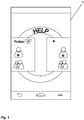
- the Fig. 1 shows by way of example a possible embodiment of an operating element which is visualized on a touch-sensitive display or a touch screen of a TEG 1, in particular a smartphone. It is therefore a virtual control element, which is formed in the example shown by four virtual, to be operated by touching the relevant points of the touch screen buttons.
- the control element shown appears in this form after the start of the emergency call app according to the invention, namely a - to stay with the chosen example - processable by the control unit of a smartphone program application.
- a user who is in an emergency situation or witnesses such an emergency situation can accordingly by pressing the appropriate trigger an emergency call and issue an emergency message addressed to the police or to the fire brigade, whereby the corresponding selection of the key simultaneously indicates whether this emergency call relates to itself (ME) or to other persons (US).
- the app will be a camera of the smartphone and a microphone for optical and acoustic recording of the environment Smartphones started.
- the recorded optical data may be several frames taken in quick succession or a short video sequence.
- the generation of the textual component of the emergency message is started by the emergency call app in the background by putting together the corresponding text data to be sent together with the recording data of the camera and the microphone.
- These are first text information about the sender, which in plain text at least the communication address of the TEG 1 associated with the activation of the emergency call app when it is first put into use - in this case the mobile number of the smartphone - and, due to the button pressed by the user, an indication of whether the emergency call concerns the user or other persons.
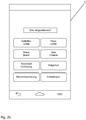
- Fig. 2a in case the emergency call is addressed to the police, asked by the user what kind of emergency situation is. By clicking on the corresponding virtual button, the user can select the category applicable in this case.
- the categories are murder / manslaughter, robbery / robbery, sexual coercion / rape, assault / brawl, domestic violence / threat, assault and rampage.
- these as well as the categories and statements exemplified below are given to the user in an operating language specified by him at an earlier point in time during the installation of the emergency call app or its configuration. If necessary, the operating language can also be determined depending on the country of delivery of the emergency call app. Accordingly, a user in the United Kingdom or the United States will receive the previously exemplified categories in English.
- a scheme for the information to be requested by the user after the activation of the virtual button for triggering a fire alarm directed to the emergency response is reproduced.
- the user can therefore indicate here whether the emergency call relates to a traffic accident, a fire or a fire, illness / injury, flooding, a house accident, a gas or chemical accident, another catastrophe or an emergency birth.
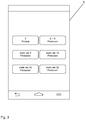
- the user still according to the in the Fig. 3 an example of how many people are affected by or involved in the emergency.
- This information is the user by the operation of a virtual button, that is, the touch of the touch screen of the TEG 1 according to the Fig. 1 at the location that visualizes this key.
- the dispatch of the emergency message to the backend devices 3 started a countdown to the delayed transmission of this message, wherein, as already stated, regardless of a dispatch of the emergency message takes place only when the minimum duration for the acoustic and visual or optical recording of the environment of the TEG 1 or smartphone is reached.
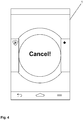
- a virtual key whose operation allows the user to cancel the emergency call, if it was initiated by mistake or accidentally, for example.
- the user can be made aware of the possibility of such termination by a vibration signal of the TEG 1.
- the latter virtual key can preferably be marked with an internationalism for cancellation (Cancel) or else with a corresponding indication in the national languages for which the TEG 1 has been configured, such as "abort" for Germany.
- the core of the system is a TEG 1 to be used by a user for automatically issuing an emergency message when an emergency call is triggered, such as the previously mentioned smartphone and at least one server 6 and a database connected to the TEG 1 via a network 7 comprehensive backend devices 3, which receive the transmitted from the TEG 1 emergency message, process and finally forward to the locally competent task center 4.
- the transmission of the emergency message is caused by the control unit of the smartphone or by the control unit of a device coupled to the smartphone terminal device 2, such as a smart watch, processed emergency app.
- the locally addressed mission control center 4 and its facilities and public network facilities also belong to the emergency call system, but these units and facilities, being part of the public infrastructure, in the context of the claims in part not be considered as part of the actual or inventive system.
- the emergency message is transmitted to the backend 3 devices.
- the corresponding emergency message is sent out, for example, by e-mail. Accordingly, the message is fed to the backend devices via a gateway 8 arranged in the transition area between the mobile radio network and the Internet 9.
- the instantaneous location of the user initiating the emergency call and placing the emergency message is determined by evaluating cell information of the TEG 1 (smartphones) logged into the mobile network, or preferably a transmitting and receiving unit of a satellite positioning system activated in the TEG 1.
- the textual parts of the emergency message preferably using the database entries of the database 7 of the backend devices, are translated into the national language of the current location of the user sending the emergency message.
- which locally competent control center 4 is the emergency message using which recipient address (eg landline phone number or fax number of the operations control center) and which transmission method zuzu dining.
- the corresponding, if necessary or, if necessary, translated into the national language emergency message is then including the recording data transmitted from the environment of the TEG 1 or a link to this recording data, for example via an e-mail-to-fax gateway 10.
- To the backend devices 3 of the emergency call system include, as indicated by the dashed line, optionally, but not necessarily, even server devices 11 to download the emergency call app according to the invention.
Landscapes
- Engineering & Computer Science (AREA)
- Business, Economics & Management (AREA)
- Emergency Management (AREA)
- Physics & Mathematics (AREA)
- General Physics & Mathematics (AREA)
- Computer Security & Cryptography (AREA)
- Human Computer Interaction (AREA)
- Computer Networks & Wireless Communication (AREA)
- Signal Processing (AREA)
- Environmental & Geological Engineering (AREA)
- Telephonic Communication Services (AREA)
- Alarm Systems (AREA)
Priority Applications (1)
| Application Number | Priority Date | Filing Date | Title |
|---|---|---|---|
| PL15190322T PL3010213T3 (pl) | 2014-10-17 | 2015-10-17 | Automatyczne wysyłanie wiadomości o nagłym zdarzeniu przy wezwaniu pomocy |
Applications Claiming Priority (1)
| Application Number | Priority Date | Filing Date | Title |
|---|---|---|---|
| DE102014115160.7A DE102014115160A1 (de) | 2014-10-17 | 2014-10-17 | Automatisierte Auslösung eines Notrufs |
Publications (2)
| Publication Number | Publication Date |
|---|---|
| EP3010213A1 EP3010213A1 (de) | 2016-04-20 |
| EP3010213B1 true EP3010213B1 (de) | 2018-01-24 |
Family
ID=54337145
Family Applications (1)
| Application Number | Title | Priority Date | Filing Date |
|---|---|---|---|
| EP15190322.6A Active EP3010213B1 (de) | 2014-10-17 | 2015-10-17 | Automatisiertes absetzen einer notfallnachricht bei einem notruf |
Country Status (7)
| Country | Link |
|---|---|
| EP (1) | EP3010213B1 (pl) |
| DE (1) | DE102014115160A1 (pl) |
| DK (1) | DK3010213T3 (pl) |
| ES (1) | ES2666971T3 (pl) |
| NO (1) | NO2689200T3 (pl) |
| PL (1) | PL3010213T3 (pl) |
| PT (1) | PT3010213T (pl) |
Cited By (2)
| Publication number | Priority date | Publication date | Assignee | Title |
|---|---|---|---|---|
| DE102018114446A1 (de) | 2018-06-15 | 2019-12-19 | Claus Wystemp | Verfahren und System zur Benachrichtigung einer Notrufzentrale |
| DE102018010300A1 (de) | 2018-06-15 | 2019-12-19 | Claus Wystemp | Verfahren und System zur Benachrichtigung einer Notrufzentrale |
Families Citing this family (7)
| Publication number | Priority date | Publication date | Assignee | Title |
|---|---|---|---|---|
| DE102016211398A1 (de) * | 2016-06-24 | 2017-12-28 | Siemens Schweiz Ag | Verfahren und eine Anordnung zum Senden einer bedienerausgelösten Gefahrenmeldung an eine Meldezentrale |
| DE102016113591A1 (de) * | 2016-07-22 | 2018-01-25 | Hubertus Platt | Verfahren zur Übertragung von Notfallinformationen |
| DE102017102959A1 (de) | 2017-02-14 | 2018-08-16 | Gilbert Duong | Kriminalitätsbekämpfungssystem für den Personenschutz |
| DE102017213166B3 (de) | 2017-07-31 | 2018-10-25 | Volkswagen Aktiengesellschaft | Verfahren zum Betreiben einer Mobilfunkstation, Mobilfunkstation sowie Computerprogramm |
| DE202017005942U1 (de) * | 2017-11-16 | 2019-02-19 | FreedStreet Ltd. | Mobile Sicherheitsgeräte (mPERS) mit alternativem Schaltverfahren zur Auslösung von Voralarmen und anschließendem Alarm |
| DE102018200986A1 (de) * | 2018-01-23 | 2019-07-25 | Alexander Pflieger | Absicherungsvorrichtung und Absicherungsverfahren zur Absicherung in einer Gefährdungssituation |
| DE102020207047A1 (de) | 2020-06-05 | 2021-12-09 | Volkswagen Aktiengesellschaft | Textbasierte Notfallkommunikation zwischen einem Kraftfahrzeug und einer Leitstelle |
Citations (10)
| Publication number | Priority date | Publication date | Assignee | Title |
|---|---|---|---|---|
| DE19650176A1 (de) | 1996-12-04 | 1997-06-05 | Fiedler Holger Dipl Ing Tu | Vorrichtung in Fahrzeugen zum automatischen Benachrichtigen von hilfeleistenden Personen bei Lebensgefahr |
| WO1999030301A1 (de) | 1997-12-11 | 1999-06-17 | Siemens Aktiengesellschaft | Kommunikationsendgerät und verfahren zur übermittlung von meldungen |
| US20010051514A1 (en) | 2000-03-10 | 2001-12-13 | Rune Lindholm | Alpha tagging and type indication of emergency call number |
| US20080132199A1 (en) | 2004-12-27 | 2008-06-05 | Jupiter Net Incorporated | Portable Radio Device Having Emergency Notifying Function, Emergency Notification Apparatus, and Emergency Notification System |
| US20080227429A1 (en) | 2007-03-13 | 2008-09-18 | Research In Motion Limited | Enhanced handling of duress situations |
| WO2011060140A1 (en) | 2009-11-12 | 2011-05-19 | Soteria Systems, Llc | Personal safety application for mobile device and method |
| US20130052982A1 (en) | 2011-08-24 | 2013-02-28 | FRESS, Inc. | Method and apparatus for creating emergency social network |
| DE202013103369U1 (de) | 2013-06-03 | 2013-08-29 | Migardo Gmbh | Notrufsystem |
| US20140057590A1 (en) | 2011-11-14 | 2014-02-27 | Optivon, Inc. | Method and system for communicating information associated with an incident and/or emergency situation |
| US20140189808A1 (en) | 2012-12-28 | 2014-07-03 | Lookout, Inc. | Multi-factor authentication and comprehensive login system for client-server networks |
Family Cites Families (8)
| Publication number | Priority date | Publication date | Assignee | Title |
|---|---|---|---|---|
| US5621727A (en) * | 1994-09-16 | 1997-04-15 | Octel Communications Corporation | System and method for private addressing plans using community addressing |
| GB2334412A (en) * | 1998-02-13 | 1999-08-18 | Nokia Mobile Phones Ltd | Mobile telephone with emergency responsive mode |
| JP2002092265A (ja) * | 2000-09-19 | 2002-03-29 | Nec Corp | 緊急情報送信方法、緊急情報送信システム、記録媒体、情報処理装置、及び移動端末 |
| CN1582010A (zh) * | 2004-02-17 | 2005-02-16 | 萧学文 | 使用短消息/电子邮件激活应用的方法及多媒体手机 |
| US8467500B2 (en) * | 2009-05-20 | 2013-06-18 | Robert S. Hidajat | Method and device for launching application triggered by initiation of telephone call |
| DE202009013305U1 (de) * | 2009-10-05 | 2009-12-17 | Thiel, Mario | Mobiltelefoneinheit für insbesondere gesundheitlich beeinträchtigte Personen |
| US8249549B1 (en) * | 2010-09-23 | 2012-08-21 | Cellco Partnership | Automating emergency calls globally |
| US8249547B1 (en) * | 2011-06-16 | 2012-08-21 | Albert Fellner | Emergency alert device with mobile phone |
-
2012
- 2012-03-23 NO NO12760343A patent/NO2689200T3/no unknown
-
2014
- 2014-10-17 DE DE102014115160.7A patent/DE102014115160A1/de not_active Withdrawn
-
2015
- 2015-10-17 DK DK15190322.6T patent/DK3010213T3/en active
- 2015-10-17 PL PL15190322T patent/PL3010213T3/pl unknown
- 2015-10-17 ES ES15190322.6T patent/ES2666971T3/es active Active
- 2015-10-17 EP EP15190322.6A patent/EP3010213B1/de active Active
- 2015-10-17 PT PT151903226T patent/PT3010213T/pt unknown
Patent Citations (10)
| Publication number | Priority date | Publication date | Assignee | Title |
|---|---|---|---|---|
| DE19650176A1 (de) | 1996-12-04 | 1997-06-05 | Fiedler Holger Dipl Ing Tu | Vorrichtung in Fahrzeugen zum automatischen Benachrichtigen von hilfeleistenden Personen bei Lebensgefahr |
| WO1999030301A1 (de) | 1997-12-11 | 1999-06-17 | Siemens Aktiengesellschaft | Kommunikationsendgerät und verfahren zur übermittlung von meldungen |
| US20010051514A1 (en) | 2000-03-10 | 2001-12-13 | Rune Lindholm | Alpha tagging and type indication of emergency call number |
| US20080132199A1 (en) | 2004-12-27 | 2008-06-05 | Jupiter Net Incorporated | Portable Radio Device Having Emergency Notifying Function, Emergency Notification Apparatus, and Emergency Notification System |
| US20080227429A1 (en) | 2007-03-13 | 2008-09-18 | Research In Motion Limited | Enhanced handling of duress situations |
| WO2011060140A1 (en) | 2009-11-12 | 2011-05-19 | Soteria Systems, Llc | Personal safety application for mobile device and method |
| US20130052982A1 (en) | 2011-08-24 | 2013-02-28 | FRESS, Inc. | Method and apparatus for creating emergency social network |
| US20140057590A1 (en) | 2011-11-14 | 2014-02-27 | Optivon, Inc. | Method and system for communicating information associated with an incident and/or emergency situation |
| US20140189808A1 (en) | 2012-12-28 | 2014-07-03 | Lookout, Inc. | Multi-factor authentication and comprehensive login system for client-server networks |
| DE202013103369U1 (de) | 2013-06-03 | 2013-08-29 | Migardo Gmbh | Notrufsystem |
Cited By (2)
| Publication number | Priority date | Publication date | Assignee | Title |
|---|---|---|---|---|
| DE102018114446A1 (de) | 2018-06-15 | 2019-12-19 | Claus Wystemp | Verfahren und System zur Benachrichtigung einer Notrufzentrale |
| DE102018010300A1 (de) | 2018-06-15 | 2019-12-19 | Claus Wystemp | Verfahren und System zur Benachrichtigung einer Notrufzentrale |
Also Published As
| Publication number | Publication date |
|---|---|
| DK3010213T3 (en) | 2018-05-07 |
| PT3010213T (pt) | 2018-04-23 |
| PL3010213T3 (pl) | 2018-07-31 |
| NO2689200T3 (pl) | 2018-08-11 |
| DE102014115160A1 (de) | 2016-04-21 |
| ES2666971T3 (es) | 2018-05-08 |
| EP3010213A1 (de) | 2016-04-20 |
Similar Documents
| Publication | Publication Date | Title |
|---|---|---|
| EP3010213B1 (de) | Automatisiertes absetzen einer notfallnachricht bei einem notruf | |
| DE602004002669T2 (de) | Notrufverfahren | |
| EP2394253B1 (de) | Notrufgerät | |
| DE10224788B4 (de) | Verfahren zur Beschaffung von persönlichen Notfallinformationen | |
| US20160373910A1 (en) | Emergency data gathering and communication system and methods of use | |
| EP1688086A1 (de) | Vorrichtung zur Überwachung von Vitalwerten Gebrechlicher | |
| DE112015004559T5 (de) | Persönliches notfallreaktionssystem und sein betriebsverfahren | |
| KR20190049187A (ko) | 사용자의 위험 상태 공유를 위해 상기 사용자의 단말에 기 설치된 어플리케이션 내 타이머를 실행시키는 방법 및 그 장치 | |
| EP3480778A1 (de) | Verfahren zur zugangskontrolle zu gefahrenbereichen | |
| EP1030641A1 (de) | System zum bedarfsabhängigen erzeugen eines von einer person wahrnehmbaren signals | |
| López | The securitization of care spaces: Lessons from telecare | |
| DE102005006037A1 (de) | Verfahren und Vorrichtung zur Überwachung Betreuung benötigender Personen | |
| AT13960U1 (de) | Notrufsystem | |
| EP3789331B1 (de) | Verfahren zum betrieb einer aufzuganlage | |
| DE102017116437A1 (de) | Rettungsarmband | |
| DE102014105937B4 (de) | Überwachungssystem und Überwachungsverfahren | |
| EP2337321A2 (de) | Notruftelefon | |
| DE19836118A1 (de) | Gerät und System zur weltweiten Notfallrettung (Primärrettung) per EIN-TASTEN-Bedienung über eine zentrale Notrufnummer WELTWEIT | |
| DE10124093B4 (de) | System zum Lokalisieren einer Person | |
| EP1616428A1 (de) | Mobiles telekommunikationsgeraet sowie system und verfahren zur herstellung einer notrufverbindung | |
| DE202017005942U1 (de) | Mobile Sicherheitsgeräte (mPERS) mit alternativem Schaltverfahren zur Auslösung von Voralarmen und anschließendem Alarm | |
| DE102018114446A1 (de) | Verfahren und System zur Benachrichtigung einer Notrufzentrale | |
| DE102018200986A1 (de) | Absicherungsvorrichtung und Absicherungsverfahren zur Absicherung in einer Gefährdungssituation | |
| DE202023103062U1 (de) | System zum Schutz von Frauen vor Belästigung | |
| DE10014079A1 (de) | Kommunikationseinrichtung, insbesondere zur Hilfeanforderung |
Legal Events
| Date | Code | Title | Description |
|---|---|---|---|
| PUAI | Public reference made under article 153(3) epc to a published international application that has entered the european phase |
Free format text: ORIGINAL CODE: 0009012 |
|
| AK | Designated contracting states |
Kind code of ref document: A1 Designated state(s): AL AT BE BG CH CY CZ DE DK EE ES FI FR GB GR HR HU IE IS IT LI LT LU LV MC MK MT NL NO PL PT RO RS SE SI SK SM TR |
|
| AX | Request for extension of the european patent |
Extension state: BA ME |
|
| 17P | Request for examination filed |
Effective date: 20161020 |
|
| RBV | Designated contracting states (corrected) |
Designated state(s): AL AT BE BG CH CY CZ DE DK EE ES FI FR GB GR HR HU IE IS IT LI LT LU LV MC MK MT NL NO PL PT RO RS SE SI SK SM TR |
|
| GRAP | Despatch of communication of intention to grant a patent |
Free format text: ORIGINAL CODE: EPIDOSNIGR1 |
|
| RIC1 | Information provided on ipc code assigned before grant |
Ipc: G08B 25/08 20060101ALI20170921BHEP Ipc: H04M 1/725 20060101AFI20170921BHEP Ipc: G06F 9/44 20060101ALI20170921BHEP Ipc: G08B 25/01 20060101ALI20170921BHEP |
|
| INTG | Intention to grant announced |
Effective date: 20171012 |
|
| GRAS | Grant fee paid |
Free format text: ORIGINAL CODE: EPIDOSNIGR3 |
|
| GRAA | (expected) grant |
Free format text: ORIGINAL CODE: 0009210 |
|
| AK | Designated contracting states |
Kind code of ref document: B1 Designated state(s): AL AT BE BG CH CY CZ DE DK EE ES FI FR GB GR HR HU IE IS IT LI LT LU LV MC MK MT NL NO PL PT RO RS SE SI SK SM TR |
|
| REG | Reference to a national code |
Ref country code: GB Ref legal event code: FG4D Free format text: NOT ENGLISH |
|
| REG | Reference to a national code |
Ref country code: CH Ref legal event code: EP |
|
| REG | Reference to a national code |
Ref country code: AT Ref legal event code: REF Ref document number: 966387 Country of ref document: AT Kind code of ref document: T Effective date: 20180215 |
|
| REG | Reference to a national code |
Ref country code: IE Ref legal event code: FG4D Free format text: LANGUAGE OF EP DOCUMENT: GERMAN |
|
| REG | Reference to a national code |
Ref country code: DE Ref legal event code: R096 Ref document number: 502015002874 Country of ref document: DE |
|
| REG | Reference to a national code |
Ref country code: CH Ref legal event code: NV Representative=s name: R.A. EGLI AND CO, PATENTANWAELTE, CH |
|
| REG | Reference to a national code |
Ref country code: PT Ref legal event code: SC4A Ref document number: 3010213 Country of ref document: PT Date of ref document: 20180423 Kind code of ref document: T Free format text: AVAILABILITY OF NATIONAL TRANSLATION Effective date: 20180416 |
|
| REG | Reference to a national code |
Ref country code: NL Ref legal event code: FP |
|
| REG | Reference to a national code |
Ref country code: DK Ref legal event code: T3 Effective date: 20180504 |
|
| REG | Reference to a national code |
Ref country code: ES Ref legal event code: FG2A Ref document number: 2666971 Country of ref document: ES Kind code of ref document: T3 Effective date: 20180508 |
|
| REG | Reference to a national code |
Ref country code: SE Ref legal event code: TRGR |
|
| REG | Reference to a national code |
Ref country code: LT Ref legal event code: MG4D |
|
| REG | Reference to a national code |
Ref country code: NO Ref legal event code: T2 Effective date: 20180124 |
|
| PG25 | Lapsed in a contracting state [announced via postgrant information from national office to epo] |
Ref country code: CY Free format text: LAPSE BECAUSE OF FAILURE TO SUBMIT A TRANSLATION OF THE DESCRIPTION OR TO PAY THE FEE WITHIN THE PRESCRIBED TIME-LIMIT Effective date: 20180124 Ref country code: LT Free format text: LAPSE BECAUSE OF FAILURE TO SUBMIT A TRANSLATION OF THE DESCRIPTION OR TO PAY THE FEE WITHIN THE PRESCRIBED TIME-LIMIT Effective date: 20180124 Ref country code: HR Free format text: LAPSE BECAUSE OF FAILURE TO SUBMIT A TRANSLATION OF THE DESCRIPTION OR TO PAY THE FEE WITHIN THE PRESCRIBED TIME-LIMIT Effective date: 20180124 |
|
| PG25 | Lapsed in a contracting state [announced via postgrant information from national office to epo] |
Ref country code: RS Free format text: LAPSE BECAUSE OF FAILURE TO SUBMIT A TRANSLATION OF THE DESCRIPTION OR TO PAY THE FEE WITHIN THE PRESCRIBED TIME-LIMIT Effective date: 20180124 Ref country code: LV Free format text: LAPSE BECAUSE OF FAILURE TO SUBMIT A TRANSLATION OF THE DESCRIPTION OR TO PAY THE FEE WITHIN THE PRESCRIBED TIME-LIMIT Effective date: 20180124 Ref country code: IS Free format text: LAPSE BECAUSE OF FAILURE TO SUBMIT A TRANSLATION OF THE DESCRIPTION OR TO PAY THE FEE WITHIN THE PRESCRIBED TIME-LIMIT Effective date: 20180524 Ref country code: BG Free format text: LAPSE BECAUSE OF FAILURE TO SUBMIT A TRANSLATION OF THE DESCRIPTION OR TO PAY THE FEE WITHIN THE PRESCRIBED TIME-LIMIT Effective date: 20180424 |
|
| PG25 | Lapsed in a contracting state [announced via postgrant information from national office to epo] |
Ref country code: MT Free format text: LAPSE BECAUSE OF FAILURE TO SUBMIT A TRANSLATION OF THE DESCRIPTION OR TO PAY THE FEE WITHIN THE PRESCRIBED TIME-LIMIT Effective date: 20180124 |
|
| REG | Reference to a national code |
Ref country code: DE Ref legal event code: R026 Ref document number: 502015002874 Country of ref document: DE |
|
| REG | Reference to a national code |
Ref country code: FR Ref legal event code: PLFP Year of fee payment: 4 |
|
| PG25 | Lapsed in a contracting state [announced via postgrant information from national office to epo] |
Ref country code: AL Free format text: LAPSE BECAUSE OF FAILURE TO SUBMIT A TRANSLATION OF THE DESCRIPTION OR TO PAY THE FEE WITHIN THE PRESCRIBED TIME-LIMIT Effective date: 20180124 Ref country code: EE Free format text: LAPSE BECAUSE OF FAILURE TO SUBMIT A TRANSLATION OF THE DESCRIPTION OR TO PAY THE FEE WITHIN THE PRESCRIBED TIME-LIMIT Effective date: 20180124 Ref country code: RO Free format text: LAPSE BECAUSE OF FAILURE TO SUBMIT A TRANSLATION OF THE DESCRIPTION OR TO PAY THE FEE WITHIN THE PRESCRIBED TIME-LIMIT Effective date: 20180124 |
|
| PLBI | Opposition filed |
Free format text: ORIGINAL CODE: 0009260 |
|
| REG | Reference to a national code |
Ref country code: GR Ref legal event code: EP Ref document number: 20180401116 Country of ref document: GR Effective date: 20181012 |
|
| PLAX | Notice of opposition and request to file observation + time limit sent |
Free format text: ORIGINAL CODE: EPIDOSNOBS2 |
|
| PG25 | Lapsed in a contracting state [announced via postgrant information from national office to epo] |
Ref country code: SK Free format text: LAPSE BECAUSE OF FAILURE TO SUBMIT A TRANSLATION OF THE DESCRIPTION OR TO PAY THE FEE WITHIN THE PRESCRIBED TIME-LIMIT Effective date: 20180124 Ref country code: SM Free format text: LAPSE BECAUSE OF FAILURE TO SUBMIT A TRANSLATION OF THE DESCRIPTION OR TO PAY THE FEE WITHIN THE PRESCRIBED TIME-LIMIT Effective date: 20180124 |
|
| 26 | Opposition filed |
Opponent name: ROBERT BOSCH GMBH Effective date: 20181018 |
|
| PG25 | Lapsed in a contracting state [announced via postgrant information from national office to epo] |
Ref country code: SI Free format text: LAPSE BECAUSE OF FAILURE TO SUBMIT A TRANSLATION OF THE DESCRIPTION OR TO PAY THE FEE WITHIN THE PRESCRIBED TIME-LIMIT Effective date: 20180124 |
|
| PLBB | Reply of patent proprietor to notice(s) of opposition received |
Free format text: ORIGINAL CODE: EPIDOSNOBS3 |
|
| REG | Reference to a national code |
Ref country code: DE Ref legal event code: R100 Ref document number: 502015002874 Country of ref document: DE |
|
| PLCK | Communication despatched that opposition was rejected |
Free format text: ORIGINAL CODE: EPIDOSNREJ1 |
|
| PLAB | Opposition data, opponent's data or that of the opponent's representative modified |
Free format text: ORIGINAL CODE: 0009299OPPO |
|
| R26 | Opposition filed (corrected) |
Opponent name: ROBERT BOSCH GMBH Effective date: 20181018 |
|
| PG25 | Lapsed in a contracting state [announced via postgrant information from national office to epo] |
Ref country code: MK Free format text: LAPSE BECAUSE OF NON-PAYMENT OF DUE FEES Effective date: 20180124 Ref country code: HU Free format text: LAPSE BECAUSE OF FAILURE TO SUBMIT A TRANSLATION OF THE DESCRIPTION OR TO PAY THE FEE WITHIN THE PRESCRIBED TIME-LIMIT; INVALID AB INITIO Effective date: 20151017 |
|
| PLBN | Opposition rejected |
Free format text: ORIGINAL CODE: 0009273 |
|
| STAA | Information on the status of an ep patent application or granted ep patent |
Free format text: STATUS: OPPOSITION REJECTED |
|
| 27O | Opposition rejected |
Effective date: 20200128 |
|
| PGFP | Annual fee paid to national office [announced via postgrant information from national office to epo] |
Ref country code: GB Payment date: 20231025 Year of fee payment: 9 Ref country code: GR Payment date: 20231019 Year of fee payment: 9 |
|
| PGFP | Annual fee paid to national office [announced via postgrant information from national office to epo] |
Ref country code: MC Payment date: 20231020 Year of fee payment: 9 |
|
| PGFP | Annual fee paid to national office [announced via postgrant information from national office to epo] |
Ref country code: TR Payment date: 20231009 Year of fee payment: 9 Ref country code: PT Payment date: 20231006 Year of fee payment: 9 Ref country code: IT Payment date: 20231031 Year of fee payment: 9 Ref country code: IE Payment date: 20231019 Year of fee payment: 9 Ref country code: DK Payment date: 20231025 Year of fee payment: 9 |
|
| PGFP | Annual fee paid to national office [announced via postgrant information from national office to epo] |
Ref country code: NL Payment date: 20241023 Year of fee payment: 10 |
|
| PGFP | Annual fee paid to national office [announced via postgrant information from national office to epo] |
Ref country code: NO Payment date: 20241022 Year of fee payment: 10 |
|
| PGFP | Annual fee paid to national office [announced via postgrant information from national office to epo] |
Ref country code: BE Payment date: 20241022 Year of fee payment: 10 Ref country code: PL Payment date: 20241011 Year of fee payment: 10 Ref country code: FI Payment date: 20241022 Year of fee payment: 10 |
|
| PGFP | Annual fee paid to national office [announced via postgrant information from national office to epo] |
Ref country code: AT Payment date: 20241021 Year of fee payment: 10 Ref country code: FR Payment date: 20241025 Year of fee payment: 10 |
|
| PGFP | Annual fee paid to national office [announced via postgrant information from national office to epo] |
Ref country code: CZ Payment date: 20241010 Year of fee payment: 10 |
|
| PGFP | Annual fee paid to national office [announced via postgrant information from national office to epo] |
Ref country code: ES Payment date: 20241118 Year of fee payment: 10 |
|
| PGFP | Annual fee paid to national office [announced via postgrant information from national office to epo] |
Ref country code: SE Payment date: 20241023 Year of fee payment: 10 |
|
| PGFP | Annual fee paid to national office [announced via postgrant information from national office to epo] |
Ref country code: CH Payment date: 20241101 Year of fee payment: 10 |
|
| REG | Reference to a national code |
Ref country code: DK Ref legal event code: EBP Effective date: 20241031 |
|
| REG | Reference to a national code |
Ref country code: DE Ref legal event code: R082 Ref document number: 502015002874 Country of ref document: DE Representative=s name: MAUCHER JENKINS PATENTANWAELTE & RECHTSANWAELT, DE |
|
| GBPC | Gb: european patent ceased through non-payment of renewal fee |
Effective date: 20241017 |
|
| PG25 | Lapsed in a contracting state [announced via postgrant information from national office to epo] |
Ref country code: MC Free format text: LAPSE BECAUSE OF NON-PAYMENT OF DUE FEES Effective date: 20241031 |
|
| PG25 | Lapsed in a contracting state [announced via postgrant information from national office to epo] |
Ref country code: GB Free format text: LAPSE BECAUSE OF NON-PAYMENT OF DUE FEES Effective date: 20241017 |
|
| PG25 | Lapsed in a contracting state [announced via postgrant information from national office to epo] |
Ref country code: PT Free format text: LAPSE BECAUSE OF NON-PAYMENT OF DUE FEES Effective date: 20250417 |
|
| PG25 | Lapsed in a contracting state [announced via postgrant information from national office to epo] |
Ref country code: GR Free format text: LAPSE BECAUSE OF NON-PAYMENT OF DUE FEES Effective date: 20250512 |
|
| PG25 | Lapsed in a contracting state [announced via postgrant information from national office to epo] |
Ref country code: DK Free format text: LAPSE BECAUSE OF NON-PAYMENT OF DUE FEES Effective date: 20241031 |
|
| PG25 | Lapsed in a contracting state [announced via postgrant information from national office to epo] |
Ref country code: IT Free format text: LAPSE BECAUSE OF NON-PAYMENT OF DUE FEES Effective date: 20241017 |
|
| PG25 | Lapsed in a contracting state [announced via postgrant information from national office to epo] |
Ref country code: IE Free format text: LAPSE BECAUSE OF NON-PAYMENT OF DUE FEES Effective date: 20241017 |
|
| PGFP | Annual fee paid to national office [announced via postgrant information from national office to epo] |
Ref country code: LU Payment date: 20251022 Year of fee payment: 11 |
|
| PGFP | Annual fee paid to national office [announced via postgrant information from national office to epo] |
Ref country code: DE Payment date: 20251007 Year of fee payment: 11 |