EP2997076B1 - Supramolekulares biologisch abbaubares polymer - Google Patents
Supramolekulares biologisch abbaubares polymer Download PDFInfo
- Publication number
- EP2997076B1 EP2997076B1 EP14726440.2A EP14726440A EP2997076B1 EP 2997076 B1 EP2997076 B1 EP 2997076B1 EP 14726440 A EP14726440 A EP 14726440A EP 2997076 B1 EP2997076 B1 EP 2997076B1
- Authority
- EP
- European Patent Office
- Prior art keywords
- polymer
- biodegradable polymer
- supramolecular
- group
- supramolecular biodegradable
- Prior art date
- Legal status (The legal status is an assumption and is not a legal conclusion. Google has not performed a legal analysis and makes no representation as to the accuracy of the status listed.)
- Active
Links
- 0 **C1=C(*)NC(N)=NC1=O Chemical compound **C1=C(*)NC(N)=NC1=O 0.000 description 2
Classifications
-
- C—CHEMISTRY; METALLURGY
- C08—ORGANIC MACROMOLECULAR COMPOUNDS; THEIR PREPARATION OR CHEMICAL WORKING-UP; COMPOSITIONS BASED THEREON
- C08G—MACROMOLECULAR COMPOUNDS OBTAINED OTHERWISE THAN BY REACTIONS ONLY INVOLVING UNSATURATED CARBON-TO-CARBON BONDS
- C08G18/00—Polymeric products of isocyanates or isothiocyanates
- C08G18/06—Polymeric products of isocyanates or isothiocyanates with compounds having active hydrogen
- C08G18/28—Polymeric products of isocyanates or isothiocyanates with compounds having active hydrogen characterised by the compounds used containing active hydrogen
- C08G18/65—Low-molecular-weight compounds having active hydrogen with high-molecular-weight compounds having active hydrogen
- C08G18/66—Compounds of groups C08G18/42, C08G18/48, or C08G18/52
- C08G18/6603—Compounds of groups C08G18/42, C08G18/48, or C08G18/52 with compounds of group C08G18/32 or polyamines of C08G18/38
- C08G18/6607—Compounds of groups C08G18/42, C08G18/48, or C08G18/52 with compounds of group C08G18/32 or polyamines of C08G18/38 with compounds of group C08G18/3203
-
- C—CHEMISTRY; METALLURGY
- C08—ORGANIC MACROMOLECULAR COMPOUNDS; THEIR PREPARATION OR CHEMICAL WORKING-UP; COMPOSITIONS BASED THEREON
- C08G—MACROMOLECULAR COMPOUNDS OBTAINED OTHERWISE THAN BY REACTIONS ONLY INVOLVING UNSATURATED CARBON-TO-CARBON BONDS
- C08G83/00—Macromolecular compounds not provided for in groups C08G2/00 - C08G81/00
- C08G83/008—Supramolecular polymers
-
- A—HUMAN NECESSITIES
- A61—MEDICAL OR VETERINARY SCIENCE; HYGIENE
- A61L—METHODS OR APPARATUS FOR STERILISING MATERIALS OR OBJECTS IN GENERAL; DISINFECTION, STERILISATION OR DEODORISATION OF AIR; CHEMICAL ASPECTS OF BANDAGES, DRESSINGS, ABSORBENT PADS OR SURGICAL ARTICLES; MATERIALS FOR BANDAGES, DRESSINGS, ABSORBENT PADS OR SURGICAL ARTICLES
- A61L27/00—Materials for grafts or prostheses or for coating grafts or prostheses
- A61L27/14—Macromolecular materials
- A61L27/18—Macromolecular materials obtained otherwise than by reactions only involving carbon-to-carbon unsaturated bonds
-
- A—HUMAN NECESSITIES
- A61—MEDICAL OR VETERINARY SCIENCE; HYGIENE
- A61L—METHODS OR APPARATUS FOR STERILISING MATERIALS OR OBJECTS IN GENERAL; DISINFECTION, STERILISATION OR DEODORISATION OF AIR; CHEMICAL ASPECTS OF BANDAGES, DRESSINGS, ABSORBENT PADS OR SURGICAL ARTICLES; MATERIALS FOR BANDAGES, DRESSINGS, ABSORBENT PADS OR SURGICAL ARTICLES
- A61L27/00—Materials for grafts or prostheses or for coating grafts or prostheses
- A61L27/50—Materials characterised by their function or physical properties, e.g. injectable or lubricating compositions, shape-memory materials, surface modified materials
- A61L27/58—Materials at least partially resorbable by the body
-
- C—CHEMISTRY; METALLURGY
- C08—ORGANIC MACROMOLECULAR COMPOUNDS; THEIR PREPARATION OR CHEMICAL WORKING-UP; COMPOSITIONS BASED THEREON
- C08G—MACROMOLECULAR COMPOUNDS OBTAINED OTHERWISE THAN BY REACTIONS ONLY INVOLVING UNSATURATED CARBON-TO-CARBON BONDS
- C08G18/00—Polymeric products of isocyanates or isothiocyanates
- C08G18/06—Polymeric products of isocyanates or isothiocyanates with compounds having active hydrogen
- C08G18/08—Processes
- C08G18/10—Prepolymer processes involving reaction of isocyanates or isothiocyanates with compounds having active hydrogen in a first reaction step
-
- C—CHEMISTRY; METALLURGY
- C08—ORGANIC MACROMOLECULAR COMPOUNDS; THEIR PREPARATION OR CHEMICAL WORKING-UP; COMPOSITIONS BASED THEREON
- C08G—MACROMOLECULAR COMPOUNDS OBTAINED OTHERWISE THAN BY REACTIONS ONLY INVOLVING UNSATURATED CARBON-TO-CARBON BONDS
- C08G18/00—Polymeric products of isocyanates or isothiocyanates
- C08G18/06—Polymeric products of isocyanates or isothiocyanates with compounds having active hydrogen
- C08G18/08—Processes
- C08G18/10—Prepolymer processes involving reaction of isocyanates or isothiocyanates with compounds having active hydrogen in a first reaction step
- C08G18/12—Prepolymer processes involving reaction of isocyanates or isothiocyanates with compounds having active hydrogen in a first reaction step using two or more compounds having active hydrogen in the first polymerisation step
-
- C—CHEMISTRY; METALLURGY
- C08—ORGANIC MACROMOLECULAR COMPOUNDS; THEIR PREPARATION OR CHEMICAL WORKING-UP; COMPOSITIONS BASED THEREON
- C08G—MACROMOLECULAR COMPOUNDS OBTAINED OTHERWISE THAN BY REACTIONS ONLY INVOLVING UNSATURATED CARBON-TO-CARBON BONDS
- C08G18/00—Polymeric products of isocyanates or isothiocyanates
- C08G18/06—Polymeric products of isocyanates or isothiocyanates with compounds having active hydrogen
- C08G18/28—Polymeric products of isocyanates or isothiocyanates with compounds having active hydrogen characterised by the compounds used containing active hydrogen
- C08G18/65—Low-molecular-weight compounds having active hydrogen with high-molecular-weight compounds having active hydrogen
- C08G18/66—Compounds of groups C08G18/42, C08G18/48, or C08G18/52
- C08G18/6633—Compounds of group C08G18/42
- C08G18/6637—Compounds of group C08G18/42 with compounds of group C08G18/32 or polyamines of C08G18/38
-
- C—CHEMISTRY; METALLURGY
- C08—ORGANIC MACROMOLECULAR COMPOUNDS; THEIR PREPARATION OR CHEMICAL WORKING-UP; COMPOSITIONS BASED THEREON
- C08G—MACROMOLECULAR COMPOUNDS OBTAINED OTHERWISE THAN BY REACTIONS ONLY INVOLVING UNSATURATED CARBON-TO-CARBON BONDS
- C08G18/00—Polymeric products of isocyanates or isothiocyanates
- C08G18/06—Polymeric products of isocyanates or isothiocyanates with compounds having active hydrogen
- C08G18/28—Polymeric products of isocyanates or isothiocyanates with compounds having active hydrogen characterised by the compounds used containing active hydrogen
- C08G18/65—Low-molecular-weight compounds having active hydrogen with high-molecular-weight compounds having active hydrogen
- C08G18/66—Compounds of groups C08G18/42, C08G18/48, or C08G18/52
- C08G18/6633—Compounds of group C08G18/42
- C08G18/6637—Compounds of group C08G18/42 with compounds of group C08G18/32 or polyamines of C08G18/38
- C08G18/664—Compounds of group C08G18/42 with compounds of group C08G18/32 or polyamines of C08G18/38 with compounds of group C08G18/3203
-
- C—CHEMISTRY; METALLURGY
- C08—ORGANIC MACROMOLECULAR COMPOUNDS; THEIR PREPARATION OR CHEMICAL WORKING-UP; COMPOSITIONS BASED THEREON
- C08G—MACROMOLECULAR COMPOUNDS OBTAINED OTHERWISE THAN BY REACTIONS ONLY INVOLVING UNSATURATED CARBON-TO-CARBON BONDS
- C08G18/00—Polymeric products of isocyanates or isothiocyanates
- C08G18/06—Polymeric products of isocyanates or isothiocyanates with compounds having active hydrogen
- C08G18/28—Polymeric products of isocyanates or isothiocyanates with compounds having active hydrogen characterised by the compounds used containing active hydrogen
- C08G18/65—Low-molecular-weight compounds having active hydrogen with high-molecular-weight compounds having active hydrogen
- C08G18/66—Compounds of groups C08G18/42, C08G18/48, or C08G18/52
- C08G18/6666—Compounds of group C08G18/48 or C08G18/52
- C08G18/667—Compounds of group C08G18/48 or C08G18/52 with compounds of group C08G18/32 or polyamines of C08G18/38
- C08G18/6674—Compounds of group C08G18/48 or C08G18/52 with compounds of group C08G18/32 or polyamines of C08G18/38 with compounds of group C08G18/3203
-
- C—CHEMISTRY; METALLURGY
- C08—ORGANIC MACROMOLECULAR COMPOUNDS; THEIR PREPARATION OR CHEMICAL WORKING-UP; COMPOSITIONS BASED THEREON
- C08G—MACROMOLECULAR COMPOUNDS OBTAINED OTHERWISE THAN BY REACTIONS ONLY INVOLVING UNSATURATED CARBON-TO-CARBON BONDS
- C08G18/00—Polymeric products of isocyanates or isothiocyanates
- C08G18/06—Polymeric products of isocyanates or isothiocyanates with compounds having active hydrogen
- C08G18/70—Polymeric products of isocyanates or isothiocyanates with compounds having active hydrogen characterised by the isocyanates or isothiocyanates used
- C08G18/72—Polyisocyanates or polyisothiocyanates
- C08G18/73—Polyisocyanates or polyisothiocyanates acyclic
-
- C—CHEMISTRY; METALLURGY
- C08—ORGANIC MACROMOLECULAR COMPOUNDS; THEIR PREPARATION OR CHEMICAL WORKING-UP; COMPOSITIONS BASED THEREON
- C08L—COMPOSITIONS OF MACROMOLECULAR COMPOUNDS
- C08L101/00—Compositions of unspecified macromolecular compounds
- C08L101/005—Dendritic macromolecules
-
- C—CHEMISTRY; METALLURGY
- C08—ORGANIC MACROMOLECULAR COMPOUNDS; THEIR PREPARATION OR CHEMICAL WORKING-UP; COMPOSITIONS BASED THEREON
- C08G—MACROMOLECULAR COMPOUNDS OBTAINED OTHERWISE THAN BY REACTIONS ONLY INVOLVING UNSATURATED CARBON-TO-CARBON BONDS
- C08G2230/00—Compositions for preparing biodegradable polymers
Definitions
- the present invention relates to a supramolecular biodegradable polymer comprising a quadruple hydrogen bonding unit (abbreviated herein as "4H-unit"), a biodegradable backbone and hard blocks, which display superior mechanical strength and elasticity while keeping its ease of processing.
- the resulting supramolecular polymers according to the invention are specifically suitable for biodegradable articles such as biomedical implants that need high strength and/or elasticity, e.g. medical implants in the cardio-vascular field.
- biodegradable also often designated as bioresorbable or biomedical
- biodegradable materials are known that are mostly based on aliphatic polyesters ( Uhrich et al., Chem. Rev. 99, 3181-3198, 1999 ).
- the mechanical properties of current biodegradable materials are strongly related to their high molecular weights that are in general over 100 kDa, the presence of chemical cross-links, and the presence of crystalline domains in these polymers.
- the crystalline domains are beneficial for the initial high strength of the material, they do have a strong impact on the biodegradation process of the material as the biodegradation of crystalline domains is in general very slow and crystalline domains may cause immunological responses.
- the need for high molecular weight polymers, in order to get the desired material properties usually implies that high processing temperatures are required, and these are unfavourable as thermal degradation processes become more likely.
- the crystalline domains may have a negative impact on the long term elastic behaviour of the material due to their tendency to induce fatigue characteristics.
- the present invention relates to a supramolecular biodegradable polymer that comprises 4H-units that are capable of forming at least four H-bridges in a row, preferably with another 4H-unit, leading to physical interactions between different polymer chains.
- the physical interactions originate from multiple hydrogen bonding interactions (supramolecular interactions) between individual 4H-units or between a 4H-unit and another moiety capable of forming hydrogen bonds thereby forming self-complementary units, preferably comprising at least four hydrogen bonds in a row.
- Units capable of forming at least four hydrogen bonds in a row i.e. quadruple hydrogen bonding units, are in this patent application abbreviated as "4H-units". Sijbesma et al.
- PCL polycaprolactone
- US 2009/00130172 discloses several biodegradable materials that comprise 4H-units mixed with bioactive molecules comprising a 4H-unit for biomedical applications such as coatings with controlled release of drugs.
- materials disclosed are the materials as published by Dankers et al. mentioned above, as well as other biodegradable polyester derivatives comprising 4H-units, notable the telechelic PCL of Dankers et al. in Example 14, and the chain extended PCL and polyadipate-based polymers with isophorone diisocyanate (IPDI) in Examples 8, 12, 13, and 15.
- IPDI isophorone diisocyanate
- US 2004/0087755 discloses polyurethane based polymers end-capped with 4H-units, alkyl diol chain extenders, and 4,4'-methylene bis(phenyl isocyanate) (MDI), which can be used as hot melt adhesive or TPU foam. These materials have limited tensile strengths ranging from 2 to 8 MPa (Table 2) or stresses at 100% elongation between 2 to 4 MPa (Table 6). Most importantly, the aromatic MDI in these polyurethane materials hamper their possible use as biodegradable biomedical materials, since MDI is known to result in degradation products that can comprise highly toxic aniline and derivatives thereof.
- MDI 4,4'-methylene bis(phenyl isocyanate)
- US 2012/116014A1 and EP2450394A1 disclose a process for the preparation of a supramolecular polymer comprising 1 - 50 4H-units, in which a 4H building block according to the formula 4H-(L-F i ) r , wherein 4H represents a 4H-unit, L represents a divalent, trivalent, tetravalent or pentavalent linking group, Fi represents a reactive group, and r is 1 - 4, is reacted with a prepolymer comprising a complementary reactive group, wherein the reaction mixture comprising said 4H building block and said prepolymer comprises less than 10 wt. % of a non-reactive organic solvent, based on the total weight of the reaction mixture.
- r is 2 and L is a divalent C 1 -C 20 alkylene, arylene, arylalkylene or alkylarylene group, which implies that the 4H building block is preferably represented by the formula 4H-(L-F i ) 2 .
- the 4H building block is preferably prepared from a precursor of an isocytosine or a melamine derivative and a diisocyanate, wherein the diisocyanate is most preferably isophorone diisocyanate (IPDI) or methylene dicyclohexane 4,4'-diisocyanate (HMDI).
- IPDI isophorone diisocyanate
- HMDI methylene dicyclohexane 4,4'-diisocyanate
- the supramolecular polymer according to US 2012/116014 / EP2450394A1 is preferably used in coating and adhesive compositions.
- supramolecular polymers obtained according to this preferred process are too stiff (high Young's modulus) and have a low elasticity.
- the supramolecular biodegradable polymers according to the present invention have better material characteristics than those of the prior art without compromising the beneficial processing properties of supramolecular polymers. It is another object of the present invention to provide strong supramolecular biodegradable polymers used in biomedical implants and scaffolds for tissue engineering.
- Described is a supramolecular biodegradable polymer comprising structural units A, B, C and F or comprising structural units A, B and C, wherein:
- the present invention relates to a supramolecular biodegradable polymer for biomedical implants or scaffolds for cardiovascular applications having a modulus at 30% elongation that is at least 1.2 times the modulus at 10% elongation according to test method ASTM D 1708-96 at room temperature with a crosshead speed of 20 mm/min, wherein said supramolecular biodegradable polymer is obtainable by a process wherein: a compound F' independently selected from the group consisting of Formulas (7), (8), (9) and (10), or a mixture thereof: is reacted with:
- the present invention further relates to a biomedical implant or scaffold for cardiovascular applications comprising the supramolecular biodegradable polymer.
- (Self)-complementary units capable of forming at least four hydrogen bonds form in principle non-covalent moieties with each other.
- the (self)-complementary units are capable of forming four hydrogen bonds in a row, they are used in their abbreviated form "4H-unit".
- the (self)-complementary units can form non-covalent moieties with other materials capable of forming less than four hydrogen bonds.
- Units capable of forming at least four hydrogen bonds can form a non-self-complementary or a self-complementary binding group.
- Non-self-complementary means for example that a 4H-unit (I) forms a bonding moiety (I)-(II) with a unit (II), wherein (II) is a different 4H-unit.
- Self-complementary means that two 4H-units (I) form a bonding moiety (I)-(I). It is preferred that the 4H-unit is self-complementary.
- the units according to Formulas (1), (2), (3) and (4) and the units according to Formulas (5) and (6) form, when incorporated in the supramolecular biodegradable polymer according to the present invention, (self)-complementary units.
- biodegradable when used in this document relates to cell-mediated degradation, enzymatic degradation, hydrolytic degradation of the supramolecular biodegradable polymer and/or the biodegradable biomedical article comprising the supramolecular biodegradable polymer.
- biodegradable may also relate to elimination of the supramolecular biodegradable polymer and/or the biodegradable biomedical article comprising the supramolecular biodegradable polymer from living tissue.
- room temperature as used in this document has its normal meaning, i.e. that it indicates a temperature in the range of about 20 °C to about 25 °C.
- urea moiety as indicated in this document is to be understood as a moiety according to the formula: -NR-C(X)-NR- wherein X is O or S, preferably O; and wherein R is, independently, a hydrogen atom or a linear alkyl group, preferably a hydrogen atom.
- urethane moiety as indicated in this document is to be understood as a moiety according to the formula: -NR-C(X)-X- wherein X and R are as described above (X can independently be O or S).
- ester moiety as indicated in this document is to be understood as a moiety according to the formula: -C(X)-X- wherein X is as described above (X can independently be O or S).
- a carbonate moiety as indicated in this document is to be understood as a moiety according to the formula: -X-C(X)-X- wherein X is as described above (X can independently be O or S).
- An isocyanate group is to be understood as a -NCX group, wherein X is as described above.
- the supramolecular biodegradable polymer has preferably a number average molecular weight M n of about 1.200 to about 1.000.000, more preferably about 4.000 to about 100.000, even more preferably about 8.000 to about 60.000, yet even more preferably about 10.000 to about 40.000, and most preferably about 10.000 to about 30.000 Dalton.
- the supramolecular biodegradable polymer may be a random polymer in which the structural units A, B, C and F occur in different random sequences.
- the supramolecular biodegradable polymer may also be a segmented polymer in which regular sequences of A, B, C and F units can be found as can for example schematically be shown as: -C-A-C-F-C-A-C-B-C-B- or -C-F-C-A-C-F-C-B-.
- a 9% w/v solution of the supramolecular biodegradable polymer in a mixture of chloroform and methanol (10/1 v/v) has a dynamic viscosity at 25°C of about 0.5 to about 10 Pa.s, preferably of about 0.8 to about 8 Pa.s, most preferably of about 0.8 to about 5 Pa.s, as measured with a rotational viscometer.
- the supramolecular biodegradable polymer absorbs less than about 50 % by weight of water, based on the total weight of the supramolecular biodegradable polymer, when soaked into excess of water at 25°C for about one hour.
- the supramolecular biodegradable polymer according to the present invention has a high mechanical strength and a high elasticity and is very suitable for biomedical applications. Therefore, the supramolecular biodegradable polymer according to the present invention has preferably a Young's modulus of at least 10 MPa, preferably at least 20 MPa, an even more preferably of at least 40 MPa, as determined by standard test method ASTM D 1708-96 at room temperature, with a crosshead speed of 20 mm /min.
- the Young's modulus is lower than 150 MPa, preferably lower than 80 MPa, most preferably lower than 60 MPa.
- the supramolecular biodegradable polymer according to the present invention has preferably also a modulus at 100% elongation of at least 5 MPa, more preferably at least 10 MPa, as determined by standard test method ASTM D 1708-96 at room temperature, with a crosshead speed of 20 mm/min. Moreover, the supramolecular biodegradable polymer is not yielding which means in this application that the modulus at 30% elongation is at least 1.2 times the modulus at 10% elongation, and most preferably at least 1.4 times the modulus at 10% elongation, according to test method ASTM D 1708-96 at room temperature, with a crosshead speed of 20 mm/min.
- the supramolecular biodegradable polymer according to the present invention has preferably also an elongation at break of at least 100%, more preferably of at least 200%, and most preferably of at least 300%, according to standard test method ASTM D 1708-96 at room temperature, with a crosshead speed of 20 mm/min.
- the supramolecular biodegradable polymer according to the present invention has preferably at least two thermal transitions selected from a glass transition or a melting point at a temperature between about 40 °C and about 140 °C, more preferably between about 50 °C and about 130 °C.
- components A', B', C' and F' can be reacted as a mixture.
- the ratio of the molar amounts of components A', B', C' and F' are ranging from about 1 : 1 : 3 : 1 to 1 : 6 : 8 : 1, more preferably ranging from about 1 : 2 : 4 : 1 to 1 : 3 : 5 : 1, most preferably about 1 : 2 : 4 : 1, in which the molar amount of C' is always equal to about 0.8 to about 1.2 times the total molar amount of A' plus B' plus F'.
- the components A', B', C' and F' in distinct steps as is explained below. These variants consisting of two or more distinct reaction steps are within the scope of the present invention.
- the molar amounts may differ from unity by about ⁇ 0.2, e.g. when components A', B', C' and F' are reacted as a 1 : 2 : 4 : 1 mixture, the molar amounts in the mixture of component A' and component F' may be within in the range of about 0.8 to about 1.2, the molar amount of component B' may be within the range of about 1.8 to about 2.2, and the molar amount of component C' may be within the range of about 3.8 to about 4.2.
- the molar amounts differ from unity by not more than about ⁇ 0.1, more preferably not more than about ⁇ 0.05.
- n is in the range of about 6 to about 20, more preferably about 10 to about 18.
- components A', C' and F' are reacted in a first step thereby forming a prepolymer P1 and a functionalised component F' (Scheme 1), where after prepolymer P1 and the functionalised component F' and potentially unreacted C' are reacted with component B' to form the supramolecular biodegradable polymer.
- prepolymer P1 and functionalised component F' are reacted with component B' wherein the ratio of the molar amounts of prepolymer P1, and functionalised component F' to component B' is in between 1 : 1 : 1 and 1 : 1 : 6, and wherein the molar amounts may differ from unity by about ⁇ 0.2.
- the supramolecular biodegradable polymer is obtainable by a process wherein:
- components A' and C' and components F' and C' are reacted separately to form a prepolymer P1 and a functionalised component F', where after prepolymer P1 and functionalised component F' are combined and reacted with 2-6 molar equivalents of component B' and additional 0 - 4 molar equivalents of C' (Scheme 3).
- components A' and C' and components F' and C' are reacted in a molar ratio of preferably 1 : 2, respectively, wherein the molar amounts may differ from unity by about ⁇ 0.2.
- Prepolymer P1 and functionalised component F' are then reacted with 2 - 6 molar equivalents of component B', and 0 - 4 molar equivalents of component C'. Again, the molar amounts may differ from unity by about ⁇ 0.2.
- component B' is reacted with component C' to form a functionalised component B', wherein the latter is reacted with prepolymer P1 (which is formed in a separate step) and component F'.
- component B' is reacted with component C' to form a functionalised component B', wherein the latter is reacted with component A' and functionalised component F' (which is formed in a separate step).
- the diisocyanate compound C' has the Formula OCN-R 6 -NCO, wherein R 6 is selected from linear C 2 - C 16 alkylene groups.
- the diisocyanate compound C' is most preferably hexane diisocyanate (HDI).
- the polymer A' has the Formula HO-P-OH, wherein P is a polymeric group having a number average molecular weight M n of about 250 to about 50.000, preferably about 400 to about 20.000, more preferably about 600 to about 2.500, even more preferably about 600 to about 1.500 and most preferably about 600 to about 1.000 g/mol.
- the polymer A' is telechelic. Whereas the Formula HO-P-OH indicates that polymer A' is exactly bifunctional, in practice this telechelic polymer can better be represented as P-(OH) w wherein w may vary within the range of about 1.8 to about 2, more preferably about 1.9 to about 2 and most preferably about 1.95 to about 2.
- the polymer A' is preferably a linear polymer.
- the polymer A' can be selected from the group consisting of biodegradable polymer backbones.
- polymer A' is a hydrophobic polymer.
- Hydrophobic polymers A' are preferred in order to prevent that the biodegradation is too fast in the aqueous environment that constitutes living tissue.
- a hydrophobic polymer is defined as a polymer having a solubility in water at 25 °C that is lower than 10 g/L, more preferably lower than 1 g/L, and/or a polymer having a water contact angle higher than 50° as measured at 25 °C using a static sessile drop method, more preferably higher than 55°, and most preferably higher than 70°.
- the polymer A' is preferably selected from the group consisting of polyethers, polyesters, polyorthoesters, polyamides, polypeptides, polyacrylates, polymethacrylates, polycarbonates and co-polymers of such polymers. More preferably, the polymer A' is selected from the group consisting of polyethers, polyesters, polycarbonates, polyorthoesters, polypeptides and co-polymers of such polymers. More preferably, the polymer A' is selected from the group consisting of polycarbonates, polyesters, polyethers and copolymers of such polymers.
- the polymer A' is selected from the group consisting of polycarbonates, polyesters, and copolymers of such polymers. Most preferably, the polymer A' is a polyester or a copolymer of a polyester (copolyester).
- the polymer A' is selected from the group consisting of polyethers, most preferably polyethylene glycols.
- polyesters and copolyesters are selected from polyesters and copolyesters made by polycondensation of dicarboxylic acids and diols, by polycondensation of hydroxyacids, or by ringopening (co)polymerisation of appropriate monomers which are preferably selected from the group consisting of ⁇ -caprolactone, glycolide, (L)-lactide, (D)-lactide, ⁇ -valerolactone, 1,4-dioxane-2-one, 1,5-dioxepan-2-one and oxepan-2,7-dione.
- Preferred polyesters and copolyesters are preferably poly ⁇ -caprolactonediols, hydroxy terminated polyadipates and hydroxy terminated polyglutarates.
- a preferred group of hydroxy terminated polyesters and copolyesters consists of poly ⁇ -caprolactonediols, hydroxy terminated poly(1,4-butylene adipate)s, hydroxy terminated poly(1,2-ethylene adipate)s, hydroxy terminated poly(1,4-butylene glutarate)s, hydroxy terminated poly(2-methyl-1,3-propylene adipate)s, hydroxy terminated poly(2-methyl-1,3-propylene glutarate)s, hydroxy terminated poly(2-methyl-1,5-pentylene adipate)s, polyesterdiols of polylactides, polyglycolides, poly(lactide-co-glycolide)s, poly(hydroxy butyrate)s, polyterephthalates such as polyethyleneterephthalates
- the hydroxy terminated polyesters and copolyesters are selected from the group consisting of hydroxy terminated polyesters or copolyesters made by ringopening polymerisation of lactone and/or lactides, polyesters from dimerized fatty acids, poly( ⁇ -caprolactone), poly(D,L-lactide), poly(L-lactide), or their copolyesters, even more preferably poly( ⁇ -caprolactone) or poly(caprolactone-co-L-lactide), most preferably poly( ⁇ -caprolacton).
- Polycarbonates are preferably selected from hydroxy terminated polycarbonates and copolycarbonates based on alkyldiol polycarbonate and polycarbonates and copolycarbonates made by ringopening polymerization of trimethylenecarbonate, 1,3-dioxepane-2-one, 1,3-dioxanone-2-one, and 1,3,8,10-tetraoxacyclotetradecane-2,9-dione. More preferably, polycarbonates are selected from alkyldiol polycarbonate, most preferably 1,6-hexanediol polycarbonate.
- Polyethers are preferably selected from polyethylene glycols, polypropylene glycols, poly(ethylene-co-propylene) glycols (random or block), poly(ethylene-block-propylene-block-ethylene) glycols (also known as Pluronics ® ), polytetramethylene glycols (i.e. poly-tetrahydrofurans) and poly(ethylene-co-tetramethylene) glycols, and their copolyethers. More preferably, polyethers are selected from the group consisting of polyethylene glycol and poly(tetrahydrofuran). Most preferably, the polyether is a polyethylene glycol.
- the compound B' has the Formula HO-R 5 -OH, wherein R 5 is selected from the group consisting of linear C 2 - C 12 alkylene groups, wherein the alkylene groups may be interrupted by 1 - 5 heteroatoms selected from the group consisting of O, N and S.
- R 5 is selected from linear C 4 - C 12 alkylene, wherein the alkylene group is optionally interrupted with one or more, preferably 1 - 5, oxygen or nitrogen atoms.
- the compound B' has a molecular weight of about 56 to about 600 g/mol, preferably a molecular weight of about 90 to about 210 g/mol, most preferably a molecular weight of about 100 to about 180 g/mol.
- the compound B' is selected from diethylene glycol, triethyleneglycol, and 1,6-hexanediol. Most preferably, the compound B' is 1,6-hexanediol.
- the process for the preparation of the supramolecular biodegradable polymer according to this invention can be done by any method known in the art, for example in solution or in the bulk using reactive extrusion.
- the process is preferably performed at a temperature between about 10 °C and about 140 °C, more preferably between about 20 °C and about 120 °C, and most preferably between about 40 °C and about 90 °C.
- the process for the preparation of the supramolecular biodegradable polymer may be performed in the presence of a catalyst.
- suitable catalysts are known in the art and they promote the reaction between isocyanates and hydroxyl groups.
- Preferred catalysts include tertiary amines and catalysts comprising a metal.
- Preferred tertiary amines are 1,4-diazabicyclo[2.2.2]octane (DABCO) and 1,8-diazabicyclo[5.4.0]undec-7-ene (DBU).
- Preferred catalysts comprising a metal are tin(IV) compounds and zirconium(IV) compounds, preferably selected from the group consisting of tin(II)octanoate, dibutyltin(IV)laurate and zirconium(IV)acetoacetate. Most preferably, the catalyst is tin(II)octanoate.
- the amount of catalyst is generally below about 1% by weight, preferably below about 0.2% by weight and most preferably below about 0.03% by weight, based on the total amount of reactants.
- the process is performed in the presence of a non-reactive organic solvent, wherein the amount of the non-reactive organic solvent is at least about 20 weight %, preferably at least about 40 weight %, more preferably at least about 60 weight %, and most preferably at least about 70 weight %, based on the total weight of the reaction mixture. It is also preferred that the reaction mixture does not comprise any inorganic solvents such as water.
- Non-reactive solvents are preferably selected from non-protic polar organic solvents, preferably tetrahydrofuran, dioxane, N-methylpyrollidone, dimethylformamide, dimethylacetamide, dimethyl sulfoxide, propylene carbonate, ethylene carbonate, 2-methoxy-ethyl-acetate. Most preferably, the non-reactive solvent is dimethyl sulfoxide or propylene carbonate.
- the supramolecular biodegradable polymer can be isolated as such, or can be isolated as a powder after precipitation in a non solvent, chopped into pellets, spun in fibers, extruded into films, directly dissolved in a medium of choice, or transformed or formulated into whatever form that is desired.
- the supramolecular biodegradable polymer is molten and melt-spun, extruded with fused deposition modelling, processed with another 3D printing techniques such as laser sintering, or dissolved in a volatile organic solvent and electro-spun, in order to obtain a scaffold for tissue engineering.
- Said scaffold may comprise woven or non-woven fibers.
- the supramolecular biodegradable polymer is electrospun from solution into a scaffold for tissue engineering comprising non-woven fibers.
- the supramolecular biodegradable polymers according to the invention are suitable for manufacturing biomedical articles, in particular medical implants, scaffolds for tissue engineering, in which human or animal tissue is grown on a substrate, scaffolds for cardio-vascular applications, such as artificial heart valves or vascular grafts, or ligaments reconstructions, but are not limited thereto (they could also be all kinds of scaffolds used for other organs/devices/objects).
- Telechelic hydroxy terminated polycaprolacton with a molecular weight of 2000 Da (40.0 g, 20 mmol, dried in vacuo) and hexamethylene diisocyanate (16.5 g, 98 mmol) were stirred together at 80 °C in the presence of one drop of tin dioctoate for 2 hours.
- UPy-monomer A 3.38 g, 20 mmol
- dry DMSO 120 mL
- 1,6-hexanediol (7.08 g, 60 mmol, dried in vacuo) was added to the reaction mixture, followed by stirring for another 2 hours at 80 °C.
- Telechelic hydroxy terminated polycaprolacton with a molecular weight of 800 Da (40.0 g, 50 mmol, dried in vacuo), 1,6-hexanediol (11.7 g, 99 mmol), and UPy-monomer A (8.36 g, 49 mmol) were dissolved in dry DMSO (120 mL) at 80 °C.
- hexamethylene diisocyanate (32.6 g, 19 mmol) was added while stirring, followed by the addition of one drop of tin dioctoate. This reaction mixture was stirred overnight at 80 °C.
- Telechelic hydroxy terminated poly(ethylene glycol) with a molecular weight of 3 kDa (20 gram, 6.67 mmol) was dried at 120 °C in vacuo for 2 hours. Subsequently, UPy-monomer A (1.13 gram, 6.67 mmol), hexanediisocyanate (4.13 gram, 24.6 mmol), 50 mL dimethylformamide and one drop of dibutyltindilaurate were added to the polymer. The reaction mixture was stirred at 90 °C. After one hour, 1,6-hexanediol (1.56 gram, 13.3 mmol) was added. The reaction mixture was stirred for 8 hours at 90 °C.
- reaction mixture was diluted with 50 mL of methanol and poured into 500 mL of diethylether.
- the precipitated polymer was dissolved into 70 mL chloroform and 70 mL methanol and poured into 500 mL diethylether.
- the precipitated polymer was dried in vacuo and obtained as a white solid.
- Telechelic hydroxy terminated poly(ethylene glycol) with a molecular weight of 10 kDa (20 gram, 2 mmol) was dried at 120 °C in vacuo for 2 hours. Subsequently, UPy-monomer A (0.34 gram, 2 mmol), hexanediisocyanate (1.24 gram, 7.38 mmol), 50 mL dimethylformamide and one drop of dibutyltindilaurate were added to the polymer. The reaction mixture was stirred at 90 °C. After one hour, 1,6-hexanediol (0.47 gram, 4 mmol) was added. The reaction mixture was stirred for 8 hours at 90 °C.
- reaction mixture was diluted with 50 mL of methanol and poured into 500 mL of diethylether.
- the precipitated polymer was dissolved into 70 mL chloroform and 70 mL methanol and poured into 500 mL diethylether.
- the precipitated polymer was dried in vacuo and obtained as a white solid.
- Telechelic hydroxy terminated polycaprolacton with a molecular weight of 2000 Da (73.0 g, 37 mmol, dried in vacuo) was stirred together with UPy-monomer A (5.29 g, 31 mmol) at 60 °C.
- UPy-monomer A 5.29 g, 31 mmol
- To this reaction mixture was added isophoronene diisocyanate (16.2 g, 73 mmol) and dibutyltindilaurate (15 mg) while stirring, followed by stirring the reaction mixture for 8 hours at 80 °C and subsequent 1.5 hours at 120°C. Subsequent the reaction mixture was put in an oven at 150 °C for 1 hour, followed by cooling to 25 °C and soaking the polymer in ethanol overnight. The polymer was dried in vacuo at 50 °C, resulting in a tough opaque material.
- SEC THF, PS-standards
- Telechelic hydroxy terminated polycaprolacton with a molecular weight of 2100 Da (25.0 g, 12 mmol, dried in vacuo) was dissolved in dry chloroform (750 mL) after which 2(6-isocyanatohexylaminocarbonylamino)-6-methyl-4[1H]pyrimidinone (8.8 g, 30 mmol, obtained according to Folmer et al., Adv. Mater. 12, 874, 2012 ) was added. After addition of one drop of dibutyltindilaurate the solution was refluxed for 16 hours. Then 5 gram silica kieselgel 60 were added and the mixture was refluxed for another 8 hours.
- Comparative Example 3 is similar to Example 4, wherein instead of hexamethylene diisocyanate (HDI), isophoron diisocyanate (IPDI) was used.
- HDI hexamethylene diisocyanate
- IPDI isophoron diisocyanate
- Telechelic hydroxy terminated polycaprolacton with a molecular weight of 808 Da (10.0 g, 12.4 mmol), 1,6-hexanediol (2.92 g, 24.8 mmol) and UPy-monomer A (2.09 g, 12.4 mmol) were dissolved in dry DMSO (10 mL) at 80 °C.
- isophoron diisocyanate 11.34 g, 51 mmol
- This reaction mixture was stirred overnight at 80 °C. The next day, the viscosity of the reaction mixture was lowered by the addition of additional DMSO in order to precipitate the mixture in water.
- Comparative Example 4 is similar to Example 4, wherein instead of hexamethylene diisocyanate (HDI), methylene dicyclohexane 4,4'-diisocyanate (HMDI) was used.
- HDI hexamethylene diisocyanate
- HMDI methylene dicyclohexane 4,4'-diisocyanate
- Telechelic hydroxy terminated polycaprolacton with a molecular weight of 808 Da (10.0 g, 12.4 mmol), 1,6-hexanediol (2.92 g, 24.8 mmol) and UPy-monomer A (2.09 g, 12.4 mmol) were dissolved in dry DMSO (10 mL) at 80 °C.
- dry DMSO (10 mL) methylene dicyclohexane 4,4'-diisocyanate (HMDI) (13.38 g, 51 mmol) while stirring, followed by the addition of two drops of tin octoate. This reaction mixture was stirred overnight at 80 °C.
- HMDI methylene dicyclohexane 4,4'-diisocyanate
- Table 1 Thermal transitions of the Polymers of the Examples above 40°C Polymer No T g (°C) T m1 (°C) T m2 (°C) 1 - 50 93 2 - 53 116 3 - 59 126 4 52 111 - C1 - 47 - C2 - 43 60 C3 - - - C4 62 - -
- Viscosity testing was performed on the polymers dissolved in chloroform/methanol mixtures (10/1 v/v) at 9 % weight per volume at 25 °C, with a Haake Viscotester 550 equipped with a FL1000 immersion spindle.
- Polymer 2 of Example 4 was melt spun using by collecting the molten extruded polymer on a rotating drum. This resulted in the formation of long fibres which can be further processed into mats or other woven structures applicable as scaffold for tissue engineering. Extrusion was performed at 140 °C and 90 rpm with a Haake Minilab extruder equipped co-rotating screws and a 0.2 mm die.
- Polymer 3 of Example 5 was dissolved in chloroform/ethanol (95/5) with a concentration of 10 wt%.
- the resulting solution had a viscosity high enough to allow stable electro-spinning of the solution with the desired fibre thicknesses.
- the resulting non-wovens can be further used as scaffold materials for tissue engineering. Electro-spinning was performed at 18 kV, 0.05 mL/min, and 15 cm distance.
Landscapes
- Chemical & Material Sciences (AREA)
- Health & Medical Sciences (AREA)
- Medicinal Chemistry (AREA)
- Chemical Kinetics & Catalysis (AREA)
- Polymers & Plastics (AREA)
- Organic Chemistry (AREA)
- Transplantation (AREA)
- Oral & Maxillofacial Surgery (AREA)
- Dermatology (AREA)
- Epidemiology (AREA)
- Life Sciences & Earth Sciences (AREA)
- Animal Behavior & Ethology (AREA)
- General Health & Medical Sciences (AREA)
- Public Health (AREA)
- Veterinary Medicine (AREA)
- Polyurethanes Or Polyureas (AREA)
- Materials For Medical Uses (AREA)
- Biological Depolymerization Polymers (AREA)
Claims (15)
- Supramolekulares biologisch abbaubares Polymer für biomedizinische Implantate oder Gerüste für kardiovaskuläre Anwendungen mit einem Modul bei 30 % Dehnung, der dem mindestens 1,2-fachen Elastizitätsmodul bei 10 % Dehnung beträgt, und zwar gemäß dem Testverfahren ASTM D 1708-96 bei Raumtemperatur mit einer Kreuzkopfgeschwindigkeit von 20 mm/min, wobei das supramolekulare biologisch abbaubare Polymer durch ein Verfahren erhalten wird, wobei:eine Verbindung F', die unabhängig aus der Gruppe ausgewählt ist, die aus den Formeln (7), (8), (9) und (10) oder eine Mischung davon besteht:
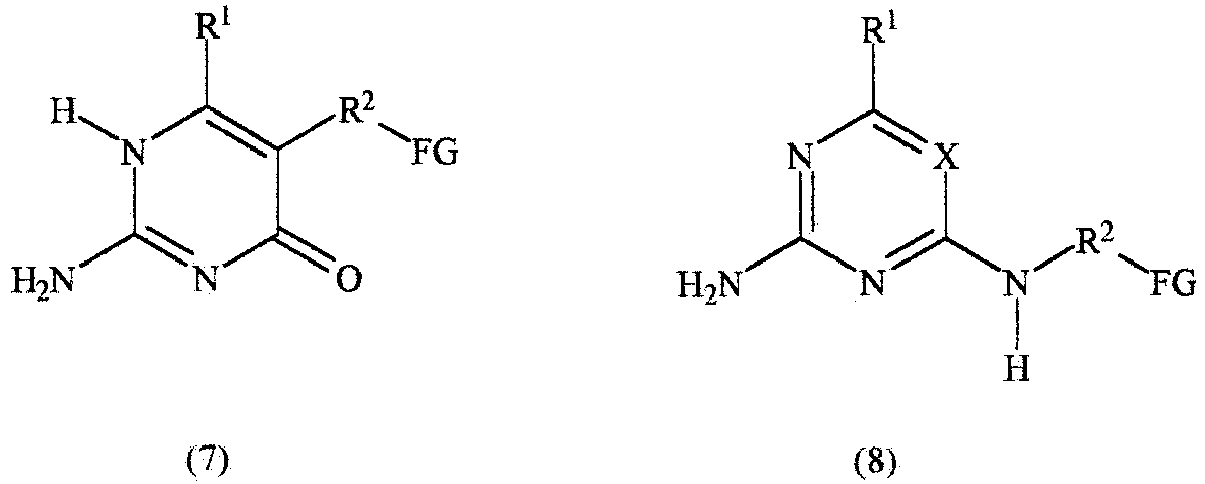
 umgesetzt wird mit:einer Diisocyanat-Verbindung C' gemäß der Formel OCN-R6-NCO;einem Polymer A' gemäß der Formel HO-P-OH; undeiner Verbindung B' gemäß der Formel HO-R5-OH mit einem Molekulargewicht von etwa 56 bis etwa 210 g/mol;in der Gegenwart eines nicht-reaktiven organischen Lösungsmittels, wobei die Verbindungen B', C' und F', Polymer A' und das nicht reaktive organische Lösungsmittel zusammen eine Reaktionsmischung bilden und wobei die Menge des nicht reaktiven organischen Lösungsmittels mindestens 20 Gewichts-% beträgt, und zwar basierend auf dem Gesamtgewicht der Reaktionsmischung,wobei:X entweder N oder CR1 ist;R1 aus der Gruppe ausgewählt ist, die aus Folgenden besteht:(a) Wasserstoff;(b) C1 - C20-Alkyl;R2 aus der Gruppe ausgewählt ist, die aus C1 - C20-Alkylen besteht;FG eine funktionelle Gruppe ist, die unabhängig ausgewählt ist aus OH und N(R1)H;P eine polymere Gruppe mit einem Mn von ungefähr 250 bis ungefähr 50.000 ist;R5 aus der Gruppe ausgewählt ist, die aus linearen C2 -C12 - Alkylengruppen besteht, wobei die Alkylengruppen durch 1 - 5 Heteroatome unterbrochen sein können, die aus der Gruppe ausgewählt sind, die aus O, N und S besteht; undR6 aus der Gruppe ausgewählt ist, die aus linearen C2 - C16-Alkylengruppen besteht.
 - Supramolekulares biologisch abbaubares Polymer nach Anspruch 1, wobei in dem Verfahren
die Verbindung F' in einem ersten Schritt mit der Diisocyanat-Verbindung C' und dem Polymer A' umgesetzt wird, um ein Präpolymer P1 und eine Diisocyanat-funktionalisierte Komponente F' zu bilden; und wobei in einem zweiten Schritt das Präpolymer P1 und die Diisoyanat-funktionalisierte Komponente F' mit der Verbindung B' umgesetzt werden. - Supramolekulares biologisch abbaubares Polymer nach Anspruch 1 oder Anspruch 2, wobei das supramolekulare biologisch abbaubare Polymer ein Zahlenmittel des Molekulargewichts Mn von 1.200 bis 1.000.000 hat.
- Supramolekulares biologisch abbaubares Polymer nach einem der Ansprüche 1 - 3, wobei A', B', C' und F' in einem Molverhältnis von 1 : 1 : 3 : 1 bis 1 : 6 : 8 : 1 umgesetzt werden, in welchem die molare Menge von C' immer gleich dem 0,8- bis 1,2-Fachen der gesamten molaren Menge von A' plus B' plus F' ist.
- Supramolekulares biologisch abbaubares Polymer nach einem der Ansprüche 2 - 3, wobei A', C' und F' in einem ersten Schritt in einem Molverhältnis von 1 : 4 : 1 bis 1 : 8 : 1 umgesetzt werden, um ein Präpolymer P1 und eine funktionalisierte Komponente F' zu bilden.
- Supramolekulares Polymer nach einem der Ansprüche 1 bis 5, wobei die Komponente F' der Formel (7) entspricht.
- Supramolekulares biologisch abbaubares Polymer nach Anspruch 5, wobei das Präpolymer P1, die funktionalisierte Komponente F' und die Komponente B' in einem Molverhältnis von 1 : 1 : 1 bis 1 : 1 : 6 umgesetzt werden.
- Supramolekulares biologisch abbaubares Polymer nach einem der Ansprüche 1 bis 7, wobei OCN-R6-NCO 1,6-Hexandiisocyanat ist.
- Supramolekulares Polymer nach einem der Ansprüche 1 bis 8, wobei Polymer A' aus der Gruppe ausgewählt ist, die aus hydroxyterminierten Polyestern, hydroxyterminierten Copolyestern, hydroxyterminierten Polycarbonaten, hydroxyterminierten Copolycarbonaten, hydroxyterminierten Polyethern und hydroxyterminierten Copolyethern besteht.
- Supramolekulares biologisch abbaubares Polymer nach Anspruch 9, wobei Polymer A' ein hydroxyterminiertes Poly-ε-Caprolacton ist.
- Supramolekulares biologisch abbaubares Polymer nach Anspruch 9, wobei Polymer A' ein hydroxyterminiertes Polyethylenglykol ist.
- Supramolekulares biologisch abbaubares Polymer nach Anspruch 9, wobei Polymer A' ein 1,6-Hexandiol Polycarbonat ist.
- Supramolekulares biologisch abbaubares Polymer nach einem der Ansprüche 1 - 12, wobei FG-R5-FG 1,6-Hexandiol ist.
- Biomedizinisches Implantat oder Gerüst für kardiovaskuläre Anwendungen, welches das supramolekulare biologisch abbaubare Polymer nach einem der vorhergehenden Ansprüche aufweist.
- Biomedizinisches Gerüst nach Anspruch 14, wobei das Gerüst eine Herzklappe oder ein Gefäßtransplantat ist.
Applications Claiming Priority (2)
| Application Number | Priority Date | Filing Date | Title |
|---|---|---|---|
| EP13167638 | 2013-05-14 | ||
| PCT/NL2014/050304 WO2014185779A1 (en) | 2013-05-14 | 2014-05-14 | Supramolecular biodegradable polymer |
Publications (2)
| Publication Number | Publication Date |
|---|---|
| EP2997076A1 EP2997076A1 (de) | 2016-03-23 |
| EP2997076B1 true EP2997076B1 (de) | 2022-03-16 |
Family
ID=48366230
Family Applications (1)
| Application Number | Title | Priority Date | Filing Date |
|---|---|---|---|
| EP14726440.2A Active EP2997076B1 (de) | 2013-05-14 | 2014-05-14 | Supramolekulares biologisch abbaubares polymer |
Country Status (5)
| Country | Link |
|---|---|
| US (2) | US10358522B2 (de) |
| EP (1) | EP2997076B1 (de) |
| JP (1) | JP6587318B2 (de) |
| CN (1) | CN108026281B (de) |
| WO (1) | WO2014185779A1 (de) |
Families Citing this family (17)
| Publication number | Priority date | Publication date | Assignee | Title |
|---|---|---|---|---|
| NL2009145C2 (en) * | 2012-07-06 | 2014-01-07 | Xeltis B V | Implant. |
| EP2997076B1 (de) * | 2013-05-14 | 2022-03-16 | SupraPolix B.V. | Supramolekulares biologisch abbaubares polymer |
| WO2015185558A1 (en) * | 2014-06-03 | 2015-12-10 | Adolphe Merkle Institute, University Of Fribourg | Stimulus-responsive supramolecular glasses |
| US10358521B2 (en) | 2014-07-28 | 2019-07-23 | Suprapolix B.V. | Durable hydrogen bonded hydrogels |
| US11510782B2 (en) * | 2015-10-27 | 2022-11-29 | Xetis AG | Medical device using bioabsorbable material |
| JP6972152B2 (ja) | 2017-03-31 | 2021-11-24 | ゼルティス ベーフェー | 心血管移植片 |
| NL2019957B1 (en) * | 2017-11-22 | 2019-05-29 | Suprapolix Bv | Supramolecular biomedical polymers |
| US10953139B2 (en) | 2017-12-28 | 2021-03-23 | Xeltis Ag | Electro-spun cardiovascular implant |
| EP3611213A1 (de) * | 2018-08-14 | 2020-02-19 | Rhodia Operations | Zusammensetzung mit einem polymer auf polyalkylenoxidbasis |
| WO2019243621A1 (en) * | 2018-06-22 | 2019-12-26 | Rhodia Operations | Composition comprising a polyalkylene oxide-based polymer |
| CN109251311B (zh) * | 2018-11-01 | 2021-02-09 | 杭州聚合顺新材料股份有限公司 | 力敏变色自修复智能尼龙6及其制备方法 |
| CN113817433B (zh) * | 2021-09-17 | 2023-03-17 | 中国科学院宁波材料技术与工程研究所 | 一种热塑性聚氨酯热熔胶、制备方法及应用 |
| GB202205568D0 (en) | 2022-04-14 | 2022-06-01 | Reckitt Benckiser Health Ltd | Condom |
| CN115181232B (zh) * | 2022-08-11 | 2023-11-07 | 中国科学院赣江创新研究院 | 一种聚氨酯材料及其制备方法和应用 |
| CN116178666A (zh) * | 2023-02-14 | 2023-05-30 | 华南理工大学 | 一种聚硅氧烷聚氨酯超分子弹性体及其制备方法和应用 |
| NL2034155B1 (en) | 2023-02-15 | 2024-09-03 | Upyther B V | Hydrogel composition for the treatment of peritoneal diseases |
| NL2034156B1 (en) | 2023-02-15 | 2024-09-03 | Upyther B V | Aerosol composition |
Family Cites Families (10)
| Publication number | Priority date | Publication date | Assignee | Title |
|---|---|---|---|---|
| US2450394A (en) * | 1943-07-31 | 1948-09-28 | Standard Oil Co | Preparation of spheroidal catalysts |
| NL1004192C2 (nl) | 1996-10-04 | 1998-04-07 | Dsm Nv | Supramoleculair polymeer. |
| EP1213309A1 (de) * | 2000-12-05 | 2002-06-12 | Huntsman International Llc | Polymer, das ein supramolekulares Polymer formt |
| DK1687378T3 (en) * | 2003-11-04 | 2014-03-03 | Suprapolix Bv | Preparation of supramolecular polymers containing four hydrogen bonding units in the polymer backbone |
| EP1773903B1 (de) * | 2004-07-12 | 2017-08-09 | SupraPolix B.V. | Supramolekulare ionomere |
| EP1877113B1 (de) | 2005-05-04 | 2011-11-09 | SupraPolix B.V. | Modulare bioresorbierbare oder biomedizinische biologisch aktive supramolekulare stoffe |
| US8628789B2 (en) * | 2007-03-23 | 2014-01-14 | Suprapolix, B.V. | Strong reversible hydrogels |
| US20090013017A1 (en) * | 2007-07-03 | 2009-01-08 | Branda Steven J | Methods, Systems, and Computer Program Products for Optimizing Virtual Machine Memory Consumption |
| US9006386B2 (en) | 2010-11-05 | 2015-04-14 | Suprapolix B.V. | Process for the preparation of a supramolecular polymer |
| EP2997076B1 (de) * | 2013-05-14 | 2022-03-16 | SupraPolix B.V. | Supramolekulares biologisch abbaubares polymer |
-
2014
- 2014-05-14 EP EP14726440.2A patent/EP2997076B1/de active Active
- 2014-05-14 US US14/891,111 patent/US10358522B2/en active Active
- 2014-05-14 WO PCT/NL2014/050304 patent/WO2014185779A1/en not_active Ceased
- 2014-05-14 JP JP2016513893A patent/JP6587318B2/ja active Active
- 2014-05-14 CN CN201480084703.5A patent/CN108026281B/zh active Active
-
2019
- 2019-06-07 US US16/435,272 patent/US10941239B2/en active Active
Also Published As
| Publication number | Publication date |
|---|---|
| EP2997076A1 (de) | 2016-03-23 |
| US10941239B2 (en) | 2021-03-09 |
| CN108026281B (zh) | 2021-06-15 |
| US20190359760A1 (en) | 2019-11-28 |
| JP6587318B2 (ja) | 2019-10-09 |
| WO2014185779A1 (en) | 2014-11-20 |
| US20160115272A1 (en) | 2016-04-28 |
| CN108026281A (zh) | 2018-05-11 |
| JP2016524636A (ja) | 2016-08-18 |
| US10358522B2 (en) | 2019-07-23 |
Similar Documents
| Publication | Publication Date | Title |
|---|---|---|
| US10941239B2 (en) | Supramolecular biodegradable polymer | |
| JP5600062B2 (ja) | 高弾性率ポリウレタン及びポリウレタン/尿素組成物 | |
| EP1687378B1 (de) | Verfahren zur herstellung von supramolekularen polymeren mit vier wasserstoffbrückenbindungen bildenden einheiten in der polymerhauptkette | |
| EP1093483B1 (de) | Biomedizinisches polyurethan, seine herstellung und verwendung | |
| EP2087027B1 (de) | Supramolekulare polymere aus niedrigschmelzenden, leicht verarbeitbaren bausteinen | |
| ES2974903T3 (es) | Poliuretanos termoplásticos biodegradables y/o bioabsorbibles | |
| Moghanizadeh‐Ashkezari et al. | Polyurethanes with separately tunable biodegradation behavior and mechanical properties for tissue engineering | |
| JP7675769B2 (ja) | 生体医療用超分子ポリマー | |
| Covolan et al. | Polyurethane based materials for the production of biomedical materials | |
| EP2457940B1 (de) | Fluorierte supramolekulare Polymere |
Legal Events
| Date | Code | Title | Description |
|---|---|---|---|
| PUAI | Public reference made under article 153(3) epc to a published international application that has entered the european phase |
Free format text: ORIGINAL CODE: 0009012 |
|
| 17P | Request for examination filed |
Effective date: 20151111 |
|
| AK | Designated contracting states |
Kind code of ref document: A1 Designated state(s): AL AT BE BG CH CY CZ DE DK EE ES FI FR GB GR HR HU IE IS IT LI LT LU LV MC MK MT NL NO PL PT RO RS SE SI SK SM TR |
|
| AX | Request for extension of the european patent |
Extension state: BA ME |
|
| DAX | Request for extension of the european patent (deleted) | ||
| STAA | Information on the status of an ep patent application or granted ep patent |
Free format text: STATUS: EXAMINATION IS IN PROGRESS |
|
| 17Q | First examination report despatched |
Effective date: 20180621 |
|
| GRAP | Despatch of communication of intention to grant a patent |
Free format text: ORIGINAL CODE: EPIDOSNIGR1 |
|
| STAA | Information on the status of an ep patent application or granted ep patent |
Free format text: STATUS: GRANT OF PATENT IS INTENDED |
|
| INTG | Intention to grant announced |
Effective date: 20211102 |
|
| GRAS | Grant fee paid |
Free format text: ORIGINAL CODE: EPIDOSNIGR3 |
|
| GRAA | (expected) grant |
Free format text: ORIGINAL CODE: 0009210 |
|
| STAA | Information on the status of an ep patent application or granted ep patent |
Free format text: STATUS: THE PATENT HAS BEEN GRANTED |
|
| AK | Designated contracting states |
Kind code of ref document: B1 Designated state(s): AL AT BE BG CH CY CZ DE DK EE ES FI FR GB GR HR HU IE IS IT LI LT LU LV MC MK MT NL NO PL PT RO RS SE SI SK SM TR |
|
| REG | Reference to a national code |
Ref country code: GB Ref legal event code: FG4D |
|
| REG | Reference to a national code |
Ref country code: CH Ref legal event code: EP |
|
| REG | Reference to a national code |
Ref country code: IE Ref legal event code: FG4D |
|
| REG | Reference to a national code |
Ref country code: DE Ref legal event code: R096 Ref document number: 602014082850 Country of ref document: DE |
|
| REG | Reference to a national code |
Ref country code: AT Ref legal event code: REF Ref document number: 1475843 Country of ref document: AT Kind code of ref document: T Effective date: 20220415 |
|
| REG | Reference to a national code |
Ref country code: NL Ref legal event code: FP |
|
| REG | Reference to a national code |
Ref country code: LT Ref legal event code: MG9D |
|
| PG25 | Lapsed in a contracting state [announced via postgrant information from national office to epo] |
Ref country code: SE Free format text: LAPSE BECAUSE OF FAILURE TO SUBMIT A TRANSLATION OF THE DESCRIPTION OR TO PAY THE FEE WITHIN THE PRESCRIBED TIME-LIMIT Effective date: 20220316 Ref country code: RS Free format text: LAPSE BECAUSE OF FAILURE TO SUBMIT A TRANSLATION OF THE DESCRIPTION OR TO PAY THE FEE WITHIN THE PRESCRIBED TIME-LIMIT Effective date: 20220316 Ref country code: NO Free format text: LAPSE BECAUSE OF FAILURE TO SUBMIT A TRANSLATION OF THE DESCRIPTION OR TO PAY THE FEE WITHIN THE PRESCRIBED TIME-LIMIT Effective date: 20220616 Ref country code: LT Free format text: LAPSE BECAUSE OF FAILURE TO SUBMIT A TRANSLATION OF THE DESCRIPTION OR TO PAY THE FEE WITHIN THE PRESCRIBED TIME-LIMIT Effective date: 20220316 Ref country code: HR Free format text: LAPSE BECAUSE OF FAILURE TO SUBMIT A TRANSLATION OF THE DESCRIPTION OR TO PAY THE FEE WITHIN THE PRESCRIBED TIME-LIMIT Effective date: 20220316 Ref country code: BG Free format text: LAPSE BECAUSE OF FAILURE TO SUBMIT A TRANSLATION OF THE DESCRIPTION OR TO PAY THE FEE WITHIN THE PRESCRIBED TIME-LIMIT Effective date: 20220616 |
|
| REG | Reference to a national code |
Ref country code: AT Ref legal event code: MK05 Ref document number: 1475843 Country of ref document: AT Kind code of ref document: T Effective date: 20220316 |
|
| PG25 | Lapsed in a contracting state [announced via postgrant information from national office to epo] |
Ref country code: LV Free format text: LAPSE BECAUSE OF FAILURE TO SUBMIT A TRANSLATION OF THE DESCRIPTION OR TO PAY THE FEE WITHIN THE PRESCRIBED TIME-LIMIT Effective date: 20220316 Ref country code: GR Free format text: LAPSE BECAUSE OF FAILURE TO SUBMIT A TRANSLATION OF THE DESCRIPTION OR TO PAY THE FEE WITHIN THE PRESCRIBED TIME-LIMIT Effective date: 20220617 Ref country code: FI Free format text: LAPSE BECAUSE OF FAILURE TO SUBMIT A TRANSLATION OF THE DESCRIPTION OR TO PAY THE FEE WITHIN THE PRESCRIBED TIME-LIMIT Effective date: 20220316 |
|
| PG25 | Lapsed in a contracting state [announced via postgrant information from national office to epo] |
Ref country code: SM Free format text: LAPSE BECAUSE OF FAILURE TO SUBMIT A TRANSLATION OF THE DESCRIPTION OR TO PAY THE FEE WITHIN THE PRESCRIBED TIME-LIMIT Effective date: 20220316 Ref country code: SK Free format text: LAPSE BECAUSE OF FAILURE TO SUBMIT A TRANSLATION OF THE DESCRIPTION OR TO PAY THE FEE WITHIN THE PRESCRIBED TIME-LIMIT Effective date: 20220316 Ref country code: RO Free format text: LAPSE BECAUSE OF FAILURE TO SUBMIT A TRANSLATION OF THE DESCRIPTION OR TO PAY THE FEE WITHIN THE PRESCRIBED TIME-LIMIT Effective date: 20220316 Ref country code: PT Free format text: LAPSE BECAUSE OF FAILURE TO SUBMIT A TRANSLATION OF THE DESCRIPTION OR TO PAY THE FEE WITHIN THE PRESCRIBED TIME-LIMIT Effective date: 20220718 Ref country code: ES Free format text: LAPSE BECAUSE OF FAILURE TO SUBMIT A TRANSLATION OF THE DESCRIPTION OR TO PAY THE FEE WITHIN THE PRESCRIBED TIME-LIMIT Effective date: 20220316 Ref country code: EE Free format text: LAPSE BECAUSE OF FAILURE TO SUBMIT A TRANSLATION OF THE DESCRIPTION OR TO PAY THE FEE WITHIN THE PRESCRIBED TIME-LIMIT Effective date: 20220316 Ref country code: CZ Free format text: LAPSE BECAUSE OF FAILURE TO SUBMIT A TRANSLATION OF THE DESCRIPTION OR TO PAY THE FEE WITHIN THE PRESCRIBED TIME-LIMIT Effective date: 20220316 Ref country code: AT Free format text: LAPSE BECAUSE OF FAILURE TO SUBMIT A TRANSLATION OF THE DESCRIPTION OR TO PAY THE FEE WITHIN THE PRESCRIBED TIME-LIMIT Effective date: 20220316 |
|
| PG25 | Lapsed in a contracting state [announced via postgrant information from national office to epo] |
Ref country code: PL Free format text: LAPSE BECAUSE OF FAILURE TO SUBMIT A TRANSLATION OF THE DESCRIPTION OR TO PAY THE FEE WITHIN THE PRESCRIBED TIME-LIMIT Effective date: 20220316 Ref country code: IS Free format text: LAPSE BECAUSE OF FAILURE TO SUBMIT A TRANSLATION OF THE DESCRIPTION OR TO PAY THE FEE WITHIN THE PRESCRIBED TIME-LIMIT Effective date: 20220716 Ref country code: AL Free format text: LAPSE BECAUSE OF FAILURE TO SUBMIT A TRANSLATION OF THE DESCRIPTION OR TO PAY THE FEE WITHIN THE PRESCRIBED TIME-LIMIT Effective date: 20220316 |
|
| REG | Reference to a national code |
Ref country code: DE Ref legal event code: R097 Ref document number: 602014082850 Country of ref document: DE |
|
| PLBE | No opposition filed within time limit |
Free format text: ORIGINAL CODE: 0009261 |
|
| STAA | Information on the status of an ep patent application or granted ep patent |
Free format text: STATUS: NO OPPOSITION FILED WITHIN TIME LIMIT |
|
| PG25 | Lapsed in a contracting state [announced via postgrant information from national office to epo] |
Ref country code: MC Free format text: LAPSE BECAUSE OF FAILURE TO SUBMIT A TRANSLATION OF THE DESCRIPTION OR TO PAY THE FEE WITHIN THE PRESCRIBED TIME-LIMIT Effective date: 20220316 Ref country code: LU Free format text: LAPSE BECAUSE OF NON-PAYMENT OF DUE FEES Effective date: 20220514 Ref country code: DK Free format text: LAPSE BECAUSE OF FAILURE TO SUBMIT A TRANSLATION OF THE DESCRIPTION OR TO PAY THE FEE WITHIN THE PRESCRIBED TIME-LIMIT Effective date: 20220316 |
|
| 26N | No opposition filed |
Effective date: 20221219 |
|
| PG25 | Lapsed in a contracting state [announced via postgrant information from national office to epo] |
Ref country code: SI Free format text: LAPSE BECAUSE OF FAILURE TO SUBMIT A TRANSLATION OF THE DESCRIPTION OR TO PAY THE FEE WITHIN THE PRESCRIBED TIME-LIMIT Effective date: 20220316 |
|
| PG25 | Lapsed in a contracting state [announced via postgrant information from national office to epo] |
Ref country code: IT Free format text: LAPSE BECAUSE OF FAILURE TO SUBMIT A TRANSLATION OF THE DESCRIPTION OR TO PAY THE FEE WITHIN THE PRESCRIBED TIME-LIMIT Effective date: 20220316 |
|
| PG25 | Lapsed in a contracting state [announced via postgrant information from national office to epo] |
Ref country code: HU Free format text: LAPSE BECAUSE OF FAILURE TO SUBMIT A TRANSLATION OF THE DESCRIPTION OR TO PAY THE FEE WITHIN THE PRESCRIBED TIME-LIMIT; INVALID AB INITIO Effective date: 20140514 |
|
| PG25 | Lapsed in a contracting state [announced via postgrant information from national office to epo] |
Ref country code: MK Free format text: LAPSE BECAUSE OF FAILURE TO SUBMIT A TRANSLATION OF THE DESCRIPTION OR TO PAY THE FEE WITHIN THE PRESCRIBED TIME-LIMIT Effective date: 20220316 Ref country code: CY Free format text: LAPSE BECAUSE OF FAILURE TO SUBMIT A TRANSLATION OF THE DESCRIPTION OR TO PAY THE FEE WITHIN THE PRESCRIBED TIME-LIMIT Effective date: 20220316 |
|
| PG25 | Lapsed in a contracting state [announced via postgrant information from national office to epo] |
Ref country code: MT Free format text: LAPSE BECAUSE OF FAILURE TO SUBMIT A TRANSLATION OF THE DESCRIPTION OR TO PAY THE FEE WITHIN THE PRESCRIBED TIME-LIMIT Effective date: 20220316 |
|
| PGFP | Annual fee paid to national office [announced via postgrant information from national office to epo] |
Ref country code: NL Payment date: 20250526 Year of fee payment: 12 |
|
| PGFP | Annual fee paid to national office [announced via postgrant information from national office to epo] |
Ref country code: DE Payment date: 20250529 Year of fee payment: 12 |
|
| PGFP | Annual fee paid to national office [announced via postgrant information from national office to epo] |
Ref country code: GB Payment date: 20250527 Year of fee payment: 12 |
|
| PGFP | Annual fee paid to national office [announced via postgrant information from national office to epo] |
Ref country code: BE Payment date: 20250527 Year of fee payment: 12 |
|
| PGFP | Annual fee paid to national office [announced via postgrant information from national office to epo] |
Ref country code: FR Payment date: 20250526 Year of fee payment: 12 |
|
| PGFP | Annual fee paid to national office [announced via postgrant information from national office to epo] |
Ref country code: CH Payment date: 20250601 Year of fee payment: 12 |
|
| PGFP | Annual fee paid to national office [announced via postgrant information from national office to epo] |
Ref country code: IE Payment date: 20250527 Year of fee payment: 12 |
|
| PG25 | Lapsed in a contracting state [announced via postgrant information from national office to epo] |
Ref country code: TR Free format text: LAPSE BECAUSE OF FAILURE TO SUBMIT A TRANSLATION OF THE DESCRIPTION OR TO PAY THE FEE WITHIN THE PRESCRIBED TIME-LIMIT Effective date: 20220316 |