EP2981302B1 - Microbicidal composite material - Google Patents
Microbicidal composite material Download PDFInfo
- Publication number
- EP2981302B1 EP2981302B1 EP14728623.1A EP14728623A EP2981302B1 EP 2981302 B1 EP2981302 B1 EP 2981302B1 EP 14728623 A EP14728623 A EP 14728623A EP 2981302 B1 EP2981302 B1 EP 2981302B1
- Authority
- EP
- European Patent Office
- Prior art keywords
- microbicidal
- composite material
- layer
- wound
- microbicidal composite
- Prior art date
- Legal status (The legal status is an assumption and is not a legal conclusion. Google has not performed a legal analysis and makes no representation as to the accuracy of the status listed.)
- Active
Links
- 0 O*1C*CCC1 Chemical compound O*1C*CCC1 0.000 description 2
- XDTMQSROBMDMFD-UHFFFAOYSA-N C1CCCCC1 Chemical compound C1CCCCC1 XDTMQSROBMDMFD-UHFFFAOYSA-N 0.000 description 1
- JHIVVAPYMSGYDF-UHFFFAOYSA-N O=C1CCCCC1 Chemical compound O=C1CCCCC1 JHIVVAPYMSGYDF-UHFFFAOYSA-N 0.000 description 1
Images







Classifications
-
- A—HUMAN NECESSITIES
- A61—MEDICAL OR VETERINARY SCIENCE; HYGIENE
- A61L—METHODS OR APPARATUS FOR STERILISING MATERIALS OR OBJECTS IN GENERAL; DISINFECTION, STERILISATION OR DEODORISATION OF AIR; CHEMICAL ASPECTS OF BANDAGES, DRESSINGS, ABSORBENT PADS OR SURGICAL ARTICLES; MATERIALS FOR BANDAGES, DRESSINGS, ABSORBENT PADS OR SURGICAL ARTICLES
- A61L15/00—Chemical aspects of, or use of materials for, bandages, dressings or absorbent pads
- A61L15/16—Bandages, dressings or absorbent pads for physiological fluids such as urine or blood, e.g. sanitary towels, tampons
- A61L15/42—Use of materials characterised by their function or physical properties
- A61L15/44—Medicaments
-
- A—HUMAN NECESSITIES
- A01—AGRICULTURE; FORESTRY; ANIMAL HUSBANDRY; HUNTING; TRAPPING; FISHING
- A01N—PRESERVATION OF BODIES OF HUMANS OR ANIMALS OR PLANTS OR PARTS THEREOF; BIOCIDES, e.g. AS DISINFECTANTS, AS PESTICIDES OR AS HERBICIDES; PEST REPELLANTS OR ATTRACTANTS; PLANT GROWTH REGULATORS
- A01N25/00—Biocides, pest repellants or attractants, or plant growth regulators, characterised by their forms, or by their non-active ingredients or by their methods of application, e.g. seed treatment or sequential application; Substances for reducing the noxious effect of the active ingredients to organisms other than pests
- A01N25/34—Shaped forms, e.g. sheets, not provided for in any other sub-group of this main group
-
- A—HUMAN NECESSITIES
- A01—AGRICULTURE; FORESTRY; ANIMAL HUSBANDRY; HUNTING; TRAPPING; FISHING
- A01N—PRESERVATION OF BODIES OF HUMANS OR ANIMALS OR PLANTS OR PARTS THEREOF; BIOCIDES, e.g. AS DISINFECTANTS, AS PESTICIDES OR AS HERBICIDES; PEST REPELLANTS OR ATTRACTANTS; PLANT GROWTH REGULATORS
- A01N55/00—Biocides, pest repellants or attractants, or plant growth regulators, containing organic compounds containing elements other than carbon, hydrogen, halogen, oxygen, nitrogen and sulfur
-
- A—HUMAN NECESSITIES
- A61—MEDICAL OR VETERINARY SCIENCE; HYGIENE
- A61F—FILTERS IMPLANTABLE INTO BLOOD VESSELS; PROSTHESES; DEVICES PROVIDING PATENCY TO, OR PREVENTING COLLAPSING OF, TUBULAR STRUCTURES OF THE BODY, e.g. STENTS; ORTHOPAEDIC, NURSING OR CONTRACEPTIVE DEVICES; FOMENTATION; TREATMENT OR PROTECTION OF EYES OR EARS; BANDAGES, DRESSINGS OR ABSORBENT PADS; FIRST-AID KITS
- A61F13/00—Bandages or dressings; Absorbent pads
- A61F13/01—Non-adhesive bandages or dressings
- A61F13/01021—Non-adhesive bandages or dressings characterised by the structure of the dressing
- A61F13/01029—Non-adhesive bandages or dressings characterised by the structure of the dressing made of multiple layers
-
- A—HUMAN NECESSITIES
- A61—MEDICAL OR VETERINARY SCIENCE; HYGIENE
- A61L—METHODS OR APPARATUS FOR STERILISING MATERIALS OR OBJECTS IN GENERAL; DISINFECTION, STERILISATION OR DEODORISATION OF AIR; CHEMICAL ASPECTS OF BANDAGES, DRESSINGS, ABSORBENT PADS OR SURGICAL ARTICLES; MATERIALS FOR BANDAGES, DRESSINGS, ABSORBENT PADS OR SURGICAL ARTICLES
- A61L15/00—Chemical aspects of, or use of materials for, bandages, dressings or absorbent pads
- A61L15/16—Bandages, dressings or absorbent pads for physiological fluids such as urine or blood, e.g. sanitary towels, tampons
- A61L15/42—Use of materials characterised by their function or physical properties
- A61L15/425—Porous materials, e.g. foams or sponges
-
- A—HUMAN NECESSITIES
- A61—MEDICAL OR VETERINARY SCIENCE; HYGIENE
- A61L—METHODS OR APPARATUS FOR STERILISING MATERIALS OR OBJECTS IN GENERAL; DISINFECTION, STERILISATION OR DEODORISATION OF AIR; CHEMICAL ASPECTS OF BANDAGES, DRESSINGS, ABSORBENT PADS OR SURGICAL ARTICLES; MATERIALS FOR BANDAGES, DRESSINGS, ABSORBENT PADS OR SURGICAL ARTICLES
- A61L31/00—Materials for other surgical articles, e.g. stents, stent-grafts, shunts, surgical drapes, guide wires, materials for adhesion prevention, occluding devices, surgical gloves, tissue fixation devices
- A61L31/14—Materials characterised by their function or physical properties, e.g. injectable or lubricating compositions, shape-memory materials, surface modified materials
- A61L31/146—Porous materials, e.g. foams or sponges
-
- A—HUMAN NECESSITIES
- A61—MEDICAL OR VETERINARY SCIENCE; HYGIENE
- A61L—METHODS OR APPARATUS FOR STERILISING MATERIALS OR OBJECTS IN GENERAL; DISINFECTION, STERILISATION OR DEODORISATION OF AIR; CHEMICAL ASPECTS OF BANDAGES, DRESSINGS, ABSORBENT PADS OR SURGICAL ARTICLES; MATERIALS FOR BANDAGES, DRESSINGS, ABSORBENT PADS OR SURGICAL ARTICLES
- A61L31/00—Materials for other surgical articles, e.g. stents, stent-grafts, shunts, surgical drapes, guide wires, materials for adhesion prevention, occluding devices, surgical gloves, tissue fixation devices
- A61L31/14—Materials characterised by their function or physical properties, e.g. injectable or lubricating compositions, shape-memory materials, surface modified materials
- A61L31/16—Biologically active materials, e.g. therapeutic substances
-
- A—HUMAN NECESSITIES
- A61—MEDICAL OR VETERINARY SCIENCE; HYGIENE
- A61P—SPECIFIC THERAPEUTIC ACTIVITY OF CHEMICAL COMPOUNDS OR MEDICINAL PREPARATIONS
- A61P17/00—Drugs for dermatological disorders
- A61P17/02—Drugs for dermatological disorders for treating wounds, ulcers, burns, scars, keloids, or the like
-
- A—HUMAN NECESSITIES
- A61—MEDICAL OR VETERINARY SCIENCE; HYGIENE
- A61P—SPECIFIC THERAPEUTIC ACTIVITY OF CHEMICAL COMPOUNDS OR MEDICINAL PREPARATIONS
- A61P31/00—Antiinfectives, i.e. antibiotics, antiseptics, chemotherapeutics
- A61P31/04—Antibacterial agents
-
- A—HUMAN NECESSITIES
- A61—MEDICAL OR VETERINARY SCIENCE; HYGIENE
- A61F—FILTERS IMPLANTABLE INTO BLOOD VESSELS; PROSTHESES; DEVICES PROVIDING PATENCY TO, OR PREVENTING COLLAPSING OF, TUBULAR STRUCTURES OF THE BODY, e.g. STENTS; ORTHOPAEDIC, NURSING OR CONTRACEPTIVE DEVICES; FOMENTATION; TREATMENT OR PROTECTION OF EYES OR EARS; BANDAGES, DRESSINGS OR ABSORBENT PADS; FIRST-AID KITS
- A61F13/00—Bandages or dressings; Absorbent pads
- A61F2013/00089—Wound bandages
- A61F2013/00238—Wound bandages characterised by way of knitting or weaving
-
- A—HUMAN NECESSITIES
- A61—MEDICAL OR VETERINARY SCIENCE; HYGIENE
- A61L—METHODS OR APPARATUS FOR STERILISING MATERIALS OR OBJECTS IN GENERAL; DISINFECTION, STERILISATION OR DEODORISATION OF AIR; CHEMICAL ASPECTS OF BANDAGES, DRESSINGS, ABSORBENT PADS OR SURGICAL ARTICLES; MATERIALS FOR BANDAGES, DRESSINGS, ABSORBENT PADS OR SURGICAL ARTICLES
- A61L2300/00—Biologically active materials used in bandages, wound dressings, absorbent pads or medical devices
- A61L2300/20—Biologically active materials used in bandages, wound dressings, absorbent pads or medical devices containing or releasing organic materials
- A61L2300/204—Biologically active materials used in bandages, wound dressings, absorbent pads or medical devices containing or releasing organic materials with nitrogen-containing functional groups, e.g. aminoxides, nitriles, guanidines
- A61L2300/208—Quaternary ammonium compounds
-
- A—HUMAN NECESSITIES
- A61—MEDICAL OR VETERINARY SCIENCE; HYGIENE
- A61L—METHODS OR APPARATUS FOR STERILISING MATERIALS OR OBJECTS IN GENERAL; DISINFECTION, STERILISATION OR DEODORISATION OF AIR; CHEMICAL ASPECTS OF BANDAGES, DRESSINGS, ABSORBENT PADS OR SURGICAL ARTICLES; MATERIALS FOR BANDAGES, DRESSINGS, ABSORBENT PADS OR SURGICAL ARTICLES
- A61L2300/00—Biologically active materials used in bandages, wound dressings, absorbent pads or medical devices
- A61L2300/20—Biologically active materials used in bandages, wound dressings, absorbent pads or medical devices containing or releasing organic materials
- A61L2300/216—Biologically active materials used in bandages, wound dressings, absorbent pads or medical devices containing or releasing organic materials with other specific functional groups, e.g. aldehydes, ketones, phenols, quaternary phosphonium groups
-
- A—HUMAN NECESSITIES
- A61—MEDICAL OR VETERINARY SCIENCE; HYGIENE
- A61L—METHODS OR APPARATUS FOR STERILISING MATERIALS OR OBJECTS IN GENERAL; DISINFECTION, STERILISATION OR DEODORISATION OF AIR; CHEMICAL ASPECTS OF BANDAGES, DRESSINGS, ABSORBENT PADS OR SURGICAL ARTICLES; MATERIALS FOR BANDAGES, DRESSINGS, ABSORBENT PADS OR SURGICAL ARTICLES
- A61L2300/00—Biologically active materials used in bandages, wound dressings, absorbent pads or medical devices
- A61L2300/40—Biologically active materials used in bandages, wound dressings, absorbent pads or medical devices characterised by a specific therapeutic activity or mode of action
- A61L2300/404—Biocides, antimicrobial agents, antiseptic agents
-
- A—HUMAN NECESSITIES
- A61—MEDICAL OR VETERINARY SCIENCE; HYGIENE
- A61L—METHODS OR APPARATUS FOR STERILISING MATERIALS OR OBJECTS IN GENERAL; DISINFECTION, STERILISATION OR DEODORISATION OF AIR; CHEMICAL ASPECTS OF BANDAGES, DRESSINGS, ABSORBENT PADS OR SURGICAL ARTICLES; MATERIALS FOR BANDAGES, DRESSINGS, ABSORBENT PADS OR SURGICAL ARTICLES
- A61L2400/00—Materials characterised by their function or physical properties
- A61L2400/12—Nanosized materials, e.g. nanofibres, nanoparticles, nanowires, nanotubes; Nanostructured surfaces
Definitions
- the present subject matter relates, in general, to a composite material and, particularly but not exclusively, to the composite material having a microbicidal activity.
- microbicidal agents on fibres and fabrics, that would effectively retard the growth of various microorganisms.
- sanitary wipes used for cleaning environmental, food contact surfaces, and personal and health care applications incorporate various microbicidal agents on its fabric to exhibit sanitizing and microbicidal properties.
- new drugs have now emerged for the treatment of drug resistant infections, the microorganisms that are treated with these new drugs are becoming increasingly drug resistant resulting in the creation of superbugs.
- pathogens There is emerging need to develop a mechanism to kill the microbes commonly referred as pathogens by techniques that do not cause drug resistance in them.
- WO2009/068713 A1 discloses a temporary cover for treating wounds including a layer which is in contact with the affected area, consisting of a fabric comprising modified polyester fibres in the cross-section thereof and an open-work weave fabric; a set of inner layers, including at least three stacked layers made from a low-fibre-density geotextile or non-woven fabric formed by polyester fibres and cellulose fibres; and an outer layer made from a polyester microfibre twill fabric.
- the layers are vertically cut or perforated.
- the layers are preferably sealed only on the edges.
- An antimicrobial agent can be incorporated into the bandage.
- the bandage includes polyester microfibres which represent an augmented surface which allows for chemical binding of an antimicrobial agent. Since the inner layers have "low fibre density" it is implicit that this fiber density is lower than the fiber density of the outer layers.
- a composite material exhibiting a microbicidal activity is herewith described.
- the description herewith provided is in reference to usage of the microbicidal composite material in bandages for the purpose of wound healing, it may be understood, that the microbicidal composite material may be used in other products, such as sanitary pad, tampons, toilet accessories, diaper, sanitary wipe, surgical gown, surgical glove, surgical scrub, mattress covers, beddings, bedding sheets and pillow covers, operation theatre covers, hospital examination table covers, hospital bio waste disposable bags, hospital curtains, air conditioning filters, water filters, face mask, meat storage and packing materials, and other products as may be understood by a person skilled in the art, to exhibit microbicidal properties.
- microbicidal agent incorporated on the surface of the composite material to exhibit microbicidal activity. These composite materials allow for absorption of exudates from the surface of the wound; and the microbicidal agent incorporated on its surface enables the property of limiting pathogen growth.
- An example of a conventionally used microbicidal agents are silver salts, which are coated over a substrate of the composite material.
- the microbicidal agent on the surface of the composite material results in eluting of the microbicidal agent back into the wound. Such eluting of the microbicidal agent may interfere with the normal wound healing process.
- eluting of the microbicidal agent on the wound may make the pathogens in the wound more resistant to the silver, thereby facilitating evolution of superbugs.
- These superbugs are significantly resistant to silver particles or normal drugs that are meant to kill the pathogens.
- the eluting of substances from the material depletes the material, reducing the performance of the material over time.
- such composite materials that are used in wound healing may have to be replaced frequently for faster healing of the wound.
- Certain other composite materials that are conventionally used for wound healing are coated with the microbicidal agent on one of the surfaces to exhibit microbicidal activity; and the composite material is provided with limited or no porosity on the other surface, in order to prevent pathogens present in the air from entering the wound.
- a restricted supply has two major disadvantages. First it gives rise to anaerobic conditions on wound which promotes the growth of anaerobic microbes and proliferates with time and secondly it may result in an inadequate circulation of oxygen to the wounded tissues, thereby resulting in delayed healing of the wound.
- the conventionally used composite materials are structured in such a manner that allow for limited absorption of exudates from the surface of the wound. Such a limitation may necessitate the need for frequent replacement of the composite material for faster wound healing.
- changing the microbicidal composite material at frequent intervals may cause of great discomfort to the user physically. Any significant delay in replacing the composite material laden with exudates is seen to have negative effect on wound healing by facilitating proliferation of pathogens in the exudates of the wound and increasing the toxic load on wound which may be a dangerous mix of body toxins causing inflammation and swelling, thereby exposing the person to a greater risk for severe wound infections.
- a three dimensional structure of a microbicidal composite material is herein described, in accordance with an implementation of the present subject matter.
- the described structure allows for efficient air circulation, thereby facilitating increased supply of oxygen to the wounded issues, and simultaneously restricts the entry of pathogens from the air entering into the wound, thereby alleviating the wound healing process.
- the described structure also allows for efficient wicking of the exudates from the surface of the wound by capillary action, thereby preventing the exudates on the wound to serve as a nutrient medium for multiplication of the pathogens.
- the described structure is also provided with increased number of surface moieties along layers of the composite material, thereby allowing for stronger and quantitatively larger binding of the microbicidal agent with the composite material.
- the surface moieties include functional groups that are available for the chemical bonding of the microbicidal agent.
- the chemical binding of the microbicidal agent to the surface moieties is via a covalent bonding. Such an interaction prevents eluting of the microbicidal agent into the wound thereby preventing the evolution of drug resistant microbes.
- the microbicidal composite material comprises a first layer (102) having a first pre-defined thickness and a first predefined stitch/thread density; a second layer (104) having a second pre-defined thickness and a second predefined stitch/thread density; and an intermediate layer (106) having a third pre-defined thickness and a third predefined stitch/ thread density, wherein the intermediate layer is sandwiched between and connected to the first layer and the second layer to form a three-dimensional structure by one of knitting and weaving, wherein each layer in the three-dimensional structure has a plurality of apertures to allow for circulation of air through the microbicidal composite material (100); wherein each of the plurality of apertures is associated with a pre-determined size and wherein the pre-determined size of the apertures is controlled by course per inch and wales per inch of the one of knitting and weaving process;wherein the third pre-defined stitch/thread density is less than the first pre-defined stitch/thread density and the second pre-defined stitch/thread density
- each layer in the three dimensional structure has multiplicity of apertures, where each of the one or more apertures are of a predefined size.
- the predefined size of each of the one or more apertures in the three dimensional structure having the predefined size is controlled to allow for selective permeation of gases and fluids from the wound, thorough the three dimensional structure.
- such a microbicidal composite material, having one or more apertures, when used in part or as a whole in allows for efficient circulation of oxygen to the wounded tissues, thereby alleviating the wound healing process.
- the three dimensional structure which has the microbicidal spears all along the surfaces of the composite, kills the pathogens that are present in the air while passing through the composite. It kills the airborne pathogens when the air is entering the dressing material before reaching the wound tissue.
- the bonding can also be made by use of primers in case of fibres where free hydroxyl groups are not available for the formation of covalent bond.
- each layer of the microbicidal composite material i.e., the first layer, the second layer, and the intermediate layer are associated with a first pre-defined stitch/thread density, second pre-defined stitch/thread density, and a third pre-defined stitch/thread density, respectively.
- the third pre-defined stitch/thread density is lesser than that of the first pre-defined stitch/thread density and the second pre-defined stitch/thread density.
- microbicidal composite material either in whole or in part of a wound dressing may be particularly helpful to promote healing of a wound, where the differential stitch/thread density allows for wicking exudates away from the wound, through one of the first layer and second layer on contact with the wound.
- This enhanced wicking feature ensures that, the exudates in the vicinity of the wound is effectively removed ensuring that it may no longer serve as a nutrient medium for the growth of pathogens, thereby facilitating wound healing.
- the exudate which is now held away from the wound is allowed to dry slowly by simple evaporation method promoted by the air circulation through the permeable microbicidal composite material.
- the pathogens present in the exudate are killed by the composite material thus ensuring that the spread of infections is curtailed.
- the wicking happens in such a way that the wound is left sufficiently moist for enabling the body to ensure healing without interfering in normal body healing mechanism.
- At least one layer in the microbicidal composite material is composed of microfibers or nanofibers, thereby increasing the available surface area for binding on the microbicidal agent to the microbicidal composite material.
- Such an augmentated surface area results in augmented moieties may allow for greater concentration of a microbicidal agent binding to the augmented surface moieties.
- the composite thus becomes an intrinsically microbicidal composite material.
- the use of the microbicidal composite material either as whole or in part of a wound dressing may prevent eluting of the microbicidal agent into the wound thereby promoting faster healing of the wound and also prevents the evolution of drug resistant microbes.
- the described structure allows for efficient air circulation, thereby facilitating increased supply of oxygen to the wounded tissues, and simultaneously restricts the entry of pathogens from the air entering into the wound, thereby alleviating the wound healing process.
- the described structure also allows for efficient wicking of the exudates from the surface of the wound by capillary action, thereby preventing the exudates on the wound to serve as a nutrient medium for multiplication of the pathogens.
- the described structure also provides for increased number of surface moieties in layers of the composite material, thereby allowing for stronger and larger amount of the microbicidal agent binding with the composite material.
- Such an interaction may prevent eluting of the microbicidal agent from the vicinity of the wound and thus provide for a continued larger concentration of the microbicidal agent, keeping a higher kill rate of pathogens on the wound, from the exudates and from the air coming in contact with the wound without interfering in normal wound healing, thereby promoting faster healing of the wound and also preventing the evolution of drug resistant microbes.
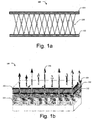
- Fig. 1a illustrates a cross sectional view of a microbicidal composite material 100 for wicking of fluids, in accordance with an embodiment of the present subject matter.
- the microbicidal composite material of the present subject matter may be used as a whole or a part in one or more of a sanitary pad, tampons, toilet accessories, diaper, sanitary wipe, surgical gown, surgical glove, surgical scrub, mattress covers, beddings, bedding sheets and pillow covers, operation theatre covers, hospital examination table covers, hospital bio waste disposable bags, hospital curtains, air conditioning filters, water filters, face mask, meat storage and packing materials, and other products as may be understood by a person skilled in the art, to exhibit microbicidal properties.
- the microbicidal composite material 100 comprises a first layer 102, a second layer 104, and an intermediate layer 106, where the intermediate layer 106 is sandwiched between the first layer 102 and the second layer 104, and where the intermediate layer 106 is connected to the first layer 102 and the second layer 104 to form a three dimensional structure.
- the three dimensional structure may be formed with a single material or with a combination of materials to form a knitted structure, woven structure or a non-woven structure.
- the one or more material may be made by fibres, filaments, yarns and fabrics or combinations thereof.
- the material can include, but not limited to synthetic fibres, natural fibres, or combinations thereof.
- Synthetic fibres include, for example, acrylic, polyamide, polyolefin, polyaramide, polyurethane, poly acylonitriles, textured polyethylene terephthalate, polytriphenylene terephthalate, polybutylene terephthalate, polylactic acid, aramides, metaramides and combinations thereof.
- Polyamide includes, for example, nylon 6, nylon 6.6, and combinations thereof.
- the polyolefin's includes, for example, polypropylene, polyethylene, and combinations thereof.
- Polyaramide includes, for example, poly-p-phenyleneteraphthalamide, poly-m-phenyleneteraphthalamid, and combinations thereof.
- Natural fibres include, for example, wool, cotton, flax, rayon, jute, linen and blends thereof.
- At least one layer in the three dimensional structure is composed of an elastomeric material, and wherein the elastomeric material includes at least one of a textured yarns, textured fibres, multi component yarns, multi component fibres, polyurethane and natural rubber to impart resilient property.
- a breathable film is applied to any one of the layer to cover it fully such that it is permeable for the gaseous exchange like vapour from the wound and air from atmosphere to the wound but limiting external water or chemicals soling the wound.
- at least one layer of the three dimensional structure may be composed of biopolymers, where the biopolymers include at least one selected from a group of poly lactic acid, poly glycolic acid and caprolactam.
- biopolymers have a defined biodegradable and bio disintegration action, where the polymer gets broken to monomeric entities, which are absorbed and eliminated in the normal body functions.
- the biopolymers can be engineered for sustained or time dependent disintegration.
- bioactive agents can be embedded with biopolymers to impart sustained and time dependent release of the bioactive agents.
- the bioactive agents include at least one selected from the group of vitamins, minerals, anti inflammatory agents, antibiotics, antiseptic, haemostatic agents and analgesics. The application of these bioactive agents at least on one layer of the composite allows faster wound healing and delivery of nutrients.
- the variants of bioactive agents can be used depending on the type of wound.
- each layer in the three dimensional structure is composed of one or more apertures, where each of the one or more apertures is associated with a pre-determined size.
- the pre-determined size of the apertures may be controlled by the course per inch and wales per inch of the weaving, knitting and spacer knitting processes.
- This pre-determined size of the one or more apertures in each of the one or more layers of the three dimensional structure is controlled to allow for selective permeation of fluids and gases.
- the one or more apertures in the three dimensional structure imparts the characteristics breathability to the microbicidal composite material 100.
- the pre-determined size may be controlled by adjusting stitch/thread density of the material in each layer of the three dimensional structure.
- each layer of the microbicidal composite material 100 i.e., the first layer 102, the second layer 104, and the intermediate layer 106 are associated with a first pre-defined stitch/thread density, second pre-defined stitch/thread density, and a third pre-defined stitch/thread density.
- the stitch/thread density of these layers can be controlled by in the process of weaving, process of knitting, spacer knitting and non-woven process.
- first pre-defined stitch/thread density may be in the range of 20 Course per Inch to 60 Course per Inch, and 20 Wales per Inch to 60 Wales per Inch.
- the second pre-defined stitch/thread density may be the range of 20 Course per Inch to 60 Course per Inch, and 20 Wales per Inch to 60 Wales per Inch.
- the stitch/thread density of these layers can be controlled by in the process of weaving, process of knitting, process of spacer knitting and non-woven process the third pre-defined stitch/thread density may be in the range of 20 Piles Course per Inch to 70 Piles Course per Inch, and 30 Piles Wales per Inch to 50 Piles Wales per Inch.
- the third pre-defined stitch/thread density is lesser than that of the first pre-defined stitch/thread density and the second pre-defined stitch/thread density.
- Such a differential stitch/thread density allows for wicking by capillary action on contact of at least one of the first layer 102 and the second layer 104 with a fluid.
- each layer of the microbicidal composite material 100 i.e., the first layer 102, the second layer 104, and the intermediate layer 106 are associated with a first pre-defined thickness, second pre-defined thickness and a third pre-defined thickness.
- at least one layer has a pre-defined thickness greater than an adjacent layer in the three dimensional structure.
- the third pre-defined thickness may be greater than the first pre-defined thickness and the second pre-defined thickness.
- the first pre-defined thickness is in the range of 100 micron to 1000 micron.
- the second pre-defined thickness is in the range of 100 micron to 1000 micron; and the third pre-defined thickness is in the range of 600 micron to 6000 micron.
- Such an increased thickness in the intermediate layer 106 may result in a stitch/thread density gradient in the layers to enhance the wicking action.
- the composite material 100 was spacer knitted using a mixture of 90% textured polyethylene terephthalate and 10% of polyurethane, with a thickness 200 microns for the first layer, a thickness 200 microns for the second layer and a thickness 700 microns for the third layer.
- the spacer knitting process used 46 Course per inch and 42 Wales per inch for the first layer and the second layers and 20 Course per inch and 20 Wales per inch for the third layer.
- microbicidal agent is represented by general formula -I. wherein:
- the microbicidal agent is one of a 3-(trimethoxysilyl)propyl-N-octadecyl-N,N-dimethyl ammonium chloride, 3-(trimethoxysilyl)propyl-N-tetradecyl-N,N-dimethyl ammonium chloride, 3-(trimethoxysilyl) propyl-N,N-didecyl-N-methyl ammonium chloride, 3-(trihydroxysilyl) propyl-N-octadecyl-N,N-dimethyl ammonium chloride.
- the microbicidal agent is preferably 3-(trimethoxysilyl) propyl-N-tetradecyl-N,N-dimethyl ammonium chloride.
- the steps employed for binding of the microbicidal agent to the microbicidal composite material 100 structure are herewith described.
- the composite material 100 is treated with the microbicidal compound as represented by formula 1 by padding it in a solution of the said microbicidal compound wherein the microbicidal compound is the solute and the solvent is chosen appropriately depending on the solubility characteristics of the microbicidal compound.
- the chosen solvent can be one of or a mixture of a demineralized/sterilized water, a suitable alcohol, such as, ethanol, methanol, isopropanol, methyl triglycol pH buffered acetic acid / sodium acetate and an organic acid like formic, citric or acetic acid.
- the solution concentration is generally in the range of 0.05 % to 2.5 % on weight of the microbicidal composite material 100. This may further depend on the type of polymer constituting the dimensional structure and the thickness and type of the dimensional structure in terms of its surface moieties available for reaction.
- a mixture of methyl triglycol (CH 3 (OCH 2 CH 2 ) 3 -OH) along with water was used as solvent suitable to the microbicidal compound 3-(trimethoxysilyl) propyl-N-tetradecyl-N, N-dimethyl ammonium chloride used as the microbicidal agent.
- the concentration of the microbicidal compound in the padding bath was held at a concentration of 1.00 % on weight of the microbicidal composite material 100.
- the solution is taken in treatment bath of the padding machine like a stenter and the composite material is passed through the bath of the microbicidal compound at a predetermined speed .
- the speed is optimized such that the amount of residence time in the bath is in the range of 3 to 10 seconds, for the chemical compound to transfer from the bath to the composite material.
- the concentration of the microbicidal compound in the padding bath is held in the range of 0.05% to 5 % w/w on weight of the microbicidal composite material 100 right through the process. This process ensures that the coating is uniform in the layers that constitute the composite material 100.
- the amount of residence of the composite material 100 in the bath is adjusted depending on the density and thickness of the three layers of the composite material 100. In the example it was held at 3 seconds.
- the three dimensional structure is further squeezed to remove the excess amount of microbicidal agent from the three dimensional structure by means of padding rollers forming a padding nip. After this treatment the coated composite material passes through a drying process with drying temperature held between 100 Deg C to 160 Degree C depending on the solvent used in the process.
- the final step is a curing step that promotes cross linking to form a polymer.
- This curing temperature is in the range 150 Deg C to 200 Deg C 8 depending on the drying temperature of the previous step ensuring that the curing temp is higher than the drying temperature by 30 Deg C to 40 Deg C.
- the formation of the Si-O-Si condensation moiety links the individually distributed microbicidal compound moieties to each other. Some of the moieties have their -Si-O bond to the fabric material and thus the cross linked compound polymer is held bound to the composite material 100.
- the link of the -Si-O is to the fabric of knitted composite material 100.
- the application of the microbicidal solution described can be sprayed uniformly on both the sides of the composite material 100 and then the drying and curing process carried out.
- the microbicidal composite material 100 herewith described may be used to treat a wound caused by one or more of a gram positive bacteria, gram negative bacteria, virus, and fungi.
- the gram positive bacteria include Methicillin-resistant Staphylococcus Aureus (MRSA).
- MRSA Methicillin-resistant Staphylococcus Aureus
- the microbicidal composite material 100 may also be used as a filter for sterilizing for at least one of fluid of air, water, and milk.
- Wound dressing materials for purposes of this application means materials which are suitable for direct exposure to wounds of any kind including but not limited to wounds, such as burns, pressure sores, punctures, ulcers, abrasions, cuts, incisions, sores including bed sores and suture treated areas on skin.
- the microbicidal composite material 100 is applied over the skin 154 such that the first layer 102 of the microbicidal composite material 100 is placed over the wound 152; and the second layer 104 is pervious to the atmosphere.
- the wound 152 may contain exudates that serve as nutrient medium for several microorganisms. Therefore, exudates management may be particularly helpful for wound healing process.
- the exudates Upon placing the microbicidal composite material 100 on the wound, the exudates is wicked away from the wound 152 surface through the one or more apertures present in the first layer 102 to the subsequent layers of the microbicidal composite material 100. Such a wicking effect, by capillary action, is exerted due to the differential stitch/thread density among each subsequent layers of the microbicidal composite material 100. Such a process where the moisture of the wound are wicked from the first layer 102, and are transmitted to the subsequent layers of the microbicidal composite material 100, creates a sterile environment on the wound 152, thereby preventing the growth of microorganisms. The exudate is allowed to be vaporised and dried in the ambient conditions by simple evaporation.
- each layer of the microbicidal composite material 100 is pervious to gases due to the presence of one or more apertures in each layer of the microbicidal composite material 100. Therefore, the air from the second layer 104 passes through the intermediate layer 106 and the first layer 102, to the wounded tissues. This allows for effective air circulation of oxygen to the wounded tissues, thereby enabling healing of the wound 152. Besides, the pre-determined size of each aperture in the microbicidal composite material 100 is so controlled that allows for passage of vapours 156 from the wound to the atmosphere 150.
- the microbicidal agent incorporated in each layer of the microbicidal composite material 100 may rupture the cell membrane of the microorganisms present in the exudates, thereby controlling its growth by preventing multiplication of the microorganisms.
- the microbicidal agent incorporated in the microbicidal composite material 100 is bonded to the microbicidal composite material in a non-eluting manner.
- Non-eluting means that the agents responsible for the particular effect, such as microbicidal, are immobilized within the wound dressing, and are not eluted or eluted when exposed to aqueous fluids, menses, bodily fluids, saliva, blood, urine or wound exudates.
- microbicidal agent in this subject matter promotes faster healing of the wound and also prevents the evolution of drug resistant microbes.
- the microbicidal agent incorporated in the microbicidal composite material 100 may also impart a microbicidal effect on any pathogen entering the wounded tissues during the circulation of oxygen from the external environment, thereby promoting faster healing of wounds.
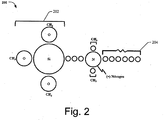
- FIG. 2 is an exemplary illustration of microbicidal agent.
- the Silicon atom bonded to three other hydrolysable groups. These hydrolysable groups, when hydrolyzed convert the organo functional group to silanols; and the silanols formed chemical bonds with each other (homopolymerization) and the microbicidal composite material 100. After the molecule has homopolymerised, it becomes an integral and permanent part of the microbicidal composite material 100.
- the microbicidal agent is covalently bonded to functional group of fibre to impart a non-eluting property.
- This dual process of the homopolymerised silanols binding to the composite material and the strong covalent coupling of the organosilane group ensures a strong binding that may be particularly helpful in promoting the wound healing process by preventing the eluting of the microbicidal agent and also prevent the evolution of superbugs. Further, it includes positively charged nitrogen and a long molecular chain 204, that are required to impart the microbicidal activity.
- Fig. 3a illustrates a pathogen being drawn towards the positively charged nitrogen base, in accordance with an embodiment.
- the microbicidal agent includes a positively charged nitrogen atom.
- This charge along with the structure of the long molecular chain 204 acts like sword that pierces the cell membrane of all pathogens that come in contact with it, thereby killing the pathogens.
- cell membrane damage imparts bactericidal characteristics to the microbicidal compound represented by formula - 1.
- the effect of the charge acts in tandem to the cell membrane potential of both gram positive and gram negative pathogenic microbes thus effectively changing the cell membrane potential causing a membrane rupture. This leads to electrolyte imbalance of the pathogenic fluids causing death of pathogens.
- FIG. 3b illustrates rupturing the cell membrane pathogen, in accordance with an embodiment.
- the aforementioned rupturing of the cell membrane of the pathogen is a physical process based on charge and length of aliphatic chain and not a chemical process.
- microbicidal agent is not consumed in the reaction, as a result of which the microbicidal agent is not depleted and continues to control microbial growth.
- Such phenomenon may be particularly helpful in wound healing, where the microbicidal composite material 100 may be used for a relatively longer period of time, before it is replaced.
- the microbicidal agent according to the present subject matter has a high microbicidal activity against various microorganisms, particularly Streptococcus, Enterococcus, Staphylococcus, Escherichia, Salmonella, Yersinia, Vibrio, Pseudomonas, Bacillus, Candida, and so on; more specifically, Streptococcus pneumoniae, Streptococcus pyogenes, Enterococcus faecalis, Staphylococcus aureus, Escherichia coli, Salmonella sp., Yersinia enterocolitica, Vibrio parahaemolyticus, Pseudomonas aeruginosa, Bacillus cereus, Bacillus subtilis, and Candida sp.
- the following tests were performed in order to determine the microbicidal activity against various pathogenic organisms.
- Example 1 Determination of Microbicidal activity BS EN ISO 20645:2004
- the microorganisms used in all assays were Staphylococcus aureus (ATCC 3658) and Klebsiella pneumoniae (ATCC 4352), selected according to the standards.
- the qualitative determination of microbicidal activity was made based on the protocol of the ISO 20645:2004.
- the textile samples were placed between two agar layers. The lower layer contained 10 ⁇ 0.1 ml of nutrient agar and the upper layer had 5 ⁇ 0.1 ml of nutrient agar with 2.0 x 10 8 cfu/ml of Klebsiella pneumoniae; and 3.5 x 10 8 cfu/ml of Staphylococcus aureus.
- the bacteria came from a previous NB inoculums incubated for 24 h at 37 ⁇ 2°C.
- Table 1 illustrates the results of microbicidal effects of the microbicidal composite material 100 against Klebsiella pneumonia (ATCC 4352) & Staphylococcus aureus (ATCC 3658).
- Table - 1 Sample Particular Bacterial reduction in mm Bacterial reduction in mm Growth under fabric Test Item K. pneumonia ATCC 4352 S. aureus ATCC 3658 1 4 Absent
- microbicidal composite material shows good microbicidal effects against Klebsiella pneumonia (ATCC 4352) & Staphylococcus aureus (ATCC 3658).
- microbicidal composite material 100 in wound healing is tested in accordance with the United States Pharmacopeia Microbicidal effectiveness Test (USP 51).
- USP 51 United States Pharmacopeia Microbicidal effectiveness Test
- This study is done to check the ability of the microbicidal agent, i.e., 1-Tetradecanaminium, N, N-dimethyl-N-[3-(trimethoxysilyl)propyl] used in the microbicidal composite material 100 to kill or prevent the growth of pathogens at least for seven days.
- Microbicidal study was carried out in five different pathogens which is shown in the Table - 2 below: Table - 2 Microbicidal effectiveness test Inoculums conc.
- CFU's/ml results Percentage of microorganism killed Percentage of microorganism killed Percentage of microorganism killed Test organism Day 1 Day 7 Day 14 Day 28 P. aeruginosa 2.00 ⁇ 10 7 100.00% 100.00% 100.00% E. coli 3.00 ⁇ 10 7 100.00% 100.00% 100.00% S. aureus 11.00 ⁇ 10 6 100.00% 100.00% 100.00% Candida albicans 2.00 ⁇ 10 6 100.00% 100.00% 100.00% 100.00% Aspergillus niger 1.00 ⁇ 10 6 99.99% 99.99% 99.00%
- column 1 refers to different microorganism and column 2 refers to the concentration of the inoculums taken for the study. After incubating the inoculated test product for seven days, it was observed that all the test microorganisms were killed as mentioned in the above table.
- the above table can be interpreted to mean that a wound can be theoretically left unattended with dressing done using the microbicidal composite material 100 for 28 days, depending on the wound type, without risk of infections. This provides comfort for the patients to do away with daily dressing changes.
- Example 3 Determining the percentage kill rate of microorganisms as per Standard ASTM 6329-98.
- the ASTM 6329-98 test was performed in accordance with Standard Guide for Developing Methodology for Evaluating the Ability of Indoor Materials to Support Microbial Growth Using Static Environmental Chambers.
- the test strains used are Staphylococcus Aureus ATCC 12600 ( S. aureus ATCC 12600), Escherichia Coli NCIM 2065 (E. Coli NCIM 2065), Methicillin Resistant Staphylococcus Aureus (MRSA - ATCC 43300).
- the results are evaluated are at regular intervals and are tabulated as under Table - 3 and Table - 4.
- the microbicidal composite material was tested in triplicates against E. coli (ATCC25922), S. aureus (ATCC 25923), P. aeruginosa (ATCC 9027) and C. albicans (ATCC 90028).
- the test material was cut as a 12 mm diameter disc and placed on 90 mm agar plates spread with 100 ⁇ l of approximately 10 8 CFU/ml of each bacterial strain and incubated at 37 ⁇ 1°C for 24 hours.
- a filter paper disc containing no antibiotic was used for a negative control.
- the zone of inhibition (Radius in mm) around the discs was measured using a transparent ruler. The results of this test are tabulated as under Table - 5.
- test item i.e., the microbicidal composite material
- ZOI Zone of Inhibition
- C. albicans C. albicans
- rest item exhibited growth inhibition of test organisms in continuation of transfer of discs of ZOI assay into broth for 24 hours. The effect was comparable to that observed with a standard reference drug ciprofloxacin.
- Discs of the microbicidal composite material were cut and placed into 24 well plates containing approximately 10 8 CFU/ml in Tryptic Soy Broth (TSB) of P. aeruginosa and S. aureus respectively and incubated at 37 ⁇ 1°C for the Bio film Prevention assay.
- TTB Tryptic Soy Broth
- 15 millimetre (mm) Discs of the microbicidal composite material were cut and placed into 24 well plates containing overnight grown culture of P. aeruginosa and S. aureus respectively in TSB and further incubated for 24 hours at 37 ⁇ 1°C for the disruption assay.
- plain filter paper discs were placed in culture control (C) wells with approximately 10 8 CFU/ml of the above bacteria in Tryptic Soy Broth (TSB) for both the Prevention and Disruption assay. After incubation, the contents were removed and washed four times with Phosphate Buffer saline (pH 7.2). A 500 ⁇ l of 0.1% crystal violet stain was added to each well and incubated for 20 minutes at room temperature, washed, and dried. Subsequently, 500 ⁇ l of ethanol supplemented with 2% acetic acid was added to each well for 30 min. The Optical Density (OD) of stained adherent Bio film was obtained by using a Tecan plate reader at 570 nm wavelength.
- OD Optical Density
- microbicidal composite material prevents the formation of Bio films caused by S. aureus and P. aeruginosa comparable to reference standard. Further, the results also indicate that the microbicidal composite material disrupts the formed Bio film caused by P. aeruginosa similar to the reference standard, but mildly effectively versus Bio film formed by S. aureus.
- Reference standard - 1 includes a test material which is a cotton gauze material bonded with non siloxane based QAS and Ref - 2: Reference standard - II includes a test material with active ingredient as silver, Test Item refers to the 'Microbicidal Composite Material'] and a disc containing 1 ⁇ g/disc ciprofloxacin. The results are tabulated in table 8 and table 9 as percentage recovery over time. Percentage survival was calculated as number of CFU/ml in test substance / number of CFU/ml in control substance. The killing percentage was calculated as 100-residual percentage.
- the test item i.e., the microbicidal composite material exhibited a rapid inhibition of growth of both P. aeruginosa and S. aureus.
- the rate of kill versus P. aeruginosa is comparable to the reference standards ( Fig 4 ), while the rate of kill vs. S. aureus was superior to one of the reference standards ( Fig 5 ).
- Fig-4 and Fig- 5 show the inhibition of growth as percentage in the Y-axis compared to the untreated control group.
- the X-axis shows time reference in this study for Fig-4 and Fig-5.
- Example 6 In vivo wound healing assay
- Sprague Dawley rats aged 6-8 weeks were randomly distributed to various treatment groups as listed in table 10. Each group contained 4 animals. The dorsal skins of the animals were shaved and a wound of about 2 sq.cm area was on the depilated dorsal thoracic region of animal under anaesthesia. An analgesic (ketoprofen 5mg/kg via S.C. route) was given to minimize pain and distress. The animals are housed individually. The wound dressing material was then applied to each animal within 4 hours after the wound was created. The animals were observed daily for clinical signs and mortality. Once a week, their body weights were recorded. On days 0, 7, 14 and 28 the dressing was removed from the assigned animals and the extent of wound contraction was noted.
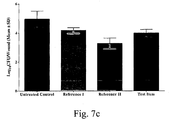
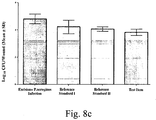
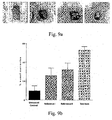
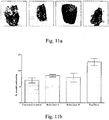
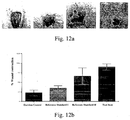
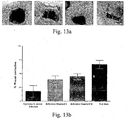
- test item i.e., the microbicidal composite material heals the wound around twice as fast as the nearest reference standard in terms of wound contraction. Also, the test item reduces the infection load at the site of the wound multi fold better than the nearest reference standard by day 7, 14, and day 28.
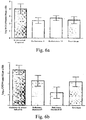
- Fig-6a, 6b, and 6c show the representation of the microbicidal action of the microbicidal composite material with the killing representation represented by the quantitative units of Colony Forming Units (CFU).
- CFU Colony Forming Units
- This unit of measurement, as known in the art is in logarithmic representation estimating the microbicidal effect.
- Fig-6a illustrates for the estimation on day 1 evaluation on excision wound without infection with respect to S. aureus, P. aeruginosa, using day 1 swab samples.
- Fig-6b illustrates for the estimation on day 1 evaluation on excision wound with infection with respect to S. aureus, using day 1 swab samples.
- Fig-6c illustrates for the estimation on day 1 evaluation on excision wound with infection with respect to P. aeruginosa, using day 1 swab samples.
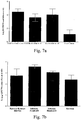
- Fig-7a, Fig-7b and Fig-7c illustrates the quantitative microbicidal action on day 7
- Fig-8a, Fig-8b and Fig-8c illustrates the quantitative microbicidal action on day 28.
- Fig-9a is a pictorial representation of the excision wound and its contraction that is dressed with this microbicidal composite material without any infection of the microbes with a control and two reference standards of wound dressing and the wound dressing in this subject matter on day 7.
- Fig-9b gives the quantitative estimate with of the wound contraction for infection without any infection of the microbes after day 7 with the control, two reference standards and the wound dressing in this subject matter.
- Fig-10a and Fig-10b illustrate similarly for infection with S. aureus after day 7.
- Fig-11a and Fig-11b illustrate similarly for infection with P. aeruginosa after day 7.
- Fig-12a, Fig-12b, Fig-13a, Fig-13b, Fig-14a and Fig-14b illustrate the effect after day 14.
- Fig-15a, Fig-15b, Fig-16a, Fig-16b, Fig-17a and Fig-17b illustrate the effect after day 28.
- Example 7 Test For In Vitro Cytotoxicity: Direct contact Method.
- test item Microbicidal composite material is considered non cytotoxic under the condition of the present test carried out using BALB/c 3T3 cells line.
- test item microbicidal Wound dressing did not show any sensitization reaction. Hence it is concluded that the test item microbicidal composite material 100 is Non Sensitized under the condition of the present study.
- Example 9 Test for intracutaneous reactivity study in New Zealand rabbits.
- test item Microbicidal wound dressing did not show any intracutaneous reactivity. Hence it is concluded that the test item, microbicidal composite material, meets the requirements of ISO 10993, Part-10:2010(E) under the conditions of the present study.
- test item Microbicidal composite material did not show any systematic toxicity. Hence it is concluded that the test item Microbicidal Wound dressing, meets the requirements of ISO 10993, Part-11: 2006 (E) under the conditions of the present study.
Landscapes
- Health & Medical Sciences (AREA)
- Life Sciences & Earth Sciences (AREA)
- General Health & Medical Sciences (AREA)
- Chemical & Material Sciences (AREA)
- Veterinary Medicine (AREA)
- Public Health (AREA)
- Animal Behavior & Ethology (AREA)
- Engineering & Computer Science (AREA)
- Epidemiology (AREA)
- Vascular Medicine (AREA)
- Heart & Thoracic Surgery (AREA)
- Hematology (AREA)
- Materials Engineering (AREA)
- Surgery (AREA)
- Dispersion Chemistry (AREA)
- Medicinal Chemistry (AREA)
- Biomedical Technology (AREA)
- Agronomy & Crop Science (AREA)
- Pest Control & Pesticides (AREA)
- Environmental Sciences (AREA)
- Zoology (AREA)
- Wood Science & Technology (AREA)
- Dentistry (AREA)
- Plant Pathology (AREA)
- Molecular Biology (AREA)
- Organic Chemistry (AREA)
- Chemical Kinetics & Catalysis (AREA)
- General Chemical & Material Sciences (AREA)
- Nuclear Medicine, Radiotherapy & Molecular Imaging (AREA)
- Pharmacology & Pharmacy (AREA)
- Toxicology (AREA)
- Oncology (AREA)
- Communicable Diseases (AREA)
- Dermatology (AREA)
- Bioinformatics & Cheminformatics (AREA)
- Materials For Medical Uses (AREA)
- Pharmaceuticals Containing Other Organic And Inorganic Compounds (AREA)
Applications Claiming Priority (2)
| Application Number | Priority Date | Filing Date | Title |
|---|---|---|---|
| IN2188CH2013 | 2013-05-17 | ||
| PCT/IB2014/000735 WO2014184640A1 (en) | 2013-05-17 | 2014-05-15 | Microbicidal composite material |
Publications (2)
| Publication Number | Publication Date |
|---|---|
| EP2981302A1 EP2981302A1 (en) | 2016-02-10 |
| EP2981302B1 true EP2981302B1 (en) | 2019-08-07 |
Family
ID=50896343
Family Applications (1)
| Application Number | Title | Priority Date | Filing Date |
|---|---|---|---|
| EP14728623.1A Active EP2981302B1 (en) | 2013-05-17 | 2014-05-15 | Microbicidal composite material |
Country Status (5)
| Country | Link |
|---|---|
| US (1) | US9566363B2 (enExample) |
| EP (1) | EP2981302B1 (enExample) |
| JP (1) | JP2016522029A (enExample) |
| CA (1) | CA2912124A1 (enExample) |
| WO (1) | WO2014184640A1 (enExample) |
Families Citing this family (3)
| Publication number | Priority date | Publication date | Assignee | Title |
|---|---|---|---|---|
| WO2018231815A2 (en) * | 2017-06-12 | 2018-12-20 | Kci Licensing, Inc. | Fabric wound filler |
| AU2019398893B2 (en) * | 2018-12-10 | 2024-11-21 | Rsd Holdings Limited | A multi-layer textile assembly |
| WO2025024163A2 (en) * | 2023-07-24 | 2025-01-30 | Bannack Medical LLC | Biodegradable hospital curtain and curtain system, method of making and composition |
Citations (1)
| Publication number | Priority date | Publication date | Assignee | Title |
|---|---|---|---|---|
| JPH09137380A (ja) * | 1995-11-10 | 1997-05-27 | Toray Ind Inc | 多層構造編地 |
Family Cites Families (12)
| Publication number | Priority date | Publication date | Assignee | Title |
|---|---|---|---|---|
| US4394378A (en) * | 1981-07-08 | 1983-07-19 | Klein Stewart E | 3-(Trimethoxysilyl) propyldidecylmethyl ammonium salts and method of inhibiting growth of microorganisms therewith |
| JPS58143749A (ja) * | 1982-02-22 | 1983-08-26 | 東レ株式会社 | 医療,衛生用素材 |
| US4496363A (en) * | 1983-11-21 | 1985-01-29 | Uop Inc. | Antimicrobial fabrics |
| JP2579971Y2 (ja) * | 1992-08-11 | 1998-09-03 | 株式会社興和ヘルスケアー | 包 帯 |
| GB2302669B (en) * | 1995-06-27 | 1997-07-23 | Marilyn Olga Jeffcoat | Fabrication process for nonwoven fabric and products thus fabricated for use as non-adherent absorbent medical and veterinary dressings |
| CA2353436C (en) * | 1998-12-08 | 2008-01-08 | Quick-Med Technologies, Inc. | Intrinsically bactericidal absorbent dressing and method of fabrication |
| US20090130160A1 (en) * | 2007-11-21 | 2009-05-21 | Fiber Innovation Technology, Inc. | Fiber for wound dressing |
| AR063987A1 (es) * | 2007-11-27 | 2009-03-04 | Segundo Mariano | Aposito utilizable como cobertura temporal para el tratamiento de heridas y procesos para su fabricacion |
| JP2010255894A (ja) * | 2009-04-23 | 2010-11-11 | Toyobo Co Ltd | 加湿エレメントおよびその使用方法 |
| JP2011020102A (ja) * | 2009-07-17 | 2011-02-03 | Unitika Trading Co Ltd | 主としてレンジフードの吸気口側に用いるフィルター材 |
| JP4590019B1 (ja) * | 2010-02-22 | 2010-12-01 | 二三男 柴田 | 抗菌性と吸水性を有する極細繊維及び極細繊維布帛 |
| WO2011106205A2 (en) * | 2010-02-23 | 2011-09-01 | 3M Innovative Properties Company | Dimensionally stable nonwoven fibrous webs and methods of making and using the same |
-
2014
- 2014-05-15 JP JP2016513454A patent/JP2016522029A/ja active Pending
- 2014-05-15 US US14/412,109 patent/US9566363B2/en active Active
- 2014-05-15 CA CA2912124A patent/CA2912124A1/en not_active Abandoned
- 2014-05-15 WO PCT/IB2014/000735 patent/WO2014184640A1/en not_active Ceased
- 2014-05-15 EP EP14728623.1A patent/EP2981302B1/en active Active
Patent Citations (1)
| Publication number | Priority date | Publication date | Assignee | Title |
|---|---|---|---|---|
| JPH09137380A (ja) * | 1995-11-10 | 1997-05-27 | Toray Ind Inc | 多層構造編地 |
Also Published As
| Publication number | Publication date |
|---|---|
| EP2981302A1 (en) | 2016-02-10 |
| WO2014184640A1 (en) | 2014-11-20 |
| US9566363B2 (en) | 2017-02-14 |
| JP2016522029A (ja) | 2016-07-28 |
| CA2912124A1 (en) | 2014-11-20 |
| US20160051720A1 (en) | 2016-02-25 |
Similar Documents
| Publication | Publication Date | Title |
|---|---|---|
| US7709694B2 (en) | Materials with covalently-bonded, nonleachable, polymeric antimicrobial surfaces | |
| JP4481372B2 (ja) | 殺菌性可塑性スポンジ材 | |
| US5707736A (en) | Products having anti-microbial activity | |
| US9610378B2 (en) | Antimicrobial wound-covering material and method for manufacturing same | |
| CN1121877C (zh) | 伤口护理的改进 | |
| US20050033251A1 (en) | Controlled release of biologically active substances from select substrates | |
| CN102170916A (zh) | 环境活化的组合物,制品与方法 | |
| EA010316B1 (ru) | Перевязочный материал на основе целлюлозы микробного происхождения, его применение и содержащий его набор | |
| EP2981302B1 (en) | Microbicidal composite material | |
| EP0852148B1 (en) | Products having anti-microbial activity | |
| AU2003290517A1 (en) | Medical pad, and method for making and using | |
| CN2724757Y (zh) | 具有多层防护层的口罩 | |
| Obendorf | Improving Personal Protection Through Novel Materials. | |
| JPH09187482A (ja) | 介護用シ−ツ | |
| US12364265B2 (en) | Inclusion of bound antiseptic in a luer lock | |
| AU2022298911A1 (en) | Wound covering, for increasing the no concentration in wounds | |
| CA3195126A1 (en) | Antimicrobial clothing and garments | |
| Gomes | Layer-by-Layer deposition of bioactive polyelectrolytes with incorporation of antimicrobial agents as a new strategy to develop bioactive textiles | |
| JP2005013339A (ja) | 褥瘡改善具 | |
| KR20040082356A (ko) | 나노 실버가 함유된 반창고 | |
| PL221352B1 (pl) | Sposób wytwarzania bioaktywnych włókien technicznych |
Legal Events
| Date | Code | Title | Description |
|---|---|---|---|
| PUAI | Public reference made under article 153(3) epc to a published international application that has entered the european phase |
Free format text: ORIGINAL CODE: 0009012 |
|
| 17P | Request for examination filed |
Effective date: 20151106 |
|
| AK | Designated contracting states |
Kind code of ref document: A1 Designated state(s): AL AT BE BG CH CY CZ DE DK EE ES FI FR GB GR HR HU IE IS IT LI LT LU LV MC MK MT NL NO PL PT RO RS SE SI SK SM TR |
|
| AX | Request for extension of the european patent |
Extension state: BA ME |
|
| DAX | Request for extension of the european patent (deleted) | ||
| STAA | Information on the status of an ep patent application or granted ep patent |
Free format text: STATUS: EXAMINATION IS IN PROGRESS |
|
| 17Q | First examination report despatched |
Effective date: 20171115 |
|
| GRAP | Despatch of communication of intention to grant a patent |
Free format text: ORIGINAL CODE: EPIDOSNIGR1 |
|
| STAA | Information on the status of an ep patent application or granted ep patent |
Free format text: STATUS: GRANT OF PATENT IS INTENDED |
|
| INTG | Intention to grant announced |
Effective date: 20190226 |
|
| GRAS | Grant fee paid |
Free format text: ORIGINAL CODE: EPIDOSNIGR3 |
|
| GRAA | (expected) grant |
Free format text: ORIGINAL CODE: 0009210 |
|
| STAA | Information on the status of an ep patent application or granted ep patent |
Free format text: STATUS: THE PATENT HAS BEEN GRANTED |
|
| AK | Designated contracting states |
Kind code of ref document: B1 Designated state(s): AL AT BE BG CH CY CZ DE DK EE ES FI FR GB GR HR HU IE IS IT LI LT LU LV MC MK MT NL NO PL PT RO RS SE SI SK SM TR |
|
| RAP1 | Party data changed (applicant data changed or rights of an application transferred) |
Owner name: CARENOW MEDICAL PRIVATE LIMITED |
|
| REG | Reference to a national code |
Ref country code: GB Ref legal event code: FG4D |
|
| REG | Reference to a national code |
Ref country code: CH Ref legal event code: EP Ref country code: AT Ref legal event code: REF Ref document number: 1162814 Country of ref document: AT Kind code of ref document: T Effective date: 20190815 |
|
| REG | Reference to a national code |
Ref country code: DE Ref legal event code: R096 Ref document number: 602014051265 Country of ref document: DE |
|
| REG | Reference to a national code |
Ref country code: IE Ref legal event code: FG4D |
|
| REG | Reference to a national code |
Ref country code: NL Ref legal event code: MP Effective date: 20190807 |
|
| REG | Reference to a national code |
Ref country code: LT Ref legal event code: MG4D |
|
| PG25 | Lapsed in a contracting state [announced via postgrant information from national office to epo] |
Ref country code: FI Free format text: LAPSE BECAUSE OF FAILURE TO SUBMIT A TRANSLATION OF THE DESCRIPTION OR TO PAY THE FEE WITHIN THE PRESCRIBED TIME-LIMIT Effective date: 20190807 Ref country code: PT Free format text: LAPSE BECAUSE OF FAILURE TO SUBMIT A TRANSLATION OF THE DESCRIPTION OR TO PAY THE FEE WITHIN THE PRESCRIBED TIME-LIMIT Effective date: 20191209 Ref country code: HR Free format text: LAPSE BECAUSE OF FAILURE TO SUBMIT A TRANSLATION OF THE DESCRIPTION OR TO PAY THE FEE WITHIN THE PRESCRIBED TIME-LIMIT Effective date: 20190807 Ref country code: NL Free format text: LAPSE BECAUSE OF FAILURE TO SUBMIT A TRANSLATION OF THE DESCRIPTION OR TO PAY THE FEE WITHIN THE PRESCRIBED TIME-LIMIT Effective date: 20190807 Ref country code: BG Free format text: LAPSE BECAUSE OF FAILURE TO SUBMIT A TRANSLATION OF THE DESCRIPTION OR TO PAY THE FEE WITHIN THE PRESCRIBED TIME-LIMIT Effective date: 20191107 Ref country code: SE Free format text: LAPSE BECAUSE OF FAILURE TO SUBMIT A TRANSLATION OF THE DESCRIPTION OR TO PAY THE FEE WITHIN THE PRESCRIBED TIME-LIMIT Effective date: 20190807 Ref country code: LT Free format text: LAPSE BECAUSE OF FAILURE TO SUBMIT A TRANSLATION OF THE DESCRIPTION OR TO PAY THE FEE WITHIN THE PRESCRIBED TIME-LIMIT Effective date: 20190807 Ref country code: NO Free format text: LAPSE BECAUSE OF FAILURE TO SUBMIT A TRANSLATION OF THE DESCRIPTION OR TO PAY THE FEE WITHIN THE PRESCRIBED TIME-LIMIT Effective date: 20191107 |
|
| REG | Reference to a national code |
Ref country code: AT Ref legal event code: MK05 Ref document number: 1162814 Country of ref document: AT Kind code of ref document: T Effective date: 20190807 |
|
| PG25 | Lapsed in a contracting state [announced via postgrant information from national office to epo] |
Ref country code: ES Free format text: LAPSE BECAUSE OF FAILURE TO SUBMIT A TRANSLATION OF THE DESCRIPTION OR TO PAY THE FEE WITHIN THE PRESCRIBED TIME-LIMIT Effective date: 20190807 Ref country code: IS Free format text: LAPSE BECAUSE OF FAILURE TO SUBMIT A TRANSLATION OF THE DESCRIPTION OR TO PAY THE FEE WITHIN THE PRESCRIBED TIME-LIMIT Effective date: 20191207 Ref country code: LV Free format text: LAPSE BECAUSE OF FAILURE TO SUBMIT A TRANSLATION OF THE DESCRIPTION OR TO PAY THE FEE WITHIN THE PRESCRIBED TIME-LIMIT Effective date: 20190807 Ref country code: AL Free format text: LAPSE BECAUSE OF FAILURE TO SUBMIT A TRANSLATION OF THE DESCRIPTION OR TO PAY THE FEE WITHIN THE PRESCRIBED TIME-LIMIT Effective date: 20190807 Ref country code: GR Free format text: LAPSE BECAUSE OF FAILURE TO SUBMIT A TRANSLATION OF THE DESCRIPTION OR TO PAY THE FEE WITHIN THE PRESCRIBED TIME-LIMIT Effective date: 20191108 Ref country code: RS Free format text: LAPSE BECAUSE OF FAILURE TO SUBMIT A TRANSLATION OF THE DESCRIPTION OR TO PAY THE FEE WITHIN THE PRESCRIBED TIME-LIMIT Effective date: 20190807 |
|
| PG25 | Lapsed in a contracting state [announced via postgrant information from national office to epo] |
Ref country code: TR Free format text: LAPSE BECAUSE OF FAILURE TO SUBMIT A TRANSLATION OF THE DESCRIPTION OR TO PAY THE FEE WITHIN THE PRESCRIBED TIME-LIMIT Effective date: 20190807 |
|
| PG25 | Lapsed in a contracting state [announced via postgrant information from national office to epo] |
Ref country code: EE Free format text: LAPSE BECAUSE OF FAILURE TO SUBMIT A TRANSLATION OF THE DESCRIPTION OR TO PAY THE FEE WITHIN THE PRESCRIBED TIME-LIMIT Effective date: 20190807 Ref country code: IT Free format text: LAPSE BECAUSE OF FAILURE TO SUBMIT A TRANSLATION OF THE DESCRIPTION OR TO PAY THE FEE WITHIN THE PRESCRIBED TIME-LIMIT Effective date: 20190807 Ref country code: PL Free format text: LAPSE BECAUSE OF FAILURE TO SUBMIT A TRANSLATION OF THE DESCRIPTION OR TO PAY THE FEE WITHIN THE PRESCRIBED TIME-LIMIT Effective date: 20190807 Ref country code: RO Free format text: LAPSE BECAUSE OF FAILURE TO SUBMIT A TRANSLATION OF THE DESCRIPTION OR TO PAY THE FEE WITHIN THE PRESCRIBED TIME-LIMIT Effective date: 20190807 Ref country code: AT Free format text: LAPSE BECAUSE OF FAILURE TO SUBMIT A TRANSLATION OF THE DESCRIPTION OR TO PAY THE FEE WITHIN THE PRESCRIBED TIME-LIMIT Effective date: 20190807 Ref country code: DK Free format text: LAPSE BECAUSE OF FAILURE TO SUBMIT A TRANSLATION OF THE DESCRIPTION OR TO PAY THE FEE WITHIN THE PRESCRIBED TIME-LIMIT Effective date: 20190807 |
|
| PG25 | Lapsed in a contracting state [announced via postgrant information from national office to epo] |
Ref country code: CZ Free format text: LAPSE BECAUSE OF FAILURE TO SUBMIT A TRANSLATION OF THE DESCRIPTION OR TO PAY THE FEE WITHIN THE PRESCRIBED TIME-LIMIT Effective date: 20190807 Ref country code: SK Free format text: LAPSE BECAUSE OF FAILURE TO SUBMIT A TRANSLATION OF THE DESCRIPTION OR TO PAY THE FEE WITHIN THE PRESCRIBED TIME-LIMIT Effective date: 20190807 Ref country code: SM Free format text: LAPSE BECAUSE OF FAILURE TO SUBMIT A TRANSLATION OF THE DESCRIPTION OR TO PAY THE FEE WITHIN THE PRESCRIBED TIME-LIMIT Effective date: 20190807 Ref country code: IS Free format text: LAPSE BECAUSE OF FAILURE TO SUBMIT A TRANSLATION OF THE DESCRIPTION OR TO PAY THE FEE WITHIN THE PRESCRIBED TIME-LIMIT Effective date: 20200224 |
|
| REG | Reference to a national code |
Ref country code: DE Ref legal event code: R097 Ref document number: 602014051265 Country of ref document: DE |
|
| PLBE | No opposition filed within time limit |
Free format text: ORIGINAL CODE: 0009261 |
|
| STAA | Information on the status of an ep patent application or granted ep patent |
Free format text: STATUS: NO OPPOSITION FILED WITHIN TIME LIMIT |
|
| PG2D | Information on lapse in contracting state deleted |
Ref country code: IS |
|
| 26N | No opposition filed |
Effective date: 20200603 |
|
| PG25 | Lapsed in a contracting state [announced via postgrant information from national office to epo] |
Ref country code: SI Free format text: LAPSE BECAUSE OF FAILURE TO SUBMIT A TRANSLATION OF THE DESCRIPTION OR TO PAY THE FEE WITHIN THE PRESCRIBED TIME-LIMIT Effective date: 20190807 |
|
| PG25 | Lapsed in a contracting state [announced via postgrant information from national office to epo] |
Ref country code: MC Free format text: LAPSE BECAUSE OF FAILURE TO SUBMIT A TRANSLATION OF THE DESCRIPTION OR TO PAY THE FEE WITHIN THE PRESCRIBED TIME-LIMIT Effective date: 20190807 Ref country code: LI Free format text: LAPSE BECAUSE OF NON-PAYMENT OF DUE FEES Effective date: 20200531 Ref country code: CH Free format text: LAPSE BECAUSE OF NON-PAYMENT OF DUE FEES Effective date: 20200531 |
|
| REG | Reference to a national code |
Ref country code: BE Ref legal event code: MM Effective date: 20200531 |
|
| PG25 | Lapsed in a contracting state [announced via postgrant information from national office to epo] |
Ref country code: LU Free format text: LAPSE BECAUSE OF NON-PAYMENT OF DUE FEES Effective date: 20200515 |
|
| PG25 | Lapsed in a contracting state [announced via postgrant information from national office to epo] |
Ref country code: IE Free format text: LAPSE BECAUSE OF NON-PAYMENT OF DUE FEES Effective date: 20200515 Ref country code: FR Free format text: LAPSE BECAUSE OF NON-PAYMENT OF DUE FEES Effective date: 20200531 |
|
| PG25 | Lapsed in a contracting state [announced via postgrant information from national office to epo] |
Ref country code: BE Free format text: LAPSE BECAUSE OF NON-PAYMENT OF DUE FEES Effective date: 20200531 |
|
| PG25 | Lapsed in a contracting state [announced via postgrant information from national office to epo] |
Ref country code: MT Free format text: LAPSE BECAUSE OF FAILURE TO SUBMIT A TRANSLATION OF THE DESCRIPTION OR TO PAY THE FEE WITHIN THE PRESCRIBED TIME-LIMIT Effective date: 20190807 Ref country code: CY Free format text: LAPSE BECAUSE OF FAILURE TO SUBMIT A TRANSLATION OF THE DESCRIPTION OR TO PAY THE FEE WITHIN THE PRESCRIBED TIME-LIMIT Effective date: 20190807 |
|
| PG25 | Lapsed in a contracting state [announced via postgrant information from national office to epo] |
Ref country code: MK Free format text: LAPSE BECAUSE OF FAILURE TO SUBMIT A TRANSLATION OF THE DESCRIPTION OR TO PAY THE FEE WITHIN THE PRESCRIBED TIME-LIMIT Effective date: 20190807 |
|
| PGFP | Annual fee paid to national office [announced via postgrant information from national office to epo] |
Ref country code: DE Payment date: 20250604 Year of fee payment: 12 |
|
| PGFP | Annual fee paid to national office [announced via postgrant information from national office to epo] |
Ref country code: GB Payment date: 20250605 Year of fee payment: 12 |