EP2970575B1 - Photoaktives additiv mit funktionalisiertem benzophenon - Google Patents
Photoaktives additiv mit funktionalisiertem benzophenon Download PDFInfo
- Publication number
- EP2970575B1 EP2970575B1 EP14721109.8A EP14721109A EP2970575B1 EP 2970575 B1 EP2970575 B1 EP 2970575B1 EP 14721109 A EP14721109 A EP 14721109A EP 2970575 B1 EP2970575 B1 EP 2970575B1
- Authority
- EP
- European Patent Office
- Prior art keywords
- group
- additive
- carbon atoms
- alkyl
- benzophenone
- Prior art date
- Legal status (The legal status is an assumption and is not a legal conclusion. Google has not performed a legal analysis and makes no representation as to the accuracy of the status listed.)
- Active
Links
- 0 CC*(*C)C(Oc1ccc(C2(C(C3)C=C4CC2CC3C4)c(cc2)ccc2O*(CC)C2CC2)cc1)=O Chemical compound CC*(*C)C(Oc1ccc(C2(C(C3)C=C4CC2CC3C4)c(cc2)ccc2O*(CC)C2CC2)cc1)=O 0.000 description 4
- BWODPOTYOXPKDH-UHFFFAOYSA-N CCOC(COc(cc1)ccc1C(c(cc1)ccc1OCC(OCC)=O)=O)=O Chemical compound CCOC(COc(cc1)ccc1C(c(cc1)ccc1OCC(OCC)=O)=O)=O BWODPOTYOXPKDH-UHFFFAOYSA-N 0.000 description 1
- RWCCWEUUXYIKHB-UHFFFAOYSA-N O=C(c1ccccc1)c1ccccc1 Chemical compound O=C(c1ccccc1)c1ccccc1 RWCCWEUUXYIKHB-UHFFFAOYSA-N 0.000 description 1
- ANYPXWOJRAQJBL-UHFFFAOYSA-N OC(COc(cc1)ccc1C(c(cc1)ccc1OCC(O)=O)=O)=O Chemical compound OC(COc(cc1)ccc1C(c(cc1)ccc1OCC(O)=O)=O)=O ANYPXWOJRAQJBL-UHFFFAOYSA-N 0.000 description 1
- RXNYJUSEXLAVNQ-UHFFFAOYSA-N Oc(cc1)ccc1C(c(cc1)ccc1O)=O Chemical compound Oc(cc1)ccc1C(c(cc1)ccc1O)=O RXNYJUSEXLAVNQ-UHFFFAOYSA-N 0.000 description 1
Images


Classifications
-
- G—PHYSICS
- G03—PHOTOGRAPHY; CINEMATOGRAPHY; ANALOGOUS TECHNIQUES USING WAVES OTHER THAN OPTICAL WAVES; ELECTROGRAPHY; HOLOGRAPHY
- G03F—PHOTOMECHANICAL PRODUCTION OF TEXTURED OR PATTERNED SURFACES, e.g. FOR PRINTING, FOR PROCESSING OF SEMICONDUCTOR DEVICES; MATERIALS THEREFOR; ORIGINALS THEREFOR; APPARATUS SPECIALLY ADAPTED THEREFOR
- G03F7/00—Photomechanical, e.g. photolithographic, production of textured or patterned surfaces, e.g. printing surfaces; Materials therefor, e.g. comprising photoresists; Apparatus specially adapted therefor
- G03F7/004—Photosensitive materials
- G03F7/027—Non-macromolecular photopolymerisable compounds having carbon-to-carbon double bonds, e.g. ethylenic compounds
-
- C—CHEMISTRY; METALLURGY
- C08—ORGANIC MACROMOLECULAR COMPOUNDS; THEIR PREPARATION OR CHEMICAL WORKING-UP; COMPOSITIONS BASED THEREON
- C08G—MACROMOLECULAR COMPOUNDS OBTAINED OTHERWISE THAN BY REACTIONS ONLY INVOLVING UNSATURATED CARBON-TO-CARBON BONDS
- C08G64/00—Macromolecular compounds obtained by reactions forming a carbonic ester link in the main chain of the macromolecule
- C08G64/02—Aliphatic polycarbonates
- C08G64/0208—Aliphatic polycarbonates saturated
- C08G64/0216—Aliphatic polycarbonates saturated containing a chain-terminating or -crosslinking agent
-
- C—CHEMISTRY; METALLURGY
- C08—ORGANIC MACROMOLECULAR COMPOUNDS; THEIR PREPARATION OR CHEMICAL WORKING-UP; COMPOSITIONS BASED THEREON
- C08G—MACROMOLECULAR COMPOUNDS OBTAINED OTHERWISE THAN BY REACTIONS ONLY INVOLVING UNSATURATED CARBON-TO-CARBON BONDS
- C08G64/00—Macromolecular compounds obtained by reactions forming a carbonic ester link in the main chain of the macromolecule
- C08G64/04—Aromatic polycarbonates
- C08G64/06—Aromatic polycarbonates not containing aliphatic unsaturation
- C08G64/14—Aromatic polycarbonates not containing aliphatic unsaturation containing a chain-terminating or -crosslinking agent
-
- C—CHEMISTRY; METALLURGY
- C08—ORGANIC MACROMOLECULAR COMPOUNDS; THEIR PREPARATION OR CHEMICAL WORKING-UP; COMPOSITIONS BASED THEREON
- C08G—MACROMOLECULAR COMPOUNDS OBTAINED OTHERWISE THAN BY REACTIONS ONLY INVOLVING UNSATURATED CARBON-TO-CARBON BONDS
- C08G64/00—Macromolecular compounds obtained by reactions forming a carbonic ester link in the main chain of the macromolecule
- C08G64/16—Aliphatic-aromatic or araliphatic polycarbonates
- C08G64/1608—Aliphatic-aromatic or araliphatic polycarbonates saturated
- C08G64/1616—Aliphatic-aromatic or araliphatic polycarbonates saturated containing a chain-terminating or -crosslinking agent
-
- C—CHEMISTRY; METALLURGY
- C08—ORGANIC MACROMOLECULAR COMPOUNDS; THEIR PREPARATION OR CHEMICAL WORKING-UP; COMPOSITIONS BASED THEREON
- C08L—COMPOSITIONS OF MACROMOLECULAR COMPOUNDS
- C08L69/00—Compositions of polycarbonates; Compositions of derivatives of polycarbonates
Definitions
- the present disclosure relates to photoactive additives that include a benzophenone having a carboxylate functionality.
- the additive can be used to crosslink polymers and blends thereof, particularly polycarbonate polymers, to produce compositions having improved properties. Also disclosed are the crosslinked polymers, products thereof, and/or products comprising the same.
- PC Polycarbonates
- E&E electronic engineering
- Polycarbonate polymers/resins and blends containing polycarbonate polymers are inherently flame retardant. However, they drip when exposed to a flame, and this dripping behavior worsens as the wall thickness decreases. This behavior reduces their suitability for applications where a V0 or 5VA flame retardance rating is required.
- polycarbonates have relatively poor chemical resistance. Polymers having better flame retardance, chemical resistance, color properties, and structural diversity are desirable.
- US5035496 (D1) discloses polycarbonates formed, at least in part, from dihydroxyaryl ketones and optionally benzylic hydrogen containing aromatic diols. The respective dihydroxyaryl ketones are structurally at least two-steps away and, hence, different, from the benzophenones claimed in the present invention.
- EP 0001577 discloses thermoplastic aromatic polycarbonates based on diphenols containing 0.5 to 5 mol% condensed aromatic hydroxyketones which, also, are structurally different from the benzophenones claimed in the instant invention.
- DE 2829258 discloses polycarbonates based on diphenols, different from the benzophenones claimed in the instant application, and monofunctional chain stoppers, which can be crosslinked by UV light.
- the present disclosure relates to additives which can be used for crosslinking polycarbonate resins and improve their flame resistance.
- the additives are formed by the reaction of a benzophenone with a first linker moiety, the benzophenone having one or two substituents formed from a divalent linker and a carboxyl endgroup.
- the resulting additive can be a polymer, an oligomer, or a compound, and can be used to crosslink polycarbonates when exposed to UV light.
- a photoactive additive formed from the reaction of: a benzophenone having one or two substituents that comprise a divalent linker and a linking group, wherein the linking group is a carboxyl group, ester group, or acid halide group; and a first linker moiety comprising a plurality of functional groups that can react with the linking group of the first photoactive moiety.
- the benzophenone contains only one substituent. More particularly, the benzophenone can have the structure of Formula (1): wherein R and R' are independently alkyl, aryl, alkenyl, halogen, sulfonate, phosphate, phosphonate, nitrile, thiophene, or pyrrole; p is an integer from 0 to 5; q is an integer from 0 to 4; and L is a single bond, oxyalkylene, alkyl, aryl, alkenyl, substituted alkyl, substituted aryl, substituted alkenyl, or amino; and Y is hydroxyl, alkoxy, aryloxy, or halogen; or an anhydride thereof.
- R and R' are independently alkyl, aryl, alkenyl, halogen, sulfonate, phosphate, phosphonate, nitrile, thiophene, or pyrrole
- p is an integer from 0 to 5
- the benzophenone contains two substituents.
- the benzophenone may have the structure of one of the following Formulas (2)-(3): wherein R and R' are independently alkyl, aryl, alkenyl, halogen, sulfonate, phosphate, phosphonate, nitrile, thiophene, or pyrrole; p is an integer from 0 to 5; q and r are independently an integer from 0 to 4; s is an integer from 0 to 3; and each L is independently a single bond, oxyalkylene, alkyl, aryl, alkenyl, substituted alkyl, substituted aryl, substituted alkenyl, or amino; and Y is hydroxyl, alkoxy, aryloxy, or halogen; or an anhydride thereof.
- the reaction further comprises an end-capping agent selected from the group consisting of phenol, p-t-butylphenol, p-cumylphenol, octylphenol, and p-cyanophenol.
- the first linker moiety has the structure of one of the following Formulas (B)-(C) or (E)-(I), which are further described herein. In other embodiments, the first linker moiety has the structure of one of the following Formulas (8)-(12), which are further described herein.
- the reaction that forms the photoactive additive further comprises a secondary linker moiety having at least three functional groups, each of which can react with a functional group of the first linker moiety.
- Such secondary linker moieties may have the structure of one of the following Formulas (25)-(28), which are further described herein.
- the reaction that forms the photoactive additive further comprises a difunctional chain extender having two functional groups, each of which can react with a functional group of the first linker moiety.
- difunctional chain extenders can have the structure of one of the following Formulas (17)-(24), which are further described herein.
- the additive is an oligomer having a weight average molecular weight of less than 15,000 prior to UV exposure. In others, the additive is a polymer having a weight average molecular weight (Mw) of 15,000 Daltons or higher prior to UV exposure.
- the molar ratio of the benzophenone to the first linker moiety can be from 1:2 to 1:200 prior to UV exposure.
- the additive is formed from the reaction of the benzophenone having one substituent, the first linker moiety, and a difunctional chain extender. More specifically, the first linker moiety is bisphenol-A, and the difunctional chain extender is phosgene.
- the additive is formed from the reaction of the benzophenone having two substituents, the first linker moiety, a difunctional chain extender, and an end-capping agent.
- a photoactive additive that is a cross-linkable polycarbonate resin formed from the reaction of (a) a benzophenone having one or two substituents that comprise a divalent linker and a linking group, wherein the linking group is a carboxyl group, ester group, or acid halide group, and (b) a first linker moiety comprising a plurality of functional groups that can react with the linking group of the first photoactive moiety; and (ii) a separate polymer resin which is not the photoactive additive.
- a photoactive additive that is a cross-linkable polycarbonate resin formed from the reaction of (a) a benzophenone having one or two substituents that comprise a divalent linker and a linking group, wherein the linking group is a carboxyl group, ester group, or acid halide group, and (b) a first linker moiety comprising a plurality of functional groups that can react with the linking group of the first photoactive moiety; and (ii) a separate polymer resin
- the crosslinked layer can contain chains from both the photoactive additive and the polymer resin. In most embodiments, the crosslinking is sufficient to create a continuous insoluble layer containing both the photoactive additive and the polymer resin. In particular embodiments, the crosslinked layer is formed by exposure to 36.0 Joules per square centimeter (J/cm 2 ) of UVA radiation with no detectable UVC radiation.
- compositions comprising a cross-linked polycarbonate, the cross-linked polycarbonate derived from a cross-linkable polycarbonate resin formed from the reaction of (a) a benzophenone having one or two substituents that comprise a divalent linker and a linking group, wherein the linking group is a carboxyl group, ester group, or acid halide group, and (b) a first linker moiety comprising a plurality of functional groups that can react with the linking group of the first photoactive moiety.
- the cross-linkable polycarbonate resin may contain from about 0.5 mole% to about 5.0 mole% of endcaps derived from the benzophenone having one substituent prior to cross-linking.
- the cross-linkable polycarbonate resin may contain from about 0.5 mole% to about 50 mole% of the benzophenone having two substituents prior to cross-linking.
- the term “comprising” may include the embodiments “consisting of” and “consisting essentially of.”
- the terms “comprise(s),” “include(s),” “having,” “has,” “can,” “contain(s),” and variants thereof, as used herein, are intended to be open-ended transitional phrases, terms, or words that require the presence of the named ingredients/steps and permit the presence of other ingredients/steps.
- compositions or processes as “consisting of” and “consisting essentially of” the enumerated ingredients/steps, which allows the presence of only the named ingredients/steps, along with any impurities that might result therefrom, and excludes other ingredients/steps.
- approximating language may be applied to modify any quantitative representation that may vary without resulting in a change in the basic function to which it is related. Accordingly, a value modified by a term or terms, such as “about” and “substantially,” may not be limited to the precise value specified, in some cases. In at least some instances, the approximating language may correspond to the precision of an instrument for measuring the value. The modifier "about” should also be considered as disclosing the range defined by the absolute values of the two endpoints.
- each intervening number there between with the same degree of precision is explicitly contemplated.
- the numbers 7 and 8 are contemplated in addition to 6 and 9, and for the range 6.0-7.0, the number 6.0, 6.1, 6.2, 6.3, 6.4, 6.5, 6.6, 6.7, 6.8, 6.9, and 7.0 are explicitly contemplated.
- any position not substituted by any indicated group is understood to have its valency filled by a bond as indicated, or a hydrogen atom.
- a dash (“-") that is not between two letters or symbols is used to indicate a point of attachment for a substituent.
- the aldehyde group -CHO is attached through the carbon of the carbonyl group.
- aliphatic refers to an linear or branched array of atoms that is not aromatic.
- the backbone of an aliphatic group is composed exclusively of carbon.
- the aliphatic group may be substituted or unsubstituted.
- Exemplary aliphatic groups include, but are not limited to, methyl, ethyl, isopropyl, hexyl, and cyclohexyl.
- aromatic refers to a radical having a ring system containing a delocalized conjugated pi system with a number of pi-electrons that obeys Hückel's Rule.
- the ring system may include heteroatoms such as nitrogen, sulfur, selenium, silicon and oxygen, or may be composed exclusively of carbon and hydrogen.
- Aromatic groups are not substituted. Exemplary aromatic groups include, but are not limited to, phenyl, pyridyl, furanyl, thienyl, naphthyl and biphenyl.
- esters refers to a radical of the formula -CO-O-, wherein the carbon atom and the oxygen atom are both covalently bonded to carbon atoms.
- carbonate refers to a radical of the formula -O-CO-O-, wherein the oxygen atoms are both covalently bonded to carbon atoms. Note that a carbonate group is not an ester group, and an ester group is not a carbonate group.
- hydroxyl refers to a radical of the formula -OH, wherein the oxygen atom is covalently bonded to a carbon atom that is not double bonded to an oxygen atom.
- carboxy or “carboxyl” refer to a radical of the formula -COOH, wherein the carbon atom is covalently bonded to another carbon atom.
- anhydride refers to a radical of the formula -CO-O-CO-, wherein the carbonyl carbon atoms are covalently bonded to other carbon atoms.
- An anhydride can be considered as being equivalent to two carboxyl groups.
- acid halide refers to a radical of the formula -CO-X, wherein the carbon atom is covalently bonded to another carbon atom.
- alkyl refers to a radical composed entirely of carbon atoms and hydrogen atoms which is fully saturated.
- the alkyl radical may be linear, branched, or cyclic. This term may refer to a monovalent radical or a divalent radical, depending on the context. Examples of alkyl radicals include -CH 3 , -CH 2 , -CH 2 CH 3 , and -CH 2 CH 2 -.
- aryl refers to an aromatic radical that is composed exclusively of carbon and hydrogen. This term may refer to a monovalent radical or a divalent radical, depending on the context. Exemplary aryl groups include phenyl, naphthyl, biphenyl, and phenylene (-C 6 H 4 -). Note that “aryl” is a subset of aromatic.
- heteroaryl refers to an aromatic radical having a ring system that is composed of carbon, hydrogen, and at least one heteroatom.
- exemplary heteroaryl groups include pyridyl, furanyl, and thienyl. Note that “heteroaryl” is a subset of aromatic, and is exclusive of “aryl”.
- halogen refers to fluorine, chlorine, bromine, and iodine.
- alkoxy refers to an alkyl radical which is attached to an oxygen atom, i.e. -O-C n H 2n+1 .
- aryloxy refers to an aryl radical which is attached to an oxygen atom, e.g. -O-C 6 H 5 .
- hydrocarbon refers to a radical which is composed exclusively of carbon and hydrogen. Both alkyl and aryl groups are considered hydrocarbon groups.
- alkenyl refers to a radical composed entirely of carbon atoms and hydrogen atoms which contains at least one carbon-carbon double bond that is not part of an aromatic structure.
- the alkenyl radical may be linear, branched, or cyclic.
- arylalkyl refers to an aryl radical which is attached to an alkyl radical, with the aryl radical being appended to the parent molecular moiety through the alkyl radical, e.g. benzyl (-CH 2 -C 6 H 5 ).
- alkylaryl refers to an alkyl radical which is attached to an aryl radical, with the alkyl radical being appended to the parent molecular moiety through the aryl radical, e.g. tolyl (-C 6 H 4 -CH 3 ).
- amino refers to a radical of the formula R-NR 1 R 2 , wherein R is a carbon atom, R1 is hydrogen or alkyl, and R 2 is hydrogen, alkyl, or a single bond.
- An amino group can therefore be a primary group, a secondary group, a tertiary group, or a divalent group.
- amide refers to a radical of the formula -CO-NH-, wherein the nitrogen atom and the carbon atom are both covalently bonded to carbon atoms.
- oxyalkylene refers to a divalent radical of the formula (OR 1 ) m -, wherein each R 1 is independently alkyl; m is an integer and is 1 or higher.
- sulfonate refers to a radical of the formula -SO 3 1- , or its chemical equivalents.
- phosphate refers to a radical of the formula: where R is hydrogen or alkyl; and M is an alkali metal.
- phosphonate refers to a radical of the formula: where R is hydrogen or alkyl; and M is an alkali metal.
- pyrrole refers to the heterocyclic radical of the formula -C 4 H 4 N, which may be attached through any of the carbon atoms or the nitrogen atom, and which is aromatic.
- thiophene refers to the heterocyclic radical of the formula -C 4 H 3 S, which may be attached through any of the carbon atoms, and which is aromatic.
- nitro refers to a radical of the formula -NO 2 .
- substituted refers to at least one hydrogen atom on the named radical being substituted with another functional group, such as halogen, -CN, or -NO 2 .
- the functional group is not hydroxyl, carboxyl, ester, acid halide, or anhydride.
- An exemplary substituted alkyl group is a perhaloalkyl group, wherein one or more hydrogen atoms in an alkyl group are replaced with halogen atoms, such as fluorine, chlorine, iodine, and bromine.
- an aryl or heteroaryl group may also be substituted with alkyl or alkoxy.
- Exemplary substituted aryl groups include methylphenyl and methoxyphenyl.
- Exemplary substituted heteroaryl groups include dodecylthienyl.
- copolymer refers to a polymer derived from two or more structural unit or monomeric species, as opposed to a homopolymer, which is derived from only one structural unit or monomer.
- Glass Transition Temperature refers to the maximum temperature that a polymer, such as a polycarbonate, will have one or more useful properties. These properties include impact resistance, stiffness, strength, and shape retention.
- the Tg of a polycarbonate therefore may be an indicator of its useful upper temperature limit, particularly in plastics applications.
- the Tg may be measured using a differential scanning calorimetry method and expressed in degrees Celsius.
- the glass transition temperatures (Tg) described herein are measures of heat resistance of, for example, polycarbonate and polycarbonate blends.
- the Tg can be determined by differential scanning calorimetry, for example by using a TA Instruments Q1000 instrument, for example, with setting of 20 °C/min ramp rate and 40 °C start temperature and 200 °C end temperature.
- halo means that the substituent to which the prefix is attached is substituted with one or more independently selected halogen radicals.
- C 1 -C 6 haloalkyl means a C 1 -C 6 alkyl substituent wherein one or more hydrogen atoms are replaced with independently selected halogen radicals.
- Non-limiting examples of C 1 -C 6 haloalkyl include chloromethyl, 1-bromoethyl, fluoromethyl, difluoromethyl, trifluoromethyl, and 1,1,1-trifluoroethyl. It should be recognized that if a substituent is substituted by more than one halogen radical, those halogen radicals may be identical or different (unless otherwise stated).
- haze refers to the percentage of transmitted light, which in passing through a specimen deviates from the incident beam by forward scattering. Percent (%) haze may be measured according to ASTM D 1003-07.
- MVR Melt Volume Rate
- MFR Melt Flow Rate
- Percent transmission or “% transmission” refers to the ratio of transmitted light to incident light, and may be measured according to ASTM D 1003-07.
- Polycarbonate refers to an oligomer or a polymer comprising residues of one or more monomers, joined by carbonate linkages.
- Thermal stability refers to resistance of a polymer to molecular weight degradation under thermal conditions.
- a polymer with poor thermal stability may show significant molecular weight degradation under thermal conditions, such as during extrusion, molding, thermoforming, hot-pressing, and like conditions.
- Molecular weight degradation may also be manifest through color formation and/or in the degradation of other properties such as weatherability, gloss, mechanical properties, and/or thermal properties.
- Molecular weight degradation can also cause significant variation in processing conditions such as melt viscosity changes.
- crosslink and its variants refer to the formation of a stable covalent bond between two oligomers/polymers. This term is intended to encompass the formation of covalent bonds that result in network formation, or the formation of covalent bonds that result in chain extension.
- cross-linkable refers to the ability of an oligomer/polymer to form such stable covalent bonds.
- a polymer is a large molecule composed of multiple repeating units chained together, the repeating units being derived from a monomer.
- One characteristic of a polymer is that different molecules of a polymer will have different lengths, and a polymer is described as having a molecular weight that is based on the average value of the chains (e.g. weight average or number average molecular weight).
- the art also distinguishes between an "oligomer” and a "polymer”, with an oligomer having only a few repeating units, while a polymer has many repeating units.
- oligomer refers to such molecules having a weight average molecular weight of less than 15,000
- polymer refers to molecules having a weight average molecular weight of 15,000 of more, as measured by GPC using polycarbonate molecular weight standards.
- all molecules will have the same molecular weight.
- a compound is a small molecule.
- the present disclosure relates to photoactive additives (PAA), and to compositions containing such additives.
- PAA photoactive additives
- the photoactive additive When the photoactive additive is added to one or more base resins and is then exposed to the appropriate wavelength of light, the resulting composition will have improved anti-drip and flame retardant properties compared to the base resins alone or to the composition prior to the light exposure.
- the chemical resistance, propensity to drip during burning, or the propensity to form a hole when exposed to a flame can be improved.
- Improved flame resistance performance characteristics may include flame out time (FOT) and time to drip (TTD).
- FOT flame out time
- TTD time to drip
- the compositions, blended or neat can be used to provide thin-walled materials that are UL94 5VA compliant.
- the compositions can be used to provide thin-walled materials that are 5VA compliant and highly transparent.
- the compositions may also exhibit good chemical resistance, tear resistance, impact strength, ductility, hydrolytic stability, and/or weather
- the photoactive additives (PAA) of the present disclosure include photoactive moieties that are covalently linked together through a first linker moiety and possibly a secondary linker moiety.
- the photoactive moieties contain a photoactive ketone group that, when exposed to the appropriate wavelength(s) of ultraviolet light, will form a stable covalent bond between the PAA and the polymeric resin.
- the PAA should be stable at conventional blending, forming, and processing temperatures (i.e. stable at 350°C or above).
- the PAA also should not induce the degradation of the polymeric resin with which it is blended.
- photoactive refers to a moiety that, when exposed to ultraviolet light of the appropriate wavelength, crosslinks with another molecule.
- the bisphenol-A monomer in a bisphenol-A homopolymer would not be considered to be photoactive, even though photo-Fries rearrangement can occur upon exposure to light, because the atoms do not participate in crosslinking but merely in rearrangement of the polymer backbone.
- ketone group refers to a carbonyl group (-CO-) that is bonded to two other carbon atoms (i.e. -R-CO-R'-).
- the two other carbon atoms can be in an aliphatic group or in an aromatic group.
- An ester group and a carboxylic acid group are not considered to be a ketone group because the carbonyl group is bonded to one carbon atom and an oxygen atom.
- the photoactive additive is formed from a reaction mixture containing at least a benzophenone and a first linker moiety.
- the benzophenone has one or two substituents that comprise a divalent linker and a linking group, wherein the linking group can be a carboxyl, ester, acid halide, or an anhydride thereof.
- the first linker moiety comprises a plurality of functional groups that can react with the linking group(s) of the benzophenone.
- the reaction product is the photoactive additive (PAA).
- PAA photoactive additive
- the molar ratio of the benzophenone to the first linker moiety can be from 1:2 to 1:200.
- an end-capping agent may also be included.
- a difunctional chain extender can also be included. The end-capping agent and the difunctional chain extender do not have photoactive properties.
- the linking group(s) of the photoactive moiety can be a carboxyl, ester, acid halide, or an anhydride thereof. These four groups react in the same way, and are thus considered to be equivalent to each other. For clarity, these four groups are illustrated below: wherein R is the remainder of the photoactive moiety, R' is alkyl or aryl, and X is a halogen. It should be noted that the anhydride essentially contains two carboxyl groups.
- the benzophenone includes a substituent that has the linking group as the endgroup (i.e at the end of the substituent).
- a divalent linker joins the linking group to the benzophenone.
- the term "divalent linker” refers to a moiety which is able to form a single bond with two different non-hydrogen atoms, joining those two different atoms together.
- Exemplary divalent linkers include -CO-, -O-, -NH-, alkyl, aryl, and combinations thereof, and also include the single bond that can formed directly between the two different non-hydrogen atoms themselves.
- the benzophenone has only one substituent, and has the structure of Formula (1): wherein R and R' are independently alkyl, aryl, alkenyl, halogen, sulfonate, phosphate, phosphonate, nitrile, thiophene, or pyrrole; p is an integer from 0 to 5; q is an integer from 0 to 4; and L is a single bond, oxyalkylene, alkyl, aryl, alkenyl, substituted alkyl, substituted aryl, substituted alkenyl, or amino; Y is hydroxyl, alkoxy, aryloxy, or halogen; or is the anhydride thereof.
- the substituent is located at the 4- (para-) position on the phenyl ring.
- the benzophenone has only two substituents, one substituent on each phenyl ring, and has the structure of Formula (2): wherein R and R' are independently alkyl, aryl, alkenyl, halogen, sulfonate, phosphate, phosphonate, nitrile, thiophene, or pyrrole; q and r are independently an integer from 0 to 4; and each L is independently a single bond, oxyalkylene, alkyl, aryl, alkenyl, substituted alkyl, substituted aryl, substituted alkenyl, or amino; Y is hydroxyl, alkoxy, aryloxy, or halogen; or is the anhydride thereof.
- R and R' are independently alkyl, aryl, alkenyl, halogen, sulfonate, phosphate, phosphonate, nitrile, thiophene, or pyrrole
- q and r are independently an integer from
- the two substituents can be located in any combination of locations, e.g. 4,4'-; 2,2'-; 2,4'-; etc.
- Some specific examples of benzophenones of Formula (2) are illustrated below as Formulas (2-a) and (2-b). It is noted that the IUPAC name for the structure of Formula (2-a) is 2-[4-[4-(carboxymethoxy)benzoyl]phenoxy]acetic acid (abbreviated herein as p,p'-CMOBPAA).
- the benzophenone has only two substituents, both located on the same phenyl ring, and has the structure of Formula (3): wherein R and R' are independently alkyl, aryl, alkenyl, halogen, sulfonate, phosphate, phosphonate, nitrile, thiophene, or pyrrole; p is an integer from 0 to 5; s is an integer from 0 to 3; and each L is independently a single bond, oxyalkylene, alkyl, aryl, alkenyl, substituted alkyl, substituted aryl, substituted alkenyl, or amino; Y is hydroxyl, alkoxy, aryloxy, or halogen; or is the anhydride thereof.
- R and R' are independently alkyl, aryl, alkenyl, halogen, sulfonate, phosphate, phosphonate, nitrile, thiophene, or pyrrole
- p is
- the two substituents can be located in any combination of locations, e.g. 2,4-; 3,4-; 3,5-; etc.
- Some specific examples of benzophenones of Formula (3) are illustrated below as Formulas (3-a) and (3-b):
- amino refers to a radical of the formula -NR 1 -, wherein R 1 is hydrogen or alkyl.
- R 1 is hydrogen or alkyl.
- the amino group will not be a primary amino group, i.e. will not have two hydrogen atoms.
- the benzophenone is reacted with one or more first linker moieties.
- the linker moiety comprises a plurality of functional groups that can react with the carboxylate linking group on the substituent(s) of the benzophenone. Examples of such functional groups include a hydroxyl group.
- the functional groups can be joined to an aliphatic group or an aromatic group which serves as a "backbone" for the first linker moiety.
- the first linker moiety can have two, three, four, or even more functional groups.
- the first linker moiety can act as a branching agent.
- the first linker moiety is not photoactive when exposed to light.
- the first linker moiety can be used to provide a desired level of miscibility when the additive is mixed with the polymeric resin.
- An exemplary first linker moiety is a bisphenol of Formula (B): wherein R a and R b each represent a halogen atom or a monovalent hydrocarbon group and may be the same or different; p and q are each independently integers of 0 to 4; and A represents one of the groups of formula (B-1): wherein R c and R d each independently represent a hydrogen atom or a monovalent linear or cyclic hydrocarbon group and R e is a divalent hydrocarbon group.
- A can be a substituted or unsubstituted C 3 -C 18 cycloalkylidene.
- bisphenol compounds that may be represented by Formula (B) include 1,1-bis(4-hydroxyphenyl) methane, 1,1-bis(4-hydroxyphenyl) ethane, 2,2-bis(4-hydroxyphenyl) propane (hereinafter "bisphenol-A” or "BPA"), 2,2-bis(4-hydroxyphenyl) butane, 2,2-bis(4-hydroxyphenyl) octane, 1,1-bis(4-hydroxyphenyl) propane, 1,1-bis(4-hydroxyphenyl) n-butane, 2,2-bis(4-hydroxy-1-methylphenyl) propane, and 1,1-bis(4-hydroxy-t-butylphenyl) propane; 4,4'-(1-phenylethane-1,1-diyl)diphenol or 1,1-bis(4-hydroxyphenyl)-1-phenyl-ethane (bisphenol-AP); and 1,1-bis(4-hydroxyphenyl)-3,3,5-trimethyl
- a 13PLAS0235nother exemplary first linker moiety is a bisphenol of Formula (C): wherein each R k is independently a C 1-10 hydrocarbon group, and n is 0 to 4.
- the halogen is usually bromine.
- compounds that may be represented by Formula (C) include resorcinol, substituted resorcinol compounds such as 5-methyl resorcinol, 5-phenyl resorcinol, or 5-cumyl resorcinol; catechol; hydroquinone; and substituted hydroquinones such as 2-methyl hydroquinone, 2-t-butyl hydroquinone, 2-phenyl hydroquinone, 2-cumyl hydroquinone, or 2,3,5,6-tetramethyl hydroquinone.
- Another exemplary first linker moiety is an aliphatic diol of Formula (E): wherein each X is independently hydrogen, halogen, or alkyl; and j is an integer from 1 to 20.
- Examples of an aliphatic diol include ethylene glycol, propanediol, 2,2-dimethyl-propanediol, 1,6-hexanediol, and 1,12-dodecanediol.
- R 13 and R 15 are each independently a halogen or a C 1 -C 6 alkyl group
- R 14 is a C 1 -C 6 alkyl, phenyl, or phenyl substituted with up to five halogens or C 1 -C 6 alkyl groups
- c is 0 to 4.
- R 14 is a C 1 -C 6 alkyl or phenyl group.
- R 14 is a methyl or phenyl group.
- each c is 0.
- Compounds of Formula (F) include 3,3-bis(4-hydroxyphenyl)-2-phenylisoindolin-1-one (PPPBP).
- dihydroxy compounds i.e. first linker moiety
- Tgs Tgs
- dihydroxy compounds having adamantane units as described in U.S. Patent No. 7,112,644 and U.S. Patent No. 3,516,968 .
- a compound having adamantane units may have repetitive units of the following formula (G) for high heat applications: wherein R 1 represents a halogen atom, an alkyl group having 1 to 6 carbon atoms, an alkoxy group having 1 to 6 carbon atoms, an aryl group having 6 to 12 carbon atoms, an aryl-substituted alkenyl group having 7 to 13 carbon atoms, or a fluoroalkyl group having 1 to 6 carbon atoms; R 2 represents a halogen atom, an alkyl group having 1 to 12 carbon atoms, an alkoxy group having 1 to 12 carbon atoms, an aryl group having 6 to 12 carbon atoms, an aryl-substituted alkenyl group having 7 to 13 carbon atoms, or a fluoroalkyl group having 1 to 12 carbon atoms; m represents an integer of 0 to 4; and n represents an integer of 0 to 14.
- One such fluorene-unit containing dihydroxy compound i.e. first linker moiety
- R 1 to R 4 are each independently a hydrogen atom, a hydrocarbon group with 1 to 9 carbon atoms which may contain an aromatic group, or a halogen atom.
- a monomer unit derived from isosorbide may be an isorbide-bisphenol unit of Formula (I): wherein R 1 is an isosorbide unit and R 2 -R 9 are each independently a hydrogen, a halogen, a C 1 -C 6 alkyl, a methoxy, an ethoxy, or an alkyl ester.
- the R 1 isosorbide unit may be represented by Formula (I-a):
- the isosorbide unit may be derived from an isosorbide, a mixture of isosorbide, a mixture of isomers of isosorbide, and/or from individual isomers of isosorbide.
- the stereochemistry for the isosorbide-based carbonate units of Formula (I) is not particularly limited. These diols may be prepared by the dehydration of the corresponding hexitols. Hexitols are produced commercially from the corresponding sugars (aldohexose).
- Aliphatic diols include 1,4:3,6-dianhydro-D glucitol; 1,4:3,6-dianhydro-D mannitol; and 1,4:3,6-dianhydro-L iditol; and any combination thereof.
- Isosorbides are available commercially from various chemical suppliers including Cargill, Roquette, and Shanxi.
- the isosorbide-bisphenol may have a pKa of between 8 and 11.
- first linker moieties which have three functional groups and can react with the benzophenone include those having the structure of one of Formulas (8)-(12):
- first linker moieties which have four functional groups and can react with the benzophenone include those having the structure of one of Formulas (13)-(14):
- the first linker moiety can be a short oligomer, including oligomers containing glycidyl methacrylate monomers with styrene or methacrylate monomers, or epoxidized novolac resins. These oligomers can permit the desired number of functional groups to be provided. Such oligomers are generalized by the structure of Formula (15): where E is hydrogen or an endcapping agent, p is the number of methacrylate monomers, q is the number of methacrylate monomers, r is the number of styrene monomers, and t is the number of epoxidized novolac (phenol-formaldehyde) monomers.
- p+q+r+t 20.
- the epoxy groups can be reacted with the phenolic group of the photoactive moiety.
- the first linker moiety can be an oligomer, made from an epoxidized novolac monomer.
- oligomers are generalized by the structure of Formula (16): wherein E is hydrogen or an endcapping agent; and t is an integer from 1 to 20.
- the photoactive additive can be formed from a reaction mixture containing the benzophenone, the first linker moiety, and one or more difunctional chain extenders.
- the difunctional chain extender is a molecule that contains only two linking groups and is not photoactive when exposed to light, and reacts with the first linker moiety.
- the chain extender is useful in forming oligomeric and polymeric forms of the photoactive additive.
- the linking groups in the difunctional chain extender are generally the same as those on the benzophenone: carboxyl, ester, acid halide, alkoxy, aryloxy, or anhydride.
- a difunctional chain extender is the compound of Formula (17): wherein Y is hydroxyl, alkoxy, aryloxy, or halogen; R a and R b each represent a halogen atom or a monovalent hydrocarbon group and may be the same or different; p and q are each independently integers of 0 to 4; and A represents one of the groups of formula (17-a): wherein R° and R d each independently represent a hydrogen atom or a monovalent linear or cyclic hydrocarbon group and R e is a divalent hydrocarbon group.
- a second reference example of a difunctional chain extender is the compound of Formula (18): wherein Y is hydroxyl, alkoxy, aryloxy, or halogen; each R k is independently a C 1-10 hydrocarbon group, and n is 0 to 4.
- the halogen is usually bromine.
- a third reference example of a difunctional chain extender is the compound of Formula (19): wherein Y is hydroxyl, alkoxy, aryloxy, or halogen; each Ar is independently aryl; each R is independently alkyl, alkoxy, alkenyl, alkenyloxy, aryl, aryloxy, arylalkyl, or alkylaryl; and D is an average value of 2 to about 1000, specifically about 2 to about 500, more specifically about 10 to about 75.
- a fourth reference example of a difunctional chain extender is the compound of Formula (20): wherein Y is hydroxyl, alkoxy, aryloxy, or halogen; each X is independently hydrogen, halogen, or alkyl; and j is an integer from 1 to 20.
- difunctional chain extenders include those having the structure of one of Formulas (21)-(24): where Y is hydroxyl, halogen, alkoxy, or aryloxy; and where n is 1 to 20. It should be noted that Formula (24) encompasses isophthalic acid and terephthalic acid.
- first linker moieties can act as a branching agent, and the first linker moiety will react with the benzophenone.
- a secondary linker moiety can be included in the reaction mixture as a branching agent.
- the secondary linker moiety has at least three functional groups, each of which can react with the functional groups of the first linker moiety.
- the functional groups of the secondary linker moiety are the same as those on the benzophenone: carboxyl, ester, acid halide, or anhydride.
- secondary linker moieties which have three functional groups and can react with the first linker moiety include those having the structure of one of Formulas (25)-(26): where Y is hydroxyl, halogen, alkoxy, or aryloxy.
- secondary linker moieties which have four functional groups and can react with the first linker moiety include those having the structure of one of Formulas (27)-(28): where Y is hydroxyl, halogen, alkoxy, or aryloxy.
- An end-capping agent is generally used to terminate any polymer chains of the photoactive additive.
- the end-capping agent i.e. chain stopper
- exemplary endcapping agents include phenol, p-cumylphenol (PCP), resorcinol monobenzoate, p-tert-butylphenol, octylphenol, p-cyanophenol, and p-methoxyphenol.
- PCP p-cumylphenol
- resorcinol monobenzoate p-tert-butylphenol
- octylphenol p-cyanophenol
- p-methoxyphenol p-methoxyphenol.
- the term "end-capping agent” is used herein to denote a compound that is not photoactive when exposed to light.
- the end-capping agent does not contain a ketone group.
- the photoactive additive may comprise about 0.5 mole% to about 5.0 mole% endcap groups derived from the end-capping agent.
- the photoactive additive of the present disclosure may be a polyester-polycarbonate copolymer.
- the molar ratio of ester units to carbonate units in the polyester-polycarbonate may vary broadly, for example 1:99 to 99:1, specifically 10:90 to 90:10, more specifically 25:75 to 75:25, optionally expanded depending on the desired properties of the final composition.
- the polyester units may be derived from an aliphatic or aromatic dicarboxylic acid. Aliphatic dicarboxylic acids may have from 6 to about 36 carbon atoms, optionally from 6 to 20 carbon atoms.
- Exemplary aliphatic dicarboxylic acids include adipic acid, sebacic acid, 3,3-dimethyl adipic acid, 3,3,6-trimethyl sebacic acid, 3,3,5,5-tetramethyl sebacic acid, azelaic acid, dodecanedioic acid, dimer acids, cyclohexane dicarboxylic acids, dimethyl cyclohexane dicarboxylic acid, norbornane dicarboxylic acids, adamantane dicarboxylic acids, cyclohexene dicarboxylic acids, or C 14 , C 18 and C 20 diacids.
- Exemplary aromatic dicarboxylic acids include isophthalic or terephthalic acid, 1,2-di(p-carboxyphenyl)ethane, 4,4'-dicarboxydiphenyl ether, 4,4'-bisbenzoic acid; 1,4-, 1,5-, or 2,6-naphthalenedicarboxylic acids; and combinations comprising at least one of the foregoing acids.
- a specific dicarboxylic acid mixture comprises a combination of isophthalic acid and terephthalic acid wherein the weight ratio of isophthalic acid to terephthalic acid is about 91:9 to about 2:98.
- the polyester unit of a polyester-polycarbonate may be derived from the reaction of a combination of isophthalic and terephthalic diacids (or derivatives thereof) with resorcinol.
- the polyester unit of a polyester-polycarbonate may be derived from the reaction of a combination of isophthalic acid and terephthalic acid with bisphenol-A.
- the polycarbonate units may be derived from bisphenol-A.
- the polycarbonate units may be derived from resorcinol and bisphenol-A in a molar ratio of resorcinol carbonate units to bisphenol-A carbonate units of 1:99 to 99:1.
- the photoactive additives of the present disclosure can be a compound, an oligomer, or a polymer.
- the oligomer has a weight average molecular weight (Mw) of less than 15,000, including 10,000 or less.
- the polymeric photoactive additives of the present disclosure have a Mw of 15,000 or higher. In particular embodiments, the Mw is between 17,000 and 80,000 Daltons, or between 17,000 and 35,000 Daltons. These molecular weights are measured prior to any UV exposure.
- the Mw may be varied as desired. Polymers/oligomers with relatively higher Mw's generally retain their mechanical properties better, while polymers/oligomers with relatively lower Mw's generally have better flow properties. In some particular embodiments, the Mw of the photoactive additives is about 5,000 or less.
- oligomers are more likely to rise to the surface of the product.
- Long chain aliphatic diols (C 6 or higher) can also be used for this purpose. This may increase the concentration of the additive at the surface, and thus increase the crosslinking density at the surface upon exposure to UV light as well.
- FIG. 1 One example of a photoactive additive formed from a benzophenone having one substituent with a carboxylate linking group is shown in FIG. 1 .
- (4-benzoylphenoxy)acetic acid (4-BPAA, benzophenone) is reacted with ethylene glycol (first linker moiety) and phosgene (difunctional chain extender) to obtain the photoactive additive.
- the resulting photoactive additive may be an oligomer or a polymer with a weight average molecular weight and a polydispersity index, and contains both ester and carbonate linkages.
- FIG. 2 An example of a photoactive additive formed from a benzophenone having two substituents with a carboxylate linking group is shown in FIG. 2 .
- p,p'-CMOBPAA Forma (2-a)
- benzophenone is reacted with bisphenol-A (first linker moiety, abbreviated HO-R-OH), phosgene (difunctional chain extender), and p-cumylphenol (end-capping agent, abbreviated HO-E) to obtain the photoactive additive.
- the benzophenone can only react with the bisphenol-A
- the bisphenol-A can react with either the benzophenone or the phosgene
- the phosgene can only react with the bisphenol-A.
- the two hydroxyl groups of a given bisphenol-A molecule can participate in either two carbonate linkages, two ester linkages, or one of each linkage. This figure is not intended to show all possible linkages that occur in the resin.
- the resulting photoactive additive (PAA) may be an oligomer or a polymer with a weight average molecular weight and a polydispersity index, and contains both ester and carbonate linkages.
- FIG. 3 An example of a photoactive additive formed from a benzophenone, a first linker moiety, and a secondary linker moiety is seen in FIG. 3 .
- (4-benzoylphenoxy)acetic acid (4-BPAA, benzophenone) is reacted with ethylene glycol (first linker moiety), phosgene (difunctional chain extender), and 1,3,5-benzenetricarboxylic acid (1,3,5-BTCA, secondary linker moiety) to obtain the photoactive additive.
- the resulting photoactive additive (PAA) may be an oligomer or a polymer with a weight average molecular weight and a polydispersity index, and contains both ester and carbonate linkages, and is branched.
- One crosslinking mechanism of the additives is believed to be due to hydrogen abstraction by the ketone group from an alkyl group that acts as a hydrogen donor and subsequent coupling of the resulting radicals.
- This mechanism is illustrated in FIG. 4 with reference to the benzophenone (the photoactive moiety) and a bisphenol-A (BPA) monomer.
- BPA bisphenol-A
- the oxygen atom of the benzophenone abstracts a hydrogen atom from a methyl group on the BPA monomer and becomes a hydroxyl group.
- the methylene group then forms a covalent bond with the carbon of the ketone group.
- the ketone group of the benzophenone could be considered to be a photoactive group.
- the presence of an abstractable hydrogen is critical for this reaction to occur. Other mechanisms may occur after the initial abstraction event with base resins containing unsaturated bonds or reactive side groups.
- the photoactive additives (PAAs) disclosed herein are cross-linkable polycarbonates. These polycarbonates, prior to cross-linking, can be provided as thermally stable high melt-flow polymers, and can thus be used to fabricate a variety of thin-walled products (e.g., 3 mm or less). These products may subsequently be treated (e.g., with UV-radiation) to affect cross-linking, thereby providing thin-walled materials that meet desired performance requirements (e.g., 5VA performance, chemical resistance, transparency).
- desired performance requirements e.g., 5VA performance, chemical resistance, transparency
- the cross-linked materials in addition to flame resistance and chemical resistance, may retain or exhibit superior mechanical properties (e.g., impact resistance, ductility) as compared to the composition prior to cross-linking.
- the cross-linkable polycarbonates of the present disclosure include homopolycarbonates, copolymers comprising different moieties in the carbonate (referred as “copolycarbonates”), copolymers comprising carbonate units and other types of polymer units such as polyester units, polysiloxane units, and combinations comprising at least one homopolycarbonate and copolycarbonate.
- copolycarbonates copolymers comprising carbonate units and other types of polymer units such as polyester units, polysiloxane units, and combinations comprising at least one homopolycarbonate and copolycarbonate.
- the term “dipolymer” refers to copolymers derived specifically from two different monomers
- terpolymer refers to copolymers derived specifically from three different monomers.
- the cross-linkable polycarbonate resin contains from about 0.5 mol% to 50 mole% of the benzophenone, and from about 50 mol% to 99.5 mole% of bisphenol-A. In other particular embodiments, the cross-linkable polycarbonate resin contains from about 0.5 mol% to 25 mole% of the benzophenone, and from about 75 mol% to 99.5 mole% of bisphenol-A.
- the monomers may be randomly incorporated into the polycarbonate.
- a random copolymer may have several block sequences and alternate sequences that follow a statistical distribution.
- x is the mole percent of a first monomer and 1-x is the mole percent of the other monomers
- the copolymer can be an alternating copolymer with alternating I and O units (-I-O-I-O-I-O-I-O-), or I and O units arranged in a repeating sequence (e.g.
- the cross-linkable polycarbonate copolymer may be a statistical copolymer in which the sequence of monomer residues follows a statistical rule.
- the copolymer may also be a block copolymer that comprises two or more homopolymer subunits linked by covalent bonds (-I-I-I-I-I-O-O-O-O-). The union of the homopolymer subunits may require an intermediate non-repeating subunit, known as a junction block.
- Block copolymers with two or three distinct blocks are called diblock copolymers and triblock copolymers, respectively.
- the cross-linkable polycarbonates of the present disclosure may have a weight average molecular weight (Mw) of 15,000 to about 80,000 Daltons [ ⁇ 1,000 Daltons], or of 15,000 to about 35,000 Daltons [ ⁇ 1,000 Daltons], or of about 20,000 to about 30,000 Daltons [ ⁇ 1,000 Daltons].
- Mw weight average molecular weight
- the cross-linkable polycarbonates have weight average molecular weights of about 16,000 Daltons [ ⁇ 1,000 Daltons], about 17,000 Daltons [ ⁇ 1,000 Daltons], about 18,000 Daltons [ ⁇ 1,000 Daltons], about 19,000 Daltons [ ⁇ 1,000 Daltons], about 20,000 Daltons [ ⁇ 1,000 Daltons], about 21,000 Daltons [ ⁇ 1,000 Daltons], about 22,000 Daltons [ ⁇ 1,000 Daltons], about 23,000 Daltons [ ⁇ 1,000 Daltons], about 24,000 Daltons [ ⁇ 1,000 Daltons], about 25,000 Daltons [ ⁇ 1,000 Daltons], about 26,000 Daltons [ ⁇ 1,000 Daltons], about 27,000 Daltons [ ⁇ 1,000 Daltons], about 28,000 Daltons [ ⁇ 1,000 Daltons], about 29,000 Daltons [ ⁇ 1,000 Daltons], about 30,000 Daltons [ ⁇ 1,000 Daltons], about 31,000 Daltons [ ⁇ 1,000 Daltons], about 32,000 Daltons [ ⁇ 1,000 Daltons], about 33,000 Daltons [ ⁇ 1,000 Daltons], about 34,000 Daltons [ ⁇ 1,000 Daltons], or about 35,000 Daltons [ ⁇ 1,000 Daltons].
- the cross-linkable polycarbonates have a Mw of 17,000 to about 80,000 Daltons.
- Molecular weight determinations may be performed using gel permeation chromatography (GPC), using a cross-linked styrene-divinylbenzene column and calibrated to polycarbonate references using a UV-VIS detector set at 264 nm, or alternatively using a refractive index detector. Samples may be prepared at a concentration of about 1 mg/ml, and eluted at a flow rate of about 1.0 ml/min.
- the cross-linkable polycarbonates of the present disclosure may have a polydispersity index (PDI) of about 2.0 to about 5.0, about 2.0 to about 3.0, or about 2.0 to about 2.5.
- PDI polydispersity index
- the cross-linkable polycarbonates of the present disclosure may have a melt flow rate (often abbreviated MFR), which measures the rate of extrusion of a composition through an orifice at a prescribed temperature and load.
- MFR melt flow rate
- the polycarbonates may have an MFR of 6 to 15 grams/10 min, 6 to 8 grams/10 min, 6 to 12 grams/10 min, 2 to 30 grams/10 min, 5 to 30 grams/10 min, 8 to 12 grams/10 min, 8 to 10 grams/10 min, or 20 to 30 grams/10 min using the ASTM D1238 method, 1.2 kg load, 300 °C temperature, 360 second dwell.
- the photoactive additive is a cross-linkable polycarbonate resin that is prepared by reacting a benzophenone with one substituent, a first linker moiety, and a difunctional chain extender.
- the resin may contain about 0.5 mole% to about 5.0 mole% endcap groups derived from the benzophenone. More specifically, the resin is formed by the reaction of (4-benzoylphenoxy) acetic acid (4-BPAA), bisphenol-A, and phosgene. Branched resins can be obtained by using another first linker moiety having at least three functional groups, or by using a secondary linker moiety.
- the photoactive additive is a cross-linkable polycarbonate resin that is prepared by reacting a benzophenone with two substituents, a first linker moiety, and a difunctional chain extender.
- the resin may contain from about 0.5 mole% to about 50 mole% of the benzophenone.
- the polymers contain from about 1 mole% to about 3 mole%, or from about 1 mole% to about 6 mole%, from about 10 mole% to about 25 mole%, or from about 0.5 mole% to about 25 mole% of the benzophenone.
- An end-capping agent may also be reacted.
- the resin is formed by the reaction of p,p'-CMOBPAA (Formula (2-a)), bisphenol-A, phosgene, and an end-capping agent.
- Branched resins can be obtained by using another first linker moiety having at least three functional groups, or by using a secondary linker moiety.
- the photoactive additives can be prepared by suitable methods, in particular interfacial polymerization for oligomers and polymers. It may be advantageous to pre-react the linking groups of the hydroxyl-containing moieties with phosgene to form chloroformates. The chloroformates can then be condensed with the other reactants with the aid of a condensation catalyst, such as triethylamine. This can result in a substantially pure product. Alternatively, a mixture of additives can be obtained by mixing all of the reactants together upfront and then reacting.
- the photoactive additives described above are blended with a polymeric base resin that is different from the photoactive additive, i.e. a second polymer resin, to form the blends of the present disclosure. More specifically, the second polymer resin does not contain photoactive groups.
- the weight ratio of the photoactive additive to the polymeric base resin is from 1:99 to 99:1, including from about 50:50 to about 85:15, or from about 10:90 to about 15:85, or from about 25:75 to about 50:50.
- the polymeric base resin has, in specific embodiments, a weight-average molecular weight of about 21,000 or greater, including from about 21,000 to about 40,000.
- blends may be subjected to cross-linking conditions (e.g., UV-radiation) to affect cross-linking of the photoactive additives in the blend.
- cross-linking conditions e.g., UV-radiation
- blend compositions of the present disclosure include blends prior to and after cross-linking.
- the blends may comprise one or more distinct cross-linkable polycarbonates, as described herein, and/or one or more cross-linked polycarbonates, as described herein, as the photoactive additive.
- the blends also comprise one or more additional polymers.
- the blends may comprise additional components, such as one or more additives.
- a blend comprises a cross-linkable and/or cross-linked polycarbonate (Polymer A) and a second polymer (Polymer B), and optionally one or more additives.
- a blend comprises a combination of a cross-linkable and/or cross-linked polycarbonate (Polymer A); and a second polycarbonate (Polymer B), wherein the second polycarbonate is different from the first polycarbonate.
- the blend compositions disclosed herein comprise a flame-retardant, a flame retardant additive, and/or an impact modifier.
- the flame-retardant may be potassium perfluorobutane sulfonate (Rimar salt), potassium diphenyl sulfone-3-sulfonate (KSS), or a combination thereof.
- the second polymer may be any polymer different from the first polymer that is suitable for use in a blend composition.
- the second polymer may be a a polyester, a polyestercarbonate, a bisphenol-A homopolymer, a polycarbonate copolymer, a tetrabromo-bisphenol A polycarbonate copolymer, a polysiloxane-co-bisphenol-A polycarbonate, a polyesteramide, a polyimide, a polyetherimide, a polyamideimide, a polyether, a polyethersulfone, a polyepoxide, a polylactide, a polylactic acid (PLA), or any combination thereof.
- the second polymer may be a vinyl polymer, a rubber-modified graft copolymer, an acrylic polymer, polyacrylonitrile, a polystyrene, a polyolefin, a polyester, a polyesteramide, a polysiloxane, a polyurethane, a polyamide, a polyamideimide, a polysulfone, a polyepoxide, a polyether, a polyimide, a polyetherimide, a polyphenylene ether, a polyphenylene sulfide, a polyether ketone, a polyether ether ketone, an acrylonitrile-butadiene-styrene (ABS) resin, an acrylic-styrene-acrylonitrile (ASA) resin, a polyethersulfone, a polyphenylsulfone, a poly(alkenylaromatic) polymer, a polybutadiene, a poly(alkeny
- the second polymer may be a homopolycarbonate, a copolycarbonate, a polycarbonate-polysiloxane copolymer, a polyester-polycarbonate, or any combination thereof.
- the second polycarbonate is a p-cumyl phenol capped poly(isophthalate-terephthalate-resorcinol ester)-co-(bisphenol-A carbonate) copolymer.
- the second polycarbonate is a polycarbonate-polysiloxane copolymer.
- the p-cumyl phenol capped poly(isophthalate-terephthalate-resorcinol ester)-co-(bisphenol-A carbonate) polymer or a polycarbonate-polysiloxane copolymer may have a polysiloxane content from 0.4 wt % to 25 wt%.
- the second polymer is a polycarbonate polysiloxane copolymer.
- the polycarbonate-polysiloxane copolymer may be a siloxane block co-polycarbonate comprising from about 6 wt% siloxane ( ⁇ 10%) to about 20 wt% siloxane ( ⁇ 10%), and having a siloxane chain length of 10 to 200.
- the second polymer is a PC-siloxane copolymer with 20% siloxane segments by weight.
- the second polymer is a polyphosphonate polymer, a polyphosphonate copolymer, or a poly(polyphosphonate)-co-(BPA carbonate) copolymer.
- the polymer resin in the blend is selected from the group consisting of a polycarbonate-polysiloxane copolymer; a polycarbonate resin having an aliphatic chain containing at least two carbon atoms as a repeating unit in the polymer backbone; a copolyester polymer; a bisphenol-A homopolymer; a polystyrene polymer; a poly(methyl methacrylate) polymer; a thermoplastic polyester; a polybutylene terephthalate polymer; a methyl methacrylate-butadiene-styrene copolymer; an acrylonitrile-butadiene-styrene copolymer; a dimethyl bisphenol cyclohexane-co-bisphenol-A copolymer; a polyetherimide; a polyethersulfone; and a copolycarbonate of bisphenol-A and 1,1-bis(4-hydroxyphenyl)-3,3,
- the polymer resin in the blend is a polycarbonate-polysiloxane (PC-Si) copolymer.
- the polycarbonate units of the copolymer are derived from dihydroxy compounds having the structures of any of the formulas described above, but particularly those of the chain extenders of Formulas (B) and (C) when Z is hydroxyl.
- suitable dihydroxy compounds include the following: 1,1-bis(4-hydroxyphenyl) methane, 1,1-bis(4-hydroxyphenyl) ethane, 2,2-bis(4-hydroxyphenyl) propane (hereinafter "bisphenol-A” or "BPA"), 2,2-bis(4-hydroxyphenyl) butane, 2,2-bis(4-hydroxyphenyl) octane, 1,1-bis(4-hydroxyphenyl) propane, 1,1-bis(4-hydroxyphenyl) n-butane, 2,2-bis(4-hydroxy-1-methylphenyl) propane, and 1,1-bis(4-hydroxy-t-butylphenyl) propane; resorcinol, substituted resorcinol compounds such as 5-methyl resorcinol, 5-phenyl resorcinol, or 5-cumyl resorcinol; catechol; hydroquinone; and substituted hydroquinones such as 2-methyl hydroquinone, 2-t
- the polysiloxane blocks of the copolymer can be derived from siloxane-containing dihydroxy monomers.
- One exemplary siloxane monomer has the structure of Formula (D-1): wherein each Ar is independently aryl; each R is independently alkyl, alkoxy, alkenyl, alkenyloxy, aryl, aryloxy, arylalkyl, or alkylaryl; and D is an average value of 2 to about 1000, specifically about 2 to about 500, more specifically about 10 to about 75.
- Compounds of this formula may be obtained by the reaction of a dihydroxyaromatic compound with, for example, an alpha, omega-bis-acetoxy-polydiorganosiloxane under phase transfer conditions.
- Another exemplary siloxane monomer has the structure of Formula (D-3): wherein each R is independently alkyl, alkoxy, alkenyl, alkenyloxy, aryl, aryloxy, arylalkyl, or alkylaryl; and D is an average value of 2 to about 1000, specifically about 2 to about 500, more specifically about 10 to about 75; each M is independently cyano, nitro, alkyl, alkoxy, alkenyl, alkenyloxy, aryl, aryloxy, arylalkyl, or alkylaryl; each n is independently an integer from 0 to 4; and each R 2 is independently an aliphatic group.
- Suitable aliphatically unsaturated monohydric phenols include, for example, eugenol, 2-alkylphenol, 4-allyl-2-methylphenol, 4-allyl-2-phenylphenol, 4-allyl-2-t-butoxyphenol, 4-phenyl-2-phenylphenol, 2-methyl-4-propylphenol, 2-allyl-4,6-dimethylphenol, 2-allyl-6-methoxy-4-methylphenol and 2-allyl-4,6-dimethylphenol. Mixtures comprising at least one of the foregoing may also be used.
- the polymer resin (polymer B) in the blend can be a polycarbonate resin having an aliphatic chain containing at least two carbon atoms as a repeating unit in the polymer backbone.
- This resin can also be considered a "soft segment polycarbonate” (SSP) resin.
- SSP resin is a copolymer of an aromatic difunctional compound and an aliphatic difunctional compound.
- the aromatic difunctional compound may have the structure of, for example, any of Formulas (B)-(C) and (E)-(I), previously described as chain extenders above.
- the aromatic difunctional compound is a bisphenol of Formula (B).
- the aliphatic difunctional compound provides a long aliphatic chain in the backbone and may have the structure of Formula (E).
- the SSP resin can be formed, for example by the phosgenation of bisphenol-A, sebacic acid, and p-cumyl phenol.
- the SSP resin contains carbonate linkages and ester linkages.
- the crosslinking reaction rate of the photoactive additive and its yield are directly related to the hydrogen-to-ketone ratio of the polymeric blend.
- the higher the hydrogen-to-ketone ratio of the blend the higher the rate of chain-extension reaction/crosslinking should be.
- Due to the presence of the hydrogen-rich SSP resin with its aliphatic blocks the hydrogen-to-ketone ratio is relatively high.
- the crosslinking density and the resulting flame retardance and chemical resistance should be very good for this blend.
- the SSP resin has very good flow properties. It is believed that the blend should also have good flow, and should also retain its ductile properties even after crosslinking.
- the polymer resin (polymer B) in the blend can be a copolyester polymer or a polybutylene terephthalate (PBT) polymer.
- Copolyester resins are commercially available, for example under the TRITAN brand from Eastman Chemical Company.
- PBT resins are commercially available, for example from SABIC Innovative Plastics under the brand name VALOX.
- the polymer resin (polymer B) in the blend can be a bisphenol-A homopolymer.
- Such resins are available, for example as LEXAN from SABIC Innovative Plastics.
- the polymer resin (polymer B) in the blend can be a polystyrene polymer.
- Such polymers contain only polystyrene monomers.
- ABS and MBS should not be considered polystyrene polymers.
- the polymer resin (polymer B) in the blend can be a thermoplastic polyester.
- An exemplary polyester is PCTG, which is a copolymer derived from the reaction of terephthalic acid, ethylene glycol, and cyclohexanedimethanol (CHDM).
- the PCTG copolymer can contain 40-90 mole% CHDM, with the terephthalic acid and the ethylene glycol making up the remaining 10-60 mole%.
- the polymer resin (polymer B) in the blend can be a dimethyl bisphenol cyclohexane-co-bisphenol-A copolymer, i.e. a DMBPC-BPA copolymer.
- This copolymer is illustrated below: wherein the molar ratio of DMBPC to BPA is m:n. Again, this notation is intended to report the relative molar amounts between the DMBPC units and the BPA units, and should not be construed as denoting the structure of the copolymer (i.e. these two units are randomly distributed and are not blocks).
- the DMBPC is usually from 20 mole% to 90 mole% of the copolymer, including 25 mole% to 60 mole%.
- the BPA is usually from 10 mole% to 80 mole% of the copolymer, including 40 mole% to 75 mole%. These resins have high scratch resistance.
- additives can also be added to the polymeric composition (e.g. an impact modifier, UV stabilizer, colorant, flame retardant, heat stabilizer, plasticizer, lubricant, mold release agent, filler, reinforcing agent, antioxidant agent, antistatic agent, blowing agent, or radiation stabilizer).
- an impact modifier e.g. an impact modifier, UV stabilizer, colorant, flame retardant, heat stabilizer, plasticizer, lubricant, mold release agent, filler, reinforcing agent, antioxidant agent, antistatic agent, blowing agent, or radiation stabilizer.
- the blend compositions disclosed herein comprise a flame-retardant, a flame retardant additive, and/or an impact modifier.
- the flame-retardant may be potassium perfluorobutane sulfonate (Rimar salt), potassium diphenyl sulfone-3-sulfonate (KSS), or a combination thereof.
- the flame retardant additives include, for example, flame retardant salts such as alkali metal salts of perfluorinated C 1 -C 16 alkyl sulfonates such as potassium perfluorobutane sulfonate (Rimar salt), potassium perfluoroctane sulfonate, tetraethylammonium perfluorohexane sulfonate, potassium diphenylsulfone sulfonate (KSS), and the like, sodium benzene sulfonate, sodium toluene sulfonate (NATS) and the like; and salts formed by reacting for example an alkali metal or alkaline earth metal (for example lithium, sodium, potassium, magnesium, calcium and barium salts) and an inorganic acid complex salt, for example, an oxo-anion, such as alkali metal and alkaline-earth metal salt
- flame retardant salts such as alkali metal salts of per
- the flame retardant optionally is a non-halogen based metal salt, e.g., of a monomeric or polymeric aromatic sulfonate or mixture thereof.
- the metal salt is, for example, an alkali metal or alkali earth metal salt or mixed metal salt.
- the metals of these groups include sodium, lithium, potassium, rubidium, cesium, beryllium, magnesium, calcium, strontium, francium and barium.
- Examples of flame retardants include cesium benzenesulfonate and cesium p-toluenesulfonate. See e.g., US 3,933,734 , EP 2103654 , and US2010/0069543A1 .
- Another useful class of flame retardant is the class of cyclic siloxanes having the general formula [(R) 2 SiO] y wherein R is a monovalent hydrocarbon or fluorinated hydrocarbon having from 1 to 18 carbon atoms and y is a number from 3 to 12.
- fluorinated hydrocarbon include, but are not limited to, 3-fluoropropyl, 3,3,3-trifluoropropyl, 5,5,5,4,4,3,3-heptafluoropentyl, fluorophenyl, difluorophenyl and trifluorotolyl.
- Suitable cyclic siloxanes include, but are not limited to, octamethylcyclotetrasiloxane, 1,2,3,4-tetramethyl-1,2,3,4-tetravinylcyclotetrasiloxane, 1,2,3,4-tetramethyl-1,2,3,4-tetraphenylcyclotetrasiloxane, octaethylcyclotetrasiloxane, octapropylcyclotetrasiloxane, octabutylcyclotetrasiloxane, decamethylcyclopentasiloxane, dodecamethylcyclohexasiloxane, tetradecamethylcycloheptasiloxane, hexadecamethylcyclooctasiloxane, eicosamethylcyclodecasiloxane, octaphenylcyclotetrasiloxane, and the like.
- Exemplary heat stabilizer additives include, for example, organophosphites such as triphenyl phosphite, tris-(2,6-dimethylphenyl)phosphite, tris-(mixed mono-and dinonylphenyl)phosphite or the like; phosphonates such as dimethylbenzene phosphonate or the like; phosphates such as trimethyl phosphate, or the like; or combinations comprising at least one of the foregoing heat stabilizers.
- Heat stabilizers are generally used in amounts of 0.0001 to 1 part by weight, based on 100 parts by weight of the polymer component of the polymeric blend/composition.
- Mold release agent will allow the material to be removed quickly and effectively. Mold releases can reduce cycle times, defects, and browning of finished product.
- phthalic acid esters such as dioctyl-4,5-epoxy-hexahydrophthalate; tris-(octoxycarbonylethyl)isocyanurate; tristearin; di- or polyfunctional aromatic phosphates such as resorcinol tetraphenyl diphosphate (RDP), the bis(diphenyl) phosphate of hydroquinone and the bis(diphenyl) phosphate of bisphenol-A; poly-alpha-olefins; epoxidized soybean oil; silicones, including silicone oils; esters, for example, fatty acid esters such as alkyl stearyl esters, e.g., methyl stearate, stearyl stearate, pentaerythritol tetra
- esters for example, fatty acid esters such as alkyl
- the polymeric blend/composition includes the photoactive additive, an optional polymeric base resin, and a flame retardant which is Rimar salt and which is present in an amount of about 0.05 wt% to about 0.085 wt%, based on the total weight of the composition; and a plaque comprising the polymeric composition has a transparency of 70 to 90% at a thickness of 3.2 mm, measured according to ASTM-D1003-00.
- the polymeric blend/composition includes the photoactive additive, an optional polymeric base resin, a flame retardant; a heat stabilizer, and a mold release agent.
- the additives when used, can improve the chemical resistance of the final product. It is contemplated that products can be used in many different applications, for example in the medical, automotive, and consumer electronics fields. Increased chemical resistance may be found against 409 Glass and Surface Cleaner; Alcohol Prep Pad; CaviCide liquid/CaviWipes; CaviWipes; Cidex Plus liquid; Clorox Bleach; Clorox Wipes; Envirocide liquid; ForPro liquid; Gentle dish soap and water; Hydrogen Peroxide Cleaner Disinfectant Wipes; Isopropyl Alcohol wipes; MadaCide-1 liquid; Mar-V-Cide liquid to dilute; Sani-Cloth Bleach Wipes; Sani-Cloth HB Wipes; Sani-Cloth Plus Wipes; Sodium Hypochlorite liquid; Super Sani-Cloth Wipes; Viraguard liquid and Wipes; Virex 256; Windex Blue; Fuel C; Toluene; Heptane; Ethanol
- compositions/blends disclosed herein may be formed, shaped, molded, injection molded, or extruded into a product, particularly thin-walled products, including highly transparent thin-walled products, having improved flame retardance and good physical properties.
- compositions/blends can be molded into useful shaped products by a variety of means such as injection molding, overmolding, co-injection molding, extrusion, multilayer extrusion, rotational molding, blow molding and thermoforming to form products.
- the formed products may be subsequently subjected to cross-linking conditions (e.g., UV-radiation) to affect cross-linking of the polycarbonates.
- cross-linking conditions e.g., UV-radiation
- Exemplary products include a molded article, a film, a sheet, a layer of a multilayer film, a layer of a multilayer sheet, or portions thereof.
- Products that may be formed from the compositions/blends include various components for cell phones and cell phone covers, components for computer housings (e.g. mouse covers), fibers, computer housings and business machine housings and parts such as housings and parts for monitors, computer routers, copiers, desk top printers, large office/industrial printers handheld electronic device housings such as computer or business machine housings, housings for hand-held devices, components for light fixtures or home or office appliances, humidifier housings, thermostat control housings air conditioner drain pans, outdoor cabinets, telecom enclosures and infrastructure, Simple Network Intrusion Detection System (SNIDS) devices, network interface devices, smoke detectors, components and devices in plenum spaces, components for medical applications or devices such as medical scanners, X-ray equipment, and ultrasound devices, components for interior or exterior components of an automobile, lenses (auto and non-auto) such as components for film applications, greenhouse components, sun room components, fire helmets, safety shields, safety goggles, glasses with impact resistance, fendors, gas pumps, films for televisions, such
- wearable electronic devices e.g. smart watch, training/tracking device, activity/sleep monitoring system, wristband, or glasses
- hand held tool enclosures or parts smart phone enclosures or parts
- turbine blades e.g., wind turbines
- products that may comprise the composition/blend include automotive bumpers, other automotive, construction and agricultural equipment exterior components, automobile mirror housings, an automobile grille, an automobile pillar, automobile wheel covers, automobile, construction and agricultural equipment instrument panels and trim, construction and agricultural grilles, automobile glove boxes, automobile door hardware and other interior trim, automobile construction and agricultural equipment exterior lights, automobile parts within the engine compartment, plumbing equipment, valves and pumps, air conditioning heating and cooling parts, furnace and heat pump parts, computer parts, electronics parts, projector parts, electronic display parts, copier parts, scanner parts, electronic printer toner cartridges, hair driers, irons, coffee makers, toasters, washing machines, microwaves, ovens, power tools, electric components, lighting parts, dental instruments and equipment, medical instruments, cookware, medical instrument trays, animal cages, fibers, laser welded medical devices, hand held electronic device enclosures or parts (e.g.
- wearable electronic devices e.g. smart watch, training/tracking device, activity/sleep monitoring system, wristband, or glasses
- hand held tool enclosures or parts smart phone enclosures or parts, and fiber optics.
- products that may comprise the composition/blend include automotive bumpers, other automotive exterior components, automobile mirror housings, an automobile grille, an automobile pillar, automobile wheel covers, automobile instrument panels and trim, automobile glove boxes, automobile door hardware and other interior trim, external automobile trim parts, such as pillars, automobile exterior lights, automobile parts within the engine compartment, an agricultural tractor or device part, a construction equipment vehicle or device part, a construction or agricultural equipment grille, a marine or personal water craft part, an all terrain vehicle or all terrain vehicle part, plumbing equipment, valves and pumps, air conditioning heating and cooling parts, furnace and heat pump parts, computer parts, electronics parts, projector parts, electronic display parts, copier parts, scanner parts, electronic printer toner cartridges, hair driers, irons, coffee makers, toasters, washing machines, microwaves, ovens, power tools, electric components, electric enclosures, lighting parts, dental instruments, medical instruments, medical or dental lighting parts, an aircraft part, a train or rail part, a seating component, sidewalls, ceiling parts, cookware, medical instrument trays
- wearable electronic devices e.g. smart watch, training/tracking device, activity/sleep monitoring system, wristband, or glasses
- hand held tool enclosures or parts smart phone enclosures or parts, and turbine blades.
- the product is one that requires or must include a material having a UL94 5VA rating performance.
- Products that require a UL94 5VA rating include, but are not limited to, computer housings, computer housings and business machine housings and parts such as housings and parts for monitors, computer routers, copiers, desk top printers, large office/industrial printers, handheld electronic device housings such as computer or business machine housings, housings for hand-held devices, components for light fixtures including LED fixtures or home or office appliances, humidifier housings, thermostat control housings, air conditioner drain pans, outdoor cabinets, telecom enclosures and infrastructure, Simple Network Intrusion Detection System (SNIDS) devices, network interface devices, smoke detectors, components and devices in plenum spaces, components for medical applications or devices such as medical scanners, X-ray equipment, and ultrasound devices, electrical boxes and enclosures, and electrical connectors.
- SNIDS Simple Network Intrusion Detection System
- the product is one that requires hydrothermal stability, such as a wind turbine blade, a steam sterilizable medical device, a food service tray, utensils and equipment.
- the product is one that requires a combination of transparency, flame resistance, and/or impact resistance.
- the product may be a safety shield, safety goggles, a gas/fuel pump housing, a display window or part, or the like.
- the PAA-containing blend can be formed into a product by a variety of known processes such as solution casting, profile extrusion, film and/or sheet extrusion, sheet-foam extrusion, injection molding, blow molding, thermoforming, and the like.
- the product, or a portion thereof, is then exposed to ultraviolet (UV) light at an appropriate wavelength and in an appropriate dosage that brings about the desired amount of crosslinking for the given application.
- UV light can be performed on one or more surfaces of the product.
- the product where the enhanced properties are needed should be exposed with a substantially uniform dose of UV light.
- the exposure can be accomplished using standard methods known in the art.
- the UV light can come from any source of UV light such as, but not limited to, those lamps powered by microwave, HID lamps, and mercury vapor lamps.
- the product is exposed by using natural sunlight.
- the exposure time will be dependent on the application and color of material. It can range from a few minutes to several days.
- the crosslinking can be accomplished by using a UV-emitting light source such as a mercury vapor, High-Intensity Discharge (HID), or various UV lamps.
- a UV-emitting light source such as a mercury vapor, High-Intensity Discharge (HID), or various UV lamps.
- commercial UV lamps are sold for UV curing from manufacturers such as Hereaus Noblelight Fusion UV.
- Non-limiting examples of UV-emitting light bulbs include mercury bulbs (H bulbs), or metal halide doped mercury bulbs (D bulbs, H+ bulbs, and V bulbs). Other combinations of metal halides to create a UV light source are also contemplated. Exemplary bulbs could also be produced by assembling the lamp out of UV-absorbing materials and considered as a filtered UV source. An undoped mercury arc lamp is not used for irradiation.
- An H bulb has strong output in the range of 200 nm to 320 nm.
- the D bulb has strong output in the 320 nm to 400 nm range.
- the V bulb has strong output in the 400 nm to 420 nm range.
- UV light source where the harmful wavelengths (those that cause polymer degradation or excessive yellowing) are removed or not present.
- Equipment suppliers such as Heraeus Noblelight Fusion UV provide lamps with various spectral distributions.
- the light can also be filtered to remove harmful or unwanted wavelengths of light. This can be done with optical filters that are used to selectively transmit or reject a wavelength or range of wavelengths. These filters are commercially available from a variety of companies such as Edmund Optics or Praezisions Glas & Optik GmbH.
- Bandpass filters are designed to transmit a portion of the spectrum, while rejecting all other wavelengths.
- Longpass edge filters are designed to transmit wavelengths greater than the cut-on wavelength of the filter.
- Shortpass edge filters are used to transmit wavelengths shorter than the cut-off wavelength of the filter.
- Various types of materials such as borosilicate glass, can be used as a long pass filter.
- Schott and/or Praezisions Glas & Optik GmbH for example have the following long pass filters: WG225, WG280, WG295, WG305, WG320 which have cut-on wavelengths of approximately ( ⁇ ) 225, -280, -295, -305, and -320 nm, respectively. These filters can be used to screen out the harmful short wavelengths while transmitting the appropriate wavelengths for the crosslinking reaction.
- UV wavelengths can be separated into four different categories.
- UVA refers to wavelengths from 320 nm to 390 nm.
- UVB refers to wavelengths from 280 nm to 320 nm.
- UVC refers to wavelengths from 250 nm to 260 nm.
- UVV refers to wavelengths from 395 nm to 445 nm.
- the UV radiation is filtered to provide no detectable UVC radiation, as measured using an EIT PowerPuck.
- At least a portion of the product is exposed to a selected UV light range having wavelengths from about 280 nanometers (nm) to about 380 nm, or from about 330 nm to about 380 nm, or from about 280 nm to about 360 nm, or from about 330 nm to about 360 nm.
- the wavelengths in a "selected" light range have an internal transmittance of greater than 50%, with wavelengths outside of the range having an internal transmittance of less than 50%.
- the change in transmittance may occur over a range of 20 nm. Reference to a selected light range should not be construed as saying that all wavelengths within the range transmit at 100%, or that all wavelengths outside the range transmit at 0%.
- a high quality crosslinked layer in a product is a layer which has the desired crosslinked layer thickness; desired cross-linked density (higher crosslink density may afford better chemical resistance, but may also lead to lower toughness); a lower level of color shift; a lower level of warp and article distortion; and/or a low level of resin degradation from harmful UV radiation.
- a high quality crosslinked layer and product is achieved by selecting UV light that induces crosslinking while minimizing the UV light wavelengths which induce degradation and color formation of the composition.
- the exposed product may have a cross-linked outer surface and an inner surface that is either lightly cross-linked or not cross-linked.
- the outer surface can be cross-linked to such a degree that the outer surface is substantially insoluble in the common solvents for the starting resins.
- the percentage of the insolubles (insoluble component) will be dependent on the part geometry and surface-to-volume ratio.
- FIG. 5 is the UPLC analysis of the compound after crystallization in CHC13 at 264 nm, using the PCP_FAST method in a C18 column. This compound was used as an endcapping agent.
- FIG. 7 is the chromatogram of the final polymer.
- the Mw is about 19,337, and the PDI is 4.14. Some unidentified low molecular weight species were present.
- the crosslinking capacity of the new polymer was compared to the cross-linking capacity of 4-hydroxybenzophenone end-capped polycarbonate.
- a film of 4-hydroxybenzophenone end-capped polycarbonate and a film of (4-benzoylphenoxy)acetic acid end-capped polycarbonate was irradiated using a Fusion UV System 600W, which used a D-bulb electrodeless bulb. The film thicknesses were equal.
- the UV energy (per pass or dose) for the Fusion UV System is provided below in Table A, and was measured using an EIT PowerPuck.
- the dose was measured as the energy from 320 - 390 nm (UVA), 280 - 320 nm (UVB), 250 - 260 nm (UVC) and 395 - 445 nm (UVV).
- the dose was calculated in J/cm2.
- Table A Fusion (unfiltered light) Fusion UV UVA UVB UVC UVV Unfiltered J/cm 2 J/cm 2 J/cm 2 J/cm 2 J/cm 2 2 passes 12.0 3.7 0.45 5.8 6 passes 35.9 11.0 1.34 17.5 10 passes 59.9 18.3 2.24 29.2
- the irradiated films formed gel at the same dosages.
- FIG. 8 is a graph indicating the crosslinking density (x, y-axis) versus the number of passes through a Fusion UV System for both polymers (x-axis, proxy for amount of UV exposure). It has been observed that when x is greater than 0.0013, gel formation is observed.
- the graph shows that the bisphenol-A polycarbonate having a benzophenone endcap through a terminal ester linkage is capable of crosslinking on the surface of the polycarbonate to the same extent as a bisphenol-A polycarbonate having a benzophenone endcap through a terminal carbonate linkage.
- the ethoxy groups in the product were converted to hydroxyl groups to obtain the diacetate-HBP.
- 13.5 grams of starting material (34.9 mmol) were dissolved in 40 mL of tetrahydrofuran.
- 20 mL of 30% NaOH aqueous solution (3 equivalents) were added and refluxed for 3 hours. During the reflux, the solution turned milky white.
- the solution was cooled down, acidified to pH 1 with HCl, and filtered.
- the precipitate was washed with acidified water with HCl (pH 1) and washed once with distilled water.
- the precipitate was dried in the oven (70°C for 12 hours). 8 grams of a white powder (69% yield) with a melting point of 234.10°C (DSC) was obtained.
- the p,p'-CMOBPAA (corresponding to Formula (2-a)) was polymerized with bisphenol-A (BPA), p-cumylphenol (PCP), and phosgene to obtain a polycarbonate copolymer.
- a film was made by pouring a solution of the PC onto a piece of glass and letting the solvent evaporate. The film had an irregular thickness of approximately 60-70 micrometers. The film was then irradiated for 12 minutes using a Loctite Zeta 7411-S system, which used a 400W metal halide arc lamp with a spectral output similar to a D-bulb containing a 280-nm cut-on wavelength. The UV energy (per pass or dose) for this system is provided below in Table B, and was measured using an EIT PowerPuck.
- the dose was measured as the energy from 320 - 390 nm (UVA), 280 - 320 nm (UVB), 250 - 260 nm (UVC) and 395 - 445 nm (UVV). The dose was calculated in J/cm 2 .
- the Mw of the copolymer was 21,113. After irradiation, a gel was formed, and the measured Mw was 30,841. The formation of gel arid the increased molecular weight are indicators that crosslinking occurred.
Landscapes
- Chemical & Material Sciences (AREA)
- Health & Medical Sciences (AREA)
- Chemical Kinetics & Catalysis (AREA)
- Medicinal Chemistry (AREA)
- Polymers & Plastics (AREA)
- Organic Chemistry (AREA)
- Physics & Mathematics (AREA)
- Spectroscopy & Molecular Physics (AREA)
- General Physics & Mathematics (AREA)
- Polyesters Or Polycarbonates (AREA)
- Compositions Of Macromolecular Compounds (AREA)
Claims (15)
- Ein photoaktiver Zusatzstoff gebildet aus der Reaktion aus:(i) einem Benzophenon mit der Struktur von Formel (1), (2) oder (3) :

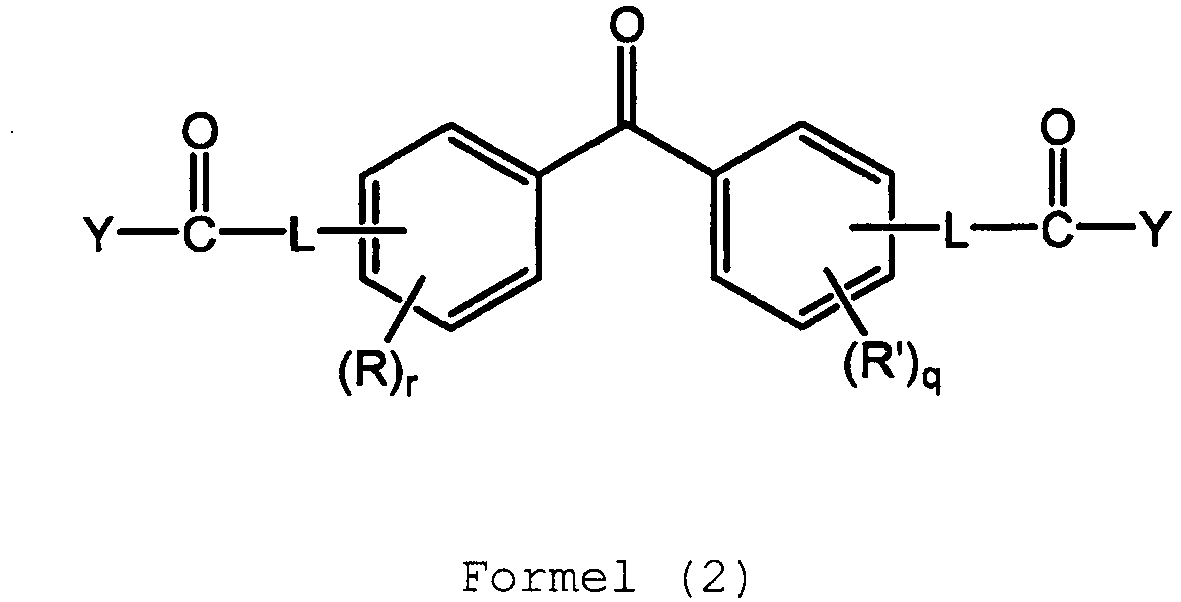

und Y ist Hydroxyl, Alkoxy, Aryloxy, oder Halogen; oder ein Anhydrid davon; und(ii) einem ersten Linkeranteil umfassend eine Vielzahl von funktionellen Gruppen und mit der Struktur von einer der folgenden Formeln (B), (C) und (E)-(I):

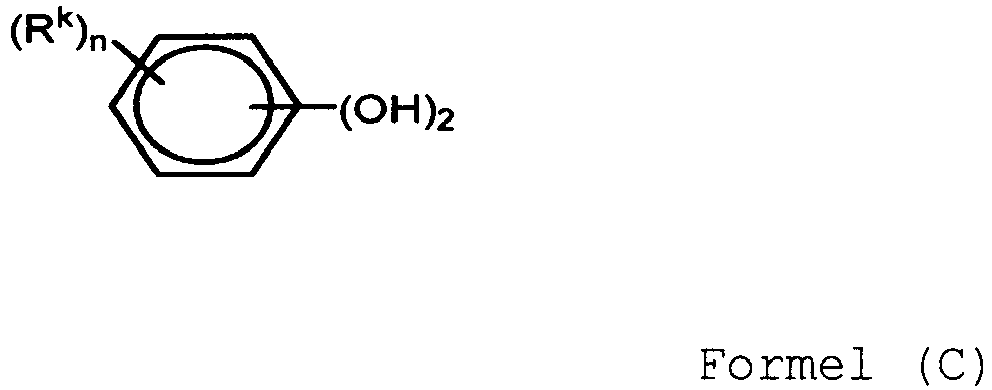


 (iii) einem bifunktionellen Kettenverlängerer, der die Struktur einer der folgenden Formeln hat

- Der Zusatzstoff gemäß Anspruch 1, worin die Reaktion weiter einen endcapping-Wirkstoff umfasst, und worin der endcapping-Wirkstoff Phenol umfasst, worin der endcapping-Wirkstoff vorzugsweise gewählt ist aus der Gruppe bestehend aus p-t-Butylphenol, p-Cumylphenol, Octylphenol und p-Cyanophenol.
- Der Zusatzstoff gemäß irgendeinem der Ansprüche 1-2, worin die Reaktion, die den photoaktiven Zusatzstoff bildet, weiter einen zweiten Linkeranteil umfasst, der mindestens drei funktionelle Gruppen hat, wobei jede davon mit einer funktionellen Gruppe des ersten Linkeranteils reagieren kann.
- Der Zusatzstoff gemäß irgendeinem der Ansprüche 1-3, worin das molare Verhältnis von dem Benzophenon zu dem ersten Linkeranteil von 1:2 bis 1:200 ist.
- Der Zusatzstoff gemäß Anspruch 1, worin der Zusatzstoff aus der Reaktion aus dem Benzophenon der Formel (2) oder Formel (3), dem ersten Linkeranteil, dem bifunktionellen Kettenverlängerer, und einem endcapping-Wirkstoff gebildet wird.
- Eine Zusammensetzung umfassend ein quervernetztes Polycarbonat, wobei das quervernetzte Polycarbonat von dem photoaktiven Zusatzstoff gemäß irgendeinem der Ansprüche 1-5 abgeleitet ist, worin der photoaktive Zusatzstoff ein quervernetzbares Polycarbonatharz ist.
- Die Zusammensetzung gemäß Anspruch 6, worin das quervernetzbare Polycarbonatharz vor dem Quervernetzen von 0,5 Mol% bis 5,0 Mol% von Endcaps abgeleitet von dem Benzophenon der Formel (1) enthält, oder das quervernetzbare Polycarbonatharz enthält von 0,5 Mol% bis 50 Mol% des Benzophenons der Formel (2) oder Formel (3).
- Ein Produkt gebildet aus einer Zusammensetzung gemäß irgendeinem der Ansprüche 1-5.
- Das Produkt gemäß Anspruch 8, worin das Produkt mindestens eines von Folgendem ist: eine Auto-Stoßstange, eine Auto-Außenkomponente, ein Automobilspiegel-Gehäuse, ein Automobil-Kühlergrill, eine Automobil-Säule, eine Automobil-Radabdeckung, ein Automobil-Armaturenbrett oder -Verkleidung, ein Automobil-Handschuhfach, eine Automobiltür-Hardware oder eine andere Innenverkleidung, ein Automobil-Außenlicht, ein Automobilteil innerhalb der Motorverkleidung, ein landwirtschaftliches Traktor- oder ein Vorrichtungs-Teil, ein Baugerätefahrzeug- oder Vorrichtungs-Teil, ein Konstruktions- oder Landwirtschaftsausrüstungs-Kühlergrill, ein Schiffs- oder Personen-Wasserfahrzeugteil, ein Geländefahrzeug oder Geländefahrzeugteil, Sanitärbedarf, ein Ventil oder eine Pumpe, ein Air-Condition-Heiz- oder Kühlteil, ein Ofen- oder Wärmepumpen-Teil, ein Computerteil, ein Computer-Router, ein Desktop-Drucker, ein Großbüro-/Industrie-Drucker, ein Elektronikbauteil, ein Projektorteil, ein elektronischer Displayteil, ein Kopiererteil, ein Scannerteil, eine elektronische Drucker-Tonerkartusche, ein Haartrockner, ein Bügeleisen, eine Kaffeemaschine, ein Toaster, eine Waschmaschine oder ein Waschmaschinenteil, eine Mikrowelle, ein Ofen, ein Elektrowerkzeug, eine elektrische Komponente, ein Elektrogehäuse, ein Beleuchtungsteil, ein Dentalinstrument, ein medizinisches Instrument, ein medizinisches oder Dental-Beleuchtungsteil, ein Luftfahrzeugteil, ein Zug- oder Schienenteil, eine Bestuhlungskomponente, eine Seitenwand, ein Deckenteil, Kochgeschirr, ein Tablett für medizinische Instrumente, ein Tierkäfig, Fasern, eine Laser-verschweißte medizinische Vorrichtung, Glasfasern, eine Linse (Auto und nicht-Auto), ein Mobiltelefonteil, eine Gewächshauskomponente, eine Sonnenkabinenkomponente, ein Feuerhelm, ein Sicherheitsschirm, eine Schutzbrille, ein Tankstellenteil, ein Befeuchter-Gehäuse, ein Thermostatkontroll-Gehäuse, ein Air-Condition-Abflussbecken, ein Außenschrank, eine Telekomanlage oder -Ausrüstung, eine Simple Network Intrusion Detection System (SNIDS) Vorrichtung, eine Netzwerk-Schnittstellenvorrichtung, ein Rauchdetektor, eine Komponente oder Vorrichtung in einem Plenumraum, ein medizinischer Scanner, eine Röntgenausrüstung, eine Konstruktions- oder Landwirtschaftsausrüstung, ein Gehäuse oder ein Teil einer tragbaren elektronischen Vorrichtung, ein Gehäuse oder ein Teil eines Walkie-Talkies, ein Gehäuse oder ein Teil eines Scanners, ein Gehäuse oder ein Teil eines Media/MP3/MP4 Players, ein Radio-Gehäuse oder -Teil, ein Gehäuse oder ein Teil eines GPS-Systems, ein Gehäuse oder ein Teil eines E-books, ein Gehäuse oder ein Teil eines Tablets, eine tragbare elektronische Vorrichtung, eine Smartwatch, eine tragbare Trainings-/Tracking-Vorrichtung, ein tragbares Aktivitäts-/Schlaf-Überwachungssystem, ein tragbares elektronisches Armband, elektronische Brillen, ein Gehäuse oder ein Teil eines tragbaren Werkzeugs, ein Gehäuse oder ein Teil eines Smartphones, und eine Turbinenschaufel.
- Eine Mischung umfassend einen photoaktiven Zusatzstoff gemäß irgendeinem der Ansprüche 1 bis 5 und ein polymeres Basisharz, das sich von dem photoaktiven Zusatzstoff unterscheidet.
- Die Mischung gemäß Anspruch 10, weiter umfassend ein Flammschutzmittel, das Kaliumperfluorbutansulfonat (Rimar Salz), Kaliumdiphenylsulfon-3-sulfonat (KSS), oder eine Kombination daraus ist.
- Eine quervernetzte Schicht gebildet aus der Mischung gemäß irgendeinem der Ansprüche 10-11, die gegenüber UV-Strahlung ausgesetzt wurde, worin der photoaktive Zusatzstoff ein quervernetzbares Polycarbonatharz ist, und worin das Polymerharz nicht der photoaktive Zusatzstoff ist.
- Die Schicht gemäß Anspruch 12, worin die quervernetzte Schicht Ketten aus sowohl dem photoaktiven Zusatzstoff als auch dem Polymerharz enthält.
- Die Schicht gemäß irgendeinem der Ansprüche 12-13, worin das Quervernetzen ausreichend ist, um eine kontinuierliche unlösliche Schicht zu erzeugen, die sowohl den photoaktiven Zusatzstoff als auch das polymere Harz enthält.
- Ein Verfahren zur Verbesserung von mindestens einer Eigenschaft eines Produkts, das aus einem polymeren Basisharz hergestellt wurde, umfassend:Mischen des photoaktiven Zusatzstoffs gemäß irgendeinem der Ansprüche 1-5 mit dem polymeren Basisharz, um eine Mischung zu erzeugen;Bilden des Produkts aus der Mischung; undAussetzen einer Oberfläche des geformten Produkts gegenüber einer wirksamen Dosis von ultravioletter Strahlung, um Quervernetzung auf der Oberfläche des Produkts zu bewirken.
Applications Claiming Priority (3)
| Application Number | Priority Date | Filing Date | Title |
|---|---|---|---|
| US201361781668P | 2013-03-14 | 2013-03-14 | |
| US201361901612P | 2013-11-08 | 2013-11-08 | |
| PCT/US2014/028101 WO2014152881A1 (en) | 2013-03-14 | 2014-03-14 | Photoactive additive with functionalized benzophenone |
Publications (2)
| Publication Number | Publication Date |
|---|---|
| EP2970575A1 EP2970575A1 (de) | 2016-01-20 |
| EP2970575B1 true EP2970575B1 (de) | 2018-04-25 |
Family
ID=50631053
Family Applications (1)
| Application Number | Title | Priority Date | Filing Date |
|---|---|---|---|
| EP14721109.8A Active EP2970575B1 (de) | 2013-03-14 | 2014-03-14 | Photoaktives additiv mit funktionalisiertem benzophenon |
Country Status (3)
| Country | Link |
|---|---|
| US (1) | US9110370B2 (de) |
| EP (1) | EP2970575B1 (de) |
| WO (1) | WO2014152881A1 (de) |
Families Citing this family (11)
| Publication number | Priority date | Publication date | Assignee | Title |
|---|---|---|---|---|
| EP2970655B1 (de) * | 2013-03-15 | 2021-10-27 | SHPP Global Technologies B.V. | Mischungen mit lichtaktiven additiven |
| EP3068441A1 (de) * | 2013-11-15 | 2016-09-21 | SABIC Global Technologies B.V. | Verfahren zur identifizierung von vernetzungsmolekülen für polymere |
| US10066056B2 (en) | 2014-06-19 | 2018-09-04 | Sabic Global Technologies B.V. | Brominated cross-linkable polycarbonate compositions |
| DE202015009117U1 (de) | 2014-06-20 | 2016-10-24 | Google Inc. | Integration von Online-Navigationsdaten mit gecachten Navigationsdaten während der aktiven Navigation |
| EP3157979A1 (de) | 2014-06-20 | 2017-04-26 | SABIC Global Technologies B.V. | Verfahren zum entwurf von vernetzbaren polycarbonaten und daraus geformte artikel |
| US10017622B2 (en) * | 2014-09-17 | 2018-07-10 | Sabic Global Technologies B.V. | Colored cross-linkable polycarbonate compositions |
| WO2017007562A1 (en) | 2015-07-09 | 2017-01-12 | Sabic Global Technologies B. V. | Polycarbonate compositions with improved flame retardance |
| US20210284842A1 (en) * | 2016-08-18 | 2021-09-16 | Sika Technology Ag | Silicone mixtures with improved tear propagation resistance |
| CN108652564B (zh) * | 2018-05-14 | 2022-03-11 | 佛山市顺德区美的洗涤电器制造有限公司 | 洗碗机自动唤醒方法、装置及计算机可读存储介质 |
| EP3730779A1 (de) * | 2019-04-25 | 2020-10-28 | Siemens Gamesa Renewable Energy A/S | Flüssigkeitsförderrohrsystem für windturbinenschaufel |
| WO2021041456A1 (en) * | 2019-08-27 | 2021-03-04 | Phillips 66 Company | Methods and systems of organic semiconducting polymers |
Citations (1)
| Publication number | Priority date | Publication date | Assignee | Title |
|---|---|---|---|---|
| DE2829258A1 (de) * | 1978-07-04 | 1980-01-17 | Bayer Ag | Polycarbonate mit uv-licht-vernetzbaren doppelbindungen enthaltenden endgruppen |
Family Cites Families (44)
| Publication number | Priority date | Publication date | Assignee | Title |
|---|---|---|---|---|
| US3516968A (en) | 1969-03-17 | 1970-06-23 | Sun Oil Co | Polycarbonates from adamantyl bisphenols |
| JPS4999596A (de) | 1973-01-25 | 1974-09-20 | ||
| US3933734A (en) | 1973-12-28 | 1976-01-20 | General Electric Company | Flame retardant polycarbonate composition |
| DE2746141A1 (de) * | 1977-10-13 | 1979-04-19 | Bayer Ag | Aromatische ketogruppen enthaltende thermoplastische polycarbonate und ihre verwendung zur herstellung von modifizierten polycarbonaten |
| DE2746139A1 (de) | 1977-10-13 | 1979-04-19 | Bayer Ag | Polycarbonate mit uv-licht-vernetzbaren doppelbindungen enthaltenden endgruppen |
| DE2829256A1 (de) | 1978-07-04 | 1980-01-17 | Bayer Ag | Polycarbonate mit uv-licht-vernetzbaren doppelbindungen enthaltenden endgruppen |
| DE2842004A1 (de) | 1978-09-27 | 1980-04-10 | Bayer Ag | Verfahren zur herstellung von modifizierten polycarbonat-formmassen |
| DE2930787A1 (de) | 1979-07-28 | 1981-02-12 | Bayer Ag | Vernetzbare polycarbonat-elastomere, ein verfahren zu ihrer herstellung und ihre verwendung fuer medizinische verpackungen nach erfolgter vernetzung |
| US4338171A (en) * | 1980-06-16 | 1982-07-06 | Gulf Oil Corporation | Photopolymerizable compositions |
| US4330663A (en) | 1980-12-31 | 1982-05-18 | General Electric Company | Benzoate ester terminated polyester-carbonate |
| US4749726A (en) | 1982-08-23 | 1988-06-07 | California Institute Of Technology | Internal stabilization of polycarbonate resins by two stage radiation process |
| US4691059A (en) | 1985-08-30 | 1987-09-01 | Minnesota Mining And Manufacturing Company | Copolymerizable UV stabilizers |
| US5034496A (en) | 1987-04-15 | 1991-07-23 | The Dow Chemical Company | Polycarbonate compositions |
| DE3821340A1 (de) | 1988-06-24 | 1989-12-28 | Bayer Ag | Polycarbonate mit mesogenen verbindungen als endgruppen, ihre herstellung und verwendung |
| DE4438543A1 (de) | 1994-10-28 | 1996-05-02 | Bayer Ag | Beschichtete Polycarbonatformkörper |
| JP3409824B2 (ja) | 1995-03-06 | 2003-05-26 | 出光石油化学株式会社 | 耐電離放射線材料及び医療用成形品 |
| GB9507811D0 (en) * | 1995-04-18 | 1995-05-31 | Lambson Fine Chemicals Limited | Novel photoinitiators |
| GB9624146D0 (en) | 1996-11-20 | 1997-01-08 | Dow Europ Sa | Polycarbonates |
| US6224949B1 (en) | 1998-06-11 | 2001-05-01 | 3M Innovative Properties Company | Free radical polymerization method |
| JP4713750B2 (ja) | 2001-02-06 | 2011-06-29 | 帝人株式会社 | 共重合ポリカーボネート、その製造方法および樹脂組成物 |
| US7799855B2 (en) | 2001-11-12 | 2010-09-21 | Sabic Innovative Plastics Ip B.V. | Flame retardant thermoplastic polycarbonate compositions, use and method thereof |
| KR100905358B1 (ko) | 2002-01-23 | 2009-07-01 | 이데미쓰 고산 가부시키가이샤 | 방향족 폴리카보네이트 수지와 그 제조 방법, 광학 부품 성형 재료 및 광학 부품 |
| US6624379B1 (en) | 2002-04-15 | 2003-09-23 | General Motors Corporation | Method and apparatus for welding a metal fastener to a metal member |
| DE10219229A1 (de) | 2002-04-30 | 2003-11-13 | Bayer Ag | Polycarbonate, Polyestercarbonate und Polyester mit speziellen verzweigten Endgruppen |
| CN100408629C (zh) | 2002-07-29 | 2008-08-06 | 拜尔材料科学股份公司 | 阻燃的聚碳酸酯模塑组合物 |
| KR100956048B1 (ko) | 2002-11-14 | 2010-05-06 | 테이진 카세이 가부시키가이샤 | 폴리카보네이트 공중합체, 수지 조성물 및 성형품 |
| US20050049369A1 (en) | 2003-08-12 | 2005-03-03 | General Electric Company | Method for preparing copolyestercarbonates |
| US7875698B2 (en) * | 2004-07-15 | 2011-01-25 | Agfa Graphics Nv | Polymeric initiators |
| US8399546B2 (en) | 2004-08-05 | 2013-03-19 | Sabic Innovative Plastics Ip B.V. | Flame retardant thermoplastic compositions having EMI shielding |
| US7326764B2 (en) | 2005-05-20 | 2008-02-05 | General Electric Company | Transparent compositions, methods for the preparation thereof, and articles derived therefrom |
| US7524919B2 (en) | 2006-09-29 | 2009-04-28 | Sabic Innovative Plastics Ip B.V. | Polycarbonate-polysiloxane copolymers, method of making, and articles formed therefrom |
| US20080114103A1 (en) | 2006-11-13 | 2008-05-15 | General Electric Company | Thermoplastic Polycarbonate Compositions With Improved Static Resistance |
| WO2008084518A1 (ja) | 2007-01-09 | 2008-07-17 | Mitsubishi Engineering-Plastics Corporation | 難燃性芳香族ポリカーボネート樹脂組成物 |
| KR100962389B1 (ko) * | 2008-05-14 | 2010-06-10 | 제일모직주식회사 | 난연성이 우수한 폴리카보네이트 수지 조성물 |
| US8771829B2 (en) | 2008-09-25 | 2014-07-08 | Sabic Innovative Plastics Ip B.V. | Flame retardant thermoplastic polymer composition, method of manufacture, and articles formed therefrom |
| WO2011043484A1 (ja) | 2009-10-07 | 2011-04-14 | 帝人化成株式会社 | 分岐状ポリカーボネート樹脂およびその製造方法 |
| CN103917598A (zh) | 2011-11-08 | 2014-07-09 | 沙特基础创新塑料Ip私人有限责任公司 | 针对阻燃应用提供延展性高热选择的高热聚碳酸酯和硅氧烷共聚碳酸酯共混物 |
| CN104583320B (zh) | 2012-08-30 | 2016-06-22 | 沙特基础全球技术有限公司 | 在具有黑色和白色色彩能力的pc-硅氧烷共聚物共混物中的改善的低温冲击性能 |
| WO2014100711A1 (en) * | 2012-12-20 | 2014-06-26 | Sabic Innovative Plastics Ip B.V. | Blends containing photoactive additives |
| US9303120B2 (en) | 2012-12-20 | 2016-04-05 | Sabic Global Technologies B.V. | Cross-linked polycarbonate resin with improved chemical and flame resistance |
| US9751980B2 (en) | 2013-03-13 | 2017-09-05 | Sabic Global Technologies B.V. | Photoactive additives with photoactive monomers and endcaps |
| EP2970578A1 (de) | 2013-03-15 | 2016-01-20 | SABIC Global Technologies B.V. | Verfahren zur verbesserung der feuerfestigkeit und chemischen beständigkeit von polymeren |
| EP2970576A1 (de) | 2013-03-15 | 2016-01-20 | SABIC Global Technologies B.V. | Fotoaktive additive mit siloxan |
| EP2970655B1 (de) | 2013-03-15 | 2021-10-27 | SHPP Global Technologies B.V. | Mischungen mit lichtaktiven additiven |
-
2014
- 2014-03-14 WO PCT/US2014/028101 patent/WO2014152881A1/en not_active Ceased
- 2014-03-14 EP EP14721109.8A patent/EP2970575B1/de active Active
- 2014-03-14 US US14/211,862 patent/US9110370B2/en active Active
Patent Citations (1)
| Publication number | Priority date | Publication date | Assignee | Title |
|---|---|---|---|---|
| DE2829258A1 (de) * | 1978-07-04 | 1980-01-17 | Bayer Ag | Polycarbonate mit uv-licht-vernetzbaren doppelbindungen enthaltenden endgruppen |
Also Published As
| Publication number | Publication date |
|---|---|
| US9110370B2 (en) | 2015-08-18 |
| EP2970575A1 (de) | 2016-01-20 |
| WO2014152881A1 (en) | 2014-09-25 |
| US20140272691A1 (en) | 2014-09-18 |
Similar Documents
| Publication | Publication Date | Title |
|---|---|---|
| EP2970575B1 (de) | Photoaktives additiv mit funktionalisiertem benzophenon | |
| EP3225645B1 (de) | Photoaktive additive hergestellt unter verwendung von photoaktiven monomeren und mit endfunktionalisierung | |
| US9963545B2 (en) | Processes for enhancing flame retardance and chemical resistance of polymers | |
| US9708447B2 (en) | Blends containing photoactive additive | |
| EP2970655B1 (de) | Mischungen mit lichtaktiven additiven | |
| US9303163B2 (en) | Photoactive additives containing siloxane | |
| US9587078B2 (en) | Processes for enhancing flame retardance and chemical resistance of polymers | |
| WO2015193862A1 (en) | Crosslinkable polycarbonate resins | |
| WO2014100745A1 (en) | Processes for enhancing flame retardance and chemical resistance of polymers | |
| WO2015193865A1 (en) | Processes for designing cross-linkable polycarbonates and articles formed therefrom |
Legal Events
| Date | Code | Title | Description |
|---|---|---|---|
| PUAI | Public reference made under article 153(3) epc to a published international application that has entered the european phase |
Free format text: ORIGINAL CODE: 0009012 |
|
| 17P | Request for examination filed |
Effective date: 20150930 |
|
| AK | Designated contracting states |
Kind code of ref document: A1 Designated state(s): AL AT BE BG CH CY CZ DE DK EE ES FI FR GB GR HR HU IE IS IT LI LT LU LV MC MK MT NL NO PL PT RO RS SE SI SK SM TR |
|
| AX | Request for extension of the european patent |
Extension state: BA ME |
|
| DAX | Request for extension of the european patent (deleted) | ||
| 17Q | First examination report despatched |
Effective date: 20160816 |
|
| STAA | Information on the status of an ep patent application or granted ep patent |
Free format text: STATUS: EXAMINATION IS IN PROGRESS |
|
| GRAP | Despatch of communication of intention to grant a patent |
Free format text: ORIGINAL CODE: EPIDOSNIGR1 |
|
| STAA | Information on the status of an ep patent application or granted ep patent |
Free format text: STATUS: GRANT OF PATENT IS INTENDED |
|
| INTG | Intention to grant announced |
Effective date: 20171016 |
|
| GRAS | Grant fee paid |
Free format text: ORIGINAL CODE: EPIDOSNIGR3 |
|
| GRAA | (expected) grant |
Free format text: ORIGINAL CODE: 0009210 |
|
| STAA | Information on the status of an ep patent application or granted ep patent |
Free format text: STATUS: THE PATENT HAS BEEN GRANTED |
|
| AK | Designated contracting states |
Kind code of ref document: B1 Designated state(s): AL AT BE BG CH CY CZ DE DK EE ES FI FR GB GR HR HU IE IS IT LI LT LU LV MC MK MT NL NO PL PT RO RS SE SI SK SM TR |
|
| REG | Reference to a national code |
Ref country code: GB Ref legal event code: FG4D |
|
| REG | Reference to a national code |
Ref country code: CH Ref legal event code: EP |
|
| RAP4 | Party data changed (patent owner data changed or rights of a patent transferred) |
Owner name: SABIC GLOBAL TECHNOLOGIES B.V. |
|
| REG | Reference to a national code |
Ref country code: AT Ref legal event code: REF Ref document number: 992826 Country of ref document: AT Kind code of ref document: T Effective date: 20180515 |
|
| REG | Reference to a national code |
Ref country code: IE Ref legal event code: FG4D |
|
| REG | Reference to a national code |
Ref country code: DE Ref legal event code: R096 Ref document number: 602014024441 Country of ref document: DE |
|
| REG | Reference to a national code |
Ref country code: NL Ref legal event code: MP Effective date: 20180425 |
|
| REG | Reference to a national code |
Ref country code: LT Ref legal event code: MG4D |
|
| PG25 | Lapsed in a contracting state [announced via postgrant information from national office to epo] |
Ref country code: NL Free format text: LAPSE BECAUSE OF FAILURE TO SUBMIT A TRANSLATION OF THE DESCRIPTION OR TO PAY THE FEE WITHIN THE PRESCRIBED TIME-LIMIT Effective date: 20180425 |
|
| PG25 | Lapsed in a contracting state [announced via postgrant information from national office to epo] |
Ref country code: ES Free format text: LAPSE BECAUSE OF FAILURE TO SUBMIT A TRANSLATION OF THE DESCRIPTION OR TO PAY THE FEE WITHIN THE PRESCRIBED TIME-LIMIT Effective date: 20180425 Ref country code: NO Free format text: LAPSE BECAUSE OF FAILURE TO SUBMIT A TRANSLATION OF THE DESCRIPTION OR TO PAY THE FEE WITHIN THE PRESCRIBED TIME-LIMIT Effective date: 20180725 Ref country code: BG Free format text: LAPSE BECAUSE OF FAILURE TO SUBMIT A TRANSLATION OF THE DESCRIPTION OR TO PAY THE FEE WITHIN THE PRESCRIBED TIME-LIMIT Effective date: 20180725 Ref country code: LT Free format text: LAPSE BECAUSE OF FAILURE TO SUBMIT A TRANSLATION OF THE DESCRIPTION OR TO PAY THE FEE WITHIN THE PRESCRIBED TIME-LIMIT Effective date: 20180425 Ref country code: FI Free format text: LAPSE BECAUSE OF FAILURE TO SUBMIT A TRANSLATION OF THE DESCRIPTION OR TO PAY THE FEE WITHIN THE PRESCRIBED TIME-LIMIT Effective date: 20180425 Ref country code: SE Free format text: LAPSE BECAUSE OF FAILURE TO SUBMIT A TRANSLATION OF THE DESCRIPTION OR TO PAY THE FEE WITHIN THE PRESCRIBED TIME-LIMIT Effective date: 20180425 Ref country code: PL Free format text: LAPSE BECAUSE OF FAILURE TO SUBMIT A TRANSLATION OF THE DESCRIPTION OR TO PAY THE FEE WITHIN THE PRESCRIBED TIME-LIMIT Effective date: 20180425 |
|
| PG25 | Lapsed in a contracting state [announced via postgrant information from national office to epo] |
Ref country code: GR Free format text: LAPSE BECAUSE OF FAILURE TO SUBMIT A TRANSLATION OF THE DESCRIPTION OR TO PAY THE FEE WITHIN THE PRESCRIBED TIME-LIMIT Effective date: 20180726 Ref country code: RS Free format text: LAPSE BECAUSE OF FAILURE TO SUBMIT A TRANSLATION OF THE DESCRIPTION OR TO PAY THE FEE WITHIN THE PRESCRIBED TIME-LIMIT Effective date: 20180425 Ref country code: HR Free format text: LAPSE BECAUSE OF FAILURE TO SUBMIT A TRANSLATION OF THE DESCRIPTION OR TO PAY THE FEE WITHIN THE PRESCRIBED TIME-LIMIT Effective date: 20180425 Ref country code: LV Free format text: LAPSE BECAUSE OF FAILURE TO SUBMIT A TRANSLATION OF THE DESCRIPTION OR TO PAY THE FEE WITHIN THE PRESCRIBED TIME-LIMIT Effective date: 20180425 |
|
| REG | Reference to a national code |
Ref country code: AT Ref legal event code: MK05 Ref document number: 992826 Country of ref document: AT Kind code of ref document: T Effective date: 20180425 |
|
| PG25 | Lapsed in a contracting state [announced via postgrant information from national office to epo] |
Ref country code: PT Free format text: LAPSE BECAUSE OF FAILURE TO SUBMIT A TRANSLATION OF THE DESCRIPTION OR TO PAY THE FEE WITHIN THE PRESCRIBED TIME-LIMIT Effective date: 20180827 |
|
| REG | Reference to a national code |
Ref country code: DE Ref legal event code: R097 Ref document number: 602014024441 Country of ref document: DE |
|
| PG25 | Lapsed in a contracting state [announced via postgrant information from national office to epo] |
Ref country code: RO Free format text: LAPSE BECAUSE OF FAILURE TO SUBMIT A TRANSLATION OF THE DESCRIPTION OR TO PAY THE FEE WITHIN THE PRESCRIBED TIME-LIMIT Effective date: 20180425 Ref country code: CZ Free format text: LAPSE BECAUSE OF FAILURE TO SUBMIT A TRANSLATION OF THE DESCRIPTION OR TO PAY THE FEE WITHIN THE PRESCRIBED TIME-LIMIT Effective date: 20180425 Ref country code: SK Free format text: LAPSE BECAUSE OF FAILURE TO SUBMIT A TRANSLATION OF THE DESCRIPTION OR TO PAY THE FEE WITHIN THE PRESCRIBED TIME-LIMIT Effective date: 20180425 Ref country code: AT Free format text: LAPSE BECAUSE OF FAILURE TO SUBMIT A TRANSLATION OF THE DESCRIPTION OR TO PAY THE FEE WITHIN THE PRESCRIBED TIME-LIMIT Effective date: 20180425 Ref country code: EE Free format text: LAPSE BECAUSE OF FAILURE TO SUBMIT A TRANSLATION OF THE DESCRIPTION OR TO PAY THE FEE WITHIN THE PRESCRIBED TIME-LIMIT Effective date: 20180425 Ref country code: DK Free format text: LAPSE BECAUSE OF FAILURE TO SUBMIT A TRANSLATION OF THE DESCRIPTION OR TO PAY THE FEE WITHIN THE PRESCRIBED TIME-LIMIT Effective date: 20180425 |
|
| PG25 | Lapsed in a contracting state [announced via postgrant information from national office to epo] |
Ref country code: IT Free format text: LAPSE BECAUSE OF FAILURE TO SUBMIT A TRANSLATION OF THE DESCRIPTION OR TO PAY THE FEE WITHIN THE PRESCRIBED TIME-LIMIT Effective date: 20180425 Ref country code: SM Free format text: LAPSE BECAUSE OF FAILURE TO SUBMIT A TRANSLATION OF THE DESCRIPTION OR TO PAY THE FEE WITHIN THE PRESCRIBED TIME-LIMIT Effective date: 20180425 |
|
| PLBE | No opposition filed within time limit |
Free format text: ORIGINAL CODE: 0009261 |
|
| STAA | Information on the status of an ep patent application or granted ep patent |
Free format text: STATUS: NO OPPOSITION FILED WITHIN TIME LIMIT |
|
| 26N | No opposition filed |
Effective date: 20190128 |
|
| PG25 | Lapsed in a contracting state [announced via postgrant information from national office to epo] |
Ref country code: SI Free format text: LAPSE BECAUSE OF FAILURE TO SUBMIT A TRANSLATION OF THE DESCRIPTION OR TO PAY THE FEE WITHIN THE PRESCRIBED TIME-LIMIT Effective date: 20180425 |
|
| PGFP | Annual fee paid to national office [announced via postgrant information from national office to epo] |
Ref country code: FR Payment date: 20190213 Year of fee payment: 6 |
|
| PG25 | Lapsed in a contracting state [announced via postgrant information from national office to epo] |
Ref country code: MC Free format text: LAPSE BECAUSE OF FAILURE TO SUBMIT A TRANSLATION OF THE DESCRIPTION OR TO PAY THE FEE WITHIN THE PRESCRIBED TIME-LIMIT Effective date: 20180425 |
|
| REG | Reference to a national code |
Ref country code: CH Ref legal event code: PL |
|
| GBPC | Gb: european patent ceased through non-payment of renewal fee |
Effective date: 20190314 |
|
| PG25 | Lapsed in a contracting state [announced via postgrant information from national office to epo] |
Ref country code: AL Free format text: LAPSE BECAUSE OF FAILURE TO SUBMIT A TRANSLATION OF THE DESCRIPTION OR TO PAY THE FEE WITHIN THE PRESCRIBED TIME-LIMIT Effective date: 20180425 Ref country code: LU Free format text: LAPSE BECAUSE OF NON-PAYMENT OF DUE FEES Effective date: 20190314 |
|
| REG | Reference to a national code |
Ref country code: BE Ref legal event code: MM Effective date: 20190331 |
|
| PG25 | Lapsed in a contracting state [announced via postgrant information from national office to epo] |
Ref country code: GB Free format text: LAPSE BECAUSE OF NON-PAYMENT OF DUE FEES Effective date: 20190314 Ref country code: IE Free format text: LAPSE BECAUSE OF NON-PAYMENT OF DUE FEES Effective date: 20190314 Ref country code: CH Free format text: LAPSE BECAUSE OF NON-PAYMENT OF DUE FEES Effective date: 20190331 Ref country code: LI Free format text: LAPSE BECAUSE OF NON-PAYMENT OF DUE FEES Effective date: 20190331 |
|
| PG25 | Lapsed in a contracting state [announced via postgrant information from national office to epo] |
Ref country code: BE Free format text: LAPSE BECAUSE OF NON-PAYMENT OF DUE FEES Effective date: 20190331 |
|
| PG25 | Lapsed in a contracting state [announced via postgrant information from national office to epo] |
Ref country code: TR Free format text: LAPSE BECAUSE OF FAILURE TO SUBMIT A TRANSLATION OF THE DESCRIPTION OR TO PAY THE FEE WITHIN THE PRESCRIBED TIME-LIMIT Effective date: 20180425 |
|
| PG25 | Lapsed in a contracting state [announced via postgrant information from national office to epo] |
Ref country code: MT Free format text: LAPSE BECAUSE OF NON-PAYMENT OF DUE FEES Effective date: 20190314 |
|
| PG25 | Lapsed in a contracting state [announced via postgrant information from national office to epo] |
Ref country code: FR Free format text: LAPSE BECAUSE OF NON-PAYMENT OF DUE FEES Effective date: 20200331 |
|
| REG | Reference to a national code |
Ref country code: DE Ref legal event code: R081 Ref document number: 602014024441 Country of ref document: DE Owner name: SHPP GLOBAL TECHNOLOGIES B.V., NL Free format text: FORMER OWNER: SABIC GLOBAL TECHNOLOGIES B.V., BERGEN OP ZOOM, NL |
|
| PG25 | Lapsed in a contracting state [announced via postgrant information from national office to epo] |
Ref country code: CY Free format text: LAPSE BECAUSE OF FAILURE TO SUBMIT A TRANSLATION OF THE DESCRIPTION OR TO PAY THE FEE WITHIN THE PRESCRIBED TIME-LIMIT Effective date: 20180425 |
|
| PG25 | Lapsed in a contracting state [announced via postgrant information from national office to epo] |
Ref country code: IS Free format text: LAPSE BECAUSE OF FAILURE TO SUBMIT A TRANSLATION OF THE DESCRIPTION OR TO PAY THE FEE WITHIN THE PRESCRIBED TIME-LIMIT Effective date: 20180825 |
|
| PG25 | Lapsed in a contracting state [announced via postgrant information from national office to epo] |
Ref country code: HU Free format text: LAPSE BECAUSE OF FAILURE TO SUBMIT A TRANSLATION OF THE DESCRIPTION OR TO PAY THE FEE WITHIN THE PRESCRIBED TIME-LIMIT; INVALID AB INITIO Effective date: 20140314 |
|
| PG25 | Lapsed in a contracting state [announced via postgrant information from national office to epo] |
Ref country code: MK Free format text: LAPSE BECAUSE OF FAILURE TO SUBMIT A TRANSLATION OF THE DESCRIPTION OR TO PAY THE FEE WITHIN THE PRESCRIBED TIME-LIMIT Effective date: 20180425 |
|
| P01 | Opt-out of the competence of the unified patent court (upc) registered |
Effective date: 20230530 |
|
| PGFP | Annual fee paid to national office [announced via postgrant information from national office to epo] |
Ref country code: DE Payment date: 20241231 Year of fee payment: 12 |