EP2969527B1 - Composite structures - Google Patents
Composite structures Download PDFInfo
- Publication number
- EP2969527B1 EP2969527B1 EP14711565.3A EP14711565A EP2969527B1 EP 2969527 B1 EP2969527 B1 EP 2969527B1 EP 14711565 A EP14711565 A EP 14711565A EP 2969527 B1 EP2969527 B1 EP 2969527B1
- Authority
- EP
- European Patent Office
- Prior art keywords
- composite structure
- nonwoven
- layer
- less
- layers
- Prior art date
- Legal status (The legal status is an assumption and is not a legal conclusion. Google has not performed a legal analysis and makes no representation as to the accuracy of the status listed.)
- Active
Links
Images
Classifications
-
- B—PERFORMING OPERATIONS; TRANSPORTING
- B32—LAYERED PRODUCTS
- B32B—LAYERED PRODUCTS, i.e. PRODUCTS BUILT-UP OF STRATA OF FLAT OR NON-FLAT, e.g. CELLULAR OR HONEYCOMB, FORM
- B32B5/00—Layered products characterised by the non- homogeneity or physical structure, i.e. comprising a fibrous, filamentary, particulate or foam layer; Layered products characterised by having a layer differing constitutionally or physically in different parts
- B32B5/22—Layered products characterised by the non- homogeneity or physical structure, i.e. comprising a fibrous, filamentary, particulate or foam layer; Layered products characterised by having a layer differing constitutionally or physically in different parts characterised by the presence of two or more layers which are next to each other and are fibrous, filamentary, formed of particles or foamed
- B32B5/24—Layered products characterised by the non- homogeneity or physical structure, i.e. comprising a fibrous, filamentary, particulate or foam layer; Layered products characterised by having a layer differing constitutionally or physically in different parts characterised by the presence of two or more layers which are next to each other and are fibrous, filamentary, formed of particles or foamed one layer being a fibrous or filamentary layer
- B32B5/26—Layered products characterised by the non- homogeneity or physical structure, i.e. comprising a fibrous, filamentary, particulate or foam layer; Layered products characterised by having a layer differing constitutionally or physically in different parts characterised by the presence of two or more layers which are next to each other and are fibrous, filamentary, formed of particles or foamed one layer being a fibrous or filamentary layer another layer next to it also being fibrous or filamentary
-
- B—PERFORMING OPERATIONS; TRANSPORTING
- B32—LAYERED PRODUCTS
- B32B—LAYERED PRODUCTS, i.e. PRODUCTS BUILT-UP OF STRATA OF FLAT OR NON-FLAT, e.g. CELLULAR OR HONEYCOMB, FORM
- B32B5/00—Layered products characterised by the non- homogeneity or physical structure, i.e. comprising a fibrous, filamentary, particulate or foam layer; Layered products characterised by having a layer differing constitutionally or physically in different parts
- B32B5/02—Layered products characterised by the non- homogeneity or physical structure, i.e. comprising a fibrous, filamentary, particulate or foam layer; Layered products characterised by having a layer differing constitutionally or physically in different parts characterised by structural features of a fibrous or filamentary layer
- B32B5/022—Non-woven fabric
-
- B—PERFORMING OPERATIONS; TRANSPORTING
- B32—LAYERED PRODUCTS
- B32B—LAYERED PRODUCTS, i.e. PRODUCTS BUILT-UP OF STRATA OF FLAT OR NON-FLAT, e.g. CELLULAR OR HONEYCOMB, FORM
- B32B5/00—Layered products characterised by the non- homogeneity or physical structure, i.e. comprising a fibrous, filamentary, particulate or foam layer; Layered products characterised by having a layer differing constitutionally or physically in different parts
- B32B5/02—Layered products characterised by the non- homogeneity or physical structure, i.e. comprising a fibrous, filamentary, particulate or foam layer; Layered products characterised by having a layer differing constitutionally or physically in different parts characterised by structural features of a fibrous or filamentary layer
- B32B5/08—Layered products characterised by the non- homogeneity or physical structure, i.e. comprising a fibrous, filamentary, particulate or foam layer; Layered products characterised by having a layer differing constitutionally or physically in different parts characterised by structural features of a fibrous or filamentary layer the fibres or filaments of a layer being of different substances, e.g. conjugate fibres, mixture of different fibres
-
- B—PERFORMING OPERATIONS; TRANSPORTING
- B32—LAYERED PRODUCTS
- B32B—LAYERED PRODUCTS, i.e. PRODUCTS BUILT-UP OF STRATA OF FLAT OR NON-FLAT, e.g. CELLULAR OR HONEYCOMB, FORM
- B32B5/00—Layered products characterised by the non- homogeneity or physical structure, i.e. comprising a fibrous, filamentary, particulate or foam layer; Layered products characterised by having a layer differing constitutionally or physically in different parts
- B32B5/22—Layered products characterised by the non- homogeneity or physical structure, i.e. comprising a fibrous, filamentary, particulate or foam layer; Layered products characterised by having a layer differing constitutionally or physically in different parts characterised by the presence of two or more layers which are next to each other and are fibrous, filamentary, formed of particles or foamed
- B32B5/24—Layered products characterised by the non- homogeneity or physical structure, i.e. comprising a fibrous, filamentary, particulate or foam layer; Layered products characterised by having a layer differing constitutionally or physically in different parts characterised by the presence of two or more layers which are next to each other and are fibrous, filamentary, formed of particles or foamed one layer being a fibrous or filamentary layer
- B32B5/26—Layered products characterised by the non- homogeneity or physical structure, i.e. comprising a fibrous, filamentary, particulate or foam layer; Layered products characterised by having a layer differing constitutionally or physically in different parts characterised by the presence of two or more layers which are next to each other and are fibrous, filamentary, formed of particles or foamed one layer being a fibrous or filamentary layer another layer next to it also being fibrous or filamentary
- B32B5/265—Layered products characterised by the non- homogeneity or physical structure, i.e. comprising a fibrous, filamentary, particulate or foam layer; Layered products characterised by having a layer differing constitutionally or physically in different parts characterised by the presence of two or more layers which are next to each other and are fibrous, filamentary, formed of particles or foamed one layer being a fibrous or filamentary layer another layer next to it also being fibrous or filamentary characterised by one fibrous or filamentary layer being a non-woven fabric layer
- B32B5/266—Layered products characterised by the non- homogeneity or physical structure, i.e. comprising a fibrous, filamentary, particulate or foam layer; Layered products characterised by having a layer differing constitutionally or physically in different parts characterised by the presence of two or more layers which are next to each other and are fibrous, filamentary, formed of particles or foamed one layer being a fibrous or filamentary layer another layer next to it also being fibrous or filamentary characterised by one fibrous or filamentary layer being a non-woven fabric layer next to one or more non-woven fabric layers
- B32B5/267—Layered products characterised by the non- homogeneity or physical structure, i.e. comprising a fibrous, filamentary, particulate or foam layer; Layered products characterised by having a layer differing constitutionally or physically in different parts characterised by the presence of two or more layers which are next to each other and are fibrous, filamentary, formed of particles or foamed one layer being a fibrous or filamentary layer another layer next to it also being fibrous or filamentary characterised by one fibrous or filamentary layer being a non-woven fabric layer next to one or more non-woven fabric layers characterised by at least one non-woven fabric layer that is a spunbonded fabric
-
- B—PERFORMING OPERATIONS; TRANSPORTING
- B32—LAYERED PRODUCTS
- B32B—LAYERED PRODUCTS, i.e. PRODUCTS BUILT-UP OF STRATA OF FLAT OR NON-FLAT, e.g. CELLULAR OR HONEYCOMB, FORM
- B32B5/00—Layered products characterised by the non- homogeneity or physical structure, i.e. comprising a fibrous, filamentary, particulate or foam layer; Layered products characterised by having a layer differing constitutionally or physically in different parts
- B32B5/22—Layered products characterised by the non- homogeneity or physical structure, i.e. comprising a fibrous, filamentary, particulate or foam layer; Layered products characterised by having a layer differing constitutionally or physically in different parts characterised by the presence of two or more layers which are next to each other and are fibrous, filamentary, formed of particles or foamed
- B32B5/24—Layered products characterised by the non- homogeneity or physical structure, i.e. comprising a fibrous, filamentary, particulate or foam layer; Layered products characterised by having a layer differing constitutionally or physically in different parts characterised by the presence of two or more layers which are next to each other and are fibrous, filamentary, formed of particles or foamed one layer being a fibrous or filamentary layer
- B32B5/26—Layered products characterised by the non- homogeneity or physical structure, i.e. comprising a fibrous, filamentary, particulate or foam layer; Layered products characterised by having a layer differing constitutionally or physically in different parts characterised by the presence of two or more layers which are next to each other and are fibrous, filamentary, formed of particles or foamed one layer being a fibrous or filamentary layer another layer next to it also being fibrous or filamentary
- B32B5/265—Layered products characterised by the non- homogeneity or physical structure, i.e. comprising a fibrous, filamentary, particulate or foam layer; Layered products characterised by having a layer differing constitutionally or physically in different parts characterised by the presence of two or more layers which are next to each other and are fibrous, filamentary, formed of particles or foamed one layer being a fibrous or filamentary layer another layer next to it also being fibrous or filamentary characterised by one fibrous or filamentary layer being a non-woven fabric layer
- B32B5/266—Layered products characterised by the non- homogeneity or physical structure, i.e. comprising a fibrous, filamentary, particulate or foam layer; Layered products characterised by having a layer differing constitutionally or physically in different parts characterised by the presence of two or more layers which are next to each other and are fibrous, filamentary, formed of particles or foamed one layer being a fibrous or filamentary layer another layer next to it also being fibrous or filamentary characterised by one fibrous or filamentary layer being a non-woven fabric layer next to one or more non-woven fabric layers
- B32B5/268—Layered products characterised by the non- homogeneity or physical structure, i.e. comprising a fibrous, filamentary, particulate or foam layer; Layered products characterised by having a layer differing constitutionally or physically in different parts characterised by the presence of two or more layers which are next to each other and are fibrous, filamentary, formed of particles or foamed one layer being a fibrous or filamentary layer another layer next to it also being fibrous or filamentary characterised by one fibrous or filamentary layer being a non-woven fabric layer next to one or more non-woven fabric layers characterised by at least one non-woven fabric layer that is a melt-blown fabric
-
- D—TEXTILES; PAPER
- D04—BRAIDING; LACE-MAKING; KNITTING; TRIMMINGS; NON-WOVEN FABRICS
- D04H—MAKING TEXTILE FABRICS, e.g. FROM FIBRES OR FILAMENTARY MATERIAL; FABRICS MADE BY SUCH PROCESSES OR APPARATUS, e.g. FELTS, NON-WOVEN FABRICS; COTTON-WOOL; WADDING ; NON-WOVEN FABRICS FROM STAPLE FIBRES, FILAMENTS OR YARNS, BONDED WITH AT LEAST ONE WEB-LIKE MATERIAL DURING THEIR CONSOLIDATION
- D04H1/00—Non-woven fabrics formed wholly or mainly of staple fibres or like relatively short fibres
- D04H1/40—Non-woven fabrics formed wholly or mainly of staple fibres or like relatively short fibres from fleeces or layers composed of fibres without existing or potential cohesive properties
- D04H1/413—Non-woven fabrics formed wholly or mainly of staple fibres or like relatively short fibres from fleeces or layers composed of fibres without existing or potential cohesive properties containing granules other than absorbent substances
-
- D—TEXTILES; PAPER
- D04—BRAIDING; LACE-MAKING; KNITTING; TRIMMINGS; NON-WOVEN FABRICS
- D04H—MAKING TEXTILE FABRICS, e.g. FROM FIBRES OR FILAMENTARY MATERIAL; FABRICS MADE BY SUCH PROCESSES OR APPARATUS, e.g. FELTS, NON-WOVEN FABRICS; COTTON-WOOL; WADDING ; NON-WOVEN FABRICS FROM STAPLE FIBRES, FILAMENTS OR YARNS, BONDED WITH AT LEAST ONE WEB-LIKE MATERIAL DURING THEIR CONSOLIDATION
- D04H3/00—Non-woven fabrics formed wholly or mainly of yarns or like filamentary material of substantial length
- D04H3/005—Synthetic yarns or filaments
- D04H3/007—Addition polymers
-
- D—TEXTILES; PAPER
- D04—BRAIDING; LACE-MAKING; KNITTING; TRIMMINGS; NON-WOVEN FABRICS
- D04H—MAKING TEXTILE FABRICS, e.g. FROM FIBRES OR FILAMENTARY MATERIAL; FABRICS MADE BY SUCH PROCESSES OR APPARATUS, e.g. FELTS, NON-WOVEN FABRICS; COTTON-WOOL; WADDING ; NON-WOVEN FABRICS FROM STAPLE FIBRES, FILAMENTS OR YARNS, BONDED WITH AT LEAST ONE WEB-LIKE MATERIAL DURING THEIR CONSOLIDATION
- D04H3/00—Non-woven fabrics formed wholly or mainly of yarns or like filamentary material of substantial length
- D04H3/02—Non-woven fabrics formed wholly or mainly of yarns or like filamentary material of substantial length characterised by the method of forming fleeces or layers, e.g. reorientation of yarns or filaments
- D04H3/03—Non-woven fabrics formed wholly or mainly of yarns or like filamentary material of substantial length characterised by the method of forming fleeces or layers, e.g. reorientation of yarns or filaments at random
- D04H3/033—Non-woven fabrics formed wholly or mainly of yarns or like filamentary material of substantial length characterised by the method of forming fleeces or layers, e.g. reorientation of yarns or filaments at random reorientation immediately after yarn or filament formation
-
- D—TEXTILES; PAPER
- D04—BRAIDING; LACE-MAKING; KNITTING; TRIMMINGS; NON-WOVEN FABRICS
- D04H—MAKING TEXTILE FABRICS, e.g. FROM FIBRES OR FILAMENTARY MATERIAL; FABRICS MADE BY SUCH PROCESSES OR APPARATUS, e.g. FELTS, NON-WOVEN FABRICS; COTTON-WOOL; WADDING ; NON-WOVEN FABRICS FROM STAPLE FIBRES, FILAMENTS OR YARNS, BONDED WITH AT LEAST ONE WEB-LIKE MATERIAL DURING THEIR CONSOLIDATION
- D04H3/00—Non-woven fabrics formed wholly or mainly of yarns or like filamentary material of substantial length
- D04H3/08—Non-woven fabrics formed wholly or mainly of yarns or like filamentary material of substantial length characterised by the method of strengthening or consolidating
- D04H3/14—Non-woven fabrics formed wholly or mainly of yarns or like filamentary material of substantial length characterised by the method of strengthening or consolidating with bonds between thermoplastic yarns or filaments produced by welding
-
- D—TEXTILES; PAPER
- D04—BRAIDING; LACE-MAKING; KNITTING; TRIMMINGS; NON-WOVEN FABRICS
- D04H—MAKING TEXTILE FABRICS, e.g. FROM FIBRES OR FILAMENTARY MATERIAL; FABRICS MADE BY SUCH PROCESSES OR APPARATUS, e.g. FELTS, NON-WOVEN FABRICS; COTTON-WOOL; WADDING ; NON-WOVEN FABRICS FROM STAPLE FIBRES, FILAMENTS OR YARNS, BONDED WITH AT LEAST ONE WEB-LIKE MATERIAL DURING THEIR CONSOLIDATION
- D04H3/00—Non-woven fabrics formed wholly or mainly of yarns or like filamentary material of substantial length
- D04H3/08—Non-woven fabrics formed wholly or mainly of yarns or like filamentary material of substantial length characterised by the method of strengthening or consolidating
- D04H3/16—Non-woven fabrics formed wholly or mainly of yarns or like filamentary material of substantial length characterised by the method of strengthening or consolidating with bonds between thermoplastic filaments produced in association with filament formation, e.g. immediately following extrusion
-
- B—PERFORMING OPERATIONS; TRANSPORTING
- B32—LAYERED PRODUCTS
- B32B—LAYERED PRODUCTS, i.e. PRODUCTS BUILT-UP OF STRATA OF FLAT OR NON-FLAT, e.g. CELLULAR OR HONEYCOMB, FORM
- B32B2250/00—Layers arrangement
- B32B2250/03—3 layers
-
- B—PERFORMING OPERATIONS; TRANSPORTING
- B32—LAYERED PRODUCTS
- B32B—LAYERED PRODUCTS, i.e. PRODUCTS BUILT-UP OF STRATA OF FLAT OR NON-FLAT, e.g. CELLULAR OR HONEYCOMB, FORM
- B32B2250/00—Layers arrangement
- B32B2250/05—5 or more layers
-
- B—PERFORMING OPERATIONS; TRANSPORTING
- B32—LAYERED PRODUCTS
- B32B—LAYERED PRODUCTS, i.e. PRODUCTS BUILT-UP OF STRATA OF FLAT OR NON-FLAT, e.g. CELLULAR OR HONEYCOMB, FORM
- B32B2250/00—Layers arrangement
- B32B2250/20—All layers being fibrous or filamentary
-
- B—PERFORMING OPERATIONS; TRANSPORTING
- B32—LAYERED PRODUCTS
- B32B—LAYERED PRODUCTS, i.e. PRODUCTS BUILT-UP OF STRATA OF FLAT OR NON-FLAT, e.g. CELLULAR OR HONEYCOMB, FORM
- B32B2250/00—Layers arrangement
- B32B2250/24—All layers being polymeric
-
- B—PERFORMING OPERATIONS; TRANSPORTING
- B32—LAYERED PRODUCTS
- B32B—LAYERED PRODUCTS, i.e. PRODUCTS BUILT-UP OF STRATA OF FLAT OR NON-FLAT, e.g. CELLULAR OR HONEYCOMB, FORM
- B32B2250/00—Layers arrangement
- B32B2250/40—Symmetrical or sandwich layers, e.g. ABA, ABCBA, ABCCBA
-
- B—PERFORMING OPERATIONS; TRANSPORTING
- B32—LAYERED PRODUCTS
- B32B—LAYERED PRODUCTS, i.e. PRODUCTS BUILT-UP OF STRATA OF FLAT OR NON-FLAT, e.g. CELLULAR OR HONEYCOMB, FORM
- B32B2262/00—Composition or structural features of fibres which form a fibrous or filamentary layer or are present as additives
- B32B2262/02—Synthetic macromolecular fibres
- B32B2262/0253—Polyolefin fibres
-
- B—PERFORMING OPERATIONS; TRANSPORTING
- B32—LAYERED PRODUCTS
- B32B—LAYERED PRODUCTS, i.e. PRODUCTS BUILT-UP OF STRATA OF FLAT OR NON-FLAT, e.g. CELLULAR OR HONEYCOMB, FORM
- B32B2262/00—Composition or structural features of fibres which form a fibrous or filamentary layer or are present as additives
- B32B2262/02—Synthetic macromolecular fibres
- B32B2262/0261—Polyamide fibres
-
- B—PERFORMING OPERATIONS; TRANSPORTING
- B32—LAYERED PRODUCTS
- B32B—LAYERED PRODUCTS, i.e. PRODUCTS BUILT-UP OF STRATA OF FLAT OR NON-FLAT, e.g. CELLULAR OR HONEYCOMB, FORM
- B32B2262/00—Composition or structural features of fibres which form a fibrous or filamentary layer or are present as additives
- B32B2262/02—Synthetic macromolecular fibres
- B32B2262/0276—Polyester fibres
-
- B—PERFORMING OPERATIONS; TRANSPORTING
- B32—LAYERED PRODUCTS
- B32B—LAYERED PRODUCTS, i.e. PRODUCTS BUILT-UP OF STRATA OF FLAT OR NON-FLAT, e.g. CELLULAR OR HONEYCOMB, FORM
- B32B2264/00—Composition or properties of particles which form a particulate layer or are present as additives
- B32B2264/10—Inorganic particles
-
- B—PERFORMING OPERATIONS; TRANSPORTING
- B32—LAYERED PRODUCTS
- B32B—LAYERED PRODUCTS, i.e. PRODUCTS BUILT-UP OF STRATA OF FLAT OR NON-FLAT, e.g. CELLULAR OR HONEYCOMB, FORM
- B32B2264/00—Composition or properties of particles which form a particulate layer or are present as additives
- B32B2264/10—Inorganic particles
- B32B2264/102—Oxide or hydroxide
-
- B—PERFORMING OPERATIONS; TRANSPORTING
- B32—LAYERED PRODUCTS
- B32B—LAYERED PRODUCTS, i.e. PRODUCTS BUILT-UP OF STRATA OF FLAT OR NON-FLAT, e.g. CELLULAR OR HONEYCOMB, FORM
- B32B2264/00—Composition or properties of particles which form a particulate layer or are present as additives
- B32B2264/10—Inorganic particles
- B32B2264/104—Oxysalt, e.g. carbonate, sulfate, phosphate or nitrate particles
-
- B—PERFORMING OPERATIONS; TRANSPORTING
- B32—LAYERED PRODUCTS
- B32B—LAYERED PRODUCTS, i.e. PRODUCTS BUILT-UP OF STRATA OF FLAT OR NON-FLAT, e.g. CELLULAR OR HONEYCOMB, FORM
- B32B2264/00—Composition or properties of particles which form a particulate layer or are present as additives
- B32B2264/12—Mixture of at least two particles made of different materials
-
- B—PERFORMING OPERATIONS; TRANSPORTING
- B32—LAYERED PRODUCTS
- B32B—LAYERED PRODUCTS, i.e. PRODUCTS BUILT-UP OF STRATA OF FLAT OR NON-FLAT, e.g. CELLULAR OR HONEYCOMB, FORM
- B32B2305/00—Condition, form or state of the layers or laminate
- B32B2305/10—Fibres of continuous length
- B32B2305/20—Fibres of continuous length in the form of a non-woven mat
-
- B—PERFORMING OPERATIONS; TRANSPORTING
- B32—LAYERED PRODUCTS
- B32B—LAYERED PRODUCTS, i.e. PRODUCTS BUILT-UP OF STRATA OF FLAT OR NON-FLAT, e.g. CELLULAR OR HONEYCOMB, FORM
- B32B2307/00—Properties of the layers or laminate
- B32B2307/50—Properties of the layers or laminate having particular mechanical properties
- B32B2307/54—Yield strength; Tensile strength
-
- B—PERFORMING OPERATIONS; TRANSPORTING
- B32—LAYERED PRODUCTS
- B32B—LAYERED PRODUCTS, i.e. PRODUCTS BUILT-UP OF STRATA OF FLAT OR NON-FLAT, e.g. CELLULAR OR HONEYCOMB, FORM
- B32B2307/00—Properties of the layers or laminate
- B32B2307/70—Other properties
- B32B2307/718—Weight, e.g. weight per square meter
-
- B—PERFORMING OPERATIONS; TRANSPORTING
- B32—LAYERED PRODUCTS
- B32B—LAYERED PRODUCTS, i.e. PRODUCTS BUILT-UP OF STRATA OF FLAT OR NON-FLAT, e.g. CELLULAR OR HONEYCOMB, FORM
- B32B2307/00—Properties of the layers or laminate
- B32B2307/70—Other properties
- B32B2307/724—Permeability to gases, adsorption
-
- B—PERFORMING OPERATIONS; TRANSPORTING
- B32—LAYERED PRODUCTS
- B32B—LAYERED PRODUCTS, i.e. PRODUCTS BUILT-UP OF STRATA OF FLAT OR NON-FLAT, e.g. CELLULAR OR HONEYCOMB, FORM
- B32B2307/00—Properties of the layers or laminate
- B32B2307/70—Other properties
- B32B2307/726—Permeability to liquids, absorption
- B32B2307/7265—Non-permeable
-
- B—PERFORMING OPERATIONS; TRANSPORTING
- B32—LAYERED PRODUCTS
- B32B—LAYERED PRODUCTS, i.e. PRODUCTS BUILT-UP OF STRATA OF FLAT OR NON-FLAT, e.g. CELLULAR OR HONEYCOMB, FORM
- B32B2307/00—Properties of the layers or laminate
- B32B2307/70—Other properties
- B32B2307/73—Hydrophobic
-
- B—PERFORMING OPERATIONS; TRANSPORTING
- B32—LAYERED PRODUCTS
- B32B—LAYERED PRODUCTS, i.e. PRODUCTS BUILT-UP OF STRATA OF FLAT OR NON-FLAT, e.g. CELLULAR OR HONEYCOMB, FORM
- B32B2437/00—Clothing
- B32B2437/02—Gloves, shoes
-
- B—PERFORMING OPERATIONS; TRANSPORTING
- B32—LAYERED PRODUCTS
- B32B—LAYERED PRODUCTS, i.e. PRODUCTS BUILT-UP OF STRATA OF FLAT OR NON-FLAT, e.g. CELLULAR OR HONEYCOMB, FORM
- B32B2535/00—Medical equipment, e.g. bandage, prostheses or catheter
-
- B—PERFORMING OPERATIONS; TRANSPORTING
- B32—LAYERED PRODUCTS
- B32B—LAYERED PRODUCTS, i.e. PRODUCTS BUILT-UP OF STRATA OF FLAT OR NON-FLAT, e.g. CELLULAR OR HONEYCOMB, FORM
- B32B2555/00—Personal care
- B32B2555/02—Diapers or napkins
-
- D—TEXTILES; PAPER
- D01—NATURAL OR MAN-MADE THREADS OR FIBRES; SPINNING
- D01D—MECHANICAL METHODS OR APPARATUS IN THE MANUFACTURE OF ARTIFICIAL FILAMENTS, THREADS, FIBRES, BRISTLES OR RIBBONS
- D01D5/00—Formation of filaments, threads, or the like
- D01D5/08—Melt spinning methods
- D01D5/098—Melt spinning methods with simultaneous stretching
- D01D5/0985—Melt spinning methods with simultaneous stretching by means of a flowing gas (e.g. melt-blowing)
-
- D—TEXTILES; PAPER
- D01—NATURAL OR MAN-MADE THREADS OR FIBRES; SPINNING
- D01F—CHEMICAL FEATURES IN THE MANUFACTURE OF ARTIFICIAL FILAMENTS, THREADS, FIBRES, BRISTLES OR RIBBONS; APPARATUS SPECIALLY ADAPTED FOR THE MANUFACTURE OF CARBON FILAMENTS
- D01F1/00—General methods for the manufacture of artificial filaments or the like
- D01F1/02—Addition of substances to the spinning solution or to the melt
- D01F1/10—Other agents for modifying properties
-
- D—TEXTILES; PAPER
- D01—NATURAL OR MAN-MADE THREADS OR FIBRES; SPINNING
- D01F—CHEMICAL FEATURES IN THE MANUFACTURE OF ARTIFICIAL FILAMENTS, THREADS, FIBRES, BRISTLES OR RIBBONS; APPARATUS SPECIALLY ADAPTED FOR THE MANUFACTURE OF CARBON FILAMENTS
- D01F6/00—Monocomponent artificial filaments or the like of synthetic polymers; Manufacture thereof
- D01F6/02—Monocomponent artificial filaments or the like of synthetic polymers; Manufacture thereof from homopolymers obtained by reactions only involving carbon-to-carbon unsaturated bonds
- D01F6/04—Monocomponent artificial filaments or the like of synthetic polymers; Manufacture thereof from homopolymers obtained by reactions only involving carbon-to-carbon unsaturated bonds from polyolefins
- D01F6/06—Monocomponent artificial filaments or the like of synthetic polymers; Manufacture thereof from homopolymers obtained by reactions only involving carbon-to-carbon unsaturated bonds from polyolefins from polypropylene
Definitions
- the present invention is generally directed to a composite structure comprising at least two nonwoven, polymeric layers bonded to each other, to articles and products comprising or formed from said composite structure, and to a process for making said composite structure.
- Polypropylene nonwovens for example, polypropylene (PP) nonwovens are used in many applications. Examples of nonwoven fabric and products thereof can be found in US 2010/184348 A1 , US 2011/151738 A1 , WO 2011/106205 A2 , WO 2010 117612 A2 , WO 00/38914 A1 , WO 2012/054636 A1 and EP 2 749 679 A1 .
- spunmelt nonwovens where spunbond and meltblown nonwovens are made into a composite nonwoven structure.
- the meltblown (M) is an internal layer with the outer layers being the spunbonded (S) nonwoven.
- the M layer provides a barrier layer, but the same fine fibers (ca. 2 microns or less in diameter) that provide a good barrier also give very weak fibers and fabrics.
- the spunbond layers (ca. 15 micron fiber diameter) are included to give the composite fabric sufficient strength to be processed in converting lines as well as function in the intended application.
- SMS (or any variant thereof, like the common SSMMS, SMMMS, SSMMMS, etc. products) is used it is because it provides a certain barrier performance.
- Common examples are medical drapes and gowns (where the medical personnel and patient need a barrier to pathogens), diaper leg cuffs (for sealing in urine), feminine care "wings", and diaper core wrap (to seal in superabsorbent powder).
- the M layer may be regarded as the primary functional layer.
- Spunbond PP nonwovens are often thermally bonded with heated calender rolls containing thousands of raised shapes, whereas the PP is partially melted/deformed through a combination of heat and pressure to give bond points. These bond points anchor multiple fibers to a single location and give the fabric strength. There is an optimum bonding point, which is a combination of temperature, pressure, speed, and embossing shape.
- a nonwoven is underbonded, when a fabric is stressed to breaking (a tensile test) the individual fibers will pull out of a bond point or the bond point will disintegrate and the elongation at break will be relatively high.
- the fibers When a nonwoven is overbonded, the fibers will break at the bonding point since the excessive melting at that point creates a fiber weak point and the elongation at break will be very low. When the optimum bonding conditions are met, the majority of the fiber breakage will occur between bond points. This affords a fabric with the highest tensile strength and the elongation is between the two extremes.
- meltblown fibers are much more sensitive to temperature than spunbond fibers due to the fact that they are attenuated at higher temperatures and do not have the same strength and crystallinity of spunbond fibers. Practically, this means that the meltblown fibers melt or deform at lower temperatures than spunbond. Melting and deformation of the fibers in the meltblown layer also destroys a certain amount of the barrier performance of the layer. Therefore, the bonding conditions used to bond SMS fabrics tend towards underbonding of the S layer so that the barrier performance is maintained.
- US 2010/184348 A1 discloses spunlaid fibres comprising a polymeric resin and a filler, and a method of their manufacture.
- US 2011/151738 A1 , WO 2011/106205 and WO 2010/117612 A2 disclose nonwoven fibrous webs comprising thermoplastic polyester and polypropylene continuous fibres.
- WO 00/38914 A1 discloses a nonwoven fabric with UV stability having a layer of meltblown fibres sandwiched between layers of spunbonded fibres.
- WO 2012/054636 A1 discloses a nonwoven fabric comprising a meltspun fibre of a lignin compound and a method of manufacture of a nonwoven fabric product.
- EP 2 749 679 A1 discloses a nonwoven fabric comprising a polyester and calcium carbonate filler, and a method of its manufacture.
- US 6 797 377 B1 discloses extruded fibres and nonwoven webs made from thermoplastic fibres containing titanium dioxide and a mineral filler such as kaolin or calcium carbonate.
- an article or product formed from or comprising a composite structure according to the first aspect of the present invention for example, a health care, personal care or hygiene article or product.
- the term "composite” means a structure which is made from two or more constituent materials with different physical and/or chemical properties. The individual components remain distinct with the finished structure.
- the composite structure comprises at least two nonwoven, polymeric layers bonded to each other, as further defined in claim 1.
- the at least two nonwoven, polymeric layers will have different physical and/or chemical properties.
- the composite comprises more than two nonwoven, polymeric layers, e.g., three nonwoven, polymeric layers
- at least two of the nonwoven, polymeric layers will have different physical and/or chemical properties.
- two of the nonwoven, polymeric layers may have the same physical and/or chemical properties, or more than two of the nonwoven, polymeric layers may have the same physical and/or chemical properties if the composite comprises at least four nonwoven, polymeric layers.
- nonwoven means a manufactured sheet, web or bat of directionally or randomly oriented fibers, bonded by friction, and/or cohesion and/or adhesion, or by any other suitable means, excluding paper or products which are woven, knitted, tufted stitch bonded incorporating binding yarns or filaments, or felted by wet milling, whether or not additionally needled.
- the fibers may be of natural or man-made origin. They may be staple or continuous or be formed in situ.
- nonwoven used herein means a nonwoven as defined in ISO 9092:2011.
- the inorganic particulate filler is selected from an alkaline earth metal carbonate or sulphate, such as calcium carbonate, magnesium carbonate, dolomite, gypsum, a hydrous kandite clay such as kaolin, halloysite or ball clay, an anhydrous (calcined) kandite clay such as metakaolin or fully calcined kaolin, wollastonite, bauxite, talc, mica, perlite or diatomaceous earth, or magnesium hydroxide, or aluminium trihydrate, or combinations thereof. Any of the aforementioned materials may be coated (or uncoated) or treated (or untreated). The inorganic particulate filler in the invention is coated.
- an alkaline earth metal carbonate or sulphate such as calcium carbonate, magnesium carbonate, dolomite, gypsum, a hydrous kandite clay such as kaolin, halloysite or ball clay, an anhydrous (calcined) kandite clay such as metakaolin
- the filler may be a single filler or may be a blend of fillers.
- the filler may be a blend of two or more of the fillers listed herein.
- certain embodiments of the invention may tend to be discussed in terms of calcium carbonate, and in relation to aspects where the calcium carbonate is processed and/or treated. The invention should not be construed as being limited to such embodiments.
- the inorganic particulate comprises, consists of or consists essentially of coated calcium carbonate.
- the inorganic particulate filler may have a mean particle size (d 50 ) from about 0.1 ⁇ m to about 10 ⁇ m, for example from about 0.1 ⁇ m to about 8 ⁇ m, or from about 0.1 ⁇ m to about 6 ⁇ m, or from about 0.1 ⁇ m to about 4 ⁇ m, or from about 0.1 ⁇ m to about 3 ⁇ m, or from about 0.5 ⁇ m to about 3 ⁇ m, or from about 0.5 ⁇ m to about 2.5 ⁇ m, or from about 0.5 ⁇ m to about 2 ⁇ m.
- d 50 mean particle size from about 0.1 ⁇ m to about 10 ⁇ m, for example from about 0.1 ⁇ m to about 8 ⁇ m, or from about 0.1 ⁇ m to about 6 ⁇ m, or from about 0.1 ⁇ m to about 4 ⁇ m, or from about 0.1 ⁇ m to about 3 ⁇ m, or from about 0.5 ⁇ m to about 3 ⁇ m, or from about 0.5 ⁇ m to about 2.5 ⁇ m,
- the inorganic particulate filler may have a d 98 of about 15 ⁇ m or less, for example, a d 98 of about 10 ⁇ m or less, or less than about 8 ⁇ m, for example about 4 ⁇ m to about 8 ⁇ m, or about 4 ⁇ m to about 5 ⁇ m, or about 5 ⁇ m to about 6 ⁇ m or about 6 ⁇ m to about 8 ⁇ m.
- the inorganic particulate filler may have a d 90 of about 12 ⁇ m or less, for example, a d 90 of about 10 ⁇ m or less, or 8 ⁇ m or less, or about 5 ⁇ m or less, or about 4 ⁇ m or less.
- the inorganic particulate filler may have a d 90 of about 3 ⁇ m to about 5 ⁇ m, or about 3 ⁇ m to about 4 ⁇ m.
- particle size distributions are: d 90 equal to about 4 ⁇ m and d 98 equal to about 8 ⁇ m; d 90 equal to about 3 ⁇ m to about 4 ⁇ m and d 98 equal to about 6 ⁇ m to about 8 ⁇ m; d 90 equal to about 3 ⁇ m to about 4 ⁇ m and d 98 equal to about 4 ⁇ m to about 5 ⁇ m; d 90 equal to about 3 ⁇ m to about 5 ⁇ m and d 98 equal to about 5 ⁇ m to about 8 ⁇ m or about 5 ⁇ m to about 6 ⁇ m.
- the inorganic particulate filler may have a d 50 of from about 0.1 ⁇ m to about 4 ⁇ m, or from about 0.1 ⁇ m to about 3 ⁇ m, or from about 0.5 ⁇ m to about 3 ⁇ m, or from about 0.5 ⁇ m to about 2.5 ⁇ m, or from about 0.5 ⁇ m to about 2 ⁇ m.
- the inorganic particulate filler may be characterized by a "top cut” value.
- the term “top cut” refers to the particle diameter at which 98% of the particles in the sample of filler have a smaller diameter.
- the inorganic particulate filler has a top cut of about 15 ⁇ m or less.
- the top cut is about 10 ⁇ m or less.
- the top cut is about 8 ⁇ m or less.
- the top cut is about 6 ⁇ m or less.
- the top cut is about 4 ⁇ m or less.
- the top cut ranges from about 4 ⁇ m to about 15 ⁇ m.
- the top cut ranges from about 4 ⁇ m to about 12 ⁇ m. In another embodiment, the top cut ranges from about 4 ⁇ m to about 10 ⁇ m. In a further embodiment, the top cut ranges from about 4 ⁇ m to about 8 ⁇ m. In yet another embodiment, the top cut ranges from about 4 ⁇ m to about 6 ⁇ m.
- very low levels of particles above a particular size which may be referred to herein as "coarse material", (or as “hard material"), which are present in fillers, e.g. processed minerals, may be detrimental for a range of applications in which the filler may be used; in particular those where fillers are incorporated into polymer compositions.
- coarse material e.g. processed minerals
- the filler may comprise less than about 3 ppm of particles having a particle size greater than about 38 ⁇ m, or greater than about 30 ⁇ m, or greater than about 25 ⁇ m or greater than about 20 ⁇ m.
- These particles and those particles having a particle size greater than or equal to about 40 ⁇ m may be described herein as “coarse particles” or “coarse material” or as “hard particles” or “hard material”.
- the coarse particle content may range from: less than or equal to about 2 ppm; less than or equal to about 1ppm; less than or equal to about 0.5 ppm; less than or equal to about 0.2 ppm.
- the coarse particle content may range from 0 ppm or about 0 ppm to about 2 ppm, or may range from 0 ppm or about 0 ppm to about 1 ppm, or may range from 0 ppm or about 0 ppm to about 0.5 ppm, or may range from 0 ppm or about 0 ppm to about 0.2 ppm.
- the lower limit of coarse particle content may be about 0.1 ppm.
- the inorganic particulate filler may be suspended in a liquid in which the filler does not aggregate.
- a suitable liquid is isopropyl alcohol, also known as propan-2-ol or simply IPA.
- the suspension is then fed through a suitably sized meshed screen, for example, a meshed screen possessing square holes, or alternatively, fed to a sifter, such as a centrifugal sifter which may be referred to as a rotary sifter.
- the mesh screen may be a fine woven screen or a laser ablated screen.
- the screen residue is left to dry at room temperature and the retained residue removed and weighed. The amount of residue compared to the initial sample weight allows for the characterisation of the amount of coarse particles in ppm.
- the sieved (or sifted) material and the screen residue may be analysed using optical microscopy.
- particle size properties referred to herein for the particulate fillers or materials are as measured in a well known manner by sedimentation of the particulate filler or material in a fully dispersed condition in an aqueous medium using a Sedigraph 5100 machine as supplied by Micromeritics Instruments Corporation, Norcross, Georgia, USA (web-site: www.micromeritics.com ), referred to herein as a "Micromeritics Sedigraph 5100 unit".
- Sedigraph 5100 machine provides measurements and a plot of the cumulative percentage by weight of particles having a size, referred to in the art as the 'equivalent spherical diameter' (e.s.d), less than given e.s.d values.
- the mean particle size d 50 is the value determined in this way of the particle e.s.d at which there are 50% by weight of the particles which have an equivalent spherical diameter less than that d 50 value.
- the d 98 and the d 90 are the values determined in this way of the particle e.s.d. at which there are 98% and 90% respectively by weight of the particles which have an equivalent spherical diameter less than that d 98 or d 90 value.
- the particulate calcium carbonate used in the present invention may be obtained from a natural source by grinding or may be prepared synthetically by precipitation (PCC), or may be a combination of the two, i.e. a mixture of the naturally derived ground material and the synthetic precipitated material.
- the PCC may also be ground.
- Ground calcium carbonate i.e. ground natural calcium carbonate is typically obtained by grinding a mineral source such as chalk, marble or limestone, which may be followed by a particle size classification step, in order to obtain a product having the desired degree of fineness.
- the particulate solid material may be ground autogenously, i.e. by attrition between the particles of the solid material themselves, or alternatively, in the presence of a particulate grinding medium comprising particles of a different material from the calcium carbonate to be ground.
- Wet grinding of calcium carbonate involves the formation of an aqueous suspension of the calcium carbonate which may then be ground, optionally in the presence of a suitable dispersing agent.
- a suitable dispersing agent for example, EP-A-614948 for more information regarding the wet grinding of calcium carbonate.
- the filler When the filler is obtained from naturally occurring sources, it may be that some mineral impurities will inevitably contaminate the ground material. For example, naturally occurring calcium carbonate occurs in association with other minerals. Also, in some circumstances, minor additions of other minerals may be included, for example, one or more of kaolin, calcined kaolin, wollastonite, bauxite, talc or mica, could also be present. In general, however, the filler used in the invention will contain less than 5% by weight, preferably less than 1% by weight of other mineral impurities.
- PCC may be used as the source of particulate calcium carbonate in the present invention, and may be produced by any of the known methods available in the art.
- TAPPI Monograph Series No 30, "Paper Coating Pigments", pages 34-35 describes the three main commercial processes for preparing precipitated calcium carbonate which is suitable for use in preparing products for use in the paper industry, but may also be used in the practice of the present invention. In all three processes, limestone is first calcined to produce quicklime, and the quicklime is then slaked in water to yield calcium hydroxide or milk of lime. In the first process, the milk of lime is directly carbonated with carbon dioxide gas. This process has the advantage that no byproduct is formed, and it is relatively easy to control the properties and purity of the calcium carbonate product.
- the milk of lime is contacted with soda ash to produce, by double decomposition, a precipitate of calcium carbonate and a solution of sodium hydroxide.
- the sodium hydroxide must be substantially completely separated from the calcium carbonate if this process is to be commercially attractive.
- the milk of lime is first contacted with ammonium chloride to give a calcium chloride solution and ammonia gas.
- the calcium chloride solution is then contacted with soda ash to produce, by double decomposition, precipitated calcium carbonate and a solution of sodium chloride.
- the process for making PCC results in very pure calcium carbonate crystals and water.
- the crystals can be produced in a variety of different shapes and sizes, depending on the specific reaction process that is used.
- the three main forms of PCC crystals are aragonite, rhombohedral and scalenohedral, all of which are suitable for use in the present invention, including mixtures thereof.
- the maximum size of the particles is typically less than the thickness of the layer.
- the inorganic particulate filler is coated with one or more fatty acids or salts or esters thereof.
- the calcium carbonate may be coated with a hydrophobising surface treatment agent.
- the calcium carbonate may be coated with one or more aliphatic carboxylic acids having at least 10 chain carbon atoms.
- the calcium carbonate may be coated with one or more fatty acids or salts or esters thereof.
- the fatty acids may be selected from stearic acid, palmitic acid, behenic acid, montanic acid, capric acid, lauric acid, myristic acid, isostearic acid and cerotic acid.
- the coated calcium carbonate may be a stearate coated calcium carbonate.
- the level of coating may be about 0.5 wt% to about 1.5 wt%, for example about 0.8 wt% to about 1.3 wt% based on the dry weight of the inorganic particulate filler.
- the inorganic particulate filler is present in the S layer or each of the S layers in an amount from 3 to 16 % by weight of the S layer.
- the M layer or each of the M layers comprises less inorganic particulate filler than the S layers.
- the inorganic particular filler is present in an amount of from about 4 to about 16 % by weight, or from about 5 to about 15 % by weight, or from about 5 to about 12 % by weight, or from about 5 to about 10 % by weight, or from about 12 to about 16 % by weight, based on the total weight of the nonwoven, polymeric layer.
- the amounts of filler described herein include the weight of the coating.
- the at least one nonwoven, polymeric layer which is meltblown may be substantially free of inorganic particulate filler.
- the nonwoven, polymeric layers of the composite structure each comprise a polymer resin, which consists essentially of polypropylene.
- At least one of the nonwoven, polymer layers may further comprise at least one additive (i.e., an additive other than the inorganic particulate filler).
- the at least one additive may be chosen from additional mineral fillers, for example talc, gypsum, diatomaceous earth, kaolin, attapulgite, bentonite, montmorillonite, and other natural or synthetic clays.
- the at least one additive may be chosen from inorganic compounds, for example silica, alumina, magnesium oxide, zinc oxide, calcium oxide, and barium sulfate.
- the at least one further additive is selected from one or more of the group consisting of: optical brighteners, heat stabilizers, antioxidants, antistatic agents, anti-blocking agents, dyestuffs, pigments, including but not limited to titanium dioxide, luster improving agents, surfactants, natural oils and synthetic oils.
- each of the nonwoven, polymeric layers present in the composite comprises spunlaid fibres, that is, fibres of the polymeric resins described herein which are made by a continuous process in which the fibres are spun and dispersed in a nonwoven web.
- spunlaid processes are spunbonding, producing a sponbonded web of polymeric fibres, or meltblowing, producing a meltblown web of polymeric fibres.
- Spunbonded fibers may be produced by spinning the polymeric resin into the shape of a fibre, for example, by heating the resin at least to its softening temperature, extruding the resin through a spineret to form fibers, and transferring the fibres to a fiber draw unit to be collected in the form of spunlaid webs.
- the polymeric resin is heated to a temperature ranging from about 180 °C to about 240 °C, for example, from about 200 °C to about 220 °C.
- Spunbonded fibers may be produced by any of the known techniques including but not limited to general spun-bonding, flash-spinning, needle-punching, and water-punching processes.
- meltblown fibers may be produced by any of the known techniques.
- meltblown fibers may be produced by extruding the at least one polymer resin and attenuating the streams of resin by hot air to form fibers with a fine diameter and collecting the fibers to form spunlaid webs.
- One example of a meltblown process is generally described in U.S. Patent No. 3,849,241 to Buntin .
- the filler may be incorporated into the polymer resin using conventional methods.
- the filler may be added to the polymer resin during any step prior to extrusion, for example, during or prior to the heating step.
- a "masterbatch" of at least one polymer resin and filler may be premixed, optionally formed into granulates or pellets, and mixed with at least one additional virgin polymer resin before extrusion of the fibers.
- the additional virgin polymer resin may be the same or different from the polymer resin used to make the masterbatch.
- the masterbatch comprises a higher concentration of the particulate filler, for instance, a concentration ranging from about 20 to about 75 wt%, than is desired in the final product, and may be mixed with the polymer resin in an amount suitable to obtain the desired concentration of filler in the final spunlaid fiber product.
- a masterbatch comprising about 50 wt% coated calcium carbonate may be mixed with an equal amount of the virgin polymer resin to produce a final product comprising about 25 wt% coated calcium carbonate.
- the masterbatch may be mixed and pelletized using suitable apparatus.
- a ZSK 30 Twin Extruder may be used to mix and extrude the coated calcium carbonate and polymer resin masterbatch, and a Cumberland pelletizer may be used to optionally form the masterbatch into pellets.
- the filler is coated or treated before incorporation into the polymer resin. In other embodiments, the filler is coated or treated in situ within the polymer resin.
- the mixture may be extruded continuously through at least one spinneret to produce long filaments.
- the extrusion rate may vary according to the desired application. In one embodiment, the extrusion rate ranges from about 0.3 grams per hole per minute (GHM) to about 2.5 GHM. In another embodiment, the extrusion rate ranges from about 0.3 GHM to about 2.0 GHM, for example, from about 0.3 GHM to about 1.5 GHM, or from about 0.3 GHM to about 1.2 GHM, or from about 0.4 GHM to about 0.8 GHM, or from about 0.4 to about 0.6 GHM.
- GHM grams per hole per minute
- the extrusion temperature may also vary depending on the desired application.
- the extrusion temperature may range from about 180 to about 260 °C.
- the extrusion temperature may range from about 220 to about 250 °C.
- the extrusion apparatus may be chosen from those conventionally used in the art, for example, the Reicofil 4 apparatus produced by Reifenhauser.
- the spinneret of the Reicofil 4 for example, contains 6800 holes per metre length approximately 0.6 mm in diameter.
- the filaments may be attenuated.
- Spunbonded fibers for example, may be attenuated by high-speed drafting, in which the filament is drawn out and cooled using a high velocity gas stream, such as air. The gas stream may create a draw force on the fibers that draws them down into a vertical fall zone to the desired level.
- Meltblown fibers may, for example, be attenuated by convergent streams of hot air to form fibers of fine diameter.
- the fibers may be directed onto a foraminous surface, such as a moving screen or wire.
- the fibers may then be randomly deposited on the surface with some fibers laying in a cross direction, so as to form a loosely bonded web or sheet.
- the web is held onto the foraminous surface by means of a vacuum force.
- the web may be characterized by its basis weight, which is the weight of a particular area of the web, expressed in grams per square meter (gsm).
- the basis weight of the web may range from about 1 to about 70 gsm, for example, from about 2 to about 55 gsm, or from about 5 to about 40 gsm, or from about 12 to about 35 gsm, or from about 12 to about 30 gsm, or from about 12 to about 25 gsm, or from about 12 to about 20 gsm.
- the basis weight of any particular nonwoven, polymer layer of the composite structure may range from about 1 to about 70 gsm, for example, from about 5 to about 55 gsm, or from about 10 to about 40 gsm, or from about 12 to about 35 gsm, or from about 12 to about 30 gsm, or from about 12 to about 25 gsm, or from about 12 to about 20 gsm.
- thermal point bonding is a commonly used method and generally involves passing the web of fibers through at least one heated calender roll to form a sheet.
- thermal point bonding may involve two calendar rolls where one roll is embossed and the other smooth. The resulting web may have thermally embossed points corresponding to the embossed points on the roll.
- the resulting sheet may optionally undergo various post-treatment processes, such as direction orientation, creping, hydroentanglement, and/or embossing processes.
- the optionally post-treated sheet may then be used to manufacture various nonwoven products, as described herein. Methods for manufacturing nonwoven products are generally described in the art, for example, in The Nonwovens Handbook, The Association of the Nonwoven Industry (1988 ) and the Encyclopedia of Polymer Science and Engineering, vol 10, John Wiley and Sons (1987 ).
- Spunlaid fibers may have an average diameter ranging from about 0.5 ⁇ m to about 35 ⁇ m or more.
- the spunbonded fibers may have a diameter ranging from about 5 ⁇ m microns to about 35 ⁇ m.
- the spunbonded fibers may have a diameter of about 15 ⁇ m.
- the spunbonded fibers may have a diameter of about 16 ⁇ m.
- the meltblown fibers may have a diameter ranging from about 0.5 ⁇ m to about 30 ⁇ m.
- the meltblown fibers may have a diameter of about 2 ⁇ m to about 7 ⁇ m.
- the meltblown fibers may have a smaller diameter than spunbonded fibers of the same or a similar composition.
- the spunbonded or meltblown fibers may range in size from about 0.1 denier to about 25 denier.
- the fibers may range in size from about 0.1 denier to about 20 denier.
- the fibers may range in size from about 1 to about 15 denier.
- the fibers may range in size from about 1 to about 10 denier.
- the fibers may range in size from about 1 to about 5 denier.
- the fibers may be about 0.1, or about 0.5, or about 1, or about 2, or about 3, or about 4, or about 5, or about 6, or about 7, or about 8 or about 9, or about 10 denier in size.
- the composite structure comprises at least two nonwoven, polymeric layers bonded to each other, wherein at least one of the nonwoven, polymeric layers is spunbonded (S), and at least one of the nonwoven, polymeric layers is meltbown (M), further wherein the S layer or each of the S layers comprise inorganic particulate filler in an amount from 3 to 16 % by weight of the S layer and the M layer or each of the M layers comprises less inorganic particulate filler than the S layers.
- S spunbonded
- M meltbown
- the composite structure comprises at least three nonwoven, polymeric layers bonded to each other, for example, at least four nonwoven, polymeric layers bonded to each other, or at least five nonwoven, polymeric layers bonded to each other, or at least six nonwoven, polymeric layers bonded to each other, or at least seven nonwoven, polymeric layers bonded to each other, or at least eight nonwoven, polymeric layers bonded to each other, or at least nine nonwoven, polymeric layers bonded to each other, or at least ten nonwoven, polymeric layers bonded to each other, or at least twelve nonwoven, polymeric layers bonded to each other.
- the composite structure comprises other materials, for example, further layers of material, other than the nonwoven, polymeric layers described herein.
- the composite structure comprises at least two, for example, at least three, nonwoven, polymeric layers bonded to each other and at least one of the nonwoven, polymeric layers is spunbonded (hereinafter referred to as an "S" layer), and at least one of the nonwoven, polymeric layers is meltblown (hereinafter referred to as an "M" layer).
- the S layer or each of the S layers comprise inorganic particulate filler in an amount from about 3 to about 16 % by weight, or from about 4 to about 15 % by weight.
- the M layer or each of the M layers are substantially free of inorganic particulate filler.
- the M layer or each of the M layers comprise less inorganic particulate filler than the S layers.
- an outermost layer of the structure is an S layer.
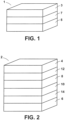
- a schematic depiction of a three layered composite is depicted in Figure 1 .
- the outermost layers (3, 5) of the composite (1) are S layers and the central layer, or sandwiched layer is an M layer (7).
- the thickness of each layer is greatly exaggerated. This can be described as a S-M-S layered structure.
- the thickness (i.e., the dimension perpendicular to the plane of the layers) of the composite structure is typically between about 100 ⁇ m and 2 mm, for example, less than about 1.5 mm, or less than about 1.0 mm, or less than about 800 ⁇ m, or less than about 600 ⁇ m, or less than about 500 ⁇ m, or less than about 400 ⁇ m, or less than about 300 ⁇ m, or less than about 200 ⁇ m.
- the composite structure has a S-M-S layered structure, or an S-M-M-S layered structure, or a S-M-M-M-S layered structure, or a S-M-M-M-S layered structure.
- the S layer or each of the S layers may comprise inorganic particulate filler in an amount of from about 4 to about 15 % by weight.
- Each S layer may comprise the same or different amount of inorganic particulate filler.
- one, or two, or three, or all, of the M layers are substantially free of inorganic particulate filler.
- the M layer or each of the M layers comprise less inorganic particulate filler than the S layers.
- the composite structure has a S-S-M-S layered structure, or a S-S-M-S-S layered structure, or a S-S-M-M-S layered structure, or a S-S-M-M-S-S layered structure, or a S-S-M-M-M-S layered structure, or a S-S-M-M-M-S layered structure, or a S-S-M-M-M-M-S-S layered structure.
- the S layer or each of the S layers may comprise inorganic particulate filler in an amount of from about 4 to about 15 % by weight. Each S layer may comprise the same or different amount of inorganic particulate filler. Optionally, one, or two, or three, or four, or all, of the M layers are substantially free of inorganic particulate filler. The M layer or each of the M layers comprise less inorganic particulate filler than the S layers.
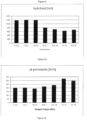
- a schematic depiction of a six layered, S-S-M-M-S-S, composite is depicted in Figure 2 .
- the outermost layers (4, 6) of the composite (2) are S layers and the central layers, or sandwiched layers, are both M layers (8,10). There is a further S layers (12, 14) between each central M layer (8, 10) and outermost S layer (4,6).
- the thickness of each layer is greatly exaggerated.
- the composite structure has a basis weight of from about 10 to about 200 gsm, for example, from about 10 to about 150 gsm, or from about 10 to about 100 gsm, or from about 10 to about 80 gsm, or from about 10 to about 70 gsm, or from about 10 to about 60 gsm, or from about 15 to about 60 gsm, or from about 20 to about 60 gsm, or from about 25 to about 60 gsm, or from about 30 to about 60 gsm, or from about 30 to about 40 gsm, or from about 40 to about 50 gsm, or from about 50 to about 60 gsm.
- the primary function of the M layer is to provide a barrier, for example, to the passage of liquids, such as water and urine, or to the passage of pathogens, or to seal in superabsorbent powders.
- the primary function of the S layer(s) is to give the composite enough strength to be processed in converting lines and to function in the intended application.
- the present inventor has surprisingly found that the incorporation of inorganic particulate filler in the composite structure, for example, in the S layer, enables the strength of the composite to be increased, but without adversely effecting M layer barrier performance. This is especially important in the medical/health care applications in which the strength of the medical product, for example, drape or gown, is directly correlated to the safety of the medical staff or patient. Whilst not wishing to be bound by theory, it is seems that the higher thermal conductivity of the inorganic particulate filler relative to the virgin polymeric resin, e.g., polypropylene, enables a lower optimum bonding temperature which, in turn, allows bonding to occur at temperatures below the normal M degradation temperatures.
- the virgin polymeric resin e.g., polypropylene
- the composite structure is characterised by having one or more of the physical or mechanical properties, determined at a basis weight of 34 gsm, and in accordance with the following test methods: Hydrostatic head (HSH), according to AATCC 127, is the height of a column of water (in mm) needed to cause the composite to leak.
- HSH Hydrostatic head
- Air permeability (l/m 2 s) is determined in accordance with ASTM D-737.
- CD Cross machine direction
- MD machine direction
- the composite structure has:
- the composite structure may be characterised as having a combination of HSH and one or more of air permeability, MD tensile strength, CD tensile strength, MD elongation and CD elongation.
- the composite structure has a HSH of from about 400 mm to about 1000 mm, and an air permeability of at least about 400 l/m 2 s, for example, from about 400 to about 900 l/m 2 s.
- the composite structure may have a HSH of 400 mm to about 1000 mm, and a MD tensile strength of at least 95.0 N/5 cm, or at least about 100.0 N/5 cm.
- the composite structure may have a HSH of 400 mm to about 1000 mm, and a CD tensile strength at least 35.0 N/5 cm, or at least about 40.0 N/5 cm. Additionally or alternatively, the composite structure may have a HSH of 400 mm to about 1000 mm, and a MD elongation of at least about 55 %, for example, at least about 60 %. Additionally or alternatively, the composite structure may have a HSH of 400 mm to about 1000 mm, and a CD elongation of at least about 55 %, for example, at least about 60 %.
- the composite structure may be characterised in terms of the ratio of HSH to one of air permeability, MD tensile strength, CD tensile strength, MD elongation and CD elongation, determined at a basis weight of 34 gsm and in accordance with the test methods described above.
- the composite structure has a ratio of HSH (in mm)/MD tensile strength (in N/5 cm) which is less than a ratio of HSH (in mm)/MD tensile strength (in N/5 cm) of a comparable composite structure in which none of the S and M layers comprise inorganic particulate filler.
- the composite structure has a ratio of HSH/MD tensile strength of less than about 10.0, for example, less than about 9.0, or less than about 8.0, or less than about 7.0, or less than about 6.5. or less than about 6.0, or less than about 5.5, or less than about 5.0.
- the composite structure has a ratio of HSH (in mm)/CD tensile strength (in N/5 cm) which is less than a ratio of HSH (in mm)/CD tensile strength (in N/5 cm) of a comparable composite structure in which none of the S and M layers comprise inorganic particulate filler.
- the composite structure has a ratio of HSH/MD tensile strength of less than about 20.0, for example, less than about 18.0, or less than about 17.0, or less than about 16.0, or less than about 15.0 or less than about 14.0, or less than about 13.0, or less than about 12.0. or less than about 11.0, or less than about 10.5.
- the composite structure has a ratio of HSH (in mm)/MD elongation (in %) which is less than a ratio of HSH (in mm)/MD elongation (in %) of a comparable composite structure in which none of the S and M layers comprise inorganic particulate filler.
- the composite structure has a ratio of HSH/MD elongation of less than about 12.0, for example, less than about 10.0, or less than about 8.0, or less than about 6.0, or less than about 5.5.
- the composite structure has a ratio of HSH (in mm)/CD elongation (in %) which is less than a ratio of HSH (in mm)/CD elongation (in %) of a comparable composite structure in which none of the S and M layers comprise inorganic particulate filler.
- the composite structure has a ratio of HSH/CD elongation of less than about 12.0, for example, less than about 11.5, or less than about 11.0, or less than about 10.0, or less than about 8.0, or less than about 6.0, or less than about 5.5.
- the composite structures of the present invention may be prepared by a process as defined in claim 12.
- the process comprises preparing or obtaining the at least one nonwoven, polymer layer which is spunbonded, and preparing or obtaining the at least one nonwoven, polymeric layer which is meltblown, and bonding together the at least one spunbonded layer and the at least one meltblown layer to form the composite structure as further defined in claim 1.
- the spunbonded and metlblown polymeric layers may be prepared in accordance with the methods described herein.
- the relative amounts of polymeric resin and inorganic additive will be selected in suitable amounts to obtain the desired composite structure.
- a masterbatch comprising polymer resin and inorganic particulate filler may be prepared first, which is combined with further virgin polymer resin and any other optional additives, and then spunlaid according to the methods described herein.
- the at least two nonwoven, polymeric layers are bonded together using any suitable means.
- bonding is effected by stacking and pressing the nonwoven layers together under the application of heat.
- inorganic particulate filler in at least one of the nonwoven polymeric layers enables the bonding process to be conducted at a temperature which is lower compared to that required to bond conventional nonwoven composites, i.e., composite in which none of the layers comprise inorganic particulate filler as described herein.
- the bonding process comprises bonding at a first maximum bonding temperature which is lower than a second maximum bonding temperature for a bonding process suitable for bonding together a comparable composite structure in which none of the nonwoven, polymeric layers comprise inorganic particulate filler as described herein.
- the second maximum bonding temperature i.e., convention bonding temperature
- the second maximum bonding temperature may be between 150.0 °C and 155°C.
- the bonding process comprises bonding at a maximum temperature of less than 150.0 °C, for example, equal to or less than about 149.5 °C, or equal or less than about 149.0 °C or equal or less than about 148.5 °C, or equal to or less than about 148.0 °C, or equal to or less than about 147.5 °C, or equal to or less than about 147.0 °C, or equal to or less than about 146.5 °C, or equal to or less than about 146.0 °C, or equal to or less than about 145.5 °C, or equal to or less than about 145.0 °C.
- the bonding process is conducted at a maximum temperature of from about 145.0 °C to less than 150.0 °C, for example, from about 145.0 °C to about 149.5°C, or from about 145.0°C to about 149.0 °C, or from about 145.0 °C to about 148.5 °C, or from about 145.0 °C to about 148.0 °C. Whilst a reduction in maximum bonding temperature of 2-5°C may seem trivial, in practice this is a significant advantage, not only for the strength properties of the composite, as described above, but also in reducing cost because less energy is required to bond the composite.
- the bonding process comprises bonding at a maximum temperature of from about 135 °C to about 165 °C, for example, from about 135 °C to about 160 °C, or from about 135 °C to about 155 °C, or from about 135 °C to about 150 °C, or from about 140 °C to about 155 °C, or from about 140 °C to about 150 °C, or from about 145 °C to about 155 °C, or from about 135 °C to about 145 °C.
- Pressing may be carried out between rollers.
- the temperature is applied by having the rollers in an oven, or the rollers may be heated.
- the rollers may be calendaring rollers and/or embossing rollers.
- bonding may involve two calendar rolls where one roll is embossed and the other smooth.
- the resulting composite may have thermally embossed points corresponding to the embossed points on the roll.
- the process further comprises (i) incorporating the composite structure in an article or product, as described below or (ii) forming an article or product from the composite structure.
- the article or product is a health care, personal care or hygiene article or product.
- the composite structure may find utility in many fields of endeavour, including, for example, agriculture and landscaping, household and home furnishings, industrial/military, automotive, leisure travel, health care, personal care and hygiene, clothing, construction/civil engineering, geotextiles and office.
- the composite structure may be comprised in products and articles of manufacture, including: Health care products and articles: surgical caps and masks; shoe covers; sponges; dressings; wipes; orthopaedic padding; bandages; tapes; cuffs; dental bibs; medical drapes; wraps; packs; sterile packaging; medical gowns, including patient gowns, examination gowns, surgical gowns and contamination control gowns; bed linen; and underpads.
- Health care products and articles surgical caps and masks; shoe covers; sponges; dressings; wipes; orthopaedic padding; bandages; tapes; cuffs; dental bibs; medical drapes; wraps; packs; sterile packaging; medical gowns, including patient gowns, examination gowns, surgical gowns and contamination control gowns; bed linen; and underpads.
- Personal care and hygiene products and articles diapers; feminine hygiene products, including sanitary napkins, towels and tampons; training pants; adult incontinence products; dry and wet wipes; cosmetic applicators/removers; lens tissue; and hand warmers.
- Household and home furnishings products and articles vacuum cleaner bags; tea/coffee bags; buff pads; aprons; souring pads; fabric softener sheets; dust cloths; mop heads; trash or rubbish bags; placemats; napkins; ironing board covers/pads; washcloths; table cloths; furniture construction sheeting; cushion ticking; dust covers; decking; skirt linings; pull strips; quilt backing; blankets; pillows and pillow cases; flanging; spring wrap; wallcovering backings; acoustical wallcoverings; upholstery backings; window treatment; drapery components; carpet backings and carpets; and mattress pad components.
- Agriculture and landscaping products and articles crop covers; turf protection products; nursery overwintering; weed control fabrics; root bags; containers; and capillary matting.
- Industrial/military products and articles coated fabrics; filters; semiconductor polishing pads; wipers; clean room apparel; air-conditioning filters; military clothing; abrasives; cable insulation; reinforced plastics; tapes; protective clothing, including lab coats; sorbetns; lubricating pads; flame barriers; packaging; conveyor belts; display felts, papermaker felts, and noise absorbent felt.
- Automotive products and articles trunk applications; floor covers; side, front and back liner; wheelhouse covers; rear shelf trim panel covers; seat applications; listings; cover slip sheets; foam reinforcements; transmission oil filters; door trim panel carpets; door trim panel padding; vinyl, landau cover backings; molded headliner substrates; hood silence pads; and dash insulators.
- Clothing products and articles interlinings; clothing and glove insulation; bra and shoulder padding; handbag components; and shoe components.
- Geotextile products and articles asphalt overlay; road and railroad beds; lining for dam and stream embankments; tennis courts; artificial turfs; and pond liners.
- Construction/civil engineering articles and products roofing and tile underlay; acoustical ceilings; insulation; house wrap; and pipe wrap.
- Office products and articles book covers; mailing envelopes; labels; maps; signs; pennants; disk liners; and pen nibs.
- a ground calcium carbonate (GCC) coated with stearic acid and possessing a d 50 of about 1.35 ⁇ m was compounded with polypropylene resin to obtain a masterbatch.
- the masterbatches were combined with further polypropylene resin and spunbond (S) and meltblown (M) nonwoven sheets were prepared. Sheets comprised either 0 % filler, 5 % filler, or 10 % filler. Note that the '7%' and '14%' filler levels specified in Tables 2 and 3 below are the amount of filler used in the masterbatch used to prepare each S or M layer. Processing conditions of the S and M process that were kept constant are summarized in Table 1 below. Table 1.
Landscapes
- Engineering & Computer Science (AREA)
- Textile Engineering (AREA)
- Laminated Bodies (AREA)
- Nonwoven Fabrics (AREA)
- Manufacturing Of Multi-Layer Textile Fabrics (AREA)
Applications Claiming Priority (2)
| Application Number | Priority Date | Filing Date | Title |
|---|---|---|---|
| US201361784836P | 2013-03-14 | 2013-03-14 | |
| PCT/GB2014/050727 WO2014140563A2 (en) | 2013-03-14 | 2014-03-12 | Composite structures |
Publications (2)
| Publication Number | Publication Date |
|---|---|
| EP2969527A2 EP2969527A2 (en) | 2016-01-20 |
| EP2969527B1 true EP2969527B1 (en) | 2024-12-04 |
Family
ID=50342342
Family Applications (1)
| Application Number | Title | Priority Date | Filing Date |
|---|---|---|---|
| EP14711565.3A Active EP2969527B1 (en) | 2013-03-14 | 2014-03-12 | Composite structures |
Country Status (6)
| Country | Link |
|---|---|
| US (1) | US11718065B2 (enExample) |
| EP (1) | EP2969527B1 (enExample) |
| JP (2) | JP2016516910A (enExample) |
| CN (1) | CN105431285B (enExample) |
| BR (1) | BR112015022667B1 (enExample) |
| WO (1) | WO2014140563A2 (enExample) |
Families Citing this family (9)
| Publication number | Priority date | Publication date | Assignee | Title |
|---|---|---|---|---|
| CN106042535A (zh) * | 2016-03-28 | 2016-10-26 | 山东俊富无纺布有限公司 | 一种用于建筑墙体的保温复合材料及其制备方法 |
| CN107474366A (zh) * | 2017-03-20 | 2017-12-15 | 浙江麦普拉新材料有限公司 | 一种医用牙科垫基膜的制备方法 |
| EP3694459B1 (en) | 2017-10-13 | 2025-01-22 | The Procter & Gamble Company | Absorbent articles comprising nonwoven materials having improved thermal conductivity |
| USD868577S1 (en) * | 2018-08-20 | 2019-12-03 | Rai Strategic Holdings, Inc. | Vapor product packaging |
| CN109662834B (zh) * | 2019-01-28 | 2022-04-12 | 董艳 | 一种婴幼儿用滞留针固定胶贴及其制备方法 |
| CN109762485B (zh) * | 2019-01-28 | 2021-10-26 | 董艳 | 一种低敏医用胶布及其制备方法 |
| JP7627927B2 (ja) * | 2020-09-29 | 2025-02-07 | 関西電子株式会社 | 粒子分散長繊維交絡集合体の製造方法 |
| US11628597B2 (en) * | 2020-12-07 | 2023-04-18 | Bmic Llc | Continuous mixing for highly viscous materials |
| CA3265583A1 (en) * | 2022-08-22 | 2024-02-29 | Berry Global, Inc. | SMALL CALCIUM CARBONATE PARTICLES IN NONWOVEN FABRICS AND FILMS |
Citations (1)
| Publication number | Priority date | Publication date | Assignee | Title |
|---|---|---|---|---|
| US6797377B1 (en) * | 1998-06-30 | 2004-09-28 | Kimberly-Clark Worldwide, Inc. | Cloth-like nonwoven webs made from thermoplastic polymers |
Family Cites Families (26)
| Publication number | Priority date | Publication date | Assignee | Title |
|---|---|---|---|---|
| US3849241A (en) | 1968-12-23 | 1974-11-19 | Exxon Research Engineering Co | Non-woven mats by melt blowing |
| DE2048006B2 (de) | 1969-10-01 | 1980-10-30 | Asahi Kasei Kogyo K.K., Osaka (Japan) | Verfahren und Vorrichtung zur Herstellung einer breiten Vliesbahn |
| DE1950669C3 (de) | 1969-10-08 | 1982-05-13 | Metallgesellschaft Ag, 6000 Frankfurt | Verfahren zur Vliesherstellung |
| US4340563A (en) | 1980-05-05 | 1982-07-20 | Kimberly-Clark Corporation | Method for forming nonwoven webs |
| GB2275876B (en) | 1993-03-12 | 1996-07-17 | Ecc Int Ltd | Grinding alkaline earth metal pigments |
| JPH10280267A (ja) | 1997-04-08 | 1998-10-20 | Mitsui Chem Inc | 柔軟性スパンボンド不織布 |
| US6524981B1 (en) | 1998-12-24 | 2003-02-25 | Bba Nonwovens Simpsonville, Inc. | UV stabilized outdoor cover with barrier properties |
| JP2001040564A (ja) | 1999-07-23 | 2001-02-13 | Mitsui Chemicals Inc | 柔軟性不織布及びその不織布積層体 |
| JP2001288371A (ja) | 2000-04-07 | 2001-10-16 | Ishizuka Glass Co Ltd | 無機フィラーを含有する抗菌性樹脂材及びその製造方法 |
| JP2002028408A (ja) | 2000-07-18 | 2002-01-29 | Kyosan Denki Co Ltd | 濾過器 |
| JP4245970B2 (ja) | 2002-04-26 | 2009-04-02 | 旭化成せんい株式会社 | 耐水性不織布 |
| MY144778A (en) * | 2006-05-31 | 2011-11-15 | Mitsui Chemicals Inc | Nonwoven fabric laminate and production thereof |
| DE102006044496A1 (de) | 2006-09-21 | 2008-04-17 | Fiberweb Corovin Gmbh | Leichtgewichtiges Spinnvlies mit besonderen mechanischen Eigenschaften |
| US20100184348A1 (en) * | 2006-12-20 | 2010-07-22 | Imerys Pigments, Inc. | Spunlaid Fibers Comprising Coated Calcium Carbonate, Processes For Their Production, and Nonwoven Products |
| ATE525182T1 (de) * | 2007-06-03 | 2011-10-15 | Imerys Pigments Inc | Gesponnene fasern mit beschichtetem kalziumkarbonat, verfahren zu ihrer herstellung und vliesprodukte |
| CN101358410B (zh) * | 2007-07-31 | 2011-05-11 | 东丽高新聚化(南通)有限公司 | 医疗用聚丙烯多层无纺布的制造方法 |
| WO2010117612A2 (en) | 2009-03-31 | 2010-10-14 | 3M Innovative Properties Company | Dimensionally stable nonwoven fibrous webs and methods of making and using the same |
| JP2010234285A (ja) * | 2009-03-31 | 2010-10-21 | Toray Ind Inc | エアフイルター用濾材 |
| JP5486243B2 (ja) * | 2009-08-31 | 2014-05-07 | 旭化成せんい株式会社 | ポリオレフィン系捲縮長繊維不織布及び不織布積層体 |
| JP3157310U (ja) | 2009-11-24 | 2010-02-12 | 山宗実業株式会社 | 抗菌性衣料 |
| JP5866295B2 (ja) | 2009-12-17 | 2016-02-17 | スリーエム イノベイティブ プロパティズ カンパニー | 寸法安定性不織布繊維ウェブ、並びにこれらの製造及び使用方法 |
| WO2011075619A1 (en) * | 2009-12-17 | 2011-06-23 | 3M Innovative Properties Company | Dimensionally stable nonwoven fibrous webs, melt blown fine fibers, and methods of making and using the same |
| US8932704B2 (en) | 2010-02-23 | 2015-01-13 | 3M Innovative Properties Company | Dimensionally stable nonwoven fibrous webs and methods of making and using the same |
| WO2012054636A1 (en) | 2010-10-20 | 2012-04-26 | Fiberweb Corovin Gmbh | A nonwoven fabric, a laminated fabric, a nonwoven fabric product, a multicomponent fibre, a web, and a method of producing the nonwoven fabric |
| US20140018758A1 (en) * | 2012-07-13 | 2014-01-16 | The Procter & Gamble Company | Stretchable laminates for absorbent articles and methods for making the same |
| DK2749679T3 (da) | 2012-12-28 | 2017-06-19 | Omya Int Ag | CaCO3 i polyester til ikke-vævet stof og fibre |
-
2014
- 2014-03-12 US US14/774,947 patent/US11718065B2/en active Active
- 2014-03-12 CN CN201480028077.8A patent/CN105431285B/zh active Active
- 2014-03-12 EP EP14711565.3A patent/EP2969527B1/en active Active
- 2014-03-12 BR BR112015022667-1A patent/BR112015022667B1/pt active IP Right Grant
- 2014-03-12 WO PCT/GB2014/050727 patent/WO2014140563A2/en not_active Ceased
- 2014-03-12 JP JP2015562306A patent/JP2016516910A/ja active Pending
-
2019
- 2019-06-07 JP JP2019106882A patent/JP6752331B2/ja active Active
Patent Citations (2)
| Publication number | Priority date | Publication date | Assignee | Title |
|---|---|---|---|---|
| US6797377B1 (en) * | 1998-06-30 | 2004-09-28 | Kimberly-Clark Worldwide, Inc. | Cloth-like nonwoven webs made from thermoplastic polymers |
| KR100656330B1 (ko) * | 1998-06-30 | 2006-12-12 | 킴벌리-클라크 월드와이드, 인크. | 열가소성 중합체로 제조된 직물과 유사한 부직포 웹 |
Also Published As
| Publication number | Publication date |
|---|---|
| US20160023432A1 (en) | 2016-01-28 |
| JP2016516910A (ja) | 2016-06-09 |
| BR112015022667A2 (pt) | 2017-07-18 |
| CN105431285A (zh) | 2016-03-23 |
| JP6752331B2 (ja) | 2020-09-09 |
| EP2969527A2 (en) | 2016-01-20 |
| WO2014140563A3 (en) | 2014-12-24 |
| CN105431285B (zh) | 2018-04-17 |
| WO2014140563A2 (en) | 2014-09-18 |
| JP2019167667A (ja) | 2019-10-03 |
| US11718065B2 (en) | 2023-08-08 |
| BR112015022667B1 (pt) | 2021-11-16 |
| BR112015022667A8 (pt) | 2019-11-26 |
Similar Documents
| Publication | Publication Date | Title |
|---|---|---|
| US11718065B2 (en) | Composite structures | |
| JP7106514B2 (ja) | 不織布および繊維のためのポリエステル中のCaCO3 | |
| JP6272883B2 (ja) | 固体フィラー材料表面の制御された化学反応方法および表面処理されたフィラー材料生成物を製造するための添加剤 | |
| KR101856832B1 (ko) | 플라스틱에서의 적용을 위한 백색 광물질의 신규한 표면 처리 | |
| KR101449981B1 (ko) | 코팅된 칼슘 카보네이트를 포함하는 스펀레이드 섬유, 및 이를 제조하는 방법, 및 부직포 제품 | |
| EP2473656B1 (en) | Carpet | |
| US20140287185A1 (en) | Particulate fillers | |
| CN105442185B (zh) | 尺寸上稳定的非织造纤维幅材及其制造和使用方法 | |
| KR20080111521A (ko) | 셀룰로오스 섬유를 함유한 수교락 제품 | |
| EP4097283B1 (en) | Nonwoven fabrics comprising polylactic acid and surface-treated calcium carbonate | |
| US12060666B2 (en) | Nonwoven fabric and process for the production thereof | |
| BR112022000544B1 (pt) | Processo para a produção de um tecido não tecido, tecido não tecido e artigo |
Legal Events
| Date | Code | Title | Description |
|---|---|---|---|
| PUAI | Public reference made under article 153(3) epc to a published international application that has entered the european phase |
Free format text: ORIGINAL CODE: 0009012 |
|
| 17P | Request for examination filed |
Effective date: 20150826 |
|
| AK | Designated contracting states |
Kind code of ref document: A2 Designated state(s): AL AT BE BG CH CY CZ DE DK EE ES FI FR GB GR HR HU IE IS IT LI LT LU LV MC MK MT NL NO PL PT RO RS SE SI SK SM TR |
|
| AX | Request for extension of the european patent |
Extension state: BA ME |
|
| DAX | Request for extension of the european patent (deleted) | ||
| STAA | Information on the status of an ep patent application or granted ep patent |
Free format text: STATUS: EXAMINATION IS IN PROGRESS |
|
| 17Q | First examination report despatched |
Effective date: 20180306 |
|
| RAP1 | Party data changed (applicant data changed or rights of an application transferred) |
Owner name: IMERTECH SAS |
|
| GRAP | Despatch of communication of intention to grant a patent |
Free format text: ORIGINAL CODE: EPIDOSNIGR1 |
|
| STAA | Information on the status of an ep patent application or granted ep patent |
Free format text: STATUS: GRANT OF PATENT IS INTENDED |
|
| RIC1 | Information provided on ipc code assigned before grant |
Ipc: D04H 3/14 20120101ALI20240213BHEP Ipc: D04H 3/033 20120101ALI20240213BHEP Ipc: D04H 3/007 20120101ALI20240213BHEP Ipc: D04H 3/16 20060101ALI20240213BHEP Ipc: D04H 1/413 20120101ALI20240213BHEP Ipc: D01F 6/06 20060101ALI20240213BHEP Ipc: D01F 1/10 20060101ALI20240213BHEP Ipc: D01D 5/098 20060101ALI20240213BHEP Ipc: B32B 5/26 20060101ALI20240213BHEP Ipc: B32B 5/08 20060101ALI20240213BHEP Ipc: B32B 5/02 20060101AFI20240213BHEP |
|
| INTG | Intention to grant announced |
Effective date: 20240227 |
|
| GRAJ | Information related to disapproval of communication of intention to grant by the applicant or resumption of examination proceedings by the epo deleted |
Free format text: ORIGINAL CODE: EPIDOSDIGR1 |
|
| STAA | Information on the status of an ep patent application or granted ep patent |
Free format text: STATUS: EXAMINATION IS IN PROGRESS |
|
| INTC | Intention to grant announced (deleted) | ||
| GRAP | Despatch of communication of intention to grant a patent |
Free format text: ORIGINAL CODE: EPIDOSNIGR1 |
|
| STAA | Information on the status of an ep patent application or granted ep patent |
Free format text: STATUS: GRANT OF PATENT IS INTENDED |
|
| P01 | Opt-out of the competence of the unified patent court (upc) registered |
Effective date: 20240528 |
|
| INTG | Intention to grant announced |
Effective date: 20240627 |
|
| GRAS | Grant fee paid |
Free format text: ORIGINAL CODE: EPIDOSNIGR3 |
|
| GRAA | (expected) grant |
Free format text: ORIGINAL CODE: 0009210 |
|
| STAA | Information on the status of an ep patent application or granted ep patent |
Free format text: STATUS: THE PATENT HAS BEEN GRANTED |
|
| AK | Designated contracting states |
Kind code of ref document: B1 Designated state(s): AL AT BE BG CH CY CZ DE DK EE ES FI FR GB GR HR HU IE IS IT LI LT LU LV MC MK MT NL NO PL PT RO RS SE SI SK SM TR |
|
| REG | Reference to a national code |
Ref country code: GB Ref legal event code: FG4D |
|
| REG | Reference to a national code |
Ref country code: CH Ref legal event code: EP |
|
| REG | Reference to a national code |
Ref country code: DE Ref legal event code: R096 Ref document number: 602014091266 Country of ref document: DE |
|
| REG | Reference to a national code |
Ref country code: IE Ref legal event code: FG4D |
|
| REG | Reference to a national code |
Ref country code: LT Ref legal event code: MG9D |
|
| REG | Reference to a national code |
Ref country code: NL Ref legal event code: MP Effective date: 20241204 |
|
| PG25 | Lapsed in a contracting state [announced via postgrant information from national office to epo] |
Ref country code: HR Free format text: LAPSE BECAUSE OF FAILURE TO SUBMIT A TRANSLATION OF THE DESCRIPTION OR TO PAY THE FEE WITHIN THE PRESCRIBED TIME-LIMIT Effective date: 20241204 |
|
| PG25 | Lapsed in a contracting state [announced via postgrant information from national office to epo] |
Ref country code: FI Free format text: LAPSE BECAUSE OF FAILURE TO SUBMIT A TRANSLATION OF THE DESCRIPTION OR TO PAY THE FEE WITHIN THE PRESCRIBED TIME-LIMIT Effective date: 20241204 |
|
| PG25 | Lapsed in a contracting state [announced via postgrant information from national office to epo] |
Ref country code: BG Free format text: LAPSE BECAUSE OF FAILURE TO SUBMIT A TRANSLATION OF THE DESCRIPTION OR TO PAY THE FEE WITHIN THE PRESCRIBED TIME-LIMIT Effective date: 20241204 |
|
| PG25 | Lapsed in a contracting state [announced via postgrant information from national office to epo] |
Ref country code: ES Free format text: LAPSE BECAUSE OF FAILURE TO SUBMIT A TRANSLATION OF THE DESCRIPTION OR TO PAY THE FEE WITHIN THE PRESCRIBED TIME-LIMIT Effective date: 20241204 |
|
| PG25 | Lapsed in a contracting state [announced via postgrant information from national office to epo] |
Ref country code: NO Free format text: LAPSE BECAUSE OF FAILURE TO SUBMIT A TRANSLATION OF THE DESCRIPTION OR TO PAY THE FEE WITHIN THE PRESCRIBED TIME-LIMIT Effective date: 20250304 |
|
| PG25 | Lapsed in a contracting state [announced via postgrant information from national office to epo] |
Ref country code: LV Free format text: LAPSE BECAUSE OF FAILURE TO SUBMIT A TRANSLATION OF THE DESCRIPTION OR TO PAY THE FEE WITHIN THE PRESCRIBED TIME-LIMIT Effective date: 20241204 Ref country code: GR Free format text: LAPSE BECAUSE OF FAILURE TO SUBMIT A TRANSLATION OF THE DESCRIPTION OR TO PAY THE FEE WITHIN THE PRESCRIBED TIME-LIMIT Effective date: 20250305 |
|
| PG25 | Lapsed in a contracting state [announced via postgrant information from national office to epo] |
Ref country code: RS Free format text: LAPSE BECAUSE OF FAILURE TO SUBMIT A TRANSLATION OF THE DESCRIPTION OR TO PAY THE FEE WITHIN THE PRESCRIBED TIME-LIMIT Effective date: 20250304 |
|
| PG25 | Lapsed in a contracting state [announced via postgrant information from national office to epo] |
Ref country code: NL Free format text: LAPSE BECAUSE OF FAILURE TO SUBMIT A TRANSLATION OF THE DESCRIPTION OR TO PAY THE FEE WITHIN THE PRESCRIBED TIME-LIMIT Effective date: 20241204 |
|
| REG | Reference to a national code |
Ref country code: AT Ref legal event code: MK05 Ref document number: 1747753 Country of ref document: AT Kind code of ref document: T Effective date: 20241204 |
|
| PG25 | Lapsed in a contracting state [announced via postgrant information from national office to epo] |
Ref country code: SM Free format text: LAPSE BECAUSE OF FAILURE TO SUBMIT A TRANSLATION OF THE DESCRIPTION OR TO PAY THE FEE WITHIN THE PRESCRIBED TIME-LIMIT Effective date: 20241204 |
|
| PG25 | Lapsed in a contracting state [announced via postgrant information from national office to epo] |
Ref country code: PL Free format text: LAPSE BECAUSE OF FAILURE TO SUBMIT A TRANSLATION OF THE DESCRIPTION OR TO PAY THE FEE WITHIN THE PRESCRIBED TIME-LIMIT Effective date: 20241204 |
|
| PG25 | Lapsed in a contracting state [announced via postgrant information from national office to epo] |
Ref country code: IS Free format text: LAPSE BECAUSE OF FAILURE TO SUBMIT A TRANSLATION OF THE DESCRIPTION OR TO PAY THE FEE WITHIN THE PRESCRIBED TIME-LIMIT Effective date: 20250404 |
|
| PG25 | Lapsed in a contracting state [announced via postgrant information from national office to epo] |
Ref country code: PT Free format text: LAPSE BECAUSE OF FAILURE TO SUBMIT A TRANSLATION OF THE DESCRIPTION OR TO PAY THE FEE WITHIN THE PRESCRIBED TIME-LIMIT Effective date: 20250404 |
|
| PG25 | Lapsed in a contracting state [announced via postgrant information from national office to epo] |
Ref country code: EE Free format text: LAPSE BECAUSE OF FAILURE TO SUBMIT A TRANSLATION OF THE DESCRIPTION OR TO PAY THE FEE WITHIN THE PRESCRIBED TIME-LIMIT Effective date: 20241204 |
|
| PG25 | Lapsed in a contracting state [announced via postgrant information from national office to epo] |
Ref country code: AT Free format text: LAPSE BECAUSE OF FAILURE TO SUBMIT A TRANSLATION OF THE DESCRIPTION OR TO PAY THE FEE WITHIN THE PRESCRIBED TIME-LIMIT Effective date: 20241204 Ref country code: RO Free format text: LAPSE BECAUSE OF FAILURE TO SUBMIT A TRANSLATION OF THE DESCRIPTION OR TO PAY THE FEE WITHIN THE PRESCRIBED TIME-LIMIT Effective date: 20241204 |
|
| PG25 | Lapsed in a contracting state [announced via postgrant information from national office to epo] |
Ref country code: SK Free format text: LAPSE BECAUSE OF FAILURE TO SUBMIT A TRANSLATION OF THE DESCRIPTION OR TO PAY THE FEE WITHIN THE PRESCRIBED TIME-LIMIT Effective date: 20241204 |
|
| PG25 | Lapsed in a contracting state [announced via postgrant information from national office to epo] |
Ref country code: CZ Free format text: LAPSE BECAUSE OF FAILURE TO SUBMIT A TRANSLATION OF THE DESCRIPTION OR TO PAY THE FEE WITHIN THE PRESCRIBED TIME-LIMIT Effective date: 20241204 |
|
| PG25 | Lapsed in a contracting state [announced via postgrant information from national office to epo] |
Ref country code: IT Free format text: LAPSE BECAUSE OF FAILURE TO SUBMIT A TRANSLATION OF THE DESCRIPTION OR TO PAY THE FEE WITHIN THE PRESCRIBED TIME-LIMIT Effective date: 20241204 |
|
| REG | Reference to a national code |
Ref country code: DE Ref legal event code: R097 Ref document number: 602014091266 Country of ref document: DE |
|
| PG25 | Lapsed in a contracting state [announced via postgrant information from national office to epo] |
Ref country code: SE Free format text: LAPSE BECAUSE OF FAILURE TO SUBMIT A TRANSLATION OF THE DESCRIPTION OR TO PAY THE FEE WITHIN THE PRESCRIBED TIME-LIMIT Effective date: 20241204 |
|
| PG25 | Lapsed in a contracting state [announced via postgrant information from national office to epo] |
Ref country code: DK Free format text: LAPSE BECAUSE OF FAILURE TO SUBMIT A TRANSLATION OF THE DESCRIPTION OR TO PAY THE FEE WITHIN THE PRESCRIBED TIME-LIMIT Effective date: 20241204 |
|
| PLBE | No opposition filed within time limit |
Free format text: ORIGINAL CODE: 0009261 |
|
| STAA | Information on the status of an ep patent application or granted ep patent |
Free format text: STATUS: NO OPPOSITION FILED WITHIN TIME LIMIT |
|
| PG25 | Lapsed in a contracting state [announced via postgrant information from national office to epo] |
Ref country code: MC Free format text: LAPSE BECAUSE OF FAILURE TO SUBMIT A TRANSLATION OF THE DESCRIPTION OR TO PAY THE FEE WITHIN THE PRESCRIBED TIME-LIMIT Effective date: 20241204 |
|
| REG | Reference to a national code |
Ref country code: CH Ref legal event code: L10 Free format text: ST27 STATUS EVENT CODE: U-0-0-L10-L00 (AS PROVIDED BY THE NATIONAL OFFICE) Effective date: 20251015 |
|
| REG | Reference to a national code |
Ref country code: CH Ref legal event code: H13 Free format text: ST27 STATUS EVENT CODE: U-0-0-H10-H13 (AS PROVIDED BY THE NATIONAL OFFICE) Effective date: 20251023 |
|
| 26N | No opposition filed |
Effective date: 20250905 |
|
| PG25 | Lapsed in a contracting state [announced via postgrant information from national office to epo] |
Ref country code: LU Free format text: LAPSE BECAUSE OF NON-PAYMENT OF DUE FEES Effective date: 20250312 |
|
| REG | Reference to a national code |
Ref country code: BE Ref legal event code: MM Effective date: 20250331 |
|
| PG25 | Lapsed in a contracting state [announced via postgrant information from national office to epo] |
Ref country code: BE Free format text: LAPSE BECAUSE OF NON-PAYMENT OF DUE FEES Effective date: 20250331 |
|
| PG25 | Lapsed in a contracting state [announced via postgrant information from national office to epo] |
Ref country code: CH Free format text: LAPSE BECAUSE OF NON-PAYMENT OF DUE FEES Effective date: 20250331 |
|
| PG25 | Lapsed in a contracting state [announced via postgrant information from national office to epo] |
Ref country code: IE Free format text: LAPSE BECAUSE OF NON-PAYMENT OF DUE FEES Effective date: 20250312 |
|
| PGFP | Annual fee paid to national office [announced via postgrant information from national office to epo] |
Ref country code: GB Payment date: 20260219 Year of fee payment: 13 |
|
| PGFP | Annual fee paid to national office [announced via postgrant information from national office to epo] |
Ref country code: DE Payment date: 20260219 Year of fee payment: 13 |
|
| PGFP | Annual fee paid to national office [announced via postgrant information from national office to epo] |
Ref country code: FR Payment date: 20260220 Year of fee payment: 13 |
|
| PGFP | Annual fee paid to national office [announced via postgrant information from national office to epo] |
Ref country code: TR Payment date: 20260227 Year of fee payment: 13 |
|
| PG25 | Lapsed in a contracting state [announced via postgrant information from national office to epo] |
Ref country code: CY Free format text: LAPSE BECAUSE OF FAILURE TO SUBMIT A TRANSLATION OF THE DESCRIPTION OR TO PAY THE FEE WITHIN THE PRESCRIBED TIME-LIMIT Effective date: 20241204 |
|
| PG25 | Lapsed in a contracting state [announced via postgrant information from national office to epo] |
Ref country code: LT Free format text: LAPSE BECAUSE OF FAILURE TO SUBMIT A TRANSLATION OF THE DESCRIPTION OR TO PAY THE FEE WITHIN THE PRESCRIBED TIME-LIMIT Effective date: 20241204 |