EP2967095B1 - Process for the production of restructured cheeses - Google Patents
Process for the production of restructured cheeses Download PDFInfo
- Publication number
- EP2967095B1 EP2967095B1 EP14763983.5A EP14763983A EP2967095B1 EP 2967095 B1 EP2967095 B1 EP 2967095B1 EP 14763983 A EP14763983 A EP 14763983A EP 2967095 B1 EP2967095 B1 EP 2967095B1
- Authority
- EP
- European Patent Office
- Prior art keywords
- cheese
- restructured
- natural cheese
- fat
- component
- Prior art date
- Legal status (The legal status is an assumption and is not a legal conclusion. Google has not performed a legal analysis and makes no representation as to the accuracy of the status listed.)
- Active
Links
Images
Classifications
-
- A—HUMAN NECESSITIES
- A23—FOODS OR FOODSTUFFS; TREATMENT THEREOF, NOT COVERED BY OTHER CLASSES
- A23C—DAIRY PRODUCTS, e.g. MILK, BUTTER OR CHEESE; MILK OR CHEESE SUBSTITUTES; PREPARATION THEREOF
- A23C19/00—Cheese; Cheese preparations; Making thereof
- A23C19/06—Treating cheese curd after whey separation; Products obtained thereby
- A23C19/068—Particular types of cheese
-
- A—HUMAN NECESSITIES
- A23—FOODS OR FOODSTUFFS; TREATMENT THEREOF, NOT COVERED BY OTHER CLASSES
- A23C—DAIRY PRODUCTS, e.g. MILK, BUTTER OR CHEESE; MILK OR CHEESE SUBSTITUTES; PREPARATION THEREOF
- A23C19/00—Cheese; Cheese preparations; Making thereof
- A23C19/06—Treating cheese curd after whey separation; Products obtained thereby
- A23C19/068—Particular types of cheese
- A23C19/0684—Soft uncured Italian cheeses, e.g. Mozarella, Ricotta, Pasta filata cheese; Other similar stretched cheeses
-
- A—HUMAN NECESSITIES
- A23—FOODS OR FOODSTUFFS; TREATMENT THEREOF, NOT COVERED BY OTHER CLASSES
- A23C—DAIRY PRODUCTS, e.g. MILK, BUTTER OR CHEESE; MILK OR CHEESE SUBSTITUTES; PREPARATION THEREOF
- A23C19/00—Cheese; Cheese preparations; Making thereof
- A23C19/06—Treating cheese curd after whey separation; Products obtained thereby
- A23C19/068—Particular types of cheese
- A23C19/072—Cheddar type or similar hard cheeses without eyes
-
- A—HUMAN NECESSITIES
- A23—FOODS OR FOODSTUFFS; TREATMENT THEREOF, NOT COVERED BY OTHER CLASSES
- A23C—DAIRY PRODUCTS, e.g. MILK, BUTTER OR CHEESE; MILK OR CHEESE SUBSTITUTES; PREPARATION THEREOF
- A23C19/00—Cheese; Cheese preparations; Making thereof
- A23C19/06—Treating cheese curd after whey separation; Products obtained thereby
- A23C19/068—Particular types of cheese
- A23C19/08—Process cheese preparations; Making thereof, e.g. melting, emulsifying, sterilizing
- A23C19/082—Adding substances to the curd before or during melting; Melting salts
-
- A—HUMAN NECESSITIES
- A23—FOODS OR FOODSTUFFS; TREATMENT THEREOF, NOT COVERED BY OTHER CLASSES
- A23C—DAIRY PRODUCTS, e.g. MILK, BUTTER OR CHEESE; MILK OR CHEESE SUBSTITUTES; PREPARATION THEREOF
- A23C19/00—Cheese; Cheese preparations; Making thereof
- A23C19/06—Treating cheese curd after whey separation; Products obtained thereby
- A23C19/09—Other cheese preparations; Mixtures of cheese with other foodstuffs
-
- A—HUMAN NECESSITIES
- A23—FOODS OR FOODSTUFFS; TREATMENT THEREOF, NOT COVERED BY OTHER CLASSES
- A23C—DAIRY PRODUCTS, e.g. MILK, BUTTER OR CHEESE; MILK OR CHEESE SUBSTITUTES; PREPARATION THEREOF
- A23C19/00—Cheese; Cheese preparations; Making thereof
- A23C19/06—Treating cheese curd after whey separation; Products obtained thereby
- A23C19/09—Other cheese preparations; Mixtures of cheese with other foodstuffs
- A23C19/0921—Addition, to cheese or curd, of minerals, including organic salts thereof, trace elements, amino acids, peptides, protein hydrolysates, nucleic acids, yeast extracts or autolysate, vitamins or derivatives of these compounds
-
- A—HUMAN NECESSITIES
- A23—FOODS OR FOODSTUFFS; TREATMENT THEREOF, NOT COVERED BY OTHER CLASSES
- A23C—DAIRY PRODUCTS, e.g. MILK, BUTTER OR CHEESE; MILK OR CHEESE SUBSTITUTES; PREPARATION THEREOF
- A23C19/00—Cheese; Cheese preparations; Making thereof
- A23C19/06—Treating cheese curd after whey separation; Products obtained thereby
- A23C19/09—Other cheese preparations; Mixtures of cheese with other foodstuffs
- A23C19/0925—Addition, to cheese or curd, of colours, synthetic flavours or artificial sweeteners, including sugar alcohols
-
- A—HUMAN NECESSITIES
- A23—FOODS OR FOODSTUFFS; TREATMENT THEREOF, NOT COVERED BY OTHER CLASSES
- A23C—DAIRY PRODUCTS, e.g. MILK, BUTTER OR CHEESE; MILK OR CHEESE SUBSTITUTES; PREPARATION THEREOF
- A23C19/00—Cheese; Cheese preparations; Making thereof
- A23C19/06—Treating cheese curd after whey separation; Products obtained thereby
- A23C19/09—Other cheese preparations; Mixtures of cheese with other foodstuffs
- A23C19/093—Addition of non-milk fats or non-milk proteins
Definitions
- Structural transformations are an important part of the modern food industry. Raw materials are changed into refined food products by processing agricultural output. A major objective of food structuring is to recombine food components for improved utilization of food resources. Alternatively, from an economic prospective, such restructuring can be designed to yield products deemed more valuable in the market place.
- restructuring is directed to four basic food components: water, proteins, fats and carbohydrates.
- Micronutrients e.g., vitamins and minerals
- other microcomponents such as flavors, colors, preservatives and other functional additives (e.g., stabilizers, emulsifiers, etc.) are often introduced at some point during the restructuring process.
- restructuring processes are most often directed to proteins and starches.
- Reasons underlying protein and starch restructure include a worldwide demand for dietary protein and carbohydrates and higher prices associated with these foods, thereby supporting higher profit margins and corresponding economic activity.
- soy milk basically a suspension of ground soybeans and water
- soy milk can be consumed as a beverage or fermented, it is more often used as a starting material for several other structured food products.
- tofu is prepared by precipitating soy milk proteins with a calcium salt to form a coagulum that is then drained, pressed and washed to yield a proteinaceous food product.
- Various other restructuring techniques can be considered in the context of comminuted meat products, whereby an oil-in-water emulsion is entrapped in a gel of insoluble proteins and muscle fibers.
- a raw meat protein matrix system typically low-value, high-connective tissue meat cuts or trimmings, is ground to reduce particle size.
- the meat protein matrix is blended with various emulsifying salts (e.g., phosphates, etc.) and other ingredients to promote extraction of a myofibrillar binder.
- emulsifying salts e.g., phosphates, etc.
- Such muscle proteins bind better under elevated temperature conditions.
- cooking serves to reactivate the protein binder, recombine the ground particles and complete the restructuring process.
- Such meat-emulsions are quite stable, but even if coalescence does occur, movement of the fat globules is confined by the restructured protein matrix.
- Cheese illustrates other aspects relating to protein restructuring. From a historical perspective, process cheese was initially developed to address homogeneity and shelf-life issues inherent to natural cheese. While natural cheese is made directly from milk, process cheese is produced by blending one or more natural cheeses in the presence of emulsifying agents and, optionally, other dairy and non-dairy ingredients. Heat processing with continuous mixing leads to a more homogeneous product with extended shelf life. Under the United States Code of Federal Regulations (CFR), process cheese is a generic term including pasteurized process cheeses, pasteurized process cheese foods and pasteurized process cheese spreads, all of which are regulated on the basis of process parameters, ingredients, fat and moisture content and the like.
- CFR United States Code of Federal Regulations
- emulsifying agents are approved for use: mono-, di-, and trisodium phosphates, dipotassium phosphate, sodium hexametaphosphate, sodium acid pyrophosphate, tetrasodium pyrophosphate, sodium aluminum phosphate, sodium citrate, potassium citrate, calcium citrate, sodium tartrate, and sodium potassium tartrate.
- the most common emulsifying salts used for process cheese manufacture in the United States are trisodium citrate and disodium phosphate.
- Trisodium citrate is the preferred emulsifying salt for slice-on-slice process cheese varieties, whereas disodium phosphate (or appropriate combinations of di- and trisodium phosphates) is used in loaf-type process cheese and process cheese spreads. In certain applications, low levels of sodium hexametaphosphate are also used along with these emulsifying salts. Sodium aluminum phosphate is frequently used in conjunction with mozzarella type imitation process cheese varieties to replace mozzarella on frozen pizzas. Regardless, the weight of the solids of such an emulsifying salt or salts is not more than 3 percent of the weight of a corresponding CFR-defined process cheese. (21 CFR ⁇ 133.169(c).) Emulsifiers used in process cheese not defined by the CFR follow the tenants of being safe and suitable.
- emulsifying salts serve to sequester calcium and adjust pH. Both functions assist hydration of proteins present in natural cheese, to facilitate interaction with the aqueous and fat phases, thereby producing a more homogeneous emulsion. More specifically, the function of such salts can be understood by contrasting it to natural cheese production.
- Bovine milk is characterized by four major types of casein proteins: ⁇ s1 -casein, ⁇ s2 -casein, ⁇ -casein and ⁇ -casein--each of which is amphiphilic, with hydrophobic and hydrophilic components, and containing covalently-attached phosphate groups.
- milk caseins adopt a micellular configuration stabilized by protein-protein hydrophobic interactions and colloidal calcium phosphate-mediated cross-linking.
- ⁇ -casein is primarily present on the micelle surface, with the hydrophobic component embedded therein and a negatively-charged hydrophilic component directed outward into the aqueous phase.
- Micelles repel each other, thereby stabilizing the emulsion.
- enzymatic (e.g., rennet) action on ⁇ -casein cleaves the hydrophilic component destabilizing the micelles.
- process cheese can be described as a stable oil-in-water emulsion.
- Emulsifying agents such as the salts described above, improve casein emulsification by--in conjunction with continued heating and mixing--displacing the calcium phosphate complexes and dispersing the calcium-paracaseinate phosphate network.
- the dispersed network interacts with the fat phase and, upon cooling, provides a process cheese structure--new and distinct from a natural cheese structure with a fat phase emulsified by a uniform protein gel.
- the resulting stable, homogeneous process cheese structure affords a wide range of product forms (e.g., loaves, slices, grates, shreds, spreads and the like) and a corresponding range of end-use applications in the food preparation and service industry.
- product forms e.g., loaves, slices, grates, shreds, spreads and the like
- end-use applications in the food preparation and service industry.
- the prior art recognizes a number of drawbacks and deficiencies, several of which can be directly related to the use of emulsifying salts. For instance, unsightly crystal formation is observed and has been linked to the relative insolubility of various phosphate and citrate salts, as further influenced by pH or storage conditions. From a more functional perspective, oil separation can result from improper salt content in conjunction with pH, casein level and process temperature considerations.
- emulsifying salts e.g., pyrophosphates, aluminum phosphates, etc.
- US4066800 discloses the preparation of a dairy based cheese food that is prepared by a process involving heating milk to pasteurize and denature whey proteins, acidifying the milk to form curd and whey, separating the curd from the whey, neutralizing the curd by adding a base, mixing an acid with the neutralized curd to reacidify, mixing an acid with the neutralized curd, manipulating the curd such as by extrusion, and packaging the curd.
- emulsifying salts e.g., pyrophosphates, aluminum phosphates, etc.
- the present invention is directed to a method of preparing a restructured cheese.
- a method can comprise providing an initial matrix system comprising water, fat, protein and salts; mixing such a matrix system with a modification component comprising a reagent selected from hydroxide species, anionic basic species and combinations thereof, such a reagent as can be in an amount at least partially sufficient to modify a secondary, tertiary or quaternary structure of such a matrix protein, such modification as can be considered with respect to a visco-elastic property of such a matrix system; and interacting such a modified matrix system with a flavoring composition comprising at least one flavor component uniquely formulated for a particular proteinaceous food product, such a flavoring composition as can be in an amount at least partially sufficient to restructure such a modified matrix system.
- a modification component comprising a reagent selected from hydroxide species, anionic basic species and combinations thereof, such a reagent as can be in an amount at least partially sufficient to modify a secondary,
- each of the aforementioned treatment or matrix modification and interaction or matrix restructure steps can be conducted at ambient/room temperatures and pressures, lower such temperatures, elevated such temperatures, positive pressures, negative pressures and/or combinations of such conditions.
- elevated temperatures can be accomplished by heating such a matrix system through conduction, convection, microwave and infrared processes, and combinations thereof, or as would otherwise be understood by those skilled in the art made aware of this invention.
- a fat component of such a matrix system can be selected from animal fats, vegetable fats, fats derived from microbiological sources and combinations thereof; and, independently, a protein of such a matrix system can be selected from animal proteins, vegetable proteins, proteins derived from microbiological sources and combinations thereof.
- a matrix modification component can be selected from food grade alkaline metal hydroxide salts, food grade Lewis base reagents and combinations thereof.
- such a flavoring composition can comprise components selected from organic alcohols, aldehydes, ketones, acids, acid salts, acid esters, mineral acids and acid salts, and combinations thereof.
- such a composition upon interaction with a modified matrix system, can be formulated to provide a restructured proteinaceous food product with one or more flavor characteristics.
- one or more optional additives can be introduced at a time of matrix treatment/modification or interaction/matrix restructure or both, such additives as can be chosen to affect flavor, texture, moisture content and one or more other characteristics of a restructured proteinaceous food product.
- such additives can be selected from proteins, fats, oils, carbohydrates, preservatives, minerals, nutrients and combinations thereof, in an amount at least partially sufficient to affect one or more food product characteristics.
- one or more dried or partially dried proteins, carbohydrates and combinations thereof can be utilized to affect moisture content.
- one or more flavors, spices, colorants, extracts, fruits, meats and combinations thereof can be utilized to affect flavor.
- certain embodiments can incorporate various enzymes, cultures and/or related probiotic additives and combinations thereof. Any such additive can be synthetic or derived from various plant, animal and microbiological sources and combinations thereof.
- a modified matrix system can be restructured to provide a proteinaceous food product with a texture comprising one or more characteristics of an initial matrix system or modified characteristics unique to a particular end-result proteinaceous food product.
- Such a method can comprise providing an initial matrix system comprising water, fat, protein selected from dairy proteins and dairy analog proteins and combinations thereof, and salts; treating such a matrix system with a modification component comprising a reagent selected from excess hydroxide species, anionic basic species and combinations thereof, such a reagent as can be in an amount at least partially sufficient to modify a secondary, tertiary or quaternary structure of such a matrix protein, such modification as can be considered with respect to a visco-elastic property of such a matrix system; and interacting such a modified matrix system with a flavoring composition comprising at least one flavor component uniquely formulated for a particular proteinaceous food product, such a flavoring composition as can be in an amount at least partially sufficient to restructure such a modified matrix system.
- a modification component comprising a reagent selected from excess hydroxide species, anionic basic species and combinations thereof, such a reagent as can be in an amount at least partially sufficient to modify a secondary, tertiary or qua
- each of the aforementioned treatment/matrix modification or interaction/matrix restructure steps, or both can be conducted at ambient temperatures and pressures, lower such temperatures, elevated such temperatures, positive pressures, negative pressures or combinations of such conditions.
- such a flavoring composition can comprise component ingredients selected from organic alcohols, aldehydes, ketones, acids, acid salts, acid esters, mineral acids and acid salts and combinations thereof.
- component ingredients can include one or more organic acids, one or more mineral acids or combinations thereof (e.g., one or more protic acids).
- matrix pH, structure and/or functionality can be adjusted depending on desired food product.
- such a composition can be formulated to provide such a restructured product, a dairy or cheese flavor, such flavors as can be selected from, but are not limited to cheddar, parmesan, romano, provolone, swiss, mozzarella, blue and cream cheese, sour cream and yogurt, together with various other dairy/cheese flavors or combinations thereof as would be understood by those skilled in the art made aware of this invention.
- a dairy or cheese flavor such flavors as can be selected from, but are not limited to cheddar, parmesan, romano, provolone, swiss, mozzarella, blue and cream cheese, sour cream and yogurt, together with various other dairy/cheese flavors or combinations thereof as would be understood by those skilled in the art made aware of this invention.
- such a modified matrix system can be restructured with control of various thermal-related rheological properties corresponding to a protein and/or fat component thereof.
- control can be at least in part defined or monitored by the degree of oiling-off (e.g., ranging from the absence to an excess thereof), such a phenomenon as can be incident to consumer food preparation.
- the invention is directed to a method of preparing or using protein structure modification to prepare restructured cheese.
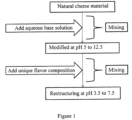
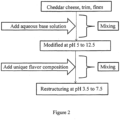
- the method comprises providing a proteinaceous natural cheese comprising an initial fat and water content; mixing such cheese with an aqueous medium, such a medium comprising a basic species at least partially sufficient to modify and impart a liquid consistency to such a natural cheese starting material; and interacting such a modified natural cheese with a flavoring composition of the sort discussed above and illustrated elsewhere herein, such a composition as can be in an amount at least partially sufficient to restore or restructure such a natural cheese.
- the natural cheese starting material is selected from cheddar, monterey jack, swiss and mozzarella-type cheeses and combinations thereof. Regardless, cheese restructured therefrom can comprise a moisture and/or fat content similar to or different from that of the natural cheese starting material.
- a flavoring composition can be formulated to provide such a restructured natural cheese a flavor or textural characteristic, or both, distinct from those of the starting material.
- a restructured natural cheese of this invention can be, for instance, a parmesan or a provolone cheese.
- such a flavoring composition can be provided as a dry blend, part of an aqueous formulation or a combination thereof, interaction of which with a modified natural cheese matrix can be accomplished simultaneously or step-wise.
- Optional additives can be as discussed above or illustrated elsewhere herein, and can be introduced at a time of natural cheese treatment/modification, upon restructure or both.
- one or more dry animal proteins, vegetable proteins or combinations thereof can be introduced to affect moisture content, stability or subsequent physical manipulation and packaging of such a restructured natural cheese.
- such additives are limited only by salts of a nature or in an amount to at least partially emulsify a protein component of a natural cheese starting material--such salt or amount thereof, the presence of which would otherwise be understood by those skilled in the art as providing a process cheese.
- a starting natural cheese material is treated with food grade aqueous base of sufficient concentration and volume, with mixing, to provide a modified cheese matrix of pH about 5 to about 12.5.
- the matrix is modified and the pH can be about 8 to about 10.
- a unique formulated flavoring composition is introduced to adjust matrix pH, structure and/or functionality depending on desired cheese variety. As discussed above and illustrated below, such a flavoring composition can be formulated to include a food grade proton donor or Lewis acid component.
- the visco-elastic properties of the restructured matrix can be either maintained so as to approximate those of the natural cheese starting material or altered to provide new visco-elastic properties and related textures.
- continued processing of the restructured cheese product can include cutting, slicing, shredding, mixing, grinding, heating and/or dispersing the restructured product, or incorporating into a prepared food product prior to packaging or distribution.
- visco pertains to the rheological parameters of materials such that imparted stress energy and the resultant strain energy is dissipated into the material in the form of heat.
- visco-elastic pertains to rheological parameters of materials such that imparted stress energy and the resultant strain energy has both a partial stored strain that can be recovered upon removal of the stress and a partial strain energy that is dissipated into the material in the form of heat.
- Various instruments and methods can be used to measure or observe visco-elastic properties, such instruments including, but not limited to, viscometers, penetrometers, shear force cutting machines, flow devices, as well as melting tests or recipes having numeric or judgmental evaluations.
- any process step including matrix modification or matrix restructuring, or both, can be conducted at temperatures from about -20 °C to about 140 °C and at pressures from 0 to about 103 MPa (0 to about 15,000 psi). Any such method step can be performed under pressure or vacuum, optionally with cooling or upon heating or an appropriate time or at a time at least partially sufficient to achieve a desired intermediate, end result or both. For instance, application of suitable pressure, at an appropriate temperature, structure, density or texture, or a combination thereof, can be imparted to obtain a desired restructured cheese product.
- a starting cheese material is selected from various cheddar, monterey jack, swiss and mozzarella-type cheeses and combinations thereof.
- such a starting material can be any cheese by-product of trims generation from cut-wrap operations, or any cheese material in or out of standard specification accepted in trade for a given cheese variety. Selection can also take into consideration moisture and fat content of any one or more cheese starting materials or restructured cheese products.
- methods of this invention can be specifically designed and tailored to provide, without limitation, particular cheddar, parmesan, romano, provolone, swiss, gouda, camembert, mozzarella or blue-style restructured cheese products. From an economic perspective, such a product can be selected from these and various other cheeses of higher relative value as compared to a starting material from which it was prepared.
- Such restructured products are limited only by a corresponding flavoring composition and the flavor components thereof.
- chocolate, tofu, fruit, vegetable, fish, meat, cured meat such as but not limited to bacon, sausage, sourdough, beer, wine, alcoholic spirit, surimi, legume paste flavors and combinations thereof can be introduced.
- a wide range of other additives can be incorporated with such a starting material to affect structure, flavor, preservation, nutrient value, stabilization, color or any combination thereof.
- Any such additive can be introduced at any process point, but preferably at a point before, during or after matrix modification or, alternatively, at a point before, during or after matrix restructuring.
- Such additives include but are not limited to flavors, spices, extracts, fruits, meats, enzymes and combinations thereof.
- probiotics can also be introduced, alone or in conjunction with other additives, such probiotics including live or deactivated microorganisms, such as eukaryotes, prokaryotes, yeasts, fungi, molds, protozoa and combinations of such live and deactivated microorganisms.
- live or deactivated microorganisms such as eukaryotes, prokaryotes, yeasts, fungi, molds, protozoa and combinations of such live and deactivated microorganisms.
- natural cheddar cheese is treated with aqueous base, with mixing, to provide a modified cheese matrix of pH 9.5.
- a selected natural flavoring composition is added for interaction with the modified cheese matrix, bringing the pH to 5.2.
- a variation of the method of Example 1 is to provide cheddar cheese (79 wt.%), natural cheddar flavoring composition (17.0 wt.%), and aqueous base (4 wt.%).
- a restructured cheddar-style cheese product is about 40 wt.% moisture, 30 wt.% fat and 3 wt.% salt.
- bacon flavoring and/or bacon bits are introduced at a point before, during or after matrix restructuring.
- process temperature may be raised from ambient to deactivate at least a portion of one or more such cultures.
- moisture content of a resulting restructured cheese product is adjusted and/or stabilizers are introduced, according to desired form (e.g., block, slices, spread, etc.)
- a parmesan-style cheese is prepared with mozzarella cheese (76 wt.%, dried to 27% moisture), natural parmesan flavoring composition (16 wt.%) and aqueous sodium hydroxide (8 wt.%).
- a restructured parmesan-style cheese product is 35% moisture, 25% fat and 4% salt.
- soy and/or dairy protein e.g., whey protein isolates
- whey protein isolates are added to lower moisture content, to vary texture and/or to stabilize the cheese product, depending on end-use.
- parmesan-style cheese is prepared with mozzarella cheese (65 wt.%, dried to 20% moisture), swiss cheese (15 wt.%), parmesan cheese (5 wt.%), natural parmesan flavoring composition (8.0 wt.%), aqueous base (6 wt.%), and added salt (1 wt.%).
- a restructured parmesan-style cheese product is 31% moisture, 26% fat and 4% salt.
- a provolone-style cheese is prepared with mozzarella cheese (44 wt.%), cheddar cheese (45 wt.%), natural provolone flavoring composition (7.0 wt.%) and aqueous base (4.0 wt.%).
- a restructured provolone-style cheese product is 45% moisture, 25% fat, and 2% salt.
- Food grade base and acid components are commercially available from sources well known to those skilled in the art.
- food grade sodium hydroxide and hydrochloric acid are available from Sigma-Aldrich (St. Louis, MO).
- Cheese and dairy flavor components are, as described above, available from Jeneil Biotech, Inc. of Saukville, Wisconsin.
- Such flavor components can be blended, dry or in an aqueous medium, with an acid or base to provide, as would be understood by those in the art made aware of this invention, a corresponding modification component or flavoring composition.
- a modification component and flavoring composition can be, respectively, added with mixing until desired pH and protein structure are obtained.
- restructured natural cheese products were prepared as described below.
- Lowfat Cheddar Cheese Ingredient Composition Range (%) Ingredient Moisture Fat Salt Percent Use Natural Cheese Component(s) Lowfat acid curd 76 to 80 0.1 to 0.5 0.1 to 0.5 33.4 Cheese curd 34 to 39 30 to 36 1.6 to 2.0 10.0 Lowfat curd 52 to 55 2 to 5 2 to 4 37.0 Additive(s) Non-fat milk powder 2 to 4 0.1 to 0.5 trace 6.0 Modification Component Base and flavor components 50 to 80 trace trace 3.0 Flavoring Composition Acid and flavor components 40 to 50 20 to 30 2 to 4 10.6 TOTAL 100.0 Procedure 1) Grind lowfat acid curd. 2) Add base and flavor components. Mix. 3) Grind remaining curd and non-fat milk power. Add. Mix. 4) Add acid and flavor components. Mix. 5) Mix and cook to 75° C. 6) Pack and cool to 4° C. Moisture Fat Salt pH Lowfat Cheddar Cheese Composition 60% 5.6% 3.3% 5.2
- Feta Style cheese Ingredient Composition Range (%) Ingredient Moisture Fat Salt Percent Use Natural cheese Component(s) Lowfat acid curd 76 to 80 0.1 to 0.5 0.1 to 0.5 45.0 Cheese curd 34 to 39 30 to 36 1.6 to 2.0 34.0 Additive(s) Concentrated milkfat 14 to 20 80 to 85 0 to 1.5 10.0 Modification Component Base and flavor components 50 to 80 trace trace 1.5 Flavoring Composition Acid and flavor components 40 to 50 20 to 30 2 to 4 9.5 TOTAL 100.0 Procedure 1) Grind lowfat curd, cheese curd, and concentrated milkfat. 2) Add base and flavor components. Mix. 3) Add acid and flavor components. Mix. 4) Mix and cook to 75° C. 5) Pack and cool to 4° C. Moisture Fat Salt pH Feta Style cheese Composition 56% 21% 2.7% 4.6
- Camembert Cheese Ingredient Composition Range (%) Ingredient Moisture Fat Salt Percent Use Natural cheese Component(s) Low-moisture part-skim curd 25 to 29 25 to 31 2.2 to 2.6 20.0 Cheese curd 34 to 39 30 to 36 1.6 to 2.0 53.7 Additive(s) Concentrated milkfat 14 to 20 80 to 85 0 to 1.5 10.0 Modification Component Base and flavor components 50 to 80 trace trace 1.5 Flavoring Composition Acid and flavor components 40 to 50 20 to 30 2 to 4 7.8 Additive(s) Steam condensate and water 100 0 0 7.8 TOTAL 100.0 Procedure 1) Grind LMPS curd, cheese curd, and concentrated milkfat. 2) Add base and flavor components. Mix. 3) Add acid and flavor components. Mix. 4) Mix and cook to 75° C. 5) Pack and cool to 4° C. Moisture Fat Salt pH Camembert Style Cheese Composition 42.5% 31.5% 2.3% 5.8
- Provolone Style Cheese Ingredient Composition Range (%) Ingredient Moisture Fat Salt Percent Use Natural Cheese Component(s) Low-moisture part-skim curd 25 to 29 25 to 31 2.2 to 2.6 15.0 Low-moisture part-skim curd 44 to 48 18 to 24 1.5 to 1.9 70.0 Additive(s) Concentrated milkfat 14 to 20 80 to 85 0 to 1.5 7.5 Modification Component Base and flavor components 50 to 80 trace trace 2.0 Flavoring Composition Acid and flavor components 40 to 50 20 to 30 2 to 4 5.5 TOTAL 100.0 Procedure 1) Grind low-moisture part-skim curd and concentrated milkfat. 2) Mix and cook to 65° C. 3) Add base and flavor components. Mix. 4) Add acid and flavor components. Mix. 5) Pack and cool to 4° C. Moisture Fat Salt pH Provolone Style Cheese Composition 44% 25% 2.0% 5.6
- Reduced Fat Cheddar Cheese Ingredient Composition Range (%) Ingredient Moisture Fat Salt Percent Use Natural cheese Component(s) Low-moisture part-skim curd 44 to 48 18 to 24 1.5 to 1.9 40.2 Cheese curd 34 to 39 30 to 36 1.6 to 2.0 37.0 Additive(s) Steam condensate and water 100 0 0 13.5 Modification Component Base and flavor components 50 to 80 trace trace 1.3 Flavoring Composition Acid and flavor components 40 to 50 20 to 30 2 to 4 8.0 TOTAL 100.0 Procedure 1) Grind low-moisture part-skim curd and cheese curd. 2) Add base and flavor components. Mix. 3) Mix and cook to 65° C. 4) Add acid and flavor components. Mix. 5) Pack and cool to 4° C. Moisture Fat Salt pH Reduced Fat Cheddar Cheese Composition 51% 22% 2.5% 5.3
- Reduced Fat Cheddar Cheese Ingredient Composition Range (%) Ingredient Moisture Fat Salt Percent Use Natural cheese Component(s) Lowfat curd 52 to 55 2 to 5 2 to 4 36.0 Cheese curd 34 to 39 30 to 36 1.6 to 2.0 54.0 Modification Component Base and flavor components 50 to 80 trace trace 2.2 Flavoring Composition Acid and flavor components 40 to 50 20 to 30 2 to 4 7.8 TOTAL 100.0 Procedure 1) Grind lowfat and cheese curd. 2) Add base and flavor components. Mix. 3) Add acid and flavor components. Mix. 4) Mix and cook to 75° C. 5) Pack and cool to 4° C. Moisture Fat Salt pH Reduced Fat Cheddar Cheese Composition 45% 20.5% 3.0% 5.3
- Parmesan Style cheese Ingredient Composition Range (%) Ingredient Moisture Fat Salt Percent Use Natural cheese Component(s) Low-moisture part-skim curd 18 to 22 27 to 33 2.4 to 2.8 46.7 Eyed cheese curd 35 to 39 24 to 30 0.5 to 1.0 20.0 Lowfat curd 24 to 30 2 to 6 3.8 to 4.3 13.0 Modification Component Base and flavor components 50 to 80 trace trace 2.2 Flavoring Composition Acid and flavor components 40 to 50 20 to 30 2 to 4 11.1 Additive(s) Steam condensate and water 100 0 0 7.0 TOTAL 100.0 Procedure 1) Grind lowfat curd. 2) Grind eyed and low-moisture part-skim curd. Add. 3) Add base and flavor components. Mix. 4) Add acid and flavor components. Mix. 5) Mix and cook to 75° C. 6) Pack and cool to 4° C. Moisture Fat Salt pH Parmesan Style Cheese Composition 34% 22% 3.2% 5.2
- Cheddar Type cheese Ingredient Composition Range (%) Ingredient Moisture Fat Salt Percent Use Natural Cheese Component(s) Cheese curd direct acid set 34 to 39 30 to 36 0.1 to 0.2 94.3 Modification Component Base and flavor components 50 to 80 trace trace 3.0 Flavoring Composition Acid and flavor components 40 to 50 20 to 30 2 to 4 2.7 TOTAL 100.0 Procedure 1) Grind cheese curd direct acid set. 2) Add base and flavor components. Mix. 3) Add acid and flavor components. Mix. 4) Pack and cool to 4° C. Moisture Fat Salt pH Cheddar Type cheese Composition 39% 30% 1.4% 5.4
- one or more of the following non-limiting protein sources or components can be used, alone or in conjunction with one or more other proteins or additives of the sort discussed herein, to prepare a range of restructured dairy or dairy analog-based food products:
- dairy analog proteins are proteins, from either dairy or non-dairy sources, that provide similar nutritive and structural contribution to manufactured diary or dairy emulating products.
- the preceding proteins of this example can be used, as described herein, alone or in addition to another protein, to prepare various dairy and dairy-analog products, including but not limited to the following:
Landscapes
- Life Sciences & Earth Sciences (AREA)
- Chemical & Material Sciences (AREA)
- Engineering & Computer Science (AREA)
- Food Science & Technology (AREA)
- Polymers & Plastics (AREA)
- Health & Medical Sciences (AREA)
- Biochemistry (AREA)
- Molecular Biology (AREA)
- Nutrition Science (AREA)
- Proteomics, Peptides & Aminoacids (AREA)
- Dairy Products (AREA)
- Peptides Or Proteins (AREA)
- Preparation Of Compounds By Using Micro-Organisms (AREA)
Applications Claiming Priority (2)
| Application Number | Priority Date | Filing Date | Title |
|---|---|---|---|
| US201361852465P | 2013-03-15 | 2013-03-15 | |
| PCT/US2014/030879 WO2014146010A1 (en) | 2013-03-15 | 2014-03-17 | Restructured natural protein matrices |
Publications (4)
| Publication Number | Publication Date |
|---|---|
| EP2967095A1 EP2967095A1 (en) | 2016-01-20 |
| EP2967095A4 EP2967095A4 (en) | 2016-11-23 |
| EP2967095C0 EP2967095C0 (en) | 2024-10-09 |
| EP2967095B1 true EP2967095B1 (en) | 2024-10-09 |
Family
ID=51538159
Family Applications (1)
| Application Number | Title | Priority Date | Filing Date |
|---|---|---|---|
| EP14763983.5A Active EP2967095B1 (en) | 2013-03-15 | 2014-03-17 | Process for the production of restructured cheeses |
Country Status (22)
Families Citing this family (5)
| Publication number | Priority date | Publication date | Assignee | Title |
|---|---|---|---|---|
| FR3084242B1 (fr) * | 2018-07-27 | 2021-07-30 | Olivier Maximin | Procede de fabrication d'un fromage a pate dure |
| FR3097408B1 (fr) * | 2019-06-24 | 2022-06-17 | Inst Nat De La Rech Agronomique Inra | Poudre fromageable, procédés pour la fabrication de cette poudre fromageable et d’une denrée alimentaire fromagère à partir de cette dernière |
| US12011011B2 (en) | 2020-07-27 | 2024-06-18 | Sargento Cheese Inc. | Natural cheese and method for making natural cheese with specific texture attributes |
| US11510416B1 (en) | 2021-02-18 | 2022-11-29 | Sargento Foods Inc. | Natural pasta-filata style cheese with improved texture |
| JP7824535B2 (ja) | 2023-11-21 | 2026-03-05 | ダイキン工業株式会社 | パルプ組成物 |
Family Cites Families (33)
| Publication number | Priority date | Publication date | Assignee | Title |
|---|---|---|---|---|
| GB551704A (en) | 1941-09-03 | 1943-03-05 | Deraef Corp | Improvements in the manufacture of cheese |
| SU102995A1 (ru) * | 1955-01-08 | 1955-11-30 | Д.А. Граников | Способ изготовлени сыра |
| US4066800A (en) * | 1973-11-30 | 1978-01-03 | The Regents Of The University Of Minnesota | Preparation of dairy-based cheese food |
| GB1487680A (en) * | 1974-11-20 | 1977-10-05 | Universal Foods Corp | Process for producing synthetic cheese-like foodstuff |
| US4197322A (en) * | 1974-11-20 | 1980-04-08 | Universal Foods Corporation | Process for producing synthetic cheese |
| US4444800A (en) * | 1977-02-28 | 1984-04-24 | L.D. Schreiber Cheese Co., Inc. | Non-cultured simulated cheese containing rennet casein |
| US4217370A (en) * | 1977-08-25 | 1980-08-12 | Blue Wing Corporation | Lipid-containing feed supplements and foodstuffs |
| NO145937C (no) * | 1977-08-25 | 1982-06-30 | Blue Wing Corp | Fremgangsmaate ved fremstilling av mikroinnkapslede, lipidholdige naeringsmiddel- og fortilsetninger |
| US4343817A (en) * | 1978-02-24 | 1982-08-10 | Arthur M. Swanson | Natural cheese analog |
| US4292333A (en) | 1979-11-19 | 1981-09-29 | Standard Brands Incorporated | Low-fat, butter-flavored, liquid spread and process |
| US4459313A (en) * | 1980-12-02 | 1984-07-10 | A. M. Swanson & Associates, Inc. | Method for making a process cheese analog |
| US4460615A (en) | 1981-10-02 | 1984-07-17 | Kyowa Hakko Kogyo Kabushiki Kaisha | Process for improving the quality of whey protein |
| US4397926A (en) * | 1981-12-03 | 1983-08-09 | Borden, Inc. | Preparation of cheese analogs from combinations of acid casein and rennet casein |
| US5064660A (en) * | 1987-11-02 | 1991-11-12 | Jules Silver | Method of making ultra low-fat cheese and resulting products |
| US5567464A (en) | 1995-02-16 | 1996-10-22 | Leprino Foods Company | Process of making mozzarella cheese |
| US5902625A (en) | 1992-02-14 | 1999-05-11 | Leprino Foods Company | Process of making a soft or semi-soft fibrous cheese |
| US5750177A (en) | 1992-11-04 | 1998-05-12 | Schreiber Foods, Inc. | Cheese with improved melt properties and methods of producing same |
| US5505979A (en) * | 1995-03-07 | 1996-04-09 | Hawkins Chemical | Preparation of process cheese using liquid sodium citrate |
| FR2762479B1 (fr) * | 1997-04-25 | 1999-06-04 | Agronomique Inst Nat Rech | Utilisation de cetoacides pour intensifier la flaveur de produits a base de fromage |
| EP1441596A1 (en) | 2001-11-07 | 2004-08-04 | Campina B.V. | Processed cheese |
| US6893674B2 (en) * | 2002-07-29 | 2005-05-17 | Kraft Foods Holdings, Inc. | Processed cheese made with soy |
| US7309510B2 (en) * | 2003-02-28 | 2007-12-18 | Unilever Bestfoods, North America Division Of Conopco, Inc. | Stable cheese condiment |
| NZ526878A (en) * | 2003-07-04 | 2007-01-26 | Fonterra Co Operative Group | A method for varying the texture of cheese or cheese-like products by varying the casein to whey protein ratio while controlling the pH in the range of 5.0 to 8.0 |
| NZ527159A (en) * | 2003-07-24 | 2005-10-28 | Fonterra Co Operative Group | Dairy product and process |
| NZ527434A (en) * | 2003-08-07 | 2006-03-31 | Fonterra Co Operative Group | Production of protein composition from a dairy stream and its use as an ingredient in the manufacture of a cheese |
| NZ527436A (en) * | 2003-08-07 | 2005-08-26 | Fonterra Co Operative Group | Dairy product and process for producing a milk protein concentrate high in whey protein and enhancing cheese yields |
| US7579033B2 (en) * | 2004-05-03 | 2009-08-25 | Leprino Foods Company | Methods for making soft or firm/semi-hard ripened and unripened cheese and cheeses prepared by such methods |
| US7585537B2 (en) * | 2004-05-03 | 2009-09-08 | Leprino Foods Company | Cheese and methods of making such cheese |
| CN101795573A (zh) * | 2007-09-27 | 2010-08-04 | 明治乳业株式会社 | 天然干酪的制造方法 |
| NZ566358A (en) | 2008-02-29 | 2010-11-26 | Fonterra Co Operative Group | Dairy product and process |
| JP5643099B2 (ja) | 2008-09-29 | 2014-12-17 | 味の素株式会社 | 改質乳の製造方法 |
| US20100196575A1 (en) | 2009-01-30 | 2010-08-05 | Solae, Llc | Melting Vegetable Protein Based Substitute Cheese |
| CN101889667B (zh) * | 2010-06-30 | 2012-12-19 | 李国喜 | 一种多肽花粉及其生产工艺 |
-
2014
- 2014-03-17 MX MX2015011450A patent/MX385740B/es unknown
- 2014-03-17 AU AU2014232331A patent/AU2014232331B2/en active Active
- 2014-03-17 CA CA2904386A patent/CA2904386C/en active Active
- 2014-03-17 PL PL14763983.5T patent/PL2967095T3/pl unknown
- 2014-03-17 JP JP2016502580A patent/JP2016515813A/ja active Pending
- 2014-03-17 MY MYPI2015703130A patent/MY172082A/en unknown
- 2014-03-17 BR BR112015022838A patent/BR112015022838B8/pt active IP Right Grant
- 2014-03-17 WO PCT/US2014/030879 patent/WO2014146010A1/en not_active Ceased
- 2014-03-17 RU RU2015140590A patent/RU2664474C2/ru active
- 2014-03-17 CN CN201480015738.3A patent/CN105324035A/zh active Pending
- 2014-03-17 ES ES14763983T patent/ES2994922T3/es active Active
- 2014-03-17 CN CN202410988892.4A patent/CN118749564A/zh active Pending
- 2014-03-17 US US14/217,284 patent/US12063941B2/en active Active
- 2014-03-17 EP EP14763983.5A patent/EP2967095B1/en active Active
- 2014-03-17 HK HK16103666.9A patent/HK1215658A1/zh unknown
- 2014-03-17 SG SG11201506867SA patent/SG11201506867SA/en unknown
-
2015
- 2015-09-02 IL IL241041A patent/IL241041B/en active IP Right Grant
- 2015-09-07 PH PH12015501974A patent/PH12015501974A1/en unknown
- 2015-09-08 CL CL2015002518A patent/CL2015002518A1/es unknown
- 2015-09-09 GT GT201500266A patent/GT201500266A/es unknown
- 2015-09-10 DO DO2015000230A patent/DOP2015000230A/es unknown
- 2015-09-10 CU CUP2015000115A patent/CU20150115A7/es unknown
- 2015-09-21 CR CR20150501A patent/CR20150501A/es unknown
-
2018
- 2018-05-14 AU AU2018203342A patent/AU2018203342A1/en not_active Abandoned
-
2020
- 2020-01-15 JP JP2020004216A patent/JP7389654B2/ja active Active
- 2020-10-01 AU AU2020244523A patent/AU2020244523A1/en not_active Abandoned
-
2022
- 2022-03-17 JP JP2022042466A patent/JP2022069667A/ja active Pending
- 2022-10-07 AU AU2022246468A patent/AU2022246468A1/en not_active Abandoned
Also Published As
Similar Documents
| Publication | Publication Date | Title |
|---|---|---|
| Fox et al. | Processed cheese and substitute/imitation cheese products | |
| JP7389654B2 (ja) | 再構成ナチュラルチーズ製品を製造する方法 | |
| EP2647293A1 (en) | Process for manufacturing cheese using milk protein concentrate powder | |
| Fox et al. | Cheese science and technology | |
| US5358730A (en) | Process for coagulating or gelling a nondenatured protein and product thereof | |
| EP1691621B1 (en) | Dairy product and process | |
| JP2015077108A (ja) | 未熟性フレッシュチーズおよびその製造方法 | |
| AU2011292508B2 (en) | Dairy product and process | |
| NZ751734A (en) | Restructured natural protein matrices | |
| NZ751734B2 (en) | Restructured natural protein matrices | |
| Ferreira et al. | Patrícia Blumer Zacarchenco, Leila Maria Spadoti | |
| AU2025248719A1 (en) | Dairy food gel production | |
| O'Kennedy | Raw material selection: Dairy ingredients | |
| KR20210055266A (ko) | 천연치즈 및 가공치즈 등 다양한 치즈 및 치즈 상품에 관한 방법 |
Legal Events
| Date | Code | Title | Description |
|---|---|---|---|
| PUAI | Public reference made under article 153(3) epc to a published international application that has entered the european phase |
Free format text: ORIGINAL CODE: 0009012 |
|
| 17P | Request for examination filed |
Effective date: 20150909 |
|
| AK | Designated contracting states |
Kind code of ref document: A1 Designated state(s): AL AT BE BG CH CY CZ DE DK EE ES FI FR GB GR HR HU IE IS IT LI LT LU LV MC MK MT NL NO PL PT RO RS SE SI SK SM TR |
|
| AX | Request for extension of the european patent |
Extension state: BA ME |
|
| DAX | Request for extension of the european patent (deleted) | ||
| A4 | Supplementary search report drawn up and despatched |
Effective date: 20161021 |
|
| RIC1 | Information provided on ipc code assigned before grant |
Ipc: A23C 19/072 20060101ALI20161017BHEP Ipc: A23C 19/068 20060101ALI20161017BHEP Ipc: A23C 19/09 20060101ALI20161017BHEP Ipc: A23C 19/08 20060101AFI20161017BHEP |
|
| STAA | Information on the status of an ep patent application or granted ep patent |
Free format text: STATUS: EXAMINATION IS IN PROGRESS |
|
| 17Q | First examination report despatched |
Effective date: 20180913 |
|
| GRAP | Despatch of communication of intention to grant a patent |
Free format text: ORIGINAL CODE: EPIDOSNIGR1 |
|
| STAA | Information on the status of an ep patent application or granted ep patent |
Free format text: STATUS: GRANT OF PATENT IS INTENDED |
|
| INTG | Intention to grant announced |
Effective date: 20240502 |
|
| GRAS | Grant fee paid |
Free format text: ORIGINAL CODE: EPIDOSNIGR3 |
|
| GRAA | (expected) grant |
Free format text: ORIGINAL CODE: 0009210 |
|
| STAA | Information on the status of an ep patent application or granted ep patent |
Free format text: STATUS: THE PATENT HAS BEEN GRANTED |
|
| AK | Designated contracting states |
Kind code of ref document: B1 Designated state(s): AL AT BE BG CH CY CZ DE DK EE ES FI FR GB GR HR HU IE IS IT LI LT LU LV MC MK MT NL NO PL PT RO RS SE SI SK SM TR |
|
| REG | Reference to a national code |
Ref country code: GB Ref legal event code: FG4D |
|
| REG | Reference to a national code |
Ref country code: CH Ref legal event code: EP |
|
| REG | Reference to a national code |
Ref country code: DE Ref legal event code: R096 Ref document number: 602014090987 Country of ref document: DE |
|
| REG | Reference to a national code |
Ref country code: IE Ref legal event code: FG4D |
|
| U01 | Request for unitary effect filed |
Effective date: 20241106 |
|
| U07 | Unitary effect registered |
Designated state(s): AT BE BG DE DK EE FI FR IT LT LU LV MT NL PT RO SE SI Effective date: 20241113 |
|
| REG | Reference to a national code |
Ref country code: ES Ref legal event code: FG2A Ref document number: 2994922 Country of ref document: ES Kind code of ref document: T3 Effective date: 20250204 |
|
| PG25 | Lapsed in a contracting state [announced via postgrant information from national office to epo] |
Ref country code: IS Free format text: LAPSE BECAUSE OF FAILURE TO SUBMIT A TRANSLATION OF THE DESCRIPTION OR TO PAY THE FEE WITHIN THE PRESCRIBED TIME-LIMIT Effective date: 20250209 Ref country code: HR Free format text: LAPSE BECAUSE OF FAILURE TO SUBMIT A TRANSLATION OF THE DESCRIPTION OR TO PAY THE FEE WITHIN THE PRESCRIBED TIME-LIMIT Effective date: 20241009 |
|
| PG25 | Lapsed in a contracting state [announced via postgrant information from national office to epo] |
Ref country code: GR Free format text: LAPSE BECAUSE OF FAILURE TO SUBMIT A TRANSLATION OF THE DESCRIPTION OR TO PAY THE FEE WITHIN THE PRESCRIBED TIME-LIMIT Effective date: 20250110 |
|
| PG25 | Lapsed in a contracting state [announced via postgrant information from national office to epo] |
Ref country code: RS Free format text: LAPSE BECAUSE OF FAILURE TO SUBMIT A TRANSLATION OF THE DESCRIPTION OR TO PAY THE FEE WITHIN THE PRESCRIBED TIME-LIMIT Effective date: 20250109 |
|
| U20 | Renewal fee for the european patent with unitary effect paid |
Year of fee payment: 12 Effective date: 20250327 |
|
| PG25 | Lapsed in a contracting state [announced via postgrant information from national office to epo] |
Ref country code: SM Free format text: LAPSE BECAUSE OF FAILURE TO SUBMIT A TRANSLATION OF THE DESCRIPTION OR TO PAY THE FEE WITHIN THE PRESCRIBED TIME-LIMIT Effective date: 20241009 |
|
| PGFP | Annual fee paid to national office [announced via postgrant information from national office to epo] |
Ref country code: ES Payment date: 20250401 Year of fee payment: 12 |
|
| PGFP | Annual fee paid to national office [announced via postgrant information from national office to epo] |
Ref country code: CH Payment date: 20250401 Year of fee payment: 12 |
|
| PG25 | Lapsed in a contracting state [announced via postgrant information from national office to epo] |
Ref country code: SK Free format text: LAPSE BECAUSE OF FAILURE TO SUBMIT A TRANSLATION OF THE DESCRIPTION OR TO PAY THE FEE WITHIN THE PRESCRIBED TIME-LIMIT Effective date: 20241009 |
|
| PG25 | Lapsed in a contracting state [announced via postgrant information from national office to epo] |
Ref country code: CZ Free format text: LAPSE BECAUSE OF FAILURE TO SUBMIT A TRANSLATION OF THE DESCRIPTION OR TO PAY THE FEE WITHIN THE PRESCRIBED TIME-LIMIT Effective date: 20241009 |
|
| PLBE | No opposition filed within time limit |
Free format text: ORIGINAL CODE: 0009261 |
|
| STAA | Information on the status of an ep patent application or granted ep patent |
Free format text: STATUS: NO OPPOSITION FILED WITHIN TIME LIMIT |
|
| 26N | No opposition filed |
Effective date: 20250710 |
|
| PG25 | Lapsed in a contracting state [announced via postgrant information from national office to epo] |
Ref country code: MC Free format text: LAPSE BECAUSE OF FAILURE TO SUBMIT A TRANSLATION OF THE DESCRIPTION OR TO PAY THE FEE WITHIN THE PRESCRIBED TIME-LIMIT Effective date: 20241009 |
|
| REG | Reference to a national code |
Ref country code: CH Ref legal event code: U11 Free format text: ST27 STATUS EVENT CODE: U-0-0-U10-U11 (AS PROVIDED BY THE NATIONAL OFFICE) Effective date: 20260401 |
|
| PGFP | Annual fee paid to national office [announced via postgrant information from national office to epo] |
Ref country code: GB Payment date: 20260327 Year of fee payment: 13 |
|
| PGFP | Annual fee paid to national office [announced via postgrant information from national office to epo] |
Ref country code: NO Payment date: 20260327 Year of fee payment: 13 Ref country code: IE Payment date: 20260327 Year of fee payment: 13 |
|
| PGFP | Annual fee paid to national office [announced via postgrant information from national office to epo] |
Ref country code: PL Payment date: 20260304 Year of fee payment: 13 |