EP2952247B1 - Verfahren zur verwendung eines keramikfilters und filtervorrichtung - Google Patents
Verfahren zur verwendung eines keramikfilters und filtervorrichtung Download PDFInfo
- Publication number
- EP2952247B1 EP2952247B1 EP14745945.7A EP14745945A EP2952247B1 EP 2952247 B1 EP2952247 B1 EP 2952247B1 EP 14745945 A EP14745945 A EP 14745945A EP 2952247 B1 EP2952247 B1 EP 2952247B1
- Authority
- EP
- European Patent Office
- Prior art keywords
- face
- ceramic filter
- mixed fluid
- path
- filter
- Prior art date
- Legal status (The legal status is an assumption and is not a legal conclusion. Google has not performed a legal analysis and makes no representation as to the accuracy of the status listed.)
- Not-in-force
Links
- 239000000919 ceramic Substances 0.000 title claims description 110
- 238000000034 method Methods 0.000 title claims description 52
- 239000012530 fluid Substances 0.000 claims description 153
- 239000012528 membrane Substances 0.000 claims description 62
- 238000000926 separation method Methods 0.000 claims description 56
- XLYOFNOQVPJJNP-UHFFFAOYSA-N water Substances O XLYOFNOQVPJJNP-UHFFFAOYSA-N 0.000 claims description 53
- 238000010438 heat treatment Methods 0.000 claims description 25
- 239000000126 substance Substances 0.000 claims description 23
- 239000007788 liquid Substances 0.000 claims description 19
- LFQSCWFLJHTTHZ-UHFFFAOYSA-N Ethanol Chemical compound CCO LFQSCWFLJHTTHZ-UHFFFAOYSA-N 0.000 claims description 16
- VYPSYNLAJGMNEJ-UHFFFAOYSA-N Silicium dioxide Chemical compound O=[Si]=O VYPSYNLAJGMNEJ-UHFFFAOYSA-N 0.000 claims description 12
- 230000008569 process Effects 0.000 claims description 10
- 125000000524 functional group Chemical group 0.000 claims description 7
- 239000000377 silicon dioxide Substances 0.000 claims description 6
- 239000012466 permeate Substances 0.000 claims description 4
- 230000000149 penetrating effect Effects 0.000 claims description 3
- 230000000881 depressing effect Effects 0.000 claims 1
- 238000001914 filtration Methods 0.000 description 18
- 230000010287 polarization Effects 0.000 description 13
- 238000009834 vaporization Methods 0.000 description 10
- 230000008016 vaporization Effects 0.000 description 10
- 239000004020 conductor Substances 0.000 description 9
- 239000000463 material Substances 0.000 description 9
- 230000035515 penetration Effects 0.000 description 9
- 238000001612 separation test Methods 0.000 description 7
- 230000000052 comparative effect Effects 0.000 description 6
- 230000007423 decrease Effects 0.000 description 6
- 230000006837 decompression Effects 0.000 description 4
- 238000003756 stirring Methods 0.000 description 4
- 229910052782 aluminium Inorganic materials 0.000 description 3
- XAGFODPZIPBFFR-UHFFFAOYSA-N aluminium Chemical compound [Al] XAGFODPZIPBFFR-UHFFFAOYSA-N 0.000 description 3
- 230000007797 corrosion Effects 0.000 description 3
- 238000005260 corrosion Methods 0.000 description 3
- 230000000694 effects Effects 0.000 description 3
- 230000004907 flux Effects 0.000 description 3
- 239000011521 glass Substances 0.000 description 3
- 239000000203 mixture Substances 0.000 description 3
- 238000012856 packing Methods 0.000 description 3
- 239000011148 porous material Substances 0.000 description 3
- 230000009467 reduction Effects 0.000 description 3
- IJGRMHOSHXDMSA-UHFFFAOYSA-N Atomic nitrogen Chemical compound N#N IJGRMHOSHXDMSA-UHFFFAOYSA-N 0.000 description 2
- OKTJSMMVPCPJKN-UHFFFAOYSA-N Carbon Chemical compound [C] OKTJSMMVPCPJKN-UHFFFAOYSA-N 0.000 description 2
- CURLTUGMZLYLDI-UHFFFAOYSA-N Carbon dioxide Chemical compound O=C=O CURLTUGMZLYLDI-UHFFFAOYSA-N 0.000 description 2
- 229920001875 Ebonite Polymers 0.000 description 2
- XEEYBQQBJWHFJM-UHFFFAOYSA-N Iron Chemical compound [Fe] XEEYBQQBJWHFJM-UHFFFAOYSA-N 0.000 description 2
- CTQNGGLPUBDAKN-UHFFFAOYSA-N O-Xylene Chemical group CC1=CC=CC=C1C CTQNGGLPUBDAKN-UHFFFAOYSA-N 0.000 description 2
- 229910052799 carbon Inorganic materials 0.000 description 2
- 230000002542 deteriorative effect Effects 0.000 description 2
- 239000007789 gas Substances 0.000 description 2
- 238000003754 machining Methods 0.000 description 2
- 230000007246 mechanism Effects 0.000 description 2
- VNWKTOKETHGBQD-UHFFFAOYSA-N methane Chemical compound C VNWKTOKETHGBQD-UHFFFAOYSA-N 0.000 description 2
- 229920002379 silicone rubber Polymers 0.000 description 2
- 239000004945 silicone rubber Substances 0.000 description 2
- VZSRBBMJRBPUNF-UHFFFAOYSA-N 2-(2,3-dihydro-1H-inden-2-ylamino)-N-[3-oxo-3-(2,4,6,7-tetrahydrotriazolo[4,5-c]pyridin-5-yl)propyl]pyrimidine-5-carboxamide Chemical compound C1C(CC2=CC=CC=C12)NC1=NC=C(C=N1)C(=O)NCCC(N1CC2=C(CC1)NN=N2)=O VZSRBBMJRBPUNF-UHFFFAOYSA-N 0.000 description 1
- WZFUQSJFWNHZHM-UHFFFAOYSA-N 2-[4-[2-(2,3-dihydro-1H-inden-2-ylamino)pyrimidin-5-yl]piperazin-1-yl]-1-(2,4,6,7-tetrahydrotriazolo[4,5-c]pyridin-5-yl)ethanone Chemical compound C1C(CC2=CC=CC=C12)NC1=NC=C(C=N1)N1CCN(CC1)CC(=O)N1CC2=C(CC1)NN=N2 WZFUQSJFWNHZHM-UHFFFAOYSA-N 0.000 description 1
- JQMFQLVAJGZSQS-UHFFFAOYSA-N 2-[4-[2-(2,3-dihydro-1H-inden-2-ylamino)pyrimidin-5-yl]piperazin-1-yl]-N-(2-oxo-3H-1,3-benzoxazol-6-yl)acetamide Chemical compound C1C(CC2=CC=CC=C12)NC1=NC=C(C=N1)N1CCN(CC1)CC(=O)NC1=CC2=C(NC(O2)=O)C=C1 JQMFQLVAJGZSQS-UHFFFAOYSA-N 0.000 description 1
- 241000196324 Embryophyta Species 0.000 description 1
- 235000006508 Nelumbo nucifera Nutrition 0.000 description 1
- 240000002853 Nelumbo nucifera Species 0.000 description 1
- 229910021536 Zeolite Inorganic materials 0.000 description 1
- 230000002411 adverse Effects 0.000 description 1
- 125000000217 alkyl group Chemical group 0.000 description 1
- PNEYBMLMFCGWSK-UHFFFAOYSA-N aluminium oxide Inorganic materials [O-2].[O-2].[O-2].[Al+3].[Al+3] PNEYBMLMFCGWSK-UHFFFAOYSA-N 0.000 description 1
- 125000003118 aryl group Chemical group 0.000 description 1
- 125000004432 carbon atom Chemical group C* 0.000 description 1
- 229910002092 carbon dioxide Inorganic materials 0.000 description 1
- 239000001569 carbon dioxide Substances 0.000 description 1
- 230000008859 change Effects 0.000 description 1
- 238000007796 conventional method Methods 0.000 description 1
- 230000003247 decreasing effect Effects 0.000 description 1
- 230000006866 deterioration Effects 0.000 description 1
- HNPSIPDUKPIQMN-UHFFFAOYSA-N dioxosilane;oxo(oxoalumanyloxy)alumane Chemical compound O=[Si]=O.O=[Al]O[Al]=O HNPSIPDUKPIQMN-UHFFFAOYSA-N 0.000 description 1
- 239000003814 drug Substances 0.000 description 1
- 235000013305 food Nutrition 0.000 description 1
- 239000001257 hydrogen Substances 0.000 description 1
- 229910052739 hydrogen Inorganic materials 0.000 description 1
- 125000004435 hydrogen atom Chemical class [H]* 0.000 description 1
- 230000006872 improvement Effects 0.000 description 1
- 238000009434 installation Methods 0.000 description 1
- 239000011810 insulating material Substances 0.000 description 1
- 229910052742 iron Inorganic materials 0.000 description 1
- 229910052751 metal Inorganic materials 0.000 description 1
- 239000002184 metal Substances 0.000 description 1
- 238000002156 mixing Methods 0.000 description 1
- 230000004048 modification Effects 0.000 description 1
- 238000012986 modification Methods 0.000 description 1
- 239000003345 natural gas Substances 0.000 description 1
- 229910052757 nitrogen Inorganic materials 0.000 description 1
- TVMXDCGIABBOFY-UHFFFAOYSA-N octane Chemical compound CCCCCCCC TVMXDCGIABBOFY-UHFFFAOYSA-N 0.000 description 1
- 125000002347 octyl group Chemical group [H]C([*])([H])C([H])([H])C([H])([H])C([H])([H])C([H])([H])C([H])([H])C([H])([H])C([H])([H])[H] 0.000 description 1
- 229920000620 organic polymer Polymers 0.000 description 1
- 239000002245 particle Substances 0.000 description 1
- 230000002093 peripheral effect Effects 0.000 description 1
- 125000001997 phenyl group Chemical group [H]C1=C([H])C([H])=C(*)C([H])=C1[H] 0.000 description 1
- 238000011084 recovery Methods 0.000 description 1
- 238000007789 sealing Methods 0.000 description 1
- 229910001220 stainless steel Inorganic materials 0.000 description 1
- 239000010935 stainless steel Substances 0.000 description 1
- -1 steam Substances 0.000 description 1
- 238000012360 testing method Methods 0.000 description 1
- 125000003944 tolyl group Chemical group 0.000 description 1
- 239000010457 zeolite Substances 0.000 description 1
Images





Classifications
-
- B—PERFORMING OPERATIONS; TRANSPORTING
- B01—PHYSICAL OR CHEMICAL PROCESSES OR APPARATUS IN GENERAL
- B01D—SEPARATION
- B01D63/00—Apparatus in general for separation processes using semi-permeable membranes
-
- B—PERFORMING OPERATIONS; TRANSPORTING
- B01—PHYSICAL OR CHEMICAL PROCESSES OR APPARATUS IN GENERAL
- B01D—SEPARATION
- B01D63/00—Apparatus in general for separation processes using semi-permeable membranes
- B01D63/06—Tubular membrane modules
- B01D63/066—Tubular membrane modules with a porous block having membrane coated passages
-
- B—PERFORMING OPERATIONS; TRANSPORTING
- B01—PHYSICAL OR CHEMICAL PROCESSES OR APPARATUS IN GENERAL
- B01D—SEPARATION
- B01D61/00—Processes of separation using semi-permeable membranes, e.g. dialysis, osmosis or ultrafiltration; Apparatus, accessories or auxiliary operations specially adapted therefor
- B01D61/36—Pervaporation; Membrane distillation; Liquid permeation
- B01D61/366—Apparatus therefor
-
- B—PERFORMING OPERATIONS; TRANSPORTING
- B01—PHYSICAL OR CHEMICAL PROCESSES OR APPARATUS IN GENERAL
- B01D—SEPARATION
- B01D2311/00—Details relating to membrane separation process operations and control
- B01D2311/26—Further operations combined with membrane separation processes
- B01D2311/2673—Evaporation
-
- B—PERFORMING OPERATIONS; TRANSPORTING
- B01—PHYSICAL OR CHEMICAL PROCESSES OR APPARATUS IN GENERAL
- B01D—SEPARATION
- B01D2313/00—Details relating to membrane modules or apparatus
- B01D2313/04—Specific sealing means
-
- B—PERFORMING OPERATIONS; TRANSPORTING
- B01—PHYSICAL OR CHEMICAL PROCESSES OR APPARATUS IN GENERAL
- B01D—SEPARATION
- B01D2313/00—Details relating to membrane modules or apparatus
- B01D2313/08—Flow guidance means within the module or the apparatus
Definitions
- the present invention relates to a method for using a ceramic filter, and a filter device including a ceramic filter.
- a filter made of ceramic has been used to selectively separate and recover an only specific component from a mixture of multiple components.
- the filter made of ceramic is excellent in mechanical strength, durability, corrosion resistance and the like as compared with a filter made of organic polymer, and hence, the filter is preferably applied as a separation membrane which separates a liquid or gas mixture at a molecule level in a broad field such as a petrochemistry field, a natural gas plant, or a medicine or food field.
- a filter made of ceramic for the purpose of improving a permeation performance while acquiring a separation performance, it is necessary to enlarge an effective membrane area (the area of the separation membrane which comes in contact with a fluid to be treated), and for this necessity, a filter shape is desirably of a monolith type (or a honeycomb type).
- the monolith type of filter has advantages that the filter is hard to bend, is easy to seal, can be made compact and can achieve cost reduction, and the like, as compared with a tube type of filter.
- the monolith type of filter includes a porous supporter having a round pillar-like outer shape and having therein a large number of parallel through channels (also referred to as cells) formed in an axial direction of the filter, and further, a separation membrane having smaller pore diameters than those of the porous supporter is formed on an inner wall surface in which the cells are to be formed.
- Patent Document 1 An example of a prior document in which the conventional monolith type (or honeycomb type) of ceramic filter is disclosed is Patent Document 1.
- Patent Document 2 An example of a prior document in which a fluid separating method using such a filter is disclosed is Patent Document 2.
- a filter (a membrane container) in which a flow speed of the fluid flowing through the filter is increased to improve the separation performance (e.g., see Patent Document 3).
- WO 2004/091756 A1 discloses a ceramic filter where a plurality of through channels is present in a pillar-shaped body extending from a first end face to a second end face. Open ends of both the end faces of the through channels are opened, but in part of the through channels, the open ends of both the end faces are plugged by plugging members.
- main causes for the polarization are (1) a difference between an inner temperature and an outer temperature of the fluid flowing through the cells (a difference in temperature between a central portion and the vicinity of a separation membrane) due to vaporization heat of a permeable substance which has permeated the separation membrane, and (2) a difference between an inner concentration and an outer concentration (a difference in concentration between the central portion and the vicinity of the separation membrane) in "the concentration of the permeable substance" in the fluid flowing through the cells due to permeation of the permeable substance through the separation membrane. That is, when the flow speed lowers, the temperature and the concentration locally lower in a contact interface, and hence, a filter cannot exert any intrinsic performance.
- D is an inner diameter of each cell
- u is an average flow speed
- ⁇ is a density of the fluid
- ⁇ is a viscosity of the fluid.
- the mixed fluid to be treated is allowed to flow only in one direction from an inflow side end face to an outflow side end face of a filter, and is filtered.
- a fluid of the high flow rate corresponding to the sectional area of the filter as described above is filtered, temperature drop of the fluid in a filtering process easily occurs. Therefore, it is necessary to beforehand sufficiently apply heat to the fluid to be treated, but there have been incurred the problems such as installation of a large heater and increase of energy or cost required for an operation of the heater.
- a flow path of the fluid is returned in the membrane container with the intension of increasing the flow speed of the fluid to be treated. Further, the separation performance is intended to be improved in this way.
- a round returning portion for use in returning the fluid is disposed in an end face of a membrane container main body. In consequence, a portion of the membrane container end face in which the returning portion is disposed cannot come in contact with a membrane due to the flowing fluid, which has raised the problem that a treatment amount of the fluid (an effective membrane area) becomes smaller.
- An object of the present invention is to provide a method for using a ceramic filter and a filter device in which a high separation performance is realized while maintaining a high treatment amount.
- the present inventors have divided through channels of a ceramic filter into an outward path and a return path by through channel division means, allowing a mixed fluid to reciprocate through the same filter once or more, and have disposed the through channel division means on plugging portions of water collecting slits. Further, the present inventors have found that the above problem can thus be solved. That is, according to the present invention, the following method for using a ceramic filter and a filter device are provided.
- water collection means collecting of a liquid and/or vapor which has permeated a membrane, and an object of the collection is not limited to "water” and may be any substance as long as the substance permeates the membrane. Examples of the substance which has permeated the membrane include water, steam, hydrogen, nitrogen, carbon dioxide, alcohol, an organic liquid medium, and an organic molecule.
- the present invention even when a supply amount of the mixed fluid is the same, a higher flow speed can be obtained, and a separation performance is hard to deteriorate, thereby enabling downsizing of a pump which feeds out a fluid to be treated and reduction of an energy amount required for an operation of the pump. Additionally, in the method for using the ceramic filter and the filter device of the present invention, in a state where through channel division means is in contact with "a row in which water collecting cells are arranged" in at least one end face of a porous body, the through channel division means is disposed along the "row". Further, an outward path and a return path are divided by the through channel division means.
- the outward path and the return path are divided, the outward path and the return path (open ends of the through channels) are not closed by the through channel division means. In consequence, it is possible to prevent decrease of a treatment amount of the fluid (an effective membrane area) due to the disposing of the through channel division means in the end face of the porous body.
- the fluid which has been polarized in the outward path cells is stirred in a portion (an intermediate path) in which the fluid is returned. In consequence, the fluid whose polarization is dissolved in at least the intermediate path can be allowed to flow into the return path, to improve the separation performance.
- the stirring is effective especially in a case where the supply amount of the mixed fluid is small.
- the Reynolds number does not reach 4000 even when the through channels are divided into the large number of zones to heighten the flow speed, insides of the cells do not reach turbulence and the polarization cannot sufficiently be dissolved.
- the fluid can forcibly be stirred to dissolve the polarization regardless of the flow speed in the intermediate path.
- a heretofore known filter is usable, but it is preferable to use such a monolith type of ceramic filter 1 as shown in, e.g., Fig. 7 .
- the monolith type indicates a structure where a plurality of through channels are present in a pillar-shaped body as in a lotus root.
- the monolith type of ceramic filter 1 shown in Fig. 7 includes a porous body 9 having a first end face 2, a second end face 3, and a circumferential surface 6.
- the porous body 9 has a round pillar-like outer shape and has therein a large number of through channels 4 extending through the porous body from the first end face 2 to the second end face 3 and formed in rows parallel to one another. Open ends of both the end faces of the through channels 4 are opened, but in part of the through channels, the open ends of both the end faces are plugged by plugging members 8.
- a separation membrane 31 is disposed on an inner wall surface of the through channel, and the through channel functions as a filtering cell 4a.
- the separation membrane 31 does not have to be disposed on the inner wall surface, and the through channel functions as a water collecting cell 4b.
- the plugging members 8 can be made of the same material as in the porous body 9. Additionally, in the end face of the ceramic filter 1, the plugging members 8 are arranged to form at least one row (a row 8a in which the water collecting cells (the plugging members) are arranged).
- water collecting slits 7 are disposed so that the water collecting cells 4b communicate with an external space.
- the water collecting slits 7 are disposed, and hence, it is possible to prevent increase of a pressure loss and decrease of a permeation amount due to the increase when a mixed fluid 10 passes through the porous body 9.
- a length of the plugging member 8 may be such a length as to reach the water collecting slit 7.
- the mixed fluid 10 there is a mechanism for the mixed fluid 10 to be separated that the mixed fluid 10 enters the filtering cell 4a, and afterward, a permeable substance of a part of the mixed fluid selectively permeates the separation membrane 31, and is discharged to the outside of the ceramic filter 1 through the water collecting slit 7 or the porous body 9.
- the first end face 2 or the second end face 3 is preferably sealed by, e.g., a glass seal or a metal seal.
- the end face through which the mixed fluid 10 penetrates into the porous body 9 is an inflow side end face.
- a sectional shape of the through channel 4 is round, but in the method for using the ceramic filter and the filter device according to the present invention, the sectional shape of the through channel 4 may be any polygonal shape.
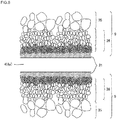
- Fig. 8 is an enlarged sectional view showing the enlarged vicinity of the filtering cell 4a shown in Fig. 7 .
- the porous body 9 is constituted of a supporter 35, and an intermediate layer 36 superimposed on the supporter 35 and including one or more layers having different average pore diameters.
- the separation membrane 31 is disposed on the surface of the intermediate layer 36.
- the number of the layers forming the intermediate layer 36 and the average pore diameter in each layer can suitably be selected in accordance with properties or use of the fluid to be treated, in view of a separation performance.
- the separation membrane 31 there is not any special restriction on the separation membrane 31 as long as it is possible to separate the mixed fluid including a mixed gas, a mixed liquid or the like, and the membrane may suitably be selected from a known carbon membrane, a zeolite membrane, a silica membrane, and the like in accordance with a type of fluid to be separated. It is to be noted that, when alcohol is separated from an organic liquid medium containing the alcohol, a hybrid silica membrane having an organic functional group is preferable among these membranes. As the organic functional group, the number of carbon atoms is preferably from 2 to 8, and the group can suitably be selected in accordance with a type of alcohol to be separated. Furthermore, the organic functional group may be a chain alkyl group or an annular aryl group. When the alcohol to be separated is ethanol, an octyl group, a phenyl group or a tolyl group is especially preferable from the viewpoint that a selection ratio is high.
- the present invention provides a method and a device for use in separating a target permeable substance from the mixed fluid by use of the ceramic filter including the porous body and the separation membrane disposed on each of the inner wall surfaces of at least part of the plurality of through channels.
- the porous body is a pillar-shaped structure body in which there are disposed the plurality of through channels extending through the body from the first end face to the second end face and formed in the rows.
- the method for using the ceramic filter of the present invention is preferably a method using the filter device of the present invention.
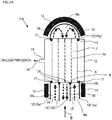
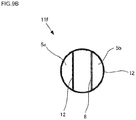
- FIG. 9A and FIG. 9B are schematic views showing the respective embodiments of the filter device of the present invention
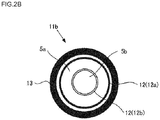
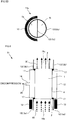
- Fig. 2A , Fig. 2B and Fig. 6 are schematic views showing one embodiment of a conventional filter device.
- Fig. 1A and the like the water collecting cells 4b and the plugging members 8 formed in the ceramic filter 1 are schematically shown.
- Fig. 1C shows, for convenience, an arrangement of the rows 8a in which the water collecting cells (the plugging members) are arranged and which is hidden by through channel division means 15.
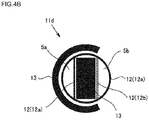
- the ceramic filter 1 is preferably received in a casing 12 and utilized as each of filter devices 11a to 11f as shown in Fig. 1A , Fig. 1B and the like.
- the casing 12 receives the ceramic filter 1, and forms an introduction path 16a to introduce the mixed fluid 10 into the ceramic filter 1, an intermediate path 16b to return and reintroduce, into the ceramic filter 1, the mixed fluid 10 which is being treated, and a discharge path 16c to discharge a treated fluid 30 from the ceramic filter 1.
- the casing 12 also functions as a disposing place of after-mentioned heating means 13 and a connecting place (a decompression port 14) of decompressing means.
- the mixed fluid 10 to be treated is allowed to flow only in one direction from the first end face 2 as an inflow side end face to the second end face 3 as an outflow side end face of the ceramic filter 1, and is filtered.
- the mixed fluid 10 undergoes, at least once, a passing process of passing through an outward path 5a in which the mixed fluid flows from the first end face 2 to the second end face 3 of the ceramic filter 1, returning, and passing through a return path 5b in which the mixed fluid flows from the second end face 3 to the first end face 2.
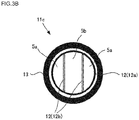
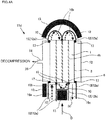
- such a passing process may be performed in one reciprocation as shown in, e.g., Fig. 1A , Fig. 3A , and Fig. 5A , two reciprocations as shown in Fig. 4A , or more.
- the filter device 11c shown in Fig. 3A the mixed fluid 10 flows in from each of two introduction paths 16a and returns, and hence, the number of returning times is one, but the fluids from two directions join each other to be stirred, so that a stirring effect enhances.
- the filter device of the present invention may only have at least one set of the outward path 5a and the return path 5b constituting a pair with the outward path 5a. For example, as shown in Fig.
- the introduction path 16a and the discharge path 16c may be formed in the different end faces of the ceramic filter 1, respectively, to have the passing process of one reciprocation and half or two reciprocations and half.
- the passing process may be discontinued halfway to dispose a plurality of mutually independent passing routes, and the routes may be used to filter different fluids, respectively. That is, a single filter device may be constituted to simultaneously serve as a plurality of filtering systems.
- the number of the returning times (the number of the intermediate paths) is preferably from 1 to 5, and further preferably from 2 to 4. When the number is smaller than 1, the separation performance deteriorates sometimes. When the number is larger than 5, this structure becomes complicated, and is hard to be manufactured sometimes.
- the plurality of through channels 4 are divided into a plurality of zones including the outward path 5a and the return path 5b by the through channel division means 15.
- the plurality of zones can be formed by the through channel division means 15 suitably disposed in the first end face 2 and/or the second end face 3.
- the casing 12 is preferably disposed on the through channel division means 15, and a flow-through route (the introduction path, the intermediate path and the discharge path) of each of the fluid flowing into the ceramic filter 1 and the fluid flowing out from the ceramic filter 1 is preferably formed by the casing 12.
- each of the introduction path, the intermediate path and the discharge path is preferably formed by a portion of the casing 12 which is disposed on the through channel division means 15, a portion of the casing which is not disposed on the through channel division means 15, or both the portions.
- the casing 12 When the casing 12 is disposed on the through channel division means 15, it is preferable that the casing 12 comes in contact with the through channel division means 15 and is disposed along the through channel division means 15.
- the fluid flows to the ceramic filter 1 through the flow-through route (the introduction path 16a) formed by a part of the casing including at least the portion of the casing which is disposed on the through channel division means 15, and the fluid flows into the zones divided by the through channel division means 15.
- the number of the zones to be divided may be two as shown in, e.g., Fig. 1A and Fig. 5A , may be three as shown in Fig. 3A , Fig. 4A and Fig. 9A , or may be more.
- a width of the seal means (the through channel division means) is preferably from 0.5 to 1.5 times, further preferably from 0.75 to 1.2 times, and especially preferably from 0.8 to 1.0 time as large as a width of the row in which the water collecting cells are arranged.
- the width of the row in which the water collecting cells are arranged is the shortest distance between circumferences of the filtering cells disposed on both sides adjacent to the water collecting cells.
- a relation between the width of the seal means and the width of the row in which the water collecting cells are arranged is in such a range, and hence, it is possible to prevent "the open ends of the cells adjacent to the water collecting slits" from being closed by the packing (the through channel division means).
- the width of the seal means is a length in "a direction perpendicular to a longitudinal direction of the seal means and parallel to the end face when the seal means is disposed in the end face of the porous body".
- the through channel division means 15 is disposed "along the row" in the state where the through channel division means 15 is in contact with "the row 8a in which the water collecting cells are arranged" in at least one end face of the porous body. That is, the through channel division means 15 is formed along portions of the end face of the ceramic filter 1 "which are sealed by the plugging members", i.e., portions of the through channels which are not opened. Therefore, when the outward path and the return path are divided, the outward path and the return path are not closed by the through channel division means.
- the through channel division means 15 preferably has a linearly extending shape so that the through channel division means can be disposed on "the row in which the water collecting cells are arranged".
- the conventional filter device 11b shown in Fig. 2A and Fig. 2B is formed so that flow of a fluid returns in the filter device, but through channel division means for forming a structure to return the flow of the fluid is round (see Fig. 2B ). Therefore, open ends of cells opened in an end face are closed by the through channel division means, and the fluid to be treated cannot flow into the closed cells, so that an effective membrane area decreases.
- the through channel division means is formed at such a width that the cells are not closed, seal properties are deteriorated by opened filtering cells facing the seal means, the fluid disadvantageously penetrates beyond the through channel division means, and a desirable flow speed cannot be obtained.
- the conventional filter device 11b shown in Fig. 2A has a constitution similar to the filter device 11a shown in Fig. 1A , except that through channel division means 15 is round and heating means 13 is disposed to surround a casing 12.
- the casing 12 disposed in each of the filter devices 11a to 1 If of the present invention forms the introduction path 16a, the intermediate path 16b and the discharge path 16c to correspond to the through channel division means 15.
- the introduction path 16a is a portion to introduce the mixed fluid 10 into the outward path 5a.
- the intermediate path 16b is a portion to return the mixed fluid 10 which is being treated and reintroduce the fluid into the ceramic filter 1.
- the discharge path 16c is a portion to discharge the treated fluid 30 from the ceramic filter 1.
- the discharge path 16c is preferably positioned on a side opposite to the introduction path 16a via the ceramic filter 1.
- main causes for the polarization are, in a contact interface between the fluid to be treated and the separation membrane (i.e., an inner peripheral portion of each cell), (1) a difference between an inner temperature and an outer temperature of the fluid flowing through the cells due to vaporization heat of the permeable substance which has permeated the separation membrane and (2) a difference between an inner concentration and an outer concentration in "the concentration of the permeable substance" in the fluid flowing through the cells due to the permeation of the permeable substance through the separation membrane.
- the filter when the flow speed lowers, the temperature and the concentration locally lower in the contact interface, and hence, the filter cannot exert any intrinsic performance. Therefore, for the purpose of preventing the separation performance of the filter from being deteriorated, it is necessary to acquire a high flow rate, i.e., a high flow speed in accordance with a sectional area of the filter, thereby mixing the fluids in the cells to dissolve the polarization. Further, it is preferable that the high flow speed is acquired to cause turbulence and that the supply fluids are sufficiently mixed to dissolve the polarization.
- the filter device of the present invention as compared with the conventional filter device, a sectional area of a portion through which the fluid passes during the filtering is smaller, and hence, even when the flow rate of the supply fluid is small, the high flow speed can be acquired. In consequence, it is possible to realize downsizing of a pump and reduction of running cost. Additionally, in the method for using the ceramic filter and the filter device of the present invention, the fluid is stirred in the portion (the intermediate path) in which the fluid is returned. In consequence, the fluid which has dissolved the polarization in at least the intermediate path can be allowed to flow into the return path, and the separation performance improves.
- the fluids flowing out from the through channels are returned to flow into the return path, but before that, in the intermediate path, the fluids flowing out from the respective cells join one another and a flow direction varies, and hence, the fluids are forcibly stirred (joined and stirred) regardless of the flow speed given to the fluid, so that the polarization can be dissolved. Therefore, especially on conditions that a supply amount of the fluid is small, e.g., even on conditions that the fluid cannot flow out from a laminar flow region (Reynolds number of 2100 or less) even when the flow speed is heightened by dividing the abovementioned through channels, the polarized fluid to be treated can be returned to the uniform fluid in at least the intermediate path.
- a laminar flow region Reynolds number of 2100 or less
- a capacity of the intermediate path 16b is preferably from 5 to 50% and further preferably from 8 to 30% of a total capacity (a through channel capacity) of the filtering cells 4a facing the intermediate path 16b.
- the through channel capacity is the total of the capacities of the respective through channels.
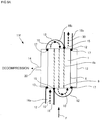
- a conventional filter device 11 shown in Fig. 6 has a mechanism in which the mixed fluid 10 is beforehand heated, before the mixed fluid 10 flows from the first end face 2 of the filter 1 into the ceramic filter 1. Further, the heating means 13 is disposed in a portion of the casing 12 before the first end face 2.
- the mixed fluid 10 is preferably beforehand heated before the mixed fluid 10 flows into each of the outward path 5a and the return path 5b. That is, each of the filter devices 11a to 11e of the present invention preferably includes the plurality of heating means 13 for heating the mixed fluid 10 before the mixed fluid flows into each of the outward path 5a and the return path 5b.
- the heating means 13 there is not any special restriction on the heating means 13 as long as the heating means 13 is capable of applying desirable heat to the mixed fluid 10, but it is preferable to use an electric heater, a heat exchanger or the like. There is not any special restriction on a heating timing in a range where the mixed fluid 10 having a required temperature is introduced into the ceramic filter 1, but the mixed fluid 10 is preferably heated immediately before introduced, so that the heat, which is applied to the mixed fluid 10 and escapes until the mixed fluid 10 is introduced into the ceramic filter 1, does not incur deterioration of an energy efficiency.
- the heating means 13 is preferably disposed in a place as close as possible to the mixed fluid 10 to be heated and the ceramic filter 1 into which the mixed fluid 10 is to be introduced.
- the heating means 13 is preferably disposed as close as possible to the end face of the ceramic filter 1, in at least a part of a portion of the casing 12 which forms each of the introduction path 16a and the intermediate path 16b.
- the heating means be disposed away from the ceramic filter 1.
- fluid conveying means connecting the heat exchanger to the introduction path 16a and the intermediate path 16b is preferably made of a high heat insulating material.
- At least a portion of the casing 12 which is interposed between the heating means 13 and the mixed fluid 10 is preferably made of a high heat conductive material 12a.
- the high heat conductive material 12a include carbon, aluminum, iron, and stainless steel.
- aluminum is especially preferably used from the viewpoints of easiness of shape machining, a high heat conductivity, a high corrosion resistance, and light weight properties.
- At least a portion of the casing 12 in which the mixed fluid 10 and the treated fluid 30 pass by each other, i.e., a portion of the casing which divides the introduction path 16a and the discharge path 16c is preferably made of a low heat conductive material 12b for the purpose of preventing the heat applied to the mixed fluid 10 from being taken to a treated fluid 30 side.
- the low heat conductive material 12b include a silicone rubber, a fluororesin, glass, and a double wall material via air or vacuum.
- a vacuum double wall material is especially preferably used from the viewpoints of the easiness of the shape machining, a low heat conductivity, and the high corrosion resistance.
- the material may be the same material as in the seal means for use in the through channel division means 15 and, for example, a silicone rubber or a fluororesin is preferable. It is to be noted that, in Fig. 1A to Fig. 6 , the low heat conductive material 12b is shown by double lines for convenience, but in the actual filter devices 11a to 11e of the present invention, the low heat conductive material 12b is not limited to a double structure as described above.
- the present invention when the mixed fluid 10 flowing into the ceramic filter 1 is always heated, the separation performance is preferably maintained to be high.
- the conventional filter device a large amount of the fluid has to be collectively heated and introduced, and hence, enlargement and cost increase of not only the pump but also a heater as the heating means cannot be avoided.
- the present invention has the heating means, the present invention overcomes these problems of the conventional filtering system while using the heretofore known ceramic filter.
- the inside of the casing 12 in which the ceramic filter 1 is received may be decompressed through the decompression port 14 by use of the decompressing means.
- the inside of the casing 12 is decompressed, and hence, a pressure difference is made between a filtering cell 4a side of the ceramic filter 1 and a water collecting cell 4b side or a circumferential wall side, and separation of a permeable substance 20 for the purpose of allowing permeation through the separation membrane is promoted, so that recovery is preferably facilitated.
- each of the filter devices 11a to 11e of the present invention may include the decompressing means for controlling a pressure in the casing 12 to promote the separation of the target permeable substance 20.
- the decompressing means is preferably disposed in a part (the decompression port 14) of a portion of the casing 12 which covers the ceramic filter 1.
- heretofore known means such as a vacuum pump is usable.
- the filter device itself becomes large-scaled, and restrictions are imposed on a disposing place and the like from the viewpoint of a size and a weight.
- the plurality of ceramic filters as well as the casings, heating means and decompressing means matched with the ceramic filters are required to raise the problem that the number of the components increases and cost heightens.
- each ceramic filter as seal positions 17 of the through channels through which the mixed fluid passes, to an internal space of the casing which is to be decompressed, increases, there heightens the risk that leakage from a system of the mixed fluid occurs to generate a loss of the mixed fluid, decompressing means such as the vacuum pump is adversely affected, or the leaked mixed fluid catches fire. Therefore, the present invention has remarkable merits even as compared with the conventional filter device in which the abovementioned plurality of ceramic filters are used.
- alumina was used as aggregate particles, and a monolith type of ceramic filter was prepared.
- the obtained ceramic filter had a round pillar shape with an outer diameter of 90 mm and a length of 100 mm.
- 500 cells of through channels were disposed, and a diameter of each cell was 2.5 mm.
- open ends water collecting slits
- the end face of the ceramic filter was sealed with a glass seal.
- the obtained filter was incorporated into such a casing as shown in Fig. 1A , to prepare a filter device.
- thermos structure As a casing material, aluminum was used, and a low heat conductive material was formed into a thermos structure the inside of which was made a vacuum with double walls.
- channel division means 15 a packing (seal means) made of a hard rubber), which was in contact with "a row 8a in which water collecting cells (plugging members) were arranged" in one end face of the porous body, was disposed "along the row” (see Fig. 1C ).
- the prepared filter device was used to carry out a penetration vaporization separation test of a mixed liquid (a mixed fluid) having a mass ratio of 1:1:1 of ethanol, normal octane and orthoxylene.
- a heater temperature was set to 70°C
- a secondary side vacuum pressure was set to 50 Torr
- a liquid flow rate was set to 3.7 L/minute
- an amount of the fluid which permeated a membrane after elapse of a certain time was calculated as Flux (kg/m 2 ⁇ h).
- an IPA concentration in the permeated mixed liquid was measured, and a separation coefficient ⁇ (1/(1-ethanol permeation concentration)) was calculated. Table 1 shows the result. [Table 1] No.
- Example 1 1 0.050 250 4.3 2.8
- Example 2 1 0.050 250 4.5 3.2
- Example 3 3 0.100 500 5.9 8.3
- Example 4 1 0.050 250 4.1 2.9
- Example 5 2 0.075 375 4.3 4.0 Comparative Ex. 1 0 0.025 125 2.4 2.1 Comparative Ex. 2 1 0.050 250 3.2 2.4
- a filter device was prepared on conditions similar to those of Example 1, except that a casing structure was formed as shown in Fig. 3A , and a penetration vaporization separation test of a mixed liquid was carried out. Table 1 shows the result.
- a filter device was prepared on conditions similar to those of Example 1, except that a casing structure was formed as shown in Fig. 4A , and a penetration vaporization separation test of a mixed liquid was carried out. Table 1 shows the result.
- a filter device was prepared on conditions similar to those of Example 1, except that a casing structure was formed as shown in Fig. 5A , and a penetration vaporization separation test of a mixed liquid was carried out. Table 1 shows the result.
- a filter device was prepared on conditions similar to those of Example 1, except that a casing structure was formed as shown in Fig. 9A , and a penetration vaporization separation test of a mixed liquid was carried out. Table 1 shows the result.
- a filter device was prepared on conditions similar to those of Example 1, except that a casing structure was formed as shown in Fig. 6 , and a penetration vaporization separation test of a mixed liquid was carried out. Table 1 shows the result.
- a filter device was prepared on conditions similar to those of Example 1, except that a casing structure was formed as shown in Fig. 2A . Open ends of part of through channels in one end face of a porous body were closed by through channel division means. A penetration vaporization separation test of a mixed liquid was carried out by using the obtained filter device. Table 1 shows the result.
- a method for using a ceramic filter and a filter device according to the present invention are suitably utilized as means for separating a component as a part of a mixture by a penetration vaporization process.
- 10 mixed fluid, 11, 11a, 11b, 11c, 11d, 11e and 11f: filter device, 12: casing, 12a: high heat conductive material, 12b: low heat conductive material, 13: heating means, 14: decompression port, 15: through channel division means, 16a: introduction path, 16b: intermediate path, 16c: discharge path, 17: seal position, 20: permeable substance, 30: treated fluid, 31: separation membrane, 35: supporter, and 36: intermediate layer.
Landscapes
- Chemical & Material Sciences (AREA)
- Chemical Kinetics & Catalysis (AREA)
- Engineering & Computer Science (AREA)
- Water Supply & Treatment (AREA)
- Separation Using Semi-Permeable Membranes (AREA)
- Filtering Materials (AREA)
Claims (19)
- Verfahren zur Verwendung eines Keramikfilters (1), der zum Trennen einer gewünschten permeablen Substanz von einem gemischten Fluid verwendet wird und der einen säulenförmigen porösen Körper (9) mit einer Umfangsfläche (6) und mit einer Vielzahl von Durchgangskanälen (4), die sich durch den porösen Körper von einer ersten Stirnfläche (2) zu einer zweiten Stirnfläche (3) erstrecken und in Reihen gebildet sind, und eine Trennmembran (31) aufweist, die auf jeder der Innenwandflächen von mindestens einem Teil der Vielzahl von Durchgangskanälen (4) angeordnet ist, wobei einige der Vielzahl von Durchgangskanälen Wassersammelzellen (4b) sind, deren offene Enden in der ersten Stirnfläche und der zweiten Stirnfläche durch Stopfenelemente (8) verschlossen sind, wobei ferner Wassersammelschlitze (7) so angeordnet sind, dass sie in der Umfangsfläche (6) des porösen Körpers (9) öffnen, so dass die Wassersammelzellen (4b) mit einem Außenraum in Verbindung stehen, und wobei die Wassersammelzellen (4b) so angeordnet sind, dass sie mindestens eine Reihe in den Stirnflächen des porösen Körpers bilden, wobei das Verfahren zum Verwenden des Keramikfilters umfasst:Anordnen von Durchgangskanalteilungsmitteln (15) entlang einer Reihe (8a), in der die Wassersammelzellen (4b) in mindestens einer der Stirnflächen des porösen Körpers in einem Zustand angeordnet sind, in dem das Durchgangskanalteilungsmittel (15) mit der Reihe in Kontakt steht, und Aufteilen der Vielzahl von Durchgangskanälen in eine Vielzahl von Zonen einschließlich eines Hinwegs (5a) und eines Rückwegs (5b) unter Verwendung der Durchgangskanalteilungsmittel (15), so dass die gemischte Flüssigkeit mindestens einmal einem Durchlaufprozess des Durchlaufens des Hinwegs (5a) unterworfen wird, bei dem die gemischte Flüssigkeit von der ersten Stirnseite (2) zur zweiten Stirnseite (3) des Keramikfilters strömt, zurückkehrt und dann den Rückweg (5b) durchläuft, bei dem die gemischte Flüssigkeit von der zweiten Stirnseite (3) zur ersten Stirnseite (2) strömt, undSammeln der gewünschten permeablen Substanz, nachdem die gewünschte permeable Substanz die Trennmembran (31) durchdrungen hat.
- Verfahren zur Verwendung des Keramikfilters nach Anspruch 1, mit Absenken des Drucks im Inneren eines Gehäuses, in dem der Keramikfilter aufgenommen ist, unter Verwendung von Druckabsenkungsmitteln.
- Verfahren zur Verwendung des Keramikfilters nach Anspruch 1 oder 2, mit Erwärmen der gemischten Flüssigkeit, bevor die gemischte Flüssigkeit in jeden der Hin- (5a) und Rückwege (5b) strömt.
- Verfahren zur Verwendung des Keramikfilters nach einem der Ansprüche 1 bis 3, mit Anordnen von Dichtungsmitteln (17) als Durchgangskanalteilungsmittel (15), um das Eindringen der gemischten Flüssigkeit über die Durchgangskanalteilungsmittel hinaus zumindest auf einer einströmseitigen Stirnfläche (2) zu verhindern.
- Verfahren zur Verwendung des Keramikfilters nach Anspruch 4, mit Anordnen der Dichtungsmittel als Durchgangskanalteilungsmittel in sowohl der ersten Stirnfläche als auch der zweiten Stirnfläche (3).
- Verfahren zur Verwendung des Keramikfilters nach Anspruch 5, wobei eine Breite der Dichtungsmittel (17) 0,5 bis 1,5 mal so groß ist wie eine Breite der Reihe, in der die Wassersammelzellen angeordnet sind.
- Verfahren zur Verwendung des Keramikfilters nach einem der Ansprüche 1 bis 6, wobei die Anzahl der Male der Rückführung von 1 bis 5 beträgt.
- Verfahren zur Verwendung des Keramikfilters nach einem der Ansprüche 1 bis 7, worin die Trennmembran (31) eine Membran ist, durch die Alkohol von einem den Alkohol enthaltenden organischen flüssigen Medium abtrennbar ist.
- Verfahren zur Verwendung des Keramikfilters nach einem der Ansprüche 1 bis 8, worin die Trennmembran (31) eine hybride Siliziumdioxidmembran mit einer organischen Funktionsgruppe ist.
- Filtervorrichtung, mit:einem Keramikfilter (1), der einen säulenförmigen porösen Körper (9) mit einer Umfangsfläche (6) und einer Vielzahl von Durchgangskanälen (4), die sich durch den porösen Körper von einer ersten Stirnfläche (2) zu einer zweiten Stirnfläche (3) erstrecken und in Reihen ausgebildet sind, und eine Trennmembran (31) aufweist, die auf jeder der Innenwandflächen von mindestens einem Teil der Vielzahl von Durchgangskanälen (4) angeordnet ist, wobei einige der Vielzahl von Durchgangskanälen Wassersammelzellen (4b) sind, deren offene Enden in der ersten Stirnfläche und der zweiten Stirnfläche durch Stopfenelemente (8) verschlossen sind, und wobei ferner Wassersammelschlitze (7) angeordnet sind, um sich in der Umfangsfläche (6) des porösen Körpers (9) zu öffnen, so dass die Wassersammelzellen mit einem Außenraum in Verbindung stehen; undeinem Gehäuse (12), das den Keramikfilter (1) aufnimmt und einen Einführungspfad (16a), um eine gemischte Flüssigkeit in den Keramikfilter einzubringen, einen Zwischenpfad (16b), um die zu behandelnde gemischte Flüssigkeit zurückzuführen und wieder in den Keramikfilter einzubringen, und einen Auslasspfad (16c) bildet, um die behandelte Flüssigkeit aus dem Keramikfilter abzuführen,wobei die Vielzahl von Durchgangskanälen (4) mindestens einen Satz aus einem Hinweg (5a), in dem die gemischte Flüssigkeit von der ersten Stirnfläche (2) zu der zweiten Stirnfläche (3) strömt, und einem Rückweg (5b) aufweist, in dem die gemischte Flüssigkeit zurückkehrt und von der zweiten Stirnfläche (3) zu der ersten Stirnfläche (2) strömt,wobei die Wassersammelzellen (4b) angeordnet sind, um mindestens eine Reihe in den Stirnflächen des porösen Körpers zu bilden.wobei Durchgangskanalteilungsmittel (15) entlang der Reihe angeordnet sind, in der die Wassersammelzellen (4b) in mindestens einer der Stirnseiten des porösen Körpers in einem Zustand angeordnet sind, in dem die Durchgangskanalteilungsmittel (15) mit der Reihe in Kontakt stehen, undder Hinweg (5a) und der Rückweg (5b) durch das Durchgangskanalteilungsmittel (15) geteilt sind.
- Filtervorrichtung nach Anspruch 10, ferner mit einem Druckabsenkungsanschluss (14), der in einem Teil eines Abschnitts des Gehäuses (12) angeordnet ist, der den Keramikfilter (1) abdeckt, um einen Innendruck des Gehäuses zu steuern, um die Trennung einer gewünschten permeablen Substanz zu fördern.
- Filtervorrichtung nach Anspruch 10 oder 11, mit einer Vielzahl von Heizmitteln (13) zum Erwärmen der gemischten Flüssigkeit, bevor die gemischte Flüssigkeit in jeden der Hin- und Rückwege strömt.
- Filtervorrichtung nach einem der Ansprüche 10 bis 12,
wobei die Vielzahl der Durchgangskanäle in eine Vielzahl von Zonen unterteilt ist, die den Hinweg (5a) und den Rückweg (5b) beinhalten, und
die Vielzahl von Zonen durch die Durchgangskanalteilungsmittel (15) gebildet wird, die in der ersten Stirnfläche und der zweiten Stirnfläche angeordnet sind. - Filtervorrichtung nach einem der Ansprüche 10 bis 13, wobei das Durchgangskanalteilungsmittel (15) ein Dichtungsmittel (17) ist, das in sowohl der ersten Stirnfläche als auch der zweiten Stirnfläche angeordnet ist, um die gemischte Flüssigkeit mindestens an einer einströmseitigen Stirnfläche (2) daran zu hindern, über das Durchgangskanalteilungsmittel hinaus einzudringen.
- Filter nach Anspruch 14, wobei eine Breite der Dichtungsmittel 0,5 bis 1,5 mal so groß ist wie eine Breite der Reihe, in der die Wassersammelzellen angeordnet sind.
- Filtervorrichtung nach einem der Ansprüche 10 bis 15, wobei die Anzahl der Male der Rückführung von 1 bis 5 beträgt.
- Filtervorrichtung nach einem der Ansprüche 10 bis 16, wobei die Trennmembran eine hybride Siliziumdioxidmembran mit einer organischen Funktionsgruppe ist.
- Filtervorrichtung nach einem der Ansprüche 10 bis 17, wobei eine Kapazität des Zwischenpfades (16b) von 5 bis 50% einer Durchgangskanalkapazität beträgt.
- Filtervorrichtung nach einem der Ansprüche 10 bis 18, wobei der Auslasspfad auf einer dem Einführungspfad über den Keramikfilter gegenüberliegenden Seite positioniert ist.
Applications Claiming Priority (2)
| Application Number | Priority Date | Filing Date | Title |
|---|---|---|---|
| JP2013019003 | 2013-02-01 | ||
| PCT/JP2014/052307 WO2014119742A1 (ja) | 2013-02-01 | 2014-01-31 | セラミックフィルタの使用方法及びフィルタ装置 |
Publications (3)
| Publication Number | Publication Date |
|---|---|
| EP2952247A1 EP2952247A1 (de) | 2015-12-09 |
| EP2952247A4 EP2952247A4 (de) | 2016-09-14 |
| EP2952247B1 true EP2952247B1 (de) | 2019-01-30 |
Family
ID=51262439
Family Applications (1)
| Application Number | Title | Priority Date | Filing Date |
|---|---|---|---|
| EP14745945.7A Not-in-force EP2952247B1 (de) | 2013-02-01 | 2014-01-31 | Verfahren zur verwendung eines keramikfilters und filtervorrichtung |
Country Status (6)
| Country | Link |
|---|---|
| US (1) | US20150336055A1 (de) |
| EP (1) | EP2952247B1 (de) |
| JP (1) | JP6320304B2 (de) |
| CN (1) | CN104994939B (de) |
| MY (1) | MY175507A (de) |
| WO (1) | WO2014119742A1 (de) |
Families Citing this family (5)
| Publication number | Priority date | Publication date | Assignee | Title |
|---|---|---|---|---|
| JP2019532812A (ja) * | 2016-10-28 | 2019-11-14 | セラヘリックス,インコーポレーテッド | フィルター流れ管理のためのシステムおよび方法 |
| CN107485982A (zh) * | 2017-10-17 | 2017-12-19 | 江苏阿尔法药化设备有限公司 | 分子筛膜装置及分离生产系统 |
| KR101921493B1 (ko) | 2018-01-18 | 2018-11-23 | 나노화인 주식회사 | 세라믹 필터 여과막 모듈 |
| KR101921495B1 (ko) * | 2018-01-18 | 2018-11-23 | 나노화인 주식회사 | 정수기용 세라믹 필터 및 이를 구비한 카트리지 |
| JP2025171756A (ja) * | 2024-05-10 | 2025-11-20 | 株式会社デンソー | 液体分離システム |
Family Cites Families (12)
| Publication number | Priority date | Publication date | Assignee | Title |
|---|---|---|---|---|
| GB1382464A (en) * | 1972-04-20 | 1975-01-29 | Aqua Chem Inc | Membrane module |
| JPS5441152Y2 (de) * | 1975-05-29 | 1979-12-03 | ||
| JPH04892Y2 (de) * | 1985-10-30 | 1992-01-13 | ||
| JP3970992B2 (ja) * | 1997-10-06 | 2007-09-05 | 日本碍子株式会社 | 水素分離装置 |
| JP3868391B2 (ja) * | 2003-04-10 | 2007-01-17 | 日本碍子株式会社 | セラミックスハニカムフィルタ及びその製造方法 |
| WO2007004263A1 (ja) * | 2005-06-30 | 2007-01-11 | Ngk Insulators, Ltd. | 濾過器 |
| EP2091633B1 (de) | 2006-11-06 | 2013-01-09 | NGK Insulators, Ltd. | Herstellungsverfahren für einen verbund aus trennmembran und porösem material |
| EP2164597A4 (de) * | 2007-07-05 | 2010-12-08 | Energysolutions Diversified Se | Fluidentfernende filtervorrichtung und verfahren zur entfernung von fluid aus einem gemisch |
| US20090107330A1 (en) * | 2007-10-30 | 2009-04-30 | Yunfeng Gu | Amorphous silica hybrid membrane structure |
| WO2010070992A1 (ja) | 2008-12-19 | 2010-06-24 | 日本碍子株式会社 | 液体混合物の分離方法、及び液体混合物分離装置 |
| JP5581086B2 (ja) * | 2010-03-26 | 2014-08-27 | 日本碍子株式会社 | セラミックフィルタモジュール |
| JP5591041B2 (ja) * | 2010-09-17 | 2014-09-17 | 三菱重工業株式会社 | 脱水装置に用いられる膜容器 |
-
2014
- 2014-01-31 JP JP2014559781A patent/JP6320304B2/ja active Active
- 2014-01-31 EP EP14745945.7A patent/EP2952247B1/de not_active Not-in-force
- 2014-01-31 WO PCT/JP2014/052307 patent/WO2014119742A1/ja not_active Ceased
- 2014-01-31 CN CN201480007219.2A patent/CN104994939B/zh not_active Expired - Fee Related
- 2014-01-31 MY MYPI2015001934A patent/MY175507A/en unknown
-
2015
- 2015-07-30 US US14/813,641 patent/US20150336055A1/en not_active Abandoned
Non-Patent Citations (1)
| Title |
|---|
| None * |
Also Published As
| Publication number | Publication date |
|---|---|
| CN104994939B (zh) | 2017-03-08 |
| US20150336055A1 (en) | 2015-11-26 |
| MY175507A (en) | 2020-06-30 |
| JP6320304B2 (ja) | 2018-05-09 |
| WO2014119742A1 (ja) | 2014-08-07 |
| JPWO2014119742A1 (ja) | 2017-01-26 |
| EP2952247A1 (de) | 2015-12-09 |
| EP2952247A4 (de) | 2016-09-14 |
| CN104994939A (zh) | 2015-10-21 |
Similar Documents
| Publication | Publication Date | Title |
|---|---|---|
| US20150336055A1 (en) | Method for using ceramic filter, and filter device | |
| TWI476040B (zh) | Adsorption separation membrane module, and adsorption separation membrane module manufacturing method | |
| EP1731215B1 (de) | Gewickelte Brennstoff-Stabilisierungseinheit zum Sauerstoffentzug | |
| CN101115545B (zh) | 膜分离组件 | |
| EP2954943B1 (de) | Vorrichtung zur trennung von sauerstoff und stickstoff | |
| EP2433703A1 (de) | Pervaporations-keramikmembran und wasserdurchlässige keramikmembran | |
| EP2977094A1 (de) | Gastrennungsmembranmodul mit verbesserter gasdichtung | |
| WO2009118934A1 (ja) | 分離膜モジュール | |
| KR20190130679A (ko) | 친화성 크로마토그래피 장치 | |
| CN104981284A (zh) | 用于冗余无菌过滤的方法和装置 | |
| WO2012008476A1 (ja) | セラミックフィルタ | |
| JP4990063B2 (ja) | 分離膜モジュール | |
| CN113316476B (zh) | 分离膜组件和使用该分离膜组件的液体处理系统 | |
| TW201306922A (zh) | 用於過濾及分離流動介質的裝置 | |
| JP2021016858A (ja) | 分離装置、および、分離装置の運転方法 | |
| US20240100483A1 (en) | Single pass electro-separation system | |
| KR101557544B1 (ko) | 중공사막 모듈 | |
| CN115003977A (zh) | 用于热量和/或物质传递的设备 | |
| CN108341462A (zh) | 一种反渗透滤芯及反渗透滤芯组件 | |
| WO2008115788A3 (en) | Fluid treatment elements and fluid treatment arrangements with posts and/or bands between fluid treatment elements and methods for making and using them | |
| CN115779690B (zh) | 一种卷式膜组件及其制备方法与应用 | |
| JP2004290838A (ja) | 流体分離フィルタ及び流体分離モジュール | |
| NZ720020A (en) | Membrane separation apparatus | |
| KR101584117B1 (ko) | 중공사막 모듈 | |
| US20180117532A1 (en) | Systems and methods for filter flow management |
Legal Events
| Date | Code | Title | Description |
|---|---|---|---|
| PUAI | Public reference made under article 153(3) epc to a published international application that has entered the european phase |
Free format text: ORIGINAL CODE: 0009012 |
|
| 17P | Request for examination filed |
Effective date: 20150818 |
|
| AK | Designated contracting states |
Kind code of ref document: A1 Designated state(s): AL AT BE BG CH CY CZ DE DK EE ES FI FR GB GR HR HU IE IS IT LI LT LU LV MC MK MT NL NO PL PT RO RS SE SI SK SM TR |
|
| AX | Request for extension of the european patent |
Extension state: BA ME |
|
| DAX | Request for extension of the european patent (deleted) | ||
| A4 | Supplementary search report drawn up and despatched |
Effective date: 20160816 |
|
| RIC1 | Information provided on ipc code assigned before grant |
Ipc: B01D 69/04 20060101ALI20160809BHEP Ipc: B01D 69/12 20060101ALI20160809BHEP Ipc: B01D 61/36 20060101ALI20160809BHEP Ipc: B01D 71/02 20060101AFI20160809BHEP |
|
| STAA | Information on the status of an ep patent application or granted ep patent |
Free format text: STATUS: EXAMINATION IS IN PROGRESS |
|
| 17Q | First examination report despatched |
Effective date: 20180209 |
|
| GRAP | Despatch of communication of intention to grant a patent |
Free format text: ORIGINAL CODE: EPIDOSNIGR1 |
|
| STAA | Information on the status of an ep patent application or granted ep patent |
Free format text: STATUS: GRANT OF PATENT IS INTENDED |
|
| INTG | Intention to grant announced |
Effective date: 20180817 |
|
| GRAS | Grant fee paid |
Free format text: ORIGINAL CODE: EPIDOSNIGR3 |
|
| GRAA | (expected) grant |
Free format text: ORIGINAL CODE: 0009210 |
|
| STAA | Information on the status of an ep patent application or granted ep patent |
Free format text: STATUS: THE PATENT HAS BEEN GRANTED |
|
| AK | Designated contracting states |
Kind code of ref document: B1 Designated state(s): AL AT BE BG CH CY CZ DE DK EE ES FI FR GB GR HR HU IE IS IT LI LT LU LV MC MK MT NL NO PL PT RO RS SE SI SK SM TR |
|
| REG | Reference to a national code |
Ref country code: GB Ref legal event code: FG4D |
|
| REG | Reference to a national code |
Ref country code: CH Ref legal event code: EP |
|
| REG | Reference to a national code |
Ref country code: AT Ref legal event code: REF Ref document number: 1092795 Country of ref document: AT Kind code of ref document: T Effective date: 20190215 |
|
| REG | Reference to a national code |
Ref country code: IE Ref legal event code: FG4D |
|
| REG | Reference to a national code |
Ref country code: DE Ref legal event code: R096 Ref document number: 602014040371 Country of ref document: DE |
|
| REG | Reference to a national code |
Ref country code: LT Ref legal event code: MG4D |
|
| REG | Reference to a national code |
Ref country code: NL Ref legal event code: MP Effective date: 20190130 |
|
| PG25 | Lapsed in a contracting state [announced via postgrant information from national office to epo] |
Ref country code: LT Free format text: LAPSE BECAUSE OF FAILURE TO SUBMIT A TRANSLATION OF THE DESCRIPTION OR TO PAY THE FEE WITHIN THE PRESCRIBED TIME-LIMIT Effective date: 20190130 Ref country code: PL Free format text: LAPSE BECAUSE OF FAILURE TO SUBMIT A TRANSLATION OF THE DESCRIPTION OR TO PAY THE FEE WITHIN THE PRESCRIBED TIME-LIMIT Effective date: 20190130 Ref country code: FI Free format text: LAPSE BECAUSE OF FAILURE TO SUBMIT A TRANSLATION OF THE DESCRIPTION OR TO PAY THE FEE WITHIN THE PRESCRIBED TIME-LIMIT Effective date: 20190130 Ref country code: NO Free format text: LAPSE BECAUSE OF FAILURE TO SUBMIT A TRANSLATION OF THE DESCRIPTION OR TO PAY THE FEE WITHIN THE PRESCRIBED TIME-LIMIT Effective date: 20190430 Ref country code: SE Free format text: LAPSE BECAUSE OF FAILURE TO SUBMIT A TRANSLATION OF THE DESCRIPTION OR TO PAY THE FEE WITHIN THE PRESCRIBED TIME-LIMIT Effective date: 20190130 Ref country code: PT Free format text: LAPSE BECAUSE OF FAILURE TO SUBMIT A TRANSLATION OF THE DESCRIPTION OR TO PAY THE FEE WITHIN THE PRESCRIBED TIME-LIMIT Effective date: 20190530 Ref country code: ES Free format text: LAPSE BECAUSE OF FAILURE TO SUBMIT A TRANSLATION OF THE DESCRIPTION OR TO PAY THE FEE WITHIN THE PRESCRIBED TIME-LIMIT Effective date: 20190130 Ref country code: NL Free format text: LAPSE BECAUSE OF FAILURE TO SUBMIT A TRANSLATION OF THE DESCRIPTION OR TO PAY THE FEE WITHIN THE PRESCRIBED TIME-LIMIT Effective date: 20190130 |
|
| REG | Reference to a national code |
Ref country code: AT Ref legal event code: MK05 Ref document number: 1092795 Country of ref document: AT Kind code of ref document: T Effective date: 20190130 |
|
| PG25 | Lapsed in a contracting state [announced via postgrant information from national office to epo] |
Ref country code: GR Free format text: LAPSE BECAUSE OF FAILURE TO SUBMIT A TRANSLATION OF THE DESCRIPTION OR TO PAY THE FEE WITHIN THE PRESCRIBED TIME-LIMIT Effective date: 20190501 Ref country code: RS Free format text: LAPSE BECAUSE OF FAILURE TO SUBMIT A TRANSLATION OF THE DESCRIPTION OR TO PAY THE FEE WITHIN THE PRESCRIBED TIME-LIMIT Effective date: 20190130 Ref country code: BG Free format text: LAPSE BECAUSE OF FAILURE TO SUBMIT A TRANSLATION OF THE DESCRIPTION OR TO PAY THE FEE WITHIN THE PRESCRIBED TIME-LIMIT Effective date: 20190430 Ref country code: HR Free format text: LAPSE BECAUSE OF FAILURE TO SUBMIT A TRANSLATION OF THE DESCRIPTION OR TO PAY THE FEE WITHIN THE PRESCRIBED TIME-LIMIT Effective date: 20190130 Ref country code: LV Free format text: LAPSE BECAUSE OF FAILURE TO SUBMIT A TRANSLATION OF THE DESCRIPTION OR TO PAY THE FEE WITHIN THE PRESCRIBED TIME-LIMIT Effective date: 20190130 Ref country code: IS Free format text: LAPSE BECAUSE OF FAILURE TO SUBMIT A TRANSLATION OF THE DESCRIPTION OR TO PAY THE FEE WITHIN THE PRESCRIBED TIME-LIMIT Effective date: 20190530 |
|
| REG | Reference to a national code |
Ref country code: CH Ref legal event code: PL |
|
| PG25 | Lapsed in a contracting state [announced via postgrant information from national office to epo] |
Ref country code: LU Free format text: LAPSE BECAUSE OF NON-PAYMENT OF DUE FEES Effective date: 20190131 |
|
| REG | Reference to a national code |
Ref country code: BE Ref legal event code: MM Effective date: 20190131 |
|
| REG | Reference to a national code |
Ref country code: IE Ref legal event code: MM4A |
|
| PG25 | Lapsed in a contracting state [announced via postgrant information from national office to epo] |
Ref country code: MC Free format text: LAPSE BECAUSE OF FAILURE TO SUBMIT A TRANSLATION OF THE DESCRIPTION OR TO PAY THE FEE WITHIN THE PRESCRIBED TIME-LIMIT Effective date: 20190130 Ref country code: AL Free format text: LAPSE BECAUSE OF FAILURE TO SUBMIT A TRANSLATION OF THE DESCRIPTION OR TO PAY THE FEE WITHIN THE PRESCRIBED TIME-LIMIT Effective date: 20190130 Ref country code: EE Free format text: LAPSE BECAUSE OF FAILURE TO SUBMIT A TRANSLATION OF THE DESCRIPTION OR TO PAY THE FEE WITHIN THE PRESCRIBED TIME-LIMIT Effective date: 20190130 Ref country code: IT Free format text: LAPSE BECAUSE OF FAILURE TO SUBMIT A TRANSLATION OF THE DESCRIPTION OR TO PAY THE FEE WITHIN THE PRESCRIBED TIME-LIMIT Effective date: 20190130 Ref country code: DK Free format text: LAPSE BECAUSE OF FAILURE TO SUBMIT A TRANSLATION OF THE DESCRIPTION OR TO PAY THE FEE WITHIN THE PRESCRIBED TIME-LIMIT Effective date: 20190130 Ref country code: RO Free format text: LAPSE BECAUSE OF FAILURE TO SUBMIT A TRANSLATION OF THE DESCRIPTION OR TO PAY THE FEE WITHIN THE PRESCRIBED TIME-LIMIT Effective date: 20190130 Ref country code: SK Free format text: LAPSE BECAUSE OF FAILURE TO SUBMIT A TRANSLATION OF THE DESCRIPTION OR TO PAY THE FEE WITHIN THE PRESCRIBED TIME-LIMIT Effective date: 20190130 Ref country code: CZ Free format text: LAPSE BECAUSE OF FAILURE TO SUBMIT A TRANSLATION OF THE DESCRIPTION OR TO PAY THE FEE WITHIN THE PRESCRIBED TIME-LIMIT Effective date: 20190130 |
|
| REG | Reference to a national code |
Ref country code: DE Ref legal event code: R097 Ref document number: 602014040371 Country of ref document: DE |
|
| PG25 | Lapsed in a contracting state [announced via postgrant information from national office to epo] |
Ref country code: SM Free format text: LAPSE BECAUSE OF FAILURE TO SUBMIT A TRANSLATION OF THE DESCRIPTION OR TO PAY THE FEE WITHIN THE PRESCRIBED TIME-LIMIT Effective date: 20190130 Ref country code: BE Free format text: LAPSE BECAUSE OF NON-PAYMENT OF DUE FEES Effective date: 20190131 |
|
| PLBE | No opposition filed within time limit |
Free format text: ORIGINAL CODE: 0009261 |
|
| STAA | Information on the status of an ep patent application or granted ep patent |
Free format text: STATUS: NO OPPOSITION FILED WITHIN TIME LIMIT |
|
| GBPC | Gb: european patent ceased through non-payment of renewal fee |
Effective date: 20190430 |
|
| PG25 | Lapsed in a contracting state [announced via postgrant information from national office to epo] |
Ref country code: AT Free format text: LAPSE BECAUSE OF FAILURE TO SUBMIT A TRANSLATION OF THE DESCRIPTION OR TO PAY THE FEE WITHIN THE PRESCRIBED TIME-LIMIT Effective date: 20190130 Ref country code: LI Free format text: LAPSE BECAUSE OF NON-PAYMENT OF DUE FEES Effective date: 20190131 Ref country code: CH Free format text: LAPSE BECAUSE OF NON-PAYMENT OF DUE FEES Effective date: 20190131 |
|
| 26N | No opposition filed |
Effective date: 20191031 |
|
| PG25 | Lapsed in a contracting state [announced via postgrant information from national office to epo] |
Ref country code: GB Free format text: LAPSE BECAUSE OF NON-PAYMENT OF DUE FEES Effective date: 20190430 Ref country code: IE Free format text: LAPSE BECAUSE OF NON-PAYMENT OF DUE FEES Effective date: 20190131 |
|
| PG25 | Lapsed in a contracting state [announced via postgrant information from national office to epo] |
Ref country code: FR Free format text: LAPSE BECAUSE OF NON-PAYMENT OF DUE FEES Effective date: 20190330 Ref country code: SI Free format text: LAPSE BECAUSE OF FAILURE TO SUBMIT A TRANSLATION OF THE DESCRIPTION OR TO PAY THE FEE WITHIN THE PRESCRIBED TIME-LIMIT Effective date: 20190130 |
|
| PG25 | Lapsed in a contracting state [announced via postgrant information from national office to epo] |
Ref country code: TR Free format text: LAPSE BECAUSE OF FAILURE TO SUBMIT A TRANSLATION OF THE DESCRIPTION OR TO PAY THE FEE WITHIN THE PRESCRIBED TIME-LIMIT Effective date: 20190130 |
|
| PG25 | Lapsed in a contracting state [announced via postgrant information from national office to epo] |
Ref country code: MT Free format text: LAPSE BECAUSE OF NON-PAYMENT OF DUE FEES Effective date: 20190131 |
|
| PG25 | Lapsed in a contracting state [announced via postgrant information from national office to epo] |
Ref country code: CY Free format text: LAPSE BECAUSE OF FAILURE TO SUBMIT A TRANSLATION OF THE DESCRIPTION OR TO PAY THE FEE WITHIN THE PRESCRIBED TIME-LIMIT Effective date: 20190130 |
|
| PG25 | Lapsed in a contracting state [announced via postgrant information from national office to epo] |
Ref country code: HU Free format text: LAPSE BECAUSE OF FAILURE TO SUBMIT A TRANSLATION OF THE DESCRIPTION OR TO PAY THE FEE WITHIN THE PRESCRIBED TIME-LIMIT; INVALID AB INITIO Effective date: 20140131 |
|
| PG25 | Lapsed in a contracting state [announced via postgrant information from national office to epo] |
Ref country code: MK Free format text: LAPSE BECAUSE OF FAILURE TO SUBMIT A TRANSLATION OF THE DESCRIPTION OR TO PAY THE FEE WITHIN THE PRESCRIBED TIME-LIMIT Effective date: 20190130 |
|
| PGFP | Annual fee paid to national office [announced via postgrant information from national office to epo] |
Ref country code: DE Payment date: 20221207 Year of fee payment: 10 |
|
| REG | Reference to a national code |
Ref country code: DE Ref legal event code: R119 Ref document number: 602014040371 Country of ref document: DE |
|
| PG25 | Lapsed in a contracting state [announced via postgrant information from national office to epo] |
Ref country code: DE Free format text: LAPSE BECAUSE OF NON-PAYMENT OF DUE FEES Effective date: 20240801 |
|
| PG25 | Lapsed in a contracting state [announced via postgrant information from national office to epo] |
Ref country code: DE Free format text: LAPSE BECAUSE OF NON-PAYMENT OF DUE FEES Effective date: 20240801 |