EP2935287B1 - Procédé d'hydrosilylation d'un siloxane photocatalysé par un composé polyoxométallate - Google Patents
Procédé d'hydrosilylation d'un siloxane photocatalysé par un composé polyoxométallate Download PDFInfo
- Publication number
- EP2935287B1 EP2935287B1 EP13820827.7A EP13820827A EP2935287B1 EP 2935287 B1 EP2935287 B1 EP 2935287B1 EP 13820827 A EP13820827 A EP 13820827A EP 2935287 B1 EP2935287 B1 EP 2935287B1
- Authority
- EP
- European Patent Office
- Prior art keywords
- group
- function
- compound
- sio
- alkene
- Prior art date
- Legal status (The legal status is an assumption and is not a legal conclusion. Google has not performed a legal analysis and makes no representation as to the accuracy of the status listed.)
- Active
Links
- XVPCPOVIRGZEMF-UHFFFAOYSA-N CN(C)[N](C)(C)[N-](C)(C)C Chemical compound CN(C)[N](C)(C)[N-](C)(C)C XVPCPOVIRGZEMF-UHFFFAOYSA-N 0.000 description 1
Images
Classifications
-
- C—CHEMISTRY; METALLURGY
- C07—ORGANIC CHEMISTRY
- C07F—ACYCLIC, CARBOCYCLIC OR HETEROCYCLIC COMPOUNDS CONTAINING ELEMENTS OTHER THAN CARBON, HYDROGEN, HALOGEN, OXYGEN, NITROGEN, SULFUR, SELENIUM OR TELLURIUM
- C07F7/00—Compounds containing elements of Groups 4 or 14 of the Periodic Table
- C07F7/02—Silicon compounds
- C07F7/08—Compounds having one or more C—Si linkages
- C07F7/0834—Compounds having one or more O-Si linkage
- C07F7/0838—Compounds with one or more Si-O-Si sequences
-
- B—PERFORMING OPERATIONS; TRANSPORTING
- B01—PHYSICAL OR CHEMICAL PROCESSES OR APPARATUS IN GENERAL
- B01J—CHEMICAL OR PHYSICAL PROCESSES, e.g. CATALYSIS OR COLLOID CHEMISTRY; THEIR RELEVANT APPARATUS
- B01J31/00—Catalysts comprising hydrides, coordination complexes or organic compounds
- B01J31/26—Catalysts comprising hydrides, coordination complexes or organic compounds containing in addition, inorganic metal compounds not provided for in groups B01J31/02 - B01J31/24
- B01J31/34—Catalysts comprising hydrides, coordination complexes or organic compounds containing in addition, inorganic metal compounds not provided for in groups B01J31/02 - B01J31/24 of chromium, molybdenum or tungsten
-
- B—PERFORMING OPERATIONS; TRANSPORTING
- B01—PHYSICAL OR CHEMICAL PROCESSES OR APPARATUS IN GENERAL
- B01J—CHEMICAL OR PHYSICAL PROCESSES, e.g. CATALYSIS OR COLLOID CHEMISTRY; THEIR RELEVANT APPARATUS
- B01J35/00—Catalysts, in general, characterised by their form or physical properties
- B01J35/30—Catalysts, in general, characterised by their form or physical properties characterised by their physical properties
- B01J35/39—Photocatalytic properties
-
- C—CHEMISTRY; METALLURGY
- C07—ORGANIC CHEMISTRY
- C07F—ACYCLIC, CARBOCYCLIC OR HETEROCYCLIC COMPOUNDS CONTAINING ELEMENTS OTHER THAN CARBON, HYDROGEN, HALOGEN, OXYGEN, NITROGEN, SULFUR, SELENIUM OR TELLURIUM
- C07F7/00—Compounds containing elements of Groups 4 or 14 of the Periodic Table
- C07F7/02—Silicon compounds
- C07F7/08—Compounds having one or more C—Si linkages
- C07F7/0834—Compounds having one or more O-Si linkage
- C07F7/0838—Compounds with one or more Si-O-Si sequences
- C07F7/0872—Preparation and treatment thereof
- C07F7/0876—Reactions involving the formation of bonds to a Si atom of a Si-O-Si sequence other than a bond of the Si-O-Si linkage
- C07F7/0878—Si-C bond
- C07F7/0879—Hydrosilylation reactions
Definitions
- the invention is in the technical field of siloxanes, and in particular polyorganosiloxanes, also commonly known as silicones. More specifically, the present invention relates to hydrosilylation reactions, also called polyadditions, of an unsaturated compound with a siloxane comprising at least one hydrogen atom bonded to a silicon atom.
- a compound comprising at least one unsaturation reacts with a compound comprising at least one hydrogen atom bonded to a silicon atom.
- This reaction can for example be described by the reaction equation (1) in the case of alkene-type unsaturation: or by the reaction equation (2) in the case of an alkyne unsaturation:
- Hydrosilylation thus makes it possible to bind siloxanes, and in particular silicones, comprising Si-H units, with compounds having at least one alkene or alkyne-type initiation, for example silicones comprising Si-vinyl units.
- the hydrosilylation reactions are conventionally carried out by catalysis.
- the catalyst suitable for this reaction is a platinum catalyst, such as for example chloroplatinic acid hexahydrate or Karstedt catalyst which consists of platinum complexes with divinyltetramethyldisiloxane as a ligand (see, for example, US Patent 3,775,452 ).
- platinum catalyst is problematic. It is indeed preferable to avoid the use of platinum on an industrial scale because it is an expensive metal, in the process of rarefaction and whose cost fluctuates enormously.
- hydrosilylation-produced silicon compounds such as hydrosilylation-functionalized siloxanes and polyorganosiloxanes and hydrosilylation-crosslinkable silicone compositions, have a cost indexed to that of platinum, which is troublesome for both manufacturers and their customers. .
- One of the objectives of the present invention is therefore to provide a hydrosilylation process between a siloxane compound and an unsaturated compound, which would use a catalyst advantageously inexpensive, easy to supply, easy to handle and / or little or no toxic.
- a catalyst advantageously inexpensive, easy to supply, easy to handle and / or little or no toxic.
- the hydrosilylation yields obtained with this alternative catalyst be as high as possible.
- POMs are anionic aggregates of transition metal oxides.
- D. Tzirakis et al. “Decatungstate as efficient photocatalysts in organic chemistry” (Chemical Society Reviews, 2009, 38, 2609-2621 ) describes in particular the photochemical properties of POM, and especially decatungstate, and their use as a photocatalyst.
- This publication describes the use of decatungstate for the creation of carbon-carbon bonds by homolytic breaking of carbon-hydrogen bonds, for oxidation in the presence of oxygen and for the degradation of organic pollutants.
- the invention relates first of all to a process for hydrosilylation between a siloxane compound (A) comprising at least one hydrogen atom bonded to a silicon atom and an unsaturated compound (B) comprising at least one alkene functional group and / or at least one less an alkyne function, said process being characterized by the fact that it is catalyzed by a photocatalyst chosen from polyoxometalates.
- A siloxane compound
- B unsaturated compound
- a polyoxometallate preferably a decatungstate
- a photocatalyst for a hydrosilylation reaction of an unsaturated compound comprising at least one alkene functional group and / or at least one alkyne function, with a siloxane compound comprising at least one hydrogen atom bonded to a silicon atom is also an object of the present invention.
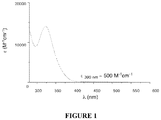
- the figure 1 represents the absorption spectrum of decatungstate dissolved in acetonitrile.
- the present invention therefore relates to a hydrosilylation reaction between, on the one hand, a siloxane compound (A) comprising at least one hydrogen atom bonded to a silicon atom and, on the other hand, an unsaturated compound (B), this reaction being photocatalysed by a polyoxometallate, commonly called POM.
- POMs have already been described in the literature.
- POMs are anionic aggregates (or "cluster"), consisting of at least 3 transition metal oxoanions that share their oxygen atoms, and together form a structured three-dimensional network.
- This general formula also includes the hydrated forms of the anionic aggregates, although these are not explicitly represented.
- all the atoms represented by M, and possibly all the atoms represented by X if a is equal to 2, may be identical or different.
- a POM therefore contains transition metals M.
- the transition metal of the POM can be chosen from the elements of groups 4, 5, 6 and 7 of the periodic table, preferably from the elements of groups 5 and 6.
- the metal of transition may be preferably selected from the group consisting of vanadium (V), niobium (Nb), tantalum (Ta), chromium (Cr), molybdenum (Mo) and tungsten (W), so more preferred in the group consisting of vanadium (V), niobium (Nb), tantalum (Ta), molybdenum (Mo) and tungsten (W), even more preferably in the group consisting of vanadium ( V), molybdenum (Mo) and tungsten (W).
- the POM is based on vanadium
- the POM is based on molybdenum
- the POM is based on tungsten
- polyoxotungstate may be a polyoxovanadate, a polyoxomolybdate, a polyoxotungstate, or mixtures thereof, and most particularly a polyoxotungstate.
- the polyoxotungstates are for example described in the reference work "Advanced Inorganic Chemistry: a comprehensive text" by Cotton and Wilkinson.
- the transition metal in the POM is generally in a high oxidation state, preferably V or VI.
- the POM may consist solely of transition metal atoms and oxygen, which corresponds to the fact that the symbol a has zero in the general formula [X a M b O c ] n- .
- the general formula of the POM is then [M b O c ] n- , wherein M, O, b, c and n have the meanings described above.
- This type of POM may be referred to as "isopolyanion".
- the POM also comprises one or more heteroatoms, which corresponds to the fact that the symbol a is different from zero in the general formula [X a M b O c ] n- .
- X is preferably selected from the group consisting of phosphorus (P) and silicon (Si). This type of POM may be referred to as "heteropolyanion".
- the POM used in the present invention may be selected from the group consisting of [W 10 O 32 ] 4- , [Mo 6 O 19 ] 2- , [V 10 O 28 ] 6- , [PW 12 O 40 ] 3- , [PMo 12 O 40 ] 3- , [SiW 10 O 40 ] 4- and mixtures thereof.
- the POM used in the present invention is chosen from POMs containing no phosphorus.
- the POM used in the present invention is [W 10 O 32 ] 4- , commonly referred to as "decatungstate".
- POMs being ionic compounds, they can be in the form of salt.
- the counter-ion (s) may be chosen from the group consisting of the proton (H + ), the alkaline ions, in particular Na + , K + and Li + , by the halogenated cations, in particular iodonium, and by the cations. ammoniums, sulphoniums, phosphoniums, ferroceniums and carbocations.
- the photocatalyst used in the method which is the subject of the invention may be a decatungstate salt.
- This is very preferably tetrabutylammonium decatungstate (TBADT), of formula (n-Bu 4 N + ) 4 [W 10 O 32 ] 4- .
- POMs can be synthesized according to the methods described in the prior art. For example, the synthesis of TBADT has been described in the publication of Protti et al. (Chem., 2009, 7351-7353) ) and in the publication of Chemseddine et al. (Inorg Chem., 1984, 23, 2609 ). This synthesis can be carried out from sodium tungstate and tetrabutylammonium bromide in an acidic medium.
- POMs in general, and decatungstate in particular are advantageous because of their photochemical properties. They can indeed be excited under conditions of very gentle irradiation, near UV or visible light.
- the figure 1 shows the absorption spectrum of decatungstate in acetonitrile. It is found that this photocatalyst absorbs light in wavelengths between about 300 nm and about 420 nm. The maximum absorption in the acetonitrile of the decatungstate is centered on about 324 nm. The absorption of this compound in the visible is significant: the molar extinction coefficient at 400 nm ( ⁇ 400nm ) is about 400 L.mol -1 .cm -1 and the molar extinction coefficient at 390 nm ( ⁇ 390nm).
- the POM catalyst Since the POM catalyst is active only when it is irradiated, it is easy to stop the hydrosilylation reaction by stopping the irradiation. This is an advantage over catalysts used in the prior art with which it is difficult to control or stop the reaction when it has been initiated.
- One of the advantages of the present invention therefore lies in the fact that the unwinding of the reaction is controllable. The hydrosilylation reaction is thus safer from an industrial risk point of view.
- One of the reagents of the hydrosilylation reaction according to the invention is a siloxane compound (A) comprising at least one hydrogen atom bonded to a silicon atom.
- siloxane compound in the present invention chemical compounds having at least one ⁇ Si-O-Si ⁇ unit.
- the silane compounds are not part of the group of siloxane compounds.
- siloxane compound comprising at least one hydrogen atom bonded to a silicon atom may be used in the process according to the invention, insofar as it does not contain any reactive chemical function which may hinder or even prevent the hydrosilylation reaction. .
- the siloxane compound (A) comprises at least two silicon atoms, preferably at least 3 silicon atoms or more.
- the symbol d may preferentially be 1.
- Z can represent a monovalent radical selected from the group consisting of an alkyl group having 1 to 8 carbon atoms, optionally substituted by at least one halogen atom. , and an aryl group. Z may advantageously represent a monovalent radical selected from the group consisting of methyl, ethyl, propyl, 3,3,3-trifluoropropyl, xylyl, tolyl and phenyl.
- units of formula (I) are the following: H (CH 3 ) 2 SiO 1/2 , HCH 3 SiO 2/2 and H (C 6 H 5 ) SiO 2/2 .
- Said siloxane compound (A) may advantageously be a polyorganosiloxane comprising at least two units of formula (I) or more.
- the polyorganosiloxane may have a linear, branched, cyclic or lattice structure.
- linear polyorganosiloxanes may be oils having a dynamic viscosity at 25 ° C. of between 1 mPa.s and 100 000 mPa.s, preferably between 10 mPa.s and 5000 mPa.s, or gums having a dynamic viscosity at 25.degree. ° C greater than 100 000 mPa.s.
- cyclic polyorganosiloxanes may consist of "D" siloxyl units chosen from the units of formulas HZSiO 2/2 and Z 2 SiO 2/2 , or of siloxyl units of formula HZSiO 2/2 only.
- the units of formula Z 2 SiO 2/2 may especially be dialkylsiloxy or alkylarylsiloxy.
- These cyclic polyorganosiloxanes can have a dynamic viscosity at 25 ° C of between 1 mPa.s and 5000 mPa.s.
- the dynamic viscosity at 25 ° C. of all the polymers described in the present application can be measured using a Brookfield viscometer, according to the AFNOR NFT 76 102 standard of February 1972.
- polyorganosiloxane that may be a siloxane compound (A) is the compound of the following formula:
- the second of the reagents of the hydrosilylation reaction according to the invention is an unsaturated compound.
- the unsaturated compound (B) according to the invention is a chemical compound comprising at least one unsaturation which is not part of an aromatic ring.
- the unsaturated compound (B) comprises at least one alkene function and / or an alkyne function. Any compound comprising at least one alkene function and / or an alkyne function can be used in the process according to the invention, insofar as it does not contain a reactive chemical function which can hinder or even prevent the hydrosilylation reaction.
- the unsaturated compound (B) comprises one or more alkene functional groups and from 2 to 40 carbon atoms. It may furthermore comprise 1 to 3 heteroatoms chosen from N, O, F, Cl, Br and I. When the unsaturated compound (B) comprises several alkene functional groups, these may be conjugated or unsubstituted.
- the unsaturated compound (B) comprises one or more alkyne functions and from 2 to 40 carbon atoms. It may further comprise 1 to 3 heteroatoms chosen from N, O, F, Cl, Br and I. When the unsaturated compound (B) comprises several alkyne functions, these may or may not be conjugated.
- the unsaturated compound (B) is chosen from non-polymeric unsaturated organic compounds, it can be chosen in a general manner from the compounds of formula (III) or (IV): in which R 1 , R 2 , R 3 and R 4 represent, independently of one another, a monovalent radical.
- alkyl is meant according to the invention a saturated hydrocarbon chain, linear or branched containing from 1 to 20 carbon atoms, preferably from 1 to 8 carbon atoms.
- An alkyl group may be selected from the group consisting of methyl, ethyl, isopropyl, n-propyl, tert-butyl, isobutyl, n-butyl, n-pentyl, isoamyl and 1,1-dimethylpropyl.
- cycloalkyl is meant according to the invention a monocyclic or polycyclic saturated hydrocarbon group, preferably monocyclic or bicyclic, containing from 3 to 20 carbon atoms, preferably from 5 to 8 carbon atoms.
- the multiple ring nuclei may be attached to each other by a covalent bond and / or by a spinan atom and / or be condensed to each other.
- Cycloalkyl may be selected from the group consisting of cyclopropyl, cyclobutyl, cyclopentyl, cyclohexyl, cycloheptyl, cyclooctyl, adamantane and norborane.
- aryl is meant according to the invention an aromatic hydrocarbon group containing from 5 to 18 carbon atoms, monocyclic or polycyclic.
- An aryl group may be selected from the group consisting of phenyl, naphthyl, anthracenyl and phenanthryl.
- halogen atom is meant according to the invention an atom selected from the group consisting of fluorine, chlorine, bromine and iodine.
- heteroaryl means an aryl group, that is to say an aromatic hydrocarbon group containing from 5 to 18 carbon atoms, monocyclic or polycyclic, in which at least one carbon atom has been substituted. by a heteroatom selected from O, N, S and P.
- a heteroaryl group may be selected from the group consisting of pyranyl, furanyl, pyridinyl, pyrimidinyl, pyrrolyl, pyrazolyl, imidazolyl, isothizolyl, isoxazolyl and indolyl.
- heterocycloalkyl is intended to mean a cycloalkyl group, that is to say a monocyclic or polycyclic, preferably monocyclic or bicyclic, saturated hydrocarbon-based group containing from 3 to 20 carbon atoms, in which at least one The carbon atom has been substituted with a heteroatom selected from O, N, S and P.
- a heterocycloalkyl group may in particular be the oxiranyl monocyclic group or the epoxycyclohexyl bicyclic group.
- alkoxy is meant according to the invention an alkyl group as defined above bonded to an oxygen atom.
- An alkoxy group may be selected from the group consisting of methoxy, ethoxy, propoxy and butoxy.
- aryloxy is meant according to the invention an aryl group as defined above bonded to an oxygen atom.
- An aryloxy group may be for example the phenoxy group.
- cycloalkoxy is meant according to the invention a cycloalkyl group as defined above bonded to an oxygen atom.
- alkylsilyl is meant according to the invention an alkyl group as defined above bonded to a silicon atom.
- alkoxysilyl is meant according to the invention an alkoxy group as defined above bonded to a silicon atom.
- R 1 may be a hydrogen atom
- R 2 may represent a substituent other than a hydrogen atom
- R 3 and R 4 may furthermore be hydrogen atoms.
- the unsaturated compound (B) may also be chosen from compounds comprising a plurality of alkene functional groups, preferably two or three alkene functional groups, and particularly preferably chosen from the following compounds: with p being 1 or 2, and with q being 2 to 6, preferably q being 2 or 4.
- the hydrosilylation process according to the invention allows, according to this embodiment, to bind organic groups advantageously comprising a chemical function of interest to siloxanes, in particular to polyorganosiloxanes.
- the unsaturated compound (B) comprises a single alkene or alkyne function
- the process according to the invention can be used as a functionalization process which can be total or partial.
- the unsaturated compound (B) comprises two or more alkene or alkyne functions, it acts as a bridge between several siloxane compounds (A), preferably between several polysiloxanes.
- the symbol g may preferentially be 1 or 2, more preferably 1.
- L can represent a monovalent radical selected from the group consisting of an alkyl group having 1 to 8 carbon atoms, optionally substituted by at least one halogen atom. , and an aryl group. L may advantageously represent a monovalent radical chosen from the group consisting of methyl, ethyl, propyl, 3,3,3-trifluoropropyl, xylyl, tolyl and phenyl.
- the alkene function and / or the alkyne function in the radical Y may (advantageously) be at the chain end.
- Y may advantageously represent a radical selected from the group consisting of vinyl, propenyl, 3-butenyl, 5-hexenyl, 9-decenyl, 10-undecenyl, 5,9-decadienyl and 6,11-dodecadienyl.
- the unsaturated compound (B) is chosen from polyorganosiloxanes comprising at least two units of formula (V) or more.
- the polyorganosiloxane may have a linear, branched, cyclic or lattice structure.
- D units By way of examples of "D" units, mention may be made of dimethylsiloxy, methylphenylsiloxy, methylvinylsiloxy, methylbutenylsiloxy, methylhexenylsiloxy, methyldecenylsiloxy and methyldecadienylsiloxy groups.
- M trimethylsiloxy, dimethylphenylsiloxy, dimethylvinylsiloxy and dimethylhexenylsiloxy groups.
- linear polyorganosiloxanes may be oils having a dynamic viscosity at 25 ° C. of between 1 mPa.s and 100 000 mPa.s, preferably between 10 mPa.s and 5000 mPa.s, or gums having a dynamic viscosity at 25.degree. ° C greater than 100 000 mPa.s.
- cyclic polyorganosiloxanes may consist of "D" siloxyl units chosen from the units of formulas Y 2 SiO 2/2 , YLSiO 2/2 and L 2 SiO 2/2 . Examples of such "D” patterns are described above.
- These cyclic polyorganosiloxanes can have a dynamic viscosity at 25 ° C of between 1 mPa.s and 5000 mPa.s.
- the dynamic viscosity at 25 ° C. of all the polymers described in the present application can be measured using a Brookfield viscometer, according to the AFNOR NFT 76 102 standard of February 1972.
- the hydrosilylation process according to the invention makes it possible to bind siloxane compounds (A), preferably polysiloxanes having at least one hydrogen atom bonded to a silicon atom, with polysiloxanes having at least an alkene function or an alkyne function.
- the process according to the invention can be used as a crosslinking process. It is preferable in this case that the polysiloxanes used as siloxane compounds (A) comprise, per molecule, at least three hydrogen atoms bonded to silicon atoms, and that the polysiloxanes used as unsaturated compound (B) comprise, per molecule, at least two unsaturated functional groups chosen from alkene or alkyne functions.
- the siloxane compound (A) comprising at least one hydrogen atom bonded to a silicon atom and the unsaturated compound (B) comprising at least one alkene functional group and or at least one alkyne function are one and the same compound.
- This compound can be described as "bifunctional" because it then comprises on the one hand at least one alkene function and / or at least one alkyne function, and on the other hand at least one silicon atom and at least one hydrogen atom bound to the silicon atom. It is likely to react with itself by hydrosilylation reaction.
- the invention may therefore also relate to a process for the hydrosilylation of a bifunctional compound with itself, said bifunctional compound comprising on the one hand at least one alkene function and / or at least one alkyne function, and on the other hand to at least one silicon atom and at least one hydrogen atom bonded to the silicon atom, said process being characterized by the fact that it is catalyzed by a photocatalyst chosen from polyoxometalates.
- the symbol d may preferentially be 1.
- Z may represent a monovalent radical selected from the group consisting of an alkyl group having 1 to 8 carbon atoms, optionally substituted by at least one halogen atom, and an aryl group.
- Z may advantageously represent a monovalent radical selected from the group consisting of methyl, ethyl, propyl, 3,3,3-trifluoropropyl, xylyl, tolyl and phenyl.
- units of formula (I) are the following: H (CH 3 ) 2 SiO 1/2 , HCH 3 SiO 2/2 and H (C 6 H 5 ) SiO 2/2 .
- the symbol g may preferentially be 1 or 2, more preferably 1.
- L may represent a monovalent radical selected from the group consisting of an alkyl group having 1 to 8 carbon atoms, optionally substituted by at least one halogen atom, and an aryl group.
- L may advantageously represent a monovalent radical chosen from the group consisting of methyl, ethyl, propyl, 3,3,3-trifluoropropyl, xylyl, tolyl and phenyl.
- the alkene function and / or the alkyne function in the radical Y may (advantageously) be at the chain end.
- Y may advantageously represent a radical selected from the group consisting of vinyl, propenyl, 3-butenyl, 5-hexenyl, 9-decenyl, 10-undecenyl, 5,9-decadienyl and 6,11-dodecadienyl.
- W may represent a monovalent radical selected from the group consisting of an alkyl group having 1 to 8 carbon atoms, optionally substituted by at least one halogen atom, and an aryl group.
- W may advantageously represent a monovalent radical chosen from the group consisting of methyl, ethyl, propyl, 3,3,3-trifluoropropyl, xylyl, tolyl and phenyl.
- said bifunctional compound is a polyorganosiloxane comprising at least two units of formula (I) or more, and at least two units of formula (V) or more.
- the bifunctional polyorganosiloxane may have a linear, branched, cyclic or lattice structure.
- D units mention may be made of dimethylsiloxy, hydrogenomethylsiloxy, methylphenylsiloxy, methylvinylsiloxy, methylbutenylsiloxy, methylhexenylsiloxy, methyldecenylsiloxy and methyldecadienylsiloxy groups.
- M trimethylsiloxy, dimethylhydrosiloxy, dimethylphenylsiloxy, dimethylvinylsiloxy and dimethylhexenylsiloxyl groups.
- linear polyorganosiloxanes may be oils having a dynamic viscosity at 25 ° C. of between 1 mPa.s and 100 000 mPa.s, preferably between 10 mPa.s and 5000 mPa.s, or gums having a dynamic viscosity at 25.degree. ° C greater than 100 000 mPa.s.
- cyclic polyorganosiloxanes may consist of "D" siloxyl units chosen from the units of formulas HZSiO 2/2 , Y 2 SiO 2/2 , YLSiO 2/2 and W 2 SiO 2 / 2 . Examples of such "D” patterns are described above.
- These cyclic polyorganosiloxanes can have a dynamic viscosity at 25 ° C of between 1 mPa.s and 5000 mPa.s.
- the dynamic viscosity at 25 ° C. of all the polymers described in the present application can be measured using a Brookfield viscometer, according to the AFNOR NFT 76 102 standard of February 1972.
- the photocatalyst chosen from polyoxometalates catalyzes the reaction of the unsaturated compound (B) with the siloxane compound (A).
- this process comprises at least one step of contacting the unsaturated compound (B) with the siloxane compound (A), in the presence of catalyst.
- the bringing into contact of these three elements can be made according to conventional techniques known to those skilled in the art.
- Suitable solvents are those miscible with the unsaturated compound (B) and with the siloxane compound (A).
- suitable solvents are those miscible with the unsaturated compound (B) and with the siloxane compound (A).
- Examples of particular solvents are the aliphatic hydrocarbons, for example pentane, hexane, heptane, pentamethylheptane and petroleum distillation fractions, aromatic hydrocarbons, for example benzene, toluene and ortho para- or meta-xylene, halogenated aliphatic or aromatic hydrocarbons, for example tetracholoethylene, and ethers, for example tetrahydrofuran and dioxane.
- aliphatic hydrocarbons for example pentane, hexane, heptane, pentamethylheptane and petroleum distillation fractions
- aromatic hydrocarbons for example benzene, toluene and ortho para- or meta-xylene
- the unsaturated compound (B) or the siloxane compound (A) is in liquid form at the temperature of the hydrosilylation reaction, it may be envisaged to use this compound as a solvent for the reaction.
- the reaction medium can then advantageously be without solvent.
- the unsaturated compound (B), the siloxane compound (A) and the catalyst can be contacted in the same phase, thus forming a homogeneous reaction medium, or else be in different phases.
- the hydrosilylation process according to the invention is carried out in homogeneous solution.
- the reagents, i.e., the unsaturated compound (B) and the siloxane compound (A), and the photocatalyst can be dissolved in a solvent suitably selected to solubilize all compounds.
- This solvent is preferably an organic solvent or a mixture of several organic solvents.
- This solvent may be selected from the group consisting of acetonitrile, dichloroethane, nitromethane, 2-methyl-tetrahydrofuran, dimethylformamide, dimethylsulfoxide, N-methylpyrrolidone and mixtures thereof.
- the solvent is preferably selected from acetonitrile and mixtures of acetonitrile and other one or more other organic co-solvent (s).
- the organic co-solvent (s) may be chosen from toluene, dichloromethane and tetrahydrofuran.
- the volume ratio of (the) cosolvent (s) relative to acetonitrile is preferably between 1:10 and 6: 1, and more preferably between 3: 1 and 4: 1.
- the use of acetonitrile alone as a solvent for the reaction has the advantage of obtaining a perfectly homogeneous reaction medium.
- acetonitrile has a high cost
- the use of a co-solvent with acetonitrile can also be considered advantageous because it reduces the volume of acetonitrile required, and thus reduce costs.
- the hydrosilylation process is carried out by heterogeneous catalysis.
- the reagents i.e. the unsaturated compound (B) and the siloxane compound (A)
- a solvent suitably selected to solubilize these reagents, but not the photocatalyst. It can remain in solid form.
- Heterogeneous catalysis is particularly advantageous because it allows easy separation of the catalyst with the reagents and products of the reaction, and easy recycling of the catalyst.
- the solvent of the reaction phase is preferably an organic solvent or a mixture of several organic solvents.
- the solvent is preferably toluene.
- the photocatalyst according to the invention may optionally be introduced into a dispersing solid medium.
- the photocatalyst may be impregnated on a solid support, immobilized in a silica network, fixed on a previously functionalized silica, fixed on an ion exchange resin or fixed in a polymer membrane.
- the catalyst according to the invention is introduced into the reaction medium at a concentration of preferably between 0.01% and 50%, more preferably between 0.05% and 5%. %, and even more preferably between 1% and 2%, the catalyst concentration being expressed as mole percent catalyst relative to the defective reagent in the hydrosilylation reaction which may be the siloxane reagent (A) or the reagent unsaturated (B).
- the stoichiometric ratio of the hydrosilylation reaction is 1 mole of siloxane compound (A) per 1 mole of unsaturated compound (B).
- this stoichiometric ratio may vary in cases where the siloxane compound (A) and / or the unsaturated compound (B) comprise more than one reactive function.
- the molar ratio of the Si-H functions of the siloxane compounds (A) to the alkenene and alkyne functional groups of the unsaturated compounds (B) is preferably between 1: 100 and 100: 1. The choice of this molar ratio can make it possible to control the progress of the hydrosilylation reaction.
- the Si-H functions of the siloxane compounds (A) to the alkenes and alkynes of the unsaturated compounds (B) are strictly less than 1, the Si-H functions are in default with respect to the unsaturated functions. If the hydrosilylation reaction is complete, the product of the reaction must no longer contain Si-H functions.
- the hydrosilylation reaction is conducted between a polyorganosiloxane comprising at least one unit of formula (I) and a non-polymeric unsaturated organic compound as described above, we can speak of total functionalization of the polyorganosiloxane.
- Such partial functionalization reactions are interesting from an industrial point of view because they lead to the preparation of polyorganosiloxane compounds comprising both siloxy units having a hydrogen atom bonded to a silicon atom and siloxy units functionalized with organic substituents of interest, for example dimethyl vinylmetyl hydrogenomethyl polysiloxanes.
- the use of a POM type photocatalyst as in the hydrosilylation process according to the present invention can advantageously solve this secondary reaction problem of the prior art.
- the photocatalyst is active only when it is irradiated. By stopping the irradiation, any parasitic secondary reaction is avoided.
- the compositions obtained by partial functionalization using the hydrosilylation reaction according to the present invention are advantageously more storage stable and safer from an industrial risk point of view. The rate of functionalization can moreover be very easily controlled.
- reaction medium may optionally be degassed, so as to be free of oxygen.
- the optional degassing step can improve the kinetics of the reaction, particularly in cases where the reagents are air-sensitive compounds.
- the photocatalyst according to the invention must be excited using a light source.
- the method according to the invention preferably comprises at least one step of irradiating the photocatalyst with UV or visible light.
- This irradiation can be carried out using any existing device, delivering light at the desired wavelength. It may be conventionally an incandescent lamp, an LED lamp, a discharge lamp, including mercury discharge and xenon, or a fluorescent lamp. It can also be a laser source.
- the irradiation is preferably carried out at a wavelength between 300 nm and 500 nm, more preferably between 300 nm and 420 nm, and even more preferably between 350 nm and 400 nm.
- the irradiation energy is preferably between 1 mW / cm 2 and 5 W / cm 2 , more preferably between 1 mW / cm 2 and 200 mW / cm 2 , and even more preferably between 10 mW / cm 2 and 100 mW / cm 2 .
- the irradiation can be kept constant throughout the duration of the hydrosilylation reaction.
- the irradiation can be modified or interrupted during the hydrosilylation reaction.
- the irradiation can be minced, which means that the irradiation follows a start / stop cycle at a constant or variable frequency.
- the hydrosilylation process can be carried out at a temperature between 0 ° C and 150 ° C, preferably between 10 ° C and 30 ° C, and more preferably at room temperature.
- the heating which may possibly be produced by the source is ignored. irradiation.
- This process is advantageously carried out at atmospheric pressure, but it is conceivable to carry out this process under-pressure, for example between 0.01 MPa (100 mbar) and 0.08 MPa (800 mbar), or in overpressure for example between 0.1 MPa (1 bar) and 8 MPa (80 bar).
- the hydrosilylation process according to the invention may be a batch process, commonly called batch type according to the English terminology.
- the reaction may be conducted for a period of time which varies depending on the reagents involved, the catalyst used and the reaction conditions, in particular depending on the concentrations of reactants and catalyst. In general, the reaction time may be between 1 minute and 24 hours, preferably between 30 minutes and 8 hours, and even more preferably between 1 hour and 4 hours.
- the reactants are introduced into the reactor in the form of one or more continuous streams.
- the photocatalyst can, for its part, also flow continuously in the reactor, particularly if the process is carried out in a homogeneous solution.
- heterogeneous catalysis it can be fixed inside the reactor, for example in the form of a fixed catalytic bed or a movable catalytic bed.
- the flow rate of the flows flowing in the reactor can be fixed by those skilled in the art depending on the volume of the reactor so as to ensure a residence time of the sufficient reagents, in the presence of photocatalyst, so that the hydrosilylation reaction is carried out.
- the inventors have discovered that, advantageously, the use of the photocatalyst according to the invention makes it possible to carry out hydrosilylation reactions under operating conditions that are easy to implement, without particularly dangerous or expensive compounds, with conversion rates. quite interesting.
- the conversion rates of siloxane reagent (A) and / or unsaturated reagent (B) may advantageously be greater than 50%, even 60%, even 75%, even 80%, even 90%, and preferably between 90 and 100%.
- conversion rate and “conversion rate”, abbreviated to TT, are synonymous and denote, for each reagent, in percent, the initial number of moles of Si-H functions of the siloxane reagent (A). ) or alkenes and alkynes functions unsaturated reagent (B), minus the number of moles of these remaining functions after reaction, divided by the initial number of moles of these functions.
- the products obtained by the process according to the invention may optionally, at a later stage, be purified using conventional means well known to those skilled in the art.
- the products may for example be purified by flash chromatography on silica gel.
- This composition forms the reaction medium in which the photocatalyst hydrosilylation reaction according to the invention can take place.
- this composition can be irradiated as described above, which will have the effect of activating the photocatalyst and allow the reaction between the unsaturated compound (B) and the siloxane compound (A).
- the unsaturated compound (B), the siloxane compound (A) and the photocatalyst are as described hereinabove in the present application.
- the composition according to the invention may be a solution.
- the hydrosilylation process can take place in homogeneous solution.
- the composition preferably comprises a solvent which can be chosen as described above in the case of a hydrosilylation process in homogeneous solution.
- the composition according to the invention may be a suspension.
- the unsaturated compound (B) and the siloxane compound (A) form a homogeneous reaction medium in a solvent in which the photocatalyst is not soluble.
- the hydrosilylation process may be a heterogeneous catalysis process.
- the composition preferably comprises a solvent which can be chosen as described above in the case of a hydrosilylation process by heterogeneous catalysis.
- the photocatalyst may optionally be introduced into a solid dispersing medium, as described above.
- the concentration of photocatalyst in the composition according to the invention is preferably between 0.01% and 50%, more preferably between 0.05% and 5%, and even more preferably between 1% and 2%.
- the catalyst concentration being expressed as molar percent of catalyst relative to the reactant which is in default in the hydrosilylation reaction, which may be the siloxane reagent (A) or the unsaturated reagent (B).
- the molar ratio of the Si-H functions of the siloxane compounds (A) to the alkenene and alkyne functional groups of the unsaturated compounds (B) is preferably from 1: 100 to 100: 1. According to one embodiment, the molar ratio of the Si-H functions of the siloxane compounds (A) to the alkenes and alkynes functions of the unsaturated compounds (B) is strictly less than 1. The Si-H functions are in default with respect to the functions unsaturated. According to another embodiment, the molar ratio of the Si-H functions of the siloxane compounds (A) to the alkenes and alkynes functions of the unsaturated compounds (B) is strictly greater than 1. The Si-H functions are then in excess relative to unsaturated functions.
- composition according to the invention may optionally comprise additives.
- additives may in particular be chosen from photosensitizers.
- Photosensitizers which can be used as additives in the present invention are described in the patent documents EP 1 133 971 and EP 1 745 083 .
- the photosensitizers are preferably chosen from the group consisting of ketones, especially aromatic ketones, coumarin dyes, xanthenes dyes, xanthones, thioxanthones, acridine dyes, thiazole dyes, thiazine dyes, oxazine dyes, dyes azines, aminoketone dyes, porphyrins, polycyclic aromatic hydrocarbons such as naphthalenes, anthracenes, phenanthrene, pyrenes, fluorenes, fluoranthenes and chrisenes, ketone compounds substituted para to aminostyryl, amino triaryl-methanes, merocyanines, squarylium dyes and pyridium dyes.
- ketones especially aromatic ketones, coumarin dyes, xanthenes dyes, xanthones, thioxanthones, acridine dyes, thiazole dyes,
- composition according to the invention may further comprise, as an additive, donor compounds electrons, such as for example those described in the EP 1 133 971 .
- concentration of additive in the composition according to the invention is advantageously less than 1000 ppm by weight relative to the total weight of the composition, and more preferably between 0 and 300 ppm.
- Tetrabutylammonium bromide (10.7 g) and sodium tungstate dihydrate (22.2 g) were dissolved separately in 600 ml of water in two Erlenmeyer flasks and heated to 90 ° C with vigorous stirring. The pH of each solution was adjusted to 2, in a controlled manner, by dropwise addition of concentrated hydrochloric acid (the sodium tungstate solution then takes on a slight green color). Both solutions were then mixed and maintained at 90 ° C for 1 hour 30 minutes. A white slurry of TBADT was formed, and allowed to cool to room temperature and then filtered through sintered glass (porosity # 4). The solid was washed with water and dried in an oven at 110 ° C overnight.
- the absorption spectrum of synthesized TBADT was obtained in acetonitrile using the JASCO V530 UV-Visible Spectrometer. The absorption spectrum is reproduced in figure 1 .
- the reaction medium was irradiated with a UV lamp (Omnicure 1000 series) emitting in the UV at 365 nm, at an energy equal to 20% of the maximum energy of the lamp of 270 mW / cm 2 for 3 hours. After the reaction was complete, the solvents were evaporated under reduced pressure. The proton NMR of the crude reaction product makes it possible to estimate the conversion rate. The reaction crude was then purified by flash chromatography on silica gel.
- the compound of formula (XI): was obtained with a conversion rate of 84% and a yield of 10%.
- the yield refers here, in percent, the number of moles of product (IX) obtained after reaction divided by the initial number of moles of ethyl acrylate.
Landscapes
- Chemical & Material Sciences (AREA)
- Organic Chemistry (AREA)
- Chemical Kinetics & Catalysis (AREA)
- Engineering & Computer Science (AREA)
- Materials Engineering (AREA)
- Inorganic Chemistry (AREA)
- Catalysts (AREA)
- Compositions Of Macromolecular Compounds (AREA)
- Low-Molecular Organic Synthesis Reactions Using Catalysts (AREA)
- Silicon Polymers (AREA)
Description
- L'invention se situe dans le domaine technique des siloxanes, et notamment des polyorganosiloxanes également appelés couramment silicones. Plus spécifiquement, la présente invention concerne des réactions d'hydrosilylation, également appelées polyadditions, d'un composé insaturé avec un siloxane comprenant au moins un atome d'hydrogène lié à un atome de silicium.
- Dans le domaine des silicones, l'hydrosilylation est une réaction majeure.
- Lors d'une réaction d'hydrosilylation, un composé comprenant au moins une insaturation réagit avec un composé comprenant au moins un atome d'hydrogène lié à un atome de silicium. Cette réaction peut par exemple être décrite par l'équation réactionnelle (1) dans le cas d'une insaturation de type alcène :


- L'hydrosilylation permet donc de lier des siloxanes, et notamment des silicones, comprenant des motifs Si-H, avec des composés présentant au moins une instauration de type alcène ou alcyne, par exemple des silicones comprenant des motifs Si-vinyle.
- Les réactions d'hydrosilylation sont classiquement réalisées par catalyse. Typiquement, le catalyseur approprié pour cette réaction est un catalyseur au platine, tel que par exemple l'acide chloroplatinique hexahydrate ou le catalyseur de Karstedt qui est constitué de complexes de platine avec du divinyltétraméthyldisiloxane comme ligand (voir par exemple dans le
brevet US 3 775 452 ). - Toutefois, l'utilisation de catalyseur au platine est problématique. Il est en effet préférable d'éviter l'emploi du platine à l'échelle industrielle car il s'agit d'un métal cher, en voie de raréfaction et dont le coût fluctue énormément. De ce fait, les composés siliciés fabriqués par hydrosilylation, tels que les siloxanes et polyorganosiloxanes fonctionnalisés par hydrosilylation et les compositions silicones réticulables par hydrosilylation, ont un coût indexé sur celui du platine, ce qui est ennuyeux aussi bien pour les fabricants que pour leurs clients.
- Il serait donc avantageux de disposer d'une alternative à la réaction d'hydrosilylation catalysée par du platine. Il serait tout particulièrement intéressant de proposer un nouveau type de catalyseur pour les réactions d'hydrosilylation de siloxanes ne contenant pas de platine.
- L'utilisation d'autres catalyseurs a été proposée par le passé, par exemple l'utilisation de rhodium ou d'iridium. Toutefois, ces métaux sont tout aussi rares que le platine, et leur utilisation ne résout pas les problèmes mentionnés. La demande internationale de brevet
WO 2011/006044 décrit l'utilisation de complexes de manganèse, de fer, de cobalt ou de nickel contenant des ligands pyridine di-imines comme catalyseur d'hydrosilylation. En outre, la publication de D.A. de Vekki (« Hydrosilylation on Photoactivated Catalyst », Russian Journal of General Chemistry, 2011, 81, 7, 1480-1492) décrit des catalyseurs photoactivables d'hydrosilylation des liaisons C=C, C=C et C=O. - Un des objectifs de la présente invention est donc de proposer un procédé d'hydrosilylation entre un composé siloxane et un composé insaturé, qui utiliserait un catalyseur avantageusement peu coûteux, d'approvisionnement facile, facile à manipuler et/ou peu ou pas toxique. En outre, on souhaite que les rendements d'hydrosilylation obtenus avec ce catalyseur alternatif soient les plus élevés possibles.
- Par ailleurs, l'utilisation de composés de la famille des polyoxométallates, couramment appelés POM, en tant que catalyseur a été décrite dans la littérature. Les POM sont des agrégats anioniques d'oxydes de métaux de transition. La publication de D. Tzirakis et al. « Decatungstate as en efficient photocatalys in organic chemistry » (Chemical Society Reviews, 2009, 38, 2609-2621) décrit en particulier les propriétés photochimiques des POM, et notamment du décatungstate, et leur utilisation comme photocatalyseur. Cette publication décrit l'utilisation de décatungstate pour la création de liaisons carbone-carbone par rupture homolytique de liaisons carbone-hydrogène, pour l'oxydation en présence d'oxygène et pour la dégradation de polluants organiques.
- Plus récemment, les chercheurs Jacques Lalevée, Nicolas Blanchard, Mohamad-Ali Tehfe et Jean Pierre Fouassier ont décrit pour la première fois dans une publication intitulée « Decatungstate (W10O324-)/Silane: a New and Promising Radical Source Under Soft Light Irradiation» (Macromolecular Rapid Communications, 2011, 32, 838-843) que le décatungstate pouvait être utilisé comme photocatalyseur pour former des radicaux silyl à partir de silanes. La photopolymérisation d'époxydes a été présentée comme une utilisation concrète de cette propriété. Toutefois, aucune application en hydrosilylation n'a été envisagée. En outre, ces divulgations ne concernent pas les siloxanes, dont la réactivité est différente de celle des silanes.
- L'invention concerne en premier lieu un procédé d'hydrosilylation entre un composé siloxane (A) comprenant au moins un atome d'hydrogène lié à un atome de silicium et un composé insaturé (B) comprenant au moins une fonction alcène et/ou au moins une fonction alcyne, ledit procédé étant caractérisé par le fait qu'il est catalysé par un photocatalyseur choisi parmi les polyoxométallates.
- La présente invention a également pour objet une composition comprenant :
- un composé siloxane (A) comprenant au moins un atome d'hydrogène lié à un atome de silicium,
- un composé insaturé (B) comprenant au moins une fonction alcène et/ou au moins une fonction alcyne, et
- un photocatalyseur choisi parmi les polyoxométallates.
- Enfin, l'utilisation d'un polyoxométallate, de préférence d'un décatungstate, comme photocatalyseur d'une réaction d'hydrosilylation d'un composé insaturé comprenant au moins une fonction alcène et/ou au moins une fonction alcyne, avec un composé siloxane comprenant au moins un atome d'hydrogène lié à un atome de silicium, est aussi un objet de la présente invention.
- La
figure 1 représente le spectre d'absorption du décatungstate en solution dans l'acétonitrile. - Il est précisé que, dans toute cette description, l'expression « compris(e) entre ... et ... » doit s'entendre comme incluant les bornes citées.
- La présente invention concerne donc une réaction d'hydrosilylation entre d'une part un composé siloxane (A) comprenant au moins un atome d'hydrogène lié à un atome de silicium et d'autre part un composé insaturé (B), cette réaction étant photocatalysée par un polyoxométallate, couramment appelé POM.
- Comme expliqué précédemment, les POM ont déjà été décrits dans la littérature. Les POM sont des agrégats (ou « cluster » selon la terminologie anglo-saxonne) anioniques, constitués d'au moins 3 oxoanions de métal de transition qui partagent leurs atomes d'oxygène, et formant ensemble un réseau tridimensionnel structuré.
- Les POM peuvent être décrits par la formule générale [XaMbOc]n- dans laquelle
- X représente un atome d'hydrogène ou un atome choisi parmi B, Al, Si, P, S, Ga, Ge, As, Ce, Th et Sb ;
- M représente un métal de transition ;
- O représente l'atome d'oxygène ;
- a représente un nombre entier pouvant valoir 0, 1 ou 2 ;
- b représente un nombre entier pouvant valoir de 3 à 20 ;
- c représente un nombre entier pouvant valoir de 6 à 62 ; et
- n représente un nombre entier supérieur ou égal à 1, de préférence pouvant valoir de 1 à 10.
- Cette formule générale comprend également les formes hydratées des agrégats anioniques, bien que celles-ci ne soient pas représentées explicitement.
- Dans cette formule générale, tous les atomes représentés par M, et éventuellement tous les atomes représentés par X si a vaut 2, peuvent être identiques ou différents.
- Un POM contient donc des métaux de transition M. Le métal de transition du POM peut être choisi parmi les éléments des groupes 4, 5, 6 et 7 de la classification périodique, de préférence parmi les éléments des groupes 5 et 6. Le métal de transition peut être choisi de façon préférée dans le groupe constitué par le vanadium (V), le niobium (Nb), le tantale (Ta), le chrome (Cr), le molybdène (Mo) et le tungstène (W), de façon plus préférée dans le groupe constitué par le vanadium (V), le niobium (Nb), le tantale (Ta), le molybdène (Mo) et le tungstène (W), de façon encore plus préférée dans le groupe constitué par le vanadium (V), le molybdène (Mo) et le tungstène (W). Dans le cas où le POM est à base de vanadium, on peut parler de polyoxovanadate. Dans le cas où le POM est à base de molybdène, on peut parler de polyoxomolybdate. Dans cas où le POM est à base de tungstène, on peut parler de polyoxotungstate. Le POM mis en oeuvre dans la présente invention peut être un polyoxovanadate, un polyoxomolybdate, un polyoxotungstate, ou leurs mélanges, et tout particulièrement un polyoxotungstate. Les polyoxotungstates sont par exemple décrits dans l'ouvrage de référence « Advanced Inorganic Chemistry : a comprehensive text » de Cotton et Wilkinson.
- Le métal de transition dans le POM est généralement dans un état d'oxydation élevé, de préférence V ou VI.
- Selon un mode de réalisation, le POM peut être constitué uniquement d'atomes de métal de transition et d'oxygène, ce qui correspond au fait que le symbole a vaut zéro dans le formule générale [XaMbOc]n-. Dans ce mode de réalisation, la formule générale du POM est alors [MbOc]n-, dans laquelle M, O, b, c et n ont les significations décrites ci-dessus. Ce type de POM peut être désigné par le terme « isopolyanion ».
- Toutefois, il est possible dans un autre mode de réalisation que le POM comprenne également un ou plusieurs hétéroatomes, ce qui correspond au fait que le symbole a est différent de zéro dans le formule générale [XaMbOc]n-. X est choisi de préférence dans le groupe constitué par le phosphore (P) et le silicium (Si). Ce type de POM peut être désigné par le terme « hétéropolyanion ».
- Les valeurs des symboles a, b, c et n sont telles que les règles de valence des différents atomes sont respectées de manière à obtenir un agrégat anionique.
- Le POM mis en oeuvre dans la présente invention peut être choisi dans le groupe constitué par [W10O32]4-, [Mo6O19]2-, [V10O28]6-, [PW12O40]3-, [PMo12O40]3-, [SiW10O40]4- et leurs mélanges. De façon préférée, le POM mis en oeuvre dans la présente invention est choisi parmi les POM ne contenant pas de phosphore. De façon tout particulièrement préférée, le POM mis en oeuvre dans la présente invention est [W10O32]4-, couramment appelé « décatungstate ».
- Les POM étant des composés ioniques, ils peuvent se présenter sous forme de sel. Le ou les contre-ions peuvent être choisis dans le groupe constitué par le proton (H+), par les ions alcalins, notamment Na+, K+ et Li+, par les cations halogènes, notamment l'iodonium, et par les cations ammoniums, sulfoniums, phosphoniums, ferroceniums et carbocations.
- Le photocatalyseur mis en oeuvre dans le procédé objet de l'invention peut être un sel de décatungstate. Il s'agit de façon très préférée de décatungstate de tétrabutylammonium (TBADT), de formule (n-Bu4N+)4 [W10O32]4-.
- Les POM peuvent être synthétisés selon les procédés décrits dans l'art antérieur. Par exemple, la synthèse du TBADT a été décrite dans la publication de Protti et al. (Chem. Commun., 2009, 7351-7353) et dans la publication de Chemseddine et al. (Inorg. Chem., 1984, 23, 2609). Cette synthèse peut être effectuée à partir de tungstate de sodium et de bromure de tétrabutylammonium en milieu acide.
- Les POM en général, et le décatungstate en particulier, sont avantageux à cause de leurs propriétés photochimiques. Ils peuvent en effet être excités dans des conditions d'irradiation très douce, en UV proche voire en lumière visible. La
figure 1 montre le spectre d'absorption du décatungstate dans l'acétonitrile. On constate que ce photocatalyseur absorbe la lumière dans des longueurs d'onde comprises entre environ 300 nm et environ 420 nm. Le maximum d'absorption dans l'acétonitrile du décatungstate est centré sur environ 324 nm. L'absorption de ce composé dans le visible est significative: le coefficient d'extinction molaire à 400 nm (ε400nm) vaut environ 400 L.mol-1.cm-1 et le coefficient d'extinction molaire à 390 nm (ε390nm) vaut environ 500 L.mol-1.cm-1. Il est donc possible de l'exciter dans cette gamme de longueurs d'onde. Le photocatalyseur ainsi excité est alors capable de réaliser une abstraction d'hydrogène sur un composé siloxane ayant un atome d'hydrogène lié à un atome de silicium. - Le catalyseur POM n'étant actif que lorsqu'il est irradié, il est facile d'arrêter la réaction d'hydrosilylation en arrêtant l'irradiation. Ceci représente un avantage par rapport aux catalyseurs utilisés dans l'art antérieur avec lesquels il est difficile de contrôler ou d'arrêter la réaction lorsque celle-ci a été amorcée. Un des avantages de la présente invention réside donc dans le fait que le déroulé de la réaction est contrôlable. La réaction d'hydrosilylation est ainsi plus sûre d'un point du vue risque industriel.
- Un des réactifs de la réaction d'hydrosilylation selon l'invention est un composé siloxane (A) comprenant au moins un atome d'hydrogène lié à un atome de silicium.
- Par composé « siloxane », on entend dans la présente invention les composés chimiques possédant au moins un motif ≡Si-O-Si≡. Les composés silanes ne font pas partie du groupe des composés siloxanes.
- Tout composé siloxane comprenant au moins un atome d'hydrogène lié à un atome de silicium peut être utilisé dans le procédé selon l'invention, dans la mesure où il ne contient pas de fonction chimique réactive pouvant gêner, voire empêcher la réaction d'hydrosilylation.
- Le composé siloxane (A) comprend au moins deux atomes de silicium, de préférence au moins 3 atomes de silicium ou plus.
- Ledit composé siloxane (A) peut avantageusement être un polyorganosiloxane comprenant au moins un motif de formule (I) :
HdZeSiO(4-(d+e))/2 (I)
dans laquelle : - Z représente un radical monovalent différent d'un atome d'hydrogène,
- d et e représentent des nombres entiers, d valant 1 ou 2, e valant 0, 1 ou 2 et (d+e) valant 1, 2 ou 3 ;
- Z a la même signification que ci-dessus, et
- f représente un nombre entier compris entre 0 et 3.
- Il est entendu dans la formule (I) et dans la formule (II) ci-dessus que si plusieurs groupes Z sont présents, ils peuvent être identiques ou différents les uns des autres.
- Dans la formule (I), le symbole d peut préférentiellement valoir 1.
- De plus, dans la formule (I) et dans la formule (II), Z peut représenter un radical monovalent choisi dans le groupe constitué par un groupe alkyle ayant 1 à 8 atomes de carbone, éventuellement substitué par au moins un atome d'halogène, et un groupe aryle. Z peut avantageusement représenter un radical monovalent choisi dans le groupe constitué par méthyle, éthyle, propyle, 3,3,3-trifluoropropyle, xylyle, tolyle et phényle. des exemples de motifs de formule (I) sont les suivants : H(CH3)2SiO1/2, HCH3SiO2/2 et H(C6H5)SiO2/2.
- Ledit composé siloxane (A) peut avantageusement être un polyorganosiloxane comprenant au moins deux motifs de formule (I) ou plus.
- Le polyorganosiloxane peut présenter une structure linéaire, ramifié, cycliques ou en réseau.
- Lorsqu'il s'agit de polyorganosiloxanes linéaires, ceux-ci peuvent être essentiellement constitués :
- de motifs siloxyles « D » choisi parmi les motifs de formules HZSiO2/2 et Z2SiO2/2 ;
- de motifs siloxyles « M » choisis parmi les motifs de formules HZ2SiO1/2 et Z3SiO2/2.
- Ces polyorganosiloxanes linéaires peuvent être des huiles ayant une viscosité dynamique à 25°C comprise entre 1 mPa.s et 100 000 mPa.s, préférentiellement entre 10 mPa.s et 5 000 mPa.s, ou des gommes ayant une viscosité dynamique à 25°C supérieure à 100 000 mPa.s.
- Lorsqu'il s'agit de polyorganosiloxanes cycliques, ceux-ci peuvent être constitués de motifs siloxyles « D » choisi parmi les motifs de formules HZSiO2/2 et Z2SiO2/2, ou de motifs siloxyle de formule HZSiO2/2 uniquement. Les motifs de formule Z2SiO2/2 peuvent être notamment des dialkylsiloxy ou des alkylarylsiloxy. Ces polyorganosiloxanes cycliques peuvent avoir une viscosité dynamique à 25°C comprise entre 1 mPa.s et 5 000 mPa.s.
- La viscosité dynamique à 25°C de tous les polymères décrits dans la présente demande peut être mesurée à l'aide d'un viscosimètre Brookfield, selon la norme AFNOR NFT 76 102 de février 1972.
- Des exemples de polyorganosiloxanes pouvant être des composés siloxane (A) sont :
- les diméthylpolysiloxanes à extrémités hydrogénodiméthylsilyles ;
- les diméthylhydrogénométhylpolysiloxanes à extrémités triméthylsilyles ;
- les diméthylhydrogénométhylpolysiloxanes à extrémités hydrogénodiméthylsilyles ;
- les hydrogénométhylpolysiloxanes à extrémités triméthylsilyles ;
- les hydrogénométhylpolysiloxanes cycliques.
- Lorsqu'il s'agit de polyorganosiloxanes ramifiés ou en réseaux, ceux-ci peuvent comprendre en outre :
- des motifs siloxyles « T » choisis parmi les motifs de formules HSiO3/2 et ZSiO3/2 ;
- des motifs siloxyles « Q » de formule SiO4/2.
- Un exemple de polyorganosiloxane pouvant être un composé siloxane (A) est le composé de formule suivante :

- Le second des réactifs de la réaction d'hydrosilylation selon l'invention est un composé insaturé.
- Le composé insaturé (B) selon l'invention est un composé chimique comprenant au moins une insaturation ne faisant pas partie d'un cycle aromatique. Le composé insaturé (B) comprend au moins une fonction alcène et/ou une fonction alcyne. Tout composé comprenant au moins une fonction alcène et/ou une fonction alcyne peut être utilisé dans le procédé selon l'invention, dans la mesure où il ne contient pas de fonction chimique réactive pouvant gêner, voire empêcher la réaction d'hydrosilylation.
- Selon un mode de réalisation, le composé insaturé (B) comprend une ou plusieurs fonctions alcène et de 2 à 40 atomes de carbone. Il peut comprendre en outre 1 à 3 hétéroatomes choisis parmi N, O, F, Cl, Br et I. Lorsque le composé insaturé (B) comprend plusieurs fonctions alcènes, celles-ci peuvent être conjuguées ou pas.
- Selon un autre mode de réalisation, le composé insaturé (B) comprend une ou plusieurs fonctions alcynes et de 2 à 40 atomes de carbone. Il peut comprendre en outre 1 à 3 hétéroatomes choisis parmi N, O, F, Cl, Br et I. Lorsque le composé insaturé (B) comprend plusieurs fonctions alcynes, celles-ci peuvent être conjuguées ou pas.
- Ledit composé insaturé (B) peut être choisi dans le groupe constitué par :
- les composés organiques insaturés non polymériques,
- les composés polyorganosiloxanes comprenant au moins une fonction alcène et/ou au moins une fonction alcyne,
- Dans le cas où le composé insaturé (B) est choisi parmi les composés organiques insaturés non polymériques, il peut être choisi de manière générale parmi les composés de formule (III) ou (IV) :

- R1, R2, R3 et R4 peuvent être choisis, indépendamment les uns des autres, dans le groupe constitué par :
- un atome d'hydrogène,
- un atome d'halogène choisi parmi le fluor, le chlore, le brome et l'iode,
- un groupe alkyle,
- un groupe cycloalkyle,
- un groupe aryle,
- un groupe hétéroaryle,
- un groupe hétérocycloalkyle,
- un groupe alcoxy,
- un groupe aryloxy,
- un groupe cycloalcoxy,
- un groupe alkylsilyl,
- un groupe alcoxysilyl,
- un groupe acide carboxylique,
- un groupe esters alkylique,
- un groupe urée,
- un groupe amide,
- un groupe sulfonamide,
- un groupe imides,
- un groupe cyano,
- un groupe aldéhyde,
- un groupe alcool,
- un groupe thiol,
- un groupe amine,
- un groupe imine,
- un groupe sulfure,
- un groupe sulfoxyde,
- un groupe sulfone,
- ou un groupe azide ;
- Par « alkyle », on entend selon l'invention une chaîne hydrocarbonée saturée, linéaire ou ramifiée contenant de 1 à 20 atomes de carbone, de préférence de 1 à 8 atomes de carbone. Un groupe alkyle peut être choisi dans le groupe constitué par méthyle, éthyle, isopropyle, n-propyle, tert-butyle, isobutyle, n-butyle, n-pentyle, isoamyle et 1,1-diméthylpropyle.
- Par « cycloalkyle », on entend selon l'invention un groupe hydrocarboné saturé monocyclique ou polycyclique, de préférence monocyclique ou bicyclique, contenant de 3 à 20 atomes de carbone, de préférence de 5 à 8 atomes de carbone. Lorsque le groupe cycloalkyle est polycyclique, les multiples noyaux cycliques peuvent être rattachés les uns aux autres par une liaison covalente et/ou par un atome spinanique et/ou être condensés les uns aux autres. Un groupe cycloalkyle peut être choisi dans le groupe constitué par le cyclopropyle, le cyclobutyle, le cyclopentyle, le cyclohexyle, le cycloheptyle, le cyclooctyle, l'adamantane et le norborane.
- Par « aryle », on entend selon l'invention un groupe hydrocarboné aromatique contenant de 5 à 18 atomes de carbone, monocyclique ou polycyclique. Un groupe aryle peut être choisi dans le groupe constitué par phényle, naphtyle, anthracényle et phénanthryle.
- Par « atome d'halogène », on entend selon l'invention un atome choisi dans le groupe constitué par le fluor, le chlore, le brome et l'iode.
- Par « hétéroaryle », on entend selon l'invention un groupe aryle, c'est-à-dire un groupe hydrocarboné aromatique contenant de 5 à 18 atomes de carbone, monocyclique ou polycyclique, dans lequel au moins un atome de carbone a été substitué par un hétéroatome choisi parmi O, N, S et P. Un groupe hétéroaryle peut être choisi dans le groupe constitué par pyranyle, furanyle, pyridinyle, pyrimidinyle, pyrrolyle, pyrazolyle, imidazolyle, isothizolyle, isoxazolyle et indolyle.
- Par « hétérocycloalkyle », on entend selon l'invention un groupe cycloalkyle, c'est-à-dire un groupe hydrocarboné saturé monocyclique ou polycyclique, de préférence monocyclique ou bicyclique, contenant de 3 à 20 atomes de carbone, dans lequel au moins un atome de carbone a été substitué par un hétéroatome choisi parmi O, N, S et P. Un groupe hétérocycloalkyle peut en particulier être le groupe monocyclique oxiranyl ou le groupe bicyclique époxycyclohexyl.
- Par « alcoxy », on entend selon l'invention un groupe alkyle tel que défini ci-avant lié à un atome d'oxygène. Un groupe alcoxy peut être choisi dans le groupe constitué par méthoxy, éthoxy, propoxy et butoxy.
- Par « aryloxy », on entend selon l'invention un groupe aryle tel que défini ci-avant lié à un atome d'oxygène. Un groupe aryloxy peut être par exemple le groupe phénoxy.
- Par « cycloalcoxy », on entend selon l'invention un groupe cycloalkyle tel que défini ci-avant lié à un atome d'oxygène.
- Par « alkylsilyl », on entend selon l'invention un groupe alkyle tel que défini ci-avant lié à un atome de silicium.
- Par « alcoxysilyl », on entend selon l'invention un groupe alcoxy tel que défini ci-avant lié à un atome de silicium.
- De préférence, R1, R2, R3 et R4 représentent, indépendamment les uns des autres:
- un atome d'hydrogène ;
- un groupe alkyle en C1 à C8, éventuellement substitué par un groupe hydroxy et/ou par un atome d'halogène ;
- un phényle, éventuellement substitué par un groupe alkyle en C1 à C4, par un halogène, par un groupe alkyle en C1 à C4 lui-même substitué par un ou plusieurs halogènes, par un groupe alcoxy en C1 à C4 ou par une fonction amine éventuellement substituée une ou deux fois par un groupe alkyle en C1 à C4 ;
- une pyridine ;
- un ester alkylique en C1 à C8 ;
- une fonction cyano ;
- une fonction acide carboxylique ;
- un groupe acyloxy en C1 à C4, notamment acétyloxy ;
- un groupe amide primaire, notamment non substituées sur l'azote ou substituées une ou deux fois par un groupe alkyle en C1 à C4 ;
- un groupe alkyle polyéthoxylé, éventuellement substitué par un hydroxy ou une cétone ;
- un groupe époxycyclohexyle ;
- un groupe oxiranyle ou un groupe alkyle en C1 à C8 substitué par un groupe oxiranyle.
- Avantageusement, R1 peut être un atome d'hydrogène, et R2 peut représenter un substituant différent d'un atome d'hydrogène. Dans le cas d'un composé de formule (III), R3 et R4 peuvent en outre être des atomes d'hydrogène.
- Ledit composé insaturé (B) peut également être un composé organique insaturé non polymérique choisi dans le groupe constitué par :
- l'acétylène ;
- les acrylates et les méthacrytales d'alkyles en C1 à C4 ;
- l'acide acrylique ou méthacrylique ;
- les alcènes, de préférence l'octène et plus préférentiellement le 1-octène ;
- l'alcool allylique ;
- l'allylamine ;
- l'éther d'allyle et glycidyle ;
- l'éther d'allyle et de pipéridine, préférentiellement l'éther d'allyle et de pipéridine stériquement encombrée ;
- les styrènes, préférentiellement l'alpha-méthyl-styrène,
- le 1,2-époxy-4-vinylcyclohexane.
- le chlorure d'allyle ;
- les alcènes chlorés, de préférence le chlorure d'allyle ; et
- les alcènes fluorés, de préférence de 4,4,5,5,6,6,7,7,7-nonafluoro-1-heptène.
- Le composé insaturé (B) peut également être choisi parmi les composés comprenant plusieurs fonctions alcènes, de préférence deux ou trois fonctions alcènes, et de façon particulièrement préférée choisi parmi les composés suivants :


- Le procédé d'hydrosilylation selon l'invention permet, selon ce mode de réalisation, de lier des groupes organiques comprenant avantageusement une fonction chimique intéressante à des siloxanes, notamment à des polyorganosiloxanes. Lorsque le composé insaturé (B) comprend une seule fonction alcène ou alcyne, le procédé selon l'invention peut être utilisé comme procédé de fonctionnalisation qui peut être totale ou partielle. Lorsque le composé insaturé (B) comprend deux fonctions alcène ou alcyne, ou plus, il joue le rôle de pont entre plusieurs composés siloxanes (A), de préférence entre plusieurs polysiloxanes.
- Dans le cas où le composé insaturé (B) est choisi parmi les composés polyorganosiloxanes comprenant au moins une fonction alcène et/ou au moins une fonction alcyne, il peut être choisi de manière générale parmi les polyorganosiloxanes comprenant au moins un motif de formule (V) :
YgLhSiO(4-(g+h))/2 (V)
dans laquelle : - Y représente un radical linéaire ou ramifié contenant entre 2 et 12 atomes de carbone, ayant au moins une fonction alcène et/ou au moins une fonction alcyne, et éventuellement au moins un hétéroatome,
- L représente un radical monovalent ne comprenant pas de fonction alcène ou alcyne ;
- g et h représentent des nombres entiers, g valant 1, 2 ou 3, h valant 0, 1 ou 2 et (g+h) valant 1, 2 ou 3 ;
- L a la même signification que ci-dessus, et
- i représente un nombre entier compris entre 0 et 3.
- Il est entendu dans la formule (V) et dans la formule (VI) ci-dessus que si plusieurs groupes Y et L sont présents, ils peuvent être identiques ou différents les uns des autres.
- Dans la formule (V), le symbole g peut préférentiellement valoir 1 ou 2, plus préférentiellement 1.
- De plus, dans la formule (V) et dans la formule (VI), L peut représenter un radical monovalent choisi dans le groupe constitué par un groupe alkyle ayant 1 à 8 atomes de carbone, éventuellement substitué par au moins un atome d'halogène, et un groupe aryle. L peut avantageusement représenter un radical monovalent choisi dans le groupe constitué par méthyle, éthyle, propyle, 3,3,3-trifluoropropyle, xylyle, tolyle et phényle.
- En outre, dans la formule (V) et dans la formule (VI), la fonction alcène et/ou la fonction alcyne dans le radical Y peut (peuvent) être avantageusement en extrémité de chaîne. Y peut avantageusement représente un radical choisi dans le groupe constitué par vinyle, propényle, 3-butényle, 5-hexényle, 9-décényle, 10-undécényle, 5,9-décadiényle et 6,11-dodécadiényle.
- De préférence, le composé insaturé (B) est choisi parmi les polyorganosiloxanes comprenant au moins deux motifs de formule (V) ou plus.
- Le polyorganosiloxane peut présenter une structure linéaire, ramifié, cycliques ou en réseau.
- Lorsqu'il s'agit de polyorganosiloxanes linéaires, ceux-ci peuvent être essentiellement constitués :
- de motifs siloxyles « D » choisi parmi les motifs de formules Y2SiO2/2, YLSiO2/2 et L2SiO2/2 ;
- de motifs siloxyles « M » choisis parmi les motifs de formules Y3SiO1/2, Y2LSiO1/2, YL2SiO1/2 et L3SiO2/2.
- A titre d'exemples de motifs « D », on peut citer les groupes diméthylsiloxy, méthylphénylsiloxy, méthylvinylsiloxy, méthylbuténylsiloxy, méthylhexénylsiloxy, méthyldécénylsiloxy et méthyldécadiénylsiloxy.
- A titre d'exemple de motifs « M », on peut citer les groupes triméthylsiloxy, diméthylphénylsiloxy, diméthylvinylsiloxy et diméthylhexénylsiloxy.
- Ces polyorganosiloxanes linéaires peuvent être des huiles ayant une viscosité dynamique à 25°C comprise entre 1 mPa.s et 100 000 mPa.s, préférentiellement entre 10 mPa.s et 5 000 mPa.s, ou des gommes ayant une viscosité dynamique à 25°C supérieure à 100 000 mPa.s.
- Lorsqu'il s'agit de polyorganosiloxanes cycliques, ceux-ci peuvent être constitués de motifs siloxyles « D » choisi parmi les motifs de formules Y2SiO2/2, YLSiO2/2 et L2SiO2/2. Des exemples de tels motifs « D » sont décrits ci-dessus. Ces polyorganosiloxanes cycliques peuvent avoir une viscosité dynamique à 25°C comprise entre 1 mPa.s et 5 000 mPa.s.
- La viscosité dynamique à 25°C de tous les polymères décrits dans la présente demande peut être mesurée à l'aide d'un viscosimètre Brookfield, selon la norme AFNOR NFT 76 102 de février 1972.
- Des exemples de polyorganosiloxanes pouvant être des composés insaturés (B) sont :
- les diméthylpolysiloxanes à extrémités diméthylvinylsilyles ;
- les diméthylphénylméthylpolysiloxanes à extrémités diméthylvinylsilyles ;
- les diméthylvinylméthylpolysiloxanes à extrémités diméthylvinylsilyles ;
- les diméthylvinylméthylpolysiloxanes à extrémités triméthylsilyles ;
- les méthylvinylpolysiloxanes cycliques.
- Le procédé d'hydrosilylation selon l'invention permet, selon ce mode de réalisation, de lier des composés siloxanes (A), préférentiellement des polysiloxanes ayant au moins un atome d'hydrogène lié à un atome de silicium, avec des polysiloxanes ayant au moins une fonction alcène ou une fonction alcyne. Le procédé selon l'invention peut être utilisé comme procédé de réticulation. Il est préférable dans ce cas que les polysiloxanes utilisés en tant que composés siloxanes (A) comprennent, par molécule, au moins trois atomes d'hydrogène lié à des atomes de silicium, et que les polysiloxanes utilisés en tant que composé insaturé (B) comprennent, par molécule, au moins deux fonctions insaturés choisies parmi les fonctions alcène ou alcyne.
- Selon un mode de réalisation particulier de la présente invention, il est possible que le composé siloxane (A) comprenant au moins un atome d'hydrogène lié à un atome de silicium et le composé insaturé (B) comprenant au moins une fonction alcène et/ou au moins une fonction alcyne soient un seul et même composé.
- Ce composé peut être qualifié de « bifonctionnel » car il comprend alors d'une part au moins une fonction alcène et/ou au moins une fonction alcyne, et d'autre part au moins un atome de silicium et au moins un atome d'hydrogène lié à l'atome de silicium. Il est susceptible de réagir avec lui-même par réaction d'hydrosilylation.
- L'invention peut donc aussi concerner un procédé d'hydrosilylation d'un composé bifonctionnel avec lui-même, ledit composé bifonctionnel comprenant d'une part au moins une fonction alcène et/ou au moins une fonction alcyne, et d'autre part au moins un atome de silicium et au moins un atome d'hydrogène lié à l'atome de silicium, ledit procédé étant caractérisé par le fait qu'il est catalysé par un photocatalyseur choisi parmi les polyoxométallates.
- Ledit composé bifonctionnel peut avantageusement être un polyorganosiloxane comprenant au moins un motif de formule (I) :
HdZeSiO(4-(d+e))/2 (I)
dans laquelle : - Z représente un radical monovalent différent d'un atome d'hydrogène,
- d et e représentent des nombres entiers, d valant 1 ou 2, e valant 0, 1 ou 2 et (d+e) valant 1, 2 ou 3 ;
- Y représente un radical linéaire ou ramifié contenant entre 2 et 12 atomes de carbone, ayant au moins une fonction alcène et/ou au moins une fonction alcyne, et éventuellement au moins un hétéroatome,
- L représente un radical monovalent ne comprenant pas de fonction alcène ou alcyne,
- g et h représentent des nombres entiers, g valant 1, 2 ou 3, h valant 0, 1 ou 2 et (g+h) valant 1, 2 ou 3 ;
- W représente un radical monovalent différent d'un atome d'hydrogène et ne comprenant pas de fonction alcène ou alcyne, et
- j représente un nombre entier compris entre 0 et 3.
- Il est entendu dans la formule (I), dans la formule (V) et dans la formule (VII) ci-dessus que si plusieurs groupes Z, Y, L et W sont présents, ils peuvent être identiques ou différents les uns des autres.
- Dans la formule (I), le symbole d peut préférentiellement valoir 1.
- De plus, dans la formule (I), Z peut représenter un radical monovalent choisi dans le groupe constitué par un groupe alkyle ayant 1 à 8 atomes de carbone, éventuellement substitué par au moins un atome d'halogène, et un groupe aryle. Z peut avantageusement représenter un radical monovalent choisi dans le groupe constitué par méthyle, éthyle, propyle, 3,3,3-trifluoropropyle, xylyle, tolyle et phényle. Des exemples de motifs de formule (I) sont les suivants : H(CH3)2SiO1/2, HCH3SiO2/2 et H(C6H5)SiO2/2.
- Dans la formule (V), le symbole g peut préférentiellement valoir 1 ou 2, plus préférentiellement 1.
- De plus, dans la formule (V), L peut représenter un radical monovalent choisi dans le groupe constitué par un groupe alkyle ayant 1 à 8 atomes de carbone, éventuellement substitué par au moins un atome d'halogène, et un groupe aryle. L peut avantageusement représenter un radical monovalent choisi dans le groupe constitué par méthyle, éthyle, propyle, 3,3,3-trifluoropropyle, xylyle, tolyle et phényle.
- En outre, dans la formule (V), la fonction alcène et/ou la fonction alcyne dans le radical Y peut (peuvent) être avantageusement en extrémité de chaîne. Y peut avantageusement représente un radical choisi dans le groupe constitué par vinyle, propényle, 3-butényle, 5-hexényle, 9-décényle, 10-undécényle, 5,9-décadiényle et 6,11-dodécadiényle.
- Dans la formule (VII), W peut représenter un radical monovalent choisi dans le groupe constitué par un groupe alkyle ayant 1 à 8 atomes de carbone, éventuellement substitué par au moins un atome d'halogène, et un groupe aryle. W peut avantageusement représenter un radical monovalent choisi dans le groupe constitué par méthyle, éthyle, propyle, 3,3,3-trifluoropropyle, xylyle, tolyle et phényle.
- De préférence, ledit composé bifonctionnel est un polyorganosiloxane comprenant au moins deux motifs de formule (I) ou plus, et au moins deux motifs de formule (V) ou plus.
- Le polyorganosiloxane bifonctionnel peut présenter une structure linéaire, ramifié, cycliques ou en réseau.
- Lorsqu'il s'agit de polyorganosiloxanes linéaires, ceux-ci peuvent être essentiellement constitués :
- de motifs siloxyles « D » choisi parmi les motifs de formules HZSiO2/2, Y2SiO2/2, YLSiO2/2 et W2SiO2/2 ;
- de motifs siloxyles « M » choisis parmi les motifs de formules HZ2SiO1/2, Y3SiO1/2, Y2LSiO1/2, YL2SiO1/2 et W3SiO2/2.
- A titre d'exemples de motifs « D », on peut citer les groupes diméthylsiloxy, hydrogénométhylsiloxy, méthylphénylsiloxy, méthylvinylsiloxy, méthylbuténylsiloxy, méthylhexénylsiloxy, méthyldécénylsiloxy et méthyldécadiénylsiloxy.
- A titre d'exemple de motifs « M », on peut citer les groupes triméthylsiloxy, diméthyhydrogénosiloxy, diméthylphénylsiloxy, diméthylvinylsiloxy et diméthylhexénylsilo xy.
- Ces polyorganosiloxanes linéaires peuvent être des huiles ayant une viscosité dynamique à 25°C comprise entre 1 mPa.s et 100 000 mPa.s, préférentiellement entre 10 mPa.s et 5 000 mPa.s, ou des gommes ayant une viscosité dynamique à 25°C supérieure à 100 000 mPa.s.
- Lorsqu'il s'agit de polyorganosiloxanes cycliques, ceux-ci peuvent être constitués de motifs siloxyles « D » choisi parmi les motifs de formules HZSiO2/2, Y2SiO2/2, YLSiO2/2 et W2SiO2/2. Des exemples de tels motifs « D » sont décrits ci-dessus. Ces polyorganosiloxanes cycliques peuvent avoir une viscosité dynamique à 25°C comprise entre 1 mPa.s et 5 000 mPa.s.
- La viscosité dynamique à 25°C de tous les polymères décrits dans la présente demande peut être mesurée à l'aide d'un viscosimètre Brookfield, selon la norme AFNOR NFT 76 102 de février 1972.
- Des exemples de polyorganosiloxanes pouvant être des composés bifonctionnels sont :
- les diméthyl-hydrogénométhyl-vinylméthyl-polysiloxanes à extrémités diméthylvinylsilyles ;
- les diméthyl-hydrogénométhyl-vinylméthyl-polysiloxanes à extrémités diméthylhydrogénosilyles ;
- les diméthyl-hydrogénométhyl-vinylméthyl-polysiloxanes à extrémités diméthylvinylsilyles ;
- les diméthyl-hydrogénométhyl-propylglycidylétherméthyl-polysiloxanes à extrémités triméthylsilyles.
- Dans ce qui suit, lorsqu'il est question de la mise en oeuvre du composé insaturé (B) et du composé siloxane (A), l'homme du métier comprendra qu'on entend également la mise en oeuvre d'un composé bifonctionnel.
- Dans le procédé d'hydrosilylation selon l'invention, le photocatalyseur choisi parmi les polyoxométallates catalyse la réaction du composé insaturé (B) avec le composé siloxane (A).
- D'un point de vue mise en oeuvre, ce procédé comprend au moins une étape consistant à mettre en contact le composé insaturé (B) avec le composé siloxane (A), en présence du catalyseur. La mise en contact de ces trois éléments peut être faite selon les techniques classiques connues de l'homme du métier.
- Le procédé selon l'invention peut être réalisé dans un solvant. Des solvants appropriés sont ceux miscibles avec le composé insaturé (B) et avec le composé siloxane (A). Des exemples de solvants particuliers sont les hydrocarbures aliphatiques, par exemple le pentane, l'hexane, l'heptane, le pentaméthylheptane et les fractions de distillation du pétrole, les hydrocarbures aromatiques, par exemple le benzène, le toluène et l'ortho- le para- ou le méta-xylène, les hydrocarbures aliphatiques ou aromatiques halogénés, par exemple le tétracholoéthylène, et les éthers, par exemple le tétrahydrofurane et le dioxane. Alternativement, dans le cas où le composé insaturé (B) ou le composé siloxane (A) est sous forme liquide à la température de la réaction d'hydrosilylation, il peut être envisagé d'utiliser ce composé comme solvant de la réaction. Le milieu réactionnel peut alors avantageusement être sans solvant.
- Le composé insaturé (B), le composé siloxane (A) et le catalyseur peuvent être mis en contact dans une même phase, en formant alors un milieu réactionnel homogène, ou bien être dans des phases différentes.
- Selon un premier mode de réalisation, le procédé d'hydrosilylation selon l'invention est réalisé en solution homogène. Les réactifs, c'est-à-dire le composé insaturé (B) et le composé siloxane (A), et le photocatalyseur peuvent être mis en solution dans un solvant choisi de façon convenable pour solubiliser l'ensemble des composés. Ce solvant est de préférence un solvant organique ou un mélange de plusieurs solvants organiques. Ce solvant peut être choisi dans le groupe constitué par l'acétonitrile, le dichloroéthane, le nitrométhane, le 2-méthyl-tétrahydrofurane, le diméthylformamide, le diméthylsulfoxyde, le N-méthylpyrrolidone et leurs mélanges. Le solvant est de préférence choisi parmi l'acétonitrile et les mélanges d'acétonitrile et d'un autre ou de plusieurs autres co-solvant(s) organique(s). Le ou les co-solvant(s) organique(s) peut (peuvent) être choisi(s) parmi le toluène, le dichlorométhane et le tétrahydrofurane. Lorsqu'un ou plusieurs co-solvant(s) est (sont) utilisé(s) en mélange avec l'acétonitrile, le rapport volumique du (des) co-solvant(s) par rapport à l'acétonitrile est de préférence compris entre 1:10 et 6:1, et de façon plus préférée entre 3:1 et 4:1. L'utilisation de l'acétonitrile seul comme solvant de la réaction présente l'avantage d'obtenir un milieu réactionnel parfaitement homogène. Toutefois, l'acétonitrile ayant un coût élevé, l'utilisation d'un co-solvant avec l'acétonitrile peut également être considéré comme avantageuse car elle permet de réduire le volume d'acétonitrile nécessaire, et ainsi de diminuer les coûts.
- Selon un second mode de réalisation, le procédé d'hydrosilylation est réalisé par catalyse hétérogène. Dans ce mode de réalisation, les réactifs, c'est-à-dire le composé insaturé (B) et le composé siloxane (A), peuvent être mis en solution dans un solvant choisi de façon convenable pour solubiliser ces réactifs, mais pas le photocatalyseur. Celui-ci peut rester sous forme solide. La catalyse hétérogène est particulièrement avantageuse car elle permet une séparation facile du catalyseur avec les réactifs et produits de la réaction, et un recyclage facile du catalyseur. Le solvant de la phase réactionnelle est de préférence un solvant organique ou un mélange de plusieurs solvants organiques. Le solvant est de préférence le toluène.
- Dans ce second mode de réalisation du procédé d'hydrosilylation par catalyse hétérogène, le photocatalyseur selon l'invention peut éventuellement être introduit dans un milieu solide dispersant. Différentes techniques sont connues de l'homme du métier. Par exemple, le photocatalyseur peut être imprégné sur un support solide, immobilisé dans un réseau de silice, fixé sur une silice préalablement fonctionnalisée, fixée sur une résine échangeuse d'ions ou fixé dans une membrane polymère.
- Que la réaction soit effectuée en catalyse homogène ou hétérogène, le catalyseur selon l'invention est introduit dans le milieu réactionnel à une concentration de façon préférée comprise entre 0,01% et 50%, de façon plus préférée entre 0,05% et 5%, et de façon encore plus préférée entre 1% et 2%, la concentration en catalyseur étant exprimée en pourcentage molaires de catalyseur par rapport au réactif en défaut dans la réaction d'hydrosilylation qui peut être le réactif siloxane (A) ou le réactif insaturé (B).
- D'après les équations réactionnelles (1) et (2) ci-avant, le rapport stoechiométrique de la réaction d'hydrosilylation est de 1 mole de composé siloxane (A) pour 1 mole de composé insaturé (B). Toutefois, ce rapport stoechiométrique peut varier dans les cas où le composé siloxane (A) et/ou le composé insaturé (B) comprennent plus d'une fonction réactive. Dans le procédé selon l'invention, le rapport molaire des fonctions Si-H des composés siloxanes (A) sur les fonctions alcènes et alcynes des composés insaturés (B) est compris de façon préférée entre 1:100 et 100:1. Le choix de ce rapport molaire peut permettre de contrôler l'avancement de la réaction d'hydrosilylation.
- Lorsque le rapport molaire des fonctions Si-H des composés siloxanes (A) sur les fonctions alcènes et alcynes des composés insaturés (B) est strictement inférieur à 1, les fonctions Si-H sont en défaut par rapport aux fonctions insaturés. Si la réaction d'hydrosilylation est totale, le produit de la réaction ne doit plus contenir de fonctions Si-H. Lorsque la réaction d'hydrosilylation est conduite entre un polyorganosiloxane comprenant au moins un motif de formule (I) et un composé organique insaturé non polymérique comme décrit ci-avant, on peut parler de fonctionnalisation totale du polyorganosiloxane.
- Dans le cas inverse, lorsque le rapport molaire des fonctions Si-H des composés siloxanes (A) sur les fonctions alcènes et alcynes des composés insaturés (B) est strictement supérieur à 1, les fonctions Si-H sont en excès par rapport aux fonctions insaturés. Le produit de la réaction doit alors encore contenir de fonctions Si-H. Lorsque la réaction d'hydrosilylation est conduite entre un polyorganosiloxane comprenant au moins un motif de formule (I) et un composé organique insaturé non polymérique comme décrit ci-avant, on peut parler de fonctionnalisation partielle du polyorganosiloxane.
- De telles réactions de fonctionnalisation partielle sont intéressantes d'un point de vue industriel car elles conduisent à la préparation de composés polyorganosiloxanes comprenant à la fois des motifs siloxy ayant un atome d'hydrogène lié à un atome de silicium et des motifs siloxy fonctionnalisés par des substituants organiques d'intérêt, par exemple des diméthyl-vinylmétyl-hydrogénométhyl-polysiloxanes.
- Or actuellement, la préparation de tels composés par hydrosilylation catalysée avec les catalyseurs classiques au platine est problématique. Lorsque la réaction d'hydrosilylation est finie et lorsque le milieu réactionnel est laissé à l'air, le platine présent dans le milieu réactionnel peut catalyser des réactions secondaires. Il s'agit notamment de réactions de deshydrogénocondensation entre des motifs Si-H et l'eau issue de l'air. Cette réaction est à l'origine d'une gélification de la surface du milieu réactionnel et s'accompagne d'une libération de dihydrogène H2 avec les risques d'explosion qui en découlent. La composition obtenue ne peut donc être stockée que difficilement. Il est actuellement très difficile de retirer du milieu réactionnel toute trace de catalyseur au platine après la réaction d'hydrosilylation car, même si la réaction est conduite avec des catalyseurs hétérogènes, ceux-ci relarguent généralement du platine en phase homogène dans les milieux réactionnels.
- Dans ce contexte, l'utilisation d'un photocatalyseur de type POM comme dans le procédé d'hydrosilylation selon la présente invention peut permettre avantageusement de résoudre ce problème de réaction secondaire de l'art antérieur. En effet, le photocatalyseur n'est actif que lorsqu'il est irradié. En arrêtant l'irradiation, on évite toute réaction secondaire parasite. Les compositions obtenues par fonctionnalisation partielle à l'aide de la réaction d'hydrosilylation selon la présente invention sont avantageusement plus stables au stockage et plus sûres d'un point du vue risque industriel. Le taux de fonctionnalisation peut en outre être très facilement contrôlé.
- En outre, le milieu réactionnel peut éventuellement être dégazé, de façon à être dépourvu d'oxygène. L'étape optionnelle de dégazage peut permettre d'améliorer la cinétique de la réaction, en particulier dans les cas où les réactifs sont des composés sensibles à l'air.
- Pour promouvoir la réaction d'hydrosilylation, le photocatalyseur selon l'invention doit être excité à l'aide d'une source lumineuse. Le procédé selon l'invention comprend de préférence au moins une étape consistant à irradier le photocatalyseur avec une lumière UV ou visible. Cette irradiation peut être effectuée à l'aide de tout dispositif existant, délivrant une lumière à la longueur d'onde souhaitée. Il peut s'agir classiquement d'une lampe à incandescence, d'une lampe à LED, d'une lampe à décharge, notamment à décharge de mercure et de xénon, ou d'une lampe fluorescente. Il peut également s'agit d'une source laser. L'irradiation est de préférence effectuée à une longueur d'onde comprise entre 300 nm et 500 nm, de façon plus préférence entre 300 nm et 420 nm, et de façon encore plus préférée entre 350 nm et 400 nm. L'énergie de l'irradiation est de préférence comprise entre 1 mW/cm2 et 5 W/cm2, de façon plus préférée entre 1 mW/cm2 et 200 mW/cm2, et de façon encore plus préférée entre 10 mW/cm2 et 100 mW/cm2.
- Selon un mode de réalisation, l'irradiation peut être maintenue constante durant toute la durée de la réaction d'hydrosilylation. Selon un mode de réalisation alternatif, l'irradiation peut être modifiée ou interrompue pendant la réaction d'hydrosilylation. Selon un autre mode de réalisation alternatif, l'irradiation peut être hachée, ce qui signifie que l'irradiation suit un cycle de marche/arrêt, selon une fréquence constante ou variable.
- Le procédé d'hydrosilylation peut être réalisé à une température entre 0°C et 150°C, de préférence entre 10°C et 30°C, et de façon plus préférée à température ambiante. Pour la mesure de la température de la réaction d'hydrosilylation dans la présente invention, on ne tient pas compte du chauffage qui peut éventuellement être produit par la source d'irradiation. Ce procédé est conduit avantageusement à pression atmosphérique, mais il est envisageable de mettre en oeuvre ce procédé en sous-pression, par exemple entre 0,01 MPa (100 mbar) et 0,08 MPa (800 mbar), ou en sur-pression, par exemple entre 0,1 MPa (1 bar) et 8 MPa (80 bars).
- Le procédé d'hydrosilylation selon l'invention peut être un procédé discontinu, couramment appelé de type batch selon la terminologie anglo-saxonne. La réaction peut être conduite pendant une durée qui varie en fonction des réactifs mis en jeu, du catalyseur utilisé et des conditions réactionnelles, en particulier en fonction des concentrations de réactifs et de catalyseur. De façon générale, la durée de la réaction peut être comprise entre 1 minute et 24 heures, de façon préférée entre 30 minutes et 8 heures, et de façon encore plus préférée entre 1 heure et 4 heures.
- Cependant, il est également envisagé de mettre en oeuvre le procédé selon l'invention en continu. Selon ce mode de réalisation, les réactifs sont introduits dans le réacteur sous la forme d'un ou de plusieurs flux continus. Le photocatalyseur peut, quant à lui, circuler également en flux continu dans le réacteur, en particulier si le procédé est réalisé dans une solution homogène. Dans le cas d'une catalyse hétérogène, il peut être fixé à l'intérieur du réacteur, par exemple sous la forme d'un lit catalytique fixe ou d'un lit catalytique mobile. Lorsque le procédé selon l'invention est un procédé continu, le débit des flux circulant dans le réacteur peuvent être fixés par l'homme du métier en fonction du volume du réacteur de façon à assurer un temps de résidence des réactifs suffisants, en présence du photocatalyseur, pour que la réaction d'hydrosilylation soit effectuée.
- Les inventeurs ont découvert que, de façon avantageuse, l'utilisation du photocatalyseur selon l'invention permettait d'effectuer des réactions d'hydrosilylation dans des conditions opératoires faciles à mettre en oeuvre, sans composés particulièrement dangereux ni coûteux, avec des taux de conversion tout à fait intéressants. Les taux de conversions de réactif siloxane (A) et/ou de réactif insaturé (B) peuvent avantageusement être supérieurs à 50%, voire 60%, voire 75%, voire 80%, voire 90%, et de préférence compris entre 90 et 100%.
- Dans la présente demande, les termes « taux de conversion » et « taux de transformation », en abrégé TT, sont synonymes et désignent, pour chaque réactif, en pourcent, le nombre initial de moles de fonctions Si-H du réactif siloxane (A) ou de fonctions alcènes et alcynes du réactif insaturé (B), moins le nombre de moles de ces fonctions restantes après réaction, divisé par le nombre initial de moles de ces fonctions.
- Les produits obtenus par le procédé selon l'invention peuvent éventuellement, lors d'une étape ultérieure, être purifiés à l'aide des moyens classiques bien connu de l'homme du métier. Les produits peuvent par exemple être purifiés par chromatographie éclair sur gel de silice.
- La présente invention a également pour objet un moyen spécialement conçu pour la mise en oeuvre du procédé d'hydrosilylation décrit ci-avant. Ce moyen consiste en une composition comprenant :
- un composé siloxane (A) comprenant au moins un atome d'hydrogène lié à un atome de silicium,
- un composé insaturé (B) comprenant au moins une fonction alcène et/ou au moins une fonction alcyne, et
- un photocatalyseur choisi parmi les polyoxométallates.
- Cette composition forme le milieu réactionnel dans lequel la réaction d'hydrosilylation photocatalysée selon l'invention peut intervenir. Pour ce faire, cette composition peut être irradiée comme décrit ci-avant, ce qui va avoir pour effet d'activer le photocatalyseur et permettre la réaction entre le composé insaturé (B) et le composé siloxane (A).
- De préférence, le composé insaturé (B), le composé siloxane (A) et le photocatalyseur sont tels que décrits ci-avant dans la présente demande.
- Selon un premier mode de réalisation, la composition selon l'invention peut être une solution. Dans ce cas, le procédé d'hydrosilylation peut avoir lieu en solution homogène. La composition comprend de préférence un solvant qui peut être choisi comme décrit ci-avant dans le cas d'un procédé d'hydrosilylation en solution homogène.
- Selon un second mode de réalisation, la composition selon l'invention peut être une suspension. De préférence, le composé insaturé (B) et le composé siloxane (A) forment un milieu réactionnel homogène dans un solvant dans lequel le photocatalyseur n'est pas soluble. Dans ce cas, le procédé d'hydrosilylation peut être un procédé par catalyse hétérogène. La composition comprend de préférence un solvant qui peut être choisi comme décrit ci-avant dans le cas d'un procédé d'hydrosilylation par catalyse hétérogène. Le photocatalyseur peut éventuellement être introduit dans un milieu solide dispersant, comme décrit précédemment.
- La concentration en photocatalyseur dans la composition selon l'invention est comprise de façon préférée entre 0,01% et 50%, de façon plus préférée entre 0,05% et 5%, et de façon encore plus préférée entre 1% et 2%, la concentration en catalyseur étant exprimée en pourcentage molaires de catalyseur par rapport au réactif qui est en défaut dans la réaction d'hydrosilylation, qui peut être le réactif siloxane (A) ou le réactif insaturé (B).
- En outre, le rapport molaire des fonctions Si-H des composés siloxanes (A) sur les fonctions alcènes et alcynes des composés insaturés (B) est compris de façon préférée entre 1:100 et 100:1. Selon un mode de réalisation, le rapport molaire des fonctions Si-H des composés siloxanes (A) sur les fonctions alcènes et alcynes des composés insaturés (B) est strictement inférieur à 1. Les fonctions Si-H sont en défaut par rapport aux fonctions insaturées. Selon un autre mode de réalisation, le rapport molaire des fonctions Si-H des composés siloxanes (A) sur les fonctions alcènes et alcynes des composés insaturés (B) est strictement supérieur à 1. Les fonctions Si-H sont alors en excès par rapport aux fonctions insaturés.
- La composition selon l'invention peut éventuellement comprendre des additifs. Ces additifs peuvent notamment être choisis parmi les photosensibilisateurs. Des photosensibilisateurs pouvant être utilisés comme additifs dans la présente invention sont décrits dans les documents de brevet
EP 1 133 971 etEP 1 745 083 . Les photosensibilisateurs sont préférentiellement choisis dans le groupe constitué par les cétones, notamment les cétones aromatiques, les colorants coumarines, les colorants xanthènes, les xanthones, les thioxanthones, les colorants acridines, les colorants thiazoles, les colorants thiazines, les colorants oxazines, les colorants azines, des colorants aminocétones, les porphyrines, les hydrocarbures aromatiques polycycliques tels que les naphtalènes, les anthracènes, des phénanthrène, les pyrènes, les fluorènes, les fluoranthènes et les chrisènes, les composés cétones substituées en para par un groupe aminostyryl, les amino-triaryl-méthanes, les mérocyanines, les colorants squarylium et les colorants pyridiums. Les photosensibilisateurs de type cétone particulièrement préférés sont la camphorquinone, la benzophénone et la thioxanthone. La composition selon l'invention peut en outre comprendre, en tant qu'additif, des composés donneurs d'électrons, tels que par exemple ceux décrits dans le document debrevet EP 1 133 971 . Toutefois, la concentration en additif dans la composition selon l'invention est avantageusement inférieure à 1000 ppm en poids par rapport au poids total de la composition, et de façon plus préférée comprise entre 0 et 300 ppm. - Le bromure de tétrabutylammonium (10,7 g) et le tungstate de sodium dihydraté (22,2 g) ont été dissous séparément dans 600 mL d'eau dans deux Erlenmeyers et portés à 90°C sous agitation vigoureuse. Le pH de chaque solution a été ajusté à 2, de façon contrôlée, par ajout goutte à goutte d'acide chlorhydrique concentré (la solution de tungstate de sodium prend alors une légère coloration verte). Les deux solutions ont ensuite été mélangées et maintenues à 90°C pendant 1 heure 30 minutes. Une suspension blanche de TBADT s'est formée, et a été laissée refroidir à température ambiante puis filtrée sur verre fritté (porosité n°4). Le solide a été lavé à l'eau et séché à l'étuve à 110°C pendant une nuit. Après retour à température ambiante, le solide blanc a été broyé au mortier pour conduire au TBADT (20,3 g, 91%) sous l'apparence d'une fine poudre blanche. La pureté a été évaluée à plus de 80% par spectrométrie UV (ε323 = 1,35 x 10⁴ dm3.mol-1.cm-1 dans l'acétonitrile).
- Le spectre d'absorption du TBADT synthétisé a été obtenu dans l'acétonitrile à l'aide du spectromètre UV-visible JASCO V530. Le spectre d'absorption est reproduit en
figure 1 . - Exemple 1 : Hydrosilylation de l'acrylate d'éthyle avec un siloxane dans l'acétonitrile Dans un ballon équipé d'un barreau magnétique, d'une entrée d'argon ou d'azote et d'un septum, ont été introduits successivement du TBADT (10 mol%), du 1,1,1,3,5,5,5-heptaméthyltrisiloxane (1,5 équiv.) de formule (VIII) :

- Le milieu réactionnel a été irradié avec une lampe UV (Omnicure série 1000) émettant dans l'UV à 365 nm, à une énergie égale à 20% de l'énergie maximale de la lampe de 270 mW/cm2 pendant 3 heures. Une fois la réaction achevée, les solvants ont été évaporés sous pression réduite. La RMN du proton du brut réactionnel permet d'estimer le taux de conversion. Le brut réactionnel a été ensuite purifié par chromatographie éclair sur gel de silice.
- Le taux de conversion et le rendement relatif de la réaction ont été mesurés par analyse RMN 1H 300 MHz.
- Le composé de formule (XI) :

- Le rendement désigne ici, en pourcent, le nombre de moles de produit (IX) obtenu après réaction divisé par le nombre initial de moles d'acrylate d'éthyle.
ZfSiO(4-f)/2 (II)
dans laquelle :
ou bien
au moins deux groupes choisis parmi R1, R2, R3 et R4 forment ensemble avec les atomes de carbone auxquels ils sont liés un ou plusieurs groupes cycloalkyles, hétérocycloalkyles, aryles ou hétéroaryles, ces groupes, cycloalkyles, hétérocycloalkyles, aryles et hétéroaryles pouvant être substitués par un ou plusieurs groupes alkyles en C1 à C8, éventuellement halogénés, par un ou plusieurs groupes alcoxy en C1 à C8, éventuellement halogénés, par un ou plusieurs groupes aryle, éventuellement halogéné, par un ou plusieurs atomes d'halogène, par un ou plusieurs groupes acides carboxyliques, par un ou plusieurs groupes esters, par un ou plusieurs groupes éthers, par un ou plusieurs groupes urées, par un ou plusieurs groupes amides, par un ou plusieurs groupes sulfonamides, par un ou plusieurs groupes imides, par un ou plusieurs groupes cyano, par un ou plusieurs groupes aldéhydes, par une ou plusieurs fonctions cétones, par un ou plusieurs groupes alcools, par un ou plusieurs groupes thiols, par un ou plusieurs groupes amines, par un ou plusieurs groupes imines, par un ou plusieurs groupes sulfures, par un ou plusieurs groupes sulfoxydes, par un ou plusieurs groupes sulfones, et/ou par un ou plusieurs groupes azides ;
les groupes restants étant tels que définis précédemment.
LiSiO(4-i)/2 (VI)
dans laquelle :
YgLhSiO(4-(g+h))/2 (V)
dans laquelle :
WjSiO(4-d)/2 (VII)
dans laquelle :
Claims (15)
- Procédé d'hydrosilylation entre un composé siloxane (A) comprenant au moins un atome d'hydrogène lié à un atome de silicium et un composé insaturé (B) comprenant au moins une fonction alcène et/ou au moins une fonction alcyne, ledit procédé étant caractérisé par le fait qu'il est catalysé par un photocatalyseur choisi parmi les polyoxométallates.
- Procédé selon la revendication 1, caractérisé en ce que ledit photocatalyseur est un décatungstate.
- Procédé selon l'une ou l'autre des revendications 1 et 2, caractérisé en ce que ledit composé siloxane (A) est un polyorganosiloxane comprenant au moins un motif de formule (I) :
HdZeSiO(4-(d+e))/2 (I)
dans laquelle :- Z représente un radical monovalent différent d'un atome d'hydrogène,- d et e représentent des nombres entiers, d valant 1 ou 2, e valant 0, 1 ou 2 et (d+e) valant 1, 2 ou 3 ;et éventuellement d'autres motifs de formule (II) :
ZfSiO(4-f)/2 (II)
dans laquelle :- Z a la même signification que ci-dessus, et- f représente un nombre entier compris entre 0 et 3. - Procédé selon la revendication 3, caractérisé en ce que, dans la formule (I), le symbole d vaut 1 et Z représente un radical monovalent choisi dans le groupe constitué par un groupe alkyle ayant 1 à 8 atomes de carbone, éventuellement substitué par au moins un atome d'halogène, et un groupe aryle.
- Procédé selon l'une quelconque des revendications 1 à 4, caractérisé en ce que ledit composé insaturé (B) comprend une ou plusieurs fonctions alcène et/ou une ou plusieurs fonctions alcyne, et de 2 à 40 atomes de carbone.
- Procédé selon l'une quelconque des revendications 1 à 5, caractérisé en ce que ledit composé insaturé (B) est choisi dans le groupe constitué par :- les composés organiques insaturés non polymériques,- les composés polyorganosiloxanes comprenant au moins une fonction alcène et/ou au moins une fonction alcyne,et leurs mélanges.
- Procédé selon la revendication 6, caractérisé en ce que ledit composé insaturé (B) est un composé organique insaturé non polymérique choisi dans le groupe constitué par choisi dans le groupe constitué par :- l'acétylène ;- les acrylates et les méthacrytales d'alkyles en C1 à C4 ;- l'acide acrylique ou méthacrylique ;- les alcènes, de préférence l'octène et plus préférentiellement le 1-octène ;- l'alcool allylique ;- l'allylamine ;- l'éther d'allyle et glycidyle ;- l'éther d'allyle et de pipéridine, préférentiellement l'éther d'allyle et de pipéridine stériquement encombrée ;- les styrènes, préférentiellement l'alpha-méthyl-styrène,- le 1,2-époxy-4-vinylcyclohexane.- le chlorure d'allyle ;- les alcènes chlorés, de préférence le chlorure d'allyle ; et- les alcènes fluorés, de préférence de 4,4,5,5,6,6,7,7,7-nonafluoro-1-heptène.
- Procédé selon la revendication 6, caractérisé en ce que ledit composé insaturé (B) est choisi parmi les composés polyorganosiloxanes comprenant au moins un motif de formule (V) :
YgLhSiO(4-(g+h))/2 (V)
dans laquelle :- Y représente un radical linéaire ou ramifié contenant entre 2 et 12 atomes de carbone, ayant au moins une fonction alcène et/ou au moins une fonction alcyne, et éventuellement au moins un hétéroatome,- L représente un radical monovalent ne comprenant pas de fonction alcène ou alcyne ;- g et h représentent des nombres entiers, g valant 1, 2 ou 3, h valant 0, 1 ou 2 et (g+h) valant 1, 2 ou 3 ;et comportant éventuellement d'autres motifs de formule (VI) :
LiSiO(4-i)/2 (VI)
dans laquelle :- L a la même signification que ci-dessus, et- i représente un nombre entier compris entre 0 et 3. - Procédé selon l'une quelconque des revendications 1 à 8, caractérisé en ce que le composé siloxane (A) comprenant au moins un atome d'hydrogène lié à un atome de silicium et le composé insaturé (B) comprenant au moins une fonction alcène et/ou au moins une fonction alcyne sont un seul et même composé bifonctionnel.
- Procédé selon la revendication 9, caractérisé en ce que ledit composé bifonctionnel est un polyorganosiloxane comprenant au moins un motif de formule (I) :
HdZeSiO(4-(d+e))/2 (I)
dans laquelle :- Z représente un radical monovalent différent d'un atome d'hydrogène,- d et e représentent des nombres entiers, d valant 1 ou 2, e valant 0, 1 ou 2 et (d+e) valant 1, 2 ou 3 ;et au moins un motif de formule (V) :
YgLhSiO(4-(g+h))/2 (V)
dans laquelle :- Y représente un radical linéaire ou ramifié contenant entre 2 et 12 atomes de carbone, ayant au moins une fonction alcène et/ou au moins une fonction alcyne, et éventuellement au moins un hétéroatome,- L représente un radical monovalent ne comprenant pas de fonction alcène ou alcyne,- g et h représentent des nombres entiers, g valant 1, 2 ou 3, h valant 0, 1 ou 2 et (g+h) valant 1, 2 ou 3 ;et éventuellement d'autres motifs de formule (VII) :
WjSiO(4-d)/2 (VII)
dans laquelle :- W représente un radical monovalent différent d'un atome d'hydrogène et ne comprenant pas de fonction alcène ou alcyne, et- j représente un nombre entier compris entre 0 et 3. - Procédé selon l'une quelconque des revendications 1 à 10, caractérisé en ce qu'il comprend une étape consistant à irradier le photocatalyseur avec une lumière UV ou visible dont la longueur d'onde comprise entre comprises entre 300 nm et 500 nm.
- Procédé selon l'une quelconque des revendications 1 à 11, caractérisé en ce qu'il est réalisé en solution homogène.
- Procédé selon l'une quelconque des revendications 1 à 11, caractérisé en ce qu'il est réalisé par catalyse hétérogène.
- Composition comprenant :- un composé siloxane (A) comprenant au moins un atome d'hydrogène lié à un atome de silicium,- un composé insaturé (B) comprenant au moins une fonction alcène et/ou au moins une fonction alcyne, et- un photocatalyseur choisi parmi les polyoxométallates.
- Utilisation d'un polyoxométallate, de préférence d'un décatungstate, comme photocatalyseur d'une réaction d'hydrosilylation d'un composé insaturé comprenant au moins une fonction alcène et/ou au moins une fonction alcyne, avec un composé siloxane comprenant au moins un atome d'hydrogène lié à un atome de silicium.
Applications Claiming Priority (2)
| Application Number | Priority Date | Filing Date | Title |
|---|---|---|---|
| FR1262594A FR3000069B1 (fr) | 2012-12-21 | 2012-12-21 | Procede d'hydrosilylation d'un siloxane photocatalyse par un compose polyoxometallate |
| PCT/FR2013/053190 WO2014096720A1 (fr) | 2012-12-21 | 2013-12-19 | Procédé d'hydrosilylation d'un siloxane photocatalysé par un composé polyoxométallate |
Publications (2)
| Publication Number | Publication Date |
|---|---|
| EP2935287A1 EP2935287A1 (fr) | 2015-10-28 |
| EP2935287B1 true EP2935287B1 (fr) | 2016-12-14 |
Family
ID=48040364
Family Applications (1)
| Application Number | Title | Priority Date | Filing Date |
|---|---|---|---|
| EP13820827.7A Active EP2935287B1 (fr) | 2012-12-21 | 2013-12-19 | Procédé d'hydrosilylation d'un siloxane photocatalysé par un composé polyoxométallate |
Country Status (7)
| Country | Link |
|---|---|
| US (1) | US9475829B2 (fr) |
| EP (1) | EP2935287B1 (fr) |
| JP (1) | JP6041997B2 (fr) |
| KR (1) | KR101766990B1 (fr) |
| CN (1) | CN104995200B (fr) |
| FR (1) | FR3000069B1 (fr) |
| WO (1) | WO2014096720A1 (fr) |
Families Citing this family (3)
| Publication number | Priority date | Publication date | Assignee | Title |
|---|---|---|---|---|
| KR102394963B1 (ko) | 2017-02-08 | 2022-05-04 | 엘켐 실리콘즈 유에스에이 코포레이션 | 열 관리가 개선된 이차 배터리 팩 |
| CN110227555B (zh) * | 2019-07-08 | 2022-01-14 | 哈尔滨理工大学 | 一种多酸基钴金属有机杂化材料制备及光催化应用 |
| TWI802750B (zh) * | 2019-09-16 | 2023-05-21 | 國立臺灣科技大學 | 矽化合物、其製備方法與鋰電池 |
Family Cites Families (12)
| Publication number | Priority date | Publication date | Assignee | Title |
|---|---|---|---|---|
| US3775452A (en) | 1971-04-28 | 1973-11-27 | Gen Electric | Platinum complexes of unsaturated siloxanes and platinum containing organopolysiloxanes |
| US5189131A (en) * | 1991-04-26 | 1993-02-23 | General Electric Company | Hydrosilylation method |
| JPH072875A (ja) * | 1993-06-16 | 1995-01-06 | Mitsui Toatsu Chem Inc | 有機シランの製造法 |
| US5391638A (en) * | 1993-12-27 | 1995-02-21 | Dow Corning Corporation | Organosiloxane compounds containing polyoxometalate groups |
| EP1059276A1 (fr) * | 1999-06-11 | 2000-12-13 | Rohm And Haas Company | Procédé de préparation d'alcènes |
| US6610759B1 (en) | 2000-03-06 | 2003-08-26 | Curators Of The University Of Missouri | Cationically polymerizable adhesive composition containing an acidic component and methods and materials employing same |
| US6841079B2 (en) * | 2002-05-31 | 2005-01-11 | 3M Innovative Properties Company | Fluorochemical treatment for silicon articles |
| WO2005121200A1 (fr) | 2004-05-13 | 2005-12-22 | Rhodia Chimie | Composition dentaire reticulable/polymerisable par voie cationique stable et a haute teneur en charge |
| US7858814B2 (en) * | 2008-06-20 | 2010-12-28 | Exxonmobil Chemical Patents Inc. | Ru-containing polyoxotungstates and process for their preparation |
| US8236915B2 (en) * | 2009-07-10 | 2012-08-07 | Momentive Performance Materials Inc. | Hydrosilylation catalysts |
| CN102000610B (zh) * | 2010-09-30 | 2013-03-27 | 常熟理工学院 | 钨系或钼系多金属氧酸盐超分子化合物及其制备方法和应用 |
| CN102140667B (zh) * | 2011-03-18 | 2013-12-11 | 蚌埠市钰诚新材料科技有限公司 | 一种金属阴极电泳前多金属氧酸稀土盐—硅烷化处理工艺 |
-
2012
- 2012-12-21 FR FR1262594A patent/FR3000069B1/fr not_active Expired - Fee Related
-
2013
- 2013-12-19 KR KR1020157019906A patent/KR101766990B1/ko not_active Expired - Fee Related
- 2013-12-19 EP EP13820827.7A patent/EP2935287B1/fr active Active
- 2013-12-19 JP JP2015548730A patent/JP6041997B2/ja active Active
- 2013-12-19 WO PCT/FR2013/053190 patent/WO2014096720A1/fr not_active Ceased
- 2013-12-19 CN CN201380073155.1A patent/CN104995200B/zh active Active
- 2013-12-19 US US14/654,014 patent/US9475829B2/en active Active
Also Published As
| Publication number | Publication date |
|---|---|
| JP6041997B2 (ja) | 2016-12-14 |
| EP2935287A1 (fr) | 2015-10-28 |
| JP2016504329A (ja) | 2016-02-12 |
| WO2014096720A1 (fr) | 2014-06-26 |
| CN104995200B (zh) | 2017-12-19 |
| CN104995200A (zh) | 2015-10-21 |
| US20150315214A1 (en) | 2015-11-05 |
| US9475829B2 (en) | 2016-10-25 |
| KR20150099835A (ko) | 2015-09-01 |
| KR101766990B1 (ko) | 2017-08-09 |
| FR3000069B1 (fr) | 2015-02-06 |
| FR3000069A1 (fr) | 2014-06-27 |
Similar Documents
| Publication | Publication Date | Title |
|---|---|---|
| EP3019272B1 (fr) | Nouveaux catalyseurs a ligand silylene | |
| EP3019273B1 (fr) | Nouveaux catalyseurs a ligand silene | |
| CN109289923B (zh) | 氢化硅烷化催化剂 | |
| EP4396266B1 (fr) | Procédé d'hydrosilylation catalysé par un complexe de cobait | |
| FR2672893A1 (fr) | Procede de preparation et d'utilisation de complexes platine-organosiloxane. | |
| JP2015501842A (ja) | 非貴金属系ヒドロシリル化触媒 | |
| FR2825709A1 (fr) | Composition silicone reticulable en elastomere par hydrosilylation, en presence de catalyseurs metalliques a base de carbenes, et catalyseurs de ce type | |
| EP2935287A1 (fr) | Procédé d'hydrosilylation d'un siloxane photocatalysé par un composé polyoxométallate | |
| EP0904315B1 (fr) | Procede de preparation d'huiles silicones par hydrosilylation avec des polyorganohydrogenosiloxanes et des motifs contenant au moins un cycle hydrocarbone dans lequel est inclus un atome d'oxygene en presence d'une composition catalytique heterogene | |
| WO2023031524A1 (fr) | Procede d'hydrosilylation catalyse par un complexe de fer | |
| WO2014096721A1 (fr) | Procédé de préparation de polyorganosiloxanes fonctionnalisés | |
| WO2014096719A2 (fr) | Procédé d'hydrosilylation photocatalysé par un composé polyoxométallate | |
| WO1998000463A1 (fr) | Utilisation de complexes du platine notamment a titre de catalyseurs d'hydrosilylation homogenes et thermoactivables | |
| JP6486924B2 (ja) | コバルト触媒並びにヒドロシリル化及び脱水素シリル化のためのその使用 | |
| CA2185823A1 (fr) | Complexes du platine et catalyseurs d'hydrosilylation photoactivables les contenant | |
| EP1309647A1 (fr) | Procede de preparation d'huiles silicones par hydrosilylation de synthons contenant au moins un cycle hydrocarbone dans lequel est inclus un atome d'oxygene en presence d'un complexe metallique catalytique | |
| WO1995025735A1 (fr) | Complexes du platine et catalyseurs d'hydrosilylation photoactivables les contenant | |
| EP1660563B1 (fr) | Fonctionnalisation (epoxydation) de silicones et utilisation de ces silicones comme revetements anti-adherents | |
| CN106414464A (zh) | 制备官能化的环硅氧烷的方法 | |
| EP2935286B1 (fr) | Procédé d'hydrosilylation | |
| Jain et al. | Organosilanes as synthetic precursors for oligosiloxanes and phenylsilica spheres | |
| JP2026510156A (ja) | エーテル官能性シリコーンの作製方法 | |
| JP2014169242A (ja) | 酸化物の製造方法 | |
| BR102013016146A2 (pt) | processo para produzir um produto sililado, por desidrogenação, composição, composto e processo para produzir um material reticulado |
Legal Events
| Date | Code | Title | Description |
|---|---|---|---|
| PUAI | Public reference made under article 153(3) epc to a published international application that has entered the european phase |
Free format text: ORIGINAL CODE: 0009012 |
|
| 17P | Request for examination filed |
Effective date: 20150720 |
|
| AK | Designated contracting states |
Kind code of ref document: A1 Designated state(s): AL AT BE BG CH CY CZ DE DK EE ES FI FR GB GR HR HU IE IS IT LI LT LU LV MC MK MT NL NO PL PT RO RS SE SI SK SM TR |
|
| AX | Request for extension of the european patent |
Extension state: BA ME |
|
| DAX | Request for extension of the european patent (deleted) | ||
| GRAP | Despatch of communication of intention to grant a patent |
Free format text: ORIGINAL CODE: EPIDOSNIGR1 |
|
| INTG | Intention to grant announced |
Effective date: 20160701 |
|
| STAA | Information on the status of an ep patent application or granted ep patent |
Free format text: STATUS: GRANT OF PATENT IS INTENDED |
|
| GRAS | Grant fee paid |
Free format text: ORIGINAL CODE: EPIDOSNIGR3 |
|
| GRAA | (expected) grant |
Free format text: ORIGINAL CODE: 0009210 |
|
| STAA | Information on the status of an ep patent application or granted ep patent |
Free format text: STATUS: THE PATENT HAS BEEN GRANTED |
|
| AK | Designated contracting states |
Kind code of ref document: B1 Designated state(s): AL AT BE BG CH CY CZ DE DK EE ES FI FR GB GR HR HU IE IS IT LI LT LU LV MC MK MT NL NO PL PT RO RS SE SI SK SM TR |
|
| REG | Reference to a national code |
Ref country code: GB Ref legal event code: FG4D Free format text: NOT ENGLISH |
|
| REG | Reference to a national code |
Ref country code: CH Ref legal event code: EP |
|
| REG | Reference to a national code |
Ref country code: IE Ref legal event code: FG4D Free format text: LANGUAGE OF EP DOCUMENT: FRENCH |
|
| REG | Reference to a national code |
Ref country code: AT Ref legal event code: REF Ref document number: 853478 Country of ref document: AT Kind code of ref document: T Effective date: 20170115 |
|
| REG | Reference to a national code |
Ref country code: DE Ref legal event code: R096 Ref document number: 602013015459 Country of ref document: DE |
|
| REG | Reference to a national code |
Ref country code: FR Ref legal event code: PLFP Year of fee payment: 4 |
|
| PG25 | Lapsed in a contracting state [announced via postgrant information from national office to epo] |
Ref country code: LV Free format text: LAPSE BECAUSE OF FAILURE TO SUBMIT A TRANSLATION OF THE DESCRIPTION OR TO PAY THE FEE WITHIN THE PRESCRIBED TIME-LIMIT Effective date: 20161214 |
|
| REG | Reference to a national code |
Ref country code: LT Ref legal event code: MG4D |
|
| REG | Reference to a national code |
Ref country code: NL Ref legal event code: MP Effective date: 20161214 |
|
| PG25 | Lapsed in a contracting state [announced via postgrant information from national office to epo] |
Ref country code: NO Free format text: LAPSE BECAUSE OF FAILURE TO SUBMIT A TRANSLATION OF THE DESCRIPTION OR TO PAY THE FEE WITHIN THE PRESCRIBED TIME-LIMIT Effective date: 20170314 Ref country code: GR Free format text: LAPSE BECAUSE OF FAILURE TO SUBMIT A TRANSLATION OF THE DESCRIPTION OR TO PAY THE FEE WITHIN THE PRESCRIBED TIME-LIMIT Effective date: 20170315 Ref country code: LT Free format text: LAPSE BECAUSE OF FAILURE TO SUBMIT A TRANSLATION OF THE DESCRIPTION OR TO PAY THE FEE WITHIN THE PRESCRIBED TIME-LIMIT Effective date: 20161214 Ref country code: SE Free format text: LAPSE BECAUSE OF FAILURE TO SUBMIT A TRANSLATION OF THE DESCRIPTION OR TO PAY THE FEE WITHIN THE PRESCRIBED TIME-LIMIT Effective date: 20161214 |
|
| REG | Reference to a national code |
Ref country code: AT Ref legal event code: MK05 Ref document number: 853478 Country of ref document: AT Kind code of ref document: T Effective date: 20161214 |
|
| PG25 | Lapsed in a contracting state [announced via postgrant information from national office to epo] |
Ref country code: HR Free format text: LAPSE BECAUSE OF FAILURE TO SUBMIT A TRANSLATION OF THE DESCRIPTION OR TO PAY THE FEE WITHIN THE PRESCRIBED TIME-LIMIT Effective date: 20161214 Ref country code: FI Free format text: LAPSE BECAUSE OF FAILURE TO SUBMIT A TRANSLATION OF THE DESCRIPTION OR TO PAY THE FEE WITHIN THE PRESCRIBED TIME-LIMIT Effective date: 20161214 Ref country code: RS Free format text: LAPSE BECAUSE OF FAILURE TO SUBMIT A TRANSLATION OF THE DESCRIPTION OR TO PAY THE FEE WITHIN THE PRESCRIBED TIME-LIMIT Effective date: 20161214 |
|
| PG25 | Lapsed in a contracting state [announced via postgrant information from national office to epo] |
Ref country code: NL Free format text: LAPSE BECAUSE OF FAILURE TO SUBMIT A TRANSLATION OF THE DESCRIPTION OR TO PAY THE FEE WITHIN THE PRESCRIBED TIME-LIMIT Effective date: 20161214 |
|
| PG25 | Lapsed in a contracting state [announced via postgrant information from national office to epo] |
Ref country code: EE Free format text: LAPSE BECAUSE OF FAILURE TO SUBMIT A TRANSLATION OF THE DESCRIPTION OR TO PAY THE FEE WITHIN THE PRESCRIBED TIME-LIMIT Effective date: 20161214 Ref country code: SK Free format text: LAPSE BECAUSE OF FAILURE TO SUBMIT A TRANSLATION OF THE DESCRIPTION OR TO PAY THE FEE WITHIN THE PRESCRIBED TIME-LIMIT Effective date: 20161214 Ref country code: RO Free format text: LAPSE BECAUSE OF FAILURE TO SUBMIT A TRANSLATION OF THE DESCRIPTION OR TO PAY THE FEE WITHIN THE PRESCRIBED TIME-LIMIT Effective date: 20161214 Ref country code: CZ Free format text: LAPSE BECAUSE OF FAILURE TO SUBMIT A TRANSLATION OF THE DESCRIPTION OR TO PAY THE FEE WITHIN THE PRESCRIBED TIME-LIMIT Effective date: 20161214 Ref country code: IS Free format text: LAPSE BECAUSE OF FAILURE TO SUBMIT A TRANSLATION OF THE DESCRIPTION OR TO PAY THE FEE WITHIN THE PRESCRIBED TIME-LIMIT Effective date: 20170414 |
|
| REG | Reference to a national code |
Ref country code: CH Ref legal event code: PL |
|
| PG25 | Lapsed in a contracting state [announced via postgrant information from national office to epo] |
Ref country code: BG Free format text: LAPSE BECAUSE OF FAILURE TO SUBMIT A TRANSLATION OF THE DESCRIPTION OR TO PAY THE FEE WITHIN THE PRESCRIBED TIME-LIMIT Effective date: 20170314 Ref country code: AT Free format text: LAPSE BECAUSE OF FAILURE TO SUBMIT A TRANSLATION OF THE DESCRIPTION OR TO PAY THE FEE WITHIN THE PRESCRIBED TIME-LIMIT Effective date: 20161214 Ref country code: PL Free format text: LAPSE BECAUSE OF FAILURE TO SUBMIT A TRANSLATION OF THE DESCRIPTION OR TO PAY THE FEE WITHIN THE PRESCRIBED TIME-LIMIT Effective date: 20161214 Ref country code: ES Free format text: LAPSE BECAUSE OF FAILURE TO SUBMIT A TRANSLATION OF THE DESCRIPTION OR TO PAY THE FEE WITHIN THE PRESCRIBED TIME-LIMIT Effective date: 20161214 Ref country code: PT Free format text: LAPSE BECAUSE OF FAILURE TO SUBMIT A TRANSLATION OF THE DESCRIPTION OR TO PAY THE FEE WITHIN THE PRESCRIBED TIME-LIMIT Effective date: 20170414 Ref country code: SM Free format text: LAPSE BECAUSE OF FAILURE TO SUBMIT A TRANSLATION OF THE DESCRIPTION OR TO PAY THE FEE WITHIN THE PRESCRIBED TIME-LIMIT Effective date: 20161214 |
|
| REG | Reference to a national code |
Ref country code: DE Ref legal event code: R097 Ref document number: 602013015459 Country of ref document: DE |
|
| PG25 | Lapsed in a contracting state [announced via postgrant information from national office to epo] |
Ref country code: MC Free format text: LAPSE BECAUSE OF FAILURE TO SUBMIT A TRANSLATION OF THE DESCRIPTION OR TO PAY THE FEE WITHIN THE PRESCRIBED TIME-LIMIT Effective date: 20161214 |
|
| REG | Reference to a national code |
Ref country code: IE Ref legal event code: MM4A |
|
| PLBE | No opposition filed within time limit |
Free format text: ORIGINAL CODE: 0009261 |
|
| STAA | Information on the status of an ep patent application or granted ep patent |
Free format text: STATUS: NO OPPOSITION FILED WITHIN TIME LIMIT |
|
| PG25 | Lapsed in a contracting state [announced via postgrant information from national office to epo] |
Ref country code: CH Free format text: LAPSE BECAUSE OF NON-PAYMENT OF DUE FEES Effective date: 20161231 Ref country code: LU Free format text: LAPSE BECAUSE OF NON-PAYMENT OF DUE FEES Effective date: 20161219 Ref country code: LI Free format text: LAPSE BECAUSE OF NON-PAYMENT OF DUE FEES Effective date: 20161231 |
|
| REG | Reference to a national code |
Ref country code: FR Ref legal event code: PLFP Year of fee payment: 5 |
|
| 26N | No opposition filed |
Effective date: 20170915 |
|
| PG25 | Lapsed in a contracting state [announced via postgrant information from national office to epo] |
Ref country code: IE Free format text: LAPSE BECAUSE OF NON-PAYMENT OF DUE FEES Effective date: 20161219 Ref country code: DK Free format text: LAPSE BECAUSE OF FAILURE TO SUBMIT A TRANSLATION OF THE DESCRIPTION OR TO PAY THE FEE WITHIN THE PRESCRIBED TIME-LIMIT Effective date: 20161214 |
|
| PG25 | Lapsed in a contracting state [announced via postgrant information from national office to epo] |
Ref country code: SI Free format text: LAPSE BECAUSE OF FAILURE TO SUBMIT A TRANSLATION OF THE DESCRIPTION OR TO PAY THE FEE WITHIN THE PRESCRIBED TIME-LIMIT Effective date: 20161214 |
|
| PG25 | Lapsed in a contracting state [announced via postgrant information from national office to epo] |
Ref country code: HU Free format text: LAPSE BECAUSE OF FAILURE TO SUBMIT A TRANSLATION OF THE DESCRIPTION OR TO PAY THE FEE WITHIN THE PRESCRIBED TIME-LIMIT; INVALID AB INITIO Effective date: 20131219 |
|
| PG25 | Lapsed in a contracting state [announced via postgrant information from national office to epo] |
Ref country code: CY Free format text: LAPSE BECAUSE OF FAILURE TO SUBMIT A TRANSLATION OF THE DESCRIPTION OR TO PAY THE FEE WITHIN THE PRESCRIBED TIME-LIMIT Effective date: 20161214 Ref country code: MK Free format text: LAPSE BECAUSE OF FAILURE TO SUBMIT A TRANSLATION OF THE DESCRIPTION OR TO PAY THE FEE WITHIN THE PRESCRIBED TIME-LIMIT Effective date: 20161214 |
|
| PG25 | Lapsed in a contracting state [announced via postgrant information from national office to epo] |
Ref country code: MT Free format text: LAPSE BECAUSE OF FAILURE TO SUBMIT A TRANSLATION OF THE DESCRIPTION OR TO PAY THE FEE WITHIN THE PRESCRIBED TIME-LIMIT Effective date: 20161214 |
|
| PG25 | Lapsed in a contracting state [announced via postgrant information from national office to epo] |
Ref country code: TR Free format text: LAPSE BECAUSE OF FAILURE TO SUBMIT A TRANSLATION OF THE DESCRIPTION OR TO PAY THE FEE WITHIN THE PRESCRIBED TIME-LIMIT Effective date: 20161214 |
|
| PG25 | Lapsed in a contracting state [announced via postgrant information from national office to epo] |
Ref country code: AL Free format text: LAPSE BECAUSE OF FAILURE TO SUBMIT A TRANSLATION OF THE DESCRIPTION OR TO PAY THE FEE WITHIN THE PRESCRIBED TIME-LIMIT Effective date: 20161214 |
|
| PGFP | Annual fee paid to national office [announced via postgrant information from national office to epo] |
Ref country code: DE Payment date: 20241023 Year of fee payment: 12 |
|
| PGFP | Annual fee paid to national office [announced via postgrant information from national office to epo] |
Ref country code: BE Payment date: 20241007 Year of fee payment: 12 |
|
| PGFP | Annual fee paid to national office [announced via postgrant information from national office to epo] |
Ref country code: GB Payment date: 20241001 Year of fee payment: 12 |
|
| PGFP | Annual fee paid to national office [announced via postgrant information from national office to epo] |
Ref country code: FR Payment date: 20241008 Year of fee payment: 12 |
|
| PGFP | Annual fee paid to national office [announced via postgrant information from national office to epo] |
Ref country code: IT Payment date: 20241112 Year of fee payment: 12 |