EP2934434B1 - Cosmetic composition - Google Patents
Cosmetic composition Download PDFInfo
- Publication number
- EP2934434B1 EP2934434B1 EP13868317.2A EP13868317A EP2934434B1 EP 2934434 B1 EP2934434 B1 EP 2934434B1 EP 13868317 A EP13868317 A EP 13868317A EP 2934434 B1 EP2934434 B1 EP 2934434B1
- Authority
- EP
- European Patent Office
- Prior art keywords
- composition
- acid
- silicone resin
- weight
- fatty acid
- Prior art date
- Legal status (The legal status is an assumption and is not a legal conclusion. Google has not performed a legal analysis and makes no representation as to the accuracy of the status listed.)
- Active
Links
Classifications
-
- A—HUMAN NECESSITIES
- A61—MEDICAL OR VETERINARY SCIENCE; HYGIENE
- A61Q—SPECIFIC USE OF COSMETICS OR SIMILAR TOILETRY PREPARATIONS
- A61Q1/00—Make-up preparations; Body powders; Preparations for removing make-up
- A61Q1/02—Preparations containing skin colorants, e.g. pigments
-
- A—HUMAN NECESSITIES
- A61—MEDICAL OR VETERINARY SCIENCE; HYGIENE
- A61K—PREPARATIONS FOR MEDICAL, DENTAL OR TOILETRY PURPOSES
- A61K8/00—Cosmetics or similar toiletry preparations
- A61K8/18—Cosmetics or similar toiletry preparations characterised by the composition
- A61K8/72—Cosmetics or similar toiletry preparations characterised by the composition containing organic macromolecular compounds
-
- A—HUMAN NECESSITIES
- A61—MEDICAL OR VETERINARY SCIENCE; HYGIENE
- A61K—PREPARATIONS FOR MEDICAL, DENTAL OR TOILETRY PURPOSES
- A61K8/00—Cosmetics or similar toiletry preparations
- A61K8/18—Cosmetics or similar toiletry preparations characterised by the composition
- A61K8/19—Cosmetics or similar toiletry preparations characterised by the composition containing inorganic ingredients
- A61K8/27—Zinc; Compounds thereof
-
- A—HUMAN NECESSITIES
- A61—MEDICAL OR VETERINARY SCIENCE; HYGIENE
- A61K—PREPARATIONS FOR MEDICAL, DENTAL OR TOILETRY PURPOSES
- A61K8/00—Cosmetics or similar toiletry preparations
- A61K8/18—Cosmetics or similar toiletry preparations characterised by the composition
- A61K8/19—Cosmetics or similar toiletry preparations characterised by the composition containing inorganic ingredients
- A61K8/28—Zirconium; Compounds thereof
-
- A—HUMAN NECESSITIES
- A61—MEDICAL OR VETERINARY SCIENCE; HYGIENE
- A61K—PREPARATIONS FOR MEDICAL, DENTAL OR TOILETRY PURPOSES
- A61K8/00—Cosmetics or similar toiletry preparations
- A61K8/18—Cosmetics or similar toiletry preparations characterised by the composition
- A61K8/19—Cosmetics or similar toiletry preparations characterised by the composition containing inorganic ingredients
- A61K8/29—Titanium; Compounds thereof
-
- A—HUMAN NECESSITIES
- A61—MEDICAL OR VETERINARY SCIENCE; HYGIENE
- A61K—PREPARATIONS FOR MEDICAL, DENTAL OR TOILETRY PURPOSES
- A61K8/00—Cosmetics or similar toiletry preparations
- A61K8/18—Cosmetics or similar toiletry preparations characterised by the composition
- A61K8/30—Cosmetics or similar toiletry preparations characterised by the composition containing organic compounds
- A61K8/31—Hydrocarbons
-
- A—HUMAN NECESSITIES
- A61—MEDICAL OR VETERINARY SCIENCE; HYGIENE
- A61K—PREPARATIONS FOR MEDICAL, DENTAL OR TOILETRY PURPOSES
- A61K8/00—Cosmetics or similar toiletry preparations
- A61K8/18—Cosmetics or similar toiletry preparations characterised by the composition
- A61K8/30—Cosmetics or similar toiletry preparations characterised by the composition containing organic compounds
- A61K8/33—Cosmetics or similar toiletry preparations characterised by the composition containing organic compounds containing oxygen
- A61K8/36—Carboxylic acids; Salts or anhydrides thereof
- A61K8/361—Carboxylic acids having more than seven carbon atoms in an unbroken chain; Salts or anhydrides thereof
-
- A—HUMAN NECESSITIES
- A61—MEDICAL OR VETERINARY SCIENCE; HYGIENE
- A61K—PREPARATIONS FOR MEDICAL, DENTAL OR TOILETRY PURPOSES
- A61K8/00—Cosmetics or similar toiletry preparations
- A61K8/18—Cosmetics or similar toiletry preparations characterised by the composition
- A61K8/30—Cosmetics or similar toiletry preparations characterised by the composition containing organic compounds
- A61K8/33—Cosmetics or similar toiletry preparations characterised by the composition containing organic compounds containing oxygen
- A61K8/36—Carboxylic acids; Salts or anhydrides thereof
- A61K8/365—Hydroxycarboxylic acids; Ketocarboxylic acids
-
- A—HUMAN NECESSITIES
- A61—MEDICAL OR VETERINARY SCIENCE; HYGIENE
- A61K—PREPARATIONS FOR MEDICAL, DENTAL OR TOILETRY PURPOSES
- A61K8/00—Cosmetics or similar toiletry preparations
- A61K8/18—Cosmetics or similar toiletry preparations characterised by the composition
- A61K8/30—Cosmetics or similar toiletry preparations characterised by the composition containing organic compounds
- A61K8/58—Cosmetics or similar toiletry preparations characterised by the composition containing organic compounds containing atoms other than carbon, hydrogen, halogen, oxygen, nitrogen, sulfur or phosphorus
-
- A—HUMAN NECESSITIES
- A61—MEDICAL OR VETERINARY SCIENCE; HYGIENE
- A61K—PREPARATIONS FOR MEDICAL, DENTAL OR TOILETRY PURPOSES
- A61K8/00—Cosmetics or similar toiletry preparations
- A61K8/18—Cosmetics or similar toiletry preparations characterised by the composition
- A61K8/30—Cosmetics or similar toiletry preparations characterised by the composition containing organic compounds
- A61K8/63—Steroids; Derivatives thereof
-
- A—HUMAN NECESSITIES
- A61—MEDICAL OR VETERINARY SCIENCE; HYGIENE
- A61K—PREPARATIONS FOR MEDICAL, DENTAL OR TOILETRY PURPOSES
- A61K8/00—Cosmetics or similar toiletry preparations
- A61K8/18—Cosmetics or similar toiletry preparations characterised by the composition
- A61K8/30—Cosmetics or similar toiletry preparations characterised by the composition containing organic compounds
- A61K8/67—Vitamins
- A61K8/673—Vitamin B group
- A61K8/675—Vitamin B3 or vitamin B3 active, e.g. nicotinamide, nicotinic acid, nicotinyl aldehyde
-
- A—HUMAN NECESSITIES
- A61—MEDICAL OR VETERINARY SCIENCE; HYGIENE
- A61K—PREPARATIONS FOR MEDICAL, DENTAL OR TOILETRY PURPOSES
- A61K8/00—Cosmetics or similar toiletry preparations
- A61K8/18—Cosmetics or similar toiletry preparations characterised by the composition
- A61K8/30—Cosmetics or similar toiletry preparations characterised by the composition containing organic compounds
- A61K8/67—Vitamins
- A61K8/676—Ascorbic acid, i.e. vitamin C
-
- A—HUMAN NECESSITIES
- A61—MEDICAL OR VETERINARY SCIENCE; HYGIENE
- A61K—PREPARATIONS FOR MEDICAL, DENTAL OR TOILETRY PURPOSES
- A61K8/00—Cosmetics or similar toiletry preparations
- A61K8/18—Cosmetics or similar toiletry preparations characterised by the composition
- A61K8/72—Cosmetics or similar toiletry preparations characterised by the composition containing organic macromolecular compounds
- A61K8/84—Cosmetics or similar toiletry preparations characterised by the composition containing organic macromolecular compounds obtained by reactions otherwise than those involving only carbon-carbon unsaturated bonds
- A61K8/89—Polysiloxanes
-
- A—HUMAN NECESSITIES
- A61—MEDICAL OR VETERINARY SCIENCE; HYGIENE
- A61K—PREPARATIONS FOR MEDICAL, DENTAL OR TOILETRY PURPOSES
- A61K8/00—Cosmetics or similar toiletry preparations
- A61K8/18—Cosmetics or similar toiletry preparations characterised by the composition
- A61K8/72—Cosmetics or similar toiletry preparations characterised by the composition containing organic macromolecular compounds
- A61K8/84—Cosmetics or similar toiletry preparations characterised by the composition containing organic macromolecular compounds obtained by reactions otherwise than those involving only carbon-carbon unsaturated bonds
- A61K8/89—Polysiloxanes
- A61K8/891—Polysiloxanes saturated, e.g. dimethicone, phenyl trimethicone, C24-C28 methicone or stearyl dimethicone
-
- A—HUMAN NECESSITIES
- A61—MEDICAL OR VETERINARY SCIENCE; HYGIENE
- A61K—PREPARATIONS FOR MEDICAL, DENTAL OR TOILETRY PURPOSES
- A61K8/00—Cosmetics or similar toiletry preparations
- A61K8/18—Cosmetics or similar toiletry preparations characterised by the composition
- A61K8/72—Cosmetics or similar toiletry preparations characterised by the composition containing organic macromolecular compounds
- A61K8/84—Cosmetics or similar toiletry preparations characterised by the composition containing organic macromolecular compounds obtained by reactions otherwise than those involving only carbon-carbon unsaturated bonds
- A61K8/89—Polysiloxanes
- A61K8/891—Polysiloxanes saturated, e.g. dimethicone, phenyl trimethicone, C24-C28 methicone or stearyl dimethicone
- A61K8/892—Polysiloxanes saturated, e.g. dimethicone, phenyl trimethicone, C24-C28 methicone or stearyl dimethicone modified by a hydroxy group, e.g. dimethiconol
-
- A—HUMAN NECESSITIES
- A61—MEDICAL OR VETERINARY SCIENCE; HYGIENE
- A61K—PREPARATIONS FOR MEDICAL, DENTAL OR TOILETRY PURPOSES
- A61K8/00—Cosmetics or similar toiletry preparations
- A61K8/18—Cosmetics or similar toiletry preparations characterised by the composition
- A61K8/72—Cosmetics or similar toiletry preparations characterised by the composition containing organic macromolecular compounds
- A61K8/84—Cosmetics or similar toiletry preparations characterised by the composition containing organic macromolecular compounds obtained by reactions otherwise than those involving only carbon-carbon unsaturated bonds
- A61K8/89—Polysiloxanes
- A61K8/896—Polysiloxanes containing atoms other than silicon, carbon, oxygen and hydrogen, e.g. dimethicone copolyol phosphate
- A61K8/898—Polysiloxanes containing atoms other than silicon, carbon, oxygen and hydrogen, e.g. dimethicone copolyol phosphate containing nitrogen, e.g. amodimethicone, trimethyl silyl amodimethicone or dimethicone propyl PG-betaine
-
- A—HUMAN NECESSITIES
- A61—MEDICAL OR VETERINARY SCIENCE; HYGIENE
- A61K—PREPARATIONS FOR MEDICAL, DENTAL OR TOILETRY PURPOSES
- A61K8/00—Cosmetics or similar toiletry preparations
- A61K8/18—Cosmetics or similar toiletry preparations characterised by the composition
- A61K8/92—Oils, fats or waxes; Derivatives thereof, e.g. hydrogenation products thereof
-
- A—HUMAN NECESSITIES
- A61—MEDICAL OR VETERINARY SCIENCE; HYGIENE
- A61K—PREPARATIONS FOR MEDICAL, DENTAL OR TOILETRY PURPOSES
- A61K8/00—Cosmetics or similar toiletry preparations
- A61K8/18—Cosmetics or similar toiletry preparations characterised by the composition
- A61K8/92—Oils, fats or waxes; Derivatives thereof, e.g. hydrogenation products thereof
- A61K8/925—Oils, fats or waxes; Derivatives thereof, e.g. hydrogenation products thereof of animal origin
-
- A—HUMAN NECESSITIES
- A61—MEDICAL OR VETERINARY SCIENCE; HYGIENE
- A61Q—SPECIFIC USE OF COSMETICS OR SIMILAR TOILETRY PREPARATIONS
- A61Q19/00—Preparations for care of the skin
-
- A—HUMAN NECESSITIES
- A61—MEDICAL OR VETERINARY SCIENCE; HYGIENE
- A61Q—SPECIFIC USE OF COSMETICS OR SIMILAR TOILETRY PREPARATIONS
- A61Q19/00—Preparations for care of the skin
- A61Q19/08—Anti-ageing preparations
-
- A—HUMAN NECESSITIES
- A61—MEDICAL OR VETERINARY SCIENCE; HYGIENE
- A61Q—SPECIFIC USE OF COSMETICS OR SIMILAR TOILETRY PREPARATIONS
- A61Q90/00—Cosmetics or similar toiletry preparations for specific uses not provided for in other groups of this subclass
-
- A—HUMAN NECESSITIES
- A61—MEDICAL OR VETERINARY SCIENCE; HYGIENE
- A61K—PREPARATIONS FOR MEDICAL, DENTAL OR TOILETRY PURPOSES
- A61K2800/00—Properties of cosmetic compositions or active ingredients thereof or formulation aids used therein and process related aspects
- A61K2800/10—General cosmetic use
-
- A—HUMAN NECESSITIES
- A61—MEDICAL OR VETERINARY SCIENCE; HYGIENE
- A61K—PREPARATIONS FOR MEDICAL, DENTAL OR TOILETRY PURPOSES
- A61K2800/00—Properties of cosmetic compositions or active ingredients thereof or formulation aids used therein and process related aspects
- A61K2800/40—Chemical, physico-chemical or functional or structural properties of particular ingredients
- A61K2800/42—Colour properties
- A61K2800/43—Pigments; Dyes
-
- A—HUMAN NECESSITIES
- A61—MEDICAL OR VETERINARY SCIENCE; HYGIENE
- A61K—PREPARATIONS FOR MEDICAL, DENTAL OR TOILETRY PURPOSES
- A61K2800/00—Properties of cosmetic compositions or active ingredients thereof or formulation aids used therein and process related aspects
- A61K2800/40—Chemical, physico-chemical or functional or structural properties of particular ingredients
- A61K2800/54—Polymers characterized by specific structures/properties
-
- A—HUMAN NECESSITIES
- A61—MEDICAL OR VETERINARY SCIENCE; HYGIENE
- A61K—PREPARATIONS FOR MEDICAL, DENTAL OR TOILETRY PURPOSES
- A61K2800/00—Properties of cosmetic compositions or active ingredients thereof or formulation aids used therein and process related aspects
- A61K2800/40—Chemical, physico-chemical or functional or structural properties of particular ingredients
- A61K2800/59—Mixtures
- A61K2800/591—Mixtures of compounds not provided for by any of the codes A61K2800/592 - A61K2800/596
-
- A—HUMAN NECESSITIES
- A61—MEDICAL OR VETERINARY SCIENCE; HYGIENE
- A61K—PREPARATIONS FOR MEDICAL, DENTAL OR TOILETRY PURPOSES
- A61K2800/00—Properties of cosmetic compositions or active ingredients thereof or formulation aids used therein and process related aspects
- A61K2800/40—Chemical, physico-chemical or functional or structural properties of particular ingredients
- A61K2800/59—Mixtures
- A61K2800/594—Mixtures of polymers
-
- A—HUMAN NECESSITIES
- A61—MEDICAL OR VETERINARY SCIENCE; HYGIENE
- A61Q—SPECIFIC USE OF COSMETICS OR SIMILAR TOILETRY PREPARATIONS
- A61Q17/00—Barrier preparations; Preparations brought into direct contact with the skin for affording protection against external influences, e.g. sunlight, X-rays or other harmful rays, corrosive materials, bacteria or insect stings
- A61Q17/04—Topical preparations for affording protection against sunlight or other radiation; Topical sun tanning preparations
Definitions
- the present invention relates to a cosmetic composition.
- the composition comprises from 0.01 to 9% of film-forming polymer having a contact angle of at least 85° by weight of the composition, from 0.01 to 3.5% of fatty compound by weight of the composition and optical particle, wherein the fatty compound is selected from fatty acid, soap, or a mixture thereof.
- composition comprising film-forming polymer may be one solution for consumers to these problems.
- Film-forming polymer would form a film onto the skin after applying topically and bring immediate firming effect to the skin.
- Some beneficial agents for example optical particle and sunscreen agent, may also be delivered onto skin surface together with the film-forming polymer.
- US patent application with publication number of US 2008/0233075 A1 disclosed a topical composition
- a topical composition comprising a water-soluble film-forming polymer, a bimodal copolymer comprising a first polymeric component with anionic functional groups and a second polymeric component with cationic functional groups, and one or more biological polymers that are derived from a source selected from the group consisting of animals, plants, algae, fungi, and bacteria or are biotechnologically synthesized.
- Such a topical composition was said to be applied to saggy or wrinkled skin for enhancing the appearance of the skin.
- the skin may undergo water washing and abrasion by hand and therefore the film formed by film-forming polymer on the skin may be easily washed away and/or rubbed away and therefore lose the benefits.
- the beneficial agent would be easily washed off and/or rubbed off and thus can not provide a long-lasting benefit.
- this invention is directed to a cosmetic composition
- a cosmetic composition comprising from 0.01 to 9% of film-forming polymer having a contact angle of at least 85° by weight of the composition, from 0.01 to 3.5% of fatty compound by weight of the composition and optical particle, wherein the fatty compound is selected from fatty acid, soap, or a mixture thereof.
- the present invention is directed to a cosmetic composition
- a cosmetic composition comprising from 0.01 to 9% of film-forming polymer having a contact angle of at least 85° by weight of the composition where contact angle means the angle at which a water/vapor interface meets a solid surface at a temperature of 25 °C and is measured in accordance with the procedure in the description, from 0.01 to 3.5% of fatty compound by weight of the composition, from 0.001 to 7% of optical particle by weight of the composition, and at least 40% of water by weight of the composition wherein the fatty compound is selected from fatty acid, soap, or a mixture thereof, and wherein the film forming polymer is silicone resin which comprises a blend of MQ silicone resin and T silicone resin, where silicone resin is silicone material which is formed by branched and/or cage-like oligosiloxanes having three-dimensional structure.
- Frm-forming polymer refers to polymer which is capable of forming cohesive and continuous covering over the hair and/or skin when applied to their surface.
- Silicone resin refers to silicone material which is formed by branched, and/or cage-like oligosiloxanes having three-dimensional structure. Typically, the silicone resin is rigid.
- “Fatty compound” refers organic compound having a straight-chain with length of at least 8 carbon atoms, preferably at least 10 carbon atoms. More preferably, the fatty compound has a C 10 to C 36 straight-chain, even more preferably a C 12 to C 28 straight-chain.
- Contact angle means the angle at which a water/vapor interface meets a solid surface at a temperature of 25°C. Such an angle may be measured with a goniometer or other water droplet shape analysis systems with water droplet of 5 ⁇ l and at 25°C.
- Melting point is the temperature at which it changes state from solid to liquid at atmospheric pressure.
- the melting point of fatty compound may be measured for example by method in standard of ISO 6321-2002.
- Optical particle refers to particle which can impart opacity to skin. Opacity as used herein will also include masking/reducing blemishes, even skin tone and/or skin lightening. "Refractive index values” referred to herein are those determined at a temperature of 25 °C and a wavelength of 589 nm unless otherwise stated.
- “Leave-on” as used with reference to compositions herein means a composition that is applied to or rubbed on the skin, and left thereon.
- “Wash-off” as used with reference to compositions herein means a skin cleanser that is applied to or rubbed on the skin and rinsed off substantially immediately subsequent to application.
- “Skin” as used herein includes the skin on the face (except eye lids and lips), neck, chest, abdomen, back, arms, underarm area, hands, and legs.
- skin means skin on the face except eye lids and lips. More preferably, “skin” means skin on cheeks.
- the composition is neither a cosmetic composition comprising silicone resin, non-volatile silicone oil, and cosmetically acceptable carrier, wherein the non-volatile silicone oil comprises dimethiconol, aminosilicone or a mixture thereof and the weight ratio of the silicone resin to the non-volatile silicone oil is at least 1:4; nor a cosmetic composition comprising a silicone resin, a steroid, and cosmetically acceptable carrier, wherein the weight ratio of silicone resin to steroid is at least 5:9.
- the requirement for film-forming polymer of the present invention is that the film-forming polymer is suitable for use in cosmetic composition.
- the film-forming polymer preferably has a contact angle of at least 90°, more preferably from 95° to 160°, most preferably from 100° to 120°.
- the film-forming polymer is silicone resin.
- the silicone resin is typically described by the following siloxy monomeric units:
- the silicone resin comprises or a mixture of MQ silicone resin and T silicone resin.
- the silicone resin preferably comprises MQ silicone resin having the formula of [(R 1 ) 3 -Si-O 1/2 ] a -(Si-O 4/2 ) b , wherein R 1 is mutually identical or different, selected from saturated hydrocarbon groups.
- R 1 is preferably selected from C 1 to C 6 alkyl, and more preferably each R 1 is methyl group.
- the more preferred MQ silicone resin is trimethylsiloxysilicate.
- a and b independently have values ranging from 10 to 1000, and more preferably from 30 to 200.
- the silicone resin preferably comprises T silicone resin having the formula of [R 2 -Si-O 3/2 ] x , wherein R 2 is selected from saturated hydrocarbon groups.
- R 2 is preferably selected from C 1 to C 6 alkyl, more preferably selected from methyl, ethyl, propyl, butyl, and most preferably propyl.
- the most preferred T silicone resin is polypropyl silsesquioxane.
- x is less than 2000, more preferably less than 500, but preferably greater than 10, and more preferably greater than 50.
- the silicone resin preferably comprises a blend of MQ silicone resin and T silicone resin, the weight ratio of the MQ silicone resin to the T silicone resin is preferably from 1:20 to 20:1 in order to achieve better film-forming performance. More preferably, the weight ratio of the MQ silicone resin to the T silicone resin is from 1:10 to 10:1, even more preferably from 1:5 to 5:1.
- Exemplary silicone resin suitable for the present invention includes Dow Corning TM MQ-1640 Flake Resin, a blend of MQ and T Propyl resins, Dow Corning TM MQ-1600 Solid Resin, a 100% active MQ resin, Dow Corning TM 670 Fluid, Cyclopentasiloxane (and) Polypropylsilsesquioxane supplied by Dow Corning.
- the film-forming polymer is present in the composition in amount of from 0.05 to 8% by weight of the composition, more preferably from 0.3 to 7 %, even more preferably from 0.8 to 5%, and most preferably from 1 to 4% by weight of the composition.
- the fatty acid typically contains fatty acid moieties with chain lengths of from C 10 to C 30 .
- the hydrocarbon chain length of the fatty acid used is from 12 to 24, more preferably 14 to 20, even more preferably 16 to 18 carbon atoms.
- Suitable fatty acid comprises pelargonic, lauric, myristic, palmitic, isopalmitic, stearic, isostearic, oleic, linoleic, ricinoleic, arachidic, behenic, erucic acid or a mixture thereof. More preferably, the fatty acid comprises stearic, lauric, palmitic, isostearic, myristic acid, or a mixture thereof. Even more preferably, the fatty acid is stearic acid, palmitic acid or a mixture thereof.
- suitable fatty acid may contain unsaturated fatty acid moieties, and may contain fatty acid moieties having a degree of substitution, such as e. g. hydroxy fatty acids. It is preferred that the fatty acid comprises saturated fatty acid, saturated fatty acid having a degree of substitution, or a combination thereof. More preferably, the fatty acid comprises saturated is selected from saturated fatty acid, saturated fatty acid having a degree of substitution, or a combination thereof. Even more preferably, the fatty acid is saturated fatty acid.
- Soap of the present invention is preferably a salt of a C 10 -C 30 fatty acid, more preferably C 12 -C 24 fatty acid, even more preferably C 14 -C 20 fatty acid and most preferably C 16 -C 18 fatty acid.
- Suitable soap comprises pelargonate, laurate, myristate, palmitate, stearate, isostearate, oleate, linoleate, ricinoleate, arachidate, behenate, erucate salt or a mixture thereof.
- the fatty acid salt comprises stearate, laurate, palmitate, isostearate salt or a mixture thereof.
- the fatty acid salt is stearate salt, palmitate salt or a mixture thereof.
- the soap is selected from ammonium salt, alkali metal salt or mixture thereof. More preferably, the soap is sodium and/or potassium salt, and most preferably sodium salt.
- the fatty compound comprises fatty acid and soap, it is preferred the fatty compound comprises fatty acid and salt thereof. More preferably the fatty compound is a combination of fatty acid and salt thereof.
- the fatty compound is preferably present in the composition in amount of from 0.01 to 3.3% by weight of the composition, more preferably from 0.7 to 3%, even more preferably from 1.5 to 2.5% by weight of the composition.
- the weight ratio of film-forming polymer to fatty compound is preferably from 50:1 to 1:10, more preferably from 10:1 to 1:2, even more preferably from 5:1 to 1:1, and most preferably from 4:1 to 2:1.
- the cosmetic composition also comprises optical particle.
- optical particles would be embedded into the film by film-forming polymer and fatty compound. Therefore, the optical particles are able to resist water and/or friction and deliver the long-lasting opacity to the skin.
- the optical particles are typically particles of high refractive index materials.
- the optical particles may have a refractive index of greater than 1.3, more preferably greater than 1.7 and most preferably from 2.0 to 2.7.
- Examples of such optical particles are those comprising bismuth oxy-chloride, boron nitride, barium sulfate, mica, silica, titanium dioxide, zirconium oxide, iron oxide, aluminium oxide, zinc oxide or combinations thereof. More preferred particles are particles comprising titanium dioxide, zinc oxide, zirconium oxide, mica, iron oxide or a combination thereof. Even more preferred particles are particles comprising zinc oxide, zirconium oxide, titanium dioxide or a combination thereof as these materials have especially high refractive index. Most preferred is titanium dioxide.
- the optical particle is preferably hydrophobic. More preferably, the optical particle is preferably hydrophobically modified. Even more preferably the optical particle is modified by hydrophobic material selected from fatty acid, silicone oil, wax, and a mixture thereof.
- the fatty acid preferably comprises oleic acid, stearic acid, or a mixture thereof.
- the size of optical particle is typical from 2 nm to 5 microns, more preferably from 5 nm to 1 micron, even more preferably from 10 nm to 500 nm.
- Particle size as used herein refers to the diameter of particles in an unaggregated state. Diameter means the largest measureable distance on a particle in the event a well-defined sphere is not generated. The diameter may be measured for example by scanning electron microscopy (SEM) by averaging the value of at least ten particles.
- SEM scanning electron microscopy
- the composition comprises optical particles in an amount of 0.01 to 7 wt%, preferably .05 to 5 wt% and most preferably 0.1 to 2 wt%.
- the weight ratio of the film-forming polymer to the optical particle is preferably in the range of from 1:10 to 50:1, more preferably from 1:3 to 10:1, and most preferably from 1:1 to 5:1.
- the weight ratio of the fatty compound to the optical particle is preferably in the range of from 1:40 to 20:1, more preferably from 1:20 to 10:1, and most preferably from 1:10 to 5:1.
- compositions of the present invention may also include at least 40% of water by weight of the composition.
- the amounts of water is from 50 to 90%, optimally between 60 and 85% by weight of the composition.
- the weight ratio of water to wax is from 1:1 to 1000:1, more preferably from 5:1 to 200:1, and most preferably from 15:1 to 60:1.
- Emollient materials may be included as carriers in compositions of this invention. These may be in the form of silicone oils, synthetic esters and/or hydrocarbons. Amounts of the emollients may range, for example, anywhere from 0.1 to 95%, more preferably between 1 and 50% by weight of the composition.
- Silicone oils may be divided into the volatile and nonvolatile variety.
- volatile refers to those materials which have a measurable vapor pressure at ambient temperature (25 °C).
- Volatile silicone oils are preferably chosen from cyclic (cyclomethicone) or linear polydimethylsiloxanes containing from 3 to 9, preferably from 4 to 5, silicon atoms.
- the volatile silicone oils may form a relatively large component of the compositions as carriers. Amounts may range, for example, from 5% to 80%, more preferably from 20% to 70% by weight of the composition.
- Nonvolatile silicone oils useful as an emollient material include polyalkyl siloxanes, polyalkylaryl siloxanes and polyether siloxane copolymers.
- the essentially nonvolatile polyalkyl siloxanes useful herein include, for example, polydimethyl siloxanes with viscosities of from about 5 ⁇ 10 -6 to 0.1 m 2 /s at 25 °C.
- the preferred nonvolatile emollients useful in the present compositions are the polydimethyl siloxanes having viscosities from about 1 ⁇ 10 -5 to about 4 ⁇ 10 -4 m 2 /s at 25 °C.
- Organopolysiloxane crosspolymers can be usefully employed. Representative of these materials are dimethicone/vinyl dimethicone crosspolymers and dimethicone crosspolymers available from a variety of suppliers including Dow Corning (9040, 9041, 9045, 9506 and 9509), General Electric (SFE 839), Shin Etsu (KSG-15, 16 and 18 [dimethicone/phenyl vinyl dimethicone crosspolymer]), and Grant Industries (Gransil brand of materials), and lauryl dimethicone/vinyl dimethicone crosspolymers supplied by Shin Etsu (e.g.
- Amounts of the aforementioned organopolysiloxane crosspolymers (when present) will usually be from 0.1 to 20% by weight dissolved usually in a volatile silicone oil such as cyclomethicone.
- silicones When silicones are present in large amounts as carrier and water is also present, the systems may be oil continuous. These normally will require emulsification with a water-in-oil emulsifier such as a dimethicone copolyol (e.g. Abil EM-90 which is cetyl dimethicone copolyol).
- a water-in-oil emulsifier such as a dimethicone copolyol (e.g. Abil EM-90 which is cetyl dimethicone copolyol).
- ester emollients are:
- Hydrocarbons which are suitable cosmetically acceptable carriers include petrolatum, mineral oil, C 11 -C 13 isoparaffins, polyalphaolefins, and especially isohexadecane, available commercially as Permethyl 101A from Presperse Inc.
- Humectants of the polyhydric alcohol-type can be employed as cosmetically acceptable carriers.
- Typical polyhydric alcohols include polyalkylene glycols and more preferably alkylene polyols and their derivatives, including propylene glycol, dipropylene glycol, polypropylene glycol, polyethylene glycol and derivatives thereof, sorbitol, hydroxypropyl sorbitol, hexylene glycol, 1,3-butylene glycol, isoprene glycol, 1,2,6-hexanetriol, glycerol, ethoxylated glycerol, propoxylated glycerol and mixtures thereof.
- the amount of humectant may range, for example, anywhere from 0.5 to 50%, more preferably between 1 and 15% by weight of the composition. Most preferred is glycerol (also known as glycerin). Amounts of glycerin may range, for example, from 1% to 50%, more preferably from 10 to 35%, optimally from 15 to 30% by weight of the composition.
- compositions of this invention may include a variety of other functional ingredients.
- Sunscreen actives may be included in compositions of the present invention. These will be organic compounds having at least one chromophoric group absorbing within the ultraviolet ranging from 290 to 400 nm.
- Chromophoric organic sunscreen agents may be divided into the following categories (with specific examples) including: p-Aminobenzoic acid, its salts and its derivatives (ethyl, isobutyl, glyceryl esters; p-dimethylaminobenzoic acid); Anthranilates (o-aminobenzoates; methyl, menthyl, phenyl, benzyl, phenylethyl, linalyl, terpinyl, and cyclohexenyl esters); Salicylates (octyl, amyl, phenyl, benzyl, menthyl, glyceryl, and dipropyleneglycol esters); Cinnamic acid derivatives (menthyl and benzyl esters, alpha-phenyl cinnamonitrile; butyl cinnamoyl pyruvate); Dihydroxycinnamic acid derivatives (umbelliferone, methylumbelliferone,
- 2-ethylhexyl p-methoxycinnamate 4,4'-t-butyl methoxydibenzoylmethane, 2-hydroxy-4-methoxybenzophenone, octyldimethyl p-aminobenzoic acid, digalloyltrioleate, 2,2-dihydroxy-4-methoxybenzophenone, ethyl 4-[bis(hydroxypropyl)]aminobenzoate, 2-ethylhexyl-2-cyano-3,3-diphenylacrylate, 2-ethylhexylsalicylate, glyceryl p-aminobenzoate, 3,3,5-trimethylcyclohexylsalicylate, methylanthranilate, p-dimethylaminobenzoic acid or aminobenzoate, 2-ethylhexyl p-dimethylaminobenzoate, 2-phenylbenzimidazole-5
- Amounts of the organic sunscreen agent may range, for example, from 0.1 to 15%, more preferably from 0.5% to 10%, optimally from 1% to 8% by weight of the composition.
- thickening agents may be included in the compositions. Illustrative but not limiting are stearic acid, Acrylamide/Sodium Acryloyldimethyltaurate Copolymer (Aristoflex AVC), Hydroxyethyl Acrylate/Sodium Acryloyldimethyltaurate Copolymer, Aluminum Starch Octenyl Succinate, Polyacrylates (such as Carbomers including Carbopol ® 980, Carbopol ® 1342, Pemulen TR-2 ® and the Ultrez ® thickeners), Polysaccharides (including xanthan gum, guar gum, pectin, carageenan and sclerotium gums), celluloses (including carboxymethyl cellulose, ethyl cellulose, hydroxyethyl cellulose and methyl hydroxymethyl cellulose), minerals (including talc, silica, alumina, mica and clays, the latter being represented by bentonites, hectorites and attapulgites), magnesium
- Preservatives can desirably be incorporated into the cosmetic compositions of this invention to protect against the growth of potentially harmful microorganisms.
- Suitable traditional preservatives for compositions of this invention are alkyl esters of parahydroxybenzoic acid.
- Other preservatives which have more recently come into use include hydantoin derivatives, propionate salts, and a variety of quaternary ammonium compounds.
- Cosmetic chemists are familiar with appropriate preservatives and routinely choose them to satisfy the preservative challenge test and to provide product stability.
- preservatives are phenoxyethanol, methyl paraben, propyl paraben, butyl paraben, isobutyl paraben, imidazolidinyl urea, sodium dehydroacetate and benzyl alcohol.
- the preservatives should be selected having regard for the use of the composition and possible incompatibilities between the preservatives and other ingredients in the composition.
- Preservatives are preferably employed in amounts ranging from 0.01% to 2% by weight of the composition.
- compositions of the present invention may also contain vitamins and flavonoids.
- Illustrative water-soluble vitamins are Niacinamide, Vitamin B 2 , Vitamin B 6 , Vitamin C, ascorbyl phosphate and Biotin.
- useful water-insoluble vitamins are Vitamin A (retinol), Vitamin A Palmitate, ascorbyl tetraisopalmitate, Vitamin E (tocopherol), Vitamin E Acetate and DL-panthenol.
- a particularly suitable Vitamin B 6 derivative is Pyridoxine Palmitate.
- the preferred flavonoids are glucosyl hesperidin and rutin.
- Total amount of vitamins or flavonoids when present in compositions according to the present invention may range, for example, from 0.001 to 10%, more preferably from 0.01% to 5%, optimally from 0.1 to 3% by weight of the composition.
- Desquamation agents are further optional components.
- Illustrative are the alphahydroxycarboxylic acids and beta-hydroxycarboxylic acids and salts of these acids.
- the former are salts of glycolic acid, lactic acid and malic acid.
- Salicylic acid is representative of the beta-hydroxycarboxylic acids. Amounts of these materials when present may range from 0.1 to 15% by weight of the composition.
- compositions of this invention may optionally be included in compositions of this invention.
- Illustrative are pomegranate, white birch (Betula Alba), green tea, chamomile, licorice, boswellia serrata, olive (Olea Europaea) leaf, arnica montana flower, lavandula angustifolia, and extract combinations thereof.
- the extracts may either be water soluble or water-insoluble carried in a solvent which respectively is hydrophilic or hydrophobic. Water and ethanol are the preferred extract solvents.
- Miscellaneous other adjunct cosmetic ingredients that may be suitable for the present compositions include ceramides (e.g. Ceramide 3 and Ceramide 6), conjugated linoleic acids, colorants (e.g. iron oxides), metal (manganese, copper and/or zinc) gluconates, allantoin, palmitoyl pentapeptide-3, amino acids (e.g. alanine, arginine, glycine, lysine, proline, serine, threonine, glumatic acid and mixtures thereof), trimethylglycine, sodium PCA, chelator like disodium EDTA, magnesium aspartate, and combinations thereof.
- Amounts may, for example, vary from 0.000001 to 3% by weight of the composition.
- a small amount of emulsifying surfactant may be present.
- Surfactants may be anionic, nonionic, cationic, amphoteric and mixtures thereof. Levels may range, for example, from 0.1 to 5%, more preferably from 0.1 to 2%, optimally from 0.1 to 1% by weight.
- the amount of surfactant present should not be sufficient for lather formation. In these instances, less than 2% by weight, preferably less than 1%, and optimally less than 0.5% by weight surfactant is present.
- Emulsifiers like PEG-100 stearate may be used as well as emulsion stabilizers like cetearyl alcohol and ceteareth-20 may be used and typically in amounts that do not exceed 5 percent by weight of the composition.
- cationic ammonium compounds to enhance moisturization.
- Such compounds include salts of hydroxypropyltri (C 1 -C 3 alkyl) ammonium mono-substituted-saccharide, salts of hydroxypropyltri (C 1 -C 3 alkyl) ammonium mono-substituted polyols, dihydroxypropyltri (C 1 -C 3 alkyl) ammonium salts, dihydroxypropyldi (C 1 -C 3 alkyl) mono(hydroxyethyl) ammonium salts, guar hydroxypropyl trimonium salts, 2,3-dihydroxypropyl tri(C 1 -C 3 alkyl or hydroxalkyl) ammonium salts or mixtures thereof.
- the cationic ammonium compound employed in this invention is the quaternary ammonium compound 1,2-dihydroxypropyltrimonium chloride. If used, such compounds typically make up from 0.01 to 30%, and more preferably from about 0.1 to about 15% by weight of the composition.
- moisturizing agents such as substituted ureas like hydroxymethyl urea, hydroxyethyl urea, hydroxypropyl urea; bis(hydroxymethyl) urea; bis(hydroxyethyl) urea; bis(hydroxypropyl) urea; N,N'-dihydroxymethyl urea; N,N'-di-hydroxyethyl urea; N,N'-dihydroxypropyl urea; N,N,N'-tri-hydroxyethyl urea; tetra(hydroxymethyl) urea; tetra(hydroxyethyl) urea; tetra(hydroxypropyl) urea; N-methyl-N'-hydroxyethyl urea; N-ethyl-N'-hydroxyethyl urea; N-hydroxypropyl-N'-hydroxyethyl urea and N,N'di
- hydroxypropyl appears, the meaning is generic for either 3-hydroxy-n-propyl, 2-hydroxy-n-propyl, 3-hydroxy-i-propyl or 2-hydroxy-i-propyl radicals. Most preferred is hydroxyethyl urea. The latter is available as a 50% aqueous liquid from AkzoNobel under the trademark Hydrovance. Such substituted ureas, while desirable in moisturizing formulations, are only selected for use when compatible with sunless tanning agent or agents (when used) in the compositions of this invention.
- Amounts of substituted urea, when used, in the composition of this invention range from 0.01 to 20%, more preferably from 0.5 to 15%, and most preferably from 2 to 10% based on total weight of the composition and including all ranges subsumed therein.
- cationic ammonium compound and substituted urea in a most especially preferred embodiment at least from 0.01 to 25%, more preferably from 0.2 to 20%, and most preferably from 1 to 15% humectant, like glycerine, is used, based on total weight of the composition and including all ranges subsumed therein.
- ingredients are typically mixed with moderate shear under atmospheric conditions.
- the compositions may be applied topically and preferably 1-4 milligrams of composition is applied per square centimeter of skin.
- the compositions display a pH from 5 to 7.
- Packaging for the composition of this invention can be a jar or tube as well as any other format typically seen for cosmetic, cream, washing and lotion type products.
- composition is a skin care composition.
- the composition may be a leave-on composition or a wash-off composition, but preferably a leave-on composition.
- the invention also concerns a method for improving skin characteristic comprising the step of topically applying to skin the cosmetic composition of the invention as described.
- Skin characteristic refers to features used to evaluate skin, include but not limit to skin firming, opacity, smoothness, cleanliness, moistening, or a combination thereof.
- the skin characteristics comprise skin firming, opacity, or a combination thereof. More preferably the skin characteristic is long-lasting opacity and most preferably, the skin characteristic is long-lasting whitening.
- “Long-lasting” refers to the beneficial agent (for example optical particle) remains at least 30%, preferably at least 50% after flushing by tap water (25°C) for 1 minute.
- the base formulation (sample A in Table 1) was coated evenly onto Bio-skin plate (Color: 30#, ex. BEAULAX, Co. Ltd., Tokyo, Japan) with surface density of 0, 0.5, 1, 1.5, 2, 2.5, 3, 3.5, 4, 5, and 6 mg/cm 2 .
- the L (for lightness), a, and b (for the color-opponent dimensions) of these coated Bio-skin plates was measured using Digieye Imaging System (Verivide, UK).
- the ITA value versus surface density was plotted and fitted by a polynomial model to obtain the curve.
- the R-Square was higher than 0.999 which demonstrated that the polynomial model was suitable to fit the functional relationship between the lightness and the surface density of the base formulation.
- the contact angles of five film-forming polymers including Dow Corning TM MQ-1640 Flake Resin, Dow Corning TM MQ-1600 Solid Resin, Dow Corning TM 670 Fluid from Dow Corning, Avalure TM UR450 from Lubrizol, Lexorez TM 100 from Inolex were conducted.
- Dow Corning TM MQ-1600 Solid Resin and Dow Corning TM 670 Fluid were dispersed into dimethicone with a polymer to solvent weight ratio of 1:9.
- the other three polymers were dispersed into ethanol with a polymer to solvent weight ratio of 1:9.
- the contact angles of Dow Corning TM MQ-1640 Flake Resin, Dow Corning TM MQ-1600 Solid Resin, Dow Corning TM 670, Avalure TM UR450, and Lexorez TM 100 were 107°, 116°, 114°, 66°, and 28° respectively.
- the formulations were prepared by the following process.
- the optical particles were completely dispersed in the oil phase with other ingredients and the silicone resin and/or fatty compound (when present) mixed thoroughly.
- the resulting oil-based mixture was gradually added to the aqueous phase.
- the resulting mixture was emulsified under 9,000 rpm of shear stress for 10 minutes at 65 °C and gradually stirred and cooled to room temperature.
Landscapes
- Health & Medical Sciences (AREA)
- Life Sciences & Earth Sciences (AREA)
- Animal Behavior & Ethology (AREA)
- General Health & Medical Sciences (AREA)
- Public Health (AREA)
- Veterinary Medicine (AREA)
- Birds (AREA)
- Epidemiology (AREA)
- Chemical & Material Sciences (AREA)
- Inorganic Chemistry (AREA)
- Emergency Medicine (AREA)
- Oil, Petroleum & Natural Gas (AREA)
- Dermatology (AREA)
- Zoology (AREA)
- Gerontology & Geriatric Medicine (AREA)
- Cosmetics (AREA)
Description
- The present invention relates to a cosmetic composition. Particularly, the composition comprises from 0.01 to 9% of film-forming polymer having a contact angle of at least 85° by weight of the composition, from 0.01 to 3.5% of fatty compound by weight of the composition and optical particle, wherein the fatty compound is selected from fatty acid, soap, or a mixture thereof.
- Usually, consumers have some skin problems including dryness, wrinkles and fine lines, loose/saggy skin and age spots. Composition comprising film-forming polymer may be one solution for consumers to these problems. Film-forming polymer would form a film onto the skin after applying topically and bring immediate firming effect to the skin. Some beneficial agents, for example optical particle and sunscreen agent, may also be delivered onto skin surface together with the film-forming polymer.
- There is an increasing interest to develop a skin care composition comprising a film-forming polymer.
- US patent application with publication number of
US 2008/0233075 A1 disclosed a topical composition comprising a water-soluble film-forming polymer, a bimodal copolymer comprising a first polymeric component with anionic functional groups and a second polymeric component with cationic functional groups, and one or more biological polymers that are derived from a source selected from the group consisting of animals, plants, algae, fungi, and bacteria or are biotechnologically synthesized. Such a topical composition was said to be applied to saggy or wrinkled skin for enhancing the appearance of the skin. - International patent application with publication number of
WO 2005/060923 A1 is said to disclose a cosmetic composition comprising a filmogenic system and an emulsifying system. This composition is said to impart to the skin high resistance to water and to sweat and provide prolonged hydration. - However, after applying cosmetic composition, the skin may undergo water washing and abrasion by hand and therefore the film formed by film-forming polymer on the skin may be easily washed away and/or rubbed away and therefore lose the benefits. Meanwhile, the beneficial agent would be easily washed off and/or rubbed off and thus can not provide a long-lasting benefit.
- Therefore, the present inventors have recognized a need to develop a cosmetic composition with improved wash-off resistance, abrasion resistance, and/or long-lasting deposition of beneficial agent. Therefore, this invention is directed to a cosmetic composition comprising from 0.01 to 9% of film-forming polymer having a contact angle of at least 85° by weight of the composition, from 0.01 to 3.5% of fatty compound by weight of the composition and optical particle, wherein the fatty compound is selected from fatty acid, soap, or a mixture thereof.
- In a first aspect, the present invention is directed to a cosmetic composition comprising from 0.01 to 9% of film-forming polymer having a contact angle of at least 85° by weight of the composition where contact angle means the angle at which a water/vapor interface meets a solid surface at a temperature of 25 °C and is measured in accordance with the procedure in the description, from 0.01 to 3.5% of fatty compound by weight of the composition, from 0.001 to 7% of optical particle by weight of the composition, and at least 40% of water by weight of the composition wherein the fatty compound is selected from fatty acid, soap, or a mixture thereof, and wherein the film forming polymer is silicone resin which comprises a blend of MQ silicone resin and T silicone resin, where silicone resin is silicone material which is formed by branched and/or cage-like oligosiloxanes having three-dimensional structure.
- All other aspects of the present invention will more readily become apparent upon considering the detailed description and examples which follow.
- Except in the examples, or where otherwise explicitly indicated, all numbers in this description indicating amounts of material or conditions of reaction, physical properties of materials and/or use may optionally be understood as modified by the word "about".
- All amounts are by weight of the composition, unless otherwise specified.
- It should be noted that in specifying any range of values, any particular upper value can be associated with any particular lower value.
- For the avoidance of doubt, the word "comprising" is intended to mean "including" but not necessarily "consisting of" or "composed of". In other words, the listed steps or options need not be exhaustive.
- The disclosure of the invention as found herein is to be considered to cover all embodiments as found in the claims as being multiply dependent upon each other irrespective of the fact that claims may be found without multiple dependency or redundancy.
- "Film-forming polymer" as used herein refers to polymer which is capable of forming cohesive and continuous covering over the hair and/or skin when applied to their surface.
- "Silicone resin" as used herein refers to silicone material which is formed by branched, and/or cage-like oligosiloxanes having three-dimensional structure. Typically, the silicone resin is rigid.
- "Fatty compound" refers organic compound having a straight-chain with length of at least 8 carbon atoms, preferably at least 10 carbon atoms. More preferably, the fatty compound has a C10 to C36 straight-chain, even more preferably a C12 to C28 straight-chain.
- "Contact angle" (CA), as used herein, means the angle at which a water/vapor interface meets a solid surface at a temperature of 25°C. Such an angle may be measured with a goniometer or other water droplet shape analysis systems with water droplet of 5 µl and at 25°C.
- "Melting point" as used herein is the temperature at which it changes state from solid to liquid at atmospheric pressure. The melting point of fatty compound may be measured for example by method in standard of ISO 6321-2002.
- "Optical particle" refers to particle which can impart opacity to skin. Opacity as used herein will also include masking/reducing blemishes, even skin tone and/or skin lightening. "Refractive index values" referred to herein are those determined at a temperature of 25 °C and a wavelength of 589 nm unless otherwise stated.
- "Leave-on" as used with reference to compositions herein means a composition that is applied to or rubbed on the skin, and left thereon. "Wash-off" as used with reference to compositions herein means a skin cleanser that is applied to or rubbed on the skin and rinsed off substantially immediately subsequent to application. "Skin" as used herein includes the skin on the face (except eye lids and lips), neck, chest, abdomen, back, arms, underarm area, hands, and legs. Preferably "skin" means skin on the face except eye lids and lips. More preferably, "skin" means skin on cheeks.
- In some preferred embodiments, the composition is neither a cosmetic composition comprising silicone resin, non-volatile silicone oil, and cosmetically acceptable carrier, wherein the non-volatile silicone oil comprises dimethiconol, aminosilicone or a mixture thereof and the weight ratio of the silicone resin to the non-volatile silicone oil is at least 1:4; nor a cosmetic composition comprising a silicone resin, a steroid, and cosmetically acceptable carrier, wherein the weight ratio of silicone resin to steroid is at least 5:9.
- The requirement for film-forming polymer of the present invention is that the film-forming polymer is suitable for use in cosmetic composition. For better performance of wash-off resistance, the film-forming polymer preferably has a contact angle of at least 90°, more preferably from 95° to 160°, most preferably from 100° to 120°.
- The film-forming polymer is silicone resin. The silicone resin is typically described by the following siloxy monomeric units:
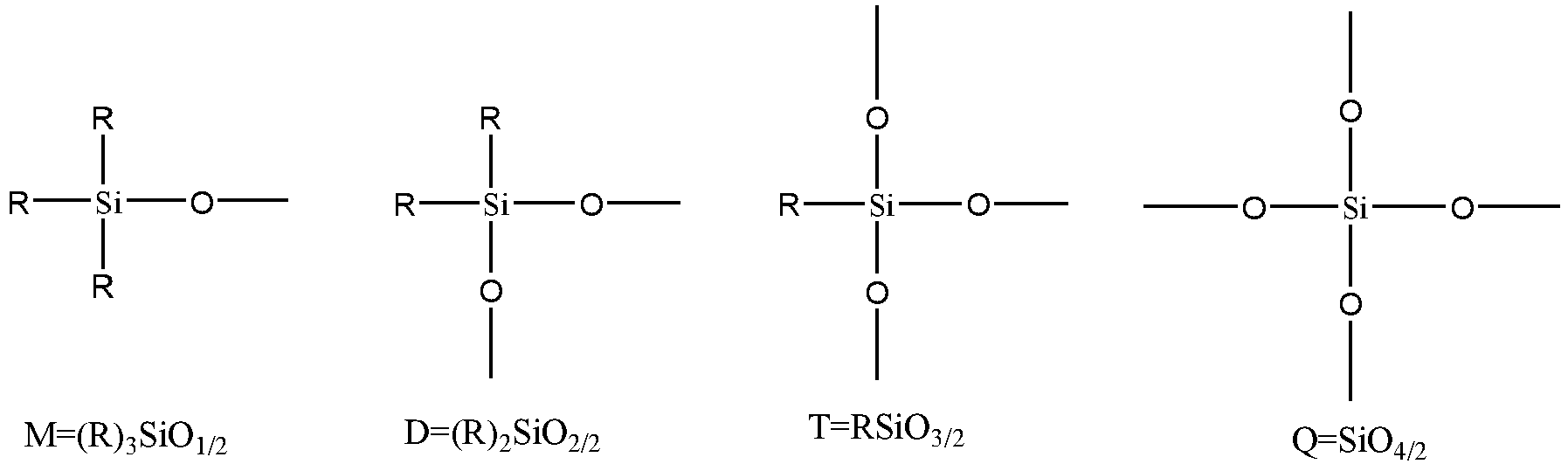
- The silicone resin comprises or a mixture of MQ silicone resin and T silicone resin.
- The silicone resin preferably comprises MQ silicone resin having the formula of [(R1)3-Si-O1/2]a-(Si-O4/2)b, wherein R1 is mutually identical or different, selected from saturated hydrocarbon groups. R1 is preferably selected from C1 to C6 alkyl, and more preferably each R1 is methyl group. Thus, the more preferred MQ silicone resin is trimethylsiloxysilicate. Preferably, a and b independently have values ranging from 10 to 1000, and more preferably from 30 to 200.
- The silicone resin preferably comprises T silicone resin having the formula of [R2-Si-O3/2]x, wherein R2 is selected from saturated hydrocarbon groups. R2 is preferably selected from C1 to C6 alkyl, more preferably selected from methyl, ethyl, propyl, butyl, and most preferably propyl. The most preferred T silicone resin is polypropyl silsesquioxane. Preferably, x is less than 2000, more preferably less than 500, but preferably greater than 10, and more preferably greater than 50.
- In more preferred embodiments, the silicone resin preferably comprises a blend of MQ silicone resin and T silicone resin, the weight ratio of the MQ silicone resin to the T silicone resin is preferably from 1:20 to 20:1 in order to achieve better film-forming performance. More preferably, the weight ratio of the MQ silicone resin to the T silicone resin is from 1:10 to 10:1, even more preferably from 1:5 to 5:1.
- Exemplary silicone resin suitable for the present invention includes Dow Corning™ MQ-1640 Flake Resin, a blend of MQ and T Propyl resins, Dow Corning™ MQ-1600 Solid Resin, a 100% active MQ resin, Dow Corning™ 670 Fluid, Cyclopentasiloxane (and) Polypropylsilsesquioxane supplied by Dow Corning.
- Preferably, the film-forming polymer is present in the composition in amount of from 0.05 to 8% by weight of the composition, more preferably from 0.3 to 7 %, even more preferably from 0.8 to 5%, and most preferably from 1 to 4% by weight of the composition.
- The fatty acid typically contains fatty acid moieties with chain lengths of from C10 to C30. In certain preferred embodiments, the hydrocarbon chain length of the fatty acid used is from 12 to 24, more preferably 14 to 20, even more preferably 16 to 18 carbon atoms. Suitable fatty acid comprises pelargonic, lauric, myristic, palmitic, isopalmitic, stearic, isostearic, oleic, linoleic, ricinoleic, arachidic, behenic, erucic acid or a mixture thereof. More preferably, the fatty acid comprises stearic, lauric, palmitic, isostearic, myristic acid, or a mixture thereof. Even more preferably, the fatty acid is stearic acid, palmitic acid or a mixture thereof.
- Although normally saturated, suitable fatty acid may contain unsaturated fatty acid moieties, and may contain fatty acid moieties having a degree of substitution, such as e. g. hydroxy fatty acids. It is preferred that the fatty acid comprises saturated fatty acid, saturated fatty acid having a degree of substitution, or a combination thereof. More preferably, the fatty acid comprises saturated is selected from saturated fatty acid, saturated fatty acid having a degree of substitution, or a combination thereof. Even more preferably, the fatty acid is saturated fatty acid.
- Soap of the present invention is preferably a salt of a C10-C30 fatty acid, more preferably C12-C24 fatty acid, even more preferably C14-C20 fatty acid and most preferably C16-C18 fatty acid. Suitable soap comprises pelargonate, laurate, myristate, palmitate, stearate, isostearate, oleate, linoleate, ricinoleate, arachidate, behenate, erucate salt or a mixture thereof. More preferably, the fatty acid salt comprises stearate, laurate, palmitate, isostearate salt or a mixture thereof. Even more preferably, the fatty acid salt is stearate salt, palmitate salt or a mixture thereof.
- Preferably the soap is selected from ammonium salt, alkali metal salt or mixture thereof. More preferably, the soap is sodium and/or potassium salt, and most preferably sodium salt. When the fatty compound comprises fatty acid and soap, it is preferred the fatty compound comprises fatty acid and salt thereof. More preferably the fatty compound is a combination of fatty acid and salt thereof.
- The fatty compound is preferably present in the composition in amount of from 0.01 to 3.3% by weight of the composition, more preferably from 0.7 to 3%, even more preferably from 1.5 to 2.5% by weight of the composition.
- For better performance of wash-off resistance, and/or long-lasting opacity, the weight ratio of film-forming polymer to fatty compound is preferably from 50:1 to 1:10, more preferably from 10:1 to 1:2, even more preferably from 5:1 to 1:1, and most preferably from 4:1 to 2:1.
- The cosmetic composition also comprises optical particle. Without being bound to any particular theory or explanation, the present inventors believe that optical particles would be embedded into the film by film-forming polymer and fatty compound. Therefore, the optical particles are able to resist water and/or friction and deliver the long-lasting opacity to the skin.
- The optical particles are typically particles of high refractive index materials. For example the optical particles may have a refractive index of greater than 1.3, more preferably greater than 1.7 and most preferably from 2.0 to 2.7. Examples of such optical particles are those comprising bismuth oxy-chloride, boron nitride, barium sulfate, mica, silica, titanium dioxide, zirconium oxide, iron oxide, aluminium oxide, zinc oxide or combinations thereof. More preferred particles are particles comprising titanium dioxide, zinc oxide, zirconium oxide, mica, iron oxide or a combination thereof. Even more preferred particles are particles comprising zinc oxide, zirconium oxide, titanium dioxide or a combination thereof as these materials have especially high refractive index. Most preferred is titanium dioxide.
- For sake of good compatibility with the film-forming polymer and/or fatty compound, the optical particle is preferably hydrophobic. More preferably, the optical particle is preferably hydrophobically modified. Even more preferably the optical particle is modified by hydrophobic material selected from fatty acid, silicone oil, wax, and a mixture thereof. The fatty acid preferably comprises oleic acid, stearic acid, or a mixture thereof.
- The size of optical particle is typical from 2 nm to 5 microns, more preferably from 5 nm to 1 micron, even more preferably from 10 nm to 500 nm. Particle size as used herein refers to the diameter of particles in an unaggregated state. Diameter means the largest measureable distance on a particle in the event a well-defined sphere is not generated. The diameter may be measured for example by scanning electron microscopy (SEM) by averaging the value of at least ten particles.
- The composition comprises optical particles in an amount of 0.01 to 7 wt%, preferably .05 to 5 wt% and most preferably 0.1 to 2 wt%. The weight ratio of the film-forming polymer to the optical particle is preferably in the range of from 1:10 to 50:1, more preferably from 1:3 to 10:1, and most preferably from 1:1 to 5:1. The weight ratio of the fatty compound to the optical particle is preferably in the range of from 1:40 to 20:1, more preferably from 1:20 to 10:1, and most preferably from 1:10 to 5:1.
- Compositions of the present invention may also include at least 40% of water by weight of the composition. Preferably, the amounts of water is from 50 to 90%, optimally between 60 and 85% by weight of the composition. Preferably the weight ratio of water to wax is from 1:1 to 1000:1, more preferably from 5:1 to 200:1, and most preferably from 15:1 to 60:1.
- Emollient materials may be included as carriers in compositions of this invention. These may be in the form of silicone oils, synthetic esters and/or hydrocarbons. Amounts of the emollients may range, for example, anywhere from 0.1 to 95%, more preferably between 1 and 50% by weight of the composition.
- Silicone oils may be divided into the volatile and nonvolatile variety. The term "volatile" as used herein refers to those materials which have a measurable vapor pressure at ambient temperature (25 °C). Volatile silicone oils are preferably chosen from cyclic (cyclomethicone) or linear polydimethylsiloxanes containing from 3 to 9, preferably from 4 to 5, silicon atoms. In many liquid versions of compositions according to the present invention, the volatile silicone oils may form a relatively large component of the compositions as carriers. Amounts may range, for example, from 5% to 80%, more preferably from 20% to 70% by weight of the composition.
- Nonvolatile silicone oils useful as an emollient material include polyalkyl siloxanes, polyalkylaryl siloxanes and polyether siloxane copolymers. The essentially nonvolatile polyalkyl siloxanes useful herein include, for example, polydimethyl siloxanes with viscosities of from about 5 × 10⁻⁶ to 0.1 m2/s at 25 °C. Among the preferred nonvolatile emollients useful in the present compositions are the polydimethyl siloxanes having viscosities from about 1 × 10⁻⁵ to about 4 × 10⁻⁴ m2/s at 25 °C.
- Organopolysiloxane crosspolymers can be usefully employed. Representative of these materials are dimethicone/vinyl dimethicone crosspolymers and dimethicone crosspolymers available from a variety of suppliers including Dow Corning (9040, 9041, 9045, 9506 and 9509), General Electric (SFE 839), Shin Etsu (KSG-15, 16 and 18 [dimethicone/phenyl vinyl dimethicone crosspolymer]), and Grant Industries (Gransil brand of materials), and lauryl dimethicone/vinyl dimethicone crosspolymers supplied by Shin Etsu (e.g. KSG-31, KSG-32, KSG-41, KSG-42, KSG-43 and KSG-44). Amounts of the aforementioned organopolysiloxane crosspolymers (when present) will usually be from 0.1 to 20% by weight dissolved usually in a volatile silicone oil such as cyclomethicone.
- When silicones are present in large amounts as carrier and water is also present, the systems may be oil continuous. These normally will require emulsification with a water-in-oil emulsifier such as a dimethicone copolyol (e.g. Abil EM-90 which is cetyl dimethicone copolyol).
- Among the ester emollients are:
- a) Alkenyl or alkyl esters of fatty acids having 10 to 20 carbon atoms. Examples thereof include isoarachidyl neopentanoate, isodecyl neopentanoate, isopropyl myristate, isononyl isonanoate, cetyl ricinoleate, oleyl myristate, oleyl stearate, and oleyl oleate.
- b) Ether-esters such as fatty acid esters of ethoxylated fatty alcohols.
- c) Polyhydric alcohol esters. Butylene glycol, ethylene glycol mono and di-fatty acid esters, diethylene glycol mono- and di-fatty acid esters, polyethylene glycol (200-6000) mono- and di-fatty acid esters, propylene glycol mono- and di-fatty acid esters, polypropylene glycol 2000 monooleate, polypropylene glycol 2000 monostearate, ethoxylated propylene glycol monostearate, glyceryl mono- and di-fatty acid esters, polyglycerol poly-fatty esters, ethoxylated glyceryl mono-stearate, 1,3-butylene glycol monostearate, 1,3-butylene glycol distearate, polyoxyethylene polyol fatty acid ester, sorbitan fatty acid esters, and polyoxyethylene sorbitan fatty acid esters are satisfactory polyhydric alcohol esters. Particularly useful are pentaerythritol, trimethylolpropane and neopentyl glycol esters of C1-C30 alcohols. Exemplative is pentaerythrityl tetraethylhexanoate.
- d) Wax esters such as beeswax, spermaceti wax and tribehenin wax.
- e) Sterols esters, of which cholesterol fatty acid esters are examples thereof.
- f) Sugar ester of fatty acids such as sucrose polybehenate and sucrose polycottonseedate.
- Of particular use also are the C12-15 alkyl benzoate esters sold under the Finsolv brand.
- Hydrocarbons which are suitable cosmetically acceptable carriers include petrolatum, mineral oil, C11-C13 isoparaffins, polyalphaolefins, and especially isohexadecane, available commercially as Permethyl 101A from Presperse Inc.
- Humectants of the polyhydric alcohol-type can be employed as cosmetically acceptable carriers. Typical polyhydric alcohols include polyalkylene glycols and more preferably alkylene polyols and their derivatives, including propylene glycol, dipropylene glycol, polypropylene glycol, polyethylene glycol and derivatives thereof, sorbitol, hydroxypropyl sorbitol, hexylene glycol, 1,3-butylene glycol, isoprene glycol, 1,2,6-hexanetriol, glycerol, ethoxylated glycerol, propoxylated glycerol and mixtures thereof. The amount of humectant may range, for example, anywhere from 0.5 to 50%, more preferably between 1 and 15% by weight of the composition. Most preferred is glycerol (also known as glycerin). Amounts of glycerin may range, for example, from 1% to 50%, more preferably from 10 to 35%, optimally from 15 to 30% by weight of the composition.
- Besides optical particles, the compositions of this invention may include a variety of other functional ingredients. Sunscreen actives may be included in compositions of the present invention. These will be organic compounds having at least one chromophoric group absorbing within the ultraviolet ranging from 290 to 400 nm. Chromophoric organic sunscreen agents may be divided into the following categories (with specific examples) including: p-Aminobenzoic acid, its salts and its derivatives (ethyl, isobutyl, glyceryl esters; p-dimethylaminobenzoic acid); Anthranilates (o-aminobenzoates; methyl, menthyl, phenyl, benzyl, phenylethyl, linalyl, terpinyl, and cyclohexenyl esters); Salicylates (octyl, amyl, phenyl, benzyl, menthyl, glyceryl, and dipropyleneglycol esters); Cinnamic acid derivatives (menthyl and benzyl esters, alpha-phenyl cinnamonitrile; butyl cinnamoyl pyruvate); Dihydroxycinnamic acid derivatives (umbelliferone, methylumbelliferone, methylaceto-umbelliferone); Trihydroxycinnamic acid derivatives (esculetin, methylesculetin, daphnetin, and the glucosides, esculin and daphnin); Hydrocarbons (diphenylbutadiene, stilbene); Dibenzalacetone and benzalacetophenone; Naphtholsulfonates (sodium salts of 2-naphthol-3,6-disulfonic and of 2-naphthol-6,8-disulfonic acids); Dihydroxy-naphthoic acid and its salts; o- and p-Hydroxybiphenyldisulfonates; Coumarin derivatives (7-hydroxy, 7-methyl, 3-phenyl); Diazoles (2-acetyl-3-bromoindazole, phenyl benzoxazole, methyl naphthoxazole, various aryl benzothiazoles); Quinine salts (bisulfate, sulfate, chloride, oleate, and tannate); Quinoline derivatives (8-hydroxyquinoline salts, 2-phenylquinoline); Hydroxyor methoxy-substituted benzophenones; Uric and vilouric acids; Tannic acid and its derivatives (e.g., hexaethylether); (Butyl carbityl) (6-propyl piperonyl) ether; Hydroquinone; Benzophenones (Oxybenzone, Sulisobenzone, Dioxybenzone, Benzoresorcinol, 2,2',4,4'-Tetrahydroxybenzophenone, 2,2'-Dihydroxy-4,4'-dimethoxybenzophenone, Octabenzone; 4-Isopropyldibenzoylmethane; Butylmethoxydibenzoylmethane; Etocrylene; and 4-isopropyl-dibenzoylmethane). Particularly useful are: 2-ethylhexyl p-methoxycinnamate, 4,4'-t-butyl methoxydibenzoylmethane, 2-hydroxy-4-methoxybenzophenone, octyldimethyl p-aminobenzoic acid, digalloyltrioleate, 2,2-dihydroxy-4-methoxybenzophenone, ethyl 4-[bis(hydroxypropyl)]aminobenzoate, 2-ethylhexyl-2-cyano-3,3-diphenylacrylate, 2-ethylhexylsalicylate, glyceryl p-aminobenzoate, 3,3,5-trimethylcyclohexylsalicylate, methylanthranilate, p-dimethylaminobenzoic acid or aminobenzoate, 2-ethylhexyl p-dimethylaminobenzoate, 2-phenylbenzimidazole-5-sulfonic acid, 2-(p-dimethylaminophenyl)-5-sulfoniobenzoxazoic acid and mixtures thereof.
- Particularly preferred are such materials as ethylhexyl p-methoxycinnamate, available as Parsol MCX®, Avobenzone, available as Parsol 1789®, Dermablock OS® (octylsalicylate) and Mexoryl SX® (with INCI name of Terephthalylidene Dicamphor Sulfonic Acid).
- Amounts of the organic sunscreen agent may range, for example, from 0.1 to 15%, more preferably from 0.5% to 10%, optimally from 1% to 8% by weight of the composition.
- A variety of thickening agents may be included in the compositions. Illustrative but not limiting are stearic acid, Acrylamide/Sodium Acryloyldimethyltaurate Copolymer (Aristoflex AVC), Hydroxyethyl Acrylate/Sodium Acryloyldimethyltaurate Copolymer, Aluminum Starch Octenyl Succinate, Polyacrylates (such as Carbomers including Carbopol® 980, Carbopol® 1342, Pemulen TR-2® and the Ultrez® thickeners), Polysaccharides (including xanthan gum, guar gum, pectin, carageenan and sclerotium gums), celluloses (including carboxymethyl cellulose, ethyl cellulose, hydroxyethyl cellulose and methyl hydroxymethyl cellulose), minerals (including talc, silica, alumina, mica and clays, the latter being represented by bentonites, hectorites and attapulgites), magnesium aluminum silicate and mixtures thereof. Amounts of the thickeners may range, for example, from 0.05 to 10%, more preferably from 0.3 to 2% by weight of the composition.
- Preservatives can desirably be incorporated into the cosmetic compositions of this invention to protect against the growth of potentially harmful microorganisms. Suitable traditional preservatives for compositions of this invention are alkyl esters of parahydroxybenzoic acid. Other preservatives which have more recently come into use include hydantoin derivatives, propionate salts, and a variety of quaternary ammonium compounds. Cosmetic chemists are familiar with appropriate preservatives and routinely choose them to satisfy the preservative challenge test and to provide product stability. Particularly preferred preservatives are phenoxyethanol, methyl paraben, propyl paraben, butyl paraben, isobutyl paraben, imidazolidinyl urea, sodium dehydroacetate and benzyl alcohol. The preservatives should be selected having regard for the use of the composition and possible incompatibilities between the preservatives and other ingredients in the composition. Preservatives are preferably employed in amounts ranging from 0.01% to 2% by weight of the composition.
- Compositions of the present invention may also contain vitamins and flavonoids. Illustrative water-soluble vitamins are Niacinamide, Vitamin B2, Vitamin B6, Vitamin C, ascorbyl phosphate and Biotin. Among the useful water-insoluble vitamins are Vitamin A (retinol), Vitamin A Palmitate, ascorbyl tetraisopalmitate, Vitamin E (tocopherol), Vitamin E Acetate and DL-panthenol. A particularly suitable Vitamin B6 derivative is Pyridoxine Palmitate. Among the preferred flavonoids are glucosyl hesperidin and rutin. Total amount of vitamins or flavonoids when present in compositions according to the present invention may range, for example, from 0.001 to 10%, more preferably from 0.01% to 5%, optimally from 0.1 to 3% by weight of the composition.
- Desquamation agents are further optional components. Illustrative are the alphahydroxycarboxylic acids and beta-hydroxycarboxylic acids and salts of these acids. Among the former are salts of glycolic acid, lactic acid and malic acid. Salicylic acid is representative of the beta-hydroxycarboxylic acids. Amounts of these materials when present may range from 0.1 to 15% by weight of the composition.
- A variety of herbal extracts may optionally be included in compositions of this invention. Illustrative are pomegranate, white birch (Betula Alba), green tea, chamomile, licorice, boswellia serrata, olive (Olea Europaea) leaf, arnica montana flower, lavandula angustifolia, and extract combinations thereof. The extracts may either be water soluble or water-insoluble carried in a solvent which respectively is hydrophilic or hydrophobic. Water and ethanol are the preferred extract solvents.
- Miscellaneous other adjunct cosmetic ingredients that may be suitable for the present compositions include ceramides (e.g. Ceramide 3 and Ceramide 6), conjugated linoleic acids, colorants (e.g. iron oxides), metal (manganese, copper and/or zinc) gluconates, allantoin, palmitoyl pentapeptide-3, amino acids (e.g. alanine, arginine, glycine, lysine, proline, serine, threonine, glumatic acid and mixtures thereof), trimethylglycine, sodium PCA, chelator like disodium EDTA, magnesium aspartate, and combinations thereof. Amounts may, for example, vary from 0.000001 to 3% by weight of the composition.
- A small amount of emulsifying surfactant may be present. Surfactants may be anionic, nonionic, cationic, amphoteric and mixtures thereof. Levels may range, for example, from 0.1 to 5%, more preferably from 0.1 to 2%, optimally from 0.1 to 1% by weight. Advantageously the amount of surfactant present should not be sufficient for lather formation. In these instances, less than 2% by weight, preferably less than 1%, and optimally less than 0.5% by weight surfactant is present. Emulsifiers like PEG-100 stearate may be used as well as emulsion stabilizers like cetearyl alcohol and ceteareth-20 may be used and typically in amounts that do not exceed 5 percent by weight of the composition.
- Other optional additives suitable for use in the composition of this invention include cationic ammonium compounds to enhance moisturization. Such compounds include salts of hydroxypropyltri (C1-C3 alkyl) ammonium mono-substituted-saccharide, salts of hydroxypropyltri (C1-C3 alkyl) ammonium mono-substituted polyols, dihydroxypropyltri (C1-C3 alkyl) ammonium salts, dihydroxypropyldi (C1-C3 alkyl) mono(hydroxyethyl) ammonium salts, guar hydroxypropyl trimonium salts, 2,3-dihydroxypropyl tri(C1-C3 alkyl or hydroxalkyl) ammonium salts or mixtures thereof. In a most preferred embodiment and when desired, the cationic ammonium compound employed in this invention is the quaternary ammonium compound 1,2-dihydroxypropyltrimonium chloride. If used, such compounds typically make up from 0.01 to 30%, and more preferably from about 0.1 to about 15% by weight of the composition.
- When cationic ammonium compounds are used, optional additives for use with the same are moisturizing agents such as substituted ureas like hydroxymethyl urea, hydroxyethyl urea, hydroxypropyl urea; bis(hydroxymethyl) urea; bis(hydroxyethyl) urea; bis(hydroxypropyl) urea; N,N'-dihydroxymethyl urea; N,N'-di-hydroxyethyl urea; N,N'-dihydroxypropyl urea; N,N,N'-tri-hydroxyethyl urea; tetra(hydroxymethyl) urea; tetra(hydroxyethyl) urea; tetra(hydroxypropyl) urea; N-methyl-N'-hydroxyethyl urea; N-ethyl-N'-hydroxyethyl urea; N-hydroxypropyl-N'-hydroxyethyl urea and N,N'dimethyl-N-hydroxyethyl urea or mixtures thereof. Where the term hydroxypropyl appears, the meaning is generic for either 3-hydroxy-n-propyl, 2-hydroxy-n-propyl, 3-hydroxy-i-propyl or 2-hydroxy-i-propyl radicals. Most preferred is hydroxyethyl urea. The latter is available as a 50% aqueous liquid from AkzoNobel under the trademark Hydrovance. Such substituted ureas, while desirable in moisturizing formulations, are only selected for use when compatible with sunless tanning agent or agents (when used) in the compositions of this invention.
- Amounts of substituted urea, when used, in the composition of this invention range from 0.01 to 20%, more preferably from 0.5 to 15%, and most preferably from 2 to 10% based on total weight of the composition and including all ranges subsumed therein.
- When cationic ammonium compound and substituted urea are used, in a most especially preferred embodiment at least from 0.01 to 25%, more preferably from 0.2 to 20%, and most preferably from 1 to 15% humectant, like glycerine, is used, based on total weight of the composition and including all ranges subsumed therein.
- When making the compositions of this invention, ingredients are typically mixed with moderate shear under atmospheric conditions. The compositions may be applied topically and preferably 1-4 milligrams of composition is applied per square centimeter of skin. Preferably, the compositions display a pH from 5 to 7. Packaging for the composition of this invention can be a jar or tube as well as any other format typically seen for cosmetic, cream, washing and lotion type products.
- It is preferred that the composition is a skin care composition. The composition may be a leave-on composition or a wash-off composition, but preferably a leave-on composition.
- The invention also concerns a method for improving skin characteristic comprising the step of topically applying to skin the cosmetic composition of the invention as described. Skin characteristic as used herein refers to features used to evaluate skin, include but not limit to skin firming, opacity, smoothness, cleanliness, moistening, or a combination thereof. Preferably, the skin characteristics comprise skin firming, opacity, or a combination thereof. More preferably the skin characteristic is long-lasting opacity and most preferably, the skin characteristic is long-lasting whitening. "Long-lasting" refers to the beneficial agent (for example optical particle) remains at least 30%, preferably at least 50% after flushing by tap water (25°C) for 1 minute.
- The following examples are provided to facilitate an understanding of the invention. The examples are not intended to limit the scope of the claims.
- The base formulation (sample A in Table 1) was coated evenly onto Bio-skin plate (Color: 30#, ex. BEAULAX, Co. Ltd., Tokyo, Japan) with surface density of 0, 0.5, 1, 1.5, 2, 2.5, 3, 3.5, 4, 5, and 6 mg/cm2. After naturally drying at around 25°C for 8 hours, the L (for lightness), a, and b (for the color-opponent dimensions) of these coated Bio-skin plates was measured using Digieye Imaging System (Verivide, UK). The ITA value was calculated by equation of ITA = [arctan(L-50/b)]×180/π. Then the ITA value versus surface density was plotted and fitted by a polynomial model to obtain the curve. The R-Square was higher than 0.999 which demonstrated that the polynomial model was suitable to fit the functional relationship between the lightness and the surface density of the base formulation.
- 30 mg of samples was coated evenly onto Bio-skin plates with area of 10 cm2. The coated bio-skin was naturally dried at around 25°C for 8 hours. The L, a, and b of the Bio-skin plate were measured by Digieye Imaging System (Verivide, UK). The ITA value (ITA1) was calculated according to the above equation. The surface density value before wash-off/abrasion experiment (SD1) was obtained according to the calibration curve. The coated bio-skin was soaked into de-ionized water for 30s. Then, a commercial face cleanser (Pond's gold radiance™ Radiance Boosting Cleansing Mousse) with amount of 5 mg/cm2 was applied onto the Bio-skin plate and the coated Bio-skin plate was washed by Martindale abrasion and pilling tester (Type: M235, SDL Altas, USA) with 33.72g of motion plate at the speed of 30 rpm for 1 min. Subsequently, the coated Bio-skin plate was soaked into water for another 1 min and washed by de-ionized water. After naturally drying at around 25°C for 2 hours, the L, a, and b of the Bio-skin plate were measured again by Digieye Imaging System and the ITA value of the Bio-skin plate (ITA2) was calculated. The surface density after wash-off/abrasion experiment (SD2) was obtained according to the calibration curve.
- The deposition ratio after wash-off/abrasion experiment was calculated by:

- The contact angles of five film-forming polymers including Dow Corning™ MQ-1640 Flake Resin, Dow Corning™ MQ-1600 Solid Resin, Dow Corning™ 670 Fluid from Dow Corning, Avalure™ UR450 from Lubrizol, Lexorez™ 100 from Inolex were conducted. Dow Corning™ MQ-1600 Solid Resin and Dow Corning™ 670 Fluid were dispersed into dimethicone with a polymer to solvent weight ratio of 1:9. The other three polymers were dispersed into ethanol with a polymer to solvent weight ratio of 1:9.
- 0.2 ml of film-forming polymer dispersions were dripped evenly onto an ordinary glass sides (about 2 cmx8cm). After the solvents evaporated, uniform films were formed. Drop shape analysis system 100 (DSA 100, Krüss) was used to measure contact angle using deionised water drops of around 5 µL applied to five different points of each film. The contact angle averaged over all 5 drops.
- The contact angles of Dow Corning™ MQ-1640 Flake Resin, Dow Corning™ MQ-1600 Solid Resin, Dow Corning™ 670, Avalure™ UR450, and Lexorez™ 100 were 107°, 116°, 114°, 66°, and 28° respectively.
- Then, these glass slides coated with polymer films were immersed fully into water for 30 minutes. After that the glass slides were taken out from water and dried. The contact angles of these glass slides were measured again. It was surprisingly found that the contact angles of glass slides coated by Avalure™ UR450, and Lexorez™ 100 were decreased to less than 15°, indicating that the polymer film has been peeled off. In contrast, the contact angle of glass slides coated by Dow Corning™ MQ-1640 Flake Resin, Dow Corning™ MQ-1600 Solid Resin, and Dow Corning™ 670 remained almost the same, manifesting that the polymer films were adhered onto the glass slides firmly.
- This example demonstrates the inclusion of fatty acid in different amount into the compositions with different film-forming polymers improved the wash-off resistance of the compositions.
- A series of cosmetic compositions were formulated as shown in Table 1 below.
- The formulations were prepared by the following process. The optical particles were completely dispersed in the oil phase with other ingredients and the silicone resin and/or fatty compound (when present) mixed thoroughly. The resulting oil-based mixture was gradually added to the aqueous phase. The resulting mixture was emulsified under 9,000 rpm of shear stress for 10 minutes at 65 °C and gradually stirred and cooled to room temperature.
- The deposition ratios of the samples were measured by following the Wash-off/abrasion resistance performance test.
Table 1 Ingredient (wt%) Samples A B C 1 2 3 4 5 Water Bal. Bal. Bal. Bal. Bal. Bal. Bal. Bal. Disodium EDTA 0.10 0.10 0.10 0.10 0.10 0.10 0.10 0.10 PEG-100 Stearate (Myij 59 P) 1.85 1.85 1.85 1.85 1.85 1.85 1.85 1.85 Glyceryl stearate 1.00 1.00 1.00 1.00 1.00 1.00 1.00 1.00 Caprylic / Capric Triglycerides 3.00 3.00 3.00 3.00 3.00 3.00 3.00 3.00 Aristoflex AVC UL 1.00 1.00 1.00 1.00 1.00 1.00 1.00 1.00 Cyclomethicone/DC 245 8.00 8.00 8.00 8.00 8.00 8.00 8.00 8.00 Preservative 0.20 0.20 0.20 0.20 0.20 0.20 0.20 0.20 Titanium dioxide a 1.00 1.00 1.00 1.00 1.00 1.00 1.00 1.00 Silicone resin-1 b --- 3.00 --- 3.00 3.00 3.00 3.00 --- Silicone resin-2 c --- --- 3.00 --- --- --- --- 3.00 Stearic acidd --- --- --- 0.50 1.00 2.00 3.00 1.00 a. MT700Z, Titanium Dioxide (and) Stearic Acid (and) Aluminium Hydroxide supplied by TAYCA
b. Dow Corning™ MQ-1640 Flake Resin, a blend of MQ and T Propyl resins, supplied by Dow Corning.
c. Dow Corning™ MQ-1600 Solid Resin, a 100% active MQ resin, supplied by Dow Corning.
d. Supplied by Emery Oleochemicals (M) Sdn. Bhd. - As can be seen in Table 2, with the addition of fatty acid into the composition with different silicone resins, the deposition ratios after wash-off test for all compositions (samples 1 to 5) were increased. It was found that the inclusion of fatty acid of the present invention unexpectedly improved the wash-off resistance, rub resistance, and the long-lasting deposition of optical particles.
- It was also surprisingly found that even lower levels of fatty acid (sample 1 and 2) can induce similar deposition ratio as higher levels of fatty acid (sample 3). It was also found that the fatty acid can improve the deposition ratio of composition containing silicone-1 more than that of the composition containing silicone-2.
Table 2 Sample Silicone resin-1 (wt%) Silicone resin-2 (wt%) Stearic acid (wt%) Deposition Ratio (%) B 3.00 0 0 61.5±3.1 C 0 3.00 0 30.1±2.6 1 3.00 0 0.50 69.3±1.6 2 3.00 0 1.00 73.8±2.1 3 3.00 0 2.00 85.6±6.3 4 3.00 0 3.00 72.5±2.3 5 0 3.00 1.00 35.5±2.0 - This example demonstrates the inclusion of different fatty acids into the compositions with film-forming polymer improved the wash-off resistance of the compositions.
- The formulations in Table 3 were prepared and the deposition ratios were tested by the following similar procedures as described in Example 1.
Table 3 Ingredient (wt%) Samples 6 7 8 9 10 Water Bal. Bal. Bal. Bal. Bal. Disodium EDTA 0.10 0.10 0.10 0.10 0.10 PEG-100 Stearate (Myij 59 P) 1.85 1.85 1.85 1.85 1.85 Glyceryl stearate 1.00 1.00 1.00 1.00 1.00 Caprylic / Capric Triglycerides 3.00 3.00 3.00 3.00 3.00 Aristoflex AVC UL 1.00 1.00 1.00 1.00 1.00 Cyclomethicone/DC 245 8.00 8.00 8.00 8.00 8.00 Preservative 0.20 0.20 0.20 0.20 0.20 Titanium dioxide a 1.00 1.00 1.00 1.00 1.00 Silicone resin-1 b 3.00 3.00 3.00 3.00 3.00 Lauric acidc 1.00 --- --- --- --- Myristic acidc --- 1.00 - --- --- Palmitic acidc --- --- 1.00 --- --- Oleic acidc --- --- --- 1.00 --- 12-hydroxy stearic acidd --- --- --- --- 1.00 Deposition Ratio (%) 71.6±2.5 72.1±3.3 72.6±2.9 71.6±1.9 68.3±3.0 a. MT700Z, Titanium Dioxide (and) Stearic Acid (and) Aluminium Hydroxide supplied by TAYCA
b. Dow Corning™ MQ-1640 Flake Resin, a blend of MQ and T Propyl resins, supplied by Dow Corning.
c. Supplied by Emery Oleochemicals (M) Sdn. Bhd.
d. Supplied by Vertellus Performance Materials Inc. - As shown in the last row of Table 3, the deposition ratios of composition containing both film-forming polymer and different fatty acids had been increased over composition merely containing film-forming polymer. It was manifested that the incorporation of different fatty acids improved wash-off resistance and therefore long-lasting whitening. It was also surprisingly found that the fatty acid without substitution improved wash-off resistance more than the fatty acid with a degree of substitution.
Claims (8)
- A cosmetic composition comprising:a) from 0.01 to 9% of film-forming polymer having a contact angle of at least 85° by weight of the composition, where contact angle means the angle at which a water/vapor interface meets a solid surface at a temperature of 25 °C and is measured in accordance with the procedure in the description;b) from 0.01 to 3.5% of fatty compound by weight of the composition;c) from 0.001 to 7% of optical particle by weight of the composition; andd) at least 40% of water by weight of the composition,wherein the fatty compound is selected from fatty acid, soap, or a mixture thereof; and wherein the film forming polymer is silicone resin which comprises a blend of MQ silicone resin and T silicone resin, where silicone resin is silicone material which is formed by branched and/or cage-like oligosiloxanes having three-dimensional structure.
- The composition according to claim 1 herein the silicone resin is selected from trimethylsiloxy silicate, polypropyl silsesquioxane, or a combination thereof, preferably the silicone resin is mixture of trimethylsiloxy silicate and polypropyl silsesquioxane.
- The composition according to any one of the preceding claims wherein the amount of film-forming polymer is from 0.3 to 7% by weight of the composition.
- The composition according to any one of the preceding claims wherein the fatty acid is C12 to C24 fatty acid.
- The composition according to claim 4 wherein the fatty acid comprises stearic acid, lauric acid, palmitic acid, isostearic acid, myristic acid or a mixture thereof, preferably stearic acid.
- The composition according to any one of the preceding claims wherein the soap is the salt of C12 to C24 fatty acid.
- The composition according to any one of the preceding claim wherein the weight ratio of film-forming polymer to the fatty compound is from 10:1 to 1:2.
- The composition according to any one of the preceding claim wherein the optical particle comprises titanium dioxide, zinc oxide, zirconium oxide, mica, iron oxide or a combination thereof, preferably comprises titanium dioxide, zinc oxide, zirconium oxide or a combination thereof, and more preferably comprises titanium dioxide.
Priority Applications (1)
| Application Number | Priority Date | Filing Date | Title |
|---|---|---|---|
| EP13868317.2A EP2934434B1 (en) | 2012-12-24 | 2013-12-18 | Cosmetic composition |
Applications Claiming Priority (6)
| Application Number | Priority Date | Filing Date | Title |
|---|---|---|---|
| CN2012087267 | 2012-12-24 | ||
| CN2012087301 | 2012-12-24 | ||
| EP13153664 | 2013-02-01 | ||
| EP13153662 | 2013-02-01 | ||
| PCT/CN2013/089863 WO2014101701A1 (en) | 2012-12-24 | 2013-12-18 | Cosmetic composition |
| EP13868317.2A EP2934434B1 (en) | 2012-12-24 | 2013-12-18 | Cosmetic composition |
Publications (3)
| Publication Number | Publication Date |
|---|---|
| EP2934434A1 EP2934434A1 (en) | 2015-10-28 |
| EP2934434A4 EP2934434A4 (en) | 2015-11-18 |
| EP2934434B1 true EP2934434B1 (en) | 2022-06-29 |
Family
ID=51019871
Family Applications (4)
| Application Number | Title | Priority Date | Filing Date |
|---|---|---|---|
| EP13869125.8A Withdrawn EP2953605A4 (en) | 2012-12-24 | 2013-12-18 | USE OF A COSMETIC COMPOSITION |
| EP13868581.3A Active EP2953604B1 (en) | 2012-12-24 | 2013-12-18 | Cosmetic composition |
| EP13868317.2A Active EP2934434B1 (en) | 2012-12-24 | 2013-12-18 | Cosmetic composition |
| EP13869168.8A Active EP2934435B1 (en) | 2012-12-24 | 2013-12-18 | Cosmetic composition |
Family Applications Before (2)
| Application Number | Title | Priority Date | Filing Date |
|---|---|---|---|
| EP13869125.8A Withdrawn EP2953605A4 (en) | 2012-12-24 | 2013-12-18 | USE OF A COSMETIC COMPOSITION |
| EP13868581.3A Active EP2953604B1 (en) | 2012-12-24 | 2013-12-18 | Cosmetic composition |
Family Applications After (1)
| Application Number | Title | Priority Date | Filing Date |
|---|---|---|---|
| EP13869168.8A Active EP2934435B1 (en) | 2012-12-24 | 2013-12-18 | Cosmetic composition |
Country Status (9)
| Country | Link |
|---|---|
| US (3) | US20150342865A1 (en) |
| EP (4) | EP2953605A4 (en) |
| JP (3) | JP6506695B2 (en) |
| CN (4) | CN105007886A (en) |
| BR (2) | BR112015015123A2 (en) |
| CA (3) | CA2896264C (en) |
| MX (3) | MX367561B (en) |
| WO (4) | WO2014101702A1 (en) |
| ZA (3) | ZA201504118B (en) |
Families Citing this family (13)
| Publication number | Priority date | Publication date | Assignee | Title |
|---|---|---|---|---|
| US20150342865A1 (en) * | 2012-12-24 | 2015-12-03 | Conopco, Inc., a/b/a UNILEVER | Cosmetic composition |
| CN107072930A (en) * | 2014-09-02 | 2017-08-18 | Edgewell个人护理品牌有限责任公司 | Mineral light screening composition |
| US11590067B2 (en) | 2016-01-22 | 2023-02-28 | Edgewell Personal Care Brands, Llc | Hydrophobic topical compositions and methods for producing same |
| KR102768024B1 (en) * | 2017-04-18 | 2025-02-13 | 카오카부시키가이샤 | Method for manufacturing a cosmetic film |
| JP7216484B2 (en) * | 2017-04-18 | 2023-02-01 | 花王株式会社 | Method for manufacturing UV protective coating |
| WO2018194085A1 (en) * | 2017-04-18 | 2018-10-25 | 花王株式会社 | Method for manufacturing decorative film |
| US20200155423A1 (en) * | 2017-04-18 | 2020-05-21 | Kao Corporation | Method for producing coating |
| US11737958B2 (en) | 2017-04-18 | 2023-08-29 | Kao Corporation | Method for producing UV protective coating |
| JP7137958B2 (en) * | 2017-04-19 | 2022-09-15 | 花王株式会社 | Coating manufacturing method |
| FR3075632B1 (en) * | 2017-12-22 | 2020-03-06 | L'oreal | COMPOSITION IN THE FORM OF AN EMULSION COMPRISING A SILICONE RESIN, AN AMINO SILICONE OIL AND METHOD OF IMPLEMENTING THE SAME |
| EP3866936B1 (en) | 2018-10-15 | 2024-03-06 | Unilever IP Holdings B.V. | Cosmetic composition with an improved pickup |
| CA3186527A1 (en) * | 2020-07-29 | 2022-02-03 | Aditi Jayavant KULKARNI | Cosmetic mask for improving appearance of skin |
| CN116056680A (en) * | 2020-07-31 | 2023-05-02 | 欧莱雅 | Cosmetic sunscreen composition, method for producing a cosmetic sunscreen composition and use of a cosmetic sunscreen composition |
Family Cites Families (103)
| Publication number | Priority date | Publication date | Assignee | Title |
|---|---|---|---|---|
| JPH0615448B2 (en) | 1984-09-06 | 1994-03-02 | 株式会社資生堂 | Skin cosmetics |
| JP2539190B2 (en) | 1985-01-11 | 1996-10-02 | 株式会社資生堂 | Skin cosmetics |
| JPS62298519A (en) | 1986-06-19 | 1987-12-25 | Shiseido Co Ltd | Skin cosmetic |
| US5013763A (en) | 1987-11-30 | 1991-05-07 | The Andrew Jergens Company | Wash-off-resistant skin preparation |
| JP2657504B2 (en) | 1988-01-12 | 1997-09-24 | 株式会社資生堂 | Water-in-oil emulsion composition |
| US5599547A (en) | 1994-11-22 | 1997-02-04 | The Procter & Gamble Company | Mascara compositions |
| JP3513862B2 (en) | 1994-11-30 | 2004-03-31 | 株式会社コーセー | Oily solid cosmetics |
| CN1097453C (en) | 1995-02-15 | 2003-01-01 | 普罗克特和甘保尔公司 | Crystalline hydroxy waxes as oil in water stabilizers for skin cleansing lqiuid composition |
| JPH08268856A (en) | 1995-03-31 | 1996-10-15 | Shiseido Co Ltd | Anti-sunburn cosmetic |
| JP3468971B2 (en) | 1995-07-05 | 2003-11-25 | カネボウ株式会社 | Cosmetics |
| FR2739281B1 (en) | 1995-09-29 | 1997-10-31 | Oreal | TOPICAL COMPOSITION CONTAINING A SILICONE GRAFT POLYMER AND AN AMINOUS SILICONE AND / OR A SILICONE GUM OR RESIN |
| US5772696A (en) | 1995-12-13 | 1998-06-30 | Warner-Jenkinson Company, Inc. | Process for purification of water soluble dyes via water insoluble metal salt intermediate |
| JPH1043342A (en) | 1996-05-01 | 1998-02-17 | Bridgestone Sports Co Ltd | Practice golf balls |
| AU721618B2 (en) * | 1996-05-20 | 2000-07-13 | Shiseido Company Ltd. | Oil-in-water emulsified composition and oil-in-water emulsifying agent |
| JPH09309818A (en) | 1996-05-22 | 1997-12-02 | Noevir Co Ltd | Emulsion-type anti-suntan cosmetic |
| JPH107517A (en) | 1996-06-16 | 1998-01-13 | Shiseido Co Ltd | Cosmetic |
| JPH109714A (en) | 1996-06-25 | 1998-01-16 | Hitachi Ltd | Refrigeration equipment |
| JPH1161097A (en) | 1997-08-28 | 1999-03-05 | Nissan Chem Ind Ltd | UV absorber |
| JPH1180237A (en) | 1997-09-10 | 1999-03-26 | Tonen Corp | Alpha-olefin polymerization catalyst |
| JP3778324B2 (en) * | 1998-03-30 | 2006-05-24 | 株式会社資生堂 | Oil-in-water emulsion composition |
| JP3535389B2 (en) * | 1998-07-31 | 2004-06-07 | 株式会社資生堂 | External composition |
| JP2000072645A (en) | 1998-08-27 | 2000-03-07 | Kose Corp | Water-in-oil type emulsion cosmetic |
| JP2000119165A (en) | 1998-10-16 | 2000-04-25 | Kanebo Ltd | Emulsion type skin lotion |
| US6036967A (en) | 1998-10-28 | 2000-03-14 | Archimica (Florida), Inc. | Mixtures of trimethylsilylated silicas and alkylsiloxanes |
| US6309657B2 (en) | 1999-02-12 | 2001-10-30 | The Procter & Gamble Company | Cosmetic compositions |
| WO2001017496A1 (en) | 1999-09-09 | 2001-03-15 | Johnson & Johnson Research Pty Limited | Skin-balance moisturizing cream |
| JP2002201109A (en) | 2000-12-28 | 2002-07-16 | Lion Corp | Sheet cosmetics |
| DE10136883B4 (en) | 2001-07-24 | 2008-08-21 | Coty B.V. | Water- and abrasion-resistant cosmetic for hair and decorative cosmetics |
| AU2002331001A1 (en) | 2001-08-07 | 2003-02-24 | Dow Corning Corporation | Hair and skin care compositions containing siloxane-based polyamide copolymers |
| WO2003026596A1 (en) * | 2001-09-26 | 2003-04-03 | The Procter & Gamble Company | Topical compositions containing solid particulates and a silicone resin copolymer fluid |
| JP3727901B2 (en) * | 2001-09-27 | 2005-12-21 | 株式会社コーセー | Oil-in-water emulsified cosmetic |
| JP2003171223A (en) | 2001-12-10 | 2003-06-17 | Pola Chem Ind Inc | Cosmetic for providing smoothness |
| JP2003183119A (en) | 2001-12-21 | 2003-07-03 | Pola Chem Ind Inc | Cosmetic giving smoothness |
| US20030235552A1 (en) | 2002-06-12 | 2003-12-25 | L'oreal | Cosmetic composition for care and/or makeup, structured with silicone polymers and film-forming silicone resins |
| US20030232030A1 (en) | 2002-06-12 | 2003-12-18 | L'oreal | Compositions containing at least one oil structured with at least one silicone-polyamide polymer, and at least one gelling agent and methods of using the same |
| JP2004059476A (en) | 2002-07-26 | 2004-02-26 | Kose Corp | Water-in-oil type cosmetic |
| JP2004115479A (en) | 2002-09-30 | 2004-04-15 | Pola Chem Ind Inc | Massage cosmetic for ameliorating swelling |
| JP2004203788A (en) * | 2002-12-25 | 2004-07-22 | Kose Corp | Solid water-in-oil type emulsified cosmetic |
| JP2004262851A (en) | 2003-03-03 | 2004-09-24 | Kanebo Ltd | Cosmetic |
| JP2005053796A (en) | 2003-08-04 | 2005-03-03 | Shiseido Co Ltd | Makeup skin cosmetic |
| JP4491216B2 (en) | 2003-10-07 | 2010-06-30 | 株式会社コーセー | Oil-in-water cosmetic for cosmetics |
| US20050089498A1 (en) | 2003-10-24 | 2005-04-28 | Patil Anjali A. | Cosmetic compositions containing first and second film forming polymers |
| JP4084294B2 (en) | 2003-12-11 | 2008-04-30 | 花王株式会社 | Cosmetics for water-in-oil coffee |
| BR0308051A (en) | 2003-12-15 | 2005-09-06 | Natura Cosmeticos Sa | Base composition for preparation of multifunctional formulations for skin and hair care and protection |
| US20050142079A1 (en) | 2003-12-26 | 2005-06-30 | Garrison Mark S. | Oil in silicone emulsion and compositions containing same |
| JP4943164B2 (en) | 2004-02-02 | 2012-05-30 | ダウ・コーニング・コーポレイション | MQ and T-propylsiloxane resin composition |
| JP2005263699A (en) | 2004-03-19 | 2005-09-29 | Kanebo Cosmetics Inc | Cosmetic for salmon |
| US7666824B2 (en) * | 2004-04-22 | 2010-02-23 | Kimberly-Clark Worldwide, Inc. | Liquid cleanser compositions |
| JP4717537B2 (en) | 2004-08-31 | 2011-07-06 | 株式会社 資生堂 | Skin external composition |
| US20060078578A1 (en) | 2004-10-07 | 2006-04-13 | Sandewicz Robert W | Cosmetic compositions with montmorillonite stabilizing agent |
| US20060110346A1 (en) * | 2004-11-04 | 2006-05-25 | L'oreal | Transfer-resistant cosmetic compositions |
| US20060127333A1 (en) * | 2004-12-13 | 2006-06-15 | Patil Anjali A | Cosmetic compositions containing very high viscosity silicone gum |
| JP2006225347A (en) | 2005-02-18 | 2006-08-31 | Shiseido Co Ltd | Skin care composition |
| JP2006282517A (en) | 2005-03-31 | 2006-10-19 | Kose Corp | Gel composition and cosmetic comprising the same |
| DE102005019953A1 (en) | 2005-04-28 | 2006-11-02 | Beiersdorf Ag | Transfer-resistant lip care products |
| US8025869B2 (en) | 2005-06-28 | 2011-09-27 | L'oréal | Cosmetic compositions having enhanced wear properties |
| JP4815166B2 (en) | 2005-08-24 | 2011-11-16 | 日本精化株式会社 | Oily base and cosmetics and skin external preparations containing the same |
| JP4993983B2 (en) * | 2005-09-28 | 2012-08-08 | 信越化学工業株式会社 | Organopolysiloxane surface treatment agent system, powder surface-treated with the treatment agent system, and cosmetics containing the powder |
| US20070093619A1 (en) * | 2005-10-24 | 2007-04-26 | L'oreal | Compositions having enhanced cosmetic properties |
| JP5240967B2 (en) * | 2006-02-20 | 2013-07-17 | 株式会社 資生堂 | Water-in-oil emulsified sunscreen cosmetics |
| US20070243143A1 (en) | 2006-04-14 | 2007-10-18 | Patil Anjali A | Cosmetic Compositions With Backbiting Silicone Polymers |
| JP2008050271A (en) * | 2006-08-22 | 2008-03-06 | Shiseido Co Ltd | Makeup cosmetic |
| JP4059284B1 (en) | 2006-09-29 | 2008-03-12 | 富士ゼロックス株式会社 | Image forming apparatus, inspection system, and inspection program |
| KR20090060422A (en) * | 2006-09-29 | 2009-06-12 | 가부시키가이샤 시세이도 | Skin external preparation and skin cleanser |
| US20080292560A1 (en) | 2007-01-12 | 2008-11-27 | Dov Tamarkin | Silicone in glycol pharmaceutical and cosmetic compositions with accommodating agent |
| US20080233075A1 (en) | 2007-03-22 | 2008-09-25 | Marina Sokolinsky | Cosmetic composition for skin tightening |
| KR101342071B1 (en) | 2007-03-23 | 2013-12-16 | 주식회사 엘지생활건강 | Oily caketype cosmetic composition and cosmetic article comprising the same |
| JP2008247757A (en) | 2007-03-29 | 2008-10-16 | Kose Corp | Composite powder and cosmetic containing the composite powder |
| JP2008255013A (en) | 2007-03-30 | 2008-10-23 | Kose Corp | Oily cosmetic |
| FR2918272B1 (en) | 2007-07-03 | 2010-09-24 | Oreal | COSMETIC COMPOSITION COMPRISING A SILICONE POLYMER, A TACKIFYING RESIN, AND AT LEAST ONE SILICON RESIN |
| CN101778617A (en) * | 2007-07-27 | 2010-07-14 | 宝洁公司 | Conditioning composition comprising dual cationic surfactant system, aminosilicone and silicone resin |
| CN101424041B (en) | 2007-10-30 | 2011-07-13 | 河南瑞贝卡发制品股份有限公司 | Method for preparing isolated hair finishing auxiliaries after frizzy hair and use |
| KR20090056301A (en) | 2007-11-30 | 2009-06-03 | (주)아모레퍼시픽 | High Moisturizing Cosmetic Composition |
| JP5253826B2 (en) | 2008-01-18 | 2013-07-31 | 株式会社ナリス化粧品 | Mascara composition |
| FR2927805B1 (en) * | 2008-02-26 | 2011-01-07 | Oreal | COSMETIC COMPOSITION COMPRISING A PARTICULAR SILICONE COPOLYMER, A VOLATILE SOLVENT AND A PARTICULAR SILICONE RESIN. |
| JP5497314B2 (en) | 2008-03-27 | 2014-05-21 | 株式会社コーセー | Oily cosmetics |
| US20100080768A1 (en) | 2008-09-26 | 2010-04-01 | Mcgraw Thomas L | Compositions and Methods for the Treatment of Inflammatory Dermatosis and Other Pathological Conditions of the Skin |
| FR2939033B1 (en) | 2008-12-02 | 2012-08-31 | Oreal | COSMETIC COMPOSITION FOR MAKE-UP AND / OR CARE OF KERATINIC MATERIALS, AND METHOD FOR MAKE-UP |
| JP2010144025A (en) | 2008-12-18 | 2010-07-01 | Soft99 Corporation | Cleaning and polishing agent |
| JP4902752B2 (en) * | 2009-01-27 | 2012-03-21 | 株式会社 資生堂 | Water-in-oil emulsified sunscreen cosmetics |
| JP5572320B2 (en) * | 2009-02-12 | 2014-08-13 | 花王株式会社 | Powdered water-in-oil emulsified cosmetic |
| WO2010094452A2 (en) * | 2009-02-20 | 2010-08-26 | Dsm Ip Assets B.V. | Novel composition |
| US8765156B2 (en) * | 2009-05-04 | 2014-07-01 | Elc Management Llc | Topical compositions comprising inorganic particulates and an alkoxylated diphenylacrylate compound |
| JP2011001295A (en) | 2009-06-18 | 2011-01-06 | Shiseido Co Ltd | Water-in-oil type emulsion composition |
| FR2946876B1 (en) | 2009-06-19 | 2011-07-29 | Oreal | COSMETIC MAKE-UP AND / OR CARE COMPOSITION COMPRISING A TACKIFYING RESIN, AND A PARTICULAR OIL ASSOCIATION |
| JP5667383B2 (en) * | 2009-06-19 | 2015-02-12 | 花王株式会社 | Water-in-oil emulsified cosmetic |
| FR2947175B1 (en) | 2009-06-25 | 2011-07-29 | Oreal | COSMETIC COMPOSITION COMPRISING A STYRENE / ACRYLATE COPOLYMER AND A SILICONE RESIN |
| FR2954157B1 (en) | 2009-12-21 | 2012-01-13 | Oreal | METHOD OF MAKE-UP OF SKIN AND / OR LIP |
| JP5723359B2 (en) * | 2010-03-24 | 2015-05-27 | 株式会社 資生堂 | Sunscreen cosmetics |
| FR2958544B1 (en) * | 2010-04-12 | 2012-05-04 | Oreal | COSMETIC COMPOSITION COMPRISING A SILICONE MIXTURE DIMETHICONOL / SILICONE RESIN, A VOLATILE SOLVENT, AN AMINO SILICONE, A PIGMENT, AND A COLORING PROCESS |
| US20130046028A1 (en) | 2010-04-29 | 2013-02-21 | Dow Corning Toray Co., Ltd. | Cosmetic Raw Material |
| FR2959932A1 (en) | 2010-05-17 | 2011-11-18 | Oreal | MAKE-UP AND / OR CARE COMPOSITION OF KERATIN FIBERS HAVING IMPROVED HOLDING PROPERTIES |
| FR2960433B1 (en) * | 2010-05-26 | 2012-08-17 | Oreal | COSMETIC METHOD FOR MAKE-UP AND / OR CARE OF SKIN AND / OR LIP |
| JP2012041322A (en) * | 2010-08-23 | 2012-03-01 | Shiseido Co Ltd | Water-in-oil emulsion cosmetic |
| JP5833812B2 (en) | 2010-08-27 | 2015-12-16 | 株式会社日本色材工業研究所 | Oily cosmetics |
| JP5679421B2 (en) | 2010-10-05 | 2015-03-04 | 株式会社トキワ | Stick cosmetic |
| DE102010063060A1 (en) | 2010-12-14 | 2012-06-14 | Henkel Ag & Co. Kgaa | Active ingredient combination and hair treatment agent with repair effect |
| JP2012214453A (en) | 2011-03-31 | 2012-11-08 | Kose Corp | Eyelash cosmetic |
| US20130028955A1 (en) | 2011-07-25 | 2013-01-31 | Gaurav Thakersi Tolia | Sustained release oral matrix and methods of making thereof |
| EP2753664A1 (en) | 2011-09-07 | 2014-07-16 | Dow Corning Corporation | Hafnium containing complex and condensation reaction catalysts, methods for preparing the catalysts, and compositions containing the catalysts |
| US9351919B2 (en) | 2011-12-30 | 2016-05-31 | L'oreal | Compositions containing silicon resin, oil and gelling agent |
| US9107854B2 (en) | 2012-05-03 | 2015-08-18 | Elc Management Llc | Emulsified MQ resin: compositions and methods |
| US20150342865A1 (en) * | 2012-12-24 | 2015-12-03 | Conopco, Inc., a/b/a UNILEVER | Cosmetic composition |
-
2013
- 2013-12-18 US US14/654,558 patent/US20150342865A1/en not_active Abandoned
- 2013-12-18 EP EP13869125.8A patent/EP2953605A4/en not_active Withdrawn
- 2013-12-18 US US14/654,554 patent/US10449138B2/en active Active
- 2013-12-18 EP EP13868581.3A patent/EP2953604B1/en active Active
- 2013-12-18 EP EP13868317.2A patent/EP2934434B1/en active Active
- 2013-12-18 US US14/654,564 patent/US9585831B2/en active Active
- 2013-12-18 CN CN201380073727.6A patent/CN105007886A/en active Pending
- 2013-12-18 BR BR112015015123A patent/BR112015015123A2/en not_active IP Right Cessation
- 2013-12-18 MX MX2015008295A patent/MX367561B/en active IP Right Grant
- 2013-12-18 EP EP13869168.8A patent/EP2934435B1/en active Active
- 2013-12-18 WO PCT/CN2013/089870 patent/WO2014101702A1/en not_active Ceased
- 2013-12-18 CA CA2896264A patent/CA2896264C/en active Active
- 2013-12-18 JP JP2015548176A patent/JP6506695B2/en not_active Expired - Fee Related
- 2013-12-18 CA CA2893456A patent/CA2893456C/en active Active
- 2013-12-18 WO PCT/CN2013/089863 patent/WO2014101701A1/en not_active Ceased
- 2013-12-18 WO PCT/CN2013/089837 patent/WO2014101698A1/en not_active Ceased
- 2013-12-18 CA CA2892740A patent/CA2892740C/en active Active
- 2013-12-18 WO PCT/CN2013/089848 patent/WO2014101699A1/en not_active Ceased
- 2013-12-18 MX MX2015008283A patent/MX350296B/en active IP Right Grant
- 2013-12-18 JP JP2015548175A patent/JP6496247B2/en not_active Expired - Fee Related
- 2013-12-18 CN CN201380067840.3A patent/CN104853716B/en active Active
- 2013-12-18 MX MX2015008296A patent/MX367560B/en active IP Right Grant
- 2013-12-18 JP JP2015548177A patent/JP6506696B2/en not_active Expired - Fee Related
- 2013-12-18 BR BR112015014497A patent/BR112015014497A2/en not_active IP Right Cessation
- 2013-12-18 CN CN201380067844.1A patent/CN104853717B/en active Active
- 2013-12-18 CN CN201380073726.1A patent/CN105246454B/en active Active
-
2015
- 2015-06-08 ZA ZA2015/04118A patent/ZA201504118B/en unknown
- 2015-06-08 ZA ZA2015/04119A patent/ZA201504119B/en unknown
- 2015-06-24 ZA ZA2015/04557A patent/ZA201504557B/en unknown
Also Published As
Similar Documents
| Publication | Publication Date | Title |
|---|---|---|
| EP2934435B1 (en) | Cosmetic composition | |
| EP2906184B1 (en) | Cosmetic composition | |
| EP3678635A1 (en) | Inorganic sunscreen agents with higher uv radiation protection | |
| EP2242472B1 (en) | Cationic copolymer formulated with pigmented cosmetic compositions exhibiting radiance with soft focus | |
| EP2934475B1 (en) | Cosmetic composition | |
| EP2934433B1 (en) | Cosmetic composition | |
| WO2013072200A2 (en) | Cosmetic composition | |
| WO2012113604A2 (en) | Improvements relating to the skin feel of products |
Legal Events
| Date | Code | Title | Description |
|---|---|---|---|
| PUAI | Public reference made under article 153(3) epc to a published international application that has entered the european phase |
Free format text: ORIGINAL CODE: 0009012 |
|
| 17P | Request for examination filed |
Effective date: 20150522 |
|
| AK | Designated contracting states |
Kind code of ref document: A1 Designated state(s): AL AT BE BG CH CY CZ DE DK EE ES FI FR GB GR HR HU IE IS IT LI LT LU LV MC MK MT NL NO PL PT RO RS SE SI SK SM TR |
|
| AX | Request for extension of the european patent |
Extension state: BA ME |
|
| A4 | Supplementary search report drawn up and despatched |
Effective date: 20151016 |
|
| RIC1 | Information provided on ipc code assigned before grant |
Ipc: A61Q 19/00 20060101ALI20151012BHEP Ipc: A61K 8/27 20060101AFI20151012BHEP Ipc: A61K 8/36 20060101ALI20151012BHEP Ipc: A61K 8/58 20060101ALI20151012BHEP Ipc: A61K 8/31 20060101ALI20151012BHEP Ipc: A61Q 1/02 20060101ALI20151012BHEP Ipc: A61K 8/28 20060101ALI20151012BHEP Ipc: A61K 8/891 20060101ALI20151012BHEP Ipc: A61K 8/29 20060101ALI20151012BHEP Ipc: A61K 8/892 20060101ALI20151012BHEP Ipc: A61K 8/92 20060101ALI20151012BHEP Ipc: A61Q 17/04 20060101ALI20151012BHEP Ipc: A61K 8/898 20060101ALI20151012BHEP Ipc: A61K 8/63 20060101ALI20151012BHEP Ipc: A61Q 19/08 20060101ALI20151012BHEP Ipc: A61K 8/365 20060101ALI20151012BHEP |
|
| DAX | Request for extension of the european patent (deleted) | ||
| STAA | Information on the status of an ep patent application or granted ep patent |
Free format text: STATUS: EXAMINATION IS IN PROGRESS |
|
| 17Q | First examination report despatched |
Effective date: 20170403 |
|
| RAP1 | Party data changed (applicant data changed or rights of an application transferred) |
Owner name: UNILEVER IP HOLDINGS B.V. Owner name: UNILEVER GLOBAL IP LIMITED |
|
| GRAP | Despatch of communication of intention to grant a patent |
Free format text: ORIGINAL CODE: EPIDOSNIGR1 |
|
| STAA | Information on the status of an ep patent application or granted ep patent |
Free format text: STATUS: GRANT OF PATENT IS INTENDED |
|
| RAP3 | Party data changed (applicant data changed or rights of an application transferred) |
Owner name: UNILEVER IP HOLDINGS B.V. Owner name: UNILEVER GLOBAL IP LIMITED |
|
| INTG | Intention to grant announced |
Effective date: 20220214 |
|
| GRAS | Grant fee paid |
Free format text: ORIGINAL CODE: EPIDOSNIGR3 |
|
| GRAA | (expected) grant |
Free format text: ORIGINAL CODE: 0009210 |
|
| STAA | Information on the status of an ep patent application or granted ep patent |
Free format text: STATUS: THE PATENT HAS BEEN GRANTED |
|
| AK | Designated contracting states |
Kind code of ref document: B1 Designated state(s): AL AT BE BG CH CY CZ DE DK EE ES FI FR GB GR HR HU IE IS IT LI LT LU LV MC MK MT NL NO PL PT RO RS SE SI SK SM TR |
|
| REG | Reference to a national code |
Ref country code: GB Ref legal event code: FG4D |
|
| REG | Reference to a national code |
Ref country code: CH Ref legal event code: EP |
|
| REG | Reference to a national code |
Ref country code: DE Ref legal event code: R096 Ref document number: 602013081974 Country of ref document: DE |
|
| REG | Reference to a national code |
Ref country code: AT Ref legal event code: REF Ref document number: 1500823 Country of ref document: AT Kind code of ref document: T Effective date: 20220715 |
|
| REG | Reference to a national code |
Ref country code: IE Ref legal event code: FG4D |
|
| REG | Reference to a national code |
Ref country code: LT Ref legal event code: MG9D |
|
| PG25 | Lapsed in a contracting state [announced via postgrant information from national office to epo] |
Ref country code: SE Free format text: LAPSE BECAUSE OF FAILURE TO SUBMIT A TRANSLATION OF THE DESCRIPTION OR TO PAY THE FEE WITHIN THE PRESCRIBED TIME-LIMIT Effective date: 20220629 Ref country code: NO Free format text: LAPSE BECAUSE OF FAILURE TO SUBMIT A TRANSLATION OF THE DESCRIPTION OR TO PAY THE FEE WITHIN THE PRESCRIBED TIME-LIMIT Effective date: 20220929 Ref country code: LT Free format text: LAPSE BECAUSE OF FAILURE TO SUBMIT A TRANSLATION OF THE DESCRIPTION OR TO PAY THE FEE WITHIN THE PRESCRIBED TIME-LIMIT Effective date: 20220629 Ref country code: HR Free format text: LAPSE BECAUSE OF FAILURE TO SUBMIT A TRANSLATION OF THE DESCRIPTION OR TO PAY THE FEE WITHIN THE PRESCRIBED TIME-LIMIT Effective date: 20220629 Ref country code: GR Free format text: LAPSE BECAUSE OF FAILURE TO SUBMIT A TRANSLATION OF THE DESCRIPTION OR TO PAY THE FEE WITHIN THE PRESCRIBED TIME-LIMIT Effective date: 20220930 Ref country code: FI Free format text: LAPSE BECAUSE OF FAILURE TO SUBMIT A TRANSLATION OF THE DESCRIPTION OR TO PAY THE FEE WITHIN THE PRESCRIBED TIME-LIMIT Effective date: 20220629 Ref country code: BG Free format text: LAPSE BECAUSE OF FAILURE TO SUBMIT A TRANSLATION OF THE DESCRIPTION OR TO PAY THE FEE WITHIN THE PRESCRIBED TIME-LIMIT Effective date: 20220929 |
|
| REG | Reference to a national code |
Ref country code: NL Ref legal event code: MP Effective date: 20220629 |
|
| REG | Reference to a national code |
Ref country code: AT Ref legal event code: MK05 Ref document number: 1500823 Country of ref document: AT Kind code of ref document: T Effective date: 20220629 |
|
| PG25 | Lapsed in a contracting state [announced via postgrant information from national office to epo] |
Ref country code: RS Free format text: LAPSE BECAUSE OF FAILURE TO SUBMIT A TRANSLATION OF THE DESCRIPTION OR TO PAY THE FEE WITHIN THE PRESCRIBED TIME-LIMIT Effective date: 20220629 Ref country code: LV Free format text: LAPSE BECAUSE OF FAILURE TO SUBMIT A TRANSLATION OF THE DESCRIPTION OR TO PAY THE FEE WITHIN THE PRESCRIBED TIME-LIMIT Effective date: 20220629 |
|
| PG25 | Lapsed in a contracting state [announced via postgrant information from national office to epo] |
Ref country code: NL Free format text: LAPSE BECAUSE OF FAILURE TO SUBMIT A TRANSLATION OF THE DESCRIPTION OR TO PAY THE FEE WITHIN THE PRESCRIBED TIME-LIMIT Effective date: 20220629 |
|
| PG25 | Lapsed in a contracting state [announced via postgrant information from national office to epo] |
Ref country code: SM Free format text: LAPSE BECAUSE OF FAILURE TO SUBMIT A TRANSLATION OF THE DESCRIPTION OR TO PAY THE FEE WITHIN THE PRESCRIBED TIME-LIMIT Effective date: 20220629 Ref country code: SK Free format text: LAPSE BECAUSE OF FAILURE TO SUBMIT A TRANSLATION OF THE DESCRIPTION OR TO PAY THE FEE WITHIN THE PRESCRIBED TIME-LIMIT Effective date: 20220629 Ref country code: RO Free format text: LAPSE BECAUSE OF FAILURE TO SUBMIT A TRANSLATION OF THE DESCRIPTION OR TO PAY THE FEE WITHIN THE PRESCRIBED TIME-LIMIT Effective date: 20220629 Ref country code: PT Free format text: LAPSE BECAUSE OF FAILURE TO SUBMIT A TRANSLATION OF THE DESCRIPTION OR TO PAY THE FEE WITHIN THE PRESCRIBED TIME-LIMIT Effective date: 20221031 Ref country code: ES Free format text: LAPSE BECAUSE OF FAILURE TO SUBMIT A TRANSLATION OF THE DESCRIPTION OR TO PAY THE FEE WITHIN THE PRESCRIBED TIME-LIMIT Effective date: 20220629 Ref country code: EE Free format text: LAPSE BECAUSE OF FAILURE TO SUBMIT A TRANSLATION OF THE DESCRIPTION OR TO PAY THE FEE WITHIN THE PRESCRIBED TIME-LIMIT Effective date: 20220629 Ref country code: AT Free format text: LAPSE BECAUSE OF FAILURE TO SUBMIT A TRANSLATION OF THE DESCRIPTION OR TO PAY THE FEE WITHIN THE PRESCRIBED TIME-LIMIT Effective date: 20220629 |
|
| PG25 | Lapsed in a contracting state [announced via postgrant information from national office to epo] |
Ref country code: PL Free format text: LAPSE BECAUSE OF FAILURE TO SUBMIT A TRANSLATION OF THE DESCRIPTION OR TO PAY THE FEE WITHIN THE PRESCRIBED TIME-LIMIT Effective date: 20220629 Ref country code: IS Free format text: LAPSE BECAUSE OF FAILURE TO SUBMIT A TRANSLATION OF THE DESCRIPTION OR TO PAY THE FEE WITHIN THE PRESCRIBED TIME-LIMIT Effective date: 20221029 |
|
| REG | Reference to a national code |
Ref country code: DE Ref legal event code: R097 Ref document number: 602013081974 Country of ref document: DE |
|
| PG25 | Lapsed in a contracting state [announced via postgrant information from national office to epo] |
Ref country code: AL Free format text: LAPSE BECAUSE OF FAILURE TO SUBMIT A TRANSLATION OF THE DESCRIPTION OR TO PAY THE FEE WITHIN THE PRESCRIBED TIME-LIMIT Effective date: 20220629 |
|
| PG25 | Lapsed in a contracting state [announced via postgrant information from national office to epo] |
Ref country code: DK Free format text: LAPSE BECAUSE OF FAILURE TO SUBMIT A TRANSLATION OF THE DESCRIPTION OR TO PAY THE FEE WITHIN THE PRESCRIBED TIME-LIMIT Effective date: 20220629 Ref country code: CZ Free format text: LAPSE BECAUSE OF FAILURE TO SUBMIT A TRANSLATION OF THE DESCRIPTION OR TO PAY THE FEE WITHIN THE PRESCRIBED TIME-LIMIT Effective date: 20220629 |
|
| PLBE | No opposition filed within time limit |
Free format text: ORIGINAL CODE: 0009261 |
|
| STAA | Information on the status of an ep patent application or granted ep patent |
Free format text: STATUS: NO OPPOSITION FILED WITHIN TIME LIMIT |
|
| 26N | No opposition filed |
Effective date: 20230330 |
|
| P01 | Opt-out of the competence of the unified patent court (upc) registered |
Effective date: 20230426 |
|
| REG | Reference to a national code |
Ref country code: CH Ref legal event code: PL |
|
| REG | Reference to a national code |
Ref country code: BE Ref legal event code: MM Effective date: 20221231 |
|
| PG25 | Lapsed in a contracting state [announced via postgrant information from national office to epo] |
Ref country code: SI Free format text: LAPSE BECAUSE OF FAILURE TO SUBMIT A TRANSLATION OF THE DESCRIPTION OR TO PAY THE FEE WITHIN THE PRESCRIBED TIME-LIMIT Effective date: 20220629 Ref country code: LU Free format text: LAPSE BECAUSE OF NON-PAYMENT OF DUE FEES Effective date: 20221218 |
|
| PG25 | Lapsed in a contracting state [announced via postgrant information from national office to epo] |
Ref country code: LI Free format text: LAPSE BECAUSE OF NON-PAYMENT OF DUE FEES Effective date: 20221231 Ref country code: IE Free format text: LAPSE BECAUSE OF NON-PAYMENT OF DUE FEES Effective date: 20221218 Ref country code: CH Free format text: LAPSE BECAUSE OF NON-PAYMENT OF DUE FEES Effective date: 20221231 |
|
| PG25 | Lapsed in a contracting state [announced via postgrant information from national office to epo] |
Ref country code: BE Free format text: LAPSE BECAUSE OF NON-PAYMENT OF DUE FEES Effective date: 20221231 |
|
| PG25 | Lapsed in a contracting state [announced via postgrant information from national office to epo] |
Ref country code: IT Free format text: LAPSE BECAUSE OF FAILURE TO SUBMIT A TRANSLATION OF THE DESCRIPTION OR TO PAY THE FEE WITHIN THE PRESCRIBED TIME-LIMIT Effective date: 20220629 |
|
| PG25 | Lapsed in a contracting state [announced via postgrant information from national office to epo] |
Ref country code: HU Free format text: LAPSE BECAUSE OF FAILURE TO SUBMIT A TRANSLATION OF THE DESCRIPTION OR TO PAY THE FEE WITHIN THE PRESCRIBED TIME-LIMIT; INVALID AB INITIO Effective date: 20131218 |
|
| PG25 | Lapsed in a contracting state [announced via postgrant information from national office to epo] |
Ref country code: CY Free format text: LAPSE BECAUSE OF FAILURE TO SUBMIT A TRANSLATION OF THE DESCRIPTION OR TO PAY THE FEE WITHIN THE PRESCRIBED TIME-LIMIT Effective date: 20220629 |
|
| PG25 | Lapsed in a contracting state [announced via postgrant information from national office to epo] |
Ref country code: MK Free format text: LAPSE BECAUSE OF FAILURE TO SUBMIT A TRANSLATION OF THE DESCRIPTION OR TO PAY THE FEE WITHIN THE PRESCRIBED TIME-LIMIT Effective date: 20220629 |
|
| PG25 | Lapsed in a contracting state [announced via postgrant information from national office to epo] |
Ref country code: MC Free format text: LAPSE BECAUSE OF FAILURE TO SUBMIT A TRANSLATION OF THE DESCRIPTION OR TO PAY THE FEE WITHIN THE PRESCRIBED TIME-LIMIT Effective date: 20220629 |
|
| PG25 | Lapsed in a contracting state [announced via postgrant information from national office to epo] |
Ref country code: TR Free format text: LAPSE BECAUSE OF FAILURE TO SUBMIT A TRANSLATION OF THE DESCRIPTION OR TO PAY THE FEE WITHIN THE PRESCRIBED TIME-LIMIT Effective date: 20220629 Ref country code: MC Free format text: LAPSE BECAUSE OF FAILURE TO SUBMIT A TRANSLATION OF THE DESCRIPTION OR TO PAY THE FEE WITHIN THE PRESCRIBED TIME-LIMIT Effective date: 20220629 |
|
| PG25 | Lapsed in a contracting state [announced via postgrant information from national office to epo] |
Ref country code: MT Free format text: LAPSE BECAUSE OF FAILURE TO SUBMIT A TRANSLATION OF THE DESCRIPTION OR TO PAY THE FEE WITHIN THE PRESCRIBED TIME-LIMIT Effective date: 20220629 |
|
| PG25 | Lapsed in a contracting state [announced via postgrant information from national office to epo] |
Ref country code: BG Free format text: LAPSE BECAUSE OF FAILURE TO SUBMIT A TRANSLATION OF THE DESCRIPTION OR TO PAY THE FEE WITHIN THE PRESCRIBED TIME-LIMIT Effective date: 20220629 |
|
| PG25 | Lapsed in a contracting state [announced via postgrant information from national office to epo] |
Ref country code: BG Free format text: LAPSE BECAUSE OF FAILURE TO SUBMIT A TRANSLATION OF THE DESCRIPTION OR TO PAY THE FEE WITHIN THE PRESCRIBED TIME-LIMIT Effective date: 20220629 |
|
| PGFP | Annual fee paid to national office [announced via postgrant information from national office to epo] |
Ref country code: DE Payment date: 20241210 Year of fee payment: 12 |
|
| PGFP | Annual fee paid to national office [announced via postgrant information from national office to epo] |
Ref country code: GB Payment date: 20241224 Year of fee payment: 12 |
|
| PGFP | Annual fee paid to national office [announced via postgrant information from national office to epo] |
Ref country code: FR Payment date: 20241224 Year of fee payment: 12 |