EP2931841B1 - Umwandlung von triacylglyceridhaltigen ölen in düsentreibstoffkohlenwasserstoffe - Google Patents
Umwandlung von triacylglyceridhaltigen ölen in düsentreibstoffkohlenwasserstoffe Download PDFInfo
- Publication number
- EP2931841B1 EP2931841B1 EP13862605.6A EP13862605A EP2931841B1 EP 2931841 B1 EP2931841 B1 EP 2931841B1 EP 13862605 A EP13862605 A EP 13862605A EP 2931841 B1 EP2931841 B1 EP 2931841B1
- Authority
- EP
- European Patent Office
- Prior art keywords
- triacylglycerides
- water
- range
- jet
- hydrothermolysis
- Prior art date
- Legal status (The legal status is an assumption and is not a legal conclusion. Google has not performed a legal analysis and makes no representation as to the accuracy of the status listed.)
- Active
Links
Images
Classifications
-
- C—CHEMISTRY; METALLURGY
- C10—PETROLEUM, GAS OR COKE INDUSTRIES; TECHNICAL GASES CONTAINING CARBON MONOXIDE; FUELS; LUBRICANTS; PEAT
- C10G—CRACKING HYDROCARBON OILS; PRODUCTION OF LIQUID HYDROCARBON MIXTURES, e.g. BY DESTRUCTIVE HYDROGENATION, OLIGOMERISATION, POLYMERISATION; RECOVERY OF HYDROCARBON OILS FROM OIL-SHALE, OIL-SAND, OR GASES; REFINING MIXTURES MAINLY CONSISTING OF HYDROCARBONS; REFORMING OF NAPHTHA; MINERAL WAXES
- C10G3/00—Production of liquid hydrocarbon mixtures from oxygen-containing organic materials, e.g. fatty oils, fatty acids
- C10G3/50—Production of liquid hydrocarbon mixtures from oxygen-containing organic materials, e.g. fatty oils, fatty acids in the presence of hydrogen, hydrogen donors or hydrogen generating compounds
-
- B—PERFORMING OPERATIONS; TRANSPORTING
- B01—PHYSICAL OR CHEMICAL PROCESSES OR APPARATUS IN GENERAL
- B01J—CHEMICAL OR PHYSICAL PROCESSES, e.g. CATALYSIS OR COLLOID CHEMISTRY; THEIR RELEVANT APPARATUS
- B01J19/00—Chemical, physical or physico-chemical processes in general; Their relevant apparatus
- B01J19/0046—Sequential or parallel reactions, e.g. for the synthesis of polypeptides or polynucleotides; Apparatus and devices for combinatorial chemistry or for making molecular arrays
-
- C—CHEMISTRY; METALLURGY
- C07—ORGANIC CHEMISTRY
- C07C—ACYCLIC OR CARBOCYCLIC COMPOUNDS
- C07C1/00—Preparation of hydrocarbons from one or more compounds, none of them being a hydrocarbon
- C07C1/20—Preparation of hydrocarbons from one or more compounds, none of them being a hydrocarbon starting from organic compounds containing only oxygen atoms as heteroatoms
- C07C1/22—Preparation of hydrocarbons from one or more compounds, none of them being a hydrocarbon starting from organic compounds containing only oxygen atoms as heteroatoms by reduction
-
- C—CHEMISTRY; METALLURGY
- C10—PETROLEUM, GAS OR COKE INDUSTRIES; TECHNICAL GASES CONTAINING CARBON MONOXIDE; FUELS; LUBRICANTS; PEAT
- C10G—CRACKING HYDROCARBON OILS; PRODUCTION OF LIQUID HYDROCARBON MIXTURES, e.g. BY DESTRUCTIVE HYDROGENATION, OLIGOMERISATION, POLYMERISATION; RECOVERY OF HYDROCARBON OILS FROM OIL-SHALE, OIL-SAND, OR GASES; REFINING MIXTURES MAINLY CONSISTING OF HYDROCARBONS; REFORMING OF NAPHTHA; MINERAL WAXES
- C10G3/00—Production of liquid hydrocarbon mixtures from oxygen-containing organic materials, e.g. fatty oils, fatty acids
- C10G3/40—Thermal non-catalytic treatment
-
- C—CHEMISTRY; METALLURGY
- C10—PETROLEUM, GAS OR COKE INDUSTRIES; TECHNICAL GASES CONTAINING CARBON MONOXIDE; FUELS; LUBRICANTS; PEAT
- C10G—CRACKING HYDROCARBON OILS; PRODUCTION OF LIQUID HYDROCARBON MIXTURES, e.g. BY DESTRUCTIVE HYDROGENATION, OLIGOMERISATION, POLYMERISATION; RECOVERY OF HYDROCARBON OILS FROM OIL-SHALE, OIL-SAND, OR GASES; REFINING MIXTURES MAINLY CONSISTING OF HYDROCARBONS; REFORMING OF NAPHTHA; MINERAL WAXES
- C10G3/00—Production of liquid hydrocarbon mixtures from oxygen-containing organic materials, e.g. fatty oils, fatty acids
- C10G3/42—Catalytic treatment
-
- C—CHEMISTRY; METALLURGY
- C10—PETROLEUM, GAS OR COKE INDUSTRIES; TECHNICAL GASES CONTAINING CARBON MONOXIDE; FUELS; LUBRICANTS; PEAT
- C10G—CRACKING HYDROCARBON OILS; PRODUCTION OF LIQUID HYDROCARBON MIXTURES, e.g. BY DESTRUCTIVE HYDROGENATION, OLIGOMERISATION, POLYMERISATION; RECOVERY OF HYDROCARBON OILS FROM OIL-SHALE, OIL-SAND, OR GASES; REFINING MIXTURES MAINLY CONSISTING OF HYDROCARBONS; REFORMING OF NAPHTHA; MINERAL WAXES
- C10G3/00—Production of liquid hydrocarbon mixtures from oxygen-containing organic materials, e.g. fatty oils, fatty acids
- C10G3/50—Production of liquid hydrocarbon mixtures from oxygen-containing organic materials, e.g. fatty oils, fatty acids in the presence of hydrogen, hydrogen donors or hydrogen generating compounds
- C10G3/52—Hydrogen in a special composition or from a special source
-
- C—CHEMISTRY; METALLURGY
- C10—PETROLEUM, GAS OR COKE INDUSTRIES; TECHNICAL GASES CONTAINING CARBON MONOXIDE; FUELS; LUBRICANTS; PEAT
- C10G—CRACKING HYDROCARBON OILS; PRODUCTION OF LIQUID HYDROCARBON MIXTURES, e.g. BY DESTRUCTIVE HYDROGENATION, OLIGOMERISATION, POLYMERISATION; RECOVERY OF HYDROCARBON OILS FROM OIL-SHALE, OIL-SAND, OR GASES; REFINING MIXTURES MAINLY CONSISTING OF HYDROCARBONS; REFORMING OF NAPHTHA; MINERAL WAXES
- C10G45/00—Refining of hydrocarbon oils using hydrogen or hydrogen-generating compounds
-
- C—CHEMISTRY; METALLURGY
- C10—PETROLEUM, GAS OR COKE INDUSTRIES; TECHNICAL GASES CONTAINING CARBON MONOXIDE; FUELS; LUBRICANTS; PEAT
- C10G—CRACKING HYDROCARBON OILS; PRODUCTION OF LIQUID HYDROCARBON MIXTURES, e.g. BY DESTRUCTIVE HYDROGENATION, OLIGOMERISATION, POLYMERISATION; RECOVERY OF HYDROCARBON OILS FROM OIL-SHALE, OIL-SAND, OR GASES; REFINING MIXTURES MAINLY CONSISTING OF HYDROCARBONS; REFORMING OF NAPHTHA; MINERAL WAXES
- C10G45/00—Refining of hydrocarbon oils using hydrogen or hydrogen-generating compounds
- C10G45/02—Refining of hydrocarbon oils using hydrogen or hydrogen-generating compounds to eliminate hetero atoms without changing the skeleton of the hydrocarbon involved and without cracking into lower boiling hydrocarbons; Hydrofinishing
-
- C—CHEMISTRY; METALLURGY
- C10—PETROLEUM, GAS OR COKE INDUSTRIES; TECHNICAL GASES CONTAINING CARBON MONOXIDE; FUELS; LUBRICANTS; PEAT
- C10G—CRACKING HYDROCARBON OILS; PRODUCTION OF LIQUID HYDROCARBON MIXTURES, e.g. BY DESTRUCTIVE HYDROGENATION, OLIGOMERISATION, POLYMERISATION; RECOVERY OF HYDROCARBON OILS FROM OIL-SHALE, OIL-SAND, OR GASES; REFINING MIXTURES MAINLY CONSISTING OF HYDROCARBONS; REFORMING OF NAPHTHA; MINERAL WAXES
- C10G45/00—Refining of hydrocarbon oils using hydrogen or hydrogen-generating compounds
- C10G45/02—Refining of hydrocarbon oils using hydrogen or hydrogen-generating compounds to eliminate hetero atoms without changing the skeleton of the hydrocarbon involved and without cracking into lower boiling hydrocarbons; Hydrofinishing
- C10G45/04—Refining of hydrocarbon oils using hydrogen or hydrogen-generating compounds to eliminate hetero atoms without changing the skeleton of the hydrocarbon involved and without cracking into lower boiling hydrocarbons; Hydrofinishing characterised by the catalyst used
- C10G45/06—Refining of hydrocarbon oils using hydrogen or hydrogen-generating compounds to eliminate hetero atoms without changing the skeleton of the hydrocarbon involved and without cracking into lower boiling hydrocarbons; Hydrofinishing characterised by the catalyst used containing nickel or cobalt metal, or compounds thereof
-
- C—CHEMISTRY; METALLURGY
- C10—PETROLEUM, GAS OR COKE INDUSTRIES; TECHNICAL GASES CONTAINING CARBON MONOXIDE; FUELS; LUBRICANTS; PEAT
- C10G—CRACKING HYDROCARBON OILS; PRODUCTION OF LIQUID HYDROCARBON MIXTURES, e.g. BY DESTRUCTIVE HYDROGENATION, OLIGOMERISATION, POLYMERISATION; RECOVERY OF HYDROCARBON OILS FROM OIL-SHALE, OIL-SAND, OR GASES; REFINING MIXTURES MAINLY CONSISTING OF HYDROCARBONS; REFORMING OF NAPHTHA; MINERAL WAXES
- C10G45/00—Refining of hydrocarbon oils using hydrogen or hydrogen-generating compounds
- C10G45/02—Refining of hydrocarbon oils using hydrogen or hydrogen-generating compounds to eliminate hetero atoms without changing the skeleton of the hydrocarbon involved and without cracking into lower boiling hydrocarbons; Hydrofinishing
- C10G45/04—Refining of hydrocarbon oils using hydrogen or hydrogen-generating compounds to eliminate hetero atoms without changing the skeleton of the hydrocarbon involved and without cracking into lower boiling hydrocarbons; Hydrofinishing characterised by the catalyst used
- C10G45/06—Refining of hydrocarbon oils using hydrogen or hydrogen-generating compounds to eliminate hetero atoms without changing the skeleton of the hydrocarbon involved and without cracking into lower boiling hydrocarbons; Hydrofinishing characterised by the catalyst used containing nickel or cobalt metal, or compounds thereof
- C10G45/08—Refining of hydrocarbon oils using hydrogen or hydrogen-generating compounds to eliminate hetero atoms without changing the skeleton of the hydrocarbon involved and without cracking into lower boiling hydrocarbons; Hydrofinishing characterised by the catalyst used containing nickel or cobalt metal, or compounds thereof in combination with chromium, molybdenum, or tungsten metals, or compounds thereof
-
- C—CHEMISTRY; METALLURGY
- C10—PETROLEUM, GAS OR COKE INDUSTRIES; TECHNICAL GASES CONTAINING CARBON MONOXIDE; FUELS; LUBRICANTS; PEAT
- C10G—CRACKING HYDROCARBON OILS; PRODUCTION OF LIQUID HYDROCARBON MIXTURES, e.g. BY DESTRUCTIVE HYDROGENATION, OLIGOMERISATION, POLYMERISATION; RECOVERY OF HYDROCARBON OILS FROM OIL-SHALE, OIL-SAND, OR GASES; REFINING MIXTURES MAINLY CONSISTING OF HYDROCARBONS; REFORMING OF NAPHTHA; MINERAL WAXES
- C10G45/00—Refining of hydrocarbon oils using hydrogen or hydrogen-generating compounds
- C10G45/02—Refining of hydrocarbon oils using hydrogen or hydrogen-generating compounds to eliminate hetero atoms without changing the skeleton of the hydrocarbon involved and without cracking into lower boiling hydrocarbons; Hydrofinishing
- C10G45/04—Refining of hydrocarbon oils using hydrogen or hydrogen-generating compounds to eliminate hetero atoms without changing the skeleton of the hydrocarbon involved and without cracking into lower boiling hydrocarbons; Hydrofinishing characterised by the catalyst used
- C10G45/10—Refining of hydrocarbon oils using hydrogen or hydrogen-generating compounds to eliminate hetero atoms without changing the skeleton of the hydrocarbon involved and without cracking into lower boiling hydrocarbons; Hydrofinishing characterised by the catalyst used containing platinum group metals or compounds thereof
-
- C—CHEMISTRY; METALLURGY
- C10—PETROLEUM, GAS OR COKE INDUSTRIES; TECHNICAL GASES CONTAINING CARBON MONOXIDE; FUELS; LUBRICANTS; PEAT
- C10G—CRACKING HYDROCARBON OILS; PRODUCTION OF LIQUID HYDROCARBON MIXTURES, e.g. BY DESTRUCTIVE HYDROGENATION, OLIGOMERISATION, POLYMERISATION; RECOVERY OF HYDROCARBON OILS FROM OIL-SHALE, OIL-SAND, OR GASES; REFINING MIXTURES MAINLY CONSISTING OF HYDROCARBONS; REFORMING OF NAPHTHA; MINERAL WAXES
- C10G45/00—Refining of hydrocarbon oils using hydrogen or hydrogen-generating compounds
- C10G45/32—Selective hydrogenation of the diolefin or acetylene compounds
-
- C—CHEMISTRY; METALLURGY
- C10—PETROLEUM, GAS OR COKE INDUSTRIES; TECHNICAL GASES CONTAINING CARBON MONOXIDE; FUELS; LUBRICANTS; PEAT
- C10G—CRACKING HYDROCARBON OILS; PRODUCTION OF LIQUID HYDROCARBON MIXTURES, e.g. BY DESTRUCTIVE HYDROGENATION, OLIGOMERISATION, POLYMERISATION; RECOVERY OF HYDROCARBON OILS FROM OIL-SHALE, OIL-SAND, OR GASES; REFINING MIXTURES MAINLY CONSISTING OF HYDROCARBONS; REFORMING OF NAPHTHA; MINERAL WAXES
- C10G47/00—Cracking of hydrocarbon oils, in the presence of hydrogen or hydrogen- generating compounds, to obtain lower boiling fractions
- C10G47/02—Cracking of hydrocarbon oils, in the presence of hydrogen or hydrogen- generating compounds, to obtain lower boiling fractions characterised by the catalyst used
- C10G47/10—Cracking of hydrocarbon oils, in the presence of hydrogen or hydrogen- generating compounds, to obtain lower boiling fractions characterised by the catalyst used with catalysts deposited on a carrier
- C10G47/12—Inorganic carriers
- C10G47/16—Crystalline alumino-silicate carriers
-
- C—CHEMISTRY; METALLURGY
- C10—PETROLEUM, GAS OR COKE INDUSTRIES; TECHNICAL GASES CONTAINING CARBON MONOXIDE; FUELS; LUBRICANTS; PEAT
- C10G—CRACKING HYDROCARBON OILS; PRODUCTION OF LIQUID HYDROCARBON MIXTURES, e.g. BY DESTRUCTIVE HYDROGENATION, OLIGOMERISATION, POLYMERISATION; RECOVERY OF HYDROCARBON OILS FROM OIL-SHALE, OIL-SAND, OR GASES; REFINING MIXTURES MAINLY CONSISTING OF HYDROCARBONS; REFORMING OF NAPHTHA; MINERAL WAXES
- C10G65/00—Treatment of hydrocarbon oils by two or more hydrotreatment processes only
- C10G65/02—Treatment of hydrocarbon oils by two or more hydrotreatment processes only plural serial stages only
- C10G65/12—Treatment of hydrocarbon oils by two or more hydrotreatment processes only plural serial stages only including cracking steps and other hydrotreatment steps
-
- C—CHEMISTRY; METALLURGY
- C10—PETROLEUM, GAS OR COKE INDUSTRIES; TECHNICAL GASES CONTAINING CARBON MONOXIDE; FUELS; LUBRICANTS; PEAT
- C10G—CRACKING HYDROCARBON OILS; PRODUCTION OF LIQUID HYDROCARBON MIXTURES, e.g. BY DESTRUCTIVE HYDROGENATION, OLIGOMERISATION, POLYMERISATION; RECOVERY OF HYDROCARBON OILS FROM OIL-SHALE, OIL-SAND, OR GASES; REFINING MIXTURES MAINLY CONSISTING OF HYDROCARBONS; REFORMING OF NAPHTHA; MINERAL WAXES
- C10G2300/00—Aspects relating to hydrocarbon processing covered by groups C10G1/00 - C10G99/00
- C10G2300/10—Feedstock materials
- C10G2300/1011—Biomass
-
- C—CHEMISTRY; METALLURGY
- C10—PETROLEUM, GAS OR COKE INDUSTRIES; TECHNICAL GASES CONTAINING CARBON MONOXIDE; FUELS; LUBRICANTS; PEAT
- C10G—CRACKING HYDROCARBON OILS; PRODUCTION OF LIQUID HYDROCARBON MIXTURES, e.g. BY DESTRUCTIVE HYDROGENATION, OLIGOMERISATION, POLYMERISATION; RECOVERY OF HYDROCARBON OILS FROM OIL-SHALE, OIL-SAND, OR GASES; REFINING MIXTURES MAINLY CONSISTING OF HYDROCARBONS; REFORMING OF NAPHTHA; MINERAL WAXES
- C10G2300/00—Aspects relating to hydrocarbon processing covered by groups C10G1/00 - C10G99/00
- C10G2300/10—Feedstock materials
- C10G2300/1011—Biomass
- C10G2300/1014—Biomass of vegetal origin
-
- C—CHEMISTRY; METALLURGY
- C10—PETROLEUM, GAS OR COKE INDUSTRIES; TECHNICAL GASES CONTAINING CARBON MONOXIDE; FUELS; LUBRICANTS; PEAT
- C10G—CRACKING HYDROCARBON OILS; PRODUCTION OF LIQUID HYDROCARBON MIXTURES, e.g. BY DESTRUCTIVE HYDROGENATION, OLIGOMERISATION, POLYMERISATION; RECOVERY OF HYDROCARBON OILS FROM OIL-SHALE, OIL-SAND, OR GASES; REFINING MIXTURES MAINLY CONSISTING OF HYDROCARBONS; REFORMING OF NAPHTHA; MINERAL WAXES
- C10G2300/00—Aspects relating to hydrocarbon processing covered by groups C10G1/00 - C10G99/00
- C10G2300/10—Feedstock materials
- C10G2300/1011—Biomass
- C10G2300/1018—Biomass of animal origin
-
- C—CHEMISTRY; METALLURGY
- C10—PETROLEUM, GAS OR COKE INDUSTRIES; TECHNICAL GASES CONTAINING CARBON MONOXIDE; FUELS; LUBRICANTS; PEAT
- C10G—CRACKING HYDROCARBON OILS; PRODUCTION OF LIQUID HYDROCARBON MIXTURES, e.g. BY DESTRUCTIVE HYDROGENATION, OLIGOMERISATION, POLYMERISATION; RECOVERY OF HYDROCARBON OILS FROM OIL-SHALE, OIL-SAND, OR GASES; REFINING MIXTURES MAINLY CONSISTING OF HYDROCARBONS; REFORMING OF NAPHTHA; MINERAL WAXES
- C10G2300/00—Aspects relating to hydrocarbon processing covered by groups C10G1/00 - C10G99/00
- C10G2300/20—Characteristics of the feedstock or the products
- C10G2300/201—Impurities
- C10G2300/202—Heteroatoms content, i.e. S, N, O, P
-
- C—CHEMISTRY; METALLURGY
- C10—PETROLEUM, GAS OR COKE INDUSTRIES; TECHNICAL GASES CONTAINING CARBON MONOXIDE; FUELS; LUBRICANTS; PEAT
- C10G—CRACKING HYDROCARBON OILS; PRODUCTION OF LIQUID HYDROCARBON MIXTURES, e.g. BY DESTRUCTIVE HYDROGENATION, OLIGOMERISATION, POLYMERISATION; RECOVERY OF HYDROCARBON OILS FROM OIL-SHALE, OIL-SAND, OR GASES; REFINING MIXTURES MAINLY CONSISTING OF HYDROCARBONS; REFORMING OF NAPHTHA; MINERAL WAXES
- C10G2300/00—Aspects relating to hydrocarbon processing covered by groups C10G1/00 - C10G99/00
- C10G2300/40—Characteristics of the process deviating from typical ways of processing
- C10G2300/4081—Recycling aspects
-
- C—CHEMISTRY; METALLURGY
- C10—PETROLEUM, GAS OR COKE INDUSTRIES; TECHNICAL GASES CONTAINING CARBON MONOXIDE; FUELS; LUBRICANTS; PEAT
- C10G—CRACKING HYDROCARBON OILS; PRODUCTION OF LIQUID HYDROCARBON MIXTURES, e.g. BY DESTRUCTIVE HYDROGENATION, OLIGOMERISATION, POLYMERISATION; RECOVERY OF HYDROCARBON OILS FROM OIL-SHALE, OIL-SAND, OR GASES; REFINING MIXTURES MAINLY CONSISTING OF HYDROCARBONS; REFORMING OF NAPHTHA; MINERAL WAXES
- C10G2400/00—Products obtained by processes covered by groups C10G9/00 - C10G69/14
- C10G2400/02—Gasoline
-
- C—CHEMISTRY; METALLURGY
- C10—PETROLEUM, GAS OR COKE INDUSTRIES; TECHNICAL GASES CONTAINING CARBON MONOXIDE; FUELS; LUBRICANTS; PEAT
- C10G—CRACKING HYDROCARBON OILS; PRODUCTION OF LIQUID HYDROCARBON MIXTURES, e.g. BY DESTRUCTIVE HYDROGENATION, OLIGOMERISATION, POLYMERISATION; RECOVERY OF HYDROCARBON OILS FROM OIL-SHALE, OIL-SAND, OR GASES; REFINING MIXTURES MAINLY CONSISTING OF HYDROCARBONS; REFORMING OF NAPHTHA; MINERAL WAXES
- C10G2400/00—Products obtained by processes covered by groups C10G9/00 - C10G69/14
- C10G2400/04—Diesel oil
-
- C—CHEMISTRY; METALLURGY
- C10—PETROLEUM, GAS OR COKE INDUSTRIES; TECHNICAL GASES CONTAINING CARBON MONOXIDE; FUELS; LUBRICANTS; PEAT
- C10G—CRACKING HYDROCARBON OILS; PRODUCTION OF LIQUID HYDROCARBON MIXTURES, e.g. BY DESTRUCTIVE HYDROGENATION, OLIGOMERISATION, POLYMERISATION; RECOVERY OF HYDROCARBON OILS FROM OIL-SHALE, OIL-SAND, OR GASES; REFINING MIXTURES MAINLY CONSISTING OF HYDROCARBONS; REFORMING OF NAPHTHA; MINERAL WAXES
- C10G2400/00—Products obtained by processes covered by groups C10G9/00 - C10G69/14
- C10G2400/08—Jet fuel
-
- Y—GENERAL TAGGING OF NEW TECHNOLOGICAL DEVELOPMENTS; GENERAL TAGGING OF CROSS-SECTIONAL TECHNOLOGIES SPANNING OVER SEVERAL SECTIONS OF THE IPC; TECHNICAL SUBJECTS COVERED BY FORMER USPC CROSS-REFERENCE ART COLLECTIONS [XRACs] AND DIGESTS
- Y02—TECHNOLOGIES OR APPLICATIONS FOR MITIGATION OR ADAPTATION AGAINST CLIMATE CHANGE
- Y02P—CLIMATE CHANGE MITIGATION TECHNOLOGIES IN THE PRODUCTION OR PROCESSING OF GOODS
- Y02P30/00—Technologies relating to oil refining and petrochemical industry
- Y02P30/20—Technologies relating to oil refining and petrochemical industry using bio-feedstock
Definitions
- Embodiments disclosed herein relate generally to production of useful hydrocarbons, such as distillate fuels, from triacylglycerides-containing plant or animal fats-containing oils. More particularly, embodiments disclosed herein relate to production of jet fuel range hydrocarbons from triacylglycerides-containing plant or animal fats-containing oils.
- Triacylglycerides-containing oils such as those derived from crops, animal fats or waste vegetable and animal-derived oils involves many types of chemical reactions.
- some prior art processes catalytically hydrotreat C10 to C18 triacylglyceride containing oils, converting the unsaturated aliphatic chains in the triacylglyceride containing oils to straight chain paraffins while simultaneously deoxygenating / decarboxylating the acid and glyceryl groups to form water, carbon dioxide and propane.
- Two downstream processes are then required to (a) skeletally isomerize the n-paraffins to isoparaffins to produce specification grade diesel fuels, and (b) hydrocracking the diesel range n-paraffins and isoparaffins to hydrocarbons to produce specification grade jet fuels.
- U.S. Patent No. 7,691,159 discloses a hydrothermolysis process to convert triacylglycerides to smaller organic acids in the presence of hot compressed water at supercritical water conditions. During the process, the backbone of the triacylglycerides undergoes rearrangement reactions.
- the invention relates to a process according to claim 1.
- Embodiments disclosed herein relate to the process as defined above ,wherein the aromatics boil in the range of naphtha, diesel, and jet fuels, and wherein the process further comprises varying a composition of the one or more triacylglycerides-containing oils to selectively vary a yield of the jet range products.
- the varying may include, for example, increasing or decreasing a content of camelina-based oils, carinata-based oils, lesquerella-based oils, physaria-based oils, or mixtures thereof in the triacylglycerides-containing oil, thereby affecting the overall jet yield of the process.
- embodiments disclosed herein relate generally to production of useful hydrocarbons, such as paraffins, from triacylglycerides-containing oils, such as from renewable feedstocks.
- embodiments disclosed herein relate to processes and systems for converting triacylglycerides-containing oils into crude oil precursors and/or distillate hydrocarbon fuels.
- renewable feedstocks having triacylglycerides-containing oils useful in embodiments disclosed herein may include fatty acids, saturated triacylglycerides, and triacylglycerides having one or more olefinic bonds.
- triacylglycerides-containing oils may include oils from at least one of camelina, carinata, lesquerella, physaria, jatropha, karanja, moringa, palm, castor, cotton, corn, linseed, peanut, soybean, sunflower, tung, babassu, and canola, or at least one triacylglycerides-containing oil from at least one of, shea butter, tall oil, tallow, waste vegetable oil, algal oil, and pongamia.
- a mixture of the triacylglycerides-containing oil with water and hydrogen, fed as H 2 , diatomic hydrogen, is reacted at a temperature in the range from 250°C to 560°C and a pressure greater than 7.5 MPa (75 bar) to convert at least a portion of the triacylglycerides to a hydrocarbon or mixture of hydrocarbons comprising one or more of isoolefins, isoparaffins, cycloolefins, cycloparaffins, and aromatics.
- the reaction conditions are such that the temperature and pressure are above the supercritical temperature and pressure of water.
- the resulting reaction effluent may then be further treated and separated to recover the hydrocarbon products.
- a triacylglycerides-containing oil may be mixed with water and diatomic hydrogen in any order or with a mixture of water and diatomic hydrogen.
- protonic hydrogen may be generated in situ.
- U.S. Patent No. 7,691,159 hypothesizes that, for each mole of soybean oil, 1.5 moles of H 2 are extracted from the water and added to the resulting hydrocarbon. While presenting this in terms of diatomic hydrogen equivalents, the in situ derived protonic hydrogen atoms would rapidly react and incorporate into the carboxylate molecules derived from the triacylglycerides.
- the diatomic hydrogen feed used in embodiments herein is in addition to any monoatomic hydrogen that may be generated in situ from water or other components in the hydrothermolysis reactor, and, although being an additional operating expense, may provide the benefits of enhanced reactivity within the hydrothermolysis reactor as well as an increased H/C ratio in the resulting product.
- Externally supplied diatomic hydrogen also provides an independent means of controlling the process performance, which cannot be obtained via in situ monoatomic hydrogen production alone, as it is dependent upon the hydrothermolysis reaction conditions and the composition of the triacylglycerides-containing feedstock.
- adding an external supply of diatomic hydrogen to the catalytic hydrothermolysis reactor, along with the super critical water and the renewable oil feed provides a different process, different reaction mechanism, and added performance over in situ monoatomic hydrogen generation alone.
- co-feeding externally supplied diatomic hydrogen to the catalytic hydrothermolysis reactor is the hydrogen capping effect of stabilizing any free radicals formed during the catalytic hydrothermolysis reactions, thereby avoiding formation of oligomeric and/or polymeric materials, often referred to as coke or coke precursors or coke deposits, that would otherwise form as a result of condensation of these free radicals.
- co-feeding externally supplied diatomic hydrogen provides improved on-stream operability relative to processes that do not co-feed diatomic hydrogen gas.
- triacylglycerides-containing oil is first mixed with water to form a triacylglyceride-water mixture.
- the resulting triacylglycerides-water mixture is then mixed with diatomic hydrogen to form the triacylglycerides-water-diatomic hydrogen mixture.
- the triacylglycerides-water-diatomic hydrogen mixture has a water to triacylglycerides mass ratio in the range from 0.001:1 to 1:1; from 0.01:1 to 1:1 in some embodiments; and from 0.1:1 to 1:1 in other embodiments.
- the triacylglycerides-water-diatomic hydrogen mixture has a diatomic hydrogen to triacylglycerides mass ratio in the range from 0.005:1 to 0.5:1; from 0.01:1 to 0.5:1 in some embodiments; and from 0.1:1 to 0.5:1 in other embodiments.
- the diatomic hydrogen to triacylglycerides mass ratio may be in the range from 0.1:1 to 0.2:1.
- the total diatomic hydrogen feed rate in some embodiments may be sufficient to supply a portion or all of the hydrogen necessary for the hydrothermolysis as well as any close-coupled downstream processing steps, such as hydrotreatment.
- the reaction effluent may then be directly catalytically hydrotreated, without intermediate separations of water, unreacted diatomic hydrogen, or other light gas byproducts, to form additional distillate range hydrocarbons and/or to convert precursors in the reaction effluent to distillate range hydrocarbons.
- Homogeneously catalyzed hydrothermolysis produces a crude oil that requires heterogeneously catalyzed hydrotreatment to be converted to useful infrastructure-compatible distillate fuels.
- Catalytic hydrotreatment processes may operate at elevated pressures, such as 3.45-13.79+ MPa (500-2000+ psig), using supported catalysts having activity towards both heteroatom removal and double bond saturation reactions.
- diatomic hydrogen gas is required for the case of catalytic hydrothermolysis-derived crude oil feedstocks, which for the case of catalytic hydrothermolysis-derived crude oil feedstocks may be in the range of 178 to 356 nm 3 /m 3 (1000 to 2000 scf per barrel), the latter depending upon renewable feedstock type and catalytic hydrothermolysis reaction conditions.
- the need for excess diatomic hydrogen gas is to: a) drive the desired hydrotreatment reactions to a high degree of conversion; and b) to provide a heat sink to control unmanageable exotherms that would otherwise result from the high heats of hydrotreatment reactions.
- the adiabatic temperature rise i.e., the temperature increase from reactant inlet stream to product effluent stream across the hydrotreating catalyst bed, can amount to 82-93°C (180-200°F) per each 28 m 3 (thousand standard cubic feet) hydrogen consumed.
- An advantage of co-feeding externally supplied diatomic hydrogen to the hydrothermolysis reactor is that the diatomic hydrogen contained in the effluent gas stream from the catalytic hydrothermolysis reactor can provide a part or all of the diatomic hydrogen gas feed requirement for the downstream catalytic hydrotreating reactor, as well as enhancing the reaction within the catalytic hydrothermolysis reactor itself, as discussed above.
- the above-mentioned triacylglycerides-containing oils may be co-processed in the hydrotreatment zone with other hydrocarbon feedstocks, such as atmospheric gas oil (AGO), vacuum gas oil (VGO), or other feeds derived from petroleum, shale oil, tar sands, coal-derived oils, organic waste oils, and the like.
- hydrocarbon feedstocks such as atmospheric gas oil (AGO), vacuum gas oil (VGO), or other feeds derived from petroleum, shale oil, tar sands, coal-derived oils, organic waste oils, and the like.
- the hydrotreatment effluent may then be processed to separate water, unreacted diatomic hydrogen, and light gases from the hydrotreatment effluent and to fractionate the hydrocarbons into one or more hydrocarbon fractions, such as those boiling in the range of naphtha, diesel, or jet.
- the water and diatomic hydrogen may then be recycled for admixture with the triacylglycerides-containing oil as described above.
- the reaction of the triacylglycerides to produce hydrocarbons may be primarily one or more hydrothermolysis reactions catalyzed by water and performed at a reaction temperature in the range from 250°C to 560°C; from 375°C to 550°C in some embodiments; and from 425°C to 525°C in other embodiments.
- Reaction conditions may also include a pressure of greater than 7.5 MPa (75 bar); greater than 15 MPa (150 bar) in other embodiments; greater than 200 bar in other embodiments; between 7.5 MPa (75 bar) and 30 MPa (300 bar) in some embodiments; and between 15 MPa (150 bar) and 25 bar (250 bar) in other embodiments.
- Conditions of temperature and/or pressure may be selected to be above the critical temperature and/or pressure of water.
- the hydrothermolysis reactions are performed in the absence of added inorganic heterogeneous catalyst or a soluble metallic catalyst.
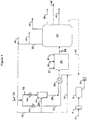
- a triacylglycerides-containing oil may be provided to the system via flow line 2, filtered if necessary in a filter 4, and stored in feed tank 6.
- the triacylglycerides-containing oil may then be fed via pump 8 and mixed with water fed via flow line 10.
- Mixing of the triacylglycerides-containing oil with water may be performed in a mixing device, such as a mixing tee, an agitated vessel, an in-line mixer or other mixing devices as known to those of skill in the art.
- the triacylglycerides-water mixture 12 may then be combined with diatomic hydrogen fed via flow line 14 to form a triacylglycerides-water-diatomic hydrogen mixture 16.
- Mixture 16 may then be fed to hydrothermolysis reactor 18 and maintained at reaction conditions for a time sufficient to convert at least a portion of the triacylglycerides to distillate hydrocarbons or precursors thereof.
- Reaction conditions may include a temperature in the range from 250°C to 560°C and a pressure of at least 7.5 MPa (75 bar).
- the residence time required in reactor 18 to convert the triacylglycerides may vary depending upon the reaction conditions as well as the specific triacylglycerides-containing oil used.
- residence times in reactor 18 may be in the range from 3 to 6 minutes.
- heat may be supplied to the feed via one or more of a feed-effluent exchanger 20, an indirect heat exchanger 22 to heat the triacylglycerides-water mixture 12, and an indirect heat exchanger 24 to heat the triacylglycerides-water-diatomic hydrogen mixture 16, among other options.
- the hydrothermolysis reaction can also include some exothermic reactions, which may supply additional heat to maintain the required reaction temperature conditions and to reduce external heat input requirements.
- one or more water feed lines 26 may be provided to control the exotherm and the temperature or temperature profile in hydrothermolysis reactor 18.
- reaction effluent 28 may be used to preheat the feed in feed-effluent exchanger 20, and further processed to recover the distillate hydrocarbons.
- hydrothermolysis effluent 28 may then be fed, without separation of the water from the hydrothermolysis effluent, to a hydrotreatment system 29 to further treat the effluent.
- Hydrotreatment system 29 may include one or more reactors (hydrotreaters) (not shown) containing a hydroconversion catalyst to convert at least a portion of the hydrothermolysis effluent to distillate hydrocarbons. Additional diatomic hydrogen, if necessary, may be added to hydrotreatment system 29 via flow line 27.
- additional hydrocarbon feedstocks may be co-processed with hydrothermolysis effluent 28, and may be fed to hydrotreatment system 29 via flow line 25.
- Non-renewable hydrocarbon feedstocks may include one or more of petroleum distillates; shale oil distillates; tar sands-derived distillates; coal gasification byproduct oils; and coal pyrolysis oils, among others.
- some sulfur-containing compound such as, for example, dimethyl disulfide dissolved in a suitable hydrocarbon solvent, may be fed to hydrotreatment system 29 via flow line 31 in order to maintain the catalysts in their most active states.
- the hydrothermolysis reactor and the hydrotreatment system may be "close-coupled," where the effluent from the hydrothermolysis reaction step is passed to the hydrotreatment system 29 without phase separation (no separation of water, oil, and diatomic hydrogen).
- the effluent from the hydrothermolysis reaction step may be passed to the hydrotreatment system under autogeneous pressure, i.e., without any pressure letdown between hydrothermolysis and hydrotreatment other than that which may occur by normal flow-induced pressure drops in piping and feed-effluent heat exchangers.
- the effluent from the hydrothermolysis reaction step may be passed to the hydrotreatement system with pressure let down to a lower pressure level of the hydrotreatment system.
- the diatomic hydrogen may be carried through the entire reaction system, providing enhanced system performance including suppressed coking rates and at higher thermal efficiencies and lower cost.
- the hydrotreatment effluent 34 may then be fed to effluent treatment system 30 for separation and recovery of reaction products.
- Effluent treatment system 30 may, for example, separate water 32 and diatomic hydrogen from the hydrocarbons.
- the resulting hydrocarbons may also be fractionated into two or more fractions, which, as illustrated, may include distillate hydrocarbons boiling in the range of naphtha 38, diesel 41, or jet 40, and vacuum gas oil (VGO). Some offgas 44 may also be produced.
- the effluent from the hydrothermolysis reaction step may be close-coupled, being passed to the hydrotreatment system 29 under autogeneous pressure, i.e., without any pressure letdown between hydrothermolysis and hydrotreatment other than that which may occur by normal flow-induced pressure drops in piping and feed-effluent heat exchangers.
- a pressure letdown valve or valves 35 may be provided intermediate hydrotreatment system 29 and separation system 30 to decrease the pressure from an autogeneous pressure, for example, at or above the supercritical pressure of water, to a pressure less than the supercritical pressure of water, such as atmospheric pressure, in one or more letdown steps.
- the pressure letdown system may also provide for an initial phase separation of light gases (including diatomic hydrogen), water, and hydrocarbons.
- a portion of water fraction 32 may be purged via flow line 33, if and as necessary, to avoid buildup of organic acids or other reaction byproducts.
- the water fraction 32 and the diatomic hydrogen fraction may then be recycled and combined, as necessary, with makeup water 46 and makeup diatomic hydrogen, respectively, for mixture with the triacylglycerides-containing oil as described above.
- a compressor may be used to pressurize the diatomic hydrogen recycle.
- a heavy hydrocarbon recycle fraction 43 may also be recovered, and may be recycled to the hydrothermolysis reactor system 18, hydrotreatment system 29, or a combination thereof.
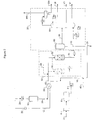
- hydrotreatment system 29 may include a hydrotreater 82 for further converting the crude oil precursors and/or distillate hydrocarbon fuels in hydrothermolysis effluent 28.
- the hydrothermolysis effluent 28, 62 including diatomic hydrogen and water, may be fed to a hydrotreater 82 and contacted with a suitable catalyst to produce desired end products, such as jet, naphtha, and diesel boiling range hydrocarbons. If necessary, additional diatomic hydrogen may be added to the hydrothermolysis effluent prior to hydrotreatment via flow line 86.
- effluent treatment system 30 may include a drum 60 for separation of the gaseous components from the liquid components in the cooled effluent 62.
- the gaseous components including diatomic hydrogen and possibly some light reaction byproducts, may be recovered from drum 60 via a flow line. Liquid components may settle in the bottom of drum 60, resulting in formation of a two-phase system, where the water may be recovered via flow line 32 and the hydrocarbons may be recovered via flow line 68.
- the water fraction 32 recovered from drum 60 may then be purged and/or recycled as described above.
- the gaseous products in said flow line may be separated via a gas separation device to result in a recycle diatomic hydrogen fraction and an off-gas fraction, as described above.
- the liquid hydrocarbon products may then be fed to a fractionator 80 for separation of the hydrocarbons into one or more boiling range fractions including naphtha 38, jet 40, diesel 41, and vacuum gas oil (VGO).
- An additional off-gas fraction 44b and water fraction 32b may also result from separations in fractionator 80.
- VGO fraction may be recycled back to the hydrothermolysis reactor 18 for additional processing, such as via flow line 43.
- Catalysts useful in hydrotreater 82 may include catalysts that may be used for the hydrotreating or hydrocracking of a hydrocarbon feedstock.
- the hydrotreating catalyst may effectively hydrodeoxygenate and/or decarboxylate the oxygen bonds contained in the hydrotreater feed reduce or eliminate the organic acid concentration in effluent 28.
- greater than 99%, 99.9%, or 99.99% of the organic acids may be converted over the hydrotreatment catalyst.
- Hydrotreating catalysts that may be useful include catalysts selected from those elements known to provide catalytic hydrogenation activity. At least one metal component selected from Group 8-10 elements and/or from Group 6 elements is generally chosen. Group 6 elements may include chromium, molybdenum and tungsten. Group 8-10 elements may include iron, cobalt, nickel, ruthenium, rhodium, palladium, osmium, iridium and platinum.
- the amount(s) of hydrogenation component(s) in the catalyst suitably range from 0.5% to 10% by weight of Group 8-10 metal component(s) and from about 5% to 25% by weight of Group 6 metal component(s), calculated as metal oxide(s) per 100 parts by weight of total catalyst, where the percentages by weight are based on the weight of the catalyst before sulfiding.
- the hydrogenation components in the catalyst may be in the oxidic and/or the sulfidic form. If a combination of at least a Group 6 and a Group 8 metal component is present as (mixed) oxides, it will be subjected to a sulfiding treatment prior to proper use in hydrocracking.
- the catalyst comprises one or more components of nickel and/or cobalt and one or more components of molybdenum and/or tungsten or one or more components of platinum and/or palladium. Catalysts containing nickel and molybdenum, nickel and tungsten, platinum and/or palladium are useful.
- hydrotreater 82 may include two or more beds or layers of catalyst, such as a first layer including a hydrocracking catalyst and a second layer including a hydrotreating catalyst.
- the layered catalyst system may include a lower catalyst layer that includes a bed of a hydrocracking catalyst suitable for hydrocracking any vacuum gas oil (VGO) range hydrothermolysis products or added feeds to diesel range or lighter hydrocarbons.
- VGO vacuum gas oil
- the hydrocracking catalysts used may also be selected to minimize or reduce dearomatization of the alkylaromatics formed in the hydrothermolysis reactor.
- VGO hydrocracking catalysts that may be used according to embodiments herein include one or more noble metals supported on low acidity zeolites wherein the zeolite acidity is widely distributed throughout each catalyst particle.
- one or more catalysts as described in US4990243 , US5069890 , US5071805 , US5073530 , US5141909 , US5277793 , US5366615 , US5439860 , US5593570 , US6860986 , US6902664 , and US6872685 may be used in embodiments herein, each of which are incorporated herein by reference with respect to the hydrocracking catalysts described therein.
- the inclusion of the VGO hydrocracking may result in extinctive hydrocracking of the heavy hydrocarbons, such that the only net hydrocarbon products include diesel range and lighter hydrocarbons.
- the various catalyst layers may not be made up of only a single catalyst, but may be composed of an intermixture of different catalysts to achieve the optimal level of metals and deoxygenation for that layer. Although some olefinic bond hydrogenation will occur in the lower portion of the zone, the removal of oxygen, nitrogen, and sulfur may take place primarily in the upper layer or layers. Obviously additional metals removal also will take place.
- the specific catalyst or catalyst mixture selected for each layer, the number of layers in the zone, the proportional volume in the bed of each layer, and the specific hydroprocessing conditions selected will depend on the feedstock being processed by the unit, the desired product to be recovered, as well as commercial considerations such as cost of the catalyst. All of these parameters are within the skill of a person engaged in the petroleum processing industry and should not need further elaboration here.
- reaction zones may include two or more reactors arranged in series or in parallel.
- back-up compressors, filters, pumps, and the like may also be used.
- compressors may be single stage or multi-stage compressors, which in some embodiments may be used to compress a single gas stream in sequential stages or may be used to compress separate gas streams, depending on plant layout.
- fractionator 80 may be used to recover various hydrocarbon fractions. Where hydrotreater 82 includes a bed or layer of hydrocracking catalyst, production of heavy hydrocarbons may be reduced or eliminated. In such embodiments where the heavy hydrocarbons are eliminated, fractionator 80 may be used to recover a diesel fraction as the bottoms from the column, and recycle of heavy hydrocarbons, such as VGO, may be unnecessary. When produced, the VGO may be recycled, as described above, or may be recovered as a low sulfur fuel oil product.
- the system may include one or more mixing devices for mixing a triacylglycerides-containing oil feed with water and diatomic hydrogen.
- the system may include a first mixing device for mixing a triacylglycerides-containing oil feed with water to form an oil-water mixture, and a second mixing device for mixing the oil-water mixture with diatomic hydrogen to form a feed mixture.
- the resulting mixture may then be fed via a flow conduit to a hydrothermolysis reactor for reacting the feed mixture at a temperature in the range of 250°C to 560°C and a pressure greater than 7.5 MPa (75 bar) to produce a reaction effluent.
- the hydrothermolysis reactor may include, for example, one or more tubular conduits within a furnace configured to maintain a temperature of the hydrothermolysis reactor effluent proximate an outlet of the hydrothermolysis reactor at reaction conditions, such as a temperature in the range from 400°C to 560°C, or at a temperature and pressure greater than the critical temperature and pressure of water.
- the furnace may be, for example, an electrically heated furnace, or a furnace fired with a fuel gas, such as a natural gas, synthesis gas, or light hydrocarbon gases, including those produced in and recovered from the hydrothermolysis reactor.
- a fuel gas such as a natural gas, synthesis gas, or light hydrocarbon gases, including those produced in and recovered from the hydrothermolysis reactor.
- Reaction conditions may be achieved by use of one or more pumps, compressors, and heat exchangers.
- the hydrothermolysis reactor may be an adiabatic reactor.
- a separator may then be used for separating water and hydrogen from hydrocarbons in the reaction effluent.
- the system may also include a compressor for compressing diatomic hydrogen recovered from the separator, as well as one or more fluid conduits for recycling the compressed diatomic hydrogen and/or the recovered water to the mixing device for mixing diatomic hydrogen or the mixing device for mixing water.
- the system also includes a hydrotreater to hydrotreat at least a portion of the hydrothermolysis reaction effluent.
- the system may also include a fractionator for fractionating hydrocarbons in the hydrotreater effluent to form one or more hydrocarbon fractions boiling in the naphtha, jet or diesel range.
- the system may include one or more fluid conduits for injecting water into the hydrothermolysis reactor.
- the jet fraction recovered may have a total acid number of less than 0.1 in some embodiments, expressed as mg KOH per gram; less than0.015 expressed as mg KOH per gram in other embodiments; and less than 0.010 in other embodiments.
- the jet may have an olefins content of less than 5 vol% and an aromatics content of less than 25 vol% in some embodiments. These properties, among others, may allow the jet and/or the diesel fractions produced in embodiments herein to be used directly as a fuel without blending.
- the whole hydrocarbon liquid product recovered from the hydrotreatment reaction zone may be used to produce distillate fuels meeting military, ASTM, EN, ISO, or equivalent fuel specifications.
- the process may be carried out in an economically feasible method at a commercial scale. Embodiments herein may maximize the thermal efficiency of the triacylglycerides-containing oil conversion in an economically attractive manner without being hampered by operability problems associated with catalyst fouling.
- water such as 5% of the feed water, may be consumed in the hydrolysis reaction.
- much of the glycerin byproduct produced may be further hydrogenated and converted to propane.
- Diatomic hydrogen is consumed during the hydrotreating step, and the average specific gravity of the product may be reduced, such as from approximately 0.91 to 0.81.
- Decarboxylation reactions form COx and that carbon loss may result in a reduced mass yield of liquid products, and an equivalent lower volumetric yield.
- the actual crude yield may be in the range from 75% to 90%, such as in the range from 80% to 84%, depending on how the hydrothermolysis process is executed.
- Naphtha, jet, and diesel fuels may be produced by processes disclosed herein.
- a higher boiling gas oil material may also be produced, and may contain high-quality, high hydrogen content paraffins in the C17 to C24 boiling range. These heavier hydrocarbons may be recycled to the hydrothermolysis reactor for further treatment and production of naphtha, jet, and diesel range products.
- Fuel gases (off gases) may also be produced, which may be used in some embodiments for process heat, hydrogen production, or recovered as individual products (LPG, ethylene, propylene, n-butane, iso-butane, etc.).
- Fuels produced by embodiments herein may: contain cycloparaffins and aromatics; exhibit high density; exhibit high energy density; exhibit good low-temperature properties (freezing point, cloud point, pour point, and viscosity); exhibit natural lubricity; exhibit a wide range of hydrocarbon types and molecular weights similar to petroleum; and/or have good thermal stability. These fuels may thus be true "drop in” analogs of their petroleum counterparts and do not require blending to meet current petroleum specifications.
- Coupling of the hydrothermolysis reaction and hydrotreating is unique and may result in many process and economic benefits.
- benefits may include: elimination of a hydrothermolysis product cool down and separation of gas, oil, and water components; elimination of acid water production and treatment; elimination of additional liquid pumping, gas compression, and heat exchange operations for the hydrotreater feed; reduced heat loss; and/or reduced power consumption.
- renewable feedstocks having triacylglycerides-containing oils useful in embodiments disclosed herein may include triacylglycerides-containing oils such as camelina, carinata, lesquerella, physaria, jatropha, karanja, moringa, palm, castor, cotton, corn, linseed, peanut, soybean, sunflower, tung, babassu, and canola, or at least one triacylglycerides-containing oil from at least one of, shea butter, tall oil, tallow, waste vegetable oil, algal oil, and pongamia.
- triacylglycerides-containing oils such as camelina, carinata, lesquerella, physaria, jatropha, karanja, moringa, palm, castor, cotton, corn, linseed, peanut, soybean, sunflower, tung, babassu, and canola, or at least one triacylglycerides-containing oil from at least one of, shea butter, tall oil, t
- Embodiments disclosed herein also relate to the selective use of renewable feedstocks having triacylglycerides containing oils with high concentrations of C20-C24, such as lesquerella, physaria, camelina and carinata, for the preferential production of jet and diesel fuels.
- renewable feedstocks include but are not limited to: a) plant oils such as canola, coconut, corn, cottonseed, flaxseed, grapeseed, olive, palm, peanut, safflower, sesame, shea, soybean, sunflower, walnut, jatropha; b) animal fasts/oils such as tallow, lard, butterfat; and c) organic wastes such as greases, used cooking oil and sewage sludge.
- feedstocks for conversion to crude oils are composed of mono-, di-, and triacylglycerides containing their fatty acid backbones in the C10 to C18 carbon number range.
- Another class of compounds appropriate for these conversion processes are fatty acid alkyl esters especially fatty acid methyl ester (FAME) and fatty acid ethyl ester (FAEE).
- FAME fatty acid methyl ester
- FAEE fatty acid ethyl ester
- the aliphatic carbon chains in the glycerides, fatty acids and FAEE can be saturated or mono-, di-, or polyunsaturated, with the latter group being more reactive that that of the saturated group.
- feedstocks may be used, as described above, for the production of various fuels.
- feedstocks listed in Table 1 may have little productivity for the production of jet fuel range hydrocarbons when subjected to conversion processes that promote cracking-type reactions.
- renewable feedstocks are essentially devoid of fatty acids in the carbon number ranges of C20-C24.
- C20 and higher fatty acids under cracking-type processing can split into 2 mols of jet range products whereas C18 and lighter fatty acids are limited by their chemical stoichiometry to co-producing lower boiling and less desirable naphtha and LPG range hydrocarbons. This translates to higher potential jet range yields for the C20+ fatty acids.
- all triacylglycerides derived from plant and animal oils contain some distribution of fatty acids from C10 to C24. Carinata and camelina oils, however, have been found to have an exceptional amount of triacylglycerides in the C20 to C24 range.
- Carinata contains more than 55 wt% C20-C24 fatty acid backbone content and Camelina contains more than 25 wt% C20-C24, as shown in Table 2.
- the plant oils shown in Table 1 in contrast contain very low contents of the C20 and heavier fatty acids.
- Other oils that may contain a high amount of C20 to C24 triacylglycerides may include lesquerella and phyaria oils, among others. Table 2.
- Embodiments disclosed herein relate to the selective use of renewable feedstocks having triacylglycerides containing oils with high concentrations of C20-C24, such as lesquerella, physaria, camelina and carinata, for the preferential production of jet and diesel fuels. Embodiments disclosed herein also relate to the selective variation of renewable feedstocks to produce hydrocarbons to meet fluctuating demand in the marketplace.
- renewable feedstocks or a mixture of renewable feedstocks containing a higher proportion of C16 to C18 triacylglycerides may be used; during periods of lower gasoline demand, or higher jet fuel demand, renewable feedstocks or a mixture of renewable feedstocks containing a higher proportion of C20 to C24 or C22 to C24 triacylglycerides may be used.
- the olefinic triacylglycerides content represents more than 95% of the total 55% C20-C24 content which is very desirable.
- the cracking reactivity of the triacylglycerides increases with increasing carbon number meaning that a lower reaction severity can be used to achieve the same conversion of the C20+ olefinic triacylglycerides as that of the C18 and lighter triacylglycerides.
- the use of a lower reaction severity also translates to reduction in the secondary thermal conversion reactions of the cracked hydrocarbons leading to the production of lighter hydrocarbons in the LPG and naphtha ranges.
- the C20+ olefinic triacylglycerides will convert at a higher rate than that of the C18 and lighter triacylglycerides.
- C20-C24 triacylglycerides maximizes the selectivity of jet range hydrocarbons and jet range oxygenated precursors, thereby promoting the use of opportunity triacylglycerides feedstocks that contain significantly higher contents of C20-C24 fatty acid backbone components.
- the overall renewables feed plant capacity and associated capital costs are significantly lower than those using triacylglycerides feedstocks containing significantly lower contents of C20-C24 fatty acid backbone components.
- Carinata can produce a theoretical jet range yield of 71.5wt%, while Camelina can produce a theoretical jet range yield of 55wt%. Compare these to the 20 most common renewable resources, such as those shown in Table 1, and one can see that these two in particular provide a much higher jet yield than these other renewable sources.
- the unsaturates/saturates ratio for Carinata (18.7/1) is much higher than that of the 20 renewables feedstocks shown in Table 1, the latter of which have an average ratio of only 5.0/1.
- the unsaturated triacylglycerides containing olefinic bonds are the most reactive under thermolysis, supercritical hydrothermolysis, hydrothermal liquefaction, catalytic hydropyrolysis or catalytic conversion conditions.
- the olefinic triacylglycerides content represents more than 95% of the total 55% C20-C24 content which is very desirable.
- a mixture of the jet-producing triacylglycerides containing oil with water may be reacted at a temperature in the range from 250°C to 560°C and a pressure greater than about 7.5 MPa (75 bar) to convert at least a portion of the triacylglycerides to a hydrocarbon or mixture of hydrocarbons comprising one or more of jet fuel range hydrocarbons and oxygenated precursors.
- the reaction conditions are such that the temperature and pressure are above the supercritical temperature and pressure of water.
- the resulting reaction effluent may then be further treated and separated to recover the hydrocarbon products.
- a triacylglycerides containing oil may be mixed with water in any fashion.
- the triacylglycerides/water mixture may have a water to triacylglycerides mass ratio in the range from 0.001:1 to 1:1 in some embodiments; from 0.01:1 to 1:1 in other embodiments; and from 0.1:1 to 1:1 in yet other embodiments.
- reaction effluent may then be directly catalytically hydrotreated, without intermediate separations of water, to form additional jet fuel range hydrocarbons and/or to convert precursors in the reaction effluent to jet fuel range hydrocarbons.
- the above-mentioned triacylglycerides containing oils, following hydrothermolysis may be co-processed in the hydrotreatment zone with other renewable hydrocarbon feedstocks.
- the hydrotreatment effluent may then be processed to separate water and fractionate the hydrocarbons into one or more hydrocarbon fractions, such as those boiling in the range of jet.
- the water may then be recycled for admixture with the triacylglycerides containing oil as described above.
- the reaction of the triacylglycerides to produce jet fuel range hydrocarbons may be primarily one or more hydrothermolysis reactions catalyzed by water and performed at a reaction temperature in the range from 250°C to 560°C in some embodiments.
- Reaction conditions may also include a pressure in the range of 5 MPa (50 bar) to 30 MPa (300 bar). Conditions of temperature and/or pressure may be selected to be above the critical temperature and/or pressure of water.
- the hydrothermolysis reactions is performed in the absence of added catalysts, such as an inorganic heterogeneous catalyst.
- Embodiments disclosed herein may be used, as described above, for the preferential production of jet fuel range products from triacylglycerides-containing oils.
- processes for converting triacylglycerides-containing oils into crude oil precursors and/or distillate hydrocarbon fuels may include: subjecting one or more triacylglycerides-containing oils to a conversion process to convert at least a portion of the triacylglycerides to produce a reaction product comprising one or more of isoolefins, isoparaffins, cycloolefins, cycloparaffins, and aromatics boiling in the range of naphtha, diesel, and jet fuels.
- the proportion of jet fuel range products produced may be varied to meet market demand.
- Processes disclosed herein may thus also include a step of varying a composition of the triacylglycerides-containing oils to selectively vary a yield of the jet range products.
- the varying may include increasing or decreasing a content of camelina-based oils, carinata-based oils, lesquerella-based oils, physaria-based oils, or mixtures thereof in the triacylglycerides-containing oil.
- the high theoretical jet yield that may be realized from such oils may allow their use in achieving high jet yields from processes disclosed herein as well as to effectively vary the proportion of jet yield products.
- thermolysis may include one or more of thermolysis, hydrothermal liquefaction, supercritical hydrothermolysis, catalytic hydropyrolysis, and catalytic cracking.
- the thermolysis process may be carried out in a fixed-bed, fluidized-bed, or entrained-bed reactor, with or without inert materials, at a temperature in the range from 300°C to 600°C, and at space velocities in the range from 2 to 1000 h -1 , in the absence of co-fed water.
- the hydrothermal liquefaction process may be carried out in a fixed-bed, fluidized-bed, or entrained-bed reactor, with or without inert materials, at a temperature in the range from 150°C to 370°C, a pressure in the range from 5 (50) to 20 MPa (200 bar), and a residence time in the range from 3 to 60 minutes, in the presence of co-fed water.
- the supercritical hydrothermolysis may be carried out in a fixed-bed, fluidized-bed, or entrained-bed reactor, with or without inert materials, at a residence time in the range from 3 to 60 minutes at near-critical or supercritical water conditions (e.g., at pressures greater than 20 MPa (200 bar) and/or at temperatures greater than 370°C).
- the catalytic cracking processes may be carried out in entrained-bed reactors using fluid cracking catalysts at a temperature in the range from 350°C to 600°C.
- the catalytic hydropyrolysis may be carried out in a fixed-bed, fluidized-bed, slurry-phase, or entrained-bed reactor, using catalysts comprising one or more of supported or unsupported base metal oxides, silica-aluminas, zeolites, metal phosphides, and hydrotalcites at a temperature in the range from 300°C to 600°C and a pressure in the range from 0.1 (1) to 10 MPa (100 bar).
- the conversion process comprises a combination of hydrothermolysis and catalytic cracking.
- the recovered hydrocarbons or a portion thereof such as the jet fuel range hydrocarbons or the C5 to end point hydrocarbons
- Hydrotreatment of the reaction product or portion thereof such as contacting the hydrocarbons at reaction conditions with a catalyst or catalysts comprising one or more metals, metal oxides, and/or metal sulfides, supported or unsupported, having activity for at least one of saturation of olefinic bonds, hydrodeoxygenation, hydrodenitrogenation, and hydrodesulfurization, may be used to upgrade the jet fuel range hydrocarbons to produce specification jet fuel products including one or more of Jet A, Jet A-1, JP-4, JP-5, JP-6, JP-7, JP-8, SPK, and HEFA jet fuels.
- the jet fraction may have properties including one or more of: a total acid number of less than 0.1, expressed as mg KOH per gram, and an olefins content of less than 5 vol% and an aromatics content of less than 25 vol%.
- the jet fuel range products produced from triacylglycerides-containing oils according to embodiments herein may be used directly as a jet fuel without blending.
- hydrothermolysis processes for converting triacylglycerides-containing oils into crude oil precursors and/or distillate hydrocarbon fuels may include: reacting a mixture comprising water, diatomic hydrogen, and a triacylglycerides-containing oil comprising at least 20 wt% C20 to C24 fatty acids at a temperature in the range from 250°C to 560°C and a pressure greater than 7.5 MPa (75 bar) to convert at least a portion of the triacylglycerides and recovering a reaction effluent comprising water and one or more of isoolefins, isoparaffins, cycloolefins, cycloparaffins, and aromatics; hydrotreating the reaction effluent to form a hydrotreated effluent.
- the triacylglycerides-containing oil may have a theoretical jet yield of at least 50 wt%, such as in the range from 50 wt% to 75 wt%.
- the triacylglycerides-containing oil may consist of, or consist essentially of, a renewable oil selected from camelina oil, carinata oil, lesquerella oil, physaria oil, and mixtures thereof.
- TAG triacylglycerides
- the total aromatics yields shown in the table are expressed as percentages on the whole hydrothermolysis crude oil and these values when corrected for the equivalent jet fuel compositions are still within the 25 liquid volume % maximum specification in the jet fuel fraction. While the reaction temperature between the two runs was slightly different, the temperature alone cannot account for the large changes in conversion and aromatics yield, indicating that hydrogen co-feed may have significant advantages.
- embodiments disclosed herein provide processes for the conversion of renewable feedstocks to infrastructure-compatible jet range fuels.
- the use of C20-C24 triacylglycerides maximizes the selectivity of jet range hydrocarbons and jet range precursors thereby promoting the use of opportunity triacylglycerides-feedstocks that contain significantly higher contents of C20-C24 fatty acid backbone components.
- the overall renewables feed plant capacity and associated capital costs are significantly lower than those using triacylglycerides-feedstocks containing significantly lower contents of C20-C24 fatty acid backbone components.
- Embodiments herein may maximize the thermal efficiency of the triacylglycerides containing oil conversion in an economically attractive manner without being hampered by operability problems associated with catalyst fouling.
- water such as 5% of the feed water, may be consumed in the hydrolysis reaction.
- much of the glycerin byproduct produced may be further hydrogenated and converted to propane. Decarboxylation reactions form COx and that carbon loss may result in a reduced mass yield of liquid products, and an equivalent lower volumetric yield.
- Jet fuel range hydrocarbons and oxygenated precursors may be produced by processes disclosed herein.
- Fuels produced by embodiments herein may: exhibit high density; exhibit high energy density; exhibit good low-temperature properties (freezing point, cloud point, pour point, and viscosity); exhibit natural lubricity; and/or have good thermal stability. These fuels may thus be true "drop in” analogs of their petroleum counterparts and do not require blending to meet current petroleum specifications.
Landscapes
- Chemical & Material Sciences (AREA)
- Oil, Petroleum & Natural Gas (AREA)
- Organic Chemistry (AREA)
- Chemical Kinetics & Catalysis (AREA)
- Engineering & Computer Science (AREA)
- General Chemical & Material Sciences (AREA)
- Thermal Sciences (AREA)
- Physics & Mathematics (AREA)
- Inorganic Chemistry (AREA)
- Crystallography & Structural Chemistry (AREA)
- Production Of Liquid Hydrocarbon Mixture For Refining Petroleum (AREA)
- Organic Low-Molecular-Weight Compounds And Preparation Thereof (AREA)
- Liquid Carbonaceous Fuels (AREA)
- Fats And Perfumes (AREA)
Claims (9)
- Verfahren zum Umwandeln von Triglyzerid-haltigen Ölen in Rohöl-Vorläufer und/oder Kohlenwasserstoff-Destillat-Brennstoffe, das Verfahren beinhaltend:Reagierenlassen einer Mischung, die Wasser (10), diatomaren Wasserstoff (14) und ein oder mehrere Triglyzerid-haltige Öle (2) mit wenigstens 20 Gew.-% C20 bis C24 Fettsäuren in einem Temperaturbereich von 250°C bis 560°C und einem Druck über 7,5 MPa (75 bar) zum Umwandeln wenigstens eines Teils der Triglyzeride, und Auffangen eines Reaktionsabwassers (28), welches Isoolefine, Isoparaffine, Cycloolefine, Cycloparaffine und/oder Aromaten enthält,katalytisches Hydro-Behandeln des Reaktionsabwassers (28), um ein hydro-behandeltes Reaktionsabwasser (34) zu erhalten,wobei das Reagierenlassen in Abwesenheit eines zugefügten heterogenen oder löslichen metallischen Katalysators erfolgt,wobei die Triglyzerid-Wasser-diatomarer Wasserstoff-Mischung ein Massenverhältnis von Wasser zu Triglyzerid im Bereich von 0,001:1 bis 1:1 aufweist, undwobei die Triglyzerid-Wasser-diatomarer Wasserstoff-Mischung ein Massenverhältnis von diatomarem Wasserstoff zu Triglyzerid im Bereich von 0,005:1 bis 0,5:1 aufweist.
- Verfahren nach Anspruch 1, wobei das eine oder die mehreren Triglyzerid-enthaltenden Öle (2) im Wesentlichen aus erneuerbaren Ölen aus Camelina, Carinata, Lesquerella, Physaria oder Mischungen davon bestehen.
- Verfahren nach Anspruch 1, ferner beinhaltend Abtrennen des diatomaren Wasserstoffs oder des Wassers vom hydro-behandelten Reaktionsabwasser (34; 84) und Wiederverwerten des abgetrennten diatomaren Wasserstoffs bzw. Wassers (32) im Reaktionsschritt.
- Verfahren nach Anspruch 1, ferner beinhaltend Fraktionieren des hydro-behandelten Reaktionsabwassers (34; 84) zum Auffangen einer oder mehrerer Kohlenwasserstofffraktionen, die im Bereich von Naphtha (38), Diesel (41) oder Jet (40) sieden.
- Verfahren nach Anspruch 4, wobei die Jet-Fraktion (40) ohne Verschneiden direkt als Jet-Treibstoff verwendet werden kann; bzw. die Diesel-Fraktion (41) ohne Verschneiden direkt als Diesel-Treibstoff verwendet werden kann.
- Verfahren nach Anspruch 1, wobei die Aromaten im Bereich von Naphtha, Diesel und Jet sieden, ferner beinhaltend Variieren einer Zusammensetzung des einen oder der mehreren Triglyzerid-haltigen Öle (2) zum wahlweisen Variieren einer Ausbeute an Jet-Bereich-Produkten, wobei das Variieren das Erhöhen oder Erniedrigen des Gehalts von Camelinabasierten Ölen, Carinata-basierten Ölen, Lesquerella-basierten Ölen, Physaria-basierten Ölen oder Mischungen davon beinhaltet.
- Verfahren nach Anspruch 1, wobei das hydro-behandelte Reaktionsabwasser (34; 84) spezifizierte Jet-Treibstoff-Produkte enthält, beinhaltend eines oder mehrere von Jet A, Jet A-1, JP-4, JP-5, JP-6, JP-7, JP-8, SPK und HEFA Jet-Treibstoff, wobei das Hydro-Behandeln das In-Kontakt-Bringen des Reaktionsabwassers (28) oder eines Teils davon bei Reaktionsbedingungen mit einem Katalysator beinhaltet, der ein oder mehrere Metalle, Metalloxide und/oder Metallsulfide enthält, geträgert oder ungeträgert, mit Aktivität für das Sättigen olefinischer Bindungen, Hydro-Desoxygenierung, Hydro-Denitrogenierung oder Hydro-Desulfurierung.
- Verfahren nach Anspruch 1, wobei das Reagierenlassen eine überkritische Hydrothermolyse beinhaltet.
- Verfahren nach Anspruch 8, wobei die überkritische Hydrothermolyse mit oder ohne Inertmaterialien, bei einer Verweilzeit im Bereich von 3 bis 60 Minuten unter Bedingungen des überkritischen Wassers, in einem Festbett-, Wirbelschicht- oder Flugstrom-Reaktor (18) durchgeführt wird.
Priority Applications (3)
| Application Number | Priority Date | Filing Date | Title |
|---|---|---|---|
| PL13862605T PL2931841T3 (pl) | 2012-12-11 | 2013-12-04 | Przekształcanie olejów zawierających triacyloglicerydy w węglowodory z zakresu paliwa do silników odrzutowych |
| RSP20191060 RS59231B1 (sr) | 2012-12-11 | 2013-12-04 | Konverzija ulja koja sadrže triacilgliceride u ugljovodonike klase mlaznih goriva |
| HRP20191472 HRP20191472T1 (hr) | 2012-12-11 | 2013-12-04 | Pretvaranje ulja koja sadržavaju triacilgliceride u ugljikohidrate za mlazna goriva |
Applications Claiming Priority (2)
| Application Number | Priority Date | Filing Date | Title |
|---|---|---|---|
| US13/711,111 US9162938B2 (en) | 2012-12-11 | 2012-12-11 | Conversion of triacylglycerides-containing oils to hydrocarbons |
| PCT/US2013/073121 WO2014093097A1 (en) | 2012-12-11 | 2013-12-04 | Conversion of triacylglycerides-containing oils to jet fuel range hydrocarbons |
Publications (4)
| Publication Number | Publication Date |
|---|---|
| EP2931841A1 EP2931841A1 (de) | 2015-10-21 |
| EP2931841A4 EP2931841A4 (de) | 2016-08-10 |
| EP2931841B1 true EP2931841B1 (de) | 2019-05-15 |
| EP2931841B8 EP2931841B8 (de) | 2019-08-21 |
Family
ID=50881663
Family Applications (3)
| Application Number | Title | Priority Date | Filing Date |
|---|---|---|---|
| EP13862605.6A Active EP2931841B8 (de) | 2012-12-11 | 2013-12-04 | Umwandlung von triacylglyceridhaltigen ölen in düsentreibstoffkohlenwasserstoffe |
| EP19171663.8A Active EP3546547B1 (de) | 2012-12-11 | 2013-12-04 | Anlage und verfahren zur umwandlung von triacylglyceridhaltigen ölen in kohlenwasserstoffe |
| EP13861979.6A Active EP2931847B1 (de) | 2012-12-11 | 2013-12-04 | Umwandlung von triacylglyceridhaltigen ölen in kohlenwasserstoffe |
Family Applications After (2)
| Application Number | Title | Priority Date | Filing Date |
|---|---|---|---|
| EP19171663.8A Active EP3546547B1 (de) | 2012-12-11 | 2013-12-04 | Anlage und verfahren zur umwandlung von triacylglyceridhaltigen ölen in kohlenwasserstoffe |
| EP13861979.6A Active EP2931847B1 (de) | 2012-12-11 | 2013-12-04 | Umwandlung von triacylglyceridhaltigen ölen in kohlenwasserstoffe |
Country Status (11)
| Country | Link |
|---|---|
| US (4) | US9162938B2 (de) |
| EP (3) | EP2931841B8 (de) |
| JP (2) | JP6162811B2 (de) |
| AR (2) | AR093888A1 (de) |
| DK (3) | DK2931841T3 (de) |
| HR (3) | HRP20191472T1 (de) |
| HU (2) | HUE045091T2 (de) |
| PL (3) | PL2931847T3 (de) |
| RS (3) | RS63176B1 (de) |
| TW (2) | TWI527896B (de) |
| WO (2) | WO2014093098A1 (de) |
Families Citing this family (17)
| Publication number | Priority date | Publication date | Assignee | Title |
|---|---|---|---|---|
| US20150152336A1 (en) * | 2013-12-04 | 2015-06-04 | Lummus Technology Inc. | Co-current adiabatic reaction system for conversion of triacylglycerides rich feedstocks |
| US9523050B2 (en) | 2014-12-18 | 2016-12-20 | Uop Llc | Methods for co-processing renewable feedstock and petroleum distillate feedstock |
| US10071322B2 (en) * | 2015-01-28 | 2018-09-11 | Applied Research Associates, Inc. | Hydrothermal cleanup process |
| ES2701128T3 (es) * | 2016-02-19 | 2019-02-20 | Linde Ag | Procedimiento e instalación para la obtención de un producto de etileno en estado supercrítico |
| ITUA20163833A1 (it) * | 2016-05-26 | 2017-11-26 | Consorzio Per La Ricerca E La Dimostrazione Sulle Energie Rinnovabili | Metodo e apparato per la produzione di bio-idrocarburi tramite pirolisi catalitica di lipidi. |
| JP6635362B1 (ja) | 2018-05-18 | 2020-01-22 | 一般社団法人HiBD研究所 | バイオジェット燃料の製造方法 |
| WO2020117119A1 (en) * | 2018-12-05 | 2020-06-11 | Biofuel-Solution I Malmö Ab | A process for converting glycerol to propane |
| WO2021213991A1 (en) | 2020-04-20 | 2021-10-28 | N.V. Desmet Ballestra Engineering S.A. | Versatile method for purifying glyceridic materials |
| JPWO2022004267A1 (de) * | 2020-06-29 | 2022-01-06 | ||
| US11781075B2 (en) | 2020-08-11 | 2023-10-10 | Applied Research Associates, Inc. | Hydrothermal purification process |
| CN112591810A (zh) * | 2020-10-21 | 2021-04-02 | 中国科学院青岛生物能源与过程研究所 | 一种含盐废水加氢超临界处理工艺方法 |
| US12037552B2 (en) | 2021-04-15 | 2024-07-16 | ExxonMobil Technology and Engineering Company | Co-processing of renewable jet and diesel |
| WO2022221840A1 (en) * | 2021-04-15 | 2022-10-20 | ExxonMobil Technology and Engineering Company | Co-processing of renewable jet and diesel |
| US12312305B2 (en) * | 2022-05-12 | 2025-05-27 | Lummus Technology Llc | Production of heavy isoparaffinic hydrocarbons |
| FR3138443B1 (fr) | 2022-07-27 | 2025-08-15 | Totalenergies Onetech | Composition renouvelable de carburéacteur à teneur élevée en composés naphténiques |
| FR3138444B1 (fr) | 2022-07-27 | 2026-01-09 | Totalenergies Onetech | Composition renouvelable de carburéacteur à teneur élevée en composés naphténiques et procédé de préparation associé |
| CN115669993A (zh) * | 2022-10-26 | 2023-02-03 | 河南农业大学 | 一种无机催化剂改良近临界水提取烟叶生物质的方法 |
Family Cites Families (101)
| Publication number | Priority date | Publication date | Assignee | Title |
|---|---|---|---|---|
| US3394074A (en) | 1967-04-03 | 1968-07-23 | Exxon Research Engineering Co | Single reactor hydrocracking process with mixed nonnoble metal catalyst for full boiling raw feed |
| US5073530A (en) | 1989-05-10 | 1991-12-17 | Chevron Research And Technology Company | Hydrocracking catalyst and process |
| US4990243A (en) | 1989-05-10 | 1991-02-05 | Chevron Research And Technology Company | Process for hydrodenitrogenating hydrocarbon oils |
| US5277793A (en) | 1989-05-10 | 1994-01-11 | Chevron Research And Technology Company | Hydrocracking process |
| US5071805A (en) | 1989-05-10 | 1991-12-10 | Chevron Research And Technology Company | Catalyst system for hydrotreating hydrocarbons |
| US5069890A (en) | 1989-06-19 | 1991-12-03 | Texaco Inc. | Zeolite treating process |
| US5141909A (en) | 1991-01-22 | 1992-08-25 | Chevron Research And Technology Company | Zeolitic catalyst having selectivity for jet fuel |
| US5439860A (en) | 1992-04-16 | 1995-08-08 | Chevron Research And Technology Company, A Division Of Chevron U.S.A. Inc. | Catalyst system for combined hydrotreating and hydrocracking and a process for upgrading hydrocarbonaceous feedstocks |
| US5409617A (en) | 1993-07-13 | 1995-04-25 | Sri International | Environmentally acceptable waste disposal by conversion of hydrothermally labile compounds |
| US5453177A (en) | 1994-01-27 | 1995-09-26 | The M. W. Kellogg Company | Integrated distillate recovery process |
| FR2724390B1 (fr) | 1994-09-08 | 1996-12-13 | Inst Francais Du Petrole | Hydrogenation selective de coupes hydrocarbonees renfermant des hydrocarbures monoinsatures et polyinsatures |
| US5959167A (en) | 1997-08-25 | 1999-09-28 | The University Of Utah Research Foundation | Process for conversion of lignin to reformulated hydrocarbon gasoline |
| US5986022A (en) | 1998-04-01 | 1999-11-16 | Witco Corporation | Continuous manufacture of silicone coploymers |
| US6514897B1 (en) | 1999-01-12 | 2003-02-04 | Hyperion Catalysis International, Inc. | Carbide and oxycarbide based compositions, rigid porous structures including the same, methods of making and using the same |
| US6180845B1 (en) | 1999-10-07 | 2001-01-30 | Board Of Supervisors Of Louisiana State University And Agricultural And Mechanical College | Transforming biomass to hydrocarbon mixtures in near-critical or supercritical water |
| FR2810991B1 (fr) | 2000-06-28 | 2004-07-09 | Inst Francais Du Petrole | Procede pour l'hydrogenation de coupes contenant des hydrocarbures et notamment des molecules insaturees contenant au moins deux doubles liaisons ou au moins une triple liaison |
| KR100571731B1 (ko) | 2000-11-11 | 2006-04-17 | 할도르 토프쉐 에이/에스 | 개선된 수소화공정 방법 및 기존의 수소화공정 반응기를개장하는 방법 |
| US6573417B1 (en) | 2001-11-05 | 2003-06-03 | Uop Llc | Fractionation of paraffin isomerization process effluent |
| US7232935B2 (en) | 2002-09-06 | 2007-06-19 | Fortum Oyj | Process for producing a hydrocarbon component of biological origin |
| FI20021806A0 (fi) | 2002-10-10 | 2002-10-10 | Fortum Oyj | Menetelmä bensiiniseoskomponentin valmistamiseksi |
| US6902664B2 (en) | 2002-11-08 | 2005-06-07 | Chevron U.S.A. Inc. | Extremely low acidity USY and homogeneous, amorphous silica-alumina hydrocracking catalyst and process |
| US6860986B2 (en) | 2002-11-08 | 2005-03-01 | Chevron U.S.A. Inc. | Extremely low acidity ultrastable Y zeolite catalyst composition and process |
| US6872685B2 (en) | 2002-11-08 | 2005-03-29 | Chevron U.S.A. Inc. | Method for preparing a highly homogeneous amorphous silica-alumina composition |
| US7473811B2 (en) | 2003-11-13 | 2009-01-06 | Neste Oil Oyj | Process for the hydrogenation of olefins |
| ITMI20050062A1 (it) | 2005-01-20 | 2006-07-21 | Polimeri Europa Spa | Processo per la preparazione di fenolo |
| KR20080012831A (ko) | 2005-03-21 | 2008-02-12 | 벤-구리온 유니버시티 오브 더 네게브 리서치 앤드 디벨럽먼트 어쏘러티 | 식물성 또는 동물성 오일로부터 디젤 연료의 제조 |
| US7964761B2 (en) | 2005-05-02 | 2011-06-21 | University Of Utah Research Foundation | Processes for catalytic conversion of lignin to liquid bio-fuels and novel bio-fuels |
| US7754931B2 (en) * | 2005-09-26 | 2010-07-13 | Her Majesty The Queen In Right Of Canada As Represented By The Minister Of Natural Resources | Production of high-cetane diesel fuel from low-quality biomass-derived feedstocks |
| JP2007131595A (ja) | 2005-11-11 | 2007-05-31 | Kyoto Univ | 脂肪酸アルキルエステルの製造方法 |
| FR2892121B1 (fr) | 2005-10-19 | 2008-01-04 | Michelin Soc Tech | Procede de preparation en continu d'un systeme catalytique pour polymeriser un diene conjugue, et installation pour sa mise en oeuvre. |
| AU2006309212B2 (en) | 2005-10-31 | 2011-09-15 | Government Of The United States Of America, Represented By The Secretary Department Of Health And Human Services | Polysaccharide-derived nitric oxide-releasing carbon-bound diazeniumdiolates |
| US8178060B2 (en) | 2005-12-07 | 2012-05-15 | Uop Llc | Dividing wall fractionation in integrated oxygenate conversion and product cracking |
| US7998339B2 (en) | 2005-12-12 | 2011-08-16 | Neste Oil Oyj | Process for producing a hydrocarbon component |
| US7501546B2 (en) | 2005-12-12 | 2009-03-10 | Neste Oil Oj | Process for producing a branched hydrocarbon component |
| US7850841B2 (en) | 2005-12-12 | 2010-12-14 | Neste Oil Oyj | Process for producing a branched hydrocarbon base oil from a feedstock containing aldehyde and/or ketone |
| US7459597B2 (en) | 2005-12-13 | 2008-12-02 | Neste Oil Oyj | Process for the manufacture of hydrocarbons |
| US20070137097A1 (en) * | 2005-12-16 | 2007-06-21 | Michio Ikura | Production of biodiesel from triglycerides via a thermal route |
| US7550634B2 (en) | 2006-01-30 | 2009-06-23 | Conocophillips Company | Process for converting triglycerides to hydrocarbons |
| BRPI0601403B1 (pt) | 2006-04-17 | 2015-11-03 | Petroleo Brasileiro Sa | processo de obtenção de n-parafinas a partir de óleo vegetal |
| US7511181B2 (en) | 2006-05-02 | 2009-03-31 | Uop Llc | Production of diesel fuel from biorenewable feedstocks |
| US7880049B2 (en) | 2006-06-06 | 2011-02-01 | Wisconsin Alumni Research Foundation | Production of liquid alkanes in the jet fuel range (C8-C15) from biomass-derived carbohydrates |
| US8795392B2 (en) | 2006-06-09 | 2014-08-05 | Albemarle Netherlands B.V. | Catalytic hydrodeoxygenation of an oxygenate feedstock |
| CA2691612C (en) * | 2006-06-30 | 2016-05-03 | University Of North Dakota | Method for cold stable biojet fuel |
| US8067653B2 (en) | 2006-07-14 | 2011-11-29 | The Governors Of The University Of Alberta | Methods for producing fuels and solvents |
| BRPI0715883A2 (pt) | 2006-08-16 | 2013-08-13 | Bioecon Int Holding Nv | processo para a hidroconversço branda de compostos de hidrocarbonetos oxigenados |
| BRPI0717487B1 (pt) * | 2006-09-19 | 2017-03-28 | Applied Res Ass Inc | processos de converter triglicerídeos insaturados em biocombustíveis, e, composição de biocombustível |
| EP1911734A1 (de) | 2006-10-06 | 2008-04-16 | Bp Oil International Limited | Prozess zur Hydrierung von Carbonsäuren und Derivaten zu Kohlenwasserstoffen |
| ITMI20062193A1 (it) | 2006-11-15 | 2008-05-16 | Eni Spa | Processo per produrre frazioni idrocarburiche da miscele di origine biologica |
| US20080163543A1 (en) | 2007-01-05 | 2008-07-10 | Ramin Abhari | Process for producing bio-derived fuel with alkyl ester and iso-paraffin components |
| US7977517B2 (en) | 2007-03-08 | 2011-07-12 | Virent Energy Systems, Inc. | Synthesis of liquid fuels and chemicals from oxygenated hydrocarbons |
| ITMI20070522A1 (it) | 2007-03-16 | 2008-09-17 | Eni Spa | Composizione idrocarburica utile come carburante e combustibile contenente una componente petrolifera e una componente di origine biologica |
| US7846323B2 (en) | 2007-04-06 | 2010-12-07 | Syntroleum Corporation | Process for co-producing jet fuel and LPG from renewable sources |
| JP5396008B2 (ja) * | 2007-05-31 | 2014-01-22 | Jx日鉱日石エネルギー株式会社 | アルキルベンゼン類の製造方法 |
| US20080312480A1 (en) | 2007-06-15 | 2008-12-18 | E. I. Du Pont De Nemours And Company | Catalytic process for converting renewable resources into paraffins for use as diesel blending stocks |
| US7838272B2 (en) | 2007-07-25 | 2010-11-23 | Chevron U.S.A. Inc. | Increased yield in gas-to-liquids processing via conversion of carbon dioxide to diesel via microalgae |
| US8523959B2 (en) | 2007-07-26 | 2013-09-03 | Chevron U.S.A. Inc. | Paraffinic biologically-derived distillate fuels with bio-oxygenates for improved lubricity and methods of making same |
| US8217210B2 (en) | 2007-08-27 | 2012-07-10 | Purdue Research Foundation | Integrated gasification—pyrolysis process |
| US7982078B2 (en) | 2007-09-20 | 2011-07-19 | Uop Llc | Production of diesel fuel from biorenewable feedstocks with selective separation of converted oxygen |
| US7915460B2 (en) | 2007-09-20 | 2011-03-29 | Uop Llc | Production of diesel fuel from biorenewable feedstocks with heat integration |
| US7999142B2 (en) | 2007-09-20 | 2011-08-16 | Uop Llc | Production of diesel fuel from biorenewable feedstocks |
| US7982075B2 (en) | 2007-09-20 | 2011-07-19 | Uop Llc | Production of diesel fuel from biorenewable feedstocks with lower hydrogen consumption |
| US20090077864A1 (en) | 2007-09-20 | 2009-03-26 | Marker Terry L | Integrated Process of Algae Cultivation and Production of Diesel Fuel from Biorenewable Feedstocks |
| US7982076B2 (en) | 2007-09-20 | 2011-07-19 | Uop Llc | Production of diesel fuel from biorenewable feedstocks |
| US8003834B2 (en) | 2007-09-20 | 2011-08-23 | Uop Llc | Integrated process for oil extraction and production of diesel fuel from biorenewable feedstocks |
| US7982077B2 (en) | 2007-09-20 | 2011-07-19 | Uop Llc | Production of diesel fuel from biorenewable feedstocks with selective separation of converted oxygen |
| US7999143B2 (en) | 2007-09-20 | 2011-08-16 | Uop Llc | Production of diesel fuel from renewable feedstocks with reduced hydrogen consumption |
| FI20075794A7 (fi) | 2007-11-09 | 2009-05-10 | Upm Kymmene Oyj | Integroitu menetelmä dieselpolttoaineen valmistamiseksi biologisesta materiaalista sekä mainittuun menetelmään liittyvät valmisteet, käyttö ja laitteisto |
| US8026401B2 (en) | 2007-12-20 | 2011-09-27 | Syntroleum Corporation | Hydrodeoxygenation process |
| US8076504B2 (en) | 2007-12-31 | 2011-12-13 | The University Of North Dakota | Method for production of short chain carboxylic acids and esters from biomass and product of same |
| US8058492B2 (en) * | 2008-03-17 | 2011-11-15 | Uop Llc | Controlling production of transportation fuels from renewable feedstocks |
| US8039682B2 (en) | 2008-03-17 | 2011-10-18 | Uop Llc | Production of aviation fuel from renewable feedstocks |
| US8017819B2 (en) | 2008-04-25 | 2011-09-13 | Conocophillips Company | Thermal treatment of triglycerides |
| WO2009152873A1 (en) | 2008-06-17 | 2009-12-23 | Upm-Kymmene Oyj | An integrated process for producing diesel fuel from biological material and products and uses relating to said process |
| US9005429B2 (en) | 2008-07-01 | 2015-04-14 | Neste Oil Oyj | Process for the manufacture of hydrocarbon components |
| US7960596B2 (en) | 2008-07-24 | 2011-06-14 | Chevron U.S.A. Inc. | Conversion of vegetable oils to base oils and transportation fuels |
| BRPI0918237B1 (pt) | 2008-09-10 | 2018-05-08 | Haldor Topsoe A/S | processo para a produção de um combustível de hidrocarboneto a partir de material orgânico renovável de origem biológica, e, uso de um catalisador de hidrodeoxigenação. |
| US7982079B2 (en) | 2008-09-11 | 2011-07-19 | Uop Llc | Integrated process for production of diesel fuel from renewable feedstocks and ethanol denaturizing |
| RU2501840C2 (ru) | 2008-10-01 | 2013-12-20 | Лайселла Пти Лтд | Способ получения бионефти |
| US8309783B2 (en) | 2008-11-04 | 2012-11-13 | Energy & Environmental Research Center Foundation | Process for the conversion of renewable oils to liquid transportation fuels |
| US7989671B2 (en) | 2008-11-04 | 2011-08-02 | Energy & Environmental Research Center Foundation | Process for the conversion of renewable oils to liquid transportation fuels |
| US8066867B2 (en) | 2008-11-10 | 2011-11-29 | Uop Llc | Combination of mild hydrotreating and hydrocracking for making low sulfur diesel and high octane naphtha |
| US8231804B2 (en) | 2008-12-10 | 2012-07-31 | Syntroleum Corporation | Even carbon number paraffin composition and method of manufacturing same |
| IT1392194B1 (it) | 2008-12-12 | 2012-02-22 | Eni Spa | Processo per la produzione di idrocarburi, utili per autotrazione, da miscele di origine biologica |
| FR2940144B1 (fr) | 2008-12-23 | 2016-01-22 | Inst Francais Du Petrole | Methode de transformation d'effluents d'origine renouvelable en carburant d'excellente qualite mettant en oeuvre un catalyseur a base de molybdene |
| FR2943071B1 (fr) | 2009-03-10 | 2011-05-13 | Inst Francais Du Petrole | Procede d'hydrodesoxygenation de charges issues de sources renouvelables avec conversion limitee en decarboxylation mettant en oeuvre un catalyseur a base de nickel et de molybdene |
| US8193803B2 (en) | 2009-03-23 | 2012-06-05 | Consolidated Edison Company Of New York, Inc. | Current measuring device |
| US8492600B2 (en) * | 2009-04-07 | 2013-07-23 | Gas Technology Institute | Hydropyrolysis of biomass for producing high quality fuels |
| US8221706B2 (en) | 2009-06-30 | 2012-07-17 | Uop Llc | Apparatus for multi-staged hydroprocessing |
| US20110028773A1 (en) | 2009-07-29 | 2011-02-03 | Bala Subramaniam | Deoxygenation of Bio-Oils and Other Compounds to Hydrocarbons in Supercritical Media |
| PL2488474T3 (pl) * | 2009-10-12 | 2017-07-31 | Elevance Renewable Sciences, Inc. | Sposoby rafinacji i wytwarzania paliw z surowców na bazie olejów naturalnych |
| US8231847B2 (en) | 2009-11-09 | 2012-07-31 | Uop Llc | Apparatus for recovering FCC product |
| WO2011082222A2 (en) | 2009-12-30 | 2011-07-07 | Virent Energy Systems, Inc. | Improved catalysts for hydrodeoxygenation of polyols |
| BR112012019094A2 (pt) | 2010-02-01 | 2016-09-13 | Conocophillips Co | reações de hidrogenação que formam água utilizando suporte de catalisadores intensificados e métodos de uso. |
| US8404911B2 (en) | 2010-05-27 | 2013-03-26 | Jumluck Srinakruang | Process for producing fuel from vegetable oil by using ore catalyst |
| US9580660B2 (en) | 2010-06-18 | 2017-02-28 | The Texas A&M University System | Deoxygenation of biomass derived oxygenates to hydrocarbons via direct methane intervention |
| US8992764B2 (en) | 2010-06-29 | 2015-03-31 | Exxonmobil Research And Engineering Company | Integrated hydrocracking and dewaxing of hydrocarbons |
| US20120016167A1 (en) | 2010-07-15 | 2012-01-19 | Exxonmobil Research And Engineering Company | Hydroprocessing of biocomponent feeds with low pressure hydrogen-containing streams |
| US8993818B2 (en) | 2010-10-14 | 2015-03-31 | Phillips 66 Company | Combination of zeolite upgrading with hydrogenation upgrading to produce renewable gasoline from biomass |
| US8487148B2 (en) | 2010-12-13 | 2013-07-16 | Exxonmobil Research And Engineering Company | Hydrothermal treatment of biomass with heterogeneous catalyst |
| US8431756B2 (en) * | 2010-12-13 | 2013-04-30 | Exxonmobil Research And Engineering Company | Conversion catalysts and processes having oxygenate and water stability |
| US8809026B2 (en) * | 2011-12-27 | 2014-08-19 | Commonwealth Scientific And Industrial Research Organisation | Processes for producing lipids |
-
2012
- 2012-12-11 US US13/711,111 patent/US9162938B2/en active Active
-
2013
- 2013-12-04 WO PCT/US2013/073132 patent/WO2014093098A1/en not_active Ceased
- 2013-12-04 US US14/651,611 patent/US10144880B2/en active Active
- 2013-12-04 HR HRP20191472 patent/HRP20191472T1/hr unknown
- 2013-12-04 JP JP2015537030A patent/JP6162811B2/ja active Active
- 2013-12-04 PL PL13861979T patent/PL2931847T3/pl unknown
- 2013-12-04 DK DK13862605.6T patent/DK2931841T3/da active
- 2013-12-04 RS RS20220344A patent/RS63176B1/sr unknown
- 2013-12-04 HU HUE13861979A patent/HUE045091T2/hu unknown
- 2013-12-04 RS RSP20191060 patent/RS59231B1/sr unknown
- 2013-12-04 EP EP13862605.6A patent/EP2931841B8/de active Active
- 2013-12-04 PL PL13862605T patent/PL2931841T3/pl unknown
- 2013-12-04 DK DK13861979.6T patent/DK2931847T3/da active
- 2013-12-04 PL PL19171663T patent/PL3546547T3/pl unknown
- 2013-12-04 EP EP19171663.8A patent/EP3546547B1/de active Active
- 2013-12-04 HU HUE13862605A patent/HUE045930T2/hu unknown
- 2013-12-04 HR HRP20220460TT patent/HRP20220460T1/hr unknown
- 2013-12-04 DK DK19171663.8T patent/DK3546547T3/da active
- 2013-12-04 WO PCT/US2013/073121 patent/WO2014093097A1/en not_active Ceased
- 2013-12-04 RS RSP20190995 patent/RS59247B1/sr unknown
- 2013-12-04 JP JP2015537029A patent/JP6122131B2/ja active Active
- 2013-12-04 HR HRP20191415 patent/HRP20191415T1/hr unknown
- 2013-12-04 EP EP13861979.6A patent/EP2931847B1/de active Active
- 2013-12-09 AR ARP130104594A patent/AR093888A1/es active IP Right Grant
- 2013-12-10 TW TW102145420A patent/TWI527896B/zh active
- 2013-12-10 TW TW102145419A patent/TWI519638B/zh active
- 2013-12-10 AR ARP130104616A patent/AR093907A1/es active IP Right Grant
-
2015
- 2015-09-29 US US14/869,275 patent/US10144881B2/en active Active
- 2015-10-16 US US14/885,135 patent/US10087374B2/en active Active
Non-Patent Citations (1)
| Title |
|---|
| None * |
Also Published As
Similar Documents
| Publication | Publication Date | Title |
|---|---|---|
| US10144880B2 (en) | Conversion of triacylglycerides-containing oils to jet fuel range hydrocarbons | |
| JP6872323B2 (ja) | 最大限に利用されたガス再循環を伴う、再生可能な材料の水素化処理方法 | |
| EP2235138A2 (de) | Gestufte coverarbeitung von bioeinsatzstoffen zur herstellung von kohlenwasserstoffen des dieselbereichs | |
| US20110237853A1 (en) | Process for producing hydrocarbon oil | |
| JP6336081B2 (ja) | トリアシルグリセロールが豊富な原料を変換するための並流断熱反応システム | |
| US9675956B2 (en) | Conversion of triacylglycerides-containing oils | |
| CN102399567B (zh) | 使用镍和钼基催化剂连续加氢含甘油三酯的原材料的方法 |
Legal Events
| Date | Code | Title | Description |
|---|---|---|---|
| PUAI | Public reference made under article 153(3) epc to a published international application that has entered the european phase |
Free format text: ORIGINAL CODE: 0009012 |
|
| 17P | Request for examination filed |
Effective date: 20150713 |
|
| AK | Designated contracting states |
Kind code of ref document: A1 Designated state(s): AL AT BE BG CH CY CZ DE DK EE ES FI FR GB GR HR HU IE IS IT LI LT LU LV MC MK MT NL NO PL PT RO RS SE SI SK SM TR |
|
| AX | Request for extension of the european patent |
Extension state: BA ME |
|
| DAX | Request for extension of the european patent (deleted) | ||
| RIN1 | Information on inventor provided before grant (corrected) |
Inventor name: MUKHERJEE, UJJAL K. Inventor name: RED.JR,CHARLES Inventor name: NANA, SANJAY Inventor name: COPPOLA, EDWARDS Inventor name: ARORA, ANUN Inventor name: GREENE, MARVIN I. Inventor name: RINE, JEFFREY Inventor name: BAXLEY, STEVEN J. |
|
| RAP1 | Party data changed (applicant data changed or rights of an application transferred) |
Owner name: CHEVRON LUMMUS GLOBAL, LLC Owner name: APPLIED RESEARCH ASSOCIATES, INC. |
|
| RIN1 | Information on inventor provided before grant (corrected) |
Inventor name: NANA, SANJAY Inventor name: BAXLEY, STEVEN J. Inventor name: RED.JR,CHARLES Inventor name: ARORA, ANUN Inventor name: GREENE, MARVIN I. Inventor name: MUKHERJEE, UJJAL K. Inventor name: RINE, JEFFREY Inventor name: COPPOLA, EDWARDS |
|
| A4 | Supplementary search report drawn up and despatched |
Effective date: 20160712 |
|
| RIC1 | Information provided on ipc code assigned before grant |
Ipc: C10G 45/00 20060101ALI20160706BHEP Ipc: C10G 45/02 20060101ALI20160706BHEP Ipc: C10G 45/08 20060101ALI20160706BHEP Ipc: C10G 45/10 20060101ALI20160706BHEP Ipc: C10G 45/06 20060101ALI20160706BHEP Ipc: C10G 3/00 20060101AFI20160706BHEP Ipc: C10G 65/12 20060101ALI20160706BHEP |
|
| STAA | Information on the status of an ep patent application or granted ep patent |
Free format text: STATUS: EXAMINATION IS IN PROGRESS |
|
| 17Q | First examination report despatched |
Effective date: 20180302 |
|
| GRAP | Despatch of communication of intention to grant a patent |
Free format text: ORIGINAL CODE: EPIDOSNIGR1 |
|
| STAA | Information on the status of an ep patent application or granted ep patent |
Free format text: STATUS: GRANT OF PATENT IS INTENDED |
|
| RIC1 | Information provided on ipc code assigned before grant |
Ipc: C10G 3/00 20060101AFI20181108BHEP Ipc: C10G 45/00 20060101ALI20181108BHEP Ipc: C10G 45/02 20060101ALI20181108BHEP Ipc: C10G 45/06 20060101ALI20181108BHEP Ipc: C07C 1/22 20060101ALI20181108BHEP Ipc: C10G 45/08 20060101ALI20181108BHEP Ipc: C10G 45/32 20060101ALI20181108BHEP Ipc: C10G 45/10 20060101ALI20181108BHEP Ipc: C10G 65/12 20060101ALI20181108BHEP |
|
| INTG | Intention to grant announced |
Effective date: 20181130 |
|
| GRAS | Grant fee paid |
Free format text: ORIGINAL CODE: EPIDOSNIGR3 |
|
| GRAA | (expected) grant |
Free format text: ORIGINAL CODE: 0009210 |
|
| STAA | Information on the status of an ep patent application or granted ep patent |
Free format text: STATUS: THE PATENT HAS BEEN GRANTED |
|
| AK | Designated contracting states |
Kind code of ref document: B1 Designated state(s): AL AT BE BG CH CY CZ DE DK EE ES FI FR GB GR HR HU IE IS IT LI LT LU LV MC MK MT NL NO PL PT RO RS SE SI SK SM TR |
|
| REG | Reference to a national code |
Ref country code: CH Ref legal event code: EP |
|
| REG | Reference to a national code |
Ref country code: DE Ref legal event code: R096 Ref document number: 602013055576 Country of ref document: DE |
|
| REG | Reference to a national code |
Ref country code: IE Ref legal event code: FG4D |
|
| GRAT | Correction requested after decision to grant or after decision to maintain patent in amended form |
Free format text: ORIGINAL CODE: EPIDOSNCDEC |
|
| REG | Reference to a national code |
Ref country code: CH Ref legal event code: PK Free format text: BERICHTIGUNG B8 Ref country code: CH Ref legal event code: PK Free format text: BERICHTIGUNGEN |
|
| RIN2 | Information on inventor provided after grant (corrected) |
Inventor name: ARORA, ANUN Inventor name: GREENE, MARVIN I. Inventor name: MUKHERJEE, UJJAL K. Inventor name: NANA, SANJAY Inventor name: BAXLEY, STEVEN J. Inventor name: RINE, JEFFREY Inventor name: RED.JR,CHARLES Inventor name: COPPOLA, EDWARD |
|
| REG | Reference to a national code |
Ref country code: HR Ref legal event code: TUEP Ref document number: P20191472T Country of ref document: HR |
|
| REG | Reference to a national code |
Ref country code: DK Ref legal event code: T3 Effective date: 20190816 |
|
| REG | Reference to a national code |
Ref country code: NL Ref legal event code: FP |
|
| REG | Reference to a national code |
Ref country code: SE Ref legal event code: TRGR |
|
| REG | Reference to a national code |
Ref country code: LT Ref legal event code: MG4D |
|
| REG | Reference to a national code |
Ref country code: NO Ref legal event code: T2 Effective date: 20190515 |
|
| PG25 | Lapsed in a contracting state [announced via postgrant information from national office to epo] |
Ref country code: LT Free format text: LAPSE BECAUSE OF FAILURE TO SUBMIT A TRANSLATION OF THE DESCRIPTION OR TO PAY THE FEE WITHIN THE PRESCRIBED TIME-LIMIT Effective date: 20190515 Ref country code: PT Free format text: LAPSE BECAUSE OF FAILURE TO SUBMIT A TRANSLATION OF THE DESCRIPTION OR TO PAY THE FEE WITHIN THE PRESCRIBED TIME-LIMIT Effective date: 20190915 Ref country code: AL Free format text: LAPSE BECAUSE OF FAILURE TO SUBMIT A TRANSLATION OF THE DESCRIPTION OR TO PAY THE FEE WITHIN THE PRESCRIBED TIME-LIMIT Effective date: 20190515 Ref country code: FI Free format text: LAPSE BECAUSE OF FAILURE TO SUBMIT A TRANSLATION OF THE DESCRIPTION OR TO PAY THE FEE WITHIN THE PRESCRIBED TIME-LIMIT Effective date: 20190515 Ref country code: ES Free format text: LAPSE BECAUSE OF FAILURE TO SUBMIT A TRANSLATION OF THE DESCRIPTION OR TO PAY THE FEE WITHIN THE PRESCRIBED TIME-LIMIT Effective date: 20190515 |
|
| REG | Reference to a national code |
Ref country code: HR Ref legal event code: T1PR Ref document number: P20191472 Country of ref document: HR |
|
| PG25 | Lapsed in a contracting state [announced via postgrant information from national office to epo] |
Ref country code: BG Free format text: LAPSE BECAUSE OF FAILURE TO SUBMIT A TRANSLATION OF THE DESCRIPTION OR TO PAY THE FEE WITHIN THE PRESCRIBED TIME-LIMIT Effective date: 20190815 Ref country code: LV Free format text: LAPSE BECAUSE OF FAILURE TO SUBMIT A TRANSLATION OF THE DESCRIPTION OR TO PAY THE FEE WITHIN THE PRESCRIBED TIME-LIMIT Effective date: 20190515 |
|
| REG | Reference to a national code |
Ref country code: SK Ref legal event code: T3 Ref document number: E 32068 Country of ref document: SK |
|
| REG | Reference to a national code |
Ref country code: HR Ref legal event code: ODRP Ref document number: P20191472 Country of ref document: HR Payment date: 20191120 Year of fee payment: 7 |
|
| REG | Reference to a national code |
Ref country code: FI Ref legal event code: P71A |
|
| REG | Reference to a national code |
Ref country code: FI Ref legal event code: FGE |
|
| REG | Reference to a national code |
Ref country code: GR Ref legal event code: EP Ref document number: 20190402428 Country of ref document: GR Effective date: 20191128 |
|
| PG25 | Lapsed in a contracting state [announced via postgrant information from national office to epo] |
Ref country code: EE Free format text: LAPSE BECAUSE OF FAILURE TO SUBMIT A TRANSLATION OF THE DESCRIPTION OR TO PAY THE FEE WITHIN THE PRESCRIBED TIME-LIMIT Effective date: 20190515 Ref country code: RO Free format text: LAPSE BECAUSE OF FAILURE TO SUBMIT A TRANSLATION OF THE DESCRIPTION OR TO PAY THE FEE WITHIN THE PRESCRIBED TIME-LIMIT Effective date: 20190515 Ref country code: CZ Free format text: LAPSE BECAUSE OF FAILURE TO SUBMIT A TRANSLATION OF THE DESCRIPTION OR TO PAY THE FEE WITHIN THE PRESCRIBED TIME-LIMIT Effective date: 20190515 |
|
| REG | Reference to a national code |
Ref country code: DE Ref legal event code: R097 Ref document number: 602013055576 Country of ref document: DE |
|
| PG25 | Lapsed in a contracting state [announced via postgrant information from national office to epo] |
Ref country code: SM Free format text: LAPSE BECAUSE OF FAILURE TO SUBMIT A TRANSLATION OF THE DESCRIPTION OR TO PAY THE FEE WITHIN THE PRESCRIBED TIME-LIMIT Effective date: 20190515 |
|
| REG | Reference to a national code |
Ref country code: HU Ref legal event code: AG4A Ref document number: E045930 Country of ref document: HU |
|
| PLBE | No opposition filed within time limit |
Free format text: ORIGINAL CODE: 0009261 |
|
| STAA | Information on the status of an ep patent application or granted ep patent |
Free format text: STATUS: NO OPPOSITION FILED WITHIN TIME LIMIT |
|
| PG25 | Lapsed in a contracting state [announced via postgrant information from national office to epo] |
Ref country code: TR Free format text: LAPSE BECAUSE OF FAILURE TO SUBMIT A TRANSLATION OF THE DESCRIPTION OR TO PAY THE FEE WITHIN THE PRESCRIBED TIME-LIMIT Effective date: 20190515 |
|
| 26N | No opposition filed |
Effective date: 20200218 |
|
| PG25 | Lapsed in a contracting state [announced via postgrant information from national office to epo] |
Ref country code: FI Free format text: LAPSE BECAUSE OF FAILURE TO SUBMIT A TRANSLATION OF THE DESCRIPTION OR TO PAY THE FEE WITHIN THE PRESCRIBED TIME-LIMIT Effective date: 20190515 |
|
| PGRI | Patent reinstated in contracting state [announced from national office to epo] |
Ref country code: FI Effective date: 20200109 |
|
| PG25 | Lapsed in a contracting state [announced via postgrant information from national office to epo] |
Ref country code: SI Free format text: LAPSE BECAUSE OF FAILURE TO SUBMIT A TRANSLATION OF THE DESCRIPTION OR TO PAY THE FEE WITHIN THE PRESCRIBED TIME-LIMIT Effective date: 20190515 |
|
| REG | Reference to a national code |
Ref country code: CH Ref legal event code: PL |
|
| PG25 | Lapsed in a contracting state [announced via postgrant information from national office to epo] |
Ref country code: MC Free format text: LAPSE BECAUSE OF FAILURE TO SUBMIT A TRANSLATION OF THE DESCRIPTION OR TO PAY THE FEE WITHIN THE PRESCRIBED TIME-LIMIT Effective date: 20190515 |
|
| GBPC | Gb: european patent ceased through non-payment of renewal fee |
Effective date: 20191204 |
|
| PG25 | Lapsed in a contracting state [announced via postgrant information from national office to epo] |
Ref country code: GB Free format text: LAPSE BECAUSE OF NON-PAYMENT OF DUE FEES Effective date: 20191204 Ref country code: LU Free format text: LAPSE BECAUSE OF NON-PAYMENT OF DUE FEES Effective date: 20191204 Ref country code: IE Free format text: LAPSE BECAUSE OF NON-PAYMENT OF DUE FEES Effective date: 20191204 |
|
| PG25 | Lapsed in a contracting state [announced via postgrant information from national office to epo] |
Ref country code: LI Free format text: LAPSE BECAUSE OF NON-PAYMENT OF DUE FEES Effective date: 20191231 Ref country code: CH Free format text: LAPSE BECAUSE OF NON-PAYMENT OF DUE FEES Effective date: 20191231 |
|
| REG | Reference to a national code |
Ref country code: HR Ref legal event code: ODRP Ref document number: P20191472 Country of ref document: HR Payment date: 20201116 Year of fee payment: 8 |
|
| PG25 | Lapsed in a contracting state [announced via postgrant information from national office to epo] |
Ref country code: CY Free format text: LAPSE BECAUSE OF FAILURE TO SUBMIT A TRANSLATION OF THE DESCRIPTION OR TO PAY THE FEE WITHIN THE PRESCRIBED TIME-LIMIT Effective date: 20190515 |
|
| PG25 | Lapsed in a contracting state [announced via postgrant information from national office to epo] |
Ref country code: IS Free format text: LAPSE BECAUSE OF FAILURE TO SUBMIT A TRANSLATION OF THE DESCRIPTION OR TO PAY THE FEE WITHIN THE PRESCRIBED TIME-LIMIT Effective date: 20190915 |
|
| PG25 | Lapsed in a contracting state [announced via postgrant information from national office to epo] |
Ref country code: MT Free format text: LAPSE BECAUSE OF FAILURE TO SUBMIT A TRANSLATION OF THE DESCRIPTION OR TO PAY THE FEE WITHIN THE PRESCRIBED TIME-LIMIT Effective date: 20190515 |
|
| REG | Reference to a national code |
Ref country code: HR Ref legal event code: ODRP Ref document number: P20191472 Country of ref document: HR Payment date: 20211203 Year of fee payment: 9 |
|
| REG | Reference to a national code |
Ref country code: AT Ref legal event code: UEP Ref document number: 1133415 Country of ref document: AT Kind code of ref document: T Effective date: 20190515 |
|
| PG25 | Lapsed in a contracting state [announced via postgrant information from national office to epo] |
Ref country code: MK Free format text: LAPSE BECAUSE OF FAILURE TO SUBMIT A TRANSLATION OF THE DESCRIPTION OR TO PAY THE FEE WITHIN THE PRESCRIBED TIME-LIMIT Effective date: 20190515 |
|
| REG | Reference to a national code |
Ref country code: HR Ref legal event code: ODRP Ref document number: P20191472 Country of ref document: HR Payment date: 20221130 Year of fee payment: 10 |
|
| P01 | Opt-out of the competence of the unified patent court (upc) registered |
Effective date: 20230517 |
|
| REG | Reference to a national code |
Ref country code: HR Ref legal event code: ODRP Ref document number: P20191472 Country of ref document: HR Payment date: 20231026 Year of fee payment: 11 |
|
| REG | Reference to a national code |
Ref country code: HR Ref legal event code: ODRP Ref document number: P20191472 Country of ref document: HR Payment date: 20241025 Year of fee payment: 12 |
|
| REG | Reference to a national code |
Ref country code: HU Ref legal event code: HC9C Owner name: APPLIED RESEARCH ASSOCIATES, INC., US Ref country code: HU Ref legal event code: HC9C Owner name: CHEVRON LUMMUS GLOBAL, LLC, US |
|
| PGFP | Annual fee paid to national office [announced via postgrant information from national office to epo] |
Ref country code: PL Payment date: 20250912 Year of fee payment: 13 |
|
| PGFP | Annual fee paid to national office [announced via postgrant information from national office to epo] |
Ref country code: FR Payment date: 20250930 Year of fee payment: 13 |
|
| PGFP | Annual fee paid to national office [announced via postgrant information from national office to epo] |
Ref country code: NL Payment date: 20251003 Year of fee payment: 13 |
|
| REG | Reference to a national code |
Ref country code: HR Ref legal event code: ODRP Ref document number: P20191472 Country of ref document: HR Payment date: 20251031 Year of fee payment: 13 |
|
| PGFP | Annual fee paid to national office [announced via postgrant information from national office to epo] |
Ref country code: DE Payment date: 20250930 Year of fee payment: 13 |
|
| PGFP | Annual fee paid to national office [announced via postgrant information from national office to epo] |
Ref country code: NO Payment date: 20251210 Year of fee payment: 13 |
|
| PGFP | Annual fee paid to national office [announced via postgrant information from national office to epo] |
Ref country code: AT Payment date: 20251126 Year of fee payment: 13 |
|
| PGFP | Annual fee paid to national office [announced via postgrant information from national office to epo] |
Ref country code: FI Payment date: 20251211 Year of fee payment: 13 Ref country code: DK Payment date: 20251212 Year of fee payment: 13 Ref country code: IT Payment date: 20251121 Year of fee payment: 13 |
|
| PGFP | Annual fee paid to national office [announced via postgrant information from national office to epo] |
Ref country code: HR Payment date: 20251031 Year of fee payment: 13 Ref country code: HU Payment date: 20251112 Year of fee payment: 13 |
|
| PGFP | Annual fee paid to national office [announced via postgrant information from national office to epo] |
Ref country code: GR Payment date: 20251114 Year of fee payment: 13 Ref country code: BE Payment date: 20251003 Year of fee payment: 13 |
|
| PGFP | Annual fee paid to national office [announced via postgrant information from national office to epo] |
Ref country code: SE Payment date: 20251001 Year of fee payment: 13 |
|
| PGFP | Annual fee paid to national office [announced via postgrant information from national office to epo] |
Ref country code: SK Payment date: 20251024 Year of fee payment: 13 |
|
| PGFP | Annual fee paid to national office [announced via postgrant information from national office to epo] |
Ref country code: RS Payment date: 20251117 Year of fee payment: 13 |