EP2930656B1 - Blickerkennungsvorrichtung, blickerkennungsprogramme und blickerkennungsverfahren - Google Patents
Blickerkennungsvorrichtung, blickerkennungsprogramme und blickerkennungsverfahren Download PDFInfo
- Publication number
- EP2930656B1 EP2930656B1 EP15161526.7A EP15161526A EP2930656B1 EP 2930656 B1 EP2930656 B1 EP 2930656B1 EP 15161526 A EP15161526 A EP 15161526A EP 2930656 B1 EP2930656 B1 EP 2930656B1
- Authority
- EP
- European Patent Office
- Prior art keywords
- eye gaze
- corneal reflection
- candidates
- area
- face image
- Prior art date
- Legal status (The legal status is an assumption and is not a legal conclusion. Google has not performed a legal analysis and makes no representation as to the accuracy of the status listed.)
- Not-in-force
Links
Images










Classifications
-
- A—HUMAN NECESSITIES
- A61—MEDICAL OR VETERINARY SCIENCE; HYGIENE
- A61B—DIAGNOSIS; SURGERY; IDENTIFICATION
- A61B3/00—Apparatus for testing the eyes; Instruments for examining the eyes
- A61B3/10—Objective types, i.e. instruments for examining the eyes independent of the patients' perceptions or reactions
- A61B3/113—Objective types, i.e. instruments for examining the eyes independent of the patients' perceptions or reactions for determining or recording eye movement
-
- G—PHYSICS
- G06—COMPUTING OR CALCULATING; COUNTING
- G06V—IMAGE OR VIDEO RECOGNITION OR UNDERSTANDING
- G06V40/00—Recognition of biometric, human-related or animal-related patterns in image or video data
- G06V40/10—Human or animal bodies, e.g. vehicle occupants or pedestrians; Body parts, e.g. hands
- G06V40/16—Human faces, e.g. facial parts, sketches or expressions
- G06V40/161—Detection; Localisation; Normalisation
- G06V40/167—Detection; Localisation; Normalisation using comparisons between temporally consecutive images
-
- G—PHYSICS
- G06—COMPUTING OR CALCULATING; COUNTING
- G06V—IMAGE OR VIDEO RECOGNITION OR UNDERSTANDING
- G06V40/00—Recognition of biometric, human-related or animal-related patterns in image or video data
- G06V40/10—Human or animal bodies, e.g. vehicle occupants or pedestrians; Body parts, e.g. hands
- G06V40/18—Eye characteristics, e.g. of the iris
- G06V40/19—Sensors therefor
-
- G—PHYSICS
- G06—COMPUTING OR CALCULATING; COUNTING
- G06V—IMAGE OR VIDEO RECOGNITION OR UNDERSTANDING
- G06V40/00—Recognition of biometric, human-related or animal-related patterns in image or video data
- G06V40/10—Human or animal bodies, e.g. vehicle occupants or pedestrians; Body parts, e.g. hands
- G06V40/18—Eye characteristics, e.g. of the iris
- G06V40/193—Preprocessing; Feature extraction
Definitions
- the embodiments discussed herein are related to an eye gaze detection apparatus, an eye gaze detection program, and an eye gaze detection method for detecting a user's eye gaze.
- an eye gaze detection technology for detecting the user's eye gaze or the line of sight is used in an input interface, determination of a user's state, or the like.
- the input interface is used as a technology for detecting the user's eye gaze as data and operating icons on a screen of a computer by using the detected eye gaze data.
- the determination of the user's state is used in a technology for detecting a user's eye gaze while driving a vehicle and then outputting an alarm by determining whether or not a driver looks aside while driving.
- the eye gaze detection technology using a non-contact type camera or the like reduces an operation load on a user and thus is widely used.
- a corneal reflection method for detecting an eye gaze by extracting a corneal reflection area of the user from an image captured by a camera As an application technology for the above technology, a technology for selecting an optimal corneal reflection area by removing an area acquired by the reflection of a spectacle lens in a plurality of candidates of corneal reflection areas is disclosed (for example, refer to Japanese Laid-open Patent Publication No. 2012-239550 ).
- a technology for detecting and tracing an eye and an eye blink from an image of a user's face for example, refer to Japanese Laid-open Patent Publication No. 2001-43382 ).
- a technology for extracting a partial image which is considered to include a face image from a target image based on an edge image extracted from the target image, and determining whether or not the extracted partial image includes the face image by referring to a learning dictionary that holds learning information for identifying the face image and a non-face image for example, refer to Japanese Laid-open Patent Publication No. 2003-44853 .
- a technology for detecting a user's eyeball from the target image by moving a template image in which the eyeball is modeled by using genetic algorithms to each portion on the target image which is the image of a user's face to perform template matching for example, refer to Japanese Laid-open Patent Publication No. 2013-45151 .
- a technology for more accurately extracting a contour of an eye from an input face image of a user by using a two-dimensional template for example, refer to Japanese Laid-open Patent Publication No. 2001-22933 ).
- US 2011/0069277 A1 discloses a visual display with illuminators for gaze tracking, wherein the illuminators are adapted to emit invisible light for generating corneoscleral reflections on an eye watching a screen surface of the display. The tracking of such reflections and the pupil centre provides input for gaze tracking.
- a corneal reflection area is present in an image.
- a large load is applied to a calculator in order to calculate eye gazes such as a process for detecting a position of the iris from the captured image, a process for detecting a position of the pupil or the pupils from the position of the iris, and a process for specifying a position of eye gaze from a positional relationship with a position of the corneal reflection.
- the corneal reflection area is not present in the image in some cases, for example, at the time of closing an eye when performing the eye gaze calculation. Even in this case, a determining process of the corneal reflection area is performed in the eye gaze detection process of the related art.
- the captured image includes a frame in which a position of the eye gaze is not changed from a previous frame and a frame in which the position of eye gaze is not detectable. Even in this case, the eye gaze detection process is performed in the related art.
- an object in one aspect of the invention to provide an eye gaze detection apparatus, an eye gaze detection program, and an eye gaze detection method which are capable of efficiently performing a gaze detection process by reducing a processing load of the gaze detection process.
- aspects of the invention provide an eye gaze detection apparatus, a program for causing a computer in an eye gaze detection apparatus to execute an eye gaze detection process, and an eye gaze detection method, all as defined in the claims.
- the claims define the scope of the invention .
- an eye gaze calculation process is performed to detect a user's eye gaze.
- the eye gaze calculation process is basically performed in all input images.
- the eye gaze calculation process is not desired.
- Examples of the state where the eye gaze calculation process is not able to be performed include state where the user is blinking his or her eye (eye blink), a state where the user is closing his or her eye, a state where the user looking aside, a state where the user is cross-eyed, and a state where the user is looking sideways.
- information for the eye gaze calculation process for example, a corneal reflection area which is used in a corneal reflection method is not present in an input image, it is not possible to perform the eye gaze calculation process.
- examples of the state where the eye gaze calculation process is not desired include a state where the user's eye remains stationary (focus), and the like. In this case, the same frames of the image for the eye gaze calculation process are consecutive, and thus the result of the eye gaze calculation process becomes the same. Therefore, performing the eye gaze calculation process is useless.
- an image state is determined based on the feature quantity with respect to the eye gaze in the input image such as the candidate of the corneal reflection area. From this determination result, a target for the eye gaze calculation process is determined, and the eye gaze calculation process is performed on the target.
- FIG. 1 is a diagram illustrating a functional configuration of an eye gaze detection apparatus according to the present embodiment.
- an eye gaze detection apparatus 1A is, for example, an information processing apparatus such as a work station, a personal computer, and a mobile communication terminal, and is connected to an imaging apparatus 2.
- the eye gaze detection apparatus 1A includes an image acquisition unit 11, a feature quantity extraction unit 12, a rule storage unit 13, an eye gaze calculation determination unit 14, an eye gaze calculation unit 15, and a result output unit 16.
- the imaging apparatus 2 is, for example, a digital camera, a mobile phone with a camera, a surveillance camera, a video phone camera, or a web camera. Then, the imaging apparatus 2 captures, for example, a face image including a user's face and a face peripheral area.
- the image acquisition unit 11 acquires the image of the user's face captured by the imaging apparatus 2 from the imaging apparatus 2 via a transmission path.
- the feature quantity extraction unit 12 extracts the feature quantity of the face image acquired by the image acquisition unit 11.
- the feature quantity represents, for example, a candidate of corneal reflection areas used in a corneal reflection method.
- the corneal reflection area is an area of reflection image in which the light incident on the eyeball is reflected on the corneal area.
- the rule storage unit 13 stores a rule set as a rule database (refer to FIG. 7 , FIG. 14 , FIG. 18 , and FIG. 23 ) which is described later.
- the rule database stores the rule set which associates a condition including the feature quantity of the face image with information indicating whether or not the eye gaze calculation process is performed.
- the rule database includes the rule set in which the eye gaze calculation process is not performed in a case where the feature quantity of the face image in a current frame coincides with the feature quantity of the face image in a previous frame at a predetermined ratio or higher.
- the rule database includes the rule set in which the eye gaze calculation process is not performed when the number of the feature quantities of the face image in the current frame is changed equal to or more than a predetermined number in comparison with the number of the feature quantities of the face image in the previous frame, and then the changed quantity of the changed feature quantity in a predetermined direction is within a predetermined value.
- the rule database includes a rule set in which the eye gaze calculation process is not performed in a case where pixels on both sides of feature quantities in the right eye peripheral area and the left eye peripheral area are less than a predetermined number of white pixels.
- the rule database includes the rule set in which the eye gaze calculation process is not performed in a case where the size in the face area is smaller than a predetermined value.
- the rule database includes the rule set in which the eye gaze calculation process is not performed in a case where the feature quantity is not extracted in the face area.
- the rule database includes the rule set in which the eye gaze calculation process is not performed in a case where the feature quantity in the face area is greater than a predetermined value.
- the rule database includes the rule set in which in a case where the feature quantities of the two face images are within an overlapped area of the two face images, the eye gaze calculation process is performed based on the feature quantity of any one of the face images.
- the eye gaze calculation determination unit 14 determines whether or not to perform the user's eye gaze calculation process by referring to the rule database, based on the feature quantity extracted by the feature quantity extraction unit 12.
- the eye gaze calculation unit 15 performs the user's eye gaze calculation process based on the feature quantity of the face image acquired by the image acquisition unit 11 when the eye gaze calculation determination unit 14 determines that the eye gaze calculation process is performed.
- the basic concept of the eye gaze calculation process is well known, for example, the eye gaze is calculated from the center of the corneal reflection area and the center of the pupil in the corneal reflection method.
- the result output unit 16 outputs a result of the eye gaze calculation process which is performed by the eye gaze calculation unit 15.
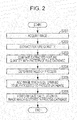
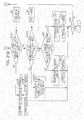
- FIG. 2 is a flowchart illustrating a basic flow (part 1) of an eye gaze detection process performed by a computer of the eye gaze detection apparatus.
- a flowchart illustrated in FIG. 2 illustrates a flow by so-called batch processing.
- the image acquisition unit 11 acquires an image of a user's face captured by the imaging apparatus 2.
- step S202 the feature quantity extraction unit 12 extracts the feature quantity of the face image from the face image acquired in step S201.
- step S203 the eye gaze calculation determination unit 14 determines whether or not to perform the user's eye gaze calculation process in step S204 by referring to the rule database, based on the feature quantity extracted by the feature quantity extraction unit in step S202.
- step S205 the eye gaze calculation determination unit 14 stores the face image which is determined to be subject to the eye gaze calculation process in step S204 in a processing database described later (refer to FIGs. 11 and 20 ).
- step S206 the eye gaze calculation unit 15 performs the eye gaze calculation process based on the feature quantity of the face image which is acquired in step S201.
- the eye gaze detection process is performed by such batch processing.
- FIG. 3 is a flowchart illustrating a basic flow (part 2) of an eye gaze detection process performed by a computer of the eye gaze detection apparatus.
- FIG. 3 A flowchart illustrated in FIG. 3 illustrates a flow by so-called serial processing.
- step S201 to S203 is the same as that in the flowchart illustrated in FIG. 2 , and thus will be omitted.
- step S301 the eye gaze calculation unit 15 performs the eye gaze calculation process based on the feature quantity of the face image which is determined to be subject to the eye gaze calculation process by the eye gaze calculation determination unit 14 in step S204.
- step S302 the result output unit 16 immediately outputs the result of the eye gaze calculation process which is performed in step S301.
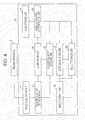
- FIG. 4 is a diagram illustrating a functional configuration of an eye gaze detection apparatus according to a first embodiment.
- the eye gaze detection apparatus 1B is, for example, an information processing apparatus such as a work station, a personal computer, and a mobile communication terminal, and is connected to the imaging apparatus 2.
- the eye gaze detection apparatus 1B includes an image acquisition unit 11, a feature quantity extraction unit 12, a comparison unit 41, a rule storage unit 13, an eye gaze calculation determination unit 14, a feature quantity storage unit 42, an eye gaze calculation unit 15, a result storage unit 43, and a result output unit 16.
- the imaging apparatus 2 is, for example, a digital camera, and captures, for example, a user's face or a face image including a face peripheral area.
- the face image may not include the entire user's face, and may include at least the user's eyes.
- the image acquisition unit 11 acquires the image of user's face captured by the imaging apparatus 2 from the imaging apparatus 2 via the transmission path.
- the feature quantity extraction unit 12 extracts the feature quantity of the face image acquired by the image acquisition unit 11, for example, the candidate of the corneal reflection area which is used in the corneal reflection method. Then, the extracted feature quantity is stored in the feature quantity storage unit 42.
- the comparison unit 41 compares the feature quantity of the face image in the current frame with the feature quantity of the face image in the previous frame, which are extracted by the feature quantity extraction unit 12.
- the rule storage unit 13 stores the rule set as the rule database.
- the rule database includes the rule set in which the eye gaze calculation process is not performed in a case where the feature quantity of the face image in the current frame coincides with the feature quantity of the face image in the previous frame at a predetermined ratio or higher. This rule set represents that the user's eye gaze remains stationary.
- the rule database includes the rule set in which the eye gaze calculation process is not performed when the number of the feature quantities of the face image in the current frame is changed equal to or more than a predetermined number in comparison with the number of the feature quantities of the face image in the previous frame, and then the changed quantity of the changed feature quantity in a predetermined direction is within a predetermined value. This rule set represents that the user is blinking his or her eye.
- the eye gaze calculation determination unit 14 determines whether or not to perform the user's eye gaze calculation process by referring to the rule database, based on the feature quantity extracted by the feature quantity extraction unit 12. For example, the eye gaze calculation determination unit 14 determines that the eye gaze calculation process is not performed, based on a comparison result obtained by the comparison unit 41, in a case where the feature quantity of the face image in the current frame coincides with the feature quantity of the face image in the previous frame equal to or greater than a predetermined ratio.
- the eye gaze calculation determination unit 14 determines that the eye gaze calculation process is not performed, based on a comparison result obtained by the comparison unit 41, when the number of the feature quantities of the face image in the current frame is changed equal to or more than a predetermined number in comparison with the number of the feature quantities of the face image in the previous frame, and then the changed quantity of the changed feature quantity in a predetermined direction is within a predetermined value.
- the feature quantity storage unit 42 stores the feature quantity of the face image extracted by the feature quantity extraction unit 12 when the eye gaze calculation determination unit 14 determines that the eye gaze calculation process is performed.
- the eye gaze calculation unit 15 performs the user's eye gaze calculation process, based on the feature quantity of the face image acquired by the image acquisition unit 11, when the eye gaze calculation determination unit 14 determines that the eye gaze calculation process is performed. For example, the eye gaze is calculated from the center of the corneal reflection area and the center of the pupil in the corneal reflection method.
- the result storage unit 43 stores coordinates of an eye gaze point, an eye gaze vector, or the like based on a result of the eye gaze calculation process performed by the eye gaze calculation unit 15. This is to output the stored result of the previous frame when the user's eyes are determined to remain stationary.
- the result output unit 16 outputs the result of the eye gaze calculation process which is performed by the eye gaze calculation unit 15.
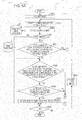
- FIGs. 5A and 5B are flowchart illustrating an eye gaze detection process by serial processing performed by a computer of an eye gaze detection apparatus according to the first embodiment.
- FIG. 6 is a diagram illustrating an example of a candidate area database.
- FIG. 7 is a diagram illustrating an example of a rule database (part 1).
- FIG. 8A and 8B are diagrams illustrating examples of a face image when it is determined that a user is blinking his or her eye.
- FIG. 9A and 9B are diagrams illustrating examples of a face image when it is determined that the user is not blinking his or her eye.
- FIGs. 5A and 5B illustrate a flow of the eye gaze detection process in a case where the eye gaze calculation process is performed only when the eye gaze calculation process is desired, by determining a state where the user is blinking his or her eye or the user's eye remains stationary as the state where the eye gaze calculation process is not able to be performed. Determination criteria are stored in the rule database in advance.
- the above described eye gaze detection apparatus 1B is realized by the aforementioned information processing apparatus which performs the eye gaze detection process as below.
- step S501 of FIG. 5A the image acquisition unit 11 acquires the image of a user's face captured by the imaging apparatus 2 from the imaging apparatus 2 via the transmission path.
- the feature quantity extraction unit 12 extracts the candidate of the corneal reflection area as the feature quantity of the face image acquired by the image acquisition unit 11.
- the candidate of the corneal reflection area is a high luminance area in the face image, and may be extracted through a binarization process, a filtering process, a template matching process, a corner detection process, or the like.
- the extracted candidate of the corneal reflection area is stored in the feature quantity storage unit 42 as a candidate area database 61 as illustrated in FIG. 6 .
- the candidate area database 61 in FIG. 6 stores, for example, coordinates (10, 10), (10, 12),
- step S504 it is determined whether or not the face image acquired in step S501 is the first image.
- step S504 Since the face image acquired in step S501 is the first image (step S504: Yes), it is determined whether or not to end the current eye gaze detection process in step S505. Unless there is an instruction to end from the outside, normally, the current eye gaze detection process does not end.
- step S505 No
- the next face image is acquired in step S506.
- step S502 the feature quantity extraction unit 12 extracts the candidate of the corneal reflection area from the next face image which is acquired in step S506, and in step S503, the extracted candidate of the corneal reflection area is stored in the candidate area database 61 as illustrated in FIG. 6 .
- step S504 it is determined again whether or not the face image acquired in step S506 is the first image.
- step S507 the eye gaze calculation determination unit 14 refers to the rule database 71 as illustrated in FIG. 7 , and the comparison unit 41 compares the number of candidates of the corneal reflection area of the face image in the current frame with the number of candidates of the corneal reflection area of the face image in the previous frame.
- step S508 it is determined whether or not the changed number of candidates of the corneal reflection area is equal to or more than a certain number, for example, equal to or more than two.
- step S509 it is determined whether or not y coordinate values of the changed candidate of the corneal reflection area, that is, coordinate values in the vertical direction of the face image are within a certain range.
- step S510 the eye gaze calculation determination unit 14 determines that the user is blinking his or her eye as illustrated in FIGs. 8A and 8B . That is, when the number of the corneal reflection is reduced equal to or more than a certain number in comparison with the number of the corneal reflection of the face image in the previous frame, the frame is determined in which the user is blinking his or her eye. The fact that an eyelid covers a part of the iris, and thus the corneal reflection which is generated in the part of the iris is reduced is used to support the above determination.
- step S507 the number of candidates of the corneal reflection area is not the same as each other (step S507: No).
- step S508 it is determined that two or more candidates of the corneal reflection area are changed (step S508: Yes).
- step S509 it is determined that the y coordinate values of the changed candidates of the corneal reflection area 83 and 84 are within a certain range (step S509: Yes).
- the changed candidates of the corneal reflection area 83 and 84 are the corneal reflection areas, and are considered to be changed by the user blinking his or her eye.
- step S507 the number of candidates of the corneal reflection area is not the same as each other (step S507: No).
- step S508: Yes it is determined that two or more candidates of the corneal reflection area are changed (step S508: Yes).
- step S509 it is determined that the y coordinate values of the changed candidates of the corneal reflection area 91 and 97 are not within a certain range (step S509: No).
- step S511 the eye gaze calculation unit 15 performs the eye gaze calculation process based on the feature quantity of the face image which is acquired in step S506. Even when it is determined that two or more candidates of the corneal reflection area are not changed (step S508: No) in step S508, in step S511, the eye gaze calculation unit 15 performs the eye gaze calculation process based on the feature quantity of the face image which is acquired in step S506.
- step S512 it is determined that whether or not an average value of a difference between the coordinate value of the candidates of the corneal reflection area corresponding to the face image in the current frame and the coordinate value of the candidates of the corneal reflection area corresponding to the face image in the previous frame is within a certain value.
- step S512 When the average value is not within a certain value (step S512: No), since it is considered that a position of the candidate of the corneal reflection area corresponding to the face image in the current frame is different from a position of the candidate of the corneal reflection area corresponding to the face image in the previous frame, the process proceeds to step S511.
- step S512 determines whether or not the degree of coincidence exceeds 95%.
- step S515: No When the degree of coincidence does not exceed 95% (step S515: No), the process proceeds to step S511.
- step S515: Yes when the degree of coincidence exceeds 95% (step S515: Yes), in step S516, the eye gaze calculation determination unit 14 determines that the user's eye remains stationary. That is, it is determined that a position of the eye gaze is not changed when the change of the position is within a predetermined value when specifying the position of the iris and comparing the position of the iris in the current frame with the position of the iris in the previous frame.
- step S517 the result output unit 16 outputs the result of the eye gaze detection process.
- the corresponding face image is removed from the targets for the eye gaze calculation process.
- determination of the state where the user's eye remains stationary or the state where the user is blinking his or her eye is obtained from the difference between the candidates of the corneai reflection area in the current frame and the candidates of the corneal reflection area in the previous frame; however, another method may be used.
- a method such as a pattern matching of an iris may be used.
- a method of using a motion vector, or a technology for detecting and tracing an eye or an eye blink from the image of a user's face may be used (for example, refer to Japanese Laid-open Patent Publication No. 2001-43382 ).
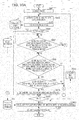
- FIGs. 10A and 10B are flowcharts illustrating a flow of the eye gaze detection process by batch processing performed by the computer of the eye gaze detection apparatus according to the second embodiment.
- FIG. 11 is a diagram illustrating an example of a processing database (part 1).
- Steps S501 to S510 and steps S512 to S516 are the same as the steps of the eye gaze detection process by the serial processing performed by the computer of the eye gaze detection apparatus according to the first embodiment as illustrated in FIGs. 5A and 5B . That is, the second embodiment is the same as the first embodiment regarding a point in that the acquisition of the face image, the feature quantity extraction, the determination of the user's eye blinking, and the determination of the user's eye remaining stationary.
- the determination criteria are stored in the rule database in advance.
- step S508 when it is determined that the number of candidates of the corneal reflection area of the face image in the current frame and the number of candidates of the corneal reflection area of the face image in the previous frame are not changed equal to or more than two (step S508: No), the face image acquired in step S506 is stored in processing database 111 as illustrated in FIG. 11 in step S1001.
- the face image which is captured at time "00:00:00.033" is stored as a frame 1. This face image is used to perform the eye gaze calculation process later.
- step S509 when the y coordinate values of the changed candidates of the corneal reflection area are not within a certain range (step S509: No), the face image acquired in step S506 is stored in the processing database 111 in step S1001.
- the face image acquired in step S506 is stored in the processing database 111 in step S1001 in a case where the average value of the difference between the coordinate value of the candidates of the corneal reflection area corresponding to the face image in the current frame and the coordinate value of the candidates of the corneal reflection area corresponding to the face image in the previous frame is not within a certain value in step S512 (step S512: No) and also in a case where the degree of coincidence between the peripheral area corresponding to the face image in the current frame and the peripheral area corresponding to the face image in the previous frame does not exceed 95% in step S515 (step S515: No).
- step S1002 the eye gaze calculation unit 15 performs the eye gaze calculation process based on the feature quantity of the face image stored in the processing database 111 in step S1001.
- step S1003 the result output unit 16 outputs the result of the eye gaze detection process performed in step S1002.
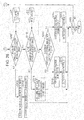
- FIG. 12 is a flowchart illustrating the eye gaze detection process by the serial processing performed by a computer of an eye gaze detection apparatus according to a third embodiment.
- FIG. 13 is a diagram illustrating a right eye peripheral area and a left eye peripheral area of the face image.
- FIG. 14 is a diagram illustrating an example of a rule database (part 2).
- FIG. 15 is a diagram illustrating an example of the face image which is determined that the user is looking sideways.
- a flowchart illustrated in FIG. 12 illustrates a flow of the eye gaze detection process in a case where the eye gaze calculation process is performed only when the eye gaze calculation process is desired, by determining a state where the user is looking sideways as the state where the eye gaze calculation process is not able to be performed. Since it is difficult to accurately obtain the shape of the iris in the state where the user is looking sideways and thus a large error is generated, the eye gaze calculation process is not desired.
- the eye gaze detection process determines whether or not to perform the eye gaze calculation process by using information of the area of corneal reflection candidate and the face area.
- the determination criteria are stored in the rule database in advance.
- known technology is used as a process for detecting the face area from the input face image.
- a technology for extracting a partial image which is considered to include a face image based on an edge image extracted from a target image, and determining whether or not the extracted partial image includes the face image by referring a learning dictionary that holds learning information for identifying the face image and a non-face image (for example, refer to Japanese Laid-open Patent Publication No. 2003-44853 ).
- the face area may be an area including a face or a part of face such as an eye.
- the image acquisition unit 11 acquires the image of user's face captured by the imaging apparatus 2 from the imaging apparatus 2 via the transmission path.
- the image acquisition unit 11 performs detection in a face area 1301 from the acquired face image as illustrated in FIG. 13 .
- the image acquisition unit 11 specifies a right eye peripheral area 1302 and a left eye peripheral area 1303, which are within a predetermined range, from the detected face area 1301 as illustrated in FIG. 13 .
- the right eye peripheral area 1302 includes an image of the right eye and the left eye peripheral area 1303 includes an image of the left eye.
- step S1203 the feature quantity extraction unit 12 extracts the candidate of the corneal reflection area as the feature quantity in the face area 1301 which is detected by the image acquisition unit 11.
- step S1204 among the candidates of the corneal reflection area which are extracted in step S1203, the feature quantity extraction unit 12 acquires one candidate of the corneal reflection area, which is in the right eye peripheral area 1302 specified in step S1202 and has the highest luminance value. For example, when expressing the area from a black pixel to the white pixel by 8 bits (256 gradations), the luminance value which is equal to or greater than 240 is the highest luminance value in many cases. Having the highest possibility of the corneal reflection area, the candidate of the corneal reflection area having the highest luminance value is acquired.
- step S1205 the feature quantity extraction unit 12 acquires the peripheral area of the candidate of the corneal reflection area having the highest luminance value among the right eye peripheral area 1302, that is, a corneal peripheral area image having the highest possibility of the corneal reflection area.
- the eye gaze calculation determination unit 14 refers to the rule database 141 as illustrated in FIG. 14 . Then, it is determined whether or not pixels on both sides of the candidate of the corneal reflection area (horizontal direction: an X axial direction) are equal to or more than a predetermined number of white pixels (for example, a predetermined number of n) in the corneal peripheral area image which is acquired in step S1205.
- a predetermined number of white pixels for example, a predetermined number of n
- the white pixel has the luminance value in a range of 190 to 230.
- step S1206 the eye gaze calculation determination unit 14 determines that the user is not looking sideways, and the eye gaze calculation unit 15 performs the eye gaze calculation process based on the feature quantity of the face image in step S1207. Then, in step S1208, the result output unit 16 outputs the result of the performed eye gaze detection process. For example, as illustrated in FIG. 15A , on both sides of the candidate of the corneal reflection area having the highest luminance value 1501 the white pixels 1502 and 1503 which are equal to or greater than a predetermined number.
- the eye gaze calculation determination unit 14 determines there is a possibility that the user is looking sideways. For example, as illustrated in FIG. 15B , a predetermined number or more of the white pixels 1505 are present only on the one side of the candidate of the corneal reflection area having the highest luminance value 1504.
- step S1209 the feature quantity extraction unit 12 acquires one candidate of the corneal reflection area having the highest luminance value in the left eye peripheral area 1303 which is specified in step S1202, among the candidates of the corneal reflection area extracted in step S1203.
- step S1210 the feature quantity extraction unit 12 acquires the peripheral area of the candidate of the corneal reflection area having the highest luminance value among the left eye peripheral area 1303, that is, the corneal peripheral area image having the highest possibility of the corneal reflection area.
- step S1211 the eye gaze calculation determination unit 14 refers to the rule database 141 as illustrated in FIG. 14 . Then, it is determined whether or not pixels on both sides of the candidate of the corneal reflection area (horizontal direction: the X axial direction) are equal to or more than a predetermined number of white pixels (for example, a predetermined number of n) in the corneal peripheral area image which is acquired in step S1210.
- a predetermined number of white pixels for example, a predetermined number of n
- step S1211 the eye gaze calculation determination unit 14 determines that the user is not looking sideways, and the eye gaze calculation unit 15 performs the eye gaze calculation process based on the feature quantity of the face image in step S1207. Then, in step S1208, the result output unit 16 outputs the result of the performed eye gaze detection process.
- step S1211 determines that the user is looking sideways in step S1212.
- step S1213 it is determined whether or not to end the current eye gaze detection process. Unless there is an instruction to end from the outside, normally, the current eye gaze detection process does not end. When the process does not end (step S1213: No), the next face image is acquired in step S1214.
- the eye gaze detection process it is determined whether or not a high luminance area (white of an eye) in a predetermined range on both sides of the position of the corneal reflection area (the horizontal direction), and then when the high luminance area is present on only one side, it is determined that the user is looking sideways. Meanwhile, the same is true for a case where the user is cross-eyed.
- FIG. 16 is a diagram illustrating a functional configuration of an eye gaze detection apparatus according to fourth to eighth embodiments.
- an eye gaze detection apparatus 1C is, for example, an information processing apparatus such as a workstation, a personal computer, and a portable communication terminal, and is connected to the imaging apparatus 2 and an input reception device 3.
- the eye gaze detection apparatus 1C includes the image acquisition unit 11, a face detection unit 1601, the feature quantity extraction unit 12, the rule storage unit 13, a processing priority setting unit 1602, the eye gaze calculation determination unit 14, the eye gaze calculation unit 15, the result output unit 16, and a user input receiving unit 1603.
- the imaging apparatus 2 is, for example, a digital camera and the like, and captures, for example, a face image including a user's face and a face peripheral area.
- the imaging apparatus 2 may be configured to include a plurality of cameras.
- the input reception device 3 is an input device such as a keyboard, or a mouse, and the user inputs a processing priority setting by using the input reception device.
- the image acquisition unit 11 acquires the image of user's face captured by the imaging apparatus 2 from the imaging apparatus 2 via the transmission path. In a case where the imaging apparatus 2 is configured to include the plurality of cameras, the image acquisition unit 11 acquires the face images captured by each imaging apparatus 2 from each imaging apparatus 2.
- the face detection unit 1601 detects the face area from the face image acquired by the image acquisition unit 11. For example, the face area is detected from the face image by extracting a partial image which is considered to include a face image based on an edge image extracted from a target image, referring a learning dictionary for identifying the face image and a non-face image, and then determining whether or not the extracted partial image includes the face image.
- the feature quantity extraction unit 12 extracts the feature quantity of the face image acquired by the image acquisition unit 11, for example, the candidate of the corneal reflection area which is used in the corneal reflection method. In addition, the feature quantity extraction unit 12 extracts the feature quantity in the face area which is detected by the face detection unit 1601. In a case where the imaging apparatus 2 is configured to include a plurality of cameras, the feature quantity extraction unit 12 extracts the feature quantity of the face image acquired from the respective cameras. Then, the extracted feature quantity is stored in the feature quantity storage unit 42.
- the rule storage unit 13 stores the rule set as the rule database.
- the rule database includes the rule set in which the eye gaze calculation process is not performed in a case where the size in the face area is smaller than a predetermined value. This rule set represents that since the user's face captured by the imaging apparatus 2 is too small, it is not possible to perform the eye gaze detection.
- the rule database includes the rule set in which the eye gaze calculation process is not performed in a case where the extracted feature quantity is extracted in an area other than the face area and the feature quantity is not extracted in the face area. This rule set represents that since the feature quantity is detected by metal or the like in an area other than the face area, it is not possible to perform the eye gaze detection.
- the rule database includes the rule set in which the eye gaze calculation process is not performed in a case where the feature quantity in the face area is greater than a predetermined value.
- This rule set represents that since the feature quantity in the face area is obtained by reflection with the glasses or the like, it is not possible to perform the eye gaze detection.
- the rule database includes the rule set in which in a case where the feature quantities of the two face images are within an overlapped area of the two face images, the eye gaze calculation process is performed based on the feature quantity of any one of the face images. This rule set represents that there is a high possibility of obtaining the same result of the eye gaze calculation based on the feature quantities of both of the face images, and thus the eye gaze detection of one side may be sufficient.
- the processing priority setting unit 1602 associates the feature quantity in the face area extracted by the feature quantity extraction unit 12 with a priority of performing the eye gaze calculation process, and then stores the set priority in the processing database.
- the eye gaze calculation determination unit 14 determines whether or not to perform the user's eye gaze calculation process by referring the rule database, based on the feature quantity extracted by the feature quantity extraction unit 12. For example, the eye gaze calculation determination unit 14 determines that the eye gaze calculation process is not performed in a case where the size in the face area which is detected by the face detection unit 1601 is smaller than a predetermined value. In addition, the eye gaze calculation determination unit 14 determines that the eye gaze calculation process is not performed in a case where the feature quantity which is extracted by the feature quantity extraction unit 12 is extracted from an area other than the face area and the feature quantity is not extracted in the face area.
- the eye gaze calculation determination unit 14 determines that eye gaze calculation process is not performed in a case where the size of feature quantity in the face area which is extracted by the feature quantity extraction unit 12 is greater than a predetermined value. In addition, the eye gaze calculation determination unit 14 determines that the eye gaze calculation process is performed according to the priority of the feature quantity in the face area extracted by the feature quantity extraction unit 12. Further, the eye gaze calculation determination unit 14 determines that the eye gaze calculation process is performed based on the feature quantity of any one of the face images in a case where feature quantities of the plurality of face images which are extracted by the feature quantity extraction unit 12 are in an overlapped area of the plurality of face images which are acquired by the image acquisition unit 11.
- the eye gaze calculation unit 15 performs the user's eye gaze calculation process, based on the feature quantity of the face image acquired by the image acquisition unit 11, when the eye gaze calculation determination unit 14 determines that the eye gaze calculation process is performed. For example, the eye gaze is calculated from the center of the corneal reflection area and the center of the pupil in the corneal reflection method.
- the result output unit 16 outputs the result of the eye gaze calculation process which is performed by the eye gaze calculation unit 15.
- the user input receiving unit 1603 receives the processing priority setting which is input by the input reception device 3.
- FIG. 17 is a flowchart illustrating a flow of the eye gaze detection process by batch processing performed by the computer of the eye gaze detection apparatus according to the fourth embodiment.
- FIG. 18 is a diagram illustrating an example of the rule database (part 3).
- a situation in which it is not possible to perform the eye gaze calculation process is assumed depending on a method of the eye gaze detection and usage conditions. Examples includes a case where a user's face is captured small, a case where the candidate of the corneal reflection area is generated in an area other than a face such as metal, or a case where the corneal reflection area is invisible due to the reflection of glasses. In this case, it is not possible to accurately perform the eye gaze calculation process.
- step S501 of FIG. 17 the image acquisition unit 11 acquires the image of user's face which is captured by the imaging apparatus 2 from the imaging apparatus 2 via the transmission path.
- step S1701 the image acquisition unit 11 performs detection in the face area from the acquired face image.
- step S1702 the eye gaze calculation determination unit 14 refers to a rule database 181 as illustrated in FIG. 18 . Then, the eye gaze calculation determination unit 14 determines whether or not the size in the face area detected in step S1701 is equal to or greater than a predetermined size. This is because that when the size in the face area is too small, it is not possible to perform the area of the eye is reduced and thus appropriate eye gaze detection. Meanwhile, the determination in step S1701 includes the determination from the size of the area of an eye in addition to the determination from the area of the entire face. In addition, even though the area of the eye is large, for example, a case where the user is looking aside or a case where the user is looking upside or downside, the corneal reflection area is not present in the image in some cases.
- the eye gaze calculation determination unit 14 may perform the same process as that when determining that the size in the face area is smaller than a predetermined size in a case where it is determined that the user is looking aside or the user is looking upside or downside based on the positional relationship between parts of the face such as eyes, a nose, and a mouth.
- the eye gaze calculation determination unit 14 may perform the same process as that when determining that the size in the face area is smaller than a predetermined size in a case where the shape of an eye area in the face area approximates to the shape of the eye area in the case where the user is looking aside or the user is looking upside or downside beyond a predetermined threshold by referring to the information, which is stored in the database (not shown), of the shape of the eye in the case where the user is looking aside or the user is looking upside or downside.
- step S1703 When the shape of the eye is smaller than a certain size (step S1702: No), in step S1703, since the size in the face area is too small, the eye gaze calculation determination unit 14 determines that it is not possible to perform the eye gaze calculation process, and then the process proceeds to step S505.
- the size of the face area is equal to or smaller than a predetermined size, specifically, the size of an eye image in the face area is equal to or smaller than the size which is defined that it is not possible to detect the eye gaze like the case where the user is looking aside or the user is looking upside or downside, it is determined that it is not possible to perform the eye gaze calculation process, and then the process proceeds to step S505.
- step S1704 the feature quantity extraction unit 12 extracts the candidate of the corneal reflection area as the feature quantity of the face image acquired by the image acquisition unit 11 in step S1701.
- step S1705 the eye gaze calculation determination unit 14 refers to the rule database 181 as illustrated in FIG. 18 . Then, the eye gaze calculation determination unit 14 determines whether or not the candidate of the corneal reflection area is extracted as the feature quantity in the face area. This is because that in a case where the extracted feature quantity is extracted from an area other than the face area and the feature quantity is not extracted in the face area, the extracted feature quantity is not the corneal reflection area.
- step S1703 since the extracted feature quantity is extracted in the area other than the face area and the feature quantity is not extracted in the face area, the eye gaze calculation determination unit 14 determines that it is not possible to perform the eye gaze calculation process, and then the process proceeds to step S505.
- step S1705 when it is determined that the candidate of the corneal reflection area is extracted in step S1705 (step S1705: Yes), since the process of the candidate of the corneal reflection area is performed in order, the first candidate of the corneal reflection area is acquired in step S1706.
- step S1707 the eye gaze calculation determination unit 14 determines that the size of feature quantity in the face area which is extracted by the feature quantity extraction unit 12 is greater than a predetermined value.
- a predetermined value it is determined that the candidate of the corneal reflection area is not the corneal reflection area (a non-corneal reflection area) in step S1708. That is, it is determined that the candidate of the corneal reflection area is obtained by the reflection of the glasses or the like.
- step S1707 when the size of feature quantity in the face area is not greater than a predetermined value in step S1707 (step S1707: No), it is determined that the candidate of the corneal reflection area is the corneal reflection area in step S1709. Then, the face image is stored in the processing database 111 in step S1001.
- step S1710 it is determined whether or not the next candidate of the corneal reflection area is the last candidate of the corneal reflection area which is extracted in step S1704. When it is not the last candidate (step S1710: No), the next candidate of the corneal reflection area is acquired in step S1711, and the processes after step S1707 are repeated.
- step S1710 when it is the last candidate (step S1710: Yes), it is determined whether or not one or more of candidates of the corneal reflection area are stored in the processing database 111 in step S1712.
- step S1712: Yes When one or more of candidates of the corneal reflection area are stored in the processing database 111 (step S1712: Yes), the process proceeds to step S505.
- step S1712: No when the candidate of the corneal reflection area is not stored at all (step S1712: No), in step S1703, since the feature quantity is not extracted in the face area, the eye gaze calculation determination unit 14 determines that it is not possible to perform the eye gaze calculation process, and then the process proceeds to step S505.
- step S505 it is determined whether or not to end the current eye gaze detection process in step S505.
- step S505 the process does not end (step S505: No)
- the next face image is acquired in step S506 and the processes after step S1901 are repeated.
- step S1002 the eye gaze calculation unit 15 performs the eye gaze calculation process based on the feature quantity of the face image stored in the processing database 111 in step S1001.
- step S1003 the result output unit 16 outputs the result of the eye gaze detection process which is performed in step S1002.
- the face area and the candidate of the corneal reflection area are used for description; however, a technology for more accurately extracting an input face image of a user by using a two-dimensional template may be used (for example, refer to Japanese Laid-open Patent Publication No. 2001-22933 ).
- a technology for detecting a reflection illumination part of the glasses from a captured image of a user wearing glasses for example, refer to Japanese Laid-open Patent Publication No. 2001-167284 ).
- FIG. 19 is a flowchart illustrating a flow of the eye gaze detection process by batch processing performed by the computer of the eye gaze detection apparatus according to the fifth embodiment.
- FIG. 20 is a diagram illustrating an example of the processing database (part 2).
- whether or not the eye gaze calculation process is performed is determined and it is also assumed a case where the eye gaze calculation process is desired to be performed in an order other than in a time-series order. In such a case, the eye gaze calculation process is performed only when desired, and the eye gaze calculation process may be performed in a desired order. In addition, whether or not the eye gaze calculation process is desired is determined by using the information on the face area and the candidate of the corneal reflection area.
- step S501 of FIG. 19 the image acquisition unit 11 acquires the image of user's face captured by the imaging apparatus 2 from the imaging apparatus 2 via the transmission path.
- step S1901 the feature quantity extraction unit 12 extracts the candidate of the corneal reflection area as the feature quantity of the face image acquired by the image acquisition unit 11 in step S501.
- step S1701 the image acquisition unit 11 performs detection in the face area from the acquired face image.
- step S1702 the eye gaze calculation determination unit 14 refers to the rule database 181 as illustrated in FIG. 18 . Then, the eye gaze calculation determination unit 14 determines whether or not the size in the face area which is detected in step S1701 is equal to or greater than a predetermined size.
- step S1703 When the size in the face area is smaller than a certain size (step S1702: No), in step S1703, since the size in the face area is too small, the eye gaze calculation determination unit 14 determines that it is not possible to perform the eye gaze calculation process, and then the process proceeds to step S505.
- step S1704 when the size in the face area is equal to or greater than a certain size (step S1702: Yes), in step S1704, the feature quantity extraction unit 12 detects the candidate of the corneal reflection area as the feature quantity in the face area which is detected by the image acquisition unit 11 in step S1701.
- step S1705 the eye gaze calculation determination unit 14 refers to the rule database 181 as illustrated in FIG. 18 . Then, the eye gaze calculation determination unit 14 determines whether or not the candidate of the corneal reflection area is extracted as the feature quantity in the face area.
- step S1703 since the extracted feature quantity is extracted in the area other than the face area and the feature quantity is not extracted in the face area, the eye gaze calculation determination unit 14 determines it is not possible to perform the eye gaze calculation process, and then the process proceeds to step S505.
- step S1902 the user input receiving unit 1603 receives the processing priority setting which is input by the input reception device 3.
- the face image having a large number of candidates of the corneal reflection area is set to have higher processing priority than the face image having a small number of candidates of the corneal reflection area.
- the large sized face area is set to have the high priority. Accordingly, it is possible to perform the eye gaze detection process for a person who is close to the eye gaze detection apparatus.
- step S1903 the processing priority setting unit 1602 associates the feature quantity in the face area extracted in step S1704 with the priority of performing the eye gaze calculation process, and then stores the set priority in a processing database 201 as illustrated in FIG. 20 .
- step S505 it is determined whether or not to end the current eye gaze detection process in step S505.
- step S505 the process does not end (step S505: No)
- the next face image is acquired in step S506 and the processes after step S1901 are repeated.
- step S1905 the eye gaze calculation unit 15 performs the eye gaze calculation process based on the feature quantity of the face image stored in the processing database 201 in order of the priority in step S1903.
- step S1003 the result output unit 16 outputs the result of the eye gaze detection process which is performed in step S1905.
- FIGs. 21A and 21B are flowcharts illustrating an eye gaze detection process by serial processing performed by a computer of an eye gaze detection apparatus according to a sixth embodiment.
- FIG. 22 is a diagram illustrating an example of an overlapping database.
- FIG. 23 is a diagram illustrating an example of the rule database (part 4).
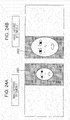
- FIGs. 24A and 24B are diagrams illustrating an example of an overlapped image.
- the imaging apparatus 2 is configured to include a plurality of cameras. In this case, spaces which are captured by each of the imaging apparatuses 2 are overlapped with each other. In regard to a user in the overlapped space, the same eye gaze information is output from each of the plurality of imaging apparatuses 2. For this reason, it is possible to reduce a load of calculation process when performing the eye gaze calculation process by avoiding repeatedly calculating the same eye gaze information.
- the overlapped area is stored in an overlapping database 221 in advance.
- an area specified at diagonal coordinates (440,0) and (640,480) of a first face image captured by a "camera 1" which is a first imaging apparatus 2 is stored in the overlapping database 221 as the overlapped area.
- an area specified at diagonal coordinates (0,0) and (200,480) of a second face image captured by a "camera 2" which is a second imaging apparatus 2 is stored in the overlapping database 221 as the overlapped area.
- the image acquisition unit 11 acquires a user's first face image captured by a first imaging apparatus 2 from the first imaging apparatus 2 via transmission path.
- the image acquisition unit 11 performs detection in the first face area from the acquired first face image.
- the feature quantity extraction unit 12 extracts the candidate of a first corneal reflection area as the feature quantity in the first face area detected by the image acquisition unit 11 in step S2102 and then stores the extracted candidate in an overlapping database 221 as illustrated in FIG. 22 .
- step S2104 the image acquisition unit 11 acquires a user's second face image captured by a second imaging apparatus 2 from the second imaging apparatus 2 via transmission path.
- step S2105 the image acquisition unit 11 performs detection of the second face area from the acquired second face image.
- step S2106 the feature quantity extraction unit 12 extracts the candidate of a second corneal reflection area as the feature quantity of the second face area detected by the image acquisition unit 11 in step S2105 and then stores the extracted candidate in an overlapping database 221 as illustrated in FIG. 22 .
- Steps S2101 to S2103 are performed in parallel with steps S2104 to S2106.
- step S2107 the eye gaze calculation determination unit 14 refers to the overlapping database 221. Then, the eye gaze calculation determination unit 14 determines whether or not the feature quantities of the first and second face images which are extracted by the feature quantity extraction unit 12 are within the overlapped area of the first and second face images acquired by the image acquisition unit 11.
- step S2108 the eye gaze calculation unit 15 performs the user's eye gaze calculation process based on each of the feature quantities of the first and second face images. Then, in step S2109, the result output unit 16 outputs the result of the performed eye gaze calculation process, and then the process proceeds to step S505.
- the eye gaze calculation determination unit 14 refers to a rule database 231 as illustrated in FIG. 23 .
- the rule database 231 includes the rule set in which in a case where the feature quantities of the two face images are within an overlapped area of the two face images, the eye gaze calculation process is performed based on the feature quantity of any one of the face images.
- This rule set represents that there is a high possibility of obtaining the same result of the eye gaze calculation based on the feature quantities of both of the face images, and thus the eye gaze detection of one side may be sufficient.
- a case where the feature quantities of the two face images are within the overlapped area of the two face images is a case where the feature quantities of the two face images are within the overlapped areas 2401 and 2402 as illustrated in FIGs. 24A and 24B .
- step S2111 it is determined whether or not an average likelihood of the candidate of the corneal reflection area in the first face area is higher than the average likelihood of the candidate of the corneal reflection area of the second face area.
- step S2112 When it is determined that the average likelihood of the candidate of the corneal reflection area in the first face area is high (step S2111: Yes), in step S2112, the eye gaze calculation unit 15 performs the user's eye gaze calculation process based on the feature quantity of the first face image. Then, in step S2113, the result output unit 16 outputs the result of the performed eye gaze calculation process, and then the process proceeds to step S505.
- step S2114 the eye gaze calculation unit 15 performs the user's eye gaze calculation process based on the second feature quantity of the face image.
- the average likelihood of the candidate of the corneal reflection area is a criterion which is in consideration of the calculation accuracy of the eye gaze calculation process, and is set in advance.
- step S2115 the result output unit 16 outputs the result of the performed eye gaze calculation process, and the process proceeds to step S505.
- step S2110 when the candidates of the corneal reflection areas in the first and second face areas are not extracted at all in steps S2103 and S2106 (step S2110: Yes), in step S2116, since the feature quantity is not extracted, the eye gaze calculation determination unit 14 determines that it is not possible to perform the eye gaze calculation process, and then the process proceeds to step S505.
- step S505 it is determined whether or not to end the current eye gaze detection process in step S505.
- step S505 No
- the process returns to step S2101 and S2104.
- the eye gaze detection process As described above, when there are the same candidates of the corneal reflection area in the plurality of face images, it is possible to perform the eye gaze calculation process on any one of the face images.
- the face image on which the eye gaze calculation process is easily performed and the face image on which the eye gaze calculation process is not easily performed which are for example, two face images in the face images in which the reflection by the glasses is generated, it is possible to select the face image on which the eye gaze calculation process is easily performed.
- it is possible to select the face image having the higher calculation accuracy of the eye gaze calculation process by setting the criterion in consideration of the calculation accuracy of the eye gaze calculation process. Therefore, it is possible to reduce a processing load and a deterioration of the calculation accuracy when performing the eye gaze calculation process.
- the overlapped area may be set in accordance with the distance from the imaging apparatus 2 and may be set in consideration of the positional relationship between the two imaging apparatuses 2 and installation conditions thereof, for example, an installation angle.
- FIGs. 25 and 26 are flowcharts illustrating an eye gaze detection process by serial processing performed by a computer of an eye gaze detection apparatus according to a seventh embodiment.
- steps S2101 to S2103 are performed in parallel with steps S2104 to S2106.
- steps S2104 to S2106 are performed after performing steps S2101 to S2103. That is, it is possible to perform the eye gaze detection process even when the two face images are not captured at the same time but captured within a certain time range.
- FIGs. 27 and 28 are flowcharts illustrating a flow of an eye gaze detection process by batch processing performed by a computer of an eye gaze detection apparatus according to the eighth embodiment.
- the determination result obtained in step S2111 of the seventh embodiment is set as a priority.
- step S2111 when it is determined that the average likelihood of the candidate of the corneal reflection area in the first face area is higher than that in the second face area (step S2111: Yes), the first face image is set to have a higher priority in step S2803. It is preferable that the priority is set based on characteristics such as likelihood or detection accuracy of the candidate of the corneal reflection area. Then, in step S2804, the first face image is associated with a priority and the set priority is stored in the processing database 201, and then the process proceeds to step S505.
- step S2111 when it is determined that the average likelihood of the candidate of the corneal reflection area in the first face area is not higher than that in the second face area (step S2111: No), the second face image is set to have a higher priority in step S2805. Then, in step S2806, the second face image is associated with the priority and the set priority is stored in the processing database 201, and then the process proceeds to step S505.
- step S2807 the face images in the processing database 201 are rearranged in a priority order (sorting).
- step S2808 the eye gaze calculation unit 15 performs the eye gaze calculation process based on the feature quantity of the face image in the sorted priority order.
- step S2809 the result output unit 16 outputs the result of the performed eye gaze calculation process.
- FIG. 29 is a configuration example of the information processing apparatus.
- the eye gaze detection apparatuses 1A, 1B, and 1C in FIG. 1 may be realized by using, for example, the information processing apparatus (the computer) in FIG. 29 .
- the information processing apparatus illustrated in FIG. 29 includes a central processing unit (CPU) 2901, a memory 2902, an input device 2903, an output device 2904, an external recording device 2905, a medium driving device 2906, and a network connecting device 2907. These are connected to each other via a bus 2908.
- CPU central processing unit
- the memory 2902 is a semiconductor memory, for example, a read only memory (ROM), a random access memory (RAM), and a flash memory, and stores a program and data which are used in the eye gaze detection process which is performed by the eye gaze detection apparatuses 1A, 1B, and 1C.
- the CPU 2901 performed the above described eye gaze detection process by performing the program by using the memory 2902.
- the input device 2903 may be a keyboard, a pointing device, or the like and is used for an input of instruction or information from an operator.
- the output device 2904 may be a display device, a printer, a speaker, or the like and is used to pose queries to the operator or output a processing result.
- the external recording device 2905 may be a magnetic disk device, a magneto-optical disk device, a tape device, or the like.
- This external recording device 2905 includes a hard disk drive.
- the information processing apparatus stores a program and data in the external recording device 2905 in advance and the stored program and data may be used by being loaded into the memory 2902.
- a medium driving device 2906 drives a portable recording medium 2909 and accesses to the record contents.
- the portable recording medium 2909 may be a memory device, a flexible disk, an optical disk, a magneto-optical disk, or the like.
- the portable recording medium 2909 includes a compact disk read only memory (CD-ROM), a digital versatile disk (DVD), a universal serial bus (USB), a memory, or the like.
- CD-ROM compact disk read only memory
- DVD digital versatile disk
- USB universal serial bus
- the operator stores a program and data in the portable recording medium 2909 and the stored program and data may be used by being loaded into the memory 2902.
- a computer readable recording medium which stores the program and data which are used for the eye gaze detection process includes a physical (non-temporary) recording medium such as the memory 2902, the external recording device 2905, and the portable recording medium 2909.
- the network connecting device 2907 is connected to the communication network 2910, and is a communication interface for performing data conversion in accordance with communication.
- the information processing apparatus receives the program and data from the external device via the network connecting device 2907, and the received program and data may be used by being loaded into the memory 2902.
Landscapes
- Engineering & Computer Science (AREA)
- Health & Medical Sciences (AREA)
- General Health & Medical Sciences (AREA)
- Human Computer Interaction (AREA)
- Physics & Mathematics (AREA)
- Life Sciences & Earth Sciences (AREA)
- Ophthalmology & Optometry (AREA)
- General Physics & Mathematics (AREA)
- Multimedia (AREA)
- Theoretical Computer Science (AREA)
- Biophysics (AREA)
- Surgery (AREA)
- Computer Vision & Pattern Recognition (AREA)
- Biomedical Technology (AREA)
- Heart & Thoracic Surgery (AREA)
- Medical Informatics (AREA)
- Molecular Biology (AREA)
- Oral & Maxillofacial Surgery (AREA)
- Animal Behavior & Ethology (AREA)
- Public Health (AREA)
- Veterinary Medicine (AREA)
- Eye Examination Apparatus (AREA)
- Image Processing (AREA)
- User Interface Of Digital Computer (AREA)
- Image Analysis (AREA)
Claims (10)
- Blickerkennungsvorrichtung (1A), umfassend:eine Bilderfassungseinheit (11), die zum Erfassen eines Gesichtsbilds eines Benutzers aus einer Bildgebungsvorrichtung (2) konfiguriert ist, wobei das Gesichtsbild durch die Bildgebungsvorrichtung (2) erfasst wird;eine Gesichtserkennungsvorrichtung (1601), die zum Erkennen eines Gesichtsbereichs, der Hornhautreflexionsbereichskandidaten enthält, aus dem Gesichtsbild, welches durch die Bilderfassungseinheit (11) wird, konfiguriert ist;eine Merkmalsmengenextraktionseinheit (12), die zum Extrahieren von Hornhautreflexionsbereichskandidaten des Gesichtsbilds, das durch die Bilderfassungseinheit (11) erfasst wird, konfiguriert ist, wobei die Hornhautreflexionsbereichskandidaten des Gesichtsbilds Hochluminanzbereiche des Gesichtsbilds sind;eine Blickberechnungsbestimmungseinheit (14), die zum Bestimmen konfiguriert ist, ob ein Blickberechnungsprozess für den Benutzer durch Bezugnahme auf eine Regeldatenbank ausgeführt wird oder nicht, basierend auf den Hornhautreflexionsbereichskandidaten, die durch die Merkmalsmengenextraktionseinheit extrahiert werden, wobei die Regeldatenbank einen Regelsatz speichert, der eine Bedingung, welche Hornhautreflexionsbereichskandidaten des Gesichtsbereichs beinhaltet, mit Infomation assoziiert, die anzeigt, ob der Blickberechnungsprozess ausgeführt wird oder nicht; undeine Blickberechnungseinheit (15), die zum Ausführen des Blickberechnungsprozesses für den Benutzer konfiguriert ist, basierend auf den Hornhautreflexionsbereichskandidaten des Gesichtsbilds, welches durch die Bilderfassungseinheit (11) erfasst wird, wenn die Blickberechnungsbestimmungseinheit (14) bestimmt, dass der Blickberechnungsprozess ausgeführt wird,wobei die Bilderfassungseinheit (11) ferner zum Spezifizieren eines Peripheriebereichs des rechten Auges und eines Peripheriebereichs des linken Auges in einer vorgegebenen Reichweite zum erfassten Gesichtsbild konfiguriert ist,wobei die Regeldatenbank einen Regelsatz beinhaltet, in dem der Blickberechnungsprozess nicht ausgeführt wird, wenn Pixel auf beiden Seiten von Hornhautreflexionsbereichskandidaten im Peripheriebereich des rechten Ausges und Peripheriebereich des linken Auges weniger als eine vorgegebene Anzahl von weißen Pixeln sind, undwobei die Blickberechnungsbestimmungseinheit (14) ferner zum Bestimmen konfiguriert ist, dass der Blickberechnungsprozess nicht ausgeführt wird, wenn die Pixel auf den beiden Seiten der Hornhautreflexionsbereichskandidaten im Peripheriebereich des rechten Auges und Peripheriebereich des linken Auges, die durch die Bilderfassungseinheit (11) spezifiziert werden, weniger als die vorgegebene Anzahl von weißen Pixeln sind.
- Blickerkennungsvorrichtung (1A) nach Anspruch 1, ferner umfassend:eine Ergebnisausgabeeinheit (16), die zum Ausgeben eines Ergebnisses des Blickberechnungsprozesses konfiguriert ist, welcher durch die Blickberechnungseinheit (15) ausgeführt wird;eine Vergleichseinheit (41), die zum Vergleichen der Hornhautreflexionsbereichskandidaten des Gesichtsbilds in einem laufenden Frame mit den Hornhautreflexionsbereichskandidaten des Gesichtsbilds in einem vorhergehenden Frame konfiguriert ist, die beide durch die Merkmalsmengenextraktionseinheit (12) extrahiert werden,wobei die Regeldatenbank einen Regelsatz beinhaltet, in dem der Blickberechnungsprozess in einem Fall nicht augeführt wird, in dem die Hornhautreflexionsbereichskandidaten des Gesichtsbilds im laufenden Frame mit den Hornhautreflexionsbereichskandidaten des Gesichtsbilds im vorhergehenden Frame in einem vorgegebenen Verhältnis oder darüber übereinstimmen,wobei die Blickberechnungsbestimmungseinheit (14) zum Bestimmen konfiguriert ist, dass der Blickberechnungsprozess nicht ausgeführt wird, basierend auf einem Vergleichsergebnis, das durch die Vergleichseinheit (41) erhalten wird, wenn die Hornhautreflexionsbereichskandidaten des Gesichtsbilds im laufenden Frame mit den Hornhautreflexionsbereichskandidaten des Gesichtsbilds im vorhergehenden Frame im vorgegebenen Verhältnis oder darüber übereinstimmen, undwobei die Ergebnisausgabeeinheit (16) zum Ausgeben des Ergebnisses des Blickberechnungsprozesses konfiguriert ist, basierend auf den Hornhautreflexionsbereichskandidaten des Gesichtsbilds im vorhergehenden Frame.
- Blickerkennungsvorrichtung (1A) nach einem der vorhergehenden Ansprüche,
wobei die Regeldatenbank einen Regelsatz beinhaltet, in dem der Blickberechnungsprozess nicht ausgeführt wird, wenn eine Größe des Gesichtsbereichs kleiner als ein vorgegebener Wert ist, und
wobei die Blickberechnungsbestimmungseinheit (14) ferner zum Bestimmen konfiguriert ist, dass der Blickberechnungsprozess nicht ausgeführt werden soll, wenn die Größe des Gesichtsbereichs, der durch die Gesichtserkennungseinheit erkannt wird, kleiner als der vorgegebene Wert ist. - Blickerkennungsvorrichtung (1A) nach einem der Ansprüche 1 und 2,
wobei die Regeldatenbank einen Regelsatz beinhaltet, in dem der Blickberechnungsprozess nicht ausgeführt wird, wenn die Hornhautreflexionsbereichskandidaten nicht im Gesichtsbereich extrahiert werden, und
wobei die Blickberechnungsbestimmungseinheit zum Bestimmen konfiguriert ist, dass der Blickberechnungsprozess nicht ausgeführt wird, wenn die Hornhautreflexionsbereichskandidaten nicht im Gesichtsbereich durch die Merkmalsmengenextraktionseinheit (12) extrahiert werden. - Blickerkennungsvorrichtung (1A) nach einem der Ansprüche 1 und 2,
wobei die Merkmalsmengenextraktionseinheit (12) zum Extrahieren der Hornhautreflexionsbereichskandidaten im Gesichtsbereich, der durch die Gesichtserkennungseinheit (1601) erkannt wird, konfiguriert ist,
wobei die Regeldatenbank einen Regelsatz beinhaltet, in dem der Blickberechnungsprozess nicht ausgeführt wird, wenn die Hornhautreflexionsbereichskandidaten im Gesichtsbereich außerhalb eines vorgegebenen Bereichs liegen, und
wobei die Blickberechnungsbestimmungseinheit (14) zum Bestimmen konfiguriert ist, dass der Blickberechnungsprozess nicht ausgeführt wird, wenn die Hornhautreflexionsbereichskandidaten im Gesichtsbereich, die durch di Merkmalsmengenextraktionseinheit extrahiert werden, außerhalb des vorgegebenen Bereichs liegen. - Blickerkennungsvorrichtung (1A) nach einem der vorhergehenden Ansprüche,
wobei die Bilderfassungseinheit (11) zum Erfassen eines ersten Gesichtsbilds, das durch eine erste Bildgebungsvorrichtung (2) erfasst wird, und eines zweiten Gesichtsbilds, das durch eine zweite Bildgebungsvorrichtung (2) erfasst wird, konfiguriert ist,
wobei die Merkmalsmengenextraktionseinheit (12) zum Extrahieren der Hornhautreflexionsbereichskandidaten des ersten und zweiten Bilds, die durch die Bilderfassungseinheit (11) erfasst werden, konfiguriert ist,
wobei die Regeldatenbank einen Regelsatz beinhaltet, in dem der Blickberechnungsprozess basierend auf den Hornhautreflexionsbereichskandidaten von jeglichem der Gesichtsbilder ausgeführt wird, wenn die Hornhautreflexionsbereichskandidaten der zwei Gesichtsbilder innerhalb eines überlappenden Bereichs der zwei Gesichtbilder liegen, und
wobei die Blickberechnungsbestimmungseinheit (14) zum Bestimmen konfiguriert ist, dass der Blickberechnungsprozess in dem Fall basierend auf den Hornhautreflexionsbereichskandidaten des ersten Gesichtsbilds und/oder Hornhautreflexionsbereichskandidaten des zweiten Gesichtsbilds ausgeführt wird, in dem die Hornhautreflexionsbereichskandidaten, die durch die Merkmlsmengenextraktionseinheit (12) extrahiert werden, des ersten und zweiten Gesichtsbilds im überlappenden Bereich des ersten und zweiten Gesichtsbilds liegen, welche durch die Bilderfassungseinheit (11) erfasst werden. - Programm zum Bewirken, dass ein Rechner in einer Blickerkennungsvorrichtung (1A) einen Blickerkennungsprozess ausführt, umfassend:Erfassen eines Gesichtsbilds eines Benutzers aus einer Bildgebungsvorrichtung (2), wobei das Gesichtsbild durch die Bildgebungsvorrichtung (2) erfasst wird;Erkennen eines Gesichtsbereichs, der die Hornhautreflexionsbereichskandidaten enthält, aus dem erfassten Gesichtsbild;Extrahieren von Hornhautreflexionsbereichskandidaten des erfassten Gesichtsbilds, wobei die Hornhautreflexionsbereichskandidaten des Gesichtsbilds Hochluminanzbereiche des Gesichtsbilds sind;Bestimmen, ob ein Blickberechnungsprozess für den Benutzer durch Bezugnahme auf eine Regeldatenbank ausgeführt wird oder nicht, basierend auf den Hornhautreflexionsbereichskandidaten, wobei die Regeldatenbank einen Regelsatz speichert, der eine Bedingung, welche Hornhautreflexionsbereichskandidaten des Gesichtsbereichs beinhaltet, mit Infomation assoziiert, die anzeigt, ob der Blickberechnungsprozess ausgeführt wird oder nicht; undAusführen des Blickberechnungsprozesses für den Benutzer, basierend auf den Hornhautreflexionsbereichskandidaten des erfassten Gesichtsbilds, wenn beim Bestimmen bestimmt wird, dass der Blickberechnungsprozess ausgeführt werden soll,wobei das Erfassen das Spezifizieren eines Peripheriebereichs des rechten Auges und eines Peripheriebereichs des linken Auges in einer vorgegebenen Reichweite zum erfassten Gesichtsbild beinhaltet,wobei die Regeldatenbank einen Regelsatz beinhaltet, in dem der Blickberechnungsprozess nicht ausgeführt wird, wenn Pixel auf beiden Seiten von Hornhautreflexionsbereichskandidaten im Peripheriebereich des rechten Ausges und Peripheriebereich des linken Auges weniger als eine vorgegebene Anzahl von weißen Pixeln sind, undwobei bestimmt wird, dass der Blickberechnungsprozess nicht ausgeführt wird, wenn die Pixel auf den beiden Seiten der Hornhautreflexionsbereichskandidaten im Peripheriebereich des rechten Auges und Peripheriebereich des linken Auges, die beim Erfassen spezifiziert werden, weniger als die vorgegebene Anzahl von weißen Pixeln sind.
- Blickerkennungsverfahren, das durch einen Rechner in einer Blickerkennungsvorrichtung (1A) ausgeführt wird, umfassend:Erfassen eines Gesichtsbilds eines Benutzers aus einer Bildgebungsvorrichtung (2), wobei das Gesichtsbild durch die Bildgebungsvorrichtung (2) erfasst wird;Erkennen eines Gesichtsbereichs, der die Hornhautreflexionsbereichskandidaten enthält, aus dem erfassten Gesichtsbild;Extrahieren von Hornhautreflexionsbereichskandidaten des erfassten Gesichtsbilds, wobei die Hornhautreflexionsbereichskandidaten des Gesichtsbilds Hochluminanzbereiche des Gesichtsbilds sind;Bestimmen, ob ein Blickberechnungsprozess für den Benutzer durch Bezugnahme auf eine Regeldatenbank ausgeführt wird oder nicht, basierend auf den Hornhautreflexionsbereichskandidaten, wobei die Regeldatenbank einen Regelsatz speichert, der eine Bedingung, welche Hornhautreflexionsbereichskandidaten des Gesichtsbereichs beinhaltet, mit Infomation assoziiert, die anzeigt, ob der Blickberechnungsprozess ausgeführt wird oder nicht; undAusführen des Blickberechnungsprozesses für den Benutzer, basierend auf den Hornhautreflexionsbereichskandidaten des erfassten Gesichtsbilds, wenn beim Bestimmen bestimmt wird, dass der Blickberechnungsprozess ausgeführt werden soll, wobei das Erfassen das Spezifizieren eines Peripheriebereichs des rechten Auges und eines Peripheriebereichs des linken Auges in einer vorgegebenen Reichweite zum erfassten Gesichtsbild beinhaltet,wobei die Regeldatenbank einen Regelsatz beinhaltet, in dem der Blickberechnungsprozess nicht ausgeführt wird, wenn Pixel auf beiden Seiten von Hornhautreflexionsbereichskandidaten im Peripheriebereich des rechten Ausges und Peripheriebereich des linken Auges weniger als eine vorgegebene Anzahl von weißen Pixeln sind, undwobei bestimmt wird, dass der Blickberechnungsprozess nicht ausgeführt wird, wenn die Pixel auf den beiden Seiten der Hornhautreflexionsbereichskandidaten im Peripheriebereich des rechten Auges und Peripheriebereich des linken Auges, die beim Erfassen spezifiziert werden, weniger als die vorgegebene Anzahl von weißen Pixeln sind.
- Blickerkennungsverfahren nach Anspruch 8, ferner umfassend:Ausgeben eines Ergebnisses des ausgeführten Blickberechnungsprozesses;Vergleichen der extrahierten Hornhautreflexionsbereichskandidaten des Gesichtsbilds in einem laufenden Frame mit den Hornhautreflexionsbereichskandidaten des Gesichtsbilds in einem vorhergehenden Frame,wobei die Regeldatenbank einen Regelsatz beinhaltet, in dem der Blickberechnungsprozess nicht augeführt wird, wenn die Hornhautreflexionsbereichskandidaten des Gesichtsbilds im laufenden Frame mit den Hornhautreflexionsbereichskandidaten des Gesichtsbilds im vorhergehenden Frame in einem vorgegebenen Verhältnis oder darüber übereinstimmen,wobei das Bestimmen bestimmt, dass der Blickberechnungsprozess nicht ausgeführt wird, wenn die Hornhautreflexionsbereichskandidaten des Gesichtsbilds im laufenden Frame mit den Hornhautreflexionsbereichskandidaten des Gesichtsbilds im vorhergehenden Frame im vorgegebenen Verhältnis oder darüber übereinstimmen, basierend auf einem Ergebnis des Vergleichens, undwobei beim Ausgeben des Ergebnisses des Blickberechnungsprozesses, der basierend auf den Hornhautreflexionsbereichskandidaten des Gesichtsbilds im vorhergehenden Frame ausgeführt wird, beim Ausgeben ausgegeben wird.
- Blickerkennungsverfahren nach einem der Ansprüche 8 oder 9, ferner umfassend:wobei in der Regeldatenbank ein Regelsatz, in dem der Blickberechnungsprozess in einem Fall nicht augeführt wird, in dem die Hornhautreflexionsbereichskandidaten im Gesichtsbereich nicht extrahiert werden, beinhaltet ist, undwobei beim Bestimmen der Blickberechnung bestimmt wird, dass der Blickberechnungsprozess in dem Fall nicht augeführt wird, in dem die Hornhautreflexionsbereichskandidaten im Gesichtsbereich nicht extrahiert werden.
Applications Claiming Priority (1)
| Application Number | Priority Date | Filing Date | Title |
|---|---|---|---|
| JP2014080440A JP6256165B2 (ja) | 2014-04-09 | 2014-04-09 | 視線検出装置、視線検出プログラム及び視線検出方法 |
Publications (2)
| Publication Number | Publication Date |
|---|---|
| EP2930656A1 EP2930656A1 (de) | 2015-10-14 |
| EP2930656B1 true EP2930656B1 (de) | 2019-02-20 |
Family
ID=52810997
Family Applications (1)
| Application Number | Title | Priority Date | Filing Date |
|---|---|---|---|
| EP15161526.7A Not-in-force EP2930656B1 (de) | 2014-04-09 | 2015-03-27 | Blickerkennungsvorrichtung, blickerkennungsprogramme und blickerkennungsverfahren |
Country Status (3)
| Country | Link |
|---|---|
| US (1) | US9508004B2 (de) |
| EP (1) | EP2930656B1 (de) |
| JP (1) | JP6256165B2 (de) |
Families Citing this family (15)
| Publication number | Priority date | Publication date | Assignee | Title |
|---|---|---|---|---|
| DE102015202846B4 (de) | 2014-02-19 | 2020-06-25 | Magna Electronics, Inc. | Fahrzeugsichtsystem mit Anzeige |
| US20150296135A1 (en) * | 2014-04-10 | 2015-10-15 | Magna Electronics Inc. | Vehicle vision system with driver monitoring |
| US9953247B2 (en) * | 2015-01-29 | 2018-04-24 | Samsung Electronics Co., Ltd. | Method and apparatus for determining eye position information |
| JP6535223B2 (ja) * | 2015-05-28 | 2019-06-26 | 浜松ホトニクス株式会社 | 瞬目計測方法、瞬目計測装置、及び瞬目計測プログラム |
| JP6553418B2 (ja) * | 2015-06-12 | 2019-07-31 | パナソニック インテレクチュアル プロパティ コーポレーション オブ アメリカPanasonic Intellectual Property Corporation of America | 表示制御方法、表示制御装置及び制御プログラム |
| US10324297B2 (en) | 2015-11-30 | 2019-06-18 | Magna Electronics Inc. | Heads up display system for vehicle |
| JP2017163180A (ja) * | 2016-03-07 | 2017-09-14 | 富士通株式会社 | ずれ判定プログラム、ずれ判定方法、及び、情報処理装置 |
| US10401621B2 (en) | 2016-04-19 | 2019-09-03 | Magna Electronics Inc. | Display unit for vehicle head-up display system |
| JP6737057B2 (ja) | 2016-08-10 | 2020-08-05 | 富士通株式会社 | 視線検出装置、視線検出方法、及び視線検出プログラム |
| CN109993030A (zh) * | 2017-12-29 | 2019-07-09 | 上海聚虹光电科技有限公司 | 基于数据统计的注视点预测模型建立方法 |
| US11067805B2 (en) * | 2018-04-19 | 2021-07-20 | Magic Leap, Inc. | Systems and methods for operating a display system based on user perceptibility |
| CN109389069B (zh) * | 2018-09-28 | 2021-01-05 | 北京市商汤科技开发有限公司 | 注视点判断方法和装置、电子设备和计算机存储介质 |
| JP7425562B2 (ja) * | 2019-08-14 | 2024-01-31 | キヤノン株式会社 | 撮像装置およびその制御方法 |
| CN112580423B (zh) * | 2019-09-30 | 2025-03-28 | 托比股份公司 | 处理用户眼睛的图像的方法、相关联系统和计算机程序 |
| CN113900518A (zh) * | 2021-09-30 | 2022-01-07 | Oppo广东移动通信有限公司 | 人眼注视数据采集方法、装置、存储介质与电子设备 |
Family Cites Families (24)
| Publication number | Priority date | Publication date | Assignee | Title |
|---|---|---|---|---|
| JPH10222287A (ja) * | 1997-02-10 | 1998-08-21 | Sony Corp | 情報入力装置 |
| JP3768735B2 (ja) | 1999-07-07 | 2006-04-19 | 三菱電機株式会社 | 顔画像処理装置 |
| JP2001043382A (ja) | 1999-07-27 | 2001-02-16 | Fujitsu Ltd | 目追跡装置 |
| JP3813043B2 (ja) | 1999-12-06 | 2006-08-23 | 沖電気工業株式会社 | 眼鏡反射検出装置及び眼鏡反射検出方法 |
| DE60213032T2 (de) | 2001-05-22 | 2006-12-28 | Matsushita Electric Industrial Co. Ltd. | Gerät zur Gesichtsdetektion, Gerät zur Detektion der Gesichtspose, Gerät zur Extraktion von Teilbildern und Verfahren für diese Geräte |
| JP2003044853A (ja) | 2001-05-22 | 2003-02-14 | Matsushita Electric Ind Co Ltd | 顔検出装置、顔向き検出装置、部分画像抽出装置及びそれらの方法 |
| JP4500992B2 (ja) * | 2004-01-14 | 2010-07-14 | 国立大学法人静岡大学 | 三次元視点計測装置 |
| JP4397719B2 (ja) * | 2004-03-30 | 2010-01-13 | 本田技研工業株式会社 | 視線検出装置 |
| JP4876687B2 (ja) * | 2006-04-19 | 2012-02-15 | 株式会社日立製作所 | 注目度計測装置及び注目度計測システム |
| DE602007009990D1 (de) * | 2006-07-14 | 2010-12-02 | Panasonic Corp | Sehachsenrichtungs-nachweisvorrichtung und sehlinienrichtungs-nachweisverfahren |
| US8363909B2 (en) * | 2007-03-20 | 2013-01-29 | Ricoh Company, Limited | Image processing apparatus, image processing method, and computer program product |
| JP4909840B2 (ja) * | 2007-08-21 | 2012-04-04 | 株式会社東芝 | 映像処理装置、プログラムおよび方法 |
| JP4966816B2 (ja) * | 2007-10-25 | 2012-07-04 | 株式会社日立製作所 | 視線方向計測方法および視線方向計測装置 |
| JP2009205283A (ja) * | 2008-02-26 | 2009-09-10 | Olympus Corp | 画像処理装置、画像処理方法及び画像処理プログラム |
| EP2236074B1 (de) * | 2009-04-01 | 2021-05-26 | Tobii AB | Sichtanzeige mit Illuminatoren zur Blickverfolgung |
| JP5618686B2 (ja) * | 2010-08-03 | 2014-11-05 | キヤノン株式会社 | 視線検出装置、視線検出方法及びプログラム |
| US8836777B2 (en) * | 2011-02-25 | 2014-09-16 | DigitalOptics Corporation Europe Limited | Automatic detection of vertical gaze using an embedded imaging device |
| JP5655644B2 (ja) * | 2011-03-09 | 2015-01-21 | 富士通株式会社 | 視線検出装置及び視線検出方法 |
| JP5776323B2 (ja) * | 2011-05-17 | 2015-09-09 | 富士通株式会社 | 角膜反射判定プログラム、角膜反射判定装置および角膜反射判定方法 |
| JP5812479B2 (ja) | 2011-08-22 | 2015-11-11 | 国立大学法人岩手大学 | 眼球検出システムおよび眼球検出方法 |
| JP5766564B2 (ja) * | 2011-09-15 | 2015-08-19 | 株式会社東芝 | 顔認証装置及び顔認証方法 |
| EP2814246A4 (de) * | 2012-02-06 | 2015-07-15 | Panasonic Corp | Kameravorrichtung, servervorrichtung, bildüberwachungssystem, steuerverfahren für das bildüberwachungssystem und steuerprogramm für das bildüberwachungssystem |
| JP6074182B2 (ja) * | 2012-07-09 | 2017-02-01 | キヤノン株式会社 | 画像処理装置及び画像処理方法、プログラム |
| US9424467B2 (en) * | 2013-03-14 | 2016-08-23 | Disney Enterprises, Inc. | Gaze tracking and recognition with image location |
-
2014
- 2014-04-09 JP JP2014080440A patent/JP6256165B2/ja not_active Expired - Fee Related
-
2015
- 2015-03-27 EP EP15161526.7A patent/EP2930656B1/de not_active Not-in-force
- 2015-03-30 US US14/672,903 patent/US9508004B2/en not_active Expired - Fee Related
Non-Patent Citations (1)
| Title |
|---|
| None * |
Also Published As
| Publication number | Publication date |
|---|---|
| EP2930656A1 (de) | 2015-10-14 |
| JP6256165B2 (ja) | 2018-01-10 |
| US20150294148A1 (en) | 2015-10-15 |
| JP2015201096A (ja) | 2015-11-12 |
| US9508004B2 (en) | 2016-11-29 |
Similar Documents
| Publication | Publication Date | Title |
|---|---|---|
| EP2930656A1 (de) | Blickerkennungsvorrichtung, Blickerkennungsprogramme und Blickerkennungsverfahren | |
| US11715231B2 (en) | Head pose estimation from local eye region | |
| US10445574B2 (en) | Method and apparatus for iris recognition | |
| JP5361524B2 (ja) | パターン認識システム及びパターン認識方法 | |
| EP3440593B1 (de) | Verfahren und vorrichtung zur iriserkennung | |
| WO2021012370A1 (zh) | 瞳孔半径的检测方法、装置、计算机设备和存储介质 | |
| EP3418944A2 (de) | Informationsverarbeitungsvorrichtung, informationsverarbeitungsverfahren und programm | |
| JP4642128B2 (ja) | 画像処理方法、画像処理装置及びシステム | |
| KR20190028349A (ko) | 이미지 내 휴먼 분리를 위한 전자 장치 및 방법 | |
| JP6007682B2 (ja) | 画像処理装置、画像処理方法及びプログラム | |
| WO2019033569A1 (zh) | 眼球动作分析方法、装置及存储介质 | |
| US11887331B2 (en) | Information processing apparatus, control method, and non-transitory storage medium | |
| US20150077568A1 (en) | Control method in image capture system, control apparatus and a non-transitory computer-readable storage medium | |
| CN105718844B (zh) | 眨眼检测方法及装置 | |
| US20130148849A1 (en) | Image processing device and method | |
| US20160110909A1 (en) | Method and apparatus for creating texture map and method of creating database | |
| JP2016099643A (ja) | 画像処理装置、画像処理方法および画像処理プログラム | |
| Shanmugavadivu et al. | Rapid face detection and annotation with loosely face geometry | |
| EP2998928B1 (de) | Vorrichtung und verfahren zur extraktion eines bildes mit hohem wasserzeichen aus kontinuierlich fotografierten bildern | |
| John et al. | Real time blink recognition from various head pose using single eye | |
| Shieh et al. | Fast facial detection by depth map analysis | |
| US9741171B2 (en) | Image processing device and image processing method | |
| Zhang et al. | Discrimination of gaze directions using low-level eye image features | |
| KR100847142B1 (ko) | 얼굴 인식을 위한 전처리 방법, 이를 이용한 얼굴 인식방법 및 장치 | |
| JP2010026804A (ja) | 画像処理装置、画像処理プログラム、および画像処理方法 |
Legal Events
| Date | Code | Title | Description |
|---|---|---|---|
| PUAI | Public reference made under article 153(3) epc to a published international application that has entered the european phase |
Free format text: ORIGINAL CODE: 0009012 |
|
| AK | Designated contracting states |
Kind code of ref document: A1 Designated state(s): AL AT BE BG CH CY CZ DE DK EE ES FI FR GB GR HR HU IE IS IT LI LT LU LV MC MK MT NL NO PL PT RO RS SE SI SK SM TR |
|
| AX | Request for extension of the european patent |
Extension state: BA ME |
|
| 17P | Request for examination filed |
Effective date: 20160331 |
|
| RBV | Designated contracting states (corrected) |
Designated state(s): AL AT BE BG CH CY CZ DE DK EE ES FI FR GB GR HR HU IE IS IT LI LT LU LV MC MK MT NL NO PL PT RO RS SE SI SK SM TR |
|
| STAA | Information on the status of an ep patent application or granted ep patent |
Free format text: STATUS: EXAMINATION IS IN PROGRESS |
|
| 17Q | First examination report despatched |
Effective date: 20171009 |
|
| GRAP | Despatch of communication of intention to grant a patent |
Free format text: ORIGINAL CODE: EPIDOSNIGR1 |
|
| STAA | Information on the status of an ep patent application or granted ep patent |
Free format text: STATUS: GRANT OF PATENT IS INTENDED |
|
| INTG | Intention to grant announced |
Effective date: 20181115 |
|
| GRAS | Grant fee paid |
Free format text: ORIGINAL CODE: EPIDOSNIGR3 |
|
| GRAA | (expected) grant |
Free format text: ORIGINAL CODE: 0009210 |
|
| STAA | Information on the status of an ep patent application or granted ep patent |
Free format text: STATUS: THE PATENT HAS BEEN GRANTED |
|
| AK | Designated contracting states |
Kind code of ref document: B1 Designated state(s): AL AT BE BG CH CY CZ DE DK EE ES FI FR GB GR HR HU IE IS IT LI LT LU LV MC MK MT NL NO PL PT RO RS SE SI SK SM TR |
|
| REG | Reference to a national code |
Ref country code: GB Ref legal event code: FG4D |
|
| REG | Reference to a national code |
Ref country code: CH Ref legal event code: EP |
|
| REG | Reference to a national code |
Ref country code: DE Ref legal event code: R096 Ref document number: 602015024724 Country of ref document: DE |
|
| REG | Reference to a national code |
Ref country code: AT Ref legal event code: REF Ref document number: 1099177 Country of ref document: AT Kind code of ref document: T Effective date: 20190315 |
|
| REG | Reference to a national code |
Ref country code: IE Ref legal event code: FG4D |
|
| REG | Reference to a national code |
Ref country code: NL Ref legal event code: MP Effective date: 20190220 |
|
| REG | Reference to a national code |
Ref country code: LT Ref legal event code: MG4D |
|
| PG25 | Lapsed in a contracting state [announced via postgrant information from national office to epo] |
Ref country code: PT Free format text: LAPSE BECAUSE OF FAILURE TO SUBMIT A TRANSLATION OF THE DESCRIPTION OR TO PAY THE FEE WITHIN THE PRESCRIBED TIME-LIMIT Effective date: 20190620 Ref country code: NL Free format text: LAPSE BECAUSE OF FAILURE TO SUBMIT A TRANSLATION OF THE DESCRIPTION OR TO PAY THE FEE WITHIN THE PRESCRIBED TIME-LIMIT Effective date: 20190220 Ref country code: NO Free format text: LAPSE BECAUSE OF FAILURE TO SUBMIT A TRANSLATION OF THE DESCRIPTION OR TO PAY THE FEE WITHIN THE PRESCRIBED TIME-LIMIT Effective date: 20190520 Ref country code: FI Free format text: LAPSE BECAUSE OF FAILURE TO SUBMIT A TRANSLATION OF THE DESCRIPTION OR TO PAY THE FEE WITHIN THE PRESCRIBED TIME-LIMIT Effective date: 20190220 Ref country code: LT Free format text: LAPSE BECAUSE OF FAILURE TO SUBMIT A TRANSLATION OF THE DESCRIPTION OR TO PAY THE FEE WITHIN THE PRESCRIBED TIME-LIMIT Effective date: 20190220 Ref country code: SE Free format text: LAPSE BECAUSE OF FAILURE TO SUBMIT A TRANSLATION OF THE DESCRIPTION OR TO PAY THE FEE WITHIN THE PRESCRIBED TIME-LIMIT Effective date: 20190220 |
|
| PG25 | Lapsed in a contracting state [announced via postgrant information from national office to epo] |
Ref country code: BG Free format text: LAPSE BECAUSE OF FAILURE TO SUBMIT A TRANSLATION OF THE DESCRIPTION OR TO PAY THE FEE WITHIN THE PRESCRIBED TIME-LIMIT Effective date: 20190520 Ref country code: HR Free format text: LAPSE BECAUSE OF FAILURE TO SUBMIT A TRANSLATION OF THE DESCRIPTION OR TO PAY THE FEE WITHIN THE PRESCRIBED TIME-LIMIT Effective date: 20190220 Ref country code: GR Free format text: LAPSE BECAUSE OF FAILURE TO SUBMIT A TRANSLATION OF THE DESCRIPTION OR TO PAY THE FEE WITHIN THE PRESCRIBED TIME-LIMIT Effective date: 20190521 Ref country code: IS Free format text: LAPSE BECAUSE OF FAILURE TO SUBMIT A TRANSLATION OF THE DESCRIPTION OR TO PAY THE FEE WITHIN THE PRESCRIBED TIME-LIMIT Effective date: 20190620 Ref country code: LV Free format text: LAPSE BECAUSE OF FAILURE TO SUBMIT A TRANSLATION OF THE DESCRIPTION OR TO PAY THE FEE WITHIN THE PRESCRIBED TIME-LIMIT Effective date: 20190220 Ref country code: RS Free format text: LAPSE BECAUSE OF FAILURE TO SUBMIT A TRANSLATION OF THE DESCRIPTION OR TO PAY THE FEE WITHIN THE PRESCRIBED TIME-LIMIT Effective date: 20190220 |
|
| REG | Reference to a national code |
Ref country code: AT Ref legal event code: MK05 Ref document number: 1099177 Country of ref document: AT Kind code of ref document: T Effective date: 20190220 |
|
| PG25 | Lapsed in a contracting state [announced via postgrant information from national office to epo] |
Ref country code: CZ Free format text: LAPSE BECAUSE OF FAILURE TO SUBMIT A TRANSLATION OF THE DESCRIPTION OR TO PAY THE FEE WITHIN THE PRESCRIBED TIME-LIMIT Effective date: 20190220 Ref country code: RO Free format text: LAPSE BECAUSE OF FAILURE TO SUBMIT A TRANSLATION OF THE DESCRIPTION OR TO PAY THE FEE WITHIN THE PRESCRIBED TIME-LIMIT Effective date: 20190220 Ref country code: IT Free format text: LAPSE BECAUSE OF FAILURE TO SUBMIT A TRANSLATION OF THE DESCRIPTION OR TO PAY THE FEE WITHIN THE PRESCRIBED TIME-LIMIT Effective date: 20190220 Ref country code: SK Free format text: LAPSE BECAUSE OF FAILURE TO SUBMIT A TRANSLATION OF THE DESCRIPTION OR TO PAY THE FEE WITHIN THE PRESCRIBED TIME-LIMIT Effective date: 20190220 Ref country code: ES Free format text: LAPSE BECAUSE OF FAILURE TO SUBMIT A TRANSLATION OF THE DESCRIPTION OR TO PAY THE FEE WITHIN THE PRESCRIBED TIME-LIMIT Effective date: 20190220 Ref country code: DK Free format text: LAPSE BECAUSE OF FAILURE TO SUBMIT A TRANSLATION OF THE DESCRIPTION OR TO PAY THE FEE WITHIN THE PRESCRIBED TIME-LIMIT Effective date: 20190220 Ref country code: EE Free format text: LAPSE BECAUSE OF FAILURE TO SUBMIT A TRANSLATION OF THE DESCRIPTION OR TO PAY THE FEE WITHIN THE PRESCRIBED TIME-LIMIT Effective date: 20190220 Ref country code: AL Free format text: LAPSE BECAUSE OF FAILURE TO SUBMIT A TRANSLATION OF THE DESCRIPTION OR TO PAY THE FEE WITHIN THE PRESCRIBED TIME-LIMIT Effective date: 20190220 |
|
| REG | Reference to a national code |
Ref country code: CH Ref legal event code: PL |
|
| REG | Reference to a national code |
Ref country code: DE Ref legal event code: R097 Ref document number: 602015024724 Country of ref document: DE |
|
| PG25 | Lapsed in a contracting state [announced via postgrant information from national office to epo] |
Ref country code: PL Free format text: LAPSE BECAUSE OF FAILURE TO SUBMIT A TRANSLATION OF THE DESCRIPTION OR TO PAY THE FEE WITHIN THE PRESCRIBED TIME-LIMIT Effective date: 20190220 Ref country code: SM Free format text: LAPSE BECAUSE OF FAILURE TO SUBMIT A TRANSLATION OF THE DESCRIPTION OR TO PAY THE FEE WITHIN THE PRESCRIBED TIME-LIMIT Effective date: 20190220 Ref country code: LU Free format text: LAPSE BECAUSE OF NON-PAYMENT OF DUE FEES Effective date: 20190327 |
|
| REG | Reference to a national code |
Ref country code: BE Ref legal event code: MM Effective date: 20190331 |
|
| PLBE | No opposition filed within time limit |
Free format text: ORIGINAL CODE: 0009261 |
|
| STAA | Information on the status of an ep patent application or granted ep patent |
Free format text: STATUS: NO OPPOSITION FILED WITHIN TIME LIMIT |
|
| PG25 | Lapsed in a contracting state [announced via postgrant information from national office to epo] |
Ref country code: AT Free format text: LAPSE BECAUSE OF FAILURE TO SUBMIT A TRANSLATION OF THE DESCRIPTION OR TO PAY THE FEE WITHIN THE PRESCRIBED TIME-LIMIT Effective date: 20190220 Ref country code: MC Free format text: LAPSE BECAUSE OF FAILURE TO SUBMIT A TRANSLATION OF THE DESCRIPTION OR TO PAY THE FEE WITHIN THE PRESCRIBED TIME-LIMIT Effective date: 20190220 |
|
| 26N | No opposition filed |
Effective date: 20191121 |
|
| PG25 | Lapsed in a contracting state [announced via postgrant information from national office to epo] |
Ref country code: CH Free format text: LAPSE BECAUSE OF NON-PAYMENT OF DUE FEES Effective date: 20190331 Ref country code: IE Free format text: LAPSE BECAUSE OF NON-PAYMENT OF DUE FEES Effective date: 20190327 Ref country code: LI Free format text: LAPSE BECAUSE OF NON-PAYMENT OF DUE FEES Effective date: 20190331 |
|
| PG25 | Lapsed in a contracting state [announced via postgrant information from national office to epo] |
Ref country code: SI Free format text: LAPSE BECAUSE OF FAILURE TO SUBMIT A TRANSLATION OF THE DESCRIPTION OR TO PAY THE FEE WITHIN THE PRESCRIBED TIME-LIMIT Effective date: 20190220 Ref country code: BE Free format text: LAPSE BECAUSE OF NON-PAYMENT OF DUE FEES Effective date: 20190331 |
|
| PG25 | Lapsed in a contracting state [announced via postgrant information from national office to epo] |
Ref country code: TR Free format text: LAPSE BECAUSE OF FAILURE TO SUBMIT A TRANSLATION OF THE DESCRIPTION OR TO PAY THE FEE WITHIN THE PRESCRIBED TIME-LIMIT Effective date: 20190220 |
|
| PG25 | Lapsed in a contracting state [announced via postgrant information from national office to epo] |
Ref country code: MT Free format text: LAPSE BECAUSE OF NON-PAYMENT OF DUE FEES Effective date: 20190327 |
|
| REG | Reference to a national code |
Ref country code: DE Ref legal event code: R082 Ref document number: 602015024724 Country of ref document: DE Representative=s name: HL KEMPNER PATENTANWAELTE, SOLICITORS (ENGLAND, DE Ref country code: DE Ref legal event code: R082 Ref document number: 602015024724 Country of ref document: DE Representative=s name: HL KEMPNER PATENTANWALT, RECHTSANWALT, SOLICIT, DE |
|
| PG25 | Lapsed in a contracting state [announced via postgrant information from national office to epo] |
Ref country code: CY Free format text: LAPSE BECAUSE OF FAILURE TO SUBMIT A TRANSLATION OF THE DESCRIPTION OR TO PAY THE FEE WITHIN THE PRESCRIBED TIME-LIMIT Effective date: 20190220 |
|
| PG25 | Lapsed in a contracting state [announced via postgrant information from national office to epo] |
Ref country code: HU Free format text: LAPSE BECAUSE OF FAILURE TO SUBMIT A TRANSLATION OF THE DESCRIPTION OR TO PAY THE FEE WITHIN THE PRESCRIBED TIME-LIMIT; INVALID AB INITIO Effective date: 20150327 |
|
| REG | Reference to a national code |
Ref country code: DE Ref legal event code: R079 Ref document number: 602015024724 Country of ref document: DE Free format text: PREVIOUS MAIN CLASS: G06K0009000000 Ipc: G06V0010000000 |
|
| PG25 | Lapsed in a contracting state [announced via postgrant information from national office to epo] |
Ref country code: MK Free format text: LAPSE BECAUSE OF FAILURE TO SUBMIT A TRANSLATION OF THE DESCRIPTION OR TO PAY THE FEE WITHIN THE PRESCRIBED TIME-LIMIT Effective date: 20190220 |
|
| PGFP | Annual fee paid to national office [announced via postgrant information from national office to epo] |
Ref country code: FR Payment date: 20230208 Year of fee payment: 9 |
|
| PGFP | Annual fee paid to national office [announced via postgrant information from national office to epo] |
Ref country code: GB Payment date: 20230202 Year of fee payment: 9 Ref country code: DE Payment date: 20230131 Year of fee payment: 9 |
|
| REG | Reference to a national code |
Ref country code: DE Ref legal event code: R119 Ref document number: 602015024724 Country of ref document: DE |
|
| GBPC | Gb: european patent ceased through non-payment of renewal fee |
Effective date: 20240327 |
|
| PG25 | Lapsed in a contracting state [announced via postgrant information from national office to epo] |
Ref country code: DE Free format text: LAPSE BECAUSE OF NON-PAYMENT OF DUE FEES Effective date: 20241001 |
|
| PG25 | Lapsed in a contracting state [announced via postgrant information from national office to epo] |
Ref country code: GB Free format text: LAPSE BECAUSE OF NON-PAYMENT OF DUE FEES Effective date: 20240327 |
|
| PG25 | Lapsed in a contracting state [announced via postgrant information from national office to epo] |
Ref country code: FR Free format text: LAPSE BECAUSE OF NON-PAYMENT OF DUE FEES Effective date: 20240331 |
|
| PG25 | Lapsed in a contracting state [announced via postgrant information from national office to epo] |
Ref country code: GB Free format text: LAPSE BECAUSE OF NON-PAYMENT OF DUE FEES Effective date: 20240327 Ref country code: FR Free format text: LAPSE BECAUSE OF NON-PAYMENT OF DUE FEES Effective date: 20240331 Ref country code: DE Free format text: LAPSE BECAUSE OF NON-PAYMENT OF DUE FEES Effective date: 20241001 |